EP2273842A2 - Improving component carrier identification in a random access procedure in a wireless communication system - Google Patents
Improving component carrier identification in a random access procedure in a wireless communication system Download PDFInfo
- Publication number
- EP2273842A2 EP2273842A2 EP10167057A EP10167057A EP2273842A2 EP 2273842 A2 EP2273842 A2 EP 2273842A2 EP 10167057 A EP10167057 A EP 10167057A EP 10167057 A EP10167057 A EP 10167057A EP 2273842 A2 EP2273842 A2 EP 2273842A2
- Authority
- EP
- European Patent Office
- Prior art keywords
- random access
- component carrier
- wireless communication
- communication system
- preamble
- Prior art date
- Legal status (The legal status is an assumption and is not a legal conclusion. Google has not performed a legal analysis and makes no representation as to the accuracy of the status listed.)
- Withdrawn
Links
Images




Classifications
-
- H—ELECTRICITY
- H04—ELECTRIC COMMUNICATION TECHNIQUE
- H04W—WIRELESS COMMUNICATION NETWORKS
- H04W74/00—Wireless channel access
- H04W74/002—Transmission of channel access control information
-
- H—ELECTRICITY
- H04—ELECTRIC COMMUNICATION TECHNIQUE
- H04W—WIRELESS COMMUNICATION NETWORKS
- H04W74/00—Wireless channel access
- H04W74/08—Non-scheduled access, e.g. ALOHA
- H04W74/0833—Random access procedures, e.g. with 4-step access
-
- H—ELECTRICITY
- H04—ELECTRIC COMMUNICATION TECHNIQUE
- H04W—WIRELESS COMMUNICATION NETWORKS
- H04W74/00—Wireless channel access
- H04W74/08—Non-scheduled access, e.g. ALOHA
- H04W74/0866—Non-scheduled access, e.g. ALOHA using a dedicated channel for access
Definitions
- the present invention relates to a method of improving component carrier identification in a random access procedure in a wireless communication system and related communication device.
- an evolved universal terrestrial radio access network includes a plurality of evolved Node-Bs (eNBs) and communicates with a plurality of mobile stations, also referred as user equipments (UEs).
- eNBs evolved Node-Bs
- UEs user equipments
- the LTE radio protocol stack includes the Layer 3, also known as the Radio Resource Control (RRC) layer, the Layer 2, consisting of three sub-layers that are the Packet Data Convergence Protocol (PDCP) layer, the Radio Link Control (RLC) layer, and the Medium Access Control (MAC) layer, and the Layer 1, also known as the Physical (PHY) layer.
- RRC Radio Resource Control
- PDCP Packet Data Convergence Protocol
- RLC Radio Link Control
- MAC Medium Access Control
- PHY Physical
- Carrier aggregation where two or more component carriers are aggregated, is introduced into the LTE-Advanced system in order to support wider transmission bandwidths, e.g. up to 100MHz and for spectrum aggregation.
- a UE of the LTE-Advanced system can simultaneously receive and/or transmit on multiple component carriers.
- Carrier aggregation allows a UE to aggregate a different number of component carriers of possibly different bandwidths in uplink (UL) and downlink (DL).
- UL uplink
- DL downlink
- the number of component carriers and the bandwidth of each component carrier in UL and DL is the same in typical Time Division Duplexing (TDD) deployments. It would be reasonable for DL to have wider bandwidth than for UL, which means that it is possible that a UE has multiple DL component carriers match to a single UL component carrier.
- TDD Time Division Duplexing
- the present invention aims at providing a method of improving component carrier identification in a random access procedure in a wireless communication system and related communication device, for improving efficiency of anchor component carrier identification in a random access procedure for the network of a wireless communication system.
- the claimed method for improving component carrier identification in a random access procedure for a UE of a wireless communication system includes transmitting a random access preamble on an UL component carrier to a network of the wireless communication system by using a PRACH resource corresponding to an anchor component carrier of a plurality of DL component carriers, so that the network identifies the anchor component carrier according to the PRACH resource used for transmitting the random access preamble.
- FIG. 1 is a diagram illustrating a contention-based random access procedure according to the prior art.
- the random access procedure consists of four steps, for transmitting (1) a random access preamble, from the UE to the eNB; (2) a random access response, from the eNB to the UE; (3) a scheduled transmission, called message 3, from the UE to the eNB; and (4) a contention resolution message, from the eNB to the UE.
- Information for performing the random access procedure e.g. the available set of physical random access channel (PRACH) resources for the transmission of the random access preamble (which are time and frequency resources), the groups of random access preambles, the set of available random access preambles in each preamble group, the random access response window size, etc., are available before the random access procedure is initiated, and are delivered and updated from the UE RRC layer.
- PRACH physical random access channel
- the UE MAC layer performs a random access resource selection procedure to select a random access preamble within a selected random access preamble group and select a PRACH resource.
- the random access preamble transmitted on the RACH is a 6-bit random access preamble index.
- the UE MAC layer instructs the UE PHY layer to transmit the random access preamble by using the selected PRACH resource, corresponding random access radio network temporary identifier (RA-RNTI), preamble index and predetermined preamble power.
- RA-RNTI random access radio network temporary identifier
- the UE can use a random access preamble selected from total 64 random access preambles, and the 64 random access preambles are divided into two preamble groups for the contention-based random access procedure and the non-contention-based random access procedure.
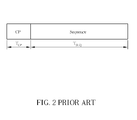
- FIG. 2 is a diagram of a physical layer random access preamble format according to the prior art.
- a physical layer random access preamble transmitted on PRACH resources consists of a cyclic prefix of length T CP and a preamble sequence of length T SEQ .
- Current MAC specification defines five preamble formats numbered from 0 to 4 for different length configurations of the cyclic prefix and the preamble sequence.
- T S is the basic time unit.
- the preamble sequence of the physical layer random access preamble is a Zadoff-Chu sequences generated from one or several root Zadoff-Chu sequences.
- the UE monitors the physical downlink control channel (PDCCH) for a random access response in a specific time window.
- PDU MAC protocol data unit
- RAPID random access preamble identifier
- the MAC random access response consists of reserved bit, timing advance command, UL grant, and temporary cell-RNTI.
- the UE MAC layer stops monitoring the PDCCH for the random access response after successful reception of a MAC PDU containing the MAC random access response and the random access preamble identifier that matches the transmitted random access preamble. After the MAC random access response is successfully received, the UE MAC layer processes the received UL grant and instructs the UE PHY layer to transmit the message 3 according to the UL grant.
- the UE when the UE is in the RRC idle mode, it is required to only monitor and/or camp one DL component carrier, called anchor component carrier.
- the UE In order to establish a radio link with the eNB, the UE performs the random access procedure, beginning with transmitting a random access preamble on the UL component carrier specified in the system information.
- the eNB Under carrier aggregation, when the eNB receives a random access preamble on the UL component carrier, the eNB does not know the DL component carrier (anchor component carrier) of the UE since there are more than one DL component carriers mapped to the UL component carrier. Consequently, the eNB does not know which DL component carrier it should transmit a corresponding random access response on. This problem is called the anchor component carrier confusion.
- a solution given in the prior art is that the eNB transmits the random access response on all DL component carriers.
- This solution requires no extra work for the LTE-advanced eNB and UE but wastes frequency resources.
- the DL carrier aggregation is much higher than the UL carrier aggregation, i.e. DL component carriers are much more than UL component carriers, the resulted resource waste is unacceptable.
- the LTE-Advanced specifications do not include solutions to determine the anchor component carrier efficiently.
- the wireless communication system 10 is composed of a network and a plurality of mobile devices.
- the wireless communication system 10 can be an LTE-Advanced system or any other similar network system supporting carrier aggregation functionality.
- the network can be referred as an E-UTRAN (evolved-UTRAN) comprising a plurality of eNBs, and the mobile devices are referred as user equipments (UEs).
- the UEs can be devices such as mobile phones, computer systems, etc.
- This terminology will be used throughout the application for ease of reference; however, this should not be construed as limiting the disclosure to any one particular type of network.
- the network and the UE may be seen as a transmitter or receiver according to transmission direction, e.g. for uplink (UL), the UE is the transmitter and the network is the receiver, and for downlink (DL), the network is the transmitter and the UE is the receiver.
- UL uplink
- DL downlink
- the communication device 20 can be the UE or the network shown in FIG. 4 and may include a processing means 200 such as a microprocessor or ASIC, a memory unit 210, and a communication interfacing unit 220.
- the memory unit 210 may be any data storage device that can store program code 214 for access by the processing means 200. Examples of the memory unit 210 include but are not limited to a subscriber identity module (SIM), read-only memory (ROM), flash memory, random-access memory (RAM), CD-ROM, magnetic tape, floppy disk, and optical data storage device.
- SIM subscriber identity module
- ROM read-only memory
- flash memory random-access memory
- CD-ROM compact disc-read-only memory
- magnetic tape magnetic tape
- floppy disk and optical data storage device.
- optical data storage device optical data storage device.
- the communication interfacing unit 220 is preferably a radio transceiver for wirelessly communicating according to processing results of the processing means 200.
- FIG. 6 is a flowchart of an exemplary process 60.
- the process 60 is utilized for improving component carrier identification in a random access procedure for a UE of the wireless communication system 10.
- the process 60 can be compiled into the program code 214.
- the process 60 includes the following steps:
- FIG. 7 is a flowchart of an exemplary process 70.
- the process 70 is utilized for improving component carrier identification in a random access procedure for a network of the wireless communication system 10, and is corresponding to the process 60.
- the process 70 can be compiled into the program code 214.
- the process 70 includes the following steps:
- the UE performing the process 60 cooperates with the eNB using the process 70.
- the UE MAC layer randomly selects a random access preamble from a selected preamble group that is included in information received from the UE RRC layer.
- the random access preamble may be assigned by the network.
- the information from the UE RRC layer also comprises available PRACH resources for transmission of the random access preamble.
- the UE transmits the random access preamble on an UL component carrier to the eNB by using a PRACH resource corresponding to an anchor component carrier, which is the only one component carrier that the UE monitors in the RRC idle mode.
- the UE transmits the random access preamble by using a first PRACH resource corresponding to the DL component carrier CC 1 , or transmits the random access preamble by using a second PRACH resource corresponding to the DL component carrier CC 2 , depending on whether the DL component carrier CC 1 or CC 2 is the anchor component carrier.
- the PRACH resource corresponding to each DL component carrier is different by frequency or transmission time interval (TTI).
- TTI transmission time interval
- the first PRACH resource corresponding to the DL component carrier CC 1 may be a first frequency resource different from a second frequency resource that is the second PRACH resource corresponding to the DL component carrier CC 2 .
- the first PRACH resource corresponding to the DL component carrier CC 1 may be a first TTI resource different from a second TTI resource that is the second PRACH resource corresponding to the DL component carrier CC 2 .
- the eNB For the eNB side, after the random access preamble is received, the eNB recognizes which PRACH resource is used for the UE transmitting the random access preamble, and identifies the anchor component carrier that the UE is on according to the PRACH resource used for the transmission of the random access preamble. For example, when the used PRACH resource is recognized as a first PRACH resource, the eNB identifies that the DL component carrier CC 1 corresponding to the first PRACH resource is the anchor component carrier. In other words, the eNB identifies that the UE is on the DL component carrier CC 1 .
- the eNB when the used PRACH resource is recognized as a second PRACH resource, the eNB identifies that the DL component carrier CC 2 corresponding to the second PRACH resource is the anchor component carrier, and so on. Therefore, the eNB can continue the rest of the random access procedure, to transmit a random access response to the UE on the anchor component carrier.
- the essential idea shown in the process 60 and the process 70 is the UE uses different PRACH resource corresponding to different DL component carrier to transmit the random access preamble, and the eNB identifies the anchor component carrier by different PRACH resource used for the transmission of the random access preamble.
- the eNB identifies the anchor component carrier that the UE is on as soon as possible, and it is not necessary for the eNB to transmit random access responses on all the DL component carriers.
- the process 60 and the process 70 make the anchor component carrier identification performed more efficiently and save radio resources.
- FIG. 8 is a flowchart of an exemplary process 80.
- the process 80 is utilized for improving component carrier identification in a random access procedure for a network of the wireless communication system 10.
- the process 80 can be compiled into the program code 214.
- the process 80 includes the following steps:
- FIG. 9 is a flowchart of an exemplary process 90.
- the process 90 is corresponding to the process 80, and is utilized for improving component carrier identification in a random access procedure for a UE of the wireless communication system 10.
- the process 90 can be compiled into the program code 214.
- the process 90 includes the following steps:
- the eNB After receiving a random access preamble from the UE, the eNB transmits random access responses RAR 1 -RAR N on the DL component carriers CC 1 -CC N to the UE respectively, i.e. the eNB transmits the random access response RAR 1 on the corresponding DL component carrier CC 1 , and transmits the random access response RAR 2 on the corresponding DL component carrier CC 2 , and so on, to the UE at Step 802.
- Each transmitted random access response includes an UL grant, which is corresponding to a DL component carrier and indicates the format of a message transmitted by the UE in response to the random access response.
- Step 802 the UE receives the random access response on the anchor component carrier at Step 902.
- the UE transmits, on the UL component carrier to the eNB, a message using the format indicated by the UL grant corresponding to the anchor component carrier and included in the received random access response at Step 904. This transmitted message is called "message 3" in the current specification.
- the eNB receives the message 3 at Step 804, recognizes the format of the message 3, and identifies the anchor component carrier according to the format of the message 3 at Step 806.
- the format of the message 3 is indicated by the UL grant included in the random access response sent on the anchor component carrier. For example, when the format of the message 3 is recognized as a first format, the eNB identifies that the DL component carrier CC 1 is the anchor component carrier because the random access response successfully received by the UE is the random access response RAR 1 which includes the UL grant indicating the first format. Similarly, the eNB identifies that the DL component carrier CC 2 is the anchor component carrier when the format of the message 3 is recognized as a second format.
- the UL grant indicates the format of a message 3 by carrying information of frequency, TTI and modulation and coding scheme (MCS), and therefore the UL grant for each DL component carrier may be different by carrying different information of frequency, TTI or MCS.
- a message 3 corresponding to the DL component carrier CC 1 may be transmitted by a frequency, TTI or MCS different from that by which a message 3 corresponding to the DL component carrier CC 2 may be transmitted.
- the process 80 can be performed after the process 70 while the process 90 can be performed after the process 60, so that the process 80 for the eNB and the process 90 for the UE provide the second chance to identify the anchor component carrier when the eNB cannot identify the anchor component carrier after the process 60 and the process 70 are performed.
- component carrier identification is provided such that the eNB can identify the anchor component carrier after receiving the random access preamble.
- FIG. 10 is a flowchart of an exemplary process 100.
- the process 100 is utilized for improving component carrier identification in a random access procedure for a UE of the wireless communication system 10.
- the process 100 can be compiled into the program code 214.
- the process 100 includes the following steps:
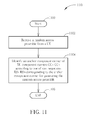
- FIG. 11 is a flowchart of an exemplary process 110.
- the process 110 is corresponding to the process 100, and is utilized for improving component carrier identification in a random access procedure for a network of the wireless communication system 10.
- the process 110 can be compiled into the program code 214.
- the process 110 includes the following steps:
- the UE performing the process 100 cooperates with the eNB using the process 110.
- the random access preamble stated in the process 100 and the process 110 is the physical layer random access preamble that is actually transmitted on the PRACH resource by the UE PHY layer.
- the physical layer random access preamble is generated by using a root sequence, which is a Zadoff-Chu sequence according to the current PHY specification.
- the UE PHY layer For the UE side, as the process 100, the UE PHY layer generates the physical layer random access preamble by using a root sequence corresponding to the anchor component carrier.
- the root sequence for each DL component carrier is different.
- the root sequence RS 1 used when the anchor component carrier is the DL component carrier CC 1 is different from the root sequence RS 2 used when the anchor component carrier is the DL component carrier CC 2 .
- the UE transmits the physical layer random access preamble generated by using the dedicated root sequence to the eNB.
- the eNB receives the physical layer random access preamble from the UE.
- the eNB can recognize which root sequence the UE uses to generate the physical layer random access preamble.
- the eNB identifies the anchor component carrier according to the root sequence. For example, the eNB identifies the DL component carrier CC 1 or CC 2 as the anchor component carrier when the root sequence is recognized as the root sequence RS 1 or the root sequence RS 2 .
- the process 100 and the process 110 may be performed independent to identify the anchor component carrier. In another embodiment, the process 100 and the process 110 may be performed in accompany with the process 60 and the process 70, or in accompany with the process 80 and the process 90 after the eNB receives the message 3 to have the second chance to identify the anchor component carrier.
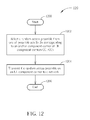
- FIG. 12 is a flowchart of an exemplary process 120.
- the process 120 is utilized for improving component carrier identification in a random access procedure for a UE of the wireless communication system 10.
- the process 120 can be compiled into the program code 214.
- the process 120 includes the following steps:
- FIG. 13 is a flowchart of an exemplary process 130.
- the process 130 is corresponding to the process 120, and is utilized for improving component carrier identification in a random access procedure for a network of the wireless communication system 10.
- the process 130 can be compiled into the program code 214.
- the process 130 includes the following steps:
- the UE performing the process 120 cooperates with the eNB using the process 130.
- the idea of the process 120 and the process 130 is dividing all the available random access preambles into multiple sets and each preamble set is mapped to at least one DL component carrier.
- the current 3GPP specification may require adding a parameter for indicating the preamble set.
- the UE selects a random access preamble from a preamble set corresponding to the anchor component carrier, and transmits the selected random access preamble.
- the eNB receives the random access preamble sent from the UE, and can recognize which preamble set the received random access preamble belongs to (based on associated parameters, for example.) The eNB identifies the anchor component carrier according to the preamble set the received random access preamble belongs to.
- the eNB identifies the DL component carrier CC 1 corresponding to the preamble set S 1 is the anchor component carrier; when the preamble set is recognized as the preamble set S 2 , the eNB identifies the DL component carrier CC 2 corresponding to the preamble set S 2 is the anchor component carrier.
- the process 120 and the process 130 may be performed independent to identify the anchor component carrier.
- the number of preamble sets K is not necessary to be equal to the number of the DL component carriers N, especially in the case of a large number of the DL component carriers.
- the eNB may not completely identify the anchor component carrier only according to the preamble set. In this condition, the UE and the eNB may perform the process 120 and the process 130 in combination with the aforementioned processes.
- the process 120 and the process 130 may be performed in combination with the process 60 and the process 70.
- the UE selects a random access preamble from one preamble set corresponding to an anchor component carrier (Step 1202) and transmits the selected random access preamble on the UL component carrier by using a PRACH resource corresponding to the anchor component carrier (Step 604).
- the eNB receives the random access preamble (Step 702 or Step 1302), and identifies the anchor component carrier according to both the PRACH resource used by the random access preamble and the preamble set which the received random access preamble belongs to.
- the process 120 and the process 130 may be performed in accompany with the process 80 and the process 90 after the eNB receives the message 3, to have the second chance to identify the anchor component carrier.
- steps of the processes 60, 70, 80, 90, 100, 110, 120 or 130 including suggested steps can be realized by means that could be hardware, firmware known as a combination of a hardware device and computer instructions and data that reside as read-only software on the hardware device, or an electronic system.
- hardware can include analog, digital and mixed circuits known as microcircuit, microchip, or silicon chip.
- the electronic system can include system on chip (SOC), system in package (Sip), computer on module (COM), and the communication device 20.
- SOC system on chip
- Sip system in package
- COM computer on module
- a UE under carrier aggregation uses different PRACH resource, different root sequence for generating the random access preamble, or different preamble set on each component carrier, and the eNB identifies the anchor component carrier the UE is on after receiving the random access preamble. Moreover, the eNB may send random access responses including different UL grants on all DL component carriers, and identifies the anchor component carrier after receiving the message 3. Through these exemplary processes and communication device, the eNB identifies the anchor component carrier as soon as possible and the problem of anchor component carrier confusion in the prior art is solved.
Landscapes
- Engineering & Computer Science (AREA)
- Computer Networks & Wireless Communication (AREA)
- Signal Processing (AREA)
- Mobile Radio Communication Systems (AREA)
Abstract
Description
- The present invention relates to a method of improving component carrier identification in a random access procedure in a wireless communication system and related communication device.
- A long-term evolution (LTE) system, initiated by the third generation partnership project (3GPP), is now being regarded as a new radio interface and radio network architecture that provides a high data rate, low latency, packet optimization, and improved system capacity and coverage. In the LTE system, an evolved universal terrestrial radio access network (E-UTRAN) includes a plurality of evolved Node-Bs (eNBs) and communicates with a plurality of mobile stations, also referred as user equipments (UEs). The LTE radio protocol stack includes the
Layer 3, also known as the Radio Resource Control (RRC) layer, theLayer 2, consisting of three sub-layers that are the Packet Data Convergence Protocol (PDCP) layer, the Radio Link Control (RLC) layer, and the Medium Access Control (MAC) layer, and theLayer 1, also known as the Physical (PHY) layer. - Recently, the 3GPP is involved in the further advancements for E-UTRA and proposes an LTE-Advanced system as an enhancement of the LTE system. Carrier aggregation, where two or more component carriers are aggregated, is introduced into the LTE-Advanced system in order to support wider transmission bandwidths, e.g. up to 100MHz and for spectrum aggregation. A UE of the LTE-Advanced system can simultaneously receive and/or transmit on multiple component carriers. Carrier aggregation allows a UE to aggregate a different number of component carriers of possibly different bandwidths in uplink (UL) and downlink (DL). In general, the number of component carriers and the bandwidth of each component carrier in UL and DL is the same in typical Time Division Duplexing (TDD) deployments. It would be reasonable for DL to have wider bandwidth than for UL, which means that it is possible that a UE has multiple DL component carriers match to a single UL component carrier.
- This in mind, the present invention aims at providing a method of improving component carrier identification in a random access procedure in a wireless communication system and related communication device, for improving efficiency of anchor component carrier identification in a random access procedure for the network of a wireless communication system.
- This is achieved by a method of improving component carrier identification in a random access procedure in a wireless communication system according to
claims - As will be seen more clearly from the detailed description following below, the claimed method for improving component carrier identification in a random access procedure for a UE of a wireless communication system includes transmitting a random access preamble on an UL component carrier to a network of the wireless communication system by using a PRACH resource corresponding to an anchor component carrier of a plurality of DL component carriers, so that the network identifies the anchor component carrier according to the PRACH resource used for transmitting the random access preamble.
-
-
FIG. 1 is a diagram illustrating the random access procedure according to the prior art. -
FIG. 2 is a diagram of a physical layer random access preamble format according to the prior art. -
FIG. 3 is a diagram of a MAC random access response according to the prior art. -
FIG. 4 is a schematic diagram of an exemplary wireless communication system. -
FIG. 5 is a schematic diagram of an exemplary communication device. -
FIG. 6 to FIG. 13 are flowcharts of exemplary processes. - A random access procedure is initiated by the UE MAC layer for different events, including initial access from the RRC idle mode, RRC connection re-establishment procedure, handover, and DL or UL data arrival during the RRC connected mode requiring the random access procedure. Please refer to
FIG. 1 , which is a diagram illustrating a contention-based random access procedure according to the prior art. As shown inFIG. 1 , the random access procedure consists of four steps, for transmitting (1) a random access preamble, from the UE to the eNB; (2) a random access response, from the eNB to the UE; (3) a scheduled transmission, calledmessage 3, from the UE to the eNB; and (4) a contention resolution message, from the eNB to the UE. Information for performing the random access procedure, e.g. the available set of physical random access channel (PRACH) resources for the transmission of the random access preamble (which are time and frequency resources), the groups of random access preambles, the set of available random access preambles in each preamble group, the random access response window size, etc., are available before the random access procedure is initiated, and are delivered and updated from the UE RRC layer. - The UE MAC layer performs a random access resource selection procedure to select a random access preamble within a selected random access preamble group and select a PRACH resource. Note that, the random access preamble transmitted on the RACH is a 6-bit random access preamble index. After the random access resource selection procedure is completed, the UE MAC layer instructs the UE PHY layer to transmit the random access preamble by using the selected PRACH resource, corresponding random access radio network temporary identifier (RA-RNTI), preamble index and predetermined preamble power. The UE can use a random access preamble selected from total 64 random access preambles, and the 64 random access preambles are divided into two preamble groups for the contention-based random access procedure and the non-contention-based random access procedure.
- Please refer to
FIG. 2 , which is a diagram of a physical layer random access preamble format according to the prior art. A physical layer random access preamble transmitted on PRACH resources consists of a cyclic prefix of length TCP and a preamble sequence of length TSEQ. Current MAC specification defines five preamble formats numbered from 0 to 4 for different length configurations of the cyclic prefix and the preamble sequence. For example, the preamble format 0 indicates TCP=3168 TS and TSEQ=24576 TS, and thepreamble format 1 is TCP=21024 TS and TSEQ=24576 TS, where TS is the basic time unit. The preamble sequence of the physical layer random access preamble is a Zadoff-Chu sequences generated from one or several root Zadoff-Chu sequences. - Once the random access preamble is transmitted, the UE monitors the physical downlink control channel (PDCCH) for a random access response in a specific time window. Please refer to
FIG. 3 , which is a diagram of a MAC random access response according to the prior art. The MAC random access response is in a MAC protocol data unit (PDU) following a corresponding MAC subheader including a 6-bit random access preamble identifier (RAPID), which indicates the transmitted random access preamble. The MAC random access response consists of reserved bit, timing advance command, UL grant, and temporary cell-RNTI. The UE MAC layer stops monitoring the PDCCH for the random access response after successful reception of a MAC PDU containing the MAC random access response and the random access preamble identifier that matches the transmitted random access preamble. After the MAC random access response is successfully received, the UE MAC layer processes the received UL grant and instructs the UE PHY layer to transmit themessage 3 according to the UL grant. - From the above, when the UE is in the RRC idle mode, it is required to only monitor and/or camp one DL component carrier, called anchor component carrier. In order to establish a radio link with the eNB, the UE performs the random access procedure, beginning with transmitting a random access preamble on the UL component carrier specified in the system information. Under carrier aggregation, when the eNB receives a random access preamble on the UL component carrier, the eNB does not know the DL component carrier (anchor component carrier) of the UE since there are more than one DL component carriers mapped to the UL component carrier. Consequently, the eNB does not know which DL component carrier it should transmit a corresponding random access response on. This problem is called the anchor component carrier confusion.
- To avoid the anchor component carrier confusion, a solution given in the prior art is that the eNB transmits the random access response on all DL component carriers. This solution requires no extra work for the LTE-advanced eNB and UE but wastes frequency resources. However, when the DL carrier aggregation is much higher than the UL carrier aggregation, i.e. DL component carriers are much more than UL component carriers, the resulted resource waste is unacceptable. At present, the LTE-Advanced specifications do not include solutions to determine the anchor component carrier efficiently.
- Please refer to
FIG. 4 , which illustrates a schematic diagram of an examplarywireless communication system 10. Briefly, thewireless communication system 10 is composed of a network and a plurality of mobile devices. Thewireless communication system 10 can be an LTE-Advanced system or any other similar network system supporting carrier aggregation functionality. In the LTE-Advanced system, the network can be referred as an E-UTRAN (evolved-UTRAN) comprising a plurality of eNBs, and the mobile devices are referred as user equipments (UEs). The UEs can be devices such as mobile phones, computer systems, etc. This terminology will be used throughout the application for ease of reference; however, this should not be construed as limiting the disclosure to any one particular type of network. In some examples, the network and the UE may be seen as a transmitter or receiver according to transmission direction, e.g. for uplink (UL), the UE is the transmitter and the network is the receiver, and for downlink (DL), the network is the transmitter and the UE is the receiver. - Please refer to
FIG. 5 , which is a schematic diagram of anexemplary communication device 20. Thecommunication device 20 can be the UE or the network shown inFIG. 4 and may include a processing means 200 such as a microprocessor or ASIC, amemory unit 210, and acommunication interfacing unit 220. Thememory unit 210 may be any data storage device that can storeprogram code 214 for access by the processing means 200. Examples of thememory unit 210 include but are not limited to a subscriber identity module (SIM), read-only memory (ROM), flash memory, random-access memory (RAM), CD-ROM, magnetic tape, floppy disk, and optical data storage device. Thecommunication interfacing unit 220 is preferably a radio transceiver for wirelessly communicating according to processing results of the processing means 200. - Please refer to
FIG. 6 , which is a flowchart of anexemplary process 60. Theprocess 60 is utilized for improving component carrier identification in a random access procedure for a UE of thewireless communication system 10. Theprocess 60 can be compiled into theprogram code 214. Theprocess 60 includes the following steps: - Step 600: Start.
- Step 602: Select a random access preamble.
- Step 604: Transmit the random access preamble on an UL component carrier by using a physical random access channel (PRACH) resource corresponding to an anchor component carrier of DL component carriers CC1-CCN.
- Step 606: End.
- Please refer to
FIG. 7 , which is a flowchart of anexemplary process 70. Theprocess 70 is utilized for improving component carrier identification in a random access procedure for a network of thewireless communication system 10, and is corresponding to theprocess 60. Theprocess 70 can be compiled into theprogram code 214. Theprocess 70 includes the following steps: - Step 700: Start.
- Step 702: Receive a random access preamble.
- Step 704: Identify an anchor component carrier of DL component carriers CC1-CCN according to a PRACH resource used for transmitting the random access preamble.
- Step 706: End.
- The UE performing the
process 60 cooperates with the eNB using theprocess 70. For the UE side, the UE MAC layer randomly selects a random access preamble from a selected preamble group that is included in information received from the UE RRC layer. In another embodiment, the random access preamble may be assigned by the network. The information from the UE RRC layer also comprises available PRACH resources for transmission of the random access preamble. After the random access preamble is selected, the UE transmits the random access preamble on an UL component carrier to the eNB by using a PRACH resource corresponding to an anchor component carrier, which is the only one component carrier that the UE monitors in the RRC idle mode. For example, the UE transmits the random access preamble by using a first PRACH resource corresponding to the DL component carrier CC1, or transmits the random access preamble by using a second PRACH resource corresponding to the DL component carrier CC2, depending on whether the DL component carrier CC1 or CC2 is the anchor component carrier. - The PRACH resource corresponding to each DL component carrier is different by frequency or transmission time interval (TTI). In other words, the first PRACH resource corresponding to the DL component carrier CC1 may be a first frequency resource different from a second frequency resource that is the second PRACH resource corresponding to the DL component carrier CC2. Or, the first PRACH resource corresponding to the DL component carrier CC1 may be a first TTI resource different from a second TTI resource that is the second PRACH resource corresponding to the DL component carrier CC2.
- For the eNB side, after the random access preamble is received, the eNB recognizes which PRACH resource is used for the UE transmitting the random access preamble, and identifies the anchor component carrier that the UE is on according to the PRACH resource used for the transmission of the random access preamble. For example, when the used PRACH resource is recognized as a first PRACH resource, the eNB identifies that the DL component carrier CC1 corresponding to the first PRACH resource is the anchor component carrier. In other words, the eNB identifies that the UE is on the DL component carrier CC1. Or, when the used PRACH resource is recognized as a second PRACH resource, the eNB identifies that the DL component carrier CC2 corresponding to the second PRACH resource is the anchor component carrier, and so on. Therefore, the eNB can continue the rest of the random access procedure, to transmit a random access response to the UE on the anchor component carrier.
- The essential idea shown in the
process 60 and theprocess 70 is the UE uses different PRACH resource corresponding to different DL component carrier to transmit the random access preamble, and the eNB identifies the anchor component carrier by different PRACH resource used for the transmission of the random access preamble. Through theprocess 60 and theprocess 70, the eNB identifies the anchor component carrier that the UE is on as soon as possible, and it is not necessary for the eNB to transmit random access responses on all the DL component carriers. Compared to the prior art, theprocess 60 and theprocess 70 make the anchor component carrier identification performed more efficiently and save radio resources. - The present invention provides another opportunity to identify the anchor component carrier after the transmission of the random access preamble when the eNB cannot identify the anchor component carrier. Please refer to
FIG. 8 , which is a flowchart of anexemplary process 80. Theprocess 80 is utilized for improving component carrier identification in a random access procedure for a network of thewireless communication system 10. Theprocess 80 can be compiled into theprogram code 214. Theprocess 80 includes the following steps: - Step 800: Start.
- Step 802: Transmit random access responses RAR1-RARN on DL component carriers CC1-CCN respectively to the UE, wherein each random access response RARi includes an UL grant corresponding to the DL component carrier CCi.
- Step 804: Receive a message from the UE.
- Step 806: Identify an anchor component carrier of the DL component carriers CC1-CCN according to the format of the message indicated by an UL grant included in one of the random access responses RAR1-RARN transmitted to the UE.
- Step 808: End.
- Please refer to
FIG. 9 , which is a flowchart of anexemplary process 90. Theprocess 90 is corresponding to theprocess 80, and is utilized for improving component carrier identification in a random access procedure for a UE of thewireless communication system 10. Theprocess 90 can be compiled into theprogram code 214. Theprocess 90 includes the following steps: - Step 900: Start.
- Step 902: Receive a random access response.
- Step 904: Transmit a message on an UL component carrier according to an UL grant corresponding to an anchor component carrier of DL component carriers CC1-CCN and included in the random access response.
- Step 906: End.
- After receiving a random access preamble from the UE, the eNB transmits random access responses RAR1-RARN on the DL component carriers CC1-CCN to the UE respectively, i.e. the eNB transmits the random access response RAR1 on the corresponding DL component carrier CC1, and transmits the random access response RAR2 on the corresponding DL component carrier CC2, and so on, to the UE at
Step 802. Each transmitted random access response includes an UL grant, which is corresponding to a DL component carrier and indicates the format of a message transmitted by the UE in response to the random access response. - After
Step 802 is performed, for the UE side, the UE receives the random access response on the anchor component carrier atStep 902. After the random access response is received, the UE transmits, on the UL component carrier to the eNB, a message using the format indicated by the UL grant corresponding to the anchor component carrier and included in the received random access response atStep 904. This transmitted message is called "message 3" in the current specification. - After
Step 904 is performed, for the eNB side, the eNB receives themessage 3 atStep 804, recognizes the format of themessage 3, and identifies the anchor component carrier according to the format of themessage 3 atStep 806. The format of themessage 3 is indicated by the UL grant included in the random access response sent on the anchor component carrier. For example, when the format of themessage 3 is recognized as a first format, the eNB identifies that the DL component carrier CC1 is the anchor component carrier because the random access response successfully received by the UE is the random access response RAR1 which includes the UL grant indicating the first format. Similarly, the eNB identifies that the DL component carrier CC2 is the anchor component carrier when the format of themessage 3 is recognized as a second format. - In this embodiment, the UL grant indicates the format of a
message 3 by carrying information of frequency, TTI and modulation and coding scheme (MCS), and therefore the UL grant for each DL component carrier may be different by carrying different information of frequency, TTI or MCS. In other words, amessage 3 corresponding to the DL component carrier CC1 may be transmitted by a frequency, TTI or MCS different from that by which amessage 3 corresponding to the DL component carrier CC2 may be transmitted. - In another embodiment, the
process 80 can be performed after theprocess 70 while theprocess 90 can be performed after theprocess 60, so that theprocess 80 for the eNB and theprocess 90 for the UE provide the second chance to identify the anchor component carrier when the eNB cannot identify the anchor component carrier after theprocess 60 and theprocess 70 are performed. Furthermore, another example of component carrier identification is provided such that the eNB can identify the anchor component carrier after receiving the random access preamble. Please refer toFIG. 10 , which is a flowchart of anexemplary process 100. Theprocess 100 is utilized for improving component carrier identification in a random access procedure for a UE of thewireless communication system 10. Theprocess 100 can be compiled into theprogram code 214. Theprocess 100 includes the following steps: - Step 1000: Start.
- Step 1002: Generate a random access preamble by using one of root sequences RS1-RSN corresponding to an anchor component carrier of DL component carriers CC1- CCN.
- Step 1004: Transmit the random access preamble on an UL component carrier to a network.
- Step 1006: End.
- Please refer to
FIG. 11 , which is a flowchart of anexemplary process 110. Theprocess 110 is corresponding to theprocess 100, and is utilized for improving component carrier identification in a random access procedure for a network of thewireless communication system 10. Theprocess 110 can be compiled into theprogram code 214. Theprocess 110 includes the following steps: - Step 1100: Start.
- Step 1102: Receive a random access preamble from a UE.
- Step 1104: Identify an anchor component carrier of DL component carriers CC1-CCN according to one of root sequences RS1-RSN corresponding to the anchor component carrier for generating the random access preamble.
- Step 1106: End.
- The UE performing the
process 100 cooperates with the eNB using theprocess 110. The random access preamble stated in theprocess 100 and theprocess 110 is the physical layer random access preamble that is actually transmitted on the PRACH resource by the UE PHY layer. The physical layer random access preamble is generated by using a root sequence, which is a Zadoff-Chu sequence according to the current PHY specification. - For the UE side, as the
process 100, the UE PHY layer generates the physical layer random access preamble by using a root sequence corresponding to the anchor component carrier. The root sequence for each DL component carrier is different. For example, the root sequence RS1 used when the anchor component carrier is the DL component carrier CC1 is different from the root sequence RS2 used when the anchor component carrier is the DL component carrier CC2. The UE transmits the physical layer random access preamble generated by using the dedicated root sequence to the eNB. - For the eNB side, as the
process 110, the eNB receives the physical layer random access preamble from the UE. The eNB can recognize which root sequence the UE uses to generate the physical layer random access preamble. After the root sequence is recognized and obtained, the eNB identifies the anchor component carrier according to the root sequence. For example, the eNB identifies the DL component carrier CC1 or CC2 as the anchor component carrier when the root sequence is recognized as the root sequence RS1 or the root sequence RS2. - The
process 100 and theprocess 110 may be performed independent to identify the anchor component carrier. In another embodiment, theprocess 100 and theprocess 110 may be performed in accompany with theprocess 60 and theprocess 70, or in accompany with theprocess 80 and theprocess 90 after the eNB receives themessage 3 to have the second chance to identify the anchor component carrier. - Another example of component carrier identification is provided as follows. Please refer to
FIG. 12 , which is a flowchart of anexemplary process 120. Theprocess 120 is utilized for improving component carrier identification in a random access procedure for a UE of thewireless communication system 10. Theprocess 120 can be compiled into theprogram code 214. Theprocess 120 includes the following steps: - Step 1200: Start.
- Step 1202: Select a random access preamble from one of preamble sets S1-SK corresponding to an anchor component carrier of DL component carriers CC1-CCN.
- Step 1204: Transmit the random access preamble on an UL component carrier to a network.
- Step 1206: End.
- Please refer to
FIG. 13 , which is a flowchart of anexemplary process 130. Theprocess 130 is corresponding to theprocess 120, and is utilized for improving component carrier identification in a random access procedure for a network of thewireless communication system 10. Theprocess 130 can be compiled into theprogram code 214. Theprocess 130 includes the following steps: - Step 1300: Start.
- Step 1302: Receive a random access preamble.
- Step 1304: Identify an anchor component carrier of DL component carriers CC1-CCN according to one of preamble sets S1-SK the random access preamble belongs to.
- Step 1306: End.
- The UE performing the
process 120 cooperates with the eNB using theprocess 130. The idea of theprocess 120 and theprocess 130 is dividing all the available random access preambles into multiple sets and each preamble set is mapped to at least one DL component carrier. To implement theprocess 120 and theprocess 130, the current 3GPP specification may require adding a parameter for indicating the preamble set. - For the UE side, as the
process 120, the UE selects a random access preamble from a preamble set corresponding to the anchor component carrier, and transmits the selected random access preamble. For the eNB side, as theprocess 130, the eNB receives the random access preamble sent from the UE, and can recognize which preamble set the received random access preamble belongs to (based on associated parameters, for example.) The eNB identifies the anchor component carrier according to the preamble set the received random access preamble belongs to. For example, when the preamble set is recognized as the preamble set S1, the eNB identifies the DL component carrier CC1 corresponding to the preamble set S1 is the anchor component carrier; when the preamble set is recognized as the preamble set S2, the eNB identifies the DL component carrier CC2 corresponding to the preamble set S2 is the anchor component carrier. - The
process 120 and theprocess 130 may be performed independent to identify the anchor component carrier. Note that, the number of preamble sets K is not necessary to be equal to the number of the DL component carriers N, especially in the case of a large number of the DL component carriers. When two or more DL component carriers correspond to the same preamble set, the eNB may not completely identify the anchor component carrier only according to the preamble set. In this condition, the UE and the eNB may perform theprocess 120 and theprocess 130 in combination with the aforementioned processes. - The
process 120 and theprocess 130 may be performed in combination with theprocess 60 and theprocess 70. For the UE side, the UE selects a random access preamble from one preamble set corresponding to an anchor component carrier (Step 1202) and transmits the selected random access preamble on the UL component carrier by using a PRACH resource corresponding to the anchor component carrier (Step 604). For the eNB side, the eNB receives the random access preamble (Step 702 or Step 1302), and identifies the anchor component carrier according to both the PRACH resource used by the random access preamble and the preamble set which the received random access preamble belongs to. In addition, theprocess 120 and theprocess 130 may be performed in accompany with theprocess 80 and theprocess 90 after the eNB receives themessage 3, to have the second chance to identify the anchor component carrier. - Please note that the abovementioned steps of the
processes communication device 20. - As will become apparent for the person skilled in the art when studying the present application, the aspects of any of the
dependent claims 2 to 5 or any related aspect as disclosed above, can of course be combined with the features of any of the independent claims, in particular withclaims 6, 8, 9, 10, 12, 14, 15. - In summary, according to the above exemplary processes and communication device, a UE under carrier aggregation uses different PRACH resource, different root sequence for generating the random access preamble, or different preamble set on each component carrier, and the eNB identifies the anchor component carrier the UE is on after receiving the random access preamble. Moreover, the eNB may send random access responses including different UL grants on all DL component carriers, and identifies the anchor component carrier after receiving the
message 3. Through these exemplary processes and communication device, the eNB identifies the anchor component carrier as soon as possible and the problem of anchor component carrier confusion in the prior art is solved.
Claims (15)
- A method of improving component carrier identification in a random access procedure for a user equipment of a wireless communication system (10), characterized by comprising:transmitting a random access preamble on an uplink component carrier to a
network of the wireless communication system by using a physical random access channel resource corresponding to an anchor component carrier of a plurality of downlink component carriers, so that the network identifies the anchor component carrier according to the physical random access channel resource used for transmitting the random access preamble (604). - The method of claim 1, characterized in that the physical random access channel resource corresponding to each of the plurality of downlink component carriers is different by frequency or transmission time interval.
- The method of claim 1 or 2, further comprising:selecting the random access preamble from a selected preamble group (602).
- The method of any of the preceding claims, characterized in that the random access preamble is assigned by the network.
- The method of any of the preceding claims, characterized in that the anchor component carrier is monitored by the user equipment.
- A method of improving component carrier identification in a random access procedure for a user equipment of a wireless communication system (10), the method comprising:receiving a random access response from a network of the wireless
communication system (902); andcharacterized by transmitting a message on an uplink component carrier to the
network according to an uplink grant, which is corresponding to an anchor component carrier of a plurality of downlink component carriers and included in the random access response, so that the network identifies the anchor component carrier according to a format of the message indicated by the uplink grant (904). - The method of claim 6, characterized in that the uplink grant for each of the plurality of downlink component carriers is different by carrying different information of frequency, transmission time interval, or modulation and coding scheme.
- A method of improving component carrier identification in a random access procedure for a user equipment of a wireless communication system (10), the method comprising:generating a random access preamble by using one of a plurality of root sequences corresponding to an anchor component carrier of a plurality of downlink component carriers, wherein the plurality of root sequences are different (1002); andcharacterized by transmitting the random access preamble on an uplink component carrier to a network of the wireless communication system, so that the network identifies the anchor component carrier according to the one of the plurality of root sequences for generating the random access preamble (1004).
- A method of improving component carrier identification in a random access procedure for a user equipment of a wireless communication system (10), the method comprising:selecting a random access preamble from one of a plurality of preamble sets corresponding to an anchor component carrier of a plurality of downlink component carriers (1202); andcharacterized by transmitting the random access preamble on an uplink component carrier to a network of the wireless communication system, so that the network identifies the anchor component carrier according to the one of preamble sets the random access preamble belongs to (1204).
- A method for improving component carrier identification in a random access procedure for a network of a wireless communication system (10), the method comprising:receiving a random access preamble transmitted from a user equipment of the
wireless communication system (702); andcharacterized by identifying an anchor component carrier of a plurality of downlink component carriers according to a physical random access channel resource used for transmitting the random access preamble (704). - The method of claim 10, characterized in that the physical random access channel resource corresponding to each of the plurality of downlink component carriers is different by frequency or transmission time interval.
- A method for improving component carrier identification in a random access procedure for a network of a wireless communication system (10), characterized by comprising:transmitting a plurality of random access responses on a plurality of downlink component carriers respectively to a user equipment of the wireless communication system, each random access response including an uplink grant corresponding to a corresponding one of the plurality of downlink component carriers (802);receiving a message from the user equipment (804); andidentifying an anchor component carrier of the plurality of downlink component carriers according to a format of the message indicated by the uplink grant included in one of the plurality of random access responses transmitted to the user equipment (806).
- The method of claim 12, characterized in that the uplink grant for each of the plurality of downlink component carriers is different by carrying different information of frequency, transmission time interval, or modulation and coding scheme.
- A method for improving component carrier identification in a random access procedure for a network of a wireless communication system (10), the method comprising:receiving, from a user equipment of the wireless communication system, a random access preamble generated by using one of a plurality of root sequences corresponding to an anchor component carrier of a plurality of downlink component carriers (1102); andcharacterized by identifying the anchor component carrier according to the one of the plurality of root sequences for generating the random access preamble (1104).
- A method for improving component carrier identification in a random access procedure for a network of a wireless communication system (10), the method comprising:receiving a random access preamble transmitted from a user equipment of the wireless communication system (1302); andcharacterized by identifying an anchor component carrier of a plurality of downlink component carriers according to one of a plurality of preamble sets the random access preamble belongs to (1304).
Applications Claiming Priority (2)
| Application Number | Priority Date | Filing Date | Title |
|---|---|---|---|
| US21939109P | 2009-06-23 | 2009-06-23 | |
| US12/821,110 US20100322096A1 (en) | 2009-06-23 | 2010-06-22 | Method of improving component carrier identification in a random access procedure in a wireless communication system and related communication device |
Publications (2)
| Publication Number | Publication Date |
|---|---|
| EP2273842A2 true EP2273842A2 (en) | 2011-01-12 |
| EP2273842A3 EP2273842A3 (en) | 2011-05-11 |
Family
ID=42668527
Family Applications (1)
| Application Number | Title | Priority Date | Filing Date |
|---|---|---|---|
| EP10167057A Withdrawn EP2273842A3 (en) | 2009-06-23 | 2010-06-23 | Improving component carrier identification in a random access procedure in a wireless communication system |
Country Status (4)
| Country | Link |
|---|---|
| US (1) | US20100322096A1 (en) |
| EP (1) | EP2273842A3 (en) |
| CN (1) | CN101932028A (en) |
| TW (1) | TW201129205A (en) |
Cited By (1)
| Publication number | Priority date | Publication date | Assignee | Title |
|---|---|---|---|---|
| EP2549822A1 (en) * | 2011-07-19 | 2013-01-23 | Industrial Technology Research Institute | Method of handling random access response |
Families Citing this family (21)
| Publication number | Priority date | Publication date | Assignee | Title |
|---|---|---|---|---|
| JP5322832B2 (en) * | 2009-08-06 | 2013-10-23 | シャープ株式会社 | Mobile station apparatus, base station apparatus, radio communication system, and random access method |
| US8588834B2 (en) * | 2009-08-23 | 2013-11-19 | Lg Electronics Inc. | Method of performing random access procedure in multiple component carrier or aggregated carrier system with contention resolution |
| CN102055700B (en) * | 2009-10-28 | 2015-06-03 | 中兴通讯股份有限公司 | Method and device for CC configuration in CA |
| JP4728434B1 (en) * | 2010-02-15 | 2011-07-20 | 株式会社エヌ・ティ・ティ・ドコモ | Mobile station and radio base station |
| KR20110113484A (en) * | 2010-04-09 | 2011-10-17 | 주식회사 팬택 | Apparatus and Method for Performing Random Access in Multi-Carrier System |
| US8666398B2 (en) * | 2010-04-13 | 2014-03-04 | Qualcomm Incorporated | Random access procedure enhancements for heterogeneous networks |
| CN102932907B (en) * | 2011-08-11 | 2016-03-09 | 华为技术有限公司 | A processing method and device for acquiring synchronization |
| CN103313419A (en) * | 2012-03-09 | 2013-09-18 | 上海贝尔股份有限公司 | Random access method and device |
| WO2014205723A1 (en) * | 2013-06-27 | 2014-12-31 | Telefonaktiebolaget L M Ericsson (Publ) | Method and apparatus for preamble determination |
| US20160227568A1 (en) * | 2015-01-30 | 2016-08-04 | Htc Corporation | Method of Handling Carrier Grouping and Related Communication Device |
| WO2016144082A1 (en) * | 2015-03-09 | 2016-09-15 | Lg Electronics Inc. | Method for operating a fast random access procedure in a wireless communication system and a device therefor |
| US20160270102A1 (en) * | 2015-03-14 | 2016-09-15 | Qualcomm Incorporated | Distributed scheduling to control interference for data transactions using grant-less transmissions |
| US10631330B2 (en) * | 2015-04-03 | 2020-04-21 | Qualcomm Incorporated | Random access procedures under coverage limitations |
| HUE046548T2 (en) * | 2015-09-25 | 2020-03-30 | Ericsson Telefon Ab L M | Procedures for providing UL support, including time domain design and associated wireless terminal and network node |
| US11297608B2 (en) * | 2016-06-03 | 2022-04-05 | Lg Electronics Inc. | Method for transmitting uplink control information in wireless communication system and device therefor |
| CN107734659B (en) * | 2016-08-11 | 2023-06-20 | 中兴通讯股份有限公司 | Random access carrier assignment method, device, and electronic equipment |
| US10568007B2 (en) | 2017-03-22 | 2020-02-18 | Comcast Cable Communications, Llc | Handover random access |
| US11057935B2 (en) | 2017-03-22 | 2021-07-06 | Comcast Cable Communications, Llc | Random access process in new radio |
| US11647543B2 (en) | 2017-03-23 | 2023-05-09 | Comcast Cable Communications, Llc | Power control for random access |
| US11844111B2 (en) * | 2017-11-08 | 2023-12-12 | Lg Electronics Inc. | Method for transmitting message for execution of random access procedure in wireless communication system and apparatus therefor |
| CN113973372B (en) * | 2020-07-24 | 2025-02-14 | 华为技术有限公司 | A method and device for sending and receiving information |
Family Cites Families (2)
| Publication number | Priority date | Publication date | Assignee | Title |
|---|---|---|---|---|
| EP1507422A1 (en) * | 2003-08-14 | 2005-02-16 | Matsushita Electric Industrial Co., Ltd. | Serving base station selection during soft handover |
| US7961700B2 (en) * | 2005-04-28 | 2011-06-14 | Qualcomm Incorporated | Multi-carrier operation in data transmission systems |
-
2010
- 2010-06-22 US US12/821,110 patent/US20100322096A1/en not_active Abandoned
- 2010-06-23 EP EP10167057A patent/EP2273842A3/en not_active Withdrawn
- 2010-06-23 TW TW099120524A patent/TW201129205A/en unknown
- 2010-06-23 CN CN2010102208190A patent/CN101932028A/en active Pending
Non-Patent Citations (1)
| Title |
|---|
| None |
Cited By (2)
| Publication number | Priority date | Publication date | Assignee | Title |
|---|---|---|---|---|
| EP2549822A1 (en) * | 2011-07-19 | 2013-01-23 | Industrial Technology Research Institute | Method of handling random access response |
| US9369980B2 (en) | 2011-07-19 | 2016-06-14 | Industrial Technology Research Institute | Method of handling random access response |
Also Published As
| Publication number | Publication date |
|---|---|
| TW201129205A (en) | 2011-08-16 |
| EP2273842A3 (en) | 2011-05-11 |
| US20100322096A1 (en) | 2010-12-23 |
| CN101932028A (en) | 2010-12-29 |
Similar Documents
| Publication | Publication Date | Title |
|---|---|---|
| US20100322096A1 (en) | Method of improving component carrier identification in a random access procedure in a wireless communication system and related communication device | |
| EP3641476B1 (en) | Transmitting random access response, access network device, and terminal device | |
| US8958317B2 (en) | Method and apparatus for performing random access in a multi-carrier system | |
| EP2680658B1 (en) | Method of handling random access response | |
| EP2675237B1 (en) | Wireless communication system, receiving device, transmitting device and method of wireless communication | |
| EP2705621B1 (en) | Methods and apparatus for random access procedures with carrier aggregation for lte-advanced systems | |
| EP2869654B1 (en) | Method of handling random access in wireless communication system | |
| CN114902781B (en) | Methods and user equipment for small data transmission | |
| EP2464186B1 (en) | Radio communication system, base station device, mobile station device and random access method | |
| CN107690173B (en) | Random access method and equipment | |
| CN117676904A (en) | A random access method, device and storage medium | |
| US20200374920A1 (en) | Method and apparatus for transmitting data in random access process | |
| CN109076600B (en) | Random access communication method, terminal and base station | |
| WO2020030087A1 (en) | Random access method, device and equipment, and storage medium | |
| CN102548015A (en) | Random access and random access control methods and devices, and random access system | |
| EP2987377B1 (en) | Method and ue for performing random access to base station, and method and base station for establishing connection with ue | |
| CN102572937B (en) | Random access method, base station and system in broadband cluster system | |
| CN109587811B (en) | Information acquisition method and terminal | |
| EP3427536B1 (en) | Classification of user equipment using extended set of random access preambles | |
| WO2017128889A1 (en) | Method, device and system for transmitting and receiving preamble sequence | |
| TWI511597B (en) | Method for preventing random access response collision | |
| EP2645792B1 (en) | Method of random access response reception | |
| EP3739802B1 (en) | Base station and search space allocation method thereof | |
| CN109617656B (en) | Terminal, base station and hybrid automatic repeat request HARQ process identifier ID configuration method | |
| US20240276558A1 (en) | Communication apparatus, base station, and communication method |
Legal Events
| Date | Code | Title | Description |
|---|---|---|---|
| PUAI | Public reference made under article 153(3) epc to a published international application that has entered the european phase |
Free format text: ORIGINAL CODE: 0009012 |
|
| 17P | Request for examination filed |
Effective date: 20100623 |
|
| AK | Designated contracting states |
Kind code of ref document: A2 Designated state(s): AL AT BE BG CH CY CZ DE DK EE ES FI FR GB GR HR HU IE IS IT LI LT LU LV MC MK MT NL NO PL PT RO SE SI SK SM TR |
|
| AX | Request for extension of the european patent |
Extension state: BA ME RS |
|
| PUAL | Search report despatched |
Free format text: ORIGINAL CODE: 0009013 |
|
| AK | Designated contracting states |
Kind code of ref document: A3 Designated state(s): AL AT BE BG CH CY CZ DE DK EE ES FI FR GB GR HR HU IE IS IT LI LT LU LV MC MK MT NL NO PL PT RO SE SI SK SM TR |
|
| AX | Request for extension of the european patent |
Extension state: BA ME RS |
|
| 17Q | First examination report despatched |
Effective date: 20110429 |
|
| STAA | Information on the status of an ep patent application or granted ep patent |
Free format text: STATUS: THE APPLICATION IS DEEMED TO BE WITHDRAWN |
|
| 18D | Application deemed to be withdrawn |
Effective date: 20110910 |