EP2272963A1 - Process for Preparation of Tacrolimus - Google Patents
Process for Preparation of Tacrolimus Download PDFInfo
- Publication number
- EP2272963A1 EP2272963A1 EP09165035A EP09165035A EP2272963A1 EP 2272963 A1 EP2272963 A1 EP 2272963A1 EP 09165035 A EP09165035 A EP 09165035A EP 09165035 A EP09165035 A EP 09165035A EP 2272963 A1 EP2272963 A1 EP 2272963A1
- Authority
- EP
- European Patent Office
- Prior art keywords
- seq
- gene
- coa
- microorganism
- gene according
- Prior art date
- Legal status (The legal status is an assumption and is not a legal conclusion. Google has not performed a legal analysis and makes no representation as to the accuracy of the status listed.)
- Ceased
Links
- QJJXYPPXXYFBGM-LFZNUXCKSA-N Tacrolimus Chemical compound C1C[C@@H](O)[C@H](OC)C[C@@H]1\C=C(/C)[C@@H]1[C@H](C)[C@@H](O)CC(=O)[C@H](CC=C)/C=C(C)/C[C@H](C)C[C@H](OC)[C@H]([C@H](C[C@H]2C)OC)O[C@@]2(O)C(=O)C(=O)N2CCCC[C@H]2C(=O)O1 QJJXYPPXXYFBGM-LFZNUXCKSA-N 0.000 title claims abstract description 148
- QJJXYPPXXYFBGM-SHYZHZOCSA-N tacrolimus Natural products CO[C@H]1C[C@H](CC[C@@H]1O)C=C(C)[C@H]2OC(=O)[C@H]3CCCCN3C(=O)C(=O)[C@@]4(O)O[C@@H]([C@H](C[C@H]4C)OC)[C@@H](C[C@H](C)CC(=C[C@@H](CC=C)C(=O)C[C@H](O)[C@H]2C)C)OC QJJXYPPXXYFBGM-SHYZHZOCSA-N 0.000 title claims abstract description 143
- 229960001967 tacrolimus Drugs 0.000 title claims abstract description 130
- 238000002360 preparation method Methods 0.000 title claims abstract description 35
- 238000000034 method Methods 0.000 title claims description 117
- 230000008569 process Effects 0.000 title claims description 85
- 108090000623 proteins and genes Proteins 0.000 claims abstract description 296
- 241001647839 Streptomyces tsukubensis Species 0.000 claims abstract description 88
- 230000015572 biosynthetic process Effects 0.000 claims abstract description 54
- 244000005700 microbiome Species 0.000 claims description 133
- 241000187747 Streptomyces Species 0.000 claims description 60
- 101150108672 ccr gene Proteins 0.000 claims description 48
- VUGZQVCBBBEZQE-VRQRJWBYSA-N Ethylmalonyl-CoA Chemical compound O[C@@H]1[C@H](OP(O)(O)=O)[C@@H](COP(O)(=O)OP(O)(=O)OCC(C)(C)C(O)C(=O)NCCC(=O)NCCSC(=O)C(C(O)=O)CC)O[C@H]1N1C2=NC=NC(N)=C2N=C1 VUGZQVCBBBEZQE-VRQRJWBYSA-N 0.000 claims description 47
- 239000002243 precursor Substances 0.000 claims description 45
- 102000004169 proteins and genes Human genes 0.000 claims description 35
- 108010030975 Polyketide Synthases Proteins 0.000 claims description 25
- 108010011384 acyl-CoA dehydrogenase (NADP+) Proteins 0.000 claims description 19
- 239000002773 nucleotide Substances 0.000 claims description 17
- 125000003729 nucleotide group Chemical group 0.000 claims description 17
- 108030005341 Ethylmalonyl-CoA mutases Proteins 0.000 claims description 15
- 230000004060 metabolic process Effects 0.000 claims description 14
- 238000012217 deletion Methods 0.000 claims description 13
- 230000037430 deletion Effects 0.000 claims description 13
- AEMOLEFTQBMNLQ-PKKLWIBTSA-N D-Alluronic Acid Chemical compound OC1O[C@H](C(O)=O)[C@@H](O)[C@@H](O)[C@H]1O AEMOLEFTQBMNLQ-PKKLWIBTSA-N 0.000 claims description 12
- MSWZFWKMSRAUBD-RSVSWTKNSA-N (3r,4s,5s,6r)-3-amino-6-(hydroxymethyl)oxane-2,4,5-triol Chemical compound N[C@H]1C(O)O[C@H](CO)[C@@H](O)[C@H]1O MSWZFWKMSRAUBD-RSVSWTKNSA-N 0.000 claims description 10
- 230000000694 effects Effects 0.000 claims description 10
- 230000005257 nucleotidylation Effects 0.000 claims description 6
- 238000006467 substitution reaction Methods 0.000 claims description 6
- 241000894006 Bacteria Species 0.000 claims description 3
- 101150045515 O gene Proteins 0.000 claims 1
- 238000004519 manufacturing process Methods 0.000 abstract description 86
- 238000000855 fermentation Methods 0.000 abstract description 47
- 230000004151 fermentation Effects 0.000 abstract description 47
- 229930001119 polyketide Natural products 0.000 abstract description 10
- 150000003839 salts Chemical class 0.000 abstract description 9
- 239000004606 Fillers/Extenders Substances 0.000 abstract description 6
- 150000003881 polyketide derivatives Chemical class 0.000 abstract description 6
- ZDQSOHOQTUFQEM-NURRSENYSA-N ascomycin Chemical compound C/C([C@H]1OC(=O)[C@@H]2CCCCN2C(=O)C(=O)[C@]2(O)O[C@@H]([C@H](C[C@H]2C)OC)[C@@H](OC)C[C@@H](C)C/C(C)=C/[C@H](C(C[C@H](O)[C@H]1C)=O)CC)=C\[C@@H]1CC[C@@H](O)[C@H](OC)C1 ZDQSOHOQTUFQEM-NURRSENYSA-N 0.000 description 68
- ZDQSOHOQTUFQEM-XCXYXIJFSA-N ascomycin Natural products CC[C@H]1C=C(C)C[C@@H](C)C[C@@H](OC)[C@H]2O[C@@](O)([C@@H](C)C[C@H]2OC)C(=O)C(=O)N3CCCC[C@@H]3C(=O)O[C@H]([C@H](C)[C@@H](O)CC1=O)C(=C[C@@H]4CC[C@@H](O)[C@H](C4)OC)C ZDQSOHOQTUFQEM-XCXYXIJFSA-N 0.000 description 55
- 239000002609 medium Substances 0.000 description 48
- 239000013598 vector Substances 0.000 description 46
- 108091028043 Nucleic acid sequence Proteins 0.000 description 23
- 241001602275 Streptomyces tsukubensis NRRL18488 Species 0.000 description 23
- 238000007792 addition Methods 0.000 description 23
- ULGZDMOVFRHVEP-RWJQBGPGSA-N Erythromycin Chemical compound O([C@@H]1[C@@H](C)C(=O)O[C@@H]([C@@]([C@H](O)[C@@H](C)C(=O)[C@H](C)C[C@@](C)(O)[C@H](O[C@H]2[C@@H]([C@H](C[C@@H](C)O2)N(C)C)O)[C@H]1C)(C)O)CC)[C@H]1C[C@@](C)(OC)[C@@H](O)[C@H](C)O1 ULGZDMOVFRHVEP-RWJQBGPGSA-N 0.000 description 22
- 239000012634 fragment Substances 0.000 description 22
- 150000001875 compounds Chemical class 0.000 description 21
- 108020004414 DNA Proteins 0.000 description 20
- 239000000047 product Substances 0.000 description 19
- NSFFHOGKXHRQEW-AIHSUZKVSA-N thiostrepton Chemical compound C([C@]12C=3SC=C(N=3)C(=O)N[C@H](C(=O)NC(/C=3SC[C@@H](N=3)C(=O)N[C@H](C=3SC=C(N=3)C(=O)N[C@H](C=3SC=C(N=3)[C@H]1N=1)[C@@H](C)OC(=O)C3=CC(=C4C=C[C@H]([C@@H](C4=N3)O)N[C@H](C(N[C@@H](C)C(=O)NC(=C)C(=O)N[C@@H](C)C(=O)N2)=O)[C@@H](C)CC)[C@H](C)O)[C@](C)(O)[C@@H](C)O)=C\C)[C@@H](C)O)CC=1C1=NC(C(=O)NC(=C)C(=O)NC(=C)C(N)=O)=CS1 NSFFHOGKXHRQEW-AIHSUZKVSA-N 0.000 description 19
- NSFFHOGKXHRQEW-UHFFFAOYSA-N Thiostrepton B Natural products N1C(=O)C(C)NC(=O)C(=C)NC(=O)C(C)NC(=O)C(C(C)CC)NC(C(C2=N3)O)C=CC2=C(C(C)O)C=C3C(=O)OC(C)C(C=2SC=C(N=2)C2N=3)NC(=O)C(N=4)=CSC=4C(C(C)(O)C(C)O)NC(=O)C(N=4)CSC=4C(=CC)NC(=O)C(C(C)O)NC(=O)C(N=4)=CSC=4C21CCC=3C1=NC(C(=O)NC(=C)C(=O)NC(=C)C(N)=O)=CS1 NSFFHOGKXHRQEW-UHFFFAOYSA-N 0.000 description 17
- 229950006334 apramycin Drugs 0.000 description 17
- XZNUGFQTQHRASN-XQENGBIVSA-N apramycin Chemical compound O([C@H]1O[C@@H]2[C@H](O)[C@@H]([C@H](O[C@H]2C[C@H]1N)O[C@@H]1[C@@H]([C@@H](O)[C@H](N)[C@@H](CO)O1)O)NC)[C@@H]1[C@@H](N)C[C@@H](N)[C@H](O)[C@H]1O XZNUGFQTQHRASN-XQENGBIVSA-N 0.000 description 17
- 238000010276 construction Methods 0.000 description 17
- 239000007362 sporulation medium Substances 0.000 description 17
- 229930188070 thiostrepton Natural products 0.000 description 17
- 229940063214 thiostrepton Drugs 0.000 description 17
- NSFFHOGKXHRQEW-OFMUQYBVSA-N thiostrepton A Natural products CC[C@H](C)[C@@H]1N[C@@H]2C=Cc3c(cc(nc3[C@H]2O)C(=O)O[C@H](C)[C@@H]4NC(=O)c5csc(n5)[C@@H](NC(=O)[C@H]6CSC(=N6)C(=CC)NC(=O)[C@@H](NC(=O)c7csc(n7)[C@]8(CCC(=N[C@@H]8c9csc4n9)c%10nc(cs%10)C(=O)NC(=C)C(=O)NC(=C)C(=O)N)NC(=O)[C@H](C)NC(=O)C(=C)NC(=O)[C@H](C)NC1=O)[C@@H](C)O)[C@](C)(O)[C@@H](C)O)[C@H](C)O NSFFHOGKXHRQEW-OFMUQYBVSA-N 0.000 description 17
- PEDCQBHIVMGVHV-UHFFFAOYSA-N Glycerine Chemical compound OCC(O)CO PEDCQBHIVMGVHV-UHFFFAOYSA-N 0.000 description 15
- 230000006801 homologous recombination Effects 0.000 description 13
- 238000002744 homologous recombination Methods 0.000 description 13
- HEMHJVSKTPXQMS-UHFFFAOYSA-M Sodium hydroxide Chemical compound [OH-].[Na+] HEMHJVSKTPXQMS-UHFFFAOYSA-M 0.000 description 12
- 101150031548 ecm gene Proteins 0.000 description 12
- 108091008053 gene clusters Proteins 0.000 description 12
- 239000013612 plasmid Substances 0.000 description 12
- 108091008146 restriction endonucleases Proteins 0.000 description 12
- 235000010633 broth Nutrition 0.000 description 11
- 229960003276 erythromycin Drugs 0.000 description 11
- 125000003903 2-propenyl group Chemical group [H]C([*])([H])C([H])=C([H])[H] 0.000 description 10
- VTYYLEPIZMXCLO-UHFFFAOYSA-L Calcium carbonate Chemical compound [Ca+2].[O-]C([O-])=O VTYYLEPIZMXCLO-UHFFFAOYSA-L 0.000 description 10
- 102000004190 Enzymes Human genes 0.000 description 10
- 108090000790 Enzymes Proteins 0.000 description 10
- FAPWRFPIFSIZLT-UHFFFAOYSA-M Sodium chloride Chemical compound [Na+].[Cl-] FAPWRFPIFSIZLT-UHFFFAOYSA-M 0.000 description 10
- 230000006696 biosynthetic metabolic pathway Effects 0.000 description 10
- CRFNGMNYKDXRTN-CITAKDKDSA-N butyryl-CoA Chemical compound O[C@@H]1[C@H](OP(O)(O)=O)[C@@H](COP(O)(=O)OP(O)(=O)OCC(C)(C)[C@@H](O)C(=O)NCCC(=O)NCCSC(=O)CCC)O[C@H]1N1C2=NC=NC(N)=C2N=C1 CRFNGMNYKDXRTN-CITAKDKDSA-N 0.000 description 10
- 230000003115 biocidal effect Effects 0.000 description 9
- 238000013461 design Methods 0.000 description 9
- 230000002018 overexpression Effects 0.000 description 9
- 239000013587 production medium Substances 0.000 description 9
- CSNNHWWHGAXBCP-UHFFFAOYSA-L Magnesium sulfate Chemical compound [Mg+2].[O-][S+2]([O-])([O-])[O-] CSNNHWWHGAXBCP-UHFFFAOYSA-L 0.000 description 8
- 108700026244 Open Reading Frames Proteins 0.000 description 8
- 150000001413 amino acids Chemical class 0.000 description 8
- 238000004458 analytical method Methods 0.000 description 8
- 238000009396 hybridization Methods 0.000 description 8
- 235000015097 nutrients Nutrition 0.000 description 8
- 230000001954 sterilising effect Effects 0.000 description 8
- 238000004659 sterilization and disinfection Methods 0.000 description 8
- 102000057234 Acyl transferases Human genes 0.000 description 7
- 108700016155 Acyl transferases Proteins 0.000 description 7
- WQZGKKKJIJFFOK-GASJEMHNSA-N Glucose Natural products OC[C@H]1OC(O)[C@H](O)[C@@H](O)[C@@H]1O WQZGKKKJIJFFOK-GASJEMHNSA-N 0.000 description 7
- 229910052799 carbon Inorganic materials 0.000 description 7
- KFWWCMJSYSSPSK-PAXLJYGASA-N crotonoyl-CoA Chemical compound O[C@@H]1[C@H](OP(O)(O)=O)[C@@H](COP(O)(=O)OP(O)(=O)OCC(C)(C)[C@@H](O)C(=O)NCCC(=O)NCCSC(=O)/C=C/C)O[C@H]1N1C2=NC=NC(N)=C2N=C1 KFWWCMJSYSSPSK-PAXLJYGASA-N 0.000 description 7
- 239000008103 glucose Substances 0.000 description 7
- 238000004128 high performance liquid chromatography Methods 0.000 description 7
- 239000000203 mixture Substances 0.000 description 7
- 230000002829 reductive effect Effects 0.000 description 7
- 238000011218 seed culture Methods 0.000 description 7
- CSCPPACGZOOCGX-UHFFFAOYSA-N Acetone Chemical compound CC(C)=O CSCPPACGZOOCGX-UHFFFAOYSA-N 0.000 description 6
- IJGRMHOSHXDMSA-UHFFFAOYSA-N Atomic nitrogen Chemical compound N#N IJGRMHOSHXDMSA-UHFFFAOYSA-N 0.000 description 6
- OKKJLVBELUTLKV-UHFFFAOYSA-N Methanol Chemical compound OC OKKJLVBELUTLKV-UHFFFAOYSA-N 0.000 description 6
- 238000006243 chemical reaction Methods 0.000 description 6
- 230000021615 conjugation Effects 0.000 description 6
- ZPWVASYFFYYZEW-UHFFFAOYSA-L dipotassium hydrogen phosphate Chemical compound [K+].[K+].OP([O-])([O-])=O ZPWVASYFFYYZEW-UHFFFAOYSA-L 0.000 description 6
- 229910000396 dipotassium phosphate Inorganic materials 0.000 description 6
- -1 ethylmalonyl- Chemical group 0.000 description 6
- 230000006870 function Effects 0.000 description 6
- 238000011081 inoculation Methods 0.000 description 6
- OKTJSMMVPCPJKN-UHFFFAOYSA-N Carbon Chemical compound [C] OKTJSMMVPCPJKN-UHFFFAOYSA-N 0.000 description 5
- 229920001353 Dextrin Polymers 0.000 description 5
- 239000004375 Dextrin Substances 0.000 description 5
- 102000004316 Oxidoreductases Human genes 0.000 description 5
- 108090000854 Oxidoreductases Proteins 0.000 description 5
- 101150053185 P450 gene Proteins 0.000 description 5
- 108091000039 acetoacetyl-CoA reductase Proteins 0.000 description 5
- 101150040210 allR gene Proteins 0.000 description 5
- 229910000019 calcium carbonate Inorganic materials 0.000 description 5
- 238000004113 cell culture Methods 0.000 description 5
- 230000008021 deposition Effects 0.000 description 5
- 238000001514 detection method Methods 0.000 description 5
- 235000019425 dextrin Nutrition 0.000 description 5
- 230000002779 inactivation Effects 0.000 description 5
- 239000007788 liquid Substances 0.000 description 5
- 230000004048 modification Effects 0.000 description 5
- 238000012986 modification Methods 0.000 description 5
- 230000037361 pathway Effects 0.000 description 5
- 125000000830 polyketide group Chemical group 0.000 description 5
- ZAHRKKWIAAJSAO-UHFFFAOYSA-N rapamycin Natural products COCC(O)C(=C/C(C)C(=O)CC(OC(=O)C1CCCCN1C(=O)C(=O)C2(O)OC(CC(OC)C(=CC=CC=CC(C)CC(C)C(=O)C)C)CCC2C)C(C)CC3CCC(O)C(C3)OC)C ZAHRKKWIAAJSAO-UHFFFAOYSA-N 0.000 description 5
- QFJCIRLUMZQUOT-HPLJOQBZSA-N sirolimus Chemical compound C1C[C@@H](O)[C@H](OC)C[C@@H]1C[C@@H](C)[C@H]1OC(=O)[C@@H]2CCCCN2C(=O)C(=O)[C@](O)(O2)[C@H](C)CC[C@H]2C[C@H](OC)/C(C)=C/C=C/C=C/[C@@H](C)C[C@@H](C)C(=O)[C@H](OC)[C@H](O)/C(C)=C/[C@@H](C)C(=O)C1 QFJCIRLUMZQUOT-HPLJOQBZSA-N 0.000 description 5
- 229960002930 sirolimus Drugs 0.000 description 5
- 239000011780 sodium chloride Substances 0.000 description 5
- 239000007858 starting material Substances 0.000 description 5
- 239000000725 suspension Substances 0.000 description 5
- 238000012546 transfer Methods 0.000 description 5
- QTBSBXVTEAMEQO-UHFFFAOYSA-N Acetic acid Chemical group CC(O)=O QTBSBXVTEAMEQO-UHFFFAOYSA-N 0.000 description 4
- 241000203809 Actinomycetales Species 0.000 description 4
- 101710146995 Acyl carrier protein Proteins 0.000 description 4
- 108010001058 Acyl-CoA Dehydrogenase Proteins 0.000 description 4
- 102000002735 Acyl-CoA Dehydrogenase Human genes 0.000 description 4
- 108030005217 Isobutyryl-CoA mutases Proteins 0.000 description 4
- KDXKERNSBIXSRK-YFKPBYRVSA-N L-lysine Chemical compound NCCCC[C@H](N)C(O)=O KDXKERNSBIXSRK-YFKPBYRVSA-N 0.000 description 4
- 108010043135 L-methionine gamma-lyase Proteins 0.000 description 4
- 241000124008 Mammalia Species 0.000 description 4
- 229910021380 Manganese Chloride Inorganic materials 0.000 description 4
- GLFNIEUTAYBVOC-UHFFFAOYSA-L Manganese chloride Chemical compound Cl[Mn]Cl GLFNIEUTAYBVOC-UHFFFAOYSA-L 0.000 description 4
- 102100027913 Peptidyl-prolyl cis-trans isomerase FKBP1A Human genes 0.000 description 4
- 238000002105 Southern blotting Methods 0.000 description 4
- 238000005273 aeration Methods 0.000 description 4
- 238000013019 agitation Methods 0.000 description 4
- 230000003321 amplification Effects 0.000 description 4
- 230000001851 biosynthetic effect Effects 0.000 description 4
- 238000010367 cloning Methods 0.000 description 4
- RQYGKZGKXDOUEO-HHRHWXIDSA-N dihydro-fk 506 Chemical compound C/C([C@H]1OC(=O)[C@@H]2CCCCN2C(=O)C(=O)[C@]2(O)OC([C@H](C[C@H]2C)OC)[C@@H](OC)C[C@@H](C)C/C(C)=C/[C@H](C(C[C@H](O)[C@H]1C)=O)CCC)=C\[C@@H]1CC[C@@H](O)[C@H](OC)C1 RQYGKZGKXDOUEO-HHRHWXIDSA-N 0.000 description 4
- RQYGKZGKXDOUEO-UHFFFAOYSA-N dihydrotacrolimus Natural products CC1C(O)CC(=O)C(CCC)C=C(C)CC(C)CC(OC)C(C(CC2C)OC)OC2(O)C(=O)C(=O)N2CCCCC2C(=O)OC1C(C)=CC1CCC(O)C(OC)C1 RQYGKZGKXDOUEO-UHFFFAOYSA-N 0.000 description 4
- 239000003814 drug Substances 0.000 description 4
- 238000002474 experimental method Methods 0.000 description 4
- 238000012262 fermentative production Methods 0.000 description 4
- 239000001963 growth medium Substances 0.000 description 4
- 230000001506 immunosuppresive effect Effects 0.000 description 4
- 229910000359 iron(II) sulfate Inorganic materials 0.000 description 4
- AEWHYWSPVRZHCT-NDZSKPAWSA-N isobutyryl-CoA Chemical compound O[C@@H]1[C@H](OP(O)(O)=O)[C@@H](COP(O)(=O)OP(O)(=O)OCC(C)(C)[C@@H](O)C(=O)NCCC(=O)NCCSC(=O)C(C)C)O[C@H]1N1C2=NC=NC(N)=C2N=C1 AEWHYWSPVRZHCT-NDZSKPAWSA-N 0.000 description 4
- 238000002372 labelling Methods 0.000 description 4
- 229910052943 magnesium sulfate Inorganic materials 0.000 description 4
- 239000011565 manganese chloride Substances 0.000 description 4
- 238000003199 nucleic acid amplification method Methods 0.000 description 4
- 239000008194 pharmaceutical composition Substances 0.000 description 4
- 230000009467 reduction Effects 0.000 description 4
- 230000001105 regulatory effect Effects 0.000 description 4
- 230000010076 replication Effects 0.000 description 4
- 239000000523 sample Substances 0.000 description 4
- 238000003786 synthesis reaction Methods 0.000 description 4
- 230000002103 transcriptional effect Effects 0.000 description 4
- 238000012070 whole genome sequencing analysis Methods 0.000 description 4
- NWONKYPBYAMBJT-UHFFFAOYSA-L zinc sulfate Chemical compound [Zn+2].[O-]S([O-])(=O)=O NWONKYPBYAMBJT-UHFFFAOYSA-L 0.000 description 4
- 229910000368 zinc sulfate Inorganic materials 0.000 description 4
- 239000011686 zinc sulphate Substances 0.000 description 4
- WEVYAHXRMPXWCK-UHFFFAOYSA-N Acetonitrile Chemical compound CC#N WEVYAHXRMPXWCK-UHFFFAOYSA-N 0.000 description 3
- 229920001817 Agar Polymers 0.000 description 3
- 206010010144 Completed suicide Diseases 0.000 description 3
- PMATZTZNYRCHOR-CGLBZJNRSA-N Cyclosporin A Chemical compound CC[C@@H]1NC(=O)[C@H]([C@H](O)[C@H](C)C\C=C\C)N(C)C(=O)[C@H](C(C)C)N(C)C(=O)[C@H](CC(C)C)N(C)C(=O)[C@H](CC(C)C)N(C)C(=O)[C@@H](C)NC(=O)[C@H](C)NC(=O)[C@H](CC(C)C)N(C)C(=O)[C@H](C(C)C)NC(=O)[C@H](CC(C)C)N(C)C(=O)CN(C)C1=O PMATZTZNYRCHOR-CGLBZJNRSA-N 0.000 description 3
- 108010036949 Cyclosporine Proteins 0.000 description 3
- 241000588724 Escherichia coli Species 0.000 description 3
- LFQSCWFLJHTTHZ-UHFFFAOYSA-N Ethanol Chemical compound CCO LFQSCWFLJHTTHZ-UHFFFAOYSA-N 0.000 description 3
- 102000009114 Fatty acid desaturases Human genes 0.000 description 3
- 108010087894 Fatty acid desaturases Proteins 0.000 description 3
- 235000010469 Glycine max Nutrition 0.000 description 3
- 241000282414 Homo sapiens Species 0.000 description 3
- 241001465754 Metazoa Species 0.000 description 3
- 102000008109 Mixed Function Oxygenases Human genes 0.000 description 3
- 108010074633 Mixed Function Oxygenases Proteins 0.000 description 3
- 238000012408 PCR amplification Methods 0.000 description 3
- 101100397226 Schizosaccharomyces pombe (strain 972 / ATCC 24843) isp4 gene Proteins 0.000 description 3
- 238000012300 Sequence Analysis Methods 0.000 description 3
- 235000019764 Soybean Meal Nutrition 0.000 description 3
- 229920002472 Starch Polymers 0.000 description 3
- 241000187180 Streptomyces sp. Species 0.000 description 3
- 108010006877 Tacrolimus Binding Protein 1A Proteins 0.000 description 3
- WDJHALXBUFZDSR-UHFFFAOYSA-M acetoacetate Chemical compound CC(=O)CC([O-])=O WDJHALXBUFZDSR-UHFFFAOYSA-M 0.000 description 3
- 239000002253 acid Substances 0.000 description 3
- 239000008272 agar Substances 0.000 description 3
- 235000001014 amino acid Nutrition 0.000 description 3
- BFNBIHQBYMNNAN-UHFFFAOYSA-N ammonium sulfate Chemical compound N.N.OS(O)(=O)=O BFNBIHQBYMNNAN-UHFFFAOYSA-N 0.000 description 3
- 229910052921 ammonium sulfate Inorganic materials 0.000 description 3
- 239000002585 base Substances 0.000 description 3
- 239000006227 byproduct Substances 0.000 description 3
- 229940041514 candida albicans extract Drugs 0.000 description 3
- 229960001265 ciclosporin Drugs 0.000 description 3
- 239000013599 cloning vector Substances 0.000 description 3
- 229930182912 cyclosporin Natural products 0.000 description 3
- 230000001419 dependent effect Effects 0.000 description 3
- VQAZCUCWHIIFGE-UHFFFAOYSA-N diethyl 2-ethylpropanedioate Chemical compound CCOC(=O)C(CC)C(=O)OCC VQAZCUCWHIIFGE-UHFFFAOYSA-N 0.000 description 3
- GDWAYKGILJJNBB-UHFFFAOYSA-N diethyl 2-prop-2-enylpropanedioate Chemical compound CCOC(=O)C(CC=C)C(=O)OCC GDWAYKGILJJNBB-UHFFFAOYSA-N 0.000 description 3
- 201000010099 disease Diseases 0.000 description 3
- 208000037265 diseases, disorders, signs and symptoms Diseases 0.000 description 3
- 238000003306 harvesting Methods 0.000 description 3
- 230000000415 inactivating effect Effects 0.000 description 3
- 230000000670 limiting effect Effects 0.000 description 3
- 239000003120 macrolide antibiotic agent Substances 0.000 description 3
- 239000012528 membrane Substances 0.000 description 3
- 229910052757 nitrogen Inorganic materials 0.000 description 3
- RXUATCUKICAIOA-ZMHDXICWSA-N pentanoyl-CoA Chemical compound O[C@@H]1[C@H](OP(O)(O)=O)[C@@H](COP(O)(=O)OP(O)(=O)OCC(C)(C)[C@@H](O)C(=O)NCCC(=O)NCCSC(=O)CCCC)O[C@H]1N1C2=NC=NC(N)=C2N=C1 RXUATCUKICAIOA-ZMHDXICWSA-N 0.000 description 3
- QAQREVBBADEHPA-IEXPHMLFSA-N propionyl-CoA Chemical compound O[C@@H]1[C@H](OP(O)(O)=O)[C@@H](COP(O)(=O)OP(O)(=O)OCC(C)(C)[C@@H](O)C(=O)NCCC(=O)NCCSC(=O)CC)O[C@H]1N1C2=NC=NC(N)=C2N=C1 QAQREVBBADEHPA-IEXPHMLFSA-N 0.000 description 3
- 238000000746 purification Methods 0.000 description 3
- 238000011084 recovery Methods 0.000 description 3
- 238000000926 separation method Methods 0.000 description 3
- 239000000243 solution Substances 0.000 description 3
- 239000004455 soybean meal Substances 0.000 description 3
- 239000008107 starch Substances 0.000 description 3
- 235000019698 starch Nutrition 0.000 description 3
- 239000000758 substrate Substances 0.000 description 3
- 150000007970 thio esters Chemical class 0.000 description 3
- 239000012138 yeast extract Substances 0.000 description 3
- OAJLVMGLJZXSGX-SLAFOUTOSA-L (2s,3s,4r,5r)-2-(6-aminopurin-9-yl)-5-methanidyloxolane-3,4-diol;cobalt(3+);[(2r,3s,4r,5s)-5-(5,6-dimethylbenzimidazol-1-yl)-4-hydroxy-2-(hydroxymethyl)oxolan-3-yl] [(2r)-1-[3-[(1r,2r,3r,4z,7s,9z,12s,13s,14z,17s,18s,19r)-2,13,18-tris(2-amino-2-oxoethyl)-7 Chemical compound [Co+3].O[C@H]1[C@@H](O)[C@@H]([CH2-])O[C@@H]1N1C2=NC=NC(N)=C2N=C1.[N-]([C@@H]1[C@H](CC(N)=O)[C@@]2(C)CCC(=O)NC[C@@H](C)OP([O-])(=O)O[C@H]3[C@H]([C@H](O[C@@H]3CO)N3C4=CC(C)=C(C)C=C4N=C3)O)\C2=C(C)/C([C@H](C\2(C)C)CCC(N)=O)=N/C/2=C\C([C@H]([C@@]/2(CC(N)=O)C)CCC(N)=O)=N\C\2=C(C)/C2=N[C@]1(C)[C@@](C)(CC(N)=O)[C@@H]2CCC(N)=O OAJLVMGLJZXSGX-SLAFOUTOSA-L 0.000 description 2
- 101150084750 1 gene Proteins 0.000 description 2
- KIJUWBPJFSIWKM-XGXNYEOVSA-N 2-[2-[3-[[(2r)-4-[[[(2r,3s,4r,5r)-5-(6-aminopurin-9-yl)-4-hydroxy-3-phosphonooxyoxolan-2-yl]methoxy-hydroxyphosphoryl]oxy-hydroxyphosphoryl]oxy-2-hydroxy-3,3-dimethylbutanoyl]amino]propanoylamino]ethylsulfanylcarbonyl]pentanoic acid Chemical compound O[C@@H]1[C@H](OP(O)(O)=O)[C@@H](COP(O)(=O)OP(O)(=O)OCC(C)(C)[C@@H](O)C(=O)NCCC(=O)NCCSC(=O)C(C(O)=O)CCC)O[C@H]1N1C2=NC=NC(N)=C2N=C1 KIJUWBPJFSIWKM-XGXNYEOVSA-N 0.000 description 2
- FHSUFDYFOHSYHI-UHFFFAOYSA-N 3-oxopentanoic acid Chemical compound CCC(=O)CC(O)=O FHSUFDYFOHSYHI-UHFFFAOYSA-N 0.000 description 2
- UXVMQQNJUSDDNG-UHFFFAOYSA-L Calcium chloride Chemical compound [Cl-].[Cl-].[Ca+2] UXVMQQNJUSDDNG-UHFFFAOYSA-L 0.000 description 2
- 108010076119 Caseins Proteins 0.000 description 2
- 108010017826 DNA Polymerase I Proteins 0.000 description 2
- 102000004594 DNA Polymerase I Human genes 0.000 description 2
- 108020003215 DNA Probes Proteins 0.000 description 2
- 239000003298 DNA probe Substances 0.000 description 2
- 241000282412 Homo Species 0.000 description 2
- XEEYBQQBJWHFJM-UHFFFAOYSA-N Iron Chemical compound [Fe] XEEYBQQBJWHFJM-UHFFFAOYSA-N 0.000 description 2
- 235000019766 L-Lysine Nutrition 0.000 description 2
- 239000004472 Lysine Substances 0.000 description 2
- 239000004677 Nylon Substances 0.000 description 2
- GFWWNHAKPFNCQB-ZMHDXICWSA-N O[C@@H]1[C@H](OP(O)(O)=O)[C@@H](COP(O)(=O)OP(O)(=O)OCC(C)(C)[C@@H](O)C(=O)NCCC(=O)NCCSC(=O)CCC=C)O[C@H]1N1C2=NC=NC(N)=C2N=C1 Chemical compound O[C@@H]1[C@H](OP(O)(O)=O)[C@@H](COP(O)(=O)OP(O)(=O)OCC(C)(C)[C@@H](O)C(=O)NCCC(=O)NCCSC(=O)CCC=C)O[C@H]1N1C2=NC=NC(N)=C2N=C1 GFWWNHAKPFNCQB-ZMHDXICWSA-N 0.000 description 2
- 239000001888 Peptone Substances 0.000 description 2
- 108010080698 Peptones Proteins 0.000 description 2
- 241000905500 Streptomyces hygroscopicus subsp. ascomyceticus Species 0.000 description 2
- 102000013530 TOR Serine-Threonine Kinases Human genes 0.000 description 2
- 108010065917 TOR Serine-Threonine Kinases Proteins 0.000 description 2
- 239000013543 active substance Substances 0.000 description 2
- 239000000654 additive Substances 0.000 description 2
- 239000001166 ammonium sulphate Substances 0.000 description 2
- 235000011130 ammonium sulphate Nutrition 0.000 description 2
- 239000002518 antifoaming agent Substances 0.000 description 2
- 230000000903 blocking effect Effects 0.000 description 2
- 230000008499 blood brain barrier function Effects 0.000 description 2
- 210000001218 blood-brain barrier Anatomy 0.000 description 2
- 239000001110 calcium chloride Substances 0.000 description 2
- 229910001628 calcium chloride Inorganic materials 0.000 description 2
- 239000005018 casein Substances 0.000 description 2
- BECPQYXYKAMYBN-UHFFFAOYSA-N casein, tech. Chemical compound NCCCCC(C(O)=O)N=C(O)C(CC(O)=O)N=C(O)C(CCC(O)=N)N=C(O)C(CC(C)C)N=C(O)C(CCC(O)=O)N=C(O)C(CC(O)=O)N=C(O)C(CCC(O)=O)N=C(O)C(C(C)O)N=C(O)C(CCC(O)=N)N=C(O)C(CCC(O)=N)N=C(O)C(CCC(O)=N)N=C(O)C(CCC(O)=O)N=C(O)C(CCC(O)=O)N=C(O)C(COP(O)(O)=O)N=C(O)C(CCC(O)=N)N=C(O)C(N)CC1=CC=CC=C1 BECPQYXYKAMYBN-UHFFFAOYSA-N 0.000 description 2
- 235000021240 caseins Nutrition 0.000 description 2
- 230000001413 cellular effect Effects 0.000 description 2
- 238000007796 conventional method Methods 0.000 description 2
- AIUDWMLXCFRVDR-UHFFFAOYSA-N dimethyl 2-(3-ethyl-3-methylpentyl)propanedioate Chemical compound CCC(C)(CC)CCC(C(=O)OC)C(=O)OC AIUDWMLXCFRVDR-UHFFFAOYSA-N 0.000 description 2
- 238000011143 downstream manufacturing Methods 0.000 description 2
- 229940079593 drug Drugs 0.000 description 2
- 125000001495 ethyl group Chemical group [H]C([H])([H])C([H])([H])* 0.000 description 2
- 239000013604 expression vector Substances 0.000 description 2
- 238000000605 extraction Methods 0.000 description 2
- 238000005187 foaming Methods 0.000 description 2
- 230000002068 genetic effect Effects 0.000 description 2
- 230000012010 growth Effects 0.000 description 2
- 230000006872 improvement Effects 0.000 description 2
- 229910052500 inorganic mineral Inorganic materials 0.000 description 2
- BAUYGSIQEAFULO-UHFFFAOYSA-L iron(2+) sulfate (anhydrous) Chemical compound [Fe+2].[O-]S([O-])(=O)=O BAUYGSIQEAFULO-UHFFFAOYSA-L 0.000 description 2
- 238000002955 isolation Methods 0.000 description 2
- SBUJHOSQTJFQJX-NOAMYHISSA-N kanamycin Chemical compound O[C@@H]1[C@@H](O)[C@H](O)[C@@H](CN)O[C@@H]1O[C@H]1[C@H](O)[C@@H](O[C@@H]2[C@@H]([C@@H](N)[C@H](O)[C@@H](CO)O2)O)[C@H](N)C[C@@H]1N SBUJHOSQTJFQJX-NOAMYHISSA-N 0.000 description 2
- JVTAAEKCZFNVCJ-UHFFFAOYSA-N lactic acid Chemical compound CC(O)C(O)=O JVTAAEKCZFNVCJ-UHFFFAOYSA-N 0.000 description 2
- 235000012054 meals Nutrition 0.000 description 2
- 230000002503 metabolic effect Effects 0.000 description 2
- 230000000813 microbial effect Effects 0.000 description 2
- 239000011707 mineral Substances 0.000 description 2
- 229920001778 nylon Polymers 0.000 description 2
- 210000000056 organ Anatomy 0.000 description 2
- 230000036961 partial effect Effects 0.000 description 2
- 235000019319 peptone Nutrition 0.000 description 2
- 238000002953 preparative HPLC Methods 0.000 description 2
- 238000012545 processing Methods 0.000 description 2
- 235000018102 proteins Nutrition 0.000 description 2
- 230000006798 recombination Effects 0.000 description 2
- 238000005215 recombination Methods 0.000 description 2
- 238000013207 serial dilution Methods 0.000 description 2
- UOENJXXSKABLJL-UHFFFAOYSA-M sodium;8-[(2-hydroxybenzoyl)amino]octanoate Chemical compound [Na+].OC1=CC=CC=C1C(=O)NCCCCCCCC([O-])=O UOENJXXSKABLJL-UHFFFAOYSA-M 0.000 description 2
- 244000000000 soil microbiome Species 0.000 description 2
- 239000007787 solid Substances 0.000 description 2
- 238000013337 sub-cultivation Methods 0.000 description 2
- 125000001424 substituent group Chemical group 0.000 description 2
- 230000009466 transformation Effects 0.000 description 2
- LWIHDJKSTIGBAC-UHFFFAOYSA-K tripotassium phosphate Chemical compound [K+].[K+].[K+].[O-]P([O-])([O-])=O LWIHDJKSTIGBAC-UHFFFAOYSA-K 0.000 description 2
- 238000011144 upstream manufacturing Methods 0.000 description 2
- XLYOFNOQVPJJNP-UHFFFAOYSA-N water Substances O XLYOFNOQVPJJNP-UHFFFAOYSA-N 0.000 description 2
- OUFHQHVVFSERRI-VKBDFPRVSA-N (2S)-methylsuccinyl-CoA Chemical compound O[C@@H]1[C@H](OP(O)(O)=O)[C@@H](COP(O)(=O)OP(O)(=O)OCC(C)(C)[C@@H](O)C(=O)NCCC(=O)NCCSC(=O)[C@H](CC(O)=O)C)O[C@H]1N1C2=NC=NC(N)=C2N=C1 OUFHQHVVFSERRI-VKBDFPRVSA-N 0.000 description 1
- OWEGMIWEEQEYGQ-UHFFFAOYSA-N 100676-05-9 Natural products OC1C(O)C(O)C(CO)OC1OCC1C(O)C(O)C(O)C(OC2C(OC(O)C(O)C2O)CO)O1 OWEGMIWEEQEYGQ-UHFFFAOYSA-N 0.000 description 1
- TYEYBOSBBBHJIV-UHFFFAOYSA-N 2-oxobutanoic acid Chemical compound CCC(=O)C(O)=O TYEYBOSBBBHJIV-UHFFFAOYSA-N 0.000 description 1
- QRXMUCSWCMTJGU-UHFFFAOYSA-N 5-bromo-4-chloro-3-indolyl phosphate Chemical compound C1=C(Br)C(Cl)=C2C(OP(O)(=O)O)=CNC2=C1 QRXMUCSWCMTJGU-UHFFFAOYSA-N 0.000 description 1
- 101710204140 Acyl carrier protein 3 Proteins 0.000 description 1
- 206010067484 Adverse reaction Diseases 0.000 description 1
- 0 C[C@@](C[C@@]1OC)[C@@](C(C(N(CCCC2)[C@@]2C(O[C@@]([C@](C)[C@](CC([C@](*)C=C(C)C[C@](C)C2)=O)O)C(C)=C[C@](CC[C@]3O)C[C@]3OC)=O)=O)=O)(O)O[C@@]1[C@]2OC Chemical compound C[C@@](C[C@@]1OC)[C@@](C(C(N(CCCC2)[C@@]2C(O[C@@]([C@](C)[C@](CC([C@](*)C=C(C)C[C@](C)C2)=O)O)C(C)=C[C@](CC[C@]3O)C[C@]3OC)=O)=O)=O)(O)O[C@@]1[C@]2OC 0.000 description 1
- 101100545272 Caenorhabditis elegans zif-1 gene Proteins 0.000 description 1
- 102000004631 Calcineurin Human genes 0.000 description 1
- 108010042955 Calcineurin Proteins 0.000 description 1
- 108020004705 Codon Proteins 0.000 description 1
- 102000002004 Cytochrome P-450 Enzyme System Human genes 0.000 description 1
- 108010015742 Cytochrome P-450 Enzyme System Proteins 0.000 description 1
- 229930091371 Fructose Natural products 0.000 description 1
- 239000005715 Fructose Substances 0.000 description 1
- RFSUNEUAIZKAJO-ARQDHWQXSA-N Fructose Chemical compound OC[C@H]1O[C@](O)(CO)[C@@H](O)[C@@H]1O RFSUNEUAIZKAJO-ARQDHWQXSA-N 0.000 description 1
- 102100036263 Glutamyl-tRNA(Gln) amidotransferase subunit C, mitochondrial Human genes 0.000 description 1
- 244000068988 Glycine max Species 0.000 description 1
- 101001001786 Homo sapiens Glutamyl-tRNA(Gln) amidotransferase subunit C, mitochondrial Proteins 0.000 description 1
- DGAQECJNVWCQMB-PUAWFVPOSA-M Ilexoside XXIX Chemical compound C[C@@H]1CC[C@@]2(CC[C@@]3(C(=CC[C@H]4[C@]3(CC[C@@H]5[C@@]4(CC[C@@H](C5(C)C)OS(=O)(=O)[O-])C)C)[C@@H]2[C@]1(C)O)C)C(=O)O[C@H]6[C@@H]([C@H]([C@@H]([C@H](O6)CO)O)O)O.[Na+] DGAQECJNVWCQMB-PUAWFVPOSA-M 0.000 description 1
- 102000001706 Immunoglobulin Fab Fragments Human genes 0.000 description 1
- 108010054477 Immunoglobulin Fab Fragments Proteins 0.000 description 1
- 206010062016 Immunosuppression Diseases 0.000 description 1
- 108090000769 Isomerases Proteins 0.000 description 1
- 102000004195 Isomerases Human genes 0.000 description 1
- FFEARJCKVFRZRR-BYPYZUCNSA-N L-methionine Chemical compound CSCC[C@H](N)C(O)=O FFEARJCKVFRZRR-BYPYZUCNSA-N 0.000 description 1
- 108090000856 Lyases Proteins 0.000 description 1
- 102000004317 Lyases Human genes 0.000 description 1
- FYYHWMGAXLPEAU-UHFFFAOYSA-N Magnesium Chemical compound [Mg] FYYHWMGAXLPEAU-UHFFFAOYSA-N 0.000 description 1
- GUBGYTABKSRVRQ-PICCSMPSSA-N Maltose Natural products O[C@@H]1[C@@H](O)[C@H](O)[C@@H](CO)O[C@@H]1O[C@@H]1[C@@H](CO)OC(O)[C@H](O)[C@H]1O GUBGYTABKSRVRQ-PICCSMPSSA-N 0.000 description 1
- PWHULOQIROXLJO-UHFFFAOYSA-N Manganese Chemical compound [Mn] PWHULOQIROXLJO-UHFFFAOYSA-N 0.000 description 1
- BZLVMXJERCGZMT-UHFFFAOYSA-N Methyl tert-butyl ether Chemical compound COC(C)(C)C BZLVMXJERCGZMT-UHFFFAOYSA-N 0.000 description 1
- 102000019010 Methylmalonyl-CoA Mutase Human genes 0.000 description 1
- 108010051862 Methylmalonyl-CoA mutase Proteins 0.000 description 1
- 229930191564 Monensin Natural products 0.000 description 1
- GAOZTHIDHYLHMS-UHFFFAOYSA-N Monensin A Natural products O1C(CC)(C2C(CC(O2)C2C(CC(C)C(O)(CO)O2)C)C)CCC1C(O1)(C)CCC21CC(O)C(C)C(C(C)C(OC)C(C)C(O)=O)O2 GAOZTHIDHYLHMS-UHFFFAOYSA-N 0.000 description 1
- 229910019142 PO4 Inorganic materials 0.000 description 1
- 101710111747 Peptidyl-prolyl cis-trans isomerase FKBP12 Proteins 0.000 description 1
- 101710111682 Peptidyl-prolyl cis-trans isomerase FKBP1A Proteins 0.000 description 1
- 108010002747 Pfu DNA polymerase Proteins 0.000 description 1
- 102000004160 Phosphoric Monoester Hydrolases Human genes 0.000 description 1
- 108090000608 Phosphoric Monoester Hydrolases Proteins 0.000 description 1
- NBIIXXVUZAFLBC-UHFFFAOYSA-N Phosphoric acid Chemical compound OP(O)(O)=O NBIIXXVUZAFLBC-UHFFFAOYSA-N 0.000 description 1
- 239000002202 Polyethylene glycol Substances 0.000 description 1
- XBDQKXXYIPTUBI-UHFFFAOYSA-M Propionate Chemical compound CCC([O-])=O XBDQKXXYIPTUBI-UHFFFAOYSA-M 0.000 description 1
- 108010009341 Protein Serine-Threonine Kinases Proteins 0.000 description 1
- 102000009516 Protein Serine-Threonine Kinases Human genes 0.000 description 1
- 108700005075 Regulator Genes Proteins 0.000 description 1
- 108091081024 Start codon Proteins 0.000 description 1
- 241000187434 Streptomyces cinnamonensis Species 0.000 description 1
- 241000187433 Streptomyces clavuligerus Species 0.000 description 1
- 241000187432 Streptomyces coelicolor Species 0.000 description 1
- 241000145545 Streptomyces collinus Species 0.000 description 1
- 241000187437 Streptomyces glaucescens Species 0.000 description 1
- 241000187391 Streptomyces hygroscopicus Species 0.000 description 1
- 241001655322 Streptomycetales Species 0.000 description 1
- 229930006000 Sucrose Natural products 0.000 description 1
- CZMRCDWAGMRECN-UGDNZRGBSA-N Sucrose Chemical compound O[C@H]1[C@H](O)[C@@H](CO)O[C@@]1(CO)O[C@@H]1[C@H](O)[C@@H](O)[C@H](O)[C@@H](CO)O1 CZMRCDWAGMRECN-UGDNZRGBSA-N 0.000 description 1
- QAOWNCQODCNURD-UHFFFAOYSA-N Sulfuric acid Chemical compound OS(O)(=O)=O QAOWNCQODCNURD-UHFFFAOYSA-N 0.000 description 1
- 230000024932 T cell mediated immunity Effects 0.000 description 1
- 108010027179 Tacrolimus Binding Proteins Proteins 0.000 description 1
- 102000018679 Tacrolimus Binding Proteins Human genes 0.000 description 1
- 239000007984 Tris EDTA buffer Substances 0.000 description 1
- 240000008042 Zea mays Species 0.000 description 1
- 235000005824 Zea mays ssp. parviglumis Nutrition 0.000 description 1
- 235000002017 Zea mays subsp mays Nutrition 0.000 description 1
- HCHKCACWOHOZIP-UHFFFAOYSA-N Zinc Chemical compound [Zn] HCHKCACWOHOZIP-UHFFFAOYSA-N 0.000 description 1
- XJLXINKUBYWONI-DQQFMEOOSA-N [[(2r,3r,4r,5r)-5-(6-aminopurin-9-yl)-3-hydroxy-4-phosphonooxyoxolan-2-yl]methoxy-hydroxyphosphoryl] [(2s,3r,4s,5s)-5-(3-carbamoylpyridin-1-ium-1-yl)-3,4-dihydroxyoxolan-2-yl]methyl phosphate Chemical compound NC(=O)C1=CC=C[N+]([C@@H]2[C@H]([C@@H](O)[C@H](COP([O-])(=O)OP(O)(=O)OC[C@@H]3[C@H]([C@@H](OP(O)(O)=O)[C@@H](O3)N3C4=NC=NC(N)=C4N=C3)O)O2)O)=C1 XJLXINKUBYWONI-DQQFMEOOSA-N 0.000 description 1
- MGFHAGGWEMOKAG-BLPRJPCASA-N [[(2r,3s,4r,5r)-5-(6-aminopurin-9-yl)-4-hydroxy-3-phosphonooxyoxolan-2-yl]methoxy-hydroxyphosphoryl] [(3r)-3-hydroxy-2,2-dimethyl-4-oxo-4-[[3-oxo-3-(2-sulfanylethylamino)propyl]amino]butyl] hydrogen phosphate;3-oxobutanoic acid Chemical compound CC(=O)CC(O)=O.O[C@@H]1[C@H](OP(O)(O)=O)[C@@H](COP(O)(=O)OP(O)(=O)OCC(C)(C)[C@@H](O)C(=O)NCCC(=O)NCCS)O[C@H]1N1C2=NC=NC(N)=C2N=C1 MGFHAGGWEMOKAG-BLPRJPCASA-N 0.000 description 1
- 230000000996 additive effect Effects 0.000 description 1
- 230000006838 adverse reaction Effects 0.000 description 1
- 239000011543 agarose gel Substances 0.000 description 1
- 239000003513 alkali Substances 0.000 description 1
- 238000000137 annealing Methods 0.000 description 1
- 239000003242 anti bacterial agent Substances 0.000 description 1
- 229940088710 antibiotic agent Drugs 0.000 description 1
- 208000006673 asthma Diseases 0.000 description 1
- 230000001580 bacterial effect Effects 0.000 description 1
- 230000000721 bacterilogical effect Effects 0.000 description 1
- 230000008901 benefit Effects 0.000 description 1
- GUBGYTABKSRVRQ-QUYVBRFLSA-N beta-maltose Chemical compound OC[C@H]1O[C@H](O[C@H]2[C@H](O)[C@@H](O)[C@H](O)O[C@@H]2CO)[C@H](O)[C@@H](O)[C@@H]1O GUBGYTABKSRVRQ-QUYVBRFLSA-N 0.000 description 1
- 230000037396 body weight Effects 0.000 description 1
- 239000000872 buffer Substances 0.000 description 1
- 229940046731 calcineurin inhibitors Drugs 0.000 description 1
- 230000021523 carboxylation Effects 0.000 description 1
- 238000006473 carboxylation reaction Methods 0.000 description 1
- 108010079058 casein hydrolysate Proteins 0.000 description 1
- 238000006555 catalytic reaction Methods 0.000 description 1
- 210000004027 cell Anatomy 0.000 description 1
- 238000005119 centrifugation Methods 0.000 description 1
- 239000003795 chemical substances by application Substances 0.000 description 1
- 210000000349 chromosome Anatomy 0.000 description 1
- 238000009833 condensation Methods 0.000 description 1
- 230000005494 condensation Effects 0.000 description 1
- 238000006482 condensation reaction Methods 0.000 description 1
- 235000005822 corn Nutrition 0.000 description 1
- 238000013500 data storage Methods 0.000 description 1
- 238000004925 denaturation Methods 0.000 description 1
- 230000036425 denaturation Effects 0.000 description 1
- 230000029087 digestion Effects 0.000 description 1
- 238000001962 electrophoresis Methods 0.000 description 1
- 238000005516 engineering process Methods 0.000 description 1
- 239000000284 extract Substances 0.000 description 1
- 239000010685 fatty oil Substances 0.000 description 1
- 239000012467 final product Substances 0.000 description 1
- 239000006260 foam Substances 0.000 description 1
- 239000007789 gas Substances 0.000 description 1
- 239000000499 gel Substances 0.000 description 1
- 230000014509 gene expression Effects 0.000 description 1
- 235000011187 glycerol Nutrition 0.000 description 1
- 108090001018 hexadecanal dehydrogenase (acylating) Proteins 0.000 description 1
- 230000033444 hydroxylation Effects 0.000 description 1
- 238000005805 hydroxylation reaction Methods 0.000 description 1
- 230000003463 hyperproliferative effect Effects 0.000 description 1
- 230000001900 immune effect Effects 0.000 description 1
- 229960003444 immunosuppressant agent Drugs 0.000 description 1
- 230000001861 immunosuppressant effect Effects 0.000 description 1
- 239000003018 immunosuppressive agent Substances 0.000 description 1
- 238000002650 immunosuppressive therapy Methods 0.000 description 1
- 239000012535 impurity Substances 0.000 description 1
- 238000010348 incorporation Methods 0.000 description 1
- 208000027866 inflammatory disease Diseases 0.000 description 1
- 239000004615 ingredient Substances 0.000 description 1
- 230000000977 initiatory effect Effects 0.000 description 1
- 238000002347 injection Methods 0.000 description 1
- 239000007924 injection Substances 0.000 description 1
- 239000002054 inoculum Substances 0.000 description 1
- 238000003780 insertion Methods 0.000 description 1
- 230000037431 insertion Effects 0.000 description 1
- 230000010354 integration Effects 0.000 description 1
- 230000003834 intracellular effect Effects 0.000 description 1
- 230000037041 intracellular level Effects 0.000 description 1
- 229910052742 iron Inorganic materials 0.000 description 1
- 238000006317 isomerization reaction Methods 0.000 description 1
- 229960000318 kanamycin Drugs 0.000 description 1
- 229930027917 kanamycin Natural products 0.000 description 1
- 229930182823 kanamycin A Natural products 0.000 description 1
- HXEACLLIILLPRG-RXMQYKEDSA-N l-pipecolic acid Natural products OC(=O)[C@H]1CCCCN1 HXEACLLIILLPRG-RXMQYKEDSA-N 0.000 description 1
- 239000004310 lactic acid Substances 0.000 description 1
- 235000014655 lactic acid Nutrition 0.000 description 1
- 150000002596 lactones Chemical class 0.000 description 1
- 108010088495 lysine cyclodeaminase Proteins 0.000 description 1
- 229940041033 macrolides Drugs 0.000 description 1
- 239000011777 magnesium Substances 0.000 description 1
- 229910052749 magnesium Inorganic materials 0.000 description 1
- 238000012423 maintenance Methods 0.000 description 1
- 229910052748 manganese Inorganic materials 0.000 description 1
- 239000011572 manganese Substances 0.000 description 1
- WPBNNNQJVZRUHP-UHFFFAOYSA-L manganese(2+);methyl n-[[2-(methoxycarbonylcarbamothioylamino)phenyl]carbamothioyl]carbamate;n-[2-(sulfidocarbothioylamino)ethyl]carbamodithioate Chemical compound [Mn+2].[S-]C(=S)NCCNC([S-])=S.COC(=O)NC(=S)NC1=CC=CC=C1NC(=S)NC(=O)OC WPBNNNQJVZRUHP-UHFFFAOYSA-L 0.000 description 1
- 231100000682 maximum tolerated dose Toxicity 0.000 description 1
- 230000007246 mechanism Effects 0.000 description 1
- 230000001404 mediated effect Effects 0.000 description 1
- 230000037353 metabolic pathway Effects 0.000 description 1
- 239000000401 methanolic extract Substances 0.000 description 1
- 229930182817 methionine Natural products 0.000 description 1
- DYKFCLLONBREIL-KVUCHLLUSA-N minocycline Chemical compound C([C@H]1C2)C3=C(N(C)C)C=CC(O)=C3C(=O)C1=C(O)[C@@]1(O)[C@@H]2[C@H](N(C)C)C(O)=C(C(N)=O)C1=O DYKFCLLONBREIL-KVUCHLLUSA-N 0.000 description 1
- 235000013379 molasses Nutrition 0.000 description 1
- 238000010369 molecular cloning Methods 0.000 description 1
- 229960005358 monensin Drugs 0.000 description 1
- GAOZTHIDHYLHMS-KEOBGNEYSA-N monensin A Chemical compound C([C@@](O1)(C)[C@H]2CC[C@@](O2)(CC)[C@H]2[C@H](C[C@@H](O2)[C@@H]2[C@H](C[C@@H](C)[C@](O)(CO)O2)C)C)C[C@@]21C[C@H](O)[C@@H](C)[C@@H]([C@@H](C)[C@@H](OC)[C@H](C)C(O)=O)O2 GAOZTHIDHYLHMS-KEOBGNEYSA-N 0.000 description 1
- 229930014626 natural product Natural products 0.000 description 1
- 230000003287 optical effect Effects 0.000 description 1
- 239000003960 organic solvent Substances 0.000 description 1
- 230000008520 organization Effects 0.000 description 1
- 239000002245 particle Substances 0.000 description 1
- 239000010452 phosphate Substances 0.000 description 1
- NBIIXXVUZAFLBC-UHFFFAOYSA-K phosphate Chemical compound [O-]P([O-])([O-])=O NBIIXXVUZAFLBC-UHFFFAOYSA-K 0.000 description 1
- HXEACLLIILLPRG-UHFFFAOYSA-N pipecolic acid Chemical compound OC(=O)C1CCCCN1 HXEACLLIILLPRG-UHFFFAOYSA-N 0.000 description 1
- 239000010773 plant oil Substances 0.000 description 1
- 229920002523 polyethylene Glycol 1000 Polymers 0.000 description 1
- 229920001223 polyethylene glycol Polymers 0.000 description 1
- 229930001118 polyketide hybrid Natural products 0.000 description 1
- 125000003308 polyketide hybrid group Chemical group 0.000 description 1
- 229920001296 polysiloxane Polymers 0.000 description 1
- 229910000160 potassium phosphate Inorganic materials 0.000 description 1
- 235000011009 potassium phosphates Nutrition 0.000 description 1
- 230000003389 potentiating effect Effects 0.000 description 1
- 230000002265 prevention Effects 0.000 description 1
- 238000011002 quantification Methods 0.000 description 1
- 230000008707 rearrangement Effects 0.000 description 1
- 108020003175 receptors Proteins 0.000 description 1
- 102000005962 receptors Human genes 0.000 description 1
- 238000004007 reversed phase HPLC Methods 0.000 description 1
- 230000002441 reversible effect Effects 0.000 description 1
- 238000007363 ring formation reaction Methods 0.000 description 1
- YYGYPCRWZMLSGK-XMWLYHNJSA-N s-[2-[3-[[(2r)-4-[[[(2r,3s,4r,5r)-5-(6-aminopurin-9-yl)-4-hydroxy-3-phosphonooxyoxolan-2-yl]methoxy-hydroxyphosphoryl]oxy-hydroxyphosphoryl]oxy-2-hydroxy-3,3-dimethylbutanoyl]amino]propanoylamino]ethyl] 3-hydroxypentanethioate Chemical compound O[C@@H]1[C@H](OP(O)(O)=O)[C@@H](COP(O)(=O)OP(O)(=O)OCC(C)(C)[C@@H](O)C(=O)NCCC(=O)NCCSC(=O)CC(O)CC)O[C@H]1N1C2=NC=NC(N)=C2N=C1 YYGYPCRWZMLSGK-XMWLYHNJSA-N 0.000 description 1
- 230000024053 secondary metabolic process Effects 0.000 description 1
- 230000035040 seed growth Effects 0.000 description 1
- JXOHGGNKMLTUBP-HSUXUTPPSA-N shikimic acid Chemical compound O[C@@H]1CC(C(O)=O)=C[C@@H](O)[C@H]1O JXOHGGNKMLTUBP-HSUXUTPPSA-N 0.000 description 1
- JXOHGGNKMLTUBP-JKUQZMGJSA-N shikimic acid Natural products O[C@@H]1CC(C(O)=O)=C[C@H](O)[C@@H]1O JXOHGGNKMLTUBP-JKUQZMGJSA-N 0.000 description 1
- 229920002545 silicone oil Polymers 0.000 description 1
- 208000017520 skin disease Diseases 0.000 description 1
- 239000001488 sodium phosphate Substances 0.000 description 1
- 229910000162 sodium phosphate Inorganic materials 0.000 description 1
- 239000012453 solvate Substances 0.000 description 1
- 230000028070 sporulation Effects 0.000 description 1
- 239000007361 sporulation-agar Substances 0.000 description 1
- 238000010561 standard procedure Methods 0.000 description 1
- 239000000126 substance Substances 0.000 description 1
- WPLOVIFNBMNBPD-ATHMIXSHSA-N subtilin Chemical compound CC1SCC(NC2=O)C(=O)NC(CC(N)=O)C(=O)NC(C(=O)NC(CCCCN)C(=O)NC(C(C)CC)C(=O)NC(=C)C(=O)NC(CCCCN)C(O)=O)CSC(C)C2NC(=O)C(CC(C)C)NC(=O)C1NC(=O)C(CCC(N)=O)NC(=O)C(CC(C)C)NC(=O)C(NC(=O)C1NC(=O)C(=C/C)/NC(=O)C(CCC(N)=O)NC(=O)C(CC(C)C)NC(=O)C(C)NC(=O)CNC(=O)C(NC(=O)C(NC(=O)C2NC(=O)CNC(=O)C3CCCN3C(=O)C(NC(=O)C3NC(=O)C(CC(C)C)NC(=O)C(=C)NC(=O)C(CCC(O)=O)NC(=O)C(NC(=O)C(CCCCN)NC(=O)C(N)CC=4C5=CC=CC=C5NC=4)CSC3)C(C)SC2)C(C)C)C(C)SC1)CC1=CC=CC=C1 WPLOVIFNBMNBPD-ATHMIXSHSA-N 0.000 description 1
- 239000005720 sucrose Substances 0.000 description 1
- 239000001117 sulphuric acid Substances 0.000 description 1
- 235000011149 sulphuric acid Nutrition 0.000 description 1
- 239000006228 supernatant Substances 0.000 description 1
- 208000024891 symptom Diseases 0.000 description 1
- 238000012360 testing method Methods 0.000 description 1
- 230000001225 therapeutic effect Effects 0.000 description 1
- 230000014621 translational initiation Effects 0.000 description 1
- 238000002054 transplantation Methods 0.000 description 1
- 150000003679 valine derivatives Chemical class 0.000 description 1
- 239000011701 zinc Substances 0.000 description 1
- 229910052725 zinc Inorganic materials 0.000 description 1
Images

Classifications
-
- C—CHEMISTRY; METALLURGY
- C12—BIOCHEMISTRY; BEER; SPIRITS; WINE; VINEGAR; MICROBIOLOGY; ENZYMOLOGY; MUTATION OR GENETIC ENGINEERING
- C12N—MICROORGANISMS OR ENZYMES; COMPOSITIONS THEREOF; PROPAGATING, PRESERVING, OR MAINTAINING MICROORGANISMS; MUTATION OR GENETIC ENGINEERING; CULTURE MEDIA
- C12N15/00—Mutation or genetic engineering; DNA or RNA concerning genetic engineering, vectors, e.g. plasmids, or their isolation, preparation or purification; Use of hosts therefor
- C12N15/09—Recombinant DNA-technology
- C12N15/11—DNA or RNA fragments; Modified forms thereof; Non-coding nucleic acids having a biological activity
- C12N15/52—Genes encoding for enzymes or proenzymes
-
- C—CHEMISTRY; METALLURGY
- C12—BIOCHEMISTRY; BEER; SPIRITS; WINE; VINEGAR; MICROBIOLOGY; ENZYMOLOGY; MUTATION OR GENETIC ENGINEERING
- C12P—FERMENTATION OR ENZYME-USING PROCESSES TO SYNTHESISE A DESIRED CHEMICAL COMPOUND OR COMPOSITION OR TO SEPARATE OPTICAL ISOMERS FROM A RACEMIC MIXTURE
- C12P17/00—Preparation of heterocyclic carbon compounds with only O, N, S, Se or Te as ring hetero atoms
- C12P17/18—Preparation of heterocyclic carbon compounds with only O, N, S, Se or Te as ring hetero atoms containing at least two hetero rings condensed among themselves or condensed with a common carbocyclic ring system, e.g. rifamycin
- C12P17/188—Heterocyclic compound containing in the condensed system at least one hetero ring having nitrogen atoms and oxygen atoms as the only ring heteroatoms
Definitions
- the present invention relates to a process for the preparation of the immunosuppressive compound tacrolimus. It also is directed to genetically modified strains of the microorganism Streptomyces tsukubaensis ( S. tsukubaensis ) and to an improved fermentation process for the preparation of tacrolimus (FK-506) or salts or derivatives thereof by cultivating these genetically modified strains and then isolating the immunosuppressive compound.
- the invention relates to new genes encoding enzymes for the allylmalonyl-CoA biosynthetic pathway in particular in S. tsukubaensis and located on the tacrolimus biosynthesis gene cluster and to genetically modified strains of S. tsukubaensis wherein these genes are over expressed and/or inactivated.
- Tacrolimus which also is referred to as FK-506 (Fermentek catalogue number 506) is a 23-membered macrolide lactone and belongs to the group of polyketides. Tacrolimus was first isolated in the 1980's from the fermentation broth of the soil bacteria Streptomyces tsukubaensis. The antibiotic macrolide compound tacrolimus was e.g. reported in 1984 by Kino et al. (J. Antibiotics 40, 1249-1255, 1984 ). Later on tacrolimus was prepared as a microbial natural product by using different microorganisms, i.e. soil bacteria such as Streptomyces sp.
- MA6858 ( US 5,116,756 ) ATCC 55098, Streptomyces tsukubaensis NRRL 18488 ( EP-B 0 356 399 and US 5,200,411 ), Streptomyces clavuligerus CKD 1119 ( KR-B 100485877 ) or Streptomyces glaucescens MTCC 5115 ( US 2007191415 ).
- the product tacrolimus exhibits immunosuppressive activities which are due to its effect to reduce the activity of the enzyme peptidyl-propyl isomerase and to the binding to the protein immunophilin FKBP12 (FK506 binding protein).
- Tacrolimus and the structurally similar polyketides ascomycin and rapamycin require initial binding to the highly conserved protein cyclophilin FKBP12 in order to be physiologically active.
- the rapamycin/FKBP12 complex binds to mTOR (mammalian target of rapamycin), a serine-threonine kinase that appears to act as a central controller for sensing the cellular environment and regulating translation initiation (see e.g. Easton J.B.
- tacrolimus/FKBP12 complex was found to bind to a different cellular target and inhibits the phosphatase activity of calcineurin, in analogy to cyclosporine (see Allison A.C., 2000, Immunopharmacology; 47(2-3):63-83 ).
- Tacrolimus is often used for immunosuppression following e.g. organ transplantation. Furthermore tacrolimus and its derivatives have been shown to be effective in treating a number of diseases such as asthma, inflammatory diseases and hyperproliferative skin disease. Tacrolimus and other immunosuppressant such as rapamycin, cyclosporine or a combination thereof are also useful in the treatment of various auto-immmune diseases. For many years calcineurin inhibitors (e.g. cyclosporine and tacrolimus) have been the mainstay of immunosuppressive therapy. These two compounds are potent suppressors of cellular immune response and have significantly improved the outcome of organ transplants during the past two decades (see Allison A.C., 2000, Immunopharmacology; 47(2-3):63-83 ).
- Tacrolimus structurally and by the biosynthetic origin resembles ascomycin (FK520) and rapamycin. They all can be synthesised by combined polyketide (PKS) and non-ribosomal peptide biosynthetic pathways (NRPS) (see McDaniel R et al. 2005, Chem Rev; 105(2):543-58 ).
- PKS polyketide
- NRPS non-ribosomal peptide biosynthetic pathways
- Tacrolimus and ascomycin are structurally similar. As only structural difference, the allyl side chain at carbon 21 of tacrolimus is replaced by an ethyl side chain in ascomycin.
- the structures of tacrolimus (FK506) and ascomycin (FK520) compounds are shown as formulae (Ia) and (Ib).
- FK520 undesired ascomycin
- the present invention relates to the use of a compound of formula (Ia) or of formula (Ib) as defined above or an optical isomer, pharmaceutically acceptable salt, hydrate, solvate or polymorph thereof for the preparation of a medicament and for the treatment of a mammal, including humans.
- the invention relates to the use of a compound for the preparation of a medicament for the prevention and/or treatment of a condition or disease in an animal, including a human.
- Ethylmalonyl-CoA is a known important building unit for ascomycin (FK-520) biosynthesis.
- the following genes which are located at the biosynthesis ascomycin cluster found in S. hygroscopius and involved in ascomycin biosynthesis are reported in the state of the art and seem to be relevant:
- One pathway involves a condensation of two acetate units, thus forming acetoacetate-CoA activated product, which is further processed to crotonyl-CoA and through a key step of reduction of crotonyl-CoA to butyryl-CoA, catalyzed by a crotonyl-CoA reductase (ccr) (see Wallace K.K. et al. 1995, Eur J Biochem; 233:954-962 ).
- This gene was first identified in S. collinus where it was found to be located within a set of primary metabolic genes.
- the invention provides a new biosynthetic pathway for the provision of allylmalonyl-CoA.
- a group of genes was found responsible for allylmalonyl-CoA biosynthesis, which is positioned in the left arm of the FK506 polyketide synthase (PKS) cluster.
- PKS polyketide synthase
- the present invention relates to this novel nucleotide sequences containing genes, involved in the biosynthesis of allylmalonyl-CoA precursor (building block), which are located at the left side of the FK506 polyketide synthase (PKS) gene cluster.
- PKS polyketide synthase
- the various uses of these sequences for the improvement of FK506 producing strains, in particular in terms of yields and purity, are also included in the present invention.
- the invention also provides a genetically modified strain having heterogeneously expressed "Allyl subcluster" that allows selective production of tacrolimus, ascomycin or related compounds.
- the availability of the extender unit allylmalonyl-CoA versus ethylmalonyl-CoA plays an important role in the final ratio of the wanted product tacrolimus (FK506) or respectively ascomycin (FK520) as by-product at the end of the fermentative process.
- the invention therefore provides several possibilities how to control the ratio of said extender units resulting in significantly improved ratios of the wanted product and by-products.
- the present invention describes an improved fermentative preparation of tacrolimus carried out by genetically modified strain preferably by Streptomyces tsukubaensis (NRRL 18488) in which the biosynthesis of the product ascomycin (FK520) may be significantly reduced or abolished.
- the yield of tacrolimus remains either constant or is increased.
- the process significantly reduces the disadvantages of known processes of fermentative production by employing means to reduce (or abolish) ethylmalonyl-CoA supply and/or by increasing the allylmalonyl-CoA biosynthesis.
- the process can reduce (or abolish) ascomycin production, and maintain or increase the production yield of tacrolimus.
- the final ratios of tacrolimus on the one hand and of ascomycin on the other hand at the end of the process can be regulated by inactivating and/or over expressing these genes involved in the metabolism of ethylmalonyl-CoA and/or allylmalonyl-CoA.
- the present application is directed to genetically modified strain of a microorganism, wherein the genetic material of the microorganism comprises at least one inactivated and/or over expressed gene involved in the metabolism and/or the biosynthesis of ethylmalonyl-CoA and/or allylmalonyl-CoA.
- the present invention is directed to a process for the preparation of tacrolimus, wherein the process comprises the step of cultivation of a genetically modified strain of a microorganism, preferably belonging to the genus Streptomyces, more preferably a genetically modified strain of Streptomyces tsukubaensis, wherein the genetic material of the microorganism comprises at least one inactivated and/or over expressed gene involved in the metabolism and/or the biosynthesis of ethylmalonyl-CoA and/or allylmalonyl-CoA.
- the present invention also describes a genetically modified strain of a microorganism belonging to the genus Streptomyces, wherein the genetic material of the microorganism comprises at least one inactivated and/or over expressed gene involved in the metabolism and/or the biosynthesis of ethylmalonyl-CoA and/or allylmalonyl-CoA.
- process for the preparation of tacrolimus comprises at least one of the following steps:
- the process for the preparation of tacrolimus according to the present application comprises the generation of genetically modified strain of a microorganism, which is described in the present application, preparation of seed medium and main fermentation comprising cultivating said genetically modified strain of a microorganism.
- the process for the preparation of tacrolimus according to the present application comprises the steps a) to d) as mentioned above.
- the process steps a) to d) are described in more detail below.
- the invention deals with a process for the preparation of tacrolimus as mentioned above, wherein the process comprises the step of cultivation of a genetically modified strain of a microorganism wherein the microorganism is a bacterium preferably selected from genus Streptomyces.
- the said microorganism may be selected from order Actinomycetales.
- Preferred is a microorganism belonging to order Actinomycetales having PKS activity or having heterologously expressed PKS or part thereof.
- the microorganism may be selected from the genus Streptomyces. Particularly Streptomyces tsukuaensis, Streptomyces sp. ATCC 55098 or Streptomyces hygroscopicus var. ascomyceticus ATCC 14891 may be used.
- the microorganism is selected from a genetically modified strain of Streptomyces tsukubaensis, preferably Streptomyces tsukubaensis (NRRL 18488). Further, the microorganism may be selected from a genetically modified strain of Streptomyces hygroscopius.
- the invention relates to a process for the preparation of tacrolimus as described in the present application, wherein the process comprises the step of cultivation of a genetically modified strain of a microorganism preferably belonging to the genus Streptomyces, wherein the process is carried out under the external addition of allylmalonyl-CoA and/or at least one precursor of allylmalonyl-CoA.
- allylmalonyl-CoA and/or at least one precursor of allylmalonyl-CoA are added to the fermentation medium in the main fermentation process (step c) as described above.
- the fermentative process described in the present application may comprise cultivating a genetically modified strain of a microorganism preferably belonging to the genus Streptomyces, more preferably a genetically modified strain of Streptomyces tsukuaensis , as provided by this invention, and adding in a controlled manner allylmalonyl-, ethylmalonyl-, and/or propylmalonyl- CoA and/or precursors of allylmalonyl-, ethylmalonyl-, and/or propylmalonyl- CoA to the fermentation medium.
- Substantially pure tacrolimus, ascomycin or related compounds respectively, can be thus obtained.
- the process for the preparation of tacrolimus as described in the present application comprises the step of cultivation of a genetically modified strain of a microorganism, wherein the genetic material of the microorganism comprises at least one inactivated and/or over expressed gene selected from crotonyl-CoA reductase (ccr) gene according to SEQ.ID.#11, and ethylmalonyl-CoA mutase (ecm) according to SEQ.ID.#12. Nucleotide sequences are listed in the appendix.
- the process for the preparation of tacrolimus as described in the present application comprises the step of cultivation of a genetically modified strain of a microorganism, preferably belonging to the genus Streptomyces, more preferably a genetically modified strain of Streptomyces tsukuaensis, wherein the genetic material of the microorganism comprises at least one inactivated and/or over expressed gene selected from gene sequence of Allyl-subcluster according to SEQ.ID.#1, which is composed of the following genes AllA gene according to SEQ.ID.# 2, AllK gene according to SEQ.ID.#3, AllR gene according to SEQ.ID.#4, AllD gene according to SEQ.ID.#5, AllM gene according to SEQ.ID.#6, AllN gene according to SEQ.ID.#7, AllP gene according to SEQ.ID.#8 , AllO gene according to SEQ.ID.#9, and AllS gene according to SEQ.ID.# 10.
- SEQ.ID.#1 which is composed of the
- ORFs open reading frame
- PKS polyketide synthase
- the invention deals with nucleotide sequences of Allyl-subcluster involved in ethylmalonyl-CoA or allylmalonyl-CoA biosynthesis of an microorganismen belonging to the genus Streptomyces comprising the sequence according to SEQ.ID # 1, which is composed of several genes according to SEQ.ID #2 to SEQ.ID # 10, and variants thereof comprising one or more nucleotide additions, deletions, substitutions or inversions.
- the nucleotide sequences of Allyl-subcluster are shown in table 1 and listed in appendices (SEQ.ID # 1 to SEQ.ID # 10).
- Table 1 Organization of the Allylmalonyl-CoA Biosynthesis Part (Allyl cluster or All-cluster) of the Tacrolimus Gene Cluster SEQ. ID.# Gene Name Gene Function Start Stop Length (bp) Length (AA) Start Codon Stop Codon 2 AllA Acyltransferase and acyl-Carrier Protein 2775 4067 1551 517 ATG TGA 3 AllK Ketoacyl synthase 4078 6465 2428 776 ATG TGA 4 AllR Acyl CoA reductase 6465 7799 1335 445 ATG TGA 5 AllD Acyl-CoA dehydrogenase 7799 8956 1158 386 GTG TAG 6 AllM Methionine gamma lyase 10126 8975 1152 384 ATG TGA 7 AllN Transcriptional regulator 10186 1065 0 465 155 ATG TAG 8 AllP P450 monooxygenase 10757 1198 3 1326 442 CTG TAG 9 All
- the process for the preparation of tacrolimus as described in the present application comprises the step of cultivation of a genetically modified strain of a microorganism belonging to the genus Streptomyces, preferably a genetically modified strain of Streptomyces tsukuaensis , wherein the process is carried out under the external addition of allylmalonyl-CoA and/or at least one precursor of allylmalonyl-CoA.
- allylmalonyl-CoA precursors can be used. More particularly the addition of allylmalonyl-SNAC (allylmalonyl-(N-acetyl-cysteamine) thioester) is preferred. In terms of the present invention allylmalonyl-CoA precursors also includes analogues of allylmalonyl-CoA.
- allylmalonyl-SNAC allylmalonyl-(N-acetyl-cysteamine) thioester
- allylmalonyl-CoA precursors also includes analogues of allylmalonyl-CoA.
- the process as described above comprises the step of cultivation of a genetically modified strain of a microorganism belonging to the genus Streptomyces, wherein the genetic material of the microorganism comprises at least one inactivated and/or over expressed gene selected from the group of
- the process as described above comprises the step of cultivation of a genetically modified strain of a microorganism belonging to the genus Streptomyces, preferably to a genetically modified strain of Streptomyces tsukubaensis, wherein the genetic material of the microorganism comprises at least one over expressed gene selected from the group of
- the process as described above comprises the step of cultivation of a genetically modified strain of a microorganism belonging to the genus Streptomyces, preferably to a strain of Streptomyces tsukubaensis, wherein the genetic material of the microorganism comprises at least one inactivated gene selected from Allyl-subcluster according to SEQ.ID.#1, which is composed of the following genes AllA gene according to SEQ.ID.# 2, AllK gene according to SEQ.ID.#3, AllR gene according to SEQ.ID.#4, AllD gene according to SEQ.ID.#5, AllM gene according to SEQ.ID.#6, AllN gene according to SEQ.ID.#7, AllP gene according to SEQ.ID.#8 , AllO gene according to SEQ.ID.#9, and AllS gene according to SEQ.ID.# 10, and wherein the process is carried out under the external addition of allylmalonyl-CoA and/or at least one precursor of ally
- the process as described above comprises the step of cultivation of a genetically modified strain of a microorganism belonging to the genus Streptomyces, wherein the genetic material of the microorganism comprises at least one inactivated gene selected from the group of AllK gene according to SEQ.ID.#3 and AllR gene according to SEQ.ID.#4, and wherein the process is carried out under the external addition of allylmalonyl-CoA and/or at least one precursor of allylmalonyl-CoA.
- the process as described above comprises the step of cultivation of a genetically modified strain of a microorganism belonging to the genus Streptomyces, preferably to a genetically modified strain of Streptomyces tsukubaensis, wherein the genetic material of the microorganism comprises inactivated AllR gene according to SEQ.ID.#4 and inactivated ccr gene according to SEQ.ID.#11, and wherein the process is carried out under external addition of allylmalonyl-CoA and/or at least one precursor of allylmalonyl-CoA.
- the present invention relates to a nucleotide sequence encoding one or several gene(s) involved in the metabolism and/or the biosynthesis of ethylmalonyl-CoA and/or allylmalonyl-CoA of an micro organism belonging to the genus Streptomyces, comprising the sequence according to SEQ ID #1, which is composed of the following genes AllA gene according to SEQ.ID.# 2, AllK gene according to SEQ.ID.#3, AllR gene according to SEQ.ID.#4, AllD gene according to SEQ.ID.#5, AllM gene according to SEQ.ID.#6, AllN gene according to SEQ.ID.#7, AllP gene according to SEQ.ID.#8 , AllO gene according to SEQ.ID.#9, and AllS gene according to SEQ.ID.# 10, and variants thereof comprising one or more nucleotide addition(s), deletion(s), substitution(s) and/or inversion(s).
- nucleotide sequence as described above has at least 50 % nucleotide identity with SEQ. ID.#1.
- nucleotide sequence as described above wherein the nucleotide sequence have at least 60% nucleotide identity, preferably at least 70%, preferably at least 80%, preferably at least 90% with sequence according to SEQ.ID # 1, which is composed of several genes according to SEQ.ID #2 to SEQ.ID10 #.
- the above described variants of the nucleotide sequences should retain the capacity to encode the enzymes involved in the ethylmalonyl- or allylmalonyl-CoA biosynthesis of an organism belonging to the genus Streptomyces.
- the invention provides nucleotide sequence of every individual gene as listed in Table 1 and described in SEQ.ID # 2 to SEQ.ID # 10 and their amino acid products described in SEQ.ID # 13 to SEQ.ID # 21 and variants thereof comprising one or more nucleotide addition(s), deletion(s), substitution(s) and/or inversion(s), wherein the wherein the nucleotide sequence have at least 50 % nucleotide identity, preferably at least 60%, preferably at least 70%, preferably at least 80%, preferably at least 90% with sequence according to sequence which is composed of several genes according to SEQ.ID #2 to SEQ.ID10 #.
- valeryl-CoA a C5 precursor, valeryl-CoA or 4-pentenoyl-CoA should first be formed.
- valeryl-CoA originating from two acetate units through acetoacetate, valeryl-CoA can emerge from one propionate and one acetate unit.
- AllA acyltransferase
- AllK ketosynthase
- Additional oxidoreductases can then further reduce this compound to valeryl-CoA and in concert with the AllP , P450 monooxygenase, also introduce an -OH group and subsequently a double bond in the position 4, yielding 4-pentenoyl-CoA.
- the proposed pathway also explains the origin of the ethylmalonyl-CoA and thereby also the origin of FK-520 in fermentation broths of FK506-producing microorganisms.
- enoyl CoA reductase gene AllR
- C4 unit acetoacetate
- C5 unit 3-oxopentanoic acid or its reduced intermediate
- the subsequent steps proceed in a similar manner for both precursors; however, the C4 unit seems not to be a substrate for P450 mediated hydroxylation and formation of the double bond.
- Deletion of enoyl-CoA reductase/carboxylase ( AllR ) gene was found to completely abolish this biosynthetic pathway and production of FK-506 and FK-520.
- ketoacyl synthase ( AllK ) gene was found to completely abolish only production of FK-506, production of FK-520 remain on the level of wild type S. tsukubaensis strain.
- One object of invention is to provide improved strain of Streptomyces tsukubaensis for fermentative production of tacrolimus by improving intracellular pool of allylmalonyl-CoA precursor.
- the novel nucleotide sequences according to table 1 and SEQ. ID #1, can be used to regulating the expression of said genes involved in biosynthesis of allylmalonyl-CoA.
- the present application is directed to a genetically modified strain of a microorganism belonging to the genus Streptomyces, preferably a genetically modified strain of Streptomyces tsukubaensis, wherein the genetic material of the microorganism comprises at least one inactivated and/or over expressed gene involved in the metabolism and/or the biosynthesis of ethylmalonyl-CoA and/or allylmalonyl-CoA.
- the present application is directed to a genetically modified strain of a microorganism belonging to the genus Streptomyces as described above, wherein the genetic material of the microorganism comprises at least one inactivated and/or over expressed gene selected from gene sequence of Allyl-subcluster according to SEQ.ID.#1, which is composed of the following genes AllA gene according to SEQ.ID.# 2, AllK gene according to SEQ.ID.#3, AllR gene according to SEQ.ID.#4, AllD gene according to SEQ.ID.#5, AllM gene according to SEQ.ID.#6, AllN gene according to SEQ.ID.#7, AllP gene according to SEQ.ID.#8, AllO gene according to SEQ.ID.#9, and AllS gene according to SEQ.ID.# 10.
- SEQ.ID.#1 which is composed of the following genes AllA gene according to SEQ.ID.# 2, AllK gene according to SEQ.ID.#3, AllR gene according to SEQ.ID.#4, AllD gene according to
- the present application is directed to a genetically modified strain of a microorganism belonging to the genus Streptomyces as described above, preferably a genetically modified strain of Streptomyces tsukubaensis, wherein the genetic material of the microorganism comprises at least one inactivated gene selected from the group of AllK gene according to SEQ.ID.#3 and AllR gene according to SEQ.ID.#4.
- the present application is directed to a genetically modified strain of a microorganism belonging to the genus Streptomyces as described above, preferably a genetically modified strain of Streptomyces tsukubaensis, wherein the genetic material of the microorganism comprises at least one over expressed gene selected from the group of AllR gene according to SEQ.ID.#4 and AllP gene according to SEQ.ID.#8.
- the present application involves the generation of the S. tsukubaensis strain(s) with inactivated and/or over expressed one or several of the genes listed in Table 1, encoding proteins necessary for allylmalonyl-CoA and/or ethylmalonyl-CoA precursor synthesis. More particularly in this aspect the present invention is directed to the generation of genetically modified strain of Streptomyces tsukubaensis wherein the strain comprises at least one inactivated gene involved in the provision of key building units for tacrolimus (FK-506) and/or ascomycin (FK-520) biosynthesis. These genetically modified strains have been found to be useful for the improved production of tacrolimus.
- Methods for genetically modification of a microorganism are known in the art, e.g. amplification of gene copy number. Another example is insertion of additional copies of said genes under control of a strong promoter. Yet another example in this sense is modification of activity of transcriptional regulator found in the "All" subcluster.
- novel nucleotide sequences containing genes, involved in the biosynthesis of allylmalonyl-CoA precursor allow a person skilled in the art the construction of recombinant strains for production of tacrolimus.
- a ascomycin producer microorganism can be engineered to produce tacrolimus.
- a suitable microorganism in this sense may be but is not limited to Streptomyces hygroscopicus . This can be achieved by transfer of said nucleotide sequences to said host strain by methods known in the art.
- present invention deals with a genetically modified strain of a microorganism, wherein said strain has a native or engineered polyketide synthase activity.
- the present invention also relates to a genetically modified strain of Streptomyces tsukubaensis, wherein the genetic material of the microorganism comprises at least one inactivated and/or over expressed gene selected from the group of
- the nucleotide sequences (DNA sequences) of the genes and the amino acid sequences of the gene products are shown in the appendix SEQ.ID #2 to SEQ.ID #10 and SEQ.ID #13 to SEQ. ID #21, respectively.
- the present application is directed to a genetically modified strain of a microorganism, preferably belonging to the genus Streptomyces, more preferably a genetically modified strain of Streptomyces tsukubaensis, wherein the genetic material of the microorganism comprises at least one inactivated and/or over expressed gene selected from the group of
- the genetically modified strain of a microorganism as described in the present application is a double modified microorganism, which comprises two inactivated and/or over expressed genes as described in the present application. It was found, that double modified microorganism has substantially improved characteristics compared to wild type microorganism as well as single mutants.
- the invention relates to the following strains of Streptomyces tsukubaensis :
- nucleotide sequences containing genes involved in the biosynthesis of allylmalonyl-CoA precursor can be used to produce novel, hybrid polyketides. This can be achieved by transfer of said nucleotide sequences to any polyketide producing host strain microorganism by methods known in the art. Due to promiscuity of polyketide synthase (PKS) modules which is well known, one can expect at least traces of new, hybrid polyketide compounds having allyl side chain in at least one carbon position.
- PKS polyketide synthase
- the microorganism which can be used for the genetically modification (over expression or inactivation of the said genes) may be selected from bacteria. More particularly the said microorganism is selected from order Actinomycetales. Preferred is a microorganism belonging to order Actinomycetales having PKS (polyketide synthase) activity. Alternatively the organism for over expression may be any microorganism having heterologously expressed PKS or part thereof.
- PKS polyketide synthase
- microorganism is selected from the genus Streptomyces. Particularly Streptomyces tsukuaensis, Streptomyces sp. ATCC 55098 or Streptomyces hygroscopicus var. ascomyceticus ATCC 14891 may be used.
- this invention refers to the use of the second group of the genes which are not clustered at the specific FK506 gene cluster on the S. tsukubaensis chromosome. These genes are involved in the metabolism of butyryl-CoA and ethylmalonyl-CoA, a precursor for biosynthesis of ascomycin (FK520).
- the invention relates to the use of nucleotide sequences of genes which are involved in the metabolism of ethylmalonyl-CoA, a building unit for ascomycin biosynthesis encoding the following enzymes:
- nucleotide sequences and amino acid sequences are listed in the appendix (see SEQ.ID.#11, SEQ.ID.#12).
- the present application is directed to a process for the preparation of tacrolimus, wherein the process comprises the step of cultivation of a genetically modified strain of a microorganism, preferably of the genus Streptomyces, more preferably a genetically modified strain of Streptomyces tsukubaensis, wherein the genetic material of the microorganism comprises at least one inactivated and/or over expressed gene selected from crotonyl-CoA reductase (ccr) gene according to SEQ.ID.#11, and ethylmalonyl-CoA mutase (ecm) gene according to SEQ.ID.#12.
- ccr crotonyl-CoA reductase
- ecm ethylmalonyl-CoA mutase
- the process for the preparation of tacrolimus comprises the step of cultivation of a genetically modified strain of a microorganism, preferably of the genus Streptomyces, more preferably a strain of Streptomyces tsukubaensis , wherein the genetic material of the microorganism comprises inactivated crotonyl-CoA reductase (ccr) gene according to SEQ.ID.#11.
- a genetically modified strain of a microorganism preferably of the genus Streptomyces, more preferably a strain of Streptomyces tsukubaensis
- the genetic material of the microorganism comprises inactivated crotonyl-CoA reductase (ccr) gene according to SEQ.ID.#11.
- the process for the preparation of tacrolimus comprises the step of cultivation of a genetically modified strain of a microorganism, preferably of the genus Streptomyces, more preferably a strain of Streptomyces tsukubaensis, wherein the genetic material of the microorganism comprises over expressed ethylmalonyl-CoA mutase (ecm) gene according to SEQ.ID.#12.
- ecm ethylmalonyl-CoA mutase
- Crotonyl-CoA reductase (EC 1.3.1.38, acyl-COA:NADP' trans-2-oxidoreductase) catalyzes the conversion of crotonyl-CoA to butyryl-CoA, a key substrate for ethylmalonyl-CoA biosynthesis or, under some circumstances, directly converts crotonyl-CoA to ethylmalonyl-CoA.
- crotonyl-CoA reductase genes ccr-gene
- ecm-genes ethylmalonyl-CoA mutase genes
- the present invention describes a method of producing a microorganism having reduced intracellular level of ethylmalonyl-CoA. This is achieved by blocking enzymes involved in biosynthesis of ethylmalonyl-CoA and/or over expressing enzymes consuming ethylmalonyl-CoA.
- crotonyl-CoA reductase crotonyl-CoA reductase specifically involved in the biosynthesis of key building units for the biosynthesis of FK506/520 in Streptomyces tsukubaensis was modified.
- ethylmalonyl-CoA mutase ecm
- crotonyl-CoA reductase gene homologue ccr
- ethylmalonyl-CoA mutase emc
- tacrolimus characterized by a significant reduction of ascomycin biosynthesis. It seems that under the tested growth conditions the mutase-catalyzed reaction proceeds from butyryl-CoA to isobutyryl-CoA.
- the ethylmalonyl-CoA mutase ( ecm ) gene was found to effectively consume ethylmalonyl-CoA when over expressed in the producing strain.
- the invention provides a genetically modified microorganism, preferably of the genus Streptomyces, more preferably a strain of Streptomyces tsukubaensis, wherein the genetic material of the microorganism comprises inactivated crotonyl-CoA reductase gene (ccr) according to SEQ. ID. #11.
- ccr crotonyl-CoA reductase gene
- the invention provides a genetically modified microorganism, preferably of the genus Streptomyces, more preferably a strain of Streptomyces tsukubaensis, wherein the genetic material of the microorganism comprises over expressed ethylmalonyl-CoA mutase gene (ecm) according to SEQ. ID. #12.
- ecm ethylmalonyl-CoA mutase gene
- the present invention provides a genetically modified microorganism, preferably of the genus Streptomyces, more preferably a strain of Streptomyces tsukubaensis, comprising inactivated crotonyl-CoA reductase gene (ccr) according to SEQ. ID. #11 and over expressed ethylmalonyl-CoA mutase (ecm) according to SEQ. ID. #12 as said above.
- ccr crotonyl-CoA reductase gene
- ecm ethylmalonyl-CoA mutase
- the invention relates to the following strains of Streptomyces tsukubaensis:
- the newly developed strains exhibits markedly reduced ascomycin content representing a significant improvement of tacrolimus fermentative production.
- nucleotide sequence encoding gene involved in ethylmalonyl-CoA biosynthesis of an microorganism Streptomyces tsukubaensis NRRL 18488 comprising the ccr gene sequence according to SEQ. ID #11, the sequence encoding for crotonyl-CoA reductase (Ccr), having amino acid sequence according to SEQ. ID #23, and variants thereof comprising one or more nucleotide additions, deletions, substitutions or inversions.
- nucleotide sequence encoding gene involved in ethylmalonyl-CoA consumption of an microorganism Streptomyces tsukubaensis NRRL 18488 comprising the ecm gene sequence according to SEQ. ID #12, the sequence encoding for ethylmalonyl-CoA mutase (ecm), having amino acid sequence according to SEQ. ID #24, and variants thereof comprising one or more nucleotide additions, deletions, substitutions or inversions.
- nucleotide sequence as described above wherein the nucleotide sequence have at least 50% identity, preferably at least 60% identity, preferably at least 70%, preferably at least 80%, preferably at least 90% with sequence according to SEQ. ID #11 and SEQ. ID #12.
- the present invention provides an improved process for the preparation of tacrolimus, in particular an industrial fermentative process, wherein the process comprises the step of cultivation of a genetically modified strain of a microorganism, wherein the genetic material of the microorganism comprises at least one inactivated and/or over expressed gene involved in the metabolism and/or the biosynthesis of ethylmalonyl-CoA and/or allylmalonyl-CoA.
- the process can be carried out by using at least one of the genetically modified strains of a microorganism as described above. In the following this process is described in more detail:
- the main fermentation process (step c) is carried out under external addition of allylmalonyl-CoA or at least one precursor (analogue) of allylmalonyl-CoA.
- allylmalonyl-CoA precursors also includes analogues of allylmalonyl-CoA.
- the present invention provides a process for the preparation of tacrolimus, in particular an industrial fermentative process, wherein the process comprises the step of cultivation of a genetically modified strain of a microorganism belonging to the genus Streptomyces, wherein the genetic material of the microorganism comprises at least one inactivated and/or over expressed gene involved in the metabolism and/or the biosynthesis of ethylmalonyl-CoA and/or allylmalonyl-CoA and wherein the process is carried out under the external addition of allylmalonyl-CoA and/or at least one precursor (analogue) of allylmalonyl-CoA.
- the invention is directed to a fermentative preparation of tacrolimus (or related compounds) by cultivating a genetically modified strain of S. tsukubaensis, wherein the biosynthetic pathway(s) providing allylmalonyl- and etlhylmalonyl CoA-activated precursors is inactivated, for example by inactivation of A llR gene, and adding or feeding in controlled manner allylmalonyl-CoA or ethylmalonyl-CoA SNAC precursors into the culture medium during the fermentation process.
- the novel process described herein resulted in process in which tacrolimus or ascomycin are produced exclusively, this way significantly simplifying the downstream process.
- the fermentation process for the production of pure tacrolimus or pure ascomycin under external addition of allylmalonyl-CoA or ethylmalonyl-CoA or at least one precursors (analogues) thereof described herein using genetically modified strains of a microorganism belonging to genus Streptomyces, in particular a genetically modified strain of S. tsukubaensis, may be carried out under submerged aerobic conditions in aqueous nutrient medium, containing sources of assimilable carbon and nitrogen similar as described earlier.
- the target concentration range of the allylmalonyl or ethylmalonyl ester precursors is in the range of 0.1 to 5.0 g/L and more preferably in the range of 0.5 to 3.0 g/L.
- the target concentration may be recorded on a tangible data storage medium, preferably before the commencement of the fermentation process.
- different allylmalonyl or ethylmalonyl ester precursors could be used.
- Allylmalonyl or ethylmalonyl N-acetyl cysteamine (SNAC) thioesters are preferred. Both single or double thioesters or mixtures thereof can be used.
- Tacrolimus from the fermentation broth can be separated and purified by conventional methods commonly used for recovery of biologically active substances.
- the process thus has significant cost advantages compared to classic process where preparative HPLC has to be employed in the downstream process.
- the present invention deals with the use of genetically modified strain of Streptomyces tsukubaensis as described above in a process for the fermentative production of tacrolimus.
- the present invention relates to a pharmaceutical composition
- a pharmaceutical composition comprising tacrolimus or a pharmaceutically acceptable derivative or analog thereof produced by cultivation of a genetically modified strain of Streptomyces tsukubaensis as described above.
- the term "analog” or “derivative” is used herein in the conventional pharmaceutical sense, to refer to a molecule that structurally resembles a reference molecule, but has been modified in a targeted and controlled manner to replace one or more specific substituents of the referent molecule with an alternate substituent, thereby generating a molecule which is structurally similar to the reference molecule.
- analogs and derivatives of the compound tacrolimus can be created which have improved therapeutic efficacy, i.e., higher potency and/or selectivity at a specific targeted receptor type, either greater or lower ability to penetrate mammalian blood-brain barriers (e.g., either higher or lower blood-brain barrier permeation rate), fewer side effects, etc.
- compositions of the invention refers to molecular entities and other ingredients of such compositions that are physiologically tolerable and do not typically produce untoward reactions when administered to a mammal, e.g., a human.
- pharmaceutically acceptable means approved by a regulatory agency of the Federal or a state government or listed e.g. in the U.S. Pharmacopeia or other generally recognized pharmacopoeia for use in mammals, and more particularly in humans.
- a further embodiment of the invention is a pharmaceutical composition
- a pharmaceutical composition comprising at least one compound of formula (I) or a polymorphic form thereof or a pharmaceutically acceptable salt thereof and at least one further pharmaceutically tolerable additive.
- the pharmaceutical composition can also comprise a further drug compound.
- the compounds of formula (I), in particular tacrolimus, or a polymorphic form or pharmaceutically acceptable salt thereof is formulated as dosage units containing e.g. from 0.1 to 4000 mg, preferably 1 to 2000 mg, of said compound or a pharmaceutically acceptable salt thereof per dosage unit for daily administration.
- the administration of a compound or composition has a dosage regime which will ultimately be determined by the attending physician and will take into consideration such factors such as the compound being used, animal type, gender, age, weight, severity of symptoms, method of administration, adverse reactions and/or other contraindications.
- Specific defined dosage ranges can be determined by standard design clinical trials with patient progress and recovery being fully monitored. Such trials may use an escalating dose design using a low percentage of the maximum tolerated dose in animals as the starting dose in man.
- the physiologically acceptable compound according to the invention will normally be administered in a daily dosage regimen (for an adult patient) of, for example, an oral dose of between 0.01 mg/kg (mg per kilogram of body weight of the mammal to be treated) and 100 mg/kg, preferably between 0.1 mg/kg and 75 mg/kg.
- Figure 1 shows the genetic organisation of "All-gene"-subcluster.
- the SEQ-ID # and the gene function are given in table 2: Table 2 SEQ. ID. # Gene Name Gene Function 2. AllA Acyltransferase and acyl-Carrier Protein 3. AllK Ketoacyl synthase 4. AllR Enoyl CoA reductase 5. AllD Acyl-CoA dehydrogenase 6.
- the ISP4 medium comprised: Soluble starch 10 grams K 2 HPO 4 1 gram MgSO 4 ⁇ 7 H 2 O 1 gram NaCl 1 gram (NH 4 ) 2 SO 4 2 grams CaCO 3 2 grams FeSO 4 ⁇ 7 H 2 O 0.001 gram MnCl 2 ⁇ 4 H 2 O 0.001 gram ZnSO 4 ⁇ 7 H 2 O 0.001 gram Bacteriological agar 20 grams Final volume 1 litre pH adjusted to 7.0 The pH was adjusted to 7.0 with 1 M NaOH. Sterilization was performed at 121 ⁇ 2°C, 120 ⁇ 10 kPa for 20 minutes. After 8-14 days of growth, spores were collected and stored at -20 °C in glycerol (20%) until use.
- the isolated Genomic DNA was sequenced with Roche FLX technology at GATC AG, Germany. Once the sequence contigs belonging to the FK506 biosynthesis genetic cluster were identified the position and orientation of open reading frames (ORFs) was analyzed using using the FramePlot beta 4.0. Software ( Ishikawa et al., FEMS Microbiol. Lett. 174 (1999) 251-253 .). Using the predicted amino acid sequences, homology searches were carried out in GenBank databases using BLASTp and BLASTx algorithm at the NCBI (NCBI/Blast: http:llblast.ncbi.nlm.nih.gov / Blast.cgi ). Based on these results and supported by conserved domain searches, putative gene functions were assigned.
- ORFs were identified to the left from fkbC.
- Six of these show high similarity with the ORFs present in the FK520 cluster ( jkbL - lysine cyclodeaminase, fkbG, fkbH, fkbI, fkbJ, fkbk - five genes involved in methoxymalonyl-ACP biosynthesis) and nine genes were predicted to form the "allyl subcluster".
- This subcluster consists of 1 gene containing acyltransferase and acyl carrier protein domains, 1 gene containg a ketoacyl synthase domain, 1 distant crotonyl-CoA reductase domain, 2 distant acyl-CoA dehydrogenase domain containing homologues, 1 methionine gamma lyase containing gene, 1 AsnC family regulator gene, 1 P450 monooxygenase gene and 1 distant acetoacetyl-CoA reductase homologue.
- ccr-F2 (GTCTAGACCACATCATCGGCTCCGACC) with an XbaI restriction site and ccr -R1 (CGAATTCACGCCGACCTTGCCCTGGTGC) with an EcoRI restriction site were made to amplify a 917 bp long region of ccr gene.
- ccr-F2 (GTCTAGACCACATCATCGGCTCCGACC) with an XbaI restriction site
- ccr -R1 CGAATTCACGCCGACCTTGCCCTGGTGC
- the PCR reaction was carried out with Pfu polymerase (New England Biolabs) and the buffer provided by the manufacturer in the presence of 200 ⁇ M dNTP, 10% glycerol, 0.5 ⁇ M of each primer, approximately 50 ng of template S. tsukubaensis genomic DNA and 2.5 units of enzyme in a final volume of 100 ⁇ l for 30 cycles.
- the thermal profile of all 30 cycles was 95°C for 45 sec (denaturation step), 69°C for 45 sec (annealing step), and 72°C for 1 min (extension step).
- the PCR-amplified product was cloned into a pUC 19 cloning vector.
- the sequence analysis of the cloned PCR product confirmed its respective partial ccr sequence.
- Vector pKC1132 only contains the normal pUC19-based Ori for replication in E. coli but cannot maintain replication in Streptomyces ( Bierman et al., 1992 Gene. 116(1):43-9 ) and is, thus, lost without integration into genome by homologous recombination.
- Vectors pKC1139- ccr 1 and pKC 1132 -ccr were then opened using BamHI restriction enzyme which cuts within the ccr gene, splitting the 917 bp long fragment into 346 bp on one side and 571 bp on the other side, which were then blunt-ended with DNA Polymerase I, Large (Klenow) Fragment.
- the p330 vector was digested with XbaI restriction enzyme, the approximately 961 bp long fragment containing the Ts cassette was blunt-ended with DNA Polymerase I, Large (Klenow) Fragment and ligated into the pKC1139- ccr and pKC1132- ccr vectors, making pKC1139- ccr Ts and pKC1132- ccr Ts vectors, respectively.
- the plasmid pUZ8002 contains all the necessary genes for construction of conjugative pilli, however it lacks the origin of transfer and, thus, remains in the host cell ( Jones et al., 1997 Mol. Microbiol. 23:169-178 ). Conjugation procedure was done as described in Kieser et al., 2000 (Practical Streptomyces genetics, A laboratory Manual. ISBNO-7084-0623-8 ). Only transformation with vector pKC1139- ccr Ts gave exconjugants.
- Exconjugants were grown at 28°C on Sporulation medium which is described in Example 1 with addition of 50 ⁇ g/ml apramycin.
- tsukubaensis exconjugants of vector pKC1139- ccr Ts, grown at 28°C on Sporulation medium with addition of 50 ⁇ g/ml apramycin were inoculated into liquid TSB medium with thiostrepton (25 ⁇ g/ml) and grown in shake flasks at 28°C and 210 rpm without the addition of apramycin to produce good seed culture. After 24h, seed culture was subcultivated into a new shake flask with fresh TSB medium with thiostrepton (25 ⁇ g/ml) and grown at an increased temperature, higher than 24°C and 210 rpm.
- the pKC1139-based vector is unable to replicate and is forced to integrate into the S. tsukubaensis genome, thus yielding primary recombinants.
- the culture was further subcultivated several times into new shake flasks with fresh TSB medium with thiostrepton (25 ⁇ g/ml), and then plated onto Sporulation medium with thiostrepton and grown at 28°C. Harvested spores were filtered and serial dilution was made on plates of Sporulation medium. After 5-8 days single colonies were patched onto plates with Sporulation medium with thiostrepton, and on plates of Sporulation medium with thiostrepton and apramycin.
- Isolated secondary recombinant mutants with disrupted ccr gene showed in average 40% reduction of ascomycin production compared to the wild type strain Streptomyces tsukubaensis NRRL 18488.
- AllR- F1 CAAGCTTCACCGGTCCCGGGCTC
- AllR -R1 GCATATGGTCCGGTTCGGGGGTGGG
- AllR -F2 GGGTCACATATGGCGAACTACCGGG
- a llR -R2 CGAATTCTGTGGGCCGACCTCACCCA
- an 894 bp (298 amino acid) gap was generated for the deletion of almost entire 1335 bp AllR gene.
- Vectors pKC1139- AllR and pKC1132- AllR were then opened using NdeI restriction enzyme, as described in paragraph iv of Example 4, and antibiotic resistance conferring cassette was inserted.
- AllR different cassettes were used; thiostrepton (Ts) resistance cassette was obtained from the p330 vector as described in Example 4, erythromycin (Er) resistance cassette was obtained from pIJ4026 vector by digesting the vector with EcoRI and XbaI and blunt-ending the 1690 bp long fragment, and kanamycin (Kn) resistance cassette was was obtained from pSuperCos1 (REF!) vector by digesting the vector with SmaI and HindIII and blunt-ending the 1323 bp long fragment.
- Ts thiostrepton
- Er erythromycin
- Kn kanamycin
- Each of the cassettes was ligated into the open pKC1132- AllR and pKC1139- AllR vectors, making pKC1132- AllR Ts, pKC1132- AllR Er, pKC1132- AllR Kn, pKC1139- AllR Ts, pKC1139- AllR Er, and pKC1139- AllR Kn vectors, respectively.
- Subcultivation was carried out in liquid TSB medium with the corresponding antibiotic for which the resistance cassette is inserted between the flanking regions of the AllR gene.
- Selected secondary recombinant strains were no longer able to grow on apramycin, but were able to grow on the secondary antibiotic for which the resistance cassette is inserted between the flanking regions of the AllR gene.
- allK-F1 AGAATTCGTTACGGGGAGACGGCATCCCGG
- allK-R1 AGGATCCGGGCGGGCTCGTCGCGGT
- allK-F2 TGGATCCGGCGCGTATCGCCAACCGCTAC
- allK-R2 AAAGCTTCCCGGTAGTTCGCCATATGTGACCCG
- PCR-amplified products were cloned into a pUC 19 cloning vector, and the sequence analysis of cloned PCR products confirmed their respective DNA sequence.
- Vectors pKC1139 and pKC1132 were previously cut with EcoRI and HindIII restriction enzymes, and the two fragments were combined and ligated into each of the target vector, making pKC1139-allK and pKC1132-allK, respectively.
- Selection for stable secondary recombinant strains of S. tsukubaensis with disrupted allK gene S.
- tsukubaensis exconjugants of vector pKC1139-allK grown at 28°C on Sporulation medium with addition of 50 ⁇ g/ml apramycin were inoculated into liquid TSB medium and grown in shake flasks at 28°C and 210 rpm with the addition of 50 ⁇ g/ml apramycin to produce good seed culture. After 24h, seed culture was subcultivated into a new shake flask with fresh TSB medium with the addition of 50 ⁇ g/ml apramycin and grown at an increased temperature, higher than 34°C, and 210 rpm. Above 34°C the pKC1139-based vector is unable to replicate and is forced to integrate into the S.
- the culture was then subcultivated several times into new shake flasks with fresh TSB medium without apramycin, allowing the pKC1139-based vector to be removed by homologous recombination, then plated onto the Sporulation medium and grown at 28°C. Harvested spores were filtered and serial dilution was made on plates of Sporulation medium. After 5-8 days, single colonies were patched onto plates with Sporulation medium, and on plates of Sporulation medium with apramycin. Primary recombinants are still resistant to apramycin, while secondary recombinants lost the apramycin resistance and cannot grow on Sporulation medium with apramycin.
- allymalonyl-CoA and ethylmalonyl-CoA precursors were added to the Fermentation medium at 5-20 mM concentration.
- allymalonyl-CoA and ethylmalonyl-CoA precursors allylmalonyl-SNAC and ethylmalonyl-SNAC, were added to the Fermentation medium at 5-20 mM concentration.
- strain Tacrolimus production (mg/l) Ascomycin production (mg/l) Dihydrotacrolimus production (mg/l) NRRL 18488 (w.t.) 36.8 ⁇ 4.3 3.4 ⁇ 0.6 ⁇ 1.0 ⁇ alIK a 0.0 3.7 ⁇ 0.5 0.0 ⁇ allK a + allylmalonyl-CoA precursor 8.3 ⁇ 2.2 2.2 ⁇ 0.6 0.0 ⁇ allK a + ethylmalonyl-CoA precursor 0.0 11.8 ⁇ 2.6 0.0 a Secondary recombinant mutants with disrupted allK gene. Mutants derived by secondary homologous recombination using pKC1139-allK.
- Isolated secondary recombinant mutants with disrupted allK gene caused complete abolishment of tacrolimus, ascomycin and dihydrotacrolimus production.
- allylmalonyl-SNAC and/or ethylmalonyl-SNAC were added to the Fermentation medium, production of tacroliomus and/or ascomycin, respectively, was re-established.
- Isolated recombinant mutants with in which AllP gene was over expressed showed 25 % increased tacrolimus production compared to the wild type strain Streptomyces tsukubaensis NRRL 18488.
Landscapes
- Genetics & Genomics (AREA)
- Engineering & Computer Science (AREA)
- Health & Medical Sciences (AREA)
- Life Sciences & Earth Sciences (AREA)
- Organic Chemistry (AREA)
- Chemical & Material Sciences (AREA)
- Zoology (AREA)
- Wood Science & Technology (AREA)
- Biomedical Technology (AREA)
- Biotechnology (AREA)
- Bioinformatics & Cheminformatics (AREA)
- General Engineering & Computer Science (AREA)
- Microbiology (AREA)
- Molecular Biology (AREA)
- General Health & Medical Sciences (AREA)
- Biochemistry (AREA)
- Chemical Kinetics & Catalysis (AREA)
- General Chemical & Material Sciences (AREA)
- Physics & Mathematics (AREA)
- Biophysics (AREA)
- Plant Pathology (AREA)
- Micro-Organisms Or Cultivation Processes Thereof (AREA)
- Preparation Of Compounds By Using Micro-Organisms (AREA)
Abstract
Genetically modified strains of Streptomyces tsukubaensis (S. tsukubaensis) can be used for an improved fermentation process for the preparation of tacrolimus or a salt or derivative thereof by cultivation of this genetically modified strains. Novel genes allowing biosynthesis of allylmalonyl-CoA can be used for polyketide production with allylmalonyl extender unit.
Description
- The present invention relates to a process for the preparation of the immunosuppressive compound tacrolimus. It also is directed to genetically modified strains of the microorganism Streptomyces tsukubaensis (S. tsukubaensis) and to an improved fermentation process for the preparation of tacrolimus (FK-506) or salts or derivatives thereof by cultivating these genetically modified strains and then isolating the immunosuppressive compound.
- Furthermore, the invention relates to new genes encoding enzymes for the allylmalonyl-CoA biosynthetic pathway in particular in S. tsukubaensis and located on the tacrolimus biosynthesis gene cluster and to genetically modified strains of S. tsukubaensis wherein these genes are over expressed and/or inactivated.
- Tacrolimus which also is referred to as FK-506 (Fermentek catalogue number 506) is a 23-membered macrolide lactone and belongs to the group of polyketides. Tacrolimus was first isolated in the 1980's from the fermentation broth of the soil bacteria Streptomyces tsukubaensis. The antibiotic macrolide compound tacrolimus was e.g. reported in 1984 by Kino et al. (J. Antibiotics 40, 1249-1255, 1984). Later on tacrolimus was prepared as a microbial natural product by using different microorganisms, i.e. soil bacteria such as Streptomyces sp. MA6858 (
US 5,116,756 ) ATCC 55098, Streptomyces tsukubaensis NRRL 18488 (EP-B 0 356 399 andUS 5,200,411 ), Streptomyces clavuligerus CKD 1119 (KR-B 100485877 US 2007191415 ). - The product tacrolimus exhibits immunosuppressive activities which are due to its effect to reduce the activity of the enzyme peptidyl-propyl isomerase and to the binding to the protein immunophilin FKBP12 (FK506 binding protein). Tacrolimus and the structurally similar polyketides ascomycin and rapamycin require initial binding to the highly conserved protein cyclophilin FKBP12 in order to be physiologically active. The rapamycin/FKBP12 complex binds to mTOR (mammalian target of rapamycin), a serine-threonine kinase that appears to act as a central controller for sensing the cellular environment and regulating translation initiation (see e.g. Easton J.B. and Houghton P.J., 2004, Expert Opin Ther Targets; 8(6):551-64). However, the tacrolimus/FKBP12 complex was found to bind to a different cellular target and inhibits the phosphatase activity of calcineurin, in analogy to cyclosporine (see Allison A.C., 2000, Immunopharmacology; 47(2-3):63-83).
- Tacrolimus is often used for immunosuppression following e.g. organ transplantation. Furthermore tacrolimus and its derivatives have been shown to be effective in treating a number of diseases such as asthma, inflammatory diseases and hyperproliferative skin disease. Tacrolimus and other immunosuppressant such as rapamycin, cyclosporine or a combination thereof are also useful in the treatment of various auto-immmune diseases. For many years calcineurin inhibitors (e.g. cyclosporine and tacrolimus) have been the mainstay of immunosuppressive therapy. These two compounds are potent suppressors of cellular immune response and have significantly improved the outcome of organ transplants during the past two decades (see Allison A.C., 2000, Immunopharmacology; 47(2-3):63-83).
- Gene clusters encoding the biosynthetic pathways of a great number of medically important drugs of microbial origin have already been cloned and sequenced, including the gene cluster of macrolides rapamycin, ascomycin and tacrolimus. With respect to cloning of the tacrolimus gene cluster, a partial sequence, mostly encompassing genes encoding polyketide synthase (PKS), was reported in the literature (see Motamedi H. and Shafiee A. 1998, Eur J Biochem; 256(3):528-34, 1996). On the other hand, scientists reported cloning of the ascomycin gene cluster in 2000 (see Wu K et al. 2000, Gene; 251(1):81-90,
US 6,503,737 ). Tacrolimus structurally and by the biosynthetic origin resembles ascomycin (FK520) and rapamycin. They all can be synthesised by combined polyketide (PKS) and non-ribosomal peptide biosynthetic pathways (NRPS) (see McDaniel R et al. 2005, Chem Rev; 105(2):543-58). - Tacrolimus and ascomycin are structurally similar. As only structural difference, the allyl side chain at carbon 21 of tacrolimus is replaced by an ethyl side chain in ascomycin. The structures of tacrolimus (FK506) and ascomycin (FK520) compounds are shown as formulae (Ia) and (Ib).
- The structures of ascomycin and tacrolimus already suggest complex biosynthetic pathways which can be divided into four steps considering the biosynthetic mechanism:
- 1) chain initiation using the unusual shikimate derived starter,
- 2) chain elongation common to most PKS derived compounds,
- 3) chain termination and cyclization by incorporation of L-pipecolic acid and
- 4) post-PKS processing.
- During the tacrolimus fermentation process, undesired ascomycin (FK520) product is also produced as an impurity, thus lowering the final yield of tacrolimus and causing significant additional costs to the downstream isolation processes of tacrolimus.

(Ia) FK506, R = -CH2-CH = CH2
(Ib) FK520, R = CH2-CH3
- In particular, the present invention relates to the use of a compound of formula (Ia) or of formula (Ib) as defined above or an optical isomer, pharmaceutically acceptable salt, hydrate, solvate or polymorph thereof for the preparation of a medicament and for the treatment of a mammal, including humans. The invention relates to the use of a compound for the preparation of a medicament for the prevention and/or treatment of a condition or disease in an animal, including a human.
- Ethylmalonyl-CoA is a known important building unit for ascomycin (FK-520) biosynthesis. The following genes which are located at the biosynthesis ascomycin cluster found in S. hygroscopius and involved in ascomycin biosynthesis are reported in the state of the art and seem to be relevant:
- a) gene encoding crotonyl-CoA reductase (ccr gene),
- b) gene encoding B12 dependent isobutyryl-CoA mutase (icm gene),
- c) gene encoding ethylmalonyl-CoA mutase (ecm gene).
- The biosynthetic pathways providing the ethylmalonyl-CoA extender unit in specific stages of polyketide chain assembly of several polyketide-derived compounds are described in the state of the art. It seems that the ethylmalonyl-CoA extender unit is derived by the reaction of carboxylation of butyryl-CoA. At least two pathways leading to butyryl-CoA have been identified in Streptomycetes. One pathway involves a condensation of two acetate units, thus forming acetoacetate-CoA activated product, which is further processed to crotonyl-CoA and through a key step of reduction of crotonyl-CoA to butyryl-CoA, catalyzed by a crotonyl-CoA reductase (ccr) (see Wallace K.K. et al. 1995, Eur J Biochem; 233:954-962). This gene was first identified in S. collinus where it was found to be located within a set of primary metabolic genes. Later on, its homologues were identified within biosynthetic clusters encoding several compounds that require ethylmalonyl-CoA as a precursor (see Cropp et al., 2001, J Ind Microbiol Biotechnol; 27:368-377). A second pathway is proposed which proceeds through an isomerization step of a valine metabolite, isobutyryl-CoA, to form butyryl-CoA and is catalyzed by the coenzyme B12-dependent isobutyryl-CoA mutase (icm) (see Reynolds K. et al. 1988, J Chem Soc Perkin Trans 1; 3195-3207; and Zerbe-Burkhardt K. et al. 1998, J Biol Chem; 273:6508-6517).
- The metabolic origin of allylmalonyl-CoA precursor and genes involved in its biosynthesis for tacrolimus (FK506) producing organisms have not been identified in the prior art.
- The invention provides a new biosynthetic pathway for the provision of allylmalonyl-CoA. Surprisingly, a group of genes was found responsible for allylmalonyl-CoA biosynthesis, which is positioned in the left arm of the FK506 polyketide synthase (PKS) cluster. The newly obtained sequence of the extreme left side of the FK506-biosynthesis gene cluster which was found to encode genes involved in allylmalonyl-CoA biosynthesis and which is referred to as "Allyl(All) cluster" or "Allyl(All) subcluster" of the tacrolimus gene cluster (see Table 1).
- The present invention relates to this novel nucleotide sequences containing genes, involved in the biosynthesis of allylmalonyl-CoA precursor (building block), which are located at the left side of the FK506 polyketide synthase (PKS) gene cluster.
- The various uses of these sequences for the improvement of FK506 producing strains, in particular in terms of yields and purity, are also included in the present invention. The invention also provides a genetically modified strain having heterogeneously expressed "Allyl subcluster" that allows selective production of tacrolimus, ascomycin or related compounds.
- It is one object of the present invention to provide an improved process for production of tacrolimus by reducing or abolishing the formation of by-products such as ascomycin and/or by increasing the yield of production of tacrolimus.
- It was found that the availability of the extender unit allylmalonyl-CoA versus ethylmalonyl-CoA plays an important role in the final ratio of the wanted product tacrolimus (FK506) or respectively ascomycin (FK520) as by-product at the end of the fermentative process. The invention therefore provides several possibilities how to control the ratio of said extender units resulting in significantly improved ratios of the wanted product and by-products.
- In this aspect, the present invention describes an improved fermentative preparation of tacrolimus carried out by genetically modified strain preferably by Streptomyces tsukubaensis (NRRL 18488) in which the biosynthesis of the product ascomycin (FK520) may be significantly reduced or abolished. Preferably, the yield of tacrolimus remains either constant or is increased. Thus, the process significantly reduces the disadvantages of known processes of fermentative production by employing means to reduce (or abolish) ethylmalonyl-CoA supply and/or by increasing the allylmalonyl-CoA biosynthesis. The process can reduce (or abolish) ascomycin production, and maintain or increase the production yield of tacrolimus.
- The final ratios of tacrolimus on the one hand and of ascomycin on the other hand at the end of the process can be regulated by inactivating and/or over expressing these genes involved in the metabolism of ethylmalonyl-CoA and/or allylmalonyl-CoA.
- Furthermore, the present application is directed to genetically modified strain of a microorganism, wherein the genetic material of the microorganism comprises at least one inactivated and/or over expressed gene involved in the metabolism and/or the biosynthesis of ethylmalonyl-CoA and/or allylmalonyl-CoA.
- The present invention is directed to a process for the preparation of tacrolimus, wherein the process comprises the step of cultivation of a genetically modified strain of a microorganism, preferably belonging to the genus Streptomyces, more preferably a genetically modified strain of Streptomyces tsukubaensis, wherein the genetic material of the microorganism comprises at least one inactivated and/or over expressed gene involved in the metabolism and/or the biosynthesis of ethylmalonyl-CoA and/or allylmalonyl-CoA. The present invention also describes a genetically modified strain of a microorganism belonging to the genus Streptomyces, wherein the genetic material of the microorganism comprises at least one inactivated and/or over expressed gene involved in the metabolism and/or the biosynthesis of ethylmalonyl-CoA and/or allylmalonyl-CoA.
- In particular the process for the preparation of tacrolimus according to the present application comprises at least one of the following steps:
- a) Generation of genetically modified strain of a microorganism
- b) Preparation of seed medium comprising addition of genetically modified strain of a microorganism into a nutrient medium and cultivating said strain of a microorganism.
- c) Main fermentation comprising addition of seed medium of genetically modified strain of a microorganism into a nutrient medium in a biorector, cultivating said strain of a microorganism and production of tacrolimus.
- d) Separation and purification of product from the fermentation broth (harvest)
- In particular the process for the preparation of tacrolimus according to the present application comprises the generation of genetically modified strain of a microorganism, which is described in the present application, preparation of seed medium and main fermentation comprising cultivating said genetically modified strain of a microorganism. Preferably the process for the preparation of tacrolimus according to the present application comprises the steps a) to d) as mentioned above. The process steps a) to d) are described in more detail below.
- In a preferred embodiment the invention deals with a process for the preparation of tacrolimus as mentioned above, wherein the process comprises the step of cultivation of a genetically modified strain of a microorganism wherein the microorganism is a bacterium preferably selected from genus Streptomyces. In particular the said microorganism may be selected from order Actinomycetales. Preferred is a microorganism belonging to order Actinomycetales having PKS activity or having heterologously expressed PKS or part thereof. More particularly the microorganism may be selected from the genus Streptomyces. Particularly Streptomyces tsukuaensis, Streptomyces sp. ATCC 55098 or Streptomyces hygroscopicus var. ascomyceticus ATCC 14891 may be used.
- In particular the microorganism is selected from a genetically modified strain of Streptomyces tsukubaensis, preferably Streptomyces tsukubaensis (NRRL 18488). Further, the microorganism may be selected from a genetically modified strain of Streptomyces hygroscopius.
- In another aspect the invention relates to a process for the preparation of tacrolimus as described in the present application, wherein the process comprises the step of cultivation of a genetically modified strain of a microorganism preferably belonging to the genus Streptomyces, wherein the process is carried out under the external addition of allylmalonyl-CoA and/or at least one precursor of allylmalonyl-CoA. In particular allylmalonyl-CoA and/or at least one precursor of allylmalonyl-CoA are added to the fermentation medium in the main fermentation process (step c) as described above. Furthermore, the fermentative process described in the present application may comprise cultivating a genetically modified strain of a microorganism preferably belonging to the genus Streptomyces, more preferably a genetically modified strain of Streptomyces tsukuaensis, as provided by this invention, and adding in a controlled manner allylmalonyl-, ethylmalonyl-, and/or propylmalonyl- CoA and/or precursors of allylmalonyl-, ethylmalonyl-, and/or propylmalonyl- CoA to the fermentation medium. Substantially pure tacrolimus, ascomycin or related compounds respectively, can be thus obtained.
- In one embodiment of the invention the process for the preparation of tacrolimus as described in the present application comprises the step of cultivation of a genetically modified strain of a microorganism, wherein the genetic material of the microorganism comprises at least one inactivated and/or over expressed gene selected from crotonyl-CoA reductase (ccr) gene according to SEQ.ID.#11, and ethylmalonyl-CoA mutase (ecm) according to SEQ.ID.#12. Nucleotide sequences are listed in the appendix.
- In an other embodiment the process for the preparation of tacrolimus as described in the present application comprises the step of cultivation of a genetically modified strain of a microorganism, preferably belonging to the genus Streptomyces, more preferably a genetically modified strain of Streptomyces tsukuaensis, wherein the genetic material of the microorganism comprises at least one inactivated and/or over expressed gene selected from gene sequence of Allyl-subcluster according to SEQ.ID.#1, which is composed of the following genes AllA gene according to SEQ.ID.# 2, AllK gene according to SEQ.ID.#3, AllR gene according to SEQ.ID.#4, AllD gene according to SEQ.ID.#5, AllM gene according to SEQ.ID.#6, AllN gene according to SEQ.ID.#7, AllP gene according to SEQ.ID.#8 , AllO gene according to SEQ.ID.#9, and AllS gene according to SEQ.ID.# 10. The nucleotide sequences mentioned above are described in table 1 and listed in the appendix.
- The entire gene cluster encoding ORFs (open reading frame) required for the biosynthesis of FK506 was sequenced. In addition to the published sequence of the central part of the cluster which contains the PKS (polyketide synthase) genes (see Motamedi H. and Shafiee A. 1998, Eur J Biochem; 256(3):528-34), the sequences of the genes present to the left and right fringe of the polyketide synthase cluster were obtained and annotated. On the left side of the gene cluster, a number of ORFs were identified, the majority of which did not show any homology to the genes present in the ascomycin (FK520) biosynthesis cluster (see Wu K et al. 2000, Gene; 251(1):81-90,
US6503737 ). BLAST search using these ORFs as a query revealed the putative functions of the identified genes as presented in the Table 1. This Allyl-cluster (or Allyl-subcluster) encoding genes are involved in the biosynthesis of allylmalonyl-CoA precursor specifically required for the biosynthesis of tacrolimus. Further, it was found that the Allyl-subcluster encoding genes are involved in the biosynthesis of ethylmalonyl-CoA. - In a further aspect, the invention deals with nucleotide sequences of Allyl-subcluster involved in ethylmalonyl-CoA or allylmalonyl-CoA biosynthesis of an microorganismen belonging to the genus Streptomyces comprising the sequence according to SEQ.ID # 1, which is composed of several genes according to SEQ.ID #2 to SEQ.ID # 10, and variants thereof comprising one or more nucleotide additions, deletions, substitutions or inversions. The nucleotide sequences of Allyl-subcluster are shown in table 1 and listed in appendices (SEQ.ID # 1 to SEQ.ID # 10).
Table 1: Organization of the Allylmalonyl-CoA Biosynthesis Part (Allyl cluster or All-cluster) of the Tacrolimus Gene Cluster SEQ. ID.# Gene Name Gene Function Start Stop Length
(bp)Length
(AA)Start
CodonStop
Codon2 AllA Acyltransferase and acyl-Carrier Protein 2775 4067 1551 517 ATG TGA 3 AllK Ketoacyl synthase 4078 6465 2428 776 ATG TGA 4 AllR Acyl CoA reductase 6465 7799 1335 445 ATG TGA 5 AllD Acyl-CoA dehydrogenase 7799 8956 1158 386 GTG TAG 6 AllM Methionine gamma lyase 10126 8975 1152 384 ATG TGA 7 AllN Transcriptional regulator 10186 1065 0 465 155 ATG TAG 8 AllP P450 monooxygenase 10757 1198 3 1326 442 CTG TAG 9 AllO Acyl-CoA oxidoreductase 12171 1335 8 1185 395 GTG TGA 10 AllS Acetoacetyl-CoA reductase 13467 1412 0 654 218 GTG TGA - It was found that by blocking synthesis of ethylmalonyl-CoA and allylmalonyl-CoA in a mutant strain, a new process is possible in which by feeding these building blocks one can control which polyketide is produced. It was found that inactivation of AllR gene encoding oxidoreductases (similar to crotonyl-CoA reductase) entirely abolished the production of tacrolimus. However external feeding with allylmalonyl-CoA precursors enables exclusive production of tacrolimus, with abolished production of ascomycin in the fermentation broth. It was also found that inactivation of AllR gene entirely abolished the production of ascomycin (FK-520). However with external feeding of ethylmalonyl-CoA precursors enables exclusive production of ascomycin (FK-520), with abolished production of tacrolimus in the fermentation broth.
- In one embodiment of the invention the process for the preparation of tacrolimus as described in the present application comprises the step of cultivation of a genetically modified strain of a microorganism belonging to the genus Streptomyces, preferably a genetically modified strain of Streptomyces tsukuaensis, wherein the process is carried out under the external addition of allylmalonyl-CoA and/or at least one precursor of allylmalonyl-CoA.
- Different allylmalonyl-CoA precursors can be used. More particularly the addition of allylmalonyl-SNAC (allylmalonyl-(N-acetyl-cysteamine) thioester) is preferred. In terms of the present invention allylmalonyl-CoA precursors also includes analogues of allylmalonyl-CoA.
- In particular the process as described above comprises the step of cultivation of a genetically modified strain of a microorganism belonging to the genus Streptomyces, wherein the genetic material of the microorganism comprises at least one inactivated and/or over expressed gene selected from the group of
- AllK gene according to SEQ.ID.#3,
- AllR gene according to SEQ.ID.#4, and
- AllP gene according to SEQ.ID.#8.
- In another embodiment of the invention the process as described above comprises the step of cultivation of a genetically modified strain of a microorganism belonging to the genus Streptomyces, preferably to a genetically modified strain of Streptomyces tsukubaensis, wherein the genetic material of the microorganism comprises at least one over expressed gene selected from the group of
- AllR gene according to SEQ.ID.#4 or
- AllP gene according to SEQ.ID.#8.
- In a further embodiment of the invention the process as described above comprises the step of cultivation of a genetically modified strain of a microorganism belonging to the genus Streptomyces, preferably to a strain of Streptomyces tsukubaensis, wherein the genetic material of the microorganism comprises at least one inactivated gene selected from Allyl-subcluster according to SEQ.ID.#1, which is composed of the following genes AllA gene according to SEQ.ID.# 2, AllK gene according to SEQ.ID.#3, AllR gene according to SEQ.ID.#4, AllD gene according to SEQ.ID.#5, AllM gene according to SEQ.ID.#6, AllN gene according to SEQ.ID.#7, AllP gene according to SEQ.ID.#8 , AllO gene according to SEQ.ID.#9, and AllS gene according to SEQ.ID.# 10, and wherein the process is carried out under the external addition of allylmalonyl-CoA and/or at least one precursor of allylmalonyl-CoA.
- In a preferred embodiment the process as described above comprises the step of cultivation of a genetically modified strain of a microorganism belonging to the genus Streptomyces, wherein the genetic material of the microorganism comprises at least one inactivated gene selected from the group of AllK gene according to SEQ.ID.#3 and AllR gene according to SEQ.ID.#4, and wherein the process is carried out under the external addition of allylmalonyl-CoA and/or at least one precursor of allylmalonyl-CoA.
- In a preferred embodiment the process as described above comprises the step of cultivation of a genetically modified strain of a microorganism belonging to the genus Streptomyces, preferably to a genetically modified strain of Streptomyces tsukubaensis, wherein the genetic material of the microorganism comprises inactivated AllR gene according to SEQ.ID.#4 and inactivated ccr gene according to SEQ.ID.#11, and wherein the process is carried out under external addition of allylmalonyl-CoA and/or at least one precursor of allylmalonyl-CoA.
- Further the present invention relates to a nucleotide sequence encoding one or several gene(s) involved in the metabolism and/or the biosynthesis of ethylmalonyl-CoA and/or allylmalonyl-CoA of an micro organism belonging to the genus Streptomyces, comprising the sequence according to SEQ ID #1, which is composed of the following genes AllA gene according to SEQ.ID.# 2, AllK gene according to SEQ.ID.#3, AllR gene according to SEQ.ID.#4, AllD gene according to SEQ.ID.#5, AllM gene according to SEQ.ID.#6, AllN gene according to SEQ.ID.#7, AllP gene according to SEQ.ID.#8 , AllO gene according to SEQ.ID.#9, and AllS gene according to SEQ.ID.# 10, and variants thereof comprising one or more nucleotide addition(s), deletion(s), substitution(s) and/or inversion(s).
- In particular the nucleotide sequence as described above has at least 50 % nucleotide identity with SEQ. ID.#1.
- Also provided by the invention is a nucleotide sequence as described above wherein the nucleotide sequence have at least 60% nucleotide identity, preferably at least 70%, preferably at least 80%, preferably at least 90% with sequence according to SEQ.ID # 1, which is composed of several genes according to SEQ.ID #2 to SEQ.ID10 #. The above described variants of the nucleotide sequences should retain the capacity to encode the enzymes involved in the ethylmalonyl- or allylmalonyl-CoA biosynthesis of an organism belonging to the genus Streptomyces.
- In this sense the invention provides nucleotide sequence of every individual gene as listed in Table 1 and described in SEQ.ID # 2 to SEQ.ID # 10 and their amino acid products described in SEQ.ID # 13 to SEQ.ID # 21 and variants thereof comprising one or more nucleotide addition(s), deletion(s), substitution(s) and/or inversion(s), wherein the wherein the nucleotide sequence have at least 50 % nucleotide identity, preferably at least 60%, preferably at least 70%, preferably at least 80%, preferably at least 90% with sequence according to sequence which is composed of several genes according to SEQ.ID #2 to SEQ.ID10 #.
- The proposed biosynthetic pathway can be described as follows. In order to obtain allylmalonyl-CoA, a C5 precursor, valeryl-CoA or 4-pentenoyl-CoA should first be formed. Analogously to butyryl-CoA, originating from two acetate units through acetoacetate, valeryl-CoA can emerge from one propionate and one acetate unit. The genes AllA (acyltransferase) and AllK (ketosynthase) have been identified, which carry out condensation reaction as single-step by a rather short polyketide synthase (PKS)-like enzyme complex. It is not clear, how 5-carbon intermediate (3-oxopentanoic acid or its reduced intermediate) is activated by the addition of CoA or is transferred directly to the FK506 PKS complex, before it is further processed to the final allylmalonyl-CoA, a C5-precursor. Feeding experiments with final synthetic allyl precursor however indicate ability of FK506 PKS to incorporate the extender in the final allylmalonyl-CoA form. The putative AllS gene, homologous to acetoacetyl-CoA reductase, carries out the first reduction step yielding 3-hydroxypentanoyl-CoA. Additional oxidoreductases (AllR - similar to crotonyl-CoA reductase, AllD and AllO) can then further reduce this compound to valeryl-CoA and in concert with the AllP, P450 monooxygenase, also introduce an -OH group and subsequently a double bond in the position 4, yielding 4-pentenoyl-CoA.
- This is then carboxylated to final allylmalonyl-CoA precursor which is introduced to the nascent polyketide chain by the corresponding acyltransferase (AT4) gene on the PKS module 4. As a part of the Allyl cluster, ORF designated as AllM were identified. This gene product shows homology to the methionine gamma lyase and likely converts methionine to 2-oxobutyrate that readily metabolizes to propionyl-CoA, a starter unit required for biosynthesis of the first 5-carbon intermediate by the AllA. Propionyl-CoA precursor can be limiting during secondary metabolism.
- Therefore, the presence of the AllM gene product is likely needed for sufficient provision of propionyl-CoA in order to increase the yield of the final product FK506.
- The proposed pathway also explains the origin of the ethylmalonyl-CoA and thereby also the origin of FK-520 in fermentation broths of FK506-producing microorganisms. Genes, present in the »Allyl subcluster« of the FK-506 biosynthetic cluster of S. tsukubaensis, involved in biosynthesis of allylmalonyl-CoA, can also produce ethylmalonyl-CoA. Namely the enoyl CoA reductase (gene AllR) most probably shows limited promiscuity to acetoacetate (C4) unit instead of the C5 unit (3-oxopentanoic acid or its reduced intermediate), which is then processed in a similar manner as in the pathway, described above. The subsequent steps proceed in a similar manner for both precursors; however, the C4 unit seems not to be a substrate for P450 mediated hydroxylation and formation of the double bond. Deletion of enoyl-CoA reductase/carboxylase (AllR) gene was found to completely abolish this biosynthetic pathway and production of FK-506 and FK-520. Deletion of ketoacyl synthase (AllK) gene was found to completely abolish only production of FK-506, production of FK-520 remain on the level of wild type S. tsukubaensis strain. One object of invention is to provide improved strain of Streptomyces tsukubaensis for fermentative production of tacrolimus by improving intracellular pool of allylmalonyl-CoA precursor. The novel nucleotide sequences according to table 1 and SEQ. ID #1, can be used to regulating the expression of said genes involved in biosynthesis of allylmalonyl-CoA.
- The present application is directed to a genetically modified strain of a microorganism belonging to the genus Streptomyces, preferably a genetically modified strain of Streptomyces tsukubaensis, wherein the genetic material of the microorganism comprises at least one inactivated and/or over expressed gene involved in the metabolism and/or the biosynthesis of ethylmalonyl-CoA and/or allylmalonyl-CoA.
- In particular the present application is directed to a genetically modified strain of a microorganism belonging to the genus Streptomyces as described above, wherein the genetic material of the microorganism comprises at least one inactivated and/or over expressed gene selected from gene sequence of Allyl-subcluster according to SEQ.ID.#1, which is composed of the following genes AllA gene according to SEQ.ID.# 2, AllK gene according to SEQ.ID.#3, AllR gene according to SEQ.ID.#4, AllD gene according to SEQ.ID.#5, AllM gene according to SEQ.ID.#6, AllN gene according to SEQ.ID.#7, AllP gene according to SEQ.ID.#8, AllO gene according to SEQ.ID.#9, and AllS gene according to SEQ.ID.# 10.
- In particular the present application is directed to a genetically modified strain of a microorganism belonging to the genus Streptomyces as described above, preferably a genetically modified strain of Streptomyces tsukubaensis, wherein the genetic material of the microorganism comprises at least one inactivated gene selected from the group of AllK gene according to SEQ.ID.#3 and AllR gene according to SEQ.ID.#4.
- In particular the present application is directed to a genetically modified strain of a microorganism belonging to the genus Streptomyces as described above, preferably a genetically modified strain of Streptomyces tsukubaensis, wherein the genetic material of the microorganism comprises at least one over expressed gene selected from the group of AllR gene according to SEQ.ID.#4 and AllP gene according to SEQ.ID.#8.
- The present application involves the generation of the S. tsukubaensis strain(s) with inactivated and/or over expressed one or several of the genes listed in Table 1, encoding proteins necessary for allylmalonyl-CoA and/or ethylmalonyl-CoA precursor synthesis. More particularly in this aspect the present invention is directed to the generation of genetically modified strain of Streptomyces tsukubaensis wherein the strain comprises at least one inactivated gene involved in the provision of key building units for tacrolimus (FK-506) and/or ascomycin (FK-520) biosynthesis. These genetically modified strains have been found to be useful for the improved production of tacrolimus.
- Methods for genetically modification of a microorganism are known in the art, e.g. amplification of gene copy number. Another example is insertion of additional copies of said genes under control of a strong promoter. Yet another example in this sense is modification of activity of transcriptional regulator found in the "All" subcluster.
- In another, yet similar embodiment, the novel nucleotide sequences containing genes, involved in the biosynthesis of allylmalonyl-CoA precursor allow a person skilled in the art the construction of recombinant strains for production of tacrolimus. In this sense a ascomycin producer microorganism can be engineered to produce tacrolimus. A suitable microorganism in this sense may be but is not limited to Streptomyces hygroscopicus. This can be achieved by transfer of said nucleotide sequences to said host strain by methods known in the art.
- Further, present invention deals with a genetically modified strain of a microorganism, wherein said strain has a native or engineered polyketide synthase activity.
- The present invention also relates to a genetically modified strain of Streptomyces tsukubaensis, wherein the genetic material of the microorganism comprises at least one inactivated and/or over expressed gene selected from the group of
- AllR gene according to SEQ.ID #4, encoding distant homologue of the crotonyl-CoA reductase,
- AllP gene according to SEQ.ID #8, encoding a cytochrome P450 enzyme,
- AllA gene according to SEQ. ID #2, encoding an acyltransferase enzyme and acyl carrier protein,
- AllK gene according to SEQ. ID #3, encoding a ketoacyl synthase enzyme,
- AllD gene according to SEQ.ID.#5, encoding an acyl-CoA dehydrogenase enzyme, AllM gene according to SEQ. ID #6, encoding a Methionie gamma lyase enzyme and acyl carrier protein,
- AllN gene according to SEQ. ID. #7, encoding a transcriptional regulator,
- AllO gene according to SEQ. ID #9, encoding an Acyl-CoA oxidoreductase enzyme, and
- AllS gene according to SEQ.ID #10, encoding an acetoacetyl-CoA reductase enzyme.
- The nucleotide sequences (DNA sequences) of the genes and the amino acid sequences of the gene products are shown in the appendix SEQ.ID #2 to SEQ.ID #10 and SEQ.ID #13 to SEQ. ID #21, respectively.
- In one embodiment the present application is directed to a genetically modified strain of a microorganism, preferably belonging to the genus Streptomyces, more preferably a genetically modified strain of Streptomyces tsukubaensis, wherein the genetic material of the microorganism comprises at least one inactivated and/or over expressed gene selected from the group of
- ccr gene according to SEQ.ID.#11, encoding crotonyl-CoA reductase,
- ecm gene according to SEQ.ID.#12, encoding ethylmalonyl-CoA mutase,
- In a preferred embodiment the genetically modified strain of a microorganism as described in the present application is a double modified microorganism, which comprises two inactivated and/or over expressed genes as described in the present application. It was found, that double modified microorganism has substantially improved characteristics compared to wild type microorganism as well as single mutants.
- In this particular aspect the invention relates to the following strains of Streptomyces tsukubaensis:
- a) Streptomyces tsukubaensis F499
deposited with the deposition number DSM 22507 on 23 April 2009, at the DSMZ - Deutsche Sammlung von Mikroorganismen und Zellkulturen GmbH (German Collection of Microorganism and Cell Cultures) in Braunschweig/Germany. This strain is described as NRRL 18488 ΔallR - b) Streptomyces tsukubaensis F872
deposited with the deposition number DSM 22509 on 23 April 2009, at the DSMZ - Deutsche Sammlung von Mikroorganismen und Zellkulturen GmbH (German Collection of Microorganism and Cell Cultures) in Braunschweig/Germany. This strain is described as NRRL 18488 ΔallK - c) Streptomyces tsukubaensis F917
deposited with the deposition number DSM 22511 on 23 April 2009, at the DSMZ - Deutsche Sammlung von Mikroorganismen und Zellkulturen GmbH (German Collection of Microorganism and Cell Cultures) in Braunschweig/Germany. This strain is described as NRRL 18488 AllP+ - Furthermore, the nucleotide sequences containing genes involved in the biosynthesis of allylmalonyl-CoA precursor can be used to produce novel, hybrid polyketides. This can be achieved by transfer of said nucleotide sequences to any polyketide producing host strain microorganism by methods known in the art. Due to promiscuity of polyketide synthase (PKS) modules which is well known, one can expect at least traces of new, hybrid polyketide compounds having allyl side chain in at least one carbon position.
- The microorganism, which can be used for the genetically modification (over expression or inactivation of the said genes) may be selected from bacteria. More particularly the said microorganism is selected from order Actinomycetales. Preferred is a microorganism belonging to order Actinomycetales having PKS (polyketide synthase) activity. Alternatively the organism for over expression may be any microorganism having heterologously expressed PKS or part thereof.
- More particularly the microorganism is selected from the genus Streptomyces. Particularly Streptomyces tsukuaensis, Streptomyces sp. ATCC 55098 or Streptomyces hygroscopicus var. ascomyceticus ATCC 14891 may be used.
- In one embodiment, this invention refers to the use of the second group of the genes which are not clustered at the specific FK506 gene cluster on the S. tsukubaensis chromosome. These genes are involved in the metabolism of butyryl-CoA and ethylmalonyl-CoA, a precursor for biosynthesis of ascomycin (FK520).
- In order to reduce or abolish ethylmalonyl-CoA supply in S. tsukubaensis, several strategies were followed. In this respect, the invention relates to the use of nucleotide sequences of genes which are involved in the metabolism of ethylmalonyl-CoA, a building unit for ascomycin biosynthesis encoding the following enzymes:
- a) crotonyl-CoA reductase (referred to as ccr respectively as ccr-gene hereinafter),
- b) ethylmalonyl-CoA mutase (referred to as ecm respectively as ecm-gene hereinafter).
- The nucleotide sequences and amino acid sequences are listed in the appendix (see SEQ.ID.#11, SEQ.ID.#12).
- In this aspect the present application is directed to a process for the preparation of tacrolimus, wherein the process comprises the step of cultivation of a genetically modified strain of a microorganism, preferably of the genus Streptomyces, more preferably a genetically modified strain of Streptomyces tsukubaensis, wherein the genetic material of the microorganism comprises at least one inactivated and/or over expressed gene selected from crotonyl-CoA reductase (ccr) gene according to SEQ.ID.#11, and ethylmalonyl-CoA mutase (ecm) gene according to SEQ.ID.#12.
- In particular the process for the preparation of tacrolimus comprises the step of cultivation of a genetically modified strain of a microorganism, preferably of the genus Streptomyces, more preferably a strain of Streptomyces tsukubaensis, wherein the genetic material of the microorganism comprises inactivated crotonyl-CoA reductase (ccr) gene according to SEQ.ID.#11.
- In particular the process for the preparation of tacrolimus comprises the step of cultivation of a genetically modified strain of a microorganism, preferably of the genus Streptomyces, more preferably a strain of Streptomyces tsukubaensis, wherein the genetic material of the microorganism comprises over expressed ethylmalonyl-CoA mutase (ecm) gene according to SEQ.ID.#12.
- This improved process for the preparation of tacrolimus exhibits significantly reduced or abolished production of ascomycin (FK520), thus significantly simplifying the tacrolimus purification process.
- Gene homologues of ccr and icm were identified in several organisms to be involved in the biosynthesis of butyryl-CoA and consequently ethylmalonyl-CoA. The coenzyme B12-dependent isobutyryl-CoA mutase (icm; butanoyl-CoA:2-methylpropanoyl-CoA mutase, EC 5.4.99.13) catalyzes the reversible rearrangement between isobutyryl-CoA and n-butyryl-CoA in a reaction closely related to the known methylmalonyl-CoA mutase (mcm) reaction. Crotonyl-CoA reductase (EC 1.3.1.38, acyl-COA:NADP' trans-2-oxidoreductase) catalyzes the conversion of crotonyl-CoA to butyryl-CoA, a key substrate for ethylmalonyl-CoA biosynthesis or, under some circumstances, directly converts crotonyl-CoA to ethylmalonyl-CoA. Gene homologues of ecm (ethylmalonyl-CoA mutase) have been shown to convert ethylmalonyl-CoA to methylsuccinyl-CoA thereby effectively altering the ratio of ethyl-substituted products in the mixture.
- It is known that crotonyl-CoA reductase genes (ccr-gene) and ethylmalonyl-CoA mutase genes (ecm-genes) are involved in several metabolic and biosynthetic pathways in different microorganismen. The role of ecm and ccr in the polyketide biosynthesis, in particular in the biosynthesis of ethylmalonyl-CoA, have been described (e.g. the role of ecm in production of monensin in S. cinnamonensis, Zhang W. et al. 2001, J. Bacteriol; 183:2071-2080).
- Therefore, the present invention describes a method of producing a microorganism having reduced intracellular level of ethylmalonyl-CoA. This is achieved by blocking enzymes involved in biosynthesis of ethylmalonyl-CoA and/or over expressing enzymes consuming ethylmalonyl-CoA.
- The activity of crotonyl-CoA reductase (ccr) specifically involved in the biosynthesis of key building units for the biosynthesis of FK506/520 in Streptomyces tsukubaensis was modified. In addition, ethylmalonyl-CoA mutase (ecm), involved in further processing of ethylmalonyl-CoA, was over expressed in the tacrolimus producing strain Streptomyces tsukubaensis.
- The inactivation of crotonyl-CoA reductase gene homologue (ccr) and over expression of ethylmalonyl-CoA mutase (emc) lead to an improved process for production of tacrolimus, characterized by a significant reduction of ascomycin biosynthesis. It seems that under the tested growth conditions the mutase-catalyzed reaction proceeds from butyryl-CoA to isobutyryl-CoA. The ethylmalonyl-CoA mutase (ecm) gene was found to effectively consume ethylmalonyl-CoA when over expressed in the producing strain.
- In one aspect, the invention provides a genetically modified microorganism, preferably of the genus Streptomyces, more preferably a strain of Streptomyces tsukubaensis, wherein the genetic material of the microorganism comprises inactivated crotonyl-CoA reductase gene (ccr) according to SEQ. ID. #11. The method of inactivating such gene in microorganism is well known in the art, for example as described in the handbook "Practical Streptomyces genetics" (Kieser et al., 2000, Practical Streptomyces genetics, A laboratory Manual. ISBN0-7084-0623-8).
- In another aspect, the invention provides a genetically modified microorganism, preferably of the genus Streptomyces, more preferably a strain of Streptomyces tsukubaensis, wherein the genetic material of the microorganism comprises over expressed ethylmalonyl-CoA mutase gene (ecm) according to SEQ. ID. #12. The method of over expressing such gene in a microorganism is well known in the art, for example as described in the handbook "Practical Streptomyces genetics" (Kieser et al., 2000, Practical Streptomyces genetics, A laboratory Manual. ISBN0-7084-0623-8).
- In a further aspect, the present invention provides a genetically modified microorganism, preferably of the genus Streptomyces, more preferably a strain of Streptomyces tsukubaensis, comprising inactivated crotonyl-CoA reductase gene (ccr) according to SEQ. ID. #11 and over expressed ethylmalonyl-CoA mutase (ecm) according to SEQ. ID. #12 as said above. In this aspect the use of double modified microorganism has substantially improved characteristics compared to wild type microorganism as well as single mutants described above.
- In particular the invention relates to the following strains of Streptomyces tsukubaensis:
- a) Streptomyces tsukubaensis F130
deposited with the deposition number DSM 22506 on 23 April 2009, at the DSMZ - Deutsche Sammlung von Mikroorganismen und Zellkulturen GmbH (German Collection of Microorganism and Cell Cultures) in Braunschweig/Germany. This strain is described as NRRL 18488 Δccr:Ts - b) Streptomyces tsukubaensis F879
deposited with the deposition number DSM 22510 on 23 April 2009, at the DSMZ - Deutsche Sammlung von Mikroorganismen und Zellkulturen GmbH (German Collection of Microorganism and Cell Cultures) in Braunschweig/Germany. This strain is described as NRRL 18488 ecm+. - The newly developed strains exhibits markedly reduced ascomycin content representing a significant improvement of tacrolimus fermentative production.
- Further provided by the invention is the above mentioned nucleotide sequence encoding gene involved in ethylmalonyl-CoA biosynthesis of an microorganism Streptomyces tsukubaensis NRRL 18488 comprising the ccr gene sequence according to SEQ. ID #11, the sequence encoding for crotonyl-CoA reductase (Ccr), having amino acid sequence according to SEQ. ID #23, and variants thereof comprising one or more nucleotide additions, deletions, substitutions or inversions. Also provided by the invention is the nucleotide sequence encoding gene involved in ethylmalonyl-CoA consumption of an microorganism Streptomyces tsukubaensis NRRL 18488 comprising the ecm gene sequence according to SEQ. ID #12, the sequence encoding for ethylmalonyl-CoA mutase (ecm), having amino acid sequence according to SEQ. ID #24, and variants thereof comprising one or more nucleotide additions, deletions, substitutions or inversions. Also, provided by the invention is a nucleotide sequence as described above wherein the nucleotide sequence have at least 50% identity, preferably at least 60% identity, preferably at least 70%, preferably at least 80%, preferably at least 90% with sequence according to SEQ. ID #11 and SEQ. ID #12.
- The present invention provides an improved process for the preparation of tacrolimus, in particular an industrial fermentative process, wherein the process comprises the step of cultivation of a genetically modified strain of a microorganism, wherein the genetic material of the microorganism comprises at least one inactivated and/or over expressed gene involved in the metabolism and/or the biosynthesis of ethylmalonyl-CoA and/or allylmalonyl-CoA. The process can be carried out by using at least one of the genetically modified strains of a microorganism as described above. In the following this process is described in more detail:
- In particular the process according to the present invention comprises the following steps:
- Step a) Generation of genetically modified strain of a microorganism
Preferably the present process for the production of tacrolimus encompasses the step of genetically modification of microorganism strains as described by this invention. In this sense the invention specifically relates to a genetically modified strain of Streptomyces tsukubaensis wherein the genetic material of the strain comprises at least one inactivated and/or over expressed gene involved in the metabolism and/or biosynthesis of ethylmalonyl-CoA and/or allylmalonyl-CoA.
Procedures to generate Streptomyces tsukubaensis for further modification according to the present invention are known to the person skilled in the art. Moreover, suitable strains of Streptomyces tsukubaensis are commercially available. One specific, non-limiting example of a suitable strain is the wild type Streptomyces tsukubaensis having the deposit number NRRL 18488.
The method of inactivating gene in microorganism is well known in the art, for example as described in the handbook "Practical Streptomyces genetics" (Kieser et al., 2000, Practical Streptomyces genetics, A laboratory Manual. ISBN0-7084-0623-8).
In a preferred embodiment a preparation of spores respectively a concentrated spore suspension in a sporulation medium of genetically modified strain of microorganism preferably a stain of S. tsukubaensis is carried out. - Step b) Preparation of seed medium
Cultivation of the modified strains of Streptomyces tsukubaensis as described in the present invention can be carried out by methods known to a person skilled in art. Cultivation processes of Streptomyces tsukubaensis are for example described in the handbook "Practical Streptomyces genetics" (Kieser et al., 2000, Practical Streptomyces genetics, A laboratory Manual. ISBN0-7084-0623-8).
Preferably the production of seed microorganism which can be used in the main fermentation process for the production of tacrolimus starts from a spore form of said genetically modified microorganism. In this respect the process according to the present application comprises the preparation of spore stock of described genetically modified microorganism, preferably of Streptomyces tsukubaensis, and optionally a concentrated spore suspension of described genetically modified microorganism. This preparation of spore form may be carried out using method known in the state of art, such as using a sporulation medium comprising a salt of manganese. Preferably this spore stock or concentrated spore suspension of genetically modified strain of microorganism is used to produce a vegetative seed medium by inoculation to a vegetative medium. The production of vegetative form of described microorganism should prepare with inoculation of a relatively small quantity of seed medium with the spores.
The seed medium may be transferred aseptically to a bioreactor.
In principle the cultivating of seed microorganism can be carried out under the conditions (e.g. pH and temperature) as in the main fermentation process (described under step c). - Step c) Main fermentation process
Preferably the main fermentation process using genetically modified microorganism as described in the present application is carried out in a bioreactor in particular under agitation and/or aeration. Preferably, the process for the production of tacrolimus as described in the present application is carried out under submerged aerobic conditions in aqueous nutrient medium (production medium), containing sources of assimilable carbon, nitrogen, phosphate and minerals. Isolation of tacrolimus, which was produced in the main fermentation process from the said medium, may be carried out in a further separation step (step d).
Preferably the main fermentation process comprises the inoculation of production medium with seed microorganism obtained in step b) in particular by aseptically transfer into the reactor. It is preferred to employ the vegetative form of the microorganism for inoculation. The addition of nutrient medium (production medium) in the main fermentation process into the reactor can be carried out once or more batch-wise or in a continuous way. Addition of nutrient medium (production medium) can be carried out before and/or during the fermentation process.
The preferred sources of carbon in the nutrient media can selected from dextrin, glucose, soluble starch, glycerol, lactic acid, maltose, fructose, molasses and sucrose as exemplified below.
The preferred sources of nitrogen in the nutrient media are yeast extract, soy peptone, soybean meal, bacterial peptone, casein hydrolysate, L-lysine, ammonium sulphate, corn steep liquor and other.
Inorganic/mineral salts such as calcium carbonate, sodium chloride, sodium or potassium phosphate, magnesium, manganese, zinc, iron and other salts may also be added to the medium.
The main fermentation process by the present process is carried out at a pH in the range of about 6.3 to 8.5 and temperature in the range of 20 to 35 °C. Preferably the pH is in the range of about 6.5 to 8.3 and the temperature is in the range of about 23 to 31 °C. Preferably, the production cultures are incubated for 80 to about 300 hours, more preferably for about 130 to 280 hours.
The production of tacrolimus could be performed in aerobic conditions with agitation and aeration of production medium. Agitation and aeration of the culture mixture may be accomplished in a variety of ways. The agitation of production medium may be provided by a propeller or similar mechanical device and varied to various extents according to fermentation conditions and scale. The aeration rate can be varied in the range of 1.0 to 2.5 VVM (gas volume flow per unit of liquid volume per minute (volume per volume per minute)) with respect to the working volume of the bioreactor.
Further known additives for fermentative process may be added in particular in the main fermentation process. To prevent excessively foaming of the culture medium anti-foaming agents could be added, such as silicone oil, fatty oil, plant oil and the like. Particularly a silicone-based anti-foaming agent may be added during the fermentation process to prevent excessively foaming of the culture medium. - Step d) Separation and purification of product from the fermentation broth (harvest) Tacrolimus from the fermentation broth can be separated and purified by conventional methods commonly used for recovery of biologically active substances. The produced tacrolimus can be recovered from the fermentation broth by extraction in organic solvent i.e. acetone, ethanol or methanol.
Optionally the extract may be then concentrated, column chromatographed with XAD16 adsorber using acetone: water mixture to get crude tacrolimus. The crude substance may be further purified on preparative HPLC to get pure tacrolimus.
- Step a) Generation of genetically modified strain of a microorganism
- A preferred embodiment of process steps according to the present application can be summarized as follows:
- i) Preparation of the S. tsukubaensis spore stocks from the said strains by cultivating said strains on the solid sporulation agar medium at 28°C for 10 to 14 days.
- ii) Spores of the S. tsukubaensis strains were harvested to produce concentrated spore suspension and inoculation to the 600 mL of vegetative medium and incubate on the shaker at 220 rpm for 24-32 hours until PMV 10-20% of vegetative medium is reached. pH at the harvest time is in the range of 6.8 to 7.3.
- iii) Propagation of seed vegetative inoculum to the desired volume of 10% in order to inoculate production medium. 10 liter fermenter containing of vegetative medium is inoculated with vegetative seed and cultivated for 24 to 28 hours at 28°C.
- iv) 10% of the vegetative seed culture is used to inoculate 100 L of the production medium. Fermentation process is carried out for 120 to 180 hours at 28°C and pH maintained at 7.0-7.2 using sulphuric acid or sodium hydroxide solution.
- In the following as a non limiting example preferred media for sporulation, seed growth and main fermentative process are described:
- 1) Solid agar sporulation medium (ISP4) comprised of soluble starch (10g/L), sodium chloride (1 g/l), ammonium sulphate (2 g/L), calcium carbonate (2 g/L), K2HPO4 (1 g/l), MgSO4 × 7 H2O (1 g/L), FeSO4 × 7 H2O (0.001 g/L), MnCl2 × 4 H2O (0.001 g/L), ZnSO4 × 7 H2O (0.001 g/L) and bacteriogical agar (20 g/L). The pH should be adjusted to 7.0 ± 0.2 prior to sterilization by suitable addition of base or acid.
- 2) Seed medium comprised of soybean meal (2.5 g/L), dextrin (10 g/L), glucose (1 g/L), yeast extract (5g/L), casein hydrolizate (7 g/L), K2HPO4 (0.2 g/L), NaCl (0.5 g/L), MnCl2 × 4H2O (0.005 g/L), FeS04 × 7H2O (0.025 g/L), ZnSO4 × 7H2O (0.001 g/L), MgSO4 × 7H2O (0.005 g/L) and CaCl2 (0.02 g/L). The pH should be adjusted to 7.0 ± 0.2 prior to sterilization by suitable addition of base or acid.
- 3) Production medium containing dextrin (60-120 g/L), glucose (0-15 g/L), soybean meal (5-20 g/L), soya peptone (5-20 g/L), glycerol (5-20 g/L), L-lysine (1-7.5 g/L), K2HPO4 (0.5-2 g/L), CaCO3 (1-5 g/L) and polyethylene glycol (1-5 g/L). The pH should be adjusted to 7.0 ± 0.2 prior to sterilization by suitable addition of base or acid.
- In another preferred embodiment of the invention the main fermentation process (step c) is carried out under external addition of allylmalonyl-CoA or at least one precursor (analogue) of allylmalonyl-CoA. In terms of the present invention allylmalonyl-CoA precursors also includes analogues of allylmalonyl-CoA.
- In this respect, the present invention provides a process for the preparation of tacrolimus, in particular an industrial fermentative process, wherein the process comprises the step of cultivation of a genetically modified strain of a microorganism belonging to the genus Streptomyces, wherein the genetic material of the microorganism comprises at least one inactivated and/or over expressed gene involved in the metabolism and/or the biosynthesis of ethylmalonyl-CoA and/or allylmalonyl-CoA and wherein the process is carried out under the external addition of allylmalonyl-CoA and/or at least one precursor (analogue) of allylmalonyl-CoA.
- In particular the invention is directed to a fermentative preparation of tacrolimus (or related compounds) by cultivating a genetically modified strain of S. tsukubaensis, wherein the biosynthetic pathway(s) providing allylmalonyl- and etlhylmalonyl CoA-activated precursors is inactivated, for example by inactivation of AllR gene, and adding or feeding in controlled manner allylmalonyl-CoA or ethylmalonyl-CoA SNAC precursors into the culture medium during the fermentation process. This results in the production of tacrolimus or ascomycin compounds in the significant amounts compared to the wild-type strain. Thus, the novel process described herein resulted in process in which tacrolimus or ascomycin are produced exclusively, this way significantly simplifying the downstream process.
- The fermentation process for the production of pure tacrolimus or pure ascomycin under external addition of allylmalonyl-CoA or ethylmalonyl-CoA or at least one precursors (analogues) thereof described herein using genetically modified strains of a microorganism belonging to genus Streptomyces, in particular a genetically modified strain of S. tsukubaensis, may be carried out under submerged aerobic conditions in aqueous nutrient medium, containing sources of assimilable carbon and nitrogen similar as described earlier. Preferably, the target concentration range of the allylmalonyl or ethylmalonyl ester precursors is in the range of 0.1 to 5.0 g/L and more preferably in the range of 0.5 to 3.0 g/L. The target concentration may be recorded on a tangible data storage medium, preferably before the commencement of the fermentation process. For the feeding process different allylmalonyl or ethylmalonyl ester precursors could be used. Allylmalonyl or ethylmalonyl N-acetyl cysteamine (SNAC) thioesters are preferred. Both single or double thioesters or mixtures thereof can be used.
- Tacrolimus from the fermentation broth can be separated and purified by conventional methods commonly used for recovery of biologically active substances. The process thus has significant cost advantages compared to classic process where preparative HPLC has to be employed in the downstream process.
- Furthermore, the present invention deals with the use of genetically modified strain of Streptomyces tsukubaensis as described above in a process for the fermentative production of tacrolimus.
- In a further aspect, the present invention relates to a pharmaceutical composition comprising tacrolimus or a pharmaceutically acceptable derivative or analog thereof produced by cultivation of a genetically modified strain of Streptomyces tsukubaensis as described above. The term "analog" or "derivative" is used herein in the conventional pharmaceutical sense, to refer to a molecule that structurally resembles a reference molecule, but has been modified in a targeted and controlled manner to replace one or more specific substituents of the referent molecule with an alternate substituent, thereby generating a molecule which is structurally similar to the reference molecule. In addition, using methods known to those skilled in the art, analogs and derivatives of the compound tacrolimus can be created which have improved therapeutic efficacy, i.e., higher potency and/or selectivity at a specific targeted receptor type, either greater or lower ability to penetrate mammalian blood-brain barriers (e.g., either higher or lower blood-brain barrier permeation rate), fewer side effects, etc.
- The phrase "pharmaceutically acceptable", as used in connection with compositions of the invention, refers to molecular entities and other ingredients of such compositions that are physiologically tolerable and do not typically produce untoward reactions when administered to a mammal, e.g., a human. Preferably, as used herein, the term "pharmaceutically acceptable" means approved by a regulatory agency of the Federal or a state government or listed e.g. in the U.S. Pharmacopeia or other generally recognized pharmacopoeia for use in mammals, and more particularly in humans.
- A further embodiment of the invention is a pharmaceutical composition comprising at least one compound of formula (I) or a polymorphic form thereof or a pharmaceutically acceptable salt thereof and at least one further pharmaceutically tolerable additive. The pharmaceutical composition can also comprise a further drug compound. In the pharmaceutical compositions of the present invention, the compounds of formula (I), in particular tacrolimus, or a polymorphic form or pharmaceutically acceptable salt thereof is formulated as dosage units containing e.g. from 0.1 to 4000 mg, preferably 1 to 2000 mg, of said compound or a pharmaceutically acceptable salt thereof per dosage unit for daily administration. For all aspects of the invention, particularly medical ones, the administration of a compound or composition has a dosage regime which will ultimately be determined by the attending physician and will take into consideration such factors such as the compound being used, animal type, gender, age, weight, severity of symptoms, method of administration, adverse reactions and/or other contraindications. Specific defined dosage ranges can be determined by standard design clinical trials with patient progress and recovery being fully monitored. Such trials may use an escalating dose design using a low percentage of the maximum tolerated dose in animals as the starting dose in man.
- The physiologically acceptable compound according to the invention will normally be administered in a daily dosage regimen (for an adult patient) of, for example, an oral dose of between 0.01 mg/kg (mg per kilogram of body weight of the mammal to be treated) and 100 mg/kg, preferably between 0.1 mg/kg and 75 mg/kg.
Figure 1 shows the genetic organisation of "All-gene"-subcluster. The SEQ-ID # and the gene function are given in table 2:Table 2 SEQ. ID. # Gene Name Gene Function 2. AllA Acyltransferase and acyl-Carrier Protein 3. AllK Ketoacyl synthase 4. AllR Enoyl CoA reductase 5. AllD Acyl-CoA dehydrogenase 6. AllM Methionine gamma lyase 7. AllN Transcriptional regulator 8. AllP P450 monooxygenase 9. AllO Acyl-CoA oxidoreductase 10. AllS Acetoacetyl-CoA reductase - The following are detailed examples of the experimental procedures used to clone and analyse "ccr", "AllK", "AllR", "AllP" and "ecm" genes, and for the generation of Streptomyces tsukubaensis mutants using these gene homologues. Also included are examples of fermentation procedures using these strains and determinations of FK506 and FK520 production yields. Additional details of standard techniques, which are well known to those skilled in molecular biology or microbiology, and the designation of the particular enzymes used, are described, for example, in the handbook "Practical Streptomyces genetics" (Kieser et al., 2000, Practical Streptomyces genetics, A laboratory Manual. ISBN0-7084-0623-8).
- Streptomyces tsukubaensis strains mycelium were grown as a confluent lawn on the sporulation medium ISP4 for 8-14 days at 28 °C. The ISP4 medium comprised:
Soluble starch 10 grams K2HPO4 1 gram MgSO4 × 7 H2O 1 gram NaCl 1 gram (NH4)2SO4 2 grams CaCO3 2 grams FeSO4 × 7 H2O 0.001 gram MnCl2 × 4 H2O 0.001 gram ZnSO4 × 7 H2O 0.001 gram Bacteriological agar 20 grams Final volume 1 litre pH adjusted to 7.0 - Spores of Streptomyces tsukubaensis NRRL 18488 (wild type) were used to inoculate 50 ml of TSB medium (Kieser et al., 2000, Practical Streptomyces genetics, A laboratory Manual. ISBN-0-7084-0623-8) in a 250-ml Erlenmeyer flask, which was maintained with shaking (210 rpm) at 28 °C for 24 hours. Cultures were grown for 24 hours at 28 °C. Mycelium was recovered by centrifugation and genomic DNA was prepared using PureLink Genomic DNA Mini Kit (Invitrogen) according to the instructions of the kit manufacturer. DNA was resuspended in 100 µl TE buffer (Sambrook, and Russell, 2000, Molecular Cloning: A Laboratory Manual, ISBN-978-087969577-4).
- The isolated Genomic DNA was sequenced with Roche FLX technology at GATC AG, Germany. Once the sequence contigs belonging to the FK506 biosynthesis genetic cluster were identified the position and orientation of open reading frames (ORFs) was analyzed using using the FramePlot beta 4.0. Software (Ishikawa et al., FEMS Microbiol. Lett. 174 (1999) 251-253.). Using the predicted amino acid sequences, homology searches were carried out in GenBank databases using BLASTp and BLASTx algorithm at the NCBI (NCBI/Blast: http:llblast.ncbi.nlm.nih.gov/Blast.cgi). Based on these results and supported by conserved domain searches, putative gene functions were assigned.
In total 15 ORFs were identified to the left from fkbC. Six of these show high similarity with the ORFs present in the FK520 cluster (jkbL - lysine cyclodeaminase, fkbG, fkbH, fkbI, fkbJ, fkbk - five genes involved in methoxymalonyl-ACP biosynthesis) and nine genes were predicted to form the "allyl subcluster". This subcluster consists of 1 gene containing acyltransferase and acyl carrier protein domains, 1 gene containg a ketoacyl synthase domain, 1 distant crotonyl-CoA reductase domain, 2 distant acyl-CoA dehydrogenase domain containing homologues, 1 methionine gamma lyase containing gene, 1 AsnC family regulator gene, 1 P450 monooxygenase gene and 1 distant acetoacetyl-CoA reductase homologue. - Construction of vectors for disruption of the ccr gene, construction of mutant strains of S. tsukubaensis NRRL 18488 with inactivated ccr gene and analysis of tacrolimus and ascomycin production of the said mutants
a) Design of primers: Primers for amplification of a large region of ccr gene were designed based on conserved regions of other known ccr genes of different Streptomyces species, found using BLAST search with ccr gene from Streptomyces coelicolor (Protein ID: NP_630556.1, GeneID:1101912) as template, and a ClustalW pile-up sequence comparison of the obtained BLAST results. Thus, ccr-F2 (GTCTAGACCACATCATCGGCTCCGACC) with an XbaI restriction site and ccr-R1 (CGAATTCACGCCGACCTTGCCCTGGTGC) with an EcoRI restriction site were made to amplify a 917 bp long region of ccr gene.
b) PCR amplification of DNA fragments: S. tsukubaensis genomic DNA obtained in Example 2 was PCR amplified using a Biorad iCycler Thermal Cycler. The PCR reaction was carried out with Pfu polymerase (New England Biolabs) and the buffer provided by the manufacturer in the presence of 200 µM dNTP, 10% glycerol, 0.5 µM of each primer, approximately 50 ng of template S. tsukubaensis genomic DNA and 2.5 units of enzyme in a final volume of 100 µl for 30 cycles. The thermal profile of all 30 cycles was 95°C for 45 sec (denaturation step), 69°C for 45 sec (annealing step), and 72°C for 1 min (extension step). The PCR-amplified product was cloned into a pUC 19 cloning vector. The sequence analysis of the cloned PCR product confirmed its respective partial ccr sequence.
c) Construction of a temperature-sensitive pKC1139-based and suicide pKC1132-based vectors to be used in the disruption of the S. tsukubaensis ccr gene by homologous recombination: The F2-R1 amplified fragment of ccr gene was excised from pUC19 by EcoRI and XbaI restriction sites and the transferred by ligation into vectors pKC1139 and pKC 1132 which were previously cut with EcoRI and XbaI restriction enzymes, making pKC1139-ccr and pKC1132-ccr. Vector pKC1139 contains a normal pUC19-based Ori for replication in E. coli, but a temperature-sensitive Ori for replication in Streptomyces, which is unable to function at elevated temperatures above 34°C (Bierman et al., 1992 Gene. 116(1):43-9, Muth et al., 1989 Mol Gen Genet. 219(3): 341-348). Vector pKC1132 only contains the normal pUC19-based Ori for replication in E. coli but cannot maintain replication in Streptomyces (Bierman et al., 1992 Gene. 116(1):43-9) and is, thus, lost without integration into genome by homologous recombination. Vectors pKC1139-ccr1 and pKC 1132-ccr were then opened using BamHI restriction enzyme which cuts within the ccr gene, splitting the 917 bp long fragment into 346 bp on one side and 571 bp on the other side, which were then blunt-ended with DNA Polymerase I, Large (Klenow) Fragment. A cassette, conferring thiostrepton (Ts) resistance, was then introduced into pKC1139-ccr and pKC1132-ccr BamHI-cut and blunt-ended vectors. The p330 vector was digested with XbaI restriction enzyme, the approximately 961 bp long fragment containing the Ts cassette was blunt-ended with DNA Polymerase I, Large (Klenow) Fragment and ligated into the pKC1139-ccr and pKC1132-ccr vectors, making pKC1139-ccrTs and pKC1132-ccrTs vectors, respectively.
d) Introduction of vectors for disruption of the ccr gene into the S. tsukubaensis NRRL 18488 strain: Plasmid constructs pKC1139-ccrTs and pKC1132-ccrTs were introduced by transformation into electrocompetent E. coli strain ET12567 containing the conjugative plasmid pUZ8002 (Paget et al., 1999 J. Bacteriol. 181: 204-211). The plasmid pUZ8002 contains all the necessary genes for construction of conjugative pilli, however it lacks the origin of transfer and, thus, remains in the host cell (Jones et al., 1997 Mol. Microbiol. 23:169-178). Conjugation procedure was done as described in Kieser et al., 2000 (Practical Streptomyces genetics, A laboratory Manual. ISBNO-7084-0623-8). Only transformation with vector pKC1139-ccrTs gave exconjugants. Exconjugants were grown at 28°C on Sporulation medium which is described in Example 1 with addition of 50 µg/ml apramycin.
e) Selection for stable secondary recombinant strains of S. tsukubaensis with disrupted ccr gene by thiostrepton resistance conferring cassette: S. tsukubaensis exconjugants of vector pKC1139-ccrTs, grown at 28°C on Sporulation medium with addition of 50 µg/ml apramycin were inoculated into liquid TSB medium with thiostrepton (25 µg/ml) and grown in shake flasks at 28°C and 210 rpm without the addition of apramycin to produce good seed culture. After 24h, seed culture was subcultivated into a new shake flask with fresh TSB medium with thiostrepton (25 µg/ml) and grown at an increased temperature, higher than 24°C and 210 rpm. Above 34°C the pKC1139-based vector is unable to replicate and is forced to integrate into the S. tsukubaensis genome, thus yielding primary recombinants. The culture was further subcultivated several times into new shake flasks with fresh TSB medium with thiostrepton (25 µg/ml), and then plated onto Sporulation medium with thiostrepton and grown at 28°C. Harvested spores were filtered and serial dilution was made on plates of Sporulation medium. After 5-8 days single colonies were patched onto plates with Sporulation medium with thiostrepton, and on plates of Sporulation medium with thiostrepton and apramycin. Primary recombinants are still resistant to apramycin, while secondary recombinants lost the apramycin resistance and cannot grow on Sporulation medium with apramycin. Selected secondary recombinant strains were also confirmed by Southern hybridization as described in next paragraph.
f) Analysis of S. tsukubaensis ccr-disrupted mutants genomic DNA by Southern Hybridization: Preparation of DIG-labelled plasmid DNA probe: Only the insert (part of the ccr gene with inserted TsR cassette) of the plasmid pKC1139-ccrTs was used as a probe; the vector was digested with EcoRI and XbaI restriction enzymes and the 1.744 bp long fragment purified with a Wizard SV Gel and PCR Clean-Up System (Promega). Approximately 1 µg of the eluted fragment was labelled over-night with digoxigenin-dUTP by random primed labelling technique using the DIG High Prime DNA Labelling and Detection Starter Kit I (Roche). - i) DNA transfer: Genomic DNA of S. tsukubaensis wild type and pKC1139-ccrTs mutants (putative primary recombinants and secondary recombinants) was prepared using the PureLink Genomic DNA Mini Kit (Invitrogen) according to the instructions of the kit manufacturer. Approximately 10 µg of each isolated genomic DNA was digested with NaeI restriction enzyme. At the end of the digestion, the DNA fragments were separated by electrophoresis in a 1% agarose gel at 20 V for 12 hours, and transferred to a positively charged Hybond-N+ nylon membrane (GE Healthcare) using the alkali capillary blotting method (Southern, E.M., 1975, J. Mol. BioI., 98:503) for 6 hours.
- ii) Hybridisation: Pre-hybridization and hybridization of DIG-labeled DNA probe to DNA immobilized on a nylon membrane was performed as suggested by the DIG High Prime DNA Labeling and Detection Starter Kit I manufacturer (Roche). Pre-hybridization was carried out in the supplied pre-hybridization solution for 1 hour at 50°C. For hybridization, 1 µg of denatured DNA (at 90°C for 10 minutes) was added to fresh pre-hybridization solution pre-warmed to 50°C. After overnight hybridization, membranes were washed as follows: two washes with 2 x SSC, 0.1% SDS, at room temperature for 5 minutes, and two washes with 0.5 x SSC, 0.1% SDS at 55°C for 15 minutes.
- iii) Immunological detection: The hybridized probes were immunodetected with anti-digoxigenin-AP Fab fragments and visualized with the colorimetric substrates NBT/BCIP, as suggested by the DIG High Prime DNA Labeling and Detection Starter Kit I supplier (Roche).
Analysing the expected bands, true secondary recombinants derived by pKC1139-ccrTs vector were confirmed by described Southern hybridization procedure. The ccr-disrupted strain S. tsukubaensis F130 was selected for further testing on tacrolimus and ascomycin production. - Isolated secondary recombinant mutants with disrupted ccr gene showed in average 40% reduction of ascomycin production compared to the wild type strain Streptomyces tsukubaensis NRRL 18488.
- Construction of vectors for disruption of the AllR gene, construction of mutant strains of S. tsukubaensis NRRL 18488 with inactivated AllR and analysis of tacrolimus and ascomycin production of the said mutants
a) Design of primers: As described in Example 4, a 454-based whole genome sequencing was used on the genome of S. tsukubaensis, which allowed us to design primers for amplification of the regions flanking the AllR gene, based on a known DNA sequence of the region flanking the AllR gene. Thus, AllR-F1 (CAAGCTTCACCGGTCCCGGGCTC) with a HindIII restriction site and AllR-R1 (GCATATGGTCCGGTTCGGGGGTGGG) with an NdeI restriction site were made to amplify the upstream region of the AllR gene, and AllR-F2 (GGGTCACATATGGCGAACTACCGGG) with an NdeI and AllR-R2 (CGAATTCTGTGGGCCGACCTCACCCA) with an EcoRI restriction site were made to amplify the downstream region of AllR gene. Between primers AllR-R1 and AllR-F2, an 894 bp (298 amino acid) gap was generated for the deletion of almost entire 1335 bp AllR gene. When the two overlapping fragments are combined at NdeI restriction site, the reading frame is preserved, which allows for an "in-frame" deletion of the target AllR gene with a minimum impact on the downstream genes.
b) PCR amplification of DNA fragments: S. tsukubaensis genomic DNA obtained in Example 2 was PCR amplified using a Biorad iCycler Thermal Cycler using the same conditions as described in the paragraph ii of Example 4, using AllR-F1+AllR-R1 and AllR-F2+AllR-R2 primer combinations. The PCR-amplified products were cloned into a pUC19 cloning vector, and the sequence analysis of cloned PCR products confirmed their respective DNA sequence.
c) Construction of a temperature-sensitive pKC1139-based and suicide pKC1132-based vectors to be used in the disruption of the S. tsukubaensis AllR gene by homologous recombination: The F1-R1 and F2-R2 amplified fragments of the flanking regions of the AllR gene were excised from pUC 19 by restriction enzymes HindIII and NdeI, and EcoRI and NdeI, respectively. Vectors pKC1139 and pKC1132 were previously cut with EcoRI and HindIII restriction enzymes, and the two fragments were combined and ligated into each of the target vector, making pKC1139-AllR and pKC1132-AllR, respectively. Vectors pKC1139-AllR and pKC1132-AllR were then opened using NdeI restriction enzyme, as described in paragraph iv of Example 4, and antibiotic resistance conferring cassette was inserted. For AllR, different cassettes were used; thiostrepton (Ts) resistance cassette was obtained from the p330 vector as described in Example 4, erythromycin (Er) resistance cassette was obtained from pIJ4026 vector by digesting the vector with EcoRI and XbaI and blunt-ending the 1690 bp long fragment, and kanamycin (Kn) resistance cassette was was obtained from pSuperCos1 (REF!) vector by digesting the vector with SmaI and HindIII and blunt-ending the 1323 bp long fragment. Each of the cassettes was ligated into the open pKC1132-AllR and pKC1139-AllR vectors, making pKC1132-AllRTs, pKC1132-AllREr, pKC1132-AllRKn, pKC1139-AllRTs, pKC1139-AllREr, and pKC1139-AllRKn vectors, respectively.
d) Introduction of vectors for disruption of the AllR gene into the S. tsukubaensis NRRL 18488 strain: Plasmid constructs pKC1139-AllRTs, pKC1139-AllREr, and pKC1139-AllRKn were introduced into S. tsukubaensis NRRL 18488 strain by the same conjugation procedure as described in Example 4d.
e) Selection for stable secondary recombinant strains of S. tsukubaensis with disrupted AllR gene by antibiotic resistance conferring cassette: The procedure for selecting stable secondary recombinant strains of S. tsukubaensis with disrupted AllR gene by thiostrepton antibiotic conferring cassette for S. tsukubaensis exconjugants of vectors pKC1139-AllRTs, pKC1139-AllREr and pKC1139-AllRKn pKC1139-ccrTs was the same as described in Example 6. Subcultivation was carried out in liquid TSB medium with the corresponding antibiotic for which the resistance cassette is inserted between the flanking regions of the AllR gene. Selected secondary recombinant strains were no longer able to grow on apramycin, but were able to grow on the secondary antibiotic for which the resistance cassette is inserted between the flanking regions of the AllR gene.
f) Introduction of vectors for disruption of the AllR gene into the S. tsukubaensis F130 strain already conferring inactivated ccr-gene: Plasmid pKC1139-AllREr and pKC1139-AllRKn were introduced into S. tsukubaensis F130 ccr-disrupted strain, described in Example 4, by the same conjugation procedure as described in Example 4d.
g) Selection for stable secondary recombinant strains of S. tsukubaensis with disrupted ccr gene by thiostrepton resistance conferring cassette and disrupted AllR gene by erythromycin resistance conferring cassette: The procedure for selecting stable secondary recombinant strains of S. tsukubaensis, derivatives of S. tsukubaensis F130, with disrupted both ccr as well as AllR genes was the same as described in Example 4e. Subcultivation was carried out in liquid TSB medium with the corresponding antibiotic for which the resistance cassette is inserted between the flanking regions of the AllR gene. Selected secondary recombinant strains were no longer able to grow on apramycin, but were able to grow both thiostrepton (disrupting the ccr gene) as well as on the secondary antibiotic for which the resistance cassette is inserted between the flanking regions of the AllR gene.
h) Fermentative tacrolimus production of erythromycin resistant AllR disrupted mutants derived by secondary homologous recombination using pKC1139-AllREr: - Tacrolimus production for erythromycin resistant AllR disrupted mutants was performed as described in Example 4g, except erythromycin 50 µg/ml was added to the Fermentation medium at the start of cultivation.
- For the determination of tacrolimus and ascomycin production of erythromycin resistant AllR disrupted mutants was used the same method as described in Example 4h.
- Construction of vectors for disruption of the allK gene, construction of mutant strains of S. tsukubaensis NRRL 18488 with inactivated allK and analysis of tacrolimus and ascomycin production of the said mutants
a) Design of primers: a 454-based whole genome sequencing was used on the genome of S. tsukubaensis, which allowed us to design primers for amplification of the regions flanking the allK gene, based on the known DNA sequence of the region flanking the allK gene. Thus, allK-F1 (AGAATTCGTTACGGGGAGACGGCATCCCGG) with an EcoRI restriction site and allK-R1 (AGGATCCGGGCGGGCTCGTCGCGGT) were made to amplify the upstream region of the allK gene containing an internal BamHI restriction site, and allK-F2 (TGGATCCGGCGCGTATCGCCAACCGCTAC) with a BamHI and allK-R2 (AAAGCTTCCCGGTAGTTCGCCATATGTGACCCG) with a HindIII restriction site were made to amplify the downstream region of the allK gene. Between the internal BamHI restriction site and allK-F2, a 1698 bp (566 amino acid) gap was generated for the deletion of almost entire 2388 bp allK gene. When the two overlapping fragments are combined at BamHI restriction site, the reading frame is preserved, which allows for deletion of the target allK gene with a minimum impact on the downstream genes.
b) PCR amplification of DNA fragments: S. tsukubaensis genomic DNA obtained in Example 2 was PCR amplified using a Biorad iCycler Thermal Cycler using the same conditions as described in the paragraph ii of Example 4b, using allK-F1+allK-R1 and allK-F2+allK-R2 primer combinations. The PCR-amplified products were cloned into a pUC 19 cloning vector, and the sequence analysis of cloned PCR products confirmed their respective DNA sequence.
c) Construction of a temperature-sensitive pKC1139-based and suicide pKC1132-based vectors to be used in the disruption of the S. tsukubaensis allK gene by homologous recombination: The F1-R1 and F2-R2 amplified fragments of the flanking regions of the allK gene were excised from pUC 19 by restriction enzymes EcoRI and BamHI and HindII and BamHI, respectively. Vectors pKC1139 and pKC1132 were previously cut with EcoRI and HindIII restriction enzymes, and the two fragments were combined and ligated into each of the target vector, making pKC1139-allK and pKC1132-allK, respectively.
d) Introduction of vector for in-frame disruption of the allK gene into the S. tsukubaensis NRRL 18488 strain: Plasmid construct pKC1139-allK was introduced into S. tsukubaensis NRRL 18488 strain by the same conjugation procedure as described in Example 4d.
e) Selection for stable secondary recombinant strains of S. tsukubaensis with disrupted allK gene: S. tsukubaensis exconjugants of vector pKC1139-allK, grown at 28°C on Sporulation medium with addition of 50 µg/ml apramycin were inoculated into liquid TSB medium and grown in shake flasks at 28°C and 210 rpm with the addition of 50 µg/ml apramycin to produce good seed culture. After 24h, seed culture was subcultivated into a new shake flask with fresh TSB medium with the addition of 50 µg/ml apramycin and grown at an increased temperature, higher than 34°C, and 210 rpm. Above 34°C the pKC1139-based vector is unable to replicate and is forced to integrate into the S. tsukubaensis genome, thus yielding primary recombinants. The culture was then subcultivated several times into new shake flasks with fresh TSB medium without apramycin, allowing the pKC1139-based vector to be removed by homologous recombination, then plated onto the Sporulation medium and grown at 28°C. Harvested spores were filtered and serial dilution was made on plates of Sporulation medium. After 5-8 days, single colonies were patched onto plates with Sporulation medium, and on plates of Sporulation medium with apramycin. Primary recombinants are still resistant to apramycin, while secondary recombinants lost the apramycin resistance and cannot grow on Sporulation medium with apramycin. True secondary recombinant mutants with the desired in-frame deletion of the allK gene were identified against wild type revertants using Southern hybridization as described in Example 4f.
f) Fermentative tacrolimus production of allK disrupted mutants derived by secondary homologous recombination using pKC1139-allK: Tacrolimus production for allK disrupted mutants was performed as described in example 4g with no antibiotic added to growth media.
g) Fermentative tacrolimus production with allK disrupted mutants: Tacrolimus production allK disrupted mutants was carried out as described in example 4g. For the feeding experiments, allymalonyl-CoA and ethylmalonyl-CoA precursors, allylmalonyl-SNAC and ethylmalonyl-SNAC, were added to the Fermentation medium at 5-20 mM concentration.
h) Determination of tacrolimus and ascomycin production with HPLC of allK disrupted mutants derived by secondary recombination using pKC1139-allK: For the determination of tacrolimus and ascomycin production of allK disrupted mutants the same method was used as described in Example 4h.Description of strain Tacrolimus production (mg/l) Ascomycin production (mg/l) Dihydrotacrolimus production (mg/l) NRRL 18488 (w.t.) 36.8 ± 4.3 3.4 ± 0.6 < 1.0 ΔalIKa 0.0 3.7 ± 0.5 0.0 ΔallKa + allylmalonyl-CoA precursor 8.3 ± 2.2 2.2 ± 0.6 0.0 ΔallKa + ethylmalonyl-CoA precursor 0.0 11.8 ± 2.6 0.0 aSecondary recombinant mutants with disrupted allK gene. Mutants derived by secondary homologous recombination using pKC1139-allK. - Isolated secondary recombinant mutants with disrupted allK gene caused complete abolishment of tacrolimus, ascomycin and dihydrotacrolimus production. When allylmalonyl-SNAC and/or ethylmalonyl-SNAC were added to the Fermentation medium, production of tacroliomus and/or ascomycin, respectively, was re-established.
- Construction of vectors for overexpression of the AllP gene, construction of mutant strains of S. tsukubaensis NRRL 18488 with overexpressed AllP and analysis of tacrolimus and ascomycin production of the said mutants
- a) Chemical synthesis of the AllP gene: The DNA sequence of the genome of S. tsukubaensis NRRL 18488, based on a 454-whole genome sequencing was used to design and synthesize the DNA sequence of the AllP gene conferring NdeI restriction site at the 5'-end of the ORF and Xba I restriction site at the 3'-end of the ORF.
- b) Construction of a pSET152-based expression vector for overexpression of the AllP gene: The synthesized AllP gene was cut by restriction enzymes NdeI and XbaI. Erm* promoter sequence was previously introduced into the multiple cloning site of the pSET152 vector using EcoRI and XbaI restriction sites generating a NdeI site to the 3'-end of the promoter sequence. This vector was cut with NdeI and XbaI and ligated with the NdeI and XbaI fragment of the AllP gene to generated pSET-152-AllP plasmid.
- c) Overexpression of the AllP gene into the S. tsukubaensis NRRL 18488 strain: Plasmid construct pSET152-AllP was introduced into S. tsukubaensis NRRL 18488 strain by conjugation procedure as described in Example 4d. d) Determination of tacrolimus and ascomycin production of S. tsukubaensis mutants conferring pSET152-AllP plasmid.
- For the determination of tacrolimus and ascomycin production HPLC method was used as described in Example 4h.
Description of strain tacrolimus
production (mg/l)% of ascomycin production compared to tacrolimus production NRRL 18488 (w.t.) 31.2 ± 14.6 12.7 ± 3.0 Strains with
overexpressed AllP gene39.3 ± 12.0 12.1 ± 3.2 - Isolated recombinant mutants with in which AllP gene was over expressed showed 25 % increased tacrolimus production compared to the wild type strain Streptomyces tsukubaensis NRRL 18488.
- Construction of vectors for over expression of the ecm gene, construction of mutant strains of S. tsukubaensis NRRL 18488 with ecm gene over expressed and analysis of tacrolimus and ascomycin production of the said mutants
- a) Chemical synthesis of the ecm gene: The DNA sequence of the genome of S. tsukubaensis NRRL 18488, based on a 454-whole genome sequencing was used to design and chemically synthesize the DNA sequence of the ecm gene conferring NdeI restriction site at the 5'-end of the ORF and XbaI restriction site at the 3'-end of the ORF.
- b) Construction of a pSET152-based expression vector for over expression of the AllP gene: The synthesized ecm gene fragment was cut by restriction enzymes NdeI and XbaI. Erm* promoter sequence was previously introduced into the multiple cloning site of the pSET152 vector using EcoRI and XbaI restriction sites adding a NdeI site to the 3'-end of the promoter sequence. This vector was cut with NdeI and XbaI and ligated with the NdeI and XbaI fragment of the AllP gene to generate pSET-152-ecm construct.
- c) Introduction of vector for over expression of the ecm gene into the S. tsukubaensis NRRL 18488 strain:
- Plasmid construct pSET152-ecm was introduced into S. tsukubaensis NRRL 18488 strain by conjugation procedure as described in Example 4d.
- d) HPLC analysis of tacrolimus and ascomycin production in ecm over expressing mutants
- For the determination of tacrolimus and ascomycin production of ecm over expressing mutants method was used as is described in Example 4h.
Description of strain Tacrolimus
production (mg/l)% of ascomycin production compared to tacrolimus production NRRL18488(w.t.) 31.6 ± 11.7 9.3 ± 2.8 Strains with
overexpressed ecm gene31.4 ± 8.5 7.5 ± 2.6 


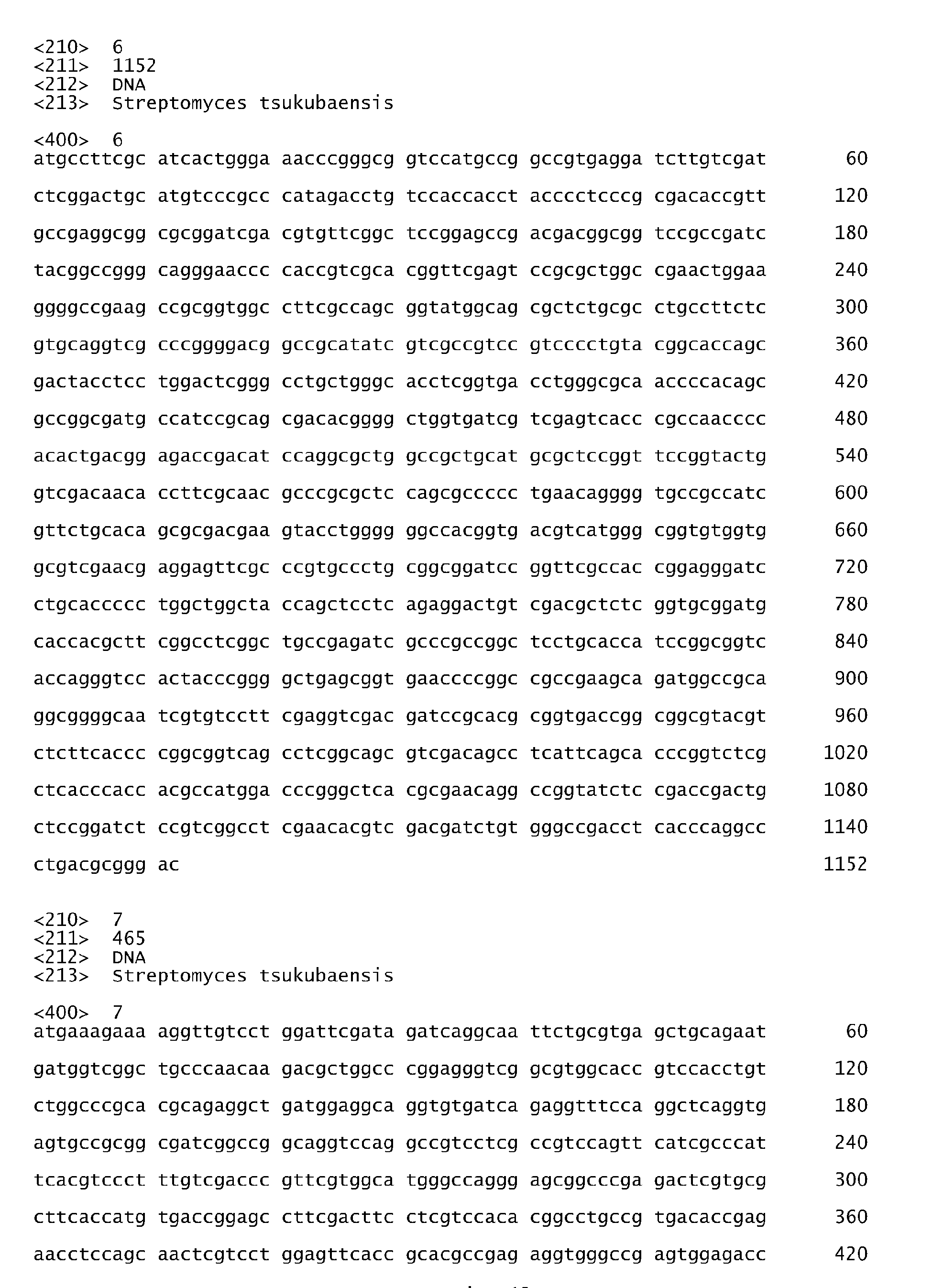


i) Seed culture Process: Seed medium comprised:
| Soy meal | 2.5 grams |
| Dextrin | 10 grams |
| Glucose | 1 gram |
| Yeast extract | 5 grams |
| Casein hydrolyzate | 7 grams |
| K2HPO4 | 0.2 gram |
| NaCl | 0.5 gram |
| MnCl2 × 4H2O | 0.005 gram |
| FeS04 × 7H2O | 0.025 gram |
| ZnSO4 × 7H2O | 0.001 gram |
| MgSO4 × 7H2O | 0.005 gram |
| CaCl2 | 0.02 gram |
| Final volume | 1 litre |
ii) Main Fermentation Process: About 10 % v/v of the above seed culture was used for the inoculation of a 250 ml Erlenmeyer flask, which contained 50 ml of Fermentation medium. The Fermentation medium contained:
| Dextrin | 90 grams |
| Glucose | 5 grams |
| Soy meal | 10 grams |
| Soy peptone | 10 grams |
| Glycerol | 10 grams |
| L-lysine | 2.5 gram |
| K2HPO4 | 1 gram |
| CaCO3 | 1.5 grams |
| PEG (1000) | 1 gram |
| Final volume | 1 litre |
h) Determination of tacrolimus and ascomycin production with HPLC of thiostrepton resistant ccr disrupted mutants derived by secondary homologous recombination using pKC1139-ccrTs.:
Method for tacrolimus and ascomycin determination: The analysis for determination of tacrolimus or ascomycin production thereof was carried out by isocratic reversed phase HPLC using an appropriate column and running conditions: column Nucleosil-100 C18 (150x4.0 mm, particle size 3 µm), flow 1.5 ml/min, T°C=60°C, mobile phase: 560 ml water, 335 ml acetonitrile, 70 ml MTBE and 0.2 ml 85% H3PO4, detection 210 nm, sample injection 20 µl.
The tacrolimus and ascomycin content in samples quantification was performed by using external standards of tacrolimus and ascomycin, where tacrolimus was eluted at 12.5 min and ascomycin at 11.5 min. Results are expressed as % of ascomycin production compared to tacrolimus production in samples.
Sample preparation: To 5 ml of well shaken broth 5 ml of methanol was added and samples were placed on a shaker for 1 hour to extract samples. After extraction, 1 ml of methanol extract of broth was taken to 1.5 ml tube and centrifuged for 10 min at 14000 rpm. 0.8 ml of supernatant was transferred into vials and to perform HPLC analysis.
| Description of strain | Tacrolimus production (mg/l) | % of ascomycin production compared to tacrolimus production |
| NRRL 18488 (w.t.) | 43.4 ± 7.4 | 10.1 ± 1.6 |
| Δccr Tsa | 33.5 ± 13.4 | 6.4 ± 1.0 |
| aSecondary recombinant mutants with disrupted ccr gene by integrated thiostrepton cassette. Mutants derived by secondary homologous recombination using pKC1139-ccrTs. |
j) Determination of tacrolimus and ascomycin production with HPLC of erythromycin resistant AllR disrupted mutants derived by secondary recombination using pKC 1139-AllREr:
| Description of strain | Tacrolimus production (mg/l) | Ascomycin production (mg/l) | Dihydrotacrolimus production (mg/l) |
| NRRL 18488 (w.t.) | 30.0 ± 6.6 | 3.2 ± 0.6 | <1.0 |
| ΔallR Era | 0.0 | 0.0 | 0.0 |
| ΔallR Era + allylmalonyl-CoA precursor | 8.1± 2.3 | 0.0 | 0.0 |
| ΔallR Era + ethylmalonyl-CoA precursor | 0.0 | 10.2± 3.2 | 0.0 |
| aSecondary recombinant mutants with disrupted allR gene by integrated erythromycin cassette. Mutants derived by secondary homologous recombination using pKC1139-allREr. |
k) Determination of tacrolimus and ascomycin production with HPLC of double, ccr and AllR disrupted mutants:
For the determination of tacrolimus and ascomycin production of double, ccr and AllR disrupted mutants, method as described in Example 4h was used.
| Description of strain | Tacrolimus production (mg/l) | Ascomycin production (mg/l) | Dihydrotacrolimus production (mg/l) |
| NRRL 18488 (w.t.) | 36.9 ± 9.9 | 3.5 ± 1.2 | < 1.0 |
| Δccr allR a | 0.0 | 0.0 | 0.0 |
| Δccr allR a + allylmalonyl-CoA precursor | 7.8± 2.0 | 0.0 | 0.0 |
| Δccr | 0.0 | 11.8± 2.1 | 0.0 |
| allR a + ethylmalonyl-CoA precursor |
| aSecondary recombinant mutants with disrupted ccr and allR genes by integrated erythromycin cassette. Mutants derived by secondary homologous recombination using pKC1139-allREr. |
Claims (15)
- A process for the preparation of tacrolimus, wherein the process comprises the step of cultivation of a genetically modified strain of a microorganism, wherein the genetic material of the microorganism comprises at least one inactivated and/or over expressed gene involved in the metabolism and/or the biosynthesis of ethylmalonyl-CoA and/or allylmalonyl-CoA.
- A process according claim 1, wherein the process comprises the step of cultivation of a genetically modified strain of a microorganism wherein the microorganism is a bacterium selected from genus Streptomyces.
- A process according to any of claims 1 or 2, wherein the microorganism is selected from a genetically modified strain of Streptomyces tsukubaensis.
- A process according to any of claims 1 to 3, wherein the process comprises the step of cultivation of a genetically modified strain of a microorganism, wherein the genetic material of the microorganism comprises at least one inactivated and/or over expressed gene selected from crotonyl-CoA reductase (ccr) gene according to SEQ.ID.#11, and ethylmalonyl-CoA mutase (ecm) according to SEQ.ID.#12.
- A process according to any of claims 1 to 4, wherein the process comprises the step of cultivation of a genetically modified strain of a microorganism belonging to the genus Streptomyces, wherein the genetic material of the microorganism comprises at least one inactivated and/or over expressed gene selected from gene sequence of Allyl-subcluster according to SEQ.ID.#I, which is composed of the following genes AllA gene according to SEQ.ID.# 2, AllK gene according to SEQ.ID.#3, AllR gene according to SEQ.ID.#4, AllD gene according to SEQ.ID.#5, AllM gene according to SEQ.ID.#6, AllN gene according to SEQ.ID.#7, AllP gene according to SEQ.ID.#8 , AllO gene according to SEQ.ID.#9, and AllS gene according to SEQ.ID.# 10.
- A process according to any of claims 1 to 5, wherein the process comprises the step of cultivation of a genetically modified strain of a microorganism belonging to the genus Streptomyces, wherein the process is carried out under the external addition of allylmalonyl-CoA and/or at least one precursor of allylmalonyl-CoA.
- A process according to any of claims 1 to 6, wherein the process comprises the step of cultivation of a genetically modified strain of a microorganism belonging to the genus Streptomyces, wherein the genetic material of the microorganism comprises at least one inactivated and/or over expressed gene selected from the group of AllK gene according to SEQ.ID.#3, AllR gene according to SEQ.ID.#4, and AllP gene according to SEQ.ID.#8.
- A process according to any of claims 1 to 7, wherein the process comprises the step of cultivation of a genetically modified strain of a microorganism belonging to the genus Streptomyces, wherein the genetic material of the microorganism comprises at least one over expressed gene selected from the group of AllR gene according to SEQ.ID.#4 and AllP gene according to SEQ.ID.#8.
- A process according to any of claims 1 to 8, wherein the process comprises the step of cultivation of a genetically modified strain of a microorganism belonging to the genus Streptomyces, wherein the genetic material of the microorganism comprises at least one inactivated gene selected from the group of AllK gene according to SEQ.ID.#3 and AllR gene according to SEQ.ID.#4, and wherein the process is carried out under the external addition of allylmalonyl-CoA and/or at least one precursor of allylmalonyl-CoA.
- A process according to any of claims 1 to 9, wherein the process comprises the step of cultivation of a genetically modified strain of a microorganism belonging to the genus Streptomyces, wherein the genetic material of the microorganism comprises inactivated AllR gene and inactivated ccr gene, and wherein the process is carried out under external addition of allylmalonyl-CoA and/or at least one precursor of allylmalonyl-CoA.
- A genetically modified strain of a microorganism belonging to the genus Streptomyces, wherein the genetic material of the microorganism comprises at least one inactivated and/or over expressed gene involved in the metabolism and/or the biosynthesis of ethylmalonyl-CoA and/or allylmalonyl-CoA.
- A genetically modified strain of a microorganism according to claim 11, wherein the genetic material of the microorganism comprises at least one inactivated and/or over expressed gene selected from gene sequence of Allyl-subcluster according to SEQ.ID.#1, which is composed of the following genes AllA gene according to SEQ.ID.# 2, AllK gene according to SEQ.ID.#3, AllR gene according to SEQ.ID.#4, AllD gene according to SEQ.ID.#5, AllM gene according to SEQ.ID.#6, AllN gene according to SEQ.ID.#7, AllP gene according to SEQ.ID.#8 , A//O gene according to SEQ.ID.#9, and AllS gene according to SEQ.ID.# 10.
- A genetically modified strain of a microorganism according to any of claims 11 or 12, wherein said strain has a native or engineered polyketide synthase activity.
- A nucleotide sequence encoding one or several gene(s) involved in the metabolism and/or the biosynthesis of ethylmalonyl-CoA and/or allylmalonyl-CoA of an micro organism belonging to the genus Streptomyces, comprising the sequence according to SEQ ID #1, which is composed of the following genes AllA gene according to SEQ.ID.# 2, AllK gene according to SEQ.ID.#3, AllR gene according to SEQ.ID.#4, AllD gene according to SEQ.ID.#5, AllM gene according to SEQ.ID.#6, AllN gene according to SEQ.ID.#7, AllP gene according to SEQ.ID.#8, AllO gene according to SEQ.ID.#9, and AllS gene according to SEQ.ID.# 10, and variants thereof comprising one or more nucleotide addition(s), deletion(s), substitution(s) and/or inversion(s).
- A nucleotide sequence according to claim 14, wherein the nucleotide sequence has at least 50 % nucleotide identity with SEQ. ID.#1.
Priority Applications (7)
| Application Number | Priority Date | Filing Date | Title |
|---|---|---|---|
| EP09165035A EP2272963A1 (en) | 2009-07-09 | 2009-07-09 | Process for Preparation of Tacrolimus |
| PCT/EP2010/059896 WO2011004008A1 (en) | 2009-07-09 | 2010-07-09 | Process for preparation of tacrolimus |
| EP10731739.8A EP2451955B1 (en) | 2009-07-09 | 2010-07-09 | Process for preparation of tacrolimus |
| CA2767491A CA2767491C (en) | 2009-07-09 | 2010-07-09 | Process for preparation of tacrolimus |
| JP2012519011A JP5891169B2 (en) | 2009-07-09 | 2010-07-09 | Method for the preparation of tacrolimus |
| US13/383,182 US8980585B2 (en) | 2009-07-09 | 2010-07-09 | Process for preparation of tacrolimus |
| AU2010270143A AU2010270143B2 (en) | 2009-07-09 | 2010-07-09 | Process for preparation of tacrolimus |
Applications Claiming Priority (1)
| Application Number | Priority Date | Filing Date | Title |
|---|---|---|---|
| EP09165035A EP2272963A1 (en) | 2009-07-09 | 2009-07-09 | Process for Preparation of Tacrolimus |
Publications (1)
| Publication Number | Publication Date |
|---|---|
| EP2272963A1 true EP2272963A1 (en) | 2011-01-12 |
Family
ID=41432773
Family Applications (2)
| Application Number | Title | Priority Date | Filing Date |
|---|---|---|---|
| EP09165035A Ceased EP2272963A1 (en) | 2009-07-09 | 2009-07-09 | Process for Preparation of Tacrolimus |
| EP10731739.8A Not-in-force EP2451955B1 (en) | 2009-07-09 | 2010-07-09 | Process for preparation of tacrolimus |
Family Applications After (1)
| Application Number | Title | Priority Date | Filing Date |
|---|---|---|---|
| EP10731739.8A Not-in-force EP2451955B1 (en) | 2009-07-09 | 2010-07-09 | Process for preparation of tacrolimus |
Country Status (6)
| Country | Link |
|---|---|
| US (1) | US8980585B2 (en) |
| EP (2) | EP2272963A1 (en) |
| JP (1) | JP5891169B2 (en) |
| AU (1) | AU2010270143B2 (en) |
| CA (1) | CA2767491C (en) |
| WO (1) | WO2011004008A1 (en) |
Cited By (5)
| Publication number | Priority date | Publication date | Assignee | Title |
|---|---|---|---|---|
| KR101197026B1 (en) | 2009-11-05 | 2012-11-06 | 명지대학교 산학협력단 | Tacrolimus producing strain and Tacrolimus biosynthetic genes obtained by the same |
| KR101263597B1 (en) | 2011-11-03 | 2013-05-10 | 명지대학교 산학협력단 | Microorganism having enhanced fk506 or fk520 productivity and method of producing fk506 or fk520 using the same |
| CN103695496A (en) * | 2013-12-05 | 2014-04-02 | 成都雅途生物技术有限公司 | Method for producing tacrolimus by fermentation |
| CN108949642A (en) * | 2018-08-31 | 2018-12-07 | 福建省微生物研究所 | It is a kind of produce tacrolimus streptomycete high-efficiency fermenting culture medium and its application |
| CN114045249A (en) * | 2021-08-19 | 2022-02-15 | 浙江大学 | Genetic engineering bacterium for overexpression of rapX-encoded exogenous FK506 transporter, and construction method and application thereof |
Families Citing this family (3)
| Publication number | Priority date | Publication date | Assignee | Title |
|---|---|---|---|---|
| CN103060248B (en) * | 2011-10-19 | 2017-05-17 | 中国科学院上海有机化学研究所 | Method for constructing gene engineering FK506 high-producing strain and streptomyces tsukubaensis high-producing strain |
| CN103276011B (en) * | 2013-05-20 | 2015-01-21 | 天津大学 | Primary pathway transformation method under guidance of FK506 strain genome-scale metabolic network model |
| CN108588172B (en) * | 2018-05-30 | 2021-10-22 | 贵州茅台酒股份有限公司 | A selective medium for quantitative detection of Pichia kudria, its preparation method and application |
Citations (9)
| Publication number | Priority date | Publication date | Assignee | Title |
|---|---|---|---|---|
| EP0356399A2 (en) | 1988-08-26 | 1990-02-28 | Sandoz Ag | Substituted 4-azatricyclo (22.3.1.04.9) octacos-18-ene derivatives, their preparation and pharmaceutical compositions containing them |
| US5116756A (en) | 1991-01-28 | 1992-05-26 | Merck & Co., Inc. | Process for producing FK-506 |
| US5200411A (en) | 1989-06-14 | 1993-04-06 | Sandoz, Ltd. | Heteroatoms-containing tricyclic compounds |
| WO2000020601A2 (en) * | 1998-10-02 | 2000-04-13 | Kosan Biosciences, Inc. | Polyketide synthase enzymes and recombinant dna constructs therefor |
| WO2003070908A2 (en) * | 2002-02-19 | 2003-08-28 | Dow Agrosciences Llc | Novel spinosyn-producing polyketide synthases |
| KR100485877B1 (en) | 2003-12-30 | 2005-04-28 | 종근당바이오 주식회사 | Microorganism producing tacrolimus and mass-productive method of tacrolimus using the same |
| DE102004027516A1 (en) * | 2004-06-03 | 2006-01-05 | Combinature Biopharm Ag | New isolated proteins and peptides, useful for synthesis of efomycin antibiotics, also nucleic acid sequences encoding them and genetically modified host cells |
| WO2006011156A1 (en) * | 2004-07-29 | 2006-02-02 | Concord Biotech Limted | Process for producing tacrolimus (fk - 506) using vegetable oil as sole source of carbon |
| US20070191415A1 (en) | 2003-10-17 | 2007-08-16 | Ranbaxy Laboratories Limited | Production of tacrolimus (fk-506) using new streptomyces species |
Family Cites Families (3)
| Publication number | Priority date | Publication date | Assignee | Title |
|---|---|---|---|---|
| US4894366A (en) * | 1984-12-03 | 1990-01-16 | Fujisawa Pharmaceutical Company, Ltd. | Tricyclo compounds, a process for their production and a pharmaceutical composition containing the same |
| US20080318289A1 (en) * | 2005-10-05 | 2008-12-25 | Parveen Kumar | Fermentation Processes for the Preparation of Tacrolimus |
| JP2011524413A (en) | 2008-06-17 | 2011-09-01 | バイオチカ テクノロジー リミテッド | Novel compounds and methods for their production |
-
2009
- 2009-07-09 EP EP09165035A patent/EP2272963A1/en not_active Ceased
-
2010
- 2010-07-09 CA CA2767491A patent/CA2767491C/en not_active Expired - Fee Related
- 2010-07-09 WO PCT/EP2010/059896 patent/WO2011004008A1/en not_active Ceased
- 2010-07-09 EP EP10731739.8A patent/EP2451955B1/en not_active Not-in-force
- 2010-07-09 AU AU2010270143A patent/AU2010270143B2/en not_active Ceased
- 2010-07-09 JP JP2012519011A patent/JP5891169B2/en not_active Expired - Fee Related
- 2010-07-09 US US13/383,182 patent/US8980585B2/en not_active Expired - Fee Related
Patent Citations (10)
| Publication number | Priority date | Publication date | Assignee | Title |
|---|---|---|---|---|
| EP0356399A2 (en) | 1988-08-26 | 1990-02-28 | Sandoz Ag | Substituted 4-azatricyclo (22.3.1.04.9) octacos-18-ene derivatives, their preparation and pharmaceutical compositions containing them |
| US5200411A (en) | 1989-06-14 | 1993-04-06 | Sandoz, Ltd. | Heteroatoms-containing tricyclic compounds |
| US5116756A (en) | 1991-01-28 | 1992-05-26 | Merck & Co., Inc. | Process for producing FK-506 |
| WO2000020601A2 (en) * | 1998-10-02 | 2000-04-13 | Kosan Biosciences, Inc. | Polyketide synthase enzymes and recombinant dna constructs therefor |
| US6503737B1 (en) | 1998-10-02 | 2003-01-07 | Kosan Biosciences, Inc. | Isolated nucleic acids relating to the fkbA gene within the FK-520 polyketide synthase gene cluster |
| WO2003070908A2 (en) * | 2002-02-19 | 2003-08-28 | Dow Agrosciences Llc | Novel spinosyn-producing polyketide synthases |
| US20070191415A1 (en) | 2003-10-17 | 2007-08-16 | Ranbaxy Laboratories Limited | Production of tacrolimus (fk-506) using new streptomyces species |
| KR100485877B1 (en) | 2003-12-30 | 2005-04-28 | 종근당바이오 주식회사 | Microorganism producing tacrolimus and mass-productive method of tacrolimus using the same |
| DE102004027516A1 (en) * | 2004-06-03 | 2006-01-05 | Combinature Biopharm Ag | New isolated proteins and peptides, useful for synthesis of efomycin antibiotics, also nucleic acid sequences encoding them and genetically modified host cells |
| WO2006011156A1 (en) * | 2004-07-29 | 2006-02-02 | Concord Biotech Limted | Process for producing tacrolimus (fk - 506) using vegetable oil as sole source of carbon |
Non-Patent Citations (34)
| Title |
|---|
| ALLISON A.C., IMMUNOPHARMACOLOGY, vol. 47, no. 2-3, 2000, pages 63 - 83 |
| BIERMAN ET AL., GENE, vol. 116, no. 1, 1992, pages 43 - 9 |
| CROPP A ET AL: "Genetic approaches for controlling ratios of related polyketide products in fermentation processes", JOURNAL OF INDUSTRIAL MICROBIOLOGY AND BIOTECHNOLOGY, vol. 27, no. 6, December 2001 (2001-12-01), pages 368 - 377, XP002561992, ISSN: 1367-5435 * |
| CROPP ET AL., J IND MICROBIOL BIOTECHNOL, vol. 27, 2001, pages 368 - 377 |
| EASTON J.B.; HOUGHTON P.J., EXPERT OPIN THER TARGETS, vol. 8, no. 6, 2004, pages 551 - 64 |
| HE M ET AL: "Isolation and characterization of meridamycin biosynthetic gene cluster from Streptomyces sp. NRRL 30748", GENE, vol. 377, 1 August 2006 (2006-08-01), pages 109 - 118, XP024934551, ISSN: 0378-1119, [retrieved on 20060801] * |
| ISHIKAWA ET AL., FEMS MICROBIOL. LETT., vol. 174, 1999, pages 251 - 253 |
| JONES ET AL., MOL. MICROBIOL., vol. 23, 1997, pages 169 - 178 |
| KIESER ET AL.: "Practical Streptomyces genetics, A laboratory Manual", 2000 |
| KIESER ET AL.: "Practical Streptomyces genetics, A laboratory Manual", 2000, article "Practical Streptomyces genetics" |
| KINO ET AL., J. ANTIBIOTICS, vol. 40, 1984, pages 1249 - 1255 |
| LI C ET AL: "High titer production of tetracenomycins by heterologous expression of the pathway in a Streptomyces cinnamonensis industrial monensin producer strain", METABOLIC ENGINEERING, ACADEMIC PRESS, US, vol. 11, no. 6, 10 July 2009 (2009-07-10), pages 319 - 327, XP026736580, ISSN: 1096-7176, [retrieved on 20090710] * |
| LI CHAOXUAN ET AL: "Crotonyl-coenzyme A reductase provides methylmalonyl-CoA precursors for monensin biosynthesis by Streptomyces cinnamonensis in an oil-based extended fermentation", MICROBIOLOGY (READING), vol. 150, no. Part 10, October 2004 (2004-10-01), pages 3463 - 3472, XP002561993, ISSN: 1350-0872 * |
| LIU H ET AL: "Precursor supply for polyketide biosynthesis: the role of crotonyl-CoA reductase", METABOLIC ENGINEERING, ACADEMIC PRESS, US, vol. 3, no. 1, 1 January 2001 (2001-01-01), pages 40 - 48, XP001011425, ISSN: 1096-7176 * |
| LIU HAIBIN ET AL: "Role of crotonyl coenzyme A reductase in determining the ratio of polyketides monensin A and monensin B produced by Streptomyces cinnamonensis", JOURNAL OF BACTERIOLOGY, vol. 181, no. 21, November 1999 (1999-11-01), pages 6806 - 6813, XP002561991, ISSN: 0021-9193 * |
| MCDANIEL R ET AL., CHEM REV, vol. 105, no. 2, 2005, pages 543 - 58 |
| MOLNAR I ET AL: "Organisation of the biosynthetic gene cluster for rapamycin in Streptomyces hygroscopicus: analysis of genes flanking the polyketide synthase", GENE, vol. 169, no. 1, 22 February 1996 (1996-02-22), pages 1 - 7, XP004042979, ISSN: 0378-1119 * |
| MOTAMEDI H ET AL: "The biosynthetic gene cluster for the macrolactone ring of the immunosuppressant FK506", EUROPEAN JOURNAL OF BIOCHEMISTRY, BLACKWELL PUBLISHING, BERLIN, DE, vol. 256, no. 3, 1 January 1998 (1998-01-01), pages 528 - 534, XP000906738, ISSN: 0014-2956 * |
| MOTAMEDI H.; SHAFIEE A, EUR J BIOCHEM, vol. 256, no. 3, 1996, pages 528 - 34 |
| MOTAMEDI H.; SHAFIEE A., EUR J BIOCHEM, vol. 256, no. 3, 1998, pages 528 - 34 |
| MUTH ET AL., MOL GEN GENET., vol. 219, no. 3, 1989, pages 341 - 348 |
| PAGET ET AL., J. BACTERIOL., vol. 181, 1999, pages 204 - 211 |
| REYNOLDS K A ET AL: "Rapamycin, FK506, and ascomycin-related compounds", DRUGS AND THE PHARMACEUTICAL SCIENCES, DEKKER, NEW YORK, NY, US, vol. 82, no. 82, 1 January 1997 (1997-01-01), pages 497 - 520, XP000906777, ISSN: 0360-2583 * |
| REYNOLDS K. ET AL., J CHEM SOC PERKIN TRANS, vol. 1, 1988, pages 3195 - 3207 |
| SAMBROOK; RUSSELL: "Molecular Cloning: A Laboratory Manual", 2000 |
| SCHWECKE T ET AL: "THE BIOSYNTHETIC GENE CLUSTER FOR THEPOLYKETIDE IMMUNOSUPPRESSANT RAPAMYCIN", PROCEEDINGS OF THE NATIONAL ACADEMY OF SCIENCES OF THE UNITED STATES (PNAS), vol. 92, 1 August 1995 (1995-08-01), pages 7839 - 7843, XP000652288, ISSN: 0027-8424 * |
| SOUTHERN, E.M., J. MOL. BIOL., vol. 98, 1975, pages 503 |
| STASSI D L ET AL: "Ethyl-substituted erythromycin derivatives produced by directed metabolic engineering", PROCEEDINGS OF THE NATIONAL ACADEMY OF SCIENCES OF USA, NATIONAL ACADEMY OF SCIENCE, WASHINGTON, DC, US, vol. 95, no. 13, 23 June 1998 (1998-06-23), pages 7305 - 7309, XP002131683, ISSN: 0027-8424 * |
| SUN W J ET AL: "Crotonic acid-directed biosynthesis of the immunosuppressants produced by Streptomyces hygroscopicus var. ascomyceticus", JOURNAL OF FERMENTATION AND BIOENGINEERING, SOCIETY OF FERMENTATION TECHNOLOGY, JP, vol. 86, no. 3, 1 January 1998 (1998-01-01), pages 261 - 265, XP000906779, ISSN: 0922-338X * |
| WALLACE K.K. ET AL., EUR J BIOCHEM, vol. 233, 1995, pages 954 - 962 |
| WU K ET AL., GENE, vol. 251, no. 1, 2000, pages 81 - 90 |
| WU K ET AL: "The FK520 gene cluster of Streptomyces hygroscopicus var. ascomyceticus (ATCC 14891) contains genes for biosynthesis of unusual polyketide extender units", GENE, ELSEVIER, AMSTERDAM, NL, vol. 251, no. 1, 1 June 2000 (2000-06-01), pages 81 - 90, XP004202089, ISSN: 0378-1119 * |
| ZERBE-BURKHARDT K. ET AL., J BIOL CHEM, vol. 273, 1998, pages 6508 - 6517 |
| ZHANG W. ET AL.: "S. cinnamonensis", J. BACTERIOL, vol. 183, 2001, pages 2071 - 2080 |
Cited By (6)
| Publication number | Priority date | Publication date | Assignee | Title |
|---|---|---|---|---|
| KR101197026B1 (en) | 2009-11-05 | 2012-11-06 | 명지대학교 산학협력단 | Tacrolimus producing strain and Tacrolimus biosynthetic genes obtained by the same |
| KR101263597B1 (en) | 2011-11-03 | 2013-05-10 | 명지대학교 산학협력단 | Microorganism having enhanced fk506 or fk520 productivity and method of producing fk506 or fk520 using the same |
| CN103695496A (en) * | 2013-12-05 | 2014-04-02 | 成都雅途生物技术有限公司 | Method for producing tacrolimus by fermentation |
| CN103695496B (en) * | 2013-12-05 | 2016-06-29 | 成都雅途生物技术有限公司 | The method of fermenting and producing tacrolimus |
| CN108949642A (en) * | 2018-08-31 | 2018-12-07 | 福建省微生物研究所 | It is a kind of produce tacrolimus streptomycete high-efficiency fermenting culture medium and its application |
| CN114045249A (en) * | 2021-08-19 | 2022-02-15 | 浙江大学 | Genetic engineering bacterium for overexpression of rapX-encoded exogenous FK506 transporter, and construction method and application thereof |
Also Published As
| Publication number | Publication date |
|---|---|
| US8980585B2 (en) | 2015-03-17 |
| CA2767491A1 (en) | 2011-01-13 |
| EP2451955A1 (en) | 2012-05-16 |
| EP2451955B1 (en) | 2018-01-24 |
| CA2767491C (en) | 2018-06-05 |
| AU2010270143B2 (en) | 2016-04-21 |
| WO2011004008A1 (en) | 2011-01-13 |
| AU2010270143A1 (en) | 2012-03-01 |
| JP5891169B2 (en) | 2016-03-22 |
| JP2012532595A (en) | 2012-12-20 |
| US20120295316A1 (en) | 2012-11-22 |
Similar Documents
| Publication | Publication Date | Title |
|---|---|---|
| EP2451955B1 (en) | Process for preparation of tacrolimus | |
| Pulsawat et al. | Characterization of biosynthetic gene cluster for the production of virginiamycin M, a streptogramin type A antibiotic, in Streptomyces virginiae | |
| CN102224242B (en) | Novel gene cluster | |
| US10047363B2 (en) | NRPS-PKS gene cluster and its manipulation and utility | |
| CN103060248B (en) | Method for constructing gene engineering FK506 high-producing strain and streptomyces tsukubaensis high-producing strain | |
| Kosec et al. | Novel chemobiosynthetic approach for exclusive production of FK506 | |
| Schulz et al. | Optimization of the precursor supply for an enhanced FK506 production in Streptomyces tsukubaensis | |
| Daduang et al. | Characterization of the biosynthetic gene cluster for maklamicin, a spirotetronate-class antibiotic of the endophytic Micromonospora sp. NBRC 110955 | |
| JP2023012549A (en) | Modified Streptomyces fungicidicus isolate and uses thereof | |
| EP2141236A1 (en) | Process for production of lipstatin and microorganisms therefore | |
| US8188245B2 (en) | Enduracidin biosynthetic gene cluster from streptomyces fungicidicus | |
| WO2012064883A2 (en) | Systems and methods for propionic acid production | |
| Fedeshko | Polyketide enzymes and genes in Penicillium urticae. | |
| EP2546345A1 (en) | DNA encoding polypeptide involved in biosynthesis of herboxidiene | |
| RU2495937C1 (en) | Method of preparation of tacrolimus by microbiological synthesis method | |
| AU5838600A (en) | Streptomyces avermitilis gene directing the ratio of b2:b1 avermectins | |
| Vaishnav et al. | Immunosuppressants: Remarkable Microbial Products | |
| WO2008093912A1 (en) | Novel ansamycin derivatives and the method for mutational biosynthesis thereof | |
| EP1520025A2 (en) | Nucleic acid molecules involved in the synthesis of melithiazols | |
| EP2589663A1 (en) | Process for production of clavulanic acid | |
| Aiyada | Pleiotropic control of secondary metabolism and | |
| Sucipto | Synthetic biotechnology to engineer myxopyronin production | |
| WO2001019959A1 (en) | Improvement of clavulanic acid production | |
| WO2005021586A2 (en) | Metabolic engineering of viomycin biosynthesis |
Legal Events
| Date | Code | Title | Description |
|---|---|---|---|
| PUAI | Public reference made under article 153(3) epc to a published international application that has entered the european phase |
Free format text: ORIGINAL CODE: 0009012 |
|
| AK | Designated contracting states |
Kind code of ref document: A1 Designated state(s): AT BE BG CH CY CZ DE DK EE ES FI FR GB GR HR HU IE IS IT LI LT LU LV MC MK MT NL NO PL PT RO SE SI SK SM TR |
|
| 17P | Request for examination filed |
Effective date: 20110712 |
|
| 18R | Application refused |
Effective date: 20101110 |
|
| STAA | Information on the status of an ep patent application or granted ep patent |
Free format text: STATUS: THE APPLICATION HAS BEEN REFUSED |
|
| R18R | Application refused (corrected) |
Effective date: 20110416 |