EP2272880A1 - Salt-sensitive binders for nonwoven webs and method of making same - Google Patents
Salt-sensitive binders for nonwoven webs and method of making same Download PDFInfo
- Publication number
- EP2272880A1 EP2272880A1 EP10010983A EP10010983A EP2272880A1 EP 2272880 A1 EP2272880 A1 EP 2272880A1 EP 10010983 A EP10010983 A EP 10010983A EP 10010983 A EP10010983 A EP 10010983A EP 2272880 A1 EP2272880 A1 EP 2272880A1
- Authority
- EP
- European Patent Office
- Prior art keywords
- salt
- alkyl
- binder
- percent
- water
- Prior art date
- Legal status (The legal status is an assumption and is not a legal conclusion. Google has not performed a legal analysis and makes no representation as to the accuracy of the status listed.)
- Withdrawn
Links
- 239000011230 binding agent Substances 0.000 title claims abstract description 132
- 150000003839 salts Chemical class 0.000 title claims abstract description 72
- 238000004519 manufacturing process Methods 0.000 title description 10
- 239000000178 monomer Substances 0.000 claims abstract description 130
- XLYOFNOQVPJJNP-UHFFFAOYSA-N water Substances O XLYOFNOQVPJJNP-UHFFFAOYSA-N 0.000 claims abstract description 78
- 229920000642 polymer Polymers 0.000 claims abstract description 72
- 239000008367 deionised water Substances 0.000 claims abstract description 21
- 229910021641 deionized water Inorganic materials 0.000 claims abstract description 21
- FAPWRFPIFSIZLT-UHFFFAOYSA-M Sodium chloride Chemical compound [Na+].[Cl-] FAPWRFPIFSIZLT-UHFFFAOYSA-M 0.000 claims description 74
- 125000000217 alkyl group Chemical group 0.000 claims description 44
- 239000011780 sodium chloride Substances 0.000 claims description 37
- 125000004432 carbon atom Chemical group C* 0.000 claims description 33
- 230000002209 hydrophobic effect Effects 0.000 claims description 32
- 125000005250 alkyl acrylate group Chemical group 0.000 claims description 21
- NIXOWILDQLNWCW-UHFFFAOYSA-M Acrylate Chemical compound [O-]C(=O)C=C NIXOWILDQLNWCW-UHFFFAOYSA-M 0.000 claims description 16
- CQEYYJKEWSMYFG-UHFFFAOYSA-N butyl acrylate Chemical compound CCCCOC(=O)C=C CQEYYJKEWSMYFG-UHFFFAOYSA-N 0.000 claims description 12
- 238000007720 emulsion polymerization reaction Methods 0.000 claims description 12
- 239000007864 aqueous solution Substances 0.000 claims description 11
- SOGAXMICEFXMKE-UHFFFAOYSA-N Butylmethacrylate Chemical compound CCCCOC(=O)C(C)=C SOGAXMICEFXMKE-UHFFFAOYSA-N 0.000 claims description 10
- 150000001768 cations Chemical class 0.000 claims description 9
- 125000000753 cycloalkyl group Chemical group 0.000 claims description 8
- 150000003926 acrylamides Chemical class 0.000 claims description 7
- 150000001252 acrylic acid derivatives Chemical class 0.000 claims description 7
- IAXXETNIOYFMLW-COPLHBTASA-N [(1s,3s,4s)-4,7,7-trimethyl-3-bicyclo[2.2.1]heptanyl] 2-methylprop-2-enoate Chemical compound C1C[C@]2(C)[C@@H](OC(=O)C(=C)C)C[C@H]1C2(C)C IAXXETNIOYFMLW-COPLHBTASA-N 0.000 claims description 6
- 239000012736 aqueous medium Substances 0.000 claims description 6
- 229940119545 isobornyl methacrylate Drugs 0.000 claims description 6
- YRDNVESFWXDNSI-UHFFFAOYSA-N n-(2,4,4-trimethylpentan-2-yl)prop-2-enamide Chemical compound CC(C)(C)CC(C)(C)NC(=O)C=C YRDNVESFWXDNSI-UHFFFAOYSA-N 0.000 claims description 4
- HRPVXLWXLXDGHG-UHFFFAOYSA-N Acrylamide Chemical compound NC(=O)C=C HRPVXLWXLXDGHG-UHFFFAOYSA-N 0.000 claims description 3
- 125000005395 methacrylic acid group Chemical group 0.000 claims description 2
- 239000000243 solution Substances 0.000 abstract description 70
- 229920001577 copolymer Polymers 0.000 abstract description 41
- 150000001732 carboxylic acid derivatives Chemical class 0.000 abstract description 22
- 239000012266 salt solution Substances 0.000 abstract description 10
- 230000003472 neutralizing effect Effects 0.000 abstract description 5
- 238000005728 strengthening Methods 0.000 abstract 1
- 239000000203 mixture Substances 0.000 description 78
- 239000000839 emulsion Substances 0.000 description 55
- 239000000835 fiber Substances 0.000 description 38
- 239000004094 surface-active agent Substances 0.000 description 38
- CERQOIWHTDAKMF-UHFFFAOYSA-N Methacrylic acid Chemical compound CC(=C)C(O)=O CERQOIWHTDAKMF-UHFFFAOYSA-N 0.000 description 26
- -1 NaAMPS Chemical compound 0.000 description 26
- 239000003995 emulsifying agent Substances 0.000 description 24
- 239000007787 solid Substances 0.000 description 24
- 238000000034 method Methods 0.000 description 20
- HEMHJVSKTPXQMS-UHFFFAOYSA-M Sodium hydroxide Chemical compound [OH-].[Na+] HEMHJVSKTPXQMS-UHFFFAOYSA-M 0.000 description 15
- 239000002585 base Substances 0.000 description 14
- 238000006386 neutralization reaction Methods 0.000 description 13
- 239000000123 paper Substances 0.000 description 13
- 239000004908 Emulsion polymer Substances 0.000 description 12
- 150000002500 ions Chemical class 0.000 description 12
- 238000006116 polymerization reaction Methods 0.000 description 12
- SMZOUWXMTYCWNB-UHFFFAOYSA-N 2-(2-methoxy-5-methylphenyl)ethanamine Chemical compound COC1=CC=C(C)C=C1CCN SMZOUWXMTYCWNB-UHFFFAOYSA-N 0.000 description 11
- NIXOWILDQLNWCW-UHFFFAOYSA-N 2-Propenoic acid Natural products OC(=O)C=C NIXOWILDQLNWCW-UHFFFAOYSA-N 0.000 description 11
- 239000012986 chain transfer agent Substances 0.000 description 11
- 229910052783 alkali metal Inorganic materials 0.000 description 9
- 239000000463 material Substances 0.000 description 9
- 230000008569 process Effects 0.000 description 9
- 125000002947 alkylene group Chemical group 0.000 description 8
- 238000009736 wetting Methods 0.000 description 8
- QGZKDVFQNNGYKY-UHFFFAOYSA-O Ammonium Chemical class [NH4+] QGZKDVFQNNGYKY-UHFFFAOYSA-O 0.000 description 7
- 150000001340 alkali metals Chemical class 0.000 description 7
- 238000001035 drying Methods 0.000 description 7
- 230000000694 effects Effects 0.000 description 7
- 150000002430 hydrocarbons Chemical group 0.000 description 7
- 239000004816 latex Substances 0.000 description 7
- 229920000126 latex Polymers 0.000 description 7
- 229920006395 saturated elastomer Polymers 0.000 description 7
- 229920001897 terpolymer Polymers 0.000 description 7
- 239000002562 thickening agent Substances 0.000 description 7
- RTZKZFJDLAIYFH-UHFFFAOYSA-N Diethyl ether Chemical compound CCOCC RTZKZFJDLAIYFH-UHFFFAOYSA-N 0.000 description 6
- DGAQECJNVWCQMB-PUAWFVPOSA-M Ilexoside XXIX Chemical compound C[C@@H]1CC[C@@]2(CC[C@@]3(C(=CC[C@H]4[C@]3(CC[C@@H]5[C@@]4(CC[C@@H](C5(C)C)OS(=O)(=O)[O-])C)C)[C@@H]2[C@]1(C)O)C)C(=O)O[C@H]6[C@@H]([C@H]([C@@H]([C@H](O6)CO)O)O)O.[Na+] DGAQECJNVWCQMB-PUAWFVPOSA-M 0.000 description 6
- VVQNEPGJFQJSBK-UHFFFAOYSA-N Methyl methacrylate Chemical compound COC(=O)C(C)=C VVQNEPGJFQJSBK-UHFFFAOYSA-N 0.000 description 6
- ROOXNKNUYICQNP-UHFFFAOYSA-N ammonium persulfate Chemical compound [NH4+].[NH4+].[O-]S(=O)(=O)OOS([O-])(=O)=O ROOXNKNUYICQNP-UHFFFAOYSA-N 0.000 description 6
- 150000002148 esters Chemical class 0.000 description 6
- 239000008233 hard water Substances 0.000 description 6
- 239000007788 liquid Substances 0.000 description 6
- 229920005989 resin Polymers 0.000 description 6
- 239000011347 resin Substances 0.000 description 6
- 239000011734 sodium Substances 0.000 description 6
- 229910052708 sodium Inorganic materials 0.000 description 6
- 239000000758 substrate Substances 0.000 description 6
- GOXQRTZXKQZDDN-UHFFFAOYSA-N 2-Ethylhexyl acrylate Chemical compound CCCCC(CC)COC(=O)C=C GOXQRTZXKQZDDN-UHFFFAOYSA-N 0.000 description 5
- 235000014113 dietary fatty acids Nutrition 0.000 description 5
- 239000000194 fatty acid Substances 0.000 description 5
- 229930195729 fatty acid Natural products 0.000 description 5
- 150000004665 fatty acids Chemical class 0.000 description 5
- 230000009477 glass transition Effects 0.000 description 5
- 239000003999 initiator Substances 0.000 description 5
- ULUAUXLGCMPNKK-UHFFFAOYSA-N Sulfobutanedioic acid Chemical compound OC(=O)CC(C(O)=O)S(O)(=O)=O ULUAUXLGCMPNKK-UHFFFAOYSA-N 0.000 description 4
- 239000002253 acid Substances 0.000 description 4
- 230000002378 acidificating effect Effects 0.000 description 4
- 239000003513 alkali Substances 0.000 description 4
- 239000000084 colloidal system Substances 0.000 description 4
- 239000006185 dispersion Substances 0.000 description 4
- 125000003438 dodecyl group Chemical group [H]C([H])([H])C([H])([H])C([H])([H])C([H])([H])C([H])([H])C([H])([H])C([H])([H])C([H])([H])C([H])([H])C([H])([H])C([H])([H])C([H])([H])* 0.000 description 4
- 238000009472 formulation Methods 0.000 description 4
- 230000007246 mechanism Effects 0.000 description 4
- 239000002245 particle Substances 0.000 description 4
- 230000000379 polymerizing effect Effects 0.000 description 4
- 230000001681 protective effect Effects 0.000 description 4
- 239000011541 reaction mixture Substances 0.000 description 4
- HJLBIRSYZDPPIR-UHFFFAOYSA-M sodium;4-dodecoxy-1,4-dioxo-1-prop-2-enoxybutane-2-sulfonate Chemical compound [Na+].CCCCCCCCCCCCOC(=O)CC(S([O-])(=O)=O)C(=O)OCC=C HJLBIRSYZDPPIR-UHFFFAOYSA-M 0.000 description 4
- 125000005156 substituted alkylene group Chemical group 0.000 description 4
- 238000012360 testing method Methods 0.000 description 4
- 125000003903 2-propenyl group Chemical group [H]C([*])([H])C([H])=C([H])[H] 0.000 description 3
- CYUZOYPRAQASLN-UHFFFAOYSA-N 3-prop-2-enoyloxypropanoic acid Chemical compound OC(=O)CCOC(=O)C=C CYUZOYPRAQASLN-UHFFFAOYSA-N 0.000 description 3
- IRLPACMLTUPBCL-KQYNXXCUSA-N 5'-adenylyl sulfate Chemical compound C1=NC=2C(N)=NC=NC=2N1[C@@H]1O[C@H](COP(O)(=O)OS(O)(=O)=O)[C@@H](O)[C@H]1O IRLPACMLTUPBCL-KQYNXXCUSA-N 0.000 description 3
- SNRUBQQJIBEYMU-UHFFFAOYSA-N Dodecane Natural products CCCCCCCCCCCC SNRUBQQJIBEYMU-UHFFFAOYSA-N 0.000 description 3
- XLYMOEINVGRTEX-ARJAWSKDSA-N Ethyl hydrogen fumarate Chemical compound CCOC(=O)\C=C/C(O)=O XLYMOEINVGRTEX-ARJAWSKDSA-N 0.000 description 3
- KWYUFKZDYYNOTN-UHFFFAOYSA-M Potassium hydroxide Chemical compound [OH-].[K+] KWYUFKZDYYNOTN-UHFFFAOYSA-M 0.000 description 3
- 229910001870 ammonium persulfate Inorganic materials 0.000 description 3
- 239000003945 anionic surfactant Substances 0.000 description 3
- 230000008901 benefit Effects 0.000 description 3
- 239000003795 chemical substances by application Substances 0.000 description 3
- 229920006026 co-polymeric resin Polymers 0.000 description 3
- 150000001875 compounds Chemical class 0.000 description 3
- 238000004132 cross linking Methods 0.000 description 3
- WNAHIZMDSQCWRP-UHFFFAOYSA-N dodecane-1-thiol Chemical compound CCCCCCCCCCCCS WNAHIZMDSQCWRP-UHFFFAOYSA-N 0.000 description 3
- 239000004744 fabric Substances 0.000 description 3
- 238000010528 free radical solution polymerization reaction Methods 0.000 description 3
- XLYMOEINVGRTEX-UHFFFAOYSA-N fumaric acid monoethyl ester Natural products CCOC(=O)C=CC(O)=O XLYMOEINVGRTEX-UHFFFAOYSA-N 0.000 description 3
- 239000002736 nonionic surfactant Substances 0.000 description 3
- 239000004745 nonwoven fabric Substances 0.000 description 3
- 239000003973 paint Substances 0.000 description 3
- 229920005596 polymer binder Polymers 0.000 description 3
- 239000002491 polymer binding agent Substances 0.000 description 3
- 229920002451 polyvinyl alcohol Polymers 0.000 description 3
- 238000012545 processing Methods 0.000 description 3
- 239000010865 sewage Substances 0.000 description 3
- 239000002904 solvent Substances 0.000 description 3
- 150000003467 sulfuric acid derivatives Chemical class 0.000 description 3
- VZCYOOQTPOCHFL-UHFFFAOYSA-N trans-butenedioic acid Natural products OC(=O)C=CC(O)=O VZCYOOQTPOCHFL-UHFFFAOYSA-N 0.000 description 3
- 238000012546 transfer Methods 0.000 description 3
- 125000000391 vinyl group Chemical group [H]C([*])=C([H])[H] 0.000 description 3
- YWWVWXASSLXJHU-AATRIKPKSA-N (9E)-tetradecenoic acid Chemical compound CCCC\C=C\CCCCCCCC(O)=O YWWVWXASSLXJHU-AATRIKPKSA-N 0.000 description 2
- MYRTYDVEIRVNKP-UHFFFAOYSA-N 1,2-Divinylbenzene Chemical group C=CC1=CC=CC=C1C=C MYRTYDVEIRVNKP-UHFFFAOYSA-N 0.000 description 2
- QLAJNZSPVITUCQ-UHFFFAOYSA-N 1,3,2-dioxathietane 2,2-dioxide Chemical compound O=S1(=O)OCO1 QLAJNZSPVITUCQ-UHFFFAOYSA-N 0.000 description 2
- LQJBNNIYVWPHFW-UHFFFAOYSA-N 20:1omega9c fatty acid Natural products CCCCCCCCCCC=CCCCCCCCC(O)=O LQJBNNIYVWPHFW-UHFFFAOYSA-N 0.000 description 2
- IJGRMHOSHXDMSA-UHFFFAOYSA-N Atomic nitrogen Chemical compound N#N IJGRMHOSHXDMSA-UHFFFAOYSA-N 0.000 description 2
- ROSDSFDQCJNGOL-UHFFFAOYSA-N Dimethylamine Chemical compound CNC ROSDSFDQCJNGOL-UHFFFAOYSA-N 0.000 description 2
- 241000196324 Embryophyta Species 0.000 description 2
- IAYPIBMASNFSPL-UHFFFAOYSA-N Ethylene oxide Chemical compound C1CO1 IAYPIBMASNFSPL-UHFFFAOYSA-N 0.000 description 2
- VZCYOOQTPOCHFL-OWOJBTEDSA-N Fumaric acid Chemical compound OC(=O)\C=C\C(O)=O VZCYOOQTPOCHFL-OWOJBTEDSA-N 0.000 description 2
- MHAJPDPJQMAIIY-UHFFFAOYSA-N Hydrogen peroxide Chemical compound OO MHAJPDPJQMAIIY-UHFFFAOYSA-N 0.000 description 2
- 206010021639 Incontinence Diseases 0.000 description 2
- OKKJLVBELUTLKV-UHFFFAOYSA-N Methanol Chemical class OC OKKJLVBELUTLKV-UHFFFAOYSA-N 0.000 description 2
- BAPJBEWLBFYGME-UHFFFAOYSA-N Methyl acrylate Chemical compound COC(=O)C=C BAPJBEWLBFYGME-UHFFFAOYSA-N 0.000 description 2
- 229910019142 PO4 Inorganic materials 0.000 description 2
- KFSLWBXXFJQRDL-UHFFFAOYSA-N Peracetic acid Chemical compound CC(=O)OO KFSLWBXXFJQRDL-UHFFFAOYSA-N 0.000 description 2
- OFOBLEOULBTSOW-UHFFFAOYSA-N Propanedioic acid Natural products OC(=O)CC(O)=O OFOBLEOULBTSOW-UHFFFAOYSA-N 0.000 description 2
- CDBYLPFSWZWCQE-UHFFFAOYSA-L Sodium Carbonate Chemical compound [Na+].[Na+].[O-]C([O-])=O CDBYLPFSWZWCQE-UHFFFAOYSA-L 0.000 description 2
- UIIMBOGNXHQVGW-UHFFFAOYSA-M Sodium bicarbonate Chemical compound [Na+].OC([O-])=O UIIMBOGNXHQVGW-UHFFFAOYSA-M 0.000 description 2
- QAOWNCQODCNURD-UHFFFAOYSA-L Sulfate Chemical compound [O-]S([O-])(=O)=O QAOWNCQODCNURD-UHFFFAOYSA-L 0.000 description 2
- GWEVSGVZZGPLCZ-UHFFFAOYSA-N Titan oxide Chemical compound O=[Ti]=O GWEVSGVZZGPLCZ-UHFFFAOYSA-N 0.000 description 2
- 239000002250 absorbent Substances 0.000 description 2
- 230000002745 absorbent Effects 0.000 description 2
- 125000002252 acyl group Chemical group 0.000 description 2
- 239000000654 additive Substances 0.000 description 2
- 230000002411 adverse Effects 0.000 description 2
- 150000001298 alcohols Chemical class 0.000 description 2
- 125000005037 alkyl phenyl group Chemical group 0.000 description 2
- 150000001412 amines Chemical class 0.000 description 2
- 125000000129 anionic group Chemical group 0.000 description 2
- YZXBAPSDXZZRGB-DOFZRALJSA-N arachidonic acid Chemical compound CCCCC\C=C/C\C=C/C\C=C/C\C=C/CCCC(O)=O YZXBAPSDXZZRGB-DOFZRALJSA-N 0.000 description 2
- 230000009286 beneficial effect Effects 0.000 description 2
- DIKBFYAXUHHXCS-UHFFFAOYSA-N bromoform Chemical compound BrC(Br)Br DIKBFYAXUHHXCS-UHFFFAOYSA-N 0.000 description 2
- 125000003178 carboxy group Chemical group [H]OC(*)=O 0.000 description 2
- 239000003093 cationic surfactant Substances 0.000 description 2
- 238000004140 cleaning Methods 0.000 description 2
- 238000000576 coating method Methods 0.000 description 2
- ZQMIGQNCOMNODD-UHFFFAOYSA-N diacetyl peroxide Chemical compound CC(=O)OOC(C)=O ZQMIGQNCOMNODD-UHFFFAOYSA-N 0.000 description 2
- IQDGSYLLQPDQDV-UHFFFAOYSA-N dimethylazanium;chloride Chemical compound Cl.CNC IQDGSYLLQPDQDV-UHFFFAOYSA-N 0.000 description 2
- 239000002657 fibrous material Substances 0.000 description 2
- 239000003205 fragrance Substances 0.000 description 2
- NKHAVTQWNUWKEO-UHFFFAOYSA-N fumaric acid monomethyl ester Natural products COC(=O)C=CC(O)=O NKHAVTQWNUWKEO-UHFFFAOYSA-N 0.000 description 2
- 239000003906 humectant Substances 0.000 description 2
- 229910017053 inorganic salt Inorganic materials 0.000 description 2
- VZCYOOQTPOCHFL-UPHRSURJSA-N maleic acid Chemical compound OC(=O)\C=C/C(O)=O VZCYOOQTPOCHFL-UPHRSURJSA-N 0.000 description 2
- 239000011976 maleic acid Substances 0.000 description 2
- 239000002609 medium Substances 0.000 description 2
- IWVKTOUOPHGZRX-UHFFFAOYSA-N methyl 2-methylprop-2-enoate;2-methylprop-2-enoic acid Chemical compound CC(=C)C(O)=O.COC(=O)C(C)=C IWVKTOUOPHGZRX-UHFFFAOYSA-N 0.000 description 2
- LVHBHZANLOWSRM-UHFFFAOYSA-N methylenebutanedioic acid Natural products OC(=O)CC(=C)C(O)=O LVHBHZANLOWSRM-UHFFFAOYSA-N 0.000 description 2
- 238000012986 modification Methods 0.000 description 2
- 230000004048 modification Effects 0.000 description 2
- 150000002825 nitriles Chemical class 0.000 description 2
- 239000003960 organic solvent Substances 0.000 description 2
- SECPZKHBENQXJG-FPLPWBNLSA-N palmitoleic acid Chemical compound CCCCCC\C=C/CCCCCCCC(O)=O SECPZKHBENQXJG-FPLPWBNLSA-N 0.000 description 2
- 235000021317 phosphate Nutrition 0.000 description 2
- 150000003013 phosphoric acid derivatives Chemical class 0.000 description 2
- 235000019422 polyvinyl alcohol Nutrition 0.000 description 2
- 238000002360 preparation method Methods 0.000 description 2
- 125000004368 propenyl group Chemical group C(=CC)* 0.000 description 2
- 239000011342 resin composition Substances 0.000 description 2
- 239000002002 slurry Substances 0.000 description 2
- 238000005507 spraying Methods 0.000 description 2
- 239000003381 stabilizer Substances 0.000 description 2
- 239000003760 tallow Substances 0.000 description 2
- VZGDMQKNWNREIO-UHFFFAOYSA-N tetrachloromethane Chemical compound ClC(Cl)(Cl)Cl VZGDMQKNWNREIO-UHFFFAOYSA-N 0.000 description 2
- 239000002351 wastewater Substances 0.000 description 2
- 229920003169 water-soluble polymer Polymers 0.000 description 2
- PSGCQDPCAWOCSH-UHFFFAOYSA-N (4,7,7-trimethyl-3-bicyclo[2.2.1]heptanyl) prop-2-enoate Chemical compound C1CC2(C)C(OC(=O)C=C)CC1C2(C)C PSGCQDPCAWOCSH-UHFFFAOYSA-N 0.000 description 1
- YHGJECVSSKXFCJ-KUBAVDMBSA-N (6Z,9Z,12Z,15Z,18Z,21Z)-tetracosahexaenoic acid Chemical compound CC\C=C/C\C=C/C\C=C/C\C=C/C\C=C/C\C=C/CCCCC(O)=O YHGJECVSSKXFCJ-KUBAVDMBSA-N 0.000 description 1
- CUXYLFPMQMFGPL-UHFFFAOYSA-N (9Z,11E,13E)-9,11,13-Octadecatrienoic acid Natural products CCCCC=CC=CC=CCCCCCCCC(O)=O CUXYLFPMQMFGPL-UHFFFAOYSA-N 0.000 description 1
- OYHQOLUKZRVURQ-NTGFUMLPSA-N (9Z,12Z)-9,10,12,13-tetratritiooctadeca-9,12-dienoic acid Chemical compound C(CCCCCCC\C(=C(/C\C(=C(/CCCCC)\[3H])\[3H])\[3H])\[3H])(=O)O OYHQOLUKZRVURQ-NTGFUMLPSA-N 0.000 description 1
- WRIDQFICGBMAFQ-UHFFFAOYSA-N (E)-8-Octadecenoic acid Natural products CCCCCCCCCC=CCCCCCCC(O)=O WRIDQFICGBMAFQ-UHFFFAOYSA-N 0.000 description 1
- 239000001124 (E)-prop-1-ene-1,2,3-tricarboxylic acid Substances 0.000 description 1
- LGNQGTFARHLQFB-UHFFFAOYSA-N 1-dodecyl-2-phenoxybenzene Chemical compound CCCCCCCCCCCCC1=CC=CC=C1OC1=CC=CC=C1 LGNQGTFARHLQFB-UHFFFAOYSA-N 0.000 description 1
- YAJYJWXEWKRTPO-UHFFFAOYSA-N 2,3,3,4,4,5-hexamethylhexane-2-thiol Chemical compound CC(C)C(C)(C)C(C)(C)C(C)(C)S YAJYJWXEWKRTPO-UHFFFAOYSA-N 0.000 description 1
- LCPVQAHEFVXVKT-UHFFFAOYSA-N 2-(2,4-difluorophenoxy)pyridin-3-amine Chemical compound NC1=CC=CN=C1OC1=CC=C(F)C=C1F LCPVQAHEFVXVKT-UHFFFAOYSA-N 0.000 description 1
- MUWOTPLDXQSGQZ-UHFFFAOYSA-N 2-(2-methylprop-2-enoyloxy)propanoic acid Chemical compound OC(=O)C(C)OC(=O)C(C)=C MUWOTPLDXQSGQZ-UHFFFAOYSA-N 0.000 description 1
- JAHNSTQSQJOJLO-UHFFFAOYSA-N 2-(3-fluorophenyl)-1h-imidazole Chemical compound FC1=CC=CC(C=2NC=CN=2)=C1 JAHNSTQSQJOJLO-UHFFFAOYSA-N 0.000 description 1
- NJRHMGPRPPEGQL-UHFFFAOYSA-N 2-hydroxybutyl prop-2-enoate Chemical compound CCC(O)COC(=O)C=C NJRHMGPRPPEGQL-UHFFFAOYSA-N 0.000 description 1
- OMIGHNLMNHATMP-UHFFFAOYSA-N 2-hydroxyethyl prop-2-enoate Chemical compound OCCOC(=O)C=C OMIGHNLMNHATMP-UHFFFAOYSA-N 0.000 description 1
- GASMGDMKGYYAHY-UHFFFAOYSA-N 2-methylidenehexanamide Chemical group CCCCC(=C)C(N)=O GASMGDMKGYYAHY-UHFFFAOYSA-N 0.000 description 1
- ZJCZFAAXZODMQT-UHFFFAOYSA-N 2-methylpentadecane-2-thiol Chemical compound CCCCCCCCCCCCCC(C)(C)S ZJCZFAAXZODMQT-UHFFFAOYSA-N 0.000 description 1
- CUTWSDAQYCQTGD-UHFFFAOYSA-N 2-prop-2-enoyloxypropanoic acid Chemical compound OC(=O)C(C)OC(=O)C=C CUTWSDAQYCQTGD-UHFFFAOYSA-N 0.000 description 1
- FRIBMENBGGCKPD-UHFFFAOYSA-N 3-(2,3-dimethoxyphenyl)prop-2-enal Chemical compound COC1=CC=CC(C=CC=O)=C1OC FRIBMENBGGCKPD-UHFFFAOYSA-N 0.000 description 1
- YNJSNEKCXVFDKW-UHFFFAOYSA-N 3-(5-amino-1h-indol-3-yl)-2-azaniumylpropanoate Chemical compound C1=C(N)C=C2C(CC(N)C(O)=O)=CNC2=C1 YNJSNEKCXVFDKW-UHFFFAOYSA-N 0.000 description 1
- DKIDEFUBRARXTE-UHFFFAOYSA-N 3-mercaptopropanoic acid Chemical compound OC(=O)CCS DKIDEFUBRARXTE-UHFFFAOYSA-N 0.000 description 1
- PIFPCDRPHCQLSJ-WYIJOVFWSA-N 4,8,12,15,19-Docosapentaenoic acid Chemical compound CC\C=C\CC\C=C\C\C=C\CC\C=C\CC\C=C\CCC(O)=O PIFPCDRPHCQLSJ-WYIJOVFWSA-N 0.000 description 1
- OIYTYGOUZOARSH-UHFFFAOYSA-N 4-methoxy-2-methylidene-4-oxobutanoic acid Chemical compound COC(=O)CC(=C)C(O)=O OIYTYGOUZOARSH-UHFFFAOYSA-N 0.000 description 1
- IUNVCWLKOOCPIT-UHFFFAOYSA-N 6-methylheptylsulfanyl 2-hydroxyacetate Chemical compound CC(C)CCCCCSOC(=O)CO IUNVCWLKOOCPIT-UHFFFAOYSA-N 0.000 description 1
- QSBYPNXLFMSGKH-UHFFFAOYSA-N 9-Heptadecensaeure Natural products CCCCCCCC=CCCCCCCCC(O)=O QSBYPNXLFMSGKH-UHFFFAOYSA-N 0.000 description 1
- FKLSONDBCYHMOQ-UHFFFAOYSA-N 9E-dodecenoic acid Natural products CCC=CCCCCCCCC(O)=O FKLSONDBCYHMOQ-UHFFFAOYSA-N 0.000 description 1
- YWWVWXASSLXJHU-UHFFFAOYSA-N 9E-tetradecenoic acid Natural products CCCCC=CCCCCCCCC(O)=O YWWVWXASSLXJHU-UHFFFAOYSA-N 0.000 description 1
- NLHHRLWOUZZQLW-UHFFFAOYSA-N Acrylonitrile Chemical compound C=CC#N NLHHRLWOUZZQLW-UHFFFAOYSA-N 0.000 description 1
- 241000609240 Ambelania acida Species 0.000 description 1
- NLXLAEXVIDQMFP-UHFFFAOYSA-N Ammonium chloride Substances [NH4+].[Cl-] NLXLAEXVIDQMFP-UHFFFAOYSA-N 0.000 description 1
- CIWBSHSKHKDKBQ-JLAZNSOCSA-N Ascorbic acid Chemical compound OC[C@H](O)[C@H]1OC(=O)C(O)=C1O CIWBSHSKHKDKBQ-JLAZNSOCSA-N 0.000 description 1
- 239000004342 Benzoyl peroxide Substances 0.000 description 1
- OMPJBNCRMGITSC-UHFFFAOYSA-N Benzoylperoxide Chemical compound C=1C=CC=CC=1C(=O)OOC(=O)C1=CC=CC=C1 OMPJBNCRMGITSC-UHFFFAOYSA-N 0.000 description 1
- BVKZGUZCCUSVTD-UHFFFAOYSA-M Bicarbonate Chemical class OC([O-])=O BVKZGUZCCUSVTD-UHFFFAOYSA-M 0.000 description 1
- DPUOLQHDNGRHBS-UHFFFAOYSA-N Brassidinsaeure Natural products CCCCCCCCC=CCCCCCCCCCCCC(O)=O DPUOLQHDNGRHBS-UHFFFAOYSA-N 0.000 description 1
- UXVMQQNJUSDDNG-UHFFFAOYSA-L Calcium chloride Chemical compound [Cl-].[Cl-].[Ca+2] UXVMQQNJUSDDNG-UHFFFAOYSA-L 0.000 description 1
- PIFPCDRPHCQLSJ-UHFFFAOYSA-N Clupanodonic acid Natural products CCC=CCCC=CCC=CCCC=CCCC=CCCC(O)=O PIFPCDRPHCQLSJ-UHFFFAOYSA-N 0.000 description 1
- 240000000491 Corchorus aestuans Species 0.000 description 1
- 235000011777 Corchorus aestuans Nutrition 0.000 description 1
- 235000010862 Corchorus capsularis Nutrition 0.000 description 1
- 229920000742 Cotton Polymers 0.000 description 1
- CIWBSHSKHKDKBQ-DUZGATOHSA-N D-araboascorbic acid Natural products OC[C@@H](O)[C@H]1OC(=O)C(O)=C1O CIWBSHSKHKDKBQ-DUZGATOHSA-N 0.000 description 1
- QXNVGIXVLWOKEQ-UHFFFAOYSA-N Disodium Chemical compound [Na][Na] QXNVGIXVLWOKEQ-UHFFFAOYSA-N 0.000 description 1
- URXZXNYJPAJJOQ-UHFFFAOYSA-N Erucic acid Natural products CCCCCCC=CCCCCCCCCCCCC(O)=O URXZXNYJPAJJOQ-UHFFFAOYSA-N 0.000 description 1
- LFQSCWFLJHTTHZ-UHFFFAOYSA-N Ethanol Chemical compound CCO LFQSCWFLJHTTHZ-UHFFFAOYSA-N 0.000 description 1
- VGGSQFUCUMXWEO-UHFFFAOYSA-N Ethene Chemical compound C=C VGGSQFUCUMXWEO-UHFFFAOYSA-N 0.000 description 1
- JIGUQPWFLRLWPJ-UHFFFAOYSA-N Ethyl acrylate Chemical compound CCOC(=O)C=C JIGUQPWFLRLWPJ-UHFFFAOYSA-N 0.000 description 1
- 239000005977 Ethylene Substances 0.000 description 1
- 244000207543 Euphorbia heterophylla Species 0.000 description 1
- 244000299507 Gossypium hirsutum Species 0.000 description 1
- YIVJZNGAASQVEM-UHFFFAOYSA-N Lauroyl peroxide Chemical compound CCCCCCCCCCCC(=O)OOC(=O)CCCCCCCCCCC YIVJZNGAASQVEM-UHFFFAOYSA-N 0.000 description 1
- 240000006240 Linum usitatissimum Species 0.000 description 1
- 235000004431 Linum usitatissimum Nutrition 0.000 description 1
- 241001148717 Lygeum spartum Species 0.000 description 1
- TWRXJAOTZQYOKJ-UHFFFAOYSA-L Magnesium chloride Chemical compound [Mg+2].[Cl-].[Cl-] TWRXJAOTZQYOKJ-UHFFFAOYSA-L 0.000 description 1
- LSDPWZHWYPCBBB-UHFFFAOYSA-N Methanethiol Chemical compound SC LSDPWZHWYPCBBB-UHFFFAOYSA-N 0.000 description 1
- 229920000881 Modified starch Polymers 0.000 description 1
- 239000004368 Modified starch Substances 0.000 description 1
- 239000004909 Moisturizer Substances 0.000 description 1
- CNCOEDDPFOAUMB-UHFFFAOYSA-N N-Methylolacrylamide Chemical compound OCNC(=O)C=C CNCOEDDPFOAUMB-UHFFFAOYSA-N 0.000 description 1
- 239000005642 Oleic acid Substances 0.000 description 1
- ZQPPMHVWECSIRJ-UHFFFAOYSA-N Oleic acid Natural products CCCCCCCCC=CCCCCCCCC(O)=O ZQPPMHVWECSIRJ-UHFFFAOYSA-N 0.000 description 1
- 235000021319 Palmitoleic acid Nutrition 0.000 description 1
- RFFFKMOABOFIDF-UHFFFAOYSA-N Pentanenitrile Chemical compound CCCCC#N RFFFKMOABOFIDF-UHFFFAOYSA-N 0.000 description 1
- 239000004952 Polyamide Substances 0.000 description 1
- 239000004698 Polyethylene Substances 0.000 description 1
- 239000004743 Polypropylene Substances 0.000 description 1
- 239000004793 Polystyrene Substances 0.000 description 1
- 239000004372 Polyvinyl alcohol Substances 0.000 description 1
- GOOHAUXETOMSMM-UHFFFAOYSA-N Propylene oxide Chemical compound CC1CO1 GOOHAUXETOMSMM-UHFFFAOYSA-N 0.000 description 1
- 229920001131 Pulp (paper) Polymers 0.000 description 1
- 229920000297 Rayon Polymers 0.000 description 1
- 241000030366 Scorpidinae Species 0.000 description 1
- PMZURENOXWZQFD-UHFFFAOYSA-L Sodium Sulfate Chemical compound [Na+].[Na+].[O-]S([O-])(=O)=O PMZURENOXWZQFD-UHFFFAOYSA-L 0.000 description 1
- DBMJMQXJHONAFJ-UHFFFAOYSA-M Sodium laurylsulphate Chemical compound [Na+].CCCCCCCCCCCCOS([O-])(=O)=O DBMJMQXJHONAFJ-UHFFFAOYSA-M 0.000 description 1
- 229920002472 Starch Polymers 0.000 description 1
- 229940091181 aconitic acid Drugs 0.000 description 1
- 239000000853 adhesive Substances 0.000 description 1
- 230000001070 adhesive effect Effects 0.000 description 1
- 239000002671 adjuvant Substances 0.000 description 1
- 229910052784 alkaline earth metal Inorganic materials 0.000 description 1
- 150000001342 alkaline earth metals Chemical class 0.000 description 1
- 125000003342 alkenyl group Chemical group 0.000 description 1
- 150000003973 alkyl amines Chemical class 0.000 description 1
- 125000002877 alkyl aryl group Chemical class 0.000 description 1
- 125000005599 alkyl carboxylate group Chemical class 0.000 description 1
- 125000005907 alkyl ester group Chemical class 0.000 description 1
- 150000008051 alkyl sulfates Chemical class 0.000 description 1
- 229940045714 alkyl sulfonate alkylating agent Drugs 0.000 description 1
- 150000008052 alkyl sulfonates Chemical class 0.000 description 1
- 125000005211 alkyl trimethyl ammonium group Chemical group 0.000 description 1
- CUXYLFPMQMFGPL-SUTYWZMXSA-N all-trans-octadeca-9,11,13-trienoic acid Chemical compound CCCC\C=C\C=C\C=C\CCCCCCCC(O)=O CUXYLFPMQMFGPL-SUTYWZMXSA-N 0.000 description 1
- DTOSIQBPPRVQHS-PDBXOOCHSA-N alpha-linolenic acid Chemical compound CC\C=C/C\C=C/C\C=C/CCCCCCCC(O)=O DTOSIQBPPRVQHS-PDBXOOCHSA-N 0.000 description 1
- 235000020661 alpha-linolenic acid Nutrition 0.000 description 1
- 150000001408 amides Chemical class 0.000 description 1
- 125000003277 amino group Chemical group 0.000 description 1
- 235000019270 ammonium chloride Nutrition 0.000 description 1
- BFNBIHQBYMNNAN-UHFFFAOYSA-N ammonium sulfate Chemical compound N.N.OS(O)(=O)=O BFNBIHQBYMNNAN-UHFFFAOYSA-N 0.000 description 1
- 229910052921 ammonium sulfate Inorganic materials 0.000 description 1
- 235000011130 ammonium sulphate Nutrition 0.000 description 1
- 238000004458 analytical method Methods 0.000 description 1
- 230000000844 anti-bacterial effect Effects 0.000 description 1
- 238000013459 approach Methods 0.000 description 1
- 229940114079 arachidonic acid Drugs 0.000 description 1
- 235000021342 arachidonic acid Nutrition 0.000 description 1
- 125000003118 aryl group Chemical group 0.000 description 1
- 239000003899 bactericide agent Substances 0.000 description 1
- 239000010905 bagasse Substances 0.000 description 1
- 235000019400 benzoyl peroxide Nutrition 0.000 description 1
- 229920001400 block copolymer Polymers 0.000 description 1
- KGBXLFKZBHKPEV-UHFFFAOYSA-N boric acid Chemical compound OB(O)O KGBXLFKZBHKPEV-UHFFFAOYSA-N 0.000 description 1
- 239000004327 boric acid Substances 0.000 description 1
- XNNQFQFUQLJSQT-UHFFFAOYSA-N bromo(trichloro)methane Chemical compound ClC(Cl)(Cl)Br XNNQFQFUQLJSQT-UHFFFAOYSA-N 0.000 description 1
- 229950005228 bromoform Drugs 0.000 description 1
- 239000000872 buffer Substances 0.000 description 1
- 239000006172 buffering agent Substances 0.000 description 1
- SKGVGRLWZVRZDC-UHFFFAOYSA-N butyl 2-sulfanylacetate Chemical compound CCCCOC(=O)CS SKGVGRLWZVRZDC-UHFFFAOYSA-N 0.000 description 1
- 125000005243 carbonyl alkyl group Chemical group 0.000 description 1
- 150000001733 carboxylic acid esters Chemical class 0.000 description 1
- 230000015556 catabolic process Effects 0.000 description 1
- 230000003197 catalytic effect Effects 0.000 description 1
- 239000001913 cellulose Substances 0.000 description 1
- 229920002678 cellulose Polymers 0.000 description 1
- 235000010980 cellulose Nutrition 0.000 description 1
- 239000002738 chelating agent Substances 0.000 description 1
- 239000003638 chemical reducing agent Substances 0.000 description 1
- XZJZNZATFHOMSJ-KTKRTIGZSA-N cis-3-dodecenoic acid Chemical compound CCCCCCCC\C=C/CC(O)=O XZJZNZATFHOMSJ-KTKRTIGZSA-N 0.000 description 1
- GTZCVFVGUGFEME-IWQZZHSRSA-N cis-aconitic acid Chemical compound OC(=O)C\C(C(O)=O)=C\C(O)=O GTZCVFVGUGFEME-IWQZZHSRSA-N 0.000 description 1
- SECPZKHBENQXJG-UHFFFAOYSA-N cis-palmitoleic acid Natural products CCCCCCC=CCCCCCCCC(O)=O SECPZKHBENQXJG-UHFFFAOYSA-N 0.000 description 1
- 239000011248 coating agent Substances 0.000 description 1
- 239000003086 colorant Substances 0.000 description 1
- 230000000052 comparative effect Effects 0.000 description 1
- 230000001276 controlling effect Effects 0.000 description 1
- 239000011258 core-shell material Substances 0.000 description 1
- LDHQCZJRKDOVOX-NSCUHMNNSA-N crotonic acid Chemical compound C\C=C\C(O)=O LDHQCZJRKDOVOX-NSCUHMNNSA-N 0.000 description 1
- 125000000113 cyclohexyl group Chemical group [H]C1([H])C([H])([H])C([H])([H])C([H])(*)C([H])([H])C1([H])[H] 0.000 description 1
- 230000003247 decreasing effect Effects 0.000 description 1
- VKKVMDHHSINGTJ-UHFFFAOYSA-M di(docosyl)-dimethylazanium;chloride Chemical compound [Cl-].CCCCCCCCCCCCCCCCCCCCCC[N+](C)(C)CCCCCCCCCCCCCCCCCCCCCC VKKVMDHHSINGTJ-UHFFFAOYSA-M 0.000 description 1
- OCTAKUVKMMLTHX-UHFFFAOYSA-M di(icosyl)-dimethylazanium;chloride Chemical compound [Cl-].CCCCCCCCCCCCCCCCCCCC[N+](C)(C)CCCCCCCCCCCCCCCCCCCC OCTAKUVKMMLTHX-UHFFFAOYSA-M 0.000 description 1
- 238000007865 diluting Methods 0.000 description 1
- OGQYPPBGSLZBEG-UHFFFAOYSA-N dimethyl(dioctadecyl)azanium Chemical compound CCCCCCCCCCCCCCCCCC[N+](C)(C)CCCCCCCCCCCCCCCCCC OGQYPPBGSLZBEG-UHFFFAOYSA-N 0.000 description 1
- UAKOZKUVZRMOFN-JDVCJPALSA-M dimethyl-bis[(z)-octadec-9-enyl]azanium;chloride Chemical compound [Cl-].CCCCCCCC\C=C/CCCCCCCC[N+](C)(C)CCCCCCCC\C=C/CCCCCCCC UAKOZKUVZRMOFN-JDVCJPALSA-M 0.000 description 1
- RSHHCURRBLAGFA-UHFFFAOYSA-M dimethyl-di(tetradecyl)azanium;chloride Chemical compound [Cl-].CCCCCCCCCCCCCC[N+](C)(C)CCCCCCCCCCCCCC RSHHCURRBLAGFA-UHFFFAOYSA-M 0.000 description 1
- REZZEXDLIUJMMS-UHFFFAOYSA-M dimethyldioctadecylammonium chloride Chemical compound [Cl-].CCCCCCCCCCCCCCCCCC[N+](C)(C)CCCCCCCCCCCCCCCCCC REZZEXDLIUJMMS-UHFFFAOYSA-M 0.000 description 1
- 235000019329 dioctyl sodium sulphosuccinate Nutrition 0.000 description 1
- 238000007598 dipping method Methods 0.000 description 1
- YHAIUSTWZPMYGG-UHFFFAOYSA-L disodium;2,2-dioctyl-3-sulfobutanedioate Chemical compound [Na+].[Na+].CCCCCCCCC(C([O-])=O)(C(C([O-])=O)S(O)(=O)=O)CCCCCCCC YHAIUSTWZPMYGG-UHFFFAOYSA-L 0.000 description 1
- AROZNDPYQZUZKK-UHFFFAOYSA-L disodium;2-octadecyl-2-sulfobutanedioate Chemical compound [Na+].[Na+].CCCCCCCCCCCCCCCCCCC(S(O)(=O)=O)(C([O-])=O)CC([O-])=O AROZNDPYQZUZKK-UHFFFAOYSA-L 0.000 description 1
- TVMDUMQNXXNGMG-UHFFFAOYSA-N dodecyl 2-sulfanylacetate Chemical compound CCCCCCCCCCCCOC(=O)CS TVMDUMQNXXNGMG-UHFFFAOYSA-N 0.000 description 1
- GVGUFUZHNYFZLC-UHFFFAOYSA-N dodecyl benzenesulfonate;sodium Chemical compound [Na].CCCCCCCCCCCCOS(=O)(=O)C1=CC=CC=C1 GVGUFUZHNYFZLC-UHFFFAOYSA-N 0.000 description 1
- 239000003814 drug Substances 0.000 description 1
- 230000009977 dual effect Effects 0.000 description 1
- 239000003792 electrolyte Substances 0.000 description 1
- 239000003974 emollient agent Substances 0.000 description 1
- 238000004945 emulsification Methods 0.000 description 1
- DPUOLQHDNGRHBS-KTKRTIGZSA-N erucic acid Chemical compound CCCCCCCC\C=C/CCCCCCCCCCCC(O)=O DPUOLQHDNGRHBS-KTKRTIGZSA-N 0.000 description 1
- 235000010350 erythorbic acid Nutrition 0.000 description 1
- 239000004318 erythorbic acid Substances 0.000 description 1
- 125000001495 ethyl group Chemical group [H]C([H])([H])C([H])([H])* 0.000 description 1
- 239000005038 ethylene vinyl acetate Substances 0.000 description 1
- 239000000945 filler Substances 0.000 description 1
- 239000001530 fumaric acid Substances 0.000 description 1
- 125000000524 functional group Chemical group 0.000 description 1
- LQJBNNIYVWPHFW-QXMHVHEDSA-N gadoleic acid Chemical compound CCCCCCCCCC\C=C/CCCCCCCC(O)=O LQJBNNIYVWPHFW-QXMHVHEDSA-N 0.000 description 1
- 238000007429 general method Methods 0.000 description 1
- 239000011521 glass Substances 0.000 description 1
- LNMQRPPRQDGUDR-UHFFFAOYSA-N hexyl prop-2-enoate Chemical compound CCCCCCOC(=O)C=C LNMQRPPRQDGUDR-UHFFFAOYSA-N 0.000 description 1
- 229920001519 homopolymer Polymers 0.000 description 1
- 230000007062 hydrolysis Effects 0.000 description 1
- 238000006460 hydrolysis reaction Methods 0.000 description 1
- 150000002432 hydroperoxides Chemical class 0.000 description 1
- 125000002768 hydroxyalkyl group Chemical group 0.000 description 1
- 239000004615 ingredient Substances 0.000 description 1
- 239000003112 inhibitor Substances 0.000 description 1
- 230000002427 irreversible effect Effects 0.000 description 1
- 230000007794 irritation Effects 0.000 description 1
- 229940026239 isoascorbic acid Drugs 0.000 description 1
- QXJSBBXBKPUZAA-UHFFFAOYSA-N isooleic acid Natural products CCCCCCCC=CCCCCCCCCC(O)=O QXJSBBXBKPUZAA-UHFFFAOYSA-N 0.000 description 1
- 125000001449 isopropyl group Chemical group [H]C([H])([H])C([H])(*)C([H])([H])[H] 0.000 description 1
- 239000002655 kraft paper Substances 0.000 description 1
- 230000000670 limiting effect Effects 0.000 description 1
- 229960004488 linolenic acid Drugs 0.000 description 1
- KQQKGWQCNNTQJW-UHFFFAOYSA-N linolenic acid Natural products CC=CCCC=CCC=CCCCCCCCC(O)=O KQQKGWQCNNTQJW-UHFFFAOYSA-N 0.000 description 1
- 150000002688 maleic acid derivatives Chemical class 0.000 description 1
- 229910052751 metal Chemical class 0.000 description 1
- 239000002184 metal Chemical class 0.000 description 1
- 125000005641 methacryl group Chemical group 0.000 description 1
- 125000005394 methallyl group Chemical group 0.000 description 1
- NKHAVTQWNUWKEO-IHWYPQMZSA-N methyl hydrogen fumarate Chemical compound COC(=O)\C=C/C(O)=O NKHAVTQWNUWKEO-IHWYPQMZSA-N 0.000 description 1
- 235000019426 modified starch Nutrition 0.000 description 1
- 230000001333 moisturizer Effects 0.000 description 1
- NKHAVTQWNUWKEO-NSCUHMNNSA-N monomethyl fumarate Chemical compound COC(=O)\C=C\C(O)=O NKHAVTQWNUWKEO-NSCUHMNNSA-N 0.000 description 1
- 229940005650 monomethyl fumarate Drugs 0.000 description 1
- 235000021290 n-3 DPA Nutrition 0.000 description 1
- 125000004108 n-butyl group Chemical group [H]C([H])([H])C([H])([H])C([H])([H])C([H])([H])* 0.000 description 1
- QNILTEGFHQSKFF-UHFFFAOYSA-N n-propan-2-ylprop-2-enamide Chemical group CC(C)NC(=O)C=C QNILTEGFHQSKFF-UHFFFAOYSA-N 0.000 description 1
- 230000007935 neutral effect Effects 0.000 description 1
- 229910052757 nitrogen Inorganic materials 0.000 description 1
- 238000010606 normalization Methods 0.000 description 1
- KZCOBXFFBQJQHH-UHFFFAOYSA-N octane-1-thiol Chemical compound CCCCCCCCS KZCOBXFFBQJQHH-UHFFFAOYSA-N 0.000 description 1
- ZQPPMHVWECSIRJ-KTKRTIGZSA-N oleic acid Chemical compound CCCCCCCC\C=C/CCCCCCCC(O)=O ZQPPMHVWECSIRJ-KTKRTIGZSA-N 0.000 description 1
- 229960002969 oleic acid Drugs 0.000 description 1
- 239000003605 opacifier Substances 0.000 description 1
- 230000003287 optical effect Effects 0.000 description 1
- 150000007524 organic acids Chemical class 0.000 description 1
- 235000005985 organic acids Nutrition 0.000 description 1
- 150000001451 organic peroxides Chemical class 0.000 description 1
- 239000003002 pH adjusting agent Substances 0.000 description 1
- 238000004806 packaging method and process Methods 0.000 description 1
- PNJWIWWMYCMZRO-UHFFFAOYSA-N pent‐4‐en‐2‐one Natural products CC(=O)CC=C PNJWIWWMYCMZRO-UHFFFAOYSA-N 0.000 description 1
- 150000002978 peroxides Chemical class 0.000 description 1
- 150000004714 phosphonium salts Chemical group 0.000 description 1
- 230000000704 physical effect Effects 0.000 description 1
- 239000000049 pigment Substances 0.000 description 1
- 239000004014 plasticizer Substances 0.000 description 1
- 238000009428 plumbing Methods 0.000 description 1
- 238000005498 polishing Methods 0.000 description 1
- 229920001200 poly(ethylene-vinyl acetate) Polymers 0.000 description 1
- 229920002647 polyamide Polymers 0.000 description 1
- 229920000728 polyester Polymers 0.000 description 1
- 229920000573 polyethylene Polymers 0.000 description 1
- 239000002952 polymeric resin Substances 0.000 description 1
- 229920001155 polypropylene Polymers 0.000 description 1
- 229920002223 polystyrene Polymers 0.000 description 1
- USHAGKDGDHPEEY-UHFFFAOYSA-L potassium persulfate Chemical compound [K+].[K+].[O-]S(=O)(=O)OOS([O-])(=O)=O USHAGKDGDHPEEY-UHFFFAOYSA-L 0.000 description 1
- 159000000001 potassium salts Chemical class 0.000 description 1
- 239000003755 preservative agent Substances 0.000 description 1
- 125000002924 primary amino group Chemical group [H]N([H])* 0.000 description 1
- 239000002964 rayon Substances 0.000 description 1
- 239000012966 redox initiator Substances 0.000 description 1
- 238000006479 redox reaction Methods 0.000 description 1
- 230000002829 reductive effect Effects 0.000 description 1
- 230000001105 regulatory effect Effects 0.000 description 1
- WBHHMMIMDMUBKC-XLNAKTSKSA-N ricinelaidic acid Chemical compound CCCCCC[C@@H](O)C\C=C\CCCCCCCC(O)=O WBHHMMIMDMUBKC-XLNAKTSKSA-N 0.000 description 1
- 229960003656 ricinoleic acid Drugs 0.000 description 1
- FEUQNCSVHBHROZ-UHFFFAOYSA-N ricinoleic acid Natural products CCCCCCC(O[Si](C)(C)C)CC=CCCCCCCCC(=O)OC FEUQNCSVHBHROZ-UHFFFAOYSA-N 0.000 description 1
- 230000035945 sensitivity Effects 0.000 description 1
- 239000000344 soap Substances 0.000 description 1
- 229910000030 sodium bicarbonate Inorganic materials 0.000 description 1
- 229910000029 sodium carbonate Inorganic materials 0.000 description 1
- 229940080264 sodium dodecylbenzenesulfonate Drugs 0.000 description 1
- 235000019333 sodium laurylsulphate Nutrition 0.000 description 1
- CHQMHPLRPQMAMX-UHFFFAOYSA-L sodium persulfate Substances [Na+].[Na+].[O-]S(=O)(=O)OOS([O-])(=O)=O CHQMHPLRPQMAMX-UHFFFAOYSA-L 0.000 description 1
- 159000000000 sodium salts Chemical class 0.000 description 1
- 229910052938 sodium sulfate Inorganic materials 0.000 description 1
- 235000011152 sodium sulphate Nutrition 0.000 description 1
- 239000002910 solid waste Substances 0.000 description 1
- 230000003381 solubilizing effect Effects 0.000 description 1
- 239000002704 solution binder Substances 0.000 description 1
- 229910001220 stainless steel Inorganic materials 0.000 description 1
- 239000008107 starch Substances 0.000 description 1
- 235000019698 starch Nutrition 0.000 description 1
- 238000003860 storage Methods 0.000 description 1
- 239000010902 straw Substances 0.000 description 1
- BDHFUVZGWQCTTF-UHFFFAOYSA-M sulfonate Chemical compound [O-]S(=O)=O BDHFUVZGWQCTTF-UHFFFAOYSA-M 0.000 description 1
- 239000012209 synthetic fiber Substances 0.000 description 1
- 229920002994 synthetic fiber Polymers 0.000 description 1
- 229920003002 synthetic resin Polymers 0.000 description 1
- 239000008399 tap water Substances 0.000 description 1
- 235000020679 tap water Nutrition 0.000 description 1
- 238000009864 tensile test Methods 0.000 description 1
- CIHOLLKRGTVIJN-UHFFFAOYSA-N tert‐butyl hydroperoxide Chemical compound CC(C)(C)OO CIHOLLKRGTVIJN-UHFFFAOYSA-N 0.000 description 1
- 239000012085 test solution Substances 0.000 description 1
- GEKDEMKPCKTKEC-UHFFFAOYSA-N tetradecane-1-thiol Chemical compound CCCCCCCCCCCCCCS GEKDEMKPCKTKEC-UHFFFAOYSA-N 0.000 description 1
- 239000004753 textile Substances 0.000 description 1
- 230000008719 thickening Effects 0.000 description 1
- 150000007970 thio esters Chemical class 0.000 description 1
- 239000004408 titanium dioxide Substances 0.000 description 1
- GTZCVFVGUGFEME-UHFFFAOYSA-N trans-aconitic acid Natural products OC(=O)CC(C(O)=O)=CC(O)=O GTZCVFVGUGFEME-UHFFFAOYSA-N 0.000 description 1
- LDHQCZJRKDOVOX-UHFFFAOYSA-N trans-crotonic acid Natural products CC=CC(O)=O LDHQCZJRKDOVOX-UHFFFAOYSA-N 0.000 description 1
- AAAQKTZKLRYKHR-UHFFFAOYSA-N triphenylmethane Chemical compound C1=CC=CC=C1C(C=1C=CC=CC=1)C1=CC=CC=C1 AAAQKTZKLRYKHR-UHFFFAOYSA-N 0.000 description 1
- 229930195735 unsaturated hydrocarbon Natural products 0.000 description 1
- 229920001567 vinyl ester resin Polymers 0.000 description 1
- 229920002554 vinyl polymer Polymers 0.000 description 1
- ZTWTYVWXUKTLCP-UHFFFAOYSA-N vinylphosphonic acid Chemical class OP(O)(=O)C=C ZTWTYVWXUKTLCP-UHFFFAOYSA-N 0.000 description 1
- NLVXSWCKKBEXTG-UHFFFAOYSA-N vinylsulfonic acid Chemical class OS(=O)(=O)C=C NLVXSWCKKBEXTG-UHFFFAOYSA-N 0.000 description 1
- 239000003232 water-soluble binding agent Substances 0.000 description 1
- 239000002492 water-soluble polymer binding agent Substances 0.000 description 1
Classifications
-
- C—CHEMISTRY; METALLURGY
- C08—ORGANIC MACROMOLECULAR COMPOUNDS; THEIR PREPARATION OR CHEMICAL WORKING-UP; COMPOSITIONS BASED THEREON
- C08F—MACROMOLECULAR COMPOUNDS OBTAINED BY REACTIONS ONLY INVOLVING CARBON-TO-CARBON UNSATURATED BONDS
- C08F2/00—Processes of polymerisation
- C08F2/04—Polymerisation in solution
- C08F2/10—Aqueous solvent
-
- C—CHEMISTRY; METALLURGY
- C08—ORGANIC MACROMOLECULAR COMPOUNDS; THEIR PREPARATION OR CHEMICAL WORKING-UP; COMPOSITIONS BASED THEREON
- C08F—MACROMOLECULAR COMPOUNDS OBTAINED BY REACTIONS ONLY INVOLVING CARBON-TO-CARBON UNSATURATED BONDS
- C08F2/00—Processes of polymerisation
- C08F2/12—Polymerisation in non-solvents
- C08F2/16—Aqueous medium
- C08F2/22—Emulsion polymerisation
-
- C—CHEMISTRY; METALLURGY
- C08—ORGANIC MACROMOLECULAR COMPOUNDS; THEIR PREPARATION OR CHEMICAL WORKING-UP; COMPOSITIONS BASED THEREON
- C08F—MACROMOLECULAR COMPOUNDS OBTAINED BY REACTIONS ONLY INVOLVING CARBON-TO-CARBON UNSATURATED BONDS
- C08F220/00—Copolymers of compounds having one or more unsaturated aliphatic radicals, each having only one carbon-to-carbon double bond, and only one being terminated by only one carboxyl radical or a salt, anhydride ester, amide, imide or nitrile thereof
- C08F220/02—Monocarboxylic acids having less than ten carbon atoms; Derivatives thereof
- C08F220/04—Acids; Metal salts or ammonium salts thereof
- C08F220/06—Acrylic acid; Methacrylic acid; Metal salts or ammonium salts thereof
-
- C—CHEMISTRY; METALLURGY
- C08—ORGANIC MACROMOLECULAR COMPOUNDS; THEIR PREPARATION OR CHEMICAL WORKING-UP; COMPOSITIONS BASED THEREON
- C08F—MACROMOLECULAR COMPOUNDS OBTAINED BY REACTIONS ONLY INVOLVING CARBON-TO-CARBON UNSATURATED BONDS
- C08F220/00—Copolymers of compounds having one or more unsaturated aliphatic radicals, each having only one carbon-to-carbon double bond, and only one being terminated by only one carboxyl radical or a salt, anhydride ester, amide, imide or nitrile thereof
- C08F220/02—Monocarboxylic acids having less than ten carbon atoms; Derivatives thereof
- C08F220/10—Esters
- C08F220/12—Esters of monohydric alcohols or phenols
- C08F220/16—Esters of monohydric alcohols or phenols of phenols or of alcohols containing two or more carbon atoms
- C08F220/18—Esters of monohydric alcohols or phenols of phenols or of alcohols containing two or more carbon atoms with acrylic or methacrylic acids
- C08F220/1804—C4-(meth)acrylate, e.g. butyl (meth)acrylate, isobutyl (meth)acrylate or tert-butyl (meth)acrylate
-
- C—CHEMISTRY; METALLURGY
- C08—ORGANIC MACROMOLECULAR COMPOUNDS; THEIR PREPARATION OR CHEMICAL WORKING-UP; COMPOSITIONS BASED THEREON
- C08F—MACROMOLECULAR COMPOUNDS OBTAINED BY REACTIONS ONLY INVOLVING CARBON-TO-CARBON UNSATURATED BONDS
- C08F220/00—Copolymers of compounds having one or more unsaturated aliphatic radicals, each having only one carbon-to-carbon double bond, and only one being terminated by only one carboxyl radical or a salt, anhydride ester, amide, imide or nitrile thereof
- C08F220/02—Monocarboxylic acids having less than ten carbon atoms; Derivatives thereof
- C08F220/10—Esters
- C08F220/12—Esters of monohydric alcohols or phenols
- C08F220/16—Esters of monohydric alcohols or phenols of phenols or of alcohols containing two or more carbon atoms
- C08F220/18—Esters of monohydric alcohols or phenols of phenols or of alcohols containing two or more carbon atoms with acrylic or methacrylic acids
- C08F220/1811—C10or C11-(Meth)acrylate, e.g. isodecyl (meth)acrylate, isobornyl (meth)acrylate or 2-naphthyl (meth)acrylate
-
- C—CHEMISTRY; METALLURGY
- C08—ORGANIC MACROMOLECULAR COMPOUNDS; THEIR PREPARATION OR CHEMICAL WORKING-UP; COMPOSITIONS BASED THEREON
- C08F—MACROMOLECULAR COMPOUNDS OBTAINED BY REACTIONS ONLY INVOLVING CARBON-TO-CARBON UNSATURATED BONDS
- C08F220/00—Copolymers of compounds having one or more unsaturated aliphatic radicals, each having only one carbon-to-carbon double bond, and only one being terminated by only one carboxyl radical or a salt, anhydride ester, amide, imide or nitrile thereof
- C08F220/02—Monocarboxylic acids having less than ten carbon atoms; Derivatives thereof
- C08F220/52—Amides or imides
- C08F220/54—Amides, e.g. N,N-dimethylacrylamide or N-isopropylacrylamide
Definitions
- the present invention relates generally to salt-sensitive binders for nonwoven webs, and more particularly to water-soluble binder compositions which are converted from emulsion polymers.
- Methacrylic acid/alkyl acrylate/hydrophobic monomer terpolymers are preferred.
- Wet strength is a desirable attribute for many disposable paper products that are required to maintain their wet integrity for an extended period of time prior to and during their intended use.
- Such products include toilet tissue, diapers, personal care products, and pre-moistened articles such as baby wipes and household cleaning wipes.
- a polymer formulation comprising a triggerable copolymer of acrylic acid, NaAMPS, butyl acrylate and 2-ethylhexyl acrylate as well as a non-crosslinkable co-binder emulsion polymer comprising poly(ethylene - vinyl acetate), wherein the polymer formulation is insoluble in a neutral salt solution containing at least about 1 weight percent salt and wherein the triggerable copolymer is soluble in water containing up to about 200 ppm of one or more multivalent ions.
- the polymers in Lang are typically prepared by solution polymerization.
- United States Patent No. 6,683,129 to Eknoian discloses salt sensitive binders in aqueous emulsions comprising methacrylic acid and acrylate monomers such as butyl acrylate and 2-ethylhexyl acrylate.
- the ion-sensitive binders are applied as emulsion compositions.
- EP 0 646 606 A2 a method for the preparation of a low molecular weight alkali soluble emulsion copolymer of an ethylenically unsaturated aromatic monomer and methacrylic acid is disclosed.
- US 5,739,196 latex compositions having desired wet adhesion and other rehological properties are described.
- a water soluble polymer binder includes about 25 to about 85 weight percent of unsaturated carboxylic acid ester terpolymer; as well as from about 5 weight percent to about 35 weight percent of a divalent ion inhibitor and from about 10 weight percent to about 60 weight percent of a hydrophilic cross-linkable emulsion polymer.
- the polymer binder is useful for binding absorbent webs of the class used in personal care products such as pre-moistened wipes.
- United States Patent No. 5,631,317 to Komatsu et al. discloses a process for producing a self-dispersing and salt-sensitive polymer.
- the formulations include a) from about 35 to about 65 weight percent of acrylic acid; b) from about 10 to about 45 weight percent of an acrylic ester such as 2-ethylhexyl (meth) acrylate or lauryl (meth) acrylate; and c) from about 20 to about 45 weight percent of a second acrylic ester such as ethyl (meth) acrylate, isopropyl (meth) acrylate, or n-butyl (meth) acrylate.
- the polymers in Komatsu are polymerized in a mixture of water and organic solvent, and the solvent is subsequently evaporated such that the binder is provided in an aqueous dispersion.
- salt sensitive binders include the following: United States Patent No. 5,312,883 and United States Patent No. 5,317,063 both to Komatsu et al. which disclose water soluble salt sensitive polymers; and United States Patent Nos. 6,127,593 and 6,433,245 , both to Bjorkquist et al. which disclose flushable fibrous structures.
- Emulsion polymers converted into water soluble polymers whereby the emulsion polymer is put into solution by increasing the pH have not heretofore been used as salt-sensitive binders.
- Emulsion polymerized, alkali-solubilized polymers have been employed primarily in applications such as thickeners. Thickeners are added to aqueous systems to increase the viscosity to a desired level and are frequently added to materials such as paints, polishing and cleaning compositions, pharmaceuticals, among others.
- United States Patent No. 5,073,591 to Tsaur discloses a method for producing an alkali soluble emulsion polymer for use as a thickener.
- the method comprises emulsion-polymerizing in an aqueous media a polymer having an acidic moiety and an amino moiety.
- the emulsion polymerization occurs in acidic media and then the pH of the emulsion is raised to dissolve the polymer. Tsaur notes that when the pH of the emulsion is increased, the dispersed composition dissolves, and the viscosity rapidly increases.
- United States Patent No. 4,384,096 to Sonnabend discloses a liquid emulsion copolymer containing a carboxylic acid monomer, a monovinyl ester monomer, and a nonionic vinyl surfactant ester monomer.
- the emulsions are stable as dispersions in solutions with a pH below 5.0, but dissolve as the pH is increased.
- the dissolved emulsions are said to be useful as thickeners in applications such as latex paint.
- Emulsion polymerization offers several advantages in the production of nonwoven binders.
- emulsion polymerization is cost effective and environmentally safe, allowing for the production of a high-solids composition without the necessity of removing unwanted solvent.
- emulsion binders may not "trigger” as well as solution binders.
- Triggering is a critical mechanism in salt-sensitive applications whereby the polymer becomes insoluble in concentrated salt solutions, yet remains dispersible when in contact with solutions containing a lower concentration of ions.
- the film-forming mechanism in emulsion polymers is different and less predictable than solution polymers.
- solution polymerization is disadvantaged from a processing standpoint because the solvent must be removed and the resulting compositions typically do not achieve as high of a solids content as can be produced with emulsion polymerization.
- superior binder solutions having salt-sensitive polymeric resins can be prepared by emulsion polymerizing the desired copolymer, and then neutralizing the emulsion composition to produce a water soluble polymer.
- methacrylic acid (MAA) terpolymers such as the methacrylic acid/butyl acrylate/isobornyl methacrylate polymers described in the examples below.
- a method for producing a solution having a salt-sensitive binder for a nonwoven article including the steps of:
- the process may also include the step of diluting the emulsion composition to a solids level of from 10 to 35 percent prior to neutralization, and preferably to a level of from 15 to 25 percent.
- the viscosity of the solution should be controlled to be less than 1,000 cps, and more preferably less than 500 cps, or less than 200 cps.
- a method of making a nonwoven web with a polymeric binder comprising the steps of i) preparing an emulsion composition by emulsion polymerizing in an aqueous medium, a copolymer resin having from about 5-80 wt.
- the inventive method also includes the step of drying the fibrous web.
- a salt-sensitive binder polymer comprising from about 10-70 wt. percent of methacrylic acid units, about 10-90 percent of alkyl acrylate units having from 2 to 4 carbon atoms in the alkyl moiety, and from about 2-55 wt.
- hydrophobic monomer units selected from the group of alkyl (meth)acrylamides having from 4 to 12 carbon atoms in the alkyl moiety, straight chained or branched alkyl methacrylate units having from 4 to 6 carbon atoms in the alkyl moiety; bi-cycloalkyl (meth) acrylates with from 4 to 20 carbon atoms in the cycloalkyl moiety; and combinations thereof, where the binder polymer is neutralized such that it is water soluble.
- the alkyl acrylate units suitably comprise butyl acrylate.
- the hydrophobic monomer units include a substituted or unsubstituted bi-cycloalkyl (meth) acrylate with 6-14 carbon atoms in the cylcloalkyl moiety, e.g ., isobornyl methacrylate.
- Other suitable hydrophobic monomer units include n-butyl methacrylate and alkyl (meth)acrylamides with 6-10 carbon atoms in the alkyl moiety, such as N-tertiary octyl acrylamide.
- the polymer desirably contains less than 5 wt. percent of straight or branched chain, i.e . non-cyclical, alkyl acrylate units with 8-12 carbon atoms in the alkyl moiety; the presence of less than 5 wt. % (or more preferably the absence) of (C 8 -C 12 ) alkyl acrylates may be beneficial due to cost and processing considerations.
- a salt-sensitive, aqueous binder solution for a nonwoven web comprising water and a water-solubilized resin composition that is converted from an emulsion polymer, where the composition includes i) a copolymer with from about 5-80 wt. percent of carboxylic acid units and from 10-95 wt. percent of ethylenically unsaturated comonomer units, and ii) an amount of emulsifier effective to maintain a stable emulsion during polymerization of the polymer.
- the binder provides a characteristic wet strength index of less than 25 in deionized water and a characteristic wet strength index elevation of at least 15 points in 10 % NaCl.
- the emulsifier is present in the binder solution in suitable amounts of from 0.05 to 10 wt. percent, or from 0.2 to 5 percent, of the total solids weight.
- the emulsifier includes one or more polymerizable surfactants that are polymerized into the backbone of the salt-sensitive resin. More preferably, the emulsifying agent consists of polymerizable surfactants.
- the copolymer resin may have from about 20 to about 65 weight percent of carboxylic acid units.
- the carboxyl acid units are most preferably methacrylic acid; however, other carboxylic acid units may include beta-carboxy ethyl acrylate or a monoalkyl ester of maleic acid such as monoethyl maleate.
- the copolymer desirably has from about 30 to about 70 weight percent of ethylenically unsaturated comonomer units.
- exemplary comonomer units include alkyl acrylates with 1-4 carbon atoms in the alkyl moiety, such as butyl acrylate.
- the ethylenically unsaturated monomer units may include hydrophobic monomer units which are selected from the group consisting of alkyl (meth)acrylamides having from 2 to 15 carbon atoms in the alkyl moiety, straight chained or branched alkyl methacrylate units having from 4 to 12 carbon atoms in the alkyl moiety; straight chained or branched alkyl acrylates having from 5 to 12 carbon atoms in the alkyl moiety; substituted or unsubstituted bi-cycloalkyl (meth) acrylates; and combinations thereof.
- the hydrophobic monomer units may be present in the copolymer in suitable amounts of from 2 to 55 wt. percent, and preferably from 3 to 20 weight percent.
- the ethylenically unsaturated monomer units may also include hardening monomer units in preferred amounts of from 2 to 55 wt. percent, or from 10 to 50 wt. percent.
- the hardening monomer generally has a glass transition temperature in the range of from 40°C to 140°C, and preferably from 80°C to 120°C.
- the hardening monomer used in the invention is usually methyl methacrylate.
- the salt-sensitive resin preferably has less than 0.25 percent of crosslinkable monomers, the presence of which may adversely affect the dispersibility properties of the binder.
- the copolymer employed in the invention generally has a molecular weight of from 40,000 to 400,000 g/mol and more typically from 60,000 to 250,000 g/mol.
- the copolymer in the inventive binder solution is preferably solubilized at least to the point where it reaches its maximum optical transparence in water.
- the resin is solubilized by neutralzing it with base that is stoichiometrically equivalent to a 5-55 mole percent of the carboxylic acid units in the emulsion.
- the cations in the base should be monovalent cations, such as sodium or potassium salts.
- the binder solution generally has a pH of from about 4 to about 9, with more preferable pH values being from about 6 to 8, or from about 6 to 7.
- the binder of the invention generally has salt-sensitive properties such that it provides a characteristic wet strength index of less than 25 in deionized water and a characteristic wet strength index elevation of at least 35 points in a 10% NaCl solution.
- the binder provides a wet strength index of less than 10 in deionized water with an index elevation of at least 50 points in a 10 % solution of NaCl.
- the binder has typical characteristic wet strength index values in a 10% NaCl solution of at least about 40 and a characteristic wet strength index value of less than about 10 in DI water.
- the binder provides a characteristic wet strength index of at least about 80 in 10 % NaCl, and less than about 5 in DI water, and more preferably provides an index of at least about 100 in 10 % NaCl, and less than about 5 in DI water.
- the present invention also provides for a disposable article having a nonwoven web which is provided with a salt-sensitive polymeric binder comprising an emulsion-polymerized, water-solubilized resin composition having: (i) a copolymer with from about 5 to about 80 wt. percent of carboxylic acid units, and from about 10 to about 95 wt.
- emulsifier effective to maintain a stable aqueous emulsion with the copolymer as it polymerizes, where the binder provides a characteristic wet strength index of less than 25 in deionized water and a characteristic wet strength index elevation of at least 20 points in a 10 % aqueous solution of NaCl.
- the disposable article is preferably in contact with a wetting composition that includes at least about 0.1 wt. percent of an inorganic salt.
- the disposable article may be a wet wipe, a household wipe, a diaper, an incontinence garment, or feminine care product.
- an amount of emulsifier effective to maintain a stable aqueous emulsion refers to an amount of emulsifying agent needed to prevent the polymer and water from separating into non-emulsified phases over at least the polymerization time.
- the effective amounts of emulsifier needed to maintain a stable aqueous emulsion will vary depending on the composition of the polymer and other factors.
- Non-woven “non-woven web,” and like terminology, refer to materials formed from loosely assembled fibers, which are bound together, in part, by a polymer binder.
- the binder plays an important role in the material properties, such as strength of the non-woven material.
- binder solution refers to an aqueous composition containing an emulsion polymerized binder where the polymer is neutralized with base at least to the point where the composition is no longer opaque.
- Aqueous polymeric emulsions also referred to herein as "latexes"
- latexes are typically opaque, milky-white liquids.
- the emulsion copolymer employed in the present invention is neutralized, it begins to solubilize and the liquid becomes more transparent.
- the emulsion copolymer is preferably neutralized to an optimum point whereby the aqueous composition becomes as clear as possible.
- water-solubilized when used in reference to an emulsion polymerized binder, mean that the polymer has been neutralized with base at least to the point where it would be optically translucent as a 20 weight percent aqueous composition.
- Weight tensile strength is the tensile strength of a web when wetted.
- the wet tensile strength as used herein is measured according to the TAPPI UM 656 procedure and is reported in N/m (gf/in), consistent with the tests in the Examples illustrated below.
- Weight index as used herein, is defined as the normalized cross-machine wet tensile strength in N/m (gf/in) (adjusted for basis weight; see Examples below) of a web divided by the amount of binder add-on.
- Chargeristic wet strength index refers to the wet strength index that a binder or binder solution provides to a standard web when subjected to standard conditions, and soaked in a specified solution.
- the characteristic wet strength index is a property of the binder which is measured as set forth in the Examples below. Accordingly, the characteristic wet strength index of a binder is determined by finding the average cross-machine wet tensile strength of samples which have been cut from Whatman No. 4 filter paper, provided with an amount of binder solution equivalent to an add-on of from 10-16 percent, dried, and then soaked for 60 minutes in the prescribed solution.
- the resulting tensile strength is normalized to a basis weight of 112.5 gsm, which is a representative average basis weight for testing purposes.
- the characteristic wet strength index is then calculated by dividing the normalized wet tensile strength (in units of N/m (gf/in)) by the percent of binder add-on.
- Salt sensitive when used in reference to a binder, refers to the characteristic of a binder to provide a higher wet strength index in concentrated salt solutions as compared to its wet strength index in deionized water.
- the compositions of the present invention typically exhibit a wet strength index in deionized water of less than 25 and a characteristic wet strength index in an aqueous solution of 10 % NaCl that is at least 15 points higher than it exhibits in deionized water, i.e ., the binder exhibits at least a 15 point index elevation in solutions with 10 % salt.
- the binder exhibits a wet strength index elevation in an aqueous solution of 10 % NaCl of at least 20 points, 35 points or, even more preferably at least 50 points.
- the binders employed in the present invention are dispersible in deionized water and non-dispersible in solutions containing high ion concentrations.
- 10 % NaCl solutions are used as a reference for concentrated salt solutions, it should be understood that the binders of the present invention will typically be non-dispersible in aqueous solutions having a salt content of at least about 0.5 wt. percent or, perhaps, even lower.
- the fibrous webs exhibits similar salt-sensitive dispersibility behavior when provided with the binder.
- the dispersiblity of a web is inversely proportional to the wet tensile strength, i . e ., high wet strengths correspond to a low dispersibility.
- the salt-sensitive binder compositions provided in the present invention comprise water and an emulsion polymerized, water-solubilized binder composition which includes a copolymer comprising from about 5 to about 80 wt. percent of carboxylic acid monomer units and from about 10 to about 95 wt. percent of ethylenically unsaturated comonomer units.
- the carboxylic acid monomers used in the inventive binder compositions typically comprise methacrylic acid. While acrylic acid may be used in certain embodiments, it has been surprisingly discovered that polymers of the invention which include methacrylic acid generally have superior salt-sensitive properties compared to those made with acrylic acid. Without intending to be bound by any theory, it is believed that methacrylic acid exhibits substantially improved results compared to acrylic acid, because the emulsion polymerization/neutralization process of the invention is less compatible with more hydrophilic monomers, such as acrylic acid. It is seen, for example, in Figure 1, that the acrylic acid terpolymer of Example 18 does not exhibit sufficient strength in salt solutions as compared to the corresponding methacrylic acid terpolymer of Example 17.
- Additional carboxylic acid monomers which may be suitable include one or more of the following C 3 -C 8 ethylenically unsaturated carboxylic acid monomers: maleic acid, crotonic acid, itaconic acid, fumaric acid, aconitic acid, vinyl sulfonic acids and vinyl phosphonic acids, acryloxypropionic acid, methacryloxypropionic acid, beta-carboxy ethyl acrylate, monomethyl maleate, monoethyl maleate, monomethyl fumarate, monomethyl itaconate and the like, fatty acids such as lauroleic acid, myristoleic acid, palmitoleic acid, oleic acid, ricinoleic acid, linoleic acid, linolenic acid, eleostearic acid, laconic acid, gadoleic acid, arachidonic acid, erucic acid, clupanodonic acid, nisinic acid, and combinations thereof.
- Suitable ethylenically unsaturated monomers units are well known in the art. These monomers may comprise (meth)acrylates, maleates, (meth)acrylamides, itaconates, vinyl esters, styrenics, acrylonitrile, nitrogen functional monomers, alcohol functional monomers, and unsaturated hydrocarbons. In some embodiments, the ethylenically unsaturated monomer units also comprise hydrophobic monomers and/or hardening monomers, as is discussed in detail below.
- the ethylenically unsaturated comonomer units comprise alkyl acrylate monomers.
- the alkyl acrylate monomers used in the polymer composition may include alkyl and hydroxyl alkyl esters of acrylic acid, where the alkyl moiety has from 1 to 4 carbon atoms.
- the alkyl acrylates suitably have from 2 to 4 carbon atoms in the alkyl moiety.
- Exemplary alkyl acrylate monomers include methyl acrylate, ethyl acrylate, butyl acrylate, 2-hydroxyethyl acrylate, 2-hydroxybutyl acrylate, and the like. Butyl acrylate monomer is especially preferred.
- the copolymer generally comprises from about 30 to 70 wt.
- the copolymer consists essentially of alkyl acrylate monomers and carboxylic acid monomers, such that other components are not present in amounts that affect the basic and novel characteristics of the inventive binders-namely their salt-sensitivity. Also, while it is recognized that butyl acrylate and like lower alkyl acrylates may be somewhat hydrophobic, they are not considered a "hydrophobic monomer" for the purposes of this invention.
- the ethylenically unsaturated monomers may comprise hydrophobic monomers in amounts such that the salt-sensitive copolymer includes from 2 to 55 wt. percent of hydrophobic monomer units.
- the presence of a hydrophobic monomer may improve the triggering properties of the binder, particularly in applications where hard water dispersibility is desired.
- the hydrophobic monomer is selected from alkyl (meth)acrylamides having from 2 to 15 carbon atoms in the alkyl moiety, straight chained or branched alkyl methacrylates having from 4 to 12 carbon atoms in the alkyl moiety, straight chained or branched alkyl acrylates having from 5 to 12 carbon atoms in the alkyl moiety, a substituted or unsubstituted cycloalkyl (meth)acrylate, and combinations thereof.
- the alkyl (meth)acrylamide component includes alkyl and carbonyl alkyl (meth)acrylamides having from 2 to 15 carbon atoms in the alkyl moiety, and preferably from 4-12, or 6-10 carbon atoms in the alkyl moiety.
- Exemplary monomers include those such as tertiary butyl acrylamide, N-tertiary octyl acrylamide, isopropyl acrylamide, and N-(1,1,-dimethyl-3-oxobutyl) acrylamide.
- a preferred alkyl acrylamide is N-tertiary octyl acrylamide (8 carbon atoms in the alkyl moiety) which may have the following structures.
- the hydrophobic monomer units may further comprise an alkyl methacrylate which should generally have from 4 to 12 carbon atoms in the alkyl moiety, preferably from 4 to 6 carbon atoms in the alkyl moiety.
- Suitable alkyl methacrylate monomers include n-butyl methacrylate.
- the hydrophobic monomer units may also include straight chained or branched alkyl acrylates which have from 5 to 12 carbon atoms in the alkyl moiety.
- exemplary alkyl acrylates of this type include hexyl acrylate and 2-ethylhexyl acrylate.
- hydrophobic alkyl methacrylate or alkyl acrylate monomers may be suitable in many embodiments
- the salt-sensitive copolymer used in the invention preferably has less than 5 wt. percent of straight or branched chain alkyl (meth) acrylates that have from 8 to 12 carbon atoms in the alkyl moiety, e.g . 2-ethylhexyl acrylate.
- the copolymer is substantially free of hydrophobic monomers such as 2-ethylhexyl acrylate.
- hydrophobic monomer units comprise a cycloalkyl (meth) acrylate, (including bi-cycloalkyl (meth)acrylates), it should contain from 4 to 20 carbon atoms in the cycloalkyl moiety.
- Suitable cycloalkyl (meth)acrylate monomers include isobornyl acrylate, isobornyl methacrylate, cyclohexyl (meth)acrylate, 3,5,5-trimethylcyclohexyl (meth)acrylate, 4-tert-butylcyclohexyl (meth)acrylate, and mixtures thereof.
- the monomer is a bi-cycloalkyl (meth) acrylate with from 6 to 12 carbon atoms in the cycloalkyl moiety; isobornyl methacrylate which has the following structure, is especially preferred:
- the ethylenically unsaturated monomers used in the salt-sensitive copolymer may also include hardening monomers in amounts such that the copolymer includes from 2 to 55 wt. percent of hardening monomer units. More preferably, the hardening monomer units are present in the ranges of from 10 to 50 wt. percent, or from 15 to 45 wt. percent.
- hardening monomers refers to monomers having a glass transition temperature (based on a homopolymer of that monomer) of at least -40°C. Preferably the hardening monomer has a glass transition temperature of greater than 0°C, and suitably in the ranges of 40°C-140°C or 80°C-120°C.
- the hardening monomer comprises methyl methacrylate which has a glass transition temperature of about 105°C. It is believed that the addition of monomers which raise the glass transition temperature of the salt-sensitive polymer may also favorably affect the triggering properties of the binder.
- Monomers with substantial irreversible cross-linking characteristics should generally not be used with the polymers of the present invention because a significant amount of cross-linking will adversely affect the dispersibility of the copolymer in water.
- the copolymer should generally contain less than about 1.0 wt. percent, suitably less than 0.25 wt. percent of pre-crosslinkable monomers. Desirably, the copolymer should also contain less than 0.25 wt. % of post-crosslinkable monomers, and preferably should contain no post-crosslinkable monomers.
- Pre-crosslinkable monomers crosslink with themselves during the polymerization to build polymer molecular weight, and would include monomers containing at least two vinyl end groups such as divinyl benzene, among others.
- Post-crosslinkable monomers crosslink with themselves after the polymer has been formed.
- Post-crosslinkable monomers generally require a catalytic or thermal inducement to crosslink, and can often times also crosslink with cellulosic substrates.
- Examples of post-crosslinkable monomers include methylol containing monomers such as methylol acrylamide.
- the copolymer employed in the present invention contains less than 0.1 %, and preferably no monomers which exhibit significant cross-linking ability.
- the copolymers employed in the present invention are produced by emulsion polymerization.
- a general method for emulsion polymerization is disclosed in United States Patent Application Publication No. 2003/0164476 to Guo et al.
- the emulsion polymerization is typically carried out in an aqueous medium at a pH of lower than about 5.0, preferably at about 2.0 and at temperatures of less than 100°C, and preferably in the range of 40°C to 80°C.
- a seeded or unseeded process is utilized to copolymerize the monomers in water with a surfactant.
- the polymerization occurs once the monomer and the initiator are added to the charge.
- the polymerization may be carried out batchwise, stepwise or continuously with batch and/or continuous addition of the monomer in the conventional manner.
- At least one emulsifier is present in the polymerization.
- the emulsifier is present in an amount that is effective to maintain a stable aqueous emulsion of the copolymer as it polymerizes.
- Emulsifying agents may include surfactants and/or protective colloids. Emulsifiers perform many functions in emulsion systems including solubilizing hydrophobic monomers, determining the size of the latex particles (typically, more emulsifier results in smaller latex particles), lessening the latex sensitivity to electrolytes and providing stability to the emulsion both during and after polymerization.
- the amount of emulsifying agent is typically about 0.05 wt. percent to about 10 wt.
- the emulsifier should generally be present in low enough amounts such that the salt-sensitive properties of the binder are not materially affected by the emulsifying agent; it is known, for example, that excess surfactant can impede the triggering mechanism of the resin.
- the emulsifiers used in the invention are preferably either anionic, nonionic, or cationic surfactants.
- Suitable anionic surfactants include fatty acid soaps, sulfonated fatty acids, alkyl carboxylates, alkyl sulfates, alkyl sulfonates, alkali metal alkyl aryl sulfonates, alkali metal alkyl sulfates, sulfonated alkyl esters, alkylaryl disulfonates, sulfates of hydroxylalkanols, sulfates and phosphates of polyethoxylated alkanols and alkyphenols, as well as esters of sulfosuccinic acid; specific examples include sodium dodecylbenzene sulfonate, sodium disecondarybutylnaphtalne sulfonate, sodium lauryl sulfate, disodium dodecyldip
- Non-ionic surfactants include the addition products of 5 to 50 moles of ethylene oxide adducted to straight-chained and branch-chained alkanols with 6 to 22 carbon atoms, or alkylphenols, of higher fatty acids, or higher fatty acid amides, or primary and secondary higher alkyl amines; as well as block copolymers of propylene oxide with ethylene oxide and mixtures thereof.
- Poly(vinyl alcohol) may also be used as a nonionic stabilizer.
- Cationic surfactants may include alkyl quaternary ammonium salts and alkyl quaternary phosphonium salts, such as: alkyl trimethyl ammonium chloride, dieicosyldimethyl ammonium chloride, didocosyldimethyl ammonium chloride, dioctadecyldimethyl ammonium chloride; dioctadecyldimethyl ammonium methosulphate, ditetradecyldimethyl ammonium chloride, and naturally occurring mixtures of above fatty groups, e.g ., di(hydrogenated tallow) dimethyl ammonium chloride; di(hydrogenated tallow) dimethyl ammonium methosulfate, ditallow dimethyl ammonium chloride, and dioleyldimethyl ammonium chloride.
- alkyl trimethyl ammonium chloride dieicosyldimethyl ammonium chloride, didocosyldimethyl ammonium chloride, dioctade
- Cationically modified polyvinyl alcohol and cationically modified starch may also be used as emulsifying agents.
- the surfactants used in the present invention are primarily anionic ether sulfate surfactants.
- Preferred surfactants are Disponil FES 993 or Standapol ES-40, available commercially from the Cognis Corporation.
- the emulsifying agent is a surfactant monomer that is polymerized into the polymer backbone.
- a polymerizable surfactant is advantageous because when the emulsifying agent is polymerized into the backbone, there is essentially no free surfactant in the water phase of the emulsion; this is desirable because the presence of free surfactants may negatively affect the triggering mechanism of the inventive binder.
- the polymerizable surfactant monomers are typically compositions having both hydrophilic and hydrophobic functional groups, and a polymerizable group.
- Polymerizable groups include allyl, acryl, methallyl or methacryl groups.
- Suitable polymerizable surfactant monomers may include anionic surfactants such as sulphates, phosphates, sulphosuccinate half esters, and sulphosuccinate diesters bearing copolymerizable reactive groups and nonionic surfactant monomers such as nonylphenoxy propenyl polyethoxylated alcohols. Additionally, ammonium or metal salts of unsaturated C 6 to C 30 organic acids may be suitable; these may be used alone or in combination with the above surfactants.
- Suitable polymerizable surfactants are described in United States Patent No. 5,332,854 to Yokota et al., and European Patent No. 1479699 , the entireties of which are incorporated herein by reference.
- Preferred polymerizable surfactants include Hitenol BC 1025 (Montello Incorporated), Trem LF-40 (a sodium dodecyl allyl sulfosuccinate surfactant available from the Henkel Corporation), and Adeka Reasoap Series Surfactants such as SR-10 (Asahi Denka Co., Ltd.). It is believed Hitenol BC and SR-10 have the following respective structures:
- Table 1 The general structures of exemplary polymerizable surfactants are illustrated in Table 1, below: Table 1-Polymerizable Surfactants wherein R 1 and R 2 : H or CH 3 ; R 3 : C 7-21 alkyl or alkenyl group; and M: alkali metal or ammonium group (see Japanese Patent Laid-Open Publication No. 144317/1979) wherein R: H or CH 3 ; and M: alkali metal, ammonium group, or amine (see Japanese Patent Laid-Open Publication No. 115419/1980) wherein R: H or CH 3 ; A: alkylene group; n: integer of 2 or more; and M: monovalent or divalent cation (see Japanese Patent Laid-Open Publication No.
- R 1 C 6-18 alkyl group or the like
- R 2 H, C 6-18 alkyl group or the like
- R 3 H or propenyl group
- A C 2-4 alkylene group or substituted alkylene group
- M alkali metal or the like
- n 1 to 200
- R 1 H or CH 3
- R 2 C 6-24 hydrocarbon group or the like
- A C 2-4 alkylene group
- M H, alkali metal, alkaline earth metal, ammonium group or the like
- L 0 to 20
- m 0 to 50
- R C 8-22 hydrocarbon group
- M alkali metal or ammonium group
- R C 8-22 hydrocarbon group
- M alkali metal or ammonium group
- A ethylene
- M ammonium, amine, or alkali metal
- m 9, 12, 14, or 28 (working example)
- R 1 C 6-18 alkyl group or the like; R 2 : H, C 6-18 alkyl group or the like; R 3 : H or propenyl group; A: C 2-4 alkylene group or substituted alkylene group; and n: 1 to 200 (see Japanese Patent Laid-Open Publication No. 50204/1992) wherein R 1 : H or CH 3 ; R 2 ; C 8-24 hydrocarbon group or acyl group; A: C 2-4 alkylene group; L: 0 to 100; and m: 0 to 50 (see Japanese Patent Laid-Open Publication No.
- R 1 and R 2 H, C 1-20 hydrocarbon group, or acyl group; A 1 and A 2 : C 2-4 alkylene group or substituted alkylene group; L: 1 or 2; m and n: 0 or positive number with the proviso that m + n ⁇ 3; and when both R 1 and R 2 are H, m and n ⁇ 1 (see Japanese Patent Laid-Open Publication No. 98484/1975)
- Surfactants have a tendency to lower the surface tension in water, which normally has a surface tension of about 73 dyne/cm.
- the surfactants used in the present invention reduce the surface tension of water by at least 30 percent when measured at 10% solids in water.
- the surfactants reduce the surface tension of the water by at least 40, or even 50 percent when measured in 10 % aqueous solutions.
- the surface tensions of water and 10 % aqueous solutions of sodium AMPS, Hitenol BC 1025, and Hitenol BC 05 are listed in Table 2, below.
- Protective colloids may also be used as a stabilizing agent.
- suitable protective colloids are polyvinyl alcohols, starch and cellulose derivatives, and vinylpyrrolidone copolymers.
- Protective colloids may also be used in conjunction with other emulsifying agents.
- Initiators are typically added to the aqueous medium to stimulate polymerization.
- the initiators are commonly water-soluble and may decompose by high temperature or through redox reactions.
- the Guo reference noted above describes suitable thermal initiators and suitable redox initiator systems.
- Exemplary initators include peroxygen compounds such as ammonium persulfate, potassium persulfate, sodium persulfate; peroxides such as hydrogen peroxide; organic hydroperoxides, such as as cumene hydroperoxide, t-butyl hydroperoxide; organic peroxides, such as benzoyl peroxide, acetyl peroxide, lauroyl peroxide, peracetic acid, and perbenzoic acid; and azo-type compounds such as azodiisobutyl nitrile, azobisdimethyl valeronitrile, azobisisobutyl nitrile, azodiisobutyl amide, azobis(alpha-ethylbutyl nitrile) and azobis(alpha, gammadimethylcarponitrile).
- peroxygen compounds such as ammonium persulfate, potassium persulfate, sodium persulfate
- peroxides such as
- a chain transfer agent may also be added to control the molecular weight of the polymer.
- the chain transfer agent may be present in amounts ranging from 0 % to about 5 % based on the total weight of the monomers, and is preferably from about 0.2 % to about 1.2 %.
- the amount of chain transfer agent in the polymerization is inversely proportional to molecular weight; thus, if more chain transfer agent is added, the molecular weight will be lower.
- the chain transfer agent may include any compound which is able to transfer free radicals.
- Suitable chain transfer agents include carbon tetrachloride, bromoform, bromotrichloromethane, triphenyl methane, mercapto propionic acid, alkyl mercaptans and thioesters such as n-dodecyl mercaptan, t-dodecyl mercaptan, octyl mercaptan, tetradecyl mercaptan, hexadecyl mercaptan, butyl thioglycolate, isooctyl thioglycolate, and dodecyl thioglycolate.
- ingredients may be used in the emulsion polymerization that are well known in the art including chelating agents, buffering agents, inorganic salts and pH adjusting agents.
- the emulsions thus prepared will generally have a solids content of from about 20 to about 60 %, and preferably about 40 %. Prior to neutralization, the emulsion may be diluted with water until it has a solids content ranging from about 10 to about 35 %, preferably from 15 and 25 %. Alternatively, the composition may be neutralized into solution and then diluted to the desired solids content or, perhaps, not diluted at all. Generally, the salt-sensitive copolymer(s) should comprise from about 25 to 100 weight percent, preferably 50 to 99.9 weight percent of the total solids in binder composition. Water should be the primary medium in the binder composition although organic solvents may be present in lesser amounts, i.e . less than about 20 %.
- the molecular weight of the copolymers is not particularly limited, though it does affect the salt-sensitive properties of the polymer.
- the desired molecular weight range will depend on the specific monomer components and the desired application of the binder. Typically, however, the molecular weight of the polymer should be about 40,000 g/mol to about 500,000 g/mol, and preferably about 60,000 g/mol to about 250,000 g/mol.
- the copolymers made according to the present invention exhibit a decrease in solubility as the molecular weight goes up, as is illustrated more completely in the examples which follow.
- the emulsion polymer typically has a particle size of from 10 to 1000 nm, preferably about 50 to 300 nm.
- the morphology of the polymer may vary from spheres to core-shell structures, voids, half-moons, and the like. When monomers of drastically different solubility or hydrophobicity are polymerized in an emulsion process, a wide variety of morphologies may result.
- the copolymer must be neutralized into solution in order to prepare the water-solubilized latex binder.
- base is added to the emulsion until the composition becomes optically transparent; the pH is recorded at this point.
- enough base is added just until the point where the emulsion becomes as translucent as possible.
- Suitable bases include NaOH, KOH, Na 2 CO 3 , NaHCO 3 , and the like.
- the base should be non-volatile and contain only monovalent ions.
- the emulsions typically become water-solubilized when the solution reaches a pH of from 4.0 to 9.0, preferably from about 6.0 to 8.0, and even more preferably from about 6.0 to 7.0.
- Control of neutralization and final solution pH is an important part of the process.
- Polymers that are over-neutralized can experience problems with viscosity or may exhibit excess base leeching into wetting solutions.
- Using a relatively mild pH value in the inventive compositions is of great advantage in disposable consumer applications. Such pHs are desirable because they are compatible with a user's skin and will not likely cause irritation upon contact. It is, however, possible to utilize salt-sensitive, solubilized polymers with pH values outside the desired range.
- the polymer may be applied to a fibrous web and the web may be treated with acidic agents, buffers, or the like.
- the degree of neutralization required for the binder solutions to exhibit the desired properties will vary depending on the composition and properties of the polymer. Such factors will include things such as the amount of acid monomer in the polymer chain and the molecular weight of the polymer.
- the viscosity of the binder solution will also depend on many factors, e.g ., the monomer content of the polymer. However, regardless of the makeup of the solution, the viscosity can generally be controlled by regulating one or more of the following aspects: 1) the amount of solids content in the emulsion; 2) the molecular weight of the polymer; 3) the extent that the composition is diluted either before or after neutralization; and 4) the extent of neutralization.
- the viscosity of the composition should be controlled so that it may be applied to a fibrous web by normal means, and also so that the composition adequately impregnates the web, thereby at least partially binding the fibers together.
- the viscosity of the binder composition should be below about 2,000 cps at room temperature (23 °C). Preferably it should be below, 1000 cps, 500 cps, 200 cps and more even more preferably below 150 cps at room temperature.
- adjuvants may also be incorporated into the binder solution as dictated by the nature of the desired composition as well known by those of ordinary skill in the art.
- additives traditionally used include plasticizers, surfactants, tackifiers, thickeners, fillers, humectants, fragrances, pigments, titanium dioxide or other opacifiers, colorants, antifoams, bactericides, bacteriostats, and encapsulated components which may be employed in conventional amounts.
- the fibrous webs employed in the present invention are non-woven webs.
- the non-woven structures of the present invention comprise the polymeric binder in combination with fibers.
- the non-woven is formed by any process known in the art, such as, but not limited to, airlaid, wetlaid, drylaid, or carded fiber.
- the fiber web typically has a basis weight of from 20 - 200 grams per square meter (gsm).
- the fibers in the non-woven material may be oriented isotropically, or be aligned with respect to a processing direction. Thicker non-wovens may additionally have fiber oriented in the z-direction of the article, i.e . perpendicular to the fabric plane.
- the fibers in the non-woven materials may be interlocked mechanically to provide strength and cohesion.
- the fibers are typically dispersed in a medium (air for air-laid and liquid for wet-laid) and deposited in sheet form on a support base.
- a medium air for air-laid and liquid for wet-laid
- the fibers and other optional materials are typically suspended in air within a forming system and deposited as a sheet-like structure onto a moving forming screen or a rotating cylinder, prior to application of the binder.
- Wet-laid processes include providing an aqueous slurry and drying the slurry to form the web.
- Fibers from any source and of any suitable length may be used in the present invention.
- Fibers include those known in the art including cellulosic fibers from woody plants such as deciduous and coniferous trees; non-woody plants, such as cotton, flax, esparto grass, milkweed, straw, jute and bagasse; and synthetic fibers, such as those derived from polyester, polypropylene, polyethylene, polyamides, polyacrylics, and rayon.
- Other fiber materials used in the art, and mixtures of any fibers can be used in the present invention.
- Preferred fibers are those typically used in non-wovens, especially wood pulp fibers having a length of less than 0.5 cm such as kraft fibers.
- the fibers should generally be less than a maximum of 5 cm long and most preferably less than 2 cm long.
- the fibers should be less than 8 mm long, preferably less than 6 mm long.
- Such fibers provide good biodegradable breakdown and dispersion characteristics. Fibers are present in the web at from 50 to 98 percent by weight, depending on the end use of the disposable article. For many uses, fibers make up about 70 to 85 percent by weight of web.
- the fiber web is formed or at least partially formed prior to application of binder.
- the binder solution is combined with the fibers by contacting the fibers with the composition by means known in the art such as, printing, spraying with or without air, saturation, creping, and foam-application.
- the polymer may be combined with the fibers in the wet-end of the papermaking process (e.g., by addition to the paper furnish) or, preferably, after the paper product is substantially formed (e.g., via dry end addition).
- the fibrous web is typically subjected to a drying step to remove water and/or other liquid. Drying may be accomplished by subjecting the paper product to elevated temperatures, e.g., in the range of from about 85°C to about 125°C for a time sufficient to achieve the desired level of dryness, typically to constant weight.
- the amount of binder composition that remains on the fibers is referred to as "add-on.”
- the fiber weight is the weight of the fibers before any binder composition is applied.
- the fiber/binder weight is the weight of the dried (dry to the touch) product.
- the fibrous webs will generally have an add-on value of from 2 to 50 percent by weight, preferably from 10 to 30 percent by weight.
- the binder has temporary wet strength in the presence of salt.
- the salt may be applied to the article during manufacture by conventional means such a spraying, coating, dipping, etc.
- the water-solubilized binder composition and the salt should not be mixed together before they are added to the fibers. The reason for this is that the salt has a tendency to precipitate the polymer if the two are combined prior to addition to the fibers.
- the disposable article that is being treated with the polymer binder is preferably subjected to the drying step to remove water and/or any other liquid prior to the addition of salt.
- the salt component can be added to the fiber/binder substrate to develop the in-use strength.
- the salt is typically applied to the web in a solution containing at least about 0.5 wt. percent salt to ensure the web maintains its temporary wet strength. It is preferred to employ salts with monovalent cations such as NaCl, as opposed to salts having multivalent cations which tend to affect the dispersibility characteristics of the binder.
- Pre-moistened products produced according to present invention may contain a wetting composition.
- the wetting composition should desirably contain at least 0.5 percent by weight of an inorganic salt.
- the wetting composition may contain one or more additives, which include, but are not limited to, sodium chloride or sodium sulfate solution, preservatives, boric acid, bicarbonates, moisturizers, emollients, surfactants, humectants, alcohols, water, and fragrances.
- the wetting composition may be present at up to 500 percentage by weight based on the weight of the non-woven material, and preferably up to 350 percent.
- the wetting composition is generally added as a secondary treatment of the non-woven web.
- This wet solution treatment can occur just prior to packaging, or after the non-woven has been placed in the final container. Prepared in this manner, wet-use products will have a stable wet strength of measurable tensile value and integrity, yet disperse when placed in tap water, allowing the product to be flushed in sewer or septic systems without blockage.
- the fiber typically begins dispersing immediately in water. The rate of dispersion can be tailored for different applications by varying factors such as the composition of the polymer, the molecular weight, the degree of neutralization, the pH of the solution, or the type of fiber web.
- the inventive binders are particularly suitable for applications involving pre-moistened articles because the articles may be stored in a solution containing about 0.5 wt. percent or more of salt, whereby the articles maintain a high wet strength until disposed.
- Pre-moistened articles include those such as wet wipes, household wipes, pre-moistened baby wipes, pre-moistened toilet tissue, and pre-moistened household wipes.
- the inventive binder solutions may also be suitable for other disposable applications which employ salt sensitive binders such as diapers, incontinent garments, feminine care products, and the like.
- the fibrous webs of the present invention should be non-dispersible in solutions containing more than 0.5% salt, yet readily dispersible in typical wastewater.
- the fibrous webs used in the disposable articles of the present invention have binders that typically provide a characteristic wet strength index of at least about 40 in a 10 % aqueous solution of NaCl, and preferably at least about 80, and more preferably at least about 100. Some binder compositions may provide wet strength indexes of over 120 in 10 wt. percent NaCl solutions.
- the binders generally provide a characteristic wet strength index in deionized water of less than 25, and preferably less than 10, and even more preferably less than 5.
- Exemplary binder solutions were prepared by emulsion polymerizing the monomers to obtain a latex composition having about 30-55% solids.
- the emulsion polymerization procedure which was used to polymerize Examples 1-4 of the present invention is summarized below for illustrative purposes.
- a quantity of 560 grams of deionized water was added to a 4 L glass reactor equipped with a condenser, thermometer and stainless steal agitator. Next, a solution of 121 grams of water and 27 grams of Disponil FES 993, an emulsifier, were mixed. The following components were then added to the water/surfactant mixture: 200 grams of methacrylic acid, 300 grams of butyl acrylate, and 2.5 grams of dodecyl mercaptan. The mixture was agitated to give a stable monomer pre-emulsion. To the reactor charge was added, 33 grams of monomer pre-emulsion. Then, 0.3 grams of ammonium persulfate in 5 grams of water was added to the reactor charge.
- the reaction mixture was heated to 80°C. After 10 minutes, the remaining monomer pre-emulsion was added over a 4 hour period to the reactor. Also, 2.4 grams of ammonium persulfate in 45 grams of water was added to the reactor for about 4.5 hours. After completion of monomer and initiator slow-adds, the reaction mixture was cooled to 60°C. The metering of reducing component, which is composed of 10 grams of water and 0.7 grams of Erythorbic acid, was started at an internal reactor temperature of 60°C. The reaction mixture was maintained between 55-60°C for 10 minutes. After completing reducer add, the reaction mixture was cooled to 30°C. The product had 40 wt. percent solids, a pH of 2.3, a viscosity of 18 centipoise, and a mean particle size of 131 nm.
- the examples were diluted to the desired solids content which, unless specified otherwise, is at about 20%.
- the binder solution is then prepared at room temperature by neutralizing the polymer according to the following procedure: the emulsion composition is agitated and an aqueous solution of 15% solids sodium hydroxide is added until the desired degree of neutralization is achieved.
- the compositions of the examples below were neutralized at least to the point where they are as translucent as possible.
- the resulting compositions have a wide variety of pH values as can be seen from Table 7 below.
- the binder solutions were applied to pulp substrates and tested for tensile strength after being wetted with three aqueous solutions having varying ion concentrations.
- the procedure for preparing the saturated pulp substrate is as follows: a pulp substrate is dip-nip saturated with binder solution and then thermally dried and post-treated to simulate temperature conditions in commercial pulp manufacturing. Whatman #4 Qualitative Filter Paper sheets, commercially available from Whatman, Inc., are the pulp base stock and are stored under controlled temperature (23°C) and humidity (50%) conditions before use. The pulp is cut to approximately 11.5 x 57 cm strips and weighed to 0.01 gm.
- the Whatman pulp is dip-nip saturated by passing the pulp through a binder bath and then passing the saturated sheets through the pressurized nip rolls of a dual roller saturator (Werner Mathis VFM or a similar saturator) to squeeze off the excess polymer solution.
- the saturated sheet is then placed into a heated drum drier (Adirondack or a similar drier) set at 100°C until dry to the touch (usually about 2 - 3 passes). After initial drying, the pulp is placed into an oven set at 130°C for two minutes.
- the saturated dried sheet is re-conditioned at controlled temperature and humidity conditions for a minimum of one hour. The sheet is reweighed to 0.01 gm and then calculated for % add-on.
- the examples below have add-on values ranging from about 10 % to about 16 %.
- Test solutions are prepared as follows: The saturated pulp is cut into 1 x 4 inch cross-machine direction tensile strips using a precision paper cutter (Test Machines, Inc. or similar cutter). The tensile strips are weighed and the weight is used to calculate basis weight in grams/square meter. Test solutions are prepared as follows:
- Tensile testing and normalization is performed as follows: The test strips are soaked in the various solutions and then measured for wet strength.
- the solutions represent the type of environments which the pulp may be exposed to, e.g ., concentrated salt conditions for in-use storage (10%) and various water conditions for disposal (200 ppm for hard water disposal and deionized for softer water disposal).
- a tensile tester (Instron 5542 or a similar tester) is set to the following parameters: a) pneumatic grips using 1 x 1 inch facings; b) a gap or 2 inches between the top and the bottom facings; c) a crosshead speed of 1 inch/minute; and d) a load cell capable of measuring up to 20,000 gm/inch. Tensile strips are soaked (4 - 6 strips per soak solution) for 60 minutes in the specified soak solution with an emphasis placed on ensuring that full wetting of the strips occurs.
- wet Strength Index Normalized Wet Tensile Strength Percent Add - on The wet strength index of each example was calculated in deionized water and in a 10 % NaCl solution (the hard water index was also calculated for examples 28-31).
- compositional abbreviations are used in the examples: AA Acrylic Acid monomer BA Butyl Acrylate monomer BC1025 Hitenol BC 1025, Polymerizable polyoxyethylne alkylphenyl ether ammonium sulfate surfactant bCEA beta-Carboxy Ethyl Acrylate monomer ES-40 Standopol ES-40 (Sulfates Alkyl Alcohol Ethoxylate, sodium salt) surfactant ibMA Isobornyl Methacrylate monomer MAA Methacrylic Acid monomer MEM Monoethyl Maleate monomer MMA Methyl Methacrylate nBMA n-Butyl Methacrylate monomer tOA tertiary-Octyl Acrylamide monomer Trem LF-40 Polymerizable sodium dodecyl allyl sulfosuccinate surfactant
- the binders in Examples 1-4 contain butyl acrylate and methacrylic acid and the binders in Examples 5-9 further contain tOA. These examples are neutralized to varying degrees and the tensile results illustrate the effect that the amount of neutralization has on the salt-sensitive properties of the binder.
- the percent sodium hydroxide used to neutralize the polymer is based on weight percent of the dry polymer, i.e . (solids/solids). Examples 1 and 5 are not neutralized and, therefore, not covered by the present invention. They are included for comparative purposes.
- compositions and tensile properties of Examples 10-16 are shown below in Tables 5 and 6. These examples illustrate the effect of chain transfer agent and molecular weight on the wet strength index.
- the amount of chain transfer agent present during the polymerization reaction is reported as weight percent of the total monomer content.
- the molecular weight is measured by GPC analysis using polystyrene standards as the reference molecular weight.
- the polymers in Examples 10A-15B below have the same corresponding compositions and molecular weights as those in Examples 10-15; that is, the polymer compositions of Examples 10A and 10B correlates to the composition in Example 10, and so on.
- the polymers in Examples below were diluted to a target solids content of about 20% in the "A” examples and about 25 in the "B” examples. The actual solids values are indicated in Table 7, below.
- the emulsions were then neutralized with 7% NaOH on a solids/solids basis and tested for the physical properties which are also reported in Table 7.
- compositions for Examples 17-23 are shown below in Table 8. These examples were polymerized with various carboxylic acid monomers to determine the effects of each monomer on the salt-sensitive properties of the binder.
- the wet tensile strengths and wet strength indexes provided by each binder composition are reported in Table 9.
- Examples 17 and 18 show that a BA/MMA/MAA solubilized emulsion binder provides higher wet strength in concentrated salt solutions than a BA/MMA/AA monomer, while still having good dispersibility in deionized water (see Fig. 1).
- a BA/MAA binder provides nearly 8 times the wet strength of a BA/bCEA binder in 10 % NaCl.
- MAA appears to provide the best salt-sensitive performance in these examples, any carboxylic acid monomer may be used; indeed, acrylic acid or bCEA may be suitable in other polymer systems.
- the salt-sensitive properties are also effected by the amount of carboxylic acid monomer, as can be seen from Examples 24-27 in Tables 10 and 11, below.
- Table 10- Composition of Examples 24-27 Example BA MAA 24 70 30 25 60 40 26 50 50 27 40 60
- Table 11-Comparison varying MAA levels Wet Tensile Strength (normalized to 112.5 gsm) Wet Strength Index Example Add-on (%) Basis Weight Weight (gsm) 10% NaCl N/m (gf/in) 200 ppm N/m (gf/in) DI water N/m (gf/in) 10% NaCl DI water 24 12.5 101.5 355 398 32 73.6 6.72 (920) (1031) (84) 25 12.1 113.8 378 236 15 80.9 3.3 (979) (610) (40) 26 13.1 118.2 793 379 71 156.7 14.1 (2053) (981) (185) 27 12.5 109.3 776 535 104 160.8 21.6 (2010) (1386) (270)
- the binder compositions contain a hydrophobic monomer in addition to the carboxylic acid and acrylate monomers.
- Examples 28-31 illustrate the effect of varying the amount and type of hydrophobic monomer in a binder having BA as an alkyl acrylate component and MAA as a carboxylic acid component.
- binders in Examples 28-31 provide acceptable wet strength values in 10 % NaCl and DI water. Furthermore, it is seen that in Examples 29-31, the webs have relatively low wet strengths in solutions having 200 ppm of divalent cations; the index elevation in the 200 ppm solution is no more than about 10.5 from that of DI water. Salt-sensitive properties of this type are particularly desirable for markets or applications where hard water dispersibility is required.
- binders in Examples 32-36 are polymerized into a stable emulsion using either a non-polymerizable, ether sulfate surfactant (ES-40) or a polymerizable surfactant monomer (BC 1025 or Trem LF-40). The amount of surfactant and chain transfer agent are reported as weight percent of the total non-surfactant monomer content.
- ES-40 non-polymerizable, ether sulfate surfactant
- BC 1025 or Trem LF-40 polymerizable surfactant monomer
- the amount of surfactant and chain transfer agent are reported as weight percent of the total non-surfactant monomer content.
Landscapes
- Chemical & Material Sciences (AREA)
- Health & Medical Sciences (AREA)
- Chemical Kinetics & Catalysis (AREA)
- Medicinal Chemistry (AREA)
- Polymers & Plastics (AREA)
- Organic Chemistry (AREA)
- Addition Polymer Or Copolymer, Post-Treatments, Or Chemical Modifications (AREA)
- Paper (AREA)
- Nonwoven Fabrics (AREA)
- Treatments For Attaching Organic Compounds To Fibrous Goods (AREA)
- Adhesives Or Adhesive Processes (AREA)
Abstract
Description
- The present invention relates generally to salt-sensitive binders for nonwoven webs, and more particularly to water-soluble binder compositions which are converted from emulsion polymers. Methacrylic acid/alkyl acrylate/hydrophobic monomer terpolymers are preferred.
- Wet strength is a desirable attribute for many disposable paper products that are required to maintain their wet integrity for an extended period of time prior to and during their intended use. Such products include toilet tissue, diapers, personal care products, and pre-moistened articles such as baby wipes and household cleaning wipes.
- Permanent wet strength, however, is often an unnecessary and undesirable characteristic in paper products. Many paper products are disposed of after brief periods of use into landfills, incinerators, etc. which is inconvenient and can pose a significant burden on the solid waste stream. It is therefore preferable in many cases to direct used paper products to municipal sewage treatment facilities or private septic systems. Unfortunately, this procedure is often not available if the product is "unflushable." Clogging of sewage and septic systems can result if the product permanently retains hydrolysis-resistant strength properties. To address this problem, efforts have been undertaken to make binders that will provide paper products with sufficient "temporary" wet integrity in the presence of saline solutions, but minimal integrity when exposed to large amounts of waste water, such that they traverse plumbing and disintegrate in sewage and/or septic systems.
- Specifically, it has been attempted to produce disposable fibrous products which maintain a relatively high wet strength in the presence of solutions with elevated ion concentrations, but become more dispersible when in contact with solutions having a lower ion concentration. These ion sensitive, water dispersible polymer formulations are well known in the art. There is disclosed for example, in
United States Patent No. 6,429,261 to Lang et al. a polymer formulation comprising a triggerable copolymer of acrylic acid, NaAMPS, butyl acrylate and 2-ethylhexyl acrylate as well as a non-crosslinkable co-binder emulsion polymer comprising poly(ethylene - vinyl acetate), wherein the polymer formulation is insoluble in a neutral salt solution containing at least about 1 weight percent salt and wherein the triggerable copolymer is soluble in water containing up to about 200 ppm of one or more multivalent ions. The polymers in Lang are typically prepared by solution polymerization. -
United States Patent No. 6,683,129 to Eknoian discloses salt sensitive binders in aqueous emulsions comprising methacrylic acid and acrylate monomers such as butyl acrylate and 2-ethylhexyl acrylate. The ion-sensitive binders are applied as emulsion compositions. InEP 0 646 606 A2 a method for the preparation of a low molecular weight alkali soluble emulsion copolymer of an ethylenically unsaturated aromatic monomer and methacrylic acid is disclosed. InUS 5,739,196 latex compositions having desired wet adhesion and other rehological properties are described. -
United States Patent No. 6,291,372 of Mumick et al. discloses ion sensitive binders for fibrous material. A water soluble polymer binder is disclosed that includes about 25 to about 85 weight percent of unsaturated carboxylic acid ester terpolymer; as well as from about 5 weight percent to about 35 weight percent of a divalent ion inhibitor and from about 10 weight percent to about 60 weight percent of a hydrophilic cross-linkable emulsion polymer. The polymer binder is useful for binding absorbent webs of the class used in personal care products such as pre-moistened wipes. -
United States Patent No. 5,631,317 to Komatsu et al. discloses a process for producing a self-dispersing and salt-sensitive polymer. The formulations include a) from about 35 to about 65 weight percent of acrylic acid; b) from about 10 to about 45 weight percent of an acrylic ester such as 2-ethylhexyl (meth) acrylate or lauryl (meth) acrylate; and c) from about 20 to about 45 weight percent of a second acrylic ester such as ethyl (meth) acrylate, isopropyl (meth) acrylate, or n-butyl (meth) acrylate. The polymers in Komatsu are polymerized in a mixture of water and organic solvent, and the solvent is subsequently evaporated such that the binder is provided in an aqueous dispersion. - Still further references of interest with respect to salt sensitive binders include the following:
United States Patent No. 5,312,883 andUnited States Patent No. 5,317,063 both to Komatsu et al. which disclose water soluble salt sensitive polymers; andUnited States Patent Nos. 6,127,593 and6,433,245 , both to Bjorkquist et al. which disclose flushable fibrous structures. - Many of the references discussed above, such as Lang and Komatsu, produce ion sensitive binders by solution polymerization. Others, such as Eknoian, employ emulsion polymerization and provide the binders as emulsion compositions. These approaches are typical in salt-sensitive binder applications.
- In contrast to the above procedures, emulsion polymers converted into water soluble polymers, whereby the emulsion polymer is put into solution by increasing the pH have not heretofore been used as salt-sensitive binders. Emulsion polymerized, alkali-solubilized polymers have been employed primarily in applications such as thickeners. Thickeners are added to aqueous systems to increase the viscosity to a desired level and are frequently added to materials such as paints, polishing and cleaning compositions, pharmaceuticals, among others.
United States Patent No. 5,073,591 to Tsaur discloses a method for producing an alkali soluble emulsion polymer for use as a thickener. The method comprises emulsion-polymerizing in an aqueous media a polymer having an acidic moiety and an amino moiety. The emulsion polymerization occurs in acidic media and then the pH of the emulsion is raised to dissolve the polymer. Tsaur notes that when the pH of the emulsion is increased, the dispersed composition dissolves, and the viscosity rapidly increases. -
United States Patent No. 4,384,096 to Sonnabend discloses a liquid emulsion copolymer containing a carboxylic acid monomer, a monovinyl ester monomer, and a nonionic vinyl surfactant ester monomer. The emulsions are stable as dispersions in solutions with a pH below 5.0, but dissolve as the pH is increased. The dissolved emulsions are said to be useful as thickeners in applications such as latex paint. - Other references of interest include
United States Patent No. 6,063,857 to Greenblatt et al. which discloses a hydrophobically-modified alkali soluble emulsion polymer which is neutralized to at least 60% of its acidic groups. The polymer contains as the hydrophobic monomer, a surfactant ester. The polymers in Greenblatt may be used as thickening agents in paints, adhesives, nonwovens, textiles, etc. Likewise,United States Patent Application Publication No. 2004/0151886 to Bobsein et al. discloses a composition for paper coatings which contain 1) a binder copolymer and 2) a hydrophobically modified alkali-soluble emulsion polymer.United States Patent No. 4,801,671 to Shay et al. discloses an alkali soluble copolymer containing a monomer with surfactant characteristics and a monomer with carboxyl functionality. Here again, the copolymers are used as thickeners. While the substantial increase in viscosity associated with water-soluble emulsion polymers is beneficial in thickening applications, it is an undesirable property in the field of nonwoven binders because the viscosity must be kept within processable limits. - Emulsion polymerization offers several advantages in the production of nonwoven binders. For example, emulsion polymerization is cost effective and environmentally safe, allowing for the production of a high-solids composition without the necessity of removing unwanted solvent. However, the present Applicants have observed that emulsion binders may not "trigger" as well as solution binders. "Triggering" is a critical mechanism in salt-sensitive applications whereby the polymer becomes insoluble in concentrated salt solutions, yet remains dispersible when in contact with solutions containing a lower concentration of ions. Also, the film-forming mechanism in emulsion polymers is different and less predictable than solution polymers. On the other hand, solution polymerization is disadvantaged from a processing standpoint because the solvent must be removed and the resulting compositions typically do not achieve as high of a solids content as can be produced with emulsion polymerization.
- Thus, despite the contributions in salt-sensitive binders and products incorporating them, there still exists a need for high quality salt-sensitive binders which may be produced safely and efficiently.
- It has been discovered in accordance with the present invention that superior binder solutions having salt-sensitive polymeric resins can be prepared by emulsion polymerizing the desired copolymer, and then neutralizing the emulsion composition to produce a water soluble polymer. Especially preferred are methacrylic acid (MAA) terpolymers, such as the methacrylic acid/butyl acrylate/isobornyl methacrylate polymers described in the examples below.
- There is provided in one aspect of the present invention a method for producing a solution having a salt-sensitive binder for a nonwoven article, including the steps of:
- i) preparing an emulsion composition by emulsion polymerizing in an aqueous medium a copolymer resin which has from about 5 to about 80 wt. percent of carboxylic acid monomer units, and from about 10 to about 95 wt. percent of ethylenically unsaturated monomer units;
- ii) converting the emulsion composition into a solution by neutralizing the resin with base until it is water soluble; and
- iii) controlling the viscosity of the solution to be less than about 2,000 cps at 23°C
- The process may also include the step of diluting the emulsion composition to a solids level of from 10 to 35 percent prior to neutralization, and preferably to a level of from 15 to 25 percent. Desirably, the viscosity of the solution should be controlled to be less than 1,000 cps, and more preferably less than 500 cps, or less than 200 cps.
- In another aspect of the present invention there is provided a method of making a nonwoven web with a polymeric binder, the method comprising the steps of i) preparing an emulsion composition by emulsion polymerizing in an aqueous medium, a copolymer resin having from about 5-80 wt. percent of carboxylic acid units and from about 10-95 percent of ethylenically unsaturated comonomer units; ii) converting the emulsion composition to a binder solution by neutralizing the resin with base until it is water soluble; iii) providing a fibrous web; and iv) applying the binder solution to the web, where the binder provides a characteristic wet strength index of less than 25 in deionized water, and a wet strength index elevation of at least 15 points in a 10 percent NaCl solution. Typically, the inventive method also includes the step of drying the fibrous web.
- In yet another aspect of the invention, there is provided a salt-sensitive binder polymer comprising from about 10-70 wt. percent of methacrylic acid units, about 10-90 percent of alkyl acrylate units having from 2 to 4 carbon atoms in the alkyl moiety, and from about 2-55 wt. percent of hydrophobic monomer units selected from the group of alkyl (meth)acrylamides having from 4 to 12 carbon atoms in the alkyl moiety, straight chained or branched alkyl methacrylate units having from 4 to 6 carbon atoms in the alkyl moiety; bi-cycloalkyl (meth) acrylates with from 4 to 20 carbon atoms in the cycloalkyl moiety; and combinations thereof, where the binder polymer is neutralized such that it is water soluble.
- The alkyl acrylate units suitably comprise butyl acrylate. In some embodiments, the hydrophobic monomer units include a substituted or unsubstituted bi-cycloalkyl (meth) acrylate with 6-14 carbon atoms in the cylcloalkyl moiety, e.g., isobornyl methacrylate. Other suitable hydrophobic monomer units include n-butyl methacrylate and alkyl (meth)acrylamides with 6-10 carbon atoms in the alkyl moiety, such as N-tertiary octyl acrylamide.
- Also, the polymer desirably contains less than 5 wt. percent of straight or branched chain, i.e. non-cyclical, alkyl acrylate units with 8-12 carbon atoms in the alkyl moiety; the presence of less than 5 wt. % (or more preferably the absence) of (C8-C12) alkyl acrylates may be beneficial due to cost and processing considerations.
- In still another embodiment of the present invention there is provided a salt-sensitive, aqueous binder solution for a nonwoven web comprising water and a water-solubilized resin composition that is converted from an emulsion polymer, where the composition includes i) a copolymer with from about 5-80 wt. percent of carboxylic acid units and from 10-95 wt. percent of ethylenically unsaturated comonomer units, and ii) an amount of emulsifier effective to maintain a stable emulsion during polymerization of the polymer. The binder provides a characteristic wet strength index of less than 25 in deionized water and a characteristic wet strength index elevation of at least 15 points in 10 % NaCl.
- The emulsifier is present in the binder solution in suitable amounts of from 0.05 to 10 wt. percent, or from 0.2 to 5 percent, of the total solids weight. Preferably the emulsifier includes one or more polymerizable surfactants that are polymerized into the backbone of the salt-sensitive resin. More preferably, the emulsifying agent consists of polymerizable surfactants.
- The copolymer resin may have from about 20 to about 65 weight percent of carboxylic acid units. The carboxyl acid units are most preferably methacrylic acid; however, other carboxylic acid units may include beta-carboxy ethyl acrylate or a monoalkyl ester of maleic acid such as monoethyl maleate.
- The copolymer desirably has from about 30 to about 70 weight percent of ethylenically unsaturated comonomer units. Exemplary comonomer units include alkyl acrylates with 1-4 carbon atoms in the alkyl moiety, such as butyl acrylate.
- The ethylenically unsaturated monomer units may include hydrophobic monomer units which are selected from the group consisting of alkyl (meth)acrylamides having from 2 to 15 carbon atoms in the alkyl moiety, straight chained or branched alkyl methacrylate units having from 4 to 12 carbon atoms in the alkyl moiety; straight chained or branched alkyl acrylates having from 5 to 12 carbon atoms in the alkyl moiety; substituted or unsubstituted bi-cycloalkyl (meth) acrylates; and combinations thereof. The hydrophobic monomer units may be present in the copolymer in suitable amounts of from 2 to 55 wt. percent, and preferably from 3 to 20 weight percent.
- The ethylenically unsaturated monomer units may also include hardening monomer units in preferred amounts of from 2 to 55 wt. percent, or from 10 to 50 wt. percent. The hardening monomer generally has a glass transition temperature in the range of from 40°C to 140°C, and preferably from 80°C to 120°C. The hardening monomer used in the invention is usually methyl methacrylate.
- The salt-sensitive resin preferably has less than 0.25 percent of crosslinkable monomers, the presence of which may adversely affect the dispersibility properties of the binder.
- The copolymer employed in the invention generally has a molecular weight of from 40,000 to 400,000 g/mol and more typically from 60,000 to 250,000 g/mol.
- The copolymer in the inventive binder solution is preferably solubilized at least to the point where it reaches its maximum optical transparence in water. Typically the resin is solubilized by neutralzing it with base that is stoichiometrically equivalent to a 5-55 mole percent of the carboxylic acid units in the emulsion. Preferably, the cations in the base should be monovalent cations, such as sodium or potassium salts. The binder solution generally has a pH of from about 4 to about 9, with more preferable pH values being from about 6 to 8, or from about 6 to 7.
- The binder of the invention generally has salt-sensitive properties such that it provides a characteristic wet strength index of less than 25 in deionized water and a characteristic wet strength index elevation of at least 35 points in a 10% NaCl solution. Preferably, the binder provides a wet strength index of less than 10 in deionized water with an index elevation of at least 50 points in a 10 % solution of NaCl. The binder has typical characteristic wet strength index values in a 10% NaCl solution of at least about 40 and a characteristic wet strength index value of less than about 10 in DI water. Preferably, the binder provides a characteristic wet strength index of at least about 80 in 10 % NaCl, and less than about 5 in DI water, and more preferably provides an index of at least about 100 in 10 % NaCl, and less than about 5 in DI water.
- The present invention also provides for a disposable article having a nonwoven web which is provided with a salt-sensitive polymeric binder comprising an emulsion-polymerized, water-solubilized resin composition having: (i) a copolymer with from about 5 to about 80 wt. percent of carboxylic acid units, and from about 10 to about 95 wt. percent of ethylenically unsaturated comonomer units; and (ii) an amount of emulsifier effective to maintain a stable aqueous emulsion with the copolymer as it polymerizes, where the binder provides a characteristic wet strength index of less than 25 in deionized water and a characteristic wet strength index elevation of at least 20 points in a 10 % aqueous solution of NaCl.
- The disposable article is preferably in contact with a wetting composition that includes at least about 0.1 wt. percent of an inorganic salt. The disposable article may be a wet wipe, a household wipe, a diaper, an incontinence garment, or feminine care product.
- Further features and advantages of the present invention will become apparent from the discussion that follows.
- The invention is described in detail below with reference to the following drawing:
- Figure 1 is a graph comparing the salt-sensitive properties of methacrylic acid terpolymer with a corresponding acrylic acid terpolymer.
- Figure 2 is a graph of the wet strength indexes of Examples 1-9 plotted against the degree of neutralization.
- Figure 3 is a graph of the wet strength indexes of Examples 10-15 plotted against the amount of chain transfer agent used during polymerization.
- Figure 4 is a graph of the wet strength indexes of Examples 22-25 plotted against the amount of acid monomer in the binder polymer.
- The present invention is described in detail below with reference to the various examples. Modifications to particular examples within the scope of the present invention, set forth in the appended claims, will be readily apparent to those of skill in the art.
- Unless otherwise indicated, terms are to be construed in accordance with their ordinary meaning. Percent, for example, refers to weight percent, unless context indicates otherwise. Following are some exemplary definitions of terms used in this specification and the appended claims.
- The phrase "an amount of emulsifier effective to maintain a stable aqueous emulsion" as the binder polymerizes, refers to an amount of emulsifying agent needed to prevent the polymer and water from separating into non-emulsified phases over at least the polymerization time. As a person of skill in the art will recognize, the effective amounts of emulsifier needed to maintain a stable aqueous emulsion will vary depending on the composition of the polymer and other factors.
- "Non-woven," "non-woven web," and like terminology, refer to materials formed from loosely assembled fibers, which are bound together, in part, by a polymer binder. The binder plays an important role in the material properties, such as strength of the non-woven material.
- The phrase, "binder solution", and like terminology, refers to an aqueous composition containing an emulsion polymerized binder where the polymer is neutralized with base at least to the point where the composition is no longer opaque. Aqueous polymeric emulsions (also referred to herein as "latexes"), are typically opaque, milky-white liquids. When the emulsion copolymer employed in the present invention is neutralized, it begins to solubilize and the liquid becomes more transparent. For the purposes of the present invention, the emulsion copolymer is preferably neutralized to an optimum point whereby the aqueous composition becomes as clear as possible. Similarly, the phrases "water-solubilized," and "water soluble," when used in reference to an emulsion polymerized binder, mean that the polymer has been neutralized with base at least to the point where it would be optically translucent as a 20 weight percent aqueous composition.
- "Wet tensile strength" is the tensile strength of a web when wetted. The wet tensile strength as used herein is measured according to the TAPPI UM 656 procedure and is reported in N/m (gf/in), consistent with the tests in the Examples illustrated below.
- "Wet strength index" as used herein, is defined as the normalized cross-machine wet tensile strength in N/m (gf/in) (adjusted for basis weight; see Examples below) of a web divided by the amount of binder add-on.
- "Characteristic wet strength index" refers to the wet strength index that a binder or binder solution provides to a standard web when subjected to standard conditions, and soaked in a specified solution. For the purposes of this invention, the characteristic wet strength index is a property of the binder which is measured as set forth in the Examples below. Accordingly, the characteristic wet strength index of a binder is determined by finding the average cross-machine wet tensile strength of samples which have been cut from Whatman No. 4 filter paper, provided with an amount of binder solution equivalent to an add-on of from 10-16 percent, dried, and then soaked for 60 minutes in the prescribed solution. The resulting tensile strength is normalized to a basis weight of 112.5 gsm, which is a representative average basis weight for testing purposes. The characteristic wet strength index is then calculated by dividing the normalized wet tensile strength (in units of N/m (gf/in)) by the percent of binder add-on.
- "Salt sensitive," when used in reference to a binder, refers to the characteristic of a binder to provide a higher wet strength index in concentrated salt solutions as compared to its wet strength index in deionized water. The compositions of the present invention typically exhibit a wet strength index in deionized water of less than 25 and a characteristic wet strength index in an aqueous solution of 10 % NaCl that is at least 15 points higher than it exhibits in deionized water, i.e., the binder exhibits at least a 15 point index elevation in solutions with 10 % salt. In preferred embodiments, the binder exhibits a wet strength index elevation in an aqueous solution of 10 % NaCl of at least 20 points, 35 points or, even more preferably at least 50 points. Thus, the binders employed in the present invention are dispersible in deionized water and non-dispersible in solutions containing high ion concentrations. Although 10 % NaCl solutions are used as a reference for concentrated salt solutions, it should be understood that the binders of the present invention will typically be non-dispersible in aqueous solutions having a salt content of at least about 0.5 wt. percent or, perhaps, even lower. The fibrous webs exhibits similar salt-sensitive dispersibility behavior when provided with the binder. The dispersiblity of a web is inversely proportional to the wet tensile strength, i.e., high wet strengths correspond to a low dispersibility.
- The salt-sensitive binder compositions provided in the present invention comprise water and an emulsion polymerized, water-solubilized binder composition which includes a copolymer comprising from about 5 to about 80 wt. percent of carboxylic acid monomer units and from about 10 to about 95 wt. percent of ethylenically unsaturated comonomer units.
- The carboxylic acid monomers used in the inventive binder compositions typically comprise methacrylic acid. While acrylic acid may be used in certain embodiments, it has been surprisingly discovered that polymers of the invention which include methacrylic acid generally have superior salt-sensitive properties compared to those made with acrylic acid. Without intending to be bound by any theory, it is believed that methacrylic acid exhibits substantially improved results compared to acrylic acid, because the emulsion polymerization/neutralization process of the invention is less compatible with more hydrophilic monomers, such as acrylic acid. It is seen, for example, in Figure 1, that the acrylic acid terpolymer of Example 18 does not exhibit sufficient strength in salt solutions as compared to the corresponding methacrylic acid terpolymer of Example 17.
- Additional carboxylic acid monomers which may be suitable include one or more of the following C3-C8 ethylenically unsaturated carboxylic acid monomers: maleic acid, crotonic acid, itaconic acid, fumaric acid, aconitic acid, vinyl sulfonic acids and vinyl phosphonic acids, acryloxypropionic acid, methacryloxypropionic acid, beta-carboxy ethyl acrylate, monomethyl maleate, monoethyl maleate, monomethyl fumarate, monomethyl itaconate and the like, fatty acids such as lauroleic acid, myristoleic acid, palmitoleic acid, oleic acid, ricinoleic acid, linoleic acid, linolenic acid, eleostearic acid, laconic acid, gadoleic acid, arachidonic acid, erucic acid, clupanodonic acid, nisinic acid, and combinations thereof. The carboxylic acid may be present in the copolymer an amount of from 5 to 80 wt. percent, or from about 20 to about 55 wt. percent.
- Suitable ethylenically unsaturated monomers units are well known in the art. These monomers may comprise (meth)acrylates, maleates, (meth)acrylamides, itaconates, vinyl esters, styrenics, acrylonitrile, nitrogen functional monomers, alcohol functional monomers, and unsaturated hydrocarbons. In some embodiments, the ethylenically unsaturated monomer units also comprise hydrophobic monomers and/or hardening monomers, as is discussed in detail below.
- Preferably, the ethylenically unsaturated comonomer units comprise alkyl acrylate monomers. The alkyl acrylate monomers used in the polymer composition may include alkyl and hydroxyl alkyl esters of acrylic acid, where the alkyl moiety has from 1 to 4 carbon atoms. The alkyl acrylates suitably have from 2 to 4 carbon atoms in the alkyl moiety. Exemplary alkyl acrylate monomers include methyl acrylate, ethyl acrylate, butyl acrylate, 2-hydroxyethyl acrylate, 2-hydroxybutyl acrylate, and the like. Butyl acrylate monomer is especially preferred. The copolymer generally comprises from about 30 to 70 wt. percent of alkyl acrylate monomers. In some embodiments, the copolymer consists essentially of alkyl acrylate monomers and carboxylic acid monomers, such that other components are not present in amounts that affect the basic and novel characteristics of the inventive binders-namely their salt-sensitivity. Also, while it is recognized that butyl acrylate and like lower alkyl acrylates may be somewhat hydrophobic, they are not considered a "hydrophobic monomer" for the purposes of this invention.
- As noted above, the ethylenically unsaturated monomers may comprise hydrophobic monomers in amounts such that the salt-sensitive copolymer includes from 2 to 55 wt. percent of hydrophobic monomer units. The presence of a hydrophobic monomer may improve the triggering properties of the binder, particularly in applications where hard water dispersibility is desired. The hydrophobic monomer is selected from alkyl (meth)acrylamides having from 2 to 15 carbon atoms in the alkyl moiety, straight chained or branched alkyl methacrylates having from 4 to 12 carbon atoms in the alkyl moiety, straight chained or branched alkyl acrylates having from 5 to 12 carbon atoms in the alkyl moiety, a substituted or unsubstituted cycloalkyl (meth)acrylate, and combinations thereof.
- The alkyl (meth)acrylamide component includes alkyl and carbonyl alkyl (meth)acrylamides having from 2 to 15 carbon atoms in the alkyl moiety, and preferably from 4-12, or 6-10 carbon atoms in the alkyl moiety. Exemplary monomers include those such as tertiary butyl acrylamide, N-tertiary octyl acrylamide, isopropyl acrylamide, and N-(1,1,-dimethyl-3-oxobutyl) acrylamide. A preferred alkyl acrylamide is N-tertiary octyl acrylamide (8 carbon atoms in the alkyl moiety) which may have the following structures.


- The hydrophobic monomer units may further comprise an alkyl methacrylate which should generally have from 4 to 12 carbon atoms in the alkyl moiety, preferably from 4 to 6 carbon atoms in the alkyl moiety. Suitable alkyl methacrylate monomers include n-butyl methacrylate.
- The hydrophobic monomer units may also include straight chained or branched alkyl acrylates which have from 5 to 12 carbon atoms in the alkyl moiety. Exemplary alkyl acrylates of this type include hexyl acrylate and 2-ethylhexyl acrylate. However, while hydrophobic alkyl methacrylate or alkyl acrylate monomers may be suitable in many embodiments, the salt-sensitive copolymer used in the invention preferably has less than 5 wt. percent of straight or branched chain alkyl (meth) acrylates that have from 8 to 12 carbon atoms in the alkyl moiety, e.g. 2-ethylhexyl acrylate. Indeed, typically the copolymer is substantially free of hydrophobic monomers such as 2-ethylhexyl acrylate.
- If the hydrophobic monomer units comprise a cycloalkyl (meth) acrylate, (including bi-cycloalkyl (meth)acrylates), it should contain from 4 to 20 carbon atoms in the cycloalkyl moiety. Suitable cycloalkyl (meth)acrylate monomers include isobornyl acrylate, isobornyl methacrylate, cyclohexyl (meth)acrylate, 3,5,5-trimethylcyclohexyl (meth)acrylate, 4-tert-butylcyclohexyl (meth)acrylate, and mixtures thereof. Preferably, the monomer is a bi-cycloalkyl (meth) acrylate with from 6 to 12 carbon atoms in the cycloalkyl moiety; isobornyl methacrylate which has the following structure, is especially preferred:

- The ethylenically unsaturated monomers used in the salt-sensitive copolymer may also include hardening monomers in amounts such that the copolymer includes from 2 to 55 wt. percent of hardening monomer units. More preferably, the hardening monomer units are present in the ranges of from 10 to 50 wt. percent, or from 15 to 45 wt. percent. As used herein, "hardening monomers" refers to monomers having a glass transition temperature (based on a homopolymer of that monomer) of at least -40°C. Preferably the hardening monomer has a glass transition temperature of greater than 0°C, and suitably in the ranges of 40°C-140°C or 80°C-120°C. It should be understood, of course, that many monomers used in the invention may be characterized as both a hardening monomer and a hydrophobic monomer. Most preferably, the hardening monomer comprises methyl methacrylate which has a glass transition temperature of about 105°C. It is believed that the addition of monomers which raise the glass transition temperature of the salt-sensitive polymer may also favorably affect the triggering properties of the binder.
- Monomers with substantial irreversible cross-linking characteristics should generally not be used with the polymers of the present invention because a significant amount of cross-linking will adversely affect the dispersibility of the copolymer in water. The copolymer should generally contain less than about 1.0 wt. percent, suitably less than 0.25 wt. percent of pre-crosslinkable monomers. Desirably, the copolymer should also contain less than 0.25 wt. % of post-crosslinkable monomers, and preferably should contain no post-crosslinkable monomers. Pre-crosslinkable monomers crosslink with themselves during the polymerization to build polymer molecular weight, and would include monomers containing at least two vinyl end groups such as divinyl benzene, among others. Post-crosslinkable monomers crosslink with themselves after the polymer has been formed. Post-crosslinkable monomers generally require a catalytic or thermal inducement to crosslink, and can often times also crosslink with cellulosic substrates. Examples of post-crosslinkable monomers include methylol containing monomers such as methylol acrylamide. In most embodiments, the copolymer employed in the present invention contains less than 0.1 %, and preferably no monomers which exhibit significant cross-linking ability.
- The copolymers employed in the present invention are produced by emulsion polymerization. A general method for emulsion polymerization is disclosed in
United States Patent Application Publication No. 2003/0164476 to Guo et al. The emulsion polymerization is typically carried out in an aqueous medium at a pH of lower than about 5.0, preferably at about 2.0 and at temperatures of less than 100°C, and preferably in the range of 40°C to 80°C. Typically, a seeded or unseeded process is utilized to copolymerize the monomers in water with a surfactant. The polymerization occurs once the monomer and the initiator are added to the charge. The polymerization may be carried out batchwise, stepwise or continuously with batch and/or continuous addition of the monomer in the conventional manner. - Suitably, at least one emulsifier is present in the polymerization. The emulsifier is present in an amount that is effective to maintain a stable aqueous emulsion of the copolymer as it polymerizes. Emulsifying agents may include surfactants and/or protective colloids. Emulsifiers perform many functions in emulsion systems including solubilizing hydrophobic monomers, determining the size of the latex particles (typically, more emulsifier results in smaller latex particles), lessening the latex sensitivity to electrolytes and providing stability to the emulsion both during and after polymerization. The amount of emulsifying agent is typically about 0.05 wt. percent to about 10 wt. percent, preferably from 0.1 to 5 percent based on the total solids weight. For salt-sensitive binders, the emulsifier should generally be present in low enough amounts such that the salt-sensitive properties of the binder are not materially affected by the emulsifying agent; it is known, for example, that excess surfactant can impede the triggering mechanism of the resin.
- The emulsifiers used in the invention are preferably either anionic, nonionic, or cationic surfactants. Suitable anionic surfactants include fatty acid soaps, sulfonated fatty acids, alkyl carboxylates, alkyl sulfates, alkyl sulfonates, alkali metal alkyl aryl sulfonates, alkali metal alkyl sulfates, sulfonated alkyl esters, alkylaryl disulfonates, sulfates of hydroxylalkanols, sulfates and phosphates of polyethoxylated alkanols and alkyphenols, as well as esters of sulfosuccinic acid; specific examples include sodium dodecylbenzene sulfonate, sodium disecondarybutylnaphtalne sulfonate, sodium lauryl sulfate, disodium dodecyldiphenyl ether disulfonate, disodium n-octadecylsulfosuccinate, sodium dioctyl sulfosuccinate, among others. Non-ionic surfactants include the addition products of 5 to 50 moles of ethylene oxide adducted to straight-chained and branch-chained alkanols with 6 to 22 carbon atoms, or alkylphenols, of higher fatty acids, or higher fatty acid amides, or primary and secondary higher alkyl amines; as well as block copolymers of propylene oxide with ethylene oxide and mixtures thereof. Poly(vinyl alcohol) may also be used as a nonionic stabilizer. Cationic surfactants may include alkyl quaternary ammonium salts and alkyl quaternary phosphonium salts, such as: alkyl trimethyl ammonium chloride, dieicosyldimethyl ammonium chloride, didocosyldimethyl ammonium chloride, dioctadecyldimethyl ammonium chloride; dioctadecyldimethyl ammonium methosulphate, ditetradecyldimethyl ammonium chloride, and naturally occurring mixtures of above fatty groups, e.g., di(hydrogenated tallow) dimethyl ammonium chloride; di(hydrogenated tallow) dimethyl ammonium methosulfate, ditallow dimethyl ammonium chloride, and dioleyldimethyl ammonium chloride. Cationically modified polyvinyl alcohol and cationically modified starch may also be used as emulsifying agents. Preferably, the surfactants used in the present invention are primarily anionic ether sulfate surfactants. Preferred surfactants are Disponil FES 993 or Standapol ES-40, available commercially from the Cognis Corporation.
- In preferred embodiments, the emulsifying agent is a surfactant monomer that is polymerized into the polymer backbone. Using a polymerizable surfactant is advantageous because when the emulsifying agent is polymerized into the backbone, there is essentially no free surfactant in the water phase of the emulsion; this is desirable because the presence of free surfactants may negatively affect the triggering mechanism of the inventive binder.
- The polymerizable surfactant monomers are typically compositions having both hydrophilic and hydrophobic functional groups, and a polymerizable group. Polymerizable groups include allyl, acryl, methallyl or methacryl groups. Suitable polymerizable surfactant monomers may include anionic surfactants such as sulphates, phosphates, sulphosuccinate half esters, and sulphosuccinate diesters bearing copolymerizable reactive groups and nonionic surfactant monomers such as nonylphenoxy propenyl polyethoxylated alcohols. Additionally, ammonium or metal salts of unsaturated C6 to C30 organic acids may be suitable; these may be used alone or in combination with the above surfactants. Suitable polymerizable surfactants are described in
United States Patent No. 5,332,854 to Yokota et al., andEuropean Patent No. 1479699 , the entireties of which are incorporated herein by reference. Preferred polymerizable surfactants include Hitenol BC 1025 (Montello Incorporated), Trem LF-40 (a sodium dodecyl allyl sulfosuccinate surfactant available from the Henkel Corporation), and Adeka Reasoap Series Surfactants such as SR-10 (Asahi Denka Co., Ltd.). It is believed Hitenol BC and SR-10 have the following respective structures:

- The general structures of exemplary polymerizable surfactants are illustrated in Table 1, below:
Table 1-Polymerizable Surfactants 
wherein R1 and R2: H or CH3; R3: C7-21 alkyl or alkenyl group; and M: alkali metal or ammonium group (see Japanese Patent Laid-Open Publication No. 144317/1979) 
wherein R: H or CH3; and M: alkali metal, ammonium group, or amine (see Japanese Patent Laid-Open Publication No. 115419/1980) 
wherein R: H or CH3; A: alkylene group; n: integer of 2 or more; and M: monovalent or divalent cation (see Japanese Patent Laid-Open Publication No. 34947/1987) 
wherein R1: H or CH3; R2: unsubstituted or substituted hydrocarbon group or the like; A: C2-4 alkylene group or substituted alkylene group; and n: 0 or positive number (see Japanese Patent Publication No. 46291/1974) wherein R1: H or CH3; R2: unsubstituted or substituted hydrocarbon group, amino group or 
the like; A: C2-4 alkylene group; n: 0 to 100; and M: monovalent or divalent cation (see Japanese Patent Laid-Open Publication No. 203960/1983) 
wherein R1: C6-18 alkyl group or the like; R2: H, C6-18 alkyl group or the like; R3: H or propenyl group; A: C2-4 alkylene group or substituted alkylene group; M: alkali metal or the like; and n: 1 to 200 (see Japanese Patent Laid-Open Publication No. 53802/1992) 
wherein R1: H or CH3; R2: C6-24 hydrocarbon group or the like; A: C2-4 alkylene group; M: H, alkali metal, alkaline earth metal, ammonium group or the like; L: 0 to 20; and m: 0 to 50 (see Japanese Patent Laid-Open Publication No. 104802/1987) 
wherein R: C8-22 hydrocarbon group; and M: alkali metal or ammonium group (see Japanese Patent Laid-Open Publication No. 40388/1974) 
wherein R: C8-22 hydrocarbon group; and M: alkali metal or ammonium group (see Japanese Patent Laid-Open Publication No. 403881i 974) 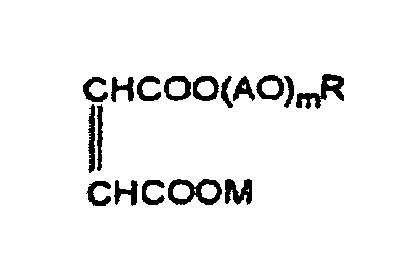
wherein R: alkyl or alkylphenyl; A: ethylene; M: ammonium, amine, or alkali metal; and m: 9, 12, 14, or 28 (working example) (see Japanese Patent Laid-Open Publication No. 134658/1977) 
wherein R1: H or CH3; R2: H, CH3, or -C6H4-(CH2)m-H; and n: 4 to 30 (see Japanese Patent Laid-Open Publication No. 126093/1978) 
wherein R1 and R2: H or CH3, x: 0 to 100; y: 0 to 100; z: 0 to 100; and 1 ≤ x + y + z ≤ 100 (see Japanese Patent Laid-Oper Publication No. 28208/1981) 
wherein R1: C6-18 alkyl group or the like; R2: H, C6-18 alkyl group or the like; R3: H or propenyl group; A: C2-4 alkylene group or substituted alkylene group; and n: 1 to 200 (see Japanese Patent Laid-Open Publication No. 50204/1992) 
wherein R1: H or CH3; R2; C8-24 hydrocarbon group or acyl group; A: C2-4 alkylene group; L: 0 to 100; and m: 0 to 50 (see Japanese Patent Laid-Open Publication No. 104802/1987) 
wherein R1 and R2: H, C1-20 hydrocarbon group, or acyl group; A1 and A2: C2-4 alkylene group or substituted alkylene group; L: 1 or 2; m and n: 0 or positive number with the proviso that m + n ≥ 3; and when both R1 and R2 are H, m and n ≥ 1 (see Japanese Patent Laid-Open Publication No. 98484/1975) - Surfactants have a tendency to lower the surface tension in water, which normally has a surface tension of about 73 dyne/cm. Typically, the surfactants used in the present invention reduce the surface tension of water by at least 30 percent when measured at 10% solids in water. Preferably, the surfactants reduce the surface tension of the water by at least 40, or even 50 percent when measured in 10 % aqueous solutions. The surface tensions of water and 10 % aqueous solutions of sodium AMPS, Hitenol BC 1025, and Hitenol BC 05 are listed in Table 2, below.
Table 2-Surface Tension Activity Solution Surface Tension at 10 % solids (dyne/cm) Water 73 10 % Sodium AMPS 59 10 % Hitenol BC 1025 36 10 % Hitenol BC 05 29.6 - Protective colloids may also be used as a stabilizing agent. Examples of suitable protective colloids are polyvinyl alcohols, starch and cellulose derivatives, and vinylpyrrolidone copolymers. Protective colloids may also be used in conjunction with other emulsifying agents.
- Initiators are typically added to the aqueous medium to stimulate polymerization. The initiators are commonly water-soluble and may decompose by high temperature or through redox reactions. The Guo reference noted above describes suitable thermal initiators and suitable redox initiator systems.
- Exemplary initators include peroxygen compounds such as ammonium persulfate, potassium persulfate, sodium persulfate; peroxides such as hydrogen peroxide; organic hydroperoxides, such as as cumene hydroperoxide, t-butyl hydroperoxide; organic peroxides, such as benzoyl peroxide, acetyl peroxide, lauroyl peroxide, peracetic acid, and perbenzoic acid; and azo-type compounds such as azodiisobutyl nitrile, azobisdimethyl valeronitrile, azobisisobutyl nitrile, azodiisobutyl amide, azobis(alpha-ethylbutyl nitrile) and azobis(alpha, gammadimethylcarponitrile).
- A chain transfer agent may also be added to control the molecular weight of the polymer. The chain transfer agent may be present in amounts ranging from 0 % to about 5 % based on the total weight of the monomers, and is preferably from about 0.2 % to about 1.2 %. The amount of chain transfer agent in the polymerization is inversely proportional to molecular weight; thus, if more chain transfer agent is added, the molecular weight will be lower. The chain transfer agent may include any compound which is able to transfer free radicals. Suitable chain transfer agents include carbon tetrachloride, bromoform, bromotrichloromethane, triphenyl methane, mercapto propionic acid, alkyl mercaptans and thioesters such as n-dodecyl mercaptan, t-dodecyl mercaptan, octyl mercaptan, tetradecyl mercaptan, hexadecyl mercaptan, butyl thioglycolate, isooctyl thioglycolate, and dodecyl thioglycolate.
- Other ingredients may be used in the emulsion polymerization that are well known in the art including chelating agents, buffering agents, inorganic salts and pH adjusting agents.
- The emulsions thus prepared will generally have a solids content of from about 20 to about 60 %, and preferably about 40 %. Prior to neutralization, the emulsion may be diluted with water until it has a solids content ranging from about 10 to about 35 %, preferably from 15 and 25 %. Alternatively, the composition may be neutralized into solution and then diluted to the desired solids content or, perhaps, not diluted at all. Generally, the salt-sensitive copolymer(s) should comprise from about 25 to 100 weight percent, preferably 50 to 99.9 weight percent of the total solids in binder composition. Water should be the primary medium in the binder composition although organic solvents may be present in lesser amounts, i.e. less than about 20 %.
- The molecular weight of the copolymers is not particularly limited, though it does affect the salt-sensitive properties of the polymer. The desired molecular weight range will depend on the specific monomer components and the desired application of the binder. Typically, however, the molecular weight of the polymer should be about 40,000 g/mol to about 500,000 g/mol, and preferably about 60,000 g/mol to about 250,000 g/mol. In general, the copolymers made according to the present invention exhibit a decrease in solubility as the molecular weight goes up, as is illustrated more completely in the examples which follow.
- The emulsion polymer typically has a particle size of from 10 to 1000 nm, preferably about 50 to 300 nm. The morphology of the polymer may vary from spheres to core-shell structures, voids, half-moons, and the like. When monomers of drastically different solubility or hydrophobicity are polymerized in an emulsion process, a wide variety of morphologies may result.
- As stated above, the copolymer must be neutralized into solution in order to prepare the water-solubilized latex binder. To neutralize the copolymer, base is added to the emulsion until the composition becomes optically transparent; the pH is recorded at this point. Preferably, enough base is added just until the point where the emulsion becomes as translucent as possible. Typically, about 5 to about 55 mole % of the carboxylic acid units in the emulsion are neutralized. Suitable bases include NaOH, KOH, Na2CO3, NaHCO3, and the like. Preferably, the base should be non-volatile and contain only monovalent ions.
- The emulsions typically become water-solubilized when the solution reaches a pH of from 4.0 to 9.0, preferably from about 6.0 to 8.0, and even more preferably from about 6.0 to 7.0. Control of neutralization and final solution pH is an important part of the process. Polymers that are over-neutralized can experience problems with viscosity or may exhibit excess base leeching into wetting solutions. Using a relatively mild pH value in the inventive compositions is of great advantage in disposable consumer applications. Such pHs are desirable because they are compatible with a user's skin and will not likely cause irritation upon contact. It is, however, possible to utilize salt-sensitive, solubilized polymers with pH values outside the desired range. To make a fibrous web more compatible with a user's skin in such circumstances, the polymer may be applied to a fibrous web and the web may be treated with acidic agents, buffers, or the like.
- It should be understood that the degree of neutralization required for the binder solutions to exhibit the desired properties (e.g., solubility, viscosity, salt-sensitivity) will vary depending on the composition and properties of the polymer. Such factors will include things such as the amount of acid monomer in the polymer chain and the molecular weight of the polymer.
- The viscosity of the binder solution will also depend on many factors, e.g., the monomer content of the polymer. However, regardless of the makeup of the solution, the viscosity can generally be controlled by regulating one or more of the following aspects: 1) the amount of solids content in the emulsion; 2) the molecular weight of the polymer; 3) the extent that the composition is diluted either before or after neutralization; and 4) the extent of neutralization. The viscosity of the composition should be controlled so that it may be applied to a fibrous web by normal means, and also so that the composition adequately impregnates the web, thereby at least partially binding the fibers together. Thus, the viscosity of the binder composition should be below about 2,000 cps at room temperature (23 °C). Preferably it should be below, 1000 cps, 500 cps, 200 cps and more even more preferably below 150 cps at room temperature.
- Other adjuvants may also be incorporated into the binder solution as dictated by the nature of the desired composition as well known by those of ordinary skill in the art. Examples of additives traditionally used include plasticizers, surfactants, tackifiers, thickeners, fillers, humectants, fragrances, pigments, titanium dioxide or other opacifiers, colorants, antifoams, bactericides, bacteriostats, and encapsulated components which may be employed in conventional amounts.
- The fibrous webs employed in the present invention are non-woven webs. The non-woven structures of the present invention comprise the polymeric binder in combination with fibers. The non-woven is formed by any process known in the art, such as, but not limited to, airlaid, wetlaid, drylaid, or carded fiber. The fiber web typically has a basis weight of from 20 - 200 grams per square meter (gsm). The fibers in the non-woven material may be oriented isotropically, or be aligned with respect to a processing direction. Thicker non-wovens may additionally have fiber oriented in the z-direction of the article, i.e. perpendicular to the fabric plane. In addition to a binder material, the fibers in the non-woven materials may be interlocked mechanically to provide strength and cohesion.
- In the manufacture of nonwoven webs, the fibers are typically dispersed in a medium (air for air-laid and liquid for wet-laid) and deposited in sheet form on a support base. In air-laid processes the fibers and other optional materials are typically suspended in air within a forming system and deposited as a sheet-like structure onto a moving forming screen or a rotating cylinder, prior to application of the binder. Wet-laid processes include providing an aqueous slurry and drying the slurry to form the web.
- Fibers from any source and of any suitable length may be used in the present invention. Fibers include those known in the art including cellulosic fibers from woody plants such as deciduous and coniferous trees; non-woody plants, such as cotton, flax, esparto grass, milkweed, straw, jute and bagasse; and synthetic fibers, such as those derived from polyester, polypropylene, polyethylene, polyamides, polyacrylics, and rayon. Other fiber materials used in the art, and mixtures of any fibers, can be used in the present invention. Preferred fibers are those typically used in non-wovens, especially wood pulp fibers having a length of less than 0.5 cm such as kraft fibers. For wet-laid webs, the fibers should generally be less than a maximum of 5 cm long and most preferably less than 2 cm long. For air-laid webs, the fibers should be less than 8 mm long, preferably less than 6 mm long. Such fibers provide good biodegradable breakdown and dispersion characteristics. Fibers are present in the web at from 50 to 98 percent by weight, depending on the end use of the disposable article. For many uses, fibers make up about 70 to 85 percent by weight of web.
- Generally, the fiber web is formed or at least partially formed prior to application of binder. The binder solution is combined with the fibers by contacting the fibers with the composition by means known in the art such as, printing, spraying with or without air, saturation, creping, and foam-application. The polymer may be combined with the fibers in the wet-end of the papermaking process (e.g., by addition to the paper furnish) or, preferably, after the paper product is substantially formed (e.g., via dry end addition). After application, the fibrous web is typically subjected to a drying step to remove water and/or other liquid. Drying may be accomplished by subjecting the paper product to elevated temperatures, e.g., in the range of from about 85°C to about 125°C for a time sufficient to achieve the desired level of dryness, typically to constant weight.
- The amount of binder composition that remains on the fibers is referred to as "add-on." The percent add-on can be calculated as follows:

The fiber weight is the weight of the fibers before any binder composition is applied. The fiber/binder weight is the weight of the dried (dry to the touch) product. The fibrous webs will generally have an add-on value of from 2 to 50 percent by weight, preferably from 10 to 30 percent by weight. - The binder has temporary wet strength in the presence of salt. Depending on the application, it may be desirable to apply the salt to the fibrous web during production. In such cases, the salt may be applied to the article during manufacture by conventional means such a spraying, coating, dipping, etc. Generally, the water-solubilized binder composition and the salt should not be mixed together before they are added to the fibers. The reason for this is that the salt has a tendency to precipitate the polymer if the two are combined prior to addition to the fibers. Thus, the disposable article that is being treated with the polymer binder is preferably subjected to the drying step to remove water and/or any other liquid prior to the addition of salt. Upon drying, the salt component can be added to the fiber/binder substrate to develop the in-use strength. The salt is typically applied to the web in a solution containing at least about 0.5 wt. percent salt to ensure the web maintains its temporary wet strength. It is preferred to employ salts with monovalent cations such as NaCl, as opposed to salts having multivalent cations which tend to affect the dispersibility characteristics of the binder.
- Pre-moistened products produced according to present invention, such as wet wipes, may contain a wetting composition. The wetting composition should desirably contain at least 0.5 percent by weight of an inorganic salt. The wetting composition may contain one or more additives, which include, but are not limited to, sodium chloride or sodium sulfate solution, preservatives, boric acid, bicarbonates, moisturizers, emollients, surfactants, humectants, alcohols, water, and fragrances. The wetting composition may be present at up to 500 percentage by weight based on the weight of the non-woven material, and preferably up to 350 percent. The wetting composition is generally added as a secondary treatment of the non-woven web. This wet solution treatment can occur just prior to packaging, or after the non-woven has been placed in the final container. Prepared in this manner, wet-use products will have a stable wet strength of measurable tensile value and integrity, yet disperse when placed in tap water, allowing the product to be flushed in sewer or septic systems without blockage. The fiber typically begins dispersing immediately in water. The rate of dispersion can be tailored for different applications by varying factors such as the composition of the polymer, the molecular weight, the degree of neutralization, the pH of the solution, or the type of fiber web.
- The inventive binders are particularly suitable for applications involving pre-moistened articles because the articles may be stored in a solution containing about 0.5 wt. percent or more of salt, whereby the articles maintain a high wet strength until disposed. Pre-moistened articles include those such as wet wipes, household wipes, pre-moistened baby wipes, pre-moistened toilet tissue, and pre-moistened household wipes. The inventive binder solutions may also be suitable for other disposable applications which employ salt sensitive binders such as diapers, incontinent garments, feminine care products, and the like.
- The fibrous webs of the present invention should be non-dispersible in solutions containing more than 0.5% salt, yet readily dispersible in typical wastewater. The fibrous webs used in the disposable articles of the present invention have binders that typically provide a characteristic wet strength index of at least about 40 in a 10 % aqueous solution of NaCl, and preferably at least about 80, and more preferably at least about 100. Some binder compositions may provide wet strength indexes of over 120 in 10 wt. percent NaCl solutions. In addition, the binders generally provide a characteristic wet strength index in deionized water of less than 25, and preferably less than 10, and even more preferably less than 5.
- The following examples are presented to further illustrate and explain the present invention and should not be taken as limiting in any regard.
- Exemplary binder solutions were prepared by emulsion polymerizing the monomers to obtain a latex composition having about 30-55% solids. The emulsion polymerization procedure which was used to polymerize Examples 1-4 of the present invention is summarized below for illustrative purposes.
- A quantity of 560 grams of deionized water was added to a 4 L glass reactor equipped with a condenser, thermometer and stainless steal agitator. Next, a solution of 121 grams of water and 27 grams of Disponil FES 993, an emulsifier, were mixed. The following components were then added to the water/surfactant mixture: 200 grams of methacrylic acid, 300 grams of butyl acrylate, and 2.5 grams of dodecyl mercaptan. The mixture was agitated to give a stable monomer pre-emulsion. To the reactor charge was added, 33 grams of monomer pre-emulsion. Then, 0.3 grams of ammonium persulfate in 5 grams of water was added to the reactor charge. The reaction mixture was heated to 80°C. After 10 minutes, the remaining monomer pre-emulsion was added over a 4 hour period to the reactor. Also, 2.4 grams of ammonium persulfate in 45 grams of water was added to the reactor for about 4.5 hours. After completion of monomer and initiator slow-adds, the reaction mixture was cooled to 60°C. The metering of reducing component, which is composed of 10 grams of water and 0.7 grams of Erythorbic acid, was started at an internal reactor temperature of 60°C. The reaction mixture was maintained between 55-60°C for 10 minutes. After completing reducer add, the reaction mixture was cooled to 30°C. The product had 40 wt. percent solids, a pH of 2.3, a viscosity of 18 centipoise, and a mean particle size of 131 nm.
- After polymerization, the examples were diluted to the desired solids content which, unless specified otherwise, is at about 20%. The binder solution is then prepared at room temperature by neutralizing the polymer according to the following procedure: the emulsion composition is agitated and an aqueous solution of 15% solids sodium hydroxide is added until the desired degree of neutralization is achieved. Unless context indicates otherwise, the compositions of the examples below were neutralized at least to the point where they are as translucent as possible. The resulting compositions have a wide variety of pH values as can be seen from Table 7 below.
- As described in detail below, the binder solutions were applied to pulp substrates and tested for tensile strength after being wetted with three aqueous solutions having varying ion concentrations.
- The procedure for preparing the saturated pulp substrate is as follows: a pulp substrate is dip-nip saturated with binder solution and then thermally dried and post-treated to simulate temperature conditions in commercial pulp manufacturing. Whatman #4 Qualitative Filter Paper sheets, commercially available from Whatman, Inc., are the pulp base stock and are stored under controlled temperature (23°C) and humidity (50%) conditions before use. The pulp is cut to approximately 11.5 x 57 cm strips and weighed to 0.01 gm.
- The Whatman pulp is dip-nip saturated by passing the pulp through a binder bath and then passing the saturated sheets through the pressurized nip rolls of a dual roller saturator (Werner Mathis VFM or a similar saturator) to squeeze off the excess polymer solution. The saturated sheet is then placed into a heated drum drier (Adirondack or a similar drier) set at 100°C until dry to the touch (usually about 2 - 3 passes). After initial drying, the pulp is placed into an oven set at 130°C for two minutes. The saturated dried sheet is re-conditioned at controlled temperature and humidity conditions for a minimum of one hour. The sheet is reweighed to 0.01 gm and then calculated for % add-on. The examples below have add-on values ranging from about 10 % to about 16 %.
- The procedure for preparation of tensile strips and soak solutions is as follows: The saturated pulp is cut into 1 x 4 inch cross-machine direction tensile strips using a precision paper cutter (Test Machines, Inc. or similar cutter). The tensile strips are weighed and the weight is used to calculate basis weight in grams/square meter. Test solutions are prepared as follows:
- a) Solutions of 10% sodium chloride (NaCl) by weight in deionized water.
- b) A 200 ppm hard water solution using 134 ppm Ca++ from calcium chloride (CaCl2) and 66 ppm Mg++ from magnesium chloride (MgCl2) in deionized water.
- c) Standard deionized water.
- Tensile testing and normalization is performed as follows: The test strips are soaked in the various solutions and then measured for wet strength. The solutions represent the type of environments which the pulp may be exposed to, e.g., concentrated salt conditions for in-use storage (10%) and various water conditions for disposal (200 ppm for hard water disposal and deionized for softer water disposal).
- To determine the wet tensile strength, a tensile tester (Instron 5542 or a similar tester) is set to the following parameters: a) pneumatic grips using 1 x 1 inch facings; b) a gap or 2 inches between the top and the bottom facings; c) a crosshead speed of 1 inch/minute; and d) a load cell capable of measuring up to 20,000 gm/inch. Tensile strips are soaked (4 - 6 strips per soak solution) for 60 minutes in the specified soak solution with an emphasis placed on ensuring that full wetting of the strips occurs. The level of soak solution used is as follows: a) 125 gm 10% NaCl salt solution per tensile group (4 - 6 strips); and b) 45 gm of hard water or deionized water per tensile strip soaked. Upon removal from the soak solution, the tensile strip is placed onto absorbent paper toweling to remove excess solution and then immediately tested for tensile strength. The average tensile strength (N/m (gf/inch)) is then normalized to a web basis weight of 112.5 gsm (representative basis weight) using the following formula:

The raw tensile strength is normalized to a standard fabric basis weight (112.5 gsm) in order to compensate for slight effects of variations in the fabric weight. - The wet strength index is then calculated for each example in order to minimize the differences in wet strength due to varying levels of binder add-on. It is calculated according to the following formula:

The wet strength index of each example was calculated in deionized water and in a 10 % NaCl solution (the hard water index was also calculated for examples 28-31). - The following compositional abbreviations are used in the examples:
AA Acrylic Acid monomer BA Butyl Acrylate monomer BC1025 Hitenol BC 1025, Polymerizable polyoxyethylne alkylphenyl ether ammonium sulfate surfactant bCEA beta-Carboxy Ethyl Acrylate monomer ES-40 Standopol ES-40 (Sulfates Alkyl Alcohol Ethoxylate, sodium salt) surfactant ibMA Isobornyl Methacrylate monomer MAA Methacrylic Acid monomer MEM Monoethyl Maleate monomer MMA Methyl Methacrylate nBMA n-Butyl Methacrylate monomer tOA tertiary-Octyl Acrylamide monomer Trem LF-40 Polymerizable sodium dodecyl allyl sulfosuccinate surfactant - The binders in Examples 1-4 contain butyl acrylate and methacrylic acid and the binders in Examples 5-9 further contain tOA. These examples are neutralized to varying degrees and the tensile results illustrate the effect that the amount of neutralization has on the salt-sensitive properties of the binder. In these examples, the percent sodium hydroxide used to neutralize the polymer is based on weight percent of the dry polymer, i.e. (solids/solids). Examples 1 and 5 are not neutralized and, therefore, not covered by the present invention. They are included for comparative purposes.
Table 3-Composition of Examples 1-9 Example BA tOA MAA % NaOH 1 60 - 40 0 (emulsion) 2 60 - 40 4 3 60 - 40 6 4 60 - 40 8 5 50 10 40 0 (emulsion) 6 50 10 40 4 7 50 10 40 6 8 50 10 40 8 9 50 10 40 10 Table 4-Tensile strength values for Examples 1-9 Wet Tensile Strength (normalized to 112.5 gsm) Wet Strenght Index Example Add-on
(%)Basis Weight
(gsm)10 % NaCl N/m
(gf/in)200 ppm N/m
(gf/in)DI water N/m
(gf/in)10 % NaCl DI water 1 13.0 115.6 466 356 382 91.0 76 (1183) (923) (988) 2 16.1 111.6 612 505 230 98.4 37.0 (1585) (1307) (595) 3 12.1 113.0 588 426 65 125.9 14.0 (1523) (1104) (169) 4 14.4 111.5 427 171 22 76.8 4.0 (1106) (442) (58) 5 12.7 109.0 487 393 406 99.4 82.8 (1262) (1018) (1051) 6 13.4 111.9 658 545 253 127.2 48.9 (1705) (1411) (655) 7 14.7 114.9 580 464 60 102.1 10.5 (1501) (1201) (155) 8 12.6 118.2 362 139 13 74.4 2.6 (938) (360) (33) 9 14.9 120.3 145 28 7 25.2 1.1 (376) (73) (17) - The compositions and tensile properties of Examples 10-16 are shown below in Tables 5 and 6. These examples illustrate the effect of chain transfer agent and molecular weight on the wet strength index. The amount of chain transfer agent present during the polymerization reaction is reported as weight percent of the total monomer content. The molecular weight is measured by GPC analysis using polystyrene standards as the reference molecular weight.
Table 5-Composition of Examples 10-16 Example BA MMA MAA Chain Transfer Agent Molecular (% Dodecyl weight mercaptan) 10 43 44 13 1.0 57,000 11 43 44 13 0.5 118,375 12 43 44 13 0.25 251,055 13 60 0 40 1.0 66,044 14 60 0 40 0.5 147,531 15 60 0 40 0.25 301,582 16 55 5 40 0.5 142,791 Table 6-Effect of Mw on Wet Strength Wet Tensile Strength
(normalized to 112.5 gsm)Wet Strength Index Example Add-on
(%)Basis Weight Weight
(gsm)10% NaCl N/m
(gf/in)200 ppm N/m
(gf/in)DI water N/m
(gf/in)10% NaCl DI water 10 13 109.0 194 170 10 38.7 2.1 (503) (439) (27) 11 13.6 108.3 257 281 8 48.9 1.5 (665) (728) (21) 12 14.8 120.5 339 432 0 59.3 0 (877) (1118) (0) 13 14.3 96.6 320 172 36 58.0 6.5 (829) (445) (93) 14 12.1 113.0 588 426 653 125.9 14.0 (1523) (1104) (169) 15 14.7 98.8 756 674 168 133.3 29.5 (1959) (1745) (434) 16 13.3 99.0 505 334 32 98.4 6.3 (1309) (864) (84) - The polymers in Examples 10A-15B below, have the same corresponding compositions and molecular weights as those in Examples 10-15; that is, the polymer compositions of Examples 10A and 10B correlates to the composition in Example 10, and so on. The polymers in Examples below were diluted to a target solids content of about 20% in the "A" examples and about 25 in the "B" examples. The actual solids values are indicated in Table 7, below. The emulsions were then neutralized with 7% NaOH on a solids/solids basis and tested for the physical properties which are also reported in Table 7.
Table 7-Physical properties of Examples 10A-15B Example Mw % Solids pH Viscosity
(cps)10A 57,000 18.7 12.9 43 10B 57,000 23.4 12.8 29,770 11A 118,375 18.9 12.7 81 11B 118,375 ∼ 25 - Gel 12A 251,055 19.1 12.7 548 12B 251,055 ∼ 25 - Gel 13A 66,044 19.3 6.9 29 13B 66,044 23.2 6.9 429 14A 147,531 19.1 7.1 86 14B 147,531 23.2 6.9 5,325 15A 301,582 18.8 7.2 218 15B 301,582 24.2 6.8 56,920 - The compositions for Examples 17-23 are shown below in Table 8. These examples were polymerized with various carboxylic acid monomers to determine the effects of each monomer on the salt-sensitive properties of the binder. The wet tensile strengths and wet strength indexes provided by each binder composition are reported in Table 9.
Table 8-Composition of Examples 17-23 Example BA MMA MAA AA bCEA MEM 17 43 44 13 - - - 18 43 44 - 13 - - 19 50 15 35 - - - 20 60 - 20 - - 20 21 60 - 30 - - 10 22 60 - - - 40 - 23 60 - 40 - - - Table 9-Carboxylic acid performance Wet Tensile Strength
(normalized to 112.5 gsm)Wet Strength Index Example Add-on
(%)Basis Weight
(gsm)10 % NaCl N/m
(gf/in)200 ppm N/m
(gf/in)DI water N/m
(gf/in)10% NaCl DI water 17 13.0 109.0 194 170 10 38.7 2.1 (503) (439) (27) 18 13.4 111.1 38 31 5 7.3 1.0 (98) (79) (14) 19 14.8 113.6 476 288 24 83.2 4.2 (1232) (747) (62) 20 9.6 96.2 103 188 33 27.9 9.0 (267.4) (486.5) (86.0) 21 9.4 95.4 224 318 44 61.7 12.0 (580.1) (823.0) (113.1) 22 8.1 91.7 39 32 11 12.5 3.5 (101.3) (83.6) (28.3) 23 10.7 96.8 418 317 44 101.2 10.6 (1082.6) (819.9) (113.1) - The salt-sensitive properties are also effected by the amount of carboxylic acid monomer, as can be seen from Examples 24-27 in Tables 10 and 11, below.
Table 10- Composition of Examples 24-27 Example BA MAA 24 70 30 25 60 40 26 50 50 27 40 60 Table 11-Comparison varying MAA levels Wet Tensile Strength
(normalized to 112.5 gsm)Wet Strength Index Example Add-on
(%)Basis Weight Weight
(gsm)10% NaCl N/m
(gf/in)200 ppm N/m
(gf/in)DI water N/m
(gf/in)10% NaCl DI water 24 12.5 101.5 355 398 32 73.6 6.72 (920) (1031) (84) 25 12.1 113.8 378 236 15 80.9 3.3 (979) (610) (40) 26 13.1 118.2 793 379 71 156.7 14.1 (2053) (981) (185) 27 12.5 109.3 776 535 104 160.8 21.6 (2010) (1386) (270) - As discussed above, in preferred embodiments of the present invention the binder compositions contain a hydrophobic monomer in addition to the carboxylic acid and acrylate monomers. Examples 28-31 illustrate the effect of varying the amount and type of hydrophobic monomer in a binder having BA as an alkyl acrylate component and MAA as a carboxylic acid component.
Table 12- Composition of Examples 28-31 Example BA tOA nBMA ibMA MAA 28 60 - - - 40 29 50 10 - - 40 30 45 - 15 - 40 31 55 - - 5 40 Table 13-Comparison of varying hydrophobic monomer Wet Tensile Strength
(normalized to 112.5 gsm)Wet Strength Index Example Add-on
(%)Basis Weight
(gsm)10% NaCl N/m
(gf/in)200 ppm N/m
(gf/in)DI water N/m
(gf/in)10% NaCl 200 ppm divalent cations DI water 28 13.8 117.1 446 263 28 83.8 49.4 5.2 (1156) (682) (72) 29 16.4 119.7 315 58 12 49.8 9.1 1.9 (817) (150) (31) 30 15.9 115.8 330 58 12 53.7 9.4 2.0 (854) (150) (32) 31 15.6 111.7 331 77 15 54.9 12.8 2.4 (857) (200) (38) - The binders in Examples 32-36, shown below, are polymerized into a stable emulsion using either a non-polymerizable, ether sulfate surfactant (ES-40) or a polymerizable surfactant monomer (BC 1025 or Trem LF-40). The amount of surfactant and chain transfer agent are reported as weight percent of the total non-surfactant monomer content.
Table 14-Composition of Examples 32-36 Example BA MMA MAA (% ES-40 BC 1025 Trem LF-40 Dodecyl mercaptan) 32 43 44 13 1 1.6 - - 33 43 44 13 1 - 2 - 34 60 - 40 0.5 1.6 - - 35 60 - 40 0.5 - 2 - 36 60 - 40 0.5 - - 1.6 Table 15-Strength values of Examples 32-36 Wet Tensile Strength
(normalized to 112.5 gsm)Wet Strength Index Example Add-on
(%)Basis Weight
(gsm)10 % NaCl N/m
(gf/in)200 ppm N/m
(gf/in)DI water N/m
(gf/in)10 % NaCl DI water 32 12.9 99.0 118 94 10 23.6 1.9 (305) (243) (25) 33 12.3 99.5 243 236 21 51.1 4.3 (629) (612) (53) 34 12.8 101.8 536 351 76 108.5 15.3 (1389) (908) (196) 35 13.4 100.7 466 221 40 90.1 7.8 (1207) (573) (104) 36 12.5 95.9 543 444 62 112.5 12.9 (1406) (1149) (161) - The above examples are intended to more fully explain the invention as defined by the claims, below. Many modifications and variations of this invention can be made without departing from its scope, as will be apparent to those skilled in the art. For example, increasing or decreasing the various monomer ratios can influence the tensile performance of a web, as can changing the level of neutralization. Other factors can also affect the dispersibility of a web such as the type of fibers, the structure of the substrate, and the amount of binder used. Of course, it will also be understood that the specific wet strength properties should vary depending on the desired application. The specific embodiments described herein are offered by way of example only, and the invention is to be limited only by the terms of the appended claims, along with the full scope of equivalents to which such claims are entitled.
Claims (9)
- A salt-sensitive binder polymer comprising:i) from 10 to 70 wt. percent of methacrylic acid units;ii) from 10 to 90 wt. percent of alkyl acrylate units having from 2 to 4 carbon atoms in the alkyl moiety; andiii) from 2 to 55 wt. percent of hydrophobic monomer units from the selected group of alkyl (meth)acrylamides having from 4 to 12 carbon atoms in the alkyl moiety, straight chained or branched alkyl methacrylate units having from 4 to 6 carbon atoms in the alkyl moiety; bi-cycloalkyl (meth) acrylates with from 4 to 20 carbon atoms in the cycloalkyl moiety; and combinations thereof,wherein the salt-sensitive binder polymer is prepared by emulsion polymerization in an aqueous medium and is neutralized such that it is water-soluble, and
wherein the binder provides a characteristic wet strength index of less than 25 in deionized water and a characteristic wet strength index elevation of at least 15 points in a 10 % aqueous solution of NaCl. - The salt-sensitive binder polymer according to claim 1, wherein the alkyl acrylate units comprise butyl acrylate.
- The salt-sensitive binder polymer according to claim 2, wherein the hydrophobic monomer units comprise a substituted or unsubstituted bi-cycloalkyl (meth)acrylate having from 6 to 14 carbon atoms in the cycloalkyl moiety.
- The salt-sensitive binder polymer according to claim 3, wherein the hydrophobic monomer units comprise isobornyl methacrylate.
- The salt-sensitive binder polymer according to claim 1, wherein the hydrophobic monomer units comprise n-butyl methacrylate.
- The salt-sensitive binder polymer according to claim 1, wherein the hydrophobic monomer units comprise an alkyl (meth)acrylamide having from 6 to 10 carbon atoms in the alkyl moiety.
- The salt-sensitive binder polymer according to claim 6, wherein the hydrophobic monomer units comprise N-tertiary octyl acrylamide.
- The salt-sensitive binder polymer according to claim 1, wherein the polymer comprises less than 5 wt. percent of straight or branched chain alkyl (meth) acrylates that have from 8 to 12 carbon atoms in the alkyl moiety.
- The salt-sensitive binder polymer according to claim 1, wherein the binder provides a characteristic wet strength index of less than 25 in deionized water and a characteristic wet strength index elevation of no more than 15 points in an aqueous solution containing 200 ppm of divalent cations.
Applications Claiming Priority (2)
| Application Number | Priority Date | Filing Date | Title |
|---|---|---|---|
| US11/339,216 US7989545B2 (en) | 2006-01-25 | 2006-01-25 | Salt-sensitive binders for nonwoven webs and method of making same |
| EP07716308A EP1979386A2 (en) | 2006-01-25 | 2007-01-03 | Salt-sensitive binders for nonwoven webs and method of making same |
Related Parent Applications (1)
| Application Number | Title | Priority Date | Filing Date |
|---|---|---|---|
| EP07716308.7 Division | 2007-01-03 |
Publications (1)
| Publication Number | Publication Date |
|---|---|
| EP2272880A1 true EP2272880A1 (en) | 2011-01-12 |
Family
ID=38218904
Family Applications (2)
| Application Number | Title | Priority Date | Filing Date |
|---|---|---|---|
| EP07716308A Withdrawn EP1979386A2 (en) | 2006-01-25 | 2007-01-03 | Salt-sensitive binders for nonwoven webs and method of making same |
| EP10010983A Withdrawn EP2272880A1 (en) | 2006-01-25 | 2007-01-03 | Salt-sensitive binders for nonwoven webs and method of making same |
Family Applications Before (1)
| Application Number | Title | Priority Date | Filing Date |
|---|---|---|---|
| EP07716308A Withdrawn EP1979386A2 (en) | 2006-01-25 | 2007-01-03 | Salt-sensitive binders for nonwoven webs and method of making same |
Country Status (4)
| Country | Link |
|---|---|
| US (2) | US7989545B2 (en) |
| EP (2) | EP1979386A2 (en) |
| CN (1) | CN101426826B (en) |
| WO (1) | WO2007087128A2 (en) |
Cited By (1)
| Publication number | Priority date | Publication date | Assignee | Title |
|---|---|---|---|---|
| WO2024099751A1 (en) * | 2022-11-10 | 2024-05-16 | Allnex Belgium, S.A. | Aqueous radiation curable composition |
Families Citing this family (12)
| Publication number | Priority date | Publication date | Assignee | Title |
|---|---|---|---|---|
| US20080214080A1 (en) * | 2007-03-01 | 2008-09-04 | Barcomb Christopher S | Salt-sensitive binder composition with latex processing aid |
| US8088252B2 (en) | 2008-03-03 | 2012-01-03 | Celanese International Corporation | Salt-sensitive cationic polymeric binders for nonwoven webs and method of making the same |
| CN102834566B (en) * | 2010-03-23 | 2016-04-27 | 巴斯夫欧洲公司 | Paper Coating or bonding preparaton and its production and use |
| CN103282582B (en) * | 2010-10-29 | 2016-02-24 | 巴克曼实验室国际公司 | The polymer particles papermaking utilizing ion-type crosslinked and the product produced thereby |
| DE102010051078A1 (en) * | 2010-11-12 | 2012-05-16 | Tam Gmbh & Co. Kg | Fiber-containing fabric with pH-dependent decomposability and process for its preparation |
| US9102848B2 (en) | 2011-02-28 | 2015-08-11 | Basf Se | Environmentally friendly, polymer dispersion-based coating formulations and methods of preparing and using same |
| US9394637B2 (en) | 2012-12-13 | 2016-07-19 | Jacob Holm & Sons Ag | Method for production of a hydroentangled airlaid web and products obtained therefrom |
| CA2909690C (en) | 2013-04-17 | 2018-01-02 | Sellars Absorbent Materials, Inc. | Dispersible articles and methods of making the same |
| ES2717760T3 (en) * | 2013-10-29 | 2019-06-25 | Allegiance Corp | Aqueous hydrophilic / hydrophobic polymer emulsions and products and methods related thereto |
| WO2017058405A1 (en) | 2015-09-29 | 2017-04-06 | Rohm And Haas Company | Water-soluble films and their use in detergent packets |
| JP7332100B2 (en) * | 2019-04-16 | 2023-08-23 | ハイモ株式会社 | Papermaking paper strength agent |
| CN112140652B (en) * | 2020-09-16 | 2022-05-10 | 上海恋轩实业有限公司 | Intelligent breathable fabric and preparation method thereof |
Citations (18)
| Publication number | Priority date | Publication date | Assignee | Title |
|---|---|---|---|---|
| US4384096A (en) | 1979-08-27 | 1983-05-17 | The Dow Chemical Company | Liquid emulsion polymers useful as pH responsive thickeners for aqueous systems |
| US4423199A (en) * | 1982-09-30 | 1983-12-27 | Rohm And Haas Company | Acrylamide containing emulsion copolymers for thickening purposes |
| US4801671A (en) | 1987-06-25 | 1989-01-31 | Desoto, Inc. | Production of alkali-soluble, carboxyl-functional aqueous emulsion thickeners |
| US5073591A (en) | 1989-07-21 | 1991-12-17 | S. C. Johnson & Son, Inc. | Polymeric thickeners and methods of producing the same |
| US5312883A (en) | 1991-11-07 | 1994-05-17 | Lion Corporation | Water-soluble polymer sensitive to salt |
| US5317063A (en) | 1989-09-06 | 1994-05-31 | Lion Corporation | Water-soluble polymer sensitive to salt |
| US5332854A (en) | 1990-06-20 | 1994-07-26 | Dai-Ichi Kogyo Seiyaku Co., Ltd. | Surfactant |
| EP0646606A2 (en) | 1993-10-04 | 1995-04-05 | Rohm And Haas Company | Method for making alkali-soluble emulsion copolymer |
| US5631317A (en) | 1992-12-10 | 1997-05-20 | Lion Corporation | Process for producing self-dispersing and salt-sensitive polymer |
| US5739196A (en) | 1995-11-30 | 1998-04-14 | Union Carbide Chemicals & Plastics Technology Corporation | Latex compositions having wet adhesion and other improved rheological properties and methods of producing same |
| US6063857A (en) | 1997-07-29 | 2000-05-16 | Rohm And Haas Company | Solubilized hydrophobically-modified alkali-soluble emulsion polymers |
| US6127593A (en) | 1997-11-25 | 2000-10-03 | The Procter & Gamble Company | Flushable fibrous structures |
| US6291372B1 (en) | 1997-05-23 | 2001-09-18 | Kimberly Clark Worldwide, Inc. | Ion sensitive binder for fibrous materials |
| US6429261B1 (en) | 2000-05-04 | 2002-08-06 | Kimberly-Clark Worldwide, Inc. | Ion-sensitive, water-dispersible polymers, a method of making same and items using same |
| US20030164476A1 (en) | 2002-01-25 | 2003-09-04 | Hailan Guo | Triggered response compositions |
| US6683129B1 (en) | 2000-03-31 | 2004-01-27 | National Starch And Chemical Investment Holding Corporation | Salt sensitive aqueous emulsions |
| US20040151886A1 (en) | 2000-03-06 | 2004-08-05 | Bobsein Barrett Richard | Binder composition |
| EP1479699A1 (en) | 2001-12-28 | 2004-11-24 | Clariant International Ltd. | Synthetic resin emulsion, easily water-swellable pressure-sensitive adhesive compositions containing the same and process for production of the emulsion |
Family Cites Families (65)
| Publication number | Priority date | Publication date | Assignee | Title |
|---|---|---|---|---|
| US2726230A (en) * | 1950-11-24 | 1955-12-06 | Goodrich Co B F | Preparation of plastic condensable alkyl acrylate polymers and subsequent elasto-condensation thereof |
| US3035004A (en) * | 1955-03-25 | 1962-05-15 | Rohm & Haas | Aqueous polymer dispersions containing (c1-c8)-alkyl acrylate/methacrylic acid copolymer salt thickeners |
| US3248356A (en) * | 1963-09-26 | 1966-04-26 | Dow Chemical Co | Multisperse acrylic latexes |
| US3677991A (en) * | 1968-08-14 | 1972-07-18 | Dow Chemical Co | Anionic acrylate latexes that possess sensitivity to alkalinity |
| US3649581A (en) * | 1970-03-02 | 1972-03-14 | Goodyear Tire & Rubber | Stable polymeric latices of high carboxyl content |
| ZA739217B (en) | 1973-12-04 | 1974-10-30 | Minnesota Mining & Mfg | Enzymatically dispersible non-woven webs and enzyme-dispersible bandage |
| US4005251A (en) * | 1974-01-07 | 1977-01-25 | Johnson & Johnson | Process for preparation of alkali cellulose ester sulfates |
| US3939836A (en) * | 1974-02-07 | 1976-02-24 | Johnson & Johnson | Water dispersible nonwoven fabric |
| US4110291A (en) * | 1977-02-18 | 1978-08-29 | Gaf Corporation | Copolymer emulsions for thickening acrylic polymer latices |
| US4151143A (en) * | 1977-08-19 | 1979-04-24 | American Cyanamid Company | Surfactant-free polymer emulsion coating composition and method for preparing same |
| US4309469A (en) * | 1977-08-22 | 1982-01-05 | Scott Paper Company | Flushable binder system for pre-moistened wipers wherein an adhesive for the fibers of the wipers interacts with ions contained in the lotion with which the wipers are impregnated |
| US4242408A (en) * | 1979-06-25 | 1980-12-30 | The Dow Chemical Company | Easily disposable non-woven products having high wet strength at acid pH and low wet strength at base pH |
| DE3404537A1 (en) * | 1984-02-09 | 1985-08-14 | Hoechst Ag, 6230 Frankfurt | AQUEOUS FUNCTIONAL LIQUIDS BASED ON POLYMERS |
| US5082896A (en) * | 1989-01-17 | 1992-01-21 | Milliken Research Corporation | Polymeric materials useful for sizing synthetic yarns to be used in water jet weaving |
| US5252332A (en) * | 1992-07-24 | 1993-10-12 | Air Products And Chemicals, Inc. | Pre-moistened flushable towlette impregnated with polyvinyl alcohol containing binders |
| US5384189A (en) * | 1993-01-27 | 1995-01-24 | Lion Corporation | Water-decomposable non-woven fabric |
| EP0608460B1 (en) | 1993-01-29 | 1998-09-09 | Lion Corporation | Water-decomposable non-woven fabric |
| CA2128483C (en) * | 1993-12-16 | 2006-12-12 | Richard Swee-Chye Yeo | Flushable compositions |
| US5500281A (en) * | 1994-02-23 | 1996-03-19 | International Paper Company | Absorbent, flushable, bio-degradable, medically-safe nonwoven fabric with PVA binding fibers, and process for making the same |
| US5656746A (en) * | 1996-03-28 | 1997-08-12 | The Proctor & Gamble Company | Temporary wet strength polymers from oxidized reaction product of polyhydroxy polymer and 1,2-disubstituted carboxylic alkene |
| EP0931795A4 (en) | 1996-10-11 | 2000-04-12 | Nippon Carbide Kogyo Kk | POLYMER OBTAINED BY AN EMULSION POLYMERIZATION PROCESS |
| US5986004A (en) * | 1997-03-17 | 1999-11-16 | Kimberly-Clark Worldwide, Inc. | Ion sensitive polymeric materials |
| US5935880A (en) * | 1997-03-31 | 1999-08-10 | Wang; Kenneth Y. | Dispersible nonwoven fabric and method of making same |
| US5972805A (en) * | 1998-04-07 | 1999-10-26 | Kimberly-Clark Worldwide, Inc. | Ion sensitive polymeric materials |
| CA2335242C (en) | 1998-06-15 | 2005-03-01 | Union Carbide Chemicals & Plastics Technology Corporation | Alkali soluble latex thickeners |
| US6387528B1 (en) | 1998-12-29 | 2002-05-14 | Kimberly-Clark Worldwide, Inc. | Compositions of ion-trigger polymer coatings on water-sensitive polymer films |
| SV1999000251A (en) | 1998-12-31 | 2000-10-16 | Pfizer Prod Inc | DERIVATIVES OF 3,3-BIARILPIPERIDINA AND 2,2-BIARILMORFOLINA REF. PCL0085 / 82805 / BB |
| US6579570B1 (en) * | 2000-05-04 | 2003-06-17 | Kimberly-Clark Worldwide, Inc. | Ion-sensitive, water-dispersible polymers, a method of making same and items using same |
| US7276459B1 (en) | 2000-05-04 | 2007-10-02 | Kimberly-Clark Worldwide, Inc. | Ion-sensitive, water-dispersible polymers, a method of making same and items using same |
| US6713414B1 (en) * | 2000-05-04 | 2004-03-30 | Kimberly-Clark Worldwide, Inc. | Ion-sensitive, water-dispersible polymers, a method of making same and items using same |
| US6423804B1 (en) * | 1998-12-31 | 2002-07-23 | Kimberly-Clark Worldwide, Inc. | Ion-sensitive hard water dispersible polymers and applications therefor |
| US6653406B1 (en) * | 2000-05-04 | 2003-11-25 | Kimberly Clark Worldwide, Inc. | Ion-sensitive, water-dispersible polymers, a method of making same and items using same |
| EP1280860A2 (en) | 2000-05-04 | 2003-02-05 | Kimberly-Clark Worldwide, Inc. | Salt-sensitive, water-dispersible polymer composition |
| US6683143B1 (en) * | 2000-05-04 | 2004-01-27 | Kimberly Clark Worldwide, Inc. | Ion-sensitive, water-dispersible polymers, a method of making same and items using same |
| US7101612B2 (en) | 2000-05-04 | 2006-09-05 | Kimberly Clark Worldwide, Inc. | Pre-moistened wipe product |
| US6548592B1 (en) * | 2000-05-04 | 2003-04-15 | Kimberly-Clark Worldwide, Inc. | Ion-sensitive, water-dispersible polymers, a method of making same and items using same |
| US6537663B1 (en) * | 2000-05-04 | 2003-03-25 | Kimberly-Clark Worldwide, Inc. | Ion-sensitive hard water dispersible polymers and applications therefor |
| JP4789386B2 (en) | 2000-05-04 | 2011-10-12 | キンバリー クラーク ワールドワイド インコーポレイテッド | Ion-sensitive, water-dispersible polymer, method for producing the same, and article using the same |
| US6599848B1 (en) * | 2000-05-04 | 2003-07-29 | Kimberly-Clark Worldwide, Inc. | Ion-sensitive, water-dispersible polymers, a method of making same and items using same |
| US6835678B2 (en) * | 2000-05-04 | 2004-12-28 | Kimberly-Clark Worldwide, Inc. | Ion sensitive, water-dispersible fabrics, a method of making same and items using same |
| US6815502B1 (en) * | 2000-05-04 | 2004-11-09 | Kimberly-Clark Worldwide, Inc. | Ion-sensitive, water-dispersable polymers, a method of making same and items using same |
| GB0028254D0 (en) | 2000-11-21 | 2001-01-03 | Dow Corning Sa | Organopolysiloxane compositions and their preparation |
| US6762239B1 (en) * | 2000-11-21 | 2004-07-13 | National Starch And Chemical Investment Holding Corporation | Highly functionalized ethylene-vinyl acetate emulsion copolymers |
| EP1209210A3 (en) * | 2000-11-28 | 2002-07-24 | Basf Aktiengesellschaft | Adhesive comprising calcium aluminium sulfate |
| US6908966B2 (en) * | 2001-03-22 | 2005-06-21 | Kimberly-Clark Worldwide, Inc. | Water-dispersible, cationic polymers, a method of making same and items using same |
| US6897168B2 (en) | 2001-03-22 | 2005-05-24 | Kimberly-Clark Worldwide, Inc. | Water-dispersible, cationic polymers, a method of making same and items using same |
| US20030032352A1 (en) | 2001-03-22 | 2003-02-13 | Yihua Chang | Water-dispersible, cationic polymers, a method of making same and items using same |
| US6506696B2 (en) * | 2001-03-26 | 2003-01-14 | Air Products Polymers, L.P. | High performance synthetic nonwovens using polymers having dual crosslinkable functionality |
| US6897165B2 (en) * | 2001-06-06 | 2005-05-24 | Matsushita Electric Industrial Co., Ltd. | Environmental control equipment/method of developing apparatus for developing light-exposed resist film with developer in wafer treating chamber |
| US20030008591A1 (en) | 2001-06-18 | 2003-01-09 | Parsons John C. | Water dispersible, salt sensitive nonwoven materials |
| US7056847B2 (en) * | 2002-01-18 | 2006-06-06 | Celanese International Corporation | Binder for high wet-strength substrates |
| US20040034138A1 (en) | 2002-04-19 | 2004-02-19 | Richard Buscall | Salt-sensitive polymer composition |
| US7772138B2 (en) | 2002-05-21 | 2010-08-10 | Kimberly-Clark Worldwide, Inc. | Ion sensitive, water-dispersible polymers, a method of making same and items using same |
| MXPA03006208A (en) | 2002-07-25 | 2004-12-07 | Rohm & Haas | Triggered response compositions. |
| KR20040012487A (en) | 2002-07-31 | 2004-02-11 | 롬 앤드 하스 캄파니 | Triggered response compositions |
| US6994865B2 (en) | 2002-09-20 | 2006-02-07 | Kimberly-Clark Worldwide, Inc. | Ion triggerable, cationic polymers, a method of making same and items using same |
| US20040058600A1 (en) | 2002-09-20 | 2004-03-25 | Bunyard W. Clayton | Water-dispersible, cationic polymers, a method of making same and items using same |
| US7141519B2 (en) | 2002-09-20 | 2006-11-28 | Kimberly-Clark Worldwide, Inc. | Ion triggerable, cationic polymers, a method of making same and items using same |
| US7101456B2 (en) | 2002-09-20 | 2006-09-05 | Kimberly-Clark Worldwide, Inc. | Ion triggerable, cationic polymers, a method of making same and items using same |
| US7157389B2 (en) | 2002-09-20 | 2007-01-02 | Kimberly-Clark Worldwide, Inc. | Ion triggerable, cationic polymers, a method of making same and items using same |
| DE60315241T2 (en) | 2002-12-09 | 2008-04-17 | Rohm And Haas Co. | Compositions of multistage release polymers |
| US7476631B2 (en) | 2003-04-03 | 2009-01-13 | The Procter & Gamble Company | Dispersible fibrous structure and method of making same |
| JP3812554B2 (en) * | 2003-08-13 | 2006-08-23 | 船井電機株式会社 | Optical disk playback device |
| US7320831B2 (en) * | 2005-05-03 | 2008-01-22 | Celanese International Corporation | Salt-sensitive vinyl acetate binder compositions and fibrous article incorporating same |
| US7329705B2 (en) * | 2005-05-03 | 2008-02-12 | Celanese International Corporation | Salt-sensitive binder compositions with N-alkyl acrylamide and fibrous articles incorporating same |
-
2006
- 2006-01-25 US US11/339,216 patent/US7989545B2/en not_active Expired - Fee Related
-
2007
- 2007-01-03 EP EP07716308A patent/EP1979386A2/en not_active Withdrawn
- 2007-01-03 CN CN2007800035761A patent/CN101426826B/en not_active Expired - Fee Related
- 2007-01-03 WO PCT/US2007/000172 patent/WO2007087128A2/en not_active Ceased
- 2007-01-03 EP EP10010983A patent/EP2272880A1/en not_active Withdrawn
-
2011
- 2011-02-23 US US12/932,290 patent/US8232345B2/en not_active Expired - Fee Related
Patent Citations (20)
| Publication number | Priority date | Publication date | Assignee | Title |
|---|---|---|---|---|
| US4384096A (en) | 1979-08-27 | 1983-05-17 | The Dow Chemical Company | Liquid emulsion polymers useful as pH responsive thickeners for aqueous systems |
| US4423199A (en) * | 1982-09-30 | 1983-12-27 | Rohm And Haas Company | Acrylamide containing emulsion copolymers for thickening purposes |
| US4801671A (en) | 1987-06-25 | 1989-01-31 | Desoto, Inc. | Production of alkali-soluble, carboxyl-functional aqueous emulsion thickeners |
| US5073591A (en) | 1989-07-21 | 1991-12-17 | S. C. Johnson & Son, Inc. | Polymeric thickeners and methods of producing the same |
| US5317063A (en) | 1989-09-06 | 1994-05-31 | Lion Corporation | Water-soluble polymer sensitive to salt |
| US5332854A (en) | 1990-06-20 | 1994-07-26 | Dai-Ichi Kogyo Seiyaku Co., Ltd. | Surfactant |
| US5312883A (en) | 1991-11-07 | 1994-05-17 | Lion Corporation | Water-soluble polymer sensitive to salt |
| US5631317A (en) | 1992-12-10 | 1997-05-20 | Lion Corporation | Process for producing self-dispersing and salt-sensitive polymer |
| EP0646606A2 (en) | 1993-10-04 | 1995-04-05 | Rohm And Haas Company | Method for making alkali-soluble emulsion copolymer |
| US5739196A (en) | 1995-11-30 | 1998-04-14 | Union Carbide Chemicals & Plastics Technology Corporation | Latex compositions having wet adhesion and other improved rheological properties and methods of producing same |
| US6291372B1 (en) | 1997-05-23 | 2001-09-18 | Kimberly Clark Worldwide, Inc. | Ion sensitive binder for fibrous materials |
| US6063857A (en) | 1997-07-29 | 2000-05-16 | Rohm And Haas Company | Solubilized hydrophobically-modified alkali-soluble emulsion polymers |
| US6127593A (en) | 1997-11-25 | 2000-10-03 | The Procter & Gamble Company | Flushable fibrous structures |
| US6433245B1 (en) | 1997-11-25 | 2002-08-13 | The Procter & Gamble Company | Flushable fibrous structures |
| US20040151886A1 (en) | 2000-03-06 | 2004-08-05 | Bobsein Barrett Richard | Binder composition |
| US6683129B1 (en) | 2000-03-31 | 2004-01-27 | National Starch And Chemical Investment Holding Corporation | Salt sensitive aqueous emulsions |
| US20040186222A1 (en) * | 2000-03-31 | 2004-09-23 | Eknoian Michael W. | Salt sensitive aqueous emulsions |
| US6429261B1 (en) | 2000-05-04 | 2002-08-06 | Kimberly-Clark Worldwide, Inc. | Ion-sensitive, water-dispersible polymers, a method of making same and items using same |
| EP1479699A1 (en) | 2001-12-28 | 2004-11-24 | Clariant International Ltd. | Synthetic resin emulsion, easily water-swellable pressure-sensitive adhesive compositions containing the same and process for production of the emulsion |
| US20030164476A1 (en) | 2002-01-25 | 2003-09-04 | Hailan Guo | Triggered response compositions |
Cited By (1)
| Publication number | Priority date | Publication date | Assignee | Title |
|---|---|---|---|---|
| WO2024099751A1 (en) * | 2022-11-10 | 2024-05-16 | Allnex Belgium, S.A. | Aqueous radiation curable composition |
Also Published As
| Publication number | Publication date |
|---|---|
| WO2007087128A3 (en) | 2008-04-24 |
| US8232345B2 (en) | 2012-07-31 |
| US20070173594A1 (en) | 2007-07-26 |
| EP1979386A2 (en) | 2008-10-15 |
| US7989545B2 (en) | 2011-08-02 |
| WO2007087128A2 (en) | 2007-08-02 |
| US20110146927A1 (en) | 2011-06-23 |
| CN101426826B (en) | 2012-11-28 |
| CN101426826A (en) | 2009-05-06 |
Similar Documents
| Publication | Publication Date | Title |
|---|---|---|
| US8232345B2 (en) | Method of making salt-sensitive binders and nonwoven webs | |
| US8088252B2 (en) | Salt-sensitive cationic polymeric binders for nonwoven webs and method of making the same | |
| US5312883A (en) | Water-soluble polymer sensitive to salt | |
| US5631317A (en) | Process for producing self-dispersing and salt-sensitive polymer | |
| EP1137679A1 (en) | Aqueous dispersions of water-soluble polymers of n-vinyl carboxylic acid amides, method for the production and use thereof | |
| JP3643550B2 (en) | Reduced formaldehyde nonwoven binder containing polymerized units of N-methylolacrylamide | |
| US7329705B2 (en) | Salt-sensitive binder compositions with N-alkyl acrylamide and fibrous articles incorporating same | |
| US7320831B2 (en) | Salt-sensitive vinyl acetate binder compositions and fibrous article incorporating same | |
| CA2560287C (en) | Process for preparing an aqueous dispersion of a quaternary ammonium salt containing vinyl copolymer | |
| US20030220459A1 (en) | Heat-sensitive water soluble copolymers based on(poly)ethoxylated(meth) acrylate, method for making same and use for preparing adhesive films and binders for textiles webs | |
| US20090123773A1 (en) | Salt-sensitive binders containing vinyl acetate for nonwoven webs and method of making same | |
| EP1964887B1 (en) | Salt-sensitive binder composition with latex processing aid | |
| RU2699465C2 (en) | Fast disintegrating nonwoven binding agent | |
| MX2008009681A (en) | Salt-sensitive binders for nonwoven webs and method of making same |
Legal Events
| Date | Code | Title | Description |
|---|---|---|---|
| PUAI | Public reference made under article 153(3) epc to a published international application that has entered the european phase |
Free format text: ORIGINAL CODE: 0009012 |
|
| AC | Divisional application: reference to earlier application |
Ref document number: 1979386 Country of ref document: EP Kind code of ref document: P |
|
| AK | Designated contracting states |
Kind code of ref document: A1 Designated state(s): AT BE BG CH CY CZ DE DK EE ES FI FR GB GR HU IE IS IT LI LT LU LV MC NL PL PT RO SE SI SK TR |
|
| AX | Request for extension of the european patent |
Extension state: AL BA HR MK RS |
|
| 17P | Request for examination filed |
Effective date: 20110712 |
|
| RIC1 | Information provided on ipc code assigned before grant |
Ipc: A61L 15/00 20060101ALI20110921BHEP Ipc: D04H 1/64 20060101ALI20110921BHEP Ipc: C08F 220/06 20060101AFI20110921BHEP |
|
| 17Q | First examination report despatched |
Effective date: 20120411 |
|
| STAA | Information on the status of an ep patent application or granted ep patent |
Free format text: STATUS: THE APPLICATION IS DEEMED TO BE WITHDRAWN |
|
| 18D | Application deemed to be withdrawn |
Effective date: 20130801 |