EP2271044A2 - Anonymous transactions in computer networks - Google Patents
Anonymous transactions in computer networks Download PDFInfo
- Publication number
- EP2271044A2 EP2271044A2 EP20100005252 EP10005252A EP2271044A2 EP 2271044 A2 EP2271044 A2 EP 2271044A2 EP 20100005252 EP20100005252 EP 20100005252 EP 10005252 A EP10005252 A EP 10005252A EP 2271044 A2 EP2271044 A2 EP 2271044A2
- Authority
- EP
- European Patent Office
- Prior art keywords
- user
- servers
- transaction
- computer
- pseudonym
- Prior art date
- Legal status (The legal status is an assumption and is not a legal conclusion. Google has not performed a legal analysis and makes no representation as to the accuracy of the status listed.)
- Granted
Links
Images


Classifications
-
- H—ELECTRICITY
- H04—ELECTRIC COMMUNICATION TECHNIQUE
- H04L—TRANSMISSION OF DIGITAL INFORMATION, e.g. TELEGRAPHIC COMMUNICATION
- H04L63/00—Network architectures or network communication protocols for network security
- H04L63/04—Network architectures or network communication protocols for network security for providing a confidential data exchange among entities communicating through data packet networks
- H04L63/0407—Network architectures or network communication protocols for network security for providing a confidential data exchange among entities communicating through data packet networks wherein the identity of one or more communicating identities is hidden
- H04L63/0421—Anonymous communication, i.e. the party's identifiers are hidden from the other party or parties, e.g. using an anonymizer
-
- H—ELECTRICITY
- H04—ELECTRIC COMMUNICATION TECHNIQUE
- H04L—TRANSMISSION OF DIGITAL INFORMATION, e.g. TELEGRAPHIC COMMUNICATION
- H04L63/00—Network architectures or network communication protocols for network security
- H04L63/12—Applying verification of the received information
- H04L63/126—Applying verification of the received information the source of the received data
-
- H—ELECTRICITY
- H04—ELECTRIC COMMUNICATION TECHNIQUE
- H04L—TRANSMISSION OF DIGITAL INFORMATION, e.g. TELEGRAPHIC COMMUNICATION
- H04L9/00—Cryptographic mechanisms or cryptographic arrangements for secret or secure communications; Network security protocols
- H04L9/32—Cryptographic mechanisms or cryptographic arrangements for secret or secure communications; Network security protocols including means for verifying the identity or authority of a user of the system or for message authentication, e.g. authorization, entity authentication, data integrity or data verification, non-repudiation, key authentication or verification of credentials
- H04L9/321—Cryptographic mechanisms or cryptographic arrangements for secret or secure communications; Network security protocols including means for verifying the identity or authority of a user of the system or for message authentication, e.g. authorization, entity authentication, data integrity or data verification, non-repudiation, key authentication or verification of credentials involving a third party or a trusted authority
-
- H—ELECTRICITY
- H04—ELECTRIC COMMUNICATION TECHNIQUE
- H04L—TRANSMISSION OF DIGITAL INFORMATION, e.g. TELEGRAPHIC COMMUNICATION
- H04L9/00—Cryptographic mechanisms or cryptographic arrangements for secret or secure communications; Network security protocols
- H04L9/32—Cryptographic mechanisms or cryptographic arrangements for secret or secure communications; Network security protocols including means for verifying the identity or authority of a user of the system or for message authentication, e.g. authorization, entity authentication, data integrity or data verification, non-repudiation, key authentication or verification of credentials
- H04L9/3218—Cryptographic mechanisms or cryptographic arrangements for secret or secure communications; Network security protocols including means for verifying the identity or authority of a user of the system or for message authentication, e.g. authorization, entity authentication, data integrity or data verification, non-repudiation, key authentication or verification of credentials using proof of knowledge, e.g. Fiat-Shamir, GQ, Schnorr, ornon-interactive zero-knowledge proofs
- H04L9/3221—Cryptographic mechanisms or cryptographic arrangements for secret or secure communications; Network security protocols including means for verifying the identity or authority of a user of the system or for message authentication, e.g. authorization, entity authentication, data integrity or data verification, non-repudiation, key authentication or verification of credentials using proof of knowledge, e.g. Fiat-Shamir, GQ, Schnorr, ornon-interactive zero-knowledge proofs interactive zero-knowledge proofs
-
- H—ELECTRICITY
- H04—ELECTRIC COMMUNICATION TECHNIQUE
- H04L—TRANSMISSION OF DIGITAL INFORMATION, e.g. TELEGRAPHIC COMMUNICATION
- H04L9/00—Cryptographic mechanisms or cryptographic arrangements for secret or secure communications; Network security protocols
- H04L9/32—Cryptographic mechanisms or cryptographic arrangements for secret or secure communications; Network security protocols including means for verifying the identity or authority of a user of the system or for message authentication, e.g. authorization, entity authentication, data integrity or data verification, non-repudiation, key authentication or verification of credentials
- H04L9/3236—Cryptographic mechanisms or cryptographic arrangements for secret or secure communications; Network security protocols including means for verifying the identity or authority of a user of the system or for message authentication, e.g. authorization, entity authentication, data integrity or data verification, non-repudiation, key authentication or verification of credentials using cryptographic hash functions
-
- H—ELECTRICITY
- H04—ELECTRIC COMMUNICATION TECHNIQUE
- H04L—TRANSMISSION OF DIGITAL INFORMATION, e.g. TELEGRAPHIC COMMUNICATION
- H04L2209/00—Additional information or applications relating to cryptographic mechanisms or cryptographic arrangements for secret or secure communication H04L9/00
- H04L2209/42—Anonymization, e.g. involving pseudonyms
-
- H—ELECTRICITY
- H04—ELECTRIC COMMUNICATION TECHNIQUE
- H04L—TRANSMISSION OF DIGITAL INFORMATION, e.g. TELEGRAPHIC COMMUNICATION
- H04L2209/00—Additional information or applications relating to cryptographic mechanisms or cryptographic arrangements for secret or secure communication H04L9/00
- H04L2209/56—Financial cryptography, e.g. electronic payment or e-cash
-
- H—ELECTRICITY
- H04—ELECTRIC COMMUNICATION TECHNIQUE
- H04L—TRANSMISSION OF DIGITAL INFORMATION, e.g. TELEGRAPHIC COMMUNICATION
- H04L2463/00—Additional details relating to network architectures or network communication protocols for network security covered by H04L63/00
- H04L2463/081—Additional details relating to network architectures or network communication protocols for network security covered by H04L63/00 applying self-generating credentials, e.g. instead of receiving credentials from an authority or from another peer, the credentials are generated at the entity itself
Definitions
- the present invention relates to the field of transactions over distributed computer networks.
- the invention relates to transactions wherein it is necessary to confirm to two or more entities that a user known to one entity as "user A” and to another entity as "user B" is the same person while maintaining the user's anonymity.
- SOA Service Oriented Architecture
- web services in supporting different multiphase transaction processes, the issue of providing services which preserve users anonymity, is very important nowadays.
- SOA is defined as a group of services that communicate with each other. The process of communication involves a number of services coordinating a common activity.
- Anonymity is defined as preventing the association of any personal data communicated using a SOA with a specific client.
- the Janus function satisfies a number of properties, including anonymity, consistency, secrecy, uniqueness of an alias, and protection from creation of dossiers, thereby providing the user anonymity in the computationally secure aspect.
- This function translates the user name (for example, e-mail address) to a unique user alias.
- the computation of the Janus function and the translation of the real user name to the corresponding alias are performed by the centralized Janus proxy server which is usually placed in the firewall which connects a certain Intranet to the Internet.
- One of the drawbacks with the Janus function is that the use of a central server yields the existence of a bottleneck and a single point of failure, which our scheme avoids.
- the invention is a method for anonymously carrying out multiphase transactions over a distributed computer network that comprises a trusted authority, a user's computer, and servers of one or more service providers.
- Each of the computers/servers in the network comprises dedicated software that contains a one-way function and other information and instructions necessary to execute the method.
- the method comprises two stages. In the first stage a user anonymously authenticates himself/herself by means of a unique pseudonym to each of the servers that are involved in the transaction. In the second stage the user proves to each of the servers that it is a single entity that has interacted with each of the servers in the first stage and therefore has made all of the preparations necessary to execute the multiphase transaction.
- One of the features that characterize the invention is that the user's computer uses the one way function to produce a unique user name and password for each user-server pair from a random seed provided by the trusted authority and the IP address of each of the servers involved in the transaction.
- the trusted authority supplies the servers with the proof required in the second stage.
- the trusted authority limits the number of times that the random seed provided to the user can be used.
- the hard to produce evidence is a very large prime number.
- the invention is a computer implemented method for anonymously carrying out multiphase transactions over distributed computer networks that comprise a user's computer and servers of one or more service providers that are interconnected by communication channels.
- Each of the computers/servers in the network comprises dedicated software that contains the information and instructions necessary to execute the method of the invention.
- an entity known as a user U
- User U is able to prove, without revealing information concerning his/her identity, that he/she is the one that accessed each entity in S U .
- a transaction is defined as a two stage operation.
- user U anonymously authenticates himself/herself by means of a unique pseudonym to the other servers S U that are involved in the transaction.
- Each user U has a one way function F by means of which he/she can produce from a random seed and the IP address of each other entity S involved in the transaction a unique user name and password.
- the pseudonym which is a fictitious alternative to a person's legal name, is generated by a user for accessing any server in a group of servers. The pseudonym is unique for each user-server pair.
- the uniqueness of the pseudonym is provided by the server's IP address which is one of the parameters of the one way function that, together with a seed, generates a pseudo random sequence.
- the user U does not have to maintain any information about the server in order to reproduce the user name and password used for accessing a given server S.
- In the second stage U is able to prove to each server S from the group of servers S U that the same entity, i.e. himself/herself, interacted (during the first phase) with all the servers S U and therefore has made all of the preparations necessary to execute the (composite) transaction.
- the invention has two embodiments each of which is a protocol for anonymous transactions.
- the first embodiment is known as Anonymous Transactions Protocol (ATP 1 ) . It is based on the approval of a Trusted Authority (TA ) for the transaction resolution.
- TA Trusted Authority
- the TA may limit the number of possible transactions carried out by the same user.
- the transactions are performed in two modes: unlinkable and linkable transactions.
- the different user's transactions can be unlinkable in the sense that different entities from a set of network entities do not know that the same anonymous user requested a service from them.
- the linkability of transactions may also be satisfied when the entities are provided with tools to verify that they have received service from the same anonymous user.
- the mode of the transactions is chosen by the player who accesses the TA in order to carry out the transactions.
- the second embodiment known as the Advanced Transactions Protocol ATP 2 uses the TA in the initialization stage only, while the anonymous transactions are carried out by a user without involving the TA.
- the TA generates a hard to produce evidence EVID for each user U e.g., a problem instance with or without a solution.
- the user's pseudonym in this scheme is based on the server's IP address, a hard to produce evidence EVID , and one way function granted to the user by the TA during the system initialization.
- the pseudonym includes the anonymous user name (login) and the password.
- the pseudonym is created as a pseudo random sequence.
- This pseudo random sequence is generated by the one way function and a seed calculated by XOR - ing the server's IP address and an evidence EVID.
- the user performs an interactive Zero Knowledge Proof to prove that he/she knows EVID which is computationally hard to produce by the polynomial time adversary.
- the advanced ATP 2 uses Zero-Knowledge proof techniques to repeatedly identify a user U without exposing the EVID and its solution, therefore avoiding identity theft.
- the TA in ATP 2 is involved only once during the system initialization. Because the Zero Knowledge Proof techniques relied upon in the second embodiment of the invention are very computationally expensive Zero, this embodiment is implementable only by very powerful computers.
- the anonymous network comprises a set of network entities (users and servers) and a Trusted Authority TA .
- a user U i ⁇ U initiates and carries out anonymous transaction with the servers from the corresponding server set S U i .
- the transaction is defined as a two stage operation:
- the message t ij consists of the anonymous user name and password pair ( u ij ,p ij ) which is, in essence unique for a given user U i and a server S j .
- the transaction resolution is initiated by the user U i and is performed by sending the message Resolve i k to each S j ⁇ S U i .
- the security parameter in the model is ⁇ which is equal to the length of the seed c ij that generates the pseudo random sequence for the anonymous user name and password.
- ⁇ is compared to the pseudo random sequence length, the higher is the computational security level of the scheme.
- the transaction resolution in ATP 1 is executed by the TA when each server S j passes the Resolve i k message received from U i to the TA.
- the transaction resolution provided by ATP 2 is performed by the user U i while U i proves that he/she knows the hardly producible evidence EVID to each server from the corresponding server set S U i in the interactive Zero Knowledge Proof (ZKP).
- ZKP Zero Knowledge Proof
- a polynomially time restricted semi-honest adversary A [14] is assumed. Entity A can impersonate the legal user and therefore can get access to the servers' resources. A can also try to prove to the group of servers that he/she is the legal user that initiated the transaction.
- the security model and the corresponding requirements are defined as a function of the security parameter ⁇ that assures the computationally secure level of the anonymous transactions.
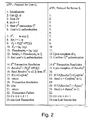
- Figs. 1a to 1d and 2 schematically show the four stages in executing a transaction according to the ATP 1 protocol and Fig. 2 is a listing of the steps of the ATP 1 protocol for the User U i (on the left) and for the Server S j (on the right).
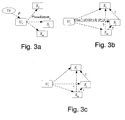
- Figs. 1b to 1c , 3b, and 3c the question marks signify unknown relations and the exclamation points signify revealed relations.
- the ATP 1 protocol user U i may choose to allow his/her different transactions T i k and T i l , k ⁇ l with the same group of servers S U i to be linkable in the sense that after executing the T i k transaction any S j from S U i can be convinced, i.e. know with overwhelming probability, that the T i k and T i l transactions have been performed by the same anonymous user.
- One method of allowing linkability is to use the authentication scheme suggested by Lamport [10].
- the one way function F generates the pseudo random sequence F ( Q i ) from the seed Q i .
- the maximum number of the transactions permitted to the user U i by the TA is t and F t-k ( Q i ) denotes t - k sequential applications of the one way function F on the secret seed Q i .
- the value revealed by the user U i in the Resolve i k message is, consequently, the internal seed F t-k ( Q i ) ⁇ IP ( S j ) used to compute ( u ij , p ij ).
- user U i may choose not to allow his/her different transactions T i k and T i l , k ⁇ l with the group of servers S U i to be linkable.
- the TA provides U i with the pair ( Q i , W i ) of secret seeds.
- the pseudo random sequence F k ( W i ), generated by the secret seed W i by the k sequential compositions of the one way function F provides the one way "lock” F t-k ( Q i ) of the encrypted secret Q i .
- the security parameter ⁇ equals to the length of the seed Q i or W i , which are used as the arguments of the F function for generating the pseudo random sequence. Note that the larger ⁇ is, the higher the encryption level provided in the transactions.
- ATP 1 satisfies the model requirements (R 1 ) to (R 6 ) listed herein above.
- ATP 1 is computationally secure regarding the security parameter ⁇ that determines the computational security level. and thus provides the anonymous transactions in the computationally secure manner.
- user U i ⁇ U wishes to carry out at most t transactions with the network servers from the S U i set.
- the TA permits the user U i at most t possible transactions with the groups of servers, and provides U i with a secret number Q i and a one way function F .
- (R 3 ) - Pseudonym uniqueness The user's U i pseudonym for any l th transaction T i l is generated by the one way function F from the seed Q i l ⁇ IP ( S j ). The seed's uniqueness is satisfied by the IP address IP ( S j ) of server's S j , which is one of Q i l ⁇ IP ( S j ) seed components. Assuming that F is a proper collision-resistant one way function ([14]), the generated pseudo random sequence is unique for any ( U i ,S j ) pair.
- the advanced anonymous transactions protocol ATP 2 allows the user to carry out and resolve the anonymous transactions by himself/herself. Hence, the TA is involved in the system only once during the initialization stage.
- the idea is to provide a user with an evidence which is hard to produce, say a very long prime number [3]. Only a powerful entity may have enough resources to obtain such evidences.
- Figs. 3a to 3d and 4 schematically show the three stages in executing a transaction according to the ATP 2 protocol and Fig. 4 is a listing of the steps of the ATP 2 protocol for the User U i (on the left) and for the Server S j (on the right).
- the user U i 's transaction with the servers from the corresponding set S U i is executed in the following way:
- ATP 2 satisfies the model requirements (R 1 ) to (R 5 ) listed herein above.
- the ATP 2 protocol's computational security level is determined by the security parameters of the ZKP performed by the user to the servers from the corresponding servers' set and therefore provides the anonymous transactions in the computationally secure manner without involving the TA.
- the anonymous user's pseudonym in the ATP 2 is constructed in nearly the same manner as in the ATP 1 case.
- the TA in order to provide a user's permanent identity, the TA must generate a hard to produce evidence EVID and its solution, so it is computationally infeasible to produce and hence to guess EVID in an adversarial manner.
- the inventor's propose turning to the difficulty of the prime numbers generation and the primality proof as an example of one method of producing such an EVID.
- the generation of large prime numbers is an extremely difficult problem [3] and therefore only an extremely wealthy authority such as a government is able to produce large primes.
- the proposed hard evidence EVID is a very large prime number P and also assume that the purpose of the user U i is to convince the servers from the S U i set that U i anonymously interacted with each S j ⁇ S U i and provided a k th transaction T i k in a legitimate manner.
- the user U i acts as follows: he/she computes a commitment to P for the T i k transaction and proves in the T i kth second phase ( Fig. 4 , line18) that P is a very large prime.
- a method by which the user can supply this proof is to use the ZKP proofs of primality proposed in either [2] or [11].
- the ZKP protocols presented in these papers are based on the randomized primality tests which provide a very high confidence level of the committed number to be prime.
- the main advantage of these schemes is that the target number is not revealed, and only its commitment participates in the ZKP. Based on these results, the prime evidence P granted to the user by the TA is valid forever for any number of possible transactions. Hence, only commitment to P is updated for a new transaction.
- a prover in the context of the present invention a user performs the correct computation of a modular addition, modular multiplication, or a modular exponentiation, where all values including the modulus are committed but not publicly available.
- the authors of [2] implement the randomized Lehmann primality test in Zero Knowledge (see [1]).
- the computational security power is based on the hardness of the discrete logarithm problem in finite groups [14].
- ATP 2 The application of ATP 2 requires the users and the servers to deal with computations that are very long and, therefore requires them to be powerful machines as well.
Landscapes
- Engineering & Computer Science (AREA)
- Computer Security & Cryptography (AREA)
- Computer Networks & Wireless Communication (AREA)
- Signal Processing (AREA)
- Computer Hardware Design (AREA)
- Computing Systems (AREA)
- General Engineering & Computer Science (AREA)
- Computer And Data Communications (AREA)
- Data Exchanges In Wide-Area Networks (AREA)
Abstract
Description
- The present invention relates to the field of transactions over distributed computer networks. In particular the invention relates to transactions wherein it is necessary to confirm to two or more entities that a user known to one entity as "user A" and to another entity as "user B" is the same person while maintaining the user's anonymity.
- Publications and other reference materials referred to herein, including reference cited therein, are incorporated herein by reference in their entirety and are numerically referenced in the following text and respectively grouped in the appended Bibliography which immediately precedes the claims.
- Due to the fast development of the Service Oriented Architecture (SOA) and web services in supporting different multiphase transaction processes, the issue of providing services which preserve users anonymity, is very important nowadays. SOA is defined as a group of services that communicate with each other. The process of communication involves a number of services coordinating a common activity. Anonymity is defined as preventing the association of any personal data communicated using a SOA with a specific client.
- Several computationally and communication efficient protocols for anonymous communication in computer methods have been proposed. Examples of such protocols are found in [4] and [5], these protocols can serve as point to point communication primitive procedures for comprehensive anonymous transactions schemes.
- A system for anonymous personalized web browsing has been proposed in [7]. In this paper a new cryptographic function, named the Janus function is described. The Janus function satisfies a number of properties, including anonymity, consistency, secrecy, uniqueness of an alias, and protection from creation of dossiers, thereby providing the user anonymity in the computationally secure aspect. This function translates the user name (for example, e-mail address) to a unique user alias. The computation of the Janus function and the translation of the real user name to the corresponding alias are performed by the centralized Janus proxy server which is usually placed in the firewall which connects a certain Intranet to the Internet. One of the drawbacks with the Janus function is that the use of a central server yields the existence of a bottleneck and a single point of failure, which our scheme avoids.
- All the methods described above have not yet provided satisfactory solutions to the problem of effecting secure transactions on the Internet because they address only anonymous point to point communication [4] and [5] and/or pseudonym support [7].
- It is therefore a purpose of the present invention to provide new protocols for providing multiphase transactions between a user and a set of servers while maintaining the user's anonymity.
- Further purposes and advantages of this invention will appear as the description proceeds.
- The invention is a method for anonymously carrying out multiphase transactions over a distributed computer network that comprises a trusted authority, a user's computer, and servers of one or more service providers. Each of the computers/servers in the network comprises dedicated software that contains a one-way function and other information and instructions necessary to execute the method. The method comprises two stages. In the first stage a user anonymously authenticates himself/herself by means of a unique pseudonym to each of the servers that are involved in the transaction. In the second stage the user proves to each of the servers that it is a single entity that has interacted with each of the servers in the first stage and therefore has made all of the preparations necessary to execute the multiphase transaction. One of the features that characterize the invention is that the user's computer uses the one way function to produce a unique user name and password for each user-server pair from a random seed provided by the trusted authority and the IP address of each of the servers involved in the transaction.
- In an embodiment of the method of the invention the trusted authority supplies the servers with the proof required in the second stage.
- In an embodiment of the method of the invention the trusted authority limits the number of times that the random seed provided to the user can be used.
- In an embodiment of the method of the invention the user can choose one of the following two modes in which to carry out the transaction:
- a. an unlinkable mode wherein different entities from a set of network entities do not know that the same anonymous user previously requested a service from them; and
- b. a linkable mode wherein different entities from a set of network entities are provided with tools to verify that two or more transactions were initiated by the same anonymous user.
- Following the first stage and after anonymously obtaining information about the transaction from some or all of the service providers the user can choose not to execute the stage of the method, thereby not going through with the transaction.
- An embodiment of the method of the invention is carried out as follows:
- a. the user uses his computer to establish contact with the computer of the trusted authority, which provides the user's computer with a secret random number which can be used for a certain number of possible transactions;
- b. a transaction is started by the user who uses the one-way function included in the software on his computer to produce locally a unique pseudonym for each service provider that will be involved in the transaction, wherein the is produced from the secret random number and the corresponding IP address of the server of the service provider, wherein the user uses the pseudonyms to communicate anonymously with the servers of the service providers;
- c. the user initiates the carrying out of the transaction by sending from his computer to each of the servers a message that reveals part of the pseudonym to the servers;
- d. the transaction is completed when each of the servers sends the revealed part of the pseudonym to the computer of the trusted authority, which confirms to each of the servers that the same user has interacted with each of them.
- An embodiment of the method of the invention is carried out as follows:
- a. the user uses his computer to establish contact with the computer of the trusted authority, which provides the user's computer with a hard to produce evidence;
- b. a transaction is started by the user who uses the one-way function included in the software on his computer to produce locally a unique pseudonym for each service provider that will be involved in the transaction, wherein the pseudonym is produced from the hard to produce evidence and the corresponding IP address of the server of the service provider, wherein the user uses the pseudonyms to communicate anonymously with the servers of the service providers;
- c. the user initiates the carrying out of the transaction by sending from his computer to each of the servers a message that reveals part of the pseudonym to the servers and the user completes the transaction by providing to each of the servers a computationally secure Interactive Zero Knowledge Proof he is the same anonymous identity that knows the hard to produce evidence.
- In this latter embodiment the hard to produce evidence is a very large prime number.
- All the above and other characteristics and advantages of the invention will be further understood through the following illustrative and non-limitative description of preferred embodiments thereof, with reference to the appended drawings.
-
-
Fig. 1a to Fig. 1d schematically show the four stages in executing a transaction according to the ATP 1 protocol; -
Fig. 2 is a listing of the steps of the ATP 1 protocol for the User U i and for the Server S j; -
Fig. 3a to Fig. 3d schematically show the three stages in executing a transaction according to the ATP 2 protocol; and -
Fig. 4 is a listing of the steps of the ATP 2 protocol for the User U i and for the Server S j. - The invention is a computer implemented method for anonymously carrying out multiphase transactions over distributed computer networks that comprise a user's computer and servers of one or more service providers that are interconnected by communication channels. Each of the computers/servers in the network comprises dedicated software that contains the information and instructions necessary to execute the method of the invention. According to the invention, an entity, known as a user U, may execute transactions with a group of entities, known as servers SU . User U is able to prove, without revealing information concerning his/her identity, that he/she is the one that accessed each entity in SU .
- A transaction is defined as a two stage operation. During the first stage, user U anonymously authenticates himself/herself by means of a unique pseudonym to the other servers SU that are involved in the transaction. Each user U has a one way function F by means of which he/she can produce from a random seed and the IP address of each other entity S involved in the transaction a unique user name and password. The pseudonym, which is a fictitious alternative to a person's legal name, is generated by a user for accessing any server in a group of servers. The pseudonym is unique for each user-server pair. The uniqueness of the pseudonym is provided by the server's IP address which is one of the parameters of the one way function that, together with a seed, generates a pseudo random sequence. The user U does not have to maintain any information about the server in order to reproduce the user name and password used for accessing a given server S. In the second stage U is able to prove to each server S from the group of servers SU that the same entity, i.e. himself/herself, interacted (during the first phase) with all the servers SU and therefore has made all of the preparations necessary to execute the (composite) transaction.
- The invention has two embodiments each of which is a protocol for anonymous transactions. The first embodiment is known as Anonymous Transactions Protocol (ATP 1). It is based on the approval of a Trusted Authority (TA) for the transaction resolution. The TA may limit the number of possible transactions carried out by the same user. The transactions are performed in two modes: unlinkable and linkable transactions. The different user's transactions can be unlinkable in the sense that different entities from a set of network entities do not know that the same anonymous user requested a service from them. The linkability of transactions may also be satisfied when the entities are provided with tools to verify that they have received service from the same anonymous user. The mode of the transactions is chosen by the player who accesses the TA in order to carry out the transactions.
- The second embodiment, known as the Advanced Transactions Protocol ATP 2 uses the TA in the initialization stage only, while the anonymous transactions are carried out by a user without involving the TA. In the advanced scheme the TA generates a hard to produce evidence EVID for each user U e.g., a problem instance with or without a solution. The user's pseudonym in this scheme is based on the server's IP address, a hard to produce evidence EVID, and one way function granted to the user by the TA during the system initialization. The pseudonym includes the anonymous user name (login) and the password. The pseudonym is created as a pseudo random sequence. This pseudo random sequence is generated by the one way function and a seed calculated by XOR - ing the server's IP address and an evidence EVID. In order to perform the transaction resolution and prove to the group of players SU that a user U processed all accesses needed to complete the transaction, the user performs an interactive Zero Knowledge Proof to prove that he/she knows EVID which is computationally hard to produce by the polynomial time adversary. The advanced ATP 2 uses Zero-Knowledge proof techniques to repeatedly identify a user U without exposing the EVID and its solution, therefore avoiding identity theft. Hence, the TA in ATP 2 is involved only once during the system initialization. Because the Zero Knowledge Proof techniques relied upon in the second embodiment of the invention are very computationally expensive Zero, this embodiment is implementable only by very powerful computers.
- Compared with the prior art Janus system, the protocols of the invention have the following advantages:
- They provide complete anonymity between all entities in the network: a user who/which performs a transaction, a group of servers participating in the transaction, and a Trusted Authority.
- Transactions can be performed without involving a Trusted Authority. The ATP 2 protocol involves the TA only once during the system initialization. The ATP 2 protocol's functionality is implemented by the user who locally computes the pseudonym and resolves the transaction by himself/herself.
- The invention combines low computational cost with a very high security level. The first embodiment continuously uses the pseudo random sequences generation by the cryptographic one way functions and XOR calculation as a source for preserving the security level of the anonymous user's pseudonym. Therefore, low computational power is required in comparison with standard cryptographic techniques. The Zero-Knowledge proof performed by the user in the transaction resolution stage computationally prevents an adversary from impersonating the legal user. In contrast to the Janus system, the protocols of the invention do not rely on Secure Socket Layer (SSL) [13] or any other security protocol that assumes the involvement of the Trusted Authority.
- The invention provides permanent validity of the secret number granted to the users by the TA. The secret number granted by the TA to the user in the ATP 1 protocol and the corresponding hardly producible EVID in ATP 2 are valid forever, and only the user's encryptions of the secret value are updated during different transactions.
- The invention allows linkability and unlinkability of the transactions. The encryption scheme for the pseudonym generation may be chosen adaptively on the user's demand. The user may choose the unlinkable mode in which none of the network entities (users and servers) can identify that they have communicated with the same anonymous identity during different transactions. The user may also perform transactions in a linkable mode in which the invention provides the other entities with tools that allow the user's identity to remain anonymous while allowing the other entities to know that the same player has executed different transactions with them.
- The formal system description of the security model for anonymous transactions used in both embodiments of the invention is now described. The anonymous network comprises a set of network entities (users and servers) and a Trusted Authority TA. The set of network entities includes two sub-sets that may intersect, i.e. the set of users U = {U 1, ... , Un} and the set of servers S = {S 1,... Sn}. A user Ui ∈ U initiates and carries out anonymous transaction with the servers from the corresponding server set SU i . The transaction is defined as a two stage operation:
- (a)The first stage is the authentication stage. During this stage a user Ui anonymously authenticates himself/herself and interacts with each server Sj from the server set SU i .
- (b) The second stage is the transaction resolution. In this stage Ui proves to each server from the SU i set that he/she is the same identity that provided authentication and visited all the servers from SU i during the previous stage. Note that this stage is optional in the sense that after anonymously obtaining information about the transaction from some or all of the service providers in the first stage, Ui can decide not to go through with the transaction simply by not executing the second stage of the method.
- According to the method described in [4], two cryptographic primitives are used: encryption and authentication. Encryption guarantees the secrecy of messages, while authentication ensures that if a sender sends a message to a receiver and an adversary alters this message, then with overwhelming probability the receiver can detect this fact (see [4] for details and [9] for formal definitions). The kth transaction carried out by the user Ui with the servers from the corresponding server set SU i is denoted as Ti k. Each Ti k starts with the authentication message tij sent by Ui to each Sj ∈ SU i , and ends when each Sj ∈ SU i confirms the transaction resolution by sending the message ri = Confirmi k , or rejects it by sending the message ri = Rejecti k . The message tij consists of the anonymous user name and password pair (uij,pij ) which is, in essence unique for a given user Ui and a server Sj . The transaction resolution is initiated by the user Ui and is performed by sending the message Resolvei k to each Sj ∈ SU i .
- The security parameter in the model is ∈ which is equal to the length of the seed cij that generates the pseudo random sequence for the anonymous user name and password. The larger ∈ is compared to the pseudo random sequence length, the higher is the computational security level of the scheme.
- Given the features of the model, the basic anonymous transactions protocol ATP 1 , and the advanced ATP 2 protocol are described. The transaction resolution in ATP 1 is executed by the TA when each server Sj passes the Resolvei k message received from Ui to the TA. The TA confirms the transaction correctness by sending the message ri =Confirmi k or rejects the transaction by sending the ri = Rejecti k to all servers from the SU i set.
- The transaction resolution provided by ATP 2 is performed by the user Ui while Ui proves that he/she knows the hardly producible evidence EVID to each server from the corresponding server set SU i in the interactive Zero Knowledge Proof (ZKP). A polynomially time restricted semi-honest adversary A [14] is assumed. Entity A can impersonate the legal user and therefore can get access to the servers' resources. A can also try to prove to the group of servers that he/she is the legal user that initiated the transaction.
- The requirements for the ATP 1 and ATP 2 protocols are defined as follows:
- (R 1) - Anonymicity: If a user Ui performs a transaction, neither the network entities, including the TA and the servers, get information about U'1s real identity.
- (R 2) - Anonymous authentication to TA: The user Ui authenticates himself/herself to the TA and gets the credit for the execution of a certain number of transactions via an anonymous secure channel.
- (R 3) - Pseudonym uniqueness: the pseudonym which is composed of the user's user name and password is unique for any user-server pair participating in the transaction.
- (R 4) - Pseudonym consistency: The user pseudonym is consistent for each server in the sense that the server can recognize the pseudonym during repeated visits by the user in the same transaction.
- (R 5) - Atomicity: The transaction resolution is executed simultaneously for all servers in the corresponding server set.
- (R 6) - Optionality of the transaction mode (linkability and unlinkability of a transaction): User can choose for himself/herself one of two transaction modes: linkable and unlinkable. In the linkable mode the servers from the corresponding server set can verify that the same user executed a certain number of transactions with them, whereas in the unlinkable mode the servers have no tools to identify that the same anonymous identity executed the transactions.
- The security model and the corresponding requirements are defined as a function of the security parameter ∈ that assures the computationally secure level of the anonymous transactions.
- The first embodiment of the invention, i.e. the ATP 1 protocol is described in
Figs. 1a to 1d and 2 , whereinFig. 1a to Fig. 1d schematically show the four stages in executing a transaction according to the ATP 1 protocol andFig. 2 is a listing of the steps of the ATP 1 protocol for the User Ui (on the left) and for the Server S j (on the right). Note that inFigs. 1b to 1c ,3b, and 3c the question marks signify unknown relations and the exclamation points signify revealed relations. - In order to carry out a certain transaction with a group of servers SU i a user Ui ∈ U performs the following operations:
- (1) Initialization stage: The user establishes contact with the trusted authority TA, which provides Ui with a secret random number Qi , which can be used for t possible transactions. It is assumed a common knowledge of a one-way function F, which is provided by the software on all of the user, server, and TA computers. It is to be noted that anonymous communication is provided between the TA and the user because the TA gets no information about the user's identity. (
Fig.1a andFig. 2 , lines 1-4) - (2) In order to start the kth transaction Pseudonymij that consists of the anonymous user name uij and password pij is locally computed on the computer of Ui.

Wherein, IP(Sj ) is the corresponding IP address of the server Sj , and Qi k , k = 1,..., t is the kth sub-string of the Qi string. It should be noted that if the Qi string is short, Qi may be used as a seed for generating a pseudo random sequence cF (Qi ) by the F function for any kth transaction instead of the Qi k sub-string. In this case cF (Qi ) should be divided on t sequential sub-strings cF 1(Qi )i,...,cF t (Qi ). Each cF k (Qi ) will generate the user name and password pair for any kth user's transaction. Assuming that F is a proper collision-resistant
one way function [14], the generated Pseudonymij is unique for all interactions between Ui and any Si ∈ SU i . It is noted that the Pseudonymij of user Ui is different for each server Sj from SU i , and therefore the servers do not know whether Ui is the same user that visited any other server in the
corresponding set of servers. (Fig. 1a andFig. 2 , lines 5-13). - (3) In order to convince each server from the SU i set that Ui is the same identity that visited other servers from the server set, the computer of Ui opens the part Qi k of the secret Qi , or the sub-string cF k (Qi ) of the pseudo random sequence cF (Qi ), respectively used in the kth transaction by sending the message Resolvei k = (Qi k )⊕(IP(Sj) (or Resolvek i = ck F(Qi)⊕IP(Sj), respectively) to all servers (
Fig. 1b andFig. 2 , lines 14-16). - (4) Transaction resolution is performed simultaneously when the computer from each Sj sends the Qi k (or cF k (Qi ) revealed from the Resolvei k message which was previously received from Ui to the computer of to TA. The computer of TA verifies whether Qi k (or cF k (Qi )) is the correct Qi th sub-string, or correct sub-string generated by F from the secret number Qi . If so, then the computer of TA sends Confirmi k message to each computer of Sj from SU i and executes the kth transaction Ti k . Otherwise, the computer of TA sends Rejecti k message to each computer of Sj , and rejects Ti k. (
Fig. 1c, Fig. 1d , andFig.2 , lines 17-22). - In one mode of operation of the ATP 1 protocol user Ui may choose to allow his/her different transactions Ti k and Ti l, k < l with the same group of servers SU i to be linkable in the sense that after executing the Ti k transaction any Sj from SU i can be convinced, i.e. know with overwhelming probability, that the Ti k and Ti l transactions have been performed by the same anonymous user. One method of allowing linkability is to use the authentication scheme suggested by Lamport [10]. In this case, the kth encryption of the secret Qi used in transaction Ti k equals Ft-k (Qi ) and the corresponding user name and password pair is (uij,pij ) = F(Ft-k (Qi ) ⊕ IP(Sj )). It should be noted that the one way function Fgenerates the pseudo random sequence F(Qi ) from the seed Q i. The maximum number of the transactions permitted to the user Ui by the TA is t and Ft-k (Qi ) denotes t - k sequential applications of the one way function F on the secret seed Qi . The value revealed by the user Ui in the Resolvei k message is, consequently, the internal seed Ft-k (Qi ) ⊕ IP(Sj ) used to compute (u ij, p ij). If the user Ui has carried out Ti k, Ti k+1 ,..., Ti l sequential transactions with the servers from the SU i set, then Ui remains linkable after any transaction that follows the Ti k transaction because each Sj ∈ SU i can verify that Qi th encryptions Ft-k (Qi ) and F t-l (Qi ) used in the kth and lth transactions, respectively satisfy the equality Ft-k (Qi ) = Fl-k (Ft-l (Qi )) by repeatedly applying l -k times the one way function F on Qi .
- In a second mode of operation of the ATP 1 protocol user Ui may choose not to allow his/her different transactions Ti k and Ti l, k < l with the group of servers SU i to be linkable. In this case the TA provides Ui with the pair (Qi, Wi ) of secret seeds. The user name and password of user Ui th in the Ti k transaction are calculated in the following manner

- In doing so, the pseudo random sequence Fk (Wi ), generated by the secret seed Wi by the k sequential compositions of the one way function F, provides the one way "lock" Ft-k (Qi ) of the encrypted secret Qi.
- It is noted that the use of the different seeds Qi 1 , Qi 2 , Qi t in the different transactions divided from the secret string Qi , also provide unlinkability of the transactions. The reason is that the different independent seeds, e. g. Qi k and Qi l , result in the different independent pseudo random sequences F(Qi k ) and F(Qi l ), respectively.
- The security parameter ∈ equals to the length of the seed Qi or Wi , which are used as the arguments of the F function for generating the pseudo random sequence. Note that the larger ∈ is, the higher the encryption level provided in the transactions.
- It is now shown that ATP 1 satisfies the model requirements (R1) to (R6) listed herein above. ATP 1 is computationally secure regarding the security parameter ∈ that determines the computational security level. and thus provides the anonymous transactions in the computationally secure manner. Assume that user Ui ∈ U wishes to carry out at most t transactions with the network servers from the SU i set. Assume next that the TA permits the user Ui at most t possible transactions with the groups of servers, and provides Ui with a secret number Qi and a one way function F. According to the ATP 1 protocol the corresponding message generated for any lth transaction, l < t with a server Sj ∈ SU i is:

(Fig.2 , lines 1-4, ATP 1 Protocol for User Ui ). - (R1) - Anonymicity: For any Ui ∈ U the anonymity of the generated pseudonym (uij pij ) is provided by the one way function F and the corresponding encryption F(Qi l ) of the Qi l sub-string of the secret number Qi . The security parameter ∈ which is equal to the length of the seed Qi l , determines the computational security level. The larger ∈ is, the higher is the ATP 1 's security level.
- Assume that the goal of the adversary A is to break the user's Ui pseudonym sent in the tij message and to reveal the secret string Qi or its sub-string Qi l (
Fig.2 , lines 6-13, ATP Protocol for User Ui ). In order to succeed in his/her attempt, A must calculate F 1 from tij . Since F is a proper publicly known one way function, the calculation of its inverse is computationally infeasible [14]. (R2) - Anonymous authentication to TA: During the initialization stage the TA communicates with Ui via a secure anonymous channel (Fig. 2 , lines 1-3, ATP 1 Protocol for User Ui ). This means that the TA does not get any information about the identity of Ui . Moreover, the next user's transactions are resolved by the TA based only on a secret Qi and the encryption function F. As a matter of fact, neither the sub-string Qi l of Qi nor F contains information about a user's identity (Fig. 2 , lines 14-23, ATP 1 Protocol for Server Sj ). - (R3) - Pseudonym uniqueness: The user's Ui pseudonym for any lth transaction Ti l is generated by the one way function F from the seed Qi l ⊕ IP(Sj ). The seed's uniqueness is satisfied by the IP address IP(Sj ) of server's Sj , which is one of Qi l ⊕ IP(Sj ) seed components. Assuming that F is a proper collision-resistant one way function ([14]), the generated pseudo random sequence is unique for any (Ui,Sj) pair.
- (R4) - Pseudonym consistency: The user's pseudonym generated by the user Ui for visiting any server Sj ∈ SU i is the same for any repeated visit Sj during the same transaction. Hence, the user's anonymous pseudonym is consistent for any transaction.
- (R5) - Atomicity: The Ti l transaction resolution is initiated upon demand by Ui and is performed by the TA upon reception of the same message Resolvei 1 = F(Qi 1 ) from all the servers participating in the t i 1 transaction. The TA simultaneously verifies that F(Qi 1 ) is the proper encryption of the secret Qi sub-string Qi l and sends the ri=Confirmi 1 message to all servers from SU i set in parallel (
Fig. 2 , lines 18-19, ATP 1 Protocol for Server Sj ). If F(Qi 1 ) has been corrupted for at least one server Sj , a transaction reject is performed by the TA simultaneously to all servers from SU i by sending the message ri = Rejecti 1 (Fig. 2 , lines 14-18, ATP 1 Protocol for Server Sj ). - (R6) - Optionality of the transaction mode:
- Linkability of the transactions: Assuming that the user Ui chooses the linkable mode. In this case Ui calculates t + 1 sequential encryptions F(Qi ), F(F(Qi )), ...,Ft (Qi ) of the secret number Qi [10]. Assuming that the user Ui has provided Ti k, Ti k+1 ,..., Ti l sequential transactions with the servers from the SU i set. Ui remains linkable after any transaction that follows Ti k because each Sj ∈ SU i can verify that the secret encryption F t-k (Qi ) used in the kth transaction equals to the F t-k (Qi ) = F l-k (F t-l (Qi )), by repeating application of a one way function F on Qi .
- Unlinkability of the transactions: Assuming that the user Ui has been granted a pair of secret seeds (Qi, Wi ). The user name and password of the Ui th user in the Ti k transaction are calculated as (uij,pij ) = F(F t-k (Q i) ⊕ Fk (Wi )).
- The advanced anonymous transactions protocol ATP 2 allows the user to carry out and resolve the anonymous transactions by himself/herself. Hence, the TA is involved in the system only once during the initialization stage. The idea is to provide a user with an evidence which is hard to produce, say a very long prime number [3]. Only a powerful entity may have enough resources to obtain such evidences.
- The second embodiment of the invention, i.e. the ATP 2 protocol is described in
Figs. 3a to 3d and 4 , whereinFig. 3a to Fig. 3d schematically show the three stages in executing a transaction according to the ATP 2 protocol andFig. 4 is a listing of the steps of the ATP 2 protocol for the User Ui (on the left) and for the Server Sj (on the right). - Referring to
Fig. 3 andFig. 4 , the user Ui's transaction with the servers from the corresponding set SU i is executed in the following way: - (a) Initialization Stage: As in the ATP 1 case, a certain proper one way function F, e.g. RSA, that is known to all computers/servers in the network generates the pseudo random sequence for the anonymous user's pseudonym. An evidence EVID which is hard to produce, is also granted by the TA to Ui . After the initialization stage the TA leaves the system forever (
Fig. 3 a andFig. 4 , lines 1-3). - (b) In order to initiate the Ti k transaction, Ui visits the servers from the SU i set and authenticates himself/herself to each Sj ∈ SU i by means of the anonymous Pseudonymij = (uij,pij ). Here uij and pij are the anonymous user name and password, as in the ATP 1 case. Now the anonymous Ui th identity is computed as Pseudonymij = (uij,pij ) = F(Comi k (EVID) ⊕ IP(Sj )). As in the ATP 1 case, IP(Sj ) is the Sj th IP address, and F is the one way function provided to the user by the TA during the initialization stage. The parameter Comi k (EV ID) is the kth commitment to the instance EVID [8]. Compared to the ATP 1 protocol, the computationally hard evidence EVID is granted to Ui by the TA instead of a secret random number. As in the ATP 1 case the message sent by Ui to each Sj is tij = (uij,pij ) (
Fig. 3 a andFig. 4 , lines 4-13). - (c) In order to resolve the Ti k transaction, Ui opens and sends each Sj ∈ SU i in the Resolvei k message the Comi k (EVID) string (
Fig. 3b andFig. 4 , lines 15-17). The Ti k transaction is resolved by the user when Ui provides the computationally secure Interactive Zero Knowledge Proof (ZKP) [8] that Ui is the same anonymous identity that knows EVID (Fig. 3c andFig. 4 , lines 15-24). - It is now shown that ATP 2 satisfies the model requirements (R1) to (R5) listed herein above. The ATP 2 protocol's computational security level is determined by the security parameters of the ZKP performed by the user to the servers from the corresponding servers' set and therefore provides the anonymous transactions in the computationally secure manner without involving the TA.
- The anonymous user's pseudonym in the ATP 2 is constructed in nearly the same manner as in the ATP 1 case. The only difference is that, instead of the sequential kth encryption Ek (Qi ) of the secret number Qi, the commitment Comi k (EVID) to the hard evidence EVID serves as one of the arguments of the one way function F, while the second argument IP(Sj ) remains the same, i.e. tij = F(Comi k (EVID) ⊕ IP(Sj )) (
Fig. 4 , lines 5-13, Protocol for User Ui ). Therefore, the requirements (R1) to (R4) are satisfied as shown herein above for the ATP 1 protocol. - That (R5), i.e. Atomicity, is also satisfied is shown as follows: Resolution of the Ti lth transaction is initiated and performed by Ui by sending each Sj ∈ SU i simultaneously the commitment to the hard instance Comi k (EVID) in the Resolvei l message. The transaction is resolved simultaneously if all the servers accept the ZKP that shows that Ui surely knows the committed instance EVID. The Ti lth transaction is rejected simultaneously by all servers if at least one server Sm ∈ SU i does not accept the ZKP (
Fig. 4 , lines 15-21, Protocol for Server Sj ). - According to the ATP 2 protocol, in order to provide a user's permanent identity, the TA must generate a hard to produce evidence EVID and its solution, so it is computationally infeasible to produce and hence to guess EVID in an adversarial manner. The inventor's propose turning to the difficulty of the prime numbers generation and the primality proof as an example of one method of producing such an EVID. As a matter of fact, the generation of large prime numbers is an extremely difficult problem [3] and therefore only an extremely wealthy authority such as a government is able to produce large primes.
- Assume the proposed hard evidence EVID is a very large prime number P and also assume that the purpose of the user Ui is to convince the servers from the SU i set that Ui anonymously interacted with each Sj ∈ SU i and provided a kth transaction Ti k in a legitimate manner. The user Ui acts as follows: he/she computes a commitment to P for the Ti k transaction and proves in the Ti kth second phase (
Fig. 4 , line18) that P is a very large prime. A method by which the user can supply this proof is to use the ZKP proofs of primality proposed in either [2] or [11]. The ZKP protocols presented in these papers are based on the randomized primality tests which provide a very high confidence level of the committed number to be prime. The main advantage of these schemes is that the target number is not revealed, and only its commitment participates in the ZKP. Based on these results, the prime evidence P granted to the user by the TA is valid forever for any number of possible transactions. Hence, only commitment to P is updated for a new transaction. In [2] the first efficient statistical ZKP protocol for proof that a committed number is pseudo prime is presented. A prover (in the context of the present invention a user) performs the correct computation of a modular addition, modular multiplication, or a modular exponentiation, where all values including the modulus are committed but not publicly available. The authors of [2] implement the randomized Lehmann primality test in Zero Knowledge (see [1]). The computational security power is based on the hardness of the discrete logarithm problem in finite groups [14]. - The authors of [11] propose a more efficient ZKP of primality. The primality certificate is investigated based on the proof that a given number has only one prime factor and that it is square free. The algebraic settings are: Let G= (g) be a finite group of large known order Q generated by g and let h be a second group generator while the discrete logarithm loggh is unknown to the prover-user and the verifier-server.
- A commitment scheme in [2] and [11] is as follows: In order to commit to any element x that participated in the ZKP, the prover-user chooses a random number rx and sends the commitment on x cx = gxhr x to the verifier-sender. Given cx = gxhr x it is computationally infeasible for the verifier or any other adversary to obtain any information about x, while it is infeasible to find different pairs (x,rx and x',rx' such that cx = gxhr x = gxhr x' unless the prover can compute loghg (see [2], [11]). The ZKP of primality in [11] is provided in two phases: firstly, the prover proves that a committed number P in cp= gPhr P has only one prime factor; and next that P is square free. The ZKP is based on the quadratic residues and the LaGrange theorem [1]. For example, in order to perform the secret modular computation ∀a∈ Q aP = a(mod P), the basic secret modular multiplication, exponentiation, and quadratic residue computations are provided. The Lehmann primality test in [2] is also based on these building blocks. The ZKP proves that P is in a given range, and its upper bound may be as large as desired as presented in [11], which suits the ATP 2 embodiment of the invention.
- The application of ATP 2 requires the users and the servers to deal with computations that are very long and, therefore requires them to be powerful machines as well.
- Although embodiments of the invention have been described by way of illustration, it will be understood that the invention may be carried out with many variations, modifications, and adaptations, without exceeding the scope of the claims.
-
- [1] E. Bach, J. Shallit, "Algorithmic Number Theory" Volume 1: Efficient Algorithms, MIT Press, 1996.
- [2] J. Camenisch, M. Michels, "Proving in Zero Knowledge that a Number is the Product of Two Safe Primes", Basic Research in Computer Science (BRICS) Report Series, 1998.
- [3] Cooperative Computing Awards, http://w2.eff/org/awards/coop.php.
- [4] A. Beimel, S. Dolev, "Buses for Anonymous Message Delivery", Journal of Cryptology, .
- [5] S. Dolev, R. Ostrovsky, "Xor-Trees for Efficient Anonymous Multicast and Reception", ACM Transactons on Information and Syste Security, .
- [6] U. Feige, A. Fiat, A. Shamir, "Zero-Knowledge Proofs of Identity", Journal of Cryptology, .
- [7] E. Gabber, P. Gibbons, Y. Matias, A. Mayer, "How to Make Personalized Web Browsing Simple, Secure, and Anonymous", Financial Cryptography: First International Conference, Fc '97, Anguilla, 1997.
- [8] O. Goldreich, "Foundations of Cryptography", .
- [9] O. Goldreich, "Foundations of Cryptography", .
- [10] L. Lamport, "Password Authentication with Insecure Communication", Communications of the ACM, .
- [11] T. V. Lee, K. Q. Nguyen, V. Varadharajan, "How to Prove that a Committed Number is Prime", Lecture Notes In Computer Science, Volume 1716, Proceedings of the International Conference on the Theory and Applications of Cryptology and Information Security Advances in Cryptology table, pages: 208 - 218, 1999.
- [12] M. Naor, R. Ostrovsky, R. Venkatesan, M. Yung, "Perfect Zero-Knowledge Arguments for NP Using any One-Way Permutation", Advances in Cryptology- Crypto 92 Proceedings, Lecture Notes in Computer Science 740, Springer-Verlag, 1993.
- [13] W. Stallings, "Network Security Essentials: Applications and Standards", Prentice Hall, 2007.
- [14] D. R. Stingson, "Cryptography. Theory and Practice", Chapman and Hall/CRC, Third edition, 2006.
Claims (8)
- A method for anonymously carrying out multiphase transactions over a distributed computer network that comprises a trusted authority, a user's computer, and servers of one or more service providers, wherein each of said computers/servers in said network comprises dedicated software that contains information, including a one-way function, and instructions necessary to execute said method, said method comprising the following stages:A. a user anonymously authenticates himself/herself by means of a unique pseudonym to each of the servers that are involved in the transaction; andB. said user proves to each of said servers that it is a single entity, that has interacted with each of said servers in stage A and therefore has made all of the preparations necessary to execute said multiphase transaction;wherein said user's computer uses said one way function to produce a unique user name and password for each user-server pair from a random seed provided by said trusted authority and the IP address of each of said servers involved in said transaction.
- The method of claim 1, wherein the trusted authority supplies the servers with the proof required in stage B.
- The method of claim 1, wherein the trusted authority limits the number of times that the random seed provided to the user can be used.
- The method of claim 1, wherein the user can choose one of the following two modes in which to carry out the transaction:a. an unlinkable mode wherein different entities from a set of network entities do not know that the same anonymous user previously requested a service from them; andb. a linkable mode wherein different entities from a set of network entities are provided with tools to verify that two or more transactions were initiated by the same anonymous user.
- The method of claim 1, wherein following stage A and after anonymously obtaining information about the transaction from some or all of the service providers the user does not execute stage B of the method, thereby not going through with said transaction.
- The method of claim 1, wherein said method is carried out as follows:a. the user uses his computer to establish contact with the computer of the trusted authority, which provides said user's computer with a secret random number which can be used for a certain number of possible transactions;b. a transaction is started by said user who uses the one-way function included in the software on his computer to produce locally a unique pseudonym for each service provider that will be involved in the transaction, wherein said is produced from said secret random number and the corresponding IP address of the server of said service provider, wherein said user uses said pseudonyms to communicate anonymously with said servers of said service providers;c. said user initiates the carrying out of said transaction by sending from his computer to each of said servers a message that reveals part of said pseudonym to said servers;d. said transaction is completed when each of said servers sends the revealed part of said pseudonym to said computer of said trusted authority, which confirms to each of said servers that the same user has interacted with each of them.
- The method of claim 1, wherein said method is carried out as follows:a. the user uses his computer to establish contact with the computer of the trusted authority, which provides said user's computer with a hard to produce evidence;b. a transaction is started by said user who uses the one-way function included in the software on his computer to produce locally a unique pseudonym for each service provider that will be involved in the transaction, wherein said pseudonym is produced from said hard to produce evidence and the corresponding IP address of the server of said service provider, wherein said user uses said pseudonyms to communicate anonymously with said servers of said service providers;c. said user initiates the carrying out of said transaction by sending from his computer to each of said servers a message that reveals part of said pseudonym to said servers and said user completes the transaction by providing to each of said servers a computationally secure Interactive Zero Knowledge Proof he is the same anonymous identity that knows said hard to produce evidence.
- The method of claim 7, wherein the hard to produce evidence is a very large prime number.
Applications Claiming Priority (1)
| Application Number | Priority Date | Filing Date | Title |
|---|---|---|---|
| IL19966509 | 2009-07-02 |
Publications (3)
| Publication Number | Publication Date |
|---|---|
| EP2271044A2 true EP2271044A2 (en) | 2011-01-05 |
| EP2271044A3 EP2271044A3 (en) | 2011-03-16 |
| EP2271044B1 EP2271044B1 (en) | 2016-05-11 |
Family
ID=43066590
Family Applications (1)
| Application Number | Title | Priority Date | Filing Date |
|---|---|---|---|
| EP10005252.1A Active EP2271044B1 (en) | 2009-07-02 | 2010-05-19 | Anonymous transactions in computer networks |
Country Status (1)
| Country | Link |
|---|---|
| EP (1) | EP2271044B1 (en) |
Cited By (1)
| Publication number | Priority date | Publication date | Assignee | Title |
|---|---|---|---|---|
| CN105391681A (en) * | 2014-08-28 | 2016-03-09 | 瑞萨电子株式会社 | Communication system, communication device, vehicle and communication method |
Family Cites Families (2)
| Publication number | Priority date | Publication date | Assignee | Title |
|---|---|---|---|---|
| US7360080B2 (en) * | 2000-11-03 | 2008-04-15 | International Business Machines Corporation | Non-transferable anonymous credential system with optional anonymity revocation |
| CN101335622B (en) * | 2007-06-27 | 2012-08-29 | 日电(中国)有限公司 | Method and apparatus for distributed authorization using anonymous flexible certificate |
-
2010
- 2010-05-19 EP EP10005252.1A patent/EP2271044B1/en active Active
Non-Patent Citations (6)
| Title |
|---|
| A. BEIMEL; S. DOLEV: "Buses for Anonymous Message Delivery", JOURNAL OF CRYPTOLOGY, vol. 16, 2003, pages 25 - 39, XP001143422, DOI: doi:10.1007/s00145-002-0128-6 |
| E. GABBER; P. GIBBONS; Y. MATIAS; A. MAYER: "How to Make Personalized Web Browsing Simple, Secure, and Anonymous", FINANCIAL CRYPTOGRAPHY: FIRST INTERNATIONAL CONFERENCE, FC, vol. 97, pages 1997 |
| J. CAMENISCH; M. MICHELS: "Proving in Zero Knowledge that a Number is the Product of Two Safe Primes", BASIC RESEARCH IN COMPUTER SCIENCE (BRICS) REPORT SERIES, 1998 |
| L. LAMPORT: "Password Authentication with Insecure Communication", COMMUNICATIONS OFTHEACM, vol. 24, no. 11, 1981, XP000577349, DOI: doi:10.1145/358790.358797 |
| S. DOLEV; R. OSTROVSKY: "Xor-Trees for Efficient Anonymous Multicast and Reception", ACM TRANSACTONS ON INFORMATION AND SYSTE SECURITY, vol. 3, no. 2, 2000, pages 63 - 84 |
| T. V. LEE; K. Q. NGUYEN; V. VARADHARAJAN: "How to Prove that a Committed Number is Prime", LECTURE NOTES IN COMPUTER SCIENCE, VOLUME 1716, PROCEEDINGS OF THE INTERNATIONAL CONFERENCE ON THE THEORY AND APPLICATIONS OF CRYPTOLOGY AND INFORMATION SECURITY ADVANCES IN CRYPTOLOGY TABLE, vol. 1716, 1999, pages 208 - 218, XP019000322 |
Cited By (2)
| Publication number | Priority date | Publication date | Assignee | Title |
|---|---|---|---|---|
| CN105391681A (en) * | 2014-08-28 | 2016-03-09 | 瑞萨电子株式会社 | Communication system, communication device, vehicle and communication method |
| CN105391681B (en) * | 2014-08-28 | 2020-05-26 | 瑞萨电子株式会社 | Communication system, communication device, vehicle, and communication method |
Also Published As
| Publication number | Publication date |
|---|---|
| EP2271044B1 (en) | 2016-05-11 |
| EP2271044A3 (en) | 2011-03-16 |
Similar Documents
| Publication | Publication Date | Title |
|---|---|---|
| Braun et al. | Secure multiparty computation from threshold encryption based on class groups | |
| EP2399361B1 (en) | Identity based authenticated key agreement protocol | |
| US7716484B1 (en) | System and method for increasing the security of encrypted secrets and authentication | |
| Islam | A provably secure ID-based mutual authentication and key agreement scheme for mobile multi-server environment without ESL attack | |
| US20170223008A1 (en) | System and method for generating a server-assisted strong password from a weak secret | |
| Mandal et al. | CL-AGKA: Certificateless authenticated group key agreement protocol for mobile networks | |
| CN101626364A (en) | Method for authentication for resisting secrete data disclosure and key exchange based on passwords | |
| Guo et al. | Analysis and improvement of a robust smart card based-authentication scheme for multi-server architecture | |
| Yang et al. | Identity-based cloud storage auditing for data sharing with access control of sensitive information | |
| Wei et al. | Remove key escrow from the BF and Gentry identity-based encryption with non-interactive key generation | |
| CN114978622A (en) | Anonymous credential verification method and system based on block chain and zero-knowledge proof | |
| CN111147594A (en) | Internet of things data transmission system and its key generation method and data transmission method | |
| KR20040099943A (en) | System and Method for Authenticating Content User | |
| CN120811769B (en) | Authentication methods, systems, electronic devices, storage media and software products | |
| AlMeghari et al. | A proposed authentication and group-key distribution model for data warehouse signature, DWS framework | |
| EP2271044B1 (en) | Anonymous transactions in computer networks | |
| CN116318964B (en) | Verifiable lightweight searchable encryption method in cloud-edge environment | |
| Luo et al. | An authentication and key agreement mechanism for multi-domain wireless networks using certificateless public-key cryptography | |
| CN118869210A (en) | A client key management method based on threshold password authentication and related equipment | |
| Le et al. | Certificate‐based signcryption scheme without pairing: directly verifying signcrypted messages using a public key | |
| Wu et al. | A publicly verifiable PCAE scheme for confidential applications with proxy delegation | |
| Wei et al. | An efficient and practical threshold gateway-oriented password-authenticated key exchange protocol in the standard model | |
| PJA | Scalable and secure group key agreement for wireless ad‐hoc networks by extending RSA scheme | |
| CN117714074B (en) | Identity authentication system and method based on TLCP, storage medium and electronic equipment | |
| Dolev et al. | Anonymous transactions in computer networks |
Legal Events
| Date | Code | Title | Description |
|---|---|---|---|
| PUAI | Public reference made under article 153(3) epc to a published international application that has entered the european phase |
Free format text: ORIGINAL CODE: 0009012 |
|
| AK | Designated contracting states |
Kind code of ref document: A2 Designated state(s): AL AT BE BG CH CY CZ DE DK EE ES FI FR GB GR HR HU IE IS IT LI LT LU LV MC MK MT NL NO PL PT RO SE SI SK SM TR |
|
| AX | Request for extension of the european patent |
Extension state: BA ME RS |
|
| PUAL | Search report despatched |
Free format text: ORIGINAL CODE: 0009013 |
|
| AK | Designated contracting states |
Kind code of ref document: A3 Designated state(s): AL AT BE BG CH CY CZ DE DK EE ES FI FR GB GR HR HU IE IS IT LI LT LU LV MC MK MT NL NO PL PT RO SE SI SK SM TR |
|
| AX | Request for extension of the european patent |
Extension state: BA ME RS |
|
| 17P | Request for examination filed |
Effective date: 20110916 |
|
| 17Q | First examination report despatched |
Effective date: 20150429 |
|
| GRAP | Despatch of communication of intention to grant a patent |
Free format text: ORIGINAL CODE: EPIDOSNIGR1 |
|
| INTG | Intention to grant announced |
Effective date: 20151130 |
|
| GRAS | Grant fee paid |
Free format text: ORIGINAL CODE: EPIDOSNIGR3 |
|
| GRAA | (expected) grant |
Free format text: ORIGINAL CODE: 0009210 |
|
| AK | Designated contracting states |
Kind code of ref document: B1 Designated state(s): AL AT BE BG CH CY CZ DE DK EE ES FI FR GB GR HR HU IE IS IT LI LT LU LV MC MK MT NL NO PL PT RO SE SI SK SM TR |
|
| REG | Reference to a national code |
Ref country code: GB Ref legal event code: FG4D |
|
| REG | Reference to a national code |
Ref country code: CH Ref legal event code: EP |
|
| REG | Reference to a national code |
Ref country code: AT Ref legal event code: REF Ref document number: 799438 Country of ref document: AT Kind code of ref document: T Effective date: 20160515 |
|
| REG | Reference to a national code |
Ref country code: IE Ref legal event code: FG4D |
|
| REG | Reference to a national code |
Ref country code: DE Ref legal event code: R096 Ref document number: 602010033198 Country of ref document: DE |
|
| REG | Reference to a national code |
Ref country code: FR Ref legal event code: PLFP Year of fee payment: 7 |
|
| REG | Reference to a national code |
Ref country code: LT Ref legal event code: MG4D |
|
| REG | Reference to a national code |
Ref country code: NL Ref legal event code: MP Effective date: 20160511 |
|
| PG25 | Lapsed in a contracting state [announced via postgrant information from national office to epo] |
Ref country code: NL Free format text: LAPSE BECAUSE OF FAILURE TO SUBMIT A TRANSLATION OF THE DESCRIPTION OR TO PAY THE FEE WITHIN THE PRESCRIBED TIME-LIMIT Effective date: 20160511 Ref country code: FI Free format text: LAPSE BECAUSE OF FAILURE TO SUBMIT A TRANSLATION OF THE DESCRIPTION OR TO PAY THE FEE WITHIN THE PRESCRIBED TIME-LIMIT Effective date: 20160511 Ref country code: NO Free format text: LAPSE BECAUSE OF FAILURE TO SUBMIT A TRANSLATION OF THE DESCRIPTION OR TO PAY THE FEE WITHIN THE PRESCRIBED TIME-LIMIT Effective date: 20160811 Ref country code: LT Free format text: LAPSE BECAUSE OF FAILURE TO SUBMIT A TRANSLATION OF THE DESCRIPTION OR TO PAY THE FEE WITHIN THE PRESCRIBED TIME-LIMIT Effective date: 20160511 |
|
| REG | Reference to a national code |
Ref country code: AT Ref legal event code: MK05 Ref document number: 799438 Country of ref document: AT Kind code of ref document: T Effective date: 20160511 |
|
| PG25 | Lapsed in a contracting state [announced via postgrant information from national office to epo] |
Ref country code: LV Free format text: LAPSE BECAUSE OF FAILURE TO SUBMIT A TRANSLATION OF THE DESCRIPTION OR TO PAY THE FEE WITHIN THE PRESCRIBED TIME-LIMIT Effective date: 20160511 Ref country code: ES Free format text: LAPSE BECAUSE OF FAILURE TO SUBMIT A TRANSLATION OF THE DESCRIPTION OR TO PAY THE FEE WITHIN THE PRESCRIBED TIME-LIMIT Effective date: 20160511 Ref country code: SE Free format text: LAPSE BECAUSE OF FAILURE TO SUBMIT A TRANSLATION OF THE DESCRIPTION OR TO PAY THE FEE WITHIN THE PRESCRIBED TIME-LIMIT Effective date: 20160511 Ref country code: GR Free format text: LAPSE BECAUSE OF FAILURE TO SUBMIT A TRANSLATION OF THE DESCRIPTION OR TO PAY THE FEE WITHIN THE PRESCRIBED TIME-LIMIT Effective date: 20160812 Ref country code: HR Free format text: LAPSE BECAUSE OF FAILURE TO SUBMIT A TRANSLATION OF THE DESCRIPTION OR TO PAY THE FEE WITHIN THE PRESCRIBED TIME-LIMIT Effective date: 20160511 Ref country code: PT Free format text: LAPSE BECAUSE OF FAILURE TO SUBMIT A TRANSLATION OF THE DESCRIPTION OR TO PAY THE FEE WITHIN THE PRESCRIBED TIME-LIMIT Effective date: 20160912 |
|
| PG25 | Lapsed in a contracting state [announced via postgrant information from national office to epo] |
Ref country code: IT Free format text: LAPSE BECAUSE OF FAILURE TO SUBMIT A TRANSLATION OF THE DESCRIPTION OR TO PAY THE FEE WITHIN THE PRESCRIBED TIME-LIMIT Effective date: 20160511 Ref country code: BE Free format text: LAPSE BECAUSE OF NON-PAYMENT OF DUE FEES Effective date: 20160531 |
|
| REG | Reference to a national code |
Ref country code: CH Ref legal event code: PL |
|
| PG25 | Lapsed in a contracting state [announced via postgrant information from national office to epo] |
Ref country code: SK Free format text: LAPSE BECAUSE OF FAILURE TO SUBMIT A TRANSLATION OF THE DESCRIPTION OR TO PAY THE FEE WITHIN THE PRESCRIBED TIME-LIMIT Effective date: 20160511 Ref country code: EE Free format text: LAPSE BECAUSE OF FAILURE TO SUBMIT A TRANSLATION OF THE DESCRIPTION OR TO PAY THE FEE WITHIN THE PRESCRIBED TIME-LIMIT Effective date: 20160511 Ref country code: RO Free format text: LAPSE BECAUSE OF FAILURE TO SUBMIT A TRANSLATION OF THE DESCRIPTION OR TO PAY THE FEE WITHIN THE PRESCRIBED TIME-LIMIT Effective date: 20160511 Ref country code: CH Free format text: LAPSE BECAUSE OF NON-PAYMENT OF DUE FEES Effective date: 20160531 Ref country code: CZ Free format text: LAPSE BECAUSE OF FAILURE TO SUBMIT A TRANSLATION OF THE DESCRIPTION OR TO PAY THE FEE WITHIN THE PRESCRIBED TIME-LIMIT Effective date: 20160511 Ref country code: LI Free format text: LAPSE BECAUSE OF NON-PAYMENT OF DUE FEES Effective date: 20160531 Ref country code: DK Free format text: LAPSE BECAUSE OF FAILURE TO SUBMIT A TRANSLATION OF THE DESCRIPTION OR TO PAY THE FEE WITHIN THE PRESCRIBED TIME-LIMIT Effective date: 20160511 |
|
| REG | Reference to a national code |
Ref country code: DE Ref legal event code: R097 Ref document number: 602010033198 Country of ref document: DE |
|
| REG | Reference to a national code |
Ref country code: IE Ref legal event code: MM4A |
|
| PG25 | Lapsed in a contracting state [announced via postgrant information from national office to epo] |
Ref country code: SM Free format text: LAPSE BECAUSE OF FAILURE TO SUBMIT A TRANSLATION OF THE DESCRIPTION OR TO PAY THE FEE WITHIN THE PRESCRIBED TIME-LIMIT Effective date: 20160511 Ref country code: AT Free format text: LAPSE BECAUSE OF FAILURE TO SUBMIT A TRANSLATION OF THE DESCRIPTION OR TO PAY THE FEE WITHIN THE PRESCRIBED TIME-LIMIT Effective date: 20160511 Ref country code: PL Free format text: LAPSE BECAUSE OF FAILURE TO SUBMIT A TRANSLATION OF THE DESCRIPTION OR TO PAY THE FEE WITHIN THE PRESCRIBED TIME-LIMIT Effective date: 20160511 Ref country code: BE Free format text: LAPSE BECAUSE OF FAILURE TO SUBMIT A TRANSLATION OF THE DESCRIPTION OR TO PAY THE FEE WITHIN THE PRESCRIBED TIME-LIMIT Effective date: 20160511 |
|
| PLBE | No opposition filed within time limit |
Free format text: ORIGINAL CODE: 0009261 |
|
| STAA | Information on the status of an ep patent application or granted ep patent |
Free format text: STATUS: NO OPPOSITION FILED WITHIN TIME LIMIT |
|
| PG25 | Lapsed in a contracting state [announced via postgrant information from national office to epo] |
Ref country code: MC Free format text: LAPSE BECAUSE OF FAILURE TO SUBMIT A TRANSLATION OF THE DESCRIPTION OR TO PAY THE FEE WITHIN THE PRESCRIBED TIME-LIMIT Effective date: 20160511 |
|
| 26N | No opposition filed |
Effective date: 20170214 |
|
| REG | Reference to a national code |
Ref country code: FR Ref legal event code: PLFP Year of fee payment: 8 |
|
| PG25 | Lapsed in a contracting state [announced via postgrant information from national office to epo] |
Ref country code: IE Free format text: LAPSE BECAUSE OF NON-PAYMENT OF DUE FEES Effective date: 20160519 Ref country code: SI Free format text: LAPSE BECAUSE OF FAILURE TO SUBMIT A TRANSLATION OF THE DESCRIPTION OR TO PAY THE FEE WITHIN THE PRESCRIBED TIME-LIMIT Effective date: 20160511 |
|
| REG | Reference to a national code |
Ref country code: FR Ref legal event code: PLFP Year of fee payment: 9 |
|
| PG25 | Lapsed in a contracting state [announced via postgrant information from national office to epo] |
Ref country code: CY Free format text: LAPSE BECAUSE OF FAILURE TO SUBMIT A TRANSLATION OF THE DESCRIPTION OR TO PAY THE FEE WITHIN THE PRESCRIBED TIME-LIMIT Effective date: 20160511 Ref country code: HU Free format text: LAPSE BECAUSE OF FAILURE TO SUBMIT A TRANSLATION OF THE DESCRIPTION OR TO PAY THE FEE WITHIN THE PRESCRIBED TIME-LIMIT; INVALID AB INITIO Effective date: 20100519 |
|
| PG25 | Lapsed in a contracting state [announced via postgrant information from national office to epo] |
Ref country code: IS Free format text: LAPSE BECAUSE OF FAILURE TO SUBMIT A TRANSLATION OF THE DESCRIPTION OR TO PAY THE FEE WITHIN THE PRESCRIBED TIME-LIMIT Effective date: 20160511 Ref country code: MK Free format text: LAPSE BECAUSE OF FAILURE TO SUBMIT A TRANSLATION OF THE DESCRIPTION OR TO PAY THE FEE WITHIN THE PRESCRIBED TIME-LIMIT Effective date: 20160511 Ref country code: TR Free format text: LAPSE BECAUSE OF FAILURE TO SUBMIT A TRANSLATION OF THE DESCRIPTION OR TO PAY THE FEE WITHIN THE PRESCRIBED TIME-LIMIT Effective date: 20160511 Ref country code: LU Free format text: LAPSE BECAUSE OF NON-PAYMENT OF DUE FEES Effective date: 20160519 Ref country code: MT Free format text: LAPSE BECAUSE OF NON-PAYMENT OF DUE FEES Effective date: 20160531 |
|
| PG25 | Lapsed in a contracting state [announced via postgrant information from national office to epo] |
Ref country code: BG Free format text: LAPSE BECAUSE OF FAILURE TO SUBMIT A TRANSLATION OF THE DESCRIPTION OR TO PAY THE FEE WITHIN THE PRESCRIBED TIME-LIMIT Effective date: 20160511 |
|
| PG25 | Lapsed in a contracting state [announced via postgrant information from national office to epo] |
Ref country code: AL Free format text: LAPSE BECAUSE OF FAILURE TO SUBMIT A TRANSLATION OF THE DESCRIPTION OR TO PAY THE FEE WITHIN THE PRESCRIBED TIME-LIMIT Effective date: 20160511 |
|
| REG | Reference to a national code |
Ref country code: DE Ref legal event code: R079 Ref document number: 602010033198 Country of ref document: DE Free format text: PREVIOUS MAIN CLASS: H04L0029060000 Ipc: H04L0065000000 |
|
| PGFP | Annual fee paid to national office [announced via postgrant information from national office to epo] |
Ref country code: FR Payment date: 20241220 Year of fee payment: 16 |
|
| PGFP | Annual fee paid to national office [announced via postgrant information from national office to epo] |
Ref country code: DE Payment date: 20241212 Year of fee payment: 16 |
|
| PGFP | Annual fee paid to national office [announced via postgrant information from national office to epo] |
Ref country code: GB Payment date: 20250522 Year of fee payment: 16 |