EP2270721A1 - Systems and methods for implementing supply chain visibility policies - Google Patents
Systems and methods for implementing supply chain visibility policies Download PDFInfo
- Publication number
- EP2270721A1 EP2270721A1 EP10006688A EP10006688A EP2270721A1 EP 2270721 A1 EP2270721 A1 EP 2270721A1 EP 10006688 A EP10006688 A EP 10006688A EP 10006688 A EP10006688 A EP 10006688A EP 2270721 A1 EP2270721 A1 EP 2270721A1
- Authority
- EP
- European Patent Office
- Prior art keywords
- possession
- partner
- proof
- supply chain
- item
- Prior art date
- Legal status (The legal status is an assumption and is not a legal conclusion. Google has not performed a legal analysis and makes no representation as to the accuracy of the status listed.)
- Ceased
Links
Images






Classifications
-
- G—PHYSICS
- G06—COMPUTING OR CALCULATING; COUNTING
- G06Q—INFORMATION AND COMMUNICATION TECHNOLOGY [ICT] SPECIALLY ADAPTED FOR ADMINISTRATIVE, COMMERCIAL, FINANCIAL, MANAGERIAL OR SUPERVISORY PURPOSES; SYSTEMS OR METHODS SPECIALLY ADAPTED FOR ADMINISTRATIVE, COMMERCIAL, FINANCIAL, MANAGERIAL OR SUPERVISORY PURPOSES, NOT OTHERWISE PROVIDED FOR
- G06Q10/00—Administration; Management
- G06Q10/08—Logistics, e.g. warehousing, loading or distribution; Inventory or stock management
- G06Q10/087—Inventory or stock management, e.g. order filling, procurement or balancing against orders
-
- G—PHYSICS
- G06—COMPUTING OR CALCULATING; COUNTING
- G06F—ELECTRIC DIGITAL DATA PROCESSING
- G06F21/00—Security arrangements for protecting computers, components thereof, programs or data against unauthorised activity
- G06F21/30—Authentication, i.e. establishing the identity or authorisation of security principals
- G06F21/44—Program or device authentication
- G06F21/445—Program or device authentication by mutual authentication, e.g. between devices or programs
-
- G—PHYSICS
- G06—COMPUTING OR CALCULATING; COUNTING
- G06F—ELECTRIC DIGITAL DATA PROCESSING
- G06F21/00—Security arrangements for protecting computers, components thereof, programs or data against unauthorised activity
- G06F21/60—Protecting data
- G06F21/62—Protecting access to data via a platform, e.g. using keys or access control rules
- G06F21/6209—Protecting access to data via a platform, e.g. using keys or access control rules to a single file or object, e.g. in a secure envelope, encrypted and accessed using a key, or with access control rules appended to the object itself
-
- G—PHYSICS
- G06—COMPUTING OR CALCULATING; COUNTING
- G06F—ELECTRIC DIGITAL DATA PROCESSING
- G06F2221/00—Indexing scheme relating to security arrangements for protecting computers, components thereof, programs or data against unauthorised activity
- G06F2221/21—Indexing scheme relating to G06F21/00 and subgroups addressing additional information or applications relating to security arrangements for protecting computers, components thereof, programs or data against unauthorised activity
- G06F2221/2153—Using hardware token as a secondary aspect
-
- G—PHYSICS
- G06—COMPUTING OR CALCULATING; COUNTING
- G06F—ELECTRIC DIGITAL DATA PROCESSING
- G06F3/00—Input arrangements for transferring data to be processed into a form capable of being handled by the computer; Output arrangements for transferring data from processing unit to output unit, e.g. interface arrangements
- G06F3/12—Digital output to print unit, e.g. line printer, chain printer
- G06F3/1201—Dedicated interfaces to print systems
- G06F3/1202—Dedicated interfaces to print systems specifically adapted to achieve a particular effect
- G06F3/1203—Improving or facilitating administration, e.g. print management
- G06F3/1204—Improving or facilitating administration, e.g. print management resulting in reduced user or operator actions, e.g. presetting, automatic actions, using hardware token storing data
Definitions
- Implementations of present disclosure include methods for implementing visibility policies within a supply chain that includes a plurality of partners.
- a method includes storing event data on a computer-readable storage medium of a first partner, the event data corresponding to at least one event associated with an item while the item was in possession of the first partner, the item having traveled through the supply chain, transferring evidence of possession between the plurality of partners as the item travels through the supply chain, and requesting access to the event data by a second partner.
- the method further includes determining that the item traveled through a portion of the supply chain associated with at least the first partner and the second partner, based on the evidence, authenticating an identity of the second partner, and authorizing the second partner to access the first event data from the computer-readable storage medium, when it is determined that the item traveled through the portion of the supply chain and when the identity of the second party is authenticated.
- the method further provide that the evidence includes proofs of possession corresponding to the second partner and any intermediate partners between the first partner and the second partner along the portion of the supply chain.
- the method further provides that determining whether the portion of the supply chain is valid is further based on chaining tokens that are generated by each of the first and second partners, and any intermediate partners between the first partner and the second partner along the portion of the supply chain.
- the method further provides generating a proof of possession corresponding to the second partner as one of a signature-based proof of possession, a shared secret proof of possession, a token-based proof of possession and a time-based proof of possession, the evidence including the proof of possession.
- the shared secret proof of possession and the time-based proof of possession can be generated based on communication between the second partner and a trusted third party.
- the signature-based proof of possession can be generated based on a signature generated by a tag associated with the item
- the shared secret proof of possession can be generated based on a secret that is shared between a tag associated with the item and a first trusted third party
- the time-based proof of possession can be generated based on a random challenge sent to a second trusted third party and a timestamp issued by the second trusted third party.
- the method further include encrypting the event data by the first partner, obtaining a decryption key from a trusted third party based on the evidence, and decrypting the event data using the decryption key by the second partner.
- the present disclosure also provides a computer-readable storage medium coupled to one or more processors and having instructions stored thereon which, when executed by the one or more processors, cause the one or more processors to perform operations in accordance with implementations of the methods provided herein.
- the present disclosure further provides a system for implementing visibility policies within a supply chain that includes a plurality of partners.
- the system includes one or more processors, and a computer-readable storage medium coupled to the one or more processors having instructions stored thereon which, when executed by the one or more processors, cause the one or more processors to perform operations in accordance with implementations of the methods provided herein.
- FIG. 1 is a block diagram of an exemplar supply chain 100.
- the supply chain 100 represents a system of organizations, people, technology, activities, information, and/or resources involved in moving information, products, and/or services between supply chain parties.
- the supply chain 100 can enable data sharing between (i) a supplier and a customer, (ii) a supplier and another supplier, and/or (iii) a customer and another customer.
- the suppliers and customers can increase efficiency in providing and/or receiving services by analyzing shared data available upstream and downstream within a particular supply chain. In particular, access to this data allows new forms of analytics improving the efficiency of the supply chain.
- the shared data can be radio frequency identification (RFID) tracking data or any data stored in an Enterprise Resource Planning (ERP) system including, but not limited to stock levels, billing information, or shipping notifications.
- RFID radio frequency identification
- ERP Enterprise Resource Planning
- Shared data can be spread across multiple ERP systems and multiple supply chains. Although the shared data is provided by multiple sources, the data is stored in one or more ERP systems that do not distinguish between supply chains. Therefore, the companies storing supply chain data can implement access control rules to prevent data loss, data theft and/or espionage (e.g., spying on business operations) within a particular supply chain.
- the access control rules may be implemented in software, hardware, or a combination of both.
- one way to implement supply chain policies includes RFID tracking systems that allow a company to control access to data based on the supply chain it pertains to and the partner or party requesting access.
- Access control rules provide a mechanism to authorize or deny a business partner or other entity access to data in a particular supply chain.
- the access control rules include a number of supply chain visibility rules and/or policies. If, for example, supply chain visibility rules provide liberal access to data in the supply chain, business partners may use the information to spy on other business partners and associated business operations. Particularly, if the data is too readily available throughout the supply chain, sensitive business data detailing volumes of business, structure and supply chain partners, for example, can be used against business partners in the supply chain.
- a supplier (S1) sells a product (p1) to buyers (B1) and (B2). If (B1) has access to all scheduled orders for (p1), (B1) could infer the volume of business with (B2). For example, if (S1) were to cancel some orders due to a temporary capacity reduction, such as may occur with a production machine failure, (B1) could infer whether (B2)'s orders are treated preferentially.
- Supply chain visibility policies can include requirements such as providing evidence in the form of a proof of possession of an item at some point in the supply chain of the item.
- the proof of possession can be verified by a third party to convince the third party that the presenter of the proof actually had possession of the item at some point in time.
- the evidence may be stored on a radio frequency identification (RFID) tag (t).
- RFID tags may each have a unique identifier that can be read by a business partner each time a tagged item (I t ) is handled within a supply chain. Each time the item (I t ) is handled, an event is stored on the tag (t).
- Event data may relate to, but is not limited to, unpacking items, shipping items, and receiving items.
- Chaining tokens represent a data entity that a business partner possesses and controls that may be used to authenticate the partner's identity.
- the chaining token may be a cryptographic key that is protected by encrypting it under a password.
- a chaining token is a signed statement that a party (e.g., X i_k ) has either sent or received a tag with identifier (t) from another party (e.g., X i+n_k ).
- parties e.g., X i_k
- t tag with identifier
- links of a supply chain are tied together by chaining tokens and the system can use identity-based encryption (IBE) to encrypt the event data and protect access to the chaining token information.
- IBE identity-based encryption
- the supply chain visibility policies can be applied to data and/or business partners to distinguish between down-stream and up-stream data visibility.
- down-stream visibility rules can ensure that a supply chain partner is allowed to access data associated with products that it has shipped to its partners at those partners.
- Up-stream visibility rules can ensure that a supply chain partner is allowed access to data associated with products that the partner has received from other business partners.
- the supply chain 100 includes three stages with one business partner at each stage.
- the three business partners include Alice (A) 102, Bob (B) 104, and Charlie (C) 106.
- Each partner stores datasets (y t ) within a respective internal database.
- the database stored by Alice 102 is represented by (y t , A ).
- the databases stored by Bob 104 and Charlie 106 are represented by (y t,B ) and (y t,c ), respectively.
- the supply chain 100 includes an item (I) with an attached tag (t) and is represented by (I t ).
- the item (It) is sent from Alice 102 to Bob 104, and is subsequently forwarded to Charlie 106.
- Charlie 106 desires access to event data stored by Alice 102
- Charlie 106 must present evidence that access should be granted.
- Charlie 106 can present a proof of possession to Alice 102 to prove that access to the event data stored by Alice 102 should indeed be granted.
- Charlie 106 shows proof of having information from every supplier between Alice 102 and himself.
- the proof of possession can be obtained from Bob 104 and then presented to Alice 102.
- Alice 102 can then verify and allow or deny access accordingly. The details of this process are described below.
- FIG 2 is a schematic illustration of an exemplar architecture 200 corresponding to the exemplar supply chain 100 of Figure 1 .
- the architecture 200 may represent a supply chain supporting multiple ERP computer systems 202 that are connectively coupled for communication with one another over a network 204.
- the ERP computer systems 202 can be modeled as a database and/or server system including a database, which abstracts data from other functions throughout supply chain software installed on the systems 202.
- System 200 is typically a distributed client/server system that spans one or more networks such as network 204.
- the various components - such as ERP systems 202 - may communicate via a virtual private network (VPN), Secure Shell (SSH) tunnel, or other secure network connection.
- VPN virtual private network
- SSH Secure Shell
- system 200 may represent a hosted solution that may scale cost-effectively and help drive faster adoption.
- portions of the hosted solution may be developed by a first entity, while other components are developed by a second entity.
- data may be communicated or stored in an encrypted format using any standard or proprietary encryption algorithm. This encrypted communication may be between the user (or application/client) and the host or amongst various components of the host.
- communication or other transmission between any modules and/or components may include any encryption, export, translation or data massage, compression, and so forth as appropriate.
- system 200 may store some data at a relatively central location (over a WAN) while concurrently maintaining local data at the user's site for redundancy and to allow processing during downtime. But system 200 may be in a dedicated enterprise environment - across a local area network (over LAN) or subnet - or any other suitable environment without departing from the scope of the present disclosure.
- SOA Service Oriented Architecture
- the techniques and components described herein may be implemented within an Enterprise Service Architecture (ESA) environment, often termed a Service Oriented Architecture (SOA).
- SOA can be considered a blueprint for an adaptable, flexible, and open architecture for developing services-based, enterprise-scale business solutions.
- the respective enterprise service is typically a series of web services combined with business logic that can be accessed and used repeatedly to support a particular business process. Aggregating such web services into business-level enterprise services may provide a more meaningful foundation for the task of automating enterprise-scale business scenarios.
- the composite application framework comprises rules framework, design tools, methodologies, services and processes, an abstraction layer for objects, and user interface and process pattern libraries.
- the composite application framework supports model-driven application composition, so a user may build applications and/or implement supply chain policies with as little programming as possible, which often results in reduced development and deployment time for new/modified applications and business-pattern-oriented integration.
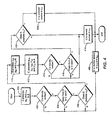
- Figure 3 is a flowchart illustrating exemplar steps that can be executed when transferring an item through the exemplar supply chain 100 of Figure 1 in accordance with implementations of the present disclosure.
- the process shown in Figure 3 may be implemented using software instructions stored in a computer-readable storage medium and executed by a processing system including one or more processing apparatus.
- the steps include generating and verifying proofs of possession and chaining tokens along the supply chain between example partners Alice (A), Bob (B), and Charlie (C).
- the proofs of possession and chaining tokens may allow the transfer of an item (It) throughout the supply chain 100.
- each business partner 102, 104, 106 can store event data about item (It) in a local database (y t ), and access to the event data can be requested by other business partners in the supply chain 100.
- each partner stores a proof of possession and a number of chaining tokens. In the event that a particular partner chooses not to reveal event data according to either upstream or downstream visibility, it can provide access to the proof of possession and chaining tokens for valid requests to prevent a break in the chain of possession.
- step 300 A generates a proof of possession (p t,A ) of having possessed item (It).
- the system e.g., system 200
- the system may receive a request from a business partner to send an item through the supply chain 100.
- the item (I t ) may be sent to B from A.
- A generates a "sent" chaining token (c t,A ) in step 304. If the system does not receive a request to send item (It), the process continues to wait for a request before continuing.
- A Upon generating the chaining token (c t,A ), A sends the item (It) and A's own proof of possession (p t,A ) to B in step 306.
- B receives the chaining token from A, and generates his own proof of possession (p t,B ) and "received" chaining token (c' t,B ).
- the system e.g., system 200 determines whether the item (It) is to be sent from B to C. If the item (I t ) is not to be sent, the system loops back. If the item (I t ) is to be sent, B generates a "sent" chaining token (c t,B ) in step 312.
- step 314 B sends the item (It) and his proof of possession (p t,B ) to C.
- C generates his own proof of possession (p t,c ) and a "received" chaining token (c' t,c ) in step 316. Accordingly, the item (It) has successfully passed through the supply chain 100.
- the subsequent discussion and corresponding flow charts provide exemplar routines that add varying levels of security (e.g., cryptography) to enforce policies for retrieving and sending supply chain data.
- the supply chain can employ various techniques to enforce security policies including, but not limited to time-based proof of possession, signature-based proof of possession, shared-secret based proof of possession, token-based proof of possession, and identity-based encryption.
- FIG. 4 a flowchart illustrates exemplar steps that can be executed to provide access to event data within the exemplar supply chain 100 of Figure 1 .
- the flowchart of Figure 4 is premised on a request by C to access event data from A.
- C presents his proof of possession (p t,c ) and his received chaining token (c' t,c ) to B.
- a series of verification tests can be performed to validate C's presented information, which are discussed in further detail below. For example, in step 402, it is determined whether C's identity can be verified, in step 404 it is determined whether the chain from B to C is valid, and in step 406, it is determined whether B possesses a sent chaining token (c t,B ).
- C is denied access to the event data stored by B (e.g., event data y t,B ), and the event data stored by A (e.g., event data y t,A ) in step 408. If, however, all three verification tests 402, 404, and 406 are true, B provides the sent chaining token (c t,B ), received chaining token (c' t,B ), and proof of possession (p t,B ) to C in step 410, and C is granted access to the event data stored by B (e.g., event data y t,B ).
- B provides the sent chaining token (c t,B ), received chaining token (c' t,B ), and proof of possession (p t,B ) to C in step 410, and C is granted access to the event data stored by B (e.g., event data y t,B ).
- step 412 C presents the proof of possession (p t,B ), the sent chaining token (c t,B ), the received chaining token (c' t,B ), the received chaining token (c' t,C ), and the proof of possession (p t,C ) to A.
- a series of verification tests are executed to validate the information presented by C.
- step 414 it is determined whether C's identity can be verified, and in step 416, it is determined whether the chain from A 102 to C 106 is valid. If either step 414 or step 416 is not true, C is denied access to event data stored by A (e.g., data y t,A ).
- step 414 and step 416 it is determine whether A possesses the sent chaining token (c t,A ) in step 420. If A does not possess the sent chaining token (c t,A ), C is denied access to event data (y t,A ) in step 418. If A does possess the sent chaining token (c t,A ), C is granted access to event data (y t,A ) in step 422.
- FIG. 5 a flowchart illustrates exemplar steps that can be executed to provide a signature-based proof of possession in accordance with implementations of the present disclosure.
- signature-based proofs of possession can be performed using cryptographic hash functions.
- Merkle signatures may be used to combine several keys of a one-time signature scheme (OTS).
- OTS one-time signature scheme
- An advantage of a Merkle signature is that it can be computed without modular arithmetic, trapdoors or similar, and is simply based on cryptographic hash functions.
- the use of Merkle signatures is merely exemplar in nature and is not intended to limit the present disclosure.
- the proof of possession is signature-based and includes a public key/private key pair such that the private key is inaccessibly stored on the tag (t).
- the tag (t) can be used to sign messages sent to it in order to verify the receipt of the tagged item (I t ).
- A sends a message to the item (I), which item is in A's possession.
- This message can be sent, for example, to an RFID tag associated with the item (I).
- A may send an event data request about where the item (I) was last processed.
- the item (I) signs the message with S I (A).
- the Item (I) sends the signature S I (A) to A in step 504.
- A stores S I (A) as her proof of possession (p t,A ).
- a number of security issues may arise by using the above described signature-based protocol to authenticate event data.
- A is not necessarily required to authenticate a request that may allow the tag (t) to sign every identity presented. Therefore, A can produce proofs of possession for every identity she wishes.
- One solution to this problem may include authenticating A.
- Such authentication can be achieved, for example, by implementing a public-key certificate.
- FIG. 6 is a flowchart illustrating exemplar steps that can be executed to provide a shared secret proof of possession in accordance with implementations of the present disclosure.
- the proofs of possession are based on communication between a supply chain partner (A, in this example) and a trusted third party (T).
- the shared secret proof of possession can be generated based on a signature generated by a tag associated with a particular item (I).
- each tag (t) has a shared secret (s) with one or more trusted third parties (T).
- a trusted third party (T) may be a producer of the tag (t) (e.g., an RFID tag), for example.
- a trusted third party (T) may be a time server.
- a trusted third party (T) can easily authenticate a partner (e.g., A), and all communication with the trusted third party (T) can be done over secure, authenticated channels.
- the exemplar steps of Figure 6 can be executed when a supply chain member (e.g., A), who possesses the item (I), desires to run a protocol between the tag (t) and the trusted third party (T).
- a plurality of passes e.g., two
- a variable x is initialized to be equal to 1.
- A sends a message to the trusted third party (T). Because the trusted third party (T) has a shared secret (s) between a supply chain partner and itself, (T) can request proof of knowledge of the secret (s) by responding to A with a random challenge (r) in step 604.
- the random challenge (r) may be a random number selected by the trusted third party (T), or another party.
- A provides the random challenge (r) to the item (I), which is in A's possession.
- the item (I) responds to A with a message authentication code (MAC) based on the received random challenge (r) and the secret (s) in step 608.
- MAC message authentication code
- A provides the MAC to the trusted third party (T) for authentication.
- the trusted third party (T) determines whether the MAC sent from A is correct. If the MAC is not correct, the trusted third party (T) does not generate the proof of possession (p t,A ). If the MAC is correct, it is determined whether x is equal to 2 in step 616. If x is not equal to 2, the trusted third party (T) records a timestamp (time) in step 618, increments x in step 620, and loops back to step 602. For example, the trusted third party (T) can store a timestamp of the current transaction on the tag (t). The timestamp can be used to incorporate secure time into proofs of possession.
- the trusted third party (T) can verify that the time of the proofs is decreasing for upstream requests and is increasing for downstream requests. As one advantage, the timestamp verification can ensure additional time integrity of the supply chain making insertions after the fact nearly impossible. If x is equal to 2 in step 616, the trusted third party (T) generates the proof of possession (p t,A ) based on the current time in step 622. In step 624, the trusted third party (T) sends the proof of possession (p t,A ) to A as an approval.
- the shared secret proof of possession and timestamp data can enable a message (e.g., a signature string produced by A) to be verified by anyone with access to A's public keys or public information. It ensures that the timestamp is within an appropriate time interval (e.g., a time interval within which A was in possession of the item (I)).
- the random variable (r) can prevent pre-dating (e.g., querying a time server before one has possession of an item for the first time), and (r) can prevent post-dating (e.g., querying a time server after one has had possession of the item).
- the trusted third party (T) that is responsible for issuing the decryption keys in the identity-based encryption scheme potentially has access to all event data. Assuming that guessing a tag identifier and a supply chain path is a sufficient hurdle, the party (T) can still access the event data itself after a legitimate access request.
- the system can raise the bar for the trusted third party (T) by not revealing the tag identifier in a request.
- the trusted third party (T) would then have to guess the identifier and a link in the supply chain to access the event data. It may also be possible to protect the identifier during a decryption key request. Protecting the identifier may involve having a trusted third party (T) verify a proof of possession for a particular item and also verify a signature for the item.
- the trusted third party (T) has a public key for every item in the system and the trusted third party (T) must reveal the tag identifier to identify the key.
- One solution to avoid the requirement of revealing the tag identifier may include introducing a common key for each item (e.g. each item from one manufacturer). Another solution is to introduce a different trusted third party (T'). The function of this different trusted third party (T') is to convert a proof of possession of the time-based form into one of the time-based and signature based form. While this solution may reveal the identity of the item in the field I, it can be verified without knowledge of any key of I.
- the proofs of possession are based on communication between a supply chain partner (e.g., A) and a trusted third party (T).
- a supply chain partner e.g., A
- T trusted third party
- the time-based proof of possession can be generated based on a random challenge sent to the trusted third party (T) and a timestamp issued by the trusted third party (T).
- Time-based techniques rely on a time ordered process for each supply chain partner.
- a materials supplier generally has access to raw material data before a product manufacturer receives the raw material to produce a product. Consequently, the product manufacturer can not obtain information regarding the raw material before the material supplier actually allows access. This order may be reflected in the time the chaining tokens and the proofs of possession have been obtained. Therefore, a time-based technique can be incorporated to secure a known timestamp into proofs of possession. This can ensure that a trusted third party can verify that the time of the proofs is decreasing for upstream supply chain requests and is increasing for downstream supply chain requests.
- the item (I) signs the message with a signature S I (r) in step 702, where (r) is a random challenge.
- a secure time protocol is executed between A and a trusted third party (T) (e.g., a time server) to ensure that the time-based proof of possession is valid. For example, given the random challenge (r), the system returns a signed message with the challenge (r), the current time ( time ), and a fresh nonce (r'). To achieve this, A sends the challenge (r) to the trusted third party (T) in step 704, and the trusted third party (T) sends a proof of possession string S T (r, time, r') to A in step 706.
- T trusted third party
- step 708 A sends the fresh nonce (r') to the item (I).
- the item (I) generates a new time-based signature S I (r'), and sends S I (r') to A in step 710.
- A generates and stores the proof of possession (p t,A ) as S A (S I (r), S T (r, time, r'), S I (r')) in step 712.
- the signature string produced by A can be verified by anyone with access to the public keys or public information for item (I). The signature string ensures that time is within the time interval, in which A possessed the item (I).
- the random challenge (r) prevents pre-dating (e.g., querying the time server before one has possession of an item (I) for the first time), and prevents post-dating, (e.g., querying the time server after one has had possession of the item (I)).
- pre-dating e.g., querying the time server before one has possession of an item (I) for the first time
- post-dating e.g., querying the time server after one has had possession of the item (I)
- time-based proof of possession protocol can provide authenticity, it does not necessarily prevent rogue readers from physical attacks.
- other protocols can be combined with the time-based proof of possession techniques to provide increased security.
- a supply chain partner Before granting access to event data (and tokens and proofs of possession) for an item, a supply chain partner should verify at least two properties of the data: (1) a chain of tokens and proofs of possession presented by the requestor leading from the requestor to itself, and (2) ownership by the accessed party of a chaining token for the requested identifier to successor in the presented chain above.
- a legitimate request for access to event data reveals a great deal of information about a particular item (I). In the worst case, it may reveal the entire history of possessors of the item (I). For example, if an attacker can create the impression that they had possession of the item (I), another party may try to request access for event data from the attacker.
- a requestor should attempt to reveal very little or no information during an access request.
- an attack from an unknown identity can be unable to retrieve information, if the supply chain employs identity-based encryption (IBE).
- IBE identity-based encryption
- the decrypting party can then request a decryption key from a trusted third party (T) for that particular string.
- T trusted third party
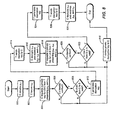
- a supply chain partner C obtains pedigree information of an item upstream by using the exemplar process depicted in Figure 8 , described in further detail below. This process includes obtaining a proof of possession, issuing a chaining token, requesting a private key for the identity, issuing a private decryption key, decrypting event data, and iterating through the requesting of key information and decrypting event data.
- step 800 C obtains a proof of possession (p t,C ) as evidence that he is indeed in possession of the item (I).
- C can obtain the proof of possession (p t,C ) using any of the techniques described herein.
- C issues a sent chaining token (c t,c ) to supplier B.
- C requests a private key for the identity "I.B.C.” from a trusted third party (T) by presenting the proof of possession (p t,c ) and the sent chaining token (c t,c ) in step 804.
- a series of verification tests are executed to validate the information presented by C. For example, it is determined whether C's identity can be verified in step 806, and whether the chain from C to B is valid in step 808.
- These verification tests generally include checking the validity of a proof of possession and a chaining token by C to its predecessor P. For every predecessor, there are two valid chaining tokens (e.g., sent and received), such that the successor of P is given in the sent token and the predecessor of P in the received token.
- the trusted third party (T) can iterate these checks until P is equal to B.
- step 806 or step 808 the trusted third party (T) denies the private decryption key to C in step 810. If both step 806 and step 808 are true, the trusted third party (T) generates the decryption key in step 812, and sends the decryption key to C in step 814. In step 816, C decrypts the event data (y t,B ) and receives the proof of possession (p t,B ), the sent chaining token (c t,B ), and the received chaining token (c' t,B ).
- C requests a private key for the identity "I.A.B.” from the trusted third party (T), by presenting the proof of possession (p t,B ), the sent chaining token (c t,B ), and the received chaining token (C' t,B ).
- a series of verification tests can be performed to validate the information presented by C. For example, in step 820, it is determined whether C's identity can be verified, and in step 822, whether the chain from B to A is valid. If either step 820 or step 822 is not true, the trusted third party (T) denies the private decryption key to C in step 810. If both step 820 and step 822 are true, the trusted third party (T) generates the decryption key in step 824, and sends the decryption key to C in step 826. In step 828, C decrypts the event data (y t,A ), and receives the proof of possession (p t,A ) and the sent chaining token (c t,A ).
- a supply chain partner may choose not to reveal their data according to either upstream or downstream visibility.
- the particular partner can and should encrypt proofs of possession and chaining tokens to ensure the supply chain is not broken.
- upstream visibility this may allow supply chain partners, who are subsequent to the particular partner in the supply chain, to obtain data from the partners that precede the particular partner.
- downstream visibility this may allow partners, who are prior to the particular partner in the supply chain, to obtain data from the partners that supersede the particular partner.
- a flowchart illustrates exemplar steps that can be executed to decrypt supply chain data in accordance with implementations of the present disclosure.
- the identifier (I) can be replaced with the pair (h Ir , g r ), where (r) is represented by a random number chosen by a producer of the identifier.
- the identifier is also randomized, such that it is not simply replaced by a different identifier, but every instance of the pairs appears different from one another.
- D(I) and D(A) be the domain of tag and party identifiers, respectively.
- T trusted third party
- the requestor When requesting a decryption key from a trusted third party (T), the requestor generally asks for the tag identifier only, but does not send the identifier for the tag.
- C provides the trusted third party (T) with an extended pair (h Ir , h r , g r ).
- the trusted third party (T) knows the supply chain partners B and C, and computes the full identity key h r'(I, ⁇ A, ⁇ B) in step 902.
- the trusted third party (T) chooses a fresh random number (r') in step 904, and performs verification checks (e.g., such as those detailed in Figure 8 ).
- the trusted third party (T) Upon successfully passing the verification checks, the trusted third party (T) generates the extended pair (h ⁇ h rr'(I+ ⁇ A+ ⁇ B) , g rr' ) in step 906 to decrypt the requested supply chain data.
- the trusted third party (T) can also perform a verification that all proofs of possession, chaining tokens, and requests are for the same identifier. For example, the trusted third party (T) can perform a pair-wise check for every supplied pair of identifiers (h Ir , g r , h I'r' , g r' ) to determine whether the same identifier provides the above criteria.
- the supply chain 100 includes suppliers (D) 1002 and (E) 1004, a number of suppliers and/or buyers (F) 1006, (G) 1008, and (I) 1012, and buyers (H) 1010 and (J) 1014. If the buyer (J) 1014 wishes to access event data stored at the supplier (D) 1002, (J) 1014 must present a number of proofs of possession and chaining tokens along the supply chain 1000. Specifically, (J) 1014 presents chaining tokens for each supplier and/or buyer between supplier (D) 1002 and himself.
- (J) 1014 can supply his proof of possession and received chaining token, (I)'s 1012 proof of possession and received and sent chaining tokens, and (F)'s 1006 proof of possession and received and sent chaining tokens. If (I) 1012 wishes to access event data stored at the supplier (D) 1002 or (E) 1004, (I) 1012 can present his own proof of possession and received chaining tokens, and (F)'s 1006 proof of possession and received and sent chaining tokens. Similarly, if (G) 1008 wishes to access event data stored at supplier (D) 1002 or (E) 1004, (G) 1008 can provide proofs of possession and chaining tokens for himself and (F) 1006.
- the systems described herein provide usability, correctness and security. Usability can be achieved by enabling the user set its policies at a high level (i.e. upstream or downstream visibility). Furthermore, the user may have the choice of these options for every item where one item can have different high-level policies than another item. As an advantage, the system designer can choose a desired level of policy granularity. Correctness implies that every legitimate entity has access to the data. If one allows upstream visibility, every partner before a partner in the supply chain for that particular item should have access. If one allows downstream visibility, the same should hold for any party after one in the supply chain.
- the systems described herein provide confidentiality, integrity, no illegitimate access, no forgery, no framing, and non-repudiation characteristics. Confidentiality ensures that no partner should have access to event data that is not explicitly allowed by the policies (e.g., no illegitimate access). Integrity of the system ensures that no partner should be able to forge event data (e.g., no forgery), that no partner should be able to frame another partner to have possessed the item (e.g., no framing), and that no partner should be able to repudiate having possessed the item (e.g., non-repudiation).
- Confidentiality ensures that no partner should have access to event data that is not explicitly allowed by the policies (e.g., no illegitimate access). Integrity of the system ensures that no partner should be able to forge event data (e.g., no forgery), that no partner should be able to frame another partner to have possessed the item (e.g.,
- the system 1100 can be used for the operations described in association with the methods described in Figures 3-10 according to one implementation.
- the system 1100 may be included in any or all of the servers 102.
- the system 1100 includes a processor 1110, a memory 1120, a storage device 1130, and an input/output device 1140.
- Each of the components 1110, 1120, 1130, and 1140 are interconnected using a system bus 1150.
- the processor 1110 is capable of processing instructions for execution within the system 1100.
- the processor 1110 is a single-threaded processor.
- the processor 1110 is a multi-threaded processor.
- the processor 1110 is capable of processing instructions stored in the memory 1120 or on the storage device 1130 to display graphical information for a user interface on the input/output device 1140.
- the memory 1120 stores information within the system 1100.
- the memory 1120 is a computer-readable medium.
- the memory 1120 is a volatile memory unit.
- the memory 1120 is a non-volatile memory unit.
- the storage device 1130 is capable of providing mass storage for the system 1100.
- the storage device 1130 is a computer-readable medium.
- the storage device 1130 may be a floppy disk device, a hard disk device, an optical disk device, or a tape device.
- the input/output device 1140 provides input/output operations for the system 1100.
- the input/output device 1140 includes a keyboard and/or pointing device.
- the input/output device 1140 includes a display unit for displaying graphical user interfaces.
- the features described can be implemented in digital electronic circuitry, or in computer hardware, firmware, software, or in combinations of them.
- the apparatus can be implemented in a computer program product tangibly embodied in an information carrier, e.g., in a machine-readable storage device, for execution by a programmable processor; and method steps can be performed by a programmable processor executing a program of instructions to perform functions of the described implementations by operating on input data and generating output.
- the described features can be implemented advantageously in one or more computer programs that are executable on a programmable system including at least one programmable processor coupled to receive data and instructions from, and to transmit data and instructions to, a data storage system, at least one input device, and at least one output device.
- a computer program is a set of instructions that can be used, directly or indirectly, in a computer to perform a certain activity or bring about a certain result.
- a computer program can be written in any form of programming language, including compiled or interpreted languages, and it can be deployed in any form, including as a stand-alone program or as a module, component, subroutine, or other unit suitable for use in a computing environment.
- Suitable processors for the execution of a program of instructions include, by way of example, both general and special purpose microprocessors, and the sole processor or one of multiple processors of any kind of computer.
- a processor will receive instructions and data from a read-only memory or a random access memory or both.
- the essential elements of a computer are a processor for executing instructions and one or more memories for storing instructions and data.
- a computer will also include, or be operatively coupled to communicate with, one or more mass storage devices for storing data files; such devices include magnetic disks, such as internal hard disks and removable disks; magneto-optical disks; and optical disks.
- Storage devices suitable for tangibly embodying computer program instructions and data include all forms of non-volatile memory, including by way of example semiconductor memory devices, such as EPROM, EEPROM, and flash memory devices; magnetic disks such as internal hard disks and removable disks; magneto-optical disks; and CD-ROM and DVD-ROM disks.
- semiconductor memory devices such as EPROM, EEPROM, and flash memory devices
- magnetic disks such as internal hard disks and removable disks
- magneto-optical disks and CD-ROM and DVD-ROM disks.
- the processor and the memory can be supplemented by, or incorporated in, ASICs (application-specific integrated circuits).
- ASICs application-specific integrated circuits
- the features can be implemented on a computer having a display device such as a CRT (cathode ray tube) or LCD (liquid crystal display) monitor for displaying information to the user and a keyboard and a pointing device such as a mouse or a trackball by which the user can provide input to the computer.
- a display device such as a CRT (cathode ray tube) or LCD (liquid crystal display) monitor for displaying information to the user and a keyboard and a pointing device such as a mouse or a trackball by which the user can provide input to the computer.
- the features can be implemented in a computer system that includes a back-end component, such as a data server, or that includes a middleware component, such as an application server or an Internet server, or that includes a front-end component, such as a client computer having a graphical user interface or an Internet browser, or any combination of them.
- the components of the system can be connected by any form or medium of digital data communication such as a communication network. Examples of communication networks include, e.g., a LAN, a WAN, and the computers and networks forming the Internet.
- the computer system can include clients and servers.
- a client and server are generally remote from each other and typically interact through a network, such as the described one.
- the relationship of client and server arises by virtue of computer programs running on the respective computers and having a client-server relationship to each other.
Landscapes
- Business, Economics & Management (AREA)
- Economics (AREA)
- Engineering & Computer Science (AREA)
- Marketing (AREA)
- Quality & Reliability (AREA)
- Finance (AREA)
- Entrepreneurship & Innovation (AREA)
- Human Resources & Organizations (AREA)
- Accounting & Taxation (AREA)
- Operations Research (AREA)
- Development Economics (AREA)
- Strategic Management (AREA)
- Tourism & Hospitality (AREA)
- Physics & Mathematics (AREA)
- General Business, Economics & Management (AREA)
- General Physics & Mathematics (AREA)
- Theoretical Computer Science (AREA)
- Storage Device Security (AREA)
Abstract
Description
- Global supply chain visibility is becoming increasingly important, particularly as manufacturing is moved to various worldwide locations to lower costs associated with product manufacturing. With supply chains lengthening, it is becoming more important to have visibility of supply chain information related to products while the products are in transit.
- Transportation between the manufacturer and the location of the product's final destination has become a major component of the supply chain. Thus, the visibility of the product in transit is crucial to managing logistical issues at supplier locations. For example, when ocean freight carriers are used to transport products to and from worldwide locations, transit times can reach upwards of 30 days. In such an example, logistics service providers in the supply chain manage the movement of freight and provide visibility to other supply chain partners.
- Implementations of present disclosure include methods for implementing visibility policies within a supply chain that includes a plurality of partners. In some implementations, such a method includes storing event data on a computer-readable storage medium of a first partner, the event data corresponding to at least one event associated with an item while the item was in possession of the first partner, the item having traveled through the supply chain, transferring evidence of possession between the plurality of partners as the item travels through the supply chain, and requesting access to the event data by a second partner. The method further includes determining that the item traveled through a portion of the supply chain associated with at least the first partner and the second partner, based on the evidence, authenticating an identity of the second partner, and authorizing the second partner to access the first event data from the computer-readable storage medium, when it is determined that the item traveled through the portion of the supply chain and when the identity of the second party is authenticated.
- In some implementations, the method further provide that the evidence includes proofs of possession corresponding to the second partner and any intermediate partners between the first partner and the second partner along the portion of the supply chain.
- In some implementations, the method further provides that determining whether the portion of the supply chain is valid is further based on chaining tokens that are generated by each of the first and second partners, and any intermediate partners between the first partner and the second partner along the portion of the supply chain.
- In some implementations, the method further provides generating a proof of possession corresponding to the second partner as one of a signature-based proof of possession, a shared secret proof of possession, a token-based proof of possession and a time-based proof of possession, the evidence including the proof of possession. In such implementations, the shared secret proof of possession and the time-based proof of possession can be generated based on communication between the second partner and a trusted third party. In such implementations, the signature-based proof of possession can be generated based on a signature generated by a tag associated with the item, the shared secret proof of possession can be generated based on a secret that is shared between a tag associated with the item and a first trusted third party, and the time-based proof of possession can be generated based on a random challenge sent to a second trusted third party and a timestamp issued by the second trusted third party.
- In some implementations, the method further include encrypting the event data by the first partner, obtaining a decryption key from a trusted third party based on the evidence, and decrypting the event data using the decryption key by the second partner.
- The present disclosure also provides a computer-readable storage medium coupled to one or more processors and having instructions stored thereon which, when executed by the one or more processors, cause the one or more processors to perform operations in accordance with implementations of the methods provided herein.
- The present disclosure further provides a system for implementing visibility policies within a supply chain that includes a plurality of partners. The system includes one or more processors, and a computer-readable storage medium coupled to the one or more processors having instructions stored thereon which, when executed by the one or more processors, cause the one or more processors to perform operations in accordance with implementations of the methods provided herein.
- It is appreciated that methods in accordance with the present disclosure can include any combination of the aspects and features described herein. That is to say that methods in accordance with the present disclosure are not limited to the combinations of aspects and features specifically described herein, but also include any combination of the aspects and features provided.
- The details of one or more embodiments of the invention are set forth in the accompanying drawings and the description below. Other features, objects, and advantages of the invention will be apparent from the description and drawings, and from the claims.
- In the drawings,
-
Figure 1 is a block diagram of an exemplar supply chain. -
Figure 2 is a schematic illustration of an exemplar architecture corresponding to the exemplar supply chain ofFigure 1 . -
Figure 3 is a flowchart illustrating exemplar steps that can be executed when transferring an item through the exemplar supply chain ofFigure 1 in accordance with implementations of the present disclosure. -
Figure 4 is a flowchart illustrating exemplar steps that can be executed to provide access to event data within the exemplar supply chain ofFigure 1 in accordance with implementations of the present disclosure. -
Figure 5 is a flowchart illustrating exemplar steps that can be executed to provide a signature-based proof of possession in accordance with implementations of the present disclosure. -
Figure 6 is a flowchart illustrating exemplar steps that can be executed to provide a shared secret proof of possession in accordance with implementations of the present disclosure. -
Figure 7 is a flowchart illustrating exemplar steps that can be executed to provide a time-based proof of possession in accordance with implementations of the present disclosure. -
Figure 8 is a flowchart illustrating exemplar steps that can be executed to provide an identity-based encryption in accordance with implementations of the present disclosure. -
Figure 9 is a flowchart illustrating exemplar steps that can be executed to decrypt supply chain data in accordance with implementations of the present disclosure. -
Figure 10 is a block diagram illustrating another exemplar supply chain. -
Figure 11 is a schematic illustration of exemplar computer systems that can be used to execute implementations of the present disclosure. - Like reference symbols in the various drawings indicate like elements.
-
Figure 1 is a block diagram of anexemplar supply chain 100. In general, thesupply chain 100 represents a system of organizations, people, technology, activities, information, and/or resources involved in moving information, products, and/or services between supply chain parties. For example, thesupply chain 100 can enable data sharing between (i) a supplier and a customer, (ii) a supplier and another supplier, and/or (iii) a customer and another customer. The suppliers and customers can increase efficiency in providing and/or receiving services by analyzing shared data available upstream and downstream within a particular supply chain. In particular, access to this data allows new forms of analytics improving the efficiency of the supply chain. - In some implementations, the shared data can be radio frequency identification (RFID) tracking data or any data stored in an Enterprise Resource Planning (ERP) system including, but not limited to stock levels, billing information, or shipping notifications. Shared data can be spread across multiple ERP systems and multiple supply chains. Although the shared data is provided by multiple sources, the data is stored in one or more ERP systems that do not distinguish between supply chains. Therefore, the companies storing supply chain data can implement access control rules to prevent data loss, data theft and/or espionage (e.g., spying on business operations) within a particular supply chain. The access control rules may be implemented in software, hardware, or a combination of both. For example, one way to implement supply chain policies includes RFID tracking systems that allow a company to control access to data based on the supply chain it pertains to and the partner or party requesting access.
- Access control rules provide a mechanism to authorize or deny a business partner or other entity access to data in a particular supply chain. In general, the access control rules include a number of supply chain visibility rules and/or policies. If, for example, supply chain visibility rules provide liberal access to data in the supply chain, business partners may use the information to spy on other business partners and associated business operations. Particularly, if the data is too readily available throughout the supply chain, sensitive business data detailing volumes of business, structure and supply chain partners, for example, can be used against business partners in the supply chain. In one example, a supplier (S1) sells a product (p1) to buyers (B1) and (B2). If (B1) has access to all scheduled orders for (p1), (B1) could infer the volume of business with (B2). For example, if (S1) were to cancel some orders due to a temporary capacity reduction, such as may occur with a production machine failure, (B1) could infer whether (B2)'s orders are treated preferentially.
- Supply chain visibility policies can include requirements such as providing evidence in the form of a proof of possession of an item at some point in the supply chain of the item. The proof of possession can be verified by a third party to convince the third party that the presenter of the proof actually had possession of the item at some point in time. In some implementations, the evidence may be stored on a radio frequency identification (RFID) tag (t). The RFID tags may each have a unique identifier that can be read by a business partner each time a tagged item (It) is handled within a supply chain. Each time the item (It) is handled, an event is stored on the tag (t). Event data may relate to, but is not limited to, unpacking items, shipping items, and receiving items.
- Evidence can also be provided in the form of a chaining token. In general, chaining tokens represent a data entity that a business partner possesses and controls that may be used to authenticate the partner's identity. In one example, the chaining token may be a cryptographic key that is protected by encrypting it under a password. In particular, a chaining token is a signed statement that a party (e.g., Xi_k) has either sent or received a tag with identifier (t) from another party (e.g., Xi+n_k). In general, links of a supply chain are tied together by chaining tokens and the system can use identity-based encryption (IBE) to encrypt the event data and protect access to the chaining token information. Chaining tokens may be represented as:

- In some implementations, the supply chain visibility policies can be applied to data and/or business partners to distinguish between down-stream and up-stream data visibility. For example, down-stream visibility rules can ensure that a supply chain partner is allowed to access data associated with products that it has shipped to its partners at those partners. Up-stream visibility rules can ensure that a supply chain partner is allowed access to data associated with products that the partner has received from other business partners.
- Referring again to
Figure 1 , thesupply chain 100 includes three stages with one business partner at each stage. The three business partners include Alice (A) 102, Bob (B) 104, and Charlie (C) 106. Each partner stores datasets (yt) within a respective internal database. For example, the database stored byAlice 102 is represented by (yt,A). Similarly, the databases stored byBob 104 andCharlie 106 are represented by (yt,B) and (yt,c), respectively. - The
supply chain 100, in this example, includes an item (I) with an attached tag (t) and is represented by (It). The item (It) is sent fromAlice 102 toBob 104, and is subsequently forwarded toCharlie 106. In this example, ifCharlie 106 desires access to event data stored byAlice 102,Charlie 106 must present evidence that access should be granted. For example,Charlie 106 can present a proof of possession toAlice 102 to prove that access to the event data stored byAlice 102 should indeed be granted. At a high level, ifCharlie 106 desires access to data stored byAlice 102,Charlie 106 shows proof of having information from every supplier betweenAlice 102 and himself. In this example, the proof of possession can be obtained fromBob 104 and then presented toAlice 102.Alice 102 can then verify and allow or deny access accordingly. The details of this process are described below. -
Figure 2 is a schematic illustration of anexemplar architecture 200 corresponding to theexemplar supply chain 100 ofFigure 1 . Thearchitecture 200 may represent a supply chain supporting multipleERP computer systems 202 that are connectively coupled for communication with one another over anetwork 204. TheERP computer systems 202 can be modeled as a database and/or server system including a database, which abstracts data from other functions throughout supply chain software installed on thesystems 202. -
System 200 is typically a distributed client/server system that spans one or more networks such asnetwork 204. In such cases, the various components - such as ERP systems 202 - may communicate via a virtual private network (VPN), Secure Shell (SSH) tunnel, or other secure network connection. Accordingly, rather than being delivered as packaged software,system 200 may represent a hosted solution that may scale cost-effectively and help drive faster adoption. In this case, portions of the hosted solution may be developed by a first entity, while other components are developed by a second entity. In such embodiments, data may be communicated or stored in an encrypted format using any standard or proprietary encryption algorithm. This encrypted communication may be between the user (or application/client) and the host or amongst various components of the host. Put simply, communication or other transmission between any modules and/or components may include any encryption, export, translation or data massage, compression, and so forth as appropriate. Further,system 200 may store some data at a relatively central location (over a WAN) while concurrently maintaining local data at the user's site for redundancy and to allow processing during downtime. Butsystem 200 may be in a dedicated enterprise environment - across a local area network (over LAN) or subnet - or any other suitable environment without departing from the scope of the present disclosure. - The techniques and components described herein may be implemented within an Enterprise Service Architecture (ESA) environment, often termed a Service Oriented Architecture (SOA). In certain implementations, SOA can be considered a blueprint for an adaptable, flexible, and open architecture for developing services-based, enterprise-scale business solutions. The respective enterprise service is typically a series of web services combined with business logic that can be accessed and used repeatedly to support a particular business process. Aggregating such web services into business-level enterprise services may provide a more meaningful foundation for the task of automating enterprise-scale business scenarios. The composite application framework comprises rules framework, design tools, methodologies, services and processes, an abstraction layer for objects, and user interface and process pattern libraries. The composite application framework supports model-driven application composition, so a user may build applications and/or implement supply chain policies with as little programming as possible, which often results in reduced development and deployment time for new/modified applications and business-pattern-oriented integration.
-
Figure 3 is a flowchart illustrating exemplar steps that can be executed when transferring an item through theexemplar supply chain 100 ofFigure 1 in accordance with implementations of the present disclosure. For example, the process shown inFigure 3 may be implemented using software instructions stored in a computer-readable storage medium and executed by a processing system including one or more processing apparatus. Briefly, the steps include generating and verifying proofs of possession and chaining tokens along the supply chain between example partners Alice (A), Bob (B), and Charlie (C). The proofs of possession and chaining tokens may allow the transfer of an item (It) throughout thesupply chain 100. In general, eachbusiness partner supply chain 100. In some implementations, each partner stores a proof of possession and a number of chaining tokens. In the event that a particular partner chooses not to reveal event data according to either upstream or downstream visibility, it can provide access to the proof of possession and chaining tokens for valid requests to prevent a break in the chain of possession. - In
step 300, A generates a proof of possession (pt,A) of having possessed item (It). Instep 302, the system (e.g., system 200) may receive a request from a business partner to send an item through thesupply chain 100. For example, the item (It) may be sent to B from A. If item (It) is sent to B, A generates a "sent" chaining token (ct,A) instep 304. If the system does not receive a request to send item (It), the process continues to wait for a request before continuing. Upon generating the chaining token (ct,A), A sends the item (It) and A's own proof of possession (pt,A) to B instep 306. Instep 308, B receives the chaining token from A, and generates his own proof of possession (pt,B) and "received" chaining token (c't,B). Instep 310, the system (e.g., system 200) determines whether the item (It) is to be sent from B to C. If the item (It) is not to be sent, the system loops back. If the item (It) is to be sent, B generates a "sent" chaining token (ct,B) instep 312. Instep 314, B sends the item (It) and his proof of possession (pt,B) to C. C generates his own proof of possession (pt,c) and a "received" chaining token (c't,c) instep 316. Accordingly, the item (It) has successfully passed through thesupply chain 100. - The subsequent discussion and corresponding flow charts provide exemplar routines that add varying levels of security (e.g., cryptography) to enforce policies for retrieving and sending supply chain data. The supply chain can employ various techniques to enforce security policies including, but not limited to time-based proof of possession, signature-based proof of possession, shared-secret based proof of possession, token-based proof of possession, and identity-based encryption.
- Referring now to
Figure 4 , a flowchart illustrates exemplar steps that can be executed to provide access to event data within theexemplar supply chain 100 ofFigure 1 . The flowchart ofFigure 4 is premised on a request by C to access event data from A. Instep 400, C presents his proof of possession (pt,c) and his received chaining token (c't,c) to B. A series of verification tests can be performed to validate C's presented information, which are discussed in further detail below. For example, instep 402, it is determined whether C's identity can be verified, instep 404 it is determined whether the chain from B to C is valid, and instep 406, it is determined whether B possesses a sent chaining token (ct,B). If any of these conditions is not true, C is denied access to the event data stored by B (e.g., event data yt,B), and the event data stored by A (e.g., event data yt,A) instep 408. If, however, all threeverification tests step 410, and C is granted access to the event data stored by B (e.g., event data yt,B). - In
step 412, C presents the proof of possession (pt,B), the sent chaining token (ct,B), the received chaining token (c't,B), the received chaining token (c't,C), and the proof of possession (pt,C) to A. A series of verification tests are executed to validate the information presented by C. Instep 414, it is determined whether C's identity can be verified, and instep 416, it is determined whether the chain from A 102 toC 106 is valid. If eitherstep 414 or step 416 is not true, C is denied access to event data stored by A (e.g., data yt,A). If, however, step 414 and step 416 are both true, it is determine whether A possesses the sent chaining token (ct,A) instep 420. If A does not possess the sent chaining token (ct,A), C is denied access to event data (yt,A) instep 418. If A does possess the sent chaining token (ct,A), C is granted access to event data (yt,A) instep 422. - Referring now to
Figure 5 , a flowchart illustrates exemplar steps that can be executed to provide a signature-based proof of possession in accordance with implementations of the present disclosure. In some implementations, signature-based proofs of possession can be performed using cryptographic hash functions. By way of one non-limiting example, Merkle signatures may be used to combine several keys of a one-time signature scheme (OTS). An advantage of a Merkle signature is that it can be computed without modular arithmetic, trapdoors or similar, and is simply based on cryptographic hash functions. The use of Merkle signatures is merely exemplar in nature and is not intended to limit the present disclosure. - As described above, each time a supply chain partner obtains a tag (t), it creates a proof of possession. In the instant example, the proof of possession is signature-based and includes a public key/private key pair such that the private key is inaccessibly stored on the tag (t). As such, the tag (t) can be used to sign messages sent to it in order to verify the receipt of the tagged item (It). The signature of a tag (t) with an identifier (I) can be represented by SI(...).
- In
step 500, A sends a message to the item (I), which item is in A's possession. This message can be sent, for example, to an RFID tag associated with the item (I). By way of one non-limiting example, A may send an event data request about where the item (I) was last processed. In the simplest case, the tag (t) simply answers the message by signing the identity (A) of the possessor (i.e., A), which can be represented by a proof of possession equation:
step 502, the item (I) signs the message with SI(A). The Item (I) sends the signature SI(A) to A instep 504. Instep 506, A stores SI(A) as her proof of possession (pt,A). - A number of security issues may arise by using the above described signature-based protocol to authenticate event data. As an example, A is not necessarily required to authenticate a request that may allow the tag (t) to sign every identity presented. Therefore, A can produce proofs of possession for every identity she wishes. One solution to this problem may include authenticating A. Such authentication can be achieved, for example, by implementing a public-key certificate.
-
Figure 6 is a flowchart illustrating exemplar steps that can be executed to provide a shared secret proof of possession in accordance with implementations of the present disclosure. In the shared secret proof of possession technique, the proofs of possession are based on communication between a supply chain partner (A, in this example) and a trusted third party (T). For example, the shared secret proof of possession can be generated based on a signature generated by a tag associated with a particular item (I). In a shared secret proof of possession, each tag (t) has a shared secret (s) with one or more trusted third parties (T). In some implementations, a trusted third party (T) may be a producer of the tag (t) (e.g., an RFID tag), for example. The producer of the tag (t) can embed information in the tag before releasing the tag to a purchaser. In some implementations, a trusted third party (T) may be a time server. One advantage of using a trusted third party (T) is that it can easily authenticate a partner (e.g., A), and all communication with the trusted third party (T) can be done over secure, authenticated channels. - The exemplar steps of
Figure 6 can be executed when a supply chain member (e.g., A), who possesses the item (I), desires to run a protocol between the tag (t) and the trusted third party (T). A plurality of passes (e.g., two) is provided through certain steps to determine a shared secret proof of possession and to verify a timestamp on the tag (t). In step 600 a variable x is initialized to be equal to 1. Instep 602, A sends a message to the trusted third party (T). Because the trusted third party (T) has a shared secret (s) between a supply chain partner and itself, (T) can request proof of knowledge of the secret (s) by responding to A with a random challenge (r) instep 604. The random challenge (r) may be a random number selected by the trusted third party (T), or another party. Instep 606, A provides the random challenge (r) to the item (I), which is in A's possession. The item (I) responds to A with a message authentication code (MAC) based on the received random challenge (r) and the secret (s) instep 608. Instep 610, A provides the MAC to the trusted third party (T) for authentication. - In
step 612, the trusted third party (T) determines whether the MAC sent from A is correct. If the MAC is not correct, the trusted third party (T) does not generate the proof of possession (pt,A). If the MAC is correct, it is determined whether x is equal to 2 instep 616. If x is not equal to 2, the trusted third party (T) records a timestamp (time) instep 618, increments x instep 620, and loops back tostep 602. For example, the trusted third party (T) can store a timestamp of the current transaction on the tag (t). The timestamp can be used to incorporate secure time into proofs of possession. For example, in a validity check of the chain, the trusted third party (T) can verify that the time of the proofs is decreasing for upstream requests and is increasing for downstream requests. As one advantage, the timestamp verification can ensure additional time integrity of the supply chain making insertions after the fact nearly impossible. If x is equal to 2 instep 616, the trusted third party (T) generates the proof of possession (pt,A) based on the current time instep 622. Instep 624, the trusted third party (T) sends the proof of possession (pt,A) to A as an approval. - The shared secret proof of possession and timestamp data can enable a message (e.g., a signature string produced by A) to be verified by anyone with access to A's public keys or public information. It ensures that the timestamp is within an appropriate time interval (e.g., a time interval within which A was in possession of the item (I)). Further, the random variable (r) can prevent pre-dating (e.g., querying a time server before one has possession of an item for the first time), and (r) can prevent post-dating (e.g., querying a time server after one has had possession of the item).
- In some implementations, it may be useful to limit the responsibilities of the trusted third party. In general, the trusted third party (T) that is responsible for issuing the decryption keys in the identity-based encryption scheme potentially has access to all event data. Assuming that guessing a tag identifier and a supply chain path is a sufficient hurdle, the party (T) can still access the event data itself after a legitimate access request.
- In one implementation, the system can raise the bar for the trusted third party (T) by not revealing the tag identifier in a request. The trusted third party (T) would then have to guess the identifier and a link in the supply chain to access the event data. It may also be possible to protect the identifier during a decryption key request. Protecting the identifier may involve having a trusted third party (T) verify a proof of possession for a particular item and also verify a signature for the item. In this example, the trusted third party (T) has a public key for every item in the system and the trusted third party (T) must reveal the tag identifier to identify the key. One solution to avoid the requirement of revealing the tag identifier may include introducing a common key for each item (e.g. each item from one manufacturer). Another solution is to introduce a different trusted third party (T'). The function of this different trusted third party (T') is to convert a proof of possession of the time-based form into one of the time-based and signature based form. While this solution may reveal the identity of the item in the field I, it can be verified without knowledge of any key of I.
- Referring now to
Figure 7 , a flowchart illustrates exemplar steps that can be executed to provide a time-based proof of possession in accordance with implementations of the present disclosure. In the time-based approach, the proofs of possession are based on communication between a supply chain partner (e.g., A) and a trusted third party (T). For example, the time-based proof of possession can be generated based on a random challenge sent to the trusted third party (T) and a timestamp issued by the trusted third party (T). - Time-based techniques rely on a time ordered process for each supply chain partner. For example, a materials supplier generally has access to raw material data before a product manufacturer receives the raw material to produce a product. Consequently, the product manufacturer can not obtain information regarding the raw material before the material supplier actually allows access. This order may be reflected in the time the chaining tokens and the proofs of possession have been obtained. Therefore, a time-based technique can be incorporated to secure a known timestamp into proofs of possession. This can ensure that a trusted third party can verify that the time of the proofs is decreasing for upstream supply chain requests and is increasing for downstream supply chain requests.
- In
step 700, A sends a message to the item (I). The item (I) signs the message with a signature SI(r) instep 702, where (r) is a random challenge. A secure time protocol is executed between A and a trusted third party (T) (e.g., a time server) to ensure that the time-based proof of possession is valid. For example, given the random challenge (r), the system returns a signed message with the challenge (r), the current time (time), and a fresh nonce (r'). To achieve this, A sends the challenge (r) to the trusted third party (T) instep 704, and the trusted third party (T) sends a proof of possession string ST(r, time, r') to A instep 706. - In
step 708, A sends the fresh nonce (r') to the item (I). The item (I) generates a new time-based signature SI(r'), and sends SI(r') to A instep 710. A generates and stores the proof of possession (pt,A) as SA(SI(r), ST(r, time, r'), SI(r')) instep 712. The signature string produced by A can be verified by anyone with access to the public keys or public information for item (I). The signature string ensures that time is within the time interval, in which A possessed the item (I). The random challenge (r) prevents pre-dating (e.g., querying the time server before one has possession of an item (I) for the first time), and prevents post-dating, (e.g., querying the time server after one has had possession of the item (I)). While the time-based proof of possession protocol can provide authenticity, it does not necessarily prevent rogue readers from physical attacks. Thus, other protocols can be combined with the time-based proof of possession techniques to provide increased security. - Referring now to
Figure 8 a flowchart illustrates exemplar steps that can be executed to provide an identity-based encryption in accordance with implementations of the present disclosure. Before granting access to event data (and tokens and proofs of possession) for an item, a supply chain partner should verify at least two properties of the data: (1) a chain of tokens and proofs of possession presented by the requestor leading from the requestor to itself, and (2) ownership by the accessed party of a chaining token for the requested identifier to successor in the presented chain above. In general, a legitimate request for access to event data reveals a great deal of information about a particular item (I). In the worst case, it may reveal the entire history of possessors of the item (I). For example, if an attacker can create the impression that they had possession of the item (I), another party may try to request access for event data from the attacker. Thus, a requestor should attempt to reveal very little or no information during an access request. - In some implementations, an attack from an unknown identity can be unable to retrieve information, if the supply chain employs identity-based encryption (IBE). For example, IBE enables the use of any string for encryption (e.g. an identity). The decrypting party can then request a decryption key from a trusted third party (T) for that particular string. In one example, a supply chain partner C obtains pedigree information of an item upstream by using the exemplar process depicted in
Figure 8 , described in further detail below. This process includes obtaining a proof of possession, issuing a chaining token, requesting a private key for the identity, issuing a private decryption key, decrypting event data, and iterating through the requesting of key information and decrypting event data. - In
step 800, C obtains a proof of possession (pt,C) as evidence that he is indeed in possession of the item (I). C can obtain the proof of possession (pt,C) using any of the techniques described herein. Instep 802, C issues a sent chaining token (ct,c) to supplier B. C requests a private key for the identity "I.B.C." from a trusted third party (T) by presenting the proof of possession (pt,c) and the sent chaining token (ct,c) instep 804. A series of verification tests are executed to validate the information presented by C. For example, it is determined whether C's identity can be verified instep 806, and whether the chain from C to B is valid instep 808. These verification tests generally include checking the validity of a proof of possession and a chaining token by C to its predecessor P. For every predecessor, there are two valid chaining tokens (e.g., sent and received), such that the successor of P is given in the sent token and the predecessor of P in the received token. In some implementations, the trusted third party (T) can iterate these checks until P is equal to B. - If either
step 806 or step 808 is not true, the trusted third party (T) denies the private decryption key to C instep 810. If bothstep 806 and step 808 are true, the trusted third party (T) generates the decryption key instep 812, and sends the decryption key to C instep 814. Instep 816, C decrypts the event data (yt,B) and receives the proof of possession (pt,B), the sent chaining token (ct,B), and the received chaining token (c't,B). Instep 818, C requests a private key for the identity "I.A.B." from the trusted third party (T), by presenting the proof of possession (pt,B), the sent chaining token (ct,B), and the received chaining token (C't,B). - A series of verification tests can be performed to validate the information presented by C. For example, in
step 820, it is determined whether C's identity can be verified, and instep 822, whether the chain from B to A is valid. If eitherstep 820 or step 822 is not true, the trusted third party (T) denies the private decryption key to C instep 810. If bothstep 820 and step 822 are true, the trusted third party (T) generates the decryption key instep 824, and sends the decryption key to C instep 826. Instep 828, C decrypts the event data (yt,A), and receives the proof of possession (pt,A) and the sent chaining token (ct,A). - In some implementations, a supply chain partner may choose not to reveal their data according to either upstream or downstream visibility. In such cases, the particular partner can and should encrypt proofs of possession and chaining tokens to ensure the supply chain is not broken. In the exemplar case of upstream visibility, this may allow supply chain partners, who are subsequent to the particular partner in the supply chain, to obtain data from the partners that precede the particular partner. In the exemplar case of downstream visibility, this may allow partners, who are prior to the particular partner in the supply chain, to obtain data from the partners that supersede the particular partner.
- Referring now to
Figure 9 , a flowchart illustrates exemplar steps that can be executed to decrypt supply chain data in accordance with implementations of the present disclosure. In the example ofFigure 9 , a proof of possession can be represented by:



- In
step 900, C provides the trusted third party (T) with an extended pair (hIr, hr, gr). The trusted third party (T) knows the supply chain partners B and C, and computes the full identity key hr'(I,γA,δB) instep 902. The trusted third party (T) chooses a fresh random number (r') instep 904, and performs verification checks (e.g., such as those detailed inFigure 8 ). Upon successfully passing the verification checks, the trusted third party (T) generates the extended pair (hαhrr'(I+γA+δB), grr') instep 906 to decrypt the requested supply chain data. The trusted third party (T) can also perform a verification that all proofs of possession, chaining tokens, and requests are for the same identifier. For example, the trusted third party (T) can perform a pair-wise check for every supplied pair of identifiers (hIr, gr, hI'r', gr') to determine whether the same identifier provides the above criteria. - Referring now to
Figure 10 , a functional block diagram illustrates anotherexemplar supply chain 1000. Thesupply chain 100 includes suppliers (D) 1002 and (E) 1004, a number of suppliers and/or buyers (F) 1006, (G) 1008, and (I) 1012, and buyers (H) 1010 and (J) 1014. If the buyer (J) 1014 wishes to access event data stored at the supplier (D) 1002, (J) 1014 must present a number of proofs of possession and chaining tokens along thesupply chain 1000. Specifically, (J) 1014 presents chaining tokens for each supplier and/or buyer between supplier (D) 1002 and himself. For example, (J) 1014 can supply his proof of possession and received chaining token, (I)'s 1012 proof of possession and received and sent chaining tokens, and (F)'s 1006 proof of possession and received and sent chaining tokens. If (I) 1012 wishes to access event data stored at the supplier (D) 1002 or (E) 1004, (I) 1012 can present his own proof of possession and received chaining tokens, and (F)'s 1006 proof of possession and received and sent chaining tokens. Similarly, if (G) 1008 wishes to access event data stored at supplier (D) 1002 or (E) 1004, (G) 1008 can provide proofs of possession and chaining tokens for himself and (F) 1006. - At a high level, the systems described herein provide usability, correctness and security. Usability can be achieved by enabling the user set its policies at a high level (i.e. upstream or downstream visibility). Furthermore, the user may have the choice of these options for every item where one item can have different high-level policies than another item. As an advantage, the system designer can choose a desired level of policy granularity. Correctness implies that every legitimate entity has access to the data. If one allows upstream visibility, every partner before a partner in the supply chain for that particular item should have access. If one allows downstream visibility, the same should hold for any party after one in the supply chain. As for the security objectives, the systems described herein provide confidentiality, integrity, no illegitimate access, no forgery, no framing, and non-repudiation characteristics. Confidentiality ensures that no partner should have access to event data that is not explicitly allowed by the policies (e.g., no illegitimate access). Integrity of the system ensures that no partner should be able to forge event data (e.g., no forgery), that no partner should be able to frame another partner to have possessed the item (e.g., no framing), and that no partner should be able to repudiate having possessed the item (e.g., non-repudiation).
- Referring now to
Figure 11 , a schematic diagram of anexemplar computer system 1100 is provided. Thesystem 1100 can be used for the operations described in association with the methods described inFigures 3-10 according to one implementation. For example, thesystem 1100 may be included in any or all of theservers 102. Thesystem 1100 includes aprocessor 1110, a memory 1120, astorage device 1130, and an input/output device 1140. Each of thecomponents processor 1110 is capable of processing instructions for execution within thesystem 1100. In one implementation, theprocessor 1110 is a single-threaded processor. In another implementation, theprocessor 1110 is a multi-threaded processor. Theprocessor 1110 is capable of processing instructions stored in the memory 1120 or on thestorage device 1130 to display graphical information for a user interface on the input/output device 1140. - The memory 1120 stores information within the
system 1100. In one implementation, the memory 1120 is a computer-readable medium. In one implementation, the memory 1120 is a volatile memory unit. In another implementation, the memory 1120 is a non-volatile memory unit. Thestorage device 1130 is capable of providing mass storage for thesystem 1100. In one implementation, thestorage device 1130 is a computer-readable medium. In various different implementations, thestorage device 1130 may be a floppy disk device, a hard disk device, an optical disk device, or a tape device. The input/output device 1140 provides input/output operations for thesystem 1100. In one implementation, the input/output device 1140 includes a keyboard and/or pointing device. In another implementation, the input/output device 1140 includes a display unit for displaying graphical user interfaces. - The features described can be implemented in digital electronic circuitry, or in computer hardware, firmware, software, or in combinations of them. The apparatus can be implemented in a computer program product tangibly embodied in an information carrier, e.g., in a machine-readable storage device, for execution by a programmable processor; and method steps can be performed by a programmable processor executing a program of instructions to perform functions of the described implementations by operating on input data and generating output. The described features can be implemented advantageously in one or more computer programs that are executable on a programmable system including at least one programmable processor coupled to receive data and instructions from, and to transmit data and instructions to, a data storage system, at least one input device, and at least one output device. A computer program is a set of instructions that can be used, directly or indirectly, in a computer to perform a certain activity or bring about a certain result. A computer program can be written in any form of programming language, including compiled or interpreted languages, and it can be deployed in any form, including as a stand-alone program or as a module, component, subroutine, or other unit suitable for use in a computing environment.
- Suitable processors for the execution of a program of instructions include, by way of example, both general and special purpose microprocessors, and the sole processor or one of multiple processors of any kind of computer. Generally, a processor will receive instructions and data from a read-only memory or a random access memory or both. The essential elements of a computer are a processor for executing instructions and one or more memories for storing instructions and data. Generally, a computer will also include, or be operatively coupled to communicate with, one or more mass storage devices for storing data files; such devices include magnetic disks, such as internal hard disks and removable disks; magneto-optical disks; and optical disks. Storage devices suitable for tangibly embodying computer program instructions and data include all forms of non-volatile memory, including by way of example semiconductor memory devices, such as EPROM, EEPROM, and flash memory devices; magnetic disks such as internal hard disks and removable disks; magneto-optical disks; and CD-ROM and DVD-ROM disks. The processor and the memory can be supplemented by, or incorporated in, ASICs (application-specific integrated circuits).
- To provide for interaction with a user, the features can be implemented on a computer having a display device such as a CRT (cathode ray tube) or LCD (liquid crystal display) monitor for displaying information to the user and a keyboard and a pointing device such as a mouse or a trackball by which the user can provide input to the computer.
- The features can be implemented in a computer system that includes a back-end component, such as a data server, or that includes a middleware component, such as an application server or an Internet server, or that includes a front-end component, such as a client computer having a graphical user interface or an Internet browser, or any combination of them. The components of the system can be connected by any form or medium of digital data communication such as a communication network. Examples of communication networks include, e.g., a LAN, a WAN, and the computers and networks forming the Internet.
- The computer system can include clients and servers. A client and server are generally remote from each other and typically interact through a network, such as the described one. The relationship of client and server arises by virtue of computer programs running on the respective computers and having a client-server relationship to each other.
- In addition, the logic flows depicted in the figures do not require the particular order shown, or sequential order, to achieve desirable results. In addition, other steps may be provided, or steps may be eliminated, from the described flows, and other components may be added to, or removed from, the described systems. Accordingly, other implementations are within the scope of the following claims.
- A number of embodiments of the invention have been described. Nevertheless, it will be understood that various modifications may be made without departing from the spirit and scope of the invention. Accordingly, other embodiments are within the scope of the following claims.
Claims (14)
- A method for implementing visibility policies within a supply chain that includes a plurality of partners, comprising:storing event data on a computer-readable storage medium of a first partner, the event data corresponding to at least one event associated with an item while the item was in possession of the first partner, the item having traveled through the supply chain;transferring evidence of possession of the item between the plurality of partners as the item travels through the supply chain;requesting access to the event data by a second partner;determining that the item traveled through a portion of the supply chain associated with at least the first partner and the second partner, based on the evidence;authenticating an identity of the second partner; andauthorizing the second partner to access the first event data from the computer-readable storage medium, when determining that the item traveled through the portion of the supply chain and when the identity of the second party is authenticated.
- The method according to claim 1, wherein the evidence includes proofs of possession corresponding to the second partner and any intermediate partners between the first partner and the second partner along the portion of the supply chain.
- The method according to claim 1 or 2, wherein determining whether the portion of the supply chain is valid is further based on chaining tokens that are generated by each of the first and second partners, and any intermediate partners between the first partner and the second partner along the portion of the supply chain.
- The method according to any one of the preceding claims, further comprising generating a proof of possession corresponding to the second partner as one of a signature-based proof of possession, a shared secret proof of possession, a token-based proof of possession and a time-based proof of possession, the evidence comprising the proof of possession.
- The method according to claim 4, wherein the shared secret proof of possession and the time-based proof of possession are generated based on communication between the second partner and a trusted third party.
- The method according to claim 4, wherein the signature-based proof of possession is generated based on a signature generated by a tag associated with the item, the shared secret proof of possession is generated based on a secret that is shared between a tag associated with the item and a first trusted third party, and the time-based proof of possession is generated based on a random challenge sent to a second trusted third party and a timestamp issued by the second trusted third party.
- The method according to any one of the preceding claims, further comprising:encrypting the event data by the first partner;obtaining a decryption key from a trusted third party based on the evidence; anddecrypting the event data using the decryption key by the second partner.
- A computer-readable storage medium coupled to one or more processors and having instructions stored thereon which, when executed by the one or more processors, cause the one or more processors to perform a method according to any one of claims 1 to 7.
- A system for implementing visibility policies within a supply chain that includes a plurality of partners, comprising:one or more processors; anda computer-readable storage medium coupled to the one or more processors having instructions stored thereon which, when executed by the one or more processors, cause the one or more processors to perform operations comprising:storing event data on a computer-readable storage medium of a first partner, the event data corresponding to at least one event associated with an item while the item was in possession of
the first partner, the item having traveled through the supply chain;transferring evidence of possession between the plurality of partners as the item travels through the supply chain;requesting access to the event data by a second partner;determining that the item traveled through a portion of the supply chain associated with at least the first partner and the second partner, based on the evidence;authenticating an identity of the second partner; andauthorizing the second partner to access the first event data from the computer-readable storage medium, when it is determined that the item traveled through the portion of the supply chain and when the identity of the second party is authenticated. - The system according to claim 9, wherein the evidence includes proofs of possession corresponding to the second partner and any intermediate partners between the first partner and the second partner along the portion of the supply chain.
- The system according to claim 9 or 10, wherein determining whether the portion of the supply chain is valid is further based on chaining tokens that are generated by each of the first and second partners, and any intermediate partners between the first partner and the second partner along the portion of the supply chain.
- The system according to any one of claims 9 to 11, further comprising generating a proof of possession corresponding to the second partner as one of a signature-based proof of possession, a shared secret proof of possession, a token-based proof of possession and a time-based proof of possession, the evidence comprising the proof of possession.
- The system according to claim 12, wherein the shared secret proof of possession and the time-based proof of possession are generated based on communication between the second partner and a trusted third party.
- The system according to claim 12, wherein the signature-based proof of possession is generated based on a signature generated by a tag associated with the item, the shared secret proof of possession is generated based on a secret that is shared between a tag associated with the item and a first trusted third party, and the time-based proof of possession is generated based on a random challenge sent to a second trusted third party and a timestamp issued by the second trusted third party.
Applications Claiming Priority (1)
| Application Number | Priority Date | Filing Date | Title |
|---|---|---|---|
| US12/493,650 US9159046B2 (en) | 2009-06-29 | 2009-06-29 | Systems and methods for implementing supply chain visibility policies |
Publications (1)
| Publication Number | Publication Date |
|---|---|
| EP2270721A1 true EP2270721A1 (en) | 2011-01-05 |
Family
ID=42730962
Family Applications (1)
| Application Number | Title | Priority Date | Filing Date |
|---|---|---|---|
| EP10006688A Ceased EP2270721A1 (en) | 2009-06-29 | 2010-06-28 | Systems and methods for implementing supply chain visibility policies |
Country Status (3)
| Country | Link |
|---|---|
| US (1) | US9159046B2 (en) |
| EP (1) | EP2270721A1 (en) |
| CN (1) | CN101937528B (en) |
Families Citing this family (25)
| Publication number | Priority date | Publication date | Assignee | Title |
|---|---|---|---|---|
| US9159046B2 (en) * | 2009-06-29 | 2015-10-13 | Sap Se | Systems and methods for implementing supply chain visibility policies |
| CN102609846B (en) * | 2011-03-18 | 2014-02-05 | 诺美网讯应用技术有限公司 | Anti-false verification method and system based on communication network |
| US9116969B2 (en) * | 2012-04-30 | 2015-08-25 | International Business Machines Corporation | Generation of electronic pedigree |
| US9633325B2 (en) * | 2012-11-12 | 2017-04-25 | Global Healthcare Exchange, Llc | Systems and methods for supply chain management |
| US20150326402A1 (en) * | 2013-01-24 | 2015-11-12 | St-Ericsson Sa | Authentication Systems |
| US9740879B2 (en) | 2014-10-29 | 2017-08-22 | Sap Se | Searchable encryption with secure and efficient updates |
| US9342707B1 (en) * | 2014-11-06 | 2016-05-17 | Sap Se | Searchable encryption for infrequent queries in adjustable encrypted databases |
| WO2016191376A1 (en) * | 2015-05-22 | 2016-12-01 | Antique Books, Inc. | Initial provisioning through shared proofs of knowledge and crowdsourced identification |
| US9830470B2 (en) | 2015-10-09 | 2017-11-28 | Sap Se | Encrypting data for analytical web applications |
| US10623443B2 (en) * | 2016-07-08 | 2020-04-14 | Ulrich Lang | Method and system for policy management, testing, simulation, decentralization and analysis |
| US11494717B2 (en) | 2017-06-08 | 2022-11-08 | Elemica, Inc. | System and method for supply chain management |
| IL272846B (en) * | 2017-08-23 | 2022-08-01 | Hashlit Inc Dba Corsha | Authentication is streamed using concatenated identifiers |
| US10699178B1 (en) | 2017-09-21 | 2020-06-30 | Impinj, Inc. | Digital identities for physical items |
| US10505916B2 (en) * | 2017-10-19 | 2019-12-10 | T-Mobile Usa, Inc. | Authentication token with client key |
| US10587409B2 (en) | 2017-11-30 | 2020-03-10 | T-Mobile Usa, Inc. | Authorization token including fine grain entitlements |
| US11438168B2 (en) | 2018-04-05 | 2022-09-06 | T-Mobile Usa, Inc. | Authentication token request with referred application instance public key |
| US10691369B2 (en) * | 2018-04-23 | 2020-06-23 | Hewlett Packard Enterprise Development Lp | Pool partner based replication |
| EP3794765A1 (en) * | 2018-05-14 | 2021-03-24 | Nchain Holdings Limited | Computer-implemented systems and methods for using a blockchain to perform an atomic swap |
| US10735205B1 (en) * | 2019-03-08 | 2020-08-04 | Ares Technologies, Inc. | Methods and systems for implementing an anonymized attestation chain |
| US10746567B1 (en) | 2019-03-22 | 2020-08-18 | Sap Se | Privacy preserving smart metering |
| US11368315B2 (en) * | 2019-07-16 | 2022-06-21 | Veridify Security Inc. | Systems and methods of device ownership self-verification |
| AU2020379834A1 (en) * | 2019-11-05 | 2022-06-09 | Strong Force Vcn Portfolio 2019, Llc | Control tower and enterprise management platform for value chain networks |
| WO2021092263A1 (en) | 2019-11-05 | 2021-05-14 | Strong Force Vcn Portfolio 2019, Llc | Control tower and enterprise management platform for value chain networks |
| US20210133669A1 (en) | 2019-11-05 | 2021-05-06 | Strong Force Vcn Portfolio 2019, Llc | Control tower and enterprise management platform with robotic process automation layer to automate actions for subset of applications benefitting value chain network entities |
| US11829924B2 (en) * | 2021-01-12 | 2023-11-28 | Cisco Technology, Inc. | Item identity federation and visibility as a service using a data sharing policy determined based on a visibility offering and a visibility intent |
Citations (2)
| Publication number | Priority date | Publication date | Assignee | Title |
|---|---|---|---|---|
| WO2006070189A2 (en) * | 2004-12-31 | 2006-07-06 | British Telecommunications Public Limited Company | Control of rfid data exchange |
| WO2007006005A2 (en) * | 2005-07-06 | 2007-01-11 | Kestrel Wireless Inc. | Device and method for authenticating and securing transactions using rf communication |
Family Cites Families (5)
| Publication number | Priority date | Publication date | Assignee | Title |
|---|---|---|---|---|
| CN1787513A (en) * | 2004-12-07 | 2006-06-14 | 上海鼎安信息技术有限公司 | System and method for safety remote access |
| JP5260523B2 (en) * | 2006-09-08 | 2013-08-14 | サーティコム コーポレーション | Radio frequency identification (RFID) authentication and key distribution system therefor |
| US8527539B2 (en) * | 2007-01-24 | 2013-09-03 | Oracle International Corporation | System and method for a central index for RFID data with data privilege indicia |
| US7607174B1 (en) * | 2008-12-31 | 2009-10-20 | Kaspersky Lab Zao | Adaptive security for portable information devices |
| US9159046B2 (en) * | 2009-06-29 | 2015-10-13 | Sap Se | Systems and methods for implementing supply chain visibility policies |
-
2009
- 2009-06-29 US US12/493,650 patent/US9159046B2/en active Active
-
2010
- 2010-06-25 CN CN201010208984.4A patent/CN101937528B/en active Active
- 2010-06-28 EP EP10006688A patent/EP2270721A1/en not_active Ceased
Patent Citations (2)
| Publication number | Priority date | Publication date | Assignee | Title |
|---|---|---|---|---|
| WO2006070189A2 (en) * | 2004-12-31 | 2006-07-06 | British Telecommunications Public Limited Company | Control of rfid data exchange |
| WO2007006005A2 (en) * | 2005-07-06 | 2007-01-11 | Kestrel Wireless Inc. | Device and method for authenticating and securing transactions using rf communication |
Non-Patent Citations (5)
| Title |
|---|
| EBERHARD GRUMMT AND RALF ACKERMANN: "Proof of Possession: Using RFID for Large-Scale Authorization Management", 1 January 2007, CONSTRUCTING AMBIENT INTELLIGENCE,, PAGE(S) 174 - 182, XP009141214 * |
| KERSCHBAUM F ET AL: "RFID-Based Supply Chain Partner Authentication and Key Agreement", PROCEEDINGS OF THE SECOND ACM CONFERENCE ON WIRELESS NETWORK SECURITY : ZURICH, SWITZERLAND, MARCH 16 - 18, 2009, NEW YORK, NY : ACM, 16 March 2009 (2009-03-16), pages 41 - 50, XP002580862, ISBN: 978-1-60558-460-7 * |
| MIKKO LEHTONEN ET AL: "Securing RFID Systems by Detecting Tag Cloning", 11 May 2009, PERVASIVE COMPUTING, SPRINGER BERLIN HEIDELBERG, BERLIN, HEIDELBERG, PAGE(S) 291 - 308, ISBN: 978-3-642-01515-1, XP019117459 * |
| YAN LIANG ET AL: "RFID System Security Using Identity-Based Cryptography", 23 June 2008, UBIQUITOUS INTELLIGENCE AND COMPUTING; [LECTURE NOTES IN COMPUTER SCIENCE], SPRINGER BERLIN HEIDELBERG, BERLIN, HEIDELBERG, PAGE(S) 482 - 489, ISBN: 978-3-540-69292-8, XP019090250 * |
| YOON-SU JEONG ET AL: "RFID Authentication Protocol Using Synchronized Secret Information", DATA, PRIVACY, AND E-COMMERCE, 2007. ISDPE 2007. THE FIRST INTERNATIONAL SYMPOSIUM ON, IEEE, PISCATAWAY, NJ, USA, 1 November 2007 (2007-11-01), pages 459 - 461, XP031440450, ISBN: 978-0-7695-3016-1 * |
Also Published As
| Publication number | Publication date |
|---|---|
| US9159046B2 (en) | 2015-10-13 |
| CN101937528A (en) | 2011-01-05 |
| US20100329464A1 (en) | 2010-12-30 |
| CN101937528B (en) | 2014-03-26 |
Similar Documents
| Publication | Publication Date | Title |
|---|---|---|
| US9159046B2 (en) | Systems and methods for implementing supply chain visibility policies | |
| US12015716B2 (en) | System and method for securely processing an electronic identity | |
| Wei et al. | Security and privacy for storage and computation in cloud computing | |
| Windley | Digital Identity: Unmasking identity management architecture (IMA) | |
| US10762311B2 (en) | Method for RFID tag authentication | |
| US20210377263A1 (en) | Distributed computing systems for strong user authentication and related methods | |
| US10079682B2 (en) | Method for managing a trusted identity | |
| US7333615B1 (en) | Encryption between multiple devices | |
| CN112567366A (en) | System and method for securing an electronic trading platform | |
| CN110689295B (en) | Block chain universal RFID translator | |
| EP2529506B1 (en) | Access control | |
| CN111492634A (en) | Secure and confidential custodial transaction system, method and apparatus using zero-knowledge protocol | |
| CN111160908B (en) | Blockchain-based supply chain transaction privacy protection system, method and related equipment | |
| CN113010861B (en) | A method and system for identity verification in blockchain-based financing transactions | |
| Raina | PKI security solutions for the Enterprise: solving HIPAA, E-Paper Act, and other compliance issues | |
| CN112884485B (en) | A symmetric encryption traceability transaction method, system and storage medium based on blockchain network | |
| Dwivedi et al. | A cryptographic algorithm analysis for security threats of Semantic E-Commerce Web (SECW) for electronic payment transaction system | |
| CN110992034A (en) | Supply chain transaction privacy protection system and method based on block chain and related equipment | |
| Han et al. | Fine-grained business data confidentiality control in cross-organizational tracking | |
| Uesugi et al. | Design and evaluation of a privacy-preserving supply chain system based on public permissionless blockchain | |
| Rech et al. | A decentralized service-platform towards cross-domain entitlement handling | |
| Marangone et al. | Enabling data confidentiality with public blockchains | |
| JP2024022850A (en) | Ordering system and ordering management method | |
| CN110798321B (en) | Article information service method based on block chain | |
| Cao et al. | ZKVeil: A Privacy-Preserving Compliance Verification Scheme for Blockchain-Enabled Supply Chain Transactions |
Legal Events
| Date | Code | Title | Description |
|---|---|---|---|
| PUAI | Public reference made under article 153(3) epc to a published international application that has entered the european phase |
Free format text: ORIGINAL CODE: 0009012 |
|
| AK | Designated contracting states |
Kind code of ref document: A1 Designated state(s): AL AT BE BG CH CY CZ DE DK EE ES FI FR GB GR HR HU IE IS IT LI LT LU LV MC MK MT NL NO PL PT RO SE SI SK SM TR |
|
| AX | Request for extension of the european patent |
Extension state: BA ME RS |
|
| 17P | Request for examination filed |
Effective date: 20110525 |
|
| 17Q | First examination report despatched |
Effective date: 20110705 |
|
| APBK | Appeal reference recorded |
Free format text: ORIGINAL CODE: EPIDOSNREFNE |
|
| APBN | Date of receipt of notice of appeal recorded |
Free format text: ORIGINAL CODE: EPIDOSNNOA2E |
|
| APBR | Date of receipt of statement of grounds of appeal recorded |
Free format text: ORIGINAL CODE: EPIDOSNNOA3E |
|
| APAF | Appeal reference modified |
Free format text: ORIGINAL CODE: EPIDOSCREFNE |
|
| RAP1 | Party data changed (applicant data changed or rights of an application transferred) |
Owner name: SAP SE |
|
| APBT | Appeal procedure closed |
Free format text: ORIGINAL CODE: EPIDOSNNOA9E |
|
| STAA | Information on the status of an ep patent application or granted ep patent |
Free format text: STATUS: THE APPLICATION HAS BEEN REFUSED |
|
| 18R | Application refused |
Effective date: 20190225 |