EP2270497A1 - Method for evaluation or selection of adiponectin secretion regulator - Google Patents
Method for evaluation or selection of adiponectin secretion regulator Download PDFInfo
- Publication number
- EP2270497A1 EP2270497A1 EP09732309A EP09732309A EP2270497A1 EP 2270497 A1 EP2270497 A1 EP 2270497A1 EP 09732309 A EP09732309 A EP 09732309A EP 09732309 A EP09732309 A EP 09732309A EP 2270497 A1 EP2270497 A1 EP 2270497A1
- Authority
- EP
- European Patent Office
- Prior art keywords
- adiponectin
- sleep deprivation
- animal
- level
- patent document
- Prior art date
- Legal status (The legal status is an assumption and is not a legal conclusion. Google has not performed a legal analysis and makes no representation as to the accuracy of the status listed.)
- Granted
Links
Images

Classifications
-
- G—PHYSICS
- G01—MEASURING; TESTING
- G01N—INVESTIGATING OR ANALYSING MATERIALS BY DETERMINING THEIR CHEMICAL OR PHYSICAL PROPERTIES
- G01N33/00—Investigating or analysing materials by specific methods not covered by groups G01N1/00 - G01N31/00
- G01N33/48—Biological material, e.g. blood, urine; Haemocytometers
- G01N33/50—Chemical analysis of biological material, e.g. blood, urine; Testing involving biospecific ligand binding methods; Immunological testing
- G01N33/5005—Chemical analysis of biological material, e.g. blood, urine; Testing involving biospecific ligand binding methods; Immunological testing involving human or animal cells
- G01N33/5008—Chemical analysis of biological material, e.g. blood, urine; Testing involving biospecific ligand binding methods; Immunological testing involving human or animal cells for testing or evaluating the effect of chemical or biological compounds, e.g. drugs, cosmetics
- G01N33/5082—Supracellular entities, e.g. tissue, organisms
- G01N33/5088—Supracellular entities, e.g. tissue, organisms of vertebrates
-
- G—PHYSICS
- G01—MEASURING; TESTING
- G01N—INVESTIGATING OR ANALYSING MATERIALS BY DETERMINING THEIR CHEMICAL OR PHYSICAL PROPERTIES
- G01N33/00—Investigating or analysing materials by specific methods not covered by groups G01N1/00 - G01N31/00
- G01N33/48—Biological material, e.g. blood, urine; Haemocytometers
- G01N33/50—Chemical analysis of biological material, e.g. blood, urine; Testing involving biospecific ligand binding methods; Immunological testing
- G01N33/68—Chemical analysis of biological material, e.g. blood, urine; Testing involving biospecific ligand binding methods; Immunological testing involving proteins, peptides or amino acids
- G01N33/6893—Chemical analysis of biological material, e.g. blood, urine; Testing involving biospecific ligand binding methods; Immunological testing involving proteins, peptides or amino acids related to diseases not provided for elsewhere
-
- G—PHYSICS
- G01—MEASURING; TESTING
- G01N—INVESTIGATING OR ANALYSING MATERIALS BY DETERMINING THEIR CHEMICAL OR PHYSICAL PROPERTIES
- G01N33/00—Investigating or analysing materials by specific methods not covered by groups G01N1/00 - G01N31/00
- G01N33/48—Biological material, e.g. blood, urine; Haemocytometers
- G01N33/50—Chemical analysis of biological material, e.g. blood, urine; Testing involving biospecific ligand binding methods; Immunological testing
- G01N33/74—Chemical analysis of biological material, e.g. blood, urine; Testing involving biospecific ligand binding methods; Immunological testing involving hormones or other non-cytokine intercellular protein regulatory factors such as growth factors, including receptors to hormones and growth factors
-
- G—PHYSICS
- G01—MEASURING; TESTING
- G01N—INVESTIGATING OR ANALYSING MATERIALS BY DETERMINING THEIR CHEMICAL OR PHYSICAL PROPERTIES
- G01N2500/00—Screening for compounds of potential therapeutic value
-
- G—PHYSICS
- G01—MEASURING; TESTING
- G01N—INVESTIGATING OR ANALYSING MATERIALS BY DETERMINING THEIR CHEMICAL OR PHYSICAL PROPERTIES
- G01N2800/00—Detection or diagnosis of diseases
- G01N2800/04—Endocrine or metabolic disorders
- G01N2800/042—Disorders of carbohydrate metabolism, e.g. diabetes, glucose metabolism
-
- G—PHYSICS
- G01—MEASURING; TESTING
- G01N—INVESTIGATING OR ANALYSING MATERIALS BY DETERMINING THEIR CHEMICAL OR PHYSICAL PROPERTIES
- G01N2800/00—Detection or diagnosis of diseases
- G01N2800/04—Endocrine or metabolic disorders
- G01N2800/044—Hyperlipemia or hypolipemia, e.g. dyslipidaemia, obesity
-
- G—PHYSICS
- G01—MEASURING; TESTING
- G01N—INVESTIGATING OR ANALYSING MATERIALS BY DETERMINING THEIR CHEMICAL OR PHYSICAL PROPERTIES
- G01N2800/00—Detection or diagnosis of diseases
- G01N2800/28—Neurological disorders
- G01N2800/2864—Sleep disorders
Definitions
- the present invention relates to a method for evaluating or selecting an adiponectin secretion regulator.
- Non-Patent Document 1 adipokines other than adiponectin (e.g., TNF- ⁇ , resistin, and free fatty acids) are known to induce insulin resistance. Unlike the cases of many adipokines, adiponectin ameliorates insulin resistance; i.e., adiponectin is a "good" adipokine, and thus it has recently become of great interest.
- adipokines other than adiponectin (e.g., TNF- ⁇ , resistin, and free fatty acids) are known to induce insulin resistance.
- adiponectin ameliorates insulin resistance; i.e., adiponectin is a "good" adipokine, and thus it has recently become of great interest.
- Non-Patent Document 2 Blood adiponectin level has been reported to be inversely correlated with the degree of obesity (Non-Patent Document 3), and adiponectin reduction has been considered to play an important role in development or exacerbation of obesity-induced insulin resistance, diabetes or cardiovascular diseases. Therefore, a substance which promotes secretion of adiponectin has been considered to be useful for preventing or ameliorating such a disease.
- adiponectin expression level is reduced through addition of, for example, TNF- ⁇ (tumor necrosis factor ⁇ ), insulin, or dexamethason (Non-Patent Document 4).
- Non-Patent Document 5 adiponectin expression level has been measured in a test system employing adipocytes isolated upon abdominal surgery.
- Non-Patent Document 5 in vitro screening of adiponectin expression inducers can be carried out by use of cells harboring an enhancer element of adiponectin and reporter gene (Patent Document 1).
- an obese diabetic animal model e.g., KKAy mouse (Non-Patent Document 6), db/db mouse (Non-Patent Document 7), ob/ob mouse (Non-Patent Document 8), C57BL/6 mouse (Non-Patent Document 9), or Zucker fatty (Non-Patent Document 10)
- KKAy mouse Non-Patent Document 6
- db/db mouse Non-Patent Document 7
- ob/ob mouse Non-Patent Document 8
- C57BL/6 mouse Non-Patent Document 9
- Zucker fatty Non-Patent Document 10
- test system poses problems in that the test system requires a long period of time for evaluating change in amount of adiponectin secreted in an animal model, since the animal model must be reared under high-fat diet for at least several weeks until blood adiponectin level is reduced in the animal model.
- the present invention provides a method for evaluating or selecting an adiponectin secretion regulator, characterized by including the following steps (A) to (C):
- the present invention is directed to provision of a method for conveniently and rapidly evaluating or selecting an adiponectin secretion regulator in vivo.
- the present inventor has conducted studies on screening systems employing animals, and has found that, unexpectedly, the blood adiponectin level of a sleep deprivation model is reduced within a short period of time after induction of a sleep deprivation, and an adiponectin secretion regulator can be evaluated or selected by use of such a sleep deprivation model.
- an adiponectin secretion regulator can be conveniently and rapidly evaluated or selected. Therefore, the present invention is useful as a screening method for conveniently selecting an agent for preventing or ameliorating a dysmetabolic syndrome (e.g., carbohydrate metabolism disorder or lipid metabolism disorder) or a disease caused by such a syndrome.
- a dysmetabolic syndrome e.g., carbohydrate metabolism disorder or lipid metabolism disorder
- blood adiponectin level was reduced within a short period of time after induction of a sleep deprivation.
- a reduction in blood adiponectin level was suppressed through administration of chlorogenic acid, which has been reported to have the effect of promoting adiponectin secretion ( JP-A-2005-232059 ), or an insulin-sensitizing effect and cholesterol- and triglyceride-lowering effect in vivo ( Journal of Nutritional Biochemistry 13 (2002), 717-726 ).
- a sleep deprivation model system can be employed for evaluation or selection of an adiponectin secretion regulator which promotes or suppresses adiponectin secretion.
- the method for evaluating or selecting an adiponectin secretion regulator of the present invention is described in below.
- the experimental animal employed in the present invention is not particularly limited, so long as it can be an experimental small animal which can be used as a sleep deprivation model.
- the experimental animal is preferably, for example, a rodent such as a mouse, rat, or guinea pig.
- a “sleep deprivation" induced in an animal refers to, for example, a sleep deprivation which is induced by any of known sleep deprivation methods devised for the purpose of studying the meaning of sleep in organisms.
- the "sleep deprivation" induced in an animal is preferably REM sleep deprivation.
- known sleep deprivation methods include the below-described methods.
- the platform method is preferably employed.
- This method can particularly induce REM sleep deprivation in a relatively specific manner.
- water is added to a cage, and a small cylindrical platform on which an experimental animal can ride is placed in the cage.
- a small cylindrical platform on which an experimental animal can ride is placed in the cage.
- an animal can take a rest on the platform, when falling into REM sleep, the animal comes into contact with water, due to loss of balance in association with muscle relaxation; i.e., the animal can have non-REM sleep, but cannot have REM sleep.
- a stainless steel cylinder (diameter: 6 to 7 cm) is placed in a rat breeding cage made of acrylic resin, and water is added to the cage so that the water level is adjusted to 1 to 2 cm below the top of the cylinder.
- One rat 250 to 400 g is reared in the cage under the conditions that the rat can take feed and drinking water ad libitum.
- the period of the sleep deprivation which may vary with the sleep derivation method employed, is generally about one day to about five days.
- the period of the sleep deprivation may be about one day to about two days, since blood adiponectin level is significantly reduced one day after induction of a sleep deprivation.
- the timing of administration of a test substance may be appropriately determined in consideration of the intended use of the substance.
- Administration of a test substance may be carried out before or after induction of a sleep deprivation in an experimental animal, or may be carried out during a sleep deprivation.
- Administration of a test substance may be carried out through any of, for example, oral, transdermal, subcutaneous, intradermal, intramuscular, tail vein, and intraperitoneal routes. Oral administration is preferable.
- Serum or plasma adiponectin level may be determined through, for example, ELISA (enzyme-linked immunosorbent assay), radioimmunoassay, or western blotting.
- serum or plasma adiponectin level may be determined by means of, for example, a rat adiponectin ELISA kit (product of AdipoGen).
- a test substance i.e., an adiponectin secretion regulator
- an adiponectin secretion regulator can be evaluated or selected on the basis of the blood adiponectin level of a subject to which the substance has been administered.
- the test substance can be evaluated or selected as an adiponectin secretion promoter.
- the adiponectin secretion promoter include substances which ameliorate low adiponectin state through, for example, enhancement of expression of adiponectin.
- Such an adiponectin secretion promoter may be provided in the form of a drug or food for prevention, treatment, or amelioration of diseases or symptoms caused by low adiponectin state, including hypoadiponectinemia, impaired glucose tolerance, diabetes, type 2 diabetes mellitus, insulin resistance syndrome, diabetic complication, hyperglycemia, arteriosclerosis, atherosclerosis, cardiovascular disease, cerebrovascular disorder, vascular stenosis, peripheral vascular disease, aneurysm, hyperlipidemia, hypercholesterolemia, and obesity.
- diseases or symptoms caused by low adiponectin state including hypoadiponectinemia, impaired glucose tolerance, diabetes, type 2 diabetes mellitus, insulin resistance syndrome, diabetic complication, hyperglycemia, arteriosclerosis, atherosclerosis, cardiovascular disease, cerebrovascular disorder, vascular stenosis, peripheral vascular disease, aneurysm, hyperlipidemia, hypercholesterolemia, and obesity.
- SD rats male, 10 to 11 weeks old were divided into groups, each containing rats with similar body weights.
- a cylindrical platform (diameter: 6.0 cm, height: 2.5 cm) on which a rat can take a rest was placed in a cage, and water was added to the cage so that the water level was adjusted to 1 cm below the top of the platform.
- Each rat was reared for one to four days in the cage (one rat/cage).
- rats were reared in cages for 30-hour REM sleep deprivation.
- Rats of a rest group were reared in cages each containing a common floorcloth, and received distilled water (N 6 for each group).
- N 6 for each group.
- Forane product of Dainippon Pharmaceutical Co., Ltd.
- Plasma collected in heparin containing tube was stored at -80°C until use.
- Plasma adiponectin level was determined by means of a rat adiponectin ELISA kit (product of AdipoGen). Specifically, plasma was 1,000-fold diluted with a dilution buffer contained in the kit, and then plasma adiponectin level was determined according to the kit protocol.
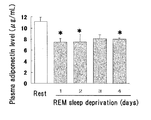
- plasma adiponectin level was significantly reduced only one day after REM sleep deprivation (also, two days and four days after REM sleep deprivation), as compared with the case of rats of the rest group.
- a reduction in plasma adiponectin level did not depend on the period of REM sleep deprivation; i.e., the degree of reduction in plasma adiponectin level was almost the same from one day to four days after REM sleep deprivation ( Fig. 1 ).
- REM sleep deprivation significantly reduced plasma adiponectin level
- chlorogenic acid (CQA) significantly suppressed a reduction in plasma adiponectin level caused by REM sleep deprivation ( Fig. 2 ).
- adiponectin level is reduced within a very short period of time. Therefore, such a system can be employed for effective screening of adiponectin secretion regulators.
Landscapes
- Health & Medical Sciences (AREA)
- Life Sciences & Earth Sciences (AREA)
- Engineering & Computer Science (AREA)
- Biomedical Technology (AREA)
- Molecular Biology (AREA)
- Immunology (AREA)
- Urology & Nephrology (AREA)
- Chemical & Material Sciences (AREA)
- Hematology (AREA)
- Cell Biology (AREA)
- Medicinal Chemistry (AREA)
- General Physics & Mathematics (AREA)
- Biotechnology (AREA)
- Food Science & Technology (AREA)
- Pathology (AREA)
- Physics & Mathematics (AREA)
- Analytical Chemistry (AREA)
- Biochemistry (AREA)
- General Health & Medical Sciences (AREA)
- Microbiology (AREA)
- Endocrinology (AREA)
- Bioinformatics & Cheminformatics (AREA)
- Toxicology (AREA)
- Tropical Medicine & Parasitology (AREA)
- Proteomics, Peptides & Aminoacids (AREA)
- Acyclic And Carbocyclic Compounds In Medicinal Compositions (AREA)
- Investigating Or Analysing Biological Materials (AREA)
- Pharmaceuticals Containing Other Organic And Inorganic Compounds (AREA)
Abstract
Description
- The present invention relates to a method for evaluating or selecting an adiponectin secretion regulator.
- In recent years, adiponectin, which is a factor (adipokine) generally secreted from adipocytes, has been reported to have an insulin-resistance-ameliorating effect or an anti-arteriosclerotic effect (Non-Patent Document 1). Hitherto, adipokines other than adiponectin (e.g., TNF-α, resistin, and free fatty acids) are known to induce insulin resistance. Unlike the cases of many adipokines, adiponectin ameliorates insulin resistance; i.e., adiponectin is a "good" adipokine, and thus it has recently become of great interest.
- Some clinical data have shown that adiponectin has the aforementioned effects and, in addition, a reduction in blood adiponectin level can be used as a marker for predicting the onset of diabetes (Non-Patent Document 2). Blood adiponectin level has been reported to be inversely correlated with the degree of obesity (Non-Patent Document 3), and adiponectin reduction has been considered to play an important role in development or exacerbation of obesity-induced insulin resistance, diabetes or cardiovascular diseases. Therefore, a substance which promotes secretion of adiponectin has been considered to be useful for preventing or ameliorating such a disease.
- There have been established several in vitro test systems for measuring adiponectin expression level. For example, as has been reported, in a system in which 3T3-L1 cells (i.e., preadipocyte cell line) have been differentiated, adiponectin expression level is reduced through addition of, for example, TNF-α (tumor necrosis factor α), insulin, or dexamethason (Non-Patent Document 4).
- Also, adiponectin expression level has been measured in a test system employing adipocytes isolated upon abdominal surgery (Non-Patent Document 5). As has been reported, in vitro screening of adiponectin expression inducers can be carried out by use of cells harboring an enhancer element of adiponectin and reporter gene (Patent Document 1).
- In an in vivo test system, an obese diabetic animal model (e.g., KKAy mouse (Non-Patent Document 6), db/db mouse (Non-Patent Document 7), ob/ob mouse (Non-Patent Document 8), C57BL/6 mouse (Non-Patent Document 9), or Zucker fatty (Non-Patent Document 10)) has been used for evaluating, for example, adiponectin secretion ability, since such an obese diabetic animal model develops obesity, insulin resistance, hypertriglyceridemia, or the like under high-fat diet, and the animal model shows a reduction in blood adiponectin level in association with obesity.
However, such a test system poses problems in that the test system requires a long period of time for evaluating change in amount of adiponectin secreted in an animal model, since the animal model must be reared under high-fat diet for at least several weeks until blood adiponectin level is reduced in the animal model. -
- Patent Document 1:
WO 2005/094866 pamphlet -
- Non-Patent Document 1: Kadowaki, T., et al.: J. Clin. Invest., 116: 1784. 1792 (2006)
- Non-Patent Document 2: Spranger, J., et al.: Lancet., 361: 226-228 (2003)
- Non-Patent Document 3: Arita, Y., et al.: Biochem. Biophys. Res. Commun., 257: 79-83 (1999)
- Non-Patent Document 4: Fasshauer., et al.: Biochem. Biophys. Res. Commun. 290: 1084-1089 (2002)
- Non-Patent Document 5: Halleux, CM., et al.: Biochem. Biophys. Res. Commun. 288: 1102-1107 (2001)
- Non-Patent Document 6: Tsuchida A., et al.: Diabetes.; 54 (12): 3358-3370 (2005)
- Non-Patent Document 7: Fujita H., et al.: Endocrine J.; 52: 427-433 (2005)
- Non-Patent Document 8: Haluzik M., et al.: Endocrinology.; 145: 3258-3264, (2004)
- Non-Patent Document 9: Araki K., et al.: Hypertension.; 48: 51-57, (2006)
- Non-Patent Document 10: Galisteo M., et al.: J. Nutr. 135: 2399-2404, (2005)
- The present invention provides a method for evaluating or selecting an adiponectin secretion regulator, characterized by including the following steps (A) to (C):
- (A) a step of administering a test substance to an experimental animal;
- (B) a step of inducing a sleep deprivation in the experimental animal; and
- (C) a step of measuring blood adiponectin level of the animal, and evaluating change of the blood adiponectin level.
-
-
Fig. 1 is a graph showing a reduction in plasma adiponectin level caused by REM sleep deprivation. *P < 0.05 (Dunnet test, vs. rest group). -
Fig. 2 is a graph showing the effect of chlorogenic acid on a reduction in plasma adiponectin level caused by REM sleep deprivation. *P < 0.05 (Fisher's PLSD test). - The present invention is directed to provision of a method for conveniently and rapidly evaluating or selecting an adiponectin secretion regulator in vivo.
- The present inventor has conducted studies on screening systems employing animals, and has found that, unexpectedly, the blood adiponectin level of a sleep deprivation model is reduced within a short period of time after induction of a sleep deprivation, and an adiponectin secretion regulator can be evaluated or selected by use of such a sleep deprivation model.
- According to the present invention, an adiponectin secretion regulator can be conveniently and rapidly evaluated or selected. Therefore, the present invention is useful as a screening method for conveniently selecting an agent for preventing or ameliorating a dysmetabolic syndrome (e.g., carbohydrate metabolism disorder or lipid metabolism disorder) or a disease caused by such a syndrome.
- As shown in the Example described hereinbelow, in a sleep-deprivation-induced animal model, blood adiponectin level was reduced within a short period of time after induction of a sleep deprivation. A reduction in blood adiponectin level was suppressed through administration of chlorogenic acid, which has been reported to have the effect of promoting adiponectin secretion (
JP-A-2005-232059
The method for evaluating or selecting an adiponectin secretion regulator of the present invention is described in below. - The experimental animal employed in the present invention is not particularly limited, so long as it can be an experimental small animal which can be used as a sleep deprivation model. The experimental animal is preferably, for example, a rodent such as a mouse, rat, or guinea pig.
- As used herein, a "sleep deprivation" induced in an animal refers to, for example, a sleep deprivation which is induced by any of known sleep deprivation methods devised for the purpose of studying the meaning of sleep in organisms. In the present invention, the "sleep deprivation" induced in an animal is preferably REM sleep deprivation. Examples of known sleep deprivation methods include the below-described methods. Particularly, the platform method is preferably employed.
- 1) The platform method (Youngblood BD., et al., Physiol. Behav. 67 (5) 643-649, (1999)). The platform method, which is also called "flower pot method," is a typical sleep deprivation method.
- This method can particularly induce REM sleep deprivation in a relatively specific manner.
- In this method, water is added to a cage, and a small cylindrical platform on which an experimental animal can ride is placed in the cage. Although an animal can take a rest on the platform, when falling into REM sleep, the animal comes into contact with water, due to loss of balance in association with muscle relaxation; i.e., the animal can have non-REM sleep, but cannot have REM sleep.
- Specifically, a stainless steel cylinder (diameter: 6 to 7 cm) is placed in a rat breeding cage made of acrylic resin, and water is added to the cage so that the water level is adjusted to 1 to 2 cm below the top of the cylinder. One rat (250 to 400 g) is reared in the cage under the conditions that the rat can take feed and drinking water ad libitum.
- 2) The treadmill (or disk) method (Guzman-Marin R., et al. Eur. J. Neurosci. 22 (8): 2111-2116 (2005), Everson CA., et al. Am. J. Physiol. Endocrinol. Metab. 286: 1060-1070 (2004)).
In this method, a treadmill or a rotatable disk is placed in a cage, and the treadmill or the disk is periodically operated for sleep deprivation of an animal in the cage. - 3) A sleep deprivation method by means of noise during rearing (Rabat A., et al. Brain Res. 1059: 82-92 (2005)).
In this method, a noise (frequency: 20 to 300 Hz, intensity: 70 to 80 db) is irregularly output from a speaker for sleep deprivation of an animal. - 4) A method in which an animal is deprived of sleep by means of handling thereof (Toru M., et al. Pharmacol. Biochem. Behav. 20 (5): 757-761 (1984)).
In this method, when an animal falls asleep, the animal is touched with a hand for sleep deprivation. - The period of the sleep deprivation, which may vary with the sleep derivation method employed, is generally about one day to about five days. When the platform method is employed, the period of the sleep deprivation may be about one day to about two days, since blood adiponectin level is significantly reduced one day after induction of a sleep deprivation.
- The timing of administration of a test substance may be appropriately determined in consideration of the intended use of the substance. Administration of a test substance may be carried out before or after induction of a sleep deprivation in an experimental animal, or may be carried out during a sleep deprivation.
Administration of a test substance may be carried out through any of, for example, oral, transdermal, subcutaneous, intradermal, intramuscular, tail vein, and intraperitoneal routes. Oral administration is preferable. - Serum or plasma adiponectin level may be determined through, for example, ELISA (enzyme-linked immunosorbent assay), radioimmunoassay, or western blotting.
Specifically, serum or plasma adiponectin level may be determined by means of, for example, a rat adiponectin ELISA kit (product of AdipoGen). - Thus, a test substance (i.e., an adiponectin secretion regulator) can be evaluated or selected on the basis of the blood adiponectin level of a subject to which the substance has been administered. In this case, when, for example, the blood adiponectin level of the subject is statistically significantly higher than that of a control subject to which the test substance has not been administered, the test substance can be evaluated or selected as an adiponectin secretion promoter.
Examples of the adiponectin secretion promoter include substances which ameliorate low adiponectin state through, for example, enhancement of expression of adiponectin. Such an adiponectin secretion promoter may be provided in the form of a drug or food for prevention, treatment, or amelioration of diseases or symptoms caused by low adiponectin state, including hypoadiponectinemia, impaired glucose tolerance, diabetes,type 2 diabetes mellitus, insulin resistance syndrome, diabetic complication, hyperglycemia, arteriosclerosis, atherosclerosis, cardiovascular disease, cerebrovascular disorder, vascular stenosis, peripheral vascular disease, aneurysm, hyperlipidemia, hypercholesterolemia, and obesity. - SD rats (male, 10 to 11 weeks old) were divided into groups, each containing rats with similar body weights. A cylindrical platform (diameter: 6.0 cm, height: 2.5 cm) on which a rat can take a rest was placed in a cage, and water was added to the cage so that the water level was adjusted to 1 cm below the top of the platform. Each rat was reared for one to four days in the cage (one rat/cage). Rats of a rest group were reared in cages each containing a common floorcloth (N = 4 for each group). In a chlorogenic acid administration experiment, rats were reared in cages for 30-hour REM sleep deprivation. Rats of a chlorogenic acid (5-CQA, product of Sigma) administration group orally received chlorogenic acid thrice every 12 hours by means of a probe (dose: 150 mg/kg (300 mg/kg/day)). Rats of a control group received distilled water. Rats of a rest group were reared in cages each containing a common floorcloth, and received distilled water (N = 6 for each group). Immediately after REM sleep deprivation, under anesthesia with Forane (product of Dainippon Pharmaceutical Co., Ltd.), blood was collected from each rat through the abdominal aorta into a Venoject vacuum blood collection tube. Plasma collected in heparin containing tube was stored at -80°C until use. Plasma adiponectin level was determined by means of a rat adiponectin ELISA kit (product of AdipoGen). Specifically, plasma was 1,000-fold diluted with a dilution buffer contained in the kit, and then plasma adiponectin level was determined according to the kit protocol.
- In rats of the sleep deprivation group, plasma adiponectin level was significantly reduced only one day after REM sleep deprivation (also, two days and four days after REM sleep deprivation), as compared with the case of rats of the rest group. However, a reduction in plasma adiponectin level did not depend on the period of REM sleep deprivation; i.e., the degree of reduction in plasma adiponectin level was almost the same from one day to four days after REM sleep deprivation (
Fig. 1 ). - REM sleep deprivation significantly reduced plasma adiponectin level, and chlorogenic acid (CQA) significantly suppressed a reduction in plasma adiponectin level caused by REM sleep deprivation (
Fig. 2 ). - Thus, in a REM sleep deprivation system, blood adiponectin level is reduced within a very short period of time. Therefore, such a system can be employed for effective screening of adiponectin secretion regulators.
Claims (4)
- A method for evaluating or selecting an adiponectin secretion regulator, comprising the following steps (A) to (C):(A) a step of administering a test substance to an experimental animal;(B) a step of inducing a sleep deprivation in the experimental animal; and(C) a step of measuring blood adiponectin level of the animal, and evaluating change of the blood adiponectin level.
- The method according to claim 1, wherein the sleep deprivation is REM sleep deprivation.
- The method according to claim 2, wherein the REM sleep deprivation is induced by the platform method.
- The method according to any one of claims 1 to 3, wherein the experimental animal is a rat or mouse.
Applications Claiming Priority (2)
| Application Number | Priority Date | Filing Date | Title |
|---|---|---|---|
| JP2008107047 | 2008-04-16 | ||
| PCT/JP2009/001720 WO2009128257A1 (en) | 2008-04-16 | 2009-04-14 | Method for evaluation or selection of adiponectin secretion regulator |
Publications (3)
| Publication Number | Publication Date |
|---|---|
| EP2270497A1 true EP2270497A1 (en) | 2011-01-05 |
| EP2270497A4 EP2270497A4 (en) | 2012-02-01 |
| EP2270497B1 EP2270497B1 (en) | 2013-01-16 |
Family
ID=41198962
Family Applications (1)
| Application Number | Title | Priority Date | Filing Date |
|---|---|---|---|
| EP09732309A Not-in-force EP2270497B1 (en) | 2008-04-16 | 2009-04-14 | Method for evaluation or selection of adiponectin secretion regulator |
Country Status (5)
| Country | Link |
|---|---|
| US (1) | US8440464B2 (en) |
| EP (1) | EP2270497B1 (en) |
| JP (1) | JP5432567B2 (en) |
| CN (1) | CN102007410B (en) |
| WO (1) | WO2009128257A1 (en) |
Families Citing this family (1)
| Publication number | Priority date | Publication date | Assignee | Title |
|---|---|---|---|---|
| KR101604212B1 (en) * | 2015-07-17 | 2016-03-17 | 울산대학교 산학협력단 | Composition for the prevention and treatment of obesity or impaired glucose tolerance containing NAD |
Family Cites Families (9)
| Publication number | Priority date | Publication date | Assignee | Title |
|---|---|---|---|---|
| KR101134605B1 (en) | 2003-10-15 | 2012-04-09 | 토우다이 티엘오, 리미티드 | Method of pretreating sample and immunological assay method using the same |
| US7781171B2 (en) * | 2003-10-15 | 2010-08-24 | Daiichi Pure Chemicals Co., Ltd. | Mehod of pretreating sample and immunological assay method using the same |
| JP2005232059A (en) * | 2004-02-18 | 2005-09-02 | Iichiro Shimomura | Preventing/treating agent for hypoadiponectinemia |
| EP1757302B1 (en) * | 2004-03-31 | 2016-10-05 | Toudai Tlo, Ltd. | Adiponectin expression inducer and utilization of the same |
| EP1744160B1 (en) * | 2004-03-31 | 2011-07-06 | Kazuhisa Maeda | Use of adiponectin as marker in the prediction of post-operative infection |
| JP2006273839A (en) | 2005-03-04 | 2006-10-12 | National Institute Of Advanced Industrial & Technology | Adiponectin production enhancer |
| JP4990513B2 (en) | 2005-09-16 | 2012-08-01 | エーザイ・アール・アンド・ディー・マネジメント株式会社 | Sleep disorder marker and therapeutic agent for sleep disorder |
| KR100766273B1 (en) * | 2006-10-23 | 2007-10-15 | 주식회사 녹십자 | Sleep disorders for children with Prader-Willi syndrome, including adiponectin as an active ingredient |
| EP2020447A1 (en) | 2007-08-03 | 2009-02-04 | Zeltia, S.A. | Method for identifying compounds modulating adiponectin gene expression |
-
2009
- 2009-04-08 JP JP2009094022A patent/JP5432567B2/en not_active Expired - Fee Related
- 2009-04-14 WO PCT/JP2009/001720 patent/WO2009128257A1/en not_active Ceased
- 2009-04-14 CN CN2009801133101A patent/CN102007410B/en not_active Expired - Fee Related
- 2009-04-14 EP EP09732309A patent/EP2270497B1/en not_active Not-in-force
- 2009-04-14 US US12/988,108 patent/US8440464B2/en not_active Expired - Fee Related
Also Published As
| Publication number | Publication date |
|---|---|
| JP2009276341A (en) | 2009-11-26 |
| EP2270497B1 (en) | 2013-01-16 |
| CN102007410A (en) | 2011-04-06 |
| JP5432567B2 (en) | 2014-03-05 |
| US20110033877A1 (en) | 2011-02-10 |
| US8440464B2 (en) | 2013-05-14 |
| CN102007410B (en) | 2013-10-09 |
| EP2270497A4 (en) | 2012-02-01 |
| WO2009128257A1 (en) | 2009-10-22 |
Similar Documents
| Publication | Publication Date | Title |
|---|---|---|
| Karusheva et al. | Short-term dietary reduction of branched-chain amino acids reduces meal-induced insulin secretion and modifies microbiome composition in type 2 diabetes: a randomized controlled crossover trial | |
| Milan-Mattos et al. | Effects of natural aging and gender on pro-inflammatory markers | |
| Abu‐Farha et al. | ANGPTL8 (betatrophin) role in diabetes and metabolic diseases | |
| Shapiro et al. | Adipose tissue foam cells are present in human obesity | |
| Zahorska-Markiewicz et al. | Serum concentration of visfatin in obese women | |
| DK2929353T3 (en) | HEXANOYLGYLINE AS BIOMARKER FOR PREPOSITION OF WEIGHT INCREASE AND OBESITAS | |
| Manell et al. | Hyperglucagonemia in youth is associated with high plasma free fatty acids, visceral adiposity, and impaired glucose tolerance | |
| Katsuki et al. | Increased oxidative stress is associated with decreased circulating levels of adiponectin in Japanese metabolically obese, normal-weight men with normal glucose tolerance | |
| Kim et al. | Serum adipokine concentrations in dogs with diabetes mellitus: a pilot study | |
| DK2929355T3 (en) | ISOVALERYLGYLINE AS BIOMARKER FOR PREPARATION FOR WEIGHT GAIN AND OBESE | |
| DK2929347T3 (en) | TRIMETHYLAMINE-N-OXIDE AS A BIOMARKER FOR THE PREPOSITION OF WEIGHTING AND OBESITY | |
| Brial et al. | Ghrelin Inhibition Restores Glucose Homeostasis in Hepatocyte Nuclear Factor-1α (MODY3)–Deficient Mice | |
| Fiamoncini et al. | Plasma metabolic signatures of healthy overweight subjects challenged with an oral glucose tolerance test | |
| McGlone et al. | Chronic treatment with glucagon-like peptide-1 and glucagon receptor co-agonist causes weight loss-independent improvements in hepatic steatosis in mice with diet-induced obesity | |
| EP2270497B1 (en) | Method for evaluation or selection of adiponectin secretion regulator | |
| da Cruz-Filho et al. | Water deprivation induces a systemic procatabolic state that differentially affects oxidative and glycolytic skeletal muscles in male mice | |
| Sommer et al. | Serum levels of adipocyte fatty acid‐binding protein (AFABP) are increased in chronic haemodialysis (CD) | |
| JP2010522332A (en) | Method for monitoring drug efficacy in diabetic patients using an assay for 1,5-anhydro-D-glucitol | |
| Rodriguez et al. | Late-onset renal hypertrophy and dysfunction in mice lacking CTRP1 | |
| EP3124966B1 (en) | Method for evaluating or selecting agent for suppressing gip level elevation | |
| Kume et al. | High levels of saturated very long-chain fatty acid (hexacosanoic acid; C26: 0) in whole blood are associated with metabolic syndrome in Japanese men | |
| Roy et al. | Acute injection of ASP in the third ventricle inhibits food intake and locomotor activity in rats | |
| WO2012105630A1 (en) | Method for testing diseases associated with lipid metabolism, and method for assessment of prophylactic and/or therapeutic agent for diseases associated with lipid metabolism | |
| Porwal et al. | Circulating interleukins (IL6)-An early predictor of insulin resistance | |
| Valdez et al. | Persistent Inflammatory Lipotoxicity Impedes Pancreatic β-cell Function in Diet-Induced Obese Mice Despite Correction of Glucotoxicity |
Legal Events
| Date | Code | Title | Description |
|---|---|---|---|
| PUAI | Public reference made under article 153(3) epc to a published international application that has entered the european phase |
Free format text: ORIGINAL CODE: 0009012 |
|
| 17P | Request for examination filed |
Effective date: 20101015 |
|
| AK | Designated contracting states |
Kind code of ref document: A1 Designated state(s): AT BE BG CH CY CZ DE DK EE ES FI FR GB GR HR HU IE IS IT LI LT LU LV MC MK MT NL NO PL PT RO SE SI SK TR |
|
| AX | Request for extension of the european patent |
Extension state: AL BA RS |
|
| DAX | Request for extension of the european patent (deleted) | ||
| A4 | Supplementary search report drawn up and despatched |
Effective date: 20120104 |
|
| RIC1 | Information provided on ipc code assigned before grant |
Ipc: G01N 33/68 20060101ALI20111223BHEP Ipc: G01N 33/15 20060101ALI20111223BHEP Ipc: G01N 33/50 20060101AFI20111223BHEP Ipc: G01N 33/74 20060101ALI20111223BHEP |
|
| GRAP | Despatch of communication of intention to grant a patent |
Free format text: ORIGINAL CODE: EPIDOSNIGR1 |
|
| GRAS | Grant fee paid |
Free format text: ORIGINAL CODE: EPIDOSNIGR3 |
|
| GRAA | (expected) grant |
Free format text: ORIGINAL CODE: 0009210 |
|
| AK | Designated contracting states |
Kind code of ref document: B1 Designated state(s): AT BE BG CH CY CZ DE DK EE ES FI FR GB GR HR HU IE IS IT LI LT LU LV MC MK MT NL NO PL PT RO SE SI SK TR |
|
| REG | Reference to a national code |
Ref country code: GB Ref legal event code: FG4D |
|
| REG | Reference to a national code |
Ref country code: CH Ref legal event code: NV Representative=s name: VOSSIUS AND PARTNER, CH Ref country code: CH Ref legal event code: EP |
|
| REG | Reference to a national code |
Ref country code: IE Ref legal event code: FG4D |
|
| REG | Reference to a national code |
Ref country code: CH Ref legal event code: NV Representative=s name: VOSSIUS AND PARTNER, CH Ref country code: AT Ref legal event code: REF Ref document number: 594134 Country of ref document: AT Kind code of ref document: T Effective date: 20130215 Ref country code: CH Ref legal event code: EP |
|
| REG | Reference to a national code |
Ref country code: DE Ref legal event code: R096 Ref document number: 602009012826 Country of ref document: DE Effective date: 20130314 |
|
| REG | Reference to a national code |
Ref country code: AT Ref legal event code: MK05 Ref document number: 594134 Country of ref document: AT Kind code of ref document: T Effective date: 20130116 |
|
| REG | Reference to a national code |
Ref country code: NL Ref legal event code: VDEP Effective date: 20130116 |
|
| REG | Reference to a national code |
Ref country code: LT Ref legal event code: MG4D |
|
| PG25 | Lapsed in a contracting state [announced via postgrant information from national office to epo] |
Ref country code: SE Free format text: LAPSE BECAUSE OF FAILURE TO SUBMIT A TRANSLATION OF THE DESCRIPTION OR TO PAY THE FEE WITHIN THE PRESCRIBED TIME-LIMIT Effective date: 20130116 Ref country code: BG Free format text: LAPSE BECAUSE OF FAILURE TO SUBMIT A TRANSLATION OF THE DESCRIPTION OR TO PAY THE FEE WITHIN THE PRESCRIBED TIME-LIMIT Effective date: 20130416 Ref country code: ES Free format text: LAPSE BECAUSE OF FAILURE TO SUBMIT A TRANSLATION OF THE DESCRIPTION OR TO PAY THE FEE WITHIN THE PRESCRIBED TIME-LIMIT Effective date: 20130427 Ref country code: AT Free format text: LAPSE BECAUSE OF FAILURE TO SUBMIT A TRANSLATION OF THE DESCRIPTION OR TO PAY THE FEE WITHIN THE PRESCRIBED TIME-LIMIT Effective date: 20130116 Ref country code: NO Free format text: LAPSE BECAUSE OF FAILURE TO SUBMIT A TRANSLATION OF THE DESCRIPTION OR TO PAY THE FEE WITHIN THE PRESCRIBED TIME-LIMIT Effective date: 20130416 Ref country code: LT Free format text: LAPSE BECAUSE OF FAILURE TO SUBMIT A TRANSLATION OF THE DESCRIPTION OR TO PAY THE FEE WITHIN THE PRESCRIBED TIME-LIMIT Effective date: 20130116 Ref country code: BE Free format text: LAPSE BECAUSE OF FAILURE TO SUBMIT A TRANSLATION OF THE DESCRIPTION OR TO PAY THE FEE WITHIN THE PRESCRIBED TIME-LIMIT Effective date: 20130116 Ref country code: IS Free format text: LAPSE BECAUSE OF FAILURE TO SUBMIT A TRANSLATION OF THE DESCRIPTION OR TO PAY THE FEE WITHIN THE PRESCRIBED TIME-LIMIT Effective date: 20130516 |
|
| PG25 | Lapsed in a contracting state [announced via postgrant information from national office to epo] |
Ref country code: SI Free format text: LAPSE BECAUSE OF FAILURE TO SUBMIT A TRANSLATION OF THE DESCRIPTION OR TO PAY THE FEE WITHIN THE PRESCRIBED TIME-LIMIT Effective date: 20130116 Ref country code: FI Free format text: LAPSE BECAUSE OF FAILURE TO SUBMIT A TRANSLATION OF THE DESCRIPTION OR TO PAY THE FEE WITHIN THE PRESCRIBED TIME-LIMIT Effective date: 20130116 Ref country code: PT Free format text: LAPSE BECAUSE OF FAILURE TO SUBMIT A TRANSLATION OF THE DESCRIPTION OR TO PAY THE FEE WITHIN THE PRESCRIBED TIME-LIMIT Effective date: 20130516 Ref country code: LV Free format text: LAPSE BECAUSE OF FAILURE TO SUBMIT A TRANSLATION OF THE DESCRIPTION OR TO PAY THE FEE WITHIN THE PRESCRIBED TIME-LIMIT Effective date: 20130116 Ref country code: NL Free format text: LAPSE BECAUSE OF FAILURE TO SUBMIT A TRANSLATION OF THE DESCRIPTION OR TO PAY THE FEE WITHIN THE PRESCRIBED TIME-LIMIT Effective date: 20130116 Ref country code: PL Free format text: LAPSE BECAUSE OF FAILURE TO SUBMIT A TRANSLATION OF THE DESCRIPTION OR TO PAY THE FEE WITHIN THE PRESCRIBED TIME-LIMIT Effective date: 20130116 Ref country code: GR Free format text: LAPSE BECAUSE OF FAILURE TO SUBMIT A TRANSLATION OF THE DESCRIPTION OR TO PAY THE FEE WITHIN THE PRESCRIBED TIME-LIMIT Effective date: 20130417 |
|
| PG25 | Lapsed in a contracting state [announced via postgrant information from national office to epo] |
Ref country code: HR Free format text: LAPSE BECAUSE OF FAILURE TO SUBMIT A TRANSLATION OF THE DESCRIPTION OR TO PAY THE FEE WITHIN THE PRESCRIBED TIME-LIMIT Effective date: 20130116 |
|
| PG25 | Lapsed in a contracting state [announced via postgrant information from national office to epo] |
Ref country code: RO Free format text: LAPSE BECAUSE OF FAILURE TO SUBMIT A TRANSLATION OF THE DESCRIPTION OR TO PAY THE FEE WITHIN THE PRESCRIBED TIME-LIMIT Effective date: 20130116 Ref country code: SK Free format text: LAPSE BECAUSE OF FAILURE TO SUBMIT A TRANSLATION OF THE DESCRIPTION OR TO PAY THE FEE WITHIN THE PRESCRIBED TIME-LIMIT Effective date: 20130116 Ref country code: EE Free format text: LAPSE BECAUSE OF FAILURE TO SUBMIT A TRANSLATION OF THE DESCRIPTION OR TO PAY THE FEE WITHIN THE PRESCRIBED TIME-LIMIT Effective date: 20130116 Ref country code: CZ Free format text: LAPSE BECAUSE OF FAILURE TO SUBMIT A TRANSLATION OF THE DESCRIPTION OR TO PAY THE FEE WITHIN THE PRESCRIBED TIME-LIMIT Effective date: 20130116 Ref country code: DK Free format text: LAPSE BECAUSE OF FAILURE TO SUBMIT A TRANSLATION OF THE DESCRIPTION OR TO PAY THE FEE WITHIN THE PRESCRIBED TIME-LIMIT Effective date: 20130116 |
|
| PLBE | No opposition filed within time limit |
Free format text: ORIGINAL CODE: 0009261 |
|
| STAA | Information on the status of an ep patent application or granted ep patent |
Free format text: STATUS: NO OPPOSITION FILED WITHIN TIME LIMIT |
|
| PG25 | Lapsed in a contracting state [announced via postgrant information from national office to epo] |
Ref country code: CY Free format text: LAPSE BECAUSE OF FAILURE TO SUBMIT A TRANSLATION OF THE DESCRIPTION OR TO PAY THE FEE WITHIN THE PRESCRIBED TIME-LIMIT Effective date: 20130116 Ref country code: MC Free format text: LAPSE BECAUSE OF FAILURE TO SUBMIT A TRANSLATION OF THE DESCRIPTION OR TO PAY THE FEE WITHIN THE PRESCRIBED TIME-LIMIT Effective date: 20130116 |
|
| 26N | No opposition filed |
Effective date: 20131017 |
|
| PG25 | Lapsed in a contracting state [announced via postgrant information from national office to epo] |
Ref country code: IT Free format text: LAPSE BECAUSE OF FAILURE TO SUBMIT A TRANSLATION OF THE DESCRIPTION OR TO PAY THE FEE WITHIN THE PRESCRIBED TIME-LIMIT Effective date: 20130116 |
|
| REG | Reference to a national code |
Ref country code: IE Ref legal event code: MM4A |
|
| REG | Reference to a national code |
Ref country code: DE Ref legal event code: R097 Ref document number: 602009012826 Country of ref document: DE Effective date: 20131017 |
|
| PG25 | Lapsed in a contracting state [announced via postgrant information from national office to epo] |
Ref country code: IE Free format text: LAPSE BECAUSE OF NON-PAYMENT OF DUE FEES Effective date: 20130414 |
|
| PG25 | Lapsed in a contracting state [announced via postgrant information from national office to epo] |
Ref country code: MT Free format text: LAPSE BECAUSE OF FAILURE TO SUBMIT A TRANSLATION OF THE DESCRIPTION OR TO PAY THE FEE WITHIN THE PRESCRIBED TIME-LIMIT Effective date: 20130116 |
|
| PG25 | Lapsed in a contracting state [announced via postgrant information from national office to epo] |
Ref country code: TR Free format text: LAPSE BECAUSE OF FAILURE TO SUBMIT A TRANSLATION OF THE DESCRIPTION OR TO PAY THE FEE WITHIN THE PRESCRIBED TIME-LIMIT Effective date: 20130116 |
|
| PG25 | Lapsed in a contracting state [announced via postgrant information from national office to epo] |
Ref country code: HU Free format text: LAPSE BECAUSE OF FAILURE TO SUBMIT A TRANSLATION OF THE DESCRIPTION OR TO PAY THE FEE WITHIN THE PRESCRIBED TIME-LIMIT; INVALID AB INITIO Effective date: 20090414 Ref country code: MK Free format text: LAPSE BECAUSE OF FAILURE TO SUBMIT A TRANSLATION OF THE DESCRIPTION OR TO PAY THE FEE WITHIN THE PRESCRIBED TIME-LIMIT Effective date: 20130116 Ref country code: LU Free format text: LAPSE BECAUSE OF NON-PAYMENT OF DUE FEES Effective date: 20130414 |
|
| REG | Reference to a national code |
Ref country code: FR Ref legal event code: PLFP Year of fee payment: 8 |
|
| REG | Reference to a national code |
Ref country code: CH Ref legal event code: PFA Owner name: KAO CORPORATION, JP Free format text: FORMER OWNER: KAO CORPORATION, JP |
|
| REG | Reference to a national code |
Ref country code: FR Ref legal event code: PLFP Year of fee payment: 9 |
|
| REG | Reference to a national code |
Ref country code: FR Ref legal event code: PLFP Year of fee payment: 10 |
|
| PGFP | Annual fee paid to national office [announced via postgrant information from national office to epo] |
Ref country code: GB Payment date: 20220303 Year of fee payment: 14 Ref country code: CH Payment date: 20220314 Year of fee payment: 14 |
|
| PGFP | Annual fee paid to national office [announced via postgrant information from national office to epo] |
Ref country code: FR Payment date: 20220308 Year of fee payment: 14 |
|
| PGFP | Annual fee paid to national office [announced via postgrant information from national office to epo] |
Ref country code: DE Payment date: 20220302 Year of fee payment: 14 |
|
| REG | Reference to a national code |
Ref country code: DE Ref legal event code: R119 Ref document number: 602009012826 Country of ref document: DE |
|
| REG | Reference to a national code |
Ref country code: CH Ref legal event code: PL |
|
| GBPC | Gb: european patent ceased through non-payment of renewal fee |
Effective date: 20230414 |
|
| PG25 | Lapsed in a contracting state [announced via postgrant information from national office to epo] |
Ref country code: GB Free format text: LAPSE BECAUSE OF NON-PAYMENT OF DUE FEES Effective date: 20230414 |
|
| PG25 | Lapsed in a contracting state [announced via postgrant information from national office to epo] |
Ref country code: LI Free format text: LAPSE BECAUSE OF NON-PAYMENT OF DUE FEES Effective date: 20230430 Ref country code: GB Free format text: LAPSE BECAUSE OF NON-PAYMENT OF DUE FEES Effective date: 20230414 Ref country code: FR Free format text: LAPSE BECAUSE OF NON-PAYMENT OF DUE FEES Effective date: 20230430 Ref country code: DE Free format text: LAPSE BECAUSE OF NON-PAYMENT OF DUE FEES Effective date: 20231103 Ref country code: CH Free format text: LAPSE BECAUSE OF NON-PAYMENT OF DUE FEES Effective date: 20230430 |