EP2269996A1 - Medicinal composition containing benzo[a]phenoxanthin compound as the active ingredient for preventing or treating protozoal disease - Google Patents
Medicinal composition containing benzo[a]phenoxanthin compound as the active ingredient for preventing or treating protozoal disease Download PDFInfo
- Publication number
- EP2269996A1 EP2269996A1 EP09718904A EP09718904A EP2269996A1 EP 2269996 A1 EP2269996 A1 EP 2269996A1 EP 09718904 A EP09718904 A EP 09718904A EP 09718904 A EP09718904 A EP 09718904A EP 2269996 A1 EP2269996 A1 EP 2269996A1
- Authority
- EP
- European Patent Office
- Prior art keywords
- group
- medicinal composition
- carbon atoms
- composition according
- benzo
- Prior art date
- Legal status (The legal status is an assumption and is not a legal conclusion. Google has not performed a legal analysis and makes no representation as to the accuracy of the status listed.)
- Granted
Links
- 0 *c(cc1)ccc1N=O Chemical compound *c(cc1)ccc1N=O 0.000 description 3
- AMJGEYODJQOMDA-IADYIPOJSA-N CCN(C(C)=C)c(cc1O2)cc(OC)c1N=C(c1ccccc11)C2=C/C1=N/c1ccncc1 Chemical compound CCN(C(C)=C)c(cc1O2)cc(OC)c1N=C(c1ccccc11)C2=C/C1=N/c1ccncc1 AMJGEYODJQOMDA-IADYIPOJSA-N 0.000 description 1
- WAXVCRQRFFITLI-SLMZUGIISA-N CCN(CC)c(cc1)cc(O2)c1N=C(c(cc1)c3cc1Br)C2=C/C3=N/c1ccncc1 Chemical compound CCN(CC)c(cc1)cc(O2)c1N=C(c(cc1)c3cc1Br)C2=C/C3=N/c1ccncc1 WAXVCRQRFFITLI-SLMZUGIISA-N 0.000 description 1
- HBUSWSPOTSQXDN-GDWJVWIDSA-N CCN(CC)c(cc1)cc(O2)c1N=C(c1c3cccc1)C2=C/C3=N/c1nc(cccc2)c2cc1 Chemical compound CCN(CC)c(cc1)cc(O2)c1N=C(c1c3cccc1)C2=C/C3=N/c1nc(cccc2)c2cc1 HBUSWSPOTSQXDN-GDWJVWIDSA-N 0.000 description 1
- WAYKEIUGRGJXFH-MEFGMAGPSA-N CCN(CC)c(cc1O2)ccc1N=C(C1=C3CCC=C1)C2=C/C3=N/c1ccccn1 Chemical compound CCN(CC)c(cc1O2)ccc1N=C(C1=C3CCC=C1)C2=C/C3=N/c1ccccn1 WAYKEIUGRGJXFH-MEFGMAGPSA-N 0.000 description 1
- HBSWMATYASLRBW-QYQHSDTDSA-N CCN(CC)c(cc1O2)ccc1N=C(c1ccccc11)C2=C/C1=N/c1ccncc1 Chemical compound CCN(CC)c(cc1O2)ccc1N=C(c1ccccc11)C2=C/C1=N/c1ccncc1 HBSWMATYASLRBW-QYQHSDTDSA-N 0.000 description 1
- JWAZRIHNYRIHIV-UHFFFAOYSA-N Oc1cc(cccc2)c2cc1 Chemical compound Oc1cc(cccc2)c2cc1 JWAZRIHNYRIHIV-UHFFFAOYSA-N 0.000 description 1
Classifications
-
- A—HUMAN NECESSITIES
- A61—MEDICAL OR VETERINARY SCIENCE; HYGIENE
- A61K—PREPARATIONS FOR MEDICAL, DENTAL OR TOILETRY PURPOSES
- A61K31/00—Medicinal preparations containing organic active ingredients
- A61K31/33—Heterocyclic compounds
- A61K31/395—Heterocyclic compounds having nitrogen as a ring hetero atom, e.g. guanethidine or rifamycins
- A61K31/535—Heterocyclic compounds having nitrogen as a ring hetero atom, e.g. guanethidine or rifamycins having six-membered rings with at least one nitrogen and one oxygen as the ring hetero atoms, e.g. 1,2-oxazines
- A61K31/5375—1,4-Oxazines, e.g. morpholine
- A61K31/538—1,4-Oxazines, e.g. morpholine ortho- or peri-condensed with carbocyclic ring systems
-
- A—HUMAN NECESSITIES
- A61—MEDICAL OR VETERINARY SCIENCE; HYGIENE
- A61P—SPECIFIC THERAPEUTIC ACTIVITY OF CHEMICAL COMPOUNDS OR MEDICINAL PREPARATIONS
- A61P33/00—Antiparasitic agents
- A61P33/02—Antiprotozoals, e.g. for leishmaniasis, trichomoniasis, toxoplasmosis
-
- A—HUMAN NECESSITIES
- A61—MEDICAL OR VETERINARY SCIENCE; HYGIENE
- A61P—SPECIFIC THERAPEUTIC ACTIVITY OF CHEMICAL COMPOUNDS OR MEDICINAL PREPARATIONS
- A61P33/00—Antiparasitic agents
- A61P33/02—Antiprotozoals, e.g. for leishmaniasis, trichomoniasis, toxoplasmosis
- A61P33/06—Antimalarials
-
- C—CHEMISTRY; METALLURGY
- C07—ORGANIC CHEMISTRY
- C07D—HETEROCYCLIC COMPOUNDS
- C07D265/00—Heterocyclic compounds containing six-membered rings having one nitrogen atom and one oxygen atom as the only ring hetero atoms
- C07D265/28—1,4-Oxazines; Hydrogenated 1,4-oxazines
- C07D265/34—1,4-Oxazines; Hydrogenated 1,4-oxazines condensed with carbocyclic rings
-
- C—CHEMISTRY; METALLURGY
- C07—ORGANIC CHEMISTRY
- C07D—HETEROCYCLIC COMPOUNDS
- C07D413/00—Heterocyclic compounds containing two or more hetero rings, at least one ring having nitrogen and oxygen atoms as the only ring hetero atoms
- C07D413/02—Heterocyclic compounds containing two or more hetero rings, at least one ring having nitrogen and oxygen atoms as the only ring hetero atoms containing two hetero rings
- C07D413/12—Heterocyclic compounds containing two or more hetero rings, at least one ring having nitrogen and oxygen atoms as the only ring hetero atoms containing two hetero rings linked by a chain containing hetero atoms as chain links
-
- C—CHEMISTRY; METALLURGY
- C07—ORGANIC CHEMISTRY
- C07D—HETEROCYCLIC COMPOUNDS
- C07D417/00—Heterocyclic compounds containing two or more hetero rings, at least one ring having nitrogen and sulfur atoms as the only ring hetero atoms, not provided for by group C07D415/00
- C07D417/02—Heterocyclic compounds containing two or more hetero rings, at least one ring having nitrogen and sulfur atoms as the only ring hetero atoms, not provided for by group C07D415/00 containing two hetero rings
- C07D417/12—Heterocyclic compounds containing two or more hetero rings, at least one ring having nitrogen and sulfur atoms as the only ring hetero atoms, not provided for by group C07D415/00 containing two hetero rings linked by a chain containing hetero atoms as chain links
-
- Y—GENERAL TAGGING OF NEW TECHNOLOGICAL DEVELOPMENTS; GENERAL TAGGING OF CROSS-SECTIONAL TECHNOLOGIES SPANNING OVER SEVERAL SECTIONS OF THE IPC; TECHNICAL SUBJECTS COVERED BY FORMER USPC CROSS-REFERENCE ART COLLECTIONS [XRACs] AND DIGESTS
- Y02—TECHNOLOGIES OR APPLICATIONS FOR MITIGATION OR ADAPTATION AGAINST CLIMATE CHANGE
- Y02A—TECHNOLOGIES FOR ADAPTATION TO CLIMATE CHANGE
- Y02A50/00—TECHNOLOGIES FOR ADAPTATION TO CLIMATE CHANGE in human health protection, e.g. against extreme weather
- Y02A50/30—Against vector-borne diseases, e.g. mosquito-borne, fly-borne, tick-borne or waterborne diseases whose impact is exacerbated by climate change
Definitions
- the present invention relates to a medicinal composition containing as an active ingredient a benzo[a]phenoxazine compound for prevention or treatment and to a benzo[a]phenoxanzine compound.
- the medicinal composition of the present invention is useful for treatment and/or treatment of diseases related to parasitic infections, especially for example, malaria including drug-resistant malaria, leishmaniasis, trypanosomiasis including African Trypanosomiasis and Chagas disease, toxoplasmosis and cryptosporidiosis.
- parasitic protozoan infections are widely known mainly around tropical or subtropical regions, and can be exemplified by malaria, leishmaniasis, African trypanosomiasis (African sleeping sickness), American trypanosomiasis (Chags disease), lymphatic filariasis, babesiosis, cryptosporidiosis and toxoplasmosis. These infections can be classified into those infecting only humans, and parasitic zoonosis also infecting domestic animals or small animals, both leading to significant economic and social loss.
- Patent Document 1 a medicinal composition for prevention or therapy of a protozoal disease, containing as an active ingredient a phenoxanizium compound
- Patent Document 2 a medicinal composition for prevention or therapy of a protozoal disease, containing as an active ingredient an azarhodacyanine compound
- Non-patent Documents 1 to 5 A number of benzo[a]phenoxzines and benzo[a]phenoxazonium compounds 1 which are salts thereof with acids have been synthesized so far, and reported to have antitumor activities.
- R 3 in General formula (1) is a hydrogen atom or an ethyl group, but their in vitro and in vivo activities are low (Non-patent Documents 6 and 7).
- the present invention aims to provide a novel medicinal composition for prevention and/or treatment having both excellent therapeutic effect and selective toxicity for a parasitic protozoal disease, especially, a medicinal composition for prevention and treatment which has low toxicity in a living body suffering from a parasitic protozoal disease and exhibits a significant therapeutic effect when it is administered.
- the present inventors tested effects of various compounds on the growth of protozoans responsible for diseases, and evaluated their cytotoxicities to mammalian cells, which are useful as indices of side effects. Further, among the compounds selected in the above tests, compounds which show suppressing effects of not less than 50% on the growth of malaria parasites were searched by using mice infected with malaria as host models and administering each compound to the mice in various amounts and by various administration modes to evaluate the therapeutic effect of the compound on malaria.
- compositions each comprising, as an active ingredient, a benzo[a]phenoxzine compound represented by the following General formula 1 or a salt thereof have excellent prophylactic or therapeutic effect for protozoal diseases, thereby completing the present invention based on these findings.
- the present invention includes the following modes.
- the benzo[a]phenoxazine compound or a salt thereof contained as an active ingredient in the medicinal composition of the present invention exhibits a growth inhibitory effect on a parasitic protozoal disease even by its administration at a low dose, and even in cases where it is administered at a higher dose than that at which an inhibitory effect on a parasitic protozoan is exhibited, mammalian cells are not injured (that is, it has a high selective toxicity coefficient). Further, in in vivo therapeutic tests using mice infected with malaria, the compounds were confirmed to show significantly higher cure rates and significantly higher survival advantages compared to conventionally known compounds. Further, since the compounds have extremely lower acute toxicities, they were confirmed to be effective also as therapeutic agents for malaria and the like having less side effects.
- R 1 and R 2 each independently represents a hydrogen atom, an alkyl group having 1 to 8 carbon atoms, an alkenyl group having 3 to 8 carbon atoms, an aryl group having 6 to 10 carbon atoms or a heterocyclic residue having 1 to 10 carbon atoms;
- R 3 represents an alkenyl group having 3 to 8 carbon atoms, an aryl group having 6 to 10 carbon atoms or a heterocyclic residue having 1 to 10 carbon atoms; and
- R 1 and R 2 may be condensed to form a ring.
- alkyl group having 1 to 8 carbon atoms include a methyl group, an ethyl group, a propyl group, a butyl group, a pentyl group, a hexyl group, a cyclohexyl group and an octyl group.
- substituents include a fluorine atom, a chlorine atom, a hydroxy group, an alkoxy group, an amino group, an oxycarbonyl group, a carboxy group, a carbonamide group and a sulfonamide group.
- Preferred examples of the alkenyl group having 3 to 8 carbon atoms include a vinyl group, an allyl group, a butenyl group and an octenyl group, and examples of substituents thereof include a fluorine atom and a chlorine atom.
- Preferred examples of the aryl group having 6 to 10 carbon atoms include a phenyl group and a naphthyl group, and examples of substituents thereof include a fluorine atom, a chlorine atom, a methyl group, an ethyl group, a propyl group, a hydroxy group, an alkoxy group, an amino group and a carboxy group.
- heterocyclic residue having 1 to 10 carbon atoms examples include a pyridyl group, a pyrimidyl group, a triazyl group, a pyridazyl group, an imidazolyl group, a triazolyl group, a tetrazolyl group, a thiazolyl group and an oxazolyl group, and preferred examples of substituents thereof include a fluorine atom, a chlorine atom, a methyl group, an ethyl group, a propyl group, a hydroxy group, an alkoxy group, an amino group, a carboxy group and a pyridyl group.
- m and n each preferably represent 0 or 1.
- Preferred examples of the anion represented by X include a chlorine atom, a bromine atom, a nitrate ion, a sulfate ion, a p-toluenesulfonate ion and an oxalate ion, and it especially preferably represents a chloride ion.
- R 4 preferably represents a halogen atom, an alkoxy group or an alkyl group having 1 to 8 carbon atoms such as a methyl group, and is especially preferably a fluorine atom, a chlorine atom, a methoxy group, an ethoxy group or a methyl group, and its position of substitution is the 11-position.
- R 5 especially preferably represents a fluorine atom, a chlorine atom or a methyl group, and its position of substitution is especially preferably the 3-position.
- substituents of R 4 and R 5 include a fluorine atom, a hydroxy group and an alkoxy group.
- R 1 and R 2 especially preferably represent a methyl group, an ethyl group, a propyl group, a 2-hydroxyethyl group or a 2-methanesulfonamidoethyl group.
- R 3 preferably represents a heterocyclic residue; more preferably represents a pyridyl group, a pyrimidyl group, an imidazolyl group, a tetrazolyl group or a thiazolyl group; and especially preferably represents a pyridyl group or an imidazolyl group.
- the medicinal composition containing the above-described compound of the present invention may be used effectively for preventing or treating various types of diseases caused by parasitic protozoan infections, including malaria, African trypanosomiasis (alias Afican sleeping sickness), American tripanosomiasis (alias Chagas disease), leishmaniasis, babesiosis, lymphatic filariasis, toxoplasmosis (opportunistic infection disease including AIDS) and cryptosporidiosis (tropical diarrhea).
- diseases caused by parasitic protozoan infections including malaria, African trypanosomiasis (alias Afican sleeping sickness), American tripanosomiasis (alias Chagas disease), leishmaniasis, babesiosis, lymphatic filariasis, toxoplasmosis (opportunistic infection disease including AIDS) and cryptosporidiosis (tropical diarrhea).
- 1 or more compounds of the present invention may be contained as active ingredients, and further, as required, the medicinal composition of the present invention may be used in combination with other arbitrary therapeutic agents known to those skilled in the art, including agents for protozoan infections which have been conventionally used.
- anti-protozoan infection agents which are used conventionally include: chloroquine, mefloquine, artemisinin, atavaquone, and pyrimethamine (treating agents for malaria infection); suramin, pentamidine, melarsoprol and ascofuranone (treating agents for African trypanosomiasis); benznidazole (treating agents for Chagas disease); pentostam, Amphotericin B, miltefosine and fluconazole (treating agents for leishmaniasis).
- Suitable examples of medicinal carriers or diluents that can be used in combination with the compounds shown by general formulae (1) of the present invention include the following: sodium chloride; magnesium chloride; zinc chloride; glucose; saccharose; lactose; ethyl alcohol; glycerol; mannitol; sorbitol; pentaerythritol; diethylene glycol; propylene glycol, dipropylene glycol, polyethylene glycol 400, other polyethylene glycol; mono-, di- and tri-glyceride of fatty acids including trilaurate glyceryl and distearate glyceryl; pectin; starch; arginine acid; xylose; talc; lycopodium; olive oil; oil and fat including peanut oil, castor oil, corn oil, safflower oil, wheat germ oil, sesame oil, cotton seed oil, sunflower oil and oleum morrhuae; gelatin; lecithin; silica;
- compositions of the present invention can be arbitrarily selected by those in the art depending on types of parasitic protozoa being the cause of the infection, habitats of protozoa, seriousness of deseases, treatment starategies, age, body weight, sex and general health conditions of the patient, and (genetic) racial background of the patient.
- the dosage of the present invention is 1 to 10,000 mg/day/70Kg of body weight, more generally 50 to 2000 mg/day/70kg of body weight.
- the medicinal compositions of the present invention may be formed into arbitrary forms known to those skilled in the art, depending on their administration methods, administration routes and/or the like. These may be administered by appropriate methods.
- Their examples include ones having the forms of a liquid, tablet and colloid, and in cases where it is a liquid, examples of the method of its administration include intravenous, intraperitoneal and subcutaneous injection of the composition dissolved in aqueous 5% glucose solution or accompanied by the above carrier or diluent.
- examples of the method of its administration include oral administration, and in the case of a colloid, examples thereof include application to the skin.
- the compound represented by the above General formula (1) may be contained in an appropriate amount depending on the purpose of use, subject, form and the like of the medicinal composition of the present invention, and is usually contained in an amount of about 1 mg to 10,000 mg, preferably 10 mg to 3,000 mg.
- benzo[a]phenaxazine compounds represented by General formula 1 and salts thereof were obtained by the process wherein a 4-nitrosoaniline derivative represented by General formula 3 or a p-phenylenediamines represented by General formula 5 was allowed to react with a 2-naphthol derivative represented by General formula 4 in the presence of an oxidizing agent such as HNO 3 to obtain 2, which was then allowed to react in ethanol in the presence of a primary amine and an oxidizing agent containing oxygen, to obtain benzo[a]phenoxazine 1 in the form of a free base as a stable substance.
- Their structures were determined by 1 H and 13 C NMR, IR, UV, mass spectrometry and elementary analysis. These can be purified also as hydrochloric acid salts. All of 1A to 1T are novel compounds.
- Non-patent Document 3 Benzo[a]phenoxazinium nitrate 2 (Non-patent Document 3) (1 mmol) was dissolved in ethanol (5 mL), and an amine (3 mmol) corresponding thereto was added to the resulting solution at one time with stirring, followed by heating the resulting mixture to reflux overnight and then stirring it at room temperature for 1 day. After evaporation of the solvent, the resulting residue was purified twice by silica gel chromatography. As the eluent, CHCl 3 :MeOH (10:1, v/v) was first used, followed by using CHCl 3 :MeOH (10:0.3, v/v). After evaporation of the solvent, the resulting product was washed with AcOEt and then Et 2 O, to obtain benzo[a]phenoxazines 1A to T.
- the compounds of the present invention to be used in the present test and the positive control drug (chloroquine) were dissolved in DMSO to make a test solution of a predetermined concentration.
- Cultured malaria parasite infected-erythrocytes were collected by centrifugation, and diluted with non-infected erythrocyte so that the early infection rate was 0.15%. Hematocrit level at that time was 2.5%. 200 ⁇ L of malaria infected solution was added to wells of a 96-well culture plate, and adjusted by adding a test solution containing drug of a predetermined concentration or a drug-free DMSO. Test solutions were taken by duplicates.
- Growth inhibition rate is calculated with the following formula based on the malarial parasite infection rate obtained in the above, to obtain a 50% growth inhibition concentration (EC 50 ).
- Growth inhibition rate % 1 - b - a / c - a ⁇ 100
- Rat derived-L6 cells (rat skeletal myoblast cell) were used. A medium, RPMI1640 medium was supplemented so that L-glutamin (200mM) is 1%, and fetal bovine serum 10%, and the medium was cultured under CO 2 concentration 5%, at 37 °C.
- the compounds of the present invention and the control drugs to be used in the test were dissolved in DMSO, to make a test solution of a predetermined concentration. Pre-culture was conducted and medium containing cells which have entered the logarithmic growth phase was taken to wells of a 96-well culture plate. Then, a test solution containing drug of a predetermined concentration or a drug-free DMSO was added. Test solutions were taken by duplicates.
- Culture plate was cultured for 72 hours in an incubator, to test the growth inhibition activity. Test was conducted as follows. 10 ⁇ L of Alamar Blue aqueous solution was added to each well, and the resultant was further cultured for 2 hours. Next, the culture plate was placed on a fluorescent micro-plate reader (Spectramax Gemeni XS; US Molecular Device), radiated at an excited wavelength of 536 nm. Fluorescent intensity was measured at 588nm, and residual rate of L6 cells of the test solution added group, and that of the control was calculated.
- a fluorescent micro-plate reader Spectramax Gemeni XS; US Molecular Device
- growth inhibition rate % C - A / B - A ⁇ 100
- Chemotherapy index (EC 50 value of a sample against rat L6 cells) / (EC 50 value of a sample against chloroquine resistant-Plasmodium falsiparum)
- rodent malaria parasites (the Plasmodium berghei NK65 strain) were used.
- the infected blood to be used was subcultured in ICR female SPF mice infected by intraperitoneal or tail vein administration at 4 to 6 weeks old (20 to 26g).
- the infection rates were calculated, and after confirming that they showed appropriate levels of infection (an infection rate of 10 to 20%), malaria-infected blood was collected from the heart of the mice with a heparin-containing syringe.
- the blood was diluted with physiological saline such that a density of 5.0 ⁇ 10 -6 malaria parasites/1 ml dose was attained.
- This was used for infection of uninfected mice (ICR female mice, 5 weeks old) in an amount of 0.2 ml/20 g body weight, through the tail vein (Day-0).
- the compound used in the test was dissolved in 10% DMSO solution (a mixture of 1 ml of DMSO and 9 ml of 5% glucose solution).
- Each group contained 4 mice, and the compound was orally administered to the mice 24 hours after their infection with malaria (Day-1), in an amount calculated such that 100 mg of the compound was administered per 1 kg of the body weight of a mouse.
- the oral administration was carried out a total of three times, that is, 24 hours (Day-1), 48 hours (Day-2) and 72 hours (Day-3) after the infection of malaria.
- Blood was collected from the tails of each mouse 96 hours (Day-4) and 144 hours (Day-6) after the infection with malaria, and thin blood films were prepared. Under the microscope, the numbers of infection of malaria parasites in the group to which the compound was administered and the control group (to which the compound was not administered) were measured, and the rates of infection with malaria parasites (Parasitemia) were calculated.
- protozoa of Tripanosoma brucei rhodensiense (STIB 900 Strain), a trypomastigote living in blood stream, was used.
- the medium used in the experiment was a MEM medium which was sterilized with a filter and supplemented with 25 mM N-2-hydroxyethylpiperazine-2-ethansulfonic acid (HEPES), 1 g/L glucose, 1% MEM non-essential amino acid, 0.2 mM 2-mercaptoethanol, 2 mM sodium pyruvate, 0.1 mM hypoxanthine, and 15% heat-treated horse serum.
- the protozoa was cultured in an atmosphere of CO 2 concentration 5%, at a temperature of 37°C.
- the compounds of the present invention to be used in the present test and the positive control drug (melarsoprol) were dissolved in dimethylsulfoxide (DMSO) to make a test solution of a predetermined concentration.
- DMSO dimethylsulfoxide
- a medium containing 8 ⁇ 10 3 protozoa, and a test solution containing a drug of a predetermined concentration of a drug-free DMSO were added to wells of a 96-well culture plate, and subsequently, medium was added so that the amount in each well becomes 100 ⁇ L.
- Test solutions were taken by duplicates. After culturing the culture plate for 72 hours in an incubator, growth inhibition activity was tested. Test was conducted as follows.
- amastigote and trypomastigote infected with rat L6 cells of protozoa of Trypanosoma cruzi (Tulahuen C2C4 starin) were used.
- medium used in the test RPMI 1640 medium containing L6 cells was supplemented so that L-glutamine (200 mM) become 1%, fetal bovine serum becomes 10%, which was cultured under CO 2 concentration 5%, at 37 °C.
- test solution of a predetermined concentration.
- a medium containing 5 ⁇ 10 3 protozoa was added to wells of a 96-well culture plate, and pre-cultured for 48hours. After replacing the medium, test solution containing drug of a predetermined concentration or a drug-free DMSO was added. Test solutions were taken by duplicates. After culturing the culture plate in an incubator for 96 hours, growth inhibition activity was tested. Test was conducted as follows. 50 ⁇ L of CPRG/Nonidet was added to each well, and allowed to rest for 2 to 6 hours. Next, the culture plate was placed on a fluorescent micro-plate reader. The absorbance was measured at 540 nm, and the trypanosome infection rate of the test solution added group and control group were calculated.
- Leishmania donovani (MHOM/ET/67/L82 strain) was used. Protozoa was subcultured in Syrian Golden hamster, from which an amastigote was obtained. In the experiment, SM medium supplemented with 10% heat-treated bovine fetal serum was used, which was adjusted to pH 5.4, and cultured in an atmosphere of 5% CO 2 concentration, at 37 °C.
- the compounds of the present invention to be used in the present test and the positive control drug (miltefosine) were dissolved in DMSO to make a test solution of a predetermined concentration. After adding a medium containing a predetermined number of protozoa to wells of a 96-well culture plate and pre-treating, concentration of the amastigote was measured with CASY cell analysis system (Scharfe, Germany). Then, test solution containing a drug of a predetermined concentration or a drug-free DMSO was added. Test solutions were taken by duplicates. After culturing the culture plate for 72 hours in an incubator, growth inhibition activity was tested. Test was conducted as follows.
- an excellent therapeutic agent and/or prophylactic agent for a protozoal disease can be provided.
Landscapes
- Chemical & Material Sciences (AREA)
- Organic Chemistry (AREA)
- Health & Medical Sciences (AREA)
- Veterinary Medicine (AREA)
- General Health & Medical Sciences (AREA)
- Animal Behavior & Ethology (AREA)
- Medicinal Chemistry (AREA)
- Public Health (AREA)
- Pharmacology & Pharmacy (AREA)
- Life Sciences & Earth Sciences (AREA)
- Tropical Medicine & Parasitology (AREA)
- Chemical Kinetics & Catalysis (AREA)
- General Chemical & Material Sciences (AREA)
- Nuclear Medicine, Radiotherapy & Molecular Imaging (AREA)
- Epidemiology (AREA)
- Pharmaceuticals Containing Other Organic And Inorganic Compounds (AREA)
- Heterocyclic Carbon Compounds Containing A Hetero Ring Having Nitrogen And Oxygen As The Only Ring Hetero Atoms (AREA)
- Plural Heterocyclic Compounds (AREA)
Abstract
Description
- The present invention relates to a medicinal composition containing as an active ingredient a benzo[a]phenoxazine compound for prevention or treatment and to a benzo[a]phenoxanzine compound. The medicinal composition of the present invention is useful for treatment and/or treatment of diseases related to parasitic infections, especially for example, malaria including drug-resistant malaria, leishmaniasis, trypanosomiasis including African Trypanosomiasis and Chagas disease, toxoplasmosis and cryptosporidiosis.
- Even now, parasitic protozoan infections are widely known mainly around tropical or subtropical regions, and can be exemplified by malaria, leishmaniasis, African trypanosomiasis (African sleeping sickness), American trypanosomiasis (Chags disease), lymphatic filariasis, babesiosis, cryptosporidiosis and toxoplasmosis. These infections can be classified into those infecting only humans, and parasitic zoonosis also infecting domestic animals or small animals, both leading to significant economic and social loss.
- Among these diseases, there are some diseases which do not have a therapeutic agent showing a sufficient effect, or some diseases which have problems such as emergence and diffusion of drug-resistant protozoa, or side effects of therapeutic agents. Therefore, an effective agent is desired. Further, since these diseases include diseases which cause serious symptoms with which patients cannot have a normal social life, diseases which force patients to be in a bedridden state in which nursing care is necessary, and diseases which lead to development of lethal symptoms, rapid development of a chemotherapeutic agent is an absolute necessity. However, there are no vaccines showing effectiveness against these diseases at present, and their future development is also said to be difficult. Under such circumstances, development of a chemotherapeutic agent which can be taken orally or by injection, or administered in a similar way thereto is strongly desired.
- Masataka Ihara, one of the present inventors, and his collaborators have carried out research and development of a medicinal composition for prevention or therapy of a protozoal disease, containing as an active ingredient a phenoxanizium compound (Patent Document 1); and a medicinal composition for prevention or therapy of a protozoal disease, containing as an active ingredient an azarhodacyanine compound (Patent Document 2).
- A number of benzo[a]phenoxzines and benzo[a]phenoxazonium compounds 1 which are salts thereof with acids have been synthesized so far, and reported to have antitumor activities (Non-patent Documents 1 to 5). On the other hand, in terms of reported examples of inhibitory activities on the growth of protozoans which cause tropical diseases such as malaria, there are cases wherein R3 in General formula (1) is a hydrogen atom or an ethyl group, but their in vitro and in vivo activities are low (Non-patent Documents 6 and 7).
-
- Patent Document 1: International Publication
WO20061087935 - Patent Document 2: International Publication
WO2006/137258 - Non-patent Document 1: M. L. Crossley, P. F. Dreisbach, C. M. Hofman, R, P. Parker, J. Am. Chem. Soc., 74, 573-578, 1952
- Non-patent Document 2: M. L. Crossley, R. J. Turner, C. M. Hofman, P, F. Dreisbach, R. P. Parker, J. Am. Chem. Soc., 74, 578-584, 1952
- Non-patent Document 3: M. L. Crossley, C. M. Hofman, P, F. Dreisbach, J. Am. Chem. Soc., 74, 584-586, 1952
- Non-patent Document 4: N. Motohashi, Yakugaku Zasshi, 102, 646-650,1982
- Non-patent Document 5: N. Motohashi, Medicinal Research Reviews, 11,239-294, 1991
- Non-patent Document 6: K. Takasu, T. Shimogama, C. Satoh, M. Kaiser, R. Brun, M. Ihara, J. Med. Chem., 50,2281-2284,2007
- Non-patent Document 7: J. L. Vennerstrom, M. T. Makler, C. K. Angerhofer, J. A. Williams, Antimicrob. Agents Chemother., 39, 2671-2677, 1995
- The present invention aims to provide a novel medicinal composition for prevention and/or treatment having both excellent therapeutic effect and selective toxicity for a parasitic protozoal disease, especially, a medicinal composition for prevention and treatment which has low toxicity in a living body suffering from a parasitic protozoal disease and exhibits a significant therapeutic effect when it is administered.
- The present inventors tested effects of various compounds on the growth of protozoans responsible for diseases, and evaluated their cytotoxicities to mammalian cells, which are useful as indices of side effects. Further, among the compounds selected in the above tests, compounds which show suppressing effects of not less than 50% on the growth of malaria parasites were searched by using mice infected with malaria as host models and administering each compound to the mice in various amounts and by various administration modes to evaluate the therapeutic effect of the compound on malaria. As a result, the present inventors first discovered that medicinal compositions each comprising, as an active ingredient, a benzo[a]phenoxzine compound represented by the following General formula 1 or a salt thereof have excellent prophylactic or therapeutic effect for protozoal diseases, thereby completing the present invention based on these findings.
- That is, the present invention includes the following modes.
- 1. A medicinal composition for prevention or treatment of a protozoal disease, the medicinal composition comprising, as an active ingredient, a benzo[a]phenoxazine compound represented by following General formula (1), or a salt thereof:

- 2. The medicinal composition according to claim 1, wherein, in General formula (1), R1 and R2 each independently represents a hydrogen atom, an alkyl group having 1 to 8 carbon atoms, an alkenyl group having 3 to 8 carbon atoms, an aryl group having 6 to 10 carbon atoms or a heterocyclic residue having 1 to 10 carbon atoms; R3 represents an alkenyl group having 3 to 8 carbon atoms, an aryl group having 6 to 10 carbon atoms or a heterocyclic residue having 1 to 10 carbon atoms; R4 and R5 each independently represents a halogen atom or an alkyl group having 1 to 8 carbon atoms; m and n each independently represents 0 or 1; and the anion represented by X- is a chlorine atom, a bromine atom, a nitrate ion, a sulfate ion, a p-toluenesulfonate ion or an oxalate ion.
- 3. The medicinal composition according to 1 or 2, wherein, in General formula (1), R1 and R2 each independently represents a methyl group, an ethyl group, a propyl group, a 2-hydroxyethyl group or a 2-methanesulfonamidoethyl group; and R3 represents a heterocyclic residue.
- 4. The medicinal composition according to 3, wherein R3 represents a pyridyl group, a pyrimidyl group, an imidazolyl group, a tetrazolyl group or a thiazolyl group.
- 5. The medicinal composition according to any one of 1 to 4, wherein R4 represents a fluorine atom, a chlorine atom, a methoxy group, an ethoxy group or a methyl group.
- 6. The medicinal composition according to 5, wherein positions of substitution of R4 include an 11-position.
- 7. The medicinal composition according to any one of 1 to 6, wherein R5 represents a fluorine atom, a chlorine atom or a methyl group.
- 8. The medicinal composition according to 7, wherein positions of substitution of R5 include a 3-position.
- 9. A medicinal composition for prevention or treatment of a protozoal disease, the medicinal composition comprising, as an active ingredient, a compound represented by any one of the following structural formulae 1A to 1T and 1a to 1h, or a salt thereof.
-


- 10. The medicinal composition according to any one of 1 to 9, wherein the protozoal disease is malariosis, leishmaniasis, African sleeping sickness, Chagas disease, toxoplasmosis, lymphatic filariasis, babesiosis or coccidiosis.
- 11. The medicinal composition according to 10, wherein the protozoal disease is malariosis, leishmaniasis, African sleeping sickness or Chagas disease.
- 12. A compound represented by any one of the above structural formulae 1 A to 1T and 1a to 1h.
- The benzo[a]phenoxazine compound or a salt thereof contained as an active ingredient in the medicinal composition of the present invention exhibits a growth inhibitory effect on a parasitic protozoal disease even by its administration at a low dose, and even in cases where it is administered at a higher dose than that at which an inhibitory effect on a parasitic protozoan is exhibited, mammalian cells are not injured (that is, it has a high selective toxicity coefficient). Further, in in vivo therapeutic tests using mice infected with malaria, the compounds were confirmed to show significantly higher cure rates and significantly higher survival advantages compared to conventionally known compounds. Further, since the compounds have extremely lower acute toxicities, they were confirmed to be effective also as therapeutic agents for malaria and the like having less side effects.
- The medicinal composition of the present invention will now be described in detail. Hereinafter, when a compound is simply described as "compound of the present invention", it means any compound of the present invention represented by General formula (1). Particular examples and preferred examples of each portion of the compound of the present invention will now be described, but the scope of the present invention is not restricted thereto.
- Specific examples of the compound of the present invention represented by General formula (1) include those wherein R1 and R2 each independently represents a hydrogen atom, an alkyl group having 1 to 8 carbon atoms, an alkenyl group having 3 to 8 carbon atoms, an aryl group having 6 to 10 carbon atoms or a heterocyclic residue having 1 to 10 carbon atoms; R3 represents an alkenyl group having 3 to 8 carbon atoms, an aryl group having 6 to 10 carbon atoms or a heterocyclic residue having 1 to 10 carbon atoms; and R1 and R2 may be condensed to form a ring. Preferred examples of the alkyl group having 1 to 8 carbon atoms include a methyl group, an ethyl group, a propyl group, a butyl group, a pentyl group, a hexyl group, a cyclohexyl group and an octyl group. Preferred examples of their substituents include a fluorine atom, a chlorine atom, a hydroxy group, an alkoxy group, an amino group, an oxycarbonyl group, a carboxy group, a carbonamide group and a sulfonamide group. Preferred examples of the alkenyl group having 3 to 8 carbon atoms include a vinyl group, an allyl group, a butenyl group and an octenyl group, and examples of substituents thereof include a fluorine atom and a chlorine atom. Preferred examples of the aryl group having 6 to 10 carbon atoms include a phenyl group and a naphthyl group, and examples of substituents thereof include a fluorine atom, a chlorine atom, a methyl group, an ethyl group, a propyl group, a hydroxy group, an alkoxy group, an amino group and a carboxy group. Examples of the heterocyclic residue having 1 to 10 carbon atoms include a pyridyl group, a pyrimidyl group, a triazyl group, a pyridazyl group, an imidazolyl group, a triazolyl group, a tetrazolyl group, a thiazolyl group and an oxazolyl group, and preferred examples of substituents thereof include a fluorine atom, a chlorine atom, a methyl group, an ethyl group, a propyl group, a hydroxy group, an alkoxy group, an amino group, a carboxy group and a pyridyl group. m and n each preferably represent 0 or 1. Preferred examples of the anion represented by X include a chlorine atom, a bromine atom, a nitrate ion, a sulfate ion, a p-toluenesulfonate ion and an oxalate ion, and it especially preferably represents a chloride ion. R4 preferably represents a halogen atom, an alkoxy group or an alkyl group having 1 to 8 carbon atoms such as a methyl group, and is especially preferably a fluorine atom, a chlorine atom, a methoxy group, an ethoxy group or a methyl group, and its position of substitution is the 11-position. R5 especially preferably represents a fluorine atom, a chlorine atom or a methyl group, and its position of substitution is especially preferably the 3-position. Examples of substituents of R4 and R5 include a fluorine atom, a hydroxy group and an alkoxy group.
- R1 and R2 especially preferably represent a methyl group, an ethyl group, a propyl group, a 2-hydroxyethyl group or a 2-methanesulfonamidoethyl group. R3 preferably represents a heterocyclic residue; more preferably represents a pyridyl group, a pyrimidyl group, an imidazolyl group, a tetrazolyl group or a thiazolyl group; and especially preferably represents a pyridyl group or an imidazolyl group.
- Among the compounds included in the compounds of the present invention represented by the above General formula (1), all the compounds represented by the structural formulae 1A to 1T below and salts thereof are especially preferred examples of active ingredients for the medicinal composition of the present invention. Further, these compounds themselves are novel substances, and therefore the present invention also relates to these novel compounds themselves.
- The medicinal composition containing the above-described compound of the present invention may be used effectively for preventing or treating various types of diseases caused by parasitic protozoan infections, including malaria, African trypanosomiasis (alias Afican sleeping sickness), American tripanosomiasis (alias Chagas disease), leishmaniasis, babesiosis, lymphatic filariasis, toxoplasmosis (opportunistic infection disease including AIDS) and cryptosporidiosis (tropical diarrhea).
- In the medicinal composition of the present invention, 1 or more compounds of the present invention may be contained as active ingredients, and further, as required, the medicinal composition of the present invention may be used in combination with other arbitrary therapeutic agents known to those skilled in the art, including agents for protozoan infections which have been conventionally used. Suitable examples of anti-protozoan infection agents which are used conventionally include: chloroquine, mefloquine, artemisinin, atavaquone, and pyrimethamine (treating agents for malaria infection); suramin, pentamidine, melarsoprol and ascofuranone (treating agents for African trypanosomiasis); benznidazole (treating agents for Chagas disease); pentostam, Amphotericin B, miltefosine and fluconazole (treating agents for leishmaniasis).
- Suitable examples of medicinal carriers or diluents that can be used in combination with the compounds shown by general formulae (1) of the present invention include the following: sodium chloride; magnesium chloride; zinc chloride; glucose; saccharose; lactose; ethyl alcohol; glycerol; mannitol; sorbitol; pentaerythritol; diethylene glycol; propylene glycol, dipropylene glycol, polyethylene glycol 400, other polyethylene glycol; mono-, di- and tri-glyceride of fatty acids including trilaurate glyceryl and distearate glyceryl; pectin; starch; arginine acid; xylose; talc; lycopodium; olive oil; oil and fat including peanut oil, castor oil, corn oil, safflower oil, wheat germ oil, sesame oil, cotton seed oil, sunflower oil and oleum morrhuae; gelatin; lecithin; silica; cellulose; cellulose derivatives including methylhydroxypropyl cellulose, methyl cellulose and hydroxyethyl cellulose; salts of fatty acids with 12 to 22 carbon atoms including calcium stearate, calcium laureate, magnesium oleate, calcium palminate, calcium behanate and magnesium stearate; cyclodextrins (for example, α-cyclodextrin, β-cyclodextrin, γ - cyclodextrin, hydroxyethyl-β-cyclodextrin, hydroxypropyl-β-cyclodextrin, dihydroxypropyl-β-cyclodextrin, carboxymethylethyl-β-cyclodextrin, cycloawaodorin, and dimethy-β-cyclodextrin, etc.); emulsifier (for example, ester of saturated and unsaturated fatty acids with 2 to 22, particularly 10 to 18 carbon atoms, with monovalent aliphatic alcohol or polyvalent alcohol with 1 to 20 carbon atoms including glycol, glycerine, diethylene glycol, pentaerythritol, ethyl alcohol and butyl alcohol, octadecyl alcohol); and silicone such as dimethylpolysiloxane. Further, arbitrary additional carriers conventionally used for medical composition and known to those skilled in the art can be also used for the medical composition of the present invention.
- Pharmaceutically effective dose and administration method or administration means of the compounds of the present invention can be arbitrarily selected by those in the art depending on types of parasitic protozoa being the cause of the infection, habitats of protozoa, seriousness of deseases, treatment starategies, age, body weight, sex and general health conditions of the patient, and (genetic) racial background of the patient. Generally, the dosage of the present invention is 1 to 10,000 mg/day/70Kg of body weight, more generally 50 to 2000 mg/day/70kg of body weight.
- The medicinal compositions of the present invention may be formed into arbitrary forms known to those skilled in the art, depending on their administration methods, administration routes and/or the like. These may be administered by appropriate methods. Their examples include ones having the forms of a liquid, tablet and colloid, and in cases where it is a liquid, examples of the method of its administration include intravenous, intraperitoneal and subcutaneous injection of the composition dissolved in aqueous 5% glucose solution or accompanied by the above carrier or diluent. In the case of a tablet, examples of the method of its administration include oral administration, and in the case of a colloid, examples thereof include application to the skin. The compound represented by the above General formula (1) may be contained in an appropriate amount depending on the purpose of use, subject, form and the like of the medicinal composition of the present invention, and is usually contained in an amount of about 1 mg to 10,000 mg, preferably 10 mg to 3,000 mg.
- To describe the present invention in detail, synthesis examples of the compound of the present invention represented by any of the structural formulae 1A to 1T, and effectiveness of these compounds will now be shown. That is, in order to demonstrate the effectiveness of these compounds and medicinal compositions comprising them, evaluations were carried out by in vitro screening tests for their inhibitory activities on the growth of malaria parasites, leishmania parasites, African trypanosoma parasites and American trypanosoma parasites, and in vivo tests for their therapeutic effects using mice infected with malaria. However, the technical scope of the present invention is not restricted to these Examples.
- In the reaction formulae below, benzo[a]phenaxazine compounds represented by General formula 1 and salts thereof were obtained by the process wherein a 4-nitrosoaniline derivative represented by General formula 3 or a p-phenylenediamines represented by General formula 5 was allowed to react with a 2-naphthol derivative represented by General formula 4 in the presence of an oxidizing agent such as HNO3 to obtain 2, which was then allowed to react in ethanol in the presence of a primary amine and an oxidizing agent containing oxygen, to obtain benzo[a]phenoxazine 1 in the form of a free base as a stable substance. Their structures were determined by 1H and 13C NMR, IR, UV, mass spectrometry and elementary analysis. These can be purified also as hydrochloric acid salts. All of 1A to 1T are novel compounds.
-

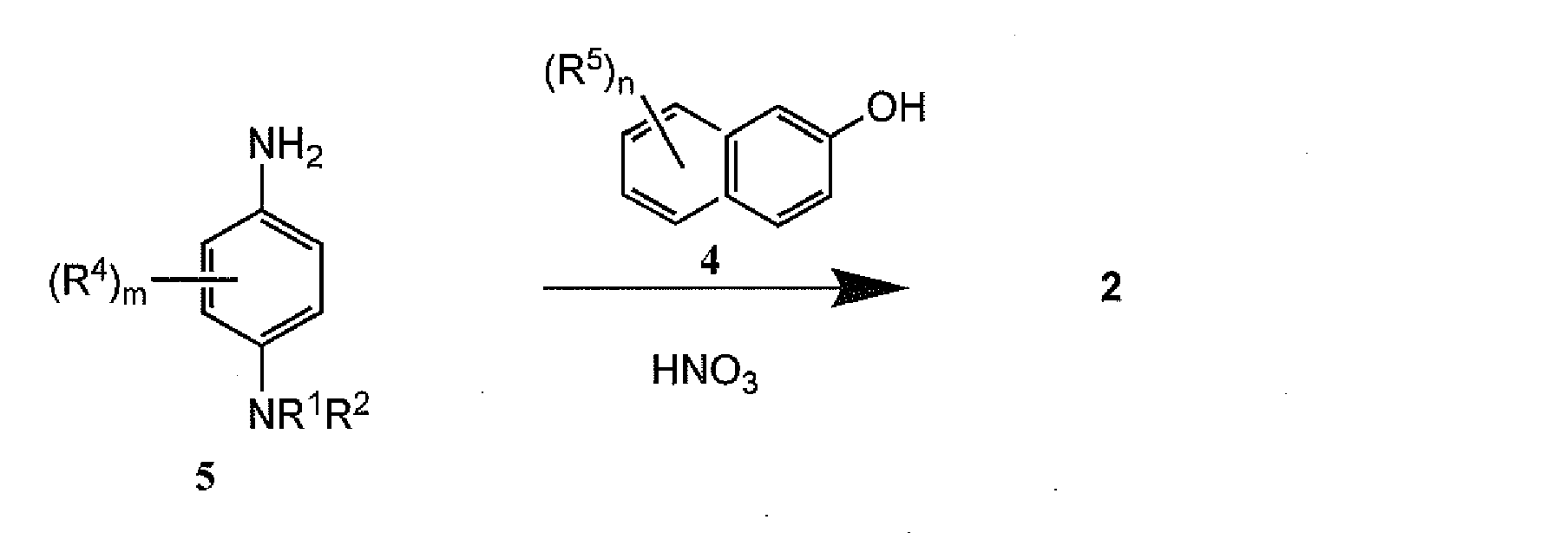
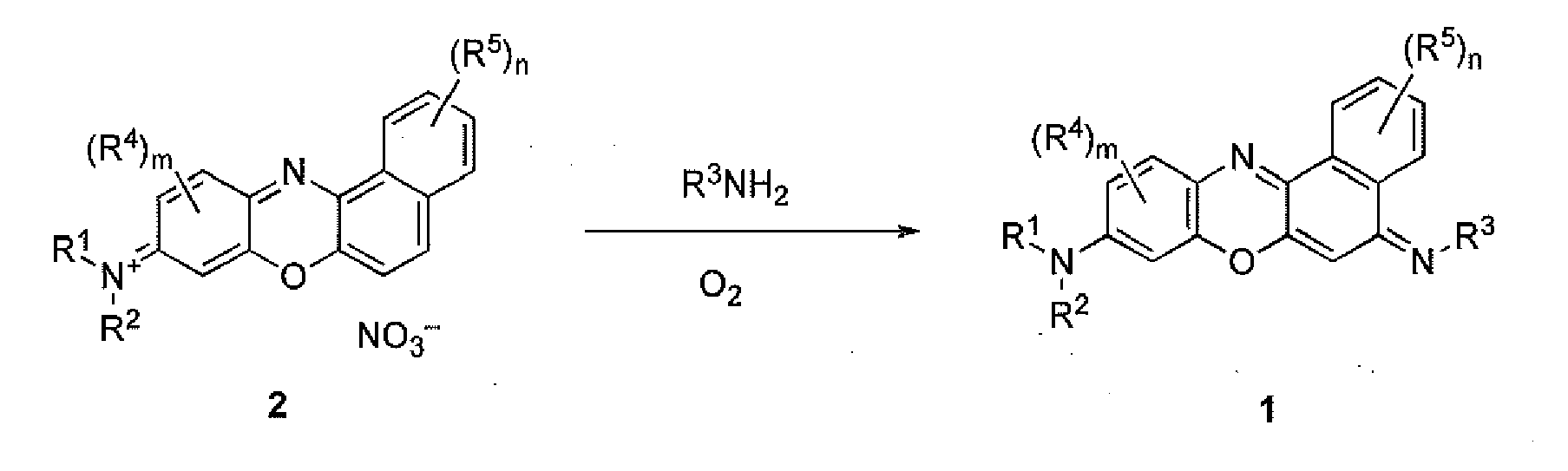
- Benzo[a]phenoxazinium nitrate 2 (Non-patent Document 3) (1 mmol) was dissolved in ethanol (5 mL), and an amine (3 mmol) corresponding thereto was added to the resulting solution at one time with stirring, followed by heating the resulting mixture to reflux overnight and then stirring it at room temperature for 1 day. After evaporation of the solvent, the resulting residue was purified twice by silica gel chromatography. As the eluent, CHCl3:MeOH (10:1, v/v) was first used, followed by using CHCl3:MeOH (10:0.3, v/v). After evaporation of the solvent, the resulting product was washed with AcOEt and then Et2O, to obtain benzo[a]phenoxazines 1A to T.
- Yield 55 %, mp 169-170 °C; IR ν(neat, cm-1): 2975, 1645, 1590, 1580, 1490, 1455, 1270, 1220, 1110; UV-vis (CHCl3 ): λ (nm) (log ε/L mor-1cm-1): 532 (4.57); 1H NMR (400 MHz, CDCl3) δ ppm 1.20 (t, J = 7.1 Hz, 6H), 3.39 (q, J = 7.1 Hz, 4H), 6.27 (d, J = 2.7 Hz, 1H), 6.43 (s, 1H), 6.54 (dd, J = 9.0, 2.7 Hz, 1H), 6.99-7.03 (m, 2H), 7.49 (d, J = 9.0 Hz, 1H), 7.60-7.72 (m, 3H), 8.50-8.51 (m, 1H), 8.60-8.64 (m, 2H); 13C NMR (101 MHz, CDCl3) δ ppm 12.6, 44.9, 96.3, 99.1, 108.6, 117.0, 118.6, 123.7, 124.7, 125.3, 129.8, 130.1, 130.3, 131.6, 132.8, 137.6, 141.9, 146.6, 148.9, 149.0, 149.9, 157.9, 163.8; MS (EI+): m/z: 394 [M×]+; HRMS (EI+) 394.1793 [M×]+, found 394.1767; Anal. Calcd. For C25H22N4O ×0.75H2O: C, 73.60; H, 5.81; N, 13.73; Found: C, 73.68; H, 5.57; N, 13.43.
- N,N-Diethyl-5-(pyridin-4-ylimino)-5H-benzo[a]phenoxazin-9-amine (1B) Yield 38 %, mp 247-248 °C; IR ν(neat, cm-1): 2975, 1640, 1595, 1575, 1490, 1455, 1270, 1220, 1110; UV-vis (CHCl3 ): λ (nm) (log ε/L mol-1cm-1):713 (4.48), 537 (4.49); 1H NMR (400 MHz, CDCl3) δ ppm 1.21 (t, J = 7.1 Hz, 6H), 3.41 (q, J = 7.1 Hz, 4H), 6.13 (s, 1H), 6.29 (d, J = 2.7 Hz, 1H), 6.57 (dd, J = 9.0, 2.7 Hz, 1H), 6.85-6.86 (m, 2H), 7.50 (d, J = 9.0 Hz, 1H), 7.61-7.69 (m, 2H), 8.50-8.52 (m, 2H), 8.54 (dd, J = 7.9, 1.4 Hz, 1H), 8.62 (dd, J = 7.9, 1.3 Hz, 1H); 13C NMR (101 MHz, CDCl3) δ ppm 12.6, 44.9, 96.3, 97.7, 108.8, 116.0, 123.9, 124.7, 125.1, 129.9, 130.3, 130.5, 131.6, 132.2, 141.5, 146.6, 149.1, 150.0, 150.4, 156.8, 159.4; MS (EI+): m/z: 394 [M×]+; HRMS (EI+) 394.1793 [M×]+, found 394.1807; Anal. Calcd. For C25H22N4O×0.25H2O: C, 75.26; H, 5.68; N, 14.04; Found: C, 75.31; H, 5.10; N, 13.88.
1B·HCl mp > 300; IR ν(neat, cm-1): 2920, 2850, 1638, 1579, 1518, 1318, 1251, 1162, 1077; UV-vis (EtOH): λ (nm) (log ε/L mol-1cm-1): 602 (4.64), 213 (4.63); 1H NMR (400 MHz, CD3OD) δ ppm 1.47 (t, J = 7.2 Hz, 6H), 4.02 (dd, J = 20.5, 7.1 Hz, 4H), 7.38 (d, J = 2.6 Hz, 1H), 7.60 (d, J = 7.5 Hz, 2H), 7.93-7.87 (m, 1H), 7.97 (dd, J =10.0, 2.6 Hz, 1H), 8.02 (d, J = 7.3 Hz, 1H), 8.05 (s, 1H), 8.15 (d, J = 10.0 Hz, 1H), 8.34 (d, J = 8.4 Hz, 1H), 8.46 (d, J = 7.5 Hz, 2H), 9.17 (d, J = 8.1 Hz, 1H); MS (ESI+): m/z: 395.2 [M-C1]+; Anal Calcd. For C25H23C1N4O×2.5H2O: C, 63.09; H, 5.93; N, 11.77; Found: C, 62.66; H, 5.42; N, 11.57. - N,N-Dimethyl-5-(pyridin-4-ylimino)-5H-benzo[a]phenoxazin-9-amine (1C) Yield 44 %, mp 217-218 °C; IR ν(neat, cm-1): 2954, 2887, 1628, 1592, 1577, 1447, 1442, 1359, 1200, 1111, 1002, 746; UV-vis (CHCl3 ): λ (nm) (log ε/L mol-1cm-1):546 (4.42), 236 (4.21); 1H NMR (400 MHz, CDCl3) δ ppm 3.07 (s, 6H), 6.14 (s, 1H), 6.33 (d, J = 2.9 Hz, 1H), 6.61 (dd, J = 9.0,2.7 Hz, 1H), 6.85-6.87 (m, 2H), 7.48 (d, J = 9.0 Hz, 1H), 7.53-7.55 (m, 2H), 7.66-7.7 (m, 2H), 8.53 (dd, J = 7.9, 1.4 Hz, 1H), 8.64 (dd, J = 7.9, 1,3 Hz, 1H); 13C NMR (101 MHz, CDCl3 ) δ ppm 40.3, 96.9, 97.9, 109.1, 112.9, 116.9, 123.9, 125.1, 129.2, 130.1, 130.4, 131.5, 132.2, 142.1, 146.2, 149.08, 152.2, 156.8, 159.4; MS (EI+): m/z: 367.1 [M+1]+; HRMS (EI+) 366.1478 [M×]+, found 366.1480.
- N,N-Dipropyl-5-(pyridin-4-ylimino)-5H-benzo[a]phenoxazin-9-amine (ID) Yield 39 %, mp 215-216 °C; IR ν(neat, cm-1): 2962, 2876, 1635, 1580, 1547, 1483, 1458, 1361, 1238, 1112, 772; UV-vis (CHCl3 ): λ (nm) (log ε/L mol-1cm-1):716 (4.97), 550 (5); 1H NMR (400 MHz, CDCl3) δ ppm 1.051 (t, J = 7.2 Hz, 6H), 1.57(m,4H), 3.5 (t, J = 7.1 Hz, 4H), 6.31 (s, 1H), 6.6 (d, J = 2.6 Hz, 1H), 6.99 (dd, J = 8.9, 2.7 Hz, 1H),7.14-7.16 (m, 2H) 7.71-7.77 (m, 2H), 7.8 (d, J = 9.0 Hz, 1H), 8.45 (dd, J = 7.9, 1.4 Hz, 1H), 8.72-8.76 (m, 2H), 8.9 (dd, J = 7.9,1.3 Hz, 1H); 13C NMR (101 MHz, CDCl3) δ ppm 11.3, 20.5, 53.1, 96.4, 97.2, 109.6, 116.8, 123.9, 125.1, 125.3, 129.9, 130.6, 130.7, 131.7, 132.4, 140.7, 146.6, 149.7, 150.9, 151.7, 152.2, 157.4; MS (EI+): m/z: 422 [M×+1]+; HRMS (EI+) 422.2106 [M×]+, found 422.2128.
- N,N-Dibutyl-5-(pyridin-4-ylimino)-5H-benzo[a]phenoxazin-9-amine (1E) Yield25 %, mp 188-189 °C; IR ν(neat, cm-1): 2950, 2872, 1626, 1581, 1514, 1457, 1365, 1324, 1285, 1218, 772; UV-vis (CHCl3 ): λ (nm) (log ε/L mol-1cm-1):545 (4.06), 222(3.92); 1H NMR (400 MHz, CDCl3) δ ppm 0.97 (t, J = 7.3 Hz, 6H), 1.37(m,4H), 1.6 (m,4H), 3.3 (t, J = 7.2 Hz, 4H), 6.13 (s, 1H), 6.27 (d, J = 2.7 Hz, 1H), 6.55 (dd, J = 9, 2.7 Hz, 1H),7.39-7.34 (m, 2H) 7.62-7.7 (m, 2H), 7.84-7.89 (m, 2H), 8.2 (d, J = 9.0 Hz, 1H), 8.5 (dd, J = 7.9, 1.4 Hz, 1H), 8.6 (dd, J = 7.9, 1.3 Hz, 1H); 13C NMR (101 MHz, CDCl3 ) δ ppm 13.9, 20.2, 29.4, 50.9, 51.1, 96.3, 97.3, 109.4, 116.6, 123.8, 123.9, 124.0, 125.0, 125.3, 127.3, 128.3, 129.9, 130.1, 130.5, 130.6, 131.0,146.6, 149.5, 150.7, 157.2; MS (EI+): m/z: 451 [M×+1]+; HRMS (EI+) 450.2406 [M×]+, found 450.2409
- Yield 73 %, mp 204-205 °C; IR ν(neat, cm-1): 2980, 1640, 1590, 1580, 1490, 1455, 1320, 1250, 1115; UV-vis (CHCl3): λ (nm) (log ε/L mol-1cm-1): 544 (4.62); 1H NMR (400 MHz, CDCl) δ ppm 1.21 (t, J = 7.1 Hz, 6H), 3.40 (q, J = 7.1 Hz, 4H), 6.26 (d, J = 2.6 Hz, 1H), 6.47 (s, 1H), 6.55 (dd, J = 9.0, 2.7 Hz, 1H), 7.04 (t, J = 6.3 Hz, 2H), 7.46 (d, J = 9.0 Hz, 1H), 7.70-7.74 (m, 2H), 8.44 (d, J = 8.6 Hz, 1H), 8.50-8.51 (m, 1H), 8.78 (d, J = 2.0 Hz, 1H); 13C NMR (101 MHz, CDCl3) δ ppm 12.6, 45.0, 96.3, 99.1, 108.9, 117.2, 118.9, 124.7, 124.8, 125.5, 128.2, 130.4, 133.1, 134.1, 137.7, 140.8, 146.7, 148.9, 149.0, 150.2, 156.7, 163.2; MS (CI+): m/z: 473 [MH]+; HRMS (CI+) 473.0976 [MH]+, found 473.0981; Anal. Calcd. For C25H21BrN4O×3H2O: C, 56.93; H, 5.16; N, 10.62; Found: C, 57.41; H, 4.35; N, 10.01.
- Yield 28 %, mp 269-271 °C; IR ν(neat, cm-1): 2980, 1635, 1590, 1575, 1490, 1410, 1355, 1250, 1115; UV-vis (CHCl3 ): λ (nm) (log ε/L mol-1cm-1): 720 (4.44), 547 (4.43); 1H NMR (400 MHz, CDCl3 ) δ ppm 1.22 (t, J = 7.1 Hz, 6H), 3.41 (q, J = 7.1 Hz, 4H), 6.08 (s, 1H), 6.27 (d, J = 2.6 Hz, 1H), 6.56 (dd, J = 9.0, 2.7 Hz, 1H), 6.84-6.86 (m, 2H), 7.47 (d, J = 9.0 Hz, 1H), 7.73 (dd, J = 8.6, 2.1 Hz, 1H), 8.44 (d, J = 8.6 Hz, 1H), 8.53-8.55 (m, 2H), 8.63 (d, J = 2.0 Hz, 1H); 13C NMR (101 MHz, CDCl3) δ ppm 12.6, 45.0, 96.2, 97.5, 109.1, 116.0, 124.81, 124.85, 125.6, 128.0, 130.3, 130.6, 133.3, 133.5, 140.4, 146.6, 149.1, 150.2, 150.3, 155.7, 159.2; MS (CI+): m/z: 473 [MH]+; HRMS (CI+) 473.0976 [MH]+, found 473.1017; Anal. Calcd. For C25H21BrN4O.4H2O: C, 73.86; H, 5.77; N, 11.88; Found: C, 73.16; H, 5.29; N, 11.67.
- N,N-Diethyl-5-(quinolin-2-ylimino)-5H-benzo[a]phenoxazin-9-amine (1H) Yield 71 %, mp 234-236 °C; IR ν(neat, cm-1): 2980, 1635, 1585, 1540, 510, 1340, 1265, 1220, 1110; UV-vis (CHCl3 ): λ (nm) (log ε/L mol-1cm-1): 691 (4.30), 539 (4.57); 1H NMR (400 MHz, CDCl3) δ ppm 1.19 (t, J = 7.1 Hz, 6H), 3.39 (q, J = 7.1 Hz, 4H), 6.26 (d, J = 2.7 Hz, 1H), 6.47 (s, 1H), 6.57 (dd, J = 9.0, 2.7 Hz, 1H), 7.20 (d, J = 8.5 Hz, 1H), 7.44-7.48 (m, 1H), 7.52 (d, J = 9.0 Hz, 1H), 7.63-7.70 (m, 3H), 7.79-7.83 (m, 1H), 8.03 (d, J = 8.4 Hz, 1H), 8.14-8.16 (m, 1H), 8.62-8.72 (m, 2H); 13C NMR (101 MHz, CDCl3) δ ppm 12.6, 44.9, 96.3, 99.3, 108.9, 117.6, 123.7, 124.8, 124.9, 125.6, 125.7, 127.4, 128.5, 129.5, 129.8, 130.3, 130.4, 130.5, 131.7, 132.5, 137.8, 146.7, 148.0, 149.2, 150.0, 156.4,158.2; MS (EI+): m/z: 444 [M×]+; HRMS (EI+) 444.1950 [M×]+, found 444.1931; Anal. Calcd. For C29H24N4O×1.5H2O: C, 73.86; H, 5.77; N, 11.88; Found: C, 73.16; H, 5.29; N, 11.67.
- 5-(6-Chlorobenzo[d]thiazol-2-ylimino)-N,N-diethyl-5H-benzo[a]phenoxazin-9-amine (1I)
Yield 45 %, mp 229-231 °C; IR ν(neat, cm-1):2975, 1640, 1585, 1545, 1510, 1460, 1420, 1320, 1220, 1110; UV-vis (CHCl3 ): δ (nm) (log ε/L mol-1cm-1): 583 (4.62); 1H NMR (400 MHz, CDCl3) δppm 1.24 (t, J = 7.1 Hz, 6H), 3.44 (q, J = 7.1 Hz, 4H), 6.40 (d, J = 2.6 Hz, 1H), 6.64 (dd, J = 9.1, 2.6 Hz, 1H), 7.37 (dd, J = 8.6, 2.1 Hz, 1H), 7.57 (d, J = 9.1 Hz, 1H), 7.59 (s, 1H), 7.62-7.71 (m, 2H), 7.75 (d, J = 2.1 Hz, 1H), 7.80 (d, J = 8.6 Hz, 1H), 8.64-8.66 (m, 2H); 13C NMR (101 MHz, CDCl3) δ ppm 12.6, 45.1, 96.2, 100.4, 109.9, 120.7, 122.5, 123.7, 125.7, 125.9, 126.4, 129.0, 129.8, 130.6, 131.0, 131.6, 132.1, 136.2, 140.4, 146.9, 150.5, 150.7, 151.4, 157.9, 160.3; MS (CI+): m/z: 485 [MH]+; HRMS (CI+) 485.1203 [MH]+, found 485.1268; Anal. Calcd. For C27H21ClN4OS×0.5H2O: C, 65.64; H, 4.49; N, 11.34; Found: C, 65.39; H, 4.42; N, 10.97. - Yield 34 %, mp 195-196 °C; IR ν(neat, cm-1): 2975, 1635, 1590, 1560, 1490, 1275, 1110; UV-vis (CHCl3 ): λ, (nm) (log ε/L mol-1cm-1): 539 (4.65); 1H NMR (400 MHz, CDCl3) δppm 1.23 (t, J = 7.1 Hz, 6H), 2.45 (s, 3H), 3.42 (q, J = 7.1 Hz, 4H), 5.92 (s, 1H), 6.33 (d, J = 2.7 Hz, 1H), 6.58 (dd, J = 9.0, 2.7 Hz, 1H), 6.77 (s, 1H), 7.51 (d, J = 9.0 Hz, 1H), 7.60-7.68 (m, 2H), 8.59-8.63 (m, 2H); 13C NMR (101 MHz, CDCl3) δ ppm 12.6, 12.7, 44.9, 96.3, 99.1, 99.6, 109.0, 123.7, 125.0, 125.5, 129.8, 130.3, 130.5, 131.5, 132.3, 141.3, 146.7, 149.2, 150.1, 160.3, 168.8, 169.6; MS (EI+): m/z: 398 [M×]+; HRMS (EI+) 398.1742 [M×]+, found 398.1721; Anal. Calcd. For C24H22N4O2×2H2O: C, 66.34; H, 6.03; N, 12.89; Found: C, 66.54; H, 5.43; N, 12.67.
- Yield 10 %, mp 192-193 °C; IR ν(neat, cm-1): 2980, 1640, 1590, 1555, 1420, 1275, 1210, 1115; UV-vis (CHCl3 ): λ (nm) (log ε/L mol-1cm-1): 547 (4.67); 1H NMR (400 MHz, CDCl3 ) δ ppm 1.22 (t, J = 7.1 Hz, 6H), 3.43 (q, J = 7.1 Hz, 4H), 6.34 (d, J = 2.6 Hz, 1H), 6.42 (s, 1H), 6.61 (dd, J = 9.0, 2.5 Hz, 1H), 7.54 (d, J = 9.0 Hz, 1H), 7.63-7.71 (m, 2H), 7.78 (d, J = 2.3 Hz, 1H), 8.34 (d, J = 2.3 Hz, 1H), 8.63-8.69 (m, 2H); 13C NMR (101 MHz, CDCl3) δ ppm 12.6, 45.0, 96.3, 98.8, 109.3, 123.7, 124.6, 125.2, 125.6, 125.8, 129.9, 130.4, 130.7, 131.6, 132.0, 137.3, 141.1, 145.4, 146.7, 149.4, 150.3, 158.5, 158.8; MS (EI+): m/z: 462 [M×]+; HRMS (EI+) 462.1014 [M×]+, found 462.0958; Anal. Calcd. For C25H20Cl2N4O×0.5H2O: C, 63.57; H, 4.48; N, 11.86; Found: C, 63.48; H, 4.30; N, 11.72.
- N,N-Diethyl-5-(pyrimidin-2-ylimino)-5H-benzo[a]phenoxazin-9-amine (1L) Yield 24 %, mp 208-210 °C; IR ν(neat, cm-1): 2975, 1640, 1590, 1550, 1395, 1275, 1110; UV-vis (CHCl3 ): λ (nm) (log ε/L mol-1cm-1): 543 (4.62); 1H NMR (400 MHz, CDCl3) δ ppm 1.23 (t, J = 7.1 Hz, 6H), 3.43 (q, J = 6.9 Hz, 1H), 6.34 (d, J = 2.1 Hz, 1H), 6.58 (s, 1H), 6.63 (dd, J = 9.0, 2.3 Hz, 1H), 7.02 (t, J = 4.8 Hz, 1H), 7.54 (d, J = 9.0 Hz, 1H), 7.61-7.70 (m, 2H), 8.63 (d, J = 7.7 Hz, 1H), 8.67 (d, J = 8.1 Hz, 1H), 8.74 (d, J = 4.8 Hz, 2H); 13C NMR (101 MHz, CDCl3) δ ppm 12.6, 45.01, 96.2, 99.3, 109.6, 115.6, 123.6, 125.4, 125.7, 129.8, 130.5, 130.8, 131.6, 131.9, 140.9, 146.7, 149.4, 150.4, 158.6, 159.0, 168.1; MS (EI+): m/z: 395 [M×]+; HRMS (CI+) 396.1824 [MH]+, found 396.1850; Anal. Calcd. For C24H21N5O×1.5H2O: C, 68.23; H, 5.73; N, 16.58; Found: C, 68.60; H, 5.29; N, 16.34.
- N,N-Diethyl-5-(6-methoxybenzo[d]thiazol-2-ylimino)-5H-benzo[a]phenoxazin-9-amine (1M) Yield 52 %, mp 197-198 °C; IR ν(neat, cm-1): 2975, 1635, 1585, 1430, 1320, 1270, 1110; UV-vis (CHC13): λ (nm) (log ε/L mol-1cm-1): 582 (4.69); 1H NMR (400 MHz, CDCl3) δ ppm 1.23 (t, J = 7.1 Hz, 6H), 3.43 (q, J = 7.1 Hz, 4H), 3.89 (s, 3H), 6.39 (d, J = 2.7 Hz, 1H), 6.62 (dd, J = 9.1, 2.7 Hz, 1H), 7.03 (dd, J = 8.9, 2.6 Hz, 1H), 7.29 (d, J = 2.5 Hz, 1H), 7.55 (d, J = 9.0 Hz, 1H), 7.62-7.70 (m, 3H), 7.81 (d, J = 8.9 Hz, 1H), 8.64-8.69 (m, 2H); 13C NMR (101 MHz, CDCl3) δ ppm 12.6, 45.0, 55.8, 96.2, 100.7, 104.2, 109.7, 114.7, 122.5, 123.7, 125.7, 125.8, 129.7, 130.4, 130.8, 131.6, 132.3, 136.3, 140.8, 146.9, 147.2, 150.2, 150.5, 156.5, 159.4, 160.3; MS (CI+): m/z: 481 [MH]+; HRMS (CI+) 481.1698 [MH]+, found 481.1691; Anal. Calcd. For C28H24N4O2S×0.5H2O: C, 68.69; H, 5.15; N, 11.44; Found: C, 68.41; H, 5.01; N, 11.23.
- N,N-Diethyl-5-(pyridin-3-ylimino)-5H-benzo[a]phenoxazin-9-amine (1N) Yield 43 %, mp 198-199 °C; IR ν(neat, cm-1): 2971, 1636, 1589, 1564, 1488, 1469, 1408, 1352, 1271, 1218, 1109, 1014; UV-vis (CHCl3 ): λ (nm) (log ε/L mol-1cm-1):533 (4.46), 240 (4.36); 1H NMR (400 MHz, CDCl3) δ ppm 1.21 (t, J = 7.1 Hz, 6H), 3.42 (q, J = 7.1 Hz, 4H), 6.24 (s, 1H), 6.29 (d, J = 2.7 Hz, 1H), 6.57 (dd, J = 9.0, 2.7 Hz, 1H), 7.29-7.31(m, 2H), 7.50 (d, J = 9.0 Hz, 1H), 7.63-7.69 (m, 2H), 8.28 (d, J = 1.47 HZ,1H), 8.37(dd, J = 4.33, 1.80 HZ), 8.57 (d, J = 7.62 Hz, 1H), 8.64 (dd, J = 7.9, 1.3 Hz, 1H); 13C NMR (101 MHz, CDCl3 δ ppm 12.58, 44.92, 96.3, 97.7, 108.8, 123.6, 123.8, 124.8, 125.07, 128.1, 129.9, 130.2, 130.4, 131.5, 132.4, 141.8, 142.4, 144.5, 146.6, 149.1, 150.02; MS (EI+): m/z: 395.1 [M+1]+; HRMS (EI+) 394.1793 [M×]+, found 394.1792.
- Yield 39 %, mp 235-236 °C; IR ν(neat, cm-1): 3066 2962, 2855, 1636, 1592, 1585,1551, 1488,1462 1423, 1332, 1307, 1237, 1123, 772; UV-vis (CHCl3 ): λ (nm) (log ε/L mol-1cm-1):525 (4.38), 225 (4.33); 1H NMR (400 MHz, CDCl3) δ ppm 3.38 (t, J = 7.2 Hz, 4H), 3.87 (t, J = 7.1 Hz, 4H), 6.6 (s, 1H), 6.89 (dd, J = 8.9, 2.7 Hz, 1H), 7.12 (t, J = 7.8 Hz, 2H), 7.6 (d, J = 9.0 Hz, 1H), 7.72-7.74 (t, J = 7.3Hz, 2H), 7.81(t, J = 7.3Hz, 2H), 8.35 (dd, J = 7.9, 1.4 Hz, 1H), 8.5 (d, J = 6.7 Hz, 1H), 8.69 (t, J = 7.9, Hz, 1H); 13C NMR (101 MHz, CDCl3) δ ppm 47.7, 66.4, 99.5, 99.8, 106.4, 111.7, 117.6, 119.2, 124.0, 125.8, 127.3, 130.4, 130.5, 130.6, 131.2, 131.6, 138.0, 146.1, 148.5, 148.9, 153.1, 157.5; MS (EI+): m/z: 409.1 [M×+1]+; HRMS (EI+) 408.1586 [M×]+, found 408.1568.
- Yield 38 %, mp 229-230 °C; IR ν(neat, cm-1): 3059, 2973, 2930, 1637, 1590, 1552, 1489, 1463, 1407, 1352, 1271, 1252, 1113, 770; UV-vis (CHCl3 ): λ (nm) (log ε/L mol-1cm-1):683 (4.10), 537 (4.24); 1H NMR (400 MHz, CDCl3) δppm 1.18 (t, J = 7.1 Hz, 6H), 3.43 (q, J = 7.1 Hz, 4H), 2.88 (s, 3H), 6.03 (s, 1H), 6.28 (d, J = 2.6 Hz, 1H), 6.58-6.69 (dd, J = 8.9, 2.7 Hz, 1H), 6.78 (s, 1H), 7.41-7.74 (m, 6H), 8.2 (d, J = 9.0 Hz, 1H), 8.63-8.70 (m, 2H) 13C NMR (101 MHz, CDCl3) δ ppm 12.5, 25.4, 44.9, 96.3, 98.2, 108.8, 110.0, 121.1, 122.2, 123.8, 123.9, 124.7, 124.8, 125.3, 126.2, 126.5, 126.9, 127.9, 128.4, 129.6, 130.0, 130.3, 130.5, 131.2, 131.6, 132.1, 141.5, 146.6, 149.1, 150.0, 157.3, 159.3, 159.7; MS (EI+): m/z: 459.1 [M×+1]+; HRMS (EI+) 458.2106 [M×]+, found 458.2125.
- Yield 37 %, mp 175-176 °C; IR ν(neat, cm-1): 3312, 3066, 2978, 2934, 1734, 1637, 1586, 1515, 1444, 1409, 1376,1354, 1272, 1252, 1170, 1014; UV-vis (CHCl3 ): λ (nm) (log ε/L mol-1cm-1):539 (4.41), 387 (4.04); 1H NMR (400 MHz, CDCl3) δ ppm 1.22 (t, J = 7.1 Hz, 6H), 1.37 (t, J = 7.13 Hz, 3H), 3.43 (q, J = 7.1 Hz, 4H), 4.82 (q, J = 7.1 Hz, 2H), 6.17 (s, 1H), 6.30 (d, J = 2.7 Hz, 1H), 6.55-658 (dd, J = 8.95, 2.58 Hz, 1H), 6.76 (d, J = 8.46 Hz, 2H), 6.99 (d, J = 8.43 Hz, 2H), 7.49-7.50 (m, 2H), 7.67-7.81 (m, 2H),, 8.63-8.69 (dd, J = 8.95, 2.58 HZ, 1H), 9.87 (s, 1H), 13C NMR (101 MHz, CDCl3) δ ppm 12.5, 14.2, 36.9, 44.5, 53.8, 61.9, 96.2, 98.6, , 109.5, 122.3, 123.9, 123.8, 125.02, 125.7, 128.8, 129.9, 130.2, 130.5, 131.3, 132.5, 146.6, 148.3, 150.4, 155.3, 156.1, 170.4; MS (EI+): m/z: 510 [M.]+; HRMS (EI+) 510.2393 [M×]+, found 510.2413.
- Yield 38 %, mp 235-236 °C; IR ν(neat, cm-1): 3633, 3023, 2972, 1639, 1605, 1581, 1556, 1491, 1412, 1370, 1313, 1219, 1136; 1H NMR (400 MHz, CDCl3) δ ppm 1.21 (t, J = 7.01 Hz, 3H), 2.6 (s, 3H ), 2.97 (s, 3H ), 3.35 (q, J = 6.62 Hz, 2H), 3.47 (q, J = 7.0 Hz, 2H), 3.58 (t, J = 6.62 Hz, 2H), 6.13 (s, 1H), 6.24 (d, J = 2.41 Hz, 1H), 6.51 (s, 1H), 6.86 (d, J = 5.58 Hz, 1H), 7.65-7.69 (m, 2H), 8.51-8.54 (m, 3H), 8.68 (dd J = 7.46, Hz, 1H); MS (El+): m/z: 502.3 [M×+1]+
1R·HCl mp > 300; IR ν(neat, cm-1): 3062, 2979, 2864, 1639, 1580, 1512, 1444, 1364, 1320, 1236, 1194, 1079; 1H NMR (400 MHz, CDCl3 ) δ ppm 1.21 (t, J = 7.01 Hz, 3H), 2.6 (s, 3H), 2.87 (s, 3H), 3.14 (q, J = 6.62 Hz, 2H), 3.49 (t, J = 6.62 Hz, 2H), 5.99 (s, 1H), 6.42 (d, J = 2.41 Hz, 1H), 6.67 (s, 1H), 6.91 (d, J = 5.58 Hz, 1H), 7.19-7.2 (t, J = 6.24 Hz, 1H), 7.69-7.81 (m, 2H), 8.45 (dd J = 7.96, 1.11 Hz, 1H), 8.51 (dd J = 4.56, 157, Hz, 2H), 8.59 (dd J = 7.96, 0.99 , Hz, 1H); MS (EI+): m/z: 503.2 [M×+1]+. - Yield 41 %, mp 221-222 °C; IR ν(neat, cm-1): 3632, 3065, 2979, 1634, 1593, 1580, 1549, 1488, 1462, 1370, 1320, 1272, 1147, 772; 1H NMR (400 MHz, CDCl3) δ ppm 1.14(t, J = 7.1 Hz, 3H), 2.53 (s, 3H), 2.96 (s, 3H), 3.32 (q, J = 6.7 Hz, 2H), 3.38 (q, J = 7.12 Hz, 2H), 3.51 (t, J = 6.76 Hz, 2H), 6.31 (s, 1H), 6.5 (d, J = 8.27Hz, 1H), 6.64 (t, J = 7.27 Hz, 1H), 6.96 (d, J = 8.01 Hz, 1H), 7.01-7.06 (t, J = 7.1 Hz, 1H), 7.44 (t, J = 7.01 Hz, 1H), 7.64-7.7 (m, 2H), 8.06 (d, J = 4.15 Hz, 1H), 8.51-8.6 (m, 2H); MS (EI+): m/z: 502.3 [M×+1]+
- N-Ethyl-N-(2-methansulfonamidylethyl)-11-methyl-5-(pyridine-3-ylimino)-5H-benzo[a]phenoxazin-9-amine (1T).
Yield 45 %, mp 227-228 °C; IR ν(neat, cm-1): 3620, 3065, 2975, 1634, 1591, 1554, 1488, 1411, 1319, 1272, 1218, 1147, 772; 1H NMR (400 MHz, CDCl3 ) δ ppm 1.2 (t, J = 7.02 Hz, 3H), 2.6 1 (s, 3H ), 2.97 (s, 3H ), 3.35 (q, J = 6.62 Hz, 2H), 3.46 (q, J = 7.0 Hz, 2H), 3.57 (t, J = 6.56 Hz, 2H), 6.2 (m, 2H), 6.49 (d, J = 1.98 Hz, 1H), 7.29-7.31 (m, 2H), 7.65-7.67 (m, 2H), 8.25 (d, J = 1.59 Hz, 1H), 8.37 (dd, J = 4.36, 1.66 Hz, 1H), 8.61 (dd, J = 7.9, 1.3 Hz, 1H), 8.684 (dd J = 7.46, 1.3 Hz, 1H); MS (EI+): m/z: 502.3 [M×+1]+ - Yield 13.8 %, 1a·HCl mp 167.2-168.4 °C; IR ν(neat, cm-1): 2978, 1638, 1594, 1577, 1530, 1446, 1245, 1196, 1124, 870, 780; UV-vis (MeOH): 1 (nm) (log e/L mol-1cm-1): 668 (4.85); 1H NMR (400 MHz, MeOD) d ppm 8.86 (d, J = 8.0 Hz, 1H), 8.62 (s, 1H), 8.48 (d, J = 8.2 Hz, 1H), 8.41 (d, J = 4.6 Hz, 1H), 7.94 (t, J = 8.0 Hz, 1H), 7.84 (t, J = 7.5, 1H), 7.78 (t, J = 7.5, 1H), 7.51 (d, J = 8.2 Hz, 1H), 7.37 (s, 1H), 7.30-7.19 (m, 1H), 6.89 (d, J = 2.4, 1H), 3.80 (q, J = 7.1 Hz, 4H), 2.73 (s, 3H), 1.39 (t, J = 7.1 Hz, 6H); 13C NMR (101 MHz, MeOD) d ppm 159.5, 153.0, 151.5, 147.4, 146.7, 145.6, 145.2, 142.4, 141.4, 132.6, 131.9, 131.2, 130.0, 126.8, 124.6, 124.3, 122.4, 119.3, 117.5, 107.5, 97.3, 36.7, 17.5, 13.6; MS (ESI+): m/z: 409.1 [M+]; Anal. Calcd. For C26H25ClN4O×4.5H2O: C, 59.37; H, 6.51; N, 10.65; Found: C, 59.24; H, 5.66; N, 10.55.
- Yield 18.2 %, 1b·HCl mp 161.6-163.1 °C; IR ν(neat, cm-1): 2978, 1639, 585, 1546, 1449, 1381, 1321, 1249, 1198, 1125, 1089, 988; UV-vis (MeOH): 1 (nm) (log e/L mol-1cm-1): 656 (4.64); 1H NMR (400 MHz, MeOD) d ppm 9.13 (d, J = 8.4 Hz, 1H), 9.02 (d, J = 2.4 Hz, 1H), 8.68 (d, J = 5.0 Hz, 1H), 8.66 (d, J = 2.4 Hz, 1H), 8.53 (d, J = 8.4 Hz, 1H), 8.12 (dd, J = 8.4, 5.0 Hz, 1H), 8.02 (t, J = 7.6 Hz, 1H), 7.91 (m, 1H), 7.57 (m, 1H), 7.54 (s, 1H), 7.05 (d, J = 2.4 Hz, 1H), 3.87 (q, J = 7.2 Hz, 4H), 2.86 (s, 3H), 1.40 (t, J = 7.2 Hz, 6H); 13C NMR (101 MHz, MeOD) d ppm 158.6, 151.7, 151.6, 149.9, 146.3, 141.9, 169.6, 139.4, 138.8, 137.4, 133.0, 132.4, 131.2, 130.0, 129.4, 125.4, 125.0, 124.3, 120.9, 99.0, 96.5, 39.8, 17.4, 13.6; MS (ESI+): m/z: 409.1 [M+]; Anal. Calcd. For C26H25ClN4O×4.5H2O: C, 59.37; H, 6.51; N, 10.65; Found: C, 59.63; H, 5.36; N, 10.56.
- Yield 26.6 %, 1c·HCl mp >300 °C; IR ν(neat, cm-1): 2977, 1639, 1579, 1513, 1443, 1324, 1249, 1199, 1072, 946, 823, 780; UV-vis (MeOH): 1 (am) (log e/L mol-1cm-1): 594 (4.22); 1H NMR (400 MHz, MeOD) d ppm 9.16 (d, J = 8.4 Hz, 1H), 8.43 (d, J = 7.4 Hz, 2H), 8.31 (d,J = 8.4 Hz, 1H), 8.06-7.96 (m, 2H), 7.86-7.90 (m, 1H), 7.79 (s, 1H), 7.56 (d, J = 7.4 Hz, 2H), 7.25 (d, J = 2.5 Hz, 1H), 4.0 (q, J = 7.0 Hz, 4H), 2.89 (s, 3H), 1.46 (t, J = 7.0 Hz, 6H); 13C NMR (101 MHz, MeOD) d ppm 160.2, 158.7, 152.0, 147.3, 146.5, 144.6, 144.4, 142.5, 132.9, 131.9, 131.5, 130.0, 127.9, 124.8, 124.7, 123.4, 112.9, 110.5, 97.6, 39.5, 17.5, 14.1; MS (ESI+): m/z: 394 [M+]; Anal. Calcd. For C26H25ClN4O×4.5H2O: C, 59.37; H, 6.51; N, 10.65; Found: C, 58.51; H, 5.57; N, 10.52.
- N,N-Dimethyl-5-(pyridin-4-ylimino)-5H-benzo[a]phenoxazin-9-amine (1d) Yield 14.1 %, mp >300 °C; IR ν(neat, cm-1): 1641, 1599, 1579, 1486, 1401, 1366, 1337, 1263, 1201, 1133, 1114, 986, 809, 769; UV-vis (CHCl3 ): 1 (nm) (log e/L mol-1cm-1): 532 (4.67); 1H NMR (400 MHz, CDCl3 )d ppm 8.64 (dd, J = 7.8, 1.6Hz, 1H), 8.54 (dd, J = 4.8, 1.5 Hz, 2H), 8.52 (d, J = 1.6 Hz, 1H), 7.77-7.59 (m, 2H), 7.55 (d, J = 9.0 Hz, 1H), 6.86 (dd, J = 4.8, 1.5 Hz, 2H), 6.60 (dd, J = 9.0, 2.7 Hz, 1H), 6.33 (d, J = 2.7 Hz, 1H), 6.15 (s, 1H), 3.07 (s, 6H); 13C NMR (101 MHz, CDCl3 ) d ppm 159.9, 156.9, 152.3, 149.7, 149.2, 146.3, 142.0, 132.2, 131.5, 130.5, 130.3, 130.1, 125.2, 125.1, 124.0, 116.2, 109.3, 97.9, 96.9,40.3; MS (ESI+): m/z: 367.1 [M+H]+; Anal. Calcd. For C23H18N4O×0.5H2O: C, 73.58; H, 5.10; N, 14.92; Found: C, 73.27; H, 4.85; N, 14.62.
- Yield 14.5 %, mp >300 °C; IR ν(neat, cm-1): 2968, 2835, 1635, 1595, 1578, 1510, 1488, 1239, 1121, 1110, 1043, 1003, 827, 755; UV-vis (CHCl3 ): 1(nm) (log e/L mol-1cm-1): 502 (4.49); 1H NMR (400 MHz, CDCl3 ) d ppm 8.69-8.62 (m, 1H), 8.54 (dd, J = 4.8, 1.5 Hz, 2H), 8.51 (d, J = 2.2 Hz, 1H), 7.77-7.63 (m, 2H), 7.58 (d, J = 8.9, 1H), 6.85 (dd, J = 4.8, 1.5 Hz, 2H), 6.78 (dd, J = 8.9, 2.6 Hz, 1H), 6.52 (d, J = 2.6, 1H), 6.15 (s, 1H), 3.86 (t, J = 4.8 Hz, 4H), 3.29 (t, J = 4.8 Hz, 4H); 13C NMR (101 MHz, CDCl3 ) d ppm 159.1, 156.5, 152.8, 150.2, 148.7, 145.8, 144.0, 132.4, 131.2, 130.5, 130.4, 130.1, 126.6, 125.2, 1.24.1, 115.9, 111.2, 99.7, 98.4, 66.4, 47.6; MS (ESI+): m/z: 409.2 [M+H]+; Anal. Calcd. For C25H20N4O2×0.5H2O: C, 71.93; H, 5.07; N, 13.42; Found: C, 72.15; H, 5.08; N, 12.23.
- Yield 1.5 %, mp 266.8-268.2 °C; IR ν(neat, cm-1): 2931, 2850, 1635, 1595, 1577, 1485, 1239, 1112, 1000, 827, 756; UV-vis (CHCl3 ): 1(nm) (log e/L mol-1cm-1): 530 (4.52); 1H NMR (400 MHz, CDCl3 ) d ppm 8.68-8.61 (m, 1H), 8.54 (dd, J = 4.6, 1.5 Hz, 2H), 8.51 (d, J = 1.8 Hz, 1H), 7.71-7.63 (m, 2H), 7.53 (d, J = 9.0 Hz, 1H), 6.86 (dd, J = 4.6, 1.5 Hz, 2H), 6.78 (dd, J = 9.0, 2.7 Hz, 1H), 6.51 (d, J = 2.7 Hz, 1H), 6.14 (s, 1H), 3.35 (t, J = 5.0 Hz, 4H), 1.71-1.65 (m, 6H); 13C NMR (101 MHz, CDCl3 ) d ppm 159.7, 156.9, 153.0, 149.8, 149.1, 146.1, 142.6, 132.1, 131.3, 130.5, 130.3, 130.1, 125.7, 125.1, 124.0, 116.3, 111.6, 99.3, 97.9, 48.8, 25.2, 24.2; MS (ESI+): m/z: 407.1 [M+H]+; Anal. Calcd. For C26H22N4O: C, 76.83; H, 5.46; N, 13.78; Found: C, 76.15; H, 5.47; N, 13.77.
- In the present experiment, protozoa of plasmodium falsiparum K1 strain was used. RPMI-1640 medium sterilized with a filter to which human serum was added to be 5%, was used in the experiment. Malarial parasites were cultured under 3% O2 concentration, 4% CO2 concentration, 93% N2 concentration, and at a temperature of 37 °C.
- The compounds of the present invention to be used in the present test and the positive control drug (chloroquine) were dissolved in DMSO to make a test solution of a predetermined concentration. Cultured malaria parasite infected-erythrocytes were collected by centrifugation, and diluted with non-infected erythrocyte so that the early infection rate was 0.15%. Hematocrit level at that time was 2.5%.
200µL of malaria infected solution was added to wells of a 96-well culture plate, and adjusted by adding a test solution containing drug of a predetermined concentration or a drug-free DMSO. Test solutions were taken by duplicates.
After culturing for 48 hours at 37 °C, 0.5µCi radioactive tritium (3H)-labeled hypoxanthine was added to each well. After further culturing for 24 hours under the same conditions, it was collected on a glass fiber filter and washed with distilled water. Radiation intensity was measured with a beta plate liquid scintillation counter (Wallac), and malarial parasite infection rates of the test solution added group and the control group were calculated. - Growth inhibition rate is calculated with the following formula based on the malarial parasite infection rate obtained in the above, to obtain a 50% growth inhibition concentration (EC50).

- a: early infection rate
- b: infection rate when test solution was added
- c: infection rate of the control
- Rat derived-L6 cells (rat skeletal myoblast cell) were used. A medium, RPMI1640 medium was supplemented so that L-glutamin (200mM) is 1%, and fetal bovine serum 10%, and the medium was cultured under CO2 concentration 5%, at 37 °C.
The compounds of the present invention and the control drugs to be used in the test were dissolved in DMSO, to make a test solution of a predetermined concentration. Pre-culture was conducted and medium containing cells which have entered the logarithmic growth phase was taken to wells of a 96-well culture plate. Then, a test solution containing drug of a predetermined concentration or a drug-free DMSO was added. Test solutions were taken by duplicates.
Culture plate was cultured for 72 hours in an incubator, to test the growth inhibition activity. Test was conducted as follows. 10µL of Alamar Blue aqueous solution was added to each well, and the resultant was further cultured for 2 hours. Next, the culture plate was placed on a fluorescent micro-plate reader (Spectramax Gemeni XS; US Molecular Device), radiated at an excited wavelength of 536 nm. Fluorescent intensity was measured at 588nm, and residual rate of L6 cells of the test solution added group, and that of the control was calculated. - Based on the cell residual rate obtained in the above, growth inhibition rate to L6 cells was calculated, to obtain a 50% growth inhibition concentration (EC50).

- A: Primary cell count
- B: cell count of control, 3 days after
- C: cell count of wells added with a sample, 3 days after
- 4. Determination of Drug Efficacy Against Chloroquine Resistant-Plasmodium Antimalarial activity of a sample was estimated from EC50 values of the sample against chloroquine resistant-Plasmodium falciparum and rat L6 cells. Chemotherapy index used as an index of selective toxicity against chloroquine resistant-plasmodium faciparum was calculated with the following formula, to determine drug efficacy. It means that the larger the value of the selection toxity, the less the risk of the side effect is.
- Chemotherapy index = (EC50 value of a sample against rat L6 cells) / (EC50 value of a sample against chloroquine resistant-Plasmodium falsiparum)
- EC50 values of a sample of the compounds of the present invention and the positive control drug against chloroquine resistant-Plasmodium falciparum and rat L6 cells, as well as selective toxicity index are shown in Tables 1 and 2.
- As shown in Table 1 below, the benzo[a]phenoxazine compounds were confirmed to show strong killing capabilities to drug-resistant plasmodium falciparam (Plasmodium falciparum K1) and to have higher selective toxicity to the parasites than to normal cells (L-6) of rat.
-
[Table 1] 50% Growth inhibition concentration (µg/ml) Compound P.falciparum K1 Cytoxicity L6 Selective toxicity 1A 0.006 6.22 1037 1B 0.003 21.96 7320 1F 0.018 >90 >5000 1G 0.005 >90 >18000 1H 0.012 30.15 2513 11 0.428 >90 210 1J 0.005 36.8 7360 1K 0.029 83.1 2866 1L 0.002 5.4 2700 1M 0.054 80.6 1492 Chloroquine 0.047 No data No data -
[Table 2] Compound P. falciparum K1 Cytoxicity L6 Selective toxicity 1N 0.009 46.11 5123 1O 0.015 20.8 1386 1P 0.036 6.6 183 1Q 0.045 33.8 751 1R 0.009 7.97 885 1S 0.007 0.307 43 1T 0.008 23.91 2988 1a 0.014 6.83 487 1b 0.011 39.79 3617 1c 0.008 38.52 481 - In this experiment, rodent malaria parasites (the Plasmodium berghei NK65 strain) were used.
The infected blood to be used was subcultured in ICR female SPF mice infected by intraperitoneal or tail vein administration at 4 to 6 weeks old (20 to 26g). By collecting blood from the tail vein of the mice infected with malaria, the infection rates were calculated, and after confirming that they showed appropriate levels of infection (an infection rate of 10 to 20%), malaria-infected blood was collected from the heart of the mice with a heparin-containing syringe. Thereafter, based on the number of red cells (cells/ml) and the rate of infection by the protozoans, the blood was diluted with physiological saline such that a density of 5.0×10⁻⁶ malaria parasites/1 ml dose was attained. This was used for infection of uninfected mice (ICR female mice, 5 weeks old) in an amount of 0.2 ml/20 g body weight, through the tail vein (Day-0). The compound used in the test was dissolved in 10% DMSO solution (a mixture of 1 ml of DMSO and 9 ml of 5% glucose solution). - Each group contained 4 mice, and the compound was orally administered to the mice 24 hours after their infection with malaria (Day-1), in an amount calculated such that 100 mg of the compound was administered per 1 kg of the body weight of a mouse. On the other hand, in terms of cases in which the amount was calculated such that 30 mg of the compound was administered per 1kg of the body weight of a mouse, the oral administration was carried out a total of three times, that is, 24 hours (Day-1), 48 hours (Day-2) and 72 hours (Day-3) after the infection of malaria.
- Blood was collected from the tails of each mouse 96 hours (Day-4) and 144 hours (Day-6) after the infection with malaria, and thin blood films were prepared. Under the microscope, the numbers of infection of malaria parasites in the group to which the compound was administered and the control group (to which the compound was not administered) were measured, and the rates of infection with malaria parasites (Parasitemia) were calculated.
- From the rate of infection with malaria parasites calculated as above, the cure rate (Suppression) in the case of administration of the drug was calculated according to the following equation.

- A: Rate of infection with the protozoans in a mouse to which the present test compound was administered
- B: Rate of infection with the parasites in a control mouse (to which the compound was not administered)
Days of survival: MSD (day) = C-D - C: the average number of days from the date of infection with malaria to the date of death in the mice to which the present test compound was administered
- D: The average number of days from the date of infection with malaria to the date of death in the 4 individuals of control mice (to which the compound was not administered)
- Further, by observation of changes in the body weight, hair glossiness and the like of each mouse, side effects such as acute toxicity due to administration of the compound were evaluated. The results obtained by the above experiments are shown in Table 3 and Table 4 below.
-
[Table 3] Compound Dose (mg/kg) Number of doses Cure rate (%) Days of survival (days) Day-4 Day-6 1A 100 1 100 97 2.3 1B 100 1 100 99 14.6 1B 100 3 100 100 Not less than 30 days (completely cured) 1A 30 3 85 99 15.0 1B 30 3 98 99 Not less than 60 days (completely cured) 1H 100 1 81 71 4.3 1N 100 1 41 0 0 1O 100 1 81 60 0.6 1R 100 1 100 95.7 15.7 1S 100 1 100 100 11.3 1T 100 1 96.5 79.4 13.3 1U 100 1 0 16.8 0.8 1V 100 1 0 11.4 0.8 Control - - 0 0 0 -
[Table 4] Compound Dose (mg/kg) Number of doses Cure rate (%) Days of survival (days) Day-4 Day-6 1a 100 1 100 99 14.3 1b 100 1 100 96 12.3 1c 100 1 100 99 13.0 Oxazin 170 perchlorate 100 1 40 57 1.3 Nile blue A 100 1 15 5 0.3 Nile red 100 1 16 3 0 - As is evident from Table 2, when the compound of the present invention was orally administered to the mice infected with malaria, high cure rates were observed and the days of survival were longer compared to the control in the cases of administration of 1A and 1B in amounts of 100 mg/kg and 30 mg/kg, and especially, in 1B, the complete cure was observed. On the other hand, with the known benzo[a]phenoxazine compounds 1U and 1V (Non-patent Document 2) shown below, the effectiveness was hardly observed. Further, even with single oral administration of 1B in an amount of 300 mg/kg, abnormality in organs or death was not observed, demonstrating that it is excellent in safety. Also with hydrochloric acid salt of 1B, a similar effect was observed. Further, 1R, 1S and 1T having a methyl group and a methanesulfonamidylethyl group on the A ring showed excellent cure effects in the in vivo tests using mice.
- Further, as is evident from Table 3, novel benzo[a]phenoxazines (1a, 1b and 1c) showed high effectiveness in the in vivo tests using rodent malaria. However, Oxazin 170 perchlorate (Non-patent Document 6), Nile blue A (Non-patent Document 7) and Nile red which are known compounds did not show effectiveness.
-

-


- [In Vitro Inhibition/Suppression Activities to African Trypanosome Parasites, American Trypanosoma Parasites and Leishmania Parasites (in Vitro)]
- In the present experiment, protozoa of Tripanosoma brucei rhodensiense (STIB 900 Strain), a trypomastigote living in blood stream, was used. The medium used in the experiment was a MEM medium which was sterilized with a filter and supplemented with 25 mM N-2-hydroxyethylpiperazine-2-ethansulfonic acid (HEPES), 1 g/L glucose, 1% MEM non-essential amino acid, 0.2 mM 2-mercaptoethanol, 2 mM sodium pyruvate, 0.1 mM hypoxanthine, and 15% heat-treated horse serum. The protozoa was cultured in an atmosphere of CO2 concentration 5%, at a temperature of 37°C.
- 2. African Trypanosome Protozoa Growth Inhibition Screening Test The compounds of the present invention to be used in the present test and the positive control drug (melarsoprol) were dissolved in dimethylsulfoxide (DMSO) to make a test solution of a predetermined concentration.
A medium containing 8×10³ protozoa, and a test solution containing a drug of a predetermined concentration of a drug-free DMSO were added to wells of a 96-well culture plate, and subsequently, medium was added so that the amount in each well becomes 100µL. Test solutions were taken by duplicates.
After culturing the culture plate for 72 hours in an incubator, growth inhibition activity was tested. Test was conducted as follows. 10µL of Alamar Blue aqueous solution was added to each well, and the resultant was further cultured for 2 hours. Next, the culture plate was placed on a fluorescent micro-plate reader (Spectramax Gemeni XS; US Molecular Device), radiated at an excited wavelength of 536 nm. Fluorescent intensity was measured at 588nm, to calculate the trypanosome protozoa infected rate of the test solution added-group, and of the control group. - In the present experiment, amastigote and trypomastigote infected with rat L6 cells of protozoa of Trypanosoma cruzi (Tulahuen C2C4 starin) were used. As medium used in the test, RPMI 1640 medium containing L6 cells was supplemented so that L-glutamine (200 mM) become 1%, fetal bovine serum becomes 10%, which was cultured under CO2 concentration 5%, at 37 °C.
- 4. American Trypanosome Protozoa Growth Inhibition Screening Test The compounds of the present invention to be used in the present test and the positive control drug (benznidazole) were dissolved in DMSO to make a test solution of a predetermined concentration.
A medium containing 5×10³ protozoa was added to wells of a 96-well culture plate, and pre-cultured for 48hours. After replacing the medium, test solution containing drug of a predetermined concentration or a drug-free DMSO was added. Test solutions were taken by duplicates.
After culturing the culture plate in an incubator for 96 hours, growth inhibition activity was tested. Test was conducted as follows. 50µL of CPRG/Nonidet was added to each well, and allowed to rest for 2 to 6 hours. Next, the culture plate was placed on a fluorescent micro-plate reader. The absorbance was measured at 540 nm, and the trypanosome infection rate of the test solution added group and control group were calculated. - In the present experiment, Leishmania donovani (MHOM/ET/67/L82 strain) was used. Protozoa was subcultured in Syrian Golden hamster, from which an amastigote was obtained. In the experiment, SM medium supplemented with 10% heat-treated bovine fetal serum was used, which was adjusted to pH 5.4, and cultured in an atmosphere of 5% CO2 concentration, at 37 °C.
- The compounds of the present invention to be used in the present test and the positive control drug (miltefosine) were dissolved in DMSO to make a test solution of a predetermined concentration.
After adding a medium containing a predetermined number of protozoa to wells of a 96-well culture plate and pre-treating, concentration of the amastigote was measured with CASY cell analysis system (Scharfe, Germany). Then, test solution containing a drug of a predetermined concentration or a drug-free DMSO was added. Test solutions were taken by duplicates.
After culturing the culture plate for 72 hours in an incubator, growth inhibition activity was tested. Test was conducted as follows. 10µL of Alamar Blue aqueous solution was added to each well, and the resultant was further cultured for 2 hours. Next, the culture plate was placed on a fluorescent micro-plate reader (Spectramax Gemeni XS; US Molecular Device), radiated at an excited wavelength of 536 nm. Fluorescent intensity was measured at 588nm, and infection rate of leishmania protozoa of the test solution added group and control was calculated. - Based on the infection rate of each protozoa cell obtained in the above, growth inhibition rate was calculated, to obtain a 50% growth inhibition concentration (EC50).

- a: early infection rate
- b: infection rate when test solution was added
- c: infection rate of the control
- The inhibition/suppression activities of the benzo[a]phenoxazine compounds of the present invention to African trypanosoma parasites (Trypanosoma brucei rhodesiense), American trypanosoma parasites (Trypanosoma cruzi) and leishmania parasites (Leishmania donovani) obtained by the above experiments are shown in Table 5 and Table 6 below. From these, it can be seen that the benzo[a]phenoxazine compounds of the present invention significantly inhibit the growth of these protozoans.
-
[Table 5] 50% Growth inhibition concentration (µg/ml) Compound Trypanosoma brucei rhod. Trypanosoma cruzi Leishmania donovani 1A 0.87 1.29 0.378 1B 14.2 4.44 2.56 1F 56.5 >30 4.76 1G 61 >30 19.13 1H 4.6 3.31 1.25 1I 44.8 >30 19.62 1J 11.8 21.84 1.86 1K 38.6 >30 8.13 1L 0.804 1.78 0.662 1M 40 >30 13.8 Melarsoprol 0.0024 Benznidazole 0.2253 Milfotesine 0.1135 -
[Table 6] Compound Trypanosoma brucei rhod. Trypanosoma cruzi Leishmania donovani 1R 5.345 2.01 3.92 1S 0.714 0.376 2.09 1a 0.569 0.366 0.386 1b 6.65 1.67 1.82 1c 4.26 1.19 3.59 - By inclusion of a compound of the present invention as an active ingredient, an excellent therapeutic agent and/or prophylactic agent for a protozoal disease can be provided.
Claims (12)
- A medicinal composition for prevention or treatment of a protozoal disease, the medicinal composition comprising, as an active ingredient, a benzo[a]phenoxazine compound represented by following General formula (1), or a salt thereof:

- The medicinal composition according to claim 1, wherein, in General formula (1), R1 and R2 each independently represents a hydrogen atom, an alkyl group having 1 to 8 carbon atoms, an alkenyl group having 3 to 8 carbon atoms, an aryl group having 6 to 10 carbon atoms or a heterocyclic residue having 1 to 10 carbon atoms; R3 represents an alkenyl group having 3 to 8 carbon atoms, an aryl group having 6 to 10 carbon atoms or a heterocyclic residue having 1 to 10 carbon atoms; R4 and R5 each independently represents a halogen atom or an alkyl group having 1 to 8 carbon atoms; m and n each independently represents 0 or 1; and the anion represented by X- is a chlorine atom, a bromine atom, a nitrate ion, a sulfate ion, a p-toluenesulfonate ion or an oxalate ion.
- The medicinal composition according to claim 1 or 2, wherein, in General formula (1), R1 and R2 each independently represents a methyl group, an ethyl group, a propyl group, a 2-hydroxyethyl group or a 2-methanesulfonamidoethyl group; and R3 represents a heterocyclic residue.
- The medicinal composition according to claim 3, wherein R3 represents a pyridyl group, a pyrimidyl group, an imidazolyl group, a tetrazolyl group or a thiazolyl group.
- The medicinal composition according to any one of claims 1 to 4, wherein R4 represents a fluorine atom, a chlorine atom, a methoxy group, an ethoxy group or a methyl group.
- The medicinal composition according to claim 5, wherein positions of substitution of R4 include an 11-position.
- The medicinal composition according to any one of claims 1 to 6, wherein R5 represents a fluorine atom, a chlorine atom or a methyl group.
- The medicinal composition according to claim 7, wherein positions of substitution of R5 include a 3-position.
- A medicinal composition for prevention or treatment of a protozoal disease, the medicinal composition comprising, as an active ingredient, a compound represented by any one of the following structural formulae 1A to 1T and 1a to 1h, or a salt thereof.


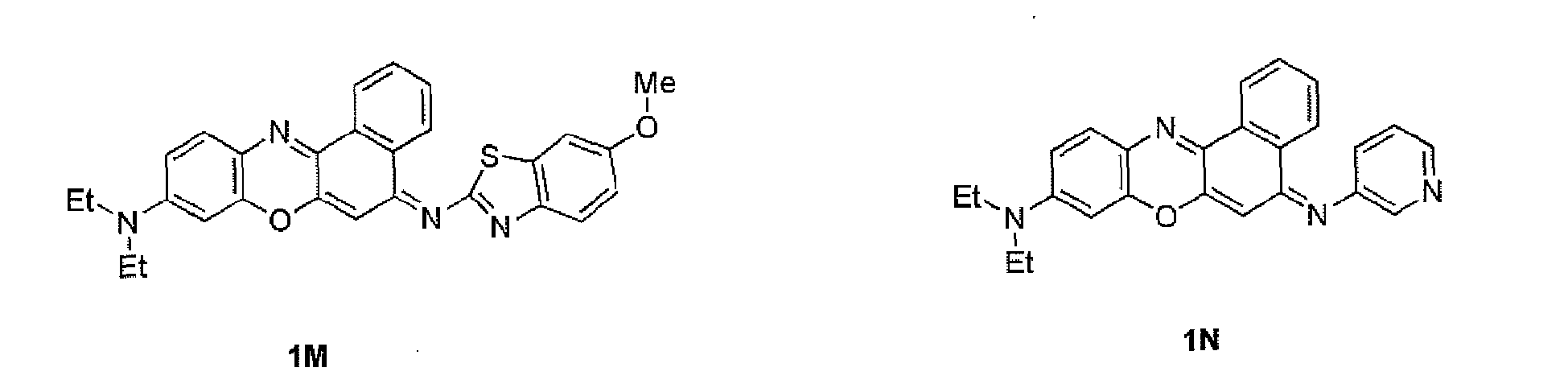


- The medicinal composition according to any one of claims 1 to 9, wherein the protozoal disease is malariosis, leishmaniasis, African sleeping sickness, Chagas disease, toxoplasmosis, lymphatic filariasis, babesiosis or coccidiosis.
- The medicinal composition according to claim 10, wherein the protozoal disease is malariosis, leishmaniasis, African sleeping sickness or Chagas disease.
- A compound represented by any one of the structural formulae 1A to 1T and 1a to 1h.
Applications Claiming Priority (2)
| Application Number | Priority Date | Filing Date | Title |
|---|---|---|---|
| JP2008062410 | 2008-03-12 | ||
| PCT/JP2009/054634 WO2009113569A1 (en) | 2008-03-12 | 2009-03-11 | Medicinal composition containing benzo[a]phenoxanthin compound as the active ingredient for preventing or treating protozoal disease |
Publications (3)
| Publication Number | Publication Date |
|---|---|
| EP2269996A1 true EP2269996A1 (en) | 2011-01-05 |
| EP2269996A4 EP2269996A4 (en) | 2011-08-31 |
| EP2269996B1 EP2269996B1 (en) | 2012-10-17 |
Family
ID=41065230
Family Applications (1)
| Application Number | Title | Priority Date | Filing Date |
|---|---|---|---|
| EP09718904A Active EP2269996B1 (en) | 2008-03-12 | 2009-03-11 | Medicinal composition containing benzo[a]phenoxanthin compound as the active ingredient for preventing or treating protozoal disease |
Country Status (5)
| Country | Link |
|---|---|
| US (1) | US8288374B2 (en) |
| EP (1) | EP2269996B1 (en) |
| JP (1) | JP5430552B2 (en) |
| CN (1) | CN102026989B (en) |
| WO (1) | WO2009113569A1 (en) |
Cited By (1)
| Publication number | Priority date | Publication date | Assignee | Title |
|---|---|---|---|---|
| EP2505583A1 (en) * | 2011-03-29 | 2012-10-03 | Centre National de la Recherche Scientifique | Total synthesis of redox-active 1.4-naphthoquinones and their metabolites and their therapeutic use as antimalarial and schistomicidal agents |
Families Citing this family (4)
| Publication number | Priority date | Publication date | Assignee | Title |
|---|---|---|---|---|
| WO2011145105A2 (en) | 2010-05-18 | 2011-11-24 | Premananda Das | Herbal composition for treatment of filariasis |
| JP5773123B2 (en) * | 2010-12-16 | 2015-09-02 | 株式会社 シンスター・ジャパン | A method for producing an azine-based compound having an imino group at the 5-position. |
| CN103254657A (en) * | 2013-05-30 | 2013-08-21 | 常熟常红织造有限公司 | Benzophenoxazine dye and synthesis method thereof |
| JP2016164125A (en) * | 2013-07-02 | 2016-09-08 | 国立大学法人帯広畜産大学 | Therapeutic and preventive agents for Babesia |
Family Cites Families (6)
| Publication number | Priority date | Publication date | Assignee | Title |
|---|---|---|---|---|
| US2528862A (en) * | 1949-08-10 | 1950-11-07 | American Cyanamid Co | 9-propylalkylamino-5-arylaminobenzo[a]phenoxazines |
| US2528863A (en) * | 1949-08-10 | 1950-11-07 | American Cyanamid Co | 9-dialkylamino-5-arylamino [a] phenoxazines |
| US2677684A (en) * | 1952-02-23 | 1954-05-04 | American Cyanamid Co | 5-heterocyclic amino derivatives of benzophenoxazine |
| JPWO2006087935A1 (en) * | 2005-02-17 | 2008-07-03 | 独立行政法人科学技術振興機構 | Pharmaceutical composition containing a phenoxazinium compound as an active ingredient |
| WO2006137258A1 (en) | 2005-06-24 | 2006-12-28 | Japan Science And Technology Agency | Pharmaceutical composition comprising azarhodacyanine compound as active ingredient |
| US20080015189A1 (en) | 2006-06-20 | 2008-01-17 | The General Hospital Corporation | Antimicrobial photoinactivation using chalcogen analogs of benzo(A)phenoxazinium dyes |
-
2009
- 2009-03-11 WO PCT/JP2009/054634 patent/WO2009113569A1/en not_active Ceased
- 2009-03-11 EP EP09718904A patent/EP2269996B1/en active Active
- 2009-03-11 JP JP2010502848A patent/JP5430552B2/en active Active
- 2009-03-11 US US12/921,569 patent/US8288374B2/en active Active
- 2009-03-11 CN CN2009801173289A patent/CN102026989B/en active Active
Cited By (5)
| Publication number | Priority date | Publication date | Assignee | Title |
|---|---|---|---|---|
| EP2505583A1 (en) * | 2011-03-29 | 2012-10-03 | Centre National de la Recherche Scientifique | Total synthesis of redox-active 1.4-naphthoquinones and their metabolites and their therapeutic use as antimalarial and schistomicidal agents |
| WO2012131010A1 (en) * | 2011-03-29 | 2012-10-04 | Centre National De La Recherche Scientifique | Total synthesis of redox-active 1.4-naphthoquinones and their metabolites and their therapeutic use as antimalarial and schistomicidal agents |
| CN103534238A (en) * | 2011-03-29 | 2014-01-22 | 国家科研中心 | Total synthesis of redox-active 1.4-naphthoquinone and its metabolites and their therapeutic use as antimalarial and schistosicides |
| US9409879B2 (en) | 2011-03-29 | 2016-08-09 | Centre National De La Recherche Scientifique | Total synthesis of redox-active 1.4-naphthoquinones and their metabolites and their therapeutic use as antimalarial and schistomicidal agents |
| CN103534238B (en) * | 2011-03-29 | 2018-01-02 | 国家科研中心 | Total synthesis of redox active 1, 4-naphthoquinones and their metabolites and their therapeutic use as antimalarial and schistosomimetics |
Also Published As
| Publication number | Publication date |
|---|---|
| US20110021450A1 (en) | 2011-01-27 |
| CN102026989A (en) | 2011-04-20 |
| US8288374B2 (en) | 2012-10-16 |
| CN102026989B (en) | 2013-03-27 |
| WO2009113569A1 (en) | 2009-09-17 |
| JPWO2009113569A1 (en) | 2011-07-21 |
| EP2269996B1 (en) | 2012-10-17 |
| JP5430552B2 (en) | 2014-03-05 |
| EP2269996A4 (en) | 2011-08-31 |
Similar Documents
| Publication | Publication Date | Title |
|---|---|---|
| Olmo et al. | Synthesis and biological evaluation of N, N′-squaramides with high in vivo efficacy and low toxicity: toward a low-cost drug against Chagas disease | |
| Stec et al. | Indole-2-carboxamide-based MmpL3 inhibitors show exceptional antitubercular activity in an animal model of tuberculosis infection | |
| Chauvière et al. | Synthesis and biological activity of nitro heterocycles analogous to megazol, a trypanocidal lead | |
| US20110021590A1 (en) | Aminopyrrolidinone derivatives and uses thereof | |
| Fomovska et al. | Salicylanilide inhibitors of Toxoplasma gondii | |
| US8288374B2 (en) | Medicinal composition containing benzo[a]phenoxazine compound as the active ingredient for prevention or treatment of protozoal disease | |
| MX2012011379A (en) | Non-nucleoside reverse transcriptase inhibitors. | |
| JP2017538676A (en) | Small molecule inhibitors of mitochondrial permeability transition pore (mtPTP) | |
| CN108699046A (en) | With the method for EZH2 inhibitor for treating medulloblastomas | |
| EP2716302B1 (en) | Prophylactic or therapeutic agent for neuropathic pain associated with guillain-barre syndrome | |
| AU2019256722A1 (en) | Imidazopyridines useful as mitochondrial uncouplers | |
| Monastyrskyi et al. | Aminoalkoxycarbonyloxymethyl ether prodrugs with a pH-triggered release mechanism: A case study improving the solubility, bioavailability, and efficacy of antimalarial 4 (1 H)-quinolones with single dose cures | |
| CN101277740B (en) | Anti-tuberculosis compositions comprising oxazole compounds | |
| EP4285898A1 (en) | Pathway modulator, pharmaceutical composition having same, use thereof, and therapeutic method using same | |
| WO2012149093A1 (en) | 2-guanidino-4-oxo-imidazoline derivatives as antimalarial agents, synthesis and methods of use thereof | |
| US20240226096A1 (en) | Treatment of myeloproliferative diseases and disorders with inhibitors of bet family bdii bromodomain | |
| CN101812052B (en) | Quinoline carboxylic acid derivative containing isatin substitute and preparation method thereof | |
| US20090036437A1 (en) | Pharmaceutical composition comprising phenoxazinium compound as an active ingredient | |
| CN103509023A (en) | Xanthine derivative | |
| RU2646475C2 (en) | Treatment of type i and ii diabetes | |
| US20240174636A1 (en) | Novel indoleamine 2,3-dioxygenase inhibitors, processes for the preparation thereof and pharmaceutical compositions comprising the same | |
| CN104109147A (en) | Hydroxyamidinobenzene derivative, preparation method and pharmaceutical use thereof | |
| CN112694461B (en) | Chromanone compound and preparation method and application thereof | |
| WO2006038550A1 (en) | Medicinal composition for prevention or treatment of parasitic protozoan infection | |
| CA3205357A1 (en) | Compounds and methods for treating malaria |
Legal Events
| Date | Code | Title | Description |
|---|---|---|---|
| PUAI | Public reference made under article 153(3) epc to a published international application that has entered the european phase |
Free format text: ORIGINAL CODE: 0009012 |
|
| 17P | Request for examination filed |
Effective date: 20101012 |
|
| AK | Designated contracting states |
Kind code of ref document: A1 Designated state(s): AT BE BG CH CY CZ DE DK EE ES FI FR GB GR HR HU IE IS IT LI LT LU LV MC MK MT NL NO PL PT RO SE SI SK TR |
|
| AX | Request for extension of the european patent |
Extension state: AL BA RS |
|
| RIN1 | Information on inventor provided before grant (corrected) |
Inventor name: ITOH, ISAMU Inventor name: YANG, MEI Inventor name: IHARA, MASATAKA Inventor name: ARAI, CHIKA Inventor name: NASSER SAAD MOHAMED ISMAIL Inventor name: BRUN, RETO Inventor name: GE, JIAN-FENG |
|
| RAP1 | Party data changed (applicant data changed or rights of an application transferred) |
Owner name: HOSHI UNIVERSITY Owner name: SYNSTAR JAPAN CO., LTD. Owner name: SCHWEIZERISCHES TROPEN- UND PUBLIC HEALTH-INSTITUT |
|
| DAX | Request for extension of the european patent (deleted) | ||
| A4 | Supplementary search report drawn up and despatched |
Effective date: 20110803 |
|
| RIC1 | Information provided on ipc code assigned before grant |
Ipc: C07D 413/12 20060101ALI20110728BHEP Ipc: A61P 33/02 20060101ALI20110728BHEP Ipc: C07D 265/34 20060101AFI20110728BHEP Ipc: C07D 417/12 20060101ALI20110728BHEP Ipc: A61K 31/538 20060101ALI20110728BHEP |
|
| RAP1 | Party data changed (applicant data changed or rights of an application transferred) |
Owner name: SCHWEIZERISCHES TROPEN- UND PUBLIC HEALTH-INSTITUT Owner name: FUJIFILM CORPORATION |
|
| RAP1 | Party data changed (applicant data changed or rights of an application transferred) |
Owner name: FUJIFILM CORPORATION Owner name: SCHWEIZERISCHES TROPEN- UND PUBLIC HEALTH-INSTITUT Owner name: HOSHI UNIVERSITY Owner name: SYNSTAR JAPAN CO., LTD. |
|
| GRAP | Despatch of communication of intention to grant a patent |
Free format text: ORIGINAL CODE: EPIDOSNIGR1 |
|
| RIN1 | Information on inventor provided before grant (corrected) |
Inventor name: YANG, MEI Inventor name: IHARA, MASATAKA Inventor name: BRUN, RETO Inventor name: NASSER, SAAD MOHAMED ISMAIL Inventor name: GE, JIAN-FENG Inventor name: ARAI, CHIKA Inventor name: ITOH, ISAMU |
|
| GRAS | Grant fee paid |
Free format text: ORIGINAL CODE: EPIDOSNIGR3 |
|
| GRAA | (expected) grant |
Free format text: ORIGINAL CODE: 0009210 |
|
| AK | Designated contracting states |
Kind code of ref document: B1 Designated state(s): AT BE BG CH CY CZ DE DK EE ES FI FR GB GR HR HU IE IS IT LI LT LU LV MC MK MT NL NO PL PT RO SE SI SK TR |
|
| REG | Reference to a national code |
Ref country code: GB Ref legal event code: FG4D |
|
| REG | Reference to a national code |
Ref country code: CH Ref legal event code: EP |
|
| REG | Reference to a national code |
Ref country code: IE Ref legal event code: FG4D |
|
| REG | Reference to a national code |
Ref country code: AT Ref legal event code: REF Ref document number: 579855 Country of ref document: AT Kind code of ref document: T Effective date: 20121115 |
|
| REG | Reference to a national code |
Ref country code: DE Ref legal event code: R096 Ref document number: 602009010489 Country of ref document: DE Effective date: 20121213 |
|
| REG | Reference to a national code |
Ref country code: AT Ref legal event code: MK05 Ref document number: 579855 Country of ref document: AT Kind code of ref document: T Effective date: 20121017 |
|
| REG | Reference to a national code |
Ref country code: NL Ref legal event code: VDEP Effective date: 20121017 |
|
| REG | Reference to a national code |
Ref country code: LT Ref legal event code: MG4D |
|
| PG25 | Lapsed in a contracting state [announced via postgrant information from national office to epo] |
Ref country code: IS Free format text: LAPSE BECAUSE OF FAILURE TO SUBMIT A TRANSLATION OF THE DESCRIPTION OR TO PAY THE FEE WITHIN THE PRESCRIBED TIME-LIMIT Effective date: 20130217 Ref country code: FI Free format text: LAPSE BECAUSE OF FAILURE TO SUBMIT A TRANSLATION OF THE DESCRIPTION OR TO PAY THE FEE WITHIN THE PRESCRIBED TIME-LIMIT Effective date: 20121017 Ref country code: NL Free format text: LAPSE BECAUSE OF FAILURE TO SUBMIT A TRANSLATION OF THE DESCRIPTION OR TO PAY THE FEE WITHIN THE PRESCRIBED TIME-LIMIT Effective date: 20121017 Ref country code: ES Free format text: LAPSE BECAUSE OF FAILURE TO SUBMIT A TRANSLATION OF THE DESCRIPTION OR TO PAY THE FEE WITHIN THE PRESCRIBED TIME-LIMIT Effective date: 20130128 Ref country code: SE Free format text: LAPSE BECAUSE OF FAILURE TO SUBMIT A TRANSLATION OF THE DESCRIPTION OR TO PAY THE FEE WITHIN THE PRESCRIBED TIME-LIMIT Effective date: 20121017 Ref country code: NO Free format text: LAPSE BECAUSE OF FAILURE TO SUBMIT A TRANSLATION OF THE DESCRIPTION OR TO PAY THE FEE WITHIN THE PRESCRIBED TIME-LIMIT Effective date: 20130117 Ref country code: LT Free format text: LAPSE BECAUSE OF FAILURE TO SUBMIT A TRANSLATION OF THE DESCRIPTION OR TO PAY THE FEE WITHIN THE PRESCRIBED TIME-LIMIT Effective date: 20121017 Ref country code: HR Free format text: LAPSE BECAUSE OF FAILURE TO SUBMIT A TRANSLATION OF THE DESCRIPTION OR TO PAY THE FEE WITHIN THE PRESCRIBED TIME-LIMIT Effective date: 20121017 |
|
| PG25 | Lapsed in a contracting state [announced via postgrant information from national office to epo] |
Ref country code: PL Free format text: LAPSE BECAUSE OF FAILURE TO SUBMIT A TRANSLATION OF THE DESCRIPTION OR TO PAY THE FEE WITHIN THE PRESCRIBED TIME-LIMIT Effective date: 20121017 Ref country code: SI Free format text: LAPSE BECAUSE OF FAILURE TO SUBMIT A TRANSLATION OF THE DESCRIPTION OR TO PAY THE FEE WITHIN THE PRESCRIBED TIME-LIMIT Effective date: 20121017 Ref country code: LV Free format text: LAPSE BECAUSE OF FAILURE TO SUBMIT A TRANSLATION OF THE DESCRIPTION OR TO PAY THE FEE WITHIN THE PRESCRIBED TIME-LIMIT Effective date: 20121017 Ref country code: BE Free format text: LAPSE BECAUSE OF FAILURE TO SUBMIT A TRANSLATION OF THE DESCRIPTION OR TO PAY THE FEE WITHIN THE PRESCRIBED TIME-LIMIT Effective date: 20121017 Ref country code: PT Free format text: LAPSE BECAUSE OF FAILURE TO SUBMIT A TRANSLATION OF THE DESCRIPTION OR TO PAY THE FEE WITHIN THE PRESCRIBED TIME-LIMIT Effective date: 20130218 Ref country code: GR Free format text: LAPSE BECAUSE OF FAILURE TO SUBMIT A TRANSLATION OF THE DESCRIPTION OR TO PAY THE FEE WITHIN THE PRESCRIBED TIME-LIMIT Effective date: 20130118 |
|
| PG25 | Lapsed in a contracting state [announced via postgrant information from national office to epo] |
Ref country code: AT Free format text: LAPSE BECAUSE OF FAILURE TO SUBMIT A TRANSLATION OF THE DESCRIPTION OR TO PAY THE FEE WITHIN THE PRESCRIBED TIME-LIMIT Effective date: 20121017 |
|
| PG25 | Lapsed in a contracting state [announced via postgrant information from national office to epo] |
Ref country code: DK Free format text: LAPSE BECAUSE OF FAILURE TO SUBMIT A TRANSLATION OF THE DESCRIPTION OR TO PAY THE FEE WITHIN THE PRESCRIBED TIME-LIMIT Effective date: 20121017 Ref country code: SK Free format text: LAPSE BECAUSE OF FAILURE TO SUBMIT A TRANSLATION OF THE DESCRIPTION OR TO PAY THE FEE WITHIN THE PRESCRIBED TIME-LIMIT Effective date: 20121017 Ref country code: CZ Free format text: LAPSE BECAUSE OF FAILURE TO SUBMIT A TRANSLATION OF THE DESCRIPTION OR TO PAY THE FEE WITHIN THE PRESCRIBED TIME-LIMIT Effective date: 20121017 Ref country code: BG Free format text: LAPSE BECAUSE OF FAILURE TO SUBMIT A TRANSLATION OF THE DESCRIPTION OR TO PAY THE FEE WITHIN THE PRESCRIBED TIME-LIMIT Effective date: 20130117 Ref country code: EE Free format text: LAPSE BECAUSE OF FAILURE TO SUBMIT A TRANSLATION OF THE DESCRIPTION OR TO PAY THE FEE WITHIN THE PRESCRIBED TIME-LIMIT Effective date: 20121017 |
|
| PLBE | No opposition filed within time limit |
Free format text: ORIGINAL CODE: 0009261 |
|
| STAA | Information on the status of an ep patent application or granted ep patent |
Free format text: STATUS: NO OPPOSITION FILED WITHIN TIME LIMIT |
|
| PG25 | Lapsed in a contracting state [announced via postgrant information from national office to epo] |
Ref country code: RO Free format text: LAPSE BECAUSE OF FAILURE TO SUBMIT A TRANSLATION OF THE DESCRIPTION OR TO PAY THE FEE WITHIN THE PRESCRIBED TIME-LIMIT Effective date: 20121017 Ref country code: IT Free format text: LAPSE BECAUSE OF FAILURE TO SUBMIT A TRANSLATION OF THE DESCRIPTION OR TO PAY THE FEE WITHIN THE PRESCRIBED TIME-LIMIT Effective date: 20121017 |
|
| 26N | No opposition filed |
Effective date: 20130718 |
|
| PG25 | Lapsed in a contracting state [announced via postgrant information from national office to epo] |
Ref country code: MC Free format text: LAPSE BECAUSE OF NON-PAYMENT OF DUE FEES Effective date: 20130331 |
|
| REG | Reference to a national code |
Ref country code: DE Ref legal event code: R097 Ref document number: 602009010489 Country of ref document: DE Effective date: 20130718 |
|
| GBPC | Gb: european patent ceased through non-payment of renewal fee |
Effective date: 20130311 |
|
| PG25 | Lapsed in a contracting state [announced via postgrant information from national office to epo] |
Ref country code: CY Free format text: LAPSE BECAUSE OF FAILURE TO SUBMIT A TRANSLATION OF THE DESCRIPTION OR TO PAY THE FEE WITHIN THE PRESCRIBED TIME-LIMIT Effective date: 20121017 |
|
| REG | Reference to a national code |
Ref country code: FR Ref legal event code: ST Effective date: 20131129 |
|
| REG | Reference to a national code |
Ref country code: IE Ref legal event code: MM4A |
|
| PG25 | Lapsed in a contracting state [announced via postgrant information from national office to epo] |
Ref country code: IE Free format text: LAPSE BECAUSE OF NON-PAYMENT OF DUE FEES Effective date: 20130311 Ref country code: GB Free format text: LAPSE BECAUSE OF NON-PAYMENT OF DUE FEES Effective date: 20130311 Ref country code: FR Free format text: LAPSE BECAUSE OF NON-PAYMENT OF DUE FEES Effective date: 20130402 |
|
| PG25 | Lapsed in a contracting state [announced via postgrant information from national office to epo] |
Ref country code: MT Free format text: LAPSE BECAUSE OF FAILURE TO SUBMIT A TRANSLATION OF THE DESCRIPTION OR TO PAY THE FEE WITHIN THE PRESCRIBED TIME-LIMIT Effective date: 20121017 |
|
| PG25 | Lapsed in a contracting state [announced via postgrant information from national office to epo] |
Ref country code: TR Free format text: LAPSE BECAUSE OF FAILURE TO SUBMIT A TRANSLATION OF THE DESCRIPTION OR TO PAY THE FEE WITHIN THE PRESCRIBED TIME-LIMIT Effective date: 20121017 |
|
| PG25 | Lapsed in a contracting state [announced via postgrant information from national office to epo] |
Ref country code: HU Free format text: LAPSE BECAUSE OF FAILURE TO SUBMIT A TRANSLATION OF THE DESCRIPTION OR TO PAY THE FEE WITHIN THE PRESCRIBED TIME-LIMIT; INVALID AB INITIO Effective date: 20090311 Ref country code: LU Free format text: LAPSE BECAUSE OF NON-PAYMENT OF DUE FEES Effective date: 20130311 Ref country code: MK Free format text: LAPSE BECAUSE OF FAILURE TO SUBMIT A TRANSLATION OF THE DESCRIPTION OR TO PAY THE FEE WITHIN THE PRESCRIBED TIME-LIMIT Effective date: 20121017 |
|
| PGFP | Annual fee paid to national office [announced via postgrant information from national office to epo] |
Ref country code: CH Payment date: 20240401 Year of fee payment: 16 |
|
| REG | Reference to a national code |
Ref country code: CH Ref legal event code: H13 Free format text: ST27 STATUS EVENT CODE: U-0-0-H10-H13 (AS PROVIDED BY THE NATIONAL OFFICE) Effective date: 20251023 |
|
| PG25 | Lapsed in a contracting state [announced via postgrant information from national office to epo] |
Ref country code: CH Free format text: LAPSE BECAUSE OF NON-PAYMENT OF DUE FEES Effective date: 20250331 |
|
| PGFP | Annual fee paid to national office [announced via postgrant information from national office to epo] |
Ref country code: DE Payment date: 20260323 Year of fee payment: 18 |