EP2269872A2 - Deck seam with reduced selvage - Google Patents
Deck seam with reduced selvage Download PDFInfo
- Publication number
- EP2269872A2 EP2269872A2 EP10165055A EP10165055A EP2269872A2 EP 2269872 A2 EP2269872 A2 EP 2269872A2 EP 10165055 A EP10165055 A EP 10165055A EP 10165055 A EP10165055 A EP 10165055A EP 2269872 A2 EP2269872 A2 EP 2269872A2
- Authority
- EP
- European Patent Office
- Prior art keywords
- sheet
- stitches
- welt
- coverstock
- sheets
- Prior art date
- Legal status (The legal status is an assumption and is not a legal conclusion. Google has not performed a legal analysis and makes no representation as to the accuracy of the status listed.)
- Withdrawn
Links
- 238000000034 method Methods 0.000 claims abstract description 24
- 238000009958 sewing Methods 0.000 claims abstract description 11
- 239000006260 foam Substances 0.000 claims description 14
- 238000010276 construction Methods 0.000 claims description 8
- 229920000642 polymer Polymers 0.000 claims description 8
- 239000010985 leather Substances 0.000 claims description 6
- 239000004744 fabric Substances 0.000 claims description 5
- 125000000391 vinyl group Chemical group [H]C([*])=C([H])[H] 0.000 claims description 4
- 229920002554 vinyl polymer Polymers 0.000 claims description 4
- 238000005520 cutting process Methods 0.000 claims description 3
- 229920000098 polyolefin Polymers 0.000 claims description 3
- 229920002635 polyurethane Polymers 0.000 claims description 3
- 239000004814 polyurethane Substances 0.000 claims description 3
- 229920002430 Fibre-reinforced plastic Polymers 0.000 claims 4
- 239000011151 fibre-reinforced plastic Substances 0.000 claims 4
- 239000000463 material Substances 0.000 description 18
- 208000024780 Urticaria Diseases 0.000 description 7
- 238000012986 modification Methods 0.000 description 4
- 230000004048 modification Effects 0.000 description 4
- 239000002699 waste material Substances 0.000 description 4
- 239000000853 adhesive Substances 0.000 description 1
- 230000001070 adhesive effect Effects 0.000 description 1
- 230000001419 dependent effect Effects 0.000 description 1
- 239000006261 foam material Substances 0.000 description 1
- 238000003475 lamination Methods 0.000 description 1
- 239000007788 liquid Substances 0.000 description 1
- 239000012705 liquid precursor Substances 0.000 description 1
- 238000004519 manufacturing process Methods 0.000 description 1
- 238000000465 moulding Methods 0.000 description 1
- 238000004064 recycling Methods 0.000 description 1
- 238000004904 shortening Methods 0.000 description 1
Images

Classifications
-
- B—PERFORMING OPERATIONS; TRANSPORTING
- B60—VEHICLES IN GENERAL
- B60R—VEHICLES, VEHICLE FITTINGS, OR VEHICLE PARTS, NOT OTHERWISE PROVIDED FOR
- B60R13/00—Elements for body-finishing, identifying, or decorating; Arrangements or adaptations for advertising purposes
- B60R13/02—Internal Trim mouldings ; Internal Ledges; Wall liners for passenger compartments; Roof liners
-
- B—PERFORMING OPERATIONS; TRANSPORTING
- B60—VEHICLES IN GENERAL
- B60N—SEATS SPECIALLY ADAPTED FOR VEHICLES; VEHICLE PASSENGER ACCOMMODATION NOT OTHERWISE PROVIDED FOR
- B60N2/00—Seats specially adapted for vehicles; Arrangement or mounting of seats in vehicles
- B60N2/58—Seat coverings
-
- B—PERFORMING OPERATIONS; TRANSPORTING
- B60—VEHICLES IN GENERAL
- B60R—VEHICLES, VEHICLE FITTINGS, OR VEHICLE PARTS, NOT OTHERWISE PROVIDED FOR
- B60R13/00—Elements for body-finishing, identifying, or decorating; Arrangements or adaptations for advertising purposes
- B60R13/02—Internal Trim mouldings ; Internal Ledges; Wall liners for passenger compartments; Roof liners
- B60R2013/0293—Connection or positioning of adjacent panels
-
- Y—GENERAL TAGGING OF NEW TECHNOLOGICAL DEVELOPMENTS; GENERAL TAGGING OF CROSS-SECTIONAL TECHNOLOGIES SPANNING OVER SEVERAL SECTIONS OF THE IPC; TECHNICAL SUBJECTS COVERED BY FORMER USPC CROSS-REFERENCE ART COLLECTIONS [XRACs] AND DIGESTS
- Y10—TECHNICAL SUBJECTS COVERED BY FORMER USPC
- Y10T—TECHNICAL SUBJECTS COVERED BY FORMER US CLASSIFICATION
- Y10T29/00—Metal working
- Y10T29/48—Upholstered article making
- Y10T29/481—Method
Definitions
- This disclosure generally relates to an upholstery seam between adjoining components, in particular components used in the automobile industry. More particularly, the disclosure relates to improved seams which may include a welt.
- Seams in coverstocks for interior and exterior automotive components may be included simply to break up a broad expanse of material, to accentuate styling lines, to connect different materials together, to allow conformability of the stock to curved surfaces (as in seating) and in the case where the complexity of the curved surface being covered cannot be accomplished with a single sheet of material.
- Prior art seams that is used on many automotive vehicle interior components, including seats, is a French seam that presents a neat appearance for a joint which joins two pieces of material together at a secured seam.
- Prior art French seams have been made by applying a foam material to the back side of the leather, vinyl or other types of coverstock to ensure that the foam is secured to the coverstock.
- One portion of a first material may then be sewn to a portion of a second material. Then the edges may then be flipped over each other and stitches placed a predetermined distance from the joint seam to create a French seam look.
- the French seam gets the appearance from the foam being compressed on itself creating a hump-like appearance adjacent to the seam thus creating the look that is desired by many automobile designers.
- Welts are originally known from the upholstery industry and are generally a rod-shaped element that is bonded, welded or stitched to the coverstock of the upholstery.
- the welt may be attached along the edges of the upholstery and may be used to position the coverstock in accordance with the shape of the underlying cushion.
- Conventional welts may comprise a flexible welt core sheathed in a covering material and a laterally protruding welt flap.
- the sheathing may comprise cut strips of covering material which may be placed around the welt core and bonded or stitched at the ends. The welts produced in this way may then be stitched onto the edges of the sown material.
- welts have been used in the automobile industry, particularly on seats, head rests and arm rests. These welts are mainly used for covering otherwise visible joints between two sheets of material and may be integrally formed by folding the coverstock and creating a standard deck seam as is shown in FIG. 7 . In this way, these welts embellish the aesthetic appearance of the automobile interior.
- Claims 1 and 7 provide alternative solutions to the problem of how to provide a welt that is prominent and aesthetically attractive while at the same time requiring a minimum of selvage or waste material. Independent method claim 1 addresses this problem for a welt formed from a single sheet of coverstock, while independent method claim 7 provides the solution for a welt formed between two sheets of coverstock.
- Independent claim 1 is directed at a method of forming a welt within a single sheet of coverstock, the method comprising providing a sheet of coverstock, the sheet having a front surface and a back surface, and folding the sheet over upon itself such that a first portion of the backside overlies a second portion of the backside, creating a first foldline.
- This may be followed by providing a needle and sewing one or more stitches S 1 through the folded sheet, the one or more stitches S 1 located at a distance from the first foldline, creating an extended welt head.
- This may be followed by unfolding the sheet and then folding the sheet over upon itself, around the extended welt head such that a first portion of the front surface overlies a second portion of the front surface, creating two overlying second foldlines.
- Independent claim 7 is directed at a method of forming an improved deck seam construction for a welt formed between two sheets of coverstock, the method comprising providing first and second sheets of coverstock, the sheets each having a front surface and a back surface and an edge and placing the first sheet on top of the second sheet with the front surface of each sheet facing the other and with the edge of the second sheet extending beyond the edge of the first sheet. This may be followed by providing a needle and sewing one or more stitches S 1 through the first and the second sheets, the one or more stitches S 1 located closely adjacent the edge of the first sheet, creating a seam.
- a welt may be formed in a single sheet of coverstock and yield an excellent appearance.
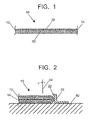
- FIG. 1 illustrates a side view of a sheet 10 of coverstock which includes a face layer 20 and a layer of foam backing 30.
- the face layer may comprise a fabric layer, leather or a polymer, such as vinyl, polyurethane and polyolefin, or fiber-reinforced versions of those polymers.
- the foam backing layer 30 may be applied to the face layer 20 by lamination, by adhesive, by molding liquid precursors or by applying the foam layer with a doctor blade while the foam is liquid.
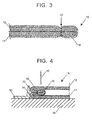
- the sheet 10 having ends 12 and 14 first will be folded onto itself such that the backside or foam layer 30 surfaces are in contact. This is illustrated in FIG. 2 . This then leaves the two ends of the sheet, 12 and 14 pointing in the same direction.
- the sheet 10 may then be placed on a flat surface 60 and the foldline 22 of the face layer 20 placed against a vertical surface or fence 50.
- a needle 40 may be placed an appropriate distance from the fence 50 such that one or more welt stitches 42 may be sewn through the ends 12 , 14 to form an extended welt head 16 . This is shown in FIG. 3 .
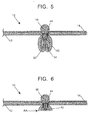
- the ends 12, 14 of the sheet 10 are separated from one another such that the face layer 20 surfaces of the sheet are facing or overlying one another (essentially in the shape of a "W").
- the foldlines 32, 34 of the foam layer 30 are then placed against the fence 50 and the needle 40 used to form one or more join stitches 44 as is shown in FIG. 5 .
- FIG. 6 illustrates the finished sheet 10 of coverstock including a welt 18 formed by inserting stitches 42 and 44 into the folded sheet.
- the excess material or selvage (bottom portions of the "W") has been trimmed off by cutting along line AA.
- the finished sheet of coverstock may then be used to attractively cover any number of flat or curved surfaces. Accordingly, a welt has been formed in a single sheet of material.
- the sheet 10' of coverstock may be attached to a second sheet 100 to form a welt 18' adjacent a seam 80 between the two sheets.
- FIG. 7 illustrates a conventional construction for a standard deck seam.
- two sheets of material 10' and 100 are placed face-to-face along an edge 14', 112 and one or more join stitches 46 are sewn to connect the sheets together adjacent that edge and form a seam 80.
- the end 14' of the first sheet 10' and the matching end 112 of the second sheet 100 are then folded to one side of the seam 80 made by stitch 46 (in the case of FIG. 7 , to the left) such that the first sheet 10' is folded over beneath itself and the back surfaces of the foam layer 30' are in contact. This results in the end 112 of a second sheet 100 lying under the fold of the first sheet 10' to form three layers of material.
- one or more second stitches 48 may be sewn through all three layers which may locally compress the surface of the first sheet 10' and form a welt 18'.
- this construction when used as a coverstock for a relatively thin article or over a flat surface (as on a door panel), the three layers of coverstock may create an unsightly appearance (bump) at the seam/welt. This is particularly true for thicker more plush feeling coverstocks, where the foam layer may be in the order of 6 mm. thick.
- this construction provides two edges 14', 112 of selvage or waste material which represent an opportunity for cost reduction of this construction.
- selvage as used herein is understood to mean an excess portion of a sheet of material which may be trimmed off, and as such may be waste or used by recycling.
- FIG. 8 illustrates an improved welt construction where a more prominent welt 18" may be formed by first shortening the end 14' of the first sheet 10' and sewing one or more stitches 46 closely adjacent the end 14' of sheet 10'.
- the extended end 112 of the second sheet 100 is then folded to one side of the seam 80 made by join stitch 46 (in the case of FIG. 8 to the left) such that the second sheet 100 is beneath the first sheet 10' and the back surface of the foam layer 30' is in contact with the face layer 120 of the second sheet 100. This results in the end 112 of a second sheet 100 lying under the first sheet 10' to form only two layers of material.
- one or more deck stitches 48 may be sown through the two layers which may locally compress the surface of the first sheet 10' and form a welt 18" wherein the end 14' of the first sheet 10' is trapped between the sheets 10', 100 and caused to form a hook configuration 140.
- an improved welt line is formed having a more prominent feature and a seam having a reduced thickness of about 50%. Further, a significant amount of trim waste or selvage 14' is eliminated providing a savings in material usage, particularly for high volume applications of this invention, such as in the automotive industry.
- welts and seams as disclosed herein may be formed from a coverstock which does not include a foam backing, that is, comprising face goods only.
Landscapes
- Engineering & Computer Science (AREA)
- Mechanical Engineering (AREA)
- Aviation & Aerospace Engineering (AREA)
- Transportation (AREA)
- Laminated Bodies (AREA)
- Vehicle Interior And Exterior Ornaments, Soundproofing, And Insulation (AREA)
- Sewing Machines And Sewing (AREA)
- Treatment Of Fiber Materials (AREA)
Abstract
Description
- This disclosure generally relates to an upholstery seam between adjoining components, in particular components used in the automobile industry. More particularly, the disclosure relates to improved seams which may include a welt.
- In the automotive industry, there continues to be an effort to create vehicles having aesthetically pleasing exterior and interior designs. The importance of appearance and aesthetic appeal in the automotive interior continues to grow. In particular, attractive upholstered coverings for interior trim, seats, ornamental roof caps and steering wheels aid in selling the modem, high-quality automobile. Customer quality demands continue to raise the bar for potential owner acceptability, and aesthetic appeal has become a critical factor in the marketing of higher profit margin vehicles. One example of such improved aesthetics involves the appearance of seams in upholstered interior and exterior components. In addition, methods of reducing manufacturing costs involved with trim components continue to be needed.
- Seams in coverstocks for interior and exterior automotive components may be included simply to break up a broad expanse of material, to accentuate styling lines, to connect different materials together, to allow conformability of the stock to curved surfaces (as in seating) and in the case where the complexity of the curved surface being covered cannot be accomplished with a single sheet of material.
- One type of prior art seam that is used on many automotive vehicle interior components, including seats, is a French seam that presents a neat appearance for a joint which joins two pieces of material together at a secured seam. Prior art French seams have been made by applying a foam material to the back side of the leather, vinyl or other types of coverstock to ensure that the foam is secured to the coverstock. One portion of a first material may then be sewn to a portion of a second material. Then the edges may then be flipped over each other and stitches placed a predetermined distance from the joint seam to create a French seam look. The French seam gets the appearance from the foam being compressed on itself creating a hump-like appearance adjacent to the seam thus creating the look that is desired by many automobile designers.
- Welts are originally known from the upholstery industry and are generally a rod-shaped element that is bonded, welded or stitched to the coverstock of the upholstery. The welt may be attached along the edges of the upholstery and may be used to position the coverstock in accordance with the shape of the underlying cushion. Conventional welts may comprise a flexible welt core sheathed in a covering material and a laterally protruding welt flap. The sheathing may comprise cut strips of covering material which may be placed around the welt core and bonded or stitched at the ends. The welts produced in this way may then be stitched onto the edges of the sown material.
- In addition, welts have been used in the automobile industry, particularly on seats, head rests and arm rests. These welts are mainly used for covering otherwise visible joints between two sheets of material and may be integrally formed by folding the coverstock and creating a standard deck seam as is shown in
FIG. 7 . In this way, these welts embellish the aesthetic appearance of the automobile interior. - Claims 1 and 7 provide alternative solutions to the problem of how to provide a welt that is prominent and aesthetically attractive while at the same time requiring a minimum of selvage or waste material. Independent method claim 1 addresses this problem for a welt formed from a single sheet of coverstock, while independent method claim 7 provides the solution for a welt formed between two sheets of coverstock.
- Independent claim 1 is directed at a method of forming a welt within a single sheet of coverstock, the method comprising providing a sheet of coverstock, the sheet having a front surface and a back surface, and folding the sheet over upon itself such that a first portion of the backside overlies a second portion of the backside, creating a first foldline. This may be followed by providing a needle and sewing one or more stitches S1 through the folded sheet, the one or more stitches S1 located at a distance from the first foldline, creating an extended welt head. This may be followed by unfolding the sheet and then folding the sheet over upon itself, around the extended welt head such that a first portion of the front surface overlies a second portion of the front surface, creating two overlying second foldlines. This may be followed by sewing one or more stitches S2 through the folded sheet and through the extended welt head, the one or more stitches S2 located at a distance from the second foldlines that is greater than the distance of the first stitches S1 from the second overlying foldlines. This may be followed by removing selvage from said sheet by cutting the sheet along a line located between the second foldlines and the one or more stitches S1 .
- Independent claim 7 is directed at a method of forming an improved deck seam construction for a welt formed between two sheets of coverstock, the method comprising providing first and second sheets of coverstock, the sheets each having a front surface and a back surface and an edge and placing the first sheet on top of the second sheet with the front surface of each sheet facing the other and with the edge of the second sheet extending beyond the edge of the first sheet. This may be followed by providing a needle and sewing one or more stitches S1 through the first and the second sheets, the one or more stitches S1 located closely adjacent the edge of the first sheet, creating a seam. This may be followed by folding the edge of the second sheet under the first sheet such that the back surface of the sheet overlies the front surface of the second sheet and sewing one or more stitches S2 through the first and second sheets, the one or more stitches S2 located closely adjacent to the edge of the second sheet thereby forming a welt between S1 and S2.
- The dependent claims relate to preferred embodiments of the invention.
- The above-mentioned and other features and advantages of this disclosure, and the manner of attaining them, will become more apparent and the disclosure will be better understood by reference to the following description of embodiments taken in conjunction with the accompanying drawings, wherein:
-
FIG. 1 is a side view of a piece of coverstock used to cover shaped articles according to the present disclosure. -
FIG. 2 is a side view of the coverstock ofFIG. 1 folded onto itself for deck stitching. -
FIG. 3 is a side view of the coverstock ofFIG. 2 after being deck stitched. -
FIG. 4 is a side view of the coverstock ofFIG. 3 unfolded over onto itself for join stitching. -
FIG. 5 is a side view of the coverstock ofFIG. 4 after the join stitching is complete. -
FIG. 6 is a side view of the coverstock ofFIG. 5 wherein the excess selvage has been removed to yield a finished seam with welt. -
FIG. 7 is a side view of the coverstock ofFIG. 1 which has been attached to a second sheet of coverstock and formed into a standard deck seam. -
FIG. 8 is a side view of the coverstock ofFIG. 1 which has been attached to a second sheet of coverstock, in a second embodiment according to the present disclosure, which uses less material by reducing the selvage of the coverstock ofFIG. 1 . - While particular embodiments of the present invention have been illustrated and described, it would be obvious to those skilled in the art that various other changes and modifications can be made without departing from the spirit and scope of the invention. It is therefore intended to cover in the appended claims all such changes and modifications that are within the scope of this invention.
- In a first exemplary embodiment, a welt may be formed in a single sheet of coverstock and yield an excellent appearance.
FIG. 1 illustrates a side view of asheet 10 of coverstock which includes aface layer 20 and a layer offoam backing 30. The face layer may comprise a fabric layer, leather or a polymer, such as vinyl, polyurethane and polyolefin, or fiber-reinforced versions of those polymers. Thefoam backing layer 30 may be applied to theface layer 20 by lamination, by adhesive, by molding liquid precursors or by applying the foam layer with a doctor blade while the foam is liquid. - To produce a welt in a sheet of coverstock, according to the present disclosure, the
sheet 10 havingends foam layer 30 surfaces are in contact. This is illustrated inFIG. 2 . This then leaves the two ends of the sheet, 12 and 14 pointing in the same direction. Thesheet 10 may then be placed on aflat surface 60 and thefoldline 22 of theface layer 20 placed against a vertical surface orfence 50. In addition, aneedle 40 may be placed an appropriate distance from thefence 50 such that one ormore welt stitches 42 may be sewn through theends welt head 16. This is shown inFIG. 3 . - Next, as shown in
FIG. 4 , theends sheet 10 are separated from one another such that theface layer 20 surfaces of the sheet are facing or overlying one another (essentially in the shape of a "W"). Thefoldlines foam layer 30 are then placed against thefence 50 and theneedle 40 used to form one ormore join stitches 44 as is shown inFIG. 5 . - In
FIG. 5 , theends sheet 10 have been rotated 90° or back into the original position as a flat sheet. An aesthetically pleasing, and in this instance asymmetrical welt 18 has now been formed which protrudes slightly from the surface of thesheet 10. All that remains is to trim the selvage adjacent thefoldlines sheet 10. -
FIG. 6 illustrates the finishedsheet 10 of coverstock including awelt 18 formed by insertingstitches - In a second exemplary embodiment, the sheet 10' of coverstock may be attached to a
second sheet 100 to form a welt 18' adjacent aseam 80 between the two sheets.FIG. 7 illustrates a conventional construction for a standard deck seam. To create the welt, two sheets ofmaterial 10' and 100 are placed face-to-face along anedge 14', 112 and one or more join stitches 46 are sewn to connect the sheets together adjacent that edge and form aseam 80. The end 14' of the first sheet 10' and thematching end 112 of thesecond sheet 100 are then folded to one side of theseam 80 made by stitch 46 (in the case ofFIG. 7 , to the left) such that the first sheet 10' is folded over beneath itself and the back surfaces of the foam layer 30' are in contact. This results in theend 112 of asecond sheet 100 lying under the fold of the first sheet 10' to form three layers of material. - Next, one or more
second stitches 48 may be sewn through all three layers which may locally compress the surface of the first sheet 10' and form a welt 18'. - One disadvantage of this construction is that when used as a coverstock for a relatively thin article or over a flat surface (as on a door panel), the three layers of coverstock may create an unsightly appearance (bump) at the seam/welt. This is particularly true for thicker more plush feeling coverstocks, where the foam layer may be in the order of 6 mm. thick. In addition, this construction provides two
edges 14', 112 of selvage or waste material which represent an opportunity for cost reduction of this construction. - The word "selvage" as used herein is understood to mean an excess portion of a sheet of material which may be trimmed off, and as such may be waste or used by recycling.
-
FIG. 8 illustrates an improved welt construction where a moreprominent welt 18" may be formed by first shortening the end 14' of the first sheet 10' and sewing one ormore stitches 46 closely adjacent the end 14' of sheet 10'. Next, as with the construction inFIG. 7 , theextended end 112 of thesecond sheet 100 is then folded to one side of theseam 80 made by join stitch 46 (in the case ofFIG. 8 to the left) such that thesecond sheet 100 is beneath the first sheet 10' and the back surface of the foam layer 30' is in contact with theface layer 120 of thesecond sheet 100. This results in theend 112 of asecond sheet 100 lying under the first sheet 10' to form only two layers of material. - Next, one or more deck stitches 48 may be sown through the two layers which may locally compress the surface of the first sheet 10' and form a
welt 18" wherein the end 14' of the first sheet 10' is trapped between thesheets 10', 100 and caused to form ahook configuration 140. - Thus, an improved welt line is formed having a more prominent feature and a seam having a reduced thickness of about 50%. Further, a significant amount of trim waste or selvage 14' is eliminated providing a savings in material usage, particularly for high volume applications of this invention, such as in the automotive industry.
- It is contemplated that the welts and seams as disclosed herein may be formed from a coverstock which does not include a foam backing, that is, comprising face goods only.
- It is further contemplated that the features of the present disclosure may find use in suitable applications in other transportation industries as well as in upholstery for the home and office.
- While particular embodiments of the present invention have been illustrated and described, it would be obvious to those skilled in the art that various other changes and modifications can be made without departing from the spirit and scope of the invention. It is therefore intended to cover in the appended claims all such changes and modifications that are within the scope of this invention.
Claims (12)
- A method of forming a welt (18) within a single sheet (10) of coverstock, the method comprising:providing a sheet (10) of coverstock, said sheet (10) having a front surface (20) and a back surface (30);folding said sheet (10) over upon itself such that a first portion of said backside (30) overlies a second portion of said backside (30), creating a first foldline (22);providing a needle (40) and sewing one or more stitches S1 (42) through said folded sheet (10), said one or more stitches S1 (42) located at a distance from said first foldline (22), creating an extended welt head (16);unfolding said sheet (10);folding said sheet (10) over upon itself, around said extended welt head (16) such that a first portion of said front surface (20) overlies or faces a second portion of said front surface (20), creating two overlying second foldlines (32, 34);sewing one or more stitches S2 (44) through said folded sheet (10) and through said extended welt head (16), said one or more stitches S2 (44) located at a distance from said second foldlines (32, 34) that is greater than the distance of said first stitches S1 (42) from said second overlying foldlines (32, 34);removing selvage from said sheet (10) by cutting said sheet (10) along a line (AA) located between said second foldlines (32, 34) and said one or more stitches S1 (42).
- The method of claim 1 wherein said sheet of coverstock comprises a face layer (20) and a foam backing layer (30).
- The method of claim 2 wherein said face layer (20) comprises fabric, leather, a polymer or a fiber-reinforced polymer.
- The method of one of the preceding claims wherein said sheet (10) comprises fabric, leather, a polymer or a fiber-reinforced polymer.
- The method of claim 4 wherein said polymer comprises vinyl, polyurethane or polyolefin.
- A welt for use in armrests, headrests, seat cushions, seat backs, instrument panels and roof caps, formed according to the method of any one of the preceding claims.
- A method of forming an improved deck seam construction for a welt (18") formed between two sheets (10', 100) of coverstock, the method comprising:providing first (10') and second (100) sheets of coverstock, said sheets (10'; 100) each having a front surface (20'; 120) and a back surface (30'; 130) and an edge (14'; 112);placing said first sheet (10') on top of said second sheet (100) with said front surface (20'; 120) of each sheet facing the other and with said edge (112) of said second sheet (100) extending beyond said edge (14') of said first sheet (10');providing a needle and sewing one or more stitches S1 (46) through said first (10') and said second (100) sheets, said one or more stitches S1 (46) located closely adjacent said edge (14') of said first sheet (10'), creating a seam (80);folding said edge (112) of said second sheet (100) under said first sheet (10') such that said back surface (30') of said first sheet (10') overlies said front surface (120) of said second sheet (100);sewing one or more stitches S2 (48) through said first (10') and second (100) sheets, said one or more stitches S2 (48) located closely adjacent to said edge (112) of said second sheet (100) thereby forming a welt (18") between S1 (46) and S2 (48).
- The method of claim 7 wherein one or both of said first (10') and said second (100) sheets of coverstock comprises a face layer (20'; 120) and a foam backing layer (3D'; 130).
- The method of claim 8 wherein said face layer (20'; 120) comprises fabric, leather, a polymer or a fiber-reinforced polymer.
- The method of one of claims 7 to 9 wherein one or both of said first (10') and said second (100) sheets comprises fabric, leather, a polymer or a fiber-reinforced polymer.
- The method of claim 10 wherein said polymer comprises vinyl, polyurethane or polyolefin.
- A welt for use in armrests, headrests, seat cushions, seat backs, instrument panels and roof caps, formed according to the method of any one of claims 7 to 11.
Applications Claiming Priority (1)
| Application Number | Priority Date | Filing Date | Title |
|---|---|---|---|
| US12/496,154 US8191218B2 (en) | 2009-07-01 | 2009-07-01 | Deck seam with reduced selvage |
Publications (2)
| Publication Number | Publication Date |
|---|---|
| EP2269872A2 true EP2269872A2 (en) | 2011-01-05 |
| EP2269872A3 EP2269872A3 (en) | 2013-04-24 |
Family
ID=43003456
Family Applications (1)
| Application Number | Title | Priority Date | Filing Date |
|---|---|---|---|
| EP10165055.4A Withdrawn EP2269872A3 (en) | 2009-07-01 | 2010-06-07 | Deck seam with reduced selvage |
Country Status (2)
| Country | Link |
|---|---|
| US (1) | US8191218B2 (en) |
| EP (1) | EP2269872A3 (en) |
Cited By (1)
| Publication number | Priority date | Publication date | Assignee | Title |
|---|---|---|---|---|
| CN107444210A (en) * | 2016-01-08 | 2017-12-08 | 丰田纺织株式会社 | Sew structure and possess the skin material of the seat for vehicle of the sewing structure |
Families Citing this family (11)
| Publication number | Priority date | Publication date | Assignee | Title |
|---|---|---|---|---|
| US8714626B2 (en) * | 2011-06-13 | 2014-05-06 | Faurecia Interior Systems, Inc. | Stitched seams for vehicle interior coverings |
| US9703029B2 (en) * | 2011-09-28 | 2017-07-11 | Inteva Products, Llc | Method for providing illuminated components and components formed from the method |
| JP6637263B2 (en) * | 2015-07-27 | 2020-01-29 | 株式会社タチエス | Vehicle interior parts and method of manufacturing the same |
| JP6630608B2 (en) * | 2016-03-29 | 2020-01-15 | 株式会社タチエス | Trim cover and vehicle seat |
| JP6660803B2 (en) * | 2016-04-26 | 2020-03-11 | 株式会社タチエス | Vehicle seat |
| DE102016114843B4 (en) | 2016-08-10 | 2021-03-25 | Inteva Products Europe Gmbh | Arrangement with a visual seam and a lighting device, its use and method for producing the arrangement |
| JP6922496B2 (en) * | 2017-07-12 | 2021-08-18 | トヨタ紡織株式会社 | Vehicle seat |
| DE102020125454A1 (en) | 2020-09-29 | 2022-03-31 | Bayerische Motoren Werke Aktiengesellschaft | Decorative part for an interior of a vehicle, interior part, vehicle and method for producing an interior part |
| US11958406B2 (en) | 2020-11-18 | 2024-04-16 | Inteva Products, Llc | Illuminated stitching that provides vehicle status |
| JP7522081B2 (en) | 2021-06-30 | 2024-07-24 | 寿屋フロンテ株式会社 | Seat back panel and vehicle seat back |
| US20240367589A1 (en) * | 2023-05-04 | 2024-11-07 | Irvin Automotive Products, LLC | Headrest Storage Pocket |
Family Cites Families (23)
| Publication number | Priority date | Publication date | Assignee | Title |
|---|---|---|---|---|
| US2290007A (en) * | 1940-06-07 | 1942-07-14 | Percy W Valentine | Welt seam |
| DE2058833A1 (en) * | 1970-11-30 | 1972-05-31 | Dynamit Nobel Ag | Forming seams on foldable and inflatable containers |
| CH651186A5 (en) * | 1981-01-22 | 1985-09-13 | Gygli Technik Ag | METHOD FOR MOUNTING PREPARED FABRIC PARTS ON ANOTHER FABRIC PART. |
| US4699420A (en) * | 1986-09-02 | 1987-10-13 | Chrysler Motors Corporation | Preformed ornamental cap or automotive vehicle |
| US4987666A (en) * | 1990-02-15 | 1991-01-29 | Hoover Universal, Inc. | Method of making covers for foam bodies using a seam stabilizer |
| US5174227A (en) * | 1991-05-02 | 1992-12-29 | Mim Industries, Inc. | Extended post sewing machine |
| JPH06246076A (en) * | 1993-02-25 | 1994-09-06 | Asahi Chem Ind Co Ltd | Manufacture of water-proof clothing |
| JP3537056B2 (en) * | 1994-03-30 | 2004-06-14 | ジューキ株式会社 | Bead forming device |
| US5885679A (en) * | 1994-11-18 | 1999-03-23 | Asahi Kasei Kogyo Kabushiki Kaisha | Joining structure for waterproof fabric |
| JP3491272B2 (en) * | 1997-02-10 | 2004-01-26 | 満 伊藤 | How to sew an elastic fabric |
| JP2001176586A (en) * | 1999-12-21 | 2001-06-29 | Citizen Electronics Co Ltd | Sounding element with connector |
| TW523561B (en) | 2000-07-28 | 2003-03-11 | Shima Seiki Mfg | Welt-seaming method and welt-seamed knitted fabric, and cad device for welt-seaming |
| JP3987802B2 (en) | 2001-03-26 | 2007-10-10 | 株式会社島精機製作所 | Knitted fabric treated with bind off and bind off treatment method |
| US6610958B2 (en) * | 2001-04-25 | 2003-08-26 | Precision Welding Technologies, Inc. | Apparatus and method for feeding filler wire in a welding operation |
| JP3954326B2 (en) | 2001-05-31 | 2007-08-08 | 株式会社島精機製作所 | Bind-off method and bind-off knitted fabric |
| DE10245816B4 (en) * | 2002-10-01 | 2006-10-19 | Lisa Dräxlmaier GmbH | piping |
| GB0308667D0 (en) * | 2003-04-15 | 2003-05-21 | Gore W L & Ass Uk | Seam |
| US6935260B2 (en) * | 2003-10-15 | 2005-08-30 | Irvin Automotive Products, Inc. | Notched seam design for interior trim upholstery pieces |
| US7117545B2 (en) * | 2003-10-15 | 2006-10-10 | Gore Enterprise Holdings Inc. | Liquidproof seam for protective apparel |
| US6886479B1 (en) * | 2003-11-14 | 2005-05-03 | Tachi-S Co., Ltd. | Sewing method to form a trim cover assembly and automotive seat using the trim cover assembly |
| US7401829B2 (en) * | 2005-07-21 | 2008-07-22 | International Automotive Components Group North America, Inc. | Critical seam alignment of soft trim to automobile components |
| US7278363B2 (en) * | 2005-07-28 | 2007-10-09 | Irvin Automotive Products, Inc. | Non-laminate seam |
| US7690318B2 (en) * | 2007-10-09 | 2010-04-06 | International Automotive Components Group North America, Inc. | Method of sewing a decorative seam and trim component made by that method |
-
2009
- 2009-07-01 US US12/496,154 patent/US8191218B2/en not_active Expired - Fee Related
-
2010
- 2010-06-07 EP EP10165055.4A patent/EP2269872A3/en not_active Withdrawn
Non-Patent Citations (1)
| Title |
|---|
| None |
Cited By (2)
| Publication number | Priority date | Publication date | Assignee | Title |
|---|---|---|---|---|
| CN107444210A (en) * | 2016-01-08 | 2017-12-08 | 丰田纺织株式会社 | Sew structure and possess the skin material of the seat for vehicle of the sewing structure |
| CN107444210B (en) * | 2016-01-08 | 2019-08-06 | 丰田纺织株式会社 | It sews structure and has the skin material of the seat for vehicle of the sewing structure |
Also Published As
| Publication number | Publication date |
|---|---|
| US8191218B2 (en) | 2012-06-05 |
| US20110000061A1 (en) | 2011-01-06 |
| EP2269872A3 (en) | 2013-04-24 |
Similar Documents
| Publication | Publication Date | Title |
|---|---|---|
| US8191218B2 (en) | Deck seam with reduced selvage | |
| US8579347B2 (en) | Seam spacers for use with decorative stitching of vehicle interior components | |
| US7644969B2 (en) | Cover for interior trim component and method of assembling same | |
| US8316785B2 (en) | Flat seam construction for automotive upholstery | |
| US7278363B2 (en) | Non-laminate seam | |
| US6997126B2 (en) | Offset seam sewing process | |
| US9096183B2 (en) | Composite part and method of manufacturing a composite part | |
| US10112514B2 (en) | Piping for a motor vehicle cover | |
| US20140333097A1 (en) | Vehicle panel | |
| CN106660779B (en) | The manufacturing method of seat skin construction with choke material and the seat skin with choke material | |
| US6935260B2 (en) | Notched seam design for interior trim upholstery pieces | |
| CN102803020B (en) | Trim panel of motor vehicles | |
| CN105793106B (en) | The epidermis method of sewing of the epigenetic structure of seat with choke material and seat with choke material | |
| CN103402817B (en) | There is the production method of the seat composite members of 3D effect and relevant seat | |
| CN109196125B (en) | Method for implementing cosmetic skinning for vehicle passenger compartment elements | |
| US7549708B2 (en) | T-member for use in an armrest or interior component of a vehicle | |
| CN222061814U (en) | Cover for a seat post of a vehicle and vehicle seat | |
| JP4198324B2 (en) | Method for producing leather-covered skin foam | |
| JP4446432B2 (en) | Chair structure and assembly method thereof | |
| US7421962B2 (en) | Guide for use in making a seam having a T-member | |
| CN110040078A (en) | For implementing the implementation method of the packing element with combined type coating | |
| JPH0246407Y2 (en) | ||
| WO2019197627A1 (en) | Decorative layer for a motor vehicle component | |
| KR200305946Y1 (en) | The Car Tuning Seat Cover | |
| JPWO1986006709A1 (en) | Seat body |
Legal Events
| Date | Code | Title | Description |
|---|---|---|---|
| PUAI | Public reference made under article 153(3) epc to a published international application that has entered the european phase |
Free format text: ORIGINAL CODE: 0009012 |
|
| AK | Designated contracting states |
Kind code of ref document: A2 Designated state(s): AL AT BE BG CH CY CZ DE DK EE ES FI FR GB GR HR HU IE IS IT LI LT LU LV MC MK MT NL NO PL PT RO SE SI SK SM TR |
|
| AX | Request for extension of the european patent |
Extension state: BA ME RS |
|
| PUAL | Search report despatched |
Free format text: ORIGINAL CODE: 0009013 |
|
| AK | Designated contracting states |
Kind code of ref document: A3 Designated state(s): AL AT BE BG CH CY CZ DE DK EE ES FI FR GB GR HR HU IE IS IT LI LT LU LV MC MK MT NL NO PL PT RO SE SI SK SM TR |
|
| AX | Request for extension of the european patent |
Extension state: BA ME RS |
|
| RIC1 | Information provided on ipc code assigned before grant |
Ipc: B60N 2/58 20060101ALI20130321BHEP Ipc: B60R 13/02 20060101AFI20130321BHEP |
|
| 17P | Request for examination filed |
Effective date: 20130808 |
|
| RBV | Designated contracting states (corrected) |
Designated state(s): AL AT BE BG CH CY CZ DE DK EE ES FI FR GB GR HR HU IE IS IT LI LT LU LV MC MK MT NL NO PL PT RO SE SI SK SM TR |
|
| STAA | Information on the status of an ep patent application or granted ep patent |
Free format text: STATUS: THE APPLICATION HAS BEEN WITHDRAWN |
|
| 18W | Application withdrawn |
Effective date: 20160614 |