EP2269471A1 - Method for production of defatted soymilk peptide - Google Patents
Method for production of defatted soymilk peptide Download PDFInfo
- Publication number
- EP2269471A1 EP2269471A1 EP09734552A EP09734552A EP2269471A1 EP 2269471 A1 EP2269471 A1 EP 2269471A1 EP 09734552 A EP09734552 A EP 09734552A EP 09734552 A EP09734552 A EP 09734552A EP 2269471 A1 EP2269471 A1 EP 2269471A1
- Authority
- EP
- European Patent Office
- Prior art keywords
- peptide
- calcium
- defatted soymilk
- defatted
- amount
- Prior art date
- Legal status (The legal status is an assumption and is not a legal conclusion. Google has not performed a legal analysis and makes no representation as to the accuracy of the status listed.)
- Withdrawn
Links
Images
Classifications
-
- A—HUMAN NECESSITIES
- A23—FOODS OR FOODSTUFFS; TREATMENT THEREOF, NOT COVERED BY OTHER CLASSES
- A23J—PROTEIN COMPOSITIONS FOR FOODSTUFFS; WORKING-UP PROTEINS FOR FOODSTUFFS; PHOSPHATIDE COMPOSITIONS FOR FOODSTUFFS
- A23J3/00—Working-up of proteins for foodstuffs
- A23J3/30—Working-up of proteins for foodstuffs by hydrolysis
- A23J3/32—Working-up of proteins for foodstuffs by hydrolysis using chemical agents
- A23J3/34—Working-up of proteins for foodstuffs by hydrolysis using chemical agents using enzymes
- A23J3/346—Working-up of proteins for foodstuffs by hydrolysis using chemical agents using enzymes of vegetable proteins
-
- A—HUMAN NECESSITIES
- A23—FOODS OR FOODSTUFFS; TREATMENT THEREOF, NOT COVERED BY OTHER CLASSES
- A23J—PROTEIN COMPOSITIONS FOR FOODSTUFFS; WORKING-UP PROTEINS FOR FOODSTUFFS; PHOSPHATIDE COMPOSITIONS FOR FOODSTUFFS
- A23J3/00—Working-up of proteins for foodstuffs
- A23J3/14—Vegetable proteins
- A23J3/16—Vegetable proteins from soybean
-
- A—HUMAN NECESSITIES
- A23—FOODS OR FOODSTUFFS; TREATMENT THEREOF, NOT COVERED BY OTHER CLASSES
- A23L—FOODS, FOODSTUFFS OR NON-ALCOHOLIC BEVERAGES, NOT OTHERWISE PROVIDED FOR; PREPARATION OR TREATMENT THEREOF
- A23L33/00—Modifying nutritive qualities of foods; Dietetic products; Preparation or treatment thereof
- A23L33/10—Modifying nutritive qualities of foods; Dietetic products; Preparation or treatment thereof using additives
- A23L33/17—Amino acids, peptides or proteins
- A23L33/18—Peptides; Protein hydrolysates
Definitions
- the present invention relates to a method for producing a defatted soymilk peptide. More specifically, the present invention relates to a method for producing a defatted soymilk peptide with improved productivity.
- Peptide is prepared by hydrolysis of protein with acid or enzyme treatment, and it is known to show excellent digestion and absorption properties when ingested orally. Peptide is used in dietary supplements and sports drinks as low-allergic nitrogen sources. Recently, a peptide has been attracting attention as functional materials, since it has been verified to have beneficial effects, such as alleviating muscle fatigue, reducing blood cholesterol levels, lowering blood pressure, and stimulating microbial fermentation.
- High degree of clarity is one of the quality requirements for developing the commercial availability of peptide in dietary supplements, including liquid food, sports drinks, and culture media markets. Low clarity causes reduction in marketability as food and difficulty in isolating useful components from medium.
- a variety of raw material proteins for preparing peptide have been developed, including animal proteins contained in egg white, milk, fish meat and the like; plant proteins contained in soybean, wheat and the like; and microbial proteins.
- peptide prepared using soy protein as raw material has been developed, including SPI peptide prepared from soy protein isolate as raw material, defatted soymilk peptide prepared from soymilk, which is derived from defatted soybean, as a raw material, and soymilk peptide prepared from soymilk, which is derived from whole fat soybean, as a raw material.
- soymilk peptide is poor in nitrogen content as compared with SPI peptide, it contains soy oligosaccharides and minerals in a balanced manner.
- soymilk peptide is widely developed in the medium market and in dietary supplements.
- insoluble matter which is thought to be a polymerization product of decomposed peptide, is known to be generated. Therefore, in general practice, such insoluble matter is removed by filtration, such as diatomite filtration, microfiltration and ultrafiltration, in the preparation of high clarity peptide.
- filtration such as diatomite filtration, microfiltration and ultrafiltration, in the preparation of high clarity peptide.
- defatted soymilk peptide in particular, has very poor filtering properties as compared with SPI peptide, and it causes an increase in production costs. Therefore, improvement of the properties has been longed.
- Patent Document 1 proposes a method for eliminating phytic acid by adding calcium to SPI peptide prepared using a soy protein isolate (SPI) as a raw material.
- SPI soy protein isolate
- Patent Document 1 calcium is used for the purpose of reducing the formation of residues from phytic acid, and it makes no particular mention of the influence of calcium on the filtering properties of SPI peptide.
- Patent Document 2 describes calcium content in relation to defatted soymilk peptides. However, the description relates to the determination of endogenous calcium levels in soymilk, and no idea of improving the filtering properties of defatted soymilk peptide by artificially adding calcium is found in Patent Document 2.
- objectives of the present invention are to provide a method for improving the filtering properties of a defatted soymilk peptide and to provide a defatted soymilk peptide having improved filtering properties.
- the present inventors have made intensive studies to address the problems with the conventional techniques, as a result, the inventors have found that the filtering properties of defatted soymilk peptide are improved by adding a large amount of calcium and have completed the present invention based on this finding.
- the present invention provides:
- the present invention allows an improvement of the filtering properties of defatted soymilk peptide. Furthermore, due to the improved productivity of defatted soymilk peptide and the reduction in production costs, inexpensive and clear defatted soymilk peptide can be provided to the markets.
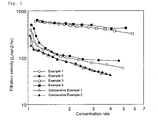
- Fig. 1 shows a graph of filtration velocity of defatted soymilk peptides with addition of different amounts of calcium.
- defatted soymilk refers to an extract of defatted soybean with removal of insoluble fractions such as okara (bean curd refuse), and a redissolved solution of a dried matter thereof, without elimination of low-molecular-weight fractions by means of isoelectric precipitation, ultrafiltration or the like.
- concentration of crude protein in the solid fraction is 40 wt% to 75 wt%.
- An exceedingly low concentration of crude protein reduces the value of defatted soymilk peptide as a nitrogen source.
- Defatted soymilk peptide can be obtained by hydrolyzing the protein components contained in the defatted soymilk using acid or proteolytic enzyme (protease).
- concentration of the solid fraction in the solution of defatted soymilk for hydrolysis of the soymilk protein is preferably 1 to 30 wt%, and more preferably 5 to 15 wt%.
- the hydrolysis is not adversely affected by a low concentration of defatted soymilk, it will cause reduction in the productivity and increase of costs for the production of defatted soymilk peptide.
- the concentration of defatted soymilk is exceedingly high, the hydrolysis rate tends to become difficult to increase.
- protease As the method for the hydrolysis, it is preferred to use protease as it is safe and is able to hydrolyze under milder condition.
- the protease used can be a commercially available protease, such as protease of animal, plant and microbial origin. Specifically, serine proteases (including animal-derived trypsin and chemotrypsin, and microbe-derived subtilisin and carboxypeptidase), thiol proteases (including plant-derived papain and bromelain), and carboxyl proteases (including animal-derived pepsin) can be used.
- serine proteases including animal-derived trypsin and chemotrypsin, and microbe-derived subtilisin and carboxypeptidase
- thiol proteases including plant-derived papain and bromelain
- carboxyl proteases including animal-derived pepsin
- protease examples include Pancreatin (manufactured by Amano Enzyme Inc.) and PTN (manufactured by Novozymes), which are animal origin; Papain W-40 and Bromelain F (both manufactured by Amano Enzyme Inc.), which are plant origin; and alcalase (manufactured by Novozymes A/S), Sumizyme LP (manufactured by Shinnihon Chemicals Co., Ltd.), Thermoase (manufactured by Daiwa Kasei Co., Ltd.) and Protease N (manufactured by Amano Enzyme Inc.), which are microbial origin.
- These proteases can be used either alone or in combination. When proteases are used in combination, they can be added simultaneously or sequentially.
- the reaction pH and temperature for the protease hydrolysis can be appropriately selected within the pH and temperature ranges that allow protease activity. However, if the hydrolysis temperature is excessively low, it takes a longer time to achieve the desired proteolysis rate. On the other hand, if the hydrolysis temperature is excessively high, problems such as inactivation of the protease, coloring of defatted soymilk peptide, and generating an off flavor may arise.
- the reaction time for protease hydrolysis is preferably about 5 minutes to 24 hours, and more preferably about 30 minutes to 9 hours, although it depends on the activity and amount of the protease used. If the hydrolysis time is excessively long, there are increased risks of decomposition of the materials.
- the extent of hydrolysis (hydrolysis rate) with the protease is expressed as a percentage of the soluble 15 wt% trichloroacetic acid (TCA) fraction in the crude protein, and is generally referred to as "15% TCA solubility.”
- the protease hydrolysis is preferably performed up to 25% to 100%, and more preferably up to 50% to 90%, as assessed by 15% TCA solubility of the defatted soymilk peptide reaction solution.
- the crude protein can be measured using any known method. In general, for soy protein, it is calculated by multiplying the nitrogen content measured by the Kjeldahl method by 6.25 as the protein factor.
- a calcium salt used in the present invention is preferably readily-soluble calcium salt, including inorganic calcium salt such as calcium chloride and calcium hydroxide, and organic calcium salt such as calcium gluconate and calcium lactate.
- the calcium salt can be either chemically synthesized or naturally occurring. These calcium salts can be used either alone or in combination.
- the amount of the salt to be added is determined considering the desired quality and the costs. The amount is 0.6 wt% or more, preferably 1.2 wt% or more and more preferably 2.0 wt% or more in terms of calcium content relative to the protein content of the defatted soymilk. A sufficient upper limit of the amount to be added is 10 wt% or less in terms of calcium content relative to the protein content of the defatted soymilk. If the amount of calcium salt to be added is excessively small, the effect of improving the filtering properties cannot be sufficiently achieved, whereas addition of an excessively large amount of calcium salt will lead to deterioration of the flavor.
- the timing of the addition of calcium salt can be either before or after the protease hydrolysis, and addition after the protease hydrolysis is preferred. If calcium salt is added before the protease hydrolysis, with large amount, the substrate soy protein forms aggregates, which may hamper the achievement of the desired proteolysis rate. If calcium salt is added after the protease hydrolysis, the addition can be carried out after the condensation and concentration of the defatted soymilk peptides obtained by protease reaction.
- the present invention is characterized in that the insoluble matter is filtered off after the addition of calcium in order to obtain defatted soymilk peptide with high clarity.
- the kind of filtration and conventional filter press, diatomite filtration, microfiltration, ultrafiltration and the like can be used.
- the insoluble matter Prior to the filtration, the insoluble matter can be roughly-removed by any means such as centrifugation.
- the filtering properties can further be improved by roughly-removing insoluble matter.
- the solution to be filtered flows in a vertical direction to the filtration membrane in diatomite filtration and the like.
- microfiltration, ultrafiltration and the like often employ a cross-flow system, in which the solution to be filtered flows in a horizontal direction to the filtration membrane.
- the solution to be filtered circulates within the circulation line provided with a filtration membrane, and the filtrate is removed from the system gradually in a sequential manner. Therefore, the impurity concentration in the circulating solution tends to increase with time.
- concentration rate This rate of concentration is referred to as a "concentration rate", and is calculated as "the amount of the solution to be filtered/(the amount of the solution to be filtered - the amount of the filtrate)." An appropriate concentration rate can be selected. If necessary, residual calcium can be removed by any means such as electrodialysis or ion-exchange resin after the filtration.
- inactivation of the protease is generally performed by heat treatment, and such treatment can be selected for the present invention.
- timing of the heat treatment any time after the achievement of the desired proteolysis rate can be selected.
- heat treatment after the removal of the insoluble matter is preferable.
- the heating condition is at about 85°C to 145°C for 5 seconds to 30 minutes. Under the condition, sterilization of the peptide solution can be carried out simultaneously in some cases.
- defatted soymilk peptide can be commercially available, either directly or after being concentrated. They can also be commercially available as powder after drying.
- the 15% TCA solubility of the defatted soymilk peptide obtained as described above is 40% to 100%, preferably 70% to 99%. If no particular desalting treatment, such as electrodialysis, is carried out, the defatted soymilk peptide contains 0.4 wt% or more of residual calcium relative to the crude protein content.
- the amount of the residual calcium is preferably 0.6 wt% or more, and more preferably 1.0 wt% or more.
- the upper limit of the amount of the residual calcium is preferably 8 wt% or less relative to the crude protein content. Flavor deterioration will result from the amount of excessively high content of residual calcium.
- the first soymilk extract was obtained by adding 10 volumes of water to defatted soybean and by stirring and extraction, followed by separating okara.
- the second soymilk extract was obtained by adding 10 volumes of water to the separated okara, and by stirring and extraction, followed by separating okara.
- the first and second soymilk extracts were mixed and then freeze-dried to obtain defatted soymilk powder.
- the crude protein concentration of the defatted soymilk powder was 62.0 wt%.
- the defatted soymilk powder was dissolved in water to prepare 9 wt% solution and the pH was adjusted to 7.0.
- protease Protease N; manufactured by Amano Enzyme Inc.
- protease protease N; manufactured by Amano Enzyme Inc.
- the mixture was subjected to hydrolysis at 55°C for 5 hours to obtain a reaction solution of defatted soymilk peptide.
- the supernatant obtained by centrifuging the reaction solution at 5,000 rpm for 5 minutes was heated at 85°C for 30 minutes to inactivate the enzyme.
- a defatted soymilk peptide solution was obtained.
- a defatted soymilk peptide was obtained by performing the same procedure as described in Comparative Example 2, except that, as shown in Table 1, calcium chloride was added in an amount of 0.9 wt% to 3 wt% in terms of calcium content relative to the crude protein content in the reaction solution of defatted soymilk peptide.
- Fig. 1 and Table 1 it was verified that the filtration velocity of the defatted soymilk peptide was significantly improved when the amount of calcium added was 0.9 wt% or more and further improved when the amount was 2.4 wt% or more.
- the residual calcium content in the filtered defatted soymilk peptide solution was 0.42 wt% relative to the crude protein when calcium was added in an amount of 0.9 wt%, and was 1.44 wt% when calcium was added in an amount of 2.4 wt%.
- a defatted soymilk peptide was obtained by performing the same procedure as described in Comparative Example 2, except that, instead of calcium chloride, calcium hydroxide (Example 5), calcium lactate (Example 6) and calcium gluconate (Example 7) were added in an amount of 2.4 wt% in terms of calcium content relative to the crude protein content in the reaction solution of defatted soymilk peptides.
Landscapes
- Life Sciences & Earth Sciences (AREA)
- Chemical & Material Sciences (AREA)
- Health & Medical Sciences (AREA)
- Food Science & Technology (AREA)
- Polymers & Plastics (AREA)
- Nutrition Science (AREA)
- Engineering & Computer Science (AREA)
- Biochemistry (AREA)
- Mycology (AREA)
- Proteomics, Peptides & Aminoacids (AREA)
- Molecular Biology (AREA)
- Chemical Kinetics & Catalysis (AREA)
- General Chemical & Material Sciences (AREA)
- Preparation Of Compounds By Using Micro-Organisms (AREA)
- Peptides Or Proteins (AREA)
- Beans For Foods Or Fodder (AREA)
Abstract
Description
- The present invention relates to a method for producing a defatted soymilk peptide. More specifically, the present invention relates to a method for producing a defatted soymilk peptide with improved productivity.
- Peptide is prepared by hydrolysis of protein with acid or enzyme treatment, and it is known to show excellent digestion and absorption properties when ingested orally. Peptide is used in dietary supplements and sports drinks as low-allergic nitrogen sources. Recently, a peptide has been attracting attention as functional materials, since it has been verified to have beneficial effects, such as alleviating muscle fatigue, reducing blood cholesterol levels, lowering blood pressure, and stimulating microbial fermentation.
- High degree of clarity is one of the quality requirements for developing the commercial availability of peptide in dietary supplements, including liquid food, sports drinks, and culture media markets. Low clarity causes reduction in marketability as food and difficulty in isolating useful components from medium.
- A variety of raw material proteins for preparing peptide have been developed, including animal proteins contained in egg white, milk, fish meat and the like; plant proteins contained in soybean, wheat and the like; and microbial proteins. Among them, for example, peptide prepared using soy protein as raw material has been developed, including SPI peptide prepared from soy protein isolate as raw material, defatted soymilk peptide prepared from soymilk, which is derived from defatted soybean, as a raw material, and soymilk peptide prepared from soymilk, which is derived from whole fat soybean, as a raw material. While soymilk peptide is poor in nitrogen content as compared with SPI peptide, it contains soy oligosaccharides and minerals in a balanced manner. In particular, soymilk peptide is widely developed in the medium market and in dietary supplements.
- During the process of producing peptide from a variety of soy protein, insoluble matter, which is thought to be a polymerization product of decomposed peptide, is known to be generated. Therefore, in general practice, such insoluble matter is removed by filtration, such as diatomite filtration, microfiltration and ultrafiltration, in the preparation of high clarity peptide. However, defatted soymilk peptide, in particular, has very poor filtering properties as compared with SPI peptide, and it causes an increase in production costs. Therefore, improvement of the properties has been longed.
- Meanwhile, calcium is known as a highly reactive divalent cation, and various applications as a flocculant have been proposed. By way of an example of application of calcium to peptide,
Patent Document 1 proposes a method for eliminating phytic acid by adding calcium to SPI peptide prepared using a soy protein isolate (SPI) as a raw material. However, inPatent Document 1, calcium is used for the purpose of reducing the formation of residues from phytic acid, and it makes no particular mention of the influence of calcium on the filtering properties of SPI peptide. -
Patent Document 2 describes calcium content in relation to defatted soymilk peptides. However, the description relates to the determination of endogenous calcium levels in soymilk, and no idea of improving the filtering properties of defatted soymilk peptide by artificially adding calcium is found inPatent Document 2. -
- Patent Document 1:
JP 2750467 B - Patent Document 2:
JP 3470441 B - The present invention has been accomplished in view of the current state of the art described above. More specifically, objectives of the present invention are to provide a method for improving the filtering properties of a defatted soymilk peptide and to provide a defatted soymilk peptide having improved filtering properties.
- The present inventors have made intensive studies to address the problems with the conventional techniques, as a result, the inventors have found that the filtering properties of defatted soymilk peptide are improved by adding a large amount of calcium and have completed the present invention based on this finding.
- That is, the present invention provides:
- (1) a method for producing a defatted soymilk peptide which comprises, adding a calcium salt to a defatted soymilk peptide in an amount of 0.6 wt% or more in terms of calcium content relative to the crude protein content, and filtering the resulting mixture once or more times; and
- (2) a defatted soymilk peptide comprising a calcium salt in an amount of 0.4 wt% or more in terms of calcium content relative to the crude protein content.
- The present invention allows an improvement of the filtering properties of defatted soymilk peptide. Furthermore, due to the improved productivity of defatted soymilk peptide and the reduction in production costs, inexpensive and clear defatted soymilk peptide can be provided to the markets.
-
Fig. 1 shows a graph of filtration velocity of defatted soymilk peptides with addition of different amounts of calcium. - As used herein, the term "defatted soymilk" refers to an extract of defatted soybean with removal of insoluble fractions such as okara (bean curd refuse), and a redissolved solution of a dried matter thereof, without elimination of low-molecular-weight fractions by means of isoelectric precipitation, ultrafiltration or the like. In such defatted soymilk, in general, the concentration of crude protein in the solid fraction is 40 wt% to 75 wt%. An exceedingly low concentration of crude protein reduces the value of defatted soymilk peptide as a nitrogen source.
- Defatted soymilk peptide can be obtained by hydrolyzing the protein components contained in the defatted soymilk using acid or proteolytic enzyme (protease). The concentration of the solid fraction in the solution of defatted soymilk for hydrolysis of the soymilk protein is preferably 1 to 30 wt%, and more preferably 5 to 15 wt%. Although the hydrolysis is not adversely affected by a low concentration of defatted soymilk, it will cause reduction in the productivity and increase of costs for the production of defatted soymilk peptide. On the other hand, when the concentration of defatted soymilk is exceedingly high, the hydrolysis rate tends to become difficult to increase.
- As the method for the hydrolysis, it is preferred to use protease as it is safe and is able to hydrolyze under milder condition. When the hydrolysis is performed with a protease, the protease used can be a commercially available protease, such as protease of animal, plant and microbial origin. Specifically, serine proteases (including animal-derived trypsin and chemotrypsin, and microbe-derived subtilisin and carboxypeptidase), thiol proteases (including plant-derived papain and bromelain), and carboxyl proteases (including animal-derived pepsin) can be used. More specifically, examples of the protease include Pancreatin (manufactured by Amano Enzyme Inc.) and PTN (manufactured by Novozymes), which are animal origin; Papain W-40 and Bromelain F (both manufactured by Amano Enzyme Inc.), which are plant origin; and alcalase (manufactured by Novozymes A/S), Sumizyme LP (manufactured by Shinnihon Chemicals Co., Ltd.), Thermoase (manufactured by Daiwa Kasei Co., Ltd.) and Protease N (manufactured by Amano Enzyme Inc.), which are microbial origin. These proteases can be used either alone or in combination. When proteases are used in combination, they can be added simultaneously or sequentially.
- The reaction pH and temperature for the protease hydrolysis can be appropriately selected within the pH and temperature ranges that allow protease activity. However, if the hydrolysis temperature is excessively low, it takes a longer time to achieve the desired proteolysis rate. On the other hand, if the hydrolysis temperature is excessively high, problems such as inactivation of the protease, coloring of defatted soymilk peptide, and generating an off flavor may arise.
- The reaction time for protease hydrolysis is preferably about 5 minutes to 24 hours, and more preferably about 30 minutes to 9 hours, although it depends on the activity and amount of the protease used. If the hydrolysis time is excessively long, there are increased risks of decomposition of the materials.
- The extent of hydrolysis (hydrolysis rate) with the protease is expressed as a percentage of the soluble 15 wt% trichloroacetic acid (TCA) fraction in the crude protein, and is generally referred to as "15% TCA solubility." The protease hydrolysis is preferably performed up to 25% to 100%, and more preferably up to 50% to 90%, as assessed by 15% TCA solubility of the defatted soymilk peptide reaction solution. In this process, the crude protein can be measured using any known method. In general, for soy protein, it is calculated by multiplying the nitrogen content measured by the Kjeldahl method by 6.25 as the protein factor.
- A calcium salt used in the present invention is preferably readily-soluble calcium salt, including inorganic calcium salt such as calcium chloride and calcium hydroxide, and organic calcium salt such as calcium gluconate and calcium lactate. The calcium salt can be either chemically synthesized or naturally occurring. These calcium salts can be used either alone or in combination. The amount of the salt to be added is determined considering the desired quality and the costs. The amount is 0.6 wt% or more, preferably 1.2 wt% or more and more preferably 2.0 wt% or more in terms of calcium content relative to the protein content of the defatted soymilk. A sufficient upper limit of the amount to be added is 10 wt% or less in terms of calcium content relative to the protein content of the defatted soymilk.
If the amount of calcium salt to be added is excessively small, the effect of improving the filtering properties cannot be sufficiently achieved, whereas addition of an excessively large amount of calcium salt will lead to deterioration of the flavor. - The timing of the addition of calcium salt can be either before or after the protease hydrolysis, and addition after the protease hydrolysis is preferred. If calcium salt is added before the protease hydrolysis, with large amount, the substrate soy protein forms aggregates, which may hamper the achievement of the desired proteolysis rate. If calcium salt is added after the protease hydrolysis, the addition can be carried out after the condensation and concentration of the defatted soymilk peptides obtained by protease reaction.
- The present invention is characterized in that the insoluble matter is filtered off after the addition of calcium in order to obtain defatted soymilk peptide with high clarity. There is no particular limitation on the kind of filtration, and conventional filter press, diatomite filtration, microfiltration, ultrafiltration and the like can be used. Prior to the filtration, the insoluble matter can be roughly-removed by any means such as centrifugation. The filtering properties can further be improved by roughly-removing insoluble matter.
- In general, the solution to be filtered flows in a vertical direction to the filtration membrane in diatomite filtration and the like. On the other hand, microfiltration, ultrafiltration and the like often employ a cross-flow system, in which the solution to be filtered flows in a horizontal direction to the filtration membrane. In such a system, the solution to be filtered circulates within the circulation line provided with a filtration membrane, and the filtrate is removed from the system gradually in a sequential manner. Therefore, the impurity concentration in the circulating solution tends to increase with time. This rate of concentration is referred to as a "concentration rate", and is calculated as "the amount of the solution to be filtered/(the amount of the solution to be filtered - the amount of the filtrate)." An appropriate concentration rate can be selected. If necessary, residual calcium can be removed by any means such as electrodialysis or ion-exchange resin after the filtration.
- In general, it is necessary to inactivate the enzyme in a product treated with the enzyme, and inactivation of the protease is required in the present invention. Inactivation of the protease is generally performed by heat treatment, and such treatment can be selected for the present invention. With respect to the timing of the heat treatment, any time after the achievement of the desired proteolysis rate can be selected. However, considering that heat treatment in the presence of insoluble matter generated by the protease hydrolysis would readily lead to formation of residues in the final product, heat treatment after the removal of the insoluble matter is preferable.
In general, the heating condition is at about 85°C to 145°C for 5 seconds to 30 minutes. Under the condition, sterilization of the peptide solution can be carried out simultaneously in some cases. - After the inactivation of the protease and the sterilization, defatted soymilk peptide can be commercially available, either directly or after being concentrated. They can also be commercially available as powder after drying.
- The 15% TCA solubility of the defatted soymilk peptide obtained as described above is 40% to 100%, preferably 70% to 99%. If no particular desalting treatment, such as electrodialysis, is carried out, the defatted soymilk peptide contains 0.4 wt% or more of residual calcium relative to the crude protein content. The amount of the residual calcium is preferably 0.6 wt% or more, and more preferably 1.0 wt% or more. The upper limit of the amount of the residual calcium is preferably 8 wt% or less relative to the crude protein content. Flavor deterioration will result from the amount of excessively high content of residual calcium.
- The present invention is described in detail below with reference to examples. In the following examples, the term "%" and "part" always refers to by weight.
- The first soymilk extract was obtained by adding 10 volumes of water to defatted soybean and by stirring and extraction, followed by separating okara. The second soymilk extract was obtained by adding 10 volumes of water to the separated okara, and by stirring and extraction, followed by separating okara. The first and second soymilk extracts were mixed and then freeze-dried to obtain defatted soymilk powder. The crude protein concentration of the defatted soymilk powder was 62.0 wt%. The defatted soymilk powder was dissolved in water to prepare 9 wt% solution and the pH was adjusted to 7.0. To the solution, protease (Protease N; manufactured by Amano Enzyme Inc.) was added in an amount of 2 wt% relative to the crude protein content in the defatted soymilk. The mixture was subjected to hydrolysis at 55°C for 5 hours to obtain a reaction solution of defatted soymilk peptide. The supernatant obtained by centrifuging the reaction solution at 5,000 rpm for 5 minutes was heated at 85°C for 30 minutes to inactivate the enzyme. Thus, a defatted soymilk peptide solution was obtained.
- To the defatted soymilk peptide reaction solution obtained in the same manner as in Comparative Example 1, calcium chloride was added in an amount of 0.4 wt% in terms of calcium content relative to the crude protein content in the reaction solution of defatted soymilk peptide. The supernatant obtained by centrifuging this solution at 5,000 rpm for 5 minutes was heated at 85°C for 30 minutes to inactivate the enzyme. Thus, a defatted soymilk peptide solution was obtained.
- A defatted soymilk peptide was obtained by performing the same procedure as described in Comparative Example 2, except that, as shown in Table 1, calcium chloride was added in an amount of 0.9 wt% to 3 wt% in terms of calcium content relative to the crude protein content in the reaction solution of defatted soymilk peptide.
- In the circulation line provide with a microfiltration module (USP-143; manufactured by Asahi Kasei Corporation), 20 L of each of the defatted soymilk peptide solution obtained in Comparative Examples 1 and 2 and Examples 1 to 4 was circulated to verify the correlation between the concentration rate and the filtration velocity when the solution was filtered at a filtration pressure of 0.04 MPa. Furthermore, the filtrate thus obtained was freeze-dried and then used to determine the crude protein content and the 15% TCA solubility by the Kjeldahl method, and the residual calcium content relative to the crude protein by fluorescent X-ray analysis.
- The results of Experimental Example 1 to verify the correlation between the concentration rate and filtration velocity are shown in
Fig. 1 . The filtration velocity when the solution was concentrated to 4 times, the crude protein content, the 15% TCA solubility, and the residual calcium content are summarized in Table 1.Table 1. Filtration velocity of calcium-added defatted soymilk peptide Comparative Example 1 Comparative Example 2 Example 1 Example 2 Example 3 Example 4 Amount of Ca-chloride added (wt%) 0.0 0.4 0.9 1.5 2.4 3.0 Filtration velocity at 4-times concentration (L/m2/hr) 42 42 69 86 388 416 Residual Ca content (wt%)* 0.13 0.21 0.42 0.73 1.44 1.68 Crude protein content (wt%) 60.3 60.6 60.9 60.0 59.2 58.5 15%TCA solubility (wt%) 98.4 97.6 97.2 98.6 97.4 98.1 * wt% in terms of Ca content relative to the crude protein content - As shown in
Fig. 1 and Table 1, it was verified that the filtration velocity of the defatted soymilk peptide was significantly improved when the amount of calcium added was 0.9 wt% or more and further improved when the amount was 2.4 wt% or more. The residual calcium content in the filtered defatted soymilk peptide solution was 0.42 wt% relative to the crude protein when calcium was added in an amount of 0.9 wt%, and was 1.44 wt% when calcium was added in an amount of 2.4 wt%. - A defatted soymilk peptide was obtained by performing the same procedure as described in Comparative Example 2, except that, instead of calcium chloride, calcium hydroxide (Example 5), calcium lactate (Example 6) and calcium gluconate (Example 7) were added in an amount of 2.4 wt% in terms of calcium content relative to the crude protein content in the reaction solution of defatted soymilk peptides.
- For the defatted soymilk peptide solutions obtained in Examples 5 to 7, the filtration velocity was determined and the filtrates obtained were analyzed as described in Experimental Example 1. These results are shown in Table 2, as well as the results obtained in Experimental Example 1 for Comparative Example 1 and Example 3 for comparison.
Table 2. Filtration velocity of defatted soymilk peptides with addition of different calcium salts Comparative Example 1 Example 3 Example 5 Example 6 Example 7 Ca salt Ca-chloride Ca-hydroxide Ca-lactate Ca-gluconate Amount of Ca added (wt%)* 0.0 2.4 2.4 2.4 2.4 Filtration velocity at 4-times concentration (L/m2/hr) 42 388 125 335 368 Residual Ca content (wt%)* 0.13 1.44 0.89 1.49 1.43 Crude protein content (wt%) 60.3 59.2 62.9 59.2 55.1 15% TCA solubility (wt%) 98.4 97.4 98.2 97.7 96.7 * wt% in terms of Ca content relative to the crude protein content - From the results shown in Table 2, it was verified that like the use of calcium chloride, the use of calcium hydroxide, calcium lactate or calcium gluconate improves the filtration velocity of defatted soymilk peptide.
Claims (2)
- A method for producing a defatted soymilk peptide which comprises:adding a calcium salt to a defatted soymilk peptide in an amount of 0.6 wt% or more in terms of calcium content relative to the crude protein content; andfiltering the resulting mixture once or more times.
- A defatted soymilk peptide comprising a calcium salt in an amount of 0.4 wt% or more in terms of calcium content relative to the crude protein content.
Applications Claiming Priority (2)
| Application Number | Priority Date | Filing Date | Title |
|---|---|---|---|
| JP2008109914 | 2008-04-21 | ||
| PCT/JP2009/057648 WO2009131052A1 (en) | 2008-04-21 | 2009-04-16 | Method for production of defatted soymilk peptide |
Publications (2)
| Publication Number | Publication Date |
|---|---|
| EP2269471A1 true EP2269471A1 (en) | 2011-01-05 |
| EP2269471A4 EP2269471A4 (en) | 2012-12-26 |
Family
ID=41216788
Family Applications (1)
| Application Number | Title | Priority Date | Filing Date |
|---|---|---|---|
| EP09734552A Withdrawn EP2269471A4 (en) | 2008-04-21 | 2009-04-16 | PROCESS FOR PRODUCTION OF DEGREASED SOY MILK PEPTIDE |
Country Status (6)
| Country | Link |
|---|---|
| US (1) | US8304005B2 (en) |
| EP (1) | EP2269471A4 (en) |
| JP (1) | JP5447372B2 (en) |
| KR (1) | KR20100134050A (en) |
| CN (1) | CN102014656B (en) |
| WO (1) | WO2009131052A1 (en) |
Cited By (2)
| Publication number | Priority date | Publication date | Assignee | Title |
|---|---|---|---|---|
| US10231467B2 (en) | 2013-02-04 | 2019-03-19 | Sapporo Holdings Limited | Solid fermented soy milk product and process for manufacturing same |
| US10299490B2 (en) | 2012-04-05 | 2019-05-28 | Sapporo Holdings Limited | Soy milk fermentation product and method for producing same |
Families Citing this family (2)
| Publication number | Priority date | Publication date | Assignee | Title |
|---|---|---|---|---|
| CA3141076A1 (en) | 2016-01-07 | 2017-07-13 | Ripple Foods, Pbc | Product analogs or components of such analogs and processes for making same |
| CA3191718A1 (en) * | 2020-08-14 | 2022-02-17 | Steuben Foods, Inc. | Plant based milk comprising protein hydrolysate and divalent cation compositions having improved taste and stability |
Family Cites Families (13)
| Publication number | Priority date | Publication date | Assignee | Title |
|---|---|---|---|---|
| JPS62232340A (en) * | 1986-04-02 | 1987-10-12 | Kibun Kk | Production of food material |
| JP2750467B2 (en) | 1990-06-14 | 1998-05-13 | 不二製油株式会社 | Peptide mixture and enteral nutrition composition |
| JPH067105A (en) * | 1992-06-23 | 1994-01-18 | Kibun Food Chemifa Co Ltd | Method for producing soy milk drink containing high calcium |
| JP3406367B2 (en) | 1994-02-15 | 2003-05-12 | 森永製菓株式会社 | Method for producing soy protein having mineral absorption promoting effect |
| JP3470441B2 (en) | 1995-03-03 | 2003-11-25 | 不二製油株式会社 | Fermentation accelerator and method for producing fermentation accelerator |
| CN1087909C (en) * | 1996-03-28 | 2002-07-24 | 不二制油株式会社 | Soybean protein hydrolysate, process for producing the same, and meat products and drinks using the same |
| US6268487B1 (en) * | 1996-05-13 | 2001-07-31 | Genzyme Transgenics Corporation | Purification of biologically active peptides from milk |
| JP3417350B2 (en) * | 1998-07-29 | 2003-06-16 | 不二製油株式会社 | Soybean protein hydrolyzate, method for producing the same, and product using the same |
| US6465432B1 (en) * | 2000-08-28 | 2002-10-15 | Kraft Food Holdings, Inc. | Isolated antioxidant peptides form casein and methods for preparing, isolating, and identifying antioxidant peptides |
| US20060057275A1 (en) | 2004-09-16 | 2006-03-16 | Shaowen Wu | Process for the preparation of glycinin-rich and beta-conglycinin-rich protein fractions |
| US7332192B2 (en) | 2004-12-17 | 2008-02-19 | Solae, Llc | Soy protein isolate |
| WO2006080426A1 (en) * | 2005-01-27 | 2006-08-03 | Fuji Oil Company, Limited | Process for producing soybean protein |
| US20090280217A1 (en) * | 2005-12-06 | 2009-11-12 | Mitsuru Katase | Method for Production of Soybean Peptide Mixture |
-
2009
- 2009-04-16 KR KR1020107023396A patent/KR20100134050A/en not_active Withdrawn
- 2009-04-16 EP EP09734552A patent/EP2269471A4/en not_active Withdrawn
- 2009-04-16 US US12/988,684 patent/US8304005B2/en not_active Expired - Fee Related
- 2009-04-16 CN CN200980114208.3A patent/CN102014656B/en not_active Expired - Fee Related
- 2009-04-16 WO PCT/JP2009/057648 patent/WO2009131052A1/en not_active Ceased
- 2009-04-16 JP JP2010509154A patent/JP5447372B2/en not_active Expired - Fee Related
Cited By (2)
| Publication number | Priority date | Publication date | Assignee | Title |
|---|---|---|---|---|
| US10299490B2 (en) | 2012-04-05 | 2019-05-28 | Sapporo Holdings Limited | Soy milk fermentation product and method for producing same |
| US10231467B2 (en) | 2013-02-04 | 2019-03-19 | Sapporo Holdings Limited | Solid fermented soy milk product and process for manufacturing same |
Also Published As
| Publication number | Publication date |
|---|---|
| JP5447372B2 (en) | 2014-03-19 |
| JPWO2009131052A1 (en) | 2011-08-18 |
| CN102014656B (en) | 2014-07-23 |
| US20110059212A1 (en) | 2011-03-10 |
| US8304005B2 (en) | 2012-11-06 |
| CN102014656A (en) | 2011-04-13 |
| KR20100134050A (en) | 2010-12-22 |
| WO2009131052A1 (en) | 2009-10-29 |
| EP2269471A4 (en) | 2012-12-26 |
Similar Documents
| Publication | Publication Date | Title |
|---|---|---|
| CN102550797B (en) | Production method of sea cucumber peptide extract | |
| US20100087629A1 (en) | Method of producing a cidic-soluble soybean protein | |
| KR101071338B1 (en) | Method of Producing Collagen Peptide from Marine Organism and Collagen Peptide Produced by the Method | |
| US5744179A (en) | Low-phosphorus whey protein, manufacturing method thereof, low-phosphorus purified whey hydrolysate and manufacturing method thereof | |
| JPH05505304A (en) | Method for producing enzymatic hydrolyzate | |
| US20090280217A1 (en) | Method for Production of Soybean Peptide Mixture | |
| EP1413614A1 (en) | Method for producing fish gelatin peptide | |
| CN106174436A (en) | A kind of preparation method of complex enzyme hydrolysis fishbone hormone | |
| CN108517343B (en) | Preparation method of porphyra yezoensis antioxidant protein peptide | |
| US8304005B2 (en) | Method for production of defatted soymilk peptide | |
| CA2105673C (en) | Method for production of a vegetable protein hydrolyzate and a use thereof | |
| JP2003250460A (en) | Method for modifying functionality of milk protein | |
| JP2004215521A (en) | Method for producing calcium complex | |
| JP4436961B2 (en) | Method for producing protein hydrolyzate | |
| KR100998659B1 (en) | Ugoltang base and its manufacturing method | |
| Ge et al. | Release of Leu‐Pro‐Pro from corn gluten meal by fermentation with a Lactobacillus helveticus strain | |
| JP4227984B2 (en) | Composition for improving flavor and taste of food | |
| CN114457137B (en) | Preparation method of deep hydrolyzed whey protein through continuous cyclic hydrolysis and accurate screening of peptide molecular weight | |
| KR20120102600A (en) | Fat accumulation suppressor | |
| JP7252733B2 (en) | Method for producing milk protein hydrolyzate | |
| JPH0678685A (en) | Production of protein hydrolyzate without unpleasant taste | |
| JP3467478B2 (en) | Seasoning material highly containing water-soluble nutrients in soybean and method for producing the same | |
| JPH0581219B2 (en) | ||
| RU2816709C1 (en) | Method of producing an extract for preparing functional beverages | |
| KR20110021409A (en) | Method for preparing low salt concentrate and natural cook using low salt concentrate |
Legal Events
| Date | Code | Title | Description |
|---|---|---|---|
| PUAI | Public reference made under article 153(3) epc to a published international application that has entered the european phase |
Free format text: ORIGINAL CODE: 0009012 |
|
| 17P | Request for examination filed |
Effective date: 20101019 |
|
| AK | Designated contracting states |
Kind code of ref document: A1 Designated state(s): AT BE BG CH CY CZ DE DK EE ES FI FR GB GR HR HU IE IS IT LI LT LU LV MC MK MT NL NO PL PT RO SE SI SK TR |
|
| AX | Request for extension of the european patent |
Extension state: AL BA RS |
|
| DAX | Request for extension of the european patent (deleted) | ||
| A4 | Supplementary search report drawn up and despatched |
Effective date: 20121128 |
|
| RIC1 | Information provided on ipc code assigned before grant |
Ipc: C07K 2/00 20060101ALI20121122BHEP Ipc: C12P 21/00 20060101ALI20121122BHEP Ipc: C07K 14/415 20060101ALI20121122BHEP Ipc: A23J 3/34 20060101ALI20121122BHEP Ipc: A23J 3/16 20060101AFI20121122BHEP |
|
| STAA | Information on the status of an ep patent application or granted ep patent |
Free format text: STATUS: THE APPLICATION IS DEEMED TO BE WITHDRAWN |
|
| 18D | Application deemed to be withdrawn |
Effective date: 20141101 |