EP2266967A1 - Intermediates for the preparation of octahydroquinolizines - Google Patents
Intermediates for the preparation of octahydroquinolizines Download PDFInfo
- Publication number
- EP2266967A1 EP2266967A1 EP09450121A EP09450121A EP2266967A1 EP 2266967 A1 EP2266967 A1 EP 2266967A1 EP 09450121 A EP09450121 A EP 09450121A EP 09450121 A EP09450121 A EP 09450121A EP 2266967 A1 EP2266967 A1 EP 2266967A1
- Authority
- EP
- European Patent Office
- Prior art keywords
- methyl
- preparation
- octahydroquinolizines
- rtt
- fluka
- Prior art date
- Legal status (The legal status is an assumption and is not a legal conclusion. Google has not performed a legal analysis and makes no representation as to the accuracy of the status listed.)
- Withdrawn
Links
Classifications
-
- C—CHEMISTRY; METALLURGY
- C07—ORGANIC CHEMISTRY
- C07D—HETEROCYCLIC COMPOUNDS
- C07D309/00—Heterocyclic compounds containing six-membered rings having one oxygen atom as the only ring hetero atom, not condensed with other rings
- C07D309/16—Heterocyclic compounds containing six-membered rings having one oxygen atom as the only ring hetero atom, not condensed with other rings having one double bond between ring members or between a ring member and a non-ring member
- C07D309/28—Heterocyclic compounds containing six-membered rings having one oxygen atom as the only ring hetero atom, not condensed with other rings having one double bond between ring members or between a ring member and a non-ring member with hetero atoms or with carbon atoms having three bonds to hetero atoms with at the most one bond to halogen, e.g. ester or nitrile radicals, directly attached to ring carbon atoms
- C07D309/30—Oxygen atoms, e.g. delta-lactones
-
- C—CHEMISTRY; METALLURGY
- C07—ORGANIC CHEMISTRY
- C07D—HETEROCYCLIC COMPOUNDS
- C07D455/00—Heterocyclic compounds containing quinolizine ring systems, e.g. emetine alkaloids, protoberberine; Alkylenedioxy derivatives of dibenzo [a, g] quinolizines, e.g. berberine
- C07D455/02—Heterocyclic compounds containing quinolizine ring systems, e.g. emetine alkaloids, protoberberine; Alkylenedioxy derivatives of dibenzo [a, g] quinolizines, e.g. berberine containing not further condensed quinolizine ring systems
Definitions
- This invention relates to compounds used as intermediates for the synthesis of octahydroquinolizines.
- Substituted octahydroquinolizines are for treatment or prevention of a number of diseases, including diabetes mellitus and its complications, for treatment or prevention of hyperlipidemia, for treatment or prevention of diabetic dyslipidemia, for treatment or prevention of the metabolic syndrome, for treatment or prevention of diseases related to metabolic dysfunction, for treatment or prevention of obesity or obesity-related diseases, for treatment or prevention of gastrointestinal dysfunction, for treatment or prevention of diseases mediated by opioid receptors located in the central nervous system or in the periphery, for treatment or prevention of opioid induced side effect e.g. constipation, nausea, vomiting and combinations of side effects of this type.
- opioid induced side effect e.g. constipation, nausea, vomiting and combinations of side effects of this type.
- the compounds disclosed in this invention belong to a synthetic route using Alkyl-aryl-lactones of formula I as intermediates, which are used for, but not limited to, the synthesis of octahydroquinolizine derivatives.
- the present invention is generally directed to a synthetic method using Alkyl-aryl-lactones intermediates, which are used for, but not limited to, the synthesis of substituted octahydroquinolizine derivatives, pharmaceutical compositions containing octahydroquinolizine derivatives and methods of their pharmaceutical use.
- the invention is directed to a method of preparation of the novel compound 5-hydroxy-2-phenylhexanenitrile 4 , its enantiomer, diastereomers or stereoisomeric mixtures following a known sequence of reactions, e.g. as described by Cossentini, M.; Seyden-Penne, J. Synth. Commun. 1985, 15(8), 689-696 , including general methodology for keton reduction e.g. Organikum 2004 WILEY-VCH Verlag GmbH, Weinheim, p.: 568ff and general methodology for asymmetric ketone reduction e.g. Cordes, D. B. et. al. Eur. J. Org. Chem.
- the invention is directed to a method of preparation of the novel compounds 2-(4-fluorophenyl)-5-oxohexanenitrile 7 , 2-(4-fluorophenyl)-5-hydroxyhexanenitrile 8 and 3-(4-fluorophenyl)-6-methyltetrahydro-2 H -pyran-2-one 9 , their respective enantiomers, diastereomers or stereoisomeric mixtures following a known sequence of reactions, e.g. as described by Cossentini, M.; Seyden-Penne, J Synth. Commun. 1985, 15(8), 689-696 , including general methodology for keton reduction e.g.
- the invention is directed to a method of preparation of the novel compounds 3,6-dimethyl-3-phenyltetrahydro-2 H -pyran-2-one 10a and 3-(4-fluorophenyl)-3,6-dimethyltetrahydro-2 H -pyran-2-one 10b , their respective enantiomers, diastereomers or stereoisomeric mixtures following a known sequence of reactions including the use of a strong base, but not limited to, e.g. lithiumdiisopropylamide and a alkylating reagent, but not limited to, like e.g. methyliodide as for example described in Beck et al. Org. Synth. 1995, 72, 62.
- the invention is directed to a method of preparation of the novel compounds 5-hydroxy-2-methyl-2-phenylhexanamide 11a and 2-(4-fluorophenyl)-5-hydroxy-2-methylhexanamide 11b , 6-amino-5-methyl-5-phenylhexan-2-ol 12a and 6-amino-5-(4-fluorophenyl)-5-methylhexan-2-ol 12b , 3,6-dimethyl-3-phenyl-2,3,4,5-tetrahydropyridine 13a and 3-(4-fluorophenyl)-3,6-dimethyl-2,3,4,5-tetrahydropyridine 13b , their respective enantiomers, diastereomers or stereoisomeric mixtures following known synthetic methodology, e.g.
- the imines 13a,b can be transformed to octahydroquinolizine derivatives according to Scheme A by methods described herein.
- octahydroquinolizines can be used as active ingredients by themselves or they can be used as intermediates for the synthesis of further octahydroquinolizine derivatives for pharmaceutical use in the therapeutic fields as described above.
- HPLC Acetonitrile (ACN) LC-MS grade (Fluka); Water, LC-MS grade (Fluka); Formic acid, puriss. p.a. (eluent additive for LC-MS, Fluka); Dry solvents for chemical reactions: Tetrahydrofurane (THF), puriss., absolute, over molecular sieve H 2 O ⁇ 0.005%, ⁇ 99.5% (GC) (Fluka)
- reaction products are identified and/or characterized by HPLC/MS.
- Instrumentation SCL-10Avp, controller; DGU-20A5, degasser, FCV-10ALvp, low pressure gradient mixing unit, LC-10ADvp pump, SIL10ADvp, autosampler, SPD-M10Avp, PDA detector, LCMS 2010A MS detector (Shimadzu); SmartMix, gradient mixer with 350 ⁇ l mixing chamber (Knauer); N 2 LCMS 1, nitrogen generator (Claind); E2M28, two stage rotary vacuum pump (Edwards); Software: LabSolutions - LCMSolution Ver.
- Reaction products and stereoisomers are characterized by HPLC/MS via relative retention time in minutes after injection (RTT) applying the following methods. Detected ions are given in intensities in percent relative to base peak (100%).
- HPLC/MS Method A Column: Synergi 4 ⁇ Polar-RP 80A 150x2.0 mm, with Security Guard Cartridge Polar-RP 4 x 2.0 mm (Phenomenex Inc.); flow: 0.5 ml/min; linear gradient (%A is the difference to 100%): start at 10% B, in 10 min to 100% B, then kept for 5 min at 100% B, then in 1 min to 10% B, then 7 min equilibration at 10% B; total run time: 23 min; PDA detector: wavelength: 190 - 600 nm, sampling rate: 1.56 Hz, MS detector: ionization mode: APCI positive, mass range: 150 - 600 ⁇ 0.5 m/z; scan speed: 500 amu/sec; detector voltage: 1.25 kV; heat block temperature: 200 °C; CDL
- HPLC/MS Method B Column: Synergi 4 ⁇ Polar-RP 80A 150x2.0 mm, with Security Guard Cartridge Polar-RP 4 x 2.0 mm (Phenomenex Inc.); flow: 0.5 ml/min; linear gradient (%A is the difference to 100%): start at 10% B, in 10 min to 100% B, then kept for 5 min at 100% B, then in 1 min to 10% B, then 7 min equilibration at 10% B; total run time: 23 min; PDA detector: wavelength: 190 - 600 nm, sampling rate: 1.56 Hz, MS detector: ionization mode: ESI positive, mass range: 150 - 600 ⁇ 0.5 m/z; scan speed: 500 amu/sec; detector voltage: 1.25 kV; heat block temperature: 200 °C; CDL temperature: 250 °C; nebulizing gas flow: 1.5 L/min; dry gas pressure: 0.1 MPa. If not stated otherwise, RT stands for room temperature or ambient temperature, which typically lies between 20 and 25 °C
- 6-methyl-3-phenyltetrahydro-2 H -pyran-2-one 5 [Lit.: Kang, S. H.; Lee, J. H.; Lee, S. B. Tetrahedron Lett. 1998, 39, 59-62 ] is prepared by a sequence of standard reactions. Starting with benzyl cyanide and 3-buten-2-one 5-oxo-2-phenylhexanenitrile 3 is obtained by phase transfer catalysis [Lit.: Cossentini, M.; Seyden-Penne, J. Synth. Commun. 1985, 15(8), 689-696 ].
- 6-methyl-3-phenyltetrahydro-2 H -pyran-2-one 5 dissolved in dry THF is added dropwise to a 1.5eq. cooled LDA solution at -20°C in a dry and inert atmosphere (Argon). After stirring the reaction mixture for 1 hour at -20°C 1.5eq. iodomethane are added and the reaction mixture is warmed to RT. The reaction mixture is quenched with saturated ammonium chloride solution and extracted with ethyl acetate. The organic phase is dried over sodium sulfate, filtered and evaporated in vac. to dryness.
- 3,6-dimethyl-3-phenyltetrahydro-2 H -pyran-2-one 10a is dissolved in dry THF in a dry and inert atmosphere (Argon) and treated with 1.1 eq. sodium amide at room temperature. After stirring the reaction mixture for 16 hours it is quenched by the addition of water and extracted with CH 2 Cl 2 . The combined organic phases are washed with brine, dried over sodium sulfate, filtered and evaporated in vac. to dryness yielding 5-hydroxy-2-methyl-2-phenylhexanamide 11a . Crude 5-hydroxy-2-methyl-2-phenylhexanamide 11a is dissolved in dry THF in a dry and inert atmosphere (Argon) and treated with 6eq.
- 6-amino-5-methyl-5-phenylhexan-2-ol 12a 6-amino-5-methyl-5-phenylhexan-2-ol 12a is dissolved in 2.9% sulphuric acid and 1.5eq. Jones reagents are added to the reaction mixture. After stirring for 16 hours at room temperature the reaction mixture is quenched with methanol and stirred for another hour. The reaction mixture is diluted with water and saturated aq.
- crystallized from cyclohexane yielding 7,9a-dimethyl-7-phenyloctahydro-2 H -quinolizin-2-one 14a or 7-(4-fluorophenyl)-7,9a-dimethyloctahydro-2 H -quinolizin-2-one 14b , respectively.
Landscapes
- Chemical & Material Sciences (AREA)
- Organic Chemistry (AREA)
- Pharmaceuticals Containing Other Organic And Inorganic Compounds (AREA)
- Nitrogen Condensed Heterocyclic Rings (AREA)
Abstract
This invention relates to compounds used as intermediates for the synthesis of octahydroquinolizines in accordance with the following formula:
X = H, F; R= Methyl, Ethyl, nPropyl, nButyl
Description
- This invention relates to compounds used as intermediates for the synthesis of octahydroquinolizines. Substituted octahydroquinolizines are for treatment or prevention of a number of diseases, including diabetes mellitus and its complications, for treatment or prevention of hyperlipidemia, for treatment or prevention of diabetic dyslipidemia, for treatment or prevention of the metabolic syndrome, for treatment or prevention of diseases related to metabolic dysfunction, for treatment or prevention of obesity or obesity-related diseases, for treatment or prevention of gastrointestinal dysfunction, for treatment or prevention of diseases mediated by opioid receptors located in the central nervous system or in the periphery, for treatment or prevention of opioid induced side effect e.g. constipation, nausea, vomiting and combinations of side effects of this type.
- Differently substituted octahydroquinolizines are published as active pharmaceutical ingredients for use in indications listed above [
W02007/050802 A (Adolor Corp [US], Dolle Roland E [US], Le Bourdonnec Bertrand [US], 3 May 2007); Kubo H. et al., Biol. Pharm.Bull. 23(9), 1114-1117 (2000 )]. - Therefore, it is of the utmost importance, to provide efficient synthetic access, which allows for stereoselective control in the course of the synthetic sequence leading to a variety of pharmacologically active octahydroquinolizines. It is common knowledge, although chemically similar in the backbone framework, specific changes in structure may result in changes in the pharmaceutical usefulness of structurally different octahydroquinolizine derivatives.
- The compounds disclosed in this invention belong to a synthetic route using Alkyl-aryl-lactones of formula I as intermediates, which are used for, but not limited to, the synthesis of octahydroquinolizine derivatives.

- The present invention is generally directed to a synthetic method using Alkyl-aryl-lactones intermediates, which are used for, but not limited to, the synthesis of substituted octahydroquinolizine derivatives, pharmaceutical compositions containing octahydroquinolizine derivatives and methods of their pharmaceutical use.
- In one embodiment, the invention is directed to a method of preparation of the novel compound 5-hydroxy-2-phenylhexanenitrile 4, its enantiomer, diastereomers or stereoisomeric mixtures following a known sequence of reactions, e.g. as described by Cossentini, M.; Seyden-Penne, J. Synth. Commun. 1985, 15(8), 689-696 , including general methodology for keton reduction e.g. Organikum 2004 WILEY-VCH Verlag GmbH, Weinheim, p.: 568ff and general methodology for asymmetric ketone reduction e.g. Cordes, D. B. et. al. Eur. J. Org. Chem. 2005, 5289-529 , B.Singaram et.al. Organic Process Research and Development 2006 (10), 949-958 , K.Nakamura et.al.Tetrahedron:Asymmetry 14(2003), 2659-2681 . The novel compound 5-hydroxy-2-phenylhexanenitrile 4, its enantiomer, diastereomers or stereoisomeric mixtures can be transformed to the formerly described 6-methyl-3-phenyltetrahydro-2H-pyran-2-one 5 Kang, S. H.; Lee, J. H.; Lee, S. B. Tetrahedron Lett. 1998, 39, 59-62 by using general methods for lactonization e.g. Organikum 2004 WILEY-VCH Verlag GmbH, Weinheim, p.:475 and 500 .

- In another embodiment, the invention is directed to a method of preparation of the novel compounds 2-(4-fluorophenyl)-5-oxohexanenitrile 7 , 2-(4-fluorophenyl)-5-hydroxyhexanenitrile 8 and 3-(4-fluorophenyl)-6-methyltetrahydro-2H-pyran-2-one 9, their respective enantiomers, diastereomers or stereoisomeric mixtures following a known sequence of reactions, e.g. as described by Cossentini, M.; Seyden-Penne, J Synth. Commun. 1985, 15(8), 689-696 , including general methodology for keton reduction e.g. Organikum 2004 WILEY-VCH Verlag GmbH, Weinheim, p.: 568ff and general methodology for asymmetric ketone reduction e.g. Cordes, D. B. et. al. Eur. J. Org. Chem. 2005, 5289-529 , B.Singaram et.al. Organic Process Research and Development 2006 (10), 949-958 , K.Nakamura et.al.Tetrahedron:Asymmetry 14(2003), 2659-26815 and general methods for lactonization e.g. Organikum 2004 WILEY-VCH Verlag GmbH, Weinheim, p.:475 and 500 .

- In yet another embodiment, the invention is directed to a method of preparation of the novel compounds 3,6-dimethyl-3-phenyltetrahydro-2H-pyran-2-one 10a and 3-(4-fluorophenyl)-3,6-dimethyltetrahydro-2H-pyran-2-one 10b, their respective enantiomers, diastereomers or stereoisomeric mixtures following a known sequence of reactions including the use of a strong base, but not limited to, e.g. lithiumdiisopropylamide and a alkylating reagent, but not limited to, like e.g. methyliodide as for example described in Beck et al. Org. Synth. 1995, 72, 62.

- In a further embodiment, the invention is directed to a method of preparation of the novel compounds 5-hydroxy-2-methyl-2-phenylhexanamide 11a and 2-(4-fluorophenyl)-5-hydroxy-2-methylhexanamide 11b, 6-amino-5-methyl-5-phenylhexan-2-ol 12a and 6-amino-5-(4-fluorophenyl)-5-methylhexan-2-ol 12b, 3,6-dimethyl-3-phenyl-2,3,4,5-tetrahydropyridine 13a and 3-(4-fluorophenyl)-3,6-dimethyl-2,3,4,5-tetrahydropyridine 13b, their respective enantiomers, diastereomers or stereoisomeric mixtures following known synthetic methodology, e.g. as described in El-Farargy, A. F. Egypt. J. Pharm. Sci. 1991, 32(3-4), 565-74 ; Organikum 2004 WILEY-VCH Verlag GmbH, Weinheim, p.:570 ; Zibuck, R.; Streiber, J. Org. Synth. 1993, 71, 236 .

- With R= Methyl:
- 10a: X = H 10b: X = F 11a: X = H 11b: X = F 12a: X = H 12b: X = F 13a: X = H 13b: X = F
- The imines 13a,b can be transformed to octahydroquinolizine derivatives according to Scheme A by methods described herein.
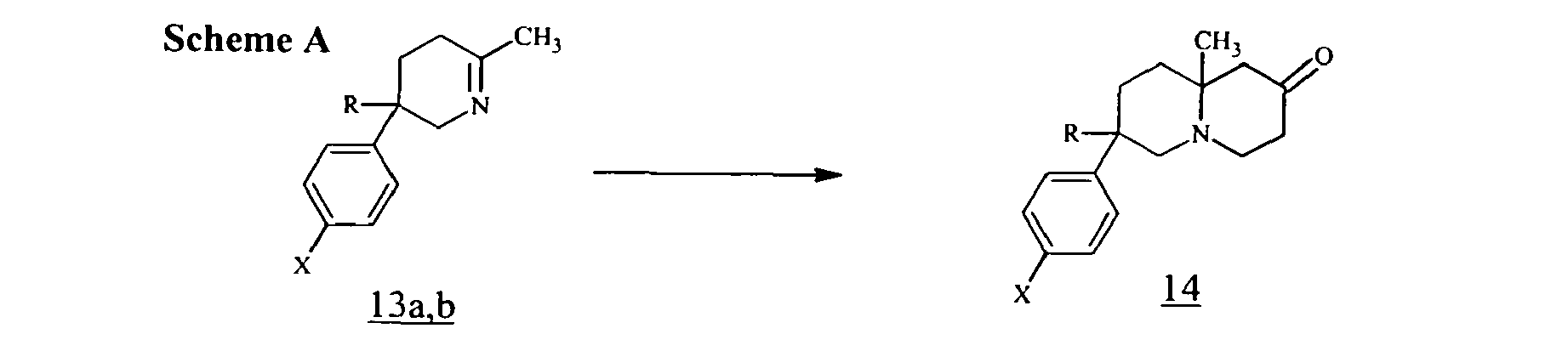
14a: X=H, R= Methyl; 14b: X=F, R= Methyl - These octahydroquinolizines can be used as active ingredients by themselves or they can be used as intermediates for the synthesis of further octahydroquinolizine derivatives for pharmaceutical use in the therapeutic fields as described above.
- If not stated otherwise, the following materials and solvents have been used: HPLC: Acetonitrile (ACN) LC-MS grade (Fluka); Water, LC-MS grade (Fluka); Formic acid, puriss. p.a. (eluent additive for LC-MS, Fluka); Dry solvents for chemical reactions: Tetrahydrofurane (THF), puriss., absolute, over molecular sieve H2O ≤0.005%, ≥99.5% (GC) (Fluka)
- If not stated otherwise, the following materials and solvents have been used for extraction and/or column chromatography: Ethyl acetate (EtOAc), GPR Rectapur (VWR Prolabo); Cyclohexane (CyclH), Toluene (Tol): Normapur (VWR Prolabo); Dichloromethane (CH2Cl2), Methanol (MeOH): GPR Rectapur (VWR Prolabo); Silica gel 60, 0.06-0.2 mm (Merck)
- If not stated otherwise, the following reagents have been used for chemical reactions: 3-Buten-2-one, 99% (Aldrich); Iodomethane (MeI), purum: ≥99.0% (GC) (Fluka); Benzyl cyanide, 98% (Aldrich); Sodium sulfate (Na2SO4), purum p.a., anhydrous >99% (Fluka); Ammonium chloride (NH4Cl), purum p.a., ≥99% (Fluka); Lithium diisopropylamide, 1,8 M solution in THF/Heptane/Ethylbenzene (Aldrich); Lithium aluminium hydride (LAH), reagent grade, 95%, powder (Aldrich); Sulfuric acid (H2S04), 95-97% puriss. p.a. (Sigma-Aldrich); Sodium hydrogen carbonate (NaHCO3) (Fluka); Magnesium sulfate anhydrous MgSO4), puriss. p.a., drying agent, ≥98% (KT) (Fluka); Sodium carbonate (Na2CO3), purum, ≥98.0% (T) (Fluka); Acetic acid, purum 99% (Fluka); Sodium amide 95% (Aldrich); Hydrochloric acid (HCl), puriss. p.a., ACS reagent, fuming, ≥37% (Sigma-Aldrich); Chromium(VI) oxide, purum p.a., ≥99% (Fluka)
- If not stated otherwise, the reaction products are identified and/or characterized by HPLC/MS. Instrumentation: SCL-10Avp, controller; DGU-20A5, degasser, FCV-10ALvp, low pressure gradient mixing unit, LC-10ADvp pump, SIL10ADvp, autosampler, SPD-M10Avp, PDA detector, LCMS 2010A MS detector (Shimadzu); SmartMix, gradient mixer with 350 µl mixing chamber (Knauer); N2 LCMS 1, nitrogen generator (Claind); E2M28, two stage rotary vacuum pump (Edwards); Software: LabSolutions - LCMSolution Ver. 3.41 (Shimadzu); Sample preparation: Samples are weighted (1-3mg) and dissolved in acetonitrile/water (with 0.1% formic acid) = 1:9. Sample solutions are used undiluted for HPLC Method A, for HPLC Method B samples are diluted with acetonitrile/water (with 0.1 % formic acid) = 1:9 to a concentration of ∼0.05mg/ml. Solvents: solvent A: water with 0.1% formic acid, solvent B: acetonitrile with 0.1 % formic acid
- Reaction products and stereoisomers are characterized by HPLC/MS via relative retention time in minutes after injection (RTT) applying the following methods. Detected ions are given in intensities in percent relative to base peak (100%). HPLC/MS Method A: Column: Synergi 4µ Polar-RP 80A 150x2.0 mm, with Security Guard Cartridge Polar-RP 4 x 2.0 mm (Phenomenex Inc.); flow: 0.5 ml/min; linear gradient (%A is the difference to 100%): start at 10% B, in 10 min to 100% B, then kept for 5 min at 100% B, then in 1 min to 10% B, then 7 min equilibration at 10% B; total run time: 23 min; PDA detector: wavelength: 190 - 600 nm, sampling rate: 1.56 Hz, MS detector: ionization mode: APCI positive, mass range: 150 - 600 ± 0.5 m/z; scan speed: 500 amu/sec; detector voltage: 1.25 kV; heat block temperature: 200 °C; CDL temperature: 250 °C; interface temperature:400°C; nebulizing gas flow: 2.5 L/min; dry gas pressure: 0.02 MPa. HPLC/MS Method B: Column: Synergi 4µ Polar-RP 80A 150x2.0 mm, with Security Guard Cartridge Polar-RP 4 x 2.0 mm (Phenomenex Inc.); flow: 0.5 ml/min; linear gradient (%A is the difference to 100%): start at 10% B, in 10 min to 100% B, then kept for 5 min at 100% B, then in 1 min to 10% B, then 7 min equilibration at 10% B; total run time: 23 min; PDA detector: wavelength: 190 - 600 nm, sampling rate: 1.56 Hz, MS detector: ionization mode: ESI positive, mass range: 150 - 600 ± 0.5 m/z; scan speed: 500 amu/sec; detector voltage: 1.25 kV; heat block temperature: 200 °C; CDL temperature: 250 °C; nebulizing gas flow: 1.5 L/min; dry gas pressure: 0.1 MPa. If not stated otherwise, RT stands for room temperature or ambient temperature, which typically lies between 20 and 25 °C.
- 6-methyl-3-phenyltetrahydro-2H-pyran-2-one 5 [Lit.: Kang, S. H.; Lee, J. H.; Lee, S. B. Tetrahedron Lett. 1998, 39, 59-62] is prepared by a sequence of standard reactions. Starting with benzyl cyanide and 3-buten-2-one 5-oxo-2-phenylhexanenitrile 3 is obtained by phase transfer catalysis [Lit.: Cossentini, M.; Seyden-Penne, J. Synth. Commun. 1985, 15(8), 689-696]. Keton reduction [Lit.: Organikum 2004 WILEY-VCH Verlag GmbH, Weinheim, p.: 568ff] of 3 delivers 5-hydroxy-2-phenylhexanenitrile 4 . Alkaline hydrolysis [Lit.: Organikum 2004 WILEY-VCH Verlag GmbH, Weinheim, p.:500 ] of 4 and lactonization [Lit.: Organikum 2004 WILEY-VCH Verlag GmbH, Weinheim, p.:475] of the obtained product delivers 6-methyl-3-phenyltetrahydro-2H-pyran-2-one 5. HPLC/MS Method A: 4: RTT = 8.5 [ms: 161, 190 (93%, M+H+), 231.2(21 %, M+ACN+H+)]; 5: RTT = 9.0 [ms: 191.1 (30%, M+H+), 232.1 (M+ACN+H+), 381.2 (16%, 2*M+H+]
- 6-methyl-3-phenyltetrahydro-2H-pyran-2-one 5 dissolved in dry THF is added dropwise to a 1.5eq. cooled LDA solution at -20°C in a dry and inert atmosphere (Argon). After stirring the reaction mixture for 1 hour at -20°C 1.5eq. iodomethane are added and the reaction mixture is warmed to RT. The reaction mixture is quenched with saturated ammonium chloride solution and extracted with ethyl acetate. The organic phase is dried over sodium sulfate, filtered and evaporated in vac. to dryness. Start-spot filtration (SiO2; cyclohexane/ethyl actetate=9/1) of the obtained syrup delivers solid 3,6-dimethyl-3-phenyltetrahydro-2H-pyran-2-one 10a. HPLC/MS Method A: 10a: RTT = 9.6 [ms: 205.1 (17%, M+H+), 246.1 (M+ACN+H+), 409.2 (35%,2*M+H+]
- 3,6-dimethyl-3-phenyltetrahydro-2H-pyran-2-one 10a is dissolved in dry THF in a dry and inert atmosphere (Argon) and treated with 1.1 eq. sodium amide at room temperature. After stirring the reaction mixture for 16 hours it is quenched by the addition of water and extracted with CH2Cl2. The combined organic phases are washed with brine, dried over sodium sulfate, filtered and evaporated in vac. to dryness yielding 5-hydroxy-2-methyl-2-phenylhexanamide 11a. Crude 5-hydroxy-2-methyl-2-phenylhexanamide 11a is dissolved in dry THF in a dry and inert atmosphere (Argon) and treated with 6eq. lithium aluminum hydride. The reaction mixture is heated to reflux for 3 hours. The reaction is cautiously quenched with water and filtrated. The filtrate is extracted with CH2Cl2. The combined organic layers are washed with brine, dried over MgSO4 and evaporated in vac. to dryness yielding 6-amino-5-methyl-5-phenylhexan-2-ol 12a. 6-amino-5-methyl-5-phenylhexan-2-ol 12a is dissolved in 2.9% sulphuric acid and 1.5eq. Jones reagents are added to the reaction mixture. After stirring for 16 hours at room temperature the reaction mixture is quenched with methanol and stirred for another hour. The reaction mixture is diluted with water and saturated aq. NaHCO3 and filtered. The filtrate is extracted with ethyl acetate, the combined organic phases are washed with brine, dried over MgSO4 and evaporated in vac. to dryness yielding 3,6-dimethyl-3-phenyl-2,3,4,5-tetrahydropyridine 13a.
HPLC/MS Method A: 11a: Isomere A: RTT = 6.8 [ms: 204.1 (M+H+), 222.1 (68%, M+H3O+), 245.1 (20%, M+ACN+H+); Isomere B: RTT = 7.0 [ms: 204.1 (M+H+), 222.1 (37%, M+H3O+), 245.1 (12%, M+ACN+H+); HPLC/MS Method B: 12a: RTT = 4.1 [ms: 208 (M+H+)]; 13a: RTT = 6.3 [ms: 188 (M+H+)] - The crude 3,6-dimethyl-3-phenyl-2,3,4,5-tetrahydropyridine 13a or 3-(4-fluorophenyl)-3,6-dimethyl-2,3,4,5-tetrahydropyridine 13b, respectively, is dissolved in acetic acid and 2.3 eq. 3-buten-2-one is added. After stirring the reaction mixture at 50 °C for 24 hours it is diluted with toluene and the solvents are removed at 40°C under reduced pressure. The obtained syrup is distributed between saturated sodium carbonate solution and CH2Cl2, the organic phase is dried over sodium sulfate, filtered and evaporated in vac. to dryness. The crude product is purified by start-spot filtration (SiO2; cyclohexane/ethyl actetate=9/1) and crystallized from cyclohexane yielding 7,9a-dimethyl-7-phenyloctahydro-2H-quinolizin-2-one 14a or 7-(4-fluorophenyl)-7,9a-dimethyloctahydro-2H-quinolizin-2-one 14b, respectively.
HPLC/MS Method A: 14a: Isomere A: RTT = 6.7 [ms: 258.2 (M+H+); Isomere B: RTT = 6.9 [ms: 258.2 (M+H+)]; 14b: Isomere A: RTT = 6.9 [ms: 276.2 (M+H+); Isomere B: RTT = 7.1
[ms: 276.2 (M+H+)]
Claims (1)
- Alkyl-aryl-lactones according to formula I

Priority Applications (2)
| Application Number | Priority Date | Filing Date | Title |
|---|---|---|---|
| EP09450121A EP2266967A1 (en) | 2009-06-19 | 2009-06-19 | Intermediates for the preparation of octahydroquinolizines |
| PCT/AT2010/000222 WO2010144937A2 (en) | 2009-06-19 | 2010-06-16 | Intermediates for the preparation of octahydroquinolizines |
Applications Claiming Priority (1)
| Application Number | Priority Date | Filing Date | Title |
|---|---|---|---|
| EP09450121A EP2266967A1 (en) | 2009-06-19 | 2009-06-19 | Intermediates for the preparation of octahydroquinolizines |
Publications (1)
| Publication Number | Publication Date |
|---|---|
| EP2266967A1 true EP2266967A1 (en) | 2010-12-29 |
Family
ID=41136900
Family Applications (1)
| Application Number | Title | Priority Date | Filing Date |
|---|---|---|---|
| EP09450121A Withdrawn EP2266967A1 (en) | 2009-06-19 | 2009-06-19 | Intermediates for the preparation of octahydroquinolizines |
Country Status (2)
| Country | Link |
|---|---|
| EP (1) | EP2266967A1 (en) |
| WO (1) | WO2010144937A2 (en) |
Citations (1)
| Publication number | Priority date | Publication date | Assignee | Title |
|---|---|---|---|---|
| WO2007050802A2 (en) | 2005-10-27 | 2007-05-03 | Adolor Corporation | Novel opioid antagonists |
-
2009
- 2009-06-19 EP EP09450121A patent/EP2266967A1/en not_active Withdrawn
-
2010
- 2010-06-16 WO PCT/AT2010/000222 patent/WO2010144937A2/en not_active Ceased
Patent Citations (1)
| Publication number | Priority date | Publication date | Assignee | Title |
|---|---|---|---|---|
| WO2007050802A2 (en) | 2005-10-27 | 2007-05-03 | Adolor Corporation | Novel opioid antagonists |
Non-Patent Citations (21)
| Title |
|---|
| "Organikum", 2004, WILEY- VCH VERLAG GMBH, pages: 475 |
| "Organikum", 2004, WILEY- VCH VERLAG GMBH, pages: 568FF |
| "Organikum", 2004, WILEY-VCH VERLAG GMBH, pages: 475 |
| "Organikum", 2004, WILEY-VCH VERLAG GMBH, pages: 475 - 500 |
| "Organikum", 2004, WILEY-VCH VERLAG GMBH, pages: 500 |
| "Organikum", 2004, WILEY-VCH VERLAG GMBH, pages: 568FF |
| "Organikum", 2004, WILEY-VCH VERLAG GMBH, pages: 570 |
| B.SINGARAM, ORGANIC PROCESS RESEARCH AND DEVELOPMENT, no. 10, 2006, pages 949 - 958 |
| BECK ET AL., ORG. SYNTH., vol. 72, 1995, pages 62 |
| CORDES, D. B., EUR. J ORG. CHEM., 2005, pages 5289 - 529 |
| CORDES, D. B., EUR. J. ORG. CHEM., 2005, pages 5289 - 529 |
| COSSENTINI, M., SEYDEN-PENNE, J SYNTH. COMMUN., vol. 15, no. 8, 1985, pages 689 - 696 |
| COSSENTINI, M.; SEYDEN-PENNE, J SYNTH. COMMUN., vol. 15, no. 8, 1985, pages 689 - 696 |
| COSSENTINI, M.; SEYDEN-PENNE, J. SYNTH. COMMUN., vol. 15, no. 8, 1985, pages 689 - 696 |
| EL-FARARGY, A. F., EGYPT. J PHARM. SCI., vol. 32, no. 3-4, 1991, pages 565 - 74 |
| K.NAKAMURA, TETRAHEDRON:ASYMMETRY, vol. 14, 2003, pages 2659 - 2681 |
| K.NAKAMURA, TETRAHEDRON:ASYMMETRY, vol. 14, 2003, pages 2659 - 26815 |
| KANG, S. H.; LEE, J. H.; LEE, S. B., TETRAHEDRON LETT., vol. 39, 1998, pages 59 - 62 |
| KANG, S. H; LEE, J H.; LEE, S. B., TETRAHEDRON LETT., vol. 39, 1998, pages 59 - 62 |
| KUBO H. ET AL., BIOL. PHARM.BULL., vol. 23, no. 9, 2000, pages 1114 - 1117 |
| ZIBUCK, R.; STREIBER, J ORG. SYNTH., vol. 71, 1993, pages 236 |
Also Published As
| Publication number | Publication date |
|---|---|
| WO2010144937A3 (en) | 2011-03-17 |
| WO2010144937A2 (en) | 2010-12-23 |
Similar Documents
| Publication | Publication Date | Title |
|---|---|---|
| Takahata et al. | Asymmetric synthesis of 1-deoxynojirimycin and its congeners from a common chiral building block | |
| Barluenga et al. | 1, 3-Amino alcohols from 4-amino-1-aza dienes. Diastereo-and enantioselective approach to the four diastereoisomers of the N-terminal amino acid component of nikkomycins B and BX | |
| KR20180012788A (en) | Manufacturing method of Bribaracetam | |
| CZ20023665A3 (en) | Shortened synthesis of 3,3-diarylpropylamine derivatives | |
| EP1958633B1 (en) | Process and intermediate compounds useful in the preparation of statins, particularly rosuvastatin | |
| Quick et al. | The pelletierine condensation. Mechanistic studies | |
| WO2021254896A1 (en) | Process for preparing (4s)-4-(4-cyano-2-methoxyphenyl)-5-ethoxy-2,8-dimethyl-1,4-dihydro-1,6-naphthyridine-3-carboxamide enabled by a catalytic asymmetric hantzsch ester reduction | |
| Hamdi et al. | Synthesis, spectroscopic and antibacterial investigations of new hydroxy ethers and heterocyclic coumarin derivatives | |
| Kawęcki | Addition of dienolates to sulfinimines. Stereoselective synthesis of dihydropyridones | |
| Usami et al. | Synthesis of (−)-pericosine B, the antipode of the cytotoxic marine natural product | |
| WO2010144937A2 (en) | Intermediates for the preparation of octahydroquinolizines | |
| Chowdhury et al. | Organocatalytic Michael addition of aldehydes to a β-silylmethylene malonate to form intermediates for the enantioselective synthesis of hydroxylated valerolactones and piperidines | |
| Kissane et al. | The influence of reaction conditions on the Diels–Alder cycloadditions of 2-thio-3-chloroacrylamides; investigation of thermal, catalytic and microwave conditions | |
| MXPA01011977A (en) | 1-trifluoromethyl-4-hydroxy-7-piperidinyl-aminomethylchroman derivatives. | |
| US6414180B1 (en) | Synthesis of chiral β-amino acids | |
| Zhang et al. | Alkyl phosphines promoted reductive coupling of acyl cyanides: formation of O-acyl cyanohydrins | |
| Zhang et al. | Synthetic Studies on Camptothecins. Part 1: An Improved Asymmetric Total Synthesis of (20S)‐Camptothecin | |
| Nagata et al. | Enantioselective synthesis of ent-Sedridine and (+)-coniine via Proline-catalyzed Mannich reaction | |
| Buchlovič et al. | One-pot, three-component synthesis of five-membered cyclic nitrones by addition/cyclization/condensation domino reaction | |
| Pansare et al. | Enantioselective approach to functionalized quinolizidines: synthesis of (+)-julandine and (+)-cryptopleurine | |
| Klimczak et al. | Reverse regioselectivity in Pd (0)/InI-mediated allylation of aldehydes with ε-amido-allylindiums generated from β-lactams. A new entry to non-racemic highly substituted γ-butyrolactones | |
| EP1856124B1 (en) | New synthesis of a camptothecin subunit | |
| Jagadeesh et al. | The synthesis of (1S, 8aS)-1-hydroxyindolizidine using a stereoselective Grignard addition to an N-benzyl-3-deoxy sugar imine derived from D-Glucose | |
| Dardennes et al. | Diastereoselective trimolecular condensation between indole, Meldrum’s acid and chiral sugar-derived aldehydes | |
| Tarantin et al. | The Povarov reaction of ethyl (18-carbomethoxyabieta-8, 11, 13-triene-12-imino) glyoxylate with electron-donating dienophiles |
Legal Events
| Date | Code | Title | Description |
|---|---|---|---|
| PUAI | Public reference made under article 153(3) epc to a published international application that has entered the european phase |
Free format text: ORIGINAL CODE: 0009012 |
|
| AK | Designated contracting states |
Kind code of ref document: A1 Designated state(s): AT BE BG CH CY CZ DE DK EE ES FI FR GB GR HR HU IE IS IT LI LT LU LV MC MK MT NL NO PL PT RO SE SI SK TR |
|
| AX | Request for extension of the european patent |
Extension state: AL BA RS |
|
| STAA | Information on the status of an ep patent application or granted ep patent |
Free format text: STATUS: THE APPLICATION IS DEEMED TO BE WITHDRAWN |
|
| 18D | Application deemed to be withdrawn |
Effective date: 20110630 |