EP2264000A1 - Ruthenium compound and method for producing optically active aminoalcohol compound - Google Patents
Ruthenium compound and method for producing optically active aminoalcohol compound Download PDFInfo
- Publication number
- EP2264000A1 EP2264000A1 EP09730145A EP09730145A EP2264000A1 EP 2264000 A1 EP2264000 A1 EP 2264000A1 EP 09730145 A EP09730145 A EP 09730145A EP 09730145 A EP09730145 A EP 09730145A EP 2264000 A1 EP2264000 A1 EP 2264000A1
- Authority
- EP
- European Patent Office
- Prior art keywords
- group
- formula
- unsubstituted
- substituted
- optically active
- Prior art date
- Legal status (The legal status is an assumption and is not a legal conclusion. Google has not performed a legal analysis and makes no representation as to the accuracy of the status listed.)
- Granted
Links
- -1 aminoalcohol compound Chemical class 0.000 title claims abstract description 73
- 150000003304 ruthenium compounds Chemical class 0.000 title claims abstract description 52
- 238000004519 manufacturing process Methods 0.000 title claims description 19
- XYFCBTPGUUZFHI-UHFFFAOYSA-N Phosphine Chemical compound P XYFCBTPGUUZFHI-UHFFFAOYSA-N 0.000 claims description 104
- 239000003446 ligand Substances 0.000 claims description 69
- 125000004169 (C1-C6) alkyl group Chemical group 0.000 claims description 56
- 229910000073 phosphorus hydride Inorganic materials 0.000 claims description 52
- 125000003118 aryl group Chemical group 0.000 claims description 51
- 125000001424 substituent group Chemical group 0.000 claims description 43
- 125000005843 halogen group Chemical group 0.000 claims description 33
- 125000004435 hydrogen atom Chemical group [H]* 0.000 claims description 33
- 125000004191 (C1-C6) alkoxy group Chemical group 0.000 claims description 29
- 238000000034 method Methods 0.000 claims description 18
- 150000004985 diamines Chemical class 0.000 claims description 14
- 125000001997 phenyl group Chemical group [H]C1=C([H])C([H])=C(*)C([H])=C1[H] 0.000 claims description 14
- 239000000126 substance Substances 0.000 claims description 14
- 125000000753 cycloalkyl group Chemical group 0.000 claims description 10
- 125000000962 organic group Chemical group 0.000 claims description 9
- 125000003710 aryl alkyl group Chemical group 0.000 claims description 8
- 125000002023 trifluoromethyl group Chemical group FC(F)(F)* 0.000 claims description 8
- 125000002947 alkylene group Chemical group 0.000 claims description 7
- 125000000392 cycloalkenyl group Chemical group 0.000 claims description 7
- 238000005984 hydrogenation reaction Methods 0.000 claims description 6
- WDYGPMAMBXJESZ-UHFFFAOYSA-N 1,1-bis(4-methoxyphenyl)-3-methylbutane-1,2-diamine Chemical compound C1=CC(OC)=CC=C1C(N)(C(N)C(C)C)C1=CC=C(OC)C=C1 WDYGPMAMBXJESZ-UHFFFAOYSA-N 0.000 claims description 5
- PONXTPCRRASWKW-UHFFFAOYSA-N 1,2-diphenylethane-1,2-diamine Chemical compound C=1C=CC=CC=1C(N)C(N)C1=CC=CC=C1 PONXTPCRRASWKW-UHFFFAOYSA-N 0.000 claims description 5
- SSJXIUAHEKJCMH-UHFFFAOYSA-N cyclohexane-1,2-diamine Chemical compound NC1CCCCC1N SSJXIUAHEKJCMH-UHFFFAOYSA-N 0.000 claims description 5
- FNHLWKCEIWYLOM-UHFFFAOYSA-N [2-[2-bis(3,5-dimethylphenyl)phosphanyl-6-methylphenyl]-3-methylphenyl]-bis(3,5-dimethylphenyl)phosphane Chemical group CC1=CC(C)=CC(P(C=2C=C(C)C=C(C)C=2)C=2C(=C(C)C=CC=2)C=2C(=CC=CC=2C)P(C=2C=C(C)C=C(C)C=2)C=2C=C(C)C=C(C)C=2)=C1 FNHLWKCEIWYLOM-UHFFFAOYSA-N 0.000 claims description 4
- 239000004305 biphenyl Substances 0.000 claims 1
- 125000000061 phosphanyl group Chemical group [H]P([H])* 0.000 claims 1
- 239000003054 catalyst Substances 0.000 abstract description 15
- 150000001875 compounds Chemical class 0.000 abstract description 10
- 150000001728 carbonyl compounds Chemical class 0.000 abstract description 9
- 125000002496 methyl group Chemical group [H]C([H])([H])* 0.000 description 70
- 238000006243 chemical reaction Methods 0.000 description 25
- UFHFLCQGNIYNRP-UHFFFAOYSA-N Hydrogen Chemical compound [H][H] UFHFLCQGNIYNRP-UHFFFAOYSA-N 0.000 description 17
- KFZMGEQAYNKOFK-UHFFFAOYSA-N Isopropanol Chemical compound CC(C)O KFZMGEQAYNKOFK-UHFFFAOYSA-N 0.000 description 16
- 239000001257 hydrogen Substances 0.000 description 15
- 229910052739 hydrogen Inorganic materials 0.000 description 15
- 239000002904 solvent Substances 0.000 description 15
- 238000006722 reduction reaction Methods 0.000 description 14
- ZMXDDKWLCZADIW-UHFFFAOYSA-N N,N-Dimethylformamide Chemical compound CN(C)C=O ZMXDDKWLCZADIW-UHFFFAOYSA-N 0.000 description 13
- 239000000047 product Substances 0.000 description 13
- RTZKZFJDLAIYFH-UHFFFAOYSA-N Diethyl ether Chemical compound CCOCC RTZKZFJDLAIYFH-UHFFFAOYSA-N 0.000 description 11
- HEDRZPFGACZZDS-UHFFFAOYSA-N Chloroform Chemical compound ClC(Cl)Cl HEDRZPFGACZZDS-UHFFFAOYSA-N 0.000 description 10
- YMWUJEATGCHHMB-UHFFFAOYSA-N Dichloromethane Chemical compound ClCCl YMWUJEATGCHHMB-UHFFFAOYSA-N 0.000 description 9
- YXFVVABEGXRONW-UHFFFAOYSA-N Toluene Chemical compound CC1=CC=CC=C1 YXFVVABEGXRONW-UHFFFAOYSA-N 0.000 description 9
- 125000001797 benzyl group Chemical group [H]C1=C([H])C([H])=C(C([H])=C1[H])C([H])([H])* 0.000 description 9
- VLKZOEOYAKHREP-UHFFFAOYSA-N n-Hexane Chemical compound CCCCCC VLKZOEOYAKHREP-UHFFFAOYSA-N 0.000 description 9
- 125000001559 cyclopropyl group Chemical group [H]C1([H])C([H])([H])C1([H])* 0.000 description 8
- 229910052707 ruthenium Inorganic materials 0.000 description 8
- 239000000758 substrate Substances 0.000 description 8
- LFQSCWFLJHTTHZ-UHFFFAOYSA-N Ethanol Chemical compound CCO LFQSCWFLJHTTHZ-UHFFFAOYSA-N 0.000 description 7
- 230000035484 reaction time Effects 0.000 description 7
- 239000000243 solution Substances 0.000 description 7
- WEVYAHXRMPXWCK-UHFFFAOYSA-N Acetonitrile Chemical compound CC#N WEVYAHXRMPXWCK-UHFFFAOYSA-N 0.000 description 6
- UHOVQNZJYSORNB-UHFFFAOYSA-N Benzene Chemical compound C1=CC=CC=C1 UHOVQNZJYSORNB-UHFFFAOYSA-N 0.000 description 6
- WVDDGKGOMKODPV-UHFFFAOYSA-N Benzyl alcohol Chemical compound OCC1=CC=CC=C1 WVDDGKGOMKODPV-UHFFFAOYSA-N 0.000 description 6
- IAZDPXIOMUYVGZ-UHFFFAOYSA-N Dimethylsulphoxide Chemical compound CS(C)=O IAZDPXIOMUYVGZ-UHFFFAOYSA-N 0.000 description 6
- OKKJLVBELUTLKV-UHFFFAOYSA-N Methanol Chemical compound OC OKKJLVBELUTLKV-UHFFFAOYSA-N 0.000 description 6
- KJTLSVCANCCWHF-UHFFFAOYSA-N Ruthenium Chemical compound [Ru] KJTLSVCANCCWHF-UHFFFAOYSA-N 0.000 description 6
- WYURNTSHIVDZCO-UHFFFAOYSA-N Tetrahydrofuran Chemical compound C1CCOC1 WYURNTSHIVDZCO-UHFFFAOYSA-N 0.000 description 6
- JFDZBHWFFUWGJE-UHFFFAOYSA-N benzonitrile Chemical compound N#CC1=CC=CC=C1 JFDZBHWFFUWGJE-UHFFFAOYSA-N 0.000 description 6
- DHCWLIOIJZJFJE-UHFFFAOYSA-L dichlororuthenium Chemical compound Cl[Ru]Cl DHCWLIOIJZJFJE-UHFFFAOYSA-L 0.000 description 6
- 125000001280 n-hexyl group Chemical group C(CCCCC)* 0.000 description 6
- 125000003367 polycyclic group Chemical group 0.000 description 6
- 239000007858 starting material Substances 0.000 description 6
- 239000012327 Ruthenium complex Substances 0.000 description 5
- GPFIUEZTNRNFGD-UHFFFAOYSA-N bis(3,5-dimethylphenyl)phosphane Chemical compound CC1=CC(C)=CC(PC=2C=C(C)C=C(C)C=2)=C1 GPFIUEZTNRNFGD-UHFFFAOYSA-N 0.000 description 5
- 238000004128 high performance liquid chromatography Methods 0.000 description 5
- 150000002430 hydrocarbons Chemical group 0.000 description 5
- 239000010948 rhodium Substances 0.000 description 5
- WDYGPMAMBXJESZ-SFHVURJKSA-N (2s)-1,1-bis(4-methoxyphenyl)-3-methylbutane-1,2-diamine Chemical compound C1=CC(OC)=CC=C1C(N)([C@@H](N)C(C)C)C1=CC=C(OC)C=C1 WDYGPMAMBXJESZ-SFHVURJKSA-N 0.000 description 4
- XTHFKEDIFFGKHM-UHFFFAOYSA-N Dimethoxyethane Chemical compound COCCOC XTHFKEDIFFGKHM-UHFFFAOYSA-N 0.000 description 4
- LRHPLDYGYMQRHN-UHFFFAOYSA-N N-Butanol Chemical compound CCCCO LRHPLDYGYMQRHN-UHFFFAOYSA-N 0.000 description 4
- OFBQJSOFQDEBGM-UHFFFAOYSA-N Pentane Chemical compound CCCCC OFBQJSOFQDEBGM-UHFFFAOYSA-N 0.000 description 4
- HEDRZPFGACZZDS-MICDWDOJSA-N Trichloro(2H)methane Chemical compound [2H]C(Cl)(Cl)Cl HEDRZPFGACZZDS-MICDWDOJSA-N 0.000 description 4
- RDJGTWJQFMNZAP-AXEKQOJOSA-N [(1S,2S)-2-azaniumyl-1,2-diphenylethyl]azanium dichloride Chemical compound [Cl-].[Cl-].C1([C@H]([NH3+])[C@@H]([NH3+])C=2C=CC=CC=2)=CC=CC=C1 RDJGTWJQFMNZAP-AXEKQOJOSA-N 0.000 description 4
- 125000000217 alkyl group Chemical group 0.000 description 4
- 239000002585 base Substances 0.000 description 4
- 230000015572 biosynthetic process Effects 0.000 description 4
- 125000003178 carboxy group Chemical group [H]OC(*)=O 0.000 description 4
- 229960001701 chloroform Drugs 0.000 description 4
- 125000001495 ethyl group Chemical group [H]C([H])([H])C([H])([H])* 0.000 description 4
- 125000005842 heteroatom Chemical group 0.000 description 4
- 125000001449 isopropyl group Chemical group [H]C([H])([H])C([H])(*)C([H])([H])[H] 0.000 description 4
- RLEBYZJBMZZXSZ-XJKSGUPXSA-N n-[(1s,2s)-1-hydroxy-1-phenylpropan-2-yl]-n-methylbenzamide Chemical compound C1([C@H](O)[C@H](C)N(C)C(=O)C=2C=CC=CC=2)=CC=CC=C1 RLEBYZJBMZZXSZ-XJKSGUPXSA-N 0.000 description 4
- 125000004123 n-propyl group Chemical group [H]C([H])([H])C([H])([H])C([H])([H])* 0.000 description 4
- BDERNNFJNOPAEC-UHFFFAOYSA-N propan-1-ol Chemical compound CCCO BDERNNFJNOPAEC-UHFFFAOYSA-N 0.000 description 4
- 238000003786 synthesis reaction Methods 0.000 description 4
- VZGDMQKNWNREIO-UHFFFAOYSA-N tetrachloromethane Chemical compound ClC(Cl)(Cl)Cl VZGDMQKNWNREIO-UHFFFAOYSA-N 0.000 description 4
- 125000003258 trimethylene group Chemical group [H]C([H])([*:2])C([H])([H])C([H])([H])[*:1] 0.000 description 4
- YBYIRNPNPLQARY-UHFFFAOYSA-N 1H-indene Natural products C1=CC=C2CC=CC2=C1 YBYIRNPNPLQARY-UHFFFAOYSA-N 0.000 description 3
- ZCYVEMRRCGMTRW-UHFFFAOYSA-N 7553-56-2 Chemical group [I] ZCYVEMRRCGMTRW-UHFFFAOYSA-N 0.000 description 3
- BSKZTRXCFFKICP-NTEVMMBTSA-N CC(C)[C@@H](C(C(C=C1)=CC=C1OC)(C(C=C1)=CC=C1OC)N)N.Cl.Cl Chemical compound CC(C)[C@@H](C(C(C=C1)=CC=C1OC)(C(C=C1)=CC=C1OC)N)N.Cl.Cl BSKZTRXCFFKICP-NTEVMMBTSA-N 0.000 description 3
- XEKOWRVHYACXOJ-UHFFFAOYSA-N Ethyl acetate Chemical compound CCOC(C)=O XEKOWRVHYACXOJ-UHFFFAOYSA-N 0.000 description 3
- WMFOQBRAJBCJND-UHFFFAOYSA-M Lithium hydroxide Chemical compound [Li+].[OH-] WMFOQBRAJBCJND-UHFFFAOYSA-M 0.000 description 3
- CTQNGGLPUBDAKN-UHFFFAOYSA-N O-Xylene Chemical compound CC1=CC=CC=C1C CTQNGGLPUBDAKN-UHFFFAOYSA-N 0.000 description 3
- KWYUFKZDYYNOTN-UHFFFAOYSA-M Potassium hydroxide Chemical compound [OH-].[K+] KWYUFKZDYYNOTN-UHFFFAOYSA-M 0.000 description 3
- RWRDLPDLKQPQOW-UHFFFAOYSA-N Pyrrolidine Chemical compound C1CCNC1 RWRDLPDLKQPQOW-UHFFFAOYSA-N 0.000 description 3
- HEMHJVSKTPXQMS-UHFFFAOYSA-M Sodium hydroxide Chemical compound [OH-].[Na+] HEMHJVSKTPXQMS-UHFFFAOYSA-M 0.000 description 3
- ZMANZCXQSJIPKH-UHFFFAOYSA-N Triethylamine Chemical compound CCN(CC)CC ZMANZCXQSJIPKH-UHFFFAOYSA-N 0.000 description 3
- 150000001298 alcohols Chemical class 0.000 description 3
- 150000004945 aromatic hydrocarbons Chemical class 0.000 description 3
- 125000003828 azulenyl group Chemical group 0.000 description 3
- GDTBXPJZTBHREO-UHFFFAOYSA-N bromine Chemical compound BrBr GDTBXPJZTBHREO-UHFFFAOYSA-N 0.000 description 3
- 229910052801 chlorine Inorganic materials 0.000 description 3
- PONXTPCRRASWKW-KBPBESRZSA-N diphenylethylenediamine Chemical compound C1([C@H](N)[C@@H](N)C=2C=CC=CC=2)=CC=CC=C1 PONXTPCRRASWKW-KBPBESRZSA-N 0.000 description 3
- 229910052731 fluorine Inorganic materials 0.000 description 3
- 125000004051 hexyl group Chemical group [H]C([H])([H])C([H])([H])C([H])([H])C([H])([H])C([H])([H])C([H])([H])* 0.000 description 3
- 125000003392 indanyl group Chemical group C1(CCC2=CC=CC=C12)* 0.000 description 3
- 125000003454 indenyl group Chemical group C1(C=CC2=CC=CC=C12)* 0.000 description 3
- 125000001972 isopentyl group Chemical group [H]C([H])([H])C([H])(C([H])([H])[H])C([H])([H])C([H])([H])* 0.000 description 3
- 238000005259 measurement Methods 0.000 description 3
- 229910052751 metal Inorganic materials 0.000 description 3
- 239000002184 metal Substances 0.000 description 3
- 125000002950 monocyclic group Chemical group 0.000 description 3
- 125000004108 n-butyl group Chemical group [H]C([H])([H])C([H])([H])C([H])([H])C([H])([H])* 0.000 description 3
- 125000000740 n-pentyl group Chemical group [H]C([H])([H])C([H])([H])C([H])([H])C([H])([H])C([H])([H])* 0.000 description 3
- 125000001624 naphthyl group Chemical group 0.000 description 3
- 125000001971 neopentyl group Chemical group [H]C([*])([H])C(C([H])([H])[H])(C([H])([H])[H])C([H])([H])[H] 0.000 description 3
- FVZVCSNXTFCBQU-UHFFFAOYSA-N phosphanyl Chemical group [PH2] FVZVCSNXTFCBQU-UHFFFAOYSA-N 0.000 description 3
- LPNYRYFBWFDTMA-UHFFFAOYSA-N potassium tert-butoxide Chemical compound [K+].CC(C)(C)[O-] LPNYRYFBWFDTMA-UHFFFAOYSA-N 0.000 description 3
- 229910052703 rhodium Inorganic materials 0.000 description 3
- 229920006395 saturated elastomer Polymers 0.000 description 3
- 125000002914 sec-butyl group Chemical group [H]C([H])([H])C([H])([H])C([H])(*)C([H])([H])[H] 0.000 description 3
- 125000000999 tert-butyl group Chemical group [H]C([H])([H])C(*)(C([H])([H])[H])C([H])([H])[H] 0.000 description 3
- 125000001973 tert-pentyl group Chemical group [H]C([H])([H])C([H])([H])C(*)(C([H])([H])[H])C([H])([H])[H] 0.000 description 3
- YLQBMQCUIZJEEH-UHFFFAOYSA-N tetrahydrofuran Natural products C=1C=COC=1 YLQBMQCUIZJEEH-UHFFFAOYSA-N 0.000 description 3
- 239000008096 xylene Substances 0.000 description 3
- RRKODOZNUZCUBN-CCAGOZQPSA-N (1z,3z)-cycloocta-1,3-diene Chemical compound C1CC\C=C/C=C\C1 RRKODOZNUZCUBN-CCAGOZQPSA-N 0.000 description 2
- WSLDOOZREJYCGB-UHFFFAOYSA-N 1,2-Dichloroethane Chemical compound ClCCCl WSLDOOZREJYCGB-UHFFFAOYSA-N 0.000 description 2
- CYSGHNMQYZDMIA-UHFFFAOYSA-N 1,3-Dimethyl-2-imidazolidinon Chemical compound CN1CCN(C)C1=O CYSGHNMQYZDMIA-UHFFFAOYSA-N 0.000 description 2
- SMWUDAKKCDQTPV-UHFFFAOYSA-N 1,3-dimethylimidazolidine Chemical compound CN1CCN(C)C1 SMWUDAKKCDQTPV-UHFFFAOYSA-N 0.000 description 2
- RYHBNJHYFVUHQT-UHFFFAOYSA-N 1,4-Dioxane Chemical compound C1COCCO1 RYHBNJHYFVUHQT-UHFFFAOYSA-N 0.000 description 2
- 238000005160 1H NMR spectroscopy Methods 0.000 description 2
- YQTCQNIPQMJNTI-UHFFFAOYSA-N 2,2-dimethylpropan-1-one Chemical group CC(C)(C)[C]=O YQTCQNIPQMJNTI-UHFFFAOYSA-N 0.000 description 2
- GQHTUMJGOHRCHB-UHFFFAOYSA-N 2,3,4,6,7,8,9,10-octahydropyrimido[1,2-a]azepine Chemical compound C1CCCCN2CCCN=C21 GQHTUMJGOHRCHB-UHFFFAOYSA-N 0.000 description 2
- VZSRBBMJRBPUNF-UHFFFAOYSA-N 2-(2,3-dihydro-1H-inden-2-ylamino)-N-[3-oxo-3-(2,4,6,7-tetrahydrotriazolo[4,5-c]pyridin-5-yl)propyl]pyrimidine-5-carboxamide Chemical compound C1C(CC2=CC=CC=C12)NC1=NC=C(C=N1)C(=O)NCCC(N1CC2=C(CC1)NN=N2)=O VZSRBBMJRBPUNF-UHFFFAOYSA-N 0.000 description 2
- 125000006024 2-pentenyl group Chemical group 0.000 description 2
- 238000004679 31P NMR spectroscopy Methods 0.000 description 2
- IJGRMHOSHXDMSA-UHFFFAOYSA-N Atomic nitrogen Chemical compound N#N IJGRMHOSHXDMSA-UHFFFAOYSA-N 0.000 description 2
- WKBOTKDWSSQWDR-UHFFFAOYSA-N Bromine atom Chemical compound [Br] WKBOTKDWSSQWDR-UHFFFAOYSA-N 0.000 description 2
- 125000000882 C2-C6 alkenyl group Chemical group 0.000 description 2
- VTYYLEPIZMXCLO-UHFFFAOYSA-L Calcium carbonate Chemical compound [Ca+2].[O-]C([O-])=O VTYYLEPIZMXCLO-UHFFFAOYSA-L 0.000 description 2
- PYEJVRWYOCGUGR-LPECGTQYSA-L Cl[Ru]Cl.C1=CC(OC)=CC=C1C(N)([C@@H](N)C(C)C)C1=CC=C(OC)C=C1 Chemical compound Cl[Ru]Cl.C1=CC(OC)=CC=C1C(N)([C@@H](N)C(C)C)C1=CC=C(OC)C=C1 PYEJVRWYOCGUGR-LPECGTQYSA-L 0.000 description 2
- CWYNVVGOOAEACU-UHFFFAOYSA-N Fe2+ Chemical compound [Fe+2] CWYNVVGOOAEACU-UHFFFAOYSA-N 0.000 description 2
- PXGOKWXKJXAPGV-UHFFFAOYSA-N Fluorine Chemical compound FF PXGOKWXKJXAPGV-UHFFFAOYSA-N 0.000 description 2
- JGFZNNIVVJXRND-UHFFFAOYSA-N N,N-Diisopropylethylamine (DIPEA) Chemical compound CCN(C(C)C)C(C)C JGFZNNIVVJXRND-UHFFFAOYSA-N 0.000 description 2
- FXHOOIRPVKKKFG-UHFFFAOYSA-N N,N-Dimethylacetamide Chemical compound CN(C)C(C)=O FXHOOIRPVKKKFG-UHFFFAOYSA-N 0.000 description 2
- MZRVEZGGRBJDDB-UHFFFAOYSA-N N-Butyllithium Chemical compound [Li]CCCC MZRVEZGGRBJDDB-UHFFFAOYSA-N 0.000 description 2
- SECXISVLQFMRJM-UHFFFAOYSA-N N-Methylpyrrolidone Chemical compound CN1CCCC1=O SECXISVLQFMRJM-UHFFFAOYSA-N 0.000 description 2
- 238000005481 NMR spectroscopy Methods 0.000 description 2
- JUJWROOIHBZHMG-UHFFFAOYSA-N Pyridine Chemical compound C1=CC=NC=C1 JUJWROOIHBZHMG-UHFFFAOYSA-N 0.000 description 2
- CDBYLPFSWZWCQE-UHFFFAOYSA-L Sodium Carbonate Chemical compound [Na+].[Na+].[O-]C([O-])=O CDBYLPFSWZWCQE-UHFFFAOYSA-L 0.000 description 2
- UIIMBOGNXHQVGW-UHFFFAOYSA-M Sodium bicarbonate Chemical compound [Na+].OC([O-])=O UIIMBOGNXHQVGW-UHFFFAOYSA-M 0.000 description 2
- WQDUMFSSJAZKTM-UHFFFAOYSA-N Sodium methoxide Chemical compound [Na+].[O-]C WQDUMFSSJAZKTM-UHFFFAOYSA-N 0.000 description 2
- 125000002777 acetyl group Chemical group [H]C([H])([H])C(*)=O 0.000 description 2
- 150000001338 aliphatic hydrocarbons Chemical class 0.000 description 2
- 125000003342 alkenyl group Chemical group 0.000 description 2
- 125000004453 alkoxycarbonyl group Chemical group 0.000 description 2
- IYABWNGZIDDRAK-UHFFFAOYSA-N allene Chemical group C=C=C IYABWNGZIDDRAK-UHFFFAOYSA-N 0.000 description 2
- 150000001408 amides Chemical class 0.000 description 2
- 125000003277 amino group Chemical group 0.000 description 2
- 235000019445 benzyl alcohol Nutrition 0.000 description 2
- 229910052794 bromium Inorganic materials 0.000 description 2
- 125000004432 carbon atom Chemical group C* 0.000 description 2
- 229950005499 carbon tetrachloride Drugs 0.000 description 2
- 230000003197 catalytic effect Effects 0.000 description 2
- 239000007795 chemical reaction product Substances 0.000 description 2
- 238000006757 chemical reactions by type Methods 0.000 description 2
- 239000000460 chlorine Substances 0.000 description 2
- 238000007796 conventional method Methods 0.000 description 2
- 239000012043 crude product Substances 0.000 description 2
- 125000004122 cyclic group Chemical group 0.000 description 2
- 125000000113 cyclohexyl group Chemical group [H]C1([H])C([H])([H])C([H])([H])C([H])(*)C([H])([H])C1([H])[H] 0.000 description 2
- 230000000694 effects Effects 0.000 description 2
- 239000003480 eluent Substances 0.000 description 2
- 150000002170 ethers Chemical class 0.000 description 2
- 239000011737 fluorine Substances 0.000 description 2
- 229940052308 general anesthetics halogenated hydrocarbons Drugs 0.000 description 2
- 150000008282 halocarbons Chemical class 0.000 description 2
- 125000000623 heterocyclic group Chemical group 0.000 description 2
- 239000000852 hydrogen donor Substances 0.000 description 2
- 125000002887 hydroxy group Chemical group [H]O* 0.000 description 2
- 229910052740 iodine Inorganic materials 0.000 description 2
- 229910052741 iridium Inorganic materials 0.000 description 2
- GKOZUEZYRPOHIO-UHFFFAOYSA-N iridium atom Chemical compound [Ir] GKOZUEZYRPOHIO-UHFFFAOYSA-N 0.000 description 2
- BDAGIHXWWSANSR-UHFFFAOYSA-N methanoic acid Natural products OC=O BDAGIHXWWSANSR-UHFFFAOYSA-N 0.000 description 2
- 150000002825 nitriles Chemical class 0.000 description 2
- BWHMMNNQKKPAPP-UHFFFAOYSA-L potassium carbonate Chemical compound [K+].[K+].[O-]C([O-])=O BWHMMNNQKKPAPP-UHFFFAOYSA-L 0.000 description 2
- MHOVAHRLVXNVSD-UHFFFAOYSA-N rhodium atom Chemical compound [Rh] MHOVAHRLVXNVSD-UHFFFAOYSA-N 0.000 description 2
- 239000011877 solvent mixture Substances 0.000 description 2
- 125000000383 tetramethylene group Chemical group [H]C([H])([*:1])C([H])([H])C([H])([H])C([H])([H])[*:2] 0.000 description 2
- 125000000391 vinyl group Chemical group [H]C([*])=C([H])[H] 0.000 description 2
- 125000004209 (C1-C8) alkyl group Chemical group 0.000 description 1
- GQPZEKOQGKOKSA-UHFFFAOYSA-N 1-bis(3,5-dimethylphenyl)phosphanylpropan-2-yl-bis(3,5-dimethylphenyl)phosphane Chemical compound C=1C(C)=CC(C)=CC=1P(C=1C=C(C)C=C(C)C=1)C(C)CP(C=1C=C(C)C=C(C)C=1)C1=CC(C)=CC(C)=C1 GQPZEKOQGKOKSA-UHFFFAOYSA-N 0.000 description 1
- 125000004973 1-butenyl group Chemical group C(=CCC)* 0.000 description 1
- 125000004972 1-butynyl group Chemical group [H]C([H])([H])C([H])([H])C#C* 0.000 description 1
- 125000006021 1-methyl-2-propenyl group Chemical group 0.000 description 1
- 125000006023 1-pentenyl group Chemical group 0.000 description 1
- 125000006017 1-propenyl group Chemical group 0.000 description 1
- 125000000530 1-propynyl group Chemical group [H]C([H])([H])C#C* 0.000 description 1
- 125000004974 2-butenyl group Chemical group C(C=CC)* 0.000 description 1
- 125000000069 2-butynyl group Chemical group [H]C([H])([H])C#CC([H])([H])* 0.000 description 1
- 125000006040 2-hexenyl group Chemical group 0.000 description 1
- 125000006022 2-methyl-2-propenyl group Chemical group 0.000 description 1
- 125000000094 2-phenylethyl group Chemical group [H]C1=C([H])C([H])=C(C([H])=C1[H])C([H])([H])C([H])([H])* 0.000 description 1
- 125000003903 2-propenyl group Chemical group [H]C([*])([H])C([H])=C([H])[H] 0.000 description 1
- 125000001494 2-propynyl group Chemical group [H]C#CC([H])([H])* 0.000 description 1
- 125000004105 2-pyridyl group Chemical group N1=C([*])C([H])=C([H])C([H])=C1[H] 0.000 description 1
- PVTXJGJDOHYFOX-UHFFFAOYSA-N 2h-1,4-benzoxazine Chemical compound C1=CC=C2N=CCOC2=C1 PVTXJGJDOHYFOX-UHFFFAOYSA-N 0.000 description 1
- YLZOPXRUQYQQID-UHFFFAOYSA-N 3-(2,4,6,7-tetrahydrotriazolo[4,5-c]pyridin-5-yl)-1-[4-[2-[[3-(trifluoromethoxy)phenyl]methylamino]pyrimidin-5-yl]piperazin-1-yl]propan-1-one Chemical compound N1N=NC=2CN(CCC=21)CCC(=O)N1CCN(CC1)C=1C=NC(=NC=1)NCC1=CC(=CC=C1)OC(F)(F)F YLZOPXRUQYQQID-UHFFFAOYSA-N 0.000 description 1
- MMLMVSNIEHIJTI-UHFFFAOYSA-N 3-bis(3,5-dimethylphenyl)phosphanylbutan-2-yl-bis(3,5-dimethylphenyl)phosphane Chemical compound C=1C(C)=CC(C)=CC=1P(C=1C=C(C)C=C(C)C=1)C(C)C(C)P(C=1C=C(C)C=C(C)C=1)C1=CC(C)=CC(C)=C1 MMLMVSNIEHIJTI-UHFFFAOYSA-N 0.000 description 1
- 125000004975 3-butenyl group Chemical group C(CC=C)* 0.000 description 1
- 125000000474 3-butynyl group Chemical group [H]C#CC([H])([H])C([H])([H])* 0.000 description 1
- 125000003349 3-pyridyl group Chemical group N1=C([H])C([*])=C([H])C([H])=C1[H] 0.000 description 1
- OSWFIVFLDKOXQC-UHFFFAOYSA-N 4-(3-methoxyphenyl)aniline Chemical compound COC1=CC=CC(C=2C=CC(N)=CC=2)=C1 OSWFIVFLDKOXQC-UHFFFAOYSA-N 0.000 description 1
- CSDQQAQKBAQLLE-UHFFFAOYSA-N 4-(4-chlorophenyl)-4,5,6,7-tetrahydrothieno[3,2-c]pyridine Chemical compound C1=CC(Cl)=CC=C1C1C(C=CS2)=C2CCN1 CSDQQAQKBAQLLE-UHFFFAOYSA-N 0.000 description 1
- BQUNSIYVDVZZEA-UHFFFAOYSA-N 4-bis(3,5-dimethylphenyl)phosphanylpentan-2-yl-bis(3,5-dimethylphenyl)phosphane Chemical compound C=1C(C)=CC(C)=CC=1P(C=1C=C(C)C=C(C)C=1)C(C)CC(C)P(C=1C=C(C)C=C(C)C=1)C1=CC(C)=CC(C)=C1 BQUNSIYVDVZZEA-UHFFFAOYSA-N 0.000 description 1
- 125000006042 4-hexenyl group Chemical group 0.000 description 1
- 125000004172 4-methoxyphenyl group Chemical group [H]C1=C([H])C(OC([H])([H])[H])=C([H])C([H])=C1* 0.000 description 1
- 125000000339 4-pyridyl group Chemical group N1=C([H])C([H])=C([*])C([H])=C1[H] 0.000 description 1
- 125000006043 5-hexenyl group Chemical group 0.000 description 1
- RVDLHGSZWAELAU-UHFFFAOYSA-N 5-tert-butylthiophene-2-carbonyl chloride Chemical compound CC(C)(C)C1=CC=C(C(Cl)=O)S1 RVDLHGSZWAELAU-UHFFFAOYSA-N 0.000 description 1
- DEXFNLNNUZKHNO-UHFFFAOYSA-N 6-[3-[4-[2-(2,3-dihydro-1H-inden-2-ylamino)pyrimidin-5-yl]piperidin-1-yl]-3-oxopropyl]-3H-1,3-benzoxazol-2-one Chemical compound C1C(CC2=CC=CC=C12)NC1=NC=C(C=N1)C1CCN(CC1)C(CCC1=CC2=C(NC(O2)=O)C=C1)=O DEXFNLNNUZKHNO-UHFFFAOYSA-N 0.000 description 1
- ZVJKHPIFHBSIMG-UHFFFAOYSA-N CC=1C=C(C=C(C1)C)P(C=1[C-](C=CC1)C(C)P(C1=CC(=CC(=C1)C)C)C1=CC(=CC(=C1)C)C)C1=CC(=CC(=C1)C)C.[CH-]1C=CC=C1.[Fe+2] Chemical compound CC=1C=C(C=C(C1)C)P(C=1[C-](C=CC1)C(C)P(C1=CC(=CC(=C1)C)C)C1=CC(=CC(=C1)C)C)C1=CC(=CC(=C1)C)C.[CH-]1C=CC=C1.[Fe+2] ZVJKHPIFHBSIMG-UHFFFAOYSA-N 0.000 description 1
- OKTJSMMVPCPJKN-UHFFFAOYSA-N Carbon Chemical group [C] OKTJSMMVPCPJKN-UHFFFAOYSA-N 0.000 description 1
- KZBUYRJDOAKODT-UHFFFAOYSA-N Chlorine Chemical compound ClCl KZBUYRJDOAKODT-UHFFFAOYSA-N 0.000 description 1
- ZAMOUSCENKQFHK-UHFFFAOYSA-N Chlorine atom Chemical compound [Cl] ZAMOUSCENKQFHK-UHFFFAOYSA-N 0.000 description 1
- SNRUBQQJIBEYMU-UHFFFAOYSA-N Dodecane Natural products CCCCCCCCCCCC SNRUBQQJIBEYMU-UHFFFAOYSA-N 0.000 description 1
- KWGRBVOPPLSCSI-WPRPVWTQSA-N L-Ephedrine Natural products CN[C@@H](C)[C@H](O)C1=CC=CC=C1 KWGRBVOPPLSCSI-WPRPVWTQSA-N 0.000 description 1
- AFCARXCZXQIEQB-UHFFFAOYSA-N N-[3-oxo-3-(2,4,6,7-tetrahydrotriazolo[4,5-c]pyridin-5-yl)propyl]-2-[[3-(trifluoromethoxy)phenyl]methylamino]pyrimidine-5-carboxamide Chemical compound O=C(CCNC(=O)C=1C=NC(=NC=1)NCC1=CC(=CC=C1)OC(F)(F)F)N1CC2=C(CC1)NN=N2 AFCARXCZXQIEQB-UHFFFAOYSA-N 0.000 description 1
- VYPSYNLAJGMNEJ-UHFFFAOYSA-N Silicium dioxide Chemical compound O=[Si]=O VYPSYNLAJGMNEJ-UHFFFAOYSA-N 0.000 description 1
- KEAYESYHFKHZAL-UHFFFAOYSA-N Sodium Chemical compound [Na] KEAYESYHFKHZAL-UHFFFAOYSA-N 0.000 description 1
- NINIDFKCEFEMDL-UHFFFAOYSA-N Sulfur Chemical compound [S] NINIDFKCEFEMDL-UHFFFAOYSA-N 0.000 description 1
- HEKOZXSZLOBKGM-USPAICOZSA-N [(1S,2S)-2-azaniumylcyclohexyl]azanium dichloride Chemical compound [Cl-].[Cl-].[NH3+][C@H]1CCCC[C@@H]1[NH3+] HEKOZXSZLOBKGM-USPAICOZSA-N 0.000 description 1
- FHKPLLOSJHHKNU-INIZCTEOSA-N [(3S)-3-[8-(1-ethyl-5-methylpyrazol-4-yl)-9-methylpurin-6-yl]oxypyrrolidin-1-yl]-(oxan-4-yl)methanone Chemical compound C(C)N1N=CC(=C1C)C=1N(C2=NC=NC(=C2N=1)O[C@@H]1CN(CC1)C(=O)C1CCOCC1)C FHKPLLOSJHHKNU-INIZCTEOSA-N 0.000 description 1
- ZGKACHAOHYORST-UHFFFAOYSA-N [1-[2-bis(2,6-dimethylphenyl)phosphanylnaphthalen-1-yl]naphthalen-2-yl]-bis(2,6-dimethylphenyl)phosphane Chemical compound CC1=CC=CC(C)=C1P(C=1C(=CC=CC=1C)C)C1=CC=C(C=CC=C2)C2=C1C1=C(P(C=2C(=CC=CC=2C)C)C=2C(=CC=CC=2C)C)C=CC2=CC=CC=C12 ZGKACHAOHYORST-UHFFFAOYSA-N 0.000 description 1
- BHSIUVCCWOMTLE-UHFFFAOYSA-N [2-[2-bis(3,5-dimethylphenyl)phosphanyl-4,6-bis(trifluoromethyl)phenyl]-3,5-bis(trifluoromethyl)phenyl]-bis(3,5-dimethylphenyl)phosphane Chemical compound CC1=CC(C)=CC(P(C=2C=C(C)C=C(C)C=2)C=2C(=C(C=C(C=2)C(F)(F)F)C(F)(F)F)C=2C(=CC(=CC=2P(C=2C=C(C)C=C(C)C=2)C=2C=C(C)C=C(C)C=2)C(F)(F)F)C(F)(F)F)=C1 BHSIUVCCWOMTLE-UHFFFAOYSA-N 0.000 description 1
- SLDQCQKPWTZBAG-UHFFFAOYSA-N [2-[2-bis(3,5-dimethylphenyl)phosphanyl-4,6-bis(trifluoromethyl)phenyl]-4-methoxy-3,5-dimethylphenyl]-bis(3,5-dimethylphenyl)phosphane Chemical compound C=1C(C)=CC(C)=CC=1P(C=1C=C(C)C=C(C)C=1)C=1C=C(C(F)(F)F)C=C(C(F)(F)F)C=1C1=C(C)C(OC)=C(C)C=C1P(C=1C=C(C)C=C(C)C=1)C1=CC(C)=CC(C)=C1 SLDQCQKPWTZBAG-UHFFFAOYSA-N 0.000 description 1
- DXGXUMZKQLBFLK-UHFFFAOYSA-N [2-[2-bis(3,5-dimethylphenyl)phosphanyl-6-chlorophenyl]-3-chlorophenyl]-bis(3,5-dimethylphenyl)phosphane Chemical group CC1=CC(C)=CC(P(C=2C=C(C)C=C(C)C=2)C=2C(=C(Cl)C=CC=2)C=2C(=CC=CC=2Cl)P(C=2C=C(C)C=C(C)C=2)C=2C=C(C)C=C(C)C=2)=C1 DXGXUMZKQLBFLK-UHFFFAOYSA-N 0.000 description 1
- IMUHNRWTDUVXOU-UHFFFAOYSA-N [2-[2-bis(3,5-dimethylphenyl)phosphanyl-6-methoxyphenyl]-3-methoxyphenyl]-bis(3,5-dimethylphenyl)phosphane Chemical group COC=1C=CC=C(P(C=2C=C(C)C=C(C)C=2)C=2C=C(C)C=C(C)C=2)C=1C=1C(OC)=CC=CC=1P(C=1C=C(C)C=C(C)C=1)C1=CC(C)=CC(C)=C1 IMUHNRWTDUVXOU-UHFFFAOYSA-N 0.000 description 1
- QRMPSQXJOBSHMZ-UHFFFAOYSA-N [2-[6-bis(3,5-dimethylphenyl)phosphanyl-2,3-dimethoxyphenyl]-3,4-dimethoxyphenyl]-bis(3,5-dimethylphenyl)phosphane Chemical compound C=1C(C)=CC(C)=CC=1P(C=1C=C(C)C=C(C)C=1)C=1C=CC(OC)=C(OC)C=1C1=C(OC)C(OC)=CC=C1P(C=1C=C(C)C=C(C)C=1)C1=CC(C)=CC(C)=C1 QRMPSQXJOBSHMZ-UHFFFAOYSA-N 0.000 description 1
- NUWYAYHPAQOFGV-UHFFFAOYSA-N [2-[6-bis(3,5-dimethylphenyl)phosphanyl-3-methoxy-2,4-dimethylphenyl]-4-methoxy-3,5-dimethylphenyl]-bis(3,5-dimethylphenyl)phosphane Chemical compound CC=1C(OC)=C(C)C=C(P(C=2C=C(C)C=C(C)C=2)C=2C=C(C)C=C(C)C=2)C=1C1=C(C)C(OC)=C(C)C=C1P(C=1C=C(C)C=C(C)C=1)C1=CC(C)=CC(C)=C1 NUWYAYHPAQOFGV-UHFFFAOYSA-N 0.000 description 1
- JHJYZBPFDMPVAU-UHFFFAOYSA-N [3,4-bis[bis(3,5-dimethylphenyl)phosphanyl]pyrrolidin-1-yl]-phenylmethanone Chemical compound CC1=CC(C)=CC(P(C2C(CN(C2)C(=O)C=2C=CC=CC=2)P(C=2C=C(C)C=C(C)C=2)C=2C=C(C)C=C(C)C=2)C=2C=C(C)C=C(C)C=2)=C1 JHJYZBPFDMPVAU-UHFFFAOYSA-N 0.000 description 1
- JRTHAKOHBMETRC-UHFFFAOYSA-N [3-[4-bis(3,5-dimethylphenyl)phosphanyl-2,6-dimethoxypyridin-3-yl]-2,6-dimethoxypyridin-4-yl]-bis(3,5-dimethylphenyl)phosphane Chemical compound COC=1N=C(OC)C=C(P(C=2C=C(C)C=C(C)C=2)C=2C=C(C)C=C(C)C=2)C=1C=1C(OC)=NC(OC)=CC=1P(C=1C=C(C)C=C(C)C=1)C1=CC(C)=CC(C)=C1 JRTHAKOHBMETRC-UHFFFAOYSA-N 0.000 description 1
- OCBFFGCSTGGPSQ-UHFFFAOYSA-N [CH2]CC Chemical compound [CH2]CC OCBFFGCSTGGPSQ-UHFFFAOYSA-N 0.000 description 1
- 125000002252 acyl group Chemical group 0.000 description 1
- 125000003158 alcohol group Chemical group 0.000 description 1
- 229910052783 alkali metal Inorganic materials 0.000 description 1
- 229910000288 alkali metal carbonate Inorganic materials 0.000 description 1
- 150000008041 alkali metal carbonates Chemical class 0.000 description 1
- 150000008044 alkali metal hydroxides Chemical class 0.000 description 1
- 229910052784 alkaline earth metal Inorganic materials 0.000 description 1
- 229910001860 alkaline earth metal hydroxide Inorganic materials 0.000 description 1
- 150000004703 alkoxides Chemical class 0.000 description 1
- 125000004448 alkyl carbonyl group Chemical group 0.000 description 1
- 125000000304 alkynyl group Chemical group 0.000 description 1
- 239000000956 alloy Substances 0.000 description 1
- 229910045601 alloy Inorganic materials 0.000 description 1
- 238000004458 analytical method Methods 0.000 description 1
- 150000001450 anions Chemical group 0.000 description 1
- 125000005129 aryl carbonyl group Chemical group 0.000 description 1
- 125000005161 aryl oxy carbonyl group Chemical group 0.000 description 1
- 238000009876 asymmetric hydrogenation reaction Methods 0.000 description 1
- QVGXLLKOCUKJST-UHFFFAOYSA-N atomic oxygen Chemical compound [O] QVGXLLKOCUKJST-UHFFFAOYSA-N 0.000 description 1
- 125000003236 benzoyl group Chemical group [H]C1=C([H])C([H])=C(C([H])=C1[H])C(*)=O 0.000 description 1
- 125000006267 biphenyl group Chemical group 0.000 description 1
- 125000004063 butyryl group Chemical group O=C([*])C([H])([H])C([H])([H])C([H])([H])[H] 0.000 description 1
- 229910000019 calcium carbonate Inorganic materials 0.000 description 1
- AXCZMVOFGPJBDE-UHFFFAOYSA-L calcium dihydroxide Chemical compound [OH-].[OH-].[Ca+2] AXCZMVOFGPJBDE-UHFFFAOYSA-L 0.000 description 1
- 239000000920 calcium hydroxide Substances 0.000 description 1
- 229910001861 calcium hydroxide Inorganic materials 0.000 description 1
- 150000001721 carbon Chemical group 0.000 description 1
- 229910052799 carbon Inorganic materials 0.000 description 1
- 238000001311 chemical methods and process Methods 0.000 description 1
- 125000001309 chloro group Chemical group Cl* 0.000 description 1
- 125000004093 cyano group Chemical group *C#N 0.000 description 1
- 125000002993 cycloalkylene group Chemical group 0.000 description 1
- 125000001995 cyclobutyl group Chemical group [H]C1([H])C([H])([H])C([H])(*)C1([H])[H] 0.000 description 1
- 125000004210 cyclohexylmethyl group Chemical group [H]C([H])(*)C1([H])C([H])([H])C([H])([H])C([H])([H])C([H])([H])C1([H])[H] 0.000 description 1
- MYJQGGALXPHWLV-UHFFFAOYSA-N cyclopentane-1,2-diamine Chemical compound NC1CCCC1N MYJQGGALXPHWLV-UHFFFAOYSA-N 0.000 description 1
- 125000001511 cyclopentyl group Chemical group [H]C1([H])C([H])([H])C([H])([H])C([H])(*)C1([H])[H] 0.000 description 1
- 125000004186 cyclopropylmethyl group Chemical group [H]C([H])(*)C1([H])C([H])([H])C1([H])[H] 0.000 description 1
- KWGRBVOPPLSCSI-UHFFFAOYSA-N d-ephedrine Natural products CNC(C)C(O)C1=CC=CC=C1 KWGRBVOPPLSCSI-UHFFFAOYSA-N 0.000 description 1
- 125000002704 decyl group Chemical group [H]C([H])([H])C([H])([H])C([H])([H])C([H])([H])C([H])([H])C([H])([H])C([H])([H])C([H])([H])C([H])([H])C([H])([H])* 0.000 description 1
- 238000011161 development Methods 0.000 description 1
- 239000012973 diazabicyclooctane Substances 0.000 description 1
- RAABOESOVLLHRU-UHFFFAOYSA-N diazene Chemical compound N=N RAABOESOVLLHRU-UHFFFAOYSA-N 0.000 description 1
- 229910000071 diazene Inorganic materials 0.000 description 1
- LMLSUEBQRGYNGH-CRRLZWOWSA-L dichlororuthenium (1S,2S)-1,2-diphenylethane-1,2-diamine Chemical compound Cl[Ru]Cl.C1([C@H](N)[C@@H](N)C=2C=CC=CC=2)=CC=CC=C1 LMLSUEBQRGYNGH-CRRLZWOWSA-L 0.000 description 1
- 238000010790 dilution Methods 0.000 description 1
- 239000012895 dilution Substances 0.000 description 1
- 125000002147 dimethylamino group Chemical group [H]C([H])([H])N(*)C([H])([H])[H] 0.000 description 1
- 125000003438 dodecyl group Chemical group [H]C([H])([H])C([H])([H])C([H])([H])C([H])([H])C([H])([H])C([H])([H])C([H])([H])C([H])([H])C([H])([H])C([H])([H])C([H])([H])C([H])([H])* 0.000 description 1
- ZSWFCLXCOIISFI-UHFFFAOYSA-N endo-cyclopentadiene Natural products C1C=CC=C1 ZSWFCLXCOIISFI-UHFFFAOYSA-N 0.000 description 1
- 229960002179 ephedrine Drugs 0.000 description 1
- 125000001301 ethoxy group Chemical group [H]C([H])([H])C([H])([H])O* 0.000 description 1
- 125000003754 ethoxycarbonyl group Chemical group C(=O)(OCC)* 0.000 description 1
- 125000002534 ethynyl group Chemical group [H]C#C* 0.000 description 1
- 230000002349 favourable effect Effects 0.000 description 1
- KTWOOEGAPBSYNW-UHFFFAOYSA-N ferrocene Chemical compound [Fe+2].C=1C=C[CH-]C=1.C=1C=C[CH-]C=1 KTWOOEGAPBSYNW-UHFFFAOYSA-N 0.000 description 1
- 125000001153 fluoro group Chemical group F* 0.000 description 1
- 235000019253 formic acid Nutrition 0.000 description 1
- 125000000524 functional group Chemical group 0.000 description 1
- 238000004817 gas chromatography Methods 0.000 description 1
- 238000010438 heat treatment Methods 0.000 description 1
- 125000003187 heptyl group Chemical group [H]C([*])([H])C([H])([H])C([H])([H])C([H])([H])C([H])([H])C([H])([H])C([H])([H])[H] 0.000 description 1
- 125000005935 hexyloxycarbonyl group Chemical group 0.000 description 1
- 150000002431 hydrogen Chemical class 0.000 description 1
- 238000011065 in-situ storage Methods 0.000 description 1
- 125000000555 isopropenyl group Chemical group [H]\C([H])=C(\*)C([H])([H])[H] 0.000 description 1
- 150000002576 ketones Chemical class 0.000 description 1
- 238000004811 liquid chromatography Methods 0.000 description 1
- AFRJJFRNGGLMDW-UHFFFAOYSA-N lithium amide Chemical class [Li+].[NH2-] AFRJJFRNGGLMDW-UHFFFAOYSA-N 0.000 description 1
- YNESATAKKCNGOF-UHFFFAOYSA-N lithium bis(trimethylsilyl)amide Chemical compound [Li+].C[Si](C)(C)[N-][Si](C)(C)C YNESATAKKCNGOF-UHFFFAOYSA-N 0.000 description 1
- ZLNQQNXFFQJAID-UHFFFAOYSA-L magnesium carbonate Chemical compound [Mg+2].[O-]C([O-])=O ZLNQQNXFFQJAID-UHFFFAOYSA-L 0.000 description 1
- 239000001095 magnesium carbonate Substances 0.000 description 1
- 229910000021 magnesium carbonate Inorganic materials 0.000 description 1
- VTHJTEIRLNZDEV-UHFFFAOYSA-L magnesium dihydroxide Chemical compound [OH-].[OH-].[Mg+2] VTHJTEIRLNZDEV-UHFFFAOYSA-L 0.000 description 1
- 239000000347 magnesium hydroxide Substances 0.000 description 1
- 229910001862 magnesium hydroxide Inorganic materials 0.000 description 1
- CRGZYKWWYNQGEC-UHFFFAOYSA-N magnesium;methanolate Chemical compound [Mg+2].[O-]C.[O-]C CRGZYKWWYNQGEC-UHFFFAOYSA-N 0.000 description 1
- 229910052987 metal hydride Inorganic materials 0.000 description 1
- 150000004681 metal hydrides Chemical class 0.000 description 1
- 125000000956 methoxy group Chemical group [H]C([H])([H])O* 0.000 description 1
- 125000001160 methoxycarbonyl group Chemical group [H]C([H])([H])OC(*)=O 0.000 description 1
- 125000000250 methylamino group Chemical group [H]N(*)C([H])([H])[H] 0.000 description 1
- 125000004370 n-butenyl group Chemical group [H]\C([H])=C(/[H])C([H])([H])C([H])([H])* 0.000 description 1
- 125000003506 n-propoxy group Chemical group [H]C([H])([H])C([H])([H])C([H])([H])O* 0.000 description 1
- 125000004923 naphthylmethyl group Chemical group C1(=CC=CC2=CC=CC=C12)C* 0.000 description 1
- 125000000449 nitro group Chemical group [O-][N+](*)=O 0.000 description 1
- 229910052757 nitrogen Inorganic materials 0.000 description 1
- QJGQUHMNIGDVPM-UHFFFAOYSA-N nitrogen group Chemical group [N] QJGQUHMNIGDVPM-UHFFFAOYSA-N 0.000 description 1
- 229910000510 noble metal Inorganic materials 0.000 description 1
- 125000001400 nonyl group Chemical group [H]C([*])([H])C([H])([H])C([H])([H])C([H])([H])C([H])([H])C([H])([H])C([H])([H])C([H])([H])C([H])([H])[H] 0.000 description 1
- 125000002347 octyl group Chemical group [H]C([*])([H])C([H])([H])C([H])([H])C([H])([H])C([H])([H])C([H])([H])C([H])([H])C([H])([H])[H] 0.000 description 1
- 230000003287 optical effect Effects 0.000 description 1
- 150000007530 organic bases Chemical class 0.000 description 1
- 150000002894 organic compounds Chemical class 0.000 description 1
- 150000002900 organolithium compounds Chemical class 0.000 description 1
- ATYBXHSAIOKLMG-UHFFFAOYSA-N oxepin Chemical compound O1C=CC=CC=C1 ATYBXHSAIOKLMG-UHFFFAOYSA-N 0.000 description 1
- 239000001301 oxygen Substances 0.000 description 1
- 229910052760 oxygen Inorganic materials 0.000 description 1
- 125000004344 phenylpropyl group Chemical group 0.000 description 1
- 229910052698 phosphorus Inorganic materials 0.000 description 1
- 239000011574 phosphorus Substances 0.000 description 1
- 230000000704 physical effect Effects 0.000 description 1
- 238000000711 polarimetry Methods 0.000 description 1
- 229910000028 potassium bicarbonate Inorganic materials 0.000 description 1
- 235000015497 potassium bicarbonate Nutrition 0.000 description 1
- 239000011736 potassium bicarbonate Substances 0.000 description 1
- 229910000027 potassium carbonate Inorganic materials 0.000 description 1
- 235000011181 potassium carbonates Nutrition 0.000 description 1
- TYJJADVDDVDEDZ-UHFFFAOYSA-M potassium hydrogencarbonate Chemical compound [K+].OC([O-])=O TYJJADVDDVDEDZ-UHFFFAOYSA-M 0.000 description 1
- 229940086066 potassium hydrogencarbonate Drugs 0.000 description 1
- 125000001501 propionyl group Chemical group O=C([*])C([H])([H])C([H])([H])[H] 0.000 description 1
- 125000001436 propyl group Chemical group [H]C([*])([H])C([H])([H])C([H])([H])[H] 0.000 description 1
- MWWATHDPGQKSAR-UHFFFAOYSA-N propyne Chemical group CC#C MWWATHDPGQKSAR-UHFFFAOYSA-N 0.000 description 1
- 238000000746 purification Methods 0.000 description 1
- UMJSCPRVCHMLSP-UHFFFAOYSA-N pyridine Natural products COC1=CC=CN=C1 UMJSCPRVCHMLSP-UHFFFAOYSA-N 0.000 description 1
- 239000011541 reaction mixture Substances 0.000 description 1
- 229910052702 rhenium Inorganic materials 0.000 description 1
- YAYGSLOSTXKUBW-UHFFFAOYSA-N ruthenium(2+) Chemical compound [Ru+2] YAYGSLOSTXKUBW-UHFFFAOYSA-N 0.000 description 1
- 239000000741 silica gel Substances 0.000 description 1
- 229910002027 silica gel Inorganic materials 0.000 description 1
- 238000010898 silica gel chromatography Methods 0.000 description 1
- 229910000030 sodium bicarbonate Inorganic materials 0.000 description 1
- 235000017557 sodium bicarbonate Nutrition 0.000 description 1
- 229910000029 sodium carbonate Inorganic materials 0.000 description 1
- QDRKDTQENPPHOJ-UHFFFAOYSA-N sodium ethoxide Chemical compound [Na+].CC[O-] QDRKDTQENPPHOJ-UHFFFAOYSA-N 0.000 description 1
- 239000012312 sodium hydride Substances 0.000 description 1
- 229910000104 sodium hydride Inorganic materials 0.000 description 1
- 238000003860 storage Methods 0.000 description 1
- 125000003107 substituted aryl group Chemical group 0.000 description 1
- 229910052717 sulfur Inorganic materials 0.000 description 1
- 239000011593 sulfur Substances 0.000 description 1
- CJKVBIJWVUYTEX-UHFFFAOYSA-N tert-butyl 4-bis(3,5-dimethylphenyl)phosphanyl-2-[bis(3,5-dimethylphenyl)phosphanylmethyl]pyrrolidine-1-carboxylate Chemical compound CC1=CC(C)=CC(P(CC2N(CC(C2)P(C=2C=C(C)C=C(C)C=2)C=2C=C(C)C=C(C)C=2)C(=O)OC(C)(C)C)C=2C=C(C)C=C(C)C=2)=C1 CJKVBIJWVUYTEX-UHFFFAOYSA-N 0.000 description 1
- 125000005329 tetralinyl group Chemical group C1(CCCC2=CC=CC=C12)* 0.000 description 1
- 238000012546 transfer Methods 0.000 description 1
- IMNIMPAHZVJRPE-UHFFFAOYSA-N triethylenediamine Chemical compound C1CN2CCN1CC2 IMNIMPAHZVJRPE-UHFFFAOYSA-N 0.000 description 1
Classifications
-
- C—CHEMISTRY; METALLURGY
- C07—ORGANIC CHEMISTRY
- C07F—ACYCLIC, CARBOCYCLIC OR HETEROCYCLIC COMPOUNDS CONTAINING ELEMENTS OTHER THAN CARBON, HYDROGEN, HALOGEN, OXYGEN, NITROGEN, SULFUR, SELENIUM OR TELLURIUM
- C07F9/00—Compounds containing elements of Groups 5 or 15 of the Periodic Table
- C07F9/02—Phosphorus compounds
- C07F9/28—Phosphorus compounds with one or more P—C bonds
- C07F9/50—Organo-phosphines
- C07F9/5022—Aromatic phosphines (P-C aromatic linkage)
-
- B—PERFORMING OPERATIONS; TRANSPORTING
- B01—PHYSICAL OR CHEMICAL PROCESSES OR APPARATUS IN GENERAL
- B01J—CHEMICAL OR PHYSICAL PROCESSES, e.g. CATALYSIS OR COLLOID CHEMISTRY; THEIR RELEVANT APPARATUS
- B01J31/00—Catalysts comprising hydrides, coordination complexes or organic compounds
- B01J31/16—Catalysts comprising hydrides, coordination complexes or organic compounds containing coordination complexes
- B01J31/18—Catalysts comprising hydrides, coordination complexes or organic compounds containing coordination complexes containing nitrogen, phosphorus, arsenic or antimony as complexing atoms, e.g. in pyridine ligands, or in resonance therewith, e.g. in isocyanide ligands C=N-R or as complexed central atoms
- B01J31/1805—Catalysts comprising hydrides, coordination complexes or organic compounds containing coordination complexes containing nitrogen, phosphorus, arsenic or antimony as complexing atoms, e.g. in pyridine ligands, or in resonance therewith, e.g. in isocyanide ligands C=N-R or as complexed central atoms the ligands containing nitrogen
- B01J31/181—Cyclic ligands, including e.g. non-condensed polycyclic ligands, comprising at least one complexing nitrogen atom as ring member, e.g. pyridine
- B01J31/1815—Cyclic ligands, including e.g. non-condensed polycyclic ligands, comprising at least one complexing nitrogen atom as ring member, e.g. pyridine with more than one complexing nitrogen atom, e.g. bipyridyl, 2-aminopyridine
-
- B—PERFORMING OPERATIONS; TRANSPORTING
- B01—PHYSICAL OR CHEMICAL PROCESSES OR APPARATUS IN GENERAL
- B01J—CHEMICAL OR PHYSICAL PROCESSES, e.g. CATALYSIS OR COLLOID CHEMISTRY; THEIR RELEVANT APPARATUS
- B01J31/00—Catalysts comprising hydrides, coordination complexes or organic compounds
- B01J31/16—Catalysts comprising hydrides, coordination complexes or organic compounds containing coordination complexes
- B01J31/24—Phosphines, i.e. phosphorus bonded to only carbon atoms, or to both carbon and hydrogen atoms, including e.g. sp2-hybridised phosphorus compounds such as phosphabenzene, phosphole or anionic phospholide ligands
- B01J31/2404—Cyclic ligands, including e.g. non-condensed polycyclic ligands, the phosphine-P atom being a ring member or a substituent on the ring
- B01J31/2409—Cyclic ligands, including e.g. non-condensed polycyclic ligands, the phosphine-P atom being a ring member or a substituent on the ring with more than one complexing phosphine-P atom
-
- C—CHEMISTRY; METALLURGY
- C07—ORGANIC CHEMISTRY
- C07B—GENERAL METHODS OF ORGANIC CHEMISTRY; APPARATUS THEREFOR
- C07B53/00—Asymmetric syntheses
-
- C—CHEMISTRY; METALLURGY
- C07—ORGANIC CHEMISTRY
- C07C—ACYCLIC OR CARBOCYCLIC COMPOUNDS
- C07C213/00—Preparation of compounds containing amino and hydroxy, amino and etherified hydroxy or amino and esterified hydroxy groups bound to the same carbon skeleton
-
- C—CHEMISTRY; METALLURGY
- C07—ORGANIC CHEMISTRY
- C07C—ACYCLIC OR CARBOCYCLIC COMPOUNDS
- C07C231/00—Preparation of carboxylic acid amides
- C07C231/16—Preparation of optical isomers
- C07C231/18—Preparation of optical isomers by stereospecific synthesis
-
- C—CHEMISTRY; METALLURGY
- C07—ORGANIC CHEMISTRY
- C07F—ACYCLIC, CARBOCYCLIC OR HETEROCYCLIC COMPOUNDS CONTAINING ELEMENTS OTHER THAN CARBON, HYDROGEN, HALOGEN, OXYGEN, NITROGEN, SULFUR, SELENIUM OR TELLURIUM
- C07F15/00—Compounds containing elements of Groups 8, 9, 10 or 18 of the Periodic Table
- C07F15/0006—Compounds containing elements of Groups 8, 9, 10 or 18 of the Periodic Table compounds of the platinum group
- C07F15/0046—Ruthenium compounds
- C07F15/0053—Ruthenium compounds without a metal-carbon linkage
-
- C—CHEMISTRY; METALLURGY
- C07—ORGANIC CHEMISTRY
- C07F—ACYCLIC, CARBOCYCLIC OR HETEROCYCLIC COMPOUNDS CONTAINING ELEMENTS OTHER THAN CARBON, HYDROGEN, HALOGEN, OXYGEN, NITROGEN, SULFUR, SELENIUM OR TELLURIUM
- C07F17/00—Metallocenes
- C07F17/02—Metallocenes of metals of Groups 8, 9 or 10 of the Periodic Table
-
- C—CHEMISTRY; METALLURGY
- C07—ORGANIC CHEMISTRY
- C07F—ACYCLIC, CARBOCYCLIC OR HETEROCYCLIC COMPOUNDS CONTAINING ELEMENTS OTHER THAN CARBON, HYDROGEN, HALOGEN, OXYGEN, NITROGEN, SULFUR, SELENIUM OR TELLURIUM
- C07F9/00—Compounds containing elements of Groups 5 or 15 of the Periodic Table
- C07F9/02—Phosphorus compounds
- C07F9/547—Heterocyclic compounds, e.g. containing phosphorus as a ring hetero atom
- C07F9/655—Heterocyclic compounds, e.g. containing phosphorus as a ring hetero atom having oxygen atoms, with or without sulfur, selenium, or tellurium atoms, as the only ring hetero atoms
- C07F9/65515—Heterocyclic compounds, e.g. containing phosphorus as a ring hetero atom having oxygen atoms, with or without sulfur, selenium, or tellurium atoms, as the only ring hetero atoms the oxygen atom being part of a five-membered ring
- C07F9/65517—Heterocyclic compounds, e.g. containing phosphorus as a ring hetero atom having oxygen atoms, with or without sulfur, selenium, or tellurium atoms, as the only ring hetero atoms the oxygen atom being part of a five-membered ring condensed with carbocyclic rings or carbocyclic ring systems
-
- B—PERFORMING OPERATIONS; TRANSPORTING
- B01—PHYSICAL OR CHEMICAL PROCESSES OR APPARATUS IN GENERAL
- B01J—CHEMICAL OR PHYSICAL PROCESSES, e.g. CATALYSIS OR COLLOID CHEMISTRY; THEIR RELEVANT APPARATUS
- B01J2231/00—Catalytic reactions performed with catalysts classified in B01J31/00
- B01J2231/60—Reduction reactions, e.g. hydrogenation
- B01J2231/64—Reductions in general of organic substrates, e.g. hydride reductions or hydrogenations
- B01J2231/641—Hydrogenation of organic substrates, i.e. H2 or H-transfer hydrogenations, e.g. Fischer-Tropsch processes
- B01J2231/643—Hydrogenation of organic substrates, i.e. H2 or H-transfer hydrogenations, e.g. Fischer-Tropsch processes of R2C=O or R2C=NR (R= C, H)
-
- B—PERFORMING OPERATIONS; TRANSPORTING
- B01—PHYSICAL OR CHEMICAL PROCESSES OR APPARATUS IN GENERAL
- B01J—CHEMICAL OR PHYSICAL PROCESSES, e.g. CATALYSIS OR COLLOID CHEMISTRY; THEIR RELEVANT APPARATUS
- B01J2531/00—Additional information regarding catalytic systems classified in B01J31/00
- B01J2531/02—Compositional aspects of complexes used, e.g. polynuclearity
- B01J2531/0202—Polynuclearity
- B01J2531/0205—Bi- or polynuclear complexes, i.e. comprising two or more metal coordination centres, without metal-metal bonds, e.g. Cp(Lx)Zr-imidazole-Zr(Lx)Cp
-
- B—PERFORMING OPERATIONS; TRANSPORTING
- B01—PHYSICAL OR CHEMICAL PROCESSES OR APPARATUS IN GENERAL
- B01J—CHEMICAL OR PHYSICAL PROCESSES, e.g. CATALYSIS OR COLLOID CHEMISTRY; THEIR RELEVANT APPARATUS
- B01J2531/00—Additional information regarding catalytic systems classified in B01J31/00
- B01J2531/02—Compositional aspects of complexes used, e.g. polynuclearity
- B01J2531/0238—Complexes comprising multidentate ligands, i.e. more than 2 ionic or coordinative bonds from the central metal to the ligand, the latter having at least two donor atoms, e.g. N, O, S, P
- B01J2531/0241—Rigid ligands, e.g. extended sp2-carbon frameworks or geminal di- or trisubstitution
- B01J2531/0244—Pincer-type complexes, i.e. consisting of a tridentate skeleton bound to a metal, e.g. by one to three metal-carbon sigma-bonds
-
- B—PERFORMING OPERATIONS; TRANSPORTING
- B01—PHYSICAL OR CHEMICAL PROCESSES OR APPARATUS IN GENERAL
- B01J—CHEMICAL OR PHYSICAL PROCESSES, e.g. CATALYSIS OR COLLOID CHEMISTRY; THEIR RELEVANT APPARATUS
- B01J2531/00—Additional information regarding catalytic systems classified in B01J31/00
- B01J2531/80—Complexes comprising metals of Group VIII as the central metal
- B01J2531/82—Metals of the platinum group
- B01J2531/821—Ruthenium
-
- C—CHEMISTRY; METALLURGY
- C07—ORGANIC CHEMISTRY
- C07B—GENERAL METHODS OF ORGANIC CHEMISTRY; APPARATUS THEREFOR
- C07B2200/00—Indexing scheme relating to specific properties of organic compounds
- C07B2200/07—Optical isomers
Definitions
- the present invention relates to a method for producing an optically active aminoalcohol compound by asymmetrically reducing a carbonyl compound, and particularly an ⁇ -aminoketone compound, using a novel ruthenium compound that is useful as an asymmetric reduction catalyst for carbonyl compounds, and also relates to the novel ruthenium compound.
- Priority is claimed on Japanese Patent Application No. 2008-099267, filed April 7, 2008 , the content of which is incorporated herein by preference.
- known methods for producing optically active alcohol compounds have involved the catalytic asymmetric reduction of carbonyl compounds such as ketones.
- Examples of these known methods include methods using a rhodium complex disclosed in Non-Patent Documents 1 and 2, a method using an iridium complex disclosed in Non-Patent Document 3, a method disclosed in Patent Document 1 that involves performing a hydrogen transfer using ruthenium as a catalyst, and a method disclosed in Patent Document 2 that involves performing a hydrogenation using ruthenium as a catalyst.
- the metal used as a catalyst is a comparatively expensive so-called noble metal such as rhodium or iridium, which also has a comparatively low hydrogenation activity, and when such a metal is used as an asymmetric reduction catalyst, a comparatively high temperature or high hydrogen pressure is required.
- a noble metal such as rhodium or iridium
- an organic compound such as formic acid must be used as the hydrogen source, and therefore the method is unfavorable from an operational and cost perspective when compared with methods where a cheap hydrogen source such as hydrogen gas can be used.
- Patent Document 2 is a superior asymmetric reduction method for carbonyl compounds, it also suffers from problems, including the fact that favorable results cannot be obtained without using a catalyst having an expensive bidentate phosphine ligand with a plurality of substituents, and a diamine ligand that is difficult to synthesize. Accordingly, there has been considerable demand for the development of an inexpensive asymmetric hydrogenation catalyst which is capable of using an inexpensive hydrogen source such as hydrogen gas to convert a carbonyl compound to a corresponding optically active alcohol compound with high selectivity and high yield.
- an inexpensive asymmetric hydrogenation catalyst which is capable of using an inexpensive hydrogen source such as hydrogen gas to convert a carbonyl compound to a corresponding optically active alcohol compound with high selectivity and high yield.
- An object of the present invention is to provide a method for producing a corresponding optically active aminoalcohol compound with high stereoselectivity and high yield by asymmetrically reducing, in particular, an ⁇ -aminoketone compound, using a novel ruthenium compound that is useful as an asymmetric reduction catalyst for carbonyl compounds.
- Another object of the present invention is to provide the novel ruthenium compound that can be obtained with relative ease.
- the present invention relates to:
- the method for producing an optically active aminoalcohol compound according to the present invention is preferably:
- the ruthenium compound according to the present invention is preferably:
- the ruthenium compound of the present invention enables an optically active aminoalcohol compound to be produced from an ⁇ -aminoketone compound with high stereoselectivity and high yield.
- R 5 represents a phenyl group that has substituents, represented by formula (III) below.
- R a represents a hydrogen atom, halogen atom, C1 to C6 alkyl group, C1 to C6 alkoxy group or C6 to C18 aryl group
- R b represents a halogen atom, C1 to C6 alkyl group, C1 to C6 alkoxy group or C6 to C18 aryl group.
- A represents a divalent organic group.
- the divalent organic group is a general description that represents all divalent functional groups containing 2 to 60 carbon atoms, which may also include from 1 to 30 hetero atoms selected independently from among oxygen, nitrogen and sulfur.
- Examples of the divalent organic group include C1 to C8 alkyl groups, divalent organic groups formed from a C6 to C18 aryl group such as a biphenyl group or binaphthalenyl group, and divalent organic groups formed from a hetero ring such as pyrrolidine or a bipyridinyl group.
- ferrocene which has two cyclopentadienyl anion ligands bonded above and below an iron (II) ion, can also be used as the divalent organic group.
- divalent organic groups may also have additional substituents.
- the "C1 to C8 alkylene groups” include methylene, ethylene and trimethylene and the like.
- the substituents mentioned above include the following.
- the "halogen atoms” refer to fluorine, chlorine, bromine and iodine atoms and the like.
- the "C1 to C6 alkyl groups” include methyl, ethyl, n-propyl, isopropyl, n-butyl, sec-butyl, t-butyl, n-pentyl, isopentyl, neopentyl, t-pentyl and hexyl groups and the like.
- the "C1 to C6 alkoxy groups” include methoxy, ethoxy, n-propoxy, isopropoxy, n-butoxy, sec-butoxy and t-butoxy groups and the like.
- C6 to C18 aryl groups include both monocyclic and polycyclic C6 to C18 aryl groups, and in the case of the polycyclic aryl groups, include not only fully unsaturated groups, but also partially saturated groups. Specific examples include phenyl, naphthyl, azulenyl, indenyl, indanyl and tetralinyl groups and the like. A C6 to C10 aryl group is preferred.
- optically active bidentate phosphine ligand examples include phosphine ligands represented by general formula (II-B): wherein R 5 represents a phenyl group that has substituents, represented by formula (III): wherein R a represents a hydrogen atom, halogen atom, C1 to C6 alkyl group, C1 to C6 alkoxy group or C6 to C18 aryl group, and R b represents a halogen atom, C1 to C6 alkyl group, C1 to C6 alkoxy group or C6 to C18 aryl group.
- R 5 is preferably a 3,5-dimethylphenyl group.
- examples of other ligands besides those represented by general formula (II-B) include phosphine ligands represented by general formula (II-C): wherein R 5 is the same as defined above. R 5 is preferably a 3,5-dimethylphenyl group.
- phosphine ligands represented by general formula (II-E): wherein R 5 is the same as defined above, R d represents a C1 to C6 alkyl group, C1 to C6 alkoxy group, halogen atom or trifluoromethyl group, R e represents a hydrogen atom, C1 to C6 alkyl group, C1 to C6 alkoxy group or halogen atom, and R f represents a hydrogen atom, C1 to C6 alkyl group or C1 to C6 alkoxy group.
- a phosphine ligand represented by formula (II-A) is preferred: wherein R 5 is the same as defined above, and R c represents a C1 to C6 alkyl group, C1 to C6 alkoxy group, halogen atom or trifluoromethyl group.
- R c represents a C1 to C6 alkyl group, C1 to C6 alkoxy group, halogen atom or trifluoromethyl group.
- R 5 is preferably a 3,5-dimethylphenyl group.
- Specific examples include 2,2'-bis[bis(3,5-dimethylphenyl)phosphanyl]-6,6'-dimethyl-1,1'-biphenyl, 2,2'-bis[bis(3,5-dimethylphenyl)phosphanyl]-6,6'-dimethoxy-1,1'-biphenyl, and 2,2'-bis[bis(3,5-dimethylphenyl)phosphanyl]-6,6'-dichloro-1,1'-biphenyl.
- ligands besides those represented by general formula (II-A) include optically active bidentate phosphine ligands represented by general formula (II-F): wherein R 5 is the same as defined above, R g represents a hydrogen atom or an unsubstituted or substituted C1 to C6 alkyl group, and R h represents a hydrogen atom or an unsubstituted or substituted C1 to C6 alkyl group.
- R 5 is preferably a 3,5-dimethylphenyl group.
- a specific example is 1',2-bis[bis(3,5-dimethylphenyl)phosphino]-ferrocenylethane.
- ligands besides those represented by general formula (II-F) include optically active bidentate phosphine ligands represented by general formula (II-G): wherein R 5 is the same as defined above, each of R i and R j independently represents an unsubstituted or substituted C1 to C6 alkyl group or an unsubstituted or substituted C6 to C18 aryl group, R i and R j may be bonded together to form a ring, and B represents a single bond or an unsubstituted or substituted C1 to C6 alkylene group.
- R 5 is the same as defined above
- each of R i and R j independently represents an unsubstituted or substituted C1 to C6 alkyl group or an unsubstituted or substituted C6 to C18 aryl group
- R i and R j may be bonded together to form a ring
- B represents a single bond or an unsubstituted or substituted
- C1 to C6 alkyl group and “C6 to C18 aryl group” for R i and R j include the same substituents as those exemplified above for the substituents within formula (III).
- the "C1 to C6 alkylene group” includes methylene, ethylene and trimethylene and the like.
- R 5 is preferably a 3,5-dimethylphenyl group.
- Specific examples include 2,3-bis(bis(3,5-dimethylphenyl)phosphino)butane, 1,2-bis(bis(3,5-dimethylphenyl)phosphino)propane, 5,6-bis(bis(3,5-dimethylphenyl)phosphino)-2-norbomene, 1-benzoyl-3,4-bis(bis(3,5-dimethylphenyl)phosphino)pyrrolidine, 2,4-bis(bis(3,5-dimethylphenyl)phosphino)pentane, and 2,3-o-isopropylidene-2,3-dihydroxy-1,4-bis(bis(3,5-dimethylphenyl)phosphino)butane.
- examples of other optically active bidentate phosphine ligands that can be used include (4,4',6,6'-tetramethyl-2,2'-biphenylene)-bis(bis(3,5-dimethylphenyl)phosphine), (3,3',6,6-tetramethyl-2,2'-biphenylene)-bis(bis(3,5-dimethylphenyl)phosphine), (4,4'-difluoro-6,6'-dimethyl-2,2'-biphenylene)-bis(bis(3,5-dimethylphenyl)phosphine), (4,4'-bis(dimethylamino)-6,6'-dimethyl-2,2'-biphenylene)-bis(bis(3,5-dimethylphenyl)phosphine), 1,11-bis(bis(3,5-dimethylphenyl)phosphino)-5,7-dihydrobenzo[c,e]oxe
- Yet more examples include 1-tert-butoxycarbonyl-4-(bis(3,5-dimethylphenyl)phosphino)-2-(bis(3,5-dimethylphenyl)phosphino)methylpyrrolidine, 2,2',6,6'-tetramethoxy-4,4'-bis[bis(3,5-dimethylphenyl)phosphino]-3,3'-bipyridine, 7,7'-bis[bis(3,5-dimethylphenyl)phosphino]-2,2',3,3'-tehahydro-1,1'-spirobiindane, 1-(2-[bis(3,5-dimethylphenyl)phosphino]ferrocenyl)ethyl-bis-(3,5-dimethylphenyl)phosphine, and 4,12-bis[bis(3,5-dimethylphenyl)phosphino]-[2.2]-paracyclophane.
- R 1 R 2 C(NH 2 )-R 3 R 4 C(NH 2 ) represents an optically active diamine ligand.
- each of R 1 to R 4 independently represents a hydrogen atom, unsubstituted or substituted C1 to C20 alkyl group, unsubstituted or substituted C2 to C20 alkenyl group, unsubstituted or substituted C3 to C8 cycloalkyl group, unsubstituted or substituted C4 to C8 cycloalkenyl group, unsubstituted or substituted C6 to C18 aryl group, or unsubstituted or substituted C7 to C18 aralkyl group, and either of R 1 and R 2 may be bonded to either of R 3 and R 4 to form a ring.
- the "C1 to C20 alkyl group" of the "unsubstituted or substituted C1 to C20 alkyl group” includes methyl, ethyl, n-propyl, isopropyl, n-butyl, sec-butyl, t-butyl, n-pentyl, isopentyl, neopentyl, t-pentyl, hexyl, heptyl, octyl, nonyl, decyl and dodecyl and the like.
- a C1 to C6 alkyl group is preferred.
- the "C2 to C20 alkenyl group" of the "unsubstituted or substituted C2 to C20 alkenyl group” includes ethenyl, n-propenyl, isopropenyl, n-butenyl, sec-butenyl, t-butenyl, 1,3-butadienyl, n-pentenyl, 2-pentenyl, 3-pentenyl, 2-hexenyl, 2-decenyl and 2-dodecenyl and the like.
- a C2 to C6 alkenyl group is preferred.
- C3 to C8 cycloalkyl group" of the "unsubstituted or substituted C3 to C8 cycloalkyl group” describes an alkyl group having a cyclic portion, and includes cyclopropyl, cyclobutyl, cyclopentyl, cyclohexyl, cyclopropylmethyl, cyclopentylethyl and cyclohexylmethyl and the like.
- C4 to C6 cycloalkenyl group of the "unsubstituted or substituted C4 to C6 cycloalkenyl group” describes an alkenyl group having a cyclic portion, and includes 2-cyclobutenyl, 2-cyclohexenyl and 2-cyclopentenylmethyl and the like.
- the "C6 to C18 aryl group" of the "unsubstituted or substituted C6 to C18 aryl group” is a monocyclic or polycyclic C6 to C 18 aryl group, and in the case of polycyclic aryl groups, includes not only fully unsaturated groups, but also partially saturated groups. Examples include phenyl, naphthyl, azulenyl, indenyl, indanyl and tatralinyl and the like. A C6 to C 10 aryl group is preferred.
- C7 to C18 aralkyl group of the "unsubstituted or substituted C7 to C18 aralkyl group” describes a group composed of an aryl group bonded to an alkyl group, and includes benzyl, phenethyl, phenylpropyl, phenylbutyl, phenylhexyl and naphthylmethyl and the like.
- a C6 to C10 aryl C1 to C6 alkyl group is preferred.
- substituted or substituted there are no particular limitations on the "substituent” relating to the "unsubstituted or substituted", and any substituent that is chemically permissible may be used.
- substituents include halogen atoms such as a fluorine atom, chlorine atom, bromine atom and iodine atom; C1 to C6 alkyl groups such as a methyl group, ethyl group, n-propyl group and i-propyl group; C2 to C6 alkenyl groups such as a vinyl group, 1-propenyl group, 2-propenyl group, 1-butenyl group, 2-butenyl group, 3-butenyl group, 1-methyl-2-propenyl group, 2-methyl-2-propenyl group, 1-pentenyl group, 2-pentenyl group, 4-hexenyl group and 5-hexenyl group; C2 to C6 alkynyl groups such as an ethynyl group, 1-
- the ring is preferably a C5 to C8 hydrocarbon ring, and examples include cyclopentane-1,2-diyl, cyclohexane-1,2-diyl and 4-cyclohexene-1,2-diyl and the like.
- the diamine ligand In the diamine ligand, at least one of the carbon atoms C within R 1 R 2 C(NH 2 )-R 3 R 4 C(NH 2 ) is preferably optically active.
- Specific examples of the diamine ligand include compounds formed with the combinations of substituents listed in the table below, although this is not limited thereto. In the table, the abbreviated symbols have the meanings shown below. Ph: phenyl, c-Pr: cyclopropyl, c-He: cyclohexyl
- compounds of formula (I) in which at least one of R 1 to R 4 is an unsubstituted or substituted phenyl group such as 1,1-bis(4-methoxyphenyl)-2-isopropyl-1,2-ethanediamine and 1,2-diphenyl-1,2-ethanediamine
- compounds of formula (I) in which either of R 1 and R 2 is bonded to either of R 3 and R 4 to form an alkyl ring such as 1,2-diaminocyclopentane and 1,2-diaminocyclohexane, are preferred.
- the ruthenium compound of formula (I) is preferably a compound represented by formula (I-A).
- P a xx represents an optically active bidentate phosphine ligand represented by formula (II-A).
- X and R 1 R 2 C(NH 2 )-R 3 R 4 C(NH 2 ) are the same as defined above.
- ruthenium compound of the present invention examples include ⁇ (S)-6,6'-bis[bis-(3,5-dimethylphenyl)-phosphanyl]-2,2'-dimethyl-biphenyl ⁇ ruthenium (II) dichloride (2S)-1,1-bis(4-methoxyphenyl)-2-isopropyl-1,2-ethanediamine, ⁇ (S)-6,6'-bis[bis-(3,5-dimethylphenyl)-phosphanyl]-2,2'-dimethyl-biphenyl ⁇ ruthenium (II) dichloride (1S,2S)-1,2-diphenyl-1,2-ethanediamine, and ⁇ (S)-6,6'-bis[bis-(3,5-dimethylphenyl)-phosphanyl]-2,2'-dimethyl-biphenyl ⁇ ruthenium (II) dichloride (1S,2S)-1,2-diaminocycl
- the ruthenium compound of the present invention can be produced by conventional methods (for example, see Patent Documents 2 and 3 above).
- the ruthenium compound may be produced using the method described below.
- the starting material using in the method for producing the ruthenium compound may be a zero-valent, monovalent, divalent, trivalent, or higher valent ruthenium.
- the method that uses a divalent ruthenium complex disclosed in Angew. Chem. Int. Ed., 37, 1703 (1998 ) is particularly simple.
- a ruthenium compound represented by formula (I) can be produced by heating a solvent solution of a divalent ruthenium-halide complex and a bidentate phosphine ligand, and subsequently adding a diamine compound.
- a method for producing the ruthenium compound using a divalent ruthenium-halide complex as a starting material is described below.
- the divalent ruthenium-halide complex and the bidentate phosphine ligand of starting materials are heated and reacted within a solvent to obtain the corresponding phosphine-ruthenium-halide complex.
- the divalent ruthenium-halide complex used as a starting material provided it is a ruthenium complex that has ligands that can be substitued with the bidentate phosphine ligand and the diamine ligand.
- diene-coordinated halogenated ruthenium compounds such as [ruthenium dichloride(norbomadiene)] polynuclear complex, [ruthenium dichloride(cyclooctadiene)] polynuclear complex and [bis(methylallyl)ruthenium(cyclooctadiene)]; and aromatic compound-coordinated halogenated ruthenium compounds such as [ruthenium dichloride(benzene)] dimer, [ruthenium dichloride(p-cymene)] dimer, [ruthenium dichloride(trimethylbenzene)] dimer and [ruthenium dichloride(hexamethylbenzene)] dimer.
- the amount used of the bidentate phosphine ligand is typically within a range from 1 to 2 mols per 1 mol of the ruthenium-halide complex, and an equimolar amount is preferred.
- solvents may be used individually, or two or more solvents may be used within a solvent mixture.
- the amount used of the solvent is typically within a range from 1 to 100 ml per 1 g of the substrate, and is preferably within a range from 1 to 10 ml per 1 g of the substrate.
- the reaction temperature is typically within a range from 0 to 200°C, and is preferably within a range from room temperature to 100°C.
- the obtained phosphine-ruthenium-halide complex and a diamine compound are reacted together to obtain the corresponding amine-phosphine-ruthenium-halide complex.
- the amount of the diamine compound used in this reaction is typically within a range from 1 to 2 mols per 1 mol of the phosphine-ruthenium-halide complex, and an equimolar amount is preferred.
- the reaction temperature is typically within a range from -100 to 200°C, and preferably from -10 to 50°C.
- the aminephosphine-ruthenium-halide complex can also be obtained by first isolating the phosphine-ruthenium-halide complex, and then reacting the diamine compound with the isolated complex under the same conditions as those described above.
- a ruthenium compound represented by formula (I) produced in the manner described above is useful as an asymmetric reduction catalyst for a carbonyl compound, and particularly for an ⁇ -aminoketone compound represented by formula (IV).
- the ruthenium compound described above can be used for performing an asymmetric reduction (hydrogenation) of a carbonyl compound to produce an optically active alcohol compound.
- the ruthenium compound is particularly ideal for performing an asymmetric reduction (hydrogenation) of an ⁇ -aminoketone compound to produce an optically active aminoalcohol compound such as an ephedrine compound.
- the asymmetric reduction reaction is described below.
- the ⁇ -aminoketone compound used as the substrate for the asymmetric reduction reaction has a structure that is capable of undergoing an asymmetric reduction reaction.
- the ⁇ -aminoketone compound is preferably a compound represented by formula (IV): wherein each of R 10 and R 11 independently represents an unsubstituted or substituted C1 to C6 alkyl group, or unsubstituted or substituted C6 to C18 aryl group, each of R 12 and R 13 represents a hydrogen atom, unsubstituted or substituted C1 to C6 alkyl group, unsubstituted or substituted C6 to C18 aryl group, R 14 CO- group or R 14 OCO- group, R 14 represents an unsubstituted or substituted C1 to C6 alkyl group, or unsubstituted or substituted C6 to C18 aryl group, and R 10 and R 11 , and R 12 and R 13 , may be respectively bonded together to form a
- the "C1 to C6 alkyl group" of the "unsubstituted or substituted C1 to C6 alkyl group” includes methyl, ethyl, n-propyl, isopropyl, n-butyl, sec-butyl, t-butyl, n-pentyl, isopentyl, neopentyl, t-pentyl and hexyl and the like.
- the "unsubstituted or substituted C6 to C18 aryl group” is a monocyclic or polycyclic aryl group, and in the case of a polycyclic aryl group, includes not only fully unsaturated groups, but also partially saturated groups. Examples include phenyl, naphthyl, azulenyl, indenyl, indanyl and tatralinyl and the like. A C6 to C10 aryl group is preferred.
- R 14 within the “R 14 CO- group or R 14 OCO- group” represents an unsubstituted or substituted C1 to C6 alkyl group, or unsubstituted or substituted C6 to C18 aryl group, and the "C1 to C6 alkyl group” and “C6 to C18 aryl group” include the same groups as those described above.
- the "R 14 CO- group” includes C1 to C6 alkylcarbonyl groups such as acetyl, propionyl, butyryl and pivaloyl, as well as arylcarbonyl groups such as a benzoyl.
- the "R 14 OCO- group” includes C1 to C6 alkyloxycarbonyl groups such as methyloxycarbonyl, ethyloxycarbonyl and hexyloxycarbonyl, as well as aryloxycarbonyl groups such as phenyloxycarbonyl and 1-naphthyloxycarbonyl.
- the "substituent” relating to the "unsubstituted or substituted” includes the same groups as those listed above for the "substituent” relating to the "unsubstituted or substituted” used in relation to the ruthenium compound represented by formula (I).
- R 10 and R 11 , and R 12 and R 13 may be respectively bonded together to form a ring” includes those cases where R 10 and R 11 are bonded together to form a hydrocarbon ring such as an alkyl ring or an alkenyl ring, and/or those cases where R 12 and R 13 are bonded together to form a hetero ring such as a nitrogen-containing hydrocarbon ring.
- the ⁇ -aminoketone compound that functions as the substrate is subjected to an asymmetric reduction in the presence of the ruthenium compound represented by formula (I), with a base added if desired, in the presence of a predetermined pressure of hydrogen gas or a hydrogen donor.
- the asymmetric reduction reaction may also be performed in situ, by first producing the ruthenium compound, either by adding the ruthenium complex (or ruthenium salt) that acts as the starting material for the ruthenium compound, a phosphorus compound, and a diamine compound separately to the reaction system, or by adding a ruthenium complex (or ruthenium salt) having a phosphine ligand and a diamine compound separately to the reaction system, if necessary together with an added base, and subsequently adding the substrate to the reaction system without isolating the ruthenium compound from the reaction system.
- the ruthenium complex or ruthenium salt
- the amount used of the ruthenium compound represented by formula (I) that acts as a catalyst varies depending on the size of the reaction container and the catalytic activity, the amount is typically within a range from 1/50 to 1/2,000,000 mol, and preferably 1/500 to 1/500,000 mol per 1 mol of the ⁇ -aminoketone compound that functions as the reaction substrate.
- Examples of the base used include organic bases such as triethylamine, diisopropylethylamine, pyridine, DABCO and DBU; metal alkoxides such as sodium methoxide, sodium ethoxide, potassium t-butoxide, magnesium methoxide and magnesium ethoxide; organolithium compounds such as n-butyl lithium; lithium amides such as LDA and lithium bistrimethylsilylamide; alkali metal hydroxides such as lithium hydroxide, sodium hydroxide and potassium hydroxide; alkaline earth metal hydroxides such as magnesium hydroxide and calcium hydroxide; alkali metal carbonates such as sodium carbonate and potassium carbonate; alkali metal hydrogen carbonates such as sodium hydrogen carbonate and potassium hydrogen carbonate; alkaline earth metal carbonates such as magnesium carbonate and calcium carbonate; and metal hydrides such as sodium hydride and calcium hydride.
- the amount of base added is typically within a range from 2 to 500,000 mols,and preferably from 2
- the solvent there are no particular limitations on the solvent, provided it is capable of dissolving the substrate and the catalyst.
- Specific examples include alcohols such as methanol, ethanol, n-propanol, isopropanol, butanol and benzyl alcohol; aromatic hydrocarbons such as benzene, toluene and xylene; aliphatic hydrocarbons such as pentane and hexane; halogenated hydrocarbons such as dichloromethane, chloroform, trichloromethane, carbon tetrachloride and 1,2-dichloroethane; ethers such as diethyl ether, THF, 1,2-dimethoxyethane and 1,4-dioxane; amides such as DMF, N,N-dimethylacetamide, 1,3-dimethylimidazolidine, 1,3-dimethyl-2-imidazolidinone, N-methylpyrrolidone and HMPT; nitriles
- solvents may be used individually, or two or more solvents may be used within a solvent mixture. Of these solvents, because the reaction product is an alcohol, the use of an alcohol solvent is preferred.
- the amount used of the solvent varies depending on the solubility of the ⁇ -aminoketone compound and economic factors, and depending on the individual situation, the reaction may proceed either with no solvent, or in a state equivalent to very high dilution conditions.
- the amount of the solvent is usually within a range from 0.1 to 10,000 parts by weight, and preferably from 20 to 1,000 parts by weight, per 100 parts by weight of the ⁇ -aminoketone compound.
- the hydrogen pressure is typically within a range from 1 to 200 atmospheres, and is preferably from 3 to 50 atmospheres.
- a hydrogen donor such as a hydrogen storage alloy or diimide may also be used, and the amount used is typically within a range from to 100 equivalents relative to the ⁇ -aminoketone compound.
- the reaction temperature is typically within a range from -50 to 100°C, and preferably from 25 to 40°C.
- the reaction time varies depending on the reaction conditions such as the concentration of the reaction substrate, the temperature and the pressure, the time is typically within a range from several minutes to several days. There are no particular limitations on the reaction type, and for example, either a batch reaction or continuous reaction type may be used.
- typical organic synthetic chemistry techniques can be used to isolate and purify the target product.
- the structure of the target product can be determined using conventional techniques such as 1 H-NMR, optical rotation measurements, liquid chromatography and gas chromatography.
- (S)-4,4'-bi-1,3-benzodioxole-5,5'-diyl-bis-[di(3,5-xylyl)phosphine] is abbreviated as (S)-Xyl SEGPHOS) S/C: 1,000 Initial hydrogen pressure: 1 MPa Reaction time: 16 hours Conversion rate: 100% syn:anti: >20:1 (NMR) Enantiomeric excess: >99%ee
Landscapes
- Chemical & Material Sciences (AREA)
- Organic Chemistry (AREA)
- Biochemistry (AREA)
- Health & Medical Sciences (AREA)
- General Health & Medical Sciences (AREA)
- Molecular Biology (AREA)
- Life Sciences & Earth Sciences (AREA)
- Inorganic Chemistry (AREA)
- Engineering & Computer Science (AREA)
- Materials Engineering (AREA)
- Chemical Kinetics & Catalysis (AREA)
- Organic Low-Molecular-Weight Compounds And Preparation Thereof (AREA)
- Low-Molecular Organic Synthesis Reactions Using Catalysts (AREA)
Abstract
Description
- The present invention relates to a method for producing an optically active aminoalcohol compound by asymmetrically reducing a carbonyl compound, and particularly an α-aminoketone compound, using a novel ruthenium compound that is useful as an asymmetric reduction catalyst for carbonyl compounds, and also relates to the novel ruthenium compound.
Priority is claimed on Japanese Patent Application No.2008-099267, filed April 7, 2008 - Conventionally, known methods for producing optically active alcohol compounds have involved the catalytic asymmetric reduction of carbonyl compounds such as ketones. Examples of these known methods include methods using a rhodium complex disclosed in Non-Patent Documents 1 and 2, a method using an iridium complex disclosed in Non-Patent Document 3, a method disclosed in Patent Document 1 that involves performing a hydrogen transfer using ruthenium as a catalyst, and a method disclosed in Patent Document 2 that involves performing a hydrogenation using ruthenium as a catalyst.
- However, of these methods, in the methods disclosed in Non-Patent Documents 1 to 3, the metal used as a catalyst is a comparatively expensive so-called noble metal such as rhodium or iridium, which also has a comparatively low hydrogenation activity, and when such a metal is used as an asymmetric reduction catalyst, a comparatively high temperature or high hydrogen pressure is required. In the method disclosed in Patent Document 1, an organic compound such as formic acid must be used as the hydrogen source, and therefore the method is unfavorable from an operational and cost perspective when compared with methods where a cheap hydrogen source such as hydrogen gas can be used. Further, although the method disclosed in Patent Document 2 is a superior asymmetric reduction method for carbonyl compounds, it also suffers from problems, including the fact that favorable results cannot be obtained without using a catalyst having an expensive bidentate phosphine ligand with a plurality of substituents, and a diamine ligand that is difficult to synthesize.
Accordingly, there has been considerable demand for the development of an inexpensive asymmetric hydrogenation catalyst which is capable of using an inexpensive hydrogen source such as hydrogen gas to convert a carbonyl compound to a corresponding optically active alcohol compound with high selectivity and high yield. - A multitude of ruthenium catalysts have already been developed, and of these, representative examples of several ruthenium catalysts having a phosphine ligand, which are the most similar to the present invention, are presented below.
-
[Chemical formula 1] RuXY(PR1R2R3)n(NR6R7R8)m (1)
wherein X and Y may be the same or different, and each represents a hydrogen atom, halogen atom, carboxyl group or other anion group, R1, R2 and R3 may be the same or different, and each represents a hydrocarbon group that may have a substituent, or alternatively, R1 and R2 may be bonded together to form a carbon chain ring that may have a substituent, n represents an integer of 0 to 4, R6, R7 and R8 may be the same or different, and each represents a hydrogen atom or a hydrocarbon group that may have a substituent, and m represents an integer of 0 to 4 (see Patent Document 2). -
[Chemical formula 2] Ru(X)(Y)(Px)n1[R1R2C*(NR3R4)-A-R5R6C*(NR7R8)] (2)
wherein each of X and Y independently represents a hydrogen atom, halogen atom, carboxyl group, hydroxyl group or C1 to C20 alkoxy group, Px represents a phosphine ligand, each of R1 to R8 independently represents a hydrogen atom, C1 to C20 alkyl group that may have a substituent, C2 to C20 alkenyl group that may have a substituent, C3 to C8 cycloalkyl group that may have a substituent, aralkyl group that may have a substituent, or aryl group that may have a substituent, and either of R1 and R2 may be bonded to either of R3 and R4 to form a ring, either of R5 and R6 may be bonded to either of R7 and R8 to form a ring, A represents a C1 to C3 alkylene that may have a substituent and may have an ether linkage, C3 to C8 cycloalkylene that may have a substituent, allylene that may have a substituent, or divalent hetero ring that may have a substituent, and in those cases where A represents an alkylene group, either of R1 and R2 may be bonded to either of R5 and R6 to form a ring, * indicates an asymmetric carbon atom, and n1 represents an integer of 1 or 2 (see Patent Document 3). -
[Chemical formula 3] Ru(X)(Y)(Px)n(A) (3)
- wherein each of X and Y independently represents a hydrogen atom, halogen atom, carboxyl group, hydroxyl group or C1 to C20 alkoxy group,
- Px represents a phosphine ligand, n represents 1 or 2, and
- A represents a diamine ligand represented by formula (4) or formula (5) shown below:
-
- [Patent Document 1] Japanese Unexamined Patent Application, First Publication No.
Hei 10-130289 - [Patent Document 2] Japanese Unexamined Patent Application, First Publication No.
Hei 11-189600 - [Patent Document 3] Japanese Unexamined Patent Application, First Publication No.
2002-284790 - [Patent Document 4] Japanese Unexamined Patent Application, First Publication No.
2005-68113 -
- [Non-Patent Document 1] Chemistry Letters, 1982, p. 261
- [Non-Patent Document 2] Tetrahedron Letters, 1994, vol. 35, p. 4963
- [Non-Patent Document 3] Journal of American Chemical Society, 1993, vol. 115, p. 3318
- An object of the present invention is to provide a method for producing a corresponding optically active aminoalcohol compound with high stereoselectivity and high yield by asymmetrically reducing, in particular, an α-aminoketone compound, using a novel ruthenium compound that is useful as an asymmetric reduction catalyst for carbonyl compounds. Another object of the present invention is to provide the novel ruthenium compound that can be obtained with relative ease.
- In other words, the present invention relates to:
- (1) a ruthenium compound represented by a formula (I):
[Chemical formula 5] Ru(X)2(Pxx)[R1R2C(NH2)-R3R4C(NH2)] (I)
wherein X represents a halogen atom,
Pxx represents an optically active bidentate phosphine ligand represented by formula (II):
[Chemical formula 6] P(R5)2-A-P(R5)2 (II)
wherein R5 represents a phenyl group that has substituents, represented by formula (III):
and A represents a divalent organic group,
R1R2C(NH2)-R3R4C(NH2) represents an optically active diamine ligand, in which each of R1 to R4 independently represents a hydrogen atom, unsubstituted or substituted C1 to C20 alkyl group, unsubstituted or substituted C2 to C20 alkenyl group, unsubstituted or substituted C3 to C8 cycloalkyl group, unsubstituted or substituted C4 to C8 cycloalkenyl group, unsubstituted or substituted C6 to C18 aryl group, or unsubstituted or substituted C7 to C18 aralkyl group, and either of R1 and R2 may be bonded to either of R3 and R4 to form a ring. - (2) a method for producing an optically active aminoalcohol compound by performing a hydrogenation, in the presence of the ruthenium compound described above, of an α-aminoketone compound, and particularly an α-aminoketone compound represented by formula (IV):

- The method for producing an optically active aminoalcohol compound according to the present invention is preferably:
- (3) the method for producing an optically active aminoalcohol compound described in (2) above, wherein R10 in formula (IV) is an unsubstituted or substituted phenyl group,
- (4) the method for producing an optically active aminoalcohol compound described in (2) or (3) above, wherein within the ruthenium compound represented by formula (I), the optically active bidentate phosphine ligand represented by formula (II) is any one of:
- an optically active bidentate phosphine ligand represented by formula (II-B):

- an optically active bidentate phosphine ligand represented by formula (II-C):


- an optically active bidentate phosphine ligand represented by formula (II-D):

- an optically active bidentate phosphine ligand represented by formula (II-E):

- an optically active bidentate phosphine ligand represented by formula (II-F):

- an optically active bidentate phosphine ligand represented by formula (II-G):

- an optically active bidentate phosphine ligand represented by formula (II-B):
- (5) the method for producing an optically active aminoalcohol compound described in (2) or (3) above, wherein within the ruthenium compound represented by formula (I), the optically active bidentate phosphine ligand represented by formula (II) is an optically active bidentate phosphine ligand represented by formula (II-A):
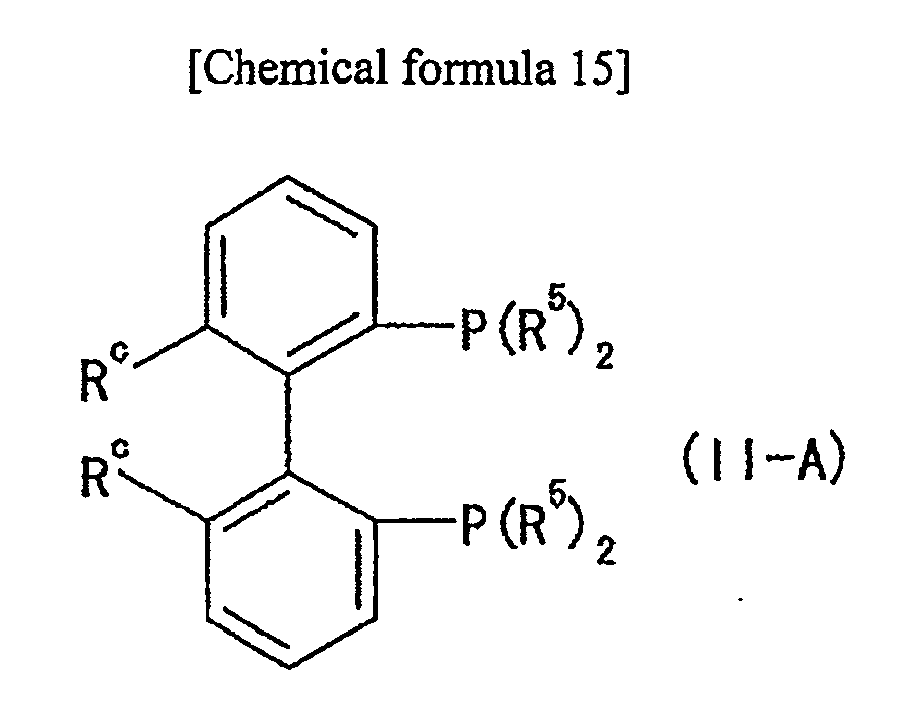
- (6) the method for producing an optically active aminoalcohol compound described in (5) above, wherein the optically active bidentate phosphine ligand represented by formula (II-A) is 2,2'-bis[bis(3,5-dimethylphenyl)phosphanyl]-6,6'-dimethyl-1,1'-biphenyl, or
- (7) the method for producing an optically active aminoalcohol compound described in any one of (2) to (6) above, wherein within the ruthenium compound represented by formula (I), the optically active diamine ligand is 1,1-bis(4-methoxyphenyl)-2-isopropyl-1,2-ethanediamine, 1,2-diphenyl-1,2-ethanediamine, or 1,2-diaminocyclohexane.
- The ruthenium compound according to the present invention is preferably:
- (8) a ruthenium compound represented by formula (I-A):
[Chemical formula 16] Ru(X)2(P8xx)[R1R2C(NH2)-R3R4C(NH2)] (I-A)
wherein X represents a halogen atom,
Paxx represents an optically active bidentate phosphine ligand represented by formula (II-A):
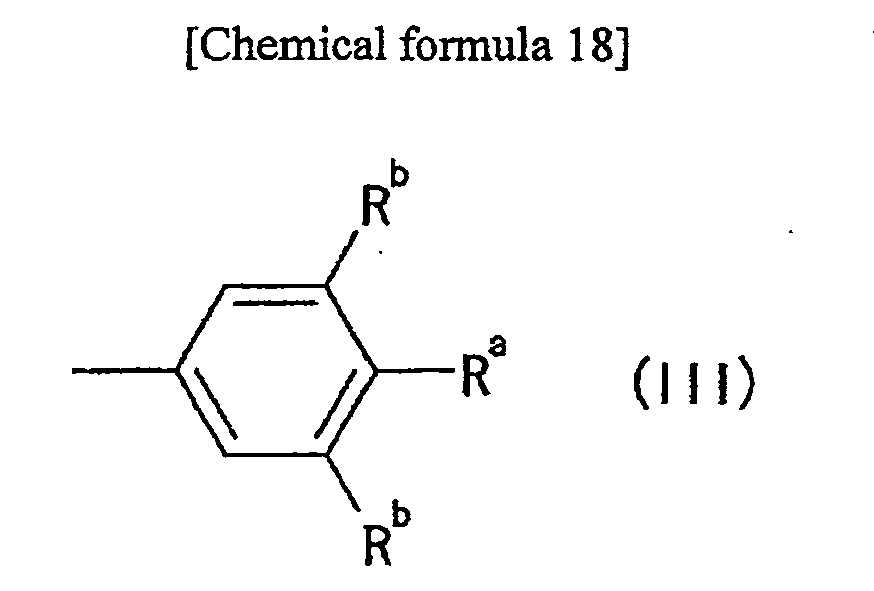
R1R2C(NH2)-R3R4C(NH2) represents an optically active diamine ligand, in which each of R1 to R4 independently represents a hydrogen atom, unsubstituted or substituted C1 to C20 alkyl group, unsubstituted or substituted C2 to C20 alkenyl group, unsubstituted or substituted C3 to C8 cycloalkyl group, unsubstituted or substituted C4 to C8 cycloalkenyl group, unsubstituted or substituted C6 to C18 aryl group, or unsubstituted or substituted C7 to C18 aralkyl group, and either of R1 and R2 may be bonded to either of R3 and R4 to form a ring, - (9) the ruthenium compound described in (8) above, wherein within the ruthenium compound represented by formula (I-A), the optically active bidentate phosphine ligand represented by formula (II-A) is 2,2'-bis[bis(3,5-dimethylphenyl)phosphanyl]-6,6'-dimethyl-1,1'-biphenyl, or
- (10) the ruthenium compound described in (8) or (9) above, wherein within the ruthenium compound represented by formula (I-A), the optically active diamine ligand is 1,1-bis(4-methoxyphenyl)-2-isopropyl-1,2-ethanediamine, 1,2-diphenyl-1,2-ethanediamine, or 1,2-diaminocyclohexane.
- As illustrated in the examples below, the ruthenium compound of the present invention enables an optically active aminoalcohol compound to be produced from an α-aminoketone compound with high stereoselectivity and high yield.
- The compound represented by formula (I) according to the present invention is described below in detail.
In formula (I):
[Chemical formula 19] Ru(X)2(Pxx)[R1R2C(NH2)-R3R4C(NH2)] (I)
X represents a "halogen atom" such as a fluorine, chlorine, bromine or iodine atom.
Pxx represents an optically active bidentate phosphine ligand represented by formula (II).
[Chemical formula 20] P(R6)2-A-P(R5)2 (II)
- In formula (II), R5 represents a phenyl group that has substituents, represented by formula (III) below.

- In formula (II), A represents a divalent organic group. The divalent organic group is a general description that represents all divalent functional groups containing 2 to 60 carbon atoms, which may also include from 1 to 30 hetero atoms selected independently from among oxygen, nitrogen and sulfur. Examples of the divalent organic group include C1 to C8 alkyl groups, divalent organic groups formed from a C6 to C18 aryl group such as a biphenyl group or binaphthalenyl group, and divalent organic groups formed from a hetero ring such as pyrrolidine or a bipyridinyl group. Further, ferrocene, which has two cyclopentadienyl anion ligands bonded above and below an iron (II) ion, can also be used as the divalent organic group. These divalent organic groups may also have additional substituents.
The "C1 to C8 alkylene groups" include methylene, ethylene and trimethylene and the like. - Examples of the substituents mentioned above include the following.
The "halogen atoms" refer to fluorine, chlorine, bromine and iodine atoms and the like.
The "C1 to C6 alkyl groups" include methyl, ethyl, n-propyl, isopropyl, n-butyl, sec-butyl, t-butyl, n-pentyl, isopentyl, neopentyl, t-pentyl and hexyl groups and the like.
The "C1 to C6 alkoxy groups" include methoxy, ethoxy, n-propoxy, isopropoxy, n-butoxy, sec-butoxy and t-butoxy groups and the like.
The "C6 to C18 aryl groups" include both monocyclic and polycyclic C6 to C18 aryl groups, and in the case of the polycyclic aryl groups, include not only fully unsaturated groups, but also partially saturated groups. Specific examples include phenyl, naphthyl, azulenyl, indenyl, indanyl and tetralinyl groups and the like. A C6 to C10 aryl group is preferred. - Specific examples of the optically active bidentate phosphine ligand include phosphine ligands represented by general formula (II-B):


R5 is preferably a 3,5-dimethylphenyl group. - Furthermore, examples of other ligands besides those represented by general formula (II-B) include phosphine ligands represented by general formula (II-C):


- Furthermore, more examples of other ligands besides those represented by general formula (II-C) include phosphine ligands represented by general formula (II-D):

- Furthermore, yet more examples of other ligands besides those represented by general formula (II-D) include phosphine ligands represented by general formula (II-E):


Specific examples include (4,4',6,6'-tetramethyl-5,5'-dimethoxybiphenyl-2,2'-diyl)-bis(bis(3,5-dimethylphenyl)phosphine), (4,4',6,6'-tetratrifluoromethylbiphenyl-2,2'-diyl)-bis(bis(3,5-dimethylphenyl)phosphine), (4,6- ditrifluoromethyl-4',6'-dimethyl-5'-methoxybiphenyl-2,2'-diyl)-bis(bis(3,5-dimethylphenyl)phosphine), and (4,4',5,5',6,6'-tetrahexamethoxybiphenyl-2,2'-diyl)-bis(bis(3,5-dimethylphenyl)phosphine). - Furthermore, a phosphine ligand represented by formula (II-A) is preferred:

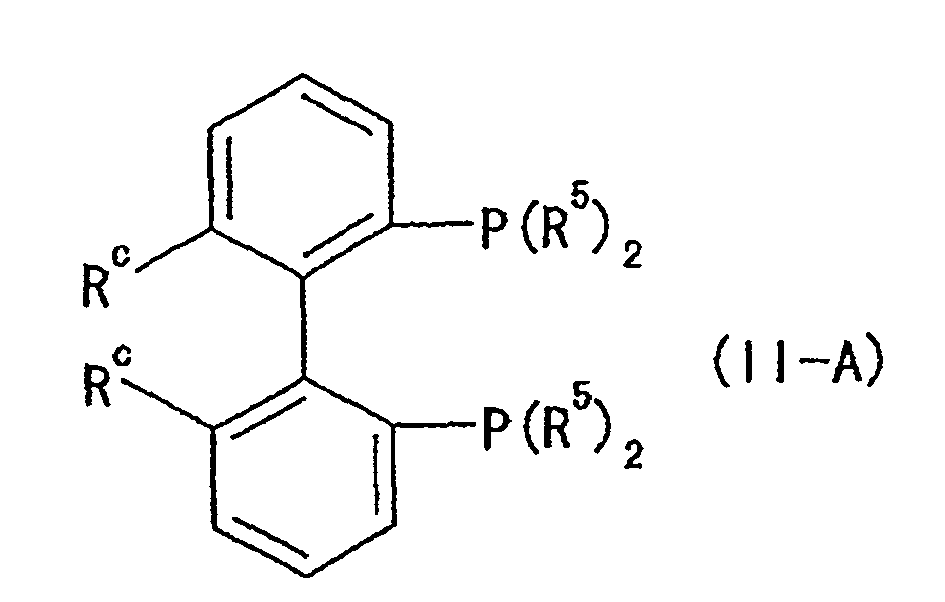
Specific examples include 2,2'-bis[bis(3,5-dimethylphenyl)phosphanyl]-6,6'-dimethyl-1,1'-biphenyl, 2,2'-bis[bis(3,5-dimethylphenyl)phosphanyl]-6,6'-dimethoxy-1,1'-biphenyl, and 2,2'-bis[bis(3,5-dimethylphenyl)phosphanyl]-6,6'-dichloro-1,1'-biphenyl. - Furthermore, yet more examples of other ligands besides those represented by general formula (II-A) include optically active bidentate phosphine ligands represented by general formula (II-F):


A specific example is 1',2-bis[bis(3,5-dimethylphenyl)phosphino]-ferrocenylethane. - Furthermore, yet more examples of other ligands besides those represented by general formula (II-F) include optically active bidentate phosphine ligands represented by general formula (II-G):

Specific examples include 2,3-bis(bis(3,5-dimethylphenyl)phosphino)butane, 1,2-bis(bis(3,5-dimethylphenyl)phosphino)propane, 5,6-bis(bis(3,5-dimethylphenyl)phosphino)-2-norbomene, 1-benzoyl-3,4-bis(bis(3,5-dimethylphenyl)phosphino)pyrrolidine, 2,4-bis(bis(3,5-dimethylphenyl)phosphino)pentane, and 2,3-o-isopropylidene-2,3-dihydroxy-1,4-bis(bis(3,5-dimethylphenyl)phosphino)butane. - Moreover, examples of other optically active bidentate phosphine ligands that can be used include (4,4',6,6'-tetramethyl-2,2'-biphenylene)-bis(bis(3,5-dimethylphenyl)phosphine), (3,3',6,6-tetramethyl-2,2'-biphenylene)-bis(bis(3,5-dimethylphenyl)phosphine), (4,4'-difluoro-6,6'-dimethyl-2,2'-biphenylene)-bis(bis(3,5-dimethylphenyl)phosphine), (4,4'-bis(dimethylamino)-6,6'-dimethyl-2,2'-biphenylene)-bis(bis(3,5-dimethylphenyl)phosphine), 1,11-bis(bis(3,5-dimethylphenyl)phosphino)-5,7-dihydrobenzo[c,e]oxepin, and 7,7'-bis[bis(3,5-dimethylphenyl)phosphino]-3,3',4,4'-tetrahydro-4,4'-dimethyl-8,8'-bis(2H-1,4-benzoxazine). Further, ligands such as (5,5',6,6'-tetramethoxybiphenyl-2,2'-diyl)-bis(bis(3,5-dimethylphenyl)phosphine) may also be used.
- Yet more examples include 1-tert-butoxycarbonyl-4-(bis(3,5-dimethylphenyl)phosphino)-2-(bis(3,5-dimethylphenyl)phosphino)methylpyrrolidine, 2,2',6,6'-tetramethoxy-4,4'-bis[bis(3,5-dimethylphenyl)phosphino]-3,3'-bipyridine, 7,7'-bis[bis(3,5-dimethylphenyl)phosphino]-2,2',3,3'-tehahydro-1,1'-spirobiindane, 1-(2-[bis(3,5-dimethylphenyl)phosphino]ferrocenyl)ethyl-bis-(3,5-dimethylphenyl)phosphine, and 4,12-bis[bis(3,5-dimethylphenyl)phosphino]-[2.2]-paracyclophane.
- In formula (I), R1R2C(NH2)-R3R4C(NH2) represents an optically active diamine ligand. In this ligand, each of R1 to R4 independently represents a hydrogen atom, unsubstituted or substituted C1 to C20 alkyl group, unsubstituted or substituted C2 to C20 alkenyl group, unsubstituted or substituted C3 to C8 cycloalkyl group, unsubstituted or substituted C4 to C8 cycloalkenyl group, unsubstituted or substituted C6 to C18 aryl group, or unsubstituted or substituted C7 to C18 aralkyl group, and either of R1 and R2 may be bonded to either of R3 and R4 to form a ring.
- The "C1 to C20 alkyl group" of the "unsubstituted or substituted C1 to C20 alkyl group" includes methyl, ethyl, n-propyl, isopropyl, n-butyl, sec-butyl, t-butyl, n-pentyl, isopentyl, neopentyl, t-pentyl, hexyl, heptyl, octyl, nonyl, decyl and dodecyl and the like. A C1 to C6 alkyl group is preferred.
- The "C2 to C20 alkenyl group" of the "unsubstituted or substituted C2 to C20 alkenyl group" includes ethenyl, n-propenyl, isopropenyl, n-butenyl, sec-butenyl, t-butenyl, 1,3-butadienyl, n-pentenyl, 2-pentenyl, 3-pentenyl, 2-hexenyl, 2-decenyl and 2-dodecenyl and the like. A C2 to C6 alkenyl group is preferred.
- The "C3 to C8 cycloalkyl group" of the "unsubstituted or substituted C3 to C8 cycloalkyl group" describes an alkyl group having a cyclic portion, and includes cyclopropyl, cyclobutyl, cyclopentyl, cyclohexyl, cyclopropylmethyl, cyclopentylethyl and cyclohexylmethyl and the like.
- The "C4 to C6 cycloalkenyl group" of the "unsubstituted or substituted C4 to C6 cycloalkenyl group" describes an alkenyl group having a cyclic portion, and includes 2-cyclobutenyl, 2-cyclohexenyl and 2-cyclopentenylmethyl and the like.
- The "C6 to C18 aryl group" of the "unsubstituted or substituted C6 to C18 aryl group" is a monocyclic or polycyclic C6 to C 18 aryl group, and in the case of polycyclic aryl groups, includes not only fully unsaturated groups, but also partially saturated groups. Examples include phenyl, naphthyl, azulenyl, indenyl, indanyl and tatralinyl and the like. A C6 to C 10 aryl group is preferred.
- The "C7 to C18 aralkyl group" of the "unsubstituted or substituted C7 to C18 aralkyl group" describes a group composed of an aryl group bonded to an alkyl group, and includes benzyl, phenethyl, phenylpropyl, phenylbutyl, phenylhexyl and naphthylmethyl and the like. A C6 to C10 aryl C1 to C6 alkyl group is preferred.
- There are no particular limitations on the "substituent" relating to the "unsubstituted or substituted", and any substituent that is chemically permissible may be used. Examples include halogen atoms such as a fluorine atom, chlorine atom, bromine atom and iodine atom; C1 to C6 alkyl groups such as a methyl group, ethyl group, n-propyl group and i-propyl group; C2 to C6 alkenyl groups such as a vinyl group, 1-propenyl group, 2-propenyl group, 1-butenyl group, 2-butenyl group, 3-butenyl group, 1-methyl-2-propenyl group, 2-methyl-2-propenyl group, 1-pentenyl group, 2-pentenyl group, 4-hexenyl group and 5-hexenyl group; C2 to C6 alkynyl groups such as an ethynyl group, 1-propynyl group, 2-propynyl group, 1-butynyl group, 2-butynyl group, 3-butynyl group, 1-methyl-2-propynyl group, 2-methyl-3-butynyl group, 1-pentynyl group, 2-pentynyl group, 1-hexynyl group and 1,1-dimethyl-2-butynyl group; C1 to C6 alkoxy groups such as a methoxy group, ethoxy group and n-propoxy group; a nitro group; a cyano group; unsubstituted or substituted amino groups such as an amino group, methylamino group and dimethylamino group; unsubstituted or substituted aryl groups such as a phenyl group, p-trifluoromethylphenyl group and p-methoxyphenyl group; unsubstituted or substituted heterocyclic groups such as a 2-pyridyl group, 3-pyridyl group, 4-pyridyl group, 5-(2-chloro)pyridyl group and 6-(2-amino)pyridyl group; alkoxycarbonyl groups such as a methoxycarbonyl group, ethoxycarbonyl group, n-butoxycarbonyl group and t-butoxycarbonyl group; acyl groups such as an acetyl group and pivaloyl group; and a carboxyl group.
- There are no particular limitations on the ring referred to "either of R1 and R2 may be bonded to either of R3 and R4 to form a ring", and any chemically permissible ring is possible. The ring is preferably a C5 to C8 hydrocarbon ring, and examples include cyclopentane-1,2-diyl, cyclohexane-1,2-diyl and 4-cyclohexene-1,2-diyl and the like.
- In the diamine ligand, at least one of the carbon atoms C within R1R2C(NH2)-R3R4C(NH2) is preferably optically active.
Specific examples of the diamine ligand include compounds formed with the combinations of substituents listed in the table below, although this is not limited thereto. In the table, the abbreviated symbols have the meanings shown below.
Ph: phenyl, c-Pr: cyclopropyl, c-He: cyclohexyl -
[Table 1] No. R1 R2 R3 R4 1 H H H H 2 H H H CH3 3 H H H Ph 4 H H H CH2=CH 5 H H H 4-CH30-Ph 6 H H H c-He 7 H H H 2-c-Hexenyl 8 H H H PhCH2 9 H H H n-C6H13 10 H H CH3 CH3 11 H H Ph Ph 12 H H 4-CH30-Ph 4-CH30-Ph 13 H H 4-CH3-Ph 4-CH3-Ph 14 H H c-He c-He 15 H H PhCH2 PhCH2 16 H H n-C6H13 n-C6H13 17 H H CH2=CH CH2=CH 18 H H 2-c-Hexenyl 2-c-Hexenyl 19 H H PhCH2 PhCH2 20 H CH3 H CH3 21 H Ph H Ph 22 H 4-CH30-Ph H 4-CH30-Ph 23 H 4-CH3-Ph H 4-CH3-Ph 24 H c-He H c-He 26 H CH2=CH H CH2=CH 26 H CH2=CHCH2 H CH2=CHCH2 27 H c-Pr H c-Pr 28 H c-He H c-He 29 H 2-c-Hexenyl H 2-c-Hexenyl 30 H CH3 H Ph 31 H CH3 CH3 CH3 32 H Ph Ph Ph 33 H PhCH2 PhCH2 PhCH2 34 H 4-CH30-Ph 4-CH30-Ph 4-CH30-Ph 35 H CH2=CH CH2=CH CH2=CH 36 H c-He c-He c-He [Table 2] No. R1 R2 R3 R4 37 H 2-c-Hexenyl 2-c-Hexenyl 2-c-Hexenyl 38 H n-C6H13 n-C6H13 n-C6H13 39 H CH3 Ph Ph 40 H CH3 CH3 Ph 41 H n-C3H7 Ph Ph 42 H i-C3H7 4-CH30-Ph 4-CH30-Ph 43 H Ph Ph Ph 44 CH3 CH3 CH3 CH3 45 CH3 Ph CH3 CH3 46 CH3 4-CH30-Ph CH3 CH3 47 CH3 4-CH3-Ph CH3 CH3 48 CH3 c-He CH3 CH3 49 CH3 CH2=CH CH3 CH3 50 CH3 CH2=CHCH2 CH3 CH3 51 CH3 c-Pr CH3 CH3 52 CH3 c-He CH3 CH3 53 CH3 2-c-Hexenyl CH3 CH3 54 CH3 C2H5 CH3 C2H5 55 CH3 Ph CH3 Ph 56 CH3 4-CH30-Ph CH3 4-CH30-Ph 57 CH3 4-CH3-Ph CH3 4-CH3-Ph 58 CH3 c-He CH3 c-He 59 CH3 CH2=CH CH3 CH2=CH 60 CH3 CH2=CHCH2 CH3 CH2=CHCH2 61 CH3 c-Pr CH3 c-Pr 62 CH3 c-He CH3 c-He 63 CH3 2-c-Hexenyl CH3 2-c-Hexenyl 64 H CH2CH2CH2 H 65 H CH2CH2CH2CH2 H 66 H CH2CH2CH2CH2CH2 H 67 H CH2CH=CHCH2 H 68 H CH2CH2CH2 CH3 69 H CH2CH2CH2CH2 CH3 70 He CH2CH=CHCH2 CH3 - Of these compounds, compounds of formula (I) in which at least one of R1 to R4 is an unsubstituted or substituted phenyl group, such as 1,1-bis(4-methoxyphenyl)-2-isopropyl-1,2-ethanediamine and 1,2-diphenyl-1,2-ethanediamine, or compounds of formula (I) in which either of R1 and R2 is bonded to either of R3 and R4 to form an alkyl ring, such as 1,2-diaminocyclopentane and 1,2-diaminocyclohexane, are preferred.
- The ruthenium compound of formula (I) is preferably a compound represented by formula (I-A).
[Chemical formula 30] Ru(X)2(Paxx)[R1R2C(NH2)-R3R4C(NH2)] (I-A)
Paxx represents an optically active bidentate phosphine ligand represented by formula (II-A). X and R1R2C(NH2)-R3R4C(NH2) are the same as defined above. - Specific examples of the ruthenium compound of the present invention include {(S)-6,6'-bis[bis-(3,5-dimethylphenyl)-phosphanyl]-2,2'-dimethyl-biphenyl}ruthenium (II) dichloride (2S)-1,1-bis(4-methoxyphenyl)-2-isopropyl-1,2-ethanediamine, {(S)-6,6'-bis[bis-(3,5-dimethylphenyl)-phosphanyl]-2,2'-dimethyl-biphenyl}ruthenium (II) dichloride (1S,2S)-1,2-diphenyl-1,2-ethanediamine, and
{(S)-6,6'-bis[bis-(3,5-dimethylphenyl)-phosphanyl]-2,2'-dimethyl-biphenyl}ruthenium (II) dichloride (1S,2S)-1,2-diaminocyclohexane. - The ruthenium compound of the present invention can be produced by conventional methods (for example, see Patent Documents 2 and 3 above).
For example, the ruthenium compound may be produced using the method described below.
The starting material using in the method for producing the ruthenium compound may be a zero-valent, monovalent, divalent, trivalent, or higher valent ruthenium. Of these, the method that uses a divalent ruthenium complex disclosed in Angew. Chem. Int. Ed., 37, 1703 (1998) is particularly simple. In other words, a ruthenium compound represented by formula (I) can be produced by heating a solvent solution of a divalent ruthenium-halide complex and a bidentate phosphine ligand, and subsequently adding a diamine compound. - A method for producing the ruthenium compound using a divalent ruthenium-halide complex as a starting material is described below.
First, the divalent ruthenium-halide complex and the bidentate phosphine ligand of starting materials are heated and reacted within a solvent to obtain the corresponding phosphine-ruthenium-halide complex.
There are no particular limitations on the divalent ruthenium-halide complex used as a starting material, provided it is a ruthenium complex that has ligands that can be substitued with the bidentate phosphine ligand and the diamine ligand. Specific examples include diene-coordinated halogenated ruthenium compounds such as [ruthenium dichloride(norbomadiene)] polynuclear complex, [ruthenium dichloride(cyclooctadiene)] polynuclear complex and [bis(methylallyl)ruthenium(cyclooctadiene)]; and aromatic compound-coordinated halogenated ruthenium compounds such as [ruthenium dichloride(benzene)] dimer, [ruthenium dichloride(p-cymene)] dimer, [ruthenium dichloride(trimethylbenzene)] dimer and [ruthenium dichloride(hexamethylbenzene)] dimer.
The amount used of the bidentate phosphine ligand is typically within a range from 1 to 2 mols per 1 mol of the ruthenium-halide complex, and an equimolar amount is preferred. - Examples of solvents that can be used in this reaction include aromatic hydrocarbons such as toluene and xylene, aromatic hydrocarbons such as benzene, toluene and xylene; aliphatic hydrocarbons such as pentane and hexane; halogenated hydrocarbons such as dichloromethane, chloroform, trichloromethane, carbon tetrachloride and 1,2-dichloroethane; ethers such as diethyl ether, tetrahydrofuran (THF), 1,2-dimethoxyethane and 1,4-dioxane; alcohols such as methanol, ethanol, n-propanol, isopropanol, butanol and benzyl alcohol; amides such as N,N-dimethylformamide (DMF), N,N-dimethylacetamide, 1,3-dimethylimidazolidine, 1,3-dimethyl-2-imidazolidinone, N-methylpyrrolidone and hexamethylphosphortriamide (HMPT); nitriles such as acetonitrile and benzonitrile; and dimethylsulfoxide (DMSO). These solvents may be used individually, or two or more solvents may be used within a solvent mixture.
The amount used of the solvent is typically within a range from 1 to 100 ml per 1 g of the substrate, and is preferably within a range from 1 to 10 ml per 1 g of the substrate. The reaction temperature is typically within a range from 0 to 200°C, and is preferably within a range from room temperature to 100°C. - Subsequently, the obtained phosphine-ruthenium-halide complex and a diamine compound are reacted together to obtain the corresponding amine-phosphine-ruthenium-halide complex. The amount of the diamine compound used in this reaction is typically within a range from 1 to 2 mols per 1 mol of the phosphine-ruthenium-halide complex, and an equimolar amount is preferred. The reaction temperature is typically within a range from -100 to 200°C, and preferably from -10 to 50°C. Furthermore, the aminephosphine-ruthenium-halide complex can also be obtained by first isolating the phosphine-ruthenium-halide complex, and then reacting the diamine compound with the isolated complex under the same conditions as those described above.
- A ruthenium compound represented by formula (I) produced in the manner described above is useful as an asymmetric reduction catalyst for a carbonyl compound, and particularly for an α-aminoketone compound represented by formula (IV).
- The ruthenium compound described above can be used for performing an asymmetric reduction (hydrogenation) of a carbonyl compound to produce an optically active alcohol compound. The ruthenium compound is particularly ideal for performing an asymmetric reduction (hydrogenation) of an α-aminoketone compound to produce an optically active aminoalcohol compound such as an ephedrine compound.
The asymmetric reduction reaction is described below. - There are no particular limitations on the α-aminoketone compound used as the substrate for the asymmetric reduction reaction, provided it has a structure that is capable of undergoing an asymmetric reduction reaction. The α-aminoketone compound is preferably a compound represented by formula (IV):


- In formula (IV), the "C1 to C6 alkyl group" of the "unsubstituted or substituted C1 to C6 alkyl group" includes methyl, ethyl, n-propyl, isopropyl, n-butyl, sec-butyl, t-butyl, n-pentyl, isopentyl, neopentyl, t-pentyl and hexyl and the like.
- The "unsubstituted or substituted C6 to C18 aryl group" is a monocyclic or polycyclic aryl group, and in the case of a polycyclic aryl group, includes not only fully unsaturated groups, but also partially saturated groups. Examples include phenyl, naphthyl, azulenyl, indenyl, indanyl and tatralinyl and the like. A C6 to C10 aryl group is preferred.
R14 within the "R14CO- group or R14OCO- group" represents an unsubstituted or substituted C1 to C6 alkyl group, or unsubstituted or substituted C6 to C18 aryl group, and the "C1 to C6 alkyl group" and "C6 to C18 aryl group" include the same groups as those described above. - The "R14CO- group" includes C1 to C6 alkylcarbonyl groups such as acetyl, propionyl, butyryl and pivaloyl, as well as arylcarbonyl groups such as a benzoyl.
The "R14OCO- group" includes C1 to C6 alkyloxycarbonyl groups such as methyloxycarbonyl, ethyloxycarbonyl and hexyloxycarbonyl, as well as aryloxycarbonyl groups such as phenyloxycarbonyl and 1-naphthyloxycarbonyl.
The "substituent" relating to the "unsubstituted or substituted" includes the same groups as those listed above for the "substituent" relating to the "unsubstituted or substituted" used in relation to the ruthenium compound represented by formula (I). - The "R10 and R11, and R12 and R13, may be respectively bonded together to form a ring" includes those cases where R10 and R11 are bonded together to form a hydrocarbon ring such as an alkyl ring or an alkenyl ring, and/or those cases where R12 and R13 are bonded together to form a hetero ring such as a nitrogen-containing hydrocarbon ring.
- The α-aminoketone compound that functions as the substrate is subjected to an asymmetric reduction in the presence of the ruthenium compound represented by formula (I), with a base added if desired, in the presence of a predetermined pressure of hydrogen gas or a hydrogen donor.
Further, in the present invention, the asymmetric reduction reaction may also be performed in situ, by first producing the ruthenium compound, either by adding the ruthenium complex (or ruthenium salt) that acts as the starting material for the ruthenium compound, a phosphorus compound, and a diamine compound separately to the reaction system, or by adding a ruthenium complex (or ruthenium salt) having a phosphine ligand and a diamine compound separately to the reaction system, if necessary together with an added base, and subsequently adding the substrate to the reaction system without isolating the ruthenium compound from the reaction system. - Although the amount used of the ruthenium compound represented by formula (I) that acts as a catalyst varies depending on the size of the reaction container and the catalytic activity, the amount is typically within a range from 1/50 to 1/2,000,000 mol, and preferably 1/500 to 1/500,000 mol per 1 mol of the α-aminoketone compound that functions as the reaction substrate.
- Examples of the base used include organic bases such as triethylamine, diisopropylethylamine, pyridine, DABCO and DBU; metal alkoxides such as sodium methoxide, sodium ethoxide, potassium t-butoxide, magnesium methoxide and magnesium ethoxide; organolithium compounds such as n-butyl lithium; lithium amides such as LDA and lithium bistrimethylsilylamide; alkali metal hydroxides such as lithium hydroxide, sodium hydroxide and potassium hydroxide; alkaline earth metal hydroxides such as magnesium hydroxide and calcium hydroxide; alkali metal carbonates such as sodium carbonate and potassium carbonate; alkali metal hydrogen carbonates such as sodium hydrogen carbonate and potassium hydrogen carbonate; alkaline earth metal carbonates such as magnesium carbonate and calcium carbonate; and metal hydrides such as sodium hydride and calcium hydride.
The amount of base added is typically within a range from 2 to 500,000 mols,and preferably from 2 to 5,000 mols per 1 mol of the ruthenium compound. - There are no particular limitations on the solvent, provided it is capable of dissolving the substrate and the catalyst. Specific examples include alcohols such as methanol, ethanol, n-propanol, isopropanol, butanol and benzyl alcohol; aromatic hydrocarbons such as benzene, toluene and xylene; aliphatic hydrocarbons such as pentane and hexane; halogenated hydrocarbons such as dichloromethane, chloroform, trichloromethane, carbon tetrachloride and 1,2-dichloroethane; ethers such as diethyl ether, THF, 1,2-dimethoxyethane and 1,4-dioxane; amides such as DMF, N,N-dimethylacetamide, 1,3-dimethylimidazolidine, 1,3-dimethyl-2-imidazolidinone, N-methylpyrrolidone and HMPT; nitriles such as acetonitrile and benzonitrile; and DMSO. These solvents may be used individually, or two or more solvents may be used within a solvent mixture. Of these solvents, because the reaction product is an alcohol, the use of an alcohol solvent is preferred.
The amount used of the solvent varies depending on the solubility of the α-aminoketone compound and economic factors, and depending on the individual situation, the reaction may proceed either with no solvent, or in a state equivalent to very high dilution conditions. The amount of the solvent is usually within a range from 0.1 to 10,000 parts by weight, and preferably from 20 to 1,000 parts by weight, per 100 parts by weight of the α-aminoketone compound. - The hydrogen pressure is typically within a range from 1 to 200 atmospheres, and is preferably from 3 to 50 atmospheres. A hydrogen donor such as a hydrogen storage alloy or diimide may also be used, and the amount used is typically within a range from to 100 equivalents relative to the α-aminoketone compound. The reaction temperature is typically within a range from -50 to 100°C, and preferably from 25 to 40°C. Further, although the reaction time varies depending on the reaction conditions such as the concentration of the reaction substrate, the temperature and the pressure, the time is typically within a range from several minutes to several days. There are no particular limitations on the reaction type, and for example, either a batch reaction or continuous reaction type may be used.
- Following completion of the reaction, typical organic synthetic chemistry techniques can be used to isolate and purify the target product. The structure of the target product can be determined using conventional techniques such as 1H-NMR, optical rotation measurements, liquid chromatography and gas chromatography.
- The present invention is described below in further detail based on examples, although the present invention is not limited to these examples. The apparatus used for measurement of the physical properties in each of the examples are listed below.
- (1) JMTC-300 (300 MHz, manufactured by JEOL, Ltd.)
- (2) Measurement of optical rotation: Polarimeter JASCO DIP-360 (manufactured by JASCO Corporation)
- (3) High-performance liquid chromatography: LC-10 Advp, SPD-10 Avp (manufactured by Shimadzu Corporation)
- Synthesis of {(S)-6,6'-bis[bis-(3,5-dimethylphenyl)-phosphanyl]-2,2'-dimethylbiphenyl} ruthenium (II) dichloride (2S)-1,1-bis(4-methoxyphenyl)-2-isopropyl-1,2-ethanediamine complex
A Schlenk tube was charged with deaerated dichloromethane (3 ml), {(S)-6,6'-bis[bis-(3,5-dimethylphenyl)-phosphanyl]-2,2'-dimethyl-biphenyl}ruthenium (II) dichloride DMF adduct (147 mg, 150 µmol) and (2S)-1,1-bis(4-methoxyphenyl)-2-isopropylethane-1,2-diamine (52 mg, 165 µmol), the resulting solution was stirred for 3 hours at room temperature, and the solvent was then removed. The reaction product was purified using a silica gel short column (eluent: diethyl ether) to obtain the target product (128 mg, 74%).
31P-NMR (CDCl3) d 43.4 (d, JP-P = 35.9 Hz), 46.6 (d, JP-P = 35.9 Hz)
[a]D 29 = -175°C (c = 1.01, CHCl3) - With the exception of using (1S,2S)-1,2-diphenyl-1,2-ethanediamine instead of (2S)-1,1-bis(4-methoxyphenyl)-2-isopropylethane-1,2-diamine, the same method as Example 1-1 was used to react {(S)-6,6'-bis[bis-(3,5-dimethylphenyl)-phosphanyl]-2,2'-dimethyl-biphenyl}ruthenium (II) dichloride DMF adduct (91.8 mg, 94 µmol) and (1S,2S)-1,2-diphenyl-1,2-ethanediamine (22 mg, 104 µmmol) to obtain the target product (71.2 mg, 72%).
31P-NMR (CDCl3) d 44.8
[a]D 29 = -143°C (c = 1.01, CHCl3) - Under an Ar atmosphere, a 100 ml autoclave was charged with 1-phenyl-2-(N-methyl-N-benzoyl)aminopropan-1-one (534 mg, 2 mmol), {(S)-6,6'-bis[bis-(3,5-dimethylphenyl)-phosphanyl]-2,2'-dimethyl-biphenyl}mthenium (II) dichloride DMF adduct (2 mg, 2 µmol, S/C = 1,000), (2S)-1,1-bis(4-methoxyphenyl)-2-isopropylethane-1,2-diamine (0.8 mg, 2.5 µmol) and 2-propanol (2 ml), the resulting solution was stirred for 30 minutes, tBuOK (1M 2-propanol solution, 60 µl, 60 µmol) was added, and hydrogen was introduced to raise the pressure to 1 MPa. Following the resulting solution was stirred for 16 hours at 25°C, the reaction mixture was concentrated, and 1H-NMR measurement of the crude product revealed that the starting materials had been completely consumed, and that the obtained (1S,2S)-1-phenyl-2-(N-methyl-N-benzoylamino)-1-propanol had a diastereomeric ratio of syn:anti > 20:1 (the signal for the anti isomer was not observed). The crude product was purified by silica gel column chromatography (eluent: hexane/ethyl acetate = 1/1, 1/2), yielding 509 mg (95%) of the target compound. The enantiomeric excess was determined by HPLC (column: Daicel CHIRALPAK OJ-H), and was >99%ee.
- With the exception of setting S/C = 10,000, the target product was obtained in the same manner as Example 2-1.
S/C: 10,000
Initial hydrogen pressure: 6 MPa
Reaction time: 16 hours
Conversion rate: 100%
syn:anti: >20:1
Enantiomeric excess: 99%ee - With the exception of using (1 S,2S)-1,2-diphenyl-1,2-ethanediamine instead of (2S)-1,1-bis(4-methoxyphenyl)-2-isopropylethane-1,2-diamine, the target product was obtained in the same manner as Example 2-1.
S/C: 1,000
Initial hydrogen pressure: 1 MPa
Reaction time: 16 hours
Conversion rate: 100%
syn:anti: >20:1
Enantiomeric excess: 95%ee - Under an Ar atmosphere, a 100 ml autoclave was charged with 1-phenyl-2-(N-methyl-N-benzoyl)aminopropan-1-one (534 mg, 2 mmol), {(S)-6,6'-bis[bis-(3,5-dimethylphenyl)-phosphanyl]-2,2'-dimethyl-biphenyl}ruthenium (II) dichloride (2S)-1,1-bis(4-methoxyphenyl)-2-isopropyl-1,2-ethanediamine complex (2 mg, 2 µmol, S/C = 1,000), 2-propanol (2 ml) and tBuOK (1M 2-propanol solution, 60 µl, 60 µmol), hydrogen was introduced to raise the pressure to 1 MPa, and the solution was stirred for 16 hours at 25°C. Purification and analysis of the target product was performed using the same methods as those described in Example 2-1 (isolated yield: 99%).
Conversion rate: 100% syn:anti: >20:1
Enantiomeric excess: >99%ee - With the exception of using {(S)-6,6'-bis[bis-(3,5-dimethylphenyl)-phosphanyl]-2,2'-dimethyl-biphenyl}ruthenium (II) dichloride (1S,2S)-1,2-diphenyl-1,2-ethanediamine complex as the Ru complex, the target product was obtained in the same manner as Example 2-1.
Conversion rate: 100%
syn:anti: >20:1
Enantiomeric excess: 95%ee - With the exception of using {(S)-6,6'-bis[bis-(3,5-dimethylphenyl)-phosphanyl]-2,2'-dimethyl-biphenyl}ruthenium (II) dichloride (1S,2S)-1,2-diphenyl-1,2-ethanediamine complex as the Ru complex, the target product was obtained in the same manner as Example 2-4 (isolated yield: 98%).
S/C: 1,000
Conversion rate: 100%
syn:anti: >20:1 (NMR)
Enantiomeric excess: 95%ee - With the exception of using (S)-1,1'-binaphthyl-2,2'-bis-[di-(3,5-xylyl)]phosphine ruthenium (II) dichloride (2S)-1,1-bis(4-methoxyphenyl)-2-isopropyl-1,2-ethanediamine complex, the target product was obtained in the same manner as Example 2-4.
((S)-1,1'-binaphthyl-2,2'-bis-[di-(3,5-xylyl)]phosphine is abbreviated as (S)-Xyl BINAP)
S/C: 1,000
Initial hydrogen pressure: 1.2 MPa
Reaction time: 16 hours
Conversion rate: 100%
syn:anti: >99:1 (HPLC)
Enantiomeric excess: >99%ee - With the exception of using (S)-1,1'-binaphthyl-2,2'-bis-[di-(3,5-xylyl)]phosphine ruthenium (II) dichloride (1S,2S)-1,2-diphenyl-1,2-ethanediamine complex, the target product was obtained in the same manner as Example 2-4 (isolated yield: 94%).
S/C: 1,000
Initial hydrogen pressure: 1.2 MPa
Reaction time: 16 hours
Conversion rate: 100%
syn:anti: >99:1 (HPLC)
Enantiomeric excess: 98%ee - With the exceptions of setting S/C = 5,000, and using (S)-6,6'-dimethyl-1,1'-binaphthyl-2,2'-bis-[di-(3,5-xylyl)]phosphine ruthenium (II) dichloride (2S)-1,1-bis(4-methoxyphenyl)-2-isopropyl-1,2-ethanediamine complex, the target product was obtained in the same manner as Example 2-4.
S/C: 5,000
Initial hydrogen pressure: 1.2 MPa
Reaction time: 1.5 hours
Conversion rate; 100%
syn:anti: >99:1 (HPLC)
Enantiomeric excess: >99%ee - With the exception of using (S)-4,4'-bi-1,3-benzodioxole-5,5'-diyl-bis-[di(3,5-xylyl)phosphine]ruthenium (II) dichloride (2S)-1,1-bis(4-methoxyphenyl)-2-isopropyl-1,2-ethanediamine complex, the target product was obtained in the same manner as Example 2-4.
((S)-4,4'-bi-1,3-benzodioxole-5,5'-diyl-bis-[di(3,5-xylyl)phosphine] is abbreviated as (S)-Xyl SEGPHOS)
S/C: 1,000
Initial hydrogen pressure: 1 MPa
Reaction time: 16 hours
Conversion rate: 100%
syn:anti: >20:1 (NMR)
Enantiomeric excess: >99%ee
[Chemical formula 4] R1CH(NH2)CH2(NR2R3) (4)
R1CH(NR2R3)CH2(NH2) (5)
wherein R1 represents a C1 to C20 alkyl group that may have a substituent, C2 to C20 alkenyl group that may have a substituent, C3 to C8 cycloalkyl group that may have a substituent, C7 to C20 aralkyl group that may have a substituent, aryl group that may have a substituent, or heterocyclic group, each of R2 and R3 independently represents a hydrogen atom, C1 to C20 alkyl group that may have a substituent, C2 to C20 alkenyl group that may have a substituent, C3 to C8 cycloalkyl group that may have a substituent, or C7 to C20 aralkyl group that may have a substituent, and R2 and R3 may be bonded together to form a ring, provided that R2 and R3 are not both hydrogen atoms (see Patent Document 4).
Claims (9)
- A method for producing an optically active aminoalcohol compound, said method comprising performing a hydrogenation, in presence of a ruthenium compound represented by a formula (I):
[Chemical formula 1] RuX)2(Pxx)[R1R2C(NH2)-R3R4C(NH2)] (I)
wherein X represents a halogen atom,
Pxx represents an optically active bidentate phosphine ligand represented by a formula (II):
[Chemical formula 2] P(R5)2-A-P(R5)2 (II)
wherein R5 represents a phenyl group that has substituents, represented by a formula (III):
and A represents a divalent organic group, and
R1R2C(NH2)-R3R4C(NH2) represents an optically active diamine ligand, in which each of R1 to R4 independently represents a hydrogen atom, unsubstituted or substituted C1 to C20 alkyl group, unsubstituted or substituted C2 to C20 alkenyl group, unsubstituted or substituted C3 to C8 cycloalkyl group, unsubstituted or substituted C4 to C8 cycloalkenyl group, unsubstituted or substituted C6 to C18 aryl group, or unsubstituted or substituted C7 to C18 aralkyl group, and either of R1 and R2 may be bonded to either of R3 and R4 to form a ring,
of an α-aminoketone compound represented by a formula (IV):
- The method for producing an optically active aminoalcohol compound according to claim 1, wherein R10 in said formula (IV) is an unsubstituted or substituted phenyl group.
- The method for producing an optically active aminoalcohol compound according to claim 1 or 2, wherein within said ruthenium compound represented by said formula (I), said optically active bidentate phosphine ligand represented by said formula (II) is any one of:an optically active bidentate phosphine ligand represented by a formula (II-B):
 an optically active bidentate phosphine ligand represented by a formula (II-C):
 an optically active bidentate phosphine ligand represented by a formula (II-D):
 an optically active bidentate phosphine ligand represented by a formula (II-E):
 an optically active bidentate phosphine ligand represented by a formula (II-F):
 an optically active bidentate phosphine ligand represented by a formula (II-G):
- The method for producing an optically active aminoalcohol compound according to claim 1 or 2, wherein within said ruthenium compound represented by said formula (I), said optically active bidentate phosphine ligand represented by said formula (II) is an optically active bidentate phosphine ligand represented by a formula (II-A):

- The method for producing an optically active aminoalcohol compound according to claim 4, wherein said optically active bidentate phosphine ligand represented by said formula (II-A) is 2,2'-bis[bis(3,5-dimethylphenyl)phosphanyl]-6,6'-dimethyl-1, I'-biphenyl.
- The method for producing an optically active aminoalcohol compound according to any one of claims 1 to 5, wherein within said ruthenium compound represented by said formula (I), said optically active diamine ligand is 1,1-bis(4-methoxyphenyl)-2-isopropyl-1,2-ethanediamine, 1,2-diphenyl-1,2-ethanediamine, or 1,2-diaminocyclohexane.
- A ruthenium compound represented by a formula (I-A):
[Chemical formula 12] Ru(X)2(Paxx)[R1R2C(NH2)-R3R4C(NH2)] (I-A)
wherein X represents a halogen atom,
P8xx represents an optically active bidentate phosphine ligand represented by a formula (II-A):

- The ruthenium compound according to claim 7, wherein within said ruthenium compound represented by said formula (I-A), said optically active bidentate phosphine ligand represented by said formula (II-A) is 2,2'-bis[bis(3,5-dimethylphenyl)-phosphanyl]-6,6'-dimethyl-1,1'-biphenyl.
- The ruthenium compound according to claim 7 or 8, wherein within said ruthenium compound represented by said formula (I-A), said optically active diamine ligand is 1,1-bis(4-methoxyphenyl)-2-isopropyl-1,2-ethanediamine, 1,2-diphenyl-1,2-ethanediamine, or 1,2-diaminocyclohexane.
Applications Claiming Priority (2)
| Application Number | Priority Date | Filing Date | Title |
|---|---|---|---|
| JP2008099267 | 2008-04-07 | ||
| PCT/JP2009/001569 WO2009125565A1 (en) | 2008-04-07 | 2009-04-03 | Ruthenium compound and method for producing optically active aminoalcohol compound |
Publications (3)
| Publication Number | Publication Date |
|---|---|
| EP2264000A1 true EP2264000A1 (en) | 2010-12-22 |
| EP2264000A4 EP2264000A4 (en) | 2011-11-23 |
| EP2264000B1 EP2264000B1 (en) | 2016-05-11 |
Family
ID=41161702
Family Applications (1)
| Application Number | Title | Priority Date | Filing Date |
|---|---|---|---|
| EP09730145.1A Active EP2264000B1 (en) | 2008-04-07 | 2009-04-03 | Method for producing optically active aminoalcohol compound using ruthenium compound |
Country Status (6)
| Country | Link |
|---|---|
| US (1) | US8207379B2 (en) |
| EP (1) | EP2264000B1 (en) |
| JP (1) | JP5276093B2 (en) |
| KR (1) | KR101243408B1 (en) |
| CN (1) | CN101983186B (en) |
| WO (1) | WO2009125565A1 (en) |
Cited By (1)
| Publication number | Priority date | Publication date | Assignee | Title |
|---|---|---|---|---|
| WO2017102507A1 (en) | 2015-12-17 | 2017-06-22 | L'oreal | Water-in-oil emulsion with moisturizing effect containing hydrophobic coated pigments and an aqueous phase at high content |
Families Citing this family (5)
| Publication number | Priority date | Publication date | Assignee | Title |
|---|---|---|---|---|
| CN101796050B (en) * | 2007-09-06 | 2015-08-12 | 日本曹达株式会社 | The manufacture method of optical activity 3-quinuclidinol derivatives |
| CN102951981A (en) * | 2011-08-22 | 2013-03-06 | 上海交通大学 | Asymmetric hydrogenation method for ketone compound |
| CN105085372B (en) * | 2014-05-12 | 2018-11-16 | 上海交通大学 | The preparation method of chiral gamma-amino alcohol compound |
| WO2020096976A1 (en) | 2018-11-08 | 2020-05-14 | Entegris, Inc. | Chemical vapor deposition processes using ruthenium precursor and reducing gas |
| CN115160162B (en) * | 2022-07-11 | 2023-11-28 | 南方科技大学 | Asymmetric hydrogenation method of alpha-amino beta-keto ester |
Family Cites Families (11)
| Publication number | Priority date | Publication date | Assignee | Title |
|---|---|---|---|---|
| JP3040353B2 (en) | 1996-10-25 | 2000-05-15 | 科学技術振興事業団 | Ruthenium-diamine complex and method for producing optically active alcohols using the same as a catalyst |
| JP4004123B2 (en) | 1997-12-26 | 2007-11-07 | 独立行政法人科学技術振興機構 | Method for producing alcohol compound using ruthenium complex as catalyst |
| US6410749B1 (en) * | 1999-01-18 | 2002-06-25 | Nippon Soda Co., Ltd. | Process for the preparation of optically active amino alcohols |
| DE19938709C1 (en) * | 1999-08-14 | 2001-01-18 | Boehringer Ingelheim Pharma | Adrenaline or its addition salt is prepared on industrial scale with asymmetric hydrogenation as the key step and special sequence of successive steps using a rhodium and bidentate phosphine ligand catalyst system |
| US20030045727A1 (en) * | 2000-02-08 | 2003-03-06 | Seiji Nakano | Process for preparing optically active secondary alcohols having nitrogenous or oxygenic functional groups |
| ES2225330T3 (en) * | 2000-03-22 | 2005-03-16 | Hoffmann La Roche | PIPERIDINE AND PIPERACINE COMPOSITE FOR USE IN THE TREATMENT OF ALZHEIMER. |
| WO2002004401A1 (en) | 2000-07-10 | 2002-01-17 | Nippon Soda Co., Ltd. | PROCESS FOR THE PREPARATION OF β-AMINO ALCOHOLS IN SYN CONFIGURATION |
| JP4286486B2 (en) | 2001-01-15 | 2009-07-01 | 日本曹達株式会社 | Ruthenium compound, diamine ligand and method for producing optically active alcohol |
| JP4482299B2 (en) | 2003-08-27 | 2010-06-16 | 日本曹達株式会社 | Ruthenium compound and method for producing optically active alcohol compound |
| ES2411713T3 (en) * | 2006-07-27 | 2013-07-08 | F. Hoffmann-La Roche Ag | Asymmetric hydrogenation of 1,1,1-trifluoroacetone |
| FR2906096B1 (en) | 2006-09-19 | 2008-10-24 | Radiotelephone Sfr | METHOD FOR SECURING SESSIONS BETWEEN A RADIO TERMINAL AND EQUIPMENT IN A NETWORK |
-
2009
- 2009-04-03 EP EP09730145.1A patent/EP2264000B1/en active Active
- 2009-04-03 KR KR1020107022117A patent/KR101243408B1/en not_active Expired - Fee Related
- 2009-04-03 WO PCT/JP2009/001569 patent/WO2009125565A1/en not_active Ceased
- 2009-04-03 CN CN2009801122094A patent/CN101983186B/en not_active Expired - Fee Related
- 2009-04-03 JP JP2010507141A patent/JP5276093B2/en not_active Expired - Fee Related
- 2009-04-03 US US12/936,496 patent/US8207379B2/en active Active
Cited By (1)
| Publication number | Priority date | Publication date | Assignee | Title |
|---|---|---|---|---|
| WO2017102507A1 (en) | 2015-12-17 | 2017-06-22 | L'oreal | Water-in-oil emulsion with moisturizing effect containing hydrophobic coated pigments and an aqueous phase at high content |
Also Published As
| Publication number | Publication date |
|---|---|
| EP2264000B1 (en) | 2016-05-11 |
| WO2009125565A1 (en) | 2009-10-15 |
| KR101243408B1 (en) | 2013-03-13 |
| CN101983186B (en) | 2013-12-11 |
| CN101983186A (en) | 2011-03-02 |
| KR20100127810A (en) | 2010-12-06 |
| US20110028749A1 (en) | 2011-02-03 |
| JP5276093B2 (en) | 2013-08-28 |
| US8207379B2 (en) | 2012-06-26 |
| EP2264000A4 (en) | 2011-11-23 |
| JPWO2009125565A1 (en) | 2011-07-28 |
Similar Documents
| Publication | Publication Date | Title |
|---|---|---|
| Chianese et al. | Axially chiral bidentate N-heterocyclic carbene ligands derived from BINAM: rhodium and iridium complexes in asymmetric ketone hydrosilylation | |
| JP4004123B2 (en) | Method for producing alcohol compound using ruthenium complex as catalyst | |
| Zeng et al. | Construction of highly active ruthenium (II) NNN complex catalysts bearing a pyridyl-supported pyrazolyl-imidazolyl ligand for transfer hydrogenation of ketones | |
| US8207379B2 (en) | Ruthenium compound and method for producing optically active aminoalcohol compound | |
| Botubol-Ares et al. | Methylene-Linked Bis-NHC Half-sandwich ruthenium complexes: Binding of small molecules and catalysis toward ketone transfer hydrogenation | |
| Diez et al. | Chiral iridium (I) bis (NHC) complexes as catalysts for asymmetric transfer hydrogenation | |
| Yap et al. | Development of a novel chiral palladacycle and its application in asymmetric hydrophosphination reaction | |
| Chen et al. | Synthesis and structures of ruthenium–NHC complexes and their catalysis in hydrogen transfer reaction | |
| CN1926083B (en) | Preparation method of optically active alcohol | |
| CA2671830C (en) | Catalytic process for asymmetric hydrogenation | |
| CA2830481C (en) | Ruthenium complex and method for preparing optically active alcohol compounds using the same as a catalyst | |
| Pertschi et al. | Synthesis, Characterization, and Catalytic Activity of Chiral NHC Platinum (II) Pyridine Dihalide Complexes | |
| US9328079B2 (en) | Process for producing optically active amine | |
| Ma et al. | A New Phosphine‐Amine‐Oxazoline Ligand for Ru‐Catalyzed Asymmetric Hydrogenation of N‐Phosphinylimines | |
| JP5042438B2 (en) | Process for producing β-aminoalcohols having a syn configuration | |
| US20120309997A1 (en) | Enantiomerically Enriched Aminodiphosphines as Ligands for the Preparation of Catalysts for Asymmetric Synthesis | |
| JP2004238306A (en) | Ruthenium hydride complex, method for producing alcohol compound and method for resolving racemic carbonyl compound | |
| JPWO2002055477A1 (en) | Method for producing ruthenium compound, diamine compound and β-amino alcohol | |
| JP4637876B2 (en) | Catalyst for synthesis of optically active alcohol compounds | |
| JP4562736B2 (en) | Method for producing optically active alcohol | |
| JP5616976B2 (en) | Diastereoselective process for producing alcohol compounds and ruthenium compounds | |
| JP6551922B2 (en) | Process for producing alcohol by hydrogenation of carboxylic acid compound, and ruthenium complex used in the process | |
| CN106995377B (en) | The method of the fluorine-containing propargylamine derivative of bionic catalysis asymmetric hydrogenation synthesis of chiral | |
| EP2774908A1 (en) | Method for preventing decrease in optical purity |
Legal Events
| Date | Code | Title | Description |
|---|---|---|---|
| PUAI | Public reference made under article 153(3) epc to a published international application that has entered the european phase |
Free format text: ORIGINAL CODE: 0009012 |
|
| 17P | Request for examination filed |
Effective date: 20101006 |
|
| AK | Designated contracting states |
Kind code of ref document: A1 Designated state(s): AT BE BG CH CY CZ DE DK EE ES FI FR GB GR HR HU IE IS IT LI LT LU LV MC MK MT NL NO PL PT RO SE SI SK TR |
|
| AX | Request for extension of the european patent |
Extension state: AL BA RS |
|
| DAX | Request for extension of the european patent (deleted) | ||
| A4 | Supplementary search report drawn up and despatched |
Effective date: 20111026 |
|
| RIC1 | Information provided on ipc code assigned before grant |
Ipc: C07C 211/27 20060101ALI20111020BHEP Ipc: C07B 53/00 20060101ALI20111020BHEP Ipc: C07C 217/58 20060101ALI20111020BHEP Ipc: C07F 15/00 20060101ALI20111020BHEP Ipc: C07C 233/73 20060101ALI20111020BHEP Ipc: C07F 9/50 20060101ALI20111020BHEP Ipc: C07C 231/12 20060101AFI20111020BHEP Ipc: C07B 61/00 20060101ALI20111020BHEP Ipc: B01J 23/46 20060101ALI20111020BHEP Ipc: B01J 31/24 20060101ALI20111020BHEP |
|
| 17Q | First examination report despatched |
Effective date: 20130429 |
|
| GRAP | Despatch of communication of intention to grant a patent |
Free format text: ORIGINAL CODE: EPIDOSNIGR1 |
|
| INTG | Intention to grant announced |
Effective date: 20151207 |
|
| GRAS | Grant fee paid |
Free format text: ORIGINAL CODE: EPIDOSNIGR3 |
|
| GRAA | (expected) grant |
Free format text: ORIGINAL CODE: 0009210 |
|
| AK | Designated contracting states |
Kind code of ref document: B1 Designated state(s): AT BE BG CH CY CZ DE DK EE ES FI FR GB GR HR HU IE IS IT LI LT LU LV MC MK MT NL NO PL PT RO SE SI SK TR |
|
| REG | Reference to a national code |
Ref country code: GB Ref legal event code: FG4D |
|
| REG | Reference to a national code |
Ref country code: CH Ref legal event code: EP Ref country code: CH Ref legal event code: NV Representative=s name: SCHMAUDER AND PARTNER AG PATENT- UND MARKENANW, CH |
|
| REG | Reference to a national code |
Ref country code: AT Ref legal event code: REF Ref document number: 798551 Country of ref document: AT Kind code of ref document: T Effective date: 20160515 |
|
| REG | Reference to a national code |
Ref country code: IE Ref legal event code: FG4D |
|
| REG | Reference to a national code |
Ref country code: DE Ref legal event code: R096 Ref document number: 602009038598 Country of ref document: DE |
|
| REG | Reference to a national code |
Ref country code: LT Ref legal event code: MG4D |
|
| REG | Reference to a national code |
Ref country code: NL Ref legal event code: MP Effective date: 20160511 |
|
| PG25 | Lapsed in a contracting state [announced via postgrant information from national office to epo] |
Ref country code: FI Free format text: LAPSE BECAUSE OF FAILURE TO SUBMIT A TRANSLATION OF THE DESCRIPTION OR TO PAY THE FEE WITHIN THE PRESCRIBED TIME-LIMIT Effective date: 20160511 Ref country code: NL Free format text: LAPSE BECAUSE OF FAILURE TO SUBMIT A TRANSLATION OF THE DESCRIPTION OR TO PAY THE FEE WITHIN THE PRESCRIBED TIME-LIMIT Effective date: 20160511 Ref country code: LT Free format text: LAPSE BECAUSE OF FAILURE TO SUBMIT A TRANSLATION OF THE DESCRIPTION OR TO PAY THE FEE WITHIN THE PRESCRIBED TIME-LIMIT Effective date: 20160511 Ref country code: NO Free format text: LAPSE BECAUSE OF FAILURE TO SUBMIT A TRANSLATION OF THE DESCRIPTION OR TO PAY THE FEE WITHIN THE PRESCRIBED TIME-LIMIT Effective date: 20160811 |
|
| REG | Reference to a national code |
Ref country code: AT Ref legal event code: MK05 Ref document number: 798551 Country of ref document: AT Kind code of ref document: T Effective date: 20160511 |
|
| PG25 | Lapsed in a contracting state [announced via postgrant information from national office to epo] |
Ref country code: ES Free format text: LAPSE BECAUSE OF FAILURE TO SUBMIT A TRANSLATION OF THE DESCRIPTION OR TO PAY THE FEE WITHIN THE PRESCRIBED TIME-LIMIT Effective date: 20160511 Ref country code: SE Free format text: LAPSE BECAUSE OF FAILURE TO SUBMIT A TRANSLATION OF THE DESCRIPTION OR TO PAY THE FEE WITHIN THE PRESCRIBED TIME-LIMIT Effective date: 20160511 Ref country code: HR Free format text: LAPSE BECAUSE OF FAILURE TO SUBMIT A TRANSLATION OF THE DESCRIPTION OR TO PAY THE FEE WITHIN THE PRESCRIBED TIME-LIMIT Effective date: 20160511 Ref country code: GR Free format text: LAPSE BECAUSE OF FAILURE TO SUBMIT A TRANSLATION OF THE DESCRIPTION OR TO PAY THE FEE WITHIN THE PRESCRIBED TIME-LIMIT Effective date: 20160812 Ref country code: PT Free format text: LAPSE BECAUSE OF FAILURE TO SUBMIT A TRANSLATION OF THE DESCRIPTION OR TO PAY THE FEE WITHIN THE PRESCRIBED TIME-LIMIT Effective date: 20160912 Ref country code: LV Free format text: LAPSE BECAUSE OF FAILURE TO SUBMIT A TRANSLATION OF THE DESCRIPTION OR TO PAY THE FEE WITHIN THE PRESCRIBED TIME-LIMIT Effective date: 20160511 |
|
| PG25 | Lapsed in a contracting state [announced via postgrant information from national office to epo] |
Ref country code: IT Free format text: LAPSE BECAUSE OF FAILURE TO SUBMIT A TRANSLATION OF THE DESCRIPTION OR TO PAY THE FEE WITHIN THE PRESCRIBED TIME-LIMIT Effective date: 20160511 |
|
| PG25 | Lapsed in a contracting state [announced via postgrant information from national office to epo] |
Ref country code: EE Free format text: LAPSE BECAUSE OF FAILURE TO SUBMIT A TRANSLATION OF THE DESCRIPTION OR TO PAY THE FEE WITHIN THE PRESCRIBED TIME-LIMIT Effective date: 20160511 Ref country code: DK Free format text: LAPSE BECAUSE OF FAILURE TO SUBMIT A TRANSLATION OF THE DESCRIPTION OR TO PAY THE FEE WITHIN THE PRESCRIBED TIME-LIMIT Effective date: 20160511 Ref country code: SK Free format text: LAPSE BECAUSE OF FAILURE TO SUBMIT A TRANSLATION OF THE DESCRIPTION OR TO PAY THE FEE WITHIN THE PRESCRIBED TIME-LIMIT Effective date: 20160511 Ref country code: CZ Free format text: LAPSE BECAUSE OF FAILURE TO SUBMIT A TRANSLATION OF THE DESCRIPTION OR TO PAY THE FEE WITHIN THE PRESCRIBED TIME-LIMIT Effective date: 20160511 Ref country code: RO Free format text: LAPSE BECAUSE OF FAILURE TO SUBMIT A TRANSLATION OF THE DESCRIPTION OR TO PAY THE FEE WITHIN THE PRESCRIBED TIME-LIMIT Effective date: 20160511 |
|
| REG | Reference to a national code |
Ref country code: DE Ref legal event code: R097 Ref document number: 602009038598 Country of ref document: DE |
|
| PG25 | Lapsed in a contracting state [announced via postgrant information from national office to epo] |
Ref country code: PL Free format text: LAPSE BECAUSE OF FAILURE TO SUBMIT A TRANSLATION OF THE DESCRIPTION OR TO PAY THE FEE WITHIN THE PRESCRIBED TIME-LIMIT Effective date: 20160511 Ref country code: AT Free format text: LAPSE BECAUSE OF FAILURE TO SUBMIT A TRANSLATION OF THE DESCRIPTION OR TO PAY THE FEE WITHIN THE PRESCRIBED TIME-LIMIT Effective date: 20160511 Ref country code: BE Free format text: LAPSE BECAUSE OF FAILURE TO SUBMIT A TRANSLATION OF THE DESCRIPTION OR TO PAY THE FEE WITHIN THE PRESCRIBED TIME-LIMIT Effective date: 20160511 |
|
| PLBE | No opposition filed within time limit |
Free format text: ORIGINAL CODE: 0009261 |
|
| STAA | Information on the status of an ep patent application or granted ep patent |
Free format text: STATUS: NO OPPOSITION FILED WITHIN TIME LIMIT |
|
| 26N | No opposition filed |
Effective date: 20170214 |
|
| REG | Reference to a national code |
Ref country code: FR Ref legal event code: PLFP Year of fee payment: 9 |
|
| PG25 | Lapsed in a contracting state [announced via postgrant information from national office to epo] |
Ref country code: SI Free format text: LAPSE BECAUSE OF FAILURE TO SUBMIT A TRANSLATION OF THE DESCRIPTION OR TO PAY THE FEE WITHIN THE PRESCRIBED TIME-LIMIT Effective date: 20160511 |
|
| PG25 | Lapsed in a contracting state [announced via postgrant information from national office to epo] |
Ref country code: MC Free format text: LAPSE BECAUSE OF FAILURE TO SUBMIT A TRANSLATION OF THE DESCRIPTION OR TO PAY THE FEE WITHIN THE PRESCRIBED TIME-LIMIT Effective date: 20160511 |
|
| REG | Reference to a national code |
Ref country code: IE Ref legal event code: MM4A |
|
| PG25 | Lapsed in a contracting state [announced via postgrant information from national office to epo] |
Ref country code: LU Free format text: LAPSE BECAUSE OF NON-PAYMENT OF DUE FEES Effective date: 20170403 |
|
| REG | Reference to a national code |
Ref country code: FR Ref legal event code: PLFP Year of fee payment: 10 |
|
| PG25 | Lapsed in a contracting state [announced via postgrant information from national office to epo] |
Ref country code: IE Free format text: LAPSE BECAUSE OF NON-PAYMENT OF DUE FEES Effective date: 20170403 |
|
| PG25 | Lapsed in a contracting state [announced via postgrant information from national office to epo] |
Ref country code: MT Free format text: LAPSE BECAUSE OF NON-PAYMENT OF DUE FEES Effective date: 20170403 |
|
| PG25 | Lapsed in a contracting state [announced via postgrant information from national office to epo] |
Ref country code: HU Free format text: LAPSE BECAUSE OF FAILURE TO SUBMIT A TRANSLATION OF THE DESCRIPTION OR TO PAY THE FEE WITHIN THE PRESCRIBED TIME-LIMIT; INVALID AB INITIO Effective date: 20090403 |
|
| PG25 | Lapsed in a contracting state [announced via postgrant information from national office to epo] |
Ref country code: BG Free format text: LAPSE BECAUSE OF FAILURE TO SUBMIT A TRANSLATION OF THE DESCRIPTION OR TO PAY THE FEE WITHIN THE PRESCRIBED TIME-LIMIT Effective date: 20160511 |
|
| PG25 | Lapsed in a contracting state [announced via postgrant information from national office to epo] |
Ref country code: CY Free format text: LAPSE BECAUSE OF NON-PAYMENT OF DUE FEES Effective date: 20160511 |
|
| PG25 | Lapsed in a contracting state [announced via postgrant information from national office to epo] |
Ref country code: MK Free format text: LAPSE BECAUSE OF FAILURE TO SUBMIT A TRANSLATION OF THE DESCRIPTION OR TO PAY THE FEE WITHIN THE PRESCRIBED TIME-LIMIT Effective date: 20160511 |
|
| PG25 | Lapsed in a contracting state [announced via postgrant information from national office to epo] |
Ref country code: TR Free format text: LAPSE BECAUSE OF FAILURE TO SUBMIT A TRANSLATION OF THE DESCRIPTION OR TO PAY THE FEE WITHIN THE PRESCRIBED TIME-LIMIT Effective date: 20160511 |
|
| PG25 | Lapsed in a contracting state [announced via postgrant information from national office to epo] |
Ref country code: IS Free format text: LAPSE BECAUSE OF FAILURE TO SUBMIT A TRANSLATION OF THE DESCRIPTION OR TO PAY THE FEE WITHIN THE PRESCRIBED TIME-LIMIT Effective date: 20160911 |
|
| P01 | Opt-out of the competence of the unified patent court (upc) registered |
Effective date: 20230509 |
|
| PGFP | Annual fee paid to national office [announced via postgrant information from national office to epo] |
Ref country code: FR Payment date: 20230425 Year of fee payment: 15 Ref country code: DE Payment date: 20230420 Year of fee payment: 15 Ref country code: CH Payment date: 20230502 Year of fee payment: 15 |
|
| PGFP | Annual fee paid to national office [announced via postgrant information from national office to epo] |
Ref country code: GB Payment date: 20230419 Year of fee payment: 15 |
|
| REG | Reference to a national code |
Ref country code: DE Ref legal event code: R119 Ref document number: 602009038598 Country of ref document: DE |
|
| REG | Reference to a national code |
Ref country code: CH Ref legal event code: PL |
|
| GBPC | Gb: european patent ceased through non-payment of renewal fee |
Effective date: 20240403 |
|
| PG25 | Lapsed in a contracting state [announced via postgrant information from national office to epo] |
Ref country code: DE Free format text: LAPSE BECAUSE OF NON-PAYMENT OF DUE FEES Effective date: 20241105 |
|
| PG25 | Lapsed in a contracting state [announced via postgrant information from national office to epo] |
Ref country code: GB Free format text: LAPSE BECAUSE OF NON-PAYMENT OF DUE FEES Effective date: 20240403 |
|
| PG25 | Lapsed in a contracting state [announced via postgrant information from national office to epo] |
Ref country code: FR Free format text: LAPSE BECAUSE OF NON-PAYMENT OF DUE FEES Effective date: 20240430 |
|
| PG25 | Lapsed in a contracting state [announced via postgrant information from national office to epo] |
Ref country code: GB Free format text: LAPSE BECAUSE OF NON-PAYMENT OF DUE FEES Effective date: 20240403 Ref country code: FR Free format text: LAPSE BECAUSE OF NON-PAYMENT OF DUE FEES Effective date: 20240430 Ref country code: DE Free format text: LAPSE BECAUSE OF NON-PAYMENT OF DUE FEES Effective date: 20241105 Ref country code: CH Free format text: LAPSE BECAUSE OF NON-PAYMENT OF DUE FEES Effective date: 20240430 |