EP2263976A1 - Layered double hydroxide with a specific morphology, its preparation and use - Google Patents
Layered double hydroxide with a specific morphology, its preparation and use Download PDFInfo
- Publication number
- EP2263976A1 EP2263976A1 EP09161849A EP09161849A EP2263976A1 EP 2263976 A1 EP2263976 A1 EP 2263976A1 EP 09161849 A EP09161849 A EP 09161849A EP 09161849 A EP09161849 A EP 09161849A EP 2263976 A1 EP2263976 A1 EP 2263976A1
- Authority
- EP
- European Patent Office
- Prior art keywords
- layered double
- double hydroxide
- range
- iii
- slurry
- Prior art date
- Legal status (The legal status is an assumption and is not a legal conclusion. Google has not performed a legal analysis and makes no representation as to the accuracy of the status listed.)
- Withdrawn
Links
- XLYOFNOQVPJJNP-UHFFFAOYSA-M hydroxide Chemical compound [OH-] XLYOFNOQVPJJNP-UHFFFAOYSA-M 0.000 title claims abstract 14
- 238000002360 preparation method Methods 0.000 title claims 2
- 229910052751 metal Inorganic materials 0.000 claims abstract 8
- 239000002184 metal Substances 0.000 claims abstract 8
- 239000002002 slurry Substances 0.000 claims abstract 4
- 239000002245 particle Substances 0.000 claims abstract 3
- 238000000034 method Methods 0.000 claims 5
- FYYHWMGAXLPEAU-UHFFFAOYSA-N Magnesium Chemical compound [Mg] FYYHWMGAXLPEAU-UHFFFAOYSA-N 0.000 claims 1
- HCHKCACWOHOZIP-UHFFFAOYSA-N Zinc Chemical compound [Zn] HCHKCACWOHOZIP-UHFFFAOYSA-N 0.000 claims 1
- 239000000654 additive Substances 0.000 claims 1
- 230000000996 additive effect Effects 0.000 claims 1
- 239000004411 aluminium Substances 0.000 claims 1
- 229910052782 aluminium Inorganic materials 0.000 claims 1
- XAGFODPZIPBFFR-UHFFFAOYSA-N aluminium Chemical compound [Al] XAGFODPZIPBFFR-UHFFFAOYSA-N 0.000 claims 1
- 239000003054 catalyst Substances 0.000 claims 1
- 238000000576 coating method Methods 0.000 claims 1
- 238000004231 fluid catalytic cracking Methods 0.000 claims 1
- 229910052749 magnesium Inorganic materials 0.000 claims 1
- 239000011777 magnesium Substances 0.000 claims 1
- 239000000203 mixture Substances 0.000 claims 1
- 239000006077 pvc stabilizer Substances 0.000 claims 1
- 239000007787 solid Substances 0.000 claims 1
- 238000007669 thermal treatment Methods 0.000 claims 1
- 229910052725 zinc Inorganic materials 0.000 claims 1
- 239000011701 zinc Substances 0.000 claims 1
- 150000004679 hydroxides Chemical class 0.000 abstract 1
Images

Classifications
-
- C—CHEMISTRY; METALLURGY
- C01—INORGANIC CHEMISTRY
- C01F—COMPOUNDS OF THE METALS BERYLLIUM, MAGNESIUM, ALUMINIUM, CALCIUM, STRONTIUM, BARIUM, RADIUM, THORIUM, OR OF THE RARE-EARTH METALS
- C01F7/00—Compounds of aluminium
- C01F7/78—Compounds containing aluminium, with or without oxygen or hydrogen, and containing two or more other elements
- C01F7/784—Layered double hydroxide, e.g. comprising nitrate, sulfate or carbonate ions as intercalating anions
-
- C—CHEMISTRY; METALLURGY
- C01—INORGANIC CHEMISTRY
- C01F—COMPOUNDS OF THE METALS BERYLLIUM, MAGNESIUM, ALUMINIUM, CALCIUM, STRONTIUM, BARIUM, RADIUM, THORIUM, OR OF THE RARE-EARTH METALS
- C01F7/00—Compounds of aluminium
- C01F7/78—Compounds containing aluminium, with or without oxygen or hydrogen, and containing two or more other elements
- C01F7/784—Layered double hydroxide, e.g. comprising nitrate, sulfate or carbonate ions as intercalating anions
- C01F7/785—Hydrotalcite
-
- C—CHEMISTRY; METALLURGY
- C01—INORGANIC CHEMISTRY
- C01G—COMPOUNDS CONTAINING METALS NOT COVERED BY SUBCLASSES C01D OR C01F
- C01G9/00—Compounds of zinc
- C01G9/006—Compounds containing zinc, with or without oxygen or hydrogen, and containing two or more other elements
-
- C—CHEMISTRY; METALLURGY
- C01—INORGANIC CHEMISTRY
- C01P—INDEXING SCHEME RELATING TO STRUCTURAL AND PHYSICAL ASPECTS OF SOLID INORGANIC COMPOUNDS
- C01P2002/00—Crystal-structural characteristics
- C01P2002/20—Two-dimensional structures
- C01P2002/22—Two-dimensional structures layered hydroxide-type, e.g. of the hydrotalcite-type
-
- C—CHEMISTRY; METALLURGY
- C01—INORGANIC CHEMISTRY
- C01P—INDEXING SCHEME RELATING TO STRUCTURAL AND PHYSICAL ASPECTS OF SOLID INORGANIC COMPOUNDS
- C01P2002/00—Crystal-structural characteristics
- C01P2002/70—Crystal-structural characteristics defined by measured X-ray, neutron or electron diffraction data
- C01P2002/78—Crystal-structural characteristics defined by measured X-ray, neutron or electron diffraction data by stacking-plane distances or stacking sequences
-
- C—CHEMISTRY; METALLURGY
- C01—INORGANIC CHEMISTRY
- C01P—INDEXING SCHEME RELATING TO STRUCTURAL AND PHYSICAL ASPECTS OF SOLID INORGANIC COMPOUNDS
- C01P2004/00—Particle morphology
- C01P2004/01—Particle morphology depicted by an image
- C01P2004/03—Particle morphology depicted by an image obtained by SEM
-
- C—CHEMISTRY; METALLURGY
- C01—INORGANIC CHEMISTRY
- C01P—INDEXING SCHEME RELATING TO STRUCTURAL AND PHYSICAL ASPECTS OF SOLID INORGANIC COMPOUNDS
- C01P2004/00—Particle morphology
- C01P2004/20—Particle morphology extending in two dimensions, e.g. plate-like
-
- C—CHEMISTRY; METALLURGY
- C01—INORGANIC CHEMISTRY
- C01P—INDEXING SCHEME RELATING TO STRUCTURAL AND PHYSICAL ASPECTS OF SOLID INORGANIC COMPOUNDS
- C01P2004/00—Particle morphology
- C01P2004/20—Particle morphology extending in two dimensions, e.g. plate-like
- C01P2004/24—Nanoplates, i.e. plate-like particles with a thickness from 1-100 nanometer
Definitions
- the present invention relates to a new layered double hydroxide, its preparation and use, said layered double hydroxide having a specific morphology.
- Layered double hydroxides - also called anionic clays - have a crystal structure consisting of positively charged layers built up of specific combinations of metal hydroxides between which there are anions and water molecules.
- Hydrotalcite is an example of a naturally occurring anionic clay wherein carbonate is the predominant anion present.
- Meixnerite is an anionic clay wherein hydroxyl is the predominant anion present.
- brucite-like main layers are built up of octahedra alternating with interlayers containing water molecules and charge-balancing anions. These charge-balancing anions compensate for the electrostatic charge deficiencies of the crystalline clay sheets of the layered double hydroxide.
- Examples of anions are NO 3 - , OH - , Cl - , Br - , I - , SO 4 2- , SiO 3 2- , CrO 4 2- , BO 3 2- , Mn0 4 - , HGaO 3 2- , HVO 4 2- , ClO 4 - , BO 3 2- , pillaring anions such as V 10 O 28 -6 and Mo 7 O 24 6- , monocarboxylates such as acetate, dicarboxylates such as oxalate, alkyl sulphonates such as lauryl sulphonate.
- the general structure of a conventional layered double hydroxide is [M(II) m 2+ M(III) n 3+ (OH) 2m+2n .](X n/z z- ).
- anionic clays The preparation of anionic clays has been described in many publications. Two major reviews of anionic clay chemistry were published in which the methods available for anionic clay synthesis have been summarised:
- Mg-Al anionic clays a characteristic of Mg-Al anionic clays is that mild calcination at 500°C results in the formation of a disordered MgO-like product. Said disordered MgO-like product is distinguishable from spinel (which results upon severe calcination) and from anionic clays. This disordered MgO-like material is also referred to as Mg-Al solid solution. The formation of these solid solutions is reversible, which means that their exposure to water results in the re-formation of the anionic clay structure.
- the most conventional method is co-precipitation of a soluble divalent metal salt and a soluble trivalent metal salt, optionally followed by hydrothermal treatment or aging to increase the crystallite size.
- the second method is the salt-oxide method in which a divalent metal oxide is reacted at atmospheric pressure with a soluble trivalent metal salt, followed by aging under atmospheric pressure. This method has only been described for the use of ZnO and CuO in combination with soluble trivalent metal salts.
- conventional LDH platelets When ideally, i.e. rhombohedrally, crystallized, conventional LDH platelets have a more or less hexagonal shape when viewed with scanning electron microscopy (SEM). When less ideally crystallized, they have a more or less circular shape.
- SEM scanning electron microscopy
- the present invention relates to a layered double hydroxide (LDH) with a different morphology. That is: the layered double hydroxide platelets have significantly more outer surface (edges) available for reaction and intercalation than the known circular or hexagonal LDH platelets.
- the advantage of having more outer surface available is that the active sites for catalysis or adsorption are more readily accessible and that intercalation becomes faster.
- the LDH platelets according to the present invention can have different shapes, but generally are ring-shaped or sickle-shaped.
- the edge content per surface area of the platelets is represented by the value of P/(2 ⁇ (A/ ⁇ )), which is more than 1.15, preferably more than 1.25, and most preferably more than 1.35.
- the value of P/(2 ⁇ (A/ ⁇ )) can be determined using image analysis of scanning electron microscopy (SEM) photographs of the platelets, whereby the outer contours of the platelets, and the surface area A within these contours and the perimeter P of these contours can be calculated.
- SEM scanning electron microscopy
- the mean stack thickness is preferably less than 50 nm, more preferably less than 40 nm, and most preferably less than 30 nm.
- This mean stack thickness can be determined using the 003-reflection, employing the well-known Scherrer technique as disclosed in " The Scherrer Formula for X-Ray Particle Size Determination,” Phys. Rev. (American Physical Society) 56 (10) 978-982, November 1939 .
- layered double hydroxides are built up of divalent and trivalent metals.
- Suitable trivalent metals for the LDH according to the present invention include aluminium, gallium, indium, iron, chromium, vanadium, cobalt, manganese, cerium, niobium, lanthanum, and combinations of one or more of these metals.
- the preferred trivalent metal is aluminium.
- Suitable divalent metals include magnesium, zinc, nickel, copper, iron, cobalt, manganese, calcium, barium, and combinations of one or more of these metals.
- Preferred divalent metals are magnesium, zinc, and combinations thereof.
- the most preferred divalent metals are magnesium and zinc.
- the LDH according the present invention can contain the various charge balancing anions listed above. Particularly preferred are OH - , CO 3 2- , sulphate, phosphate, borate, and organic anions such as carboxylic acids, alkyl sulphonates, and alkyl phosphonates.
- the layered double hydroxide according to the present invention can be prepared by a process comprising the steps of:
- the slurry in this process can be an aqueous slurry or one based on organic solvents.
- suitable organic solvents are alcohols such as methanol, ethanol, 1-propanol, and isopropanol; alkoxylated alcohols such as propylene glycol monomethyl ether and propylene glycol monoethyl ether; alkanes such as pentane, hexane, and heptane; and aromatic hydrocarbons such as benzene, toluene, and xylene.
- the suspending medium comprises water, an alcohol and/or an alkoxylated alcohol. Most preferably, the suspending medium is water.
- divalent and trivalent metal sources oxides As divalent and trivalent metal sources oxides, hydroxides, and oxyhydroxides of the above-mentioned di- and trivalent metals are used. These materials are relatively inexpensive and do not leave undesirable anions in the LDH which either have to be washed out or will be emitted as environmentally harmful gases upon heating.
- Aluminium is the preferred trivalent metal.
- suitable aluminium sources include transition aluminas, aluminium trihydroxides (gibbsite, bayerite) and its thermally treated forms (including flash-calcined alumina), alumina sols, amorphous alumina, aluminium oxyhydroxides such as (pseudo)boehmite, diaspore, and goethite, BOC (Bauxite Ore Concentrate), and bauxite.
- the preferred aluminium source is aluminium trihydroxide, also called aluminium trihydrate, such as gibbsite, nordstrandite, and bayerite. Combinations of two or more of the above-mentioned aluminium sources may also be used.
- Magnesium and zinc are the preferred divalent metals.
- suitable magnesium sources are MgO, Mg(OH) 2 , magnesium carbonate, and hydromagnesite.
- Preferred magnesium sources are MgO and Mg(OH) 2 ; the most preferred magnesium source is MgO. Combinations of two or more of the above-mentioned magnesium sources may also be used.
- Suitable zinc sources are zinc oxide, zinc hydroxide, zinc carbonate, and zinc hydroxycarbonate. Combinations of two or more of the above-mentioned zinc sources may also be used. It is also contemplated to use a combination of at least one magnesium source and at least one zinc source.
- the Mg/Al molar ratio in the slurry must be in the range 1.5 to 3.0, preferably 1.8 to 2.6, and most preferably 2 to 2.4.
- the average particle size (d50) of the solids in the slurry - prior to thermal treatment - must be in the range 1-4 microns, preferably 1.5-3.5 microns, and most preferably 2-3 microns. This can be achieved by milling of the slurry or by preparing the slurry from particles with the right average size. Suitable instruments for milling the slurry are ball mills, bead mills, sand mills, colloid mills, and a high shear mixers. Devices employing ultrasound may also be used.
- the d50 can be determined using a Malvern Mastersizer.
- [M(II)/M(III)] 3* d50 should be in the range of 6-36 ⁇ m, preferably 17-33 ⁇ m, and most preferably 20-30 ⁇ m, reflecting a strong influence of the M(II)/M(III) ratio on the morphology of the particles produced.
- the slurry is treated at a temperature in the range 75-120°C, preferably 80-110°C, most preferably 85-105°C, for a period of time ranging from 1 to 24 hours, preferably 2 to 16 hours, most preferably 3 to 8 hours.
- the pressure may be atmospheric or, if the temperature is above the boiling point of the suspending medium, autogenous. It is possible, although less preferred, to apply a higher pressure using, e.g., nitrogen gas.
- the slurry can contain anions that may intercalate, i.e. become the charge-balancing anion between the LDH platelets. Without the addition of specific anions, an LDH with OH- charge-balancing anions will be formed. If carbonate charge-balancing ions are desired, ammonium carbonate can be added to the slurry.
- Ammonium salts are a good way to also introduce other anions, such as sulphonates, organosulphonates, phosphates, and organophosphates.
- the layered double hydroxide according to the present invention can be used for various applications. These include catalytic applications, such as the use as solid base catalyst in, e.g., aldol condensation, self condensation, Knoevenagel condensation, Claisen-Schmidt condensation, Michael addition, transesterification, alkylation, double bond isomerization, hydrogenation, amination, dehydrocyclodimerization, aldol addition, nitroaldol addition, conjugate addition of alcohols, cyanaethylation, Tishchenko reaction, nucleophilic ring opening of epoxides, oxidation reactions, Si-C bond formation, P-C bond formation (Pudovik reaction), and the synthesis of heterocycles.
- catalytic applications such as the use as solid base catalyst in, e.g., aldol condensation, self condensation, Knoevenagel condensation, Claisen-Schmidt condensation, Michael addition, transesterification, alkylation, double bond isomerization, hydrogenation,
- FCC fluid catalytic cracking
- SOx and NOx reduction for SOx and NOx reduction
- hydroprocessing applications including hydrodenitrification (HDN) and hydrodesulphurization (HDS) applications.
- HDN hydrodenitrification
- HDS hydrodesulphurization
- the layered double hydroxide according to the present invention can also be used as stabilizer in chlorine-containing (co)polymers such as PVC and PVDC, as halogen scavenger, as CO 2 -scavenger as adsorbent in waste water treatment, as flame retardant or flame retardant synergist, as active component in medicaments such as anti-acids, as a filler in thermosetting resins, as adhesion promoter, in the paper and coatings industry, as anionic trash catcher or stain blocker, or as encapsulation material for sensitive (in)organic components.
- chlorine-containing (co)polymers such as PVC and PVDC
- halogen scavenger as CO 2 -scavenger as adsorbent in waste water treatment
- flame retardant or flame retardant synergist as active component in medicaments such as anti-acids
- thermosetting resins as adhesion promoter
- adhesion promoter in the paper and coatings industry
- the preferred intercalating anion is carbonate.
- the layered double hydroxide according to the invention is more compatible with polymers like PVC or PVDC, it is possible to treat the layered double hydroxide with organic anions, such as rosin derivatives or fatty acids or salts thereof (such as sodium stearate), according to well-known procedures.
- organic anions such as rosin derivatives or fatty acids or salts thereof (such as sodium stearate)
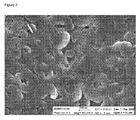
- Figures 1 and 2 are SEM micrographs of an LDH according to the present invention.
- the amounts of gibbsite, brucite, and periclase were determined with XRD, via weighed subtraction of diffractograms of these materials.
- the mean stack thickness (Lc) was determined via XRD, using the 003-reflection, employing the well-known Scherrer technique as disclosed in " The Scherrer Formula for X-Ray Particle Size Determination,”. Phys. Rev. (American Physical Society) 56 (10) 978-982, November 1939 , yielding a value of 25.4 nm.
- Example 2 To explore the optimal conditions for synthesizing layered double hydroxides showing a high value of P/2 ⁇ (A/ ⁇ ), the synthetic procedure described in Example 1 was repeated, with different Mg/Al-ratios, process temperatures, and particle sizes of the feedstock. Samples were taken during the thermal treatment.
- Figures 1 and 2 illustrate the morphology of the LDH formed in Example 12, after 24 hours of thermal treatment. It clearly shows the ring-shaped and sickle-shaped structures.
Landscapes
- Chemical & Material Sciences (AREA)
- Organic Chemistry (AREA)
- Inorganic Chemistry (AREA)
- Life Sciences & Earth Sciences (AREA)
- Geology (AREA)
- Compounds Of Alkaline-Earth Elements, Aluminum Or Rare-Earth Metals (AREA)
Abstract
Layered double hydroxide comprising platelets having an area A and a perimeter P, the value of P/(2À(A/À)) being more than 1.15. The platelets of the layered double hydroxides are generally ring-shaped or sickle-shaped and can be prepared by (i) preparing a slurry comprising at least one oxide, hydroxide, or oxyhydroxide of a trivalent metal M(III) and at least one oxide, hydroxide, or oxyhydroxide of a divalent metal M(II) in a molar ratio M(II)/M(III) of 1.5 to 3, an average particle size (d50) in the range 1-4 microns, and where the value of [M(II)/M(III)] 3 *d50 is in the range 16-36 µm, and (ii) thermally treating said slurry at a temperature in the range 75-120°C for a period of 1-24 hours.
Description
- The present invention relates to a new layered double hydroxide, its preparation and use, said layered double hydroxide having a specific morphology.
- Layered double hydroxides - also called anionic clays - have a crystal structure consisting of positively charged layers built up of specific combinations of metal hydroxides between which there are anions and water molecules. Hydrotalcite is an example of a naturally occurring anionic clay wherein carbonate is the predominant anion present. Meixnerite is an anionic clay wherein hydroxyl is the predominant anion present.
- In layered double hydroxides brucite-like main layers are built up of octahedra alternating with interlayers containing water molecules and charge-balancing anions. These charge-balancing anions compensate for the electrostatic charge deficiencies of the crystalline clay sheets of the layered double hydroxide. Examples of anions are NO3 -, OH-, Cl-, Br-, I-, SO4 2-, SiO3 2-, CrO4 2-, BO3 2-, Mn04 -, HGaO3 2-, HVO4 2-, ClO4 -, BO3 2-, pillaring anions such as V10O28 -6 and Mo7O24 6-, monocarboxylates such as acetate, dicarboxylates such as oxalate, alkyl sulphonates such as lauryl sulphonate.
- The general structure of a conventional layered double hydroxide is
[M(II)m 2+ M(III)n 3+ (OH)2m+2n.](Xn/z z-). bH2O
wherein M(II) is a divalent metal, M(III) is a trivalent metal, Xz- is the charge-balancing anion, b has a value of about 4, and m and n have a value such that m/n= 2 to 4, most preferably close to 3. - The preparation of anionic clays has been described in many publications. Two major reviews of anionic clay chemistry were published in which the methods available for anionic clay synthesis have been summarised:
- F. Cavani et al. "Hydrotalcite-type anionic clays: Preparation, Properties and Applications," Catalysis Today, 11 (1991) Elsevier Science Publishers B.V. Amsterdam.
- J P Besse and others "Anionic clays: trends in pillary chemistry," in M.I. Occelli, H.E. Robson, eds., Synthesis and Microporous Solids (1992), 2, 108, Van Nostrand Reinhold, N.Y.
- In these reviews the authors state that a characteristic of Mg-Al anionic clays is that mild calcination at 500°C results in the formation of a disordered MgO-like product. Said disordered MgO-like product is distinguishable from spinel (which results upon severe calcination) and from anionic clays. This disordered MgO-like material is also referred to as Mg-Al solid solution. The formation of these solid solutions is reversible, which means that their exposure to water results in the re-formation of the anionic clay structure.
- Two types of anionic clay preparation are described in these reviews. The most conventional method is co-precipitation of a soluble divalent metal salt and a soluble trivalent metal salt, optionally followed by hydrothermal treatment or aging to increase the crystallite size. The second method is the salt-oxide method in which a divalent metal oxide is reacted at atmospheric pressure with a soluble trivalent metal salt, followed by aging under atmospheric pressure. This method has only been described for the use of ZnO and CuO in combination with soluble trivalent metal salts.
- Several patent applications relating to the production of anionic clays from inexpensive raw materials have been published. These materials include magnesium oxide and aluminium trihydrate. See, for example,
WO 99/41198 WO 99/41196 WO 99/41195 WO 99/41197 WO 01/012550 WO 01/012543 WO 02/064504 - When ideally, i.e. rhombohedrally, crystallized, conventional LDH platelets have a more or less hexagonal shape when viewed with scanning electron microscopy (SEM). When less ideally crystallized, they have a more or less circular shape.
- The present invention relates to a layered double hydroxide (LDH) with a different morphology. That is: the layered double hydroxide platelets have significantly more outer surface (edges) available for reaction and intercalation than the known circular or hexagonal LDH platelets.
- The advantage of having more outer surface available is that the active sites for catalysis or adsorption are more readily accessible and that intercalation becomes faster.
- The LDH platelets according to the present invention can have different shapes, but generally are ring-shaped or sickle-shaped.
- The edge content per surface area of the platelets is represented by the value of P/(2π√(A/π)), which is more than 1.15, preferably more than 1.25, and most preferably more than 1.35.
- The value of P/(2π√(A/π)) can be determined using image analysis of scanning electron microscopy (SEM) photographs of the platelets, whereby the outer contours of the platelets, and the surface area A within these contours and the perimeter P of these contours can be calculated. In the case of a ring-shaped platelet, one should determine both the outer perimeter of the ring (Po) and the inner one (Pi), so that P=Po+Pi. The surface area A of such ring-shaped platelets equals the surface area within the outer and the inner contours of said rings.
- The effective radius of the platelet, calculated from the determined surface area is:

- The effective radius of the platelet, calculated from the determined perimeter is:

- The ratio Rp/s=Rp/Rs= P/(2π√(A/π)) of the LDH platelets according to the present invention is more than 1.15, indicating a larger edge content than for perfectly round (Rp/s=1) or hexagonal (Rp/s=1.0501) platelets.
- The mean stack thickness, as measured by XRD on dried samples, is preferably less than 50 nm, more preferably less than 40 nm, and most preferably less than 30 nm. This mean stack thickness can be determined using the 003-reflection, employing the well-known Scherrer technique as disclosed in "The Scherrer Formula for X-Ray Particle Size Determination," Phys. Rev. (American Physical Society) 56 (10) 978-982, November 1939.
- As mentioned above, layered double hydroxides are built up of divalent and trivalent metals. Suitable trivalent metals for the LDH according to the present invention include aluminium, gallium, indium, iron, chromium, vanadium, cobalt, manganese, cerium, niobium, lanthanum, and combinations of one or more of these metals. The preferred trivalent metal is aluminium.
- Suitable divalent metals include magnesium, zinc, nickel, copper, iron, cobalt, manganese, calcium, barium, and combinations of one or more of these metals. Preferred divalent metals are magnesium, zinc, and combinations thereof. The most preferred divalent metals are magnesium and zinc.
- The LDH according the present invention can contain the various charge balancing anions listed above. Particularly preferred are OH-, CO3 2-, sulphate, phosphate, borate, and organic anions such as carboxylic acids, alkyl sulphonates, and alkyl phosphonates.
- The layered double hydroxide according to the present invention can be prepared by a process comprising the steps of:
- preparing a slurry comprising at least one oxide, hydroxide, or oxyhydroxide of a trivalent metal M(III) and at least one oxide, hydroxide, or oxyhydroxide of a divalent metal M(II) in a molar ratio M(II)/M(III) of 1.5 to 3, an average particle size (d50) in the range 1-4 microns, and where the value of [M(II)/M(III)]3*d50 is in the range 16-36 µm, and
- thermally treating said slurry at a temperature in the range 75-120°C for a period of 1-24 hours.
- The slurry in this process can be an aqueous slurry or one based on organic solvents. Examples of suitable organic solvents are alcohols such as methanol, ethanol, 1-propanol, and isopropanol; alkoxylated alcohols such as propylene glycol monomethyl ether and propylene glycol monoethyl ether; alkanes such as pentane, hexane, and heptane; and aromatic hydrocarbons such as benzene, toluene, and xylene. Preferably, the suspending medium comprises water, an alcohol and/or an alkoxylated alcohol. Most preferably, the suspending medium is water.
- As divalent and trivalent metal sources oxides, hydroxides, and oxyhydroxides of the above-mentioned di- and trivalent metals are used. These materials are relatively inexpensive and do not leave undesirable anions in the LDH which either have to be washed out or will be emitted as environmentally harmful gases upon heating.
- Aluminium is the preferred trivalent metal. Examples of suitable aluminium sources include transition aluminas, aluminium trihydroxides (gibbsite, bayerite) and its thermally treated forms (including flash-calcined alumina), alumina sols, amorphous alumina, aluminium oxyhydroxides such as (pseudo)boehmite, diaspore, and goethite, BOC (Bauxite Ore Concentrate), and bauxite. The preferred aluminium source is aluminium trihydroxide, also called aluminium trihydrate, such as gibbsite, nordstrandite, and bayerite. Combinations of two or more of the above-mentioned aluminium sources may also be used. Magnesium and zinc are the preferred divalent metals. Examples of suitable magnesium sources are MgO, Mg(OH)2, magnesium carbonate, and hydromagnesite. Preferred magnesium sources are MgO and Mg(OH)2; the most preferred magnesium source is MgO. Combinations of two or more of the above-mentioned magnesium sources may also be used.
- Suitable zinc sources are zinc oxide, zinc hydroxide, zinc carbonate, and zinc hydroxycarbonate. Combinations of two or more of the above-mentioned zinc sources may also be used. It is also contemplated to use a combination of at least one magnesium source and at least one zinc source.
- The Mg/Al molar ratio in the slurry must be in the range 1.5 to 3.0, preferably 1.8 to 2.6, and most preferably 2 to 2.4.
- The average particle size (d50) of the solids in the slurry - prior to thermal treatment - must be in the range 1-4 microns, preferably 1.5-3.5 microns, and most preferably 2-3 microns. This can be achieved by milling of the slurry or by preparing the slurry from particles with the right average size. Suitable instruments for milling the slurry are ball mills, bead mills, sand mills, colloid mills, and a high shear mixers. Devices employing ultrasound may also be used.
- The d50 can be determined using a Malvern Mastersizer.
- It was emperically found that [M(II)/M(III)]3*d50 should be in the range of 6-36 µm, preferably 17-33 µm, and most preferably 20-30 µm, reflecting a strong influence of the M(II)/M(III) ratio on the morphology of the particles produced.
- The slurry is treated at a temperature in the range 75-120°C, preferably 80-110°C, most preferably 85-105°C, for a period of time ranging from 1 to 24 hours, preferably 2 to 16 hours, most preferably 3 to 8 hours. The pressure may be atmospheric or, if the temperature is above the boiling point of the suspending medium, autogenous. It is possible, although less preferred, to apply a higher pressure using, e.g., nitrogen gas.
- The combination of the above-mentioned Mg/Al molar ratio, d50, temperature, and treatment time is important for obtaining an LDH according to the present invention. If one of these parameters is outside the indicated range, an LDH according to the present invention is not obtained.
- Further, the slurry can contain anions that may intercalate, i.e. become the charge-balancing anion between the LDH platelets. Without the addition of specific anions, an LDH with OH- charge-balancing anions will be formed. If carbonate charge-balancing ions are desired, ammonium carbonate can be added to the slurry.
- Ammonium salts are a good way to also introduce other anions, such as sulphonates, organosulphonates, phosphates, and organophosphates.
- The layered double hydroxide according to the present invention can be used for various applications. These include catalytic applications, such as the use as solid base catalyst in, e.g., aldol condensation, self condensation, Knoevenagel condensation, Claisen-Schmidt condensation, Michael addition, transesterification, alkylation, double bond isomerization, hydrogenation, amination, dehydrocyclodimerization, aldol addition, nitroaldol addition, conjugate addition of alcohols, cyanaethylation, Tishchenko reaction, nucleophilic ring opening of epoxides, oxidation reactions, Si-C bond formation, P-C bond formation (Pudovik reaction), and the synthesis of heterocycles.
- Also contemplated is the use as FCC (fluid catalytic cracking) additive for SOx and NOx reduction, for sulphur reduction in gasoline and diesel and for hydroprocessing applications, including hydrodenitrification (HDN) and hydrodesulphurization (HDS) applications.
- The layered double hydroxide according to the present invention can also be used as stabilizer in chlorine-containing (co)polymers such as PVC and PVDC, as halogen scavenger, as CO2-scavenger as adsorbent in waste water treatment, as flame retardant or flame retardant synergist, as active component in medicaments such as anti-acids, as a filler in thermosetting resins, as adhesion promoter, in the paper and coatings industry, as anionic trash catcher or stain blocker, or as encapsulation material for sensitive (in)organic components.
- If the anticipated use is PVC stabilization, the preferred intercalating anion is carbonate.
- If desired, for instance to make the layered double hydroxide according to the invention more compatible with polymers like PVC or PVDC, it is possible to treat the layered double hydroxide with organic anions, such as rosin derivatives or fatty acids or salts thereof (such as sodium stearate), according to well-known procedures.
-
Figures 1 and2 are SEM micrographs of an LDH according to the present invention. - 800 grams of magnesium oxide (Zolitho R 40, ex Martin Marietta Magnesia 15 Specialties LLC; 98% purity) and 694.7 grams of aluminium trihydroxide (Alumill F505) were mixed in 8,364 grams of demineralized water and ground in a pearl mill to an average particle size (d50) of 2.84 µm. 5,470 grams of this milled slurry were fed to an oil-heated autoclave equipped with three Intermig stirrers and a bottom scraper. The reactor was closed and heated to 90°C within 60 minutes and was maintained at this temperature for 4 hours, using a stirring speed of 500 rpm. Subsequently, the autoclave was cooled to below 70°C within 1 hour and the resulting slurry was removed from the reactor.
- To characterize the morphology of the materials, scanning electron micrograph (SEM) pictures were taken, and at a magnification representing a total area of 2x2.5µm, the area A and the perimeter P of 10 representative platelets were determined. With these data, the value of P/2π√(A/π) was calculated for each of these platelets. The mean value of P/2π√(A/π) was 1.36.
- The amounts of gibbsite, brucite, and periclase were determined with XRD, via weighed subtraction of diffractograms of these materials.
- The mean stack thickness (Lc) was determined via XRD, using the 003-reflection, employing the well-known Scherrer technique as disclosed in "The Scherrer Formula for X-Ray Particle Size Determination,". Phys. Rev. (American Physical Society) 56 (10) 978-982, November 1939, yielding a value of 25.4 nm.
- 256.13 grams of the layered double hydroxide slurry prepared in Example 1, which contained hydroxyl anions in the interlayer, were added to a beaker glass. The slurry was diluted with 465 grams of distilled water while stirring. To this slurry 11.11 grams of (NH4)2.CO3 were added while stirring, in order to obtain an Al:CO3 stoichiometric ratio of 2:1. The reaction mixture was stirred at 70°C during 45 min. During this period the release of NH3 was clearly detected. SEM-analysis showed that the morphology was essentially the same, yielding a mean value of P/2π√(A/π) of 1.33.
- IR-analysis showed that the hydroxyl anions in the interlayer were fully exchanged for carbonate ions.
- To explore the optimal conditions for synthesizing layered double hydroxides showing a high value of P/2π√(A/π), the synthetic procedure described in Example 1 was repeated, with different Mg/Al-ratios, process temperatures, and particle sizes of the feedstock. Samples were taken during the thermal treatment.
- The various synthesis parameters, as well as the results, are summarized in the table below.
Example Mg/Al d50
(µm)(Mg/Al)3*d50
(µm)T(°C) t(hr) LDH% Lc
(nm)P/(2π√A/π)) 3
(Comp.)2.01 1.92 15.59 90 0.5 88.1 16.3 1.09 2 91.2 15.7 1.13 5 91.6 16.9 1.12 24 97.6 17.6 1.18 4
(Comp.)2.01 1.92 15.59 104.3 0.5 88.7 17.9 1.08 2 91.5 19.5 1.11 5 92 20.9 1.12 24 95.5 22.5 1.14 5
(Comp.)2.01 1.92 15.59 121 0.5 92.3 20.9 1.07 2 92 21.4 1.09 5 95.8 22 1.11 24 98 35.5 1.06 6 2.01 2.64 21.44 90 0.5 83.3 22.5 1.25 2.5 87.9 28.4 1.31 5.5 86.9 27.5 1.33 7 2.01 2.64 21.44 104.5 0.5 77.5 21.4 1.21 2 86.1 23.8 1.26 5.5 91.3 23.8 1.29 8 2.01 2.64 21.44 120 0.5 93 22.5 1.13 2.5 85 24.4 1.18 9 2.01 3.51 28.50 90 0.5 72.7 16.6 1.28 2 77.9 23.8 1.34 5 79.2 22.5 1.37 10 2.01 3.51 28.50 105 0.5 72 21.4 1.19 2 76.7 23.8 1.22 5 75.5 23.8 1.27 11 2.01 3.51 28.50 119.7 0.5 73.8 20 1.15 2 79 23.1 1.19 5 82.7 22.5 1.22 12 2.25 2.12 24.15 90 0.5 84.3 20.9 1.25 2 84 22.5 1.32 5 88 23.1 1.36 24 92.5 23.8 1.29 13 2.25 2.12 24.15 105 0.5 84.6 22.5 1.21 2 85.9 23.1 1.24 5 86.5 22.5 1.28 14 2.25 2.12 24.15 120 0.5 84.5 20.9 1.18 2 87.5 20.9 1.21 5 89.8 23.8 1.25 15 2.19 2.64 27.73 90 0.5 72.5 21.4 1.19 1.5 83.7 25.1 1.24 4 90.5 28.4 1.26 16 2.19 2.64 27.73 105 0.25 80.7 22 1.17 2.33 85.7 25.1 1.19 5.75 82.5 24.4 1.22 17 2.19 2.64 27.73 120 0 77 20.4 1.12 2 87.8 23.8 1.16 5.5 88.5 24.4 1.18 18
(Comp.)2.25 3.22 36.68 90 0.5 62.5 16 1.08 2 62.5 22.5 1.11 5 56.5 19.1 1.12 24 79.2 17.2 1.1 19
(Comp.)2.25 3.22 36.68 105 0.5 54 20.4 1.09 2 66 19.1 1.09 5 66.5 22 1.11 24 79 16.9 1.09 20
(Comp.)2.25 3.22 36.68 120 0.5 57 21.4 1.07 2 55.4 19.1 1.09 5 61 17.6 1.1 24 90 20 1.07 -
Figures 1 and2 illustrate the morphology of the LDH formed in Example 12, after 24 hours of thermal treatment. It clearly shows the ring-shaped and sickle-shaped structures.
Claims (12)
- Layered double hydroxide comprising platelets having an area A and a perimeter P, the value of P/(2π√(A/π)) being more than 1.15.
- Layered double hydroxide according to claim 1 wherein the value of P/(2π√A/π)) is more than 1.25.
- Layered double hydroxide according to claim 2 wherein the value of P/(2π√(A/π)) is more than 1.35.
- Layered double hydroxide according to any one of the preceding claims wherein the mean stack thickness is in the range 10-40 nm.
- Layered double hydroxide according to claim 4 wherein the mean stack thickness is in the range 15-35 nm, preferably 20-30 nm.
- Layered double hydroxide according to any one of the preceding claims containing at least one trivalent metal and at least one divalent metal, the trivalent metal being aluminium, the divalent metal being selected from magnesium, zinc, and mixtures thereof.
- Process for the preparation of a layered double hydroxide according to any one of the preceding claims comprising the steps of:- preparing a slurry comprising at least one oxide, hydroxide, or oxyhydroxide of a trivalent metal M(III) and at least one oxide, hydroxide, or oxyhydroxide of a divalent metal M(II) in a molar ratio M(II)/M(III) of 1.5 to 3, an average particle size (d50) in the range 1-4 microns, and where the value of [M(II)/M(III)]3*d50 is in the range 16-36 µm,- thermally treating said slurry at a temperature in the range 75-120°C for a period of 1-24 hours.
- Process according to claim 7 wherein the average particle size (d50) is 1.5-3.5, preferably 2.0-3.0 microns.
- Process according to claim 7 or 8 wherein the temperature is in the range 80-110°C, preferably 85-105°C.
- Process according to any one of claims 7 to 9 wherein the molar ratio M(II)/M(III) is 1.8-2.6, preferably 2-2.4.
- Process according to any one of claims 7 to 10 wherein the thermal treatment is performed for a period of 2-16, preferably 3-8 hours.
- Use of the layered double hydroxide of any one of claims 1-6 as PVC stabilizer, as solid base catalyst, in coatings, or as fluid catalytic cracking additive.
Priority Applications (1)
| Application Number | Priority Date | Filing Date | Title |
|---|---|---|---|
| EP09161849A EP2263976A1 (en) | 2009-06-03 | 2009-06-03 | Layered double hydroxide with a specific morphology, its preparation and use |
Applications Claiming Priority (1)
| Application Number | Priority Date | Filing Date | Title |
|---|---|---|---|
| EP09161849A EP2263976A1 (en) | 2009-06-03 | 2009-06-03 | Layered double hydroxide with a specific morphology, its preparation and use |
Publications (1)
| Publication Number | Publication Date |
|---|---|
| EP2263976A1 true EP2263976A1 (en) | 2010-12-22 |
Family
ID=41319586
Family Applications (1)
| Application Number | Title | Priority Date | Filing Date |
|---|---|---|---|
| EP09161849A Withdrawn EP2263976A1 (en) | 2009-06-03 | 2009-06-03 | Layered double hydroxide with a specific morphology, its preparation and use |
Country Status (1)
| Country | Link |
|---|---|
| EP (1) | EP2263976A1 (en) |
Cited By (13)
| Publication number | Priority date | Publication date | Assignee | Title |
|---|---|---|---|---|
| CN102874853A (en) * | 2011-07-12 | 2013-01-16 | 北京化工大学 | Annular Mg-Al double-hydroxy composite metal hydroxide and preparation method thereof |
| CN105670296A (en) * | 2015-12-28 | 2016-06-15 | 国家纳米科学中心 | Preparation method for in-situ composite nano CeO2/MgOH flame-retarding and smoke-inhibiting agent for RTV |
| EP3076477A4 (en) * | 2014-07-09 | 2017-07-19 | NGK Insulators, Ltd. | Nickel-zinc battery |
| US10087355B2 (en) | 2016-03-17 | 2018-10-02 | Saudi Arabian Oil Company | Oil-based drilling fluids containing an alkaline-earth diamondoid compound as rheology modifier |
| US10106482B2 (en) | 2016-03-17 | 2018-10-23 | Saudi Arabian Oil Company | Synthesis of magnesium adamantane salts and magnesium oxide nanocomposites, and systems and methods including the salts or the nanocomposites |
| US10105684B2 (en) | 2016-03-17 | 2018-10-23 | Saudi Arabian Oil Company | Synthesis of transition-metal adamantane salts and oxide nanocomposites, and systems and methods including the salts or the nanocomposites |
| US10138199B2 (en) | 2016-03-17 | 2018-11-27 | Saudi Arabian Oil Company | High aspect ratio layered double hydroxide materials and methods for preparation thereof |
| US10252245B2 (en) | 2016-03-17 | 2019-04-09 | Saudi Arabian Oil Company | High temperature layered mixed-metal oxide materials with enhanced stability |
| CN111448287A (en) * | 2017-08-15 | 2020-07-24 | 沙特阿拉伯石油公司 | Layered double hydroxide for oil-based drilling fluids |
| US10875092B2 (en) | 2017-05-19 | 2020-12-29 | Saudi Arabian Oil Company | Methods for preparing mixed-metal oxide diamondoid nanocomposites and catalytic systems including the nanocomposites |
| US10906028B2 (en) | 2017-05-19 | 2021-02-02 | Saudi Arabian Oil Company | Synthesis of transition-metal adamantane salts and oxide nanocomposites, and systems and methods including the salts or the nanocomposites |
| CN117042865A (en) * | 2021-03-15 | 2023-11-10 | 栗田工业株式会社 | Method for treating acid waste gas, equipment for treating acid waste gas, and incineration facility |
| CN117282440A (en) * | 2023-10-11 | 2023-12-26 | 广东龙湖科技股份有限公司 | A Ce-doped MnCoLDH nanosheet and its preparation method and application |
Citations (8)
| Publication number | Priority date | Publication date | Assignee | Title |
|---|---|---|---|---|
| WO1999041195A1 (en) | 1998-02-11 | 1999-08-19 | Akzo Nobel N.V. | Continuous process for producing anionic clay |
| WO1999041197A1 (en) | 1998-02-11 | 1999-08-19 | Akzo Nobel N.V. | Process for producing an anionic clay-containing composition |
| WO1999041196A1 (en) | 1998-02-11 | 1999-08-19 | Akzo Nobel N.V. | Process for producing anionic clays using magnesium acetate |
| WO2001012550A1 (en) | 1999-08-11 | 2001-02-22 | Akzo Nobel N.V. | POLYTYPE Mg-Al HYDROTALCITE |
| WO2001012543A1 (en) | 1999-08-11 | 2001-02-22 | Akzo Nobel N.V. | PROCESS FOR PRODUCING Al-CONTAINING NON-Mg-ANIONIC CLAY |
| US20020110520A1 (en) * | 2001-02-09 | 2002-08-15 | Dennis Stamires | Process for the preparation of anionic clay |
| WO2002064504A1 (en) | 2001-02-09 | 2002-08-22 | Akzo Nobel N.V. | Doped anionic clays |
| WO2009080597A2 (en) * | 2007-12-19 | 2009-07-02 | Akzo Nobel N.V. | Process for preparing organically modified layered double hydroxide |
-
2009
- 2009-06-03 EP EP09161849A patent/EP2263976A1/en not_active Withdrawn
Patent Citations (9)
| Publication number | Priority date | Publication date | Assignee | Title |
|---|---|---|---|---|
| WO1999041195A1 (en) | 1998-02-11 | 1999-08-19 | Akzo Nobel N.V. | Continuous process for producing anionic clay |
| WO1999041197A1 (en) | 1998-02-11 | 1999-08-19 | Akzo Nobel N.V. | Process for producing an anionic clay-containing composition |
| WO1999041196A1 (en) | 1998-02-11 | 1999-08-19 | Akzo Nobel N.V. | Process for producing anionic clays using magnesium acetate |
| WO1999041198A1 (en) | 1998-02-11 | 1999-08-19 | Akzo Nobel N.V. | Process for producing anionic clay using two types of alumina compounds |
| WO2001012550A1 (en) | 1999-08-11 | 2001-02-22 | Akzo Nobel N.V. | POLYTYPE Mg-Al HYDROTALCITE |
| WO2001012543A1 (en) | 1999-08-11 | 2001-02-22 | Akzo Nobel N.V. | PROCESS FOR PRODUCING Al-CONTAINING NON-Mg-ANIONIC CLAY |
| US20020110520A1 (en) * | 2001-02-09 | 2002-08-15 | Dennis Stamires | Process for the preparation of anionic clay |
| WO2002064504A1 (en) | 2001-02-09 | 2002-08-22 | Akzo Nobel N.V. | Doped anionic clays |
| WO2009080597A2 (en) * | 2007-12-19 | 2009-07-02 | Akzo Nobel N.V. | Process for preparing organically modified layered double hydroxide |
Non-Patent Citations (4)
| Title |
|---|
| "The Scherrer Formula for X-Ray Particle Size Determination", PHYS. REV., vol. 56, no. 10, November 1939 (1939-11-01), pages 978 - 982 |
| F. CAVANI ET AL.: "Catalysis Today", vol. 11, 1991, ELSEVIER SCIENCE PUBLISHERS B.V., article "Hydrotalcite-type anionic clays: Preparation, Properties and Applications" |
| J P BESSE: "Synthesis and Microporous Solids", vol. 2, 1992, VAN NOSTRAND REINHOLD, article "Anionic clays: trends in pillary chemistry", pages: 108 |
| OKAMOTO ET AL: "Factors affecting the crystal size of the MgAl-LDH (layered double hydroxide) prepared by using ammonia-releasing reagents", APPLIED CLAY SCIENCE, ELSEVIER SCIENCE, NL, vol. 37, no. 1-2, 1 June 2007 (2007-06-01), pages 23 - 31, XP022100935, ISSN: 0169-1317 * |
Cited By (20)
| Publication number | Priority date | Publication date | Assignee | Title |
|---|---|---|---|---|
| CN102874853B (en) * | 2011-07-12 | 2014-04-09 | 北京化工大学 | Annular Mg-Al double-hydroxy composite metal hydroxide and preparation method thereof |
| CN102874853A (en) * | 2011-07-12 | 2013-01-16 | 北京化工大学 | Annular Mg-Al double-hydroxy composite metal hydroxide and preparation method thereof |
| US10128542B2 (en) | 2014-07-09 | 2018-11-13 | Ngk Insulators, Ltd. | Nickel-zinc battery |
| EP3076477A4 (en) * | 2014-07-09 | 2017-07-19 | NGK Insulators, Ltd. | Nickel-zinc battery |
| US10381689B2 (en) | 2014-07-09 | 2019-08-13 | Ngk Insulators, Ltd. | Nickel-zinc battery |
| CN105670296A (en) * | 2015-12-28 | 2016-06-15 | 国家纳米科学中心 | Preparation method for in-situ composite nano CeO2/MgOH flame-retarding and smoke-inhibiting agent for RTV |
| CN105670296B (en) * | 2015-12-28 | 2020-09-25 | 国家纳米科学中心 | Preparation method of in-situ composite nano cerium dioxide/magnesium hydroxide flame-retardant smoke suppressant for RTV (room temperature vulcanization) |
| US10106482B2 (en) | 2016-03-17 | 2018-10-23 | Saudi Arabian Oil Company | Synthesis of magnesium adamantane salts and magnesium oxide nanocomposites, and systems and methods including the salts or the nanocomposites |
| US10138199B2 (en) | 2016-03-17 | 2018-11-27 | Saudi Arabian Oil Company | High aspect ratio layered double hydroxide materials and methods for preparation thereof |
| US10252245B2 (en) | 2016-03-17 | 2019-04-09 | Saudi Arabian Oil Company | High temperature layered mixed-metal oxide materials with enhanced stability |
| US10105684B2 (en) | 2016-03-17 | 2018-10-23 | Saudi Arabian Oil Company | Synthesis of transition-metal adamantane salts and oxide nanocomposites, and systems and methods including the salts or the nanocomposites |
| US10087355B2 (en) | 2016-03-17 | 2018-10-02 | Saudi Arabian Oil Company | Oil-based drilling fluids containing an alkaline-earth diamondoid compound as rheology modifier |
| US10906859B2 (en) | 2016-03-17 | 2021-02-02 | Saudi Arabian Oil Company | Adamantane-intercalated layered double hydroxide |
| US10875092B2 (en) | 2017-05-19 | 2020-12-29 | Saudi Arabian Oil Company | Methods for preparing mixed-metal oxide diamondoid nanocomposites and catalytic systems including the nanocomposites |
| US10906028B2 (en) | 2017-05-19 | 2021-02-02 | Saudi Arabian Oil Company | Synthesis of transition-metal adamantane salts and oxide nanocomposites, and systems and methods including the salts or the nanocomposites |
| US11351604B2 (en) | 2017-05-19 | 2022-06-07 | Saudi Arabian Oil Company | Methods for preparing mixed-metal oxide diamondoid nanocomposites and catalytic systems including the nanocomposites |
| CN111448287A (en) * | 2017-08-15 | 2020-07-24 | 沙特阿拉伯石油公司 | Layered double hydroxide for oil-based drilling fluids |
| CN117042865A (en) * | 2021-03-15 | 2023-11-10 | 栗田工业株式会社 | Method for treating acid waste gas, equipment for treating acid waste gas, and incineration facility |
| CN117042865B (en) * | 2021-03-15 | 2024-08-16 | 栗田工业株式会社 | Acid waste gas treatment method, acid waste gas treatment equipment, and incineration facility |
| CN117282440A (en) * | 2023-10-11 | 2023-12-26 | 广东龙湖科技股份有限公司 | A Ce-doped MnCoLDH nanosheet and its preparation method and application |
Similar Documents
| Publication | Publication Date | Title |
|---|---|---|
| EP1358128B1 (en) | Process for the preparation of anionic clay | |
| US6468488B1 (en) | Mg-Al anionic clay having 3R2 stacking | |
| Rao et al. | Hydrothermal synthesis of Mg–Al hydrotalcites by urea hydrolysis | |
| EP1358129B1 (en) | Method of making doped anionic clays | |
| EP0776317B1 (en) | Two powder synthesis of hydrotalcite and hydrotalcite-like compounds | |
| US6710004B2 (en) | Process for the preparation of anionic clay and boehmite-containing compositions | |
| EP1957402B1 (en) | Process for preparing organically modified layered double hydroxide | |
| CN101321692B (en) | Process for preparing organically modified layered double hydroxide | |
| EP1054837B1 (en) | Continuous process for producing anionic clay | |
| US6171991B1 (en) | Process for producing an anionic clay-containing composition | |
| US6815389B2 (en) | Process for producing anionic clay using two types of alumina compounds | |
| Kelkar et al. | Ni-, Mg-and Co-containing hydrotalcite-like materials with a sheet-like morphology: synthesis and characterization | |
| JP2004099391A (en) | Method for producing layered double hydroxide | |
| WO1999041197A1 (en) | Process for producing an anionic clay-containing composition | |
| EP2261177A1 (en) | Layered double hydroxide, its preparation and use | |
| EP1054839B1 (en) | Process for producing an anionic clay-containing composition | |
| EP1054838B1 (en) | Process for producing anionic clay using two types of alumina compounds |
Legal Events
| Date | Code | Title | Description |
|---|---|---|---|
| PUAI | Public reference made under article 153(3) epc to a published international application that has entered the european phase |
Free format text: ORIGINAL CODE: 0009012 |
|
| AK | Designated contracting states |
Kind code of ref document: A1 Designated state(s): AT BE BG CH CY CZ DE DK EE ES FI FR GB GR HR HU IE IS IT LI LT LU LV MC MK MT NL NO PL PT RO SE SI SK TR |
|
| AX | Request for extension of the european patent |
Extension state: AL BA RS |
|
| STAA | Information on the status of an ep patent application or granted ep patent |
Free format text: STATUS: THE APPLICATION HAS BEEN WITHDRAWN |
|
| 18W | Application withdrawn |
Effective date: 20101221 |