EP2263676A1 - Anti-Hepatitis C composition and method for preparing drug for inhibiting Hepatitis C viruses or treating Hepatitis C - Google Patents
Anti-Hepatitis C composition and method for preparing drug for inhibiting Hepatitis C viruses or treating Hepatitis C Download PDFInfo
- Publication number
- EP2263676A1 EP2263676A1 EP10153974A EP10153974A EP2263676A1 EP 2263676 A1 EP2263676 A1 EP 2263676A1 EP 10153974 A EP10153974 A EP 10153974A EP 10153974 A EP10153974 A EP 10153974A EP 2263676 A1 EP2263676 A1 EP 2263676A1
- Authority
- EP
- European Patent Office
- Prior art keywords
- hepatitis
- composition
- toosendanin
- trichilin
- viruses
- Prior art date
- Legal status (The legal status is an assumption and is not a legal conclusion. Google has not performed a legal analysis and makes no representation as to the accuracy of the status listed.)
- Granted
Links
- 208000005176 Hepatitis C Diseases 0.000 title claims abstract description 41
- 239000000203 mixture Substances 0.000 title claims abstract description 27
- 238000000034 method Methods 0.000 title claims abstract description 16
- 230000002401 inhibitory effect Effects 0.000 title claims abstract description 14
- 241000711557 Hepacivirus Species 0.000 title claims abstract description 13
- 239000003814 drug Substances 0.000 title claims abstract description 13
- 229940079593 drug Drugs 0.000 title claims abstract description 13
- -1 limonoid compound Chemical class 0.000 claims abstract description 45
- 150000003839 salts Chemical class 0.000 claims abstract description 10
- 239000003937 drug carrier Substances 0.000 claims abstract description 7
- NAHTXVIXCMUDLF-RFNFAWMESA-N toosendanin Chemical compound C=1([C@H]2[C@]3(C)[C@@H](OC(C)=O)C(=O)[C@H]4[C@@]([C@@]53O[C@@H]5C2)(C)[C@H](O)C[C@H]2[C@@]3(C)[C@H](O)OC[C@]24[C@@H](O)C[C@H]3OC(=O)C)C=COC=1 NAHTXVIXCMUDLF-RFNFAWMESA-N 0.000 claims description 35
- NAHTXVIXCMUDLF-DUJPAFNYSA-N Toosendanin Natural products O=C(O[C@H]1C(=O)[C@H]2[C@@](C)([C@H](O)C[C@H]3[C@@]4(C)[C@H](O)OC[C@@]23[C@@H](O)C[C@H]4OC(=O)C)[C@@]23[C@]1(C)[C@H](c1cocc1)C[C@H]2O3)C NAHTXVIXCMUDLF-DUJPAFNYSA-N 0.000 claims description 34
- 239000008488 toosendanin Substances 0.000 claims description 34
- ZXYBAVNFURYQBW-XGSVDRKXSA-N trichilin H Natural products O=C(O[C@H]1[C@@]2(C)[C@@H](OC(=O)C)[C@H](OC(=O)C)[C@@H](O)[C@@]3([C@@H]4C(=O)[C@@H](OC(=O)C)[C@]5(C)[C@@H](c6cocc6)C[C@@H]6O[C@]56[C@]4(C)[C@@H](O)C[C@@H]23)CO1)C(C)C ZXYBAVNFURYQBW-XGSVDRKXSA-N 0.000 claims description 28
- 240000000233 Melia azedarach Species 0.000 claims description 21
- 241000196324 Embryophyta Species 0.000 claims description 20
- 239000000463 material Substances 0.000 claims description 19
- 241000711549 Hepacivirus C Species 0.000 abstract description 7
- 210000004027 cell Anatomy 0.000 description 40
- 230000000694 effects Effects 0.000 description 22
- 230000005764 inhibitory process Effects 0.000 description 19
- RTZKZFJDLAIYFH-UHFFFAOYSA-N Diethyl ether Chemical compound CCOCC RTZKZFJDLAIYFH-UHFFFAOYSA-N 0.000 description 18
- 230000010076 replication Effects 0.000 description 17
- 231100000433 cytotoxic Toxicity 0.000 description 13
- 230000001472 cytotoxic effect Effects 0.000 description 13
- 238000002474 experimental method Methods 0.000 description 10
- 238000012360 testing method Methods 0.000 description 10
- YMWUJEATGCHHMB-UHFFFAOYSA-N Dichloromethane Chemical compound ClCCl YMWUJEATGCHHMB-UHFFFAOYSA-N 0.000 description 9
- XEKOWRVHYACXOJ-UHFFFAOYSA-N Ethyl acetate Chemical compound CCOC(C)=O XEKOWRVHYACXOJ-UHFFFAOYSA-N 0.000 description 9
- 150000001875 compounds Chemical class 0.000 description 8
- 239000000284 extract Substances 0.000 description 8
- VLKZOEOYAKHREP-UHFFFAOYSA-N n-Hexane Chemical compound CCCCCC VLKZOEOYAKHREP-UHFFFAOYSA-N 0.000 description 8
- 239000000243 solution Substances 0.000 description 6
- 108090000331 Firefly luciferases Proteins 0.000 description 5
- 108060001084 Luciferase Proteins 0.000 description 5
- 239000005089 Luciferase Substances 0.000 description 5
- 238000000605 extraction Methods 0.000 description 5
- 230000004083 survival effect Effects 0.000 description 5
- OKKJLVBELUTLKV-MZCSYVLQSA-N Deuterated methanol Chemical compound [2H]OC([2H])([2H])[2H] OKKJLVBELUTLKV-MZCSYVLQSA-N 0.000 description 4
- FAPWRFPIFSIZLT-UHFFFAOYSA-M Sodium chloride Chemical compound [Na+].[Cl-] FAPWRFPIFSIZLT-UHFFFAOYSA-M 0.000 description 4
- 238000002835 absorbance Methods 0.000 description 4
- 239000001963 growth medium Substances 0.000 description 4
- 239000011734 sodium Substances 0.000 description 4
- 230000003595 spectral effect Effects 0.000 description 4
- CSCPPACGZOOCGX-UHFFFAOYSA-N Acetone Chemical compound CC(C)=O CSCPPACGZOOCGX-UHFFFAOYSA-N 0.000 description 3
- WEVYAHXRMPXWCK-UHFFFAOYSA-N Acetonitrile Chemical compound CC#N WEVYAHXRMPXWCK-UHFFFAOYSA-N 0.000 description 3
- IAZDPXIOMUYVGZ-UHFFFAOYSA-N Dimethylsulphoxide Chemical compound CS(C)=O IAZDPXIOMUYVGZ-UHFFFAOYSA-N 0.000 description 3
- OKKJLVBELUTLKV-UHFFFAOYSA-N Methanol Chemical compound OC OKKJLVBELUTLKV-UHFFFAOYSA-N 0.000 description 3
- 238000005481 NMR spectroscopy Methods 0.000 description 3
- 238000004020 luminiscence type Methods 0.000 description 3
- 239000002609 medium Substances 0.000 description 3
- 239000002244 precipitate Substances 0.000 description 3
- 238000005160 1H NMR spectroscopy Methods 0.000 description 2
- 229930105110 Cyclosporin A Natural products 0.000 description 2
- PMATZTZNYRCHOR-CGLBZJNRSA-N Cyclosporin A Chemical compound CC[C@@H]1NC(=O)[C@H]([C@H](O)[C@H](C)C\C=C\C)N(C)C(=O)[C@H](C(C)C)N(C)C(=O)[C@H](CC(C)C)N(C)C(=O)[C@H](CC(C)C)N(C)C(=O)[C@@H](C)NC(=O)[C@H](C)NC(=O)[C@H](CC(C)C)N(C)C(=O)[C@H](C(C)C)NC(=O)[C@H](CC(C)C)N(C)C(=O)CN(C)C1=O PMATZTZNYRCHOR-CGLBZJNRSA-N 0.000 description 2
- 108010036949 Cyclosporine Proteins 0.000 description 2
- 239000006144 Dulbecco’s modified Eagle's medium Substances 0.000 description 2
- 241000710188 Encephalomyocarditis virus Species 0.000 description 2
- 108010047761 Interferon-alpha Proteins 0.000 description 2
- 102000006992 Interferon-alpha Human genes 0.000 description 2
- 239000007836 KH2PO4 Substances 0.000 description 2
- 239000004480 active ingredient Substances 0.000 description 2
- 238000004458 analytical method Methods 0.000 description 2
- 238000012258 culturing Methods 0.000 description 2
- BNIILDVGGAEEIG-UHFFFAOYSA-L disodium hydrogen phosphate Chemical compound [Na+].[Na+].OP([O-])([O-])=O BNIILDVGGAEEIG-UHFFFAOYSA-L 0.000 description 2
- 229910000397 disodium phosphate Inorganic materials 0.000 description 2
- 238000012986 modification Methods 0.000 description 2
- 230000004048 modification Effects 0.000 description 2
- 229910000402 monopotassium phosphate Inorganic materials 0.000 description 2
- 231100000065 noncytotoxic Toxicity 0.000 description 2
- 230000002020 noncytotoxic effect Effects 0.000 description 2
- 239000008194 pharmaceutical composition Substances 0.000 description 2
- 239000013641 positive control Substances 0.000 description 2
- GNSKLFRGEWLPPA-UHFFFAOYSA-M potassium dihydrogen phosphate Chemical compound [K+].OP(O)([O-])=O GNSKLFRGEWLPPA-UHFFFAOYSA-M 0.000 description 2
- 239000011780 sodium chloride Substances 0.000 description 2
- 239000000758 substrate Substances 0.000 description 2
- XLYOFNOQVPJJNP-UHFFFAOYSA-N water Substances O XLYOFNOQVPJJNP-UHFFFAOYSA-N 0.000 description 2
- 239000004475 Arginine Substances 0.000 description 1
- UZTKWSZSKDNQIM-ADIADEEASA-N CC(C)C(OC(C1(C)C2CC(C3(C)C4(C5(C67)[O]6C(C)=O)OC4CC5C4=COCC4)O)C1(C(C(C1O)OC(C)=O)OC(C)=O)O[C@]1(C1)C21C3C7=O)=O Chemical compound CC(C)C(OC(C1(C)C2CC(C3(C)C4(C5(C67)[O]6C(C)=O)OC4CC5C4=COCC4)O)C1(C(C(C1O)OC(C)=O)OC(C)=O)O[C@]1(C1)C21C3C7=O)=O UZTKWSZSKDNQIM-ADIADEEASA-N 0.000 description 1
- 241000244203 Caenorhabditis elegans Species 0.000 description 1
- IGXWBGJHJZYPQS-SSDOTTSWSA-N D-Luciferin Chemical compound OC(=O)[C@H]1CSC(C=2SC3=CC=C(O)C=C3N=2)=N1 IGXWBGJHJZYPQS-SSDOTTSWSA-N 0.000 description 1
- XBPCUCUWBYBCDP-UHFFFAOYSA-N Dicyclohexylamine Chemical class C1CCCCC1NC1CCCCC1 XBPCUCUWBYBCDP-UHFFFAOYSA-N 0.000 description 1
- 206010059866 Drug resistance Diseases 0.000 description 1
- 241000498255 Enterobius vermicularis Species 0.000 description 1
- YLQBMQCUIZJEEH-UHFFFAOYSA-N Furan Chemical group C=1C=COC=1 YLQBMQCUIZJEEH-UHFFFAOYSA-N 0.000 description 1
- ODKSFYDXXFIFQN-BYPYZUCNSA-P L-argininium(2+) Chemical compound NC(=[NH2+])NCCC[C@H]([NH3+])C(O)=O ODKSFYDXXFIFQN-BYPYZUCNSA-P 0.000 description 1
- ZDXPYRJPNDTMRX-VKHMYHEASA-N L-glutamine Chemical compound OC(=O)[C@@H](N)CCC(N)=O ZDXPYRJPNDTMRX-VKHMYHEASA-N 0.000 description 1
- HNDVDQJCIGZPNO-YFKPBYRVSA-N L-histidine Chemical compound OC(=O)[C@@H](N)CC1=CN=CN1 HNDVDQJCIGZPNO-YFKPBYRVSA-N 0.000 description 1
- KDXKERNSBIXSRK-YFKPBYRVSA-N L-lysine Chemical compound NCCCC[C@H](N)C(O)=O KDXKERNSBIXSRK-YFKPBYRVSA-N 0.000 description 1
- 241000254158 Lampyridae Species 0.000 description 1
- KDXKERNSBIXSRK-UHFFFAOYSA-N Lysine Natural products NCCCCC(N)C(O)=O KDXKERNSBIXSRK-UHFFFAOYSA-N 0.000 description 1
- 239000004472 Lysine Substances 0.000 description 1
- 241000158728 Meliaceae Species 0.000 description 1
- 108060004795 Methyltransferase Proteins 0.000 description 1
- 101100167320 Monascus purpureus mpl4 gene Proteins 0.000 description 1
- MBBZMMPHUWSWHV-BDVNFPICSA-N N-methylglucamine Chemical compound CNC[C@H](O)[C@@H](O)[C@H](O)[C@H](O)CO MBBZMMPHUWSWHV-BDVNFPICSA-N 0.000 description 1
- 108091005804 Peptidases Proteins 0.000 description 1
- 239000004365 Protease Substances 0.000 description 1
- 102100037486 Reverse transcriptase/ribonuclease H Human genes 0.000 description 1
- IWUCXVSUMQZMFG-AFCXAGJDSA-N Ribavirin Chemical compound N1=C(C(=O)N)N=CN1[C@H]1[C@H](O)[C@H](O)[C@@H](CO)O1 IWUCXVSUMQZMFG-AFCXAGJDSA-N 0.000 description 1
- 241001093501 Rutaceae Species 0.000 description 1
- 108010067674 Viral Nonstructural Proteins Proteins 0.000 description 1
- 239000003070 absorption delaying agent Substances 0.000 description 1
- 229910052783 alkali metal Inorganic materials 0.000 description 1
- 229910052784 alkaline earth metal Inorganic materials 0.000 description 1
- AZDRQVAHHNSJOQ-UHFFFAOYSA-N alumane Chemical class [AlH3] AZDRQVAHHNSJOQ-UHFFFAOYSA-N 0.000 description 1
- 239000003242 anti bacterial agent Substances 0.000 description 1
- 230000000844 anti-bacterial effect Effects 0.000 description 1
- 229940121375 antifungal agent Drugs 0.000 description 1
- 239000003429 antifungal agent Substances 0.000 description 1
- 230000006907 apoptotic process Effects 0.000 description 1
- 239000007900 aqueous suspension Substances 0.000 description 1
- ODKSFYDXXFIFQN-UHFFFAOYSA-N arginine Natural products OC(=O)C(N)CCCNC(N)=N ODKSFYDXXFIFQN-UHFFFAOYSA-N 0.000 description 1
- 239000000872 buffer Substances 0.000 description 1
- 159000000007 calcium salts Chemical class 0.000 description 1
- 239000002775 capsule Substances 0.000 description 1
- 150000001768 cations Chemical class 0.000 description 1
- 239000006285 cell suspension Substances 0.000 description 1
- 239000011248 coating agent Substances 0.000 description 1
- 238000000576 coating method Methods 0.000 description 1
- 238000004440 column chromatography Methods 0.000 description 1
- 238000007796 conventional method Methods 0.000 description 1
- 235000019800 disodium phosphate Nutrition 0.000 description 1
- 239000006185 dispersion Substances 0.000 description 1
- 239000002612 dispersion medium Substances 0.000 description 1
- 239000002552 dosage form Substances 0.000 description 1
- 235000011869 dried fruits Nutrition 0.000 description 1
- 238000009509 drug development Methods 0.000 description 1
- 238000007876 drug discovery Methods 0.000 description 1
- 235000013399 edible fruits Nutrition 0.000 description 1
- 239000000839 emulsion Substances 0.000 description 1
- 206010014881 enterobiasis Diseases 0.000 description 1
- 239000000469 ethanolic extract Substances 0.000 description 1
- 108020001507 fusion proteins Proteins 0.000 description 1
- 102000037865 fusion proteins Human genes 0.000 description 1
- ZDXPYRJPNDTMRX-UHFFFAOYSA-N glutamine Natural products OC(=O)C(N)CCC(N)=O ZDXPYRJPNDTMRX-UHFFFAOYSA-N 0.000 description 1
- HNDVDQJCIGZPNO-UHFFFAOYSA-N histidine Natural products OC(=O)C(N)CC1=CN=CN1 HNDVDQJCIGZPNO-UHFFFAOYSA-N 0.000 description 1
- 238000010348 incorporation Methods 0.000 description 1
- 230000001939 inductive effect Effects 0.000 description 1
- 238000001802 infusion Methods 0.000 description 1
- 239000004615 ingredient Substances 0.000 description 1
- 229910001411 inorganic cation Inorganic materials 0.000 description 1
- 239000002917 insecticide Substances 0.000 description 1
- 238000001361 intraarterial administration Methods 0.000 description 1
- 238000007918 intramuscular administration Methods 0.000 description 1
- 238000007919 intrasynovial administration Methods 0.000 description 1
- 238000007913 intrathecal administration Methods 0.000 description 1
- 238000001990 intravenous administration Methods 0.000 description 1
- 239000007951 isotonicity adjuster Substances 0.000 description 1
- 208000032839 leukemia Diseases 0.000 description 1
- 239000012139 lysis buffer Substances 0.000 description 1
- 159000000003 magnesium salts Chemical class 0.000 description 1
- 238000004949 mass spectrometry Methods 0.000 description 1
- 235000019796 monopotassium phosphate Nutrition 0.000 description 1
- 229960004927 neomycin Drugs 0.000 description 1
- 239000002547 new drug Substances 0.000 description 1
- 108010092853 peginterferon alfa-2a Proteins 0.000 description 1
- XAEFZNCEHLXOMS-UHFFFAOYSA-M potassium benzoate Chemical compound [K+].[O-]C(=O)C1=CC=CC=C1 XAEFZNCEHLXOMS-UHFFFAOYSA-M 0.000 description 1
- 102000004169 proteins and genes Human genes 0.000 description 1
- 108090000623 proteins and genes Proteins 0.000 description 1
- 230000003362 replicative effect Effects 0.000 description 1
- 238000012552 review Methods 0.000 description 1
- 229960000329 ribavirin Drugs 0.000 description 1
- HZCAHMRRMINHDJ-DBRKOABJSA-N ribavirin Natural products O[C@@H]1[C@H](O)[C@@H](CO)O[C@H]1N1N=CN=C1 HZCAHMRRMINHDJ-DBRKOABJSA-N 0.000 description 1
- 210000003705 ribosome Anatomy 0.000 description 1
- 238000011894 semi-preparative HPLC Methods 0.000 description 1
- 159000000000 sodium salts Chemical class 0.000 description 1
- 239000002904 solvent Substances 0.000 description 1
- 239000007921 spray Substances 0.000 description 1
- 238000007920 subcutaneous administration Methods 0.000 description 1
- 239000003826 tablet Substances 0.000 description 1
- 230000003612 virological effect Effects 0.000 description 1
- 150000003751 zinc Chemical class 0.000 description 1
- 150000003754 zirconium Chemical class 0.000 description 1
Classifications
-
- A—HUMAN NECESSITIES
- A61—MEDICAL OR VETERINARY SCIENCE; HYGIENE
- A61K—PREPARATIONS FOR MEDICAL, DENTAL OR TOILETRY PURPOSES
- A61K31/00—Medicinal preparations containing organic active ingredients
- A61K31/56—Compounds containing cyclopenta[a]hydrophenanthrene ring systems; Derivatives thereof, e.g. steroids
- A61K31/58—Compounds containing cyclopenta[a]hydrophenanthrene ring systems; Derivatives thereof, e.g. steroids containing heterocyclic rings, e.g. danazol, stanozolol, pancuronium or digitogenin
-
- A—HUMAN NECESSITIES
- A61—MEDICAL OR VETERINARY SCIENCE; HYGIENE
- A61P—SPECIFIC THERAPEUTIC ACTIVITY OF CHEMICAL COMPOUNDS OR MEDICINAL PREPARATIONS
- A61P1/00—Drugs for disorders of the alimentary tract or the digestive system
- A61P1/16—Drugs for disorders of the alimentary tract or the digestive system for liver or gallbladder disorders, e.g. hepatoprotective agents, cholagogues, litholytics
-
- A—HUMAN NECESSITIES
- A61—MEDICAL OR VETERINARY SCIENCE; HYGIENE
- A61P—SPECIFIC THERAPEUTIC ACTIVITY OF CHEMICAL COMPOUNDS OR MEDICINAL PREPARATIONS
- A61P31/00—Antiinfectives, i.e. antibiotics, antiseptics, chemotherapeutics
- A61P31/12—Antivirals
-
- A—HUMAN NECESSITIES
- A61—MEDICAL OR VETERINARY SCIENCE; HYGIENE
- A61P—SPECIFIC THERAPEUTIC ACTIVITY OF CHEMICAL COMPOUNDS OR MEDICINAL PREPARATIONS
- A61P31/00—Antiinfectives, i.e. antibiotics, antiseptics, chemotherapeutics
- A61P31/12—Antivirals
- A61P31/14—Antivirals for RNA viruses
Definitions
- Taiwan Patent Application No. 098120040 filed on Jun. 16, 2009
- Taiwan Patent Application No. 098136423 filed on Oct. 28, 2009 , the entirety of which is incorporated by reference herein.
- the present invention relates to an anti-hepatitis C composition, and in particular, relates to a composition comprising a limonoid compound which may be used to inhibit hepatitis C viruses or to treat hepatitis C.
- the basic illustrative structure of the limonoid compound comprises three 6-membered rings and a 5-membered ring connected to a furan ring by a single bond.
- the limonoid compounds mainly exist in plants of Rutaceae and Meliaceae. Toosendanin of limonoid compounds may be extracted from Melia toosendan Sieb. Et Zucc. Toosendanin is mainly used as a natural insecticide and is known to be capable of inducing apoptosis of human leukemia cells. Furthermore, toosendanin may also be extracted from chuanlianzi (fructus toosendan) which is mature, dried fruit of the Melia toosendan Sieb. Et Zucc and used as an herb for driving out roundworm and pinworm.
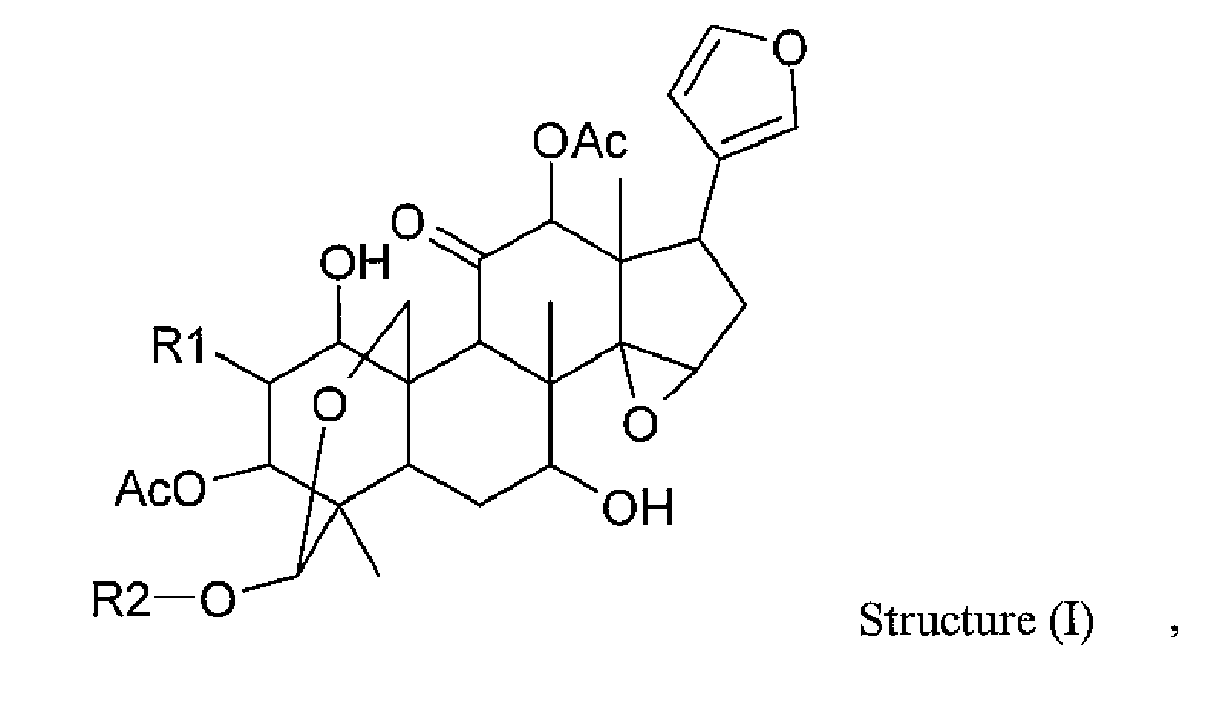
- the invention provides an anti-hepatitis C composition, comprising: an effective amount of limonoid compound, wherein the structure of the limonoid compound is shown as Structure (I): , where R1 comprises H or OAc and R2 comprises H or COCH(CH 3 ) 2 ; and a pharmaceutically acceptable carrier or salt, wherein the anti-hepatitis C composition is used for inhibiting hepatitis C viruses or treating hepatitis C.
- the invention also provides a method for preparing a drug for inhibiting hepatitis C viruses or treating hepatitis C, wherein an effective amount of limonoid compound is used, and the structure of the limonoid compound is shown as Structure (I): , where R1 comprises H or OAc and R2 comprises H or COCH(CH 3 ) 2 .
- the invention uses a composition comprising a limonoid compound as an anti-hepatitis C drug which is used for inhibiting hepatitis C viruses or treating hepatitis C.
- the composition may comprise an effective amount of limonoid compound and a pharmaceutically acceptable carrier or salt, and a structure of the limonoid compound is shown as Structure (I):
- R1 comprises H or OAc and R2 comprises H or COCH(CH 3 ) 2 .
- the limonoid compound may be extracted from a plant material, and the plant material may comprise Melia toosendan Sieb. Et Zucc. or Melia azedarach Linn.
- the limonoid compound may comprise toosendanin or Trichilin H.
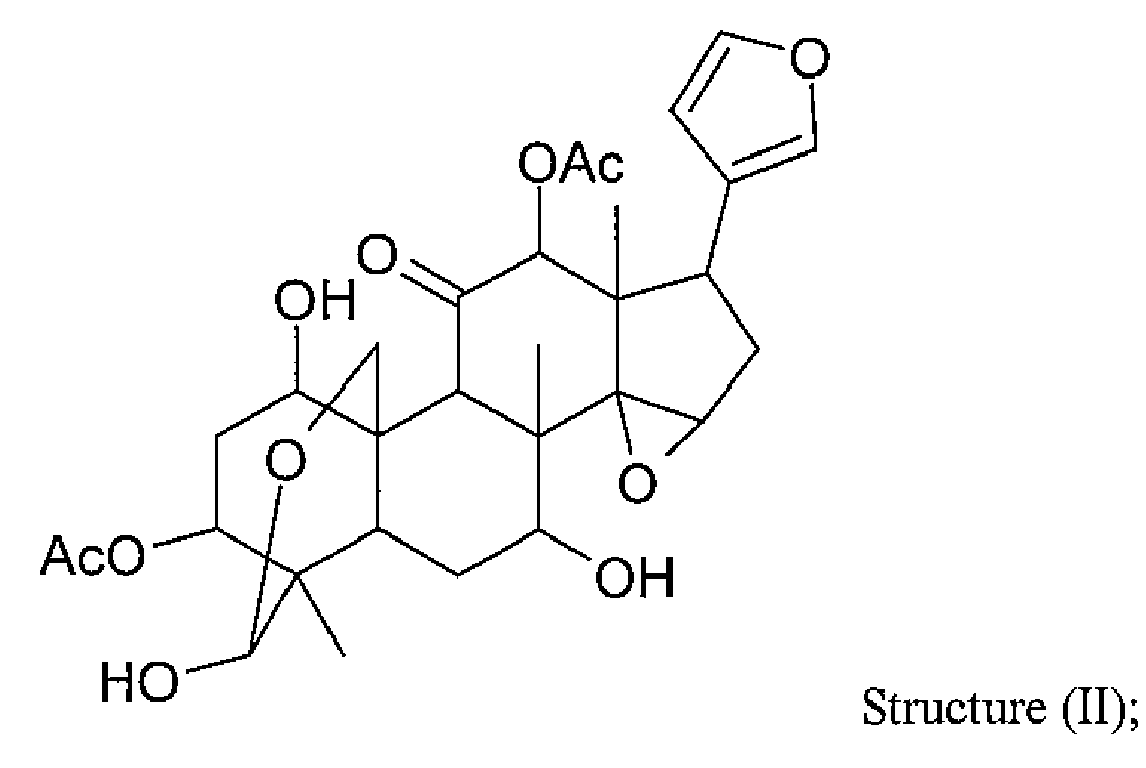
- Structures of toosendanin and Trichilin H are shown as Structures (II) and (III), respectively: and
- the HCV replicon system has been used worldwide as new drug development tool ( V. Lohmann et al., 1999, Science. Vol. 285, 110-113 ; R. Bartenschlager, 2002, Nature Reviews/Drug Discovery. Vol. 1, 911-916 ; J. M. Vorlijk et al., 2003, Journal of Virological Methods. 110:201-209 ).
- the Huh-luc/neo-ET cell has I389luc-ubi-NS3-3'/ET replicon and could be used to monitor the replicative capability of the HCV.
- the Huh-luc/neo-ET is able to express a firefly luciferase-ubiquitin-neomycin fusion protein translated by the internal ribosomal entry site (IRES) of the hepatitis C virus and is able to express the hepatitis C viral nonstructural protein (NS3-5B) including protease, helicase and polymerase translated by the IRES of the encephalomyocarditis virus (EMCV).
- IRES internal ribosomal entry site
- NS3-5B hepatitis C viral nonstructural protein
- the effect of the candidate for inhibiting the activity of the hepatitis C virus repilcon can be estimated by determining the intensity of the firefly luciferase activity.
- the hepatitis C virus inhibition effect of the limonoid compound can be determined by determining the firefly luciferase activity expressed by the Huh-Iuc/noe-ET cell in presence of the limonoid compound.
- 50 % of the HCV replication inhibition concentration (IC 50 ) of the limonoid compound is at least less than about 0.5 ⁇ g/ml, preferably about 0.045 ⁇ g/ml. Furthermore, the effect window (EW), a ratio of 50% of the cell cytotoxic concentration (CC 50 ) to IC 50 , of the limonoid compound is at least greater than about 100, preferably greater than about 2500.
- the limonoid compound may comprise toosendanin Structure of toosendanin is shown as Structure (II):
- the toosendanin may be extracted from a plant material, and the plant material may comprise Melia toosendan Sieb. Et Zucc. or Melia azedarach Linn.
- the IC 50 of the toosendanin is at least less than about 0.05 ⁇ g/ml, and the EW of the toosendanin is at least greater than about 2500.
- the limonoid compound may comprise Trichilin H.
- Structure of Trichilin H is shown as Structure (III):
- the Trichilin H may be extracted from a plant material, and the plant material may comprise Melia toosendan Sieb. Et Zucc. or Melia azedarach Linn.
- the IC 50 of the Trichilin H is at least less than about 0.5 ⁇ g/ml, and the EW of the Trichilin H is at least greater than about 100.
- a pharmaceutically acceptable carrier may comprise, but is not limited to, a solvent, a dispersion medium, a coating, an antibacterial and antifungal agent, or an isotonic and absorption delaying agent.
- the pharmaceutical composition can be formulated into dosage forms for different administration routes utilizing conventional methods.
- the pharmaceutically acceptable salt may comprise, but is not limited to, inorganic cation salts including alkali metal salts such as sodium salt, potassium salt or amine salt, alkaline-earth metal salt such as magnesium salt or calcium salt, the salt containing bivalent or quadrivalent cation such as zinc salt, aluminum salt or zirconium salt.
- the pharmaceutically acceptable salt may also comprise organic salt including dicyclohexylamine salt, methyl-D-glucamine, and amino acid salt such as arginine, lysine, histidine, or glutamine.
- the pharmaceutical composition may be administered orally, parenterally by an inhalation spray or via an implanted reservoir.
- the parenteral method may comprise subcutaneous, intracutaneous, intravenous, intramuscular, intraarticular, intraarterial, intrasynovial, intrasternal, intrathecal, and intraleaional, as well as infusion techniques.
- An oral composition can comprise, but is not limited to, tablets, capsules, emulsions and aqueous suspensions, dispersions and solutions.
- the invention may further provide a method for preparing a drug for inhibiting hepatitis C viruses or treating hepatitis C.
- an effective amount of limonoid compound is used as an active ingredient for the drug.
- Structure of the limonoid compound is shown as Structure (I):
- R1 comprises H or OAc and R2 comprises H or COCH(CH 3 ) 2 .
- the limonoid compound may be extracted from a plant material, and the plant material may comprise Melia toosendan Sieb. Et Zucc. or Melia azedarach Linn.
- the limonoid compound may comprise toosendanin or Trichilin H.
- Structures of toosendanin and Trichilin H are shown as Structures (II) and (III), respectively: and
- the invention may provide a method for treating hepatitis C.
- the method for treating hepatitis C may comprise administering an effective amount of an anti-hepatitis C composition to a patient in need.
- the anti-hepatitis C composition is described as above, which may comprise an effective amount of limonoid compound and a pharmaceutically acceptable carrier or salt.
- R1 comprises H or OAc and R2 comprises H or COCH(CH 3 ) 2 .
- the limonoid compound may be extracted from a plant material, and the plant material may comprise Melia toosendan Sieb. Et Zucc. or Melia azedarach Linn.
- the limonoid compound may comprise toosendanin or Trichilin H.
- Structures of toosendanin and Trichilin H are shown as Structures (II) and (III), respectively: and
- chuanlianzi the fruit of Melia toosendan Sieb. Et Zucc.
- ethanol extract was dissolved in 20 ml of a mixture of methanol and water and extracted with 15 ml of n-hexane, diethyl ether, dichloromethane and ethyl acetate for 2-3 times, respectively to obtain an n-hexane layer extraction solution, diethyl ether layer extraction solution, dichloromethane layer extraction solution and ethyl acetate layer extraction solution, respectively.
- Each layer extraction solution was concentrated and dried to obtain an n-hexane layer extract, diethyl ether layer extract, dichloromethane layer extract and ethyl acetate layer extract, respectively.
- the hepatitis C inhibition activity of each layer extract was determined by using a Huh-luc/neo-ET cell (HCV replication system) for testing thereof.
- Open column chromatography was used to isolate 1.1 g of the diethyl ether layer extract with mixtures of n-hexane and acetone with different ratios as a mobile phase and then the diethyl ether layer extract was separated to many fractions. After activity test, the selected fractions containing active ingredients were isolated by a reverse phase semi-preparative HPLC column with water and acetonitrile as a mobile phase and then two compounds were isolated. After that, the NMR spectroscopy and mass spectrometry were used to analyze the two compounds.
- the first compound was determined as toosendanin.
- Huh-luc/neo-ET cells with concentration of 2.5 ⁇ 10 4 cells/100 ⁇ l/well were seeded into a 96 well culture plate (Corning Incorporation COSTAR, 3599) and placed into a cell incubator for culturing.
- a toosendanin sample was diluted with a DMEM culture medium to the concentrations of 28.73 ⁇ g/ml, 9.57 ⁇ g/ml, 3.19 ⁇ g/ml, 1.06 ⁇ g/ml, 0.35 ⁇ g/ml, 0.11 ⁇ g/ml, 0.039 ⁇ g/ml and 0.013 ⁇ g/ml, respectively, or to become the concentrations of 114.92 ⁇ g/ml, 38.33 ⁇ g/ml, 12.77 ⁇ g/ml, 4.25 ⁇ g/ml, 1.42 ⁇ g/ml, 0.46 ⁇ g/ml, 0.16 ⁇ g/ml and 0.057 ⁇ g/ml, respectively.
- the initial medium in the 96 well culture plate was sucked out by a vacuum pump (DOAT-704AA) without removing the cells. Then, the toosendanin culture medium with concentrations mentioned above were added into the 96 well culture plate containing cells with amount of 100 ⁇ l/well as experiment groups while untreated culture medium were added to the cells as a control group.
- DMSO Distil-de Ha ⁇ n, 60153
- KS shaker Type 670 a votexer
- the 96 well culture plate was placed in a continuous wave length microwell plate analysis system (Molecular Devices, SPECTRAMAX 190) to measure the absorbance of cells at 560 nm.
- the average absorbance of the control groups was used as 100% of the cell survival rates (%) to calculate the cell survival rates (%) of the experiment groups with different concentrations of toosendanin samples.
- the formula of the cell survival rate was: (absorbance of experiment group/absorbance of the control group) ⁇ 100%.
- the cell survival rates of all experiment groups were drawn to form an x-y graph and thus a trend line formula with R 2 value greater than 0.9 was obtained.
- CC 15 was calculated from the trend line formula generated by the experiment groups containing samples with concentrations of 3.19 ⁇ g/ml, 1.06 ⁇ g/ml, 0.35 ⁇ g/ml, 0.11 ⁇ g/ml and 0.039 ⁇ g/ml. The result is shown as Table 1. 50% of the cell cytotoxic concentration (CC 50 ) of the toosendanin was greater than 114.8 ⁇ g/ml, and 15% of the cell cytotoxic concentration (CC 15 ) of the toosendanin was 0.34 ⁇ g/ml.
- the cell survival rates (%) was greater than 85%, it meant that the sample at or less than the concentration (the concentration less than CC 15 ) was non-cytotoxic.
- the samples with non-cytotoxic concentrations were selected for a test to be performed for firefly luciferase activity ofHuh-luc/neo-ET cells (detailed in the following).
- the Huh-luc/neo-ET cells were co-cultured with toosendanin with concentrations of 0.15 ⁇ g/ml, 0.075 ⁇ g/ml, 0.038 ⁇ g/ml, 0.019 ⁇ g/ml and 0.0085 ⁇ g/ml, respectively for 2 days and then were washed twice by 100 ⁇ l of 1 ⁇ PBS (1 mM KH2PO4, 10 mM Na2HPO4, 137 mM NaCl, 2.7 mM KCl) and PBS was removed. 35 ⁇ l of 1 ⁇ passive lysis buffer (Promega, E1941) was added to the cells and vortexed by a vortexer for 10 minutes to thoroughly mix the cells.
- 1 ⁇ passive lysis buffer Promega, E1941
- Cell suspension with an amount of 30 ⁇ l/well was added to a 96 well white plate(NUNC, 236108) for measuring luciferase activity, and 40 ⁇ l /well of luminescence analysis buffer and 20 ⁇ l /well of luminescence substrate (1 mM D-Luciferin) were sequentially added into the 96 well white plates. After the substrate was added, a microplate luminescence meter (Berthold, MPL4) was used to measure the luciferase activity (Rlu/s).
- the luciferase activity of the control group was used as a standard to calculate the hepatitis C virus inhibition rates (%) of the experiment groups.
- the formula of inhibition rates (%) was : ⁇ [(1uciferase activity of control group)-(luciferase activity of experiment group)]/(luciferase activity of control group) ⁇ 100%.
- 50% of the HCV replication inhibition concentration (IC 50 ) was calculated by grafit5 software (Erithacus Software).
- the experiment procedure was the same as Example 2 while the testing sample was replaced with Trichilin H.
- the Trichilin H sample was diluted with a DMEM culture medium to become final concentrations of 50 ⁇ g/ml, 25 ⁇ g/ml, 8.33 ⁇ g/ml, 2.78 ⁇ g/ml, 0.93 ⁇ g/ml, 0.31 ⁇ g/ml, 0.1 ⁇ g/ml and 0.03 ⁇ g/ml, respectively.
- the experiment procedure was the same as Example 2 while the testing sample was replaced with Trichilin H.
- the Huh-luc/neo-ET cells were co-cultured with Trichilin H with concentrations of 0.75 ⁇ g/ml, 0.5 ⁇ g/ml, 0.25 ⁇ g/ml and 0.125 ⁇ g/ml, respectively.
- Table 1 Cell cytotoxic concentration and HCV replication inhibition concentration of the test sample
- Sample CC 50 ( ⁇ g/ml)
- CC 15 ⁇ g/ml
- IC 50 ⁇ g/ml
- IC 90 ⁇ g/ml
- EW CC 50 /IC 50
- Trichilin H >50 0.7 0.48 ⁇ 0.10 0.9 >104.2
- EW 50% of the cell cytotoxic concentration/50 % of the HCV replication inhibition concentration
Landscapes
- Health & Medical Sciences (AREA)
- Life Sciences & Earth Sciences (AREA)
- Pharmacology & Pharmacy (AREA)
- Veterinary Medicine (AREA)
- Public Health (AREA)
- General Health & Medical Sciences (AREA)
- Chemical & Material Sciences (AREA)
- Animal Behavior & Ethology (AREA)
- Medicinal Chemistry (AREA)
- Chemical Kinetics & Catalysis (AREA)
- Organic Chemistry (AREA)
- Nuclear Medicine, Radiotherapy & Molecular Imaging (AREA)
- General Chemical & Material Sciences (AREA)
- Virology (AREA)
- Oncology (AREA)
- Communicable Diseases (AREA)
- Molecular Biology (AREA)
- Gastroenterology & Hepatology (AREA)
- Engineering & Computer Science (AREA)
- Bioinformatics & Cheminformatics (AREA)
- Epidemiology (AREA)
- Pharmaceuticals Containing Other Organic And Inorganic Compounds (AREA)
- Medicines Containing Plant Substances (AREA)
- Steroid Compounds (AREA)
Abstract
Description
- This Application claims priority of Taiwan Patent Application No.
098120040, filed on Jun. 16, 2009 098136423, filed on Oct. 28, 2009 - The present invention relates to an anti-hepatitis C composition, and in particular, relates to a composition comprising a limonoid compound which may be used to inhibit hepatitis C viruses or to treat hepatitis C.
- According to recent estimates, about 2-3 % of the world population is infected with hepatitis C and the number is increasing by 3-4 million patients every year. Presently, the only tested and approved anti-hepatitis C drug is α-interferon. Meanwhile, ribavirin has been used to enhance the anti-hepatitis C curative effect of α-interferon. However, use of both drugs induces serious side effects and results in drug-resistance in patients.
- The basic illustrative structure of the limonoid compound comprises three 6-membered rings and a 5-membered ring connected to a furan ring by a single bond. The limonoid compounds mainly exist in plants of Rutaceae and Meliaceae. Toosendanin of limonoid compounds may be extracted from Melia toosendan Sieb. Et Zucc. Toosendanin is mainly used as a natural insecticide and is known to be capable of inducing apoptosis of human leukemia cells. Furthermore, toosendanin may also be extracted from chuanlianzi (fructus toosendan) which is mature, dried fruit of the Melia toosendan Sieb. Et Zucc and used as an herb for driving out roundworm and pinworm.
- However, limonoid compounds being applied to effectively inhibit hepatitis C has yet to be disclosed.
- The invention provides an anti-hepatitis C composition, comprising: an effective amount of limonoid compound, wherein the structure of the limonoid compound is shown as Structure (I):

- The invention also provides a method for preparing a drug for inhibiting hepatitis C viruses or treating hepatitis C, wherein an effective amount of limonoid compound is used, and the structure of the limonoid compound is shown as Structure (I):

- A detailed description is given in the following embodiments with reference to the accompanying drawings.
- none
- The following description is of the best-contemplated mode of carrying out the invention. This description is made for the purpose of illustrating the general principles of the invention and should not be taken in a limiting sense. The scope of the invention is best determined by reference to the appended claims.
- The invention uses a composition comprising a limonoid compound as an anti-hepatitis C drug which is used for inhibiting hepatitis C viruses or treating hepatitis C. In one embodiment, the composition may comprise an effective amount of limonoid compound and a pharmaceutically acceptable carrier or salt, and a structure of the limonoid compound is shown as Structure (I):

- , where R1 comprises H or OAc and R2 comprises H or COCH(CH3)2.
- Moreover, the limonoid compound may be extracted from a plant material, and the plant material may comprise Melia toosendan Sieb. Et Zucc. or Melia azedarach Linn.
- The limonoid compound may comprise toosendanin or Trichilin H. Structures of toosendanin and Trichilin H are shown as Structures (II) and (III), respectively:


- The HCV replicon system has been used worldwide as new drug development tool (V. Lohmann et al., 1999, Science. Vol. 285, 110-113 ; R. Bartenschlager, 2002, Nature Reviews/Drug Discovery. Vol. 1, 911-916 ; J. M. Vorlijk et al., 2003, Journal of Virological Methods. 110:201-209). The Huh-luc/neo-ET cell has I389luc-ubi-NS3-3'/ET replicon and could be used to monitor the replicative capability of the HCV. The Huh-luc/neo-ET is able to express a firefly luciferase-ubiquitin-neomycin fusion protein translated by the internal ribosomal entry site (IRES) of the hepatitis C virus and is able to express the hepatitis C viral nonstructural protein (NS3-5B) including protease, helicase and polymerase translated by the IRES of the encephalomyocarditis virus (EMCV). When the replication complex composed of the IRES of the hepatitis C virus or the nonstructural protein of the hepatitis C virus is influenced by a candidate, the effect of the candidate for inhibiting the activity of the hepatitis C virus repilcon can be estimated by determining the intensity of the firefly luciferase activity. The hepatitis C virus inhibition effect of the limonoid compound can be determined by determining the firefly luciferase activity expressed by the Huh-Iuc/noe-ET cell in presence of the limonoid compound.
- In the Huh-Iuc/neo-ET cell, 50 % of the HCV replication inhibition concentration (IC50) of the limonoid compound is at least less than about 0.5 µg/ml, preferably about 0.045 µg/ml. Furthermore, the effect window (EW), a ratio of 50% of the cell cytotoxic concentration (CC50) to IC50, of the limonoid compound is at least greater than about 100, preferably greater than about 2500.
- In one embodiment, the limonoid compound may comprise toosendanin Structure of toosendanin is shown as Structure (II):

- The toosendanin may be extracted from a plant material, and the plant material may comprise Melia toosendan Sieb. Et Zucc. or Melia azedarach Linn. In the Huh-luc/neo-ET cell, the IC50 of the toosendanin is at least less than about 0.05 µg/ml, and the EW of the toosendanin is at least greater than about 2500.
- In another embodiment, the limonoid compound may comprise Trichilin H. Structure of Trichilin H is shown as Structure (III):

- The Trichilin H may be extracted from a plant material, and the plant material may comprise Melia toosendan Sieb. Et Zucc. or Melia azedarach Linn. In the Huh-luc/neo-ET cell, the IC50 of the Trichilin H is at least less than about 0.5 µg/ml, and the EW of the Trichilin H is at least greater than about 100.
- A pharmaceutically acceptable carrier may comprise, but is not limited to, a solvent, a dispersion medium, a coating, an antibacterial and antifungal agent, or an isotonic and absorption delaying agent. The pharmaceutical composition can be formulated into dosage forms for different administration routes utilizing conventional methods.
- The pharmaceutically acceptable salt may comprise, but is not limited to, inorganic cation salts including alkali metal salts such as sodium salt, potassium salt or amine salt, alkaline-earth metal salt such as magnesium salt or calcium salt, the salt containing bivalent or quadrivalent cation such as zinc salt, aluminum salt or zirconium salt. In addition, the pharmaceutically acceptable salt may also comprise organic salt including dicyclohexylamine salt, methyl-D-glucamine, and amino acid salt such as arginine, lysine, histidine, or glutamine.
- The pharmaceutical composition may be administered orally, parenterally by an inhalation spray or via an implanted reservoir. The parenteral method may comprise subcutaneous, intracutaneous, intravenous, intramuscular, intraarticular, intraarterial, intrasynovial, intrasternal, intrathecal, and intraleaional, as well as infusion techniques.
- An oral composition can comprise, but is not limited to, tablets, capsules, emulsions and aqueous suspensions, dispersions and solutions.
- In another aspect, the invention may further provide a method for preparing a drug for inhibiting hepatitis C viruses or treating hepatitis C.
- In the method of the invention, an effective amount of limonoid compound is used as an active ingredient for the drug. Structure of the limonoid compound is shown as Structure (I):

- , where R1 comprises H or OAc and R2 comprises H or COCH(CH3)2.
- The limonoid compound may be extracted from a plant material, and the plant material may comprise Melia toosendan Sieb. Et Zucc. or Melia azedarach Linn.
- In addition, the limonoid compound may comprise toosendanin or Trichilin H. Structures of toosendanin and Trichilin H are shown as Structures (II) and (III), respectively:


- In further another aspect, the invention may provide a method for treating hepatitis C. The method for treating hepatitis C may comprise administering an effective amount of an anti-hepatitis C composition to a patient in need.
- The anti-hepatitis C composition is described as above, which may comprise an effective amount of limonoid compound and a pharmaceutically acceptable carrier or salt.
- Structure of the limonoid compound is shown as Structure (I):

- , where R1 comprises H or OAc and R2 comprises H or COCH(CH3)2.
- The limonoid compound may be extracted from a plant material, and the plant material may comprise Melia toosendan Sieb. Et Zucc. or Melia azedarach Linn.
- Moreover, the limonoid compound may comprise toosendanin or Trichilin H. Structures of toosendanin and Trichilin H are shown as Structures (II) and (III), respectively:
-

- Furthermore, the pharmaceutically acceptable carrier and pharmaceutically acceptable salt are described as above.
- EXAMPLE
- Example 1
- Extracting an effective ingredient for inhibiting hepatitis C viruses from a plant material
- 5.96 g of chuanlianzi (the fruit of Melia toosendan Sieb. Et Zucc.) ethanol extract was dissolved in 20 ml of a mixture of methanol and water and extracted with 15 ml of n-hexane, diethyl ether, dichloromethane and ethyl acetate for 2-3 times, respectively to obtain an n-hexane layer extraction solution, diethyl ether layer extraction solution, dichloromethane layer extraction solution and ethyl acetate layer extraction solution, respectively. Each layer extraction solution was concentrated and dried to obtain an n-hexane layer extract, diethyl ether layer extract, dichloromethane layer extract and ethyl acetate layer extract, respectively. The hepatitis C inhibition activity of each layer extract was determined by using a Huh-luc/neo-ET cell (HCV replication system) for testing thereof.
- The results showed that the diethyl ether layer extract (1.113 g) had HCV replication inhibition activity. The HCV replication inhibition concentration (IC50) thereof was 0.68+0.11 µg/ml.
- Open column chromatography was used to isolate 1.1 g of the diethyl ether layer extract with mixtures of n-hexane and acetone with different ratios as a mobile phase and then the diethyl ether layer extract was separated to many fractions. After activity test, the selected fractions containing active ingredients were isolated by a reverse phase semi-preparative HPLC column with water and acetonitrile as a mobile phase and then two compounds were isolated. After that, the NMR spectroscopy and mass spectrometry were used to analyze the two compounds.
- The NMR spectral data of the first compound showed that:
- 1HNMR(500MHz, CD3OD) : 7.39 (s, 1H) ; 7.19 (s, 1H) ; 6.16 (s, 1H) ; 5.34 (s, 1H) ; 5.20 (s, 1H) ; 4.71 - 4.24(m, 5H) ; 3.80 (s, 1H) ; 3.58-3.31(m, 1H) ; 2.90 -2.54 (m, 4H) ; 2.19-1.89 (m, 8H) ; 1.37-1.33 (3H) ; 1.14-1.11 (3H) ; 0.84 (s, 3H).
- The mass spectral data of the first compound showed that:
- ESI+-MS : 621[M+2×Na]+ ; 598[M+Na]+ ; 558[M-O]+ , 498[M-O-OAc]+ ; 438[M-O-2×OAc]+.
- Therefore, the first compound was determined as toosendanin.
- Moreover, the NMR spectral data of the second compound showed that:
- 1HNMR(500MHz, CD3OD) : 7.40 (s, 1H) ; 7.20 (s, 1H) ; 6.16 (s, 1H) ; 5.77 (s, 1H) ; 5.47 (s, 1H) ; 5.37 (s, 1H) ; 5.34 (s, 1H) ; 4.52 (s, 1H) ; 4.53-4.31 (m, 2H) ; 3.82 (s, 1H) ; 3.578 (m, 1H) ; 2.96-2.87 (m, 2H) ; 2.48 -2.50 (m, 1H) ; 2.20 (m, 2H) ; ; 2.08 (sm, 2H) ; 1.99 (s,3H) ; 1.93 (s,3H) ; 1.90 (s,3H) ; 1.34-1.29 (3H) ; 1.17-1.13 (m,3H) ; 0.95-0.88 (m,6H) ; 0.83 (s, 3H)
- The mass spectral data of the second compound showed that:
- ESI+-MS : 749[M+2×Na]+ ; 726[M+Na]+ ; 635[M-furan]+ ; 616[635-COCH(CH3)2]+ ; 558[616-OAc]+.
- Therefore, the second compound was determined as Trichilin H.
- Example 2
- 1. Cell cytotoxic test of toosendanin to Huh-luc/noe-ET cells
- Huh-luc/neo-ET cells with concentration of 2.5×10⁴ cells/100 µl/well were seeded into a 96 well culture plate (Corning Incorporation COSTAR, 3599) and placed into a cell incubator for culturing.
- The next day, a toosendanin sample was diluted with a DMEM culture medium to the concentrations of 28.73 µg/ml, 9.57 µg/ml, 3.19 µg/ml, 1.06 µg/ml, 0.35 µg/ml, 0.11 µg/ml, 0.039 µg/ml and 0.013 µg/ml, respectively, or to become the concentrations of 114.92 µg/ml, 38.33 µg/ml, 12.77 µg/ml, 4.25 µg/ml, 1.42 µg/ml, 0.46 µg/ml, 0.16 µg/ml and 0.057 µg/ml, respectively. The initial medium in the 96 well culture plate was sucked out by a vacuum pump (DOAT-704AA) without removing the cells. Then, the toosendanin culture medium with concentrations mentioned above were added into the 96 well culture plate containing cells with amount of 100 µl/well as experiment groups while untreated culture medium were added to the cells as a control group.
- After culturing for two days, the medium was removed and each well containing cells of 96 well culture plate was washed twice by 100 µl of 1× PBS (1 mM KH2PO4, 10 mM Na2HPO4, 137 mM NaCl, 2.7 mM KCl) and whether there was drug precipitate on the well was observed and recorded. Then, PBS was removed and 50 µl of medium containing MTT (Sigma, M2128) with a concentration of 0.5 mg/ml was added into each well of the 96 well culture plate. After the 96 well culture plate was placed in a CO2 culture incubator for 1 hour, DMSO (Riedel-de Haën, 60153) with amount of 150 µl/well was added into the 96 well culture plate and vortexed by a votexer (KS shaker Type 670) to thoroughly mix the resulting purple precipitate. After the purple precipitate was thoroughly mixed, the 96 well culture plate was placed in a continuous wave length microwell plate analysis system (Molecular Devices, SPECTRAMAX 190) to measure the absorbance of cells at 560 nm.
- The average absorbance of the control groups was used as 100% of the cell survival rates (%) to calculate the cell survival rates (%) of the experiment groups with different concentrations of toosendanin samples. The formula of the cell survival rate was: (absorbance of experiment group/absorbance of the control group)×100%. The cell survival rates of all experiment groups were drawn to form an x-y graph and thus a trend line formula with R2 value greater than 0.9 was obtained.
- In the trend line formula, when y was 50, the resulting X meant 50% of the cell cytotoxic concentration (CC50) or when y was 85, the resulting X meant 15% of the cell cytotoxic concentration (CC15). Due to the property of the sample, CC15 was calculated from the trend line formula generated by the experiment groups containing samples with concentrations of 3.19 µg/ml, 1.06 µg/ml, 0.35 µg/ml, 0.11 µg/ml and 0.039 µg/ml. The result is shown as Table 1. 50% of the cell cytotoxic concentration (CC50) of the toosendanin was greater than 114.8 µg/ml, and 15% of the cell cytotoxic concentration (CC15) of the toosendanin was 0.34 µg/ml.
- When the cell survival rates (%) was greater than 85%, it meant that the sample at or less than the concentration (the concentration less than CC15) was non-cytotoxic. The samples with non-cytotoxic concentrations were selected for a test to be performed for firefly luciferase activity ofHuh-luc/neo-ET cells (detailed in the following).
- 2. Estimating the HCV replication inhibition effect of toosendanin by determining the firefly luciferase activity
- The Huh-luc/neo-ET cells were co-cultured with toosendanin with concentrations of 0.15 µg/ml, 0.075 µg/ml, 0.038 µg/ml, 0.019 µg/ml and 0.0085 µg/ml, respectively for 2 days and then were washed twice by 100 µl of 1× PBS (1 mM KH2PO4, 10 mM Na2HPO4, 137 mM NaCl, 2.7 mM KCl) and PBS was removed. 35 µl of 1×passive lysis buffer (Promega, E1941) was added to the cells and vortexed by a vortexer for 10 minutes to thoroughly mix the cells.
- Cell suspension with an amount of 30 µl/well was added to a 96 well white plate(NUNC, 236108) for measuring luciferase activity, and 40 µl /well of luminescence analysis buffer and 20 µl /well of luminescence substrate (1 mM D-Luciferin) were sequentially added into the 96 well white plates. After the substrate was added, a microplate luminescence meter (Berthold, MPL4) was used to measure the luciferase activity (Rlu/s).
- The luciferase activity of the control group was used as a standard to calculate the hepatitis C virus inhibition rates (%) of the experiment groups. The formula of inhibition rates (%) was :{[(1uciferase activity of control group)-(luciferase activity of experiment group)]/(luciferase activity of control group)}× 100%. After the sample was serial diluted and the HCV replication inhibition rates were determined at different concentrations, 50% of the HCV replication inhibition concentration (IC50) was calculated by grafit5 software (Erithacus Software).
- For each experiment, except for the PEG IFN alpha-2a with concentrations of 0.5 ng/ml and 0.1 ng/ml were used as positive controls for the IC50 test. Additionally, cyclosporine A (CsA) with a concentration of 1 µg/ml was also used as a positive control for the IC50 test.
- The result is shown as Table 1, wherein 50% of the HCV replication inhibition concentration (IC50) of the toosendanin was 0.045±0.004 µg/ml, and, 90% of the HCV replication inhibition concentration (IC90) of the toosendanin was 0.35 µg/ml.
- Example 3
- 1. Cell cytotoxic test of Trichilin H to Huh-luc/neo-ET cells
- The experiment procedure was the same as Example 2 while the testing sample was replaced with Trichilin H. The Trichilin H sample was diluted with a DMEM culture medium to become final concentrations of 50 µg/ml, 25 µg/ml, 8.33 µg/ml, 2.78 µg/ml, 0.93 µg/ml, 0.31 µg/ml, 0.1 µg/ml and 0.03 µg/ml, respectively.
- The result is shown as Table 1, wherein 50% of the cell cytotoxic concentration (CC50) of the toosendanin was greater than 50 µg/ml, and 15% of the cell cytotoxic concentration (CC15) of the toosendanin was 0.7 µg/ml.
- 2. Estimating the HCV replication inhibition effect of Trichilin H by determining the firefly luciferase activity
- The experiment procedure was the same as Example 2 while the testing sample was replaced with Trichilin H. The Huh-luc/neo-ET cells were co-cultured with Trichilin H with concentrations of 0.75 µg/ml, 0.5 µg/ml, 0.25 µg/ml and 0.125 µg/ml, respectively.
- The result is shown as Table 1, wherein 50% of the HCV replication inhibition concentration (IC50) of the Trichilin H was 0.48±0.10 µg/ml, and 90 % of the HCV replication inhibition concentration (IC90) of the Trichilin H was 0.9 µg/ml.
-
Table 1: Cell cytotoxic concentration and HCV replication inhibition concentration of the test sample Sample CC50 (µg/ml) CC15 (µg/ml) IC50 (µg/ml) IC90 (µg/ml) EW (CC50/IC50) Toosendanin >114 0.34 0.045±0.004 0.35 >2531.6 Trichilin H >50 0.7 0.48±0.10 0.9 >104.2 - CC50: 50% of the cell cytotoxic concentration
- CC15: 15% of the cell cytotoxic concentration
- IC50: 50% of the HCV replication inhibition concentration
- IC90: 90% of the HCV replication inhibition concentration
- EW: 50% of the cell cytotoxic concentration/50 % of the HCV replication inhibition concentration
- While the invention has been described by way of example and in terms of the preferred embodiments, it is to be understood that the invention is not limited to the disclosed embodiments. To the contrary, it is intended to cover various modifications and similar arrangements (as would be apparent to those skilled in the art). Therefore, the scope of the appended claims should be accorded the broadest interpretation so as to encompass all such modifications and similar arrangements.
Claims (14)
- An anti-hepatitis C composition, comprising:an effective amount of limonoid compound, wherein the structure of the limonoid compound is shown as Structure (I):
 a pharmaceutically acceptable carrier or salt,wherein the anti-hepatitis C composition is used for inhibiting hepatitis C viruses or treating hepatitis C.
 - The anti-hepatitis C composition as claimed in claim 1, wherein the limonoid compound is extracted from a plant material.
- The anti-hepatitis C composition as claimed in claim 2, wherein the plant material comprises Melia toosendan Sieb. Et Zucc. or Melia azedarach Linn.
- The anti-hepatitis C composition as claimed in claim 1, wherein the limonoid compound comprises toosendanin or Trichilin H, and structures of toosendanin or Trichilin H are shown as Structures (II) and (III), respectively:
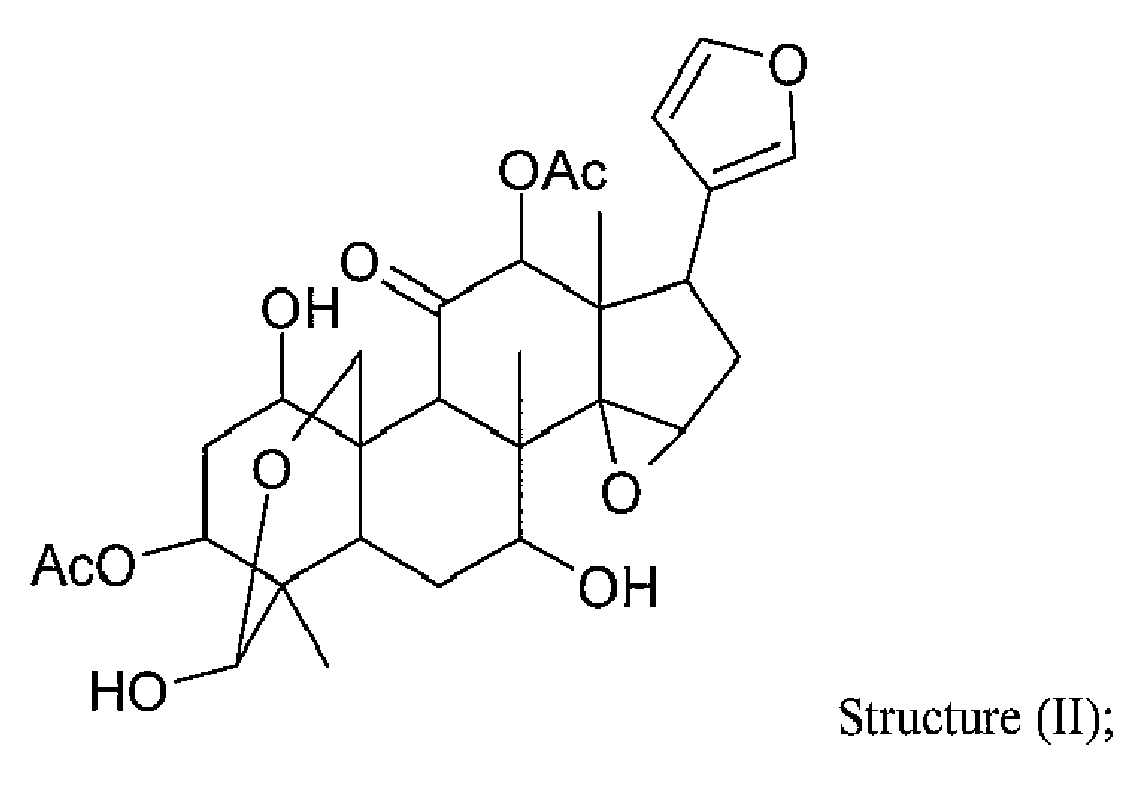

- The anti-hepatitis C composition as claimed in claim 1, wherein the limonoid compound comprises toosendanin and a structure of toosendanin is shown as Structure (II):

- The anti-hepatitis C composition as claimed in claim 5, wherein the toosendanin is extracted from a plant material.
- The anti-hepatitis C composition as claimed in claim 6, wherein the plant material comprises Melia toosendan Sieb. Et Zucc. or Melia azedarach Linn.
- The anti-hepatitis C composition as claimed in claim 1, wherein the limonoid compound comprises Trichilin H, and a structure of Trichilin H is shown as Structure (III):

- The anti-hepatitis C composition as claimed in claim 8, wherein the Trichilin H is extracted from a plant material.
- The anti-hepatitis C composition as claimed in claim 9, wherein the plant material comprises Melia toosendan Sieb. Et Zucc. or Melia azedarach Linn.
- A method for preparing a drug for inhibiting hepatitis C viruses or treating hepatitis C, wherein an effective amount of limonoid compound is used, and the structure of the limonoid compound is shown as Structure (I):

- The method for preparing a drug for inhibiting hepatitis C viruses or treating hepatitis C as claimed in claim 11, wherein the limonoid compound is extracted from a plant material.
- The method for preparing a drug for inhibiting hepatitis C viruses or treating hepatitis C as claimed in claim 12, wherein the plant material comprises Melia toosendan Sieb. Et Zucc. or Melia azedarach Linn.
- The method for preparing a drug for inhibiting hepatitis C viruses or treating hepatitis C as claimed in claim 11, wherein the limonoid compound comprises toosendanin or Trichilin H, and structures of toosendanin or Trichilin H are shown as Structure (II) and (III), respectively:


Applications Claiming Priority (2)
| Application Number | Priority Date | Filing Date | Title |
|---|---|---|---|
| TW98120040 | 2009-06-16 | ||
| TW098136423A TWI351280B (en) | 2009-06-16 | 2009-10-28 | Anti-hepatitis c composition, method for preparing |
Publications (2)
| Publication Number | Publication Date |
|---|---|
| EP2263676A1 true EP2263676A1 (en) | 2010-12-22 |
| EP2263676B1 EP2263676B1 (en) | 2011-08-31 |
Family
ID=42712431
Family Applications (1)
| Application Number | Title | Priority Date | Filing Date |
|---|---|---|---|
| EP10153974A Active EP2263676B1 (en) | 2009-06-16 | 2010-02-18 | Compositions for inhibiting or treating Hepatitis C viruses |
Country Status (4)
| Country | Link |
|---|---|
| EP (1) | EP2263676B1 (en) |
| JP (1) | JP5172894B2 (en) |
| AT (1) | ATE522219T1 (en) |
| TW (1) | TWI351280B (en) |
Cited By (1)
| Publication number | Priority date | Publication date | Assignee | Title |
|---|---|---|---|---|
| CN103907627A (en) * | 2013-01-09 | 2014-07-09 | 中国科学院海洋研究所 | Application of tetracyclic triterpenoids in preparation of low-dosage rotifer insecticides |
Families Citing this family (3)
| Publication number | Priority date | Publication date | Assignee | Title |
|---|---|---|---|---|
| MD4177C1 (en) * | 2011-01-14 | 2013-02-28 | Национальный Центр Общественного Здоровья Министерства Здравоохранения Республики Молдова | Method for vaccination against hepatitis B of persons with immunodeficiency |
| JP2012167023A (en) * | 2011-02-09 | 2012-09-06 | Kao Corp | Ceramide production promoter, humectant, and skin care preparation for external use |
| JP2012167063A (en) * | 2011-02-15 | 2012-09-06 | Kao Corp | Dopa oxidase activity inhibitor and whitening agent |
Citations (1)
| Publication number | Priority date | Publication date | Assignee | Title |
|---|---|---|---|---|
| CN1476829A (en) * | 2003-07-16 | 2004-02-25 | 中国科学院上海生命科学研究院 | Application of toosendanin as an antitumor drug |
Family Cites Families (2)
| Publication number | Priority date | Publication date | Assignee | Title |
|---|---|---|---|---|
| CN100333756C (en) * | 2004-05-25 | 2007-08-29 | 李春光 | Chinese medicinal preparation for hepatitis and its preparing method (1) |
| CN101181567B (en) * | 2007-11-28 | 2010-06-16 | 王科先 | Medicament for curing liver fibrosis of chronic hepatitis B |
-
2009
- 2009-10-28 TW TW098136423A patent/TWI351280B/en not_active IP Right Cessation
-
2010
- 2010-02-18 EP EP10153974A patent/EP2263676B1/en active Active
- 2010-02-18 AT AT10153974T patent/ATE522219T1/en not_active IP Right Cessation
- 2010-04-30 JP JP2010105429A patent/JP5172894B2/en not_active Expired - Fee Related
Patent Citations (1)
| Publication number | Priority date | Publication date | Assignee | Title |
|---|---|---|---|---|
| CN1476829A (en) * | 2003-07-16 | 2004-02-25 | 中国科学院上海生命科学研究院 | Application of toosendanin as an antitumor drug |
Non-Patent Citations (4)
| Title |
|---|
| DATABASE WPI Week 200437, Derwent World Patents Index; AN 2004-390844, XP002600851, SHI Y.; WANG W; WANG Z: "Toosendanin used as anti-tumor medicine, is separated from phloem of toosendan and purified" * |
| J. M. VORLIJK ET AL., JOURNAL OF VIROLOGICAL METHODS, vol. 110, 2003, pages 201 - 209 |
| R. BARTENSCHLAGER, NATURE REVIEWS/DRUG DISCOVERY, vol. 1, 2002, pages 911 - 916 |
| V. LOHMANN ET AL., SCIENCE, vol. 285, 1999, pages 110 - 113 |
Cited By (2)
| Publication number | Priority date | Publication date | Assignee | Title |
|---|---|---|---|---|
| CN103907627A (en) * | 2013-01-09 | 2014-07-09 | 中国科学院海洋研究所 | Application of tetracyclic triterpenoids in preparation of low-dosage rotifer insecticides |
| CN103907627B (en) * | 2013-01-09 | 2015-07-01 | 中国科学院海洋研究所 | Application of tetracyclic triterpenoids in preparation of low-dosage rotifer insecticides |
Also Published As
| Publication number | Publication date |
|---|---|
| JP5172894B2 (en) | 2013-03-27 |
| TW201100077A (en) | 2011-01-01 |
| JP2011001345A (en) | 2011-01-06 |
| ATE522219T1 (en) | 2011-09-15 |
| TWI351280B (en) | 2011-11-01 |
| EP2263676B1 (en) | 2011-08-31 |
Similar Documents
| Publication | Publication Date | Title |
|---|---|---|
| JP4892486B2 (en) | Use of [D-MEALA] 3- [ETVAL] 4-cyclosporin for the treatment of hepatitis C infection and pharmaceutical composition comprising said [D-MEALA] 3- [ETVAL] 4-cyclosporin | |
| CN102526083B (en) | Pharmaceutical composition for preventing or treating Hepatitis C | |
| CN107986951B (en) | Novel topoisomerase I inhibitor and pharmaceutical composition, preparation method and application thereof | |
| EP2263676B1 (en) | Compositions for inhibiting or treating Hepatitis C viruses | |
| US8802662B2 (en) | Anti-hepatitis C composition and method for preparing drug for inhibiting hepatitis C viruses or treating hepatitis C | |
| JP2009524585A (en) | Diarylureas for treating viral infections | |
| US20110064694A1 (en) | Anti-hepatitis c activity of meso-tetrakis-porphyrin analogues | |
| You et al. | New potent biaryl sulfate-based hepatitis C virus inhibitors | |
| CN101991583B (en) | Anti-hepatitis C composition and method for preparing medicine for inhibiting hepatitis C virus or treating hepatitis C | |
| CN101375842B (en) | Application of lignan of biphenyl cyclooctene series in preparing anti-hepatitis B virus medicament | |
| DE102006013957A1 (en) | Use of new or known N-benzyl N-phenyl benzenesulfonamide derivatives to prepare medicaments for treating or preventing viral diseases | |
| JPWO2006046674A1 (en) | Preventive and therapeutic agent for hepatitis C virus infection | |
| US10765644B2 (en) | Methods for the treatment of hepatitis C | |
| US11548891B1 (en) | Quaternary ammonium salts of phenanthroindolizidine and phenanthroquinolizidine alkaloids as hypoxia-targeted anticancer agents | |
| KR102864655B1 (en) | Pharmaceutical composition for preventing or treating diseases caused by dengue virus infection | |
| CN104163851B (en) | Fluorinated α-carbonyl HCV NS3/4A serine protease inhibitor | |
| CN110974834A (en) | Application of Lonicera fulvidraco acid hydrolysate in pharmacy and preparation method thereof | |
| CN112142809B (en) | Uric acid dipropionate phosphoramidate compound, its pharmaceutical composition and its preparation method and application | |
| KR20240151910A (en) | Pharmaceutical compositions for preventing or treating cancer comprising a compound derived from Schisandra sphenanthera as an active ingredient | |
| CN100338067C (en) | Anti-AIDS compound, its preparing method and pharmaceutical composition with anti-AIDS compound as active component and use thereof | |
| US20130150435A1 (en) | Method for treating hepatitis c | |
| CN119707969A (en) | Acer truncatum alkaloid compound with anti-EV71 virus activity and its preparation and application | |
| US10376498B2 (en) | 3-alkyl pyridinium compound from red sea sponge with potent antiviral activity | |
| EP4674846A1 (en) | Urea motif containing compounds as antibacterial drugs against multiresistant mycobacteria | |
| KR20020084312A (en) | Anti-HCV agent containing Poncirus trifoliate Ratin extract |
Legal Events
| Date | Code | Title | Description |
|---|---|---|---|
| PUAI | Public reference made under article 153(3) epc to a published international application that has entered the european phase |
Free format text: ORIGINAL CODE: 0009012 |
|
| AK | Designated contracting states |
Kind code of ref document: A1 Designated state(s): AT BE BG CH CY CZ DE DK EE ES FI FR GB GR HR HU IE IS IT LI LT LU LV MC MK MT NL NO PL PT RO SE SI SK SM TR |
|
| 17P | Request for examination filed |
Effective date: 20110216 |
|
| RIC1 | Information provided on ipc code assigned before grant |
Ipc: A61K 31/58 20060101AFI20110317BHEP Ipc: A61P 31/12 20060101ALI20110317BHEP |
|
| RTI1 | Title (correction) |
Free format text: COMPOSITIONS FOR INHIBITING OR TREATING HEPATITIS C VIRUSES |
|
| GRAP | Despatch of communication of intention to grant a patent |
Free format text: ORIGINAL CODE: EPIDOSNIGR1 |
|
| GRAS | Grant fee paid |
Free format text: ORIGINAL CODE: EPIDOSNIGR3 |
|
| GRAA | (expected) grant |
Free format text: ORIGINAL CODE: 0009210 |
|
| AK | Designated contracting states |
Kind code of ref document: B1 Designated state(s): AT BE BG CH CY CZ DE DK EE ES FI FR GB GR HR HU IE IS IT LI LT LU LV MC MK MT NL NO PL PT RO SE SI SK SM TR |
|
| AX | Request for extension of the european patent |
Extension state: AL BA RS |
|
| REG | Reference to a national code |
Ref country code: GB Ref legal event code: FG4D Ref country code: CH Ref legal event code: EP |
|
| REG | Reference to a national code |
Ref country code: IE Ref legal event code: FG4D |
|
| REG | Reference to a national code |
Ref country code: DE Ref legal event code: R096 Ref document number: 602010000156 Country of ref document: DE Effective date: 20111103 |
|
| REG | Reference to a national code |
Ref country code: NL Ref legal event code: VDEP Effective date: 20110831 |
|
| LTIE | Lt: invalidation of european patent or patent extension |
Effective date: 20110831 |
|
| PG25 | Lapsed in a contracting state [announced via postgrant information from national office to epo] |
Ref country code: IS Free format text: LAPSE BECAUSE OF FAILURE TO SUBMIT A TRANSLATION OF THE DESCRIPTION OR TO PAY THE FEE WITHIN THE PRESCRIBED TIME-LIMIT Effective date: 20111231 Ref country code: LT Free format text: LAPSE BECAUSE OF FAILURE TO SUBMIT A TRANSLATION OF THE DESCRIPTION OR TO PAY THE FEE WITHIN THE PRESCRIBED TIME-LIMIT Effective date: 20110831 Ref country code: NL Free format text: LAPSE BECAUSE OF FAILURE TO SUBMIT A TRANSLATION OF THE DESCRIPTION OR TO PAY THE FEE WITHIN THE PRESCRIBED TIME-LIMIT Effective date: 20110831 Ref country code: FI Free format text: LAPSE BECAUSE OF FAILURE TO SUBMIT A TRANSLATION OF THE DESCRIPTION OR TO PAY THE FEE WITHIN THE PRESCRIBED TIME-LIMIT Effective date: 20110831 Ref country code: SE Free format text: LAPSE BECAUSE OF FAILURE TO SUBMIT A TRANSLATION OF THE DESCRIPTION OR TO PAY THE FEE WITHIN THE PRESCRIBED TIME-LIMIT Effective date: 20110831 Ref country code: NO Free format text: LAPSE BECAUSE OF FAILURE TO SUBMIT A TRANSLATION OF THE DESCRIPTION OR TO PAY THE FEE WITHIN THE PRESCRIBED TIME-LIMIT Effective date: 20111130 Ref country code: HR Free format text: LAPSE BECAUSE OF FAILURE TO SUBMIT A TRANSLATION OF THE DESCRIPTION OR TO PAY THE FEE WITHIN THE PRESCRIBED TIME-LIMIT Effective date: 20110831 |
|
| REG | Reference to a national code |
Ref country code: AT Ref legal event code: MK05 Ref document number: 522219 Country of ref document: AT Kind code of ref document: T Effective date: 20110831 |
|
| PG25 | Lapsed in a contracting state [announced via postgrant information from national office to epo] |
Ref country code: CY Free format text: LAPSE BECAUSE OF FAILURE TO SUBMIT A TRANSLATION OF THE DESCRIPTION OR TO PAY THE FEE WITHIN THE PRESCRIBED TIME-LIMIT Effective date: 20110831 Ref country code: LV Free format text: LAPSE BECAUSE OF FAILURE TO SUBMIT A TRANSLATION OF THE DESCRIPTION OR TO PAY THE FEE WITHIN THE PRESCRIBED TIME-LIMIT Effective date: 20110831 Ref country code: GR Free format text: LAPSE BECAUSE OF FAILURE TO SUBMIT A TRANSLATION OF THE DESCRIPTION OR TO PAY THE FEE WITHIN THE PRESCRIBED TIME-LIMIT Effective date: 20111201 Ref country code: AT Free format text: LAPSE BECAUSE OF FAILURE TO SUBMIT A TRANSLATION OF THE DESCRIPTION OR TO PAY THE FEE WITHIN THE PRESCRIBED TIME-LIMIT Effective date: 20110831 Ref country code: SI Free format text: LAPSE BECAUSE OF FAILURE TO SUBMIT A TRANSLATION OF THE DESCRIPTION OR TO PAY THE FEE WITHIN THE PRESCRIBED TIME-LIMIT Effective date: 20110831 |
|
| PG25 | Lapsed in a contracting state [announced via postgrant information from national office to epo] |
Ref country code: BE Free format text: LAPSE BECAUSE OF FAILURE TO SUBMIT A TRANSLATION OF THE DESCRIPTION OR TO PAY THE FEE WITHIN THE PRESCRIBED TIME-LIMIT Effective date: 20110831 |
|
| PG25 | Lapsed in a contracting state [announced via postgrant information from national office to epo] |
Ref country code: SK Free format text: LAPSE BECAUSE OF FAILURE TO SUBMIT A TRANSLATION OF THE DESCRIPTION OR TO PAY THE FEE WITHIN THE PRESCRIBED TIME-LIMIT Effective date: 20110831 Ref country code: CZ Free format text: LAPSE BECAUSE OF FAILURE TO SUBMIT A TRANSLATION OF THE DESCRIPTION OR TO PAY THE FEE WITHIN THE PRESCRIBED TIME-LIMIT Effective date: 20110831 |
|
| PG25 | Lapsed in a contracting state [announced via postgrant information from national office to epo] |
Ref country code: PL Free format text: LAPSE BECAUSE OF FAILURE TO SUBMIT A TRANSLATION OF THE DESCRIPTION OR TO PAY THE FEE WITHIN THE PRESCRIBED TIME-LIMIT Effective date: 20110831 Ref country code: EE Free format text: LAPSE BECAUSE OF FAILURE TO SUBMIT A TRANSLATION OF THE DESCRIPTION OR TO PAY THE FEE WITHIN THE PRESCRIBED TIME-LIMIT Effective date: 20110831 Ref country code: RO Free format text: LAPSE BECAUSE OF FAILURE TO SUBMIT A TRANSLATION OF THE DESCRIPTION OR TO PAY THE FEE WITHIN THE PRESCRIBED TIME-LIMIT Effective date: 20110831 Ref country code: IT Free format text: LAPSE BECAUSE OF FAILURE TO SUBMIT A TRANSLATION OF THE DESCRIPTION OR TO PAY THE FEE WITHIN THE PRESCRIBED TIME-LIMIT Effective date: 20110831 Ref country code: PT Free format text: LAPSE BECAUSE OF FAILURE TO SUBMIT A TRANSLATION OF THE DESCRIPTION OR TO PAY THE FEE WITHIN THE PRESCRIBED TIME-LIMIT Effective date: 20120102 |
|
| PG25 | Lapsed in a contracting state [announced via postgrant information from national office to epo] |
Ref country code: DK Free format text: LAPSE BECAUSE OF FAILURE TO SUBMIT A TRANSLATION OF THE DESCRIPTION OR TO PAY THE FEE WITHIN THE PRESCRIBED TIME-LIMIT Effective date: 20110831 |
|
| PLBE | No opposition filed within time limit |
Free format text: ORIGINAL CODE: 0009261 |
|
| STAA | Information on the status of an ep patent application or granted ep patent |
Free format text: STATUS: NO OPPOSITION FILED WITHIN TIME LIMIT |
|
| 26N | No opposition filed |
Effective date: 20120601 |
|
| REG | Reference to a national code |
Ref country code: DE Ref legal event code: R097 Ref document number: 602010000156 Country of ref document: DE Effective date: 20120601 |
|
| PG25 | Lapsed in a contracting state [announced via postgrant information from national office to epo] |
Ref country code: MC Free format text: LAPSE BECAUSE OF NON-PAYMENT OF DUE FEES Effective date: 20120229 |
|
| REG | Reference to a national code |
Ref country code: IE Ref legal event code: MM4A |
|
| PG25 | Lapsed in a contracting state [announced via postgrant information from national office to epo] |
Ref country code: IE Free format text: LAPSE BECAUSE OF NON-PAYMENT OF DUE FEES Effective date: 20120218 |
|
| PG25 | Lapsed in a contracting state [announced via postgrant information from national office to epo] |
Ref country code: MK Free format text: LAPSE BECAUSE OF FAILURE TO SUBMIT A TRANSLATION OF THE DESCRIPTION OR TO PAY THE FEE WITHIN THE PRESCRIBED TIME-LIMIT Effective date: 20110831 |
|
| PG25 | Lapsed in a contracting state [announced via postgrant information from national office to epo] |
Ref country code: ES Free format text: LAPSE BECAUSE OF FAILURE TO SUBMIT A TRANSLATION OF THE DESCRIPTION OR TO PAY THE FEE WITHIN THE PRESCRIBED TIME-LIMIT Effective date: 20111211 |
|
| PG25 | Lapsed in a contracting state [announced via postgrant information from national office to epo] |
Ref country code: BG Free format text: LAPSE BECAUSE OF FAILURE TO SUBMIT A TRANSLATION OF THE DESCRIPTION OR TO PAY THE FEE WITHIN THE PRESCRIBED TIME-LIMIT Effective date: 20111130 |
|
| PG25 | Lapsed in a contracting state [announced via postgrant information from national office to epo] |
Ref country code: MT Free format text: LAPSE BECAUSE OF FAILURE TO SUBMIT A TRANSLATION OF THE DESCRIPTION OR TO PAY THE FEE WITHIN THE PRESCRIBED TIME-LIMIT Effective date: 20110831 |
|
| PG25 | Lapsed in a contracting state [announced via postgrant information from national office to epo] |
Ref country code: TR Free format text: LAPSE BECAUSE OF FAILURE TO SUBMIT A TRANSLATION OF THE DESCRIPTION OR TO PAY THE FEE WITHIN THE PRESCRIBED TIME-LIMIT Effective date: 20110831 |
|
| PG25 | Lapsed in a contracting state [announced via postgrant information from national office to epo] |
Ref country code: SM Free format text: LAPSE BECAUSE OF FAILURE TO SUBMIT A TRANSLATION OF THE DESCRIPTION OR TO PAY THE FEE WITHIN THE PRESCRIBED TIME-LIMIT Effective date: 20110831 Ref country code: LU Free format text: LAPSE BECAUSE OF NON-PAYMENT OF DUE FEES Effective date: 20120218 |
|
| PG25 | Lapsed in a contracting state [announced via postgrant information from national office to epo] |
Ref country code: HU Free format text: LAPSE BECAUSE OF FAILURE TO SUBMIT A TRANSLATION OF THE DESCRIPTION OR TO PAY THE FEE WITHIN THE PRESCRIBED TIME-LIMIT Effective date: 20100218 |
|
| REG | Reference to a national code |
Ref country code: CH Ref legal event code: PL |
|
| PG25 | Lapsed in a contracting state [announced via postgrant information from national office to epo] |
Ref country code: LI Free format text: LAPSE BECAUSE OF NON-PAYMENT OF DUE FEES Effective date: 20140228 Ref country code: CH Free format text: LAPSE BECAUSE OF NON-PAYMENT OF DUE FEES Effective date: 20140228 |
|
| REG | Reference to a national code |
Ref country code: FR Ref legal event code: PLFP Year of fee payment: 6 |
|
| REG | Reference to a national code |
Ref country code: FR Ref legal event code: PLFP Year of fee payment: 7 |
|
| REG | Reference to a national code |
Ref country code: FR Ref legal event code: PLFP Year of fee payment: 8 |
|
| REG | Reference to a national code |
Ref country code: FR Ref legal event code: PLFP Year of fee payment: 9 |
|
| PGFP | Annual fee paid to national office [announced via postgrant information from national office to epo] |
Ref country code: GB Payment date: 20200327 Year of fee payment: 11 Ref country code: DE Payment date: 20200327 Year of fee payment: 11 |
|
| PGFP | Annual fee paid to national office [announced via postgrant information from national office to epo] |
Ref country code: FR Payment date: 20200325 Year of fee payment: 11 |
|
| REG | Reference to a national code |
Ref country code: DE Ref legal event code: R119 Ref document number: 602010000156 Country of ref document: DE |
|
| GBPC | Gb: european patent ceased through non-payment of renewal fee |
Effective date: 20210218 |
|
| PG25 | Lapsed in a contracting state [announced via postgrant information from national office to epo] |
Ref country code: FR Free format text: LAPSE BECAUSE OF NON-PAYMENT OF DUE FEES Effective date: 20210228 Ref country code: GB Free format text: LAPSE BECAUSE OF NON-PAYMENT OF DUE FEES Effective date: 20210218 Ref country code: DE Free format text: LAPSE BECAUSE OF NON-PAYMENT OF DUE FEES Effective date: 20210901 |