EP2263465A1 - Polyvalent conjugate vaccine for cancer - Google Patents
Polyvalent conjugate vaccine for cancer Download PDFInfo
- Publication number
- EP2263465A1 EP2263465A1 EP10184649A EP10184649A EP2263465A1 EP 2263465 A1 EP2263465 A1 EP 2263465A1 EP 10184649 A EP10184649 A EP 10184649A EP 10184649 A EP10184649 A EP 10184649A EP 2263465 A1 EP2263465 A1 EP 2263465A1
- Authority
- EP
- European Patent Office
- Prior art keywords
- vaccine
- patients
- klh
- igm
- igg
- Prior art date
- Legal status (The legal status is an assumption and is not a legal conclusion. Google has not performed a legal analysis and makes no representation as to the accuracy of the status listed.)
- Withdrawn
Links
- 206010028980 Neoplasm Diseases 0.000 title description 85
- 201000011510 cancer Diseases 0.000 title description 44
- 229940031670 conjugate vaccine Drugs 0.000 title description 29
- 108010060123 Conjugate Vaccines Proteins 0.000 title description 25
- 108091007433 antigens Proteins 0.000 claims abstract description 199
- 102000036639 antigens Human genes 0.000 claims abstract description 199
- 239000000427 antigen Substances 0.000 claims abstract description 197
- 239000002671 adjuvant Substances 0.000 claims abstract description 67
- 102000015728 Mucins Human genes 0.000 claims abstract description 24
- 108010063954 Mucins Proteins 0.000 claims abstract description 24
- 229940031348 multivalent vaccine Drugs 0.000 claims abstract description 23
- 229930186217 Glycolipid Natural products 0.000 claims abstract description 16
- HVCOBJNICQPDBP-UHFFFAOYSA-N 3-[3-[3,5-dihydroxy-6-methyl-4-(3,4,5-trihydroxy-6-methyloxan-2-yl)oxyoxan-2-yl]oxydecanoyloxy]decanoic acid;hydrate Chemical compound O.OC1C(OC(CC(=O)OC(CCCCCCC)CC(O)=O)CCCCCCC)OC(C)C(O)C1OC1C(O)C(O)C(O)C(C)O1 HVCOBJNICQPDBP-UHFFFAOYSA-N 0.000 claims abstract description 14
- 150000004676 glycans Chemical class 0.000 claims abstract description 11
- 229920001282 polysaccharide Polymers 0.000 claims abstract description 11
- 239000005017 polysaccharide Substances 0.000 claims abstract description 11
- 229960005486 vaccine Drugs 0.000 claims description 227
- 238000011282 treatment Methods 0.000 claims description 61
- 108010045069 keyhole-limpet hemocyanin Proteins 0.000 claims description 57
- 102100034256 Mucin-1 Human genes 0.000 claims description 38
- 108010008707 Mucin-1 Proteins 0.000 claims description 38
- 206010060862 Prostate cancer Diseases 0.000 claims description 34
- 208000000236 Prostatic Neoplasms Diseases 0.000 claims description 34
- 108090000765 processed proteins & peptides Proteins 0.000 claims description 23
- 206010033128 Ovarian cancer Diseases 0.000 claims description 22
- 206010061535 Ovarian neoplasm Diseases 0.000 claims description 20
- 206010006187 Breast cancer Diseases 0.000 claims description 16
- 208000026310 Breast neoplasm Diseases 0.000 claims description 16
- 101710147220 Ent-copalyl diphosphate synthase, chloroplastic Proteins 0.000 claims description 15
- 102100031940 Epithelial cell adhesion molecule Human genes 0.000 claims description 15
- 150000002270 gangliosides Chemical class 0.000 claims description 13
- 101000623901 Homo sapiens Mucin-16 Proteins 0.000 claims description 12
- 102100023123 Mucin-16 Human genes 0.000 claims description 12
- 102100034263 Mucin-2 Human genes 0.000 claims description 11
- -1 or a portion thereof Proteins 0.000 claims description 10
- 210000000481 breast Anatomy 0.000 claims description 9
- 210000002307 prostate Anatomy 0.000 claims description 9
- 108090000623 proteins and genes Proteins 0.000 claims description 7
- 102000004169 proteins and genes Human genes 0.000 claims description 6
- 102100041003 Glutamate carboxypeptidase 2 Human genes 0.000 claims description 5
- 239000002253 acid Substances 0.000 claims description 5
- 125000005630 sialyl group Chemical group 0.000 claims description 5
- 101000892862 Homo sapiens Glutamate carboxypeptidase 2 Proteins 0.000 claims description 4
- 108010008705 Mucin-2 Proteins 0.000 claims description 4
- 229920001481 poly(stearyl methacrylate) Polymers 0.000 claims description 4
- 101100346932 Mus musculus Muc1 gene Proteins 0.000 claims description 3
- 241000699670 Mus sp. Species 0.000 description 62
- 230000003053 immunization Effects 0.000 description 61
- 238000002649 immunization Methods 0.000 description 58
- 210000004027 cell Anatomy 0.000 description 54
- 102100038358 Prostate-specific antigen Human genes 0.000 description 47
- 108010072866 Prostate-Specific Antigen Proteins 0.000 description 46
- 201000010099 disease Diseases 0.000 description 41
- 208000037265 diseases, disorders, signs and symptoms Diseases 0.000 description 41
- 238000002965 ELISA Methods 0.000 description 35
- 238000000034 method Methods 0.000 description 35
- 238000002255 vaccination Methods 0.000 description 29
- 230000000694 effects Effects 0.000 description 28
- 230000028993 immune response Effects 0.000 description 26
- 238000001943 fluorescence-activated cell sorting Methods 0.000 description 25
- 239000000562 conjugate Substances 0.000 description 24
- 230000005847 immunogenicity Effects 0.000 description 24
- 230000005875 antibody response Effects 0.000 description 23
- 210000004881 tumor cell Anatomy 0.000 description 23
- MUMGGOZAMZWBJJ-DYKIIFRCSA-N Testostosterone Chemical compound O=C1CC[C@]2(C)[C@H]3CC[C@](C)([C@H](CC4)O)[C@@H]4[C@@H]3CCC2=C1 MUMGGOZAMZWBJJ-DYKIIFRCSA-N 0.000 description 22
- 238000013459 approach Methods 0.000 description 22
- 230000004044 response Effects 0.000 description 22
- 241000282414 Homo sapiens Species 0.000 description 21
- NKVLDFAVEWLOCX-GUSKIFEASA-N [(2s,3r,4s,5r,6r)-3-[(2s,3r,4s,5r,6s)-5-[(2s,3r,4s,5r)-4-[(2s,3r,4r)-3,4-dihydroxy-4-(hydroxymethyl)oxolan-2-yl]oxy-3,5-dihydroxyoxan-2-yl]oxy-3,4-dihydroxy-6-methyloxan-2-yl]oxy-4,5-dihydroxy-6-methyloxan-2-yl] (4ar,5r,6as,6br,9s,10s,12ar)-10-[(2r,3r,4s, Chemical compound O([C@H]1[C@H](O)CO[C@H]([C@@H]1O)O[C@H]1[C@H](C)O[C@H]([C@@H]([C@@H]1O)O)O[C@@H]1[C@@H](O)[C@@H](O)[C@@H](C)O[C@H]1OC(=O)[C@]12CCC(C)(C)CC1C1=CCC3[C@@]([C@@]1(C[C@H]2O)C)(C)CCC1[C@]3(C)CC[C@@H]([C@@]1(C)C=O)O[C@@H]1O[C@@H]([C@H]([C@H](O[C@H]2[C@@H]([C@@H](O)[C@H](O)CO2)O)[C@H]1O[C@H]1[C@@H]([C@@H](O)[C@@H](O)[C@@H](CO)O1)O)O)C(=O)NCCCCCCCCCCCC)[C@@H]1OC[C@](O)(CO)[C@H]1O NKVLDFAVEWLOCX-GUSKIFEASA-N 0.000 description 20
- 238000011156 evaluation Methods 0.000 description 19
- 238000002560 therapeutic procedure Methods 0.000 description 19
- DDRJAANPRJIHGJ-UHFFFAOYSA-N creatinine Chemical compound CN1CC(=O)NC1=N DDRJAANPRJIHGJ-UHFFFAOYSA-N 0.000 description 18
- 229930182490 saponin Natural products 0.000 description 18
- 150000007949 saponins Chemical group 0.000 description 18
- 235000017709 saponins Nutrition 0.000 description 18
- 238000012360 testing method Methods 0.000 description 18
- 235000014633 carbohydrates Nutrition 0.000 description 17
- 239000001397 quillaja saponaria molina bark Substances 0.000 description 17
- 238000011160 research Methods 0.000 description 17
- 231100000057 systemic toxicity Toxicity 0.000 description 17
- 230000001988 toxicity Effects 0.000 description 17
- 231100000419 toxicity Toxicity 0.000 description 17
- 150000001720 carbohydrates Chemical class 0.000 description 16
- 235000010482 polyoxyethylene sorbitan monooleate Nutrition 0.000 description 16
- 239000000244 polyoxyethylene sorbitan monooleate Substances 0.000 description 16
- 229920000053 polysorbate 80 Polymers 0.000 description 16
- 229940068968 polysorbate 80 Drugs 0.000 description 16
- 241000699666 Mus <mouse, genus> Species 0.000 description 14
- 239000003814 drug Substances 0.000 description 14
- 230000008901 benefit Effects 0.000 description 13
- 238000009534 blood test Methods 0.000 description 13
- 230000021615 conjugation Effects 0.000 description 13
- 238000002591 computed tomography Methods 0.000 description 12
- 230000006698 induction Effects 0.000 description 12
- 239000000203 mixture Substances 0.000 description 12
- 210000004369 blood Anatomy 0.000 description 11
- 238000002474 experimental method Methods 0.000 description 11
- 230000001939 inductive effect Effects 0.000 description 11
- 230000009257 reactivity Effects 0.000 description 11
- 210000002966 serum Anatomy 0.000 description 11
- 229960003604 testosterone Drugs 0.000 description 11
- 229940079593 drug Drugs 0.000 description 10
- 239000000568 immunological adjuvant Substances 0.000 description 10
- 238000002360 preparation method Methods 0.000 description 10
- 238000002512 chemotherapy Methods 0.000 description 9
- 229940109239 creatinine Drugs 0.000 description 9
- 238000001794 hormone therapy Methods 0.000 description 9
- 210000000987 immune system Anatomy 0.000 description 9
- 238000012552 review Methods 0.000 description 9
- 241000283707 Capra Species 0.000 description 8
- 208000030453 Drug-Related Side Effects and Adverse reaction Diseases 0.000 description 8
- 206010015150 Erythema Diseases 0.000 description 8
- 206010041067 Small cell lung cancer Diseases 0.000 description 8
- 239000008280 blood Substances 0.000 description 8
- 238000003384 imaging method Methods 0.000 description 8
- 238000002347 injection Methods 0.000 description 8
- 239000007924 injection Substances 0.000 description 8
- 208000000587 small cell lung carcinoma Diseases 0.000 description 8
- 208000024891 symptom Diseases 0.000 description 8
- 108091003079 Bovine Serum Albumin Proteins 0.000 description 7
- 102000008203 CTLA-4 Antigen Human genes 0.000 description 7
- 108010021064 CTLA-4 Antigen Proteins 0.000 description 7
- 229940045513 CTLA4 antagonist Drugs 0.000 description 7
- CMSMOCZEIVJLDB-UHFFFAOYSA-N Cyclophosphamide Chemical compound ClCCN(CCCl)P1(=O)NCCCO1 CMSMOCZEIVJLDB-UHFFFAOYSA-N 0.000 description 7
- 206010061818 Disease progression Diseases 0.000 description 7
- 102000003886 Glycoproteins Human genes 0.000 description 7
- 108090000288 Glycoproteins Proteins 0.000 description 7
- 241000147041 Guaiacum officinale Species 0.000 description 7
- 101001133081 Homo sapiens Mucin-2 Proteins 0.000 description 7
- 238000004458 analytical method Methods 0.000 description 7
- 230000007423 decrease Effects 0.000 description 7
- 238000011161 development Methods 0.000 description 7
- 238000010790 dilution Methods 0.000 description 7
- 239000012895 dilution Substances 0.000 description 7
- 239000003937 drug carrier Substances 0.000 description 7
- 239000012894 fetal calf serum Substances 0.000 description 7
- 230000002163 immunogen Effects 0.000 description 7
- 201000001441 melanoma Diseases 0.000 description 7
- 239000002953 phosphate buffered saline Substances 0.000 description 7
- 102000004196 processed proteins & peptides Human genes 0.000 description 7
- 238000001959 radiotherapy Methods 0.000 description 7
- 238000001356 surgical procedure Methods 0.000 description 7
- 102000002260 Alkaline Phosphatase Human genes 0.000 description 6
- 108020004774 Alkaline Phosphatase Proteins 0.000 description 6
- 206010030113 Oedema Diseases 0.000 description 6
- 206010066901 Treatment failure Diseases 0.000 description 6
- 210000001015 abdomen Anatomy 0.000 description 6
- 230000003190 augmentative effect Effects 0.000 description 6
- 238000007469 bone scintigraphy Methods 0.000 description 6
- 230000003247 decreasing effect Effects 0.000 description 6
- 230000005750 disease progression Effects 0.000 description 6
- 231100000321 erythema Toxicity 0.000 description 6
- 229940091561 guaiac Drugs 0.000 description 6
- 239000000463 material Substances 0.000 description 6
- 210000004197 pelvis Anatomy 0.000 description 6
- BASFCYQUMIYNBI-UHFFFAOYSA-N platinum Chemical compound [Pt] BASFCYQUMIYNBI-UHFFFAOYSA-N 0.000 description 6
- 230000000630 rising effect Effects 0.000 description 6
- 230000001629 suppression Effects 0.000 description 6
- 210000001519 tissue Anatomy 0.000 description 6
- 201000009030 Carcinoma Diseases 0.000 description 5
- 208000003788 Neoplasm Micrometastasis Diseases 0.000 description 5
- 238000001574 biopsy Methods 0.000 description 5
- 239000000969 carrier Substances 0.000 description 5
- 230000000295 complement effect Effects 0.000 description 5
- 229960004397 cyclophosphamide Drugs 0.000 description 5
- 238000009093 first-line therapy Methods 0.000 description 5
- MHMNJMPURVTYEJ-UHFFFAOYSA-N fluorescein-5-isothiocyanate Chemical compound O1C(=O)C2=CC(N=C=S)=CC=C2C21C1=CC=C(O)C=C1OC1=CC(O)=CC=C21 MHMNJMPURVTYEJ-UHFFFAOYSA-N 0.000 description 5
- 238000009472 formulation Methods 0.000 description 5
- 238000004108 freeze drying Methods 0.000 description 5
- 208000015181 infectious disease Diseases 0.000 description 5
- 230000000977 initiatory effect Effects 0.000 description 5
- 125000005647 linker group Chemical group 0.000 description 5
- 206010061289 metastatic neoplasm Diseases 0.000 description 5
- 230000002611 ovarian Effects 0.000 description 5
- 238000009258 post-therapy Methods 0.000 description 5
- 230000003389 potentiating effect Effects 0.000 description 5
- 235000018102 proteins Nutrition 0.000 description 5
- 230000005855 radiation Effects 0.000 description 5
- 230000003442 weekly effect Effects 0.000 description 5
- 102000004625 Aspartate Aminotransferases Human genes 0.000 description 4
- 108010003415 Aspartate Aminotransferases Proteins 0.000 description 4
- BPYKTIZUTYGOLE-IFADSCNNSA-N Bilirubin Chemical compound N1C(=O)C(C)=C(C=C)\C1=C\C1=C(C)C(CCC(O)=O)=C(CC2=C(C(C)=C(\C=C/3C(=C(C=C)C(=O)N\3)C)N2)CCC(O)=O)N1 BPYKTIZUTYGOLE-IFADSCNNSA-N 0.000 description 4
- LFQSCWFLJHTTHZ-UHFFFAOYSA-N Ethanol Chemical compound CCO LFQSCWFLJHTTHZ-UHFFFAOYSA-N 0.000 description 4
- 206010020751 Hypersensitivity Diseases 0.000 description 4
- 241001465754 Metazoa Species 0.000 description 4
- 208000002193 Pain Diseases 0.000 description 4
- PXIPVTKHYLBLMZ-UHFFFAOYSA-N Sodium azide Chemical compound [Na+].[N-]=[N+]=[N-] PXIPVTKHYLBLMZ-UHFFFAOYSA-N 0.000 description 4
- 108010008038 Synthetic Vaccines Proteins 0.000 description 4
- 230000002411 adverse Effects 0.000 description 4
- 239000003098 androgen Substances 0.000 description 4
- 230000000259 anti-tumor effect Effects 0.000 description 4
- 238000003556 assay Methods 0.000 description 4
- 230000008859 change Effects 0.000 description 4
- 210000000038 chest Anatomy 0.000 description 4
- 231100000026 common toxicity Toxicity 0.000 description 4
- 230000012010 growth Effects 0.000 description 4
- 230000003054 hormonal effect Effects 0.000 description 4
- 230000036737 immune function Effects 0.000 description 4
- 230000001965 increasing effect Effects 0.000 description 4
- 230000001404 mediated effect Effects 0.000 description 4
- 238000012986 modification Methods 0.000 description 4
- 230000004048 modification Effects 0.000 description 4
- 210000003101 oviduct Anatomy 0.000 description 4
- 239000008194 pharmaceutical composition Substances 0.000 description 4
- 230000008569 process Effects 0.000 description 4
- 230000000405 serological effect Effects 0.000 description 4
- 235000000346 sugar Nutrition 0.000 description 4
- 230000004083 survival effect Effects 0.000 description 4
- 208000005443 Circulating Neoplastic Cells Diseases 0.000 description 3
- 206010012735 Diarrhoea Diseases 0.000 description 3
- 206010061819 Disease recurrence Diseases 0.000 description 3
- 238000012286 ELISA Assay Methods 0.000 description 3
- 201000001342 Fallopian tube cancer Diseases 0.000 description 3
- 208000013452 Fallopian tube neoplasm Diseases 0.000 description 3
- 206010061218 Inflammation Diseases 0.000 description 3
- 206010022004 Influenza like illness Diseases 0.000 description 3
- 102100027378 Prothrombin Human genes 0.000 description 3
- 108010094028 Prothrombin Proteins 0.000 description 3
- FAPWRFPIFSIZLT-UHFFFAOYSA-M Sodium chloride Chemical compound [Na+].[Cl-] FAPWRFPIFSIZLT-UHFFFAOYSA-M 0.000 description 3
- 210000001744 T-lymphocyte Anatomy 0.000 description 3
- 238000002679 ablation Methods 0.000 description 3
- 230000002159 abnormal effect Effects 0.000 description 3
- 230000005856 abnormality Effects 0.000 description 3
- 238000002835 absorbance Methods 0.000 description 3
- 235000001014 amino acid Nutrition 0.000 description 3
- 150000001413 amino acids Chemical class 0.000 description 3
- 230000003466 anti-cipated effect Effects 0.000 description 3
- 230000010056 antibody-dependent cellular cytotoxicity Effects 0.000 description 3
- 230000001588 bifunctional effect Effects 0.000 description 3
- 230000033228 biological regulation Effects 0.000 description 3
- 210000001772 blood platelet Anatomy 0.000 description 3
- 239000006285 cell suspension Substances 0.000 description 3
- 229940106189 ceramide Drugs 0.000 description 3
- 238000006243 chemical reaction Methods 0.000 description 3
- 238000001514 detection method Methods 0.000 description 3
- 230000036541 health Effects 0.000 description 3
- 229940088597 hormone Drugs 0.000 description 3
- 239000005556 hormone Substances 0.000 description 3
- 230000001900 immune effect Effects 0.000 description 3
- 238000003364 immunohistochemistry Methods 0.000 description 3
- 230000036512 infertility Effects 0.000 description 3
- 230000004054 inflammatory process Effects 0.000 description 3
- 238000011221 initial treatment Methods 0.000 description 3
- 230000007246 mechanism Effects 0.000 description 3
- 229940051875 mucins Drugs 0.000 description 3
- 238000010606 normalization Methods 0.000 description 3
- 210000001672 ovary Anatomy 0.000 description 3
- 230000001575 pathological effect Effects 0.000 description 3
- 210000005259 peripheral blood Anatomy 0.000 description 3
- 239000011886 peripheral blood Substances 0.000 description 3
- 201000002628 peritoneum cancer Diseases 0.000 description 3
- 229910052697 platinum Inorganic materials 0.000 description 3
- 238000002203 pretreatment Methods 0.000 description 3
- 230000002250 progressing effect Effects 0.000 description 3
- 229940039716 prothrombin Drugs 0.000 description 3
- 238000011472 radical prostatectomy Methods 0.000 description 3
- 238000009781 safety test method Methods 0.000 description 3
- 230000001225 therapeutic effect Effects 0.000 description 3
- 231100000041 toxicology testing Toxicity 0.000 description 3
- 239000004382 Amylase Substances 0.000 description 2
- 102000013142 Amylases Human genes 0.000 description 2
- 108010065511 Amylases Proteins 0.000 description 2
- 241000272478 Aquila Species 0.000 description 2
- YDNKGFDKKRUKPY-JHOUSYSJSA-N C16 ceramide Natural products CCCCCCCCCCCCCCCC(=O)N[C@@H](CO)[C@H](O)C=CCCCCCCCCCCCCC YDNKGFDKKRUKPY-JHOUSYSJSA-N 0.000 description 2
- 238000011740 C57BL/6 mouse Methods 0.000 description 2
- BVKZGUZCCUSVTD-UHFFFAOYSA-L Carbonate Chemical compound [O-]C([O-])=O BVKZGUZCCUSVTD-UHFFFAOYSA-L 0.000 description 2
- 241000282326 Felis catus Species 0.000 description 2
- SXRSQZLOMIGNAQ-UHFFFAOYSA-N Glutaraldehyde Chemical compound O=CCCCC=O SXRSQZLOMIGNAQ-UHFFFAOYSA-N 0.000 description 2
- 241000282412 Homo Species 0.000 description 2
- 208000033830 Hot Flashes Diseases 0.000 description 2
- 206010060800 Hot flush Diseases 0.000 description 2
- 206010058467 Lung neoplasm malignant Diseases 0.000 description 2
- 206010027476 Metastases Diseases 0.000 description 2
- 241001529936 Murinae Species 0.000 description 2
- 208000007571 Ovarian Epithelial Carcinoma Diseases 0.000 description 2
- 206010057249 Phagocytosis Diseases 0.000 description 2
- 208000003251 Pruritus Diseases 0.000 description 2
- 206010037660 Pyrexia Diseases 0.000 description 2
- 208000007660 Residual Neoplasm Diseases 0.000 description 2
- 208000037656 Respiratory Sounds Diseases 0.000 description 2
- 206010042674 Swelling Diseases 0.000 description 2
- 238000008050 Total Bilirubin Reagent Methods 0.000 description 2
- 208000024780 Urticaria Diseases 0.000 description 2
- 206010047924 Wheezing Diseases 0.000 description 2
- 208000027418 Wounds and injury Diseases 0.000 description 2
- 230000003187 abdominal effect Effects 0.000 description 2
- 239000000654 additive Substances 0.000 description 2
- 208000026935 allergic disease Diseases 0.000 description 2
- 230000007815 allergy Effects 0.000 description 2
- MGSDFCKWGHNUSM-QVPNGJTFSA-N alpha-L-Fucp-(1->2)-beta-D-Galp-(1->3)-beta-D-GlcpNAc Chemical compound O[C@H]1[C@H](O)[C@H](O)[C@H](C)O[C@H]1O[C@H]1[C@H](O[C@@H]2[C@H]([C@H](O)O[C@H](CO)[C@H]2O)NC(C)=O)O[C@H](CO)[C@H](O)[C@@H]1O MGSDFCKWGHNUSM-QVPNGJTFSA-N 0.000 description 2
- SRHNADOZAAWYLV-XLMUYGLTSA-N alpha-L-Fucp-(1->2)-beta-D-Galp-(1->4)-[alpha-L-Fucp-(1->3)]-beta-D-GlcpNAc Chemical compound O[C@H]1[C@H](O)[C@H](O)[C@H](C)O[C@H]1O[C@H]1[C@H](O[C@H]2[C@@H]([C@@H](NC(C)=O)[C@H](O)O[C@@H]2CO)O[C@H]2[C@H]([C@H](O)[C@H](O)[C@H](C)O2)O)O[C@H](CO)[C@H](O)[C@@H]1O SRHNADOZAAWYLV-XLMUYGLTSA-N 0.000 description 2
- 235000019418 amylase Nutrition 0.000 description 2
- 230000000890 antigenic effect Effects 0.000 description 2
- 230000005784 autoimmunity Effects 0.000 description 2
- 210000003719 b-lymphocyte Anatomy 0.000 description 2
- 230000001580 bacterial effect Effects 0.000 description 2
- 229960000074 biopharmaceutical Drugs 0.000 description 2
- 239000000872 buffer Substances 0.000 description 2
- 229940022399 cancer vaccine Drugs 0.000 description 2
- 238000009566 cancer vaccine Methods 0.000 description 2
- ZVEQCJWYRWKARO-UHFFFAOYSA-N ceramide Natural products CCCCCCCCCCCCCCC(O)C(=O)NC(CO)C(O)C=CCCC=C(C)CCCCCCCCC ZVEQCJWYRWKARO-UHFFFAOYSA-N 0.000 description 2
- 238000012790 confirmation Methods 0.000 description 2
- 238000010276 construction Methods 0.000 description 2
- 230000009089 cytolysis Effects 0.000 description 2
- 238000011500 cytoreductive surgery Methods 0.000 description 2
- 230000003013 cytotoxicity Effects 0.000 description 2
- 231100000135 cytotoxicity Toxicity 0.000 description 2
- 238000013523 data management Methods 0.000 description 2
- 230000034994 death Effects 0.000 description 2
- 231100000517 death Toxicity 0.000 description 2
- 230000001419 dependent effect Effects 0.000 description 2
- 238000013461 design Methods 0.000 description 2
- 238000003745 diagnosis Methods 0.000 description 2
- 238000002405 diagnostic procedure Methods 0.000 description 2
- 238000009826 distribution Methods 0.000 description 2
- 230000008029 eradication Effects 0.000 description 2
- 230000007717 exclusion Effects 0.000 description 2
- 230000006870 function Effects 0.000 description 2
- 230000014509 gene expression Effects 0.000 description 2
- 230000013595 glycosylation Effects 0.000 description 2
- 238000006206 glycosylation reaction Methods 0.000 description 2
- 208000014617 hemorrhoid Diseases 0.000 description 2
- 210000005260 human cell Anatomy 0.000 description 2
- 230000008348 humoral response Effects 0.000 description 2
- JYGXADMDTFJGBT-VWUMJDOOSA-N hydrocortisone Chemical compound O=C1CC[C@]2(C)[C@H]3[C@@H](O)C[C@](C)([C@@](CC4)(O)C(=O)CO)[C@@H]4[C@@H]3CCC2=C1 JYGXADMDTFJGBT-VWUMJDOOSA-N 0.000 description 2
- 230000008073 immune recognition Effects 0.000 description 2
- 210000004201 immune sera Anatomy 0.000 description 2
- 229940042743 immune sera Drugs 0.000 description 2
- 230000005764 inhibitory process Effects 0.000 description 2
- 238000011835 investigation Methods 0.000 description 2
- 230000007803 itching Effects 0.000 description 2
- 230000002045 lasting effect Effects 0.000 description 2
- 230000003902 lesion Effects 0.000 description 2
- 231100000518 lethal Toxicity 0.000 description 2
- 230000001665 lethal effect Effects 0.000 description 2
- 210000000265 leukocyte Anatomy 0.000 description 2
- 230000003908 liver function Effects 0.000 description 2
- 208000030208 low-grade fever Diseases 0.000 description 2
- 201000005202 lung cancer Diseases 0.000 description 2
- 208000020816 lung neoplasm Diseases 0.000 description 2
- 238000005259 measurement Methods 0.000 description 2
- 210000000865 mononuclear phagocyte system Anatomy 0.000 description 2
- 229940031346 monovalent vaccine Drugs 0.000 description 2
- VVGIYYKRAMHVLU-UHFFFAOYSA-N newbouldiamide Natural products CCCCCCCCCCCCCCCCCCCC(O)C(O)C(O)C(CO)NC(=O)CCCCCCCCCCCCCCCCC VVGIYYKRAMHVLU-UHFFFAOYSA-N 0.000 description 2
- 231100000252 nontoxic Toxicity 0.000 description 2
- 230000003000 nontoxic effect Effects 0.000 description 2
- 239000012188 paraffin wax Substances 0.000 description 2
- 230000007170 pathology Effects 0.000 description 2
- 230000008782 phagocytosis Effects 0.000 description 2
- 239000000546 pharmaceutical excipient Substances 0.000 description 2
- 238000009520 phase I clinical trial Methods 0.000 description 2
- 239000013641 positive control Substances 0.000 description 2
- 230000002516 postimmunization Effects 0.000 description 2
- 230000035755 proliferation Effects 0.000 description 2
- 238000011471 prostatectomy Methods 0.000 description 2
- 230000007115 recruitment Effects 0.000 description 2
- 238000002271 resection Methods 0.000 description 2
- 235000014102 seafood Nutrition 0.000 description 2
- 239000000243 solution Substances 0.000 description 2
- 230000006641 stabilisation Effects 0.000 description 2
- 238000011105 stabilization Methods 0.000 description 2
- 238000013190 sterility testing Methods 0.000 description 2
- 230000003319 supportive effect Effects 0.000 description 2
- 230000008961 swelling Effects 0.000 description 2
- 230000009885 systemic effect Effects 0.000 description 2
- 231100000331 toxic Toxicity 0.000 description 2
- 230000002588 toxic effect Effects 0.000 description 2
- 238000002562 urinalysis Methods 0.000 description 2
- FFILOTSTFMXQJC-QCFYAKGBSA-N (2r,4r,5s,6s)-2-[3-[(2s,3s,4r,6s)-6-[(2s,3r,4r,5s,6r)-5-[(2s,3r,4r,5r,6r)-3-acetamido-4,5-dihydroxy-6-(hydroxymethyl)oxan-2-yl]oxy-2-[(2r,3s,4r,5r,6r)-4,5-dihydroxy-2-(hydroxymethyl)-6-[(e)-3-hydroxy-2-(octadecanoylamino)octadec-4-enoxy]oxan-3-yl]oxy-3-hy Chemical compound O[C@@H]1[C@@H](O)[C@H](OCC(NC(=O)CCCCCCCCCCCCCCCCC)C(O)\C=C\CCCCCCCCCCCCC)O[C@H](CO)[C@H]1O[C@H]1[C@H](O)[C@@H](O[C@]2(O[C@@H]([C@@H](N)[C@H](O)C2)C(O)C(O)CO[C@]2(O[C@@H]([C@@H](N)[C@H](O)C2)C(O)C(O)CO)C(O)=O)C(O)=O)[C@@H](O[C@H]2[C@@H]([C@@H](O)[C@@H](O)[C@@H](CO)O2)NC(C)=O)[C@@H](CO)O1 FFILOTSTFMXQJC-QCFYAKGBSA-N 0.000 description 1
- GZCWLCBFPRFLKL-UHFFFAOYSA-N 1-prop-2-ynoxypropan-2-ol Chemical compound CC(O)COCC#C GZCWLCBFPRFLKL-UHFFFAOYSA-N 0.000 description 1
- NHBKXEKEPDILRR-UHFFFAOYSA-N 2,3-bis(butanoylsulfanyl)propyl butanoate Chemical compound CCCC(=O)OCC(SC(=O)CCC)CSC(=O)CCC NHBKXEKEPDILRR-UHFFFAOYSA-N 0.000 description 1
- 102000013563 Acid Phosphatase Human genes 0.000 description 1
- 108010051457 Acid Phosphatase Proteins 0.000 description 1
- 240000007241 Agrostis stolonifera Species 0.000 description 1
- 206010006242 Breast enlargement Diseases 0.000 description 1
- 101100400624 Caenorhabditis elegans mbr-1 gene Proteins 0.000 description 1
- OYPRJOBELJOOCE-UHFFFAOYSA-N Calcium Chemical compound [Ca] OYPRJOBELJOOCE-UHFFFAOYSA-N 0.000 description 1
- 241000282472 Canis lupus familiaris Species 0.000 description 1
- CURLTUGMZLYLDI-UHFFFAOYSA-N Carbon dioxide Chemical compound O=C=O CURLTUGMZLYLDI-UHFFFAOYSA-N 0.000 description 1
- 208000020446 Cardiac disease Diseases 0.000 description 1
- 102000014914 Carrier Proteins Human genes 0.000 description 1
- 108010078791 Carrier Proteins Proteins 0.000 description 1
- 241000700198 Cavia Species 0.000 description 1
- VEXZGXHMUGYJMC-UHFFFAOYSA-M Chloride anion Chemical compound [Cl-] VEXZGXHMUGYJMC-UHFFFAOYSA-M 0.000 description 1
- 206010009944 Colon cancer Diseases 0.000 description 1
- 208000035473 Communicable disease Diseases 0.000 description 1
- YVGGHNCTFXOJCH-UHFFFAOYSA-N DDT Chemical compound C1=CC(Cl)=CC=C1C(C(Cl)(Cl)Cl)C1=CC=C(Cl)C=C1 YVGGHNCTFXOJCH-UHFFFAOYSA-N 0.000 description 1
- 238000011510 Elispot assay Methods 0.000 description 1
- 208000007882 Gastritis Diseases 0.000 description 1
- 108010010803 Gelatin Proteins 0.000 description 1
- WQZGKKKJIJFFOK-GASJEMHNSA-N Glucose Natural products OC[C@H]1OC(O)[C@H](O)[C@@H](O)[C@@H]1O WQZGKKKJIJFFOK-GASJEMHNSA-N 0.000 description 1
- 101100346929 Homo sapiens MUC1 gene Proteins 0.000 description 1
- 241000713772 Human immunodeficiency virus 1 Species 0.000 description 1
- HEFNNWSXXWATRW-UHFFFAOYSA-N Ibuprofen Chemical compound CC(C)CC1=CC=C(C(C)C(O)=O)C=C1 HEFNNWSXXWATRW-UHFFFAOYSA-N 0.000 description 1
- DGAQECJNVWCQMB-PUAWFVPOSA-M Ilexoside XXIX Chemical compound C[C@@H]1CC[C@@]2(CC[C@@]3(C(=CC[C@H]4[C@]3(CC[C@@H]5[C@@]4(CC[C@@H](C5(C)C)OS(=O)(=O)[O-])C)C)[C@@H]2[C@]1(C)O)C)C(=O)O[C@H]6[C@@H]([C@H]([C@@H]([C@H](O6)CO)O)O)O.[Na+] DGAQECJNVWCQMB-PUAWFVPOSA-M 0.000 description 1
- 102000008070 Interferon-gamma Human genes 0.000 description 1
- 108010074328 Interferon-gamma Proteins 0.000 description 1
- WQZGKKKJIJFFOK-VSOAQEOCSA-N L-altropyranose Chemical compound OC[C@@H]1OC(O)[C@H](O)[C@@H](O)[C@H]1O WQZGKKKJIJFFOK-VSOAQEOCSA-N 0.000 description 1
- 206010067125 Liver injury Diseases 0.000 description 1
- 208000019693 Lung disease Diseases 0.000 description 1
- 206010025323 Lymphomas Diseases 0.000 description 1
- 241000282560 Macaca mulatta Species 0.000 description 1
- FYYHWMGAXLPEAU-UHFFFAOYSA-N Magnesium Chemical compound [Mg] FYYHWMGAXLPEAU-UHFFFAOYSA-N 0.000 description 1
- 206010025652 Malignant melanoma in situ Diseases 0.000 description 1
- 102000018697 Membrane Proteins Human genes 0.000 description 1
- 108010052285 Membrane Proteins Proteins 0.000 description 1
- 241001092142 Molina Species 0.000 description 1
- 241000237852 Mollusca Species 0.000 description 1
- 208000000112 Myalgia Diseases 0.000 description 1
- CRJGESKKUOMBCT-VQTJNVASSA-N N-acetylsphinganine Chemical compound CCCCCCCCCCCCCCC[C@@H](O)[C@H](CO)NC(C)=O CRJGESKKUOMBCT-VQTJNVASSA-N 0.000 description 1
- 206010061309 Neoplasm progression Diseases 0.000 description 1
- 208000007256 Nevus Diseases 0.000 description 1
- 206010067482 No adverse event Diseases 0.000 description 1
- KUIFHYPNNRVEKZ-VIJRYAKMSA-N O-(N-acetyl-alpha-D-galactosaminyl)-L-threonine Chemical compound OC(=O)[C@@H](N)[C@@H](C)O[C@H]1O[C@H](CO)[C@H](O)[C@H](O)[C@H]1NC(C)=O KUIFHYPNNRVEKZ-VIJRYAKMSA-N 0.000 description 1
- 241000283973 Oryctolagus cuniculus Species 0.000 description 1
- CBENFWSGALASAD-UHFFFAOYSA-N Ozone Chemical compound [O-][O+]=O CBENFWSGALASAD-UHFFFAOYSA-N 0.000 description 1
- 229930012538 Paclitaxel Natural products 0.000 description 1
- 241000237988 Patellidae Species 0.000 description 1
- 102000004160 Phosphoric Monoester Hydrolases Human genes 0.000 description 1
- 108090000608 Phosphoric Monoester Hydrolases Proteins 0.000 description 1
- OAICVXFJPJFONN-UHFFFAOYSA-N Phosphorus Chemical compound [P] OAICVXFJPJFONN-UHFFFAOYSA-N 0.000 description 1
- 108010066816 Polypeptide N-acetylgalactosaminyltransferase Proteins 0.000 description 1
- ZLMJMSJWJFRBEC-UHFFFAOYSA-N Potassium Chemical compound [K] ZLMJMSJWJFRBEC-UHFFFAOYSA-N 0.000 description 1
- 239000004820 Pressure-sensitive adhesive Substances 0.000 description 1
- 206010036774 Proctitis Diseases 0.000 description 1
- 241001454523 Quillaja saponaria Species 0.000 description 1
- 235000009001 Quillaja saponaria Nutrition 0.000 description 1
- 241001222774 Salmonella enterica subsp. enterica serovar Minnesota Species 0.000 description 1
- 206010040880 Skin irritation Diseases 0.000 description 1
- 229920002472 Starch Polymers 0.000 description 1
- 235000021355 Stearic acid Nutrition 0.000 description 1
- 229940123237 Taxane Drugs 0.000 description 1
- LEHOTFFKMJEONL-UHFFFAOYSA-N Uric Acid Chemical compound N1C(=O)NC(=O)C2=C1NC(=O)N2 LEHOTFFKMJEONL-UHFFFAOYSA-N 0.000 description 1
- TVWHNULVHGKJHS-UHFFFAOYSA-N Uric acid Natural products N1C(=O)NC(=O)C2NC(=O)NC21 TVWHNULVHGKJHS-UHFFFAOYSA-N 0.000 description 1
- FHICGHSMIPIAPL-HDYAAECPSA-N [2-[3-[6-[3-[(5R,6aS,6bR,12aR)-10-[6-[2-[2-[4,5-dihydroxy-3-(3,4,5-trihydroxyoxan-2-yl)oxyoxan-2-yl]ethoxy]ethyl]-3,4,5-trihydroxyoxan-2-yl]oxy-5-hydroxy-2,2,6a,6b,9,9,12a-heptamethyl-1,3,4,5,6,6a,7,8,8a,10,11,12,13,14b-tetradecahydropicene-4a-carbonyl]peroxypropyl]-5-[[5-[8-[3,5-dihydroxy-4-(3,4,5-trihydroxyoxan-2-yl)oxyoxan-2-yl]octoxy]-3,4-dihydroxy-6-methyloxan-2-yl]methoxy]-3,4-dihydroxyoxan-2-yl]propoxymethyl]-5-hydroxy-3-[(6S)-6-hydroxy-2,6-dimethylocta-2,7-dienoyl]oxy-6-methyloxan-4-yl] (2E,6S)-6-hydroxy-2-(hydroxymethyl)-6-methylocta-2,7-dienoate Chemical group C=C[C@@](C)(O)CCC=C(C)C(=O)OC1C(OC(=O)C(\CO)=C\CC[C@](C)(O)C=C)C(O)C(C)OC1COCCCC1C(O)C(O)C(OCC2C(C(O)C(OCCCCCCCCC3C(C(OC4C(C(O)C(O)CO4)O)C(O)CO3)O)C(C)O2)O)C(CCCOOC(=O)C23C(CC(C)(C)CC2)C=2[C@@]([C@]4(C)CCC5C(C)(C)C(OC6C(C(O)C(O)C(CCOCCC7C(C(O)C(O)CO7)OC7C(C(O)C(O)CO7)O)O6)O)CC[C@]5(C)C4CC=2)(C)C[C@H]3O)O1 FHICGHSMIPIAPL-HDYAAECPSA-N 0.000 description 1
- 238000010317 ablation therapy Methods 0.000 description 1
- 230000002378 acidificating effect Effects 0.000 description 1
- 230000001464 adherent effect Effects 0.000 description 1
- 230000000240 adjuvant effect Effects 0.000 description 1
- 125000003172 aldehyde group Chemical group 0.000 description 1
- 208000030961 allergic reaction Diseases 0.000 description 1
- 230000001668 ameliorated effect Effects 0.000 description 1
- 238000005576 amination reaction Methods 0.000 description 1
- 125000003277 amino group Chemical group 0.000 description 1
- 208000007502 anemia Diseases 0.000 description 1
- 238000010171 animal model Methods 0.000 description 1
- 230000001093 anti-cancer Effects 0.000 description 1
- 230000006023 anti-tumor response Effects 0.000 description 1
- 230000003416 augmentation Effects 0.000 description 1
- 230000001363 autoimmune Effects 0.000 description 1
- 229960000190 bacillus calmette–guérin vaccine Drugs 0.000 description 1
- 244000052616 bacterial pathogen Species 0.000 description 1
- WQZGKKKJIJFFOK-VFUOTHLCSA-N beta-D-glucose Chemical compound OC[C@H]1O[C@@H](O)[C@H](O)[C@@H](O)[C@@H]1O WQZGKKKJIJFFOK-VFUOTHLCSA-N 0.000 description 1
- SQVRNKJHWKZAKO-UHFFFAOYSA-N beta-N-Acetyl-D-neuraminic acid Natural products CC(=O)NC1C(O)CC(O)(C(O)=O)OC1C(O)C(O)CO SQVRNKJHWKZAKO-UHFFFAOYSA-N 0.000 description 1
- 230000003115 biocidal effect Effects 0.000 description 1
- 229940031416 bivalent vaccine Drugs 0.000 description 1
- 210000000601 blood cell Anatomy 0.000 description 1
- 238000004820 blood count Methods 0.000 description 1
- 210000004556 brain Anatomy 0.000 description 1
- 210000001217 buttock Anatomy 0.000 description 1
- 239000011575 calcium Substances 0.000 description 1
- 229910052791 calcium Inorganic materials 0.000 description 1
- CJZGTCYPCWQAJB-UHFFFAOYSA-L calcium stearate Chemical compound [Ca+2].CCCCCCCCCCCCCCCCCC([O-])=O.CCCCCCCCCCCCCCCCCC([O-])=O CJZGTCYPCWQAJB-UHFFFAOYSA-L 0.000 description 1
- 239000008116 calcium stearate Substances 0.000 description 1
- 235000013539 calcium stearate Nutrition 0.000 description 1
- 238000002619 cancer immunotherapy Methods 0.000 description 1
- 239000002775 capsule Substances 0.000 description 1
- 125000000837 carbohydrate group Chemical group 0.000 description 1
- 238000001516 cell proliferation assay Methods 0.000 description 1
- 239000003153 chemical reaction reagent Substances 0.000 description 1
- 239000003795 chemical substances by application Substances 0.000 description 1
- 238000009104 chemotherapy regimen Methods 0.000 description 1
- 208000011654 childhood malignant neoplasm Diseases 0.000 description 1
- 239000004927 clay Substances 0.000 description 1
- 238000003776 cleavage reaction Methods 0.000 description 1
- 238000010367 cloning Methods 0.000 description 1
- 210000001072 colon Anatomy 0.000 description 1
- 208000029742 colonic neoplasm Diseases 0.000 description 1
- 238000004891 communication Methods 0.000 description 1
- 230000024203 complement activation Effects 0.000 description 1
- 150000001875 compounds Chemical class 0.000 description 1
- 238000007596 consolidation process Methods 0.000 description 1
- 239000000470 constituent Substances 0.000 description 1
- 230000001276 controlling effect Effects 0.000 description 1
- 238000007796 conventional method Methods 0.000 description 1
- 230000008878 coupling Effects 0.000 description 1
- 238000010168 coupling process Methods 0.000 description 1
- 238000005859 coupling reaction Methods 0.000 description 1
- 238000004132 cross linking Methods 0.000 description 1
- 235000018417 cysteine Nutrition 0.000 description 1
- XUJNEKJLAYXESH-UHFFFAOYSA-N cysteine Natural products SCC(N)C(O)=O XUJNEKJLAYXESH-UHFFFAOYSA-N 0.000 description 1
- 230000002435 cytoreductive effect Effects 0.000 description 1
- 230000006378 damage Effects 0.000 description 1
- 229960003957 dexamethasone Drugs 0.000 description 1
- UREBDLICKHMUKA-CXSFZGCWSA-N dexamethasone Chemical compound C1CC2=CC(=O)C=C[C@]2(C)[C@]2(F)[C@@H]1[C@@H]1C[C@@H](C)[C@@](C(=O)CO)(O)[C@@]1(C)C[C@@H]2O UREBDLICKHMUKA-CXSFZGCWSA-N 0.000 description 1
- 230000004069 differentiation Effects 0.000 description 1
- LOKCTEFSRHRXRJ-UHFFFAOYSA-I dipotassium trisodium dihydrogen phosphate hydrogen phosphate dichloride Chemical compound P(=O)(O)(O)[O-].[K+].P(=O)(O)([O-])[O-].[Na+].[Na+].[Cl-].[K+].[Cl-].[Na+] LOKCTEFSRHRXRJ-UHFFFAOYSA-I 0.000 description 1
- 238000002651 drug therapy Methods 0.000 description 1
- 230000005584 early death Effects 0.000 description 1
- 239000012636 effector Substances 0.000 description 1
- 230000008030 elimination Effects 0.000 description 1
- 238000003379 elimination reaction Methods 0.000 description 1
- 238000005516 engineering process Methods 0.000 description 1
- 230000002708 enhancing effect Effects 0.000 description 1
- 208000037828 epithelial carcinoma Diseases 0.000 description 1
- 206010016256 fatigue Diseases 0.000 description 1
- 239000000796 flavoring agent Substances 0.000 description 1
- 235000019634 flavors Nutrition 0.000 description 1
- 238000000684 flow cytometry Methods 0.000 description 1
- 239000000499 gel Substances 0.000 description 1
- 239000008273 gelatin Substances 0.000 description 1
- 229920000159 gelatin Polymers 0.000 description 1
- 235000019322 gelatine Nutrition 0.000 description 1
- 235000011852 gelatine desserts Nutrition 0.000 description 1
- 210000004907 gland Anatomy 0.000 description 1
- 239000008103 glucose Substances 0.000 description 1
- 150000002334 glycols Chemical class 0.000 description 1
- 150000002339 glycosphingolipids Chemical class 0.000 description 1
- 239000008187 granular material Substances 0.000 description 1
- 208000019622 heart disease Diseases 0.000 description 1
- 230000002489 hematologic effect Effects 0.000 description 1
- 231100000234 hepatic damage Toxicity 0.000 description 1
- 230000002440 hepatic effect Effects 0.000 description 1
- 102000057860 human MUC1 Human genes 0.000 description 1
- 210000004408 hybridoma Anatomy 0.000 description 1
- 229960000890 hydrocortisone Drugs 0.000 description 1
- 230000002519 immonomodulatory effect Effects 0.000 description 1
- 230000008004 immune attack Effects 0.000 description 1
- 238000011502 immune monitoring Methods 0.000 description 1
- 230000036039 immunity Effects 0.000 description 1
- 230000016784 immunoglobulin production Effects 0.000 description 1
- 238000011532 immunohistochemical staining Methods 0.000 description 1
- 230000002434 immunopotentiative effect Effects 0.000 description 1
- 230000003308 immunostimulating effect Effects 0.000 description 1
- 201000001881 impotence Diseases 0.000 description 1
- 230000001976 improved effect Effects 0.000 description 1
- 239000004615 ingredient Substances 0.000 description 1
- 238000013101 initial test Methods 0.000 description 1
- 208000014674 injury Diseases 0.000 description 1
- 230000002452 interceptive effect Effects 0.000 description 1
- 229960003130 interferon gamma Drugs 0.000 description 1
- 238000007912 intraperitoneal administration Methods 0.000 description 1
- 238000001990 intravenous administration Methods 0.000 description 1
- 230000003907 kidney function Effects 0.000 description 1
- 238000002350 laparotomy Methods 0.000 description 1
- 210000002414 leg Anatomy 0.000 description 1
- 231100001106 life-threatening toxicity Toxicity 0.000 description 1
- 230000000670 limiting effect Effects 0.000 description 1
- 230000008818 liver damage Effects 0.000 description 1
- 230000033001 locomotion Effects 0.000 description 1
- 230000007774 longterm Effects 0.000 description 1
- PWPJGUXAGUPAHP-UHFFFAOYSA-N lufenuron Chemical compound C1=C(Cl)C(OC(F)(F)C(C(F)(F)F)F)=CC(Cl)=C1NC(=O)NC(=O)C1=C(F)C=CC=C1F PWPJGUXAGUPAHP-UHFFFAOYSA-N 0.000 description 1
- 210000001165 lymph node Anatomy 0.000 description 1
- 210000004324 lymphatic system Anatomy 0.000 description 1
- 210000004698 lymphocyte Anatomy 0.000 description 1
- 229910052749 magnesium Inorganic materials 0.000 description 1
- HQKMJHAJHXVSDF-UHFFFAOYSA-L magnesium stearate Substances [Mg+2].CCCCCCCCCCCCCCCCCC([O-])=O.CCCCCCCCCCCCCCCCCC([O-])=O HQKMJHAJHXVSDF-UHFFFAOYSA-L 0.000 description 1
- 235000019359 magnesium stearate Nutrition 0.000 description 1
- 230000036210 malignancy Effects 0.000 description 1
- 238000002483 medication Methods 0.000 description 1
- 230000002503 metabolic effect Effects 0.000 description 1
- 208000037819 metastatic cancer Diseases 0.000 description 1
- 208000011575 metastatic malignant neoplasm Diseases 0.000 description 1
- 208000010658 metastatic prostate carcinoma Diseases 0.000 description 1
- 230000000813 microbial effect Effects 0.000 description 1
- 235000013336 milk Nutrition 0.000 description 1
- 239000008267 milk Substances 0.000 description 1
- 210000004080 milk Anatomy 0.000 description 1
- 231100000324 minimal toxicity Toxicity 0.000 description 1
- 231100001224 moderate toxicity Toxicity 0.000 description 1
- 238000012544 monitoring process Methods 0.000 description 1
- 150000002772 monosaccharides Chemical class 0.000 description 1
- 230000003533 narcotic effect Effects 0.000 description 1
- 230000007935 neutral effect Effects 0.000 description 1
- 231100000956 nontoxicity Toxicity 0.000 description 1
- QIQXTHQIDYTFRH-UHFFFAOYSA-N octadecanoic acid Chemical compound CCCCCCCCCCCCCCCCCC(O)=O QIQXTHQIDYTFRH-UHFFFAOYSA-N 0.000 description 1
- OQCDKBAXFALNLD-UHFFFAOYSA-N octadecanoic acid Natural products CCCCCCCC(C)CCCCCCCCC(O)=O OQCDKBAXFALNLD-UHFFFAOYSA-N 0.000 description 1
- 239000003921 oil Substances 0.000 description 1
- 230000000174 oncolytic effect Effects 0.000 description 1
- 230000014207 opsonization Effects 0.000 description 1
- 238000011474 orchiectomy Methods 0.000 description 1
- 210000000056 organ Anatomy 0.000 description 1
- 238000005949 ozonolysis reaction Methods 0.000 description 1
- 229960001592 paclitaxel Drugs 0.000 description 1
- 230000036961 partial effect Effects 0.000 description 1
- 244000052769 pathogen Species 0.000 description 1
- 238000010647 peptide synthesis reaction Methods 0.000 description 1
- 210000004303 peritoneum Anatomy 0.000 description 1
- 238000009522 phase III clinical trial Methods 0.000 description 1
- 239000011574 phosphorus Substances 0.000 description 1
- 229910052698 phosphorus Inorganic materials 0.000 description 1
- 230000036470 plasma concentration Effects 0.000 description 1
- 238000011518 platinum-based chemotherapy Methods 0.000 description 1
- 231100000683 possible toxicity Toxicity 0.000 description 1
- 230000002980 postoperative effect Effects 0.000 description 1
- 239000011591 potassium Substances 0.000 description 1
- 229910052700 potassium Inorganic materials 0.000 description 1
- 239000000843 powder Substances 0.000 description 1
- 238000009021 pre-vaccination Methods 0.000 description 1
- 239000002243 precursor Substances 0.000 description 1
- 229960004618 prednisone Drugs 0.000 description 1
- XOFYZVNMUHMLCC-ZPOLXVRWSA-N prednisone Chemical compound O=C1C=C[C@]2(C)[C@H]3C(=O)C[C@](C)([C@@](CC4)(O)C(=O)CO)[C@@H]4[C@@H]3CCC2=C1 XOFYZVNMUHMLCC-ZPOLXVRWSA-N 0.000 description 1
- 238000012545 processing Methods 0.000 description 1
- 238000004393 prognosis Methods 0.000 description 1
- 230000002035 prolonged effect Effects 0.000 description 1
- 238000000746 purification Methods 0.000 description 1
- 229940124551 recombinant vaccine Drugs 0.000 description 1
- 230000000306 recurrent effect Effects 0.000 description 1
- 238000006268 reductive amination reaction Methods 0.000 description 1
- 238000007670 refining Methods 0.000 description 1
- 230000001105 regulatory effect Effects 0.000 description 1
- 238000012429 release testing Methods 0.000 description 1
- 230000004043 responsiveness Effects 0.000 description 1
- 238000004007 reversed phase HPLC Methods 0.000 description 1
- 238000009666 routine test Methods 0.000 description 1
- 231100000279 safety data Toxicity 0.000 description 1
- 150000003839 salts Chemical class 0.000 description 1
- 230000007017 scission Effects 0.000 description 1
- 238000012216 screening Methods 0.000 description 1
- 208000011571 secondary malignant neoplasm Diseases 0.000 description 1
- 230000003248 secreting effect Effects 0.000 description 1
- 230000035945 sensitivity Effects 0.000 description 1
- 235000004400 serine Nutrition 0.000 description 1
- 150000003355 serines Chemical class 0.000 description 1
- 231100000004 severe toxicity Toxicity 0.000 description 1
- 210000002832 shoulder Anatomy 0.000 description 1
- SQVRNKJHWKZAKO-OQPLDHBCSA-N sialic acid Chemical compound CC(=O)N[C@@H]1[C@@H](O)C[C@@](O)(C(O)=O)OC1[C@H](O)[C@H](O)CO SQVRNKJHWKZAKO-OQPLDHBCSA-N 0.000 description 1
- 201000008261 skin carcinoma Diseases 0.000 description 1
- 231100000475 skin irritation Toxicity 0.000 description 1
- 230000036556 skin irritation Effects 0.000 description 1
- 239000011734 sodium Substances 0.000 description 1
- 229910052708 sodium Inorganic materials 0.000 description 1
- 235000002639 sodium chloride Nutrition 0.000 description 1
- 210000004872 soft tissue Anatomy 0.000 description 1
- 238000010186 staining Methods 0.000 description 1
- 238000011272 standard treatment Methods 0.000 description 1
- 235000019698 starch Nutrition 0.000 description 1
- 239000008107 starch Substances 0.000 description 1
- 239000008117 stearic acid Substances 0.000 description 1
- 238000007920 subcutaneous administration Methods 0.000 description 1
- 239000000126 substance Substances 0.000 description 1
- 239000000758 substrate Substances 0.000 description 1
- 229940031626 subunit vaccine Drugs 0.000 description 1
- FIAFUQMPZJWCLV-UHFFFAOYSA-N suramin Chemical compound OS(=O)(=O)C1=CC(S(O)(=O)=O)=C2C(NC(=O)C3=CC=C(C(=C3)NC(=O)C=3C=C(NC(=O)NC=4C=C(C=CC=4)C(=O)NC=4C(=CC=C(C=4)C(=O)NC=4C5=C(C=C(C=C5C(=CC=4)S(O)(=O)=O)S(O)(=O)=O)S(O)(=O)=O)C)C=CC=3)C)=CC=C(S(O)(=O)=O)C2=C1 FIAFUQMPZJWCLV-UHFFFAOYSA-N 0.000 description 1
- 229960005314 suramin Drugs 0.000 description 1
- 239000000725 suspension Substances 0.000 description 1
- 239000003826 tablet Substances 0.000 description 1
- 239000000454 talc Substances 0.000 description 1
- 235000012222 talc Nutrition 0.000 description 1
- 229910052623 talc Inorganic materials 0.000 description 1
- DKPFODGZWDEEBT-QFIAKTPHSA-N taxane Chemical class C([C@]1(C)CCC[C@@H](C)[C@H]1C1)C[C@H]2[C@H](C)CC[C@@H]1C2(C)C DKPFODGZWDEEBT-QFIAKTPHSA-N 0.000 description 1
- RCINICONZNJXQF-MZXODVADSA-N taxol Chemical compound O([C@@H]1[C@@]2(C[C@@H](C(C)=C(C2(C)C)[C@H](C([C@]2(C)[C@@H](O)C[C@H]3OC[C@]3([C@H]21)OC(C)=O)=O)OC(=O)C)OC(=O)[C@H](O)[C@@H](NC(=O)C=1C=CC=CC=1)C=1C=CC=CC=1)O)C(=O)C1=CC=CC=C1 RCINICONZNJXQF-MZXODVADSA-N 0.000 description 1
- 210000001550 testis Anatomy 0.000 description 1
- 229940031351 tetravalent vaccine Drugs 0.000 description 1
- 125000003396 thiol group Chemical group [H]S* 0.000 description 1
- 235000008521 threonine Nutrition 0.000 description 1
- 150000003588 threonines Chemical class 0.000 description 1
- 230000000699 topical effect Effects 0.000 description 1
- 239000003053 toxin Substances 0.000 description 1
- 231100000765 toxin Toxicity 0.000 description 1
- 108700012359 toxins Proteins 0.000 description 1
- 230000026683 transduction Effects 0.000 description 1
- 238000010361 transduction Methods 0.000 description 1
- 230000001052 transient effect Effects 0.000 description 1
- 230000007704 transition Effects 0.000 description 1
- 229940031418 trivalent vaccine Drugs 0.000 description 1
- 230000005751 tumor progression Effects 0.000 description 1
- 241000701447 unidentified baculovirus Species 0.000 description 1
- 210000000689 upper leg Anatomy 0.000 description 1
- 229940116269 uric acid Drugs 0.000 description 1
- 210000002700 urine Anatomy 0.000 description 1
- 235000015112 vegetable and seed oil Nutrition 0.000 description 1
- 235000019871 vegetable fat Nutrition 0.000 description 1
- 230000003612 virological effect Effects 0.000 description 1
- 230000002747 voluntary effect Effects 0.000 description 1
- 230000004584 weight gain Effects 0.000 description 1
- 235000019786 weight gain Nutrition 0.000 description 1
- 230000004580 weight loss Effects 0.000 description 1
- 238000001262 western blot Methods 0.000 description 1
- 239000000080 wetting agent Substances 0.000 description 1
Classifications
-
- A—HUMAN NECESSITIES
- A61—MEDICAL OR VETERINARY SCIENCE; HYGIENE
- A61P—SPECIFIC THERAPEUTIC ACTIVITY OF CHEMICAL COMPOUNDS OR MEDICINAL PREPARATIONS
- A61P35/00—Antineoplastic agents
-
- A—HUMAN NECESSITIES
- A61—MEDICAL OR VETERINARY SCIENCE; HYGIENE
- A61K—PREPARATIONS FOR MEDICAL, DENTAL OR TOILETRY PURPOSES
- A61K39/00—Medicinal preparations containing antigens or antibodies
- A61K39/0005—Vertebrate antigens
- A61K39/0011—Cancer antigens
- A61K39/001169—Tumor associated carbohydrates
-
- A—HUMAN NECESSITIES
- A61—MEDICAL OR VETERINARY SCIENCE; HYGIENE
- A61K—PREPARATIONS FOR MEDICAL, DENTAL OR TOILETRY PURPOSES
- A61K39/00—Medicinal preparations containing antigens or antibodies
- A61K39/0005—Vertebrate antigens
- A61K39/0011—Cancer antigens
- A61K39/001169—Tumor associated carbohydrates
- A61K39/00117—Mucins, e.g. MUC-1
-
- A—HUMAN NECESSITIES
- A61—MEDICAL OR VETERINARY SCIENCE; HYGIENE
- A61K—PREPARATIONS FOR MEDICAL, DENTAL OR TOILETRY PURPOSES
- A61K39/00—Medicinal preparations containing antigens or antibodies
- A61K39/0005—Vertebrate antigens
- A61K39/0011—Cancer antigens
- A61K39/001169—Tumor associated carbohydrates
- A61K39/001171—Gangliosides, e.g. GM2, GD2 or GD3
-
- A—HUMAN NECESSITIES
- A61—MEDICAL OR VETERINARY SCIENCE; HYGIENE
- A61K—PREPARATIONS FOR MEDICAL, DENTAL OR TOILETRY PURPOSES
- A61K39/00—Medicinal preparations containing antigens or antibodies
- A61K39/0005—Vertebrate antigens
- A61K39/0011—Cancer antigens
- A61K39/001169—Tumor associated carbohydrates
- A61K39/001172—Sialyl-Thomson-nouvelle antigen [sTn]
-
- A—HUMAN NECESSITIES
- A61—MEDICAL OR VETERINARY SCIENCE; HYGIENE
- A61K—PREPARATIONS FOR MEDICAL, DENTAL OR TOILETRY PURPOSES
- A61K39/00—Medicinal preparations containing antigens or antibodies
- A61K39/0005—Vertebrate antigens
- A61K39/0011—Cancer antigens
- A61K39/001169—Tumor associated carbohydrates
- A61K39/001173—Globo-H
-
- A—HUMAN NECESSITIES
- A61—MEDICAL OR VETERINARY SCIENCE; HYGIENE
- A61K—PREPARATIONS FOR MEDICAL, DENTAL OR TOILETRY PURPOSES
- A61K39/00—Medicinal preparations containing antigens or antibodies
- A61K39/385—Haptens or antigens, bound to carriers
-
- A—HUMAN NECESSITIES
- A61—MEDICAL OR VETERINARY SCIENCE; HYGIENE
- A61K—PREPARATIONS FOR MEDICAL, DENTAL OR TOILETRY PURPOSES
- A61K47/00—Medicinal preparations characterised by the non-active ingredients used, e.g. carriers or inert additives; Targeting or modifying agents chemically bound to the active ingredient
- A61K47/50—Medicinal preparations characterised by the non-active ingredients used, e.g. carriers or inert additives; Targeting or modifying agents chemically bound to the active ingredient the non-active ingredient being chemically bound to the active ingredient, e.g. polymer-drug conjugates
- A61K47/51—Medicinal preparations characterised by the non-active ingredients used, e.g. carriers or inert additives; Targeting or modifying agents chemically bound to the active ingredient the non-active ingredient being chemically bound to the active ingredient, e.g. polymer-drug conjugates the non-active ingredient being a modifying agent
- A61K47/62—Medicinal preparations characterised by the non-active ingredients used, e.g. carriers or inert additives; Targeting or modifying agents chemically bound to the active ingredient the non-active ingredient being chemically bound to the active ingredient, e.g. polymer-drug conjugates the non-active ingredient being a modifying agent the modifying agent being a protein, peptide or polyamino acid
- A61K47/64—Drug-peptide, drug-protein or drug-polyamino acid conjugates, i.e. the modifying agent being a peptide, protein or polyamino acid which is covalently bonded or complexed to a therapeutically active agent
- A61K47/646—Drug-peptide, drug-protein or drug-polyamino acid conjugates, i.e. the modifying agent being a peptide, protein or polyamino acid which is covalently bonded or complexed to a therapeutically active agent the entire peptide or protein drug conjugate elicits an immune response, e.g. conjugate vaccines
-
- A—HUMAN NECESSITIES
- A61—MEDICAL OR VETERINARY SCIENCE; HYGIENE
- A61P—SPECIFIC THERAPEUTIC ACTIVITY OF CHEMICAL COMPOUNDS OR MEDICINAL PREPARATIONS
- A61P37/00—Drugs for immunological or allergic disorders
- A61P37/02—Immunomodulators
-
- A—HUMAN NECESSITIES
- A61—MEDICAL OR VETERINARY SCIENCE; HYGIENE
- A61P—SPECIFIC THERAPEUTIC ACTIVITY OF CHEMICAL COMPOUNDS OR MEDICINAL PREPARATIONS
- A61P37/00—Drugs for immunological or allergic disorders
- A61P37/02—Immunomodulators
- A61P37/04—Immunostimulants
-
- A—HUMAN NECESSITIES
- A61—MEDICAL OR VETERINARY SCIENCE; HYGIENE
- A61K—PREPARATIONS FOR MEDICAL, DENTAL OR TOILETRY PURPOSES
- A61K39/00—Medicinal preparations containing antigens or antibodies
- A61K2039/545—Medicinal preparations containing antigens or antibodies characterised by the dose, timing or administration schedule
-
- A—HUMAN NECESSITIES
- A61—MEDICAL OR VETERINARY SCIENCE; HYGIENE
- A61K—PREPARATIONS FOR MEDICAL, DENTAL OR TOILETRY PURPOSES
- A61K39/00—Medicinal preparations containing antigens or antibodies
- A61K2039/555—Medicinal preparations containing antigens or antibodies characterised by a specific combination antigen/adjuvant
- A61K2039/55511—Organic adjuvants
- A61K2039/55577—Saponins; Quil A; QS21; ISCOMS
-
- A—HUMAN NECESSITIES
- A61—MEDICAL OR VETERINARY SCIENCE; HYGIENE
- A61K—PREPARATIONS FOR MEDICAL, DENTAL OR TOILETRY PURPOSES
- A61K39/00—Medicinal preparations containing antigens or antibodies
- A61K2039/57—Medicinal preparations containing antigens or antibodies characterised by the type of response, e.g. Th1, Th2
- A61K2039/575—Medicinal preparations containing antigens or antibodies characterised by the type of response, e.g. Th1, Th2 humoral response
-
- A—HUMAN NECESSITIES
- A61—MEDICAL OR VETERINARY SCIENCE; HYGIENE
- A61K—PREPARATIONS FOR MEDICAL, DENTAL OR TOILETRY PURPOSES
- A61K39/00—Medicinal preparations containing antigens or antibodies
- A61K2039/60—Medicinal preparations containing antigens or antibodies characteristics by the carrier linked to the antigen
- A61K2039/6031—Proteins
- A61K2039/6081—Albumin; Keyhole limpet haemocyanin [KLH]
-
- A—HUMAN NECESSITIES
- A61—MEDICAL OR VETERINARY SCIENCE; HYGIENE
- A61K—PREPARATIONS FOR MEDICAL, DENTAL OR TOILETRY PURPOSES
- A61K39/00—Medicinal preparations containing antigens or antibodies
- A61K2039/62—Medicinal preparations containing antigens or antibodies characterised by the link between antigen and carrier
- A61K2039/627—Medicinal preparations containing antigens or antibodies characterised by the link between antigen and carrier characterised by the linker
-
- A—HUMAN NECESSITIES
- A61—MEDICAL OR VETERINARY SCIENCE; HYGIENE
- A61K—PREPARATIONS FOR MEDICAL, DENTAL OR TOILETRY PURPOSES
- A61K39/00—Medicinal preparations containing antigens or antibodies
- A61K2039/70—Multivalent vaccine
Definitions
- Tumor-specific antigens have been identified and pursued as targets for vaccines. Previous work from the inventors' has shown that monovalent vaccines utilizing the tumor antigens Globo H, Lewis y , GM2, glycosylated MUC-1, Tn(c), sTn(c), or TF(c) conjugated to KLH to be safe with local erythema and edema but minimal systemic toxicities. As a result of vaccination with these monovalent vaccines, most patients generated specific high titer IgM or IgG antibodies against the respective antigen-KLH conjugates.
- the present invention provides a polyvalent vaccine wherein the components of the monovalent vaccines are combined and administered with an adjuvant as treatment for cancer.
- the invention disclosed herein provides a polyvalent vaccine comprising at least two conjugated antigens selected from a group containing glycolipid antigen, polysaccharide antigen, mucin antigen, glycosylated mucin antigen and an appropriate adjuvant.
- This invention also provides the multivalent vaccine, comprising glycosylated MUC-1-32mer, Globo H, GM2, Le y , Tn(c), and TF(c).
- This vaccine may comprise glycosylated MUC-1-G5, Globo H, GM2, Le y , Tn(c), sTN(c), and TF(c).
- This invention provides the vaccine above, wherein the adjuvant is saponin-based adjuvant.
- This invention also provides a method for inducing immune response in a subject comprising administering an effective amount of the vaccine above to the subject.
- this invention provides a method for treating cancer in a subject comprising administering an appropriate amount of the vaccine above to the subject.
- the invention disclosed herein provides a polyvalent vaccine comprising at least two conjugated antigens selected from a group containing glycolipid antigen, polysaccharide antigen, mucin antigen, glycosylated mucin antigen and an appropriate adjuvant.
- the glycolipid includes but is not limited to Globo H, a Lewis antigen and a ganglioside.
- the Lewis antigen includes but is not limited to Le y and sialyl Le a .
- the ganglioside includes fucosylated GM1, GM2, GD2, or GD3.
- the mucin is a MUC peptide.
- the MUC peptide is MUC-1, MUC-2 or MUC-16.
- the polysaccharide antigen includes but is not limited to Tn(c), sTn(c), TF(c), and polysialic acid.
- This invention provides a bivalent, trivalent, tetravalent, pentavalent, hexavalent, and heptavalent vaccine.
- the vaccine comprises at least two conjugated antigens selected from a group containing glycolipid antigen, polysaccharide antigen, mucin antigen, glycosylated mucin antigen and an appropriate adjuvant.
- the hexavalent vaccine comprises glycosylated MUC-1-32mer, Globo H, GM2, Le y , Tn(c), and TF(c).
- the range of MUC-1-32mer is from about 0.1 to 30ug.
- the range of Globo H is from about 0.1 to 100ug.
- the range of GM2 is from about 0.1 to 100ug.
- the range of Le y is from about 0.1 to 60ug.
- the range of Tn(c) is from about 0.1 to 100ug.
- the range of TF(c) is from about 0.1 to 30ug.
- the adjuvant is saponin based.
- the adjuvant includes QS21 and GPI-0100.
- the range of QS21 is from about 25 to about 200ug.
- QS21 is about 100ug.
- the adjuvant is GPI-0100 with a range from about 1 to 25mg. In an embodiment, GPI-0100 is about 10mg.
- This invention provides a heptavalent vaccine comprising at least two conjugated antigens selected from a group containing glycolipid antigen, polysaccharide antigen, mucin antigen, and glycosylated mucin antigen and an appropriate adjuvant.
- the vaccine comprises glycosylated MUC-1-G5, Globo H, GM2, Le y , Tn(c), sTN(c), and TF(c).
- the range of MUC-1-G5 is from about 0.1 to 30ug.
- the range of Globo H is from about 0.1 to 100ug.
- the range of GM2 is from about 0.1 to 100ug.
- the range of Le y is from about 0.1 to 60ug.
- the range of Tn(c) is from about 0.1 to 100ug.
- the range of sTn(c) is from about 0.1 to 100ug.
- the range of TF(c) is from about 0.1 to 30ug.
- This invention provides the vaccine above, wherein the adjuvant is saponin-based adjuvant.
- saponin based adjuvants include but are not limited to QS21 and GPI-0100.
- the range of QS21 is from about 25 to 200ug. In another embodiment, the QS21 is about 100ug.
- the adjuvant is GPI-0100 and the range is from about 1 to 25mg. In a preferred embodiment, GPI-0100 is about 10mg.
- This invention provides a polyvalent vaccine comprising a conjugated glycosylated antigen, a conjugated ganglioside antigen and an appropriate adjuvant, wherein the antigens are conjugated to a carrier.
- the carrier is Keyhole Limpet Hemocyanin (KLH).
- This invention provides the polyvalent vaccine above comprising at least two conjugated antigens selected from a group containing glycolipid antigen, polysaccharide antigen, mucin antigen, and glycosylated mucin antigen and an appropriate adjuvant for cancer.
- the cancer is prostate, breast or ovarian cancer.
- This invention also provides a method for inducing immune response in a subject comprising administering an effective amount of the above vaccine to the subject.
- this invention provides a method for treating cancer in a subject comprising administering an appropriate amount of the above vaccine to the subject.
- This invention also provides a composition comprising the above vaccine and a carrier.
- This invention also provides a pharmaceutical composition
- a pharmaceutical composition comprising the above vaccine and a pharmaceutically acceptable carrier.
- the invention provides a vaccine for small cell lung cancer comprising at least two conjugated antigens selected from the group containing Globo H, fucosylated GM1, GM2, GD2, GD3, sialyl Le a and polysialic acid.
- This invention also provides a method for inducing immune response in a subject bearing small cell lung cancer comprising administering an effective amount of the above vaccine to the subject.
- This invention furthermore provides a method for treating a subject bearing small cell lung cancer comprising administering an effective amount of the above vaccine to the subject.
- this invention provides the above vaccine, further comprising an antigen selected from a group containing CA125, or a portion thereof, KSA peptide or protein, and PSMA, or a portion thereof.
- This invention includes the above vaccines which further comprise other antigens which can induce antibody and/or immune response.
- the antigen used may be modified to increase its immunogenicity.
- Said antigens include but are not limited to CA125, or a portion thereof, KSA peptide or protein, and PSMA, or a portion thereof. As can be easily appreciated by the ordinary skilled artisan, only a portion of the antigen may be required for induction of immune response from a subject.
- subjects are organisms which have immune response.
- the subject includes but is not limited to humans.
- Said subject could be domestic animals, such as dogs and cats.
- This invention further provides the above compositions and a pharmaceutically acceptable carrier, thereby forming pharmaceutical compositions.
- compositions comprising a combination as described above and a pharmaceutically acceptable carrier.
- pharmaceutically acceptable carriers means any of the standard pharmaceutical carriers. Examples of suitable carriers are well known in the art and may include, but are not limited to, any of the standard pharmaceutical carriers such as a phosphate buffered saline solution and various wetting agents. Other carriers may include additives used in tablets, granules and capsules, etc. Typically such carriers contain excipients such as starch, milk, sugar, certain types of clay, gelatin, stearic acid or salts thereof, magnesium or calcium stearate, talc, vegetable fats or oils, gum, glycols or other known excipients. Such carriers may also include flavor and color additives or other ingredients. Compositions comprising such carriers are formulated by well-known conventional methods.
- Tumor-specific antigens have been identified and pursued as targets for vaccines.
- the inventors' previous work has shown that monovalent vaccines utilizing the tumor antigens Globo H, Lewis y , GM2, glycosylated MUC-1, Tn(c), or TF(c) conjugated to KLH to be safe with local erythema and edema but minimal systemic toxicities.
- monovalent vaccines utilizing the tumor antigens Globo H, Lewis y , GM2, glycosylated MUC-1, Tn(c), or TF(c) conjugated to KLH to be safe with local erythema and edema but minimal systemic toxicities.
- the present invention provides a hexavalent vaccine wherein the components of the monovalent vaccines are combined and administered with an adjuvant as treatment for prostate, breast, ovarian and small cell lung cancer.
- a vaccine consisting of a unique combination of six tumor antigens administered with a saponin immunological adjuvant QS-21 or GPI-0100.
- the antigens are glycosylated MUC-1-32mer, Globo H, GM2, Le y , Tn(c), and TF(c). In each case the antigen is conjugated to Keyhole Limpet Hemocyanin (KLH),
- the preferred ranges of the antigen and adjuvant doses are as follows:
- phase I pilot trial designed to assess safety using a multivalent conjugate vaccine.
- This trial is based on the results of eight dose-seeking phase I monovalent glycoprotein and carbohydrate conjugate vaccine trials which have been shown to be consistently immunogenic in man. These trails also allowed us to screen candidate antigens for their ability to generate high titer specific antibodies against the immunizing antigen.
- This vaccine will consist of the highest dose of synthetic glycoprotein and carbohydrate antigens shown to elicit high titer IgM and IgG antibodies in patients with biochemically relapsed prostate cancer.
- the inventors' previous work has shown the monovalent vaccines to be safe with local erythema and edema but minimal systemic toxicities.
- the antigens to be included in the multivalent vaccine are carbohydrate antigens Globo H and GM2 and the glycoprotein antigens glycosylated MUC-1-32mer, Lewisy, Tn(c), and TF(c).
- the patient populations to be targeted are those patients who have failed primary therapies such as prostatectomy or radiation or have been on intermittent hormonal therapy and have remained hormonally sensitive in the absence of radiographic disease. These populations must have as the sole indication of disease progression, a rising PSA.
- the inventors' data from approximately 160 men who participated in earlier monovalent vaccine trials against the aforementioned antigens have shown that a treatment effect in the form of a decline in PSA log slopes compared with pretreatment values could be seen in patients with minimal tumor burden.
- phase III double blind randomized trial with two hundred forty patients is planned based on the safety data accrued form this proposed phase I trial.
- the primary endpoint of the study will be the ability to assess the safety of the vaccine and the humoral response to a multivalent conjugate. Secondary endpoints will be to evaluate post-therapy changes in PSA.
- the study evaluation will include parameters to assess the safety of the vaccine, antitumor effect, as well as assessments of immune function.
- Interval safety assessments will include the Patient Diary. An overall antitumor assessment will be performed during weeks 13 and 26. If the patient has not demonstrated progression of disease at week 13 or 26, he will continue on protocol. Upon completion of the trial, he will be monitored every 3 months with bloodwork and imaging studies for the next 2 years or until disease progression.
- b Within 7 days of the first immunization.
- c Within 15 days of starting treatment for biochemical studies; 30 days for imaging studies. Includes total bilirubin, SGOT, LDH, Alkaline Phosphatase, Creatinine, BUN.
- CMP Includes total bilirubin, SGOT, ALT, Sodium, Potassium, Chloride, CO 2 , Calcium, Glucose, Total Protein, Abumin, Alkaline Phosphatase, Creatinine, BUN.
- e Patients will be asked to obtain tissue blocks from previous diagnostic/therapeutic procedures will be obtained and the patient's tumor evaluated for the presence of the antigens by immunohistochemistry.
- Toxicity will be graded on a scale of 0 to 4+, generally defined as follows:
- Adverse Drug Reactions must be reported to the principal investigator and to the IRB on NCI ADR Report Form using the Common Toxicity Criteria described in Appendix G. Life-threatening, lethal (grade 4 or 5) and unknown reactions (ie. those not listed in section 3 as known toxicities) must be reported to Susan Slovin, MD, PhD, (212-639-6412) and Howard Scher, MD (212-639-7585) or Dr. Philip Livingston (212-639-7425) within 24 hours. Written reports should follow within 10 working days. Copies of the ADR report form must be filed with the Clinical Trials Office, Department of Medicine, Box #347.
- a vaccine is a medicine that teaches the body to destroy harmful infections and other foreign substances. Your immune system is made up of many different types of cells, which fight infection and disease in your body. A vaccine may stimulate the immune system to destroy the cancer cells. It may also help to slow the growth of the cancer.
- the vaccine is a solution given as an injection given into or under the skin. It is made up of several parts.
- the study is open to all patients with prostate cancer that is progressing. Before you enter into this study, you will have some tests to see if the cancer has spread. X-rays and scans can be performed at a facility near your home or in the outpatient department at Memorial Hospital. The initial testing will consist of:
- tissue blocks If you had a biopsy or your prostate removed in another hospital, we may ask you to obtain the tissue blocks. We want to see if the tissue has any of the sugar molecules. You will be asked to sign a separate consent form for the study of these biopsy and tissue blocks.
- the drugs and treatment used to kill cancer cells also affect normal cells and can cause side effects. At this time, all the side effects of this treatment are not known. If you choose to take part, it is very important that you let the doctor know of any symptoms you have.
- the side effects known to be linked with this vaccine are:
- Allergic reaction including hives, wheezing, fever, diarrhea, cramping, and chills
- the vaccine or tests used to measure the response of your immune system The vaccine or tests used to measure the response of your immune system.
- ELISA Enzyme-Linked Immunosorbent Assay
- ELISA assays were performed as described below. Antigen in ethanol or in 0.1 M carbonate buffer (pH 11) were coated on ELISA plates at 0.2 ⁇ g/well for glycolipids and 0.1 ⁇ g/well for peptides. Serially diluted antiserum was added to each well and alkaline phosphatase-conjugated goat anti-mouse IgM or anti-mouse IgG was added at a dilution of 1:200 (Southern Biotechnology Associates, Inc, Birmingham, AL). Goat anti-mouse IgG and IgM conjugated with alkaline phosphatase obtained from Kierkegaard and Perry Labs, (Gaithersburg, MD) were used as second antibodies. ELISA titer is defined as the highest dilution yielding an absorbance of 0.1 or greater over that of normal control mouse sera.
- the cell surface reactivity of immune sera was tested on human cell lines.
- Single cell suspensions of 2 x 10 5 cells/tube were washed in PBS with 3% fetal calf serum (FCS) and 0.01M NaN 3 and incubated with 20 ⁇ l of 1:20 diluted sera or monoclonal antibody mAb for 30 min on ice. After two washes with 3% FCS in PBS, 20 ⁇ l of 1:15 diluted goat anti-mouse IgM or IgG-labeled with fluorescein-isothiocyanate (FITC, Southern Biotechnology Associates Inc. Birmingham, AL) was added, and the mixture incubated for 30 min. After a final wash, the positive population and mean fluorescence intensity of stained cells were differentiated using FACScan, Becton & Dickinson Immnocytometry, San Jose, CA.
- Tumor-specific antigens have been identified and pursued as targets for vaccines.
- the inventors' previous work has shown that monovalent vaccines utilizing the tumor antigens Globo H, Lewis y , GM2, glycosylated MUC-1, Tn(C), sTn(c), or TF(c) conjugated to KLH to be safe with local erythema and edema but minimal systemic toxicities.
- monovalent vaccines most patients generated specific high titer IgM or IgG antibodies against the respective antigen-KLH conjugates.
- the present invention provides a heptavalent vaccine wherein the components of the monovalent vaccines are combined and administered with an adjuvant as treatment for prostate, breast, ovarian and small cell lung cancer.
- a vaccine consisting of a unique combination of seven tumor antigens administered with a saponin immunological adjuvant QS-21 or GPI-0100.
- the antigens are glycosylated MUC-1-G5, Globo H, GM2, Le y , Tn(c), sTn(c), and TF(c). In each case the antigen is conjugated to Keyhole Limpet Hemocyanin (KLH).
- KLH Keyhole Limpet Hemocyanin
- the preferred ranges of the antigen and adjuvant doses are as follows:
- Eligible patients for this pilot trial are those patients initially with stage II-IV disease in complete clinical remission following primary therapy, or following relapse and re-induction to remission with additional chemotherapy.
- patients will receive an antigen defined vaccine with the following ganglioside components: a) GM2, b) Globo-H; the blood group related antigens: c) TF(c), d) s-Tn (c), e) Tn (c) f) Lewis-Y; and g) the protein antigen MUC-1-G5 (glycosylated).
- the primary endpoints of this pilot study are safety, and confirmation of continued immunogenicity.
- the secondary endpoint will be to characterize the nature and duration of the antibody response.
- Gangliosides are best conjugated using ozone cleavage of the ceramide double bond and introducing an aldehyde group followed by coupling to aminolysyl groups of KLH by reductive amination.
- This approach was not as effective for conjugation of Tn, sTn and TF clusters or Globo H to KLH where an M2C2H linker arm has proved most efficient 31 or for MUC1 or MUC2 where an MBS linker group was optimal .
- the impact of dose and schedule of vaccine administration on antibody response to GM2 vaccines in melanoma patients has also been explored.
- GM2 doses of 3 ug or less resulted in lower IgM titers and undetectable IgG titers in most patients.
- GM2 doses of 10, 30 and 100 ug gave comparable IgM and IgG titers. 33 Based an these studies, we have selected the initial weekly schedule of 3-4 immunizations followed by booster immunizations every three months, and the doses for use in the randomized Phase III trial.
- 7.1 Vaccine contains:
- the primary endpoints of this pilot trial are safety and confirmation of immunogenicity in the polyvalent setting. No systemic toxicity has occurred with the administration of monovalent vaccines at the center. Toxicity is not expected with this preparation. Following this pilot, additional studies with efficacy as the endpoint will be proposed. This pilot trial would be suspended pending investigation for any systemic toxicity thought related to vaccine in any patient. The same criteria for immunogenicity will be used as that of the individual pilot trials: patients must have IgM titer ⁇ 1:80, or a four fold increase in prevailing antibody titer if present at baseline. Nine patients will be accrued, and ⁇ 5 of 9 patients should meet these criteria for three or more antigens in order to proceed with this construct in additional studies. In prior trials, antibodies are generally present by completion of the fourth vaccination (week 7). If no systemic toxicity is seen by the week 9 assessment in these patients, we will proceed with proposals for phase II studies with efficacy endpoints.
- Time to treatment failure will be simply defined based on data from Rustin et al. 42
- Treatment failure can be characterized by 1) physical examination evidence of disease recurrence, radiographic evidence of disease recurrence (biopsy will be performed at the discretion of the principal investigator but is not required); or 3) CA-125 elevation to twice the upper limits of normal (ie. ⁇ 70), confirmed by a second sample also ⁇ 70 U/ml. Time to treatment failure for biochemical relapse is recorded as the date of the first sample ⁇ 70 U/ml.
- the secondary endpoint of this pilot trial is to characterize the nature and duration of the immune response.
- Peripheral blood (20-30 ml) will be drawn as indicated in the table.
- Antibodies against the individual antigens will be studies by ELISA, and against the appropriate human tumor antigen FACS using human tumor cell lines expressing the respective antigen.
- the informed consent document used will meet requirements of the code of federal regulations, and the Institutional Review board of this center.
- a consent form is appended.
- Informed consent may be obtained by one of the physicians on the cover sheet of this protocol designated by an asterisk.
- the informed consent will be signed by the participant and the registering physician in triplicate. One signed original will be given to the patient, and one will become part of the patient medical record, and the remaining copy will be kept on file in the Clinical Trials Office.
- ELISA Enzyme-Linked Immunosorbent Assay
- ELISA assays were performed as described below. Antigen in ethanol or in 0.1 M carbonate buffer (pH 11) were coated on ELISA plates at 0.2 ⁇ g/well for glycolipids and 0.1 ⁇ g/well for peptides. Serially diluted antiserum was added to each well and alkaline phosphatase-conjugated goat anti-mouse IgM or anti-mouse IgG was added at a dilution of 1:200 (Southern Biotechnology Associates, Inc, Birmingham, AL). Goat anti-mouse IgG and IgM conjugated with alkaline phosphatase obtained from Kierkegaard and Perry Labs, (Gaithersburg, MD) were used as second antibodies. ELISA titer is defined as the highest dilution yielding an absorbance of 0.1 or greater over that of normal control mouse sera.
- the cell surface reactivity of immune sera was tested on human MCF-7 and LSC cell lines.
- Single cell suspensions of 2 x 10 5 cells/tube were washed in PBS with 3% fetal calf serum (FCS) and 0.01M NaN 3 and incubated with 20 ⁇ l of 1:20 diluted sera or monoclonal antibody mAb for 30 min on ice. After two washes with 3% FCS in PBS, 20 ⁇ l of 1:15 diluted goat anti-mouse IgM or IgG-labeled with fluorescein-isothiocyanate (FITC, Southern Biotechnology Associates Inc. Birmingham, AL) was added, and the mixture incubated for 30 min.
- FCS fetal calf serum
- FITC fluorescein-isothiocyanate
- JAA-F11 0/ A78-6/A7 /640 Tn(c) GM2 (group #1) 0/0 GloboH (group#2) 0/0 LeY (group #3) 0/0 Muc1-G5 (group #4) 5120+/160 STn(c) (group #5) 5120+/320 TF(c) (group #6) 5120+/320 Tn(c) (group #7 ) 0/0 5120+/2560 mAb.
- Heptavalent-KLH 1 10.96/10.08 91.06/1.64 55.98/0.02 9.76/10.81 26.58/2.13 5.42/0.16 +10ug QS-21 2 9.88/10.41 94.84/2.32 72.07/0.02 9.80/11.58 88.16/22.37 34.36/0.94 (200 ul/mice) 3 11.0/10.57 99.34/9.99 93.96/0.84 9.86/10.79 87.20/11.70 76.90/0.14 4 11.05/10.65 88.58/3.78 61.69/0.13 10.07/10.45 71.56/3.79 26.42/0.15 5 10.86/10.27 81.44/6.27 69.68/0.14 12.
- Heptavalent-KLH 1 10.08/10.56 74.85/8.71 40.57/0.24 10.96/10.20 64.39/3.85 7.58/0,17 + 10ug ER803732 2 11.03/10.91 36.35/5.07 4.79/0.07 9.84/10.19 3.67/11.73 0.47//0.73 (200 ul/mice) 3 10.22/10.54 65.94/30.22 7.87/0.63 10.83/10.07 66.06/25.19 8.66/0.82 4 10.75/10.07 91.69/12.15 22.96/0.41 5 10.87/11.04 35.45/6.88 1.38/0.11 14.
- Tumor-specific antigens have been identified and pursued as targets for vaccines.
- the inventors' previous work has shown that monovalent vaccines utilizing the tumor antigens Globo H, Lewisy, GM2, glycosylated MUC-1, Tn(c), sTn(c), or TF(c) conjugated to KLH to be safe with local erythema and edema but minimal systemic toxicities.
- monovalent vaccines utilizing the tumor antigens Globo H, Lewisy, GM2, glycosylated MUC-1, Tn(c), sTn(c), or TF(c) conjugated to KLH to be safe with local erythema and edema but minimal systemic toxicities.
- Most patients generated specific high titer IgM or IgG antibodies against the respective antigen-KLH conjugates.
- the present invention provides multivalent vaccines wherein the components of the monovalent vaccine are combined and administered with an adjuvant as treatment for cancer.
- Vaccines consisting of a combination of tumor antigens administered with a saponin immunological adjuvant QS-21 or GPI-0100.
- the antigens are glycosylated MUC-1-G5, Globo H, GM2, Le y , Tn(c), sTn(c), and TF(c). In each case the antigen is conjugated to Keyhole Limpet Hemocyanin (KLH).
- KLH Keyhole Limpet Hemocyanin
- the preferred ranges of the antigen and adjuvant doses are as follows:
- the immune response of the five initial patients receiving hexavalent vaccine with the immune responses of patients who had previously been immunized with the respective monovalent vaccines is compared in the following five tables. Shown are the reciprocal mean peak ELISA titer for IgM and IgG after immunization and FACS assay (% of positive cells/mean intensity) using the MCF-7 tumor cell line. The comparison for GM2-KLH is pending. Comparing the responses induced by monovalent and hexavalent vaccines, there was no significant difference in the antibody responses against any of the five antigens tested to date. Combination of six individual conjugates into a single vaccine does not significantly change the antibody response against the individual antigens.
- mice groups of five mice were immunized 3 times at one week intervals with the heptavalent vaccine containing 3mcg of each of the 7 antigens covalently conjugated to KLH and mixed with GPI-0100 or QS-21 as indicated. Vaccines were administered subcutaneously over the lower abdomen. A 4th, booster, immunization was given at week 8.
- Phosphatase-conjugated goat anti-mouse IgG or IgM was added at a dilution of 1:200 (Southern Biotechnology Associates, Inc., Birmingham, AL). Antibody titer was the highest dilution yielding absorbance of 0.10 or greater.
- F ACS analysis MCF- 7 human breast cancer cells expressing all seven antigens but especially Lewis Y and MUC1 and sTn, and LSC expressing especially Lewis Y, sTn and Tn, were used.
- Single cell suspensions of 5 x 10 7 cells/ tube were washed in PBS with 3% fetal calf serum and incubated with 20mcl of full strength or 1/200 diluted antisera for 30 minutes on ice.
- 20 microliters of 1/15 goat anti-mouse IgG or IgM labeled with FITC were all added and percent positive cells and mean fluorescent intensity (MFI) of stained cells analyzed using a F ACScan (Becton Dickenson, CA).
- Pre and post vaccination sera were analyzed together and the pretreatment percent positive cells set at 10%.
- Glycolipid and glycoprotein differentiation antigens such as GM2, Globo H, Lewis y, Tn, TF, and mucin 1 (MUC1) are over-expressed on the cell surface of many tumors.
- KLH keyhole limpet hemocyanin
- QS-21 immunological adjuvant QS-21
- IgG (7) 1:640 (+) IgM:640 (-) Human AB Serum IgG:640 (-) IgM:NMA IgG:NMA Hexavalent Pilot study, protocol # 00-64 ELISA against glycosylated MUC1-1 (5 sites) Vaccination 1 2 3 4 5 Ag Patient Number Ab wkl 2 3 7 12 19 21 31 MUC 1 Igm NMA 40 >1280 >1280 >1280 >1280 >1280 1-1G5 IgG NMA NMA 80 160 >1280 640 >1280 >1280 32mer 2 IgM NMA NMA 640 10 NMA 10 20 IgG NMA NMA 10 40 40 20.00 40 160 3 Igm 20 640 IgG NMA 40 4 Igm NMA NMA 320.00 >1280 >1280 >1280 640 640 IgG NMA NMA 10 320 160 >1280 >1280 >1280 5 IgM 10 40 >1280 >1280 IgG NMA NMA NMA
Landscapes
- Health & Medical Sciences (AREA)
- Life Sciences & Earth Sciences (AREA)
- Immunology (AREA)
- Chemical & Material Sciences (AREA)
- General Health & Medical Sciences (AREA)
- Veterinary Medicine (AREA)
- Public Health (AREA)
- Animal Behavior & Ethology (AREA)
- Pharmacology & Pharmacy (AREA)
- Medicinal Chemistry (AREA)
- Molecular Biology (AREA)
- Epidemiology (AREA)
- Mycology (AREA)
- Microbiology (AREA)
- Oncology (AREA)
- Engineering & Computer Science (AREA)
- Bioinformatics & Cheminformatics (AREA)
- Proteomics, Peptides & Aminoacids (AREA)
- Nuclear Medicine, Radiotherapy & Molecular Imaging (AREA)
- Organic Chemistry (AREA)
- General Chemical & Material Sciences (AREA)
- Chemical Kinetics & Catalysis (AREA)
- Virology (AREA)
- Medicines Containing Antibodies Or Antigens For Use As Internal Diagnostic Agents (AREA)
Abstract
Description
- This application claims priority of
U.S. Serial No. 60/303,494, filed 06 July 2001 U.S. Serial No. 60/347,231, filed 10 January 2002 - The invention disclosed herein was made with United States government support under NIH Grant Nos. CA33049 and CA52477 from the United States Department of Health and Human Services. Accordingly, the United States Government has certain rights in this invention.
- Throughout this application, various references are referred to. Disclosures of these publications in their entireties are hereby incorporated by reference into this application to more fully describe the state of the art to which this invention pertains.
- Tumor-specific antigens have been identified and pursued as targets for vaccines. Previous work from the inventors' has shown that monovalent vaccines utilizing the tumor antigens Globo H, Lewisy, GM2, glycosylated MUC-1, Tn(c), sTn(c), or TF(c) conjugated to KLH to be safe with local erythema and edema but minimal systemic toxicities. As a result of vaccination with these monovalent vaccines, most patients generated specific high titer IgM or IgG antibodies against the respective antigen-KLH conjugates. The present invention provides a polyvalent vaccine wherein the components of the monovalent vaccines are combined and administered with an adjuvant as treatment for cancer.
- The invention disclosed herein provides a polyvalent vaccine comprising at least two conjugated antigens selected from a group containing glycolipid antigen, polysaccharide antigen, mucin antigen, glycosylated mucin antigen and an appropriate adjuvant. This invention also provides the multivalent vaccine, comprising glycosylated MUC-1-32mer, Globo H, GM2, Ley, Tn(c), and TF(c). This vaccine may comprise glycosylated MUC-1-G5, Globo H, GM2, Ley, Tn(c), sTN(c), and TF(c). This invention provides the vaccine above, wherein the adjuvant is saponin-based adjuvant.
- This invention also provides a method for inducing immune response in a subject comprising administering an effective amount of the vaccine above to the subject. Finally, this invention provides a method for treating cancer in a subject comprising administering an appropriate amount of the vaccine above to the subject.
- The invention disclosed herein provides a polyvalent vaccine comprising at least two conjugated antigens selected from a group containing glycolipid antigen, polysaccharide antigen, mucin antigen, glycosylated mucin antigen and an appropriate adjuvant.
- The glycolipid includes but is not limited to Globo H, a Lewis antigen and a ganglioside. The Lewis antigen includes but is not limited to Ley and sialyl Lea. The ganglioside includes fucosylated GM1, GM2, GD2, or GD3. In another embodiment, the mucin is a MUC peptide. In a further embodiment, the MUC peptide is MUC-1, MUC-2 or MUC-16. The polysaccharide antigen includes but is not limited to Tn(c), sTn(c), TF(c), and polysialic acid.
- This invention provides a bivalent, trivalent, tetravalent, pentavalent, hexavalent, and heptavalent vaccine. The vaccine comprises at least two conjugated antigens selected from a group containing glycolipid antigen, polysaccharide antigen, mucin antigen, glycosylated mucin antigen and an appropriate adjuvant.
- In an embodiment, the hexavalent vaccine comprises glycosylated MUC-1-32mer, Globo H, GM2, Ley, Tn(c), and TF(c). In a further embodiment, the range of MUC-1-32mer is from about 0.1 to 30ug. In yet another embodiment, the range of Globo H is from about 0.1 to 100ug. In still a further embodiment, the range of GM2 is from about 0.1 to 100ug. In an additional embodiment, the range of Ley is from about 0.1 to 60ug. In a further embodiment, the range of Tn(c) is from about 0.1 to 100ug. In an additional embodiment, the range of TF(c) is from about 0.1 to 30ug.
- In a separate embodiment, the adjuvant is saponin based. The adjuvant includes QS21 and GPI-0100. In an embodiment, the range of QS21 is from about 25 to about 200ug. In another embodiment, QS21 is about 100ug. In a separate embodiment, the adjuvant is GPI-0100 with a range from about 1 to 25mg. In an embodiment, GPI-0100 is about 10mg.
- This invention provides a heptavalent vaccine comprising at least two conjugated antigens selected from a group containing glycolipid antigen, polysaccharide antigen, mucin antigen, and glycosylated mucin antigen and an appropriate adjuvant. In an embodiment, the vaccine comprises glycosylated MUC-1-G5, Globo H, GM2, Ley, Tn(c), sTN(c), and TF(c). In another embodiment, the range of MUC-1-G5 is from about 0.1 to 30ug. In a further embodiment, the range of Globo H is from about 0.1 to 100ug. In another embodiment, the range of GM2 is from about 0.1 to 100ug. In still another embodiment, the range of Ley is from about 0.1 to 60ug. In an embodiment, the range of Tn(c) is from about 0.1 to 100ug. In a further embodiment, the range of sTn(c) is from about 0.1 to 100ug. In yet another embodiment, the range of TF(c) is from about 0.1 to 30ug.
- This invention provides the vaccine above, wherein the adjuvant is saponin-based adjuvant. These saponin based adjuvants include but are not limited to QS21 and GPI-0100.
- In an embodiment, the range of QS21 is from about 25 to 200ug. In another embodiment, the QS21 is about 100ug. In a separate embodiment, the adjuvant is GPI-0100 and the range is from about 1 to 25mg. In a preferred embodiment, GPI-0100 is about 10mg.
- This invention provides a polyvalent vaccine comprising a conjugated glycosylated antigen, a conjugated ganglioside antigen and an appropriate adjuvant, wherein the antigens are conjugated to a carrier. In an embodiment, the carrier is Keyhole Limpet Hemocyanin (KLH).
- This invention provides the polyvalent vaccine above comprising at least two conjugated antigens selected from a group containing glycolipid antigen, polysaccharide antigen, mucin antigen, and glycosylated mucin antigen and an appropriate adjuvant for cancer. In an embodiment, the cancer is prostate, breast or ovarian cancer.
- This invention also provides a method for inducing immune response in a subject comprising administering an effective amount of the above vaccine to the subject.
- Furthermore, this invention provides a method for treating cancer in a subject comprising administering an appropriate amount of the above vaccine to the subject.
- This invention also provides a composition comprising the above vaccine and a carrier.
- This invention also provides a pharmaceutical composition comprising the above vaccine and a pharmaceutically acceptable carrier.
- In addition, the invention provides a vaccine for small cell lung cancer comprising at least two conjugated antigens selected from the group containing Globo H, fucosylated GM1, GM2, GD2, GD3, sialyl Lea and polysialic acid. This invention also provides a method for inducing immune response in a subject bearing small cell lung cancer comprising administering an effective amount of the above vaccine to the subject. This invention furthermore provides a method for treating a subject bearing small cell lung cancer comprising administering an effective amount of the above vaccine to the subject.
- In addition, this invention provides the above vaccine, further comprising an antigen selected from a group containing CA125, or a portion thereof, KSA peptide or protein, and PSMA, or a portion thereof.
- This invention includes the above vaccines which further comprise other antigens which can induce antibody and/or immune response. As illustrated throughout the specification, the antigen used may be modified to increase its immunogenicity. Said antigens include but are not limited to CA125, or a portion thereof, KSA peptide or protein, and PSMA, or a portion thereof. As can be easily appreciated by the ordinary skilled artisan, only a portion of the antigen may be required for induction of immune response from a subject.
- As stated herein, subjects are organisms which have immune response. The subject includes but is not limited to humans. Said subject could be domestic animals, such as dogs and cats.
- This invention further provides the above compositions and a pharmaceutically acceptable carrier, thereby forming pharmaceutical compositions.
- This invention also provides a pharmaceutical composition comprising a combination as described above and a pharmaceutically acceptable carrier. For the purposes of this invention, "pharmaceutically acceptable carriers" means any of the standard pharmaceutical carriers. Examples of suitable carriers are well known in the art and may include, but are not limited to, any of the standard pharmaceutical carriers such as a phosphate buffered saline solution and various wetting agents. Other carriers may include additives used in tablets, granules and capsules, etc. Typically such carriers contain excipients such as starch, milk, sugar, certain types of clay, gelatin, stearic acid or salts thereof, magnesium or calcium stearate, talc, vegetable fats or oils, gum, glycols or other known excipients. Such carriers may also include flavor and color additives or other ingredients. Compositions comprising such carriers are formulated by well-known conventional methods.
- The invention will be better understood by reference to the Experimental Details which follow, but those skilled in the art will readily appreciate that the specific experiments detailed are only illustrative, and are not meant to limit the invention as described herein, which is defined by the claims which follow thereafter.
- Tumor-specific antigens have been identified and pursued as targets for vaccines. The inventors' previous work has shown that monovalent vaccines utilizing the tumor antigens Globo H, Lewisy, GM2, glycosylated MUC-1, Tn(c), or TF(c) conjugated to KLH to be safe with local erythema and edema but minimal systemic toxicities. As a result of vaccination with these monovalent vaccines, most patients generated specific high titer IgM or IgG antibodies against the respective antigen-KLH conjugates. The present invention provides a hexavalent vaccine wherein the components of the monovalent vaccines are combined and administered with an adjuvant as treatment for prostate, breast, ovarian and small cell lung cancer.
- A vaccine consisting of a unique combination of six tumor antigens administered with a saponin immunological adjuvant QS-21 or GPI-0100. The antigens are glycosylated MUC-1-32mer, Globo H, GM2, Ley, Tn(c), and TF(c). In each case the antigen is conjugated to Keyhole Limpet Hemocyanin (KLH),
- The preferred ranges of the antigen and adjuvant doses are as follows:
- Glycosylated MUC-1-32mer: 0.1 to 30 µg;
- Globo H: 0.1 to 100µg;
- GM2: 0.1 to 100µg;
- Ley: 0.1 to 60µg;
- Tn(c): 0.1 to 10µg;
- TF (c) : 0.1 to 30µg;
- QS-21: 100µg;
- GPI-0100: 1 or 25mg.
-
- 1.0 PROTOCOL SUMMARY
- 2.0 OBJECTIVE
- 3.0 BACKGROUND AND RATIONALE
- 4.0 PATIENT ELIGIBILIITY
- 5.0 PRETREATMENT EVALUATION
- 6.0 VACCINE PREPARATION
- 7.0 IMMUNIZATION SCHEDULE
- 8.0 PRE- AND POST-THERAPY EVALUATION
- 9.0 TOXICICTY INFORMATION
- 10.0 DATA MANAGEMENT
- 11.0 PROTECTION OF HUMAN SUBJECTS
- 12.0 RESPONSE CRITERIA
- 13.0 CRITERIA FOR REMOVAL FROM STUDY
- 14.0 BIOSTATISTICAL CONSIDERATIONS
- 15.0 INFORMED CONSENT PROCEDURES
- 16.0 REFERENCES
- 17.0 APPENDICES
- A. INFORMED CONSENT
- B. ELIGIBILITY CRITERIA CHECKLIST
- C. PATIENT DIARY
- D. ECONOMIC SPREADSHEET
- E. IMMUNE MONITORING SCHEDULE
- This is a phase I pilot trial designed to assess safety using a multivalent conjugate vaccine. This trial is based on the results of eight dose-seeking phase I monovalent glycoprotein and carbohydrate conjugate vaccine trials which have been shown to be consistently immunogenic in man. These trails also allowed us to screen candidate antigens for their ability to generate high titer specific antibodies against the immunizing antigen. This vaccine will consist of the highest dose of synthetic glycoprotein and carbohydrate antigens shown to elicit high titer IgM and IgG antibodies in patients with biochemically relapsed prostate cancer. The inventors' previous work has shown the monovalent vaccines to be safe with local erythema and edema but minimal systemic toxicities. Among the antigens to be included in the multivalent vaccine are carbohydrate antigens Globo H and GM2 and the glycoprotein antigens glycosylated MUC-1-32mer, Lewisy, Tn(c), and TF(c). The patient populations to be targeted are those patients who have failed primary therapies such as prostatectomy or radiation or have been on intermittent hormonal therapy and have remained hormonally sensitive in the absence of radiographic disease. These populations must have as the sole indication of disease progression, a rising PSA. The inventors' data from approximately 160 men who participated in earlier monovalent vaccine trials against the aforementioned antigens have shown that a treatment effect in the form of a decline in PSA log slopes compared with pretreatment values could be seen in patients with minimal tumor burden. A phase III double blind randomized trial with two hundred forty patients is planned based on the safety data accrued form this proposed phase I trial. The primary endpoint of the study will be the ability to assess the safety of the vaccine and the humoral response to a multivalent conjugate. Secondary endpoints will be to evaluate post-therapy changes in PSA.
-
- 2.1 The primary endpoints of the study are:
- 2.1.1 To determine the safety of a multivalent conjugate vaccine in patients with prostate cancer who have biochemically relapsed following primary therapies such as surgery or radiation.
- 2.1.2 Measure the antibody response against the individual components of the vaccine and to correlate the response to subsequent clinical course.
- 2.2. The secondary endpoints will be:
- 2.2.1 To assess post-immunization changes in prostate specific antigen levels and other objective parameters of disease (radionuclide bone scan and/or measurable disease if present.
-
- 3.1 Prostate cancer: Over 180,000 cases of prostate cancer will be diagnosed in the United States in 2000.1 Of these, 30-35% will present with tumors beyond the confines of the gland, while an additional 25% will develop metastases in the course of the disease despite local therapies. In these cases, a rising PSA antedates the development of overt metastases by a median of 12-24 months. Androgen ablation is the standard treatment with upwards of 70% of cases showing a normalization of an abnormal PSA after therapy. When to initiate treatment remains an area of controversy and there is no evidence that deferring therapy compromises outcomes. This observation, coupled with the fact that most patients relapsed within a median of 12-18 months2, and that most men can not tolerate the side effects of castration including impotency, weight gain and hot flashes, has led to the search for alternative therapies. One such approach involves enhancing the body's own immune system as a means to treat local disease and prevent disease progression. PSA monitoring allows the identification of patients with low-volume disease, in whom an immunostimulatory approach may be more efficacious relative to a heavily pretreated, symptomatic population with large tumor burdens. Vaccinations represent a safe intervention with minimal toxicities that can be given as an adjuvant to surgery or radiation therapy in men at risk for systemic relapse. They can also be offered to men with minimal tumor burdens who are progressing and who are not willing to accept toxicities of hormonal therapy or chemotherapy. Because hormonal status may effect antigen expression and regulation, we propose to enroll patients with different hormone sensitivities. This will include patients who have not received hormonal therapy or have been on intermittent hormonal therapy.
- 3.2 PSA as an endpoint for clinical trials: The availability of serum PSA determinations provides a unique trial design for testing new therapies rapidly as changes in PSA levels over time correlate well with clinical outcomes.3 This relationship holds for both hormone-naive and hormonally relapsed disease. Once sequential elevations in PSA are documented in the setting of castrate testosterone levels, clinical symptoms develop in a median of 3-6 months. This observation justifies treatment in the setting of rising PSA values, using post-therapy changes in PSA as the outcome measure. With this design, therapeutic approaches that do not produce a defined degree of decline in PSA on multiple determinations for a defined duration (vide infra) are not evaluated further.2
- 3.3 Immunologic approaches: Augmentation of the immune response to cancer can be attempted by two basic approaches: non-specific immunopotentiation which constitutes the bulk of past and current efforts at cancer immunotherapy, and specific immunization which has not really been evaluated in the treatment of cancer but has contributed much to the control of infectious diseases. It is the knowledge of microbial antigens which has permitted the development of successful specific immunization against infections. The lack of availability of well-defined human cancer antigens, on the other hand, has prevented exploration of specific immunization in the context of cancer as it should be explored, using vaccines of defined cancer-restricted antigenicity and demonstrating their immunogenicity in cancer patients.
- 3.3.1 The role of carbohydrates and mucins in prostate cancer: Carbohydrate antigens have proven to be clinically relevant and (aside from vaccines against toxins) are the only defined bacterial antigens used in vaccines against bacterial pathogens. Immunization with carbohydrate antigens has also resulted in directed antibody responses against human tumor cells (reviewed in 4), presumably because these antibodies are known to mediate antibody-dependent cell-mediated and complement mediated lysis of tumor cells, complement-induced inflammation, and phagocytosis by the reticulo-endothelial system. The inventors' previous study in prostate cancer focused on defining the antigens expressed on the surface of prostate cancer cells.
- 3.3.2 Results with eight monovalent phase I trials using glycoprotein peptides and carbohydrate antigens. Immunohistochemistry using well-defined monoclonal antibodies against glycoprotein and carbohydrate antigens have shown that primary and metastatic prostate carcinoma specimens express these heretofore unknown antigens and that these molecules can serve as targets for immune recognition. We have studied two mucin peptide antigens, MUC-1 and MUC-2 conjugated to KLH and given with the immune adjuvant, QS21 in the phase I setting as a dose escalating trial with 10, 30 100 and 3 µg. Patients received five subcutaneous vaccines over the course of twenty-six weeks at weeks 1,2, 3, 7, and 19. Twenty patients were treated in the MUC-1-KLH-QS21 trial and fifteen were treated with MUC-2-KLH-QS21 trial. All patients developed high titer IgM and IgG antibodies specific for the immunizing peptide. Antibody titers rose by week 7 and declined usually by week 19, the time of the fifth and final vaccine. Unexpectedly, a treatment effect was observed after the vaccine trial was completed in the form of a declining PSA log slope compared with pretreatment values in approximately two-thirds of patients. In many patients, the slope began to show a decline by week 38 with subsequent declines by week 60. The initial decline corresponded to the rise of antibodies following the last immunization received at week 19. Five patients who were treated with the MUC-1-KLH conjugate in 1996 continue to have stable PSA log slopes without radiographic evidence of disease. Patients who were treated with MUC-2-KLH conjugate also demonstrated a similar treatment effect, however, the trial has not as yet reached maturity. The vaccines were found to be safe with erythema, tenderness and edema at the injection site. No evidence of autoimmunity or systemic toxicity was observed.
- 3.3.3 Experience with glycolipid and carbohydrate antigens. Eighteen patients have undergone immunization with Globo H, a glycolipid antigen expressed on prostate cancer cells. This is the first purely synthetic complex carbohydrate antigen used for immunization in man capable of generating high titer specific antibodies (median peak titer 1:320, IgG median titer 160) capable of mediating complement lysis of tumor cells. Several patients generated IgM antibody titers of 1:20,480). Patients were immunized with 10, 30 100 or 3 µg of Globo H-KLH plus QS21 over twenty-six weeks. Of the patients immunized with this vaccine, six remain active with stable PSA log slopes and no radiologic evidence of evidence of disease over the last 2 ½ years. This vaccine was found to be safe with no evidence of systemic toxicity. Ganglioside antigens (acidic glycosphingolipids expressing sialic acid at one end and ceramide at the other) was also investigated in a trial comparing the immunogenicity of higher doses of QS21. Using GM2-KLH at 30 µg, a dose previously established in melanoma trials, 18 patients were immunized with either the GM2 conjugate plus QS21 at the standard dose of 100 µg or QS21 at 225 µg. Because of its potential for systemic toxicity, the latter vaccine was given as three separate immunizations to three separate sites as GM2-KLH at 10 µg plus QS21 at 75 µg subcutaneously. No difference in antibody titers were observed in two groups of patients; although two patients from the group given the higher dose of QS21 experienced grade II myalgias. Several patients also exhibited a decline in PSA log slopes but there did not appear to be any difference between groups with regard to treatment effects.
- Patients with prostate cancer that is histologically confirmed by the Department of Pathology at MSKCC will be considered. Prior to entry, all patients must show disease progression based on biochemical parameters in the absence of radiographic changes.
4.1 Biochemical parameters:Extent of disease Minimum No. of determination (within 6 months) Minimum Interval Minimal Baseline value prior to entry (ng/ml)* Minimum Log PSA Slope PSA Only: Post-prostatectomy 3 ≥2 weeks 0.1 >0.15 PSA Only: Post-radiation 3 ≥2 weeks 1.0 >0.15 Intermittent Hormonal Therapy 3 ≥2 weeks 1.0 >0.15
4.3 Patients should have no change in their hormone therapies (with the exception of therapies needed to maintain castrate levels of testosterone), including prednisone or dexamethasone within two weeks prior to entry into study.
4.4 Karnofsky performance status >60%.
4.5 Patients must have adequate organ function as defined by: - 1. WBC ≥3500/mm3, platelet count ≥100,000 mm3.
- 2. Bilirubin <2.0 mg/100 ml or SGOT <3.0 X's the upper limit of normal.
- 3. Creatinine ≤2.0 mg/100 ml or creatinine clearance ≥40 cc/min.
- 1. Clinically significant cardiac disease (New York Heart Association Class III/IV), or severe debilitating pulmonary disease.
- 2. Radiographic evidence of metastatic disease.
- 3. An infection requiring antibiotic treatment.
- 4. Narcotic dependent pain.
- 5. Anticipated survival of less than 6 months.
- 6. Positive stool guaiac excluding hemorrhoids or history of documented radiation induced proctitis.
- 7. Allergy to seafood.
- 8. Prior vaccine therapy at outside institution except for phase I monovalent trial performed at MSCKK.
-
- 5.1 Clinical:
- 5.1.1 Complete history and physical examination by the primary physician.
- 5.1.2 Height, weight, and Karnofsky Performance Status.
- 5.1.3 Baseline evaluation of symptoms, pain, medications, and health-related quality of life.
- 5.2 Laboratory (within two weeks of treatment initiation)
- 5.2.1 Complete blood cell and platelet count.
- 5.2.2 Comprehensive metabolic panel, LDH, and serum creatinine.
- 5.2.3 Prothrombin time.
- 5.2.4 PSA and acid phosphatase.
- 5.2.5 Testosterone.
- 5.2.6 U/A and C&S.
- 5.3 Imaging and Diagnostic Studies: (within one month of treatment initiation)
- 5.3.1 Chest radiograph.
- 5.3.2 Radionuclide bone scan.
- 5.3.3 Imaging for measurable disease: Abdominal and pelvic CT scan or MRI as indicated.
- 5.4 Pathologic correlations: Patients may be requested to obtain tissue blocks from previous diagnostic/therapeutic procedures and the patient's tumor evaluated for the presence of antigen by immunohistochemistry. Patients will be asked to register to IRB Protocol 90-40 (Correlative Studies in Human Prostate Cancer) in order to obtain tissue blocks. The presence of antigen(s) on paraffin embedded tumor material, is/are not a criterion for entry. Further, no biopsy procedures will be performed specifically for protocol entry.
- Globo H, Lewisy, Tn(c), TF(c) are synthesized in the laboratory of Bio-Organic Chemistry headed by Dr. Samuel Danishefsky. MUC-1-32mer is synthesized in the Core Peptide Synthesis Facility of The Rockefeller Research Laboratories under the aegis of Dr. Paul Tempst. It is glycosylated with Tn by Dr. Henrik Clausen at the University of Copenhagen, Copenhagen, Denmark. GM2 is extracted from rabbit brains by Progenics, Inc., Tarrytown, New York.
- 6.1 Globo H, MUC-1-32mer, GM2, Lewisy, Tn(c) and TF(c)-KLH conjugation: The above antigens will be covalently attached to KLH in Dr. Livingston's laboratory. Antigen-KLH ratios between 150/1 and 800/1 assuming a KLH molecular weight of 5 x 10⁶ will be accepted. Gels will be performed and western blot analysis will be conducted with each lot of antigen-KLH for comparison to future lots. Sterility and safety testing with each lot plus QS21, at >50 times the dose/meter2 to be used in clinical trials will be performed. No growth in culture and no adverse reaction in mice or Guinea pigs (including weight loss of 10% or more) will be tolerated. Two or more mice will be immunized with each antigen-KLH batch on 2-3 occasions at 1-2 week intervals and post immunization sera tested. Antibody titers of 1/200 or greater against antigen and 1/40 by IA or FACS staining of >25% of antigen positive cells will be accepted as proof that the construct has the appropriate immunogenicity.
- 6.2 Antigen Doses: Based on previous vaccine trials in prostate cancer patients, the following doses have been established for the multivalent trial: glycosylated MUC-1-32mer, 3µg; Globo H, 10µg; GM2, 10µg; Ley, 10 µg; Tn(c), 3µg; and TF(c), 3 µg. QS21 will be used at 100µg as no significant difference in immunogenicity was observed with doses as high as 225µg.
- 6.3 Safety testing: Samples from the materials are sent for sterility and safety testing. Immunogenicity of the individual peptides/carbohydrates have been previously confirmed in mice.
-
- 7.1 Patient selection: All patients with evidence of biochemical relapse will be considered. Hormonal status will be recorded on the basis of serum testosterone levels as follows: Patients who have progressed after primary surgery or radiation (with or without neo-adjuvant androgen ablation) who have non-castrate levels of testosterone (>50 ng/ml) will be eligible.
- 7.2 Interval: The immunization schedule that we will utilize was derived from the inventors' studies with other glycoprotein and carbohydrate conjugate vaccines in patients with melanoma, colon and breast cancers.
- 7.3 Treatment schedule and dose: Fifteen patients will be treated with specified doses of each carbohydrate or peptide constituent as has been determined previously based on earlier monovalent trials completed. QS21 will be administered at the standard dose of 100 ug. Sites: The vaccine conjugate will be administered subcutaneously to random sites on the upper arms and upper legs.
- 7.4 Dose modifications: If a patient experiences a Grade III or greater local or Grade II or greater systemic toxicity at any time a decrease by 50% in all components of future vaccinations will be administered for that patient.
- 8.1 Outcomes: The study evaluation will include parameters to assess the safety of the vaccine, antitumor effect, as well as assessments of immune function. Interval safety assessments will include the Patient Diary. An overall antitumor assessment will be performed during weeks 13 and 26. If the patient has not demonstrated progression of disease at week 13 or 26, he will continue on protocol. Upon completion of the trial, he will be monitored every 3 months with bloodwork and imaging studies for the next 2 years or until disease progression.
8.2 Safety and antitumor effects:STUDY WEEK O a,c 1 2 3 7 9 13 19 26 Clinical: Performance Status Xb - - X X X X X Xh Interval Hx & PE Xb - - X X X X - X CBC, Diff, Plt. X - - X X - X - X CMPd, LDH X - - X - - X - X Uric acid, Phosphorus X - - X - - X - X Prothrombin time X - - - - - - - - PSA, Ac. Phos X - - X X - X - X Testosterone X - - - - - - - - U/A X - - X X X X - X Stool guaiac X - - - X - - - X Pathology Reviewe X - - - - - - - - Imaging:f Chest X-ray X - - - - - X - X Bone scan X - - - - - X - X CT Scan or MRI X - - - - - X - X Overall response - - - - - - X - X assessmentsg Consent for Pathologic X Correlatesi a Baseline studies prior to immunization.
b Within 7 days of the first immunization.
c Within 15 days of starting treatment for biochemical studies; 30 days for imaging studies. Includes total bilirubin, SGOT, LDH, Alkaline Phosphatase, Creatinine, BUN.
d CMP Includes total bilirubin, SGOT, ALT, Sodium, Potassium, Chloride, CO2, Calcium, Glucose, Total Protein, Abumin, Alkaline Phosphatase, Creatinine, BUN.
e Patients will be asked to obtain tissue blocks from previous diagnostic/therapeutic procedures will be obtained and the patient's tumor evaluated for the presence of the antigens by immunohistochemistry. The presence of any antigen on paraffin material is not a criterion for entry and no biopsy procedures will be performed specifically for enrollment.
f Abdominal and pelvic CT scans with and without contrast, chest x-ray and any other tests deemed necessary to document evaluable disease.
g Overall response assessment includes the repetition of abnormal imaging and biochemical studies used to assess disease, and in selected cases, immune function.
h Repeat at 3 month intervals for 2 years or until disease progression is documented. i Patients will be asked to sign a separate consent for pathologic correlative studies under IRB [90-40: Dr. H. Scher, P.I. - Molecular correlations in human prostate cancer].STUDYWEEK 0 1 2 3 7 9 13 19 26 VACCINATION* - 1 2 3 4 - - 5 - B-CELL TESTING - 1 2 3 4 5 6 7 8 *No skin tests will be performed as previous trials indicated that there is minimal or no reactivity with intradermal administration of the antigens studied. - Toxicity will be graded on a scale of 0 to 4+, generally defined as follows:
- 0 no toxicity.
- 1+ mild toxicity, usually transient, requiring no special treatment and generally not interfering with usual daily activities.
- 2+ moderate toxicity which may be ameliorated by simple therapeutic maneuvers; impairs usual activities.
- 3+ severe toxicity which requires therapeutic intervention and interrupts usual activities. Hospitalization may or may not be required.
- 4+ life-threatening toxicity which requires hospitalization. A toxicity which causes a drug-related death will be called 4F.
-
- 10.1 This study will be conducted solely at MSKCC. Clinical data will be collected and entered into the Institution's Clinical Research Database (CRDB). Adverse events, including all toxic effects of treatment, will be tabulated individually, summarized by the body system according to dosage of study medication, and to severity or toxicity grade. Laboratory data will be tabulated and summarized by descriptive statistics, as well as on the basis of MSKCC specific normal ranges.
- 10.2 The analysis of treatment response will include all patients who have initiated protocol with rising PSAs in the absence of radiographic disease. The criteria for response are outlined in section 12.0.
- Adverse Drug Reactions (ADR) must be reported to the principal investigator and to the IRB on NCI ADR Report Form using the Common Toxicity Criteria described in Appendix G. Life-threatening, lethal (grade 4 or 5) and unknown reactions (ie. those not listed in section 3 as known toxicities) must be reported to Susan Slovin, MD, PhD, (212-639-6412) and Howard Scher, MD (212-639-7585) or Dr. Philip Livingston (212-639-7425) within 24 hours. Written reports should follow within 10 working days. Copies of the ADR report form must be filed with the Clinical Trials Office, Department of Medicine, Box #347.
- 11.1 Expected toxicities: The primary toxicities of vaccines in this class are low grade fever for 12-24 hours, and topical redness, swelling or itching of the skin at the site where the injection is given which may be associated with local discomfort. Diarrhea, bowel problems, flu-like symptoms, and autoimmune or allergic reactions including hives, wheezing and chills are theoretical possibilities.
- 11.2 Benefits: For patients who have not received androgen ablation therapy for their cancer, the treatment offers the potential to delay the progression of the cancer with significantly fewer side effects. The adverse experiences associated with hormonal therapy include hot flashes, weakness, fatigue, breast enlargement, liver damage, diarrhea, anemia and impotence.
- 11.3 Risks in Relation to Anticipated/Benefit: The risks associated with participation in this trial are reasonable given the potential benefit to patients with biochemically recurrent prostate cancer in the absence of radiographic evidence of disease. Previous data from one hundred seventy patients suggest that a treatment effect can occur as manifested by modulation of posttreatment PSA log slopes compared with pretreatment values. All patients have been shown to develop an antitumor effect in the form of high titer specific antibodies against the immunizing antigen.
- 11.4 Protocol Amendments: All protocol amendments will be reviewed and approved by the Institutional Review Board and the FDA before they can be implemented.
- 11.5 Alternative treatments: Patients with non-castrate levels of testosterone can undergo medical or surgical orchiectomy for palliation should they become symptomatic or show radiographic progression of disease.
- 11.6 Incremental costs: The patient will be responsible for the costs of standard medical care required to monitor the effects of the vaccine. There will be no charge for the vaccines. The staging procedures used to determine disease extent are part of the routine evaluation for a cancer that is progressing.
- 11.7 Protection of Privacy: The investigator agrees to maintain in confidence all data generated in the study, except as provided or required by law, and will divulge such information to the Institutional Review Board with the understanding that confidentially will be maintained by the committee. The identity of all patients in the study must remain confidential.
- 11.8 Incentives: No incentives will be offered to patients/subjects for participation in the study. Participation is voluntary.
-
- 12.1 Patients WITHOUT bi-dimensionally measurable disease are evaluable by post-therapy changes in PSA as follows:
- 12.1.1 Complete Response (CR): Normalization of the PSA (< 1.0 or 2.0 as defined in 4.1.1) for 3 successive evaluations at least 2 weeks apart.
- 12.1.2 Partial Response (PR): Decrease in PSA value by ≥50% above baseline (without normalization) for 3 successive evaluations.
- 12.1.3 Stabilization (STAB): Patients who do not meet the criteria for PR or PROG for at least 90 days will be considered stable.
- 12.1.4 Progression (PROG): Three consecutive increases in PSA, to > 50% above baseline.
- 12.2 Duration of response: Non-measurable disease: Time from initiation of therapy until a 50% increase from the PSA nadir value is documented on three successive determinations.
- Efforts shall be made to account for all patients entered into the study during the evaluation of results. However, the following patients will be considered invaluable:
- 13.1 Early deaths: Patients who died as a result of tumor progression or a non-disease related event within two weeks of the initiation of drug therapy.
- 13.2 Lost to follow up: Patients in whom there is inadequate information to judge tumor response because of loss of contact with patient, referring physician, or institution, after repeated attempts to obtain information.
- 13.3 Major protocol violation:
- 13.3.1 Patients who receive further therapy (surgery or irradiation of only measurable lesion) or deviate from the treatment program by either adding another oncolytic agent, or by modifying substantially the dosage and schedule specified.
- 13.3.2 A minimum of four weeks post-completion of the trial shall be required for a patient to be considered as having an adequate trial to evaluate immunologic responsiveness and anti-tumor responses.
- 13.4 Therapy may be discontinued at any time due to unacceptable side effects, or life-threatening effects not described in any other section.
- 13.5 The reason for terminating therapy should be clearly recorded on case report forms. All patients should be followed for time to progression and survival.
-
- 14.1 This is an exploratory study to study the safety of a multivalent conjugate vaccine which will be taken to phase III clinical trials. Patients with prostate cancer who have experienced a PSA recurrence after radical prostatectomy or radiation therapy are eligible. All fifteen patients will receive the same dose. The dose is based on previous vaccine trials in prostate cancer patients, the following doses have been established for the multivalent trial: glycosylated MUC-1-32mer, 3µg; Globo H, 10 µg; GM2, 10µg; Ley, 10 µg; Tn(c), 3µg; and TF(c), 3µg. QS21 will be used at 100µg as no significant difference in immunogenicity was observed with doses as high as 225µg. Subjects will be followed for two years or until the development of metastatic disease. Bone scan and CT scans (or MRI where clinically appropriate) will be performed approximately at week 13, 26, and approximately every 3 months thereafter until the development of metastatic disease. In addition, PSA measurements will be obtained at weeks 3, 7, 13, 26, and every approximately 3 months thereafter in order to study the effect of the vaccine on the probability of developing metastatic disease and the effect of the vaccine on PSA slope over time, respectively.24
- 14.2 In order to be eligible for the study, patients must have a rising PSA following radical prostatectomy or radiation therapy. This detection of PSA following treatment must occur within two years. Using the ASTRO definition, three consecutive PSA rises are considered a biochemical failure after radical prostatectomy or radiation therapy. The date of failure should be the midpoint between the postsurgical (or postirradiation) nadir PSA and the first of the three consecutive rises.25 In addition, patients must have a PSA doubling time (DT) less than 5 months. PSA doubling time is determined prior to treatment and is equal to ln(2) divided by the least squares derived slope of log PSA over time (log PSA slope > 0.15).26 The time interval in which PSA DT will be based will consist of a minimum of three PSA measurements in a twelve-month interval prior to randomization. Patients who meet this requirement are considered at a higher risk for metastatic disease and will be eligible for this trial.
- 14.3 The primary objective of this study is to determine the safety and the humoral response of the multivalent vaccine in preparation for the phase III trial. The primary endpoint will be the time to radiographic progression of disease. The secondary objective is to study the rate of change in PSA over time.
- Patients will be required to sign a statement of informed consent which meets the requirements of the code of Federal Regulations (Federal Register Vol. 46, No. 17, Jan. 27, 1981, part 50) and the IRB of this center. A consent form is appended.
- All patients must be registered with the MSKCC Clinical Trials Office (CTO) prior to initiation of treatment.
- Patients are registered to the protocol via telephone with MSKCC CTO at (212) 639-6061.
- The last page of the signed informed consent must be faxed to the CTO (FAX# 212-717-3085).
- The CTO will make no exceptions to the eligibility requirements for this protocol.
- Registration hours are 8:00 A.M. to 5:00 P.M., Monday through Friday, except holidays.
- 15.1 Consent Process: Members of the treating team (indicated on the facesheet) will review the rationale for the treatment program with the patient. The discussion will review the alternatives available including hormonal therapy, chemotherapy or supportive care as appropriate, the potential benefits of this program, the risks and the probability of their occurrence, and the procedures to minimize these risks. The provisions available to ensure medical intervention should an adverse event occur will also be reviewed. While the risks are reasonable in relation to the anticipated benefits, incentives, costs that will or may be incurred as a result of participation in the study, as will the efforts to maintain the confidentiality will also be discussed.
- 15.2 Physicians Eligible to Register Patients: Final informed consent may be obtained by one of the Physician Investigators listed on the protocol facesheet or by Medical Oncology Fellows assigned to the Genitourinary Oncology Service OutPatient Clinic. Any Fellow who obtains consent should have the consent co-signed by one of the Attendings designated on the front page of the protocol as authorized to obtain consent. At the time of registration, the eligibility checklist is reviewed, verified and signed.
- 15.3 Documentation of Informed Consent: The informed consent will be signed by the patient and registering physician in triplicate. For registration on the study, a completed copy of the consent form must be faxed to the Clinical Trials Office (CTO) at MSKCC [FAX number: 212 717-3085]. A signed original copy of the consent form will be given to the patient. The second original will be placed in the medical record, and the third original will be kept on file in the Clinical Trials Office.
-
- 1. Wingo, PA, Tong, T, Bolden S: Cancer statistics, 1995. Ca Cancer J Clin, 45:8-30, 1999.
- 2. Scher, HI, Cordon-Cardo C: Current and future therapeutic strategies in metastatic hormonal resistant prostate cancer: therapy based on phenotype. Problems in Urology, 7:226-253, 1993.
- 3. Scher HI: Prostatic cancer: where do we go from here? Current Opin Oncol, 3:568-574, 1991.
- 4. Livingston, PO: Augmenting the immunogenicity of carbohydrate tumor antigens. Semin Cancer Biol, 6:357-366, 1995.
- 5. Itzkowitz SH, Bloom EJ, Kokai WA, Modin G, et al: Sialosyl Tn: A novel mucin antigen associated with prognosis in colorectal cancer patients. Cancer 66:1960-1966, 1990.
- 6. Burchell, J, Taylor-Papadimitriou J, Boishell M, Gendler,S et al: A short sequence, with the amino acid tandem repeat of a cancer-associated mucin, contains immunodominant epitopes. Int J cancer 44:691-696, 1989.
- 7. Gendler S, Lancaster C, Taylor-Papadimitriou J, Duhig T, et al: Molecular cloning and expresion of human tumor-associated polymorphic epithelial mucin. J Biol Chem 265:15286-15293, 1990.
- 8. Gendler SJ, Spicer AP, Lalani E-N, et al: Structure and biology of a carcinoma-associated mucin, MUC1. Am Rev Res, 144:S42-S47, 1991.
- 9. Carrato C, Balague C, De Bolos C, Gonzalez E, Gambus G, et al: Differential apomucin expression in normal and neoplastic human gastrointestinal tissues. Gastroenterology, 107:160-172, 1994.
- 10. Ho SB, Niehans GA, Lyftogt C, Yan Ps, et al: Heterogeneity of mucin gene expression in normal and neoplastic tissues. Cancer Res, 53:641-651, 1993.
- 11. Slovin, S.F., Livingston, P., Zhang, S., Keeperman, K., Mhatre, S., Adluri, S., Ghossein, R., Glazewski,, J., Gordils, J., Danishefsy, S., and Scher, H.I.: Targeted therapy in prostate cancer (PC): vaccination with a glycoprotein, MUC-1-KLH-QS21 peptide conjugate. Proc Am Soc Clin Onc., 16:311a (Abstr 1107), 1997.
- 12. Slovin, S.F., Livingston, P., Keeperman, K., Mhatre, S., Danishefsky, S., Glazewski, J., Adluri, S., Zhang, S., Gordils, J., and Scher, H.I.: Targeted therapy in prostate cancer: vaccination with glycoprotein, MUC-1-KLH-QS21 peptide conjugate. J. Urol., 157:160 (Abstr 620), 1997.
- 13. Zing PX, Apostolopoulos V, Prenzoska J, et al: Petioled binding sites recognized by anti-mucin (MUC-2) antibodies. Scand J Immun, 591-592, 1994.
- 14. Slovin, S.F., Ragupathi, G., Donaldson, C., Olkiewicz, K., Terry, K., DePaolo, R., Livingston, P.O, and Scher, H.I.: MUC-2-KLH conjugate vaccine: Immunogenicity in patients with relapsed prostate cancer. Proc. Amer. Assoc. Cancer Res, 40:312(Abstr#2071), 1999.
- 15. Ragugpathi, G., Adluri, R., Amaravathi, R., Howarad, L., Gilewski, T., Slovin S.F., and Livingston, P.O.: Specificity analysis of sera from breast and prostate cancer patients vaccinated with MUC1-KLH and MUC-2-KLH conjugate vaccines. Proc. Amer. Assoc. Cancer Res, 40:312(Abstr #2070), 1999
- 16. Slovin, S.F., Livingston, P.O., Danishefsky, S., Mhatre, S., Ragupathi, R., Depaolo R., Sames, D., Terry K., Bauso, A., Kelly, W.K., Fazzari, M., and Scher, H.I.: Carbohydrate vaccines as immunotherapy for prostate cancer (PC): Globo-H-KLH conjugate plus QS21. Proc Am Soc Clin Onc, 17:433a (Abstr 1669), 1998.
- 17. Slovin, SF, Ragupathi G, Adluri S, Ungers G, Terry K, Kim S, Spassova M, Bornmann, WG, Fazzari M, Dantis L, Olkiewicz K, Lloyd KO, Livingston PO, Danishefsky SJ, and Scher HI: Carbohydrate vaccines in cancer: Immunogenicity of a fully synthetic globo hexasaccharide conjugate in man. Proc Natl Acad Sci, USA, 96:5710-5715, 1999.
- 18. Slovin, S., Ragupathi, G., Israel, R., Terry, K., Bauso, A., Fazzari, M., Kelly, K., Reyes, S., Livingston, P., and Scher, H. Ganglioside vaccines in relapsed prostate cancer (PC): Experience with GM2-KLH conjugate plus the immunologic adjuvant, QS21-A trial comparing QS21 doses. Proc. Amer. Soc. Clin. Onc., 18:316Aa(Abstr #1214), 1999.
- 19. Livingston PO, Natoli EJ, Calves MJ: Vaccines containing purified GM2 ganglioside elicit antibodies in melanoma patients. Proc natl Acad Sci USA, 27:537, 1987 (Abstract).
- 20. Slovin, SF, et al: Tn- cluster (c)-KLH/PAM vaccine conjugates in biochemically relapsed prostate cancer (PC): Phase I trial results. Proc. Amer. Assoc. Cancer Res, in press.
- 21. MacLean GD, Reddish M, Koganty, RR, Wong T, Gandhi S, Smolenski M, Samuel J, Nabholtz JM, and Longenecker BM: Immunization of breast cancer patients using a synthetic sialyl-Tn glycoconjugate plus Detox adjuvant. Cancer Immunol Immunotherap 36:215-222, 1993.
- 22. Zhang S, Walberg LA, Ogata S, Itzkowitz SH, Koganty RR, Reddish M, Gandhi SS, Longenecker BM, Lloyd KO and Livingston PO: Immune sera and monoclonal antibodies define two configurations for the sialyl Tn tumor antigen. Cancer Res 55:3364-3368, 1995.
- 23. MacLean GD, Bowen-Yacyshyn MB, Samuel J, Meikle A, Stuart G, Nation J, Poppema S, Jerry M, Koganty R, Wong T, and Longenecker BM: Active immunization of human ovarian cancer patients against a common carcinoma (Thompson-Friedenreich) determinant using a synthetic carbohydrate antigen. J Immunotherapy, 11:292-305, 1992
- 24. Scher, H.I, Slovin, S.F., Kelly, W.K., Livingston, P.O., Danishefsky, S., Fazzari, M., Terry, K. And Heller, Glen: Intermediate markers in assessing response to vaccine therapies. Proc Am Soc Clin Onc, 17:324a (Abstr 1247), 1998.
- 25. Patel, A, Dorey, F, Franklin, J, and DeKernion, JB: Recurrence pattterns after radical retropubic prostatectomy: Clinical usefulness of prostate specific antigen doubling times and log slope prostate specific antigen. J Urol, 158:1441-1445, 1997.
- 26. O'Brien, PC, Fleming, TR: A multiple testing procedure for clinical trials. Biometrics 35:549-556, 1979.
- You are being asked to take part in a research study. We hope it will help us learn more about how to diagnose and treat your disease. In order to make an informed judgment on whether or not you want to be part of this study, you should understand its risks and benefits and the alternatives. This process is known as informed consent.
- This consent form gives you detailed information about the research study. Once you understand the study, its risks, benefits, and alternatives, you will be asked to sign this form if you wish to take part. You will be given a copy to keep.
- A PHASE I MULTIVALENT CONJUGATE VACCINE TRIAL FOR PATIENTS WITH BIOCHEMICALLY RELAPSED PROSTATE CANCER.
- The purpose of this research is to help us study a vaccine treatment for patients with prostate cancer. A vaccine is a medicine that teaches the body to destroy harmful infections and other foreign substances. Your immune system is made up of many different types of cells, which fight infection and disease in your body. A vaccine may stimulate the immune system to destroy the cancer cells. It may also help to slow the growth of the cancer. The vaccine is a solution given as an injection given into or under the skin. It is made up of several parts.
- several sugar and protein molecules which have been shown to cause an immune response in patients previously treated with this drug. The sugar molecules are on many cancers, especially prostate cancer. We already know what doses of these molecules can cause a high immune response when patients are treated with them.
- a material called KLH or keyhole limpet hemocyanin. KLH is purified from a snail-like marine mollusk called a keyhole limpet and has been used for many years to boost immune responses in animals and in people. Attaching these molecules to KLH helps the immune system react to all these molecules.
- a material called QS21, from the bark of a tree. It also helps the immune system to make more cancer-fighting cells.
- The study is open to all patients with prostate cancer that is progressing. Before you enter into this study, you will have some tests to see if the cancer has spread. X-rays and scans can be performed at a facility near your home or in the outpatient department at Memorial Hospital. The initial testing will consist of:
- A complete history and physical exam
- Routine blood tests
- Urine sample
- Chest x-ray
- Bone scan
- CAT scan of the abdomen and pelvis
- It is possible that you will not be able to be part of the study. We will only know this after reviewing the test results. If you cannot take part in the study, we will offer you other treatment options.
- If you had a biopsy or your prostate removed in another hospital, we may ask you to obtain the tissue blocks. We want to see if the tissue has any of the sugar molecules. You will be asked to sign a separate consent form for the study of these biopsy and tissue blocks.
-
- • As part of your pre-treatment evaluation, we will draw 8 tablespoons of blood. Most of this will be for routine studies.
- • You will receive 9 vaccinations. Blood tests will be done throughout this study to be sure that the vaccine is safe and to learn what effect it is having on your immune system. Four tablespoons of blood will be drawn each time you receive the vaccine and at weeks 9, 13. Another 4 tablespoons of blood may be drawn on weeks 3, 9, 21 and 26 of the study. You will and 26. You will also have blood tests done on a regular basis after this treatment is over to measure the levels of antibodies in your blood, as well as markers such as PSA. X-rays will be done to assess extent of disease.
- You will fill out a "Patient Diary" after each vaccine in order to keep track of any side effects you may experience after receiving the vaccine. The diary is one page and takes five to ten minutes to complete. Record any symptoms of discomfort. Your Doctor will closely monitor any symptoms you may have during your routine clinic visits. Report any symptom that affects your daily activities to the research nurse immediately.
- The drugs and treatment used to kill cancer cells also affect normal cells and can cause side effects. At this time, all the side effects of this treatment are not known. If you choose to take part, it is very important that you let the doctor know of any symptoms you have. The side effects known to be linked with this vaccine are:
- Skin irritation at the site where the injection is given lasting 2-4 days; Low-grade fever and flu-like symptoms lasting 1-2 days; Redness, swelling, or itching of the skin at site where the injection is given
- Allergic reaction including hives, wheezing, fever, diarrhea, cramping, and chills
- We hope this study will help you by slowing the growth of your cancer, but we cannot say that it will help you directly. We also hope it will help others in the future.
- If you are injured as a result of being in this research study, the hospital will provide the care you need. The hospital will not give you any money to cover this care. Your or your insurance carrier will be billed for it.
- There are other treatments for your cancer. For patients who have rises in PSA, it is common to use treatments that lower testosterone (a male hormone). This can be done using drugs or by removal of the testes. This treatment can slow the growth of the cancer for about 1 to 2 years, after which time the cancer may continue to grow. If your cancer continues to grow despite a low or absent level of testosterone, chemotherapy either alone or with other hormonal therapies may help to control your cancer. These treatments have been shown to benefit about 1 in 4 patients for a short period of time.
- Pain may be controlled with radiation therapy or pain medicine, but this does not treat the cancer. You may also decide not to have any further treatment. In this case, you would receive supportive care to make you as comfortable as possible. You should discuss the alternatives with your doctor before you make your decision about taking part in this study.
- You or your insurance company WILL BE charged for:
- The routine tests that will be done to see if the cancer has spread
- All blood tests, including those done just for this study
- All doctor visits, including the extra visits need for this study
- X-rays to monitor your cancer
- Hospitalization or treatment if you are injured as a results of this study
- You will NOT be charged for:
- The vaccine or tests used to measure the response of your immune system.
- Your medical and hospital records of this research are private. Neither your name nor any other information that identifies you will be used in reports or publications about the results of this study. The Food and Drug Administration may inspect your records.
- The choice to take part in this study or not is yours. Make your choice based on what we have explained to you and what you have read about the study and other forms of care. If you decide not to take part, other options are available to you without prejudice. We will answer your questions about the study at any time. While you are part of the study, we will inform you of any results that might affect your willingness to continue in it. You have aright to withdraw at any time; if you do, you will be offered other available care that suits your needs and condition. You will lose no benefits to which you are entitled.
- Your doctor may stop your treatment without your consent if:
- It poses any danger to your health.
- You have any serious or life-threatening side effects.
- Any hospital that does research on people has an Institutional Review Board (IRB). This Board reviews all new studies to make sure patients' rights and welfare are protected. The IRB at Memorial Hospital has reviewed this study.
- The physicians in charge of this study are Dr. Susan Slovin [Telephone number: (212) 639-6412], Dr. Howard Scher [(212) 639-7585], and Dr. Philip Livingston [(212) 639-7425]. If you need more information about this study before you decide to join, or at any other time, you may wish to contact them. In the event that you decide to take part, they should also be called if there are side effects from the research study. A non-physician whom you may call for information about the consent process, research patient's rights, or research-related injury is Janice Levy, telephone number (212) 639-5804.
- ELISA assays were performed as described below. Antigen in ethanol or in 0.1 M carbonate buffer (pH 11) were coated on ELISA plates at 0.2 µg/well for glycolipids and 0.1µg/well for peptides. Serially diluted antiserum was added to each well and alkaline phosphatase-conjugated goat anti-mouse IgM or anti-mouse IgG was added at a dilution of 1:200 (Southern Biotechnology Associates, Inc, Birmingham, AL). Goat anti-mouse IgG and IgM conjugated with alkaline phosphatase obtained from Kierkegaard and Perry Labs, (Gaithersburg, MD) were used as second antibodies. ELISA titer is defined as the highest dilution yielding an absorbance of 0.1 or greater over that of normal control mouse sera.
- The cell surface reactivity of immune sera was tested on human cell lines. Single cell suspensions of 2 x 10⁵ cells/tube were washed in PBS with 3% fetal calf serum (FCS) and 0.01M NaN3 and incubated with 20 µl of 1:20 diluted sera or monoclonal antibody mAb for 30 min on ice. After two washes with 3% FCS in PBS, 20 µl of 1:15 diluted goat anti-mouse IgM or IgG-labeled with fluorescein-isothiocyanate (FITC, Southern Biotechnology Associates Inc. Birmingham, AL) was added, and the mixture incubated for 30 min. After a final wash, the positive population and mean fluorescence intensity of stained cells were differentiated using FACScan, Becton & Dickinson Immnocytometry, San Jose, CA.

- Tumor-specific antigens have been identified and pursued as targets for vaccines. The inventors' previous work has shown that monovalent vaccines utilizing the tumor antigens Globo H, Lewisy, GM2, glycosylated MUC-1, Tn(C), sTn(c), or TF(c) conjugated to KLH to be safe with local erythema and edema but minimal systemic toxicities. As a result of vaccination with these monovalent vaccines, most patients generated specific high titer IgM or IgG antibodies against the respective antigen-KLH conjugates. The present invention provides a heptavalent vaccine wherein the components of the monovalent vaccines are combined and administered with an adjuvant as treatment for prostate, breast, ovarian and small cell lung cancer.
- A vaccine consisting of a unique combination of seven tumor antigens administered with a saponin immunological adjuvant QS-21 or GPI-0100. The antigens are glycosylated MUC-1-G5, Globo H, GM2, Ley, Tn(c), sTn(c), and TF(c). In each case the antigen is conjugated to Keyhole Limpet Hemocyanin (KLH).
- The preferred ranges of the antigen and adjuvant doses are as follows:
- Glycosylated MUC-1-G5: 0.1 to 30 µg;
- Globo H: 0.1 to 100 µg;
- GM2: 0.1 to 100 µg;
- Ley: 0.1 to 60 µg;
- Tn (c) : 0.1 to 100 µg;
- sTn(c): 0.1 to 100 µg;
- TF (c) : 0.1 to 30 µg;
- QS-21: 25 - 200µg;
- GPI-0100: 1 - 25mg.
- Phase I clinical trial protocol using the heptavalent vaccine
- Heptavalent vaccine immunogenicity trial in mice
- 1. Methods
- 2. Results
-
1.0 PROTOCOL SUMMARY 2.0 OBJECTIVE 3.0 BACKGROUND AND RATIONALE 4.0 PATIENT ELIGIBILITY CRITERIA 5.0 PRETREATMENT EVALUATION 6.0 VACCINE PREPARATION 7.0 TREATMENT SCHEDULE AND DOSE 8.0 EVALUATION DURING STUDY 9.0 TOXICITY INFORMATION 10.0 CRITERIA FOR REMOVAL FROM STUDY 11.0 BIOSTATISTICAL CONSIDERATIONS (Endpoints) 12.0 RECRUITMENT & PROTECTION OF HUMAN SUBJECTS 13.0 BIBLIOGRAPHY 14.0 APPENDIX A. Informed Consent B. NCI Common Toxicity Scale - Patients with epithelial ovarian, fallopian tube, or peritoneal cancer who receive surgical cytoreduction and platinum/taxane containing chemotherapy have a significant chance of entering complete clinical remission but unfortunately approximately 70% will eventually relapse. These patients in clinical remission have minimal residual disease, and are excellent candidates in which to evaluate novel consolidation strategies in an attempt to improve outcome. This pilot polyvalent protocol represents the culmination of a series of monovalent phase I vaccine trials at the center demonstrating the immunogenicity of the various component antigens. It represents the transition between the phase I monovalent trial program in second remission, to the planned development of larger trials designed to evaluate efficacy. Immunization with the individual antigens selected for this vaccine has been consistently immunogenic in the majority of patients. No confirmed systemic toxicity has occurred related to vaccine administration. It is expected that the immunogenicity will remain unchanged, and that no systemic toxicity will occur with polyvalent vaccine administration. Eligible patients for this pilot trial are those patients initially with stage II-IV disease in complete clinical remission following primary therapy, or following relapse and re-induction to remission with additional chemotherapy. In this trial, patients will receive an antigen defined vaccine with the following ganglioside components: a) GM2, b) Globo-H; the blood group related antigens: c) TF(c), d) s-Tn (c), e) Tn (c) f) Lewis-Y; and g) the protein antigen MUC-1-G5 (glycosylated). The primary endpoints of this pilot study are safety, and confirmation of continued immunogenicity. The secondary endpoint will be to characterize the nature and duration of the antibody response.
-
- 2.1 The primary endpoints of this pilot study are to determine the safety of polyvalent vaccine administration, and continued immunogenicity in patients prior to conducting a large, randomized study.
- 2. 2.2 The secondary endpoint is to further characterize the nature and duration of the antibody response generated by the polyvalent vaccine (ELISA and FACS)
-
- 3.1 Disease Background and Suitability for Treatment
In 1999, approximately 22,500 new cases of ovarian cancer were diagnosed, and it is estimated that 14,500 women died of the disease. Seventy-five percent of patients with ovarian cancer will have spread beyond the ovary at diagnosis. Standard primary treatment consists of cytoreductive surgery followed by a platinum and paclitaxel containing chemotherapy regimen.1 Many patients have no clinically measurable disease at the end of primary treatment. A review of second-look laparotomy, however, indicates that less than 50% of patients are actually free of disease.2 Furthermore, nearly half of patients with a negative second look procedure are destined to relapse and require additional treatment.3,4 Overall, only approximately 30% of patients remain disease free with currently available treatment. Given the minimal disease burden at the completion of primary therapy, these patients are ideal candidates in which to evaluate immune modulating strategies. - 3.2 Rationale for polyvalent vaccines designed primarily for antibody production
Varied data exists in solid tumors to support the development of immune directed therapy. Studies have emerged in patients with melanoma which demonstrate that naturally acquired 5,6, or actively induced 7,8 antibodies may improve outcome. In a large clinical trial reported by Reithmuller et al., 189 patients with resected Dukes C colon carcinoma were randomized to receive observation versus postoperative treatment with murine antibody CO17-1A that recognizes the KSA antigen. Toxic effects were limited to infrequent constitutional symptoms. At median follow-up of five years, the death rate was 36% in the treated group versus 51% in the observed group. The advantage of treatment was demonstrated in univariate (p=0.051) and multivariate (p=0.043) analysis when controlling for other known prognostic factors. 9
The basis for cancer vaccines designed primarily for antibody induction are the many preclinical models demonstrating the ability of passively administered or actively induced antibodies to prevent tumor recurrence 10, the increasing number of clinical trials where passively administered monoclonal antibodies have demonstrated clinical efficacy, and the correlation of antibodies, naturally acquired or vaccine induced, with improved prognosis in several different clinical settings.6
EL4 lymphoma naturally expresses GD2 ganglioside, which is recognized by monoclonal antibody 3F8. Vaccines containing GD2 covalently conjugated to KLH and mixed with immunological adjuvant QS21 are the optimal approach to vaccination against GD2. Relatively higher levels of antibody administered two or four days after intravenous tumor challenge or moderate titers induced by vaccine that were present by day two or four after tumor challenge were able to eradicate disease in most mice. If antibody administration was deferred until day seven or ten, little or no benefit could be demonstrated. If the number of cells in the EL4 challenge was decreased, giving a longer window of opportunity, the vaccinations could be initiated after tumor challenge and good protection seen.7 These results are consistent with the need to initiate immunization with vaccines inducing antibodies in the adjuvant setting, when the targets are circulating tumor cells and micrometastases. Patients with ovarian cancer in first remission meet these criteria, and unfortunately have a high "event rate" (ie. 80% will relapse) allowing for the rapid assessment of the efficacy of this approach.
The basis for the inventors' emphasis on polyvalent vaccines is tumor cell heterogeneity, heterogeneity of the human immune response and the correlation between overall antibody titer against tumor cells and effector mechanisms such as complement mediated cytotoxicity (CDC) or antibody dependent cell mediated cytotoxicity (ADCC). For example, using a series of 14 tumor cell lines and monoclonal antibodies (mAbs) against 3 gangliosides, investigators at MSKCC have shown that significant cell surface reactivity analyzed by flow cytometry and CDC increased from 2-8 of the cell lines using one of three mAbs to 13-14 of the cell lines when the 3 mAbs were pooled. The median CDC increased 4 fold with the pool of mAbs compared to the best single mAbs.11 Cancers of the ovary express a rich array of cell surface antigens making them especially suitable targets for polyvalent vaccines.
Cell surface antigens (especially carbohydrate cell surface antigens) have proven to be unexpectedly potent targets for immune recognition and attack of human cancers. Many of the more tumor-restricted monoclonal antibodies derived by immunization of mice with human tumor cells have been found to be directed against carbohydrate antigens expressed at the cell surface 12 Immunization against carbohydrate antigens results generally in an antibody response (see references for dissenting views), which is primarily IgM.13-15 These antibodies are known to induce CDC, inflammation, and phagocytosis of tumor cells by the reticulo-endothelial system (opsonization).16 Immunization against cell surface protein antigens can induce a variety of B and T lymphocyte responses. The T lymphocyte responses are difficult to quantify in the context of vaccination trials and are not the focus of this proposal. The antibody responses against protein antigens contain IgM and IgG, both of which can induce complement activation (with regard to IgG depending on the subclass, IgG1 and IgG3 being optimal). IgG antibodies of these subclasses can also induce ADCC.
Antibodies are the primary mechanism for active elimination of circulating pathogens from the bloodstream. They are ideally suited for eradication of free tumor cells and systemic or intraperitoneal micrometastases and they have accomplished this as described above in a variety of preclinical mouse experiments (reviewed in references).10,7 In adjuvant immunization trials, the primary targets are individual tumor cells or early micrometastases which may persist for long periods after apparent resection of all residual tumor.17 After surgery and completion of chemotherapy is the ideal time for immune intervention, and in particular for administration of cancer vaccines aimed at instructing the immune system to identify and kill the few remaining cancer cells. If antibodies of sufficient titer can be induced against tumor antigens to eliminate tumor cells from the blood and lymphatic systems, aggressive local therapies, including surgery, radiation therapy and intralesional treatments might result in long term control of even metastatic cancers. - 3.3 Preliminary studies for the antigens
GM2 vaccines: Investigators at the center (P.O. Livinsgton et al.) have been refining the ability to induce antibodies against GM2 in melanoma patients for fifteen years, since first demonstrating that vaccines containing purified GM2 could be more immunogenic than vaccines containing tumor cells expressing GM2.18 Initially GM2 adherent to BCG was selected as optimal, inducing IgM antibodies in 85% of patients. This was the basis for a randomized trial comparing immunization with BCG to immunization with GM2/BCG in 122 patients with AJCC Stage 3 melanoma.8 The IgM antibodies had a median titer of 1/160 and were short lived (8-12 weeks). IgG antibody induction was rare. Antibody titers have been maintained for over three years by administration of repeated booster immunizations at 3-4 month intervals. When comparing patients as randomized in this trial, no statistically significant difference on overall or disease free survival was seen. Pre-existing GM2 antibodies were seen in 5 patients in the control group, as opposed to one in the GM2 treated group which may have blunted the treatment result. The association between better outcome and the presence of GM2 antibodies was seen (8).
TF, Tn and sTn vaccines: Patients with various epithelial cancers have been immunized with unclustered TF-KLH and sTn-KLH conjugate vaccines plus various adjuvants.19 High titer IgM and IgG antibodies against TF and sTn antigens have resulted, but we found that the majority of the reactivity detected in sera from immunized mice and patients was against antigenic epitopes present on synthetic constructs which were not present on naturally expressed mucins.20 Based on previous studies with Tn antigen,21 Kurosaka and Nakada et al. hypothesized that MLS102, a monoclonal antibody against sTn, might preferentially recognize clusters (C) of sTn. In studies at MSKCC with monoclonal antibody B72.3 and with sera raised against TF-KLH and sTn-KLH conjugate vaccines in mice and in patients resulted in the same conclusion.20,22 The availability of synthetic TF, Tn and sTn clusters consisting of 3 epitopes covalently linked to 3 consecutive serines or threonines has permitted investigators at MSKCC to prove this hypothesis. In both direct tests and inhibition assays, B72.3 recognized sTn clusters exclusively, and sera from mice immunized with sTn (C)-KLH reacted strongly with both natural mucins and tumor cells expressing sTn.22 Based on this background, we initiated trials with the TF(C)-KLH, Tn(C)-KLH and sTn(C)-KLH conjugate vaccines in patients with breast cancer. Antibodies of relevant high titer specificity, including against OSM or PSM and cancer cells expressing TF, Tn or sTn, have been induced for the first time in the inventors' experience. Based on these results confirming the importance of clustered epitopes and defining their relevant immunogenicity, we are including these clustered antigens in the polyvalent vaccine against ovarian cancer.
Ley and Globo H vaccines: The development of Ley and Globo H vaccines was previously limited by the lack of sufficient quantities of antigen for vaccine construction and testing. Over the last four years, Dr. Danishefsky has successfully synthesized both antigens.23,24 Investigators at MSKCC have immunized groups of mice with Globo H-ceramide plus or minus adjuvants QS-21 and Salmonella minnesota mutant R595, and with Globo H covalently attached to KLH or BSA plus immunological adjuvant QS-21. The highest antibody titers against both synthetic antigen and MCF7 cells expressing Globo H were induced by the Globo H-KLH plus QS-21 vaccine.23,24 The antibody titer induced against synthetic Globo H was 1/120,000 by ELISA, the titer induced against MCF7 was 1/320, and potent complement mediated cytotoxicity was seen as well. Ley-BSA and Ley-KLH vaccines have also been tested in the mouse. High titer antibody responses have resulted against the synthetic epitope of Ley and against tumor cells expressing Ley in the majority of mice immunized.25 Based on these results, monovalent phase I clinical trials with Globo H-KLH plus QS-21 and Ley-KLH plus QS21 have been initiated in patients with breast, prostate or ovary cancer. Antibodies against the purified antigens and against tumor cells expressing these antigens were induced in most patients and the manuscript was recently published for the latter.26,27
MUC1 and MUC2 vaccines: Investigators at MSKCC have immunized mice with MUC1-KLH and MUC2-KLH, plus QS-21, and seen induction of consistent high titer IgM and IgG antibodies against MUC1 and MUC2 and human cell lines expressing MUC1 and MUC2, as well as protection from a syngeneic mouse breast cancer expressing human MUC1 as a consequence of gene transduction. Mice were also immunized with vaccines containing MUC1 peptides of various lengths conjugated to KLH by one of three methods or not, and mixed with QS-21 or BCG. MUC1 containing 30 amino acids or more, conjugated to KLH with an MBS bifunctional linker and mixed with immunological adjuvant QS-21 induced the highest titer antibodies.28 Based on these studies in the mouse, a trial was initiated and completed a trial with this MUC1-KLH plus QS-21 vaccine in breast cancer patients who were free of detectable breast cancer after resection of all known disease. Nine patients were treated with a 31 amino acid MUC1 peptide with cysteine at one end for conjugation to KLH and the immune dominant epitope -APDTRPA at the other end.29 No patient had detectable MUC1 serological reactivity by ELISA or FACS prior to immunization. The results are summarized below in table below. Reactivity against MUC1 and tumor cells expressing MUC1 was seen in most patients. A separate group of patients were immunized with MUC2-KLH plus QS21. Analysis of this trial is not yet complete, but the results to date are also summarized in the table below.
The inventors have been unable to demonstrate T-lymphocyte proliferation, interferon γ and IL4 release by ELISPOT assays, CTL activity or positive DTH responses after vaccination with MUC1 or MUC2. The proliferation assays were particularly focussed on in the MUC1 trials. Patients had leukophoresis pre and post vaccination, providing ample lymphocytes for study. After 2 years of steady endeavor, there has been no clear evidence of augmented reactivity against MUC1 peptides of various lengths or, in HLA A2 positive patients against heteroclytic MUC1 peptides with single amino acid changes that increased binding to HLA A2. (personal communication, P.O. Livingston) Pre and post vaccination PBLs from the first 6 patients vaccinated with MUC1 were also sent to the laboratory of Dr. Olivera Finn for CTL precursor frequency analysis. No increase in frequency was seen. Over all, the major difference between results from MSKCC with the 31aa MUC1-KLH plus QS-21 vaccine and Dr. Finn's results with a 104aa MUC1 peptide plus BCG vaccine was that the former had a clearly demonstrable, consistent antibody response, which was reactive with tumor cells. Inhibition assays were performed to better understand this serologic response.30 Much of the IgM response and nearly all of the IgG response were against the immune dominant epitope, APDTRPA, preferentially with RPA at the terminal position.
KSA vaccines: KSA has been prepared in the baculovirus system by Jenner Technologies (San Ramon, CA) and 10 mcg/patient has been provided for testing. Due to the small quantity of KSA available, following demonstration of relevant immunogenicity in mice, we treated groups of 9 patients with KSA plus QS21 or with KSA covalently linked to KLH by glutaraldehyde, plus QS21. In neither case was there significant induction of antibodies against KSA that had not been glutaraldehyde treated, or tumor cells expressing KSA. Consequently KSA will not be included in the polyvalent vaccine. The results of this and the other trials with KLH conjugate vaccines are summarized in the table below (personal data, P.O. Livingston). -
Median ELISA IgG Subclass Median FACS Median
IAMedian
CDCAntigen IgM IgG IgM IgG GM2 640 320 IgG1+3 +++ ++ ++ ++ Globo H 640 40 IgG1+3 ++ + ++ + Lewisy 80 0 ++ + + + Tn 1280 1200 ++ - + - STn 1280 160 IgG3 +++ - + - TF 320 10 - + - MUC1 1280 5120 IgG1+3 + - + - MUC2 2660 2560 pending KSA 40 160 - - - -
The impact of dose and schedule of vaccine administration on antibody response to GM2 vaccines in melanoma patients has also been explored. Immunization 4 times at weekly intervals or biweekly intervals followed by booster immunizations twice at 2-3 month intervals was compared to 6 immunizations at monthly intervals. Initial immunizations at weekly or biweekly intervals resulted in comparable high titers (with high titers occurring slightly sooner at weekly intervals), but remarkably the monthly immunizations resulted in far weaker or undetectable antibody responses in the 6 patients vaccinated.32 GM2-KLH plus QS-21 vaccines prepared at MSKCC and at Progenics Pharmaceuticals have each been tested in dose finding studies such as those proposed in this application. In both cases GM2 doses of 3 ug or less resulted in lower IgM titers and undetectable IgG titers in most patients. GM2 doses of 10, 30 and 100 ug gave comparable IgM and IgG titers.33 Based an these studies, we have selected the initial weekly schedule of 3-4 immunizations followed by booster immunizations every three months, and the doses for use in the randomized Phase III trial. - 3.4 Potential Toxicity of vaccination
The expected safety of the vaccine is based on the safety of vaccination with the individual components. Clinical experience is growing in clinical trials with vaccine induced antibody responses against each of the included antigens. Antigen expression at secretory borders in these trials, where the majority is located, has induced neither immunological tolerance nor symptomatic autoimmunity once antibodies are present, suggesting they are sequestered from the immune system. Nevertheless, a regular schedule of laboratory studies and physical examinations are designed to detect any abnormalities. This pilot trial will represent one of the first studies to confirm the safety of polyvalent vaccine administration in this setting. - 3.5 General immune approaches
Various methods have been used to increase the immunogenicity of antigens, and in particular for inducing an IgG response. In preclinical laboratory studies, we have found the covalent attachment of antigen to keyhole limpet hemocyanin (KLH) to be most effective.34 KLH is well tolerated, and has previously caused only mild inflammation at the vaccine injection site. Attachment of KLH may be accomplished by a variety of cross-linking methods. MBS (m-maleimidobenzoly-N-hydroxysuccinimide ester) is the best-known heterobifunctional reagent; and at neutral pH crosslinks thiol groups with amino groups. The linkage proceeds via two separate reactions, thus limiting bonds between identical molecules. In addition to linking antigen to immunogenic carrier proteins, the titer of antibody induced may be further augmented with the use of appropriate immunological adjuvants. We have immunized groups of melanoma patients with vaccines either containing no adjuvant, or using DETOX, BCG or QS-21. QS-21 is a significantly more effective adjuvant than the others, producing significantly higher titer IgM and IgG antibodies. It is a saponin derivative extracted from the bark of the South American tree Quillaja saponaria Molina. The monosaccharide composition, molecular weight, adjuvant effect and toxicity for a series of these saponins have been described.35-36 It has also proven to be non-toxic and effective at augmenting the immunogenicity of an FeLV subunit vaccine in cats 37 and an HIV-1 recombinant vaccine in Rhesus monkeys. A phase I trial demonstrating the safety and suggesting the efficacy of a 100 ug QS-21 dose in patients treated with GM2-KLH vaccines has been reported. The only adverse events reported were minimal flu-like symptoms, and mild discomfort at the injection site.38 Thus, conjugation with KLH and the addition of QS-21 have become standard approaches for vaccine construction at MSKCC has proven optimal for antibody induction against a variety of gangliosides, MUC1, MUC2, KSA, Tn, sTn, TF, Leγ and Globo H in the mouse and in humans. - 3.6 Distribution of the antigens studied: In general, the antigens contained in this vaccine are expressed on ovarian cancer cells with high frequency. Recent studies at MSKCC have characterized this distribution in a variety of tumor types including ovarian cancer using immunohistochemical staining. A variety of tumor specimens were used in each tumor type, and it was required that 50% or more cells be positive in order to consider the antigen present. The presence of these antigens on the tumor specimens tested in ovarian cancer was: GM2 (100%), GLOBO-H (60%), MUC 1 (100%), sTn (60%), TF (100%), Le Y (80%). 39-41
- 3.7 Rational for the inventors' approach: The inventors' hypothesis is that induction of an antibody response against several cell surface antigens on ovarian cancer cells with a polyvalent conjugate vaccine will result in eradication of free tumor antigen, circulating tumor cells and micrometastases. The polyvalent nature of the vaccine and antibody response is important to eliminate escape by tumor cells that fail to express any one or two of the antigens, and to increase the number of antibodies reacting against each cell. It is expected that the inventors' vaccine will prove consistently immunogenic against five or six of the ovarian cancer cell surface antigens described above, and that it will prove nontoxic. Whether immunization with this polyvalent vaccine in high-risk ovarian cancer patients in the remission setting will result in prolonged disease-free and overall survival is the focus of subsequent studies to follow this pilot trial.
-
- 4.1 Eligibility Criteria
- 4.1.1 Patients must have histologically documented epithelial carcinoma arising in the ovary, fallopian tube or peritoneum, from stage II-IV at diagnosis, and receive initial cytoreductive surgery and chemotherapy with at least one platinum based chemotherapy regimen and are in complete clinical remission - OR - may be patients who have relapsed following primary treatment with at least one platinum containing regimen but returned to complete remission following additional chemotherapy. Eligible patients are those in complete clinical remission.
(Complete clinical remission is defined as CA125 < 35 units, negative physical examination and no definite evidence of disease by computed tomography (CT) of the abdomen and pelvis. Lymph nodes and/or soft tissue abnormalities ≤ 1.0 cm are often present in the pelvis, and may not be considered definite evidence of disease.) - 4.1.2 Patients must have adequate hematologic, renal and hepatic function.
- 4.1.2.1 ANC ≥ 1,000 cells/mm3; platelets ≥ 100,000 cells/mm3 .
- 4.1.2.2 Serum creatinine <1.6 mg/dl, and/or creatinine clearance ≥ 50 cc/min.
- 4.1.2.3 Bilirubin, SGOT, Alk Phos < than 2x normal.
- 4.1.2.4 Karnofsky performance status > 60%
- 4.1.3 Patients must sign informed consent.
- 4.1.1 Patients must have histologically documented epithelial carcinoma arising in the ovary, fallopian tube or peritoneum, from stage II-IV at diagnosis, and receive initial cytoreductive surgery and chemotherapy with at least one platinum based chemotherapy regimen and are in complete clinical remission - OR - may be patients who have relapsed following primary treatment with at least one platinum containing regimen but returned to complete remission following additional chemotherapy. Eligible patients are those in complete clinical remission.
- 4.2 Exclusion Criteria
- 4.2.1 Patients with any other active invasive malignancy concomitantly.
- 4.2.2 Patients who cannot be followed for the duration of the study.
- 4.2.3 Patients who have an allergy to seafood.
- 4.2.4 Patients with a positive stool guaiac excluding hemorrhoids. Stool guaiacs will be repeated throughout the study as a screening tool to aid in the detection of gastritis.
- 4.2.5 Participation of children: This protocol does not include children because the number of children with cancer is limited, and because a nationwide pediatric cancer research network already accesses the majority. Furthermore, the incidence of ovarian, fallopian tube, or peritoneal cancer in children is extremely infrequent.
-
- 5.1 Clinical: (within 3 weeks of treatment)
- 5.1.1 History and physical examination
- 5.1.2 Karnofsky performance status
- 5.2 Laboratory: (within 3 weeks of treatment)
- 5.2.1 Complete blood cell count with differential
- 5.2.2 Hepatic function profile and serum creatinine
- 5.2.3 Prothrombin time
- 5.2.4 Serum CA-125 level
- 5.2.5 Serum amylase
- 5.2.6 Stool guaiac
- 5.2.7 Urinalysis
- 5.2.8 TSH
- 5.3 Imaging and diagnostic studies: (within 4 weeks of treatment)
- 5.3.1 Computed tomography (CT) scans of the abdomen and pelvis
-
- 6.1 GM2 is provided by Progenics. GLOBO-H, Lewis-Y, TF(c), Tn (c), and sTn (c) are synthesized in the laboratory of Dr. Sam Danishefsky at the center. MUC-1 is produced at the core facility at MSKCC. For glycosylation, the MUC-1 was shipped to the University of Copenhagen, Glycobiology Group. The glycosylation was carried out by GalNAc transferase using UDP-N-GalNAc as substrate. The product was shipped back to MSKCC after purification by reverse phase HPLC.
- 6.2 QS-21 is obtained from Aquila Biopharmaceuticals in 100 mg vials as a white powder and is stored at -30 degrees Celsius. This is suspended initially in PBS as it is less soluble in normal saline and then final dilutions are made in normal saline. QS-21 is passed through a 0.22 micrometer filter immediately prior to use.
- 6.3 Conjugation to KLH is accomplished with three different conjugation procedures: direct amination (ozonolysis) for GM2, the M2C2H bifunctional linker group for Globo H and Le Y, and the MBS bifunctional linker group for the four mucin antigens.
- 6.4 The sterility of the conjugate is confirmed by passage through a 0.22 micrometer filter and it is stored in frozen normal saline at -30 to - 80 degrees Celsius.
- 6.5 Vials are released for use following standard lot release testing (approximately five weeks).
- 7.1 Vaccine contains:
- [GM2(10 mcg)/TF(c)(3 mcg)/sTn(c)(3 mcg)/Globo-H(10 mcg)/MUC1-1-G5(3 mcg) /LeY (10 mcg)/Tn(c)(3 mcg)]-KLH (≈ 400 mcg) with adjuvant QS21(100mcg)
- 7.3.1 No dose escalation or dose modification will be performed. Systemic toxicity has not been seen with the previous vaccine studies. Systemic toxicity > grade II (with the exception of fever without infection) thought related to vaccination would result in removal of the patient from study and suspension of the protocol pending investigation.
- 7.3.2 The preparation will be administered subcutaneously to a site in the shoulders, buttocks, or thighs. It will be administered in one syringe, and will be supplied in approximately 1 cc total volume.
- 8.1 IMMUNE FUNCTION (Summarized in Table 8.3)
- 8.1.1 Antibody response: Peripheral blood (20-30 ml) will be drawn according to the schedule in table 8.3 with the exception of week 0, 7, and 9 at which time 50-60' ml will be collected for antibody testing. Thereafter, blood will be drawn at 12-week intervals as the patients return for booster immunizations. Antibodies against various antigens will be studies by ELISA, and against human tumor cell lines by FACS when appropriate.
- 8.2.1 Clinical and laboratory assessment schedule: The clinical and laboratory assessment schedule is outlined in Section 8.3 and includes parameters to assess the safety of the vaccine, as well as evaluate for signs of disease recurrence and progression. Abnormal findings will be evaluated per standard medical practice, and the abnormality will be classified as related to treatment, disease progression, or neither.
- 8.2.3 Extent of disease evaluation: All patients are by definition without clinical or radiographic evidence of disease at protocol entry.
- 8.2.4 Radiographic imaging (CT abdomen and pelvis) will be obtained q 6 months while on study, or if any clinical symptoms/examination findings warrant further evaluation, or if serum CA-125 rises to ≥ 70 (per time to treatment failure criteria), confirmed by repeat value; or at any time at the discretion of the investigator.
- 8.2.5 Length of follow-up: The primary endpoint of the study in this pilot trial is safety. Patients will be followed for the duration of the study, but based on previous trials, antibodies are generally present by the seventh week, and we will proceed with the proposal for additional studies to evaluate efficacy if no systemic toxicity is seen in any patient at the ninth week assessment. An additional 8-12 weeks would be required for processing before patients could be enrolled on the polyvalent study, allowing ample time for follow-up of the pilot trial. Patients will be followed until time to treatment failure, or until all vaccinations are completed (maximum 24 months).
-
- 9.1 Toxicity will be graded in accordance with the common toxicity criteria developed by the National Cancer Institute (NCI). Dose modification is described in section 7.3.1.
- 9.2 Adverse drug reactions (ADR) must be reported to the principal or co-principal investigators and to the IRB on NCI ADR Report Form using the Common Toxicity Criteria described in the appendix. Life-threatening, lethal (grade 4 or 5) and unknown reactions must be reported to Paul Sabbatini, M.D. (212) 639-6423, or Carol Brown, M.D. (212) 639-7659 within 24 hours. Written reports should follow within 10 working days. Copies of the ADR report form must be filed with the Clinical Trials Office, Department of Medicine, Box # 347.
-
- 10.1 Patients are removed from study if they have treatment failure as defined in section 11.0.
- 10.2 Therapy may be discontinued at any time due to unacceptable side effects, or life-threatening effects not described in any other section. The reason for terminating therapy should be clearly recorded.
- The primary endpoints of this pilot trial are safety and confirmation of immunogenicity in the polyvalent setting. No systemic toxicity has occurred with the administration of monovalent vaccines at the center. Toxicity is not expected with this preparation. Following this pilot, additional studies with efficacy as the endpoint will be proposed. This pilot trial would be suspended pending investigation for any systemic toxicity thought related to vaccine in any patient. The same criteria for immunogenicity will be used as that of the individual pilot trials: patients must have IgM titer ≥ 1:80, or a four fold increase in prevailing antibody titer if present at baseline. Nine patients will be accrued, and ≥ 5 of 9 patients should meet these criteria for three or more antigens in order to proceed with this construct in additional studies. In prior trials, antibodies are generally present by completion of the fourth vaccination (week 7). If no systemic toxicity is seen by the week 9 assessment in these patients, we will proceed with proposals for phase II studies with efficacy endpoints.
- While not the endpoint of this pilot, patients would be removed from study for relapse as defined below. Time to treatment failure will be simply defined based on data from Rustin et al.42 Treatment failure can be characterized by 1) physical examination evidence of disease recurrence, radiographic evidence of disease recurrence (biopsy will be performed at the discretion of the principal investigator but is not required); or 3) CA-125 elevation to twice the upper limits of normal (ie. ≥ 70), confirmed by a second sample also ≥ 70 U/ml. Time to treatment failure for biochemical relapse is recorded as the date of the first sample ≥ 70 U/ml.
- The secondary endpoint of this pilot trial is to characterize the nature and duration of the immune response. Peripheral blood (20-30 ml) will be drawn as indicated in the table. Antibodies against the individual antigens will be studies by ELISA, and against the appropriate human tumor antigen FACS using human tumor cell lines expressing the respective antigen.
- All study participants must provide written, informed consent prior to enrolling on the study. Any patient meeting the eligibility criteria will be offered the opportunity to participate in the study. No selectivity will be exercised by the investigator among eligible patients. Participants will not be offered incentives or payments for participation.
- Eligible patients who consent to participation will be registered with the clinical trials office by the designated research study assistant.
- Informed Consent Process: Patients or their legal guardians will receive comprehensive explanation of the proposed treatment including the nature of the therapy, the rationale for the treatment protocol, alternative treatments available, any known previously observed adverse events, the investigational nature of the study, and the potential risks and benefits of the treatment.
- The informed consent document used will meet requirements of the code of federal regulations, and the Institutional Review board of this center. A consent form is appended. Informed consent may be obtained by one of the physicians on the cover sheet of this protocol designated by an asterisk. The informed consent will be signed by the participant and the registering physician in triplicate. One signed original will be given to the patient, and one will become part of the patient medical record, and the remaining copy will be kept on file in the Clinical Trials Office.
- Privacy and confidentiality: The medical, hospital, and research records associated with this study are considered confidential. Members of the treating team and designated research study assistants will have access to the records as required to administer treatment and comply with the protocol. Neither the name nor other identifying information for an individual will be used in the report or publication concerning this study. Patient records may be inspected by auditing agencies to satisfy regulatory requirements.
-
- 1. McGuire WP, Hoskins WJ, Brady MF, et al: Cyclophosphamide and cisplatin compared with paclitaxel and cisplatin in patients with stage III and stage IV ovarian cancer. New England Journal of Medicine 334:1-6, 1996
- 2. Barnhill DR, Hoskins WJ, Heller PB, et al: The second look surgical reassessment for epithelial ovarian cancer. Gynecologic Oncology 19:148-, 1984
- 3. Cain JM, Saigo PE, Pierce VR, et al: A review of second look laparotomy for ovarian cancer. Gynecologic Oncology 23:14-, 1986
- 4. Rubin SC, W.J. H, Saigo PE, et al: Recurrence following negative second look laparotomy for ovarian cancer. American Journal of Obstetrics and Gynecology 159:1094-, 1988
- 5. Livingston PO, Zhang S, Lloyd KO: Carbohydrate vaccines that induce antibodies against cancer. Part I. Rational. Immunol Immunother 45:1-9, 1997
- 6. Jones PC, Sze LL, Liu PY, et al: Prolonged survival for melanoma patients with elevated IgM antibody to oncofetal antigen. Journal of the National Cancer Institute 66:249-54, 1981
- 7. Zhang H, Zhang S, Cheung NK, et al: Antibodies can eradicate cancer micrometastasis. Cancer Research 58:2844-99, 1998
- 8. Livingston PO, Wong GYC, Alduri S, et al: Improved survival in AJCC stage III melanoma patients with GM2 antibodies: a randomized trial of vaccination with GM2 ganglioside. Journal of Clinical Oncology 12:1036-44, 1994
- 9. Reithmuller G, Schneider-Gadicke E, Schlimok G, et al: Randomized trial of monoclonal antibody for adjuvant therapy of resected Dukes C colorectal carcinoma. Lancet 343:1177-1183, 1994
- 10. Livingston PO: The cases for melanoma vaccines that induce antibodies., in Kirkwood JM (ed): Molecular Diagnosis Prevention and Treatment of Melanoma, Marcel Dekker, Inc., 1997
- 11. Zhang S, Helling F, Lloyd KO, et al: Increased tumor cell reactivity and complement dependent cytotoxicity with mixtures of monoclonal antibodies against different gangliosides. Cancer Immunology and Immunotherapy 40:88-94, 1995
- 12. Feizi T: Demonstration by monoclonal antibodies that carbohydrate structures of glycoproteins and glycolipids are onco-developmental antigens. Nature 314:53-57, 1985
- 13. Fung PYS, Madej M, Koganty RR, et al: Active specific immunotherapy of a murine mammary adenocarcinoma using a synthetic tumor associated glycoconjugate. Cancer Research 50:4308-4314, 1990
- 14. Singhal A, Fohn M, Hakomori SI: Induction of a-N-acetylgalactosamine-O-serine/threonine(Tn) antigen - mediated cellular immune response for active immunotherapy in mice. Cancer Research 51:1406-1411, 1991
- 15. Zhao XJ, Cheung NK: GD2 Oligosaccharide: target for cytotoxic T lymphocytes. Journal of Experimental Medicine 182:67-74, 1995
- 16. Livingston PO: Augmenting the immunogenicity of carbohydrate antigens. Seminars in Cancer Biology 6:357-366, 1995
- 17. Ghossein R, Scher H, Gerald W, et al: Detection of circulating tumor cells in patients with localized and metastatic prostate cancer. Journal of Clinical Oncology 13:1195-1200, 1995
- 18. Livingston PO, Natoli J, Jones Calves M, et al: Vaccines containing purified GM2 ganglioside elicit GM2 antibodies in melanoma patients. Proceedings of the Natl Acad Sci USA 84:2911-2915, 1987
- 19. MacLean GD, Bowen-Yachyn MB, Samuel J, et al: Active immunization of human ovarian cancer patients against a common carcinoma (Thomsen-Friedenreich) determinant using a synthetic carbohydrate antigen. Journal of Immunotherapy 11:292-305, 1992
- 20. Adluri S, Helling F, Calves MJ, et al: Immunogenicity of synthetic TF and sTn-KLH conjugate in colorectal carcinoma patients. Cancer Immunology and Immunotherapy 41:185-192, 1995
- 21. Nakada H, Inoue M, Numata Y, et al: Epitopic structure of Tn glycophorin A for an anti-Tn antibody (MLS 128). Proceedings of the Natl Acad Sci USA 90:2495-2499, 1993
- 22. Zhang S, Walberg LA, Ogata S, et al: Immune sera and monoclonal antibodies define two configurations for the sialyl Tn tumor antigen. Cancer Research 55:3364-3368, 1995
- 23. Bilodeau MT, Park TK, Hu ST, J.T./ , et al: Total synthesis of a human breast tumor associated antigen. Journal of the American Chemical Society 117:7840-7841, 1995
- 24. Ragupathi G, Slovin S, Adluri S, et al: A fully synthetic globo-H carbohydrate vaccine induces a focused humoral response in prostate cancer patients: a proof of principle. Angewandte Chemie 38:563-566, 1999
- 25. Kudryashov V, Kim HM, Ragupathi G, et al: Immunogenicity of synthetic conjugates of Lewis-Y oligosaccharide with protein in mice: towards the design of anticancer vaccines. Cancer Immunology and Immunotherapy 45:281, 1998
- 26. Slovin SF, Ragupathi G, Adluri S, et al: Immunogenicity of a fully synthetic globo-H hexasaccharide conjugate in man. Proc Natl Acad Sci USA 96:5710-5715, 1999
- 27. Sabbatini P, Kudryashov V, Ragupathi G, et al: Immunization of ovarian cancer patients with a synthetic Lewis-Y protein conjugate vaccine: a phase I trial. Intl J Cancer 87 (1): 79-85, 2000.
- 28. Zhang S, Walberg LA, Helling F, et al: Augmenting the immunogenicity of synthetic MUC-1 vaccines in mice. Cancer Research 55:3364-3368, 1996
- 29. Gilewski T, Adluri S, Zhang S, et al: Vaccination of high-risk breast cancer patients with Mucin-1 keyhole limpet hemocyanin conjugate plus QS-21. Clinical Cancer Research 6(5):1693-701, 2000.
- 30. Adluri S, Gilewski T, Zhang S, et al: Specificity analysis of sera from breast cancer patients vaccinated with Muc-1-KLH plus QS-21. British Journal of Cancer 79:1806-1812, 1999
- 31. Ragupathi G, Park TK, Zhang S, et al: Immunization of mice with the synthetic hexasaccharide Globo H results in antibodies against human cancer cells. Angewandte Chem Int Engl :125-128, 1997
- 32. Livingston PO: Approaches to augmenting the immunogenicity of melanoma gangliosides: from whole melanoma cells to ganglioside-KLH conjugate vaccines. Immunological Reviews 145:147-166, 1995
- 33. Chapman PB, Morissey DM, Pangeas KS, et al: Induction of antibodies against GM2 ganglioside by immunizing melanoma patients using GM2-KLH+ QS21 vaccine: a dose response study. Clinical Cancer Research in press, 1999
- 34. Helling F, Shang Y, Calves M, et al: Increased immunogenicity of GD3 conjugate vaccines: comparison of various carrier proteins and selection of GD3-KLH for further testing. Cancer Research :197-203, 1994
- 35. Kensil CR, Patel U, Lennick M: Separation and characterization of saponins with adjuvant activity from Quillaja saponin Molina cortex. Journal of Immunology 146:431-436, 1991
- 36. Kim SK, Ragupathi G, Musselli C, et al: Comparison of the effect of different immunological adjuvants on the antibody and T-cell response to immunization with MUC1-KLH and GD3-KLH conjugate carrier vaccines. Vaccine 18:597-603, 2000
- 37. Marciani DJ, Kensil CR, Beltz GA: Genetically engineered subunit vaccine against FeLV: protective immune response in cats. Vaccine 9:89-96, 1991
- 38. Livingston PO, Adluri S, Helling F, et al: Phase I trial of immunological adjuvant QS-21 with a GM2 ganglioside-keyhole limpet hemocyanin conjugate vaccine in patients with malignant melanoma. Vaccine 12:1275-1280, 1994
- 39. Zhang S, Zhang H, Cordon-Cardo C, Reuter V, et al. Selection of tumor antigens as targets for immune attack using immunohistochemistry: II. Blood Group-Related Antigens. Int J Cancer 73: 50-56, 1997.
- 40. Zheng S, Cordon-Cardo C, Zhang H, Reuter V, et al. Selection of tumor antigens as targets for immune attack using immunohistochemistry: I. Focus on gangliosides. Int J Cancer 73: 42-49, 1997.
- 41. Zheng S, Zhang HHHS, Cordon-Cardo C, Ragupathi G, et al. Selection of tumor antigens for immune attack using immunohistochemistry: Protein antigens. Clin Cancer Res 4: 2669-2676, 1998.
- 42. Rustin GJ, Nelstrop AE, Bentzen SM, et al: Use of tumour markers in monitoring the course of ovarian cancer. Ann Oncol 10:21-7, 1999
- ELISA assays were performed as described below. Antigen in ethanol or in 0.1 M carbonate buffer (pH 11) were coated on ELISA plates at 0.2 µg/well for glycolipids and 0.1µg/well for peptides. Serially diluted antiserum was added to each well and alkaline phosphatase-conjugated goat anti-mouse IgM or anti-mouse IgG was added at a dilution of 1:200 (Southern Biotechnology Associates, Inc, Birmingham, AL). Goat anti-mouse IgG and IgM conjugated with alkaline phosphatase obtained from Kierkegaard and Perry Labs, (Gaithersburg, MD) were used as second antibodies. ELISA titer is defined as the highest dilution yielding an absorbance of 0.1 or greater over that of normal control mouse sera.
- The cell surface reactivity of immune sera was tested on human MCF-7 and LSC cell lines. Single cell suspensions of 2 x 10⁵ cells/tube were washed in PBS with 3% fetal calf serum (FCS) and 0.01M NaN3 and incubated with 20 µl of 1:20 diluted sera or monoclonal antibody mAb for 30 min on ice. After two washes with 3% FCS in PBS, 20 µl of 1:15 diluted goat anti-mouse IgM or IgG-labeled with fluorescein-isothiocyanate (FITC, Southern Biotechnology Associates Inc. Birmingham, AL) was added, and the mixture incubated for 30 min. After a final wash, the positive population and mean fluorescence intensity of stained cells were differentiated using FACScan, Becton & Dickinson Immnocytometry, San Jose, CA.
Immunizaton of mice with Heptavalent-KLH Conjugates plus ELISA GPI100 Or QS21. 3-19-01 ELISA plate coated with... mice immunized with.. /(Group#) pre vacc. (IgG/IgM) post vacc. (IgG/IgM) Comments GM2 GM2 (group #1) 0/0 0/0 GloboH (group#2) 0/0 LeY (group #3) 0/0 Muc1-G5 (group #4) 0/0 STn(c) (group #5) 0/0 TF(c) (group #6) 0/0 Tn(c) (group #7) 0/0 Globo H GM2 (group #1) GloboH (group#2) 0/0 640/5120 LeY (group #3) Muc1-G5 (group #4) STn(c) (group #5) TF(c) (group #6) Tn(c) (group #7) LeY GM2 (group #1) 0/0 GloboH (group#2) 0/0 LeY (group #3) 0/0 640/2560 Muc1-G5 (group #4) 0/0 STn(c) (group #5) 0/160 TF(c) (group #6) 0/40 Muc1-G5 Tn(c) (group #7) GM2(group#1) 0/40 0/320 GloboH (group#2) 0/160 LeY (group #3) 0/160 Muc1-G5 (group #4) 0/0 2560+/1280 STn(c) (group #5) 40/80 TF(c) (group #6) 40/80 Tn(c) (group #7) 0/320 mAb. C595 2560/ B55 / < 5120+++ STn(c) GM2 (group #1) 0/0 GloboH (group#2) 0/0 LeY (group #3) 0/0 Muc1-G5 (group #4) 0/0 STn(c) (group #5) 0/0 5120/320 TF(c) (group #6) 0/0 Tn(c) (group #7) 0/0 mAb. cc49 1280/0 Tf(c) GM2 (group #1) 0/40 GloboH (group#2) 40/80 LeY (group #3) 40/40 Muc1-G5 (group #4) 5120+/160 STn(c) (group #5) 5120+/320 TF(c) (group #6) 0/0 5120+/320 Tn(c) (group #7) 5120+/640 mAb. JAA-F11 0/ A78-6/A7 /640 Tn(c) GM2 (group #1) 0/0 GloboH (group#2) 0/0 LeY (group #3) 0/0 Muc1-G5 (group #4) 5120+/160 STn(c) (group #5) 5120+/320 TF(c) (group #6) 5120+/320 Tn(c) (group #7) 0/0 5120+/2560 mAb. 5F4 /5120++ HB-Tn1 /5120 Immunization of mice with Heptavalent-KLH Conjugates* plus GPI-100 or QS-2 ELISA (IgG/IgM) FACS (IgG/IgM) Comments Group# Antigen Mice # Pre-vacc. Post-vacc Pre-vacc. Post-vacc. 8. Heptavalent-KLH+ Tn(c) 1 0/0 5120+/160 100ug GPI-100 2 0/0 5120/160 (200ul/mouse) 3 0/0 5120/160 4 0/0 5120++/640 5 0/40 5120+/320 Tf(c) 1 0/0 5120/160 2 0/0 5120/160 3 0/0 5120/160 4 0/0 5120+/320 5 0/40 5120+/640 sTN(c) 1 0/0 5120/640 2 0/0 1280/640 3 0/0 5120/640 4 0/0 5120/320 5 0/0 1280/320 MUC1-1G5 1 0/0 5120+/0 2 0/0 5120+/80 3 0/0 5120+++/160 4 0/0 5120++/40 5 0/0 5120+++/80 Ley 1 0/0 0/40 2 0/0 320/640 3 0/0 0/160 4 0/0 80/40 5 0/0 0/640 Globo H 1 0/80 40/640 2 0/80 0/640 3 0/80 0/640 4 0/160 40/1280 5 0/160 0/2560 GM2 1 0/0 0/40 2 0/0 0/0 3 0/0 0/0 4 0/0 0/0 5 0/0 0/0 Heptavalent: Tn(c) (3 ug), TF(c) (3 ug),sTn(c) (3 ug), MUC1-1G5 (3 ug), Ley (10 ug), Globo H (10 ug), and GM2 (10ug). New GPI-100 used for all groups except group 9 (batch J). Polysorbate 80, 4mg/ml in final vaccine. Immunization of mice with Heptavalent-KLH Conjugates* plus GPI-100 or QS-21. 4/2/2001 Group # Antigen Mice # ELISA (IgG/IgM) FACS (IgG/IgM) Comments Pre-vacc. Post-vacc Pre-vacc. Post-vacc. 9. Heptavalent-KLH+ 100ug GPI-100 (Batch J) (200ul/mouse) Tn(c) 1 0/0 640/40 2 0/0 640/0 3 0/0 5120140 4 0/0 5120+/0 5 0/0 1280/40 Tf(c) 1 0/0 1280/80 2 0/0 1280/40 3 0/0 5120+/40 4 0/0 5120++/40 5 0/0 2560/40 sTN(c) 1 0/0 320/80 2 0/0 320/160 3 0/0 640/160 4 0/0 640/80 5 0/0 80/320 MUC1-1G5 1 0/0 2560/0 2 0/0 640/0 3 0/0 640/0 4 0/0 640/0 5 0/0 2560/80 Ley 1 0/0 0/0 2 0/0 0/80 3 0/0 0/0 4 0/0 0/0 5 0/0 160/1280 Globo H 1 0/80 0/160 2 0/80 0/320 3 0/80 0/160 4 0/80 0/320 5 0/80 40/320 GM2 1 0/0 0/0 2 0/0 0/0 3 0/0 0/0 4 0/0 0/0 5 0/0 0/0 Heptavalent: Tn(c) (3 ug), TF(c) (3 ug),sTn(c) (3 ug), MUC1-1G5 (3 ug), Ley (10 ug), Globo H (10 ug), and GM2 (10ug). New GPI-100 used for all groups except group 9 (batch J). Polysorbate 80, 4mg/ml in final vaccine. Immunization of mice with Heptavalent-KLH Conjugates* plus GPI-100 or QS-21. 4/2/2001 Group # Antigen Mice # ELISA FACS (IgG/IgM) Comments (IgG/IgM) Pre-vacc. Post-vacc Pre-vacc. Post-vacc. 10. Heptavalent-KLH+ 100ug GPI-100 + polysorbate 80 (200ul/mouse) Tn(c) 1 0/0 5120++/320 2 0/0 5120/320 3 0/40 5120+/1280 4 0/0 5120+/640 0/0 2560/320 Tf(c) 5 1 0/0 5120+/320 2 0/0 5120+/160 3 0/0 5120+/640 4 0/0 5120+/640 5 0/0 5120+/320 sTN(c) 1 0/0 320/640 2 0/0 320/1280 3 0/0 1280/1280 4 0/0 640/40 5 0/0 320/320 MUC1-1G5 1 0/0 1280/40 2 0/0 5120/80 3 0/0 5120/160 4 0/0 2560/160 5 0/0 5120/40 Ley 1 0/0 0//0 2 0/0 0/0 3 0/0 0/640 4 0/0 0/640 5 0/0 0/80 Globo H 1 0/40 80/640 2 0/80 40/2560 3 0/320 0/2560 4 0/160 0/2560 0/80 0/640 GM2 5 1 0/0 0/0 2 0/0 0/0 3 0/0 0/0 4 0/0 0/0 5 0/0 0/0 Heptavalent: Tn(c) (3 ug), TF(c) (3 ug),sTn(c) (3 ug), MUC1-1G5 (3 ug), Ley (10 ug), Globo H (10 ug), and GM2 (10ug). New GPI-100 used for all groups except group 9 (batch J). Polysorbate 80, 4mg/ml in final vaccine. Immunization of mice with Heptavalent-KLH Conjugates* plus GPI-100 or QS-21. 4/2/2001 Group # Antigen Mice # ELISA (IgG/IgM) FACS (IgG/IgM) Comments Pre-vacc. Post-vacc Pre-vacc. Post-vacc. 11. Heptavalent-KLH+ + 10 ug QS-21 (200ul/mouse) Tn(c) 1 0/0 5120/160 2 0/0 5120+/160 3 0/40 5120+++/160 4 0/80 2560/320 5 0/0 5120+/80 Tf(c) 1 0/40 5120+/320 2 0/0 5120++/640 3 0/160 5120++640 4 0/320 2560/640 5 0/40 5120++/320 sTN(c) 1 0/0 40/40 2 0/0 2560/640 3 0/0 5120/160 4 0/0 1280/80 5 0/0 5120/640 MUC1-1G5 1 0/0 1280/160 2 0/0 2560/80 3 0/0 5120/80 4 0/0 2560/320 5 0/0 5120++/80 Ley 1 0/0 0//0 2 0/0 0/0 3 0/0 0/0 4 0/0 0/0 5 0/0 40/40 Globo H 1 0/80 40/320 2 0/80 80/320 3 0/80 40/640 4 40/160 0/640 5 0/320 0/2560 GM2 1 0/0 0/0 2 0/0 0/0 3 0/0 0/0 4 0/0 0/0 5 0/0 0/0 Heptavalent: Tn(c) (3 ug), TF(c) (3 ug),sTn(c) (3 ug), MUC1-1G5 (3 ug), Ley (10 ug), Globo H (10 ug), and GM2 (10ug). New GPI-100 used for all groups except group 9 (batch J). Polysorbate 80, 4mg/ml in final vaccine. Immunization of mice with Heptavalent-KLH Conjugates* plus CPI-100 or QS-21. 4/16/2001 Group # Antigen Mice # ELISA (IgG/IgM) FACS (IgG/IgM) Comments Pre-vacc. Post-vacc Pre-vacc. Post-vacc. 12. Heptavalent-KLH+ 3ug ER-803022 (200ul/mouse) Tn(c) 1 0/40 2560/160 2 0/0 640/160 3 0/40 320/320 4 0/0 160/160 5 0/0 2560/160 Tf(c) 1 0/0 2560/40 2 0/0 2560/40 3 0/0 640/160 4 0/0 320/80 5 0/0 2560/0 sTN(c) 1 0/0 0/40 2 0/0 40/80 3 40/40 80/160 4 0/0 160/160 5 0/0 40/0 MUC1-1G5 1 0/0 80/0 2 0/0 80/0 3 0/0 80/40 4 0/0 40/80 5 0/0 40/0 Ley 1 0/0 0/0 2 0/0 0/0 3 0/0 0/0 4 0/0 0/80 5 0/0 0/0 Globo H 1 0/80 0/320 2 0/160 40/1280 3 0/320 0/320 4 80/160 160/1280 5 40/160 320/640 GM2 1 0/0 0/0 2 0/0 0/0 3 0/0 0/0 4 0/0 0/0 5 0/0 0/0 Heptavalent: Tn(c) (3 ug), TF(c) (3 ug),sTn(c) (3 ug), MUC1-1G5 (3 ug), Ley (10 ug), Globo H (10 ug), and GM2 (10ug). New GPI-100 used for all groups except group 9 (batch J). Polysorbate 80, 4mg/ml in final vaccine. Immunization of mice with Heptavalent-KLH Conjugates* plus GPI-100 or QS-21. 4/16/2001 Group # Antigen Mice # ELISA (IgG/IgM) FACS (IgG/IgM) Comments Pre-vacc. Post-vacc Pre-vacc. Post-vacc. 13. Heptavalent-KLH+ 10 ug ER-803732 (200ul/mouse) Tn(c) 1 0/40 40/320 2 0/0 40/40 3 0/0 320/160 4 0/40 160/160 5 0/40 160/80 Tf(c) 1 0/0 160/160 2 0/0 320/40 3 0/40 640/160 4 0/40 320/160 5 0/0 320/160 1 0/0 40/80 sTN(c) 2 0/0 0/80 3 0/0 0/320 4 0/160 40/320 5 0/40 40/160 MUC1-1G5 1 0/0 640/40 2 0/0 0/40 3 0/0 40/80 4 0/40 80/160 5 0/0 160/80 Ley 1 0/0 0/0 2 0/0 0/0 3 0/40 40/320 4 0/0 0/40 5 0/0 0/80 Globo H 1 40/80 80/160 2 0/160 40/320 3 0/40 80/320 4 0/80 0/160 5 80/160 160/320 GM2 1 0/0 0/0 2 0/0 0/0 3 0/0 0/0 4 0/0 0/0 5 0/0 0/0 Heptavalent: Tn(c) (3 ug), TF(c) (3 ug),sTn(c) (3 ug), MUC1-1G5 (3 ug), Ley (10 ug), Globo H (10 ug), and GM2 (10ug). New GPI-100 used for all groups except group 9 (batch J). Polysorbate 80, 4mg/ml in final vaccine. Immunization of mice with Heptavalent-KLH Conjugates* plus GPI-100 or QS-21. Group # Antigen Mice # ELISA (IgG/IgM) FACS (IgG/IgM) Comments Pre-vacc. Post-vacc Pre-vacc. Post-vacc. 14. 30 ug KLH+ 100 ug GPI-100 (100ul/mouse) Tn(c) 1 0/0 0/160 2 0/0 0/40 3 0/0 0/0 4 0/0 0/160 5 0/40 0/640 Tf(c) 1 0/40 0/320 2 0/40 0/160 3 0/0 0/80 4 0/0 0/320 5 0/160 40/640 sTN(c) 1 0/0 0/80 2 0/0 0/40 3 0/0 0/0 4 0/0 0/320 5 0/0 0/80 MUC1-1G5 1 40/40 0/160 2 0/40 0/80 3 0/0 0/80 4 0/0 0/320 5 0/0 0/320 Ley 1 0/0 0/40 2 0/0 0/0 3 0/0 0/0 4 0/0 0/0 5 0/0 0/0 Globo H 1 0/320 40/1280 2 0/320 0/640 3 0/80 0/1280 4 0/160 0/640 5 0/160 40/640 GM2 1 0/0 0/160 2 0/0 0/40 3 0/0 0/0 4 0/0 0/320 5 0/0 0/160 KLH 1 0/0 5120++/320 2 0/40 5120++/160 3 0/0 5120++/320 4 0/0 5120++/640 5 0/40 5120++/320 Immunization of mice with Heptavalent-KLH Conjugates* plus GPI-100 or QS-21. FACS % positive cells Group #
(mice immunized with..)Mice # MCF-7 (IgG/IgM) LSC (IgG/IgM) Pre-vacc. Post-vacc. 1:200 dilut. Pre-vacc. Post-vacc. 1:200 dilut. 1. 3ug GM2-KLH + 1 11.79/10.68 21.45/11.79 15.73/0.38 10.90/9.58 6.91/2.93 6.56/0.14 100 ug GPI-100 2 10.23/10.69 4.80/1.49 2.34/0.0 10.90/10.45 5.99/3.45 1.45/0.59 (100 ul/mice) 3 9.50/10.74 6.95/15.79 0.99/0.21 11.29/11.11 7.79/1.53 6.41/0.23 4 9.81/9.68 3.41/12.63 0.99/2.06 9.76/11.06 6.94/1.75 3.42/0.02 5 10.81/10.42 10.43/3.15 12.29/0.11 10.13/10.76 4.40/1.67 0.40/0.10 2. 3ug GloboH-KLH+ 1 10.63/9.93 5.79/17.26 6.60/0.19 9.87/10.99 7.08/2.77 9.55/0.25 100 ug GPI100 2 10.08/10.67 16.60/27.63 10.54/6.75 10.0/10.41 8.9/3.43 1.29/0.52 (100ul/mice) 3 11.03/10.09 27.21/40.86 27.58/2.30 10.42/10.61 11.56/1.15 7.60/0.02 4 10.16/11.36 1.92/13.77 2.30/1.03 10.57/11.04 5.29/2.43 3.81/0.24 5 11.94/10.82 24.61/12.97 20.32/3.62 10.79/10.72 10.58/2.54 1.25/0.20 3. 3ug Ley-KLH + 1 11.01/9.97 85.01/43.57 41.26/1.73 10.22/10.10 89.17/44.27 13.40/1.87 100ug GPI-100 2 9.95/9.69 47.75/78.17 4.86/3.43 10.49/8.39 91.69/79.9 7.64/7.04 (100ul/mice) 3 10.41/10.58 69.55/10.95 20.53/0.12 11.30/9.47 95.57/21.25 24.67/0.16 4 11.93/10.03 91.08/0.76 21.29/0.0 10.96/9.60 81.5/6.24 9.08/0.38 5 12.46/11.18 42.94/36.67 13.66/1.87 10.98/10.61 12.74/52.16 1.05/1.87 4. 3ug Muc-1G-5-KLH 1 11.33/10.94 98.12/9.52 97.98/0.93 9.50/9.89 4.83/1.10 2.29/0.18 + 100ug GPI-100 2 10.90/9.44 88.05/1.47 66.29/0.07 11.39/9.63 8.47/0.15 4.85/0 (100ul/mice) 3 10.59/10.81 93.34/0.93 83.12/0.09 10.42/9.85 7.42/1.16 3.15/0.02 4 10.47/9.70 94.57/21.92 85.52/0.47 9.70/11.11 10.99/7.79 3.47/0.71 5 12.29/10.03 99.77/6.12 99.79/0.77 *11.05/10.49 63.71/1.82 28.90/0.71 5. 3ug STn(c)-KLH + 1 9.56/9.77 13.95/1.74 1.29/0.13 10.10/10.73 95.14/4.42 86.94/0.50 100ug GPI-100 2 9.91/10.59 15.95/1.79 12.70/0.23 10.20/11.18 98.65/19.42 88.58/0.59 (100ul/mice) 3 10.72/10.55 6.88/2.81 6.23/0.02 11.31/11.46 97.78/31.98 95.31/0.36 4 9.62/9.52 4.62/1.69 3.18/0.14 10.11/9.78 94.14/1.19 86.65/0.09 5 10.77/10.71 17.96/2.16 6 7,17/0.3 10.71/0.05 97.66/7.28 87.09/0.38 6. 3ug Tf(c)-KLH + 1 10.84/10.39 13.89/5.73 5.86/0.23 9.64/10.31 7.66/4.74 3.85/0.24 100ug GPI-100 2 9.22/11.34 31.03/4.44 31.75/0.10 9.65/10.15 9.01/1.17 3.98/0.18 (100ul)mice) 3 10.59/10.11 4.05/1.05 0.73/0.02 10.12/9.92 4.97/2.77 0.90/0.04 4 10.26/10.63 6.72/7.10 2.19/0.19 9.72/10.79 3.85/3.58 2.25/0.16 5 12.0/10.90 9.11/6.28 5.18/0.18 *11.54/10.09 11.71/5.0 12.76/0.54 7. 3ug Tn(c)-KLH + 1 9.60/10.44 3.64/8.41 0.62/0.37 10.65/10.46 9.91/5.07 3.02/0.32 100ug GPI-100 2 10.54/10.46 12.94/3.24 20.35/0.17 11.50/10.85 4.81/0.48 5.33/0.05 (100ul/mice) 3 10.51/10.46 4.72/23.22 0.16/1.22 10.70/9.68 2.37/1.33 0.04/0.02 4 10.97/9.48 8.50/17.77 4.52/0.16 10.94/10.97 18.50/1.81 4.18/0.12 5 10.79/10.72 46.27/32.77 9.46/2.04 11.40/10.16 25.42/16.84 16.5/22.80 *DU145 + control IE-3 91.67,95.15 + control IE-3 95.73% MLS128 77.07% HMFG1 38.34% MLS132 19.92,4.52 49H8 84.90% Immunization of mice with Heptavalent-KLH Conjugates* plus GPI-100 or QS-21. FACS % positive cells Group # (mice immunized with..) Mice # MCF-7 (IgG/IgM) LSC (IaG/IgM) Pre-vacc. Post-vacc. 1:200 dilut. Pre-vacc. Post-vacc. 1:200 dilut. 1 10.84/11.21 89.44/17.63 69.4B/0.47 10.29/10.63 97.79/49.78 90.80/0.46 8. Heptavalent-KLH+ 2 9.55/9.54 96.98/25.87 83.67/1.12 9.97/10.58 95.44/74.27 83.11/0.35 100 ug GPI-100 3 9.94/10.88 96.53/32.44 88.36/0.79 10.56/10.91 95.39/40.29 85.79/0.49 (200 ul/mice) 4 10.90/10.72 99.47/5.72 96.61/0.45 10.69/10.42 97.65/16.44 88.77/0.28 5 10.37/10.17 75.64/10.67 63.57/0.11 10.58/10.14 93.93/15.49 71.06/1.36 9. Heptavalent-KLH+ 1 10.65/10.57 74.25/12.81 69.56/1.07 10.93/10.21 99.45/8.83 85.59/0.38 100 ug GPI-100 2 10.20/10.97 98.22/16.51 81.61/0.91 10.86/10.78 96.70/22.94 66.20/0.50 (batch J) 3 9.96/9.68 89.36/1,03 60.88/0.22 9.79/9.80 95.10/0.43 53.45/0.03 (200ul/mice) 4 10.77/10.75 82.25/8.95 27.80/0.09 10.58/10.28 02.21/1.17 66.13/0.18 5 10.95110.77 77.49/10.19 62.39/0.13 10. Heptavalent-KLH 1 10.99/10.32 84.5418.61 39.91/0.49 10.63/10.92 93.11/38.33 63.61/1.57 +100 ug GPI-100 2 10.09/10.92 97.83/11.79 94.21/0.16 10.72/10.68 97.64/12.52 77.95/0.05 +polysorbate 80 3 11.32/10.32 97.74/15.67 89.24/0.30 9.53/10.16 89.84/2.13 63.96/0.19 (200 ul/mice) 4 9.76/10.59 92.51/15.57 82.83/0.10 11.50/10.03 60.13/14.56 8.56/1.59 5 10.33/10.05 80.12/11.34 70.98/0.30 11. Heptavalent-KLH 1 10.96/10.08 91.06/1.64 55.98/0.02 9.76/10.81 26.58/2.13 5.42/0.16 +10ug QS-21 2 9.88/10.41 94.84/2.32 72.07/0.02 9.80/11.58 88.16/22.37 34.36/0.94 (200 ul/mice) 3 11.0/10.57 99.34/9.99 93.96/0.84 9.86/10.79 87.20/11.70 76.90/0.14 4 11.05/10.65 88.58/3.78 61.69/0.13 10.07/10.45 71.56/3.79 26.42/0.15 5 10.86/10.27 81.44/6.27 69.68/0.14 12. Heptavalent-KLH 1 18.54/11.29 67.73/1.59 26.33/0.18 10.98/9.97 16.98/1.97 6.40/0.09 + 3ug ER803022 2 9.69/9.60 74.76/0.72 33-4,i/0-08 10.62/10.33 36.76/2.05 3.73/0.07 (200 ul/mice) 3 9.65/10.62 91.62/2.89 46.96/0.31 10.16/10.03 28.33/4.88 3.26/0.10 4 10.78/10.0 22.58/4.14 9.51/0.36 5 10.90/10.94 48.15/7.29 10.64/0.23 13. Heptavalent-KLH 1 10.08/10.56 74.85/8.71 40.57/0.24 10.96/10.20 64.39/3.85 7.58/0,17 + 10ug ER803732 2 11.03/10.91 36.35/5.07 4.79/0.07 9.84/10.19 3.67/11.73 0.47//0.73 (200 ul/mice) 3 10.22/10.54 65.94/30.22 7.87/0.63 10.83/10.07 66.06/25.19 8.66/0.82 4 10.75/10.07 91.69/12.15 22.96/0.41 5 10.87/11.04 35.45/6.88 1.38/0.11 14. 30 ug KLH+ 1 9.42/11.35 13.72/9.84 10.08/2.29 10.85/10.49 5.49/4.48 3.29/2.53 100 ug GPI-100 2 12.14/11.31 17.50/2.09 6.41/0.0 10.58/10.44 10.57/3.53 14.38/0.21 (200 ul/mice) 3 9.82/10.97 1.64/1.05 0.13/0.02 9.19/11.46 15.10/1.03 11.63/0.01 4 11.20/11.84 13.25/2.14 10.05/0.12 5 10.51/9.95 8.98/5.40 1.38/0.06 Heptavalent: Tn(c) (3 ug), TF(c) (3 ug),sTn(c) (3 ug). MUC1-1G5 (3 ug), Ley (10 ug), Globo H (10 ug), and GM2 (10ug). New GPI-100 used for all groups except group 9 (batch J). - Tumor-specific antigens have been identified and pursued as targets for vaccines. The inventors' previous work has shown that monovalent vaccines utilizing the tumor antigens Globo H, Lewisy, GM2, glycosylated MUC-1, Tn(c), sTn(c), or TF(c) conjugated to KLH to be safe with local erythema and edema but minimal systemic toxicities. As a result of vaccination with these monovalent vaccines, most patients generated specific high titer IgM or IgG antibodies against the respective antigen-KLH conjugates. The present invention provides multivalent vaccines wherein the components of the monovalent vaccine are combined and administered with an adjuvant as treatment for cancer.
- Vaccines consisting of a combination of tumor antigens administered with a saponin immunological adjuvant QS-21 or GPI-0100. The antigens are glycosylated MUC-1-G5, Globo H, GM2, Ley, Tn(c), sTn(c), and TF(c). In each case the antigen is conjugated to Keyhole Limpet Hemocyanin (KLH).
- The preferred ranges of the antigen and adjuvant doses are as follows:
- Glycosylated MUC-1-G5: 0.1 to 30g;
- Globo H: 0.1 to 100g;
- GM2: 0.1 to 100g;
- Ley: 0.1 to 60g;
- Tn(c): 0.1 to 100g;
- sTn(c): 0.1 to 100g;
- TF (c) : 0.1 to 30g;
- QS-21: 25 - 200g;
- GPI-0100: 1 - 25mg.
-
- a) Clinical trial protocol utilizing a hexavalent vaccine
- b) Comparison of the immune response after immunization with monovalent and hexavalent-KLH conjugate vaccines against prostate cancer
-
- a) Clinical trial protocol utilizing a hexavalent vaccine
- b) Preclinical study comparing approaches for augmenting the immunogenicity of a heptavalent KLH-conjugate vaccine against epithelial cancers
- The immune response of the five initial patients receiving hexavalent vaccine with the immune responses of patients who had previously been immunized with the respective monovalent vaccines is compared in the following five tables. Shown are the reciprocal mean peak ELISA titer for IgM and IgG after immunization and FACS assay (% of positive cells/mean intensity) using the MCF-7 tumor cell line. The comparison for GM2-KLH is pending. Comparing the responses induced by monovalent and hexavalent vaccines, there was no significant difference in the antibody responses against any of the five antigens tested to date. Combination of six individual conjugates into a single vaccine does not significantly change the antibody response against the individual antigens.


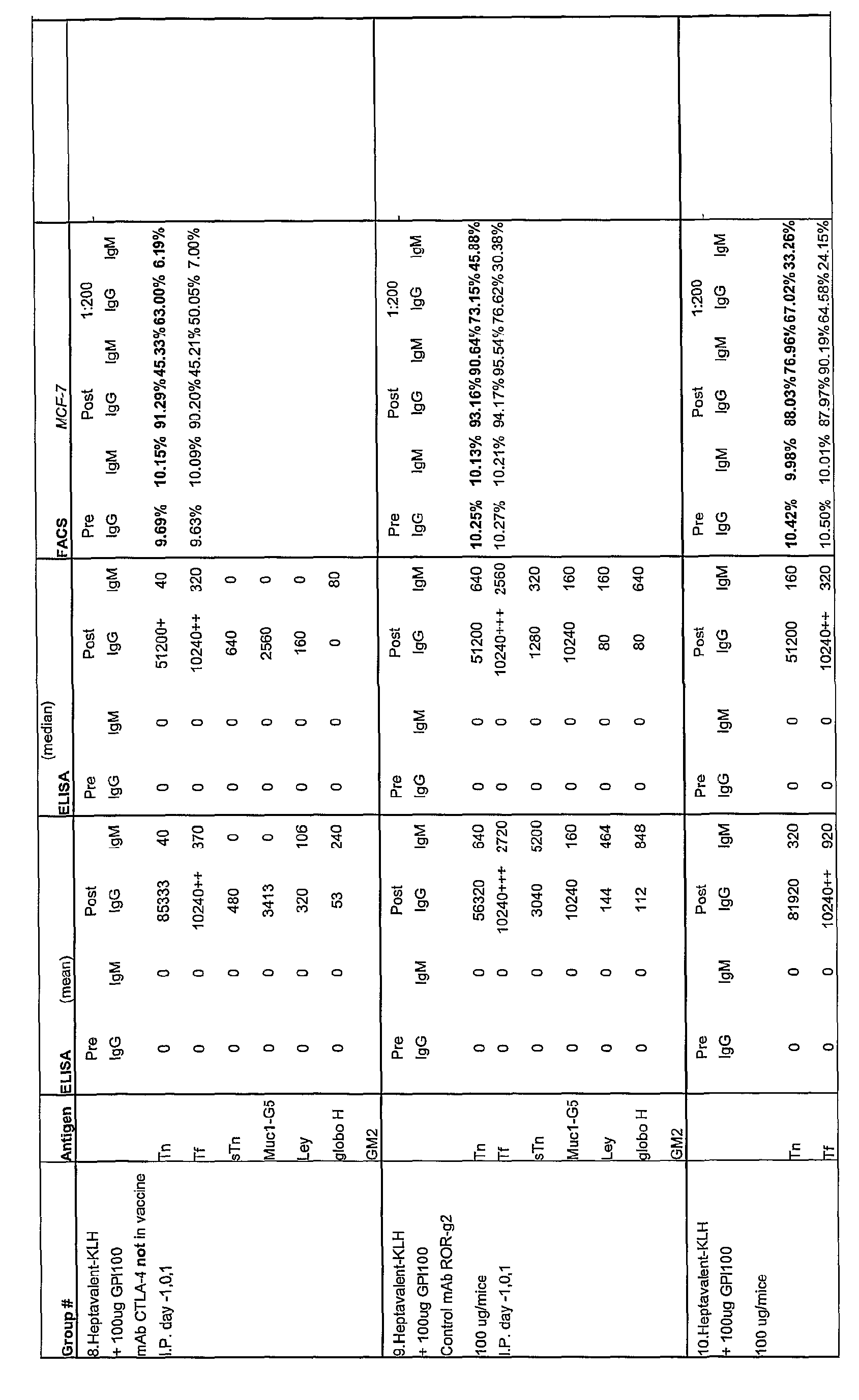

- Ragupathi, G., Koide; F., Kagan, E.; Bornmann, W., Spassova, M., Danishefsky, S. and Livingston, P. Memorial Sloan-Kettering Cancer Center, New York, NY.
- Previously using a series of monovalent vaccines, we have demonstrated that the optimal method for inducing an antibody response against cancer cell-surface antigens is covalent conjugation of the antigens to keyhole limpet hemocyanin (KLH) and the use of a saponin adjuvant. In preparation for testing a polyvalent (heptavalent)-KLH conjugate vaccine in the clinic, we have tested the impact on antibody induction against the 7 antigens of several variables described by others to augment immunogenicity. We explore here the impact of approaches for decreasing suppression of the immune response (low dose cyclophosphamide and anti-CTLA4 mAb), different saponin adjuvants (QS-21 and GPI-0100), and different methods of formulation (lyophilization and use of polysorbate 80). After two sets of experiments, these results are clear:
- 1) Immunization with the heptavalent-KLH conjugate vaccine induces high titers of antibodies against Tn (median ELISA titer IgM/IgG 320/10,240), sTn (640/2560), TF (320/5120), MUC1 (80/20,480) and globo H (1280/10), lower titers of antibodies against Lewis Y (160/80) and only occasional antibodies against GM2.
- 2) These antibodies reacted with the purified synthetic antigens by ELISA, and with naturally expressed antigens on the cancer cell surface by FACS.
- 3) Neither decreasing suppression with low dose cyclophosphamide or anti-CTLA4 mAb, nor changing the standard formulation by lyophilization or use of polysorbate 80 had any impact on antibody titers.
- 4) The two saponin adjuvants were comparably potent at our standard doses (QS-21 10ug and GPI-0100 100ug) but a third experiment comparing higher doses is in progress.
- The high titers of antibodies against this heptavalent vaccine and the inability of these additional approaches to further augment antibody titers confirms that the combination of conjugation to KLH and use of a saponin adjuvant is sufficiently optimized for testing in the clinic.
- There is a broad and expanding body of pre-clinical and clinical studies demonstrating that naturally acquired, actively induced, and passively administered antibodies are able to eliminate circulating tumor cells and micro metastases (1). Induction of antibodies against tumor antigens is more difficult than induction of antibodies against viral and bacterial antigens because most tumor antigens are normal or slightly modified auto antigens and because actively growing tumors may set in motion mechanisms which suppress the anti-cancer cell immune response. Consequently it may be necessary to overcome not only some level of tolerance but also some additional level of active suppression, making the immunization approach critical. We have previously reported that the optimal approach for induction of antibodies against gangliosides and a variety of other carbohydrate and peptide antigens is covalent attachment of the tumor antigen to an immunogenic carrier molecule (keyhole limpet hemocyanin (KLH) was optimal (2,3)) plus the use of a potent immunological adjuvant. In our previous experience saponin adjuvants such as QS-21 and GPI-0100 were the optimal adjuvants (4,5).
- In preparation for clinical trials with a heptavalent KLH-conjugate vaccine we test here the impact of several variables including 1) vaccine formulation (lyophilization or the use of polysorbate 80), 2) decreasing suppression (low dose cyclophosphamide or anti-CTLA4 mAb),or 3) various doses of the two saponin adjuvants QS-21 and GPI-0100, on antibody titers against the individual antigens and tumor cells expressing these antigens.
- Pathogen-free female BALB/c or C57BL/6 mice 6-10 weeks of age were obtained from the Jackson Laboratory (Bar Harbor, ME). QS-21 was obtained from Aquila Biopharmaceuticals (Framingham, MA (now Antigenics Inc., NYC, NY)), GPI-0100 was obtained from Galenica Pharmaceuticals, Inc.(Birmingham, AL). Cytoxan (25mg/kg) was purchased and injected IP one day prior to the first immunization. The hybridoma for murine monoclonal antibody CTLA-4 was obtained from Jim Allison (Berkeley, CA) and the mAb was prepared by Dr. Polly Gregor (MSKCC). The reactivity of mAb with CTLA-4 was confirmed. Polysorbate 80 was purchased.
- Immunization of mice: groups of five mice were immunized 3 times at one week intervals with the heptavalent vaccine containing 3mcg of each of the 7 antigens covalently conjugated to KLH and mixed with GPI-0100 or QS-21 as indicated. Vaccines were administered subcutaneously over the lower abdomen. A 4th, booster, immunization was given at week 8.
- Serological Assays: For the ELISA assay, glycosylated MUC1, globo H, Lewis Y or GM2, or Tn, sTn or TF conjugated to BSA, were coated on ELISA plates at an antigen dose of 0.1-0.2 mcg per well.
- Phosphatase-conjugated goat anti-mouse IgG or IgM was added at a dilution of 1:200 (Southern Biotechnology Associates, Inc., Birmingham, AL). Antibody titer was the highest dilution yielding absorbance of 0.10 or greater.
- F ACS analysis: MCF- 7 human breast cancer cells expressing all seven antigens but especially Lewis Y and MUC1 and sTn, and LSC expressing especially Lewis Y, sTn and Tn, were used. Single cell suspensions of 5 x 10⁷ cells/ tube were washed in PBS with 3% fetal calf serum and incubated with 20mcl of full strength or 1/200 diluted antisera for 30 minutes on ice. 20 microliters of 1/15 goat anti-mouse IgG or IgM labeled with FITC were all added and percent positive cells and mean fluorescent intensity (MFI) of stained cells analyzed using a F ACScan (Becton Dickenson, CA). Pre and post vaccination sera were analyzed together and the pretreatment percent positive cells set at 10%.
- Govindaswami Ragupathi, Fusataka Koide, Ella Kagan, William Bommann, Maria Spassova, Samuel Danishefsky, Philip Livingston, Memorial Sloan-Kettering Cancer Center, New York, NY.
- Previously using a series of monovalent vaccines, we have demonstrated that the optimal method for inducing an antibody response against cancer cell surface antigens is covalent conjugation of the antigens to keyhole limpet hemocyanin (KLH) and the use of a saponin adjuvant. In preparation for testing a polyvalent (heptavalent)--KLH conjugate vaccine in the clinic, we have tested the impact on antibody induction against the 7 antigens of several variables described by others to augment immunogenicity. We explore here the impact of approaches for decreasing suppression of the immune response (low dose cyclophosphamide and anti--CTLA4mAb), different saponin adjuvants (QS-21 and GPI-0100), and different methods of formulation (lyophilization and use of polysorbate 80). After two sets of experiments, these results are clear: 1) Immunization with the heptvalent-KLH conjugate vaccine induces high titers of antibodies against Tn (median ELISA titer IgM/IgG 320/10,240), sTn(640/2560), TF (320/5120), MUC1 (80/20,480) and globo H (1280/10), low titers of antibodies against Lewis Y (160/80) and only occasional antibodies against GM2. 2) These antibodies reacted with the purified synthetic antigens by ELISA, and with naturally expressed antigens on the cancer cell surface by FACS. 3) Neither decreasing suppression with cyclophosphamide (25mg/M2) or anti-CTLA4 mAb, nor changing the standard formulation by lyophilization or use of polysorbate 80 had any impact on antibody titers. 4) The two saponin adjuvants were comparably potent at our standard doses (QS-21 10ug and GPI-0100 100ug) but a third experiment comparing higher doses is in progress. The high titers of antibodies against this heptavalent vaccine and the inability of these additional approaches to further augment antibody titers confirm that the combination of conjugation to KLH and use of a saponin adjuvant is sufficiently optimized, and that this vaccine is ready for testing in the clinic.
- Govind Ragupathi, Susan F Slovin, Sonal Bhuta, Chandra Hood, Maria Spassova, William G Bornmann, Howard I Scher, Samuel J Danishefsky, Philip O Livingston, Memorial Sloan-Kettering, New York, NY.
- Glycolipid and glycoprotein differentiation antigens such as GM2, Globo H, Lewis y, Tn, TF, and mucin 1 (MUC1) are over-expressed on the cell surface of many tumors. Of the many approaches to immunization we have tested, covalent conjugation of antigens such as these to keyhole limpet hemocyanin (KLH) plus the use of immunological adjuvant QS-21 has been the optimal approach for inducing IgM and IgG antibodies. Immunization of patients with monovalent vaccines containing these antigens has demonstrated the consistent immunogenicity and safety of these vaccines. However, to overcome the heterogeneous nature of tumors, and of the immune response in different individuals, we have recently vaccinated a small group of patients (prostate cancer with rising PSA, but free of detectable disease) with a hexavalent-KLH vaccine containing GM2, Globo H, Ley, Tn(c), TF(c) and glycosylated MUC1 individually conjugated with KLH and mixed with immunological adjuvant QS-21. The main objective of this presentation is to compare the immune response of the six initial patients receiving hexavalent vaccine with the immune responses of patients who had previously been immunized with the respective monovalent vaccines. All patients were vaccinated six times (weeks 1,2,3,7,19 and 31) and bloods obtained pre treatment and on weeks 7 and 9 were tested at one time. RECIPRICOL MEAN PEAK ELISA TITER AFTER IMMUNIZATION IgM/IgG.
Antigen GM2 Globo H Ley Tn TF MUC1 Polyvalent vaccine Pending 160/0 0/0 640/640 1280/160 40/320 Individual Vaccine Pending 160/0 0/10 1280/2560 1280/160 2560/320 - Because of the low response against Ley, we are continuing studies aimed at creating a more immunogenic Ley vaccine. Comparing the responses induced by monovalent and hexavalent vaccines, there was no significant difference in the antibody responses against any of the five antigens tested to date. Combination of six individual conjugates into a single vaccine does not significantly change the antibody response against the individual antigens.
Experiment 1: Median ELISA titers and FACS results after vaccination of groups of 5 Balb/c mice with Heptavalent-KLH conjugate Group # Antigen ELISA(mean) ELISA(median) FACS MCF-7 1. Heptavalent-KLH + 10 ug QS21 Pre Post Pre Post Pre Post 1:200 + CONTROL IgG IgM IgG IgM IgG IgM IgG IgM IgG IgM IgG IgM IgG IgM 40.08 Tn 0 0 57440 10240+ 640 0 0 25600 640 10% 10% 96% 78% 78% 16% IVK-9 I % 97.56 Tf 0 0 + 260 0 0 10240+ 160 9% 10% 96% 81% 80% 8% MLS128 % sTn 0 0 3520 580 0 0 1280 320 antiGM2 98.87% G5 0 0 1280 80 0 0 1280 80 MBr-1 58.06% Ley 0 32 1920 2560 0 0 1280 1280 globo H 0 48 672 128 0 80 640 160 GM2 2. Heptavalent-KLH Pre Post Pre Post Pre Post 1:200 +100 ug GPI100 IgG IgM IgG IgM IgG IgM IgG IgM IgG IgM IgG IgM IgG IgM Tn 0 0 19200 840 0 0 25600 320 10% 10% 93% 80% 67% 28% Tf 0 0 10240+ 260 0 0 10240+ 160 10% 10% 96% 94% 70% 27% sTn 0 0 720 360 0 0 320 80 Muc1- G5 0 0 1520 80 0 0 2560 160 Ley 0 0 3920 680 0 0 5120 640 globo H 0 0 320 176 0 0 80 160 GM2 3.Heptavalent-KLH Pre Post Pre Post Pre Post 1:200 +100ug GPI-100 (Lyophilized) IgG IgM IgG IgM IgG IgM IgG IgM IgG IgM IgG IgM IgG IgM Tn 0 0 32000 480 0 0 25600 320 10% 10% 93% 63% 65% 18% Tf 0 0 10240+ 340 0 0 10240+ 320 10% 10% 92% 59% 64% 14% sTn 0 0 1200 260 0 0 1280 320 Muc1- G5 0 0 1120 0 0 0 320 0 Ley 0 0 320 720 0 0 480 640 globo H 0 0 128 440 0 0 0 200 GM2 4.Heptavalent-KLH Pre Post Pre Post Pre Post 1:200 +100 ug GPI100'+ IgG IgM IgG IgM IgG IgM IgG IgM IgG IgM IgG IgM IgG IgM polysorbate80 Tn 0 0 38400 400 0 0 25600 160 10% 10% 91% 57% 71% 7% 10240 Tf 0 0 + 140 0 0 10240+ 160 10% 10% 91% 62% 67% 5% sTn 0 0 1960 200 0 0 1280 320 Muc1- G5 0 0 4000 20 0 0 2560 0 Ley 0 0 1440 960 0 0 1280 640 globo H 0 40 100 224 0 40 120 160 GM2 5. Heptavalent-KLH Pre Post Pre Post Pre Post 1:200 +100ug GPI100 IgG IgM IgG IgM IgG IgM IgG IgM IgG IgM IgG IgM IgG IgM Cytoxan 25mg/Kg (I.P.) Day-1 Tn 0 0 61400 808 0 0 25600 640 10% 10% 90% 72% 64% 12% Tf 0 0 10240 ++ 560 0 0 10240+ + 640 10% 10% 91% 71% 66% 14% sTn 0 0 520 480 0 0 640 320 Muc1- G5 0 0 3840 0 0 0 2560 0 Ley 0 0 480 200 0 0 0 80 globo H 0 0 32 540 0 0 0 400 GM2 6.Heptavalent-KLH Pre Post Pre Post Pre Post 1:200 +100ug GPI100 IgG IgM IgG IgM IgG IgM IgG IgM IgG IgM IgG IgM IgG IgM mAb CTLA-4 in vaccine (100ug/mice) Day 0 Tn 0 0 32000 250 0 0 25600 160 10% 10% 91% 66% 62% 18% Day 7& 14 no 10240 CTLA-4 Tf 0 0 + 1040 0 0 10240+ 1280 10% 10% 92% 63% 63% 8% sTn 0 0 6240 180 0 0 1280 200 Muc1- G5 0 0 1950 40 0 0 2560 40 Ley 0 0 180 2600 0 0 40 40 globo H GM2 0 0 0 240 0 0 0 240 Post Pre Post Pre Post 1:200 7.Heptavalent-KLH + 100ug GPI100 Pre IgG IgM IgG IgM IgG IgM IgG IgM IgG IgM IgG IgM IgG IgM mAb CTLA-4 in vaccine (100ug/mice) Day & 7 0 Tn 0 0 32000 1600 0 0 25600 1280 10% 10% 90% 85% 67% 29% 10240 Day 14 no CTLA-4 Tf 0 0 + 1920 0 0 10240+ 1280 10% 10% 90% 86% 69% 21% sTn 0 0 2880 100 0 0 2560 80 Muc1-G5 0 0 6400 60 0 0 5120 80 Ley 0 0 32 208 0 0 0 160 globo H GM2 0 0 32 220 0 0 0 240 8.Heptavalent-KLH Pre Post Pre Post Pre Post 1:200 + 100ug GPI100 IgG IgM IgG IgM IgG IgM IgG IgM IgG IgM IgG IgM IgG IgM mAb CTLA-4 not in vaccine I.P. day -1,0,1 91% 45% 63% 6% Tn 0 0 85333 40 0 0 51200+ 40 10% 10% Tf 0 0 10240 ++ 370 0 0 10240+ + 320 10% 10% 90% 45% 50% 7% sTn 0 0 480 0 0 0 640 0 Muc1-G5 0 0 3413 0 0 0 2560 0 Ley 0 0 320 106 0 0 160 0 globo H GM2 0 0 53 240 0 0 0 80 9.Heptavalent-KLH Pre Post Pre Post Pre Post 1:200 +100ug GPI100 IgG IgM IgG IgM IgG IgM IgG IgM IgG IgM IgG IgM IgG IgM Control mAb ROR- g2 100 ug/mice Tn 0 0 56320 640 0 0 51200 640 10% 10% 93% 91% 73% 46% 10240 10240+ J.P. day-1,0,1 Tf 0 0 +++ 2720 0 0 ++ 2560 10% 10% 94% 96% 77% 30% sTn 0 0 3040 5200 0 0 1280 320 Muc1-G5 0 0 10240 160 0 0 10240 160 Ley 0 0 144 464 0 0 80 160 globo H GM2 0 0 112 848 0 0 80 640 10.Heptavalent- KLH Pre Post Pre Post Pre Post 1:200 + 100ug GPI100 IgG IgM IgG IgM IgG IgM IgG IgM IgG IgM IgG IgM IgG IgM 100 ug/mice Tn 0 0 81920 320 0 0 51200 160 10% 10% 88% 77% 67% 33% 10240 10240+ Tf 0 0 ++ 920 0 0 + 320 11% 10% 88% 90% 65% 24% sTn 0 0 2240 1440 0 0 2560 160 Muc1- G5 0 0 4160 40 0 0 2560 0 Ley 0 144 144 2640 0 160 80 320 globo H GM2 0 0 0 224 0 0 0 160 Experiment 2: Median ELISA titers and FACS results against MCF-7 and LSC cells after vaccination groups of 5 C57BL/6 Mice with heptavalent-KLH conjugate vaccine Group # Antigen ELISA FACS withMCF-7 FACS with LSC Heptavalent- Pre Post Pre Post 1:200 #LSC Pre Post 1:200 KLH+ 100ug GPI100 IgG IgM IgG IgM IgG IgM IgG IgM IgG IgM IgG IgM IgG IgM IgG IgM (200 ul/mice) Tn 0 10 5120+ 320 10% 11% 91.61% 18.46% 80% 18% 10% 11% 96.04% 39.25% 84% 39% Tf 0 10 5120 320 99% 24% 82% 21% sTn 0 0 2560 640 Muc1-G5 0 0 5120++ 80 Ley 0 0 80 160 globo H 0 80 10 1280 GM2 0 0 0 10 Heptavalent- Pre Post Pre Post 1:200 Pre Post 1:200 KLH+ 100ug GPI IgG IgM IgG IgM IgG IgM IgG IgM IgG IgM IgG IgM IgG IgM IgG IgM (old batch) (200ul/mice) Tn 0 0 2560 40 11% 11% 84.31% 9.89% 60% 10% 10% 10% 92.22% 16.68% 63% 17% Tf 0 0 5120 40 sTn 0 0 320 160 Muc1-G5 0 0 1280 0 Ley 0 0 40 320 globo H 0 80 0 320 GM2 0 0 0 0 Heptavalent-KLH Pre Post Pre Post 1:200 Pre Post 1:200 +100 ug GPI-100 IgG IgM IgG IgM IgG IgM IgG IgM IgG IgM IgG IgM IgG IgM IgG IgM +polysorbate 80 Tn 0 0 5120+ 640 11% 10% 90.55% 12.59% 75% 13% 11% 10% 85.22% 11.17% 54% 11% (200 ul/mice) Tf 0 0 5120 320 sTn 0 0 640 640 Muc1-G5 0 0 5120 80 Ley 0 0 0 320 globo H 0 160 20 1280 GM2 0 0 0 0 Heptavalent-KLH Pre Post Pre Post 1:200 Pre Post 1:200 +10ug QS-21 IgG IgM IgG IgM IgG IgM IgG IgM IgG IgM IgG IgM IgG IgM IgG IgM (200 ul/mice) Tn 0 20 5120+ 160 11% 10% 90.96% 4.8% 71% 5% 10% 11% 70.28% 8.33% 41% 8% Tf 0 80 5120+ 640 sTn 0 0 2560 320 Muc1-G5 0 0 2560 160 Ley 0 0 10 10 globo H 0 80 40 640 GM2 0 0 0 0 Heptavalent-KLH Pre Post Pre Post 1:200 Pre Post 1:200 + 10ug ER803732 IgG IgM IgG IgM IgG IgM IgG IgM IgG IgM IgG IgM IgG IgM IgG IgM (200 ul/mice) Tn 0 20 160 160 11% 11% 60.86% 12.60% 16% 13% 11% 10% 45.30% 11.86% 6% 12% Tf 0 10 320 160 sTn 0 40 20 160 Muc1-G5 0 0 160 80 Ley 0 0 0 80 globo H 20 80 80 320 GM2 0 0 0 0 


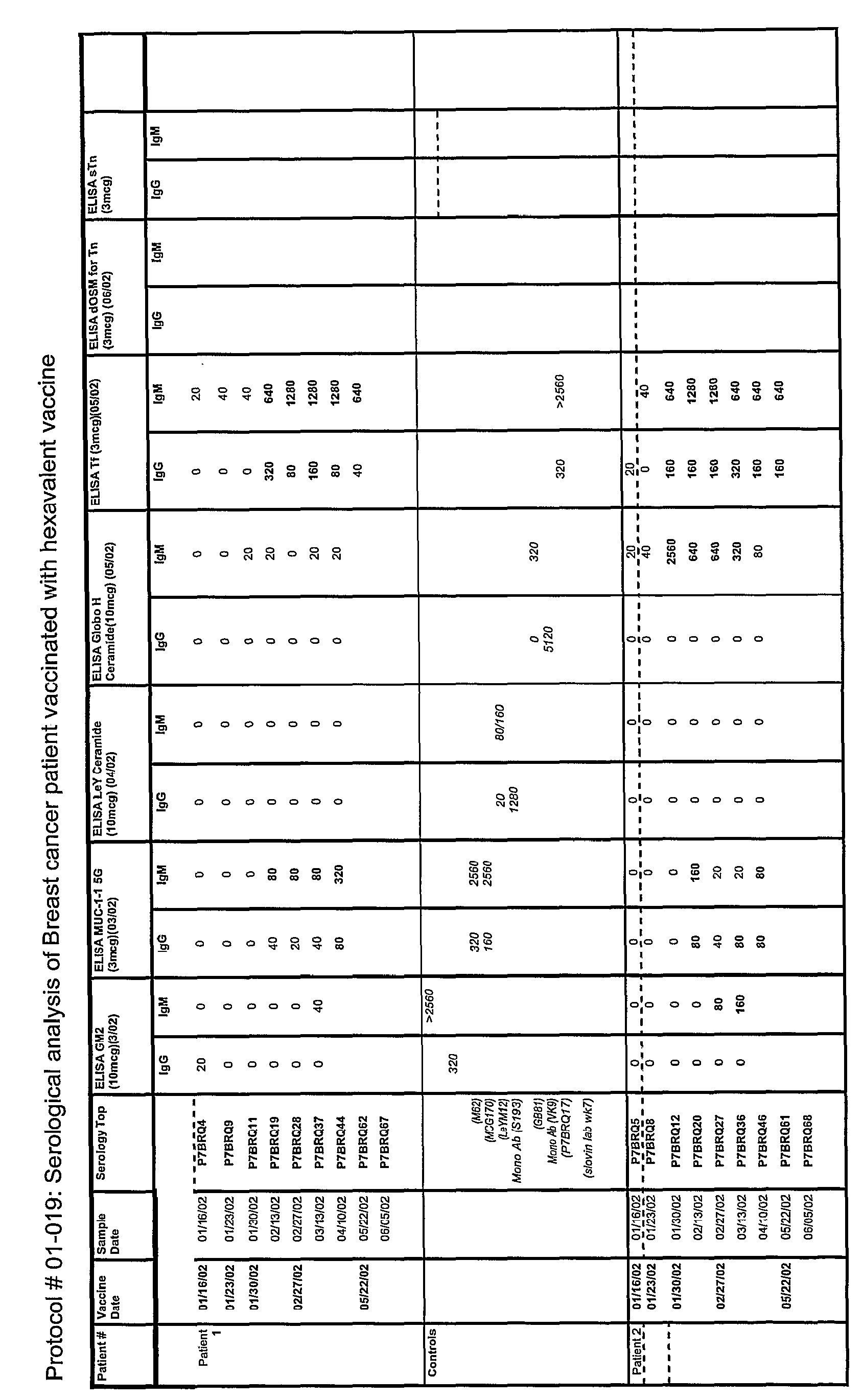


Hexavalent Pilot study, protocol number #00-64, ELISA tested against TF(c)-HSA Vaccination 1 2 3 4 5 Ag Patient Ab wkl 2 3 7 12 19 21 31 33 T 1 Igm 40 40 40 40 >1280 40 40 40 40 F IgG 20 20 >1280 320 80 80 80 160 320 c 2 IgM NMA 80 160 160 80 40 40 20 20 IgG 10 NMA 10 40 80 NMA NMA 20 40 3 Igm 40 H IgG NMA S 4 IgM 40 20 320 80 80 80 NMA A IgG NMA NMA 640 80 40 160 320 5 IgM NMA 20 160 20 IgG 10 NMA 10 20 6 IgM 40 640 640 640 160 80 80 160 IgG 640 >1280 >1280 >1280 >1280 >1280 >1280 >1280 7 IgM NMA 40 80 640 160 80 40 80 80 IgG 10 320 NMA NMA 40 20 80 20 80 8 IgM NMA NMA 160 160 IgG NMA NMA 10 80 9 IgM NMA NMA NMA 20 NMA NMA NMA NMA IgG NMA NMA 40 NMA 640 80 >1280 160 10 IgM NMA 10 160 160 IgG NMA NMA 40 20 11 IgM 20 IgG NMA 12 Igm 10 40 160 >1280 80 640 80 20 160 IgG NMA NMA NMA NMA >640 20 40 40 80 13 IgM NMA IgG NMA 14 IgM 20 80 40 80 80 40 40 160 160 IgG NMA 40 160 >1280 640 80 80 80 160 15 IgM NMA NMA 20 80 40 40 IgG NMA NMA 10 40 40 40 16 IgM 20 80 >1280 IgG 10 10 80 17 IgM NMA 10 NMA 40 40 40 40 40 20 160 40 IgG NMA NMA 40 40 80 40 18 IgM 40 20 80 640 40 80 80 20 40 80 40 IgG NMA NMA NMA 40 160 40 640 Positive Controls: IgM(19) 1:1280 As from 10/19/01 end pt. Titers: IgG (7) 1:640 (+) IgM:640 (-) Human AB Serum IgG:640 (-) IgM:NMA IgG:NMA Hexavalent Pilot study, protocol # 00-64 ELISA against glycosylated MUC1-1 (5 sites) Vaccination 1 2 3 4 5 Ag Patient Number Ab wkl 2 3 7 12 19 21 31 MUC 1 Igm NMA 40 >1280 >1280 >1280 >1280 >1280 >1280 1-1G5 IgG NMA NMA 80 160 >1280 640 >1280 >1280 32mer 2 IgM NMA NMA 640 10 NMA 10 20 IgG NMA NMA 10 40 40 20.00 40 160 3 Igm 20 640 IgG NMA 40 4 Igm NMA NMA 320.00 >1280 >1280 >1280 640 640 IgG NMA NMA 10 320 160 >1280 >1280 >1280 5 IgM 10 40 >1280 >1280 IgG NMA NMA 160 >1280 6 IgM NMA 320 >1280 320 320 160 80 IgG NMA 160 >1280 320 160 160 160 7 IgM NMA NMA 40 640 640 80 80 40 IgG NMA NMA 640 >1280 >1280 >1280 >1280 >1280 8 IgM NMA NMA 160 IgG NMA NMA 10 9 IgM NMA NMA 40 160 80 20 20 10 IgG NMA NMA NMA 40 20 10 80 40 10 Igm NMA NMA IgG NMA NMA 11 IgM NMA NMA 10 40 20 160 160 80 IgG NMA NMA 10 320 160 40 40 20 12 Igm 40 40 IgG NMA NMA 320 160 13 Igm NMA NMA 20 80 80 320 IgG NMA NMA 20 20 40 320 320 160 14 Igm 80 20 160 160 40 40 IgG NMA NMA NMA NMA 40 20 15 Igm NMA NMA 640 640 640 10 10 10 IgG NMA NMA 640 640 640 160 80 80 16 Igm NMA 20 IgG NMA 20 17 IgM NMA 20 320 160 40 640 320 80 IgG NMA NMA 10 80 640 40 640 160 Positive Controls: (7) IgM 1:2560 Controls as of 10/15/01: (+) Igm:>1280 IgG 1:2560 10/22/01 IgG:>1280 (-) AB Sera (-) IgM:NMA IgG:NMA - The inversion can be further described with reference to the following clauses.
- 1. A polyvalent vaccine comprising at least two conjugated antigens selected from a group containing glycolipid antigen, polysaccharide antigen, mucin antigen, glycosylated mucin antigen and an appropriate adjuvant.
- 2. The vaccine of clause 1, wherein the glycolipid is Globo H, a Lewis antigen, or a ganglioside.
- 3. The vaccine of clause 1, wherein the Lewis antigen is Ley or sialyl Lea.
- 4. The vaccine of clause 2, wherein the ganglioside is fucosylated GM1, GM2, GD2, or GD3.
- 5. The vaccine of clause 1, wherein the mucin is a MUC peptide.
- 6. The vaccine of clause 5, wherein the MUC peptide is MUC-1, MUC-2 or MUC-16.
- 7. The vaccine of clause 1, wherein the polysaccharide antigen is Tn (c), sTn (c), TF(c), or polysialic acid.
- 8. A bivalent vaccine of clause 1.
- 9. A trivalent vaccine of clause 1.
- 10. A tetravalent vaccine of clause 1.
- 11. A pentavalent vaccine of clause 1.
- 12. A hexavalent vaccine of clause 1.
- 13. The hexavalent vaccine of clause 12, comprising glycosylated MUC-1-32mer, Globo H, GM2, Ley, Tn (c), and TF (c).
- 14. The vaccine of clause 13, wherein the range of MUC-1-32 mer is from about 0.1 to 30ug.
- 15. The vaccine of clause 13, wherein the range of Globo H is from about 0.1 to 100ug.
- 16. The vaccine of clause 13, wherein the range of GM2 is from about 0. 1 to 100ug.
- 17. The vaccine of clause 13, wherein the range of Ley is from about 0. 1 to 60ug.
- 18. The vaccine of clause 13, wherein the range of Tn (c) is from about 0.1 to 100ug.
- 19. The vaccine of clause 13, where the range of TF (c) is from about 0. 1 to 30 ug.
- 20. The vaccine of clause 13, wherein the adjuvant is QS21.
- 21. The vaccine of clause 20, wherein the range of the adjuvant is from about 25 to about 200ug.
- 22. The vaccine of clause 21, wherein the adjuvant is about 100ug.
- 23. The vaccine of clause 13, wherein the adjuvant is GPI- 0100.
- 24. The vaccine of clause 23, wherein the range of the adjuvant is from about 1 to 25mg.
- 25. The vaccine of clause 24, wherein the adjuvant is about 10mg.
- 26. A heptavalent vaccine of clause 1.
- 27. The heptavalent vaccine of clause 26, comprising glycosylated MUC-1-G5, Globo H, GM2, Ley, Tn (c), sTN (c), and TF (c).
- 28. The vaccine of clause 27, wherein the range of MUC-1-G5 is from about 0.1 to 30ug.
- 29. The vaccine of clause 27, wherein the range of Globo H is from about 0.1 to 100ug.
- 30. The vaccine of clause 27, wherein the range of GM2 is from about 0. 1 to 100ug.
- 31. The vaccine of clause 27, wherein the range of Ley s from about 0.1 to 60ug.
- 32. The vaccine of clause 27, wherein the range of Tn (c) is from about 0. 1 to 100ug.
- 33. The vaccine of clause 27, wherein the range of sTn (c) is from about 0.1 to 100ug.
- 34. The vaccine of clause 27, where the range of TF (c) is from about 0.1 to 30ug.
- 35. The vaccine of clause 27, wherein the adjuvant is QS21.
- 36. The vaccine of clause 35, wherein the range of the adjuvant is from about 25 to about 200ug.
- 37. The vaccine of clause 27, wherein the adjuvant is GPI- 0100.
- 38. The vaccine of clause 37, wherein the range of the adjuvant is from about 1 to 25 mg.
- 39. The vaccine of clause 38, wherein the adjuvant is about 10 mg.
- 40. The vaccine of clause 1, wherein the antigens are conjugated to Keyhole Limpet Hemocyanin (KLH).
- 41. The vaccine of clause 1 for cancer.
- 42. The vaccine of clause 41, wherein the cancer is prostate, breast or ovarian cancer.
- 43. A method for inducing immune response in a subject comprising administering an effective amount of vaccine of clauses 1-42 to the subject.
- 44. A method for treating cancer in a subject comprising administering an appropriate amount of the vaccine of clauses 1-42 to the subject.
- 45. A composition comprising the vaccine of clauses 1-42 and a carrier.
- 46. A pharmaceutical composition comprising the vaccine of clauses 1-42 and a pharmaceutically acceptable carrier.
- 47. A vaccine for small ceil lung cancer comprising at least two conjugated antigens selected from the group containing Globo H, fucosylated GM1, GM2, GD2, GD3, sialyl Lea and polysialic acid.
- 48. A method for inducing immune response in a subject bearing small cell lung cancer comprising administering an effective amount of the vaccine of clause 47 to the subject.
- 49. A method for treating a subject bearing cell lung cancer comprising administering an effective amount of the vaccine of clause 47 to the subject.
- 50. A vaccine of clause 1, further comprising an antigen selected from a group containing CA125, or a portion thereof, KSA peptide or protein, and PSMA, or a portion thereof.
4.7 No history of an active secondary malignancy within the prior five years except for nonmelanoma skin cancer. Patients with history of melanoma in situ will be permitted since these lesions behave in a manner similar to compound nevi.
4.8 Patients must be at least 18 years of age.
4.9 Patients who have previously received suramin, may be treated if they have been off this drug for at least 8 weeks and/or have a documented plasma concentration below 50 µg/ml. For these patients, replacement doses of hydrocortisone are permitted.
4.10 Patients must sign informed consent.
4.11 Registration to IRB Protocol 90-40 (Correlative studies in human prostate cancer).
4.12 EXCLUSIONS:
| Week One | - | Exam, blood test, vaccine |
| Week Two | - | Blood test and vaccine |
| Week Three | - | Exam, blood test, vaccine |
| Week Seven | - | Exam, blood test, vaccine |
| Week Nine | - | Exam, blood test |
| Week Thirteen | - | Exam, blood test, x-rays |
| Week Nineteen | - | Exam, blood test, vaccine |
| Week Twenty-six | - | Exam, blood tests, x-rays |
The vaccine will be administered at weekly intervals for 3 doses. This will be followed by a four week break and then a fourth vaccination. There will then be an eight week break and then a fifth vaccination, followed by additional immunizations every twelve weeks for 24 months total (as long as patient remains on study).
| IMMUNIZATION SCHEDULE | |||||
| WEEK # | 1 | 2 | 3 | 7 | 15 |
| VACCINE # | 1 | 2 | 3 | 4 | 5 |
| SUMMARY OF CLINICAL, LABORATORY, AND IMMUNE ASSESSMENTS | |||||||||||
| week # | 0a | 1 | 2 | 3 | 5 | 7 | 9 | 13 | 15 | 17 | 27c |
| vaccine # | 1 | 2 | 3 | 4 | 5 | V | |||||
| Office Visit | * | * | * | * | * | * | * | * | * | * | * |
| Hx and PE | * | * | * | * | * | * | * | * | * | ||
| CA-125 | * | * | * | * | * | * | |||||
| CBC, diff | * | * | * | * | * | * | * | * | * | * | |
| Hepatic profile + creatinine | * | * | * | * | * | * | * | * | * | * | |
| Amylase | * | * | * | * | * | * | * | * | * | * | |
| Urinalysis | * | * | * | * | * | ||||||
| PT | * | ||||||||||
| Stool guaiacb | * | * | * | * | |||||||
| TSH | * | * | |||||||||
| Immuned bloods | * | * | * | * | * | * | * | ||||
| a = pretreatment evaluation, within 3 weeks b = stool guaiac may be obtained by digital exam or cards collected by patient c = following week 27, visits + laboratory studies + immunization q 3 months, CT scan q 6 months while on study d = immune bloods routinely consist of 20-30 ml collected in 3 red top tubes. In order to obtain sufficient serum to evaluate for multiple antibodies, 6 tubes will be collected instead of 3 at the pre-vaccination visit; and at week 7 and 9 only. |
Claims (15)
- A polyvalent vaccine comprising at least two conjugated antigens selected from a group containing glycolipid antigen, polysaccharide antigen, mucin antigen, glycosylated mucin antigen and an appropriate adjuvant.
- The vaccine of claim 1, wherein the glycolipid is Globo H, a Lewis antigen or a ganglioside, wherein the Lewis antigen is Ley or sialyl Lea, wherein the ganglioside is fucosylated GM1, GM2, GD2, or GD3, wherein the mucin is a MUC peptide, wherein the MUC peptide is MUC- 1, MUC-2 or MUC-16 and wherein the polysaccharide antigen is Tn, Tn (c), sTn (c), TF (c), or polysialic acid.
- A vaccine according to claim 1 and which is bivalent, trivalent, tetravalent, pentavalant, hexavalent or heptavalent.
- A pentavelant vaccine of claim 3 comprising GloboH, GM2, MUC-1, Tn and Tf(c).
- A heptavalent vaccine of claim 3 comprising GloboH, MUC-1, Tn, Tn(c), sTn(c), TF(c) and sLea.
- A vaccine according to claim 4 or 5 wherein said MUC-1 is glycosylated.
- A pentavalent vaccine of claim 4 for use in treating ovarian cancer.
- A heptavalent vaccine of claim 5 for use in treating breast cancer.
- A hexavalent vaccine according to claim 3, comprising glycosylated MUC-1-32mer, Globo H, GM2, Ley, Tn (c), and TF (c).
- The vaccine of claim 9, wherein the range of MUC-1-32 mer is from about 0.1 to 30ug, wherein the range of Globo H is from about 0.1 to 100ug, wherein the range of GM2 is from about 0. 1 to 100ug, wherein the range of Ley is from about 0. 1 to 60ug, wherein the range of Tn (c) is from about 0.1 to 100ug, and wherein the range of TF (c) is from about 0. 1 to 30 ug.
- The vaccine of claim 9, wherein the adjuvant is OS21 or GPI- 0100, wherein the range of the adjuvant QS21 is from about 25 to about 200ug, wherein the adjuvant QS21 is about 100ug, wherein the range of the adjutant GPI-100 is from about 1 to 25mg or wherein the adjuvant GPI-100 is about 10mg.
- A heptavalent vaccine according to claim 3, comprising glycosylated MUC-1-G5, Globo H, GM2, LeY, Tn (c), sTN (c), and TF (c).
- The vaccine of claim 12, wherein the range of MUC-1-G5 is from about 0.1 to 30ug, wherein the range of Globo H is from about 0.1 to 100ug, wherein the range of GM2 is from about 0. 1 to 100ug, wherein the range of Ley is from about 0.1 to 60ug, wherein the range of Tn (c) is from about 0. 1 to 100ug, wherein the range of sTn (c) is from about 0.1 to 100ug or wherein the range of TF (c) is from about 0.1 to 30ug.
- The vaccine of claim 9, wherein the adjuvant is QS21 or GPI- 0100, wherein the range of the adjuvant QS21 is from about 25 to about 200ug, wherein the adjuvant QS21 is about 100ug, wherein the range of the adjuvant GPI-100 is from about 1 to 25mg or wherein the adjuvant GPI-100 is about 10mg.
- The vaccine of any preceding claim, wherein the antigens are conjugated to Keyhole Limpet Hemocyanin (KLH); and/or optionally wherein
the vaccine is for use in the treatment of prostate, breast or ovarian cancer; and/or optionally wherein
said vaccine further comprises an antigen selected from a group containing CA125, or a portion thereof, KSA peptide or protein, and PSMA, or a portion thereof.
Applications Claiming Priority (3)
| Application Number | Priority Date | Filing Date | Title |
|---|---|---|---|
| US30349401P | 2001-07-06 | 2001-07-06 | |
| US34723102P | 2002-01-10 | 2002-01-10 | |
| EP02752182A EP1458242A4 (en) | 2001-07-06 | 2002-07-05 | POLYVALENTIC CONJUGATE VACCINES AGAINST CANCER |
Related Parent Applications (1)
| Application Number | Title | Priority Date | Filing Date |
|---|---|---|---|
| EP02752182.2 Division | 2002-07-05 |
Publications (1)
| Publication Number | Publication Date |
|---|---|
| EP2263465A1 true EP2263465A1 (en) | 2010-12-22 |
Family
ID=26973484
Family Applications (2)
| Application Number | Title | Priority Date | Filing Date |
|---|---|---|---|
| EP10184649A Withdrawn EP2263465A1 (en) | 2001-07-06 | 2002-07-05 | Polyvalent conjugate vaccine for cancer |
| EP02752182A Ceased EP1458242A4 (en) | 2001-07-06 | 2002-07-05 | POLYVALENTIC CONJUGATE VACCINES AGAINST CANCER |
Family Applications After (1)
| Application Number | Title | Priority Date | Filing Date |
|---|---|---|---|
| EP02752182A Ceased EP1458242A4 (en) | 2001-07-06 | 2002-07-05 | POLYVALENTIC CONJUGATE VACCINES AGAINST CANCER |
Country Status (5)
| Country | Link |
|---|---|
| US (5) | US7479266B2 (en) |
| EP (2) | EP2263465A1 (en) |
| JP (1) | JP2004534088A (en) |
| AU (1) | AU2002354804A1 (en) |
| WO (1) | WO2003003985A2 (en) |
Cited By (1)
| Publication number | Priority date | Publication date | Assignee | Title |
|---|---|---|---|---|
| RU2666141C2 (en) * | 2013-09-17 | 2018-09-06 | Оби Фарма, Инк. | Compositions of carbohydrate vaccine for inducing immune responses and uses thereof in cancer treatment |
Families Citing this family (45)
| Publication number | Priority date | Publication date | Assignee | Title |
|---|---|---|---|---|
| US7915238B2 (en) * | 1999-02-01 | 2011-03-29 | Eisai R & D Management Co., Ltd. | Immunomodulatory compounds and methods of use thereof |
| US20040006242A1 (en) | 1999-02-01 | 2004-01-08 | Hawkins Lynn D. | Immunomodulatory compounds and method of use thereof |
| EP2263465A1 (en) | 2001-07-06 | 2010-12-22 | Sloan-Kettering Institute for Cancer Research | Polyvalent conjugate vaccine for cancer |
| US7504364B2 (en) * | 2002-03-01 | 2009-03-17 | Receptors Llc | Methods of making arrays and artificial receptors |
| AU2003273206B2 (en) * | 2002-05-31 | 2009-08-20 | Children's Hospital Medical Center | Method, composition and kit for antigenic binding of Norwalk-Like viruses |
| AT500648B1 (en) * | 2002-08-12 | 2010-03-15 | Igeneon Krebs Immuntherapie | SET FOR THE TREATMENT OF CANCER PATIENTS |
| US20050037429A1 (en) * | 2003-03-28 | 2005-02-17 | Receptors Llc | Artificial receptors including reversibly immobilized building blocks and methods |
| US20060051802A1 (en) * | 2002-09-16 | 2006-03-09 | Receptors Llc | Artificial receptors, building blocks, and methods |
| US20060057625A1 (en) * | 2002-09-16 | 2006-03-16 | Carlson Robert E | Scaffold-based artificial receptors and methods |
| US7469076B2 (en) * | 2003-09-03 | 2008-12-23 | Receptors Llc | Sensors employing combinatorial artificial receptors |
| US20050136483A1 (en) * | 2003-09-03 | 2005-06-23 | Receptors Llc | Nanodevices employing combinatorial artificial receptors |
| US20040137481A1 (en) * | 2002-09-16 | 2004-07-15 | Receptors Llc | Artificial receptor building blocks, components, and kits |
| US20050037381A1 (en) * | 2002-09-16 | 2005-02-17 | Receptors Llc | Artificial receptors, building blocks, and methods |
| WO2005003326A2 (en) * | 2003-03-28 | 2005-01-13 | Receptors Llc. | Artificial receptors including reversibly immobilized building blocks and methods |
| JP2006522828A (en) * | 2003-04-09 | 2006-10-05 | スローン − ケタリング・インスティテュート・フォー・キャンサー・リサーチ | Optimal multivalent vaccine for cancer |
| US20060035267A1 (en) * | 2003-04-09 | 2006-02-16 | Livingston Philip O | Optimal polyvalent vaccine for cancer |
| TW201204410A (en) * | 2004-04-01 | 2012-02-01 | Oncothyreon Inc | Mucinous glycoprotein (MUC-1) vaccine |
| WO2006029234A1 (en) * | 2004-09-03 | 2006-03-16 | Receptors Llc | Combinatorial artificial receptors including tether building blocks |
| WO2006029383A2 (en) | 2004-09-11 | 2006-03-16 | Receptors Llc | Combinatorial artificial receptors including peptide building blocks |
| US7341688B2 (en) * | 2004-11-19 | 2008-03-11 | Husky Injection Molding Systems Ltd. | Valve gate for a hot runner injection molding machine |
| CA2605749C (en) | 2005-04-26 | 2015-06-30 | Eisai Co., Ltd. | Compositions and methods for cancer immunotherapy |
| JP5364371B2 (en) | 2005-06-28 | 2013-12-11 | オンコセリオン インコーポレイテッド | Methods of treating patients with mucin glycoprotein (MUC-1) vaccines |
| CN101405028B (en) | 2006-03-17 | 2015-08-19 | 美国政府健康及人类服务部 | Method for preparing complexed multivalent immunogenic conjugates |
| CA2646021A1 (en) * | 2006-04-05 | 2007-10-05 | Oklahoma Medical Research Foundation | O-glycans in the treatment of inflammatory bowel disease and cancers |
| GB2437727B (en) * | 2006-05-04 | 2011-04-20 | Univ Open | Aptamers directed to MUC1 |
| EP1920782A1 (en) * | 2006-11-10 | 2008-05-14 | Glycotope Gmbh | Carboyhdrate specific cellular immunity inducing microorganisms and fractions thereof |
| US8877206B2 (en) | 2007-03-22 | 2014-11-04 | Pds Biotechnology Corporation | Stimulation of an immune response by cationic lipids |
| AU2009236306B2 (en) * | 2008-04-17 | 2015-04-02 | Pds Biotechnology Corporation | Stimulation of an immune response by enantiomers of cationic lipids |
| JP2011524375A (en) | 2008-06-16 | 2011-09-01 | アカデミア シニカ | Compositions that induce immune responses specific to GloboH and SSEA3 and their use in cancer therapy |
| CA2734348A1 (en) | 2008-07-11 | 2010-01-14 | Samuel Danishefsky | Glycopeptide constructs and uses thereof |
| JP5894528B2 (en) | 2009-06-09 | 2016-03-30 | チルドレンズ ホスピタル メディカル センター | Antigen-norovirus P domain monomers and dimers, antigen-norovirus P particle molecules, and their production and use |
| US9125848B2 (en) | 2010-06-10 | 2015-09-08 | The Cleveland Clinic Foundation | Alpha lactalbumin immunization methods |
| CN103108654A (en) * | 2010-06-11 | 2013-05-15 | 索隆-基特林癌症研究协会 | Multivalent glycopeptide constructs and uses thereof |
| WO2012019125A2 (en) * | 2010-08-06 | 2012-02-09 | The United States Of America, As Represented By The Secretary, Department Of Health And Human Services | Biomarkers for prostate cancer and methods for their detection |
| US20120083459A1 (en) * | 2010-10-01 | 2012-04-05 | The Governors Of The University Of Alberta | Use of ganglioside to decrease propagation of malignant prostate cells |
| CA2867700A1 (en) * | 2012-03-23 | 2013-09-26 | Memorial Sloan-Kettering Cancer Center | Potentiating antibody-induced complement-mediated cytotoxicity via pi3k inhibition |
| CA2870537A1 (en) | 2012-04-16 | 2013-10-24 | The Cleveland Clinic Foundation | Multivalent breast cancer vaccine |
| US10286064B2 (en) | 2012-06-15 | 2019-05-14 | Pds Biotechnology Corporation | Cationic lipid vaccine compositions and methods of use |
| ES2843509T3 (en) | 2013-01-04 | 2021-07-19 | Obi Pharma Inc | Vaccines with higher carbohydrate antigen density and new saponin adjuvant |
| US9321803B2 (en) | 2013-07-12 | 2016-04-26 | Children's Hospital Medical Center | Compositions and methods for inhibiting norovirus infection |
| CN106414472A (en) * | 2013-12-06 | 2017-02-15 | 现实制药有限公司 | Anti-ganglioside compound for targeting cancer and generating antibodies |
| WO2018112669A1 (en) | 2016-12-23 | 2018-06-28 | Realist Pharma, Inc. | Ganglioside carbohydrate structures and uses thereof |
| WO2018182983A1 (en) | 2017-03-28 | 2018-10-04 | Children's Hospital Medical Center | Norovirus s particle based vaccines and methods of making and using same |
| AU2018378588A1 (en) | 2017-12-05 | 2020-06-25 | Pds Biotechnology Corporation | Methods and compositions comprising cationic lipids for stimulating type 1 interferon genes |
| US11793867B2 (en) | 2017-12-18 | 2023-10-24 | Biontech Us Inc. | Neoantigens and uses thereof |
Family Cites Families (7)
| Publication number | Priority date | Publication date | Assignee | Title |
|---|---|---|---|---|
| US5371197A (en) * | 1991-09-24 | 1994-12-06 | Merck & Co., Inc. | Protein-dimeric polysaccharide conjugate vaccine |
| EP0996455B1 (en) * | 1997-04-16 | 2009-12-16 | Sloan-Kettering Institute For Cancer Research | Alpha-o-linked glycoconjugates with clustered (2,6)-st epitopes, methods of preparation and uses thereof |
| WO2001047552A1 (en) | 1999-09-08 | 2001-07-05 | Sloane-Kettering Institute For Cancer Research | Polysialic acid-klh conjugate vaccine |
| US7442776B2 (en) | 1999-10-08 | 2008-10-28 | Young David S F | Cancerous disease modifying antibodies |
| EP2263465A1 (en) | 2001-07-06 | 2010-12-22 | Sloan-Kettering Institute for Cancer Research | Polyvalent conjugate vaccine for cancer |
| CA2399325A1 (en) | 2001-08-21 | 2003-02-21 | National Research Council Of Canada | Carbohydrate-based whole cell cancer vaccines |
| JP2006522828A (en) | 2003-04-09 | 2006-10-05 | スローン − ケタリング・インスティテュート・フォー・キャンサー・リサーチ | Optimal multivalent vaccine for cancer |
-
2002
- 2002-07-05 EP EP10184649A patent/EP2263465A1/en not_active Withdrawn
- 2002-07-05 AU AU2002354804A patent/AU2002354804A1/en not_active Abandoned
- 2002-07-05 JP JP2003509999A patent/JP2004534088A/en active Pending
- 2002-07-05 WO PCT/US2002/021348 patent/WO2003003985A2/en not_active Ceased
- 2002-07-05 EP EP02752182A patent/EP1458242A4/en not_active Ceased
-
2004
- 2004-01-06 US US10/752,945 patent/US7479266B2/en not_active Expired - Lifetime
-
2008
- 2008-10-31 US US12/262,729 patent/US8092780B2/en not_active Expired - Fee Related
-
2011
- 2011-12-08 US US13/314,521 patent/US8540964B2/en not_active Expired - Fee Related
-
2013
- 2013-07-26 US US13/951,795 patent/US9149516B2/en not_active Expired - Fee Related
-
2015
- 2015-10-01 US US14/872,232 patent/US9572875B2/en not_active Expired - Fee Related
Non-Patent Citations (78)
| Title |
|---|
| ADLURI SGILEWSKI TZHANG S ET AL.: "Specificity analysis of sera from breast cancer patients vaccinated with Muc-1-KLH plus QS-21", BRITISH JOURNAL OF CANCER, vol. 79, 1999, pages 1806 - 1812 |
| ADLURI SHELLING FCALVES MJ ET AL.: "Immunogenicity of synthetic TF and sTn-KLH conjugate in colorectal carcinoma patients", CANCER IMMUNOLOGY AND IMMUNOTHERAPY, vol. 41, 1995, pages 185 - 192 |
| BARNHILL DRHOSKINS WJHELLER PB ET AL.: "The second look surgical reassessment for epithelial ovarian cancer", GYNECOLOGIC ONCOLOGY, vol. 19, 1984, pages 148 |
| BILODEAU MTPARK TKHU ST, J.T ET AL.: "Total synthesis of a human breast tumor associated antigen", JOURNAL OF THE AMERICAN CHEMICAL SOCIETY, vol. 117, 1995, pages 7840 - 7841 |
| BURCHELL, JTAYLOR-PAPADIMITRIOU JBOISHELL MGENDLER,S ET AL.: "A short sequence, with the amino acid tandem repeat of a cancer-associated mucin, contains immunodominant epitopes", INT J CANCER, vol. 44, 1989, pages 691 - 696 |
| CAIN JMSAIGO PEPIERCE VR ET AL.: "A review of second look laparotomy for ovarian cancer", GYNECOLOGIC ONCOLOGY, vol. 23, 1986, pages 14 |
| CARRATO CBALAGUE CDE BOLOS CGONZALEZ EGAMBUS G ET AL.: "Differential apomucin expression in normal and neoplastic human gastrointestinal tissues", GASTROENTEROLOGY, vol. 107, 1994, pages 160 - 172 |
| CHAPMAN PBMORISSEY DMPANGEAS KS ET AL.: "Induction of antibodies against GM2 ganglioside by immunizing melanoma patients using GM2-KLH+ QS21 vaccine: a dose response study", CLINICAL CANCER RESEARCH, 1999 |
| FEDERAL REGISTER, vol. 46, no. 17, 1981, pages 50 |
| FEIZI T: "Demonstration by monoclonal antibodies that carbohydrate structures of glycoproteins and glycolipids are onco-developmental antigens", NATURE, vol. 314, 1985, pages 53 - 57 |
| FUNG PYSMADEJ MKOGANTY RR ET AL.: "Active specific immunotherapy of a murine mammary adenocarcinoma using a synthetic tumor associated glycoconjugate", CANCER RESEARCH, vol. 50, 1990, pages 4308 - 4314 |
| GENDLER SJSPICER APLALANI E-N ET AL.: "Structure and biology of a carcinoma-associated mucin", MUC1. AM REV RES, vol. 144, 1991, pages 542 - 547 |
| GENDLER SLANCASTER CTAYLOR-PAPADIMITRIOU JDUHIG T ET AL.: "Molecular cloning and expresion of human tumor- associated polymorphic epithelial mucin", J BIOL CHEM, vol. 265, 1990, pages 15286 - 15293 |
| GHOSSEIN RSCHER HGERALD W ET AL.: "Detection of circulating tumor cells in patients with localized and metastatic prostate cancer", JOURNAL OF CLINICAL ONCOLOGY, vol. 13, 1995, pages 1195 - 1200 |
| GILEWSKI T ET AL: "Immunization of metastatic breast cancer patients with a fully synthetic globo H conjugate: a phase I trial", PROCEEDINGS OF THE NATIONAL ACADEMY OF SCIENCES OF THE UNITED STATES, vol. 98, no. 6, 13 March 2001 (2001-03-13), pages 3270 - 3275, XP002964246, ISSN: 0027-8424 * |
| GILEWSKI TADLURI SZHANG S ET AL.: "Vaccination of high-risk breast cancer patients with Mucin-1 keyhole limpet hemocyanin conjugate plus QS-21", CLINICAL CANCER RESEARCH, vol. 6, no. 5, 2000, pages 1693 - 701 |
| HELLING FSHANG YCALVES M ET AL.: "Increased immunogenicity of GD3 conjugate vaccines: comparison of various carrier proteins and selection of GD3-KLH for further testing", CANCER RESEARCH, 1994, pages 197 - 203 |
| HO SBNIEHANS GALYFTOGT CYAN PS ET AL.: "Heterogeneity of mucin gene expression in normal and neoplastic tissues", CANCER RES, vol. 53, 1993, pages 641 - 651 |
| ITZKOWITZ SHBLOOM EJKOKAI WAMODIN G ET AL.: "Sialosyl Tn: A novel mucin antigen associated with prognosis in colorectal cancer patients", CANCER, vol. 66, 1990, pages 1960 - 1966 |
| JONES PCSZE LLLIU PY ET AL.: "Prolonged survival for melanoma patients with elevated IgM antibody to oncofetal antigen", JOURNAL OF THE NATIONAL CANCER INSTITUTE, vol. 66, 1981, pages 249 - 54 |
| KENSIL CRPATEL ULENNICK M: "Separation and characterization of saponins with adjuvant activity from Quillaja saponin Molina cortex", JOURNAL OF IMMUNOLOGY, vol. 146, 1991, pages 431 - 436 |
| KIM S K ET AL: "Effect of immunological adjuvant combinations on the antibody and T-cell response to vaccination with MUC1-KLH and GD3-KLH conjugates", VACCINE, vol. 19, no. 4-5, 15 October 2000 (2000-10-15), pages 530 - 537, XP004218125, ISSN: 0264-410X * |
| KIM SKRAGUPATHI GMUSSELLI C ET AL.: "Comparison of the effect of different immunological adjuvants on the antibody and T-cell response to immunization with MUC1-KLH and GD3-KLH conjugate carrier vaccines", VACCINE, vol. 18, 2000, pages 597 - 603 |
| KUDRYASHOV VKIM HMRAGUPATHI G ET AL.: "Immunogenicity of synthetic conjugates of Lewis-Y oligosaccharide with protein in mice: towards the design of anticancer vaccines", CANCER IMMUNOLOGY AND IMMUNOTHERAPY, vol. 45, 1998, pages 281 |
| LIVINGSTON P O ET AL: "Autoimmune and antitumor consequences of antibodies against antigens shared by normal and malignant tissues.", JOURNAL OF CLINICAL IMMUNOLOGY. MAR 2000, vol. 20, no. 2, March 2000 (2000-03-01), pages 85 - 93, XP002375840, ISSN: 0271-9142 * |
| LIVINGSTON PO: "Approaches to augmenting the immunogenicity of melanoma gangliosides: from whole melanoma cells to ganglioside-KLH conjugate vaccines", IMMUNOLOGICAL REVIEWS, vol. 145, 1995, pages 147 - 166 |
| LIVINGSTON PO: "Augmenting the immunogenicity of carbohydrate antigens", SEMINARS IN CANCER BIOLOGY, vol. 6, 1995, pages 357 - 366 |
| LIVINGSTON PO: "Molecular Diagnosis Prevention and Treatment of Melanoma", 1994, MARCEL DEKKER, INC., article "The cases for melanoma vaccines that induce antibodies." |
| LIVINGSTON POADLURI SHELLING F ET AL.: "Phase I trial of immunological adjuvant QS-21 with a GM2 ganglioside-keyhole limpet hemocyanin conjugate vaccine in patients with malignant melanoma", VACCINE, vol. 12, 1994, pages 1275 - 1280 |
| LIVINGSTON PONATOLI EJCALVES MJ: "Vaccines containing purified GM2 ganglioside elicit antibodies in melanoma patients", PROC NATL ACAD SCI USA, vol. 27, 1987, pages 537 |
| LIVINGSTON PONATOLI JJONES CALVES M ET AL.: "Vaccines containing purified GM2 ganglioside elicit GM2 antibodies in melanoma patients", PROCEEDINGS OF THE NATL ACAD SCI USA, vol. 84, 1987, pages 2911 - 2915 |
| LIVINGSTON POWONG GYCALDURI S ET AL.: "Improved survival in AJCC stage III melanoma patients with GM2 antibodies: a randomized trial of vaccination with GM2 ganglioside", JOURNAL OF CLINICAL ONCOLOGY, vol. 12, 1994, pages 1036 - 44 |
| LIVINGSTON POZHANG SLLOYD KO: "Carbohydrate vaccines that induce antibodies against cancer", RATIONAL. IMMUNOL IMMUNOTHER, vol. 45, 1997, pages 1 - 9 |
| LIVINGSTON, PO: "Augmenting the immunogenicity of carbohydrate tumor antigens", SEMIN CANCER BIOL, vol. 6, 1995, pages 357 - 366 |
| MACLEAN GDBOWEN-YACHYN MBSAMUEL J ET AL.: "Active immunization of human ovarian cancer patients against a common carcinoma (Thomsen-Friedenreich) determinant using a synthetic carbohydrate antigen", JOURNAL OF IMMUNOTHERAPY, vol. 11, 1992, pages 292 - 305 |
| MACLEAN GDBOWEN-YACYSHYN MBSAMUEL JMEIKLE ASTUART GNATION JPOPPEMA SJERRY MKOGANTY RWONG T: "Active immunization of human ovarian cancer patients against a common carcinoma (Thompson-Friedenreich) determinant using a synthetic carbohydrate antigen", J IMMUNOTHERAPY, vol. 11, 1992, pages 292 - 305 |
| MACLEAN GDREDDISH MKOGANTY, RRWONG TGANDHI SSMOLENSKI MSAMUEL JNABHOLTZ JMLONGENECKER BM: "Immunization of breast cancer patients using a synthetic sialyl-Tn glycoconjugate plus Detox adjuvant", CANCER IMMUNOL IMMUNOTHERAP, vol. 36, 1993, pages 215 - 222 |
| MARCIANI DJKENSIL CRBELTZ GA: "Genetically engineered subunit vaccine against FeLV: protective immune response in cats", VACCINE, vol. 9, 1991, pages 89 - 96 |
| MCGUIRE WPHOSKINS WJBRADY MF ET AL.: "Cyclophosphamide and cisplatin compared with paclitaxel and cisplatin in patients with stage III and stage IV ovarian cancer", NEW ENGLAND JOURNAL OF MEDICINE, vol. 334, 1996, pages 1 - 6 |
| MUSSELLI C ET AL: "Keyhole limpet hemocyanin conjugate vaccines against cancer: the Memorial Sloan Kettering experience.", JOURNAL OF CANCER RESEARCH AND CLINICAL ONCOLOGY. OCT 2001, vol. 127 Suppl 2, October 2001 (2001-10-01), pages R20 - R26, XP002259776, ISSN: 0171-5216 * |
| NAKADA HINOUE MNUMATA Y ET AL.: "Epitopic structure of Tn glycophorin A for an anti-Tn antibody (MLS 128)", PROCEEDINGS OF THE NATL ACAD SCI USA, vol. 90, 1993, pages 2495 - 2499 |
| O'BRIEN, PCFLEMING, TR: "A multiple testing procedure for clinical trials", BIOMETRICS, vol. 35, 1979, pages 549 - 556 |
| PATEL, ADOREY, FFRANKLIN, JDEKERNION, JB: "Recurrence pattterns ,after radical retropubic prostatectomy: Clinical usefulness of prostate specific antigen doubling times and log slope prostate specific antigen", J UROL, vol. 158, 1997, pages 1441 - 1445 |
| RAGUGPATHI, G.ADLURI, R.AMARAVATHI, R.HOWARAD, L.GILEWSKI, T.SLOVIN S.F.LIVINGSTON, P.O.: "Specificity analysis of sera from breast and prostate cancer patients vaccinated with MUCI-KLH and MUC-2-KLH conjugate vaccines", PROC. AMER. ASSOC. CANCER RES, vol. 40, 1999, pages 312 |
| RAGUPATHI G ET AL: "Comparison of antibody titers after immunization with monovalent or tetravalent KLH conjugate vaccines.", VACCINE, vol. 20, no. 7-8, 15 January 2002 (2002-01-15), pages 1030 - 1038, XP004332972, ISSN: 0264-410X * |
| RAGUPATHI G ET AL: "Comparison of the antibody response to monovalent and polyvalent conjugate cancer vaccines", PROCEEDINGS OF THE AMERICAN ASSOCIATION FOR CANCER RESEARCH ANNUAL MEETING, vol. 41, March 2000 (2000-03-01), & 91st Annual Meeting of the American Association for Cancer Research; San Francisco, CA, USA, 1-5 April 2000, pages 874 - 875, XP008062672, ISSN: 0197-016X * |
| RAGUPATHI G: "Carbohydrate antigens as targets for active specific immunotherapy", CANCER IMMUNOLOGY AND IMMUNOTHERAPY, vol. 43, no. 3, November 1996 (1996-11-01), pages 152 - 157, XP002964245, ISSN: 0340-7004 * |
| RAGUPATHI GPARK TKZHANG S ET AL.: "Immunization of mice with the synthetic hexasaccharide Globo H results in antibodies against human cancer cells", ANGEWANDTE CHEM INT ENGL, 1997, pages 125 - 128 |
| RAGUPATHI GSLOVIN SADLURI S ET AL.: "A fully synthetic globo-H carbohydrate vaccine induces a focused humoral response in prostate cancer patients: a proof of principle", ANGEWANDTE CHEMIE, vol. 38, 1999, pages 563 - 566 |
| REITHMULLER GSCHNEIDER-GADICKE ESCHLIMOK G ET AL.: "Randomized trial of monoclonal antibody for adjuvant therapy of resected Dukes C colorectal carcinoma", LANCET, vol. 343, 1994, pages 1177 - 1183 |
| RUBIN SCW.J. H, SAIGO PE ET AL.: "Recurrence following negative second look laparotomy for ovarian cancer", AMERICAN JOURNAL OF OBSTETRICS AND GYNECOLOGY, vol. 159, 1988, pages 1094 |
| RUSTIN GJNELSTROP AEBENTZEN SM ET AL.: "Use of tumour markers in monitoring the course of ovarian cancer", ANN ONCOL, vol. 10, 1999, pages 21 - 7 |
| SABBATINI P J ET AL: "Immunization of ovarian cancer patients with a synthetic Lewis(y)-protein conjugate vaccine: a phase 1 trial.", INTERNATIONAL JOURNAL OF CANCER, vol. 87, no. 1, 1 July 2000 (2000-07-01), pages 79 - 85, XP002363510, ISSN: 0020-7136 * |
| SABBATINI PKUDRYASHOV VRAGUPATHI G ET AL.: "Immunization of ovarian cancer patients with a synthetic Lewis-Y protein conjugate vaccine: a phase I trial", INTL J CANCER, vol. 87, no. 1, 2000, pages 79 - 85 |
| SCHER HI: "Prostatic cancer: where do we go from here?", CURRENT OPIN ONCOL, vol. 3, 1991, pages 568 - 574 |
| SCHER, H.ISLOVIN, S.F.KELLY, W.K.LIVINGSTON, P.O.DANISHEFSKY, S.FAZZARI, M.TERRY, K.HELLER, GLEN: "Intermediate markers in assessing response to vaccine therapies", PROC AM SOC CLIN ONC, vol. 17, 1998, pages 324A |
| SCHER, HICORDON-CARDO C: "Current and future therapeutic strategies in metastatic hormonal resistant prostate cancer: therapy based on phenotype", PROBLEMS IN UROLOGY, vol. 7, 1993, pages 226 - 253 |
| SINGHAL AFOHN MHAKOMORI SI: "Induction of a-N-acetylgalactosamine-O-serine/threonine(Tn) antigen - mediated cellular immune response for active immunotherapy in mice", CANCER RESEARCH, vol. 51, 1991, pages 1406 - 1411 |
| SLOVIN S F ET AL: "Carbohydrate vaccines in cancer: Immunogenicity of a fully synthetic globo H hexasaccharide conjugate in man", PROCEEDINGS OF THE NATIONAL ACADEMY OF SCIENCES OF THE UNITED STATES, vol. 96, 11 May 1999 (1999-05-11), pages 5710 - 5715, XP002155262, ISSN: 0027-8424 * |
| SLOVIN SFRAGUPATHI GADLURI S ET AL.: "Immunogenicity of a fully synthetic globo-H hexasaccharide conjugate in man", PROC NATL ACAD SCI USA, vol. 96, 1999, pages 5710 - 5715 |
| SLOVIN, S.F.LIVINGSTON, P.KEEPERMAN, K.MHATRE, S.DANISHEFSKY, S.GLAZEWSKI, J.ADLURI, S.ZHANG, S.GORDILS, J.SCHER, H.I.: "Targeted therapy in prostate cancer: vaccination with glycoprotein, MUC-1-KLH-QS21 peptide conjugate", J. UROL., vol. 157, 1997, pages 160 |
| SLOVIN, S.F.LIVINGSTON, P.O.DANISHEFSKY, S.MHATRE, S.RAGUPATHI, R.DEPAOLO R.SAMES, D.TERRY K.BAUSO, A.KELLY, W.K.: "Carbohydrate vaccines as immunotherapy for prostate cancer (PC): Globo-H-KLH conjugate plus QS21", PROC AM SOC CLIN ONC, vol. 17, 1998, pages 433A |
| SLOVIN, S.F.LIVINGSTON, P.ZHANG, S.KEEPERMAN, K.MHATRE, S.ADLURI, S.GHOSSEIN, R.GLAZEWSKI,, J.GORDILS, J.DANISHEFSY, S.: "Targeted therapy in prostate cancer (PC): vaccination with a glycoprotein, MUC-1-KLH-QS21 peptide conjugate", PROC AM SOC CLIN ONC., vol. 16, 1997, pages 311A |
| SLOVIN, S.F.RAGUPATHI, G.DONALDSON, C.OLKIEWICZ, K.TERRY, K.DEPAOLO, R.LIVINGSTON, P.OSCHER, H.I.: "MUC-2-KLH conjugate vaccine: Immunogenicity in patients with relapsed prostate cancer", PROC. AMER. ASSOC. CANCER RES, vol. 40, 1999, pages 312 |
| SLOVIN, S.RAGUPATHI, G.ISRAEL, R.TERRY, K.BAUSO, A.FAZZARI, M.KELLY, K.REYES, S.LIVINGSTON, P.SCHER, H.: "Ganglioside vaccines in relapsed prostate cancer (PC): Experience with GM2-KLH conjugate plus the immunologic adjuvant, QS21-A trial comparing QS21 doses", PROC. AMER. SOC. CLIN. ONC., vol. 18, 1999, pages 316AA |
| SLOVIN, SF ET AL.: "Tn- cluster (c)-KLH/PAM vaccine conjugates in biochemically relapsed prostate cancer (PC): Phase I trial results", PROC. AMER. ASSOC. CANCER RES |
| SLOVIN, SFRAGUPATHI GADLURI SUNGERS GTERRY KKIM SSPASSOVA MBORNMANN, WGFAZZARI MDANTIS L: "Carbohydrate vaccines in cancer: Immunogenicity of a fully synthetic globo hexasaccharide conjugate in man", PROC NATL ACAD SCI, USA, vol. 96, 1999, pages 5710 - 5715 |
| WINGO, PATONG, TBOLDEN S: "Cancer statistics", CA CANCER J CLIN, vol. 45, no. 8-30, 1995, pages 1999 |
| ZHANG HZHANG SCHEUNG NK ET AL.: "Antibodies can eradicate cancer micrometastasis", CANCER RESEARCH, vol. 58, 1998, pages 2844 - 99 |
| ZHANG SHELLING FLLOYD KO ET AL.: "Increased tumor cell reactivity and complement dependent cytotoxicity with mixtures of monoclonal antibodies against different gangliosides", CANCER IMMUNOLOGY AND IMMUNOTHERAPY, vol. 40, 1995, pages 88 - 94 |
| ZHANG SWALBERG LAHELLING F ET AL.: "Augmenting the immunogenicity of synthetic MUC-1 vaccines in mice", CANCER RESEARCH, vol. 55, 1996, pages 3364 - 3368 |
| ZHANG SWALBERG LAOGATA S ET AL.: "Immune sera and monoclonal antibodies define two configurations for the sialyl Tn tumor antigen", CANCER RESEARCH, vol. 55, 1995, pages 3364 - 3368 |
| ZHANG SWALBERG LAOGATA SITZKOWITZ SHKOGANTY RRREDDISH MGANDHI SSLONGENECKER BMLLOYD KOLIVINGSTON PO: "Immune sera and monoclonal antibodies define two configurations for the sialyl Tn tumor antigen", CANCER RES, vol. 55, 1995, pages 3364 - 3368 |
| ZHANG SZHANG HCORDON-CARDO CREUTER V ET AL.: "Selection of tumor antigens as targets for immune attack using immunohistochemistry: II. Blood Group-Related Antigens", INT J CANCER, vol. 73, 1997, pages 50 - 56 |
| ZHAO XJCHEUNG NK: "GD2 Oligosaccharide: target for cytotoxic T lymphocytes", JOURNAL OF EXPERIMENTAL MEDICINE, vol. 182, 1995, pages 67 - 74 |
| ZHENG SCORDON-CARDO CZHANG HREUTER V ET AL.: "Selection of tumor antigens as targets for immune attack using immunohistochemistry: I. Focus on gangliosides", INT J CANCER, vol. 73, 1997, pages 42 - 49 |
| ZHENG SZHANG HHHSCORDON-CARDO CRAGUPATHI G ET AL.: "Selection of tumor antigens for immune attack using immunohistochemistry: Protein antigens", CLIN CANCER RES, vol. 4, 1998, pages 2669 - 2676 |
| ZING PXAPOSTOLOPOULOS VPRENZOSKA J ET AL.: "Petioled binding sites recognized by anti-mucin (MUC-2) antibodies", SCAND J IMMUN, 1994, pages 591 - 592 |
Cited By (1)
| Publication number | Priority date | Publication date | Assignee | Title |
|---|---|---|---|---|
| RU2666141C2 (en) * | 2013-09-17 | 2018-09-06 | Оби Фарма, Инк. | Compositions of carbohydrate vaccine for inducing immune responses and uses thereof in cancer treatment |
Also Published As
| Publication number | Publication date |
|---|---|
| WO2003003985A3 (en) | 2004-05-27 |
| WO2003003985A2 (en) | 2003-01-16 |
| US8540964B2 (en) | 2013-09-24 |
| US20140037673A1 (en) | 2014-02-06 |
| US9572875B2 (en) | 2017-02-21 |
| WO2003003985A8 (en) | 2003-12-24 |
| US20160250306A1 (en) | 2016-09-01 |
| JP2004534088A (en) | 2004-11-11 |
| US7479266B2 (en) | 2009-01-20 |
| US8092780B2 (en) | 2012-01-10 |
| US9149516B2 (en) | 2015-10-06 |
| US20120263749A1 (en) | 2012-10-18 |
| EP1458242A2 (en) | 2004-09-22 |
| US20040151733A1 (en) | 2004-08-05 |
| EP1458242A4 (en) | 2006-06-07 |
| AU2002354804A1 (en) | 2003-01-21 |
| US20090060938A1 (en) | 2009-03-05 |
Similar Documents
| Publication | Publication Date | Title |
|---|---|---|
| US9149516B2 (en) | Polyvalent conjugate vaccine for cancer | |
| JP3852945B2 (en) | Ganglioside-KLH complex with QS-21 | |
| Slovin et al. | Carbohydrate vaccines as immunotherapy for cancer | |
| Gilewski et al. | Immunization of high-risk breast cancer patients with clustered sTn-KLH conjugate plus the immunologic adjuvant QS-21 | |
| Krug et al. | Vaccination of small cell lung cancer patients with polysialic acid or N-propionylated polysialic acid conjugated to keyhole limpet hemocyanin | |
| Ragupathi et al. | A preclinical study comparing approaches for augmenting the immunogenicity of a heptavalent KLH-conjugate vaccine against epithelial cancers | |
| AU745555B2 (en) | Fucosyl GM1-KLH conjugate vaccine against small cell lung cancer | |
| CN103933556A (en) | Mucinous glycoprotein (MUC-1) vaccine | |
| US20190216907A1 (en) | Compositions for and methods of treating and preventing cancer targeting tumor associated carbohydrate antigens | |
| CN116847875A (en) | Active cancer immunotherapy through immune modulation via GLOBO series antigens | |
| Ragupathi et al. | The case for polyvalent cancer vaccines that induce antibodies | |
| CA2542327C (en) | Combination therapy for cancer | |
| RU2174013C2 (en) | Composition for stimulation and enhancement of production of antibody that recognize ganglioside | |
| Livingston et al. | Carbohydrate Vaccines Against Cancer | |
| LIVINGSTON | 7. ANTIBODY INDUCING POLYVALENT CANCER VACCINES | |
| Martin et al. | Phase III Multicenter Clinical Trial of the Sialyl-TN (STn)-Keyhole Limpet Hemocyanin (KLH) Vaccine for Metastatic Breast... | |
| CA2470908A1 (en) | Therapy for cancer | |
| HK1223155B (en) | Compositions for treating and preventing cancer targeting tumor associated carbohydrate antigens |
Legal Events
| Date | Code | Title | Description |
|---|---|---|---|
| PUAI | Public reference made under article 153(3) epc to a published international application that has entered the european phase |
Free format text: ORIGINAL CODE: 0009012 |
|
| AC | Divisional application: reference to earlier application |
Ref document number: 1458242 Country of ref document: EP Kind code of ref document: P |
|
| AK | Designated contracting states |
Kind code of ref document: A1 Designated state(s): AT BE BG CH CY CZ DE DK EE ES FI FR GB GR IE IT LI LU MC NL PT SE SK TR |
|
| 17P | Request for examination filed |
Effective date: 20110622 |
|
| 17Q | First examination report despatched |
Effective date: 20131025 |
|
| STAA | Information on the status of an ep patent application or granted ep patent |
Free format text: STATUS: THE APPLICATION HAS BEEN WITHDRAWN |
|
| 18W | Application withdrawn |
Effective date: 20151201 |