EP2262231A1 - Smart navigation inside an electronic programming guide - Google Patents
Smart navigation inside an electronic programming guide Download PDFInfo
- Publication number
- EP2262231A1 EP2262231A1 EP09290422A EP09290422A EP2262231A1 EP 2262231 A1 EP2262231 A1 EP 2262231A1 EP 09290422 A EP09290422 A EP 09290422A EP 09290422 A EP09290422 A EP 09290422A EP 2262231 A1 EP2262231 A1 EP 2262231A1
- Authority
- EP
- European Patent Office
- Prior art keywords
- cell
- navigation
- state machine
- module
- input handler
- Prior art date
- Legal status (The legal status is an assumption and is not a legal conclusion. Google has not performed a legal analysis and makes no representation as to the accuracy of the status listed.)
- Withdrawn
Links
Images

Classifications
-
- H—ELECTRICITY
- H04—ELECTRIC COMMUNICATION TECHNIQUE
- H04N—PICTORIAL COMMUNICATION, e.g. TELEVISION
- H04N21/00—Selective content distribution, e.g. interactive television or video on demand [VOD]
- H04N21/40—Client devices specifically adapted for the reception of or interaction with content, e.g. set-top-box [STB]; Operations thereof
- H04N21/47—End-user applications
- H04N21/482—End-user interface for programme selection
- H04N21/4821—End-user interface for programme selection using a grid, e.g. sorted out by channel and broadcast time
-
- H—ELECTRICITY
- H04—ELECTRIC COMMUNICATION TECHNIQUE
- H04N—PICTORIAL COMMUNICATION, e.g. TELEVISION
- H04N21/00—Selective content distribution, e.g. interactive television or video on demand [VOD]
- H04N21/40—Client devices specifically adapted for the reception of or interaction with content, e.g. set-top-box [STB]; Operations thereof
- H04N21/43—Processing of content or additional data, e.g. demultiplexing additional data from a digital video stream; Elementary client operations, e.g. monitoring of home network or synchronising decoder's clock; Client middleware
- H04N21/431—Generation of visual interfaces for content selection or interaction; Content or additional data rendering
- H04N21/4312—Generation of visual interfaces for content selection or interaction; Content or additional data rendering involving specific graphical features, e.g. screen layout, special fonts or colors, blinking icons, highlights or animations
- H04N21/4314—Generation of visual interfaces for content selection or interaction; Content or additional data rendering involving specific graphical features, e.g. screen layout, special fonts or colors, blinking icons, highlights or animations for fitting data in a restricted space on the screen, e.g. EPG data in a rectangular grid
-
- H—ELECTRICITY
- H04—ELECTRIC COMMUNICATION TECHNIQUE
- H04N—PICTORIAL COMMUNICATION, e.g. TELEVISION
- H04N21/00—Selective content distribution, e.g. interactive television or video on demand [VOD]
- H04N21/40—Client devices specifically adapted for the reception of or interaction with content, e.g. set-top-box [STB]; Operations thereof
- H04N21/43—Processing of content or additional data, e.g. demultiplexing additional data from a digital video stream; Elementary client operations, e.g. monitoring of home network or synchronising decoder's clock; Client middleware
- H04N21/443—OS processes, e.g. booting an STB, implementing a Java virtual machine in an STB or power management in an STB
- H04N21/4438—Window management, e.g. event handling following interaction with the user interface
-
- H—ELECTRICITY
- H04—ELECTRIC COMMUNICATION TECHNIQUE
- H04N—PICTORIAL COMMUNICATION, e.g. TELEVISION
- H04N21/00—Selective content distribution, e.g. interactive television or video on demand [VOD]
- H04N21/40—Client devices specifically adapted for the reception of or interaction with content, e.g. set-top-box [STB]; Operations thereof
- H04N21/47—End-user applications
Definitions
- the present invention relates to a state machine for managing an Electronic Program Guide EPG comprising a grid of cells arranged in a plurality of rows, each cell representing a multimedia program and each row comprising a series of cells representing consecutive programs of a same multimedia channel, wherein a cell is adapted to be selected by a virtual cursor positioned inside the selected cell, said state machine comprising an input handler module adapted to detect navigation from a first cell to a second cell in said grid whereby said state machine consequently places the virtual cursor from inside said first cell to inside said second cell.
- EPG Electronic Program Guides
- IPTV devices show 'grid' implementations that provide a user with a stateless navigation mechanisms within the grid of cells.
- An object of the present invention is to provide a state machine for managing an Electronic Program Guide EPG of the above known type but wherein the navigation between cells is more smart and intuitive.
- said state machine further comprises a clock timer module adapted to be triggered by said input handler module, and a cell offset module adapted to be activated either immediately by said input handler module or after a predetermined time delay by the triggered clock timer module, and that said cell offset module is adapted for positioning the virtual cursor in the middle of said second cell.
- the position of the virtual cursor is only adjusted in the middle of the second cell when the user's intent is that he/she wants to stay on that second cell.
- the delay corresponds to an intent of the user for staying on a cell and the action of the cell offset module leads to a more intuitive navigation between cells.
- the present invention is characterized in that said input handler module is adapted to activate immediately said cell offset module upon detection of horizontal navigation, and in that said input handler module is adapted to trigger said clock timer module upon detection of vertical navigation.
- This embodiment solves the problem of a main consequence of the fact that there are no clear columns in EPG grids and that current navigation implementations are stateless whereby specifically vertical navigation is non intuitive for most of the current implementations.
- said cell offset module is adapted for positioning the virtual cursor from a position on a first virtual vertical axis at the middle of a said first cell with respect to the horizontal length thereof, to a position on a second virtual vertical axis at the middle of a said second cell.
- the way up i.e. vertically from one row to another row, may be different than the way down, which becomes more intuitive owing to this embodiment.
- the term 'coupled' should not be interpreted as being restricted to direct connections only.
- the scope of the expression 'a device A coupled to a device B' should not be limited to devices or systems wherein an output of device A is directly connected to an input of device B. It means that there exists a path between an output of A and an input of B which may be a path including other devices or means.
- the state machine shown at Fig. 1 is used for managing the navigation between cells of an Electronic Program Guide EPG of a multimedia device, e.g. an IPTV.
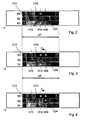
- the EPG comprises a grid of cells C13 - C15, C23 - C25, C33 - C34 arranged in different rows R1, R2, R3 as shown at the Figs. 2 to 4 .
- Each cell represents a multimedia program broadcasted by the multimedia device and each row comprises a series of cells representing consecutive programs of a same multimedia channel. Only a portion of the whole grid of cells is visible to a user within a viewport window VP.
- the viewport corresponds to a time range of the broadcasted multimedia programs.
- the state machine of Fig. 1 comprises an input handler module IH for detecting the navigation from an initial cell, say C13 at Fig. 2 , to a final destination cell, say C34 at Fig. 4 .
- the navigation is for instance initiated by a user of the multimedia device.
- a virtual cursor 0 - invisible to the user - is located on a vertical axis H13 in the middle, with respect to its horizontal length, of the initial cell C13 selected by the user, as shown at Fig. 2 .
- a horizontal navigation H1 to the right and starting from the initial cell C13 is for instance detected by the input handler module IH.
- the input handler module IH is able to detect horizontal and vertical navigation from the initial cell C13 to another cell in the grid, as a result of which the state machine places the virtual cursor inside the other cell.
- the input handler module IH is able, upon detection of a horizontal navigation, i.e. between cells within a same row R1, R2 or R3, to immediately activate HN1 a cell offset module CO also belonging to the state machine.
- the cell offset module CO is adapted for positioning the virtual cursor in the middle of the other cell.
- the virtual cursor 0 on the vertical axis H13 in the middle of the cell C13 is repositioned at 1 on the vertical axis H14 in the middle of the cell C14.
- the state machine further comprises a clock timer module CT which is triggered VN1 by the input handler module IH when a vertical navigation, i.e. between different rows, is detected.
- the clock timer module CT activates VN2 the cell offset module CO a time delay d after being triggered by the input handler module IH.
- the virtual cursor 1 on the vertical axis H14 in the middle of the cell C14 is first repositioned at 2 on the same vertical axis H14.
- the cell offset module CO repositions the virtual cursor at 3 on the vertical axis H34 in the middle of the final cell C34.
- the virtual cursor starting from the position 2 on the cell 34 will move on the vertical axis H14 down to the cell C23 whilst, after the end of the time delay d, the virtual cursor, starting then from the position 3 in the middle of the cell 34 will move on the vertical axis H34 down to the cell C23.
- the present state machine provides a smart, calm and intuitive navigation between cells inside the Electronic Programming Guide EPG. Best results are obtained with a time delay of about 1000 ms.
Landscapes
- Engineering & Computer Science (AREA)
- Multimedia (AREA)
- Signal Processing (AREA)
- Human Computer Interaction (AREA)
- Software Systems (AREA)
- Navigation (AREA)
Abstract
Description
- The present invention relates to a state machine for managing an Electronic Program Guide EPG comprising a grid of cells arranged in a plurality of rows, each cell representing a multimedia program and each row comprising a series of cells representing consecutive programs of a same multimedia channel, wherein a cell is adapted to be selected by a virtual cursor positioned inside the selected cell, said state machine comprising an input handler module adapted to detect navigation from a first cell to a second cell in said grid whereby said state machine consequently places the virtual cursor from inside said first cell to inside said second cell.
- Known Electronic Program Guides EPG, e.g. for IPTV devices, show 'grid' implementations that provide a user with a stateless navigation mechanisms within the grid of cells.
- This leads to a non-intuitive navigation initiated by the user for most of the current implementations.
- An object of the present invention is to provide a state machine for managing an Electronic Program Guide EPG of the above known type but wherein the navigation between cells is more smart and intuitive.
- According to the invention, this object is achieved due to the fact that said state machine further comprises a clock timer module adapted to be triggered by said input handler module, and a cell offset module adapted to be activated either immediately by said input handler module or after a predetermined time delay by the triggered clock timer module, and that said cell offset module is adapted for positioning the virtual cursor in the middle of said second cell.
- In this way, at least some navigation between the cells of the grid becomes time aware, dependent, e.g., of the direction of navigation.
- In case the cell offset module is activated by the triggered clock timer module after a predetermined time delay, the position of the virtual cursor is only adjusted in the middle of the second cell when the user's intent is that he/she wants to stay on that second cell. In fact, the delay corresponds to an intent of the user for staying on a cell and the action of the cell offset module leads to a more intuitive navigation between cells.
- In a preferred embodiment, the present invention is characterized in that said input handler module is adapted to activate immediately said cell offset module upon detection of horizontal navigation, and in that said input handler module is adapted to trigger said clock timer module upon detection of vertical navigation.
- This embodiment solves the problem of a main consequence of the fact that there are no clear columns in EPG grids and that current navigation implementations are stateless whereby specifically vertical navigation is non intuitive for most of the current implementations.
- Another a characterizing embodiment of the present invention is that said cell offset module is adapted for positioning the virtual cursor from a position on a first virtual vertical axis at the middle of a said first cell with respect to the horizontal length thereof, to a position on a second virtual vertical axis at the middle of a said second cell.
- In this way, due to the non symmetrical structure of the grid of cells, the way up, i.e. vertically from one row to another row, may be different than the way down, which becomes more intuitive owing to this embodiment.
- Further characterizing embodiments of the present state machine for managing an Electronic Program Guide EPG are mentioned in the appended claims.
- It is to be noticed that the term 'comprising', used in the claims, should not be interpreted as being restricted to the means listed thereafter. Thus, the scope of the expression 'a device comprising means A and B' should not be limited to devices consisting only of components A and B. It means that with respect to the present invention, the only relevant components of the device are A and B.
- Similarly, it is to be noticed that the term 'coupled', also used in the claims, should not be interpreted as being restricted to direct connections only. Thus, the scope of the expression 'a device A coupled to a device B' should not be limited to devices or systems wherein an output of device A is directly connected to an input of device B. It means that there exists a path between an output of A and an input of B which may be a path including other devices or means.
- The above and other objects and features of the invention will become more apparent and the invention itself will be best understood by referring to the following description of an embodiment taken in conjunction with the accompanying drawings wherein:
-
Fig. 1 represents a state machine for managing an Electronic Program Guide EPG according to the invention; and -
Figs. 2 to 4 show successive navigation steps within a grid of cells visible in a viewport VP of the Electronic Program Guide EPG. - The state machine shown at
Fig. 1 is used for managing the navigation between cells of an Electronic Program Guide EPG of a multimedia device, e.g. an IPTV. The EPG comprises a grid of cells C13 - C15, C23 - C25, C33 - C34 arranged in different rows R1, R2, R3 as shown at theFigs. 2 to 4 . Each cell represents a multimedia program broadcasted by the multimedia device and each row comprises a series of cells representing consecutive programs of a same multimedia channel. Only a portion of the whole grid of cells is visible to a user within a viewport window VP. The viewport corresponds to a time range of the broadcasted multimedia programs. - The state machine of
Fig. 1 comprises an input handler module IH for detecting the navigation from an initial cell, say C13 atFig. 2 , to a final destination cell, say C34 atFig. 4 . The navigation is for instance initiated by a user of the multimedia device. - At the start of a navigating through the Electronic Program Guide EPG, a virtual cursor 0 - invisible to the user - is located on a vertical axis H13 in the middle, with respect to its horizontal length, of the initial cell C13 selected by the user, as shown at
Fig. 2 . - A horizontal navigation H1 to the right and starting from the initial cell C13 is for instance detected by the input handler module IH.
- Referring back to
Fig. 1 , the input handler module IH is able to detect horizontal and vertical navigation from the initial cell C13 to another cell in the grid, as a result of which the state machine places the virtual cursor inside the other cell. - To this end, the input handler module IH is able, upon detection of a horizontal navigation, i.e. between cells within a same row R1, R2 or R3, to immediately activate HN1 a cell offset module CO also belonging to the state machine.
- The cell offset module CO is adapted for positioning the virtual cursor in the middle of the other cell.
- In more detail, and referring to
Fig. 2 , in case of a horizontal navigation H1 from the cell C13 to the cell C14 on the same row R1, the virtual cursor 0 on the vertical axis H13 in the middle of the cell C13 is repositioned at 1 on the vertical axis H14 in the middle of the cell C14. - The state machine further comprises a clock timer module CT which is triggered VN1 by the input handler module IH when a vertical navigation, i.e. between different rows, is detected.
- The clock timer module CT activates VN2 the cell offset module CO a time delay d after being triggered by the input handler module IH.
- In more detail, and still referring to
Fig. 2 , in case of a vertical navigation V1 from the cell C14 to the cell C34, i.e. from the row R1 to the row R3, thevirtual cursor 1 on the vertical axis H14 in the middle of the cell C14 is first repositioned at 2 on the same vertical axis H14. After the time delay d, as shown atFig. 3 , the cell offset module CO repositions the virtual cursor at 3 on the vertical axis H34 in the middle of the final cell C34. - As a consequence, when starting from the vertical way-up ending in row R3 at the
virtual cursor position 2, if the user is merely passing by and navigates further vertically, e.g. down to the row R2, he/she will select the cell C23. This happens when the further navigation occurs before the end of the time delay d. On the other hand, if the user stays in cell C34 for a time delay longer than d, any further vertical navigation, e.g. down to the row R2, leads to the selection of the cell C24. - In other words, before the end of the time delay d, the virtual cursor, starting from the
position 2 on the cell 34 will move on the vertical axis H14 down to the cell C23 whilst, after the end of the time delay d, the virtual cursor, starting then from theposition 3 in the middle of the cell 34 will move on the vertical axis H34 down to the cell C23. - The present state machine provides a smart, calm and intuitive navigation between cells inside the Electronic Programming Guide EPG. Best results are obtained with a time delay of about 1000 ms.
- A final remark is that embodiments of the present invention are described above in terms of functional blocks. From the functional description of these blocks, given above, it will be apparent for a person skilled in the art of designing electronic devices how embodiments of these blocks can be manufactured with well-known electronic components. A detailed architecture of the contents of the functional blocks hence is not given.
- While the principles of the invention have been described above in connection with specific apparatus, it is to be clearly understood that this description is merely made by way of example and not as a limitation on the scope of the invention, as defined in the appended claims.
Claims (8)
- A state machine for managing an Electronic Program Guide EPG comprising a grid of cells (C13 - C15, C23 - C25, C33 - C34) arranged in a plurality of rows (R1, R2, R3), each cell representing a multimedia program and each row comprising a series of cells representing consecutive programs of a same multimedia channel,
wherein a cell is adapted to be selected by a virtual cursor (0, 1, 2, 3, 4) positioned inside the selected cell,
said state machine comprising an input handler module (IH) adapted to detect navigation (H1, V1) from a first cell (C13) to a second cell (C14; C34) in said grid whereby said state machine consequently places the virtual cursor from inside (0) said first cell to inside (1; 2, 3) said second cell,
characterized in that said state machine further comprises a clock timer module (CT) adapted to be triggered (VN1) by said input handler module (IH), and a cell offset module (CO) adapted to be activated (HN1, VN2) either immediately by said input handler module or after a predetermined time delay (d) by the triggered clock timer module,
and in that said cell offset module (CO) is adapted for positioning the virtual cursor in the middle (3) of said second cell (C34). - The state machine according to claim 1,
characterized in that said input handler module (IH) is adapted to activate immediately said cell offset module (CO) upon detection of horizontal navigation (H1),
and in that said input handler module (IH) is adapted to trigger said clock timer module (CT) upon detection of vertical navigation (V1). - The state machine according to claim 2,
characterized in that said horizontal navigation (H1) consists in selecting a said second cell (C14) within the same row (R1) as said first cell (C13),
and in that said vertical navigation (V1) consists in selecting a said second cell (C34) in a different row (R3) as the row (R1) of a said first cell (C14). - The state machine according to claim 3, characterized in that in case of vertical navigation (V1), the virtual cursor (1, 2) is displaced from a first row (R1) to a second row (R3) along a virtual vertical axis (H14).
- The state machine according to claim 4, characterized in that said virtual vertical axis (H14) corresponds to the middle of a said first cell (C14) from which the vertical navigation (V1) starts.
- The state machine according to any of the claims 1 or 5, characterized in that middle of a cell is considered with respect to the horizontal length of said cell.
- The state machine according to claim 6, characterized in that said cell offset module (CO) is adapted for positioning the virtual cursor from a position (2) on a first virtual vertical axis (H14) at the middle of a said first cell (C14) towards a position (3) on a second virtual vertical axis (H34) at the middle of a said second cell (C34).
- The state machine according to claim 1, characterized in that said navigation is initiated by a user of said Electronic Program Guide EPG.
Priority Applications (1)
| Application Number | Priority Date | Filing Date | Title |
|---|---|---|---|
| EP09290422A EP2262231A1 (en) | 2009-06-10 | 2009-06-10 | Smart navigation inside an electronic programming guide |
Applications Claiming Priority (1)
| Application Number | Priority Date | Filing Date | Title |
|---|---|---|---|
| EP09290422A EP2262231A1 (en) | 2009-06-10 | 2009-06-10 | Smart navigation inside an electronic programming guide |
Publications (1)
| Publication Number | Publication Date |
|---|---|
| EP2262231A1 true EP2262231A1 (en) | 2010-12-15 |
Family
ID=41264142
Family Applications (1)
| Application Number | Title | Priority Date | Filing Date |
|---|---|---|---|
| EP09290422A Withdrawn EP2262231A1 (en) | 2009-06-10 | 2009-06-10 | Smart navigation inside an electronic programming guide |
Country Status (1)
| Country | Link |
|---|---|
| EP (1) | EP2262231A1 (en) |
Cited By (1)
| Publication number | Priority date | Publication date | Assignee | Title |
|---|---|---|---|---|
| EP3232313A1 (en) * | 2016-04-15 | 2017-10-18 | Wiztivi | Method for navigating in a graphical user interface of a program guide |
Citations (2)
| Publication number | Priority date | Publication date | Assignee | Title |
|---|---|---|---|---|
| US20050102634A1 (en) | 2003-11-10 | 2005-05-12 | Sloo David H. | Understandable navigation of an information array |
| WO2009055273A1 (en) | 2007-10-24 | 2009-04-30 | Scientific-Atlanta, Inc. | Navigation in program guides with non-uniform events |
-
2009
- 2009-06-10 EP EP09290422A patent/EP2262231A1/en not_active Withdrawn
Patent Citations (2)
| Publication number | Priority date | Publication date | Assignee | Title |
|---|---|---|---|---|
| US20050102634A1 (en) | 2003-11-10 | 2005-05-12 | Sloo David H. | Understandable navigation of an information array |
| WO2009055273A1 (en) | 2007-10-24 | 2009-04-30 | Scientific-Atlanta, Inc. | Navigation in program guides with non-uniform events |
Cited By (2)
| Publication number | Priority date | Publication date | Assignee | Title |
|---|---|---|---|---|
| EP3232313A1 (en) * | 2016-04-15 | 2017-10-18 | Wiztivi | Method for navigating in a graphical user interface of a program guide |
| FR3050292A1 (en) * | 2016-04-15 | 2017-10-20 | Wiztivi | NAVIGATION METHOD IN GRAPHIC PROGRAM GUIDE INTERFACE |
Similar Documents
| Publication | Publication Date | Title |
|---|---|---|
| KR101615093B1 (en) | Method and system for displaying unread message | |
| US10929013B2 (en) | Method for adjusting input virtual keyboard and input apparatus | |
| EP2902897B1 (en) | Word processing method and apparatus for touchscreen intelligent device | |
| CN105094617A (en) | Screen capturing method and device | |
| US20150370402A1 (en) | Methods, systems, and media for controlling playback of video using a touchscreen | |
| US20140071171A1 (en) | Pinch-and-zoom, zoom-and-pinch gesture control | |
| CN103870156A (en) | Method and device for processing object | |
| US20160306541A1 (en) | Object switching method and device, and touchscreen terminal | |
| KR101996469B1 (en) | Display control device, display control method, and program | |
| CN104461444A (en) | Split-screen display method for flexible screen and terminal device | |
| CN103186345A (en) | Text segment selecting method and field selecting method, device and terminal | |
| CN103096157B (en) | A kind of method utilizing mobile phone to control moving focal point on TV applications interface | |
| US20140304625A1 (en) | Page returning | |
| CN106980438B (en) | Cursor control method, device and system | |
| US20140137008A1 (en) | Apparatus and algorithm for implementing processing assignment including system level gestures | |
| US20140085223A1 (en) | Apparatus and method capable of switching displayed pictures | |
| CN105549814B (en) | Photographing method based on mobile terminal and mobile terminal | |
| CN106572381A (en) | Processing method of photo thumbnail and intelligent television | |
| CN103197886B (en) | The method that video switches and terminal | |
| KR20130054579A (en) | Display apparatus and control method thereof | |
| EP2262231A1 (en) | Smart navigation inside an electronic programming guide | |
| JP5644658B2 (en) | Information processing apparatus, input control method, and input control program | |
| US20170003982A1 (en) | Method for operating on web page of terminal and terminal | |
| US9973721B2 (en) | Processing method and apparatus for misoperation, and display device | |
| CN105573638B (en) | Method and device for publishing pictures |
Legal Events
| Date | Code | Title | Description |
|---|---|---|---|
| PUAI | Public reference made under article 153(3) epc to a published international application that has entered the european phase |
Free format text: ORIGINAL CODE: 0009012 |
|
| AK | Designated contracting states |
Kind code of ref document: A1 Designated state(s): AT BE BG CH CY CZ DE DK EE ES FI FR GB GR HR HU IE IS IT LI LT LU LV MC MK MT NL NO PL PT RO SE SI SK TR |
|
| AX | Request for extension of the european patent |
Extension state: AL BA RS |
|
| 17P | Request for examination filed |
Effective date: 20110615 |
|
| 17Q | First examination report despatched |
Effective date: 20110725 |
|
| RAP1 | Party data changed (applicant data changed or rights of an application transferred) |
Owner name: ALCATEL LUCENT |
|
| STAA | Information on the status of an ep patent application or granted ep patent |
Free format text: STATUS: THE APPLICATION HAS BEEN WITHDRAWN |
|
| 18W | Application withdrawn |
Effective date: 20130503 |
|
| 111Z | Information provided on other rights and legal means of execution |
Free format text: AT BE BG CH CY CZ DE DK EE ES FI FR GB GR HR HU IE IS IT LI LT LU LV MC MK MT NL NO PL PT RO SE SI SK TR Effective date: 20130410 |