EP2260873A1 - Pcylation of proteins - Google Patents
Pcylation of proteins Download PDFInfo
- Publication number
- EP2260873A1 EP2260873A1 EP09162203A EP09162203A EP2260873A1 EP 2260873 A1 EP2260873 A1 EP 2260873A1 EP 09162203 A EP09162203 A EP 09162203A EP 09162203 A EP09162203 A EP 09162203A EP 2260873 A1 EP2260873 A1 EP 2260873A1
- Authority
- EP
- European Patent Office
- Prior art keywords
- group
- polymer
- alkyl
- alkoxy
- groups
- Prior art date
- Legal status (The legal status is an assumption and is not a legal conclusion. Google has not performed a legal analysis and makes no representation as to the accuracy of the status listed.)
- Granted
Links
- 0 CC(C)(*)NC(C)(C)C(C)(*)* Chemical compound CC(C)(*)NC(C)(C)C(C)(*)* 0.000 description 1
Images


Classifications
-
- A—HUMAN NECESSITIES
- A61—MEDICAL OR VETERINARY SCIENCE; HYGIENE
- A61K—PREPARATIONS FOR MEDICAL, DENTAL OR TOILETRY PURPOSES
- A61K47/00—Medicinal preparations characterised by the non-active ingredients used, e.g. carriers or inert additives; Targeting or modifying agents chemically bound to the active ingredient
- A61K47/50—Medicinal preparations characterised by the non-active ingredients used, e.g. carriers or inert additives; Targeting or modifying agents chemically bound to the active ingredient the non-active ingredient being chemically bound to the active ingredient, e.g. polymer-drug conjugates
- A61K47/51—Medicinal preparations characterised by the non-active ingredients used, e.g. carriers or inert additives; Targeting or modifying agents chemically bound to the active ingredient the non-active ingredient being chemically bound to the active ingredient, e.g. polymer-drug conjugates the non-active ingredient being a modifying agent
- A61K47/56—Medicinal preparations characterised by the non-active ingredients used, e.g. carriers or inert additives; Targeting or modifying agents chemically bound to the active ingredient the non-active ingredient being chemically bound to the active ingredient, e.g. polymer-drug conjugates the non-active ingredient being a modifying agent the modifying agent being an organic macromolecular compound, e.g. an oligomeric, polymeric or dendrimeric molecule
- A61K47/58—Medicinal preparations characterised by the non-active ingredients used, e.g. carriers or inert additives; Targeting or modifying agents chemically bound to the active ingredient the non-active ingredient being chemically bound to the active ingredient, e.g. polymer-drug conjugates the non-active ingredient being a modifying agent the modifying agent being an organic macromolecular compound, e.g. an oligomeric, polymeric or dendrimeric molecule obtained by reactions only involving carbon-to-carbon unsaturated bonds, e.g. poly[meth]acrylate, polyacrylamide, polystyrene, polyvinylpyrrolidone, polyvinylalcohol or polystyrene sulfonic acid resin
-
- A—HUMAN NECESSITIES
- A61—MEDICAL OR VETERINARY SCIENCE; HYGIENE
- A61K—PREPARATIONS FOR MEDICAL, DENTAL OR TOILETRY PURPOSES
- A61K47/00—Medicinal preparations characterised by the non-active ingredients used, e.g. carriers or inert additives; Targeting or modifying agents chemically bound to the active ingredient
- A61K47/50—Medicinal preparations characterised by the non-active ingredients used, e.g. carriers or inert additives; Targeting or modifying agents chemically bound to the active ingredient the non-active ingredient being chemically bound to the active ingredient, e.g. polymer-drug conjugates
- A61K47/51—Medicinal preparations characterised by the non-active ingredients used, e.g. carriers or inert additives; Targeting or modifying agents chemically bound to the active ingredient the non-active ingredient being chemically bound to the active ingredient, e.g. polymer-drug conjugates the non-active ingredient being a modifying agent
- A61K47/54—Medicinal preparations characterised by the non-active ingredients used, e.g. carriers or inert additives; Targeting or modifying agents chemically bound to the active ingredient the non-active ingredient being chemically bound to the active ingredient, e.g. polymer-drug conjugates the non-active ingredient being a modifying agent the modifying agent being an organic compound
- A61K47/543—Lipids, e.g. triglycerides; Polyamines, e.g. spermine or spermidine
-
- A—HUMAN NECESSITIES
- A61—MEDICAL OR VETERINARY SCIENCE; HYGIENE
- A61K—PREPARATIONS FOR MEDICAL, DENTAL OR TOILETRY PURPOSES
- A61K47/00—Medicinal preparations characterised by the non-active ingredients used, e.g. carriers or inert additives; Targeting or modifying agents chemically bound to the active ingredient
- A61K47/50—Medicinal preparations characterised by the non-active ingredients used, e.g. carriers or inert additives; Targeting or modifying agents chemically bound to the active ingredient the non-active ingredient being chemically bound to the active ingredient, e.g. polymer-drug conjugates
- A61K47/51—Medicinal preparations characterised by the non-active ingredients used, e.g. carriers or inert additives; Targeting or modifying agents chemically bound to the active ingredient the non-active ingredient being chemically bound to the active ingredient, e.g. polymer-drug conjugates the non-active ingredient being a modifying agent
- A61K47/54—Medicinal preparations characterised by the non-active ingredients used, e.g. carriers or inert additives; Targeting or modifying agents chemically bound to the active ingredient the non-active ingredient being chemically bound to the active ingredient, e.g. polymer-drug conjugates the non-active ingredient being a modifying agent the modifying agent being an organic compound
- A61K47/548—Phosphates or phosphonates, e.g. bone-seeking
Definitions
- This invention relates to the modification of proteins with polymers for the purpose of improving their efficacy as therapeutic treatments.
- PEGylation involves the attachment of a flexible strand or strands of polyethylene glycol (PEG) to a protein.
- PEG polyethylene glycol
- PEG polymer chains When attached to a drug or protein, PEG polymer chains can sustain bioavailability by protecting the drug molecules from immune responses and other clearance mechanisms in the body.
- the long chain-like PEG molecule In an aqueous medium, the long chain-like PEG molecule is heavily hydrated and in rapid motion. This motion is believed to cause the PEG molecule to sweep out a large volume and prevent the interference of other molecules.
- PEGylation is used in tumour targeting and diagnostic imaging applications.
- PEGylated liposomes for instance, are employed in several marketed formulations.
- PEGylation of surfaces is an efficient method to enhance the biocompatibility of a synthetic material.
- PEGylation is an established method to improve on the pharmacokinetic profile of therapeutic compounds.
- PEGylation has been very successfully applied to the development of second-generation biotherapeutics and captured a significant portion of the US biologicals market.
- L-asparaginase (denoted asparaginase) is an enzyme that catalyzes the hydrolysis of asparagine to aspartic acid.
- a bacterially-derived asparaginase is marketed under the brand name ElsparRTM (Merck & Co) to treat acute lymphoblastic leukaemia and lymphomas.
- ElsparRTM Merck & Co
- a PEGylated version is marketed under the brand name OncasparTM.
- Leukemic cells depend on circulating asparagine, and treatment with asparaginase deprives these cells of this nutrient essential for their growth and replication. Approximately a third of all patients receiving the treatment eventually develop blocking antibodies against the native E . coli asparaginase, and are unable to continue with treatment.
- a major concern with this treatment is the immunogenicity of asparaginase produced by E.coli, which can lead to anaphylactic reactions and early clearance by serum antibodies.
- the PEGylated form of asparaginase is less immunogenic and as a result the development of antibodies can be substantially attenuated.
- E . coli derived asparaginase is a protein (MW 133-138 kDa) that consists of four identical subunits, each of which contains 326 amino acids and a single disulfide bond between Cys77-Cys105.
- Asparaginase must exist in its tetrameric form to display its biological activity. Structurally, the disulfides are accessible because they lie on the outer edge of the protein and are distant from the protein's enzymatic site.
- L-asparaginase has been shown to undergo disulfide bond PEGylation ( Balan et al. (2007) Site-Specific PEGylation of Protein Disulfide Bonds Using a Three-Carbon Bridge. Bioconjugate Chem 18:61-76 ).
- a polymer comprising 2-methacryloyloxyethyl-phosphoryl chlorine (MPC) for use in reducing the immunogenicity of a therapeutic protein which is administered to the human or animal body.
- MPC 2-methacryloyloxyethyl-phosphoryl chlorine
- a polymer comprising MPC in the manufacture of a medicament comprising the polymer and a therapeutic protein, for use in reducing the immunogenicity of the protein when it is administered to the human or animal body.
- polymers comprising MPC of controlled architecture may be made using methods known in the art such as atom transfer radical polymerisation (ATRP) or radical addition-fragmentation chain transfer polymerisation (RAFT), for instance as described in US6,852,816 .
- ATRP atom transfer radical polymerisation
- RAFT radical addition-fragmentation chain transfer polymerisation
- the polymers based on phosphorylcholine (PC) are functionalised with an end-terminal linking group capable of insertion into the disulfide bridges or reaction with terminal cysteine residues of many commonly used therapeutic proteins.
- PC phosphorylcholine
- This technology is described in detail in WO2008/098930 .
- the resulting conjugate has reduced immunogenicity by virtue of the presence of the MPC residues which are effective at reducing antibody recognition of the protein.
- site-specific attachment away from the active site of the protein allows for retention of significant activity.
- WO2008/098930 discloses that MPC polymer provides improved protein shielding from antibodies.
- the present invention is based on the finding that conjugating PC polymer to therapeutic proteins can allow the proteins to avoid detection by the immune system, thus leading to low antibody titres in vivo upon exposure of the protein in the bloodstream.
- Antigen presentation is a process in the body's immune system by which macrophages, dendritic cells and other cell types capture antigens and the enable their recognition by T-cells. Activation of T-cells ultimately leads to antibody production.
- PCylation (the process of conjugating with PC) provides an effective method of camouflaging the underlying antigen regions of the therapeutic proteins, preventing recognition and engulfment by Antigen Presenting Cells or binding to the surface antibodies presented on B cells, thus inhibiting the production of further antibodies.
- PCylation of a protein seeks to avoid the immune response by blocking the early recognition pathways that would otherwise result in antibody production. This is distinctly different to the finding that MPC polymer provides improved protein shielding from antibodies, which relies on PCylation to act as a steric barrier to shield the protein from antibodies directed towards the protein.
- the polymer used in this invention comprises MPC.
- the polymer is administered in the form of a covalently-linked conjugate of the polymer and a therapeutic protein.
- the protein comprises one or more cysteine residues and the protein is covalently linked to the polymer via one or more of said cysteine residues.
- a polymer of general formula V or VI may be formed in this method: wherein R 1 -R 6 , R 7 -R 8 (if present), L, Z, m, and E 1 are as defined above: f is 1 to 500; and Groups M are the same or different and are residues of ethylenically unsaturated monomers. At least one group M is a residue of MPC.
- a method of derivatisation of a biological molecule may be used in which a polymer of general formula V or general formula VI is added to a therapeutic protein of general formula T 1 D 1 X or to therapeutic proteins of general formula T 1 D 1 X and T 2 D 2 X, wherein D is S, NH or O and X is H, D 1 T 1 or D 2 T 2 to form an adduct of general formula VII or of general formula VIII wherein R 1 -R 5 , R 7 - R 8 (if present), m and L are as defined in the first aspect of the invention and M is as defined above in the third aspect of the invention; f is 1 to 500; R 36 is -CH 2 E 4 , H or C 1-4 alkyl; and E 4 is a leaving group; x is 1 or 2; p is 1-5 and q is 1-10.
- the initiators act as initiators in the living radical polymerisation process.
- the initiators are extended at the carbon to which Z is attached by a living radical polymerisation process.
- the opposite end of the initiator molecule must be suitable for derivatisation with a therapeutic protein.
- the initiator has an ⁇ -methylene leaving group, or precursor to a leaving group, or a double bond conjugated with an electron-withdrawing group. This allows a biological molecule to react with the initiator in a Michael reaction.
- R 6 is -CH 2 E 2 .
- R 1 is a suitable activating moiety for the Michael reaction
- sequential intramolecular bis-alkylation can occur by consecutive Michael and retro Michael reactions.
- the leaving moiety serves to mask a latent conjugated double bond that is not exposed until after the first alkylation has occurred and bis-alkylation results from sequential Michael and retro-Michael reactions.
- Initiators of general formula IV may have from 1 to 5 double bonds.
- a nucleophile may add to the conjugated system at a suitable position on any of the double bonds.
- m is zero in an initiator of general formula II.
- R 6 , R 7 and R 8 are each independently selected from -H or -CH 3 .
- R 4 and R 5 are H.
- neither are hydrogen.
- at least one, and preferably both of R 4 and R 5 are methyl.
- R 3 is -CO-R 10 in which R 10 is oligoalkoxy, preferably oligoethoxy in which there are 2 to 10 ethoxy groups.
- the alkoxy group may have 1 or 3 carbon atoms.
- R 4 and R 5 are preferably methyl.
- Group Z is a radically transferable group and is preferably a halogen, more preferably Cl, Br or I, most preferably Br. Since groups R 4 and R 5 may also be Z the initiator may be di-, oligo- or poly- functional.
- Suitable linking groups, L include a bond, a C 1-10 alkylene group, or an optionally substituted aryl or heteroaryl, any of which groups may have substituents selected from optionally substituted alkoxy, oligoalkoxy, amino (including mono- and di-alkyl amino and trialkyl ammonium, which alkyl groups, in turn, may have substituents selected from acyl, alkoxycarbonyl, alkenoxycarbonyl, aryl and hydroxy) and hydroxyl groups.
- Suitable groups for electron-withdrawing group R 1 include a keto group, an ester group, and a sulphone group.
- Groups E 1 and E 2 are typically leaving groups selected from -SR 17 , - SO 2 R 17 , -OSO 2 R 17 , -N + R 17 3 , -N + HR 2 17 , -N + H 2 R 17 , halogen, or -OAr, in which R 17 represents an alkyl or aryl group and Ar represents a substituted aryl group containing at least one electron-withdrawing substituent.
- groups E 1 and E 2 may be precursors to leaving groups, wherein the leaving group may be obtained by a simple chemical reaction such as oxidation or reduction. Having E 1 and E 2 as precursors to leaving groups may be preferable if this facilitates synthesis of the initiator and the subsequent polymerisation reaction.
- E 1 and E 2 are each, independently, an (optionally substituted) aryl sulfide or aryl sulfone group.
- An aryl sulfide (a precursor to a leaving group) may be converted into an aryl sulfone (a leaving group) by a simple oxidation reaction, as is well known in the art.
- the process may include a subsequent reaction step in which groups E 1 and E 2 (if present) which are precursors to leaving groups are converted into leaving groups.
- a particularly preferred initiator of general formula III has formula:
- the living radical polymerisation process used in the invention may be a group transfer radical polymerisation, for instance in which an N-O, or other carbon-, sulphur-, and oxygen- centred radical group is transferred from an initiator compound to a monomer.
- the process is an atom transfer radical polymerisation process.
- the polymers used in this invention are generally made by a living radical polymerisation process.
- NO group transfer systems such as are described in WO-A-0018807
- Atom or group transfer radical polymerisation processes are described further in WO 02/28929 and WO 03/074090 ; pages 15-24.
- the living radical polymerisation process used in the invention is preferably carried out to achieve a degree of polymerisation in the range 5 to 500.
- the degree of polymerisation is in the range 10 to 100, more preferably in the range 10 to 50.
- the degree of polymerisation is directly related to the initial ratios of initiator to monomer.
- the ratio is in the range 1:(5 to 500), more preferably in the range of 1:(10 to 100), most preferably in the range 1:(10 to 50).
- At least one of the ethylenically unsaturated monomers is MPC.
- the others may be anionic, cationic or nonionic monomers.
- the polymer may be a homopolymer that is moiety -(-M-)- f may comprise groups M which are residues of the same ethylenically unsaturated monomer MPC.
- the polymer may be a copolymer or a block copolymer, wherein groups M in moiety -(-M-)- f are residues of different ethylenically unsaturated monomers.
- the ethylenically unsaturated comonomers are zwitterionic.
- the zwitterionic nature arises from the combination of a cationic and anionic moiety.
- the cationic moiety may be an ammonium, phosphonium or sulphonium group, preferably an ammonium group.
- the anion is typically a phospho moiety, more typically a phosphate diester.
- groups L, R 1 -R 6 and Z are the same as outlined above.
- groups E 1 and E 2 (if present) in the polymers of formula V and VI should be leaving groups. Accordingly, a particularly preferred leaving group is:
- Particularly preferred polymers which have formed covalently-linked conjugates of polymer and therapeutic protein are of formula:
- the therapeutic protein or proteins are represented by general formulae T 1 D 1 X and T 2 D 2 X wherein D 1 X and D 2 X represent a nucleophilic group.
- the nucleophilic group is a thiol group, although amine and hydroxyl groups may also be used to conjugate the therapeutic protein to the MPC polymer.
- Adduct of general formula II is formed when the polymer of general formula V or VI has only one leaving group, or R 6 is not a leaving group in a polymer of general formula V.
- Adducts of general formula II may form when a nucleophile attacks the polymer of general formula V or VI twice, i.e. when there are two leaving groups (E 1 and E 2 ), or R 6 is a leaving group in V.
- Moiety T x -D x - in formula I may be derived from the same therapeutic protein molecule as T 1 -D 1 , in which case x is 1.
- moiety T x -D x - may be derived from a different therapeutic protein, in which case x is 2.
- the process according to the invention is carried out by partially reducing a disulfide bond derived from two cysteine amino acids in the protein in situ following which the reduced product reacts with the polymer of formula V or VI.
- Disulfides can be reduced, for example, with dithiothreitiol, mercaptoethanol, or tris-carboxyethylphosphone using conventional methods.
- the process may be carried out in a solvent or solvent mixture in which all reactants are soluble.
- the protein containing nucleophilic groups may be allowed to react directly with the polymer of the general formula V or VI in an aqueous reaction medium. This reaction medium may also be buffered, depending on the pH requirements of the nucleophile.
- the optimum pH for the reaction is generally between about 5.5 and about 8, for example 7.4, preferably about 6.0-6.5.
- Reaction temperatures between 3-37°C are generally suitable: proteins and other biological molecules may decompose or denature impairing function if the conjugation reaction is conducted at a temperature where these processes may occur.
- Reactions conducted in organic media are typically conducted at temperatures up to ambient, for example temperatures below 0°C.
- a protein can contain one or a multiplicity of disulfide bridges. Reduction to give free sulfhydral moieties can be conducted to reduce one or a multiplicity of disulfide bridges in a protein. Depending on the extent of disulfide reduction in the stoichiometry of the polymeric conjugation reagent that is used, it is possible to conjugate one or a multiplicity of polymer molecules to the protein. Immobilised reducing agents may be used if it is desired to reduce less than the total number of disulfides, as can partial reduction using different reaction conditions or the addition of denaturants.
- the source of the thiol groups can be from cysteines or thiols not originally derived from a disulfide bridge. If the source of the thiol groups is a disulfide bridge, this may be intrachain or interchain.
- the therapeutic protein can be effectively conjugated with polymers using a stoichiometric equivalent or a slight excess of polymer, unlike many prior art reagents.
- polymers do not undergo competitive reactions with aqueous media used to solvate proteins, it is possible to conduct conjugation reaction with an excess stoichiometry of polymer.
- the excess polymer can be easily removed by ion exchange chromatography during routine purification of proteins.
- the therapeutic protein may be, for example, a polypeptide, antibody, antibody fragment, enzyme, cytokine, chemokine or receptor.
- Constrained or cyclic polypeptides which are usually cyclised through a disulphide bridge, and epitopes, may also be used.
- the therapeutic protein is an enzyme.
- Enzymes include carbohydrate-specific enzymes, proteolytic enzymes and the like. Enzymes of interest, for both industrial (organic based reactions) and biological applications in general and therapeutic applications in particular include the oxidoreductases, transferases, hydrolases, lyases, isomerases and ligases disclosed by US 4,179,337 .
- Specific enzymes of interest include asparaginase, arginase, adenosine deaminase, superoxide dismutase, catalase, chymotrypsin, lipase, uricase, bilirubin oxidase, glucose oxidase, glucuronidase, galactosidase, glucocerbrosidase, and glutaminase.
- the therapeutic protein conjugated in the present invention may be, for example, factor 8, insulin, ACTH, glucagen, somatostatin, somatotropins, thymosin, parathyroid hormone, pigmentary hormones, somatomedins, erythropoietin, luteinizing hormone, hypothalamic releasing factors, antidiuretic hormones, prolactin, interleukins, interferons, colony stimulating factors, hemoglobin, cytokines, antibodies, glycopolypeptides such as immunoglobulins, ovalbumin, lipase, glucocerebrosidase, lectins, tissue plasminogen activator and glycosilated inerleukins, interferons and colony stimulating factors are of interest, as are immunoglobulins such as IgG, IgE, IgM, IgA, IgD and fragments thereof.
- the therapeutic protein is preferably a peptide hormone.
- the therapeutic protein is asparaginase.
- MPC polymer in this invention is shown to reduce the immunogenecity of a therapeutic protein.
- Reduced immunogenicity is determined in a standard assay by measuring the antibody titres raised to the therapeutic protein with and without conjugated MPC polymer. Immunogenicity is generally measured using an IgG ELISA assay. Example 4 gives more details on the use of this assay.
- the MPC polymer and therapeutic protein are generally administered to the human or animal body by direct injection.
- Typical pharmaceutical formulations comprise the MPC polymer and therapeutic protein the form of a conjugate together with one or more pharmaceutically acceptable excipients, which are selected from those known in the art.
- Example 1 Reduced Antibody Staining for MPCylated Interferon (MPC-IFN).
- MPC-IFN and corresponding PEG-IFN are described in detail in the Examples of WO2008/098930 .
- 20kD PEG-IFN and a comparative MPC-IFN (20 kD equivalent on SEC, actual 40 kD) prepared using the same bissulphone linker were subjected to Western blot analysis using a polyclonal antibody against IFN alpha.
- Optimisation of antibody dilution and the length of incubation were required to improve the detection of MPC-IFN.
- PEGylation is known to cause steric shielding and consequently affects the way an antibody binds to a PEGylated protein.
- Active asparaginase is a tetramer with each monomer unit containing one disulfide bond. MPCylation of the disulfide bonds therefore allows up to four MPC polymer chains per active asparaginase tetramer depending on the efficiency of the MPCylation.
- Asparaginase from Escherichia coli was purchased from Sigma-Aldrich Ltd (product number A3809, lot number 117K4159).
- Poly(2-methacryloyloxyethyl phosphorylchloline) (PMPC or MPC polymer) with the bis-sulfide end-group was made as described in WO2008/098930 .
- the end group was oxidised to the protein reactive bis-sulfone form as follows: MPC bis-sulfide (0.15 mg) was oxidised to the bis-sulfone end group using Oxone (7 mg) in a 1:1 v/v methanol:water mixture 2 ml) overnight.
- MPCylation of asparaginase for in vitro and in vivo analysis was performed on asparaginase (4 mg, 1 mg/ml) reduced with DTT (100 mM) according to a revised procedure of Shaunak et al; Nat Chem Biol. 2006 Jun;2(6):312-3 .
- MPC bis-sulfone (96 mg, molar excess) was allowed to react with the reduced asparaginase in pH 8.2 phosphate buffered saline (PBS) overnight at 4 °C. Excess MPC polymer was then removed using anion exchange chromatography with a 1 ml HiTrap Q FF column (GE Healthcare) at pH 8.0 ( Figure 2 ).
- MPC polymer sterically hinders the conjugation of further MPC polymer chains preventing full MPCylation in most cases.
- a second explanation or additional factor could be that the MPC polymer used causes reoxidation of the disulfide reduced protein due to oxidising metal ion contaminants such as copper. EDTA (20 mM) was added to the reaction buffer to minimise this effect.
- Example 3 In vitro enzymatic activity of MPCylated asparaginase
- Asparaginase is an amidase that converts L-asparagine to L-aspartic acid and ammonia.
- the most commonly used assay for asparaginase is based on the colorimetric determination of liberated ammonia from L-asparagine using the Nessler's reagent.
- the immunogenicity study does not require an in vitro validation of the PMPC-asparaginase, it was deemed necessary in order to ensure that the mice are immunised with a functional protein. Briefly, the amount of ammonia released when asparagine is incubated with PC-asparaginase is measured by comparing to a standard curve using a spectrophotometric determination method. The results are shown in Table 1.
- Example 4 In vivo immunogenicity of MPCylated asparaginase
- ⁇ -Asp anti-asparaginase antibody
- ⁇ -Asp anti-asparaginase antibody
- microtitre plates designed for ELISA were coated with 50 ⁇ l of native or MPCylated asparaginase (2 ⁇ g/ml in binding buffer) and incubated for 18 h at 4°C. After washing once with 200 ⁇ l/well of PBS-T, 50 ⁇ l of 1% BSA/PBS-T was added and incubated on a shaking platform for 1 h at RT. After the solution was removed, diluted serum was added at 50 ⁇ l/well and incubated while shaking for 18 h at 4°C.
- the plate was then washed 3 times with PBS-T and tap dried. Then anti-mouse IgG or IgM antibodies conjugated to HRP (1:10,000 in PBS-T with 5% FCS and 1% BSA) was added at 50 ⁇ l/well, and incubated with shaking for 3 h at RT. After washing 3 times with PBS-T, the plate was tap dried. TMB solution was added at 50 ⁇ l/well for 15 min at RT in the dark and the absorbance read at 630 nm using a microplate reader.
- mice in Group 1 were sacrificed after one immunisation, Group 2 after two immunisations and finally Group 3 after three immunisations with either 20 ⁇ g of asparaginase or PMPC-asparaginase (20 ⁇ g of asparaginase), and their plasma collected.
- Table 2 shows the sample IDs used for the individual plasma samples.
- Table 2 Plasma sample IDs and their respective harvest dates Group 1 (day 7) Group 2 (day 18) Group 3 (day 25) Asp MPC- PBS Asp MPC- PBS Asp MPC- PBS Asp Asp Asp A1-1 P1-1 Q1-1 A2-1 P2-1 Q2-1 A3-1 P3-1 Q3-1 A 1-2 P 1-2 Q1-2 A2-2 P2-2 Q2-2 A3-2 P3-2 Q3-2 A1-3 P1-3 A2-3 P2-3 A3-3 P3-3 A1-4 P1-4 A2-4 P2-4 A3-4 P3-4 A1-5 P1-5 A2-5 P2-5 A3-5 P3-5 Quantitative titre of ⁇ - Asp IgG in plasma samples using asparaginase-coated ELISA
- the titres of ⁇ -Asp IgG in the plasma samples from the three Groups were measured in ELISA plates coated with 100 ng of asparaginase (Asp-coated ELISA).
- the plasma was appropriately diluted and added to the coated wells.
- the amount of ⁇ -Asp IgG was then measured by the addition of ⁇ -mouse secondary antibody whose titre was subsequently measured colorimetrically at 630 nm.
- ⁇ -Asp IgG By testing a known dilution of commercially available ⁇ -Asp IgG (AbD Serotec), a standard curve could be plotted to obtain the relationship between antibody concentration and the absorbance. The absorbance readings were therefore converted into quantitative titres (ng/ml of antibody) using their respective IgG standard curve.
- the ⁇ -Asp IgG titres within each group were then combined and pooled in order to obtain a mean antibody titre per Group ( Figure 5 ).
- the mean values are shown in Table 3. According to the pooled results, there was a slight increase in ⁇ -Asp IgG titre on day 7 in Asp inoculated mice (25 ⁇ 3 ng/ml) compared to the MPC-Asp-inoculated mice (16 ⁇ 2 ng/ml). By day 18, there was a huge increase in the antibody titre in Asp-inoculated mice (4749 ⁇ 1160 ng/ml) due to the highly immunogenic nature of the native asparaginase.
- Table 3 Mean ⁇ -Asp IgG titre pooled from five mice inoculated with asparaginase (Asp), PMPC-asparaginase (PMPC-Asp) or PBS in Asp-coated ELISA. n represents the number of values. Antibody titre unit is ng/ml.
- Figure 5 shows the expected immunogenic response for asparaginase.
- ⁇ -Asp IgG titre There is a manifold increase in ⁇ -Asp IgG titre by day 18 (day 7 is too early to observe a substantial amount of antigen-specific IgG) and this level is maintained by day 25 after the second booster on day 18.
- the IgG level will eventually diminish in the absence of antigenic challenge, but this level is expected to continue in the short run.
- MPC-asparaginase-inoculated mice there is a gradual increase in the ⁇ -Asp IgG titre. This is likely due to the shielding of the antigenic epitopes on the surface of asparaginase by the conjugated MPC polymer.
- the difference between the two immunogenic responses within 25 days is staggering, and illustrates the role of the MPC polymer in lowering immunogenicity of the conjugated protein.
Landscapes
- Health & Medical Sciences (AREA)
- Life Sciences & Earth Sciences (AREA)
- Animal Behavior & Ethology (AREA)
- General Health & Medical Sciences (AREA)
- Medicinal Chemistry (AREA)
- Pharmacology & Pharmacy (AREA)
- Epidemiology (AREA)
- Bioinformatics & Cheminformatics (AREA)
- Engineering & Computer Science (AREA)
- Chemical & Material Sciences (AREA)
- Public Health (AREA)
- Veterinary Medicine (AREA)
- Biophysics (AREA)
- Molecular Biology (AREA)
- Medicinal Preparation (AREA)
- Medicines That Contain Protein Lipid Enzymes And Other Medicines (AREA)
Abstract
Description
- This invention relates to the modification of proteins with polymers for the purpose of improving their efficacy as therapeutic treatments.
- In the past, therapeutic proteins have had several inherent shortcomings. Proteins often have short half-lives, wide tissue distribution, the potential for immunogenicity, and sometimes need to be dosed frequently. When frequent dosing is required, it can result in increased cost, toxicity and complicated dosing regimens. In an effort to overcome these shortcomings, researchers have looked at improving the delivery systems of proteins. Among the potential solutions lies PEGylation, which involves the attachment of a flexible strand or strands of polyethylene glycol (PEG) to a protein. The size, weight, shape and the linkage used to connect the PEG strand to the protein determine the impact of PEGylation on absorption, volume of distribution, proteolysis, circulation lifetime, renal clearance and toxicity of the protein.
- When attached to a drug or protein, PEG polymer chains can sustain bioavailability by protecting the drug molecules from immune responses and other clearance mechanisms in the body. In an aqueous medium, the long chain-like PEG molecule is heavily hydrated and in rapid motion. This motion is believed to cause the PEG molecule to sweep out a large volume and prevent the interference of other molecules.
- PEGylation is used in tumour targeting and diagnostic imaging applications. PEGylated liposomes, for instance, are employed in several marketed formulations. PEGylation of surfaces is an efficient method to enhance the biocompatibility of a synthetic material. In drug development, PEGylation is an established method to improve on the pharmacokinetic profile of therapeutic compounds. PEGylation has been very successfully applied to the development of second-generation biotherapeutics and captured a significant portion of the US biologicals market.
- The numerous advantages of PEGylation make this one of the most powerful technologies for the engineering of biotherapeutics. Clinical developments are reported for PEG conjugates of proteins, peptides, aptamers, natural products and small molecules.
- L-asparaginase (denoted asparaginase) is an enzyme that catalyzes the hydrolysis of asparagine to aspartic acid. A bacterially-derived asparaginase is marketed under the brand name ElsparR™ (Merck & Co) to treat acute lymphoblastic leukaemia and lymphomas. A PEGylated version is marketed under the brand name Oncaspar™. Leukemic cells depend on circulating asparagine, and treatment with asparaginase deprives these cells of this nutrient essential for their growth and replication. Approximately a third of all patients receiving the treatment eventually develop blocking antibodies against the native E. coli asparaginase, and are unable to continue with treatment. A major concern with this treatment is the immunogenicity of asparaginase produced by E.coli, which can lead to anaphylactic reactions and early clearance by serum antibodies. The PEGylated form of asparaginase is less immunogenic and as a result the development of antibodies can be substantially attenuated.
- E. coli derived asparaginase is a protein (MW 133-138 kDa) that consists of four identical subunits, each of which contains 326 amino acids and a single disulfide bond between Cys77-Cys105. Asparaginase must exist in its tetrameric form to display its biological activity. Structurally, the disulfides are accessible because they lie on the outer edge of the protein and are distant from the protein's enzymatic site. L-asparaginase has been shown to undergo disulfide bond PEGylation (Balan et al. (2007) Site-Specific PEGylation of Protein Disulfide Bonds Using a Three-Carbon Bridge. Bioconjugate Chem 18:61-76). In an enzyme immunoassay (ELISA) that was based upon the use of a rabbit polyclonal anti-asparaginase antibody, the in vitro antigenicity of the disulfide bond PEGylated asparaginase was similar to that of the native asparaginase. These results are consistent with the site-selective conjugation of PEG to a site that is distant to the enzyme's antigenic site. Disulfide bond PEGylated asparaginase retained its enzymatic activity and its antigenicity, irrespective of the size of PEG attached. In contrast, commercially available amine bond PEGylated asparaginase has lower enzymatic activity and is less antigenic. This is thought to be due to the hyper-PEGylation that characterises the commercially available PEG-asparaginase which has approximately 40 molecules of 5 kDa PEGs per protein tetramer. There is therefore scope to improve this therapeutic, and indeed other therapeutic proteins also, by conjugation with a polymer that reduces immunogenicity whilst maintaining high levels of protein activity.
- There is provided in a first aspect of the invention, a polymer comprising 2-methacryloyloxyethyl-phosphoryl chlorine (MPC) for use in reducing the immunogenicity of a therapeutic protein which is administered to the human or animal body.
- In a second aspect of the invention there is provided use of a polymer comprising MPC in the manufacture of a medicament comprising the polymer and a therapeutic protein, for use in reducing the immunogenicity of the protein when it is administered to the human or animal body.
- In this invention polymers comprising MPC of controlled architecture may be made using methods known in the art such as atom transfer radical polymerisation (ATRP) or radical addition-fragmentation chain transfer polymerisation (RAFT), for instance as described in
US6,852,816 . We have previously described methods of attaching polymers to proteins via conventional linking technologies described in the art (WO2004/063237 ) or by modification of the protein into an initiator for polymerisation of said polymers (WO 03/062290 - The polymers, based on phosphorylcholine (PC) are functionalised with an end-terminal linking group capable of insertion into the disulfide bridges or reaction with terminal cysteine residues of many commonly used therapeutic proteins. This technology is described in detail in
WO2008/098930 . The resulting conjugate has reduced immunogenicity by virtue of the presence of the MPC residues which are effective at reducing antibody recognition of the protein. Advantageously, site-specific attachment away from the active site of the protein allows for retention of significant activity. - It will be noted that
WO2008/098930 discloses that MPC polymer provides improved protein shielding from antibodies. However, the present invention is based on the finding that conjugating PC polymer to therapeutic proteins can allow the proteins to avoid detection by the immune system, thus leading to low antibody titres in vivo upon exposure of the protein in the bloodstream. - Antigen presentation is a process in the body's immune system by which macrophages, dendritic cells and other cell types capture antigens and the enable their recognition by T-cells. Activation of T-cells ultimately leads to antibody production. PCylation (the process of conjugating with PC) provides an effective method of camouflaging the underlying antigen regions of the therapeutic proteins, preventing recognition and engulfment by Antigen Presenting Cells or binding to the surface antibodies presented on B cells, thus inhibiting the production of further antibodies. Hence, in this way PCylation of a protein seeks to avoid the immune response by blocking the early recognition pathways that would otherwise result in antibody production. This is distinctly different to the finding that MPC polymer provides improved protein shielding from antibodies, which relies on PCylation to act as a steric barrier to shield the protein from antibodies directed towards the protein.
- The polymer used in this invention comprises MPC. Generally the polymer is administered in the form of a covalently-linked conjugate of the polymer and a therapeutic protein. Typically, the protein comprises one or more cysteine residues and the protein is covalently linked to the polymer via one or more of said cysteine residues. In a particularly preferred embodiment, the polymer has formula I or II.:


R2 is selected from C=O, C(=O)NR9 or a bond; wherein R9 is H or C1-4 alkyl;
R3 is selected from the group consisting of C1-C20 alkylene, C3-C8 cycloalkylene, C(=O)R10, C(=O)NR11, C1-C20 alkoxy, C2-C20 alkenylene, C2-C20 alkenyl oxiranylene, arylene, heterocyclene and aralkylene; in which 0 to all of the hydrogen atoms are replaced with halogen, C1-C6 alkyl optionally substituted with 1 to 2 substituents selected from the group consisting of C1-C4 alkoxy, aryl, heterocyclyl, C(=O)R13, C(=O)NR11R12, oxiranyl and glycidyl;
R10 is alkylene of from 1 to 20 carbon atoms, alkoxy from 1 to 20 carbon atoms, oligo(alkoxy) in which each alkoxy group has from 1 to 3 carbon atoms, aryloxy or heterocyclyloxy; any of which groups may have substituents selected from optionally substituted alkoxy, oligoalkoxy, amino (including mono- and di-alkyl amino and trialkyl ammonium, which alkyl groups, in turn, may have substituents selected from acyl, alkoxycarbonyl, alkenoxycarbonyl, aryl and hydroxy) and hydroxyl groups;
R11 and R12 are independently H or alkyl of from 1 to 20 carbon atoms, or R11 and R12 may be joined together to form an alkanediyl group of from 2 to 5 carbon atoms, thus forming a 3- to 6- membered ring;
R4 and R5 are each independently selected from H, Z, halogen, C1-20 alkyl, C3-C8 cycloalkyl, OH, CN, C2-C20 alkenyl, C2-C20 alkenyl oxiranyl, C(=O)R13, glycidyl, aryl, heterocyclyl, arylkyl, aralkenyl, in which 0 to all of the hydrogen atoms are replaced with halogen, C1-C6 alkyl optionally substituted with 1 to 2 substituents selected from the group consisting of C1-C4 alkoxy, aryl, heterocyclyl, C(=O)R13, C(=O)NR11R12, oxiranyl and glycidyl;
where R13 is alkyl of from 1 to 20 carbon atoms, alkoxy of from 1 to 20 carbon atoms, oligo(alkoxy) in which each alkoxy group has 1 to 3 carbon atoms, aryloxy or heterocyclyloxy any of which groups may have substituents selected from optionally substituted alkoxy, oligoalkoxy, amino (including mono- and di-alkyl amino and trialkyl ammonium, which alkyl groups, in turn may have substituents selected from acyl, alkoxycarbonyl, alkenoxycarbonyl, aryl and hydroxy) and hydroxyl groups; and
L is a linking group;
Groups M are the same or different and are residues of ethylenically unsaturated monomers, wherein at least one of the residues M is MPC;
f is 1 to 500;
R36 is -CH2E4, H or C1-4 alkyl; and
E4 is a leaving group;
x is 1 or 2;
p is 1-5 and q is 1-10;
D is S, NH or O; and
T-D is a therapeutic protein; wherein T1D1 and T2D2 (if present) are different biological molecules. - The ethylenically unsaturated monomers are preferably polymerised by a living radical polymerisation process in the presence of an initiator of the general formula III or IV and a catalyst

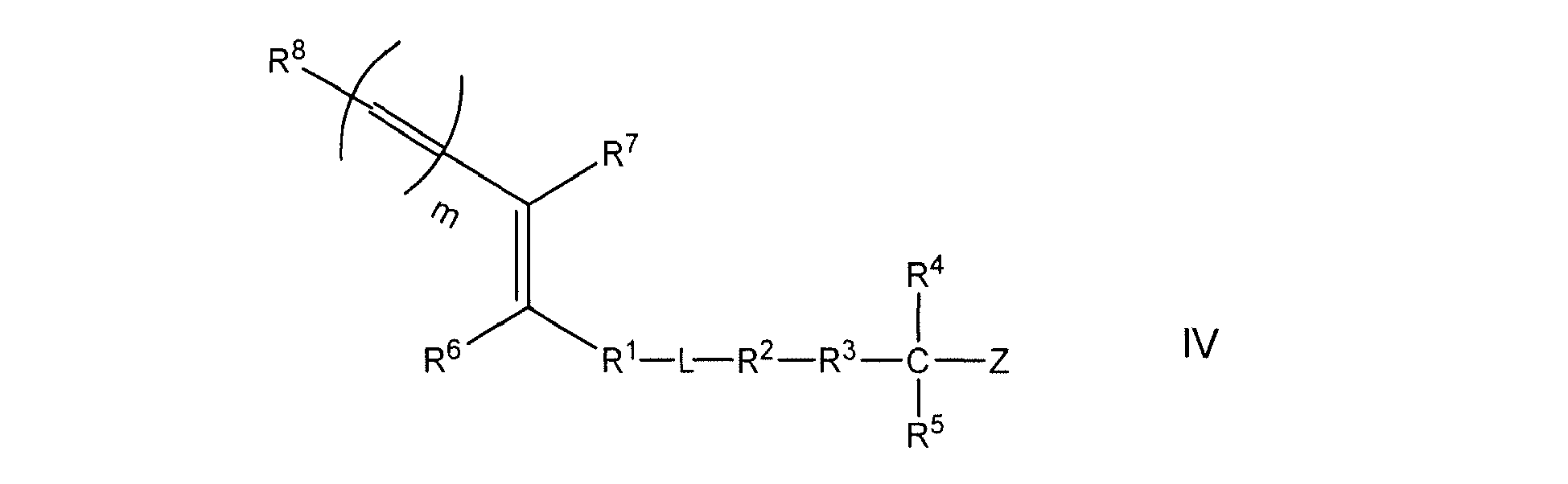
R2 is selected from C=O, C(=O)NR9 or a bond;
wherein R9 is H or C1-4 alkyl;
R3 is selected from the group consisting of C1-C20 alkylene, C3-C8 cycloalkylene, C(=O)R10, C(=O)NR11, C1-C20 alkoxy, C2-C20 alkenylene, C2-C20 alkenyl oxiranylene, arylene, heterocyclene and aralkylene; in which 0 to all of the hydrogen atoms are replaced with halogen, C1-C6 alkyl optionally substituted with 1 to 2 substituents selected from the group consisting of C1-C4 alkoxy, aryl, heterocyclyl, C(=O)R13, C(=O)NR11R12, oxiranyl and glycidyl;
R10 is alkylene of from 1 to 20 carbon atoms, alkoxy from 1 to 20 carbon atoms, oligo(alkoxy) in which each alkoxy group has from 1 to 3 carbon atoms, aryloxy or heterocyclyloxy; any of which groups may have substituents selected from optionally substituted alkoxy, oligoalkoxy, amino (including mono- and di-alkyl amino and trialkyl ammonium, which alkyl groups, in turn, may have substituents selected from acyl, alkoxycarbonyl, alkenoxycarbonyl, aryl and hydroxy) and hydroxyl groups;
R11 and R12 are independently H or alkyl of from 1 to 20 carbon atoms, or R11 and R12 may be joined together to form an alkanediyl group of from 2 to 5 carbon atoms, thus forming a 3- to 6- membered ring;
R4 and R5 are each independently selected from H, Z, halogen, C1-20 alkyl, C3-C8 cycloalkyl, OH, CN, C2-C20 alkenyl, C2-C20 alkenyl oxiranyl, C(=O)R13, glycidyl, aryl, heterocyclyl, arylkyl, aralkenyl, in which 0 to all of the hydrogen atoms are replaced with halogen, C1-C6 alkyl optionally substituted with 1 to 2 substituents selected from the group consisting of C1-C4 alkoxy, aryl, heterocyclyl, C(=O)R13, C(=O)NR11R12, oxiranyl and glycidyl;
where R13 is alkyl of from 1 to 20 carbon atoms, alkoxy of from 1 to 20 carbon atoms, oligo(alkoxy) in which each alkoxy group has 1 to 3 carbon atoms, aryloxy or heterocyclyloxy any of which groups may have substituents selected from optionally substituted alkoxy, oligoalkoxy, amino (including mono- and di-alkyl amino and trialkyl ammonium, which alkyl groups, in turn may have substituents selected from acyl, alkoxycarbonyl, alkenoxycarbonyl, aryl and hydroxy) and hydroxyl groups; and
L is a linking group;
Z is selected from the group consisting of Cl, Br, I, OR14, SR15, SeR15, OP(=O)R15, OP(=O)(=OR15)2, O-N(R15)2 and S-C(=S)N(R15)2, where R14 is alkyl of from 1 to 20 carbon atoms in which each of the hydrogen atoms may be independently replaced by halide, R15 is aryl or a straight or branched C1-C20 alkyl group, and where an N(R15)2 group is present, the two R15 groups may be joined to form a 5- or 6- membered heterocyclic ring;
R6 is CH2E2, H or C1-4 alkyl;
R7 and R8 are each independently selected from H and C1-4 alkyl;
m is 0-4; and
E1 and E2 are each, independently, a leaving group, or a precursor to a leaving group. - A polymer of general formula V or VI may be formed in this method:


f is 1 to 500; and
Groups M are the same or different and are residues of ethylenically unsaturated monomers. At least one group M is a residue of MPC. - These polymers may be used to derivatise therapeutic proteins. A method of derivatisation of a biological molecule may be used in which a polymer of general formula V or general formula VI is added to a therapeutic protein of general formula T1D1X or to therapeutic proteins of general formula T1D1X and T2D2X, wherein D is S, NH or O and X is H, D1T1 or D2T2 to form an adduct of general formula VII or of general formula VIII


f is 1 to 500;
R36 is -CH2E4, H or C1-4 alkyl; and
E4 is a leaving group;
x is 1 or 2;
p is 1-5 and q is 1-10. - Compounds of general formulae III and IV act as initiators in the living radical polymerisation process. The initiators are extended at the carbon to which Z is attached by a living radical polymerisation process. The opposite end of the initiator molecule must be suitable for derivatisation with a therapeutic protein. In this regard it is vital that the initiator has an α-methylene leaving group, or precursor to a leaving group, or a double bond conjugated with an electron-withdrawing group. This allows a biological molecule to react with the initiator in a Michael reaction.
- When referring to groups which are radicals, it is intended that the group can be joined to adjacent groups in either direction. For instance when R3 is C(=O)R10, it may be linked either R2-C(=O)R10-C or R2-R10C(=O)-C.
- Preferably, in compounds of formula III and IV, R6 is -CH2E2. If the leaving group is prone to elimination rather than to direct displacement with a nucleophile, and the electron-withdrawing group R1 is a suitable activating moiety for the Michael reaction then sequential intramolecular bis-alkylation can occur by consecutive Michael and retro Michael reactions. The leaving moiety serves to mask a latent conjugated double bond that is not exposed until after the first alkylation has occurred and bis-alkylation results from sequential Michael and retro-Michael reactions.
- Initiators of general formula IV may have from 1 to 5 double bonds. A nucleophile may add to the conjugated system at a suitable position on any of the double bonds. Preferably, however, m is zero in an initiator of general formula II.
- Preferably, in the initiators of general formula III and IV, R6, R7 and R8 are each independently selected from -H or -CH3.
- In the initiator of general formula III or IV it is preferred that only one of R4 and R5 is H. Preferably, neither are hydrogen. Suitably, at least one, and preferably both of R4 and R5 are methyl.
- In a preferred embodiment, R3 is -CO-R10 in which R10 is oligoalkoxy, preferably oligoethoxy in which there are 2 to 10 ethoxy groups. Alternatively, the alkoxy group may have 1 or 3 carbon atoms. R4 and R5 are preferably methyl.
- Group Z is a radically transferable group and is preferably a halogen, more preferably Cl, Br or I, most preferably Br. Since groups R4 and R5 may also be Z the initiator may be di-, oligo- or poly- functional.
- Suitable linking groups, L, include a bond, a C1-10 alkylene group, or an optionally substituted aryl or heteroaryl, any of which groups may have substituents selected from optionally substituted alkoxy, oligoalkoxy, amino (including mono- and di-alkyl amino and trialkyl ammonium, which alkyl groups, in turn, may have substituents selected from acyl, alkoxycarbonyl, alkenoxycarbonyl, aryl and hydroxy) and hydroxyl groups.
- Suitable groups for electron-withdrawing group R1 include a keto group, an ester group, and a sulphone group.
- Groups E1 and E2 are typically leaving groups selected from -SR17, - SO2R17, -OSO2R17, -N+R17 3, -N+HR2 17, -N+H2R17, halogen, or -OAr, in which R17 represents an alkyl or aryl group and Ar represents a substituted aryl group containing at least one electron-withdrawing substituent.
- Alternatively, groups E1 and E2 may be precursors to leaving groups, wherein the leaving group may be obtained by a simple chemical reaction such as oxidation or reduction. Having E1 and E2 as precursors to leaving groups may be preferable if this facilitates synthesis of the initiator and the subsequent polymerisation reaction.
- In a preferred embodiment of this invention, E1 and E2 are each, independently, an (optionally substituted) aryl sulfide or aryl sulfone group.
- An aryl sulfide (a precursor to a leaving group) may be converted into an aryl sulfone (a leaving group) by a simple oxidation reaction, as is well known in the art. The process may include a subsequent reaction step in which groups E1 and E2 (if present) which are precursors to leaving groups are converted into leaving groups.
- A particularly preferred initiator of general formula III has formula:

- The living radical polymerisation process used in the invention may be a group transfer radical polymerisation, for instance in which an N-O, or other carbon-, sulphur-, and oxygen- centred radical group is transferred from an initiator compound to a monomer. Preferably, however, the process is an atom transfer radical polymerisation process.
- The polymers used in this invention are generally made by a living radical polymerisation process. Other controlled polymerisation techniques may be used for instance NO group transfer systems such as are described in
WO-A-0018807 WO-A-9958588 WO-A-99/10387 - Atom or group transfer radical polymerisation processes are described further in
WO 02/28929 WO 03/074090 - The living radical polymerisation process used in the invention is preferably carried out to achieve a degree of polymerisation in the
range 5 to 500. Preferably the degree of polymerisation is in the range 10 to 100, more preferably in the range 10 to 50. In the preferred group or atom transfer radical polymerisation technique, the degree of polymerisation is directly related to the initial ratios of initiator to monomer. Preferably the ratio is in the range 1:(5 to 500), more preferably in the range of 1:(10 to 100), most preferably in the range 1:(10 to 50). - At least one of the ethylenically unsaturated monomers is MPC. The others may be anionic, cationic or nonionic monomers.
- The polymer may be a homopolymer that is moiety -(-M-)-f may comprise groups M which are residues of the same ethylenically unsaturated monomer MPC. Alternatively, the polymer may be a copolymer or a block copolymer, wherein groups M in moiety -(-M-)-f are residues of different ethylenically unsaturated monomers.
- Preferably, the ethylenically unsaturated comonomers are zwitterionic. The zwitterionic nature arises from the combination of a cationic and anionic moiety. The cationic moiety may be an ammonium, phosphonium or sulphonium group, preferably an ammonium group. The anion is typically a phospho moiety, more typically a phosphate diester.
- In polymers of general formula I and II, the preferred groups L, R1-R6 and Z are the same as outlined above. For the polymers to be able to conjugate therapeutic proteins, groups E1 and E2 (if present) in the polymers of formula V and VI should be leaving groups. Accordingly, a particularly preferred leaving group is:
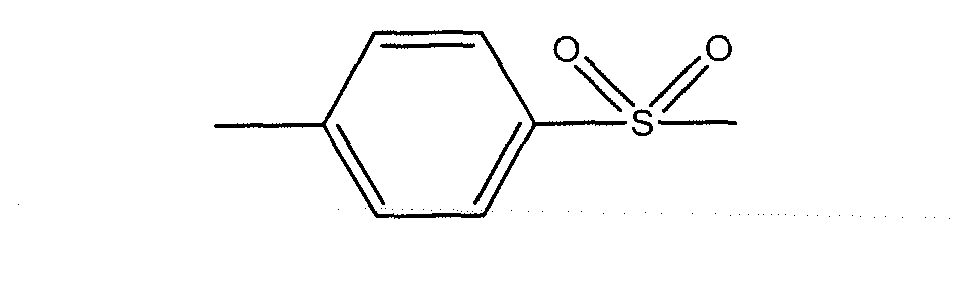
- Particularly preferred polymers which have formed covalently-linked conjugates of polymer and therapeutic protein are of formula:


- The therapeutic protein or proteins are represented by general formulae T1D1X and T2D2X wherein D1X and D2X represent a nucleophilic group. Typically, the nucleophilic group is a thiol group, although amine and hydroxyl groups may also be used to conjugate the therapeutic protein to the MPC polymer.
- An adduct of general formula II is formed when the polymer of general formula V or VI has only one leaving group, or R6 is not a leaving group in a polymer of general formula V. Adducts of general formula II may form when a nucleophile attacks the polymer of general formula V or VI twice, i.e. when there are two leaving groups (E1 and E2), or R6 is a leaving group in V.
- Moiety Tx-Dx- in formula I may be derived from the same therapeutic protein molecule as T1-D1, in which case x is 1. Alternatively, moiety Tx-Dx- may be derived from a different therapeutic protein, in which case x is 2.
- Typically, the derivatisation will be carried out by partially reducing a disulphide bond derived from two cysteine amino acids in the same protein. Since in this case T1D1 and TxDx are derived from the same protein, x = 1.
- Suitably, the process according to the invention is carried out by partially reducing a disulfide bond derived from two cysteine amino acids in the protein in situ following which the reduced product reacts with the polymer of formula V or VI. Disulfides can be reduced, for example, with dithiothreitiol, mercaptoethanol, or tris-carboxyethylphosphone using conventional methods. The process may be carried out in a solvent or solvent mixture in which all reactants are soluble. The protein containing nucleophilic groups may be allowed to react directly with the polymer of the general formula V or VI in an aqueous reaction medium. This reaction medium may also be buffered, depending on the pH requirements of the nucleophile. The optimum pH for the reaction is generally between about 5.5 and about 8, for example 7.4, preferably about 6.0-6.5. Reaction temperatures between 3-37°C are generally suitable: proteins and other biological molecules may decompose or denature impairing function if the conjugation reaction is conducted at a temperature where these processes may occur. Reactions conducted in organic media (for example THF, ethyl acetate, acetone) are typically conducted at temperatures up to ambient, for example temperatures below 0°C.
- A protein can contain one or a multiplicity of disulfide bridges. Reduction to give free sulfhydral moieties can be conducted to reduce one or a multiplicity of disulfide bridges in a protein. Depending on the extent of disulfide reduction in the stoichiometry of the polymeric conjugation reagent that is used, it is possible to conjugate one or a multiplicity of polymer molecules to the protein. Immobilised reducing agents may be used if it is desired to reduce less than the total number of disulfides, as can partial reduction using different reaction conditions or the addition of denaturants.
- Alternatively the source of the thiol groups can be from cysteines or thiols not originally derived from a disulfide bridge. If the source of the thiol groups is a disulfide bridge, this may be intrachain or interchain.
- The therapeutic protein can be effectively conjugated with polymers using a stoichiometric equivalent or a slight excess of polymer, unlike many prior art reagents. However, since the polymers do not undergo competitive reactions with aqueous media used to solvate proteins, it is possible to conduct conjugation reaction with an excess stoichiometry of polymer. The excess polymer can be easily removed by ion exchange chromatography during routine purification of proteins.
- The therapeutic protein may be, for example, a polypeptide, antibody, antibody fragment, enzyme, cytokine, chemokine or receptor. Constrained or cyclic polypeptides, which are usually cyclised through a disulphide bridge, and epitopes, may also be used.
- Preferably, the therapeutic protein is an enzyme. Enzymes include carbohydrate-specific enzymes, proteolytic enzymes and the like. Enzymes of interest, for both industrial (organic based reactions) and biological applications in general and therapeutic applications in particular include the oxidoreductases, transferases, hydrolases, lyases, isomerases and ligases disclosed by
US 4,179,337 . Specific enzymes of interest include asparaginase, arginase, adenosine deaminase, superoxide dismutase, catalase, chymotrypsin, lipase, uricase, bilirubin oxidase, glucose oxidase, glucuronidase, galactosidase, glucocerbrosidase, and glutaminase. - The therapeutic protein conjugated in the present invention may be, for example, factor 8, insulin, ACTH, glucagen, somatostatin, somatotropins, thymosin, parathyroid hormone, pigmentary hormones, somatomedins, erythropoietin, luteinizing hormone, hypothalamic releasing factors, antidiuretic hormones, prolactin, interleukins, interferons, colony stimulating factors, hemoglobin, cytokines, antibodies, glycopolypeptides such as immunoglobulins, ovalbumin, lipase, glucocerebrosidase, lectins, tissue plasminogen activator and glycosilated inerleukins, interferons and colony stimulating factors are of interest, as are immunoglobulins such as IgG, IgE, IgM, IgA, IgD and fragments thereof. The therapeutic protein is preferably a peptide hormone.
- Preferably, the therapeutic protein is asparaginase.
- MPC polymer in this invention is shown to reduce the immunogenecity of a therapeutic protein. Reduced immunogenicity is determined in a standard assay by measuring the antibody titres raised to the therapeutic protein with and without conjugated MPC polymer. Immunogenicity is generally measured using an IgG ELISA assay. Example 4 gives more details on the use of this assay.
- The MPC polymer and therapeutic protein are generally administered to the human or animal body by direct injection. Typical pharmaceutical formulations comprise the MPC polymer and therapeutic protein the form of a conjugate together with one or more pharmaceutically acceptable excipients, which are selected from those known in the art.
- The invention will now be illustrated by the following Examples, which refer to
Figures 1-5 , in which -
Figure 1 is a Western Blot Analysis of MPC-IFN (A) and PEG-IFN (B); -
Figure 2 is a chromatogram showing excess MPC polymer removal on a anion exchange column (1 ml HiTrap Q FF column from GS Healthcare); -
Figure 3 shows the SDS-PAGE analysis of asparaginase-MPC reaction solutions showing oxidized asparaginase monomer A and MPCylated asparaginase monomer B (reaction time 4 h at room temperature V4-12% Bis-Tris, MOPS buffer & Novex Sharp markers from Invitrogen; Instant Blue stain from Expedeon). -
Figure 4 shows the SDS-PAGE analysis of the PMPC-asparaginase sample used for the in vitro and in vivo studies; and -
Figure 5 shows the mean α-Asp IgG titre pooled from five mice inoculated with asparaginase (Asp), MPC-asparaginase (MPC-Asp) or PBS in Asp-coated ELISA. - The preparation of MPC-IFN and corresponding PEG-IFN is described in detail in the Examples of
WO2008/098930 . 20kD PEG-IFN and a comparative MPC-IFN (20 kD equivalent on SEC, actual 40 kD) prepared using the same bissulphone linker were subjected to Western blot analysis using a polyclonal antibody against IFN alpha. Optimisation of antibody dilution and the length of incubation were required to improve the detection of MPC-IFN. PEGylation is known to cause steric shielding and consequently affects the way an antibody binds to a PEGylated protein. One aim of Western blot analysis was to assess the extent of steric shielding caused by MPCylation in comparison to PEGylation. When equal loadings of PEG-IFN and MPC-IFN were analysed (as determined by the height of the SEC trace peak at specific time points), no bands were detected for MPC-IFN (data not shown). To facilitate the detection of PC-IFN bands, larger volumes of PC-IFN were required, together with a longer incubation protocol (48 h incubation with 1:10,000 anti-IFN primary antibody). Finally, the MPC conjugate could be detected (Figure 1 , lane A) but the intensity of the band was significantly lower for that of PEG-IFN (Figure 1 , lane B) indicating the MPC was protecting the interferon from antibody recognition more efficiently. - Active asparaginase is a tetramer with each monomer unit containing one disulfide bond. MPCylation of the disulfide bonds therefore allows up to four MPC polymer chains per active asparaginase tetramer depending on the efficiency of the MPCylation. Asparaginase from Escherichia coli was purchased from Sigma-Aldrich Ltd (product number A3809, lot number 117K4159). Poly(2-methacryloyloxyethyl phosphorylchloline) (PMPC or MPC polymer) with the bis-sulfide end-group was made as described in
WO2008/098930 . The end group was oxidised to the protein reactive bis-sulfone form as follows: MPC bis-sulfide (0.15 mg) was oxidised to the bis-sulfone end group using Oxone (7 mg) in a 1:1 v/v methanol:water mixture 2 ml) overnight. The MPCylation of asparaginase for in vitro and in vivo analysis was performed on asparaginase (4 mg, 1 mg/ml) reduced with DTT (100 mM) according to a revised procedure of Shaunak et al; Nat Chem Biol. 2006 Jun;2(6):312-3. MPC bis-sulfone (96 mg, molar excess) was allowed to react with the reduced asparaginase in pH 8.2 phosphate buffered saline (PBS) overnight at 4 °C. Excess MPC polymer was then removed using anion exchange chromatography with a 1 ml HiTrap Q FF column (GE Healthcare) at pH 8.0 (Figure 2 ). - Reaction solutions during optimisation and scale-up were analysed by SDS-PAGE. The presence of SDS causes the asparaginase tetramer to dissociate into its monomeric constituents. The SDS-PAGE analysis revealed that it was possible to significantly MPCylate asparaginase (see
Figure 3 ). It was not possible to convert all the four disulfide bonds of asparaginase to the MPCylated form as some non-MPCylated monomers were still detected (marked A inFigure 3 ). Increasing the amount of conjugating MPC polymer to the reaction did not appear to increase the conversion of monomer to MPCylated monomer (Lanes 3 to 6 inFigure 3 ). One explanation is that already conjugated MPC polymer sterically hinders the conjugation of further MPC polymer chains preventing full MPCylation in most cases. A second explanation or additional factor could be that the MPC polymer used causes reoxidation of the disulfide reduced protein due to oxidising metal ion contaminants such as copper. EDTA (20 mM) was added to the reaction buffer to minimise this effect. - The sample of MPCylated asparaginase used for the in vitro and in vivo studies is shown analysed by SDS-PAGE in
Figure 4 . The result shows significant MPCylation of the asparaginase tetramer with MPCylated monomer present around the 160 kDa protein marker (4-12% Bis-Tris gel and MOPS buffer from Invitrogen). - Asparaginase is an amidase that converts L-asparagine to L-aspartic acid and ammonia. The most commonly used assay for asparaginase is based on the colorimetric determination of liberated ammonia from L-asparagine using the Nessler's reagent. Although the immunogenicity study does not require an in vitro validation of the PMPC-asparaginase, it was deemed necessary in order to ensure that the mice are immunised with a functional protein. Briefly, the amount of ammonia released when asparagine is incubated with PC-asparaginase is measured by comparing to a standard curve using a spectrophotometric determination method. The results are shown in Table 1.
Table 1: In vitro activity of the native and MPCylated asparaginase. Sample Conc (mg/ml) NH3 liberated (mmol) Units/mg Asparaginase 0.180 4.2 173† PMPC-asparaginase 0.180 4.5 184 †Manufacturer quoted activity is 129.6 units/mg - The conclusion is that MPCylation does not affect the enzymatic activity of asparaginase in an in vitro assay, and the PMPC-asparaginase was a suitable candidate for the subsequent in vivo immunogenicity study.
- Determination of the immunogenic potential of MPCylated asparaginase was performed by repeated immunisation of the native non-MPCylated asparaginase and the MPCylated asparaginase separately in mice.
- The amount of anti-asparaginase (α-Asp) antibody was measured using a custom ELISA. Briefly, microtitre plates designed for ELISA (Maxisorp, Nunc) were coated with 50 µl of native or MPCylated asparaginase (2 µg/ml in binding buffer) and incubated for 18 h at 4°C. After washing once with 200 µl/well of PBS-T, 50 µl of 1% BSA/PBS-T was added and incubated on a shaking platform for 1 h at RT. After the solution was removed, diluted serum was added at 50 µl/well and incubated while shaking for 18 h at 4°C. The plate was then washed 3 times with PBS-T and tap dried. Then anti-mouse IgG or IgM antibodies conjugated to HRP (1:10,000 in PBS-T with 5% FCS and 1% BSA) was added at 50 µl/well, and incubated with shaking for 3 h at RT. After washing 3 times with PBS-T, the plate was tap dried. TMB solution was added at 50 µl/well for 15 min at RT in the dark and the absorbance read at 630 nm using a microplate reader.
- A total of 36 plasma samples were collected and grouped into three sets according to the date of harvest (day 7, 18 or 25). Briefly, mice in
Group 1 were sacrificed after one immunisation,Group 2 after two immunisations and finallyGroup 3 after three immunisations with either 20 µg of asparaginase or PMPC-asparaginase (20 µg of asparaginase), and their plasma collected. Table 2 shows the sample IDs used for the individual plasma samples.Table 2: Plasma sample IDs and their respective harvest dates Group 1 (day 7) Group 2 (day 18) Group 3 (day 25) Asp MPC- PBS Asp MPC- PBS Asp MPC- PBS Asp Asp Asp A1-1 P1-1 Q1-1 A2-1 P2-1 Q2-1 A3-1 P3-1 Q3-1 A 1-2 P 1-2 Q1-2 A2-2 P2-2 Q2-2 A3-2 P3-2 Q3-2 A1-3 P1-3 A2-3 P2-3 A3-3 P3-3 A1-4 P1-4 A2-4 P2-4 A3-4 P3-4 A1-5 P1-5 A2-5 P2-5 A3-5 P3-5 Quantitative titre of α-Asp IgG in plasma samples using asparaginase-coated ELISA - Firstly, the titres of α-Asp IgG in the plasma samples from the three Groups were measured in ELISA plates coated with 100 ng of asparaginase (Asp-coated ELISA). The plasma was appropriately diluted and added to the coated wells. The amount of α-Asp IgG was then measured by the addition of α-mouse secondary antibody whose titre was subsequently measured colorimetrically at 630 nm. By testing a known dilution of commercially available α-Asp IgG (AbD Serotec), a standard curve could be plotted to obtain the relationship between antibody concentration and the absorbance. The absorbance readings were therefore converted into quantitative titres (ng/ml of antibody) using their respective IgG standard curve.
- The α-Asp IgG titres within each group were then combined and pooled in order to obtain a mean antibody titre per Group (
Figure 5 ). The mean values are shown in Table 3. According to the pooled results, there was a slight increase in α-Asp IgG titre on day 7 in Asp inoculated mice (25 ± 3 ng/ml) compared to the MPC-Asp-inoculated mice (16 ± 2 ng/ml). By day 18, there was a huge increase in the antibody titre in Asp-inoculated mice (4749 ± 1160 ng/ml) due to the highly immunogenic nature of the native asparaginase. By comparison, there was no significant increase in the antibody titre in mice inoculated with MPC-Asp (25 ± 5 ng/ml). By day 25, α-Asp IgG titre was raised even higher (8379 ± 2993 ng/ml) in Asp-inoculated mice whereas there was only a minor lift observed in PMPC-Asp-inoculated mice (123 ± 42 ng/ml). This is therefore evidence supporting the protective effect of PMPC polymer shielding the antigenic sites of asparaginase.Table 3: Mean α-Asp IgG titre pooled from five mice inoculated with asparaginase (Asp), PMPC-asparaginase (PMPC-Asp) or PBS in Asp-coated ELISA. n represents the number of values. Antibody titre unit is ng/ml. Day Asp-inoculated MPC-Asp inoculated PBS-inoculated 7 25 ±3 (n=30) 16 ± 2 (n=30) 13 ± 2 (n=19) 18 4749 ± 1160(n=30) 25 ± 5 (n=30) 9 ± 2 (n=12) 25 8379 ± 2993 (n=30) 123 ± 42 (n=29*) 9 ± 1 (n=12) *Some values were below the level of detection and were not included in the analysis -
Figure 5 shows the expected immunogenic response for asparaginase. There is a manifold increase in α-Asp IgG titre by day 18 (day 7 is too early to observe a substantial amount of antigen-specific IgG) and this level is maintained by day 25 after the second booster on day 18. The IgG level will eventually diminish in the absence of antigenic challenge, but this level is expected to continue in the short run. For MPC-asparaginase-inoculated mice, there is a gradual increase in the α-Asp IgG titre. This is likely due to the shielding of the antigenic epitopes on the surface of asparaginase by the conjugated MPC polymer. The difference between the two immunogenic responses within 25 days is staggering, and illustrates the role of the MPC polymer in lowering immunogenicity of the conjugated protein.
Claims (13)
- A polymer comprising 2-methacryloyloxyethyl-phosphoryl choline (MPC) for use in reducing the immunogenicity of a therapeutic protein which is administered to the human or animal body.
- A polymer according to claim 1 which consists substantially only of MPC monomers.
- A polymer according to claim 1 or 2 which is administered in the form of a covalently-linked conjugate of the polymer and therapeutic protein.
- A polymer according to claim 3 wherein the protein comprises at least one cysteine residue and the protein is covalently linked to the polymer via one or more of said cysteine residues.
- A polymer according to claim 3 wherein the covalently linked conjugate of polymer and therapeutic protein is of formula I or II:


R2 is selected from C=O, C(=O)NR9 or a bond; wherein R9 is H or C1-4 alkyl;
R3 is selected from the group consisting of C1-C20 alkylene, C3-C8 cycloalkylene, C(=O)R10, C(=O)NR11, C1-C20 alkoxy, C2-C20 alkenylene, C2-C20 alkenyl oxiranylene, arylene, heterocyclene and aralkylene; in which 0 to all of the hydrogen atoms are replaced with halogen, C1-C6 alkyl optionally substituted with 1 to 2 substituents selected from the group consisting of C1-C4 alkoxy, aryl, heterocyclyl, C(=O)R13, C(=O)NR11R12, oxiranyl and glycidyl;
R10 is alkylene of from 1 to 20 carbon atoms, alkoxy from 1 to 20 carbon atoms, oligo(alkoxy) in which each alkoxy group has from 1 to 3 carbon atoms, aryloxy or heterocyclyloxy; any of which groups may have substituents selected from optionally substituted alkoxy, oligoalkoxy, amino (including mono- and di-alkyl amino and trialkyl ammonium, which alkyl groups, in turn, may have substituents selected from acyl, alkoxycarbonyl, alkenoxycarbonyl, aryl and hydroxy) and hydroxyl groups;
R11 and R12 are independently H or alkyl of from 1 to 20 carbon atoms, or R11 and R12 may be joined together to form an alkanediyl group of from 2 to 5 carbon atoms, thus forming a 3- to 6- membered ring;
R4 and R5 are each independently selected from H, Z, halogen, C1-20 alkyl, C3-C8 cycloalkyl, OH, CN, C2-C20 alkenyl, C2-C20 alkenyl oxiranyl, C(=O)R13, glycidyl, aryl, heterocyclyl, arylkyl, aralkenyl, in which 0 to all of the hydrogen atoms are replaced with halogen, C1-C6 alkyl optionally substituted with 1 to 2 substituents selected from the group consisting of C1-C4 alkoxy, aryl, heterocyclyl, C(=O)R13, C(=O)NR11R12, oxiranyl and glycidyl;
where R13 is alkyl of from 1 to 20 carbon atoms, alkoxy of from 1 to 20 carbon atoms, oligo(alkoxy) in which each alkoxy group has 1 to 3 carbon atoms, aryloxy or heterocyclyloxy any of which groups may have substituents selected from optionally substituted alkoxy, oligoalkoxy, amino (including mono- and di-alkyl amino and trialkyl ammonium, which alkyl groups, in turn may have substituents selected from acyl, alkoxycarbonyl, alkenoxycarbonyl, aryl and hydroxy) and hydroxyl groups; and
L is a linking group;
Groups M are the same or different and are residues of ethylenically unsaturated monomers, wherein at least one of the residues M is MPC;
f is 1 to 500;
R36 is -CH2E4, H or C1-4 alkyl; and
E4 is a leaving group;
x is 1 or 2;
p is 1-5 and q is 1-10;
D is S, NH or O; and
T-D is a therapeutic protein; wherein T1D1 and T2D2 ( if present) are different biological molecules. - A polymer according to claim 5 wherein each M is a residue of MPC.
- A polymer according to claim 5 or 6, wherein R3 is CO-R10 in which R10 is oligoalkoxy, preferably oligoethoxy in which there are 2 to 10 ethoxy groups.
- A polymer according to any of claims 5-7, wherein R1 is selected from a keto group, an ester group and a sulphone group.
- A polymer according to any of claim 5-8, wherein the linking group L, is selected from a bond, a C1-10 alkylene group, or an optionally substituted aryl or heteroaryl, any of which groups may have substituents selected from optionally substituted alkoxy, oligoalkoxy, amino (including mono- and di-alkyl amino and trialkyl ammonium, which alkyl groups, in turn, may have substituents selected from acyl, alkoxycarbonyl, alkenoxycarbonyl, aryl and hydroxy) and hydroxyl groups.
- A polymer according to any of claims 5-9 of formula

- A polymer according to any preceding claim wherein the therapeutic protein is asparaginase.
- Use of a polymer comprising MPC in the manufacture of a medicament comprising the polymer and a therapeutic protein, for use in reducing the immunogenicity of the protein when it is administered to the human or animal body.
- Use according to claim 9, wherein the polymer has any of the features of claims 2-11.
Priority Applications (2)
| Application Number | Priority Date | Filing Date | Title |
|---|---|---|---|
| EP09162203.5A EP2260873B1 (en) | 2009-06-08 | 2009-06-08 | Pcylation of proteins |
| DK09162203.5T DK2260873T3 (en) | 2009-06-08 | 2009-06-08 | PCYLING OF PROTEINS |
Applications Claiming Priority (1)
| Application Number | Priority Date | Filing Date | Title |
|---|---|---|---|
| EP09162203.5A EP2260873B1 (en) | 2009-06-08 | 2009-06-08 | Pcylation of proteins |
Publications (2)
| Publication Number | Publication Date |
|---|---|
| EP2260873A1 true EP2260873A1 (en) | 2010-12-15 |
| EP2260873B1 EP2260873B1 (en) | 2019-07-24 |
Family
ID=41011846
Family Applications (1)
| Application Number | Title | Priority Date | Filing Date |
|---|---|---|---|
| EP09162203.5A Active EP2260873B1 (en) | 2009-06-08 | 2009-06-08 | Pcylation of proteins |
Country Status (2)
| Country | Link |
|---|---|
| EP (1) | EP2260873B1 (en) |
| DK (1) | DK2260873T3 (en) |
Cited By (16)
| Publication number | Priority date | Publication date | Assignee | Title |
|---|---|---|---|---|
| EP1988910A4 (en) * | 2006-02-28 | 2013-03-06 | Oligasis Corp | CONJUGATES OF POLYMERS CONTAINING ACRYLOYLOXYETHYLPHOSPHORYLCHOLINE AND THEIR PREPARATION |
| US8765432B2 (en) | 2009-12-18 | 2014-07-01 | Oligasis, Llc | Targeted drug phosphorylcholine polymer conjugates |
| WO2014122646A1 (en) * | 2013-02-05 | 2014-08-14 | Tel Hashomer Medical Research Infrastructure And Services Ltd. | Phosphorylcholine conjugates and uses thereof |
| WO2016085808A1 (en) | 2014-11-26 | 2016-06-02 | The Regents Of The University Of California | Stealth nanocapsules for protein delivery |
| US20170143841A1 (en) * | 2010-04-15 | 2017-05-25 | Kodiak Sciences Inc. | High molecular weight zwitterion-containing polymers |
| US10046021B2 (en) | 2013-02-05 | 2018-08-14 | Tpcera Ltd. | Phosphorylcholine conjugates and uses thereof |
| US10363290B2 (en) | 2014-10-17 | 2019-07-30 | Kodiak Sciences Inc. | Butyrylcholinesterase zwitterionic polymer conjugates |
| US10702608B2 (en) | 2013-09-08 | 2020-07-07 | Kodiak Sciences Inc. | Factor VIII zwitterionic polymer conjugates |
| US10835616B2 (en) | 2014-10-14 | 2020-11-17 | Polytherics Limited | Process for the conjugation of a peptide or protein with a reagent comprising a leaving group including a portion of PEG |
| US11027022B2 (en) | 2016-05-20 | 2021-06-08 | Polytherics Limited | Conjugates and conjugating reagents |
| US11066465B2 (en) | 2015-12-30 | 2021-07-20 | Kodiak Sciences Inc. | Antibodies and conjugates thereof |
| US11155610B2 (en) | 2014-06-28 | 2021-10-26 | Kodiak Sciences Inc. | Dual PDGF/VEGF antagonists |
| US11273224B2 (en) | 2016-04-14 | 2022-03-15 | Polytherics Limited | Conjugates and conjugating reagents comprising a linker that includes at least two (-CH2—CH2—O-) units in a ring |
| JPWO2022255479A1 (en) * | 2021-06-04 | 2022-12-08 | ||
| US11912784B2 (en) | 2019-10-10 | 2024-02-27 | Kodiak Sciences Inc. | Methods of treating an eye disorder |
| US12071476B2 (en) | 2018-03-02 | 2024-08-27 | Kodiak Sciences Inc. | IL-6 antibodies and fusion constructs and conjugates thereof |
Citations (10)
| Publication number | Priority date | Publication date | Assignee | Title |
|---|---|---|---|---|
| US4179337A (en) | 1973-07-20 | 1979-12-18 | Davis Frank F | Non-immunogenic polypeptides |
| WO1999010387A1 (en) | 1997-08-27 | 1999-03-04 | E.I. Du Pont De Nemours And Company | Improved atom transfer radical polymerization |
| WO1999058588A1 (en) | 1998-05-07 | 1999-11-18 | The University Of Melbourne | Process for microgel preparation |
| WO2000018807A1 (en) | 1998-09-29 | 2000-04-06 | Ciba Specialty Chemicals Holding Inc. | Process for the preparation of polymers containing n→o terminal groups |
| WO2002028929A1 (en) | 2000-10-06 | 2002-04-11 | Biocompatibles Uk Limited | Zwitterionic polymers |
| WO2003062290A1 (en) | 2002-01-16 | 2003-07-31 | Biocompatibles Uk Limited | Polymer conjugates |
| WO2003074090A2 (en) | 2002-03-07 | 2003-09-12 | Biocompatibles Uk Limited | Compositions of polymers |
| WO2004063237A1 (en) | 2003-01-16 | 2004-07-29 | Biocompatibles Uk Limited | Conjugation reactions |
| WO2007100902A2 (en) * | 2006-02-28 | 2007-09-07 | Oligasis Corporation | Acryloyloxyethylphosphorylcholine containing polymer conjugates and their preparation |
| WO2008098930A1 (en) | 2007-02-14 | 2008-08-21 | Biocompatibes Uk Limited | Derivatisation of biological molecules |
-
2009
- 2009-06-08 DK DK09162203.5T patent/DK2260873T3/en active
- 2009-06-08 EP EP09162203.5A patent/EP2260873B1/en active Active
Patent Citations (11)
| Publication number | Priority date | Publication date | Assignee | Title |
|---|---|---|---|---|
| US4179337A (en) | 1973-07-20 | 1979-12-18 | Davis Frank F | Non-immunogenic polypeptides |
| WO1999010387A1 (en) | 1997-08-27 | 1999-03-04 | E.I. Du Pont De Nemours And Company | Improved atom transfer radical polymerization |
| WO1999058588A1 (en) | 1998-05-07 | 1999-11-18 | The University Of Melbourne | Process for microgel preparation |
| WO2000018807A1 (en) | 1998-09-29 | 2000-04-06 | Ciba Specialty Chemicals Holding Inc. | Process for the preparation of polymers containing n→o terminal groups |
| WO2002028929A1 (en) | 2000-10-06 | 2002-04-11 | Biocompatibles Uk Limited | Zwitterionic polymers |
| US6852816B2 (en) | 2000-10-06 | 2005-02-08 | Biocompatibles Uk Limited | Zwitterionic polymers |
| WO2003062290A1 (en) | 2002-01-16 | 2003-07-31 | Biocompatibles Uk Limited | Polymer conjugates |
| WO2003074090A2 (en) | 2002-03-07 | 2003-09-12 | Biocompatibles Uk Limited | Compositions of polymers |
| WO2004063237A1 (en) | 2003-01-16 | 2004-07-29 | Biocompatibles Uk Limited | Conjugation reactions |
| WO2007100902A2 (en) * | 2006-02-28 | 2007-09-07 | Oligasis Corporation | Acryloyloxyethylphosphorylcholine containing polymer conjugates and their preparation |
| WO2008098930A1 (en) | 2007-02-14 | 2008-08-21 | Biocompatibes Uk Limited | Derivatisation of biological molecules |
Non-Patent Citations (8)
| Title |
|---|
| BIOCONJUGATE CHEM, vol. 18, pages 61 - 76 |
| BONTEVIN, B., J. POLYM.SCI. PTA, POLYM.CHEM., vol. 38, no. 18, 2000, pages 3235 - 3243 |
| LEWIS A ET AL: "Poly(2-methacryloyloxyethyl phosphorylcholine) for protein conjugation", BIOCONJUGATE CHEMISTRY 200811 US, vol. 19, no. 11, November 2008 (2008-11-01), pages 2144 - 2155, XP002544347, ISSN: 1043-1802 * |
| LIBERATORE F A ET AL: "SITE-DIRECTED CHEMICAL MODIFICATION AND CROSS-LINKING OF A MONOCLONAL ANTIBODY USING EQUILIBRIUM TRANSFER ALKYLATING CROSS-LINK REAGENTS", BIOCONJUGATE CHEMISTRY, ACS, WASHINGTON, DC, US, vol. 1, no. 1, 1 January 1990 (1990-01-01), pages 36 - 50, XP002313939, ISSN: 1043-1802 * |
| RIZZARDO, E. ET AL., ACS SYMPOSIUM SERIES, vol. 768, 2000, pages 278 - 296 |
| SAMANTA DEBASIS ET AL: "End-functionalized phosphorylcholine methacrylates and their use in protein conjugation.", BIOMACROMOLECULES OCT 2008, vol. 9, no. 10, October 2008 (2008-10-01), pages 2891 - 2897, XP002544348, ISSN: 1526-4602 * |
| SHAUNAK ET AL., NAT CHEM BIOL., vol. 2, no. 6, June 2006 (2006-06-01), pages 312 - 3 |
| SHAUNAK SUNIL ET AL: "Site-specific PEGylation of native disulfide bonds in therapeutic proteins.", NATURE CHEMICAL BIOLOGY JUN 2006, vol. 2, no. 6, June 2006 (2006-06-01), pages 312 - 313, XP002544349, ISSN: 1552-4450 * |
Cited By (35)
| Publication number | Priority date | Publication date | Assignee | Title |
|---|---|---|---|---|
| EP1988910A4 (en) * | 2006-02-28 | 2013-03-06 | Oligasis Corp | CONJUGATES OF POLYMERS CONTAINING ACRYLOYLOXYETHYLPHOSPHORYLCHOLINE AND THEIR PREPARATION |
| US8846021B2 (en) | 2006-02-28 | 2014-09-30 | Oligasis, Llc | Acryloyloxyethylphosphorylcholine containing polymer conjugates and their preparation |
| EP3222142A1 (en) * | 2006-02-28 | 2017-09-27 | Kodiak Sciences Inc. | Acryloyloxyethylphosphorylcholine containing polymer conjugates and their preparation |
| US8765432B2 (en) | 2009-12-18 | 2014-07-01 | Oligasis, Llc | Targeted drug phosphorylcholine polymer conjugates |
| US11819531B2 (en) | 2009-12-18 | 2023-11-21 | Kodiak Sciences Inc. | Multifunctional zwitterionic polymer conjugates |
| US20170143841A1 (en) * | 2010-04-15 | 2017-05-25 | Kodiak Sciences Inc. | High molecular weight zwitterion-containing polymers |
| US9987372B2 (en) | 2013-02-05 | 2018-06-05 | Tpcera Ltd. | Phosphorylcholine conjugates and uses thereof |
| US10881707B2 (en) | 2013-02-05 | 2021-01-05 | Tpcera Ltd. | Phosphorylcholine conjugates and uses thereof |
| US11458186B2 (en) | 2013-02-05 | 2022-10-04 | Tpcera Ltd. | Phosphorylcholine conjugates and uses thereof |
| AU2014213631B2 (en) * | 2013-02-05 | 2018-03-08 | Tpcera Ltd | Phosphorylcholine conjugates and uses thereof |
| US11696935B2 (en) | 2013-02-05 | 2023-07-11 | Tpcera Ltd. | Phosphorylcholine conjugates and uses thereof |
| CN105102485A (en) * | 2013-02-05 | 2015-11-25 | 堤乐哈修门医学研究基础建设及服务有限公司 | Phosphorylcholine conjugates and uses thereof |
| US10046021B2 (en) | 2013-02-05 | 2018-08-14 | Tpcera Ltd. | Phosphorylcholine conjugates and uses thereof |
| CN105102485B (en) * | 2013-02-05 | 2019-04-19 | 特普塞拉公司 | Phosphocholine conjugates and uses thereof |
| US12350308B2 (en) | 2013-02-05 | 2025-07-08 | Tpcera Ltd. | Phosphorylcholine conjugates and uses thereof |
| US10842844B2 (en) | 2013-02-05 | 2020-11-24 | Tpcera Ltd. | Phosphorylcholine conjugates and uses thereof |
| WO2014122646A1 (en) * | 2013-02-05 | 2014-08-14 | Tel Hashomer Medical Research Infrastructure And Services Ltd. | Phosphorylcholine conjugates and uses thereof |
| US10702608B2 (en) | 2013-09-08 | 2020-07-07 | Kodiak Sciences Inc. | Factor VIII zwitterionic polymer conjugates |
| US12214044B2 (en) | 2013-09-08 | 2025-02-04 | Kodiak Sciences Inc. | Factor VIII zwitterionic polymer conjugates |
| US11155610B2 (en) | 2014-06-28 | 2021-10-26 | Kodiak Sciences Inc. | Dual PDGF/VEGF antagonists |
| US10835616B2 (en) | 2014-10-14 | 2020-11-17 | Polytherics Limited | Process for the conjugation of a peptide or protein with a reagent comprising a leaving group including a portion of PEG |
| US10363290B2 (en) | 2014-10-17 | 2019-07-30 | Kodiak Sciences Inc. | Butyrylcholinesterase zwitterionic polymer conjugates |
| US11071771B2 (en) | 2014-10-17 | 2021-07-27 | Kodiak Sciences Inc. | Butyrylcholinesterase zwitterionic polymer conjugates |
| US10722475B2 (en) | 2014-11-26 | 2020-07-28 | The Regents Of The University Of California | Stealth nanocapsules for protein delivery |
| EP3223802A4 (en) * | 2014-11-26 | 2018-07-04 | The Regents of The University of California | Stealth nanocapsules for protein delivery |
| US20170354613A1 (en) * | 2014-11-26 | 2017-12-14 | The Regents Of The University Of California | Stealth nanocapsules for protein delivery |
| WO2016085808A1 (en) | 2014-11-26 | 2016-06-02 | The Regents Of The University Of California | Stealth nanocapsules for protein delivery |
| US11066465B2 (en) | 2015-12-30 | 2021-07-20 | Kodiak Sciences Inc. | Antibodies and conjugates thereof |
| US11273224B2 (en) | 2016-04-14 | 2022-03-15 | Polytherics Limited | Conjugates and conjugating reagents comprising a linker that includes at least two (-CH2—CH2—O-) units in a ring |
| US11865183B2 (en) | 2016-04-14 | 2024-01-09 | Polytherics Limited | Conjugates and conjugating reagents comprising a linker that includes at least two (−CH2—CH2—O—) units in a ring |
| US11027022B2 (en) | 2016-05-20 | 2021-06-08 | Polytherics Limited | Conjugates and conjugating reagents |
| US12071476B2 (en) | 2018-03-02 | 2024-08-27 | Kodiak Sciences Inc. | IL-6 antibodies and fusion constructs and conjugates thereof |
| US11912784B2 (en) | 2019-10-10 | 2024-02-27 | Kodiak Sciences Inc. | Methods of treating an eye disorder |
| JPWO2022255479A1 (en) * | 2021-06-04 | 2022-12-08 | ||
| WO2022255479A1 (en) * | 2021-06-04 | 2022-12-08 | タグシクス・バイオ株式会社 | Medium-sized molecule compound conjugated body for improving blood kinetics of medium-sized molecule compound and method for producing same |
Also Published As
| Publication number | Publication date |
|---|---|
| EP2260873B1 (en) | 2019-07-24 |
| DK2260873T3 (en) | 2019-09-16 |
Similar Documents
| Publication | Publication Date | Title |
|---|---|---|
| EP2260873B1 (en) | Pcylation of proteins | |
| US8575397B2 (en) | Derivatisation of biological molecules | |
| US9005598B2 (en) | Conjugated proteins and peptides | |
| AU2013279079B2 (en) | Conjugation reagents | |
| US20050176108A1 (en) | Physiologically active polypeptide conjugate having prolonged in vivo half-life | |
| ES2885854T3 (en) | Process for the conjugation of a peptide or protein with a reagent comprising a leaving group that includes a portion of PEG | |
| US7799549B2 (en) | Methods for increasing protein polyethylene glycol (PEG) conjugation | |
| US10406235B2 (en) | Use of multi-arm polyethylene glycol modifier and application of multi-arm polyethylene glycol modifier in L-asparaginasum modification | |
| US20070117924A1 (en) | Biologically active material conjugated with biocompatible polymer with 1:1 complex, preparation method thereof and pharmaceutical composition comprising the same | |
| WO2001048052A1 (en) | Branched polyalkylene glycols | |
| RU2293574C2 (en) | Peg-containing conjugates of hgf-nk4 | |
| US10174125B2 (en) | Conjugation reagents | |
| JP7069043B2 (en) | Conjugates and conjugate reagents | |
| US20100239532A1 (en) | Interferon alpha2a modified by polyethylene glycol, the preparation and use thereof | |
| Jevševar et al. | Half-life extension through PEGylation | |
| WO2017178828A1 (en) | Conjugates and conjugating reagents comprising a linker that includes at least two (-ch2-ch2-0-) units in a ring | |
| CA2425407A1 (en) | Protecting therapeutic compositions from host-mediated inactivation | |
| JP7725047B2 (en) | PEG-modified protein or PEG-modified hydrophobic substance, or method for producing the same | |
| Mueller | Development of novel PEGylation approaches based on non-covalent interactions | |
| Gong | Releasable and Traceless PEGylation of Arginine Residues | |
| KR20040086521A (en) | Biologically Active Material Conjugated With Biocompatible Polymer with 1:1 complex, Preparation Method Thereof And Pharmaceutical Composition Comprising The Same |
Legal Events
| Date | Code | Title | Description |
|---|---|---|---|
| PUAI | Public reference made under article 153(3) epc to a published international application that has entered the european phase |
Free format text: ORIGINAL CODE: 0009012 |
|
| AK | Designated contracting states |
Kind code of ref document: A1 Designated state(s): AT BE BG CH CY CZ DE DK EE ES FI FR GB GR HR HU IE IS IT LI LT LU LV MC MK MT NL NO PL PT RO SE SI SK TR |
|
| 17P | Request for examination filed |
Effective date: 20110606 |
|
| 17Q | First examination report despatched |
Effective date: 20111003 |
|
| STAA | Information on the status of an ep patent application or granted ep patent |
Free format text: STATUS: EXAMINATION IS IN PROGRESS |
|
| REG | Reference to a national code |
Ref country code: DE Ref legal event code: R079 Ref document number: 602009059195 Country of ref document: DE Free format text: PREVIOUS MAIN CLASS: A61K0047480000 Ipc: A61K0047580000 |
|
| RIC1 | Information provided on ipc code assigned before grant |
Ipc: A61K 47/58 20170101AFI20180515BHEP |
|
| GRAP | Despatch of communication of intention to grant a patent |
Free format text: ORIGINAL CODE: EPIDOSNIGR1 |
|
| STAA | Information on the status of an ep patent application or granted ep patent |
Free format text: STATUS: GRANT OF PATENT IS INTENDED |
|
| INTG | Intention to grant announced |
Effective date: 20190206 |
|
| GRAS | Grant fee paid |
Free format text: ORIGINAL CODE: EPIDOSNIGR3 |
|
| GRAA | (expected) grant |
Free format text: ORIGINAL CODE: 0009210 |
|
| STAA | Information on the status of an ep patent application or granted ep patent |
Free format text: STATUS: THE PATENT HAS BEEN GRANTED |
|
| AK | Designated contracting states |
Kind code of ref document: B1 Designated state(s): AT BE BG CH CY CZ DE DK EE ES FI FR GB GR HR HU IE IS IT LI LT LU LV MC MK MT NL NO PL PT RO SE SI SK TR |
|
| REG | Reference to a national code |
Ref country code: GB Ref legal event code: FG4D |
|
| REG | Reference to a national code |
Ref country code: CH Ref legal event code: EP |
|
| REG | Reference to a national code |
Ref country code: DE Ref legal event code: R096 Ref document number: 602009059195 Country of ref document: DE |
|
| REG | Reference to a national code |
Ref country code: AT Ref legal event code: REF Ref document number: 1157412 Country of ref document: AT Kind code of ref document: T Effective date: 20190815 |
|
| REG | Reference to a national code |
Ref country code: IE Ref legal event code: FG4D |
|
| REG | Reference to a national code |
Ref country code: CH Ref legal event code: NV Representative=s name: STOLMAR AND PARTNER INTELLECTUAL PROPERTY S.A., CH |
|
| REG | Reference to a national code |
Ref country code: DK Ref legal event code: T3 Effective date: 20190910 |
|
| REG | Reference to a national code |
Ref country code: SE Ref legal event code: TRGR |
|
| REG | Reference to a national code |
Ref country code: NL Ref legal event code: MP Effective date: 20190724 |
|
| REG | Reference to a national code |
Ref country code: LT Ref legal event code: MG4D |
|
| REG | Reference to a national code |
Ref country code: AT Ref legal event code: MK05 Ref document number: 1157412 Country of ref document: AT Kind code of ref document: T Effective date: 20190724 |
|
| PG25 | Lapsed in a contracting state [announced via postgrant information from national office to epo] |
Ref country code: NL Free format text: LAPSE BECAUSE OF FAILURE TO SUBMIT A TRANSLATION OF THE DESCRIPTION OR TO PAY THE FEE WITHIN THE PRESCRIBED TIME-LIMIT Effective date: 20190724 Ref country code: BG Free format text: LAPSE BECAUSE OF FAILURE TO SUBMIT A TRANSLATION OF THE DESCRIPTION OR TO PAY THE FEE WITHIN THE PRESCRIBED TIME-LIMIT Effective date: 20191024 Ref country code: PT Free format text: LAPSE BECAUSE OF FAILURE TO SUBMIT A TRANSLATION OF THE DESCRIPTION OR TO PAY THE FEE WITHIN THE PRESCRIBED TIME-LIMIT Effective date: 20191125 Ref country code: LT Free format text: LAPSE BECAUSE OF FAILURE TO SUBMIT A TRANSLATION OF THE DESCRIPTION OR TO PAY THE FEE WITHIN THE PRESCRIBED TIME-LIMIT Effective date: 20190724 Ref country code: HR Free format text: LAPSE BECAUSE OF FAILURE TO SUBMIT A TRANSLATION OF THE DESCRIPTION OR TO PAY THE FEE WITHIN THE PRESCRIBED TIME-LIMIT Effective date: 20190724 Ref country code: AT Free format text: LAPSE BECAUSE OF FAILURE TO SUBMIT A TRANSLATION OF THE DESCRIPTION OR TO PAY THE FEE WITHIN THE PRESCRIBED TIME-LIMIT Effective date: 20190724 Ref country code: NO Free format text: LAPSE BECAUSE OF FAILURE TO SUBMIT A TRANSLATION OF THE DESCRIPTION OR TO PAY THE FEE WITHIN THE PRESCRIBED TIME-LIMIT Effective date: 20191024 Ref country code: FI Free format text: LAPSE BECAUSE OF FAILURE TO SUBMIT A TRANSLATION OF THE DESCRIPTION OR TO PAY THE FEE WITHIN THE PRESCRIBED TIME-LIMIT Effective date: 20190724 |
|
| PG25 | Lapsed in a contracting state [announced via postgrant information from national office to epo] |
Ref country code: ES Free format text: LAPSE BECAUSE OF FAILURE TO SUBMIT A TRANSLATION OF THE DESCRIPTION OR TO PAY THE FEE WITHIN THE PRESCRIBED TIME-LIMIT Effective date: 20190724 Ref country code: IS Free format text: LAPSE BECAUSE OF FAILURE TO SUBMIT A TRANSLATION OF THE DESCRIPTION OR TO PAY THE FEE WITHIN THE PRESCRIBED TIME-LIMIT Effective date: 20191124 Ref country code: GR Free format text: LAPSE BECAUSE OF FAILURE TO SUBMIT A TRANSLATION OF THE DESCRIPTION OR TO PAY THE FEE WITHIN THE PRESCRIBED TIME-LIMIT Effective date: 20191025 Ref country code: LV Free format text: LAPSE BECAUSE OF FAILURE TO SUBMIT A TRANSLATION OF THE DESCRIPTION OR TO PAY THE FEE WITHIN THE PRESCRIBED TIME-LIMIT Effective date: 20190724 |
|
| PG25 | Lapsed in a contracting state [announced via postgrant information from national office to epo] |
Ref country code: TR Free format text: LAPSE BECAUSE OF FAILURE TO SUBMIT A TRANSLATION OF THE DESCRIPTION OR TO PAY THE FEE WITHIN THE PRESCRIBED TIME-LIMIT Effective date: 20190724 |
|
| PG25 | Lapsed in a contracting state [announced via postgrant information from national office to epo] |
Ref country code: RO Free format text: LAPSE BECAUSE OF FAILURE TO SUBMIT A TRANSLATION OF THE DESCRIPTION OR TO PAY THE FEE WITHIN THE PRESCRIBED TIME-LIMIT Effective date: 20190724 Ref country code: EE Free format text: LAPSE BECAUSE OF FAILURE TO SUBMIT A TRANSLATION OF THE DESCRIPTION OR TO PAY THE FEE WITHIN THE PRESCRIBED TIME-LIMIT Effective date: 20190724 Ref country code: IT Free format text: LAPSE BECAUSE OF FAILURE TO SUBMIT A TRANSLATION OF THE DESCRIPTION OR TO PAY THE FEE WITHIN THE PRESCRIBED TIME-LIMIT Effective date: 20190724 Ref country code: PL Free format text: LAPSE BECAUSE OF FAILURE TO SUBMIT A TRANSLATION OF THE DESCRIPTION OR TO PAY THE FEE WITHIN THE PRESCRIBED TIME-LIMIT Effective date: 20190724 |
|
| PG25 | Lapsed in a contracting state [announced via postgrant information from national office to epo] |
Ref country code: SK Free format text: LAPSE BECAUSE OF FAILURE TO SUBMIT A TRANSLATION OF THE DESCRIPTION OR TO PAY THE FEE WITHIN THE PRESCRIBED TIME-LIMIT Effective date: 20190724 Ref country code: IS Free format text: LAPSE BECAUSE OF FAILURE TO SUBMIT A TRANSLATION OF THE DESCRIPTION OR TO PAY THE FEE WITHIN THE PRESCRIBED TIME-LIMIT Effective date: 20200224 Ref country code: CZ Free format text: LAPSE BECAUSE OF FAILURE TO SUBMIT A TRANSLATION OF THE DESCRIPTION OR TO PAY THE FEE WITHIN THE PRESCRIBED TIME-LIMIT Effective date: 20190724 |
|
| REG | Reference to a national code |
Ref country code: DE Ref legal event code: R097 Ref document number: 602009059195 Country of ref document: DE |
|
| PLBE | No opposition filed within time limit |
Free format text: ORIGINAL CODE: 0009261 |
|
| STAA | Information on the status of an ep patent application or granted ep patent |
Free format text: STATUS: NO OPPOSITION FILED WITHIN TIME LIMIT |
|
| PG2D | Information on lapse in contracting state deleted |
Ref country code: IS |
|
| 26N | No opposition filed |
Effective date: 20200603 |
|
| PG25 | Lapsed in a contracting state [announced via postgrant information from national office to epo] |
Ref country code: SI Free format text: LAPSE BECAUSE OF FAILURE TO SUBMIT A TRANSLATION OF THE DESCRIPTION OR TO PAY THE FEE WITHIN THE PRESCRIBED TIME-LIMIT Effective date: 20190724 |
|
| PG25 | Lapsed in a contracting state [announced via postgrant information from national office to epo] |
Ref country code: MC Free format text: LAPSE BECAUSE OF FAILURE TO SUBMIT A TRANSLATION OF THE DESCRIPTION OR TO PAY THE FEE WITHIN THE PRESCRIBED TIME-LIMIT Effective date: 20190724 |
|
| PG25 | Lapsed in a contracting state [announced via postgrant information from national office to epo] |
Ref country code: LU Free format text: LAPSE BECAUSE OF NON-PAYMENT OF DUE FEES Effective date: 20200608 |
|
| REG | Reference to a national code |
Ref country code: BE Ref legal event code: MM Effective date: 20200630 |
|
| PG25 | Lapsed in a contracting state [announced via postgrant information from national office to epo] |
Ref country code: IE Free format text: LAPSE BECAUSE OF NON-PAYMENT OF DUE FEES Effective date: 20200608 |
|
| PG25 | Lapsed in a contracting state [announced via postgrant information from national office to epo] |
Ref country code: BE Free format text: LAPSE BECAUSE OF NON-PAYMENT OF DUE FEES Effective date: 20200630 |
|
| PGFP | Annual fee paid to national office [announced via postgrant information from national office to epo] |
Ref country code: FR Payment date: 20210513 Year of fee payment: 13 |
|
| PGFP | Annual fee paid to national office [announced via postgrant information from national office to epo] |
Ref country code: DK Payment date: 20210610 Year of fee payment: 13 Ref country code: CH Payment date: 20210616 Year of fee payment: 13 Ref country code: GB Payment date: 20210513 Year of fee payment: 13 Ref country code: SE Payment date: 20210610 Year of fee payment: 13 |
|
| PG25 | Lapsed in a contracting state [announced via postgrant information from national office to epo] |
Ref country code: MT Free format text: LAPSE BECAUSE OF FAILURE TO SUBMIT A TRANSLATION OF THE DESCRIPTION OR TO PAY THE FEE WITHIN THE PRESCRIBED TIME-LIMIT Effective date: 20190724 Ref country code: CY Free format text: LAPSE BECAUSE OF FAILURE TO SUBMIT A TRANSLATION OF THE DESCRIPTION OR TO PAY THE FEE WITHIN THE PRESCRIBED TIME-LIMIT Effective date: 20190724 |
|
| PG25 | Lapsed in a contracting state [announced via postgrant information from national office to epo] |
Ref country code: MK Free format text: LAPSE BECAUSE OF FAILURE TO SUBMIT A TRANSLATION OF THE DESCRIPTION OR TO PAY THE FEE WITHIN THE PRESCRIBED TIME-LIMIT Effective date: 20190724 |
|
| PGFP | Annual fee paid to national office [announced via postgrant information from national office to epo] |
Ref country code: DE Payment date: 20220505 Year of fee payment: 14 |
|
| REG | Reference to a national code |
Ref country code: DK Ref legal event code: EBP Effective date: 20220630 |
|
| REG | Reference to a national code |
Ref country code: CH Ref legal event code: PL Ref country code: SE Ref legal event code: EUG |
|
| GBPC | Gb: european patent ceased through non-payment of renewal fee |
Effective date: 20220608 |
|
| PG25 | Lapsed in a contracting state [announced via postgrant information from national office to epo] |
Ref country code: SE Free format text: LAPSE BECAUSE OF NON-PAYMENT OF DUE FEES Effective date: 20220609 Ref country code: LI Free format text: LAPSE BECAUSE OF NON-PAYMENT OF DUE FEES Effective date: 20220630 Ref country code: FR Free format text: LAPSE BECAUSE OF NON-PAYMENT OF DUE FEES Effective date: 20220630 Ref country code: CH Free format text: LAPSE BECAUSE OF NON-PAYMENT OF DUE FEES Effective date: 20220630 |
|
| PG25 | Lapsed in a contracting state [announced via postgrant information from national office to epo] |
Ref country code: GB Free format text: LAPSE BECAUSE OF NON-PAYMENT OF DUE FEES Effective date: 20220608 |
|
| PG25 | Lapsed in a contracting state [announced via postgrant information from national office to epo] |
Ref country code: DK Free format text: LAPSE BECAUSE OF NON-PAYMENT OF DUE FEES Effective date: 20220630 |
|
| REG | Reference to a national code |
Ref country code: DE Ref legal event code: R119 Ref document number: 602009059195 Country of ref document: DE |
|
| PG25 | Lapsed in a contracting state [announced via postgrant information from national office to epo] |
Ref country code: DE Free format text: LAPSE BECAUSE OF NON-PAYMENT OF DUE FEES Effective date: 20240103 |