EP2259527A2 - Multi carrier apparatus and method for communicating a data block with a PAPR reduction identification sequence superimposed thereon - Google Patents
Multi carrier apparatus and method for communicating a data block with a PAPR reduction identification sequence superimposed thereon Download PDFInfo
- Publication number
- EP2259527A2 EP2259527A2 EP10177736A EP10177736A EP2259527A2 EP 2259527 A2 EP2259527 A2 EP 2259527A2 EP 10177736 A EP10177736 A EP 10177736A EP 10177736 A EP10177736 A EP 10177736A EP 2259527 A2 EP2259527 A2 EP 2259527A2
- Authority
- EP
- European Patent Office
- Prior art keywords
- data block
- sequence
- identification sequence
- altered data
- cyclic prefix
- Prior art date
- Legal status (The legal status is an assumption and is not a legal conclusion. Google has not performed a legal analysis and makes no representation as to the accuracy of the status listed.)
- Ceased
Links
Images


Classifications
-
- H—ELECTRICITY
- H04—ELECTRIC COMMUNICATION TECHNIQUE
- H04L—TRANSMISSION OF DIGITAL INFORMATION, e.g. TELEGRAPHIC COMMUNICATION
- H04L27/00—Modulated-carrier systems
- H04L27/26—Systems using multi-frequency codes
- H04L27/2601—Multicarrier modulation systems
- H04L27/2614—Peak power aspects
- H04L27/2615—Reduction thereof using coding
-
- H—ELECTRICITY
- H04—ELECTRIC COMMUNICATION TECHNIQUE
- H04L—TRANSMISSION OF DIGITAL INFORMATION, e.g. TELEGRAPHIC COMMUNICATION
- H04L27/00—Modulated-carrier systems
- H04L27/26—Systems using multi-frequency codes
- H04L27/2601—Multicarrier modulation systems
- H04L27/2626—Arrangements specific to the transmitter only
Definitions
- the present invention relates generally to a manner by which to communicate a data block in an OFDM, or other MCM-based system. More particularly, the present invention relates to apparatus, and an associated method, by which to send the data block, altered in a manner to facilitate its communication, together with assistant data for side information to facilitate recovery of the informational content of the data block, once received.
- the assistant data forming, e.g., an identification sequence, is superimposed upon the data block, and does not require separate channel capacity, such as a channel subcarrier, to communicate the assistant data.
- Channel bandwidth efficiency is improved.
- Radio communication systems through which to communicate is a necessary aspect for much of modem society. Many varied types of radio communication systems have been developed and used for various purposes. Cellular radio communication systems, for instance, have achieved significant levels of usage. Network infrastructures of cellular communication systems have been installed to encompass significant portions of populated areas of the world. Successive generations of cellular communication systems have been developed, and their network infrastructures deployed and installed. Early-generation cellular communication systems were used primarily for voice communications. Successor-generation systems provide increasingly for data communication services, including multi-media communication services.
- a cellular communication system is generally a bandwidth-constrained system. That is to say, the radio-frequency bandwidth allocated to a cellular communication system is limited, and the limited bandwidth sometimes constrains the communication capacity of the system. Other radio communication systems are also similarly and also generally bandwidth constrained. Efforts are therefore made to make efficient use of the allocated bandwidth. And, communication schemes have been developed to make the most efficient possible use of bandwidth allocated to a communication system. For instance, OFDM (Orthogonal Frequency Division Multiplexing) schemes have been proposed and planned for use as part of a new-generation, cellular communication system. In an OFDM communication scheme, sub-carriers are defined. The sub-carriers are mutually orthogonal, or nearly orthogonal.
- each subcarrier is independently modulated, often implemented by the inverse discrete Fourier transform (IDFT).
- IDFT inverse discrete Fourier transform
- CP cyclic prefix
- PAPR Peak-To-Average Power Ratio
- PA power amplifier
- Partial Transmit Sequence One conventional scheme to reduce PAPR, referred to as Partial Transmit Sequence (PTS) scheme, is sometimes utilized.
- PTS Partial Transmit Sequence
- additional information also needs to be sent by the sending station to inform the receiving station that receives the communicated data a set of coefficients.
- Such additional communication referred to, at times, as side-information (SI), is transmitted, e.g., upon reserved sub-carriers.
- SI side-information
- Figure 1 illustrates a functional block diagram of an exemplary communication system in which an embodiment of the present invention is operable.
- Figures 2A-B illustrates a process diagram representative of the process of operation of an embodiment of the present invention.
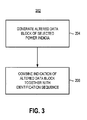
- Figure 3 illustrates a method flow diagram of the method of operation of an embodiment of the present invention.
- the present invention accordingly, advantageously provides apparatus, and an associated method, by which to communicate a data block in a symbol of an OFDM-based, or other MCM-based, communication system.
- a manner is provided by which to send the data block, altered in a manner to facilitate its communication, together with assistant data for side information, to facilitate recovery of the informational content data block, once received.
- the assistant data is superimposed upon the altered data, after IDFT and after optional padding of the cyclic prefix (CP).
- CP cyclic prefix
- a data block that is to be communicated by a sending station is combined together with a scrambling sequence that is of characteristics to cause the resultant combination, a product sequence, to lead to a signal PAPR of selected characteristics.
- the selected characteristics of the PAPR, or other power indicia ensures that the resultant combination leads to a signal PAPR of an acceptable level or, if not possible, then a PAPR of best-available characteristics.
- the scrambling sequence consisting of a stream of 1 or -1 and of the same length of the data block is multiplied together with the data block to form a resultant product.
- a first product, formed of a first scrambling sequence and the data block does not lead to a PAPR of an acceptable level
- an additional iteration, using another scrambling sequence, if available, is performed. Successive iterations are performed, with successive independent scrambling sequences, until a product is formed that leads to an acceptable PAPR or no remaining scrambling sequences are available. If successive iterations are performed and no product leads to an acceptable PAPR, selection is made of a product that leads to a best signal PAPR. Thereby, a product is formed that leads to either an acceptable signal PAPR or a best-available signal PAPR.
- an identification sequence acting as the assistant data as mentioned above, is formed that corresponds to the scrambling sequence used to form the selected product sequence.
- the identification sequence is superimposed upon the transformed product sequence, after ODFT and after the optional padding of CP as a special embodiment, such as by summing together, by a summing element, function, or procedure, to include, as part of the data that is communicated, the identification sequence.
- the data when communicated, includes the identification sequence that identifies the scrambling sequence used in the formation of the product sequence.
- a separate signal such as a signal sent upon one or more sub-carriers is not required. It should be understood that in general the identification sequence can be superimposed prior to or after the IDFT operation, and prior to or after the optional padding of CP, with corresponding adjustment of processing order in the receiving station.
- a receiving station detects reception of the communicated data block, formed of the transformed product of the data block and the scrambling sequence, with optional CP padded, and upon which the identification sequence is superimposed. Once detection is made, determination is made of the identification sequence superimposed upon the communicated data block. And, once the identification sequence is determined, the identification sequence is removed.
- determination of the identification sequence is made by way of a correlation function, procedure, or entity.
- the detected data block is correlated with every possible identification sequence that can be superimposed upon the data block that is communicated.
- the correlation value that exhibits the highest correlation is considered to be associated with the identification sequence that is superimposed upon the data block.
- the identification sequence is removed from the detected data block, such as by subtracting the identification sequence out of the detected data block.
- the scrambling sequence is also removed out of the detected data block after DFT. Because of the one-to-one correspondence between the identification sequence and the associated scrambling sequence, determination of the identification sequence also is determinative of the scrambling sequence.
- the scrambling sequence is removed, for instance, pursuant to a multiplication function, procedure, or entity.
- a data block is placed into a form to facilitate its communication with a selected PAPR.
- An identification sequence is superimposed upon the properly processed data block, thereby to provide a receiving station with an indication of the scrambling sequence used to alter an input data block.
- the superimposition of the identification sequence upon the data block obviates the need for use of one or more separate sub-carriers upon which to convey such side information.
- apparatus, and an associated method for a communication station operable pursuant to a multi-carrier modulation communication scheme.
- An altered data block generator is configured to generate an altered data block for an accepted PAPR responsive to an input data block.
- a combiner is configured to combine together an indication of the altered data block with an identification sequence. The identification sequence identifies the parameters or characteristics used in alteration of the input data block by which the input data block is altered, thereby to form the altered data block.
- a detector is configured to detect a receive signal received at the communication station.
- the received signal includes an indication of a data block, altered by a scrambling sequence and an identifying sequence that identifies the scrambling sequence.
- portions of a radio communication system include a set of communication stations 12 and 14, interconnected by way of a radio air interface 16.
- the communication system 10 forms, an OFDM (Orthogonal Frequency Division Multiplexing)-based communication system.
- the communication system is, however, more generally representative of any type of communication system in which data is communicated between a set of communication stations.
- the communication system 10 is, e.g., representative of a 4G (fourth-generation) OFDM-based cellular communication system. While the following description shall describe exemplary operation with respect to this exemplary implementation, it should be understood that the following description is exemplary only and that the communication system is also analogously representative of any of various other communication systems in which data is communicated between a set of communication stations.
- the communication station 12 shall here be considered a network station
- the communication station 14 shall here be considered a mobile station.
- description of operation shall describe downlink communication, that is, communication in which the network station forms the sending station, and the mobile station forms the receiving station.
- a cellular communication system is a two-way system, operation of the communication stations in which uplink communications are carried out, i.e., communication of data from the mobile station to the network station is analogous, and the corresponding parts of the communication stations operated in such uplink communications are analogous.
- a data source 22 sources data, here formatted into blocks. Each data is a value taken from an M-ary signal constellation set. Each data block is formed of N data values.
- the data sourced by the data source is provided to a transmit chain part of the sending station forming the communication station 12.
- the transmit chain includes the apparatus 24 of an embodiment of the present invention.
- the apparatus is formed of functional entities, implementable in any desired manner including, for instance, algorithms executable by processing circuitry or hardware equivalents.
- the apparatus includes an altered data block generator 28 and a combiner 32.
- a data block sourced at the data source 22 is provided, here represented by way of the line 34, to a multiplier 36 that operates to combine the data block with a scrambling sequence, here provided to the multiplier by way of the line 38.
- a scrambling sequence B(q) is selected to alter the Peak-To-Average Power Ratio (PAPR) of the signal after IDFT when subsequently communicated by the communication station.
- the scrambling sequence is provided by a scrambling sequence originator 42 formed, e.g., by a sequence generator or a cache at which sequences are stored and available for retrievable for application to the multiplier 36. Selection of the scrambling sequence, in one implementation, is iterative.
- a first scrambling sequence is combined with the data block, and a determination is made as to whether the PAPR of the resultant sequence after IDFT is acceptable. If so, the product sequence is forwarded on to the transmit chain portion of the communication station 12. If, however, the PAPR, or other power indicia, is unacceptable, then another scrambling sequence is provided, combined with the data block, and a determination is made as to whether the new product sequence results in an acceptable PAPR. Successive iterations are performed, if needed, until no more scrambling sequences are available. In such a scenario, a best-available product sequence is used. That is, a product sequence that leads to the minimum PAPR is utilized, and provided to other portions of the transmit chain part of the communication station.
- Selection of the scrambling sequence is here represented to be made by a selector 44.
- the selector selects a value of q, causing selection of a corresponding scrambling sequence, to be provided and used pursuant to the formation of the product sequence by the multiplier 36.
- Selection made by the selector is, e.g., made in a manner as just-described to ensure that the product sequence leads to an acceptable, or best-available, PAPR.
- the transmit chain portion further includes an IDFT (Inverse Discrete Fourier Transform) operator 48 that is provided, here by way of the line 52, the product sequence formed by the multiplier 36.
- the operator 48 performs an IDFT upon the product sequence, and the transformed product sequence x is provided, here by way of the line 54, to a Cyclic Prefix Part (CPP) padder 56.
- the padder 56 adds the cyclic prefix part to the transformed product sequence and the resultant sequence y, is provided here by way of the line 58, to a summing element 62.
- the summing element 62 forms part of the combiner 32 of the apparatus 24.
- the combiner is also provided with an identification sequence C (q), here represented by way of the line 66.
- the line 66 indicates that the identification sequence is selected together with selection of the scrambling sequence.
- the identification sequence forms a bipolar identification sequence, one-to-one corresponding to the scrambling sequence, with a sufficient magnitude that is caused, through operation of the summer 62 to be superimposed upon the transformed product sequence, together with the cyclic prefix part added thereto.
- the identification sequence is of a length of W, and the sequence provided on the line 58 is also of a length of W.
- each element of the identification sequence takes a value of ⁇ or minus ⁇ where ⁇ is a positive real number. However, it should be known that in general ⁇ can also be a complex number. This is to say, the identification sequences are formable, if desired, to be of complex values.
- the identification sequences are selected to exhibit good orthogonality.
- Exemplary identification sequences include Gold-code sequences, Walsh-code sequences, and others that similarly also exhibit good orthogonality.
- the identification sequence identifies the scrambling sequence used in the formation of the product sequence.
- the resultant summed sequence generated here on the line 72, identifies the scrambling sequence used in the product sequence formation.
- a separate subcarrier upon which to communicate such information is obviated.
- the data block is communicated upon the radio air interface 16 and delivered to the communication station 14, here a mobile station.
- the receive chain portion of the mobile station includes further apparatus 78 of an embodiment of the present invention.
- the apparatus 78 is functionally represented, implementable in any desired manner, for instance, algorithms executable by processing circuitry or hardware equivalents.
- the apparatus includes a detector entity 82 and an identification sequence remover 84.
- the detector operates to detect reception at the communication station 14 of the communicated data block.
- the detector further detects the identification sequence, C(q) that is superimposed upon the transformed product sequence to which the CP is prepended.
- the detector contains a bank of correlators that correlate the received data, i.e., the communicated data sequence with each of the possible identification sequences that could have been superimposed upon the modified product sequence.
- a real-valued operator provides the real-valued parts of the communicated data sequence on the lines 92 that extend to correlators 94, when ⁇ is a real number as an example.
- the correlators 94 correspond in number to the number of possible identification sequences, and corresponding number of scrambling sequences, a selected one of which is possibly superimposed upon the altered data block.
- a maximum correlation determiner 96 is coupled to receive indications, on the lines 98, of the correlations performed by the correlators 94. The determination made by the determiner is provided to a switch function 102, here by way of the line 104, whose switch position is determinative of which identification sequence, sourced on the lines 106, is passed on the line 108.
- the line 108 extends to a negative input of a summing element 112 of the identification sequence remover.
- the communicated data sequence is provided to a positive input of the summing element, here by way of the line 116. Operation of the summing element subtracts out the identification sequence applied by way of the line 108 from the received data sequence. Thereby, through correlation operations performed by the correlator forming the detector, the identification sequence is determined and then subtracted out of the received data.
- the line 118 extends to a Cyclic Prefix Part (CP) remover 122 that operates to remove the cyclic prefix part added to the communicated data sequence.
- CP Cyclic Prefix Part
- FDT Fast Discrete Fourier Transform
- Transformed values are provided by way of the line 128 to a multiplier 132.
- the multiplier 132 multiplies together the transformed values with scrambling sequence values provided by way of the line 136.
- the line 136 originates at a scrambling sequence selector 142 that, in turn, receives an indication, also by way of the line 104, of the determination made by the determiner 96.
- the product formed by the multiplier 132 is of data sequence that corresponds to the input data sequence sourced at the data source 22.
- the correlation operations performed upon the communicated data block determines the identification sequence to permit its subtraction out of the communicated data block. And, determination is further made of the scrambling sequence, and the scrambling sequence is multiplied out of the communicated data block to form a resultant data block that corresponds to the input data block.
- the data block, through its combination with the scrambling sequence, is placed in a form that leads to an improved PAPR, and the side information of the identification of the scrambling sequence is superimposed upon the data to facilitate re-conversion of the data into original form, once delivered at the receiving station.
- FIG. 162 a process diagram, shown generally at 162, illustrates the process of operation of an embodiment of the present invention.
- the process provides a manner by which to place an input data block into a form that leads to a selected PAPR level, to form an altered data block therefrom, superimpose information upon the altered data block that identifies the alteration to the input data block, and to recover the informational content of the input data block once communicated to a receiving station.
- an input data block formed of data symbol is provided.
- a scrambling sequence is selected.
- the scrambling sequence and input data block are multiplied together, or otherwise combined, as indicated by the block 168, to form a product sequence.
- IDFT is performed, indicated at the block 170.
- the PAPR Peak-To-Average Power Ratio
- the PAPR is determined, as indicated by the block 172. Then, a determination is made, indicated by the decision block 174, as to whether the PAPR is acceptable. If not, the no branch is taken to the block 175 and the IDFT output sequence and its PAPR are saved. Then, a path is taken to the decision block 176. At the decision block 176, a further determination is made as to whether an additional scrambling sequence is available to be combined with the input data block. If so, the yes branch is taken to the block 177 and a new scrambling sequence is obtained. Then a path is taken back to the block 166.
- the new scrambling sequence obtained at the block 177 becomes the selected scrambling sequence. If no additional scrambling sequence is available at the decision block 176, then the no branch is taken to the block 178, and a selection is made of a transformed product sequence, already-formed and saved, that exhibits a best PAPR level.
- the process then proceeds to the block 182, and a cyclic prefix part is prefixed, i.e., prepended, to the transformed product sequence.
- a cyclic prefix part is prefixed, i.e., prepended, to the transformed product sequence.
- the yes branch taken from the decision block 174 also extends to the block 182.
- the transformed product sequence, to which the CP has been added is combined with an identification sequence by superimposing the identification sequence upon the sequence from block 182.
- the identification sequence is selected correspondingly at the same time that the scrambling sequence is selected at the block 166.
- the resultant combination is sent via sending station to a receiving station, and the communicated data block is detected.
- a correlation procedure is carried out to calculate correlations between the communicated data block and possible identification sequences that possibly have been superimposed at the process step 184. Responsive to the correlations, a determination is made, indicated by the block 192, of which identification sequence exhibits the greatest correlation with the communicated data block. And, responsive to such determination, as indicated by the block 194, the corresponding identification sequence is removed by a subtraction process, out of the communicated data block. Thereafter, the associated scrambling sequence is also removed after CP is removed and DFT is performed, indicated by the block 197, out of the communicated data block, thereby to recreate the input data block. Subsequent recovery operations thereafter commence.
- Figure 3 illustrates a method flow diagram, shown generally at 202, representative of the method of operation of an embodiment of the present invention.
- the method facilitates communication in a communication system operable pursuant to a multicarrier modulation communication scheme.
- an altered data block is generated of a selected power indicia responsive to an input data block.
- an indication of the altered data block is combined together with an identification sequence.
- the identification sequence identifies alteration of the input data to form the altered data block.
- a separate sub-carrier or other bandwidth is not required by which to inform a receiving station of the manner by which a data block is altered.
- Apparatus for a communication station operable pursuant to a Multi Carrier Modulation communication scheme comprising:
- said combiner is configured to superimpose the identification sequence upon the altered data block.
- said combiner comprises a summer, said summer configured to sum together an indication of the altered data block together with the identification sequence.
- the identification sequence is of a sequence length corresponding to the indication of the altered data block.
- the identification sequence includes real-valued components.
- said altered data block generator is configured to combine the input data block together with a scrambling sequence, the scrambling sequence when combined with the input data sequence, causing the altered data block to be of the selected power indicia.
- the selected power indicia of the altered data block comprises a selected Peak-To-Average Power Ratio.
- the apparatus comprises a cyclic prefix part padder configured to prepend a cyclic prefix to the altered data block, the indication of the altered data block provided to said combiner comprised of the altered data block prepended thereto.
- the identification sequence, combined by said combiner with the indication of the altered data block is of a length corresponding to the altered data block with the cyclic prefix prepended thereto.
- Apparatus for a communication station operable pursuant to a Multi Carrier Modulation communication scheme comprising:
- said detector comprises a correlator.
- said correlator is configured to calculate a correlation of the receive signal each of a set of possible scrambling sequences to determine which of the possible scrambling sequences exhibits a best correlation with the receive signal.
- the apparatus further comprises an identifying sequence remover configured to remove the identifying sequence, identified by said identifier, out of the receive signal.
- a method for facilitating communication in a communication system operable pursuant to a Multi Carrier Modulation communication scheme comprising the operations of:
- the method comprises the operation of:
- the method further comprises the operation of the operation of identifying the identifying sequence subsequent to detection during said operation of detecting reception of the receive signal at the receive station.
- the method comprises the operation of the operation of removing the identifying sequence, identified during said operation of identifying, out of the receive signal.
- said operation of combining comprises superimposing the identification sequence upon the indication of the altered data block.
- said operation of generating an altered data block comprises altering the input data block with a selected scrambling sequence.
- the identification sequence is of a length corresponding to the scrambling sequence that alters the input data block during said operation of generating the altered data block.
Landscapes
- Engineering & Computer Science (AREA)
- Computer Networks & Wireless Communication (AREA)
- Signal Processing (AREA)
- Mobile Radio Communication Systems (AREA)
- Cable Transmission Systems, Equalization Of Radio And Reduction Of Echo (AREA)
- Digital Transmission Methods That Use Modulated Carrier Waves (AREA)
Abstract
Description
- The present invention relates generally to a manner by which to communicate a data block in an OFDM, or other MCM-based system. More particularly, the present invention relates to apparatus, and an associated method, by which to send the data block, altered in a manner to facilitate its communication, together with assistant data for side information to facilitate recovery of the informational content of the data block, once received.
- The assistant data, forming, e.g., an identification sequence, is superimposed upon the data block, and does not require separate channel capacity, such as a channel subcarrier, to communicate the assistant data. Channel bandwidth efficiency is improved.
- The availability of radio communication systems through which to communicate is a necessary aspect for much of modem society. Many varied types of radio communication systems have been developed and used for various purposes. Cellular radio communication systems, for instance, have achieved significant levels of usage. Network infrastructures of cellular communication systems have been installed to encompass significant portions of populated areas of the world. Successive generations of cellular communication systems have been developed, and their network infrastructures deployed and installed. Early-generation cellular communication systems were used primarily for voice communications. Successor-generation systems provide increasingly for data communication services, including multi-media communication services.
- A cellular communication system is generally a bandwidth-constrained system. That is to say, the radio-frequency bandwidth allocated to a cellular communication system is limited, and the limited bandwidth sometimes constrains the communication capacity of the system. Other radio communication systems are also similarly and also generally bandwidth constrained. Efforts are therefore made to make efficient use of the allocated bandwidth. And, communication schemes have been developed to make the most efficient possible use of bandwidth allocated to a communication system. For instance, OFDM (Orthogonal Frequency Division Multiplexing) schemes have been proposed and planned for use as part of a new-generation, cellular communication system. In an OFDM communication scheme, sub-carriers are defined. The sub-carriers are mutually orthogonal, or nearly orthogonal. In general, in an OFDM symbol, each subcarrier is independently modulated, often implemented by the inverse discrete Fourier transform (IDFT). In addition, cyclic prefix (CP) is often padded to the transformed data sequence after IDFT. There is a heightened need, in an OFDM-based system, to control power levels of the transmitted signal at which data is communicated. A PAPR (Peak-To-Average Power Ratio) is a power characteristic of the transmitted signal that is of significance in communications in an OFDM-based communication system. In general, a higher PAPR requires the power amplifier (PA) to have a wider linear dynamic range, forces PA to work at a lower average power, which makes the power efficiency lower, costs more electrical energy, reduces battery life, and reduces the service coverage areas.
- There is an ongoing need to provide a manner by which to communicate data in an OFDM communication system in which the PAPR of the transmitted signal is of an acceptable level. If, the data that is to be communicated is altered (i.e. processed) in some manner to improve the PAPR, indication of the manner by which the alteration is made often needs to be communicated to the receiving communication station. In many cases such information is needed by the receiving communication station to permit the receiving communication station to make inverse processing for the alteration processing, thereby to facilitate recovery of the informational content of the transmitted data.
- One conventional scheme to reduce PAPR, referred to as Partial Transmit Sequence (PTS) scheme, is sometimes utilized. In a Partial Transmit Sequence scheme, for each OFDM symbol of the data that is sent by sending station, additional information also needs to be sent by the sending station to inform the receiving station that receives the communicated data a set of coefficients. Such additional communication, referred to, at times, as side-information (SI), is transmitted, e.g., upon reserved sub-carriers. This need to send separate information on the reserved sub-carriers, or otherwise, is at the expense of bandwidth efficiency. That is to say, bandwidth is required to send the side-information. And, when capacity issues on the reserved sub-carrier, such bandwidth is no longer available for other purposes.
- What is needed, therefore, is both a manner by which to place data in a form that leads to improved signal PAPR levels and also a manner by which to provide side information related to the alteration processing of the data into the form leading to the improved PAPR to a receiving station.
- It is in light of this background information related to communications in a communication system that utilizes a multi-carrier modulation scheme that the significant improvements of the present invention have evolved.
-
Figure 1 illustrates a functional block diagram of an exemplary communication system in which an embodiment of the present invention is operable. -
Figures 2A-B illustrates a process diagram representative of the process of operation of an embodiment of the present invention. -
Figure 3 illustrates a method flow diagram of the method of operation of an embodiment of the present invention. - The present invention, accordingly, advantageously provides apparatus, and an associated method, by which to communicate a data block in a symbol of an OFDM-based, or other MCM-based, communication system.
- Through operation of an embodiment of the present invention, a manner is provided by which to send the data block, altered in a manner to facilitate its communication, together with assistant data for side information, to facilitate recovery of the informational content data block, once received.
- In an embodiment of the present invention, the assistant data is superimposed upon the altered data, after IDFT and after optional padding of the cyclic prefix (CP). By superimposing the assistant data upon the processed data block that is to be communicated, the conventional need to use a reserved sub-carrier, or other bandwidth, upon which to communicate the assistant data is obviated. Improved bandwidth efficiency is thereby provided. However, in general the assistant data can be superimposed on the processed data before or after IDFT, and before or after optional padding of the cyclic prefix (CP), with corresponding adjustment of processing order in the receiving station.
- In another aspect of the present invention, a data block that is to be communicated by a sending station is combined together with a scrambling sequence that is of characteristics to cause the resultant combination, a product sequence, to lead to a signal PAPR of selected characteristics. The selected characteristics of the PAPR, or other power indicia, ensures that the resultant combination leads to a signal PAPR of an acceptable level or, if not possible, then a PAPR of best-available characteristics. In one implementation, the scrambling sequence consisting of a stream of 1 or -1 and of the same length of the data block is multiplied together with the data block to form a resultant product. If a first product, formed of a first scrambling sequence and the data block does not lead to a PAPR of an acceptable level, an additional iteration, using another scrambling sequence, if available, is performed. Successive iterations are performed, with successive independent scrambling sequences, until a product is formed that leads to an acceptable PAPR or no remaining scrambling sequences are available. If successive iterations are performed and no product leads to an acceptable PAPR, selection is made of a product that leads to a best signal PAPR. Thereby, a product is formed that leads to either an acceptable signal PAPR or a best-available signal PAPR.
- In another aspect of the present invention, an identification sequence, acting as the assistant data as mentioned above, is formed that corresponds to the scrambling sequence used to form the selected product sequence. The identification sequence is superimposed upon the transformed product sequence, after ODFT and after the optional padding of CP as a special embodiment, such as by summing together, by a summing element, function, or procedure, to include, as part of the data that is communicated, the identification sequence. Through the superimposition of the identification sequence upon the transformed data that is to be communicated, the data, when communicated, includes the identification sequence that identifies the scrambling sequence used in the formation of the product sequence. A separate signal, such as a signal sent upon one or more sub-carriers is not required. It should be understood that in general the identification sequence can be superimposed prior to or after the IDFT operation, and prior to or after the optional padding of CP, with corresponding adjustment of processing order in the receiving station.
- In another aspect of the present invention, a receiving station detects reception of the communicated data block, formed of the transformed product of the data block and the scrambling sequence, with optional CP padded, and upon which the identification sequence is superimposed. Once detection is made, determination is made of the identification sequence superimposed upon the communicated data block. And, once the identification sequence is determined, the identification sequence is removed.
- In another aspect of the present invention, determination of the identification sequence is made by way of a correlation function, procedure, or entity. The detected data block is correlated with every possible identification sequence that can be superimposed upon the data block that is communicated. The correlation value that exhibits the highest correlation is considered to be associated with the identification sequence that is superimposed upon the data block. And, the identification sequence is removed from the detected data block, such as by subtracting the identification sequence out of the detected data block.
- In another aspect of the present invention, the scrambling sequence is also removed out of the detected data block after DFT. Because of the one-to-one correspondence between the identification sequence and the associated scrambling sequence, determination of the identification sequence also is determinative of the scrambling sequence. The scrambling sequence is removed, for instance, pursuant to a multiplication function, procedure, or entity.
- Thereby, a data block is placed into a form to facilitate its communication with a selected PAPR. An identification sequence is superimposed upon the properly processed data block, thereby to provide a receiving station with an indication of the scrambling sequence used to alter an input data block. The superimposition of the identification sequence upon the data block obviates the need for use of one or more separate sub-carriers upon which to convey such side information.
- In these and other aspects, therefore, apparatus, and an associated method, is provided for a communication station operable pursuant to a multi-carrier modulation communication scheme. An altered data block generator is configured to generate an altered data block for an accepted PAPR responsive to an input data block. A combiner is configured to combine together an indication of the altered data block with an identification sequence. The identification sequence identifies the parameters or characteristics used in alteration of the input data block by which the input data block is altered, thereby to form the altered data block.
- In these, and other, aspects, further apparatus, and method is provided for a communication station operable pursuant to a multi-carrier modulation communication scheme. A detector is configured to detect a receive signal received at the communication station. The received signal includes an indication of a data block, altered by a scrambling sequence and an identifying sequence that identifies the scrambling sequence.
- Referring first, therefore, to
Figure 1 , portions of a radio communication system, shown generally at 10, include a set ofcommunication stations radio air interface 16. In the exemplary implementation, thecommunication system 10 forms, an OFDM (Orthogonal Frequency Division Multiplexing)-based communication system. The communication system is, however, more generally representative of any type of communication system in which data is communicated between a set of communication stations. Thecommunication system 10 is, e.g., representative of a 4G (fourth-generation) OFDM-based cellular communication system. While the following description shall describe exemplary operation with respect to this exemplary implementation, it should be understood that the following description is exemplary only and that the communication system is also analogously representative of any of various other communication systems in which data is communicated between a set of communication stations. - Additionally, the
communication station 12 shall here be considered a network station, and thecommunication station 14 shall here be considered a mobile station. And, description of operation shall describe downlink communication, that is, communication in which the network station forms the sending station, and the mobile station forms the receiving station. As a cellular communication system is a two-way system, operation of the communication stations in which uplink communications are carried out, i.e., communication of data from the mobile station to the network station is analogous, and the corresponding parts of the communication stations operated in such uplink communications are analogous. - A
data source 22 sources data, here formatted into blocks. Each data is a value taken from an M-ary signal constellation set. Each data block is formed of N data values. - The data sourced by the data source is provided to a transmit chain part of the sending station forming the
communication station 12. The transmit chain includes theapparatus 24 of an embodiment of the present invention. The apparatus is formed of functional entities, implementable in any desired manner including, for instance, algorithms executable by processing circuitry or hardware equivalents. Here, the apparatus includes an altereddata block generator 28 and acombiner 32. - A data block sourced at the
data source 22 is provided, here represented by way of the line 34, to amultiplier 36 that operates to combine the data block with a scrambling sequence, here provided to the multiplier by way of the line 38. A scrambling sequence B(q) is selected to alter the Peak-To-Average Power Ratio (PAPR) of the signal after IDFT when subsequently communicated by the communication station. The scrambling sequence is provided by ascrambling sequence originator 42 formed, e.g., by a sequence generator or a cache at which sequences are stored and available for retrievable for application to themultiplier 36. Selection of the scrambling sequence, in one implementation, is iterative. That is to say, a first scrambling sequence is combined with the data block, and a determination is made as to whether the PAPR of the resultant sequence after IDFT is acceptable. If so, the product sequence is forwarded on to the transmit chain portion of thecommunication station 12. If, however, the PAPR, or other power indicia, is unacceptable, then another scrambling sequence is provided, combined with the data block, and a determination is made as to whether the new product sequence results in an acceptable PAPR. Successive iterations are performed, if needed, until no more scrambling sequences are available. In such a scenario, a best-available product sequence is used. That is, a product sequence that leads to the minimum PAPR is utilized, and provided to other portions of the transmit chain part of the communication station. Selection of the scrambling sequence is here represented to be made by aselector 44. As indicated, the selector selects a value of q, causing selection of a corresponding scrambling sequence, to be provided and used pursuant to the formation of the product sequence by themultiplier 36. Selection made by the selector is, e.g., made in a manner as just-described to ensure that the product sequence leads to an acceptable, or best-available, PAPR. - The transmit chain portion further includes an IDFT (Inverse Discrete Fourier Transform)
operator 48 that is provided, here by way of theline 52, the product sequence formed by themultiplier 36. Theoperator 48 performs an IDFT upon the product sequence, and the transformed product sequence x is provided, here by way of theline 54, to a Cyclic Prefix Part (CPP)padder 56. Thepadder 56 adds the cyclic prefix part to the transformed product sequence and the resultant sequence y, is provided here by way of theline 58, to a summingelement 62. The summingelement 62 forms part of thecombiner 32 of theapparatus 24. The combiner is also provided with an identification sequence C(q), here represented by way of theline 66. Theline 66 indicates that the identification sequence is selected together with selection of the scrambling sequence. In the exemplary implementation, the identification sequence forms a bipolar identification sequence, one-to-one corresponding to the scrambling sequence, with a sufficient magnitude that is caused, through operation of thesummer 62 to be superimposed upon the transformed product sequence, together with the cyclic prefix part added thereto. The identification sequence is of a length of W, and the sequence provided on theline 58 is also of a length of W. Further in the exemplary implementation, each element of the identification sequence takes a value of λ or minus λ where λ is a positive real number. However, it should be known that in general λ can also be a complex number. This is to say, the identification sequences are formable, if desired, to be of complex values. - The identification sequences are selected to exhibit good orthogonality. Exemplary identification sequences include Gold-code sequences, Walsh-code sequences, and others that similarly also exhibit good orthogonality.
- The identification sequence identifies the scrambling sequence used in the formation of the product sequence. By its superimposition upon the product sequence, the resultant summed sequence, generated here on the line 72, identifies the scrambling sequence used in the product sequence formation. A separate subcarrier upon which to communicate such information is obviated.
- The data block, altered by the scrambling sequence, transformed by the IDFT operator, added with the cyclic prefix, and superimposed with the identification sequence, is communicated upon the
radio air interface 16 and delivered to thecommunication station 14, here a mobile station. The receive chain portion of the mobile station includesfurther apparatus 78 of an embodiment of the present invention. Theapparatus 78 is functionally represented, implementable in any desired manner, for instance, algorithms executable by processing circuitry or hardware equivalents. Here, the apparatus includes adetector entity 82 and anidentification sequence remover 84. - The detector operates to detect reception at the
communication station 14 of the communicated data block. In an ideal system, the communicated data block, u, is identical to that transmitted by thecommunication station 12. Disregarding any distortion, u = y + C(q). The detector further detects the identification sequence, C(q) that is superimposed upon the transformed product sequence to which the CP is prepended. The detector contains a bank of correlators that correlate the received data, i.e., the communicated data sequence with each of the possible identification sequences that could have been superimposed upon the modified product sequence. - Here, a real-valued operator provides the real-valued parts of the communicated data sequence on the
lines 92 that extend to correlators 94, when λ is a real number as an example. Thecorrelators 94 correspond in number to the number of possible identification sequences, and corresponding number of scrambling sequences, a selected one of which is possibly superimposed upon the altered data block. Amaximum correlation determiner 96 is coupled to receive indications, on thelines 98, of the correlations performed by thecorrelators 94. The determination made by the determiner is provided to aswitch function 102, here by way of theline 104, whose switch position is determinative of which identification sequence, sourced on thelines 106, is passed on theline 108. - The
line 108 extends to a negative input of a summingelement 112 of the identification sequence remover. The communicated data sequence is provided to a positive input of the summing element, here by way of theline 116. Operation of the summing element subtracts out the identification sequence applied by way of theline 108 from the received data sequence. Thereby, through correlation operations performed by the correlator forming the detector, the identification sequence is determined and then subtracted out of the received data. - The line 118 extends to a Cyclic Prefix Part (CP) remover 122 that operates to remove the cyclic prefix part added to the communicated data sequence. The result, the sequence x' is provided, by way of the
line 124, to a Fast Discrete Fourier Transform (FDT)operator 126. Transformed values are provided by way of theline 128 to amultiplier 132. Themultiplier 132 multiplies together the transformed values with scrambling sequence values provided by way of theline 136. Theline 136 originates at ascrambling sequence selector 142 that, in turn, receives an indication, also by way of theline 104, of the determination made by thedeterminer 96. The product formed by themultiplier 132 is of data sequence that corresponds to the input data sequence sourced at thedata source 22. - Thereby, the correlation operations performed upon the communicated data block determines the identification sequence to permit its subtraction out of the communicated data block. And, determination is further made of the scrambling sequence, and the scrambling sequence is multiplied out of the communicated data block to form a resultant data block that corresponds to the input data block. The data block, through its combination with the scrambling sequence, is placed in a form that leads to an improved PAPR, and the side information of the identification of the scrambling sequence is superimposed upon the data to facilitate re-conversion of the data into original form, once delivered at the receiving station.
- Turning next to
Figures 2A-B , a process diagram, shown generally at 162, illustrates the process of operation of an embodiment of the present invention. The process provides a manner by which to place an input data block into a form that leads to a selected PAPR level, to form an altered data block therefrom, superimpose information upon the altered data block that identifies the alteration to the input data block, and to recover the informational content of the input data block once communicated to a receiving station. - First, and as indicated by the
block 164, an input data block, formed of data symbol is provided. And, as indicated by theblock 166, a scrambling sequence is selected. The scrambling sequence and input data block are multiplied together, or otherwise combined, as indicated by theblock 168, to form a product sequence. IDFT is performed, indicated at theblock 170. - The PAPR (Peak-To-Average Power Ratio) of the product sequence is determined, as indicated by the
block 172. Then, a determination is made, indicated by thedecision block 174, as to whether the PAPR is acceptable. If not, the no branch is taken to theblock 175 and the IDFT output sequence and its PAPR are saved. Then, a path is taken to thedecision block 176. At thedecision block 176, a further determination is made as to whether an additional scrambling sequence is available to be combined with the input data block. If so, the yes branch is taken to theblock 177 and a new scrambling sequence is obtained. Then a path is taken back to theblock 166. In the subsequent iteration of the operation at theblock 166, the new scrambling sequence obtained at theblock 177 becomes the selected scrambling sequence. If no additional scrambling sequence is available at thedecision block 176, then the no branch is taken to theblock 178, and a selection is made of a transformed product sequence, already-formed and saved, that exhibits a best PAPR level. - The process then proceeds to the
block 182, and a cyclic prefix part is prefixed, i.e., prepended, to the transformed product sequence. The yes branch taken from thedecision block 174 also extends to theblock 182. - Then, and as indicated by the
block 184, the transformed product sequence, to which the CP has been added, is combined with an identification sequence by superimposing the identification sequence upon the sequence fromblock 182. The identification sequence is selected correspondingly at the same time that the scrambling sequence is selected at theblock 166. - Then, and as indicated by the
block 186, the resultant combination is sent via sending station to a receiving station, and the communicated data block is detected. A correlation procedure, indicated by theblock 188, is carried out to calculate correlations between the communicated data block and possible identification sequences that possibly have been superimposed at theprocess step 184. Responsive to the correlations, a determination is made, indicated by theblock 192, of which identification sequence exhibits the greatest correlation with the communicated data block. And, responsive to such determination, as indicated by theblock 194, the corresponding identification sequence is removed by a subtraction process, out of the communicated data block. Thereafter, the associated scrambling sequence is also removed after CP is removed and DFT is performed, indicated by theblock 197, out of the communicated data block, thereby to recreate the input data block. Subsequent recovery operations thereafter commence. -
Figure 3 illustrates a method flow diagram, shown generally at 202, representative of the method of operation of an embodiment of the present invention. The method facilitates communication in a communication system operable pursuant to a multicarrier modulation communication scheme. - First, and as indicated by the
block 204, an altered data block is generated of a selected power indicia responsive to an input data block. - Then, and as indicated by the
block 206, an indication of the altered data block is combined together with an identification sequence. The identification sequence identifies alteration of the input data to form the altered data block. - By combining the identification sequence directly with the data of the data block that is to be communicated, a separate sub-carrier or other bandwidth is not required by which to inform a receiving station of the manner by which a data block is altered.
- The following is also disclosed:
- Apparatus for a communication station operable pursuant to a Multi Carrier Modulation communication scheme, said apparatus comprising:
- an altered data block generator configured to generate an altered data block of a selected power indicia responsive to an input data block; and
- a combiner configured to combine together an indication of the altered data block with an identification sequence, the identification sequence identifying alteration of the input data block by which said altered data block generator alters the input data block to form the altered data block.
- Optionally, said combiner is configured to superimpose the identification sequence upon the altered data block.
- Optionally, said combiner comprises a summer, said summer configured to sum together an indication of the altered data block together with the identification sequence.
- Optionally, the identification sequence is of a sequence length corresponding to the indication of the altered data block.
- Optionally, the identification sequence includes real-valued components.
- Optionally, said altered data block generator is configured to combine the input data block together with a scrambling sequence, the scrambling sequence when combined with the input data sequence, causing the altered data block to be of the selected power indicia.
- Optionally, the selected power indicia of the altered data block comprises a selected Peak-To-Average Power Ratio.
- Optionally, the apparatus comprises a cyclic prefix part padder configured to prepend a cyclic prefix to the altered data block, the indication of the altered data block provided to said combiner comprised of the altered data block prepended thereto.
- Optionally, the identification sequence, combined by said combiner with the indication of the altered data block, is of a length corresponding to the altered data block with the cyclic prefix prepended thereto.
- Apparatus for a communication station operable pursuant to a Multi Carrier Modulation communication scheme, said apparatus comprising:
- a detector configured to detect a receive signal received at the communication station, the receive signal including an indication of a data block, altered by a scrambling sequence and an identifying sequence that identifies the scrambling sequence; and
- an identifier configured to identify the identifying sequence forming part of the receive signal.
- Optionally, said detector comprises a correlator.
- Optionally, said correlator is configured to calculate a correlation of the receive signal each of a set of possible scrambling sequences to determine which of the possible scrambling sequences exhibits a best correlation with the receive signal.
- Optionally, the apparatus further comprises an identifying sequence remover configured to remove the identifying sequence, identified by said identifier, out of the receive signal.
- A method for facilitating communication in a communication system operable pursuant to a Multi Carrier Modulation communication scheme, said method comprising the operations of:
- generating an altered data block of a selected power indicia responsive to an input data block; and
- combining together an indication of the altered data block with an identification sequence, the identification sequence identifying alteration of the input data to form the altered data block during said operation of generating.
- Optionally, the method comprises the operation of:
- sending the indication of the altered data block, once combined during said operation of combining; and
- detecting reception thereof as a receive signal at a receive station.
- Optionally, the method further comprises the operation of the operation of identifying the identifying sequence subsequent to detection during said operation of detecting reception of the receive signal at the receive station.
- Optionally, the method comprises the operation of the operation of removing the identifying sequence, identified during said operation of identifying, out of the receive signal.
- Optionally, wherein said operation of combining comprises superimposing the identification sequence upon the indication of the altered data block.
- Optionally, wherein said operation of generating an altered data block comprises altering the input data block with a selected scrambling sequence.
- Optionally, wherein the identification sequence is of a length corresponding to the scrambling sequence that alters the input data block during said operation of generating the altered data block.
Claims (15)
- Apparatus for a communication station operable pursuant to a Multi Carrier Modulation communication scheme, said apparatus comprising:an altered data block generator configured to generate an altered data block comprising a selected power indicium formed of a transformed combination of an input data block and a selected scrambling sequence;a cyclic prefix part padder configured to prepend a cyclic prefix to the transformed combination of the input data block and selected scrambling sequence; anda combiner configured to add together the altered data block and prepended cyclic prefix directly with an identification sequence that is of a length equal to the transformed combination of the input data block and selected scrambling sequence with the cyclic prefix prepended thereto and that identifies the selected scrambling sequence, thereby to combine the identification sequence directly with the altered data block to form a summed sequence, the summed sequence, when transmitted, transmitting together the altered data block and the identification sequence.
- The apparatus of claim 1 wherein said combiner is configured to add together the altered data block and prepended cyclic prefix directly with the identification sequence by superimposing the identification sequence upon the altered data block and prepended cyclic prefix.
- The apparatus of claim 1 wherein said combiner comprises a summer, said summer configured to sum together the altered data block and prepended cyclic prefix together with the identification sequence.
- The apparatus of claim 1 wherein the identification sequence includes real-valued components.
- The apparatus of claim 1 wherein said altered data block generator is configured to multiply the input data block with a scrambling sequence when multiplied with the input data sequence, causes the altered data block to have an acceptable power indicium.
- The apparatus of claim 1 wherein the acceptable power indicium of the altered data block comprises a selected Peak-To-Average Power Ratio.
- The apparatus of claim 1 wherein said combiner comprises a summer, said summer configured to sum together the altered data block and prepended cyclic prefix together with the identification sequence.
- The apparatus of claim 1 wherein said combiner is configured to add together the altered data block and prepended cyclic prefix directly with the identification sequence by superimposing the identification sequence upon the altered data block.
- A method for a communication station operable pursuant to a Multi Carrier Modulation communication scheme, said method comprising:generating an altered data block comprising a selected power indicium formed of a transformed combination of an input data block and a selected scrambling sequence;prepending a cyclic prefix to the transformed combination of the input data block and selected scrambling sequence; andadding together the altered data block and prepended cyclic prefix directly with an identification sequence that is of a length equal to the transformed combination of the input data block and selected scrambling sequence with the cyclic prefix prepended thereto and that identifies the selected scrambling sequence, thereby to combine the identification sequence directly with the altered data block to form a summed sequence, the summed sequence, when transmitted, transmitting together the altered data block and the identification sequence.
- The method of claim 9 wherein said combining comprises adding together the altered data block and prep ended cyclic prefix directly with the identification sequence by superimposing the identification sequence upon the altered data block and prepended cyclic prefix.
- The method of claim 9 wherein said combining comprises summing together the altered data block and prepended cyclic prefix together with the identification sequence.
- The method of claim 9 wherein the identification sequence includes real-valued components.
- The method of claim 9 wherein said generating comprises multiplying the input data block with a scrambling sequence, the scrambling sequence when multiplied with the input data sequence, causes the altered data block to have an acceptable power indicium.
- The method of claim 9 wherein the acceptable power indicium of the altered data block comprises a selected Peak-To-Average Power Ratio.
- Apparatus for a communication station operable pursuant to a Multi Carrier Modulation communication scheme, said apparatus comprising:a detector configured to detect a receive signal, the receive signal comprising a summed sequence formed of an identification sequence summed directly together with an altered data block exhibiting a selected power indicium and formed of a transformed product of an input data block and a selected scrambling sequence, the altered data block having a prepended cyclic prefix, and the identification sequence of a length equal to the transformed product and the prepended cyclic prefix, the summed sequence formed by combining the identification sequence directly with the altered data block;a determiner configured to determine the identification sequence forming part of the receive signal;an identifying sequence remover configured to remove the identifying sequence, identified by said determiner, out of the receive signal; anda Fourier transform apparatus coupled to said identification sequence remover and configured to transform the product of an input data block and a selected scrambling sequence.
Applications Claiming Priority (1)
| Application Number | Priority Date | Filing Date | Title |
|---|---|---|---|
| EP07101694A EP1953980A1 (en) | 2007-02-02 | 2007-02-02 | Multi-carrier apparatus and method for communicating a data block with a PAPR reduction identification sequence superimposed thereon |
Related Parent Applications (1)
| Application Number | Title | Priority Date | Filing Date |
|---|---|---|---|
| EP07101694.3 Division | 2007-02-02 |
Publications (2)
| Publication Number | Publication Date |
|---|---|
| EP2259527A2 true EP2259527A2 (en) | 2010-12-08 |
| EP2259527A3 EP2259527A3 (en) | 2011-02-16 |
Family
ID=38171565
Family Applications (2)
| Application Number | Title | Priority Date | Filing Date |
|---|---|---|---|
| EP10177736A Ceased EP2259527A3 (en) | 2007-02-02 | 2007-02-02 | Multi carrier apparatus and method for communicating a data block with a PAPR reduction identification sequence superimposed thereon |
| EP07101694A Withdrawn EP1953980A1 (en) | 2007-02-02 | 2007-02-02 | Multi-carrier apparatus and method for communicating a data block with a PAPR reduction identification sequence superimposed thereon |
Family Applications After (1)
| Application Number | Title | Priority Date | Filing Date |
|---|---|---|---|
| EP07101694A Withdrawn EP1953980A1 (en) | 2007-02-02 | 2007-02-02 | Multi-carrier apparatus and method for communicating a data block with a PAPR reduction identification sequence superimposed thereon |
Country Status (5)
| Country | Link |
|---|---|
| EP (2) | EP2259527A3 (en) |
| CN (1) | CN101617514B (en) |
| CA (1) | CA2675832A1 (en) |
| SG (1) | SG178741A1 (en) |
| WO (1) | WO2008092277A1 (en) |
Families Citing this family (4)
| Publication number | Priority date | Publication date | Assignee | Title |
|---|---|---|---|---|
| US8726121B2 (en) | 2007-03-27 | 2014-05-13 | Qualcomm Incorporated | Circular buffer based rate matching |
| GB2547041A (en) * | 2016-02-05 | 2017-08-09 | Tcl Communication Ltd | Uplink peak average power ratio reduction |
| CN110611632A (en) * | 2019-10-11 | 2019-12-24 | 珠海中慧微电子有限公司 | Method for reducing peak-to-average ratio of OFDM (orthogonal frequency division multiplexing) signals |
| WO2024133930A1 (en) * | 2022-12-23 | 2024-06-27 | Sony Group Corporation | Papr reduction in ofdm uplink |
Family Cites Families (8)
| Publication number | Priority date | Publication date | Assignee | Title |
|---|---|---|---|---|
| DE19716011A1 (en) * | 1997-04-17 | 1998-10-22 | Abb Research Ltd | Method and device for transmitting information via power supply lines |
| JP3576787B2 (en) * | 1998-01-22 | 2004-10-13 | 株式会社東芝 | OFDM signal transmitting / receiving method, OFDM signal transmitting / receiving apparatus, OFDM signal transmitting method, and OFDM signal transmitting apparatus |
| US6985537B1 (en) * | 1999-09-15 | 2006-01-10 | Lucent Technologies Inc. | Symbol self synchronous interleaving method and apparatus for OFDM-based communication system |
| US7318185B2 (en) * | 2001-08-23 | 2008-01-08 | Nortel Networks Limited | Method and apparatus for scrambling based peak-to-average power ratio reduction without side information |
| KR100429528B1 (en) * | 2002-01-23 | 2004-05-03 | 삼성전자주식회사 | Method and apparatus for digital communications |
| US7177348B2 (en) * | 2002-09-04 | 2007-02-13 | Yang George L | Multipath receiver of a spread spectrum communication system with dynamic matched filter and efficient signal combiner |
| TWI257794B (en) * | 2003-01-24 | 2006-07-01 | Ind Tech Res Inst | System and method of protecting and transmitting side information for multicarrier communication systems with reduced peak-to-average power ratio |
| KR100552680B1 (en) * | 2003-02-17 | 2006-02-20 | 삼성전자주식회사 | Method for reducing PRA in multi-antenna OMD communication system and multi-antenna OMD communication system using same |
-
2007
- 2007-02-02 EP EP10177736A patent/EP2259527A3/en not_active Ceased
- 2007-02-02 EP EP07101694A patent/EP1953980A1/en not_active Withdrawn
-
2008
- 2008-02-04 CN CN200880003639.8A patent/CN101617514B/en not_active Expired - Fee Related
- 2008-02-04 SG SG2012007316A patent/SG178741A1/en unknown
- 2008-02-04 WO PCT/CA2008/000222 patent/WO2008092277A1/en not_active Ceased
- 2008-02-04 CA CA002675832A patent/CA2675832A1/en not_active Abandoned
Also Published As
| Publication number | Publication date |
|---|---|
| CN101617514A (en) | 2009-12-30 |
| WO2008092277A8 (en) | 2008-12-11 |
| EP1953980A1 (en) | 2008-08-06 |
| WO2008092277A1 (en) | 2008-08-07 |
| CA2675832A1 (en) | 2008-08-07 |
| SG178741A1 (en) | 2012-03-29 |
| CN101617514B (en) | 2016-08-24 |
| EP2259527A3 (en) | 2011-02-16 |
Similar Documents
| Publication | Publication Date | Title |
|---|---|---|
| US7864875B2 (en) | Apparatus, and associated method, for communicating a data block in a multi carrier modulation communication scheme together with an identification sequence superimposed thereon | |
| KR100933115B1 (en) | Apparatus and method for reducing peak to average power ratio in a orthogonal frequency division multiplexing communication system | |
| EP2835930B1 (en) | OFDM communications methods and apparatus | |
| KR101394103B1 (en) | Dynamically selecting methods to reduce distortion in multi-carrier modulated signals resulting from high peak-to-average power ratios | |
| CN100539480C (en) | Multicarrier transmitting/receiving apparatus | |
| EP1404079A2 (en) | Generation of preamble sequences in an multicarrier communication system | |
| EP1679849B1 (en) | OFDM communication apparatus and method, wherein the pilot symbols are weighted in order to reduce the peak to average power ratio | |
| WO2007123340A2 (en) | Method and apparatus for inserting guard interval in a mobile communication system | |
| JP2003087218A (en) | Multicarrier transmitting device, multicarrier receiving device, and multicarrier wireless communication method | |
| KR20050102332A (en) | Apparatus for channel estimations for mitigating inter-cell interference in multiple transmit and multiple receive antennas-orthogonal frequency division multiplexing cellular system and method thereof | |
| KR20050008388A (en) | Apparatus for generating preamble sequences in an orthogonal frequency division multiplexing communication system using a plurarity of transmission antennas and method thereof | |
| EP1414209A1 (en) | Apparatus and method for generating a preamble sequence in an OFDM communication system | |
| JP4250739B2 (en) | Predistortion method for communication system and transmitter for portable terminal of MC-CDMA communication system | |
| EP2259527A2 (en) | Multi carrier apparatus and method for communicating a data block with a PAPR reduction identification sequence superimposed thereon | |
| KR100863897B1 (en) | Apparatus and method for reducing pilot overhead in broadband wireless communication system | |
| CN101406003A (en) | Transmission/reception apparatus and method for supporting both high rate packet data transmission and orthogonal frequency division multiplexing transmission in a mobile communication system | |
| KR100666689B1 (en) | Real-time Peak-to-Average Power Reduction Method Using Phase Rotation and Selective Mapping Method and Data Transmission System Using the Same | |
| KR20030040330A (en) | Apparatus and method for the effective papr(peak-to-average power ratio) reduction of ofdm(orthogonal frequency division multiplexing) communication signal by the specified dummy sequence insertion | |
| KR20050018333A (en) | Apparatus for generating preamble sequence in communication system using orthogonal frequency division multiplexing scheme and method thereof | |
| JP3906116B2 (en) | Reception device and communication system | |
| KR20070035935A (en) | Digitally Implemented Carrier-Interfering Orthogonal Frequency Division Multiplexed Transmitter / Receiver and Its Transmission / Reception Method | |
| KR20040097549A (en) | Apparatus and method for generating a preamble sequence in communication system using orthogonal frequency division multiple access scheme | |
| CN1543101A (en) | A Method for Separating User Data and Training Sequence in Multi-Carrier System | |
| HK1205601B (en) | Ofdm communications methods and apparatus | |
| KR20050011058A (en) | Apparatus and method for generating a preamble sequence in communication system using orthogonal frequency division multiple access scheme |
Legal Events
| Date | Code | Title | Description |
|---|---|---|---|
| PUAI | Public reference made under article 153(3) epc to a published international application that has entered the european phase |
Free format text: ORIGINAL CODE: 0009012 |
|
| 17P | Request for examination filed |
Effective date: 20100920 |
|
| AC | Divisional application: reference to earlier application |
Ref document number: 1953980 Country of ref document: EP Kind code of ref document: P |
|
| AK | Designated contracting states |
Kind code of ref document: A2 Designated state(s): AT BE BG CH CY CZ DE DK EE ES FI FR GB GR HU IE IS IT LI LT LU LV MC NL PL PT RO SE SI SK TR |
|
| AX | Request for extension of the european patent |
Extension state: AL BA HR MK RS |
|
| PUAL | Search report despatched |
Free format text: ORIGINAL CODE: 0009013 |
|
| AK | Designated contracting states |
Kind code of ref document: A3 Designated state(s): AT BE BG CH CY CZ DE DK EE ES FI FR GB GR HU IE IS IT LI LT LU LV MC NL PL PT RO SE SI SK TR |
|
| AX | Request for extension of the european patent |
Extension state: AL BA HR MK RS |
|
| 17Q | First examination report despatched |
Effective date: 20110829 |
|
| APBK | Appeal reference recorded |
Free format text: ORIGINAL CODE: EPIDOSNREFNE |
|
| APBN | Date of receipt of notice of appeal recorded |
Free format text: ORIGINAL CODE: EPIDOSNNOA2E |
|
| APBR | Date of receipt of statement of grounds of appeal recorded |
Free format text: ORIGINAL CODE: EPIDOSNNOA3E |
|
| APAF | Appeal reference modified |
Free format text: ORIGINAL CODE: EPIDOSCREFNE |
|
| RAP1 | Party data changed (applicant data changed or rights of an application transferred) |
Owner name: BLACKBERRY LIMITED |
|
| RAP1 | Party data changed (applicant data changed or rights of an application transferred) |
Owner name: BLACKBERRY LIMITED |
|
| APBT | Appeal procedure closed |
Free format text: ORIGINAL CODE: EPIDOSNNOA9E |
|
| STAA | Information on the status of an ep patent application or granted ep patent |
Free format text: STATUS: THE APPLICATION HAS BEEN REFUSED |
|
| 18R | Application refused |
Effective date: 20141205 |