EP2259491A1 - Method and system for end-to-end management of energy efficient networking protocols - Google Patents
Method and system for end-to-end management of energy efficient networking protocols Download PDFInfo
- Publication number
- EP2259491A1 EP2259491A1 EP10005357A EP10005357A EP2259491A1 EP 2259491 A1 EP2259491 A1 EP 2259491A1 EP 10005357 A EP10005357 A EP 10005357A EP 10005357 A EP10005357 A EP 10005357A EP 2259491 A1 EP2259491 A1 EP 2259491A1
- Authority
- EP
- European Patent Office
- Prior art keywords
- een
- path
- parameters
- network
- messages
- Prior art date
- Legal status (The legal status is an assumption and is not a legal conclusion. Google has not performed a legal analysis and makes no representation as to the accuracy of the status listed.)
- Granted
Links
Images


Classifications
-
- H—ELECTRICITY
- H04—ELECTRIC COMMUNICATION TECHNIQUE
- H04L—TRANSMISSION OF DIGITAL INFORMATION, e.g. TELEGRAPHIC COMMUNICATION
- H04L41/00—Arrangements for maintenance, administration or management of data switching networks, e.g. of packet switching networks
- H04L41/08—Configuration management of networks or network elements
- H04L41/0803—Configuration setting
- H04L41/0823—Configuration setting characterised by the purposes of a change of settings, e.g. optimising configuration for enhancing reliability
- H04L41/0833—Configuration setting characterised by the purposes of a change of settings, e.g. optimising configuration for enhancing reliability for reduction of network energy consumption
-
- H—ELECTRICITY
- H04—ELECTRIC COMMUNICATION TECHNIQUE
- H04L—TRANSMISSION OF DIGITAL INFORMATION, e.g. TELEGRAPHIC COMMUNICATION
- H04L12/00—Data switching networks
- H04L12/02—Details
- H04L12/10—Current supply arrangements
-
- H—ELECTRICITY
- H04—ELECTRIC COMMUNICATION TECHNIQUE
- H04L—TRANSMISSION OF DIGITAL INFORMATION, e.g. TELEGRAPHIC COMMUNICATION
- H04L12/00—Data switching networks
- H04L12/02—Details
- H04L12/12—Arrangements for remote connection or disconnection of substations or of equipment thereof
-
- H—ELECTRICITY
- H04—ELECTRIC COMMUNICATION TECHNIQUE
- H04L—TRANSMISSION OF DIGITAL INFORMATION, e.g. TELEGRAPHIC COMMUNICATION
- H04L12/00—Data switching networks
- H04L12/28—Data switching networks characterised by path configuration, e.g. LAN [Local Area Networks] or WAN [Wide Area Networks]
- H04L12/46—Interconnection of networks
- H04L12/4604—LAN interconnection over a backbone network, e.g. Internet, Frame Relay
- H04L12/462—LAN interconnection over a bridge based backbone
- H04L12/4625—Single bridge functionality, e.g. connection of two networks over a single bridge
-
- H—ELECTRICITY
- H04—ELECTRIC COMMUNICATION TECHNIQUE
- H04L—TRANSMISSION OF DIGITAL INFORMATION, e.g. TELEGRAPHIC COMMUNICATION
- H04L41/00—Arrangements for maintenance, administration or management of data switching networks, e.g. of packet switching networks
- H04L41/08—Configuration management of networks or network elements
- H04L41/0894—Policy-based network configuration management
-
- Y—GENERAL TAGGING OF NEW TECHNOLOGICAL DEVELOPMENTS; GENERAL TAGGING OF CROSS-SECTIONAL TECHNOLOGIES SPANNING OVER SEVERAL SECTIONS OF THE IPC; TECHNICAL SUBJECTS COVERED BY FORMER USPC CROSS-REFERENCE ART COLLECTIONS [XRACs] AND DIGESTS
- Y02—TECHNOLOGIES OR APPLICATIONS FOR MITIGATION OR ADAPTATION AGAINST CLIMATE CHANGE
- Y02D—CLIMATE CHANGE MITIGATION TECHNOLOGIES IN INFORMATION AND COMMUNICATION TECHNOLOGIES [ICT], I.E. INFORMATION AND COMMUNICATION TECHNOLOGIES AIMING AT THE REDUCTION OF THEIR OWN ENERGY USE
- Y02D30/00—Reducing energy consumption in communication networks
-
- Y—GENERAL TAGGING OF NEW TECHNOLOGICAL DEVELOPMENTS; GENERAL TAGGING OF CROSS-SECTIONAL TECHNOLOGIES SPANNING OVER SEVERAL SECTIONS OF THE IPC; TECHNICAL SUBJECTS COVERED BY FORMER USPC CROSS-REFERENCE ART COLLECTIONS [XRACs] AND DIGESTS
- Y02—TECHNOLOGIES OR APPLICATIONS FOR MITIGATION OR ADAPTATION AGAINST CLIMATE CHANGE
- Y02D—CLIMATE CHANGE MITIGATION TECHNOLOGIES IN INFORMATION AND COMMUNICATION TECHNOLOGIES [ICT], I.E. INFORMATION AND COMMUNICATION TECHNOLOGIES AIMING AT THE REDUCTION OF THEIR OWN ENERGY USE
- Y02D30/00—Reducing energy consumption in communication networks
- Y02D30/50—Reducing energy consumption in communication networks in wire-line communication networks, e.g. low power modes or reduced link rate
Definitions
- Certain embodiments of the invention relate to networking. More specifically, certain embodiments of the invention relate to a method and system for end-to-end management of energy efficient networking protocols.
- Ethernet networks are becoming an increasingly popular means of exchanging data of various types and sizes for a variety of applications.
- Ethernet networks are increasingly being utilized to carry voice, data, and multimedia traffic.
- More and more devices are being equipped to interface to Ethernet networks.
- Broadband connectivity including internet, cable, phone and VOIP offered by service providers has led to increased traffic and more recently, migration to Ethernet networking.
- Much of the demand for Ethernet connectivity is driven by a shift to electronic lifestyles involving desktop computers, laptop computers, and various handheld devices such as smart phones and PDA's.
- Applications such as search engines, reservation systems and video on demand that may be offered at all hours of a day and seven days a week, have become increasingly popular.
- battery life may be a concern when communicating over Ethernet networks. Accordingly, ways of reducing power consumption when communicating over electronic networks may be needed.
- a system and/or method is provided for end-to-end management of energy efficient networking protocols, substantially as shown in and/or described in connection with at least one of the figures, as set forth more completely in the claims.
- a method for networking comprises:
- said one or more generated messages comprise a distinct marking that, upon detection by said network nodes along said determined path, triggers configuration of said one or more EEN parameters within said one or more network nodes.
- said one or more messages comprise:
- the method further comprises communicating said one or more messages utilizing simple network management protocol (SNMP).
- SNMP simple network management protocol
- the method further comprises communicating said one or more messages utilizing logical link discovery protocol (LLDP).
- LLDP logical link discovery protocol
- the method further comprises determining said path via communication of one or more packets along said determined path, wherein information identifying EEN capabilities of said network nodes along said determined path is inserted by said network nodes along said determined path as said one or more packets traverses said determined path.
- said EEN parameters are stored in a PHY of each of said network nodes along said determined path.
- said one or more EEN parameters are configured based on applications running on said first network node and/or applications running on said second network node.
- said one or more EEN parameters are configured based on quality of service required for data to be communicated over said determined path.
- the method further comprises configuring said one or more EEN parameters based on resource reservation packets communicated along said determined path.
- the method further comprises configuring one or more EEN parameters that enable and disable EEN.
- a system for networking comprises:
- said one or more generated messages comprise a distinct marking that, upon detection by said network nodes along said determined path, triggers configuration of said one or more EEN parameters within said one or more network nodes
- said one or more messages comprise:
- said one or more circuits are operable to communicate said one or more messages utilizing simple network management protocol (SNMP).
- SNMP simple network management protocol
- said one or more processors and/or circuits are operable to communicate said one or more messages in accordance with logical link discovery protocol (LLDP).
- LLDP logical link discovery protocol
- said one or more processors and/or circuits are operable to determine said path via communication of one or more packets along said determined path, wherein information identifying EEN capabilities of said network nodes along said determined path is inserted by said network nodes along said determined path as said one or more packets traverses said determined path.
- said EEN parameters are stored in a PHY of each of said network nodes along said determined path.
- said one or more EEN parameters are configured based on applications running on said first network node and/or applications running on said second network node.
- said one or more EEN parameters are configured based on quality of service required for data to be communicated over said determined path.
- said one or more processors and/or circuits are operable to configure said one or more EEN parameters based on resource reservation packets communicated along said determined path.
- said EEN parameters control whether EEN is enabled or disabled.
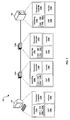
- FIG. 1 is a diagram of an exemplary network in accordance with an embodiment of the invention.
- FIG. 2A is a diagram illustrating discovery and configuration of a network path utilizing end-to-end messages, in accordance with an embodiment of the invention.
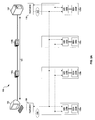
- FIG. 2B illustrates configuration and/or management of energy efficient parameters along a network path utilizing a plurality of point-to-point messages, in accordance with an embodiment of the invention.
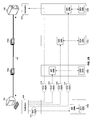
- FIG. 2C illustrates configuration and/or management of energy efficient parameters along a network path utilizing cascaded messages, in accordance with an embodiment of the invention.
- FIG. 3 is a flowchart illustrating end-to-end configuration and/or management of energy efficient networking (EEN) parameters, in accordance with an embodiment of the invention.
- EEN energy efficient networking
- a path between two network nodes may be determined and one or more messages for configuring one or more energy efficient networking (EEN) parameters along the determined network path may be generated.
- the one or more messages may be communicated to the various nodes along the determined path.
- the one or more generated messages may comprise a distinct marking that may, upon detection by network nodes along the determined path, trigger configuration of the one or more EEN parameters within the one or more network nodes.
- the one or more messages may comprise one or more fields defined by the IEEE 802.1Qat standard, and one or more fields that convey information for configuring EEN parameters along the determined path.
- the one or more messages may be communicated in accordance with the simple network management protocol (SNMP).
- the one or more messages may be communicated in accordance with logical link discovery protocol (LLDP) or other OSI layer 2 protocols.
- SNMP simple network management protocol
- LLDP logical link discovery protocol
- the path may be determined via communication of one or more packets along the path, where information identifying EEN capabilities of nodes along the determined path may be inserted by the network nodes along the determined path as the one or more packets traverse the determined path.
- the EEN parameters may be stored in a PHY of each of said network nodes along the determined path.
- the EEN parameters may be stored in devices associated with higher OSI layers.
- the one or more EEN parameters may be configured based on applications running on the first network node and/or applications running on the second network node.
- the network nodes may comprise end-systems such as computers, servers, and set-top-boxes.
- the network nodes may comprise intermediary nodes such as switches and routers.
- the one or more EEN parameters may be configured based on quality of service required for data to be communicated over the determined path.
- the one or more EEN parameters may be configured based on resource reservation packets communicated along the determined path.
- the one or more parameters may comprise a parameter that controls whether EEN is enabled or disabled in one or more of the network nodes.
- FIG. 1 is a diagram of an exemplary network in accordance with an embodiment of the invention.
- a network 100 comprising network nodes 102, 104a, 104b, and 106.
- the network node 102 may comprise an end-system such as, for example, a desktop computer, a laptop computer, a set-top-box, or a smart phone.
- the network nodes 104a and 104b may comprise, for example, gateways, routers, and/or switches.
- the network node 106 may comprise an end-system such as, for example, a mass storage device, a set-top-box, a mainframe computer, or a personal computer.
- Each of the network nodes 102, 104a, 104b, and 106 may comprise a corresponding one of networking subsystems 130a - 130d, a corresponding one of processors 132a - 132d, a corresponding one of digital signal processors (DSPs) 134a - 134d, and a corresponding one of memories 136a - 136d.
- DSPs digital signal processors
- the networking subsystems 130a - 130d may each comprise suitable logic, circuitry, interfaces, and/or code that may be operable to handle communication of information with other network nodes via one or more communication media such as copper and/or optical fiber.
- Each of the networking subsystems 130a - 130d may comprise, for example, a media access controller (MAC) and a physical layer transceiver (PHY).
- MAC media access controller
- PHY physical layer transceiver
- Each of the networking subsystems 130a - 130d may be operable to implement Ethernet protocols, such as those in the IEEE 802.3 standards, for example.
- the networking subsystems 130a - 130d may each be capable of communicating at one or more standard rates such as 10Mbps, 100Mbps, 1Gbps, 40Gbps, 10Gbps, and/or 100Gbps (e.g., 10GBASE-KX4 and/or 10GBASE-KR); and/or non-standard rates such as 2.5Gbps, 5Gbps, 6Gbps, and 20Gbps.
- the networking subsystems 130a - 130d may each be operable to communicate over multiple channels and/or over a serial interface.
- the networking subsystems 130a - 130d may each comprise a pluggable module. Exemplary form factors for the pluggable modules may comprise SFP, SFP+, XENPAK, X2, XFP and XPAK modules.
- the networking subsystems 130a - 130d may support transmission and/or reception at a high(er) data in one direction and transmission and/or reception at a low(er) data rate in the other direction.
- each of the networking subsystems 130a - 130d, or a PHY (not shown) within each of the networking subsystems 130a - 130d may be operable to implement one or more energy efficient techniques, which may be referred to generally as energy efficient networking (EEN), or in the specific case of Ethernet, as energy efficient Ethernet (EEE).
- the networking subsystems 130a - 130d may be operable to support low power idle (LPI) and/or sub-rating, also referred to as subset PHY, techniques.
- LPI may generally refer a family of techniques where, instead of transmitting conventional IDLE symbols during periods of inactivity, the networking subsystems 130a - 130d may remain silent and/or communicate signals other than conventional IDLE symbols.
- Sub-rating, or sub-set PHY may generally refer to a family of techniques where the PHYs are reconfigurable, in real-time or near real-time, to communicate at different data rates.
- the network node 102, the network nodes 104a and 104b, and/or the network node 106 may be operable to implement other energy saving features that may not be associated with networking functions.
- various aspects of the invention may be utilized in conjunction with other energy saving features.
- monitors and/or hard drives may be powered down at various times in order to save energy and aspects of the invention may be utilized to communicate and/or manage such functions.
- a network nodes' EEN control policy may, for example, control when the network node transitions into an energy saving state, when the device transitions out of an energy saving state, how much data the device may buffer while in an energy saving state, and control when one or more EEN techniques are enabled or disabled.
- each of the networking subsystems 130a - 130d, or PHYs therein may comprise a management information base (MIB) 120 and an EEN module 122 for implementing an EEN control policy.
- MIB management information base
- Each of the MIBs 120a - 120d may comprise suitable logic, circuitry, interfaces, and/or code that may be operable to store and/or manage one or more networking parameters.
- the network parameters may be utilized to control communications of the corresponding one of the networking subsystems 130a - 130d.
- Each of the EEN modules 122a - 122d may comprise suitable logic, circuitry, interfaces, and/or code that may be operable to implement, utilizing one or more EEN parameters stored in a corresponding on of the MIBs 120a - 120d, an EEN control policy.
- Parameters that may be stored in one or more of the MIBs 120a - 120d may comprise, for example, coefficients or other values for negotiating data rates of a network link and/or maintaining synchronization on the network link.
- various parameters associated with implementing EEN may be stored in the MIBs 120a - 120d.
- one or more of the parameters may determine and/or indicate whether EEN is enabled in a network node.
- each of a plurality of such parameters, or bits of such parameters may correspond to a particular port, or other portion of a network node. In this manner, EEN may be enabled and disabled on, for example, a port-by-port basis.
- Additional EEN parameters stored in or managed via the MIB 120a may comprise: a parameter that indicates EEN techniques (such as LPI and subset PHY) supported by the network node 102; a parameter that indicates subset PHY data rates supported by the network node 102; one or more networking parameters that indicate an amount of time required for the network node 102 to transition into one or more energy saving modes; one or more networking parameters that indicate an amount of time required for the network node 102 to transition out of one or more energy saving modes; a parameter that indicates whether the network node 102 is operating in an energy saving mode; a parameter that indicates whether an EEN transition or other event is scheduled to occur in the network node 102; an amount of time for which the network node 102 may operate in an energy-saving mode; one or more parameters that indicate latency that may be tolerated; one or more parameters that may be utilized to classify packets based on energy that may be utilized for routing and/or forwarding those packets; one or more parameters that may be utilized to classify packets based on Qo
- EEN may be controlled asymmetrically such that EEN parameters associated with uplink traffic may be different than EEN parameters associated with a downlink traffic. For example, EEN may be disabled in one direction along a path and enabled in the other direction along the same path.
- the DSPs 134a - 134d may comprise suitable logic, circuitry, interfaces, and/or code that may be operable to process and/or handle digital bitstreams.
- the DSPs may be operable to perform complex computations and/or algorithms to, for example, encrypt, decrypt, encode, and decode digital signals.
- the DSPs 134a - 134d may each process or handle packets and/or signals received from a corresponding one of the networking subsystems 130a - 130d.
- the DSPs 134a - 134d may each process or handle packets and/or signals to be provided to a corresponding one of the networking subsystems 130a - 130d for transmission.
- the DSPs 134a - 134d may also provide control and/or feedback information to the networking subsystems 130a - 130d based on received and/or to-be-transmitted packets or signals.
- the DSPs 134a - 134d may each communicate information and/or data to a corresponding one of the processors 132a - 132d and/or a corresponding one of the memories 136a - 136d.
- Information communicated from one of the DSPs 134a - 134d to a corresponding one of processors 132a - 132d may be extracted from, or generated based on, packets or signals received via a corresponding one of networking subsystems 130a - 130d.
- each the DSPs 134a - 134d may receive information from a corresponding one of the processors 132a - 132d and/or from a corresponding one of the memories 136a - 136d. Each of the DSPs 134a - 134d may process the information and convey the processed information to a corresponding one of the network subsystems 130a - 130d for transmission.
- Each of the memories 136a - 136d may comprise suitable logic, circuitry, interfaces, and/or code that may enable storage of data, code, and/or other information utilized by a corresponding one of the network nodes 102, the devices 104a and 104b, and the host 106.
- each of the memories 136a - 136d may be utilized for storing processed data generated by a corresponding one of the DSPs 134a - 134d and/or by a corresponding one of the processors 132a - 132d.
- the memories 136a - 136d may also be utilized to store information such as executable code and/or configuration information that may be utilized to control the operation of the network node 102, network nodes 104a and 104b, and the host 106.
- Such configuration information may, for example, comprise EEN parameters that may control implementation of one or more EEN techniques and/or policies.
- the processors 132a - 132d may comprise suitable logic, circuitry, interfaces, and/or code that may be operable to perform control and/or data processing operations within the network node 102, the networking devices 104a and 104b, and the host 106. Each of the processors 132a - 132d may be operable to control at least a portion of a corresponding one of the networking subsystems 130a - 130d, the DSPs 134a - 134d, and the memories 136a - 136d. The processors 132a - 132d may be operable to generate at least one signal for controlling operations within the network node 102, the networking devices 104a and 104b, and the host 106.
- the processors 132a - 132d may also be operable to execute applications that may be utilized by the network node 102, the networking devices 104a and 104b, and the host 106.
- the processors 132a - 132d may be operable to execute applications that may enable displaying and/or interacting with content received via the networking subsystems 130a - 130d.
- an EEN control policy of the network 100 may be utilized to optimize energy efficient and performance across the network 100.
- various components of the network 100 may exchange information, and may be configured based on the exchanged information, such that energy efficiency and performance are optimized.
- EEN parameters in the MIBs 120a - 120d may be managed via an exchange of messages between two or more of the network node 102, the networking devices 104a and 104b, and the host 106.
- EEN parameters values may be determined or configured based on applications running on the network node 102 and/or the host 106, and/or based on information to be exchanged between the network node 102 and the host 106.
- the EEN modules 122a may be configured based on applications running on the network node 102 and/or the host 106, and/or based on information to be exchanged between the network node 102 and the host 106. Management of the EEN parameters along a network path via messages generated by a network node may, for example, be utilized to enable and disable EEN along the path.
- aspects of the invention may enable configuring and/or exchanging the EEN control policies of the various nodes in the network 100. That is, aspects of the invention may also enable configuring and/or managing the EEN control policies that make use of the EEN parameters.
- FIG. 2A is a diagram illustrating discovery and configuration of a network path utilizing end-to-end messages, in accordance with an embodiment of the invention.
- FIG. 2A there is shown the network 100 described with respect to FIG. 1 .
- FIG 2A there may be applications 108 and 118 running, respectively, on the network node 102 and the host 106.
- the application 108 may generate messages 109 and send the messages 109 to the host 106.
- the messages 109 and 117 may enable determination of the path 101 traversed by the messages 109 and 117, determination of characteristics and/or capabilities of the path 101, and configuration of EEN parameters in the network node 102, the network nodes 104 and 104b, and the host 106.
- the network node 102 may generate a message 109 and send the message 109 to the host 106.
- the network node 102 and the networking devices 104a and 104b may insert or append information to the message 109.
- information appended and/or inserted by a network node may indicate whether the node supports EEN, and if so, which EEN techniques or protocols the node supports.
- the host 106 may receive the message 109 and utilize the information appended to the message 109 to determine the path 101 and/or characteristics, including EEN characteristics, of the path 101. Similarly, the host 106 may generate a message 117 and send the message 117 to the network node 102.
- the host 106 and the networking devices 104a and 104b may insert or append information to the message 117.
- information appended and/or inserted by a network node may indicate whether the node supports EEN, and if so, which EEN techniques or protocols the node supports.
- the network node 102 may receive the message 117 and utilize the information appended to the message 117 to determine the path 101 and/or characteristics, including EEN characteristics, of the path 101.
- the path 101 may be determined over time as packets are forwarded along the network. In another embodiment of the invention, the path 101 may be determined based on manual configuration by a network administrator. In this regard, a network administrator may program one or more tables or data structures into the nodes of the network 100. Accordingly, the applications 108 and 118 may reference such tables or data structures stored either locally in the network node 102 and/or in a remote network node when determining a path traversed by a datastream
- the path 101 may be determined based on information obtained from a centralized management entity or server.
- the network configuration or topology may be downloaded from such a management entity or server.
- FIG. 1 is described with regard to the path 101 between two network nodes, aspects of the invention may be utilized for any network path between any two network nodes that operate at OSI layer 2 or higher OSI layers.
- the application 108 may generate one or more messages 109 to configure one or more EEN parameters along the path 101.
- the application 118 may generate one or more messages 117 to configure one or more EEN parameters along the path 101.
- Configuring the EEN parameters may comprise, for example, enabling and/or disabling EEN along the path 101.
- the messages 109 and 117 may be distinctly marked. The marking may comprise, for example, a distinct Ethertype and/or frame format.
- a node along the path 101 may configure its EEN module 120 and/or its MIB 122 based on the information conveyed via the message 109 or 117.
- the messages the messages 109 and 117 may comprise fields defined by IEEE 802.1Qat - IEEE Standard for Local and Metropolitan Area Networks: Virtual Bridged Local Area Networks - Amendment 9: Stream Reservation Protocol (SRP). Additionally, the messages 109 and 117 may comprise one or more EEN fields for conveying EEN parameter values and/or other information for configuring EEN parameters along the path 101. In an exemplary embodiment of the invention, the EEN fields may be modifiable and/or expandable. For example, each node along the path 101 may append its EEN capabilities and/or a configuration of its EEN parameters to the EEN field(s) of the messages 109 and/or 117 prior to forwarding the messages 109 and/or 117.
- SRP Stream Reservation Protocol
- the messages 109 and/or 117 may accumulate path information as they propagate along the path 101 and, upon reaching an network node 102 or 108, such information may be extracted to determine the nodes of the path 101, the configuration of nodes along the path 101, and/or the capabilities of the nodes along the path 101.
- one or more messages 109 and/or 117 comprising IEEE 802.1Qat defined fields and EEN fields may be communicated to configure EEN parameters along the path 101.
- the messages 109 and 117 may configure EEN parameters along the path 101 in much the same manner as conventional SRP packets would reserve resources along the path 101. Details of a similar use of stream reservation protocol packets can be found in the above referenced United States Patent Application 12/015,671 filed on January 17, 2008 .
- EEN parameters along the path 101 may be configured based on available resources along the path 101 and reservations desired to be made along the path 101. In this regard, when a request to reserve resources along the path 101 is received, each node along the path 101 may determine if and/or how EEN may be implemented while honoring the reservation. For example, because various EEN techniques may increase latency along the path 101, EEN may be disabled along the path 101 in instances that resources along the path 101 are being reserved for traffic that requires low latency.
- EEN parameters may be configured based on quality of service parameters associated with data streams communicated along the path 101. Exemplary quality of service parameter comprise maximum tolerable latency, maximum tolerable packet jitter, minimum instantaneous data rate, minimum average data rate, maximum packet drop rate, and maximum bit-error rate.
- EEN parameters along the path 101 may be configured periodically or cyclically.
- EEN may periodically or cyclically be enabled and disabled in one or more nodes of the network path 101. That is, during a time interval, the one or more nodes may cycle in and out of an energy efficient state one or more times.
- FIG. 2A depicts a simplified network path
- aspects of the invention may be utilized with networks of any topology and/or with paths that traverse multiple networks.
- the messages 109 and 117 may be encapsulated in one or more protocol data units associated with one or more higher OSI layer protocols.
- FIG. 2B illustrates configuration and/or management of energy efficient parameters along a network path utilizing a plurality of point-to-point messages, in accordance with an embodiment of the invention. Referring to FIG. 2B , there is shown the network 100 described with respect to FIGS. 1 and 2A .
- the network node 102 may generate a plurality of EEN control messages 211-217 to configure EEN parameters in the devices along the network path 101.
- the network node 102 may generate a EEN control message for each node along the path 101.
- the messages 211-217 may be generated and/or communicated in adherence to a management protocol such as SNMP.
- FIG. 2B is described with regard to messages 211 - 217 being generated and communicated by the network node 102, the invention is not so limited. In this regard, messages such as the messages 211 - 217 may be generated and communicated by the host 106.
- the network nodes 104a and 104b may, in various embodiments of the invention, be operable to generate and communicate messages for configuring EEN parameters along the path 101.
- the network nodes 104a and 104b may desire or need to configure EEN parameters along the path 101 based on characteristics and/or conditions of other network paths (not shown) which the network nodes 104a and 104b are a part of.
- the network node 104a may be heavily loaded by a high priority data stream being communicated along a network path 250 (not shown) and thus EEN protocols and/or techniques that may be implemented by the network node 104a may be limited based on the traffic on path 250.
- FIG. 2B depicts a simplified network path
- aspects of the invention may be utilized with networks of any topology and/or with paths that traverse multiple networks.
- the one or more of the messages 211, 216, 215, 217, 219 may be encapsulated in one orm ore protocol data units associated with one or more high OSI layers.
- FIG. 2C illustrates configuration and/or management of energy efficient parameters along a network path utilizing cascaded messages, in accordance with an embodiment of the invention. Referring to FIG. 2C , there is shown the network 100 described with respect to FIGs. 1 , 2A , and 2B .
- the application 108 may generate a message 221 to configure EEN parameters in the MIB 120a of the network node 102.
- the EEN module 122a may generate a corresponding message 223 for configuring the next node in the path 101, which is network node 104a.
- the message 221 may be received in the network node 104a and parameters in the MIB 120b may be configured based on the message 223.
- the EEN module 122b may generate a corresponding message 225 for configuring the next node in the path 101, which is network node 104b.
- the message 225 may be received in the network node 104b and parameters in the MIB 120c may be configured based on the message 225.
- the EEN module 122c may generate a corresponding message 227 for configuring the next node in the path 101, which is host 106.
- the EEN module 122d may notify the application 118 of the new configuration.
- the application 108 may trigger cascaded messages for configuring EEN along the network path 101.
- the messages 221 - 229 may be, for example, physical layer signals and/or packetized data.
- the messages 221 - 229 may be communicated in accordance with LLDP or similar protocols.
- one or more type length value (TLV) fields for communicating EEN parameters may be defined and may be utilized for managing the EEN parameters and/or EEN control policies of the network nodes 102, 104a, 104b, and 106.
- TLV type length value
- FIG. 2C is described with reference to a configuration initiated by the network node 102, the invention is not so limited.
- the host 106 and/or the network nodes 104a and 104b may be operable to trigger a configuration of EEN parameters along the path 101.
- FIG. 2C depicts a simplified network connection
- aspects of the invention may be utilized with networks of any topology and/or with paths that traverse multiple networks.
- the one or more of the messages 211, 216, 215, 217, 219 may be encapsulated in one orm ore protocol data units associated with one or more high OSI layers.
- FIG. 3 is a flowchart illustrating end-to-end configuration and/or management of EEN parameters, in accordance with an embodiment of the invention.
- the exemplary steps may begin with step 302 when there is a datastream to be communicated between the application 108 and the application 118.
- the application 108 may request data from the application 118 and it may be desired to deliver the data in an energy efficient manner.
- the exemplary steps may advance to step 304.
- the network path 101 may be determined.
- AVB protocols and/or modified AVB protocols may be utilized to determine the network path.
- the network path 101 may be determined based on tables generated over time as packets are communicated in the network 100 and/or tables set up by a network administrator.
- the EEN capabilities and/or configuration of the nodes along the path may also be determined.
- the exemplary steps may advance to step 306.
- the application 108 and/or the application 118 may generate one or more message to configure, or trigger configuration, of EEN parameters along the path 101.
- the data requested from the application 118 by the application 108 may require low-latency, and thus may want to ensure that one or more EEN protocols do not delay transmission of the data along the path 101.
- the application 118 and/or the application 108 may generate one or more messages to disable EEN along the path 101.
- the generated messages may be similar to the messages 109 and 117 described with respect to FIG. 2A , the messages 211 - 217 described with respect to FIG 2B , and/or the message 221 described with respect to FIG. 2C . In this manner, configuration of the path 101 may occur as described with respect to one or more of FIGs. 2A - 2C .
- the exemplary steps may advance to step 308.
- step 308 the data may be communicated along the configured path 101.
- the communication of the data may be optimized with regard to performance and energy efficiency.
- a path 101 between two network nodes 102 and 106 may be determined and one or more messages 109 ( FIG. 2A ), 117 ( FIG. 2A ), 211 - 217 ( FIG. 2B ), and/or 221 - 229 ( FIG. 2C ) for configuring one or more (EEN) parameters along the determined network path 101 may be generated.
- the one or more messages 109, 117, 211 - 217, and/or 221 - 229 may be communicated to one or more of the nodes 102, 104a, 104b, and/or 106 along the determined path 101.
- the one or more generated messages 109, 117, 211 - 217, and/or 221 - 229 may comprise a distinct marking that may, upon detection by the network nodes 102, 104a, 104b, and/or 106, trigger configuration of the one or more EEN parameters within the one or more network nodes 102, 104a, 104b, and/or 106.
- the one or more messages 109, 117, 211 - 217, and/or 221 - 229 may comprise one or more fields defined by the IEEE 802.1Qat standard, and one or more fields that convey information for configuring EEN parameters along the determined path 101.
- the one or more messages may be communicated in accordance with a network management protocol, for example, the simple network management protocol (SNMP).
- the one or more messages may be communicated in accordance with logical link discovery protocol (LLDP) and may comprise one or more EEN TLVs.
- SNMP simple network management protocol
- LLDP logical link discovery protocol
- the path 101 may be determined via communication of one or more packets along the path, wherein information identifying EEN capabilities of the nodes 102, 104a, 104b, and/or 106 along the determined path 101 may be inserted by the network nodes 102, 104a, 104b, and/or 106 along the determined path 101 as the one or more packets traverse the determined path 101.
- the EEN parameters may be stored in a PHY of each of the network nodes 102, 104a, 104b, and/or 106 along the determined path 101.
- the one or more EEN parameters may be configured based on the application 108 running on the first network node 102 and/or the application 118 running on the second network node 106.
- the one or more EEN parameters may be configured based on quality of service required for data to be communicated over the determined path 101.
- the one or more EEN parameters may be configured based on resource reservation packets communicated along the determined path 101.
- the one or more parameters may comprise a parameter that controls whether EEN is enabled or disabled in one or more of the nodes 102, 104a, 104b, and/or 106.
- Another embodiment of the invention may provide a machine and/or computer readable storage and/or medium, having stored thereon, a machine code and/or a computer program having at least one code section executable by a machine and/or a computer, thereby causing the machine and/or computer to perform the steps as described herein for end-to-end management of energy efficient networking protocols.
- the present invention may be realized in hardware, software, or a combination of hardware and software.
- the present invention may be realized in a centralized fashion in at least one computer system, or in a distributed fashion where different elements are spread across several interconnected computer systems. Any kind of computer system or other apparatus adapted for carrying out the methods described herein is suited.
- a typical combination of hardware and software may be a general-purpose computer system with a computer program that, when being loaded and executed, controls the computer system such that it carries out the methods described herein.
- the present invention may also be embedded in a computer program product, which comprises all the features enabling the implementation of the methods described herein, and which when loaded in a computer system is able to carry out these methods.
- Computer program in the present context means any expression, in any language, code or notation, of a set of instructions intended to cause a system having an information processing capability to perform a particular function either directly or after either or both of the following: a) conversion to another language, code or notation; b) reproduction in a different material form.
Landscapes
- Engineering & Computer Science (AREA)
- Computer Networks & Wireless Communication (AREA)
- Signal Processing (AREA)
- Data Exchanges In Wide-Area Networks (AREA)
- Preparation Of Compounds By Using Micro-Organisms (AREA)
Abstract
Description
- This patent application makes reference to, claims priority to and claims benefit from United States Provisional Patent Application Serial No.
61/184,269 filed on June 4, 2009 - This patent application also makes reference to United States Patent Application
12/015,671 filed on Jan 17, 2008 - Each of the above stated applications is hereby incorporated herein by reference in its entirety.
- Certain embodiments of the invention relate to networking. More specifically, certain embodiments of the invention relate to a method and system for end-to-end management of energy efficient networking protocols.
- Communications networks and in particular Ethernet networks, are becoming an increasingly popular means of exchanging data of various types and sizes for a variety of applications. In this regard, Ethernet networks are increasingly being utilized to carry voice, data, and multimedia traffic. Accordingly more and more devices are being equipped to interface to Ethernet networks. Broadband connectivity including internet, cable, phone and VOIP offered by service providers has led to increased traffic and more recently, migration to Ethernet networking. Much of the demand for Ethernet connectivity is driven by a shift to electronic lifestyles involving desktop computers, laptop computers, and various handheld devices such as smart phones and PDA's. Applications such as search engines, reservation systems and video on demand that may be offered at all hours of a day and seven days a week, have become increasingly popular. As an increasing number of portable and/or handheld devices are enabled for Ethernet communications, battery life may be a concern when communicating over Ethernet networks. Accordingly, ways of reducing power consumption when communicating over electronic networks may be needed.
- Further limitations and disadvantages of conventional and traditional approaches will become apparent to one of skill in the art, through comparison of such systems with some aspects of the present invention as set forth in the remainder of the present application with reference to the drawings.
- A system and/or method is provided for end-to-end management of energy efficient networking protocols, substantially as shown in and/or described in connection with at least one of the figures, as set forth more completely in the claims.
- According to an aspect, a method for networking comprises:
- performing by one or more processors and/or circuits in a first network node:
- determining a path between said first network node and a second network node;
- generating one or more messages for configuring one or more energy efficient networking (EEN) parameters within network nodes along said determined path; and
- communicating said one or more generated messages over said determined path.
- Advantageously, said one or more generated messages comprise a distinct marking that, upon detection by said network nodes along said determined path, triggers configuration of said one or more EEN parameters within said one or more network nodes.
- Advantageously, said one or more messages comprise:
- fields defined by IEEE 802.1Qat; and
- one or more fields that convey information for configuring EEN parameters along said determined path.
- Advantageously, the method further comprises communicating said one or more messages utilizing simple network management protocol (SNMP).
- Advantageously, the method further comprises communicating said one or more messages utilizing logical link discovery protocol (LLDP).
- Advantageously, the method further comprises determining said path via communication of one or more packets along said determined path, wherein information identifying EEN capabilities of said network nodes along said determined path is inserted by said network nodes along said determined path as said one or more packets traverses said determined path.
- Advantageously, said EEN parameters are stored in a PHY of each of said network nodes along said determined path.
- Advantageously, said one or more EEN parameters are configured based on applications running on said first network node and/or applications running on said second network node.
- Advantageously, said one or more EEN parameters are configured based on quality of service required for data to be communicated over said determined path.
- Advantageously, the method further comprises configuring said one or more EEN parameters based on resource reservation packets communicated along said determined path.
- Advantageously, the method further comprises configuring one or more EEN parameters that enable and disable EEN.
- According to an aspect, a system for networking comprises:
- one or more processors and/or circuits for use in a network node, said one or more circuits being operable to:
- determine a path between a first network node and a second network node;
- generate one or more messages for configuring one or more energy efficient networking (EEN) parameters within each network node along said determined network path; and
- communicating said one or more generated messages over said determined path.
- Advantageously, said one or more generated messages comprise a distinct marking that, upon detection by said network nodes along said determined path, triggers configuration of said one or more EEN parameters within said one or more network nodes
- Advantageously, said one or more messages comprise:
- fields defined by IEEE 802.1Qat; and
- one or more fields that convey information for configuring EEN parameters along said determined path.
- Advantageously, said one or more circuits are operable to communicate said one or more messages utilizing simple network management protocol (SNMP).
- Advantageously, said one or more processors and/or circuits are operable to communicate said one or more messages in accordance with logical link discovery protocol (LLDP).
- Advantageously, said one or more processors and/or circuits are operable to determine said path via communication of one or more packets along said determined path, wherein information identifying EEN capabilities of said network nodes along said determined path is inserted by said network nodes along said determined path as said one or more packets traverses said determined path.
- Advantageously, said EEN parameters are stored in a PHY of each of said network nodes along said determined path.
- Advantageously, said one or more EEN parameters are configured based on applications running on said first network node and/or applications running on said second network node.
- Advantageously, said one or more EEN parameters are configured based on quality of service required for data to be communicated over said determined path.
- Advantageously, said one or more processors and/or circuits are operable to configure said one or more EEN parameters based on resource reservation packets communicated along said determined path.
- Advantageously, said EEN parameters control whether EEN is enabled or disabled.
- These and other advantages, aspects and novel features of the present invention, as well as details of an illustrated embodiment thereof, will be more fully understood from the following description and drawings.
-
FIG. 1 is a diagram of an exemplary network in accordance with an embodiment of the invention. -
FIG. 2A is a diagram illustrating discovery and configuration of a network path utilizing end-to-end messages, in accordance with an embodiment of the invention. -
FIG. 2B illustrates configuration and/or management of energy efficient parameters along a network path utilizing a plurality of point-to-point messages, in accordance with an embodiment of the invention. -
FIG. 2C illustrates configuration and/or management of energy efficient parameters along a network path utilizing cascaded messages, in accordance with an embodiment of the invention. -
FIG. 3 is a flowchart illustrating end-to-end configuration and/or management of energy efficient networking (EEN) parameters, in accordance with an embodiment of the invention. - Certain embodiments of the invention may be found in a method and system for end-to-end management of energy efficient networking protocols. In various embodiments of the invention, a path between two network nodes may be determined and one or more messages for configuring one or more energy efficient networking (EEN) parameters along the determined network path may be generated. The one or more messages may be communicated to the various nodes along the determined path. The one or more generated messages may comprise a distinct marking that may, upon detection by network nodes along the determined path, trigger configuration of the one or more EEN parameters within the one or more network nodes. The one or more messages may comprise one or more fields defined by the IEEE 802.1Qat standard, and one or more fields that convey information for configuring EEN parameters along the determined path. The one or more messages may be communicated in accordance with the simple network management protocol (SNMP). The one or more messages may be communicated in accordance with logical link discovery protocol (LLDP) or other OSI layer 2 protocols.
- The path may be determined via communication of one or more packets along the path, where information identifying EEN capabilities of nodes along the determined path may be inserted by the network nodes along the determined path as the one or more packets traverse the determined path. In some instances, the EEN parameters may be stored in a PHY of each of said network nodes along the determined path. In some instances, the EEN parameters may be stored in devices associated with higher OSI layers. The one or more EEN parameters may be configured based on applications running on the first network node and/or applications running on the second network node. The network nodes may comprise end-systems such as computers, servers, and set-top-boxes. The network nodes may comprise intermediary nodes such as switches and routers. The one or more EEN parameters may be configured based on quality of service required for data to be communicated over the determined path. The one or more EEN parameters may be configured based on resource reservation packets communicated along the determined path. The one or more parameters may comprise a parameter that controls whether EEN is enabled or disabled in one or more of the network nodes.
-
FIG. 1 is a diagram of an exemplary network in accordance with an embodiment of the invention. Referring toFIG. 1A there is shown anetwork 100 comprisingnetwork nodes network node 102 may comprise an end-system such as, for example, a desktop computer, a laptop computer, a set-top-box, or a smart phone. Thenetwork nodes network node 106 may comprise an end-system such as, for example, a mass storage device, a set-top-box, a mainframe computer, or a personal computer. Each of thenetwork nodes networking subsystems 130a - 130d, a corresponding one ofprocessors 132a - 132d, a corresponding one of digital signal processors (DSPs) 134a - 134d, and a corresponding one ofmemories 136a - 136d. - The
networking subsystems 130a - 130d may each comprise suitable logic, circuitry, interfaces, and/or code that may be operable to handle communication of information with other network nodes via one or more communication media such as copper and/or optical fiber. Each of thenetworking subsystems 130a - 130d may comprise, for example, a media access controller (MAC) and a physical layer transceiver (PHY). Each of thenetworking subsystems 130a - 130d may be operable to implement Ethernet protocols, such as those in the IEEE 802.3 standards, for example. Thenetworking subsystems 130a - 130d may each be capable of communicating at one or more standard rates such as 10Mbps, 100Mbps, 1Gbps, 40Gbps, 10Gbps, and/or 100Gbps (e.g., 10GBASE-KX4 and/or 10GBASE-KR); and/or non-standard rates such as 2.5Gbps, 5Gbps, 6Gbps, and 20Gbps. Thenetworking subsystems 130a - 130d may each be operable to communicate over multiple channels and/or over a serial interface. In some instances, thenetworking subsystems 130a - 130d may each comprise a pluggable module. Exemplary form factors for the pluggable modules may comprise SFP, SFP+, XENPAK, X2, XFP and XPAK modules. Also, thenetworking subsystems 130a - 130d may support transmission and/or reception at a high(er) data in one direction and transmission and/or reception at a low(er) data rate in the other direction. - Additionally, each of the
networking subsystems 130a - 130d, or a PHY (not shown) within each of thenetworking subsystems 130a - 130d, may be operable to implement one or more energy efficient techniques, which may be referred to generally as energy efficient networking (EEN), or in the specific case of Ethernet, as energy efficient Ethernet (EEE). For example, thenetworking subsystems 130a - 130d may be operable to support low power idle (LPI) and/or sub-rating, also referred to as subset PHY, techniques. LPI may generally refer a family of techniques where, instead of transmitting conventional IDLE symbols during periods of inactivity, thenetworking subsystems 130a - 130d may remain silent and/or communicate signals other than conventional IDLE symbols. Sub-rating, or sub-set PHY, may generally refer to a family of techniques where the PHYs are reconfigurable, in real-time or near real-time, to communicate at different data rates. - Furthermore, the
network node 102, thenetwork nodes network node 106 may be operable to implement other energy saving features that may not be associated with networking functions. In this regard, various aspects of the invention may be utilized in conjunction with other energy saving features. For example, monitors and/or hard drives may be powered down at various times in order to save energy and aspects of the invention may be utilized to communicate and/or manage such functions. - Algorithms, heuristics, or other factors that determine how the EEN techniques are utilized or implemented are referred to herein as the EEN control policy. In this regard, a network nodes' EEN control policy may, for example, control when the network node transitions into an energy saving state, when the device transitions out of an energy saving state, how much data the device may buffer while in an energy saving state, and control when one or more EEN techniques are enabled or disabled. Accordingly, each of the
networking subsystems 130a - 130d, or PHYs therein, may comprise a management information base (MIB) 120 and an EEN module 122 for implementing an EEN control policy. Each of theMIBs 120a - 120d may comprise suitable logic, circuitry, interfaces, and/or code that may be operable to store and/or manage one or more networking parameters. The network parameters may be utilized to control communications of the corresponding one of thenetworking subsystems 130a - 130d. Each of theEEN modules 122a - 122d may comprise suitable logic, circuitry, interfaces, and/or code that may be operable to implement, utilizing one or more EEN parameters stored in a corresponding on of theMIBs 120a - 120d, an EEN control policy. - Parameters that may be stored in one or more of the
MIBs 120a - 120d may comprise, for example, coefficients or other values for negotiating data rates of a network link and/or maintaining synchronization on the network link. Moreover, in various embodiments of the invention, various parameters associated with implementing EEN may be stored in theMIBs 120a - 120d. For example, one or more of the parameters may determine and/or indicate whether EEN is enabled in a network node. Furthermore, each of a plurality of such parameters, or bits of such parameters, may correspond to a particular port, or other portion of a network node. In this manner, EEN may be enabled and disabled on, for example, a port-by-port basis. - Additional EEN parameters stored in or managed via the MIB 120a may comprise: a parameter that indicates EEN techniques (such as LPI and subset PHY) supported by the network node 102; a parameter that indicates subset PHY data rates supported by the network node 102; one or more networking parameters that indicate an amount of time required for the network node 102 to transition into one or more energy saving modes; one or more networking parameters that indicate an amount of time required for the network node 102 to transition out of one or more energy saving modes; a parameter that indicates whether the network node 102 is operating in an energy saving mode; a parameter that indicates whether an EEN transition or other event is scheduled to occur in the network node 102; an amount of time for which the network node 102 may operate in an energy-saving mode; one or more parameters that indicate latency that may be tolerated; one or more parameters that may be utilized to classify packets based on energy that may be utilized for routing and/or forwarding those packets; one or more parameters that may be utilized to classify packets based on QoS required for those packets; one or more parameters that indicate which packets and/or traffic may wake a device from an energy-saving mode; one or more parameters that indicate which packets and/or traffic may put a device into an energy-saving mode; and parameters that determine how much data may be buffered while operating in an energy saving mode.
- In various embodiments of the invention, different parameters may be associated with different ports or connections of a network node. Similarly, multiple values of a parameter corresponding to multiple ports or connections may be stored in a network node. In this manner, EEN may be controlled asymmetrically such that EEN parameters associated with uplink traffic may be different than EEN parameters associated with a downlink traffic. For example, EEN may be disabled in one direction along a path and enabled in the other direction along the same path.
- The
DSPs 134a - 134d may comprise suitable logic, circuitry, interfaces, and/or code that may be operable to process and/or handle digital bitstreams. The DSPs may be operable to perform complex computations and/or algorithms to, for example, encrypt, decrypt, encode, and decode digital signals. In this regard, theDSPs 134a - 134d may each process or handle packets and/or signals received from a corresponding one of thenetworking subsystems 130a - 130d. Similarly, theDSPs 134a - 134d may each process or handle packets and/or signals to be provided to a corresponding one of thenetworking subsystems 130a - 130d for transmission. TheDSPs 134a - 134d may also provide control and/or feedback information to thenetworking subsystems 130a - 130d based on received and/or to-be-transmitted packets or signals. TheDSPs 134a - 134d may each communicate information and/or data to a corresponding one of theprocessors 132a - 132d and/or a corresponding one of thememories 136a - 136d. Information communicated from one of theDSPs 134a - 134d to a corresponding one ofprocessors 132a - 132d may be extracted from, or generated based on, packets or signals received via a corresponding one ofnetworking subsystems 130a - 130d. Moreover, each theDSPs 134a - 134d may receive information from a corresponding one of theprocessors 132a - 132d and/or from a corresponding one of thememories 136a - 136d. Each of theDSPs 134a - 134d may process the information and convey the processed information to a corresponding one of thenetwork subsystems 130a - 130d for transmission. - Each of the
memories 136a - 136d may comprise suitable logic, circuitry, interfaces, and/or code that may enable storage of data, code, and/or other information utilized by a corresponding one of thenetwork nodes 102, thedevices host 106. For example, each of thememories 136a - 136d may be utilized for storing processed data generated by a corresponding one of theDSPs 134a - 134d and/or by a corresponding one of theprocessors 132a - 132d. Thememories 136a - 136d may also be utilized to store information such as executable code and/or configuration information that may be utilized to control the operation of thenetwork node 102,network nodes host 106. Such configuration information may, for example, comprise EEN parameters that may control implementation of one or more EEN techniques and/or policies. - The
processors 132a - 132d may comprise suitable logic, circuitry, interfaces, and/or code that may be operable to perform control and/or data processing operations within thenetwork node 102, thenetworking devices host 106. Each of theprocessors 132a - 132d may be operable to control at least a portion of a corresponding one of thenetworking subsystems 130a - 130d, theDSPs 134a - 134d, and thememories 136a - 136d. Theprocessors 132a - 132d may be operable to generate at least one signal for controlling operations within thenetwork node 102, thenetworking devices host 106. Theprocessors 132a - 132d may also be operable to execute applications that may be utilized by thenetwork node 102, thenetworking devices host 106. For example, theprocessors 132a - 132d may be operable to execute applications that may enable displaying and/or interacting with content received via thenetworking subsystems 130a - 130d. - In operation, an EEN control policy of the
network 100 may be utilized to optimize energy efficient and performance across thenetwork 100. Accordingly, various components of thenetwork 100 may exchange information, and may be configured based on the exchanged information, such that energy efficiency and performance are optimized. In this regard, EEN parameters in theMIBs 120a - 120d may be managed via an exchange of messages between two or more of thenetwork node 102, thenetworking devices host 106. For example, EEN parameters values may be determined or configured based on applications running on thenetwork node 102 and/or thehost 106, and/or based on information to be exchanged between thenetwork node 102 and thehost 106. Similarly, theEEN modules 122a may be configured based on applications running on thenetwork node 102 and/or thehost 106, and/or based on information to be exchanged between thenetwork node 102 and thehost 106. Management of the EEN parameters along a network path via messages generated by a network node may, for example, be utilized to enable and disable EEN along the path. - Although, the configuration of the nodes is described with regard to configuring EEN parameters, the invention is not limited to configuration and/or management of the parameters. In this regard, aspects of the invention may enable configuring and/or exchanging the EEN control policies of the various nodes in the
network 100. That is, aspects of the invention may also enable configuring and/or managing the EEN control policies that make use of the EEN parameters. -
FIG. 2A is a diagram illustrating discovery and configuration of a network path utilizing end-to-end messages, in accordance with an embodiment of the invention. Referring toFIG. 2A , there is shown thenetwork 100 described with respect toFIG. 1 . InFIG 2A , there may beapplications network node 102 and thehost 106. - In operation, the
application 108 may generatemessages 109 and send themessages 109 to thehost 106. Themessages path 101 traversed by themessages path 101, and configuration of EEN parameters in thenetwork node 102, thenetwork nodes 104 and 104b, and thehost 106. - In an exemplary embodiment of the invention, the
network node 102 may generate amessage 109 and send themessage 109 to thehost 106. As themessage 109 traverses thepath 101, thenetwork node 102 and thenetworking devices message 109. In this regard, information appended and/or inserted by a network node may indicate whether the node supports EEN, and if so, which EEN techniques or protocols the node supports. Thehost 106 may receive themessage 109 and utilize the information appended to themessage 109 to determine thepath 101 and/or characteristics, including EEN characteristics, of thepath 101. Similarly, thehost 106 may generate amessage 117 and send themessage 117 to thenetwork node 102. As themessage 117 traverses thepath 101, thehost 106 and thenetworking devices message 117. In this regard, information appended and/or inserted by a network node may indicate whether the node supports EEN, and if so, which EEN techniques or protocols the node supports. Thenetwork node 102 may receive themessage 117 and utilize the information appended to themessage 117 to determine thepath 101 and/or characteristics, including EEN characteristics, of thepath 101. - In another embodiment of the invention, the
path 101 may be determined over time as packets are forwarded along the network. In another embodiment of the invention, thepath 101 may be determined based on manual configuration by a network administrator. In this regard, a network administrator may program one or more tables or data structures into the nodes of thenetwork 100. Accordingly, theapplications network node 102 and/or in a remote network node when determining a path traversed by a datastream - In another embodiment of the invention, the
path 101 may be determined based on information obtained from a centralized management entity or server. In this regard, the network configuration or topology may be downloaded from such a management entity or server. - Although
FIG. 1 is described with regard to thepath 101 between two network nodes, aspects of the invention may be utilized for any network path between any two network nodes that operate at OSI layer 2 or higher OSI layers. - Subsequent to determining the nodes along the
path 101, theapplication 108 may generate one ormore messages 109 to configure one or more EEN parameters along thepath 101. Similarly, theapplication 118 may generate one ormore messages 117 to configure one or more EEN parameters along thepath 101. Configuring the EEN parameters may comprise, for example, enabling and/or disabling EEN along thepath 101. In various embodiments of the invention, themessages marked message path 101 may configure its EEN module 120 and/or its MIB 122 based on the information conveyed via themessage - In various embodiments of the invention, the messages the
messages messages path 101. In an exemplary embodiment of the invention, the EEN fields may be modifiable and/or expandable. For example, each node along thepath 101 may append its EEN capabilities and/or a configuration of its EEN parameters to the EEN field(s) of themessages 109 and/or 117 prior to forwarding themessages 109 and/or 117. In this manner, themessages 109 and/or 117 may accumulate path information as they propagate along thepath 101 and, upon reaching annetwork node path 101, the configuration of nodes along thepath 101, and/or the capabilities of the nodes along thepath 101. - Additionally, after the
path 101, its configuration, and/or its capabilities are known, one ormore messages 109 and/or 117 comprising IEEE 802.1Qat defined fields and EEN fields may be communicated to configure EEN parameters along thepath 101. In this regard, themessages path 101 in much the same manner as conventional SRP packets would reserve resources along thepath 101. Details of a similar use of stream reservation protocol packets can be found in the above referenced United States Patent Application12/015,671 filed on January 17, 2008 - In some embodiments of the invention, EEN parameters along the
path 101 may be configured based on available resources along thepath 101 and reservations desired to be made along thepath 101. In this regard, when a request to reserve resources along thepath 101 is received, each node along thepath 101 may determine if and/or how EEN may be implemented while honoring the reservation. For example, because various EEN techniques may increase latency along thepath 101, EEN may be disabled along thepath 101 in instances that resources along thepath 101 are being reserved for traffic that requires low latency. In this regard, EEN parameters may be configured based on quality of service parameters associated with data streams communicated along thepath 101. Exemplary quality of service parameter comprise maximum tolerable latency, maximum tolerable packet jitter, minimum instantaneous data rate, minimum average data rate, maximum packet drop rate, and maximum bit-error rate. - In some embodiments of the invention, EEN parameters along the
path 101 may be configured periodically or cyclically. For example, EEN may periodically or cyclically be enabled and disabled in one or more nodes of thenetwork path 101. That is, during a time interval, the one or more nodes may cycle in and out of an energy efficient state one or more times. - Although
FIG. 2A depicts a simplified network path, aspects of the invention may be utilized with networks of any topology and/or with paths that traverse multiple networks. In this regard, in instances that the 109 and 117 cross one or more network boundaries, themessages -
FIG. 2B illustrates configuration and/or management of energy efficient parameters along a network path utilizing a plurality of point-to-point messages, in accordance with an embodiment of the invention. Referring toFIG. 2B , there is shown thenetwork 100 described with respect toFIGS. 1 and2A . - In operation, subsequent to determination of the
network path 101 between theapplication network node 102 may generate a plurality of EEN control messages 211-217 to configure EEN parameters in the devices along thenetwork path 101. In this regard, thenetwork node 102 may generate a EEN control message for each node along thepath 101. In an exemplary embodiment of the invention, the messages 211-217 may be generated and/or communicated in adherence to a management protocol such as SNMP. AlthoughFIG. 2B is described with regard to messages 211 - 217 being generated and communicated by thenetwork node 102, the invention is not so limited. In this regard, messages such as the messages 211 - 217 may be generated and communicated by thehost 106. Similarly, thenetwork nodes path 101. In this regard, thenetwork nodes path 101 based on characteristics and/or conditions of other network paths (not shown) which thenetwork nodes network node 104a may be heavily loaded by a high priority data stream being communicated along a network path 250 (not shown) and thus EEN protocols and/or techniques that may be implemented by thenetwork node 104a may be limited based on the traffic on path 250. - Although
FIG. 2B depicts a simplified network path, aspects of the invention may be utilized with networks of any topology and/or with paths that traverse multiple networks. In this regard, in instances that one or more of themessages messages -
FIG. 2C illustrates configuration and/or management of energy efficient parameters along a network path utilizing cascaded messages, in accordance with an embodiment of the invention. Referring toFIG. 2C , there is shown thenetwork 100 described with respect toFIGs. 1 ,2A , and2B . - In operation, the
application 108 may generate amessage 221 to configure EEN parameters in theMIB 120a of thenetwork node 102. In response to the configuration of theMIB 120a, theEEN module 122a may generate acorresponding message 223 for configuring the next node in thepath 101, which isnetwork node 104a. Themessage 221 may be received in thenetwork node 104a and parameters in theMIB 120b may be configured based on themessage 223. In response to the configuration of theMIB 120b, theEEN module 122b may generate acorresponding message 225 for configuring the next node in thepath 101, which isnetwork node 104b. Themessage 225 may be received in thenetwork node 104b and parameters in theMIB 120c may be configured based on themessage 225. In response to the configuration of theMIB 120c, theEEN module 122c may generate acorresponding message 227 for configuring the next node in thepath 101, which ishost 106. In response to the configuration ofMICB 120d, theEEN module 122d may notify theapplication 118 of the new configuration. - In this manner, the
application 108 may trigger cascaded messages for configuring EEN along thenetwork path 101. In various embodiments of the invention, the messages 221 - 229 may be, for example, physical layer signals and/or packetized data. In some embodiments of the invention the messages 221 - 229 may be communicated in accordance with LLDP or similar protocols. In this regard, one or more type length value (TLV) fields for communicating EEN parameters may be defined and may be utilized for managing the EEN parameters and/or EEN control policies of thenetwork nodes - Although
FIG. 2C is described with reference to a configuration initiated by thenetwork node 102, the invention is not so limited. In this regard, thehost 106 and/or thenetwork nodes path 101. - Although
FIG. 2C depicts a simplified network connection, aspects of the invention may be utilized with networks of any topology and/or with paths that traverse multiple networks. In this regard, in instances that one or more of themessages messages -
FIG. 3 is a flowchart illustrating end-to-end configuration and/or management of EEN parameters, in accordance with an embodiment of the invention. Referring toFIG. 3 , the exemplary steps may begin withstep 302 when there is a datastream to be communicated between theapplication 108 and theapplication 118. For example, theapplication 108 may request data from theapplication 118 and it may be desired to deliver the data in an energy efficient manner. Subsequent to step 302, the exemplary steps may advance to step 304. - In
step 304, thenetwork path 101, or a portion thereof, over which the data is to be communicated, from theapplication 118 to theapplication 108, may be determined. In an exemplary embodiment of the invention, AVB protocols and/or modified AVB protocols may be utilized to determine the network path. In another exemplary embodiment of the invention, thenetwork path 101 may be determined based on tables generated over time as packets are communicated in thenetwork 100 and/or tables set up by a network administrator. In addition to determining the path, the EEN capabilities and/or configuration of the nodes along the path may also be determined. Subsequent to step 304, the exemplary steps may advance to step 306. - In
step 306, theapplication 108 and/or theapplication 118 may generate one or more message to configure, or trigger configuration, of EEN parameters along thepath 101. For example, the data requested from theapplication 118 by theapplication 108 may require low-latency, and thus may want to ensure that one or more EEN protocols do not delay transmission of the data along thepath 101. Accordingly, theapplication 118 and/or theapplication 108 may generate one or more messages to disable EEN along thepath 101. The generated messages may be similar to themessages FIG. 2A , the messages 211 - 217 described with respect toFIG 2B , and/or themessage 221 described with respect toFIG. 2C . In this manner, configuration of thepath 101 may occur as described with respect to one or more ofFIGs. 2A - 2C . Subsequent to step 306, the exemplary steps may advance to step 308. - In
step 308, the data may be communicated along the configuredpath 101. In this regard, the communication of the data may be optimized with regard to performance and energy efficiency. - Aspects of a method and system for end-to-end management of energy efficient networking protocols are provided. In an exemplary embodiment of the invention, a
path 101 between twonetwork nodes FIG. 2A ), 117 (FIG. 2A ), 211 - 217 (FIG. 2B ), and/or 221 - 229 (FIG. 2C ) for configuring one or more (EEN) parameters along thedetermined network path 101 may be generated. The one ormore messages nodes determined path 101. The one or more generatedmessages network nodes more network nodes more messages determined path 101. The one or more messages may be communicated in accordance with a network management protocol, for example, the simple network management protocol (SNMP). The one or more messages may be communicated in accordance with logical link discovery protocol (LLDP) and may comprise one or more EEN TLVs. - The
path 101 may be determined via communication of one or more packets along the path, wherein information identifying EEN capabilities of thenodes determined path 101 may be inserted by thenetwork nodes determined path 101 as the one or more packets traverse thedetermined path 101. The EEN parameters may be stored in a PHY of each of thenetwork nodes determined path 101. The one or more EEN parameters may be configured based on theapplication 108 running on thefirst network node 102 and/or theapplication 118 running on thesecond network node 106. The one or more EEN parameters may be configured based on quality of service required for data to be communicated over thedetermined path 101. The one or more EEN parameters may be configured based on resource reservation packets communicated along thedetermined path 101. The one or more parameters may comprise a parameter that controls whether EEN is enabled or disabled in one or more of thenodes - Another embodiment of the invention may provide a machine and/or computer readable storage and/or medium, having stored thereon, a machine code and/or a computer program having at least one code section executable by a machine and/or a computer, thereby causing the machine and/or computer to perform the steps as described herein for end-to-end management of energy efficient networking protocols.
- Accordingly, the present invention may be realized in hardware, software, or a combination of hardware and software. The present invention may be realized in a centralized fashion in at least one computer system, or in a distributed fashion where different elements are spread across several interconnected computer systems. Any kind of computer system or other apparatus adapted for carrying out the methods described herein is suited. A typical combination of hardware and software may be a general-purpose computer system with a computer program that, when being loaded and executed, controls the computer system such that it carries out the methods described herein.
- The present invention may also be embedded in a computer program product, which comprises all the features enabling the implementation of the methods described herein, and which when loaded in a computer system is able to carry out these methods. Computer program in the present context means any expression, in any language, code or notation, of a set of instructions intended to cause a system having an information processing capability to perform a particular function either directly or after either or both of the following: a) conversion to another language, code or notation; b) reproduction in a different material form.
- While the present invention has been described with reference to certain embodiments, it will be understood by those skilled in the art that various changes may be made and equivalents may be substituted without departing from the scope of the present invention. In addition, many modifications may be made to adapt a particular situation or material to the teachings of the present invention without departing from its scope. Therefore, it is intended that the present invention not be limited to the particular embodiment disclosed, but that the present invention will include all embodiments falling within the scope of the appended claims.
Claims (15)
- A method for networking, the method comprising:performing by one or more processors and/or circuits in a first network node:determining a path between said first network node and a second network node;generating one or more messages for configuring one or more energy efficient networking (EEN) parameters within network nodes along said determined path; andcommunicating said one or more generated messages over said determined path.
- The method according to claim 1, wherein said one or more generated messages comprise a distinct marking that, upon detection by said network nodes along said determined path, triggers configuration of said one or more EEN parameters within said one or more network nodes.
- The method according to claim 1, wherein said one or more messages comprise:fields defined by IEEE 802.1Qat; andone or more fields that convey information for configuring EEN parameters along said determined path.
- The method according to claim 1, comprising communicating said one or more messages utilizing simple network management protocol (SNMP).
- The method according to claim 1, comprising communicating said one or more messages utilizing logical link discovery protocol (LLDP).
- The method according to claim 1, comprising determining said path via communication of one or more packets along said determined path, wherein information identifying EEN capabilities of said network nodes along said determined path is inserted by said network nodes along said determined path as said one or more packets traverses said determined path.
- The method according to claim 1, wherein said EEN parameters are stored in a PHY of each of said network nodes along said determined path.
- The method according to claim 1, wherein said one or more EEN parameters are configured based on applications running on said first network node and/or applications running on said second network node.
- The method according to claim 1, wherein said one or more EEN parameters are configured based on quality of service required for data to be communicated over said determined path.
- The method according to claim 1, comprising configuring said one or more EEN parameters based on resource reservation packets communicated along said determined path.
- The method according to claim 1, comprising configuring one or more EEN parameters that enable and disable EEN.
- A system for networking, the system comprising:one or more processors and/or circuits for use in a network node, said one or more circuits being operable to:determine a path between a first network node and a second network node;generate one or more messages for configuring one or more energy efficient networking (EEN) parameters within each network node along said determined network path; andcommunicating said one or more generated messages over said determined path.
- The system according to claim 12, wherein said one or more generated messages comprise a distinct marking that, upon detection by said network nodes along said determined path, triggers configuration of said one or more EEN parameters within said one or more network nodes
- The system according to claim 12, wherein said one or more messages comprise:fields defined by IEEE 802.1Qat; andone or more fields that convey information for configuring EEN parameters along said determined path.
- The system according to claim 12, wherein said one or more circuits are operable to communicate said one or more messages utilizing simple network management protocol (SNMP).
Applications Claiming Priority (2)
| Application Number | Priority Date | Filing Date | Title |
|---|---|---|---|
| US18426909P | 2009-06-04 | 2009-06-04 | |
| US12/571,208 US8619603B2 (en) | 2009-06-04 | 2009-09-30 | Method and system for end-to-end management of energy efficient networking protocols |
Publications (2)
| Publication Number | Publication Date |
|---|---|
| EP2259491A1 true EP2259491A1 (en) | 2010-12-08 |
| EP2259491B1 EP2259491B1 (en) | 2012-03-21 |
Family
ID=43297057
Family Applications (1)
| Application Number | Title | Priority Date | Filing Date |
|---|---|---|---|
| EP10005357A Active EP2259491B1 (en) | 2009-06-04 | 2010-05-21 | Method and system for end-to-end management of energy efficient networking protocols |
Country Status (5)
| Country | Link |
|---|---|
| US (2) | US8619603B2 (en) |
| EP (1) | EP2259491B1 (en) |
| CN (1) | CN101908973B (en) |
| AT (1) | ATE550845T1 (en) |
| TW (1) | TWI435571B (en) |
Cited By (1)
| Publication number | Priority date | Publication date | Assignee | Title |
|---|---|---|---|---|
| CN112187926A (en) * | 2013-03-28 | 2021-01-05 | 柏思科技有限公司 | Method and system for transmitting and receiving data packets via at least one end-to-end connection |
Families Citing this family (11)
| Publication number | Priority date | Publication date | Assignee | Title |
|---|---|---|---|---|
| US8619603B2 (en) * | 2009-06-04 | 2013-12-31 | Broadcom Corporation | Method and system for end-to-end management of energy efficient networking protocols |
| US20100312909A1 (en) * | 2009-06-08 | 2010-12-09 | Wael William Diab | Method and system for traffic based decisions for energy efficient networking |
| US8842574B2 (en) * | 2010-11-19 | 2014-09-23 | Marvell Israel (M.I.S.L) Ltd. | Energy efficient networking |
| US9007909B2 (en) * | 2011-03-09 | 2015-04-14 | International Business Machines Corporation | Link layer reservation of switch queue capacity |
| JP2013027991A (en) * | 2011-07-26 | 2013-02-07 | Konica Minolta Business Technologies Inc | Image processing apparatus, communication method and communication program using the same |
| US20130212413A1 (en) * | 2012-01-07 | 2013-08-15 | Acer Cloud Technology, Inc. | Cloud Remote Wakeup |
| TWI500292B (en) * | 2012-11-08 | 2015-09-11 | Realtek Semiconductor Corp | Energy efficient network communication device and method |
| US10567230B1 (en) | 2015-09-25 | 2020-02-18 | Juniper Networks, Inc. | Topology information for networks |
| US9755956B1 (en) * | 2015-11-16 | 2017-09-05 | Juniper Networks, Inc. | Signal characteristic information for networks |
| CN111162927B (en) * | 2018-11-08 | 2021-12-03 | 华为技术有限公司 | Communication method, device and equipment of Ethernet |
| CN109995591A (en) * | 2019-04-09 | 2019-07-09 | 苏州浪潮智能科技有限公司 | A kind of method and device of the link topology based on LLDP |
Citations (1)
| Publication number | Priority date | Publication date | Assignee | Title |
|---|---|---|---|---|
| EP2048825A1 (en) * | 2007-10-12 | 2009-04-15 | Broadcom Corporation | Method and system for managing an energy efficient network utilizing audio/video bridging |
Family Cites Families (30)
| Publication number | Priority date | Publication date | Assignee | Title |
|---|---|---|---|---|
| US6996630B1 (en) * | 1999-06-18 | 2006-02-07 | Mitsubishi Denki Kabushiki Kaisha | Integrated network system |
| US6795450B1 (en) * | 2000-09-28 | 2004-09-21 | Tdk Semiconductor Corporation | Method and apparatus for supporting physical layer link-suspend operation between network nodes |
| US7116682B1 (en) * | 2001-03-19 | 2006-10-03 | Cisco Technology, Inc. | Methods and apparatus for dynamic bandwidth adjustment |
| US7260106B2 (en) * | 2002-01-24 | 2007-08-21 | Intel Corporation | Method and apparatus for managing energy usage of processors while executing protocol state machines |
| GB0211764D0 (en) * | 2002-05-22 | 2002-07-03 | 3Com Corp | Automatic power saving facility for network devices |
| US7145876B2 (en) * | 2002-05-31 | 2006-12-05 | Motorola, Inc. | Method and apparatus incorporating adaptive datalink framing for message communication |
| US7003331B2 (en) * | 2002-06-26 | 2006-02-21 | Lenovo (Singapore) Pte. Ltd. | Apparatus, method and program to optimize battery life in a wireless device |
| US7457973B2 (en) * | 2003-06-20 | 2008-11-25 | Texas Instruments Incorporated | System and method for prioritizing data transmission and transmitting scheduled wake-up times to network stations based on downlink transmission duration |
| CN100544392C (en) * | 2003-10-28 | 2009-09-23 | Ut斯达康(中国)有限公司 | Method for Carrying Out Call Tracking in the Whole Network in Softswitch System |
| US7203849B2 (en) * | 2003-12-12 | 2007-04-10 | Hewlett-Packard Development Company, L.P. | Method and system for distributing power to networked devices |
| US7313712B2 (en) * | 2004-05-21 | 2007-12-25 | Intel Corporation | Link power saving state |
| US8046488B2 (en) * | 2004-05-21 | 2011-10-25 | Intel Corporation | Dynamically modulating link width |
| WO2007150051A1 (en) * | 2006-06-23 | 2007-12-27 | Olympus Communication Technology Of America, Inc. | System and method for power management |
| JP4851354B2 (en) * | 2007-02-01 | 2012-01-11 | アラクサラネットワークス株式会社 | Network setting information management system |
| EP2115954A2 (en) * | 2007-02-06 | 2009-11-11 | Entropic Communications Inc. | Parameterized quality of service architecture in a network |
| US7916676B2 (en) * | 2007-03-23 | 2011-03-29 | Broadcom Corporation | Method and system for holistic energy management in ethernet networks |
| US8589563B2 (en) * | 2007-07-10 | 2013-11-19 | Cisco Technology, Inc. | System, method, and apparatus for maintaining call state information for real-time call sessions |
| US8479028B2 (en) * | 2007-09-17 | 2013-07-02 | Intel Corporation | Techniques for communications based power management |
| JP5008138B2 (en) * | 2007-11-12 | 2012-08-22 | 株式会社リコー | Information processing apparatus, information processing method, program, and recording medium |
| US8619603B2 (en) * | 2009-06-04 | 2013-12-31 | Broadcom Corporation | Method and system for end-to-end management of energy efficient networking protocols |
| US8095610B2 (en) * | 2008-03-28 | 2012-01-10 | Time Warner Cable Inc. | Methods and apparatus for centralized and decentralized emergency alert messaging |
| US8234513B2 (en) * | 2008-09-17 | 2012-07-31 | International Business Machines Corporation | Power management method |
| US8107365B2 (en) * | 2008-11-24 | 2012-01-31 | Cisco Technology, Inc. | Interim PHY solution for LPI compatibility with legacy devices |
| KR101172886B1 (en) * | 2008-12-18 | 2012-08-10 | 아주대학교산학협력단 | Method for improving energy efficiency in wireless mesh networks |
| US8276010B2 (en) * | 2009-02-12 | 2012-09-25 | Cisco Technology, Inc. | Network based system to control and monitor power consumption of networked elements |
| US8214665B2 (en) * | 2009-03-12 | 2012-07-03 | Broadcom Corporation | Method and system for transmit queue management for energy efficient networking |
| US8201005B2 (en) * | 2009-03-17 | 2012-06-12 | Intel Corporation | Negotiating a transmit wake time |
| US8201006B2 (en) * | 2009-04-08 | 2012-06-12 | Cisco Technology, Inc. | Power consumption management in a network device |
| WO2010144002A1 (en) * | 2009-06-09 | 2010-12-16 | Telefonaktiebolaget L M Ericsson (Publ) | Power-saving functions in communications networks |
| US8930534B2 (en) * | 2009-07-24 | 2015-01-06 | Broadcom Corporation | Method and system for management based end-to-end sleep limitation in an energy efficient ethernet network |
-
2009
- 2009-09-30 US US12/571,208 patent/US8619603B2/en active Active
-
2010
- 2010-05-21 EP EP10005357A patent/EP2259491B1/en active Active
- 2010-05-21 AT AT10005357T patent/ATE550845T1/en active
- 2010-05-31 CN CN201010186886.5A patent/CN101908973B/en active Active
- 2010-06-02 TW TW099117743A patent/TWI435571B/en active
-
2013
- 2013-08-26 US US13/975,478 patent/US9225598B2/en active Active
Patent Citations (1)
| Publication number | Priority date | Publication date | Assignee | Title |
|---|---|---|---|---|
| EP2048825A1 (en) * | 2007-10-12 | 2009-04-15 | Broadcom Corporation | Method and system for managing an energy efficient network utilizing audio/video bridging |
Non-Patent Citations (5)
| Title |
|---|
| "IEEE Draft P803.3az / D1.0 - Draft Standard for Information technology Telecommunications and information exchange between systems - Local and metropolitan area networks - Specific requirements, Part 3: Carrier sense multiple access with Collision Detection /CSMA/CD) Access Method and Physical Layer", DRAFT AMENDMENT TO IEEE STD 802.3-2008 - IEEE 802.3AZ ENERGY EFFICIENT ETHERNET TASK FORCE,, no. IEEE P802.3AZ /D.0, 1 November 2008 (2008-11-01), pages 1 - 11, XP002572311, Retrieved from the Internet <URL:http://www.ieee802.org/3/az/> [retrieved on 20100309] * |
| BENNETT M ET AL: "Energy Efficient Ethernet", INTERNET CITATION, 16 July 2007 (2007-07-16), pages 1 - 70, XP002509615, Retrieved from the Internet <URL:http://www.ieee802.org/802_tutorials/july07/IEEE-tutorial-energy-effi cient-ethernet.pdf> [retrieved on 20081215] * |
| FRANCISCO BLANQUICET ET AL: "Managing energy use in a network with a new SNMP Power State MIB", 33RD IEEE CONFERENCE ON LOCAL COMPUTER NETWORKS (LCN 2008) - 14-17 OCT. 2008 - MONTREAL, QUE, CANADA, IEEE, PISCATAWAY, NJ, USA, 14 October 2008 (2008-10-14), pages 509 - 511, XP031355890, ISBN: 978-1-4244-2412-2 * |
| GEOFFREY M GARNER ET AL: "IEEE 802.1 AVB and Its Application in Carrier-Grade Ethernet [Standards Topics]", IEEE COMMUNICATIONS MAGAZINE, IEEE SERVICE CENTER, PISCATAWAY, US, vol. 45, no. 12, 1 December 2007 (2007-12-01), pages 126 - 134, XP011198459, ISSN: 0163-6804 * |
| TEENER M J: "Audio/Video Bridging got Home Networks (IEEE 802.1 AV Briding Task Group)", INTERNET CITATION, 1 June 2007 (2007-06-01), pages 1 - 35, XP002509617, Retrieved from the Internet <URL:http://www.ieee802.org/3/eee_study/public/jul07/teener_1_0707.pdf> [retrieved on 20081216] * |
Cited By (2)
| Publication number | Priority date | Publication date | Assignee | Title |
|---|---|---|---|---|
| CN112187926A (en) * | 2013-03-28 | 2021-01-05 | 柏思科技有限公司 | Method and system for transmitting and receiving data packets via at least one end-to-end connection |
| CN112187926B (en) * | 2013-03-28 | 2023-11-14 | 柏思科技有限公司 | Method and system for transmitting and receiving data packets over at least one end-to-end connection |
Also Published As
| Publication number | Publication date |
|---|---|
| TWI435571B (en) | 2014-04-21 |
| US9225598B2 (en) | 2015-12-29 |
| US8619603B2 (en) | 2013-12-31 |
| US20100309816A1 (en) | 2010-12-09 |
| US20130336163A1 (en) | 2013-12-19 |
| TW201114222A (en) | 2011-04-16 |
| ATE550845T1 (en) | 2012-04-15 |
| EP2259491B1 (en) | 2012-03-21 |
| HK1151653A1 (en) | 2012-02-03 |
| CN101908973B (en) | 2015-02-04 |
| CN101908973A (en) | 2010-12-08 |
Similar Documents
| Publication | Publication Date | Title |
|---|---|---|
| US8619603B2 (en) | Method and system for end-to-end management of energy efficient networking protocols | |
| EP2282589B1 (en) | Method and system for management based end-to-end sleep limitation in an energy efficient ethernet network | |
| US8195964B2 (en) | Method and system for energy efficient networking via packet inspection | |
| EP2184891B1 (en) | Method and system for low latency state transitions for energy efficiency | |
| KR101050119B1 (en) | Method and system for managing an energy efficient network using audio video bridging | |
| US8995289B2 (en) | Method and system for implementing energy efficient ethernet techniques in a MACSec enabled PHY | |
| KR101000987B1 (en) | Methods and systems for indicating changes in rate and / or power consumption using distinct physical patterns on one or more idle channel (s) | |
| US8462813B2 (en) | Method and system for asymmetric operation in a network node in an energy efficient network | |
| CN101409661B (en) | Method and system for managing energy efficient network utilizing audio video bridging | |
| US9014017B2 (en) | Method and system for associating physical link partners using a layer two mechanism | |
| US20100312909A1 (en) | Method and system for traffic based decisions for energy efficient networking | |
| US8395992B2 (en) | Method and system for negotiating multiple data rate transitions on an ethernet link | |
| US8214665B2 (en) | Method and system for transmit queue management for energy efficient networking | |
| HK1151653B (en) | A networking method and networking system | |
| EP2073437B1 (en) | Method and system for duty cycling portions of a network device based on aggregate throughput of the device | |
| HK1153875B (en) | A network method and system | |
| HK1131280A1 (en) | Method and system for managing power-saving network by audio-video bridge connection | |
| HK1131280B (en) | Method and system for managing power-saving network by audio-video bridge connection |
Legal Events
| Date | Code | Title | Description |
|---|---|---|---|
| PUAI | Public reference made under article 153(3) epc to a published international application that has entered the european phase |
Free format text: ORIGINAL CODE: 0009012 |
|
| 17P | Request for examination filed |
Effective date: 20100621 |
|
| AK | Designated contracting states |
Kind code of ref document: A1 Designated state(s): AL AT BE BG CH CY CZ DE DK EE ES FI FR GB GR HR HU IE IS IT LI LT LU LV MC MK MT NL NO PL PT RO SE SI SK SM TR |
|
| AX | Request for extension of the european patent |
Extension state: BA ME RS |
|
| GRAP | Despatch of communication of intention to grant a patent |
Free format text: ORIGINAL CODE: EPIDOSNIGR1 |
|
| RIC1 | Information provided on ipc code assigned before grant |
Ipc: H04L 12/24 20060101ALN20110907BHEP Ipc: H04L 12/46 20060101ALN20110907BHEP Ipc: H04L 12/12 20060101AFI20110907BHEP Ipc: H04L 12/10 20060101ALN20110907BHEP Ipc: H04L 12/40 20060101ALI20110907BHEP |
|
| GRAS | Grant fee paid |
Free format text: ORIGINAL CODE: EPIDOSNIGR3 |
|
| GRAA | (expected) grant |
Free format text: ORIGINAL CODE: 0009210 |
|
| AK | Designated contracting states |
Kind code of ref document: B1 Designated state(s): AL AT BE BG CH CY CZ DE DK EE ES FI FR GB GR HR HU IE IS IT LI LT LU LV MC MK MT NL NO PL PT RO SE SI SK SM TR |
|
| REG | Reference to a national code |
Ref country code: GB Ref legal event code: FG4D |
|
| REG | Reference to a national code |
Ref country code: CH Ref legal event code: EP |
|
| REG | Reference to a national code |
Ref country code: IE Ref legal event code: FG4D |
|
| REG | Reference to a national code |
Ref country code: AT Ref legal event code: REF Ref document number: 550845 Country of ref document: AT Kind code of ref document: T Effective date: 20120415 |
|
| REG | Reference to a national code |
Ref country code: DE Ref legal event code: R096 Ref document number: 602010001076 Country of ref document: DE Effective date: 20120516 |
|
| REG | Reference to a national code |
Ref country code: NL Ref legal event code: T3 |
|
| PG25 | Lapsed in a contracting state [announced via postgrant information from national office to epo] |
Ref country code: LT Free format text: LAPSE BECAUSE OF FAILURE TO SUBMIT A TRANSLATION OF THE DESCRIPTION OR TO PAY THE FEE WITHIN THE PRESCRIBED TIME-LIMIT Effective date: 20120321 Ref country code: HR Free format text: LAPSE BECAUSE OF FAILURE TO SUBMIT A TRANSLATION OF THE DESCRIPTION OR TO PAY THE FEE WITHIN THE PRESCRIBED TIME-LIMIT Effective date: 20120321 Ref country code: NO Free format text: LAPSE BECAUSE OF FAILURE TO SUBMIT A TRANSLATION OF THE DESCRIPTION OR TO PAY THE FEE WITHIN THE PRESCRIBED TIME-LIMIT Effective date: 20120621 |
|
| LTIE | Lt: invalidation of european patent or patent extension |
Effective date: 20120321 |
|
| PG25 | Lapsed in a contracting state [announced via postgrant information from national office to epo] |
Ref country code: GR Free format text: LAPSE BECAUSE OF FAILURE TO SUBMIT A TRANSLATION OF THE DESCRIPTION OR TO PAY THE FEE WITHIN THE PRESCRIBED TIME-LIMIT Effective date: 20120622 Ref country code: FI Free format text: LAPSE BECAUSE OF FAILURE TO SUBMIT A TRANSLATION OF THE DESCRIPTION OR TO PAY THE FEE WITHIN THE PRESCRIBED TIME-LIMIT Effective date: 20120321 Ref country code: LV Free format text: LAPSE BECAUSE OF FAILURE TO SUBMIT A TRANSLATION OF THE DESCRIPTION OR TO PAY THE FEE WITHIN THE PRESCRIBED TIME-LIMIT Effective date: 20120321 |
|
| REG | Reference to a national code |
Ref country code: AT Ref legal event code: MK05 Ref document number: 550845 Country of ref document: AT Kind code of ref document: T Effective date: 20120321 |
|
| PG25 | Lapsed in a contracting state [announced via postgrant information from national office to epo] |
Ref country code: CY Free format text: LAPSE BECAUSE OF FAILURE TO SUBMIT A TRANSLATION OF THE DESCRIPTION OR TO PAY THE FEE WITHIN THE PRESCRIBED TIME-LIMIT Effective date: 20120321 |
|
| PG25 | Lapsed in a contracting state [announced via postgrant information from national office to epo] |
Ref country code: SI Free format text: LAPSE BECAUSE OF FAILURE TO SUBMIT A TRANSLATION OF THE DESCRIPTION OR TO PAY THE FEE WITHIN THE PRESCRIBED TIME-LIMIT Effective date: 20120321 Ref country code: SE Free format text: LAPSE BECAUSE OF FAILURE TO SUBMIT A TRANSLATION OF THE DESCRIPTION OR TO PAY THE FEE WITHIN THE PRESCRIBED TIME-LIMIT Effective date: 20120321 Ref country code: BE Free format text: LAPSE BECAUSE OF FAILURE TO SUBMIT A TRANSLATION OF THE DESCRIPTION OR TO PAY THE FEE WITHIN THE PRESCRIBED TIME-LIMIT Effective date: 20120321 Ref country code: RO Free format text: LAPSE BECAUSE OF FAILURE TO SUBMIT A TRANSLATION OF THE DESCRIPTION OR TO PAY THE FEE WITHIN THE PRESCRIBED TIME-LIMIT Effective date: 20120321 Ref country code: IS Free format text: LAPSE BECAUSE OF FAILURE TO SUBMIT A TRANSLATION OF THE DESCRIPTION OR TO PAY THE FEE WITHIN THE PRESCRIBED TIME-LIMIT Effective date: 20120721 Ref country code: PL Free format text: LAPSE BECAUSE OF FAILURE TO SUBMIT A TRANSLATION OF THE DESCRIPTION OR TO PAY THE FEE WITHIN THE PRESCRIBED TIME-LIMIT Effective date: 20120321 Ref country code: CZ Free format text: LAPSE BECAUSE OF FAILURE TO SUBMIT A TRANSLATION OF THE DESCRIPTION OR TO PAY THE FEE WITHIN THE PRESCRIBED TIME-LIMIT Effective date: 20120321 Ref country code: EE Free format text: LAPSE BECAUSE OF FAILURE TO SUBMIT A TRANSLATION OF THE DESCRIPTION OR TO PAY THE FEE WITHIN THE PRESCRIBED TIME-LIMIT Effective date: 20120321 |
|
| PG25 | Lapsed in a contracting state [announced via postgrant information from national office to epo] |
Ref country code: SK Free format text: LAPSE BECAUSE OF FAILURE TO SUBMIT A TRANSLATION OF THE DESCRIPTION OR TO PAY THE FEE WITHIN THE PRESCRIBED TIME-LIMIT Effective date: 20120321 Ref country code: PT Free format text: LAPSE BECAUSE OF FAILURE TO SUBMIT A TRANSLATION OF THE DESCRIPTION OR TO PAY THE FEE WITHIN THE PRESCRIBED TIME-LIMIT Effective date: 20120723 |
|
| PG25 | Lapsed in a contracting state [announced via postgrant information from national office to epo] |
Ref country code: MC Free format text: LAPSE BECAUSE OF NON-PAYMENT OF DUE FEES Effective date: 20120531 |
|
| PLBE | No opposition filed within time limit |
Free format text: ORIGINAL CODE: 0009261 |
|
| STAA | Information on the status of an ep patent application or granted ep patent |
Free format text: STATUS: NO OPPOSITION FILED WITHIN TIME LIMIT |
|
| PG25 | Lapsed in a contracting state [announced via postgrant information from national office to epo] |
Ref country code: AT Free format text: LAPSE BECAUSE OF FAILURE TO SUBMIT A TRANSLATION OF THE DESCRIPTION OR TO PAY THE FEE WITHIN THE PRESCRIBED TIME-LIMIT Effective date: 20120321 Ref country code: DK Free format text: LAPSE BECAUSE OF FAILURE TO SUBMIT A TRANSLATION OF THE DESCRIPTION OR TO PAY THE FEE WITHIN THE PRESCRIBED TIME-LIMIT Effective date: 20120321 |
|
| 26N | No opposition filed |
Effective date: 20130102 |
|
| REG | Reference to a national code |
Ref country code: IE Ref legal event code: MM4A |
|
| PG25 | Lapsed in a contracting state [announced via postgrant information from national office to epo] |
Ref country code: MK Free format text: LAPSE BECAUSE OF FAILURE TO SUBMIT A TRANSLATION OF THE DESCRIPTION OR TO PAY THE FEE WITHIN THE PRESCRIBED TIME-LIMIT Effective date: 20120321 Ref country code: IT Free format text: LAPSE BECAUSE OF FAILURE TO SUBMIT A TRANSLATION OF THE DESCRIPTION OR TO PAY THE FEE WITHIN THE PRESCRIBED TIME-LIMIT Effective date: 20120321 |
|
| REG | Reference to a national code |
Ref country code: FR Ref legal event code: ST Effective date: 20130131 |
|
| REG | Reference to a national code |
Ref country code: DE Ref legal event code: R097 Ref document number: 602010001076 Country of ref document: DE Effective date: 20130102 |
|
| PG25 | Lapsed in a contracting state [announced via postgrant information from national office to epo] |
Ref country code: FR Free format text: LAPSE BECAUSE OF NON-PAYMENT OF DUE FEES Effective date: 20120531 Ref country code: IE Free format text: LAPSE BECAUSE OF NON-PAYMENT OF DUE FEES Effective date: 20120521 Ref country code: ES Free format text: LAPSE BECAUSE OF FAILURE TO SUBMIT A TRANSLATION OF THE DESCRIPTION OR TO PAY THE FEE WITHIN THE PRESCRIBED TIME-LIMIT Effective date: 20120702 |
|
| PG25 | Lapsed in a contracting state [announced via postgrant information from national office to epo] |
Ref country code: BG Free format text: LAPSE BECAUSE OF FAILURE TO SUBMIT A TRANSLATION OF THE DESCRIPTION OR TO PAY THE FEE WITHIN THE PRESCRIBED TIME-LIMIT Effective date: 20120621 Ref country code: MT Free format text: LAPSE BECAUSE OF FAILURE TO SUBMIT A TRANSLATION OF THE DESCRIPTION OR TO PAY THE FEE WITHIN THE PRESCRIBED TIME-LIMIT Effective date: 20120321 |
|
| PG25 | Lapsed in a contracting state [announced via postgrant information from national office to epo] |
Ref country code: AL Free format text: LAPSE BECAUSE OF FAILURE TO SUBMIT A TRANSLATION OF THE DESCRIPTION OR TO PAY THE FEE WITHIN THE PRESCRIBED TIME-LIMIT Effective date: 20120321 |
|
| PG25 | Lapsed in a contracting state [announced via postgrant information from national office to epo] |
Ref country code: TR Free format text: LAPSE BECAUSE OF FAILURE TO SUBMIT A TRANSLATION OF THE DESCRIPTION OR TO PAY THE FEE WITHIN THE PRESCRIBED TIME-LIMIT Effective date: 20120321 |
|
| PG25 | Lapsed in a contracting state [announced via postgrant information from national office to epo] |
Ref country code: LU Free format text: LAPSE BECAUSE OF NON-PAYMENT OF DUE FEES Effective date: 20120521 Ref country code: SM Free format text: LAPSE BECAUSE OF FAILURE TO SUBMIT A TRANSLATION OF THE DESCRIPTION OR TO PAY THE FEE WITHIN THE PRESCRIBED TIME-LIMIT Effective date: 20120321 |
|
| PG25 | Lapsed in a contracting state [announced via postgrant information from national office to epo] |
Ref country code: HU Free format text: LAPSE BECAUSE OF FAILURE TO SUBMIT A TRANSLATION OF THE DESCRIPTION OR TO PAY THE FEE WITHIN THE PRESCRIBED TIME-LIMIT Effective date: 20100521 |
|
| REG | Reference to a national code |
Ref country code: CH Ref legal event code: PL |
|
| GBPC | Gb: european patent ceased through non-payment of renewal fee |
Effective date: 20140521 |
|
| PG25 | Lapsed in a contracting state [announced via postgrant information from national office to epo] |
Ref country code: CH Free format text: LAPSE BECAUSE OF NON-PAYMENT OF DUE FEES Effective date: 20140531 Ref country code: LI Free format text: LAPSE BECAUSE OF NON-PAYMENT OF DUE FEES Effective date: 20140531 |
|
| PG25 | Lapsed in a contracting state [announced via postgrant information from national office to epo] |
Ref country code: GB Free format text: LAPSE BECAUSE OF NON-PAYMENT OF DUE FEES Effective date: 20140521 |
|
| PGFP | Annual fee paid to national office [announced via postgrant information from national office to epo] |
Ref country code: NL Payment date: 20160526 Year of fee payment: 7 |
|
| REG | Reference to a national code |
Ref country code: DE Ref legal event code: R082 Ref document number: 602010001076 Country of ref document: DE Representative=s name: BOSCH JEHLE PATENTANWALTSGESELLSCHAFT MBH, DE Ref country code: DE Ref legal event code: R081 Ref document number: 602010001076 Country of ref document: DE Owner name: AVAGO TECHNOLOGIES INTERNATIONAL SALES PTE. LT, SG Free format text: FORMER OWNER: BROADCOM CORPORATION, IRVINE, CALIF., US Ref country code: DE Ref legal event code: R081 Ref document number: 602010001076 Country of ref document: DE Owner name: AVAGO TECHNOLOGIES GENERAL IP (SINGAPORE) PTE., SG Free format text: FORMER OWNER: BROADCOM CORPORATION, IRVINE, CALIF., US |
|
| REG | Reference to a national code |
Ref country code: NL Ref legal event code: MM Effective date: 20170601 |
|
| PG25 | Lapsed in a contracting state [announced via postgrant information from national office to epo] |
Ref country code: NL Free format text: LAPSE BECAUSE OF NON-PAYMENT OF DUE FEES Effective date: 20170601 |
|
| REG | Reference to a national code |
Ref country code: DE Ref legal event code: R082 Ref document number: 602010001076 Country of ref document: DE Representative=s name: BOSCH JEHLE PATENTANWALTSGESELLSCHAFT MBH, DE Ref country code: DE Ref legal event code: R081 Ref document number: 602010001076 Country of ref document: DE Owner name: AVAGO TECHNOLOGIES INTERNATIONAL SALES PTE. LT, SG Free format text: FORMER OWNER: AVAGO TECHNOLOGIES GENERAL IP (SINGAPORE) PTE. LTD., SINGAPORE, SG |
|
| PGFP | Annual fee paid to national office [announced via postgrant information from national office to epo] |
Ref country code: DE Payment date: 20260511 Year of fee payment: 17 |