EP2259214A1 - Implementing a neural associative memory based on non-linear learning of discrete synapses - Google Patents
Implementing a neural associative memory based on non-linear learning of discrete synapses Download PDFInfo
- Publication number
- EP2259214A1 EP2259214A1 EP09179260A EP09179260A EP2259214A1 EP 2259214 A1 EP2259214 A1 EP 2259214A1 EP 09179260 A EP09179260 A EP 09179260A EP 09179260 A EP09179260 A EP 09179260A EP 2259214 A1 EP2259214 A1 EP 2259214A1
- Authority
- EP
- European Patent Office
- Prior art keywords
- synaptic
- neural
- pattern
- matrix
- synapses
- Prior art date
- Legal status (The legal status is an assumption and is not a legal conclusion. Google has not performed a legal analysis and makes no representation as to the accuracy of the status listed.)
- Granted
Links
Images








Classifications
-
- G—PHYSICS
- G06—COMPUTING OR CALCULATING; COUNTING
- G06N—COMPUTING ARRANGEMENTS BASED ON SPECIFIC COMPUTATIONAL MODELS
- G06N3/00—Computing arrangements based on biological models
- G06N3/02—Neural networks
- G06N3/04—Architecture, e.g. interconnection topology
- G06N3/044—Recurrent networks, e.g. Hopfield networks
- G06N3/0442—Recurrent networks, e.g. Hopfield networks characterised by memory or gating, e.g. long short-term memory [LSTM] or gated recurrent units [GRU]
-
- G—PHYSICS
- G06—COMPUTING OR CALCULATING; COUNTING
- G06N—COMPUTING ARRANGEMENTS BASED ON SPECIFIC COMPUTATIONAL MODELS
- G06N3/00—Computing arrangements based on biological models
- G06N3/02—Neural networks
- G06N3/08—Learning methods
-
- G—PHYSICS
- G06—COMPUTING OR CALCULATING; COUNTING
- G06N—COMPUTING ARRANGEMENTS BASED ON SPECIFIC COMPUTATIONAL MODELS
- G06N3/00—Computing arrangements based on biological models
- G06N3/02—Neural networks
- G06N3/04—Architecture, e.g. interconnection topology
- G06N3/044—Recurrent networks, e.g. Hopfield networks
-
- G—PHYSICS
- G06—COMPUTING OR CALCULATING; COUNTING
- G06N—COMPUTING ARRANGEMENTS BASED ON SPECIFIC COMPUTATIONAL MODELS
- G06N3/00—Computing arrangements based on biological models
- G06N3/02—Neural networks
- G06N3/04—Architecture, e.g. interconnection topology
- G06N3/0495—Quantised networks; Sparse networks; Compressed networks
-
- G—PHYSICS
- G06—COMPUTING OR CALCULATING; COUNTING
- G06N—COMPUTING ARRANGEMENTS BASED ON SPECIFIC COMPUTATIONAL MODELS
- G06N3/00—Computing arrangements based on biological models
- G06N3/02—Neural networks
- G06N3/04—Architecture, e.g. interconnection topology
- G06N3/0499—Feedforward networks
-
- G—PHYSICS
- G06—COMPUTING OR CALCULATING; COUNTING
- G06N—COMPUTING ARRANGEMENTS BASED ON SPECIFIC COMPUTATIONAL MODELS
- G06N3/00—Computing arrangements based on biological models
- G06N3/02—Neural networks
- G06N3/08—Learning methods
- G06N3/082—Learning methods modifying the architecture, e.g. adding, deleting or silencing nodes or connections
-
- G—PHYSICS
- G06—COMPUTING OR CALCULATING; COUNTING
- G06N—COMPUTING ARRANGEMENTS BASED ON SPECIFIC COMPUTATIONAL MODELS
- G06N3/00—Computing arrangements based on biological models
- G06N3/02—Neural networks
- G06N3/08—Learning methods
- G06N3/09—Supervised learning
Definitions
- This invention is in the field of machine learning and neural associative memory.
- the invention discloses a neural associative memory structure for storing and maintaining associations between memory address patterns and memory content patterns using a neural network, as well as methods for retrieving such associations.
- a method for a non-linear synaptic learning of discrete synapses is disclosed and its application on neural networks is laid out.
- the inventive neural associative memory structure can store associations between memory address patterns and memory content patterns in the neural network, i.e. in a network of neurons and synaptic connections, for example in a set of synaptic weights between the neurons and also other properties and values of the neural network.
- Neural networks are applicable in all areas where pattern (and/or sequence) recognition is needed to identify a specific patterns, situations or to process information derived from observations made by machinery such as robots, autonomous vehicles or systems designed to assist a human operators - especially where the complexity of the data or a task renders an implementation of functions by hand impractical.
- a neural network can generally be used to infer functions from observations as neural networks allow to work with no or only little a priori knowledge on the problem to be solved and also allows to provide for a failure tolerant behavior. Problems that may be addressed, may relate to system identification and control (vehicle control, process control), game-playing and decision making, machine vision and pattern recognition (facial recognition, object recognition, gesture recognition, speech recognition, (handwritten) character and text recognition), medical diagnosis, financial applications (automated trading systems), data mining (or knowledge discovery) and visualization.
- system identification and control vehicle control, process control
- game-playing and decision making machine vision and pattern recognition (facial recognition, object recognition, gesture recognition, speech recognition, (handwritten) character and text recognition), medical diagnosis, financial applications (automated trading systems), data mining (or knowledge discovery) and visualization.
- the neural associative memory structure accepts an input signal or input query pattern as a memory address pattern, which may be tainted with noise, and derives an output signal or output pattern that is identical or similar to the memory content pattern associated with the memory address pattern obtained from the input signal or input query pattern.
- the input signal or input query pattern may be accepted by one or more sensors, e.g. for visual or acoustic input. In the following, only the terms input query pattern and output pattern are used.
- the output pattern may be output through a software or hardware interface or may be transferred to another processing unit.
- the invention combines the advantages of neural networks with new non-linear learning principles. Computations and transformations required by this combination as well those necessary for maintaining, adjusting and training the neural network may be performed by a processing means such as one or more processors (CPUs), signal processing units or other calculation, processing or computational hardware and/or software, which might also be adapted for parallel processing. All the processing and computations may be performed on standard off the shelf hardware or specially designed hardware components.
- a processing means such as one or more processors (CPUs), signal processing units or other calculation, processing or computational hardware and/or software, which might also be adapted for parallel processing. All the processing and computations may be performed on standard off the shelf hardware or specially designed hardware components.
- Fig. 1 illustrates a memory task:
- M associations of memory address patterns u ⁇ and memory content patterns v ⁇ are stored in the associative memory device (AM).
- the AM is addressed with an input query pattern ⁇ typically resembling one of the previously stored memory address patterns u ⁇ 1 .
- the AM returns the retrieval result v ⁇ that should be similar to the associated memory content pattern v ⁇ 1 .
- an input query pattern u ⁇ entered in the associative memory can serve as address for accessing the associated pattern v ⁇ .
- the tasks performed by the two types of memory differ fundamentally. Random access is only defined for input query patterns that are valid addresses, that is, for the set of u patterns used during storage. The random access task consists of returning the data record at the addressed location (look-up).
- associative memories accept arbitrary input query patterns ⁇ and the computation of any particular output involves all stored data records rather than a single one.
- the associative memory task consists of comparing an input query pattern ⁇ with all stored addresses and returning an output pattern equal (or similar) to the pattern v ⁇ associated with the memory address pattern u ⁇ most similar to the input query pattern.
- the associative memory task includes the random access task but is not restricted to it. It also includes computations such as pattern completion, de-noising or data retrieval using incomplete cues.
- Neural associative memories are parallel implementations of associative memory in a network of neurons in which associations are stored in a set of synaptic weights W between neurons typically employing fast Hebbian-type learning methods (cf., e.g., J. Hertz, A. Krogh, and R.G. Palmer. Introduction to the theory of neural computation. Addison-Wesley, Redwood City, 1991 ), see Fig. 2 .
- Neural associative networks are closely related to Hebbian cell assemblies (cf., e.g., G. Palm. Neural Assemblies. An Alternative Approach to Artificial Intelligence. Springer, Berlin, 1982 ) and play an important role in neuroscience as models of neural computation for various brain structures, in particular for neocortex, hippocampus, and cerebellum.
- Fig. 2 illustrates a neuronal associative memory (NAM) considered by this invention. It is a two-layer neuronal network consisting of an address population u (size m) and a content population v (size n). All address neuron u i can make synaptic contacts with weight w ij onto content neuron v j .
- Memory associations are stored in the synaptic weights and firing thresholds of the network.
- Fig. 2 shows a hetero-associative memory. For identical u and v the network becomes an auto-associative memory with recurrent synaptic connections.
- neural associative memory Most previous realizations of two-layer neural associative memories can be assigned to one of the following three classes.
- the simplest model of neural associative memory is the so-called Steinbuch or Willshaw model with binary synapses and clipped Hebbian learning (cf., e.g., G. Palm and F. Sommer. Associative data storage and retrieval in neural nets.
- K. Steinbuch. Die Lernmatrix. Kybernetik, 1:36-45, 1961 A. Knoblauch, G. Palm, and F.T. Sommer. Memory capacities for synaptic and structural plasticity. Neural Computation, 2009. accepted).
- a single coincidence of pre-synaptic and postsynaptic activity is sufficient to increase the synaptic weight from 0 to 1, while further coincidences do not cause further changes.
- a Bayesian associative memory model is actually the general optimal memory system if performance is measured only by network storage capacity C defined as stored Shannon information per synapse, or output noise ⁇ defined as the normalized Hamming distance between retrieval output and original content pattern (cf., e.g., A. Knoblauch. Neural associative networks with optimal bayesian learning. HRI-EU Report. 09-02, Hyundai Research Institute Europe GmbH, D-63073 Offen-bach/Main, Germany, May 2009 ).
- the Bayesian memory system can perform much better than both Willshaw and linear networks.
- the Bayesian memory system is much more robust for "correlated" real-world memories violating the theoretical assumption of independently generated random patterns implicit in most previous works.
- the three models have almost the same asymptotic network storage capacity C as measured by the bits of information stored per synapse.
- the Willshaw model achieves 0.69 bits per synapse, however, only for very sparse memory patterns with a very low number k ⁇ log n of active units. For k » log n the network capacity C of the Willshaw model is near zero bits per synapse.
- the linear and Bayesian models can store up to 0.72 bits per synapse for moderately sparse patterns and still about 0.33 bits per synapse for non-sparse patterns (cf., e.g., A. Knoblauch. Neural associative networks with optimal bayesian learning. HRI-EU Report. 09-02, Hyundai Research Institute Europe GmbH, D-63073 Offenbach/Main, Germany, May 2009 ).
- synapses in the linear and Bayesian models have gradual weights and usually must be implemented using floating point variables, e.g., employing 16 bit or 32 bit per synapse.
- the information capacity C I of the linear and Bayesian models are near zero, whereas the synaptic capacity achieves similar values as C ⁇ 0.72.
- Such compression methods do not only minimize memory space but also retrieval time and energy requirements.
- the so-called pattern capacity M the maximal number of memories that can be stored and retrieved at good quality
- the memory address patterns are very sparse, k « m.
- the pattern capacity of the Willshaw network is about factor k smaller than for the linear and Bayesian models.
- the table of Fig. 3 shows a comparison of different associative memory (AM) models with respect to the following performance measures:
- the pattern capacity M measures the maximal number of stored memories.
- the network capacity C measures the maximal information a synapse can store in a structurally static network.
- the information capacity C I measures the maximally stored information per computer bit in a digitally compressed representation.
- the synaptic capacity C S measures the maximal information a synapse can store in a structurally plastic network assuming that irrelevant synapses can be pruned.
- the Linear AM achieves maximal M and C in the asymptotic limit of very large networks but only low C I and C S .
- the (excitatory) Willshaw AM has always low performance unless the memories are extremely sparse.
- the Inhibitory WAM has low M and C but achieves maximal C I and C S even for moderate sparseness.
- the novel Bayes AM achieves maximal M and C even for finite networks but only low C I and C S .
- the novel Zip AM achieves maximal or near maximal performance for all measures.
- the two-layer memory models can be used as building blocks to implement larger systems with a more complex hierarchical structure.
- some brain theories consider the brain as a complex network of interconnected associative memories (also see G. Palm. Neural Assemblies. An Alternative Approach to Artificial Intelligence. Springer, Berlin, 1982 ).
- For technical applications at least three layer networks are of interest because of well known limitations of two-layer networks (which cannot compute XOR functions, for example).
- One possible strategy is to map the memory address patterns u ⁇ into a high-dimensional space w and then associate the corresponding patterns w ⁇ with the content memories v ⁇ .
- the target of the invention hence is to disclose an efficient implementation of neural associative memory employing optimal non-linear learning methods and optimal threshold strategies.
- the invention therefore provides a neural associative memory structure for maintaining associations between memory address patterns and memory content patterns, the memory structure comprising a neural network consisting of a set of synapses and sets neurons, the synapses connecting neurons and storing the associations, an accepting means for accepting an input query pattern, a processing means for computing a matrix of synaptic potentials as a function of the memory address patterns and the memory content patterns, transforming the matrix of synaptic potentials into a matrix of synaptic weights, wherein each weight can be chosen from a finite set of synaptic strengths, optimizing the neural network with respect to a target architecture chosen for implementation, and computing for each neuron an optimal output function for minimizing output noise, and an output means for returning an output pattern to the input query pattern equal or similar to the memory content pattern associated with the memory address pattern equal or similar to the input query pattern.
- the accepting means can be at least one of a sensor, a hardware interface and a software interface.
- the processing means may be a processor and/or a signal processing unit formed of hardware and/or software.
- the processing means can be adapted for parallel processing.
- the output means can be at least one of a hardware interface, a software interface and an actor.
- the neural network may be optimized by application of compression mechanisms.
- the neural network can be optimized by skipping synapses with a predefined or zero weight in the optimization.
- the output noise can be defined the distance between the original content memory pattern and the output generated by the memory system, and parameters can be determined through the matrix of synaptic weights and a noise distribution describing how a query input pattern used for retrieval deviates from an original memory address pattern.
- the synaptic potentials may be computed as a linear sum of learning increments.
- the synaptic potentials can be computed corresponding to the weights of a Bayesian associative memory model.
- Synaptic potentials can be transformed into synaptic weights by applying synaptic thresholds yielding discrete synaptic strengths, wherein the synaptic thresholds are computed to minimize the expected number of component errors in the retrieval output are computed.
- the synaptic thresholds may be chosen such that each content neuron has the same set of matrix loads defined as an expected fraction of synapses with specified weights.
- the synaptic thresholds can be adapted homeostatically such that, at any time, each neuron has the same number of synapses with a predetermined weight.
- Discretization parameters may be chosen to maximize the signal-to-noise ratio and to maximize the number of storable patterns and/or stored information per synapse.
- the neural network can be structurally static.
- the discretization parameters may be obtained with respect to the synaptic strength and memory load.
- the discretization parameters can be chosen to maximize the information capacity of the neural network, wherein the capacity can be defined as the stored information per computer bit.
- the discretization parameters may be obtained with respect to the synaptic strength, the memory load, and information content of a discrete synaptic weight.
- the discretization parameters can be chosen to maximize the synaptic capacity, wherein the synaptic capacity can be defined as the stored information per non-silent synapse.
- the discretization parameters may be obtained with respect to the synaptic strength, the memory load and a total matrix load, wherein the total matrix load can be defined as the fraction of non-silent synapses.
- the neural network may be a structurally plastic network.
- a discrete synaptic weight matrix can be implemented by a set of binary matrices.
- synapses may have discrete weights, and each discrete weight can be calculated as a binary linear combination of values described by a binary bit vector.
- Each entry of the binary matrices can be defined as a binary weight, which may be active if the discrete weight is a linear combination of predetermined factors, and wherein the factor corresponding to the binary matrix considered is active.
- the invention also provides a method for retrieving a memory content pattern from the neural associative memory structure comprising the steps of accepting an input query pattern by an accepting means, using a neural network consisting of a set of synapses and a set of neurons, the synapses connecting neurons and storing the associations between memory address patterns and memory content patterns for retrieval of an output pattern, computing dendritic potentials from the input query pattern with a synaptic weight matrix by a processing means, computing an output pattern by a non-linear function of the dendritic potentials, parametrized by synaptic thresholds, and returning the output pattern to the input query pattern equal or similar to the memory content pattern associated with the memory address pattern equal or similar to the input query pattern through output means.
- the processing means may be used for computing a matrix of synaptic potentials as a function of the memory address patterns and the memory content patterns, transforming the matrix of synaptic potentials into a matrix of discrete synaptic weights, wherein each weight is chosen from a finite set of synaptic strength, optimizing the neural network with respect to a target architecture chosen for implementation, and computing for each neuron an optimal output function for minimizing the output noise.
- the dendritic potentials can be computed by a matrix multiplication of the query input pattern with the synaptic weight matrix, and the output pattern may be computed by applying synaptic thresholds to the dendritic potentials, where the synaptic thresholds are optimized for minimizing the expected number of component errors in the output pattern if a binary input query pattern is provided.
- the dendritic potentials may also be computed by a matrix multiplication of the input query pattern with the synaptic weight matrix, wherein a vector of synaptic thresholds can be subtracted, if parameters are such that not all resulting synaptic thresholds are zero or near zero, wherein the dendritic potentials can be normalized, and wherein the neurons with the largest dendritic potentials can be activated.
- the dendritic potentials can be computed for discrete synapses from the synaptic strength, matrices and the input query pattern.
- the matrix multiplications can be performed bit-parallel.
- the matrix multiplications can be efficiently parallelized, such that in each computation step several synapses may be processed in parallel.
- the invention provides a neural network structure used in the neural associative memory structure, wherein the neural network consisting of a set of synapses and a set of neurons, the synapses connecting neurons and storing the associations between memory address patterns and memory content patterns can be implemented on a parallel computational architecture with at least two processors, the processors being connected by a common bus.
- Each processor may store a column of a discrete synaptic weight matrix in its local memory, wherein active components of the input query patterns accepted by an accepting means are presented one after the other on the common bus to neurons implemented by the processors, and wherein the processors may add up corresponding synaptic weights in parallel, such that a retrieval requires only as many time steps as the number of neurons active for the input query pattern.
- the architecture may be a matrix like architecture, and the neurons may instantaneously add synaptic inputs such that retrieval takes only a single time step.
- u ⁇ is the ⁇ -th memory address pattern being a binary vector of size m.
- v ⁇ is the ⁇ -th memory content pattern being a binary vector of size n.
- the "one-shot” constraint restricts the set of possible learning methods. For example, gradient descent methods (as error-backpropagation) are not viable because they require repeated training of the whole pattern set. Instead it is straight-forward to use simple Hebbian-like learning rules:
- both the presynaptic and postsynaptic neurons are active then the synaptic weight must be increased.
- C S synaptic capacity
- C s : stored information #non - silent synapses bit / synapse .
- the target of the current invention is to build a memory system that can achieve high capacities C, C I , and C S at low output noise levels ⁇ . As shown below, this becomes possible for a non-linear learning procedure resulting in discrete synaptic weights.
- Memory address patterns u ⁇ have dimension m and memory content patterns v ⁇ dimension n.
- Information about the memory patterns are stored in the discrete synaptic weights w ij by non-linear learning. More specifically, the weight w ij of a synapse from address neuron i to content neuron j results from applying synaptic thresholds ⁇ j t to the synaptic potential a ij obtained by linear summing the learning increments R u i ⁇ ⁇ v j ⁇ .
- Fig. 5 exemplarily illustrates the discretization of synaptic strengths by non-linear threshold operations on the synaptic potentials a (see eq. 2).
- Optimal parameters p 1 t , s (t) can be found, for example, by maximizing eq. 13 (further information is provided below). Some optimal results are shown below (for further results see technical report A. Knoblauch. Zip nets: Neural associative networks with non-linear learning. Internal Report HRI-EU 09-03, Hyundai Research Institute Europe GmbH, D-63073 Offenbach/Main, Germany, June 2009 ).
- the network structure can be compressed.
- the table of Fig. 6 shows extended Golomb code for representing non-binary weight matrices.
- the run-length is defined as the number of zero-weights before the next non-zero weight occurs.
- codes the exact value of the non-zero weight for example ⁇ ⁇ 0, 1 ⁇ for ternary synapses where 0 may code the negative weight value -s (-1) and 1 may code the positive weight value s (1) . Similar is true for larger state numbers.
- ⁇ be an input query pattern of dimension m, typically resembling one of the memory address patterns u ⁇ .
- a ij ⁇ u ⁇ i v ⁇ j ⁇ 1 , x j ⁇ ⁇ j 0 , otherwise
- the retrieval takes only time t ret ⁇ zn min(p 1 ,1-p 1 ) where ⁇ is a (small) constant required for decompressing the weight matrix.
- the retrieval quality can be measured, for example, by the Hamming distance based output noise ⁇ as discussed above (see eq. 1).
- v j ⁇ 1) is the mean dendritic potential of a high-neuron being active in the memory v ⁇ to be reactivated.
- ⁇ lo : E x j
- v j ⁇ 0 is the mean dendritic potential of a low-unit being inactive in v ⁇ .
- ⁇ lo and ⁇ hi are the standard deviations of the dendritic potential distribution of a low-unit and high-unit, respectively.
- the SNR is a measure how well the dendritic potentials of a high-unit and low-unit are separated. In general, the better the separation the better the retrieval quality.
- the SNR r is equivalent to the output noise ⁇ , i.e., there is a bijective mapping between r and ⁇ (see app. A of the mentioned technical report). The following optimizations of the memory system rely actually on a maximization of the SNR r.
- optimality criterion can be fulfilled for many different combinations of the learning parameters r 1 , r 2 , r 3 , and r 4 ⁇
- the optimal firing thresholds can be computed from the means and variances of the dendritic potential distributions of low-units and high-units ( ⁇ lo , ⁇ hi , ⁇ lo 2 , ⁇ hi 2 ) .
- the average difference between a high-potential and low-potential is due to (small) deviations of the regional matrix loads p 1 , c , lo t , p 1 , c , hi t , p 1 , f , lo t , p 1 , f , hi t from the overall matrix loads p 1 t .
- the ⁇ -th memory address pattern u ⁇ contains k ⁇ one-entries and m - k ⁇ zero-entries.
- the noisy version ⁇ used for the query retrieval contains c correct one-entries and f false one-entries.
- the memory matrix W can be divided into four relevant regions with different memory loads p 1 , c , lo t , p 1 , c , hi t , p 1 , f , lo t , p 1 , f , hi t . These memory loads are required for estimating optimal firing thresholds.
- Linear approximations of the regional matrix loads are p 1 , c , lo t ⁇ ⁇ p 1 t - 1 - p ⁇ r 1 - r 2 ⁇ a , lo ⁇ g t - g t + 1 , t > 0 p 1 t + 1 - p ⁇ r 1 - r 2 ⁇ a , lo ⁇ g t - g t - 1 , t ⁇ 0 p 1 , c , hi t ⁇ ⁇ p 1 t + 1 - p ⁇ r 4 - r 3 ⁇ a , hi ⁇ g t - g t + 1 , t > 0 p 1 t - 1 - p ⁇ r 4 - r 3 ⁇ a , hi ⁇ g t - g t + 1 , t > 0 p 1 t - 1 -
- indices j are skipped for brevity.
- the optimal firing threshold ⁇ of neuron j depends on the unit usage M 1 (j).
- zip nets can optimize the discretization parameters in order to maximize storage capacities.
- the relevant storage capacities for zip nets are as follows (also see the mentioned technical report):
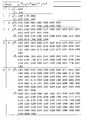
- Fig. 9 shows a table for optimal parameter sets for zip nets with discrete synapses as obtained from maximizing ⁇ with respect to matrix loads p 1 ⁇ t and synaptic strengths s ( ⁇ t) .
- the optimal parameters have been found by applying Matlab function "fminsearch" to the function - ⁇ given by eq.
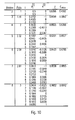
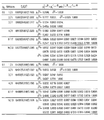
- Fig. 10 shows another table for optimal parameter sets for zip nets with discrete synapses.
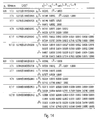
- Fig. 11 shows yet another table for optimal parameter sets for zip nets with discrete synapses.
- the results appear slightly better than in the table of Fig. 9 .
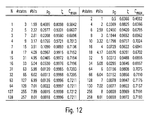
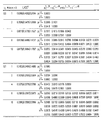
- Fig. 12 shows a further table for optimal parameter sets for zip nets with discrete synapses.
- Left columns display results for odd state number applying symmetric default parameters as described in the table of Fig. 11 .
- Right columns display results for even state number as described in the table of Fig. 10 . Note again that the results for large even state number are worse than for corresponding odd state number because of local minima and insufficient parameter initialization.
- Fig. 13 shows a table for optimal parameter sets p 1 t , s (t) for odd state number applying symmetric default parameters as described in the table of Fig. 11 .
- the data corresponds to left part of the table of Fig. 12 .
- synaptic potentials as defined and optimized as described above correspond to synaptic weights of a linear associative memory model. Since the linear associative network is suboptimal for finite network size, a good alternative is to use instead the optimal synaptic weights based on non-linear Bayesian learning (see also A. Knoblauch. Neural associative networks with optimal bayesian learning. HRI-EU Report. 09-02, Hyundai Research Institute Europe GmbH, D-63073 Offenbach/Main, Germany, May 2009 ).
- computing fixed synaptic thresholds only as a function of the unit usage M 1 may lead to inaccurate results, in particular if the Gaussian approximation of the synaptic potential distribution fails. The latter may happen, for example, in case the memory patterns are not generated at random.
- the synaptic thresholds ⁇ j t can be adapted in such a way that each content neuron has exactly p 1 t ⁇ m synapses with strength s (t) , where
- This is achieved by sorting the synaptic potentials in descending and ascending order for each content neuron j. For neuron j, let rankdesc(K) be the index of the address neuron with the K-th largest synaptic potential and, similarly, rankasc(K) is the index of the K-th smallest synaptic potential.
- rankdesc(K) is not unique (assuming t > 0), for example, if several synapses of neuron j have the same potential, this would mean that more than p 1 t ⁇ m synapses would obtain strength s (t) .
- Such a procedure requires that neuron j computes first ⁇ j N , then ⁇ j N - 1 , and so on. Similar is true for t ⁇ 0 when rankasc(K) is not unique.
- the potentials of excessive synapses have to be slightly increased assuming that one computes first ⁇ j - N , then ⁇ j - N + 1 , and so on.
- each content neuron has exactly p 1 t ⁇ m synapses with strength s (t) , and thus the standard deviations of dendritic potentials, ⁇ lo and ⁇ hi will be minimal.
- Numerical evaluations indicate that at the same time the mean potential difference ⁇ hi - ⁇ lo decreases, but inevitably to a lesser degree than the standard deviations. For this reason the SNR eq. 5 and thus the overall performance will improve (cf., e.g., A. Knoblauch. Zip nets: Neural associative networks with non-linear learning. Internal Report HRI-EU 09-03, Hyundai Research Institute Europe GmbH, D-63073 Offenbach/Main, Germany, June 2009 ).
- the synaptic thresholds may still be regulated by homeostatic mechanisms.
- ongoing background activity can provide a random stimulation.
- Recurrent inhibition can select the most excited neurons in a winners-take-all fashion.
- the winning neurons will increase their synaptic thresholds and thus decrease their future activity.
- all neurons will have approximately the same expected dendritic potential for a given random stimulus thus minimizing the variance of the low-potential distribution.
- the estimated optimal firing thresholds may be inaccurate. If the optimal firing thresholds are unknown then a simple strategy is to activate the 1 neurons with the highest dendritic potentials x j . Numerical experiments show that this winners-take-all activation can significantly reduce output noise ⁇ and increase storage capacity (cf., e.g., A. Knoblauch. Zip nets: Neural associative networks with non-linear learning. Internal Report HRI-EU 09-03, Hyundai Research Institute Europe GmbH, D-63073 Offenbach/Main, Germany, June 2009 ). In brain-like biological implementations the WTA mechanism can be realized by recurrent inhibition regulating the network activity to a desired level 1.
- the linear network requires zn (or even mn, cf., e.g., G. Palm and F. Sommer. Associative data storage and retrieval in neural nets. In E. Domany, J.L. van Hemmen, and K. Schulten, editors, Models of Neural Networks III, pages 79-118. Springer-Verlag, New York, 1996 ) additions of real-valued synaptic weights.
- zip nets are much faster and more energy efficient than the linear networks. This argument holds true both for computer implementations as well as for the brain where the energy consumption is dominated by the number of (non-zero) excitatory postsynaptic potentials corresponding to non-silent synapses (also see P. Lennie. The cost of cortical computation. Current Biology, 13:493-497, 2003 ).
- register w 1 contains the matrix row of W (or part of it, e.g., 64 components) corresponding to the i-th active neuron in ⁇ .
- register x 1 (i) will contain the lowest bits 0 of the sum up to the i-th active matrix row.
- register w 2 will contain the carry bits of these additions.
- registers x 2 (i-1) and x 2 (i) contain the second lowest bits 1 of the sums up to the i-1-th and i-th active matrix row, respectively, and so on.
- Fig. 17 pictures asymptotic storage capacities as functions of matrix load p 1 for binary zip nets (solid lines) and the Willshaw model (dashed lines).
- the left plot shows network capacity C and information capacity C I .
- the right plot shows C, C I and additionally the synaptic capacity C S employing logarithmic scales.
- the network capacity C measures bits of stored information per synapse. It is C ⁇ ⁇ /(2 In 2) ⁇ 0.46 for the zip net (eq. 14) and C ⁇ ld p 1 In(l - p1) ⁇ 0.69 for the Willshaw model (also see D.J. Willshaw, O.P. Buneman, and H.C. Longuet-Higgins. Non-holographic associative memory.
- the parallelization method for binary synapses as illustrated by Fig. 16 can be generalized to zip nets with a larger number of synaptic states.
- the discretized synapses may be further compressed depending on the implementation: (3a) For implementations on sequential digital computers the weight matrix can be compressed by applying a Huffman or Golomb-like coding procedure. This procedure is most useful if the synapses have low entropy, i.e., if most synapses have one particular weight value. (3b) For implementations on parallel VLSI hardware the synapses with zero weights can be pruned. This is most useful if the synaptic thresholds are chosen such that many synapses have actually weight zero.
- Fig. 18 illustrates a processing flow of the zip network:
- Upper part: Synaptic learning occurs in three steps: (1) Synaptic potentials a ij are determined by linear summation of the learning increments r 1 , r 2 , r 3 , r 4 selected by presynaptic memory activities u i ⁇ and postsynaptic memory activities v j ⁇ ( ⁇ 1, ..., M) as illustrated by Fig. 4 . (2) Discrete synaptic weights w ij ⁇ ⁇ s (1) , -s (-1) , s (2) , -s (-2) ,... ⁇ are determined by a non-linear threshold operation of synaptic potentials a ij .
- the zip neural associative memory system described in the previous sections are applied in a four-layer neural network for information retrieval which can generally be applied for efficient implementation of nearest neighbor search (see Fig. 19 ).
- this system is used for accelerating object recognition systems (see e.g., ( H. Wersing and E. Körner. Learning optimized features for hierarchical models of invariant object recognition. Neural Computation, 15:1559-1588, 2003 ; S. Hasler, H. Wersing, and E. Körner. A comparison of features in parts-based object recognition hierarchies. In J. Marques de Sa, L.A. Alexandre, W. Duch, and D.P.
- Fig. 19 pictures a four-layer system for information retrieval according to one embodiment of the invention.
- the system is basically identical to a system based on inhibitory associative memory (IAM) proposed in the previous patent application except that the IAM of the previous invention was replaced by the Zip Associative Memory (ZAM) of the current invention.
- IAM inhibitory associative memory
- ZAM Zip Associative Memory
- memory address patterns u ⁇ are mapped to (carefully chosen) index representations w 1 ⁇ via a ZAM which maps via an error-correcting compressed look-up-table (cLUT) to the memory content patterns v ⁇ .
- cLUT error-correcting compressed look-up-table
- Fig. 20 shows a block diagram of a system for visual object recognition using a Zip Associative Memory (ZAM) according to one embodiment of the invention.
- ZAM Zip Associative Memory
- images I ⁇ are preprocessed in a visual feature hierarchy.
- the resulting continuous valued feature vector u* ⁇ is binarized resulting in a binary address vector u ⁇ which is associated with the memory content or class label v ⁇ employing the four-layer-system described in Fig. 19 .
- a test image ⁇ ⁇ is processed in a similar way.
- the system (with ZAM replaced by an IAM) is described in detail in the previous patent application.
- potential applications include efficient implementations of clustering algorithms or self-organizing maps if the number of cluster prototypes is large and the prototype vectors are high-dimensional and moderately sparse.
- the database may consist of a large set of text documents, for example taken from the internet.
- Each text document consists of (possibly many) words and can be indexed by selecting a relatively small set of key words.
- the result is a sparse binary feature vector for each text document. Given a query consisting of a set of key words the task is to find the most relevant documents. This retrieval can be accelerated by the methods proposed here.
- a complementary idea is to represent the words in a text document by applying an N-gram code.
- the 1-grams (or monograms) of the “memory” are simply the letter “m”, “e”, “m”, “o”, “r”, “y”.
- the 2-grams (or digrams) are “me”, “em”, “mo”, “or”, “ry”, and the 3-grams are “mem”, “emo”, “mor”, “ory”.
- This method can be used, for example, to implement a fault-tolerant code for the keywords described in the previous item.
- the N-gram method can be used to code keyword order and key word sequences in a manner suitable for the associative memory models discussed in this application.
- the zipped neural networks and algorithms proposed in this application can be used for any application involving the best match or nearest-neighbor problem if the underlying pattern vectors are high-dimensional and (moderately) sparse.
Landscapes
- Engineering & Computer Science (AREA)
- Theoretical Computer Science (AREA)
- Physics & Mathematics (AREA)
- Data Mining & Analysis (AREA)
- General Health & Medical Sciences (AREA)
- Biomedical Technology (AREA)
- Biophysics (AREA)
- Computational Linguistics (AREA)
- Life Sciences & Earth Sciences (AREA)
- Evolutionary Computation (AREA)
- Artificial Intelligence (AREA)
- Molecular Biology (AREA)
- Computing Systems (AREA)
- General Engineering & Computer Science (AREA)
- General Physics & Mathematics (AREA)
- Mathematical Physics (AREA)
- Software Systems (AREA)
- Health & Medical Sciences (AREA)
- Image Analysis (AREA)
Abstract
Description
- This invention is in the field of machine learning and neural associative memory. In particular the invention discloses a neural associative memory structure for storing and maintaining associations between memory address patterns and memory content patterns using a neural network, as well as methods for retrieving such associations. A method for a non-linear synaptic learning of discrete synapses is disclosed and its application on neural networks is laid out.
- The inventive neural associative memory structure can store associations between memory address patterns and memory content patterns in the neural network, i.e. in a network of neurons and synaptic connections, for example in a set of synaptic weights between the neurons and also other properties and values of the neural network. Neural networks are applicable in all areas where pattern (and/or sequence) recognition is needed to identify a specific patterns, situations or to process information derived from observations made by machinery such as robots, autonomous vehicles or systems designed to assist a human operators - especially where the complexity of the data or a task renders an implementation of functions by hand impractical.
- A neural network can generally be used to infer functions from observations as neural networks allow to work with no or only little a priori knowledge on the problem to be solved and also allows to provide for a failure tolerant behavior. Problems that may be addressed, may relate to system identification and control (vehicle control, process control), game-playing and decision making, machine vision and pattern recognition (facial recognition, object recognition, gesture recognition, speech recognition, (handwritten) character and text recognition), medical diagnosis, financial applications (automated trading systems), data mining (or knowledge discovery) and visualization.
- Using the advantages of neural networks the neural associative memory structure accepts an input signal or input query pattern as a memory address pattern, which may be tainted with noise, and derives an output signal or output pattern that is identical or similar to the memory content pattern associated with the memory address pattern obtained from the input signal or input query pattern. The input signal or input query pattern may be accepted by one or more sensors, e.g. for visual or acoustic input. In the following, only the terms input query pattern and output pattern are used. The output pattern may be output through a software or hardware interface or may be transferred to another processing unit.
- The invention combines the advantages of neural networks with new non-linear learning principles. Computations and transformations required by this combination as well those necessary for maintaining, adjusting and training the neural network may be performed by a processing means such as one or more processors (CPUs), signal processing units or other calculation, processing or computational hardware and/or software, which might also be adapted for parallel processing. All the processing and computations may be performed on standard off the shelf hardware or specially designed hardware components.
- In the classical von Neumann computing architecture, computation and data storage is performed by separate modules, the central processing unit and the random access memory, respectively (cf., e.g., A.W. Burks, H.H. Goldstine, and J. von Neumann. Preliminary discussion of the logical design of an electronic computing instrument. Report 1946, U.S. Army Ordonance Department, 1946). A memory address sent to the random access memory gives access to the data content of one particular storage location. Associative memories are computing architectures in which computation and data storage is not separated (cf., e.g., T. Kohonen. Associative memory: a system theoretic approach. Springer, Berlin, 1977). For example, an associative memory can store a set of associations between pairs of (binary) patterns {(uµ → vµ): µ = 1,...,M} (see
Fig. 1 ). -
Fig. 1 illustrates a memory task: In the storage phase (upper part ofFig. 1 ), M associations of memory address patterns uµ and memory content patterns vµ are stored in the associative memory device (AM). In the retrieval phase (lower part ofFig. 1 ), the AM is addressed with an input query pattern ũ typically resembling one of the previously stored memory address patterns uµ1 . The AM returns the retrieval result v̂ that should be similar to the associated memory content pattern vµ1 . - Similar as in random access memory, an input query pattern uµ entered in the associative memory can serve as address for accessing the associated pattern vµ. However, the tasks performed by the two types of memory differ fundamentally. Random access is only defined for input query patterns that are valid addresses, that is, for the set of u patterns used during storage. The random access task consists of returning the data record at the addressed location (look-up).
- In contrast, associative memories accept arbitrary input query patterns ũ and the computation of any particular output involves all stored data records rather than a single one. Specifically, the associative memory task consists of comparing an input query pattern ũ with all stored addresses and returning an output pattern equal (or similar) to the pattern vµ associated with the memory address pattern uµ most similar to the input query pattern. Thus, the associative memory task includes the random access task but is not restricted to it. It also includes computations such as pattern completion, de-noising or data retrieval using incomplete cues.
- Neural associative memories are parallel implementations of associative memory in a network of neurons in which associations are stored in a set of synaptic weights W between neurons typically employing fast Hebbian-type learning methods (cf., e.g., J. Hertz, A. Krogh, and R.G. Palmer. Introduction to the theory of neural computation. Addison-Wesley, Redwood City, 1991), see
Fig. 2 . Neural associative networks are closely related to Hebbian cell assemblies (cf., e.g., G. Palm. Neural Assemblies. An Alternative Approach to Artificial Intelligence. Springer, Berlin, 1982) and play an important role in neuroscience as models of neural computation for various brain structures, in particular for neocortex, hippocampus, and cerebellum. -
Fig. 2 illustrates a neuronal associative memory (NAM) considered by this invention. It is a two-layer neuronal network consisting of an address population u (size m) and a content population v (size n). All address neuron ui can make synaptic contacts with weight wij onto content neuron vj. When addressing with an input query pattern ũ, a content neuron vj gets active if the dendritic potential
Fig. 2 shows a hetero-associative memory. For identical u and v the network becomes an auto-associative memory with recurrent synaptic connections. - Most previous realizations of two-layer neural associative memories can be assigned to one of the following three classes. The simplest model of neural associative memory is the so-called Steinbuch or Willshaw model with binary synapses and clipped Hebbian learning (cf., e.g., G. Palm and F. Sommer. Associative data storage and retrieval in neural nets. In E. Domany, J.L. van Hemmen, and K. Schulten, editors, Models of Neural Networks III, pages 79-118. Springer-Verlag, New York, 1996); K. Steinbuch. Die Lernmatrix. Kybernetik, 1:36-45, 1961; A. Knoblauch, G. Palm, and F.T. Sommer. Memory capacities for synaptic and structural plasticity. Neural Computation, 2009. accepted). Here a single coincidence of pre-synaptic and postsynaptic activity is sufficient to increase the synaptic weight from 0 to 1, while further coincidences do not cause further changes.
- In contrast, for linear learning models as investigated by (cf., e.g., J.J. Hopfield. Neural networks and physical systems with emergent collective computational abilities. Proceedings of the National Academy of Science, USA, 79:2554-2558, 1982; P. Dayan and D.J. Willshaw. Optimising synaptic learning rules in linear associative memory. Biological Cybernetics, 65:253-265, 1991; G. Palm and F. Sommer. Associative data storage and retrieval in neural nets. In E. Domany, J.L. van Hemmen, and K. Schulten, editors, Models of Neural Networks III, pages 79-118. Springer-Verlag, New York, 1996) the contributions of each pattern pair add linearly. For binary patterns the general learning rule can be described by four values α, β, γ, and δ specifying the weight increments for the pre-/
post-synaptic activations 0/0, 0/1, 1/0, and 1/1. - Finally, a Bayesian associative memory model is actually the general optimal memory system if performance is measured only by network storage capacity C defined as stored Shannon information per synapse, or output noise ε defined as the normalized Hamming distance between retrieval output and original content pattern (cf., e.g., A. Knoblauch. Neural associative networks with optimal bayesian learning. HRI-EU Report. 09-02, Honda Research Institute Europe GmbH, D-63073 Offen-bach/Main, Germany, May 2009). In particular, for finite sizes the Bayesian memory system can perform much better than both Willshaw and linear networks. Moreover, the Bayesian memory system is much more robust for "correlated" real-world memories violating the theoretical assumption of independently generated random patterns implicit in most previous works.
- The three models (Willshaw, linear, Bayes) have almost the same asymptotic network storage capacity C as measured by the bits of information stored per synapse. The Willshaw model achieves 0.69 bits per synapse, however, only for very sparse memory patterns with a very low number k ≈ log n of active units. For k » log n the network capacity C of the Willshaw model is near zero bits per synapse. In contrast, the linear and Bayesian models can store up to 0.72 bits per synapse for moderately sparse patterns and still about 0.33 bits per synapse for non-sparse patterns (cf., e.g., A. Knoblauch. Neural associative networks with optimal bayesian learning. HRI-EU Report. 09-02, Honda Research Institute Europe GmbH, D-63073 Offenbach/Main, Germany, May 2009).
- However, for implementations on digital computers it is more reasonable to evaluate performance by the information capacity CI defined by the stored Shannon information per bit of computer memory (see A. Knoblauch, G. Palm, and F.T. Sommer. Memory capacities for synaptic and structural plasticity. Neural Computation, 2009, accepted). Here the Willshaw model performs much better than the other two models because it employs binary synapses which can be realized with single memory bits. This is because the Willshaw model employs binary synapses which can be realized with single memory bits. Thus, the naive "uncompressed" Willshaw model can achieve an information capacity CI = C ≤ 0.69 equal to the network capacity C. In contrast, synapses in the linear and Bayesian models have gradual weights and usually must be implemented using floating point variables, e.g., employing 16 bit or 32 bit per synapse. Thus, for naive computer implementations, the information capacity CI of the linear and Bayesian models are near zero, whereas the synaptic capacity achieves similar values as C ≤ 0.72.
- In previous works (cf., e.g., A. Knoblauch. Optimal matrix compression
yields storage capacity 1 for binary Willshaw associative memory. In O. Kaynak, E. Alpaydin, E. Oja, and L. Xu, editors, Artificial Neural Networks and Neural Information Processing - ICANN/ICONIP 2003., LNCS 2714, pages 325-332. Springer Verlag, Berlin, 2003; A. Knoblauch. Neural associative memory and the Willshaw-Palm probability distribution. SIAM Journal on Applied Mathematics, 69(1):169-196, 2008) it was shown that, for a large parameter range, the weight matrix of the Willshaw model can be optimally compressed by Golomb coding (cf., e.g., S.W. Golomb. Run-length encodings. IEEE Transactions on Information Theory, 12:399-401, 1966) such that, asymptotically, it is possible to store CI = 1 bit of information per computer bit. Correspondingly, a parallel VLSI parallel hardware implementation (and also the brain) can store up to CS = ld n bits per synapse if the functionally irrelevant silent synapses are pruned. Such compression methods do not only minimize memory space but also retrieval time and energy requirements. Therefore such networks are used in a four-layer system for accelerating object recognition systems based on associative nearest neighbor search (cf., e.g., A. Knoblauch. On the computational benefits of inhibitory neural associative networks. HRI-EU Report 07-05, Honda Research Institute Europe GmbH, D-63073 Offenbach/Main, Germany, May 2007; A. Knoblauch. Best-match hashing with inhibitory associative networks for real-world object recognition. HRI-EU Report 08-05, Honda Research Institute Europe GmbH, 0-63073 Offenbach/Main, Germany, October 2008). - However, one serious limitation of the Willshaw model compared to the linear models is that the maximal number of memories that can be stored and retrieved at good quality (the so-called pattern capacity M) is relatively low unless the memory address patterns are very sparse, k « m. For example, if each address pattern has about k out of m and each
content memory 1 out of n active units the theory shows that the the linear and Bayesian models can store approximately M ∼ mn/l memories while the Willshaw Model reaches only about M ∼ mn/(kl). Thus, the pattern capacity of the Willshaw network is about factor k smaller than for the linear and Bayesian models. - The invention and a related technical report (cf. A. Knoblauch. Zip nets: Neural associative networks with non-linear learning. Internal Report HRI-EU 09-03, Honda Research Institute Europe GmbH, D-63073 Offenbach/Main, Germany, June 2009) describe a novel associative memory model called zip net that combines the strengths of the Willshaw, Bayesian, and linear associative networks. Zip networks implement non-linear learning by applying thresholds on the synaptic weights obtained from either linear or Bayesian learning. The resulting discrete (binary, ternary, etc.) weight matrix then can be compressed similarly as for the Willshaw model. It turns out that such memory systems can achieve the high theoretical bounds C ≤ 0.72, CI ≤ 1, CS ≤ ld n while maintaining the large pattern capacity M ∼ mn/l of the linear and Bayesian models. The performances of different models of neural associative memory are summarized by a table shown in
FIG. 3 . - The table of
Fig. 3 shows a comparison of different associative memory (AM) models with respect to the following performance measures: The pattern capacity M measures the maximal number of stored memories. The network capacity C measures the maximal information a synapse can store in a structurally static network. The information capacity CI measures the maximally stored information per computer bit in a digitally compressed representation. Finally, the synaptic capacity CS measures the maximal information a synapse can store in a structurally plastic network assuming that irrelevant synapses can be pruned. The Linear AM achieves maximal M and C in the asymptotic limit of very large networks but only low CI and CS. The (excitatory) Willshaw AM has always low performance unless the memories are extremely sparse. The Inhibitory WAM has low M and C but achieves maximal CI and CS even for moderate sparseness. The novel Bayes AM achieves maximal M and C even for finite networks but only low CI and CS. The novel Zip AM achieves maximal or near maximal performance for all measures. - Actually, the two-layer memory models can be used as building blocks to implement larger systems with a more complex hierarchical structure. For example, some brain theories consider the brain as a complex network of interconnected associative memories (also see G. Palm. Neural Assemblies. An Alternative Approach to Artificial Intelligence. Springer, Berlin, 1982). For technical applications at least three layer networks are of interest because of well known limitations of two-layer networks (which cannot compute XOR functions, for example). One possible strategy is to map the memory address patterns uµ into a high-dimensional space w and then associate the corresponding patterns wµ with the content memories vµ. By this procedure different contents vµ
1 and vµ2 can be associated with similar memoryaddress patterns u µ1 1≈uµ2 , and, thus, the problems of storing "correlated" memories and storing memories with broadly distributed pattern activities (as described above) become tractable. For example, Kanerva (see P. Kanerva. Sparse Distributed Memory. MIT Press, Cambridge, MA, 1988) describes a three layer system where, in the first stage, the address memories are de-correlated by a random projection. Similarly, in previous patent applicationEP 07 110 870 - The target of the invention hence is to disclose an efficient implementation of neural associative memory employing optimal non-linear learning methods and optimal threshold strategies.
- This object is achieved by means of the features of the independent claims. The dependent claims develop further the central idea of the invention.
- The invention therefore provides a neural associative memory structure for maintaining associations between memory address patterns and memory content patterns, the memory structure comprising a neural network consisting of a set of synapses and sets neurons, the synapses connecting neurons and storing the associations, an accepting means for accepting an input query pattern, a processing means for computing a matrix of synaptic potentials as a function of the memory address patterns and the memory content patterns, transforming the matrix of synaptic potentials into a matrix of synaptic weights, wherein each weight can be chosen from a finite set of synaptic strengths, optimizing the neural network with respect to a target architecture chosen for implementation, and computing for each neuron an optimal output function for minimizing output noise, and an output means for returning an output pattern to the input query pattern equal or similar to the memory content pattern associated with the memory address pattern equal or similar to the input query pattern.
- The accepting means can be at least one of a sensor, a hardware interface and a software interface.
- The processing means may be a processor and/or a signal processing unit formed of hardware and/or software.
- The processing means can be adapted for parallel processing.
- The output means can be at least one of a hardware interface, a software interface and an actor.
- The neural network may be optimized by application of compression mechanisms.
- The neural network can be optimized by skipping synapses with a predefined or zero weight in the optimization.
- In another aspect of the invention the output noise can be defined the distance between the original content memory pattern and the output generated by the memory system, and parameters can be determined through the matrix of synaptic weights and a noise distribution describing how a query input pattern used for retrieval deviates from an original memory address pattern.
- The synaptic potentials may be computed as a linear sum of learning increments.
- The synaptic potentials can be computed corresponding to the weights of a Bayesian associative memory model.
- Synaptic potentials can be transformed into synaptic weights by applying synaptic thresholds yielding discrete synaptic strengths, wherein the synaptic thresholds are computed to minimize the expected number of component errors in the retrieval output are computed.
- The synaptic thresholds may be chosen such that each content neuron has the same set of matrix loads defined as an expected fraction of synapses with specified weights.
- The synaptic thresholds can be adapted homeostatically such that, at any time, each neuron has the same number of synapses with a predetermined weight.
- Discretization parameters may be chosen to maximize the signal-to-noise ratio and to maximize the number of storable patterns and/or stored information per synapse.
- The neural network can be structurally static.
- The discretization parameters may be obtained with respect to the synaptic strength and memory load.
- The discretization parameters can be chosen to maximize the information capacity of the neural network, wherein the capacity can be defined as the stored information per computer bit.
- The discretization parameters may be obtained with respect to the synaptic strength, the memory load, and information content of a discrete synaptic weight.
- The discretization parameters can be chosen to maximize the synaptic capacity, wherein the synaptic capacity can be defined as the stored information per non-silent synapse.
- The discretization parameters may be obtained with respect to the synaptic strength, the memory load and a total matrix load, wherein the total matrix load can be defined as the fraction of non-silent synapses.
- The neural network may be a structurally plastic network.
- For a set of synapses a discrete synaptic weight matrix can be implemented by a set of binary matrices.
- Moreover, synapses may have discrete weights, and each discrete weight can be calculated as a binary linear combination of values described by a binary bit vector.
- Each entry of the binary matrices can be defined as a binary weight, which may be active if the discrete weight is a linear combination of predetermined factors, and wherein the factor corresponding to the binary matrix considered is active.
- The invention also provides a method for retrieving a memory content pattern from the neural associative memory structure comprising the steps of accepting an input query pattern by an accepting means, using a neural network consisting of a set of synapses and a set of neurons, the synapses connecting neurons and storing the associations between memory address patterns and memory content patterns for retrieval of an output pattern, computing dendritic potentials from the input query pattern with a synaptic weight matrix by a processing means, computing an output pattern by a non-linear function of the dendritic potentials, parametrized by synaptic thresholds, and returning the output pattern to the input query pattern equal or similar to the memory content pattern associated with the memory address pattern equal or similar to the input query pattern through output means.
- In another aspect of the invention, the processing means may be used for computing a matrix of synaptic potentials as a function of the memory address patterns and the memory content patterns, transforming the matrix of synaptic potentials into a matrix of discrete synaptic weights, wherein each weight is chosen from a finite set of synaptic strength, optimizing the neural network with respect to a target architecture chosen for implementation, and computing for each neuron an optimal output function for minimizing the output noise.
- The dendritic potentials can be computed by a matrix multiplication of the query input pattern with the synaptic weight matrix, and the output pattern may be computed by applying synaptic thresholds to the dendritic potentials, where the synaptic thresholds are optimized for minimizing the expected number of component errors in the output pattern if a binary input query pattern is provided.
- The dendritic potentials may also be computed by a matrix multiplication of the input query pattern with the synaptic weight matrix, wherein a vector of synaptic thresholds can be subtracted, if parameters are such that not all resulting synaptic thresholds are zero or near zero, wherein the dendritic potentials can be normalized, and wherein the neurons with the largest dendritic potentials can be activated.
- The dendritic potentials can be computed for discrete synapses from the synaptic strength, matrices and the input query pattern.
- The matrix multiplications can be performed bit-parallel.
- The matrix multiplications can be efficiently parallelized, such that in each computation step several synapses may be processed in parallel.
- In another aspect, the invention provides a neural network structure used in the neural associative memory structure, wherein the neural network consisting of a set of synapses and a set of neurons, the synapses connecting neurons and storing the associations between memory address patterns and memory content patterns can be implemented on a parallel computational architecture with at least two processors, the processors being connected by a common bus.
- Each processor may store a column of a discrete synaptic weight matrix in its local memory, wherein active components of the input query patterns accepted by an accepting means are presented one after the other on the common bus to neurons implemented by the processors, and wherein the processors may add up corresponding synaptic weights in parallel, such that a retrieval requires only as many time steps as the number of neurons active for the input query pattern.
- The architecture may be a matrix like architecture, and the neurons may instantaneously add synaptic inputs such that retrieval takes only a single time step.
-
- Fig. 1
- illustrates a storage phase and a re- trieval phase of a memory task.
- Fig. 2
- illustrates a neuronal associative mem- ory (NAM).
- Fig. 3
- shows a comparison table of different associative memory (AM) models.
- Fig. 4
- shows a specification of the learning rule.
- Fig. 5
- exemplarily illustrates a discretiza- tion of synaptic strengths.
- Fig. 6
- shows a table with extended Golomb code for representing non-binary weight matrices.
- Fig. 7
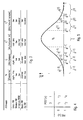
- illustrates a scenario defining region- al memory loads p1 (t) of the synaptic weight matrix as necessary for optimizing firing thresholds in order to minimize expected output noise level ε.
- Fig. 8
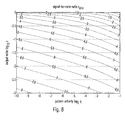
- displays a contour plot of the minimal signal-to-noise.
- Fig. 9
- shows a table for optimal parameter sets for zip nets with discrete synapses.
- Fig. 10
- shows another table for optimal parame- ter sets for zip nets with discrete syn- apses.
- Fig. 11
- shows yet another table for optimal pa- rameter sets for zip nets with discrete syn- apses.
- Fig. 12
- shows a further table for optimal para- meter sets for zip nets with discrete syn- apses.
- Fig. 13
- shows a table for optimal parameter sets s(t) for the odd state number apply- ing symmetric default parameters.
- Fig. 14
- shows a table for optimal parameter sets s(t) and corresponding zip variable ζ , network capacity C and synaptic capacity CS under the constraint of a constant small total matrix load p1.
- Fig. 15
- shows a table for optimal parameter sets s(t) and corresponding zip variable ζ , network capacity C and synaptic capacity CS under the constraint of positive synaptic
- Fig. 16
- strengths and a constant small total matrix load p1. shows illustrates a processing flow for the fast computation of dendritic poten- tials.
- Fig. 17
- pictures asymptotic storage capacities as functions of matrix load p1 for binary zip nets and the Willshaw model.
- Fig. 18
- illustrates a processing flow of the zip network.
- Fig. 19
- pictures a four-layer system for infor- mation retrieval.
- Fig. 20
- shows a block diagram of a system for object recognition using a Zip Associative Memory.
- Neural associative memory networks as considered by this invention are single layer neural networks or perceptrons with fast, typically "one-shot" learning corresponding to the storage of M discrete associations between pairs of binary pattern vectors {(uµ → vµ) : µ = 1,...,M}. Here uµ is the µ-th memory address pattern being a binary vector of size m. Similarly, vµ is the µ-th memory content pattern being a binary vector of size n. Further the pattern activities


- The "one-shot" constraint restricts the set of possible learning methods. For example, gradient descent methods (as error-backpropagation) are not viable because they require repeated training of the whole pattern set. Instead it is straight-forward to use simple Hebbian-like learning rules:
- If, during presentation of a single pattern pair, both the presynaptic and postsynaptic neurons are active then the synaptic weight must be increased.
- A commonly employed performance measure for neural associative memories is the network storage capacity C evaluating the stored information bits per synapse,

- A related performance measure is the output noise defined as the expected Hamming distance

content pattern activity 1,
- Thus, one possible goal pursued in many previous approaches was to maximize C and minimize ε. The related patent application mentioned above describes the implementation of an optimal associative memory that can indeed achieve maximal C and minimal ε.
- However, in another document (see A. Knoblauch, G. Palm, and F.T. Sommer. Memory capacities for synaptic and structural plasticity. Neural Computation, 2009. accepted) it is argued that, for implementations on digital computers, it may be more desirable to maximize the stored information per computer bit, This leads to the definition of information capacity CI,

which can behave quite differently than C if the synaptic weights wij have low entropy, e.g., if the synapses assume weights from a small set of discrete values. A further related measure interesting for VLSI hardware implementations is the synaptic capacity CS, which normalizes the stored information to the number of relevant non-silent synapses,
- Here the idea is that silent synapses (with zero weight) are actually functionally irrelevant and can simply be skipped. This is particularly important for VLSI parallel hardware implementations where costs are usually determined by the number of physical connections. Similar is true for the brain where the irrelevant synapses could be pruned by structural processes (see, e.g., A. Knoblauch. The role of structural plasticity and synaptic consolidation for memory and amnesia in a model of cortico-hippocampal interplay. In J. Mayor, N. Ruh, and K. Plunkett, editors, Connectionist Models of Behavior and Cognition II: Proceedings of the 11th Neural Computation and Psychology Workshop, pages 79-90, Singapore, 2009. World Scientific Publishing).
- In contrast to previous solutions, the target of the current invention is to build a memory system that can achieve high capacities C, CI , and CS at low output noise levels ε. As shown below, this becomes possible for a non-linear learning procedure resulting in discrete synaptic weights.
- The task is to store M associations between memory address patterns uµ and memory content patterns vµ where µ = 1 ... M. It may be assumed that all memory patterns are binary vectors. Memory address patterns uµ have dimension m and memory content patterns vµ dimension n. Information about the memory patterns are stored in the discrete synaptic weights wij by non-linear learning. More specifically, the weight wij of a synapse from address neuron i to content neuron j results from applying synaptic thresholds


- Since the memory patterns are binary the linear learning of the synaptic potentials can be described by four values r1 := R(0,0), r2 := R(1,0), r3 := R(0,1), and r4 := R(1,1) as illustrated by
Fig. 4 . -
Fig. 4 shows a specification of the learning rule R by four values r1 := R(0,0), r2 := R(1,0), r3 := R(0,1), and r4 := R(1,1). - For a discretization with an odd number of 2N +1 = 3, 5, 7, ... weight values s(t), the synaptic weights wij are given by

where the s(t) are non-negative numbers for t = ±1, ±2, ..., ±N specifying the synaptic strengths or weights. For a discretization with an even number of 2N = 2, 4, 6, ... weight values can be set, for example,
- For a given set of synaptic thresholds


and correspondingly p0 := 1 - p1 denotes the fraction of silent synapses. SeeFig. 5 for an illustration of the discretization procedure. -
Fig. 5 exemplarily illustrates the discretization of synaptic strengths by non-linear threshold operations on the synaptic potentials a (see eq. 2). Here a fraction


- In a further processing step the network structure can be compressed. For an optimal compression on a digital computer, for example, using Huffman or Golomb coding, the network will require only about mnI


- By this procedure the information capacity writes CI = C/I. In the mentioned technical report it is shown that the theoretical bound CI = 1 can be achieved for low entropy synapses with I → 0 or, equivalently, for p1 → 0. Here the appropriate compression method is Golomb's run-length encoding (cf., e.g., S.W. Golomb. Run-length encodings. IEEE Transactions on Information Theory, 12:399-401, 1966) where the so-called run-length is defined as the number of zero entries between two non-zero entries in the sparse weight matrix. A run-length encoding is used as illustrated by a Table shown in
Fig 6 . - The table of
Fig. 6 shows extended Golomb code for representing non-binary weight matrices. The code consists of the original Golomb codewords coding integer run-lengths for parameters= 2, 4, 8 concatenated with a weight code . Here the run-length is defined as the number of zero-weights before the next non-zero weight occurs. Then
 codes the exact value of the non-zero weight, for example
 ∈ {0, 1} for ternary synapses where 0 may code the negative weight value -s(-1) and 1 may code the positive weight value s(1). Similar is true for larger state numbers. A reasonable choice for the Golomb code parameter is
 = 2[ld(ln(g opt )/ln(1-p 1 ))] with gopt = 0.513 (cf., e.g., app. B in A. Knoblauch. On compressing the memory structures of binary neural associative networks. HRI-EU Report 06-02, Honda Research Institute Europe GmbH, 0-63073 Offenbach/Main, Germany, April 2006).
- For VLSI parallel hardware implementations it is appropriate to prune silent synapses. By this procedure the information capacity writes CS = C/p1. The mentioned technical report shows that, similarly as for CI, the theoretical bound CS = ld n can be achieved for low entropy synapses with p1 → 0.
- Let ũ be an input query pattern of dimension m, typically resembling one of the memory address patterns uµ. For one-step retrieval for each content neuron j the dendritic potential xj,


- For uncompressed weight matrix A, a retrieval requires tret = zn +n ≈ zn computation steps where z := |ũ| =

where γ is a (small) constant required for decompressing the weight matrix. - The retrieval quality can be measured, for example, by the Hamming distance based output noise ε as discussed above (see eq. 1). An alternative quality measure is the signal-to-noise ratio (SNR) defined as

where µhi := E(xj|

- It is important to optimize learning parameters r1, r2, r3, r4, and θj in order to maximize retrieval quality and storage capacity. The mentioned technical report describes the theoretical framework for this optimization. The following subsections present the results for implementing the optimal memory system.
- The synaptic thresholds θj should be chosen such that each content neuron j has the same expected columnar load


- We would like to optimize the learning parameters r1, r2, r3, r4 (see
Fig. 4 ) in order to obtain maximal SNR eq. 5. A theoretical analysis presented in the mentioned technical report shows that the SNR becomes maximal if the learning parameters satisfy the following optimality criterion
- Note that the optimality criterion can be fulfilled for many different combinations of the learning parameters r1, r2, r3, and r4· Examples for optimal learning rules are the
covariance rule 
and thehomosynaptic rule 
- Note that this result is in contrast to the linear learning model where the covariance rule is the unique optimum (cf., e.g., P. Dayan and D.J. Willshaw. Optimising synaptic learning rules in linear associative memory. Biological Cybernetics, 65:253-265, 1991; G. Palm and F. Sommer. Associative data storage and retrieval in neural nets. In E. Domany, J.L. van Hemmen, and K. Schulten, editors, Models of Neural Networks III, pages 79-118. Springer-Verlag, New York, 1996). Note also that employing the homosynaptic rule can reduce learning costs to only Mmnq computation steps compared to Mmn computation steps required for the covariance rule. This is a strong improvement, in particular for applications requiring sparse memory content patterns with q → 0 (also see A. Knoblauch. Best-match hashing with inhibitory associative networks for real-world object recognition. HRI-EU Report 08-05, Honda Research Institute Europe GmbH, 0-63073 Offenbach/Main, Germany, October 2008).
- For retrieval it is also important to optimize firing thresholds Θj in order to minimize expected output noise level ε. For large zp1(1-p1) » 1 the dendritic potentials are approximately Gaussian distributed (DeMoivre-Laplace theorem). Then the optimal firing thresholds can be computed from the means and variances of the dendritic potential distributions of low-units and high-units (µlo, µhi,

Fig. 7 . In fact, the average difference between a high-potential and low-potential is due to (small) deviations of the regional matrix loads


- In
Fig. 7 it is assumed that the µ-th memory address pattern uµ contains kµ one-entries and m - kµ zero-entries. The noisy version ũ used for the query retrieval contains c correct one-entries and f false one-entries. Then the memory matrix W can be divided into four relevant regions with differentmemory loads 
- Linear approximations of the regional matrix loads are


assuming Gc-1 (p1) /σa→ 0, where


- The variances are


- With


- Then the optimal firing threshold minimizing output noise ε (eq. 1) solves a quadratic equation having the solution (for details see appendix A in A. Knoblauch. Neural associative networks with incremental learning rules. HRI-EU Report 08-03, Honda Research Institute Europe GmbH, 0-63073 Offenbach/Main, Germany, May 2008)


where the optimal firing threshold is either Θ1 or Θ2. In practice the two standard deviations are often approximately equal. In this case, σlo = σhi, the optimal firing threshold is uniquely determined by
- Note that indices j are skipped for brevity. In fact, the optimal firing threshold Θ of neuron j depends on the unit usage M1(j).
-

- In our optimization so far the matrix load p1 is still a free parameter (and also the corresponding parameters

- 1) The pattern capacity defined as the maximal number of memories at output noise level ε is

With


Here ζ ≤ 1 is a function of the discretization parameters. The second variable β ≤ 1 depends on the input noise (first term) and the learning parameters r1, r2, r3, r4 (second term). The input noise term describes the memories' basins of attraction and assumes its maximum one for zero query noise (λ = 1, κ = 0). The second term assumes its maximum one for optimal learning parameters (e.g., covariance or homosynaptic rules) as described above. Finally, rmin(q, ε) is the minimal signal-to-noise ratio required to obtain output noise level ε for a memory content pattern activity q (cf.Fig. 8 ). After all, optimizing discretization parameters for maximal pattern capacity requires to maximize ζ.
Fig. 8 displays a contour plot of the minimal signal-to-noise ratio rmin required to achieve output noise level ε for memory content patterns having an average fraction q of active neurons. Note the logarithmic scales. - 2) The network capacity defined as the stored information per synapse (without network compression) is

where T is the transinformation (or mutual information) of a binary channel transmitting the memory content pattern components. It is (see also app. B in A. Knoblauch. Neural associative networks with optimal bayesian learning. HRI-EU Report. 09-02, Honda Research Institute Europe GmbH, D-63073 Offenbach/Main, Germany, May 2009)


Since Cε is essentially proportional to Mε, ζ has also to be maximized to obtain maximal network capacity. - 3) The information capacity for optimal compression of the weight matrix is defined as the stored information per computer bit,

where I is the Shannon information of a synaptic weight wij (see eq. 4). Thus, the optimal discretization for maximization of CI is obtained by maximizing ζ/I. - 4) The synaptic capacity for structural compression of the network is

where p1 is the total matrix load eq. 3. Thus, the optimal discretization for maximization of CS is obtained by maximizing ζ/P1. - The tables pictured in
Figs. 9-13 present optimal parameter sets maximizing ζ as required to obtain maximal Mε and Cε. These parameter sets have been computed by applying Matlab function "fminsearch" to the function -ζ given by eq. 13 (see below for more details). Parameter sets maximizing CI and CS can be found in a similar way, but depend on p1. That means, typically one would predefine the total matrix load p1 « 1 and then find optimal discretization parameters

Figs. 14 and15 show such parameter sets for p1 = 0.5, p1 = 0.1, p1 = 0.05, and p1 = 0.01. -
Fig. 9 shows a table for optimal parameter sets for zip nets with discrete synapses as obtained from maximizing ζ with respect tomatrix loads 

initial parameters 
-
Fig. 10 shows another table for optimal parameter sets for zip nets with discrete synapses. The table is similar to the table ofFig. 9 , but assuming


Fig. 9 , in particular for larger state numbers. For example, assuming 17 states yields only ζ = .9739 whereas the corresponding value in the table ofFig. 9 is ζ = 0.9913. -
Fig. 11 shows yet another table for optimal parameter sets for zip nets with discrete synapses. The table is similar to the table ofFig. 9 , but assuming symmetric "default" parameters with
Fig. 9 . -
Fig. 12 shows a further table for optimal parameter sets for zip nets with discrete synapses. Left columns display results for odd state number applying symmetric default parameters as described in the table ofFig. 11 . Right columns display results for even state number as described in the table ofFig. 10 . Note again that the results for large even state number are worse than for corresponding odd state number because of local minima and insufficient parameter initialization. -
Fig. 13 shows a table for optimal parameter sets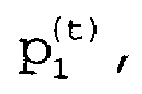
Fig. 11 . The data corresponds to left part of the table ofFig. 12 . -
Fig. 14 shows a table for optimal parameter sets

- Parameters are computed for odd state numbers applying symmetric default parameters similar as described in the table of
Fig. 11 . Note that performance gains by increasing the state number become smaller for smaller p1. Note also that the achievable synaptic capacities are smaller than for the Willshaw model which has CS =1.3863, 3.5000, 4.4337, 6.6773 for p1 =0.5, 0.1, 0.05, 0.01, respectively. -
Fig. 15 shows a table for optimal parameter sets

- In this section network variants based on the optimization principles described in the previous section are described. Although more difficult to analyze, numerical simulations described in the mentioned technical report indicate that these variants can further increase performance.
- The synaptic potentials as defined and optimized as described above correspond to synaptic weights of a linear associative memory model. Since the linear associative network is suboptimal for finite network size, a good alternative is to use instead the optimal synaptic weights based on non-linear Bayesian learning (see also A. Knoblauch. Neural associative networks with optimal bayesian learning. HRI-EU Report. 09-02, Honda Research Institute Europe GmbH, D-63073 Offenbach/Main, Germany, May 2009). The resulting synaptic potentials are then

where Mab(ij) are the synapse usages of the synapse connecting neuron i to neuron j for a, b ∈ {0,1},
and e01 (i) := pr[ũi = 1|

- In the above description synaptic thresholds


- We can easily solve this problem if the neuron has explicit access to its vector of synaptic weights. At least for computer implementations, the synaptic thresholds


- If rankdesc(K) is not unique (assuming t > 0), for example, if several synapses of neuron j have the same potential, this would mean that more than


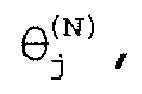


- Thus, in the resulting network each content neuron has exactly

- If the neurons have no direct access to the number of potentiated synapses (as it is likely to be the case for the brain) then the synaptic thresholds may still be regulated by homeostatic mechanisms. Here ongoing background activity can provide a random stimulation. Recurrent inhibition can select the most excited neurons in a winners-take-all fashion. The winning neurons will increase their synaptic thresholds and thus decrease their future activity. As a result, after sufficient time, all neurons will have approximately the same expected dendritic potential for a given random stimulus thus minimizing the variance of the low-potential distribution.
- Both approaches, the explicit adjustment of

- As described before, for some cases the estimated optimal firing thresholds, eq. 11 or eq. 12, may be inaccurate. If the optimal firing thresholds are unknown then a simple strategy is to activate the 1 neurons with the highest dendritic potentials xj. Numerical experiments show that this winners-take-all activation can significantly reduce output noise ε and increase storage capacity (cf., e.g., A. Knoblauch. Zip nets: Neural associative networks with non-linear learning. Internal Report HRI-EU 09-03, Honda Research Institute Europe GmbH, D-63073 Offenbach/Main, Germany, June 2009). In brain-like biological implementations the WTA mechanism can be realized by recurrent inhibition regulating the network activity to a desired
level 1. - Note that there are two situations when the 1-WTA retrieval does not improve performance. First, in case the activities of individual memory content patterns vµ deviate significantly from the
mean activity 1. Then 1-WTA often activates either too many neurons implying high levels of add-noise or too few neurons implying high levels of miss-noise. Second, 1-WTA is problematic for low SNR when the distributions of high and low units have strong overlap such that the 1 mostly excited neurons include much add-noise. Depending on the application it may then be better to activate more than 1 or less than l neurons. - Theory and numerical evaluations show that simple synapses with a small number of states achieve basically the same performance (as evaluated by pattern capacity M and network capacity C) as networks with continuous synapses (see above). For example, zip nets can store up to C = 0.46 bits per binary synapse, C = 0.58 bits per ternary synapse, C = 0.66 per quintiary synapse, C = 0.69 per seven-state synapse. For a fifteen-state synapse (which requires less than 4 bits of physical memory) zip nets achieve already C = 0.7136 which is about 99 percent of the capacity of the network employing continuous synapses.
- Moreover, since CI scales with the inverse of I, low synaptic entropies corresponding to a small number of states is preferable for implementations on digital computers. This is true not only when evaluating the required computer memory, but also when measuring retrieval time or, equivalently, energy requirements. In particular, for binary synapses the weight matrix W becomes binary, and the corresponding matrix-vector-multiplication x = Wũ necessary for computing the dendritic potentials x reduces to binary additions and, thus, can be implemented very efficiently, both on standard computers and special hardware.
- For example, a compressed implementations of zip nets on standard computers require only tret ∼ zn min(p1,1 - p1) binary additions per retrieval where

- At least for relatively small networks there might be a significant computational overhead due to the compression/decompression procedure of the synaptic weight matrix. Here an uncompressed implementation of zip nets may be preferable if the computer architecture provides large integer registers that allow to process many (binary or low-state-number) synapses in parallel. For example, today most standard computers have integer registers of size 64bit such that (almost) 64 binary synapses can be evaluated in a single computation step as illustrated by
Fig. 16 . -
Fig. 16 illustrates a processing flow for the fast computation of dendritic potentials x := Wũ in a binary zip net making use of large integer registers (e.g., 64 bit). For binary queries ũ the potentials x are essentially the sum of matrix rows i of W that correspond to active query neurons with ũi = 1. This can be done in parallel, e.g., making 64 synaptic operations at once. In the flow diagram it is assumed that register w1 contains the matrix row of W (or part of it, e.g., 64 components) corresponding to the i-th active neuron in ũ. Similarly, register X1 (i-1) contains thelowest bits 0 of the sum over all previously added matrix rows (initially it is x1 (i-1) = 0). By the exclusive-or operation (xor) register x1(i) will contain thelowest bits 0 of the sum up to the i-th active matrix row. After the and-operation register w2 will contain the carry bits of these additions. Similarly, registers x2 (i-1) and x2 (i) contain the secondlowest bits 1 of the sums up to the i-1-th and i-th active matrix row, respectively, and so on. After all active matrix rows have been summed up the vector of dendritic potentials x is obtained by the summation
- This allows an efficient parallel implementation of zip nets even on non-parallel standard desktop computers. For such an implementation it is preferable to use a high-entropy regime where the network is incompressible and M and C maximal, e.g., p1 = 0.5 for binary synapses. Here the achievable information capacity CI ≈ C is always much larger than zero but significantly below the maximum CI = 1 which could be obtained for p1 → 0 or, assuming an inhibitory implementation, also for p1 → 1 (see
Fig. 17 ). -
Fig. 17 pictures asymptotic storage capacities as functions of matrix load p1 for binary zip nets (solid lines) and the Willshaw model (dashed lines). The left plot shows network capacity C and information capacity CI. The right plot shows C, CI and additionally the synaptic capacity CS employing logarithmic scales. The network capacity C measures bits of stored information per synapse. It is C ∼ ζ/(2 In 2) ≤ 0.46 for the zip net (eq. 14) and C ∼ ld p1 In(l - p1) ≤ 0.69 for the Willshaw model (also see D.J. Willshaw, O.P. Buneman, and H.C. Longuet-Higgins. Non-holographic associative memory. Nature, 222:960-962, 1969; G. Palm. On associative memories. Biological Cybernetics, 36:19-31, 1980; A. Knoblauch, G. Palm, and F.T. Sommer. Memory capacities for synaptic and structural plasticity. Neural Computation, 2009. accepted). In both models C is maximal for p1 = 0.5. The information capacity CI := C/I(p1) ≤ 1 measures bits of stored information per computer bit (eq. 15) assuming optimal compression of the binary weight matrix. The synaptic capacity CS := C/min(p1, 1 - p1) measures stored information per non-silent synapse (eq. 16) assuming that irrelevant silent synapses can be pruned by structural plasticity (also see A. Knoblauch. On compressing the memory structures of binary neural associative networks. HRI-EU Report 06-02, Honda Research Institute Europe GmbH, 0-63073 Offenbach/Main, Germany, April 2006; A. Knoblauch. On structural plasticity in neural associative networks. HRI-EU Report 08-04, Honda Research Institute Europe GmbH, 0-63073 Offenbach/Main, Germany, May 2008; A. Knoblauch. The role of structural plasticity and synaptic consolidation for memory and amnesia in a model of cortico-hippocampal interplay. In J. Mayor, N. Ruh, and K. Plunkett, editors, Connectionist Models of Behavior and Cognition II: Proceedings of the 11th Neural Computation and Psychology Workshop, pages 79-90, Singapore, 2009. World Scientific Publishing). CI and CS are maximal for p1 → 0 and p1 → 1. The latter case assumes an inhibitory implementation (cf., e.g., the above mentioned patent application). - The parallelization method for binary synapses as illustrated by
Fig. 16 can be generalized to zip nets with a larger number of synaptic states. In particular, for ternary synapses with discrete weights -s-1, 0, s1 the weight matrix W can be represented by two binary weight matrices W(-1) and W(1) where wij (-1) = 1 if wij = -s(-1) and wij (1) = 1 if wij = s(1). Then computation of the dendritic potentials x can be implemented by first computing x(1) = W(1) ũ and x(-1) = W(-1) ũ, for example, employing the parallelization method illustrated byFig. 16 , and finally computing x = s(1)x(1) - s(-1)x(-1). - In a similar way, it is possible to efficiently parallelize 4-state synapses with discrete weights -s(-1), 0, s(1) - s(-1), s(1) defining


- Generalizing this procedure the implementation of zip nets can be efficiently parallelized with b-bit synapses having discrete weights from the set


- The core of the invention is a non-linear synaptic learning device for storing memory associations of the type uµ → vµ. Learning happens in three steps. (1) First, a synapse ij learns its potential aij by adding learning increments
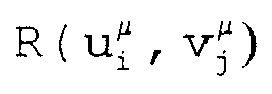

Fig. 18 . -
Fig. 18 illustrates a processing flow of the zip network: Upper part: Synaptic learning occurs in three steps: (1) Synaptic potentials aij are determined by linear summation of the learning increments r1, r2, r3, r4 selected by presynaptic memory activities

Fig. 4 . (2) Discrete synaptic weights wij ∈ {s(1), -s(-1), s(2), -s(-2),... } are determined by a non-linear threshold operation of synaptic potentials aij. (3) The resulting weight-matrix W is compressed resulting in a compressed representation Wcmpr. Lower part: Retrieval occurs in three steps: (1) Decompression of relevant parts of Wcmpr corresponding to the rows i of W where the input query pattern ũ is active, i.e., ũi = 1. (2) Vector-matrix multiplication of W with the input query pattern ũ yields the vector of dendritic potentials x. (3) Thresholding x with a vector of firing thresholds Θ yields the retrieval output v̂. - Similarly as the Bayesian model , the zip neural associative memory system described in the previous sections are applied in a four-layer neural network for information retrieval which can generally be applied for efficient implementation of nearest neighbor search (see
Fig. 19 ). For example, this system is used for accelerating object recognition systems (see e.g., (H. Wersing and E. Körner. Learning optimized features for hierarchical models of invariant object recognition. Neural Computation, 15:1559-1588, 2003; S. Hasler, H. Wersing, and E. Körner. A comparison of features in parts-based object recognition hierarchies. In J. Marques de Sa, L.A. Alexandre, W. Duch, and D.P. Mandie, editors, Proceedings of the 17th International Conference on Artificial Neural Networks (ICANN), Part II, LNCS 4668, pages 210-219, Berlin, Heidelberg, 2007. Springer Verlag; S. Kirstein, H. Wersing, and E. Körner. A biologically motivated visual memory architecture for online learning of objects. Neural Networks, 21(1):65-77, 2008) or any other application based on nearest-neighbor-search on high-dimensional sparse data (seeFig. 20 ; for more details see A. Knoblauch. On the computational benefits of inhibitory neural associative networks. HRI-EU Report 07-05, Honda Research Institute Europe GmbH, D-63073 Offenbach/Main, Germany, May 2007, A. Knoblauch. Best-match hashing with inhibitory associative networks for real-world object recognition. HRI-EU Report 08-05, Honda Research Institute Europe GmbH, 0-63073 Offenbach/Main, Germany, October 2008 and the mentioned previous patent application). Here the inhibibitory associative network (network IAM inFigs. 6 ,8 of the previous patent application: A. Knoblauch. Method and device for realizing an associative memory based on inhibitory neural networks., 2008. International Patent ApplicationPCT/EP2008/005001 EP 07 110 870.8 Figs. 19, 20 ). This can considerably improve retrieval accuracy at the cost of increased memory and/or computation requirements. -
Fig. 19 pictures a four-layer system for information retrieval according to one embodiment of the invention. The system is basically identical to a system based on inhibitory associative memory (IAM) proposed in the previous patent application except that the IAM of the previous invention was replaced by the Zip Associative Memory (ZAM) of the current invention. Here memory address patterns uµ are mapped to (carefully chosen) index representations w1 µ via a ZAM which maps via an error-correcting compressed look-up-table (cLUT) to the memory content patterns vµ. -
Fig. 20 shows a block diagram of a system for visual object recognition using a Zip Associative Memory (ZAM) according to one embodiment of the invention. During learning, images Iµ are preprocessed in a visual feature hierarchy. The resulting continuous valued feature vector u*µ is binarized resulting in a binary address vector uµ which is associated with the memory content or class label vµ employing the four-layer-system described inFig. 19 . During recognition, a test image Ĩµ is processed in a similar way. The system (with ZAM replaced by an IAM) is described in detail in the previous patent application. - Further possible applications include efficient implementations of LVQ (Learning Vector Quantization), in particular, if the pattern vectors are high-dimensional and moderately sparse and if a very large number of pattern vectors must be stored.
- Similarly, potential applications include efficient implementations of clustering algorithms or self-organizing maps if the number of cluster prototypes is large and the prototype vectors are high-dimensional and moderately sparse.
- Another potential application is document retrieval: Here the database may consist of a large set of text documents, for example taken from the internet. Each text document consists of (possibly many) words and can be indexed by selecting a relatively small set of key words. The result is a sparse binary feature vector for each text document. Given a query consisting of a set of key words the task is to find the most relevant documents. This retrieval can be accelerated by the methods proposed here.
- A complementary idea is to represent the words in a text document by applying an N-gram code. For example the 1-grams (or monograms) of the "memory" are simply the letter "m", "e", "m", "o", "r", "y". Similarly, the 2-grams (or digrams) are "me", "em", "mo", "or", "ry", and the 3-grams are "mem", "emo", "mor", "ory". By that one obtains very naturally a sparse and fault tolerant code already at the word level. For example, for an alphabet of 26 letters, the 2-gram code represents the word "memory" by a binary vector of dimension 262 = 676 where only 5 components are active. This method can be used, for example, to implement a fault-tolerant code for the keywords described in the previous item. Additionally, the N-gram method can be used to code keyword order and key word sequences in a manner suitable for the associative memory models discussed in this application.
- In summary, the zipped neural networks and algorithms proposed in this application can be used for any application involving the best match or nearest-neighbor problem if the underlying pattern vectors are high-dimensional and (moderately) sparse.
- It should be understood that the foregoing relates only to embodiments of the present invention and that numerous changes and modifications made therein may be made without departing from the scope of the invention as set forth in the following claims.
-
- 1. A.W. Burks, H.H. Goldstine, and J. von Neumann. Preliminary discussion of the logical design of an electronic computing instrument. Report 1946, U.S. Army Ordonance Department, 1946.
- 2. P. Dayan and D.J. Willshaw. Optimising synaptic learning rules in linear associative memory. Biological Cybernetics, 65:253-265, 1991.
- 3. S.W. Golomb. Run-length encodings. IEEE Transactions on Information Theory, 12:399-401, 1966.
- 4. S. Hasler, H. Wersing, and E. Körner. A comparison of features in parts-based object recognition hierarchies. In J. Marques de Sa, L.A. Alexandre, W. Duch, and D.P. Mandie, editors, Proceedings of the 17th International Conference on Artificial Neural Networks (ICANN), Part II, LNCS 4668, pages 210-219, Berlin, Heidelberg, 2007. Springer Verlag.
- 5. J. Hertz, A. Krogh, and R.G. Palmer. Introduction to the theory of neural computation. Addison-Wesley, Redwood City, 1991.
- 6. J.J. Hopfield. Neural networks and physical systems with emergent collective computational abilities. Proceedings of the National Academy of Science, USA, 79:2554-2558, 1982.
- 7. P. Kanerva. Sparse Distributed Memory. MIT Press, Cambridge, MA, 1988.
- 8. S. Kirstein, H. Wersing, and E. Körner. A biologically motivated visual memory architecture for online learning of objects. Neural Networks, 21(1):65-77, 2008.
- 9. A. Knoblauch. Optimal matrix compression .
- 10. A. Knoblauch. On compressing the memory structures of binary neural associative networks. HRI-EU Report 06-02, Honda Research Institute Europe GmbH, 0-63073 Offenbach/Main, Germany, April 2006.
- 11. A. Knoblauch. On the computational benefits of inhibitory neural associative networks. HRI-EU Report 07-05, Honda Research Institute Europe GmbH, D-63073 Offenbach/Main, Germany, May 2007.
- 12. A. Knoblauch. Best-match hashing with inhibitory associative networks for real-world object recognition. HRI-EU Report 08-05, Honda Research Institute Europe GmbH, 0-63073 Offenbach/Main, Germany, October 2008.
- 13. A. Knoblauch. Method and device for realizing an associative memory based on inhibitory neural networks., 2008. International Patent Application
PCT/EP2008/005001 EP 07 110 870.8 - 14. A. Knoblauch. Neural associative memory and the Willshaw-Palm probability distribution. SIAM Journal on Applied Mathematics, 69(1):169-196, 2008.
- 15. A. Knoblauch. Neural associative networks with incremental learning rules. HRI-EU Report 08-03, Honda Research Institute Europe GmbH, 0-63073 Offenbach/Main, Germany, May 2008.
- 16. A. Knoblauch. On structural plasticity in neural associative networks. HRI-EU Report 08-04, Honda Research Institute Europe GmbH, 0-63073 Offenbach/Main, Germany, May 2008.
- 17. A. Knoblauch. Method and device for realizing a neural associative memory based on optimal Bayesian learning., 2009. European Patent Application, in preparation.
- 18. A. Knoblauch. Neural associative networks with optimal bayesian learning. HRI-EU Report. 09-02, Honda Research Institute Europe GmbH, D-63073 Offenbach/Main, Germany, May 2009.
- 19. A. Knoblauch. The role of structural plasticity and synaptic consolidation for memory and amnesia in a model of cortico-hippocampal interplay. In J. Mayor, N. Ruh, and K. Plunkett, editors, Connectionist Models of Behavior and Cognition II: Proceedings of the 11th Neural Computation and Psychology Workshop, pages 79-90, Singapore, 2009. World Scientific Publishing.
- 20. A. Knoblauch. Zip nets: Neural associative networks with non-linear learning. Internal Report HRI-EU 09-03, Honda Research Institute Europe GmbH, D-63073 Offenbach/Main, Germany, June 2009.
- 21. A. Knoblauch, G. Palm, and F.T. Sommer. Memory capacities for synaptic and structural plasticity. Neural Computation, 2009. accepted.
- 22. T. Kohonen. Associative memory: a system theoretic approach. Springer, Berlin, 1977.
- 23. P. Lennie. The cost of cortical computation. Current Biology, 13:493-497, 2003.
- 24. G. Palm. On associative memories. Biological Cybernetics, 36:19-31, 1980.
- 25. G. Palm. Neural Assemblies. An Alternative Approach to Artificial Intelligence. Springer, Berlin, 1982.
- 26. G. Palm and F. Sommer. Associative data storage and retrieval in neural nets. In E. Domany, J.L. van Hemmen, and K. Schulten, editors, Models of Neural Networks III, pages 79-118. Springer-Verlag, New York, 1996.
- 27. K. Steinbuch. Die Lernmatrix. Kybernetik, 1:36-45, 1961.
- 28. H. Wersing and E. Körner. Learning optimized features for hierarchical models of invariant object recognition. Neural Computation, 15:1559-1588, 2003.
- 29. D.J. Willshaw, O.P. Buneman, and H.C. Longuet-Higgins. Non-holographic associative memory. Nature, 222:960-962, 1969.
Claims (39)
- A neural associative memory structure for maintaining associations between memory address patterns and memory content patterns, the memory structure comprising:- a neural network consisting of a set of synapses and a set of neurons, the synapses connecting neurons and storing the associations,- accepting means for accepting an input query pattern,- processing means for
○ computing a matrix of synaptic potentials as a function of the memory address patterns and the memory content patterns,
○ transforming the matrix of synaptic potentials into a matrix of synaptic weights, wherein each weight is chosen from a finite set of synaptic strengths,
○ optimizing the neural network with respect to a target architecture chosen for implementation, and
○ computing for each neuron an optimal output function for minimizing output noise, and- output means for returning an output pattern to the input query pattern equal or similar to the memory content pattern associated with the memory address pattern equal or similar to the input query pattern. - The neural associative memory structure of claim 1, wherein- said accepting means for accepting an input query pattern is at least one of a sensor, a hardware interface and a software interface.
- The neural associative memory structure of claims 1 or 2, wherein- the processing means is a processor and/or a signal processing unit formed of hardware and/or software.
- The neural associative memory structure of any one of the claims 1-3, wherein- the processing means is adapted for parallel processing.
- The neural associative memory structure of any one of the claims 1-4, wherein- the output means is at least one of a hardware interface, a software interface and an actor.
- The neural associative memory structure of any one of the claims 1-5, wherein- the neural network is optimized by application of compression mechanisms.
- The neural associative memory structure of any one of the claims 1-6, wherein- the neural network is optimized by skipping synapses with a predefined or zero weight in the optimization.
- The neural associative memory structure of any one of the claims 1-7, wherein- the output noise is defined the distance between the original content memory pattern and the output generated by the memory system, and wherein- parameters are determined through the matrix of synaptic weights and a noise distribution describing how a query input pattern used for retrieval deviates from an original memory address pattern.
- The neural associative memory structure of any one of the claims 1-8, wherein- the synaptic potentials are computed as a linear sum of learning increments.
- The neural associative memory structure of any one of the claims 1-9, wherein- the synaptic potentials are computed corresponding to the weights of a Bayesian associative memory model.
- The neural associative memory structure of any one of the claims 1-10, wherein- the synaptic potentials are transformed into synaptic weights by applying synaptic thresholds yielding discrete synaptic strengths, wherein- the synaptic thresholds are computed to minimize the expected number of component errors in the retrieval output.
- The neural associative memory structure of claim 11, wherein- the synaptic thresholds are chosen such that each content neuron has the same set of matrix loads defined as an expected fraction of synapses with specified weights.
- The neural associative memory structure of claims 11 or 12, wherein- the synaptic thresholds are adapted homeostatically such that, at any time, each neuron has the same number of synapses with a predetermined weight.
- The neural associative memory structure of any one of the claims 1-13, wherein- discretization parameters are chosen to maximize the signal-to-noise ratio and to maximize the number of storable patterns and/or stored information per synapse.
- The neural associative memory structure of claim 14, wherein- the discretization parameters are obtained with respect to the synaptic strength and memory load.
- The neural associative memory structure of claims 14 or 15, wherein- the discretization parameters are chosen to maximize the information capacity of the neural network, wherein- the capacity is defined as the stored information per computer bit.
- The neural associative memory structure of any one of the claims 14-16, wherein- the discretization parameters are obtained with respect to the synaptic strength, the memory load, and information content of a discrete synaptic weight.
- The neural associative memory structure of any one of the claims 14-17, wherein- the discretization parameters are chosen to maximize the synaptic capacity, wherein- the synaptic capacity is defined as the stored information per non-silent synapse.
- The neural associative memory structure of any one of the claims 14-18, wherein- the discretization parameters are obtained with respect to the synaptic strength, the memory load and a total matrix load, wherein- the total matrix load is defined as the fraction of non-silent synapses.
- The neural associative memory structure of any one of the claims 1-19, wherein- the neural network is structurally static.
- The neural associative memory structure of any one of the claims 1-20, wherein- the neural network is a structurally plastic network.
- The neural associative memory structure of any one of the claims 1-21, wherein- for a set of synapses a discrete synaptic weight matrix is implemented by a set of binary matrices.
- The neural associative memory structure of any one of the claims 1-22, wherein- synapses have discrete weights, and wherein- each discrete weight is calculated as a binary linear combination of values described by a binary bit vector.
- The neural associative memory structure of claims 22 or 23, wherein- each entry of the binary matrices is defined as a binary weight, which is active if the discrete weight is a linear combination of predetermined factors, wherein the factor corresponding to the binary matrix considered is active.
- A method for retrieving a memory content pattern from the neural associative memory structure according to any one of the claims 1-24, comprising the steps of:- accepting an input query pattern by an accepting means,- using a neural network consisting of a set of synapses and a set of neurons, the synapses connecting neurons and storing the associations between memory address patterns and memory content patterns for retrieval of an output pattern,- computing dendritic potentials from the input query pattern with a synaptic weight matrix by a processing means,- computing an output pattern by a non-linear function of the dendritic potentials, parametrized by firing thresholds by the processing means, and- returning the output pattern to the input query pattern equal or similar to the memory content pattern associated with the memory address pattern equal or similar to the input query pattern through output means.
- The method of claim 25, wherein- the accepting means for accepting an input query pattern is at least one of a sensor, a hardware interface and a software interface.
- The method of claims 25 or 26, wherein- the processing means is a processor and/or a signal processing unit formed of hardware and/or software.
- The method of any one of the claims 25-27, wherein- the processing means is adapted for parallel processing.
- The method of any one of the claims 25-28, wherein- the output means is at least one of a hardware interface, a software interface and an actor.
- The method of any one of the claims 25-29, wherein- the processing means is used for
○ computing a matrix of synaptic potentials as a function of the memory address patterns and the memory content patterns,
○ transforming the matrix of synaptic potentials into a matrix of discrete synaptic weights, wherein each weight is chosen from a finite set of synaptic strength,
○ optimizing the neural network with respect to a target architecture chosen for implementation, and
○ computing for each neuron an optimal output function for minimizing the output noise. - The method of any one of the claims 25-30, wherein- the dendritic potentials are computed by a matrix multiplication of the query input pattern with the synaptic weight matrix, and wherein- the output pattern is computed by applying firing thresholds to the dendritic potentials, where the firing thresholds are optimized for minimizing the expected number of component errors in the output pattern if a binary input query pattern is provided.
- The method of any one of the claims 25-31, wherein- the dendritic potentials are computed by a matrix multiplication of the input query pattern with the synaptic weight matrix, wherein- a vector of firing thresholds is subtracted, if parameters are such that not all resulting firing thresholds are zero or near zero, wherein- the dendritic potentials are normalized, and wherein- the neurons with the largest dendritic potentials are activated.
- The method of any one of the claims 25-32, wherein- the dendritic potentials are computed for discrete synapses from the synaptic strength, matrices and the input query pattern.
- The method of any one of the claims 31-33, wherein- the matrix multiplications are performed bit-parallel.
- The method of any one of the claims 31-34, wherein- the matrix multiplications are parallelized, such that in each computation step several synapses are processed in parallel.
- A neural network structure used in the neural associative memory structure of any one of the claims 1-24 and in the method of any one of the claims 25-35, wherein- the neural network consisting of a set of synapses and a set of neurons, the synapses connecting neurons and storing the associations between memory address patterns and memory content patterns is implemented on a parallel computational architecture with at least two processors, the processors being connected by a common bus.
- The neural network of claim 36, wherein- each processor stores a column of a discrete synaptic weight matrix in its local memory, wherein- one processor per neuron is provided, and wherein during retrieval, active components of the input query patterns accepted by an accepting means are presented one after the other on the common bus to neurons implemented by the processors, and wherein- the processors add up corresponding synaptic weights in parallel, such that retrieval requires only as many time steps as the number of neurons active for the input query pattern.
- The neural network of claims 36 or 37, wherein- the architecture is a matrix like architecture, and wherein- the neurons instantaneously add synaptic inputs such that a retrieval takes only a single time step.
- The neural network of any one of the claims 36-38, wherein- the accepting means for accepting an input query pattern is at least one of a sensor, a hardware interface and a software interface.
Priority Applications (2)
| Application Number | Priority Date | Filing Date | Title |
|---|---|---|---|
| EP09179260A EP2259214B1 (en) | 2009-06-04 | 2009-12-15 | Implementing a neural associative memory based on non-linear learning of discrete synapses |
| US12/765,286 US8463722B2 (en) | 2009-06-04 | 2010-04-22 | Implementing a neural associative memory based on non-linear learning of discrete synapses |
Applications Claiming Priority (2)
| Application Number | Priority Date | Filing Date | Title |
|---|---|---|---|
| EP09161923 | 2009-06-04 | ||
| EP09179260A EP2259214B1 (en) | 2009-06-04 | 2009-12-15 | Implementing a neural associative memory based on non-linear learning of discrete synapses |
Publications (2)
| Publication Number | Publication Date |
|---|---|
| EP2259214A1 true EP2259214A1 (en) | 2010-12-08 |
| EP2259214B1 EP2259214B1 (en) | 2013-02-27 |
Family
ID=42041778
Family Applications (1)
| Application Number | Title | Priority Date | Filing Date |
|---|---|---|---|
| EP09179260A Not-in-force EP2259214B1 (en) | 2009-06-04 | 2009-12-15 | Implementing a neural associative memory based on non-linear learning of discrete synapses |
Country Status (2)
| Country | Link |
|---|---|
| US (1) | US8463722B2 (en) |
| EP (1) | EP2259214B1 (en) |
Cited By (3)
| Publication number | Priority date | Publication date | Assignee | Title |
|---|---|---|---|---|
| CN111652166A (en) * | 2020-06-08 | 2020-09-11 | 重庆科技学院 | Palmprint and face recognition method based on cellular neural network heteroassociative memory model |
| CN113762492A (en) * | 2021-08-27 | 2021-12-07 | 同济大学 | Image recognition system and method based on organic synaptic transistor artificial neural network |
| GB2553055B (en) * | 2015-05-21 | 2022-05-11 | Google Llc | Vector computation unit in a neural network processor |
Families Citing this family (39)
| Publication number | Priority date | Publication date | Assignee | Title |
|---|---|---|---|---|
| KR20130111956A (en) | 2010-05-19 | 2013-10-11 | 더 리전트 오브 더 유니버시티 오브 캘리포니아 | Neural processing unit |
| US9471127B2 (en) * | 2011-03-16 | 2016-10-18 | Nokia Technologies Oy | Method, device and system for energy management |
| US9158847B1 (en) * | 2011-07-19 | 2015-10-13 | Kyndi Inc. | Cognitive memory encoding networks for fast semantic indexing storage and retrieval |
| US9424511B2 (en) | 2011-11-09 | 2016-08-23 | Qualcomm Incorporated | Methods and apparatus for unsupervised neural component replay by referencing a pattern in neuron outputs |
| US9443190B2 (en) | 2011-11-09 | 2016-09-13 | Qualcomm Incorporated | Methods and apparatus for neural pattern sequence completion and neural pattern hierarchical replay by invoking replay of a referenced neural pattern |
| US9424513B2 (en) | 2011-11-09 | 2016-08-23 | Qualcomm Incorporated | Methods and apparatus for neural component memory transfer of a referenced pattern by including neurons to output a pattern substantially the same as the referenced pattern |
| US9015091B2 (en) * | 2011-11-09 | 2015-04-21 | Qualcomm Incorporated | Methods and apparatus for unsupervised neural replay, learning refinement, association and memory transfer: structural plasticity and structural constraint modeling |
| US9082078B2 (en) | 2012-07-27 | 2015-07-14 | The Intellisis Corporation | Neural processing engine and architecture using the same |
| US9153230B2 (en) * | 2012-10-23 | 2015-10-06 | Google Inc. | Mobile speech recognition hardware accelerator |
| US9185057B2 (en) | 2012-12-05 | 2015-11-10 | The Intellisis Corporation | Smart memory |
| US9373073B2 (en) | 2012-12-21 | 2016-06-21 | International Business Machines Corporation | Time-division multiplexed neurosynaptic module with implicit memory addressing for implementing a universal substrate of adaptation |
| US9239984B2 (en) | 2012-12-21 | 2016-01-19 | International Business Machines Corporation | Time-division multiplexed neurosynaptic module with implicit memory addressing for implementing a neural network |
| WO2015105731A1 (en) * | 2014-01-07 | 2015-07-16 | Thaler Stephen L | Device and method for the autonomous bootstrapping of unified sentience |
| WO2015159242A1 (en) * | 2014-04-15 | 2015-10-22 | Saffron Technology Inc. | Methods, systems and computer program products for neuromorphic graph compression using associative memories |
| US10061531B2 (en) | 2015-01-29 | 2018-08-28 | Knuedge Incorporated | Uniform system wide addressing for a computing system |
| US9552327B2 (en) | 2015-01-29 | 2017-01-24 | Knuedge Incorporated | Memory controller for a network on a chip device |
| AU2016235087A1 (en) * | 2015-03-24 | 2017-09-21 | Kyndi, Inc. | Cognitive memory graph indexing, storage and retrieval |
| US10268948B2 (en) * | 2015-07-23 | 2019-04-23 | The Boeing Company | Data driven classification and troubleshooting system and method using associative memory and a machine learning algorithm to improve the accuracy and performance of the associative memory |
| US10474627B2 (en) * | 2015-10-08 | 2019-11-12 | Via Alliance Semiconductor Co., Ltd. | Neural network unit with neural memory and array of neural processing units that collectively shift row of data received from neural memory |
| KR102494139B1 (en) | 2015-11-06 | 2023-01-31 | 삼성전자주식회사 | Apparatus and method for training neural network, apparatus and method for speech recognition |
| US10027583B2 (en) | 2016-03-22 | 2018-07-17 | Knuedge Incorporated | Chained packet sequences in a network on a chip architecture |
| US10346049B2 (en) | 2016-04-29 | 2019-07-09 | Friday Harbor Llc | Distributed contiguous reads in a network on a chip architecture |
| US10262751B2 (en) * | 2016-09-29 | 2019-04-16 | Intel Corporation | Multi-dimensional optimization of electrical parameters for memory training |
| US10489702B2 (en) * | 2016-10-14 | 2019-11-26 | Intel Corporation | Hybrid compression scheme for efficient storage of synaptic weights in hardware neuromorphic cores |
| US10795836B2 (en) | 2017-04-17 | 2020-10-06 | Microsoft Technology Licensing, Llc | Data processing performance enhancement for neural networks using a virtualized data iterator |
| US11087206B2 (en) * | 2017-04-28 | 2021-08-10 | Intel Corporation | Smart memory handling and data management for machine learning networks |
| EP3617904A4 (en) * | 2017-04-28 | 2020-04-29 | Sony Corporation | INFORMATION PROCESSING DEVICE AND METHOD |
| US11556343B2 (en) | 2017-09-22 | 2023-01-17 | International Business Machines Corporation | Computational method for temporal pooling and correlation |
| US11651223B2 (en) * | 2017-10-27 | 2023-05-16 | Baidu Usa Llc | Systems and methods for block-sparse recurrent neural networks |
| US11138493B2 (en) | 2017-12-22 | 2021-10-05 | International Business Machines Corporation | Approaching homeostasis in a binary neural network |
| US11625609B2 (en) * | 2018-06-14 | 2023-04-11 | International Business Machines Corporation | Integration of external applications into deep neural networks |
| US11468299B2 (en) | 2018-11-01 | 2022-10-11 | Brainchip, Inc. | Spiking neural network |
| KR102898294B1 (en) | 2019-01-17 | 2025-12-12 | 삼성전자주식회사 | Electronic device and method for controlling the electronic device thereof |
| CN114127748A (en) * | 2019-07-08 | 2022-03-01 | 索美智能有限公司 | Memory in personal intelligence |
| US11741098B2 (en) * | 2019-11-01 | 2023-08-29 | Applied Brain Research Inc. | Methods and systems for storing and querying database entries with neuromorphic computers |
| US12373700B2 (en) | 2020-01-28 | 2025-07-29 | Samsung Electronics Co., Ltd. | Electronic device and controlling method of electronic device for applying a logical constraint to a neural network model |
| US12361266B2 (en) | 2020-05-14 | 2025-07-15 | Samsung Electronics Co., Ltd. | Hierarchical weight preprocessing for neural network accelerator |
| CN113408719B (en) * | 2021-06-30 | 2023-02-10 | 华中科技大学 | A multilevel associative memory circuit based on non-melting phase change device |
| CN113490242B (en) * | 2021-07-16 | 2023-07-25 | 广东石油化工学院 | Heterogeneous wireless network sub-network switching method and system |
Citations (3)
| Publication number | Priority date | Publication date | Assignee | Title |
|---|---|---|---|---|
| US5469161A (en) * | 1992-08-13 | 1995-11-21 | International Business Machines Corporation | Algorithm for the implementation of Ziv-Lempel data compression using content addressable memory |
| WO2007019124A2 (en) * | 2005-08-04 | 2007-02-15 | Saffron Technology, Inc. | Associative matrix methods, systems and computer program products using bit plane representations of selected segments |
| EP2012260A1 (en) * | 2007-06-22 | 2009-01-07 | Honda Research Institute Europe GmbH | Method and device for realizing an associative memory based on inhibitory neural networks |
-
2009
- 2009-12-15 EP EP09179260A patent/EP2259214B1/en not_active Not-in-force
-
2010
- 2010-04-22 US US12/765,286 patent/US8463722B2/en not_active Expired - Fee Related
Patent Citations (3)
| Publication number | Priority date | Publication date | Assignee | Title |
|---|---|---|---|---|
| US5469161A (en) * | 1992-08-13 | 1995-11-21 | International Business Machines Corporation | Algorithm for the implementation of Ziv-Lempel data compression using content addressable memory |
| WO2007019124A2 (en) * | 2005-08-04 | 2007-02-15 | Saffron Technology, Inc. | Associative matrix methods, systems and computer program products using bit plane representations of selected segments |
| EP2012260A1 (en) * | 2007-06-22 | 2009-01-07 | Honda Research Institute Europe GmbH | Method and device for realizing an associative memory based on inhibitory neural networks |
Non-Patent Citations (5)
| Title |
|---|
| ANDREAS KNOBLAUCH: "Synchronization and pattern separation in spiking associative memories and visual cortical areas", DISSERTATION,, 1 October 2003 (2003-10-01), pages 1 - 189, XP002458566 * |
| FRIEDRICH T SOMMER ET AL: "Bayesian Retrieval in Associative Memories with Storage Errors", IEEE TRANSACTIONS ON NEURAL NETWORKS, IEEE SERVICE CENTER, PISCATAWAY, NJ, US, vol. 9, no. 4, 1 July 1998 (1998-07-01), XP011040162, ISSN: 1045-9227 * |
| KNOBLAUCH ET AL: "Neural associative memory for brain modeling and information retrieval", INFORMATION PROCESSING LETTERS, AMSTERDAM, NL, vol. 95, no. 6, 30 September 2005 (2005-09-30), pages 537 - 544, XP005028095, ISSN: 0020-0190 * |
| MOOPENN A ET AL: "ELECTRONIC IMPLEMENTATION OF ASSOCIATIVE MEMORY BASED ON NEURAL NETWORK MODELS", IEEE TRANSACTIONS ON SYSTEMS, MAN AND CYBERNETICS, IEEE INC. NEW YORK, US, vol. SMC-17, no. 2, March 1987 (1987-03-01), pages 325 - 331, XP000743138, ISSN: 0018-9472 * |
| SANDBERG A ET AL: "A Bayesian attractor network with incremental learning; A Bayesian attractor network with incremental learning", NETWORK: COMPUTATION IN NEURAL SYSTEMS, IOP PUBLISHING, BRISTOL, GB LNKD- DOI:10.1088/0954-898X/13/2/302, vol. 13, no. 2, 1 May 2002 (2002-05-01), pages 179 - 194, XP020060719, ISSN: 0954-898X * |
Cited By (8)
| Publication number | Priority date | Publication date | Assignee | Title |
|---|---|---|---|---|
| GB2553055B (en) * | 2015-05-21 | 2022-05-11 | Google Llc | Vector computation unit in a neural network processor |
| US11620508B2 (en) | 2015-05-21 | 2023-04-04 | Google Llc | Vector computation unit in a neural network processor |
| US12014272B2 (en) | 2015-05-21 | 2024-06-18 | Google Llc | Vector computation unit in a neural network processor |
| US12277499B2 (en) | 2015-05-21 | 2025-04-15 | Google Llc | Vector computation unit in a neural network processor |
| CN111652166A (en) * | 2020-06-08 | 2020-09-11 | 重庆科技学院 | Palmprint and face recognition method based on cellular neural network heteroassociative memory model |
| CN111652166B (en) * | 2020-06-08 | 2022-08-30 | 重庆科技学院 | Palm print and face recognition method based on cellular neural network different association memory model |
| CN113762492A (en) * | 2021-08-27 | 2021-12-07 | 同济大学 | Image recognition system and method based on organic synaptic transistor artificial neural network |
| CN113762492B (en) * | 2021-08-27 | 2024-03-01 | 同济大学 | Image recognition system and method based on organic synaptic transistor artificial neural network |
Also Published As
| Publication number | Publication date |
|---|---|
| US8463722B2 (en) | 2013-06-11 |
| US20100312735A1 (en) | 2010-12-09 |
| EP2259214B1 (en) | 2013-02-27 |
Similar Documents
| Publication | Publication Date | Title |
|---|---|---|
| EP2259214B1 (en) | Implementing a neural associative memory based on non-linear learning of discrete synapses | |
| EP2259215B1 (en) | Method and structure for a neural associative memory based on optimal Bayesian learning | |
| Thomas et al. | A theoretical perspective on hyperdimensional computing | |
| Hassantabar et al. | SCANN: Synthesis of compact and accurate neural networks | |
| Gamboa | Deep learning for time-series analysis | |
| Passalis et al. | Training lightweight deep convolutional neural networks using bag-of-features pooling | |
| Guyon | Applications of neural networks to character recognition | |
| Diao et al. | Generalized learning vector quantization for classification in randomized neural networks and hyperdimensional computing | |
| Kleyko et al. | Modification of holographic graph neuron using sparse distributed representations | |
| WO2020095321A2 (en) | Dynamic structure neural machine for solving prediction problems with uses in machine learning | |
| Schmidhuber et al. | Discovering predictable classifications | |
| Karimi-Bidhendi et al. | Scalable classification of univariate and multivariate time series | |
| Kressel et al. | Pattern classification techniques based on function approximation | |
| Cios | Deep neural networks—A brief history | |
| Hammer et al. | Mathematical Aspects of Neural Networks. | |
| Yeganejou et al. | Improved deep fuzzy clustering for accurate and interpretable classifiers | |
| Lam et al. | Combination of multiple classifier decisions for optical character recognition | |
| WO2009000474A1 (en) | Method and device for realizing an associative memory based on inhibitory neural networks | |
| Anderson | Pattern recognition: An introduction | |
| US12242970B2 (en) | Incremental cluster validity index-based offline clustering for machine learning | |
| Yang et al. | Binary output layer of feedforward neural networks for solving multi-class classification problems | |
| Yadav et al. | Optimization of Hopfield Neural Network (HNN) using multiconnection and Lyapunov Energy Function (LEF) for storage and recall of handwritten images | |
| Mitiche et al. | Pattern classification by a condensed neural network | |
| Skorpil et al. | Neural networks and back propagation algorithm | |
| Shivappriya et al. | Performance Analysis of Deep Neural Network and Stacked Autoencoder for Image Classification |
Legal Events
| Date | Code | Title | Description |
|---|---|---|---|
| PUAI | Public reference made under article 153(3) epc to a published international application that has entered the european phase |
Free format text: ORIGINAL CODE: 0009012 |
|
| 17P | Request for examination filed |
Effective date: 20100303 |
|
| AK | Designated contracting states |
Kind code of ref document: A1 Designated state(s): AT BE BG CH CY CZ DE DK EE ES FI FR GB GR HR HU IE IS IT LI LT LU LV MC MK MT NL NO PL PT RO SE SI SK SM TR |
|
| AX | Request for extension of the european patent |
Extension state: AL BA RS |
|
| 17Q | First examination report despatched |
Effective date: 20111206 |
|
| RIC1 | Information provided on ipc code assigned before grant |
Ipc: G06N 3/04 20060101AFI20120905BHEP Ipc: G06N 3/08 20060101ALN20120905BHEP |
|
| GRAP | Despatch of communication of intention to grant a patent |
Free format text: ORIGINAL CODE: EPIDOSNIGR1 |
|
| GRAS | Grant fee paid |
Free format text: ORIGINAL CODE: EPIDOSNIGR3 |
|
| GRAA | (expected) grant |
Free format text: ORIGINAL CODE: 0009210 |
|
| AK | Designated contracting states |
Kind code of ref document: B1 Designated state(s): AT BE BG CH CY CZ DE DK EE ES FI FR GB GR HR HU IE IS IT LI LT LU LV MC MK MT NL NO PL PT RO SE SI SK SM TR |
|
| REG | Reference to a national code |
Ref country code: GB Ref legal event code: FG4D |
|
| REG | Reference to a national code |
Ref country code: CH Ref legal event code: EP |
|
| REG | Reference to a national code |
Ref country code: AT Ref legal event code: REF Ref document number: 598839 Country of ref document: AT Kind code of ref document: T Effective date: 20130315 |
|
| REG | Reference to a national code |
Ref country code: IE Ref legal event code: FG4D |
|
| REG | Reference to a national code |
Ref country code: DE Ref legal event code: R096 Ref document number: 602009013615 Country of ref document: DE Effective date: 20130425 |
|
| REG | Reference to a national code |
Ref country code: AT Ref legal event code: MK05 Ref document number: 598839 Country of ref document: AT Kind code of ref document: T Effective date: 20130227 |
|
| REG | Reference to a national code |
Ref country code: LT Ref legal event code: MG4D |
|
| PG25 | Lapsed in a contracting state [announced via postgrant information from national office to epo] |
Ref country code: NO Free format text: LAPSE BECAUSE OF FAILURE TO SUBMIT A TRANSLATION OF THE DESCRIPTION OR TO PAY THE FEE WITHIN THE PRESCRIBED TIME-LIMIT Effective date: 20130527 Ref country code: ES Free format text: LAPSE BECAUSE OF FAILURE TO SUBMIT A TRANSLATION OF THE DESCRIPTION OR TO PAY THE FEE WITHIN THE PRESCRIBED TIME-LIMIT Effective date: 20130607 Ref country code: BG Free format text: LAPSE BECAUSE OF FAILURE TO SUBMIT A TRANSLATION OF THE DESCRIPTION OR TO PAY THE FEE WITHIN THE PRESCRIBED TIME-LIMIT Effective date: 20130527 Ref country code: AT Free format text: LAPSE BECAUSE OF FAILURE TO SUBMIT A TRANSLATION OF THE DESCRIPTION OR TO PAY THE FEE WITHIN THE PRESCRIBED TIME-LIMIT Effective date: 20130227 Ref country code: LT Free format text: LAPSE BECAUSE OF FAILURE TO SUBMIT A TRANSLATION OF THE DESCRIPTION OR TO PAY THE FEE WITHIN THE PRESCRIBED TIME-LIMIT Effective date: 20130227 Ref country code: IS Free format text: LAPSE BECAUSE OF FAILURE TO SUBMIT A TRANSLATION OF THE DESCRIPTION OR TO PAY THE FEE WITHIN THE PRESCRIBED TIME-LIMIT Effective date: 20130627 Ref country code: SE Free format text: LAPSE BECAUSE OF FAILURE TO SUBMIT A TRANSLATION OF THE DESCRIPTION OR TO PAY THE FEE WITHIN THE PRESCRIBED TIME-LIMIT Effective date: 20130227 |
|
| REG | Reference to a national code |
Ref country code: NL Ref legal event code: VDEP Effective date: 20130227 |
|
| PG25 | Lapsed in a contracting state [announced via postgrant information from national office to epo] |
Ref country code: LV Free format text: LAPSE BECAUSE OF FAILURE TO SUBMIT A TRANSLATION OF THE DESCRIPTION OR TO PAY THE FEE WITHIN THE PRESCRIBED TIME-LIMIT Effective date: 20130227 Ref country code: GR Free format text: LAPSE BECAUSE OF FAILURE TO SUBMIT A TRANSLATION OF THE DESCRIPTION OR TO PAY THE FEE WITHIN THE PRESCRIBED TIME-LIMIT Effective date: 20130528 Ref country code: BE Free format text: LAPSE BECAUSE OF FAILURE TO SUBMIT A TRANSLATION OF THE DESCRIPTION OR TO PAY THE FEE WITHIN THE PRESCRIBED TIME-LIMIT Effective date: 20130227 Ref country code: PT Free format text: LAPSE BECAUSE OF FAILURE TO SUBMIT A TRANSLATION OF THE DESCRIPTION OR TO PAY THE FEE WITHIN THE PRESCRIBED TIME-LIMIT Effective date: 20130627 Ref country code: SI Free format text: LAPSE BECAUSE OF FAILURE TO SUBMIT A TRANSLATION OF THE DESCRIPTION OR TO PAY THE FEE WITHIN THE PRESCRIBED TIME-LIMIT Effective date: 20130227 Ref country code: PL Free format text: LAPSE BECAUSE OF FAILURE TO SUBMIT A TRANSLATION OF THE DESCRIPTION OR TO PAY THE FEE WITHIN THE PRESCRIBED TIME-LIMIT Effective date: 20130227 Ref country code: FI Free format text: LAPSE BECAUSE OF FAILURE TO SUBMIT A TRANSLATION OF THE DESCRIPTION OR TO PAY THE FEE WITHIN THE PRESCRIBED TIME-LIMIT Effective date: 20130227 |
|
| PG25 | Lapsed in a contracting state [announced via postgrant information from national office to epo] |
Ref country code: HR Free format text: LAPSE BECAUSE OF FAILURE TO SUBMIT A TRANSLATION OF THE DESCRIPTION OR TO PAY THE FEE WITHIN THE PRESCRIBED TIME-LIMIT Effective date: 20130227 |
|
| PG25 | Lapsed in a contracting state [announced via postgrant information from national office to epo] |
Ref country code: SK Free format text: LAPSE BECAUSE OF FAILURE TO SUBMIT A TRANSLATION OF THE DESCRIPTION OR TO PAY THE FEE WITHIN THE PRESCRIBED TIME-LIMIT Effective date: 20130227 Ref country code: RO Free format text: LAPSE BECAUSE OF FAILURE TO SUBMIT A TRANSLATION OF THE DESCRIPTION OR TO PAY THE FEE WITHIN THE PRESCRIBED TIME-LIMIT Effective date: 20130227 Ref country code: DK Free format text: LAPSE BECAUSE OF FAILURE TO SUBMIT A TRANSLATION OF THE DESCRIPTION OR TO PAY THE FEE WITHIN THE PRESCRIBED TIME-LIMIT Effective date: 20130227 Ref country code: EE Free format text: LAPSE BECAUSE OF FAILURE TO SUBMIT A TRANSLATION OF THE DESCRIPTION OR TO PAY THE FEE WITHIN THE PRESCRIBED TIME-LIMIT Effective date: 20130227 Ref country code: CZ Free format text: LAPSE BECAUSE OF FAILURE TO SUBMIT A TRANSLATION OF THE DESCRIPTION OR TO PAY THE FEE WITHIN THE PRESCRIBED TIME-LIMIT Effective date: 20130227 Ref country code: NL Free format text: LAPSE BECAUSE OF FAILURE TO SUBMIT A TRANSLATION OF THE DESCRIPTION OR TO PAY THE FEE WITHIN THE PRESCRIBED TIME-LIMIT Effective date: 20130227 |
|
| PG25 | Lapsed in a contracting state [announced via postgrant information from national office to epo] |
Ref country code: CY Free format text: LAPSE BECAUSE OF FAILURE TO SUBMIT A TRANSLATION OF THE DESCRIPTION OR TO PAY THE FEE WITHIN THE PRESCRIBED TIME-LIMIT Effective date: 20130227 |
|
| PG25 | Lapsed in a contracting state [announced via postgrant information from national office to epo] |
Ref country code: IT Free format text: LAPSE BECAUSE OF FAILURE TO SUBMIT A TRANSLATION OF THE DESCRIPTION OR TO PAY THE FEE WITHIN THE PRESCRIBED TIME-LIMIT Effective date: 20130227 |
|
| PLBE | No opposition filed within time limit |
Free format text: ORIGINAL CODE: 0009261 |
|
| STAA | Information on the status of an ep patent application or granted ep patent |
Free format text: STATUS: NO OPPOSITION FILED WITHIN TIME LIMIT |
|
| 26N | No opposition filed |
Effective date: 20131128 |
|
| REG | Reference to a national code |
Ref country code: DE Ref legal event code: R097 Ref document number: 602009013615 Country of ref document: DE Effective date: 20131128 |
|
| REG | Reference to a national code |
Ref country code: CH Ref legal event code: PL |
|
| PG25 | Lapsed in a contracting state [announced via postgrant information from national office to epo] |
Ref country code: LU Free format text: LAPSE BECAUSE OF FAILURE TO SUBMIT A TRANSLATION OF THE DESCRIPTION OR TO PAY THE FEE WITHIN THE PRESCRIBED TIME-LIMIT Effective date: 20131215 Ref country code: MC Free format text: LAPSE BECAUSE OF FAILURE TO SUBMIT A TRANSLATION OF THE DESCRIPTION OR TO PAY THE FEE WITHIN THE PRESCRIBED TIME-LIMIT Effective date: 20130227 |
|
| REG | Reference to a national code |
Ref country code: DE Ref legal event code: R084 Ref document number: 602009013615 Country of ref document: DE Effective date: 20140711 |
|
| REG | Reference to a national code |
Ref country code: IE Ref legal event code: MM4A |
|
| PG25 | Lapsed in a contracting state [announced via postgrant information from national office to epo] |
Ref country code: LI Free format text: LAPSE BECAUSE OF NON-PAYMENT OF DUE FEES Effective date: 20131231 Ref country code: IE Free format text: LAPSE BECAUSE OF NON-PAYMENT OF DUE FEES Effective date: 20131215 Ref country code: CH Free format text: LAPSE BECAUSE OF NON-PAYMENT OF DUE FEES Effective date: 20131231 |
|
| REG | Reference to a national code |
Ref country code: GB Ref legal event code: 746 Effective date: 20150330 |
|
| PG25 | Lapsed in a contracting state [announced via postgrant information from national office to epo] |
Ref country code: SM Free format text: LAPSE BECAUSE OF FAILURE TO SUBMIT A TRANSLATION OF THE DESCRIPTION OR TO PAY THE FEE WITHIN THE PRESCRIBED TIME-LIMIT Effective date: 20130227 |
|
| PG25 | Lapsed in a contracting state [announced via postgrant information from national office to epo] |
Ref country code: TR Free format text: LAPSE BECAUSE OF FAILURE TO SUBMIT A TRANSLATION OF THE DESCRIPTION OR TO PAY THE FEE WITHIN THE PRESCRIBED TIME-LIMIT Effective date: 20130227 |
|
| PG25 | Lapsed in a contracting state [announced via postgrant information from national office to epo] |
Ref country code: MK Free format text: LAPSE BECAUSE OF FAILURE TO SUBMIT A TRANSLATION OF THE DESCRIPTION OR TO PAY THE FEE WITHIN THE PRESCRIBED TIME-LIMIT Effective date: 20130227 Ref country code: HU Free format text: LAPSE BECAUSE OF FAILURE TO SUBMIT A TRANSLATION OF THE DESCRIPTION OR TO PAY THE FEE WITHIN THE PRESCRIBED TIME-LIMIT; INVALID AB INITIO Effective date: 20091215 |
|
| PG25 | Lapsed in a contracting state [announced via postgrant information from national office to epo] |
Ref country code: MT Free format text: LAPSE BECAUSE OF FAILURE TO SUBMIT A TRANSLATION OF THE DESCRIPTION OR TO PAY THE FEE WITHIN THE PRESCRIBED TIME-LIMIT Effective date: 20130227 |
|
| REG | Reference to a national code |
Ref country code: FR Ref legal event code: PLFP Year of fee payment: 7 |
|
| REG | Reference to a national code |
Ref country code: FR Ref legal event code: PLFP Year of fee payment: 8 |
|
| REG | Reference to a national code |
Ref country code: FR Ref legal event code: PLFP Year of fee payment: 9 |
|
| PGFP | Annual fee paid to national office [announced via postgrant information from national office to epo] |
Ref country code: FR Payment date: 20191218 Year of fee payment: 11 |
|
| PGFP | Annual fee paid to national office [announced via postgrant information from national office to epo] |
Ref country code: DE Payment date: 20191220 Year of fee payment: 11 Ref country code: GB Payment date: 20191220 Year of fee payment: 11 |
|
| REG | Reference to a national code |
Ref country code: DE Ref legal event code: R119 Ref document number: 602009013615 Country of ref document: DE |
|
| GBPC | Gb: european patent ceased through non-payment of renewal fee |
Effective date: 20201215 |
|
| PG25 | Lapsed in a contracting state [announced via postgrant information from national office to epo] |
Ref country code: FR Free format text: LAPSE BECAUSE OF NON-PAYMENT OF DUE FEES Effective date: 20201231 |
|
| PG25 | Lapsed in a contracting state [announced via postgrant information from national office to epo] |
Ref country code: GB Free format text: LAPSE BECAUSE OF NON-PAYMENT OF DUE FEES Effective date: 20201215 Ref country code: DE Free format text: LAPSE BECAUSE OF NON-PAYMENT OF DUE FEES Effective date: 20210701 |