EP2257583B1 - Methods for increasing toughness of immiscible polymer blends - Google Patents
Methods for increasing toughness of immiscible polymer blends Download PDFInfo
- Publication number
- EP2257583B1 EP2257583B1 EP09721906.7A EP09721906A EP2257583B1 EP 2257583 B1 EP2257583 B1 EP 2257583B1 EP 09721906 A EP09721906 A EP 09721906A EP 2257583 B1 EP2257583 B1 EP 2257583B1
- Authority
- EP
- European Patent Office
- Prior art keywords
- density polyolefin
- polymeric component
- poly
- article
- high density
- Prior art date
- Legal status (The legal status is an assumption and is not a legal conclusion. Google has not performed a legal analysis and makes no representation as to the accuracy of the status listed.)
- Active
Links
Images


Classifications
-
- C—CHEMISTRY; METALLURGY
- C08—ORGANIC MACROMOLECULAR COMPOUNDS; THEIR PREPARATION OR CHEMICAL WORKING-UP; COMPOSITIONS BASED THEREON
- C08L—COMPOSITIONS OF MACROMOLECULAR COMPOUNDS
- C08L67/00—Compositions of polyesters obtained by reactions forming a carboxylic ester link in the main chain; Compositions of derivatives of such polymers
- C08L67/02—Polyesters derived from dicarboxylic acids and dihydroxy compounds
- C08L67/03—Polyesters derived from dicarboxylic acids and dihydroxy compounds the dicarboxylic acids and dihydroxy compounds having the carboxyl- and the hydroxy groups directly linked to aromatic rings
-
- C—CHEMISTRY; METALLURGY
- C08—ORGANIC MACROMOLECULAR COMPOUNDS; THEIR PREPARATION OR CHEMICAL WORKING-UP; COMPOSITIONS BASED THEREON
- C08L—COMPOSITIONS OF MACROMOLECULAR COMPOUNDS
- C08L33/00—Compositions of homopolymers or copolymers of compounds having one or more unsaturated aliphatic radicals, each having only one carbon-to-carbon double bond, and only one being terminated by only one carboxyl radical, or of salts, anhydrides, esters, amides, imides or nitriles thereof; Compositions of derivatives of such polymers
- C08L33/04—Homopolymers or copolymers of esters
- C08L33/06—Homopolymers or copolymers of esters of esters containing only carbon, hydrogen and oxygen, which oxygen atoms are present only as part of the carboxyl radical
- C08L33/10—Homopolymers or copolymers of methacrylic acid esters
- C08L33/12—Homopolymers or copolymers of methyl methacrylate
-
- B—PERFORMING OPERATIONS; TRANSPORTING
- B29—WORKING OF PLASTICS; WORKING OF SUBSTANCES IN A PLASTIC STATE IN GENERAL
- B29C—SHAPING OR JOINING OF PLASTICS; SHAPING OF MATERIAL IN A PLASTIC STATE, NOT OTHERWISE PROVIDED FOR; AFTER-TREATMENT OF THE SHAPED PRODUCTS, e.g. REPAIRING
- B29C48/00—Extrusion moulding, i.e. expressing the moulding material through a die or nozzle which imparts the desired form; Apparatus therefor
-
- C—CHEMISTRY; METALLURGY
- C08—ORGANIC MACROMOLECULAR COMPOUNDS; THEIR PREPARATION OR CHEMICAL WORKING-UP; COMPOSITIONS BASED THEREON
- C08J—WORKING-UP; GENERAL PROCESSES OF COMPOUNDING; AFTER-TREATMENT NOT COVERED BY SUBCLASSES C08B, C08C, C08F, C08G or C08H
- C08J3/00—Processes of treating or compounding macromolecular substances
- C08J3/005—Processes for mixing polymers
-
- C—CHEMISTRY; METALLURGY
- C08—ORGANIC MACROMOLECULAR COMPOUNDS; THEIR PREPARATION OR CHEMICAL WORKING-UP; COMPOSITIONS BASED THEREON
- C08J—WORKING-UP; GENERAL PROCESSES OF COMPOUNDING; AFTER-TREATMENT NOT COVERED BY SUBCLASSES C08B, C08C, C08F, C08G or C08H
- C08J5/00—Manufacture of articles or shaped materials containing macromolecular substances
-
- C—CHEMISTRY; METALLURGY
- C08—ORGANIC MACROMOLECULAR COMPOUNDS; THEIR PREPARATION OR CHEMICAL WORKING-UP; COMPOSITIONS BASED THEREON
- C08L—COMPOSITIONS OF MACROMOLECULAR COMPOUNDS
- C08L67/00—Compositions of polyesters obtained by reactions forming a carboxylic ester link in the main chain; Compositions of derivatives of such polymers
- C08L67/02—Polyesters derived from dicarboxylic acids and dihydroxy compounds
-
- C—CHEMISTRY; METALLURGY
- C08—ORGANIC MACROMOLECULAR COMPOUNDS; THEIR PREPARATION OR CHEMICAL WORKING-UP; COMPOSITIONS BASED THEREON
- C08L—COMPOSITIONS OF MACROMOLECULAR COMPOUNDS
- C08L67/00—Compositions of polyesters obtained by reactions forming a carboxylic ester link in the main chain; Compositions of derivatives of such polymers
-
- Y—GENERAL TAGGING OF NEW TECHNOLOGICAL DEVELOPMENTS; GENERAL TAGGING OF CROSS-SECTIONAL TECHNOLOGIES SPANNING OVER SEVERAL SECTIONS OF THE IPC; TECHNICAL SUBJECTS COVERED BY FORMER USPC CROSS-REFERENCE ART COLLECTIONS [XRACs] AND DIGESTS
- Y10—TECHNICAL SUBJECTS COVERED BY FORMER USPC
- Y10T—TECHNICAL SUBJECTS COVERED BY FORMER US CLASSIFICATION
- Y10T428/00—Stock material or miscellaneous articles
- Y10T428/13—Hollow or container type article [e.g., tube, vase, etc.]
- Y10T428/1352—Polymer or resin containing [i.e., natural or synthetic]
- Y10T428/1397—Single layer [continuous layer]
-
- Y—GENERAL TAGGING OF NEW TECHNOLOGICAL DEVELOPMENTS; GENERAL TAGGING OF CROSS-SECTIONAL TECHNOLOGIES SPANNING OVER SEVERAL SECTIONS OF THE IPC; TECHNICAL SUBJECTS COVERED BY FORMER USPC CROSS-REFERENCE ART COLLECTIONS [XRACs] AND DIGESTS
- Y10—TECHNICAL SUBJECTS COVERED BY FORMER USPC
- Y10T—TECHNICAL SUBJECTS COVERED BY FORMER US CLASSIFICATION
- Y10T428/00—Stock material or miscellaneous articles
- Y10T428/24—Structurally defined web or sheet [e.g., overall dimension, etc.]
- Y10T428/24008—Structurally defined web or sheet [e.g., overall dimension, etc.] including fastener for attaching to external surface
Definitions
- Tough, high strain to failure materials with good stiffness (modulus) are needed by all segments of industry and commerce, but the automotive and aerospace industries are particularly in need of such materials that are also inexpensive and/or lightweight.
- Traditional approaches have used exotic polymers (expensive) or ceramic fiber reinforced composites (heavy) to achieve these goals.
- the key to achieving high levels of toughness in combination with high modulus is to generate immiscible blends of materials that individually provide the necessary properties.
- the difficulty in achieving this is that most immiscible blends of tough [e.g. HDPE] and stiff [e.g. PMMA] polymers have uncomfortable properties.
- the present invention is directed to a method for preparing an immiscible polymer blend by (a) combining an amount of a first polymeric component and an amount of a second polymeric component wherein the combination of said first polymeric component and said second polymeric component is selected from the group consisting of a high-density polyolefin and polystyrene, a high density polyolefin and thermoplastic coated fiber material, a high-density polyolefin and acrylo-nitrile-butadiene-styrene, a high-density polyolefin and polycarbonate, a high-density polyolefin and acrylonitrile-butadiene-styrene/polycarbonate, a high-density polyolefin and poly(methyl methacrylate), poly(trimethylene tere-phthalate) and poly(methylmethacrylate), polycarbonate and poly(trimethylene terephthalate), and polystyrene
- the present invention also includes an article that includes an immiscible polymer blend of poly(trimethylene terephthalate) (PTT) and poly(methylmethacrylate) (PMMA). Also provided is an article formed from an immiscible polymer blend prepared by the method of the present invention.
- the article is selected from composite building materials, railroad ties, poles, marine pilings, simulated tree trunks, trash receptacles, boxes, cartons, doormats, floor coverings, lawn decorations and ornaments, automobile parts, toys, wagons and gardening carts, buildings and sheds, furniture, tables and chairs, park benches, and housings for electronic components.
- the composite building material is selected from dimensional lumber, beams, tongue-and-groove decking panels, blocks, boards, and sheets.
- the present invention relates to methods for preparing immiscible polymer blends by increasing mixing over and above the typical single screw extruder such that the microscale or nanoscale morphology of the resulting blend is much finer (10X, typically) than blends prepared using only the typical single screw extruder.
- FIGS. 2 and 3 The phrase "immiscible polymer blend" is defined herein as a co-continuous, integrated multi-phase, three-dimensional microstructured network. Microscale or nanoscale morphology includes structures in the blend having a maximum size of less than about 1,000 ⁇ m, preferably less than about 500 ⁇ m, and even more preferably less than about 10 ⁇ m.
- the resulting blends obtained in accordance with the present invention possess similar stiffness and strength to the typical immiscible polymer blend which has passed through a single screw extruder, but with much greater toughness and ductility. "Toughness” is defined as the ability to absorb energy while being deformed without fracturing.
- Mechanical properties of the polymer blends can be measured by applying a load to a specimen and measuring the resulting deflection. From the load versus deflection data, stress versus strain data is calculable. Stress is equivalent to the applied load divided by the cross-sectional area of the specimen. Strain is equivalent to the measured deflection divided by the original specimen length. Mechanical properties are obtained from the stress versus strain plot.
- the initial slope of a stress versus strain curve is called the Young's Modulus and is an indication of the material's stiffness.
- the ultimate strength is the maximum stress.
- the fracture strength and fracture strain are the values of stress and strain at which specimen fracture occurs.
- Ductility is quantified by the percent elongation at material failure, which is 100 times the strain measured at failure.
- a ductile material is able to undergo plastic deformation and has the ability to relieve locally high stresses at points of stress concentrations. Toughness is measured by the area under a stress-strain curve up to the point of material failure.
- a material of high toughness is one that has both high strength and substantial ductility.
- Examples of equipment to increase mixing include single screw extruders with recirculating high elongational flow mixing elements, for example, those disclosed in U.S. Patent No. 6,962,431 to Luker .
- Each of the first and second polymeric components can include one or more polymers (e.g. 1, 2, 3, 4, etc.).
- Exemplary polymeric starting materials and amounts for use in the methods of the present invention include those disclosed in U.S. Patent Nos. 5,298,214 and 6,191,228 for blends of a high-density polyolefin and polystyrene, U.S. Patent Nos. 5,789,477 and 5,916,932 for blends of a high-density polyolefin and thermoplastic-coated fiber materials, U.S. Publication No.
- Additional polymeric starting materials useful in the present invention include those disclosed in U.S. Patent Nos. 4,663,388 ; 5,030,662 ; 5,212,223 ; 5,615,158 ; and 6,828,372 .
- the present invention also includes blends of poly(trimethylene terephthalate) (PTT) and poly(methylmethacrylate) (PMMA).
- the blend of the two polymers may be processed on conventional polymer processing equipment, such as extruders and injection molding machines, as well as in the method of the present invention.
- Blending as little as 5 wt% PMMA with PTT increases the viscosity of the PTT without damaging the properties and increases the processablity of PTT. This increased processability allows the PTT to be used as an engineering resin that is easily injection molded or extruded. Adding small amounts of PTT to PMMA decreases the viscosity of PMMA and increases the processability of PMMA for certain applications.
- the PTT/PMMA blends are immiscible blends in which there is a mechanical interlocking at the interface of the two polymers.
- the amount of each of PTT and PMMA in the blends ranges from about 5 wt% to about 95 wt%. In one embodiment, the amount of each of PTT and PMMA ranges from about 15 wt% to about 85 wt%. In another embodiment, the amount of each of PTT and PMMA ranges from about 20 wt% to about 80 wt%.
- the polymeric starting materials undergo distributive mixing during extrusion.
- the polymeric components in any suitable form, for example, flake, pellet, or powder form are dry-blended in the appropriate or desired composition ratio.
- the blend is gravity fed from the single screw extruder's hopper into the extruder barrel. Material enters through the feed throat, an opening near the rear of the barrel, and comes into contact with the screw. The rotating screw forces the resin forward along the barrel, heated to the desired melt temperature of the molten plastic. Frictional heat is generated by intense pressure and friction between resin particles and the barrel walls.
- Molten plastic is pumped down the screw, forced through a screen pack to remove contaminants, forced through the die that provides the resin with the final product profile, and cooled in an external water bath or by pulling through a set of cooling rolls.
- twin screw extrusion two screws are housed inside the barrel and either co-rotate or counter-rotate. The residence time is a function of the desired screw's revolutions per minute (RPM) and may be dependent upon the materials.
- the blends obtained in accordance with the present invention are suitable for composite building materials, such as, dimensional lumber (e.g. I-Beams, C-Beams, and T-Beams,), tongue-and-groove decking panels, blocks, boards, sheets, and the like.
- Lumber made from these blends can be used as joists, posts, and beams, for example.
- Such articles may be used almost anyplace where dimensional lumber or sheets are currently used. They can be used, for example, in house construction in place of boards, interior and exterior plywood, flooring, roofing, decks, and rafters.
- the definition of the term "lumber” as used herein includes articles formed into the shape of lumber.
- Additional exemplary articles that can be prepared from the immiscible polymer blends obtained in accordance with the present invention include those disclosed in U.S. Patent Nos. 5,298,214 ; 6,191,228 ; 5,789,477 ; and 5,916,932 , U.S. Publication No. 2005/0192403 , and International Publication No.
- 2006/125111 for example, railroad ties; poles; marine pilings; simulated tree trunks for use as telephone poles or guard rail posts or for use in construction of, for example, a pier or boardwalk, and the like; trash receptacles; boxes; cartons; doormats; floor coverings; lawn decorations and ornaments; automobile parts; toys; wagons and gardening carts; buildings and sheds; furniture e.g., casual furniture such as used for indoor/outdoor use including tables and chairs, park benches, etc.; housings for electronic components including consumer electronics such as radios, televisions, stereo systems, VCRs, DVDs, video game players and cartridges, computer housings, keyboards and monitors; and the like.
- the articles can be structural, decorative, or both. They may be textured to simulate wood grain, to simulate clapboard or cedar shake, or may have raised or imprinted designs of any manner. They may also include indicia.
- FIG. 1 Shown below are samples of 35 wt% PS and 65 wt% HDPE processed the typical way with a standard single screw extruder and with the compounding single screw of U.S. Patent No. 6,962,431 for comparison.
- FIG. 1 The morphology of each sample is shown in FIG. 2 , as determined using a scanning electron microscope. The PS phase was leached using toluene in order to better show the morphology.
- the micrograph in FIG. 2(a) is that of the sample produced using a standard single screw extruder.
- FIG. 2(b) is that of the sample produced using the compounding single screw of the '431 patent.
- Blends of poly(trimethylene terephthalate) (PTT) and poly(methylmethacrylate) (PMMA) prepared using typical injection molding (IM) methods were compared with blends prepared with the compounding single screw of U.S. Patent No. 6,962,431 .
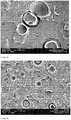
- SEM micrographs of 95/5 wt% PTT/PMMA indicate that the compounding single screw of the '431 patent produces a much better level of mixedness of PMMA particles in the PTT matrix ( FIGS. 4a and b ).
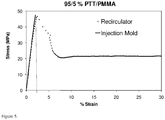
- FIG. 5 presents tensile mechanical property stress versus strain data. Each curve is the average of 5 specimens tested.
- the injection molded blend fractured at about 2.5 % strain while the blend that was processed with the compounding single screw of the '431 patent did not fracture prior to termination of the tests at 30 % strain.
Landscapes
- Chemical & Material Sciences (AREA)
- Health & Medical Sciences (AREA)
- Chemical Kinetics & Catalysis (AREA)
- Medicinal Chemistry (AREA)
- Polymers & Plastics (AREA)
- Organic Chemistry (AREA)
- Engineering & Computer Science (AREA)
- Manufacturing & Machinery (AREA)
- Materials Engineering (AREA)
- Mechanical Engineering (AREA)
- Compositions Of Macromolecular Compounds (AREA)
- Processing And Handling Of Plastics And Other Materials For Molding In General (AREA)
- Processes Of Treating Macromolecular Substances (AREA)
- Extrusion Moulding Of Plastics Or The Like (AREA)
Description
- Tough, high strain to failure materials with good stiffness (modulus) are needed by all segments of industry and commerce, but the automotive and aerospace industries are particularly in need of such materials that are also inexpensive and/or lightweight. Traditional approaches have used exotic polymers (expensive) or ceramic fiber reinforced composites (heavy) to achieve these goals.
- The key to achieving high levels of toughness in combination with high modulus is to generate immiscible blends of materials that individually provide the necessary properties. The difficulty in achieving this is that most immiscible blends of tough [e.g. HDPE] and stiff [e.g. PMMA] polymers have miserable properties.
- Viratyaporn et al. (Annual Technical Conference - ANTEC, Conference Proceedings - Society of Plastics Engineers Annual Technical Conference: Plastics Encounter at ANTEC 2017; vol. 3, pages 1843-1847) teach blends of PS/HDPE and PS/PP using a single screw extruder.
- Tol et al. (Polymer, 2005, vol. 46, no. 2, pages 369-382) disclose blends of PS/PA6, (PPE/PS, 50:50)/PA6, and PPE/PA6 using twin-screw extrusion.
-
-
FIG. 1 demonstrates the high strain to failure (12%) in ultra-fine structured PS/PE composites; -
FIG. 2 is a comparison of the effect of processing on structure: (a) a PS/PE immiscible polymer blend prepared using a single screw extruder and (b) a PS/PE immiscible polymer blend prepared according to a method of the present invention; -
FIG. 3 is a stress/strain curve demonstrating that the fine-structured immiscible polymer blends prepared according to methods of the present invention possess increased toughness and strain to failure over coarse-structured blends; -
FIGS. 4a and b are SEM micrographs of the fracture surfaces of a 95/5 wt% PTT/PMMA blend (a) injection molded and (b) processed using the compounding single screw ofU.S. Patent No. 6,962,431 ; and -
FIG. 5 is a graph of stress versus percent strain for a 95/5 wt% PTT/PMMA blend that was injection molded and another blend processed using the compounding single screw ofU.S. Patent No. 6,962,431 ("Recirculator"). - The present invention is directed to a method for preparing an immiscible polymer blend by (a) combining an amount of a first polymeric component and an amount of a second polymeric component wherein the combination of said first polymeric component and said second polymeric component is selected from the group consisting of a high-density polyolefin and polystyrene, a high density polyolefin and thermoplastic coated fiber material, a high-density polyolefin and acrylo-nitrile-butadiene-styrene, a high-density polyolefin and polycarbonate, a high-density polyolefin and acrylonitrile-butadiene-styrene/polycarbonate, a high-density polyolefin and poly(methyl methacrylate), poly(trimethylene tere-phthalate) and poly(methylmethacrylate), polycarbonate and poly(trimethylene terephthalate), and polystyrene and poly(trimethylene terephthalate); and (b) mixing in an extruder the first polymeric component and the second polymeric component to produce an immiscible polymer blend comprising a co-continuous, integrated multi-phase, three-dimensional microstructured polymer matrix network that includes structures in the blend having a maximum size of less than about 1,000 µm, wherein said first polymeric component and said second polymeric component undergo distributive mixing during extrusion, and wherein said extruder is a single screw extruder with a recirculating high elongational flow mixing element. In one embodiment, the high-density polyolefin is high-density polyethylene.
- The present invention also includes an article that includes an immiscible polymer blend of poly(trimethylene terephthalate) (PTT) and poly(methylmethacrylate) (PMMA). Also provided is an article formed from an immiscible polymer blend prepared by the method of the present invention. In one embodiment, the article is selected from composite building materials, railroad ties, poles, marine pilings, simulated tree trunks, trash receptacles, boxes, cartons, doormats, floor coverings, lawn decorations and ornaments, automobile parts, toys, wagons and gardening carts, buildings and sheds, furniture, tables and chairs, park benches, and housings for electronic components. In another embodiment, the composite building material is selected from dimensional lumber, beams, tongue-and-groove decking panels, blocks, boards, and sheets.
- The present invention relates to methods for preparing immiscible polymer blends by increasing mixing over and above the typical single screw extruder such that the microscale or nanoscale morphology of the resulting blend is much finer (10X, typically) than blends prepared using only the typical single screw extruder. (
FIGS. 2 and3 ). The phrase "immiscible polymer blend" is defined herein as a co-continuous, integrated multi-phase, three-dimensional microstructured network. Microscale or nanoscale morphology includes structures in the blend having a maximum size of less than about 1,000 µm, preferably less than about 500 µm, and even more preferably less than about 10 µm. - Finer structures give more crack deflection (more interfaces, shorter distance between phases, and strain absorption (phases are not bonded with each other). Through this specialized thermal processing of immiscible polymer blends, an extremely fine morphology is developed that permits efficient load transfer such that modulus is retained but microstrain is permitted between the phases, thus inducing high strain prior to failure.
- The resulting blends obtained in accordance with the present invention possess similar stiffness and strength to the typical immiscible polymer blend which has passed through a single screw extruder, but with much greater toughness and ductility. "Toughness" is defined as the ability to absorb energy while being deformed without fracturing. Mechanical properties of the polymer blends can be measured by applying a load to a specimen and measuring the resulting deflection. From the load versus deflection data, stress versus strain data is calculable. Stress is equivalent to the applied load divided by the cross-sectional area of the specimen. Strain is equivalent to the measured deflection divided by the original specimen length. Mechanical properties are obtained from the stress versus strain plot. The initial slope of a stress versus strain curve is called the Young's Modulus and is an indication of the material's stiffness. The ultimate strength is the maximum stress. The fracture strength and fracture strain are the values of stress and strain at which specimen fracture occurs. Ductility is quantified by the percent elongation at material failure, which is 100 times the strain measured at failure. A ductile material is able to undergo plastic deformation and has the ability to relieve locally high stresses at points of stress concentrations. Toughness is measured by the area under a stress-strain curve up to the point of material failure. A material of high toughness is one that has both high strength and substantial ductility.
- Examples of equipment to increase mixing include single screw extruders with recirculating high elongational flow mixing elements, for example, those disclosed in
U.S. Patent No. 6,962,431 to Luker . - One of skill in the art is readily able to determine the miscibility of two or more polymers. Each of the first and second polymeric components can include one or more polymers (e.g. 1, 2, 3, 4, etc.). Exemplary polymeric starting materials and amounts for use in the methods of the present invention include those disclosed in
U.S. Patent Nos. 5,298,214 and6,191,228 for blends of a high-density polyolefin and polystyrene,U.S. Patent Nos. 5,789,477 and5,916,932 for blends of a high-density polyolefin and thermoplastic-coated fiber materials,U.S. Publication No. 2005/0192403 for blends of a high-density polyolefin (e.g. high density polyethylene) and acrylonitrile-butadiene-styrene and/or polycarbonate, and International Publication No.2006/125111 for blends of a high-density polyolefin and poly(methyl methacrylate). Additional polymeric starting materials include poly(trimethylene terephthalate) and poly(methylmethacrylate), polycarbonate and poly(trimethylene terephthalate), and polystyrene and poly(trimethylene terephthalate). - Additional polymeric starting materials useful in the present invention include those disclosed in
U.S. Patent Nos. 4,663,388 ;5,030,662 ;5,212,223 ;5,615,158 ; and6,828,372 . - The present invention also includes blends of poly(trimethylene terephthalate) (PTT) and poly(methylmethacrylate) (PMMA). The blend of the two polymers may be processed on conventional polymer processing equipment, such as extruders and injection molding machines, as well as in the method of the present invention. Blending as little as 5 wt% PMMA with PTT increases the viscosity of the PTT without damaging the properties and increases the processablity of PTT. This increased processability allows the PTT to be used as an engineering resin that is easily injection molded or extruded. Adding small amounts of PTT to PMMA decreases the viscosity of PMMA and increases the processability of PMMA for certain applications. In the co-continuous composition region, the PTT/PMMA blends are immiscible blends in which there is a mechanical interlocking at the interface of the two polymers.
- The amount of each of PTT and PMMA in the blends ranges from about 5 wt% to about 95 wt%. In one embodiment, the amount of each of PTT and PMMA ranges from about 15 wt% to about 85 wt%. In another embodiment, the amount of each of PTT and PMMA ranges from about 20 wt% to about 80 wt%.
- The polymeric starting materials undergo distributive mixing during extrusion. The polymeric components in any suitable form, for example, flake, pellet, or powder form are dry-blended in the appropriate or desired composition ratio. The blend is gravity fed from the single screw extruder's hopper into the extruder barrel. Material enters through the feed throat, an opening near the rear of the barrel, and comes into contact with the screw. The rotating screw forces the resin forward along the barrel, heated to the desired melt temperature of the molten plastic. Frictional heat is generated by intense pressure and friction between resin particles and the barrel walls. Molten plastic is pumped down the screw, forced through a screen pack to remove contaminants, forced through the die that provides the resin with the final product profile, and cooled in an external water bath or by pulling through a set of cooling rolls. In twin screw extrusion, two screws are housed inside the barrel and either co-rotate or counter-rotate. The residence time is a function of the desired screw's revolutions per minute (RPM) and may be dependent upon the materials.
- The blends obtained in accordance with the present invention are suitable for composite building materials, such as, dimensional lumber (e.g. I-Beams, C-Beams, and T-Beams,), tongue-and-groove decking panels, blocks, boards, sheets, and the like. Lumber made from these blends can be used as joists, posts, and beams, for example. Such articles may be used almost anyplace where dimensional lumber or sheets are currently used. They can be used, for example, in house construction in place of boards, interior and exterior plywood, flooring, roofing, decks, and rafters. The definition of the term "lumber" as used herein includes articles formed into the shape of lumber.
- Additional exemplary articles that can be prepared from the immiscible polymer blends obtained in accordance with the present invention include those disclosed in
U.S. Patent Nos. 5,298,214 ;6,191,228 ;5,789,477 ; and5,916,932 ,U.S. Publication No. 2005/0192403 , and International Publication No.2006/125111 , for example, railroad ties; poles; marine pilings; simulated tree trunks for use as telephone poles or guard rail posts or for use in construction of, for example, a pier or boardwalk, and the like; trash receptacles; boxes; cartons; doormats; floor coverings; lawn decorations and ornaments; automobile parts; toys; wagons and gardening carts; buildings and sheds; furniture e.g., casual furniture such as used for indoor/outdoor use including tables and chairs, park benches, etc.; housings for electronic components including consumer electronics such as radios, televisions, stereo systems, VCRs, DVDs, video game players and cartridges, computer housings, keyboards and monitors; and the like. The articles can be structural, decorative, or both. They may be textured to simulate wood grain, to simulate clapboard or cedar shake, or may have raised or imprinted designs of any manner. They may also include indicia. - The following non-limiting examples set forth herein below illustrate certain aspects of the invention.
- Shown below are samples of 35 wt% PS and 65 wt% HDPE processed the typical way with a standard single screw extruder and with the compounding single screw of
U.S. Patent No. 6,962,431 for comparison. (FIG. 1 ). The morphology of each sample is shown inFIG. 2 , as determined using a scanning electron microscope. The PS phase was leached using toluene in order to better show the morphology. For comparison, the micrograph inFIG. 2(a) is that of the sample produced using a standard single screw extruder.FIG. 2(b) is that of the sample produced using the compounding single screw of the '431 patent. At the same scale of 8.57 µm, the standard single screw extruder produced a much more coarse structure than the compounding single screw of the '431 patent, which in turn affects the mechanical properties. The immiscible polymer blend compounded using the '431 extruder possesses about the same stiffness and strength as the sample prepared with the standard extruder, but with much more area under the stress strain curve and a correspondingly higher toughness. (FIG. 3 ). The area under the stress versus strain curves is indicated inFIG. 3 by the vertical dashed lines. The mechanical properties are presented in Table 1:Table 1. Mechanical property comparison of a 35/65 wt % PS/HDPE blend prepared using a standard single screw extruder and a compounding single screw extruder. Extruder Type Modulus (GPa) Ultimate Strength (MPa) % Strain at Fracture Strength at Fracture (MPa) Standard 1.43 30.0 5.0 28.1 Compounding 1.91 32.7 12.0 29.7 - Blends of poly(trimethylene terephthalate) (PTT) and poly(methylmethacrylate) (PMMA) prepared using typical injection molding (IM) methods were compared with blends prepared with the compounding single screw of
U.S. Patent No. 6,962,431 . SEM micrographs of 95/5 wt% PTT/PMMA indicate that the compounding single screw of the '431 patent produces a much better level of mixedness of PMMA particles in the PTT matrix (FIGS. 4a and b ).FIG. 5 presents tensile mechanical property stress versus strain data. Each curve is the average of 5 specimens tested. The injection molded blend fractured at about 2.5 % strain while the blend that was processed with the compounding single screw of the '431 patent did not fracture prior to termination of the tests at 30 % strain.
Claims (8)
- A method for preparing an immiscible polymer blend comprising:a) combining an amount of a first polymeric component and an amount of a second polymeric component, wherein the combination of said first polymeric component and said second polymeric component is selected from the group consisting of a high-density polyolefin and polystyrene, a high density polyolefin and thermoplastic coated fiber material, a high-density polyolefin and acrylonitrile-butadiene-styrene, a high-density polyolefin and polycarbonate, a high-density polyolefin and acrylonitrile-butadiene-styrene/polycarbonate, a high-density polyolefin and poly(methyl methacrylate), poly(trimethylene terephthalate) and poly(methylmethacrylate), polycarbonate and poly(trimethylene terephthalate), and polystyrene and poly(trimethylene terephthalate); andb) mixing in an extruder said first polymeric component and said second polymeric component to produce an immiscible polymer blend comprising a co-continuous, integrated multi-phase, three-dimensional microstructured polymer matrix network comprising structures in the blend having a maximum size of less than 1,000 µm,wherein said first polymeric component and said second polymeric component undergo distributive mixing during extrusion, and
wherein said extruder is a single screw extruder with a recirculating high elongational flow mixing element. - The method of Claim 1, wherein said first and second polymeric components are a high density polyolefin and thermoplastic coated fiber material.
- The method of Claim 1 or Claim 2 wherein said high density polyolefin is high density polyethylene.
- An article formed from an immiscible polymer blend prepared by the method of any one of claims 1 - 3.
- The article of Claim 4, wherein said first and second polymeric components are a high density polyolefin and thermoplastic coated fiber material.
- The article of Claim 4 or Claim 5 wherein said high density polyolefin is high density polyethylene.
- The article of any one of claims 4 - 6, wherein said article is selected from the group consisting of composite building materials, railroad ties, poles, marine pilings, simulated tree trunks, trash receptacles, boxes, cartons, doormats, floor coverings, lawn decorations and ornaments, automobile parts, toys, wagons and gardening carts, buildings and sheds, furniture, tables and chairs, park benches, and housings for electronic components.
- The article of claim 7, wherein said composite building material is selected from the group consisting of dimensional lumber, beams, tongue-and-groove decking panels, blocks, boards, and sheets.
Priority Applications (1)
| Application Number | Priority Date | Filing Date | Title |
|---|---|---|---|
| PL09721906T PL2257583T3 (en) | 2008-03-18 | 2009-03-18 | Methods for increasing toughness of immiscible polymer blends |
Applications Claiming Priority (2)
| Application Number | Priority Date | Filing Date | Title |
|---|---|---|---|
| US3750408P | 2008-03-18 | 2008-03-18 | |
| PCT/US2009/037552 WO2009117509A2 (en) | 2008-03-18 | 2009-03-18 | Methods for increasing toughness of immiscible polymer blends |
Publications (3)
| Publication Number | Publication Date |
|---|---|
| EP2257583A2 EP2257583A2 (en) | 2010-12-08 |
| EP2257583A4 EP2257583A4 (en) | 2014-09-03 |
| EP2257583B1 true EP2257583B1 (en) | 2019-10-23 |
Family
ID=41091520
Family Applications (1)
| Application Number | Title | Priority Date | Filing Date |
|---|---|---|---|
| EP09721906.7A Active EP2257583B1 (en) | 2008-03-18 | 2009-03-18 | Methods for increasing toughness of immiscible polymer blends |
Country Status (9)
| Country | Link |
|---|---|
| US (1) | US8497324B2 (en) |
| EP (1) | EP2257583B1 (en) |
| KR (1) | KR20110007137A (en) |
| CN (1) | CN101998971A (en) |
| AU (1) | AU2009225641B9 (en) |
| BR (1) | BRPI0909126A2 (en) |
| CA (1) | CA2715039C (en) |
| PL (1) | PL2257583T3 (en) |
| WO (1) | WO2009117509A2 (en) |
Families Citing this family (12)
| Publication number | Priority date | Publication date | Assignee | Title |
|---|---|---|---|---|
| US9533432B2 (en) | 2008-03-18 | 2017-01-03 | Rutgers, The State University Of New Jersey | Just-in-time compounding in an injection molding machine |
| JP5612344B2 (en) * | 2010-03-25 | 2014-10-22 | パナソニック株式会社 | Molding material for water-borne housing facilities and water-based housing facilities using the same |
| US11479652B2 (en) | 2012-10-19 | 2022-10-25 | Rutgers, The State University Of New Jersey | Covalent conjugates of graphene nanoparticles and polymer chains and composite materials formed therefrom |
| US12460064B2 (en) | 2012-10-19 | 2025-11-04 | Rutgers, The State University Of New Jersey | In situ exfoliation method to fabricate a graphene-reinforced polymer matrix composite |
| US9422423B2 (en) | 2012-12-04 | 2016-08-23 | Rutgers, The State University Of New Jersey | Composite articles compression molded from recycled plastic |
| KR102292918B1 (en) | 2013-04-18 | 2021-08-24 | 럿거스, 더 스테이트 유니버시티 오브 뉴저지 | In situ exfoliation method to fabricate a graphene-reinforced polymer matrix composite |
| KR101708762B1 (en) | 2015-02-09 | 2017-02-21 | (주)제이비엘 | Power monitoring system and power monitoring device |
| US11702518B2 (en) | 2016-07-22 | 2023-07-18 | Rutgers, The State University Of New Jersey | In situ bonding of carbon fibers and nanotubes to polymer matrices |
| WO2019143662A1 (en) | 2018-01-16 | 2019-07-25 | Rutgers The State University Of New Jersey | Use of graphene-polymer composites to improve barrier resistance of polymers to liquid and gas permeants |
| DE202018106258U1 (en) | 2018-10-15 | 2020-01-20 | Rutgers, The State University Of New Jersey | Nano-graphite sponges |
| CN109781723B (en) * | 2019-03-01 | 2022-01-07 | 广州钰芯传感科技有限公司 | Preparation method and application of hydrogen ion response interdigital electrode |
| US11807757B2 (en) | 2019-05-07 | 2023-11-07 | Rutgers, The State University Of New Jersey | Economical multi-scale reinforced composites |
Family Cites Families (17)
| Publication number | Priority date | Publication date | Assignee | Title |
|---|---|---|---|---|
| US4663388A (en) | 1985-08-05 | 1987-05-05 | A. E. Staley Manufacturing Company | Process for producing filled or reinforced polymer compositions |
| US5030662A (en) | 1988-08-11 | 1991-07-09 | Polymerix, Inc. | Construction material obtained from recycled polyolefins containing other polymers |
| US5298214A (en) | 1990-10-30 | 1994-03-29 | Rutgers, The State University | Method of deriving polystyrene and polyolefin plastics composite from recycled plastics |
| US5212223A (en) | 1991-03-05 | 1993-05-18 | Polymerix, Inc. | Extrusion method and apparatus for recycling waste plastics and construction materials therefrom |
| US5615158A (en) | 1995-11-13 | 1997-03-25 | Micron Technology, Inc. | Sense amplifier circuit for detecting degradation of digit lines and method thereof |
| US5789477A (en) | 1996-08-30 | 1998-08-04 | Rutgers, The State University | Composite building materials from recyclable waste |
| US6191228B1 (en) | 1999-01-27 | 2001-02-20 | Polywood Inc. | Use of recycled plastics for preparing high performance composite railroad ties |
| US6572956B1 (en) * | 1999-04-08 | 2003-06-03 | General Electric Company | Weatherable multilayer resinous articles and method for their preparation |
| US6689474B2 (en) | 1999-05-18 | 2004-02-10 | General Electric Company | Thermally stable polymers, method of preparation, and articles made therefrom |
| US6962431B1 (en) * | 2000-11-08 | 2005-11-08 | Randcastle Extrusion System, Inc. | Extruder mixer |
| US6828372B2 (en) | 2001-03-05 | 2004-12-07 | Tie Tek, Inc. | Railroad tie and method for making same |
| JP3862996B2 (en) * | 2001-10-31 | 2006-12-27 | 帝人ファイバー株式会社 | Polytrimethylene terephthalate filament yarn and method for producing the same |
| CA2378922C (en) * | 2002-01-16 | 2009-01-27 | Rutgers, The State University Of New Jersey | Compositions and methods of making plastic articles from polymer blends containing polyethylene |
| CN1252179C (en) | 2003-04-11 | 2006-04-19 | 山东大学 | Thermoplastic resin combination of polypropylene terephthalate and its formed pieces |
| EP1896528A4 (en) | 2005-05-19 | 2011-09-21 | Univ Rutgers | USE OF RECYCLED PLASTICS FOR CONSTRUCTION MODELS |
| US20090242655A1 (en) * | 2006-03-30 | 2009-10-01 | Rutgers, The State University Of New Jersey | Railroad tie that obviates the need for a tie plate |
| IT1387503B (en) * | 2008-05-08 | 2011-04-13 | Novamont Spa | ALYPATIC-AROMATIC BIODEGRADABLE POLYESTER |
-
2009
- 2009-03-18 AU AU2009225641A patent/AU2009225641B9/en active Active
- 2009-03-18 BR BRPI0909126A patent/BRPI0909126A2/en not_active Application Discontinuation
- 2009-03-18 KR KR1020107023193A patent/KR20110007137A/en not_active Withdrawn
- 2009-03-18 PL PL09721906T patent/PL2257583T3/en unknown
- 2009-03-18 US US12/922,940 patent/US8497324B2/en active Active
- 2009-03-18 CN CN2009801128334A patent/CN101998971A/en active Pending
- 2009-03-18 WO PCT/US2009/037552 patent/WO2009117509A2/en not_active Ceased
- 2009-03-18 EP EP09721906.7A patent/EP2257583B1/en active Active
- 2009-03-18 CA CA2715039A patent/CA2715039C/en active Active
Non-Patent Citations (1)
| Title |
|---|
| None * |
Also Published As
| Publication number | Publication date |
|---|---|
| WO2009117509A2 (en) | 2009-09-24 |
| AU2009225641A1 (en) | 2009-09-24 |
| BRPI0909126A2 (en) | 2015-11-24 |
| AU2009225641B2 (en) | 2015-04-02 |
| WO2009117509A3 (en) | 2010-01-21 |
| EP2257583A2 (en) | 2010-12-08 |
| EP2257583A4 (en) | 2014-09-03 |
| CN101998971A (en) | 2011-03-30 |
| US20110143058A1 (en) | 2011-06-16 |
| US8497324B2 (en) | 2013-07-30 |
| CA2715039A1 (en) | 2009-09-24 |
| PL2257583T3 (en) | 2020-05-18 |
| KR20110007137A (en) | 2011-01-21 |
| AU2009225641B9 (en) | 2015-08-27 |
| CA2715039C (en) | 2016-10-18 |
Similar Documents
| Publication | Publication Date | Title |
|---|---|---|
| CA2715039C (en) | Methods for increasing toughness of immiscible polymer blends | |
| Ashothaman et al. | A comprehensive review on biodegradable polylactic acid polymer matrix composite material reinforced with synthetic and natural fibers | |
| Zhou et al. | Recycling end-of-life WPC products into ultra-high-filled, high-performance wood fiber/polyethylene composites: A sustainable strategy for clean and cyclic processing in the WPC industry | |
| Chaharmahali et al. | Mechanical properties of wood plastic composite panels made from waste fiberboard and particleboard | |
| US12071537B2 (en) | Composite extrusion with non-aligned fiber orientation | |
| US6015612A (en) | Polymer wood composite | |
| US8629203B2 (en) | Rigid biofiber thermoplastic composite and articles made therefrom | |
| Najafi et al. | Effect of thermomechanical degradation of polypropylene on mechanical properties of wood-polypropylene composites | |
| WO2009072914A1 (en) | Cork-polymer composite (cpc) materials and processes to obtain the same | |
| WO2011014085A2 (en) | Fibre-reinforced cork-based composites | |
| Sozen et al. | The effects of lignocellulosic fillers on mechanical, morphological and thermal properties of wood polymer composites | |
| Mengeloglu et al. | Mechanical properties of extruded high density polyethylene and polypropylene wood flour decking boards | |
| Kim | Overview of wood plastic composites: focusing on use of bio-based plastics and co-extrusion technique | |
| CA2378922C (en) | Compositions and methods of making plastic articles from polymer blends containing polyethylene | |
| Matuana et al. | A factorial design applied to the extrusion foaming of polypropylene/wood-flour composites | |
| Joshi et al. | Mechanical properties of highly filled PVC/wood-flour composites | |
| Hyvärinen et al. | Tensile Properties of cellulose-filled recycled thermoplastic composite filaments for 3D printing | |
| Alodan et al. | Effect of fiber loading on physical, mechanical, and thermal properties of low density polyethylene/palm tree waste fiber composites | |
| Marsi et al. | Utilization of Rice Husk Fiber Blended Recycled Polyethylene Terephthalate for Manufacturing RHF/R-PET Polymer Composites | |
| Nosker et al. | Methods of increasing toughness of immiscible polymer blends, US Patent 8,497,324 | |
| Akdogan et al. | Wood-reinforced polymer composites | |
| Faroque et al. | RETRACTED: Fabrication and Characterization of Wood Fiber Reinforced Polymer Composites | |
| Gupta et al. | Natural fiber based bio-materials: a review on processing, characterization and applications | |
| Douglas et al. | Effect of Coupling Agents and Weathering on the Mechanical Properties of Wood‐Polymer Composites | |
| Öztürk et al. | Mechanical Performance of L-Shaped Corner Joints Manufactured by 3D Printing with a Polylactic Acid-Wood Composite. |
Legal Events
| Date | Code | Title | Description |
|---|---|---|---|
| PUAI | Public reference made under article 153(3) epc to a published international application that has entered the european phase |
Free format text: ORIGINAL CODE: 0009012 |
|
| 17P | Request for examination filed |
Effective date: 20101012 |
|
| AK | Designated contracting states |
Kind code of ref document: A2 Designated state(s): AT BE BG CH CY CZ DE DK EE ES FI FR GB GR HR HU IE IS IT LI LT LU LV MC MK MT NL NO PL PT RO SE SI SK TR |
|
| AX | Request for extension of the european patent |
Extension state: AL BA RS |
|
| DAX | Request for extension of the european patent (deleted) | ||
| A4 | Supplementary search report drawn up and despatched |
Effective date: 20140806 |
|
| RIC1 | Information provided on ipc code assigned before grant |
Ipc: B29C 47/62 20060101ALI20140728BHEP Ipc: C08L 33/12 20060101ALI20140728BHEP Ipc: C08G 63/00 20060101AFI20140728BHEP Ipc: C08L 67/02 20060101ALI20140728BHEP Ipc: B29C 47/64 20060101ALI20140728BHEP Ipc: B29C 47/60 20060101ALI20140728BHEP Ipc: C08J 3/00 20060101ALI20140728BHEP |
|
| 17Q | First examination report despatched |
Effective date: 20151123 |
|
| STAA | Information on the status of an ep patent application or granted ep patent |
Free format text: STATUS: EXAMINATION IS IN PROGRESS |
|
| REG | Reference to a national code |
Ref country code: DE Ref legal event code: R079 Ref document number: 602009060227 Country of ref document: DE Free format text: PREVIOUS MAIN CLASS: C08G0063000000 Ipc: B29C0048505000 |
|
| RIC1 | Information provided on ipc code assigned before grant |
Ipc: B29C 48/67 20190101ALI20190321BHEP Ipc: C08J 3/00 20060101ALI20190321BHEP Ipc: B29C 48/505 20190101AFI20190321BHEP Ipc: C08L 67/00 20060101ALI20190321BHEP Ipc: C08L 33/12 20060101ALI20190321BHEP Ipc: B29C 48/64 20190101ALI20190321BHEP Ipc: C08L 67/02 20060101ALI20190321BHEP |
|
| GRAP | Despatch of communication of intention to grant a patent |
Free format text: ORIGINAL CODE: EPIDOSNIGR1 |
|
| STAA | Information on the status of an ep patent application or granted ep patent |
Free format text: STATUS: GRANT OF PATENT IS INTENDED |
|
| INTG | Intention to grant announced |
Effective date: 20190506 |
|
| GRAS | Grant fee paid |
Free format text: ORIGINAL CODE: EPIDOSNIGR3 |
|
| GRAA | (expected) grant |
Free format text: ORIGINAL CODE: 0009210 |
|
| STAA | Information on the status of an ep patent application or granted ep patent |
Free format text: STATUS: THE PATENT HAS BEEN GRANTED |
|
| AK | Designated contracting states |
Kind code of ref document: B1 Designated state(s): AT BE BG CH CY CZ DE DK EE ES FI FR GB GR HR HU IE IS IT LI LT LU LV MC MK MT NL NO PL PT RO SE SI SK TR |
|
| REG | Reference to a national code |
Ref country code: GB Ref legal event code: FG4D |
|
| REG | Reference to a national code |
Ref country code: CH Ref legal event code: EP |
|
| REG | Reference to a national code |
Ref country code: IE Ref legal event code: FG4D |
|
| REG | Reference to a national code |
Ref country code: DE Ref legal event code: R096 Ref document number: 602009060227 Country of ref document: DE |
|
| REG | Reference to a national code |
Ref country code: AT Ref legal event code: REF Ref document number: 1193187 Country of ref document: AT Kind code of ref document: T Effective date: 20191115 |
|
| REG | Reference to a national code |
Ref country code: SE Ref legal event code: TRGR |
|
| REG | Reference to a national code |
Ref country code: NL Ref legal event code: MP Effective date: 20191023 |
|
| REG | Reference to a national code |
Ref country code: LT Ref legal event code: MG4D |
|
| PG25 | Lapsed in a contracting state [announced via postgrant information from national office to epo] |
Ref country code: ES Free format text: LAPSE BECAUSE OF FAILURE TO SUBMIT A TRANSLATION OF THE DESCRIPTION OR TO PAY THE FEE WITHIN THE PRESCRIBED TIME-LIMIT Effective date: 20191023 Ref country code: LV Free format text: LAPSE BECAUSE OF FAILURE TO SUBMIT A TRANSLATION OF THE DESCRIPTION OR TO PAY THE FEE WITHIN THE PRESCRIBED TIME-LIMIT Effective date: 20191023 Ref country code: NL Free format text: LAPSE BECAUSE OF FAILURE TO SUBMIT A TRANSLATION OF THE DESCRIPTION OR TO PAY THE FEE WITHIN THE PRESCRIBED TIME-LIMIT Effective date: 20191023 Ref country code: LT Free format text: LAPSE BECAUSE OF FAILURE TO SUBMIT A TRANSLATION OF THE DESCRIPTION OR TO PAY THE FEE WITHIN THE PRESCRIBED TIME-LIMIT Effective date: 20191023 Ref country code: GR Free format text: LAPSE BECAUSE OF FAILURE TO SUBMIT A TRANSLATION OF THE DESCRIPTION OR TO PAY THE FEE WITHIN THE PRESCRIBED TIME-LIMIT Effective date: 20200124 Ref country code: NO Free format text: LAPSE BECAUSE OF FAILURE TO SUBMIT A TRANSLATION OF THE DESCRIPTION OR TO PAY THE FEE WITHIN THE PRESCRIBED TIME-LIMIT Effective date: 20200123 Ref country code: FI Free format text: LAPSE BECAUSE OF FAILURE TO SUBMIT A TRANSLATION OF THE DESCRIPTION OR TO PAY THE FEE WITHIN THE PRESCRIBED TIME-LIMIT Effective date: 20191023 Ref country code: PT Free format text: LAPSE BECAUSE OF FAILURE TO SUBMIT A TRANSLATION OF THE DESCRIPTION OR TO PAY THE FEE WITHIN THE PRESCRIBED TIME-LIMIT Effective date: 20200224 Ref country code: BG Free format text: LAPSE BECAUSE OF FAILURE TO SUBMIT A TRANSLATION OF THE DESCRIPTION OR TO PAY THE FEE WITHIN THE PRESCRIBED TIME-LIMIT Effective date: 20200123 |
|
| PG25 | Lapsed in a contracting state [announced via postgrant information from national office to epo] |
Ref country code: HR Free format text: LAPSE BECAUSE OF FAILURE TO SUBMIT A TRANSLATION OF THE DESCRIPTION OR TO PAY THE FEE WITHIN THE PRESCRIBED TIME-LIMIT Effective date: 20191023 Ref country code: IS Free format text: LAPSE BECAUSE OF FAILURE TO SUBMIT A TRANSLATION OF THE DESCRIPTION OR TO PAY THE FEE WITHIN THE PRESCRIBED TIME-LIMIT Effective date: 20200224 |
|
| REG | Reference to a national code |
Ref country code: DE Ref legal event code: R097 Ref document number: 602009060227 Country of ref document: DE |
|
| PG2D | Information on lapse in contracting state deleted |
Ref country code: IS |
|
| PG25 | Lapsed in a contracting state [announced via postgrant information from national office to epo] |
Ref country code: RO Free format text: LAPSE BECAUSE OF FAILURE TO SUBMIT A TRANSLATION OF THE DESCRIPTION OR TO PAY THE FEE WITHIN THE PRESCRIBED TIME-LIMIT Effective date: 20191023 Ref country code: CZ Free format text: LAPSE BECAUSE OF FAILURE TO SUBMIT A TRANSLATION OF THE DESCRIPTION OR TO PAY THE FEE WITHIN THE PRESCRIBED TIME-LIMIT Effective date: 20191023 Ref country code: EE Free format text: LAPSE BECAUSE OF FAILURE TO SUBMIT A TRANSLATION OF THE DESCRIPTION OR TO PAY THE FEE WITHIN THE PRESCRIBED TIME-LIMIT Effective date: 20191023 Ref country code: DK Free format text: LAPSE BECAUSE OF FAILURE TO SUBMIT A TRANSLATION OF THE DESCRIPTION OR TO PAY THE FEE WITHIN THE PRESCRIBED TIME-LIMIT Effective date: 20191023 Ref country code: IS Free format text: LAPSE BECAUSE OF FAILURE TO SUBMIT A TRANSLATION OF THE DESCRIPTION OR TO PAY THE FEE WITHIN THE PRESCRIBED TIME-LIMIT Effective date: 20200223 |
|
| REG | Reference to a national code |
Ref country code: AT Ref legal event code: MK05 Ref document number: 1193187 Country of ref document: AT Kind code of ref document: T Effective date: 20191023 |
|
| PLBE | No opposition filed within time limit |
Free format text: ORIGINAL CODE: 0009261 |
|
| STAA | Information on the status of an ep patent application or granted ep patent |
Free format text: STATUS: NO OPPOSITION FILED WITHIN TIME LIMIT |
|
| PG25 | Lapsed in a contracting state [announced via postgrant information from national office to epo] |
Ref country code: SK Free format text: LAPSE BECAUSE OF FAILURE TO SUBMIT A TRANSLATION OF THE DESCRIPTION OR TO PAY THE FEE WITHIN THE PRESCRIBED TIME-LIMIT Effective date: 20191023 Ref country code: IT Free format text: LAPSE BECAUSE OF FAILURE TO SUBMIT A TRANSLATION OF THE DESCRIPTION OR TO PAY THE FEE WITHIN THE PRESCRIBED TIME-LIMIT Effective date: 20191023 |
|
| 26N | No opposition filed |
Effective date: 20200724 |
|
| PG25 | Lapsed in a contracting state [announced via postgrant information from national office to epo] |
Ref country code: MC Free format text: LAPSE BECAUSE OF FAILURE TO SUBMIT A TRANSLATION OF THE DESCRIPTION OR TO PAY THE FEE WITHIN THE PRESCRIBED TIME-LIMIT Effective date: 20191023 |
|
| REG | Reference to a national code |
Ref country code: CH Ref legal event code: PL |
|
| PG25 | Lapsed in a contracting state [announced via postgrant information from national office to epo] |
Ref country code: SI Free format text: LAPSE BECAUSE OF FAILURE TO SUBMIT A TRANSLATION OF THE DESCRIPTION OR TO PAY THE FEE WITHIN THE PRESCRIBED TIME-LIMIT Effective date: 20191023 Ref country code: AT Free format text: LAPSE BECAUSE OF FAILURE TO SUBMIT A TRANSLATION OF THE DESCRIPTION OR TO PAY THE FEE WITHIN THE PRESCRIBED TIME-LIMIT Effective date: 20191023 |
|
| REG | Reference to a national code |
Ref country code: BE Ref legal event code: MM Effective date: 20200331 |
|
| PG25 | Lapsed in a contracting state [announced via postgrant information from national office to epo] |
Ref country code: LU Free format text: LAPSE BECAUSE OF NON-PAYMENT OF DUE FEES Effective date: 20200318 |
|
| PG25 | Lapsed in a contracting state [announced via postgrant information from national office to epo] |
Ref country code: IE Free format text: LAPSE BECAUSE OF NON-PAYMENT OF DUE FEES Effective date: 20200318 Ref country code: LI Free format text: LAPSE BECAUSE OF NON-PAYMENT OF DUE FEES Effective date: 20200331 Ref country code: CH Free format text: LAPSE BECAUSE OF NON-PAYMENT OF DUE FEES Effective date: 20200331 |
|
| PG25 | Lapsed in a contracting state [announced via postgrant information from national office to epo] |
Ref country code: BE Free format text: LAPSE BECAUSE OF NON-PAYMENT OF DUE FEES Effective date: 20200331 |
|
| GBPC | Gb: european patent ceased through non-payment of renewal fee |
Effective date: 20200318 |
|
| PG25 | Lapsed in a contracting state [announced via postgrant information from national office to epo] |
Ref country code: GB Free format text: LAPSE BECAUSE OF NON-PAYMENT OF DUE FEES Effective date: 20200318 |
|
| REG | Reference to a national code |
Ref country code: GB Ref legal event code: S28 Free format text: APPLICATION FILED |
|
| REG | Reference to a national code |
Ref country code: GB Ref legal event code: S28 Free format text: RESTORATION ALLOWED Effective date: 20210708 |
|
| PG25 | Lapsed in a contracting state [announced via postgrant information from national office to epo] |
Ref country code: TR Free format text: LAPSE BECAUSE OF FAILURE TO SUBMIT A TRANSLATION OF THE DESCRIPTION OR TO PAY THE FEE WITHIN THE PRESCRIBED TIME-LIMIT Effective date: 20191023 Ref country code: MT Free format text: LAPSE BECAUSE OF FAILURE TO SUBMIT A TRANSLATION OF THE DESCRIPTION OR TO PAY THE FEE WITHIN THE PRESCRIBED TIME-LIMIT Effective date: 20191023 Ref country code: CY Free format text: LAPSE BECAUSE OF FAILURE TO SUBMIT A TRANSLATION OF THE DESCRIPTION OR TO PAY THE FEE WITHIN THE PRESCRIBED TIME-LIMIT Effective date: 20191023 |
|
| PG25 | Lapsed in a contracting state [announced via postgrant information from national office to epo] |
Ref country code: MK Free format text: LAPSE BECAUSE OF FAILURE TO SUBMIT A TRANSLATION OF THE DESCRIPTION OR TO PAY THE FEE WITHIN THE PRESCRIBED TIME-LIMIT Effective date: 20191023 |
|
| P01 | Opt-out of the competence of the unified patent court (upc) registered |
Effective date: 20230525 |
|
| PGFP | Annual fee paid to national office [announced via postgrant information from national office to epo] |
Ref country code: SE Payment date: 20250312 Year of fee payment: 17 |
|
| PGFP | Annual fee paid to national office [announced via postgrant information from national office to epo] |
Ref country code: PL Payment date: 20250305 Year of fee payment: 17 |
|
| PGFP | Annual fee paid to national office [announced via postgrant information from national office to epo] |
Ref country code: GB Payment date: 20260327 Year of fee payment: 18 |
|
| PGFP | Annual fee paid to national office [announced via postgrant information from national office to epo] |
Ref country code: DE Payment date: 20260327 Year of fee payment: 18 |
|
| PGFP | Annual fee paid to national office [announced via postgrant information from national office to epo] |
Ref country code: FR Payment date: 20260325 Year of fee payment: 18 |