EP2257420B1 - Moldable composite materials - Google Patents
Moldable composite materials Download PDFInfo
- Publication number
- EP2257420B1 EP2257420B1 EP09725153.2A EP09725153A EP2257420B1 EP 2257420 B1 EP2257420 B1 EP 2257420B1 EP 09725153 A EP09725153 A EP 09725153A EP 2257420 B1 EP2257420 B1 EP 2257420B1
- Authority
- EP
- European Patent Office
- Prior art keywords
- flakes
- fibers
- composite material
- composite
- moldable
- Prior art date
- Legal status (The legal status is an assumption and is not a legal conclusion. Google has not performed a legal analysis and makes no representation as to the accuracy of the status listed.)
- Not-in-force
Links
- 239000002131 composite material Substances 0.000 title claims description 58
- 239000000835 fiber Substances 0.000 claims description 44
- 239000000463 material Substances 0.000 claims description 32
- 239000011159 matrix material Substances 0.000 claims description 25
- 239000000758 substrate Substances 0.000 claims description 15
- 229920000642 polymer Polymers 0.000 claims description 12
- 239000000945 filler Substances 0.000 claims description 6
- 229920001169 thermoplastic Polymers 0.000 description 16
- 239000004416 thermosoftening plastic Substances 0.000 description 13
- 239000011521 glass Substances 0.000 description 12
- 239000010410 layer Substances 0.000 description 12
- -1 for example Substances 0.000 description 9
- 238000000034 method Methods 0.000 description 6
- 238000000465 moulding Methods 0.000 description 6
- 229920003023 plastic Polymers 0.000 description 6
- 239000004033 plastic Substances 0.000 description 6
- 239000004760 aramid Substances 0.000 description 4
- 239000004566 building material Substances 0.000 description 4
- 239000000203 mixture Substances 0.000 description 4
- 229920001187 thermosetting polymer Polymers 0.000 description 4
- 239000002023 wood Substances 0.000 description 4
- 229920000106 Liquid crystal polymer Polymers 0.000 description 3
- 239000004977 Liquid-crystal polymers (LCPs) Substances 0.000 description 3
- 239000004698 Polyethylene Substances 0.000 description 3
- CDBYLPFSWZWCQE-UHFFFAOYSA-L Sodium Carbonate Chemical compound [Na+].[Na+].[O-]C([O-])=O CDBYLPFSWZWCQE-UHFFFAOYSA-L 0.000 description 3
- 239000000853 adhesive Substances 0.000 description 3
- 230000001070 adhesive effect Effects 0.000 description 3
- 229910000323 aluminium silicate Inorganic materials 0.000 description 3
- 229920003235 aromatic polyamide Polymers 0.000 description 3
- 239000003365 glass fiber Substances 0.000 description 3
- 238000004519 manufacturing process Methods 0.000 description 3
- 239000002184 metal Substances 0.000 description 3
- 229910052751 metal Inorganic materials 0.000 description 3
- 229920000573 polyethylene Polymers 0.000 description 3
- OKTJSMMVPCPJKN-UHFFFAOYSA-N Carbon Chemical compound [C] OKTJSMMVPCPJKN-UHFFFAOYSA-N 0.000 description 2
- XEEYBQQBJWHFJM-UHFFFAOYSA-N Iron Chemical compound [Fe] XEEYBQQBJWHFJM-UHFFFAOYSA-N 0.000 description 2
- CPLXHLVBOLITMK-UHFFFAOYSA-N Magnesium oxide Chemical compound [Mg]=O CPLXHLVBOLITMK-UHFFFAOYSA-N 0.000 description 2
- BPQQTUXANYXVAA-UHFFFAOYSA-N Orthosilicate Chemical compound [O-][Si]([O-])([O-])[O-] BPQQTUXANYXVAA-UHFFFAOYSA-N 0.000 description 2
- 239000004697 Polyetherimide Substances 0.000 description 2
- 239000004743 Polypropylene Substances 0.000 description 2
- 229920001577 copolymer Polymers 0.000 description 2
- 230000006378 damage Effects 0.000 description 2
- HNPSIPDUKPIQMN-UHFFFAOYSA-N dioxosilane;oxo(oxoalumanyloxy)alumane Chemical compound O=[Si]=O.O=[Al]O[Al]=O HNPSIPDUKPIQMN-UHFFFAOYSA-N 0.000 description 2
- 239000012634 fragment Substances 0.000 description 2
- 238000001746 injection moulding Methods 0.000 description 2
- 230000014759 maintenance of location Effects 0.000 description 2
- 239000012778 molding material Substances 0.000 description 2
- 239000008188 pellet Substances 0.000 description 2
- 229920001601 polyetherimide Polymers 0.000 description 2
- 229920001155 polypropylene Polymers 0.000 description 2
- 239000004634 thermosetting polymer Substances 0.000 description 2
- VSSAADCISISCOY-UHFFFAOYSA-N 1-(4-furo[3,4-c]pyridin-1-ylphenyl)furo[3,4-c]pyridine Chemical compound C1=CN=CC2=COC(C=3C=CC(=CC=3)C3=C4C=CN=CC4=CO3)=C21 VSSAADCISISCOY-UHFFFAOYSA-N 0.000 description 1
- ZOXJGFHDIHLPTG-UHFFFAOYSA-N Boron Chemical compound [B] ZOXJGFHDIHLPTG-UHFFFAOYSA-N 0.000 description 1
- 229920000049 Carbon (fiber) Polymers 0.000 description 1
- GABQNAFEZZDSCM-RMKNXTFCSA-N Cinnamyl anthranilate Chemical compound NC1=CC=CC=C1C(=O)OC\C=C\C1=CC=CC=C1 GABQNAFEZZDSCM-RMKNXTFCSA-N 0.000 description 1
- 229920002430 Fibre-reinforced plastic Polymers 0.000 description 1
- 241000238631 Hexapoda Species 0.000 description 1
- 229920000271 Kevlar® Polymers 0.000 description 1
- 229920000914 Metallic fiber Polymers 0.000 description 1
- 239000004677 Nylon Substances 0.000 description 1
- 239000004952 Polyamide Substances 0.000 description 1
- 239000004693 Polybenzimidazole Substances 0.000 description 1
- 229920000265 Polyparaphenylene Polymers 0.000 description 1
- 239000004372 Polyvinyl alcohol Substances 0.000 description 1
- 229910000831 Steel Inorganic materials 0.000 description 1
- 229920001494 Technora Polymers 0.000 description 1
- 229920000561 Twaron Polymers 0.000 description 1
- 229920010741 Ultra High Molecular Weight Polyethylene (UHMWPE) Polymers 0.000 description 1
- 229920000508 Vectran Polymers 0.000 description 1
- 239000004979 Vectran Substances 0.000 description 1
- 208000027418 Wounds and injury Diseases 0.000 description 1
- HCHKCACWOHOZIP-UHFFFAOYSA-N Zinc Chemical compound [Zn] HCHKCACWOHOZIP-UHFFFAOYSA-N 0.000 description 1
- 239000000654 additive Substances 0.000 description 1
- 239000003513 alkali Substances 0.000 description 1
- 230000004075 alteration Effects 0.000 description 1
- XAGFODPZIPBFFR-UHFFFAOYSA-N aluminium Chemical compound [Al] XAGFODPZIPBFFR-UHFFFAOYSA-N 0.000 description 1
- PNEYBMLMFCGWSK-UHFFFAOYSA-N aluminium oxide Inorganic materials [O-2].[O-2].[O-2].[Al+3].[Al+3] PNEYBMLMFCGWSK-UHFFFAOYSA-N 0.000 description 1
- 229920006231 aramid fiber Polymers 0.000 description 1
- 239000010425 asbestos Substances 0.000 description 1
- 229910052788 barium Inorganic materials 0.000 description 1
- DSAJWYNOEDNPEQ-UHFFFAOYSA-N barium atom Chemical compound [Ba] DSAJWYNOEDNPEQ-UHFFFAOYSA-N 0.000 description 1
- 238000000071 blow moulding Methods 0.000 description 1
- 229910052796 boron Inorganic materials 0.000 description 1
- 239000005388 borosilicate glass Substances 0.000 description 1
- 229910052799 carbon Inorganic materials 0.000 description 1
- 239000004917 carbon fiber Substances 0.000 description 1
- 238000003763 carbonization Methods 0.000 description 1
- 229920002678 cellulose Polymers 0.000 description 1
- 239000001913 cellulose Substances 0.000 description 1
- 239000000919 ceramic Substances 0.000 description 1
- 239000003245 coal Substances 0.000 description 1
- 150000001875 compounds Chemical class 0.000 description 1
- 238000000748 compression moulding Methods 0.000 description 1
- 238000005520 cutting process Methods 0.000 description 1
- 239000002360 explosive Substances 0.000 description 1
- 239000011151 fibre-reinforced plastic Substances 0.000 description 1
- 239000008187 granular material Substances 0.000 description 1
- 239000010439 graphite Substances 0.000 description 1
- 229910002804 graphite Inorganic materials 0.000 description 1
- 238000010438 heat treatment Methods 0.000 description 1
- 229920006253 high performance fiber Polymers 0.000 description 1
- 238000010348 incorporation Methods 0.000 description 1
- 208000014674 injury Diseases 0.000 description 1
- 229910052742 iron Inorganic materials 0.000 description 1
- 239000004761 kevlar Substances 0.000 description 1
- 239000000395 magnesium oxide Substances 0.000 description 1
- 239000011302 mesophase pitch Substances 0.000 description 1
- 229910001092 metal group alloy Inorganic materials 0.000 description 1
- 150000002739 metals Chemical class 0.000 description 1
- 239000003658 microfiber Substances 0.000 description 1
- 239000002121 nanofiber Substances 0.000 description 1
- 229920001778 nylon Polymers 0.000 description 1
- 229920000620 organic polymer Polymers 0.000 description 1
- 239000002245 particle Substances 0.000 description 1
- 239000011238 particulate composite Substances 0.000 description 1
- 239000011236 particulate material Substances 0.000 description 1
- 239000003208 petroleum Substances 0.000 description 1
- 125000000843 phenylene group Chemical group C1(=C(C=CC=C1)*)* 0.000 description 1
- 230000000704 physical effect Effects 0.000 description 1
- 239000011295 pitch Substances 0.000 description 1
- 229920002239 polyacrylonitrile Polymers 0.000 description 1
- 229920002647 polyamide Polymers 0.000 description 1
- 229920002480 polybenzimidazole Polymers 0.000 description 1
- 229920002959 polymer blend Polymers 0.000 description 1
- 229920001296 polysiloxane Polymers 0.000 description 1
- 229920002451 polyvinyl alcohol Polymers 0.000 description 1
- 235000019422 polyvinyl alcohol Nutrition 0.000 description 1
- 239000002243 precursor Substances 0.000 description 1
- 125000005551 pyridylene group Chemical group 0.000 description 1
- 239000010453 quartz Substances 0.000 description 1
- 238000004064 recycling Methods 0.000 description 1
- 239000002990 reinforced plastic Substances 0.000 description 1
- 230000003014 reinforcing effect Effects 0.000 description 1
- 239000012783 reinforcing fiber Substances 0.000 description 1
- 229920005989 resin Polymers 0.000 description 1
- 239000011347 resin Substances 0.000 description 1
- 229910052895 riebeckite Inorganic materials 0.000 description 1
- 238000001175 rotational moulding Methods 0.000 description 1
- 229920006298 saran Polymers 0.000 description 1
- 230000035939 shock Effects 0.000 description 1
- 239000005368 silicate glass Substances 0.000 description 1
- VYPSYNLAJGMNEJ-UHFFFAOYSA-N silicon dioxide Inorganic materials O=[Si]=O VYPSYNLAJGMNEJ-UHFFFAOYSA-N 0.000 description 1
- 239000002356 single layer Substances 0.000 description 1
- 239000010959 steel Substances 0.000 description 1
- 238000005728 strengthening Methods 0.000 description 1
- 239000000126 substance Substances 0.000 description 1
- 239000004950 technora Substances 0.000 description 1
- 239000004753 textile Substances 0.000 description 1
- 238000003856 thermoforming Methods 0.000 description 1
- 239000004762 twaron Substances 0.000 description 1
- 239000002699 waste material Substances 0.000 description 1
- 229910052725 zinc Inorganic materials 0.000 description 1
- 239000011701 zinc Substances 0.000 description 1
Images

Classifications
-
- C—CHEMISTRY; METALLURGY
- C08—ORGANIC MACROMOLECULAR COMPOUNDS; THEIR PREPARATION OR CHEMICAL WORKING-UP; COMPOSITIONS BASED THEREON
- C08L—COMPOSITIONS OF MACROMOLECULAR COMPOUNDS
- C08L101/00—Compositions of unspecified macromolecular compounds
-
- B—PERFORMING OPERATIONS; TRANSPORTING
- B29—WORKING OF PLASTICS; WORKING OF SUBSTANCES IN A PLASTIC STATE IN GENERAL
- B29B—PREPARATION OR PRETREATMENT OF THE MATERIAL TO BE SHAPED; MAKING GRANULES OR PREFORMS; RECOVERY OF PLASTICS OR OTHER CONSTITUENTS OF WASTE MATERIAL CONTAINING PLASTICS
- B29B17/00—Recovery of plastics or other constituents of waste material containing plastics
- B29B17/0026—Recovery of plastics or other constituents of waste material containing plastics by agglomeration or compacting
- B29B17/0042—Recovery of plastics or other constituents of waste material containing plastics by agglomeration or compacting for shaping parts, e.g. multilayered parts with at least one layer containing regenerated plastic
-
- B—PERFORMING OPERATIONS; TRANSPORTING
- B29—WORKING OF PLASTICS; WORKING OF SUBSTANCES IN A PLASTIC STATE IN GENERAL
- B29C—SHAPING OR JOINING OF PLASTICS; SHAPING OF MATERIAL IN A PLASTIC STATE, NOT OTHERWISE PROVIDED FOR; AFTER-TREATMENT OF THE SHAPED PRODUCTS, e.g. REPAIRING
- B29C70/00—Shaping composites, i.e. plastics material comprising reinforcements, fillers or preformed parts, e.g. inserts
- B29C70/04—Shaping composites, i.e. plastics material comprising reinforcements, fillers or preformed parts, e.g. inserts comprising reinforcements only, e.g. self-reinforcing plastics
- B29C70/06—Fibrous reinforcements only
- B29C70/08—Fibrous reinforcements only comprising combinations of different forms of fibrous reinforcements incorporated in matrix material, forming one or more layers, and with or without non-reinforced layers
- B29C70/081—Combinations of fibres of continuous or substantial length and short fibres
-
- B—PERFORMING OPERATIONS; TRANSPORTING
- B29—WORKING OF PLASTICS; WORKING OF SUBSTANCES IN A PLASTIC STATE IN GENERAL
- B29C—SHAPING OR JOINING OF PLASTICS; SHAPING OF MATERIAL IN A PLASTIC STATE, NOT OTHERWISE PROVIDED FOR; AFTER-TREATMENT OF THE SHAPED PRODUCTS, e.g. REPAIRING
- B29C70/00—Shaping composites, i.e. plastics material comprising reinforcements, fillers or preformed parts, e.g. inserts
- B29C70/04—Shaping composites, i.e. plastics material comprising reinforcements, fillers or preformed parts, e.g. inserts comprising reinforcements only, e.g. self-reinforcing plastics
- B29C70/06—Fibrous reinforcements only
- B29C70/10—Fibrous reinforcements only characterised by the structure of fibrous reinforcements, e.g. hollow fibres
- B29C70/12—Fibrous reinforcements only characterised by the structure of fibrous reinforcements, e.g. hollow fibres using fibres of short length, e.g. in the form of a mat
-
- B—PERFORMING OPERATIONS; TRANSPORTING
- B32—LAYERED PRODUCTS
- B32B—LAYERED PRODUCTS, i.e. PRODUCTS BUILT-UP OF STRATA OF FLAT OR NON-FLAT, e.g. CELLULAR OR HONEYCOMB, FORM
- B32B7/00—Layered products characterised by the relation between layers; Layered products characterised by the relative orientation of features between layers, or by the relative values of a measurable parameter between layers, i.e. products comprising layers having different physical, chemical or physicochemical properties; Layered products characterised by the interconnection of layers
- B32B7/04—Interconnection of layers
- B32B7/12—Interconnection of layers using interposed adhesives or interposed materials with bonding properties
-
- C—CHEMISTRY; METALLURGY
- C08—ORGANIC MACROMOLECULAR COMPOUNDS; THEIR PREPARATION OR CHEMICAL WORKING-UP; COMPOSITIONS BASED THEREON
- C08J—WORKING-UP; GENERAL PROCESSES OF COMPOUNDING; AFTER-TREATMENT NOT COVERED BY SUBCLASSES C08B, C08C, C08F, C08G or C08H
- C08J5/00—Manufacture of articles or shaped materials containing macromolecular substances
- C08J5/04—Reinforcing macromolecular compounds with loose or coherent fibrous material
- C08J5/047—Reinforcing macromolecular compounds with loose or coherent fibrous material with mixed fibrous material
-
- B—PERFORMING OPERATIONS; TRANSPORTING
- B29—WORKING OF PLASTICS; WORKING OF SUBSTANCES IN A PLASTIC STATE IN GENERAL
- B29K—INDEXING SCHEME ASSOCIATED WITH SUBCLASSES B29B, B29C OR B29D, RELATING TO MOULDING MATERIALS OR TO MATERIALS FOR MOULDS, REINFORCEMENTS, FILLERS OR PREFORMED PARTS, e.g. INSERTS
- B29K2101/00—Use of unspecified macromolecular compounds as moulding material
- B29K2101/10—Thermosetting resins
-
- B—PERFORMING OPERATIONS; TRANSPORTING
- B29—WORKING OF PLASTICS; WORKING OF SUBSTANCES IN A PLASTIC STATE IN GENERAL
- B29K—INDEXING SCHEME ASSOCIATED WITH SUBCLASSES B29B, B29C OR B29D, RELATING TO MOULDING MATERIALS OR TO MATERIALS FOR MOULDS, REINFORCEMENTS, FILLERS OR PREFORMED PARTS, e.g. INSERTS
- B29K2101/00—Use of unspecified macromolecular compounds as moulding material
- B29K2101/12—Thermoplastic materials
-
- B—PERFORMING OPERATIONS; TRANSPORTING
- B29—WORKING OF PLASTICS; WORKING OF SUBSTANCES IN A PLASTIC STATE IN GENERAL
- B29K—INDEXING SCHEME ASSOCIATED WITH SUBCLASSES B29B, B29C OR B29D, RELATING TO MOULDING MATERIALS OR TO MATERIALS FOR MOULDS, REINFORCEMENTS, FILLERS OR PREFORMED PARTS, e.g. INSERTS
- B29K2105/00—Condition, form or state of moulded material or of the material to be shaped
- B29K2105/06—Condition, form or state of moulded material or of the material to be shaped containing reinforcements, fillers or inserts
-
- C—CHEMISTRY; METALLURGY
- C08—ORGANIC MACROMOLECULAR COMPOUNDS; THEIR PREPARATION OR CHEMICAL WORKING-UP; COMPOSITIONS BASED THEREON
- C08L—COMPOSITIONS OF MACROMOLECULAR COMPOUNDS
- C08L2205/00—Polymer mixtures characterised by other features
- C08L2205/02—Polymer mixtures characterised by other features containing two or more polymers of the same C08L -group
- C08L2205/025—Polymer mixtures characterised by other features containing two or more polymers of the same C08L -group containing two or more polymers of the same hierarchy C08L, and differing only in parameters such as density, comonomer content, molecular weight, structure
-
- C—CHEMISTRY; METALLURGY
- C08—ORGANIC MACROMOLECULAR COMPOUNDS; THEIR PREPARATION OR CHEMICAL WORKING-UP; COMPOSITIONS BASED THEREON
- C08L—COMPOSITIONS OF MACROMOLECULAR COMPOUNDS
- C08L2205/00—Polymer mixtures characterised by other features
- C08L2205/08—Polymer mixtures characterised by other features containing additives to improve the compatibility between two polymers
-
- Y—GENERAL TAGGING OF NEW TECHNOLOGICAL DEVELOPMENTS; GENERAL TAGGING OF CROSS-SECTIONAL TECHNOLOGIES SPANNING OVER SEVERAL SECTIONS OF THE IPC; TECHNICAL SUBJECTS COVERED BY FORMER USPC CROSS-REFERENCE ART COLLECTIONS [XRACs] AND DIGESTS
- Y02—TECHNOLOGIES OR APPLICATIONS FOR MITIGATION OR ADAPTATION AGAINST CLIMATE CHANGE
- Y02W—CLIMATE CHANGE MITIGATION TECHNOLOGIES RELATED TO WASTEWATER TREATMENT OR WASTE MANAGEMENT
- Y02W30/00—Technologies for solid waste management
- Y02W30/50—Reuse, recycling or recovery technologies
- Y02W30/62—Plastics recycling; Rubber recycling
-
- Y—GENERAL TAGGING OF NEW TECHNOLOGICAL DEVELOPMENTS; GENERAL TAGGING OF CROSS-SECTIONAL TECHNOLOGIES SPANNING OVER SEVERAL SECTIONS OF THE IPC; TECHNICAL SUBJECTS COVERED BY FORMER USPC CROSS-REFERENCE ART COLLECTIONS [XRACs] AND DIGESTS
- Y10—TECHNICAL SUBJECTS COVERED BY FORMER USPC
- Y10T—TECHNICAL SUBJECTS COVERED BY FORMER US CLASSIFICATION
- Y10T428/00—Stock material or miscellaneous articles
- Y10T428/24—Structurally defined web or sheet [e.g., overall dimension, etc.]
- Y10T428/24132—Structurally defined web or sheet [e.g., overall dimension, etc.] including grain, strips, or filamentary elements in different layers or components parallel
-
- Y—GENERAL TAGGING OF NEW TECHNOLOGICAL DEVELOPMENTS; GENERAL TAGGING OF CROSS-SECTIONAL TECHNOLOGIES SPANNING OVER SEVERAL SECTIONS OF THE IPC; TECHNICAL SUBJECTS COVERED BY FORMER USPC CROSS-REFERENCE ART COLLECTIONS [XRACs] AND DIGESTS
- Y10—TECHNICAL SUBJECTS COVERED BY FORMER USPC
- Y10T—TECHNICAL SUBJECTS COVERED BY FORMER US CLASSIFICATION
- Y10T428/00—Stock material or miscellaneous articles
- Y10T428/25—Web or sheet containing structurally defined element or component and including a second component containing structurally defined particles
-
- Y—GENERAL TAGGING OF NEW TECHNOLOGICAL DEVELOPMENTS; GENERAL TAGGING OF CROSS-SECTIONAL TECHNOLOGIES SPANNING OVER SEVERAL SECTIONS OF THE IPC; TECHNICAL SUBJECTS COVERED BY FORMER USPC CROSS-REFERENCE ART COLLECTIONS [XRACs] AND DIGESTS
- Y10—TECHNICAL SUBJECTS COVERED BY FORMER USPC
- Y10T—TECHNICAL SUBJECTS COVERED BY FORMER US CLASSIFICATION
- Y10T428/00—Stock material or miscellaneous articles
- Y10T428/29—Coated or structually defined flake, particle, cell, strand, strand portion, rod, filament, macroscopic fiber or mass thereof
- Y10T428/2982—Particulate matter [e.g., sphere, flake, etc.]
-
- Y—GENERAL TAGGING OF NEW TECHNOLOGICAL DEVELOPMENTS; GENERAL TAGGING OF CROSS-SECTIONAL TECHNOLOGIES SPANNING OVER SEVERAL SECTIONS OF THE IPC; TECHNICAL SUBJECTS COVERED BY FORMER USPC CROSS-REFERENCE ART COLLECTIONS [XRACs] AND DIGESTS
- Y10—TECHNICAL SUBJECTS COVERED BY FORMER USPC
- Y10T—TECHNICAL SUBJECTS COVERED BY FORMER US CLASSIFICATION
- Y10T428/00—Stock material or miscellaneous articles
- Y10T428/31504—Composite [nonstructural laminate]
Definitions
- This invention relates to hybrid materials that employ composites to form a moldable material.
- the invention relates to a material according to the preamble of claim 1.
- traditional building materials sometimes exhibit insufficient mechanical properties when exposed to high loads, for example, high winds or shock waves from explosive blasts. In such instances, where traditional building materials are employed, significant destruction, injury, and even loss of life are possible.
- EP 1892072 discloses a method of recycling tow fibers reinforced plastics composites by reducing the size of the fibers to form particles subjected to injection molding.
- CA 2 549 844 discloses the incorporation of fiber dispersed plastic flakes, granules or pellets into a molded article, the fiber dispersed plastic flakes being obtained by a method wherein cellulosic micro- and nanofibers are dispersed uniformly in a plastic, the obtained fiber dispersed film being cut or shaped to obtain small pieces such as flakes.
- GB 2 216 531 discloses a method of manufacturing a molding compound for producing fiber reinforced plastic articles, which makes use of scrap prepeg material.
- the scrap material is cooled and milled at low temperature to yield fragments of the fiber/plastic mixture.
- WO 91/06410 discloses a composite material manufactured from at least a non-thermotropic, thermoplastic, at least partly crystallizable polymer, copolymer or polymer blend.
- the composite material contains so-called self-reinforced structure containing binding material and strengthening structure units.
- the composite material is in a particulate state, into which state it has been reduced, after manufacturing of the composite material, in at least one stage where a larger piece of the composite material is reduced to particulate pieces.
- the particulate composite material is aimed to be used as a manufacturing material for pieces to be manufactured especially by melt molding techniques.
- FR 2 740 149 discloses a method of producing a sheet molding material consisting of cutting a composite molding material, containing reinforcing fiber laid in a particular direction, into pieces of a predetermined shape; assembling the pieces flat, heating them and compressing them.
- the reinforced molding sheet has a fiber content of 55-80% by weight and a resin molecular weight of 10000-25000.
- the present invention resides in a moldable composite material that contains flakes of composite material according to the independent claim 1.
- a composite material includes fibers embedded in a polymeric matrix.
- Composite materials can optionally be made in the form of sheets, continuous rolls or other forms.
- a composite material may be chopped, cut or otherwise divided into flakes that may have various lengths, e.g., 1 to 6 inches (in.) [2.5 to 15.25 centimeters (cm)] long, and various widths, e.g., about 1 ⁇ 4 to about 3 in. ( 0.6 to 7.6 cm) wide.
- the present invention is not limited in this regard as any practical flake size can be used.
- the moldable material includes a mixture of flakes of composite material with filler.
- the filler may comprise flakes of any one or more substrate materials, including, for example, building materials or other materials, such as wood, wood flakes, sawdust, plastic, metal, composites or textiles.
- the composite flakes may be mixed with substrate pieces or other filler so that the composite flakes are somewhat evenly distributed throughout the mixture. Adhesive can optionally be included to bind the composite flakes with the substrate flakes. Alternatively, the composite flakes may be used without substrate flakes to form a moldable material.
- the moldable material may comprise substantially free-flowing flakes or flakes that have been consolidated into a useful precursor form, e.g., pellets, by application of heat and/or pressure.
- the matrix material is a thermoplastic
- the polymeric matrix materials therein can at least partially melt, thereby causing the matrix material to act as an adhesive and the flakes to bond to one another.
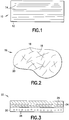
- a flake of composite material generally designated as 10 includes a polymeric matrix 12 and a plurality of mutually longitudinally aligned fibers 14 located within the polymeric matrix.
- a flake, sheet, fragment, laminate or ply of composite material may be characterized as "unidirectional" in reference to the principally unidirectional orientation of the fibers therein, as seen in flake 10.
- flake 10 is rectangular, the present invention is not limited in this regard as a flake of composite material can be any shape without departing from the broader aspects of the present invention.
- the fibers can be longitudinally oriented in the polymer matrix, or chopped and randomly oriented in the polymer matrix, or a combination thereof.
- the flake 16 shown in Fig. 2 is randomly shaped and comprises fibers 18 which are chopped from longer strands and are randomly oriented in the polymer matrix 20.
- the composite material can employ particulate material.
- exemplary fibers include E-glass and S-glass fibers.
- E-glass is a low alkali borosilicate glass with good electrical and mechanical properties and good chemical resistance. This type of glass is the most widely used in fibers for reinforcing plastics.
- S-glass is the higher strength and higher cost material relative to E-glass.
- S-glass is a magnesia-alumina-silicate glass for aerospace applications with high tensile strength. Originally, "S" stood for high strength.
- E-glass fiber may be incorporated in the composite in a wide range of fiber weights and thermoplastic polymer matrix material.
- the E-glass may range from 30.34 to 1.36 g/ m 2 (10 to 40 ounces per square yard ; oz. /sq.yd.), for example, 0.64 to 1.02 (19 to 30) or, in a particular embodiment, 0.73 to 0.96 g/cm 2 (21.4 to 28.4 oz./sq.yd.).
- Fibers may also be incorporated, optionally in combination with E-glass and/or S-glass.
- Such other fibers include ECR, A and C glass, as well as other glass fibers; fibers formed from quartz, magnesia aluminosilicate, non-alkaline aluminoborosilicate, soda borosilicate, soda silicate, soda lime-aluminosilicate, lead silicate, non-alkaline lead boroalumina, non-alkaline barium boroalumina, non-alkaline zinc boroalumina, non-alkaline iron aluminosilicate, cadmium borate, alumina fibers, asbestos, boron, silicone carbide, graphite and carbon such as those derived from the carbonization of polyethylene, polyvinylalcohol, saran, aramid, polyamide, polybenzimidazole, polyoxadiazole, polyphenylene, PPR, petroleum and coal pitches (isotropic), mesophase pitch, cellulose and poly
- One suitable organic polymer fiber is formed from an aramid exemplified by Kevlar.
- Other high performance, unidirectional fiber bundles generally have a tensile strength greater than 7 grams per denier.
- These bundled high-performance fibers may be any one of, or a combination of, aramid, extended chain ultra-high molecular weight polyethylene (UHMWPE), poly [p-phenylene-2,6-benzobisoxazole] (PBO), and poly[diimidazo pyridinylene (dihydroxy) phenylene] (M5).
- UHMWPE extended chain ultra-high molecular weight polyethylene
- PBO poly [p-phenylene-2,6-benzobisoxazole]
- M5 poly[diimidazo pyridinylene (dihydroxy) phenylene]
- the use of these very high tensile strength materials is particularly useful for making composite ballistic armor panels and similar applications requiring very high ballistic properties.
- Aramid fibers such as, inter alia, those marketed under the trade names Twaron, and Technora; basalt, carbon fibers such as those marketed under the trade names Toray, Fortafil and Zoltek; Liquid Crystal Polymer (LCP), such as, but not limited to LCP marketed under the trade name Vectran.
- LCP Liquid Crystal Polymer
- the present invention contemplates the use of organic, inorganic and metallic fibers either alone or in combination.
- the quantity of S-glass, E-glass or other fiber in a composite material may optionally accommodate 40 to 90 weight percent (wt %) thermoplastic matrix, for example 50 to 85 wt% and in one embodiment 60 to 80 wt% thermoplastic matrix in the ply, based on the combined weight of thermoplastic matrix plus fiber.
- the polymeric matrix material may comprise a thermoplastic polymeric material (providing a "thermoplastic flake”), a thermosetting polymeric material (providing a "thermosetting flake”), or a combination thereof.
- a thermoplastic polymeric matrix may comprise a polymer that may be a high molecular weight thermoplastic polymer, including but not limited to, polypropylene, polyethylene, nylon, PEI (polyetherimide) and copolymers. Thermoplastic loading by weight can vary widely depending on physical property requirements of the intended use of the product sheet.
- Flakes used in the present invention can include flakes made exclusively from a single composite material, or the flakes can be made from composite materials that differ from each other with respect to the fibers and/or with respect to the polymer matrix therein.
- a thermoplastic polymer, or a combination thereof are each different matrix materials from the other.
- one type of thermoplastic or thermosetting polymer matrix may be different from another type of thermoplastic or thermosetting polymer matrix, respectively.
- thermoplastic polyethylene is different from thermoplastic polypropylene, etc.
- the composite material is a laminate which includes at least one composite layer or ply, a composite layer being a single layer comprising a polymer matrix with fibers therein.
- a laminate of two or more composite layers may contain composite layers that differ from each other with respect to the fibers and/or with respect to the polymer matrix therein.
- the flake 22 shown in Fig. 3 is formed from a laminate of two composite layers 24 and 26.
- each of the composite layers 24 and 26 includes oriented continuous fibers 28.
- the fibers 28 in one of the layers 24 and 26 are oriented substantially orthogonally to the fibers in the other layer.
- the present invention is not limited in this regard as the fibers 28 in each layer can be oriented at any angle relative to one another.
- the fibers in each layer can be of different material and can also be chopped, continuous, aligned, randomly oriented, and combinations thereof. While the flake 22 has two layers, the present invention is not limited in this regard as any practical number of layers of composite material may comprise the flake without departing from the broader aspects of the present invention.
- the flakes 10, 16 and 22 can be accumulated into a moldable composite material which can be molded using standard molding techniques, e.g., injection molding, blow molding, compression molding, film insert molding, rotational molding, thermoforming, etc., to produce a molded product 30 as shown in Fig. 4 .
- the molding process may include the application of heat and/or pressure to cause adjacent flakes 10, 16, 22 to at least partially melt or set, and bond to one another.
- the moldable composite material includes fillers, processing additives, etc.
- the flakes 10, 16, and 22 are combined with pieces of substrate material 32 as filler to provide the moldable composite material.
- the substrate pieces may include for example, wood flakes, sawdust, metals, or any other substrate, and any combination thereof.
- the flakes 10, 16, and 22 are mixed with the substrate pieces 32 so the flakes are somewhat evenly distributed throughout the mixture, which may then be molded into any desired shape, for example, into a configuration having a semicircular cross-section as illustrated in Fig. 4 .
- an adhesive may be added to the moldable composite material to improve adherence between the substrate material 32 and the flakes 10, 16, 22.
- flakes 10, 12 and/or 22 can be concentrated in particular areas of the molded product 30.
- the flakes of composite materials can be concentrated along edge portions or other regions of the molded product 30 as the addition of the composite material may enhance the fastener retention properties, or other properties, of the molded product.
- Flakes 10, 16, and/ or 22 can be additionally coated in particular areas of the molded product 30.
- the flakes 10, 16, and/ or 22 can be formed from larger pieces of the composite material that are subsequently chopped or otherwise cut into the flakes. If the fibers that are in the composite material are oriented in a particular direction, the flakes can also be positioned in the moldable material so that the flake orientation and thereby the fiber orientation enhances the mechanical properties of the moldable material.
- the moldable material can utilize flakes 10, 16, and/ or 22 made from waste, recycled, or scrap composite material.
- Another advantage of one embodiment of a moldable material of the present invention is that the flakes 10, 16, and/ or 22 can be employed to enhance the mechanical properties of the moldable material of the present invention. These enhancements can be overall and/or in desired areas and/or directions.
- Still another advantage of the moldable material of the present invention is that the flakes 10, 16, and/ or 22 can be concentrated in particular areas to enhance the retention of fasteners, such as, but not limited to, screws and nails, thereby making the moldable material less likely to dislodge from a structure in severe weather or stress conditions.
Landscapes
- Chemical & Material Sciences (AREA)
- Engineering & Computer Science (AREA)
- Mechanical Engineering (AREA)
- Chemical Kinetics & Catalysis (AREA)
- Organic Chemistry (AREA)
- Polymers & Plastics (AREA)
- Medicinal Chemistry (AREA)
- Health & Medical Sciences (AREA)
- Composite Materials (AREA)
- Materials Engineering (AREA)
- Manufacturing & Machinery (AREA)
- Environmental & Geological Engineering (AREA)
- Textile Engineering (AREA)
- Laminated Bodies (AREA)
- Coating Of Shaped Articles Made Of Macromolecular Substances (AREA)
- Moulding By Coating Moulds (AREA)
- Reinforced Plastic Materials (AREA)
- Compositions Of Macromolecular Compounds (AREA)
Description
- This invention relates to hybrid materials that employ composites to form a moldable material. In particular, the invention relates to a material according to the preamble of claim 1.
- Building materials, and other substrates, are often exposed to wear, sunlight, weather, and insects, causing the materials to deteriorate quickly. The cost of wood, and other materials, has also increased significantly in recent years. The desire to reuse or recycle materials is also a greater focus in "green" building. In addition, traditional building materials sometimes exhibit insufficient mechanical properties when exposed to high loads, for example, high winds or shock waves from explosive blasts. In such instances, where traditional building materials are employed, significant destruction, injury, and even loss of life are possible.
-
EP 1892072 discloses a method of recycling tow fibers reinforced plastics composites by reducing the size of the fibers to form particles subjected to injection molding. -
CA 2 549 844 discloses the incorporation of fiber dispersed plastic flakes, granules or pellets into a molded article, the fiber dispersed plastic flakes being obtained by a method wherein cellulosic micro- and nanofibers are dispersed uniformly in a plastic, the obtained fiber dispersed film being cut or shaped to obtain small pieces such as flakes. -
GB 2 216 531 -
WO 91/06410 -
FR 2 740 149 - The present invention resides in a moldable composite material that contains flakes of composite material according to the independent claim 1.
-
-
Fig. 1 is a schematic top view of a flake of composite material having continuous, unidirectionally oriented fibers. -
Fig. 2 is a schematic top view of a flake of composite material having chopped randomly oriented fibers. -
Fig. 3 is a side schematic view of a laminated flake of composite material. -
Fig. 4 schematically illustrates a moldable composite material formed from substrate pieces and composite material flakes. -
Fig. 5 schematically illustrates flakes of composite material concentrated around the periphery of a substrate. -
Fig. 6 schematically illustrates flakes of composite material concentrated in rows on a substrate. - A composite material includes fibers embedded in a polymeric matrix. Composite materials can optionally be made in the form of sheets, continuous rolls or other forms. To provide flakes, a composite material may be chopped, cut or otherwise divided into flakes that may have various lengths, e.g., 1 to 6 inches (in.) [2.5 to 15.25 centimeters (cm)] long, and various widths, e.g., about ¼ to about 3 in. ( 0.6 to 7.6 cm) wide. However, the present invention is not limited in this regard as any practical flake size can be used.
- The moldable material includes a mixture of flakes of composite material with filler. The filler may comprise flakes of any one or more substrate materials, including, for example, building materials or other materials, such as wood, wood flakes, sawdust, plastic, metal, composites or textiles. The composite flakes may be mixed with substrate pieces or other filler so that the composite flakes are somewhat evenly distributed throughout the mixture. Adhesive can optionally be included to bind the composite flakes with the substrate flakes. Alternatively, the composite flakes may be used without substrate flakes to form a moldable material. The moldable material may comprise substantially free-flowing flakes or flakes that have been consolidated into a useful precursor form, e.g., pellets, by application of heat and/or pressure. When the matrix material is a thermoplastic, if two or more flakes are touching one another when exposed to sufficient heat and/or pressure the polymeric matrix materials therein can at least partially melt, thereby causing the matrix material to act as an adhesive and the flakes to bond to one another.
- In one embodiment shown in
Fig. 1 , a flake of composite material generally designated as 10 includes apolymeric matrix 12 and a plurality of mutually longitudinally alignedfibers 14 located within the polymeric matrix. A flake, sheet, fragment, laminate or ply of composite material may be characterized as "unidirectional" in reference to the principally unidirectional orientation of the fibers therein, as seen inflake 10. In addition, whileflake 10 is rectangular, the present invention is not limited in this regard as a flake of composite material can be any shape without departing from the broader aspects of the present invention. In addition, the fibers can be longitudinally oriented in the polymer matrix, or chopped and randomly oriented in the polymer matrix, or a combination thereof. For example, theflake 16 shown inFig. 2 is randomly shaped and comprisesfibers 18 which are chopped from longer strands and are randomly oriented in thepolymer matrix 20. In addition, and rather than instead of the number of fibers, the composite material can employ particulate material. - Various types of fibers or particulate may be used in a composite material. Exemplary fibers include E-glass and S-glass fibers. E-glass is a low alkali borosilicate glass with good electrical and mechanical properties and good chemical resistance. This type of glass is the most widely used in fibers for reinforcing plastics.
- S-glass is the higher strength and higher cost material relative to E-glass. S-glass is a magnesia-alumina-silicate glass for aerospace applications with high tensile strength. Originally, "S" stood for high strength.
- E-glass fiber may be incorporated in the composite in a wide range of fiber weights and thermoplastic polymer matrix material. The E-glass may range from 30.34 to 1.36 g/ m2 (10 to 40 ounces per square yard ; oz. /sq.yd.), for example, 0.64 to 1.02 (19 to 30) or, in a particular embodiment, 0.73 to 0.96 g/cm2 (21.4 to 28.4 oz./sq.yd.).
- Other fibers may also be incorporated, optionally in combination with E-glass and/or S-glass. Such other fibers include ECR, A and C glass, as well as other glass fibers; fibers formed from quartz, magnesia aluminosilicate, non-alkaline aluminoborosilicate, soda borosilicate, soda silicate, soda lime-aluminosilicate, lead silicate, non-alkaline lead boroalumina, non-alkaline barium boroalumina, non-alkaline zinc boroalumina, non-alkaline iron aluminosilicate, cadmium borate, alumina fibers, asbestos, boron, silicone carbide, graphite and carbon such as those derived from the carbonization of polyethylene, polyvinylalcohol, saran, aramid, polyamide, polybenzimidazole, polyoxadiazole, polyphenylene, PPR, petroleum and coal pitches (isotropic), mesophase pitch, cellulose and polyacrylonitrile, ceramic fibers, metal fibers as for example steel, aluminum metal alloys, and the like.
- One suitable organic polymer fiber is formed from an aramid exemplified by Kevlar. Other high performance, unidirectional fiber bundles generally have a tensile strength greater than 7 grams per denier. These bundled high-performance fibers may be any one of, or a combination of, aramid, extended chain ultra-high molecular weight polyethylene (UHMWPE), poly [p-phenylene-2,6-benzobisoxazole] (PBO), and poly[diimidazo pyridinylene (dihydroxy) phenylene] (M5). The use of these very high tensile strength materials is particularly useful for making composite ballistic armor panels and similar applications requiring very high ballistic properties.
- Still other fiber types known to those skilled in the particular art to which the present invention pertains can be substituted without departing from the broader aspects of the present invention. For example, Aramid fibers such as, inter alia, those marketed under the trade names Twaron, and Technora; basalt, carbon fibers such as those marketed under the trade names Toray, Fortafil and Zoltek; Liquid Crystal Polymer (LCP), such as, but not limited to LCP marketed under the trade name Vectran. Based on the foregoing, the present invention contemplates the use of organic, inorganic and metallic fibers either alone or in combination.
- The quantity of S-glass, E-glass or other fiber in a composite material may optionally accommodate 40 to 90 weight percent (wt %) thermoplastic matrix, for example 50 to 85 wt% and in one embodiment 60 to 80 wt% thermoplastic matrix in the ply, based on the combined weight of thermoplastic matrix plus fiber.
- The polymeric matrix material may comprise a thermoplastic polymeric material (providing a "thermoplastic flake"), a thermosetting polymeric material (providing a "thermosetting flake"), or a combination thereof. A thermoplastic polymeric matrix may comprise a polymer that may be a high molecular weight thermoplastic polymer, including but not limited to, polypropylene, polyethylene, nylon, PEI (polyetherimide) and copolymers. Thermoplastic loading by weight can vary widely depending on physical property requirements of the intended use of the product sheet.
- Flakes used in the present invention can include flakes made exclusively from a single composite material, or the flakes can be made from composite materials that differ from each other with respect to the fibers and/or with respect to the polymer matrix therein. For example, a thermoplastic polymer, or a combination thereof are each different matrix materials from the other. In addition, one type of thermoplastic or thermosetting polymer matrix may be different from another type of thermoplastic or thermosetting polymer matrix, respectively. Thus, thermoplastic polyethylene is different from thermoplastic polypropylene, etc.
- In one embodiment, the composite material is a laminate which includes at least one composite layer or ply, a composite layer being a single layer comprising a polymer matrix with fibers therein. Optionally, a laminate of two or more composite layers may contain composite layers that differ from each other with respect to the fibers and/or with respect to the polymer matrix therein. For example, the
flake 22 shown inFig. 3 is formed from a laminate of twocomposite layers composite layers continuous fibers 28. Thefibers 28 in one of thelayers fibers 28 in each layer can be oriented at any angle relative to one another. In addition, the fibers in each layer can be of different material and can also be chopped, continuous, aligned, randomly oriented, and combinations thereof. While theflake 22 has two layers, the present invention is not limited in this regard as any practical number of layers of composite material may comprise the flake without departing from the broader aspects of the present invention. - The
flakes product 30 as shown inFig. 4 . Optionally, the molding process may include the application of heat and/or pressure to causeadjacent flakes Fig. 4 , theflakes substrate material 32 as filler to provide the moldable composite material. The substrate pieces may include for example, wood flakes, sawdust, metals, or any other substrate, and any combination thereof. Theflakes substrate pieces 32 so the flakes are somewhat evenly distributed throughout the mixture, which may then be molded into any desired shape, for example, into a configuration having a semicircular cross-section as illustrated inFig. 4 . In one embodiment, an adhesive may be added to the moldable composite material to improve adherence between thesubstrate material 32 and theflakes - In an alternative embodiment of the present invention,
flakes product 30. For example, the flakes of composite materials can be concentrated along edge portions or other regions of the moldedproduct 30 as the addition of the composite material may enhance the fastener retention properties, or other properties, of the molded product.Flakes product 30. - In some of the above-described embodiments, the
flakes - One advantage of one embodiment is that the moldable material can utilize
flakes - Another advantage of one embodiment of a moldable material of the present invention is that the
flakes - Still another advantage of the moldable material of the present invention is that the
flakes - The advantages set forth above are illustrative only and should not be considered an exhaustive list, as other advantages will be evident to those skilled in the pertinent art to which the present invention pertains.
- The terms "a" and "an" herein do not denote a limitation of quantity, but rather denote the presence of at least one of the referenced item.
- Although the invention has been described with reference to particular embodiments thereof, it will be understood by one of ordinary skill in the art, upon a reading and understanding of the foregoing disclosure, that numerous variations and alterations to the disclosed embodiments will fall within the scope of the appended claims.
Claims (2)
- A moldable composite material comprising flakes (10, 16, 22) of composite material, the flakes comprising
first flakes (10) including a polymer matrix (12) and a plurality of mutually longitudinally aligned fibers (14) located within the polymer matrix (12)
characterized in that the material comprises
second flakes (16) comprising fibers (18) which are chopped from longer strands and randomly oriented in a polymer matrix (20), and
third flakes (22) formed from a laminate of at least two composite layers (24, 26) each including oriented continuous fibers (28),
wherein the first flakes (10), the second flakes (16) and the third flakes (22) are combined with pieces of substrate material (32) as filler to provide a moldable composite material, and wherein the first flakes (10), the second flakes (16) and the third flakes (22) are mixed with the substrate pieces (32) to be somewhat evenly distributed. - The material of claim 1, wherein the first flakes (10) comprises fibers that are chopped and randomly oriented in the polymer matrix (12).
Applications Claiming Priority (2)
| Application Number | Priority Date | Filing Date | Title |
|---|---|---|---|
| US3982508P | 2008-03-27 | 2008-03-27 | |
| PCT/US2009/038491 WO2009120920A1 (en) | 2008-03-27 | 2009-03-27 | Composite coated substrates and moldable composite materials |
Publications (2)
| Publication Number | Publication Date |
|---|---|
| EP2257420A1 EP2257420A1 (en) | 2010-12-08 |
| EP2257420B1 true EP2257420B1 (en) | 2017-02-22 |
Family
ID=40809802
Family Applications (1)
| Application Number | Title | Priority Date | Filing Date |
|---|---|---|---|
| EP09725153.2A Not-in-force EP2257420B1 (en) | 2008-03-27 | 2009-03-27 | Moldable composite materials |
Country Status (6)
| Country | Link |
|---|---|
| US (3) | US8962737B2 (en) |
| EP (1) | EP2257420B1 (en) |
| JP (1) | JP5688515B2 (en) |
| CN (2) | CN102015259B (en) |
| CA (3) | CA2728420C (en) |
| WO (1) | WO2009120920A1 (en) |
Families Citing this family (14)
| Publication number | Priority date | Publication date | Assignee | Title |
|---|---|---|---|---|
| CN102015259B (en) | 2008-03-27 | 2016-10-26 | 普立万公司 | Composite coated substrates and moldable composites |
| US8709319B2 (en) | 2009-11-06 | 2014-04-29 | The Boeing Company | Compression molding method and reinforced thermoplastic parts molded thereby |
| US20130172509A1 (en) * | 2010-09-22 | 2013-07-04 | Interfacial Solutions Ip, Llc | Methods of Producing Microfabricated Particles for Composite Materials |
| US10603821B2 (en) | 2012-01-23 | 2020-03-31 | The Boeing Company | Narrow flake composite fiber material compression molding |
| BR112015003221A2 (en) | 2012-08-15 | 2017-10-10 | 3M Innovative Properties Co | alumina-based inorganic oxide short fiber, production method, and composition including the same |
| US9623612B2 (en) | 2013-02-21 | 2017-04-18 | The Boeing Company | Method for fabricating composite fasteners |
| US9238339B2 (en) | 2013-02-21 | 2016-01-19 | The Boeing Company | Hybrid fastener and method of making the same |
| GB2511746B (en) * | 2013-03-11 | 2016-07-06 | Gurit (Uk) Ltd | Balsawood cores for composite material sandwich panels |
| US9302434B2 (en) | 2013-12-03 | 2016-04-05 | The Boeing Company | Thermoplastic composite support structures with integral fittings and method |
| US9283706B2 (en) | 2013-12-03 | 2016-03-15 | The Boeing Company | Method and apparatus for compression molding fiber reinforced thermoplastic parts |
| US10807277B2 (en) | 2016-11-07 | 2020-10-20 | The Boeing Company | Resin-infused short fiber composite materials |
| US11628632B2 (en) * | 2019-03-25 | 2023-04-18 | The Boeing Company | Pre-consolidated charges of chopped fiber for composite part fabrication |
| US11351744B2 (en) | 2019-03-29 | 2022-06-07 | The Boeing Company | Molten extrusion loading for compression molds using chopped prepreg fiber |
| FR3130819B1 (en) * | 2021-12-22 | 2025-09-26 | Fairmat | Part made from recycled composite material and manufacturing process |
Family Cites Families (22)
| Publication number | Priority date | Publication date | Assignee | Title |
|---|---|---|---|---|
| JPS5425551B2 (en) * | 1972-12-29 | 1979-08-29 | ||
| JPS6136354Y2 (en) * | 1980-08-11 | 1986-10-22 | ||
| GB8806915D0 (en) * | 1988-03-23 | 1988-04-27 | Blatchford & Sons Ltd | Moulding compound & method of manufacturing compound |
| FI895172A7 (en) | 1989-10-31 | 1991-05-01 | Biocon Oy | Composite material |
| US5879601A (en) * | 1992-06-09 | 1999-03-09 | Baker; Richard David | Method and apparatus for the manufacture of recycled fiber reinforced resin containing products |
| ZW7193A1 (en) * | 1992-06-09 | 1993-12-15 | Baker Richard D | Recycled fibre reinforced resin containing product and method and apparatus therefor |
| JPH08142273A (en) * | 1994-11-11 | 1996-06-04 | Shoei Kagaku Kogyo Kk | Composite panel |
| JPH09109310A (en) * | 1995-10-20 | 1997-04-28 | Ykk Corp | Method for producing molded sheet material, fiber-reinforced molded sheet material produced by the method, and toecap of safety shoes using the same |
| JPH09110494A (en) * | 1995-10-24 | 1997-04-28 | Shinko:Kk | Resin concrete and method for producing the same |
| US6242527B1 (en) * | 1998-12-02 | 2001-06-05 | E. I. Du Pont De Nemours And Company | Solid surface materials derived from aqueous latex dispersions of thermoplastic polymers |
| CA2366430A1 (en) * | 2002-01-02 | 2003-07-02 | Chengjie Zhang | Composite plastic materials produced from waste materials and method of producing same |
| EP1592545A2 (en) | 2003-01-24 | 2005-11-09 | VEC Technology, Inc. | Composite molded article and method of making a composite molded article |
| US20040145092A1 (en) * | 2003-01-24 | 2004-07-29 | Mccollum Robert P. | Method of making a composite molded article |
| CN100519122C (en) * | 2003-03-11 | 2009-07-29 | 富士通株式会社 | Method for producing recycled resin and resin material containing recycled resin produced by the method |
| US20050281999A1 (en) * | 2003-03-12 | 2005-12-22 | Petritech, Inc. | Structural and other composite materials and methods for making same |
| JP4339734B2 (en) * | 2004-03-31 | 2009-10-07 | 積水化学工業株式会社 | Recycled molded body and method for producing the same |
| US7223476B2 (en) * | 2004-06-14 | 2007-05-29 | Ppg Industries Ohio, Inc. | Composite flakes and methods for making and using the same |
| US7279059B2 (en) * | 2004-12-28 | 2007-10-09 | Owens Corning Intellectual Capital, Llc | Polymer/WUCS mat for use in automotive applications |
| US20060137799A1 (en) * | 2004-12-29 | 2006-06-29 | Enamul Haque | Thermoplastic composites with improved sound absorbing capabilities |
| CA2549844C (en) * | 2006-05-25 | 2016-12-06 | Mohini M. Sain | Solid phase dispersion and processing of micro-and nano-cellulosic fibres in plastic phase to manufacture bio-nanocomposite products of commercial interest |
| EP1892072A1 (en) | 2006-08-22 | 2008-02-27 | HONDA MOTOR CO., Ltd. | Recycling fibres reinforced plastics (FRP) in injection moulding process |
| CN102015259B (en) | 2008-03-27 | 2016-10-26 | 普立万公司 | Composite coated substrates and moldable composites |
-
2009
- 2009-03-27 CN CN200980110998.8A patent/CN102015259B/en not_active Expired - Fee Related
- 2009-03-27 US US12/412,478 patent/US8962737B2/en active Active
- 2009-03-27 CN CN201410569518.7A patent/CN105415696B/en active Active
- 2009-03-27 EP EP09725153.2A patent/EP2257420B1/en not_active Not-in-force
- 2009-03-27 CA CA2728420A patent/CA2728420C/en not_active Expired - Fee Related
- 2009-03-27 JP JP2011502086A patent/JP5688515B2/en not_active Expired - Fee Related
- 2009-03-27 CA CA2853570A patent/CA2853570C/en not_active Expired - Fee Related
- 2009-03-27 CA CA2938479A patent/CA2938479A1/en not_active Abandoned
- 2009-03-27 WO PCT/US2009/038491 patent/WO2009120920A1/en not_active Ceased
-
2014
- 2014-03-25 US US14/224,454 patent/US9278501B2/en active Active
-
2016
- 2016-03-02 US US15/058,266 patent/US9631095B2/en active Active
Non-Patent Citations (1)
| Title |
|---|
| None * |
Also Published As
| Publication number | Publication date |
|---|---|
| JP5688515B2 (en) | 2015-03-25 |
| CA2728420A1 (en) | 2009-10-01 |
| CN105415696B (en) | 2019-01-15 |
| US20160177097A1 (en) | 2016-06-23 |
| US9631095B2 (en) | 2017-04-25 |
| WO2009120920A4 (en) | 2010-02-25 |
| CA2938479A1 (en) | 2009-10-01 |
| US8962737B2 (en) | 2015-02-24 |
| CA2728420C (en) | 2014-08-19 |
| CN102015259A (en) | 2011-04-13 |
| WO2009120920A8 (en) | 2010-01-28 |
| WO2009120920A1 (en) | 2009-10-01 |
| CN105415696A (en) | 2016-03-23 |
| US20090263619A1 (en) | 2009-10-22 |
| CA2853570C (en) | 2016-10-04 |
| EP2257420A1 (en) | 2010-12-08 |
| US9278501B2 (en) | 2016-03-08 |
| US20140205833A1 (en) | 2014-07-24 |
| CN102015259B (en) | 2016-10-26 |
| CA2853570A1 (en) | 2009-10-01 |
| JP2011515570A (en) | 2011-05-19 |
Similar Documents
| Publication | Publication Date | Title |
|---|---|---|
| US9631095B2 (en) | Composite coated substrates and moldable composite materials | |
| US10252505B2 (en) | Method of manufacturing a composite laminate | |
| US20080044659A1 (en) | Composite laminate and method of manufacture | |
| JP5701748B2 (en) | Panel including stack and ballistic resistant article including the panel | |
| US8197732B2 (en) | Composite reinforced oriented strand board | |
| US5851932A (en) | Ballistic armor laminate | |
| US20150165731A1 (en) | Composite structure with reinforced thermoplastic adhesive laminate and method of manufacture | |
| US11161322B2 (en) | Reinforced composite material and article including same | |
| CN102762949A (en) | Ballistic-resistant articles | |
| EP2598827B1 (en) | Ballistic resistant article | |
| WO2012004392A1 (en) | Ballistic resistant article | |
| KR20240104382A (en) | Wood composition having a laminated state of continuous lyocell fibers impregnated with a biodegradable thermoplastic resin |
Legal Events
| Date | Code | Title | Description |
|---|---|---|---|
| PUAI | Public reference made under article 153(3) epc to a published international application that has entered the european phase |
Free format text: ORIGINAL CODE: 0009012 |
|
| 17P | Request for examination filed |
Effective date: 20100924 |
|
| AK | Designated contracting states |
Kind code of ref document: A1 Designated state(s): AT BE BG CH CY CZ DE DK EE ES FI FR GB GR HR HU IE IS IT LI LT LU LV MC MK MT NL NO PL PT RO SE SI SK TR |
|
| AX | Request for extension of the european patent |
Extension state: AL BA RS |
|
| DAX | Request for extension of the european patent (deleted) | ||
| 17Q | First examination report despatched |
Effective date: 20140318 |
|
| REG | Reference to a national code |
Ref country code: DE Ref legal event code: R079 Ref document number: 602009044313 Country of ref document: DE Free format text: PREVIOUS MAIN CLASS: B29C0070120000 Ipc: B29B0017000000 |
|
| RIC1 | Information provided on ipc code assigned before grant |
Ipc: B29B 17/00 20060101AFI20160630BHEP Ipc: C08J 5/04 20060101ALI20160630BHEP Ipc: C08L 101/00 20060101ALI20160630BHEP Ipc: B32B 7/12 20060101ALI20160630BHEP Ipc: B29K 101/12 20060101ALI20160630BHEP Ipc: B29K 101/10 20060101ALI20160630BHEP Ipc: B29K 105/06 20060101ALI20160630BHEP Ipc: B29C 70/08 20060101ALI20160630BHEP Ipc: B29C 70/12 20060101ALI20160630BHEP |
|
| GRAP | Despatch of communication of intention to grant a patent |
Free format text: ORIGINAL CODE: EPIDOSNIGR1 |
|
| INTG | Intention to grant announced |
Effective date: 20160818 |
|
| RAP1 | Party data changed (applicant data changed or rights of an application transferred) |
Owner name: GORDON HOLDINGS, INC. |
|
| STAA | Information on the status of an ep patent application or granted ep patent |
Free format text: STATUS: GRANT OF PATENT IS INTENDED |
|
| GRAS | Grant fee paid |
Free format text: ORIGINAL CODE: EPIDOSNIGR3 |
|
| GRAA | (expected) grant |
Free format text: ORIGINAL CODE: 0009210 |
|
| STAA | Information on the status of an ep patent application or granted ep patent |
Free format text: STATUS: THE PATENT HAS BEEN GRANTED |
|
| RAP1 | Party data changed (applicant data changed or rights of an application transferred) |
Owner name: POLYONE CORPORATION |
|
| AK | Designated contracting states |
Kind code of ref document: B1 Designated state(s): AT BE BG CH CY CZ DE DK EE ES FI FR GB GR HR HU IE IS IT LI LT LU LV MC MK MT NL NO PL PT RO SE SI SK TR |
|
| REG | Reference to a national code |
Ref country code: GB Ref legal event code: FG4D |
|
| REG | Reference to a national code |
Ref country code: CH Ref legal event code: EP |
|
| REG | Reference to a national code |
Ref country code: CH Ref legal event code: NV Representative=s name: ING. MARCO ZARDI C/O M. ZARDI AND CO. S.A., CH Ref country code: AT Ref legal event code: REF Ref document number: 868911 Country of ref document: AT Kind code of ref document: T Effective date: 20170315 |
|
| REG | Reference to a national code |
Ref country code: IE Ref legal event code: FG4D |
|
| REG | Reference to a national code |
Ref country code: FR Ref legal event code: PLFP Year of fee payment: 9 |
|
| REG | Reference to a national code |
Ref country code: DE Ref legal event code: R096 Ref document number: 602009044313 Country of ref document: DE |
|
| PGFP | Annual fee paid to national office [announced via postgrant information from national office to epo] |
Ref country code: CH Payment date: 20170327 Year of fee payment: 9 Ref country code: FR Payment date: 20170327 Year of fee payment: 9 |
|
| PGFP | Annual fee paid to national office [announced via postgrant information from national office to epo] |
Ref country code: GB Payment date: 20170327 Year of fee payment: 9 |
|
| REG | Reference to a national code |
Ref country code: LT Ref legal event code: MG4D |
|
| REG | Reference to a national code |
Ref country code: NL Ref legal event code: MP Effective date: 20170222 |
|
| REG | Reference to a national code |
Ref country code: AT Ref legal event code: MK05 Ref document number: 868911 Country of ref document: AT Kind code of ref document: T Effective date: 20170222 |
|
| PG25 | Lapsed in a contracting state [announced via postgrant information from national office to epo] |
Ref country code: HR Free format text: LAPSE BECAUSE OF FAILURE TO SUBMIT A TRANSLATION OF THE DESCRIPTION OR TO PAY THE FEE WITHIN THE PRESCRIBED TIME-LIMIT Effective date: 20170222 Ref country code: GR Free format text: LAPSE BECAUSE OF FAILURE TO SUBMIT A TRANSLATION OF THE DESCRIPTION OR TO PAY THE FEE WITHIN THE PRESCRIBED TIME-LIMIT Effective date: 20170523 Ref country code: LT Free format text: LAPSE BECAUSE OF FAILURE TO SUBMIT A TRANSLATION OF THE DESCRIPTION OR TO PAY THE FEE WITHIN THE PRESCRIBED TIME-LIMIT Effective date: 20170222 Ref country code: NO Free format text: LAPSE BECAUSE OF FAILURE TO SUBMIT A TRANSLATION OF THE DESCRIPTION OR TO PAY THE FEE WITHIN THE PRESCRIBED TIME-LIMIT Effective date: 20170522 Ref country code: FI Free format text: LAPSE BECAUSE OF FAILURE TO SUBMIT A TRANSLATION OF THE DESCRIPTION OR TO PAY THE FEE WITHIN THE PRESCRIBED TIME-LIMIT Effective date: 20170222 |
|
| PGFP | Annual fee paid to national office [announced via postgrant information from national office to epo] |
Ref country code: DE Payment date: 20170329 Year of fee payment: 9 |
|
| PG25 | Lapsed in a contracting state [announced via postgrant information from national office to epo] |
Ref country code: PT Free format text: LAPSE BECAUSE OF FAILURE TO SUBMIT A TRANSLATION OF THE DESCRIPTION OR TO PAY THE FEE WITHIN THE PRESCRIBED TIME-LIMIT Effective date: 20170622 Ref country code: SE Free format text: LAPSE BECAUSE OF FAILURE TO SUBMIT A TRANSLATION OF THE DESCRIPTION OR TO PAY THE FEE WITHIN THE PRESCRIBED TIME-LIMIT Effective date: 20170222 Ref country code: NL Free format text: LAPSE BECAUSE OF FAILURE TO SUBMIT A TRANSLATION OF THE DESCRIPTION OR TO PAY THE FEE WITHIN THE PRESCRIBED TIME-LIMIT Effective date: 20170222 Ref country code: LV Free format text: LAPSE BECAUSE OF FAILURE TO SUBMIT A TRANSLATION OF THE DESCRIPTION OR TO PAY THE FEE WITHIN THE PRESCRIBED TIME-LIMIT Effective date: 20170222 Ref country code: BG Free format text: LAPSE BECAUSE OF FAILURE TO SUBMIT A TRANSLATION OF THE DESCRIPTION OR TO PAY THE FEE WITHIN THE PRESCRIBED TIME-LIMIT Effective date: 20170522 Ref country code: ES Free format text: LAPSE BECAUSE OF FAILURE TO SUBMIT A TRANSLATION OF THE DESCRIPTION OR TO PAY THE FEE WITHIN THE PRESCRIBED TIME-LIMIT Effective date: 20170222 Ref country code: AT Free format text: LAPSE BECAUSE OF FAILURE TO SUBMIT A TRANSLATION OF THE DESCRIPTION OR TO PAY THE FEE WITHIN THE PRESCRIBED TIME-LIMIT Effective date: 20170222 |
|
| PG25 | Lapsed in a contracting state [announced via postgrant information from national office to epo] |
Ref country code: RO Free format text: LAPSE BECAUSE OF FAILURE TO SUBMIT A TRANSLATION OF THE DESCRIPTION OR TO PAY THE FEE WITHIN THE PRESCRIBED TIME-LIMIT Effective date: 20170222 Ref country code: EE Free format text: LAPSE BECAUSE OF FAILURE TO SUBMIT A TRANSLATION OF THE DESCRIPTION OR TO PAY THE FEE WITHIN THE PRESCRIBED TIME-LIMIT Effective date: 20170222 Ref country code: CZ Free format text: LAPSE BECAUSE OF FAILURE TO SUBMIT A TRANSLATION OF THE DESCRIPTION OR TO PAY THE FEE WITHIN THE PRESCRIBED TIME-LIMIT Effective date: 20170222 Ref country code: SK Free format text: LAPSE BECAUSE OF FAILURE TO SUBMIT A TRANSLATION OF THE DESCRIPTION OR TO PAY THE FEE WITHIN THE PRESCRIBED TIME-LIMIT Effective date: 20170222 Ref country code: IT Free format text: LAPSE BECAUSE OF FAILURE TO SUBMIT A TRANSLATION OF THE DESCRIPTION OR TO PAY THE FEE WITHIN THE PRESCRIBED TIME-LIMIT Effective date: 20170222 |
|
| REG | Reference to a national code |
Ref country code: DE Ref legal event code: R097 Ref document number: 602009044313 Country of ref document: DE |
|
| PG25 | Lapsed in a contracting state [announced via postgrant information from national office to epo] |
Ref country code: PL Free format text: LAPSE BECAUSE OF FAILURE TO SUBMIT A TRANSLATION OF THE DESCRIPTION OR TO PAY THE FEE WITHIN THE PRESCRIBED TIME-LIMIT Effective date: 20170222 Ref country code: DK Free format text: LAPSE BECAUSE OF FAILURE TO SUBMIT A TRANSLATION OF THE DESCRIPTION OR TO PAY THE FEE WITHIN THE PRESCRIBED TIME-LIMIT Effective date: 20170222 Ref country code: MC Free format text: LAPSE BECAUSE OF FAILURE TO SUBMIT A TRANSLATION OF THE DESCRIPTION OR TO PAY THE FEE WITHIN THE PRESCRIBED TIME-LIMIT Effective date: 20170222 |
|
| REG | Reference to a national code |
Ref country code: IE Ref legal event code: MM4A |
|
| PLBE | No opposition filed within time limit |
Free format text: ORIGINAL CODE: 0009261 |
|
| STAA | Information on the status of an ep patent application or granted ep patent |
Free format text: STATUS: NO OPPOSITION FILED WITHIN TIME LIMIT |
|
| 26N | No opposition filed |
Effective date: 20171123 |
|
| PG25 | Lapsed in a contracting state [announced via postgrant information from national office to epo] |
Ref country code: LU Free format text: LAPSE BECAUSE OF NON-PAYMENT OF DUE FEES Effective date: 20170327 |
|
| PG25 | Lapsed in a contracting state [announced via postgrant information from national office to epo] |
Ref country code: SI Free format text: LAPSE BECAUSE OF FAILURE TO SUBMIT A TRANSLATION OF THE DESCRIPTION OR TO PAY THE FEE WITHIN THE PRESCRIBED TIME-LIMIT Effective date: 20170222 Ref country code: IE Free format text: LAPSE BECAUSE OF NON-PAYMENT OF DUE FEES Effective date: 20170327 |
|
| REG | Reference to a national code |
Ref country code: BE Ref legal event code: MM Effective date: 20170331 |
|
| PG25 | Lapsed in a contracting state [announced via postgrant information from national office to epo] |
Ref country code: BE Free format text: LAPSE BECAUSE OF NON-PAYMENT OF DUE FEES Effective date: 20170331 |
|
| PG25 | Lapsed in a contracting state [announced via postgrant information from national office to epo] |
Ref country code: MT Free format text: LAPSE BECAUSE OF NON-PAYMENT OF DUE FEES Effective date: 20170327 |
|
| REG | Reference to a national code |
Ref country code: DE Ref legal event code: R119 Ref document number: 602009044313 Country of ref document: DE |
|
| REG | Reference to a national code |
Ref country code: CH Ref legal event code: PL |
|
| GBPC | Gb: european patent ceased through non-payment of renewal fee |
Effective date: 20180327 |
|
| PG25 | Lapsed in a contracting state [announced via postgrant information from national office to epo] |
Ref country code: DE Free format text: LAPSE BECAUSE OF NON-PAYMENT OF DUE FEES Effective date: 20181002 |
|
| PG25 | Lapsed in a contracting state [announced via postgrant information from national office to epo] |
Ref country code: LI Free format text: LAPSE BECAUSE OF NON-PAYMENT OF DUE FEES Effective date: 20180331 Ref country code: GB Free format text: LAPSE BECAUSE OF NON-PAYMENT OF DUE FEES Effective date: 20180327 Ref country code: CH Free format text: LAPSE BECAUSE OF NON-PAYMENT OF DUE FEES Effective date: 20180331 |
|
| PG25 | Lapsed in a contracting state [announced via postgrant information from national office to epo] |
Ref country code: FR Free format text: LAPSE BECAUSE OF NON-PAYMENT OF DUE FEES Effective date: 20180331 |
|
| PG25 | Lapsed in a contracting state [announced via postgrant information from national office to epo] |
Ref country code: HU Free format text: LAPSE BECAUSE OF FAILURE TO SUBMIT A TRANSLATION OF THE DESCRIPTION OR TO PAY THE FEE WITHIN THE PRESCRIBED TIME-LIMIT; INVALID AB INITIO Effective date: 20090327 |
|
| PG25 | Lapsed in a contracting state [announced via postgrant information from national office to epo] |
Ref country code: CY Free format text: LAPSE BECAUSE OF NON-PAYMENT OF DUE FEES Effective date: 20170222 |
|
| PG25 | Lapsed in a contracting state [announced via postgrant information from national office to epo] |
Ref country code: MK Free format text: LAPSE BECAUSE OF FAILURE TO SUBMIT A TRANSLATION OF THE DESCRIPTION OR TO PAY THE FEE WITHIN THE PRESCRIBED TIME-LIMIT Effective date: 20170222 |
|
| PG25 | Lapsed in a contracting state [announced via postgrant information from national office to epo] |
Ref country code: TR Free format text: LAPSE BECAUSE OF FAILURE TO SUBMIT A TRANSLATION OF THE DESCRIPTION OR TO PAY THE FEE WITHIN THE PRESCRIBED TIME-LIMIT Effective date: 20170222 |
|
| PG25 | Lapsed in a contracting state [announced via postgrant information from national office to epo] |
Ref country code: IS Free format text: LAPSE BECAUSE OF FAILURE TO SUBMIT A TRANSLATION OF THE DESCRIPTION OR TO PAY THE FEE WITHIN THE PRESCRIBED TIME-LIMIT Effective date: 20170622 |