EP2256986A1 - Staged establishment of secure strings of symbols - Google Patents
Staged establishment of secure strings of symbols Download PDFInfo
- Publication number
- EP2256986A1 EP2256986A1 EP10158074A EP10158074A EP2256986A1 EP 2256986 A1 EP2256986 A1 EP 2256986A1 EP 10158074 A EP10158074 A EP 10158074A EP 10158074 A EP10158074 A EP 10158074A EP 2256986 A1 EP2256986 A1 EP 2256986A1
- Authority
- EP
- European Patent Office
- Prior art keywords
- stage
- strings
- secure
- string
- node
- Prior art date
- Legal status (The legal status is an assumption and is not a legal conclusion. Google has not performed a legal analysis and makes no representation as to the accuracy of the status listed.)
- Granted
Links
Images

Classifications
-
- H—ELECTRICITY
- H04—ELECTRIC COMMUNICATION TECHNIQUE
- H04L—TRANSMISSION OF DIGITAL INFORMATION, e.g. TELEGRAPHIC COMMUNICATION
- H04L9/00—Cryptographic mechanisms or cryptographic arrangements for secret or secure communications; Network security protocols
- H04L9/06—Cryptographic mechanisms or cryptographic arrangements for secret or secure communications; Network security protocols the encryption apparatus using shift registers or memories for block-wise or stream coding, e.g. DES systems or RC4; Hash functions; Pseudorandom sequence generators
- H04L9/065—Encryption by serially and continuously modifying data stream elements, e.g. stream cipher systems, RC4, SEAL or A5/3
-
- H—ELECTRICITY
- H04—ELECTRIC COMMUNICATION TECHNIQUE
- H04L—TRANSMISSION OF DIGITAL INFORMATION, e.g. TELEGRAPHIC COMMUNICATION
- H04L9/00—Cryptographic mechanisms or cryptographic arrangements for secret or secure communications; Network security protocols
- H04L9/08—Key distribution or management, e.g. generation, sharing or updating, of cryptographic keys or passwords
- H04L9/0816—Key establishment, i.e. cryptographic processes or cryptographic protocols whereby a shared secret becomes available to two or more parties, for subsequent use
Definitions
- the present invention relates to telecommunications in general, and, more particularly, to cryptography.
- the present invention provides a technique for establishing secure strings of symbols between pairs or groups of nodes in a telecommunications network without some of the costs and disadvantages for doing so in the prior art. These secure strings can then be used to create and transmit a "secure message,” which for the purposes of this specification, is defined as a message that is:
- the node When a node in a telecommunications network is turned on, comes on-line, or is re-booted, the node might be required to establish a secure string of symbols with one or more other nodes. Because the process to establish even one highly secure string of symbols is computationally intense, the amount of time required for one node to establish a highly secure string with each of several other nodes can be substantial. The consequence is that a user of the node might be prevented from transmitting a secure message for a long time.
- the illustrative embodiment stages the process of establishing secure strings.
- the illustrative embodiment establishes a first-stage string of symbols with each other node.
- the first-stage strings are chosen from a first, small, key space, which means that they can be established more quickly than a highly secure key from a large key space.
- the advantage of the first-stage strings is that it enables the user to transmit secure messages more quickly than messages secured with highly secure strings.
- the disadvantage of the illustrative embodiment is that the first-stage strings are not as secure as strings from a larger key space. This disadvantage is mitigated, however, by the fact that the first-stage strings are only used for a short amount of time - until the second-stage strings are established in the second stage.
- the illustrative embodiment establishes a second-stage string of symbols with each other node.
- the second-stage strings are chosen from a second, medium-sized, key space.
- the advantage of the second-stage strings is that they are more secure than the first-stage strings, albeit not as secure as the third-stage strings established in the third stage. Once the second-stage strings are established, they can be used in place of the first-stage strings.
- the illustrative embodiment establishes a third-stage string of symbols with each other node.
- the third-stage strings are chosen from a third, large-sized, key space.
- the advantage of the third-stage strings is that they are more secure than the second-stage strings. Once the third-stage strings are established, they can be used in place of the second-stage strings.
- the illustrative embodiment comprises: transmitting secure messages at a telecommunications node with a first string of symbols for a first interval from instant b 1 to instant x 1 , wherein the first string of symbols is selected from a first key space having K 1 members, where K 1 is a natural number; and transmitting secure messages at the telecommunications node with a second string of symbols for a second interval from instant b 2 to instant x 2 , wherein the second string of symbols is selected from a second key space having K 2 members, where K 2 is a natural number; wherein b 2 ⁇ x 1 ; and wherein ln K 2 x 2 - b 2 > ln K 1 x 1 - b 1 .
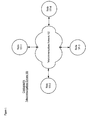
- Figure 1 depicts a schematic diagram of a portion of a typical wireless telecommunications system.
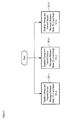
- Figure 2 depicts a flowchart of the salient tasks associated with the operation of the illustrative embodiment of the present invention.
- Figure 3 depicts a flowchart of the salient tasks associated with the operation of task 201- i .
- FIG. 1 is a schematic diagram of the salient components of cryptographic telecommunications system 100 in accordance with the illustrated embodiment of the present invention.
- Cryptographic telecommunications system 100 comprises: telecommunications nodes 101-1 through 101-4 and telecommunications network 102, interconnected as shown.
- node 101-4 is a communications hub, and messages between nodes 101-1, 101-2, and 101-3 pass through node 101-4, but it will be clear to those skilled in the art, after reading this disclosure, how to make and use alternative embodiments of the present invention in which any node communicates directly with any other hub ( i . e ., the nodes communicate on a peer-to-peer basis).
- each of nodes 101-1 through 101-3 establishes a series of progressively-more-secure string of symbols with node 101-4 for the purposes of exchanging secure messages with node 101-4.
- each of nodes 101-1 through 101-4 uses one series of strings of symbols to exchange secure messages, but it will be clear to those skilled in the art, after reading this disclosure, how to make and use alternative embodiments of the present invention in which one node uses one series of strings of symbols to transmit secure messages to a second node, but the second node uses a second series of strings of symbols to transmit secure messages to the first node.
- Node 101- j where j ⁇ ⁇ 1, 2, 3, 4 ⁇ , is hardware and software that provides voice, video, and data capabilities to a user, and that is capable of performing the functionality described below and in the accompanying figures.
- node 101- j is a wireless terminal that is connected to network 102 via wireline, but it will be clear to those skilled in the art, after reading this disclosure, how to make and use alternative embodiments of the present invention in which node 101- j is connected to network 102 via wireless.
- Network 102 is the Internet, but it will be clear to those skilled in the art, after reading this disclosure, how to make and use alternative embodiments of the present invention in which telecommunications network 102 is any network (e . g ., the Public Switched Telephone Network, an intranet, an 802.11 network, etc .), or combination of networks, using the same or dissimilar networks and in one or more address spaces.
- telecommunications network 102 is any network (e . g ., the Public Switched Telephone Network, an intranet, an 802.11 network, etc .), or combination of networks, using the same or dissimilar networks and in one or more address spaces.
- FIG. 2 is a flowchart of the salient tasks associated with the operation of the illustrative embodiment of the present invention.
- tasks 201-1, 201-2 and 201-3 are performed concurrently, but it will be clear to those skilled in the art, after reading this disclosure, how to make and use alternative embodiments of the present invention in which some or all of the tasks are performed serially or simultaneously.
- the subtasks within tasks 201-1, 201-2, and 201-3 are performed serially so as to not overwhelm the computing capabilities of node 101-4, but it will be clear to those skilled in the art, after reading this disclosure, how to make and use alternative embodiments of the present invention in which some or all of the subtasks are performed concurrently or simultaneously.
- node 101-1 and node 101-4 establish a series of three progressively-more-secure strings of symbols and exchange secret and authenticated messages using those strings of symbols. This is described in detail below and in Figure 3 . Although node 101-1 and 101-4 establish a series of three secure strings of symbols, it will be clear to those skilled in the art, after reading this disclosure, how to make and use alternative embodiments of the present invention in which the series comprises any plurality of secure strings of symbols.
- node 101-2 and node 101-4 establish a series of three progressively-more-secure strings of symbols and exchange secret and authenticated messages using those strings of symbols. This is described in detail below and in Figure 3 . Although node 101-2 and 101-4 establish a series of three secure strings of symbols, it will be clear to those skilled in the art, after reading this disclosure, how to make and use alternative embodiments of the present invention in which the series comprises any plurality of secure strings of symbols.
- node 101-3 and node 101-4 establish a series of three progressively-more-secure strings of symbols and exchange secret and authenticated messages using those strings of symbols. This is described in detail below and in Figure 3 . Although node 101-3 and 101-4 establish a series of three secure strings of symbols, it will be clear to those skilled in the art, after reading this disclosure, how to make and use alternative embodiments of the present invention in which the series comprises any plurality of secure strings of symbols.
- Figure 3 is a flowchart of the salient tasks associated with the operation of task 201- i , where i ⁇ ⁇ 1, 2, 3 ⁇ , involving node 101- i and node 101-4.
- Task 201- i begins, by definition, when node 101- i is turned on, is re-booted, or for whatever reason is required to renew its secure strings. The beginning of task 201- i is defined as instant t 0 - i .
- the first-stage string S 1 -i is chosen from a key space having K 1 - i members, where K 1 is a natural number, using the well-known Diffie-Hellman key exchange protocol.
- K 1 is a natural number
- task 301- i occurs at a different instant than all of the other tasks so as to not overwhelm the computing capabilities of node 101-4, but it will be clear to those skilled in the art, after reading this disclosure, how to make and use alternative embodiments of the present invention in which task 301- i does, in fact occur concurrently with one or more other tasks. In any case, it will be clear to those skilled in the art how to make and use embodiments of the present invention that accomplish task 301- i .
- the second-stage string S 2 -i is chosen from a key space having K 2 -i members, where K 2 is a natural number that is larger than the key space of the first-stage string ( i . e ., K 2 -i > K 1 -i ).
- the fact that the second-stage string S 2 -i is chosen from a larger key space than the first-stage string S 1 -i suggests that the second-stage string S 2 -i is more secure than the first-stage string and can be used for a longer interval before it is likely to be broken.
- the key spaces and the length of the intervals during which they are comparably secure are related by: ln K 2 x 2 - b 2 > ln K 1 x 1 - b 1
- node 101- i and node 101-4 use the well-known Diffie-Hellman key exchange protocol to establish the second-stage string S 2 -i, but it will be clear to those skilled in the art, after reading this disclosure, how to make and use alternative embodiments of the present invention in which the nodes use another protocol to establish the second-stage string S 2 - i ( e . g ., physically secure key exchanges, protocols based on the computational difficulty inherent in solving large numbers of puzzles, of factoring large numbers, of inverting large matrices, etc .).
- task 303- i occurs at a different instant than all of the other tasks so as to not overwhelm the computing capabilities of node 101-4, but it will be clear to those skilled in the art, after reading this disclosure, how to make and use alternative embodiments of the present invention in which task 303- i does, in fact occur concurrently with one or more other tasks. In any case, it will be clear to those skilled in the art how to make and use embodiments of the present invention that accomplish task 303- i .
- first-stage string S 1 -i expires because sufficient time has elapsed since instant b 1 -i for a reasonably-skilled cryptanalyst could discover it. It will be clear to those skilled in the art how to determine when instant x 1 -i occurs given K 1 and the technique used for generating the first-stage string S 1 -i . In all cases, instant b 1 -i occurs before instant m 1 -i which occurs before instant x 1 -i ( i . e ., b 1 -i ⁇ m 1 -i ⁇ x 1 -i).
- the third-stage string S 3 -i is chosen from a key space having K 3 -i members, where K 3 is a natural number that is larger than the key space of the second-stage string ( i . e ., K 3 -i > K 2 -i ).
- the fact that the third-stage string S 3 -i is chosen from a larger key space than the second-stage string S 2 -i suggests that the third-stage string S 3 -i is more secure than the second-stage string and can be used for a longer interval before it is likely to be broken.
- the key spaces and the length of the intervals during which they are comparably secure are related by: ln K 3 x 3 - b 3 > ln K 2 x 2 - b 2 > ln K 1 x 1 - b 1
- node 101- i and node 101-4 use the well-known Diffie-Hellman key exchange protocol to establish the third-stage string S 3 -i, but it will be clear to those skilled in the art, after reading this disclosure, how to make and use alternative embodiments of the present invention in which the nodes use another protocol to establish the third-stage string S 3 - i ( e . g ., physically secure key exchanges, protocols based on the computational difficulty inherent in solving large numbers of puzzles, of factoring large numbers, of inverting large matrices, etc.).
- task 305- i occurs at a different instant than all of the other tasks so as to not overwhelm the computing capabilities of node 101-4, but it will be clear to those skilled in the art, after reading this disclosure, how to make and use alternative embodiments of the present invention in which task 305- i does, in fact occur concurrently with one or more other tasks. In any case, it will be clear to those skilled in the art how to make and use embodiments of the present invention that accomplish task 305- i .
Landscapes
- Engineering & Computer Science (AREA)
- Computer Security & Cryptography (AREA)
- Computer Networks & Wireless Communication (AREA)
- Signal Processing (AREA)
- Mobile Radio Communication Systems (AREA)
Abstract
Description
- The present invention relates to telecommunications in general, and, more particularly, to cryptography.
- When two parties communicate via a telecommunications network, it is common for the parties:
- i. to encrypt their messages so that they remain secret from eavesdroppers, and
- ii. to authenticate the messages so that the receiver is confident who really sent the message.
- The present invention provides a technique for establishing secure strings of symbols between pairs or groups of nodes in a telecommunications network without some of the costs and disadvantages for doing so in the prior art. These secure strings can then be used to create and transmit a "secure message," which for the purposes of this specification, is defined as a message that is:
- i. authenticated, or
- ii. encrypted, or
- iii. authenticated and encrypted.
- When a node in a telecommunications network is turned on, comes on-line, or is re-booted, the node might be required to establish a secure string of symbols with one or more other nodes. Because the process to establish even one highly secure string of symbols is computationally intense, the amount of time required for one node to establish a highly secure string with each of several other nodes can be substantial. The consequence is that a user of the node might be prevented from transmitting a secure message for a long time.
- To address this, the illustrative embodiment stages the process of establishing secure strings. In the first stage, the illustrative embodiment establishes a first-stage string of symbols with each other node. The first-stage strings are chosen from a first, small, key space, which means that they can be established more quickly than a highly secure key from a large key space. The advantage of the first-stage strings is that it enables the user to transmit secure messages more quickly than messages secured with highly secure strings. The disadvantage of the illustrative embodiment is that the first-stage strings are not as secure as strings from a larger key space. This disadvantage is mitigated, however, by the fact that the first-stage strings are only used for a short amount of time - until the second-stage strings are established in the second stage.
- In the second stage, the illustrative embodiment establishes a second-stage string of symbols with each other node. The second-stage strings are chosen from a second, medium-sized, key space. The advantage of the second-stage strings is that they are more secure than the first-stage strings, albeit not as secure as the third-stage strings established in the third stage. Once the second-stage strings are established, they can be used in place of the first-stage strings.
- In the third stage, the illustrative embodiment establishes a third-stage string of symbols with each other node. The third-stage strings are chosen from a third, large-sized, key space. The advantage of the third-stage strings is that they are more secure than the second-stage strings. Once the third-stage strings are established, they can be used in place of the second-stage strings.
- The illustrative embodiment comprises: transmitting secure messages at a telecommunications node with a first string of symbols for a first interval from instant b 1 to instant x 1, wherein the first string of symbols is selected from a first key space having K 1 members, where K1 is a natural number; and transmitting secure messages at the telecommunications node with a second string of symbols for a second interval from instant b 2 to instant x2 , wherein the second string of symbols is selected from a second key space having K 2 members, where K2 is a natural number; wherein b2 < x1 ; and wherein

-
Figure 1 depicts a schematic diagram of a portion of a typical wireless telecommunications system. -
Figure 2 depicts a flowchart of the salient tasks associated with the operation of the illustrative embodiment of the present invention. -
Figure 3 depicts a flowchart of the salient tasks associated with the operation of task 201-i. -
Figure 1 is a schematic diagram of the salient components ofcryptographic telecommunications system 100 in accordance with the illustrated embodiment of the present invention.Cryptographic telecommunications system 100 comprises: telecommunications nodes 101-1 through 101-4 andtelecommunications network 102, interconnected as shown. - In accordance with the illustrative embodiment, node 101-4 is a communications hub, and messages between nodes 101-1, 101-2, and 101-3 pass through node 101-4, but it will be clear to those skilled in the art, after reading this disclosure, how to make and use alternative embodiments of the present invention in which any node communicates directly with any other hub (i.e., the nodes communicate on a peer-to-peer basis).
- In accordance with the illustrative embodiment, each of nodes 101-1 through 101-3 establishes a series of progressively-more-secure string of symbols with node 101-4 for the purposes of exchanging secure messages with node 101-4.
- Although the illustrative embodiment depicts three nodes that establish a series of string of symbols with one other node, it will be clear to those skilled in the art, after reading this disclosure, how to make and use alternative embodiments of the present invention in which any number of nodes establish a series of string of symbols with any number of other nodes.
- In accordance with the illustrative embodiment, each of nodes 101-1 through 101-4 uses one series of strings of symbols to exchange secure messages, but it will be clear to those skilled in the art, after reading this disclosure, how to make and use alternative embodiments of the present invention in which one node uses one series of strings of symbols to transmit secure messages to a second node, but the second node uses a second series of strings of symbols to transmit secure messages to the first node.
- Node 101-j, where j ∈ { 1, 2, 3, 4}, is hardware and software that provides voice, video, and data capabilities to a user, and that is capable of performing the functionality described below and in the accompanying figures. In accordance with the illustrative embodiment, node 101-j is a wireless terminal that is connected to
network 102 via wireline, but it will be clear to those skilled in the art, after reading this disclosure, how to make and use alternative embodiments of the present invention in which node 101-j is connected tonetwork 102 via wireless. -
Network 102 is the Internet, but it will be clear to those skilled in the art, after reading this disclosure, how to make and use alternative embodiments of the present invention in whichtelecommunications network 102 is any network (e.g., the Public Switched Telephone Network, an intranet, an 802.11 network, etc.), or combination of networks, using the same or dissimilar networks and in one or more address spaces. -
Figure 2 is a flowchart of the salient tasks associated with the operation of the illustrative embodiment of the present invention. In accordance with the illustrative embodiment, tasks 201-1, 201-2 and 201-3 are performed concurrently, but it will be clear to those skilled in the art, after reading this disclosure, how to make and use alternative embodiments of the present invention in which some or all of the tasks are performed serially or simultaneously. Furthermore, in accordance with the illustrative embodiments, the subtasks within tasks 201-1, 201-2, and 201-3 are performed serially so as to not overwhelm the computing capabilities of node 101-4, but it will be clear to those skilled in the art, after reading this disclosure, how to make and use alternative embodiments of the present invention in which some or all of the subtasks are performed concurrently or simultaneously. - At task 201-1, node 101-1 and node 101-4 establish a series of three progressively-more-secure strings of symbols and exchange secret and authenticated messages using those strings of symbols. This is described in detail below and in
Figure 3 . Although node 101-1 and 101-4 establish a series of three secure strings of symbols, it will be clear to those skilled in the art, after reading this disclosure, how to make and use alternative embodiments of the present invention in which the series comprises any plurality of secure strings of symbols. - At task 201-2, node 101-2 and node 101-4 establish a series of three progressively-more-secure strings of symbols and exchange secret and authenticated messages using those strings of symbols. This is described in detail below and in
Figure 3 . Although node 101-2 and 101-4 establish a series of three secure strings of symbols, it will be clear to those skilled in the art, after reading this disclosure, how to make and use alternative embodiments of the present invention in which the series comprises any plurality of secure strings of symbols. - At task 201-3, node 101-3 and node 101-4 establish a series of three progressively-more-secure strings of symbols and exchange secret and authenticated messages using those strings of symbols. This is described in detail below and in
Figure 3 . Although node 101-3 and 101-4 establish a series of three secure strings of symbols, it will be clear to those skilled in the art, after reading this disclosure, how to make and use alternative embodiments of the present invention in which the series comprises any plurality of secure strings of symbols. -
Figure 3 is a flowchart of the salient tasks associated with the operation of task 201-i, where i ∈ {1, 2, 3}, involving node 101-i and node 101-4. Task 201-i begins, by definition, when node 101-i is turned on, is re-booted, or for whatever reason is required to renew its secure strings. The beginning of task 201-i is defined as instant t0 -i. - At task 301-i - which occurs at instant b1-i - node 101-i and node 101-4 establish a first-stage secure string of symbols S1-i.
- In accordance with the illustrative embodiment, the first-stage string S1-i is chosen from a key space having K1 -i members, where K1 is a natural number, using the well-known Diffie-Hellman key exchange protocol. It will be clear to those skilled in the art, after reading this disclosure, how to make and use alternative embodiments of the present invention in which another protocol is used to establish the first-stage string S1-i (e.g., physically secure key exchanges, protocols based on the computational difficulty inherent in solving large numbers of puzzles, of factoring large numbers, of inverting large matrices, etc.).
- In accordance with the illustrative embodiment, task 301-i occurs at a different instant than all of the other tasks so as to not overwhelm the computing capabilities of node 101-4, but it will be clear to those skilled in the art, after reading this disclosure, how to make and use alternative embodiments of the present invention in which task 301-i does, in fact occur concurrently with one or more other tasks. In any case, it will be clear to those skilled in the art how to make and use embodiments of the present invention that accomplish task 301-i.
- At task 302-i - which occurs at instant m1-i:
- i. node 101-i transmits a first secure message to node 101-4 and uses the first-stage string S1-i to secure the first message, and
- ii. node 101-4 transmits a second secure message to node 101-i and uses the first-stage string S1-i to secure the second message.
- At task 303-i - which occurs at instant b2-i - node 101-i and node 101-4 establish a second-stage secure string of symbols S2-i. In all cases, the second-stage string S2-i is established before the first-stage string S1-i expires (i.e., b2-i < x1-i).
- In accordance with the illustrative embodiment, the second-stage string S2-i is chosen from a key space having K2-i members, where K2 is a natural number that is larger than the key space of the first-stage string (i.e., K2-i > K1-i).
- All other things being equal, the fact that the second-stage string S2-i is chosen from a larger key space than the first-stage string S1-i suggests that the second-stage string S2-i is more secure than the first-stage string and can be used for a longer interval before it is likely to be broken. In accordance with the illustrative embodiment, the key spaces and the length of the intervals during which they are comparably secure are related by:

- It will be clear to those skilled in the art, however, after reading this disclosure, how to make and use alternative embodiments of the present invention in which the key space of the second-stage string is smaller than the key space of the first-stage string (i.e., K2-i < K1-i) or in which they are identical (i.e., K2-i = K1-i).
- In accordance with the illustrative embodiment, node 101-i and node 101-4 use the well-known Diffie-Hellman key exchange protocol to establish the second-stage string S2-i, but it will be clear to those skilled in the art, after reading this disclosure, how to make and use alternative embodiments of the present invention in which the nodes use another protocol to establish the second-stage string S2- i (e.g., physically secure key exchanges, protocols based on the computational difficulty inherent in solving large numbers of puzzles, of factoring large numbers, of inverting large matrices, etc.).
- In accordance with the illustrative embodiment, task 303-i occurs at a different instant than all of the other tasks so as to not overwhelm the computing capabilities of node 101-4, but it will be clear to those skilled in the art, after reading this disclosure, how to make and use alternative embodiments of the present invention in which task 303-i does, in fact occur concurrently with one or more other tasks. In any case, it will be clear to those skilled in the art how to make and use embodiments of the present invention that accomplish task 303-i.
- At instant x1-i first-stage string S1-i expires because sufficient time has elapsed since instant b1-i for a reasonably-skilled cryptanalyst could discover it. It will be clear to those skilled in the art how to determine when instant x1-i occurs given K1 and the technique used for generating the first-stage string S1-i. In all cases, instant b1-i occurs before instant m1-i which occurs before instant x1-i (i.e., b1-i < m1-i < x1-i).
- At task 304-i - which occurs at instant m2-i:
- i. node 101-i transmits a third secure message to node 101-4 and uses the second-stage string S2-i to secure the third message, and
- ii. node 101-4 transmits a fourth secure message to node 101-i and uses the second-stage string S2-i to secure the fourth message.
- At task 305-i - which occurs at instant b3-i - node 101-i and node 101-4 establish a third-stage secure string of symbols S3-i. In all cases, the third-stage string S3-i is established before the second-stage string S2-i expires (i.e., b3-i < x2-i).
- In accordance with the illustrative embodiment, the third-stage string S3-i is chosen from a key space having K3-i members, where K3 is a natural number that is larger than the key space of the second-stage string (i.e., K3-i > K2-i).
- All other things being equal, the fact that the third-stage string S3-i is chosen from a larger key space than the second-stage string S2-i suggests that the third-stage string S3-i is more secure than the second-stage string and can be used for a longer interval before it is likely to be broken. In accordance with the illustrative embodiment, the key spaces and the length of the intervals during which they are comparably secure are related by:

- It will be clear to those skilled in the art, however, after reading this disclosure, how to make and use alternative embodiments of the present invention in which the key space of the third-stage string is smaller than the key space of the second-stage string (i.e., K3-i < K2-i) or in which they are identical (i.e., K3-i = K2-i).
- In accordance with the illustrative embodiment, node 101-i and node 101-4 use the well-known Diffie-Hellman key exchange protocol to establish the third-stage string S3-i, but it will be clear to those skilled in the art, after reading this disclosure, how to make and use alternative embodiments of the present invention in which the nodes use another protocol to establish the third-stage string S3- i (e.g., physically secure key exchanges, protocols based on the computational difficulty inherent in solving large numbers of puzzles, of factoring large numbers, of inverting large matrices, etc.).
- In accordance with the illustrative embodiment, task 305-i occurs at a different instant than all of the other tasks so as to not overwhelm the computing capabilities of node 101-4, but it will be clear to those skilled in the art, after reading this disclosure, how to make and use alternative embodiments of the present invention in which task 305-i does, in fact occur concurrently with one or more other tasks. In any case, it will be clear to those skilled in the art how to make and use embodiments of the present invention that accomplish task 305-i.
- At instant x2-i the second-stage string S2-i expires because sufficient time has elapsed since instant b2-i for a reasonably-skilled cryptanalyst could discover it. It will be clear to those skilled in the art how to determine when instant x2-i occurs given K2 and the technique used for generating the second-stage string S2-i. In all cases, instant b2-i occurs before instant m2-i which occurs before instant x2-i (i.e., b2-i < m2-i < x2-i).
- At task 306-i - which occurs at instant m3-i:
- i. node 101-i transmits a fifth secure message to node 101-4 and uses the third-stage string S3-i to secure the fifth message, and
- ii. node 101-4 transmits a sixth secure message to node 101-i and uses the third-stage string S3-i to secure the sixth message.
- At instant x3-i the third-stage string S3-i expires because sufficient time has elapsed since instant b3-i for a reasonably-skilled cryptanalyst could discover it. It will be clear to those skilled in the art how to determine when instant x3-i occurs given K3 and the technique used for generating the third-stage string S3-i, In all cases, instant b3-i occurs before instant m3-i which occurs before instant x3-i (i.e., b3-i < m3-i < x3-i).
- It is to be understood that the disclosure teaches just one example of the illustrative embodiment and that many variations of the invention can easily be devised by those skilled in the art after reading this disclosure and that the scope of the present invention is to be determined by the following claims.
Claims (15)
- A method comprising:transmitting secure messages at a telecommunications node with a first string of symbols for a first interval from instant b 1 to instant x 1, wherein the first string of symbols is selected from a first key space having K 1 members, where K1 is a natural number; andtransmitting secure messages at the telecommunications node with a second string of symbols for a second interval from instant b 2 to instant x2 , wherein the second string of symbols is selected from a second key space having K 2 members, where K2 is a natural number;wherein b2 < x1 ; andwherein

- The method of claim 1 wherein K2 > K1 .
- The method of claim 1 wherein K2 < K1 .
- The method of claim 1 wherein K2 = K1 .
- The method of claim 1 further comprising transmitting secure messages at a telecommunications node with a third string of symbols for a third interval from instant b 3 to instant x 3, wherein the third string of symbols is selected from a third key space having K 3 members, where K3 is a natural number; and
wherein b3 < x2 ; and
wherein
- The method of claim 5 wherein K3 > K2 > K1 .
- The method of claim 5 wherein K3 < K2 < K1 .
- The method of claim 5 wherein K3 = K2 = K1 .
- A method comprising:establishing a first string of symbols for a telecommunications node for a first interval from instant b 1 to instant x1 , wherein the first string of symbols is selected from a first key space having K 1 members, where K1 is a natural number;transmitting a first message from the telecommunications node at instant m1 , wherein the first message is authenticated with the first string;establishing a second string of symbols for the telecommunications node for a second interval from instant b 2 to instant x2 , wherein the second string of symbols is selected from a second key space having K 2 members, where K2 is a natural number; andtransmitting a second message from the telecommunications node at instant m2 , wherein the second message is authenticated with the second string;wherein b1 < m1 < x1 ;wherein b2 < m2 < x2;wherein b2 < x1 ; andwherein

- The method of claim 9 wherein K2 > K1 .
- The method of claim 9 wherein K2 < K1 .
- The method of claim 9 wherein K2 = K1 .
- The method of claim 9 further comprising:establishing a third string of symbols for the telecommunications node for a third interval from instant b 3 to instant x3 , wherein the third string of symbols is selected from a third key space having K 3 members, where K3 is a natural number; andtransmitting a third message from the telecommunications node at instant m3 , wherein the third message is authenticated with the third string;wherein b3 < m3 < x3 ;wherein b3 < x2 ; andwherein

- The method of claim 13 wherein K3 > K2 > K1 .
- The method of claim 13 wherein K3 < K2 < K1 .
Applications Claiming Priority (1)
| Application Number | Priority Date | Filing Date | Title |
|---|---|---|---|
| US12/473,157 US8392711B2 (en) | 2009-05-27 | 2009-05-27 | Staged establishment of secure strings of symbols |
Publications (2)
| Publication Number | Publication Date |
|---|---|
| EP2256986A1 true EP2256986A1 (en) | 2010-12-01 |
| EP2256986B1 EP2256986B1 (en) | 2013-06-26 |
Family
ID=42563079
Family Applications (1)
| Application Number | Title | Priority Date | Filing Date |
|---|---|---|---|
| EP10158074.4A Not-in-force EP2256986B1 (en) | 2009-05-27 | 2010-03-26 | Staged establishment of secure strings of symbols |
Country Status (5)
| Country | Link |
|---|---|
| US (1) | US8392711B2 (en) |
| EP (1) | EP2256986B1 (en) |
| JP (1) | JP5517697B2 (en) |
| KR (1) | KR101070117B1 (en) |
| CN (1) | CN101902294B (en) |
Citations (3)
| Publication number | Priority date | Publication date | Assignee | Title |
|---|---|---|---|---|
| US20030091184A1 (en) | 2001-10-22 | 2003-05-15 | Chui Charles K. | System and method for real-time secure communication based on multi-level transform and encryption |
| EP1841121A1 (en) * | 2006-03-31 | 2007-10-03 | Avaya Technology Llc | Verifiable generation of weak symmetric keys for strong algorithms |
| US20080044028A1 (en) * | 2006-07-25 | 2008-02-21 | National Tsing Hua University | Pair-wise key pre-distribution method for wireless sensor network |
Family Cites Families (16)
| Publication number | Priority date | Publication date | Assignee | Title |
|---|---|---|---|---|
| US1889769A (en) * | 1929-08-09 | 1932-12-06 | Bausch & Lomb | Apparatus for fusing multifocal lenses |
| JPH0465939A (en) * | 1990-07-02 | 1992-03-02 | Nippon Telegr & Teleph Corp <Ntt> | cryptographic device |
| US5751811A (en) * | 1995-08-30 | 1998-05-12 | Magnotti; Joseph C. | 32N +D bit key encryption-decryption system using chaos |
| AU747943B2 (en) * | 1997-02-07 | 2002-05-30 | Salbu Research And Development (Proprietary) Limited | Secure packet radio network |
| US6707914B1 (en) * | 1999-11-29 | 2004-03-16 | Cisco Technology, Inc. | System and method for encrypting information within a communications network |
| US7376835B2 (en) * | 2000-04-25 | 2008-05-20 | Secure Data In Motion, Inc. | Implementing nonrepudiation and audit using authentication assertions and key servers |
| CA2365481C (en) * | 2001-12-18 | 2006-01-03 | Ibm Canada Limited-Ibm Canada Limitee | Encryption method using synchronized continuously calculated pseudo-random key |
| US20060034456A1 (en) * | 2002-02-01 | 2006-02-16 | Secure Choice Llc | Method and system for performing perfectly secure key exchange and authenticated messaging |
| US7486795B2 (en) * | 2002-09-20 | 2009-02-03 | University Of Maryland | Method and apparatus for key management in distributed sensor networks |
| US20050195975A1 (en) * | 2003-01-21 | 2005-09-08 | Kevin Kawakita | Digital media distribution cryptography using media ticket smart cards |
| US7055039B2 (en) | 2003-04-14 | 2006-05-30 | Sony Corporation | Protection of digital content using block cipher crytography |
| CN100442923C (en) * | 2005-06-29 | 2008-12-10 | 华为技术有限公司 | A Periodic Update Method for Transmitting Encryption Key Pair |
| US7664765B2 (en) * | 2005-07-12 | 2010-02-16 | Cipherflux, Llc | Method for accelerating the computational speed of a computer algorithm |
| EP1750389B1 (en) * | 2005-08-05 | 2007-09-26 | Sap Ag | System and method for updating keys used for public key cryptography |
| JP5247465B2 (en) * | 2005-12-20 | 2013-07-24 | インターデイジタル テクノロジー コーポレーション | Method and system for generating a secret key from simultaneous randomness |
| US8180958B2 (en) * | 2007-04-18 | 2012-05-15 | Marvell Israel (Misl) Ltd. | Key selection device and process for content-addressable memory |
-
2009
- 2009-05-27 US US12/473,157 patent/US8392711B2/en not_active Expired - Fee Related
-
2010
- 2010-03-26 EP EP10158074.4A patent/EP2256986B1/en not_active Not-in-force
- 2010-03-30 CN CN201010141570.4A patent/CN101902294B/en not_active Expired - Fee Related
- 2010-03-30 JP JP2010076483A patent/JP5517697B2/en not_active Expired - Fee Related
- 2010-03-31 KR KR1020100029184A patent/KR101070117B1/en not_active Expired - Fee Related
Patent Citations (3)
| Publication number | Priority date | Publication date | Assignee | Title |
|---|---|---|---|---|
| US20030091184A1 (en) | 2001-10-22 | 2003-05-15 | Chui Charles K. | System and method for real-time secure communication based on multi-level transform and encryption |
| EP1841121A1 (en) * | 2006-03-31 | 2007-10-03 | Avaya Technology Llc | Verifiable generation of weak symmetric keys for strong algorithms |
| US20080044028A1 (en) * | 2006-07-25 | 2008-02-21 | National Tsing Hua University | Pair-wise key pre-distribution method for wireless sensor network |
Non-Patent Citations (1)
| Title |
|---|
| SRINIVASA K G ET AL: "Combinatorial Approach to Key Generation using Multiple Key Spaces for Wireless Sensor Networks", ADVANCED COMPUTING AND COMMUNICATIONS, 2008. ADCOM 2008. 16TH INTERNATIONAL CONFERENCE ON, IEEE, PISCATAWAY, NJ, USA, 14 December 2008 (2008-12-14), pages 279 - 284, XP031411143, ISBN: 978-1-4244-2962-2 * |
Also Published As
| Publication number | Publication date |
|---|---|
| EP2256986B1 (en) | 2013-06-26 |
| JP5517697B2 (en) | 2014-06-11 |
| KR20100128227A (en) | 2010-12-07 |
| CN101902294B (en) | 2014-11-19 |
| JP2010279021A (en) | 2010-12-09 |
| US8392711B2 (en) | 2013-03-05 |
| KR101070117B1 (en) | 2011-10-05 |
| CN101902294A (en) | 2010-12-01 |
| US20100306526A1 (en) | 2010-12-02 |
Similar Documents
| Publication | Publication Date | Title |
|---|---|---|
| Harkins | Simultaneous authentication of equals: A secure, password-based key exchange for mesh networks | |
| USRE49053E1 (en) | System and method for an adaptive TCP SYN cookie with time validation | |
| AU2009248475B2 (en) | Deploying and provisioning wireless handheld devices | |
| US8397062B2 (en) | Method and system for source authentication in group communications | |
| JP5722868B2 (en) | Method for secure communication in network, communication device, network, and computer program | |
| CN103563288B (en) | Single round key exchange protocol based on password | |
| KR20140009105A (en) | One-time password authentication with infinite nested hash chains | |
| Shin et al. | Efficient augmented password-only authentication and key exchange for IKEv2 | |
| CN103685217A (en) | Method and apparatus for determining a cryptographic key in a network | |
| CN108574699B (en) | A communication connection method, system, Internet of things device system and storage medium | |
| Flood et al. | Peer to peer authentication for small embedded systems: A zero-knowledge-based approach to security for the Internet of Things | |
| Sulaiman et al. | Improving scalability in vehicular communication using one-way hash chain method | |
| Ho | A versatile suite of strong authenticated key agreement protocols for body area networks | |
| EP2186252B1 (en) | Method for distributing cryptographic keys in a communication network | |
| WO2010054542A1 (en) | Cga public key identification, cga public key determination method, system and device | |
| Iovane | Computational quantum key distribution (CQKD) on decentralized ledger and blockchain | |
| TW200807998A (en) | Pair-wise key pre-distribution method for wireless sensor network | |
| EP2256986B1 (en) | Staged establishment of secure strings of symbols | |
| CN110754069A (en) | Computing device and method for performing secure neighbor discovery | |
| Yau et al. | Cryptanalysis of a chaotic map-based password-authenticated key agreement protocol using smart cards | |
| EP3082207A1 (en) | Method for transmitting a teleprotection command using sequence number | |
| Strangio | An optimal round two-party password-authenticated key agreement protocol | |
| Das | A Location-Adaptive Key Establishment Scheme for Large-Scale Distributed Wireless Sensor Networks. | |
| ISLAM | Reduced Side Channel Timing Attack in Dragonfly Handshake of WPA3 for MODP Group | |
| CN114268456A (en) | Method for establishing virtual grouping and safety channel in end-to-end progressive diffusion mode |
Legal Events
| Date | Code | Title | Description |
|---|---|---|---|
| PUAI | Public reference made under article 153(3) epc to a published international application that has entered the european phase |
Free format text: ORIGINAL CODE: 0009012 |
|
| 17P | Request for examination filed |
Effective date: 20100326 |
|
| AK | Designated contracting states |
Kind code of ref document: A1 Designated state(s): AT BE BG CH CY CZ DE DK EE ES FI FR GB GR HR HU IE IS IT LI LT LU LV MC MK MT NL NO PL PT RO SE SI SK SM TR |
|
| AX | Request for extension of the european patent |
Extension state: AL BA ME RS |
|
| RIC1 | Information provided on ipc code assigned before grant |
Ipc: H04L 9/08 20060101AFI20110928BHEP |
|
| 17Q | First examination report despatched |
Effective date: 20120119 |
|
| GRAP | Despatch of communication of intention to grant a patent |
Free format text: ORIGINAL CODE: EPIDOSNIGR1 |
|
| GRAS | Grant fee paid |
Free format text: ORIGINAL CODE: EPIDOSNIGR3 |
|
| GRAA | (expected) grant |
Free format text: ORIGINAL CODE: 0009210 |
|
| AK | Designated contracting states |
Kind code of ref document: B1 Designated state(s): AT BE BG CH CY CZ DE DK EE ES FI FR GB GR HR HU IE IS IT LI LT LU LV MC MK MT NL NO PL PT RO SE SI SK SM TR |
|
| REG | Reference to a national code |
Ref country code: GB Ref legal event code: FG4D |
|
| REG | Reference to a national code |
Ref country code: CH Ref legal event code: EP |
|
| REG | Reference to a national code |
Ref country code: AT Ref legal event code: REF Ref document number: 619092 Country of ref document: AT Kind code of ref document: T Effective date: 20130715 |
|
| REG | Reference to a national code |
Ref country code: IE Ref legal event code: FG4D |
|
| REG | Reference to a national code |
Ref country code: DE Ref legal event code: R096 Ref document number: 602010008011 Country of ref document: DE Effective date: 20130822 |
|
| PG25 | Lapsed in a contracting state [announced via postgrant information from national office to epo] |
Ref country code: SI Free format text: LAPSE BECAUSE OF FAILURE TO SUBMIT A TRANSLATION OF THE DESCRIPTION OR TO PAY THE FEE WITHIN THE PRESCRIBED TIME-LIMIT Effective date: 20130626 Ref country code: LT Free format text: LAPSE BECAUSE OF FAILURE TO SUBMIT A TRANSLATION OF THE DESCRIPTION OR TO PAY THE FEE WITHIN THE PRESCRIBED TIME-LIMIT Effective date: 20130626 Ref country code: GR Free format text: LAPSE BECAUSE OF FAILURE TO SUBMIT A TRANSLATION OF THE DESCRIPTION OR TO PAY THE FEE WITHIN THE PRESCRIBED TIME-LIMIT Effective date: 20130927 Ref country code: FI Free format text: LAPSE BECAUSE OF FAILURE TO SUBMIT A TRANSLATION OF THE DESCRIPTION OR TO PAY THE FEE WITHIN THE PRESCRIBED TIME-LIMIT Effective date: 20130626 Ref country code: NO Free format text: LAPSE BECAUSE OF FAILURE TO SUBMIT A TRANSLATION OF THE DESCRIPTION OR TO PAY THE FEE WITHIN THE PRESCRIBED TIME-LIMIT Effective date: 20130926 Ref country code: SE Free format text: LAPSE BECAUSE OF FAILURE TO SUBMIT A TRANSLATION OF THE DESCRIPTION OR TO PAY THE FEE WITHIN THE PRESCRIBED TIME-LIMIT Effective date: 20130626 |
|
| REG | Reference to a national code |
Ref country code: AT Ref legal event code: MK05 Ref document number: 619092 Country of ref document: AT Kind code of ref document: T Effective date: 20130626 |
|
| REG | Reference to a national code |
Ref country code: LT Ref legal event code: MG4D |
|
| PG25 | Lapsed in a contracting state [announced via postgrant information from national office to epo] |
Ref country code: HR Free format text: LAPSE BECAUSE OF FAILURE TO SUBMIT A TRANSLATION OF THE DESCRIPTION OR TO PAY THE FEE WITHIN THE PRESCRIBED TIME-LIMIT Effective date: 20130626 Ref country code: BG Free format text: LAPSE BECAUSE OF FAILURE TO SUBMIT A TRANSLATION OF THE DESCRIPTION OR TO PAY THE FEE WITHIN THE PRESCRIBED TIME-LIMIT Effective date: 20130926 |
|
| REG | Reference to a national code |
Ref country code: NL Ref legal event code: VDEP Effective date: 20130626 |
|
| PG25 | Lapsed in a contracting state [announced via postgrant information from national office to epo] |
Ref country code: LV Free format text: LAPSE BECAUSE OF FAILURE TO SUBMIT A TRANSLATION OF THE DESCRIPTION OR TO PAY THE FEE WITHIN THE PRESCRIBED TIME-LIMIT Effective date: 20130626 |
|
| PG25 | Lapsed in a contracting state [announced via postgrant information from national office to epo] |
Ref country code: BE Free format text: LAPSE BECAUSE OF FAILURE TO SUBMIT A TRANSLATION OF THE DESCRIPTION OR TO PAY THE FEE WITHIN THE PRESCRIBED TIME-LIMIT Effective date: 20130626 Ref country code: IS Free format text: LAPSE BECAUSE OF FAILURE TO SUBMIT A TRANSLATION OF THE DESCRIPTION OR TO PAY THE FEE WITHIN THE PRESCRIBED TIME-LIMIT Effective date: 20131026 Ref country code: EE Free format text: LAPSE BECAUSE OF FAILURE TO SUBMIT A TRANSLATION OF THE DESCRIPTION OR TO PAY THE FEE WITHIN THE PRESCRIBED TIME-LIMIT Effective date: 20130626 Ref country code: CZ Free format text: LAPSE BECAUSE OF FAILURE TO SUBMIT A TRANSLATION OF THE DESCRIPTION OR TO PAY THE FEE WITHIN THE PRESCRIBED TIME-LIMIT Effective date: 20130626 Ref country code: SK Free format text: LAPSE BECAUSE OF FAILURE TO SUBMIT A TRANSLATION OF THE DESCRIPTION OR TO PAY THE FEE WITHIN THE PRESCRIBED TIME-LIMIT Effective date: 20130626 Ref country code: PT Free format text: LAPSE BECAUSE OF FAILURE TO SUBMIT A TRANSLATION OF THE DESCRIPTION OR TO PAY THE FEE WITHIN THE PRESCRIBED TIME-LIMIT Effective date: 20131028 Ref country code: AT Free format text: LAPSE BECAUSE OF FAILURE TO SUBMIT A TRANSLATION OF THE DESCRIPTION OR TO PAY THE FEE WITHIN THE PRESCRIBED TIME-LIMIT Effective date: 20130626 Ref country code: CY Free format text: LAPSE BECAUSE OF FAILURE TO SUBMIT A TRANSLATION OF THE DESCRIPTION OR TO PAY THE FEE WITHIN THE PRESCRIBED TIME-LIMIT Effective date: 20130911 |
|
| PG25 | Lapsed in a contracting state [announced via postgrant information from national office to epo] |
Ref country code: NL Free format text: LAPSE BECAUSE OF FAILURE TO SUBMIT A TRANSLATION OF THE DESCRIPTION OR TO PAY THE FEE WITHIN THE PRESCRIBED TIME-LIMIT Effective date: 20130626 Ref country code: PL Free format text: LAPSE BECAUSE OF FAILURE TO SUBMIT A TRANSLATION OF THE DESCRIPTION OR TO PAY THE FEE WITHIN THE PRESCRIBED TIME-LIMIT Effective date: 20130626 Ref country code: RO Free format text: LAPSE BECAUSE OF FAILURE TO SUBMIT A TRANSLATION OF THE DESCRIPTION OR TO PAY THE FEE WITHIN THE PRESCRIBED TIME-LIMIT Effective date: 20130626 Ref country code: ES Free format text: LAPSE BECAUSE OF FAILURE TO SUBMIT A TRANSLATION OF THE DESCRIPTION OR TO PAY THE FEE WITHIN THE PRESCRIBED TIME-LIMIT Effective date: 20131007 |
|
| PG25 | Lapsed in a contracting state [announced via postgrant information from national office to epo] |
Ref country code: CY Free format text: LAPSE BECAUSE OF FAILURE TO SUBMIT A TRANSLATION OF THE DESCRIPTION OR TO PAY THE FEE WITHIN THE PRESCRIBED TIME-LIMIT Effective date: 20130626 |
|
| PG25 | Lapsed in a contracting state [announced via postgrant information from national office to epo] |
Ref country code: DK Free format text: LAPSE BECAUSE OF FAILURE TO SUBMIT A TRANSLATION OF THE DESCRIPTION OR TO PAY THE FEE WITHIN THE PRESCRIBED TIME-LIMIT Effective date: 20130626 |
|
| PLBE | No opposition filed within time limit |
Free format text: ORIGINAL CODE: 0009261 |
|
| STAA | Information on the status of an ep patent application or granted ep patent |
Free format text: STATUS: NO OPPOSITION FILED WITHIN TIME LIMIT |
|
| PG25 | Lapsed in a contracting state [announced via postgrant information from national office to epo] |
Ref country code: IT Free format text: LAPSE BECAUSE OF FAILURE TO SUBMIT A TRANSLATION OF THE DESCRIPTION OR TO PAY THE FEE WITHIN THE PRESCRIBED TIME-LIMIT Effective date: 20130626 |
|
| 26N | No opposition filed |
Effective date: 20140327 |
|
| REG | Reference to a national code |
Ref country code: DE Ref legal event code: R097 Ref document number: 602010008011 Country of ref document: DE Effective date: 20140327 |
|
| PG25 | Lapsed in a contracting state [announced via postgrant information from national office to epo] |
Ref country code: LU Free format text: LAPSE BECAUSE OF FAILURE TO SUBMIT A TRANSLATION OF THE DESCRIPTION OR TO PAY THE FEE WITHIN THE PRESCRIBED TIME-LIMIT Effective date: 20140326 |
|
| REG | Reference to a national code |
Ref country code: CH Ref legal event code: PL |
|
| REG | Reference to a national code |
Ref country code: FR Ref legal event code: ST Effective date: 20141128 |
|
| REG | Reference to a national code |
Ref country code: IE Ref legal event code: MM4A |
|
| PG25 | Lapsed in a contracting state [announced via postgrant information from national office to epo] |
Ref country code: LI Free format text: LAPSE BECAUSE OF NON-PAYMENT OF DUE FEES Effective date: 20140331 Ref country code: IE Free format text: LAPSE BECAUSE OF NON-PAYMENT OF DUE FEES Effective date: 20140326 Ref country code: CH Free format text: LAPSE BECAUSE OF NON-PAYMENT OF DUE FEES Effective date: 20140331 Ref country code: FR Free format text: LAPSE BECAUSE OF NON-PAYMENT OF DUE FEES Effective date: 20140331 |
|
| PG25 | Lapsed in a contracting state [announced via postgrant information from national office to epo] |
Ref country code: MT Free format text: LAPSE BECAUSE OF FAILURE TO SUBMIT A TRANSLATION OF THE DESCRIPTION OR TO PAY THE FEE WITHIN THE PRESCRIBED TIME-LIMIT Effective date: 20130626 |
|
| PG25 | Lapsed in a contracting state [announced via postgrant information from national office to epo] |
Ref country code: SM Free format text: LAPSE BECAUSE OF FAILURE TO SUBMIT A TRANSLATION OF THE DESCRIPTION OR TO PAY THE FEE WITHIN THE PRESCRIBED TIME-LIMIT Effective date: 20130626 |
|
| PG25 | Lapsed in a contracting state [announced via postgrant information from national office to epo] |
Ref country code: MC Free format text: LAPSE BECAUSE OF FAILURE TO SUBMIT A TRANSLATION OF THE DESCRIPTION OR TO PAY THE FEE WITHIN THE PRESCRIBED TIME-LIMIT Effective date: 20130626 |
|
| PG25 | Lapsed in a contracting state [announced via postgrant information from national office to epo] |
Ref country code: TR Free format text: LAPSE BECAUSE OF FAILURE TO SUBMIT A TRANSLATION OF THE DESCRIPTION OR TO PAY THE FEE WITHIN THE PRESCRIBED TIME-LIMIT Effective date: 20130626 Ref country code: HU Free format text: LAPSE BECAUSE OF FAILURE TO SUBMIT A TRANSLATION OF THE DESCRIPTION OR TO PAY THE FEE WITHIN THE PRESCRIBED TIME-LIMIT; INVALID AB INITIO Effective date: 20100326 |
|
| PG25 | Lapsed in a contracting state [announced via postgrant information from national office to epo] |
Ref country code: MK Free format text: LAPSE BECAUSE OF FAILURE TO SUBMIT A TRANSLATION OF THE DESCRIPTION OR TO PAY THE FEE WITHIN THE PRESCRIBED TIME-LIMIT Effective date: 20130626 |
|
| REG | Reference to a national code |
Ref country code: DE Ref legal event code: R082 Ref document number: 602010008011 Country of ref document: DE Representative=s name: PAGE, WHITE & FARRER GERMANY LLP, DE |
|
| PGFP | Annual fee paid to national office [announced via postgrant information from national office to epo] |
Ref country code: DE Payment date: 20190321 Year of fee payment: 10 |
|
| REG | Reference to a national code |
Ref country code: DE Ref legal event code: R119 Ref document number: 602010008011 Country of ref document: DE |
|
| PG25 | Lapsed in a contracting state [announced via postgrant information from national office to epo] |
Ref country code: DE Free format text: LAPSE BECAUSE OF NON-PAYMENT OF DUE FEES Effective date: 20201001 |
|
| PGFP | Annual fee paid to national office [announced via postgrant information from national office to epo] |
Ref country code: GB Payment date: 20220328 Year of fee payment: 13 |
|
| GBPC | Gb: european patent ceased through non-payment of renewal fee |
Effective date: 20230326 |
|
| PG25 | Lapsed in a contracting state [announced via postgrant information from national office to epo] |
Ref country code: GB Free format text: LAPSE BECAUSE OF NON-PAYMENT OF DUE FEES Effective date: 20230326 |
|
| PG25 | Lapsed in a contracting state [announced via postgrant information from national office to epo] |
Ref country code: GB Free format text: LAPSE BECAUSE OF NON-PAYMENT OF DUE FEES Effective date: 20230326 |