EP2256692A1 - Method and system for approximating a curve for display purposes, and graphic display control method and apparatus - Google Patents
Method and system for approximating a curve for display purposes, and graphic display control method and apparatus Download PDFInfo
- Publication number
- EP2256692A1 EP2256692A1 EP10161928A EP10161928A EP2256692A1 EP 2256692 A1 EP2256692 A1 EP 2256692A1 EP 10161928 A EP10161928 A EP 10161928A EP 10161928 A EP10161928 A EP 10161928A EP 2256692 A1 EP2256692 A1 EP 2256692A1
- Authority
- EP
- European Patent Office
- Prior art keywords
- curve
- subdividing
- points
- coordinate information
- coordinate
- Prior art date
- Legal status (The legal status is an assumption and is not a legal conclusion. Google has not performed a legal analysis and makes no representation as to the accuracy of the status listed.)
- Granted
Links
Images


Classifications
-
- G—PHYSICS
- G06—COMPUTING OR CALCULATING; COUNTING
- G06T—IMAGE DATA PROCESSING OR GENERATION, IN GENERAL
- G06T11/00—Two-dimensional [2D] image generation
- G06T11/20—Drawing from basic elements
- G06T11/23—Drawing from basic elements using straight lines or curves
Definitions
- the invention relates to graphic processing, and particularly relates to a method and apparatus for approximating a curve and a graphic display control method and apparatus.
- the method and apparatus are suitable to aid rendering characters or other curved symbols or pictures, for example to convert a character consisting of one or more mathematically defined curves into a format more suitable for display using a pixel array.
- Two-dimensional characters are generally formed by quadratic Bezier curves, cubic Bezier curves, and elliptical curves etc., in a two-dimensional plane.
- GDC Graphics Display Controller
- Approximating a curve with straight lines needs to firstly subdivide the curve with subdividing points, then calculate coordinates of the subdividing points, and finally connect adjacent subdividing points via straight lines. It is a long existing problem to approximate a curve. There exist many solutions to approximate Bezier curves, such as direct method, recursive subdivision, forward differencing, and hybrid method. However, these methods are not fast enough.
- this method is simple and direct, it needs too many multiplications for each subdividing point.
- Recursive subdivision is a recursive procedure, to find step by step subdividing points by calculating the middle points on each edge of a control polygon. Connecting adjacent subdividing points will form straight lines. Setting an appropriate threshold of flatness, the straight lines will approximate a curve with reasonable precision. However, the recursive procedure and calculating flatness will take a large amount of time.
- Forward differencing is suitable for Bezier curves.
- the coordinate values of a next subdividing point can be got by adding the coordinate values of a previous subdividing point with difference values.
- the coordinate values of each subdividing point can be calculated by just several addition operations. Therefore, the speed is very high.
- the number of the subdividing points i.e. the step) needs to be determined before calculating the coordinates.
- the hybrid method combines recursive subdivision and forward differencing together. It first uses recursive subdivision and flatness to obtains the parameter of each subdividing point, and then uses forward differencing to calculate the coordinate values of each subdividing point. This method is complex for implementation.
- this invention proposes a method and apparatus for approximating a curve and a graphic-display control method and apparatus.
- One method for approximating a curve comprises the steps of: acquiring number information of subdividing points for subdividing a curve needed to be approximated based on coordinate information of control points of the curve; acquiring coordinate information of the subdividing points based on the number information of the subdividing points and the coordinate information of the control points; and connecting the subdividing points with straight lines based on the coordinate information of the subdividing points.
- An apparatus for approximating a curve comprises: a number acquiring unit configured to acquire number information of (the number of) subdividing points for subdividing a curve needed to be approximated based on coordinate information of control points of the curve; a coordinate acquiring unit configured to acquire coordinate information of (coordinates of) the subdividing points based on the number information of the subdividing points and the coordinate information of the control points; and a curve approximating unit configured to connect the subdividing points with straight lines based on the coordinate information of the subdividing points.
- a graphic-display control method comprises the steps of: acquiring number information of subdividing points for subdividing a curve needed to be approximated based on coordinate information of control points of the curve; acquiring coordinate information of the subdividing points based on the number information of the subdividing points and the coordinate information of the control points; and connecting the subdividing points with straight lines based on the coordinate information of the subdividing points and drawing the straight lines connecting the subdividing points according to rendering parameters.
- the graphic-display control apparatus comprises: a number acquiring unit configured to acquire number information of subdividing points for subdividing a curve needed to be approximated based on coordinate information of control points of the curve; a coordinate acquiring unit configured to acquire coordinate information of the subdividing points based on the number information of the subdividing points and the coordinate information of the control points; and a curve rendering unit configured to connect the subdividing points with straight lines based on the coordinate information of the subdividing points and draw the straight lines connecting the subdividing points according to rendering parameters.
- the embodiments of the invention achieve efficient curve approximation and efficient graphic-display control by acquiring the number information of the subdividing points for subdividing a curve by means of using the coordinate information of the control points of the curve, acquiring the coordinate information of the subdividing points according to the number information of the subdividing points and the coordinate information of the control points.
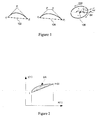
- Figure 1 illustrates diagrams of a quadratic Bezier curve, a cubic Bezier curve and an elliptical curve.
- the quadratic Bezier curve 102 has three control points: P 0 ( x 0 , y 0 ), P 1 ( x 1 , y 1 ) and P 2 ( x 2 , y 2 );
- the cubic Bezier curve 104 has four control points: P 0 ( x 0 , y 0 ), P 1 ( x 1 , y 1 ), P 2 ( x 2 , y 2 ) and P 3 ( x 3 , y 3 ). These control points constitute a control polygon for each curve respectively.
- the elliptical curve 106 has a horizontal radius rh , a vertical radius rv , a starting angle ⁇ 0 , a terminating angle ⁇ 1 , a center point P c ( x c , y c ), a rotation angle rot and a symbol indicating whether the elliptical curve rotates counterclockwise (CCW) or clockwise (CW).
- the elliptical curve can be regarded as a result of affine transforming a unit circle (cos ⁇ , sin ⁇ ).
- Figure 2 illustrates a schematic diagram of a relationship between an area difference and a subdividing step, wherein the area difference is the difference between the area of a curve segment corresponding to the subdividing step with respect to X coordinate axis and the area of a line segment of two points corresponding to the subdividing step on the curve with respect to X coordinate axis.
- the area difference has no relationship with the parameter t , but with ⁇ t .
- ⁇ A is set to a threshold T , (5 pixels, for example)
- n int 1 / ⁇ ⁇ t + 1
- the elliptical curve can be obtained by affine transforming a unit circle curve
- coordinate information of the subdividing points can be calculated on the unit circle curve.
- the angle of the circular arc on the unit circle curve corresponding to the elliptical curve is ⁇ 1 - ⁇ 0 in all
- the angle difference between two adjacent subdividing points on the circular arc of the unit circle is ( ⁇ 1 - ⁇ 0 )/ n .
- the number of subdividing points on the circular arc of the unit circle is the same as that of the elliptical curve.
- Figure 3 illustrates a conceptual schematic diagram of forward differencing for approximating a Bezier curve.
- the coordinate values of the first subdividing point, ⁇ x and ⁇ y between the second and first subdividing points can be obtained by substituting the value of t on the first subdividing point into the expressions (1) and (27) respectively.
- the value of t can be, for example, 0.
- a x ( X 2 - X 1 )-( X 1 - X 0 )
- x n +1 x n + ⁇ x n
- ⁇ x n ⁇ x n -1 + ⁇ 2 x n -1
- ⁇ 2 x n -1 ⁇ 2 x n -2 + ⁇ 3 x n -2
- y n +1 y n + ⁇ y n
- y n +1 y n + ⁇ y n
- ⁇ 2 y n -1 ⁇ 2 y n -2 + ⁇ 3 y n -2
- x n +1 and y n +1 can be calculated in an iterative way.
- the coordinate values of the first subdividing point, ⁇ x and ⁇ y between the second and first subdividing points, and ⁇ 2 x and ⁇ 2 y between the second and first subdividing points can be obtained by substituting the value of t on the first subdividing point into the expressions (3), (30) and (31) respectively.
- the value of t on the first subdividing point can be, for example, 0.
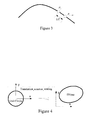
- Figure 4 illustrates a schematic diagram of the procedure for affine transforming a unit circle, with translation, rotation and scaling, to acquire an ellipse.
- Figure 5 illustrates a block diagram of a graphic-display control apparatus according to an embodiment of the invention.
- the graphic-display control apparatus comprises a subdivision module (corresponding to the number acquiring unit) 502, a coordinate calculation module (corresponding to the coordinate acquiring unit) 504, and a rendering module (corresponding to the curve rendering unit) 506.
- a curve and rendering parameters are acquired by the graphic-display control apparatus from outside, and the curve is represented by its control points.
- the subdivision module acquires number information of subdividing points for subdividing a curve by using coordinate information of control points of the curve.
- the coordinate calculation module acquires the coordinate information of each subdividing point according to the number information of the subdividing points and the coordinate information of the control points, by using the method of forward difference when the curve is a Bezier curve or the method of affine transformation when the curve is an ellipse curve.
- the rendering module connects the subdividing points by straight lines according to the coordinate information of each subdividing point and renders the straight lines connecting respective subdividing points by using the rendering parameters.
- Figure 6 illustrates a detailed block diagram of a subdivision module shown in figure 5 .
- the subdividing module calculates coefficients Q , C max and E in a curve function according to the coordinate information of the control points of the curve input from outside, acquires the relationship between an area difference and a subdividing step based on the curve function, the area difference being the difference between the area of a curve segment corresponding to the subdividing step on the curve with respect to X coordinate axis and the area of a line segment of two points corresponding to the subdividing step on the curve with respect to X coordinate axis, calculates the subdividing step ⁇ t according to the acquired relationship and a threshold input from outside, and calculates the number n of the subdividing points by using the subdividing step ⁇ t .
- Figure 7 illustrates a detailed block diagram of a coordinate calculation module shown in figure 5 .
- the coordinate calculation module calculates the parameter difference ⁇ t according to the number of the subdividing points, and calculates the coordinate information of the first subdividing point according to coordinate information of the control points. Then it calculates a curve difference ⁇ P between adjacent subdividing points for the Bezier curve, and calculates affine transformation coefficients for the ellipse curve. By using the difference value ⁇ P between adjacent subdividing points, it calculates the coordinate values of the subdividing points of the Bezier curve. By using the affine transformation coefficients, it affine transforms the subdividing points on the unit circle to the subdividing points on the ellipse curve. Finally, the coordinate values of each subdividing point are stored in an external memory for the rendering module.
- the invention acquires the number information of subdividing points for subdividing a curve by using coordinate information of control points of the curve, and then acquires coordinate information of the subdividing points according to the number information of the subdividing points and the coordinate information of the control points, thereby achieving high efficient curve approximation and further high efficient graphic-display control.
- modules and/or units shown in figure 5 can be implemented by using pre-programmed firmware or hardware component (for example ASIC) or by using data processing devices including EEPROM or other components.
- the invention also provides a computer program or a computer program product for carrying out any of the methods described herein, and a computer readable medium having stored thereon a program for carrying out any of the methods described herein.
- a computer program embodying the invention may be stored on a computer-readable medium, or it could, for example, be in the form of a signal such as a downloadable data signal provided from an Internet website, or it could be in any other form.
Landscapes
- Physics & Mathematics (AREA)
- General Physics & Mathematics (AREA)
- Engineering & Computer Science (AREA)
- Theoretical Computer Science (AREA)
- Image Generation (AREA)
- Digital Computer Display Output (AREA)
- Complex Calculations (AREA)
Abstract
Description
- The invention relates to graphic processing, and particularly relates to a method and apparatus for approximating a curve and a graphic display control method and apparatus. The method and apparatus are suitable to aid rendering characters or other curved symbols or pictures, for example to convert a character consisting of one or more mathematically defined curves into a format more suitable for display using a pixel array.
- In computer graphics applications, rendering characters is an important branch. Two-dimensional characters are generally formed by quadratic Bezier curves, cubic Bezier curves, and elliptical curves etc., in a two-dimensional plane.
- It is inefficient, for a Graphics Display Controller (GDC) chip, to render curves pixel by pixel by tracking along the curves. With appropriate precision, it is reasonable to approximate a curve with straight lines. It is a tradeoff between precision and speed. For many applications of GDC chips, speed overwhelms precision, such as car navigation, mobile phone, and amusement displayer.
- Approximating a curve with straight lines needs to firstly subdivide the curve with subdividing points, then calculate coordinates of the subdividing points, and finally connect adjacent subdividing points via straight lines. It is a long existing problem to approximate a curve. There exist many solutions to approximate Bezier curves, such as direct method, recursive subdivision, forward differencing, and hybrid method. However, these methods are not fast enough.
- As Bezier curves are commonly represented by polynomials of parameter t (for example, x(t)=a·t 2+b·t+c, y(t)=d·t 2+e·t+f for quadratic Bezier curve, where the coefficients a, b, c, d, e , and f can be calculated by control points of the quadratic Bezier curve), the coordinate values of each subdividing point can be calculated directly, given the parameter t at each subdividing point. Although this method is simple and direct, it needs too many multiplications for each subdividing point.
- Recursive subdivision is a recursive procedure, to find step by step subdividing points by calculating the middle points on each edge of a control polygon. Connecting adjacent subdividing points will form straight lines. Setting an appropriate threshold of flatness, the straight lines will approximate a curve with reasonable precision. However, the recursive procedure and calculating flatness will take a large amount of time.
- Forward differencing is suitable for Bezier curves. The coordinate values of a next subdividing point can be got by adding the coordinate values of a previous subdividing point with difference values. With a fixed step, the coordinate values of each subdividing point can be calculated by just several addition operations. Therefore, the speed is very high. However, the number of the subdividing points (i.e. the step) needs to be determined before calculating the coordinates.
- The hybrid method combines recursive subdivision and forward differencing together. It first uses recursive subdivision and flatness to obtains the parameter of each subdividing point, and then uses forward differencing to calculate the coordinate values of each subdividing point. This method is complex for implementation.
- Therefore, a method and/or apparatus for approximating a curve, used in curve rendering and more efficient than the abovementioned methods for a graphic display control, are needed.
- In view of one or more of the above problems, this invention proposes a method and apparatus for approximating a curve and a graphic-display control method and apparatus.
- The invention is defined in the independent claims, to which reference should now be made. Advantageous developments are defined in the sub-claims.
- One method for approximating a curve according to embodiments of an aspect of the invention comprises the steps of: acquiring number information of subdividing points for subdividing a curve needed to be approximated based on coordinate information of control points of the curve; acquiring coordinate information of the subdividing points based on the number information of the subdividing points and the coordinate information of the control points; and connecting the subdividing points with straight lines based on the coordinate information of the subdividing points.
- An apparatus for approximating a curve according to embodiments of another aspect of the invention, comprises: a number acquiring unit configured to acquire number information of (the number of) subdividing points for subdividing a curve needed to be approximated based on coordinate information of control points of the curve; a coordinate acquiring unit configured to acquire coordinate information of (coordinates of) the subdividing points based on the number information of the subdividing points and the coordinate information of the control points; and a curve approximating unit configured to connect the subdividing points with straight lines based on the coordinate information of the subdividing points.
- A graphic-display control method according to embodiments of still another aspect of the invention comprises the steps of: acquiring number information of subdividing points for subdividing a curve needed to be approximated based on coordinate information of control points of the curve; acquiring coordinate information of the subdividing points based on the number information of the subdividing points and the coordinate information of the control points; and connecting the subdividing points with straight lines based on the coordinate information of the subdividing points and drawing the straight lines connecting the subdividing points according to rendering parameters.
- The graphic-display control apparatus according to embodiments of still another aspect of the invention comprises: a number acquiring unit configured to acquire number information of subdividing points for subdividing a curve needed to be approximated based on coordinate information of control points of the curve; a coordinate acquiring unit configured to acquire coordinate information of the subdividing points based on the number information of the subdividing points and the coordinate information of the control points; and a curve rendering unit configured to connect the subdividing points with straight lines based on the coordinate information of the subdividing points and draw the straight lines connecting the subdividing points according to rendering parameters.
- The features enumerated for different aspects may be combined.
- To sum up, the embodiments of the invention achieve efficient curve approximation and efficient graphic-display control by acquiring the number information of the subdividing points for subdividing a curve by means of using the coordinate information of the control points of the curve, acquiring the coordinate information of the subdividing points according to the number information of the subdividing points and the coordinate information of the control points.
- The invention can be easily understood from the following description of the preferred embodiments of this invention in conjunction with the drawings, in which
-
Figure 1 illustrates schematic diagrams of a quadratic Bezier curve, a cubic Bezier curve and an elliptical curve; -
Figure 2 illustrates schematic diagram of a relationship between an area difference and a subdividing step, wherein the area difference is the difference between the area of a curve segment corresponding to the subdividing step with respect to X coordinate axis and the area of a line segment of two points corresponding to the subdividing step on the curve with respect to X coordinate axis; -
Figure 3 illustrates a conceptual schematic diagram of forward differencing for approximating a Bezier curve; -
Figure 4 illustrates a schematic diagram of the procedure for affine transforming a unit circle to acquire an ellipse; -
Figure 5 illustrates a block diagram of a graphic-display control apparatus according to an embodiment of the invention; -
Figure 6 illustrates a detailed block diagram of a subdivision module shown infigure 5 ; and -
Figure 7 illustrates a detailed block diagram of a coordinate calculation module shown infigure 5 . - Features in respective aspects and exemplary embodiments of the invention will be described in detail below. In the following detailed description, a number of specific details are proposed to provide thorough understanding of the invention. However, it is obvious to those skilled in the art that the invention can be implemented without some of the specific details. The following descriptions of the embodiments are merely to provide better understanding of the invention by illustrating examples of the invention. The invention is not limited to any specific configuration and algorithm mentioned below, and covers any modification, substitution and improvement of the elements, components and algorithms without departing from the spirit of the invention. In the figures and the following description, well-known structures and techniques are not disclosed to avoid unnecessarily obscuring the invention.
-
Figure 1 illustrates diagrams of a quadratic Bezier curve, a cubic Bezier curve and an elliptical curve. As shown infigure 1 , thequadratic Bezier curve 102 has three control points: P 0(x 0,y 0), P 1(x 1,y 1) and P 2(x 2,y 2); thecubic Bezier curve 104 has four control points: P 0(x 0,y 0), P 1(x 1,y 1), P 2(x 2,y 2) and P 3(x 3,y 3). These control points constitute a control polygon for each curve respectively. Theelliptical curve 106 has a horizontal radius rh, a vertical radius rv, a starting angle θ0, a terminating angle θ1, a center point Pc (xc ,yc ), a rotation angle rot and a symbol indicating whether the elliptical curve rotates counterclockwise (CCW) or clockwise (CW). - The parametrical equation of the quadratic Bezier curve is

where 0 ≤ t ≤ 1. The parametrical equation of the quadratic Bezier curve can be set as another form:
where aqx = x 2 - 2x 1 + x 0 , bqx = 2(x 1 - x 0), cqx = x 0 , aqy = y 2 - 2y 1 + y 0 , bqy = 2(y 1 - y 0), and cqy = y 0. - The parametrical equation of the cubic Bezier curve is

where 0 ≤ t ≤ 1. The parametrical equations of the cubic Bezier curve can also be set as another form:
wherein acx = x 3 - 3x 2 + 3x 1 - x 0, bcx = 3x 2 - 6x 1 + 3x 0 , ccx = 3x 1 - 3x 0, dcx = x 0, acy = y 3 - 3y 2 + 3y 1 - y 0, bcy = 3y 2 - 6y 1 + 3y 0, ccy = 3y 1 - 3y 0 and dcy = y 0. - The parametrical equation of the elliptical curve is

where θ is the parameter of any point on the elliptical curve, and rot is the rotation angle of the elliptical curve relative to the coordinate system. The elliptical curve can be regarded as a result of affine transforming a unit circle (cosθ, sin θ). -
Figure 2 illustrates a schematic diagram of a relationship between an area difference and a subdividing step, wherein the area difference is the difference between the area of a curve segment corresponding to the subdividing step with respect to X coordinate axis and the area of a line segment of two points corresponding to the subdividing step on the curve with respect to X coordinate axis. - The area difference ΔA between the area of a curve segment corresponding to a subdividing step Δt with respect to X coordinate axis and the area of a line segment between two points corresponding to the subdividing step on the curve with respect to X coordinate axis can be obtained by the following expression:

where A is the area of the curve segment corresponding to Δt with respect to X coordinate axis, and Aa is the area of the line segment between two end points on the curve segment with respect to X coordinate axis. - If the curve segment is part of the quadratic Bezier curve, then there exist the following equations

and
- Therefore, the area difference between the area of the curve segment corresponding to Δt with respect to X coordinate axis and the area of the line segment between the two points on the curve segment corresponding to the subdividing step with respect to X coordinate axis is

- As can be seen from the above expression, the area difference has no relationship with the parameter t, but with Δt. If ΔA is set to a threshold T, (5 pixels, for example), Δt can be obtained by the following expression:

- If the curve segment is part of the cubic Bezier curve, then there exist the following equations:

and
- Then,

- As Δt is between (01] under general conditions, two items Δt 5Δt 4 can be omitted, then the above mentioned equation (13) becomes


- If the maximum value of


- As in general cases, the scope of t is [0.0,1.0], to find the maximum value of C(t) is to find the maximum value of among t = 0.0 , t = 1.0 and


- Therefore,

- Finally, if ΔA is set to a threshold T (5 pixels, for example), then the following expression will be gotten:

- If the curve segment is part of the elliptical curve, which is centered at the original point of the coordinate system, and has no rotation relative to X coordinate axis, then there exist the following equations:

and
- Then

- The absolute value of ΔA is

- Finally, if ΔA is set to a threshold T, (5 pixels, for example), then

- After the subdividing step Δt is obtained, the number of the subdividing points can be obtained by the following expression:

- As the elliptical curve can be obtained by affine transforming a unit circle curve, coordinate information of the subdividing points can be calculated on the unit circle curve. As the number n of the subdividing points has already been obtained and the angle of the circular arc on the unit circle curve corresponding to the elliptical curve is θ1 - θ0 in all, the angle difference between two adjacent subdividing points on the circular arc of the unit circle is (θ1-θ0)/n. From θ0 to θ1, the coordinates of each subdividing point on the circular arc are calculated according to x = cos θ and y = sin θ. Herein, the number of subdividing points on the circular arc of the unit circle is the same as that of the elliptical curve.
-
Figure 3 illustrates a conceptual schematic diagram of forward differencing for approximating a Bezier curve. For any point P t+Δt on the curve, the coordinate values can be calculated from the coordinate values of the previous point P t , given the curve length difference ΔPt , as follows:
- If P t+Δt is treated as parameter equations, then

- If the curve is a quadratic Bezier curve, then

where X 0 = x 1 - x 0, Y 0 = y 1 - y 0, X 1 = x 2 - x 1, and Y 1 = y 2 - y 1. Similarly,
- So,

- If the curve is defined in iterative terms x n+1 = xn + Δx n , Δxn = Δx n-1 + Δ2x n-1, and y n+1 = yn + Δyn , y n+1 = yn + Δyn , then x n+1 and y n+1 can be obtained in an iterative way.
- The coordinate values of the first subdividing point, Δx and Δy between the second and first subdividing points can be obtained by substituting the value of t on the first subdividing point into the expressions (1) and (27) respectively. Herein, the value of t can be, for example, 0.
- If the curve is a cubic Bezier curve, then

where A x = (X 2 - X 1)-(X 1 - X 0), Bx = (X 1 - X 0), Cx = X 0, X 2 = x 3 - x 2, Ay = (Y 2 - Y 1)-(Y 1 - Y 0), By = (Y 1 - Y 0), C y = Y0 and Y 2 = y 3 - y 2. - Likewise,

and
- If the curve is defined in iterative terms x n+1 = xn + Δxn , Δxn = Δx n-1 + Δ2 x n-1, Δ2 x n-1 = Δ2 x n-2 + Δ3 x n-2 , and y n+1 = yn + Δyn , y n+1 = y n + Δyn , Δ2 y n-1 = Δ2 y n-2 + Δ3 y n-2, then x n+1 and y n+1 can be calculated in an iterative way.
- Likewise, the coordinate values of the first subdividing point, Δx and Δy between the second and first subdividing points, and Δ2 x and Δ2 y between the second and first subdividing points can be obtained by substituting the value of t on the first subdividing point into the expressions (3), (30) and (31) respectively. Herein, the value of t on the first subdividing point can be, for example, 0.
-
Figure 4 illustrates a schematic diagram of the procedure for affine transforming a unit circle, with translation, rotation and scaling, to acquire an ellipse. The unit circle curve can be defined as (x(θ),y(θ),1) T =(cosθ,sinθ,1) T , and the ellipse curve can be obtained by first subdividing the unit circle into points and then affine transforming the subdividing points. According to the coordinates (cos θ, sin θ,1) T of the subdividing points on the unit circle arc and the equation (5), the coordinates (x, y,1) T of an ellipse curve after affine transformation can be obtained through the following specific calculating formulas:
-
Figure 5 illustrates a block diagram of a graphic-display control apparatus according to an embodiment of the invention. As shown infigure 5 , the graphic-display control apparatus comprises a subdivision module (corresponding to the number acquiring unit) 502, a coordinate calculation module (corresponding to the coordinate acquiring unit) 504, and a rendering module (corresponding to the curve rendering unit) 506. A curve and rendering parameters are acquired by the graphic-display control apparatus from outside, and the curve is represented by its control points. Firstly, the subdivision module acquires number information of subdividing points for subdividing a curve by using coordinate information of control points of the curve. Secondly, the coordinate calculation module acquires the coordinate information of each subdividing point according to the number information of the subdividing points and the coordinate information of the control points, by using the method of forward difference when the curve is a Bezier curve or the method of affine transformation when the curve is an ellipse curve. Finally the rendering module connects the subdividing points by straight lines according to the coordinate information of each subdividing point and renders the straight lines connecting respective subdividing points by using the rendering parameters. -
Figure 6 illustrates a detailed block diagram of a subdivision module shown infigure 5 . As shown infigure 6 , the subdividing module calculates coefficients Q, C max and E in a curve function according to the coordinate information of the control points of the curve input from outside, acquires the relationship between an area difference and a subdividing step based on the curve function, the area difference being the difference between the area of a curve segment corresponding to the subdividing step on the curve with respect to X coordinate axis and the area of a line segment of two points corresponding to the subdividing step on the curve with respect to X coordinate axis, calculates the subdividing step Δt according to the acquired relationship and a threshold input from outside, and calculates the number n of the subdividing points by using the subdividing step Δt. -
Figure 7 illustrates a detailed block diagram of a coordinate calculation module shown infigure 5 . As shown infigure 7 , the coordinate calculation module calculates the parameter difference Δt according to the number of the subdividing points, and calculates the coordinate information of the first subdividing point according to coordinate information of the control points. Then it calculates a curve difference ΔP between adjacent subdividing points for the Bezier curve, and calculates affine transformation coefficients for the ellipse curve. By using the difference value ΔP between adjacent subdividing points, it calculates the coordinate values of the subdividing points of the Bezier curve. By using the affine transformation coefficients, it affine transforms the subdividing points on the unit circle to the subdividing points on the ellipse curve. Finally, the coordinate values of each subdividing point are stored in an external memory for the rendering module. - To sum up, the invention acquires the number information of subdividing points for subdividing a curve by using coordinate information of control points of the curve, and then acquires coordinate information of the subdividing points according to the number information of the subdividing points and the coordinate information of the control points, thereby achieving high efficient curve approximation and further high efficient graphic-display control.
- What needs to be noted is that respect modules and/or units shown in
figure 5 can be implemented by using pre-programmed firmware or hardware component (for example ASIC) or by using data processing devices including EEPROM or other components. - In any of the above aspects, the various features may be implemented in hardware, or as software modules running on one or more processors. Features of one aspect may be applied to any of the other aspects.
- The invention also provides a computer program or a computer program product for carrying out any of the methods described herein, and a computer readable medium having stored thereon a program for carrying out any of the methods described herein. A computer program embodying the invention may be stored on a computer-readable medium, or it could, for example, be in the form of a signal such as a downloadable data signal provided from an Internet website, or it could be in any other form.
- Those skilled in the art will understand that there exist more optional embodiments and modifications for implementing the embodiments of this invention, and the abovementioned embodiments and examples are only descriptions of one or more embodiments. Therefore, the scope of this invention is restricted only by the claims attached.
Claims (11)
- A method for approximating a curve, comprising the steps of:acquiring number information of subdividing points for subdividing a curve needed to be approximated based on coordinate information of control points of the curve;acquiring coordinate information of the subdividing points based on the number information of the subdividing points and the coordinate information of the control points; andconnecting the subdividing points with straight lines based on the coordinate information of the subdividing points.
- The method for approximating a curve of claim 1, characterized in that the process of acquiring the number information of the subdividing points comprises the sub-steps of:acquiring a curve function of the curve based on the coordinate information of the control points;acquiring a relationship between an area difference and a subdividing step based on the curve function, wherein the area difference is the difference between the area of a curve segment corresponding to the subdividing step on the curve with respect to X coordinate axis and the area of a line segment of two points corresponding to the subdividing step on the curve with respect to X coordinate axis;acquiring a subdividing step corresponding to a set area difference based on the relationship between the area difference and the subdividing step; andacquiring the number information of the subdividing points using the subdividing step corresponding to the set area difference.
- The method for approximating a curve of claim 1 or 2, characterized in that when the curve is a Bezier curve, the coordinate information of the subdividing points is acquired by forward differencing.
- The method for approximating a curve of any of the preceding claims, characterized in that when the curve is an elliptic curve, the coordinate information of the subdividing points is acquired by affine transforming.
- The method of any of the preceding method claims used for graphic display control, to render a curve based on coordinate information of control points of the curve; wherein
connection of the subdividing points with straight lines is followed by drawing of the straight lines connecting the subdividing points according to rendering parameters. - The method of claim 5, wherein
the straight lines are an approximate rendering of a curved character or other symbol or image for display. - An apparatus for approximating a curve, comprising:a number acquiring unit configured to acquire number information of subdividing points for subdividing a curve needed to be approximated based on coordinate information of control points of the curve;a coordinate acquiring unit configured to acquire coordinate information of the subdividing points based on the number information of the subdividing points and the coordinate information of the control points; anda curve approximating unit configured to connect the subdividing points with straight lines based on the coordinate information of the subdividing points.
- The apparatus for approximating a curve of claim 7, characterized in that the number acquiring unit comprises:a curve function acquiring unit configured to acquire a curve function of the curve based on the coordinate information of the control points;a mutual relationship acquiring unit configured to acquire a relationship between an area difference and a subdividing step based on the curve function, wherein the area difference is the difference between the area of a curve segment corresponding to the subdividing step on the curve with respect to X coordinate axis and the area of a line segment of two points corresponding to the subdividing step on the curve with respect to X coordinate axis;a subdividing step acquiring unit configured to acquire a subdividing step corresponding to a set area difference based on the relationship between the area difference and the subdividing step; anda number information acquiring unit configured to acquire the number information of the subdividing points using the subdividing step corresponding to the set area difference.
- The apparatus for approximating a curve of claim 7 or 8, characterized in that in the case that the curve is a Bezier curve, the coordinate acquiring unit acquires the coordinate information of the subdividing points by forward differencing.
- The apparatus for approximating a curve of any of claims 7 to 9, characterized in that in the case that the curve is an elliptic curve, the coordinate acquiring unit acquires the coordinate information of the subdividing points by affine transforming.
- A graphic display control apparatus comprising the features of any of the preceding apparatus claims, wherein:the number acquiring unit is for acquiring number information of subdividing points for subdividing a curve needed to be rendered based on coordinate information of control points of the curve; and whereinthe curve approximating unit is a curve rendering unit configured to connect the subdividing points with straight lines based on the coordinate information of the subdividing points and to draw the straight lines connecting the subdividing points according to rendering parameters.
Applications Claiming Priority (1)
| Application Number | Priority Date | Filing Date | Title |
|---|---|---|---|
| CN200910142113.4A CN101901488B (en) | 2009-05-25 | 2009-05-25 | For the method and apparatus of curve approximation and figure display control method and device |
Publications (2)
| Publication Number | Publication Date |
|---|---|
| EP2256692A1 true EP2256692A1 (en) | 2010-12-01 |
| EP2256692B1 EP2256692B1 (en) | 2012-01-04 |
Family
ID=42312849
Family Applications (1)
| Application Number | Title | Priority Date | Filing Date |
|---|---|---|---|
| EP10161928A Not-in-force EP2256692B1 (en) | 2009-05-25 | 2010-05-04 | Method and system for approximating a curve for display purposes, and graphic display control method and apparatus |
Country Status (5)
| Country | Link |
|---|---|
| US (1) | US8976183B2 (en) |
| EP (1) | EP2256692B1 (en) |
| JP (1) | JP5640459B2 (en) |
| CN (1) | CN101901488B (en) |
| AT (1) | ATE540385T1 (en) |
Families Citing this family (10)
| Publication number | Priority date | Publication date | Assignee | Title |
|---|---|---|---|---|
| CN102129710A (en) * | 2010-12-30 | 2011-07-20 | 北京像素软件科技股份有限公司 | Method and system for simulating flight path |
| CN102819853B (en) * | 2011-06-10 | 2015-11-25 | 富士通株式会社 | Curve rendering intent and system |
| CN102819854B (en) * | 2011-06-10 | 2014-11-12 | 富士通株式会社 | Method and system for describing elliptic arc on raster display |
| CN104537698B (en) * | 2014-12-26 | 2017-11-28 | 北京航天飞行控制中心 | A kind of adaptive track method for drafting of curvature |
| CN106095370B (en) * | 2016-06-15 | 2018-11-23 | 深圳市华星光电技术有限公司 | A kind of image simulation method and image simulation equipment of flexible displays |
| CN109891461B (en) * | 2016-10-25 | 2023-02-03 | 三菱电机株式会社 | Map data generation device, terminal device, and map data generation method |
| CN110824299B (en) * | 2019-11-25 | 2021-11-16 | 云南电网有限责任公司临沧供电局 | Fault line selection method based on two-dimensional plane judgment of zero-sequence current curve cluster |
| JP7552192B2 (en) | 2020-09-24 | 2024-09-18 | 株式会社ニューフレアテクノロジー | Data generation method, charged particle beam irradiation device and program |
| CN113674378B (en) * | 2021-08-24 | 2024-02-13 | 合肥工业大学 | A curve image construction method based on interpolation and approximation subdivision technology |
| KR20240137774A (en) * | 2023-03-09 | 2024-09-20 | 주식회사 모라이 | Method and system for optimizing road shape information |
Citations (3)
| Publication number | Priority date | Publication date | Assignee | Title |
|---|---|---|---|---|
| EP0577131A2 (en) * | 1992-07-02 | 1994-01-05 | Microsoft Corporation | System and method of hybrid forward differencing to render bézier splines |
| US5408598A (en) * | 1991-05-23 | 1995-04-18 | International Business Machines Corporation | Method for fast generation of parametric curves employing a pre-calculated number of line segments in accordance with a determined error threshold |
| US6069554A (en) * | 1994-07-07 | 2000-05-30 | Adobe Systems Incorporated | Memory having both stack and queue operation |
Family Cites Families (11)
| Publication number | Priority date | Publication date | Assignee | Title |
|---|---|---|---|---|
| JPH02126376A (en) | 1988-11-04 | 1990-05-15 | Nec Corp | Bezier curve plotting device |
| JP2877480B2 (en) * | 1990-10-03 | 1999-03-31 | 大日本印刷株式会社 | High accuracy vector approximation apparatus and method |
| JP2961121B2 (en) * | 1990-10-17 | 1999-10-12 | セイコープレシジョン株式会社 | Curve approximation device |
| AU669516B2 (en) * | 1992-04-29 | 1996-06-13 | Canon Kabushiki Kaisha | Bezier spline to quadratic polynomial fragment conversion |
| US7031538B2 (en) * | 1999-12-17 | 2006-04-18 | Level Set Systems, Inc. | Method and apparatus for feature-based quantization and compression of data |
| JP2002117411A (en) * | 2000-10-12 | 2002-04-19 | Matsushita Electric Ind Co Ltd | Curve drawing method, curve drawing device, and recording medium recording curve drawing program |
| JP4027646B2 (en) * | 2001-11-21 | 2007-12-26 | 株式会社リコー | 3D shape processing apparatus, polyline generation program, and polygon generation program |
| CN1947155B (en) * | 2004-04-27 | 2012-03-28 | 株式会社日立医药 | Image plotting device and method thereof |
| JP2006338541A (en) | 2005-06-03 | 2006-12-14 | Mitsubishi Electric Corp | Graphic drawing apparatus and program |
| JP5294313B2 (en) | 2008-11-07 | 2013-09-18 | Necシステムテクノロジー株式会社 | Bezier curve drawing device, Bezier curve drawing method and program |
| US8373702B2 (en) * | 2009-05-15 | 2013-02-12 | Stmicroelectronics S.R.L. | System and method for adaptive tessellation of a curve |
-
2009
- 2009-05-25 CN CN200910142113.4A patent/CN101901488B/en not_active Expired - Fee Related
-
2010
- 2010-04-23 US US12/766,531 patent/US8976183B2/en not_active Expired - Fee Related
- 2010-05-04 EP EP10161928A patent/EP2256692B1/en not_active Not-in-force
- 2010-05-04 AT AT10161928T patent/ATE540385T1/en active
- 2010-05-25 JP JP2010119386A patent/JP5640459B2/en not_active Expired - Fee Related
Patent Citations (3)
| Publication number | Priority date | Publication date | Assignee | Title |
|---|---|---|---|---|
| US5408598A (en) * | 1991-05-23 | 1995-04-18 | International Business Machines Corporation | Method for fast generation of parametric curves employing a pre-calculated number of line segments in accordance with a determined error threshold |
| EP0577131A2 (en) * | 1992-07-02 | 1994-01-05 | Microsoft Corporation | System and method of hybrid forward differencing to render bézier splines |
| US6069554A (en) * | 1994-07-07 | 2000-05-30 | Adobe Systems Incorporated | Memory having both stack and queue operation |
Non-Patent Citations (2)
| Title |
|---|
| MACVICAR D ET AL: "Bezier curve rendering on Virtex<TM>", FIELD-PROGRAMMABLE CUSTOM COMPUTING MACHINES, 1999. FCCM '99. PROCEEDI NGS. SEVENTH ANNUAL IEEE SYMPOSIUM ON NAPA VALLEY, CA, USA 21-23 APRIL 1999, LOS ALAMITOS, CA, USA,IEEE COMPUT. SOC, US LNKD- DOI:10.1109/FPGA.1999.803712, 21 April 1999 (1999-04-21), pages 314 - 315, XP010359158, ISBN: 978-0-7695-0375-2 * |
| RAPPOPORT A: "RENDERING CURVES AND SURFACES WITH HYBRID SUBDIVISION AND FORWARD DIFFERENCING", ACM TRANSACTIONS ON GRAPHICS, ACM, US LNKD- DOI:10.1145/116913.116914, vol. 10, no. 4, 1 October 1991 (1991-10-01), pages 323 - 341, XP000248359, ISSN: 0730-0301 * |
Also Published As
| Publication number | Publication date |
|---|---|
| CN101901488A (en) | 2010-12-01 |
| JP2010272120A (en) | 2010-12-02 |
| US8976183B2 (en) | 2015-03-10 |
| CN101901488B (en) | 2015-09-09 |
| US20100295858A1 (en) | 2010-11-25 |
| EP2256692B1 (en) | 2012-01-04 |
| ATE540385T1 (en) | 2012-01-15 |
| JP5640459B2 (en) | 2014-12-17 |
Similar Documents
| Publication | Publication Date | Title |
|---|---|---|
| EP2256692A1 (en) | Method and system for approximating a curve for display purposes, and graphic display control method and apparatus | |
| US9652825B2 (en) | Image enlargement method and apparatus | |
| JP6152821B2 (en) | Image processing apparatus and computer program | |
| US8630506B2 (en) | Image correcting device, method for creating corrected image, correction table creating device, method for creating correction table, program for creating correction table, and program for creating corrected image | |
| US9070034B2 (en) | Method and system for correcting QR code image | |
| CN102129065B (en) | Fake image reduction apparatus, radar apparatus, fake image reduction method and fake image reduction program | |
| US20110299761A1 (en) | Image Processing Apparatus, Image Processing Method, and Program | |
| CN111353951B (en) | Circuit devices, electronic equipment and mobile objects | |
| CN113470140B (en) | Dynamic reversing trajectory realization method and device, computer equipment and storage medium | |
| US6421063B1 (en) | Pixel zoom system and method for a computer graphics system | |
| CN111428707B (en) | Method and device for identifying pattern identification code, storage medium and electronic equipment | |
| US20210012459A1 (en) | Image processing method and apparatus | |
| CN111986124A (en) | Filling method and device for missing pixels of depth image | |
| US9336573B2 (en) | Self-adaptive image edge correction device and method thereof | |
| EP2034444B1 (en) | Method for rotating images | |
| US9514526B2 (en) | Device and method for detecting angle of rotation from normal position of image | |
| US20250348982A1 (en) | Display video correction device, display video correction method, and recording medium | |
| US9230359B2 (en) | Method for resizing an image | |
| CN111178289B (en) | Method and system for shortening iris recognition time consumption | |
| JP2002140704A (en) | Method of superimposing images by computer | |
| JPH04141789A (en) | Device and method for highly accurate vector approximation | |
| JP2010271873A (en) | Tilt angle detection method for image | |
| JPH0827837B2 (en) | Hough transform arithmetic circuit | |
| JP3080102B2 (en) | Data processing method and device | |
| JPS63204379A (en) | Graphic processing device |
Legal Events
| Date | Code | Title | Description |
|---|---|---|---|
| PUAI | Public reference made under article 153(3) epc to a published international application that has entered the european phase |
Free format text: ORIGINAL CODE: 0009012 |
|
| AK | Designated contracting states |
Kind code of ref document: A1 Designated state(s): AL AT BE BG CH CY CZ DE DK EE ES FI FR GB GR HR HU IE IS IT LI LT LU LV MC MK MT NL NO PL PT RO SE SI SK SM TR |
|
| AX | Request for extension of the european patent |
Extension state: BA ME RS |
|
| 17P | Request for examination filed |
Effective date: 20110525 |
|
| GRAC | Information related to communication of intention to grant a patent modified |
Free format text: ORIGINAL CODE: EPIDOSCIGR1 |
|
| GRAP | Despatch of communication of intention to grant a patent |
Free format text: ORIGINAL CODE: EPIDOSNIGR1 |
|
| RIC1 | Information provided on ipc code assigned before grant |
Ipc: G06T 11/20 20060101AFI20110704BHEP |
|
| GRAS | Grant fee paid |
Free format text: ORIGINAL CODE: EPIDOSNIGR3 |
|
| GRAA | (expected) grant |
Free format text: ORIGINAL CODE: 0009210 |
|
| AK | Designated contracting states |
Kind code of ref document: B1 Designated state(s): AL AT BE BG CH CY CZ DE DK EE ES FI FR GB GR HR HU IE IS IT LI LT LU LV MC MK MT NL NO PL PT RO SE SI SK SM TR |
|
| REG | Reference to a national code |
Ref country code: GB Ref legal event code: FG4D |
|
| REG | Reference to a national code |
Ref country code: CH Ref legal event code: EP |
|
| REG | Reference to a national code |
Ref country code: AT Ref legal event code: REF Ref document number: 540385 Country of ref document: AT Kind code of ref document: T Effective date: 20120115 |
|
| REG | Reference to a national code |
Ref country code: IE Ref legal event code: FG4D |
|
| REG | Reference to a national code |
Ref country code: DE Ref legal event code: R096 Ref document number: 602010000616 Country of ref document: DE Effective date: 20120308 |
|
| REG | Reference to a national code |
Ref country code: NL Ref legal event code: VDEP Effective date: 20120104 |
|
| PG25 | Lapsed in a contracting state [announced via postgrant information from national office to epo] |
Ref country code: SI Free format text: LAPSE BECAUSE OF FAILURE TO SUBMIT A TRANSLATION OF THE DESCRIPTION OR TO PAY THE FEE WITHIN THE PRESCRIBED TIME-LIMIT Effective date: 20120104 |
|
| LTIE | Lt: invalidation of european patent or patent extension |
Effective date: 20120104 |
|
| PG25 | Lapsed in a contracting state [announced via postgrant information from national office to epo] |
Ref country code: NO Free format text: LAPSE BECAUSE OF FAILURE TO SUBMIT A TRANSLATION OF THE DESCRIPTION OR TO PAY THE FEE WITHIN THE PRESCRIBED TIME-LIMIT Effective date: 20120404 Ref country code: HR Free format text: LAPSE BECAUSE OF FAILURE TO SUBMIT A TRANSLATION OF THE DESCRIPTION OR TO PAY THE FEE WITHIN THE PRESCRIBED TIME-LIMIT Effective date: 20120104 Ref country code: BE Free format text: LAPSE BECAUSE OF FAILURE TO SUBMIT A TRANSLATION OF THE DESCRIPTION OR TO PAY THE FEE WITHIN THE PRESCRIBED TIME-LIMIT Effective date: 20120104 Ref country code: BG Free format text: LAPSE BECAUSE OF FAILURE TO SUBMIT A TRANSLATION OF THE DESCRIPTION OR TO PAY THE FEE WITHIN THE PRESCRIBED TIME-LIMIT Effective date: 20120404 Ref country code: LT Free format text: LAPSE BECAUSE OF FAILURE TO SUBMIT A TRANSLATION OF THE DESCRIPTION OR TO PAY THE FEE WITHIN THE PRESCRIBED TIME-LIMIT Effective date: 20120104 Ref country code: NL Free format text: LAPSE BECAUSE OF FAILURE TO SUBMIT A TRANSLATION OF THE DESCRIPTION OR TO PAY THE FEE WITHIN THE PRESCRIBED TIME-LIMIT Effective date: 20120104 Ref country code: IS Free format text: LAPSE BECAUSE OF FAILURE TO SUBMIT A TRANSLATION OF THE DESCRIPTION OR TO PAY THE FEE WITHIN THE PRESCRIBED TIME-LIMIT Effective date: 20120504 |
|
| PG25 | Lapsed in a contracting state [announced via postgrant information from national office to epo] |
Ref country code: LV Free format text: LAPSE BECAUSE OF FAILURE TO SUBMIT A TRANSLATION OF THE DESCRIPTION OR TO PAY THE FEE WITHIN THE PRESCRIBED TIME-LIMIT Effective date: 20120104 Ref country code: GR Free format text: LAPSE BECAUSE OF FAILURE TO SUBMIT A TRANSLATION OF THE DESCRIPTION OR TO PAY THE FEE WITHIN THE PRESCRIBED TIME-LIMIT Effective date: 20120405 Ref country code: PL Free format text: LAPSE BECAUSE OF FAILURE TO SUBMIT A TRANSLATION OF THE DESCRIPTION OR TO PAY THE FEE WITHIN THE PRESCRIBED TIME-LIMIT Effective date: 20120104 Ref country code: PT Free format text: LAPSE BECAUSE OF FAILURE TO SUBMIT A TRANSLATION OF THE DESCRIPTION OR TO PAY THE FEE WITHIN THE PRESCRIBED TIME-LIMIT Effective date: 20120504 Ref country code: FI Free format text: LAPSE BECAUSE OF FAILURE TO SUBMIT A TRANSLATION OF THE DESCRIPTION OR TO PAY THE FEE WITHIN THE PRESCRIBED TIME-LIMIT Effective date: 20120104 |
|
| REG | Reference to a national code |
Ref country code: AT Ref legal event code: MK05 Ref document number: 540385 Country of ref document: AT Kind code of ref document: T Effective date: 20120104 |
|
| PG25 | Lapsed in a contracting state [announced via postgrant information from national office to epo] |
Ref country code: CY Free format text: LAPSE BECAUSE OF FAILURE TO SUBMIT A TRANSLATION OF THE DESCRIPTION OR TO PAY THE FEE WITHIN THE PRESCRIBED TIME-LIMIT Effective date: 20120104 |
|
| PG25 | Lapsed in a contracting state [announced via postgrant information from national office to epo] |
Ref country code: SE Free format text: LAPSE BECAUSE OF FAILURE TO SUBMIT A TRANSLATION OF THE DESCRIPTION OR TO PAY THE FEE WITHIN THE PRESCRIBED TIME-LIMIT Effective date: 20120104 Ref country code: CZ Free format text: LAPSE BECAUSE OF FAILURE TO SUBMIT A TRANSLATION OF THE DESCRIPTION OR TO PAY THE FEE WITHIN THE PRESCRIBED TIME-LIMIT Effective date: 20120104 Ref country code: DK Free format text: LAPSE BECAUSE OF FAILURE TO SUBMIT A TRANSLATION OF THE DESCRIPTION OR TO PAY THE FEE WITHIN THE PRESCRIBED TIME-LIMIT Effective date: 20120104 Ref country code: RO Free format text: LAPSE BECAUSE OF FAILURE TO SUBMIT A TRANSLATION OF THE DESCRIPTION OR TO PAY THE FEE WITHIN THE PRESCRIBED TIME-LIMIT Effective date: 20120104 Ref country code: EE Free format text: LAPSE BECAUSE OF FAILURE TO SUBMIT A TRANSLATION OF THE DESCRIPTION OR TO PAY THE FEE WITHIN THE PRESCRIBED TIME-LIMIT Effective date: 20120104 |
|
| PLBE | No opposition filed within time limit |
Free format text: ORIGINAL CODE: 0009261 |
|
| STAA | Information on the status of an ep patent application or granted ep patent |
Free format text: STATUS: NO OPPOSITION FILED WITHIN TIME LIMIT |
|
| PG25 | Lapsed in a contracting state [announced via postgrant information from national office to epo] |
Ref country code: SK Free format text: LAPSE BECAUSE OF FAILURE TO SUBMIT A TRANSLATION OF THE DESCRIPTION OR TO PAY THE FEE WITHIN THE PRESCRIBED TIME-LIMIT Effective date: 20120104 Ref country code: IT Free format text: LAPSE BECAUSE OF FAILURE TO SUBMIT A TRANSLATION OF THE DESCRIPTION OR TO PAY THE FEE WITHIN THE PRESCRIBED TIME-LIMIT Effective date: 20120104 |
|
| 26N | No opposition filed |
Effective date: 20121005 |
|
| PG25 | Lapsed in a contracting state [announced via postgrant information from national office to epo] |
Ref country code: MC Free format text: LAPSE BECAUSE OF NON-PAYMENT OF DUE FEES Effective date: 20120531 |
|
| PG25 | Lapsed in a contracting state [announced via postgrant information from national office to epo] |
Ref country code: AT Free format text: LAPSE BECAUSE OF FAILURE TO SUBMIT A TRANSLATION OF THE DESCRIPTION OR TO PAY THE FEE WITHIN THE PRESCRIBED TIME-LIMIT Effective date: 20120104 |
|
| REG | Reference to a national code |
Ref country code: DE Ref legal event code: R097 Ref document number: 602010000616 Country of ref document: DE Effective date: 20121005 |
|
| REG | Reference to a national code |
Ref country code: IE Ref legal event code: MM4A |
|
| PG25 | Lapsed in a contracting state [announced via postgrant information from national office to epo] |
Ref country code: MK Free format text: LAPSE BECAUSE OF FAILURE TO SUBMIT A TRANSLATION OF THE DESCRIPTION OR TO PAY THE FEE WITHIN THE PRESCRIBED TIME-LIMIT Effective date: 20120104 |
|
| REG | Reference to a national code |
Ref country code: FR Ref legal event code: ST Effective date: 20130131 |
|
| PG25 | Lapsed in a contracting state [announced via postgrant information from national office to epo] |
Ref country code: FR Free format text: LAPSE BECAUSE OF NON-PAYMENT OF DUE FEES Effective date: 20120531 Ref country code: IE Free format text: LAPSE BECAUSE OF NON-PAYMENT OF DUE FEES Effective date: 20120504 Ref country code: ES Free format text: LAPSE BECAUSE OF FAILURE TO SUBMIT A TRANSLATION OF THE DESCRIPTION OR TO PAY THE FEE WITHIN THE PRESCRIBED TIME-LIMIT Effective date: 20120415 |
|
| PG25 | Lapsed in a contracting state [announced via postgrant information from national office to epo] |
Ref country code: MT Free format text: LAPSE BECAUSE OF FAILURE TO SUBMIT A TRANSLATION OF THE DESCRIPTION OR TO PAY THE FEE WITHIN THE PRESCRIBED TIME-LIMIT Effective date: 20120104 |
|
| PG25 | Lapsed in a contracting state [announced via postgrant information from national office to epo] |
Ref country code: AL Free format text: LAPSE BECAUSE OF FAILURE TO SUBMIT A TRANSLATION OF THE DESCRIPTION OR TO PAY THE FEE WITHIN THE PRESCRIBED TIME-LIMIT Effective date: 20120104 |
|
| PG25 | Lapsed in a contracting state [announced via postgrant information from national office to epo] |
Ref country code: TR Free format text: LAPSE BECAUSE OF FAILURE TO SUBMIT A TRANSLATION OF THE DESCRIPTION OR TO PAY THE FEE WITHIN THE PRESCRIBED TIME-LIMIT Effective date: 20120104 |
|
| PG25 | Lapsed in a contracting state [announced via postgrant information from national office to epo] |
Ref country code: LU Free format text: LAPSE BECAUSE OF NON-PAYMENT OF DUE FEES Effective date: 20120504 Ref country code: SM Free format text: LAPSE BECAUSE OF FAILURE TO SUBMIT A TRANSLATION OF THE DESCRIPTION OR TO PAY THE FEE WITHIN THE PRESCRIBED TIME-LIMIT Effective date: 20120104 |
|
| PG25 | Lapsed in a contracting state [announced via postgrant information from national office to epo] |
Ref country code: HU Free format text: LAPSE BECAUSE OF FAILURE TO SUBMIT A TRANSLATION OF THE DESCRIPTION OR TO PAY THE FEE WITHIN THE PRESCRIBED TIME-LIMIT Effective date: 20100504 |
|
| REG | Reference to a national code |
Ref country code: CH Ref legal event code: PL |
|
| PG25 | Lapsed in a contracting state [announced via postgrant information from national office to epo] |
Ref country code: LI Free format text: LAPSE BECAUSE OF NON-PAYMENT OF DUE FEES Effective date: 20140531 Ref country code: CH Free format text: LAPSE BECAUSE OF NON-PAYMENT OF DUE FEES Effective date: 20140531 |
|
| PGFP | Annual fee paid to national office [announced via postgrant information from national office to epo] |
Ref country code: GB Payment date: 20170503 Year of fee payment: 8 Ref country code: DE Payment date: 20170426 Year of fee payment: 8 |
|
| REG | Reference to a national code |
Ref country code: DE Ref legal event code: R119 Ref document number: 602010000616 Country of ref document: DE |
|
| GBPC | Gb: european patent ceased through non-payment of renewal fee |
Effective date: 20180504 |
|
| PG25 | Lapsed in a contracting state [announced via postgrant information from national office to epo] |
Ref country code: GB Free format text: LAPSE BECAUSE OF NON-PAYMENT OF DUE FEES Effective date: 20180504 Ref country code: DE Free format text: LAPSE BECAUSE OF NON-PAYMENT OF DUE FEES Effective date: 20181201 |