EP2255877A1 - Method for preparation of ruthenium-based metathesis catalysts with chelating alkylidene ligands - Google Patents
Method for preparation of ruthenium-based metathesis catalysts with chelating alkylidene ligands Download PDFInfo
- Publication number
- EP2255877A1 EP2255877A1 EP09006204A EP09006204A EP2255877A1 EP 2255877 A1 EP2255877 A1 EP 2255877A1 EP 09006204 A EP09006204 A EP 09006204A EP 09006204 A EP09006204 A EP 09006204A EP 2255877 A1 EP2255877 A1 EP 2255877A1
- Authority
- EP
- European Patent Office
- Prior art keywords
- alkyl
- group
- substituted
- ligand
- ruthenium
- Prior art date
- Legal status (The legal status is an assumption and is not a legal conclusion. Google has not performed a legal analysis and makes no representation as to the accuracy of the status listed.)
- Granted
Links
- 0 Cc(c(C(*)=C*)c1*)c(*)c(C)c1O Chemical compound Cc(c(C(*)=C*)c1*)c(*)c(C)c1O 0.000 description 3
Classifications
-
- C—CHEMISTRY; METALLURGY
- C08—ORGANIC MACROMOLECULAR COMPOUNDS; THEIR PREPARATION OR CHEMICAL WORKING-UP; COMPOSITIONS BASED THEREON
- C08F—MACROMOLECULAR COMPOUNDS OBTAINED BY REACTIONS ONLY INVOLVING CARBON-TO-CARBON UNSATURATED BONDS
- C08F4/00—Polymerisation catalysts
- C08F4/42—Metals; Metal hydrides; Metallo-organic compounds; Use thereof as catalyst precursors
- C08F4/72—Metals; Metal hydrides; Metallo-organic compounds; Use thereof as catalyst precursors selected from metals not provided for in group C08F4/44
- C08F4/80—Metals; Metal hydrides; Metallo-organic compounds; Use thereof as catalyst precursors selected from metals not provided for in group C08F4/44 selected from iron group metals or platinum group metals
-
- C—CHEMISTRY; METALLURGY
- C07—ORGANIC CHEMISTRY
- C07F—ACYCLIC, CARBOCYCLIC OR HETEROCYCLIC COMPOUNDS CONTAINING ELEMENTS OTHER THAN CARBON, HYDROGEN, HALOGEN, OXYGEN, NITROGEN, SULFUR, SELENIUM OR TELLURIUM
- C07F15/00—Compounds containing elements of Groups 8, 9, 10 or 18 of the Periodic Table
- C07F15/0006—Compounds containing elements of Groups 8, 9, 10 or 18 of the Periodic Table compounds of the platinum group
- C07F15/0046—Ruthenium compounds
-
- B—PERFORMING OPERATIONS; TRANSPORTING
- B01—PHYSICAL OR CHEMICAL PROCESSES OR APPARATUS IN GENERAL
- B01J—CHEMICAL OR PHYSICAL PROCESSES, e.g. CATALYSIS OR COLLOID CHEMISTRY; THEIR RELEVANT APPARATUS
- B01J31/00—Catalysts comprising hydrides, coordination complexes or organic compounds
- B01J31/16—Catalysts comprising hydrides, coordination complexes or organic compounds containing coordination complexes
- B01J31/22—Organic complexes
- B01J31/2265—Carbenes or carbynes, i.e.(image)
-
- B—PERFORMING OPERATIONS; TRANSPORTING
- B01—PHYSICAL OR CHEMICAL PROCESSES OR APPARATUS IN GENERAL
- B01J—CHEMICAL OR PHYSICAL PROCESSES, e.g. CATALYSIS OR COLLOID CHEMISTRY; THEIR RELEVANT APPARATUS
- B01J31/00—Catalysts comprising hydrides, coordination complexes or organic compounds
- B01J31/16—Catalysts comprising hydrides, coordination complexes or organic compounds containing coordination complexes
- B01J31/22—Organic complexes
- B01J31/2265—Carbenes or carbynes, i.e.(image)
- B01J31/2278—Complexes comprising two carbene ligands differing from each other, e.g. Grubbs second generation catalysts
-
- B—PERFORMING OPERATIONS; TRANSPORTING
- B01—PHYSICAL OR CHEMICAL PROCESSES OR APPARATUS IN GENERAL
- B01J—CHEMICAL OR PHYSICAL PROCESSES, e.g. CATALYSIS OR COLLOID CHEMISTRY; THEIR RELEVANT APPARATUS
- B01J2231/00—Catalytic reactions performed with catalysts classified in B01J31/00
- B01J2231/50—Redistribution or isomerisation reactions of C-C, C=C or C-C triple bonds
- B01J2231/54—Metathesis reactions, e.g. olefin metathesis
- B01J2231/543—Metathesis reactions, e.g. olefin metathesis alkene metathesis
-
- B—PERFORMING OPERATIONS; TRANSPORTING
- B01—PHYSICAL OR CHEMICAL PROCESSES OR APPARATUS IN GENERAL
- B01J—CHEMICAL OR PHYSICAL PROCESSES, e.g. CATALYSIS OR COLLOID CHEMISTRY; THEIR RELEVANT APPARATUS
- B01J2531/00—Additional information regarding catalytic systems classified in B01J31/00
- B01J2531/80—Complexes comprising metals of Group VIII as the central metal
- B01J2531/82—Metals of the platinum group
- B01J2531/821—Ruthenium
Definitions
- the present invention relates to a method for the preparation of ruthenium based metathesis catalysts, in particular to the synthesis of ruthenium catalysts, which comprise a chelating alkylidene (carbene) ligand.
- the method disclosed herein is based on the use of a penta-coordinated Ru-alkylidene complex as starting material for the synthesis via a cross metathesis reaction (CM).
- CM cross metathesis reaction
- Olefin metathesis is a fundamental catalytic reaction and one of the most versatile ways to break and create new carbon-carbon bonds and build molecules.
- Various general metathesis reaction pathways have been described, such as ring-closing metathesis (RCM), ring-opening metathesis polymerization (ROMP), cross metathesis (CM) and their combinations.
- RCM ring-closing metathesis
- ROMP ring-opening metathesis polymerization
- CM cross metathesis
- olefin metathesis has become a widely used method for the formation of carbon-carbon bonds in organic synthesis and polymer chemistry.
- NHS N-heterocyclic carbene
- WO 2008/065187A1 discloses cyclic Ru carbene complexes with amido-substituted alkoxybenzylidene ligands
- WO 2004/035596 describes a similar complex bearing an alkoxybenzylidene ligand with a nitro-group.
- Such "boomerang-type” or “Hoveyda-type” Ru carbene catalysts exhibit a broad application profile in metathesis reactions and may allow for a considerable reduction of the catalyst loading in some applications. Additionally, for some systems recyclability has been described. Therefore, these catalysts are gaining increased importance in commercial applications. Consequently, robust and simple manufacturing pathways for these materials are required, which allow production in industrial scale.
- suitable olefinic precursor ligands which comprise an additional donor group.
- the new carbene bond is generated by cross metathesis reaction (“CM"), while one phosphine ligand (L' or L”) is replaced by the donor group of the olefinic ligand, thus forming a chelating ring complex.
- Hazardous chemicals such as diazo reagents (e.g. diazoalkenes) are commonly used in the preparation of ruthenium benzylidene complexes. Therefore, synthesis routes starting from such compounds should be avoided in industrial catalyst production.
- diazo reagents e.g. diazoalkenes
- the new method should provide high yields and should not require the use of hazardous chemicals.
- the method should provide the ruthenium carbene catalysts in high product purity and without contamination (for example without residues of phosphine ligands or Cu ions).
- the method should be easily scalable, environmentally friendly and applicable at industrial production scale.
- the present invention is directed to these objectives by providing the method according to claim 1 and the subsequent claims dependent thereon.
- ruthenium-based carbene catalysts with a chelating alkylidene ligand are prepared by the reaction of a ruthenium alkylidene starting complex with an olefin derivative via cross metathesis reaction (CM).
- CM cross metathesis reaction
- the method of the present invention employs a penta-coordinated ruthenium (II)-alkylidene catalyst of the type (Py)(L)X 1 X 2 Ru(alkylidene) as starting compound.
- This starting complex has the general formula
- L is a neutral ligand
- X 1 and X 2 are, independently from each other, inorganic or organic anionic ligands, such as halide anions, pseudohalide anions, hydroxides, acetates, trifluoracetates or carboxylates and Py stands for an N-heterocyclic two-electron donor ligand.
- Y 1 and Y 2 are, independently form each other, hydrogen, C 1 -C 6 -alkyl, C 2 -C 6 -alkenyl, C 2 -C 6 -alkynyl, C 1 -C 6 -alkylthio, aryl, arylthio, C 1 -C 6 -alkylsulfonyl or C 1 -C 6 - alkylsulfinyl.
- Y 1 and Y 2 are taken together to form a ring of the "indenylidene" type according to the formula with R 3 being hydrogen, a substituted or unsubstituted aryl group or a substituted or unsubstituted phenyl group.
- R 3 is a substituted or unsubstituted phenyl group.
- the ligand L is a saturated or unsaturated N-heterocyclic carbene ligand ("NHC" ligand) and the Ru(II)-precursor complexes are of the type (Py)(NHC)X 1 X 2 Ru(indenylidene) or (Py)(NHC)X 1 X 2 Ru(phenyl-indenylidene).
- the present invention provides a method for preparing a ruthenium-based carbene catalyst with a chelating alkylidene ligand comprising the reaction of a ruthenium (II)-alkylidene complex with an olefin derivative according to equation (1):
- the present invention is directed to a method for preparing a ruthenium-based carbene catalyst with a chelating alkylidene ligand comprising the reaction of a ruthenium (II)-alkylidene complex with an olefin derivative according to equation (1), wherein
- the substituents of the olefin derivative may form a ring.
- the heterodonor atom Z preferably is nitrogen (N) and Z and d form a ring to build up a quinoline ring system, a quinoxaline ring system or an indol ring system.
- Ru(II)-carbene complexes of the type (Py)(L)X 1 X 2 Ru(alkylidene) are used as starting compounds in the method of the present invention.
- penta-coordinated ruthenium (indenylidene) carbene complexes are employed.
- the Ru-alkylidene carbene precursors preferably are phosphine-free and comprise a "NHC” ligand and a "Py” ligand.
- the term "Py” denotes an N-heterocyclic two-electron donor ligand, preferably a substituted or unsubstituted pyridine ligand.
- Examples for suitable Py ligands are pyridine, 3-bromo-pyridine or 4-methyl pyridine, quinoline or piperidine.
- X 1 and X 2 are, independently from each other, inorganic or organic anionic (i.e. negatively charged) ligands, such as halide anions, pseudohalide anions, hydroxides, acetates, trifluoracetates or carboxylates.
- anionic ligands X are the halides Cl-, Br- or I-, with Cl- being most preferred.
- R 3 which is bonded to the indenylidene moiety, stands for hydrogen, a substituted or unsubstituted aryl or substituted or unsubstituted phenyl group; preferably, R 3 is a substituted or unsubstituted phenyl group.
- a particularly preferred starting compound is (Py)(H 2 -IMes)Cl 2 Ru(3-phenyl-1H-inden-1-ylidene).
- This complex can be obtained in excellent yields (>90%) in a ligand exchange reaction starting from (H 2 -IMes)(PCy 3 )Cl 2 Ru(phenyl-indenylidene) with excess pyridine (ref to D. Burtscher, C. Lexer, K. Mauster, R. Winde, R. Karch and C. Slugovc, J. of Polymer Science: Part A: Polymer Chemistry 2008, Vol. 46, 4630-4635 .
- Other suitable starting complexes can be prepared by the person skilled in the art by applying similar methods. Due to the generally high yields of these Ru starting compounds, the preparation method of the present invention is straightforward and economical. It can be applied for the preparation of a great variety of ruthenium-based carbene catalysts with chelating alkylidene ligands.
- the method of the present invention avoids the use of Ru carbene complexes with phosphine ligands L as starting materials. As, in this case, no phosphine ligands L (such as PPh 3 or PCy 3 ) are present in the starting complex, less side products (such as free phosphine ligands or phosphine oxides) are produced.
- phosphine ligands L such as PPh 3 or PCy 3
- side products such as free phosphine ligands or phosphine oxides
- inert reaction conditions i.e. a protective gas atmosphere
- the preparation method can be performed under regular air atmosphere or at least under non-stringent inert conditions.
- the method of the present invention provides excellent overall yields in the range of 80 to 95%. This may be due to the unique structure of the penta-coordinated Ru (II)-alkylidene complex employed as the starting compound. While the bulky ligand L provides sufficient stability during the reaction, the substitution of the Py ligand by the heterodonor atom (or the heterodonor atom comprising) group Z in the chelating alkylidene moiety occurs rapidly and easily, thus the formation of the chelating ring in the cross metathesis (CM) reaction is facilitated. Consequently, the reaction times are significantly shortened.
- CM cross metathesis
- olefin derivative The precursors for the chelating alkylidene ligands (hereinafter called "olefin derivative”) have the following general formula:
- R 0 and R 1 are, independent from each other, hydrogen, C 1 -C 10 -alkyl, C 2 -C 10 -alkenyl, C 2 -C 10 -alkynyl, a phenyl or an aryl group.
- the substituents a, b, c and d can be, independent from each other, hydrogen, C 1 -C 10 -alkyl, C 2 -C 10 -alkenyl, C 2 -C 10 -alkynyl, a phenyl or aryl group, or an electron withdrawing group (herein abbreviated "EWG").
- EWG electron withdrawing group
- atoms and/or groups are summarized, which have electron-withdrawing properties and which exhibit higher electronegativity values (EN) compared to hydrogen (H).
- EWGs examples are the halogen atoms F, Cl, Br, I or the groups -CF 3 , -NO 2 , -N(H)-CO-CH 3 , N(alkyl)-CO-CH 3 , -N(H)-CO-CF 3 ; -N(alkyl)-CO-CF 3 , -O 2 S-(alkyl), -O-CO-(alkyl) and -SO 2 -N(CH 3 ) 2 .
- each of the substituents a, b, c or d may form a ring with each other.
- Z is a heterodonor atom such as oxygen (O) or nitrogen (N).
- R 2 is a substituted or unsubstituted hydrocarbon group, such as alkyl, alkenyl, alkynyl, aryl, alkylamino, alkylthio, a substituted or unsubstituted keto group such as -C(R a ) 2 -CO-C(R b ) 3 , a substituted or unsubstituted ester group such as -C(R a ) 2 -CO-O(R c ) (wherein in said groups R a is hydrogen or C 1 -C 10 -alkyl, R b is hydrogen, C 1 -C 10 -alkyl, C 1 -C 10 -fluoroalkyl, C 1 -C 10 -alkylamino, C 1 -C 10 -alkyl ammonium or C 2 -C 10 -alkenyl and R c is C 1 -C 10 -alkyl, C 1 -C 10 -fluoroal
- the precursor ligands may be prepared according to standard procedures known from the literature or may be obtained commercially from various suppliers.
- olefin derivatives suitable for the method of the present invention are (E/Z)-1-Isopropoxy-2-(1-propenyl)-benzene, (E/Z)-1-[2-(1-propen-1-yl)-phenoxy]-2-propanone), 2-isoprop-oxy-4-nitro-styrene, 2-isopropoxy-3-vinyl-biphenyl or 8-vinyl-quinolin.
- the vinyl-quinoline and vinyl-quinoxaline derivates are obtainable according to the procedures described in the literature (M. Barbasievicz et al., ref to above).
- the preparation method of the present invention is conducted in aromatic hydrocarbon solvents or chlorinated hydrocarbon solvents such as dichlormethane or 1, 2-dichloroethane.
- Aromatic hydrocarbon solvents such as benzene, toluene or xylene are preferred.
- the use of these aromatic hydrocarbon solvents, in particular toluene, provides in most cases the additional advantage that the resulting ruthenium complexes directly precipitate from the reaction mixture thus enabling easy isolation and work-up procedures.
- the starting Ru(II)-compound (Py)(L)X 1 X 2 Ru(alkylidene) is dissolved in the appropriate solvent and the ligand precursor (olefin derivative) is added.
- the molar ratio of ligand precursor vs. Ru-starting complex is in the range of 2 : 1, preferably in the range of 1.1 : 1.
- a stoichiometric ratio of both reactants is particularly preferred.
- reaction temperatures are in the range of 0°C to 150°C, preferably in the range of room temperature (20°C) to 100°C.
- suitable reaction times depend on the type of olefin derivative employed. Typically, the reaction times are in the range from 1 to 8 hours, preferably in the range from 1 to 5 hours and most preferred in the range of 1 to 4 hours.
- the resulting ruthenium catalyst complexes are sparely soluble and precipitate from the reaction mixture upon cooling and/or solvent reduction.
- the precipitated products are separated from the reaction mixture by conventional separation techniques (filtration, centrifuging etc), washed with non-polar solvents such as n-hexane or n-heptane and/or polar solvents such as diethylether or ethanol.
- the products may be dried by conventional drying methods.
- the preparation method according to the present invention is very versatile and useful for industrial, large scale production of catalysts and can be applied to a great variety of ruthenium-based carbene catalysts with chelating alkylidene ligands.
- the Ru-carbene catalysts ("Hoveyda-type catalysts") prepared according to the present invention exhibit a broad application profile in metathesis reactions.
- the catalyst products can be used in a variety of metathesis reactions, for example in ring-closing metathesis (RCM), ring-opening metathesis polymerization (ROMP), cross metathesis (CM), acyclic dien-metathesis-polymerisation (ADMET) and their combinations.
- RCM ring-closing metathesis
- CM cross metathesis
- ADMET acyclic dien-metathesis-polymerisation
- the ligand precursors/olefin derivatives employed in the following examples are known compounds, having CAS Registy Nos. They can be prepared according to methods published in the literature and/or procedures known to the person skilled in the art. Details: for (E/Z)-1-Isopropoxy-2-(1-propenyl) benzene: CAS Reg.No. 533934-20-2; for (E/Z)-1-[2-(1-propen-1-yl)-phenoxy]-2-propanone): CAS Reg.No. 1014701-63-3; for 2-isopropoxy-4-nitrostyrene: CAS Reg.No. 753031-08-2; for 8-vinylquinoline: CAS Reg.No. 96911-08-9.
- the starting complex was prepared according to D. Burtscher et al., J. of Polymer Science: Part A: Polymer Chemistry 2008, 46, 4630-4635 starting from (H 2 -IMes)(PCy 3 )Cl 2 Ru(phenyl-indenylidene) (metathesis catalyst M2; Umicore AG & Co KG, Hanau) by stirring with excess pyridine ( ⁇ 30 equivalents) under inert atmosphere for 30 minutes at room temperature. Subsequent addition of the reaction mixture to stirred n-heptane and further stirring for 30 minutes at room temperature followed by cooling the reaction mixture overnight (- 27°C) resulted in the formation of a brown precipitate. The precipitate was filtered off, washed with n-heptane and dried in vacuum. The compound is obtained in 95% yield as an orange-brown, microcrystalline solid.
- Umicore M31 [Dichloro-(3-phenyl-1H-inden-1-ylidene)-(1,3-dimesityl-4,5-dihydro-imidazol-2-ylidene)-(pyridine)-ruthenium(II); Umicore AG & Co KG, Hanau, prepared as described in Example 1a)] were dissolved in 50 ml of toluene and 0.80 g of (E/Z)-1-[2-(1-propen-1-yl)-phenoxy]-2-propanone), dissolved in 10 ml toluene, were added. The reaction mixture was stirred for 3 hours at 65°C and then cooled down to room temperature.
- Umicore M31 [Dichloro-(3-phenyl-1H-inden-1-ylidene)-(1,3-dimesityl-4,5-dihydro-imidazol-2-ylidene)-(pyridine)-ruthenium(II); Umicore AG & Co KG, Hanau, prepared as described in Example 1a)] were dissolved in 30 ml of toluene and 0.8 g of 2-isopropoxy-4-nitrostyrene dissolved in 10 ml toluene were added. The reaction mixture was stirred for 2 hours at 65°C and then cooled down to room temperature. The mixture was concentrated under vacuum and a green microcrystalline solid precipitated.
Landscapes
- Chemical & Material Sciences (AREA)
- Organic Chemistry (AREA)
- Engineering & Computer Science (AREA)
- Materials Engineering (AREA)
- Chemical Kinetics & Catalysis (AREA)
- Inorganic Chemistry (AREA)
- Health & Medical Sciences (AREA)
- Medicinal Chemistry (AREA)
- Polymers & Plastics (AREA)
- Catalysts (AREA)
- Organic Low-Molecular-Weight Compounds And Preparation Thereof (AREA)
Abstract
Description
- The present invention relates to a method for the preparation of ruthenium based metathesis catalysts, in particular to the synthesis of ruthenium catalysts, which comprise a chelating alkylidene (carbene) ligand. The method disclosed herein is based on the use of a penta-coordinated Ru-alkylidene complex as starting material for the synthesis via a cross metathesis reaction (CM). The preparation method of the present invention is simple, straightforward, economical and useful for industrial scale.
- Olefin metathesis is a fundamental catalytic reaction and one of the most versatile ways to break and create new carbon-carbon bonds and build molecules. Various general metathesis reaction pathways have been described, such as ring-closing metathesis (RCM), ring-opening metathesis polymerization (ROMP), cross metathesis (CM) and their combinations. In the past years, olefin metathesis has become a widely used method for the formation of carbon-carbon bonds in organic synthesis and polymer chemistry.
- The development of well-defined molydenum-based carbene catalysts by Schrock and ruthenium-based carbene catalysts by Grubbs has led to a fast growth in the field of metathesis, particularly for industrial applications.
- The Grubbs "first generation" catalyst, a ruthenium benzylidene complex bearing two tricyclohexylphosphine ligands, having the structure (PCy3)2Cl2Ru=CHPh, was one of the first metathesis catalyst widely used in organic synthesis. This class of catalysts was followed by a more active "second generation" analog, in which N-heterocyclic carbene (NHC) ligands, such as "unsaturated" IMes (= 1,3-dimesityl-imidazol-2-ylidene) or "saturated" S-IMes (= H2IMes = 1,3-dimesitylimidazolidine-2-ylidene) replaces one phosphine ligand.
- Recently, the so-called "boomerang" catalysts are gaining more and more attention. Hoveyda et al. prepared latent metathesis catalysts comprising a benzylidene-ether fragment connected to an alkylidene (carbene) moiety (ref to S.B. Garber, J.S. Kingsbury, B.L. Gray, A. H. Hoveyda, J. Amer. Chem. Soc. 2000, 122, 8168-8179) and
WO 02/14376A2 - Over the past years, different types of "boomerang catalysts" were disclosed in the literature. Examples from the state of the art are Ru-complexes comprising a cyclic alkoxybenzylidene ligand with an additional ester group (ref to
WO 2005/016944A1 ) or an additional keto group (ref toWO 2008/034552A1 ). Furthermore, cyclic chelating Ru complexes comprising quinoline and quinoxaline derivates are described inWO 2007/140954 .WO 2008/065187A1 discloses cyclic Ru carbene complexes with amido-substituted alkoxybenzylidene ligands,WO 2004/035596 describes a similar complex bearing an alkoxybenzylidene ligand with a nitro-group. - Such "boomerang-type" or "Hoveyda-type" Ru carbene catalysts exhibit a broad application profile in metathesis reactions and may allow for a considerable reduction of the catalyst loading in some applications. Additionally, for some systems recyclability has been described. Therefore, these catalysts are gaining increased importance in commercial applications. Consequently, robust and simple manufacturing pathways for these materials are required, which allow production in industrial scale.
- The general preparation route for chelating "Hoveyda-type" Ru carbene complexes is based on the use of ruthenium carbene complexes of the type X2L'L"Ru=CHPh (wherein at least one L' or L" is a phosphine of the type PR3) as precursors. These compounds are reacted with suitable olefinic precursor ligands which comprise an additional donor group. The new carbene bond is generated by cross metathesis reaction ("CM"), while one phosphine ligand (L' or L") is replaced by the donor group of the olefinic ligand, thus forming a chelating ring complex.
-
US 7,205,424 teaches the preparation of ruthenium-based olefin metathesis catalysts by a cross metathesis reaction using Ru-indenylidene carbene complexes and an olefin. However, the preparation of Ru-complexes with chelating alkylidene ligands is not disclosed. - S. Blechert et al. (Synlett 2001, No 3, 430-432) report the use of a NHC- and PPh3-substituted Ru-indenylidene complex as a precursor for the preparation of a chelating Ru-alkoyxbenzylidene catalyst ("Hoveyda-type" catalyst) by ring closing metathesis. However, due to the low yields reported (i.e. about 40%), this method seems not to be economical.
- The use of pyridine-substituted ruthenium carbene complexes as precursors for the synthesis of Ru carbene catalysts via cross metathesis (CM) is described in the literature.
- A. Hejl, M.W. Day and R.H. Grubbs (Organometallics 2006, 25, 6149-6154) describe the preparation of two ruthenium alkylidene complexes comprising an imine donor bonded to the alkylidene moiety. These compounds were prepared starting from a hexa-coordinated ruthenium precursor complex (H2-IMes)(py)2Cl2Ru=CHPh, comprising two pyridine ligands and a benzylidene group. Yields of 78 to 84 % were reported.
- The same precursor complex is used for the synthesis of a ruthenium alkylidene complex containing a cyclic butenyl-pyridyl ligand (T. Ung, A. Heyl, R.H. Grubbs and Y. Schrodi, Organometallics 2004, 23, 5399-5401).
-
W02007/140954 discloses the use of a 3-bromo-pyridine substituted complex (H2-IMes)(Br-py)2Cl2Ru=CHPh as starting material, again bearing two pyridine-type ligands. - M. Barbasievicz et al. report the synthesis of chelating ruthenium quinoline and quinoxaline complexes starting from the benzylidene compound (H2-IMes)(PCy3)Cl2Ru=CHPh and using Cu(I)Cl as phosphine scavenger (ref to Organometallics 2006, 25(15), 3599-3604).
- Hazardous chemicals, such as diazo reagents (e.g. diazoalkenes) are commonly used in the preparation of ruthenium benzylidene complexes. Therefore, synthesis routes starting from such compounds should be avoided in industrial catalyst production.
- It was an objective of the present invention to provide an improved method for preparation of ruthenium-based carbene catalysts with chelating alkylidene ligands ("boomerang-type" catalysts). The new method should provide high yields and should not require the use of hazardous chemicals. Furthermore, the method should provide the ruthenium carbene catalysts in high product purity and without contamination (for example without residues of phosphine ligands or Cu ions). The method should be easily scalable, environmentally friendly and applicable at industrial production scale.
- The present invention is directed to these objectives by providing the method according to claim 1 and the subsequent claims dependent thereon.
- According to the present invention, ruthenium-based carbene catalysts with a chelating alkylidene ligand are prepared by the reaction of a ruthenium alkylidene starting complex with an olefin derivative via cross metathesis reaction (CM). The method of the present invention employs a penta-coordinated ruthenium (II)-alkylidene catalyst of the type (Py)(L)X1X2 Ru(alkylidene) as starting compound. This starting complex has the general formula

- In this formula, L is a neutral ligand, X1 and X2 are, independently from each other, inorganic or organic anionic ligands, such as halide anions, pseudohalide anions, hydroxides, acetates, trifluoracetates or carboxylates and Py stands for an N-heterocyclic two-electron donor ligand. Y1 and Y2 are, independently form each other, hydrogen, C1-C6 -alkyl, C2-C6 -alkenyl, C2-C6 -alkynyl, C1-C6 -alkylthio, aryl, arylthio, C1-C6 -alkylsulfonyl or C1-C6 - alkylsulfinyl. Preferably, Y1 and Y2 are taken together to form a ring of the "indenylidene" type according to the formula

- The present invention provides a method for preparing a ruthenium-based carbene catalyst with a chelating alkylidene ligand comprising the reaction of a ruthenium (II)-alkylidene complex with an olefin derivative according to equation (1):
-
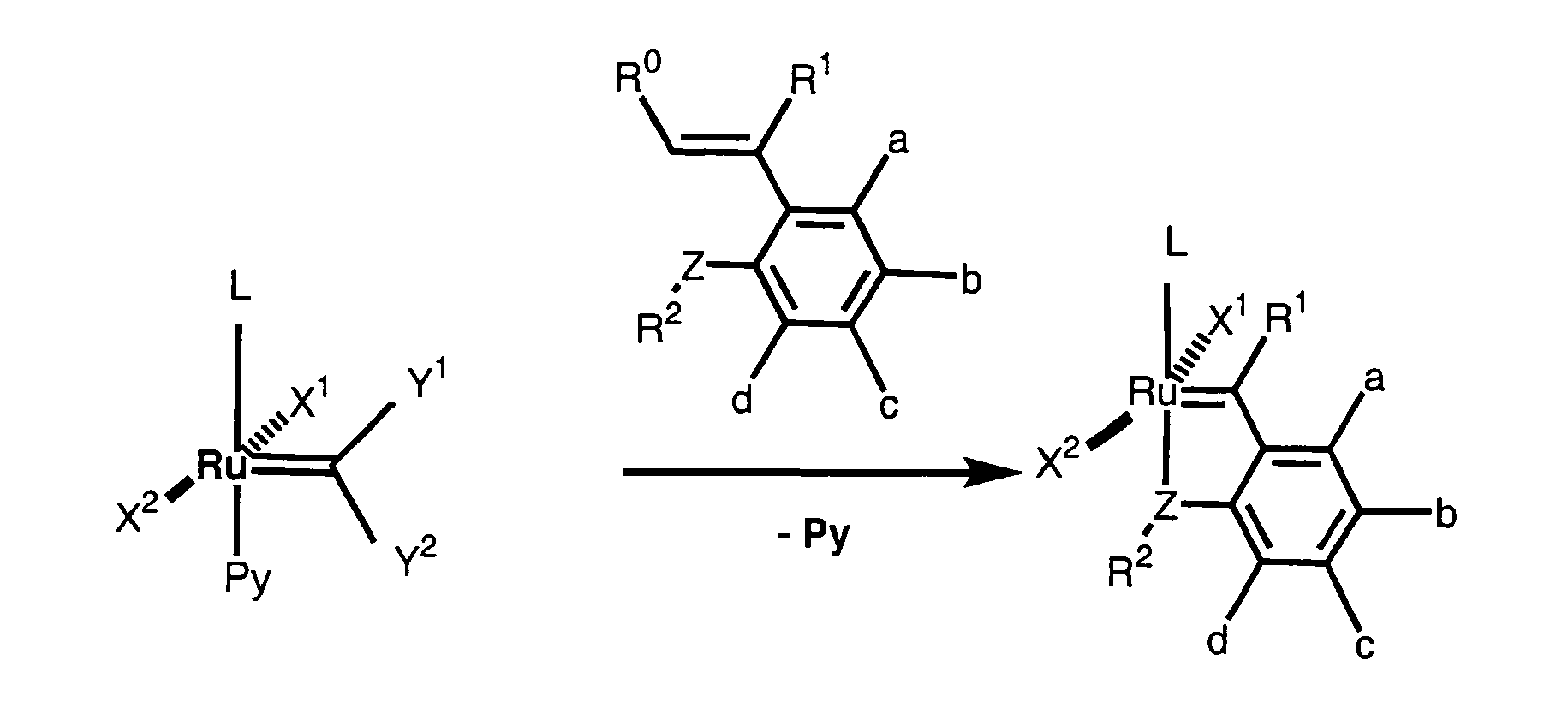
- L is a neutral ligand, preferably a saturated or unsaturated N-heterocyclic carbene ligand ("NHC" ligand),
- X1 and X2 are, independently from each other, inorganic or organic anionic ligands, such as halide anions, pseudohalide anions, hydroxides, acetates, trifluoracetates or carboxylates,
- Y1 and Y2 are, independently form each other, hydrogen, C1-C6-alkyl, C2-C6-alkenyl, C2-C6-alkynyl, C1-C6-alkylthio, aryl, arylthio, C1-C6-alkylsulfonyl or C1-C6 -alkylsulfinyl, or Y1 and Y2 are taken together to form a ring of the indenylidene type according to the formula

- Py is an N-heterocyclic two-electron donor ligand,
- R0 and R1 are, independently from each other, hydrogen, C1-C10-alkyl, C2-C10 -alkenyl, C2-C10 -alkynyl, a phenyl or an aryl group (which optionally can be substituted),
- a, b, c and d are, independently from each other, hydrogen, C1-C10-alkyl, C2-C10-alkenyl, C2-C10-alkynyl, a phenyl or aryl group, or an electron withdrawing group ("EWG"), with the provision that each of a, b, c or d can form a ring with each other,
- Z is a heterodonor atom such as oxygen (O), sulphur (S), nitrogen (N) or a group comprising a heterodonor atom such as sulfinyl (>S=O),
- R2 is a substituted or unsubstituted hydrocarbon group, such as alkyl, alkenyl, alkynyl, aryl, alkylamino, alkylthio, a substituted or unsubstituted keto group such as -C(Ra)2-CO-C(Rb)3, a substituted or unsubstituted ester group such as -C(Ra)2-CO-O(Rc) (wherein in said groups Ra is hydrogen or C1-C10-alkyl, Rb is hydrogen, C1-C10-alkyl, C1-C10-fluoroalkyl, C1-C10-alkylamino, C1-C10-alkyl ammonium or C2-C10-alkenyl and Rc is C1-C10-alkyl, C1-C10-fluoroalkyl, C1-C10-alkylamino, C1-C10-alkyl ammonium or C2-C10-alkenyl) and wherein R2 and/or Z may form a ring with d.
- In a preferred embodiment, the present invention is directed to a method for preparing a ruthenium-based carbene catalyst with a chelating alkylidene ligand comprising the reaction of a ruthenium (II)-alkylidene complex with an olefin derivative according to equation (1), wherein
- L is a saturated H2IMes (= 1,3-dimesityl-imidazolidine-2-ylidene) or unsaturated IMes (= 1,3-dimesityl-imidazole-2-ylidene) ligand,
- X1 and X2 are, independently from each other, anionic ligands such as CI-, Br- or I-,
- Y1 and Y2 are taken together to form a ring of the indenylidene type according to the formula

- Py is a substituted or un-substituted pyridine ligand,
- R0 and R1 are, independent from each other, hydrogen or a C1-C10-alkyl group,
- a, b, c and d are, independent from each other, hydrogen, C1-C10-alkyl, a phenyl, an aryl group or an electron withdrawing group (EWG) such as F, Cl, Br, I, -CF3, -NO2, -N(H)-CO-CH3, -N(alkyl)-CO-CH3, -N(H)-CO-CF3; -N(alkyl)-CO-CF3, -O2S-(alkyl), -O-CO-(alkyl) or -SO2-N(CH3)2,
- Z is a heterodonor atom such as oxygen (O) or nitrogen (N),
- R2 is a substituted or unsubstituted alkyl group such as -CH3 or -CH(CH3)2, a substituted or unsubstituted keto group such as -CH2-CO-CH3, -CH2-CO-C2H5, -CH(CH3)-CO-CH3 or -CH(CH3)-CO-C2H5, a substituted or unsubstituted ester group such as -CH2-CO-O-CH3, -CH2-CO-O-C2H5, -CH(CH3)-CO-O-CH3 or -CH(CH3)-CO-O-C2H5 or an amino-group containing ester group such as -CH(CH3)-CO-O-C2H4-N(CH3)2,
- In a further embodiment of the invention, the substituents of the olefin derivative (specifically R2 or the heterodonor atom Z and substituent d) may form a ring. In this case, the heterodonor atom Z preferably is nitrogen (N) and Z and d form a ring to build up a quinoline ring system, a quinoxaline ring system or an indol ring system.
- Generally, Ru(II)-carbene complexes of the type (Py)(L)X1X2Ru(alkylidene) are used as starting compounds in the method of the present invention. Preferably, penta-coordinated ruthenium (indenylidene) carbene complexes are employed. The Ru-alkylidene carbene precursors preferably are phosphine-free and comprise a "NHC" ligand and a "Py" ligand. Herein, the term "Py" denotes an N-heterocyclic two-electron donor ligand, preferably a substituted or unsubstituted pyridine ligand. Examples for suitable Py ligands are pyridine, 3-bromo-pyridine or 4-methyl pyridine, quinoline or piperidine. Examples for suitable NHC ligands ("N-heterocyclic carbene" ligands) are saturated H2IMes (= 1, 3-dimesityl-imidazolidine-2-ylidene) or unsaturated IMes (= 1, 3-dimesityl-imidazole-2-ylidene).
- X1 and X2 are, independently from each other, inorganic or organic anionic (i.e. negatively charged) ligands, such as halide anions, pseudohalide anions, hydroxides, acetates, trifluoracetates or carboxylates. Examples for suitable anionic ligands X are the halides Cl-, Br- or I-, with Cl- being most preferred.
- R3, which is bonded to the indenylidene moiety, stands for hydrogen, a substituted or unsubstituted aryl or substituted or unsubstituted phenyl group; preferably, R3 is a substituted or unsubstituted phenyl group.
- A particularly preferred starting compound is (Py)(H2-IMes)Cl2Ru(3-phenyl-1H-inden-1-ylidene). This complex can be obtained in excellent yields (>90%) in a ligand exchange reaction starting from (H2-IMes)(PCy3)Cl2Ru(phenyl-indenylidene) with excess pyridine (ref to D. Burtscher, C. Lexer, K. Mereiter, R. Winde, R. Karch and C. Slugovc, J. of Polymer Science: Part A: Polymer Chemistry 2008, Vol. 46, 4630-4635. Other suitable starting complexes can be prepared by the person skilled in the art by applying similar methods. Due to the generally high yields of these Ru starting compounds, the preparation method of the present invention is straightforward and economical. It can be applied for the preparation of a great variety of ruthenium-based carbene catalysts with chelating alkylidene ligands.
- In its preferred versions, the method of the present invention avoids the use of Ru carbene complexes with phosphine ligands L as starting materials. As, in this case, no phosphine ligands L (such as PPh3 or PCy3) are present in the starting complex, less side products (such as free phosphine ligands or phosphine oxides) are produced.
- Furthermore, the addition of Cu(I)Cl, frequently used in the prior art as phosphine scavenger in similar cross metathesis processes, is not necessary. This results in high purity products with a very low Cu-content. Typically, the Cu-content of the Ru catalyst products is less than 10 ppm, preferably less than 5 ppm (as determined by ICP; ICP = inductive coupled plasma). As an additional advantage, due to the absence of phosphine ligands in the present method, inert reaction conditions (i.e. a protective gas atmosphere) are not required per se. In many cases, depending on the ligands employed, the preparation method can be performed under regular air atmosphere or at least under non-stringent inert conditions.
- Surprisingly, the method of the present invention provides excellent overall yields in the range of 80 to 95%. This may be due to the unique structure of the penta-coordinated Ru (II)-alkylidene complex employed as the starting compound. While the bulky ligand L provides sufficient stability during the reaction, the substitution of the Py ligand by the heterodonor atom (or the heterodonor atom comprising) group Z in the chelating alkylidene moiety occurs rapidly and easily, thus the formation of the chelating ring in the cross metathesis (CM) reaction is facilitated. Consequently, the reaction times are significantly shortened.
- The precursors for the chelating alkylidene ligands (hereinafter called "olefin derivative") have the following general formula:

- In this formula, R0 and R1 are, independent from each other, hydrogen, C1-C10-alkyl, C2-C10-alkenyl, C2-C10-alkynyl, a phenyl or an aryl group.
- The substituents a, b, c and d can be, independent from each other, hydrogen, C1-C10-alkyl, C2-C10-alkenyl, C2-C10-alkynyl, a phenyl or aryl group, or an electron withdrawing group (herein abbreviated "EWG"). Hereinafter, under the term EWG, atoms and/or groups are summarized, which have electron-withdrawing properties and which exhibit higher electronegativity values (EN) compared to hydrogen (H). Examples for suitable EWGs are the halogen atoms F, Cl, Br, I or the groups -CF3, -NO2, -N(H)-CO-CH3, N(alkyl)-CO-CH3, -N(H)-CO-CF3; -N(alkyl)-CO-CF3, -O2S-(alkyl), -O-CO-(alkyl) and -SO2-N(CH3)2.
- Furthermore, each of the substituents a, b, c or d may form a ring with each other.
- Z is a heterodonor atom such as oxygen (O), sulphur (S), nitrogen (N) or a group comprising a heterodonor atom, such as sulfinyl (>S=O). Preferably, Z is a heterodonor atom such as oxygen (O) or nitrogen (N).
- R2 is a substituted or unsubstituted hydrocarbon group, such as alkyl, alkenyl, alkynyl, aryl, alkylamino, alkylthio, a substituted or unsubstituted keto group such as -C(Ra)2-CO-C(Rb)3, a substituted or unsubstituted ester group such as -C(Ra)2-CO-O(Rc) (wherein in said groups Ra is hydrogen or C1-C10-alkyl, Rb is hydrogen, C1-C10-alkyl, C1-C10-fluoroalkyl, C1-C10-alkylamino, C1-C10-alkyl ammonium or C2-C10-alkenyl and Rc is C1-C10-alkyl, C1-C10-fluoroalkyl, C1-C10-alkylamino, C1-C10-alkyl ammonium or C2-C10-alkenyl) and wherein R2 and/or Z may form a ring with d.
- In general, the precursor ligands may be prepared according to standard procedures known from the literature or may be obtained commercially from various suppliers. Examples of olefin derivatives suitable for the method of the present invention are (E/Z)-1-Isopropoxy-2-(1-propenyl)-benzene, (E/Z)-1-[2-(1-propen-1-yl)-phenoxy]-2-propanone), 2-isoprop-oxy-4-nitro-styrene, 2-isopropoxy-3-vinyl-biphenyl or 8-vinyl-quinolin. The vinyl-quinoline and vinyl-quinoxaline derivates are obtainable according to the procedures described in the literature (M. Barbasievicz et al., ref to above).
- Generally, the preparation method of the present invention is conducted in aromatic hydrocarbon solvents or chlorinated hydrocarbon solvents such as dichlormethane or 1, 2-dichloroethane. Aromatic hydrocarbon solvents such as benzene, toluene or xylene are preferred. The use of these aromatic hydrocarbon solvents, in particular toluene, provides in most cases the additional advantage that the resulting ruthenium complexes directly precipitate from the reaction mixture thus enabling easy isolation and work-up procedures.
- The starting Ru(II)-compound (Py)(L)X1X2Ru(alkylidene) is dissolved in the appropriate solvent and the ligand precursor (olefin derivative) is added. The molar ratio of ligand precursor vs. Ru-starting complex is in the range of 2 : 1, preferably in the range of 1.1 : 1. A stoichiometric ratio of both reactants is particularly preferred.
- The reaction temperatures are in the range of 0°C to 150°C, preferably in the range of room temperature (20°C) to 100°C. The suitable reaction times depend on the type of olefin derivative employed. Typically, the reaction times are in the range from 1 to 8 hours, preferably in the range from 1 to 5 hours and most preferred in the range of 1 to 4 hours.
- When using aromatic hydrocarbon solvents (such as benzene, toluene or xylene), in many cases the resulting ruthenium catalyst complexes are sparely soluble and precipitate from the reaction mixture upon cooling and/or solvent reduction. The precipitated products are separated from the reaction mixture by conventional separation techniques (filtration, centrifuging etc), washed with non-polar solvents such as n-hexane or n-heptane and/or polar solvents such as diethylether or ethanol. The products may be dried by conventional drying methods.
- Due to the high purity of the resulting products, there is no need for further purification steps (such as chromatography and the like). However, if necessary, additional purification steps such as column chromatography (LC, HPLC etc) may be employed. The preparation method according to the present invention is very versatile and useful for industrial, large scale production of catalysts and can be applied to a great variety of ruthenium-based carbene catalysts with chelating alkylidene ligands.
- The Ru-carbene catalysts ("Hoveyda-type catalysts") prepared according to the present invention exhibit a broad application profile in metathesis reactions. The catalyst products can be used in a variety of metathesis reactions, for example in ring-closing metathesis (RCM), ring-opening metathesis polymerization (ROMP), cross metathesis (CM), acyclic dien-metathesis-polymerisation (ADMET) and their combinations.
- The following examples are intended to describe the invention in more detail, without limiting the scope of protection.
- General remarks: The ligand precursors/olefin derivatives employed in the following examples are known compounds, having CAS Registy Nos. They can be prepared according to methods published in the literature and/or procedures known to the person skilled in the art. Details: for (E/Z)-1-Isopropoxy-2-(1-propenyl) benzene: CAS Reg.No. 533934-20-2; for (E/Z)-1-[2-(1-propen-1-yl)-phenoxy]-2-propanone): CAS Reg.No. 1014701-63-3; for 2-isopropoxy-4-nitrostyrene: CAS Reg.No. 753031-08-2; for 8-vinylquinoline: CAS Reg.No. 96911-08-9.
- Preparation of

- The starting complex was prepared according to D. Burtscher et al., J. of Polymer Science: Part A: Polymer Chemistry 2008, 46, 4630-4635 starting from (H2-IMes)(PCy3)Cl2Ru(phenyl-indenylidene) (metathesis catalyst M2; Umicore AG & Co KG, Hanau) by stirring with excess pyridine (∼30 equivalents) under inert atmosphere for 30 minutes at room temperature. Subsequent addition of the reaction mixture to stirred n-heptane and further stirring for 30 minutes at room temperature followed by cooling the reaction mixture overnight (- 27°C) resulted in the formation of a brown precipitate. The precipitate was filtered off, washed with n-heptane and dried in vacuum. The compound is obtained in 95% yield as an orange-brown, microcrystalline solid.
- b) Preparation of

-

- 2.5 g catalyst Dichloro-(3-phenyl-1H-inden-1-ylidene)-(1,3-dimesityl-4,5-dihydro-imidazol-2-ylidene)-(pyridine)-ruthenium(II), [Umicore M31, Umicore AG & Co KG, Hanau] were dissolved in 30 ml of toluene and 0.7 g of (E/Z)-1-Isopropoxy-2-(1-propenyl)benzene dissolved in 10 ml toluene were added. The reaction mixture was stirred for 4 hours at 65°C and then cooled down to room temperature. The mixture was concentrated under vacuum and a green microcrystalline solid precipitated.
- It was filtered and washed with n-hexane and diethyl ether. The green-yellowish product was dried under vacuum (approx. 12 mbar) overnight and characterized by NMR and elemental analysis. Yield: 1.8 g (87%). The analytical data are in agreement with the published data.
- Preparation of

-

- 3.0 g of Umicore M31 [Dichloro-(3-phenyl-1H-inden-1-ylidene)-(1,3-dimesityl-4,5-dihydro-imidazol-2-ylidene)-(pyridine)-ruthenium(II); Umicore AG & Co KG, Hanau, prepared as described in Example 1a)] were dissolved in 50 ml of toluene and 0.80 g of (E/Z)-1-[2-(1-propen-1-yl)-phenoxy]-2-propanone), dissolved in 10 ml toluene, were added. The reaction mixture was stirred for 3 hours at 65°C and then cooled down to room temperature. A green microcrystalline solid precipitated. It was filtered and washed with n-hexane and diethyl ether. The green-yellowish product was dried under vacuum overnight and characterized by NMR and elemental analysis. Yield: 2.2 g (87%).
- Preparation of

-

- 2.5 g catalyst Umicore M31 [Dichloro-(3-phenyl-1H-inden-1-ylidene)-(1,3-dimesityl-4,5-dihydro-imidazol-2-ylidene)-(pyridine)-ruthenium(II); Umicore AG & Co KG, Hanau, prepared as described in Example 1a)] were dissolved in 30 ml of toluene and 0.8 g of 2-isopropoxy-4-nitrostyrene dissolved in 10 ml toluene were added. The reaction mixture was stirred for 2 hours at 65°C and then cooled down to room temperature. The mixture was concentrated under vacuum and a green microcrystalline solid precipitated. It was filtered and washed with n-hexane and diethyl ether. The green-yellowish product was dried under vacuum overnight and characterized by NMR and elemental analysis. Yield: 1.9 g (85%). The analytical data are in agreement with the published data.
- Preparation of

-

- 1.0 g catalyst Umicore M31 [Dichloro-(3-phenyl-1H-inden-1-yliden)-(1,3-dimesityl-4,5-dihydro-imidazol-2-yliden)-(pyridine)-ruthenium(II)] (Umicore AG & Co KG, Hanau) were dissolved in 20 ml of toluene and 0.24 g of 8-vinylquinoline dissolved in 5 ml toluene were added. The reaction mixture was stirred for 2 hours at 65°C and then cooled down to room temperature. The mixture was concentrated under vacuum and a green microcrystalline solid precipitated. It was filtered and washed with cold n-hexane and diethyl ether. The green-yellowish product was dried under vacuum overnight and characterized by NMR and elemental analysis. Yield: 0.7 g (85%). The analytical data are in agreement with the published data.
- Preparation of

- Reaction equation:

- 1.15 g (1.2 mmol) of (H2-IMes)(PCy3)Cl2Ru(phenylindenylidene) (Umicore M2, Umicore AG & Co KG, Hanau) was dissolved in 30 ml of toluene and 0.25 g (1,44 mmol, 1.2 eq.) of (E/Z)-1-Isopropoxy-2-(1-propenyl)benzene, dissolved in 10 ml toluene, were added. The reaction mixture was stirred for 6 hours at 65°C and then cooled down to room temperature. The mixture was concentrated under vacuum to about 15 ml.
- Then, 60 ml of pentane were added under stirring. The resulting greenish-brown precipitate was separated by filtration and washed with cold pentane and ethyl acetate. The crude product was suspended in 15 ml toluene, filtered and washed with diethyl ether. The green solid was finally dried overnight under vacuum. A yield of 0.25 g (30%) was obtained.
- This yield is significantly lower than the yield obtained by the method according to the invention (ref. to Example 1). Furthermore, due to the presence of a phosphine ligand, additional time-consuming purification steps are necessary and the product purity is reduced.
Claims (10)
- Method for the preparation of a ruthenium-based carbene catalyst with a chelating alkylidene ligand comprising the reaction of a ruthenium (II)-alkylidene complex with an olefin derivative according to the equation:
 - L is a neutral ligand, preferably a saturated or unsaturated N-heterocyclic carbene ligand ("NHC" ligand),- X1 and X2 are, independently from each other, inorganic or organic anionic ligands, such as halide anions, pseudohalide anions,hydroxides, acetates, trifluoracetates or carboxylates,- Y1 and Y2 are, independently form each other, hydrogen, C1-C6-alkyl, C2-C6-alkenyl, C2-C6-alkynyl, C1-C6-alkylthio, aryl, arylthio, C1-C6-alkylsulfonyl or C1-C6 -alkylsulfonyl, or Y1 and Y2 are taken together to form a ring of the indenylidene type according to the formula
 - Py is an N-heterocyclic two-electron donor ligand,- R0 and R1 are, independently from each other, hydrogen, C1-C10-alkyl, C2-C10 -alkenyl, C2-C10 -alkynyl, a phenyl or an aryl group (which optionally can be substituted),- a, b, c and d are, independently from each other, hydrogen, C1-C10-alkyl, C2-C10-alkenyl, C2-C10-alkynyl, a phenyl or aryl group, or an electron withdrawing group ("EWG"), with the provision that each of a, b, c or d can form a ring with each other,- Z is a heterodonor atom such as oxygen (O), sulphur (S), nitrogen (N) or a group comprising a heterodonor atom such as sulfinyl (>S=O),- R2 is a substituted or unsubstituted hydrocarbon group, such as alkyl, alkenyl, alkynyl, aryl, alkylamino, alkylthio, a substituted orunsubstituted keto group such as -C(Ra)2-CO-C(Rb)3, a substituted or unsubstituted ester group such as -C(Ra)2-CO-O(Rc) (wherein in said groups Ra is hydrogen or C1-C10-alkyl, Rb is hydrogen, C1-C10-alkyl, C1-C10-fluoroalkyl, C1-C10-alkylamino, C1-C10-alkyl ammonium or C2-C10-alkenyl and Rc is C1-C10-alkyl, C1-C10-fluoroalkyl, C1-C10-alkylamino, C1-C10-alkyl ammonium or C2-C10-alkenyl) and wherein R2 and/or Z may form a ring with d.
 - The method according to claim 1, wherein- L is a saturated H2IMes (= 1, 3-dimesityl-imidazolidine-2-ylidene) or unsaturated IMes (= 1, 3-dimesityl-imidazole-2-ylidene) ligand,- X1 and X2 are, independently from each other, anionic ligands such as Cl-, Br- or I-,- Y1 and Y2 are taken together to form a ring of the indenylidene type
according to the formula - Py is a substituted or un-substituted pyridine ligand- R0 and R1 are, independently from each other, hydrogen or a C1-C10-alkyl group,- a, b, c and d are, independently from each other, hydrogen, C1-C10-alkyl, a phenyl, an aryl group or an electron withdrawing group (EWG) such as F, Cl, Br, I, -CF3, -NO2, -N(H)-CO-CH3, -N(alkyl)-CO-CH3, -N(H)-CO-CF3; -N(alkyl)-CO-CF3, -O2S-(alkyl), -O-CO-(alkyl) or -SO2-N(CH3)2,- Z is a heterodonor atom such as oxygen (O) or nitrogen (N),- R2 is a substituted or unsubstituted alkyl group such as -CH3 or -CH(CH3)2, a substituted or unsubstituted keto group such as -CH2-CO-CH3, -CH2-CO-C2H5, -CH(CH3)-CO-CH3 or -CH(CH3)-CO-C2H5, a substituted or unsubstituted ester group such as -CH2-CO-O-CH3, -CH2-CO-O-C2H5, -CH(CH3)-CO-O-CH3 or -CH(CH3)-CO-O-C2H5 or an amino-group containing ester group such as -CH(CH3)-CO-O-C2H4-N(CH3)2, and
wherein R2 and/or the heterodonor atom Z may form a ring with d. - The method according to claim 1 or 2, wherein the reaction is a cross metathesis reaction (CM).
- The method according to any one of claims 1 to 3, wherein the reaction is conducted in aromatic hydrocarbon solvents.
- The method according to any one of claims 1 to 4, wherein the reaction temperature is in the range of 20 to 100°C.
- The method according to any one of claims 1 to 5, wherein the molar ratio of olefinic derivative vs. ruthenium (II)- alkylidene complex is in the range of 2 : 1, preferably in the range of 1.1 : 1.
- The method according to any one of claims 1 to 6, wherein the reaction time is in the range of 1 to 8 hours, preferably in the range of 1 to 4 hours.
- The method according to any one of claims 1 to 7, wherein the olefin derivative is selected from (E/Z)-1-Isopropoxy-2-(1-propenyl)-benzene, (E/Z)-1-[2-(1-propen-1-yl)-phenoxy]-2-propanone), 2-isopropoxy-4-nitro-styrene, 8-vinylquinolin or 2-isopropoxy-3-vinyl-biphenyl.
- The method according to any one of claims 1 to 8, further comprising the separation of the ruthenium-based carbene catalyst with a chelating alkylidene ligand from the reaction mixture by precipitation and filtration.
- Ruthenium-based carbene catalyst with a chelating alkylidene ligand, obtained by the method according to any one of claims 1 to 9, wherein the Cu content is <10 ppm (as determined by ICP).
Priority Applications (8)
| Application Number | Priority Date | Filing Date | Title |
|---|---|---|---|
| EP09006204.3A EP2255877B1 (en) | 2009-05-07 | 2009-05-07 | Method for preparation of ruthenium-based metathesis catalysts with chelating alkylidene ligands |
| JP2012508942A JP5595486B2 (en) | 2009-05-07 | 2010-05-04 | Process for the preparation of ruthenium-based metathesis catalysts with chelating alkylidene ligands |
| BRPI1013845A BRPI1013845A2 (en) | 2009-05-07 | 2010-05-04 | method for preparing ruthenium-based metathesis catalysts with chelating alkylidene binders |
| PCT/EP2010/002720 WO2010127829A1 (en) | 2009-05-07 | 2010-05-04 | Method for preparation of ruthenium-based metathesis catalysts with chelating alkylidene ligands |
| CN201080016392.0A CN102481557B (en) | 2009-05-07 | 2010-05-04 | Method for preparation of ruthenium-based metathesis catalysts with chelating alkylidene ligands |
| CA2760652A CA2760652A1 (en) | 2009-05-07 | 2010-05-04 | Method for preparation of ruthenium-based metathesis catalysts with chelating alkylidene ligands |
| US13/318,989 US8846938B2 (en) | 2009-05-07 | 2010-05-04 | Method for preparation of ruthenium-based metathesis catalysts with chelating alkylidene ligands |
| US14/472,088 US9562116B2 (en) | 2009-05-07 | 2014-08-28 | Method for preparation of ruthenium-based metathesis catalysts with chelating alkylidene ligands |
Applications Claiming Priority (1)
| Application Number | Priority Date | Filing Date | Title |
|---|---|---|---|
| EP09006204.3A EP2255877B1 (en) | 2009-05-07 | 2009-05-07 | Method for preparation of ruthenium-based metathesis catalysts with chelating alkylidene ligands |
Publications (2)
| Publication Number | Publication Date |
|---|---|
| EP2255877A1 true EP2255877A1 (en) | 2010-12-01 |
| EP2255877B1 EP2255877B1 (en) | 2014-09-24 |
Family
ID=41137429
Family Applications (1)
| Application Number | Title | Priority Date | Filing Date |
|---|---|---|---|
| EP09006204.3A Not-in-force EP2255877B1 (en) | 2009-05-07 | 2009-05-07 | Method for preparation of ruthenium-based metathesis catalysts with chelating alkylidene ligands |
Country Status (7)
| Country | Link |
|---|---|
| US (2) | US8846938B2 (en) |
| EP (1) | EP2255877B1 (en) |
| JP (1) | JP5595486B2 (en) |
| CN (1) | CN102481557B (en) |
| BR (1) | BRPI1013845A2 (en) |
| CA (1) | CA2760652A1 (en) |
| WO (1) | WO2010127829A1 (en) |
Cited By (4)
| Publication number | Priority date | Publication date | Assignee | Title |
|---|---|---|---|---|
| WO2012097379A3 (en) * | 2011-01-14 | 2012-10-11 | California Institute Of Technology | Z-selective olefin metathesis catalysts and their synthetic procedure |
| AT511852A1 (en) * | 2011-09-02 | 2013-03-15 | Univ Graz Tech | olefin metathesis |
| US9586981B2 (en) | 2012-12-12 | 2017-03-07 | California Institute Of Technology | Z-selective metathesis catalysts |
| US9610572B2 (en) | 2012-11-15 | 2017-04-04 | Apeiron Synthesis Spolka Akcyjna | Ruthenium complexes, method of their production and their usage |
Families Citing this family (10)
| Publication number | Priority date | Publication date | Assignee | Title |
|---|---|---|---|---|
| WO2010127964A1 (en) * | 2009-05-07 | 2010-11-11 | F. Hoffmann-La Roche Ag | Process for the preparation of ruthenium metathesis complex catalysts |
| EP2255877B1 (en) * | 2009-05-07 | 2014-09-24 | Umicore AG & Co. KG | Method for preparation of ruthenium-based metathesis catalysts with chelating alkylidene ligands |
| JP5569147B2 (en) * | 2010-05-27 | 2014-08-13 | Jsr株式会社 | Method for producing cyclic olefin ring-opening polymer |
| CN102658206B (en) * | 2012-05-02 | 2014-01-29 | 天津大学 | Ruthenium carbyne complex catalyst and its preparation method and application |
| EP2867243B1 (en) | 2012-06-29 | 2016-04-13 | Apeiron Synthesis S.A. | Metal complexes, their application and methods of carrying out of metathesis reaction |
| PL400162A1 (en) | 2012-07-27 | 2014-02-03 | Apeiron Synthesis Spólka Z Ograniczona Odpowiedzialnoscia | New ruthenium complexes, their use in metathesis reactions and the method of conducting metathesis reactions |
| RU2577252C1 (en) * | 2015-02-26 | 2016-03-10 | Открытое акционерное общество "Нефтяная компания "Роснефть" | Method of producing catalyst for metathesis polymerisation of dicyclopentadiene |
| CN114106057B (en) * | 2016-10-19 | 2023-06-23 | 优美科股份公司及两合公司 | Synthesis and Characterization of Ru Alkylene Complexes |
| KR102670566B1 (en) * | 2019-01-18 | 2024-05-31 | 광주과학기술원 | Ruthenium complex compound, ligand for preparing same and use thereof |
| WO2021177000A1 (en) * | 2020-03-02 | 2021-09-10 | 国立大学法人東京大学 | Method for producing fluorine-containing olefin |
Citations (7)
| Publication number | Priority date | Publication date | Assignee | Title |
|---|---|---|---|---|
| WO2002014376A2 (en) | 2000-08-10 | 2002-02-21 | Trustees Of Boston College | Recyclable metathesis catalysts |
| WO2004035596A1 (en) | 2002-10-15 | 2004-04-29 | Boehringer Ingelheim International Gmbh | Ruthenium complexes as (pre)catalysts for metathesis reactions |
| WO2005016944A1 (en) | 2003-08-02 | 2005-02-24 | Boehringer Ingelheim International Gmbh | Novel metathesis catalysts |
| US7205424B2 (en) | 2003-06-19 | 2007-04-17 | University Of New Orleans Research And Technology Foundation, Inc. | Preparation of ruthenium-based olefin metathesis catalysts |
| WO2007140954A1 (en) | 2006-06-07 | 2007-12-13 | Umicore Ag & Co. Kg | Complex of ruthenium and osmium, method of production thereof and use thereof as (pre)catalysts of the metathesis reaction |
| WO2008034552A1 (en) | 2006-09-18 | 2008-03-27 | Umicore Ag & Co. Kg | Novel metathesis catalysts |
| WO2008065187A1 (en) | 2006-11-30 | 2008-06-05 | Ecole Nationale Superieure De Chimie De Rennes | Ruthenium-based catalytic complexes and the use of such complexes for olefin metathesis |
Family Cites Families (2)
| Publication number | Priority date | Publication date | Assignee | Title |
|---|---|---|---|---|
| AU2005228434A1 (en) | 2004-03-29 | 2005-10-13 | California Institute Of Technology | Latent, high-activity olefin metathesis catalysts containing an N-heterocyclic carbene ligand |
| EP2255877B1 (en) * | 2009-05-07 | 2014-09-24 | Umicore AG & Co. KG | Method for preparation of ruthenium-based metathesis catalysts with chelating alkylidene ligands |
-
2009
- 2009-05-07 EP EP09006204.3A patent/EP2255877B1/en not_active Not-in-force
-
2010
- 2010-05-04 CN CN201080016392.0A patent/CN102481557B/en not_active Expired - Fee Related
- 2010-05-04 JP JP2012508942A patent/JP5595486B2/en not_active Expired - Fee Related
- 2010-05-04 BR BRPI1013845A patent/BRPI1013845A2/en not_active IP Right Cessation
- 2010-05-04 CA CA2760652A patent/CA2760652A1/en not_active Abandoned
- 2010-05-04 US US13/318,989 patent/US8846938B2/en not_active Expired - Fee Related
- 2010-05-04 WO PCT/EP2010/002720 patent/WO2010127829A1/en not_active Ceased
-
2014
- 2014-08-28 US US14/472,088 patent/US9562116B2/en active Active
Patent Citations (7)
| Publication number | Priority date | Publication date | Assignee | Title |
|---|---|---|---|---|
| WO2002014376A2 (en) | 2000-08-10 | 2002-02-21 | Trustees Of Boston College | Recyclable metathesis catalysts |
| WO2004035596A1 (en) | 2002-10-15 | 2004-04-29 | Boehringer Ingelheim International Gmbh | Ruthenium complexes as (pre)catalysts for metathesis reactions |
| US7205424B2 (en) | 2003-06-19 | 2007-04-17 | University Of New Orleans Research And Technology Foundation, Inc. | Preparation of ruthenium-based olefin metathesis catalysts |
| WO2005016944A1 (en) | 2003-08-02 | 2005-02-24 | Boehringer Ingelheim International Gmbh | Novel metathesis catalysts |
| WO2007140954A1 (en) | 2006-06-07 | 2007-12-13 | Umicore Ag & Co. Kg | Complex of ruthenium and osmium, method of production thereof and use thereof as (pre)catalysts of the metathesis reaction |
| WO2008034552A1 (en) | 2006-09-18 | 2008-03-27 | Umicore Ag & Co. Kg | Novel metathesis catalysts |
| WO2008065187A1 (en) | 2006-11-30 | 2008-06-05 | Ecole Nationale Superieure De Chimie De Rennes | Ruthenium-based catalytic complexes and the use of such complexes for olefin metathesis |
Non-Patent Citations (8)
| Title |
|---|
| A. HEJL; M.W. DAY; R.H. GRUBBS, ORGANOMETALLICS, vol. 25, 2006, pages 6149 - 6154 |
| D. BURTSCHER ET AL., J. OF POLYMER SCIENCE: PART A: POLYMER CHEMISTRY, vol. 46, 2008, pages 4630 - 4635 |
| ORGANOMETALLICS, vol. 25, no. 15, 2006, pages 3599 - 3604 |
| S. BLECHERT ET AL., SYNLETT, no. 3, 2001, pages 430 - 432 |
| S.B. GARBER ET AL., J. AMER. CHEM. SOC., vol. 122, 2000, pages 8168 - 8179 |
| SLUGOVC C ET AL: "Second generation ruthenium carbene complexes with a cis-dichloro arrangement", ORGANOMETALLICS, vol. 23, no. 15, 19 July 2004 (2004-07-19), pages 3622 - 3626, XP001199984, ISSN: 0276-7333, DOI: 10.1021/om049877n * |
| SLUGOVC C ET AL: "Thermally switchable olefin metathesis initiators bearing chelating carbenes: influence of the chelate's ring size", ORGANOMETALLICS, vol. 24, no. 10, 9 May 2005 (2005-05-09), pages 2255 - 2258, XP002455276, ISSN: 0276-7333, DOI: 10.1021/om050141f * |
| T. UNG ET AL., ORGANOMETALLICS, vol. 23, 2004, pages 5399 - 5401 |
Cited By (5)
| Publication number | Priority date | Publication date | Assignee | Title |
|---|---|---|---|---|
| WO2012097379A3 (en) * | 2011-01-14 | 2012-10-11 | California Institute Of Technology | Z-selective olefin metathesis catalysts and their synthetic procedure |
| US9597674B2 (en) | 2011-01-14 | 2017-03-21 | California Institute Of Technology | Z-selective olefin metathesis catalysts and their synthetic procedure |
| AT511852A1 (en) * | 2011-09-02 | 2013-03-15 | Univ Graz Tech | olefin metathesis |
| US9610572B2 (en) | 2012-11-15 | 2017-04-04 | Apeiron Synthesis Spolka Akcyjna | Ruthenium complexes, method of their production and their usage |
| US9586981B2 (en) | 2012-12-12 | 2017-03-07 | California Institute Of Technology | Z-selective metathesis catalysts |
Also Published As
| Publication number | Publication date |
|---|---|
| US20140371462A1 (en) | 2014-12-18 |
| EP2255877B1 (en) | 2014-09-24 |
| US9562116B2 (en) | 2017-02-07 |
| CN102481557A (en) | 2012-05-30 |
| JP2012525960A (en) | 2012-10-25 |
| CN102481557B (en) | 2015-04-01 |
| BRPI1013845A2 (en) | 2016-04-12 |
| US8846938B2 (en) | 2014-09-30 |
| US20120101279A1 (en) | 2012-04-26 |
| JP5595486B2 (en) | 2014-09-24 |
| CA2760652A1 (en) | 2010-11-11 |
| WO2010127829A1 (en) | 2010-11-11 |
Similar Documents
| Publication | Publication Date | Title |
|---|---|---|
| EP2255877B1 (en) | Method for preparation of ruthenium-based metathesis catalysts with chelating alkylidene ligands | |
| EP2350105B1 (en) | Method for preparation of ruthenium-indenylidene carbene catalysts | |
| KR100388364B1 (en) | High Metathesis Activity Ruthenium and Osmium Metal Carbene Complexes | |
| EP2280017B1 (en) | Catalytic complex for olefin metathesis reactions, process for the preparation thereof and use thereof | |
| CN102834175B (en) | Preparation method of ruthenium-based carbene catalyst with chelated alkylene ligand | |
| JP6395714B2 (en) | Ruthenium-based metathesis catalysts, precursors for their production and their use | |
| EP3164409B1 (en) | Group 8 transition metal catalysts and method for making same and process for use of same in metathesis reaction | |
| EP2029278B1 (en) | Complex of ruthenium, method of production thereof and use thereof as (pre)catalyst of the metathesis reaction | |
| US9108996B2 (en) | Ruthenium-based metathesis catalysts and precursors for their preparation | |
| WO2000058322A1 (en) | Novel ruthenium metal alkylidene complexes coordinated with triazolylidene ligands that exhibit high olefin metathesis activity | |
| JP2005508883A (en) | Hexacoordinate ruthenium or osmium metal carbene metathesis catalyst | |
| KR20180059822A (en) | METHODS FOR PRODUCING RUTHENIUM COMPLEXES AND INTERMEDIATES AND USE THEREOF IN OLEFIN METHODOLOGY | |
| CN104428306A (en) | Novel ruthenium complexes, their use in the metathesis reactions, and a process for carrying out the metathesis reaction | |
| Dorta et al. | Cross metathesis allowing the conversion of a ruthenium indenylidene complex into Grubbs' catalyst | |
| JP2010229411A (en) | Hexacoordinate ruthenium or osmium metal carbene metathesis catalyst | |
| JP2002284789A (en) | Novel organometallic complex compound having high metathesis activity, metathesis reaction catalyst containing the same, polymerization method using this catalyst, and polymer obtained by this polymerization method | |
| JP6759760B2 (en) | Method for producing fluorine-containing olefin | |
| JP5577069B2 (en) | Hexacoordinate ruthenium or osmium metal carbene metathesis catalyst | |
| WO2016129606A1 (en) | Method for manufacturing fluorine-containing polymer |
Legal Events
| Date | Code | Title | Description |
|---|---|---|---|
| PUAI | Public reference made under article 153(3) epc to a published international application that has entered the european phase |
Free format text: ORIGINAL CODE: 0009012 |
|
| AK | Designated contracting states |
Kind code of ref document: A1 Designated state(s): AT BE BG CH CY CZ DE DK EE ES FI FR GB GR HR HU IE IS IT LI LT LU LV MC MK MT NL NO PL PT RO SE SI SK TR |
|
| AX | Request for extension of the european patent |
Extension state: AL BA RS |
|
| 17P | Request for examination filed |
Effective date: 20110601 |
|
| 17Q | First examination report despatched |
Effective date: 20110712 |
|
| GRAP | Despatch of communication of intention to grant a patent |
Free format text: ORIGINAL CODE: EPIDOSNIGR1 |
|
| INTG | Intention to grant announced |
Effective date: 20140423 |
|
| GRAS | Grant fee paid |
Free format text: ORIGINAL CODE: EPIDOSNIGR3 |
|
| GRAA | (expected) grant |
Free format text: ORIGINAL CODE: 0009210 |
|
| AK | Designated contracting states |
Kind code of ref document: B1 Designated state(s): AT BE BG CH CY CZ DE DK EE ES FI FR GB GR HR HU IE IS IT LI LT LU LV MC MK MT NL NO PL PT RO SE SI SK TR |
|
| REG | Reference to a national code |
Ref country code: GB Ref legal event code: FG4D |
|
| RIN1 | Information on inventor provided before grant (corrected) |
Inventor name: KARCH, RALF DR. Inventor name: LEXER, CHRISTINA Inventor name: WINDE, ROLAND DR. Inventor name: RIVAS-NASS, ANDREAS DR. Inventor name: WOERNER, EILEEN Inventor name: SLUGOVC, CHRISTIAN DR. Inventor name: DOPPIU, ANGELINO, DR. |
|
| REG | Reference to a national code |
Ref country code: CH Ref legal event code: EP |
|
| REG | Reference to a national code |
Ref country code: AT Ref legal event code: REF Ref document number: 688353 Country of ref document: AT Kind code of ref document: T Effective date: 20141015 |
|
| REG | Reference to a national code |
Ref country code: IE Ref legal event code: FG4D |
|
| REG | Reference to a national code |
Ref country code: DE Ref legal event code: R096 Ref document number: 602009026791 Country of ref document: DE Effective date: 20141106 |
|
| PG25 | Lapsed in a contracting state [announced via postgrant information from national office to epo] |
Ref country code: GR Free format text: LAPSE BECAUSE OF FAILURE TO SUBMIT A TRANSLATION OF THE DESCRIPTION OR TO PAY THE FEE WITHIN THE PRESCRIBED TIME-LIMIT Effective date: 20141225 Ref country code: SE Free format text: LAPSE BECAUSE OF FAILURE TO SUBMIT A TRANSLATION OF THE DESCRIPTION OR TO PAY THE FEE WITHIN THE PRESCRIBED TIME-LIMIT Effective date: 20140924 Ref country code: LT Free format text: LAPSE BECAUSE OF FAILURE TO SUBMIT A TRANSLATION OF THE DESCRIPTION OR TO PAY THE FEE WITHIN THE PRESCRIBED TIME-LIMIT Effective date: 20140924 Ref country code: FI Free format text: LAPSE BECAUSE OF FAILURE TO SUBMIT A TRANSLATION OF THE DESCRIPTION OR TO PAY THE FEE WITHIN THE PRESCRIBED TIME-LIMIT Effective date: 20140924 Ref country code: NO Free format text: LAPSE BECAUSE OF FAILURE TO SUBMIT A TRANSLATION OF THE DESCRIPTION OR TO PAY THE FEE WITHIN THE PRESCRIBED TIME-LIMIT Effective date: 20141224 |
|
| REG | Reference to a national code |
Ref country code: LT Ref legal event code: MG4D Ref country code: NL Ref legal event code: VDEP Effective date: 20140924 |
|
| PG25 | Lapsed in a contracting state [announced via postgrant information from national office to epo] |
Ref country code: LV Free format text: LAPSE BECAUSE OF FAILURE TO SUBMIT A TRANSLATION OF THE DESCRIPTION OR TO PAY THE FEE WITHIN THE PRESCRIBED TIME-LIMIT Effective date: 20140924 Ref country code: CY Free format text: LAPSE BECAUSE OF FAILURE TO SUBMIT A TRANSLATION OF THE DESCRIPTION OR TO PAY THE FEE WITHIN THE PRESCRIBED TIME-LIMIT Effective date: 20140924 Ref country code: HR Free format text: LAPSE BECAUSE OF FAILURE TO SUBMIT A TRANSLATION OF THE DESCRIPTION OR TO PAY THE FEE WITHIN THE PRESCRIBED TIME-LIMIT Effective date: 20140924 |
|
| REG | Reference to a national code |
Ref country code: AT Ref legal event code: MK05 Ref document number: 688353 Country of ref document: AT Kind code of ref document: T Effective date: 20140924 |
|
| PG25 | Lapsed in a contracting state [announced via postgrant information from national office to epo] |
Ref country code: NL Free format text: LAPSE BECAUSE OF FAILURE TO SUBMIT A TRANSLATION OF THE DESCRIPTION OR TO PAY THE FEE WITHIN THE PRESCRIBED TIME-LIMIT Effective date: 20140924 |
|
| PG25 | Lapsed in a contracting state [announced via postgrant information from national office to epo] |
Ref country code: IS Free format text: LAPSE BECAUSE OF FAILURE TO SUBMIT A TRANSLATION OF THE DESCRIPTION OR TO PAY THE FEE WITHIN THE PRESCRIBED TIME-LIMIT Effective date: 20150124 Ref country code: PT Free format text: LAPSE BECAUSE OF FAILURE TO SUBMIT A TRANSLATION OF THE DESCRIPTION OR TO PAY THE FEE WITHIN THE PRESCRIBED TIME-LIMIT Effective date: 20150126 Ref country code: SK Free format text: LAPSE BECAUSE OF FAILURE TO SUBMIT A TRANSLATION OF THE DESCRIPTION OR TO PAY THE FEE WITHIN THE PRESCRIBED TIME-LIMIT Effective date: 20140924 Ref country code: RO Free format text: LAPSE BECAUSE OF FAILURE TO SUBMIT A TRANSLATION OF THE DESCRIPTION OR TO PAY THE FEE WITHIN THE PRESCRIBED TIME-LIMIT Effective date: 20140924 Ref country code: EE Free format text: LAPSE BECAUSE OF FAILURE TO SUBMIT A TRANSLATION OF THE DESCRIPTION OR TO PAY THE FEE WITHIN THE PRESCRIBED TIME-LIMIT Effective date: 20140924 Ref country code: ES Free format text: LAPSE BECAUSE OF FAILURE TO SUBMIT A TRANSLATION OF THE DESCRIPTION OR TO PAY THE FEE WITHIN THE PRESCRIBED TIME-LIMIT Effective date: 20140924 Ref country code: CZ Free format text: LAPSE BECAUSE OF FAILURE TO SUBMIT A TRANSLATION OF THE DESCRIPTION OR TO PAY THE FEE WITHIN THE PRESCRIBED TIME-LIMIT Effective date: 20140924 |
|
| PG25 | Lapsed in a contracting state [announced via postgrant information from national office to epo] |
Ref country code: PL Free format text: LAPSE BECAUSE OF FAILURE TO SUBMIT A TRANSLATION OF THE DESCRIPTION OR TO PAY THE FEE WITHIN THE PRESCRIBED TIME-LIMIT Effective date: 20140924 Ref country code: AT Free format text: LAPSE BECAUSE OF FAILURE TO SUBMIT A TRANSLATION OF THE DESCRIPTION OR TO PAY THE FEE WITHIN THE PRESCRIBED TIME-LIMIT Effective date: 20140924 |
|
| REG | Reference to a national code |
Ref country code: DE Ref legal event code: R097 Ref document number: 602009026791 Country of ref document: DE |
|
| PG25 | Lapsed in a contracting state [announced via postgrant information from national office to epo] |
Ref country code: DK Free format text: LAPSE BECAUSE OF FAILURE TO SUBMIT A TRANSLATION OF THE DESCRIPTION OR TO PAY THE FEE WITHIN THE PRESCRIBED TIME-LIMIT Effective date: 20140924 |
|
| PLBE | No opposition filed within time limit |
Free format text: ORIGINAL CODE: 0009261 |
|
| STAA | Information on the status of an ep patent application or granted ep patent |
Free format text: STATUS: NO OPPOSITION FILED WITHIN TIME LIMIT |
|
| 26N | No opposition filed |
Effective date: 20150625 |
|
| REG | Reference to a national code |
Ref country code: CH Ref legal event code: PL |
|
| PG25 | Lapsed in a contracting state [announced via postgrant information from national office to epo] |
Ref country code: IT Free format text: LAPSE BECAUSE OF NON-PAYMENT OF DUE FEES Effective date: 20150507 Ref country code: LI Free format text: LAPSE BECAUSE OF NON-PAYMENT OF DUE FEES Effective date: 20150531 Ref country code: MC Free format text: LAPSE BECAUSE OF FAILURE TO SUBMIT A TRANSLATION OF THE DESCRIPTION OR TO PAY THE FEE WITHIN THE PRESCRIBED TIME-LIMIT Effective date: 20140924 Ref country code: LU Free format text: LAPSE BECAUSE OF FAILURE TO SUBMIT A TRANSLATION OF THE DESCRIPTION OR TO PAY THE FEE WITHIN THE PRESCRIBED TIME-LIMIT Effective date: 20150507 Ref country code: CH Free format text: LAPSE BECAUSE OF NON-PAYMENT OF DUE FEES Effective date: 20150531 |
|
| REG | Reference to a national code |
Ref country code: IE Ref legal event code: MM4A |
|
| REG | Reference to a national code |
Ref country code: FR Ref legal event code: ST Effective date: 20160129 |
|
| PG25 | Lapsed in a contracting state [announced via postgrant information from national office to epo] |
Ref country code: SI Free format text: LAPSE BECAUSE OF FAILURE TO SUBMIT A TRANSLATION OF THE DESCRIPTION OR TO PAY THE FEE WITHIN THE PRESCRIBED TIME-LIMIT Effective date: 20140924 |
|
| PG25 | Lapsed in a contracting state [announced via postgrant information from national office to epo] |
Ref country code: IE Free format text: LAPSE BECAUSE OF NON-PAYMENT OF DUE FEES Effective date: 20150507 |
|
| PG25 | Lapsed in a contracting state [announced via postgrant information from national office to epo] |
Ref country code: FR Free format text: LAPSE BECAUSE OF NON-PAYMENT OF DUE FEES Effective date: 20150601 |
|
| PG25 | Lapsed in a contracting state [announced via postgrant information from national office to epo] |
Ref country code: MT Free format text: LAPSE BECAUSE OF FAILURE TO SUBMIT A TRANSLATION OF THE DESCRIPTION OR TO PAY THE FEE WITHIN THE PRESCRIBED TIME-LIMIT Effective date: 20140924 |
|
| PG25 | Lapsed in a contracting state [announced via postgrant information from national office to epo] |
Ref country code: BG Free format text: LAPSE BECAUSE OF FAILURE TO SUBMIT A TRANSLATION OF THE DESCRIPTION OR TO PAY THE FEE WITHIN THE PRESCRIBED TIME-LIMIT Effective date: 20140924 Ref country code: HU Free format text: LAPSE BECAUSE OF FAILURE TO SUBMIT A TRANSLATION OF THE DESCRIPTION OR TO PAY THE FEE WITHIN THE PRESCRIBED TIME-LIMIT; INVALID AB INITIO Effective date: 20090507 |
|
| PG25 | Lapsed in a contracting state [announced via postgrant information from national office to epo] |
Ref country code: TR Free format text: LAPSE BECAUSE OF FAILURE TO SUBMIT A TRANSLATION OF THE DESCRIPTION OR TO PAY THE FEE WITHIN THE PRESCRIBED TIME-LIMIT Effective date: 20140924 |
|
| PG25 | Lapsed in a contracting state [announced via postgrant information from national office to epo] |
Ref country code: BE Free format text: LAPSE BECAUSE OF FAILURE TO SUBMIT A TRANSLATION OF THE DESCRIPTION OR TO PAY THE FEE WITHIN THE PRESCRIBED TIME-LIMIT Effective date: 20140924 |
|
| PG25 | Lapsed in a contracting state [announced via postgrant information from national office to epo] |
Ref country code: MK Free format text: LAPSE BECAUSE OF FAILURE TO SUBMIT A TRANSLATION OF THE DESCRIPTION OR TO PAY THE FEE WITHIN THE PRESCRIBED TIME-LIMIT Effective date: 20140924 |
|
| PGFP | Annual fee paid to national office [announced via postgrant information from national office to epo] |
Ref country code: DE Payment date: 20190423 Year of fee payment: 11 |
|
| PGFP | Annual fee paid to national office [announced via postgrant information from national office to epo] |
Ref country code: GB Payment date: 20190501 Year of fee payment: 11 |
|
| REG | Reference to a national code |
Ref country code: DE Ref legal event code: R119 Ref document number: 602009026791 Country of ref document: DE |
|
| GBPC | Gb: european patent ceased through non-payment of renewal fee |
Effective date: 20200507 |
|
| PG25 | Lapsed in a contracting state [announced via postgrant information from national office to epo] |
Ref country code: GB Free format text: LAPSE BECAUSE OF NON-PAYMENT OF DUE FEES Effective date: 20200507 |
|
| PG25 | Lapsed in a contracting state [announced via postgrant information from national office to epo] |
Ref country code: DE Free format text: LAPSE BECAUSE OF NON-PAYMENT OF DUE FEES Effective date: 20201201 |