EP2254850B1 - Process for the iodination of aromatic compounds - Google Patents
Process for the iodination of aromatic compounds Download PDFInfo
- Publication number
- EP2254850B1 EP2254850B1 EP09713167.6A EP09713167A EP2254850B1 EP 2254850 B1 EP2254850 B1 EP 2254850B1 EP 09713167 A EP09713167 A EP 09713167A EP 2254850 B1 EP2254850 B1 EP 2254850B1
- Authority
- EP
- European Patent Office
- Prior art keywords
- formula
- process according
- compound
- solution
- group
- Prior art date
- Legal status (The legal status is an assumption and is not a legal conclusion. Google has not performed a legal analysis and makes no representation as to the accuracy of the status listed.)
- Active
Links
- 0 *C(C(N(*)c(c(I)c(*)c(I)c1*)c1I)=O)O Chemical compound *C(C(N(*)c(c(I)c(*)c(I)c1*)c1I)=O)O 0.000 description 3
- ODOYDUBGQZFRDH-UHFFFAOYSA-N OCC(CO)NC(c(c(I)c(c(I)c1C(NC(CO)CO)=O)O)c1I)=O Chemical compound OCC(CO)NC(c(c(I)c(c(I)c1C(NC(CO)CO)=O)O)c1I)=O ODOYDUBGQZFRDH-UHFFFAOYSA-N 0.000 description 1
- XUQVERHZNWQYIL-UHFFFAOYSA-N OCC(CO)NC(c1cc(O)cc(C(NC(CO)CO)=O)c1)=O Chemical compound OCC(CO)NC(c1cc(O)cc(C(NC(CO)CO)=O)c1)=O XUQVERHZNWQYIL-UHFFFAOYSA-N 0.000 description 1
Classifications
-
- C—CHEMISTRY; METALLURGY
- C07—ORGANIC CHEMISTRY
- C07C—ACYCLIC OR CARBOCYCLIC COMPOUNDS
- C07C231/00—Preparation of carboxylic acid amides
- C07C231/12—Preparation of carboxylic acid amides by reactions not involving the formation of carboxamide groups
-
- C—CHEMISTRY; METALLURGY
- C07—ORGANIC CHEMISTRY
- C07C—ACYCLIC OR CARBOCYCLIC COMPOUNDS
- C07C51/00—Preparation of carboxylic acids or their salts, halides or anhydrides
- C07C51/347—Preparation of carboxylic acids or their salts, halides or anhydrides by reactions not involving formation of carboxyl groups
- C07C51/363—Preparation of carboxylic acids or their salts, halides or anhydrides by reactions not involving formation of carboxyl groups by introduction of halogen; by substitution of halogen atoms by other halogen atoms
-
- C—CHEMISTRY; METALLURGY
- C07—ORGANIC CHEMISTRY
- C07B—GENERAL METHODS OF ORGANIC CHEMISTRY; APPARATUS THEREFOR
- C07B39/00—Halogenation
-
- C—CHEMISTRY; METALLURGY
- C07—ORGANIC CHEMISTRY
- C07C—ACYCLIC OR CARBOCYCLIC COMPOUNDS
- C07C237/00—Carboxylic acid amides, the carbon skeleton of the acid part being further substituted by amino groups
- C07C237/28—Carboxylic acid amides, the carbon skeleton of the acid part being further substituted by amino groups having the carbon atom of at least one of the carboxamide groups bound to a carbon atom of a non-condensed six-membered aromatic ring of the carbon skeleton
- C07C237/46—Carboxylic acid amides, the carbon skeleton of the acid part being further substituted by amino groups having the carbon atom of at least one of the carboxamide groups bound to a carbon atom of a non-condensed six-membered aromatic ring of the carbon skeleton having carbon atoms of carboxamide groups, amino groups and at least three atoms of bromine or iodine, bound to carbon atoms of the same non-condensed six-membered aromatic ring
-
- C—CHEMISTRY; METALLURGY
- C07—ORGANIC CHEMISTRY
- C07C—ACYCLIC OR CARBOCYCLIC COMPOUNDS
- C07C37/00—Preparation of compounds having hydroxy or O-metal groups bound to a carbon atom of a six-membered aromatic ring
- C07C37/62—Preparation of compounds having hydroxy or O-metal groups bound to a carbon atom of a six-membered aromatic ring by introduction of halogen; by substitution of halogen atoms by other halogen atoms
-
- C—CHEMISTRY; METALLURGY
- C07—ORGANIC CHEMISTRY
- C07C—ACYCLIC OR CARBOCYCLIC COMPOUNDS
- C07C67/00—Preparation of carboxylic acid esters
- C07C67/30—Preparation of carboxylic acid esters by modifying the acid moiety of the ester, such modification not being an introduction of an ester group
- C07C67/307—Preparation of carboxylic acid esters by modifying the acid moiety of the ester, such modification not being an introduction of an ester group by introduction of halogen; by substitution of halogen atoms by other halogen atoms
-
- C—CHEMISTRY; METALLURGY
- C25—ELECTROLYTIC OR ELECTROPHORETIC PROCESSES; APPARATUS THEREFOR
- C25B—ELECTROLYTIC OR ELECTROPHORETIC PROCESSES FOR THE PRODUCTION OF COMPOUNDS OR NON-METALS; APPARATUS THEREFOR
- C25B3/00—Electrolytic production of organic compounds
- C25B3/01—Products
- C25B3/07—Oxygen containing compounds
-
- C—CHEMISTRY; METALLURGY
- C25—ELECTROLYTIC OR ELECTROPHORETIC PROCESSES; APPARATUS THEREFOR
- C25B—ELECTROLYTIC OR ELECTROPHORETIC PROCESSES FOR THE PRODUCTION OF COMPOUNDS OR NON-METALS; APPARATUS THEREFOR
- C25B3/00—Electrolytic production of organic compounds
- C25B3/01—Products
- C25B3/09—Nitrogen containing compounds
-
- C—CHEMISTRY; METALLURGY
- C25—ELECTROLYTIC OR ELECTROPHORETIC PROCESSES; APPARATUS THEREFOR
- C25B—ELECTROLYTIC OR ELECTROPHORETIC PROCESSES FOR THE PRODUCTION OF COMPOUNDS OR NON-METALS; APPARATUS THEREFOR
- C25B3/00—Electrolytic production of organic compounds
- C25B3/01—Products
- C25B3/11—Halogen containing compounds
-
- C—CHEMISTRY; METALLURGY
- C25—ELECTROLYTIC OR ELECTROPHORETIC PROCESSES; APPARATUS THEREFOR
- C25B—ELECTROLYTIC OR ELECTROPHORETIC PROCESSES FOR THE PRODUCTION OF COMPOUNDS OR NON-METALS; APPARATUS THEREFOR
- C25B3/00—Electrolytic production of organic compounds
- C25B3/20—Processes
- C25B3/27—Halogenation
Definitions
- the present invention relates to a process for the preparation of iodinated aromatic compounds.
- it relates to a process including the electrochemical iodination of 3,5-disubstituted phenols to the corresponding 3,5-disubstituted-2,4,6-triiodophenols, which are useful intermediates for the synthesis of x-ray contrast media, and to the preparation of the contrast media themselves.
- Iodinated contrast media are well-known compounds widely used in x-ray imaging diagnostic techniques. Suitable examples of the said compounds include, for instance, diatrizoate, iothalamate, ioxithalamate, metrizoate, iohexol, iomeprol, iopamidol, iopentol, iopromide, ioversol, ioxilan, iodixanol, iosarcol, iogulamide, ioglunide, iogluamide, acetrizoate, iodamide, iocetamide and metrizamide, which are all monomeric; while, for example, ioxaglate, iotrolan, iotasul, iodipamide, iocarmate, iodoxamate, iotroxate, iotrolan, and the like, are dimers.
- iodinated contrast agents are described, for instance, in WO
- the said compounds may be prepared by a variety of routes, some of which comprise the aromatic iodination of given substrates, in particular suitable anilines, so as to provide the corresponding 2,4,6-triiodoaniline derivatives, to be further converted and processed to the final compounds.
- Useful precursors for the preparation of the above compounds are also 3,5-disubstituted phenols, which undergo triiodination on the available 2, 4 and 6 positions, at first, so as to give rise to the corresponding 3,5-disubstituted-2,4,6-triiodophenols. These latter, in turn, may be further converted and processed through the so-called Smile's rearrangement, to the expected final compounds.
- Iodination on the phenol ring may occur at the ortho and para free positions, i.e. at the 2, 4 and 6 positions, according to the well-known electrophilic substitution mechanism, thus leading to the triiodinated ring.
- the iodination step in particular, may be performed according to several methods known in the art.
- ICI iodine chloride
- HCl concentrated hydrochloric acid
- analogous iodinating agents such as, for instance, KlCl 2 or NaICl 2 in aqueous solution; see, for a general reference, WO 92/14695 (Guerbet ) or US 5,013,865 (Mallinckrodt ).
- Electrochemical iodination involves, in particular, the anodic formation of I + ions from an iodine source, for instance I 2 itself, in an electrolytic cell, substantially as per the following Scheme: I 2 ⁇ 2 I + + e ⁇ and the thus formed I + cations may then act as iodinating agents on the aromatic nucleus of the targeted compound.
- iodides such as alkali metal iodides and even hydriodic acid or their mixtures may be employed as well to electrochemically originate I + species.
- electrochemical iodination from I 2 source advantageously provides for two moles of iodinating species originating from 1 mole of iodine source.
- Another main advantage offered by said method is that the iodinating specie may be generated on need, thus avoiding the storage of corrosive reagents. Moreover, as no chlorine source is present, no chlorination by-products affecting the purity of the final compound may be thus obtained.
- EP 828705 (Nycomed Imaging As) and EP376858A1 which discloses the selective monoiodination of aromatic substrates.
- EP 828705 in particular, it is disclosed a process for the preparation of monomeric or dimeric triiodoaniline compounds comprising the electrochemical iodination of 3,5-disubstituted anilines or 3,3'-disubstituted-5,5'-linked bisanilines.
- US 3,833,490 discloses a process for the preparation of herbicides comprising the electrochemical iodination of 4-hydroxybenzonitrile in the presence of IO - ions, so as to provide the corresponding mono- or di-iodinated derivatives bearing iodine atoms in positions 3 and/or 5.
- the above iodination process is directly carried out within the electrolytic cell, that is under the oxidizing conditions existing at the anodic compartment, as the presence of a substituent (e.g. cyano group) in para position with respect to the phenolic hydroxy group may render the above substrate less susceptible of oxidative degradation.
- a substituent e.g. cyano group
- the present invention thus provides a process for the electrochemical iodination of 3,5-di-substituted phenols and, also, a method for the preparation of x-ray contrast agents including the above electrochemical iodination step.
- the present process enables, advantageously, the recovery of triiodinated 3,5-disubstituted phenols of formula (2) in high yields and purity.
- straight or branched C 1 -C 6 alkyl group we intend a linear or branched alkyl chain with from 1 to 6 carbon atoms.
- Suitable examples for the said alkyl groups may thus comprise methyl, ethyl, n-propyl, isopropyl, n-butyl, isobutyl, sec-butyl, tert-butyl, n-pentyl, n-hexyl, and the like.
- alkyl groups may be further substituted and/or interrupted by a variety of moieties as set forth above.
- C 1 -C 6 alkoxy we intend any alkyl-oxy group wherein the alkyl moiety just represents any of the above straight or branched C 1 -C 6 alkyl groups. Suitable examples of alkoxy groups of the invention may thus comprise methoxy, ethoxy, n-propoxy, isopropoxy, n-pentyloxy, and the like.
- R and R' represent, the same or different from each other, a group selected from carboxy (-COOH), carboxyester (-COOR 1 ) and carboxamido (-CONH 2 , -CONHR 1 or -CONR 2 R 3 ) wherein R 1 , R 2 and R 3 are, the same or different from each other, a straight or branched C 1 -C 4 alkyl group optionally substituted by one or more hydroxy groups.
- R and R' represent, the same or different form each other, a group selected from:
- Suitable anodes are those conventionally known in the art and may comprise graphitic carbon anodes, vitreous carbon anodes, platinum anodes or even platinum alloys anodes which alloys may include other metals such as, for instance, iridium, titanium or conductive titanium dioxide. Particularly preferred are platinum and graphitic carbon anodes.
- cathode conventional ones may be employed as well including, for instance, carbon, platinum, palladium, lead, copper or stainless steel cathodes as well as mixtures thereof. Carbon and steel cathodes in particular, are the most preferred.
- Cathode and anode are electrochemically interconnected according to conventional means, by a porous barrier or diaphragm, for instance consisting of a porous frit or of any other permeable membrane material known in the art for the intended purpose.
- the iodinating specie is represented by iodine cations (I + ) that are generated in situ from any suitable iodine source, for instance comprising molecular I 2 or suitable iodide derivatives like the alkaline salts NaI or Kl or even hydriodic acid, or any mixture of them.
- molecular iodine (I 2 ) is particularly preferred.
- the present process refers to, at least 3 moles of the reactive (I + ) specie are required for each mole of aromatic substrate of formula (1) to be triiodinated to the corresponding compound of formula (2).
- a slight excess of the iodinating agent to the phenolic substrate will be employed so that the equivalent ratio between them may vary from 1:1 to 3:1 or, even more preferably, from 1:1 to 2:1.
- the anodic reaction is carried out in acetonitrile, lower alcohols C 1 -C 4 or mixtures thereof.
- the process is carried out in lower alcohols wherein methanol is even more preferred.
- Hydroalcoholic solvent systems comprising water, for instance water: methanol mixtures in a weight ratio of 1 : 1 or with an even lower water content, for instance of 1 : 4, have to be avoided.
- step (a) particularly when generating the reactive (I + ) specie in step (a) from molecular iodine, either alone or together with any suitable iodide, the presence of amounts of water that may impair its solubility in the solvent medium, appears to negatively affect the reaction outcome.
- polar and/or protic solvents such as acetonitrile, lower alcohols and water admixtures thereof, may be employed.
- methanol-water mixtures are particularly preferred.
- the reaction medium is usually kept to an acidic pH, i.e. below 7, through acid addition, for instance of concentrated nitric or sulfuric acid, e.g. 97% H 2 SO 4 .
- pH is kept between 0 and 4 and, even more preferably, between 1 and 2.
- step (a) may be performed in the presence of known compounds suitable to maintain conductivity within the electrolytic cell, and thus used for the above purpose.
- a voltage across the electrodes may be applied, so as to have an anode potential from about 1 to about 3 V versus SCE (Saturated Calomel Electrode as the reference electrode).
- the reaction is carried out with an anode potential comprised from about 1.2 to about 1.8 V vs. SCE.
- the electrolytic process according to the present invention may be performed in a galvanostatic mode, i.e. a constant current is passed through the solution during the process, for instance corresponding to 1-500 mA/cm 2 .
- the temperature during the process is kept constant, for instance between 15°C and 25°C by operating according to conventional methods.
- additional amounts of fresh solvent may be added so as to keep steady both temperature and solvent volume.
- the resulting solution containing the iodinating specie is then contacted with the aromatic substrate (1), or a suitable solution thereof, as formerly indicated.
- the iodination of the aromatic substrate of formula (1) is carried out in a separate reactor, wherein both the iodinating solution from step (a) and the substrate (1), either as such or suitable dissolved in a selected solvent, for instance including those previously indicated, are properly contacted.
- a solution of the substrate (1) in a lower alcohol, like methanol, is employed.
- any excess of (I + ) or I 2 could be easily removed according to conventional methods by adding suitable amounts of alkali iodide, for instance Kl, so as to form I 2 and, then, Kl 3 complex.
- alkali iodide for instance Kl
- excess of iodine could be also removed through the addition of sodium sulfite or bisulfite, up to discolouration of the reaction medium.
- the compounds of formula (1) as starting materials of the process of the invention are known and, if not commercially available per se, may be all prepared according to known methods.
- any other reactant and/or solvent being employed in the instant process is known and readily available.
- a melting pot otherwise referred to as crucible, is placed inside a crystallizer put on a magnetic stirrer system.
- a platinum anode is then suspended and placed between the porous frit constituting the bottom of the melting pot, and the inner bottom of the crystallizer.
- a suitable amount of an alcoholic solution of the selected iodine source for example a solution of I 2 in methanol, is poured into the crystallizer so that its volume is such to provide the electrochemical contact with the porous frit, and an amount of acid is then added.
- a suitable amount of an alcohol-water mixture is then poured into the melting pot, followed by the addition of an acid.
- a graphite cathode is introduced into the melting pot and the system is then electrically connected. A constant electrical flow is maintained, then hydrogen forms at the cathode and the iodine solution turns brown to yellow-orange.
- a suitable amount of fresh methanol is added portionwise to the anodic compartment so as to compensate evaporation and to keep a permanent contact between the glass frit of the melting pot and the surrounding iodine solution.
- the solution is yellow-pale.
- electric power is stopped and the iodinating solution in the crystallizer is transferred into a one-neck flask.
- a suitable amount of the selected compound of formula (1) or of a solution thereof is then added, either as such or portionwise, and the mixture is heated under reflux.
- the reaction is monitored by TLC and heating is continued up to quantitative conversion.
- the final solution thus obtained is lead cooling to room temperature.
- any excess of I+ and I 2 may be eliminated by addition of suitable solutions of Kl and of a saturated solution of NaSO 3 being added up to decolourisation.
- the solvent is then evaporated and the residue is extracted with a suitable solvent, for instance ethyl acetate.
- the solution is dried, filtered and evaporated to residue.
- the crude is purified by flash chromatography onto silica gel or by elution onto a hydrophobic polymeric resin column, starting elution with water to eliminate iodine salts and then with a suitable solvent, for instance acetone, to elute the product.
- the compounds of formula (2) may be then easily converted into the corresponding x-ray contrast agents of interest having formula (5) below.
- steps (a) and (b) the electrochemical iodination of steps (a) and (b) is carried out as formerly reported whilst steps (c) and (d), comprehensive of experimental conditions and optional variants thereof, are known in the art as reported, for instance, in the aforementioned patent applications WO 88/09328 , WO 97/05097 and WO 00/32561 .
- Z is a bromine or chlorine atom.
- the instant process may be applied to the preparation of widely known x-ray contrast agents like iopoamidol (wherein, respectively, R and R' both represent a -CONH-CH(CH 2 OH) 2 group, R 4 is hydrogen and R 5 is methyl; see The Merck Index, XIII Ed., 2001, No. 5073) or iomeprol (wherein, respectively, R and R' both represent a -CONH-CH 2 -CH(OH)CH 2 OH group, R 4 is methyl and R 5 is hydrogen; see The Merck Index, XIII Ed., 2001, No. 5071 ).
- iopoamidol wherein, respectively, R and R' both represent a -CONH-CH(CH 2 OH) 2 group, R 4 is hydrogen and R 5 is methyl
- iomeprol wherein, respectively, R and R' both represent a -CONH-CH 2 -CH(OH)CH 2 OH group, R 4 is methyl and R 5 is
- Such a process may comprise:
- the starting materials of formula (6) are known or can be easily prepared according to known methods, for instance by suitably hydrogenating or anyway reducing the corresponding nitroisophthalic acid, optionally to be subsequently functionalized according to conventional techniques for the conversion of carboxy to carboxyester groups.
- the compounds of formula (7) are useful intermediates for the synthesis of X-ray contrast agents, among which are the aforementioned iopamidol and iomeprol, by working according to methods widely known in the art.
- a stock solution of iodine in methanol (0.55 M, 10 mL) was introduced in a 100 mL beaker, diluted with methanol (20 mL) and acidified with 0.2 mL 97% H 2 SO 4 .
- a porous crucible (6 ⁇ m pore diameter) was partially filled with methanol (2 mL), water (6 mL) and 97% H 2 SO 4 (0.2 mL) and introduced in the beaker.
- a platinum sheet anode was inserted in the beaker and a graphite cathode was introduced in the crucible.
- the electrolysis was performed in galvanostatic mode (200 mA/cm 2 ) until the anolyte discolored to light yellow. The obtained solution was used as such in the subsequent iodination reactions.
- the reaction mixture was refluxed for 1 hour.
- An additional amount of the above phenol derivative (56.5 mg, 0.17 mmol) was then added and the solution was refluxed for 1 hour.
- a third portion of the above phenol derivative was finally added (56.5 mg, 0.17 mmol) and the solution was refluxed until complete conversion was observed.
- Kl (257 mg, 1.55 mmol) was added and a saturated aqueous solution of Na 2 SO 3 was added dropwise until the solution became pale yellow.
- the electrochemical iodination apparatus consisted of a cell composed of:
- the two compartments were separated by a porous glass frit (average pore size 6 ⁇ m).
Landscapes
- Chemical & Material Sciences (AREA)
- Organic Chemistry (AREA)
- Chemical Kinetics & Catalysis (AREA)
- Engineering & Computer Science (AREA)
- Electrochemistry (AREA)
- Materials Engineering (AREA)
- Metallurgy (AREA)
- Oil, Petroleum & Natural Gas (AREA)
- Organic Low-Molecular-Weight Compounds And Preparation Thereof (AREA)
- Electrolytic Production Of Non-Metals, Compounds, Apparatuses Therefor (AREA)
Description
- The present invention relates to a process for the preparation of iodinated aromatic compounds. In particular, it relates to a process including the electrochemical iodination of 3,5-disubstituted phenols to the corresponding 3,5-disubstituted-2,4,6-triiodophenols, which are useful intermediates for the synthesis of x-ray contrast media, and to the preparation of the contrast media themselves.
- Iodinated contrast media are well-known compounds widely used in x-ray imaging diagnostic techniques. Suitable examples of the said compounds include, for instance, diatrizoate, iothalamate, ioxithalamate, metrizoate, iohexol, iomeprol, iopamidol, iopentol, iopromide, ioversol, ioxilan, iodixanol, iosarcol, iogulamide, ioglunide, iogluamide, acetrizoate, iodamide, iocetamide and metrizamide, which are all monomeric; while, for example, ioxaglate, iotrolan, iotasul, iodipamide, iocarmate, iodoxamate, iotroxate, iotrolan, and the like, are dimers. Other examples of iodinated contrast agents are described, for instance, in
WO 94/14478 (Bracco - As a common feature, their chemical structure shares a triiodinated aromatic nucleus which provides the enhanced contrast effect.
- The said compounds may be prepared by a variety of routes, some of which comprise the aromatic iodination of given substrates, in particular suitable anilines, so as to provide the corresponding 2,4,6-triiodoaniline derivatives, to be further converted and processed to the final compounds.
- Useful precursors for the preparation of the above compounds are also 3,5-disubstituted phenols, which undergo triiodination on the available 2, 4 and 6 positions, at first, so as to give rise to the corresponding 3,5-disubstituted-2,4,6-triiodophenols. These latter, in turn, may be further converted and processed through the so-called Smile's rearrangement, to the expected final compounds.
- For a general reference to the above synthetic route and Smile's rearrangement see, for instance,
WO 88/09328 WO 97/05097 WO 00/32561 (Bracco - Iodination on the phenol ring may occur at the ortho and para free positions, i.e. at the 2, 4 and 6 positions, according to the well-known electrophilic substitution mechanism, thus leading to the triiodinated ring.
- The iodination step, in particular, may be performed according to several methods known in the art.
- For instance, it can be carried out by using solutions of iodine chloride (ICI) in concentrated hydrochloric acid (HCl) or, alternatively, by means of analogous iodinating agents such as, for instance, KlCl2 or NaICl2 in aqueous solution; see, for a general reference,
WO 92/14695 (Guerbet US 5,013,865 (Mallinckrodt ). - The above methods suffer from major drawbacks due to the limited storage life of the iodinating agents and to their corrosive properties. In addition, the presence of chlorine atoms may lead to side-reactions and, thus, to the undesired formation of chlorine side-products, which may affect reaction yields and purity of the final compounds.
- The above problems may be well addressed according to an alternative path comprising electrochemical iodination of suitable aromatic nuclei. Electrochemical iodination involves, in particular, the anodic formation of I+ ions from an iodine source, for instance I2 itself, in an electrolytic cell, substantially as per the following Scheme:

- Apart from molecular iodine, a variety of iodides such as alkali metal iodides and even hydriodic acid or their mixtures may be employed as well to electrochemically originate I+ species.
- Remarkably, however, electrochemical iodination from I2 source advantageously provides for two moles of iodinating species originating from 1 mole of iodine source.
- In addition, another main advantage offered by said method is that the iodinating specie may be generated on need, thus avoiding the storage of corrosive reagents. Moreover, as no chlorine source is present, no chlorination by-products affecting the purity of the final compound may be thus obtained.
- The electrochemical iodination of aromatic substrates is known in the art as reported, for instance, in J. Am. Chem. Soc., Vol. 98, No. 6, 1976, pages 1515-1519;
EP 828705 EP376858A1 EP 828705 - As far as phenols and derivatives thereof are concerned, instead,
US 3,833,490 discloses a process for the preparation of herbicides comprising the electrochemical iodination of 4-hydroxybenzonitrile in the presence of IO- ions, so as to provide the corresponding mono- or di-iodinated derivatives bearing iodine atoms in positions 3 and/or 5. - Remarkably, the above iodination process is directly carried out within the electrolytic cell, that is under the oxidizing conditions existing at the anodic compartment, as the presence of a substituent (e.g. cyano group) in para position with respect to the phenolic hydroxy group may render the above substrate less susceptible of oxidative degradation.
- However, by even carrying out the iodination step outside the electrolytic cell, the iodination of phenol with a iodinating specie electrochemically generated, did not provide the expected results as mixtures of byproducts were instead obtained. Experimental evidence for the same can be found in Comparative Examples 1 and 2 of the following experimental section.
- Despite these major drawbacks concerning the electrochemical iodination of phenols, however, we have unexpectedly found that the electrochemical iodination of given 3,5-disubstituted phenols enabled for the preparation of the corresponding triiodinated compounds.
- The present invention thus provides a process for the electrochemical iodination of 3,5-di-substituted phenols and, also, a method for the preparation of x-ray contrast agents including the above electrochemical iodination step.
- It is therefore a first object of the present invention a process for the preparation of 3,5-disubstituted-2,4,6-triiodophenols of formula (2), which process comprises:
- (a) electrochemically generating I+ cations from a suitable iodine source in a solvent at the anodic compartment, the same or different for steps (a) and (b), selected from: acetonitrile, lower alcohols C1-C4 or mixtures thereof; and
- (b) iodinating 3,5-disubstituted-phenols of formula (1) in the presence of the above I+ cations of step (a):
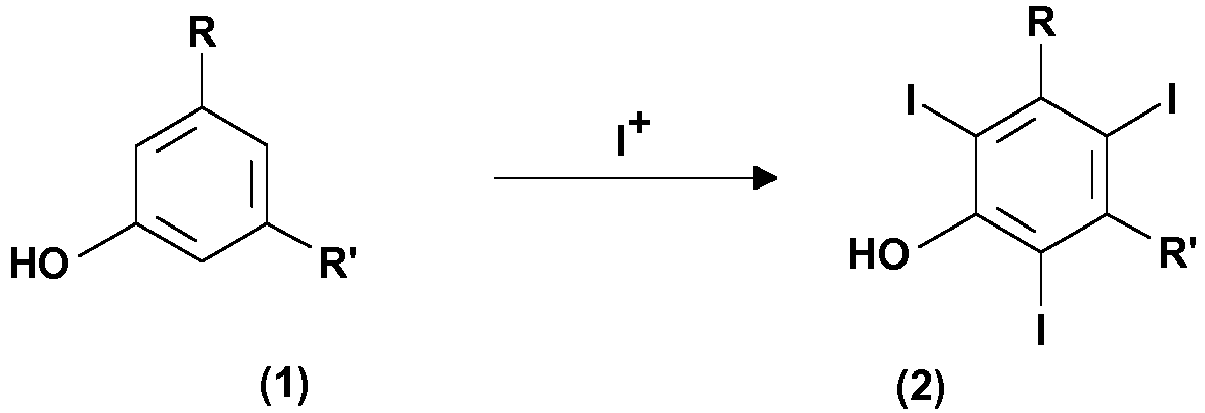
R and R' represent, the same or different from each other, a group selected from carboxy -COOH, carboxyester -COOR1 and carboxamido -CONH2, -CONHR1 or -CONR2R3; wherein R1, R2 and R3 represent, the same or different from each other, a straight or branched C1-C6 alkyl group which is optionally substituted by one or more groups selected from hydroxy, amino, sulphydryl, C1-C6 alkoxy or carboxy, and/or optionally interrupted by one or more divalent groups selected from -NH-, -O-, >C=O, -(C=O)O-, -O(C=O)-, -NH(C=O)-, -(C=O)NH-, >SO or >SO2 groups. - The present process enables, advantageously, the recovery of triiodinated 3,5-disubstituted phenols of formula (2) in high yields and purity.
- In the present description, unless otherwise provided, with the term straight or branched C1-C6 alkyl group we intend a linear or branched alkyl chain with from 1 to 6 carbon atoms. Suitable examples for the said alkyl groups may thus comprise methyl, ethyl, n-propyl, isopropyl, n-butyl, isobutyl, sec-butyl, tert-butyl, n-pentyl, n-hexyl, and the like.
- The above alkyl groups may be further substituted and/or interrupted by a variety of moieties as set forth above.
- Within them, with the term C1-C6 alkoxy we intend any alkyl-oxy group wherein the alkyl moiety just represents any of the above straight or branched C1-C6 alkyl groups. Suitable examples of alkoxy groups of the invention may thus comprise methoxy, ethoxy, n-propoxy, isopropoxy, n-pentyloxy, and the like.
- According to a preferred embodiment of the process of the invention, within the compounds of formula (1) and (2), R and R' represent, the same or different from each other, a group selected from carboxy (-COOH), carboxyester (-COOR1) and carboxamido (-CONH2, -CONHR1 or -CONR2R3) wherein R1, R2 and R3 are, the same or different from each other, a straight or branched C1-C4 alkyl group optionally substituted by one or more hydroxy groups.
- Even more preferably, within the compounds of formula (1) and (2), R and R' represent, the same or different form each other, a group selected from:
- COOH,
- COOCH3,
- COO(CH2)3-CH3,
- CONH2,
- CONHCH3,
- CONHCH2-CH(OH)-CH2(OH),
- CONHCH[CH2OH]2
- From all of the above, as both R and R' groups do not take direct part to the reaction step, as per the details below, it is clear to the skilled person that optional substituents or groups, anyway present within the meanings of R and R' and which may undergo unwanted side reactions, need to be suitably protected before reaction takes place. Protection and subsequent deprotection of the said groups can be accomplished by a variety of methods widely known in the art and conventionally adopted in organic synthesis techniques. For a general reference to protective groups in organic chemistry see, for instance, T. W. Green, Protective Groups in Organic Synthesis (Wiley, N.Y. 1981).The electrochemical generation of I+, as per step (a) of the process of the invention is performed in an electrolytic cell, hence in the presence of an anode and a cathode otherwise referred to as anodic and cathodic compartments.
- Suitable anodes are those conventionally known in the art and may comprise graphitic carbon anodes, vitreous carbon anodes, platinum anodes or even platinum alloys anodes which alloys may include other metals such as, for instance, iridium, titanium or conductive titanium dioxide. Particularly preferred are platinum and graphitic carbon anodes.
- As the cathode, conventional ones may be employed as well including, for instance, carbon, platinum, palladium, lead, copper or stainless steel cathodes as well as mixtures thereof. Carbon and steel cathodes in particular, are the most preferred. Cathode and anode are electrochemically interconnected according to conventional means, by a porous barrier or diaphragm, for instance consisting of a porous frit or of any other permeable membrane material known in the art for the intended purpose. According to the process of the invention, the iodinating specie is represented by iodine cations (I+) that are generated in situ from any suitable iodine source, for instance comprising molecular I2 or suitable iodide derivatives like the alkaline salts NaI or Kl or even hydriodic acid, or any mixture of them.
- Within the present invention, molecular iodine (I2) is particularly preferred.
- Because of the stoichiometry of the reaction the present process refers to, at least 3 moles of the reactive (I+) specie are required for each mole of aromatic substrate of formula (1) to be triiodinated to the corresponding compound of formula (2). Preferably, a slight excess of the iodinating agent to the phenolic substrate will be employed so that the equivalent ratio between them may vary from 1:1 to 3:1 or, even more preferably, from 1:1 to 2:1.
- The anodic reaction is carried out in acetonitrile, lower alcohols C1-C4 or mixtures thereof.
- Preferably, the process is carried out in lower alcohols wherein methanol is even more preferred.
- Hydroalcoholic solvent systems comprising water, for instance water: methanol mixtures in a weight ratio of 1 : 1 or with an even lower water content, for instance of 1 : 4, have to be avoided.
- To this extent, particularly when generating the reactive (I+) specie in step (a) from molecular iodine, either alone or together with any suitable iodide, the presence of amounts of water that may impair its solubility in the solvent medium, appears to negatively affect the reaction outcome.
- As per Comparative example 3, in fact, when the electrochemical oxidation of iodine, as per step (a) of the process, is carried out with the given water : alcohol mixture, major amounts of unreacted iodine are recovered at the end of the process.
- As far as the cathodic compartment is concerned, instead, the above limitations on the choice of the solvent system are not needed and, hence, varying amounts of water may be successfully employed.
- Typically, polar and/or protic solvents such as acetonitrile, lower alcohols and water admixtures thereof, may be employed.
- Among them, methanol-water mixtures are particularly preferred.
- The reaction medium is usually kept to an acidic pH, i.e. below 7, through acid addition, for instance of concentrated nitric or sulfuric acid, e.g. 97% H2SO4.Preferably, pH is kept between 0 and 4 and, even more preferably, between 1 and 2.
- Alternatively, step (a) may be performed in the presence of known compounds suitable to maintain conductivity within the electrolytic cell, and thus used for the above purpose.
- For the electrochemical generation of I+ cations at the anode, a voltage across the electrodes may be applied, so as to have an anode potential from about 1 to about 3 V versus SCE (Saturated Calomel Electrode as the reference electrode).
- Preferably, the reaction is carried out with an anode potential comprised from about 1.2 to about 1.8 V vs. SCE.
- Alternatively, the electrolytic process according to the present invention may be performed in a galvanostatic mode, i.e. a constant current is passed through the solution during the process, for instance corresponding to 1-500 mA/cm2.
- The temperature during the process is kept constant, for instance between 15°C and 25°C by operating according to conventional methods. Typically, as the heat generated during the process may lead to a partial evaporation of the solvent, particularly when employing lower boiling solvents like methanol, additional amounts of fresh solvent may be added so as to keep steady both temperature and solvent volume.
- The resulting solution containing the iodinating specie is then contacted with the aromatic substrate (1), or a suitable solution thereof, as formerly indicated.
- Typically, as reported in the experimental section, the iodination of the aromatic substrate of formula (1) is carried out in a separate reactor, wherein both the iodinating solution from step (a) and the substrate (1), either as such or suitable dissolved in a selected solvent, for instance including those previously indicated, are properly contacted.
- Preferably, a solution of the substrate (1) in a lower alcohol, like methanol, is employed.
- Subsequent work-up of the reaction mixture may be then accomplished according to conventional techniques widely known in the art so as to isolate and obtain the final compound of formula (2).
- As an example, when using molecular iodine to generate (I+) cations, at the end of the reaction any excess of (I+) or I2 could be easily removed according to conventional methods by adding suitable amounts of alkali iodide, for instance Kl, so as to form I2 and, then, Kl3 complex. Likewise, excess of iodine could be also removed through the addition of sodium sulfite or bisulfite, up to discolouration of the reaction medium.
- The compounds of formula (1) as starting materials of the process of the invention are known and, if not commercially available per se, may be all prepared according to known methods.
- For a general reference to the compounds of formula (1) see, for instance, the aforementioned
WO 88/09328 WO 97/05097 WO 00/32561 - Likewise, any other reactant and/or solvent being employed in the instant process is known and readily available.
- Details concerning the process of the invention are reported in the following experimental section for the electrochemical iodination of 3,5-disubstituted phenols according to the present invention, which is however shortly reported below.
- A melting pot, otherwise referred to as crucible, is placed inside a crystallizer put on a magnetic stirrer system. A platinum anode is then suspended and placed between the porous frit constituting the bottom of the melting pot, and the inner bottom of the crystallizer.
- A suitable amount of an alcoholic solution of the selected iodine source, for example a solution of I2 in methanol, is poured into the crystallizer so that its volume is such to provide the electrochemical contact with the porous frit, and an amount of acid is then added. A suitable amount of an alcohol-water mixture is then poured into the melting pot, followed by the addition of an acid. When the melting pot with its content is dipped into the iodine alcoholic solution, a graphite cathode is introduced into the melting pot and the system is then electrically connected. A constant electrical flow is maintained, then hydrogen forms at the cathode and the iodine solution turns brown to yellow-orange. During the reaction, a suitable amount of fresh methanol is added portionwise to the anodic compartment so as to compensate evaporation and to keep a permanent contact between the glass frit of the melting pot and the surrounding iodine solution. After a suitable time, for instance of about three hours, the solution is yellow-pale. Then, electric power is stopped and the iodinating solution in the crystallizer is transferred into a one-neck flask. A suitable amount of the selected compound of formula (1) or of a solution thereof is then added, either as such or portionwise, and the mixture is heated under reflux. The reaction is monitored by TLC and heating is continued up to quantitative conversion. The final solution thus obtained is lead cooling to room temperature.
- Then, any excess of I+ and I2 may be eliminated by addition of suitable solutions of Kl and of a saturated solution of NaSO3 being added up to decolourisation. The solvent is then evaporated and the residue is extracted with a suitable solvent, for instance ethyl acetate. The solution is dried, filtered and evaporated to residue. The crude is purified by flash chromatography onto silica gel or by elution onto a hydrophobic polymeric resin column, starting elution with water to eliminate iodine salts and then with a suitable solvent, for instance acetone, to elute the product.
- Once obtained, the compounds of formula (2) may be then easily converted into the corresponding x-ray contrast agents of interest having formula (5) below.
- Hence, it is a further object of the present invention a process for the preparation of the compounds of formula (5) below which process comprises:
- (a) electrochemically generating I+ cations from a suitable iodine source in a solvent at the anodic compartment selected from the group consisting of: acetonitrile, lower alcohols C1-C4 or mixtures; and
- (b) iodinating 3,5-disubstituted-phenols of formula (1) in the presence of the above I+ cations of step (a):

- wherein R and R' have the meanings above reported, so as to obtain the compounds of formula (2);
- (c) reacting the compound of formula (2), either as such or wherein the hydroxy group on the benzene ring is present as alkali or alkali-earth metal salt, with a compound of formula (3)
R4HN(C=O)CH(R5)Z (3)
wherein R4 and R5 are, the same or different from each other, hydrogen or a straight or branched C1-C6 alkyl group optionally substituted by one or more hydroxy or C1-C6 alkoxy groups and Z is a halogen atom or any suitable leaving group; so as to obtain a compound of formula (4)
- (d) subjecting the compound of formula (4) to Smile's rearrangement in the presence of bases, so as to obtain the final compound of formula (5)

- According to the present process for preparing x-ray contrast agents, the electrochemical iodination of steps (a) and (b) is carried out as formerly reported whilst steps (c) and (d), comprehensive of experimental conditions and optional variants thereof, are known in the art as reported, for instance, in the aforementioned patent applications
WO 88/09328 WO 97/05097 WO 00/32561 - Preferably, within the compounds of formula (3), Z is a bromine or chlorine atom.
- Even more preferably, the instant process may be applied to the preparation of widely known x-ray contrast agents like iopoamidol (wherein, respectively, R and R' both represent a -CONH-CH(CH2OH)2 group, R4 is hydrogen and R5 is methyl; see The Merck Index, XIII Ed., 2001, No. 5073) or iomeprol (wherein, respectively, R and R' both represent a -CONH-CH2-CH(OH)CH2OH group, R4 is methyl and R5 is hydrogen; see The Merck Index, XIII Ed., 2001, No. 5071).
- Therefore, it is an additional object of the invention a process for the preparation of iopamidol or iomeprol by starting from the compounds of formula (2a) or (2b), respectively, the said compounds of formula (2a) and (2b) being obtained through the electrochemical iodination of compounds (1a) or (1b), respectively, as per steps (a) and (b) of the process of the invention.


- The same process may be conveniently employed also for the preparation of suitably substituted anilines bearing given carboxy or carboxyester groups, substantially as set forth below (outside the scope of the present invention).
- Such a process may comprise:
- (a) electrochemically generating I+ cations from a suitable iodine source; and
- (b) iodinating 3,5-disubstituted-anilines of formula (6) in the presence of the above I+ cations of step (a):
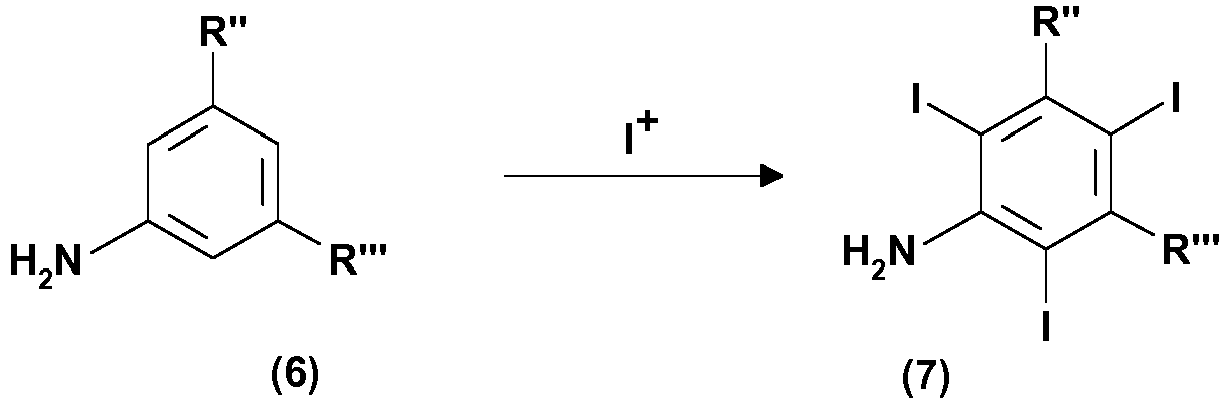
- R" and R'" represent, the same or different from each other, a carboxy -COOH or carboxyester group -COOR1, wherein R1 is a straight or branched C1-C6 alkyl group which is optionally substituted by one or more groups selected from hydroxy, amino, sulphydryl, C1-C6 alkoxy or carboxy, and/or optionally interrupted by one or more divalent groups selected from -NH-, -O-, >C=O, -(C=O)O-, -O(C=O)-, -NH(C=O)-, -(C=O)NH-, >SO or >SO2 groups.
- In formula (6) and (7) the definitions of R" and R'" and, hence, of R1, can be as those previously reported.
- The starting materials of formula (6) are known or can be easily prepared according to known methods, for instance by suitably hydrogenating or anyway reducing the corresponding nitroisophthalic acid, optionally to be subsequently functionalized according to conventional techniques for the conversion of carboxy to carboxyester groups.
- The compounds of formula (7) are useful intermediates for the synthesis of X-ray contrast agents, among which are the aforementioned iopamidol and iomeprol, by working according to methods widely known in the art.
- With the aim to better illustrate the present invention, without posing any limitation to it, the following examples are now given.
- A stock solution of iodine in methanol (0.55 M, 10 mL) was introduced in a 100 mL beaker, diluted with methanol (20 mL) and acidified with 0.2 mL 97% H2SO4. A porous crucible (6 µm pore diameter) was partially filled with methanol (2 mL), water (6 mL) and 97% H2SO4 (0.2 mL) and introduced in the beaker. A platinum sheet anode was inserted in the beaker and a graphite cathode was introduced in the crucible. The electrolysis was performed in galvanostatic mode (200 mA/cm2) until the anolyte discolored to light yellow. The obtained solution was used as such in the subsequent iodination reactions.
- Synthesis of 3,5-bis(2,3-dihydroxypropylaminocarbonyl)-2,4,6-triiodophenol

- 3,5-Bis(2,3-dihydroxypropylaminocarbonyl)-phenol (56.5 mg, 0.17 mmol) was added in a round bottomed flask containing the I+ solution (obtained by working as described in Example 1, from 1.55 mmol I2 and 50 mL MeOH). The reaction mixture was refluxed for 1 hour. An additional amount of 3,5-bis(2,3-dihydroxypropylaminocarbonyl)-phenol (56.5 mg, 0.17 mmol) was then added and the solution was refluxed for 1 hour. A third portion of 3,5-bis(2,3-dihydroxypropylaminocarbonyl)-phenol was finally added (56.5 mg, 0.17 mmol) and the solution was refluxed until complete conversion was observed. After cooling, Kl (257 mg, 1.55 mmol) was added and a saturated aqueous solution of Na2SO3 was added dropwise until the solution became pale yellow.
- Methanol was removed under reduced pressure and the yellow residue was purified with an Amberlite® XAD 1600 column by elution with water (100 mL) until salts were completely removed and then with water/acetone 8/2 (100 mL).
- Yield: 300 mg, 82%.
-
4.00 ppm b quint[2H] 3.74 ppm dd[2H] J1 = 11.6 Hz J2 = 3.7 Hz 3.62 ppm dd[2H] J1 = 11.8 Hz J2 = 6.6 Hz 3.56-3.36 ppm m[4H] -
172.6 ppm [C] 156.0 ppm [C] 148.2 ppm [C] 85.3 ppm [C] 78.9 ppm [C] 70.5 ppm [CH] 64.4 ppm [CH2] 42.9 ppm [CH2] -

- 3,5-Bis(1-hydroxymethyl-2-hydroxyethylaminocarbonyl)-phenol (56.5 mg, 0.17 mmol) was added in a round bottomed flask containing the I+ solution (obtained by working as described in Example 1, from 1.55 mmol I2 and 50 mL MeOH).
- The reaction mixture was refluxed for 1 hour. An additional amount of the above phenol derivative (56.5 mg, 0.17 mmol) was then added and the solution was refluxed for 1 hour. A third portion of the above phenol derivative was finally added (56.5 mg, 0.17 mmol) and the solution was refluxed until complete conversion was observed. After cooling, Kl (257 mg, 1.55 mmol) was added and a saturated aqueous solution of Na2SO3 was added dropwise until the solution became pale yellow.
- Methanol was removed under reduced pressure and the yellow residue was purified with an Amberlite® XAD 1600 column by elution with water (100 mL) until salts were completely removed and then with water/acetone 8/2 (100 mL).
- Yield: 200 mg, 55%.
-
4.11 ppm quint[2H] J = 5.2 Hz 3.85-3.70 ppm m[8H] -
172.1 ppm [C] 156.0 ppm [C] 148.4 ppm [C] 85.1 ppm [C] 78.7 ppm [C] 60.0 ppm [CH2] 53.2 ppm [CH] -

- In a round bottomed flask containing the I+ solution (obtained by working as described in Example 1, from 0.78 mmol I2 and 50 mL MeOH), 3,5-bis(n-butoxycarbonyl)-phenol (25.0 mg, 0.085 mmol) was added. The solution obtained was refluxed for 1 hour. An additional amount of the above phenol derivative was then added (25.0 mg, 0.085 mmol) and the solution was refluxed for 1 hour. A third portion of the above phenol derivative was finally added (25.0 mg, 0.085 mmol) and the solution was refluxed 7 h, until complete conversion was observed.
- After cooling, Kl (125 mg, 0.76 mmol) was added and a saturated aqueous solution of Na2SO3 was dropped until the solution became pale yellow.
- Methanol was removed under reduced pressure and the yellow solution so obtained was diluted with water and extracted with AcOEt (3x20 mL). The organic phase was dried over Na2SO4 and evaporated under reduced pressure. The black residue was purified by flash chromatography onto silica gel (eluent: 9 petroleum ether/ 0.5 isopropanol/ 0.5 AcOEt).
- Yield: 100 mg, 58%.
-
6.23 ppm bs[1 H] 4.36 ppm t[4H] J = 6.6 Hz 1.75 ppm quint[4H] J = 6.7 Hz 1.47 ppm sext[4H] J = 7.4 Hz 0.95 ppm t[6H] J = 7.4 Hz - 13C-NMR (CDCl3, 75.4 MHz, 298K)
167.8 ppm [C] 154.7 ppm [C] 147.9 ppm [C] 80.8 ppm [C] 76.4 ppm [C] 66.8 ppm [CH2] 30.3 ppm [CH2] 19.3 ppm [CH2] 13.7 ppm [CH3] -

- In a round bottomed flask containing the I+ solution (obtained by working as described in Example 1, from 0.78 mmol I2 and 50 mL MeOH), 3,5-bis(methoxycarbonyl)-phenol (53.0 mg, 0.085 mmol) was added. The solution obtained was refluxed for 1 hour. An additional amount of the above phenol derivative was then added (53.0 mg, 0.085 mmol) and the solution was refluxed for 1 hour. A third portion of the above phenol solution was finally added (53.0 mg, 0.085 mmol) and the solution was refluxed 10 h, until complete conversion was observed.
- After cooling, Kl (125 mg, 0.76 mmol) was added and a saturated aqueous solution of Na2SO3 was dropped until the solution became pale yellow.
- Methanol was removed under reduced pressure and the yellow solution so obtained was diluted with water and extracted with AcOEt (3x20 mL). The organic phase was dried over Na2SO4 and evaporated under reduced pressure. The black residue was purified with flash chromatography onto silica gel (eluent: 9 petroleum benzine/ 0.5 isopropanol/ 0.5 AcOEt).
- Yield: 90 mg, 60%.
-
6.23 ppm bs[1H] 3.95 ppm s[6H] -
168.1 ppm [C] 154.8 ppm [C] 147.7 ppm [C] 81.1 ppm [C] 76.4 ppm [C] 53.6 ppm [CH3] - In a round bottomed flask containing the I+ solution (obtained in Example 1 from 0.78 mmol I2 and 50 mL MeOH), phenol (24.4 mg, 0.26 mmol) was added. The reaction mixture was refluxed for 5 h. After cooling, Kl (131 mg, 0.79 mmol) was added and a satured aqueous Na2SO3 solution was added dropwise.
- Methanol was removed under reduced pressure and the yellow solution so obtained was diluted with water and extracted with AcOEt (3x20 mL). The organic phase was dried over Na2SO4 and evaporated under reduced pressure and the brown residue was charged on a flash chromatography column and eluted with 9 petroleum benzine/ 1 AcOEt.
- Yield: 25 mg, 21%.
-

-
8.01 ppm s[2H] -
155.8 ppm [C] 145.8 ppm [CH] 88.5 ppm [C] 85.0 ppm [C] - In subsequent fractions, more polar byproducts were collected, among which 2-iodohydroquinone and a diiodobiphenol.
- In a round bottomed flask containing the I+ solution (obtained as in Example 1 from 0.78 mmol I2 and 50 mL MeOH), pyrogallol (32 mg, 0.26 mmol) was added. The reaction mixture was refluxed for 3 h. After cooling, Kl (131 mg, 0.79 mmol) was added and a satured aqueous Na2SO3 solution was added dropwise.
- Methanol was removed under reduced pressure and the yellow solution so obtained was diluted with water and extracted with AcOEt (3x20 mL). The organic phase was dried over Na2SO4 and evaporated under reduced pressure. The chromatographic analysis of the brown residue so obtained showed a complex and inseparable mixture of oxidized and iodinated byproducts.
- The electrochemical iodination apparatus consisted of a cell composed of:
- an anode compartment with a platinum anode (foil, 3 cm2) and a magnetic stirring bar;
- a cathode compartment with a stainless steel cathode (plate, 8 cm2).
- The two compartments were separated by a porous glass frit (average pore size 6 µm).
- In the anode compartment it was placed a 0.15 M solution of NaBF4 in methanol/water (50/50, 40 mL) and iodine (762 mg, 3 mmol) was added therein with vigorous stirring. Owing to the low solubility of iodine in the mixture, a large portion of it was still present, as a precipitate, at the bottom of the anode compartment; the mixture showed a pale orange colour. pH was adjusted to 1.5 by using a 40% aqueous solution of HBF4.
- In the cathode compartment, it was placed a 0.15 M solution of NaBF4 in methanol/water (50/50, 15 mL).
- A constant current of 400 mA was applied. After about 30 minutes, the current began to decrease and after about 40 minutes the current dropped to ∼60 mA at the maximum power supply voltage of 31.6 V. The solution was yellow and the major portion of the starting iodine was still present at the bottom of the anolyte compartment. The solid iodine was recovered by filtration, washed with water and dried, weighing 678 mg (89% recovery of unreacted iodine).
Claims (14)
- A process for the preparation of 3,5-disubstituted-2,4,6-triiodophenols of formula (2), which process comprises:(a) electrochemically generating I+ cations from a suitable iodine source in a solvent at the anodic compartment, the same or different for steps (a) and (b), selected from: acetonitrile, lower alcohols C1-C4 or mixtures thereof; and(b) iodinating 3,5-disubstituted-phenols of formula (1) in the presence of the above I+ cations of step (a):
 R and R' represent, the same or different from each other, a group selected from carboxy -COOH, carboxyester -COOR1 and carboxamido -CONH2, -CONHR1 or -CONR2R3; whereinR1, R2 and R3 represent, the same or different from each other, a straight or branched C1-C6 alkyl group which is optionally substituted by one or more groups selected from hydroxy, amino, sulphydryl, C1-C6 alkoxy or carboxy, and/or optionally interrupted by one or more divalent groups selected from -NH-, -O-, >C=O, -(C=O)O-, -O(C=O)-, -NH(C=O)-, -(C=O)NH-, >SO or >SO2 groups.
 - The process according to claim 1 wherein, within the compounds of formula (1) and (2), R and R' represent, the same or different from each other, a group selected from carboxy-COOH, carboxyester -COOR1 and carboxamido -CONH2, -CONHR1 or -CONR2R3 wherein R1, R2 and R3 are, the same or different from each other, a straight or branched C1-C4 alkyl group optionally substituted by one or more hydroxy groups.
- The process according to claim 2 wherein, within the compounds of formula (1) and (2), R and R' represent, the same or different form each other, a group selected from:- COOH,- COOCH3,- COO(CH2)3-CH3,- CONH2,- CONHCH3,- CONHCH2-CH(OH)-CH2(OH),- CONHCH[CH2OH]2.
- The process according to anyone of claims from 1 to 3 wherein iodine cations I+ are generated in situ from a suitable iodine source including molecular I2, sodium or potassium iodide or hydroiodic acid, or mixture thereof.
- The process according to claim 4 wherein iodine cations I+ are generated in situ from molecular I2.
- The process according to claim 1 wherein the solvent is a lower alcohol C1-C4.
- The process according to claim 6 wherein the solvent is methanol.
- The process according to any one of claims from 1 to 7 wherein step (b) is carried out in a separate reactor.
- The process according to claim 8 wherein the resulting solution of step (a) is transferred in a separate reactor and contacted with the compound of formula (1) or a solution thereof.
- The process according to claim 1, further comprising steps c) and d) as follows:(c) reacting the compound of formula (2), either as such or wherein the hydroxy group on the benzene ring is present as alkali or alkali-earth metal salt, with a compound of formula (3)
R4HN(C=O)CH(R5)Z (3)
wherein R4 and R5 are, the same or different from each other, hydrogen or a straight or branched C1-C6 alkyl group optionally substituted by one or more hydroxy or C1-C6 alkoxy groups and Z is a halogen atom or any suitable leaving group; so as to obtain a compound of formula (4) (d) subjecting the compound of formula (4) to Smile's rearrangement in the presence of bases, so as to obtain the final compound of formula (5)
- The process according to claim 10 wherein, within the compounds of formula (3), Z is a bromine or chlorine atom.
- The process according to claims 10 or 11 for the preparation of a compound of formula (5) wherein both R and R' are a -CONH-CH(CH2OH)2 group, R4 is hydrogen and R5 is methyl.
- The process according to claims 10 or 11 for the preparation of a compound of formula (5) wherein both R and R' represent a -CONH-CH2-CH(OH)CH2OH group, R4 is methyl and R5 is hydrogen.
- The process for the preparation of Iopamidol or Iomeprol by starting from the corresponding compound of formula (2) prepared according to the process of any one of claims 1-10.
Priority Applications (2)
| Application Number | Priority Date | Filing Date | Title |
|---|---|---|---|
| EP09713167.6A EP2254850B1 (en) | 2008-02-20 | 2009-02-16 | Process for the iodination of aromatic compounds |
| HRP20161137TT HRP20161137T1 (en) | 2008-02-20 | 2009-02-16 | Process for the iodination of aromatic compounds |
Applications Claiming Priority (3)
| Application Number | Priority Date | Filing Date | Title |
|---|---|---|---|
| EP20080151661 EP2093206A1 (en) | 2008-02-20 | 2008-02-20 | Process for the iodination of aromatic compounds |
| EP09713167.6A EP2254850B1 (en) | 2008-02-20 | 2009-02-16 | Process for the iodination of aromatic compounds |
| PCT/EP2009/051747 WO2009103666A2 (en) | 2008-02-20 | 2009-02-16 | Process for the iodination of aromatic compounds |
Publications (2)
| Publication Number | Publication Date |
|---|---|
| EP2254850A2 EP2254850A2 (en) | 2010-12-01 |
| EP2254850B1 true EP2254850B1 (en) | 2016-06-22 |
Family
ID=39650549
Family Applications (2)
| Application Number | Title | Priority Date | Filing Date |
|---|---|---|---|
| EP20080151661 Withdrawn EP2093206A1 (en) | 2008-02-20 | 2008-02-20 | Process for the iodination of aromatic compounds |
| EP09713167.6A Active EP2254850B1 (en) | 2008-02-20 | 2009-02-16 | Process for the iodination of aromatic compounds |
Family Applications Before (1)
| Application Number | Title | Priority Date | Filing Date |
|---|---|---|---|
| EP20080151661 Withdrawn EP2093206A1 (en) | 2008-02-20 | 2008-02-20 | Process for the iodination of aromatic compounds |
Country Status (20)
| Country | Link |
|---|---|
| US (1) | US9193659B2 (en) |
| EP (2) | EP2093206A1 (en) |
| JP (1) | JP5611057B2 (en) |
| KR (1) | KR101622552B1 (en) |
| CN (1) | CN101970381B (en) |
| AU (1) | AU2009216783B2 (en) |
| BR (1) | BRPI0907525B1 (en) |
| CA (1) | CA2715430C (en) |
| ES (1) | ES2589961T3 (en) |
| HR (1) | HRP20161137T1 (en) |
| HU (1) | HUE030008T2 (en) |
| IL (1) | IL207640A (en) |
| MX (1) | MX362895B (en) |
| NZ (1) | NZ586944A (en) |
| PL (1) | PL2254850T3 (en) |
| PT (1) | PT2254850T (en) |
| RU (1) | RU2469997C2 (en) |
| SG (1) | SG176522A1 (en) |
| WO (1) | WO2009103666A2 (en) |
| ZA (1) | ZA201005285B (en) |
Families Citing this family (15)
| Publication number | Priority date | Publication date | Assignee | Title |
|---|---|---|---|---|
| EP2243767A1 (en) | 2009-04-21 | 2010-10-27 | Bracco Imaging S.p.A | Process for the iodination of aromatic compounds |
| JP5661762B2 (en) | 2009-07-07 | 2015-01-28 | ブラッコ・イメージング・ソシエタ・ペル・アチオニBracco Imaging S.P.A. | Method for producing iodinating agent |
| EP2394984A1 (en) * | 2010-06-10 | 2011-12-14 | Bracco Imaging S.p.A | Process for the iodination of phenolic derivatives |
| CN103086915A (en) * | 2011-10-31 | 2013-05-08 | 上海海神化学生物科技有限公司 | Iodination method for preparing 3,5-disubstituted-2,4,6-triiodo aromatic amine compound |
| PL3066071T3 (en) | 2013-11-05 | 2018-09-28 | Bracco Imaging S.P.A | Process for the preparation of iopamidol |
| CN106103407B (en) | 2014-03-04 | 2020-10-16 | 大塚制药株式会社 | Iohexol powder and method of use |
| RU2558037C1 (en) * | 2014-07-14 | 2015-07-27 | Общество с ограниченной ответственностью "Научно-производственная фирма ЛиноРМ" ООО "НПФ ЛиноРМ" | Method for producing linoiodol |
| JP6743781B2 (en) * | 2016-08-08 | 2020-08-19 | 信越化学工業株式会社 | Resist material and pattern forming method |
| WO2018104228A1 (en) | 2016-12-05 | 2018-06-14 | Bracco Imaging Spa | Mechanochemical synthesis of radiographic agents intermediates |
| CN108505063B (en) * | 2018-04-19 | 2019-11-05 | 华南理工大学 | A kind of electrochemical preparation method of N- (3,5- dimethyl -4- hydroxy phenyl) acetamide |
| US11833621B2 (en) | 2018-05-08 | 2023-12-05 | Koki Company Limited | Flux and solder material |
| CN113351186B (en) * | 2021-06-18 | 2022-12-27 | 海南希源化工科技有限公司 | Preparation method of iodine adsorbent, obtained product and application |
| CN113563399B (en) * | 2021-07-22 | 2023-06-27 | 中国科学院南海海洋研究所 | Method for preparing tiacumicin B iodide and other aromatic iodination products and application thereof |
| WO2023046815A1 (en) | 2021-09-24 | 2023-03-30 | Bracco Imaging Spa | Electrochemical iodination of n,n'-(2,3-dihydroxypropyl)-5-hydroxy-1,3-benzenedicarboxamide |
| EP4514771B1 (en) | 2022-04-29 | 2026-04-15 | Bracco Imaging SPA | Process for the preparation of 2,4,6-triiodophenol derivatives |
Family Cites Families (24)
| Publication number | Priority date | Publication date | Assignee | Title |
|---|---|---|---|---|
| US3647864A (en) * | 1967-11-16 | 1972-03-07 | Sterling Drug Inc | 5-substituted-1 3-benzenediacrylic and -dipropionic acids |
| BE795902A (en) * | 1972-02-25 | 1973-08-23 | Rhone Poulenc Sa | PROCESS FOR THE PREPARATION OF DIIODO-3,5 HYDROXY-4BENZONITRILE AND IODO-3 HYDROXY-4 NITRO-5BENZONITRILE |
| CH608189A5 (en) | 1974-12-13 | 1978-12-29 | Savac Ag | |
| DD124516A1 (en) | 1975-11-14 | 1977-03-02 | ||
| GB1548594A (en) | 1976-06-11 | 1979-07-18 | Nyegaard & Co As | Triiodoisophthalic acid amides |
| US4396598A (en) | 1982-01-11 | 1983-08-02 | Mallinckrodt, Inc. | Triiodoisophthalamide X-ray contrast agent |
| EP0365541B1 (en) | 1987-05-22 | 1992-08-12 | BRACCO S.p.A. | Preparation of 5-acylamino-2,4,6-triiodo- or tribromo-benzoic acid derivatives |
| JPH0735243B2 (en) | 1987-11-27 | 1995-04-19 | 三井東圧化学株式会社 | Method for producing iodine monochloride |
| JPH0735244B2 (en) | 1987-12-18 | 1995-04-19 | 三井東圧化学株式会社 | Method for producing iodine monochloride |
| US5013865A (en) | 1988-04-06 | 1991-05-07 | Mallinckrodt, Inc. | Process for the preparation of 2,4,6-triiodo-5-amino-N-alkylisophthalamic acid and 2,4,6-triiodo-5-amino-isophthalamide compounds |
| CA2002599A1 (en) | 1988-11-25 | 1990-05-25 | Eastman Chemical Company | Process for the electrochemical iodination of aromatic compounds |
| IL94718A (en) | 1989-07-05 | 1994-10-21 | Schering Ag | Non-ionic carboxamide contrast agent and method of preparation |
| FR2673180B1 (en) | 1991-02-25 | 1994-03-04 | Guerbet Sa | NOVEL POLY-IODIC NON-IONIC COMPOUNDS, PREPARATION METHOD, CONTRAST PRODUCT CONTAINING THE SAME. |
| IT1256248B (en) | 1992-12-24 | 1995-11-29 | Bracco Spa | WATER INJECTABLE FORMULATIONS FOR RADIODIAGNOSTICS INCLUDING MIXTURES OF IODURATED AROMATIC COMPOUNDS USEFUL AS X-RAY MATTING AGENTS |
| US5763650A (en) | 1995-05-23 | 1998-06-09 | Fructamine S.P.A. | Process for the preparation of a halosubstituted aromatic acid |
| US5575905A (en) | 1995-05-24 | 1996-11-19 | Nycomed Imaging As | Iodination process |
| JP3985034B2 (en) * | 1995-05-24 | 2007-10-03 | ジーイー・ヘルスケア・アクスイェ・セルスカプ | Iodination method |
| IT1277339B1 (en) | 1995-07-25 | 1997-11-10 | Bracco Spa | PROCESS FOR THE PRODUCTION OF IODURATED CONTRASTING AGENTS |
| IT1289520B1 (en) | 1996-12-24 | 1998-10-15 | Zambon Spa | PROCESS FOR THE PREPARATION OF A USEFUL INTERMEDIATE IN THE SUMMARY OF HALIDATED CONTRAST MEANS |
| IT1303797B1 (en) | 1998-11-27 | 2001-02-23 | Bracco Spa | PROCESS FOR THE PREPARATION OF N, N'-BIS (2,3-DIHYDROXYPROPYL) -5 - ((HYDROXIACETYL) METHYLAMINE) -2,4,6-TRIIODE-1,3-BENZENDICARBOXAMIDE. |
| JP2000264605A (en) | 1999-03-19 | 2000-09-26 | Hiroyuki Nakazawa | Production of iodine monochloride aqueous solution |
| RU2278816C2 (en) | 2004-04-02 | 2006-06-27 | ОАО "Троицкий йодный завод" | Method for preparing iodine monochloride hydrochloride solution |
| EP1837324B1 (en) | 2005-01-06 | 2012-02-01 | Nippoh Chemicals Co., Ltd | Process for producing aromatic iodine compound |
| EP2123795B1 (en) | 2007-03-09 | 2015-05-06 | Japan Science and Technology Agency | Method for producing iodizing agent and method for producing aromatic iodine compound |
-
2008
- 2008-02-20 EP EP20080151661 patent/EP2093206A1/en not_active Withdrawn
-
2009
- 2009-02-16 EP EP09713167.6A patent/EP2254850B1/en active Active
- 2009-02-16 PT PT97131676T patent/PT2254850T/en unknown
- 2009-02-16 CN CN2009801059048A patent/CN101970381B/en active Active
- 2009-02-16 ES ES09713167.6T patent/ES2589961T3/en active Active
- 2009-02-16 SG SG2011087244A patent/SG176522A1/en unknown
- 2009-02-16 NZ NZ586944A patent/NZ586944A/en not_active IP Right Cessation
- 2009-02-16 RU RU2010138570/04A patent/RU2469997C2/en active
- 2009-02-16 JP JP2010547157A patent/JP5611057B2/en active Active
- 2009-02-16 BR BRPI0907525-9A patent/BRPI0907525B1/en active IP Right Grant
- 2009-02-16 CA CA2715430A patent/CA2715430C/en active Active
- 2009-02-16 KR KR1020107017162A patent/KR101622552B1/en active Active
- 2009-02-16 US US12/918,001 patent/US9193659B2/en active Active
- 2009-02-16 AU AU2009216783A patent/AU2009216783B2/en active Active
- 2009-02-16 HU HUE09713167A patent/HUE030008T2/en unknown
- 2009-02-16 WO PCT/EP2009/051747 patent/WO2009103666A2/en not_active Ceased
- 2009-02-16 MX MX2010009184A patent/MX362895B/en active IP Right Grant
- 2009-02-16 PL PL09713167.6T patent/PL2254850T3/en unknown
- 2009-02-16 HR HRP20161137TT patent/HRP20161137T1/en unknown
-
2010
- 2010-07-23 ZA ZA2010/05285A patent/ZA201005285B/en unknown
- 2010-08-16 IL IL207640A patent/IL207640A/en active IP Right Grant
Non-Patent Citations (1)
| Title |
|---|
| None * |
Also Published As
| Publication number | Publication date |
|---|---|
| US20100331567A1 (en) | 2010-12-30 |
| IL207640A0 (en) | 2010-12-30 |
| PT2254850T (en) | 2016-08-29 |
| HRP20161137T1 (en) | 2016-11-04 |
| AU2009216783A1 (en) | 2009-08-27 |
| KR101622552B1 (en) | 2016-05-19 |
| US9193659B2 (en) | 2015-11-24 |
| MX2010009184A (en) | 2010-09-10 |
| WO2009103666A3 (en) | 2009-12-23 |
| WO2009103666A2 (en) | 2009-08-27 |
| KR20100116594A (en) | 2010-11-01 |
| BRPI0907525A2 (en) | 2015-07-28 |
| PL2254850T3 (en) | 2016-12-30 |
| CA2715430A1 (en) | 2009-08-27 |
| JP5611057B2 (en) | 2014-10-22 |
| AU2009216783B2 (en) | 2013-03-07 |
| HUE030008T2 (en) | 2017-04-28 |
| CA2715430C (en) | 2017-07-04 |
| MX362895B (en) | 2019-02-22 |
| EP2093206A1 (en) | 2009-08-26 |
| BRPI0907525B1 (en) | 2018-01-02 |
| RU2010138570A (en) | 2012-03-27 |
| ES2589961T3 (en) | 2016-11-17 |
| NZ586944A (en) | 2012-06-29 |
| IL207640A (en) | 2016-10-31 |
| JP2011512381A (en) | 2011-04-21 |
| RU2469997C2 (en) | 2012-12-20 |
| SG176522A1 (en) | 2011-12-29 |
| ZA201005285B (en) | 2011-04-28 |
| CN101970381A (en) | 2011-02-09 |
| CN101970381B (en) | 2013-10-23 |
| EP2254850A2 (en) | 2010-12-01 |
Similar Documents
| Publication | Publication Date | Title |
|---|---|---|
| AU2009216783B2 (en) | Process for the iodination of aromatic compounds | |
| EP2243767A1 (en) | Process for the iodination of aromatic compounds | |
| EP2773610B1 (en) | Iodination process for the preparation of 3,5-disubstituted-2,4,6-triiodo aromatic amines compounds | |
| EP2580187B1 (en) | Process for the iodination of phenolic derivatives | |
| EP0828705B1 (en) | Iodination process | |
| JP2651230B2 (en) | Electrochemical synthesis of substituted aromatic amines in basic media | |
| JPH0730475B2 (en) | Method for producing 1-aminoanthraquinones | |
| US5575905A (en) | Iodination process | |
| HK1148515A (en) | Process for the iodination of aromatic compounds | |
| KR101699065B1 (en) | Process for the preparation of a iodinating agent | |
| EP4405329B1 (en) | Electrochemical iodination of n,n'-(2,3-dihydroxypropyl)-5-hydroxy-1,3-benzenedicarboxamide | |
| US12269790B1 (en) | Process for the preparation of 2,4,6-triiodophenol derivatives |
Legal Events
| Date | Code | Title | Description |
|---|---|---|---|
| PUAI | Public reference made under article 153(3) epc to a published international application that has entered the european phase |
Free format text: ORIGINAL CODE: 0009012 |
|
| 17P | Request for examination filed |
Effective date: 20100909 |
|
| AK | Designated contracting states |
Kind code of ref document: A2 Designated state(s): AT BE BG CH CY CZ DE DK EE ES FI FR GB GR HR HU IE IS IT LI LT LU LV MC MK MT NL NO PL PT RO SE SI SK TR |
|
| AX | Request for extension of the european patent |
Extension state: AL BA RS |
|
| DAX | Request for extension of the european patent (deleted) | ||
| 17Q | First examination report despatched |
Effective date: 20110916 |
|
| TPAC | Observations filed by third parties |
Free format text: ORIGINAL CODE: EPIDOSNTIPA |
|
| GRAP | Despatch of communication of intention to grant a patent |
Free format text: ORIGINAL CODE: EPIDOSNIGR1 |
|
| RIC1 | Information provided on ipc code assigned before grant |
Ipc: C07C 237/46 20060101ALI20160204BHEP Ipc: C07B 39/00 20060101AFI20160204BHEP Ipc: C25B 3/06 20060101ALI20160204BHEP Ipc: C07C 37/62 20060101ALI20160204BHEP Ipc: C07C 69/88 20060101ALI20160204BHEP Ipc: C07C 67/307 20060101ALI20160204BHEP Ipc: C07C 51/363 20060101ALI20160204BHEP Ipc: C07C 233/69 20060101ALI20160204BHEP Ipc: C07C 231/12 20060101ALI20160204BHEP |
|
| INTG | Intention to grant announced |
Effective date: 20160309 |
|
| GRAS | Grant fee paid |
Free format text: ORIGINAL CODE: EPIDOSNIGR3 |
|
| GRAA | (expected) grant |
Free format text: ORIGINAL CODE: 0009210 |
|
| AK | Designated contracting states |
Kind code of ref document: B1 Designated state(s): AT BE BG CH CY CZ DE DK EE ES FI FR GB GR HR HU IE IS IT LI LT LU LV MC MK MT NL NO PL PT RO SE SI SK TR |
|
| REG | Reference to a national code |
Ref country code: GB Ref legal event code: FG4D |
|
| REG | Reference to a national code |
Ref country code: CH Ref legal event code: EP |
|
| REG | Reference to a national code |
Ref country code: IE Ref legal event code: FG4D |
|
| REG | Reference to a national code |
Ref country code: AT Ref legal event code: REF Ref document number: 807563 Country of ref document: AT Kind code of ref document: T Effective date: 20160715 |
|
| REG | Reference to a national code |
Ref country code: DE Ref legal event code: R096 Ref document number: 602009039319 Country of ref document: DE |
|
| REG | Reference to a national code |
Ref country code: PT Ref legal event code: SC4A Ref document number: 2254850 Country of ref document: PT Date of ref document: 20160829 Kind code of ref document: T Free format text: AVAILABILITY OF NATIONAL TRANSLATION Effective date: 20160819 |
|
| REG | Reference to a national code |
Ref country code: HR Ref legal event code: TUEP Ref document number: P20161137 Country of ref document: HR |
|
| REG | Reference to a national code |
Ref country code: NL Ref legal event code: FP |
|
| REG | Reference to a national code |
Ref country code: LT Ref legal event code: MG4D |
|
| PG25 | Lapsed in a contracting state [announced via postgrant information from national office to epo] |
Ref country code: FI Free format text: LAPSE BECAUSE OF FAILURE TO SUBMIT A TRANSLATION OF THE DESCRIPTION OR TO PAY THE FEE WITHIN THE PRESCRIBED TIME-LIMIT Effective date: 20160622 Ref country code: LT Free format text: LAPSE BECAUSE OF FAILURE TO SUBMIT A TRANSLATION OF THE DESCRIPTION OR TO PAY THE FEE WITHIN THE PRESCRIBED TIME-LIMIT Effective date: 20160622 |
|
| REG | Reference to a national code |
Ref country code: HR Ref legal event code: T1PR Ref document number: P20161137 Country of ref document: HR |
|
| REG | Reference to a national code |
Ref country code: NO Ref legal event code: T2 Effective date: 20160622 |
|
| REG | Reference to a national code |
Ref country code: ES Ref legal event code: FG2A Ref document number: 2589961 Country of ref document: ES Kind code of ref document: T3 Effective date: 20161117 |
|
| PG25 | Lapsed in a contracting state [announced via postgrant information from national office to epo] |
Ref country code: GR Free format text: LAPSE BECAUSE OF FAILURE TO SUBMIT A TRANSLATION OF THE DESCRIPTION OR TO PAY THE FEE WITHIN THE PRESCRIBED TIME-LIMIT Effective date: 20160923 Ref country code: SE Free format text: LAPSE BECAUSE OF FAILURE TO SUBMIT A TRANSLATION OF THE DESCRIPTION OR TO PAY THE FEE WITHIN THE PRESCRIBED TIME-LIMIT Effective date: 20160622 Ref country code: LV Free format text: LAPSE BECAUSE OF FAILURE TO SUBMIT A TRANSLATION OF THE DESCRIPTION OR TO PAY THE FEE WITHIN THE PRESCRIBED TIME-LIMIT Effective date: 20160622 |
|
| PG25 | Lapsed in a contracting state [announced via postgrant information from national office to epo] |
Ref country code: EE Free format text: LAPSE BECAUSE OF FAILURE TO SUBMIT A TRANSLATION OF THE DESCRIPTION OR TO PAY THE FEE WITHIN THE PRESCRIBED TIME-LIMIT Effective date: 20160622 Ref country code: RO Free format text: LAPSE BECAUSE OF FAILURE TO SUBMIT A TRANSLATION OF THE DESCRIPTION OR TO PAY THE FEE WITHIN THE PRESCRIBED TIME-LIMIT Effective date: 20160622 Ref country code: SK Free format text: LAPSE BECAUSE OF FAILURE TO SUBMIT A TRANSLATION OF THE DESCRIPTION OR TO PAY THE FEE WITHIN THE PRESCRIBED TIME-LIMIT Effective date: 20160622 Ref country code: IS Free format text: LAPSE BECAUSE OF FAILURE TO SUBMIT A TRANSLATION OF THE DESCRIPTION OR TO PAY THE FEE WITHIN THE PRESCRIBED TIME-LIMIT Effective date: 20161022 |
|
| REG | Reference to a national code |
Ref country code: FR Ref legal event code: PLFP Year of fee payment: 9 |
|
| REG | Reference to a national code |
Ref country code: DE Ref legal event code: R097 Ref document number: 602009039319 Country of ref document: DE |
|
| PLBE | No opposition filed within time limit |
Free format text: ORIGINAL CODE: 0009261 |
|
| REG | Reference to a national code |
Ref country code: HU Ref legal event code: AG4A Ref document number: E030008 Country of ref document: HU |
|
| STAA | Information on the status of an ep patent application or granted ep patent |
Free format text: STATUS: NO OPPOSITION FILED WITHIN TIME LIMIT |
|
| 26N | No opposition filed |
Effective date: 20170323 |
|
| PG25 | Lapsed in a contracting state [announced via postgrant information from national office to epo] |
Ref country code: DK Free format text: LAPSE BECAUSE OF FAILURE TO SUBMIT A TRANSLATION OF THE DESCRIPTION OR TO PAY THE FEE WITHIN THE PRESCRIBED TIME-LIMIT Effective date: 20160622 |
|
| PG25 | Lapsed in a contracting state [announced via postgrant information from national office to epo] |
Ref country code: SI Free format text: LAPSE BECAUSE OF FAILURE TO SUBMIT A TRANSLATION OF THE DESCRIPTION OR TO PAY THE FEE WITHIN THE PRESCRIBED TIME-LIMIT Effective date: 20160622 |
|
| PG25 | Lapsed in a contracting state [announced via postgrant information from national office to epo] |
Ref country code: MC Free format text: LAPSE BECAUSE OF FAILURE TO SUBMIT A TRANSLATION OF THE DESCRIPTION OR TO PAY THE FEE WITHIN THE PRESCRIBED TIME-LIMIT Effective date: 20160622 |
|
| REG | Reference to a national code |
Ref country code: FR Ref legal event code: PLFP Year of fee payment: 10 |
|
| PG25 | Lapsed in a contracting state [announced via postgrant information from national office to epo] |
Ref country code: MT Free format text: LAPSE BECAUSE OF NON-PAYMENT OF DUE FEES Effective date: 20170216 |
|
| REG | Reference to a national code |
Ref country code: AT Ref legal event code: UEP Ref document number: 807563 Country of ref document: AT Kind code of ref document: T Effective date: 20160622 |
|
| REG | Reference to a national code |
Ref country code: HR Ref legal event code: ODRP Ref document number: P20161137 Country of ref document: HR Payment date: 20190206 Year of fee payment: 11 |
|
| PG25 | Lapsed in a contracting state [announced via postgrant information from national office to epo] |
Ref country code: BG Free format text: LAPSE BECAUSE OF FAILURE TO SUBMIT A TRANSLATION OF THE DESCRIPTION OR TO PAY THE FEE WITHIN THE PRESCRIBED TIME-LIMIT Effective date: 20160622 |
|
| PG25 | Lapsed in a contracting state [announced via postgrant information from national office to epo] |
Ref country code: CY Free format text: LAPSE BECAUSE OF NON-PAYMENT OF DUE FEES Effective date: 20160622 |
|
| PG25 | Lapsed in a contracting state [announced via postgrant information from national office to epo] |
Ref country code: MK Free format text: LAPSE BECAUSE OF FAILURE TO SUBMIT A TRANSLATION OF THE DESCRIPTION OR TO PAY THE FEE WITHIN THE PRESCRIBED TIME-LIMIT Effective date: 20160622 |
|
| REG | Reference to a national code |
Ref country code: HR Ref legal event code: ODRP Ref document number: P20161137 Country of ref document: HR Payment date: 20200204 Year of fee payment: 12 |
|
| PG25 | Lapsed in a contracting state [announced via postgrant information from national office to epo] |
Ref country code: TR Free format text: LAPSE BECAUSE OF FAILURE TO SUBMIT A TRANSLATION OF THE DESCRIPTION OR TO PAY THE FEE WITHIN THE PRESCRIBED TIME-LIMIT Effective date: 20160622 |
|
| REG | Reference to a national code |
Ref country code: HR Ref legal event code: ODRP Ref document number: P20161137 Country of ref document: HR Payment date: 20210202 Year of fee payment: 13 |
|
| REG | Reference to a national code |
Ref country code: HR Ref legal event code: ODRP Ref document number: P20161137 Country of ref document: HR Payment date: 20220201 Year of fee payment: 14 |
|
| PGFP | Annual fee paid to national office [announced via postgrant information from national office to epo] |
Ref country code: HU Payment date: 20220216 Year of fee payment: 14 Ref country code: AT Payment date: 20220202 Year of fee payment: 14 |
|
| PGFP | Annual fee paid to national office [announced via postgrant information from national office to epo] |
Ref country code: LU Payment date: 20220225 Year of fee payment: 14 Ref country code: HR Payment date: 20220201 Year of fee payment: 14 Ref country code: CZ Payment date: 20220202 Year of fee payment: 14 |
|
| REG | Reference to a national code |
Ref country code: HR Ref legal event code: PBON Ref document number: P20161137 Country of ref document: HR Effective date: 20230216 |
|
| REG | Reference to a national code |
Ref country code: AT Ref legal event code: MM01 Ref document number: 807563 Country of ref document: AT Kind code of ref document: T Effective date: 20230216 |
|
| PG25 | Lapsed in a contracting state [announced via postgrant information from national office to epo] |
Ref country code: LU Free format text: LAPSE BECAUSE OF NON-PAYMENT OF DUE FEES Effective date: 20230216 Ref country code: CZ Free format text: LAPSE BECAUSE OF NON-PAYMENT OF DUE FEES Effective date: 20230216 Ref country code: AT Free format text: LAPSE BECAUSE OF NON-PAYMENT OF DUE FEES Effective date: 20230216 |
|
| PG25 | Lapsed in a contracting state [announced via postgrant information from national office to epo] |
Ref country code: HU Free format text: LAPSE BECAUSE OF NON-PAYMENT OF DUE FEES Effective date: 20230217 Ref country code: HR Free format text: LAPSE BECAUSE OF NON-PAYMENT OF DUE FEES Effective date: 20230216 |
|
| REG | Reference to a national code |
Ref country code: CH Ref legal event code: U11 Free format text: ST27 STATUS EVENT CODE: U-0-0-U10-U11 (AS PROVIDED BY THE NATIONAL OFFICE) Effective date: 20260301 |
|
| PGFP | Annual fee paid to national office [announced via postgrant information from national office to epo] |
Ref country code: NL Payment date: 20260226 Year of fee payment: 18 |
|
| PGFP | Annual fee paid to national office [announced via postgrant information from national office to epo] |
Ref country code: GB Payment date: 20260227 Year of fee payment: 18 |
|
| PGFP | Annual fee paid to national office [announced via postgrant information from national office to epo] |
Ref country code: ES Payment date: 20260302 Year of fee payment: 18 |
|
| PGFP | Annual fee paid to national office [announced via postgrant information from national office to epo] |
Ref country code: NO Payment date: 20260227 Year of fee payment: 18 Ref country code: DE Payment date: 20260227 Year of fee payment: 18 Ref country code: IE Payment date: 20260227 Year of fee payment: 18 |
|
| PGFP | Annual fee paid to national office [announced via postgrant information from national office to epo] |
Ref country code: IT Payment date: 20260219 Year of fee payment: 18 Ref country code: BE Payment date: 20260227 Year of fee payment: 18 |
|
| PGFP | Annual fee paid to national office [announced via postgrant information from national office to epo] |
Ref country code: FR Payment date: 20260225 Year of fee payment: 18 |
|
| PGFP | Annual fee paid to national office [announced via postgrant information from national office to epo] |
Ref country code: PT Payment date: 20260202 Year of fee payment: 18 Ref country code: CH Payment date: 20260301 Year of fee payment: 18 |
|
| PGFP | Annual fee paid to national office [announced via postgrant information from national office to epo] |
Ref country code: PL Payment date: 20260206 Year of fee payment: 18 |