EP2253619A1 - Amine salt of carbostyril derivative - Google Patents
Amine salt of carbostyril derivative Download PDFInfo
- Publication number
- EP2253619A1 EP2253619A1 EP10174397A EP10174397A EP2253619A1 EP 2253619 A1 EP2253619 A1 EP 2253619A1 EP 10174397 A EP10174397 A EP 10174397A EP 10174397 A EP10174397 A EP 10174397A EP 2253619 A1 EP2253619 A1 EP 2253619A1
- Authority
- EP
- European Patent Office
- Prior art keywords
- amine
- salt
- carbostyril
- carbostyril derivative
- preparation
- Prior art date
- Legal status (The legal status is an assumption and is not a legal conclusion. Google has not performed a legal analysis and makes no representation as to the accuracy of the status listed.)
- Granted
Links
- LISFMEBWQUVKPJ-UHFFFAOYSA-N quinolin-2-ol Chemical class C1=CC=C2NC(=O)C=CC2=C1 LISFMEBWQUVKPJ-UHFFFAOYSA-N 0.000 title claims abstract description 72
- -1 Amine salt Chemical class 0.000 title claims abstract description 47
- 150000001412 amines Chemical class 0.000 claims abstract description 33
- 125000005843 halogen group Chemical group 0.000 claims abstract description 5
- 238000002360 preparation method Methods 0.000 claims description 37
- ALLWOAVDORUJLA-UHFFFAOYSA-N Rebamipida Chemical compound C=1C(=O)NC2=CC=CC=C2C=1CC(C(=O)O)NC(=O)C1=CC=C(Cl)C=C1 ALLWOAVDORUJLA-UHFFFAOYSA-N 0.000 claims description 33
- 239000008194 pharmaceutical composition Substances 0.000 claims description 22
- 235000001014 amino acid Nutrition 0.000 claims description 8
- 150000001413 amino acids Chemical class 0.000 claims description 8
- KDXKERNSBIXSRK-YFKPBYRVSA-N L-Lysine Natural products NCCCC[C@H](N)C(O)=O KDXKERNSBIXSRK-YFKPBYRVSA-N 0.000 claims description 7
- 229930064664 L-arginine Natural products 0.000 claims description 7
- 235000014852 L-arginine Nutrition 0.000 claims description 7
- 239000007864 aqueous solution Substances 0.000 claims description 7
- 239000004472 Lysine Substances 0.000 claims description 6
- 239000004480 active ingredient Substances 0.000 claims description 6
- 235000019766 L-Lysine Nutrition 0.000 claims description 5
- 125000002059 L-arginyl group Chemical group O=C([*])[C@](N([H])[H])([H])C([H])([H])C([H])([H])C([H])([H])N([H])C(=N[H])N([H])[H] 0.000 claims description 5
- 125000001176 L-lysyl group Chemical group [H]N([H])[C@]([H])(C(=O)[*])C([H])([H])C([H])([H])C([H])([H])C(N([H])[H])([H])[H] 0.000 claims description 4
- 239000003125 aqueous solvent Substances 0.000 claims description 4
- XLYOFNOQVPJJNP-UHFFFAOYSA-N water Substances O XLYOFNOQVPJJNP-UHFFFAOYSA-N 0.000 abstract description 29
- 208000037265 diseases, disorders, signs and symptoms Diseases 0.000 abstract description 13
- 239000003814 drug Substances 0.000 abstract description 11
- 229940079593 drug Drugs 0.000 abstract description 10
- 201000010099 disease Diseases 0.000 abstract description 7
- 230000000144 pharmacologic effect Effects 0.000 abstract description 3
- 239000013011 aqueous formulation Substances 0.000 abstract 1
- LFQSCWFLJHTTHZ-UHFFFAOYSA-N Ethanol Chemical compound CCO LFQSCWFLJHTTHZ-UHFFFAOYSA-N 0.000 description 55
- 235000002639 sodium chloride Nutrition 0.000 description 39
- 239000000203 mixture Substances 0.000 description 29
- ZMXDDKWLCZADIW-UHFFFAOYSA-N N,N-Dimethylformamide Chemical compound CN(C)C=O ZMXDDKWLCZADIW-UHFFFAOYSA-N 0.000 description 24
- 235000019441 ethanol Nutrition 0.000 description 23
- 150000001875 compounds Chemical class 0.000 description 22
- 239000000243 solution Substances 0.000 description 20
- 229940126062 Compound A Drugs 0.000 description 19
- NLDMNSXOCDLTTB-UHFFFAOYSA-N Heterophylliin A Natural products O1C2COC(=O)C3=CC(O)=C(O)C(O)=C3C3=C(O)C(O)=C(O)C=C3C(=O)OC2C(OC(=O)C=2C=C(O)C(O)=C(O)C=2)C(O)C1OC(=O)C1=CC(O)=C(O)C(O)=C1 NLDMNSXOCDLTTB-UHFFFAOYSA-N 0.000 description 19
- 239000000725 suspension Substances 0.000 description 18
- KRKNYBCHXYNGOX-UHFFFAOYSA-N citric acid Chemical compound OC(=O)CC(O)(C(O)=O)CC(O)=O KRKNYBCHXYNGOX-UHFFFAOYSA-N 0.000 description 15
- 239000000825 pharmaceutical preparation Substances 0.000 description 15
- IAZDPXIOMUYVGZ-WFGJKAKNSA-N Dimethyl sulfoxide Chemical compound [2H]C([2H])([2H])S(=O)C([2H])([2H])[2H] IAZDPXIOMUYVGZ-WFGJKAKNSA-N 0.000 description 14
- 239000003826 tablet Substances 0.000 description 14
- 239000013078 crystal Substances 0.000 description 13
- 239000002997 ophthalmic solution Substances 0.000 description 13
- MBBZMMPHUWSWHV-BDVNFPICSA-N N-methylglucamine Chemical group CNC[C@H](O)[C@@H](O)[C@H](O)[C@H](O)CO MBBZMMPHUWSWHV-BDVNFPICSA-N 0.000 description 11
- 239000003795 chemical substances by application Substances 0.000 description 11
- 230000001965 increasing effect Effects 0.000 description 11
- 150000003839 salts Chemical class 0.000 description 11
- 210000001508 eye Anatomy 0.000 description 10
- 238000001914 filtration Methods 0.000 description 10
- 229920001223 polyethylene glycol Polymers 0.000 description 10
- 239000012086 standard solution Substances 0.000 description 10
- OKKJLVBELUTLKV-UHFFFAOYSA-N Methanol Chemical compound OC OKKJLVBELUTLKV-UHFFFAOYSA-N 0.000 description 9
- ZBCBWPMODOFKDW-UHFFFAOYSA-N diethanolamine Chemical group OCCNCCO ZBCBWPMODOFKDW-UHFFFAOYSA-N 0.000 description 9
- LVTYICIALWPMFW-UHFFFAOYSA-N diisopropanolamine Chemical group CC(O)CNCC(C)O LVTYICIALWPMFW-UHFFFAOYSA-N 0.000 description 9
- 239000007924 injection Substances 0.000 description 9
- 238000002347 injection Methods 0.000 description 9
- 229960003194 meglumine Drugs 0.000 description 9
- 208000003556 Dry Eye Syndromes Diseases 0.000 description 8
- 206010013774 Dry eye Diseases 0.000 description 8
- PIICEJLVQHRZGT-UHFFFAOYSA-N Ethylenediamine Chemical compound NCCN PIICEJLVQHRZGT-UHFFFAOYSA-N 0.000 description 8
- 239000007795 chemical reaction product Substances 0.000 description 8
- 238000009472 formulation Methods 0.000 description 8
- 230000005764 inhibitory process Effects 0.000 description 8
- HQKMJHAJHXVSDF-UHFFFAOYSA-L magnesium stearate Chemical compound [Mg+2].CCCCCCCCCCCCCCCCCC([O-])=O.CCCCCCCCCCCCCCCCCC([O-])=O HQKMJHAJHXVSDF-UHFFFAOYSA-L 0.000 description 8
- 239000002244 precipitate Substances 0.000 description 8
- 238000005160 1H NMR spectroscopy Methods 0.000 description 7
- 229920002472 Starch Polymers 0.000 description 7
- 230000000694 effects Effects 0.000 description 7
- 238000010438 heat treatment Methods 0.000 description 7
- 239000000843 powder Substances 0.000 description 7
- 235000019698 starch Nutrition 0.000 description 7
- 239000008107 starch Substances 0.000 description 7
- LENZDBCJOHFCAS-UHFFFAOYSA-N tris Chemical group OCC(N)(CO)CO LENZDBCJOHFCAS-UHFFFAOYSA-N 0.000 description 7
- QGZKDVFQNNGYKY-UHFFFAOYSA-N Ammonia Chemical compound N QGZKDVFQNNGYKY-UHFFFAOYSA-N 0.000 description 6
- FBPFZTCFMRRESA-KVTDHHQDSA-N D-Mannitol Chemical compound OC[C@@H](O)[C@@H](O)[C@H](O)[C@H](O)CO FBPFZTCFMRRESA-KVTDHHQDSA-N 0.000 description 6
- WQZGKKKJIJFFOK-GASJEMHNSA-N Glucose Natural products OC[C@H]1OC(O)[C@H](O)[C@@H](O)[C@@H]1O WQZGKKKJIJFFOK-GASJEMHNSA-N 0.000 description 6
- PEDCQBHIVMGVHV-UHFFFAOYSA-N Glycerine Chemical compound OCC(O)CO PEDCQBHIVMGVHV-UHFFFAOYSA-N 0.000 description 6
- VEXZGXHMUGYJMC-UHFFFAOYSA-N Hydrochloric acid Chemical compound Cl VEXZGXHMUGYJMC-UHFFFAOYSA-N 0.000 description 6
- GUBGYTABKSRVRQ-QKKXKWKRSA-N Lactose Natural products OC[C@H]1O[C@@H](O[C@H]2[C@H](O)[C@@H](O)C(O)O[C@@H]2CO)[C@H](O)[C@@H](O)[C@H]1O GUBGYTABKSRVRQ-QKKXKWKRSA-N 0.000 description 6
- FAPWRFPIFSIZLT-UHFFFAOYSA-M Sodium chloride Chemical compound [Na+].[Cl-] FAPWRFPIFSIZLT-UHFFFAOYSA-M 0.000 description 6
- DBMJMQXJHONAFJ-UHFFFAOYSA-M Sodium laurylsulphate Chemical compound [Na+].CCCCCCCCCCCCOS([O-])(=O)=O DBMJMQXJHONAFJ-UHFFFAOYSA-M 0.000 description 6
- 229940024606 amino acid Drugs 0.000 description 6
- 229940043276 diisopropanolamine Drugs 0.000 description 6
- 208000035475 disorder Diseases 0.000 description 6
- 239000012153 distilled water Substances 0.000 description 6
- 239000008103 glucose Substances 0.000 description 6
- 239000005457 ice water Substances 0.000 description 6
- 239000008101 lactose Substances 0.000 description 6
- 239000007788 liquid Substances 0.000 description 6
- 238000000034 method Methods 0.000 description 6
- 235000019333 sodium laurylsulphate Nutrition 0.000 description 6
- HZAXFHJVJLSVMW-UHFFFAOYSA-N 2-Aminoethan-1-ol Chemical group NCCO HZAXFHJVJLSVMW-UHFFFAOYSA-N 0.000 description 5
- 239000002202 Polyethylene glycol Substances 0.000 description 5
- 239000000654 additive Substances 0.000 description 5
- 239000003085 diluting agent Substances 0.000 description 5
- 239000000839 emulsion Substances 0.000 description 5
- 239000003885 eye ointment Substances 0.000 description 5
- 230000002757 inflammatory effect Effects 0.000 description 5
- 239000004615 ingredient Substances 0.000 description 5
- 230000002401 inhibitory effect Effects 0.000 description 5
- 229940054534 ophthalmic solution Drugs 0.000 description 5
- 238000010992 reflux Methods 0.000 description 5
- 239000002904 solvent Substances 0.000 description 5
- 230000001954 sterilising effect Effects 0.000 description 5
- GUBGYTABKSRVRQ-XLOQQCSPSA-N Alpha-Lactose Chemical compound O[C@@H]1[C@@H](O)[C@@H](O)[C@@H](CO)O[C@H]1O[C@@H]1[C@@H](CO)O[C@H](O)[C@H](O)[C@H]1O GUBGYTABKSRVRQ-XLOQQCSPSA-N 0.000 description 4
- VTYYLEPIZMXCLO-UHFFFAOYSA-L Calcium carbonate Chemical compound [Ca+2].[O-]C([O-])=O VTYYLEPIZMXCLO-UHFFFAOYSA-L 0.000 description 4
- 229920002261 Corn starch Polymers 0.000 description 4
- 241000792859 Enema Species 0.000 description 4
- HNDVDQJCIGZPNO-YFKPBYRVSA-N L-histidine Chemical compound OC(=O)[C@@H](N)CC1=CN=CN1 HNDVDQJCIGZPNO-YFKPBYRVSA-N 0.000 description 4
- 108010046334 Urease Proteins 0.000 description 4
- 125000003277 amino group Chemical group 0.000 description 4
- WQZGKKKJIJFFOK-VFUOTHLCSA-N beta-D-glucose Chemical compound OC[C@H]1O[C@@H](O)[C@H](O)[C@@H](O)[C@@H]1O WQZGKKKJIJFFOK-VFUOTHLCSA-N 0.000 description 4
- 239000006172 buffering agent Substances 0.000 description 4
- 239000008120 corn starch Substances 0.000 description 4
- 235000014113 dietary fatty acids Nutrition 0.000 description 4
- 239000007920 enema Substances 0.000 description 4
- 239000000194 fatty acid Substances 0.000 description 4
- 229930195729 fatty acid Natural products 0.000 description 4
- 210000002175 goblet cell Anatomy 0.000 description 4
- 239000008187 granular material Substances 0.000 description 4
- 210000003714 granulocyte Anatomy 0.000 description 4
- 125000002887 hydroxy group Chemical group [H]O* 0.000 description 4
- JVTAAEKCZFNVCJ-UHFFFAOYSA-N lactic acid Chemical compound CC(O)C(O)=O JVTAAEKCZFNVCJ-UHFFFAOYSA-N 0.000 description 4
- 239000012669 liquid formulation Substances 0.000 description 4
- 235000019359 magnesium stearate Nutrition 0.000 description 4
- 238000004519 manufacturing process Methods 0.000 description 4
- LXCFILQKKLGQFO-UHFFFAOYSA-N methylparaben Chemical compound COC(=O)C1=CC=C(O)C=C1 LXCFILQKKLGQFO-UHFFFAOYSA-N 0.000 description 4
- 210000003097 mucus Anatomy 0.000 description 4
- 239000003380 propellant Substances 0.000 description 4
- QELSKZZBTMNZEB-UHFFFAOYSA-N propylparaben Chemical compound CCCOC(=O)C1=CC=C(O)C=C1 QELSKZZBTMNZEB-UHFFFAOYSA-N 0.000 description 4
- 239000012488 sample solution Substances 0.000 description 4
- 238000004659 sterilization and disinfection Methods 0.000 description 4
- 125000001424 substituent group Chemical group 0.000 description 4
- WNWHHMBRJJOGFJ-UHFFFAOYSA-N 16-methylheptadecan-1-ol Chemical class CC(C)CCCCCCCCCCCCCCCO WNWHHMBRJJOGFJ-UHFFFAOYSA-N 0.000 description 3
- ZWEHNKRNPOVVGH-UHFFFAOYSA-N 2-Butanone Chemical compound CCC(C)=O ZWEHNKRNPOVVGH-UHFFFAOYSA-N 0.000 description 3
- QTBSBXVTEAMEQO-UHFFFAOYSA-N Acetic acid Chemical compound CC(O)=O QTBSBXVTEAMEQO-UHFFFAOYSA-N 0.000 description 3
- CSCPPACGZOOCGX-UHFFFAOYSA-N Acetone Chemical compound CC(C)=O CSCPPACGZOOCGX-UHFFFAOYSA-N 0.000 description 3
- WEVYAHXRMPXWCK-UHFFFAOYSA-N Acetonitrile Chemical compound CC#N WEVYAHXRMPXWCK-UHFFFAOYSA-N 0.000 description 3
- 239000005995 Aluminium silicate Substances 0.000 description 3
- 108010010803 Gelatin Proteins 0.000 description 3
- 206010061218 Inflammation Diseases 0.000 description 3
- ODKSFYDXXFIFQN-BYPYZUCNSA-N L-arginine Chemical compound OC(=O)[C@@H](N)CCCN=C(N)N ODKSFYDXXFIFQN-BYPYZUCNSA-N 0.000 description 3
- DNIAPMSPPWPWGF-UHFFFAOYSA-N Propylene glycol Chemical compound CC(O)CO DNIAPMSPPWPWGF-UHFFFAOYSA-N 0.000 description 3
- HEMHJVSKTPXQMS-UHFFFAOYSA-M Sodium hydroxide Chemical compound [OH-].[Na+] HEMHJVSKTPXQMS-UHFFFAOYSA-M 0.000 description 3
- 102000005157 Somatostatin Human genes 0.000 description 3
- 108010056088 Somatostatin Proteins 0.000 description 3
- CZMRCDWAGMRECN-UGDNZRGBSA-N Sucrose Chemical compound O[C@H]1[C@H](O)[C@@H](CO)O[C@@]1(CO)O[C@@H]1[C@H](O)[C@@H](O)[C@H](O)[C@@H](CO)O1 CZMRCDWAGMRECN-UGDNZRGBSA-N 0.000 description 3
- 229930006000 Sucrose Natural products 0.000 description 3
- 244000299461 Theobroma cacao Species 0.000 description 3
- 235000005764 Theobroma cacao ssp. cacao Nutrition 0.000 description 3
- 235000005767 Theobroma cacao ssp. sphaerocarpum Nutrition 0.000 description 3
- 239000000443 aerosol Substances 0.000 description 3
- 235000012211 aluminium silicate Nutrition 0.000 description 3
- 229910021529 ammonia Inorganic materials 0.000 description 3
- 239000003963 antioxidant agent Substances 0.000 description 3
- 230000003078 antioxidant effect Effects 0.000 description 3
- 235000006708 antioxidants Nutrition 0.000 description 3
- MSWZFWKMSRAUBD-UHFFFAOYSA-N beta-D-galactosamine Natural products NC1C(O)OC(CO)C(O)C1O MSWZFWKMSRAUBD-UHFFFAOYSA-N 0.000 description 3
- 239000011230 binding agent Substances 0.000 description 3
- 235000014121 butter Nutrition 0.000 description 3
- 235000001046 cacaotero Nutrition 0.000 description 3
- 239000001768 carboxy methyl cellulose Substances 0.000 description 3
- 239000011247 coating layer Substances 0.000 description 3
- 239000003086 colorant Substances 0.000 description 3
- 229960002986 dinoprostone Drugs 0.000 description 3
- 229940079360 enema for constipation Drugs 0.000 description 3
- 239000007941 film coated tablet Substances 0.000 description 3
- 239000000796 flavoring agent Substances 0.000 description 3
- 235000019634 flavors Nutrition 0.000 description 3
- 239000012530 fluid Substances 0.000 description 3
- 235000003599 food sweetener Nutrition 0.000 description 3
- 239000008273 gelatin Substances 0.000 description 3
- 229920000159 gelatin Polymers 0.000 description 3
- 235000019322 gelatine Nutrition 0.000 description 3
- 235000011852 gelatine desserts Nutrition 0.000 description 3
- 235000011187 glycerol Nutrition 0.000 description 3
- 150000002337 glycosamines Chemical class 0.000 description 3
- 235000010979 hydroxypropyl methyl cellulose Nutrition 0.000 description 3
- 239000001866 hydroxypropyl methyl cellulose Substances 0.000 description 3
- 229920003088 hydroxypropyl methyl cellulose Polymers 0.000 description 3
- UFVKGYZPFZQRLF-UHFFFAOYSA-N hydroxypropyl methyl cellulose Chemical compound OC1C(O)C(OC)OC(CO)C1OC1C(O)C(O)C(OC2C(C(O)C(OC3C(C(O)C(O)C(CO)O3)O)C(CO)O2)O)C(CO)O1 UFVKGYZPFZQRLF-UHFFFAOYSA-N 0.000 description 3
- 230000004054 inflammatory process Effects 0.000 description 3
- NLYAJNPCOHFWQQ-UHFFFAOYSA-N kaolin Chemical compound O.O.O=[Al]O[Si](=O)O[Si](=O)O[Al]=O NLYAJNPCOHFWQQ-UHFFFAOYSA-N 0.000 description 3
- 239000010410 layer Substances 0.000 description 3
- 235000010355 mannitol Nutrition 0.000 description 3
- 239000012528 membrane Substances 0.000 description 3
- 239000007923 nasal drop Substances 0.000 description 3
- 229940100662 nasal drops Drugs 0.000 description 3
- 239000003883 ointment base Substances 0.000 description 3
- 239000002245 particle Substances 0.000 description 3
- 239000002304 perfume Substances 0.000 description 3
- 239000000546 pharmaceutical excipient Substances 0.000 description 3
- 239000006187 pill Substances 0.000 description 3
- 229920000036 polyvinylpyrrolidone Polymers 0.000 description 3
- 239000001267 polyvinylpyrrolidone Substances 0.000 description 3
- 235000013855 polyvinylpyrrolidone Nutrition 0.000 description 3
- 239000011541 reaction mixture Substances 0.000 description 3
- 239000011780 sodium chloride Substances 0.000 description 3
- 239000001509 sodium citrate Substances 0.000 description 3
- NLJMYIDDQXHKNR-UHFFFAOYSA-K sodium citrate Chemical compound O.O.[Na+].[Na+].[Na+].[O-]C(=O)CC(O)(CC([O-])=O)C([O-])=O NLJMYIDDQXHKNR-UHFFFAOYSA-K 0.000 description 3
- 239000007787 solid Substances 0.000 description 3
- NHXLMOGPVYXJNR-ATOGVRKGSA-N somatostatin Chemical compound C([C@H]1C(=O)N[C@H](C(N[C@@H](CO)C(=O)N[C@@H](CSSC[C@@H](C(=O)N[C@@H](CCCCN)C(=O)N[C@@H](CC(N)=O)C(=O)N[C@@H](CC=2C=CC=CC=2)C(=O)N[C@@H](CC=2C=CC=CC=2)C(=O)N[C@@H](CC=2C3=CC=CC=C3NC=2)C(=O)N[C@@H](CCCCN)C(=O)N[C@H](C(=O)N1)[C@@H](C)O)NC(=O)CNC(=O)[C@H](C)N)C(O)=O)=O)[C@H](O)C)C1=CC=CC=C1 NHXLMOGPVYXJNR-ATOGVRKGSA-N 0.000 description 3
- 229960000553 somatostatin Drugs 0.000 description 3
- 239000000829 suppository Substances 0.000 description 3
- 239000000375 suspending agent Substances 0.000 description 3
- 239000003765 sweetening agent Substances 0.000 description 3
- 239000000454 talc Substances 0.000 description 3
- 229910052623 talc Inorganic materials 0.000 description 3
- 235000012222 talc Nutrition 0.000 description 3
- OGNSCSPNOLGXSM-UHFFFAOYSA-N 2,4-diaminobutyric acid Chemical compound NCCC(N)C(O)=O OGNSCSPNOLGXSM-UHFFFAOYSA-N 0.000 description 2
- WRMNZCZEMHIOCP-UHFFFAOYSA-N 2-phenylethanol Chemical compound OCCC1=CC=CC=C1 WRMNZCZEMHIOCP-UHFFFAOYSA-N 0.000 description 2
- QCHPKSFMDHPSNR-UHFFFAOYSA-N 3-aminoisobutyric acid Chemical compound NCC(C)C(O)=O QCHPKSFMDHPSNR-UHFFFAOYSA-N 0.000 description 2
- 229920001817 Agar Polymers 0.000 description 2
- IJGRMHOSHXDMSA-UHFFFAOYSA-N Atomic nitrogen Chemical compound N#N IJGRMHOSHXDMSA-UHFFFAOYSA-N 0.000 description 2
- CURLTUGMZLYLDI-UHFFFAOYSA-N Carbon dioxide Chemical compound O=C=O CURLTUGMZLYLDI-UHFFFAOYSA-N 0.000 description 2
- 235000019739 Dicalciumphosphate Nutrition 0.000 description 2
- ROSDSFDQCJNGOL-UHFFFAOYSA-N Dimethylamine Chemical compound CNC ROSDSFDQCJNGOL-UHFFFAOYSA-N 0.000 description 2
- QUSNBJAOOMFDIB-UHFFFAOYSA-N Ethylamine Chemical compound CCN QUSNBJAOOMFDIB-UHFFFAOYSA-N 0.000 description 2
- 206010020575 Hyperammonaemia Diseases 0.000 description 2
- KFZMGEQAYNKOFK-UHFFFAOYSA-N Isopropanol Chemical compound CC(C)O KFZMGEQAYNKOFK-UHFFFAOYSA-N 0.000 description 2
- 229920001543 Laminarin Polymers 0.000 description 2
- BAVYZALUXZFZLV-UHFFFAOYSA-N Methylamine Chemical compound NC BAVYZALUXZFZLV-UHFFFAOYSA-N 0.000 description 2
- QCOGKXLOEWLIDC-UHFFFAOYSA-N N-methylbutylamine Chemical compound CCCCNC QCOGKXLOEWLIDC-UHFFFAOYSA-N 0.000 description 2
- OPKOKAMJFNKNAS-UHFFFAOYSA-N N-methylethanolamine Chemical compound CNCCO OPKOKAMJFNKNAS-UHFFFAOYSA-N 0.000 description 2
- NBIIXXVUZAFLBC-UHFFFAOYSA-N Phosphoric acid Chemical compound OP(O)(O)=O NBIIXXVUZAFLBC-UHFFFAOYSA-N 0.000 description 2
- RVGRUAULSDPKGF-UHFFFAOYSA-N Poloxamer Chemical compound C1CO1.CC1CO1 RVGRUAULSDPKGF-UHFFFAOYSA-N 0.000 description 2
- 229920003171 Poly (ethylene oxide) Polymers 0.000 description 2
- 229920002584 Polyethylene Glycol 6000 Polymers 0.000 description 2
- 229920001214 Polysorbate 60 Polymers 0.000 description 2
- ASNFTDCKZKHJSW-REOHCLBHSA-N Quisqualic acid Chemical compound OC(=O)[C@@H](N)CN1OC(=O)NC1=O ASNFTDCKZKHJSW-REOHCLBHSA-N 0.000 description 2
- UIIMBOGNXHQVGW-UHFFFAOYSA-M Sodium bicarbonate Chemical compound [Na+].OC([O-])=O UIIMBOGNXHQVGW-UHFFFAOYSA-M 0.000 description 2
- GSEJCLTVZPLZKY-UHFFFAOYSA-N Triethanolamine Chemical compound OCCN(CCO)CCO GSEJCLTVZPLZKY-UHFFFAOYSA-N 0.000 description 2
- SLINHMUFWFWBMU-UHFFFAOYSA-N Triisopropanolamine Chemical compound CC(O)CN(CC(C)O)CC(C)O SLINHMUFWFWBMU-UHFFFAOYSA-N 0.000 description 2
- 208000025865 Ulcer Diseases 0.000 description 2
- XSQUKJJJFZCRTK-UHFFFAOYSA-N Urea Chemical compound NC(N)=O XSQUKJJJFZCRTK-UHFFFAOYSA-N 0.000 description 2
- 208000027418 Wounds and injury Diseases 0.000 description 2
- 238000010521 absorption reaction Methods 0.000 description 2
- 235000010489 acacia gum Nutrition 0.000 description 2
- 239000001785 acacia senegal l. willd gum Substances 0.000 description 2
- DPXJVFZANSGRMM-UHFFFAOYSA-N acetic acid;2,3,4,5,6-pentahydroxyhexanal;sodium Chemical compound [Na].CC(O)=O.OCC(O)C(O)C(O)C(O)C=O DPXJVFZANSGRMM-UHFFFAOYSA-N 0.000 description 2
- 230000004913 activation Effects 0.000 description 2
- 239000002671 adjuvant Substances 0.000 description 2
- 239000008272 agar Substances 0.000 description 2
- 235000010419 agar Nutrition 0.000 description 2
- 150000001298 alcohols Chemical class 0.000 description 2
- 230000003178 anti-diabetic effect Effects 0.000 description 2
- 230000000767 anti-ulcer Effects 0.000 description 2
- 239000004599 antimicrobial Substances 0.000 description 2
- 239000003699 antiulcer agent Substances 0.000 description 2
- 239000002473 artificial blood Substances 0.000 description 2
- QVGXLLKOCUKJST-UHFFFAOYSA-N atomic oxygen Chemical compound [O] QVGXLLKOCUKJST-UHFFFAOYSA-N 0.000 description 2
- 229960000686 benzalkonium chloride Drugs 0.000 description 2
- CADWTSSKOVRVJC-UHFFFAOYSA-N benzyl(dimethyl)azanium;chloride Chemical compound [Cl-].C[NH+](C)CC1=CC=CC=C1 CADWTSSKOVRVJC-UHFFFAOYSA-N 0.000 description 2
- MSWZFWKMSRAUBD-QZABAPFNSA-N beta-D-glucosamine Chemical compound N[C@H]1[C@H](O)O[C@H](CO)[C@@H](O)[C@@H]1O MSWZFWKMSRAUBD-QZABAPFNSA-N 0.000 description 2
- UCMIRNVEIXFBKS-UHFFFAOYSA-N beta-alanine Chemical compound NCCC(O)=O UCMIRNVEIXFBKS-UHFFFAOYSA-N 0.000 description 2
- 230000008033 biological extinction Effects 0.000 description 2
- 210000004369 blood Anatomy 0.000 description 2
- 239000008280 blood Substances 0.000 description 2
- 210000004204 blood vessel Anatomy 0.000 description 2
- KGBXLFKZBHKPEV-UHFFFAOYSA-N boric acid Chemical compound OB(O)O KGBXLFKZBHKPEV-UHFFFAOYSA-N 0.000 description 2
- 239000004327 boric acid Substances 0.000 description 2
- 235000010338 boric acid Nutrition 0.000 description 2
- GDTBXPJZTBHREO-UHFFFAOYSA-N bromine Chemical compound BrBr GDTBXPJZTBHREO-UHFFFAOYSA-N 0.000 description 2
- HQABUPZFAYXKJW-UHFFFAOYSA-N butan-1-amine Chemical compound CCCCN HQABUPZFAYXKJW-UHFFFAOYSA-N 0.000 description 2
- 229910000019 calcium carbonate Inorganic materials 0.000 description 2
- 239000001506 calcium phosphate Substances 0.000 description 2
- 238000011088 calibration curve Methods 0.000 description 2
- 239000002775 capsule Substances 0.000 description 2
- 239000004359 castor oil Substances 0.000 description 2
- 235000019438 castor oil Nutrition 0.000 description 2
- 238000006243 chemical reaction Methods 0.000 description 2
- OSASVXMJTNOKOY-UHFFFAOYSA-N chlorobutanol Chemical compound CC(C)(O)C(Cl)(Cl)Cl OSASVXMJTNOKOY-UHFFFAOYSA-N 0.000 description 2
- 238000004587 chromatography analysis Methods 0.000 description 2
- 208000037976 chronic inflammation Diseases 0.000 description 2
- 208000037893 chronic inflammatory disorder Diseases 0.000 description 2
- CVSVTCORWBXHQV-UHFFFAOYSA-N creatine Chemical compound NC(=[NH2+])N(C)CC([O-])=O CVSVTCORWBXHQV-UHFFFAOYSA-N 0.000 description 2
- DDRJAANPRJIHGJ-UHFFFAOYSA-N creatinine Chemical compound CN1CC(=O)NC1=N DDRJAANPRJIHGJ-UHFFFAOYSA-N 0.000 description 2
- JQVDAXLFBXTEQA-UHFFFAOYSA-N dibutylamine Chemical compound CCCCNCCCC JQVDAXLFBXTEQA-UHFFFAOYSA-N 0.000 description 2
- NEFBYIFKOOEVPA-UHFFFAOYSA-K dicalcium phosphate Chemical compound [Ca+2].[Ca+2].[O-]P([O-])([O-])=O NEFBYIFKOOEVPA-UHFFFAOYSA-K 0.000 description 2
- 229940038472 dicalcium phosphate Drugs 0.000 description 2
- 229910000390 dicalcium phosphate Inorganic materials 0.000 description 2
- BNIILDVGGAEEIG-UHFFFAOYSA-L disodium hydrogen phosphate Chemical compound [Na+].[Na+].OP([O-])([O-])=O BNIILDVGGAEEIG-UHFFFAOYSA-L 0.000 description 2
- 239000002270 dispersing agent Substances 0.000 description 2
- 238000009826 distribution Methods 0.000 description 2
- 239000003221 ear drop Substances 0.000 description 2
- 229940047652 ear drops Drugs 0.000 description 2
- 210000002919 epithelial cell Anatomy 0.000 description 2
- 125000003916 ethylene diamine group Chemical group 0.000 description 2
- 239000007888 film coating Substances 0.000 description 2
- 238000009501 film coating Methods 0.000 description 2
- BTCSSZJGUNDROE-UHFFFAOYSA-N gamma-aminobutyric acid Chemical compound NCCCC(O)=O BTCSSZJGUNDROE-UHFFFAOYSA-N 0.000 description 2
- 210000001035 gastrointestinal tract Anatomy 0.000 description 2
- ZEMPKEQAKRGZGQ-XOQCFJPHSA-N glycerol triricinoleate Natural products CCCCCC[C@@H](O)CC=CCCCCCCCC(=O)OC[C@@H](COC(=O)CCCCCCCC=CC[C@@H](O)CCCCCC)OC(=O)CCCCCCCC=CC[C@H](O)CCCCCC ZEMPKEQAKRGZGQ-XOQCFJPHSA-N 0.000 description 2
- 229960002885 histidine Drugs 0.000 description 2
- 239000003906 humectant Substances 0.000 description 2
- 239000003112 inhibitor Substances 0.000 description 2
- 230000021995 interleukin-8 production Effects 0.000 description 2
- 210000004347 intestinal mucosa Anatomy 0.000 description 2
- 239000007951 isotonicity adjuster Substances 0.000 description 2
- YGPSJZOEDVAXAB-UHFFFAOYSA-N kynurenine Chemical compound OC(=O)C(N)CC(=O)C1=CC=CC=C1N YGPSJZOEDVAXAB-UHFFFAOYSA-N 0.000 description 2
- 235000014655 lactic acid Nutrition 0.000 description 2
- 239000004310 lactic acid Substances 0.000 description 2
- DBTMGCOVALSLOR-VPNXCSTESA-N laminarin Chemical compound O[C@@H]1[C@@H](O)[C@H](O)[C@@H](CO)OC1O[C@@H]1[C@@H](O)C(O[C@H]2[C@@H]([C@@H](CO)OC(O)[C@@H]2O)O)O[C@H](CO)[C@H]1O DBTMGCOVALSLOR-VPNXCSTESA-N 0.000 description 2
- 208000019423 liver disease Diseases 0.000 description 2
- 239000000314 lubricant Substances 0.000 description 2
- 239000000463 material Substances 0.000 description 2
- 239000004292 methyl p-hydroxybenzoate Substances 0.000 description 2
- 235000010270 methyl p-hydroxybenzoate Nutrition 0.000 description 2
- 229960002216 methylparaben Drugs 0.000 description 2
- 238000002156 mixing Methods 0.000 description 2
- QIQXTHQIDYTFRH-UHFFFAOYSA-N octadecanoic acid Chemical compound CCCCCCCCCCCCCCCCCC(O)=O QIQXTHQIDYTFRH-UHFFFAOYSA-N 0.000 description 2
- 229940069265 ophthalmic ointment Drugs 0.000 description 2
- 210000000056 organ Anatomy 0.000 description 2
- 239000001301 oxygen Substances 0.000 description 2
- 229910052760 oxygen Inorganic materials 0.000 description 2
- DPBLXKKOBLCELK-UHFFFAOYSA-N pentan-1-amine Chemical compound CCCCCN DPBLXKKOBLCELK-UHFFFAOYSA-N 0.000 description 2
- 229920001993 poloxamer 188 Polymers 0.000 description 2
- 229940093429 polyethylene glycol 6000 Drugs 0.000 description 2
- 239000003755 preservative agent Substances 0.000 description 2
- 230000035755 proliferation Effects 0.000 description 2
- 235000010232 propyl p-hydroxybenzoate Nutrition 0.000 description 2
- 239000004405 propyl p-hydroxybenzoate Substances 0.000 description 2
- WGYKZJWCGVVSQN-UHFFFAOYSA-N propylamine Chemical compound CCCN WGYKZJWCGVVSQN-UHFFFAOYSA-N 0.000 description 2
- 229960003415 propylparaben Drugs 0.000 description 2
- FSYKKLYZXJSNPZ-UHFFFAOYSA-N sarcosine Chemical compound C[NH2+]CC([O-])=O FSYKKLYZXJSNPZ-UHFFFAOYSA-N 0.000 description 2
- RMAQACBXLXPBSY-UHFFFAOYSA-N silicic acid Chemical compound O[Si](O)(O)O RMAQACBXLXPBSY-UHFFFAOYSA-N 0.000 description 2
- 235000012239 silicon dioxide Nutrition 0.000 description 2
- 235000019812 sodium carboxymethyl cellulose Nutrition 0.000 description 2
- 229920001027 sodium carboxymethylcellulose Polymers 0.000 description 2
- GEHJYWRUCIMESM-UHFFFAOYSA-L sodium sulfite Chemical compound [Na+].[Na+].[O-]S([O-])=O GEHJYWRUCIMESM-UHFFFAOYSA-L 0.000 description 2
- WPLOVIFNBMNBPD-ATHMIXSHSA-N subtilin Chemical compound CC1SCC(NC2=O)C(=O)NC(CC(N)=O)C(=O)NC(C(=O)NC(CCCCN)C(=O)NC(C(C)CC)C(=O)NC(=C)C(=O)NC(CCCCN)C(O)=O)CSC(C)C2NC(=O)C(CC(C)C)NC(=O)C1NC(=O)C(CCC(N)=O)NC(=O)C(CC(C)C)NC(=O)C(NC(=O)C1NC(=O)C(=C/C)/NC(=O)C(CCC(N)=O)NC(=O)C(CC(C)C)NC(=O)C(C)NC(=O)CNC(=O)C(NC(=O)C(NC(=O)C2NC(=O)CNC(=O)C3CCCN3C(=O)C(NC(=O)C3NC(=O)C(CC(C)C)NC(=O)C(=C)NC(=O)C(CCC(O)=O)NC(=O)C(NC(=O)C(CCCCN)NC(=O)C(N)CC=4C5=CC=CC=C5NC=4)CSC3)C(C)SC2)C(C)C)C(C)SC1)CC1=CC=CC=C1 WPLOVIFNBMNBPD-ATHMIXSHSA-N 0.000 description 2
- 239000006188 syrup Substances 0.000 description 2
- 235000020357 syrup Nutrition 0.000 description 2
- LWIHDJKSTIGBAC-UHFFFAOYSA-K tripotassium phosphate Chemical compound [K+].[K+].[K+].[O-]P([O-])([O-])=O LWIHDJKSTIGBAC-UHFFFAOYSA-K 0.000 description 2
- 231100000397 ulcer Toxicity 0.000 description 2
- 239000002966 varnish Substances 0.000 description 2
- LDDMACCNBZAMSG-BDVNFPICSA-N (2r,3r,4s,5r)-3,4,5,6-tetrahydroxy-2-(methylamino)hexanal Chemical compound CN[C@@H](C=O)[C@@H](O)[C@H](O)[C@H](O)CO LDDMACCNBZAMSG-BDVNFPICSA-N 0.000 description 1
- LNAZSHAWQACDHT-XIYTZBAFSA-N (2r,3r,4s,5r,6s)-4,5-dimethoxy-2-(methoxymethyl)-3-[(2s,3r,4s,5r,6r)-3,4,5-trimethoxy-6-(methoxymethyl)oxan-2-yl]oxy-6-[(2r,3r,4s,5r,6r)-4,5,6-trimethoxy-2-(methoxymethyl)oxan-3-yl]oxyoxane Chemical compound CO[C@@H]1[C@@H](OC)[C@H](OC)[C@@H](COC)O[C@H]1O[C@H]1[C@H](OC)[C@@H](OC)[C@H](O[C@H]2[C@@H]([C@@H](OC)[C@H](OC)O[C@@H]2COC)OC)O[C@@H]1COC LNAZSHAWQACDHT-XIYTZBAFSA-N 0.000 description 1
- IRJCBFDCFXCWGO-BYPYZUCNSA-N (2s)-2-amino-2-(3-oxo-1,2-oxazol-5-yl)acetic acid Chemical compound OC(=O)[C@@H](N)C1=CC(=O)NO1 IRJCBFDCFXCWGO-BYPYZUCNSA-N 0.000 description 1
- UFBPWFODSIJGPL-AKGZTFGVSA-N (2s)-2-amino-6-(diaminomethylideneamino)-4-hydroxyhexanoic acid Chemical compound OC(=O)[C@@H](N)CC(O)CCN=C(N)N UFBPWFODSIJGPL-AKGZTFGVSA-N 0.000 description 1
- 125000004169 (C1-C6) alkyl group Chemical group 0.000 description 1
- FFJCNSLCJOQHKM-CLFAGFIQSA-N (z)-1-[(z)-octadec-9-enoxy]octadec-9-ene Chemical compound CCCCCCCC\C=C/CCCCCCCCOCCCCCCCC\C=C/CCCCCCCC FFJCNSLCJOQHKM-CLFAGFIQSA-N 0.000 description 1
- OPCJOXGBLDJWRM-UHFFFAOYSA-N 1,2-diamino-2-methylpropane Chemical compound CC(C)(N)CN OPCJOXGBLDJWRM-UHFFFAOYSA-N 0.000 description 1
- UJPKMTDFFUTLGM-UHFFFAOYSA-N 1-aminoethanol Chemical compound CC(N)O UJPKMTDFFUTLGM-UHFFFAOYSA-N 0.000 description 1
- BMVXCPBXGZKUPN-UHFFFAOYSA-N 1-hexanamine Chemical compound CCCCCCN BMVXCPBXGZKUPN-UHFFFAOYSA-N 0.000 description 1
- IXPNQXFRVYWDDI-UHFFFAOYSA-N 1-methyl-2,4-dioxo-1,3-diazinane-5-carboximidamide Chemical compound CN1CC(C(N)=N)C(=O)NC1=O IXPNQXFRVYWDDI-UHFFFAOYSA-N 0.000 description 1
- VBICKXHEKHSIBG-UHFFFAOYSA-N 1-monostearoylglycerol Chemical compound CCCCCCCCCCCCCCCCCC(=O)OCC(O)CO VBICKXHEKHSIBG-UHFFFAOYSA-N 0.000 description 1
- OHMHBGPWCHTMQE-UHFFFAOYSA-N 2,2-dichloro-1,1,1-trifluoroethane Chemical compound FC(F)(F)C(Cl)Cl OHMHBGPWCHTMQE-UHFFFAOYSA-N 0.000 description 1
- MSWZFWKMSRAUBD-GASJEMHNSA-N 2-amino-2-deoxy-D-galactopyranose Chemical compound N[C@H]1C(O)O[C@H](CO)[C@H](O)[C@@H]1O MSWZFWKMSRAUBD-GASJEMHNSA-N 0.000 description 1
- MSWZFWKMSRAUBD-CBPJZXOFSA-N 2-amino-2-deoxy-D-mannopyranose Chemical compound N[C@@H]1C(O)O[C@H](CO)[C@@H](O)[C@@H]1O MSWZFWKMSRAUBD-CBPJZXOFSA-N 0.000 description 1
- MSFSPUZXLOGKHJ-PGYHGBPZSA-N 2-amino-3-O-[(R)-1-carboxyethyl]-2-deoxy-D-glucopyranose Chemical compound OC(=O)[C@@H](C)O[C@@H]1[C@@H](N)C(O)O[C@H](CO)[C@H]1O MSFSPUZXLOGKHJ-PGYHGBPZSA-N 0.000 description 1
- MUHFRORXWCGZGE-KTKRTIGZSA-N 2-hydroxyethyl (z)-octadec-9-enoate Chemical compound CCCCCCCC\C=C/CCCCCCCC(=O)OCCO MUHFRORXWCGZGE-KTKRTIGZSA-N 0.000 description 1
- BDXGMDGYOIWKIF-UHFFFAOYSA-N 2-methylpropane-1,3-diamine Chemical compound NCC(C)CN BDXGMDGYOIWKIF-UHFFFAOYSA-N 0.000 description 1
- UBVSIAHUTXHQTD-UHFFFAOYSA-N 2-n-(4-bromophenyl)-1,3,5-triazine-2,4-diamine Chemical compound NC1=NC=NC(NC=2C=CC(Br)=CC=2)=N1 UBVSIAHUTXHQTD-UHFFFAOYSA-N 0.000 description 1
- DIOQKPOBSJVSJS-UHFFFAOYSA-N 3,6-Dideoxy-3-dimethylamino-beta-D-glucose Natural products CC1OC(O)C(O)C(N(C)C)C1O DIOQKPOBSJVSJS-UHFFFAOYSA-N 0.000 description 1
- RCXYBTONVBAHDC-UHFFFAOYSA-N 3-(aminomethyl)but-3-enoic acid Chemical compound NCC(=C)CC(O)=O RCXYBTONVBAHDC-UHFFFAOYSA-N 0.000 description 1
- FVXBTPGZQMNAEZ-UHFFFAOYSA-N 3-amino-2-methylpropan-1-ol Chemical compound NCC(C)CO FVXBTPGZQMNAEZ-UHFFFAOYSA-N 0.000 description 1
- PECYZEOJVXMISF-REOHCLBHSA-N 3-amino-L-alanine Chemical compound [NH3+]C[C@H](N)C([O-])=O PECYZEOJVXMISF-REOHCLBHSA-N 0.000 description 1
- CYDQOEWLBCCFJZ-UHFFFAOYSA-N 4-(4-fluorophenyl)oxane-4-carboxylic acid Chemical compound C=1C=C(F)C=CC=1C1(C(=O)O)CCOCC1 CYDQOEWLBCCFJZ-UHFFFAOYSA-N 0.000 description 1
- FTWHFXMUJQRNBK-UHFFFAOYSA-N 4-Amino-2-methylenebutanoic acid Chemical compound NCCC(=C)C(O)=O FTWHFXMUJQRNBK-UHFFFAOYSA-N 0.000 description 1
- BLFRQYKZFKYQLO-UHFFFAOYSA-N 4-aminobutan-1-ol Chemical compound NCCCCO BLFRQYKZFKYQLO-UHFFFAOYSA-N 0.000 description 1
- WIFPJDJJFUSIFP-UHFFFAOYSA-N 4-aminobutane-1,2,3-triol Chemical compound NCC(O)C(O)CO WIFPJDJJFUSIFP-UHFFFAOYSA-N 0.000 description 1
- ARZSRJNMSIMAKS-UHFFFAOYSA-N 4-aminobutane-1,2-diol Chemical compound NCCC(O)CO ARZSRJNMSIMAKS-UHFFFAOYSA-N 0.000 description 1
- LQGKDMHENBFVRC-UHFFFAOYSA-N 5-aminopentan-1-ol Chemical compound NCCCCCO LQGKDMHENBFVRC-UHFFFAOYSA-N 0.000 description 1
- SUTWPJHCRAITLU-UHFFFAOYSA-N 6-aminohexan-1-ol Chemical compound NCCCCCCO SUTWPJHCRAITLU-UHFFFAOYSA-N 0.000 description 1
- SLXKOJJOQWFEFD-UHFFFAOYSA-N 6-aminohexanoic acid Chemical compound NCCCCCC(O)=O SLXKOJJOQWFEFD-UHFFFAOYSA-N 0.000 description 1
- ZCYVEMRRCGMTRW-UHFFFAOYSA-N 7553-56-2 Chemical group [I] ZCYVEMRRCGMTRW-UHFFFAOYSA-N 0.000 description 1
- 208000030090 Acute Disease Diseases 0.000 description 1
- 206010071198 Allergic hepatitis Diseases 0.000 description 1
- 239000004475 Arginine Substances 0.000 description 1
- 229920006310 Asahi-Kasei Polymers 0.000 description 1
- CIWBSHSKHKDKBQ-JLAZNSOCSA-N Ascorbic acid Natural products OC[C@H](O)[C@H]1OC(=O)C(O)=C1O CIWBSHSKHKDKBQ-JLAZNSOCSA-N 0.000 description 1
- 206010003547 Asterixis Diseases 0.000 description 1
- 208000023275 Autoimmune disease Diseases 0.000 description 1
- 241000894006 Bacteria Species 0.000 description 1
- 229920002134 Carboxymethyl cellulose Polymers 0.000 description 1
- 208000024172 Cardiovascular disease Diseases 0.000 description 1
- 208000002177 Cataract Diseases 0.000 description 1
- KZBUYRJDOAKODT-UHFFFAOYSA-N Chlorine Chemical compound ClCl KZBUYRJDOAKODT-UHFFFAOYSA-N 0.000 description 1
- 206010009900 Colitis ulcerative Diseases 0.000 description 1
- 208000027932 Collagen disease Diseases 0.000 description 1
- 208000011231 Crohn disease Diseases 0.000 description 1
- DYDCUQKUCUHJBH-UWTATZPHSA-N D-Cycloserine Chemical compound N[C@@H]1CONC1=O DYDCUQKUCUHJBH-UWTATZPHSA-N 0.000 description 1
- DYDCUQKUCUHJBH-UHFFFAOYSA-N D-Cycloserine Natural products NC1CONC1=O DYDCUQKUCUHJBH-UHFFFAOYSA-N 0.000 description 1
- ASNFTDCKZKHJSW-UHFFFAOYSA-N DL-Quisqualic acid Natural products OC(=O)C(N)CN1OC(=O)NC1=O ASNFTDCKZKHJSW-UHFFFAOYSA-N 0.000 description 1
- 206010012438 Dermatitis atopic Diseases 0.000 description 1
- 206010012442 Dermatitis contact Diseases 0.000 description 1
- FEWJPZIEWOKRBE-JCYAYHJZSA-N Dextrotartaric acid Chemical compound OC(=O)[C@H](O)[C@@H](O)C(O)=O FEWJPZIEWOKRBE-JCYAYHJZSA-N 0.000 description 1
- PXGOKWXKJXAPGV-UHFFFAOYSA-N Fluorine Chemical compound FF PXGOKWXKJXAPGV-UHFFFAOYSA-N 0.000 description 1
- 208000007882 Gastritis Diseases 0.000 description 1
- 208000010412 Glaucoma Diseases 0.000 description 1
- 206010018364 Glomerulonephritis Diseases 0.000 description 1
- DCXXMTOCNZCJGO-UHFFFAOYSA-N Glycerol trioctadecanoate Natural products CCCCCCCCCCCCCCCCCC(=O)OCC(OC(=O)CCCCCCCCCCCCCCCCC)COC(=O)CCCCCCCCCCCCCCCCC DCXXMTOCNZCJGO-UHFFFAOYSA-N 0.000 description 1
- 208000005176 Hepatitis C Diseases 0.000 description 1
- 206010019728 Hepatitis alcoholic Diseases 0.000 description 1
- UFHFLCQGNIYNRP-UHFFFAOYSA-N Hydrogen Chemical compound [H][H] UFHFLCQGNIYNRP-UHFFFAOYSA-N 0.000 description 1
- 206010020649 Hyperkeratosis Diseases 0.000 description 1
- IRJCBFDCFXCWGO-UHFFFAOYSA-N Ibotenic acid Natural products OC(=O)C(N)C1=CC(=O)NO1 IRJCBFDCFXCWGO-UHFFFAOYSA-N 0.000 description 1
- 208000001126 Keratosis Diseases 0.000 description 1
- QUOGESRFPZDMMT-UHFFFAOYSA-N L-Homoarginine Natural products OC(=O)C(N)CCCCNC(N)=N QUOGESRFPZDMMT-UHFFFAOYSA-N 0.000 description 1
- LIRGSTWGMWYHBN-YFKPBYRVSA-N L-Lathyrine Chemical compound OC(=O)[C@@H](N)CC1=CC=NC(N)=N1 LIRGSTWGMWYHBN-YFKPBYRVSA-N 0.000 description 1
- AHLPHDHHMVZTML-BYPYZUCNSA-N L-Ornithine Chemical compound NCCC[C@H](N)C(O)=O AHLPHDHHMVZTML-BYPYZUCNSA-N 0.000 description 1
- FSBIGDSBMBYOPN-VKHMYHEASA-N L-canavanine Chemical compound OC(=O)[C@@H](N)CCONC(N)=N FSBIGDSBMBYOPN-VKHMYHEASA-N 0.000 description 1
- SSISHJJTAXXQAX-ZETCQYMHSA-N L-ergothioneine Chemical compound C[N+](C)(C)[C@H](C([O-])=O)CC1=CNC(=S)N1 SSISHJJTAXXQAX-ZETCQYMHSA-N 0.000 description 1
- QUOGESRFPZDMMT-YFKPBYRVSA-N L-homoarginine Chemical compound OC(=O)[C@@H](N)CCCCNC(N)=N QUOGESRFPZDMMT-YFKPBYRVSA-N 0.000 description 1
- GSDBGCKBBJVPNC-BYPYZUCNSA-N L-lombricine Chemical compound NC(=[NH2+])NCCOP([O-])(=O)OC[C@H]([NH3+])C([O-])=O GSDBGCKBBJVPNC-BYPYZUCNSA-N 0.000 description 1
- 150000008545 L-lysines Chemical class 0.000 description 1
- 239000004166 Lanolin Substances 0.000 description 1
- 206010023799 Large intestinal ulcer Diseases 0.000 description 1
- 201000008197 Laryngitis Diseases 0.000 description 1
- KDXKERNSBIXSRK-UHFFFAOYSA-N Lysine Natural products NCCCCC(N)C(O)=O KDXKERNSBIXSRK-UHFFFAOYSA-N 0.000 description 1
- MSFSPUZXLOGKHJ-UHFFFAOYSA-N Muraminsaeure Natural products OC(=O)C(C)OC1C(N)C(O)OC(CO)C1O MSFSPUZXLOGKHJ-UHFFFAOYSA-N 0.000 description 1
- IJUPCLYLISRDRA-UHFFFAOYSA-N Mycaminose Natural products CC(O)C(O)C(N(C)C)C(O)C=O IJUPCLYLISRDRA-UHFFFAOYSA-N 0.000 description 1
- FSBIGDSBMBYOPN-UHFFFAOYSA-N O-guanidino-DL-homoserine Natural products OC(=O)C(N)CCON=C(N)N FSBIGDSBMBYOPN-UHFFFAOYSA-N 0.000 description 1
- AHLPHDHHMVZTML-UHFFFAOYSA-N Orn-delta-NH2 Natural products NCCCC(N)C(O)=O AHLPHDHHMVZTML-UHFFFAOYSA-N 0.000 description 1
- UTJLXEIPEHZYQJ-UHFFFAOYSA-N Ornithine Natural products OC(=O)C(C)CCCN UTJLXEIPEHZYQJ-UHFFFAOYSA-N 0.000 description 1
- 208000008469 Peptic Ulcer Diseases 0.000 description 1
- 229920001213 Polysorbate 20 Polymers 0.000 description 1
- ZLMJMSJWJFRBEC-UHFFFAOYSA-N Potassium Chemical compound [K] ZLMJMSJWJFRBEC-UHFFFAOYSA-N 0.000 description 1
- WUGQZFFCHPXWKQ-UHFFFAOYSA-N Propanolamine Chemical compound NCCCO WUGQZFFCHPXWKQ-UHFFFAOYSA-N 0.000 description 1
- 201000004681 Psoriasis Diseases 0.000 description 1
- 108010077895 Sarcosine Proteins 0.000 description 1
- 229920001800 Shellac Polymers 0.000 description 1
- 208000021386 Sjogren Syndrome Diseases 0.000 description 1
- VMHLLURERBWHNL-UHFFFAOYSA-M Sodium acetate Chemical compound [Na+].CC([O-])=O VMHLLURERBWHNL-UHFFFAOYSA-M 0.000 description 1
- DWAQJAXMDSEUJJ-UHFFFAOYSA-M Sodium bisulfite Chemical compound [Na+].OS([O-])=O DWAQJAXMDSEUJJ-UHFFFAOYSA-M 0.000 description 1
- 235000021355 Stearic acid Nutrition 0.000 description 1
- 206010042033 Stevens-Johnson syndrome Diseases 0.000 description 1
- 231100000168 Stevens-Johnson syndrome Toxicity 0.000 description 1
- ANLMVXSIPASBFL-UHFFFAOYSA-N Streptamin D Natural products NC1C(O)C(N)C(O)C(O)C1O ANLMVXSIPASBFL-UHFFFAOYSA-N 0.000 description 1
- FEWJPZIEWOKRBE-UHFFFAOYSA-N Tartaric acid Natural products [H+].[H+].[O-]C(=O)C(O)C(O)C([O-])=O FEWJPZIEWOKRBE-UHFFFAOYSA-N 0.000 description 1
- 229920001615 Tragacanth Polymers 0.000 description 1
- NTHMUJMQOXQYBR-UHFFFAOYSA-N Tricholominsaeure Natural products OC(=O)C(N)C1CC(=O)NO1 NTHMUJMQOXQYBR-UHFFFAOYSA-N 0.000 description 1
- 201000006704 Ulcerative Colitis Diseases 0.000 description 1
- 229940090496 Urease inhibitor Drugs 0.000 description 1
- 206010057295 Vocal cord inflammation Diseases 0.000 description 1
- 230000005856 abnormality Effects 0.000 description 1
- 239000003655 absorption accelerator Substances 0.000 description 1
- 235000011054 acetic acid Nutrition 0.000 description 1
- 239000002253 acid Substances 0.000 description 1
- 230000003213 activating effect Effects 0.000 description 1
- 230000001154 acute effect Effects 0.000 description 1
- 230000000996 additive effect Effects 0.000 description 1
- 239000003463 adsorbent Substances 0.000 description 1
- 230000001476 alcoholic effect Effects 0.000 description 1
- 208000002353 alcoholic hepatitis Diseases 0.000 description 1
- FOEXHEVNPRRHDY-SLPGGIOYSA-N aldehydo-D-kanosamine Chemical compound O=C[C@H](O)[C@@H](N)[C@H](O)[C@H](O)CO FOEXHEVNPRRHDY-SLPGGIOYSA-N 0.000 description 1
- 229910000147 aluminium phosphate Inorganic materials 0.000 description 1
- 229960002684 aminocaproic acid Drugs 0.000 description 1
- LHIJANUOQQMGNT-UHFFFAOYSA-N aminoethylethanolamine Chemical compound NCCNCCO LHIJANUOQQMGNT-UHFFFAOYSA-N 0.000 description 1
- CBTVGIZVANVGBH-UHFFFAOYSA-N aminomethyl propanol Chemical compound CC(C)(N)CO CBTVGIZVANVGBH-UHFFFAOYSA-N 0.000 description 1
- 229940127003 anti-diabetic drug Drugs 0.000 description 1
- 239000003472 antidiabetic agent Substances 0.000 description 1
- ODKSFYDXXFIFQN-UHFFFAOYSA-N arginine Natural products OC(=O)C(N)CCCNC(N)=N ODKSFYDXXFIFQN-UHFFFAOYSA-N 0.000 description 1
- 235000009697 arginine Nutrition 0.000 description 1
- 235000010323 ascorbic acid Nutrition 0.000 description 1
- 229960005070 ascorbic acid Drugs 0.000 description 1
- 239000011668 ascorbic acid Substances 0.000 description 1
- 239000000305 astragalus gummifer gum Substances 0.000 description 1
- 201000008937 atopic dermatitis Diseases 0.000 description 1
- OGBUMNBNEWYMNJ-UHFFFAOYSA-N batilol Chemical class CCCCCCCCCCCCCCCCCCOCC(O)CO OGBUMNBNEWYMNJ-UHFFFAOYSA-N 0.000 description 1
- 239000000440 bentonite Substances 0.000 description 1
- 229910000278 bentonite Inorganic materials 0.000 description 1
- SVPXDRXYRYOSEX-UHFFFAOYSA-N bentoquatam Chemical compound O.O=[Si]=O.O=[Al]O[Al]=O SVPXDRXYRYOSEX-UHFFFAOYSA-N 0.000 description 1
- UREZNYTWGJKWBI-UHFFFAOYSA-M benzethonium chloride Chemical compound [Cl-].C1=CC(C(C)(C)CC(C)(C)C)=CC=C1OCCOCC[N+](C)(C)CC1=CC=CC=C1 UREZNYTWGJKWBI-UHFFFAOYSA-M 0.000 description 1
- 229960001950 benzethonium chloride Drugs 0.000 description 1
- 229940000635 beta-alanine Drugs 0.000 description 1
- 150000001621 bismuth Chemical class 0.000 description 1
- 229910052797 bismuth Inorganic materials 0.000 description 1
- 230000037396 body weight Effects 0.000 description 1
- 229910021538 borax Inorganic materials 0.000 description 1
- 229910052794 bromium Inorganic materials 0.000 description 1
- 206010006451 bronchitis Diseases 0.000 description 1
- 210000005252 bulbus oculi Anatomy 0.000 description 1
- GBEUVFRMFKMDER-UHFFFAOYSA-N butane-1,2,3,4-tetramine Chemical compound NCC(N)C(N)CN GBEUVFRMFKMDER-UHFFFAOYSA-N 0.000 description 1
- KODVEKZCSDEPTL-UHFFFAOYSA-N butane-1,2,4-triamine Chemical compound NCCC(N)CN KODVEKZCSDEPTL-UHFFFAOYSA-N 0.000 description 1
- VHRGRCVQAFMJIZ-UHFFFAOYSA-N cadaverine Chemical compound NCCCCCN VHRGRCVQAFMJIZ-UHFFFAOYSA-N 0.000 description 1
- 239000004202 carbamide Substances 0.000 description 1
- 229910052799 carbon Inorganic materials 0.000 description 1
- 239000001569 carbon dioxide Substances 0.000 description 1
- 229910002092 carbon dioxide Inorganic materials 0.000 description 1
- 235000010948 carboxy methyl cellulose Nutrition 0.000 description 1
- 239000008112 carboxymethyl-cellulose Substances 0.000 description 1
- 229920002678 cellulose Polymers 0.000 description 1
- 239000001913 cellulose Substances 0.000 description 1
- 239000000460 chlorine Substances 0.000 description 1
- 229910052801 chlorine Inorganic materials 0.000 description 1
- 229960004926 chlorobutanol Drugs 0.000 description 1
- 230000001684 chronic effect Effects 0.000 description 1
- 208000019425 cirrhosis of liver Diseases 0.000 description 1
- 235000015165 citric acid Nutrition 0.000 description 1
- 208000010247 contact dermatitis Diseases 0.000 description 1
- 238000007796 conventional method Methods 0.000 description 1
- 229960003624 creatine Drugs 0.000 description 1
- 239000006046 creatine Substances 0.000 description 1
- 229940109239 creatinine Drugs 0.000 description 1
- 229960003077 cycloserine Drugs 0.000 description 1
- 230000003247 decreasing effect Effects 0.000 description 1
- 239000003405 delayed action preparation Substances 0.000 description 1
- 230000000881 depressing effect Effects 0.000 description 1
- 150000004985 diamines Chemical class 0.000 description 1
- HPNMFZURTQLUMO-UHFFFAOYSA-N diethylamine Chemical compound CCNCC HPNMFZURTQLUMO-UHFFFAOYSA-N 0.000 description 1
- 238000010790 dilution Methods 0.000 description 1
- 239000012895 dilution Substances 0.000 description 1
- XEYBRNLFEZDVAW-ARSRFYASSA-N dinoprostone Chemical compound CCCCC[C@H](O)\C=C\[C@H]1[C@H](O)CC(=O)[C@@H]1C\C=C/CCCC(O)=O XEYBRNLFEZDVAW-ARSRFYASSA-N 0.000 description 1
- ZPWVASYFFYYZEW-UHFFFAOYSA-L dipotassium hydrogen phosphate Chemical compound [K+].[K+].OP([O-])([O-])=O ZPWVASYFFYYZEW-UHFFFAOYSA-L 0.000 description 1
- 235000019797 dipotassium phosphate Nutrition 0.000 description 1
- 229910000396 dipotassium phosphate Inorganic materials 0.000 description 1
- WEHWNAOGRSTTBQ-UHFFFAOYSA-N dipropylamine Chemical compound CCCNCCC WEHWNAOGRSTTBQ-UHFFFAOYSA-N 0.000 description 1
- PXEDJBXQKAGXNJ-QTNFYWBSSA-L disodium L-glutamate Chemical compound [Na+].[Na+].[O-]C(=O)[C@@H](N)CCC([O-])=O PXEDJBXQKAGXNJ-QTNFYWBSSA-L 0.000 description 1
- 229910000397 disodium phosphate Inorganic materials 0.000 description 1
- 235000019800 disodium phosphate Nutrition 0.000 description 1
- LNGNZSMIUVQZOX-UHFFFAOYSA-L disodium;dioxido(sulfanylidene)-$l^{4}-sulfane Chemical compound [Na+].[Na+].[O-]S([O-])=S LNGNZSMIUVQZOX-UHFFFAOYSA-L 0.000 description 1
- 239000006185 dispersion Substances 0.000 description 1
- 238000010494 dissociation reaction Methods 0.000 description 1
- 230000005593 dissociations Effects 0.000 description 1
- 239000008298 dragée Substances 0.000 description 1
- 239000006196 drop Substances 0.000 description 1
- 239000003995 emulsifying agent Substances 0.000 description 1
- 229940095399 enema Drugs 0.000 description 1
- 210000003560 epithelium corneal Anatomy 0.000 description 1
- 229940093497 ergothioneine Drugs 0.000 description 1
- YSMODUONRAFBET-UHNVWZDZSA-N erythro-5-hydroxy-L-lysine Chemical compound NC[C@H](O)CC[C@H](N)C(O)=O YSMODUONRAFBET-UHNVWZDZSA-N 0.000 description 1
- 235000012732 erythrosine Nutrition 0.000 description 1
- 150000002148 esters Chemical class 0.000 description 1
- WVRIJHGUJNXDRZ-UHFFFAOYSA-N ethane-1,1-diamine Chemical compound CC(N)N WVRIJHGUJNXDRZ-UHFFFAOYSA-N 0.000 description 1
- 150000002169 ethanolamines Chemical class 0.000 description 1
- 150000002170 ethers Chemical class 0.000 description 1
- LIWAQLJGPBVORC-UHFFFAOYSA-N ethylmethylamine Chemical compound CCNC LIWAQLJGPBVORC-UHFFFAOYSA-N 0.000 description 1
- 238000002474 experimental method Methods 0.000 description 1
- 239000003889 eye drop Substances 0.000 description 1
- 229940012356 eye drops Drugs 0.000 description 1
- 239000000945 filler Substances 0.000 description 1
- 239000000706 filtrate Substances 0.000 description 1
- 239000011737 fluorine Substances 0.000 description 1
- 229910052731 fluorine Inorganic materials 0.000 description 1
- 229960003692 gamma aminobutyric acid Drugs 0.000 description 1
- OPCBKDJCJYBGTQ-BKLSDQPFSA-N gamma-hydroxy-L-arginine Chemical compound OC(=O)[C@@H](N)CC(O)CNC(N)=N OPCBKDJCJYBGTQ-BKLSDQPFSA-N 0.000 description 1
- 210000001156 gastric mucosa Anatomy 0.000 description 1
- 108010025899 gelatin film Proteins 0.000 description 1
- 239000011521 glass Substances 0.000 description 1
- 235000001727 glucose Nutrition 0.000 description 1
- 125000005456 glyceride group Chemical group 0.000 description 1
- 238000009499 grossing Methods 0.000 description 1
- 208000007386 hepatic encephalopathy Diseases 0.000 description 1
- 208000006454 hepatitis Diseases 0.000 description 1
- 231100000283 hepatitis Toxicity 0.000 description 1
- 208000002672 hepatitis B Diseases 0.000 description 1
- NAQMVNRVTILPCV-UHFFFAOYSA-N hexane-1,6-diamine Chemical compound NCCCCCCN NAQMVNRVTILPCV-UHFFFAOYSA-N 0.000 description 1
- 238000004128 high performance liquid chromatography Methods 0.000 description 1
- 239000008172 hydrogenated vegetable oil Substances 0.000 description 1
- 208000015181 infectious disease Diseases 0.000 description 1
- 208000027866 inflammatory disease Diseases 0.000 description 1
- 229940102223 injectable solution Drugs 0.000 description 1
- 210000000936 intestine Anatomy 0.000 description 1
- 229910052740 iodine Inorganic materials 0.000 description 1
- JJWLVOIRVHMVIS-UHFFFAOYSA-N isopropylamine Chemical compound CC(C)N JJWLVOIRVHMVIS-UHFFFAOYSA-N 0.000 description 1
- 150000002576 ketones Chemical class 0.000 description 1
- 208000017169 kidney disease Diseases 0.000 description 1
- TYQCGQRIZGCHNB-JLAZNSOCSA-N l-ascorbic acid Chemical compound OC[C@H](O)[C@H]1OC(O)=C(O)C1=O TYQCGQRIZGCHNB-JLAZNSOCSA-N 0.000 description 1
- 235000019388 lanolin Nutrition 0.000 description 1
- 229940039717 lanolin Drugs 0.000 description 1
- XMGQYMWWDOXHJM-UHFFFAOYSA-N limonene Chemical compound CC(=C)C1CCC(C)=CC1 XMGQYMWWDOXHJM-UHFFFAOYSA-N 0.000 description 1
- KWWHDNLMGLRNRN-NKWVEPMBSA-N linatine Chemical compound OC(=O)[C@@H](N)CCC(=O)NN1CCC[C@@H]1C(O)=O KWWHDNLMGLRNRN-NKWVEPMBSA-N 0.000 description 1
- 108010064842 linatine Proteins 0.000 description 1
- 229940057995 liquid paraffin Drugs 0.000 description 1
- 206010025135 lupus erythematosus Diseases 0.000 description 1
- 235000018977 lysine Nutrition 0.000 description 1
- 229960003646 lysine Drugs 0.000 description 1
- RTWNYYOXLSILQN-UHFFFAOYSA-N methanediamine Chemical compound NCN RTWNYYOXLSILQN-UHFFFAOYSA-N 0.000 description 1
- XMYQHJDBLRZMLW-UHFFFAOYSA-N methanolamine Chemical compound NCO XMYQHJDBLRZMLW-UHFFFAOYSA-N 0.000 description 1
- 229920000609 methyl cellulose Polymers 0.000 description 1
- 235000010981 methylcellulose Nutrition 0.000 description 1
- 239000001923 methylcellulose Substances 0.000 description 1
- 229910000402 monopotassium phosphate Inorganic materials 0.000 description 1
- 235000019796 monopotassium phosphate Nutrition 0.000 description 1
- 235000013923 monosodium glutamate Nutrition 0.000 description 1
- 229910000403 monosodium phosphate Inorganic materials 0.000 description 1
- 235000019799 monosodium phosphate Nutrition 0.000 description 1
- 210000004877 mucosa Anatomy 0.000 description 1
- 239000002365 multiple layer Substances 0.000 description 1
- IJUPCLYLISRDRA-ULAWRXDQSA-N mycaminose Chemical compound C[C@@H](O)[C@@H](O)[C@H](N(C)C)[C@@H](O)C=O IJUPCLYLISRDRA-ULAWRXDQSA-N 0.000 description 1
- DTSSDPFTHGBSDX-KVTDHHQDSA-N mycosamine Chemical compound C[C@@H](O)[C@@H](O)[C@H](N)[C@H](O)C=O DTSSDPFTHGBSDX-KVTDHHQDSA-N 0.000 description 1
- KFIGICHILYTCJF-UHFFFAOYSA-N n'-methylethane-1,2-diamine Chemical compound CNCCN KFIGICHILYTCJF-UHFFFAOYSA-N 0.000 description 1
- XCVNDBIXFPGMIW-UHFFFAOYSA-N n-ethylpropan-1-amine Chemical compound CCCNCC XCVNDBIXFPGMIW-UHFFFAOYSA-N 0.000 description 1
- PXSXRABJBXYMFT-UHFFFAOYSA-N n-hexylhexan-1-amine Chemical compound CCCCCCNCCCCCC PXSXRABJBXYMFT-UHFFFAOYSA-N 0.000 description 1
- XJINZNWPEQMMBV-UHFFFAOYSA-N n-methylhexan-1-amine Chemical compound CCCCCCNC XJINZNWPEQMMBV-UHFFFAOYSA-N 0.000 description 1
- JACMPVXHEARCBO-UHFFFAOYSA-N n-pentylpentan-1-amine Chemical compound CCCCCNCCCCC JACMPVXHEARCBO-UHFFFAOYSA-N 0.000 description 1
- 201000008383 nephritis Diseases 0.000 description 1
- 229910052757 nitrogen Inorganic materials 0.000 description 1
- 239000000041 non-steroidal anti-inflammatory agent Substances 0.000 description 1
- 229940021182 non-steroidal anti-inflammatory drug Drugs 0.000 description 1
- OQCDKBAXFALNLD-UHFFFAOYSA-N octadecanoic acid Natural products CCCCCCCC(C)CCCCCCCCC(O)=O OQCDKBAXFALNLD-UHFFFAOYSA-N 0.000 description 1
- 239000003921 oil Substances 0.000 description 1
- 235000019198 oils Nutrition 0.000 description 1
- 229940100654 ophthalmic suspension Drugs 0.000 description 1
- 229940100688 oral solution Drugs 0.000 description 1
- 239000007968 orange flavor Substances 0.000 description 1
- 229960003104 ornithine Drugs 0.000 description 1
- 229940100684 pentylamine Drugs 0.000 description 1
- 235000019271 petrolatum Nutrition 0.000 description 1
- 229940127557 pharmaceutical product Drugs 0.000 description 1
- DCNLOVYDMCVNRZ-UHFFFAOYSA-N phenylmercury(.) Chemical class [Hg]C1=CC=CC=C1 DCNLOVYDMCVNRZ-UHFFFAOYSA-N 0.000 description 1
- PJNZPQUBCPKICU-UHFFFAOYSA-N phosphoric acid;potassium Chemical compound [K].OP(O)(O)=O PJNZPQUBCPKICU-UHFFFAOYSA-N 0.000 description 1
- 239000002504 physiological saline solution Substances 0.000 description 1
- 150000004885 piperazines Chemical class 0.000 description 1
- 229920000259 polyoxyethylene lauryl ether Polymers 0.000 description 1
- 235000010486 polyoxyethylene sorbitan monolaurate Nutrition 0.000 description 1
- 239000000256 polyoxyethylene sorbitan monolaurate Substances 0.000 description 1
- 235000010482 polyoxyethylene sorbitan monooleate Nutrition 0.000 description 1
- 239000000244 polyoxyethylene sorbitan monooleate Substances 0.000 description 1
- 229940068968 polysorbate 80 Drugs 0.000 description 1
- 229920000053 polysorbate 80 Polymers 0.000 description 1
- 239000011591 potassium Substances 0.000 description 1
- 229910052700 potassium Inorganic materials 0.000 description 1
- 229910000160 potassium phosphate Inorganic materials 0.000 description 1
- 235000011009 potassium phosphates Nutrition 0.000 description 1
- BDERNNFJNOPAEC-UHFFFAOYSA-N propan-1-ol Chemical compound CCCO BDERNNFJNOPAEC-UHFFFAOYSA-N 0.000 description 1
- XEYBRNLFEZDVAW-UHFFFAOYSA-N prostaglandin E2 Natural products CCCCCC(O)C=CC1C(O)CC(=O)C1CC=CCCCC(O)=O XEYBRNLFEZDVAW-UHFFFAOYSA-N 0.000 description 1
- 238000000746 purification Methods 0.000 description 1
- KIDHWZJUCRJVML-UHFFFAOYSA-N putrescine Chemical compound NCCCCN KIDHWZJUCRJVML-UHFFFAOYSA-N 0.000 description 1
- 125000001453 quaternary ammonium group Chemical group 0.000 description 1
- 230000005855 radiation Effects 0.000 description 1
- 239000011347 resin Substances 0.000 description 1
- 229920005989 resin Polymers 0.000 description 1
- 208000023504 respiratory system disease Diseases 0.000 description 1
- 239000000523 sample Substances 0.000 description 1
- 229940043230 sarcosine Drugs 0.000 description 1
- 208000037921 secondary disease Diseases 0.000 description 1
- ZLGIYFNHBLSMPS-ATJNOEHPSA-N shellac Chemical compound OCCCCCC(O)C(O)CCCCCCCC(O)=O.C1C23[C@H](C(O)=O)CCC2[C@](C)(CO)[C@@H]1C(C(O)=O)=C[C@@H]3O ZLGIYFNHBLSMPS-ATJNOEHPSA-N 0.000 description 1
- 239000004208 shellac Substances 0.000 description 1
- 229940113147 shellac Drugs 0.000 description 1
- 235000013874 shellac Nutrition 0.000 description 1
- 235000020374 simple syrup Nutrition 0.000 description 1
- 208000017520 skin disease Diseases 0.000 description 1
- IFGCUJZIWBUILZ-UHFFFAOYSA-N sodium 2-[[2-[[hydroxy-(3,4,5-trihydroxy-6-methyloxan-2-yl)oxyphosphoryl]amino]-4-methylpentanoyl]amino]-3-(1H-indol-3-yl)propanoic acid Chemical compound [Na+].C=1NC2=CC=CC=C2C=1CC(C(O)=O)NC(=O)C(CC(C)C)NP(O)(=O)OC1OC(C)C(O)C(O)C1O IFGCUJZIWBUILZ-UHFFFAOYSA-N 0.000 description 1
- HELHAJAZNSDZJO-OLXYHTOASA-L sodium L-tartrate Chemical compound [Na+].[Na+].[O-]C(=O)[C@H](O)[C@@H](O)C([O-])=O HELHAJAZNSDZJO-OLXYHTOASA-L 0.000 description 1
- 239000001632 sodium acetate Substances 0.000 description 1
- 235000017281 sodium acetate Nutrition 0.000 description 1
- 235000010413 sodium alginate Nutrition 0.000 description 1
- 239000000661 sodium alginate Substances 0.000 description 1
- 229940005550 sodium alginate Drugs 0.000 description 1
- 235000017557 sodium bicarbonate Nutrition 0.000 description 1
- 229910000030 sodium bicarbonate Inorganic materials 0.000 description 1
- 235000011083 sodium citrates Nutrition 0.000 description 1
- AJPJDKMHJJGVTQ-UHFFFAOYSA-M sodium dihydrogen phosphate Chemical compound [Na+].OP(O)([O-])=O AJPJDKMHJJGVTQ-UHFFFAOYSA-M 0.000 description 1
- HRZFUMHJMZEROT-UHFFFAOYSA-L sodium disulfite Chemical compound [Na+].[Na+].[O-]S(=O)S([O-])(=O)=O HRZFUMHJMZEROT-UHFFFAOYSA-L 0.000 description 1
- 229940073490 sodium glutamate Drugs 0.000 description 1
- 229940079827 sodium hydrogen sulfite Drugs 0.000 description 1
- 235000010267 sodium hydrogen sulphite Nutrition 0.000 description 1
- 239000001540 sodium lactate Substances 0.000 description 1
- 235000011088 sodium lactate Nutrition 0.000 description 1
- 229940005581 sodium lactate Drugs 0.000 description 1
- 235000010262 sodium metabisulphite Nutrition 0.000 description 1
- 239000001488 sodium phosphate Substances 0.000 description 1
- 229910000162 sodium phosphate Inorganic materials 0.000 description 1
- 235000011008 sodium phosphates Nutrition 0.000 description 1
- 235000010265 sodium sulphite Nutrition 0.000 description 1
- 239000001433 sodium tartrate Substances 0.000 description 1
- 229960002167 sodium tartrate Drugs 0.000 description 1
- 235000011004 sodium tartrates Nutrition 0.000 description 1
- 235000010339 sodium tetraborate Nutrition 0.000 description 1
- 238000007711 solidification Methods 0.000 description 1
- 230000008023 solidification Effects 0.000 description 1
- 238000005507 spraying Methods 0.000 description 1
- 239000008117 stearic acid Substances 0.000 description 1
- 208000003265 stomatitis Diseases 0.000 description 1
- ANLMVXSIPASBFL-FAEUDGQSSA-N streptamine Chemical compound N[C@H]1[C@H](O)[C@@H](N)[C@H](O)[C@@H](O)[C@@H]1O ANLMVXSIPASBFL-FAEUDGQSSA-N 0.000 description 1
- 239000005720 sucrose Substances 0.000 description 1
- 239000007940 sugar coated tablet Substances 0.000 description 1
- 208000024891 symptom Diseases 0.000 description 1
- 230000009885 systemic effect Effects 0.000 description 1
- 239000011975 tartaric acid Substances 0.000 description 1
- 235000002906 tartaric acid Nutrition 0.000 description 1
- VHYQDLYSULDZSO-SCSAIBSYSA-N tauropine Chemical compound OC(=O)[C@@H](C)NCCS(O)(=O)=O VHYQDLYSULDZSO-SCSAIBSYSA-N 0.000 description 1
- YBRBMKDOPFTVDT-UHFFFAOYSA-N tert-butylamine Chemical compound CC(C)(C)N YBRBMKDOPFTVDT-UHFFFAOYSA-N 0.000 description 1
- 239000012085 test solution Substances 0.000 description 1
- RTKIYNMVFMVABJ-UHFFFAOYSA-L thimerosal Chemical compound [Na+].CC[Hg]SC1=CC=CC=C1C([O-])=O RTKIYNMVFMVABJ-UHFFFAOYSA-L 0.000 description 1
- 229940033663 thimerosal Drugs 0.000 description 1
- NTHMUJMQOXQYBR-OKKQSCSOSA-N tricholomic acid Chemical compound OC(=O)[C@@H](N)[C@@H]1CC(=O)NO1 NTHMUJMQOXQYBR-OKKQSCSOSA-N 0.000 description 1
- XFNJVJPLKCPIBV-UHFFFAOYSA-N trimethylenediamine Chemical compound NCCCN XFNJVJPLKCPIBV-UHFFFAOYSA-N 0.000 description 1
- BSVBQGMMJUBVOD-UHFFFAOYSA-N trisodium borate Chemical compound [Na+].[Na+].[Na+].[O-]B([O-])[O-] BSVBQGMMJUBVOD-UHFFFAOYSA-N 0.000 description 1
- RYFMWSXOAZQYPI-UHFFFAOYSA-K trisodium phosphate Chemical compound [Na+].[Na+].[Na+].[O-]P([O-])([O-])=O RYFMWSXOAZQYPI-UHFFFAOYSA-K 0.000 description 1
- 239000002601 urease inhibitor Substances 0.000 description 1
- 239000003981 vehicle Substances 0.000 description 1
- 210000004127 vitreous body Anatomy 0.000 description 1
- 208000011293 voice disease Diseases 0.000 description 1
- 238000005406 washing Methods 0.000 description 1
- 239000003871 white petrolatum Substances 0.000 description 1
Classifications
-
- C—CHEMISTRY; METALLURGY
- C07—ORGANIC CHEMISTRY
- C07D—HETEROCYCLIC COMPOUNDS
- C07D215/00—Heterocyclic compounds containing quinoline or hydrogenated quinoline ring systems
- C07D215/02—Heterocyclic compounds containing quinoline or hydrogenated quinoline ring systems having no bond between the ring nitrogen atom and a non-ring member or having only hydrogen atoms or carbon atoms directly attached to the ring nitrogen atom
- C07D215/16—Heterocyclic compounds containing quinoline or hydrogenated quinoline ring systems having no bond between the ring nitrogen atom and a non-ring member or having only hydrogen atoms or carbon atoms directly attached to the ring nitrogen atom with hetero atoms or with carbon atoms having three bonds to hetero atoms with at the most one bond to halogen, e.g. ester or nitrile radicals, directly attached to ring carbon atoms
- C07D215/20—Oxygen atoms
- C07D215/22—Oxygen atoms attached in position 2 or 4
- C07D215/227—Oxygen atoms attached in position 2 or 4 only one oxygen atom which is attached in position 2
-
- A—HUMAN NECESSITIES
- A61—MEDICAL OR VETERINARY SCIENCE; HYGIENE
- A61K—PREPARATIONS FOR MEDICAL, DENTAL OR TOILETRY PURPOSES
- A61K31/00—Medicinal preparations containing organic active ingredients
- A61K31/33—Heterocyclic compounds
- A61K31/395—Heterocyclic compounds having nitrogen as a ring hetero atom, e.g. guanethidine or rifamycins
- A61K31/435—Heterocyclic compounds having nitrogen as a ring hetero atom, e.g. guanethidine or rifamycins having six-membered rings with one nitrogen as the only ring hetero atom
- A61K31/47—Quinolines; Isoquinolines
-
- A—HUMAN NECESSITIES
- A61—MEDICAL OR VETERINARY SCIENCE; HYGIENE
- A61K—PREPARATIONS FOR MEDICAL, DENTAL OR TOILETRY PURPOSES
- A61K9/00—Medicinal preparations characterised by special physical form
- A61K9/08—Solutions
-
- A—HUMAN NECESSITIES
- A61—MEDICAL OR VETERINARY SCIENCE; HYGIENE
- A61P—SPECIFIC THERAPEUTIC ACTIVITY OF CHEMICAL COMPOUNDS OR MEDICINAL PREPARATIONS
- A61P1/00—Drugs for disorders of the alimentary tract or the digestive system
- A61P1/04—Drugs for disorders of the alimentary tract or the digestive system for ulcers, gastritis or reflux esophagitis, e.g. antacids, inhibitors of acid secretion, mucosal protectants
-
- A—HUMAN NECESSITIES
- A61—MEDICAL OR VETERINARY SCIENCE; HYGIENE
- A61P—SPECIFIC THERAPEUTIC ACTIVITY OF CHEMICAL COMPOUNDS OR MEDICINAL PREPARATIONS
- A61P1/00—Drugs for disorders of the alimentary tract or the digestive system
- A61P1/16—Drugs for disorders of the alimentary tract or the digestive system for liver or gallbladder disorders, e.g. hepatoprotective agents, cholagogues, litholytics
-
- A—HUMAN NECESSITIES
- A61—MEDICAL OR VETERINARY SCIENCE; HYGIENE
- A61P—SPECIFIC THERAPEUTIC ACTIVITY OF CHEMICAL COMPOUNDS OR MEDICINAL PREPARATIONS
- A61P11/00—Drugs for disorders of the respiratory system
-
- A—HUMAN NECESSITIES
- A61—MEDICAL OR VETERINARY SCIENCE; HYGIENE
- A61P—SPECIFIC THERAPEUTIC ACTIVITY OF CHEMICAL COMPOUNDS OR MEDICINAL PREPARATIONS
- A61P13/00—Drugs for disorders of the urinary system
- A61P13/12—Drugs for disorders of the urinary system of the kidneys
-
- A—HUMAN NECESSITIES
- A61—MEDICAL OR VETERINARY SCIENCE; HYGIENE
- A61P—SPECIFIC THERAPEUTIC ACTIVITY OF CHEMICAL COMPOUNDS OR MEDICINAL PREPARATIONS
- A61P17/00—Drugs for dermatological disorders
-
- A—HUMAN NECESSITIES
- A61—MEDICAL OR VETERINARY SCIENCE; HYGIENE
- A61P—SPECIFIC THERAPEUTIC ACTIVITY OF CHEMICAL COMPOUNDS OR MEDICINAL PREPARATIONS
- A61P27/00—Drugs for disorders of the senses
- A61P27/02—Ophthalmic agents
-
- A—HUMAN NECESSITIES
- A61—MEDICAL OR VETERINARY SCIENCE; HYGIENE
- A61P—SPECIFIC THERAPEUTIC ACTIVITY OF CHEMICAL COMPOUNDS OR MEDICINAL PREPARATIONS
- A61P29/00—Non-central analgesic, antipyretic or antiinflammatory agents, e.g. antirheumatic agents; Non-steroidal antiinflammatory drugs [NSAID]
-
- A—HUMAN NECESSITIES
- A61—MEDICAL OR VETERINARY SCIENCE; HYGIENE
- A61P—SPECIFIC THERAPEUTIC ACTIVITY OF CHEMICAL COMPOUNDS OR MEDICINAL PREPARATIONS
- A61P3/00—Drugs for disorders of the metabolism
- A61P3/08—Drugs for disorders of the metabolism for glucose homeostasis
- A61P3/10—Drugs for disorders of the metabolism for glucose homeostasis for hyperglycaemia, e.g. antidiabetics
-
- A—HUMAN NECESSITIES
- A61—MEDICAL OR VETERINARY SCIENCE; HYGIENE
- A61P—SPECIFIC THERAPEUTIC ACTIVITY OF CHEMICAL COMPOUNDS OR MEDICINAL PREPARATIONS
- A61P37/00—Drugs for immunological or allergic disorders
- A61P37/02—Immunomodulators
-
- A—HUMAN NECESSITIES
- A61—MEDICAL OR VETERINARY SCIENCE; HYGIENE
- A61P—SPECIFIC THERAPEUTIC ACTIVITY OF CHEMICAL COMPOUNDS OR MEDICINAL PREPARATIONS
- A61P39/00—General protective or antinoxious agents
- A61P39/06—Free radical scavengers or antioxidants
-
- A—HUMAN NECESSITIES
- A61—MEDICAL OR VETERINARY SCIENCE; HYGIENE
- A61P—SPECIFIC THERAPEUTIC ACTIVITY OF CHEMICAL COMPOUNDS OR MEDICINAL PREPARATIONS
- A61P43/00—Drugs for specific purposes, not provided for in groups A61P1/00-A61P41/00
Definitions
- the present invention relates to pharmaceutically useful and novel amine salts of a carbostyril derivative, more specifically, amine salts of a carbostyril derivative formed from a carbostyril derivative represented by the formula (1): wherein:
- the carbostyril derivatives represented by the general formula (1) are known to be useful as an anti-ulcer agent ( JP-B-63-35623 ).
- the representative example of the derivative, 2-(4-chlorobenzoylamino)-3-(2-quinolon-4-yl)propionic acid is a commercially available medicine, but the formulation thereof is limited to a solid formulation for oral administration or a suspension type liquid formulation (an ophthalmic suspension, an enema, and a gargle) since the compound is very little soluble in water.
- Suspension type liquid formulations have several problems in the preparation, such as difficulty in keeping of uniformity of contents; necessity of controlling the particle distribution; necessity of use of a suspending agent, a dispersing agent and the like; impossibility of the terminal sterilization by steam or the sterilization by filtration; etc.
- formulations in the form of a solution have some advantages such as rapid absorption compared with solid formulations and suspension type liquid formulations, and hence it is desirable to formulate the carbostyril derivatives in the form of a solution, such as injections, ophthalmic solutions, oral solutions, enemas, gargles, ear droppers, nasal drops, and external preparations.
- the carbostyril derivatives represented by the above general formula (1) and the preparation thereof are disclosed in JP-B-63-35623 . It is also known that the carbostyril derivatives are formed into a bismuth salt thereof, a carboxylate-bismuth complex thereof, and a salt with a diamine derivative or a piperazine derivative ( WO 95/12579 and JP-A-8-295673 ). However, such salts also have low solubility in water.
- the present invention is to provide a novel salt of a carbostyril derivative represented by the general formula (1) which can dissolve the above problems.
- the present inventors have extensively studied to find a salt of the carbostyril derivative of the formula (1) which has superior water-solubility, and have found that an amine salt of the carbostyril derivative of the above-mentioned formula (1) exhibits the desired excellent water-solubility. Based upon the new findings, the present invention has been completed.
- the halogen atom of group R in the above formula (1) means a fluorine, chlorine, bromine or iodine atom.
- the amine includes an amino acid, a lower alkyl-substituted amine which may have a substituent selected from the group consisting of hydroxy group and amino group, an amino sugar, and the like.
- the amino acid includes a basic amino acid such as L-arginine, L-lysine, L-histidine, ⁇ -amino-alanine, ⁇ -amino- butyrine, ornithine, ⁇ -hydroxy-lysine, canavanine, lombricine, homoarginine, ⁇ -hydroxy-homoarginine, ⁇ -hydroxy-L-arginine, ⁇ - alanine, ⁇ -amino-butyric acid, ⁇ -amino-isobutyric acid, ⁇ -amino- ⁇ -methylenebutyric acid, creatine, rhodoic acid, sarcosine, ⁇ - amino- ⁇ -methylenebutyric acid, kynurenine, agritine, L-try
- the lower alkyl-substituted amine which may have a substituent selected from the group consisting of hydroxy group and amino group includes an amine substituted with 1 to 3 straight or branched chain C 1-6 alkyl groups which may further have 1 to 3 substituents selected from the group consisting of hydroxy group and amino group, such as tris(hydroxymethyl)-aminomethane, ethylenediamine, diethanolamine, diisopropanolamine, triethanolamine, triisopropanolamine, hydroxymethylamine, (2-hydroxyethyl)amine, 1-hydroxyethylamine, 3-hydroxypropylamine, 2,3-dihydroxyethylamine, 4-hydroxybutylamine, 3,4-dihydroxybutylamine, 1,1-dimethyl-2-hydroxyethylamine, 5-hydroxypentylamine, 6-hydroxyhexylamine, 2-methyl-3-hydroxypropylamine, 2,3,4-trihydroxybutylamine, aminomethylamine, 1-aminoethylamine, 3-
- the amino sugar includes, for example, meglumine (i.e., N-methyl-D-glucamine), D-glucosamine, D-galactosamine, D-mannosamine, mycosamine, kanosamine, neosamine C, N-methyl-L-glucosamine, mycaminose, muramic acid, streptamine and the like.
- the amino acid is a basic amino acid such as L-arginine, L-lysine, and L-histidine; the lower alkyl-substituted amine which may have a substituent selected from the group consisting of hydroxy group and amino group is tris(hydroxymethyl)aminomethane, ethylenediamine, monoethanolamine, diethanolamine, diisopropanolamine, triethanolamine, triisopropanolamine and the like; and the amino sugar is meglumine, D-glucosamine and the like.
- the lower alkyl-substituted amine which may have a substituent selected from the group consisting of hydroxy group and amino group is tris(hydroxymethyl)aminomethane, ethylenediamine, monoethanolamine, diethanolamine, diisopropanolamine, triethanolamine, triisopropanolamine and the like
- the amino sugar is meglumine, D-glucosamine and the like.
- the amine salts of the carbostyril derivative can be prepared by reacting the derivative with an appropriate amine in a suitable solvent.
- the solvent used herein includes, for example, alcohols such as methanol, ethanol, and isopropanol; ketones such as acetone and methyl ethyl ketone; water; and the like; or the mixture thereof.
- the reaction is completed generally at room temperature to 150°C, preferably at room temperature to about 120°C, for several minutes to 7 days.
- the amount of the amine used is at least 0.1 mole, preferably 0.1 to 2 moles to 1 mole of the carbostyril derivative.
- reaction system Into the reaction system, it may be optionally added an acid such as hydrochloric acid in order to prevent the dissociation of the carbostyril derivative.
- an acid such as hydrochloric acid
- the amine salt of the carbostyril derivative may be formed in the course of preparing the aqueous preparation by adding an amine into an aqueous solution of the carbostyril derivative without the isolating as a salt.
- the compounds of the present invention exhibit antiulcer activities, activities for increasing endogenic-prostaglandin E2, extinction or inhibition of active oxygen, inhibition of IL-8 production, inhibition of granulocyte activation, inhibition of expression of granulocyte adhesion factor, and the like, and are useful as an antiulcer drug, an agent for treating gastritis, a drug having efficacy derived from prostaglandin E2, such as an agent for preventing and treating ulcer, an antioxidant, an agent for preventing, protecting or treating an acute or chronic inflammatory disease. Additionally, they are useful for improving the biocompatibility of an artificial organ and an artificial blood vessel. Furthermore, the compounds of the invention are especially useful for preventing the relapse of peptic ulcer and inflammation.
- the inflammatory diseases include, but not limited thereto, inflammatory dermatoses, such as inflammatory keratosis (psoriasis, etc.) , atopic dermatitis, contact dermatitis and the like; autoimmune diseases which are chronic inflammatory diseases such as chronic rheumatoid, systemic lupus erthematosus(SLE), Behchet's disease and the like; inflammatory liver diseases such as hepatitis B, hepatitis C, alcoholic hepatitis, drug-induced allergic hepatitis and the like; inflammatory renal diseases such as nephritis, glomerulonephritis and the like; inflammatory respiratory diseases, such as bronchitis and the like; stomatitis; laryngitis; vocal cord inflammation; voice disorder; inflammation due to using an artificial organ and an artificial blood vessel; disorder of gastrointestinal tract mucosa and disorder of intestinal mucosa due to nonsteroidal antiinflammatory drug; and the like.
- the compounds of the invention have inhibitory effects of lowering somatostatin-release, antidiabetic effects, urease inhibiting effects and the like and are useful as a somatostatin-release inhibitor, an antidiabetic drug, and an urease inhibitor.
- the compounds of the invention are useful for preventing and treating the diseases which may be caused by the enhancement of the urease activity by the increase of various bacteria and the production of ammonia, and thus the compounds may be used for preventing and treating disorders of gastric mucosa which may be caused by the production of ammonia by the increase of H. pylori.
- the compounds may be used for improving and treating hyperammonemia and the diseases associated with hyperammonemia by depressing the production of ammonia in an intestinal tract, for example, they may be used for preventing and treating hepatic encephalopathies which are caused from liver diseases such as hepatitis, liver cirrhosis and the like; neuropsychiatric disorders; abnormality in electroencephalogram; and flapping tremor.
- the compounds of the invention also have an increasing effect of goblet cell in eye, an increasing effect of mucus in eye, a facilitating effect of proliferation of corneal epithelial cell, and further an increasing effect of lacrimal fluid, and thus may be useful as a drug for treating dry eye, i.e., dry eye syndrome.
- the compounds of the invention may increase the production of mucin by increasing goblet cells in eye and prevent decreasing mucin as observed in dry eye while may hold the aqueous layer by way of increasing mucus in eye.
- the compounds also exhibit the action of increasing lacrimal fluid and thus are useful as a drug for treating dry eye.
- the compounds of the invention are not only useful for Sjoegren's syndrome or Stevens-Johnson syndrome which may indicate dry eye syndrome, but also useful as a drug for preventing and/or treating various ophthalmopathies which are indicated by the secondary disease of dry eye or by the reduction of goblet cells and the amount of mucus. Eyeballs affected by dry eye are so easy to be injured.
- the compounds of the invention are also useful as a drug for curing eye wound, especially corneal epithelium wound, or an intraocular perfusing and washing agents used in ophthalmological operations (cataract, vitreous body, glaucoma), since the compounds have the effect for accelerating the proliferation of corneal epithelial cells.
- the pharmaceutical composition of the compound of the present invention can be prepared into various forms of common pharmaceutical preparations by formulating the amine salt of carbostyril derivative as the active ingredient.
- the pharmaceutical formulations of the present invention are especially preferred to aqueous liquid formulations such as injections, ophthalmic solutions, oral solutions, enemas, gargles, ear drops, nasal drops, external liquid preparations and the like, and also including other conventional forms of pharmaceutical formulations, such as tablets, pills, powders, emulsions, granules, capsules, suppositories, aerosols, syrups and the like.
- the aqueous solution preparation of the present invention can be prepared by adding the amine salt of carbostyril derivative into an aqueous solvent such as water, physiological saline and the like.
- the pharmaceutical formulations to be prepared in the form of a preparation when used, comprising the carbostyril derivative and the amine can be prepared by adding an aqueous solvent when used, and thereby the amine salt of carbostyril derivative is formed in the preparation.
- conventional additives or excipients such as a filler, an expander, a binder, a humectant, a disintegrator, a surface activating agent, a lubricant, a flavor, a perfume, a sweetener, a coloring agent, may be also used.
- sustained release preparations can also be prepared by incorporating a suitable resin and the like.
- the formulations of the present invention for treating ophthalmopathies are especially preferred to form a pharmaceutical preparation applicable for ophthalmological purpose, such as an ophthalmic solution, an ophthalmic ointment and the like, depending on the symptoms to be applied.
- any diluents which are widely used in this field can be applied, for example, solvents such as water, ethyl alcohol, propylene glycol and the like; stearyl alcohols such as ethoxylated isostearyl alcohol, polyoxylated isostearyl alcohol and the like; emulsifying agents such as fatty acid esters of polyoxyethylene sorbitan and the like; suspending agents such as arabic gum, sodium carboxymethyl cellulose, hydroxypropylmethyl cellulose and the like.
- solvents such as water, ethyl alcohol, propylene glycol and the like
- stearyl alcohols such as ethoxylated isostearyl alcohol, polyoxylated isostearyl alcohol and the like
- emulsifying agents such as fatty acid esters of polyoxyethylene sorbitan and the like
- suspending agents such as arabic gum, sodium carboxymethyl cellulose, hydroxypropylmethyl cellulose and the like.
- a sufficient amount of sodium chloride, glucose, D-mannitol or the like may be contained therein.
- conventional dissolving adjuvants such as Polysorbate 80 and the like; buffering agents such as citric acid, sodium citrate, phosphoric acid, lactic acid and the like; soothing agents such as glycerin and the like; and so on may be also be contained therein.
- coloring agents, preservatives, flavors, perfumes, sweeteners and the like, other medicines may be contained therein.
- the pharmaceutical preparations applicable for ophthalmological purpose are prepared in accordance with a conventional method by using usual vehicles (diluting agents) acceptable for ophthalmological purpose.
- they are prepared by mixing the active ingredient with suitable base material(s), then the mixture is subjected to sterilizing treatment.
- suitable base material(s) for example, in case of preparing ophthalmic ointments, conventional emulsion type ointment base, watersoluble type ointment base, suspension type ointment base and the like can be employed.
- white petrolatum, refined lanolin, liquid paraffin and the like can be exemplified.
- sterilized distilled water can be employed as typical diluting agent.
- a dissolving additive, a buffering agent, an antioxidant, an antiseptic agent, an isotonic agent, a pH-controlling agent and the like can be formulated with a pharmaceutical preparation applicable for ophthalmological purpose.
- sodium carboxymethyl cellulose As to the dissolving additives, sodium carboxymethyl cellulose; polyoxyethyleneglycol ethers, such as polyoxyethylene lauryl ether, polyoxyethylene oleyl ether and the like; polyethylene glycol higher fatty acid esters, such as polyethylene glycol monolaurate, polyethylene glycol monooleate and the like; polyoxyethylene sorbitan monolaurate; polyoxyethylene fatty acid esters and the like can be exemplified.
- polyoxyethyleneglycol ethers such as polyoxyethylene lauryl ether, polyoxyethylene oleyl ether and the like
- polyethylene glycol higher fatty acid esters such as polyethylene glycol monolaurate, polyethylene glycol monooleate and the like
- polyoxyethylene sorbitan monolaurate polyoxyethylene fatty acid esters and the like
- sodium phosphate, sodium hydrogen phosphate, potassium hydrogen phosphate, boric acid, sodium borate, citric acid, sodium citrate, tartaric acid, sodium tartrate, acetic acid, sodium acetate, ⁇ -aminocaproic acid, sodium glutamate and the like can be exemplified.
- sodium sulfite, sodium pyrosulfite, sodium hydrogen sulfite, sodium thiosulfite, ascorbic acid and the like can be exemplified.
- chlorobutanol benzalkonium chloride, benzethonium chloride, phenylmercury salt, thimerosal, phenethyl alcohol, methylparaben, propylparaben and the like
- isotonic agent sodium chloride, glucose, D-mannitol, glycerin and the like can be exemplified.
- pH-controlling agent sodium hydroxide, hydrochloric acid and the like can be exemplified.
- any known ingredients which are used widely in this field can be applied, for example, excipients such as lactose, white sugar, sodium chloride, glucose, urea, starch, calcium carbonate, kaolin, crystalline cellulose, silicic acid and the like; binders such as water, ethanol, propanol, simple syrup, glucose solution, starch solution, gelatin solution, carboxymethyl cellulose, shellac, methyl cellulose, potassium phosphate, polyvinyl pyrrolidone and the like; disintegrators such as dry starch, sodium alginate, agar powder, laminaran powder, sodium hydrogen carbonate, calcium carbonate, polyoxyethylene sorbitan fatty acid esters, sodium lauryl sulfate, monoglycerides of stearic acid, starch, lactose and the like; disintegration inhibitors such as white sugar, stearin, cacao butter, hydrogenated oil and the like; absorption accelerators such as quaternary ammonium base
- the tablets can be prepared in the form of common coated tablets, for example, sugar-coated tablets, gelatin film-coated tablets, enteric film-coated tablets, film-coated tablets, or in the form of double-layers tablets and multiple-layers tablets.
- any known ingredients which are widely used in this field can be applied, for example, excipients such as glucose, lactose, starch, cacao butter, hydrogenated vegetable oils, kaolin, talc and the like; binders such as arabic gum powder, tragacanth gum powder, gelatin, ethanol and the like; and disintegrators such as laminaran, agar and the like can be exemplified.
- excipients such as glucose, lactose, starch, cacao butter, hydrogenated vegetable oils, kaolin, talc and the like
- binders such as arabic gum powder, tragacanth gum powder, gelatin, ethanol and the like
- disintegrators such as laminaran, agar and the like
- any known ingredients which are widely used in this field can be applied, for example, polyethylene glycols, cacao butter, higher alcohols, esters of higher alcohol, gelatin, semi-synthesized glycerides and the like can be exemplified.
- the aerosols are usually prepared in the form of a sterilized liquid or suspension, and therein propellants are added.
- any diluents which are used widely in this field can be applied, for example, above-mentioned diluents for the injections can be exemplified.
- Any propellants which are used widely in this field can be applied, for example, chlorofluorocarbons such as flon 12 and the like; liquefied gas-propellants such as flon 123 and the like; and compressed gas-propellants such as nitrogen, carbon dioxide and the like can be exemplified.
- the aerosols may include conventional dissolving adjuvants, buffering agents and the like, further when necessary, coloring agents, preservatives, flavors, perfumes, sweeteners and the like.
- the amount of the amine salt of the carbostyril derivative of the present invention to be contained in the formulation is not specifically restricted and it can suitably be selected from a wide range, and generally 1 to 70 %, preferably 5 to 50 % by weight of the whole composition.
- the amount is generally 0.005 to 5 %, preferably 0.01 to 3 % by weight of the whole composition.
- Method for the administration is not specifically restricted.
- the pharmaceutical preparation may be administered by acceptable methods, depending upon the form of each preparation, the age of patient, the distinction of sex and other conditions, as well as the severity of diseases of the patient.
- tablets, pills, a liquid preparation, a suspension preparation, an emulsion preparation, a granular preparation, a syrup preparation and capsules are orally administered.
- An injection preparation is intravenously administered alone or in combination with a conventional auxiliary solution such as a glucose solution, an amino acid solution and the like. Additionally, when necessary, the injection preparation is administered alone intramuscularly, intradermally, subcutaneously or intraperitoneally. Suppositories are endorectally administered.
- the present pharmaceutical preparations applicable for ophthalmological purpose may be administered by a method similar to those of conventional preparations, for example, ophthalmic ointments are administered on eyes.
- Ophthalmic solutions are administered by a method similar to those of conventional preparations, for example, 1 to 2 drops of an ophthalmic solution is dropped in eyes from a suitable eye drop container, or an ophthalmic solution may be administered in eyes by use of a spraying device.
- Dosage of the agent of the present invention may be suitably selected depending upon the method for administration, the age of patient, the distinction of sex, and other conditions, as well as the severity of diseases of the patient, and generally the agent of the invention may preferably contain 0.6 to 50 mg/kg of body weight/day of the carbostyril derivative (1). Further 10 to 1000 mg of the active ingredient may be contained in the administrative unit form.
- the pharmaceutical preparations applicable for ophthalmological purpose such as an ophthalmic solution or an ophthalmic ointment, are administered within a range of 1 to 15 times, preferably 1 to 10 times a day.
- the amine salts of carbostyril derivative of the present invention have a superior water solubility, and are useful for the preparation in the form of a solution such as injections, ophthalmic solutions, oral solutions, enemas, gargles, ear drops, nasal drops, external liquid preparations and the like. Especially, they have some advantages such as being easy to keep the uniformity of content; not necessary to control the particle distribution; not necessary to add the suspending agent, dispersing agent and the like; easy to carry out the terminal sterilization by steam or the sterilization by filtration; etc. and thus the desired pharmaceutical products can be prepared industrially, simply and easily. Especially, the ophthalmic solutions of the invention have some advantages, for example, not to need the complicated re-dispersion like a suspension preparation, and good feelings in use such as good looks.
- the compound of the invention Avicel, corn starch and magnesium stearate were mixed and milled, and then compressed with punches (10 mm R for sugar-coat).
- the resulting tablets were coated with a film coating agent comprising hydroxypropylmethyl cellulose, polyethylene glycol-6000, castor oil and methanol to prepare the film coating tablets.
- the compound of the present invention citric acid, lactose, dicalcium phosphate, Pluronic F-68 and sodium lauryl sulfate are mixed.
- the above mixture is screened through a No. 60 screen and wet-granulated with alcoholic solution comprising polyvinylpyrrolidone, Carbowax 1500 and 6000.
- alcoholic solution comprising polyvinylpyrrolidone, Carbowax 1500 and 6000.
- some alcohol is added to make the powder to paste-like solid.
- Corn starch is added thereto, the mixing is continued to form uniform particles.
- the granules are sieved through No. 10 screen, put on a tray and dried at 100°C for 12 - 14 hours in an oven.
- the dried granules are sieved through No.
- the core portions are treated with a varnish, the surfaces thereof are sprayed with talc for preventing the surfaces from the absorption of moisture.
- the surface of the core portions are further coated with a primary coating layer.
- the surface are further coated with a varnish to make a sufficient number of layers for preparing coated tablets for oral administration.
- the coated tablets are further coated with primary coating layers and smoothing coating layers. The coated tablets are color-coated until the desired color of the surface is obtained. After dried, the coated tablets are polished to make them uniform gloss.
- the above-mentioned compound of the invention and the additives are dissolved in distilled water, transferred into glass vials and then sterilized by steam to prepare the injectable solution.
- the above-mentioned compound of the invention and the additives are formulated to prepare the oral solution.
- the amine salts of carbostyril derivative of the present invention have superior water solubility, and are especially useful for the preparation of formulations in the form of an aqueous solution, such as injections, ophthalmic solutions, oral solutions and the like; additionally keep the superior pharmacological effectiveness of the carbostyril derivatives, such as antiulcer activity, activities for increasing endogenic-prostaglandin E2, extinction or inhibition of active oxygen, inhibition of IL-8 production, inhibition of granulocyte activation, inhibition of expression of granulocyte adhesion factor, inhibitory effects of lowering somatostatin-release, antidiabetic activity, urease inhibitory activity, and further an increasing of goblet cell in eye, an increasing of mucus in eye, an increasing of lacrimal fluid; and are useful as drugs for treating various diseases, especially as ophthalmic drops for treating various ophthalmopathy such as dry eye.
Landscapes
- Health & Medical Sciences (AREA)
- Chemical & Material Sciences (AREA)
- Organic Chemistry (AREA)
- Life Sciences & Earth Sciences (AREA)
- Animal Behavior & Ethology (AREA)
- Pharmacology & Pharmacy (AREA)
- Veterinary Medicine (AREA)
- Medicinal Chemistry (AREA)
- Public Health (AREA)
- General Health & Medical Sciences (AREA)
- Nuclear Medicine, Radiotherapy & Molecular Imaging (AREA)
- Chemical Kinetics & Catalysis (AREA)
- General Chemical & Material Sciences (AREA)
- Engineering & Computer Science (AREA)
- Bioinformatics & Cheminformatics (AREA)
- Diabetes (AREA)
- Immunology (AREA)
- Epidemiology (AREA)
- Biochemistry (AREA)
- Emergency Medicine (AREA)
- Endocrinology (AREA)
- Hematology (AREA)
- Obesity (AREA)
- Ophthalmology & Optometry (AREA)
- Pain & Pain Management (AREA)
- Rheumatology (AREA)
- Dermatology (AREA)
- Urology & Nephrology (AREA)
- Gastroenterology & Hepatology (AREA)
- Pulmonology (AREA)
- Toxicology (AREA)
- Pharmaceuticals Containing Other Organic And Inorganic Compounds (AREA)
- Medicinal Preparation (AREA)
- Quinoline Compounds (AREA)
- Acyclic And Carbocyclic Compounds In Medicinal Compositions (AREA)
Abstract
Description
- The present invention relates to pharmaceutically useful and novel amine salts of a carbostyril derivative, more specifically, amine salts of a carbostyril derivative formed from a carbostyril derivative represented by the formula (1):

- R is a halogen atom,
- the substituted position of the side chain is 3- or 4- position in the carbostyril skeleton, and
- the bonding between 3- and 4-positions of the carbostyril skeleton is a single bond or a double bond,
and an amine; and pharmaceutical formulations comprising the amine salt of the carbostyril derivative as the active ingredient. - The carbostyril derivatives represented by the general formula (1) are known to be useful as an anti-ulcer agent (
JP-B-63-35623 - The carbostyril derivatives represented by the above general formula (1) and the preparation thereof are disclosed in
JP-B-63-35623 WO 95/12579 JP-A-8-295673 - The present invention is to provide a novel salt of a carbostyril derivative represented by the general formula (1) which can dissolve the above problems.
- The present inventors have extensively studied to find a salt of the carbostyril derivative of the formula (1) which has superior water-solubility, and have found that an amine salt of the carbostyril derivative of the above-mentioned formula (1) exhibits the desired excellent water-solubility. Based upon the new findings, the present invention has been completed.
- The present invention includes a variety of embodiments as follows:
- 1. An amine salt of a carbostyril derivative formed from a carbostyril derivative represented by the formula (1):
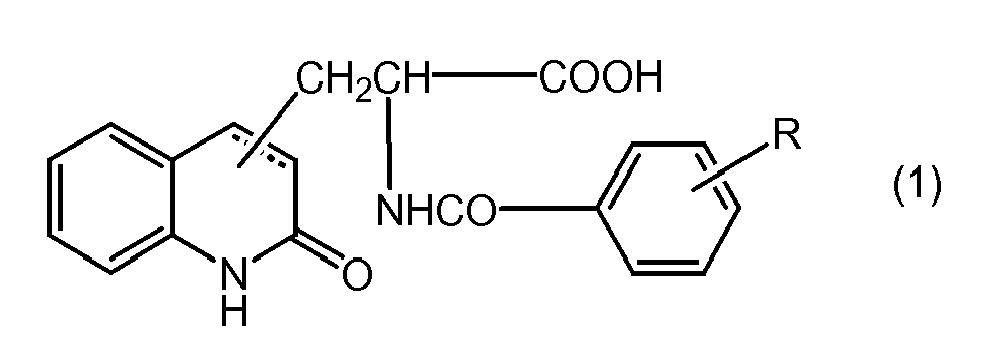
and an amine. - 2. The amine salt of the carbostyril derivative according to the above 1, wherein said carbostyril derivative (1) is 2-(4-chlorobenzoylamino)-3-(2-quinolon-4-yl)propionic acid.
- 3. The amine salt of the carbostyril derivative according to the above 2, wherein said amine is L-arginine.
- 4. The amine salt of the carbostyril derivative according to the above 2, wherein said amine is L-lysine.
- 5. The amine salt of the carbostyril derivative according to the above 2, wherein said amine is ethylenediamine.
- 6. The amine salt of the carbostyril derivative according to the above 2, wherein said amine is tris(hydroxymethyl)-aminomethane.
- 7. The amine salt of the carbostyril derivative according to the above 2, wherein said amine is monoethanolamine.
- 8. The amine salt of the carbostyril derivative according to the above 2, wherein said amine is diethanolamine.
- 9. The amine salt of the carbostyril derivative according to the above 2, wherein said amine is diisopropanolamine.
- 10. The amine salt of the carbostyril derivative according to the above 2, wherein said amine is meglumine.
- 11. A pharmaceutical formulation comprising the amine salt of the carbostyril derivative according to any one of the above 1 - 10 as the active ingredient.
- 12. A pharmaceutical formulation comprising a carbostyril derivative represented by the above formula (1) and an amine, which may be prepared in the form of an aqueous solution by adding an aqueous solvent when used.
- 13. The pharmaceutical formulation to be prepared in a preparation when used according to the above 12, wherein said carbostyril derivative (1) is 2-(4-chlorobenzoylamino)-3-(2-quinolon-4-yl)propionic acid.
- 14. The pharmaceutical formulation to be prepared in a preparation when used according to the above 13, wherein said amine is L-arginine.
- 15. The pharmaceutical formulation to be prepared in a preparation when used according to the above 13, wherein said amine is L-lysine.
- 16. The pharmaceutical formulation to be prepared in a preparation when used according to the above 13, wherein said amine is ethylenediamine.
- 17. The pharmaceutical formulation to be prepared in a preparation when used according to the above 13, wherein said amine is tris(hydroxymethyl)aminomethane.
- 18. The pharmaceutical formulation to be prepared in a preparation when used according to the above 13, wherein said amine is monoethanolamine.
- 19. The pharmaceutical formulation to be prepared in a preparation when used according to the above 13, wherein said amine is diethanolamine.
- 20. The pharmaceutical formulation to be prepared in a preparation when used according to the above 13, wherein said amine is diisopropanolamine.
- 21. The pharmaceutical formulation to be prepared in a preparation when used according to the above 13, wherein said amine is meglumine.
- The halogen atom of group R in the above formula (1) means a fluorine, chlorine, bromine or iodine atom.
- The amine includes an amino acid, a lower alkyl-substituted amine which may have a substituent selected from the group consisting of hydroxy group and amino group, an amino sugar, and the like. The amino acid includes a basic amino acid such as L-arginine, L-lysine, L-histidine, β-amino-alanine, γ-amino- butyrine, ornithine, δ-hydroxy-lysine, canavanine, lombricine, homoarginine, γ-hydroxy-homoarginine, γ-hydroxy-L-arginine, β- alanine, γ-amino-butyric acid, β-amino-isobutyric acid, γ-amino- β-methylenebutyric acid, creatine, rhodoic acid, sarcosine, γ- amino-α-methylenebutyric acid, kynurenine, agritine, L-tryptophan, ibotenic acid, lathyrine, tricholomic acid, quisqualic acid, linatine, ergothioneine, creatinine, and cycloserine.
- The lower alkyl-substituted amine which may have a substituent selected from the group consisting of hydroxy group and amino group includes an amine substituted with 1 to 3 straight or branched chain C1-6 alkyl groups which may further have 1 to 3 substituents selected from the group consisting of hydroxy group and amino group, such as tris(hydroxymethyl)-aminomethane, ethylenediamine, diethanolamine, diisopropanolamine, triethanolamine, triisopropanolamine, hydroxymethylamine, (2-hydroxyethyl)amine, 1-hydroxyethylamine, 3-hydroxypropylamine, 2,3-dihydroxyethylamine, 4-hydroxybutylamine, 3,4-dihydroxybutylamine, 1,1-dimethyl-2-hydroxyethylamine, 5-hydroxypentylamine, 6-hydroxyhexylamine, 2-methyl-3-hydroxypropylamine, 2,3,4-trihydroxybutylamine, aminomethylamine, 1-aminoethylamine, 3-aminopropylamine, 2,3-diaminoethylamine, 4-aminobutylamine, 3,4-diaminobutylamine, 1,1-dimethyl-2-aminoethylamine, 5-aminopentylamine, 6-aminohexylamine, 2-methyl-3-aminopropylamine, 2,3,4-triaminobutylamine, methylamine, ethylamine, propylamine, isopropylamine, butylamine, tert-butylamine, pentylamine, hexylamine, dimethylamine, diethylamine, dipropylamine, dibutylamine, dipentylamine, dihexylamine, N-methyl-N-ethylamine, N-ethyl-N-propylamine, N-methyl-N-butylamine, N-methyl-N-hexylamine, N-methyl-N-(2-hydroxyethyl)amine, N-methyl-N-(2-aminoethyl)amine, N-(2-aminoethyl)-N-(2-hydroxyethyl)amine and the like.
- The amino sugar includes, for example, meglumine (i.e., N-methyl-D-glucamine), D-glucosamine, D-galactosamine, D-mannosamine, mycosamine, kanosamine, neosamine C, N-methyl-L-glucosamine, mycaminose, muramic acid, streptamine and the like.
- Preferably, the amino acid is a basic amino acid such as L-arginine, L-lysine, and L-histidine; the lower alkyl-substituted amine which may have a substituent selected from the group consisting of hydroxy group and amino group is tris(hydroxymethyl)aminomethane, ethylenediamine, monoethanolamine, diethanolamine, diisopropanolamine, triethanolamine, triisopropanolamine and the like; and the amino sugar is meglumine, D-glucosamine and the like.
- The amine salts of the carbostyril derivative can be prepared by reacting the derivative with an appropriate amine in a suitable solvent. The solvent used herein includes, for example, alcohols such as methanol, ethanol, and isopropanol; ketones such as acetone and methyl ethyl ketone; water; and the like; or the mixture thereof. The reaction is completed generally at room temperature to 150°C, preferably at room temperature to about 120°C, for several minutes to 7 days. The amount of the amine used is at least 0.1 mole, preferably 0.1 to 2 moles to 1 mole of the carbostyril derivative.
- Into the reaction system, it may be optionally added an acid such as hydrochloric acid in order to prevent the dissociation of the carbostyril derivative.
- Further, the amine salt of the carbostyril derivative may be formed in the course of preparing the aqueous preparation by adding an amine into an aqueous solution of the carbostyril derivative without the isolating as a salt.
- The compounds of the present invention exhibit antiulcer activities, activities for increasing endogenic-prostaglandin E2, extinction or inhibition of active oxygen, inhibition of IL-8 production, inhibition of granulocyte activation, inhibition of expression of granulocyte adhesion factor, and the like, and are useful as an antiulcer drug, an agent for treating gastritis, a drug having efficacy derived from prostaglandin E2, such as an agent for preventing and treating ulcer, an antioxidant, an agent for preventing, protecting or treating an acute or chronic inflammatory disease. Additionally, they are useful for improving the biocompatibility of an artificial organ and an artificial blood vessel. Furthermore, the compounds of the invention are especially useful for preventing the relapse of peptic ulcer and inflammation.
- The inflammatory diseases include, but not limited thereto, inflammatory dermatoses, such as inflammatory keratosis (psoriasis, etc.) , atopic dermatitis, contact dermatitis and the like; autoimmune diseases which are chronic inflammatory diseases such as chronic rheumatoid, systemic lupus erthematosus(SLE), Behchet's disease and the like; inflammatory liver diseases such as hepatitis B, hepatitis C, alcoholic hepatitis, drug-induced allergic hepatitis and the like; inflammatory renal diseases such as nephritis, glomerulonephritis and the like; inflammatory respiratory diseases, such as bronchitis and the like; stomatitis; laryngitis; vocal cord inflammation; voice disorder; inflammation due to using an artificial organ and an artificial blood vessel; disorder of gastrointestinal tract mucosa and disorder of intestinal mucosa due to nonsteroidal antiinflammatory drug; and the like.
- As to the disorder of intestinal mucosa, cryptogenic simple primary intestine ulcer, nonspecific colonic ulcer, ulcerative colitis due to nonspecific inflammation, Crohn's disease and the like are exemplified, and additinally disorders due to infection, cardiovascular disease, collagen disease, radiations, drugs and the like; etc. are also exemplified.
- Additionally, the compounds of the invention have inhibitory effects of lowering somatostatin-release, antidiabetic effects, urease inhibiting effects and the like and are useful as a somatostatin-release inhibitor, an antidiabetic drug, and an urease inhibitor.
- On the basis of the urease inhibiting effects, the compounds of the invention are useful for preventing and treating the diseases which may be caused by the enhancement of the urease activity by the increase of various bacteria and the production of ammonia, and thus the compounds may be used for preventing and treating disorders of gastric mucosa which may be caused by the production of ammonia by the increase of H. pylori. Additionally, the compounds may be used for improving and treating hyperammonemia and the diseases associated with hyperammonemia by depressing the production of ammonia in an intestinal tract, for example, they may be used for preventing and treating hepatic encephalopathies which are caused from liver diseases such as hepatitis, liver cirrhosis and the like; neuropsychiatric disorders; abnormality in electroencephalogram; and flapping tremor.
- The compounds of the invention also have an increasing effect of goblet cell in eye, an increasing effect of mucus in eye, a facilitating effect of proliferation of corneal epithelial cell, and further an increasing effect of lacrimal fluid, and thus may be useful as a drug for treating dry eye, i.e., dry eye syndrome. Hence, the compounds of the invention may increase the production of mucin by increasing goblet cells in eye and prevent decreasing mucin as observed in dry eye while may hold the aqueous layer by way of increasing mucus in eye. The compounds also exhibit the action of increasing lacrimal fluid and thus are useful as a drug for treating dry eye. Further, the compounds of the invention are not only useful for Sjoegren's syndrome or Stevens-Johnson syndrome which may indicate dry eye syndrome, but also useful as a drug for preventing and/or treating various ophthalmopathies which are indicated by the secondary disease of dry eye or by the reduction of goblet cells and the amount of mucus. Eyeballs affected by dry eye are so easy to be injured. Thus, the compounds of the invention are also useful as a drug for curing eye wound, especially corneal epithelium wound, or an intraocular perfusing and washing agents used in ophthalmological operations (cataract, vitreous body, glaucoma), since the compounds have the effect for accelerating the proliferation of corneal epithelial cells.
- The pharmaceutical composition of the compound of the present invention can be prepared into various forms of common pharmaceutical preparations by formulating the amine salt of carbostyril derivative as the active ingredient. The pharmaceutical formulations of the present invention are especially preferred to aqueous liquid formulations such as injections, ophthalmic solutions, oral solutions, enemas, gargles, ear drops, nasal drops, external liquid preparations and the like, and also including other conventional forms of pharmaceutical formulations, such as tablets, pills, powders, emulsions, granules, capsules, suppositories, aerosols, syrups and the like.
- The aqueous solution preparation of the present invention can be prepared by adding the amine salt of carbostyril derivative into an aqueous solvent such as water, physiological saline and the like. The pharmaceutical formulations to be prepared in the form of a preparation when used, comprising the carbostyril derivative and the amine, can be prepared by adding an aqueous solvent when used, and thereby the amine salt of carbostyril derivative is formed in the preparation.
- In preparing the pharmaceutical formulations of the present invention, conventional additives or excipients, such as a filler, an expander, a binder, a humectant, a disintegrator, a surface activating agent, a lubricant, a flavor, a perfume, a sweetener, a coloring agent, may be also used. Further, sustained release preparations can also be prepared by incorporating a suitable resin and the like. The formulations of the present invention for treating ophthalmopathies are especially preferred to form a pharmaceutical preparation applicable for ophthalmological purpose, such as an ophthalmic solution, an ophthalmic ointment and the like, depending on the symptoms to be applied.
- In case of preparing the injections of the present invention, they are prepared in the form of a solution, an emulsion or a suspension, and generally they are sterilized and preferably made isotonic to the blood. For the purpose of forming into a solution, an emulsion or a suspension, any diluents which are widely used in this field can be applied, for example, solvents such as water, ethyl alcohol, propylene glycol and the like; stearyl alcohols such as ethoxylated isostearyl alcohol, polyoxylated isostearyl alcohol and the like; emulsifying agents such as fatty acid esters of polyoxyethylene sorbitan and the like; suspending agents such as arabic gum, sodium carboxymethyl cellulose, hydroxypropylmethyl cellulose and the like. In the case of preparing an injection solution isotonic to the blood, a sufficient amount of sodium chloride, glucose, D-mannitol or the like may be contained therein. Additionally, conventional dissolving adjuvants such as Polysorbate 80 and the like; buffering agents such as citric acid, sodium citrate, phosphoric acid, lactic acid and the like; soothing agents such as glycerin and the like; and so on may be also be contained therein. Further, when necessary, coloring agents, preservatives, flavors, perfumes, sweeteners and the like, other medicines may be contained therein.
- The pharmaceutical preparations applicable for ophthalmological purpose, such as ophthalmic solutions, ophthalmic ointments and the like, are prepared in accordance with a conventional method by using usual vehicles (diluting agents) acceptable for ophthalmological purpose. Thus, they are prepared by mixing the active ingredient with suitable base material(s), then the mixture is subjected to sterilizing treatment. For example, in case of preparing ophthalmic ointments, conventional emulsion type ointment base, watersoluble type ointment base, suspension type ointment base and the like can be employed. As to typical examples of these base materials, white petrolatum, refined lanolin, liquid paraffin and the like can be exemplified. In case of producing ophthalmic solutions, sterilized distilled water can be employed as typical diluting agent. Further, if necessary, a dissolving additive, a buffering agent, an antioxidant, an antiseptic agent, an isotonic agent, a pH-controlling agent and the like can be formulated with a pharmaceutical preparation applicable for ophthalmological purpose. As to the dissolving additives, sodium carboxymethyl cellulose; polyoxyethyleneglycol ethers, such as polyoxyethylene lauryl ether, polyoxyethylene oleyl ether and the like; polyethylene glycol higher fatty acid esters, such as polyethylene glycol monolaurate, polyethylene glycol monooleate and the like; polyoxyethylene sorbitan monolaurate; polyoxyethylene fatty acid esters and the like can be exemplified. As to the buffering agent, sodium phosphate, sodium hydrogen phosphate, potassium hydrogen phosphate, boric acid, sodium borate, citric acid, sodium citrate, tartaric acid, sodium tartrate, acetic acid, sodium acetate, ε-aminocaproic acid, sodium glutamate and the like can be exemplified. As to the antioxidant, sodium sulfite, sodium pyrosulfite, sodium hydrogen sulfite, sodium thiosulfite, ascorbic acid and the like can be exemplified. As to the antiseptic agent, chlorobutanol, benzalkonium chloride, benzethonium chloride, phenylmercury salt, thimerosal, phenethyl alcohol, methylparaben, propylparaben and the like can be exemplified. As to isotonic agent, sodium chloride, glucose, D-mannitol, glycerin and the like can be exemplified. As to the pH-controlling agent, sodium hydroxide, hydrochloric acid and the like can be exemplified.
- For the purpose of preparing tablets, any known ingredients which are used widely in this field can be applied, for example, excipients such as lactose, white sugar, sodium chloride, glucose, urea, starch, calcium carbonate, kaolin, crystalline cellulose, silicic acid and the like; binders such as water, ethanol, propanol, simple syrup, glucose solution, starch solution, gelatin solution, carboxymethyl cellulose, shellac, methyl cellulose, potassium phosphate, polyvinyl pyrrolidone and the like; disintegrators such as dry starch, sodium alginate, agar powder, laminaran powder, sodium hydrogen carbonate, calcium carbonate, polyoxyethylene sorbitan fatty acid esters, sodium lauryl sulfate, monoglycerides of stearic acid, starch, lactose and the like; disintegration inhibitors such as white sugar, stearin, cacao butter, hydrogenated oil and the like; absorption accelerators such as quaternary ammonium base, sodium lauryl sulfate and the like; humectants such as glycerin, starch and the like; adsorbents such as starch, lactose, kaolin, bentonite, colloidal silicic acid and the like; lubricants such as refined talc, stearic acid salts, boric acid powder, polyethylene glycols and the like. Further, when necessary, the tablets can be prepared in the form of common coated tablets, for example, sugar-coated tablets, gelatin film-coated tablets, enteric film-coated tablets, film-coated tablets, or in the form of double-layers tablets and multiple-layers tablets.
- For the purpose of preparing pills, any known ingredients which are widely used in this field can be applied, for example, excipients such as glucose, lactose, starch, cacao butter, hydrogenated vegetable oils, kaolin, talc and the like; binders such as arabic gum powder, tragacanth gum powder, gelatin, ethanol and the like; and disintegrators such as laminaran, agar and the like can be exemplified. For the purpose of preparing suppositories, any known ingredients which are widely used in this field can be applied, for example, polyethylene glycols, cacao butter, higher alcohols, esters of higher alcohol, gelatin, semi-synthesized glycerides and the like can be exemplified.
- The aerosols are usually prepared in the form of a sterilized liquid or suspension, and therein propellants are added. For the purpose of preparing the liquids and suspensions, any diluents which are used widely in this field can be applied, for example, above-mentioned diluents for the injections can be exemplified. Any propellants which are used widely in this field can be applied, for example, chlorofluorocarbons such as flon 12 and the like; liquefied gas-propellants such as flon 123 and the like; and compressed gas-propellants such as nitrogen, carbon dioxide and the like can be exemplified. The aerosols may include conventional dissolving adjuvants, buffering agents and the like, further when necessary, coloring agents, preservatives, flavors, perfumes, sweeteners and the like.
- The amount of the amine salt of the carbostyril derivative of the present invention to be contained in the formulation is not specifically restricted and it can suitably be selected from a wide range, and generally 1 to 70 %, preferably 5 to 50 % by weight of the whole composition. For especially preferably pharmaceutical preparations applicable for ophthalmological purpose, the amount is generally 0.005 to 5 %, preferably 0.01 to 3 % by weight of the whole composition. Method for the administration is not specifically restricted. Thus, the pharmaceutical preparation may be administered by acceptable methods, depending upon the form of each preparation, the age of patient, the distinction of sex and other conditions, as well as the severity of diseases of the patient. For example, tablets, pills, a liquid preparation, a suspension preparation, an emulsion preparation, a granular preparation, a syrup preparation and capsules are orally administered. An injection preparation is intravenously administered alone or in combination with a conventional auxiliary solution such as a glucose solution, an amino acid solution and the like. Additionally, when necessary, the injection preparation is administered alone intramuscularly, intradermally, subcutaneously or intraperitoneally. Suppositories are endorectally administered. The present pharmaceutical preparations applicable for ophthalmological purpose may be administered by a method similar to those of conventional preparations, for example, ophthalmic ointments are administered on eyes. Ophthalmic solutions are administered by a method similar to those of conventional preparations, for example, 1 to 2 drops of an ophthalmic solution is dropped in eyes from a suitable eye drop container, or an ophthalmic solution may be administered in eyes by use of a spraying device.
- Dosage of the agent of the present invention may be suitably selected depending upon the method for administration, the age of patient, the distinction of sex, and other conditions, as well as the severity of diseases of the patient, and generally the agent of the invention may preferably contain 0.6 to 50 mg/kg of body weight/day of the carbostyril derivative (1). Further 10 to 1000 mg of the active ingredient may be contained in the administrative unit form. The pharmaceutical preparations applicable for ophthalmological purpose, such as an ophthalmic solution or an ophthalmic ointment, are administered within a range of 1 to 15 times, preferably 1 to 10 times a day.
- The amine salts of carbostyril derivative of the present invention have a superior water solubility, and are useful for the preparation in the form of a solution such as injections, ophthalmic solutions, oral solutions, enemas, gargles, ear drops, nasal drops, external liquid preparations and the like. Especially, they have some advantages such as being easy to keep the uniformity of content; not necessary to control the particle distribution; not necessary to add the suspending agent, dispersing agent and the like; easy to carry out the terminal sterilization by steam or the sterilization by filtration; etc. and thus the desired pharmaceutical products can be prepared industrially, simply and easily. Especially, the ophthalmic solutions of the invention have some advantages, for example, not to need the complicated re-dispersion like a suspension preparation, and good feelings in use such as good looks.
- The present invention will be explained more specifically by the way of the following examples, examples of pharmaceutical preparation and pharmacologic experiments.
- A suspension of 3.88 g of 2-(4-chlorobenzoylamino)-3-(2-quinolon-4-yl)propionic acid (10.5 mmol) and 2.00 g of L-arginine (11.5 mmol) in 200 mL of ethanol was refluxed for 30 minutes. To the mixture was added 20 mL of water, and the reflux was continued, then the reaction product was temporarily completely dissolved. After that, precipitates appeared under the reflux. After stopped the heating, the reaction mixture was cooled to room temperature, and further cooled in ice-water. The precipitates were taken by filtration through a Nutsche funnel, washed with ethanol on the Nutsche funnel, and dried with a blower at 50°C for 20 hours to give 5.38 g of 2-(4-chlorobenzoylamino)-3-(2-quinolon-4-yl)propionic acid·L-arginine salt (95% yield) as a white crystal.
1H NMR (DMSO-d6) δ = 1.43 - 1.92 (4H, m), 2.95 - 3.85 (5H, m), 4.41 - 4.58 (1H, m), 6.42 (1H, s), 7.20 (1H, dd, J = 8.1, 7.6 Hz), 7.30 (1H, d, J = 8.2 Hz), 7.47 (1H, dd, J = 8.2, 7.6 Hz), 7.49 (2H, d, J = 8.4 Hz), 7.81 (2H, d, J = 8.4 Hz), 7.96 (1H, d, J = 8.1 Hz), 8.34 ppm (1H, d, J = 8.2 Hz). - A suspension of 1.94 g of 2-(4-chlorobenzoylamino)-3-(2-quinolon-4-yl)propionic acid (5.23 mmol) and 0.84 g of L-lysine (5.76 mmol) in ethanol (100 mL) was refluxed for 30 minutes. To the mixture was added 25 mL of water, and the reflux was continued, then the reaction product was completely dissolved. After that, precipitates appeared under the reflux. After stopped the heating, the reaction mixture was cooled to room temperature and further cooled in ice-water. The precipitates were taken by filtration through a Nutsche funnel, washed with ethanol on the Nutsche funnel, and dried with a blower at 60°C over night to give 1.46 g of 2-(4-chlorobenzoylamino)-3-(2-quinolon-4-yl)propionic acid·L-lysine salt as a white crystal (54% yield).
1H NMR (DMSO-d6) δ = 1.18 - 1.80 (6H, m), 2.74 (2H, br.d, J = 6.7 Hz), 3.08 (1H, br.dd, J = 13.6, 9.8 Hz), 3.29 (1H, br.t, J = 5.8 Hz), 3.43 - 3.59 (1H, m), 4.48 (1H, br.ddd, J = 9.8, 8.0, 3.6 Hz), 6.44 (1H, s), 7.18 (1H, dd, J = 8.1, 7.5 Hz), 7.31 (1H, d, J = 7.9 Hz), 7.45 (1H, dd, J = 7. 9, 7.5 Hz), 7.48 (2H, d, J = 8.5 Hz), 7.81 (2H, d, J = 8.5 Hz), 7.96 (1H, d, J = 8.1 Hz),
8.40 ppm (1H, d, J = 8.0 Hz) -
- (A): A suspension of 2.00 g of 2-(4-chlorobenzoylamino)-3-(2-quinolon-4-yl)propionic acid (5.39 mmol) and 0.18 mL of ethylenediamine (2.69 mmol) in 100 mL of ethanol was refluxed for 30 minutes. Water was added thereto by each 5 mL portion until the reaction product was dissolved. The reaction product was completely dissolved when 35 mL of water in total was added. After the heating was stopped, the mixture was cooled to room temperature, and then the crystals were precipitated. After the reaction mixture was further cooled in ice-water, the precipitated crystals were taken by filtration through a Nutsche funnel, and dried with a blower at 60°C to give 1.92 g 2-(4-chlorobenzoylamino)-3-(2-quinolon-4-yl)propionic acid·1/2 ethylenediamine salt (89% yield) as a white crystal.
- (B): A suspension of 2.00 g of 2-(4-chlorobenzoylamino)-3-(2-quinolon-4-yl)propionic acid (5.39 mmol), 0.40 mL of ethylenediamine (5.98 mmol) in 100 mL of ethanol was refluxed for 30 minutes. Water was added thereto by each 5 mL portion until the reaction product was dissolved. The reaction product was completely dissolved when 25 mL of water in total was added. Then, the heating was stopped and the mixture was cooled to room temperature, but any crystals were not precipitated. So the solvent was removed off under a reduced pressure. To the residue was added 50 mL of ethanol, dispersed under a reflux for the purification and cooled to room temperature. The resulting crystals were taken by filtration through a Nutsche funnel, and dried with a blower at 60°C to give 1.96 g of 2-(4-chlorobenzoylamino)-3-(2-quinolon-4-yl)propionic acid·1/2 ethylenediamine salt (91% yield) as a white crystal.
1H NMR (DMSO-d6) δ = 2.87 (2H, s), 3.11 (1H, br.dd, J = 13.9, 9.8 Hz), 3.52 (1H, br.dd, J = 13.9, 3.5 Hz), 4.50 - 4.57 (1H, m), 6.41 (1H, s), 7.20 (1H, dd, J = 8.0, 7.6 Hz), 7.30 (1H, d, J = 7.5 Hz), 7.48 (1H, dd, J = 8.0, 7.5 Hz), 7.52 (2H, d, J = 8.5 Hz), 7.80 (2H, d, J = 8.5 Hz), 7.93 (1H, d, J = 7.6 Hz), 8.40 ppm (1H, d, J = 8.0 Hz). - A suspension of 2.00 g of 2-(4-chlorobenzoylamino)-3-(2-quinolon-4-yl)propionic acid (5.39 mmol) and 0.72 g of tris-(hydroxymethyl)aminomethane (5.94 mmol) in 100 mL of ethanol was refluxed for 30 minutes. Water was added thereto by each 5 - 10 mL pc heating was stopped and the mixture was cooled to room temperature and further cooled with ice-water, but any crystals were not precipitated. And then the solvent was removed off under a reduced pressure. To the residue was added ethanol and the mixture was concentrated under a reduced pressure. To the residue was added 50 mL of ethanol, and the mixture was stirred at room temperature. The resulting precipitates were separated by filtration through a Nutsche funnel, and dried with a blower at 60°C to give 2.58 g of 2-(4-chlorobenzoylamino)-3-(2-quinolon-4-yl)propionic acid · tris(hydroxymethyl)aminomethane salt (97% yield) as a white crystal.
1H NMR (DMSO-d6) δ = 3.07 (1H, br.dd, J = 13.8, 10.1 Hz), 3.47 (6H, s), 3.54 (1H, br.dd, J = 13.9, 3.3 Hz), 4.49 - 4.56 (1H, m), 6.41 (1H, s), 7.21 (1H, dd, J = 8.1, 7.7 Hz), 7.31 (1H, d, J = 7.5 Hz), 7.45 (1H, dd, J = 8.1, 7.5 Hz), 7.51 (2H, d, J = 8.5 Hz), 7.81 (2H, d, J = 8.5 Hz), 7.94 (1H, d, J = 7.7 Hz), 8.38 ppm (1H, d, J = 8.3 Hz). - A suspension of 2.00 g of 2-(4-chlorobenzoylamino)-3-(2-quinolon-4-yl)propionic acid (5.39 mmol) and 0.62 g of diethanolamine (5.90 mmol) in 100 mL of ethanol was refluxed for 30 minutes. The reaction product was completely dissolved without adding water. Then, the heating was stopped and the mixture was cooled to room temperature and further cooled with ice-water. The resulting precipitates were separated by filtration through a Nutsche funnel, and dried with a blower at 60°C to give 1.95 g of 2-(4-chlorobenzoylamino)-3-(2-quinolon-4-yl)propionic acid·diethanolamine salt (76% yield) as a white crystal.
1H NMR (DMSO-d6) δ = 2.89 (4H, t, J = 5.4 Hz), 3.10 (1H, br.dd, J = 13.9, 9.9 Hz), 3.52 (1H, br.dd, J = 13.9, 3.6 Hz), 3.61 (4H, t, J = 5.4 Hz), 4.50 - 4.56 (1H, m), 6.41 (1H, s), 7.21 (1H, dd, J = 8.1, 7.6 Hz), 7.31 (1H, d, J = 7.5 Hz), 7.48 (1H, dd, J = 8.1, 7.5 Hz), 7.52 (2H, d, J = 8.5 Hz), 7.81 (2H, d, J = 8.5 Hz), 7.94 (1H, d, J = 7. 6Hz), 8.44 ppm (1H, d, J = 8.2 Hz). - A suspension of 2.00 g of 2-(4-chlorobenzoylamino)-3-(2-quinolon-4-yl)propionic acid (5.39 mmol) and 0.79 g of diisopropanolamine (5.93 mmol) in 100 mL of ethanol was refluxed for 30 minutes. The reaction product was completely dissolved without adding water. Then, the heating was stopped and the mixture was cooled to room temperature and further cooled with ice-water. The resulting precipitates were separated by filtration through a Nutsche funnel, and dried with a blower at 60°C to give 1.66 g of 2-(4-chlorobenzoylamino)-3-(2-quinolon-4-yl)propionic acid·diisopropanolamine salt (61% yield) as a white crystal.
1H NMR (DMSO-d6) δ = 1.07 (3H, d, J = 6.2 Hz), 1.13 (3H, d, J = 6.2 Hz), 2.54 - 2.68 (2H, m), 2.77 (2H, dd, J = 12.2, 3.5 Hz), 3.08 - 3.18 (1H, m), 3.43 - 3.56 (1H, m), 3.75 - 3.92 (2H, m), 4.47 - 4.60 (1H, m), 6.41 (1H, s), 7.21 (1H, dd, J = 8.0, 7.7 Hz), 7.30 (1H, d, J = 7.5 Hz), 7.49 (1H, t, J = 7.5 Hz), 7.52 (2H, d, J = 8.6 Hz), 7.81 (2H, d, J = 8.6 Hz), 7.93 (1H, d, J = 7.7 Hz), 8.48 ppm (1H, d, J = 8.1 Hz). - To 3.7 g of 2-(4-chlorobenzoylamino)-3-(2-quinolon-4-yl)-propionic acid (10 mmol) was added 1 mol/L aqueous solution of meglumine (10 mL, 10 mmol), and heated at 50°C to be dissolved. To the solution was added an aqueous solution of equimolar mixture of meglumine and hydrochloric acid (0.5 mol/L; 20 mL), and the mixture was cooled. The resulting precipitates were separated by filtration, washed with water, and dried under a reduced pressure at room temperature to give 0.9 g of 2-(4-chlorobenzoylamino)-3-(2-quinolon-4-yl)propionic acid· meglumine salt (16% yield) as a white crystal.
1H NMR (DMSO-d6) δ = 2.82 - 3.14 (3H, m), 3.37 - 3.73 (6H, m), 3.82 - 3.94 (1H, m), 4.52 (1H, ddd, J = 9.6, 8.2, 3.5 Hz), 6.41 (1H, s), 7.20 (1H, dd, J = 8.0, 7.2 Hz), 7.30 (1H, d, J = 7.8 Hz), 7.48 (1H, dd, J = 7.8, 7.2 Hz), 7.51 (2H, d, J = 8.5 Hz), 7.80 (2H, d, J = 8.5 Hz), 7.94 (1H, d, J = 8.0 Hz), 8.37 ppm (1H, d, J = 8.2 Hz). - 0.5 g of the salt obtained in the above Examples 1 - 7 was transferred into a 50mL centrifugal tube, and 5 mL of water was added thereto, and the mixture was shaken by a shaker for 3 hours (5 days for meglumine salt) in a thermostat (25°C). After shaking, the mixture was filtered through a 0.45 µm membrane filter (0.2 µm for meglumine salt). 1 mL of the filtrate was precisely pipetted and thereto was added 50% DMF so as to be totally 50 mL in precise. 2 mL of this solution was precisely pipetted and thereto was added 50% DMF so as to be totally 20 mL in precise to give a sample solution.
- 0.01 g of Compound A was dissolved in 5 mL of dimethylformamide (DMF) and thereto was added 50% DMF so as to be totally 100 mL precisely to give the standard solution (1). 5 mL of the standard solution (1) was precisely pipetted and thereto was added 50% DMF so as to be totally 10 mL in precise to give the standard solution (2). 1 mL of the standard solution (1) was precisely pipetted and thereto was added 50% DMF so as to be totally 10 mL in precise to give the standard solution (3). 1 mL of the standard solution (3) was precisely pipetted and thereto was added 50% DMF so as to be totally 10 mL in precise to give the standard solution (4).
- Using each 10 µL of the sample solutions and the standard solutions, the liquid chromatographic analyses were carried out in the following conditions. A calibration curve was drawn based on the peak areas of Compound A and the concentrations of Compound A obtained from the standard solutions (1) - (4). Using this calibration curve, the concentration of Compound A in the sample solution was calculated from the peak area of compound A of the sample solution and the data were corrected by means of dilution ratio, and thereby the solubilities (%) of various salts were determined.
Test Conditions Detector UV Spectrophotometer (Wave Length : 254 nm) Column Cosmosil 5C18 (4.6 mm I.D. X 15 cm) Column Temperature A constant temperature of around 25°C Mobile Phase 0.58 g of anhydrous sodium monohydrogen phosphate and 2.0 g of potassium dihydrogen phospate were dissolved in 1000 mL of water. To 830 mL of the solution was added 170 mL of acetonitrile. Flow Rate 1.0 mL/min Compounds Solubility (%) Compound A-L-arginine salt 1.0 % Compound A-L-lysine salt 2.2 % Compound A·1/2 ethylenediamine salt 0.05 % Compound A·diethanolamine salt 4.1 % Compound A·diisopropanolamine salt 2.9 % Compound A·tris(hydroxymethyl)aminomethane salt 0.2 % Compound A·meglumine salt 8.6 % Compound A 0.0006 % - To Compound A was added an equimolar amount of each amine compound and then added water in such an amount that the salt would not be completely dissolved, and shaken by a shaker for 7 days in a thermostat (25°C). And then as to a sample to which arginine was added, the suspension was filtered through a 0.2 µm membrane filter. As to samples to which lysine, diisopropanolamine, meglumine, monoethanolamine or diethanolamine was added, the mixture could not be filtered due to the solidification, and hence, water was further added to the mixture until it became to be possible to be filtered. And then the mixture was filtrated through a 0.2 µm membrane filter. According to the same method as Example 8, the solubilities (%) of each salt was measured by HPLC.
Compound Solubility (%) Compound A·L-arginine salt 0.78 % Compound A·L-lysine salt >3.2 % Compound A·diisopropanolamine salt >7.4 % Compound A·meglumine salt >12 % Compound A·monoethanolamine salt >3.3 % Compound A·diethanolamine salt >7.4 % -
2-(4-Chlorobezoylamino)-3-(2-quinolon-4-yl)-propionic acid·diethanolamine salt 0.2 g Benzalkonium chloride 0.01 g Sodium dihydrogen phosphate 0.56 g Potassium dihydrogen phosphate 0.8 g Distilled water q.s. Total 100.0 mL - Above ingredients were dissolved in distilled water and sterilized with a suitable filter to prepare the formulation of the present invention in the form of an ophthalmic solution.
-
2-(4-Chlorobenzoylamino)-3-(2-quinolon-4-yl)-propionic acid·L-arginine salt 150 g Avicel (Trademark, Asahi KASEI) 40 g Corn starch 30 g Magnesium stearate 2 g Hydroxypropylmethyl cellulose 10 g Polyethylene glycol-6000 3 g Castor oil 40 g Methanol 40 g - The compound of the invention, Avicel, corn starch and magnesium stearate were mixed and milled, and then compressed with punches (10 mm R for sugar-coat). The resulting tablets were coated with a film coating agent comprising hydroxypropylmethyl cellulose, polyethylene glycol-6000, castor oil and methanol to prepare the film coating tablets.
-
2-(4-Chlorobenzoylamino)-3-(2-quinolon-4-yl)propionic acid·diisopropanolamine salt 150g Citric acid 1.0g Lactose 33.5g Dicalcium phosphate 70.0g Pluronic F-68 30.0g Sodium lauryl sulfate 15.0g Polyvinyl pyrrolidone 15.0g Polyethylene glycol (Carbowax 1500) 4.5g Polyethylene glycol (Carbowax 6000) 45.0g Corn starch 30.0g Dry sodium lauryl sulfate 3.0g Dry magnesium stearate 3.0g ethanol q.s. - The compound of the present invention, citric acid, lactose, dicalcium phosphate, Pluronic F-68 and sodium lauryl sulfate are mixed. The above mixture is screened through a No. 60 screen and wet-granulated with alcoholic solution comprising polyvinylpyrrolidone, Carbowax 1500 and 6000. When necessary, some alcohol is added to make the powder to paste-like solid. Corn starch is added thereto, the mixing is continued to form uniform particles. The granules are sieved through No. 10 screen, put on a tray and dried at 100°C for 12 - 14 hours in an oven. The dried granules are sieved through No. 16 screen, to the sieved granules are added dry sodium lauryl sulfate and dry magnesium stearate, then the whole ingredients are mixed and compressed into the shape of desired form by using a tabletting machine. The core portions are treated with a varnish, the surfaces thereof are sprayed with talc for preventing the surfaces from the absorption of moisture. The surface of the core portions are further coated with a primary coating layer. The surface are further coated with a varnish to make a sufficient number of layers for preparing coated tablets for oral administration. In order to make the coated tablets into complete spherical form and to make the surfaces smooth, the coated tablets are further coated with primary coating layers and smoothing coating layers. The coated tablets are color-coated until the desired color of the surface is obtained. After dried, the coated tablets are polished to make them uniform gloss.
-
2-(4-Chlorobenzoylamino)-3-(2-quinolon-4-yl)propionic acid·L-lysine salt 2 g Lactic acid 0.01 g Sodium lactate 0.1 g D-Mannitol 3.5 g Distilled water q.s. Total 100 mL - The above-mentioned compound of the invention and the additives are dissolved in distilled water, transferred into glass vials and then sterilized by steam to prepare the injectable solution.
-
2-(4-chlorobenzoylamino)-3-(2-quinolon-4-yl)propionic acid·meglumine salt 2 g Citric acid 1.0 g Sodium citrate 0.3 g Sucrose 15 g Methylparaben 0.2 g Propylparaben 0.02 g ethanol 5 mL Orange flavor 0.1 g Red No.3 q.s. Distilled water q.s. Total 100 mL - The above-mentioned compound of the invention and the additives are formulated to prepare the oral solution.
- The amine salts of carbostyril derivative of the present invention have superior water solubility, and are especially useful for the preparation of formulations in the form of an aqueous solution, such as injections, ophthalmic solutions, oral solutions and the like; additionally keep the superior pharmacological effectiveness of the carbostyril derivatives, such as antiulcer activity, activities for increasing endogenic-prostaglandin E2, extinction or inhibition of active oxygen, inhibition of IL-8 production, inhibition of granulocyte activation, inhibition of expression of granulocyte adhesion factor, inhibitory effects of lowering somatostatin-release, antidiabetic activity, urease inhibitory activity, and further an increasing of goblet cell in eye, an increasing of mucus in eye, an increasing of lacrimal fluid; and are useful as drugs for treating various diseases, especially as ophthalmic drops for treating various ophthalmopathy such as dry eye.
Claims (9)
- An amine salt of a carbostyril derivative formed from a carbostyril derivative represented by the formula (1):
 R is a halogen atom,the substituted position of the side chain is 3- or 4-position in the carbostyril skeleton, andthe bonding between 3- and 4-positions of the carbostyril skeleton is a single bond or a double bond; andan amino acid.
 - The amine salt of the carbostyril derivative according to claim 1, wherein said carbostyril derivative (1) is 2-(4-chlorobenzoylamino)-3-(2-quinolon-4-yl)propionic acid.
- The amine salt of the carbostyril derivative according to claim 2, wherein said amine is L-arginine.
- The amine salt of the carbostyril derivative according to claim 2, wherein said amine is L-lysine.
- A pharmaceutical formulation comprising the amine salt of the carbostyril derivative according to any one of claims 1 - 4 as the active ingredient.
- A pharmaceutical formulation which is prepared in the form of an aqueous solution by adding an aqueous solvent when used, comprising a carbostyril derivative represented by the formula (1):
 R is a halogen atom,the substituted position of the side chain is 3- or 4-position in the carbostyril skeleton, andthe bonding between 3- and 4-positions of the carbostyril skeleton is a single bond or a double bond; andan amino acid.
 - The pharmaceutical formulation to be prepared in a preparation when used according to claim 6, wherein said carbostyril derivative (1) is 2-(4-chlorobenzoylamino)-3-(2-quinolon-4-yl)propionic acid.
- The pharmaceutical formulation to be prepared in a preparation when used according to claim 7, wherein said amine is L-arginine.
- The pharmaceutical formulation to be prepared in a preparation when used according to claim 7, wherein said amine is L-lysine.
Priority Applications (3)
| Application Number | Priority Date | Filing Date | Title |
|---|---|---|---|
| PL10174397T PL2253619T3 (en) | 2004-01-21 | 2005-01-20 | Amine salt of carbostyril derivative |
| SI200531494T SI2253619T1 (en) | 2004-01-21 | 2005-01-20 | Amine salt of carbostyril derivative |
| CY20121100442T CY1112723T1 (en) | 2004-01-21 | 2012-05-11 | SALT AMINE CARBOSTYRIL PRODUCER |
Applications Claiming Priority (2)
| Application Number | Priority Date | Filing Date | Title |
|---|---|---|---|
| JP2004013402 | 2004-01-21 | ||
| EP05704144.4A EP1706383B1 (en) | 2004-01-21 | 2005-01-20 | Amine salt of carbostyril derivative useful for the treatment of, inter alia, gastric ulcer |
Related Parent Applications (2)
| Application Number | Title | Priority Date | Filing Date |
|---|---|---|---|
| EP05704144.4 Division | 2005-01-20 | ||
| EP05704144.4A Division-Into EP1706383B1 (en) | 2004-01-21 | 2005-01-20 | Amine salt of carbostyril derivative useful for the treatment of, inter alia, gastric ulcer |
Publications (2)
| Publication Number | Publication Date |
|---|---|
| EP2253619A1 true EP2253619A1 (en) | 2010-11-24 |
| EP2253619B1 EP2253619B1 (en) | 2012-03-14 |
Family
ID=34805383
Family Applications (2)
| Application Number | Title | Priority Date | Filing Date |
|---|---|---|---|
| EP05704144.4A Expired - Lifetime EP1706383B1 (en) | 2004-01-21 | 2005-01-20 | Amine salt of carbostyril derivative useful for the treatment of, inter alia, gastric ulcer |
| EP10174397A Expired - Lifetime EP2253619B1 (en) | 2004-01-21 | 2005-01-20 | Amine salt of carbostyril derivative |
Family Applications Before (1)
| Application Number | Title | Priority Date | Filing Date |
|---|---|---|---|
| EP05704144.4A Expired - Lifetime EP1706383B1 (en) | 2004-01-21 | 2005-01-20 | Amine salt of carbostyril derivative useful for the treatment of, inter alia, gastric ulcer |
Country Status (22)
| Country | Link |
|---|---|
| US (2) | US7732611B2 (en) |
| EP (2) | EP1706383B1 (en) |
| JP (1) | JP4516962B2 (en) |
| KR (1) | KR100844762B1 (en) |
| CN (1) | CN1934086B (en) |
| AR (1) | AR047438A1 (en) |
| AT (1) | ATE549318T1 (en) |
| AU (1) | AU2005206430B2 (en) |
| BR (1) | BRPI0506982A (en) |
| CA (1) | CA2553231C (en) |
| CY (2) | CY1112723T1 (en) |
| DK (2) | DK1706383T3 (en) |
| ES (2) | ES2382133T3 (en) |
| HU (1) | HUE027990T2 (en) |
| MY (1) | MY148416A (en) |
| PL (2) | PL1706383T3 (en) |
| PT (2) | PT1706383E (en) |
| RU (1) | RU2372336C2 (en) |
| SG (1) | SG149854A1 (en) |
| SI (2) | SI2253619T1 (en) |
| TW (1) | TWI340650B (en) |
| WO (1) | WO2005070892A1 (en) |
Families Citing this family (6)
| Publication number | Priority date | Publication date | Assignee | Title |
|---|---|---|---|---|
| US6187197B1 (en) * | 1998-10-28 | 2001-02-13 | Marvin Haddock | Multi-stage engine coolant recycling process |
| TWI340650B (en) * | 2004-01-21 | 2011-04-21 | Otsuka Pharma Co Ltd | Amine saly of carbostyril derivative |
| WO2009022674A1 (en) * | 2007-08-10 | 2009-02-19 | Otsuka Pharmaceutical Co., Ltd. | Medical composition containing rebamipide |
| WO2009126695A2 (en) * | 2008-04-08 | 2009-10-15 | Dynamis Therapeutics, Inc. | Method for treating or preventing dry eye disorders using alkylamino-polyhydroxyalkanes |
| US20110124682A1 (en) * | 2008-06-19 | 2011-05-26 | Sumida Shun-Ichiro | Pharmaceutical composition comprising rebamipide |
| CN103476753B (en) * | 2011-02-25 | 2015-12-09 | 诺弗米克斯有限公司 | New rebamipide mixture and eutectic |
Citations (3)
| Publication number | Priority date | Publication date | Assignee | Title |
|---|---|---|---|---|
| JPS6335623B2 (en) | 1982-07-05 | 1988-07-15 | Otsuka Pharma Co Ltd | |
| WO1995012579A1 (en) | 1993-11-05 | 1995-05-11 | Otsuka Pharmaceutical Company, Limited | Bismuth salt of carbostyril derivatives for the treatment of peptic ulcers |
| JPH08295673A (en) | 1995-04-26 | 1996-11-12 | Otsuka Pharmaceut Co Ltd | Bismuth salt of carbostyril derivative |
Family Cites Families (13)
| Publication number | Priority date | Publication date | Assignee | Title |
|---|---|---|---|---|
| JPS517614Y2 (en) * | 1971-02-12 | 1976-03-01 | ||
| FI80022C (en) * | 1982-07-05 | 1990-04-10 | Otsuka Pharma Co Ltd | FOERFARANDE FOER FRAMSTAELLNING AV ETT NYTT, TERAPEUTISKT ANVAENDBART KARBOSTYRILDERIVAT. |
| DE69207560T2 (en) * | 1991-06-07 | 1996-06-27 | Otsuka Pharma Co Ltd | Antidiabetic |
| TW227558B (en) * | 1992-05-14 | 1994-08-01 | Otsuka Pharma Co Ltd | |
| US5415872A (en) * | 1992-06-22 | 1995-05-16 | Digestive Care Inc. | Compositions of gastric acid-resistant microspheres containing salts of bile acids |
| JP2872546B2 (en) * | 1992-11-26 | 1999-03-17 | 大塚製薬株式会社 | Intestinal mucosal damage protective agent |
| CA2150546C (en) * | 1993-10-21 | 2004-11-09 | Takahide Matsuda | Agent for inhibiting production of interleukin-8 |
| AR004214A1 (en) | 1995-10-12 | 1998-11-04 | Otsuka Pharma Co Ltd | A PREPARATION OF OPHTHALMIC DROPS FOR THE CURE OF OPHTHALMIC DISEASES |
| GB9613455D0 (en) * | 1996-06-27 | 1996-08-28 | Aston Molecules Ltd | Analogues or derivatives of quercetin |
| JP2005519949A (en) * | 2002-03-11 | 2005-07-07 | ノバルティス アクチエンゲゼルシャフト | Nateglinide salt |
| KR20040104020A (en) | 2003-06-02 | 2004-12-10 | 진양제약주식회사 | A new rebamipide lysinate, rebamipide argininate and pharmaceutical preparation containing the same as active substance |
| TWI340650B (en) * | 2004-01-21 | 2011-04-21 | Otsuka Pharma Co Ltd | Amine saly of carbostyril derivative |
| JP4719917B2 (en) | 2007-03-30 | 2011-07-06 | 国立大学法人 岡山大学 | Azuki raw material varieties judgment method of azuki bean processed food |
-
2005
- 2005-01-18 TW TW094101386A patent/TWI340650B/en not_active IP Right Cessation
- 2005-01-19 MY MYPI20050200A patent/MY148416A/en unknown
- 2005-01-20 ES ES10174397T patent/ES2382133T3/en not_active Expired - Lifetime
- 2005-01-20 JP JP2006520510A patent/JP4516962B2/en not_active Expired - Lifetime
- 2005-01-20 BR BRPI0506982-3A patent/BRPI0506982A/en not_active IP Right Cessation
- 2005-01-20 ES ES05704144.4T patent/ES2544327T3/en not_active Expired - Lifetime
- 2005-01-20 HU HUE05704144A patent/HUE027990T2/en unknown
- 2005-01-20 PT PT57041444T patent/PT1706383E/en unknown
- 2005-01-20 AU AU2005206430A patent/AU2005206430B2/en not_active Ceased
- 2005-01-20 RU RU2006129945/04A patent/RU2372336C2/en not_active IP Right Cessation
- 2005-01-20 WO PCT/JP2005/001034 patent/WO2005070892A1/en not_active Ceased
- 2005-01-20 SI SI200531494T patent/SI2253619T1/en unknown
- 2005-01-20 AT AT10174397T patent/ATE549318T1/en active
- 2005-01-20 PL PL05704144T patent/PL1706383T3/en unknown
- 2005-01-20 EP EP05704144.4A patent/EP1706383B1/en not_active Expired - Lifetime
- 2005-01-20 KR KR1020067016600A patent/KR100844762B1/en not_active Expired - Fee Related
- 2005-01-20 DK DK05704144.4T patent/DK1706383T3/en active
- 2005-01-20 US US10/586,453 patent/US7732611B2/en not_active Expired - Fee Related
- 2005-01-20 CA CA2553231A patent/CA2553231C/en not_active Expired - Fee Related
- 2005-01-20 PL PL10174397T patent/PL2253619T3/en unknown
- 2005-01-20 DK DK10174397.9T patent/DK2253619T3/en active
- 2005-01-20 EP EP10174397A patent/EP2253619B1/en not_active Expired - Lifetime
- 2005-01-20 SG SG200900369-0A patent/SG149854A1/en unknown
- 2005-01-20 PT PT10174397T patent/PT2253619E/en unknown
- 2005-01-20 SI SI200531992T patent/SI1706383T1/en unknown
- 2005-01-20 AR ARP050100199A patent/AR047438A1/en not_active Application Discontinuation
- 2005-01-20 CN CN2005800086478A patent/CN1934086B/en not_active Expired - Fee Related
-
2010
- 2010-04-26 US US12/662,610 patent/US8222276B2/en not_active Expired - Fee Related
-
2012
- 2012-05-11 CY CY20121100442T patent/CY1112723T1/en unknown
-
2015
- 2015-10-06 CY CY20151100891T patent/CY1116773T1/en unknown
Patent Citations (3)
| Publication number | Priority date | Publication date | Assignee | Title |
|---|---|---|---|---|
| JPS6335623B2 (en) | 1982-07-05 | 1988-07-15 | Otsuka Pharma Co Ltd | |
| WO1995012579A1 (en) | 1993-11-05 | 1995-05-11 | Otsuka Pharmaceutical Company, Limited | Bismuth salt of carbostyril derivatives for the treatment of peptic ulcers |
| JPH08295673A (en) | 1995-04-26 | 1996-11-12 | Otsuka Pharmaceut Co Ltd | Bismuth salt of carbostyril derivative |
Non-Patent Citations (3)
| Title |
|---|
| DATABASE CAPLUS [online] CHEMICAL ABSTRACTS SERVICE, COLUMBUS, OHIO, US; 1988, XP002325767, retrieved from STN Database accession no. 1988:21690 * |
| M. UCHIDA ET AL.: "Studies on 2(1H)-quinolinone derivatives as gastric antiulcer active agents. Synthesis and antiulcer activities of optically active .alpha.-amino acid derivatives of 2(1H)-quinolinone and oxindole", CHEMICAL AND PHARMACEUTICAL BULLETIN., vol. 35, no. 2, 1987, JPPHARMACEUTICAL SOCIETY OF JAPAN. TOKYO., pages 853 - 856 * |
| PATENT ABSTRACTS OF JAPAN vol. 1997, no. 3 31 March 1997 (1997-03-31) * |
Also Published As
Similar Documents
| Publication | Publication Date | Title |
|---|---|---|
| US8222276B2 (en) | Amine salt of carbostyril derivative | |
| EP2970128B1 (en) | Base addition salts of nitroxoline and uses thereof | |
| WO2024248083A1 (en) | Crystal of quinoline-substituted compound | |
| EP4092014B1 (en) | Crystalline form of fluvatinib methanesulfonate and preparation method therefor | |
| MX2012000749A (en) | 2-[[[2-[(hydroxyacetyl)amino]-4-pyridinyl]methyl]thio]-n-[4-(tri fluoromethoxy)phenyl]-3-pyridinecarboxamide benzene- sulfonate, crystals of same, polymorphs thereof, and processes for production thereof. | |
| CN105622558B (en) | Acyl hydrazone derivative of the ring containing benzofuran and preparation method and application | |
| HK1148527B (en) | Amine salt of carbostyril derivative | |
| MXPA06008306A (en) | Amine salt of carbostyril derivative | |
| HK1101327B (en) | Amine salt of carbostyril derivative | |
| JP7835785B2 (en) | Crystalline form of cyclohexenone compounds | |
| WO2015107545A1 (en) | Water soluble salts of dasatinib hydrate | |
| JPH05500060A (en) | Substituted quinolines | |
| JP2517309B2 (en) | Benzoheterocycle derivative | |
| WO2024143236A1 (en) | Crystals of acetate hydrochloride | |
| CN116514727A (en) | 5-fluoro-2, 4-dioxo-3, 4-dihydropyrimidine acetate derivative, preparation method and application thereof | |
| WO2024098856A1 (en) | Anti-influenza-virus derivatives and use thereof | |
| CA2375702A1 (en) | Nasal preparations |
Legal Events
| Date | Code | Title | Description |
|---|---|---|---|
| PUAI | Public reference made under article 153(3) epc to a published international application that has entered the european phase |
Free format text: ORIGINAL CODE: 0009012 |
|
| AC | Divisional application: reference to earlier application |
Ref document number: 1706383 Country of ref document: EP Kind code of ref document: P |
|
| AK | Designated contracting states |
Kind code of ref document: A1 Designated state(s): AT BE BG CH CY CZ DE DK EE ES FI FR GB GR HU IE IS IT LI LT LU MC NL PL PT RO SE SI SK TR |
|
| 17P | Request for examination filed |
Effective date: 20101203 |
|
| 17Q | First examination report despatched |
Effective date: 20110104 |
|
| RIN1 | Information on inventor provided before grant (corrected) |
Inventor name: SUMIDA, SHUN-ICHIRO Inventor name: FUJITA, SHIGEKAZU Inventor name: ONISHI, YOSHINAO Inventor name: NISHIOKA, YOSHIHIRO Inventor name: AKI, SHINJI |
|
| RIC1 | Information provided on ipc code assigned before grant |
Ipc: C07D 215/227 20060101AFI20110421BHEP |
|
| GRAP | Despatch of communication of intention to grant a patent |
Free format text: ORIGINAL CODE: EPIDOSNIGR1 |
|
| REG | Reference to a national code |
Ref country code: HK Ref legal event code: DE Ref document number: 1148527 Country of ref document: HK |
|
| GRAS | Grant fee paid |
Free format text: ORIGINAL CODE: EPIDOSNIGR3 |
|
| GRAA | (expected) grant |
Free format text: ORIGINAL CODE: 0009210 |
|
| AC | Divisional application: reference to earlier application |
Ref document number: 1706383 Country of ref document: EP Kind code of ref document: P |
|
| AK | Designated contracting states |
Kind code of ref document: B1 Designated state(s): AT BE BG CH CY CZ DE DK EE ES FI FR GB GR HU IE IS IT LI LT LU MC NL PL PT RO SE SI SK TR |
|
| REG | Reference to a national code |
Ref country code: GB Ref legal event code: FG4D |
|
| REG | Reference to a national code |
Ref country code: AT Ref legal event code: REF Ref document number: 549318 Country of ref document: AT Kind code of ref document: T Effective date: 20120315 Ref country code: CH Ref legal event code: EP Ref country code: CH Ref legal event code: NV Representative=s name: BOHEST AG |
|
| REG | Reference to a national code |
Ref country code: PT Ref legal event code: SC4A Free format text: AVAILABILITY OF NATIONAL TRANSLATION Effective date: 20120316 |
|
| REG | Reference to a national code |
Ref country code: RO Ref legal event code: EPE |
|
| REG | Reference to a national code |
Ref country code: IE Ref legal event code: FG4D |
|
| REG | Reference to a national code |
Ref country code: DK Ref legal event code: T3 |
|
| REG | Reference to a national code |
Ref country code: DE Ref legal event code: R096 Ref document number: 602005033218 Country of ref document: DE Effective date: 20120510 |
|
| REG | Reference to a national code |
Ref country code: ES Ref legal event code: FG2A Ref document number: 2382133 Country of ref document: ES Kind code of ref document: T3 Effective date: 20120605 |
|
| REG | Reference to a national code |
Ref country code: NL Ref legal event code: T3 |
|
| REG | Reference to a national code |
Ref country code: SE Ref legal event code: TRGR |
|
| REG | Reference to a national code |
Ref country code: GR Ref legal event code: EP Ref document number: 20120401094 Country of ref document: GR Effective date: 20120614 |
|
| PG25 | Lapsed in a contracting state [announced via postgrant information from national office to epo] |
Ref country code: LT Free format text: LAPSE BECAUSE OF FAILURE TO SUBMIT A TRANSLATION OF THE DESCRIPTION OR TO PAY THE FEE WITHIN THE PRESCRIBED TIME-LIMIT Effective date: 20120314 |
|
| REG | Reference to a national code |
Ref country code: SK Ref legal event code: T3 Ref document number: E 11708 Country of ref document: SK |
|
| REG | Reference to a national code |
Ref country code: EE Ref legal event code: FG4A Ref document number: E006734 Country of ref document: EE Effective date: 20120605 |
|
| LTIE | Lt: invalidation of european patent or patent extension |
Effective date: 20120314 |
|
| REG | Reference to a national code |
Ref country code: HK Ref legal event code: GR Ref document number: 1148527 Country of ref document: HK Ref country code: PL Ref legal event code: T3 |
|
| PG25 | Lapsed in a contracting state [announced via postgrant information from national office to epo] |
Ref country code: IS Free format text: LAPSE BECAUSE OF FAILURE TO SUBMIT A TRANSLATION OF THE DESCRIPTION OR TO PAY THE FEE WITHIN THE PRESCRIBED TIME-LIMIT Effective date: 20120714 |
|
| PLBE | No opposition filed within time limit |
Free format text: ORIGINAL CODE: 0009261 |
|
| STAA | Information on the status of an ep patent application or granted ep patent |
Free format text: STATUS: NO OPPOSITION FILED WITHIN TIME LIMIT |
|
| REG | Reference to a national code |
Ref country code: HU Ref legal event code: AG4A Ref document number: E014806 Country of ref document: HU |
|
| 26N | No opposition filed |
Effective date: 20121217 |
|
| REG | Reference to a national code |
Ref country code: DE Ref legal event code: R097 Ref document number: 602005033218 Country of ref document: DE Effective date: 20121217 |
|
| REG | Reference to a national code |
Ref country code: CH Ref legal event code: PCAR Free format text: NEW ADDRESS: HOLBEINSTRASSE 36-38, 4051 BASEL (CH) |
|
| REG | Reference to a national code |
Ref country code: FR Ref legal event code: PLFP Year of fee payment: 12 |
|
| PGFP | Annual fee paid to national office [announced via postgrant information from national office to epo] |
Ref country code: BG Payment date: 20151221 Year of fee payment: 12 Ref country code: GR Payment date: 20151215 Year of fee payment: 12 Ref country code: EE Payment date: 20151228 Year of fee payment: 12 |
|
| PGFP | Annual fee paid to national office [announced via postgrant information from national office to epo] |
Ref country code: PL Payment date: 20151215 Year of fee payment: 12 Ref country code: NL Payment date: 20151210 Year of fee payment: 12 Ref country code: SK Payment date: 20151215 Year of fee payment: 12 Ref country code: RO Payment date: 20151208 Year of fee payment: 12 Ref country code: MC Payment date: 20151209 Year of fee payment: 12 Ref country code: FR Payment date: 20151208 Year of fee payment: 12 Ref country code: ES Payment date: 20151214 Year of fee payment: 12 |
|
| PGFP | Annual fee paid to national office [announced via postgrant information from national office to epo] |
Ref country code: LU Payment date: 20160115 Year of fee payment: 12 |
|
| PGFP | Annual fee paid to national office [announced via postgrant information from national office to epo] |
Ref country code: DE Payment date: 20160112 Year of fee payment: 12 Ref country code: IE Payment date: 20160112 Year of fee payment: 12 Ref country code: CZ Payment date: 20160105 Year of fee payment: 12 Ref country code: CH Payment date: 20160111 Year of fee payment: 12 Ref country code: IT Payment date: 20160127 Year of fee payment: 12 Ref country code: CY Payment date: 20151209 Year of fee payment: 12 Ref country code: DK Payment date: 20160112 Year of fee payment: 12 Ref country code: TR Payment date: 20160108 Year of fee payment: 12 |
|
| PGFP | Annual fee paid to national office [announced via postgrant information from national office to epo] |
Ref country code: PT Payment date: 20160119 Year of fee payment: 12 Ref country code: SI Payment date: 20151214 Year of fee payment: 12 Ref country code: HU Payment date: 20151216 Year of fee payment: 12 Ref country code: FI Payment date: 20160112 Year of fee payment: 12 Ref country code: SE Payment date: 20160112 Year of fee payment: 12 Ref country code: BE Payment date: 20151223 Year of fee payment: 12 Ref country code: AT Payment date: 20151223 Year of fee payment: 12 Ref country code: GB Payment date: 20160120 Year of fee payment: 12 |
|
| PG25 | Lapsed in a contracting state [announced via postgrant information from national office to epo] |
Ref country code: BE Free format text: LAPSE BECAUSE OF NON-PAYMENT OF DUE FEES Effective date: 20170131 |
|
| REG | Reference to a national code |
Ref country code: DE Ref legal event code: R119 Ref document number: 602005033218 Country of ref document: DE |
|
| REG | Reference to a national code |
Ref country code: EE Ref legal event code: MM4A Ref document number: E006734 Country of ref document: EE Effective date: 20170131 |
|
| REG | Reference to a national code |
Ref country code: DK Ref legal event code: EBP Effective date: 20170131 |
|
| REG | Reference to a national code |
Ref country code: CH Ref legal event code: PL |
|
| REG | Reference to a national code |
Ref country code: NL Ref legal event code: MM Effective date: 20170201 |
|
| REG | Reference to a national code |
Ref country code: AT Ref legal event code: MM01 Ref document number: 549318 Country of ref document: AT Kind code of ref document: T Effective date: 20170120 |
|
| GBPC | Gb: european patent ceased through non-payment of renewal fee |
Effective date: 20170120 |
|
| PG25 | Lapsed in a contracting state [announced via postgrant information from national office to epo] |
Ref country code: MC Free format text: LAPSE BECAUSE OF NON-PAYMENT OF DUE FEES Effective date: 20170131 |
|
| REG | Reference to a national code |
Ref country code: SK Ref legal event code: MM4A Ref document number: E 11708 Country of ref document: SK Effective date: 20170120 |
|
| REG | Reference to a national code |
Ref country code: FR Ref legal event code: ST Effective date: 20170929 |
|
| REG | Reference to a national code |
Ref country code: SI Ref legal event code: KO00 Effective date: 20170912 |
|
| PG25 | Lapsed in a contracting state [announced via postgrant information from national office to epo] |
Ref country code: CZ Free format text: LAPSE BECAUSE OF NON-PAYMENT OF DUE FEES Effective date: 20170120 Ref country code: AT Free format text: LAPSE BECAUSE OF NON-PAYMENT OF DUE FEES Effective date: 20170120 Ref country code: FR Free format text: LAPSE BECAUSE OF NON-PAYMENT OF DUE FEES Effective date: 20170131 Ref country code: EE Free format text: LAPSE BECAUSE OF NON-PAYMENT OF DUE FEES Effective date: 20170131 Ref country code: CY Free format text: LAPSE BECAUSE OF NON-PAYMENT OF DUE FEES Effective date: 20170120 Ref country code: RO Free format text: LAPSE BECAUSE OF NON-PAYMENT OF DUE FEES Effective date: 20170120 Ref country code: GR Free format text: LAPSE BECAUSE OF NON-PAYMENT OF DUE FEES Effective date: 20170811 Ref country code: LI Free format text: LAPSE BECAUSE OF NON-PAYMENT OF DUE FEES Effective date: 20170131 Ref country code: SK Free format text: LAPSE BECAUSE OF NON-PAYMENT OF DUE FEES Effective date: 20170120 Ref country code: CH Free format text: LAPSE BECAUSE OF NON-PAYMENT OF DUE FEES Effective date: 20170131 Ref country code: FI Free format text: LAPSE BECAUSE OF NON-PAYMENT OF DUE FEES Effective date: 20170120 |
|
| REG | Reference to a national code |
Ref country code: IE Ref legal event code: MM4A |
|
| PG25 | Lapsed in a contracting state [announced via postgrant information from national office to epo] |
Ref country code: SE Free format text: LAPSE BECAUSE OF NON-PAYMENT OF DUE FEES Effective date: 20170121 Ref country code: NL Free format text: LAPSE BECAUSE OF NON-PAYMENT OF DUE FEES Effective date: 20170201 Ref country code: DE Free format text: LAPSE BECAUSE OF NON-PAYMENT OF DUE FEES Effective date: 20170801 Ref country code: GB Free format text: LAPSE BECAUSE OF NON-PAYMENT OF DUE FEES Effective date: 20170120 Ref country code: LU Free format text: LAPSE BECAUSE OF NON-PAYMENT OF DUE FEES Effective date: 20170120 Ref country code: PT Free format text: LAPSE BECAUSE OF NON-PAYMENT OF DUE FEES Effective date: 20170720 Ref country code: SI Free format text: LAPSE BECAUSE OF NON-PAYMENT OF DUE FEES Effective date: 20170121 Ref country code: HU Free format text: LAPSE BECAUSE OF NON-PAYMENT OF DUE FEES Effective date: 20170121 |
|
| PG25 | Lapsed in a contracting state [announced via postgrant information from national office to epo] |
Ref country code: DK Free format text: LAPSE BECAUSE OF NON-PAYMENT OF DUE FEES Effective date: 20170131 |
|
| REG | Reference to a national code |
Ref country code: BE Ref legal event code: MM Effective date: 20170131 |
|
| PG25 | Lapsed in a contracting state [announced via postgrant information from national office to epo] |
Ref country code: IT Free format text: LAPSE BECAUSE OF NON-PAYMENT OF DUE FEES Effective date: 20170120 Ref country code: IE Free format text: LAPSE BECAUSE OF NON-PAYMENT OF DUE FEES Effective date: 20170120 |
|
| PG25 | Lapsed in a contracting state [announced via postgrant information from national office to epo] |
Ref country code: ES Free format text: LAPSE BECAUSE OF NON-PAYMENT OF DUE FEES Effective date: 20170121 |
|
| PG25 | Lapsed in a contracting state [announced via postgrant information from national office to epo] |
Ref country code: PL Free format text: LAPSE BECAUSE OF NON-PAYMENT OF DUE FEES Effective date: 20170120 |
|
| REG | Reference to a national code |
Ref country code: ES Ref legal event code: FD2A Effective date: 20181116 |
|
| PG25 | Lapsed in a contracting state [announced via postgrant information from national office to epo] |
Ref country code: BG Free format text: LAPSE BECAUSE OF NON-PAYMENT OF DUE FEES Effective date: 20170808 |
|
| PG25 | Lapsed in a contracting state [announced via postgrant information from national office to epo] |
Ref country code: TR Free format text: LAPSE BECAUSE OF NON-PAYMENT OF DUE FEES Effective date: 20170120 |