EP2253341A1 - Lubricated breastshield - Google Patents
Lubricated breastshield Download PDFInfo
- Publication number
- EP2253341A1 EP2253341A1 EP10009311A EP10009311A EP2253341A1 EP 2253341 A1 EP2253341 A1 EP 2253341A1 EP 10009311 A EP10009311 A EP 10009311A EP 10009311 A EP10009311 A EP 10009311A EP 2253341 A1 EP2253341 A1 EP 2253341A1
- Authority
- EP
- European Patent Office
- Prior art keywords
- breastshield
- breast
- breastpump
- lubricious surface
- lubricant
- Prior art date
- Legal status (The legal status is an assumption and is not a legal conclusion. Google has not performed a legal analysis and makes no representation as to the accuracy of the status listed.)
- Granted
Links
- 210000000481 breast Anatomy 0.000 claims abstract description 19
- 210000002445 nipple Anatomy 0.000 claims abstract description 17
- 239000000463 material Substances 0.000 claims description 26
- 239000000314 lubricant Substances 0.000 claims description 20
- 230000001050 lubricating effect Effects 0.000 claims description 15
- 229920000642 polymer Polymers 0.000 claims description 12
- 239000011248 coating agent Substances 0.000 claims description 9
- 238000000576 coating method Methods 0.000 claims description 9
- 239000008267 milk Substances 0.000 claims description 8
- 210000004080 milk Anatomy 0.000 claims description 8
- 235000013336 milk Nutrition 0.000 claims description 8
- 229920000052 poly(p-xylylene) Polymers 0.000 claims description 5
- 229920001296 polysiloxane Polymers 0.000 claims description 4
- -1 polytetrafluoroethylene Polymers 0.000 claims description 4
- 229920001343 polytetrafluoroethylene Polymers 0.000 claims description 4
- 239000004810 polytetrafluoroethylene Substances 0.000 claims description 4
- KRHYYFGTRYWZRS-UHFFFAOYSA-M Fluoride anion Chemical compound [F-] KRHYYFGTRYWZRS-UHFFFAOYSA-M 0.000 claims description 3
- 229920001577 copolymer Polymers 0.000 claims 1
- 239000010410 layer Substances 0.000 description 7
- 239000000758 substrate Substances 0.000 description 7
- 230000000474 nursing effect Effects 0.000 description 4
- WWUZCRRIJZUXEZ-AWEZNQCLSA-N (2s)-n-(3,5-dimethylphenyl)-2-[formyl(methyl)amino]-3-methylbutanamide Chemical compound O=CN(C)[C@@H](C(C)C)C(=O)NC1=CC(C)=CC(C)=C1 WWUZCRRIJZUXEZ-AWEZNQCLSA-N 0.000 description 2
- 239000004812 Fluorinated ethylene propylene Substances 0.000 description 2
- 229920002633 Kraton (polymer) Polymers 0.000 description 2
- 229920005601 base polymer Polymers 0.000 description 2
- 230000007794 irritation Effects 0.000 description 2
- 238000000465 moulding Methods 0.000 description 2
- 229920009441 perflouroethylene propylene Polymers 0.000 description 2
- 239000004033 plastic Substances 0.000 description 2
- 229920003023 plastic Polymers 0.000 description 2
- ZCYVEMRRCGMTRW-UHFFFAOYSA-N 7553-56-2 Chemical compound [I] ZCYVEMRRCGMTRW-UHFFFAOYSA-N 0.000 description 1
- DPUOLQHDNGRHBS-UHFFFAOYSA-N Brassidinsaeure Natural products CCCCCCCCC=CCCCCCCCCCCCC(O)=O DPUOLQHDNGRHBS-UHFFFAOYSA-N 0.000 description 1
- URXZXNYJPAJJOQ-UHFFFAOYSA-N Erucic acid Natural products CCCCCCC=CCCCCCCCCCCCC(O)=O URXZXNYJPAJJOQ-UHFFFAOYSA-N 0.000 description 1
- 208000024818 Nipple disease Diseases 0.000 description 1
- 239000004793 Polystyrene Substances 0.000 description 1
- 239000002253 acid Substances 0.000 description 1
- 239000000654 additive Substances 0.000 description 1
- 230000000996 additive effect Effects 0.000 description 1
- 150000001408 amides Chemical class 0.000 description 1
- 229920001400 block copolymer Polymers 0.000 description 1
- 238000010276 construction Methods 0.000 description 1
- 238000005516 engineering process Methods 0.000 description 1
- DPUOLQHDNGRHBS-KTKRTIGZSA-N erucic acid Chemical compound CCCCCCCC\C=C/CCCCCCCCCCCC(O)=O DPUOLQHDNGRHBS-KTKRTIGZSA-N 0.000 description 1
- 239000000284 extract Substances 0.000 description 1
- 229920002313 fluoropolymer Polymers 0.000 description 1
- 230000005484 gravity Effects 0.000 description 1
- 238000002347 injection Methods 0.000 description 1
- 239000007924 injection Substances 0.000 description 1
- 229910052740 iodine Inorganic materials 0.000 description 1
- 239000011630 iodine Substances 0.000 description 1
- 239000012948 isocyanate Substances 0.000 description 1
- 150000002513 isocyanates Chemical class 0.000 description 1
- 239000007788 liquid Substances 0.000 description 1
- 238000002844 melting Methods 0.000 description 1
- 230000008018 melting Effects 0.000 description 1
- 238000000034 method Methods 0.000 description 1
- 238000012986 modification Methods 0.000 description 1
- 230000004048 modification Effects 0.000 description 1
- 239000002245 particle Substances 0.000 description 1
- 230000000704 physical effect Effects 0.000 description 1
- 239000002861 polymer material Substances 0.000 description 1
- 229920002223 polystyrene Polymers 0.000 description 1
- 229920000036 polyvinylpyrrolidone Polymers 0.000 description 1
- 235000013855 polyvinylpyrrolidone Nutrition 0.000 description 1
- 239000001267 polyvinylpyrrolidone Substances 0.000 description 1
- 238000005086 pumping Methods 0.000 description 1
- 229920005573 silicon-containing polymer Polymers 0.000 description 1
- 239000002344 surface layer Substances 0.000 description 1
- 229920003051 synthetic elastomer Polymers 0.000 description 1
- 239000005061 synthetic rubber Substances 0.000 description 1
- 229920002725 thermoplastic elastomer Polymers 0.000 description 1
- 230000000699 topical effect Effects 0.000 description 1
- XLYOFNOQVPJJNP-UHFFFAOYSA-N water Substances O XLYOFNOQVPJJNP-UHFFFAOYSA-N 0.000 description 1
Images
Classifications
-
- A—HUMAN NECESSITIES
- A61—MEDICAL OR VETERINARY SCIENCE; HYGIENE
- A61M—DEVICES FOR INTRODUCING MEDIA INTO, OR ONTO, THE BODY; DEVICES FOR TRANSDUCING BODY MEDIA OR FOR TAKING MEDIA FROM THE BODY; DEVICES FOR PRODUCING OR ENDING SLEEP OR STUPOR
- A61M1/00—Suction or pumping devices for medical purposes; Devices for carrying-off, for treatment of, or for carrying-over, body-liquids; Drainage systems
- A61M1/06—Milking pumps
- A61M1/062—Pump accessories
- A61M1/064—Suction cups
-
- A—HUMAN NECESSITIES
- A61—MEDICAL OR VETERINARY SCIENCE; HYGIENE
- A61M—DEVICES FOR INTRODUCING MEDIA INTO, OR ONTO, THE BODY; DEVICES FOR TRANSDUCING BODY MEDIA OR FOR TAKING MEDIA FROM THE BODY; DEVICES FOR PRODUCING OR ENDING SLEEP OR STUPOR
- A61M2205/00—General characteristics of the apparatus
- A61M2205/02—General characteristics of the apparatus characterised by a particular materials
- A61M2205/0222—Materials for reducing friction
Definitions
- the invention relates to breastshields used with breastpumps by nursing mothers.
- breastshields typically used in conjunction with breastpumps have a conical configuration and are usually funnel-shaped.
- the breastshield need not be conical, of course, but nonetheless will ordinarily have a part within which at least some of the breast is received along with the nipple.
- the interior of the breastshield is placed against the nursing mother's breast, and the breastpump extracts milk from the breast through application of a negative pressure (vacuum) within the breastshield.
- a negative pressure vacuum
- Breastshields typically have a funnel-shape, comprising a conical portion with a tubular extension, sometimes referred to as the nipple tunnel.
- the nipple and surrounding breast are received in the conical portion, with the nipple often extending into the tubular extension.
- Under vacuum the breast is pulled further into the breastshield, ordinarily with the nipple then being pulled into the tubular extension, with the surrounding breast thereby also compressed about the nipple.
- a nursing mother's nipples may thus be forced against the wall of the nipple tunnel under vacuum. This may cause friction against the wall as the nipple moves deeper into the nipple tunnel. There can also be friction between the breast and the conical portion, as well as the nipple tunnel. This may result in irritation, particularly if the mother is already suffering from some topical problem, such as a chapped or cracked nipple condition. This makes the pumping of milk from the breast uncomfortable. If it were possible to reduce or eliminate the chafing and irritation of a nursing mother's breast when a breastpump is used, an advance in the art would be afforded.
- the invention comprises an improved breastshield for a breastpump having a breast-receiving portion which is provided with a lubricious surface.
- it has bonded to its interior breast-contacting surface a coating of a polymeric lubricant, having a reduced coefficient of friction.
- the polymeric lubricant may preferably be from the group consisting of polytetrafluoroethylene, fluorinated ethylene-propylene copolymers, poly (vinylidine fluoride), polyparaxylene and silicone lubricant polymers.
- Preferred polymers of this group are the polyparaxylene polymers and the polytetrafluoroethylene polymers, with parylene being a presently preferred lubricating material.
- the lubricating material may be bonded directly to a rigid breast-receiving part of the breastshield, which could also be an insert or adaptor received in a breastshield, it is furthermore envisioned to provide the lubricious surface in conjunction with elastomeric materials making up a soft breast-receiving part.
- the lubricating material can be provided as a coating to the already formed substrate (or base).
- the two layers could be molded together in the same molding operation, or in a two-shot type molding process, just to name two other applications.
- the lubricating material is present on, provided to or applied to a major part of the breast-receiving surface of the breastshield. In an alternate embodiment, the lubricating material is provided to the entire breast-receiving surface of the breastshield.
- the lubricant polymer material is mixed with or otherwise contained within the substrate, to provide a relatively homogeneous lubricant-containing breastshield surface area.
- Yet another variation of the foregoing embodiment has the lubricant material releasable upon contact with water, or heat.
- the lubricant may be encapsulated, for instance, and then released to coat the surface in use.
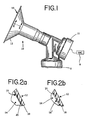
- FIG. 1 a funnel-shaped breastshield 10 having a breast-receiving cone 12, the interior of which is designated by the numeral 14.
- This is a relatively well-known type of breastshield, having a rigid plastic construction. It will be understood, however, that the application of this invention is not limited to just such a form of the breastshield.
- the breastpump assembly which includes the breastshield 10 further has a container 8 for collecting milk, and source of pressure, typically a vacuum (negative pressure), schematically indicated at 9.
- the vacuum source 9 would typically be a manually operated piston pump attached at collar 11, a battery operated diaphragm pump attached at collar 11, a house-current driven vacuum pump using a vacuum line (tube) attached to a port within the collar 11, among others.
- U.S. 4,929,229 and 4,857,051 for such detail.
- the invention herein is, however, not limited to the manner in which the breast is manipulated for the expression of milk.
- Figs. 2a and 2b show a lubricating area formed integral with the interior 14 of the main breast-receiving portion of cone 12. As shown in Fig. 2a , the area 16 is part of a base polymer 18 forming the general structure of the cone 12. Distributed about its interior surface and partially dispersed therein is a lubricant polymer in the form of intermingling particles 20, which are encapsulated for release in use.
- Fig 2b shows a different embodiment from 2a, wherein a lubricious coating 16' is provided in the form of a discrete layer 21, such as one yielded through coating base polymer 18 with the lubricating material.
- a lubricious coating 16' is provided in the form of a discrete layer 21, such as one yielded through coating base polymer 18 with the lubricating material.
- This can be any number of lubricants, including but not limited to a dry lubricant material which reduces friction on contact with liquid.
- the layer 21, in the form of a film, may be bonded by any suitable means.
- One particular lubricious material considered advantageous is parylene.
- a coating thickness in the range from about 1500 to about 2500 Angstroms may suffice.
- One type of parylene considered suitable is provided under the name ParyLAST, by AST Products, Inc. of Billerica, Massachusetts (see U.S. 5,355,382 and 5,447,799 ), and can be applied to a silicone substrate.
- Another lubricating material considered applicable is a coating material sold under the name HYDROMER by a company of the same name, and is a polyvinyl pyrrolidone interacted with an isocyanate prepolymer.
- An elastomeric polymer considered useful as the substrate is KRATON G2705, a thermoplastic elastomer that is a block copolymer, having a synthetic rubber base and terminal polystyrene moieties. This polymer has been approved for use in medical devices. This product is available from GLS Corporation of Cary, Illinois.
- KENAMIDE E ULTRA is an unsaturated fatty monamide derived from erucic acid.
- the material may be blended with the plastic making up the surface layer of the breastshield, for one example.
- KENAMIDE E ULTRA has the following specifications: Amide Content, % 98.0 min. Erucic Content, % by GLC 90.0 min. Color, Gardner (1963) 2 max. Acid Value 1 max. Iodine Value 71-76 Melting Point, °C (°F) 76-86 (168-187) Moisture, % 0.25 max.
- the disclosure also comprises the following:
Landscapes
- Health & Medical Sciences (AREA)
- Heart & Thoracic Surgery (AREA)
- Life Sciences & Earth Sciences (AREA)
- Animal Behavior & Ethology (AREA)
- Engineering & Computer Science (AREA)
- Anesthesiology (AREA)
- Biomedical Technology (AREA)
- Hematology (AREA)
- Pediatric Medicine (AREA)
- Vascular Medicine (AREA)
- General Health & Medical Sciences (AREA)
- Public Health (AREA)
- Veterinary Medicine (AREA)
- Prostheses (AREA)
- Materials For Medical Uses (AREA)
- External Artificial Organs (AREA)
- Sealing Devices (AREA)
- Compressor (AREA)
Abstract
Description
- The invention relates to breastshields used with breastpumps by nursing mothers.
- Breastshields typically used in conjunction with breastpumps have a conical configuration and are usually funnel-shaped. The breastshield need not be conical, of course, but nonetheless will ordinarily have a part within which at least some of the breast is received along with the nipple. In use, the interior of the breastshield is placed against the nursing mother's breast, and the breastpump extracts milk from the breast through application of a negative pressure (vacuum) within the breastshield. Breastpumps having breastshields of this type are shown and described in
U.S. Patent Nos. 4,929,229 and4,857,051 , for instance. - Breastshields typically have a funnel-shape, comprising a conical portion with a tubular extension, sometimes referred to as the nipple tunnel. The nipple and surrounding breast are received in the conical portion, with the nipple often extending into the tubular extension. Under vacuum, the breast is pulled further into the breastshield, ordinarily with the nipple then being pulled into the tubular extension, with the surrounding breast thereby also compressed about the nipple.
- A nursing mother's nipples may thus be forced against the wall of the nipple tunnel under vacuum. This may cause friction against the wall as the nipple moves deeper into the nipple tunnel. There can also be friction between the breast and the conical portion, as well as the nipple tunnel. This may result in irritation, particularly if the mother is already suffering from some topical problem, such as a chapped or cracked nipple condition. This makes the pumping of milk from the breast uncomfortable. If it were possible to reduce or eliminate the chafing and irritation of a nursing mother's breast when a breastpump is used, an advance in the art would be afforded.
- The invention comprises an improved breastshield for a breastpump having a breast-receiving portion which is provided with a lubricious surface. In one embodiment, it has bonded to its interior breast-contacting surface a coating of a polymeric lubricant, having a reduced coefficient of friction. The polymeric lubricant may preferably be from the group consisting of polytetrafluoroethylene, fluorinated ethylene-propylene copolymers, poly (vinylidine fluoride), polyparaxylene and silicone lubricant polymers. Preferred polymers of this group are the polyparaxylene polymers and the polytetrafluoroethylene polymers, with parylene being a presently preferred lubricating material. It is to be understood that any number of other well-known lubricating materials may be used in the practice of the invention, as will be made evident hereafter. Due to the particular application of the invention as a breast shield, it is necessary that the particular polymers chosen be acceptable for bodily contact.
- While the lubricating material may be bonded directly to a rigid breast-receiving part of the breastshield, which could also be an insert or adaptor received in a breastshield, it is furthermore envisioned to provide the lubricious surface in conjunction with elastomeric materials making up a soft breast-receiving part. Whether a rigid or softer substrate is employed, the lubricating material can be provided as a coating to the already formed substrate (or base). Alternatively, the two layers could be molded together in the same molding operation, or in a two-shot type molding process, just to name two other applications.
- In one embodiment, the lubricating material is present on, provided to or applied to a major part of the breast-receiving surface of the breastshield. In an alternate embodiment, the lubricating material is provided to the entire breast-receiving surface of the breastshield.
- In another embodiment, the lubricant polymer material is mixed with or otherwise contained within the substrate, to provide a relatively homogeneous lubricant-containing breastshield surface area.
- Yet another variation of the foregoing embodiment has the lubricant material releasable upon contact with water, or heat. The lubricant may be encapsulated, for instance, and then released to coat the surface in use.
- The foregoing objectives and advantages of the invention will be further understood upon consideration of the following detailed description of certain embodiments taken in conjunction with the drawings, in which:
-
-
Fig. 1 is a funnel-shaped breastshield having an interior lubricated surface; and -
Figs. 2a and 2b are two embodiments of the invention each taken across the lines 2-2 ofFig. 1 . - In the drawings, like parts have like numbers.
- With respect to the drawings, there is shown in
Fig. 1 a funnel-shaped breastshield 10 having a breast-receivingcone 12, the interior of which is designated by thenumeral 14. This is a relatively well-known type of breastshield, having a rigid plastic construction. It will be understood, however, that the application of this invention is not limited to just such a form of the breastshield. - The breastpump assembly which includes the
breastshield 10 further has acontainer 8 for collecting milk, and source of pressure, typically a vacuum (negative pressure), schematically indicated at 9. Thevacuum source 9 would typically be a manually operated piston pump attached atcollar 11, a battery operated diaphragm pump attached atcollar 11, a house-current driven vacuum pump using a vacuum line (tube) attached to a port within thecollar 11, among others. Again, reference can be made toU.S. 4,929,229 and4,857,051 for such detail. The invention herein is, however, not limited to the manner in which the breast is manipulated for the expression of milk. -
Figs. 2a and 2b show a lubricating area formed integral with theinterior 14 of the main breast-receiving portion ofcone 12. As shown inFig. 2a , thearea 16 is part of abase polymer 18 forming the general structure of thecone 12. Distributed about its interior surface and partially dispersed therein is a lubricant polymer in the form of interminglingparticles 20, which are encapsulated for release in use. -
Fig 2b shows a different embodiment from 2a, wherein a lubricious coating 16' is provided in the form of adiscrete layer 21, such as one yielded throughcoating base polymer 18 with the lubricating material. This can be any number of lubricants, including but not limited to a dry lubricant material which reduces friction on contact with liquid. - The
layer 21, in the form of a film, may be bonded by any suitable means. One particular lubricious material considered advantageous is parylene. A coating thickness in the range from about 1500 to about 2500 Angstroms may suffice. One type of parylene considered suitable is provided under the name ParyLAST, by AST Products, Inc. of Billerica, Massachusetts (seeU.S. 5,355,382 and5,447,799 ), and can be applied to a silicone substrate. Another lubricating material considered applicable is a coating material sold under the name HYDROMER by a company of the same name, and is a polyvinyl pyrrolidone interacted with an isocyanate prepolymer. - As indicated, it is possible to employ a single lubricating polymeric material to accomplish the goals of the invention. To effectuate the desired lower coefficients of friction, it is also possible to blend a variety of polymers, such as silicone polymers with fluorinated polymers with the lubricating material.
- An elastomeric polymer considered useful as the substrate is KRATON G2705, a thermoplastic elastomer that is a block copolymer, having a synthetic rubber base and terminal polystyrene moieties. This polymer has been approved for use in medical devices. This product is available from GLS Corporation of Cary, Illinois. It typically has the following physical properties:
Hardness, Shore A, (ASTM D2240) injection molded 57 Specific Gravity, (D792) 0.90 Tensile Modulus at 300% Elongation, PSI, (D412) In Flow Direction 405 Tensile Strength at Break, PSI, (D412) In Flow Direction 970 Percent Elongation at Break 655 Tear Strength, PLI, Die C, (D624) In Flow Direction 136 Color Translucent - It should be noted that this product by itself has little lubricity. Another useful lubricant polymer additive that could be applied to a Kraton G2705 base is a proprietary material sold under the trade name LUBRICOAT, by Coating Technologies Inc. of Scotch Plaines, New Jersey. This material has an exceptionally low coefficient of friction.
- Yet another lubricant that has been considered is sold by Witco Corporation of Greenwich, Connecticut under the name KENAMIDE E ULTRA, and is an unsaturated fatty monamide derived from erucic acid. The material may be blended with the plastic making up the surface layer of the breastshield, for one example. KENAMIDE E ULTRA has the following specifications:
Amide Content, % 98.0 min. Erucic Content, % by GLC 90.0 min. Color, Gardner (1963) 2 max. Acid Value 1 max. Iodine Value 71-76 Melting Point, °C (°F) 76-86 (168-187) Moisture, % 0.25 max. - Thus, while the invention has been described with respect to certain presently preferred embodiments, those with skill in the art will recognize changes, modifications and other applications which will fall within the scope of the inventive concepts and claims.
- The disclosure also comprises the following:
- 1. An improved breastshield for a breastpump having a breast-receiving part within which a portion of a mother's breast is received including the nipple, wherein the improvement comprises: a lubricious surface formed integral with a major portion of the breast-receiving part.
- 2. The improved breastshield of item 1, wherein the lubricious surface is a polymeric material from the group consisting of polytetrafluoroethylene, fluorinated ethylene-propylene copolymers, poly (vinylidine fluoride), polyparaxylene and silicone lubricant polymers.
- 3. The improved breastshield of item 1, wherein the lubricious surface is parylene.
- 4. The improved breastshield for the breastpump of item 1, wherein the lubricious surface is intermingled with a non-lubricating base layer.
- 5. The improved breastshield of item 2, wherein the polymeric material is coated on the surface of a base layer forming the structure of the breast-receiving part.
- 6. The improved breastshield of item 1, wherein a lubricant material is dispersed within a substrate and encapsulated therein for release in use of the breastshield.
- 7. An improved breastpump comprising a breastshield having an interior portion adapted to receive at least part of a mother's breast including the nipple therein;
a container communicating with said breastshield to receive milk;
a pressure source communicating with said interior portion to manipulate the breast therein for the expression of milk; and
a lubricious surface formed integral with a major portion of said interior portion. - 8. The improved breastpump of item 7, wherein said lubricious surface is a lubricant coating forming an outer layer to said interior portion.
- 9. The improved breastpump of item 7, wherein said lubricious surface is a lubricant material which is intermingled with a non-lubricating base layer.
- 10. The improved breastpump of
item 9, wherein said lubricant material is dispersed within a substrate and encapsulated therein for release in use of the breastshield. - 11. An improved breastshield for a breastpump having a breast-receiving part within which a portion of a mother's breast is received including the nipple, wherein the improvement comprises: a lubricious surface bonded to a major portion of the breast-receiving part.
- 12. The improved breastshield of
item 11, wherein the entire breast-receiving portion includes the lubricious surface.
Claims (8)
- A breastshield (10) for a breastpump having a breast-receiving part (12) within which a portion of a mother's breast is received including the nipple, wherein the breastshield comprises a lubricious surface (16, 21) formed integral with a major portion of the breast-receiving part (12).
- The breastshield of Claim 1, wherein the lubricious surface (16, 21) is a polymeric material from the group consisting of polytetrafluoroethylene, fluorinated ethylene-probylene copolymers, poly (vinylidine fluoride), polyparaxylene and silicone lubricant polymers.
- The breastshield of Claim 1, wherein the lubricious surface (16, 21) is parylene.
- The breastshield of Claim 1, wherein the lubricious surface (16, 21) is intermingled with a non-lubricating base layer.
- The breastshield of Claim 2, wherein the polymeric material is coated on the surface of a base layer (18) forming the structure of the breast-receiving part (12).
- A breastpump comprising a breastshield (10) having an interior portion (14) adapted to receive at least part of a mother's breast including the nipple therein;
a container (8) communicating with said breastshield (10) to receive milk; and
a pressure source (9) communicating with said interior portion (14) to manipulate the breast therein for the expression of milk; and
a lubricious surface (16, 21) formed integral with a major portion of said interior portion (14). - The breastpump of Claim 6, wherein said lubricious surface is a lubricant coating forming an outer layer to said interior portion.
- The breastpump of Claim 6, wherein said lubricious surface is a lubricant material which is intermingled with a non-lubricating base layer.
Applications Claiming Priority (2)
| Application Number | Priority Date | Filing Date | Title |
|---|---|---|---|
| EP02709447A EP1474189B1 (en) | 2002-02-11 | 2002-02-11 | Lubricated breastshield |
| PCT/US2002/003896 WO2003068291A1 (en) | 2002-02-11 | 2002-02-11 | Lubricated breastshield |
Related Parent Applications (1)
| Application Number | Title | Priority Date | Filing Date |
|---|---|---|---|
| EP02709447.3 Division | 2002-02-11 |
Publications (2)
| Publication Number | Publication Date |
|---|---|
| EP2253341A1 true EP2253341A1 (en) | 2010-11-24 |
| EP2253341B1 EP2253341B1 (en) | 2012-01-04 |
Family
ID=27732079
Family Applications (2)
| Application Number | Title | Priority Date | Filing Date |
|---|---|---|---|
| EP02709447A Expired - Lifetime EP1474189B1 (en) | 2002-02-11 | 2002-02-11 | Lubricated breastshield |
| EP10009311A Expired - Lifetime EP2253341B1 (en) | 2002-02-11 | 2002-02-11 | Lubricated breastshield |
Family Applications Before (1)
| Application Number | Title | Priority Date | Filing Date |
|---|---|---|---|
| EP02709447A Expired - Lifetime EP1474189B1 (en) | 2002-02-11 | 2002-02-11 | Lubricated breastshield |
Country Status (8)
| Country | Link |
|---|---|
| EP (2) | EP1474189B1 (en) |
| JP (1) | JP4480399B2 (en) |
| AT (2) | ATE539780T1 (en) |
| AU (1) | AU2002243930B2 (en) |
| CA (1) | CA2475842C (en) |
| DE (1) | DE60239708D1 (en) |
| NZ (1) | NZ534718A (en) |
| WO (1) | WO2003068291A1 (en) |
Families Citing this family (4)
| Publication number | Priority date | Publication date | Assignee | Title |
|---|---|---|---|---|
| US10828407B2 (en) | 2014-06-23 | 2020-11-10 | Momgenuity, Llc | Breast pump kit |
| US9408957B1 (en) | 2014-06-23 | 2016-08-09 | Sherri Levine | Breast pump shield |
| US9878078B1 (en) | 2015-10-21 | 2018-01-30 | Momgenuity, Llc | Disposable breast pump shield |
| CN106714860B (en) * | 2014-07-22 | 2019-08-20 | 医疗探索Nc7公司 | Breast pump system and method |
Citations (7)
| Publication number | Priority date | Publication date | Assignee | Title |
|---|---|---|---|---|
| US4857051A (en) | 1980-09-05 | 1989-08-15 | Isg/Ag | Breastpump |
| US4929229A (en) | 1988-11-30 | 1990-05-29 | Isg/Ag | Breastpump having improved valve mechanism |
| US5308321A (en) * | 1992-05-05 | 1994-05-03 | Castro Donna J | Retainer assisted by vacuum expansion system |
| US5355382A (en) | 1993-11-22 | 1994-10-11 | Xerox Corporation | Composite laser array support |
| US5447799A (en) | 1992-12-15 | 1995-09-05 | Advanced Surface Technology, Inc. | Polymerization process |
| EP1034807A1 (en) * | 1998-03-06 | 2000-09-13 | Ameda AG | Suction bell for breast pump |
| US6290671B1 (en) * | 1996-10-03 | 2001-09-18 | Trimed Ag | Regulating device for a breast pump |
Family Cites Families (9)
| Publication number | Priority date | Publication date | Assignee | Title |
|---|---|---|---|---|
| US229A (en) | 1837-06-10 | Improvement in the machine for breaking and softening hides, skins | ||
| US51A (en) | 1836-10-11 | Endless-slide-chain-carriage sawmill | ||
| US4929A (en) | 1847-01-15 | And robert beale | ||
| US4857A (en) | 1846-11-18 | Machinery fob cutting flocks | ||
| NL73732C (en) * | 1948-10-08 | |||
| EP0237474B1 (en) * | 1986-02-28 | 1991-06-12 | Ameda Ag | Breast pump insert |
| US5032113A (en) * | 1989-04-13 | 1991-07-16 | Scimed Life Systems, Inc. | Innerless catheter |
| CH676795A5 (en) * | 1989-03-01 | 1991-03-15 | Ameda Ag | |
| GB9502995D0 (en) * | 1995-02-16 | 1995-04-05 | Cannon Rubber Ltd | Breast pump insert |
-
2002
- 2002-02-11 EP EP02709447A patent/EP1474189B1/en not_active Expired - Lifetime
- 2002-02-11 CA CA002475842A patent/CA2475842C/en not_active Expired - Fee Related
- 2002-02-11 AU AU2002243930A patent/AU2002243930B2/en not_active Ceased
- 2002-02-11 EP EP10009311A patent/EP2253341B1/en not_active Expired - Lifetime
- 2002-02-11 JP JP2003567471A patent/JP4480399B2/en not_active Expired - Fee Related
- 2002-02-11 AT AT10009311T patent/ATE539780T1/en active
- 2002-02-11 DE DE60239708T patent/DE60239708D1/en not_active Expired - Lifetime
- 2002-02-11 AT AT02709447T patent/ATE504320T1/en not_active IP Right Cessation
- 2002-02-11 NZ NZ534718A patent/NZ534718A/en unknown
- 2002-02-11 WO PCT/US2002/003896 patent/WO2003068291A1/en not_active Ceased
Patent Citations (7)
| Publication number | Priority date | Publication date | Assignee | Title |
|---|---|---|---|---|
| US4857051A (en) | 1980-09-05 | 1989-08-15 | Isg/Ag | Breastpump |
| US4929229A (en) | 1988-11-30 | 1990-05-29 | Isg/Ag | Breastpump having improved valve mechanism |
| US5308321A (en) * | 1992-05-05 | 1994-05-03 | Castro Donna J | Retainer assisted by vacuum expansion system |
| US5447799A (en) | 1992-12-15 | 1995-09-05 | Advanced Surface Technology, Inc. | Polymerization process |
| US5355382A (en) | 1993-11-22 | 1994-10-11 | Xerox Corporation | Composite laser array support |
| US6290671B1 (en) * | 1996-10-03 | 2001-09-18 | Trimed Ag | Regulating device for a breast pump |
| EP1034807A1 (en) * | 1998-03-06 | 2000-09-13 | Ameda AG | Suction bell for breast pump |
Also Published As
| Publication number | Publication date |
|---|---|
| NZ534718A (en) | 2005-10-28 |
| DE60239708D1 (en) | 2011-05-19 |
| AU2002243930B2 (en) | 2007-04-26 |
| JP2005516738A (en) | 2005-06-09 |
| EP1474189B1 (en) | 2011-04-06 |
| CA2475842A1 (en) | 2003-08-21 |
| WO2003068291A1 (en) | 2003-08-21 |
| ATE539780T1 (en) | 2012-01-15 |
| ATE504320T1 (en) | 2011-04-15 |
| EP2253341B1 (en) | 2012-01-04 |
| AU2002243930A1 (en) | 2003-09-04 |
| CA2475842C (en) | 2009-06-09 |
| EP1474189A1 (en) | 2004-11-10 |
| EP1474189A4 (en) | 2008-04-16 |
| JP4480399B2 (en) | 2010-06-16 |
Similar Documents
| Publication | Publication Date | Title |
|---|---|---|
| US6423030B1 (en) | Lubricated breastshield | |
| US7753338B2 (en) | Luer activated device with minimal fluid displacement | |
| US11433001B2 (en) | System, apparatus and method employed with enteral systems | |
| KR100544926B1 (en) | Medical Valves with Forward Flow Characteristics | |
| US5569235A (en) | Valve and valved container for use with a syringe fitting | |
| US7335023B2 (en) | Aspirator having a cushioned and aspiration controlling tip | |
| US9687644B2 (en) | Soft, flexible connector | |
| US20080172003A1 (en) | Luer activated device | |
| MXPA05004972A (en) | Artificial nipple. | |
| US20080097407A1 (en) | Luer activated device with compressible valve element | |
| US20050245899A1 (en) | Dual purpose adapter | |
| CN1547650A (en) | Vacuum Demand Valve | |
| US20210346190A1 (en) | Device and method for opening an airway | |
| US20220241066A1 (en) | Delivery sleeve | |
| US10912884B2 (en) | Infusion set | |
| US8221363B2 (en) | Luer activated device with valve element under tension | |
| EP1474189B1 (en) | Lubricated breastshield | |
| US20120035536A1 (en) | Breast pump insert | |
| CN211024640U (en) | Novel trachea cannula | |
| US20230146392A1 (en) | Low-friction coatings for syringes and related methods | |
| US20220401644A1 (en) | Irremovable buckling-resistant flexible cannula and process |
Legal Events
| Date | Code | Title | Description |
|---|---|---|---|
| PUAI | Public reference made under article 153(3) epc to a published international application that has entered the european phase |
Free format text: ORIGINAL CODE: 0009012 |
|
| AC | Divisional application: reference to earlier application |
Ref document number: 1474189 Country of ref document: EP Kind code of ref document: P |
|
| AK | Designated contracting states |
Kind code of ref document: A1 Designated state(s): AT BE CH CY DE DK ES FI FR GB GR IE IT LI LU MC NL PT SE TR |
|
| 17P | Request for examination filed |
Effective date: 20110503 |
|
| GRAP | Despatch of communication of intention to grant a patent |
Free format text: ORIGINAL CODE: EPIDOSNIGR1 |
|
| RIC1 | Information provided on ipc code assigned before grant |
Ipc: A61M 1/06 20060101AFI20110621BHEP |
|
| GRAS | Grant fee paid |
Free format text: ORIGINAL CODE: EPIDOSNIGR3 |
|
| GRAA | (expected) grant |
Free format text: ORIGINAL CODE: 0009210 |
|
| AC | Divisional application: reference to earlier application |
Ref document number: 1474189 Country of ref document: EP Kind code of ref document: P |
|
| AK | Designated contracting states |
Kind code of ref document: B1 Designated state(s): AT BE CH CY DE DK ES FI FR GB GR IE IT LI LU MC NL PT SE TR |
|
| REG | Reference to a national code |
Ref country code: GB Ref legal event code: FG4D |
|
| REG | Reference to a national code |
Ref country code: CH Ref legal event code: EP |
|
| REG | Reference to a national code |
Ref country code: AT Ref legal event code: REF Ref document number: 539780 Country of ref document: AT Kind code of ref document: T Effective date: 20120115 |
|
| REG | Reference to a national code |
Ref country code: IE Ref legal event code: FG4D |
|
| REG | Reference to a national code |
Ref country code: CH Ref legal event code: NV Representative=s name: ISLER & PEDRAZZINI AG |
|
| REG | Reference to a national code |
Ref country code: DE Ref legal event code: R096 Ref document number: 60241930 Country of ref document: DE Effective date: 20120308 |
|
| PGFP | Annual fee paid to national office [announced via postgrant information from national office to epo] |
Ref country code: CH Payment date: 20120224 Year of fee payment: 11 |
|
| REG | Reference to a national code |
Ref country code: NL Ref legal event code: VDEP Effective date: 20120104 |
|
| PG25 | Lapsed in a contracting state [announced via postgrant information from national office to epo] |
Ref country code: BE Free format text: LAPSE BECAUSE OF FAILURE TO SUBMIT A TRANSLATION OF THE DESCRIPTION OR TO PAY THE FEE WITHIN THE PRESCRIBED TIME-LIMIT Effective date: 20120104 Ref country code: NL Free format text: LAPSE BECAUSE OF FAILURE TO SUBMIT A TRANSLATION OF THE DESCRIPTION OR TO PAY THE FEE WITHIN THE PRESCRIBED TIME-LIMIT Effective date: 20120104 |
|
| PG25 | Lapsed in a contracting state [announced via postgrant information from national office to epo] |
Ref country code: FI Free format text: LAPSE BECAUSE OF FAILURE TO SUBMIT A TRANSLATION OF THE DESCRIPTION OR TO PAY THE FEE WITHIN THE PRESCRIBED TIME-LIMIT Effective date: 20120104 Ref country code: PT Free format text: LAPSE BECAUSE OF FAILURE TO SUBMIT A TRANSLATION OF THE DESCRIPTION OR TO PAY THE FEE WITHIN THE PRESCRIBED TIME-LIMIT Effective date: 20120504 Ref country code: GR Free format text: LAPSE BECAUSE OF FAILURE TO SUBMIT A TRANSLATION OF THE DESCRIPTION OR TO PAY THE FEE WITHIN THE PRESCRIBED TIME-LIMIT Effective date: 20120405 |
|
| REG | Reference to a national code |
Ref country code: AT Ref legal event code: MK05 Ref document number: 539780 Country of ref document: AT Kind code of ref document: T Effective date: 20120104 |
|
| PG25 | Lapsed in a contracting state [announced via postgrant information from national office to epo] |
Ref country code: MC Free format text: LAPSE BECAUSE OF NON-PAYMENT OF DUE FEES Effective date: 20120229 Ref country code: CY Free format text: LAPSE BECAUSE OF FAILURE TO SUBMIT A TRANSLATION OF THE DESCRIPTION OR TO PAY THE FEE WITHIN THE PRESCRIBED TIME-LIMIT Effective date: 20120104 |
|
| PG25 | Lapsed in a contracting state [announced via postgrant information from national office to epo] |
Ref country code: DK Free format text: LAPSE BECAUSE OF FAILURE TO SUBMIT A TRANSLATION OF THE DESCRIPTION OR TO PAY THE FEE WITHIN THE PRESCRIBED TIME-LIMIT Effective date: 20120104 Ref country code: SE Free format text: LAPSE BECAUSE OF FAILURE TO SUBMIT A TRANSLATION OF THE DESCRIPTION OR TO PAY THE FEE WITHIN THE PRESCRIBED TIME-LIMIT Effective date: 20120104 |
|
| PLBE | No opposition filed within time limit |
Free format text: ORIGINAL CODE: 0009261 |
|
| STAA | Information on the status of an ep patent application or granted ep patent |
Free format text: STATUS: NO OPPOSITION FILED WITHIN TIME LIMIT |
|
| REG | Reference to a national code |
Ref country code: IE Ref legal event code: MM4A |
|
| PG25 | Lapsed in a contracting state [announced via postgrant information from national office to epo] |
Ref country code: IT Free format text: LAPSE BECAUSE OF FAILURE TO SUBMIT A TRANSLATION OF THE DESCRIPTION OR TO PAY THE FEE WITHIN THE PRESCRIBED TIME-LIMIT Effective date: 20120104 |
|
| 26N | No opposition filed |
Effective date: 20121005 |
|
| PG25 | Lapsed in a contracting state [announced via postgrant information from national office to epo] |
Ref country code: IE Free format text: LAPSE BECAUSE OF NON-PAYMENT OF DUE FEES Effective date: 20120211 Ref country code: AT Free format text: LAPSE BECAUSE OF FAILURE TO SUBMIT A TRANSLATION OF THE DESCRIPTION OR TO PAY THE FEE WITHIN THE PRESCRIBED TIME-LIMIT Effective date: 20120104 |
|
| REG | Reference to a national code |
Ref country code: DE Ref legal event code: R097 Ref document number: 60241930 Country of ref document: DE Effective date: 20121005 |
|
| PG25 | Lapsed in a contracting state [announced via postgrant information from national office to epo] |
Ref country code: ES Free format text: LAPSE BECAUSE OF FAILURE TO SUBMIT A TRANSLATION OF THE DESCRIPTION OR TO PAY THE FEE WITHIN THE PRESCRIBED TIME-LIMIT Effective date: 20120415 |
|
| REG | Reference to a national code |
Ref country code: CH Ref legal event code: PL |
|
| PG25 | Lapsed in a contracting state [announced via postgrant information from national office to epo] |
Ref country code: LI Free format text: LAPSE BECAUSE OF NON-PAYMENT OF DUE FEES Effective date: 20130228 Ref country code: CH Free format text: LAPSE BECAUSE OF NON-PAYMENT OF DUE FEES Effective date: 20130228 |
|
| PG25 | Lapsed in a contracting state [announced via postgrant information from national office to epo] |
Ref country code: TR Free format text: LAPSE BECAUSE OF FAILURE TO SUBMIT A TRANSLATION OF THE DESCRIPTION OR TO PAY THE FEE WITHIN THE PRESCRIBED TIME-LIMIT Effective date: 20120104 |
|
| PG25 | Lapsed in a contracting state [announced via postgrant information from national office to epo] |
Ref country code: LU Free format text: LAPSE BECAUSE OF NON-PAYMENT OF DUE FEES Effective date: 20120211 |
|
| REG | Reference to a national code |
Ref country code: FR Ref legal event code: PLFP Year of fee payment: 14 |
|
| PGFP | Annual fee paid to national office [announced via postgrant information from national office to epo] |
Ref country code: DE Payment date: 20150226 Year of fee payment: 14 |
|
| PGFP | Annual fee paid to national office [announced via postgrant information from national office to epo] |
Ref country code: GB Payment date: 20150226 Year of fee payment: 14 Ref country code: FR Payment date: 20150217 Year of fee payment: 14 |
|
| REG | Reference to a national code |
Ref country code: DE Ref legal event code: R119 Ref document number: 60241930 Country of ref document: DE |
|
| GBPC | Gb: european patent ceased through non-payment of renewal fee |
Effective date: 20160211 |
|
| REG | Reference to a national code |
Ref country code: FR Ref legal event code: ST Effective date: 20161028 |
|
| PG25 | Lapsed in a contracting state [announced via postgrant information from national office to epo] |
Ref country code: DE Free format text: LAPSE BECAUSE OF NON-PAYMENT OF DUE FEES Effective date: 20160901 Ref country code: FR Free format text: LAPSE BECAUSE OF NON-PAYMENT OF DUE FEES Effective date: 20160229 Ref country code: GB Free format text: LAPSE BECAUSE OF NON-PAYMENT OF DUE FEES Effective date: 20160211 |