EP2253039B1 - Low-porosity anode diffusion media for direct oxidation fuel cells - Google Patents
Low-porosity anode diffusion media for direct oxidation fuel cells Download PDFInfo
- Publication number
- EP2253039B1 EP2253039B1 EP09709661.4A EP09709661A EP2253039B1 EP 2253039 B1 EP2253039 B1 EP 2253039B1 EP 09709661 A EP09709661 A EP 09709661A EP 2253039 B1 EP2253039 B1 EP 2253039B1
- Authority
- EP
- European Patent Office
- Prior art keywords
- anode
- dofc
- porosity
- fuel
- methanol
- Prior art date
- Legal status (The legal status is an assumption and is not a legal conclusion. Google has not performed a legal analysis and makes no representation as to the accuracy of the status listed.)
- Not-in-force
Links
Images




Classifications
-
- H—ELECTRICITY
- H01—ELECTRIC ELEMENTS
- H01M—PROCESSES OR MEANS, e.g. BATTERIES, FOR THE DIRECT CONVERSION OF CHEMICAL ENERGY INTO ELECTRICAL ENERGY
- H01M8/00—Fuel cells; Manufacture thereof
- H01M8/02—Details
- H01M8/0202—Collectors; Separators, e.g. bipolar separators; Interconnectors
- H01M8/023—Porous and characterised by the material
-
- H—ELECTRICITY
- H01—ELECTRIC ELEMENTS
- H01M—PROCESSES OR MEANS, e.g. BATTERIES, FOR THE DIRECT CONVERSION OF CHEMICAL ENERGY INTO ELECTRICAL ENERGY
- H01M8/00—Fuel cells; Manufacture thereof
- H01M8/04—Auxiliary arrangements, e.g. for control of pressure or for circulation of fluids
- H01M8/04082—Arrangements for control of reactant parameters, e.g. pressure or concentration
- H01M8/04197—Preventing means for fuel crossover
-
- H—ELECTRICITY
- H01—ELECTRIC ELEMENTS
- H01M—PROCESSES OR MEANS, e.g. BATTERIES, FOR THE DIRECT CONVERSION OF CHEMICAL ENERGY INTO ELECTRICAL ENERGY
- H01M8/00—Fuel cells; Manufacture thereof
- H01M8/10—Fuel cells with solid electrolytes
- H01M8/1009—Fuel cells with solid electrolytes with one of the reactants being liquid, solid or liquid-charged
- H01M8/1011—Direct alcohol fuel cells [DAFC], e.g. direct methanol fuel cells [DMFC]
-
- H—ELECTRICITY
- H01—ELECTRIC ELEMENTS
- H01M—PROCESSES OR MEANS, e.g. BATTERIES, FOR THE DIRECT CONVERSION OF CHEMICAL ENERGY INTO ELECTRICAL ENERGY
- H01M8/00—Fuel cells; Manufacture thereof
- H01M8/02—Details
- H01M8/0202—Collectors; Separators, e.g. bipolar separators; Interconnectors
- H01M8/023—Porous and characterised by the material
- H01M8/0234—Carbonaceous material
-
- H—ELECTRICITY
- H01—ELECTRIC ELEMENTS
- H01M—PROCESSES OR MEANS, e.g. BATTERIES, FOR THE DIRECT CONVERSION OF CHEMICAL ENERGY INTO ELECTRICAL ENERGY
- H01M8/00—Fuel cells; Manufacture thereof
- H01M8/02—Details
- H01M8/0202—Collectors; Separators, e.g. bipolar separators; Interconnectors
- H01M8/023—Porous and characterised by the material
- H01M8/0239—Organic resins; Organic polymers
-
- H—ELECTRICITY
- H01—ELECTRIC ELEMENTS
- H01M—PROCESSES OR MEANS, e.g. BATTERIES, FOR THE DIRECT CONVERSION OF CHEMICAL ENERGY INTO ELECTRICAL ENERGY
- H01M8/00—Fuel cells; Manufacture thereof
- H01M8/02—Details
- H01M8/0202—Collectors; Separators, e.g. bipolar separators; Interconnectors
- H01M8/023—Porous and characterised by the material
- H01M8/0241—Composites
- H01M8/0243—Composites in the form of mixtures
-
- H—ELECTRICITY
- H01—ELECTRIC ELEMENTS
- H01M—PROCESSES OR MEANS, e.g. BATTERIES, FOR THE DIRECT CONVERSION OF CHEMICAL ENERGY INTO ELECTRICAL ENERGY
- H01M8/00—Fuel cells; Manufacture thereof
- H01M8/02—Details
- H01M8/0202—Collectors; Separators, e.g. bipolar separators; Interconnectors
- H01M8/023—Porous and characterised by the material
- H01M8/0241—Composites
- H01M8/0245—Composites in the form of layered or coated products
-
- Y—GENERAL TAGGING OF NEW TECHNOLOGICAL DEVELOPMENTS; GENERAL TAGGING OF CROSS-SECTIONAL TECHNOLOGIES SPANNING OVER SEVERAL SECTIONS OF THE IPC; TECHNICAL SUBJECTS COVERED BY FORMER USPC CROSS-REFERENCE ART COLLECTIONS [XRACs] AND DIGESTS
- Y02—TECHNOLOGIES OR APPLICATIONS FOR MITIGATION OR ADAPTATION AGAINST CLIMATE CHANGE
- Y02E—REDUCTION OF GREENHOUSE GAS [GHG] EMISSIONS, RELATED TO ENERGY GENERATION, TRANSMISSION OR DISTRIBUTION
- Y02E60/00—Enabling technologies; Technologies with a potential or indirect contribution to GHG emissions mitigation
- Y02E60/30—Hydrogen technology
- Y02E60/50—Fuel cells
Definitions
- the present disclosure relates generally to fuel cells, fuel cell systems, and electrodes/electrode assemblies for the same. More specifically, the present disclosure relates to anodes with improved diffusion media, suitable for direct oxidation fuel cells (hereinafter "DOFC”), such as direct methanol fuel cells (hereinafter “DMFC”), and their components.
- DOFC direct oxidation fuel cells
- DMFC direct methanol fuel cells
- a DOFC is an electrochemical device that generates electricity from electrochemical oxidation of a liquid fuel.
- DOFC's do not require a preliminary fuel processing stage; hence, they offer considerable weight and space advantages over indirect fuel cells, i.e., cells requiring preliminary fuel processing.
- Liquid fuels of interest for use in DOFC's include methanol, formic acid, dimethyl ether, etc., and their aqueous solutions.
- the oxidant may be substantially pure oxygen or a dilute stream of oxygen, such as that in air.
- Significant advantages of employing a DOFC in portable and mobile applications include easy storage/handling and high energy density of the liquid fuel.
- a DOFC system is a direct methanol fuel cell, (DMFC).
- DMFC membrane-electrode assembly
- MEA membrane-electrode assembly
- DM diffusion medium
- microporous layers may be placed between the catalyst layer and DM, is intended to provide wicking of liquid water into the DM, minimize electric contact resistance with the adjacent catalyst layer, and furthermore prevent the catalyst layer from leaking into the DM, thereby increasing the catalyst utilization and reducing the tendency of electrode flooding.
- a typical example of a membrane electrolyte is one composed of a perfluorosulfonic acid - tetrafluorethylene copolymer, such as NAFION ® (NAFION ® is a registered trademark of E.I. Dupont de Nemours and Company).
- NAFION ® is a registered trademark of E.I. Dupont de Nemours and Company
- DOFC a perfluorosulfonic acid - tetrafluorethylene copolymer
- an alcohol/water solution is directly supplied to the anode as the fuel and air is supplied to the cathode as the oxidant.
- the alcohol such as methanol reacts with water in the presence of a catalyst, typically a Pt or Ru metal-based catalyst, to produce carbon dioxide, H + ions (protons), and electrons.
- the electrochemical reaction is shown as equation (1) below: CH 3 OH + H 2 O ⁇ C O 2 + 6 H + + 6 e - (1)
- the protons migrate to the cathode through the proton-conducting membrane electrolyte, which is non-conductive to electrons.
- the electrons travel to the cathode through an external circuit for delivery of electrical power to a load device.
- the protons, electrons, and oxygen molecules typically derived from air, are combined to form water.
- the electrochemical reaction is given in equation (2) below: 3/2 O 2 +6 H + +6 e - ⁇ 3 H 2 O (2)
- Electrochemical reactions (1) and (2) form an overall cell reaction as shown in equation (3) below: CH 3 OH + 3/2 O 2 ⁇ CO 2 + 2 H 2 O (3)
- Method (1) low proton conductivity of alternative polymer electrolyte membranes and low compatibility/adhesion with NAFION®-bonded electrodes limit the attainment of high power density.
- Method (2) modification of NAFION® membrane may lead to the decrease of proton conductivity and stability.
- Method (3) the addition of porous carbon plate increases the thickness of each unit cell and hence increases the stack volume; and it likely increases the manufacturing cost of a DMFC system.
- PTFE polytetrafluoroethylene
- US 2004/121208 A1 discloses a tubular direct methanol fuel cell comprising an inner electrode, an outer electrode concentrically arranged around the inner electrode, and a membrane separator having an annular electrolyte conduit concentric to and in between the electrodes.
- the electrodes are formed from carbon-based materials, such as carbon cloth, carbon fibers or graphite, and their porosity can be controlled through the admixture of or coating with PTFE.
- the porosity of the anode is described as being in the order of 1 % to 10%.
- US 2007/154779 A1 discloses a porous carbon electrode substrate for use in a solid polymer fuel cell or a direct methanol fuel cell.
- This electrode substrate is provided with a woven structure and a property combination of a thickness ranging from 0,1 to 1,0 mm, a bending strength of 0,7 MPa or more, a porosity of 50% or more, and a surface resistivity of 1.0 ⁇ /sq or less.
- WO 2007/111201 A reveals a fuel cell configured to prevent the loss of a liquid fuel caused by crossover. It allows for a high output and high energy density utilizing a high-concentration liquid fuel.
- This fuel cell comprises at least an air electrode-side current collecting layer, an air electrode catalyst layer, a polymer electrolyte membrane, a fuel electrode catalyst layer, and a fuel electrode-side current collecting layer.
- a porous layer formed of a porous material is provided on the liquid fuel side of the fuel electrode-side current collecting layer, and functions as a medium for diffusion of a fuel into the fuel electrode catalyst layer.
- the porous layer is made of a carbon-based material and has a porosity of 55 %.
- JP 2007 234589 A , DE 10 2006 048612 Al , EP-A-1 538 689 and US 2005/084742 A1 are commonly teaching anode, diffusion medias for fuel cells with emphasis on direct oxidation fuel cells (DOFC), comprising a porous composite layer made of carbonaceous material, such as carbon cloth or carbon paper. This material is mixed with a fluorinated polymer, such as PTFE or FEP.
- DOE direct oxidation fuel cells
- DOFC/DMFC systems including an anode diffusion medium (DM), which facilitates a reduction of methanol crossover.
- DM anode diffusion medium
- An advantage of the present disclosure is a fuel cell having reduced fuel crossover from the anode to cathode and in particular a fuel cell having a reduced alcohol crossover.
- Embodiments of the disclosure include a direct methanol fuel cell having an anode diffusion medium with a reduced porosity to minimize alcohol transport and crossover rates.
- a direct oxidation fuel cell comprising a liquid fuel, an anode electrode configured to generate power, the anode electrode having a diffusion medium (DM) with or without a microporous layer, wherein the DM has a low porosity such that it reduces fuel crossover through the membrane and increases the power density of the DOFC under highly concentrated fuel, wherein the DM is loaded at between 30 wt% to 70 wt% with at least one fluorinated polymer, wherein at least one of said fluorinated polymer is fluorinated ethylene propylene.
- DOFC direct oxidation fuel cell
- an anode electrode configured to be used in a DOFC, the anode electrode comprising a diffusion medium (DM) with or without a microporous layer, wherein said DM has a low porosity such that it reduces fuel crossover through the membrane and increases the power density of the DOFC, wherein said DM is loaded at 30 wt% to 70 wt% with at least one fluorinated polymer, wherein at least one of said fluorinated polymer is fluorinated ethylene propylene.
- DM diffusion medium
- said DM has a low porosity such that it reduces fuel crossover through the membrane and increases the power density of the DOFC
- said DM is loaded at 30 wt% to 70 wt% with at least one fluorinated polymer, wherein at least one of said fluorinated polymer is fluorinated ethylene propylene.
- DOFC direct oxidation fuel cell
- FIG 1 is a graph showing the relationship between the porosity of FEP treated carbon paper and the FEP content
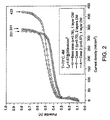
- FIG 2 is a graph showing methanol crossover under open-circuit condition of MEA at 70°C with the base case and modified anode DM when fed with 4M methanol;
- FIG 3 is a graph showing methanol crossover under open-circuit condition of MEA at 65°C as a function of porosity of anode DM;
- FIG 4 is a graph of IR-free anode polarization at 70°C as a function of current density with the base case and modified anode DM when fed with 4M methanol;
- FIG 6 is a graph showing Steady-state performance of DMFC with the modified anode DM when fed with 6M at 65°C and with 8M methanol at 60°C.
- the crossover of a fuel in a direct oxidation fuel cell can depend on several factors. For example, alcohol crossover depends on such factors as alcohol concentration fed into the anode, operating temperature, alcohol permeability through anode diffusion media, thickness of anode diffusion media, and alcohol permeability through the membrane.
- a method proposed here is to reduce the alcohol crossover via the control of the mass permeability through the anode diffusion media.
- the alcohol permeation flux through the anode diffusion media depends on the effective mass diffusivity and the feed alcohol concentration, where the effective diffusivity is a function of porosity and tortuosity of anode diffusion media, as shown in Eq.
- D eff ⁇ n ⁇ D
- D eff the effective mass diffusivity
- ⁇ the porosity of anode diffusion media
- D the alcohol molecular diffusivity
- n the Bruggmann factor to account for the tortuosity effect.
- DM low-porosity anode diffusion medium
- a diffusion medium with a reduced or low porosity is one that is less than 78% porous.
- the porosity of the DM is between 0.70 to 0.10. In a preferred embodiment of the disclosure the porosity of the DM is between about 0.57 to 0.10.
- the low porosity anode diffusion media can be obtained via the following methods, but not limiting to: Filling currently available carbon paper or carbon cloth with polymers such as fluorinated ethylene propylene (FEP), using other diffusion media inherently of low porosity, such as porous carbon, and using metal foams with the controlled porosity.
- FEP fluorinated ethylene propylene
- anode DM may be configured with or without a microporous layer (MPL), which may provide additional resistance to alcohol transport.
- MPL microporous layer
- DM may have a thickness of less than 1000 micrometers, preferably less than 600 micrometers, and most preferably between 300 and 600 micrometers.
- carbon paper diffusion medium is used as an example to describe how using low-porosity anode diffusion media can significantly reduce alcohol crossover through the membrane. These methods and concepts can also be applied to other types of diffusion media.
- the carbon paper with different porosity can be obtained by treating the carbon paper with different loading of fluorinated ethylene propylene (FEP).
- ⁇ the porosity of a FEP-treated carbon paper
- ⁇ 0 the porosity of the untreated carbon paper
- ⁇ the weight fraction of FEP in the carbon paper
- ⁇ CP is the density of the carbon paper
- ⁇ FEP is the density of the dry FEP.
- FIG. 1 shows the relationship between the porosity of FEP-treated Toray TGPH-90 carbon paper and the weight fraction of dry FEP.
- FIG. 1 shows that the high loading of FEP filled into carbon paper reduces the porosity of the carbon paper.
- the porosity of 10wt%, 30wt%, 50wt% and 70wt% FEP-treated Toray TGPH-90 carbon papers are 0.78, 0.70, 0.57 and 0.27 respectively.
- two methods are described to reduce alcohol permeability through DM: one is to increase the thickness of anode diffusion media, and another is to reduce the pore size/porosity of anode diffusion media.
- the carbon papers were treated with fluorinated ethylene propylene (FEP) as follows.
- FEP fluorinated ethylene propylene
- the carbon paper was slowly dipped into a 20wt% FEP suspension, then was dried at 80°C in the oven. The procedure was repeated until the desired loading of the FEP (10wt%, 30wt%, 50wt% and 70wt%) was achieved.
- the FEP-impregnated carbon paper was heat-treated at 270°C for 10min and sintered at 340°C for 30 min.
- a paste for making desirable microporous layers (MPL) was made by mixing carbon powder (for example, Vulcan XC-72R) and 60wt%PTFE suspension, iso-propanol and de-ionized water.
- the paste was cast onto the surface of carbon paper to form a microporous layer.
- the coated carbon paper was dried at 100°C for 1h and sintered at 360°C for 30min. Details of MEA fabrication procedure are similar to that described in previous patents and/or publications, (see US 2008/0176112 , 11/655,867 ), except for the 30wt%, 50wt% and 70wt% FEP-treated carbon paper used as the anode DM.
- the MEA with the modified DM in Cases 1 and 2 shows 19% and 22% reduction in methanol crossover under open-circuit condition when fed with 4 molar (M) methanol (see FIG. 2 ), respectively.
- M molar
- methanol crossover decreases with decreasing of the porosity of anode DM.
- the iR-free anode overpotential in modified cases is almost the same as that in the base case ( FIG. 4 ).
- Low methanol crossover in the modified cases (Cases 1 and 2) increases fuel efficiency, and mitigates the effect of mixed potential at the cathode side. Therefore, there is a marked improvement in power density in case of MEA with the modified DMs.
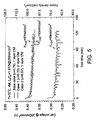
- the power density of the modified cases (Cases 1 and 2) can reach 93 ⁇ 97mW/cm 2 at 70°C, 35 ⁇ 40% higher than that achieved in the base case.
- a concentrated fuel is one which is at least 2 molar (M) in concentration and a highly concentrated fuel is one which is at least 4M in concentration.
- DMFC with the modified DMs can achieve high power even when fed with high concentration methanol fuel such as 6M and 8M methanol. As shown in FIG. 6 , the highest power densities that can be reached are 97 and 88mW/cm 2 when fed with 6M at 65°C and 8M methanol at 60°C, respectively.
- the present disclosure describes low-porosity anode diffusion media for use in DMFC systems, which facilitates operation at good power densities with highly concentrated fuel.
Landscapes
- Life Sciences & Earth Sciences (AREA)
- Engineering & Computer Science (AREA)
- Manufacturing & Machinery (AREA)
- Sustainable Development (AREA)
- Sustainable Energy (AREA)
- Chemical & Material Sciences (AREA)
- Chemical Kinetics & Catalysis (AREA)
- Electrochemistry (AREA)
- General Chemical & Material Sciences (AREA)
- Inert Electrodes (AREA)
- Fuel Cell (AREA)
Description
- The present disclosure relates generally to fuel cells, fuel cell systems, and electrodes/electrode assemblies for the same. More specifically, the present disclosure relates to anodes with improved diffusion media, suitable for direct oxidation fuel cells (hereinafter "DOFC"), such as direct methanol fuel cells (hereinafter "DMFC"), and their components.
- A DOFC is an electrochemical device that generates electricity from electrochemical oxidation of a liquid fuel. DOFC's do not require a preliminary fuel processing stage; hence, they offer considerable weight and space advantages over indirect fuel cells, i.e., cells requiring preliminary fuel processing. Liquid fuels of interest for use in DOFC's include methanol, formic acid, dimethyl ether, etc., and their aqueous solutions. The oxidant may be substantially pure oxygen or a dilute stream of oxygen, such as that in air. Significant advantages of employing a DOFC in portable and mobile applications (e.g., notebook computers, mobile phones, personal data assistants, etc.) include easy storage/handling and high energy density of the liquid fuel.
- One example of a DOFC system is a direct methanol fuel cell, (DMFC). A DMFC generally employs a membrane-electrode assembly (hereinafter "MEA") having an anode, a cathode, and a proton-conducting membrane electrolyte positioned therebetween. In the MEA, a catalyst layer is usually supported on a diffusion medium (DM) that is made of either a carbon cloth, carbon paper, porous carbon or porous metals. The microporous layers (MPL), may be placed between the catalyst layer and DM, is intended to provide wicking of liquid water into the DM, minimize electric contact resistance with the adjacent catalyst layer, and furthermore prevent the catalyst layer from leaking into the DM, thereby increasing the catalyst utilization and reducing the tendency of electrode flooding.
- A typical example of a membrane electrolyte is one composed of a perfluorosulfonic acid - tetrafluorethylene copolymer, such as NAFION® (NAFION® is a registered trademark of E.I. Dupont de Nemours and Company). In a DOFC, an alcohol/water solution is directly supplied to the anode as the fuel and air is supplied to the cathode as the oxidant. At the anode, the alcohol, such as methanol reacts with water in the presence of a catalyst, typically a Pt or Ru metal-based catalyst, to produce carbon dioxide, H+ ions (protons), and electrons. The electrochemical reaction is shown as equation (1) below:
CH 3 OH + H 2 O → CO 2 + 6H + + 6e- (1)
- During operation of the DOFC, the protons migrate to the cathode through the proton-conducting membrane electrolyte, which is non-conductive to electrons. The electrons travel to the cathode through an external circuit for delivery of electrical power to a load device. At the cathode, the protons, electrons, and oxygen molecules, typically derived from air, are combined to form water. The electrochemical reaction is given in equation (2) below:
3/2O 2 +6H + +6e - → 3H 2 O (2)
- Electrochemical reactions (1) and (2) form an overall cell reaction as shown in equation (3) below:
CH 3 OH + 3/2O 2 → CO 2 + 2H 2 O (3)
- One drawback of a conventional DOFC is that the alcohol, such as methanol, partly permeates the membrane electrolyte from the anode to the cathode, such permeated methanol being termed "crossover methanol". The crossover methanol reacts with oxygen at the cathode, causing a reduction in fuel utilization and cathode potential, with a corresponding reduction in power generation of the fuel cell. It is thus conventional for DOFC systems, to use excessively dilute (3-6% by vol.) alcohol solutions for the anode reaction in order to limit crossover and its detrimental consequences. However, the problem with such a DOFC system is that it requires a significant amount of water to be carried in a portable system, thus diminishing the system energy density.
- The ability to use highly concentrated fuel is desirable for portable power sources, particularly since DOFC technology is currently competing with advanced batteries, such as those based upon lithium-ion technology. Therefore it is necessary to reduce methanol crossover from the anode to the cathode. There are several methods to reduce methanol crossover: (1) develop alternative proton conducting membranes with low methanol permeability, (see, N. W. Deluca and Y. A. Elabd, Polymer electrolyte membranes for the direct methanol fuel cell: A review, Journal of Polymer Science: Part B: Polymer Physics, 44, pp. 2201-2225, 2006 and V. Neburchilov, J. Martin, H.J. Wang, J.J. Zhang, A Review of Polymer Electrolyte Membranes for Direct Methanol Fuel Cells, Journal of Power Sources, 169, pp. 221-238, 2007); (2) modify the existing membrane like NAFION® by making it a composite with inorganic and organic materials, or by executing the membrane surface modification, (see Deluca et al., and Neburchilov et al.); (3) control the mass transport in the anode through a porous carbon plate.(See M. A. Abdelkareem and N. Nakagawa, DMFC employing a porous plate for an efficient operation at high methanol concentrations, Journal of Power Sources, 162, pp. 114-123, 2006).
- However, the above-mentioned methods have certain disadvantages. In Method (1); low proton conductivity of alternative polymer electrolyte membranes and low compatibility/adhesion with NAFION®-bonded electrodes limit the attainment of high power density. In Method (2), modification of NAFION® membrane may lead to the decrease of proton conductivity and stability. In Method (3), the addition of porous carbon plate increases the thickness of each unit cell and hence increases the stack volume; and it likely increases the manufacturing cost of a DMFC system.
- JOURNAL OF APPLIED ELECTROCHEMISTRY, vol. 36, , XP019247486, discloses the effect of operational parameters of mini-direct methanol fuel cells operating at ambient temperature, wherein two-layer gas diffusion electrodes comprising a diffusion layer which is made by mixing a carbon powder with a polytetrafluoroethylene (PTFE) dispersion which then deposited on a carbon cloth, such diffusion layers having a porosity of around 50 - 60 % are discussed. Here, catalysts with different Pt compounds are of particular interest.
-
US 2004/121208 A1 discloses a tubular direct methanol fuel cell comprising an inner electrode, an outer electrode concentrically arranged around the inner electrode, and a membrane separator having an annular electrolyte conduit concentric to and in between the electrodes. The electrodes are formed from carbon-based materials, such as carbon cloth, carbon fibers or graphite, and their porosity can be controlled through the admixture of or coating with PTFE. The porosity of the anode is described as being in the order of 1 % to 10%. -
US 2007/154779 A1 discloses a porous carbon electrode substrate for use in a solid polymer fuel cell or a direct methanol fuel cell. This electrode substrate is provided with a woven structure and a property combination of a thickness ranging from 0,1 to 1,0 mm, a bending strength of 0,7 MPa or more, a porosity of 50% or more, and a surface resistivity of 1.0 Ω/sq or less. -
WO 2007/111201 A reveals a fuel cell configured to prevent the loss of a liquid fuel caused by crossover. It allows for a high output and high energy density utilizing a high-concentration liquid fuel. This fuel cell comprises at least an air electrode-side current collecting layer, an air electrode catalyst layer, a polymer electrolyte membrane, a fuel electrode catalyst layer, and a fuel electrode-side current collecting layer. A porous layer formed of a porous material is provided on the liquid fuel side of the fuel electrode-side current collecting layer, and functions as a medium for diffusion of a fuel into the fuel electrode catalyst layer. The porous layer is made of a carbon-based material and has a porosity of 55 %. -
JP 2007 234589 A DE 10 2006 048612 Al ,EP-A-1 538 689 andUS 2005/084742 A1 are commonly teaching anode, diffusion medias for fuel cells with emphasis on direct oxidation fuel cells (DOFC), comprising a porous composite layer made of carbonaceous material, such as carbon cloth or carbon paper. This material is mixed with a fluorinated polymer, such as PTFE or FEP. - In view of the foregoing, there exists a need for improved DOFC/DMFC systems including an anode diffusion medium (DM), which facilitates a reduction of methanol crossover.
- An advantage of the present disclosure is a fuel cell having reduced fuel crossover from the anode to cathode and in particular a fuel cell having a reduced alcohol crossover.
- Embodiments of the disclosure include a direct methanol fuel cell having an anode diffusion medium with a reduced porosity to minimize alcohol transport and crossover rates.
- Hence, in one aspect of the invention, there is provided a direct oxidation fuel cell (DOFC) comprising a liquid fuel, an anode electrode configured to generate power, the anode electrode having a diffusion medium (DM) with or without a microporous layer, wherein the DM has a low porosity such that it reduces fuel crossover through the membrane and increases the power density of the DOFC under highly concentrated fuel, wherein the DM is loaded at between 30 wt% to 70 wt% with at least one fluorinated polymer, wherein at least one of said fluorinated polymer is fluorinated ethylene propylene.
- In a further aspect of the invention, there is provided an anode electrode configured to be used in a DOFC, the anode electrode comprising a diffusion medium (DM) with or without a microporous layer, wherein said DM has a low porosity such that it reduces fuel crossover through the membrane and increases the power density of the DOFC, wherein said DM is loaded at 30 wt% to 70 wt% with at least one fluorinated polymer, wherein at least one of said fluorinated polymer is fluorinated ethylene propylene.
- In still a further aspect of the invention, there is provided a method of operating a direct oxidation fuel cell (DOFC) system, comprising the steps of:
- a) providing at least one fuel cell assembly including a cathode and an anode with an electrolyte positioned therebetween, said anode comprising a diffusion medium (DM) with or without a microporous layer, said DM comprising an electrically conductive material and a fluorinated polymer, wherein said fluorinated polymer is fluorinated ethylene propylene;
- b) loading said DM with said fluorinated polymer at 30 wt% to 70 wt%;
- c) supplying a concentrated solution of a liquid fuel and water to said anode; and
- d) operating said at least one fuel cell assembly with low methanol crossover and high power density.
- Preferred embodiments of the above recited aspects are defined in the subclaims.
- These, as well as other components, steps, features, objects, benefits, and advantages, will now become clear from a review of the following detailed description of illustrative embodiments, the accompanying drawings, and the claims.
- The various features and advantages of the present disclosure will become more apparent and facilitated by reference to the accompanying drawings, provided for purposes of illustration only and not to limit the scope of the invention, wherein the same reference numerals are employed throughout for designating like features and the various features are not necessarily drawn to scale but rather are drawn as to best illustrate the pertinent features.
- The drawings discloses illustrative embodiments. They do not set forth all embodiments. Other embodiments may be used in addition or instead. Details that may be apparent or unnecessary may be omitted to save space or for more effective illustration. Conversely, some embodiments may be practiced without all of the details that are disclosed, wherein:
-
FIG 1 . is a graph showing the relationship between the porosity of FEP treated carbon paper and the FEP content; -
FIG 2 . is a graph showing methanol crossover under open-circuit condition of MEA at 70°C with the base case and modified anode DM when fed with 4M methanol; -
FIG 3 . is a graph showing methanol crossover under open-circuit condition of MEA at 65°C as a function of porosity of anode DM; -
FIG 4 . is a graph of IR-free anode polarization at 70°C as a function of current density with the base case and modified anode DM when fed with 4M methanol; -
FIG 5 . is a graph showing Steady-state performance discharged at 250mA/cm2 of DMFC with the base case and modified anode DM when fed with 4M methanol (Operating conditions: T=70°C, 4M, ξa/ξc=1.67/3@250mA/cm2); -
FIG 6 . is a graph showing Steady-state performance of DMFC with the modified anode DM when fed with 6M at 65°C and with 8M methanol at 60°C. - Illustrative embodiments are now discussed. Other embodiments may be used in addition or instead. Details that may be apparent or unnecessary may be omitted to save space or for a more effective presentation. Conversely, some embodiments may be practiced without all of the details that are disclosed
- The crossover of a fuel in a direct oxidation fuel cell can depend on several factors. For example, alcohol crossover depends on such factors as alcohol concentration fed into the anode, operating temperature, alcohol permeability through anode diffusion media, thickness of anode diffusion media, and alcohol permeability through the membrane. A method proposed here is to reduce the alcohol crossover via the control of the mass permeability through the anode diffusion media. The alcohol permeation flux through the anode diffusion media depends on the effective mass diffusivity and the feed alcohol concentration, where the effective diffusivity is a function of porosity and tortuosity of anode diffusion media, as shown in Eq. (4),

- In an embodiment of the disclosure the porosity of the DM is between 0.70 to 0.10. In a preferred embodiment of the disclosure the porosity of the DM is between about 0.57 to 0.10.
- The low porosity anode diffusion media can be obtained via the following methods, but not limiting to: Filling currently available carbon paper or carbon cloth with polymers such as fluorinated ethylene propylene (FEP), using other diffusion media inherently of low porosity, such as porous carbon, and using metal foams with the controlled porosity.
- Furthermore the anode DM may be configured with or without a microporous layer (MPL), which may provide additional resistance to alcohol transport.
- Moreover, DM may have a thickness of less than 1000 micrometers, preferably less than 600 micrometers, and most preferably between 300 and 600 micrometers.
- In this disclosure, carbon paper diffusion medium is used as an example to describe how using low-porosity anode diffusion media can significantly reduce alcohol crossover through the membrane. These methods and concepts can also be applied to other types of diffusion media. The carbon paper with different porosity can be obtained by treating the carbon paper with different loading of fluorinated ethylene propylene (FEP). The carbon paper porosity level depends on the weight fraction of the treated transparent exopolymer particles (TEP) in the carbon paper according to the following equation,

FIG. 1 shows the relationship between the porosity of FEP-treated Toray TGPH-90 carbon paper and the weight fraction of dry FEP. -
FIG. 1 shows that the high loading of FEP filled into carbon paper reduces the porosity of the carbon paper. The porosity of 10wt%, 30wt%, 50wt% and 70wt% FEP-treated Toray TGPH-90 carbon papers are 0.78, 0.70, 0.57 and 0.27 respectively. In this disclosure, two methods are described to reduce alcohol permeability through DM: one is to increase the thickness of anode diffusion media, and another is to reduce the pore size/porosity of anode diffusion media. Incase 1, two pieces of 30wt% FEP-treated TGPH-90 Toray carbon paper (ε=0.70) is used as the anode DM. - In case 2, one piece of 50wt% FEP-treated TGPH-90 Toray carbon paper (ε=0.57) is used. In
case 3, one piece of 70wt% FEP-treated TGPH-90 Toray carbon paper (ε=0.27) is used. InCases 2 and 3, the high loading of treatment agents is used to reduce the porosity of the DM. As a result, a large resistance to alcohol transport is created in the DM. - The DM in the base case is 10wt% FEP-treated TGPH-90 Toray carbon paper (ε=0.78), which is optimal for the DMFC fed with 1 molar (M) or 2M methanol solution due to the balance between sufficient mass transport of methanol through the anode diffusion media and reasonable methanol crossover.
- The carbon papers were treated with fluorinated ethylene propylene (FEP) as follows. The carbon paper was slowly dipped into a 20wt% FEP suspension, then was dried at 80°C in the oven. The procedure was repeated until the desired loading of the FEP (10wt%, 30wt%, 50wt% and 70wt%) was achieved. The FEP-impregnated carbon paper was heat-treated at 270°C for 10min and sintered at 340°C for 30 min. A paste for making desirable microporous layers (MPL) was made by mixing carbon powder (for example, Vulcan XC-72R) and 60wt%PTFE suspension, iso-propanol and de-ionized water. The paste was cast onto the surface of carbon paper to form a microporous layer. The coated carbon paper was dried at 100°C for 1h and sintered at 360°C for 30min. Details of MEA fabrication procedure are similar to that described in previous patents and/or publications, (see
US 2008/0176112 ,11/655,867 - In comparison with the results obtained with the base case DM, the MEA with the modified DM in
Cases 1 and 2 shows 19% and 22% reduction in methanol crossover under open-circuit condition when fed with 4 molar (M) methanol (seeFIG. 2 ), respectively. This indicates that increasing thickness of the anode diffusion media (from one layer to two layers of Toray TGPH-90 carbon paper with a porosity of 0.70) and decreasing the porosity of the anode diffusion media (one layer DM with a porosity reduced from 0.78 to 0.57) can significantly reduce methanol crossover through the membrane. As shown inFIG. 3 , methanol crossover decreases with decreasing of the porosity of anode DM. - When the porosity of the anode diffusion media is extremely low, such as 0.27 in
Case 3, the methanol crossover through the membrane under open-circuit condition is very small. When fed with 2M methanol, the methanol crossover under open-circuit condition in Case 3 (ε=0.27) is only 32% of that exhibited in the base case (ε=0.78), and about half of that exhibited in Case 2 (ε=0.57). Even when fed with 6M, the methanol crossover under open-circuit condition inCase 3 is less than half of when fed with 2M in the base case. Therefore, low porosity anode diffusion media was found to be very effective to reduce methanol crossover through the membrane. - While fed with a fuel of 4M methanol, the iR-free anode overpotential in modified cases (
Cases 1 and 2) is almost the same as that in the base case (FIG. 4 ). Low methanol crossover in the modified cases (Cases 1 and 2) increases fuel efficiency, and mitigates the effect of mixed potential at the cathode side. Therefore, there is a marked improvement in power density in case of MEA with the modified DMs. As shown inFIG. 5 , the power density of the modified cases (Cases 1 and 2) can reach 93~97mW/cm2 at 70°C, 35~40% higher than that achieved in the base case. As used herein, a concentrated fuel is one which is at least 2 molar (M) in concentration and a highly concentrated fuel is one which is at least 4M in concentration. In addition, DMFC with the modified DMs (Cases 1 and 2) can achieve high power even when fed with high concentration methanol fuel such as 6M and 8M methanol. As shown inFIG. 6 , the highest power densities that can be reached are 97 and 88mW/cm2 when fed with 6M at 65°C and 8M methanol at 60°C, respectively. - In summary, the present disclosure describes low-porosity anode diffusion media for use in DMFC systems, which facilitates operation at good power densities with highly concentrated fuel.
- In the previous description, numerous specific details are set forth, such as specific materials, structures, reactants, processes, etc., in order to provide a better understanding of the present disclosure. However, the present disclosure can be practiced without resorting to the details specifically set forth. In other instances, well-known processing materials and techniques have not been described in detail in order not to unnecessarily obscure the present disclosure.
- Only the preferred embodiments of the present disclosure and but a few examples of its versatility are shown and described in the present disclosure. It is to be understood that the present disclosure is capable of use in various other combinations and environments and is susceptible of changes and/or modifications within the scope of the disclosed concept as expressed herein.
- The components, steps, features, objects, benefits and advantages that have been discussed are merely illustrative. None of them, nor the discussions relating to them, are intended to limit the scope of protection in any way. Numerous other embodiments are also contemplated, including embodiments that have fewer, additional, and/or different components, steps, features, objects, benefits and advantages. The components and steps may also be arranged and ordered differently.
- The phrase "means for" when used in a claim embraces the corresponding structures and materials that have been described and their equivalents. Similarly, the phrase "step for" when used in a claim embraces the corresponding acts that have been described and their equivalents. The absence of these phrases means that the claim is not limited to any of the corresponding structures, materials, or acts or to their equivalents.
- Nothing that has been stated or illustrated is intended to cause a dedication of any component, step, feature, object, benefit, advantage, or equivalent to the public, regardless of whether it is recited in the claims.
- In short, the scope of protection is limited solely by the claims that now follow. That scope is intended to be as broad as is reasonably consistent with the language that is used in the claims and to encompass all structural and functional equivalents
Claims (15)
- A direct oxidation fuel cell (DOFC) comprising: a liquid fuel, an anode electrode configured to generate power, the anode electrode having a diffusion medium (DM) with or without a microporous layer; wherein the DM has a low porosity such that it reduces fuel crossover through the membrane and increases the power density of the DOFC under highly concentrated fuel;
wherein the DM is loaded at between 30 wt% to 70wt% with at least one fluorinated polymer, wherein at least one of said fluorinated polymer is fluorinated ethylene propylene. - The DOFC of claim 1, wherein the DM porosity is between 0.70 and 0.10.
- The DOFC of claim 2, wherein the DM porosity is between about 0.57 and 0.10.
- The DOFC of claim 1, wherein the DM thickness is less than 600 micrometers.
- The DOFC of claim 1, wherein the DM thickness is between 300 and 600 micrometers.
- The DOFC of claim 1, wherein said highly concentrated liquid fuel is at least 4 molar (M) in concentration.
- The DOFC of claim 1, wherein said highly concentrated liquid fuel is methanol.
- The DOFC of claim 7, wherein said highly concentrated methanol is at least 4 molar (M) in concentration.
- An anode electrode configured to be used in a direct oxidation fuel cell (DOFC), the anode electrode comprising a diffusion medium (DM) with or without a microporous layer, wherein said DM has a low porosity such that it reduces fuel crossover through the membrane and increases the power density of the DOFC,
wherein said DM is loaded at 30wt% to 70wt% with at least one fluorinated polymer,
wherein at least one of said fluorinated polymer is fluorinated ethylene propylene. - The anode of claim 9, wherein said DM comprises carbon paper, carbon cloth, porous carbon, or porous metals.
- The anode of claim 9, wherein said microporous layer is prepared from carbon powder and Polytetrafluorethylene (PTFE) suspension.
- The anode of claim 9, wherein the porosity of said DM layer is less than 0.78.
- The anode of claim 12, wherein the porosity of said DM layer is between 0.70 and 0.10.
- The anode of claim 13, wherein the porosity of said DM layer is between about 0.57 and 0.10.
- A method of operating a direct oxidation fuel cell DOFC system, comprising the steps of:a) providing at least one fuel cell assembly including a cathode and an anode with an electrolyte positioned therebetween, said anode comprising a diffusion medium (DM) with or without a microporous layer, said DM comprising an electrically conductive material and a fluorinated polymer wherein said fluorinated polymer is fluorinated ethylene propylene;b) loading said DM with said fluorinated polymer at 30 wt% to 70 wt%;c) supplying a concentrated solution of a liquid fuel and water to said anode; andd) operating said at least one fuel cell assembly with low methanol crossover and high power density.
Applications Claiming Priority (2)
| Application Number | Priority Date | Filing Date | Title |
|---|---|---|---|
| US12/071,155 US20090208783A1 (en) | 2008-02-15 | 2008-02-15 | Low porosity anode diffusion media for fuel cells |
| PCT/US2009/033926 WO2009102870A1 (en) | 2008-02-15 | 2009-02-12 | Low-porosity anode diffusion media for direct oxidation fuel cells |
Publications (2)
| Publication Number | Publication Date |
|---|---|
| EP2253039A1 EP2253039A1 (en) | 2010-11-24 |
| EP2253039B1 true EP2253039B1 (en) | 2013-07-24 |
Family
ID=40577736
Family Applications (1)
| Application Number | Title | Priority Date | Filing Date |
|---|---|---|---|
| EP09709661.4A Not-in-force EP2253039B1 (en) | 2008-02-15 | 2009-02-12 | Low-porosity anode diffusion media for direct oxidation fuel cells |
Country Status (4)
| Country | Link |
|---|---|
| US (1) | US20090208783A1 (en) |
| EP (1) | EP2253039B1 (en) |
| JP (1) | JP2011512626A (en) |
| WO (1) | WO2009102870A1 (en) |
Families Citing this family (1)
| Publication number | Priority date | Publication date | Assignee | Title |
|---|---|---|---|---|
| US10236513B2 (en) | 2016-03-18 | 2019-03-19 | Board Of Regents, The University Of Texas System | Alkali-metal batteries with a dendrite-free anode interfacing an organic liquid electrolyte |
Family Cites Families (14)
| Publication number | Priority date | Publication date | Assignee | Title |
|---|---|---|---|---|
| JPS61273865A (en) * | 1985-05-29 | 1986-12-04 | Hitachi Ltd | Liquid fuel cell |
| US20030022054A1 (en) * | 2000-03-03 | 2003-01-30 | Didier Marsacq | Method for preparing electrode-membrane assemblies, resulting assemblies and fuel cells comprising same |
| US6766817B2 (en) * | 2001-07-25 | 2004-07-27 | Tubarc Technologies, Llc | Fluid conduction utilizing a reversible unsaturated siphon with tubarc porosity action |
| US20040121208A1 (en) * | 2002-12-23 | 2004-06-24 | Doug James | Tubular direct methanol fuel cell |
| WO2004075322A1 (en) * | 2003-02-18 | 2004-09-02 | Nec Corporation | Electrode for fuel cell, fuel cell and methods for manufacturing these |
| US7105242B2 (en) * | 2003-10-17 | 2006-09-12 | General Motors Corporation | Control of polymer surface distribution on diffusion media improved fuel cell performance |
| JP4824298B2 (en) * | 2003-12-04 | 2011-11-30 | パナソニック株式会社 | Gas diffusion layer for fuel cell, electrode, membrane electrode assembly and method for producing the same |
| FR2867903B1 (en) * | 2004-03-22 | 2008-10-03 | Commissariat Energie Atomique | SOLID ELECTROLYTE FUEL CELL WITH SEALED STRUCTURE |
| JP2007109639A (en) * | 2005-09-14 | 2007-04-26 | Gunma Univ | Direct liquid fuel cell |
| US7722979B2 (en) * | 2005-10-14 | 2010-05-25 | Gm Global Technology Operations, Inc. | Fuel cells with hydrophobic diffusion medium |
| TWI296449B (en) * | 2006-01-04 | 2008-05-01 | Univ Feng Chia | Porous carbon electrode substrates and methods for preparing the same |
| JP2007234589A (en) * | 2006-02-01 | 2007-09-13 | Matsushita Electric Ind Co Ltd | Direct oxidation fuel cell and method of operating direct oxidation fuel cell system |
| US9373851B2 (en) * | 2006-03-27 | 2016-06-21 | Mitsubishi Pencil Company, Limited | Fuel cell |
| US10079391B2 (en) * | 2007-10-09 | 2018-09-18 | Uvic Industry Partnerships Inc. | Fuel cell with flow-through porous electrodes |
-
2008
- 2008-02-15 US US12/071,155 patent/US20090208783A1/en not_active Abandoned
-
2009
- 2009-02-12 EP EP09709661.4A patent/EP2253039B1/en not_active Not-in-force
- 2009-02-12 WO PCT/US2009/033926 patent/WO2009102870A1/en not_active Ceased
- 2009-02-12 JP JP2010546891A patent/JP2011512626A/en active Pending
Also Published As
| Publication number | Publication date |
|---|---|
| WO2009102870A1 (en) | 2009-08-20 |
| US20090208783A1 (en) | 2009-08-20 |
| JP2011512626A (en) | 2011-04-21 |
| EP2253039A1 (en) | 2010-11-24 |
Similar Documents
| Publication | Publication Date | Title |
|---|---|---|
| Livshits et al. | Progress in the development of a high-power, direct ethylene glycol fuel cell (DEGFC) | |
| JP5118372B2 (en) | Direct methanol fuel cell | |
| US8785070B2 (en) | Direct oxidation fuel cells with improved cathode gas diffusion media for low air stoichiometry operation | |
| JP3981684B2 (en) | ELECTRIC POWER ELEMENT FOR LIQUID FUEL CELL, MANUFACTURING METHOD THEREOF, AND LIQUID FUEL CELL USING THE SAME | |
| US20090214918A1 (en) | Anode of direct methanol fuel cell and direct methanol fuel cell employing the same | |
| JP2004171844A (en) | Liquid fuel cell | |
| US20070154777A1 (en) | Cathode electrodes for direct oxidation fuel cells and systems operating with concentrated liquid fuel at low oxidant stoichiometry | |
| US20090042091A1 (en) | Supported catalyst layers for direct oxidation fuel cells | |
| US20100068592A1 (en) | Electrodes for use in hydrocarbon-based membrane electrode assemblies of direct oxidation fuel cells | |
| US20110200914A1 (en) | High power direct oxidation fuel cell | |
| US8278001B2 (en) | Low-porosity anode diffusion media for high concentration direct methanol fuel cells and method of making | |
| JP2007234589A (en) | Direct oxidation fuel cell and method of operating direct oxidation fuel cell system | |
| US20090208783A1 (en) | Low porosity anode diffusion media for fuel cells | |
| US20120214086A1 (en) | Method of fabricating a polymer electrolyte membrane (pem) | |
| US20120189933A1 (en) | Anode catalyst layers for direct oxidation fuel cells | |
| US20120156590A1 (en) | Direct oxidation fuel cell with improved fuel distribution | |
| JP2008270019A (en) | Fuel cell and fuel cell assembly | |
| JP2006066209A (en) | Direct methanol type fuel cell | |
| KR20230135797A (en) | Hydrophobic-treated metallic gas diffusion layer, membrane-electrode assembly and fuel cell | |
| JP2004139902A (en) | Liquid fuel cell | |
| KAMO | Development trends of direct methanol fuel cells | |
| Zhang | Reduction of methanol crossover in direct methanol fuel cells by an integrated anode structure and composite electrolyte membrane | |
| CN1929181A (en) | Direct oxidation fuel cell system | |
| WO2010087070A1 (en) | Direct methanol fuel cell and cathode for direct methanol fuel cell |
Legal Events
| Date | Code | Title | Description |
|---|---|---|---|
| PUAI | Public reference made under article 153(3) epc to a published international application that has entered the european phase |
Free format text: ORIGINAL CODE: 0009012 |
|
| 17P | Request for examination filed |
Effective date: 20100824 |
|
| AK | Designated contracting states |
Kind code of ref document: A1 Designated state(s): AT BE BG CH CY CZ DE DK EE ES FI FR GB GR HR HU IE IS IT LI LT LU LV MC MK MT NL NO PL PT RO SE SI SK TR |
|
| AX | Request for extension of the european patent |
Extension state: AL BA RS |
|
| DAX | Request for extension of the european patent (deleted) | ||
| 17Q | First examination report despatched |
Effective date: 20120511 |
|
| GRAP | Despatch of communication of intention to grant a patent |
Free format text: ORIGINAL CODE: EPIDOSNIGR1 |
|
| GRAS | Grant fee paid |
Free format text: ORIGINAL CODE: EPIDOSNIGR3 |
|
| GRAA | (expected) grant |
Free format text: ORIGINAL CODE: 0009210 |
|
| AK | Designated contracting states |
Kind code of ref document: B1 Designated state(s): AT BE BG CH CY CZ DE DK EE ES FI FR GB GR HR HU IE IS IT LI LT LU LV MC MK MT NL NO PL PT RO SE SI SK TR |
|
| REG | Reference to a national code |
Ref country code: GB Ref legal event code: FG4D |
|
| REG | Reference to a national code |
Ref country code: CH Ref legal event code: EP |
|
| REG | Reference to a national code |
Ref country code: DE Ref legal event code: R082 Ref document number: 602009017404 Country of ref document: DE Representative=s name: SCHWABE SANDMAIR MARX, DE Ref country code: DE Ref legal event code: R082 Ref document number: 602009017404 Country of ref document: DE Representative=s name: SCHWABE SANDMAIR MARX PATENTANWAELTE RECHTSANW, DE |
|
| REG | Reference to a national code |
Ref country code: AT Ref legal event code: REF Ref document number: 623882 Country of ref document: AT Kind code of ref document: T Effective date: 20130815 |
|
| REG | Reference to a national code |
Ref country code: IE Ref legal event code: FG4D |
|
| REG | Reference to a national code |
Ref country code: DE Ref legal event code: R096 Ref document number: 602009017404 Country of ref document: DE Effective date: 20130919 |
|
| REG | Reference to a national code |
Ref country code: AT Ref legal event code: MK05 Ref document number: 623882 Country of ref document: AT Kind code of ref document: T Effective date: 20130724 |
|
| REG | Reference to a national code |
Ref country code: NL Ref legal event code: VDEP Effective date: 20130724 |
|
| REG | Reference to a national code |
Ref country code: LT Ref legal event code: MG4D |
|
| PG25 | Lapsed in a contracting state [announced via postgrant information from national office to epo] |
Ref country code: SE Free format text: LAPSE BECAUSE OF FAILURE TO SUBMIT A TRANSLATION OF THE DESCRIPTION OR TO PAY THE FEE WITHIN THE PRESCRIBED TIME-LIMIT Effective date: 20130724 Ref country code: AT Free format text: LAPSE BECAUSE OF FAILURE TO SUBMIT A TRANSLATION OF THE DESCRIPTION OR TO PAY THE FEE WITHIN THE PRESCRIBED TIME-LIMIT Effective date: 20130724 Ref country code: NO Free format text: LAPSE BECAUSE OF FAILURE TO SUBMIT A TRANSLATION OF THE DESCRIPTION OR TO PAY THE FEE WITHIN THE PRESCRIBED TIME-LIMIT Effective date: 20131024 Ref country code: LT Free format text: LAPSE BECAUSE OF FAILURE TO SUBMIT A TRANSLATION OF THE DESCRIPTION OR TO PAY THE FEE WITHIN THE PRESCRIBED TIME-LIMIT Effective date: 20130724 Ref country code: CY Free format text: LAPSE BECAUSE OF FAILURE TO SUBMIT A TRANSLATION OF THE DESCRIPTION OR TO PAY THE FEE WITHIN THE PRESCRIBED TIME-LIMIT Effective date: 20130911 Ref country code: PT Free format text: LAPSE BECAUSE OF FAILURE TO SUBMIT A TRANSLATION OF THE DESCRIPTION OR TO PAY THE FEE WITHIN THE PRESCRIBED TIME-LIMIT Effective date: 20131125 Ref country code: IS Free format text: LAPSE BECAUSE OF FAILURE TO SUBMIT A TRANSLATION OF THE DESCRIPTION OR TO PAY THE FEE WITHIN THE PRESCRIBED TIME-LIMIT Effective date: 20131124 Ref country code: BE Free format text: LAPSE BECAUSE OF FAILURE TO SUBMIT A TRANSLATION OF THE DESCRIPTION OR TO PAY THE FEE WITHIN THE PRESCRIBED TIME-LIMIT Effective date: 20130724 Ref country code: HR Free format text: LAPSE BECAUSE OF FAILURE TO SUBMIT A TRANSLATION OF THE DESCRIPTION OR TO PAY THE FEE WITHIN THE PRESCRIBED TIME-LIMIT Effective date: 20130724 |
|
| PG25 | Lapsed in a contracting state [announced via postgrant information from national office to epo] |
Ref country code: SI Free format text: LAPSE BECAUSE OF FAILURE TO SUBMIT A TRANSLATION OF THE DESCRIPTION OR TO PAY THE FEE WITHIN THE PRESCRIBED TIME-LIMIT Effective date: 20130724 Ref country code: NL Free format text: LAPSE BECAUSE OF FAILURE TO SUBMIT A TRANSLATION OF THE DESCRIPTION OR TO PAY THE FEE WITHIN THE PRESCRIBED TIME-LIMIT Effective date: 20130724 Ref country code: PL Free format text: LAPSE BECAUSE OF FAILURE TO SUBMIT A TRANSLATION OF THE DESCRIPTION OR TO PAY THE FEE WITHIN THE PRESCRIBED TIME-LIMIT Effective date: 20130724 Ref country code: FI Free format text: LAPSE BECAUSE OF FAILURE TO SUBMIT A TRANSLATION OF THE DESCRIPTION OR TO PAY THE FEE WITHIN THE PRESCRIBED TIME-LIMIT Effective date: 20130724 Ref country code: LV Free format text: LAPSE BECAUSE OF FAILURE TO SUBMIT A TRANSLATION OF THE DESCRIPTION OR TO PAY THE FEE WITHIN THE PRESCRIBED TIME-LIMIT Effective date: 20130724 Ref country code: GR Free format text: LAPSE BECAUSE OF FAILURE TO SUBMIT A TRANSLATION OF THE DESCRIPTION OR TO PAY THE FEE WITHIN THE PRESCRIBED TIME-LIMIT Effective date: 20131025 |
|
| PG25 | Lapsed in a contracting state [announced via postgrant information from national office to epo] |
Ref country code: CY Free format text: LAPSE BECAUSE OF FAILURE TO SUBMIT A TRANSLATION OF THE DESCRIPTION OR TO PAY THE FEE WITHIN THE PRESCRIBED TIME-LIMIT Effective date: 20130724 |
|
| PG25 | Lapsed in a contracting state [announced via postgrant information from national office to epo] |
Ref country code: CZ Free format text: LAPSE BECAUSE OF FAILURE TO SUBMIT A TRANSLATION OF THE DESCRIPTION OR TO PAY THE FEE WITHIN THE PRESCRIBED TIME-LIMIT Effective date: 20130724 Ref country code: EE Free format text: LAPSE BECAUSE OF FAILURE TO SUBMIT A TRANSLATION OF THE DESCRIPTION OR TO PAY THE FEE WITHIN THE PRESCRIBED TIME-LIMIT Effective date: 20130724 Ref country code: RO Free format text: LAPSE BECAUSE OF FAILURE TO SUBMIT A TRANSLATION OF THE DESCRIPTION OR TO PAY THE FEE WITHIN THE PRESCRIBED TIME-LIMIT Effective date: 20130724 Ref country code: SK Free format text: LAPSE BECAUSE OF FAILURE TO SUBMIT A TRANSLATION OF THE DESCRIPTION OR TO PAY THE FEE WITHIN THE PRESCRIBED TIME-LIMIT Effective date: 20130724 Ref country code: DK Free format text: LAPSE BECAUSE OF FAILURE TO SUBMIT A TRANSLATION OF THE DESCRIPTION OR TO PAY THE FEE WITHIN THE PRESCRIBED TIME-LIMIT Effective date: 20130724 |
|
| PG25 | Lapsed in a contracting state [announced via postgrant information from national office to epo] |
Ref country code: ES Free format text: LAPSE BECAUSE OF FAILURE TO SUBMIT A TRANSLATION OF THE DESCRIPTION OR TO PAY THE FEE WITHIN THE PRESCRIBED TIME-LIMIT Effective date: 20130724 Ref country code: IT Free format text: LAPSE BECAUSE OF FAILURE TO SUBMIT A TRANSLATION OF THE DESCRIPTION OR TO PAY THE FEE WITHIN THE PRESCRIBED TIME-LIMIT Effective date: 20130724 |
|
| PLBE | No opposition filed within time limit |
Free format text: ORIGINAL CODE: 0009261 |
|
| STAA | Information on the status of an ep patent application or granted ep patent |
Free format text: STATUS: NO OPPOSITION FILED WITHIN TIME LIMIT |
|
| 26N | No opposition filed |
Effective date: 20140425 |
|
| REG | Reference to a national code |
Ref country code: DE Ref legal event code: R097 Ref document number: 602009017404 Country of ref document: DE Effective date: 20140425 |
|
| REG | Reference to a national code |
Ref country code: DE Ref legal event code: R119 Ref document number: 602009017404 Country of ref document: DE |
|
| PG25 | Lapsed in a contracting state [announced via postgrant information from national office to epo] |
Ref country code: LU Free format text: LAPSE BECAUSE OF FAILURE TO SUBMIT A TRANSLATION OF THE DESCRIPTION OR TO PAY THE FEE WITHIN THE PRESCRIBED TIME-LIMIT Effective date: 20140212 Ref country code: MC Free format text: LAPSE BECAUSE OF FAILURE TO SUBMIT A TRANSLATION OF THE DESCRIPTION OR TO PAY THE FEE WITHIN THE PRESCRIBED TIME-LIMIT Effective date: 20130724 |
|
| REG | Reference to a national code |
Ref country code: CH Ref legal event code: PL |
|
| GBPC | Gb: european patent ceased through non-payment of renewal fee |
Effective date: 20140212 |
|
| PG25 | Lapsed in a contracting state [announced via postgrant information from national office to epo] |
Ref country code: CH Free format text: LAPSE BECAUSE OF NON-PAYMENT OF DUE FEES Effective date: 20140228 Ref country code: LI Free format text: LAPSE BECAUSE OF NON-PAYMENT OF DUE FEES Effective date: 20140228 |
|
| REG | Reference to a national code |
Ref country code: DE Ref legal event code: R119 Ref document number: 602009017404 Country of ref document: DE Effective date: 20140902 |
|
| REG | Reference to a national code |
Ref country code: FR Ref legal event code: ST Effective date: 20141031 |
|
| REG | Reference to a national code |
Ref country code: IE Ref legal event code: MM4A |
|
| PG25 | Lapsed in a contracting state [announced via postgrant information from national office to epo] |
Ref country code: IE Free format text: LAPSE BECAUSE OF NON-PAYMENT OF DUE FEES Effective date: 20140212 Ref country code: DE Free format text: LAPSE BECAUSE OF NON-PAYMENT OF DUE FEES Effective date: 20140902 Ref country code: GB Free format text: LAPSE BECAUSE OF NON-PAYMENT OF DUE FEES Effective date: 20140212 Ref country code: FR Free format text: LAPSE BECAUSE OF NON-PAYMENT OF DUE FEES Effective date: 20140228 |
|
| PG25 | Lapsed in a contracting state [announced via postgrant information from national office to epo] |
Ref country code: MT Free format text: LAPSE BECAUSE OF FAILURE TO SUBMIT A TRANSLATION OF THE DESCRIPTION OR TO PAY THE FEE WITHIN THE PRESCRIBED TIME-LIMIT Effective date: 20130724 |
|
| PG25 | Lapsed in a contracting state [announced via postgrant information from national office to epo] |
Ref country code: BG Free format text: LAPSE BECAUSE OF FAILURE TO SUBMIT A TRANSLATION OF THE DESCRIPTION OR TO PAY THE FEE WITHIN THE PRESCRIBED TIME-LIMIT Effective date: 20130724 |
|
| PG25 | Lapsed in a contracting state [announced via postgrant information from national office to epo] |
Ref country code: HU Free format text: LAPSE BECAUSE OF FAILURE TO SUBMIT A TRANSLATION OF THE DESCRIPTION OR TO PAY THE FEE WITHIN THE PRESCRIBED TIME-LIMIT; INVALID AB INITIO Effective date: 20090212 Ref country code: TR Free format text: LAPSE BECAUSE OF FAILURE TO SUBMIT A TRANSLATION OF THE DESCRIPTION OR TO PAY THE FEE WITHIN THE PRESCRIBED TIME-LIMIT Effective date: 20130724 |
|
| PG25 | Lapsed in a contracting state [announced via postgrant information from national office to epo] |
Ref country code: MK Free format text: LAPSE BECAUSE OF FAILURE TO SUBMIT A TRANSLATION OF THE DESCRIPTION OR TO PAY THE FEE WITHIN THE PRESCRIBED TIME-LIMIT Effective date: 20130724 |
|
| P01 | Opt-out of the competence of the unified patent court (upc) registered |
Effective date: 20230526 |