EP2251345A1 - Near infrared strongly luminous rare earth complex - Google Patents
Near infrared strongly luminous rare earth complex Download PDFInfo
- Publication number
- EP2251345A1 EP2251345A1 EP09718512A EP09718512A EP2251345A1 EP 2251345 A1 EP2251345 A1 EP 2251345A1 EP 09718512 A EP09718512 A EP 09718512A EP 09718512 A EP09718512 A EP 09718512A EP 2251345 A1 EP2251345 A1 EP 2251345A1
- Authority
- EP
- European Patent Office
- Prior art keywords
- groups
- complex
- near infrared
- rare
- hydrogen atoms
- Prior art date
- Legal status (The legal status is an assumption and is not a legal conclusion. Google has not performed a legal analysis and makes no representation as to the accuracy of the status listed.)
- Granted
Links
Images

Classifications
-
- C—CHEMISTRY; METALLURGY
- C07—ORGANIC CHEMISTRY
- C07F—ACYCLIC, CARBOCYCLIC OR HETEROCYCLIC COMPOUNDS CONTAINING ELEMENTS OTHER THAN CARBON, HYDROGEN, HALOGEN, OXYGEN, NITROGEN, SULFUR, SELENIUM OR TELLURIUM
- C07F9/00—Compounds containing elements of Groups 5 or 15 of the Periodic Table
- C07F9/02—Phosphorus compounds
- C07F9/28—Phosphorus compounds with one or more P—C bonds
- C07F9/50—Organo-phosphines
- C07F9/53—Organo-phosphine oxides; Organo-phosphine thioxides
- C07F9/5345—Complexes or chelates of phosphine-oxides or thioxides with metallic compounds or metals
-
- C—CHEMISTRY; METALLURGY
- C07—ORGANIC CHEMISTRY
- C07F—ACYCLIC, CARBOCYCLIC OR HETEROCYCLIC COMPOUNDS CONTAINING ELEMENTS OTHER THAN CARBON, HYDROGEN, HALOGEN, OXYGEN, NITROGEN, SULFUR, SELENIUM OR TELLURIUM
- C07F5/00—Compounds containing elements of Groups 3 or 13 of the Periodic Table
- C07F5/003—Compounds containing elements of Groups 3 or 13 of the Periodic Table without C-Metal linkages
-
- C—CHEMISTRY; METALLURGY
- C09—DYES; PAINTS; POLISHES; NATURAL RESINS; ADHESIVES; COMPOSITIONS NOT OTHERWISE PROVIDED FOR; APPLICATIONS OF MATERIALS NOT OTHERWISE PROVIDED FOR
- C09D—COATING COMPOSITIONS, e.g. PAINTS, VARNISHES OR LACQUERS; FILLING PASTES; CHEMICAL PAINT OR INK REMOVERS; INKS; CORRECTING FLUIDS; WOODSTAINS; PASTES OR SOLIDS FOR COLOURING OR PRINTING; USE OF MATERIALS THEREFOR
- C09D11/00—Inks
- C09D11/02—Printing inks
- C09D11/03—Printing inks characterised by features other than the chemical nature of the binder
- C09D11/037—Printing inks characterised by features other than the chemical nature of the binder characterised by the pigment
-
- C—CHEMISTRY; METALLURGY
- C09—DYES; PAINTS; POLISHES; NATURAL RESINS; ADHESIVES; COMPOSITIONS NOT OTHERWISE PROVIDED FOR; APPLICATIONS OF MATERIALS NOT OTHERWISE PROVIDED FOR
- C09D—COATING COMPOSITIONS, e.g. PAINTS, VARNISHES OR LACQUERS; FILLING PASTES; CHEMICAL PAINT OR INK REMOVERS; INKS; CORRECTING FLUIDS; WOODSTAINS; PASTES OR SOLIDS FOR COLOURING OR PRINTING; USE OF MATERIALS THEREFOR
- C09D11/00—Inks
- C09D11/50—Sympathetic, colour changing or similar inks
-
- C—CHEMISTRY; METALLURGY
- C09—DYES; PAINTS; POLISHES; NATURAL RESINS; ADHESIVES; COMPOSITIONS NOT OTHERWISE PROVIDED FOR; APPLICATIONS OF MATERIALS NOT OTHERWISE PROVIDED FOR
- C09K—MATERIALS FOR MISCELLANEOUS APPLICATIONS, NOT PROVIDED FOR ELSEWHERE
- C09K11/00—Luminescent materials, e.g. electroluminescent or chemiluminescent
- C09K11/06—Luminescent materials, e.g. electroluminescent or chemiluminescent containing organic luminescent materials
-
- C—CHEMISTRY; METALLURGY
- C09—DYES; PAINTS; POLISHES; NATURAL RESINS; ADHESIVES; COMPOSITIONS NOT OTHERWISE PROVIDED FOR; APPLICATIONS OF MATERIALS NOT OTHERWISE PROVIDED FOR
- C09K—MATERIALS FOR MISCELLANEOUS APPLICATIONS, NOT PROVIDED FOR ELSEWHERE
- C09K2211/00—Chemical nature of organic luminescent or tenebrescent compounds
- C09K2211/18—Metal complexes
- C09K2211/182—Metal complexes of the rare earth metals, i.e. Sc, Y or lanthanide
Definitions
- the present invention relates to a near infrared high emission rare-earth complex that emits light in the near infrared region when irradiated with a predetermined excitation light.
- rare-earth complexes have conventionally been developed as optical functional materials or luminescent materials.
- a rare-earth complex that emits light in the near infrared region is particularly expected to be used in security-related areas due to its invisibility. It is also expected to be useful as a labeling agent used in bio-related areas because it can efficiently permeate into biological bodies.
- the near infrared light has high utility values in the field of optical information communications.
- Non-Patent Document 1 a composition containing a rare-earth complex with a +3 valence has an excellent light-emitting property. Particularly, they developed a high emission neodymium complex as a luminescent material that exhibits an excellent light-emitting property in the near infrared region (Non-Patent Document 1). This neodymium complex has an emission quantum yield of approximately 3% in an organic medium in the near infrared region. Bunzli et al. in Switzerland announced the creation of an ytterbium complex having an emission quantum yield of 2.1 % in the near infrared region (Non-Patent Document 2). In recent years, the present inventors have also created an ytterbium complex having an emission quantum yield of approximately 7.4 % in the near infrared region (Non-Patent Document 3).
- the problem to be solved by the present invention is to provide a near infrared high emission rare-earth complex having an excellent light-emitting property in the near infrared region.
- the present inventors have continued research on a rare-earth complex with which a high level of emission quantum yield can be attained in the near infrared region.
- a ternary rare-earth complex with three or more bidentate phosphine oxide ligands having a biphenyl base and three bidentate ligands which differ from the aforementioned ligands has an emission quantum yield significantly higher than those of the well-known near infrared emission rare-earth complexes.
- the present invention has been completed.
- such a rare-earth complex is referred to as a near infrared high emission rare-earth complex.
- the phosphate double bond is known as a low vibration structure. It seems that the coordination of a ligand having such a structure suppresses the deactivation of electrons and thereby improves the emission quantum yield in the rare-earth complex of the present invention.
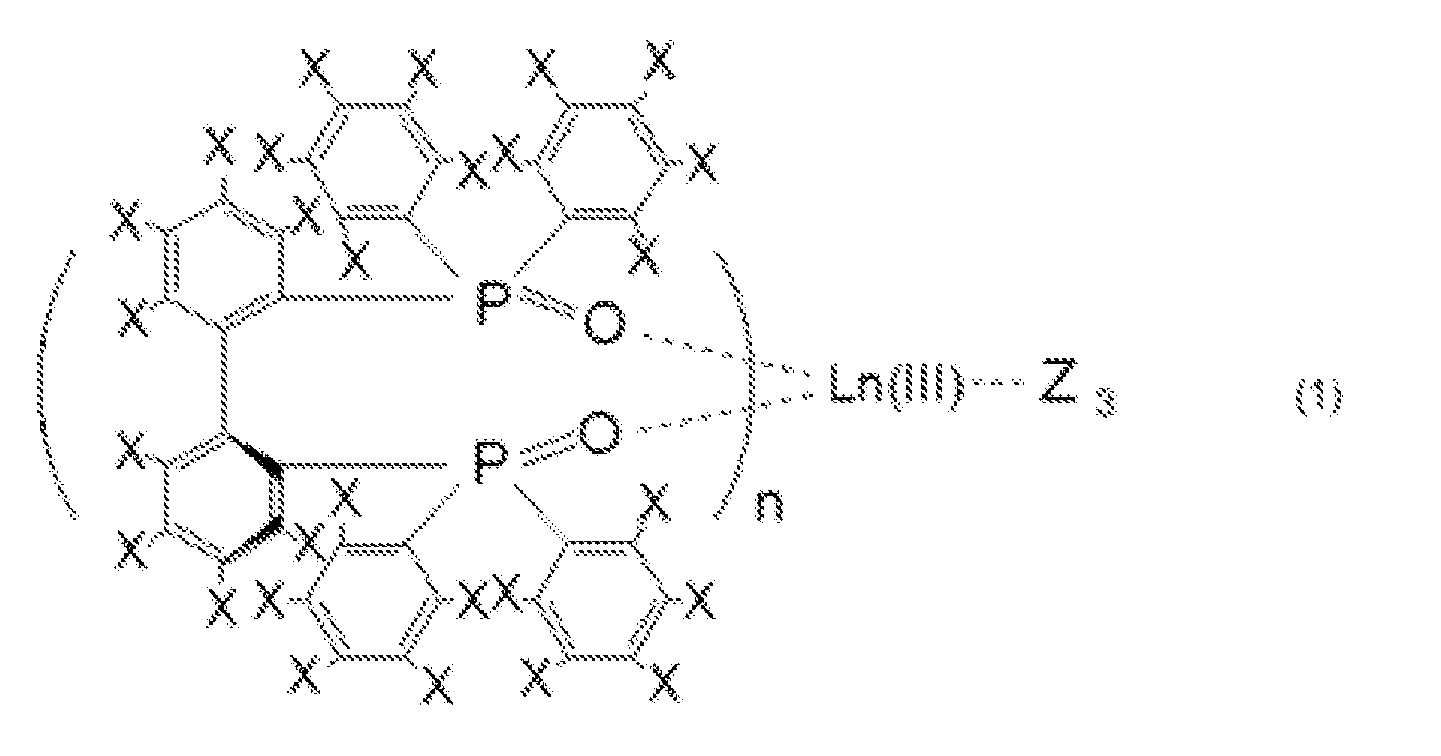
- the present invention pertains to a near infrared high emission rare-earth complex expressed by the following general formula (1): where Ln(III) represents a trivalent rare-earth ion; n is an integer equal to or greater than three; Xs represent either the same member or different members selected from a hydrogen atom, a deuterium atom, halogen atoms, C 1 -C 20 groups, hydroxyl groups, nitro groups, amino groups, sulfonyl groups, cyano groups, silyl groups, phosphonic groups, diazo groups and mercapto groups; and Z represents a bidentate ligand.
- Ln(III) represents a trivalent rare-earth ion
- n is an integer equal to or greater than three
- Xs represent either the same member or different members selected from a hydrogen atom, a deuterium atom, halogen atoms, C 1 -C 20 groups, hydroxyl groups, nitro groups, amino groups, sulfonyl
- the present invention also pertains to a near infrared high emission rare-earth complex in which the ligand represented by Z in the general formula (1) is expressed by the following general formula (2): where R 1 and R 2 are the same member or different members selected from C 1 -C 22 aliphatic groups free of hydrogen atoms, aromatic groups free of hydrogen atoms, and aromatic heterocyclic groups free of hydrogen atoms.
- Yb 3+ , Er 3+ and Nd 3+ exhibit excellent light-emitting properties in the near infrared region. Accordingly, it is possible to use Yb 3+ , Er 3+ and Nd 3+ as the central ion of the near infrared high emission rare-earth complex of the present invention.
- the near infrared high emission rare-earth complex according to the present invention exhibits a high level of emission quantum yield in the near infrared region and hence is useful for applications in the areas related to security, biological and medical technologies, and optical information communications. For example, it can be used in security inks, bio-labeling agents, medical lasers and optical fibers.
- 1,1'-biphenyl-2,2'-diylbisdiphenylphosphineoxide ((C 6 H 5 ) 2 P(C 6 H 4 )-(C 6 H 4 )P(C 6 H 5 ) 2 (BIPHEP) 1.0g) was dissolved in 60ml of dichloromethane, into which 5ml of 30% hydrogen peroxide water was dropped in ice bath, and the solution was stirred for 6 hours. The obtained reaction solution was washed with water several times, and the dichloromethane layer was dried by means of magnesium sulfate. Subsequently, magnesium sulfate was removed by filtration, and dichloromethane was distilled away from the obtained solution to obtain a white solid.
- Yb complex (Yb(PMS) 3 (H 2 O) 8 : 0.13g, 0.12mmol) and 1,1'-biphenyl-2,2'-diylbisdiphenylphosphineoxide (BIPHEPO: 0.2g, 0.36mmol) obtained by the previously described method were dissolved in 100ml of methanol and heated to reflux for 12 hours. Twelve hours later, impurities were removed by filtration, and methanol was removed by vacuum evaporation to obtain a white product. After this powder was dispersed in water to remove the unreacted remnant of the complex Yb(PMS) 3 (H2O) 8 , the filtration and vacuum-drying processes were successively performed to obtain a white objective compound.
- the yield was 92mg in weight and 28% in percentage.
- the results of an IR measurement (cm -1 ), 1 H-NMR measurement (acetone-d 6 , standard reference material TMS; ppm) and elementary analysis of the obtained complex Yb(PMS) 3 (BIPHEPO) 3 are shown below. Additionally, the chemical formula of the complex Yb(PMS) 3 (BIPHEPO) 3 is shown in Fig. 1 .
- Yb(CH 3 COO) 3 is a standard complex and a marketed product of this complex was used in the measurement.
- the emission quantum yield is expressed as a relative percentage calculated on the assumption that the emission quantum yield of Yb(CH 3 COO) 3 is 1.5%. The measured results are shown in Figs. 2 and 3 .
- the complex Yb(PMS) 3 (BIPHEPO) 3 of Product Example 1 had a strong emission of light in the near infrared region (around 980nm). Its emission quantum yield was beyond expectation and significantly exceeded those of the comparative examples. Furthermore, the emission quantum yield is drastically higher than those of the ytterbium complexes and neodymium complex disclosed in Non-Patent Documents 1-3 mentioned in the "BACKGROUND ART" section. Thus, the rare-earth complex of Product Example 1 exhibits an excellent light-emitting property in the near infrared region and hence can produce an adequately strong emission of light even in small quantity. Such a material is useful in security-related areas (e.g. security inks) and bio-related areas (e.g. biological body markers).
- security-related areas e.g. security inks
- bio-related areas e.g. biological body markers
- the complex Yb(PMS) 3 (BIPHEPO) 3 has a broad absorption peak over a range from 900 to 1050nm due to the f-f transition of the central ion, Yb 3+ .
- Such an absorption property will probably have considerable effects when the complex Yb(PMS) 3 (BIPHEPO) 3 is combined with an electroluminescence (EL) or similar broad light-emitting element.
- EL electroluminescence
- ytterbium (Yb) erbium (Er) and neodymium (Nd) are also known as rare-earth elements having an emission spectrum line in the near infrared region. Therefore, it is expected that similar effects will be obtained even if Er 3+ or Nd 3+ is used in place of Yb 3+ as the central ion of the near infrared high emission rare-earth complex of the present invention. Examples of the synthesizing method for a rare-earth complex of the present invention using Er 3+ or Nd3 + are hereinafter described.
- Nd(PMS) 3 (H 2 O) 8 0.31g, 0.3mmol
- BIPHEPO 1,1'-biphenyl-2,2'-diylbisdiphenylphosphineoxide
Landscapes
- Chemical & Material Sciences (AREA)
- Organic Chemistry (AREA)
- Life Sciences & Earth Sciences (AREA)
- Engineering & Computer Science (AREA)
- Materials Engineering (AREA)
- Wood Science & Technology (AREA)
- Biochemistry (AREA)
- General Health & Medical Sciences (AREA)
- Molecular Biology (AREA)
- Health & Medical Sciences (AREA)
- Chemical Kinetics & Catalysis (AREA)
- General Chemical & Material Sciences (AREA)
- Inks, Pencil-Leads, Or Crayons (AREA)
Abstract

Description
- The present invention relates to a near infrared high emission rare-earth complex that emits light in the near infrared region when irradiated with a predetermined excitation light.
- Various kinds of rare-earth complexes have conventionally been developed as optical functional materials or luminescent materials. Among those complexes, a rare-earth complex that emits light in the near infrared region is particularly expected to be used in security-related areas due to its invisibility. It is also expected to be useful as a labeling agent used in bio-related areas because it can efficiently permeate into biological bodies. Furthermore, the near infrared light has high utility values in the field of optical information communications.
- The present inventor and their colleagues have found that a composition containing a rare-earth complex with a +3 valence has an excellent light-emitting property. Particularly, they developed a high emission neodymium complex as a luminescent material that exhibits an excellent light-emitting property in the near infrared region (Non-Patent Document 1). This neodymium complex has an emission quantum yield of approximately 3% in an organic medium in the near infrared region. Bunzli et al. in Switzerland announced the creation of an ytterbium complex having an emission quantum yield of 2.1 % in the near infrared region (Non-Patent Document 2). In recent years, the present inventors have also created an ytterbium complex having an emission quantum yield of approximately 7.4 % in the near infrared region (Non-Patent Document 3).
- Non-Patent Document 1: Y.Hasegawa et al., Angew. Chem. Int. Ed., 39,357(2000)
- Non-Patent Document 2: J.G.Bunzli et al., Eur. J. Inorg. Chem., 23, 4739(2005)
- Non-Patent Document 3: Y.Hasegawa et al., 2007 Fall Meeting of the Chemical Society of Japan, Jpn. J. Appl. Phys. in press
- Thus, various kinds of rare-earth complexes that emit light in the near infrared region have been previously developed. However, these previous products have low emission quantum yields and have not achieved satisfactory levels of light-emitting properties. Therefore, these complexes need to be used in large quantity to obtain adequate emission intensity for optical functional materials.
- The problem to be solved by the present invention is to provide a near infrared high emission rare-earth complex having an excellent light-emitting property in the near infrared region.
- If the molecular design is performed so that a low vibration structure is created to reduce the molecular vibration of the complex, the deactivation of excited electrons due to the molecular vibration will be suppressed and the emission quantum yield will improve. Taking this into account, the present inventors have continued research on a rare-earth complex with which a high level of emission quantum yield can be attained in the near infrared region.
- As a result, it has been found that a ternary rare-earth complex with three or more bidentate phosphine oxide ligands having a biphenyl base and three bidentate ligands which differ from the aforementioned ligands, has an emission quantum yield significantly higher than those of the well-known near infrared emission rare-earth complexes. Thus, the present invention has been completed. In the present specification, such a rare-earth complex is referred to as a near infrared high emission rare-earth complex.
The phosphate double bond is known as a low vibration structure. It seems that the coordination of a ligand having such a structure suppresses the deactivation of electrons and thereby improves the emission quantum yield in the rare-earth complex of the present invention. - Particularly, the present invention pertains to a near infrared high emission rare-earth complex expressed by the following general formula (1):

- The present invention also pertains to a near infrared high emission rare-earth complex in which the ligand represented by Z in the general formula (1) is expressed by the following general formula (2):

- Yb3+, Er3+ and Nd3+ exhibit excellent light-emitting properties in the near infrared region. Accordingly, it is possible to use Yb3+, Er3+ and Nd3+ as the central ion of the near infrared high emission rare-earth complex of the present invention.
- The near infrared high emission rare-earth complex according to the present invention exhibits a high level of emission quantum yield in the near infrared region and hence is useful for applications in the areas related to security, biological and medical technologies, and optical information communications. For example, it can be used in security inks, bio-labeling agents, medical lasers and optical fibers.
-
-
Fig. 1 is a diagram showing the chemical formula of a complex Yb(PMS)3(BIPHEPO)3, which is the first example of the present invention. -
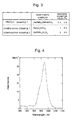
Fig. 2 is a graph showing the emission spectrums of the complex Yb(PMS)3(BIPHEPO)3 and two other Yb complexes (Yb(CH3COO)3, Yb(PMS)3(H2O)n) as comparative examples. -
Fig. 3 is a table showing the emission quantum yields of the complex Yb(PMS)3(BIPHEPO)3 and the other Yb complexes (Yb(CH3COO)3, Yb(PMS)3(H2O)n) as the comparative examples. -
Fig. 4 is a graph showing the absorption spectrum of the complex Yb(PMS)3(BIPHEPO)3. - The present invention is hereinafter described in detail based on the production examples and product examples.
- Ytterbium oxide (Yb2O3: 7.0g, 17.8mmol) was dispersed in 200ml of water, and bistrifluoromethane sulfonylimide (CF3SO2NH SO2 CF3(PMS): 10.0g, 35.6mmol) was added to it. The liquid was stirred for 120 hours at room temperature, and subsequently filtered to remove unreacted Yb2O3. Finally, water was distilled away from the filtrate to obtain a white solid, which was the objective compound. The yield was 10.9g. The result of an elementary analysis of the obtained complex Yb(PMS)3(H2O)8 is shown below.
Elementary analysis: C6H16F18O20S6Yb
Measured values: C, 6.06; H, 1.19; N, 3.63 %
Calculated values: C, 6.23; H, 1.39; N, 3.63 % - 1,1'-biphenyl-2,2'-diylbisdiphenylphosphineoxide ((C6H5)2P(C6H4)-(C6H4)P(C6H5)2 (BIPHEP) 1.0g) was dissolved in 60ml of dichloromethane, into which 5ml of 30% hydrogen peroxide water was dropped in ice bath, and the solution was stirred for 6 hours. The obtained reaction solution was washed with water several times, and the dichloromethane layer was dried by means of magnesium sulfate. Subsequently, magnesium sulfate was removed by filtration, and dichloromethane was distilled away from the obtained solution to obtain a white solid. Then, this white solid was re-crystallized with water/ethanol to obtain the objective compound. The result of an
1H-NMR measurement (acetone-d6, standard reference material TMS; ppm) is shown below.
1H-NMR(acetone-d6, standard reference material TMS; ppm): δ7.7, 7.55, 7.4, 7.2, 6.9 (m, aromatic C-H) - The Yb complex (Yb(PMS)3(H2O)8: 0.13g, 0.12mmol) and 1,1'-biphenyl-2,2'-diylbisdiphenylphosphineoxide (BIPHEPO: 0.2g, 0.36mmol) obtained by the previously described method were dissolved in 100ml of methanol and heated to reflux for 12 hours. Twelve hours later, impurities were removed by filtration, and methanol was removed by vacuum evaporation to obtain a white product. After this powder was dispersed in water to remove the unreacted remnant of the complex Yb(PMS)3(H2O)8, the filtration and vacuum-drying processes were successively performed to obtain a white objective compound. The yield was 92mg in weight and 28% in percentage. The results of an IR measurement (cm-1), 1H-NMR measurement (acetone-d6, standard reference material TMS; ppm) and elementary analysis of the obtained complex Yb(PMS)3(BIPHEPO)3 are shown below. Additionally, the chemical formula of the complex Yb(PMS)3(BIPHEPO)3 is shown in
Fig. 1 .
IR(cm-1): 1645(C=C, st), 1439, 1352(S=O, st), 1190, 1134, 1055(P=O, C-F, C-N, st)
1H-NMR(acetone-d6, standard reference material TMS; ppm): δ7.5, 7.3 (m, aromatic C-H)
Elementary analysis: C114H84F18N3O18P6S6Yb
Measured values: C, 50.98; H, 3.09; N, 1.59 %
Calculated values: C, 51.14; H, 3.16; N, 1.57 % - The emission quantum yield and emission spectrum of a dimethylsulfoxide-d6 solution of the complex Yb(PMS)3(BIPHEPO)3 obtained in Product Example 1 (Yb ion concentration: 10mM) were measured (excitation wavelength: 940nm). Additionally, the emission quantum yield and emission spectrum of two Yb complexes, Yb(CH3COO)3 and Yb(PMS)3(H2O)n (n=1 to 10), were measured as comparative examples under the same conditions as in the case of the complex Yb(PMS)3(BIPHEPO)3. Yb(CH3COO)3 is a standard complex and a marketed product of this complex was used in the measurement. The emission quantum yield is expressed as a relative percentage calculated on the assumption that the emission quantum yield of Yb(CH3COO)3 is 1.5%. The measured results are shown in
Figs. 2 and3 . - The absorption spectrum of a dimethylsulfoxide-d6 solution of the complex Yb(PMS)3(BIPHEPO)3 of Product Example 1 (Yb ion concentration: 10mM) was measured with an ultraviolet-visible near-infrared transmission spectrophotometer. The result is shown in
Fig. 4 . - As is evident from
Figs. 2 and3 , the complex Yb(PMS)3(BIPHEPO)3 of Product Example 1 had a strong emission of light in the near infrared region (around 980nm). Its emission quantum yield was beyond expectation and significantly exceeded those of the comparative examples. Furthermore, the emission quantum yield is drastically higher than those of the ytterbium complexes and neodymium complex disclosed in Non-Patent Documents 1-3 mentioned in the "BACKGROUND ART" section.
Thus, the rare-earth complex of Product Example 1 exhibits an excellent light-emitting property in the near infrared region and hence can produce an adequately strong emission of light even in small quantity. Such a material is useful in security-related areas (e.g. security inks) and bio-related areas (e.g. biological body markers). - As shown in
Fig. 4 , the complex Yb(PMS)3(BIPHEPO)3 has a broad absorption peak over a range from 900 to 1050nm due to the f-f transition of the central ion, Yb3+. Such an absorption property will probably have considerable effects when the complex Yb(PMS)3(BIPHEPO)3 is combined with an electroluminescence (EL) or similar broad light-emitting element. - Other than ytterbium (Yb), erbium (Er) and neodymium (Nd) are also known as rare-earth elements having an emission spectrum line in the near infrared region. Therefore, it is expected that similar effects will be obtained even if Er3+ or Nd3+ is used in place of Yb3+ as the central ion of the near infrared high emission rare-earth complex of the present invention. Examples of the synthesizing method for a rare-earth complex of the present invention using Er3+ or Nd3+ are hereinafter described.
- An Nd complex (Nd(PMS)3(H2O)8: 0.31g, 0.3mmol), which was obtained by a synthesizing method similar to the method used for the aforementioned Yb complex, and 1,1'-biphenyl-2,2'-diylbisdiphenylphosphineoxide (BIPHEPO: 0.5g, 0.9mmol) were dissolved in 100ml of methanol and heated to reflux for 12 hours. Twelve hours later, impurities were removed by filtration, and methanol was removed by vacuum distillation to obtain a pale purple product.
After this powder was dispersed in water to remove the unreacted remnant of the complex Nd(PMS)3(H2O)8, the filtration and vacuum-drying processes were successively performed to obtain a pale purple objective compound. The yield was 230mg in weight and 29% in percentage. The results of an IR measurement (cm-1), 1H-NMR measurement (acetone-d6, standard reference material TMS; ppm) and elementary analysis of the obtained complex Nd(PMS)3(BIPHEPO)3 are shown below.
IR(cm-1): 1635(C=C, st), 1352(S=O, st), 1192, 1142, 1053(P=O, C-F, C-N, st)
1H-NMR(acetone-d6, standard reference material TMS; ppm): δ7.5, 7.2 (m, aromatic C-H)
Elementary analysis: C114H84F18N3NdO18P6S6
Measured values: C, 51.69; H, 3.13; N, 1.48 %
Calculated values: C, 51.70; H, 3.20; N, 1.59 % - An Er complex (Er(PMS)3(H2O)8: 0.31g, 0.3mmol), which was obtained by a synthesizing method similar to the method used for the aforementioned Yb complex, and 1,1'-biphenyl-2,2'-diylbisdiphenylphosphineoxide (BIPHEPO: 0.5g, 0.9mmol) were dissolved in 100ml of methanol and heated to reflux for 12 hours. Twelve hours later, impurities were removed by filtration, and methanol was removed by vacuum distillation, and then by azeotropic distillation with hexane added thereto. As a result, a pink product was obtained.
- After this powder was dispersed in water to remove the unreacted remnant of the complex Er(PMS)3(H2O)8, the filtration and vacuum-drying processes were successively performed to obtain a pink objective compound. The yield was 12mg in weight and 1.5% in percentage. The results of an IR measurement (cm-1), 1H-NMR measurement (acetone-d6, standard reference material TMS; ppm) and elementary analysis of the obtained complex Er(PMS)3(BIPHEPO)3 are shown below.
IR(cm-1): 1628(C=C, st), 1350(S=O, st), 1182, 1136, 1053(P=O, C-F, C-N, st)
1H-NMR(acetone-d6, standard reference material TMS; ppm): δ7.5, 7.4 (m, aromatic C-H)
Elementary analysis: C114ErH84F18N3018P6S6
Measure values: C, 50.89; H, 3.02; N, 1.42 %
Calculated values: C, 51.26; H, 3.17; N, 1.57 %
Claims (17)
- A near infrared high emission rare-earth complex, comprising three or more bidentate phosphine oxide ligands having a biphenyl base and three bidentate ligands which differ from the aforementioned ligands.
- The near infrared high emission rare-earth complex according to claim 1, which is characterized in that the complex has a structure expressed by a following general formula (1):

- The near infrared high emission rare-earth complex according to claim 1 or 2, which is characterized in that Z is expressed by a general formula (2):

- The near infrared high emission rare-earth complex according to one of claims 1-3, which is characterized in that Ln is an element selected from a group consisting of Yb, Er and Nd.
- A security ink using a near infrared high emission rare-earth complex comprising three or more bidentate phosphine oxide ligands having a biphenyl base and three bidentate ligands which differ from the aforementioned ligands.
- The security ink according to claim 5, wherein the complex has a structure expressed by a following general formula (1):
- The security ink according to claim 5 or 6, which is characterized in that Z is expressed by a general formula (2):

- The security ink according to one of claims 5-7, which is characterized in that Ln is an element selected from a group consisting of Yb, Er and Nd.
- A light-emitting source using a near infrared high emission rare-earth complex comprising three or more bidentate phosphine oxide ligands having a biphenyl base and three bidentate ligands which differ from the aforementioned ligands.
- The light-emitting source according to claim 9, wherein the complex has a structure expressed by a following general formula (1):

- The security ink according to claim 9 or 10, which is characterized in that Z is expressed by a general formula (2):

- The light-emitting source according to one of claims 9-11, which is characterized in that Ln is an element selected from a group consisting of Yb, Er and Nd.
- A labeling agent for a measurement, using a near infrared high emission rare-earth complex comprising three or more bidentate phosphine oxide ligands having a biphenyl base and three bidentate ligands which differ from the aforementioned ligands.
- The labeling agent for a measurement according to claim 13, wherein the complex has a structure expressed by a following general formula (1):

- The security ink according to claim 13 or 14, which is characterized in that Z is expressed by a general formula (2):

- The labeling agent for a measurement according to one of claims 13-15, which is characterized in that Ln is an element selected from a group consisting of Yb, Er and Nd.
- A method for identifying a commodity composed of an organic compound and a Yb complex with a dodecadentate coordinate bond, by measuring a near-infrared light of the commodity.
Applications Claiming Priority (2)
| Application Number | Priority Date | Filing Date | Title |
|---|---|---|---|
| JP2008052779 | 2008-03-04 | ||
| PCT/JP2009/000866 WO2009110199A1 (en) | 2008-03-04 | 2009-02-26 | Near infrared strongly luminous rare earth complex |
Publications (3)
| Publication Number | Publication Date |
|---|---|
| EP2251345A1 true EP2251345A1 (en) | 2010-11-17 |
| EP2251345A4 EP2251345A4 (en) | 2011-05-18 |
| EP2251345B1 EP2251345B1 (en) | 2014-01-22 |
Family
ID=41055764
Family Applications (1)
| Application Number | Title | Priority Date | Filing Date |
|---|---|---|---|
| EP20090718512 Not-in-force EP2251345B1 (en) | 2008-03-04 | 2009-02-26 | Near infrared high emission rare-earth complex |
Country Status (4)
| Country | Link |
|---|---|
| US (1) | US8545807B2 (en) |
| EP (1) | EP2251345B1 (en) |
| JP (1) | JP5207492B2 (en) |
| WO (1) | WO2009110199A1 (en) |
Families Citing this family (6)
| Publication number | Priority date | Publication date | Assignee | Title |
|---|---|---|---|---|
| US9051427B2 (en) * | 2011-05-02 | 2015-06-09 | National University Corporation Hokkaido University | Rare-earth complex polymer and plastic molded product |
| JP6296398B2 (en) * | 2013-02-19 | 2018-03-20 | 国立大学法人 奈良先端科学技術大学院大学 | Ink set, printed matter, and printing method |
| JP6249477B2 (en) * | 2013-10-31 | 2017-12-20 | 国立研究開発法人産業技術総合研究所 | Stress luminescent material, stress luminescent material, and method of manufacturing stress luminescent material |
| JP6249476B2 (en) * | 2013-10-31 | 2017-12-20 | 国立研究開発法人産業技術総合研究所 | Near-infrared phosphorescent fluorescent material, near-infrared phosphorescent phosphor, and manufacturing method of near-infrared phosphorescent fluorescent material |
| EP3783072B1 (en) * | 2017-09-15 | 2023-04-12 | Dai Nippon Printing Co., Ltd. | Ink composition, printed product, and authenticity determination method |
| WO2019053962A1 (en) * | 2017-09-15 | 2019-03-21 | 大日本印刷株式会社 | Ink composition and printed matter |
Family Cites Families (4)
| Publication number | Priority date | Publication date | Assignee | Title |
|---|---|---|---|---|
| JP2000086952A (en) | 1998-09-11 | 2000-03-28 | New Japan Chem Co Ltd | Luminous ink composition |
| JP3811142B2 (en) * | 2003-06-24 | 2006-08-16 | 株式会社東芝 | LED element and light emitting medium using rare earth complex |
| JP4378139B2 (en) | 2003-09-08 | 2009-12-02 | 国立大学法人 奈良先端科学技術大学院大学 | Luminescent rare earth complex |
| JP4423920B2 (en) * | 2003-10-06 | 2010-03-03 | Dic株式会社 | Identifying mark |
-
2009
- 2009-02-26 WO PCT/JP2009/000866 patent/WO2009110199A1/en not_active Ceased
- 2009-02-26 US US12/920,244 patent/US8545807B2/en not_active Expired - Fee Related
- 2009-02-26 JP JP2010501786A patent/JP5207492B2/en not_active Expired - Fee Related
- 2009-02-26 EP EP20090718512 patent/EP2251345B1/en not_active Not-in-force
Non-Patent Citations (2)
| Title |
|---|
| NAKAMURA ET AL: J. PHYS. CHEM. A, vol. 111, 2007, pages 3029-3037, XP002631243, * |
| See also references of WO2009110199A1 * |
Also Published As
| Publication number | Publication date |
|---|---|
| JP5207492B2 (en) | 2013-06-12 |
| WO2009110199A1 (en) | 2009-09-11 |
| US20110003979A1 (en) | 2011-01-06 |
| JPWO2009110199A1 (en) | 2011-07-14 |
| EP2251345A4 (en) | 2011-05-18 |
| US8545807B2 (en) | 2013-10-01 |
| EP2251345B1 (en) | 2014-01-22 |
Similar Documents
| Publication | Publication Date | Title |
|---|---|---|
| Biju et al. | A new tetrakis β-diketone ligand for NIR emitting Ln III ions: Luminescent doped PMMA films and flexible resins for advanced photonic applications | |
| Ahmed et al. | Efficient layers of emitting ternary lanthanide complexes for fabricating red, green, and yellow OLEDs | |
| EP2251345B1 (en) | Near infrared high emission rare-earth complex | |
| Popy et al. | “This or that”–light emission from hybrid organic–inorganic vs. coordination Cu (I) halides | |
| EP3619218B1 (en) | Luminescent and dispersible hybrid materials combining ionic and coordinate bonds in molecular crystals | |
| EP2706081B1 (en) | Rare-earth complex polymer and plastic molded product | |
| CA2816432A1 (en) | Compounds and methods for enhancing metal luminescence that can be selectively turned off | |
| Li et al. | Water-soluble Tb 3+ and Eu 3+ complexes based on task-specific ionic liquid ligands and their application in luminescent poly (vinyl alcohol) films | |
| De Silva et al. | Adducts of lanthanide β-diketonates with 2, 4, 6-tri (2-pyridyl)-1, 3, 5-triazine: Synthesis, structural characterization, and photoluminescence studies | |
| Bozoklu et al. | Structural and photophysical properties of trianionic nine-coordinated near-IR emitting 8-hydroxyquinoline-based complexes | |
| Guo et al. | Two efficient near-infrared (NIR) luminescent [Ir (C^ N) 2 (N^ O)]-characteristic complexes with 8-hydroxyquinoline (8-Hq) as the ancillary ligand | |
| KR20160059597A (en) | Light-emitting compound of metal-organic coordination polymers, and method of preparing the same | |
| JP7857906B2 (en) | Organic compounds exhibiting delayed fluorescence emission and circularly polarized emission, and their use | |
| JP2013121921A (en) | Circularly-polarized emission rare earth complex | |
| Qin et al. | Novel luminescent iminephosphine complex of copper (I) with high photochemical and electrochemical stability | |
| JP3687791B2 (en) | Novel rare earth complexes with circularly polarized light emission | |
| WO2005044770A1 (en) | Heat-resistant rare earth complex | |
| EP2554533A1 (en) | Rare-earth metal complex | |
| JP6590254B2 (en) | Ligand, polymer complex and production method thereof | |
| Beverina et al. | Perfluorinated nitrosopyrazolone-based erbium chelates: a new efficient solution processable NIR emitter | |
| WO2016063304A1 (en) | Luminescent lanthanide complexes and method of preparation thereof | |
| Khatkar et al. | Multi-functional organosamarium complexes, photometric properties, applications, and energy transfer process: a review | |
| Sun et al. | Ternary lanthanide (Er3+, Nd3+, Yb3+, Sm3+, Pr3+) complex-functionalized mesoporous SBA-15 materials that emit in the near-infrared range | |
| Seltzer et al. | Curcuminoid ligands for sensitization of near-infrared lanthanide emission | |
| Sahoo et al. | Synthesis, characterization and photo-physical properties of Eu (III) complexes and its luminescent thin films |
Legal Events
| Date | Code | Title | Description |
|---|---|---|---|
| PUAI | Public reference made under article 153(3) epc to a published international application that has entered the european phase |
Free format text: ORIGINAL CODE: 0009012 |
|
| 17P | Request for examination filed |
Effective date: 20100910 |
|
| AK | Designated contracting states |
Kind code of ref document: A1 Designated state(s): AT BE BG CH CY CZ DE DK EE ES FI FR GB GR HR HU IE IS IT LI LT LU LV MC MK MT NL NO PL PT RO SE SI SK TR |
|
| AX | Request for extension of the european patent |
Extension state: AL BA RS |
|
| A4 | Supplementary search report drawn up and despatched |
Effective date: 20110414 |
|
| DAX | Request for extension of the european patent (deleted) | ||
| 17Q | First examination report despatched |
Effective date: 20120102 |
|
| GRAP | Despatch of communication of intention to grant a patent |
Free format text: ORIGINAL CODE: EPIDOSNIGR1 |
|
| INTG | Intention to grant announced |
Effective date: 20130802 |
|
| RIC1 | Information provided on ipc code assigned before grant |
Ipc: C07F 9/53 20060101AFI20130719BHEP Ipc: C07F 5/00 20060101ALI20130719BHEP Ipc: C09D 11/02 20060101ALI20130719BHEP Ipc: C09D 11/00 20060101ALI20130719BHEP Ipc: C09K 11/06 20060101ALI20130719BHEP |
|
| RIN1 | Information on inventor provided before grant (corrected) |
Inventor name: KAWAI, TSUYOSHI Inventor name: KAWAI, HIDEKI Inventor name: HASEGAWA, YASUCHIKA |
|
| GRAS | Grant fee paid |
Free format text: ORIGINAL CODE: EPIDOSNIGR3 |
|
| GRAA | (expected) grant |
Free format text: ORIGINAL CODE: 0009210 |
|
| AK | Designated contracting states |
Kind code of ref document: B1 Designated state(s): AT BE BG CH CY CZ DE DK EE ES FI FR GB GR HR HU IE IS IT LI LT LU LV MC MK MT NL NO PL PT RO SE SI SK TR |
|
| REG | Reference to a national code |
Ref country code: GB Ref legal event code: FG4D |
|
| REG | Reference to a national code |
Ref country code: CH Ref legal event code: EP |
|
| REG | Reference to a national code |
Ref country code: AT Ref legal event code: REF Ref document number: 650778 Country of ref document: AT Kind code of ref document: T Effective date: 20140215 |
|
| REG | Reference to a national code |
Ref country code: IE Ref legal event code: FG4D |
|
| REG | Reference to a national code |
Ref country code: DE Ref legal event code: R096 Ref document number: 602009021566 Country of ref document: DE Effective date: 20140306 |
|
| REG | Reference to a national code |
Ref country code: NL Ref legal event code: VDEP Effective date: 20140122 |
|
| REG | Reference to a national code |
Ref country code: AT Ref legal event code: MK05 Ref document number: 650778 Country of ref document: AT Kind code of ref document: T Effective date: 20140122 |
|
| REG | Reference to a national code |
Ref country code: LT Ref legal event code: MG4D |
|
| PG25 | Lapsed in a contracting state [announced via postgrant information from national office to epo] |
Ref country code: IS Free format text: LAPSE BECAUSE OF FAILURE TO SUBMIT A TRANSLATION OF THE DESCRIPTION OR TO PAY THE FEE WITHIN THE PRESCRIBED TIME-LIMIT Effective date: 20140522 Ref country code: NO Free format text: LAPSE BECAUSE OF FAILURE TO SUBMIT A TRANSLATION OF THE DESCRIPTION OR TO PAY THE FEE WITHIN THE PRESCRIBED TIME-LIMIT Effective date: 20140422 Ref country code: LT Free format text: LAPSE BECAUSE OF FAILURE TO SUBMIT A TRANSLATION OF THE DESCRIPTION OR TO PAY THE FEE WITHIN THE PRESCRIBED TIME-LIMIT Effective date: 20140122 |
|
| PG25 | Lapsed in a contracting state [announced via postgrant information from national office to epo] |
Ref country code: NL Free format text: LAPSE BECAUSE OF FAILURE TO SUBMIT A TRANSLATION OF THE DESCRIPTION OR TO PAY THE FEE WITHIN THE PRESCRIBED TIME-LIMIT Effective date: 20140122 Ref country code: ES Free format text: LAPSE BECAUSE OF FAILURE TO SUBMIT A TRANSLATION OF THE DESCRIPTION OR TO PAY THE FEE WITHIN THE PRESCRIBED TIME-LIMIT Effective date: 20140122 Ref country code: CY Free format text: LAPSE BECAUSE OF FAILURE TO SUBMIT A TRANSLATION OF THE DESCRIPTION OR TO PAY THE FEE WITHIN THE PRESCRIBED TIME-LIMIT Effective date: 20140122 Ref country code: AT Free format text: LAPSE BECAUSE OF FAILURE TO SUBMIT A TRANSLATION OF THE DESCRIPTION OR TO PAY THE FEE WITHIN THE PRESCRIBED TIME-LIMIT Effective date: 20140122 Ref country code: PT Free format text: LAPSE BECAUSE OF FAILURE TO SUBMIT A TRANSLATION OF THE DESCRIPTION OR TO PAY THE FEE WITHIN THE PRESCRIBED TIME-LIMIT Effective date: 20140522 Ref country code: FI Free format text: LAPSE BECAUSE OF FAILURE TO SUBMIT A TRANSLATION OF THE DESCRIPTION OR TO PAY THE FEE WITHIN THE PRESCRIBED TIME-LIMIT Effective date: 20140122 Ref country code: SE Free format text: LAPSE BECAUSE OF FAILURE TO SUBMIT A TRANSLATION OF THE DESCRIPTION OR TO PAY THE FEE WITHIN THE PRESCRIBED TIME-LIMIT Effective date: 20140122 |
|
| PG25 | Lapsed in a contracting state [announced via postgrant information from national office to epo] |
Ref country code: BE Free format text: LAPSE BECAUSE OF FAILURE TO SUBMIT A TRANSLATION OF THE DESCRIPTION OR TO PAY THE FEE WITHIN THE PRESCRIBED TIME-LIMIT Effective date: 20140122 Ref country code: LV Free format text: LAPSE BECAUSE OF FAILURE TO SUBMIT A TRANSLATION OF THE DESCRIPTION OR TO PAY THE FEE WITHIN THE PRESCRIBED TIME-LIMIT Effective date: 20140122 Ref country code: HR Free format text: LAPSE BECAUSE OF FAILURE TO SUBMIT A TRANSLATION OF THE DESCRIPTION OR TO PAY THE FEE WITHIN THE PRESCRIBED TIME-LIMIT Effective date: 20140122 |
|
| REG | Reference to a national code |
Ref country code: CH Ref legal event code: PL |
|
| REG | Reference to a national code |
Ref country code: DE Ref legal event code: R097 Ref document number: 602009021566 Country of ref document: DE |
|
| PG25 | Lapsed in a contracting state [announced via postgrant information from national office to epo] |
Ref country code: MC Free format text: LAPSE BECAUSE OF FAILURE TO SUBMIT A TRANSLATION OF THE DESCRIPTION OR TO PAY THE FEE WITHIN THE PRESCRIBED TIME-LIMIT Effective date: 20140122 Ref country code: DK Free format text: LAPSE BECAUSE OF FAILURE TO SUBMIT A TRANSLATION OF THE DESCRIPTION OR TO PAY THE FEE WITHIN THE PRESCRIBED TIME-LIMIT Effective date: 20140122 Ref country code: LI Free format text: LAPSE BECAUSE OF NON-PAYMENT OF DUE FEES Effective date: 20140228 Ref country code: RO Free format text: LAPSE BECAUSE OF FAILURE TO SUBMIT A TRANSLATION OF THE DESCRIPTION OR TO PAY THE FEE WITHIN THE PRESCRIBED TIME-LIMIT Effective date: 20140122 Ref country code: EE Free format text: LAPSE BECAUSE OF FAILURE TO SUBMIT A TRANSLATION OF THE DESCRIPTION OR TO PAY THE FEE WITHIN THE PRESCRIBED TIME-LIMIT Effective date: 20140122 Ref country code: CZ Free format text: LAPSE BECAUSE OF FAILURE TO SUBMIT A TRANSLATION OF THE DESCRIPTION OR TO PAY THE FEE WITHIN THE PRESCRIBED TIME-LIMIT Effective date: 20140122 Ref country code: CH Free format text: LAPSE BECAUSE OF NON-PAYMENT OF DUE FEES Effective date: 20140228 |
|
| PG25 | Lapsed in a contracting state [announced via postgrant information from national office to epo] |
Ref country code: PL Free format text: LAPSE BECAUSE OF FAILURE TO SUBMIT A TRANSLATION OF THE DESCRIPTION OR TO PAY THE FEE WITHIN THE PRESCRIBED TIME-LIMIT Effective date: 20140122 Ref country code: SK Free format text: LAPSE BECAUSE OF FAILURE TO SUBMIT A TRANSLATION OF THE DESCRIPTION OR TO PAY THE FEE WITHIN THE PRESCRIBED TIME-LIMIT Effective date: 20140122 |
|
| PLBE | No opposition filed within time limit |
Free format text: ORIGINAL CODE: 0009261 |
|
| STAA | Information on the status of an ep patent application or granted ep patent |
Free format text: STATUS: NO OPPOSITION FILED WITHIN TIME LIMIT |
|
| REG | Reference to a national code |
Ref country code: IE Ref legal event code: MM4A |
|
| GBPC | Gb: european patent ceased through non-payment of renewal fee |
Effective date: 20140422 |
|
| 26N | No opposition filed |
Effective date: 20141023 |
|
| REG | Reference to a national code |
Ref country code: FR Ref legal event code: ST Effective date: 20141208 |
|
| PG25 | Lapsed in a contracting state [announced via postgrant information from national office to epo] |
Ref country code: FR Free format text: LAPSE BECAUSE OF NON-PAYMENT OF DUE FEES Effective date: 20140324 Ref country code: GB Free format text: LAPSE BECAUSE OF NON-PAYMENT OF DUE FEES Effective date: 20140422 Ref country code: IE Free format text: LAPSE BECAUSE OF NON-PAYMENT OF DUE FEES Effective date: 20140226 |
|
| REG | Reference to a national code |
Ref country code: DE Ref legal event code: R097 Ref document number: 602009021566 Country of ref document: DE Effective date: 20141023 |
|
| PG25 | Lapsed in a contracting state [announced via postgrant information from national office to epo] |
Ref country code: SI Free format text: LAPSE BECAUSE OF FAILURE TO SUBMIT A TRANSLATION OF THE DESCRIPTION OR TO PAY THE FEE WITHIN THE PRESCRIBED TIME-LIMIT Effective date: 20140122 |
|
| REG | Reference to a national code |
Ref country code: DE Ref legal event code: R082 Ref document number: 602009021566 Country of ref document: DE Representative=s name: HOEGER, STELLRECHT & PARTNER PATENTANWAELTE MB, DE |
|
| PG25 | Lapsed in a contracting state [announced via postgrant information from national office to epo] |
Ref country code: MT Free format text: LAPSE BECAUSE OF FAILURE TO SUBMIT A TRANSLATION OF THE DESCRIPTION OR TO PAY THE FEE WITHIN THE PRESCRIBED TIME-LIMIT Effective date: 20140122 |
|
| PG25 | Lapsed in a contracting state [announced via postgrant information from national office to epo] |
Ref country code: BG Free format text: LAPSE BECAUSE OF FAILURE TO SUBMIT A TRANSLATION OF THE DESCRIPTION OR TO PAY THE FEE WITHIN THE PRESCRIBED TIME-LIMIT Effective date: 20140122 |
|
| PG25 | Lapsed in a contracting state [announced via postgrant information from national office to epo] |
Ref country code: IT Free format text: LAPSE BECAUSE OF FAILURE TO SUBMIT A TRANSLATION OF THE DESCRIPTION OR TO PAY THE FEE WITHIN THE PRESCRIBED TIME-LIMIT Effective date: 20140122 Ref country code: GR Free format text: LAPSE BECAUSE OF FAILURE TO SUBMIT A TRANSLATION OF THE DESCRIPTION OR TO PAY THE FEE WITHIN THE PRESCRIBED TIME-LIMIT Effective date: 20140423 |
|
| PG25 | Lapsed in a contracting state [announced via postgrant information from national office to epo] |
Ref country code: HU Free format text: LAPSE BECAUSE OF FAILURE TO SUBMIT A TRANSLATION OF THE DESCRIPTION OR TO PAY THE FEE WITHIN THE PRESCRIBED TIME-LIMIT; INVALID AB INITIO Effective date: 20090226 Ref country code: TR Free format text: LAPSE BECAUSE OF FAILURE TO SUBMIT A TRANSLATION OF THE DESCRIPTION OR TO PAY THE FEE WITHIN THE PRESCRIBED TIME-LIMIT Effective date: 20140122 Ref country code: LU Free format text: LAPSE BECAUSE OF NON-PAYMENT OF DUE FEES Effective date: 20140226 |
|
| REG | Reference to a national code |
Ref country code: DE Ref legal event code: R082 Ref document number: 602009021566 Country of ref document: DE Representative=s name: HOEGER, STELLRECHT & PARTNER PATENTANWAELTE MB, DE Ref country code: DE Ref legal event code: R081 Ref document number: 602009021566 Country of ref document: DE Owner name: NATIONAL UNIVERSITY CORPORATION NARA INSTITUTE, JP Free format text: FORMER OWNERS: NATIONAL UNIVERSITY CORPORATION NARA INSTITUTE OF SCIENCE AND TECHNOLOGY, IKOMA-SHI, NARA, JP; NATIONAL UNIVERSITY CORPORATION SHIZUOKA UNIVERSITY, SHIZUOKA-SHI, SHIZUOKA-KEN, JP |
|
| PGFP | Annual fee paid to national office [announced via postgrant information from national office to epo] |
Ref country code: DE Payment date: 20170221 Year of fee payment: 9 |
|
| PG25 | Lapsed in a contracting state [announced via postgrant information from national office to epo] |
Ref country code: MK Free format text: LAPSE BECAUSE OF FAILURE TO SUBMIT A TRANSLATION OF THE DESCRIPTION OR TO PAY THE FEE WITHIN THE PRESCRIBED TIME-LIMIT Effective date: 20140122 |
|
| REG | Reference to a national code |
Ref country code: DE Ref legal event code: R119 Ref document number: 602009021566 Country of ref document: DE |
|
| PG25 | Lapsed in a contracting state [announced via postgrant information from national office to epo] |
Ref country code: DE Free format text: LAPSE BECAUSE OF NON-PAYMENT OF DUE FEES Effective date: 20180901 |