EP2251336A1 - Hydrazide compounds as intermediates of pesticides - Google Patents
Hydrazide compounds as intermediates of pesticides Download PDFInfo
- Publication number
- EP2251336A1 EP2251336A1 EP10006958A EP10006958A EP2251336A1 EP 2251336 A1 EP2251336 A1 EP 2251336A1 EP 10006958 A EP10006958 A EP 10006958A EP 10006958 A EP10006958 A EP 10006958A EP 2251336 A1 EP2251336 A1 EP 2251336A1
- Authority
- EP
- European Patent Office
- Prior art keywords
- group
- halogen atom
- optionally substituted
- group optionally
- pyridinyl
- Prior art date
- Legal status (The legal status is an assumption and is not a legal conclusion. Google has not performed a legal analysis and makes no representation as to the accuracy of the status listed.)
- Withdrawn
Links
- 0 *N(/C(/I)=*\I)c1ccccc1C(**C([N+])=*)=* Chemical compound *N(/C(/I)=*\I)c1ccccc1C(**C([N+])=*)=* 0.000 description 14
- DZFBFEKATCBQPO-UHFFFAOYSA-N C=[Br]c(cc1C(Nc(c([Br]=C)cc(Br)c2)c2C(NN)=O)=O)n[n]1-c(nccc1)c1Cl Chemical compound C=[Br]c(cc1C(Nc(c([Br]=C)cc(Br)c2)c2C(NN)=O)=O)n[n]1-c(nccc1)c1Cl DZFBFEKATCBQPO-UHFFFAOYSA-N 0.000 description 1
- UMJQKVFLMBELCD-UHFFFAOYSA-N CCOC(NNC(c(cccc1)c1N(C)C(c1cc(C(F)(F)F)n[n]1-c(nccc1)c1Cl)=O)=O)=O Chemical compound CCOC(NNC(c(cccc1)c1N(C)C(c1cc(C(F)(F)F)n[n]1-c(nccc1)c1Cl)=O)=O)=O UMJQKVFLMBELCD-UHFFFAOYSA-N 0.000 description 1
- ZEQNZPQJEZSBED-UHFFFAOYSA-N CCOC(NNC(c(cccc1)c1NC(c1cc(C(F)(F)F)n[n]1-c1ncccc1Cl)=O)=O)=O Chemical compound CCOC(NNC(c(cccc1)c1NC(c1cc(C(F)(F)F)n[n]1-c1ncccc1Cl)=O)=O)=O ZEQNZPQJEZSBED-UHFFFAOYSA-N 0.000 description 1
- JQULCRFOGIJDHC-WKULSOCRSA-N CCS(NNC(c1cc(Cl)cc(C)c1NC(N(c(nccc1)c1Cl)/N=C(/C(F)(F)F)\C=C)=O)=O)(=O)=O Chemical compound CCS(NNC(c1cc(Cl)cc(C)c1NC(N(c(nccc1)c1Cl)/N=C(/C(F)(F)F)\C=C)=O)=O)(=O)=O JQULCRFOGIJDHC-WKULSOCRSA-N 0.000 description 1
- IWLWUGGGZQMPIX-UHFFFAOYSA-N CC[n]1nc(C(F)(F)F)cc1C(O)=O Chemical compound CC[n]1nc(C(F)(F)F)cc1C(O)=O IWLWUGGGZQMPIX-UHFFFAOYSA-N 0.000 description 1
- FNGYMMNPPJOUGJ-UHFFFAOYSA-N CSc(cc1C(O)=O)n[n]1-c1ncccc1Cl Chemical compound CSc(cc1C(O)=O)n[n]1-c1ncccc1Cl FNGYMMNPPJOUGJ-UHFFFAOYSA-N 0.000 description 1
- JZHICZVMXCFSLN-UHFFFAOYSA-N Cc(cc(cc12)Cl)c1N=C(c([n]1-c3ncccc3)cc(Cl)c1Cl)OC2=O Chemical compound Cc(cc(cc12)Cl)c1N=C(c([n]1-c3ncccc3)cc(Cl)c1Cl)OC2=O JZHICZVMXCFSLN-UHFFFAOYSA-N 0.000 description 1
- SMADAACBVRZMBZ-UHFFFAOYSA-N Cc(cc(cc12)Cl)c1N=C(c1cc(Br)c[n]1-c(ccnc1)c1Cl)OC2=O Chemical compound Cc(cc(cc12)Cl)c1N=C(c1cc(Br)c[n]1-c(ccnc1)c1Cl)OC2=O SMADAACBVRZMBZ-UHFFFAOYSA-N 0.000 description 1
- OHNVAZZDLYLFRW-UHFFFAOYSA-N Cc(cc(cc12)Cl)c1N=C(c1cc(C(F)(F)F)n[n]1-c(cccc1)c1Cl)OC2=O Chemical compound Cc(cc(cc12)Cl)c1N=C(c1cc(C(F)(F)F)n[n]1-c(cccc1)c1Cl)OC2=O OHNVAZZDLYLFRW-UHFFFAOYSA-N 0.000 description 1
- WWTKUPWORPWLBC-UHFFFAOYSA-N Cc(cc(cc12)Cl)c1N=C(c1cc(C(F)(F)F)n[n]1-c(nccc1)c1Cl)OC2=O Chemical compound Cc(cc(cc12)Cl)c1N=C(c1cc(C(F)(F)F)n[n]1-c(nccc1)c1Cl)OC2=O WWTKUPWORPWLBC-UHFFFAOYSA-N 0.000 description 1
- PQSIZTPMFLRQHM-UHFFFAOYSA-N Cc(cc(cc1C(NN)=O)Cl)c1NC(c1cc(Br)c[n]1-c(c(Cl)cnc1)c1Cl)=O Chemical compound Cc(cc(cc1C(NN)=O)Cl)c1NC(c1cc(Br)c[n]1-c(c(Cl)cnc1)c1Cl)=O PQSIZTPMFLRQHM-UHFFFAOYSA-N 0.000 description 1
- REZCFQKLTUWDBT-UHFFFAOYSA-N Cc(cc(cc1C(NN)=O)Cl)c1NC(c1cc(C(F)(F)F)n[n]1-c1ncccc1)=O Chemical compound Cc(cc(cc1C(NN)=O)Cl)c1NC(c1cc(C(F)(F)F)n[n]1-c1ncccc1)=O REZCFQKLTUWDBT-UHFFFAOYSA-N 0.000 description 1
- KUIXVFDXFXNPSG-UHFFFAOYSA-N Cc(cc12)cc(Br)c1N=C(c1cc(Br)n[n]1-c(nccc1)c1Cl)OC2=O Chemical compound Cc(cc12)cc(Br)c1N=C(c1cc(Br)n[n]1-c(nccc1)c1Cl)OC2=O KUIXVFDXFXNPSG-UHFFFAOYSA-N 0.000 description 1
- PBFIBFCMJCWJKX-UHFFFAOYSA-N Cc(cc1Br)cc(C(NN)=O)c1NC(c1cc(C(F)(F)F)n[n]1-c1ncccc1Cl)=O Chemical compound Cc(cc1Br)cc(C(NN)=O)c1NC(c1cc(C(F)(F)F)n[n]1-c1ncccc1Cl)=O PBFIBFCMJCWJKX-UHFFFAOYSA-N 0.000 description 1
- HRKJLQKYVXSHMF-UHFFFAOYSA-N Cc(cc1C(Nc(c(C)cc(Cl)c2)c2C(N(C)NC(SC)=O)=O)=O)n[n]1-c(nccc1)c1Cl Chemical compound Cc(cc1C(Nc(c(C)cc(Cl)c2)c2C(N(C)NC(SC)=O)=O)=O)n[n]1-c(nccc1)c1Cl HRKJLQKYVXSHMF-UHFFFAOYSA-N 0.000 description 1
- IQLZXRCDLXZZIQ-UHFFFAOYSA-N Cc(cc1C(O2)=Nc(c(C)cc(Cl)c3)c3C2=O)n[n]1-c(nccc1)c1[ClH+] Chemical compound Cc(cc1C(O2)=Nc(c(C)cc(Cl)c3)c3C2=O)n[n]1-c(nccc1)c1[ClH+] IQLZXRCDLXZZIQ-UHFFFAOYSA-N 0.000 description 1
- VBROLLWUTIDKBE-UHFFFAOYSA-N Cc1cc(Cl)cc(C(NN)=O)c1NC(c1cc(I)n[n]1-c(nccc1)c1Cl)=O Chemical compound Cc1cc(Cl)cc(C(NN)=O)c1NC(c1cc(I)n[n]1-c(nccc1)c1Cl)=O VBROLLWUTIDKBE-UHFFFAOYSA-N 0.000 description 1
- FRSPJIBSPJZFLP-UHFFFAOYSA-N Cc1cc(Cl)cc(C(NNC(COC)=O)=O)c1NC(c1cc(Br)n[n]1-c(nccc1)c1Cl)=O Chemical compound Cc1cc(Cl)cc(C(NNC(COC)=O)=O)c1NC(c1cc(Br)n[n]1-c(nccc1)c1Cl)=O FRSPJIBSPJZFLP-UHFFFAOYSA-N 0.000 description 1
- RKBFIUJHFUXWJI-UHFFFAOYSA-N Cc1cc(Cl)cc(C(NNC(OC)=O)=O)c1NC(c([n](-c(nccc1)c1Cl)nc1)c1Br)=O Chemical compound Cc1cc(Cl)cc(C(NNC(OC)=O)=O)c1NC(c([n](-c(nccc1)c1Cl)nc1)c1Br)=O RKBFIUJHFUXWJI-UHFFFAOYSA-N 0.000 description 1
- VFYOBMMCKHBDPE-UHFFFAOYSA-N Cc1cc(Cl)cc(C(NNC(OC)=O)=O)c1NC(c1cc(Br)c[n]1-c1ccncc1Cl)=O Chemical compound Cc1cc(Cl)cc(C(NNC(OC)=O)=O)c1NC(c1cc(Br)c[n]1-c1ccncc1Cl)=O VFYOBMMCKHBDPE-UHFFFAOYSA-N 0.000 description 1
- LGEOWYXWWPCAHC-UHFFFAOYSA-N Cc1cc(Cl)cc(C(NNC(OC)=O)=O)c1NC(c1cc(Br)c[n]1-c1ncccc1Cl)=O Chemical compound Cc1cc(Cl)cc(C(NNC(OC)=O)=O)c1NC(c1cc(Br)c[n]1-c1ncccc1Cl)=O LGEOWYXWWPCAHC-UHFFFAOYSA-N 0.000 description 1
- GTLFANPSCBZKQC-UHFFFAOYSA-N Cc1cc(Cl)cc(C(NNC(OC)=O)=O)c1NC(c1cc(C(F)(F)F)n[n]1-c1ccccc1)=O Chemical compound Cc1cc(Cl)cc(C(NNC(OC)=O)=O)c1NC(c1cc(C(F)(F)F)n[n]1-c1ccccc1)=O GTLFANPSCBZKQC-UHFFFAOYSA-N 0.000 description 1
- UPMOWDSQPBLQGZ-UHFFFAOYSA-N Cc1cc(Cl)cc(C(NNC(OC)=O)=O)c1NC(c1cc(SC(F)(F)F)n[n]1-c(nccc1)c1Cl)=O Chemical compound Cc1cc(Cl)cc(C(NNC(OC)=O)=O)c1NC(c1cc(SC(F)(F)F)n[n]1-c(nccc1)c1Cl)=O UPMOWDSQPBLQGZ-UHFFFAOYSA-N 0.000 description 1
- JCFOCTQHCKCUDE-UHFFFAOYSA-N FC(F)(F)Sc(cc1)n[n]1-c(nccc1)c1Cl Chemical compound FC(F)(F)Sc(cc1)n[n]1-c(nccc1)c1Cl JCFOCTQHCKCUDE-UHFFFAOYSA-N 0.000 description 1
- HECMRIKNQQEXIF-UHFFFAOYSA-N NNC(c(cc(cc1Br)Br)c1NC(c1cc(Br)c[n]1-c(nccc1)c1Cl)=O)=O Chemical compound NNC(c(cc(cc1Br)Br)c1NC(c1cc(Br)c[n]1-c(nccc1)c1Cl)=O)=O HECMRIKNQQEXIF-UHFFFAOYSA-N 0.000 description 1
- DVMXWNCQRLFEGI-UHFFFAOYSA-N NNC(c(cc(cc1Br)Cl)c1NC(c1cc(C(F)(F)F)n[n]1-c1ncccc1Cl)=O)=O Chemical compound NNC(c(cc(cc1Br)Cl)c1NC(c1cc(C(F)(F)F)n[n]1-c1ncccc1Cl)=O)=O DVMXWNCQRLFEGI-UHFFFAOYSA-N 0.000 description 1
- PAYRUJLWNCNPSJ-UHFFFAOYSA-N Nc1ccccc1 Chemical compound Nc1ccccc1 PAYRUJLWNCNPSJ-UHFFFAOYSA-N 0.000 description 1
- RWZYAGGXGHYGMB-UHFFFAOYSA-N Nc1ccccc1C(O)=O Chemical compound Nc1ccccc1C(O)=O RWZYAGGXGHYGMB-UHFFFAOYSA-N 0.000 description 1
- JXYGOFTVVYHTSH-UHFFFAOYSA-N O=C(c1c(cc2)Cl)OC(c3cc(Br)n[n]3-c(nccc3)c3Cl)=Nc1c2Cl Chemical compound O=C(c1c(cc2)Cl)OC(c3cc(Br)n[n]3-c(nccc3)c3Cl)=Nc1c2Cl JXYGOFTVVYHTSH-UHFFFAOYSA-N 0.000 description 1
- BKTFCHNOBRZJTN-UHFFFAOYSA-N O=C(c1cc(Br)c2)OC(c3cc(Br)c[n]3-c3c(C(F)(F)F)cccn3)=Nc1c2Br Chemical compound O=C(c1cc(Br)c2)OC(c3cc(Br)c[n]3-c3c(C(F)(F)F)cccn3)=Nc1c2Br BKTFCHNOBRZJTN-UHFFFAOYSA-N 0.000 description 1
- JXDYKVIHCLTXOP-UHFFFAOYSA-N O=C(c1ccccc1N1)C1=O Chemical compound O=C(c1ccccc1N1)C1=O JXDYKVIHCLTXOP-UHFFFAOYSA-N 0.000 description 1
- BWAJAQXAVGEBKS-UHFFFAOYSA-N O=C1OC(c2cc(Br)n[n]2-c(nccc2)c2Cl)=Nc(cc2)c1cc2Cl Chemical compound O=C1OC(c2cc(Br)n[n]2-c(nccc2)c2Cl)=Nc(cc2)c1cc2Cl BWAJAQXAVGEBKS-UHFFFAOYSA-N 0.000 description 1
- FADQZMHPWJUGEI-UHFFFAOYSA-N O=C1OC(c2cc(Br)n[n]2-c(nccc2)c2Cl)=Nc2c(C(F)(F)F)cccc12 Chemical compound O=C1OC(c2cc(Br)n[n]2-c(nccc2)c2Cl)=Nc2c(C(F)(F)F)cccc12 FADQZMHPWJUGEI-UHFFFAOYSA-N 0.000 description 1
- SINGZTWDXNPJME-UHFFFAOYSA-N O=C1OC(c2cc(C(F)(F)F)n[n]2-c2ncccc2Cl)=Nc(cc2)c1cc2Cl Chemical compound O=C1OC(c2cc(C(F)(F)F)n[n]2-c2ncccc2Cl)=Nc(cc2)c1cc2Cl SINGZTWDXNPJME-UHFFFAOYSA-N 0.000 description 1
- IQNSMJTUAULQOR-UHFFFAOYSA-N O=C1OC(c2cc(C(F)(F)F)n[n]2-c2ncccc2Cl)=Nc2c1c(Cl)ccc2 Chemical compound O=C1OC(c2cc(C(F)(F)F)n[n]2-c2ncccc2Cl)=Nc2c1c(Cl)ccc2 IQNSMJTUAULQOR-UHFFFAOYSA-N 0.000 description 1
- DMRVBKATYROROJ-UHFFFAOYSA-N O=CC(CC(Br)=C1)N1c1ncccc1C(F)(F)F Chemical compound O=CC(CC(Br)=C1)N1c1ncccc1C(F)(F)F DMRVBKATYROROJ-UHFFFAOYSA-N 0.000 description 1
- FVNIHRSCMUSWAN-UHFFFAOYSA-N O=Cc([n]1-c2ncccc2Cl)cc(Br)c1Cl Chemical compound O=Cc([n]1-c2ncccc2Cl)cc(Br)c1Cl FVNIHRSCMUSWAN-UHFFFAOYSA-N 0.000 description 1
- SSCOWHOZMNTAQP-UHFFFAOYSA-N O=Cc1cc(Br)c[n]1-c1ncccc1Br Chemical compound O=Cc1cc(Br)c[n]1-c1ncccc1Br SSCOWHOZMNTAQP-UHFFFAOYSA-N 0.000 description 1
- UCWQJFWGYWPPRF-UHFFFAOYSA-N O=Cc1ccc[n]1-c(cccn1)c1Cl Chemical compound O=Cc1ccc[n]1-c(cccn1)c1Cl UCWQJFWGYWPPRF-UHFFFAOYSA-N 0.000 description 1
- IOCDZSKAZUOEGE-UHFFFAOYSA-N OC(c1cc(Br)c[n]1-c(ccnc1)c1Cl)=O Chemical compound OC(c1cc(Br)c[n]1-c(ccnc1)c1Cl)=O IOCDZSKAZUOEGE-UHFFFAOYSA-N 0.000 description 1
Classifications
-
- C—CHEMISTRY; METALLURGY
- C07—ORGANIC CHEMISTRY
- C07D—HETEROCYCLIC COMPOUNDS
- C07D207/00—Heterocyclic compounds containing five-membered rings not condensed with other rings, with one nitrogen atom as the only ring hetero atom
- C07D207/02—Heterocyclic compounds containing five-membered rings not condensed with other rings, with one nitrogen atom as the only ring hetero atom with only hydrogen or carbon atoms directly attached to the ring nitrogen atom
- C07D207/30—Heterocyclic compounds containing five-membered rings not condensed with other rings, with one nitrogen atom as the only ring hetero atom with only hydrogen or carbon atoms directly attached to the ring nitrogen atom having two double bonds between ring members or between ring members and non-ring members
- C07D207/34—Heterocyclic compounds containing five-membered rings not condensed with other rings, with one nitrogen atom as the only ring hetero atom with only hydrogen or carbon atoms directly attached to the ring nitrogen atom having two double bonds between ring members or between ring members and non-ring members with hetero atoms or with carbon atoms having three bonds to hetero atoms with at the most one bond to halogen, e.g. ester or nitrile radicals, directly attached to ring carbon atoms
-
- A—HUMAN NECESSITIES
- A01—AGRICULTURE; FORESTRY; ANIMAL HUSBANDRY; HUNTING; TRAPPING; FISHING
- A01N—PRESERVATION OF BODIES OF HUMANS OR ANIMALS OR PLANTS OR PARTS THEREOF; BIOCIDES, e.g. AS DISINFECTANTS, AS PESTICIDES OR AS HERBICIDES; PEST REPELLANTS OR ATTRACTANTS; PLANT GROWTH REGULATORS
- A01N43/00—Biocides, pest repellants or attractants, or plant growth regulators containing heterocyclic compounds
- A01N43/34—Biocides, pest repellants or attractants, or plant growth regulators containing heterocyclic compounds having rings with one nitrogen atom as the only ring hetero atom
- A01N43/36—Biocides, pest repellants or attractants, or plant growth regulators containing heterocyclic compounds having rings with one nitrogen atom as the only ring hetero atom five-membered rings
-
- A—HUMAN NECESSITIES
- A01—AGRICULTURE; FORESTRY; ANIMAL HUSBANDRY; HUNTING; TRAPPING; FISHING
- A01N—PRESERVATION OF BODIES OF HUMANS OR ANIMALS OR PLANTS OR PARTS THEREOF; BIOCIDES, e.g. AS DISINFECTANTS, AS PESTICIDES OR AS HERBICIDES; PEST REPELLANTS OR ATTRACTANTS; PLANT GROWTH REGULATORS
- A01N43/00—Biocides, pest repellants or attractants, or plant growth regulators containing heterocyclic compounds
- A01N43/34—Biocides, pest repellants or attractants, or plant growth regulators containing heterocyclic compounds having rings with one nitrogen atom as the only ring hetero atom
- A01N43/40—Biocides, pest repellants or attractants, or plant growth regulators containing heterocyclic compounds having rings with one nitrogen atom as the only ring hetero atom six-membered rings
-
- A—HUMAN NECESSITIES
- A01—AGRICULTURE; FORESTRY; ANIMAL HUSBANDRY; HUNTING; TRAPPING; FISHING
- A01N—PRESERVATION OF BODIES OF HUMANS OR ANIMALS OR PLANTS OR PARTS THEREOF; BIOCIDES, e.g. AS DISINFECTANTS, AS PESTICIDES OR AS HERBICIDES; PEST REPELLANTS OR ATTRACTANTS; PLANT GROWTH REGULATORS
- A01N43/00—Biocides, pest repellants or attractants, or plant growth regulators containing heterocyclic compounds
- A01N43/48—Biocides, pest repellants or attractants, or plant growth regulators containing heterocyclic compounds having rings with two nitrogen atoms as the only ring hetero atoms
- A01N43/56—1,2-Diazoles; Hydrogenated 1,2-diazoles
-
- C—CHEMISTRY; METALLURGY
- C07—ORGANIC CHEMISTRY
- C07D—HETEROCYCLIC COMPOUNDS
- C07D231/00—Heterocyclic compounds containing 1,2-diazole or hydrogenated 1,2-diazole rings
- C07D231/02—Heterocyclic compounds containing 1,2-diazole or hydrogenated 1,2-diazole rings not condensed with other rings
- C07D231/10—Heterocyclic compounds containing 1,2-diazole or hydrogenated 1,2-diazole rings not condensed with other rings having two or three double bonds between ring members or between ring members and non-ring members
- C07D231/14—Heterocyclic compounds containing 1,2-diazole or hydrogenated 1,2-diazole rings not condensed with other rings having two or three double bonds between ring members or between ring members and non-ring members with hetero atoms or with carbon atoms having three bonds to hetero atoms with at the most one bond to halogen, e.g. ester or nitrile radicals, directly attached to ring carbon atoms
-
- C—CHEMISTRY; METALLURGY
- C07—ORGANIC CHEMISTRY
- C07D—HETEROCYCLIC COMPOUNDS
- C07D401/00—Heterocyclic compounds containing two or more hetero rings, having nitrogen atoms as the only ring hetero atoms, at least one ring being a six-membered ring with only one nitrogen atom
- C07D401/02—Heterocyclic compounds containing two or more hetero rings, having nitrogen atoms as the only ring hetero atoms, at least one ring being a six-membered ring with only one nitrogen atom containing two hetero rings
- C07D401/04—Heterocyclic compounds containing two or more hetero rings, having nitrogen atoms as the only ring hetero atoms, at least one ring being a six-membered ring with only one nitrogen atom containing two hetero rings directly linked by a ring-member-to-ring-member bond
-
- C—CHEMISTRY; METALLURGY
- C07—ORGANIC CHEMISTRY
- C07D—HETEROCYCLIC COMPOUNDS
- C07D401/00—Heterocyclic compounds containing two or more hetero rings, having nitrogen atoms as the only ring hetero atoms, at least one ring being a six-membered ring with only one nitrogen atom
- C07D401/14—Heterocyclic compounds containing two or more hetero rings, having nitrogen atoms as the only ring hetero atoms, at least one ring being a six-membered ring with only one nitrogen atom containing three or more hetero rings
-
- C—CHEMISTRY; METALLURGY
- C07—ORGANIC CHEMISTRY
- C07D—HETEROCYCLIC COMPOUNDS
- C07D403/00—Heterocyclic compounds containing two or more hetero rings, having nitrogen atoms as the only ring hetero atoms, not provided for by group C07D401/00
- C07D403/02—Heterocyclic compounds containing two or more hetero rings, having nitrogen atoms as the only ring hetero atoms, not provided for by group C07D401/00 containing two hetero rings
- C07D403/04—Heterocyclic compounds containing two or more hetero rings, having nitrogen atoms as the only ring hetero atoms, not provided for by group C07D401/00 containing two hetero rings directly linked by a ring-member-to-ring-member bond
-
- C—CHEMISTRY; METALLURGY
- C07—ORGANIC CHEMISTRY
- C07D—HETEROCYCLIC COMPOUNDS
- C07D413/00—Heterocyclic compounds containing two or more hetero rings, at least one ring having nitrogen and oxygen atoms as the only ring hetero atoms
- C07D413/14—Heterocyclic compounds containing two or more hetero rings, at least one ring having nitrogen and oxygen atoms as the only ring hetero atoms containing three or more hetero rings
-
- C—CHEMISTRY; METALLURGY
- C07—ORGANIC CHEMISTRY
- C07D—HETEROCYCLIC COMPOUNDS
- C07D417/00—Heterocyclic compounds containing two or more hetero rings, at least one ring having nitrogen and sulfur atoms as the only ring hetero atoms, not provided for by group C07D415/00
- C07D417/14—Heterocyclic compounds containing two or more hetero rings, at least one ring having nitrogen and sulfur atoms as the only ring hetero atoms, not provided for by group C07D415/00 containing three or more hetero rings
Definitions
- the present invention relates to a hydrazide compound and pesticidal use of the same.
- the present invention is intended to provide a compound having excellent efficacy of controlling pests.
- the present inventors have intensively studied in order to find out a compound having excellent efficacy of controlling pests and, as a result, found out that a hydrazide compound represented by the following formula (1) has excellent controlling efficacy.
- a hydrazide compound represented by the following formula (1) has excellent controlling efficacy.
- R 14a used herein represents a group which can substitute for a hydrogen atom of a ring constituting CH of a group represented by J1
- R 14b represents a group which can substitute for a hydrogen atom of a ring constituting CH of a group represented by J2.
- examples of a halogen atom include a fluorine atom, a chlorine atom, a bromine atom and an iodine atom.
- examples of the "C1-C6 alkyl group optionally substituted with at least one halogen atom" include a methyl group, an ethyl group, a 2,2,2-trifluoroethyl group, a propyl group, an isopropyl group, a butyl group, an isobutyl group, a sec-butyl group, a tert-butyl group, a pentyl group and a hexyl group.
- examples of the "C2-C6 cyanoalkyl group” include a cyanomethyl group and a 2-cyanoethyl group;
- examples of the "C2-C6 alkoxyalkyl group optionally substituted with at least one halogen atom” include a 2-methoxyethyl group, a 2-ethoxyethyl group and a 2-isopropyloxyethyl group;
- examples of the "C2-C6 alkenyl group optionally substituted with at least one halogen atom” include a 2-propenyl group, a 3-chloro-2-propenyl group, a 2-chloro-2-propenyl group, a 3,3-dichloro-2-propenyl group, a 2-butenyl group, a 3-butenyl group, a 2-methyl-2-propenyl group, a 3-methyl-2-butenyl group, a 2-pentenyl group and a 2-hexenyl group; example
- examples of the "C1-C6 acyl group” include a formyl group, an acetyl group, a propionyl group, an isobutyryl group and a trimethylacetyl group;
- examples of the "C2-C6 alkoxycarbonyl group” include a methoxycarbonyl group, an ethoxycarbonyl group, an isopropoxycarbonyl group and a tert-butoxycarbonyl group;
- examples of the "C3-C7 N,N-dialkylcarbamoyl group” include a N,N-dimethylcarbamoyl group and a N,N-diethylcarbamoyl group; and examples of the "phenyl group optionally substituted with 1 to 5 independent groups selected from the group consisting of (1) a halogen atom, (2) a cyano group, (3) a nitro group, (4) a C1-C6 alkyl group optionally substituted with at least one
- examples of the "C1-C6 alkyl group optionally substituted with at least one halogen atom" include a methyl group, a trifluoromethyl group, an ethyl group, a propyl group, an isopropyl group, a butyl group, an isobutyl group, a sec-butyl group, a tert-butyl group, a pentyl group and a hexyl group.
- examples of the "C1-C6 alkoxy group optionally substituted with at least one halogen atom" include a methoxy group, a trifluoromethoxy group, an ethoxy group, a 2,2,2-trifluoroethoxy group, a propyloxy group, an isopropyloxy group, a butoxy group, an isobutyloxy group, a sec-butoxy group, a tert-butoxy group, a pentyloxy group and a hexyloxy group.
- examples of the "C1-C6 alkylthio group optionally substituted with at least one halogen atom" include a methylthio group, a trifluoromethylthio group and an ethylthio group.
- examples of the "C1-C6 alkylsulfinyl group optionally substituted with at least one halogen atom" include a methylsulfinyl group, a trifluoromethylsulfinyl group and an ethylsulfinyl group.
- examples of the "C1-C6 alkylsulfonyl group optionally substituted with at least one halogen atom" include a methylsulfonyl group, a trifluoromethylsulfonyl group and an ethylsulfonyl group.
- examples of the "phenyl group optionally substituted with at least one halogen atom” include a phenyl group, a 2-chlorophenyl group, a 3-chlorophenyl group and a 4-chlorophenyl group.
- examples of the "C1-C6 alkyl group optionally substituted with at least one halogen atom” include a methyl group, a trifluoromethyl group, and an ethyl group.
- examples of the "C2-C6 alkenyl group optionally substituted with at least one halogen atom” include a vinyl group, a 1-propenyl group, a 2-propenyl group, a 1-methylvinyl group, a 2-chlorovinyl group and a 2-methyl-1-propenyl group;
- examples of the "C2-C6 alkynyl group optionally substituted with at least one halogen atom” include an ethynyl group;
- examples of the "C1-C6 alkyl group optionally substituted with at least one halogen atom” include a methyl group, an ethyl group, a 2,2,2-trifluoroethyl group, a 2,2,2-trichloroethyl group, a propyl group, an isopropyl group, a butyl group, an isobutyl group, a sec-butyl group, a tert-butyl group, a pentyl group and a hexyl group;
- examples of the "C3-C6 alkoxyalkyl group optionally substituted with at least one halogen atom” include a 2-methoxyethyl group, 2-ethoxyethyl group and a 2-isopropyloxyethyl group;
- examples of the "C2-C6 alkenyl group optionally substituted with at least one halogen atom” include a 1-propenyl group, a 2-
- examples of the "C1-C6 alkyl group optionally substituted with at least one halogen atom” include a methyl group, an ethyl group, a 2,2,2-trifluoroethyl group, a 2,2,2-trichloroethyl group, a propyl group, an isopropyl group, a butyl group, an isobutyl group, a sec-butyl group, a tert-butyl group, a pentyl group and a hexyl group;
- examples of the "C2-C6 alkoxyalkyl group optionally substituted with at least one halogen atom” include a 2-methoxyethyl group, a 2-ethoxyethyl group and a 2-isopropyloxyethyl group;
- examples of the "C2-C6 alkenyl group optionally substituted with at least one halogen atom” include a 2-propenyl group, a
- examples of the "C1-C6 alkyl group optionally substituted with at least one halogen atom” include a methyl group, a trifluoromethyl group, a trichloromethyl group, an ethyl group, a 2-chloroethyl group, a 2,2,2-trifluoroethyl group, a propyl group, an isopropyl group, a butyl group, an isobutyl group, a sec-butyl group, a tert-butyl group, a pentyl group and a hexyl group;
- examples of the "C3-C6 cycloalkyl group optionally substituted with one or more independent substituents selected from the group consisting of (1) a halogen atom and (2) a C1-C6 alkyl group optionally substituted with at least one halogen atom” include a cyclopropyl group, a cyclobutyl group, a cyclobut
- examples of the "C1-C6 alkyl group optionally substituted with at least one halogen atom” include a methyl group, an ethyl group, a 2,2,2-trifluoroethyl group, a 2,2,2-trichloroethyl group, a propyl group, an isopropyl group, a butyl group, an isobutyl group, a sec-butyl group, a tert-butyl group, a pentyl group and a hexyl group;
- examples of the "C3-C6 cycloalkyl group optionally substituted with one or more independent substituents selected from the group consisting of (1) a halogen atom and (2) a C1-C6 alkyl group optionally substituted with at least one halogen atom” include a cyclopropyl group, a cyclobutyl group, a cyclopentyl group and a cyclohex
- examples of the "C1-C6 alkyl group optionally substituted with at least one halogen atom” include a methyl group, a fluoromethyl group, a difluoromethyl group, a trifluoromethyl group, an ethyl group, a 2,2,2-trifluoroethyl group, a 1,1,2,2-tetrafluoroethyl group, a propyl group, an isopropyl group, a butyl group, an isobutyl group, a sec-butyl group, a tert-butyl group, a pentyl group and a hexyl group;
- examples of the "C2-C6 cyanoalkyl group” include a cyanomethyl group and a 2-cyanoethyl group;
- examples of the "C2-C6 alkoxyalkyl group optionally substituted with at least one halogen atom” include a methoxymethyl group, an e
- examples of the "C1-C6 alkyl group optionally substituted with at least one halogen atom” include a methyl group, a trifluoromethyl group, a trichloromethyl group, a chloromethyl group, a dichloromethyl group, a fluoromethyl group, a difluoromethyl group, an ethyl group, a pentafluoroethyl group, a propyl group, an isopropyl group, a butyl group, an isobutyl group, a sec-butyl group, a tert-butyl group, a pentyl group and a hexyl group;
- examples of the "C1-C6 alkoxy group optionally substituted with at least one halogen atom” include a methoxy group, an ethoxy group, a 2,2,2-trifluoroethoxy group, a propoxy group, an isopropyloxy group,
- Examples of the group represented by J1 include a 1-phenylpyrazol-5-yl group, a 1-(2-chlorophenyl)pyrazol-5-yl group, a 1-(2-pyridinyl)pyrazol-5-yl group, a 1-(3-chloro-2-pyridinyl)pyrazol-5-yl, a 3-fluoro-1-phenylpyrazol-5-yl group, a 1-(2-chlorophenyl)-3-fluoropyrazol-5-yl group, a 3-fluoro-1-(2-pyridinyl)pyrazol-5-yl group, a 3-fluoro-1-(3-chloro-2-pyridinyl)pyrazol-5-yl group, a 3-chloro- 1-phenylpyrazol-5-yl group, a 3-chloro-1-(2-chlorophenyl)pyrazol-5-yl group, a 3-chloro-1-(2-pyridinyl)
- Examples of the group represented by J2 include a 1-methyl-3-phenylpyrazol-4-yl group, a 3-(2-chlorophenyl)-1-methylpyrazol-4-yl group, a 1-methyl-3-(2-pyridinyl)pyrazol-4-yl group, a 3-(3-chloro-2-pyridinyl)-1-methylpyrazol-4-yl group, a 1-methyl-5-phenylpyrazol-4-yl group, a 5-(2-chlorophenyl)-1-methylpyrazol-4-yl group, a 1-methyl-5-(2-pyridinyl)pyrazol-4-yl group, a 5-(3-chloro-2-pyridinyl)-1-methylpyrazol-4-yl group, a 3-phenyl-1-(2,2,2-trifluoroethyl)pyrazol-4-yl group, a 3-(2-chlorophenyl)-1-(2,2,2-trifluoroethyl)
- the present compound can be produced, for example, by the following Process A-1 to Process C-1.
- a compound represented by the formula (1-i): wherein R 1 , R 2 , R 3 , R 4 , A 1 , A 2 , J and n are as defined above, Q' represents a group selected from the group consisting of Q1 to Q6 (provided that the compound wherein Q' is Q4, and R 8 and R 9 are a hydrogen atom is excluded) (hereinafter, referred to as the compound (1-i)) can be produced by reacting a compound represented by the formula (2): wherein R 1 , R 2 , R 3 , R 4 , A 1 , A 2 , J and n are as defined above (hereinafter, referred to as the compound (2)), and a compound represented by the formula (3): L 1 -Q' (3) wherein Q' is as defined above, and L 1 represents a halogen atom or a Q'-O-group (provided that the case where Q' is Q4, and R 8 and R 9 are a hydrogen atom is excluded) (hereinafter,
- the reaction is performed in the presence or the absence of a solvent.
- the solvent to be used in the reaction include ethers such as 1,4-dioxane, diethyl ether, tetrahydrofuran, methyl tert-butyl ether, and the like, halogenated hydrocarbons such as dichloromethane, chloroform, carbon tetrachloride, 1,2-dichloroethane, chlorobenzene, and the like, hydrocarbons such as toluene, benzene, xylene, and the like, nitriles such as acetonitrile and the like, aprotic polar solvents such as N,N-dimethylformamide, N-methlpyrrolidone, 1,3-dimethyl-2-imidadzolidinone, dimethyl sulfoxide, and the like, and a mixture thereof.
- the amount of the compound (3) to be used in the reaction is usually 1 to 2 mols per 1 mol of the compound (2).
- the reaction is performed in the presence of a base, if necessary.
- a base include nitrogen-containing heterocyclic compounds such as pyridine, picoline, 2,6-lutidine, 1,8-diazabicyclo[5,4,0]7-undecene (DBU), 1,5-diazabicyclo[4,3, 0]5-nonene (DBN), and the like, tertiary amines such as triethylamine, N,N-diisopropylethylamine, and the like, and inorganic bases such as potassium carbonate, sodium hydride, and the like.
- DBU 1,8-diazabicyclo[5,4,0]7-undecene
- DBN 1,5-diazabicyclo[4,3, 0]5-nonene
- tertiary amines such as triethylamine, N,N-diisopropylethylamine, and the like
- inorganic bases such as potassium carbonate
- the amount of the base when the reaction is performed in the presence of the base is usually 1 to 2 mols per 1 mol of the compound (2), while the base may be used in an excess amount in case that the base used is liquid under the reaction conditions such as pyridine, and the like.
- the reaction temperature is usually in a range of 0 to 100°C, and the reaction time is usually in a range of 0.1 to 24 hours.
- the compound (1-i) can be isolated by pouring the reaction mixture into water and extracting the mixture with an organic solvent, or collecting a deposited precipitate by filtration.
- the isolated compound (1-i) may be further purified by recrystallization, chromatography, or the like.
- a compound represented by the formula (1-ii) wherein R 1 , R 2 , R 3 , R 4 , A 1 , A 2 , A 34 , J and n are as defined above, and R 8a represents a C1-C6 alkyl group optionally substituted with at least one halogen atom; a C2-C6 alkoxyalkyl group optionally substituted with at least one halogen atom; a C2-C6 alkenyl group optionally substituted with at least one halogen atom; a C3-C6 alkynyl group optionally substituted with at least one halogen atom; a C3-C6 cycloalkyl group optionally substituted with one or more independent substituents selected from the group consisting of (1) a halogen atom and (2) a C1-C6 alkyl group; a phenyl group optionally substituted with a 1 to 5 independent substituents selected from the group consisting of (1) a halogen atom and (2)
- the reaction is performed in the presence or the absence of a solvent.
- the solvent to be used in the reaction include ethers such as 1,4-dioxane, diethyl ether, tetrahydrofuran, methyl tert-butyl ether, and the like, halogenated hydrocarbons such as dichloromethane, chloroform, carbon tetrachloride, 1,2-dichloroethane, chlorobenzene, and the like, hydrocarbons such as toluene, benzene, xylene, and the like, nitriles such as acetonitrile, and the like, aprotic polar solvents such as N,N-dimethylformamide, N-methylpyrrolidone, 1,3-dimethyl-2-imidazolidinone, dimethyl sulfoxide, and the like, and a mixture thereof.
- the amount of the compound (4) used in the reaction is usually 1 to 2 mols per 1 mol of the compound (2).
- the reaction temperature is usually in a range of 0 to 100°C, and the reaction time is a usually a range of 0.1 to 24 hours.
- the compound (1-ii) can be isolated by pouring the reaction mixture into water, and extracting the mixture with an organic solvent, or collecting a deposited precipitate by filtration.
- the isolated compound (1-ii) may be further purified by recrystallization, chromatography, or the like.
- a compound represented by the formula (1-iii): wherein R 1 , R 2 , R 3 , R 4 , A 1, A 2 , A 34 , J and n are as defined above (hereinafter, referred to as the compound (I-iii)) can be produced by reacting the compound (2) and a cyanate or a thiocyanate.
- the reaction is performed in the presence of a solvent.
- the solvent used in the reaction include acids such as organic acids such as acetic acids, and the like and mineral acids such as hydrochloric acid, and the like, as well as a mixture of these acids and water, chloroform, or the like.
- the amount of the cyanate or the thiocyanate used in the reaction is usually 1 to 2 mols per 1 mol of the compound (2).
- the reaction temperature is usually in a range of 0 to 100°C, and the reaction time is usually in a range of 0.1 to 24 hours.
- Examples of the cyanate or the thiocyanate include potassium cyanate, sodium cyanate, ammonium cyanate, potassium thiocyanate, sodium thiocyanate and ammonium thiocyanate.
- the compound (I-iii) can be isolated by pouring the reaction mixture into water and extracting the mixture with an organic solvent, or collecting a deposited precipitate by filtration.
- the isolated Compound (I-iii) may be further purified by recrystallization, chromatography, or the like.
- the present compound can be produced by reacting a compound represented by the formula (6): wherein R 1 , R 2 , R 3 , R 4 , A 2 , Q and n are as defined above (hereinafter, referred to as Compound (6)) and a compound represented by the formula (7): wherein A 1 and J are as define above, and L 2 represents a halogen atom (hereinafter, referred to as the compound (7)).
- the reaction is performed in the presence or the absence of a solvent.
- the solvent used in the reaction include ethers such as 1,4-dioxane, diethyl ether, tetrahydrofuran, methyl tert-butyl ether, and the like, halogenated hydrocarbons such as dichloromethane, chloroform, carbon tetrachloride, 1,2-dichloroethane, chlorobenzene, and the like, hydrocarbons such as toluene, benzene, xylene, and the like, nitriles such as acetonitrile, and the like, aprotic polar solvents such as N,N-dimethylformamide, N-methylpyrrolidone, 1,3-dimethyl-2-imidazolidinone, dimethyl sulfoxide, and the like, and a mixture thereof.
- the amount of the compound (7) used in the reaction is usually 1 to 2 mols per 1 mol of the compound (6).
- the reaction is performed in the presence of a base, if necessary.
- a base include nitrogen-containing heterocyclic compounds such as pyridine, picoline, 2,6-lutidine, 1,8-diazabicyclo[5,4,0]7-undecene (DBU), 1,5-diazadicyclo[4,3,0]5-nonene (DBN), and the like, tertiary amines such as triethylamine, N,N-diisopropylethylamine, and the like, and inorganic bases such as potassium carbonate, sodium hydride, and the like.
- DBU 1,8-diazabicyclo[5,4,0]7-undecene
- DBN 1,5-diazadicyclo[4,3,0]5-nonene
- tertiary amines such as triethylamine, N,N-diisopropylethylamine, and the like
- inorganic bases such as potassium carbonate, sodium
- the amount of the base when the reaction is performed in the presence of the base is usually 1 to 2 mole per 1 mol of the compound (6), while the base may be used in an excess amount in case that the base used is liquid under the reaction conditions such as pyridine, and the like.
- the reaction temperature is usually in a range of 0 to 100°C, and the reaction time is usually in a range of 0.1 to 24 hours.
- the present compound can be isolated by pouring the reaction mixture into water, and extracting the mixture with an organic solvent, or collecting a deposited precipitation by filtration.
- the isolated present compound may be further purified by recrystallization, chromatography, or the like.
- a compound represented by the formula (I-iv): wherein R 1 , R 2 , R 3 , R 4 , A 2 , J, Q and n are as defined above (hereinafter referred to as the compound (I-iv)) can be produced by reacting the compound (6) and a compound represented by the formula (8): wherein J is as defined above (hereinafter, referred to as the compound (8)) in the presence of a dehydrating agent.
- the reaction is performed in the presence or the absence of a solvent.
- the solvent to be used in the reaction include ethers such as 1,4-dioxane, diethyl ether, tetrahydrofuran, methyl tert-butyl ether, and the like, halogenated hydrocarbons such as dichloromethane, chloroform, carbon tetrachloride, 1,2-dichloroethane, chlorobenzene, and the like, hydrocarbons such as toluene, benzene, xylene, and the like, nitriles such as acetonitrile, and the like, aprotic polar solvents such as N,N-dimethylformamide, N-methylpyrrolidone, 1,3-dimethyl-2-imidazolidinone, dimethyl sulfoxide, and the like, and a mixture thereof.
- the amount of the compound (8) used in the reaction is usually 1 to 2 mols per 1 mol of the compound (6).
- Examples of the dehydrating agent to be used in the reaction include carbodiimides such as dicyclohexylcarbodiimide (DCC), 1-ethyl-3-(3-dimethylaminopropyl)carbodiimide hydrochloride (WSC), and the like.
- the amount of the dehydrating agent to be used is usually 1 to 2 mols per 1 mol of the compound (6).
- the reaction temperature is usually in a range of 0 to 100°C, and the reaction time is usually in a range of 0.1 to 24 hours.
- the compound (I-iv) can be isolated by pouring the reaction mixture into water, and extracting the mixture with an organic solvent, or collecting a deposited precipitate by filtration.
- the isolated compound (1-iv) may be further purified by recrystallization, chromatography, or the like.
- a compound represented by the formula (1-v): wherein R 2 , R 3 , R 4 , J, Q and n are as defined above can be produced by reacting a compound represented by the formula (9): wherein R 4 , J and n are as defined above (hereinafter, referred to as the compound (9)) and a compound represented by the formula (10): wherein R 2 , R 3 and Q are as defined above (hereinafter, referred to as the compound (10)).
- the reaction is performed in the presence or the absence of a solvent.
- the solvent used in the reaction include ethers such as 1,4-dioxane, diethyl ether, tetrahydrofuran, methyl tert-butyl ether, and the like, halogenated hydrocarbons such as dichloromethane, chloroform, carbon tetrachloride, 1,2-dichloroethane, chlorobenzene, and the like, hydrocarbons such as toluene, benzene, xylene, and the like, nitriles such as acetonitrile, and the like, aprotic polar solvents such as N,N-dimethylformamide, N-methylpyrrolidone, 1,3-dimethyl-2-imidaozolidinone, dimethyl sulfoxide, and the like, and a mixture thereof.
- the amount of the compound (10) to be used in the reaction is usually 1 to 20 mols per 1 mol of the compound (9).
- the reaction temperature is usually in a range of 0 to 100°C, and the reaction time is usually in a range of 0.1 to 48 hours.
- the compound (1-v) can be isolated by pouring the reaction mixture into water, and extracting the mixture with an organic solvent, or collecting a deposited precipitate by filtration.
- the isolated compound (1-v) may be further purified by recrystallization, chromatography, or the like.
- R 1-a represents a C1-C6 alkyl group optionally substituted with at least one halogen atom; a C2-C6 cyanoalkyl group; a C2-C6 alkoxyalkyl group optionally substituted with at least one halogen atom; a C2-C6 alkenyl group optionally substituted with at least one halogen atom; a C3-C6 alkynyl group optionally substituted with at least one halogen atom; or a C7-C9 phenylalkyl group in which a benzene ring part may be substituted with 1 to 5 independent substituents selected from the group consisting of (1) a halogen atom, (2) a cyano group, (3) a nitro group, (4) a C1-C6 alkyl group optionally substituted with 1 to 5 independent substituents selected from the group consisting of (1) a halogen atom, (2) a cyano group, (3) a nitro group, (4) a C1
- the reaction is performed in the presence or the absence of a solvent.
- the solvent to be used in the reaction include ethers such as 1,4-dioxane, diethyl ether, tetrahydrofuran, methyl tert-butyl ether, and the like, halogenated hydrocarbons such as dichloromethane, chloroform, carbon tetrachloride, 1,2-dichlorethane, chlorobenzene, and the like, hydrocarbons such as toluene, benzene, xylene, and the like, nitriles such as acetonitrile, and the like, aprotic polar solvents such as N,N-diethylformamide, N-methylpyrrolidone, 1,3-dimethyl-2-imidazolidinone, dimethyl sulfoxide, and the like, and a mixture thereof.
- the amount of the compound (10) to be used in the reaction is usually 1 to 2 mols per 1 mol of the compound (11).
- the reaction is performed in the presence of a base, if necessary.
- a base include nitrogen-containing heterocyclic compounds such as pyridine, picoline, 2,6-lutidine, 1,8-diazabicyclo[5,4,0]7-undecene (DBU), 1, 5-diazabicyclo[4,3, 0] 5-nonene (DBN), and the like, tertiary amines such as triethylamine, N,N-diisopropylethylamine, and the like, and inorganic bases such as potassium carbonate, sodium hydride, and the like.
- DBU 1,8-diazabicyclo[5,4,0]7-undecene
- DBN 1, 5-diazabicyclo[4,3, 0] 5-nonene
- tertiary amines such as triethylamine, N,N-diisopropylethylamine, and the like
- inorganic bases such as potassium carbonate, sodium
- the amount of the base to be used when the reaction is performed in the presence of the base is usually 1 to 2 mols per 1 mol of the compound (11), while the base may be used in an excess amount in the case that the base used is liquid under the reaction conditions such as pyridine and the like.
- the reaction temperature is usually in a range of 0 to 100°C, and the reaction time is usually in a range of 0.1 to 24 hours.
- the compound (1-vi) can be isolated after pouring the reaction mixture into water, and extracting the mixture with an organic solvent, or collecting a deposited precipitate by filtration.
- the isolated compound (1-vi) may be further purified by recrystallization, chromatography or the like.
- the compound (1-vi) can also be produced by reacting a compound represented by the formula (12): wherein R 4 , R 1-a , A 1 , J and n are as defined above (hereinafter, referred to as Compound (12)) and the compound (10) in the presence of a dehydrating agent.
- the reaction is performed in the presence or the absence of a solvent.
- the solvent to be used in the reaction include ethers such as 1,4-dioxane, diethyl ether, tetrahydrofuran, methyl tert-butyl ether, and the like, halogenated hydrocarbons such as dichloromethane, chloroform, carbon tetrachloride, 1,2-dichlroethane, chlorobenzene, and the like, hydrocarbons such as toluene, benzene, xylene, and the like, nitriles such as acetonitrile, and the like, aprotic polar solvents such as N,N-dimethylformamide, N-methylpyrrolidone, 1,3-dimethyl-2-imidazolidinone, dimethyl sulfoxide, and the like, and a mixture thereof.
- the amount of the compound (10) used in the reaction is usually 1 to 2 mols per 1 mol of the compound (12).
- Examples of the dehydrating agent used in the reaction include carbodiimides such as dicyclohexylcarbodiimide (DCC), 1-ethyl-3-(3-dimethylaminopropyl)carbodiimide hydrochloride (WSC), and the like.
- the amount of the dehydrating agent to be used is usually 1 to 2 mols per 1 mol of the compound (12).
- the reaction temperature is usually in a range of 0 to 100°C, and the reaction time is usually in a range of 0.1 to 24 hours.
- the compound (1-vi) can be isolated by pouring the reaction mixture into water and extracting the mixture with an organic solvent, or collecting a deposited precipitate by filtration.
- the isolated compound (1-vi) may be further purified by recrystallization, chromatography, or the like.
- a compound represented by the formula (2-i): wherein R 2 , R 3 , R 4 , J and n are as defined above (hereinafter, referred to as the compound (2-i)) can be produced by reacting the compound (9) and a compound represented by the formula (13) : wherein R 2 and R 3 are as defined above (hereinafter, referred to as the compound (13)).
- the reaction is performed in the presence or the absence of a solvent.
- the solvent used in the reaction include ethers such as 1,4-dioxane, diethyl ether, tetrahydrofuran, methyl tert-butyl ether, and the like, halogenated hydrocarbons such as dichloromethane, chloroform, carbon tetrachloride, 1,2-dichloroethane, chlorobenzene and the like, hydrocarbons such as toluene, benzene, xylene and the like, nitriles such as acetonitrile, and the like, aprotic polar solvents such as N,N-dimethylformamide, N-methylpyrrolidone, 1,3-dimethyl-2-imidazolidinone, dimethyl sulfoxide, and the like, alcohols such as methanol, ethanol, 2-propanol, and the like, and a mixture thereof.
- the amount of the compound (13) to be used in the reaction is usually 1 to 5 mols per 1 mol of the compound (9).
- the reaction temperature is usually in a range of -50 to 100°C, and the reaction time is usually in a range of 0.1 to 24 hours.
- the compound (2-i) can be isolated by pouring the reaction mixture into water, and extracting the mixture with an organic solvent, or collecting a deposited precipitate by filtration.
- the isolated compound (2-i) may be further purified by recrystallization, chromatography, or the like.
- a compound represented by the formula (2-ii): wherein R 2 , R 3 , R 4 , J and n are as defined above (hereinafter, referred to as Compound (2-ii)) can be produced by reacting a compound represented by the formula (14): wherein R 4 , J and n are as defined above (hereinafter, referred to as the compound (14)) and the compound (13).
- the reaction is performed in the presence or the absence of a solvent.
- the solvent to be used in the reaction include ethers such as 1,4-dioxane, diethyl ether, tetrahydrofuran, methyl tert-butyl ether, and the like, halogenated hydrocarbons such as dichloromethane, chloroform, carbon tetrachloride, 1,2-dichloroethane, chlorobenzene and the like, hydrocarbons such as toluene, benzene, xylene, and the like, nitriles such as acetonitrile, and the like, aprotic polar solvents such as N,N-dimethylformamide, N-methylpyrrolidone, 1,3-dimethyl-2-imidazolidinone, dimethyl sulfoxide, and the like, alcohols such as methanol, ethanol, 2-propanol, and the like, and a mixture thereof.
- the amount of the compound (13) to be used in the reaction is usually 1 to 5 mols per 1 mol of the compound (14).
- the reaction temperature is usually in a range of -50 to 100°C, and the reaction time is usually in a range of 0.1 to 24 hours.
- the compound (2-ii) can be isolated by pouring the reaction mixture into water, and extracting the mixture with an organic solvent, or collecting a deposited precipitate by filtration.
- the isolated compound (2-ii) may be further purified by recrystallization, chromatography, or the like.
- a compound represented by the formula (2-iii) wherein R 1-a , R 2 , R 3 , R 4 , A 1 , J and n are as defined above (hereinafter, referred to as the compound (2-iii)) can be produced by reacting the compound (11) and the compound (13).
- the reaction is performed in the presence or the absence of a solvent.
- the solvent used in the reaction include ethers such as 1,4-dioxane, diethyl ether, tetrahydrofuran, methyl tert-butyl ether, and the like, halogenated hydrocarbons such as dichloromethane, chloroform, carbon tetrachloride, 1,2-dichloroethane, chlorobenzene, and the like, hydrocarbons such as toluene, benzene, xylene, and the like, nitriles such as acetonitrile, and the like, aprotic polar solvents such as N,N-dimethylformamide, N-methylpyrrolidone, 1,3-dimethyl-2-imidazolidinone, dimethyl sulfoxide, and the like, and a mixture thereof.
- the amount of Compound (13) used in the reaction is usually 2 to 10 mols per 1 mol of the compound (11).
- the reaction temperature is usually in a range of -50 to 100°C, and the reaction time is in a range of 0.1 to 24 hours.
- the compound (2-iii) can be isolated by pouring the reaction mixture into water, and extracting the mixture with an organic solvent, or collecting a deposited precipitate by filtration.
- the isolated compound (2-iii) may be further purified by recrystallization, chromatography, or the like.
- the compound (9) can be produced by reacting a compound represented by the formula (16). wherein R 4 and n are as defined above (hereinafter, referred to as the compound (16)) and a compound represented by the formula (7'): wherein J and L 2 are as defined above (hereinafter, referred to as Compound (7')).
- the reaction is performed in the presence or the absence of a solvent in the presence of a base.
- the solvent to be used in the reaction include ethers such as 1,4-dioxane, diethyl ether, tetrahydrofuran, methyl tert-butyl ether, and the like, halogenated hydrocarbons such as dichloromethane, chloroform, carbon tetrachloride, 1,2-dichloroethane, chlorobenzene, and the like, hydrocarbons such as toluene, benzene, xylene, and the like, nitriles such as acetonitrile, and the like, aprotic polar solvents such as N,N-dimethylformamide, N-methylpyrrolidone, 1,3-dimethyl-2-imidazolidinone, dimethyl sulfoxide, and the like, and a mixture thereof.
- the amount of the compound (7') used in the reaction is usually 0.5 to 2 mols per 1 mol of the compound (16).
- Examples of the base to be used in the reaction include nitrogen-containing heterocyclic compounds such as pyridine, picoline, 2,6-lutidine, 1,8-diazabicyclo[5,4,0]7-undecene(DBU), 1,5-diazabicyclo[4,3,0]5-nonene (DBN), and the like, tertiary amines such as triethylamine, N,N-diisopropylethylamine, and the like, and inorganic bases such as potassium carbonate, sodium hydride, and the like.
- the amount of the base to be used is usually 1 to 2 mols per 1 mol of the compound (16), while the base may be used in an excess amount in case that the base is liquid under the reaction conditions such as pyridine, and the like.
- the reaction temperature is usually in a range of 50 to 150°C, and the reaction time is usually in a range of 1 to 24 hours.
- the compound (9) can be isolated by pouring the reaction mixture into water, and extracting the mixture with an organic solvent, or collecting a deposited precipitates by filtration.
- the isolated compound (9) may be further purified by recrystallization, chromatography, or the like.
- the compound (9) can be produced by reacting a compound represented by the formula (17): wherein R 4 and n are as defined above (hereinafter, referred to as Compound (17)) and the compound (7').
- the reaction is performed in the presence or the absence of a solvent.
- the solvent to be used in the reaction include ethers such as 1,4-dioxane, diethyl ether, tetrahydrofuran, methyl tert-butyl ether, and the like, halogenated hydrocarbons such as dichloromethane, chloroform, carbon tetrachloride, 1,2-dichloroethane, chlorobenzene, and the like, hydrocarbons such as toluene, benzene, xylene, and the like, nitriles such as acetonitrile, and the like, aprotic polar solvents such as N,N-dimethylformamide, N-methylpyrrolidone, 1,3-dimethyl-2-imidazolidinone, dimethyl sulfoxide, and the like, and a mixture thereof.
- the process comprises the following step 5-1 and step 5-2.
- This step is performed by reacting the compound (17) and the compound (7') in the presence of a base.
- the amount of the compound (7') to be used in this step is usually 1 to 2 mols per 1 mol of the compound (17).
- the base include nitrogen-containing heterocyclic compounds such as pyridine, picoline, 2,6-lutidine, 1,8-diazabicyclo[5,4,0]7-undecene (DBU), 1,5-diazabicyclo[4,3,0]5-nonene (DBN), and the like, tertiary amines such as triethylamine, N,N-diisopropylethylamine, and the like, and inorganic bases such as potassium carbonate, sodium hydride, and the like.
- the amount of the base to be used is usually 1 to 2 mols per 1 mol of the compound (17).
- the reaction temperature of this step is usually in a range of 0 to 50°C, and the reaction time is usually in a range of 0.1 to 24 hours.
- reaction mixture is used as it is in the next step 5-2.
- This step is performed by reacting the reaction mixture in the step 5-1 and a sulfonyl halide in the presence of a base.
- Examples of the sulfonyl halide used in this step include methanesulfonyl chloride, p-toluenesulfonyl chloride, and trifluoromethanesulfonyl chloride.
- the amount of the sulfonyl halide to be used in this step is usually 1 to 2 mols per 1 mol of the compound (17) used in the step 5-1.
- Examples of the base include the same bases as those described with respect to the step 5-1.
- the amount of the base is usually 2 to 4 mols per 1 mol of the compound (17) used in the step 5-1.
- the reaction temperature of this step is usually in a range of 0 to 50°C, and the reaction time is usually in a range of 0.1 to 24 hours.
- the compound (9) can be isolated by pouring the reaction mixture into water, followed by conventional extraction with an organic solvent.
- the isolated compound (9) may be further purified by recrystallization, chromatography, or the like.
- the compound (14) can be produced by reacting the compound (9) with a thiocarbonylation agent.
- the reaction is performed in the presence or the absence of a solvent.
- the solvent to be used in the reaction include ethers such as 1,4-dioxane, diethyl ether, tetrahydrofuran, methyl tert-butyl ether, diglyme, and the like, halogenated hydrocarbons such as dichloromethane, chloroform, carbon tetrachloride, 1,2-dichloroethane, chlorobenzene, and the like, hydrocarbons such as toluene, benzene, xylene, and the like, nitriles such as acetonitrile, and the like, pyridines such as pyridine, picoline, lutidine, and the like, and a mixture thereof.
- thiocarbonylation agent examples include diphosphorus pentasulfide, a Lawesson's reagent (2,4-bis-(4-methoxyphenyl)-1,3-dithia-2,4-diphosphetane 2,4-disulfide), and the like.
- the amount of the thiocarbonylation agent to be used in the reaction is usually 1 to 3 mols per 1 mol of the compound (9).
- the reaction temperature is usually in a range of 0°C to 200°C, and the reaction time is usually in a range of 1 to 24 hours.
- the compound (14) can be isolated by collecting a precipitate deposited in the reaction mixture by filtration, or extracting the reaction mixture with an organic solvent.
- the isolated compound (14) may be further purified by recrystallization, chromatography, or the like.
- the compound (11) can be produced by reacting the compound (12) with a halogenating agent.
- the reaction is performed in the presence or the absence of a solvent.
- the solvent to be used in the reaction include ethers such as 1,4-dioxane, diethyl ether, tetrahydrofuran, methyl tert-butyl ether, and the like, halogenated hydrocarbons such as dichloromethane, chloroform, carbon tetrachloride, 1,2-dichloroethane, chlorobenzene, and the like, hydrocarbons such as toluene, benzene, xylene, and the like, nitriles such as acetonitrile, and the like, aprotic polar solvents such as N,N-dimethylformamide, N-methylpyrrolidone, 1,3-dimethyl-2-imidazolidinone, dimethyl sulfoxide, and the like, and a mixture thereof.
- halogenating agent examples include thionyl chloride, thionyl bromide, phosphorus oxychloride, phosphorus oxybromide, phosphorus pentachloride, oxalyl chloride, and phosgene.
- the amount of the halogenating agent to be used in the reaction is usually 1 to 2 mols per 1 mol of the compound (12) and, in some cases, the halogenating agent may be used in an excess amount.
- the reaction temperature is usually in a range of 0°C to 150°C, and the reaction time is usually in a range of 0.1 to 24 hours.
- the compound (11) can be isolated by collecting a precipitate deposited in the reaction mixture, or concentrating the reaction mixture.
- the isolated compound (11) is usually used as it is in the next step and, if necessary, may be further purified by recrystallization, or the like.
- the compound (12) can be produced by reacting a compound represented by the formula (18'): wherein R 1-a , R 4 and n are as defined above (hereinafter, referred to as the compound (18')) and the compound (7).
- the reaction is performed in the presence or the absence of a solvent.
- the solvent used in the reaction include ethers such as 1,4-dioxane, diethyl ether, tetrahydrofuran, methyl tert-butyl ether, and the like, halogenated hydrocarbons such as dichloromethane, chloroform, carbon tetrachloride, 1,2-dichloroethane, chlorobenzene, and the like, hydrocarbons such as toluene, benzene, xylene, and the like, nitriles such as acetonitrile, and the like, aprotic polar solvents such as N,N-dimethylformamide, N-methylpyrrolidone, 1,3-dimethyl-2-imidazolidinone, dimethyl sulfoxide, and the like, and a mixture thereof.
- the amount of the compound (7) to be used in the reaction is usually 1 to 2 mols per 1 mol of the compound (18').
- the reaction is performed in the presence of a base.
- a base examples include nitrogen-containing heterocyclic compounds such as pyridine, picoline, 2,6-lutidine, 1,8-diazabicyclo[5,4,0]7-undecene (DBU), 1,5-diazabicyclo[4,3,0]5-nonene (DBN), and the like, tertiary amines such as triethylamine, N,N-diisopropylethylamine, and the like, inorganic bases such as potassium carbonate, sodium hydride, and the like.
- the amount of the base to be used is usually 1 to 2 mols per 1 mol of the compound (18').
- the reaction temperature is usually in a range of 0 to 50°C, and the reaction time is usually in range of 0.1 to 24 hours.
- the compound (12) can be isolated by pouring the reaction mixture into water, followed by conventional extraction with an organic solvent, or collecting a deposited precipitate by filtration.
- the isolated compound (12) may be further purified by recrystallization, chromatography, or the like.
- the compound (6) can be produced by reacting a compound represented by the formula (20): wherein R 1 , R 4 and n are as defined above (hereinafter, referred to as the compound 20)) and the compound (10).
- the reaction is performed-in the presence or the absence of a solvent.
- the solvent used in the reaction include ethers such as 1,4-dioxane, diethyl ether, tetrahydrofuran, methyl tert-butyl ether, and the like, halogenated hydrocarbons such as dichloromethane, chloroform, carbon tetrachloride, 1,2-dichloroethane, chlorobenzene, and the like, hydrocarbons such as toluene, benzene, xylene, and the like, nitriles such as acetonitrile, and the like, aprotic polar solvents such as N,N-dimethylformamide, N-methylpyrrolidone, 1,3-dimethyl-2-imidazolidinone, dimethyl sulfoxide, and the like, alcohols such as methanol, ethanol, isopropyl alcohol, and the like, and a mixture thereof.
- the amount of the compound (10) to be used in the reaction is usually 1 to 2 mols per 1 mol of the compound (20).
- the reaction temperature is usually in a range of -20 to 150°C, and the reaction time is usually in a range of 0.1 to 24 hours.
- the compound (20) can be isolated by pouring the reaction mixture into water, and extracting the mixture with an organic solvent, or collecting a deposited precipitate by filtration.
- the isolated Compound (20) may be further purified by recrystallization, chromatography, or the like.
- the compounds (3), (4) and (13) are known compounds, or can be produced from known compounds according to known processes (e.g. see Organic Functional Group Preparations, 2nd edition, Vol.1, chapter 12, p.359-376 (Stanley R. Sandler, Wolf Karo .) or Organic Functional Group Preparations, 2nd edition, Vol.1, chapter 14, p.434-465 (Stanley R. Sandler, Wolf Karo .)).
- the compound (10) can be produced, for example, according to the following scheme (1).
- Scheme (I) A 34 , L 1 , Q', R 2 , R 3 and R 8a are as defined above.
- the compound (17) can be produced, for example, according to the following Scheme (3).
- R 4 and n are as defined above.
- R 1-a , R 4 and n are as defined above, and L 4 represents a leaving group (e.g. a halogen atom, a methanesulfonyloxy group, a p-toluenesulfonyloxy group etc.).
- a compound represented by the formula (17-i): wherein R 1 and R 4 are as defined above, R 4e-x represents a halogen atom or a cyano group, and n-1 represents an integer of 0 to 3, can be produced, for example, according to the following Scheme (5).
- R 1 , R 4 and n-1 are as defined above, and halo represents a halogen atom.
- a compound represented by the formula (17-ii): wherein R 1 and R 4 are as defined above, R 4a-x represents a halogen atom, R 4c represents the same meaning as that of R 4 , and n-2 represents an integer of 0 to 2, can be produced, for example, according to the following Scheme (6).
- R 1 , R 4 , R 4a-x , R 4c and n-2 are as defined above.
- the compound (8) can be produced, for example, according to the process shown in the following Scheme (7).
- J is as defined above
- R 17 represents a methyl group or an ethyl group
- LDA represents lithium diisopropylamide
- n-BuLi represents normal butyl lithium
- t-BuLi represents tertiary butyl lithium.
- a compound represented by the formula (8-i) wherein R 13a , R 14a , X a , Y a , Z a and p are as defined above can be produced, for example, according to the process shown in the following Scheme (8).
- R 13a , R 14a , X a , Y a , Z a , p, LDA and n-BuLi are as defined above, and L 5 represents a leaving group (e.g. a halogen atom, a methanesulfonyloxy group, a p-toluenesulfonyloxy group, a methylsulfonyl group etc.).
- R 14a , R 18a , R 18b , R 18c , R 18d , LDA and p are as defined above, and L 6 represents a leaving group (e.g. a halogen atom, a methylsulfonyl group etc.).
- R 14-a , R 17 , R 18a , R 18b , R 18c , R 18d and X 18 are as defined above, and R 20 represents a methyl group or an ethyl group.
- a compound represented by the formula (8-vii): wherein R 13b , R 14b , X b , Y b , Z b and q are as defined above, can be produced, for example, according to the process shown in the following Scheme (14).
- R 13b , R 14b , R 17 , X b , Y b , Z b , L 5 and q are as defined above.
- a compound represented by the formula (7-ii): wherein L 2 and J are as defined above can be produced, for example, according to the process shown in the following scheme (17).
- L 2 and J are as defined above
- LDA represents lithium diisopropylamide
- n-BuLi represents normal butyl lithium
- t-BuLi represents tertiary butyl lithium.
- a compound represented by the formula (21-i), the formula (21-ii), and the formula (21-iii): wherein R 18a , R 18b , R 18c , R 18d and X 18 are as defined above, and halo (x) and halo (y) independently represent a halogen atom, can be produced, for example, according to the process shown in the following Scheme (20).
- R 18a , R 18b , R 18c , R 18d , X 18 , halo (x) and halo (y) are as defined above.
- a compound represented by the formula (8-vi): wherein R 18a , R 18b , R 18c , R 19d and X 18 are as defined above, R 14ay-1 represents a hydrogen atom or a halogen atom, R 30 represents a C1-C6 alkyl group optionally substituted with at least one halogen atom, and r represents an integer of 0 to 2, can be produced, for example, according to the process shown in the following Scheme (21).
- R 18a , R 18b , R 18c , R 18d , X 18 , R 14ay-1 , R 30 , r and L 4 are as defined above.
- R 5 , A 31 , (R 4 ) n , R 13a-1 and R 14a-1 are combinations shown in Table 1 to Table 7.
- Table 1 R 5 A 31 (R 4 ) n R 13a-1 R 14a-1 H O 3-CH 3 , 5-Cl 3-chloro-2-pyridinyl H H O 3-Br, 5-Cl 3-chloro-2-pyridinyl H H O 3-Br, 5-Br 3-chloro-2-pyridinyl H H O 3-CH 3 , 5-CN 3-chloro-2-pyridinyl H H O 3-CH 3 , 5-Cl 3-chloro-2-pyridinyl Cl H O 3-Br, 5-Cl 3-chloro-2-pyridinyl Cl H O 3-Br, 5-Br 3-chloro-2-pyridinyl Cl H O 3-CH 3 , 5-CN 3-chloro-2-pyridinyl Cl H O 3-CH 3 , 5-CN 3-chloro-2-pyridinyl Cl H O 3-CH 3
- R 6 , A 32 , (R 4 ) n , R 13a-1 and R 14a-1 represent combinations shown in Table 8 to Table 31.
- Table 8 R 6 A 32 (R 4 ) n R 13a-1 R 14a-1 CH 3 O 3-CH 3 3-chloro-2-pyridinyl H CH 3 O 3-CH 3 , 5-Cl 3-chloro-2-pyridinyl H CH 3 O 3-CH 3 , 5-Br 3-chloro-2-pyridinyl H CH 3 O 3-CH 3 , 5-I 3-chloro-2-pyridinyl H CH 3 O 3-CH 3 , 5-CH 3 3-chloro-2-pyridinyl H CH 3 O 3-CH 3 , 5-CN 3-chloro-2-pyridinyl H CH 3 O 3-Cl 3-chloro-2-pyridinyl H CH 3 O 3-Cl, 5-Cl 3-chloro-2-pyridinyl H CH 3 O 3-Cl, 5-Br 3-chloro
- R 1 , R 2 , R 3 , (R 4 ) n and R 14a-1 represent combinations shown in Table 32 to Table 39.
- Table 32 R 1 R 2 R 3 (R 4 ) n R 14a-1 H CH 3 H 3-CH 3 , 5-Cl H H CH 3 H 3-Br, 5-Cl H H CH 3 H 3-Br, 5-Br H H CH 3 H 3-CH 3 , 5-CN H H CH 3 H 3-CH 3 , 5-Cl Cl H CH 3 H 3-Br, 5-Cl Cl H CH 3 H 3-Br, 5-Br Cl H CH 3 H 3-CH 3 , 5-CN Cl H CH 3 H 3-CH 3 , 5-Cl Br H CH 3 H 3-Br, 5-Cl Br H CH 3 H 3-Br, 5-Br Br H CH 3 H 3-CH 3 , 5-CN Br H CH 3 H 3-CH 3 , 5-Cl CF 3 H CH 3 H 3-Br, 5-Cl CF 3 H CH 3 H 3-Br, 5-Br CF
- R 7 , A 33 , (R 4 ) n , R 13a-1 and R 14a-1 represent combinations shown in Table 40 to Table 41.
- Table 40 R 7 A 33 (R 4 ) n R 13a-1 R 14a-1 CH 3 O 3-CH 3 , 5-Cl 3-chloro-2-pyridinyl H CH 3 O 3-Br, 5-Cl 3-chloro-2-pyridinyl H CH 3 O 3-Br, 5-Br 3-chloro-2-pyridinyl H CH 3 O 3-CH 3 , 5-CN 3-chloro-2-pyridinyl H CH 3 O 3-CH 3 , 5-Cl 3-chloro-2-pyridinyl Cl CH 3 O 3-Br, 5-Cl 3-chloro-2-pyridinyl Cl CH 3 O 3-Br, 5-Br 3-chloro-2-pyridinyl Cl CH 3 O 3-CH 3 , 5-CN 3-chloro-2-pyridinyl Cl CH 3 O 3-CH 3 , 5-CN 3-chloro-2-pyr
- NR 8 R 9 , A 34 , (R 4 ) n , R 13a-1 and R 14a-1 represent combinations shown in Table 42 to Table 57.
- Table 42 NR 8 R 9 A 34 (R 4 ) n R 13a-1 R 14a-1 NH 2 O 3-CH 3 , 5-Cl 3-chloro-2-pyridinyl H NH 2 O 3-Br, 5-Cl 3-chloro-2-pyridinyl H NH 2 O 3-Br, 5-Br 3-chloro-2-pyridinyl H NH 2 O 3-CH 3 , 5-CN 3-chloro-2-pyridinyl H NH 2 O 3-CH 3 , 5-Cl 3-chloro-2-pyridinyl Cl NH 2 O 3-Br, 5-Cl 3-chloro-2-pyridinyl Cl NH 2 O 3-Br, 5-Cl 3-chloro-2-pyridinyl Cl NH 2 O 3-Br, 5-Br 3-chloro-2-pyridinyl Cl NH
- R 10 , (R 4 ) n , R 13a-1 and R 14a-1 represent combinations shown in Table 58 to Table 60.
- Table 58 R 10 (R 4 ) n R 13a-1 R 14a-1 CH 3 3-CH 3 , 5-Cl 3-chloro-2-pyridinyl H CH 3 3-Br, 5-Cl 3-chloro-2-pyridinyl H CH 3 3-Br, 5-Br 3-chloro-2-pyridinyl H CH 3 3-CH 3 , 5-CN 3-chloro-2-pyridinyl H CH 3 3-CH 3 , 5-Cl 3-chloro-2-pyridinyl Cl CH 3 3-Br, 5-Cl 3-chloro-2-pyridinyl Cl CH 3 3-Br, 5-Br 3-chloro-2-pyridinyl Cl CH 3 3-CH 3 , 5-CN 3-chloro-2-pyridinyl Cl CH 3 3-CH 3 , 5-CN 3-chloro-2-pyridinyl Cl CH 3 3-CH 3 , 5-
- NR 11 R 12 , (R 4 ) n , R 13a-1 and R 14a-1 represent combinations shown in Table 61.
- Table 61 NR 11 R 12 (R 4 ) n R 13a-1 R 14a-1 N(CH 3 ) 2 3-CH 3 , 5-Cl 3-chloro-2-pyridinyl H N(CH 3 ) 2 3-Br, 5-Cl 3-chloro-2-pyridinyl H N(CH 3 ) 2 3-Br, 5-Br 3-chloro-2-pyridinyl H N(CH 3 ) 2 3-CH 3 , 5-CN 3-chloro-2-pyridinyl H N(CH 3 ) 2 3-CH 3 , 5-Cl 3-chloro-2-pyridinyl Cl N(CH 3 ) 2 3-Br, 5-Cl 3-chloro-2-pyridinyl Cl N(CH 3 ) 2 3-Br, 5-Cl 3-chloro-2-pyridinyl Cl N(CH 3 ) 2 3-Br, 5-
- R 5 , A 31 , (R 4 ) n , R 13a-2 and (R 14a ) p represent combinations shown in Table 62.
- Table 62 R 5 A 31 (R 4 ) n R 13a-2 (R 14a ) p H O 3-CH 3 , 5-Cl 3-chloro-2-pyridinyl H H O 3-Br, 5-Cl 3-chloro-2-pyridinyl H H O 3-Br, 5-Br 3-chloro-2-pyridinyl H H O 3-CH 3 , 5-CN 3-chloro-2-pyridinyl H H O 3-CH 3 , 5-Cl 3-chloro-2-pyridinyl 4-Cl H O 3-Br, 5-Cl 3-chloro-2-pyridinyl 4-Cl H O 3-Br, 5-Cl 3-chloro-2-pyridinyl 4-Cl H O 3-Br, 5-Cl 3-chloro-2-pyridinyl 4-Cl H O 3-Br, 5-Br 3-
- R 6 , A 32 , (R 4 ) n , R 13a-2 and (R 14a ) p represent combinations shown in Table 63 to Table 74.
- Table 63 R 6 A 32 (R 4 ) n R 13a-2 (R 14a ) p CH 3 O 3-CH 3 3-chloro-2-pyridinyl H CH 3 O 3-CH 3 , 5-Cl 3-chloro-2-pyridinyl H CH 3 O 3-CH 3 , 5-Br 3-chloro-2-pyridinyl H CH 3 O 3-CH 3 , 5-I 3-chloro-2-pyridinyl H CH 3 O 3-CH 3 , 5-CH 3 3-chloro-2-pyridinyl H CH 3 O 3-CH 3 , 5-CN 3-chloro-2-pyridinyl H CH 3 O 3-Cl 3-chloro-2-pyridinyl H CH 3 O 3-Cl, 5-Cl 3-chloro-2-pyridinyl H CH 3 O
- R 1 , R 2 , R 3 , (R 4 ) n and (R 14a ) p represent combinations shown in Table 75 to Table 82.
- Table 75 R 1 R 2 R 3 (R 4 ) n (R 14a ) p H CH 3 H 3-CH 3 , 5-Cl H H CH 3 H 3-Br, 5-Cl H H CH 3 H 3-Br, 5-Br H H CH 3 H 3-CH 3 , 5-CN H H CH 3 H 3-CH 3 , 5-Cl 4-Cl H CH 3 H 3-Br, 5-Cl 4-Cl H CH 3 H 3-Br, 5-Br 4-Cl H CH 3 H 3-CH 3 , 5-CN 4-Cl H CH 3 H 3-CH 3 , 5-Cl 4-Br H CH 3 H 3-Br, 5-Cl 4-Br H CH 3 H 3-Br, 5-Cl 4-Br H CH 3 H 3-CH 3 , 5-CN 4-Br H CH 3 H 3-CH 3 , 5-Cl 4-Br H CH 3 H 3-Br, 5-Cl 4-
- R 6 , A 32 , (R 4 ) n , R 13a-3 and R 14a-3 represent combinations shown in Table 84.
- Table 84 R 6 A 32 (R 4 ) n R 13a-3 R 14a-3 CH 3 O 3-CH 3 , 5-Cl 3-chloro-2-pyridinyl H CH 3 O 3-Br, 5-Cl 3-chloro-2-pyridinyl H CH 3 O 3-Br, 5-Br 3-chloro-2-pyridinyl H CH 3 O 3-CH 3 , 5-CN 3-chloro-2-pyridinyl H CH 3 O 3-CH 3 , 5-Cl 3-chloro-2-pyridinyl Cl CH 3 O 3-Br, 5-Cl 3-chloro-2-pyridinyl Cl CH 3 O 3-Br, 5-Br 3-chloro-2-pyridinyl Cl CH 3 O 3-CH 3 , 5-CN 3-chloro-2-pyridinyl Cl CH 3 O 3-CH 3 ,
- R 6 , A 32 , (R 4 ) n , R 13a-4 and R 14a-4 represent combinations shown in Table 85.
- Table 85 R 6 A 32 (R 4 ) n R 13a-4 R 14a-4 CH 3 O 3-CH 3 , 5-Cl 3-chloro-2-pyridinyl H CH 3 O 3-Br, 5-Cl 3-chloro-2-pyridinyl H CH 3 O 3-Br, 5-Br 3-chloro-2-pyridinyl H CH 3 O 3-CH 3 , 5-CN 3-chloro-2-pyridinyl H CH 3 O 3-CH 3 , 5-Cl 3-chloro-2-pyridinyl Cl CH 3 O 3-Br, 5-Cl 3-chloro-2-pyridinyl Cl CH 3 O 3-Br, 5-Br 3-chloro-2-pyridinyl Cl CH 3 O 3-CH 3 , 5-CN 3-chloro-2-pyridinyl Cl CH 3 O 3-CH 3 , 5-Cr 3-chloro-2-pyridin
- R 6 , A 32 , (R 4 ) n , R 13b-1 , R 14bz-1 and R 14by-1 represent combinations shown in Table 86 to Table 89.
- Table 86 R 6 A 32 (R 4 ) n R 14bz-1 R 14by-1 R 13b-1 CH 3 O 3-CH 3 , 5-Cl 2-chlorophenyl H CH 3 CH 3 O 3-Br, 5-Cl 2-chlorophenyl H CH 3 CH 3 O 3-Br, 5-Br 2-chlorophenyl H CH 3 CH 3 O 3-CH 3 , 5-CN 2-chlorophenyl H CH 3 CH 3 O 3-CH 3 , 5-Cl 3-chloro-2-pyridinyl H CH 3 CH 3 O 3-Br, 5-Cl 3-chloro-2-pyridinyl H CH 3 CH 3 O 3-Br, 5-Br 3-chloro-2-pyridinyl H CH 3 CH 3 O 3-CH 3 , 5-CN 3-chloro-2-
- Examples of the pests against which the present compound has controlling efficacy include harmful arthropods such as harmful insects and harmful mites, and nemathelminths such as nematodes, and specific examples are as shown below.
- Planthoppers such as small brown planthopper ( Laodelphax striatellus ), brown rice planthopper ( Nilaparvata lugens ), and white-backed rice planthopper ( Sogatella furcifera ); leafhoppers (Deltocephalidae) such as green rice leafhopper (Nephotettix cincticeps ), green rice leafhopper ( Nephotettix virescens ), and tea green leafhopper ( Empoasca onukii ); aphids (Aphididae) such as cotton aphid ( Aphis gossypii ), green peach aphid ( Myzus persicae ), cabbage aphid ( Brevicoryne brassicae ), spiraea aphid (Aphis spiraecola ), potato aphid ( Macrosiphum euphorbiae ), foxglove aphid (Aulacorthum sol
- Pyralid moths such as rice stem borer ( Chilo suppressalis ), yellow rice borer ( Tryporyza incertulas ), rice leafroller (Cnaphalocrocis medinalis ), cotton leafroller ( Notarcha derogata ), Indian meal moth (Plodia interpunctella ), oriental corn borer ( Ostrinia furnacalis ), cabbage webworm ( Hellula undalis ), and bluegrass webworm ( Pediasia teterrellus ); owlet moths (Noctuidae) such as common cutworm ( Spodoptera litura ), beet armyworm ( Spodoptera exigua ), armyworm ( Pseudaletia separata ), cabbage armyworm ( Mamestra brassicae ), black cutworm ( Agrotis ipsilon ), beet semi-looper ( Plusia nigrisigna ), Thoricoplusia spp.,
- Thysanoptera -
- Thrips such as yellow citrus thrips ( Frankliniella occidentalis ), Thrips peri, yellow tea thrips ( Scirtothrips dorsalis ), onion thrip ( Thrips tabaci ), flower thrips ( Frankliniella intonsa ), etc.
- Housefly Musca domestica ), common mosquito (Culex popiens pallens ), horsefly ( Tabanus trigonus ), onion maggot ( Hylemya antiqua ), seedcorn maggot ( Hylemya platura ), Anopheles sinensis, rice leafminer (Agromyza oryzae ), rice leafminer ( Hydrellia griseola ), rice stem maggot ( Chlorops oryzae ), melon fly ( Dacus cucurbitae ), Ceratitis capitata, legume leafminer ( Liriomyza trifolii ), tomato leafminer ( Liriomyza sativae ), garden pea leafminer ( Chromatomyia horticola ), etc.
- Asiatic locust Locusta migratoria ), African mole cricket ( Gryllotalpa africana ), rice grasshopper ( Oxya yezoensis ), rice grasshopper ( Oxya japonica ), etc.
- Cabbage sawfly ( Athalia rosae ), Acromyrmex spp., fire ant (S olenopsis spp.), etc.
- Rice white-tip nematode ( Aphelenchoides besseyi ), strawberry bud nematode ( Nothotylenchus acris ), southern root-knot nematode ( Meloidogyne incognita ), northern root-knot nematode ( Meloidogyne hapla ), Javanese root-knot nematode ( Meloidogyne javanica ), soybean cyst nematode ( Heterodera glycines ), potato cyst nematode ( Globodera rostochiensis ), coffee root-lesion nematode ( Pratylenchus coffeae ), California root-lesion nematode ( Pratylenchus neglectus ), etc.
- German cockroach Blattella germanica
- smokybrown cockroach Periplaneta fuliginosa
- American cockroach Periplaneta americana
- Periplaneta brunnea oriental cockroach ( Blatta orientalis ), etc.
- Spider mites such as two-spotted spider mite ( Tetranychus urticae ), Kanzawa spider mite ( Tetranychus kanzawai ), citrus red mite ( Panonychus citri ), European red mite ( Panonychus ulmi ), and Oligonychus spp.; eriophyid mites (Eriophyidae) such as pink citrus rust mite ( Aculops pelekassi ), pink citrus rust mite ( Phyllocoptruta citri ), tomato rust mite ( Aculops lycopersici ), purple tea mite ( Calacarus carinatus), pink tea rust mite ( Acaphylla theavagran ), and Eriophyes chibaensis; tarosonemid mites (Tarsonemidae) such as broad mite ( Polyphagotarsonemus latus); false spider mites (Tenuipalpidae
- the pesticide of the present invention may be the present compound itself but, usually, the present compound is mixed with an inert carrier such as a solid carrier, a liquid carrier, a gaseous carrier and the like and, if necessary, a surfactant, and other preparation additives are added to formulate into a composition or a preparation such as an emulsion, oil, powder, granules, a wettable preparation, a flowable preparation, microcapsules, an aerosol, a fumigant, poison bait, a resin preparation or the like.
- an inert carrier such as a solid carrier, a liquid carrier, a gaseous carrier and the like
- a surfactant, and other preparation additives are added to formulate into a composition or a preparation such as an emulsion, oil, powder, granules, a wettable preparation, a flowable preparation, microcapsules, an aerosol, a fumigant, poison bait, a resin preparation or the like.
- solid carrier to be used examples include fine powders and granules such as clays (kaolin clay, diatomaceous earth, bentonite, fubasami clay, acid clay, etc.), synthetic hydrous silicon oxide, talc, ceramic, other inorganic minerals (sericite, quartz, sulfur, active carbon, calcium carbonate, hydrated silica, etc.), chemical fertilizers (ammonium sulfate, ammonium phosphate, ammonium nitrate, urea, ammonium chloride, etc.) and the like.
- clays kaolin clay, diatomaceous earth, bentonite, fubasami clay, acid clay, etc.
- synthetic hydrous silicon oxide talc
- ceramic other inorganic minerals
- other inorganic minerals soricite, quartz, sulfur, active carbon, calcium carbonate, hydrated silica, etc.
- chemical fertilizers ammonium sulfate, ammonium phosphate, ammonium nitrate, urea, ammonium chloride, etc
- liquid carrier examples include water, alcohols (methanol, ethanol, isopropyl alcohol, butanol, hexanol, benzyl alcohol, ethylene glycol, propylene glycol, phenoxyethanol, etc.), ketones (acetone, methyl ethyl ketone, cyclohexanone, etc.), aromatic hydrocarbons (toluene, xylene, ethylbenzene, dodecylbenzene, phenylxylylethane, methylnaphthalene, etc.), aliphatic hydrocarbons (hexane, cyclohexane, kerosene, gas oil, etc.), esters (ethyl acetate, butyl acetate, isopropyl myristate, ethyl oleate, diisopropyl adipate, diisobutyl adipate, propylene glycol monomethyl ether acetate, etc.),
- gaseous carrier examples include fluorocarbon, butane gas, LPG (liquefied petroleum gas), dimethyl ether, and carbonic acid gas.
- surfactant examples include nonionic surfactants such as polyoxyethylene alkyl ether, polyoxyethylene alkyl aryl ether, polyethylene glycol fatty acid ester, and the like, and anionic surfactants such as alkyl sulfonate salts, alkylbenzene sulfonate salts and alkyl sulfate salts.
- nonionic surfactants such as polyoxyethylene alkyl ether, polyoxyethylene alkyl aryl ether, polyethylene glycol fatty acid ester, and the like
- anionic surfactants such as alkyl sulfonate salts, alkylbenzene sulfonate salts and alkyl sulfate salts.
- binders examples include binders, dispersing agents, coloring agents and stabilizers, specifically, casein, gelatin, sugars (starch, gum arabic, cellulose derivatives, alginic acid, etc.), lignin derivatives, bentonite, synthetic water-soluble polymers (polyvinyl alcohol, polyvinylpyrrolidone, polyacrylic acids, etc.), PAP (acidic isopropyl phosphate), BHT (2,6-di-tert-butyl-4-methylphenol), and BHA(a mixture of 2-tert-butyl-4-methoxyphenol and 3-tert-butyl-4-methoxyphenol).
- binders examples include binders, dispersing agents, coloring agents and stabilizers, specifically, casein, gelatin, sugars (starch, gum arabic, cellulose derivatives, alginic acid, etc.), lignin derivatives, bentonite, synthetic water-soluble polymers (polyvinyl alcohol, polyvinylpyrroli
- the method of controlling a pest of the present invention is usually performed by applying the pesticide of the present invention directly to a pest or to a place where a pest inhabits (plant, soil, in house, animal, etc.).
- an amount to be applied is usually 1 to 10,000 g per 10,000 m 2 in terms of the amount of the present compound.
- the agent is applied by diluting with water so that the active ingredient concentration becomes 0.01 to 10,000 ppm, and granules, powder or the like are usually applied as they are.
- preparations, or preparations diluted with water may be directly applied to a pest or to a plant such as a crop to be protected against a pest, or may be applied to soil of a cultivated land in order to control a pest inhabiting in the soil.
- treatment may be performed for example, by winding a sheet-like or string-like-processed resin preparation on a crop, surrounding a crop with the resin preparation, or laying the resin preparation on soil about roots of a crop.
- the amount to be applied is usually 0.01 to 1000 mg per 1 m 2 of treating area in terms of the amount of the present compound in case of surface treatment, and is usually 0.01 to 500 mg per 1 m 3 of treating space in terms of the amount of the present of compound in case of spatial treatment.
- the pesticide of the present invention is formulated into an emulsion, a wettable preparation, a flowable preparation or the like, usually, the agent is applied by diluting with water so that the active ingredient concentration becomes 0.1 to 1000 ppm, and oil, an aerosol, a fumigant, poison bait or the like is applied as it is.
- the pesticide of the present invention may contain other harmful arthropod controlling agents, acaricides, nematicides, fungicides, herbicides, plant growth regulators, synergists, fertilizers, soil conditioners, animal feeds, and the like.
- Cartap bensultap, thiocyclam, monosultap, bisultap, and the like.
- Imidacloprid Imidacloprid, nitenpyram, acetamiprid, thiamethoxam, thiacloprid, dinotefuran, clothianidin, and the like.
- Chlorfluazuron bistrifluron, diafenthiuron, diflubenzuron, fluazuron, flucycloxuron, flufenoxuron, hexaflumuron, lufenuron, novaluron, noviflumuron, teflubenzuron, triflumuron, and the like.
- Chromafenozide Chromafenozide, halofenozide, methoxyfenozide, tebufenozide, and the like.
- Aldrin dieldrin, dienochlor, endosulfan, methoxychlor, and the like.
- Avermectin-B bromopropylate, buprofezin, chlorphenapyr, cyromazine, 1, 3-Dichloropropene, emamectin-benzoate, fenazaquin, flupyrazofos, hydroprene, indoxacarb, metoxadiazone, milbemycin-A, pymetrozine, pyridalyl, pyriproxyfen, spinosad, sulfluramid, tolfenpyrad, triazamate, flubendiamide, SI-0009, cyflumetofen, arsenic acid, benclothiaz, calcium cyanamide, calcium polysulfide, chlordane, DDT, DSP, flufenerim, flonicamid, flurimfen, formetanate, metam-ammonium, metam-sodium, Methyl bromide, nidinotefuran, Potassium ole
- the present compound (36) 1 H-NMR(CDCl 3 ,TMS) ⁇ (ppm):2.15(3H,s),3.76(6H,s),7.23-7.27(3H, m),7.30-7.40(2H,m),7.43-7.47(2H,m),8.84(1H,brs),9.29(1H, brs)
- the present compound (37) 1 H-NMR(DMSO-d 6 ) ⁇ (ppm):2.22(3H,s),3.68(3H,brs),7.44(1H,brs), 7.53-7.72(6H,m),9.35(1H,brs),10.
- the filter cake was subjected to silica gel column chromatography to obtain 0.22g of the present compound (38) or the formula:
- the present compound (38) 1 H-NMR(DMSO-d 6 ) ⁇ (ppm):1.19(3H,brm),2.15(3H,s),4.05(2H,brm), 7.37(1H,s),7.49-7.66(6H,m),9.22(1H,brs),10.14(1H,brs),10.25 (1H,brs)
- the reaction mixture was concentrated under reduced pressure, and the resulting residue was washed successively with water and chloroform to obtain 0.080g of the present compound (48) of the formula:
- a 2N aqueous sodium hydroxide solution was added to adjust the pH of the aqueous layer to 10 to 12, the layers were separated, and the organic layer was extracted with a 0.5N aqueous sodium hydroxide solution.
- the aqueous layers were combined, and washed with chloroform, and 2N hydrochloric acid was added so that the pH of the aqueous layer became about 3, followed by extraction with ethyl acetate three times.
- the residue was subjected to silica gel column chromatography to obtain 0.036g of the present compound (114) of the formula:
- the residue was subjected to silica gel column chromatography to obtain 0.46g of the present compound (115) of the formula:
- reaction mixture was poured into 30ml of water, and the mixture was extracted with ethyl acetate three times. The organic layers were combined, washed successively with water and an aqueous saturated sodium chloride solution, dried over anhydrous sodium sulfate, and concentrated under reduced pressure.
- the present compound (118) 1 H-NMR(DMSO-d 6 ,TMS) ⁇ (ppm):3.05(1.9H,s),3.38(1.1H,s), 3.52-3.73(3H,m),5.68(0.7H,brs),7.11(0.3H,brs),7.57-7.81(2H, m),8.16-8.32(2H,m),8.49-8.55(1H,m),9.42(1H,brs),10.54(1H, brs).
- the present compound (153) was used in place of the present compound (93) to obtain the present compound (159) of the formula:
- the present compound (132) was used in place of the present compound (93) to obtain the present compound (167) of the formula:
- the present compound (171) was used in place of the present compound (93) to obtain the present compound (172) of the formula:
- the present compound (173) was used in place of the present compound (93) to obtain the present compound (179) of the formula:
- the present compound (214) was used in place of the present compound (34) to obtain the present compound (215) of the formula:
- the present compound (218) was used in place of the present compound (34) to obtain the present compound (219) of the formula:
- the aqueous layer was adjusted to pH 10-12 by an addition of a 2N aqueous sodium hydroxide solution, and then layers were separated.
- the resulting aqueous layer was washed with diethyl ether two times, adjusted to around pH 3 by an addition of 2N hydrochloric acid, and then extracted with methyl tert-butyl ether three times.
- the aqueous layer was adjusted to pH 10-12 by an addition of a 2N aqueous sodium hydroxide solution and layers were separated.
- the resulting aqueous layer was washed with diethyl ether two times, adjusted to around pH 3 by an addition of 2N hydrochloric acid, and extracted with methyl tert-butyl ether three times.
- the aqueous layer was adjusted to pH 10-12 by an addition of a 2N aqueous sodium hydroxide solution and layers were separated. After the aqueous layer was washed with diethyl ether two times, the aqueous layer was adjusted to around pH 3 by an addition of 2N hydrochloric acid, and the mixture was extracted with methyl tert-butyl ether three times.
Landscapes
- Chemical & Material Sciences (AREA)
- Organic Chemistry (AREA)
- Life Sciences & Earth Sciences (AREA)
- Wood Science & Technology (AREA)
- Environmental Sciences (AREA)
- Plant Pathology (AREA)
- Health & Medical Sciences (AREA)
- Engineering & Computer Science (AREA)
- Dentistry (AREA)
- General Health & Medical Sciences (AREA)
- Agronomy & Crop Science (AREA)
- Zoology (AREA)
- Pest Control & Pesticides (AREA)
- Agricultural Chemicals And Associated Chemicals (AREA)
- Plural Heterocyclic Compounds (AREA)
- Pharmaceuticals Containing Other Organic And Inorganic Compounds (AREA)
- Nitrogen Condensed Heterocyclic Rings (AREA)
- Organic Low-Molecular-Weight Compounds And Preparation Thereof (AREA)
- Indole Compounds (AREA)
- Pyrrole Compounds (AREA)
- Heterocyclic Carbon Compounds Containing A Hetero Ring Having Nitrogen And Oxygen As The Only Ring Hetero Atoms (AREA)
Abstract
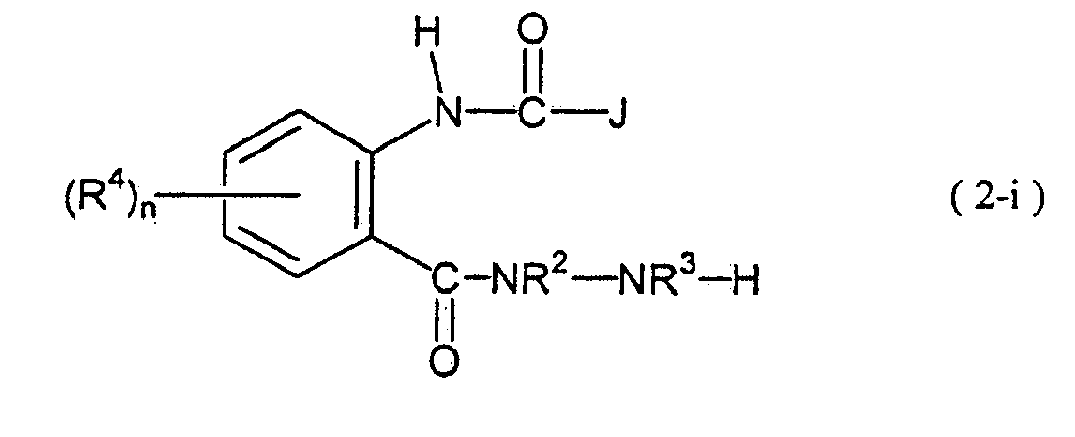
Description
- The present invention relates to a hydrazide compound and pesticidal use of the same.
- In
WO 01/70671 WO 03/015518 WO 03/016284 WO 03/016300 WO 03/024222 - The present invention is intended to provide a compound having excellent efficacy of controlling pests.
- The present inventors have intensively studied in order to find out a compound having excellent efficacy of controlling pests and, as a result, found out that a hydrazide compound represented by the following formula (1) has excellent controlling efficacy. Thus, the present invention has been completed.
- According to the present invention, there is provided:
- (1) A hydrazide compound represented by the formula (1):

- R1 represents a hydrogen atom, a C1-C6 alkyl group optionally substituted with at least one halogen atom, a C2-C6 cyanoalkyl group, a C2-C6 alkoxyalkyl group optionally substituted with at least one halogen atom, a C2-C6 alkenyl group optionally substituted with at least one halogen atom, a C3-C6 alkynyl group optionally substituted with at least one halogen atom, or a C7-C9 phenyl alkyl group whose benzene ring moiety may be substituted with 1 to 5 independent substituents selected from the group consisting of (1) a halogen atom, (2) a cyano group, (3) a nitro group, (4) a C1-C6 alkyl group optionally substituted with at least one halogen atom and (5) a C1-C6 alkoxy group optionally substituted with at least one halogen atom,
- R2 and R3 independently represent a hydrogen atom, a C1-C6 alkyl group optionally substituted with at least one halogen atom, a C1-C6 acyl group, a C2-C6 alkoxycarbonyl group, a C3-C7 N,N-dialkylcarbamoyl group, or a phenyl group optionally substituted with 1 to 5 independent substituents selected from the group consisting of (1) a halogen atom, (2) a cyano group, (3) a nitro group and (4) a C1-C6 alkyl group optionally substituted with at least one halogen atom,
- R4 represents a halogen atom, a cyano group, a nitro group, a C1-C6 alkyl group optionally substituted with at least one halogen atom, a C1-C6 alkoxy group optionally substituted with at least one halogen atom, a phenyl group optionally substituted with at least one halogen atom, a C1-C6 alkylthio group optionally substituted with at least one halogen atom, a C1-C6 alkylsulfinyl group optionally substituted with at least one halogen atom, or a C1-C6 alkylsulfonyl group optionally substituted with at least one halogen atom, or two R4 groups which are bound to the adjacent carbon atoms are bound at their terminal ends to each other to form a group T1 or T2
T1: -CR41=CR42-CR43=CR44-
T2: -(CR45R46)h-
(wherein R41, R42,R43 and R44 independently, represent a-hydrogen atom, a halogen atom, a cyano group, a nitro group, a C1-C6 alkyl group optionally substituted with at least one halogen atom, a C1-C6 alkoxy group optionally substituted with at least one halogen atom, a C1-C6 alkylthio group optionally substituted with at least one halogen atom, a C1-C6 alkylsulfinyl group optionally substituted with at least one halogen atom, or a C1-C6 alkylsulfonyl group optionally substituted with at least one halogen atom, - R45 and R46 independently represent a hydrogen atom, or a C1-C6 alkyl group optionally substituted with at least one halogen atom, and
- h represents an integer of 3 or 4),
- n represents an integer of 0 to 4 (provided that, when n is an integer of 2 or more, R4's may be the same or different),
- Q represents a group selected from Q1 to Q6:
- Q1: -C(=A31)-R5
- Q2 -C(=A32)-OR6
- Q3: -C(=A33)-SR7
- Q4: -C(=A34)-NR8R9
- Q5: -S(O)2-R10
- Q6: -S(O)2-NR11R12
- R5 represents a hydrogen atom; a C2-C6 alkenyl group optionally substituted with at least one halogen atom; a C2-C6 alkynyl group optionally substituted with at least one halogen atom; a C1-C6 alkyl group optionally substituted with one or more independent substituents selected from the group consisting of (1) a halogen atom, (2) a C1-C6 alkoxy group, (3) a C1-C6 alkylthio group, (4) a C1-C6 alkylsulfinyl group, (5) a C1-C6 alkylsulfonyl group, (6) a C2-C6 dialkylamino group and (7) a C3-C6 cycloalkyl group; a C3-C6 cycloalkyl group optionally substituted with one or more independent substituents selected from the group consisting of (1) a halogen atom, (2) a C1-C6 alkyl group; a phenyl group optionally substituted with 1 to 5 independent substituents selected from the group consisting of (1) a halogen atom, (2) a cyano group, (3) a nitro group, (4) a C1-C6 alkyl group optionally substituted with at least one halogen atom, (5) a C1-C6 alkoxy group optionally substituted with at least one halogen atom, (6) a C1-C6 alkylthio group optionally substituted with at least one halogen atom, (7) a C1-C6 alkylsulfinyl group optionally substituted with at least one halogen atom, (8) a C1-C6 alkylsulfonyl group optionally substituted with at least one halogen atom, (9) a C2-C6 dialkylamino group optionally substituted with at least one halogen atom and (10) a C2-C6 alkoxycarbonyl group optionally substituted with at least one halogen atom; a naphthyl group optionally substituted with 1 to 9 independent substituents selected from the group consisting of (1) a halogen atom, (2) a cyano group, (3) a nitro group, (4) a C1-C6 alkyl group optionally substituted with at least one halogen atom and (5) a C1-C6 alkoxy group optionally substituted with at least one halogen atom; a 5- to 6-membered heteroaryl group optionally substituted with one or more independent substituents selected from the group consisting of (1) a halogen atom, (2) a cyano group, (3) a nitro group, (4) a C1-C6 alkyl group optionally substituted with at least one halogen atom and (5) a C1-C6 alkoxy group optionally substituted with at least one halogen atom; a 3- to 8-membered non-aromatic heterocyclic group optionally substituted with one or more independent substituents selected from the group consisting of (1) a halogen atom and (2) a C1-C6 alkyl group; a C7-C9 phenylalkyl group whose benzene ring moiety may be substituted with 1 to 5 independent substituents selected from the group consisting of (1) a halogen atom, (2) a cyano group, (3) a nitro group, (4) a C1-C6 alkyl group optionally substituted with at least one halogen atom and (5) a C1-C6 alkoxy group optionally substituted with at least one halogen atom; or a C7-C9 phenoxyalkyl group whose benzene ring moiety may be substituted with 1 to 5 independent substituents selected from the group consisting of (1) a halogen atom, (2) a cyano group, (3) a nitro group, (4) a C1-C6 alkyl group optionally substituted with at least one halogen atom and (5) a C1-C6 alkoxy group optionally substituted with at least one halogen atom,
- R6 and R7 represent a C1-C6 alkyl group optionally substituted with at least one halogen atom; a C3-C6 alkoxyalkyl group optionally substituted with at least one halogen atom; a C2-C6 alkenyl group optionally substituted with at least one halogen atom; a C3-C6 alkynyl group optionally substituted with at least one halogen atom; a C3-C6 cycloalkyl group optionally substituted with one or more independent substituents selected from the group consisting of (1) a halogen atom and (2) a C1-C6 alkyl group; a phenyl group optionally substituted with 1 to 5 independent substituents selected from the group consisting of (1) a halogen atom, (2) a cyano group, (3) a nitro group, (4) a C1-C6 alkyl group optionally substituted with at least one halogen atom, (5) a C1-C6 alkoxy group optionally substituted with at least one halogen atom, (6) a C1-C6 alkylthio group optionally substituted with at least one halogen atom, (7) a C1-C6 alkylsulfinyl group optionally substituted with at least one halogen atom, (8) a C1-C6 alkylsulfonyl group optionally substituted with at least one halogen atom, (9) a C2-C6 dialkylamino group optionally substituted with at least one halogen atom and (10) a C2-C6 alkoxycarbonyl group optionally substituted with at least one halogen atom; a 5- to 6-membered heteroaryl group optionally substituted with 1 to 5 independent substituents selected from the group consisting of (1) a halogen atom, (2) a cyano group, (3) a nitro group, (4) a C1-C6 alkyl group optionally substituted with at least one halogen atom and (5) a C1-C6 alkoxy group optionally substituted with at least one halogen atom; or a C7-C9 phenylalkyl group whose benzene ring moiety may be substituted with 1 to 5 independent substituents selected from the group consisting of (1) a halogen atom, (2) a cyano group, (3) a nitro group, (4) a C1-C6 alkyl group optionally substituted with at least one halogen atom and (5) a C1-C6 alkoxy group optionally substituted with at least one halogen atom,
- R8and R9 independently represent a hydrogen atom; a C1-C6 alkyl group optionally substituted with at least one halogen atom; a C2-C6 alkoxyalkyl group optionally substituted with at least one halogen atom; a C2-C6 alkenyl group optionally substituted with at least one halogen atom; a C3-C6 alkynyl group optionally substituted with at least one halogen atom; a C3-C6 cycloalkyl group optionally substituted with one or more independent substituents selected from the group consisting of (1) a halogen atom and (2) a C1-C6 alkyl group; a phenyl group optionally substituted with 1 to 5 independent substituents selected from the group consisting of (1) a halogen atom, (2) a cyano group, (3) a nitro group, (4) a C1-C6 alkyl group optionally substituted with at least one halogen atom, (5) a C1-C6 alkoxy group optionally substituted with at least one halogen atom, (6) a C1-C6 alkylthio group optionally substituted with at least one halogen atom, (7) a C1-C6 alkylsulfinyl group optionally substituted with at least one halogen atom, (8) a C1-C6 alkylsulfonyl group optionally substituted with at least one halogen atom, (9) a C2-C6 dialkylamino group optionally substituted with at least one halogen atom and (10) a C2-C6 alkoxycarbonyl group optionally substituted with at least one halogen atom; a 5- to 6-membered heteroaryl group optionally substituted with 1 to 5 independent substituents selected from the group consisting of (1) a halogen atom, (2) a cyano group, (3) a nitro group, (4) a C1-C6 alkyl group optionally substituted with at least one halogen atom and (5) a C1-C6 alkoxy group optionally substituted with at least one halogen atom; or a C7-C9 phenylalkyl group whose benzene ring moiety may be substituted with 1 to 5 independent substituents selected from the group consisting of (1) a halogen atom, (2) a cyano group, (3) a nitro group, (4) a C1-C6 alkyl group optionally substituted with at least one halogen atom and (5) a C1-C6 alkoxy group optionally substituted with at least one halogen atom; or R8 and R9 are taken together with the nitrogen atom to which they are bound to form a 3- to 8-membered non-aromatic heterocyclic group, the 3- to 8-membered non-aromatic heterocyclic group may contain, in the ring, one or more independent groups selected from the group consisting of (1) an oxygen atom, (2) a sulfur group and (3) a -NRa- group (wherein Ra represents a C1-C6 alkyl group optionally substituted with at least one halogen atom, a C2-C6 alkoxycarbonyl group optionally substituted with at least one halogen atom, or a phenyl group optionally substituted with 1 to 5 independent substituents selected from the group consisting of (1) a halogen atom, (2) a cyano group, (3) a nitro group, (4) a C1-C6 alkyl group optionally substituted with at least one halogen atom and (5) a C1-C6 alkoxy group optionally substituted with at least one halogen atom), and carbon atom(s) in the ring may be substituted with one or more independent substituents selected from the group consisting of (1) a halogen atom, (2) a C1-C6 alkyl group optionally substituted with at least one halogen atom and (3) a C2-C6 alkoxycarbonyl group optionally substituted with at least one halogen atom,
- R10 represents a C1-C6 alkyl group optionally substituted with at least one halogen atom; a C3-C6 cycloalkyl group optionally substituted with one or more independent substituents selected from the group consisting of (1) a halogen atom and (2) a C1-C6 alkyl group optionally substituted with at least one halogen atom; or a phenyl group optionally substituted with 1 to 5 independent substituents selected from the group consisting of (1) a halogen atom, (2) a cyano group, (3) a nitro group, (4) a C1-C6 alkyl group optionally substituted with at least one halogen atom and (5) a C1-C6 alkoxy group optionally substituted with at least one halogen atom, and
- R11 and R12 independently represent a C1-C6 alkyl group optionally substituted with at least one halogen atom; a C3-C6 cycloalkyl group optionally substituted with one or more independent substituents selected from the group consisting of (1) a halogen atom and (2) a C1-C6 alkyl group optionally substituted with at least one halogen atom; or a phenyl group optionally substituted with 1 to 5 independent substituents selected from the group consisting of (1) a halogen atom, (2) a cyano group, (3) a nitro group, (4) a C1-C6 alkyl group optionally substituted with at least one halogen atom and (5) a C1-C6 alkoxy group optionally substituted with at least one halogen atom; or R11 and R12 are taken together with the nitrogen atom to which they are bound to form a 3- to 8-membered non-aromatic heterocyclic group, the 3- to 8-membered non-aromatic heterocyclic group may contain, in the ring, one or more independent groups selected from the group consisting of (1) an oxygen atom, (2) a sulfur atom and (3) a -NRb-group (wherein Rb represents a C1-C6 alkyl group optionally substituted with at least one halogen atom, a C2-C6 alkoxycarbonyl group optionally substituted with at least one halogen atom, or a phenyl group optionally substituted with 1 to 5 independent substituents selected from the group consisting of (1) a halogen atom, (2) a cyano group, (3) a nitro group, (4) a C1-C6 alkyl group optionally substituted with at least one halogen atom and (5) a C1-C6 alkoxy group optionally substituted with at least one halogen atom), and carbon atom(s) in the ring may be substituted with one or more independent substituents selected from the group consisting of (1) a halogen atom, (2) a C1-C6 alkyl group optionally substituted with at least one halogen atom and (3) a C2-C6 alkoxycarbonyl group optionally substituted with at least one halogen atom),
- J represents a group represented by J1 or J2:

- R13a and R13b represent a C1-C6 alkyl group optionally substituted with at least one halogen atom; a C2-C6 cyanoalkyl group; a C2-C6 alkoxyalkyl group optionally substituted with at least one halogen atom; a C2-C6 alkenyl group optionally substituted with at least one halogen atom; a C2-C6 alkynyl group optionally substituted with at least one halogen atom; a C3-C6 cycloalkyl group optionally substituted with one or more independent substituents selected from the group consisting of (1) a halogen atom and (2) a C1-C6 alkyl group; a phenyl group optionally substituted with 1 to 5 independent substituents selected from the group consisting of (1) a halogen atom, (2) a cyano group, (3) a nitro group, (4) a C1-C6 alkyl group optionally substituted with at least one halogen atom, (5) a C1-C6 alkoxy group optionally substituted with at least one halogen atom, (6) a C1-C6 alkylthio group optionally substituted with at least one halogen atom, (7) a C1-C6 alkylsulfinyl group optionally substituted with at least one halogen atom and (8) a C1-C6 alkylsulfonyl group optionally substituted with at least one halogen atom; a 5- to 6-membered heteroaryl group optionally substituted with one or more independent substituents selected from the group consisting of (1) a halogen atom, (2) a cyano group, (3) a nitro group, (4) a C1-C6 alkyl group optionally substituted with at least one halogen atom and (5) a C1-C6 alkoxy group optionally substituted with at least one halogen atom; a C7-C9 phenylalkyl group whose benzene ring moiety may be substituted with one or more independent substituents selected from the group consisting of (1) a halogen atom, (2) a cyano group, (3) a nitro group, (4) a C1-C6 alkyl group optionally substituted with at least one halogen atom and (5) a C1-C6 alkoxy group optionally substituted with at least one halogen atom; or a C7-C9 pyridinylalkyl group whose pyridine ring moiety may be substituted with one or more independent substituents selected from the group consisting of (1) a halogen atom, (2) a cyano group, (3) a nitro group, (4) a C1-C6 alkyl group optionally substituted with at least one halogen atom and (5) a C1-C6 alkoxy group optionally substituted with at least one halogen atom,
- R14a and R14b represent a halogen atom; a cyano group; a nitro group; a C1-C6 alkyl group optionally substituted with at least one halogen atom; a C1-C6 alkoxy group optionally substituted with at least one halogen atom; a C2-C6 cyanoalkyloxy group; a C3-C6 alkoxyalkyloxy group optionally substituted with at least one halogen atom; a C3-C6 alkenyloxy group optionally substituted with at least one halogen atom; a C3-C6 alkynyloxy group optionally substituted with at least one halogen atom; a C1-C6 alkylthio group optionally substituted with at least one halogen atom; a C1-C6 alkylsulfinyl group optionally substituted with at least one halogen atom; a C1-C6 alkylsulfonyl group optionally substituted with at least one halogen atom; a phenyl group optionally substituted with 1 to 5 independent substituents selected from the group consisting of (1) a halogen atom, (2) a cyano group, (3) a nitro group, (4) a C1-C6 alkyl group optionally substituted with at least one halogen atom and (5) a C1-C6 alkoxy group optionally substituted with at least one halogen atom; a 5- to 6-membered heteroaryl group optionally substituted with one or more independent substituents selected from the group consisting of (1) a halogen atom, (2) a cyano group, (3) a nitro group, (4) a C1-C6 alkyl group optionally substituted with at least one halogen atom and (5) a C1-C6 alkoxy group optionally substituted with at least one halogen atom; or a phenoxy group optionally substituted with 1 to 5 independent substituents selected from the group consisting of (1) a halogen atom, (2) a cyano group, (3) a nitro group, (4) a C1-C6 alkyl group optionally substituted with at least one halogen atom and (5) a C1-C6 alkoxy group optionally substituted with at least one halogen atom,
- p represents an integer of 0 to 3, and
- q represents an integer of 0 to 3 (provided that, when p is an integer of 2 or 3, two or more R14a's may be the same or different and, when q is an integer of 2 or 3, two or more R14b's may be the same or different), and
- A1 and A2 independently represent an oxygen atom or a sulfur atom (hereinafter referred to as the present compound).
- (2) The compound according to the above (1), wherein n is an integer of 0 to 3.
- (3) The compound according to the above (2), wherein R4 is a halogen atom, a cyano group, a C1-C6 alkyl group optionally substituted with at least one halogen atom, a C1-C6 alkoxy group optionally substituted with at least one halogen atom, a phenyl group optionally substituted with at least one halogen atom, or two R4 groups which are bound to the adjacent carbon atoms are bound at their terminal ends to form a group T1: -CR41=CR42-CR43=CR44-
(wherein R41, R42, R43 and R44 represent a hydrogen atom). - (4) The compound according to the above (3), wherein R4 is a fluorine atom, a chlorine atom, a bromine atom, an iodine atom, a cyano group, a methyl group, an ethyl group, a trifluoromethyl group, a methoxy group, a phenyl group, or two R4 groups which are bound to the adjacent carbon atoms are bound at their terminal ends to form a group T1: -CR41=CR42-CR43=CR44-(wherein R41, R42, R43 and R44 represent a hydrogen atom).
- (5) The compound according to any one of the above (1) to (4), wherein
- J is J1,
- Ya is CH,
- R13a is a C1-C6 alkyl group optionally substituted with at least one halogen atom; a C3-C6 cycloalkyl group optionally substituted with one or more independent substituents selected from the group consisting of (1) a halogen atom and (2) a C1-C6 alkyl group; a phenyl group optionally substituted with 1 to 5 independent substituents selected from the group consisting of (1) a halogen atom, (2) a cyano group, (3) a nitro group, (4) a C1-C6 alkyl group optionally substituted with at least one halogen atom, (5) a C1-C6 alkoxy group optionally substituted with at least one halogen atom, (6) a C1-C6 alkylthio group optionally substituted with at least one halogen atom, (7) a C1-C6 alkylsulfinyl group optionally substituted with at least one halogen atom and (8) a C1-C6 alkylsulfonyl group optionally substituted with at least one halogen atom; or a 5- to 6-membered heteroaryl group optionally substituted with one or more independent substituents selected from the group consisting of (1) a halogen atom, (2) a cyano group, (3) a nitro group, (4) a C1-C6 alkyl group optionally substituted with at least one halogen atom and (5) a C1-C6 alkoxy group optionally substituted with at least one halogen atom,
- R14a is a halogen atom; a cyano group; a C1-C6 alkyl group optionally substituted with at least one halogen atom; a C1-C6 alkylthio group optionally substituted with at least one halogen atom; a C1-C6 alkylsulfinyl group optionally substituted with at least one halogen atom; a C1-C6 alkylsulfonyl group optionally substituted with at least one halogen atom; or a phenyl group optionally substituted with 1 to 5 independent substituents selected from the group consisting of (1) a halogen atom, (2) a cyano group, (3) a nitro group, (4) a C1-C6 alkyl group optionally substituted with at least one halogen atom and (5) a C1-C6 alkoxy group optionally substituted with at least one halogen atom, and
- p is an integer of 0 to 2.
- (6) The compound according to any one of the above (1) to (4), wherein
- J is J2, Yb is CH,
- R13b is a C1-C6 alkyl group optionally substituted with at least one halogen atom,
- R14b is a C1-C6 alkyl group optionally substituted with at least one halogen atom, or a phenyl group optionally substituted with 1 to 5 independent substituents selected from the group consisting of (1) a halogen atom, (2) a cyano group, (3) a nitro group, (4) a C1-C6 alkyl group optionally substituted with at least one halogen atom and (5) a C1-C6 alkoxy group optionally substituted with at least one halogen atom, and
- q is 1.
- (7) The compound according to any one of the above (1) to (6), wherein A1 and A2 are an oxygen atom, and R1 is a hydrogen atom or a methyl group.
- (8) The compound according to any one of the above (1) to (7), wherein
- Q is Q1,
- A31 is an oxygen atom, and
- R5 is a hydrogen atom; a C1-C6 alkyl group optionally substituted with one or more independent substituents selected from the group consisting of (1) a halogen atom, (2) a C1-C6 alkoxy group, (3) a C1-C6 alkylthio group, (4) a C1-C6 alkylsulfinyl group, (5) a C1-C6 alkylsulfonyl group, (6) a C2-C6 dialkylamino group and (7) a C3-C6 cycloalkyl group; a C3-C6 cycloalkyl group optionally substituted with one or more independent substituents selected from the group consisting of (1) a halogen and (2) a C1-C6 alkyl group; a phenyl group optionally substituted with 1 to 5 independent substituents selected from the group consisting of (1) a halogen atom, (2) a cyano group, (3) a nitro group, (4) a C1-C6 alkyl group optionally substituted with at least one halogen atom, (5) a C1-C6 alkoxy group optionally substituted with at least one halogen atom, (6) a C1-C6 alkylthio group optionally substituted with at least one halogen atom, (7) a C1-C6 alkylsulfinyl group optionally substituted with at least one halogen atom, (8) a C1-C6 alkylsulfonyl group optionally substituted with at least one halogen atom, (9) a C2-C6 dialkylamino group optionally substituted with at least one halogen atom and (10) a C2-C6 alkoxycarbonyl group optionally substituted with at least one halogen atom; a 5- to 6-membered heteroaryl group optionally substituted with one or more independent substituents selected from the group consisting of (1) a halogen atom, (2) a cyano group, (3) a nitro group, (4) a C1-C6 alkyl group optionally substituted with at least one halogen atom and (5) a C1-C6 alkoxy group optionally substituted with at least one halogen atom; or a 3 to 8-membered non-aromatic heterocyclic group optionally substituted with one or more independent groups selected from the group consisting of (1) a halogen atom and (2) a C1-C6 alkyl group.
- (9) The compound according to the above (8), wherein R5 is a hydrogen atom, a methyl group, an ethyl group, a tert-butyl group, a cyclopropyl group, a phenyl group, a 3-methylphenyl group, a 4-methoxyphenyl group, a 2-pyridinyl group, or a morpholino group.
- (10) The compound according to any one of the above (1) to (7), wherein
- Q is Q2,
- A32 is an oxygen atom, and
- R6 is a C1-C6 alkyl group optionally substituted with at least one halogen atom; a C2-C6 alkenyl group optionally substituted with at least one halogen atom; or a phenyl group optionally substituted with 1 to 5 independent substituents selected from the group consisting of (1) a halogen atom, (2) a cyano group, (3) a nitro group, (4) a C1-C6 alkyl group optionally substituted with at least one halogen atom, (5) a C1-C6 alkoxy group optionally substituted with at least one halogen atom, (6) a C1-C6 alkylthio group optionally substituted with at least one halogen atom, (7) a C1-C6 alkylsulfinyl group optionally substituted with at least one halogen atom, (8) a C1-C6 alkylsulfonyl group optionally substituted with at least one halogen atom, (9) a C2-C6 dialkylamino group optionally substituted with at least one halogen atom and (10) a C2-C6 alkoxy carbonyl group optionally substituted with at least one halogen atom.
- (11) The compound according to the above (10), wherein R6 is a methyl group, an ethyl group, a propyl group, an isopropyl group, a butyl group, a sec-butyl group, a 2-propenyl group, or a phenyl group.
- (12) The compound according to any one of the above (1) to (7), wherein
- Q is Q4,
- A34 is an oxygen atom, and
- R8 and R9 independently represent a hydrogen atom; a C1-C6 alkyl group optionally substituted with at least one halogen atom; or a phenyl group optionally substituted with 1 to 5 independent substituents selected from the group consisting of (1) a halogen atom, (2) a cyano group, (3) a nitro group, (4) a C1-C6 alkyl group optionally substituted with at least one halogen atom, (5) a C1-C6 alkoxy group optionally substituted with at least one halogen atom, (6) a C1-C6 alkylthio group optionally substituted with at least one halogen atom, (7) a C1-C6 alkylsulfinyl group optionally substituted with at least one halogen atom, (8) a C1-C6 alkylsulfonyl group optionally substituted with at least one halogen atom, (9) a C2-C6 dialkylamino group optionally substituted with at least one halogen atom and (10) a C2-C6 alkoxy carbonyl group optionally substituted with at least one halogen atom.
- (13) The compound according to the above (12), wherein R8 and R9, each, independently, represent a hydrogen atom, a methyl group, an ethyl group, or a phenyl group.
- (14) The compound according to any one of the above (1) to (13), wherein R2 is a hydrogen atom or a methyl group, and R3 is a hydrogen atom, a methyl group, an isopropyl group, or a methoxycarbonyl group.
- (15) The compound according to the above (1), wherein R1 is a hydrogen atom, or a C1-C6 alkyl group optionally substituted with at least one halogen atom,
- R2 is a hydrogen atom, or a C1-C6 alkyl group optionally substituted with at least one halogen atom,
- R3 is a hydrogen atom, a C1-C6 alkyl group optionally substituted with at least one halogen atom, or a C2-C6 alkoxycarbonyl group,
- R4 is a halogen atom, a cyano group, a C1-C6 alkyl group optionally substituted with at least one halogen atom, a C1-C6 alkoxy group optionally substituted with at least one halogen atom, or a phenyl group optionally substituted with at least one halogen atom, or two R4 groups which are bound to the adjacent carbon atoms are bound at their terminal ends to form T1: -CR41=CR42-CR43=CR49-
(wherein R41, R42, R43 and R44 represent a hydrogen atom), - n is an integer of 0 to 3,
- Q is a group represented by Q1 to Q6:
- Q1: -C(=A31)-R5
- Q2: -C(=A32)-OR6
- Q3: -C(=A33)-SR7
- Q4: -C(=A34)-NR8R9
- Q5: -S(O)2-R10
- Q6: -S(O)2-NR11R12
- R5 is a hydrogen atom; a C1-C6 alkyl group optionally substituted with one or more independent substituents selected from the group consisting of (1) a halogen atom, (2) a C1-C6 alkoxy group, (3) a C1-C6 alkylthio group, (4) a C1-C6 alkylsulfinyl group, (5) a C1-C6 alkylsulfonyl group, (6) a C2-C6 dialkylamino group and (7) a C3-C6 cycloalkyl group; a C3-C6 cycloalkyl group optionally substituted with one or more independent substituents selected from the group consisting of (1) a halogen atom and (2) a C1-C6 alkyl group; a phenyl group optionally substituted with 1 to 5 independent substituents selected from the group consisting of (1) a halogen atom, (2) a cyano group, (3) a nitro group, (4) a C1-C6 alkyl group optionally substituted with at least one halogen atom, (5) a C1-C6 alkoxy group optionally substituted with at least one halogen atom, (6) a C1-C6 alkylthio group optionally substituted with at least one halogen atom, (7) a C1-C6 alkylsulfinyl group optionally substituted with at least one halogen atom, (8) a C1-C6 alkylsulfonyl group optionally substituted with at least one halogen atom, (9) a C2-C6 dialkylamino group optionally substituted with at least one halogen atom and (10) a C2-C6 alkoxycarbonyl group optionally substituted with at least one halogen atom; a 5- to 6-membered heteroaryl group optionally substituted with one or more independent substituents selected from the group consisting of (1) a halogen atom, (2) a cyano group, (3) a nitro group, (4) a C1-C6 alkyl group optionally substituted with at least one halogen atom and (5) a C1-C6 alkoxy group optionally substituted with at least one halogen atom; or a 3- to 8-membered non-aromatic heterocyclic group optionally substituted with one or more independent substituents selected from the group consisting of (1) a halogen atom and (2) a C1-C6 alkyl group,
- R6 is a C1-C6 alkyl group optionally substituted with at least one halogen atom; a C2-C6 alkenyl group optionally substituted with at least one halogen atom; or a phenyl group optionally substituted with 1 to 5 independent substituents selected from the group consisting of (1) a halogen atom, (2) a cyano group, (3) a nitro group, (4) a C1-C6 alkyl group optionally substituted with at least one halogen atom, (5) a C1-C6 alkoxy group optionally substituted with at least one halogen atom, (6) a C1-C6 alkylthio group optionally substituted with at least one halogen atom, (7) a C1-C6 alkylsulfinyl group optionally substituted with at least one halogen atom, (8) a C1-C6 alkylsulfonyl group optionally substituted with at least one halogen atom, (9) a C2-C6 dialkylamino group optionally substituted with at least one halogen atom and (10) a C2-C6 alkoxycarbonyl group optionally substituted with at least one halogen atom,
- R7 is a C1-C6 alkyl group optionally substituted with at least one halogen atom,
- R8 and R9 independently represent a hydrogen atom; a C1-C6 alkyl group optionally substituted with at least one halogen atom; or a phenyl_group optionally substituted with 1 to 5 independent substituents selected from the group consisting of (1) a halogen atom, (2) a cyano group, (3) a nitro group, (4) a C1-C6 alkyl group optionally substituted with at least one halogen atom, (5) a C1-C6 alkoxy group optionally substituted with at least one halogen atom, (6) a C1-C6 alkylthio group optionally substituted with at least one halogen atom, (7) a C1-C6 alkylsulfinyl group optionally substituted with at least one halogen atom, (8) a C1-C6 alkylsulfonyl group optionally substituted with at least one halogen atom, (9) a C2-C6 dialkylamino group optionally substituted with at least one halogen atom and (10) a C2-C6 alkoxycarbonyl group optionally substituted with at least one halogen atom,
- R10 is a C1-C6 alkyl group optionally substituted with at least one halogen atom, and
- R11 and R12 independently represent a C1-C6 alkyl group optionally substituted with at least one halogen atom),
- J is a group represented by J1 or J2:

- R13a is a C1-C6 alkyl group optionally substituted with at least one halogen atom; a C3-C6 cycloalkyl group optionally substituted with one or more independent substituents selected from the group consisting of (1) a halogen atom and (2) a C1-C6 alkyl group; a phenyl group optionally substituted with 1 to 5 independent substituents selected from the group consisting of (1) a halogen atom, (2) a cyano group, (3) a nitro group, (4) a C1-C6 alkyl group optionally substituted with at least one halogen atom, (5) a C1-C6 alkoxy group optionally substituted with at least one halogen atom, (6) a C1-C6 alkylthio group optionally substituted with at least one halogen atom, (7) a C1-C6 alkylsulfinyl group optionally substituted with at least one halogen atom and (8) a C1-C6 alkylsulfonyl group optionally substituted with at least one halogen atom; or a 5- to 6-membered heteroaryl group optionally substituted with one or more independent substituents selected from the group consisting of (1) a halogen atom, (2) a cyano group, (3) a nitro group, (4) a C1-C6 alkyl group optionally substituted with at least one halogen atom and (5) a C1-C6 alkoxy group optionally substituted with at least one halogen atom,
- R13b is a C1-C6 alkyl group optionally substituted with at least one halogen atom,
- R14a is a halogen atom; a cyano group; a C1-C6 alkyl group optionally substituted with at least one halogen atom; a C1-C6 alkylthio group optionally substituted with at least one halogen atom; a C1-C6 alkylsulfinyl group optionally substituted with at least one halogen atom; a C1-C6 alkylsulfonyl group optionally substituted with at least one halogen atom; or a phenyl group optionally substituted with 1 to 5 independent substituents selected from the group consisting of (1) a halogen atom, (2) a cyano group, (3) a nitro group, (4) a C1-C6 alkyl group optionally substituted with at least one halogen atom and (5) a C1-C6 alkoxy group optionally substituted with at least one halogen atom,
- R14b is a C1-C6 alkyl group optionally substituted with at least one halogen atom; or a phenyl group optionally substituted with 1 to 5 independent substituents selected from the group consisting of (1) a halogen atom, (2) a cyano group, (3) a nitro group, (4) a C1-C6 alkyl group optionally substituted with at least one halogen atom and (5) a C1-C6 alkoxy group optionally substituted with at least one halogen atom,
- p is an integer of 0 to 2,
- q is 1,
A1 and A2 are an oxygen atom. - (16) A hydrazide compound represented by-the formula (1-1) :

- R1 is a hydrogen atom, or a C1-C6 alkyl group optionally substituted with at least one halogen atom,
- R2 is a C1-C6 alkyl group optionally substituted with at least one halogen atom,
- R3 is a hydrogen atom, a C1-C6 alkyl group optionally substituted with at least one halogen atom, or a C2-C6 alkoxycarbonyl group,
- R4a is a hydrogen atom, a halogen atom, a C1-C6 alkyl group optionally substituted with at least one halogen atom, a C1-C6 alkoxy group optionally substituted with at least one halogen atom, or a phenyl group optionally substituted with at least one halogen atom,
- R4b, R4c and R4d are independently a hydrogen atom, a halogen atom, a cyano group, a C1-C6 alkyl group optionally substituted with at least one halogen atom, or
- R4b and R4c are bound to each other at their terminal ends to form a group: -CR41=CR42-CR43=CR44-
(wherein R41, R42, R43 and R44 represent a hydrogen atom), - M is OR6, SR7 or NR8R9
(wherein R6 and R7 are a C1-C6 alkyl group optionally substituted with at least one halogen atom, a C3-C6 alkoxyalkyl group optionally substituted with at least one halogen atom, a C2-C6 alkenyl group optionally substituted with at least one halogen atom, or a C3-C6 alkynyl group optionally substituted with at least one halogen atom, - R8 and R9 are independently a hydrogen atom, a C1-C6 alkyl group optionally substituted with at least one halogen atom, a C2-C6 alkenyl group optionally substituted with at least one halogen atom, a C3-C6 alkynyl group optionally substituted with at least one halogen atom, or
- R8 and R9 are taken together with the nitrogen atom to which they are bound to form a pyrrolidin-1-yl group, a piperidino group, a hexamethyleneimin-1-yl group, a heptamethyleneimin-1-yl group, a morpholino group, a thiomorpholin-4-yl group, or a 4-phenylpiperazin-1-yl group),
- Xa is a nitrogen atom or CR14ax
(wherein R14ax represents a hydrogen atom, a halogen atom, a cyano group, a C1-C6 alkyl group optionally substituted with at least one halogen atom, a C1-C6 alkylthio group optionally substituted with at least one halogen atom, or a C1-C6 alkylsulfinyl group optionally substituted with at least one halogen atom), - R14ay is a hydrogen atom, a halogen atom, a cyano group, a C1-C6 alkyl group optionally substituted with at least one halogen atom, a C1-C6 alkylthio group optionally substituted with at least one halogen atom, a C1-C6 alkylsulfinyl group optionally substituted with at least one halogen atom, a C1-C6 alkylsulfonyl group optionally substituted with at least one halogen atom, or a phenyl group,
- R14az is a hydrogen atom,
- X18 is a nitrogen atom or CR18e
(wherein R18e is a hydrogen atom or a halogen atom), and - R18a, R18b, R18c and R18d are independently a hydrogen atom or a halogen atom.
- (17) A hydrazide compound represented by the formula
(1-1) :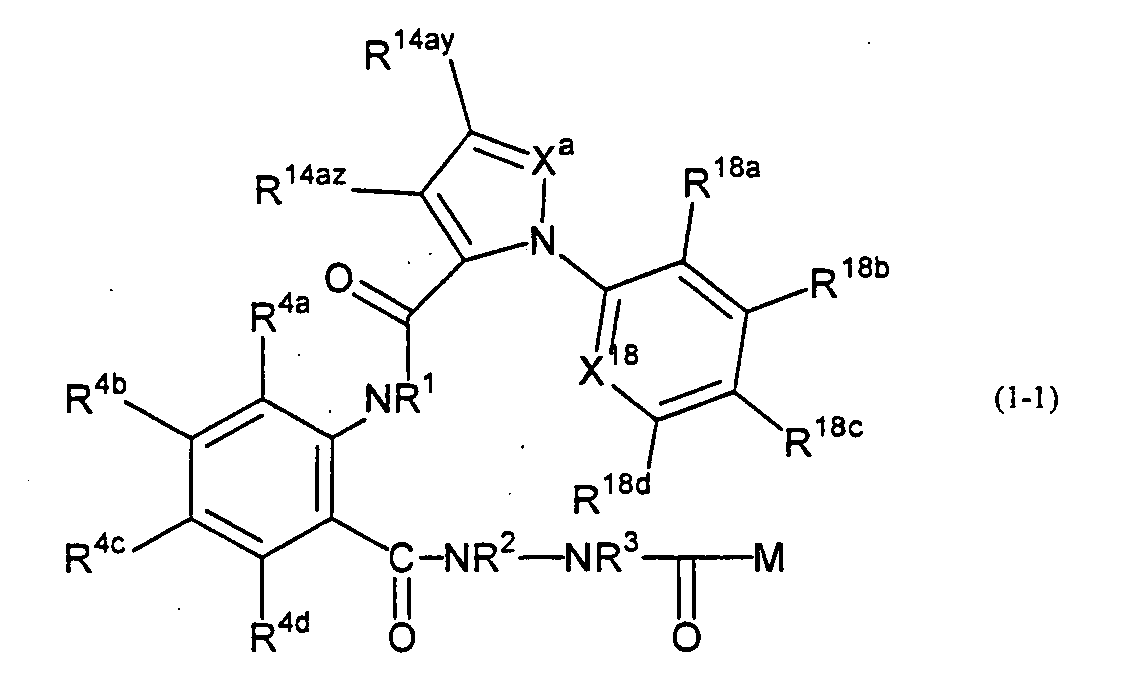
- R1 is a hydrogen atom, or a C1-C6 alkyl group optionally substituted with at least one halogen atom,
- R2 is a hydrogen atom, or a C1-C6 alkyl group optionally substituted with at least one halogen atom,
- R3 is a hydrogen atom, a C1-C6 alkyl group optionally substituted with at least one halogen atom, or a C2-C6 alkoxycarbonyl group,
- R4a is a hydrogen atom, a halogen atom, a C1-C6 alkyl group optionally substituted with at least one halogen atom, a C1-C6 alkoxy group optionally substituted with at least one halogen atom, or a phenyl group optionally substituted with at least one halogen atom,
- R4b, R4c and R4d are independently a hydrogen atom, a halogen atom, a cyano group, a C1-C6 alkyl group optionally substituted with at least one halogen atom, or
- R4b and R4c are bound to each other at their terminal ends to form a group: -CR41=CR42-CR43=CR44-
(wherein R41, R42, R43 and R44 represent a hydrogen atom), - M is a hydrogen atom,
- Xa is a nitorogen atom or CR14ax
(wherein R14ax is a hydrogen atom, a halogen atom, a cyano group, a C1-C6 alkyl group optionally substituted with at least one halogen atom, a C1-C6 alkoxy group optionally substituted with at least one halogen atom, a C1-C6 alkylthio group optionally substituted with at least one halogen atom, a C1-C6 alkylsulfinyl group optionally substituted with at least one halogen atom, or a C1-C6 alkylsulfonyl group optionally substituted with at least one halogen atom), - R14ay is a hydrogen atom, a halogen atom, a cyano group, a C1-C6 alkyl group optionally substituted with at least one halogen atom, a C1-C6 alkylthio group optionally substituted with at least one halogen atom, a C1-C6 alkylsulfinyl group optionally substituted with at least one halogen atom, a C1-C6 alkylsulfonyl group optionally substituted with at least one halogen atom, or a phenyl group,
- R14az is a hydrogen atom,
- X18 is a nitrogen atom or CR18e
(wherein R18e is a hydrogen atom or a halogen atom), and - R18a, R18b, R18c and R18d are independently a hydrogen atom or a halogen atom.
- (18) A hydrazide compound represented by the formula (II):

- R1-i represents a hydrogen atom, or a C1-C6 alkyl group optionally substituted with at least one halogen atom,
- R2-i represents a hydrogen atom or a methyl group,
- R4a represents a halogen atom, or a C1-C6 alkyl group optionally substituted with at least one halogen atom,
- R4b, R4c and R4d independently, represent a hydrogen atom, a halogen atom, a cyano group, a C1-C6 alkyl group optionally substituted with at least one halogen atom,
- or R4b and R4c are bound at an end to form a group T1: -CR41=CR42-CR43=CR44-
(wherein R41, R42, R43 and R44, each, independently, represent a hydrogen atom, a halogen atom, a cyano group, or a C1-C6 alkyl group optionally substituted with at least one halogen atom), - Xa represents a nitrogen atom or CR14ax
(wherein R14ax represents a hydrogen atom, a halogen atom, a cyano group, a C1-C6 alkyl group optionally substituted with at least one halogen atom, a C1-C6 alkoxy group optionally substituted with at least one halogen atom, a C1-C6 alkylthio group optionally substituted with at least one halogen atom, a C1-C6 alkylsulfinyl group optionally substituted with at least one halogen atom, or a C1-C6 alkylsulfonyl group optionally substituted with at least one halogen atom), - R14ay and R14az independently represent a hydrogen atom, a halogen atom, a cyano group, a C1-C6 alkyl group optionally substituted with at least one halogen atom, a C1-C6 alkoxy group optionally substituted with at least one halogen atom, a C1-C6 alkylthio group optionally substituted with at least one halogen atom, a C1-C6 alkylsulfinyl group optionally substituted with at least one halogen atom, or a C1-C6 alkylsulfonyl group optionally substituted with at least one halogen atom,
- x18 represents a nitrogen atom or CR18e,
(wherein R18e represents a hydrogen atom, a halogen atom, or a C1-C6 alkyl group optionally substituted with at least one halogen atom) - R18a represents a halogen atom, or a C1-C6 alkyl group optionally substituted with at least one halogen atom, and
- R18b R18c and R18d independently represent a hydrogen atom, a halogen atom, or a C1-C6 alkyl group optionally substituted with at least one halogen atom.
- (19) The compound according to the above (18), wherein R2-i is a methyl group.
- (20) A pesticide comprising the compound according to any one of the above (1) to (17) as an active ingredient.
- (21) A method of controlling a pest which comprises applying the compound according to any one of the above (1) to (17) directly to a pest or to a place where a pest inhabits.
- (22) Use of the compound according to any one of the above (1) to (17) for controlling a pest.
- (23) Use of the compound according to any one of the above (1) to (17) for manufacturing a pesticidal preparation.
- Hereinafter, preferred embodiments of the present invention will be illustrated.
- R14a used herein represents a group which can substitute for a hydrogen atom of a ring constituting CH of a group represented by J1, and R14b represents a group which can substitute for a hydrogen atom of a ring constituting CH of a group represented by J2.
- In the present invention, examples of a halogen atom include a fluorine atom, a chlorine atom, a bromine atom and an iodine atom.
- In R1, R2 and R3, examples of the "C1-C6 alkyl group optionally substituted with at least one halogen atom" include a methyl group, an ethyl group, a 2,2,2-trifluoroethyl group, a propyl group, an isopropyl group, a butyl group, an isobutyl group, a sec-butyl group, a tert-butyl group, a pentyl group and a hexyl group.
- In R1, examples of the "C2-C6 cyanoalkyl group" include a cyanomethyl group and a 2-cyanoethyl group;
examples of the "C2-C6 alkoxyalkyl group optionally substituted with at least one halogen atom" include a 2-methoxyethyl group, a 2-ethoxyethyl group and a 2-isopropyloxyethyl group;
examples of the "C2-C6 alkenyl group optionally substituted with at least one halogen atom" include a 2-propenyl group, a 3-chloro-2-propenyl group, a 2-chloro-2-propenyl group, a 3,3-dichloro-2-propenyl group, a 2-butenyl group, a 3-butenyl group, a 2-methyl-2-propenyl group, a 3-methyl-2-butenyl group, a 2-pentenyl group and a 2-hexenyl group;
example of the "C3-C6 alkynyl group optionally substituted with at least one halogen atom" include a 2-propynyl group, a 3-chloro-2-propynyl group, a 3-bromo-2-propynyl group, a 2-butynyl group and a 3-butynyl group; and
examples of the "C7-C9 phenylalkyl group whose benzene ring moiety may be substituted with 1 to 5 independent groups selected from the group consisting of (1) a halogen atom, (2) a cyano group, (3) a nitro group, (4) a C1-C6 alkyl group optionally substituted with at least one halogen atom and (5) a C1-C6 alkoxy group optionally substituted with at least one halogen atom" include a benzyl group, a 1-phenylethyl group, a 2-phenylethyl group, a 2-chlorobenzyl group, a 3-chlorobenzyl group, a 4-chlorobenzyl group, a 2-cyanobenzyl group, a 3-cyanobenzyl group, a 4-cyanobenzyl group, a 2-nitrobenzyl group, a 3-nitrobenzyl group, a 4-nitrobenzyl group, a 2-methylbenzyl group, a 3-methylbenzyl group, a 4-methylbenzyl group, a 2-(trifluoromethyl)benzyl group, a 3-(trifluoromethyl)benzyl group, a 4-(trifluoromethyl)benzyl group, a 2-methoxybenzyl group, a 3-methoxybenzyl group and a 4-methoxybenzyl group. - In R2 and R3, examples of the "C1-C6 acyl group" include a formyl group, an acetyl group, a propionyl group, an isobutyryl group and a trimethylacetyl group;
examples of the "C2-C6 alkoxycarbonyl group" include a methoxycarbonyl group, an ethoxycarbonyl group, an isopropoxycarbonyl group and a tert-butoxycarbonyl group;
examples of the "C3-C7 N,N-dialkylcarbamoyl group" include a N,N-dimethylcarbamoyl group and a N,N-diethylcarbamoyl group; and
examples of the "phenyl group optionally substituted with 1 to 5 independent groups selected from the group consisting of (1) a halogen atom, (2) a cyano group, (3) a nitro group, (4) a C1-C6 alkyl group optionally substituted with at least one halogen atom and (5) a C1-C6 alkyl group optionally substituted with at least one halogen atom" include a phenyl group, a 2-chlorophenyl group, a 3-chlorophenyl group, a 4-chlorophenyl group, a 2-cyanophenyl group, a 3-cyanophenyl group, a 4-cyanophenyl group, a 2-nitrophenyl group, a 3-nitrophenyl group, a 4-nitrophenyl group, a 2-methylphenyl group, a 3-methylphenyl group, a 4-methylphenyl group, a 2-(trifluoromethyl)phenyl group, a 3-(trifluoromethyl)phenyl group and a 4-(trifluoromethyl)phenyl group. - In R4, R41, R42, R43 and R44, examples of the "C1-C6 alkyl group optionally substituted with at least one halogen atom" include a methyl group, a trifluoromethyl group, an ethyl group, a propyl group, an isopropyl group, a butyl group, an isobutyl group, a sec-butyl group, a tert-butyl group, a pentyl group and a hexyl group.
- In R4, R41, R42, R43 and R44, examples of the "C1-C6 alkoxy group optionally substituted with at least one halogen atom" include a methoxy group, a trifluoromethoxy group, an ethoxy group, a 2,2,2-trifluoroethoxy group, a propyloxy group, an isopropyloxy group, a butoxy group, an isobutyloxy group, a sec-butoxy group, a tert-butoxy group, a pentyloxy group and a hexyloxy group.
- In R4 R41, R42, R43 and R44, examples of the "C1-C6 alkylthio group optionally substituted with at least one halogen atom" include a methylthio group, a trifluoromethylthio group and an ethylthio group.
- In R4, R41, R42, R43 and R44, examples of the "C1-C6 alkylsulfinyl group optionally substituted with at least one halogen atom" include a methylsulfinyl group, a trifluoromethylsulfinyl group and an ethylsulfinyl group.
- In R4, R41, R42, R43 and R44, examples of the "C1-C6 alkylsulfonyl group optionally substituted with at least one halogen atom" include a methylsulfonyl group, a trifluoromethylsulfonyl group and an ethylsulfonyl group.
- In R4, examples of the "phenyl group optionally substituted with at least one halogen atom" include a phenyl group, a 2-chlorophenyl group, a 3-chlorophenyl group and a 4-chlorophenyl group.
- In R45 and R46, examples of the "C1-C6 alkyl group optionally substituted with at least one halogen atom" include a methyl group, a trifluoromethyl group, and an ethyl group.
- In R5, examples of the "C2-C6 alkenyl group optionally substituted with at least one halogen atom" include a vinyl group, a 1-propenyl group, a 2-propenyl group, a 1-methylvinyl group, a 2-chlorovinyl group and a 2-methyl-1-propenyl group;
examples of the "C2-C6 alkynyl group optionally substituted with at least one halogen atom" include an ethynyl group;
examples of the "C1-C6 alkyl group optionally substituted with one or more independent substituents selected from the group consisting of (1) a halogen atom, (2) a C1-C6 alkoxy group, (3) a C1-C6 alkylthio group, (4) a C1-C6 alkylsulfinyl group, (5) a C1-C6 alkylsulfonyl group, (6) a C2-C6 dialkylamino group and (7) a C3-C6 cycloalkyl group" include a methyl group, a trifluoromethyl group, a trichloromethyl group, a chloromethyl group, a dichloromethyl group, a fluoromethyl group, a difluoromethyl group, a methoxymethyl group, an ethoxymethyl group, a methylthiomethyl group, an ethylthiomethyl group, a methylsulfinylmethyl group, a methylsulfonylmethyl group, a dimethylaminomethyl group, a cyclopropylmethyl group, a cyclopentylmethyl group, a cyclohexylmethyl group, an ethyl group, a pentafluoroethyl group, a propyl group, an isopropyl group, a butyl group, an isobutyl group, a sec butyl group, a tert-butyl group, a pentyl group and a hexyl group;
examples of the "C3-C6 cycloalkyl group optionally substituted with one or more independent substituents selected from the group consisting of (1) a halogen atom and (2) a C1-C6 alkyl group" include a cyclopropyl group, a 2-methylcyclopropyl group, a cyclobutyl group, a cyclopentyl group and a cyclohexyl group;
examples of the "phenyl group optionally substituted with 1 to 5 independent substituents selected from the group consisting of (1) a halogen atom, (2) a cyano group, (3) a nitro group, (4) a C1-C6 alkyl group optionally substituted with at least one halogen atom, (5) a C1-C6 alkoxy group optionally substituted with at least one halogen atom, (6) a C1-C6 alkylthio group optionally substituted with at least one halogen atom, (7) a C1-C6 alkylsulfinyl group optionally substituted with at least one halogen atom, (8) a C1-C6 alkylsulfonyl group optionally substituted with at least one halogen atom, (9) a C2-C6 dialkylamino group optionally substituted with at least one halogen atom and (10) a C2-C6 alkoxycarbonyl group optionally substituted with at least one halogen atom" include a phenyl group, a 2-chlorophenyl group, a 3-chlorophenyl group, a 4-chlorophenyl group, a 4-fluorophenyl group, a 4-bromophenyl group, a 4-iodophenyl group, a 2-cyanophenyl group, a 3-cyanophenyl group, a 4-cyanophenyl-group, a 2-nitrophenyl group, a 3-nitrophenyl group, a 4-nitrophenyl group, a 2-methylphenyl group, a 3-methylphenyl group, a 4-methylphenyl group, a 2-(trifluoromethyl)phenyl group, a 3-(trifluoromethyl)phenyl group, a 4-(trifluoromethyl)phenyl group, a 2-methoxyphenyl group, a 3-methoxyphenyl group, a 4-methoxyphenyl group, a 4-(trifluoromethoxy)phenyl group, a 4-(methylthio)phenyl group, a 4-(methylsulfinyl)phenyl group, a 4-(methylsulfonyl)phenyl group and a 4-(methoxycarbonyl)phenyl group;
examples of the "naphthyl group optionally substituted with 1 to 9 independent substituents selected from the group consisting of (1) a halogen atom, (2) a cyano group, (3) a nitro group, (4) a C1-C6 alkyl group optionally substituted with at least one halogen atom and (5) a C1-C6 alkoxy group optionally substituted with at least one halogen atom" include a 1-naphthyl and a 2-naphthyl group;
examples of the "5- to 6-membered heteroaryl group optionally substituted with one or more independent substituents selected from the group (1) a halogen atom, (2) a cyano group, (3) a nitro group, (4) a C1-C6 alkyl group optionally substituted with at least one halogen atom and (5) a C1-C6 alkoxy group optionally substituted with at least one halogen atom" include a 1-methyl-2-pyrrolyl group, a 2-furyl group, a 3-furyl group, a 5-bromo-2-furyl group, a 5-nitro-2-furyl group, a 2-methyl-3-furyl group, a 2,5-dimethyl-3-furyl group, a 2,4-dimethyl-3-furyl group, a 2-thienyl group, a 3-thienyl group, a 5-methyl-2-thienyl group, a 3-methyl-2-thienyl group, a 1-methyl-3-trifluoromethyl-5-pyrazolyl group, a 5-chloro-1,3-dimethyl-4-pyrazolyl group, a 2-pyridinyl group, a 3-pyridinyl group, a 4-pyridinyl group, a 2-methyl-3-pyridinyl group, a 6-methyl-3-pyridinyl group, a 2-chloro-3-pyridinyl group, a 6-chloro-3-pyridinyl group and a pyrazinyl group;
examples of the "3- to 8-membered non-aromatic heterocyclic group optionally substituted with one or more independent substituents selected from a group consisting of (1) a halogen atom and (2) a C1-C6 alkyl group" include a tetrahydro-2-furyl group, a tetrahydro-3-furyl group, and a morpholino group;
examples of the "C7-C9 phenylalkyl group whose benzene ring moiety may be substituted with 1 to 5 independent substituents selected from the group consisting of (1) a halogen atom, (2) a cyano group, (3) a nitro group, (4) a C1-C6 alkyl group optionally substituted with at least one halogen atom and (5) a C1-C6 alkoxy group optionally substituted with at least one halogen atom" include a benzyl group, a 1-phenylethyl group, a 2-phenylethyl group, a 2-chlorobenzyl group, a 3-chlorobenzyl group, a 4-chlorobenzyl group, a 2-cyanobenzyl group, a 3-cyanobenzyl group, a 4-cyanobenzyl group, a 2-nitrobenzyl group, a 3-nitrobenzyl group, a 4-nitrobenzyl group, a 2-methylbenzyl group, a 3-methylbenzyl group, a 4-methylbenzyl group, a 2-(trifluoromethyl)benzyl group, a 3-(trifluoromethyl)benzyl group, a 4-(trifluoromethyl)benzyl group, a 2-methoxybenzyl group, a 3-methoxybenzyl group and a 4-methoxybenzyl group; and
examples of the "C7-C9 phenoxyalkyl group whose benzene ring moiety may be substituted with 1 to 5 independent substituents selected from the group consisting of (1) a halogen atom, (2) a cyano group, (3) a nitro group, (4) a C1-C6 alkyl group optionally substituted with at least one halogen atom and (5) a C1-C6 alkoxy group optionally substituted with at least one halogen atom" include a phenoxymethyl group, a 2-phenoxyethyl group and a 1-phenoxyethyl group. - In R6 and R7, examples of the "C1-C6 alkyl group optionally substituted with at least one halogen atom" include a methyl group, an ethyl group, a 2,2,2-trifluoroethyl group, a 2,2,2-trichloroethyl group, a propyl group, an isopropyl group, a butyl group, an isobutyl group, a sec-butyl group, a tert-butyl group, a pentyl group and a hexyl group;
examples of the "C3-C6 alkoxyalkyl group optionally substituted with at least one halogen atom" include a 2-methoxyethyl group, 2-ethoxyethyl group and a 2-isopropyloxyethyl group;
examples of the "C2-C6 alkenyl group optionally substituted with at least one halogen atom" include a 1-propenyl group, a 2-propenyl group, a 3-chloro-2-propenyl group, a 2-chloro-2-propenyl group, a 3,3-dichloro-2-propenyl group, a 2-butenyl group, a 3-butenyl group, a 2-methyl-2-propenyl group, a 3-methyl-2-butenyl group, a 2-pentenyl group and a 2-hexenyl group;
examples of the "C3-C6 alkynyl group optionally substituted with at least one halogen atom" include a 2-propynyl group, a 3-chloro-2-propynyl group, a 3-bromo-2-propynyl group, a 2-butynyl group and a 3-butynyl group;
examples of the "C3-C6 cycloalkyl group optionally substituted with one or more independent substituents selected from the group consisting of (1) a halogen atom and (2) a C1-C6 alkyl group" include a cyclopropyl group, a cyclobutyl group, a cyclopentyl group and a cyclohexyl group;
examples of the "phenyl group optionally substituted with 1 to 5 independent substituents selected from the group consisting of the (1) a halogen atom, (2) a cyano group, (3) a nitro group, (4) a C1-C6 alkyl group optionally substituted with at least one halogen atom, (5) a C1-C6 alkoxy group optionally substituted with at least one halogen atom, (6) a C1-C6 alkylthio group optionally substituted with at least one halogen atom, (7) a C1-C6 alkylsulfinyl group optionally substituted with at least one halogen atom, (8) a C1-C6 alkylsulfonyl group optionally substituted with at least one halogen atom, (9) a C2-C6 dialkylamino group optionally substituted with at least one halogen atom and (10) a C2-C6 alkoxycarbonyl group optionally substituted with at least one halogen atom" include a phenyl group, a 2-chlorophenyl group, a 3-chlorophenyl group, a 4-chlorophenyl group, a 4-fluorophenyl group, a 4-bromophenyl group, a 4-iodophenyl group, a 2-cyanophenyl group, a 3-cyanophenyl group, a 4-cyanophenyl group, a 2-nitrophenyl group, a 3-nitrophenyl group, a 4-nitrophenyl group, a 2-methylphenyl group, a 3-methylphenyl group, a 4-methylphenyl group, a 2-(trifluoromethyl)phenyl group, a 3-(trifluoromethyl)phenyl group, a 4-(trifluoromethyl)phenyl group, a 2-methoxyphenyl group, a 3-methoxyphenyl group, a 4-methoxyphenyl group, a 4-(trifluoromethoxy)phenyl group, a 4-(methylthio)phenyl group, a 4-(methylsulfinyl)phenyl group, a 4-(methylsulfonyl)phenyl group and a 4-(methoxycarbonyl)phenyl group;
examples of the "5- to 6-membered heteroaryl group optionally substituted with 1 to 5 independent substituents selected from the group consisting of (1) a halogen atom, (2) a cyano group, (3) a nitro group, (4) a C1-C6 alkyl group optionally substituted with at least one halogen atom and (5) a C1-C6 alkoxy group optionally substituted with at least one halogen atom" include a 2-pyridinyl group; and
examples of the "C7-C9 phenylalkyl group whose benzene ring moiety may be substituted with 1 to 5 independent substituents selected from the group consisting of (1) a halogen atom, (2) a cyano group, (3) a nitro group, (4) a C1-C6 alkyl group optionally substituted with at least one halogen atom and (5) a C1-C6 alkoxy group optionally substituted with at least one halogen atom" include a benzyl group, a
1-phenylethyl group, a 2-phenylethyl group, a 2-chlorobenzyl group, a 3-chlorobenzyl group, a 4-chlorobenzyl group, a 2-cyanobenzyl group, a 3-cyanobenzyl group, a 4-cyanobenzyl group, a 2-nitrobenzyl group, a 3-nitrobenzyl group, a 4-nitrobenzyl group, a 2-methylbenzyl group, a 3-methylbenzyl group, a 4-methylbenzyl group, a 2-(trifluoromethyl)benzyl group, a 3-(trifluoromethyl)benzyl group, a 4-(trifluoromethyl)benzyl group, a 2-methoxybenzyl group, a 3-methoxybenzyl group and a 4-methoxybenzyl group. - In R8 and R9, examples of the "C1-C6 alkyl group optionally substituted with at least one halogen atom" include a methyl group, an ethyl group, a 2,2,2-trifluoroethyl group, a 2,2,2-trichloroethyl group, a propyl group, an isopropyl group, a butyl group, an isobutyl group, a sec-butyl group, a tert-butyl group, a pentyl group and a hexyl group;
examples of the "C2-C6 alkoxyalkyl group optionally substituted with at least one halogen atom" include a 2-methoxyethyl group, a 2-ethoxyethyl group and a 2-isopropyloxyethyl group;
examples of the "C2-C6 alkenyl group optionally substituted with at least one halogen atom" include a 2-propenyl group, a 3-chloro-2-propenyl group, a 2-chloro-2-propenyl group, a 3,3-dichloro-2-propenyl group, a 2-butenyl group, a 3-butenyl group, a 2-methyl-2-propenyl group, a 3-methyl-2-butenyl group, a 2-pentenyl group and a 2-hexenyl group;
examples of the "C3-C6 alkynyl group optionally substituted with at least one halogen atom" include a 2-propynyl group, a 3-chloro-2-propynyl group, a 3-bromo-2-propynyl group, a 2-butynyl group and a 3-butynyl group;
examples of the "C3-C6 cycloalkyl group optionally substituted with one or more independent substituents selected from the group consisting of (1) a halogen atom and (2) a C1-C6 alkyl group include a cyclopropyl group, a cyclobutyl group, a cyclopentyl group and a cyclohexyl group;
examples of the "phenyl group optionally substituted with 1 to 5 independent substituents selected from the group consisting of (1) a halogen atom, (2) a cyano group, (3) a nitro group, (4) a C1-C6 alkyl group optionally substituted with at least one halogen atom, (5) a C1-C6 alkoxy group optionally substituted with at least one halogen atom, (6) a C1-C6 alkylthio group optionally substituted with at least one halogen atom, (7) a C1-C6 alkylsulfinyl group optionally substituted with at least one halogen atom, (8) a C1-C6 alkylsulfonyl group optionally substituted with at least one halogen atom, (9) a C2-C6 dialkylamino group optionally substituted with at least one halogen atom and (10) a C2-C6 alkoxycarbonyl group optionally substituted with at least one halogen atom" include a phenyl group, a 2-chlorophenyl group, a 3-chlorophenyl group, a 4-chlorophenyl group, a 4-fluorophenyl group, a 4-bromophenyl group, a 4-iodophenyl group, a 2-cyanophenyl group, a 3-cyanophenyl group, a 4-cyanophenyl group, a 2-nitrophenyl group, a 3-nitrophenyl group, a 4-nitrophenyl group, a 2-methylphenyl group, a 3-methylphenyl group, a 4-methylphenyl group, a 2-(trifluoromethyl)phenyl group, a 3-(trifluoromethyl)phenyl group, a 4-(trifluoromethyl)phenyl group, a 2-methoxyphenyl group, a 3-methoxyphenyl group, a 4-methoxyphenyl group, a 4-(trifluoromethoxy)phenyl group, a 4-(methylthio)phenyl group, a 4-(methylsulfinyl)phenyl group, a 4-(methylsulfonyl)phenyl group and a 4-(methoxycarbonyl)phenyl group;
examples of the "5- to 6-membered heteroaryl group optionally substituted with 1 to 5 independent substituents selected from the group consisting of (1) a halogen atom, (2) a cyano group, (3) a nitro group, (4) a C1-C6 alkyl group optionally substituted with at least one halogen atom and (5) a C1-C6 alkoxy group optionally substituted with at least one halogen atom" include a 3-pyridinyl group;
examples of the "C7-C9 phenylalkyl group whose benzene ring moiety may be substituted with 1 to 5 independent substituents selected from the group consisting of (1) a halogen atom, (2) a cyano group, (3) a nitro group, (4) a C1-C6 alkyl group optionally substituted with at least one halogen atom and (5) a C1-C6 alkoxy group optionally substituted with at least one halogen atom" include a benzyl group, a 1-phenylethyl group, a 2-phenylethyl group, a 2-chlorobenzyl group, a 3-chlorobenzyl group, a 4-chlorobenzyl group, a 2-cyanobenzyl group, a 3-cyanobenzyl group, a 4-cyanobenzyl group, a 2-nitrobenzyl group, a 3-nitrobenzyl group, a 4-nitrobenzyl group, a 2-methylbenzyl group, a 3-methylbenzyl group, a 4-methylbenzyl group, a 2-(trifluoromethyl)benzyl group, a 3-(trifluoromethyl)benzyl group, a 4-(trifluoromethyl)benzyl group, a 2-methoxybenzyl group, a 3-methoxybenzyl group and a 4-methoxybenzyl group; and
examples of the "3- to 8-membered non-aromatic heterocyclic group" when "R8 and R9 are taken together with the nitrogen atom to which they are bound to form a 3- to 8-membered non-aromatic heterocyclic group" include a pyrrolidin-1-yl group, piperidino group, a 3,5-dimethylpiperidino group, a hexamethyleneimin-1-yl group, a heptamethyleneimin-1-yl group, a morpholino group, a 2,6-dimethylmorpholino group, a thiomorpholin-4-yl group, a 4-methylpiperazin-1-yl group, a 4-(ethoxycarbonyl)piperazin-1-yl group and a 4-phenylpiperazin-1-yl group. - In R10, examples of the "C1-C6 alkyl group optionally substituted with at least one halogen atom" include a methyl group, a trifluoromethyl group, a trichloromethyl group, an ethyl group, a 2-chloroethyl group, a 2,2,2-trifluoroethyl group, a propyl group, an isopropyl group, a butyl group, an isobutyl group, a sec-butyl group, a tert-butyl group, a pentyl group and a hexyl group;
examples of the "C3-C6 cycloalkyl group optionally substituted with one or more independent substituents selected from the group consisting of (1) a halogen atom and (2) a C1-C6 alkyl group optionally substituted with at least one halogen atom" include a cyclopropyl group, a cyclobutyl group, a cyclopentyl group and a cyclohexyl group; and
examples of the "phenyl group optionally substituted with 1 to 5 independent substituents selected from the group consisting of (1) a halogen atom, (2) a cyano group, (3) a nitro group, (4) a C1-C6 alkyl group optionally substituted with at least one halogen atom and (5) a C1-C6 alkoxy group optionally substituted with at least one halogen atom" include a phenyl group, a 4-chlorophenyl group, a 4-nitrophenyl group and a 4-methylphenyl group. In R11 and R12, examples of the "C1-C6 alkyl group optionally substituted with at least one halogen atom" include a methyl group, an ethyl group, a 2,2,2-trifluoroethyl group, a 2,2,2-trichloroethyl group, a propyl group, an isopropyl group, a butyl group, an isobutyl group, a sec-butyl group, a tert-butyl group, a pentyl group and a hexyl group;
examples of the "C3-C6 cycloalkyl group optionally substituted with one or more independent substituents selected from the group consisting of (1) a halogen atom and (2) a C1-C6 alkyl group optionally substituted with at least one halogen atom" include a cyclopropyl group, a cyclobutyl group, a cyclopentyl group and a cyclohexyl group;
examples of the "phenyl group optionally substituted with 1 to 5 independent groups selected from the group consisting of (1) a halogen atom, (2) a cyano group, (3) a nitro group, (4) a C1-C6 alkyl group optionally substituted with at least one halogen atom and (5) a C1-C6 alkoxy group optionally substituted with at least one halogen atom" include a phenyl group and a 4-methylphenyl group; and
examples of the "3- to 8-membered non-aromatic heterocyclic group" when "R11 and R12 are taken together with the nitrogen atom to which they are bound to form a 3- to 8-membered non-aromatic heterocyclic group" include a pyrrolidin-1-yl group, a piperidino group, a 3,5-dimethylpiperidino group, a morpholino group, a 2,6-dimethylmorpholino group, a thiomorpholin-4-yl group, a 4-methylpiperazin-1-yl group, a 4-(ethoxycarbonyl)piperazin-1-yl group and a 4-phenylpiperazin-1-yl group. - In R13a and R13b, examples of the "C1-C6 alkyl group optionally substituted with at least one halogen atom" include a methyl group, a fluoromethyl group, a difluoromethyl group, a trifluoromethyl group, an ethyl group, a 2,2,2-trifluoroethyl group, a 1,1,2,2-tetrafluoroethyl group, a propyl group, an isopropyl group, a butyl group, an isobutyl group, a sec-butyl group, a tert-butyl group, a pentyl group and a hexyl group;
examples of the "C2-C6 cyanoalkyl group" include a cyanomethyl group and a 2-cyanoethyl group;
examples of the "C2-C6 alkoxyalkyl group optionally substituted with at least one halogen atom" include a methoxymethyl group, an ethoxymethyl group, a 2-methoxyethyl group, a 2-ethoxyethyl group and a 2-isopropyloxyethyl group;
examples of the "C2-C6 alkenyl group optionally substituted with at least one halogen atom" include a 2-propenyl group, a 3-chloro-2-propenyl group, a 2-chloro-2-propenyl group, a 3,3-dichloro-2-propenyl group, a 2-butenyl group, a 3-butenyl group, a 2-methyl-2-propenyl group, a 3-methyl-2-butenyl group, a 2-pentenyl group and a 2-hexenyl group;
examples of the "C2-C6 alkynyl group optionally substituted with at least one halogen atom" include a 2-propynyl group, a 3-chloro-2-propynyl group, a 3-bromo-2-propynyl group, a 2-butynyl group and a 3-butynyl group;
examples of the "C3-C6 cycloalkyl group optionally substituted with one or more independent substituents selected from the group consisting of (1) a halogen atom and (2) a C1-C6 alkyl group" include a cyclopropyl group, a cyclobutyl group, a cyclopentyl group and a cyclohexyl group;
examples of the "phenyl group optionally substituted with 1 to 5 independent substituents selected from a group consisting of (1) a halogen atom, (2) a cyano group, (3) a nitro group, (4) a C1-C6 alkyl group optionally substituted with at least one halogen atom, (5) a C1-C6 alkoxy group optionally substituted with at least one halogen atom, (6) a C1-C6 alkylthio group optionally substituted with at least one halogen atom, (7) a C1-C6 alkylsulfinyl group optionally substituted with at least one halogen atom and (8) a C1-C6 alkylsulfonyl group optionally substituted with at least one halogen atom" include a phenyl group, a 2-fluorophenyl group, a 3-fluorophenyl group, a 4-fluorophenyl group, a 2-chlorophenyl group, a 3-chlorophenyl group, a 4-chlorophenyl group, a 2-bromophenyl group, a 2-iodophenyl group, a 2,6-difluorophenyl group, a 2,6-dichlorophenyl group, a 2-chloro-6-fluorophenyl group, a 2-chloro-4-fluorophenyl group, a 2-cyanophenyl group, a 3-cyanophenyl group, a 4-cyanophenyl group, a 2-nitrophenyl group, a 3-nitrophenyl group, a 4-nitrophenyl group, a 2-methylphenyl group, a 3-methylphenyl group, a 4-methylphenyl group, a 2-ethylphenyl group, a 2-isopropylphenyl group, a 2-tert-butylphenyl group, a 2-(trifluoromethyl)phenyl group, a 3-(trifluoromethyl)phenyl group, a 4-(trifluoromethyl)phenyl group, a 2-methoxyphenyl group, a 3-methoxyphenyl group, a 4-methoxyphenyl group, a 2-ethoxyphenyl group, a 2-(trifluoromethoxy)phenyl group, a 2-(methylthio)phenyl group, a 2-(methylsulfinyl)phenyl group and a 2-(methylsulfonyl)phenyl group;
examples of the "5- to 6-membered heteroaryl group optionally substituted with one or more independent substituents selected from the group consisting of (1) a halogen atom, (2) a cyano group, (3) a nitro group, (4) a C1-C6 alkyl group optionally substituted with at least one halogen atom and (5) a C1-C6 alkoxy group optionally substituted with at least one halogen atom" include a 2-pyridinyl group, a 3-fluoro-2-pyridinyl group, a 3-chloro-2-pyridinyl group, a 3-bromo-2-pyridinyl group, a 3-iodo-2-pyridinyl group, a 3-methyl-2-pyridinyl group, a 3-trifluoromethyl-2-pyridinyl group, a 3-methoxy-2-pyridinyl group, a 3-cyano-2-pyridinyl group, a 3-nitro-2-pyridinyl group, a 3-pyridinyl group, a 2-chloro-3-pyridinyl group, a 4-chloro-3-pyridinyl group, a 4-pyridinyl group, a 3-chloro-4-pyridinyl group, a 3,5-dichloro-4-pyridinyl group, a 2-pyrimidinyl group, a 4-methyl-2-pyrimidinyl group, a 4,6-dimethyl-2-pyrimidinyl group, a 4-pyrimidinyl group, a 5-chloro-4-pyrimidinyl group, a pyrazinyl group, a 3-methyl-2-pyrazinyl group, a 2-thiazolyl group, a 1-methyl-5-pyrazolyl group, a 4-chloro-1-methyl-5-pyrazolyl group, a 4-chloro-1,3-dimethyl-5-pyrazolyl group and a 4-chloro-5-methyl-3-isooxazolyl group;
examples of the "C7-C9 phenylalkyl group whose benzene ring moiety may be substituted with one or more independent substituents selected from the group consisting of (1) a halogen atom, (2) a cyano group, (3) a nitro group, (4) a C1-C6 alkyl group optionally substituted with at least one halogen atom and (5) a C1-C6 alkoxy group optionally substituted with at least one halogen atom" include a benzyl group, a 1-phenylethyl group, a 2-phenylethyl group, a 2-chlorobenzyl group, a 3-chlorobenzyl group, a 4-chlorobenzyl group, a 2-cyanobenzyl group, a 3-cyanobenzyl group, a 4-cyanobenzyl group, a 2-nitrobenzyl group, a 3-nitrobenzyl group, a 4-nitrobenzyl group, a 2-methylbenzyl group, a 3-methylbenzyl group, a 4-methylbenzyl group, a 2-(trifluoromethyl)benzyl group, a 3-(trifluoromethyl)benzyl group, a 4-(trifluoromethyl)benzyl group, a 2-methoxybenzyl group, a 3-methoxybenzyl group and a 4-methoxybenzyl group; and
examples of the "C7-C9 pyridinylalkyl group whose pyridine ring moiety_may be substituted with one or more independent substituents selected from the group consisting of (1) a halogen atom, (2) a cyano group, (3) a nitro group, (4) a C1-C6 alkyl group optionally substituted with at least one halogen atom and (5) a C1-C6 alkoxy group optionally substituted with at least one halogen atom" include a 2-pyridinylmethyl group, a 3-pyridinylmethyl group, a 4-pyridinylmethyl group, a 3-chloro-2-pyridinylmethyl group, and a 2-chloro-3-pyridinylmethyl group. - In R14a and R14b, examples of the "C1-C6 alkyl group optionally substituted with at least one halogen atom" include a methyl group, a trifluoromethyl group, a trichloromethyl group, a chloromethyl group, a dichloromethyl group, a fluoromethyl group, a difluoromethyl group, an ethyl group, a pentafluoroethyl group, a propyl group, an isopropyl group, a butyl group, an isobutyl group, a sec-butyl group, a tert-butyl group, a pentyl group and a hexyl group;
examples of the "C1-C6 alkoxy group optionally substituted with at least one halogen atom" include a methoxy group, an ethoxy group, a 2,2,2-trifluoroethoxy group, a propoxy group, an isopropyloxy group, a butoxy group, an isobutyloxy group, a sec-butoxy group and a tert-butoxy group;
examples of the "C2-C6 cyanoalkyloxy group" include a cyanomethoxy group and a 2-cyanoethoxy group;
examples of the "C3-C6 alkoxyalkyloxy group optionally substituted with at least one halogen atom" include a 2-(methoxy)ethoxy group;
examples of the "C3-C6 alkenyloxy group optionally substituted with at least one halogen atom" include a 2-propenyloxy group and a 2-methyl-2-propenyloxy group;
examples of the "C3-C6 alkynyloxy group optionally substituted with at least one halogen atom" include a 2-propynyloxy group and a 2-butynyloxy group;
examples of the "C1-C6 alkylthio group optionally substituted with at least one halogen atom" include a methylthio group, a trifluoromethylthio group, an ethylthio group, a propylthio group, an isopropylthio group, a butylthio group, an isobutylthio group, a sec-butylthio group, a tert-butylthio group, a pentylthio group and a hexylthio group;
examples of the "C1-C6 alkylsulfinyl group optionally substituted with at least one halogen atom" include a methylsulfinyl group, a trifluoromethylsulfinyl group, an ethylsulfinyl group, a propylsulfinyl group, an isopropylsulfinyl group, a butylsulfinyl group, an isobutylsulfinyl group, a sec-butylsulfinyl group, a tert-butylsulfinyl group, a pentylsulfinyl group and a hexylsulfinyl group;
examples of the "C1-C6 alkylsulfonyl group optionally substituted with at least one halogen atom" include a methylsulfonyl group, a trifluoromethylsulfonyl group, an ethylsulfonyl group, a propylsulfonyl group, an isopropylsulfonyl group, a butylsulfonyl group, an isobutylsulfonyl group, a sec-butylsulfonyl group, a tert-butylsulfonyl group, a pentylsulfonyl group and a hexylsulfonyl group;
examples of the "phenyl group optionally substituted with 1 to 5 independent substituents selected from the group consisting of (1) a halogen atom, (2) a cyano group, (3) a nitro group, (4) a C1-C6 alkyl group optionally substituted with at least one halogen atom and (5) a C1-C6 alkoxy group optionally substituted with at least one halogen atom" include a phenyl group, a 2-chlorophenyl group, a 3-chlorophenyl group, a 4-chlorophenyl group, a 4-fluorophenyl group, a 4-bromophenyl group, a 4-iodophenyl group, a 2-cyanophenyl group, a 3-cyanophenyl group, a 4-cyanophenyl group, a 2-nitrophenyl group, a 3-nitrophenyl group, a 4-nitrophenyl group, a 2-methylphenyl group, a 3-methylphenyl group, a 4-methylphenyl group, a 2-(trifluoromethyl)phenyl group, a 3-(trifluoromethyl)phenyl group, a 4-(trifluoromethyl)phenyl group, a 2-methoxyphenyl group, a 3-methoxyphenyl group, a 4-methoxyphenyl group and a 4-(trifluoromethoxy)phenyl group;
examples of the "5- to 6-membered heteroaryl group optionally substituted with one or more independent substituents selected from the group consisting of (1) a halogen atom, (2) a cyano group, (3) a nitro group, (4) a C1-C6 alkyl group optionally substituted with at least one halogen atom and (5) a C1-C6 alkoxy group optionally substituted with at least one halogen atom" include a 2-furyl group, a 3-furyl group, a 2-pyridinyl group, a 3-pyridinyl group, a 4-pyridinyl group and a pyrazinyl group; and
examples of the "phenoxy group optionally substituted with 1 to 5 independent substituents selected from the group consisting of (1) a halogen atom, (2) a cyano group, (3) a nitro group, (4) a C1-C6 alkyl group optionally substituted with at least one halogen atom and (5) a C1-C6 alkoxy group optionally substituted with at least one halogen atom" include a phenoxy group, a 2-chlorophenoxy group, a 3-chlorophenoxy group, a 4-chlorophenoxy group, a 2-cyanophenoxy group, a 3-cyanophenoxy group, a 4-cyanophenoxy group, a 2-nitrophenoxy group, a 3-nitrophenoxy group, a 4-nitrophenoxy group, a 2-methylphenoxy group, a 3-methylphenoxy group, a 4-methylphenoxy group, a 2-(trifluoromethyl)phenoxy group, a 3-(trifluoromethyl)phenoxy group, a 4-(trifluoromethyl)phenoxy group, a 2-methoxyphenoxy group, a 3-methoxyphenoxy group, a 4-methoxyphenoxy group and a 4-(trifluoromethoxy)phenoxy group. - Examples of the group represented by J1 include a 1-phenylpyrazol-5-yl group, a 1-(2-chlorophenyl)pyrazol-5-yl group, a 1-(2-pyridinyl)pyrazol-5-yl group, a 1-(3-chloro-2-pyridinyl)pyrazol-5-yl, a 3-fluoro-1-phenylpyrazol-5-yl group, a 1-(2-chlorophenyl)-3-fluoropyrazol-5-yl group, a 3-fluoro-1-(2-pyridinyl)pyrazol-5-yl group, a 3-fluoro-1-(3-chloro-2-pyridinyl)pyrazol-5-yl group, a 3-chloro- 1-phenylpyrazol-5-yl group, a 3-chloro-1-(2-chlorophenyl)pyrazol-5-yl group, a 3-chloro-1-(2-pyridinyl)pyrazol-5-yl group, a 3-chloro-1-(3-chloro-2-pyridinyl)pyrazol-5-yl group, a 3-bromo-1-phenylpyrazol-5-yl group, a 3-bromo-1-(2-chlorophenyl)pyrazol-5-yl group, a 3-bromo-1-(2-pyridinyl)pyrazol-5-yl group, a 3-bromo-1-(3-chloro-2-pyridinyl)pyrazol-5-yl group, a 3-iodo-1-phenylpyrazol-5-yl group, a 3-iodo-1-(2-chlorophenyl)pyrazol-5-yl group, a 3-iodo-1-(2-pyridinyl)pyrazol-5-yl group, a 3-iodo-1-(3-chloro-2-pyridinyl)pyrazol-5-yl group, a 3-methyl-1-phenylpyrazol-5-yl group, a 1-(2-chlorophenyl)-3-methylpyrazol-5-yl group, a 3-methyl-1-(2-pyridinyl)pyrazol-5-yl group, a 1-(3-chloro-2-pyridinyl)-3-methylpyrazol-5-yl group, a 1-phenyl-3-(trifluoromethyl)pyrazol-5-yl group, a 1-(2-chlorophenyl)-3-(trifluoromethyl)pyrazol-5-yl group, a 1-(2-pyridinyl)-3-(trifluoromethyl)pyrazol-5-yl group, a 1-(3-chloro-2-pyridinyl)-3-(trifluoromethyl)pyrazol-5-yl group,
a 3-chloro-1-methylpyrazol-5-yl group, a 3-chloro-1-ethylpyrazol-5-yl group, a 3-chloro-1-isopropylpyrazol-5-yl group, a 1-tert-butyl-3-chloropyrazol-5-yl group, a 3-chloro-1-(3-fluoro-2-pyridinyl)pyrazol-5-yl group, a 1-(3-bromo-2-pyridinyl)-3-chloropyrazol-5-yl group, a 3-chloro-1-(3-iodo-2-pyridinyl)pyrazol-5-yl group, a 3-chloro-1-(3-methyl-2-pyridinyl)pyrazol-5-yl group, a 3-chloro-1-(3-trifluoromethyl-2-pyridinyl)pyrazol-5-yl group, a 3-chloro-1-(3-methoxy-2-pyridinyl)pyrazol-5-yl group, a 3-chloro-1-(3-cyano-2-pyridinyl)pyrazol-5-yl group, a 3-chloro-1-(3-nitro-2-pyridinyl)pyrazol-5-yl group,
a 3-bromo-1-methylpyrazol-5-yl group, a 3-bromo-1-ethylpyrazol-5-yl group, a 3-bromo-1-isopropylpyrazol-5-yl group, a 3-bromo-1-tert-butylpyrazol-5-yl group, a 3-bromo-1-(3-fluoro-2-pyridinyl)pyrazol-5-yl group, a 3-bromo-1-(3-bromo-2-pyridinyl)pyrazol-5-yl group, a 3-bromo-1-(3-iodo-2-pyridinyl)pyrazol-5-yl group, a 3-bromo-1-(3-methyl-2-pyridinyl)pyrazol-5-yl group, a 3-bromo-1-(3-trifluoromethyl-2-pyridinyl)pyrazol-5-yl group, a 3-bromo-1-(3-methoxy-2-pyridinyl)pyrazol-5-yl group, a 3-bromo-1-(3-cyano-2-pyridinyl)pyrazol-5-yl group, a 3-bromo-1-(3-nitro-2-pyridinyl)pyrazol-5-yl group,
a 1-methyl-3-(trifluoromethyl)pyrazol-5-yl group, a 1-ethyl-3-(trifluoromethyl)pyrazol-5-yl group, a 1-isopropyl-3-(trifluoromethyl)pyrazol-5-yl group, a 1-tert-butyl-3-(trifluoromethyl)pyrazol-5-yl group, a 1-(3-fluoro-2-pyridinyl)-3-(trifluoromethyl)pyrazol-5-yl group, a 1-(3-bromo-2-pyridinyl)-3-(trifluoromethyl)pyrazol-5-yl group, a 1-(3-iodo-2-pyridinyl)-3-(trifluoromethyl)pyrazol-5-yl group, a 1-(3-methyl-2-pyridinyl)-3-(trifluoromethyl)pyrazol-5-yl group, a 1-(3-trifluoromethyl-2-pyridinyl)-3-(trifluoromethyl)pyrazol-5-yl group, a 1-(3-methoxy-2-pyridinyl)-3-(trifluoromethyl)pyrazol-5-yl group, a 1-(3-cyano-2-pyridinyl)-3-(trifluoromethyl)pyrazol-5-yl group, a 1-(3-nitro-2-pyridinyl)-3-(trifluoromethyl)pyrazol-5-yl group,
a 1-(3-chloro-2-pyridinyl)-3-ethylpyrazol-5-yl group, a 1-(3-chloro-2-pyridinyl)-3-isopropylpyrazol-5-yl group, a 3-tert-butyl-1-(3-chloro-2-pyridinyl)pyrazol-5-yl group, a 1-(3-chloro-2-pyridinyl)-3-(methylthio)pyrazol-5-yl group, a 1-(3-chloro-2-pyridinyl)-3-(ethylthio)pyrazol-5-yl group, a 1-(3-chloro-2-pyridinyl)-3-(isopropylthio)pyrazol-5-yl group, a 3-tert-butylthio-1-(3-chloro-2-pyridinyl)pyrazol-5-yl group, a 1-(3-chloro-2-pyridinyl)-3-(methylsulfinyl)pyrazol-5-yl group, a 1-(3-chloro-2-pyridinyl)-3-(ethylsulfinyl)pyrazol-5-yl group, a 1-(3-chloro-2-pyridinyl)-3-(isopropylsulfinyl)pyrazol-5-yl group, a 3-tert-butylsulfinyl-1-(3-chloro-2-pyridinyl)pyrazol-5-yl group, a 1-(3-chloro-2-pyridinyl)-3-(methylsulfonyl)pyrazol-5-yl group, a 1-(3-chloro-2-pyridinyl)-3-(ethylsulfonyl)pyrazol-5-yl group, a 1-(3-chloro-2-pyridinyl)-3-(isopropylsulfonyl)pyrazol-5-yl group, a 3-tert-butylsulfonyl-1-(3-chloro-2-pyridinyl)pyrazol-5-yl group, a 1-(3-chloro-2-pyridinyl)-3-(2,2,2-trifluoroethoxy)pyrazol-5-yl group, a 1-(3-chloro-2-pyridinyl)-3-cyanopyrazol-5-yl group,
a 1-(2-chlorophenyl)pyrrol-2-yl group, a 1-(3-chloro-2-pyridinyl)pyrrol-2-yl group, a 4-chloro-1-(2-chlorophenyl)pyrrol-2-yl group, a 4-chloro-1-(3-chloro-2-pyridinyl)pyrrol-2-yl group, a 5-chloro-1-(2-chlorophenyl)pyrrol-2-yl group, a 5-chloro-1-(3-chloro-2-pyridinyl)pyrrol-2-yl group, a 1-(2-chlorophenyl)-4,5-dichloropyrrol-2-yl group, a 1-(3-chloro-2-pyridinyl)-4,5-dichloropyrrol-2-yl group, a 4-bromo-1-(2-chlorophenyl)pyrrol-2-yl group, a 4-bromo-1-(3-chloro-2-pyridinyl)pyrrol-2-yl group, a 5-bromo-1-(2-chlorophenyl)pyrrol-2-yl group, a 5-bromo-1-(3-chloro-2-pyridinyl)pyrrol-2-yl group, a 1-(2-chlorophenyl)-4,5-dibromopyrrol-2-yl group, a 1-(3-chloro-2-pyridinyl)-4,5-dibromopyrrol-2-yl group, a 1-(2-chlorophenyl)-4-iodopyrrol-2-yl group, a 1-(3-chloro-2-pyridinyl)-4-iodopyrrol-2-yl group, a 1-(2-chlorophenyl)-5-iodopyrrol-2-yl group, a 1-(3-chloro-2-pyridinyl)-5-iodopyrrol-2-yl group, a 1-(2-chlorophenyl)-4,5-diiodopyrrol-2-yl group, a 1-(3-chloro-2-pyridinyl)-4,5-diiodopyrrol-2-yl group, a 1-(2-chlorophenyl)-4-(trifluoromethyl)pyrrol-2-yl group, a 1-(3-chloro-2-pyridinyl)-4-(trifluoromethyl)pyrrol-2-yl group, a 1-(2-chlorophenyl)-5-(trifluoromethyl)pyrrol-2-yl group, a 1-(3-chloro-2-pyridinyl)-5-(trifluoromethyl)pyrrol-2-yl group,
a 1-(2-chlorophenyl)imidazol-2-yl group, a 1-(3-chloro-2-pyridinyl)imidazol-2-yl group, a 4-chloro-1-(2-chlorophenyl)imidazol-2-yl group, a 4-chloro-1-(3-chloro-2-pyridinyl)imidazol-2-yl group, a 4-bromo-1-(2-chlorophenyl)imidazol-2-yl group, a 4-bromo-1-(3-chloro-2-pyridinyl)imidazol-2-yl group, a 1-(2-chlorophenyl)-4-(trifluoromethyl)imdazol-2-yl group, a 1-(3-chloro-2-pyridinyl)-4-(trifluoromethyl)imidazol-2-yl group,
a 1-(2-chlorophenyl)-1,2,4-triazol-5-yl group, a 1-(3-chloro-2-pyridinyl)-1,2,4-triazol-5-yl group, a 3-chloro-1-(2-chlorophenyl)-1,2,4-triazol-5-yl group, a 3-chloro-1-(3-chloro-2-pyridinyl)-1,2,4-triazol-5-yl group, a 3-bromo-1-(2-chlorophenyl)-1,2,4-triazol-5-yl group, a 3-bromo-1-(3-chloro-2-pyridinyl)-1,2,4-triazol-5-yl group, a 1-(2-chlorophenyl)-3-(trifluoromethyl)-1,2,4-triazol-5-yl group and a 1-(3-chloro-2-pyridinyl)-3-(trifluoromethyl)-1,2,4-triazol-5-yl group. - Examples of the group represented by J2 include a 1-methyl-3-phenylpyrazol-4-yl group, a 3-(2-chlorophenyl)-1-methylpyrazol-4-yl group, a 1-methyl-3-(2-pyridinyl)pyrazol-4-yl group, a 3-(3-chloro-2-pyridinyl)-1-methylpyrazol-4-yl group, a 1-methyl-5-phenylpyrazol-4-yl group, a 5-(2-chlorophenyl)-1-methylpyrazol-4-yl group, a 1-methyl-5-(2-pyridinyl)pyrazol-4-yl group, a 5-(3-chloro-2-pyridinyl)-1-methylpyrazol-4-yl group, a 3-phenyl-1-(2,2,2-trifluoroethyl)pyrazol-4-yl group, a 3-(2-chlorophenyl)-1-(2,2,2-trifluoroethyl)pyrazol-4-yl group, a 3-(2-pyridinyl)-1-(2,2,2-trifluoroethyl)pyrazol-4-yl group, a 3-(3-chloro-2-pyridinyl)-1-(2,2,2-trifluoroethyl)pyrazol-4-yl group, a 5-phenyl-1-(2,2,2-trifluoroethyl)pyrazol-4-yl group, a 5-(2-chlorophenyl)-1-(2,2,2-trifluoroethyl)pyrazol-4-yl group, a 5-(2-pyridinyl)-1-(2,2,2-trifluoroethyl)pyrazol-4-yl group, a 5-(3-chloro-2-pyridinyl)-1-(2,2,2-trifluoroethyl)pyrazol-4-yl group, a 1-(difluoromethyl)-3-phenylpyrazol-4-yl group, a 3-(2-chlorophenyl)-1-(difluoromethyl)pyrazol-4-yl group, a 1-(difluoromethyl)-3-(2-pyridinyl)pyrazol-4-yl group, a 3-(3-chloro-2-pyridinyl)-1-(difluoromethyl)pyrazol-4-yl group, a 1-(difluoromethyl)-5-phenylpyrazol-4-yl group, a 5-(2-chlorophenyl)-1-(difluoromethyl)pyrazol-4-yl group, a 1-(difluoromethyl)-5-(2-pyridinyl)pyrazol-4-yl group, a 5-(3-chloro-2-pyridinyl)-1-(difluoromethyl)pyrazol-4-yl group, a 3-(2-chlorophenyl)-1-ethylpyrazol-4-yl group, a 3-(3-chloro-2-pyridinyl)-1-ethylpyrazol-4-yl group, a 5-(2-chlorophenyl)-1-ethylpyrazol-4-yl group, a 5-(3-chloro-2-pyridinyl)-1-ethylpyrazol-4-yl group, a 3-(2-chlorophenyl)-1-isopropylpyrazol-4-yl group, a 3-(3-chloro-2-pyridinyl)-1-isopropylpyrazol-4-yl group, a 5-(2-chlorophenyl)-1-isopropylpyrazol-4-yl group, a 5-(3-chloro-2-pyridinyl)-1-isopropylpyrazol-4-yl group, a 3-(2-chlorophenyl)-1-tert-butylpyrazol-4-yl group, a 3-(3-chloro-2-pyridinyl)-1-tert-butylpyrazol-4-yl group, a 5-(2-chlorophenyl)-1-tert-butylpyrazol-4-yl group and a 5-(3-chloro-2-pyridinyl)-1-tert-butylpyrazol-4-yl group.
- As an example of the compound represented by the formula (1), the following compound is mentioned:
- A compound of the formula (1), wherein
- R1 is a hydrogen atom, or a C1-C6 alkyl group optionally substituted with at least one halogen atom,
- R2 is a hydrogen atom, or a C1-C6 alkyl group optionally substituted with at least one halogen atom,
- R3 is a hydrogen atom, a C1-C6 alkyl group optionally substituted with at least one halogen atom, or a C2-C6-alkoxycarbonyl group,
- R4 is a halogen atom, a cyano group, a C1-C6 alkyl group optionally substituted with at least one halogen atom, a C1-C6 alkoxy group optionally substituted with at least one halogen atom, a phenyl group optionally substituted with at least one halogen atom, or
- two R4 groups which are bound to the adjacent carbon atoms are bound to each other at their terminal ends to form a group T1: -CR41=CR42-CR43=CR44-
(wherein R41, R42, R43 and R44 represent a hydrogen atom), - n is an integer of 0 to 3,
- Q is a group represented by Q1 to Q6:
- Q1: -C(=A31)-R5
- Q2: -C(=A32)-OR6
- Q3: -C(=A33)-SR7
- Q4: -C(=A34)-NR8R9
- Q5: -S(O)2-R10
- Q6: -S(O)2-NR11R12
- R5 is a hydrogen atom; a C1-C6 alkyl group optionally substituted with one or more independent substituents selected from the group consisting of (1) a halogen atom, (2) a C1-C6 alkoxy group, (3) a C1-C6 alkylthio group, (4) a C1-C6 alkylsulfinyl group, (5) a C1-C6 alkylsulfonyl group, (6) a C2-C6 dialkylamino group and (7) a C3-C6 cycloalkyl group; a C3-C6 cycloalkyl group optionally substituted with one or more independent substituents selected from the group consisting of (1) a halogen atom and (2) a C1-C6 alkyl group; a phenyl group optionally substituted with 1 to 5 independent substituents selected from the group consisting of (1) a halogen atom, (2) a cyano group, (3) a nitro group, (4) a C1-C6 alkyl group optionally substituted with at least one halogen atom, (5) a C1-C6 alkoxy group optionally substituted with at least one halogen atom, (6) a C1-C6 alkylthio group optionally substituted with at least one halogen atom, (7) a C1-C6 alkylsulfinyl group optionally substituted with at least one halogen atom, (8) a C1-C6 alkylsulfonyl group optionally substituted with at least one halogen atom, (9) a C2-C6 dialkylamino group optionally substituted with at least one halogen atom and (10) a C2-C6 alkoxycarbonyl group optionally substituted with at least one halogen atom; a 5 to 6-membered heteroaryl group optionally substituted with one or more independent substituents selected from the group consisting of (1) a halogen atom, (2) a cyano group, (3) a nitro group, (4) a C1-C6 alkyl group optionally substituted with at least one halogen atom and (5) a C1-C6 alkoxy group optionally substituted with at least one halogen atom; or a 3- to 8-membered non-aromatic heterocyclic group optionally substituted with one or more independent substituents selected from the group consisting of (1) a halogen atom and (2) a C1-C6 alkyl group,
- R6 is a C1-C6 alkyl group optionally substituted with at least one halogen atom; a C2-C6 alkenyl group optionally substituted with at least one halogen atom; or a phenyl group optionally substituted with 1 to 5 independent substituents selected from the group consisting of (1) a halogen atom, (2) a cyano group, (3) a nitro group, (4) a C1-C6 alkyl group optionally substituted with at least one halogen atom, (5) a C1-C6 alkoxy group optionally substituted with at least one halogen atom, (6) a C1-C6 alkylthio group optionally substituted with at least one halogen atom, (7) a C1-C6 alkylsulfinyl group optionally substituted with at least one halogen atom, (8) a C1-C6 alkylsulfonyl group optionally substituted with at least one halogen atom, (9) a C2-C6 dialkylamino group optionally substituted with at least one halogen atom and (10) a C2-C6 alkoxycarbonyl group optionally substituted with at least one halogen atom,
- R7 is a C1-C6 alkyl group optionally substituted with at least one halogen atom,
- R8 and R9 are independently a hydrogen atom; a C1-C6 alkyl group optionally substituted with at least one halogen atom; or a phenyl group optionally substituted with 1 to 5 independent substituents selected from the group consisting of (1) a halogen atom, (2) a cyano group, (3) a nitro group, (4) a C1-C6 alkyl group optionally substituted with at least one halogen atom, (5) a C1-C6 alkoxy group optionally substituted with at least one halogen atom, (6) a C1-C6 alkylthio group optionally substituted with at least one halogen atom, (7) a C1-C6 alkylsulfinyl group optionally substituted with at least one halogen atom, (8) a C1-C6 alkylsulfonyl group optionally substituted with at least one halogen atom, (9) a C2-C6 dialkylamino group optionally substituted with at least one halogen atom and (10) a C2-C6 alkoxycarbonyl group optionally substituted with at least one halogen atom,
- R10 is a C1-C6 alkyl group optionally substituted with at least one halogen atom,
- R11 and R12 are independently a C1-C6 alkyl group optionally substituted with at least one halogen atom,
- J is a group represented by J1 or J2:
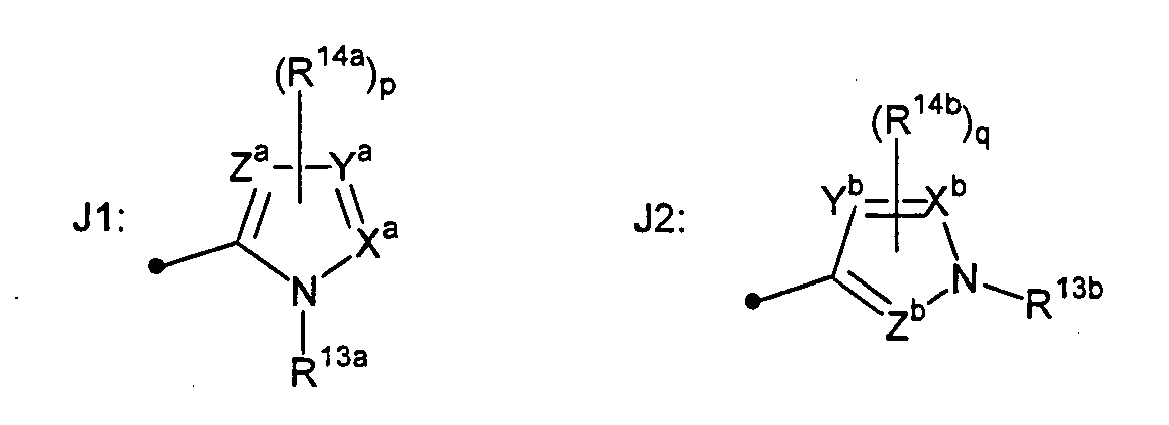
- R13a is a C1-C6 alkyl group optionally substituted with at least one halogen atom; a C3-C6 cycloalkyl group optionally substituted with one or more independent substituents selected from the group consisting of (1) a halogen atom and (2) a C1-C6 alkyl group; a phenyl group optionally substituted with 1 to 5 independent substituents selected from the group consisting of (1) a halogen atom, (2) a cyano group, (3) a nitro group, (4) a C1-C6 alkyl group optionally substituted with at least one halogen atom, (5) a C1-C6 alkoxy group optionally substituted with at least one halogen atom, (6) a C1-C6 alkylthio group optionally substituted with at least one halogen atom, (7) a C1-C6 alkylsulfinyl group optionally substituted with at least one halogen atom and (8) a C1-C6 alkylsulfonyl group optionally substituted with at least one halogen atom; or a 5- to 6-membered heteroaryl group optionally substituted with one or more independent substituents selected from the group consisting of (1) a halogen atom, (2) a cyano group, (3) a nitro group, (4) a C1-C6 alkyl group optionally substituted with at least one halogen atom and (5) a C1-C6 alkoxy group optionally substituted with at least one halogen atom,
- R13b is a C1-C6 alkyl group optionally substituted with at least one halogen atom,
- R14a is a halogen atom; a cyano group; a C1-C6 alkyl group optionally substituted with at least one halogen atom; a C1-C6 alkylthio group optionally substituted with at least one halogen atom; a C1-C6 alkylsulfinyl group optionally substituted with at least one halogen atom; a C1-C6 alkylsulfonyl group optionally substituted with at least one halogen atom; or a phenyl group optionally substituted with 1 to 5 independent substituents selected from the group consisting of (1) a halogen atom, (2) a cyano group, (3) a nitro group, (4) a C1-C6 alkyl group optionally substituted with at least one halogen atom and (5) a C1-C6 alkoxy group optionally substituted with at least one halogen atom,
- R14b is a C1-C6 alkyl group optionally substituted with at least one halogen atom; or a phenyl group optionally substituted with 1 to 5 independent substituents selected from the group consisting of (1) a halogen atom, (2) a cyano group, (3) a nitro group, (4) a C1-C6 alkyl group optionally substituted with at least one halogen atom and (5) a C1-C6 alkoxy group optionally substituted with at least one halogen atom,
- p is an integer of 0 to 2,
- q is 1,
(provided that when p is 2, two R14a's may be the same or different)), and - A1 and A2 are an oxygen atom.
- Examples of the specific aspects of the present compound include the following "Aspects 1 to 32":
- A compound of the formula (1-1):

- R1 is a hydrogen atom, or a C1-C6 alkyl group optionally substituted with at least one halogen atom,
- R2 is a hydrogen atom, or a C1-C6 alkyl group optionally substituted with at least one halogen atom,
- R3 is a hydrogen atom, a C1-C6 alkyl group optionally substituted with at least one halogen atom, or a C2-C6 alkoxycarbonyl group,
- R4a is a hydrogen atom, a halogen atom, a C1-C6 alkyl group optionally substituted with at least one halogen atom, a C1-C6 alkoxy group optionally substituted with at least one halogen atom, or a phenyl group optionally substituted with at least one halogen atom,
- R4b, R4c and R4d are independently a hydrogen atom, a halogen atom, a cyano group, or a C1-C6 alkyl group optionally substituted with at least one halogen atom, or R4b and R4c are bound to each other at their terminal ends to form a group: -CR41=CR42-CR43=CR44-
(wherein R41, R42, R43 and R44 are a hydrogen atom), - M is R5, OR6, SR7, or NR8R9
(wherein - R5 is a hydrogen atom; a C1-C6 alkyl group optionally substituted with at least one halogen atom; a C3-C6 cycloalkyl group; a phenyl group optionally substituted with one substituent selected from the group consisting of (1) a C1-C6 alkyl group optionally substituted with at least one halogen atom and (2) a C1-C6 alkoxy group optionally substituted with at least one halogen atom; a 5 to 6-membered heteroaryl group; or a 3- to 8-membered non-aromatic heterocyclic group,
- R6 is a C1-C6 alkyl group optionally substituted with at least one halogen atom, a C2-C6 alkenyl group optionally substituted with at least one halogen atom, or a phenyl group,
- R7 is a C1-C6 alkyl group optionally substituted with at least one halogen atom,
- R8 and R9 are independently a hydrogen atom, a C1-C6 alkyl group optionally substituted with at least one halogen atom, or a phenyl group, or R8 and R9 are taken together with the nitrogen atom to which they are bound to form a morpholino group),
- Xa is a nitrogen atom,
- R14ay is a hydrogen atom, a halogen atom, a cyano group, a C1-C6 alkyl group optionally substituted with at least one halogen atom, a C1-C6 alkylthio group optionally substituted with at least one halogen atom, a C1-C6 alkylsulfinyl group optionally substituted with at least one halogen atom, a C1-C6 alkylsulfonyl group optionally substituted with at least one halogen atom, or a phenyl group,
- R14az is a hydrogen atom,
- X18 is a nitrogen atom or CR18e
(wherein R18e is a hydrogen atom or a halogen atom), and - R18a, R18b, R18c and R18d are independently a hydrogen atom or a halogen atom.
- A compound of the formula (1-1), wherein
- R1 is a hydrogen atom, or a C1-C6 alkyl group optionally substituted with at least one halogen atom,
- R2 is a hydrogen atom, or a C1-C6 alkyl group optionally substituted with at least one halogen atom,
- R3 is a hydrogen atom, a C1-C6 alkyl group optionally substituted with at least one halogen atom, or a C2-C6 alkoxycarbonyl group,
- R4a is a hydrogen atom, a halogen atom, a C1-C6 alkyl group optionally substituted with at least one halogen atom, a C1-C6 alkoxy group optionally substituted with at least one halogen atom, or a phenyl group optionally substituted with at least one halogen atom,
- R4b, R4c and R4d are independently a hydrogen atom, a halogen atom, a cyano group, or a C1-C6 alkyl group optionally substituted with at least one halogen atom,
- or R4b and R4c are bound to each other at their terminal ends to form a group; -CR41=CR42-CR43=CR44-
(wherein R41, R42, R43 and R44 are a hydrogen atom), - M is R5, OR6, SR7, or NR8R9
(wherein R5 is a hydrogen atom; a C1-C6 alkyl group optionally substituted with at least one halogen atom; a C3-C6 cycloalkyl group; a phenyl group optionally substituted with one substituent selected from the group consisting of (1) a C1-C6 alkyl group optionally substituted with at least one halogen atom and (2) a C1-C6 alkoxy group optionally substituted with at least one halogen atom; a 5 to 6-membered heteroaryl group; or a 3- to 8-membered non-aromatic heterocyclic group, - R6 is a C1-C6 alkyl group optionally substituted with at least one halogen atom, a C2-C6 alkenyl group optionally substituted with at least one halogen atom, or a phenyl group,
- R7 is a C1-C6 alkyl group optionally substituted with at least one halogen atom,
- R8 and R9 are independently a hydrogen atom, a C1-C6 alkyl group optionally substituted with at least one halogen atom, or a phenyl group,
- or R8 and R9 are taken together with the nitrogen atom to which they are bound to form a morpholino group),
- Xa is CR14ax
(wherein R14ax is a hydrogen atom; a halogen atom; a cyano group; a C1-C6 alkyl group optionally substituted with at least one halogen atom; a C1-C6 alkylthio group optionally substituted with at least one halogen atom; or a C1-C6 alkylsulfinyl group optionally substituted with at least one halogen atom, a C1-C6 alkylsulfonyl group optionally substituted with at least one halogen atom, or a phenyl group), - R14ay is a hydrogen atom; a halogen atom; a cyano group; a C1-C6 alkyl group optionally substituted with at least one halogen atom; a C1-C6 alkylthio group optionally substituted with at least one halogen atom; a C1-C6 alkylsulfinyl group optionally substituted with at least one halogen atom; a C1-C6 alkylsulfonyl group optionally substituted with at least one halogen atom; or a phenyl group,
- R14az is a hydrogen atom,
- X18 is a nitrogen atom or CR18e
(wherein R18e is a hydrogen atom or a halogen atom), and - R18a, R18b, R18c and R18d are independently a hydrogen atom or a halogen atom.
- A compound of the formula (1-1), wherein
- R1 is a hydrogen atom, or a C1-C6 alkyl group optionally substituted with at least one halogen atom,
- R2 is a hydrogen atom, or a C1-C6 alkyl group optionally substituted with at least one halogen atom,
- R3 is a hydrogen atom, a C1-C6 alkyl group optionally substituted with at least one halogen atom, or a C2-C6 alkoxycarbonyl group,
- R4a is a halogen atom, or a C1-C6 alkyl group optionally substituted with at least one halogen atom,
- R4b is a hydrogen atom,
- R4c is a hydrogen atom, a halogen atom, a cyano group, or a C1-C6 alkyl group optionally substituted with at least one halogen atom,
- R4d is a hydrogen atom, a halogen atom, or a C1-C6 alkyl group optionally substituted with at least one halogen atom,
- M is OR6
(wherein R6 is a C1-C6 alkyl group optionally substituted with at least one halogen atom), - Xa is a nitrogen atom,
- R14ay is a hydrogen atom, a halogen atom, a C1-C6 alkyl group optionally substituted with at least one halogen atom,
- R14az is a hydrogen atom,
- X18 is a nitrogen atom,
- R18a is a halogen atom, or a C1-C6 alkyl group optionally substituted with at least one halogen atom, and
- R18b, R18c and R18d are a hydrogen atom.
- A compound of the formula (1-1), wherein
- R1 is a hydrogen atom, or a C1-C6 alkyl group optionally substituted with at least one halogen atom,
- R2 is a hydrogen atom, or a C1-C6 alkyl group optionally substituted with at least one halogen atom,
- R3 is a hydrogen atom, a C1-C6 alkyl group optionally substituted with at least one halogen atom, or a C2-C6 alkoxycarbonyl group,
- R4a is a halogen atom, or a C1-C6 alkyl group optionally substituted with at least one halogen atom,
- R4b is a hydrogen atom,
- R4c is a hydrogen atom, a halogen atom, a cyano group, or a C1-C6 alkyl group optionally substituted with at least one halogen atom,
- R4d is a hydrogen atom, a halogen atom, or a C1-C6 alkyl group optionally substituted with at least one halogen atom,
- M is OR6
(wherein R6 is a C1-C6 alkyl group optionally substituted with at least one halogen atom), - Xa is CR14ax
(wherein R14ax is a hydrogen atom, a halogen atom, or a C1-C6 alkyl group optionally substituted with at least one halogen atom), - R14ay is a hydrogen atom, a halogen atom, a C1-C6 alkyl group optionally substituted with at least one halogen atom,
- R14az is a hydrogen atom,
- X18 is a nitrogen atom,
- X18a is a halogen atom, or a C1-C6 alkyl group optionally substituted with at least one halogen atom, and
- R18b, R18c and R18d are a hydrogen atom.
- A compound of the formula (1-1), wherein
- R1 is a hydrogen atom or a methyl group,
- R2 is a hydrogen atom or a methyl group,
- R3 is a hydrogen atom, a methyl group, or a methoxycarbonyl group,
- R4a is a hydrogen atom, a chlorine atom, a bromine atom, an iodine atom, a methyl group, an ethyl group, a trifluoromethyl group, a methoxy group, or a phenyl group,
- R4c is a hydrogen atom, a fluorine atom, a chlorine atom, a bromine atom, an iodine atom, a methyl group, or a cyano group,
- R4b and R4d are a hydrogen atom, a chlorine atom, or a methyl group,
- M is OR6
(wherein R6 is a methyl group), - Xa is a nitrogen atom,
- R14ay is a hydrogen atom, a chlorine atom, a bromine atom, a cyano group, a methyl group, an isopropyl group, a trifluoromethyl group, a methylthio group, a methylsulfinyl group, a methylsulfonyl group, or a phenyl group,
- R14az is a hydrogen atom or a bromine atom,
- X18 is a nitrogen atom,
- R18a is a chlorine atom, and
- R18b, R18c and R18d are a hydrogen atom.
- A compound of the formula (1-1), wherein
- R1 is a hydrogen atom or a methyl group,
- R2 is a hydrogen atom or a methyl group,
- R3 is a hydrogen atom, a methyl group, or a methoxycarbonyl group
- R4a is a hydrogen atom, a chlorine atom, a bromine atom, an iodine atom, a methyl group, an ethyl group, a trifluoromethyl group, a methoxy group, or a phenyl group,
- R4c is a hydrogen atom, a fluorine atom, a chlorine atom, a bromine atom, an iodine atom, a methyl group, or a cyano group,
- R4b and R4d are a hydrogen atom, a chlorine atom, or a methyl group,
- M is OR6
(wherein R6 is a methyl group), - Xa is CR14ax
(wherein R14ax is a hydrogen atom or a halogen atom), - R14ay is a hydrogen atom, a chlorine atom, a bromine atom, a cyano group, a methyl group, an isopropypl group, a trifluoromethyl group, a methylthio group, a methylsulfinyl group, a methylsulfonyl group, or a phenyl group,
- R14az is a hydrogen atom or a bromine atom,
- X18 is a nitrogen atom,
- R18a is a chlorine atom, and
- R18b, R18c and R18d are a hydrogen atom.
- A compound of the formula (1-1), wherein
- R1 is a hydrogen atom, or a C1-C6 alkyl group optionally substituted with at least one halogen atom,
- R2 is a C1-C6 alkyl group optionally substituted with at least one halogen atom.
- R3 is a hydrogen atom, a C1-C6 alkyl group optionally substituted with at least one halogen atom, or a C2-C6 alkoxycarbonyl group,
- R4a is a hydrogen atom, a halogen atom, a C1-C6 alkyl group optionally substituted with at least one halogen atom, a C1-C6 alkoxy group optionally substituted with at least one halogen atom, or a phenyl group optionally substituted with at least one halogen atom,
- R4b, R4c and R4d are independently a hydrogen atom, a halogen atom, a cyano group, a C1-C6 alkyl group optionally substituted with at least one halogen atom, or
- R4b and R4c are bound to each other at their terminal ends to form a group: -CR41=CR42-CRq3=CR44-
(wherein R41, R42, R43 and R44 are a hydrogen atom), - M is OR6, SR7 or NR8R9
(wherein R6 and R7 are a C1-C6 alkyl group optionally substituted with at least one halogen atom, a C3-C6 alkoxyalkyl group optionally substituted with at least one halogen atom, a C2-C6 alkenyl group optionally substituted with at-least one halogen atom, or a C3-C6 alkynyl group optionally substituted with at least one halogen atom, - R8 and R9 are independently a hydrogen atom, a C1-C6 alkyl group optionally substituted with at least one halogen atom, a C2-C6 alkenyl group optionally substituted with at least one halogen atom, a C3-C6 alkynyl group optionally substituted with at least one halogen atom,
- or R8 and R9 are taken together with the nitrogen atom to which they are bound to form a pyrroridin-1-yl group, a piperidino group, a hexamethyleneimin-1-yl group, a heptamethyleneimin-1-yl group, a morpholino group, a thiomorpholin-4-yl group, or a 4-phenylpiperazin-1-yl group),
- Xa is a nitrogen atom or CR14ax
(wherein X14ax is a hydrogen atom, a halogen atom, a cyano group, a C1-C6 alkyl group optionally substituted with at least one halogen atom, a C1-C6 alkylthio group optionally substituted with at least one halogen atom, or a C1-C6 alkylsulfinyl group optionally substituted with at least one halogen atom), - R14ay is a hydrogen atom, a halogen atom, a cyano group, a C1-C6 alkyl group optionally substituted with at least one halogen atom, a C1-C6 alkylthio group optionally substituted with at least one halogen atom, or a C1-C6 alkylsulfinyl group optionally substituted with at least one halogen atom, a C1-C6 alkylsulfonyl group optionally substituted with at least one halogen atom, or a phenyl group,
- R14az is a hydrogen atom,
- X18 is a nitrogen a tom or a CR18e
(wherein R18e is a hydrogen atom or a halogen atom), and - R1Ba, R18b, R18c and R18d are independently a hydrogen atom or a halogen atom.
- A compound of the formula (1-1), wherein
- R1 is a hydrogen atom, or a C1-C6 alkyl group optionally substituted with at least one halogen atom,
- R2 is a hydrogen, or a C1-C6 alkyl group optionally substituted with at least one halogen atom,
- R3 is a hydrogen, a C1-C6 alkyl group optionally substituted with at least one halogen atom, or a C2-C6 alkoxycarbonyl group,
- R4a is a hydrogen atom, a halogen atom, a C1-C6 alkyl group optionally substituted with at least one halogen atom, a C1-C6 alkoxy group optionally substituted with at least one halogen atom, or a phenyl group optionally substituted with at least one halogen atom.
- R4b, R4c and R4d are independently a hydrogen atom, a halogen atom, a cyano group, a C1-C6 alkyl group optionally substituted with at least one halogen atom, or
- R4b and R4c are bound to each other at their terminal ends to form a group: -CR41=CR42-CR43=CR44-
(wherein R41, R42, R43 and R44 are a hydrogen atom), - M is a hydrogen atom,
- Xa is a nitrogen atom or CR14ax
(wherein R14ax is a hydrogen atom, a halogen atom, a cyano group, a C1-C6 alkyl group optionally substituted with at least one halogen atom, a C1-C6 alkoxy group optionally substituted with at least one halogen atom, a C1-C6 alkylthio group optionally substituted with at least one halogen atom, a C1-C6 alkylsulfinyl group optionally substituted with at least one halogen atom, or a C1-C6 alkylsulfony group optionally substituted with at least one halogen atom), - R14ay is a hydrogen atom, a halogen atom, a cyano group, a C1-C6 alkyl group optionally substituted with at least one halogen atom, a C1-C6 alkylthio group optionally substituted with at least one halogen atom, a C1-C6 alkylsulfinyl group optionally substituted with at least one halogen atom, a C1-C6 alkylsulfonyl group optionally substituted with at least one halogen atom, or a phenyl group,
- R14az is a hydrogen atom,
- X18 is a nitrogen atom or CR18e
(wherein R18e is a hydrogen atom or a halogen atom), and - R18a, R18b, R18c and R18d are independently a hydrogen atom or a halogen atom.
- A compound of the formula (1-1), wherein
- R1 is a hydrogen atom, or a C1-C6 alkyl group optionally substituted with at least one halogen atom,
- R2 is a hydrogen atom, or a C1-C6 alkyl group optionally substituted with at least one halogen atom,
- R3 is a hydrogen atom, a C1-C6 alkyl group optionally substituted with at least one halogen atom, or a C2-C6 alkoxycarbonyl group,
- R4a is a halogen atom, or a C1-C6 alkyl group optionally substituted with at least one halogen atom,
- R4b, R4c and R4d are independently a hydrogen atom, a halogen atom, a cyano group, or a C1-C6 alkyl group optionally substituted with at least one halogen atom,
- or R4b and R4c are bound to each other at their terminal ends to form a group: -CR41=CR42-CR43=CR44-
(wherein R41, R42, R43 and R44 are independently a hydrogen atom, a halogen atom, a cyano group or a C1-C6 alkyl group optionally substituted with at least one halogen atom), - M is R5, OR6, SR7 or NR8R9,
(wherein R5 is a hydrogen atom, or a C1-C6 alkyl group optionally substituted with at least one halogen atom, - R6 and R7 are a C1-C6 alkyl group optionally substituted with at least one halogen atom, a C3-C6 alkoxyalkyl group optionally substituted with at least one halogen atom, a C2-C6 alkynyl group optionally substituted with at least one halogen atom or a C3-C6 alkynyl group optionally substituted with at least one halogen atom,
- R8 and R9 are independently a hydrogen atom, a C1-C6 alkyl group optionally substituted with at least one halogen atom, a C2-C6 alkenyl group optionally substituted with at least one halogen atom, a C3-C6 alkynyl group optionally substituted with at least one halogen atom,
- or R8 and R9 are taken together with the nitrogen atom to which they are bound to form a pyrrolidin-1-yl group, a piperidino group, a hexamethyleneimin-1-yl group, a heptamethyleneimin-1-yl group, a morpholino group or a thiomorfolin-4-yl group),
- Xa is a nitrogen atom or CR14ax
(wherein R14ax is a hydrogen atom, a halogen atom, a cyano group, a C1-C6 alkyl group optionally substituted with a halogen atom, a C1-C6 alkoxy group optionally substituted with a halogen atom, a C1-C6 alkylthio group optionally substituted with a halogen atom, a C1-C6 alkylsulfinyl group optionally substituted with a halogen atom, or a C1-C6 alkylsulfonyl group optionally substituted with a halogen atom), - R14ay and R14az are independently a hydrogen atom, a halogen atom, a cyano group, a C1-C6 alkyl group optionally substituted with at least one halogen atom, a C1-C6 alkoxy group optionally substituted with at least one halogen atom, a C1-C6 alkylthio group optionally substituted with at least one halogen atom, a C1-C6 alkylsulfinyl group optionally substituted with at least one halogen atom, or a C1-C6 alkylsulfonyl group optionally substituted with at least one halogen atom,
- X18 is a nitrogen atom or CR18e,
(wherein R18e is a hydrogen atom, a halogen atom, or C1-C6 alkyl group optionally substituted with at least one halogen atom), and - R18a, R18b, R18c and R18d are independently a hydrogen atom, a halogen atom, or a C1-C6 alkyl group optionally substituted with at least one halogen atom.
- A compound of the formula (1-1), wherein
- R1 is a hydrogen atom, or a C1-C6 alkyl group optionally substituted with at least one halogen atom,
- R2 is a hydrogen atom, or a C1-C6 alkyl group optionally substituted with at least one halogen atom,
- R3 is a hydrogen atom, a C1-C6 alkyl group optionally substituted with at least one halogen atom, or a C2-C6 alkoxycarbonyl group,'
- R4a is a halogen atom, or a C1-C6 alkyl group optionally substituted with at least one halogen atom,
- R4b, R4c and R4d are independently a hydrogen atom, a halogen atom, a cyano group, or a C1-C6 alkyl group optionally substituted with at least one halogen atom,
- or R4b and R4c are bound to each other at their terminal ends to form a group: -CR41=CR42-CR43=CR44-
(wherein R41, R42, R43 and R44 are independently a hydrogen atom, a halogen atom, a cyano group, or a C1-C6 alkyl group optionally substituted with at least one halogen atom), - M is R5, OR6, SR7 or NR8R9,
(wherein R5 is a hydrogen atom, or a C1-C6 alkyl group optionally substituted with at least one halogen atom, - R6 and R7 are a C1-C6 alkyl group optionally substituted with at least one halogen atom, a C3-C6 alkoxyalkyl group optionally substituted with at least one halogen atom, a C2-C6 alkenyl group optionally substituted with at least one halogen atom, or a C3-C6 alkynyl group optionally substituted with at least one halogen atom.,
- R8 and R9 are independently a hydrogen atom, a C1-C6 alkyl group optionally substituted with at least one halogen atom, a C2-C6 alkenyl group optionally substituted with at least one halogen atom, a C3-C6 alkynyl group optionally substituted with at least one halogen atom,
- or R8 and R9 are taken together with a nitrogen atom to which they are bound to represent a pyrrolidin-1-yl group, a piperidino group, a hexamethyleneimin-1-yl group, a heptamethyleneimin-1-yl group, a morpholino or a thiomorpholin-4-yl group),
- Xa is a nitrogen atom,
- R14ay and R14az are independently a hydrogen atom, a halogen atom, a cyano group, a C1-C6 alkyl group optionally substituted with at least one halogen atom, a C1-C6 alkoxy group optionally substituted with at least one halogen atom, a C1-C6 alkylthio group optionally substituted with at least one halogen atom, a C1-C6 alkylsulfinyl group optionally substituted with at least one halogen atom, or a C1-C6 alkylsulfonyl group optionally substituted with at least one halogen atom,
- X18 is a nitrogen atom or CR18e,
(wherein R18e is a hydrogen atom, a halogen atom, or a C1-C6 alkyl group optionally substituted with at least one halogen atom), and - R18a, R18b, R18c and R18d are independently a hydrogen atom, a halogen atom or a C1-C6 alkyl group optionally substituted with at least one halogen atom.
- A compound of the formula (1-1), wherein
- R1 is a hydrogen atom, or a C1-C6 alkyl group optionally substituted with at least one halogen atom,
- R2 is a hydrogen atom, or a C1-C6 alkyl group optionally substituted with at least one halogen atom,
- R3 is a hydrogen atom, a C1-C6 alkyl group optionally substituted with at least one halogen atom, or a C2-C6 alkoxycarbonyl group,
- R4a is a halogen atom, or a C1-C6 alkyl group optionally substituted with at least one halogen atom,
- R4b, R4c and R4d are independently a hydrogen atom, a halogen atom, a cyano group, or a C1-C6 alkyl group optionally substituted with at least one halogen atom,
- or R4b and R4c are bound to each other at their terminal ends to for a group: -CR41=CR42-CR43=CR44-
(wherein R41, R42, R43 and R44 are independently a hydrogen atom, a halogen atom, a cyano group, or a C1-C6 alkyl group optionally substituted with at least one halogen atom), - M is R5, OR6, SR7 or NR8R9,
(wherein R5 is a hydrogen atom, or a C1-C6 alkyl group optionally substituted with at least one halogen atom, - R6 and R7 are a C1-C6 alkyl group optionally substituted with at least one halogen atom, a C3-C6 alkoxyalkyl group optionally substituted with at least one halogen atom, a C2-C6 alkenyl group optionally substituted with at least one halogen atom, or a C3-C6 alkynyl group optionally substituted with at least one halogen atom,
- R8 and R9 are independently a hydrogen atom, a C1-C6 alkyl group optionally substituted with at least one halogen atom, a C2-C6 alkenyl group optionally substituted with at least one halogen atom, a C3-C6 alkynyl group optionally substituted with at least one halogen atom,
- or R8 and R9 are taken together with the nitrogen atom to which they are bound to form a pyrroridin-1-yl group, a piperidino group, a hexamethyleneimin-1-yl group, a heptamethyleneimin-1-yl group, a morpholino group or a thiomorpholin-4-yl group),
- Xa is CR14ax
(wherein R14ax is a hydrogen atom, a halogen atom, a cyano group, a C1-C6 alkyl group optionally substituted with at least one halogen atom, a C1-C6 alkoxy group optionally substituted with at least one halogen atom, a C1-C6 alkylthio group optionally substituted with at least one halogen atom, a C1-C6 alkylsulfinyl group optionally substituted with at least one halogen atom, or a C1-C6 alkylsulfonyl group optionally substituted with at least one halogen atom), - R14ay and R14az are independently a hydrogen atom, a halogen atom, a cyano group, a C1-C6 alkyl group optionally substituted with at least one halogen atom, a C1-C6 alkoxy group optionally substituted with at least one halogen atom, a C1-C6 alkylthio group optionally substituted with at least one halogen atom, a C1-C6 alkylsulfinyl group optionally substituted with at least one halogen atom, or a C1-C6 alkylsulfonyl group optionally substituted with at least one halogen atom,
- X18 is a nitrogen atom, or CR18e,
(wherein R18e is a hydrogen atom, a halogen atom, or a C1-C6 alkyl group optionally substituted with at least one halogen atom), and - R18a, R18b, R18c and R18d are independently a hydrogen atom, a halogen atom, or a C1-C6 alkyl group optionally substituted with at least one halogen atom.
- A compound of the formula (1-1), wherein
- R1 is a hydrogen atom, or a C1-C6 alkyl group optionally substituted with at least one halogen atom,
- R2 is a hydrogen atom, or a C1-C6 alkyl group optionally substituted with at least one halogen atom,
- R3 is a hydrogen atom, a C1-C6 alkyl group optionally substituted with at least one halogen atom, or a C2-C6 alkoxycarbonyl group,
- R4a is a halogen atom, or a C1-C6 alkyl group optionally substituted with at least one halogen atom,
- R4b, R4c and R4d are independently a hydrogen atom, a halogen atom, a cyano group, or a C1-C6 alkyl group optionally substituted with at least one halogen atom,
- or R4b and R4c are bound to each other at their terminal ends to form a group: -CR41=CR42-CR43=CR44-
(wherein R41, R42, R43 and R44 are independently a hydrogen atom, a halogen atom, a cyano group, or a C1-C6 alkyl group optionally substituted with at least one halogen atom), - M is R5, OR6, SR7 or NR8R9,
(wherein R5 is a hydrogen atom, or a C1-C6 alkyl group optionally substituted with at least one halogen atom, - R6 and R7 are a C1-C6 alkyl group optionally substituted with at least one halogen atom, a C3-C6 alkoxyalkyl group optionally substituted with at least one halogen atom, a C2-C6 alkenyl group optionally substituted with at least one halogen atom, or a C3-C6 alkynyl group optionally substituted with at least one halogen atom,
- R8 and R9 are independently a hydrogen atom, a C1-C6 alkyl group optionally substituted with at least one halogen atom, a C2-C6 alkenyl group optionally substituted with at least one halogen atom, a C3-C6 alkynyl group optionally substituted with at least one halogen atom,
- or R8 and R9 are taken together with the nitrogen atom to which they are bound to form a pyrroridin-1-yl group, a piperidino group, a hexamethyleneimin-1-yl group, a heptamethyleneimin-1-yl group, a morpholino group or a thiomorpholin-4-yl group),
- Xa is CR14ax
(wherein R14ax is a hydrogen atom, a halogen atom, a cyano group, a C1-C6 alkyl group optionally substituted with at least one halogen atom, a C1-C6 alkoxy group optionally substituted with at least one halogen atom, a C1-C6 alkylthio group optionally substituted with at least one halogen atom, a C1-C6 alkylsulfinyl group optionally substituted with at least one halogen atom, or a C1-C6 alkylsulfonyl group optionally substituted with at least one halogen atom), - R14ay and R14az are independently a hydrogen atom, a halogen atom, a cyano group, a C1-C6 alkyl group optionally substituted with at least one halogen atom, a C1-C6 alkoxy group optionally substituted with at least one halogen atom, a C1-C6 alkylthio group optionally substituted with at least one halogen atom, a C1-C6 alkylsulfinyl group optionally substituted with at least one halogen atom, or a C1-C6 alkylsulfonyl group optionally substituted with at least one halogen atom,
- X18 is a nitrogen atom, or CR18e,
(wherein R18e is a halogen atom, or a C1-C6 alkyl group optionally substituted with at least one halogen atom), and - R18a, R18b, R18c and R18d are independently a hydrogen atom, a halogen atom, or a C1-C6 alkyl group optionally substituted with at least one halogen atom.
- A compound of the formula (1-1), wherein
- R1 is a hydrogen atom, or a C1-C6 alkyl group optionally substituted with at least one halogen atom,
- R2 is a hydrogen atom, or a C1-C6 alkyl group optionally substituted with at least one halogen atom,
- R3 is a hydrogen atom, a C1-C6 alkyl group optionally substituted with at least one halogen atom, or a C2-C6 alkoxycarbonyl group,
- R4a is a hydrogen atom, a halogen atom, or a C1-C6 alkyl group optionally substituted with at least one halogen atom,
- R4b is a hydrogen atom,
- R4c is a hydrogen atom, a halogen atom, a cyano group, or a C1-C6 alkyl group optionally substituted with at least one halogen atom,
- R4d is a hydrogen atom,
- M is OR6,
- R6 is a C1-C6 alkyl group optionally substituted with at least one halogen atom,
- Xa is a nitrogen atom,
- R14ay is a hydrogen atom, a halogen atom, or a C1-C6 alkyl group optionally substituted with at least one halogen atom,
- R14az is a hydrogen atom,
- X18 is a nitrogen atom,
- R18a is a halogen atom, or a C1-C6 alkyl group optionally substituted with at least one halogen atom, and
- R18b, R18c, R18d are a hydrogen atom.
- A compound of the formula (1-1), wherein
- R1 is a hydrogen atom, or a C1-C6 alkyl group optionally substituted with at least one halogen atom,
- R2 is a hydrogen atom, or a C1-C6 alkyl group optionally substituted with at least one halogen atom,
- R3 is a hydrogen atom, a C1-C6 alkyl group optionally substituted with at least one halogen atom, or a C2-C6 alkoxycarbonyl group,
- R4a is a hydrogen atom, a halogen atom or a C1-C6 alkyl group optionally substituted with at least one halogen atom,
- R4b is a hydrogen atom,
- R4c is a hydrogen atom, a halogen atom, a cyano group, or a C1-C6 alkyl group optionally substituted with at least one halogen atom,
- R4d is a hydrogen atom,
- M is OR6,
- R6 is a C1-C6 alkyl group optionally substituted with at least one halogen atom,
- Xa is a CR14ax
(wherein R14ax represents a hydrogen atom, a halogen atom, or a C1-C6 alkyl group optionally substituted with at least one halogen atom), - R14ay is a hydrogen atom, a halogen atom, or a C1-C6 alkyl group optionally substituted with at least one halogen atom,
- R14az is a hydrogen atom,
- X18 is a nitrogen atom,
- R18a is a halogen atom, or a C1-C6 alkyl group optionally substituted with at least one halogen atom, and
- R18b, R18c and R18d are a hydrogen atom.
- A compound of the formula (1-1), wherein
- R1 is a hydrogen atom or a methyl group,
- R2 is a hydrogen atom or a methyl group,
- R3 is a hydrogen atom, a methyl group, or a methoxycarbonyl group,
- R4a is a chlorine atom, a bromine atom, an iodide atom, or a methyl-group,
- R4c is a chlorine atom, a bromine atom, an iodine atom, a methyl group or a cyano group,
- R4b and R4d are a hydrogen atom,
- M is a OR6
(wherein R6 is a methyl group), - Xa is a nitrogen atom,
- R14ay is a chlorine atom, a bromine atom, or a trifluoromethyl group,
- R14az is a hydrogen atom,
- X18 is a nitrogen atom,
- R18a is a chlorine atom or a bromine atom, and
- R18b, R18c and R18d are a hydrogen atom.
- A compound of the formula (1-1), wherein
- R1 is a hydrogen atom or a methyl group,
- R2 is a hydrogen atom or a methyl group,
- R3 is a hydrogen atom, a methyl group, or a methoxycarbonyl group,
- R4a is a chlorine atom, a bromine atom, or an iodine atom, or a methyl group,
- R4c is a chlorine atom, a bromine atom, an iodine atom, a methyl group or a cyano group,
- R4b and R4d are a hydrogen atom,
- M is OR6
(wherein R6 is a methyl group), - Xa is CR14ax
(wherein R14ax is a hydrogen atom, a chlorine atom or a bromine atom), - R14ay is a chlorine atom, a bromine atom or a trifuoromethyl group,
- R14az is a hydrogen atom,
- X18 is a nitrogen atom,
- R18a is a chlorine atom or a bromine atom, and
- R18b, R18c and R18d are a hydrogen atom.
- A compound of the formula (1-1), wherein
- R1 is a hydrogen atom, or a C1-C6 alkyl group optionally substituted with at least one halogen atom,
- R2 is a C1-C6 alkyl group optionally substituted with at least one halogen atom,
- R3 is a hydrogen atom, a C1-C6 alkyl group optionally substituted with at least one halogen atom, or a C2-C6 alkoxycarbonyl group,
- R4a is a halogen atom, or a C1-C6 alkyl group optionally substituted with at least one halogen atom,
- R4b, R4c and R4d are independently a hydrogen atom, a halogen atom, a cyano group, or a C1-C6 alkyl group optionally substituted with at least one halogen atom,
- or R4b and R4c are bound to each other at their terminal ends to form a group: -CR41=CR42-CR43=CR44-
(wherein R41, R42, R43 and R44 are independently a hydrogen atom, a halogen atom, a cyano group, or a C1-C6 alkyl group optionally substituted with at least one halogen atom), - M is OR6, SR7 or NR8R9,
(wherein R6 and R7 are a C1-C6 alkyl group optionally substituted with at least one halogen atom, a C3-C6 alkoxyalkyl group optionally substituted with at least one halogen atom, or a C2-C6 alkenyl group optionally substituted with at least one halogen atom, or a C3-C6 alkynyl group optionally substituted with at least one halogen atom, - R8 and R9, each, independently, are a hydrogen atom, a C1-C6 alkyl group optionally substituted with at least one halogen atom, a C2-C6 alkenyl group optionally substituted with at least one halogen atom, a C3-C6 alkynyl group optionally substituted with at least one halogen atom,
- or R8 and R9 are taken together with the nitrogen atom to which they are bound to form a pyrrolidin-1-yl group, a piperidino group, a hexamethyleneimin-1-yl group, a heptamethyleneimin-1-yl group, a morpholino group, or a thiomorpholino-4-yl group),
- Xa is a nitrogen atom or CR14ax
(wherein R14ax is a hydrogen atom, a halogen atom, a cyano group, a C1-C6 alkyl group optionally substituted with at least one halogen atom, a C1-C6 alkoxy group optionally substituted with at least one halogen atom, a C1-C alkylthio group optionally substituted with at least one halogen atom, a C1-C6 alkylsulfinyl group optionally substituted with at least one halogen atom, or a C1-C6 alkylsulfonyl group optionally substituted with at least one halogen atom), - R14ay and R14az are independently a hydrogen atom, a halogen atom, a cyano group, a C1-C6 alkyl group optionally substituted with at least one halogen atom, a C1-C6 alkoxy group optionally substituted with at least one halogen atom, a C1-C6 alkylthio group optionally substituted with at least one halogen atom, a C1-C6 alkylsulfinyl group optionally substituted with at least one halogen atom, or a C1-C6 alkylsulfonyl group optionally substituted with at least one halogen atom,
- X18 is a nitrogen atom, or CR18e,
(wherein R18e is a hydrogen atom, a halogen atom, or a C1-C6 alkyl group optionally substituted with at least one halogen atom), and - R18a, R18b, R18c and R18d are independently a hydrogen atom, a halogen atom or a C1-C6 alkyl group optionally substituted with at least one halogen atom.
- A compound of the formula (1-1), wherein
- R1 is a hydrogen atom, or a C1-C6 alkyl group optionally substituted with at least one halogen atom,
- R2 is a hydrogen atom, or a C1-C6 alkyl group optionally substituted with at least one halogen atom,
- R3 is a hydrogen atom, a C1-C6 alkyl group optionally substituted with at least one halogen atom, or a C2-C6 alkoxycarbonyl group,
- R4a is a halogen atom, or a C1-C6 alkyl group optionally substituted with at least one halogen atom,
- R4b, R4c and R4 are independently a hydrogen atom, a halogen atom, a cyano group, or a C1-C6 alkyl group optionally substituted with at least one halogen atom,
- or R4b and R4c are bound at end to be -CR41=CR42-CR43=CR44-(wherein R41, R42, R43, and R44, each, independently, are a hydrogen atom, a halogen atom, a cyano group, or a C1-C6 alkyl group optionally substituted with at least one halogen atom,
- M is a hydrogen atom,
- Xa is a nitrogen atom or CR14ax
(wherein R14ax is a hydrogen atom, a halogen atom, a cyano group, a C1-C6 alkyl group optionally substituted with at least one halogen atom, a C1-C6 alkoxy group optionally substituted with at least one halogen atom, a C1-C6 alkylthio group optionally substituted with at least one halogen atom, a C1-C6 alkylsulfinyl group optionally substituted with at least one halogen atom, or a C1-C6 alkylsulfonyl group optionally substituted with at least one halogen atom), - R14ay and R14az, each, independently, are a hydrogen atom, a halogen atom, a cyano group, a C1-C6 alkyl group optionally substituted with at least one halogen atom, a C1-C6 alkoxy group optionally substituted with at least one halogen atom, a C1-C6 alkylthio group optionally substituted with at least one halogen atom, a C1-C6 alkylsulfinyl group optionally substituted with at least one halogen atom, or a C1-C6 alkylsulfonyl group optionally substituted with at least one halogen atom,
- X18 is a nitrogen atom or CR18e,
(wherein R18e is a hydrogen atom, a halogen atom, or a C1-C6 alkyl group optionally substituted with at least one halogen atom), and - R18a, R18b, R18e and R18d are independently a hydrogen atom, a halogen atom, or a C1-C6 alkyl group optionally substituted with at least one halogen atom.
- A compound of the formula (1-1), wherein
- R1 is a hydrogen atom, or a C1-C6 alkyl group optionally substituted with at least one halogen atom,
- R2 is a hydrogen atom, or a C1-C6 alkyl group optionally substituted with at least one halogen atom,
- R3 is a hydrogen atom, a C1-C6 alkyl group optionally substituted with at least one halogen atom, or a C2-C6 alkoxycarbonyl group,
- R4a is a hydrogen atom, a halogen atom, a cyano group, or a nitro group or a C1-C6 alkyl group optionally substituted with at least one halogen atom,
- R4b and R4c are bound to each other at their terminal ends to form a group: -CR41=CR42-CR43=CR44-
(wherein R41, R42, R43 and R44 are independently a hydrogen atom, a halogen atom, a cyano group, a nitro group, or a C1-C6 alkyl group optionally substituted with at least one halogen atom), - R4d is a hydrogen atom, a halogen atom, a cyano group, a nitro group, or a C1-C6 alkyl group optionally substituted with at least one halogen atom,
- M is R5, OR6, SR7 or NR8R9,
(wherein R5 is a hydrogen atom, a C1-C6 alkyl group optionally substituted with at least one halogen atom, or a C3-C6 cycloalkyl group, - R6 and R7 are a C1-C6 alkyl group optionally substituted with at least one halogen atom, a C3-C6 alkoxyalkyl group optionally substituted with at least one halogen atom, a C2-C6 alkenyl group optionally substituted with at least one halogen atom, or a C3-C6 alkynyl group optionally substituted with at least one halogen atom,
- R8 and R9 are independently a hydrogen atom, a C1-C6 alkyl group optionally substituted with at least one halogen atom, a C2-C6 alkenyl group optionally substituted with at least one halogen atom, or a C3-C6 alkynyl group optionally substituted with at least one halogen atom,
- or R8 and R9 are taken together with the nitrogen atom to which they are bound to form a pyrroridin-1-yl group, a piperidino group, a hexamethyleneimin-1-yl group, a heptamethyleneimin-1-yl group, a morpholino group, a thiomorphorin-4-yl group, or a 4-methylpiperazin-1-yl group),
- Xa is a nitrogen atom or CR14ax
- R14ax, R14ay and R14az are independently a hydrogen atom, a halogen atom, a cyano group, a C1-C6 alkyl group optionally substituted with at least one halogen atom, a C1-C6 alkoxy group optionally substituted with at least one halogen atom, a C1-C6 alkylthio group optionally substituted with at least one halogen atom, a C1-C6 alkylsulfinyl group optionally substituted with at least one halogen atom, or a C1-C6 alkyl sulfonyl group optionally substituted with at least one halogen atom,
- x18 is a nitrogen atom, or a CR18e, and
- R18a, R18b, R18c, R18d and R18e are independently a hydrogen atom, a halogen atom, or a C1-C6 alkyl group optionally substituted with at least one halogen atom.
- A compound of the formula (1-1), wherein
- R1 is a hydrogen atom, or a C1-C6 alkyl group optionally substituted with at least one halogen atom,
- R2 is a hydrogen atom, or a C1-C6 alkyl group optionally substituted with at least one halogen atom,
- R3 is a hydrogen atom, a C1-C6 alkyl group optionally substituted with at least one halogen atom, or a C2-C6 alkoxycarbonyl group,
- R4a is a hydrogen atom or a halogen atom,
- R4b and R4c are bound to each other at their terminal ends to form a group: -CR41=CR42-CR43=CR44-
(wherein R41, R42, R43 and R44 are independently a hydrogen atom, or a halogen atom), - R4d is a hydrogen atom,
- M is R5, OR6, SR7 or NR8R9,
(wherein R5 is a hydrogen atom, a C1-C6 alkyl group optionally substituted with at least one halogen atom, or a C3-C6 cycloalkyl group, - R6 and R7 are a C1-C6 alkyl group optionally substituted with at least one halogen atom, a C3-C6 alkoxyalkyl group optionally substituted with at least one halogen atom, a C2-C6 alkenyl group optionally substituted with at least one halogen atom, or a C3-C6 alkynyl group optionally substituted with at least one halogen atom,
- R8 and R9 are independently a hydrogen atom, a C1-C6 alkyl group optionally substituted with at least one halogen atom, a C2-C6 alkenyl group optionally substituted with at least one halogen atom, or a C3-C6 alkynyl group optionally substituted with at least one halogen atom,
- or R8 and R9 are taken together with the nitrogen atom to which they are bound to form a pyrroridin-1-yl group, a piperidino group, a hexamethyleneimin-1-yl group, a heptamethyleneimin-1-yl group, a morpholino group, a thiomorphorin-4-yl group, or a 4-methylpiperazin-1-yl group),
- X6 is a nitrogen atom or CR14ax,
- R14ax , R14ay and R14az are independently a hydrogen atom, a halogen atom, a cyano group, a C1-C6 alkyl group optionally substituted with at least one halogen atom, a C1-C6 alkoxy group optionally substituted with at least one halogen atom, a C1-C6 alkylthio group optionally substituted with at least one halogen atom, a C1-C6 alkylsulfinyl group optionally substituted with at least one halogen atom, or a C1-C6 alkylsulfonyl group optionally substituted with at least one halogen atom,
- X18 is a nitrogen atom, or a CR18e, and
- R18a, R18b, R18c, R18d and R18e are independently a hydrogen atom, a halogen atom, or a C1-C6 alkyl group optionally substituted with at least one halogen atom.
- A compound represented by the formula (1-2):

- R2 represents a hydrogen atom or a C1-C6 alkyl group,
- R3 represents a hydrogen atom or a methyl group,
- R4a represents a halogen atom or a methyl group,
- R4c represents a halogen atom,
- R14ay represents a halogen atom or a trifluoromethyl group,
- Xa represents a nitrogen atom or CH,
- R18a represents a halogen atom, and
- R100 represents a C1-C6 alkyl group.
- A compound of the formula (1-2), wherein
- R2 is a C1-C6 alkyl group,
- R3 is a hydrogen atom or a methyl group,
- R4a is a halogen atom, or a methyl group,
- R4c is a halogen atom,
- R14ay is a halogen atom or a trifluoromethyl group,
- Xa is a nitrogen atom or CH, and
- R18a is a halogen atom.
- A compound represented by the formula (1-3):

- R2 represents a hydrogen atom or a C1-C6 alkyl group,
- R3 represents a hydrogen atom or a methyl group,
- R4a represents a halogen atom or a methyl group,
- R14ay represents a halogen atom or a trifluoromethyl group,
- Xa represents a nitrogen atom or CH,
- R18a represents a halogen atom, and
- R100 represents a C1-C6 alkyl group.
- A compound of the formula (1-1), wherein
- R1 is a hydrogen atom, or a C1-C6 alkyl group optionally substituted with at least one halogen atom,
- R2 is a hydrogen atom, or a C1-C6 alkyl group optionally substituted with at least one halogen atom,
- R3 is a hydrogen atom, a C1-C6 alkyl group optionally substituted with at least one halogen atom, or a C2-C6 alkoxycarbonyl group,
- R4a is a halogen atom, or a C1-C6 alkyl group optionally substituted with at least one halogen atom,
- R4b is a hydrogen atom,
- R4c is a hydrogen atom, a halogen atom, a cyano group, or a C1-C6 alkyl group optionally substituted with at least one halogen atom,
- R4d is a hydrogen atom,
- M is OR6
(wherein R6 is a C1-C6 alkyl group optionally substituted with at least one halogen atom, a C3-C6 alkoxyalkyl group optionally substituted with at least one halogen atom, a C2-C6 alkenyl group optionally substituted with at least one halogen atom, or a C3-C6 alkynyl group optionally substituted with at least one halogen atom), - Xa is a nitrogen atom or CR14ax
(wherein R14ax is a hydrogen atom, a halogen atom, a cyano group, a C1-C6 alkyl group optionally substituted with at least one halogen atom, a C1-C6 alkoxy group optionally substituted with at least one halogen atom, a C1-C6 alkylthio group optionally substituted with at least one halogen atom, a C1-C6 alkylsulfinyl group optionally substituted with at least one halogen atom, or a C1-C6 alkylsulfonyl group optionally substituted with at least one halogen atom), - R14ay is a hydrogen atom, a halogen atom, a cyano group, a C1-C6 alkyl group optionally substituted with at least one halogen atom, a C1-C6 alkoxy group optionally substituted with at least one halogen atom, a C1-C6 alkylthio group optionally substituted with at least one halogen atom, a C1-C6 alkylsulfinyl group optionally substituted with at least one halogen atom, or a C1-C6 alkylsulfonyl group optionally substituted with at least one halogen atom,
- R14az is a hydrogen atom,
- X18 is a nitrogen atom
- R18a is a halogen atom, or a C1-C6 alkyl group optionally substituted with at least one halogen atom, and
- R18b, R18c, R18d are a hydrogen atom.
- A compound of the formula (1-1), wherein
- R1 is a hydrogen atom, or a C1-C6 alkyl group optionally substituted with at least one halogen atom,
- R2 is a hydrogen atom, or a C1-C6 alkyl group optionally substituted with at least one halogen atom,
- R3 is a hydrogen atom, a C1-C6 alkyl group optionally substituted with at least one halogen atom, or a C2-C6 alkoxycarbonyl group,
- R4a is a halogen atom, or a C1-C6 alkyl group optionally substituted with at least one halogen atom,
- R4b is a hydrogen atom,
- R4c is a hydrogen atom, a halogen atom, a cyano group, or a C1-C6 alkyl group optionally substituted with at least one halogen atom,
- R4d is a hydrogen atom,
- M is OR6,
(wherein R6 is a C1-C6 alkyl group optionally substituted with at least one halogen atom, a C3-C6 alkoxyalkyl group optionally substituted with at least one halogen atom, a C2-C6 alkenyl group optionally substituted with at least one halogen atom, or a C3-C6 alkynyl group optionally substituted with at least one halogen atom), - Xa is a nitrogen atom,
- R14ay is a hydrogen atom, a halogen atom, a cyano group, a C1-C6 alkyl group optionally substituted with at least one halogen atom, a C1-C6 alkoxy group optionally substituted with at least one halogen atom, a C1-C6 alkylthio group optionally substituted with at least one halogen atom, a C1-C6 alkylsulfinyl group optionally substituted with at least one halogen atom, or a C1-C6 alkylsulfonyl group optionally substituted with at least one halogen atom,
- R14az is a hydrogen atom,
- X18 is a nitrogen atom,
- R18a is a halogen atom, or a C1-C6 alkyl group optionally substituted with at least one halogen atom, and
- R18b, R18c, R18d are a hydrogen atom.
- A compound of the formula (1-1), wherein
- R1 is a hydrogen atom, or a C1-C6 alkyl group optionally substituted with at least one halogen atom,
- R2 is a hydrogen atom, or a C1-C6 alkyl group optionally substituted with at least one halogen atom,
- R3 is a hydrogen atom, a C1-C6 alkyl group optionally substituted with at least one halogen atom, or a C2-C6 alkoxycarbonyl group,
- R4a is a halogen atom or a C1-C6 alkyl group optionally substituted with at least one halogen atom,
- R4b is a hydrogen atom,
- R4c is a hydrogen atom, a halogen atom, a cyano group, or a C1-C6 alkyl group optionally substituted with at least one halogen atom,
- R4d is a hydrogen atom,
- M is OR6
(wherein R6 is a C1-C6 alkyl group optionally substituted with at least one halogen atom, a C3-C6 alkoxyalkyl group optionally substituted with at least one halogen atom, a C2-C6 alkenyl group optionally substituted with at least one halogen atom, or a C3-C6 alkynyl group optionally substituted with at least one halogen atom), - Xa is a CR14ax
(wherein R14ax is a hydrogen atom, a halogen atom, a cyano group, a C1-C6 alkyl group optionally substituted with.at least one halogen atom, a C1-C6 alkoxy group optionally substituted with at least one halogen atom, a C1-C6 alkylthio group optionally substituted with at least one halogen atom, a C1-C6 alkylsulfinyl group optionally substituted with at least one halogen atom, or a C1-C6 alkylsulfonyl group optionally substituted with at least one halogen atom), - R14ay is a hydrogen atom, a halogen atom, a cyano group, a C1-C6 alkyl group optionally substituted with at least one halogen atom, a C1-C6 alkoxy group optionally substituted with at least one halogen atom, a C1-C6 alkylthio group optionally substituted with at least one halogen atom, a C1-C6 alkylsulfinyl group optionally substituted with at least one halogen atom, or a C1-C6 alkylsulfonyl group optionally substituted with at least one halogen atom,
- R14az is a hydrogen atom,
- X18 is a nitrogen atom,
- R18a is a halogen atom, or a C1-C6 alkyl group optionally substituted with at least one halogen atom, and
- R18b, R18c and R18d are a hydrogen atom.
- A compound of the formula (1-1), wherein
- R1 is a hydrogen atom, or a C1-C6 alkyl group optionally substituted with at least one halogen atom,
- R2 is a C1-C6 alkyl group optionally substituted with at least one halogen atom,
- R3 is a hydrogen atom, a C1-C6 alkyl group optionally substituted with at least one halogen atom, or a C2-C6 alkoxycarbonyl group,
- R4a is a halogen atom, or a C1-C6 alkyl group optionally substituted with at least one halogen atom,
- R4b is a hydrogen atom,
- R4c is a hydrogen atom, a halogen atom, a cyano group, or a C1-C6 alkyl group optionally substituted with at least one halogen atom,
- R4d is a hydrogen atom,
- M is OR6,
(wherein R6 is a C1-C6 alkyl group optionally substituted with at least one halogen atom, a C3-C6 alkoxyalkyl group optionally substituted with at least one halogen atom, a C2-C6 alkenyl group optionally substituted with at least one halogen atom, or a C3-C6 alkynyl group optionally substituted with at least one halogen atom), - Xa is a nitrogen atom or CR14ax
(wherein R14ax is a hydrogen atom, a halogen atom, a cyano group, a C1-C6 alkyl group optionally substituted with at least one halogen atom, a C1-C6 alkoxy group optionally substituted with at least one halogen atom, a C1-C6 alkylthio group optionally substituted with at least one halogen atom, a C1-C6 alkylsulfinyl group optionally substituted with at least one halogen atom, or a C1-C6 alkylsulfonyl group optionally substituted with at least one halogen atom), - R14ay is a hydrogen atom, a halogen atom, a cyano group, a C1-C6 alkyl group optionally substituted with at least one halogen atom, a C1-C6 alkoxy group optionally substituted with at least one halogen atom, a C1-C6 alkylthio group optionally substituted with at least one halogen atom, a C1-C6 alkylsulfinyl group optionally substituted with at least one halogen atom, or a C1-C6 alkylsulfonyl group optionally substituted with at least one halogen atom,
- R14az is a hydrogen atom,
- X18 is a nitrogen atom,
- R18a is a halogen atom, or a C1-C6 alkyl group optionally substituted with at least one halogen atom, and
- R18b, R18c, R18d are a hydrogen atom.
- A compound of the formula (1-1), wherein
- R1 is a hydrogen atom, or a C1-C6 alkyl group optionally substituted with at least one halogen atom,
- R2 is a hydrogen atom, or a C1-C6 alkyl group optionally substituted with at least one halogen atom,
- R3 is a hydrogen atom, a C1-C6 alkyl group optionally substituted with at least one halogen atom, or a C2-C6 alkoxycarbonyl group,
- R4a is a halogen atom, a cyano group, a nitro group, or a C1-C6 alkyl group optionally substituted with at least one halogen atom,
- R4b and R4c are bound to each other at their terminal ends to form a group: -CR41=CR42-CR43=CR44-
(wherein R41, R42, R43 and R44 are independently a hydrogen atom, a halogen atom, a cyano group, a nitro group, or a C1-C6 alkyl group optionally substituted with at least one halogen atom), - R4d is a hydrogen atom,
- M is OR6,
(wherein R6 is a C1-C6 alkyl group optionally substituted with at least one halogen atom, a C3-C6 alkoxyalkyl group optionally substituted with at least one halogen atom, a C2-C6 alkenyl group optionally substituted with at least one halogen atom, or a C3-C6 alkynyl group optionally substituted with at least one halogen atom), - Xa is a nitrogen atom or CR14ax
(wherein R14ax is a hydrogen atom, a halogen atom, a cyano group, a C1-C6 alkyl group optionally substituted with at least one halogen atom, a C1-C6 alkoxy group optionally substituted with at least one halogen atom, a C1-C6 alkylthio group optionally substituted with at least one halogen atom, a C1-C6 alkylsulfinyl group optionally substituted with at least one halogen atom, or a C1-C6 alkylsulfonyl group optionally substituted with at least one halogen atom), - R14ay is a hydrogen atom, a halogen atom, a cyano group, a C1-C6 alkyl group optionally substituted with at least one halogen atom, a C1-C6 alkoxy group optionally substituted with at least one halogen atom, a C1-C6 alkylthio group optionally substituted with at least one halogen atom, a C1-C6 alkylsulfinyl group optionally substituted with at least one halogen atom, or a C1-C6 alkylsulfonyl group optionally substituted with at least one halogen atom,
- R14az is a hydrogen atom,
- X18 is a nitrogen atom,
- R18a is a halogen atom, or a C1-C6 alkyl group optionally substituted with at least one halogen atom, and
- R18b R18c, R18d are a hydrogen atom.
- A compound represented by the formula (1-2), wherein
- R2 represents a hydrogen atom or a C1-C6 alkyl group,
- R3 represents a hydrogen atom or a C1-C6 alkyl group,
- R4a represents a halogen atom or a methyl group,
- R4c represents a halogen atom,
- R14ay represents a halogen atom or a trifluoromethyl group,
- Xa represents a nitrogen atom or CR14ax (wherein R14ax is a hydrogen atom or a halogen atom),
- R18a represents a halogen atom, and
- R100 represents a C1-C6 alkyl group.
- A compound of the formula (1-2), wherein
- R2 is a C1-C6 alkyl group,
- R3 is a hydrogen atom or a C1-C6 alkyl group,
- R4a is a halogen atom, or a methyl group,
- R4c is a halogen atom,
- R14ay is a halogen atom or a trifluoromethyl group,
- Xa is a nitrogen atom or CR14ax (wherein R14ax is a hydrogen atom or a halogen atom),
- R18a is a halogen atom, and
- R100 is a C1-C6 alkyl group.
- A compound of the formula (1-2), wherein
- R2 is a C1-C6 alkyl group,
- R3 is a C1-C6 alkyl group,
- R4a is a halogen atom, or a methyl group,
- R4c is a halogen atom,
- R14ay is a halogen atom or a trifluoromethyl group,
- Xa is a nitrogen atom or CR14ax (wherein R14ax represents a hydrogen atom or a halogen atom),
- R18a is a halogen atom, and
- R100 is a C1-C6 alkyl group.
- A compound represented by the formula (1-3), wherein
- R2 represents a hydrogen atom or a C1-C6 alkyl group,
- R3 represents a hydrogen atom or a C1-C6 alkyl group,
- R4a represents a halogen atom or a methyl group,
- R14ay represents a halogen atom or a trifluoromethyl group,
- Xa represents a nitrogen atom or CR14ax (wherein R14ax represents a hydrogen atom or a halogen atom),
- R18a represents a halogen atom, and
- R100 represents a C1-C6 alkyl group.
- Hereinafter, a process for producing the present compound will be explained.
- The present compound can be produced, for example, by the following Process A-1 to Process C-1.
- Among the present compounds, a compound represented by the formula (1-i):


L1-Q' (3)
wherein Q' is as defined above, and L1 represents a halogen atom or a Q'-O-group (provided that the case where Q' is Q4, and R8 and R9 are a hydrogen atom is excluded) (hereinafter, referred to as the compound (3)). - The reaction is performed in the presence or the absence of a solvent. Examples of the solvent to be used in the reaction include ethers such as 1,4-dioxane, diethyl ether, tetrahydrofuran, methyl tert-butyl ether, and the like, halogenated hydrocarbons such as dichloromethane, chloroform, carbon tetrachloride, 1,2-dichloroethane, chlorobenzene, and the like, hydrocarbons such as toluene, benzene, xylene, and the like, nitriles such as acetonitrile and the like, aprotic polar solvents such as N,N-dimethylformamide, N-methlpyrrolidone, 1,3-dimethyl-2-imidadzolidinone, dimethyl sulfoxide, and the like, and a mixture thereof.
- The amount of the compound (3) to be used in the reaction is usually 1 to 2 mols per 1 mol of the compound (2).
- The reaction is performed in the presence of a base, if necessary. Examples of the base include nitrogen-containing heterocyclic compounds such as pyridine, picoline, 2,6-lutidine, 1,8-diazabicyclo[5,4,0]7-undecene (DBU), 1,5-diazabicyclo[4,3, 0]5-nonene (DBN), and the like, tertiary amines such as triethylamine, N,N-diisopropylethylamine, and the like, and inorganic bases such as potassium carbonate, sodium hydride, and the like. The amount of the base when the reaction is performed in the presence of the base is usually 1 to 2 mols per 1 mol of the compound (2), while the base may be used in an excess amount in case that the base used is liquid under the reaction conditions such as pyridine, and the like.
- The reaction temperature is usually in a range of 0 to 100°C, and the reaction time is usually in a range of 0.1 to 24 hours.
- After completion of the reaction, the compound (1-i) can be isolated by pouring the reaction mixture into water and extracting the mixture with an organic solvent, or collecting a deposited precipitate by filtration. The isolated compound (1-i) may be further purified by recrystallization, chromatography, or the like.
- Among the present compounds, a compound represented by the formula (1-ii) :

A34=C=N-R8a (4)
wherein A34 and R8a are as defined above (hereinafter, referred to as the compound (4)). - The reaction is performed in the presence or the absence of a solvent. Examples of the solvent to be used in the reaction include ethers such as 1,4-dioxane, diethyl ether, tetrahydrofuran, methyl tert-butyl ether, and the like, halogenated hydrocarbons such as dichloromethane, chloroform, carbon tetrachloride, 1,2-dichloroethane, chlorobenzene, and the like, hydrocarbons such as toluene, benzene, xylene, and the like, nitriles such as acetonitrile, and the like, aprotic polar solvents such as N,N-dimethylformamide, N-methylpyrrolidone, 1,3-dimethyl-2-imidazolidinone, dimethyl sulfoxide, and the like, and a mixture thereof.
- The amount of the compound (4) used in the reaction is usually 1 to 2 mols per 1 mol of the compound (2).
- The reaction temperature is usually in a range of 0 to 100°C, and the reaction time is a usually a range of 0.1 to 24 hours.
- After completion of the reaction, the compound (1-ii) can be isolated by pouring the reaction mixture into water, and extracting the mixture with an organic solvent, or collecting a deposited precipitate by filtration. The isolated compound (1-ii) may be further purified by recrystallization, chromatography, or the like.
- Among the present compounds, a compound represented by the formula (1-iii):

- The reaction is performed in the presence of a solvent. Examples of the solvent used in the reaction include acids such as organic acids such as acetic acids, and the like and mineral acids such as hydrochloric acid, and the like, as well as a mixture of these acids and water, chloroform, or the like.
- The amount of the cyanate or the thiocyanate used in the reaction is usually 1 to 2 mols per 1 mol of the compound (2).
- The reaction temperature is usually in a range of 0 to 100°C, and the reaction time is usually in a range of 0.1 to 24 hours.
- Examples of the cyanate or the thiocyanate include potassium cyanate, sodium cyanate, ammonium cyanate, potassium thiocyanate, sodium thiocyanate and ammonium thiocyanate.
- After completion of the reaction, the compound (I-iii) can be isolated by pouring the reaction mixture into water and extracting the mixture with an organic solvent, or collecting a deposited precipitate by filtration. The isolated Compound (I-iii) may be further purified by recrystallization, chromatography, or the like.
- The present compound can be produced by reacting a compound represented by the formula (6):


- The reaction is performed in the presence or the absence of a solvent. Examples of the solvent used in the reaction include ethers such as 1,4-dioxane, diethyl ether, tetrahydrofuran, methyl tert-butyl ether, and the like, halogenated hydrocarbons such as dichloromethane, chloroform, carbon tetrachloride, 1,2-dichloroethane, chlorobenzene, and the like, hydrocarbons such as toluene, benzene, xylene, and the like, nitriles such as acetonitrile, and the like, aprotic polar solvents such as N,N-dimethylformamide, N-methylpyrrolidone, 1,3-dimethyl-2-imidazolidinone, dimethyl sulfoxide, and the like, and a mixture thereof.
- The amount of the compound (7) used in the reaction is usually 1 to 2 mols per 1 mol of the compound (6).
- The reaction is performed in the presence of a base, if necessary. Examples of the base include nitrogen-containing heterocyclic compounds such as pyridine, picoline, 2,6-lutidine, 1,8-diazabicyclo[5,4,0]7-undecene (DBU), 1,5-diazadicyclo[4,3,0]5-nonene (DBN), and the like, tertiary amines such as triethylamine, N,N-diisopropylethylamine, and the like, and inorganic bases such as potassium carbonate, sodium hydride, and the like. The amount of the base when the reaction is performed in the presence of the base is usually 1 to 2 mole per 1 mol of the compound (6), while the base may be used in an excess amount in case that the base used is liquid under the reaction conditions such as pyridine, and the like.
- The reaction temperature is usually in a range of 0 to 100°C, and the reaction time is usually in a range of 0.1 to 24 hours.
- After completion of the reaction, the present compound can be isolated by pouring the reaction mixture into water, and extracting the mixture with an organic solvent, or collecting a deposited precipitation by filtration. The isolated present compound may be further purified by recrystallization, chromatography, or the like.
- Among the present compounds, a compound represented by the formula (I-iv):


- The reaction is performed in the presence or the absence of a solvent. Examples of the solvent to be used in the reaction include ethers such as 1,4-dioxane, diethyl ether, tetrahydrofuran, methyl tert-butyl ether, and the like, halogenated hydrocarbons such as dichloromethane, chloroform, carbon tetrachloride, 1,2-dichloroethane, chlorobenzene, and the like, hydrocarbons such as toluene, benzene, xylene, and the like, nitriles such as acetonitrile, and the like, aprotic polar solvents such as N,N-dimethylformamide, N-methylpyrrolidone, 1,3-dimethyl-2-imidazolidinone, dimethyl sulfoxide, and the like, and a mixture thereof.
- The amount of the compound (8) used in the reaction is usually 1 to 2 mols per 1 mol of the compound (6).
- Examples of the dehydrating agent to be used in the reaction include carbodiimides such as dicyclohexylcarbodiimide (DCC), 1-ethyl-3-(3-dimethylaminopropyl)carbodiimide hydrochloride (WSC), and the like. The amount of the dehydrating agent to be used is usually 1 to 2 mols per 1 mol of the compound (6).
- The reaction temperature is usually in a range of 0 to 100°C, and the reaction time is usually in a range of 0.1 to 24 hours.
- After completion of the reaction, the compound (I-iv) can be isolated by pouring the reaction mixture into water, and extracting the mixture with an organic solvent, or collecting a deposited precipitate by filtration. The isolated compound (1-iv) may be further purified by recrystallization, chromatography, or the like.
- Among the present compounds, a compound represented by the formula (1-v):


- The reaction is performed in the presence or the absence of a solvent. Examples of the solvent used in the reaction include ethers such as 1,4-dioxane, diethyl ether, tetrahydrofuran, methyl tert-butyl ether, and the like, halogenated hydrocarbons such as dichloromethane, chloroform, carbon tetrachloride, 1,2-dichloroethane, chlorobenzene, and the like, hydrocarbons such as toluene, benzene, xylene, and the like, nitriles such as acetonitrile, and the like, aprotic polar solvents such as N,N-dimethylformamide, N-methylpyrrolidone, 1,3-dimethyl-2-imidaozolidinone, dimethyl sulfoxide, and the like, and a mixture thereof.
- The amount of the compound (10) to be used in the reaction is usually 1 to 20 mols per 1 mol of the compound (9).
- The reaction temperature is usually in a range of 0 to 100°C, and the reaction time is usually in a range of 0.1 to 48 hours.
- After completion of the reaction, the compound (1-v) can be isolated by pouring the reaction mixture into water, and extracting the mixture with an organic solvent, or collecting a deposited precipitate by filtration. The isolated compound (1-v) may be further purified by recrystallization, chromatography, or the like.
- Among the present compounds, a compound represented by the formula (1-vi):


- The reaction is performed in the presence or the absence of a solvent. Examples of the solvent to be used in the reaction include ethers such as 1,4-dioxane, diethyl ether, tetrahydrofuran, methyl tert-butyl ether, and the like, halogenated hydrocarbons such as dichloromethane, chloroform, carbon tetrachloride, 1,2-dichlorethane, chlorobenzene, and the like, hydrocarbons such as toluene, benzene, xylene, and the like, nitriles such as acetonitrile, and the like, aprotic polar solvents such as N,N-diethylformamide, N-methylpyrrolidone, 1,3-dimethyl-2-imidazolidinone, dimethyl sulfoxide, and the like, and a mixture thereof.
- The amount of the compound (10) to be used in the reaction is usually 1 to 2 mols per 1 mol of the compound (11).
- The reaction is performed in the presence of a base, if necessary. Examples of the base include nitrogen-containing heterocyclic compounds such as pyridine, picoline, 2,6-lutidine, 1,8-diazabicyclo[5,4,0]7-undecene (DBU), 1, 5-diazabicyclo[4,3, 0] 5-nonene (DBN), and the like, tertiary amines such as triethylamine, N,N-diisopropylethylamine, and the like, and inorganic bases such as potassium carbonate, sodium hydride, and the like. The amount of the base to be used when the reaction is performed in the presence of the base is usually 1 to 2 mols per 1 mol of the compound (11), while the base may be used in an excess amount in the case that the base used is liquid under the reaction conditions such as pyridine and the like.
- The reaction temperature is usually in a range of 0 to 100°C, and the reaction time is usually in a range of 0.1 to 24 hours.
- After completion of the reaction, the compound (1-vi) can be isolated after pouring the reaction mixture into water, and extracting the mixture with an organic solvent, or collecting a deposited precipitate by filtration. The isolated compound (1-vi) may be further purified by recrystallization, chromatography or the like.
- The compound (1-vi) can also be produced by reacting a compound represented by the formula (12):

- The reaction is performed in the presence or the absence of a solvent. Examples of the solvent to be used in the reaction include ethers such as 1,4-dioxane, diethyl ether, tetrahydrofuran, methyl tert-butyl ether, and the like, halogenated hydrocarbons such as dichloromethane, chloroform, carbon tetrachloride, 1,2-dichlroethane, chlorobenzene, and the like, hydrocarbons such as toluene, benzene, xylene, and the like, nitriles such as acetonitrile, and the like, aprotic polar solvents such as N,N-dimethylformamide, N-methylpyrrolidone, 1,3-dimethyl-2-imidazolidinone, dimethyl sulfoxide, and the like, and a mixture thereof.
- The amount of the compound (10) used in the reaction is usually 1 to 2 mols per 1 mol of the compound (12).
- Examples of the dehydrating agent used in the reaction include carbodiimides such as dicyclohexylcarbodiimide (DCC), 1-ethyl-3-(3-dimethylaminopropyl)carbodiimide hydrochloride (WSC), and the like. The amount of the dehydrating agent to be used is usually 1 to 2 mols per 1 mol of the compound (12).
- The reaction temperature is usually in a range of 0 to 100°C, and the reaction time is usually in a range of 0.1 to 24 hours.
- After completion of the reaction, the compound (1-vi) can be isolated by pouring the reaction mixture into water and extracting the mixture with an organic solvent, or collecting a deposited precipitate by filtration. The isolated compound (1-vi) may be further purified by recrystallization, chromatography, or the like.
- Then, a process for producing intermediates for producing the present compound will be explained.
- Among the compound (2), a compound represented by the formula (2-i):


- The reaction is performed in the presence or the absence of a solvent. Examples of the solvent used in the reaction include ethers such as 1,4-dioxane, diethyl ether, tetrahydrofuran, methyl tert-butyl ether, and the like, halogenated hydrocarbons such as dichloromethane, chloroform, carbon tetrachloride, 1,2-dichloroethane, chlorobenzene and the like, hydrocarbons such as toluene, benzene, xylene and the like, nitriles such as acetonitrile, and the like, aprotic polar solvents such as N,N-dimethylformamide, N-methylpyrrolidone, 1,3-dimethyl-2-imidazolidinone, dimethyl sulfoxide, and the like, alcohols such as methanol, ethanol, 2-propanol, and the like, and a mixture thereof.
- The amount of the compound (13) to be used in the reaction is usually 1 to 5 mols per 1 mol of the compound (9).
- The reaction temperature is usually in a range of -50 to 100°C, and the reaction time is usually in a range of 0.1 to 24 hours.
- After completion of the reaction, the compound (2-i) can be isolated by pouring the reaction mixture into water, and extracting the mixture with an organic solvent, or collecting a deposited precipitate by filtration. The isolated compound (2-i) may be further purified by recrystallization, chromatography, or the like.
- Among the compound (2), a compound represented by the formula (2-ii):


- The reaction is performed in the presence or the absence of a solvent. Examples of the solvent to be used in the reaction include ethers such as 1,4-dioxane, diethyl ether, tetrahydrofuran, methyl tert-butyl ether, and the like, halogenated hydrocarbons such as dichloromethane, chloroform, carbon tetrachloride, 1,2-dichloroethane, chlorobenzene and the like, hydrocarbons such as toluene, benzene, xylene, and the like, nitriles such as acetonitrile, and the like, aprotic polar solvents such as N,N-dimethylformamide, N-methylpyrrolidone, 1,3-dimethyl-2-imidazolidinone, dimethyl sulfoxide, and the like, alcohols such as methanol, ethanol, 2-propanol, and the like, and a mixture thereof.
- The amount of the compound (13) to be used in the reaction is usually 1 to 5 mols per 1 mol of the compound (14).
- The reaction temperature is usually in a range of -50 to 100°C, and the reaction time is usually in a range of 0.1 to 24 hours.
- After completion of the reaction, the compound (2-ii) can be isolated by pouring the reaction mixture into water, and extracting the mixture with an organic solvent, or collecting a deposited precipitate by filtration. The isolated compound (2-ii) may be further purified by recrystallization, chromatography, or the like.
- Among the compound (2), a compound represented by the formula (2-iii) :

- The reaction is performed in the presence or the absence of a solvent. Examples of the solvent used in the reaction include ethers such as 1,4-dioxane, diethyl ether, tetrahydrofuran, methyl tert-butyl ether, and the like, halogenated hydrocarbons such as dichloromethane, chloroform, carbon tetrachloride, 1,2-dichloroethane, chlorobenzene, and the like, hydrocarbons such as toluene, benzene, xylene, and the like, nitriles such as acetonitrile, and the like, aprotic polar solvents such as N,N-dimethylformamide, N-methylpyrrolidone, 1,3-dimethyl-2-imidazolidinone, dimethyl sulfoxide, and the like, and a mixture thereof.
- The amount of Compound (13) used in the reaction is usually 2 to 10 mols per 1 mol of the compound (11).
- The reaction temperature is usually in a range of -50 to 100°C, and the reaction time is in a range of 0.1 to 24 hours.
- After completion of the reaction, the compound (2-iii) can be isolated by pouring the reaction mixture into water, and extracting the mixture with an organic solvent, or collecting a deposited precipitate by filtration. The isolated compound (2-iii) may be further purified by recrystallization, chromatography, or the like.
- The compound (9) can be produced by reacting a compound represented by the formula (16).


- The reaction is performed in the presence or the absence of a solvent in the presence of a base. Examples of the solvent to be used in the reaction include ethers such as 1,4-dioxane, diethyl ether, tetrahydrofuran, methyl tert-butyl ether, and the like, halogenated hydrocarbons such as dichloromethane, chloroform, carbon tetrachloride, 1,2-dichloroethane, chlorobenzene, and the like, hydrocarbons such as toluene, benzene, xylene, and the like, nitriles such as acetonitrile, and the like, aprotic polar solvents such as N,N-dimethylformamide, N-methylpyrrolidone, 1,3-dimethyl-2-imidazolidinone, dimethyl sulfoxide, and the like, and a mixture thereof.
- The amount of the compound (7') used in the reaction is usually 0.5 to 2 mols per 1 mol of the compound (16).
- Examples of the base to be used in the reaction include nitrogen-containing heterocyclic compounds such as pyridine, picoline, 2,6-lutidine, 1,8-diazabicyclo[5,4,0]7-undecene(DBU), 1,5-diazabicyclo[4,3,0]5-nonene (DBN), and the like, tertiary amines such as triethylamine, N,N-diisopropylethylamine, and the like, and inorganic bases such as potassium carbonate, sodium hydride, and the like. The amount of the base to be used is usually 1 to 2 mols per 1 mol of the compound (16), while the base may be used in an excess amount in case that the base is liquid under the reaction conditions such as pyridine, and the like.
- The reaction temperature is usually in a range of 50 to 150°C, and the reaction time is usually in a range of 1 to 24 hours.
- After completion of the reaction, the compound (9) can be isolated by pouring the reaction mixture into water, and extracting the mixture with an organic solvent, or collecting a deposited precipitates by filtration. The isolated compound (9) may be further purified by recrystallization, chromatography, or the like.
- The compound (9) can be produced by reacting a compound represented by the formula (17):

- The reaction is performed in the presence or the absence of a solvent. Examples of the solvent to be used in the reaction include ethers such as 1,4-dioxane, diethyl ether, tetrahydrofuran, methyl tert-butyl ether, and the like, halogenated hydrocarbons such as dichloromethane, chloroform, carbon tetrachloride, 1,2-dichloroethane, chlorobenzene, and the like, hydrocarbons such as toluene, benzene, xylene, and the like, nitriles such as acetonitrile, and the like, aprotic polar solvents such as N,N-dimethylformamide, N-methylpyrrolidone, 1,3-dimethyl-2-imidazolidinone, dimethyl sulfoxide, and the like, and a mixture thereof.
- The process comprises the following step 5-1 and step 5-2.
- This step is performed by reacting the compound (17) and the compound (7') in the presence of a base.
- The amount of the compound (7') to be used in this step is usually 1 to 2 mols per 1 mol of the compound (17). Examples of the base include nitrogen-containing heterocyclic compounds such as pyridine, picoline, 2,6-lutidine, 1,8-diazabicyclo[5,4,0]7-undecene (DBU), 1,5-diazabicyclo[4,3,0]5-nonene (DBN), and the like, tertiary amines such as triethylamine, N,N-diisopropylethylamine, and the like, and inorganic bases such as potassium carbonate, sodium hydride, and the like. The amount of the base to be used is usually 1 to 2 mols per 1 mol of the compound (17).
- The reaction temperature of this step is usually in a range of 0 to 50°C, and the reaction time is usually in a range of 0.1 to 24 hours.
- After completion of this step, usually, the reaction mixture is used as it is in the next step 5-2.
- This step is performed by reacting the reaction mixture in the step 5-1 and a sulfonyl halide in the presence of a base.
- Examples of the sulfonyl halide used in this step include methanesulfonyl chloride, p-toluenesulfonyl chloride, and trifluoromethanesulfonyl chloride. The amount of the sulfonyl halide to be used in this step is usually 1 to 2 mols per 1 mol of the compound (17) used in the step 5-1.
- Examples of the base include the same bases as those described with respect to the step 5-1. The amount of the base is usually 2 to 4 mols per 1 mol of the compound (17) used in the step 5-1.
- The reaction temperature of this step is usually in a range of 0 to 50°C, and the reaction time is usually in a range of 0.1 to 24 hours.
- After completion of this step, the compound (9) can be isolated by pouring the reaction mixture into water, followed by conventional extraction with an organic solvent. The isolated compound (9) may be further purified by recrystallization, chromatography, or the like.
- The compound (14) can be produced by reacting the compound (9) with a thiocarbonylation agent.
- The reaction is performed in the presence or the absence of a solvent. Examples of the solvent to be used in the reaction include ethers such as 1,4-dioxane, diethyl ether, tetrahydrofuran, methyl tert-butyl ether, diglyme, and the like, halogenated hydrocarbons such as dichloromethane, chloroform, carbon tetrachloride, 1,2-dichloroethane, chlorobenzene, and the like, hydrocarbons such as toluene, benzene, xylene, and the like, nitriles such as acetonitrile, and the like, pyridines such as pyridine, picoline, lutidine, and the like, and a mixture thereof.
- Examples of the thiocarbonylation agent to be used in the reaction include diphosphorus pentasulfide, a Lawesson's reagent (2,4-bis-(4-methoxyphenyl)-1,3-dithia-2,4-diphosphetane 2,4-disulfide), and the like.
- The amount of the thiocarbonylation agent to be used in the reaction is usually 1 to 3 mols per 1 mol of the compound (9).
- The reaction temperature is usually in a range of 0°C to 200°C, and the reaction time is usually in a range of 1 to 24 hours.
- After completion of the reaction, the compound (14) can be isolated by collecting a precipitate deposited in the reaction mixture by filtration, or extracting the reaction mixture with an organic solvent. The isolated compound (14) may be further purified by recrystallization, chromatography, or the like.
- The compound (11) can be produced by reacting the compound (12) with a halogenating agent.
- The reaction is performed in the presence or the absence of a solvent. Examples of the solvent to be used in the reaction include ethers such as 1,4-dioxane, diethyl ether, tetrahydrofuran, methyl tert-butyl ether, and the like, halogenated hydrocarbons such as dichloromethane, chloroform, carbon tetrachloride, 1,2-dichloroethane, chlorobenzene, and the like, hydrocarbons such as toluene, benzene, xylene, and the like, nitriles such as acetonitrile, and the like, aprotic polar solvents such as N,N-dimethylformamide, N-methylpyrrolidone, 1,3-dimethyl-2-imidazolidinone, dimethyl sulfoxide, and the like, and a mixture thereof.
- Examples of the halogenating agent to be used in the reaction include thionyl chloride, thionyl bromide, phosphorus oxychloride, phosphorus oxybromide, phosphorus pentachloride, oxalyl chloride, and phosgene.
- The amount of the halogenating agent to be used in the reaction is usually 1 to 2 mols per 1 mol of the compound (12) and, in some cases, the halogenating agent may be used in an excess amount.
- The reaction temperature is usually in a range of 0°C to 150°C, and the reaction time is usually in a range of 0.1 to 24 hours.
- After completion of the reaction, the compound (11) can be isolated by collecting a precipitate deposited in the reaction mixture, or concentrating the reaction mixture. The isolated compound (11) is usually used as it is in the next step and, if necessary, may be further purified by recrystallization, or the like.
- The compound (12) can be produced by reacting a compound represented by the formula (18'):

- The reaction is performed in the presence or the absence of a solvent. Examples of the solvent used in the reaction include ethers such as 1,4-dioxane, diethyl ether, tetrahydrofuran, methyl tert-butyl ether, and the like, halogenated hydrocarbons such as dichloromethane, chloroform, carbon tetrachloride, 1,2-dichloroethane, chlorobenzene, and the like, hydrocarbons such as toluene, benzene, xylene, and the like, nitriles such as acetonitrile, and the like, aprotic polar solvents such as N,N-dimethylformamide, N-methylpyrrolidone, 1,3-dimethyl-2-imidazolidinone, dimethyl sulfoxide, and the like, and a mixture thereof.
- The amount of the compound (7) to be used in the reaction is usually 1 to 2 mols per 1 mol of the compound (18').
- The reaction is performed in the presence of a base. Examples of the base to be used include nitrogen-containing heterocyclic compounds such as pyridine, picoline, 2,6-lutidine, 1,8-diazabicyclo[5,4,0]7-undecene (DBU), 1,5-diazabicyclo[4,3,0]5-nonene (DBN), and the like, tertiary amines such as triethylamine, N,N-diisopropylethylamine, and the like, inorganic bases such as potassium carbonate, sodium hydride, and the like. The amount of the base to be used is usually 1 to 2 mols per 1 mol of the compound (18').
- The reaction temperature is usually in a range of 0 to 50°C, and the reaction time is usually in range of 0.1 to 24 hours.
- After completion of the reaction, the compound (12) can be isolated by pouring the reaction mixture into water, followed by conventional extraction with an organic solvent, or collecting a deposited precipitate by filtration. The isolated compound (12) may be further purified by recrystallization, chromatography, or the like.
- The compound (6) can be produced by reacting a compound represented by the formula (20):

- The reaction is performed-in the presence or the absence of a solvent. Examples of the solvent used in the reaction include ethers such as 1,4-dioxane, diethyl ether, tetrahydrofuran, methyl tert-butyl ether, and the like, halogenated hydrocarbons such as dichloromethane, chloroform, carbon tetrachloride, 1,2-dichloroethane, chlorobenzene, and the like, hydrocarbons such as toluene, benzene, xylene, and the like, nitriles such as acetonitrile, and the like, aprotic polar solvents such as N,N-dimethylformamide, N-methylpyrrolidone, 1,3-dimethyl-2-imidazolidinone, dimethyl sulfoxide, and the like, alcohols such as methanol, ethanol, isopropyl alcohol, and the like, and a mixture thereof.
- The amount of the compound (10) to be used in the reaction is usually 1 to 2 mols per 1 mol of the compound (20).
- The reaction temperature is usually in a range of -20 to 150°C, and the reaction time is usually in a range of 0.1 to 24 hours.
- After completion of the reaction, the compound (20) can be isolated by pouring the reaction mixture into water, and extracting the mixture with an organic solvent, or collecting a deposited precipitate by filtration. The isolated Compound (20) may be further purified by recrystallization, chromatography, or the like.
- The compounds (3), (4) and (13) are known compounds, or can be produced from known compounds according to known processes (e.g. see Organic Functional Group Preparations, 2nd edition, Vol.1, chapter 12, p.359-376 (Stanley R. Sandler, Wolf Karo.) or Organic Functional Group Preparations, 2nd edition, Vol.1, chapter 14, p.434-465 (Stanley R. Sandler, Wolf Karo.)).
- As an aspect of the compound (2), the following compound is mentioned:
- A hydrazide compound of the formula (II):

- R1-i represents a hydrogen atom, or a C1-C6 alkyl group optionally substituted with at least one halogen atom,
- R2-i represents a hydrogen atom, or a methyl group,
- R4a represents a halogen atom, or a C1-C6 alkyl group optionally substituted with at least one halogen atom,
- R4b, R4c and R4d independently represent a hydrogen atom, a halogen atom, a cyano group, or a C1-C6 alkyl group optionally substituted with at least one halogen atom,
- or R4b and R4c are bound to each other at their terminal ends to form a group T1: -CR41=CR42-CR43=CR44-
(wherein R41, R42, R43 and R44 independently represent a hydrogen atom, a halogen atom, a cyano group, or a C1-C6 alkyl group optionally substituted with at least one halogen atom), - Xa represents a nitrogen atom or CR14ax (wherein R14ax represents a hydrogen atom, a halogen atom, a cyano group, a C1-C6 alkyl group optionally substituted with at least one halogen atom, a C1-C6 alkoxy group optionally substituted with at least one halogen atom, a C1-C6 alkylthio group optionally substituted with at least one halogen atom, a C1-C6 alkylsulfinyl group optionally substituted with at least one halogen atom, or a C1-C6 alkylsulfonyl group optionally substituted with at least one halogen atom),
- R14ay and R14az independently represent a hydrogen atom, a halogen atom, a cyano group, a C1-C6 alkyl group optionally substituted with at least one halogen atom, a C1-C6 alkoxy group optionally substituted with at least one halogen atom, a C1-C6 alkylthio group optionally substituted with at least one halogen atom, a C1-C6 alkylsulfinyl group optionally substituted with at least one halogen atom, or a C1-C6 alkylsulfonyl group optionally substituted with at least one halogen atom,
- X18 represents a nitrogen atom or CR18e (wherein R18e represents a hydrogen atom, a halogen atom, or a C1-C6 alkyl group optionally substituted with at least one halogen atom),
- R18a represents a halogen atom, or a C1-C6 alkyl group optionally substituted with at least one halogen atom, and
- R18b, R18c and R18d independently represent a hydrogen atom, a halogen atom, or a C1-C6 alkyl group optionally substituted with at least one halogen atom.
- The compound (10) can be produced, for example, according to the following scheme (1).


- Among the compound (10), a compound represented by the formula (10-i):
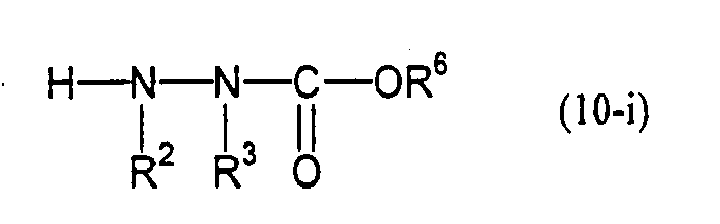

- The compound (17) can be produced, for example, according to the following Scheme (3).


- The compounds (16), (18') and (20) can be produced, for example, according to the following Scheme (4).

- Among the compounds (17) and (18), a compound represented by the formula (17-i):

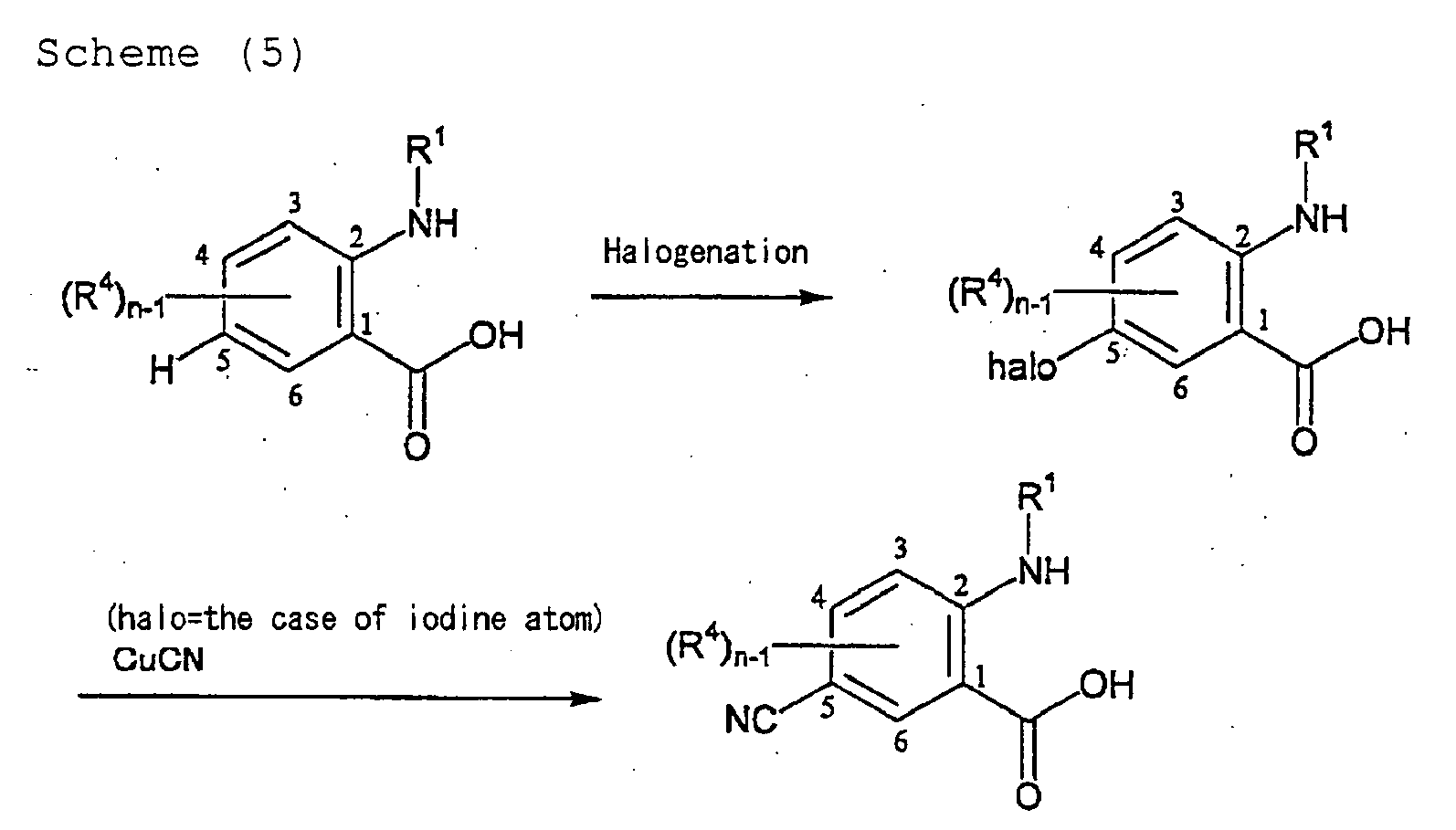
- Among the compounds (17) and (18), a compound represented by the formula (17-ii):


- The compound (8) can be produced, for example, according to the process shown in the following Scheme (7).

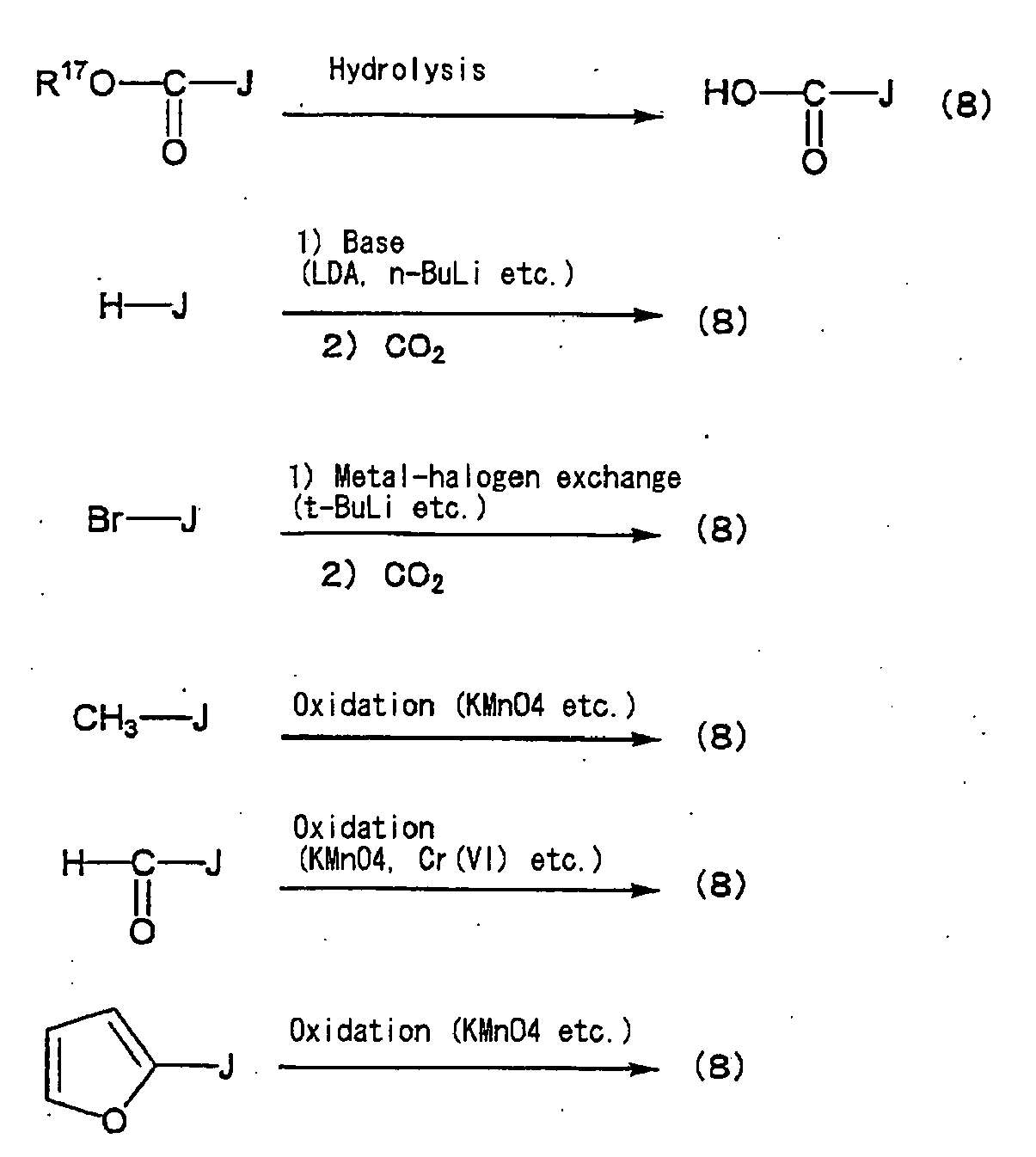
- Among the compound (8), a compound represented by the formula (8-i)


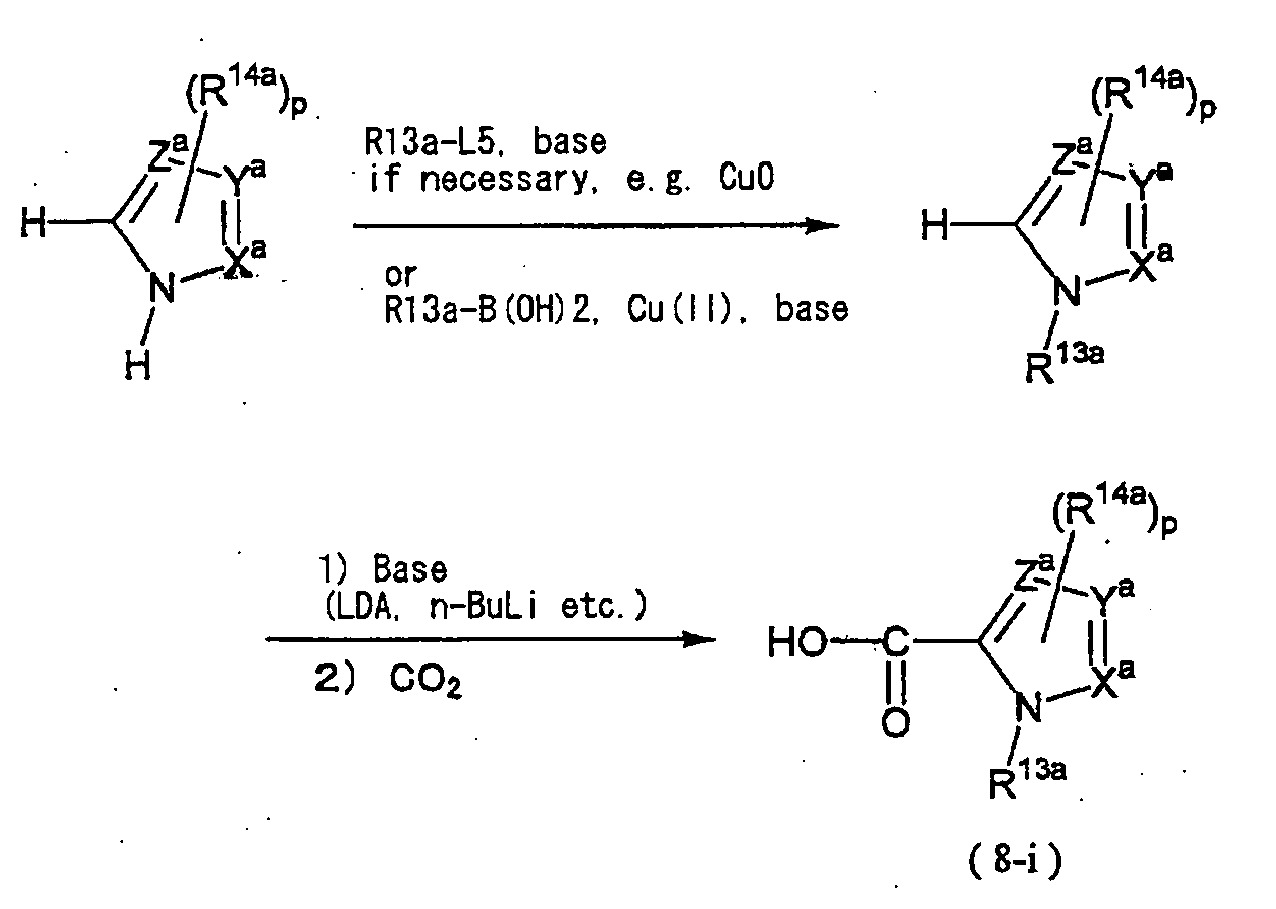
- Among the compound (8), a compound represented by the formula (8-ii):


- Among the compound (8), a compound represented by the formula (8-iii):


- Among the compound (8), a compound represented by the formula (8-iv):


- Among the compound (8), a compound represented by the formula (8-vii):


- Among the compound (8), a compound represented by the formula (8-viii) and the formula (8-ix):

- [wherein R13b is as defined above,
- X19 represents -N=, or -CR19e=,
- R19a, R19b, R19c, R19d and R19e, each, independently, represent a hydrogen atom, a halogen atom, a cyano group; a nitro group, a C1-C6 alkyl group optionally substituted with at least one halogen atom, a C1-C6 alkoxy group optionally substituted with at least one halogen atom, a C1-C6 alkylthio group optionally substituted with at least one halogen atom, a C1-C6 alkylsulfinyl group optionally substituted with at least one halogen atom, or a C1-C6 alkylsulfonyl group optionally substituted with at least one halogen atom]
- Among the compound (7), a compound represented by the formula (7-i):

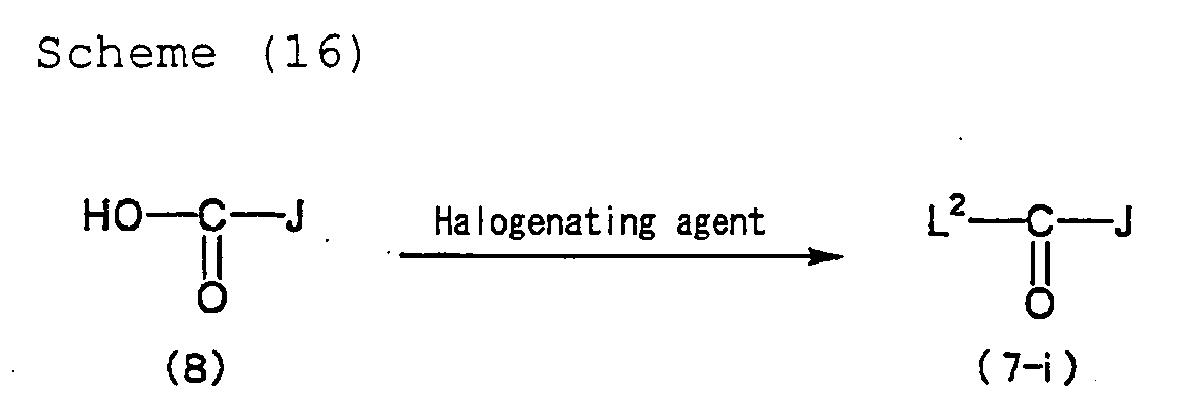
- Among the compound (7), a compound represented by the formula (7-ii):


- Among the compound (8), a compound represented by the formula (8-v):


- The compounds (21) in scheme (18) can be produced, for example, according to the process shown in the following Scheme (19).


- Among the compounds (21) in scheme (18), a compound represented by the formula (21-i), the formula (21-ii), and the formula (21-iii):


- Among the compound (8), a compound represented by the formula (8-vi):



- The specific examples of the present compound are summarized in the following tables.
- A compound represented by the formula (1-A):

Table 1 R5 A31 (R4)n R13a-1 R14a-1 H O 3-CH3, 5-Cl 3-chloro-2-pyridinyl H H O 3-Br, 5-Cl 3-chloro-2-pyridinyl H H O 3-Br, 5-Br 3-chloro-2-pyridinyl H H O 3-CH3, 5-CN 3-chloro-2-pyridinyl H H O 3-CH3, 5-Cl 3-chloro-2-pyridinyl Cl H O 3-Br, 5-Cl 3-chloro-2-pyridinyl Cl H O 3-Br, 5-Br 3-chloro-2-pyridinyl Cl H O 3-CH3, 5-CN 3-chloro-2-pyridinyl Cl H O 3-CH3, 5-Cl 3-chloro-2-pyridinyl Br H O 3-Br, 5-Cl 3-chloro-2-pyridinyl Br H O 3-Br, 5-Br 3-chloro-2-pyridinyl Br H O 3-CH3, 5-CN 3-chloro-2-pyridinyl Br H O 3-CH3, 5-Cl 3-chloro-2-pyridinyl CF3 H O 3-Br, 5-Cl 3-chloro-2-pyridinyl CF3 H O 3-Br, 5-Br 3-chloro-2-pyridinyl CF3 H O 3-CH3, 5-CN 3-chloro-2-pyridinyl CF3 CH3 O 3-CH3, 5-Cl 3-chloro-2-pyridinyl H CH3 O 3-Br, 5-Cl 3-chloro-2-pyridinyl H CH3 O 3-Br, 5-Br 3-chloro-2-pyridinyl H CH3 O 3-CH3, 5-CN 3-chloro-2-pyridinyl H CH3 O 3-CH3, 5-Cl 3-chloro-2-pyridinyl Cl CH3 O 3-Br, 5-Cl 3-chloro-2-pyridinyl Cl CH3 O 3-Br, 5-Br 3-chloro-2-pyridinyl Cl CH3 O 3-CH3, 5-CN 3-chloro-2-pyridinyl Cl CH3 O 3-CH3, 5-Cl 3-chloro-2-pyridinyl Br CH3 O 3-Br, 5-Cl 3-chloro-2-pyridinyl- Br CH3 O 3-Br, 5-Br 3-chloro-2-pyridinyl Br CH3 O 3-CH3, 5-CN 3-chloro-2-pyridinyl Br CH3 O 3-CH3, 5-Cl 3-chloro-2-pyridinyl CF3 CH3 O 3-Br, 5-Cl 3-chloro-2-pyridinyl CF3 CH3 O 3-Br, 5-Br 3-chloro-2-pyridinyl CF3 CH3 O 3-CH3, 5-CN 3-chloro-2-pyridinyl CF3 Table 2 R5 A31 (R4)n R13a-1 R14a-1 CH2CH3 O 3-CH3, 5-Cl 3-chloro-2-pyridinyl H CH2CH3 O 3-Br, 5-Cl 3-chloro-2-pyridinyl H CH2CH3 O 3-Br, 5-Br 3-chloro-2-pyridinyl H CH2CH3 O 3-CH3, 5-CN 3-chloro-2-pyridinyl H CH2CH3 O 3-CH3, 5-Cl 3-chloro-2-pyridinyl Cl CH2CH3 O 3-Br, 5-Cl 3-chloro-2-pyridinyl Cl CH2CH3 O 3-Br, 5-Br 3-chloro-2-pyridinyl Cl CH2CH3 O 3-CH3, 5-CN 3-chloro-2-pyridinyl Cl CH2CH3 O 3-CH3, 5-Cl 3-chloro-2-pyridinyl Br CH2CH3 O 3-Br, 5-Cl 3-chloro-2-pyridinyl Br CH2CH3 O 3-Br, 5-Br 3-chloro-2-pyridinyl Br CH2CH3 O 3-CH3, 5-CN 3-chloro-2-pyridinyl Br CH2CH3 O 3-CH3, 5-Cl 3-chloro-2-pyridinyl CF3 CH2CH3 O 3-Br, 5-Cl 3-chloro-2-pyridinyl CF3 CH2CH3 O 3-Br, 5-Br 3-chloro-2-pyridinyl CF3 CH2CH3 O 3-CH3, 5-CN 3-chloro-2-pyridinyl CF3 CH(CH3)2 O 3-CH3, 5-Cl 3-chloro-2-pyridinyl H CH(CH3)2 O 3-Br, 5-Cl 3-chloro-2-pyridinyl H CH(CH3)2 O 3-Br, 5-Br 3-chloro-2-pyridinyl H CH(CH3)2 O 3-CH3, 5-CN 3-chloro-2-pyridinyl H CH(CH3)2 O 3-CH3, 5-Cl 3-chloro-2-pyridinyl Cl CH(CH3)2 O 3-Br, 5-Cl 3-chloro-2-pyridinyl Cl CH(CH3)2 O 3-Br, 5-Br 3-chloro-2-pyridinyl Cl CH(CH3)2 O 3-CH3, 5-CN 3-chloro-2-pyridinyl Cl CH(CH3)2 O 3-CH3, 5-Cl 3-chloro-2-pyridinyl Br CH(CH3)2 O 3-Br, 5-Cl 3-chloro-2-pyridinyl Br CH(CH3)2 O 3-Br, 5-Br 3-chloro-2-pyridinyl Br CH(CH3)2 O 3-CH3, 5-CN 3-chloro-2-pyridinyl Br CH(CH3)2 O 3-CH3, 5-Cl 3-chloro-2-pyridinyl CF3 CH(CH3)2 O 3-Br, 5-Cl 3-chloro-2-pyridinyl CF3 CH(CH3)2 O 3-Br, 5-Br 3-chloro-2-pyridinyl CF3 CH(CH3)2 O 3-CH3, 5-CN 3-chloro-2-pyridinyl CF3 Table 3 R5 A31 (R4)n R13a-1 R14a-1 C(CH3)3 O 3-CH3, 5-Cl 3-chloro-2-pyridinyl H C(CH3)3 O 3-Br, 5-Cl 3-chloro-2-pyridinyl H C(CH3)3 O 3-Br, 5-Br 3-chloro-2-pyridinyl H C(CH3)3 O 3-CH3, 5-CN 3-chloro-2-pyridinyl H C(CH3)3 O 3-CH3, 5-Cl 3-chloro-2-pyridinyl Cl C(CH3)3 O 3-Br, 5-Cl 3-chloro-2-pyridinyl Cl C(CH3)3 O 3-Br, 5-Br 3-chloro-2-pyridinyl Cl C(CH3)3 O 3-CH3, 5-CN 3-chloro-2-pyridinyl Cl C(CH3)3 O 3-CH3, 5-Cl 3-chloro-2-pyridinyl Br C(CH3)3 O 3-Br, 5-Cl 3-chloro-2-pyridinyl Br C(CH3)3 O 3-Br, 5-Br 3-chloro-2-pyridinyl Br C(CH3)3 O 3-CH3, 5-CN 3-chloro-2-pyridinyl Br C(CH3)3 O 3-CH3, 5-Cl 3-chloro-2-pyridinyl CF3 C(CH3)3 O 3-Br, 5-Cl 3-chloro-2-pyridinyl CF3 C(CH3)3 O 3-Br, 5-Br 3-chloro-2-pyridinyl CF3 C(CH3)3 O 3-CH3, 5-CN 3-chloro-2-pyridinyl CF3 CF3 O 3-CH3, 5-Cl 3-chloro-2-pyridinyl H CF3 O 3-Br, 5-Cl 3-chloro-2-pyridinyl H CF3 O 3-Br, 5-Br 3-chloro-2-pyridinyl H CF3 O 3-CH3, 5-CN 3-chloro-2-pyridinyl H CF3 O 3-CH3, 5-Cl 3-chloro-2-pyridinyl Cl CF3 O 3-Br, 5-Cl 3-chloro-2-pyridinyl Cl CF3 O 3-Br, 5-Br 3-chloro-2-pyridinyl Cl CF3 O 3-CH3, 5-CN 3-chloro-2-pyridinyl Cl CF3 O 3-CH3, 5-Cl 3-chloro-2-pyridinyl Br CF3 O 3-Br, 5-Cl 3-chloro-2-pyridinyl Br CF3 O 3-Br, 5-Br 3-chloro-2-pyridinyl Br CF3 O 3-CH3, 5-CN 3-chloro-2-pyridinyl Br CF3 O 3-CH3, 5-Cl 3-chloro-2-pyridinyl CF3 CF3 O 3-Br, 5-Cl 3-chloro-2-pyridinyl CF3 CF3 O 3-Br, 5-Br 3-chloro-2-pyridinyl CF3 CF3 O 3-CH3, 5-CN 3-chloro-2-pyridinyl CF3 Table 4 R5 A31 (R4)n R13a-1 R14a-1 CH2OCH3 O 3-CH3, 5-Cl 3-chloro-2-pyridinyl H CH2OCH3 O 3-Br, 5-Cl 3-chloro-2-pyridinyl H CH2OCH3 O 3-Br, 5-Br 3-chloro-2-pyridinyl H CH2OCH3 O 3-CH3, 5-CN 3-chloro-2-pyridinyl H CH2OCH3 O 3-CH3, 5-Cl 3-chloro-2-pyridinyl Cl CH2OCH3 O 3-Br, 5-Cl 3-chloro-2-pyridinyl Cl CH2OCH3 O 3-Br, 5-Br 3-chloro-2-pyridinyl Cl CH2OCH3 O 3-CH3, 5-CN 3-chloro-2-pyridinyl Cl CH2OCH3 O 3-CH3, 5-Cl 3-chloro-2-pyridinyl Br CH2OCH3 O 3-Br, 5-Cl 3-chloro-2-pyridinyl Br CH2OCH3 O 3-Br, 5-Br 3-chloro-2-pyridinyl Br CH2OCH3 O 3-CH3, 5-CN 3-chloro-2-pyridinyl Br CH2OCH3 0 3-CH3, 5-Cl 3-chloro-2-pyridinyl CF3 . CH2OCH3 O 3-Br, 5-Cl 3-chloro-2-pyridinyl CF3 CH2OCH3 O 3-Br, 5-Br 3-chloro-2-pyridinyl CF3 CH2OCH3 O 3-CH3, 5-CN 3-chloro-2-pyridinyl CF3 CH2SCH3 O 3-CH3, 5-Cl 3-chloro-2-pyridinyl H CH2SCH3 O 3-Br, 5-Cl 3-chloro-2-pyridinyl H CH2SCH3 O 3-Br, 5-Br 3-chloro-2-pyridinyl H CH2SCH3 O 3-CH3, 5-CN 3-chloro-2-pyridinyl H CH2SCH3 O 3-CH3, 5-Cl 3-chloro-2-pyridinyl Cl CH2SCH3 O 3-Br, 5-Cl 3-chloro-2-pyridinyl Cl CH2SCH3 O 3-Br, 5-Br 3-chloro-2-pyridinyl Cl CH2SCH3 O 3-CH3, 5-CN 3-chloro-2-pyridinyl Cl CH2SCH3 O 3-CH3, 5-Cl 3-chloro-2-pyridinyl Br CH2SCH3 O 3-Br, 5-Cl 3-chloro-2-pyridinyl Br CH2SCH3 O 3-Br, 5-Br 3-chloro-2-pyridinyl Br CH2SCH3 O 3-CH3, 5-CN 3-chloro-2-pyridinyl Br CH2SCH3 O 3-CH3, 5-Cl 3-chloro-2-pyridinyl CF3 CH2SCH3 O 3-Br, 5-Cl 3-chloro-2-pyridinyl CF3 CH2SCH3 O 3-Br, 5-Br 3-chloro-2-pyridinyl CF3 CH2SCH3 O 3-CH3, 5-CN 3-chloro-2-pyridinyl CF3 Table 5 R 5 A31 (R4)n R13a-1 R14a-1 CH2N(CH3)2 O 3-CH3, 5-Cl 3-chloro-2-pyridinyl H CH2N(CH3)2 O 3-Br, 5-Cl 3-chloro-2-pyridinyl H CH2N(CH3)2 O 3-Br, 5-Br 3-chloro-2-pyridinyl H CH2N(CH3)2 O 3-CH3, 5-CN 3-chloro-2-pyridinyl H CH2N(CH3)2 O 3-CH3, 5-Cl 3-chloro-2-pyridinyl Cl CH2N(CH3)2 O 3-Br, 5-Cl 3-chloro-2-pyridinyl Cl CH2N(CH3)2 O 3-Br, 5-Br 3-chloro-2-pyridinyl Cl CH2N(CH3)2 P 3-CH3, 5-CN 3-chloro-2-pyridinyl Cl CH2N(CH3)2 O 3-CH3, 5-Cl 3-chloro-2-pyridinyl Br CH2N(CH3)2 O 3-Br, 5-Cl 3-chloro-2-pyridinyl Br CH2N(CH3)2 O 3-Br, 5-Br 3-chloro-2-pyridinyl Br CH2N(CH3)2 O 3-CH3, 5-CN 3-chloro-2-pyridinyl Br CH2N(CH3)2 O 3-CH3, 5-Cl 3-chloro-2-pyridinyl CF3 CH2N(CH3)2 O 3-Br, 5-Cl 3-chloro-2-pyridinyl CF3 CH2N(CH3)2 O 3-Br, 5-Br 3-chloro-2-pyridinyl CF3 CH2N(CH3)2 O 3-CH3, 5-CN 3-chloro-2-pyridinyl CF3 cyclopropyl O 3-CH3, 5-Cl 3-chloro-2-pyridinyl H cyclopropyl O 3-Br, 5-Cl 3-chloro-2-pyridinyl H cyclopropyl O 3-Br, 5-Br 3-chloro-2-pyridinyl H cyclopropyl O 3-CH3, 5-CN 3-chloro-2-pyridinyl H cyclopropyl O 3-CH3, 5-Cl 3-chloro-2-pyridinyl Cl cyclopropyl O 3-Br, 5-Cl 3-chloro-2-pyridinyl Cl cyclopropyl O 3-Br, 5-Br 3-chloro-2-pyridinyl Cl cyclopropyl O 3-CH3, 5-CN 3-chloro-2-pyridinyl Cl cyclopropyl O 3-CH3, 5-Cl 3-chloro-2-pyridinyl Br cyclopropyl O 3-Br, 5-Cl 3-chloro-2-pyridinyl Br cyclopropyl O 3-Br, 5-Br 3-chloro-2-pyridinyl Br cyclopropyl O 3-CH3, 5-CN 3-chloro-2-pyridinyl Br cyclopropyl O 3-CH3, 5-Cl 3-chloro-2-pyridinyl CF3 cyclopropyl O 3-Br, 5-Cl 3-chloro-2-pyridinyl CF3 cyclopropyl O 3-Br, 5-Br 3-chloro-2-pyridinyl CF3 cyclopropyl O 3-CH3, 5-CN 3-chloro-2-pyridinyl CF3 Table 6 R5 A31 (R4)n R13a-1 R14a-1 cyclobutyl O 3-CH3, 5-Cl 3-chloro-2-pyridinyl H cyclobutyl O 3-Br, 5-Cl 3-chloro-2-pyridinyl H cyclobutyl O 3-Br, 5-Br 3-chloro-2-pyridinyl H cyclobutyl O 3-CH3, 5-CN 3-chloro-2-pyridinyl H cyclobutyl O 3-CH3, 5-Cl 3-chloro-2-pyridinyl Cl cyclobutyl O 3-Br, 5-Cl 3-chloro-2-pyridinyl Cl cyclobutyl O 3-Br, 5-Br 3-chloro-2-pyridinyl Cl cyclobutyl O 3-CH3, 5-CN 3-chloro-2-pyridinyl Cl cyclobutyl O 3-CH3, 5-Cl 3-chloro-2-pyridinyl Br cyclobutyl O 3-Br, 5-Cl 3-chloro-2-pyridinyl Br cyclobutyl O 3-Br, 5-Br 3-chloro-2-pyridinyl Br cyclobutyl O 3-CH3, 5-CN 3-chloro-2-pyridinyl Br cyclobutyl O 3-CH3, 5-Cl 3-chloro-2-pyridinyl CF3 cyclobutyl O 3-Br, 5-Cl 3-chloro-2-pyridinyl CF3 cyclobutyl O 3-Br, 5-Br 3-chloro-2-pyridinyl CF3 cyclobutyl O 3-CH3, 5-CN 3-chloro-2-pyridinyl CF3 cyclopentyl O 3-CH3, 5-Cl 3-chloro-2-pyridinyl H cyclopentyl O 3-Br, 5-Cl 3-chloro-2-pyridinyl H cyclopentyl O 3-Br, 5-Br 3-chloro-2-pyridinyl H cyclopentyl O 3-CH3, 5-CN 3-chloro-2-pyridinyl H cyclopentyl O 3-CH3, 5-Cl 3-chloro-2-pyridinyl Cl cyclopentyl O 3-Br, 5-Cl 3-chloro-2-pyridinyl Cl cyclopentyl O 3-Br, 5-Br 3-chloro-2-pyridinyl Cl cyclopentyl O 3-CH3, 5-CN 3-chloro-2-pyridinyl Cl cyclopentyl O 3-CH3, 5-Cl 3-chloro-2-pyridinyl Br cyclopentyl O 3-Br, 5-Cl 3-chloro-2-pyridinyl Br cyclopentyl O 3-Br, 5-Br 3-chloro-2-pyridinyl Br cyclopentyl O 3-CH3, 5-CN 3-chloro-2-pyridinyl Br cyclopentyl O 3-CH3, 5-Cl 3-chloro-2-pyridinyl CF3 cyclopentyl O 3-Br, 5-Cl 3-chloro-2-pyridinyl CF3 cyclopentyl O 3-Br, 5-Br 3-chloro-2-pyridinyl CF3 cyclopentyl O 3-CH3, 5-CN 3-chloro-2-pyridinyl CF3 Table 7 R5 A31 (R4)n R13a-1 R14a-1 cyclohexyl O 3-CH3, 5-Cl 3-chloro-2-pyridinyl H cyclohexyl O 3-Br, 5-Cl 3-chloro-2-pyridinyl H cyclohexyl O 3-Br, 5-Br 3-chloro-2-pyridinyl H cyclohexyl O 3-CH3, 5-CN 3-chloro-2-pyridinyl H cyclohexyl O 3-CH3, 5-Cl 3-chloro-2-pyridinyl Cl cyclohexyl O 3-Br, 5-Cl 3-chloro-2-pyridinyl Cl cyclohexyl O 3-Br, 5-Br 3-chloro-2-pyridinyl Cl cyclohexyl O 3-CH3, 5-CN 3-chloro-2-pyridinyl Cl cyclohexyl O 3-CH3, 5-Cl 3-chloro-2-pyridinyl Br cyclohexyl O 3-Br, 5-Cl 3-chloro-2-pyridinyl Br cyclohexyl O 3-Br, 5-Br 3-chloro-2-pyridinyl Br cyclohexyl O 3-CH3, 5-CN 3-chloro-2-pyridinyl Br cyclohexyl O 3-CH3, 5-Cl 3-chloro-2-pyridinyl CF3 cyclohexyl O 3-Br, 5-Cl 3-chloro-2-pyridinyl CF3 cyclohexyl O 3-Br, 5-Br 3-chloro-2-pyridinyl CF3 cyclohexyl O 3-CH3, 5-CN 3-chloro-2-pyridinyl CF3 phenyl O 3-CH3, 5-Cl 3-chloro-2-pyridinyl H phenyl O 3-Br, 5-Cl 3-chloro-2-pyridinyl H phenyl O 3-Br, 5-Br 3-chloro-2-pyridinyl H phenyl O 3-CH3, 5-CN 3-chloro-2-pyridinyl H phenyl O 3-CH3, 5-Cl 3-chloro-2-pyridinyl Cl phenyl O 3-Br, 5-Cl 3-chloro-2-pyridinyl Cl phenyl O 3-Br, 5-Br 3-chloro-2-pyridinyl Cl phenyl O 3-CH3, 5-CN 3-chloro-2-pyridinyl Cl phenyl O 3-CH3, 5-Cl 3-chloro-2-pyridinyl Br phenyl O 3-Br, 5-Cl 3-chloro-2-pyridinyl Br phenyl O 3-Br, 5-Br 3-chloro-2-pyridinyl Br phenyl O 3-CH3, 5-CN 3-chloro-2-pyridinyl Br phenyl O 3-CH3, 5-Cl 3-chloro-2-pyridinyl CF3 phenyl O 3-Br, 5-Cl 3-chloro-2-pyridinyl CF3 phenyl O 3-Br, 5-Br 3-chloro-2-pyridinyl CF3 phenyl O 3-CH3, 5-CN 3-chloro-2-pyridinyl CF3 - A compound represented by the formula (1-B):

Table 8 R6 A32 (R4)n R13a-1 R14a-1 CH3 O 3-CH3 3-chloro-2-pyridinyl H CH3 O 3-CH3, 5-Cl 3-chloro-2-pyridinyl H CH3 O 3-CH3, 5-Br 3-chloro-2-pyridinyl H CH3 O 3-CH3, 5-I 3-chloro-2-pyridinyl H CH3 O 3-CH3, 5-CH3 3-chloro-2-pyridinyl H CH3 O 3-CH3, 5-CN 3-chloro-2-pyridinyl H CH3 O 3-Cl 3-chloro-2-pyridinyl H CH3 O 3-Cl, 5-Cl 3-chloro-2-pyridinyl H CH3 O 3-Cl, 5-Br 3-chloro-2-pyridinyl H CH3 O 3-Cl, 5-I 3-chloro-2-pyridinyl H CH3 O 3-Cl, 5-CH3 3-chloro-2-pyridinyl H CH3 O 3-Cl, 5-CN 3-chloro-2-pyridinyl H CH3 O 3-Br 3-chloro-2-pyridinyl H CH3 O 3-Br, 5-Cl 3-chloro-2-pyridinyl H CH3 O 3-Br, 5-Br 3-chloro-2-pyridinyl H CH3 O 3-Br, 5-I 3-chloro-2-pyridinyl H CH3 O 3-Br, 5-CH3 3-chloro-2-pyridinyl H CH3 O 3-Br, 5-CN 3-chloro-2-pyridinyl H CH3 O 3-I 3-chloro-2-pyridinyl H CH3 O 3-I, 5-Cl 3-chloro-2-pyridinyl H CH3 O 3-I, 5-Br 3-chloro-2-pyridinyl H CH3 O 3-I, 5-I 3-chloro-2-pyridinyl H CH3 O 3-I, 5-CH3 3-chloro-2-pyridinyl H CH3 O 3-I, 5-CN 3-chloro-2-pyridinyl H Table 9 R6 A32 (R4)n R13a-1 R14a-1 CH3 O 3-CH3 3-chloro-2-pyridinyl F CH3 O 3-CH3, 5-Cl 3-chloro-2-pyridinyl F CH3 O 3-CH3, 5-Br 3-chloro-2-pyridinyl F CH3 O 3-CH3, 5-I 3-chloro-2-pyridinyl F CH3 O 3-CH3, 5-CH3 3-chloro-2-pyridinyl F CH3 O 3-CH3, 5-CN 3-chloro-2-pyridinyl F CH3 O 3-Cl 3-chloro-2-pyridinyl F CH3 O 3-Cl, 5-Cl 3-chloro-2-pyridinyl F CH3 O 3-Cl, 5-Br 3-chloro-2-pyridinyl F CH3 O 3-Cl, 5-I 3-chloro-2-pyridinyl F CH3 O 3-Cl, 5-CH3 3-chloro-2-pyridinyl F CH3 O 3-Cl, 5-CN 3-chloro-2-pyridinyl F CH3 O 3-Br 3-chloro-2-pyridinyl F CH3 O 3-Br, 5-Cl 3-chloro-2-pyridinyl F CH3 O 3-Br, 5-Br 3-chloro-2-pyridinyl F CH3 O 3-Br, 5-I 3-chloro-2-pyridinyl F CH3 O 3-Br, 5-CH3 3-chloro-2-pyridinyl F CH3 O 3-Br, 5-CN 3-chloro-2-pyridinyl F CH3 O 3-I 3-chloro-2-pyridinyl F CH3 O 3-I, 5-Cl 3-chloro-2-pyridinyl F CH3 O 3-I, 5-Br 3-chloro-2-pyridinyl F CH3 O 3-I, 5-I 3-chloro-2-pyridinyl F CH3 O 3-I, 5-CH3 3-chloro-2-pyridinyl F CH3 O 3-I, 5-CN 3-chloro-2-pyridinyl F Table 10 R6 A32 (R4)n R13a-1 R14a-1 CH3 O 3-CH3 3-chloro-2-pyridinyl Cl CH3 O 3-CH3, 5-Cl 3-chloro-2-pyridinyl Cl CH3 O 3-CH3, 5-Br 3-chloro-2-pyridinyl Cl CH3 O 3-CH3, 5-I 3-chloro-2-pyridinyl Cl CH3 O 3-CH3, 5-CH3 3-chloro-2-pyridinyl Cl CH3 O 3-CH3, 5-CN 3-chloro-2-pyridinyl Cl CH3 O 3-Cl 3-chloro-2-pyridinyl Cl CH3 O 3-Cl, 5-Cl 3-chloro-2-pyridinyl Cl CH3 O 3-Cl, 5-Br 3-chloro-2-pyridinyl Cl CH3 O 3-Cl, 5-I 3-chloro-2-pyridinyl Cl CH3 O 3-Cl, 5-CH3 3-chloro-2-pyridinyl Cl CH3 O 3-Cl, 5-CN 3-chloro-2-pyridinyl Cl CH3 O 3-Br 3-chloro-2-pyridinyl Cl CH3 O 3-Br, 5-Cl 3-chloro-2-pyridinyl Cl CH3 O 3-Br, 5-Br 3-chloro-2-pyridinyl Cl CH3 O 3-Br, 5-I 3-chloro-2-pyridinyl Cl CH3 O 3-Br, 5-CH3 3-chloro-2-pyridinyl Cl CH3 O 3-Br, 5-CN 3-chloro-2-pyridinyl Cl CH3 O 3-I 3-chloro-2-pyridinyl Cl CH3 O 3-I, 5-Cl 3-chloro-2-pyridinyl Cl CH3 O 3-I, 5-Br 3-chloro-2-pyridinyl Cl CH3 O 3-I, 5-I 3-chloro-2-pyridinyl Cl CH3 O 3-I, 5-CH3 3-chloro-2-pyridinyl Cl CH3 O 3-I, 5-CN 3-chloro-2-pyridinyl Cl Table 11 R6 A32 (R4)n R13a-1 R14a-1 CH3 O 3-CH2CH3 3-chloro-2-pyridinyl Cl CH3 O 3-CH(CH3)2 3-chloro-2-pyridinyl Cl CH3 O 3-C(CH3)3 3-chloro-2-pyridinyl Cl CH3 O 3-CF3 3-chloro-2-pyridinyl Cl CH3 O 3-OCH3 3-chloro-2-pyridinyl Cl CH3 O 3-phenyl 3-chloro-2-pyridinyl Cl CH3 O 3-CH2CH3, 5-Cl 3-chloro-2-pyridinyl Cl CH3 O 3-CH(CH3)2, 5-Cl 3-chloro-2-pyridinyl Cl CH3 O 3-C(CH3)3, 5-Cl 3-chloro-2-pyridinyl Cl CH3 O 3-CF3, 5-Cl 3-chloro-2-pyridinyl Cl CH3 O 3-OCH3, 5-Cl 3-chloro-2-pyridinyl Cl CH3 O 3-phenyl, 5-Cl 3-chloro-2-pyridinyl Cl CH3 O 3-CH3, 4-Cl 3-chloro-2-pyridinyl Cl CH3 O 3-Cl, 4-Cl 3-chloro-2-pyridinyl Cl CH3 O 3-CH3, 6-Cl 3-chloro-2-pyridinyl Cl CH3 O 3-Cl, 6-Cl 3-chloro-2-pyridinyl Cl CH3 O 3-CH3, 4-Cl, 5-Cl 3-chloro-2-pyridinyl Cl CH3 O 3-Cl, 4-Cl, 5-Cl 3-chloro-2-pyridinyl Cl CH3 O 3-CH3, 5-Cl, 6-Cl 3-chloro-2-pyridinyl Cl CH3 O 3-Cl, 5-Cl, 6-Cl 3-chloro-2-pyridinyl Cl CH3 O 3-CH3, 5-F 3-chloro-2-pyridinyl Cl CH3 O 3-Cl, 5-F 3-chloro-2-pyridinyl Cl CH3 O 3-Br, 5-F 3-chloro-2-pyridinyl Cl CH3 O 3-I, 5-F 3-chloro-2-pyridinyl Cl CH3 O 3-Me,4,5-CH=CH-CH=CH- 3-chloro-2-pyridinyl Cl CH3 O 3-C1,4,5-CH=CH-CH=CH- 3-chloro-2-pyridinyl Cl CH3 O 3-Br,4,5-CH=CH-CH=CH- 3-chloro-2-pyridinyl Cl CH3 O 3-I,4,5-CH=CH-CH=CH- 3-chloro-2-pyridinyl Cl Table 12 R6 A32 (R4)n R13a-1 R14a-1 CH3 O 3-CH3 3-chloro-2-pyridinyl Br CH3 O 3-CH3, 5-Cl 3-chloro-2-pyridinyl Br CH3 O 3-CH3, 5-Br 3-chloro-2-pyridinyl Br CH3 O 3-CH3, 5-I 3-chloro-2-pyridinyl Br CH3 O 3-CH3, 5-CH3 3-chloro-2-pyridinyl Br CH3 O 3-CH3, 5-CN 3-chloro-2-pyridinyl Br CH3 O 3-Cl 3-chloro-2-pyridinyl Br CH3 O 3-Cl, 5-Cl 3-chloro-2-pyridinyl Br CH3 O 3-Cl, 5-Br 3-chloro-2-pyridinyl Br CH3 O 3-Cl, 5-I 3-chloro-2-pyridinyl Br CH3 O 3-Cl, 5-CH3 3-chloro-2-pyridinyl Br CH3 O 3-Cl, 5-CN 3-chloro-2-pyridinyl Br CH3 O 3-Br 3-chloro-2-pyridinyl Br CH3 O 3-Br, 5-Cl 3-chloro-2-pyridinyl Br CH3 O 3-Br, 5-Br 3-chloro-2-pyridinyl Br CH3 O 3-Br, 5-I 3-chloro-2-pyridinyl Br CH3 O 3-Br, 5-CH3 3-chloro-2-pyridinyl Br CH3 O 3-Br, 5-CN 3-chloro-2-pyridinyl Br CH3 O 3-I 3-chloro-2-pyridinyl Br CH3 O 3-I, 5-Cl 3-chloro-2-pyridinyl Br CH3 O 3-I, 5-Br 3-chloro-2-pyridinyl Br CH3 O 3-I, 5-I 3-chloro-2-pyridinyl Br CH3 O 3-I, 5-CH3 3-chloro-2-pyridinyl Br CH3 O 3-I, 5-CN 3-chloro-2-pyridinyl Br Table 13 R6 A32 (R4)n R13a-1 R14a-1 CH3 O 3-CH2CH3 3-chloro-2-pyridinyl Br CH3 O 3-CH(CH3)2 3-chloro-2-pyridinyl Br CH3 O 3-C(CH3)3 3-chloro-2-pyridinyl Br CH3 O 3-CF3 3-chloro-2-pyridinyl Br CH3 O 3-OCH3 3-chloro-2-pyridinyl Br CH3 O 3-phenyl 3-chloro-2-pyridinyl Br CH3 O 3-CH2CH3, 5-Cl 3-chloro-2-pyridinyl Br CH3 O 3-CH(CH3)2, 5-Cl 3-chloro-2-pyridinyl Br CH3 O 3-C(CH3)3, 5-Cl 3-chloro-2-pyridinyl Br CH3 O 3-CF3, 5-Cl 3-chloro-2-pyridinyl Br CH3 O 3-OCH3, 5-Cl 3-chloro-2-pyridinyl Br CH3 O 3-phenyl, 5-Cl 3-chloro-2-pyridinyl Br CH3 O 3-CH3, 4-Cl 3-chloro-2-pyridinyl Br CH3 O 3-Cl, 4-Cl 3-chloro-2-pyridinyl Br CH3 O 3-CH3, 6-Cl 3-chloro-2-pyridinyl Br CH3 O 3-Cl, 6-Cl 3-chloro-2-pyridinyl Br CH3 O 3-CH3, 4-Cl, 5-Cl 3-chloro-2-pyridinyl Br CH3 O 3-Cl, 4-Cl, 5-Cl 3-chloro-2-pyridinyl Br CH3 O 3-CH3, 5-Cl, 6-Cl 3-chloro-2-pyridinyl Br CH3 O 3-Cl, 5-Cl, 6-Cl 3-chloro-2-pyridinyl Br CH3 O 3-CH3, 5-F 3-chloro-2-pyridinyl Br CH3 O 3-Cl, 5-F 3-chloro-2-pyridinyl Br CH3 O 3-Br, 5-F 3-chloro-2-pyridinyl Br CH3 O 3-I, 5-F 3-chloro-2-pyridinyl Br CH3 O 3-Me,4,5-CH=CH-CH=CH- 3-chloro-2-pyridinyl Br CH3 O 3-Cl,4,5-CH=CH-CH=CH- 3-chloro-2-pyridinyl Br CH3 O 3-Br,4,5-CH=CH-CH=CH- 3-chloro-2-pyridinyl Br CH3 O 3-I,4,5-CH=CH-CH=CH- 3-chloro-2-pyridinyl Br Table 14 R6 A32 (R4)n R13a-1 R14a-1 CH3 O 3-CH3 3-chloro-2-pyridinyl I CH3 O 3-CH3, 5-Cl 3-chloro-2-pyridinyl I CH3 O 3-CH3, 5-Br 3-chloro-2-pyridinyl I CH3 0 3-CH3, 5-I 3-chloro-2-pyridinyl I CH3 O 3-CH3, 5-CH3 3-chloro-2-pyridinyl I CH3 O 3-CH3, 5-CN 3-chloro-2-pyridinyl I CH3 O 3-Cl 3-chloro-2-pyridinyl I CH3 O 3-Cl, 5-Cl 3-chloro-2-pyridinyl I CH3 O 3-Cl, 5-Br 3-chloro-2-pyridinyl I CH3 O 3-Cl, 5-I 3-chloro-2-pyridinyl I CH3 O 3-Cl, 5-CH3 3-chloro-2-pyridinyl I CH3 O 3-Cl, 5-CN 3-chloro-2-pyridinyl I CH3 O 3-Br 3-chloro-2-pyridinyl I CH3 O 3-Br, 5-Cl 3-chloro-2-pyridinyl I CH3 O 3-Br, 5-Br 3-chloro-2-pyridinyl I CH3 O 3-Br, 5-I 3-chloro-2-pyridinyl I CH3 O 3-Br, 5-CH3 3-chloro-2-pyridinyl I CH3 O 3-Br, 5-CN 3-chloro-2-pyridinyl I CH3 O 3-I 3-chloro-2-pyridinyl I CH3 O 3-I, 5-Cl 3-chloro-2-pyridinyl I CH3 O 3-I, 5-Br 3-chloro-2-pyridinyl I CH3 O 3-I, 5-I 3-chloro-2-pyridinyl I CH3 O 3-I, 5-CH3 3-chloro-2-pyridinyl I CH3 O 3-I, 5-CN 3-chloro-2-pyridinyl I Table 15 R6 A32 (R4)n R13a-1 R14a-1 CH3 O 3-CH3 3-chloro-2-pyridinyl CH3 CH3 O 3-CH3, 5-Cl 3-chloro-2-pyridinyl CH3 CH3 O 3-CH3, 5-Br 3-chloro-2-pyridinyl CH3 CH3 O 3-CH3, 5-I 3-chloro-2-pyridinyl CH3 CH3 O 3-CH3, 5-CH3 3-chloro-2-pyridinyl CH3 CH3 O 3-CH3, 5-CN 3-chloro-2-pyridinyl CH3 CH3 O 3-Cl 3-chloro-2-pyridinyl CH3 CH3 O 3-Cl, 5-Cl 3-chloro-2-pyridinyl CH3 CH3 O 3-Cl, 5-Br 3-chloro-2-pyridinyl CH3 CH3 O 3-Cl, 5-I 3-chloro-2-pyridinyl CH3 CH3 O 3-Cl, 5-CH3 3-chloro-2-pyridinyl CH3 CH3 O 3-Cl, 5-CN 3-chloro-2-pyridinyl CH3 CH3 O 3-Br 3-chloro-2-pyridinyl CH3 CH3 O 3-Br, 5-Cl 3-chloro-2-pyridinyl CH3 CH3 O 3-Br, 5-Br 3-chloro-2-pyridinyl CH3 CH3 O 3-Br, 5-I 3-chloro-2-pyridinyl CH3 CH3 O 3-Br, 5-CH3 3-chloro-2-pyridinyl CH3 CH3 O 3-Br, 5-CN 3-chloro-2-pyridinyl CH3 CH3 O 3-I 3-chloro-2-pyridinyl CH3 CH3 O 3-I, 5-Cl 3-chloro-2-pyridinyl CH3 CH3 O 3-I, 5-Br 3-chloro-2-pyridinyl CH3 CH3 O 3-I, 5-I 3-chloro-2-pyridinyl CH3 CH3 O 3-I, 5-CH3 3-chloro-2-pyridinyl CH3 CH3 O 3-I, 5-CN 3-chloro-2-pyridinyl CH3 Table 16 R6 A32 (R4)n R13a-1 Rma-1 CH3 O 3-CH3 3-chloro-2-pyridinyl CF3 CH3 O 3-CH3, 5-Cl 3-chloro-2-pyridinyl CF3 CH3 O 3-CH3, 5-Br 3-chloro-2-pyridinyl CF3 CH3 O 3-CH3, 5-I 3-chloro-2-pyridinyl CF3 CH3 O 3-CH3, 5-CH3 3-chloro-2-pyridinyl CF3 CH3 O 3-CH3, 5-CN 3-chloro-2-pyridinyl CF3 CH3 O 3-Cl 3-chloro-2-pyridinyl CF3 CH3 O 3-Cl, 5-Cl 3-chloro-2-pyridinyl CF3 CH3 O 3-Cl, 5-Br 3-chloro-2-pyridinyl CF3 CH3 O 3-Cl, 5-I 3-chloro-2-pyridinyl CF3 CH3 O 3-Cl, 5-CH3 3-chloro-2-pyridinyl CF3 CH3 O 3-Cl, 5-CN 3-chloro-2-pyridinyl CF3 CH3 O 3-Br 3-chloro-2-pyridinyl CF3 CH3 O 3-Br, 5-Cl 3-chloro-2-pyridinyl CF3 CH3 O 3-Br, 5-Br 3-chloro-2-pyridinyl CF3 CH3 O 3-Br, 5-I 3-chloro-2-pyridinyl CF3 CH3 O 3-Br, 5-CH3 3-chloro-2-pyridinyl CF3 CH3 O 3-Br, 5-CN 3-chloro-2-pyridinyl CF3 CH3 O 3-I 3-chloro-2-pyridinyl CF3 CH3 O 3-I, 5-Cl 3-chloro-2-pyridinyl CF3 CH3 O 3-I, 5-Br 3-chloro-2-pyridinyl CF3 CH3 O 3-I, 5-I 3-chloro-2-pyridinyl CF3 CH3 O 3-I, 5-CH3 3-chloro-2-pyridinyl CF3 CH3 O 3-I, 5-CN 3-chloro-2-pyridinyl CF3 Table 17 R6 A32 (R4)n R13a-1 R14a-1 CH3 O 3-CH2CH3 3-chloro-2-pyridinyl CF3 CH3 O 3-CH(CH3)2 3-chloro-2-pyridinyl CF3 CH3 O 3-C(CH3)3 3-chloro-2-pyridinyl CF3 CH3 O 3-CF3 3-chloro-2-pyridinyl CF3 CH3 O 3-OCH3 3-chloro-2-pyridinyl CF3 CH3 O 3-phenyl 3-chloro-2-pyridinyl CF3 CH3 O 3-CH2CH3, 5-Cl 3-chloro-2-pyridinyl CF3 CH3 O 3-CH(CH3)2, 5-Cl 3-chloro-2-pyridinyl CF3 CH3 O 3-C(CH3)3, 5-Cl 3-chloro-2-pyridinyl CF3 CH3 O 3-CF3, 5-Cl 3-chloro-2-pyridinyl CF3 CH3 O 3-OCH3, 5-Cl 3-chloro-2-pyridinyl CF3 CH3 O 3-phenyl, 5-Cl 3-chloro-2-pyridinyl CF3 CH3 O 3-CH3, 4-Cl 3-chloro-2-pyridinyl CF3 CH3 O 3-Cl, 4-Cl 3-chloro-2-pyridinyl CF3 CH3 O 3-CH3, 6-Cl 3-chloro-2-pyridinyl CF3 CH3 O 3-Cl, 6-Cl 3-chloro-2-pyridinyl CF3 CH3 O 3-CH3, 4-Cl, 5-Cl 3-chloro-2-pyridinyl CF3 CH3 O 3-Cl, 4-Cl, 5-Cl 3-chloro-2-pyridinyl CF3 CH3 O 3-CH3, 5-Cl, 6-Cl 3-chloro-2-pyridinyl CF3 CH3 O 3-Cl, 5-Cl, 6-Cl 3-chloro-2-pyridinyl CF3 CH3 O 3-CH3, 5-F 3-chloro-2-pyridinyl CF3 CH3 O 3-Cl, 5-F 3-chloro-2-pyridinyl CF3 CH3 O 3-Br, 5-F 3-chloro-2-pyridinyl CF3 CH3 O 3-I, 5-F 3-chloro-2-pyridinyl CF3 CH3 O 3-Me,4,5-CH=CH-CH=CH- 3-chloro-2-pyridinyl CF3 CH3 O 3-Cl,4,5-CH=CH-CH=CH- 3-chloro-2-pyridinyl CF3 CH3 O 3-Br,4,5-CH=CH-CH=CH- 3-chloro-2-pyridinyl CF3 CH3 O 3-I,4,5-CH=CH-CH=CH- 3-chloro-2-pyridinyl CF3 Table 18 R6 A32 (R4)n R13a-1 R14a-1 CH3 O 3-CH3 3-chloro-2-pyridinyl SCH3 CH3 O 3-CH3, 5-Cl 3-chloro-2-pyridinyl SCH3 CH3 O 3-CH3, 5-Br 3-chloro-2-pyridinyl SCH3 CH3 O 3-CH3, 5-I 3-chloro-2-pyridinyl SCH3 CH3 O 3-CH3, 5-CH3 3-chloro-2-pyridinyl SCH3 CH3 O 3-CH3, 5-CN 3-chloro-2-pyridinyl SCH3 CH3 O 3-Cl 3-chloro-2-pyridinyl SCH3 CH3 O 3-Cl, 5-Cl 3-chloro-2-pyridinyl SCH3 CH3 O 3-Cl, 5-Br 3-chloro-2-pyridinyl SCH3 CH3 O 3-Cl, 5-I 3-chloro-2-pyridinyl SCH3 CH3 O 3-Cl, 5-CH3 3-chloro-2-pyridinyl SCH3 CH3 O 3-Cl, 5-CN 3-chloro-2-pyridinyl SCH3 CH3 O 3-Br 3-chloro-2-pyridinyl SCH3 CH3 O 3-Br, 5-Cl 3-chloro-2-pyridinyl SCH3 CH3 O 3-Br, 5-Br 3-chloro-2-pyridinyl SCH3 CH3 O 3-Br, 5-I 3-chloro-2-pyridinyl SCH3 CH3 O 3-Br, 5-CH3 3-chloro-2-pyridinyl SCH3 CH3 O 3-Br, 5-CN 3-chloro-2-pyridinyl SCH3 CH3 O 3-I 3-chloro-2-pyridinyl SCH3 CH3 O 3-I, 5-Cl 3-chloro-2-pyridinyl SCH3 CH3 O 3-I, 5-Br 3-chloro-2-pyridinyl SCH3 CH3 O 3-I, 5-I 3-chloro-2-pyridinyl SCH3 CH3 O 3-I, 5-CH3 3-chloro-2-pyridinyl SCH3 CH3 O 3-I, 5-CN 3-chloro-2-pyridinyl SCH3 Table 19 R6 A32 (R4)n R13a-1 R14a-1 CH3 O 3-CH3 3-chloro-2-pyridinyl S(=O)CH3. CH3 O 3-CH3, 5-Cl 3-chloro-2-pyridinyl S(=O)CH3 CH3 O 3-CH3, 5-Br 3-chloro-2-pyridinyl S(=O)CH3 CH3 O 3-CH3, 5-I 3-chloro-2-pyridinyl S(=O)CH3 CH3 O 3-CH3, 5-CH3 3-chloro-2-pyridinyl S(=O)CH3 CH3 O 3-CH3, 5-CN 3-chloro-2-pyridinyl S(=O)CH3 CH3 O 3-Cl 3-chloro-2-pyridinyl S(=O)CH3 CH3 O 3-Cl, 5-Cl 3-chloro-2-pyridinyl S(=O)CH3 CH3 O 3-Cl, 5-Br 3-chloro-2-pyridinyl S(=O)CH3 CH3 O 3-Cl 5-I 3-chloro-2-pyridinyl S(=O)CH3 CH3 O 3-Cl, 5-CH3 3-chloro-2-pyridinyl S(=O)CH3 CH3 O 3-Cl, 5-CN 3-chloro-2-pyridinyl S(=O)CH3 CH3 O 3-Br 3-chloro-2-pyridinyl S(=O)CH3 CH3 O 3-Br, 5-Cl 3-chloro-2-pyridinyl S(=O)CH3 CH3 O 3-Br, 5-Br 3-chloro-2-pyridinyl S(=O)CH3 CH3 O 3-Br, 5-I 3-chloro-2-pyridinyl S(=O)CH3 CH3 O 3-Br, 5-CH3 3-chloro-2-pyridinyl S(=O)CH3 CH3 O 3-Br, 5-CN 3-chloro-2-pyridinyl S(=O)CH3 CH3 O 3-I 3-chloro-2-pyridinyl S(=O)CH3 CH3 O 3-I, 5-Cl 3-chloro-2-pyridinyl S(=O)CH3 CH3 O 3-I, 5-Br 3-chloro-2-pyridinyl S(=O)CH3 CH3 O 3-I, 5-I 3-chloro-2-pyridinyl S(=O)CH3 CH3 O 3-I, 5-CH3 3-chloro-2-pyridinyl S(=O)CH3 CH3 O 3-I, 5-CN 3-chloro-2-pyridinyl S(=O)CH3 Table 20 R6 A32 (R4)n R13a-1 R14a-1 CH3 O 3-CH3 3-chloro-2-pyridinyl S(=O)2CH3 CH3 O 3-CH3, 5-Cl 3-chloro-2-pyridinyl S(=O)2CH3 CH3 O 3-CH3, 5-Br 3-chloro-2-pyridinyl S(=O)2CH3 CH3 O 3-CH3, 5-I 3-chloro-2-pyridinyl S(=O)2CH3 CH3 O 3-CH3, 5-CH3 3-chloro-2-pyridinyl S(=O)2CH3 CH3 O 3-CH3, 5-CN 3-chloro-2-pyridinyl S(=O)2CH3 CH3 O 3-Cl 3-chloro-2-pyridinyl S(=O)2CH3 CH3 O 3-Cl, 5-Cl 3-chloro-2-pyridinyl S(=O)2CH3 CH3 O 3-Cl, 5-Br 3-chloro-2-pyridinyl S(=O)2CH3 CH3 O 3-Cl, 5-I 3-chloro-2-pyridinyl S(=O)2CH3 CH3 O 3-Cl, 5-CH3 3-chloro-2-pyridinyl S(=O)2CH3 CH3 O 3-Cl, 5-CN 3-chloro-2-pyridinyl S(=O)2CH3 CH3 O 3-Br 3-chloro-2-pyridinyl S(=O)2CH3 CH3 O 3-Br, 5-Cl 3-chloro-2-pyridinyl S(=O)2CH3 CH3 O 3-Br, 5-Br 3-chloro-2-pyridinyl S(=O)2CH3 CH3 O 3-Br, 5-I 3-chloro-2-pyridinyl S(=O)2CH3 CH3 O 3-Br, 5-CH3 3-chloro-2-pyridinyl S(=O)2CH3 CH3 O 3-Br, 5-CN 3-chloro-2-pyridinyl S(=O)2CH3 CH3 O 3-I 3-chloro-2-pyridinyl S(=O)2CH3 CH3 O 3-I, 5-Cl 3-chloro-2-pyridinyl S(=O)2CH3 CH3 O 3-I, 5-Br 3-chloro-2-pyridinyl S(=O)2CH3 CH3 O 3-I, 5-I 3-chloro-2-pyridinyl S(=O)2CH3 CH3 O 3-I, 5-CH3 3-chloro-2-pyridinyl S(=O)2CH3 CH3 O 3-I, 5-CN 3-chloro-2-pyridinyl S(=O)2CH3 Table 21 R6 A32 (R4)n R13a-1 R14a-1 CH3 O 3-CH3, 5-Cl 3-chloro-2-pyridinyl SCH2CH3 CH3 O 3-Br, 5-Cl 3-chloro-2-pyridinyl SCH2CH3 CH3 O 3-Br, 5-Br 3-chloro-2-pyridinyl SCH2CH3 CH3 O 3-CH3, 5-CN 3-chloro-2-pyridinyl SCH2CH3 CH3 O 3-CH3, 5-Cl 3-chloro-2-pyridinyl SCH(CH3)2 CH3 O 3-Br, 5-Cl 3-chloro-2-pyridinyl SCH(CH3)2 CH3 O 3-Br, 5-Br 3-chloro-2-pyridinyl SCH(CH3)2 CH3 O 3-CH3, 5-CN 3-chloro-2-pyridinyl SCH(CH3)2 CH3 O 3-CH3, 5-Cl 3-chloro-2-pyridinyl OCH3 CH3 O 3-Br, 5-Cl 3-chloro-2-pyridinyl OCH3 CH3 O 3-Br, 5-Br 3-chloro-2-pyridinyl OCH3 CH3 O 3-CH3, 5-CN 3-chloro-2-pyridinyl OCH3 CH3 O 3-CH3, 5-Cl 3-chloro-2-pyridinyl OCH2CF3 CH3 O 3-Br, 5-Cl 3-chloro-2-pyridinyl OCH2CF3 CH3 O 3-Br, 5-Br 3-chloro-2-pyridinyl OCH2CF3 CH3 O 3-CH3, 5-CN 3-chloro-2-pyridinyl OCH2CF3 CH3 O 3-CH3, 5-Cl 3-chloro-2-pyridinyl CH2CH3 CH3 O 3-Br, 5-Cl 3-chloro-2-pyridinyl CH2CH3 CH3 O 3-Br, 5-Br 3-chloro-2-pyridinyl CH2CH3 CH3 O 3-CH3, 5-CN 3-chloro-2-pyridinyl CH2CH3 CH3 O 3-CH3, 5-Cl 3-chloro-2-pyridinyl CH(CH3)2 CH3 O 3-Br, 5-Cl 3-chloro-2-pyridinyl CH(CH3)2 CH3 O 3-Br, 5-Br 3-chloro-2-pyridinyl CH(CH3)2 CH3 O 3-CH3, 5-CN 3-chloro-2-pyridinyl CH(CH3)2 CH3 O 3-CH3, 5-Cl 3-chloro-2-pyridinyl C(CH3)3 CH3 O 3-Br, 5-Cl 3-chloro-2-pyridinyl C(CH3)3 CH3 O 3-Br, 5-Br 3-chloro-2-pyridinyl C(CH3)3 CH3 O 3-CH3, 5-CN 3-chloro-2-pyridinyl C(CH3)3 CH3 O 3-CH3, 5-Cl 3-chloro-2-pyridinyl CN CH3 O 3-Br, 5-Cl 3-chloro-2-pyridinyl CN CH3 O 3-Br, 5-Br 3-chloro-2-pyridinyl CN CH3 O 3-CH3, 5-CN 3-chloro-2-pyridinyl CN Table 22 R6 A32 (R4)n R13a-1 R14a-1 CH3 O 3-CH3, 5-Cl 3-fluoro-2-pyridinyl H CH3 O 3-Br, 5-Cl 3-fluoro-2-pyridinyl H CH3 O 3-Br, 5-Br 3-fluoro-2-pyridinyl H CH3 O 3-CH3, 5-CN 3-fluoro-2-pyridinyl H CH3 O 3-CH3, 5-Cl 3-fluoro-2-pyridinyl Cl CH3 O 3-Br, 5-Cl 3-fluoro-2-pyridinyl Cl CH3 O 3-Br, 5-Br 3-fluoro-2-pyridinyl Cl CH3 O 3-CH3, 5-CN 3-fluoro-2-pyridinyl Cl CH3 O 3-CH3, 5-Cl 3-fluoro-2-pyridinyl Br CH3 O 3-Br, 5-Cl 3-fluoro-2-pyridinyl Br CH3 O 3-Br, 5-Br 3-fluoro-2-pyridinyl Br CH3 O 3-CH3, 5-CN 3-fluoro-2-pyridinyl Br CH3 O 3-CH3, 5-Cl 3-fluoro-2-pyridinyl CF3 CH3 O 3-Br, 5-Cl 3-fluoro-2-pyridinyl CF3 CH3 O 3-Br, 5-Br 3-fluoro-2-pyridinyl CF3 CH3 O 3-CH3, 5-CN 3-fluoro-2-pyridinyl CF3 CH3 O 3-CH3, 5-Cl 3-bromo-2-pyridinyl H CH3 O 3-Br, 5-Cl 3-bromo-2-pyridinyl H CH3 O 3-Br, 5-Br 3-bromo-2-pyridinyl H CH3 O 3-CH3, 5-CN 3-bromo-2-pyridinyl H CH3 O 3-CH3, 5-Cl 3-bromo-2-pyridinyl Cl CH3 O 3-Br, 5-Cl 3-bromo-2-pyridinyl Cl CH3 O 3-Br, 5-Br 3-bromo-2-pyridinyl Cl CH3 O 3-CH3, 5-CN 3-bromo-2-pyridinyl Cl CH3 O 3-CH3, 5-Cl 3-bromo-2-pyridinyl Br CH3 O 3-Br, 5-Cl 3-bromo-2-pyridinyl Br CH3 O 3-Br, 5-Br 3-bromo-2-pyridinyl Br CH3 O 3-CH3, 5-CN 3-bromo-2-pyridinyl Br CH3 O 3-CH3, 5-Cl 3-bromo-2-pyridinyl CF3 CH3 O 3-Br, 5-Cl 3-bromo-2-pyridinyl CF3 CH3 O 3-Br, 5-Br 3-bromo-2-pyridinyl CF3 CH3 O 3-CH3, 5-CN 3-bromo-2-pyridinyl CF3 Table 23 R6 A32 (R4)n R13a-1 R14a-1 CH3 O 3-CH3, 5-Cl 3-methyl-2-pyridinyl H CH3 O 3-Br, 5-Cl 3-methyl-2-pyridinyl H CH3 O 3-Br, 5-Br 3-methyl-2-pyridinyl H CH3 O 3-CH3, 5-CN 3-methyl-2-pyridinyl H CH3 O 3-CH3, 5-Cl 3-methyl-2-pyridinyl Cl CH3 O 3-Br, 5-Cl 3-methyl-2-pyridinyl Cl CH3 O 3-Br, 5-Br 3-methyl-2-pyridinyl Cl CH3 O 3-CH3, 5-CN 3-methyl-2-pyridinyl Cl CH3 O 3-CH3, 5-Cl 3-methyl-2-pyridinyl Br CH3 O 3-Br, 5-Cl 3-methyl-2-pyridinyl Br CH3 O 3-Br, 5-Br 3-methyl-2-pyridinyl Br CH3 O 3-CH3, 5-CN 3-methyl-2-pyridinyl Br CH3 O 3-CH3, 5-Cl 3-methyl-2-pyridinyl CF3 CH3 O 3-Br, 5-Cl 3-methyl-2-pyridinyl CF3 CH3 O 3-Br, 5-Br 3-methyl-2-pyridinyl CF3 CH3 O 3-CH3, 5-CN 3-methyl-2-pyridinyl CF3 CH3 O 3-CH3, 5-Cl 3-trifluoromethyl-2-pyridinyl H CH3 O 3-Br, 5-Cl 3-trifluoromethyl-2-pyridinyl H CH3 O 3-Br, 5-Br 3-trifluoromethyl-2-pyridinyl H CH3 O 3-CH3, 5-CN 3-trifluoromethyl-2-pyridinyl H CH3 O 3-CH3, 5-Cl 3-trifluoromethyl-2-pyridinyl Cl CH3 O 3-Br, 5-Cl 3-trifluoromethyl-2-pyridinyl Cl CH3 O 3-Br, 5-Br 3-trifluoromethyl-2-pyridinyl Cl CH3 O 3-CH3, 5-CN 3-trifluoromethyl-2-pyridinyl Cl CH3 O 3-CH3, 5-Cl 3-trifluoromethyl-2-pyridinyl Br CH3 O 3-Br, 5-Cl 3-trifluoromethyl-2-pyridinyl Br CH3 O 3-Br, 5-Br 3-trifluoromethyl-2-pyridinyl Br CH3 O 3-CH3, 5-CN 3-trifluoromethyl-2-pyridinyl Br CH3 O 3-CH3, 5-Cl 3-trifluoromethyl-2-pyridinyl CF3 CH3 O 3-Br, 5-Cl 3-trifluoromethyl-2-pyridinyl CF3 CH3 O 3-Br, 5-Br 3-trifluoromethyl-2-pyridinyl CF3 CH3 O 3-CH3, 5-CN 3-trifluoromethyl-2-pyridinyl CF3 Table 24 R6 A32 (R4)n R13a-1 R14a-1 CH3 O 3-CH3, 5-Cl 3-cyano-2-pyridinyl H CH3 O 3-Br, 5-Cl 3-cyano-2-pyridinyl H CH3 O 3-Br, 5-Br 3-cyano-2-pyridinyl H CH3 O 3-CH3, 5-CN 3-cyano-2-pyridinyl H CH3 O 3-CH3, 5-Cl 3-cyano-2-pyridinyl Cl CH3 O 3-Br, 5-Cl 3-cyano-2-pyridinyl Cl CH3 O 3-Br, 5-Br 3-cyano-2-pyridinyl Cl CH3 O 3-CH3, 5-CN 3-cyano-2-pyridinyl Cl CH3 O 3-CH3, 5-Cl 3-cyano-2-pyridinyl Br CH3 O 3-Br, 5-Cl 3-cyano-2-pyridinyl Br CH3 O 3-Br, 5-Br 3-cyano-2-pyridinyl Br CH3 O 3-CH3, 5-CN 3-cyano-2-pyridinyl Br CH3 O 3-CH3, 5-Cl 3-cyano-2-pyridinyl CF3 CH3 O 3-Br, 5-Cl 3-cyano-2-pyridinyl CF3 CH3 O 3-Br, 5-Br 3-cyano-2-pyridinyl CF3 CH3 O 3-CH3, 5-CN 3-cyano-2-pyridinyl CF3 CH3 O 3-CH3, 5-Cl 3-nitro-2-pyridinyl H CH3 O 3-Br, 5-Cl 3-nitro-2-pyridinyl H CH3 O 3-Br, 5-Br 3-nitro-2-pyridinyl H CH3 O 3-CH3, 5-CN 3-nitro-2-pyridinyl H CH3 O 3-CH3, 5-Cl 3-nitro-2-pyridinyl Cl CH3 O 3-Br, 5-Cl 3-nitro-2-pyridinyl Cl CH3 O 3-Br, 5-Br 3-nitro-2-pyridinyl Cl CH3 O 3-CH3, 5-CN 3-nitro-2-pyridinyl Cl CH3 O 3-CH3, 5-Cl 3-nitro-2-pyridinyl Br CH3 O 3-Br, 5-Cl 3-nitro-2-pyridinyl Br CH3 O 3-Br, 5-Br 3-nitro-2-pyridinyl Br CH3 O 3-CH3, 5-CN 3-nitro-2-pyridinyl Br CH3 O 3-CH3, 5-Cl 3-nitro-2-pyridinyl CF3 CH3 O 3-Br, 5-Cl 3-nitro-2-pyridinyl CF3 CH3 O 3-Br, 5-Br 3-nitro-2-pyridinyl CF3 CH3 O 3-CH3, 5-CN 3-nitro-2-pyridinyl CF3 Table 25 R6 A32 (R4)n R13a-1 R14a-1 CH3 O 3-CH3, 5-Cl 2-chlorophenyl H CH3 O 3-Br, 5-Cl 2-chlorophenyl H CH3 O 3-Br, 5-Br 2-chlorophenyl H CH3 O 3-CH3, 5-CN 2-chlorophenyl H CH3 O 3-CH3, 5-Cl 2-chlorophenyl Cl CH3 O 3-Br, 5-Cl 2-chlorophenyl Cl CH3 O 3-Br, 5-Br 2-chlorophenyl Cl CH3 O 3-CH3, 5-CN 2-chlorophenyl Cl CH3 O 3-CH3, 5-Cl 2-chlorophenyl Br CH3 O 3-Br, 5-Cl 2-chlorophenyl Br CH3 O 3-Br, 5-Br 2-chlorophenyl Br CH3 O 3-CH3, 5-CN 2-chlorophenyl Br CH3 O 3-CH3, 5-Cl 2-chlorophenyl CF3 CH3 O 3-Br, 5-Cl 2-chlorophenyl CF3 CH3 O 3-Br, 5-Br 2-chlorophenyl CF3 CH3 O 3-CH3, 5-CN 2-chlorophenyl CF3 CH3 O 3-CH3, 5-Cl 2,6-dichlorophenyl H CH3 O 3-Br, 5-Cl 2,6-dichlorophenyl H CH3 O 3-Br, 5-Br 2,6-dichlorophenyl H CH3 O 3-CH3, 5-CN 2,6-dichlorophenyl H CH3 O 3-CH3, 5-Cl 2,6-dichlorophenyl Cl CH3 O 3-Br, 5-Cl 2,6-dichlorophenyl Cl CH3 O 3-Br, 5-Br 2,6-dichlorophenyl Cl CH3 O 3-CH3, 5-CN 2,6-dichlorophenyl Cl CH3 O 3-CH3, 5-Cl 2,6-dichlorophenyl Br CH3 O 3-Br, 5-Cl 2,6-dichlorophenyl Br CH3 O 3-Br, 5-Br 2,6-dichlorophenyl Br CH3 O 3-CH3, 5-CN 2,6-dichlorophenyl Br CH3 O 3-CH3, 5-Cl 2,6-dichlorophenyl CF3 CH3 O 3-Br, 5-Cl 2,6-dichlorophenyl CF3 CH3 O 3-Br, 5-Br 2,6-dichlorophenyl CF3 CH3 O 3-CH3, 5-CN 2,6-dichlorophenyl CF3 Table 26 R6 A32 (R4)n R13a-1 R14a-1 CH2CH3 O 3-CH3, 5-Cl 3-chloro-2-pyridinyl H CH2CH3 O 3-Br, 5-Cl 3-chloro-2-pyridinyl H CH2CH3 O 3-Br, 5-Br 3-chloro-2-pyridinyl H CH2CH3 O 3-CH3, 5-CN 3-chloro-2-pyridinyl H CH2CH3 O 3-CH3, 5-Cl 3-chloro-2-pyridinyl Cl CH2CH3 O 3-Br, 5-Cl 3-chloro-2-pyridinyl Cl CH2CH3 O 3-Br, 5-Br 3-chloro-2-pyridinyl Cl CH2CH3 O 3-CH3, 5-CN 3-chloro-2-pyridinyl Cl CH2CH3 O 3-CH3, 5-Cl 3-chloro-2-pyridinyl Br CH2CH3 O 3-Br, 5-Cl 3-chloro-2-pyridinyl Br CH2CH3 O 3-Br, 5-Br 3-chloro-2-pyridinyl Br CH2CH3 O 3-CH3, 5-CN 3-chloro-2-pyridinyl Br CH2CH3 O 3-CH3, 5-Cl 3-chloro-2-pyridinyl CF3 CH2CH3 O 3-Br, 5-Cl 3-chloro-2-pyridinyl CF3 CH2CH3 O 3-Br, 5-Br 3-chloro-2-pyridinyl CF3 CH2CH3 O 3-CH3, 5-CN 3-chloro-2-pyridinyl CF3 Table 27 R6 A32 (R4)n R13a-1 R14a-1 CH2CH2CH3 O 3-CH3, 5-Cl 3-chloro-2-pyridinyl H CH2CH2CH3 O 3-Br, 5-Cl 3-chloro-2-pyridinyl H CH2CH2CH3 O 3-Br, 5-Br 3-chloro-2-pyridinyl H CH2CH2CH3 O 3-CH3, 5-CN 3-chloro-2-pyridinyl H CH2CH2CH3 O 3-CH3, 5-Cl 3-chloro-2-pyridinyl Cl CH2CH2CH3 O 3-Br, 5-Cl 3-chloro-2-pyridinyl Cl CH2CH2CH3 O 3-Br, 5-Br 3-chloro-2-pyridinyl Cl CH2CH2CH3 O 3-CH3, 5-CN 3-chloro-2-pyridinyl Cl CH2CH2CH3 O 3-CH3, 5-Cl 3-chloro-2-pyridinyl Br CH2CH2CH3 O 3-Br, 5-Cl 3-chloro-2-pyridinyl Br CH2CH2CH3 O 3-Br, 5-Br 3-chloro-2-pyridinyl Br CH2CH2CH3 O 3-CH3, 5-CN 3-chloro-2-pyridinyl Br CH2CH2CH3 O 3-CH3, 5-Cl 3-chloro-2-pyridinyl CF3 CH2CH2CH3 O 3-Br, 5-Cl 3-chloro-2-pyridinyl CF3 CH2CH2CH3 O 3-Br, 5-Br 3-chloro-2-pyridinyl CF3 CH2CH2CH3 O 3-CH3, 5-CN 3-chloro-2-pyridinyl CF3 CH(CH3)2 O 3-CH3, 5-Cl 3-chloro-2-pyridinyl H CH(CH3)2 O 3-Br, 5-Cl 3-chloro-2-pyridinyl H CH(CH3)2 O 3-Br, 5-Br 3-chloro-2-pyridinyl H CH(CH3)2 O 3-CH3, 5-CN 3-chloro-2-pyridinyl H CH(CH3)2 O 3-CH3, 5-Cl 3-chloro-2-pyridinyl Cl CH(CH3)2 O 3-Br, 5-Cl 3-chloro-2-pyridinyl Cl CH(CH3)2 O 3-Br, 5-Br 3-chloro-2-pyridinyl Cl CH(CH3)2 O 3-CH3, 5-CN 3-chloro-2-pyridinyl Cl CH(CH3)2 O 3-CH3, 5-Cl 3-chloro-2-pyridinyl Br CH(CH3)2 O 3-Br, 5-Cl 3-chloro-2-pyridinyl Br CH(CH3)2 O 3-Br, 5-Br 3-chloro-2-pyridinyl Br CH(CH3)2 O 3-CH3, 5-CN 3-chloro-2-pyridinyl Br CH(CH3)2 O 3-CH3, 5-Cl 3-chloro-2-pyridinyl CF3 CH(CH3)2 O 3-Br, 5-Cl 3-chloro-2-pyridinyl CF3 CH(CH3)2 O 3-Br, 5-Br 3-chloro-2-pyridinyl CF3 CH(CH3)2 O 3-CH3, 5-CN 3-chloro-2-pyridinyl CF3 Table 28 R6 A32 (R4)n R13a-1 R14a-1 C(CH3)3 O 3-CH3, 5-Cl 3-chloro-2-pyridinyl H C(CH3)3 O 3-Br, 5-Cl 3-chloro-2-pyridinyl H C(CH3)3 O 3-Br, 5-Br 3-chloro-2-pyridinyl H C(CH3)3 O 3-CH3, 5-CN 3-chloro-2-pyridinyl H C(CH3)3 O 3-CH3, 5-Cl 3-chloro-2-pyridinyl Cl C(CH3)3 O 3-Br, 5-Cl 3-chloro-2-pyridinyl Cl C(CH3)3 O 3-Br, 5-Br 3-chloro-2-pyridinyl Cl C(CH3)3 O 3-CH3, 5-CN 3-chloro-2-pyridinyl Cl C(CH3)3 O 3-CH3, 5-Cl 3-chloro-2-pyridinyl Br C(CH3)3 O 3-Br, 5-Cl 3-chloro-2-pyridinyl Br C(CH3)3 O 3-Br, 5-Br 3-chloro-2-pyridinyl Br C(CH3)3 O 3-CH3, 5-CN 3-chloro-2-pyridinyl Br C(CH3)3 O 3-CH3, 5-Cl 3-chloro-2-pyridinyl CF3 C(CH3)3 O 3-Br, 5-Cl 3-chloro-2-pyridinyl CF3 C(CH3)3 O 3-Br, 5-Br 3-chloro-2-pyridinyl CF3 C(CH3)3 O 3-CH3, 5-CN 3-chloro-2-pyridinyl CF3 CH2CH=CH2 O 3-CH3, 5-Cl 3-chloro-2-pyridinyl H CH2CH=CH2 O 3-Br, 5-Cl 3-chloro-2-pyridinyl H CH2CH=CH2 O 3-Br, 5-Br 3-chloro-2-pyridinyl H CH2CH=CH2 O 3-CH3, 5-CN 3-chloro-2-pyridinyl H CH2CH=CH2 O 3-CH3, 5-Cl 3-chloro-2-pyridinyl Cl CH2CH=CH2 O 3-Br, 5-Cl 3-chloro-2-pyridinyl Cl CH2CH=CH2 O 3-Br, 5-Br 3-chloro-2-pyridinyl Cl CH2CH=CH2 O 3-CH3, 5-CN 3-chloro-2-pyridinyl Cl CH2CH=CH2 O 3-CH3, 5-Cl 3-chloro-2-pyridinyl Br CH2CH=CH2 O 3-Br, 5-Cl 3-chloro-2-pyridinyl Br CH2CH=CH2 O 3-Br, 5-Br 3-chloro-2-pyridinyl Br CH2CH=CH2 O 3-CH3, 5-CN 3-chloro-2-pyridinyl Br CH2CH=CH2 O 3-CH3, 5-Cl 3-chloro-2-pyridinyl CF3 CH2CH=CH2 O 3-Br, 5-Cl 3-chloro-2-pyridinyl CF3 CH2CH=CH2 O 3-Br, 5-Br 3-chloro-2-pyridinyl CF3 CH2CH=CH2 O 3-CH3, 5-CN 3-chloro-2-pyridinyl CF3 Table 29 R6 A32 (R4)n R13a-1 R14a-1 CH2CCH O 3-CH3, 5-Cl 3-chloro-2-pyridinyl H CH2CCH O 3-Br, 5-Cl 3-chloro-2-pyridinyl H CH2CCH O 3-Br, 5-Br 3-chloro-2-pyridinyl H CH2CCH O 3-CH3, 5-CN 3-chloro-2-pyridinyl H CH2CCH O 3-CH3, 5-Cl 3-chloro-2-pyridinyl Cl CH2CCH O 3-Br, 5-Cl 3-chloro-2-pyridinyl Cl CH2CCH O 3-Br, 5-Br 3-chloro-2-pyridinyl Cl CH2CCH O 3-CH3, 5-CN 3-chloro-2-pyridinyl Cl CH2CCH O 3-CH3, 5-Cl 3-chloro-2-pyridinyl Br CH2CCH O 3-Br, 5-Cl 3-chloro-2-pyridinyl Br CH2CCH O 3-Br, 5-Br 3-chloro-2-pyridinyl Br CH2CCH O 3-CH3, 5-CN 3-chloro-2-pyridinyl Br CH2CCH O 3-CH3, 5-Cl 3-chloro-2-pyridinyl CF3 CH2CCH O 3-Br, 5-Cl 3-chloro-2-pyridinyl CF3 CH2CCH O 3-Br, 5-Br 3-chloro-2-pyridinyl CF3 CH2CCH O 3-CH3, 5-CN 3-chloro-2-pyridinyl CF3 phenyl O 3-CH3, 5-Cl 3-chloro-2-pyridinyl H phenyl O 3-Br, 5-Cl 3-chloro-2-pyridinyl H phenyl O 3-Br, 5-Br 3-chloro-2-pyridinyl H phenyl O 3-CH3, 5-CN 3-chloro-2-pyridinyl H phenyl O 3-CH3, 5-Cl 3-chloro-2-pyridinyl Cl phenyl O 3-Br, 5-Cl 3-chloro-2-pyridinyl Cl phenyl O 3-Br, 5-Br 3-chloro-2-pyridinyl Cl phenyl O 3-CH3, 5-CN 3-chloro-2-pyridinyl Cl phenyl O 3-CH3, 5-Cl 3-chloro-2-pyridinyl Br phenyl O 3-Br, 5-Cl 3-chloro-2-pyridinyl Br phenyl O 3-Br, 5-Br 3-chloro-2-pyridinyl Br phenyl O 3-CH3, 5-CN 3-chloro-2-pyridinyl Br phenyl O 3-CH3, 5-Cl 3-chloro-2-pyridinyl CF3 phenyl O 3-Br, 5-Cl 3-chloro-2-pyridinyl CF3 phenyl O 3-Br, 5-Br 3-chloro-2-pyridinyl CF3 phenyl O 3-CH3, 5-CN 3-chloro-2-pyridinyl CF3 Table 30 R6 A32 (R4)n R13a-1 R14a-1 CH3 S 3-CH3, 5-Cl 3-chloro-2-pyridinyl H CH3 S 3-Br, 5-Cl 3-chloro-2-pyridinyl H CH3 S 3-Br, 5-Br 3-chloro-2-pyridinyl H CH3 S 3-CH3, 5-CN 3-chloro-2-pyridinyl H CH3 S 3-CH3, 5-Cl 3-chloro-2-pyridinyl Cl CH3 S 3-Br, 5-Cl 3-chloro-2-pyridinyl Cl CH3 S 3-Br, 5-Br 3-chloro-2-pyridinyl Cl CH3 S 3-CH3, 5-CN 3-chloro-2-pyridinyl Cl CH3 S 3-CH3, 5-Cl 3-chloro-2-pyridinyl Br CH3 S 3-Br, 5-Cl 3-chloro-2-pyridinyl Br CH3 S 3-Br, 5-Br 3-chloro-2-pyridinyl Br CH3 S 3-CH3, 5-CN 3-chloro-2-pyridinyl Br CH3 S 3-CH3, 5-Cl 3-chloro-2-pyridinyl CF3 CH3 S 3-Br, 5-Cl 3-chloro-2-pyridinyl CF3 CH3 S 3-Br, 5-Br 3-chloro-2-pyridinyl CF3 CH3 S 3-CH3, 5-CN 3-chloro-2-pyridinyl CF3 CH2CH3 S 3-CH3, 5-Cl 3-chloro-2-pyridinyl H CH2CH3 S 3-Br, 5-Cl 3-chloro-2-pyridinyl H CH2CH3 S 3-Br, 5-Br 3-chloro-2-pyridinyl H CH2CH3 S 3-CH3, 5-CN 3-chloro-2-pyridinyl H CH2CH3 S 3-CH3, 5-Cl 3-chloro-2-pyridinyl Cl CH2CH3 S 3-Br, 5-Cl 3-chloro-2-pyridinyl Cl CH2CH3 S 3-Br, 5-Br 3-chloro-2-pyridinyl Cl CH2CH3 S 3-CH3, 5-CN 3-chloro-2-pyridinyl Cl CH2CH3 S 3-CH3, 5-Cl 3-chloro-2-pyridinyl Br CH2CH3 S 3-Br, 5-Cl 3-chloro-2-pyridinyl Br CH2CH3 S 3-Br, 5-Br 3-chloro-2-pyridinyl Br CH2CH3 S 3-CH3, 5-CN 3-chloro-2-pyridinyl Br CH2CH3 S 3-CH3, 5-Cl 3-chloro-2-pyridinyl CF3 CH2CH3 S 3-Br, 5-Cl 3-chloro-2-pyridinyl CF3 CH2CH3 S 3-Br, 5-Br 3-chloro-2-pyridinyl CF3 CH2CH3 S 3-CH3, 5-CN 3-chloro-2-pyridinyl CF3 Table 31 R6 A32 (R4)n R13a-1 R14a-1 phenyl S 3-CH3, 5-Cl 3-chloro-2-pyridinyl H phenyl S 3-Br, 5-Cl 3-chloro-2-pyridinyl H phenyl S 3-Br, 5-Br 3-chloro-2-pyridinyl H phenyl S 3-CH3, 5-CN 3-chloro-2-pyridinyl H phenyl S 3-CH3, 5-Cl 3-chloro-2-pyridinyl Cl phenyl S 3-Br, 5-Cl 3-chloro-2-pyridinyl Cl phenyl S 3-Br, 5-Br 3-chloro-2-pyridinyl Cl phenyl S 3-CH3, 5-CN 3-chloro-2-pyridinyl Cl phenyl S 3-CH3, 5-Cl 3-chloro-2-pyridinyl Br phenyl S 3-Br, 5-Cl 3-chloro-2-pyridinyl Br phenyl S 3-Br, 5-Br 3-chloro-2-pyridinyl Br phenyl S 3-CH3, 5-CN 3-chloro-2-pyridinyl Br phenyl S 3-CH3, 5-Cl 3-chloro-2-pyridinyl CF3 phenyl S 3-Br, 5-Cl 3-chloro-2-pyridinyl CF3 phenyl S 3-Br, 5-Br 3-chloro-2-pyridinyl CF3 phenyl S 3-CH3, 5-CN 3-chloro-2-pyridinyl CF3 - A compound represented by the formula (1-R):

Table 32 R1 R2 R3 (R4)n R14a-1 H CH3 H 3-CH3, 5-Cl H H CH3 H 3-Br, 5-Cl H H CH3 H 3-Br, 5-Br H H CH3 H 3-CH3, 5-CN H H CH3 H 3-CH3, 5-Cl Cl H CH3 H 3-Br, 5-Cl Cl H CH3 H 3-Br, 5-Br Cl H CH3 H 3-CH3, 5-CN Cl H CH3 H 3-CH3, 5-Cl Br H CH3 H 3-Br, 5-Cl Br H CH3 H 3-Br, 5-Br Br H CH3 H 3-CH3, 5-CN Br H CH3 H 3-CH3, 5-Cl CF3 H CH3 H 3-Br, 5-Cl CF3 H CH3 H 3-Br, 5-Br CF3 H CH3 H 3-CH3, 5-CN CF3 H H CH3 3-CH3, 5-Cl H H H CH3 3-Br, 5-Cl H H H CH3 3-Br, 5-Br H H H CH3 3-CH3, 5-CN H H H CH3 3-CH3, 5-Cl Cl H H CH3 3-Br, 5-Cl Cl H H CH3 3-Br, 5-Br Cl H H CH3 3-CH3, 5-CN Cl H H CH3 3-CH3, 5-Cl Br H H CH3 3-Br, 5-Cl Br H H CH3 3-Br, 5-Br Br H H CH3 3-CH3, 5-CN Br H H CH3 3-CH3, 5-Cl CF3 H H CH3 3-Br, 5-Cl CF3 H H CH3 3-Br, 5-Br CF3 H H CH3 3-CH3, 5-CN CF3 Table 33 R1 R2 R3 (R4)n R14a-1 H CH3 CH3 3-CH3, 5-Cl H H CH3 CH3 3-Br, 5-Cl H H CH3 CH3 3-Br, 5-Br H H CH3 CH3 3-CH3, 5-CN H H CH3 CH3 3-CH3, 5-Cl Cl H CH3 CH3 3-Br, 5-Cl Cl H CH3 CH3 3-Br, 5-Br Cl H CH3 CH3 3-CH3, 5-CN Cl H CH3 CH3 3-CH3, 5-Cl Br H CH3 CH3 3-Br, 5-Cl Br H CH3 CH3 3-Br, 5-Br Br H CH3 CH3 3-CH3, 5-CN Br H CH3 CH3 3-CH3, 5-Cl CF3 H CH3 CH3 3-Br, 5-Cl CF3 H CH3 CH3 3-Br, 5-Br CF3 H CH3 CH3 3-CH3, 5-CN CF3 H H CH2CH3 3-CH3, 5-Cl H H H CH2CH3 3-Br, 5-Cl H H H CH2CH3 3-Br, 5-Br H H H CH2CH3 3-CH3, 5-CN H H H CH2CH3 3-CH3, 5-Cl Cl H H CH2CH3 3-Br, 5-Cl Cl H H CH2CH3 3-Br, 5-Br Cl H H CH2CH3 3-CH3, 5-CN Cl H H CH2CH3 3-CH3, 5-Cl Br H H CH2CH3 3-Br, 5-Cl Br H H CH2CH3 3-Br, 5-Br Br H H CH2CH3 3-CH3, 5-CN Br H H CH2CH3 3-CH3, 5-Cl CF3 H H CH2CH3 3-Br, 5-Cl CF3 H H CH2CH3 3-Br, 5-Br CF3 H H CH2CH3 3-CH3, 5-CN CF3 Table 34 R1 R2 R3 (R4)n R14a-1 H H CH(CH3)2 3-CH3, 5-Cl H H H CH(CH3)2 3-Br, 5-Cl H H H CH(CH3)2 3-Br, 5-Br H H H CH(CH3)2 3-CH3, 5-CN H H H CH(CH3)2 3-CH3, 5-Cl Cl H H CH(CH3)2 3-Br, 5-Cl Cl H H CH(CH3)2 3-Br, 5-Br Cl H H CH(CH3)2 3-CH3, 5-CN Cl H H CH(CH3)2 3-CH3, 5-Cl Br H H CH(CH3)2 3-Br, 5-Cl Br H H CH(CH3)2 3-Br, 5-Br Br H H CH(CH3)2 3-CH3, 5-CN Br H H CH(CH3)2 3-CH3, 5-Cl CF3 H H CH(CH3)2 3-Br, 5-Cl CF3 H H CH(CH3)2 3-Br, 5-Br CF3 H H CH(CH3)2 3-CH3, 5-CN CF3 H H C(CH3)3 3-CH3, 5-Cl H H H C(CH3)3 3-Br, 5-Cl H H H C(CH3)3 3-Br, 5-Br H H H C(CH3)3 3-CH3, 5-CN H H H C(CH3)3 3-CH3, 5-Cl Cl H H C(CH3)3 3-Br, 5-Cl Cl H H C(CH3)3 3-Br, 5-Br Cl H H C(CH3)3 3-CH3, 5-CN Cl H H C(CH3)3 3-CH3, 5-Cl Br H H C(CH3)3 3-Br, 5-Cl Br - H H C(CH3)3 3-Br, 5-Br Br H H C(CH3)3 3-CH3, 5-CN Br H H C(CH3)3 3-CH3, 5-Cl CF3 H H C(CH3)3 3-Br, 5-Cl CF3 H H C(CH3)3 3-Br, 5-Br CF3 H H C(CH3)3 3-CH3, 5-CN CF3 Table 35 R1 R2 R3 (R4)n R14a-1 H H C(=O)OCH3 3-CH3, 5-Cl H H H C(=O)OCH3 3-Br, 5-Cl H H H C(=O)OCH3 3-Br, 5-Br H H H C(=O)OCH3 3-CH3, 5-CN H H H C(=O)OCH3 3-CH3, 5-Cl Cl H H C(=O)OCH3 3-Br, 5-Cl Cl H H C(=O)OCH3 3-Br, 5-Br Cl H H C(=O)OCH3 3-CH3, 5-CN Cl H H C(=O)OCH3 3-CH3, 5-Cl Br H H C(=O)OCH3 3-Br, 5-Cl Br H H C(=O)OCH3 3-Br, 5-Br Br H H C(=O)OCH3 3-CH3, 5-CN Br H H C(=O)OCH3 3-CH3, 5-Cl CF3 H H C(=O)OCH3 3-Br, 5-Cl CF3 H H C(=O)OCH3 3-Br, 5-Br CF3 H H C(=O)OCH3 3-CH3, 5-CN CF3 H H C(=O)N(CH3)2 3-CH3, 5-Cl H H H C(=O)N(CH3)2 3-Br, 5-Cl H H H C(=O)N(CH3)2 3-Br, 5-Br H H H C(=O)N(CH3)2 3-CH3, 5-CN H H H C(=O)N(CH3)2 3-CH3, 5-Cl Cl H H C(=O)N(CH3)2 3-Br, 5-Cl Cl H H C(=O)N(CH3)2 3-Br, 5-Br Cl H H C(=O)NCH3)2 3-CH3, 5-CN Cl H H C(=O)N(CH3)2 3-CH3, 5-Cl Br H H C(=O)N(CH3)2 3-Br, 5-Cl Br H H C(=O)N(CH3)2 3-Br, 5-Br Br H H C(=O)N(CH3)2 3-CH3, 5-CN Br H H C(=O)N(CH3)2 3-CH3, 5-Cl CF3 H H C(=O)N(CH3)2 3-Br, 5-Cl CF3 H H C(=O)N(CH3)2 3-Br, 5-Br CF3 H H C(=O)N(CH3)2 3-CH3, 5-CN CF3 Table 36 R1 R2 R3 (R4)n R14a-1 CH3 CH3 H 3-CH3, 5-Cl H CH3 CH3 H 3-Br, 5-Cl H CH3 CH3 H 3-Br, 5-Br H CH3 CH3 H 3-CH3, 5-CN H CH3 CH3 H 3-CH3, 5-Cl C1 CH3 CH3 H 3-Br, 5-Cl Cl CH3 CH3 H 3-Br, 5-Br Cl CH3 CH3 H 3-CH3, 5-CN Cl CH3 CH3 H 3-CH3, 5-Cl Br CH3 CH3 H 3-Br, 5-Cl Br CH3 CH3 H 3-Br, 5-Br Br CH3 CH3 H 3-CH3, 5-CN Br CH3 CH3 H 3-CH3, 5-Cl CF3 CH3 CH3 H 3-Br, 5-Cl CF3 CH3 CH3 H 3-Br, 5-Br CF3 CH3 CH3 H 3-CH3, 5-CN CF3 CH3 H CH3 3-CH3, 5-Cl H CH3 H CH3 3-Br, 5-Cl H CH3 H CH3 3-Br, 5-Br H CH3 H CH3 3-CH3, 5-CN H CH3 H CH3 3-CH3, 5-Cl Cl CH3 H CH3 3-Br, 5-Cl Cl CH3 H CH3 3-Br, 5-Br Cl CH3 H CH3 3-CH3, 5-CN Cl CH3 H CH3 3-CH3, 5-Cl Br CH3 H CH3 3-Br, 5-Cl Br CH3 H CH3 3-Br, 5-Br Br CH3 H CH3 3-CH3, 5-CN Br CH3 H CH3 3-CH3, 5-Cl CF3 CH3 H CH3 3-Br, 5-Cl CF3 CH3 H CH3 3-Br, 5-Br CF3 CH3 H CH3 3-CH3, 5-CN CF3 Table 37 R1 R2 R3 (R4)n R14a-1 CH3 CH3 CH3 3-CH3, 5-Cl H CH3 CH3 CH3 3-Br, 5-Cl H CH3 CH3 CH3 3-Br, 5-Br H CH3 CH3 CH3 3-CH3, 5-CN H CH3 CH3 CH3 3-CH3, 5-Cl Cl CH3 CH3 CH3 3-Br, 5-Cl Cl CH3 CH3 CH3 3-Br, 5-Br Cl CH3 CH3 CH3 3-CH3, 5-CN Cl CH3 CH3 CH3 3-CH3, 5-Cl Br CH3 CH3 CH3 3-Br, 5-Cl Br CH3 CH3 CH3 3-Br, 5-Br Br CH3 CH3 CH3 3-CH3, 5-CN Br CH3 CH3 CH3 3-CH3, 5-Cl CF3 CH3 CH3 CH3 3-Br, 5-Cl CF3 CH3 CH3 CH3 3-Br, 5-Br CF3 CH3 CH3 CH3 3-CH3, 5-CN CF3 CH3 H CH2CH3 3-CH3, 5-Cl H CH3 H CH2CH3 3-Br, 5-Cl H CH3 H CH2CH3 3-Br, 5-Br H CH3 H CH2CH3 3-CH3, 5-CN H CH3 H CH2CH3 3-CH3, 5-Cl Cl CH3 H CH2CH3 3-Br, 5-Cl Cl CH3 H CH2CH3 3-Br, 5-Br Cl CH3 H CH2CH3 3-CH3, 5-CN Cl CH3 H CH2CH3 3-CH3, 5-Cl Br CH3 H CH2CH3 3-Br, 5-Cl Br CH3 H CH2CH3 3-Br, 5-Br Br CH3 H CH2CH3 3-CH3, 5-CN Br CH3 H CH2CH3 3-CH3, 5-Cl CF3 CH3 H CH2CH3 3-Br, 5-Cl CF3 CH3 H CH2CH3 3-Br, 5-Br CF3 CH3 H CH2CH3 3-CH3, 5-CN CF3 Table 38 R1 R2 R3 (R4)n R14a-1 CH3 H CH(CH3)2 3-CH3, 5-Cl H CH3 H CH(CH3)2 3-Br, 5-Cl H CH3 H CH(CH3)2 3-Br, 5-Br H CH3 H CH(CH3)2 3-CH3, 5-CN H CH3 H CH(CH3)2 3-CH3, 5-Cl Cl CH3 H CH(CH3)2 3-Br, 5-Cl Cl CH3 H CH(CH3)2 3-Br, 5-Br Cl CH3 H CH(CH3)2 3-CH3, 5-CN Cl CH3 H CH(CH3)2 3-CH3, 5-Cl Br CH3 H CH(CH3)2 3-Br, 5-Cl Br CH3 H CH(CH3)2 3-Br, 5-Br Br CH3 H CH(CH3)2 3-CH3, 5-CN Br CH3 H CH(CH3)2 3-CH3, 5-Cl CF3 CH3 H CH(CH3)2 3-Br, 5-Cl CF3 CH3 H CH(CH3)2 3-Br, 5-Br CF3 CH3 H CH(CH3)2 3-CH3, 5-CN CF3 CH3 H C(CH3)3 3-CH3, 5-Cl H CH3 H C(CH3)3 3-Br, 5-Cl H CH3 H C(CH3)3 3-Br, 5-Br H CH3 H C(CH3)3 3-CH3, 5-CN H CH3 H C(CH3)3 3-CH3, 5-Cl Cl CH3 H C(CH3)3 3-Br, 5-Cl Cl CH3 H C(CH3)3 3-Br, 5-Br Cl CH3 H C(CH3)3 3-CH3, 5-CN Cl CH3 H C(CH3)3 3-CH3, 5-Cl Br CH3 H C(CH3)3 3-Br, 5-Cl Br CH3 H C(CH3)3 3-Br, 5-Br Br CH3 H C(CH3)3 3-CH3, 5-CN Br CH3 H C(CH3)3 3-CH3, 5-Cl CF3 CH3 H C(CH3)3 3-Br, 5-Cl CF3 CH3 H C(CH3)3 3-Br, 5-Br CF3 CH3 H C(CH3)3 3-CH3, 5-CN CF3 Table 39 R1 R2 R3 (R4)n R14a-1 CH3 H C(=O)OCH3 3-CH3, 5-Cl H CH3 H C(=O)OCH3 3-Br, 5-Cl H CH3 H C(=O)OCH3 3-Br, 5-Br H CH3 H C(=O)OCH3 3-CH3, 5-CN H CH3 H C(=O)OCH3 3-CH3, 5-Cl Cl CH3 H C(=O)OCH3 3-Br, 5-Cl Cl CH3 H C(=O)OCH3 3-Br, 5-Br Cl CH3 H C(=O)OCH3 3-CH3, 5-CN Cl CH3 H C(=O)OCH3 3-CH3, 5-Cl Br CH3 H C(=O)OCH3 3-Br, 5-Cl Br CH3 H C(=O)OCH3 3-Br, 5-Br Br CH3 H C(=O)OCH3 3-CH3, 5-CN Br CH3 H C(=O)OCH3 3-CH3, 5-Cl CF3 CH3 H C(=O)OCH3 3-Br, 5-Cl CF3 CH3 H C(=O)OCH3 3-Br, 5-Br CF3 CH3 H C(=O)OCH3 3-CH3, 5-CN CF3 CH3 H C(=O)N(CH3)2 3-CH3, 5-Cl H CH3 H C(=O)N(CH3)2 3-Br, 5-Cl H CH3 H C(=O)N(CH3)2 3-Br, 5-Br H CH3 H C(=O)N(CH3)2 3-CH3, 5-CN H CH3 H C(=O)N(CH3)2 3-CH3, 5-Cl Cl CH3 H C(=O)N(CH3)2 3-Br, 5-Cl Cl CH3 H C(=O)N(CH3)2 3-Br, 5-Br Cl CH3 H C(=O)N(CH3)2 3-CH3, 5-CN Cl CH3 H C(=O)N(CH3)2 3-CH3, 5-Cl Br CH3 H C(=O)N(CH3)2 3-Br, 5-Cl Br CH3 H C(=O)N(CH3)2 3-Br, 5-Br Br CH3 H C(=O)N(CH3)2 3-CH3, 5-CN Br CH3 H C(=O)N(CH3)2 3-CH3, 5-Cl CF3 CH3 H C(=O)N(CH3)2 3-Br, 5-Cl CF3 CH3 H C(=O)N(CH3)2 3-Br, 5-Br CF3 CH3 H C(=O)N(CH3)2 3-CH3, 5-CN CF3 H CH3 H 3-Cl, 5-Cl H H CH3 H 3-Cl, 5-Cl Cl H CH3 H 3-Cl, 5-Cl Br H CH3 H 3-Cl, 5-Cl CF3 H H CH3 3-Cl, 5-Cl H H H CH3 3-Cl, 5-Cl Cl H H CH3 3-Cl, 5-Cl Br H H CH3 3-Cl, 5-Cl CF3 H CH3 CH3 3-Cl, 5-Cl H H CH3 CH3 3-Cl, 5-Cl Cl H CH3 CH3 3-Cl, 5-Cl Br H CH3 CH3 3-Cl, 5-Cl CF3 H H CH2CH3 3-Cl, 5-Cl H H H CH2CH3 3-Cl, 5-Cl Cl H H CH2CH3 3-Cl, 5-Cl Br H H CH2CH3 3-Cl, 5-Cl CF3 H H CH(CH3)2 3-Cl, 5-Cl H H H CH(CH3)2 3-Cl, 5-Cl Cl H H CH(CH3)2 3-Cl, 5-Cl Br H H CH(CH3)2 3-Cl, 5-Cl CF3 H H C(CH3)3 3-Cl, 5-Cl H H H C(CH3)3 3-Cl, 5-Cl Cl H H C(CH3)3 3-Cl, 5-Cl Br H H C(CH3)3 3-Cl, 5-Cl CF3 H H C(=O)OCH3 3-Cl, 5-Cl H H H C(=O)OCH3 3-Cl, 5-Cl Cl H H C(=O)OCH3 3-Cl, 5-Cl Br H H C(=O)OCH3 3-Cl, 5-Cl CF3 H H C(=O)N(CH3)2 3-Cl, 5-Cl H H H C(=O)N(CH3)2 3-Cl, 5-Cl Cl H H C(=O)N(CH3)2 3-Cl, 5-Cl Br H H C(=O)N(CH3)2 3-Cl, 5-Cl CF3 CH3 CH3 H 3-Cl, 5-Cl H CH3 CH3 H 3-Cl, 5-Cl Cl CH3 CH3 H 3-Cl, 5-Cl Br CH3 CH3 H 3-Cl, 5-Cl CF3 CH3 H CH3 3-Cl, 5-Cl H CH3 H CH3 3-Cl, 5-Cl Cl CH3 H CH3 3-Cl, 5-Cl Br CH3 H CH3 3-Cl, 5-Cl CF3 CH3 CH3 CH3 3-Cl, 5-Cl H CH3 CH3 CH3 3-Cl, 5-Cl Cl CH3 CH3 CH3 3-Cl, 5-Cl Br CH3 CH3 CH3 3-Cl, 5-Cl CF3 CH3 H CH2CH3 3-Cl, 5-Cl H CH3 H CH2CH3 3-Cl, 5-Cl Cl CH3 H CH2CH3 3-Cl, 5-Cl Br CH3 H CH2CH3 3-Cl, 5-Cl CF3 CH3 H CH(CH3)2 3-Cl, 5-Cl H CH3 H CH(CH3)2 3-Cl, 5-Cl Cl CH3 H CH(CH3)2 3-Cl, 5-Cl Br CH3 H CH(CH3)2 3-Cl, 5-Cl CF3 CH3 H C(CH3)3 3-Cl, 5-Cl H CH3 H C(CH3)3 3-Cl, 5-Cl Cl CH3 H C(CH3)3 3-Cl, 5-Cl Br CH3 H C(CH3)3 3-Cl, 5-Cl CF3 CH3 H C(=O)OCH3 3-Cl, 5-Cl H CH3 H C(=O)OCH3 3-Cl, 5-Cl Cl CH3 H C(=O)OCH3 3-Cl, 5-Cl Br CH3 H C(=O)OCH3 3-Cl, 5-Cl CF3 CH3 H C(=O)N(CH3)2 3-Cl, 5-Cl H CH3 H C(=O)N(CH3)2 3-Cl, 5-Cl Cl CH3 H C(=O)N(CH3)2 3-Cl, 5-Cl Br CH3 H C(=O)N(CH3)2 3-Cl, 5-Cl CF3 H CH3 CH2CH3 3-CH3, 5-Cl H H CH3 CH2CH3 3-Br, 5-Cl H H CH3 CH2CH3 3-Br, 5-Br H H CH3 CH2CH3 3-CH3, 5-CN H H CH3 CH2CH3 3-Cl, 5-Cl H H CH3 CH2CH3 3-CH3, 5-Cl Cl H CH3 CH2CH3 3-Br, 5-Cl Cl H CH3 CH2CH3 3-Br, 5-Br Cl H CH3 CH2CH3 3-CH3, 5-CN Cl H CH3 CH2CH3 3-Cl, 5-Cl Cl H CH3 CH2CH3 3-CH3, 5-Cl Br H CH3 CH2CH3 3-Br, 5-Cl Br H CH3 CH2CH3 3-Br, 5-Br Br H CH3 CH2CH3 3-CH3, 5-CN Br H CH3 CH2CH3 3-Cl, 5-Cl Br H CH3 CH2CH3 3-CH3, 5-Cl CF3 H CH3 CH2CH3 3-Br, 5-Cl CF3 H CH3 CH2CH3 3-Br, 5-Br CF3 H CH3 CH2CH3 3-CH3, 5-CN CF3 H CH3 CH2CH3 3-Cl, 5-Cl CF3 H CH3 CH(CH3)2 3-CH3, 5-Cl H H CH3 CH(CH3)2 3-Br, 5-Cl H H CH3 CH(CH3)2 3-Br, 5-Br H H CH3 CH(CH3)2 3-CH3, 5-CN H H CH3 CH(CH3)2 3-Cl, 5-Cl H H CH3 CH(CH3)2 3-CH3, 5-Cl Cl H CH3 CH(CH3)2 3-Br, 5-Cl Cl H CH3 CH(CH3)2 3-Br, 5-Br Cl H CH3 CH(CH3)2 3-CH3, 5-CN Cl H CH3 CH(CH3)2 3-Cl, 5-Cl Cl H CH3 CH(CH3)2 3-CH3, 5-Cl Br H CH3 CH(CH3)2 3-Br, 5-Cl Br H CH3 CH(CH3)2 3-Br, 5-Br Br H CH3 CH(CH3)2 3-CH3, 5-CN Br H CH3 CH(CH3)2 3-Cl, 5-Cl Br H CH3 CH(CH3)2 3-CH3, 5-Cl CF3 H CH3 CH(CH3)2 3-Br, 5-Cl CF3 H CH3 CH(CH3)2 3-Br, 5-Br CF3 H CH3 CH(CH3)2 3-CH3, 5-CN CF3 H CH2CH3 CH3 3-CH3, 5-Cl H H CH2CH3 CH3 3-Br, 5-Cl H H CH2CH3 CH3 3-Br, 5-Br H H CH2CH3 CH3 3-CH3, 5-CN H H CH2CH3 CH3 3-Cl, 5-Cl H H CH2CH3 CH3 3-CH3, 5-Cl Cl H CH2CH3 CH3 3-Br, 5-Cl Cl H CH2CH3 CH3 3-Br, 5-Br Cl H CH2CH3 CH3 3-CH3, 5-CN Cl H CH2CH3 CH3 3-Cl, 5-Cl Cl H CH2CH3 CH3 3-CH3, 5-Cl Br H CH2CH3 CH3 3-Br, 5-Cl Br H CH2CH3 CH3 3-Br, 5-Br Br H CH2CH3 CH3 3-CH3, 5-CN Br H CH2CH3 CH3 3-Cl, 5-Cl Br H CH2CH3 CH3 3-CH3, 5-Cl CF3 H CH2CH3 CH3 3-Br, 5-Cl CF3 H CH2CH3 CH3 3-Br, 5-Br CF3 H CH2CH3 CH3 3-CH3, 5-CN CF3 H CH2CH3 CH3 3-Cl, 5-Cl CF3 H CH(CH3)2 CH3 3-CH3, 5-Cl H H CH(CH3)2 CH3 3-Br, 5-Cl H H CH(CH3)2 CH3 3-Br, 5-Br H H CH(CH3)2 CH3 3-CH3, 5-CN H H CH(CH3)2 CH3 3-Cl, 5-Cl H H CH(CH3)2 CH3 3-CH3, 5-Cl Cl H CH(CH3)2 CH3 3-Br, 5-Cl Cl H CH(CH3)2 CH3 3-Br, 5-Br Cl H CH(CH3)2 CH3 3-CH3, 5-CN Cl H CH(CH3)2 CH3 3-Cl, 5-Cl Cl H CH(CH3)2 CH3 3-CH3, 5-Cl Br H CH(CH3)2 CH3 3-Br, 5-Cl Br H CH(CH3)2 CH3 3-Br, 5-Br Br H CH(CH3)2 CH3 3-CH3, 5-CN Br H CH(CH3)2 CH3 3-Cl, 5-Cl Br H CH(CH3)2 CH3 3-CH3, 5-Cl CF3 H CH(CH3)2 CH3 3-Br, 5-Cl CF3 H CH(CH3)2 CH3 3-Br, 5-Br CF3 H CH(CH3)2 CH3 3-CH3, 5-CN CF3 H CH(CH3)2 CH3 3-Cl, 5-Cl CF3 H CH2CH3 CH2CH3 3-CH3, 5-Cl H H CH2CH3 CH2CH3 3-Br, 5-Cl H H CH2CH3 CH2CH3 3-Br, 5-Br H H CH2CH3 CH2CH3 3-CH3, 5-CN H H CH2CH3 CH2CH3 3-Cl, 5-Cl H H CH2CH3 CH2CH3 3-CH3, 5-Cl Cl H CH2CH3 CH2CH3 3-Br, 5-Cl Cl H CH2CH3 CH2CH3 3-Br, 5-Br Cl H CH2CH3 CH2CH3 3-CH3, 5-CN Cl H CH2CH3 CH2CH3 3-Cl 5-Cl Cl H CH2CH3 CH2CH3 3-CH3, 5-Cl Br H CH2CH3 CH2CH3 3-Br, 5-Cl Br H CH2CH3 CH2CH3 3-Br, 5-Br Br H CH2CH3 CH2CH3 3-CH3, 5-CN Br H CH2CH3 CH2CH3 3-Cl, 5-Cl Br H CH2CH3 CH2CH3 3-CH3, 5-Cl CF3 H CH2CH3 CH2CH3 3-Br, 5-Cl CF3 H CH2CH3 CH2CH3 3-Br, 5-Br CF3 H CH2CH3 CH2CH3 3-CH3, 5-CN CF3 H CH2CH3 CH2CH3 3-Cl, 5-Cl CF3 - A compound represented by the formula (1-C):
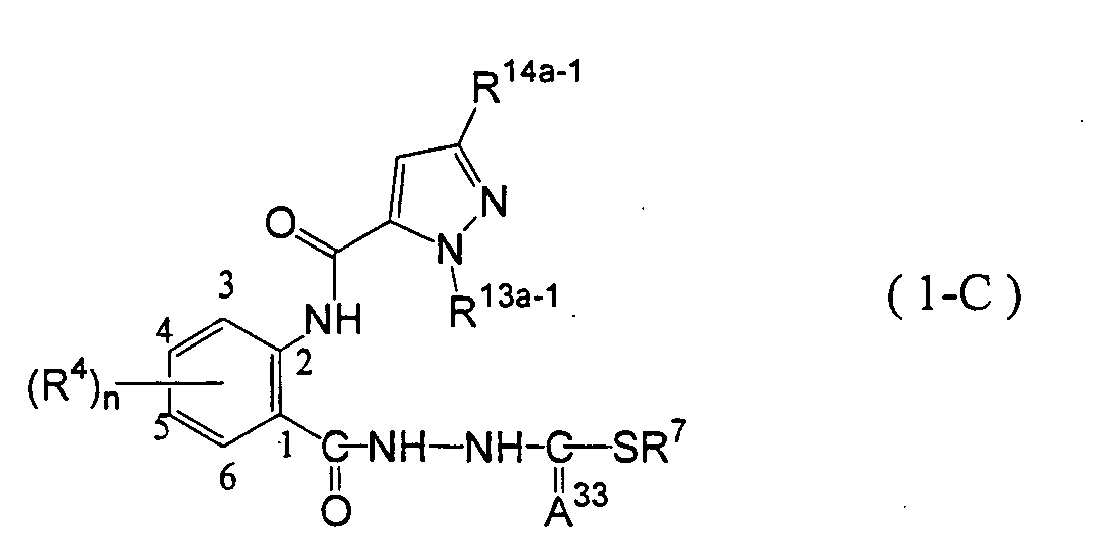
Table 40 R7 A33 (R4)n R13a-1 R14a-1 CH3 O 3-CH3, 5-Cl 3-chloro-2-pyridinyl H CH3 O 3-Br, 5-Cl 3-chloro-2-pyridinyl H CH3 O 3-Br, 5-Br 3-chloro-2-pyridinyl H CH3 O 3-CH3, 5-CN 3-chloro-2-pyridinyl H CH3 O 3-CH3, 5-Cl 3-chloro-2-pyridinyl Cl CH3 O 3-Br, 5-Cl 3-chloro-2-pyridinyl Cl CH3 O 3-Br, 5-Br 3-chloro-2-pyridinyl Cl CH3 O 3-CH3, 5-CN 3-chloro-2-pyridinyl Cl CH3 O 3-CH3, 5-Cl 3-chloro-2-pyridinyl Br CH3 O 3-Br, 5-Cl 3-chloro-2-pyridinyl Br CH3 O 3-Br, 5-Br 3-chloro-2-pyridinyl Br CH3 O 3-CH3, 5-CN 3-chloro-2-pyridinyl Br CH3 O 3-CH3, 5-Cl 3-chloro-2-pyridinyl CF3 CH3 O 3-Br, 5-Cl 3-chloro-2-pyridinyl CF3 CH3 O 3-Br, 5-Br 3-chloro-2-pyridinyl CF3 CH3 O 3-CH3, 5-CN 3-chloro-2-pyridinyl CF3 CH2CH3 O 3-CH3, 5-Cl 3-chloro-2-pyridinyl H CH2CH3 O 3-Br, 5-Cl 3-chloro-2-pyridinyl H CH2CH3 O 3-Br, 5-Br 3-chloro-2-pyridinyl H CH2CH3 O 3-CH3, 5-CN 3-chloro-2-pyridinyl H CH2CH3 O 3-CH3, 5-Cl 3-chloro-2-pyridinyl Cl CH2CH3 O 3-Br, 5-Cl 3-chloro-2-pyridinyl Cl CH2CH3 O 3-Br, 5-Br 3-chloro-2-pyridinyl Cl CH2CH3 O 3-CH3, 5-CN 3-chloro-2-pyridinyl Cl CH2CH3 O 3-CH3, 5-Cl 3-chloro-2-pyridinyl Br CH2CH3 O 3-Br, 5-Cl 3-chloro-2-pyridinyl Br CH2CH3 O 3-Br, 5-Br 3-chloro-2-pyridinyl Br CH2CH3 O 3-CH3, 5-CN 3-chloro-2-pyridinyl Br CH2CH3 O 3-CH3, 5-Cl 3-chloro-2-pyridinyl CF3 CH2CH3 O 3-Br, 5-Cl 3-chloro-2-pyridinyl CF3 CH2CH3 O 3-Br, 5-Br 3-chloro-2-pyridinyl CF3 CH2CH3 O 3-CH3, 5-CN 3-chloro-2-pyridinyl CF3 Table 41 R7 A33 (R4)n R13a-1 R14a-1 phenyl O 3-CH3, 5-Cl 3-chloro-2-pyridinyl H phenyl O 3-Br, 5-Cl 3-chloro-2-pyridinyl H phenyl O 3-Br, 5-Br 3-chloro-2-pyridinyl H phenyl O 3-CH3, 5-CN 3-chloro-2-pyridinyl H phenyl O 3-CH3, 5-Cl 3-chloro-2-pyridinyl Cl phenyl O 3-Br, 5-Cl 3-chloro-2-pyridinyl Cl phenyl O 3-Br, 5-Br 3-chloro-2-pyridinyl Cl phenyl O 3-CH3, 5-CN 3-chloro-2-pyridinyl Cl phenyl O 3-CH3, 5-Cl 3-chloro-2-pyridinyl Br phenyl O 3-Br, 5-Cl 3-chloro-2-pyridinyl Br phenyl O 3-Br, 5-Br 3-chloro-2-pyridinyl Br phenyl O 3-CH3, 5-CN 3-chloro-2-pyridinyl Br phenyl O 3-CH3, 5-Cl 3-chloro-2-pyridinyl CF3 phenyl O 3-Br, 5-Cl 3-chloro-2-pyridinyl CF3 phenyl O 3-Br, 5-Br 3-chloro-2-pyridinyl CF3 phenyl O 3-CH3, 5-CN 3-chloro-2-pyridinyl CF3 phenyl S 3-CH3, 5-Cl 3-chloro-2-pyridinyl H phenyl S 3-Br, 5-Cl 3-chloro-2-pyridinyl H phenyl S 3-Br, 5-Br 3-chloro-2-pyridinyl H phenyl S 3-CH3, 5-CN 3-chloro-2-pyridinyl H phenyl S 3-CH3, 5-Cl 3-chloro-2-pyridinyl Cl phenyl S 3-Br, 5-Cl 3-chloro-2-pyridinyl Cl phenyl S 3-Br, 5-Br 3-chloro-2-pyridinyl Cl phenyl S 3-CH3, 5-CN 3-chloro-2-pyridinyl Cl phenyl S 3-CH3, 5-Cl 3-chloro-2-pyridinyl Br phenyl S 3-Br, 5-Cl 3-chloro-2-pyridinyl Br phenyl S 3-Br, 5-Br 3-chloro-2-pyridinyl Br phenyl S 3-CH3, 5-CN 3-chloro-2-pyridinyl Br phenyl S 3-CH3, 5-Cl 3-chloro-2-pyridinyl CF3 phenyl S 3-Br, 5-Cl 3-chloro-2-pyridinyl CF3 phenyl S 3-Br, 5-Br 3-chloro-2-pyridinyl CF3 phenyl S 3-CH3, 5-CN 3-chloro-2-pyridinyl CF3 - A compound represented by the formula (1-D):

Table 42 NR8R9 A34 (R4)n R13a-1 R14a-1 NH2 O 3-CH3, 5-Cl 3-chloro-2-pyridinyl H NH2 O 3-Br, 5-Cl 3-chloro-2-pyridinyl H NH2 O 3-Br, 5-Br 3-chloro-2-pyridinyl H NH2 O 3-CH3, 5-CN 3-chloro-2-pyridinyl H NH2 O 3-CH3, 5-Cl 3-chloro-2-pyridinyl Cl NH2 O 3-Br, 5-Cl 3-chloro-2-pyridinyl Cl NH2 O 3-Br, 5-Br 3-chloro-2-pyridinyl Cl NH2 O 3-CH3, 5-CN 3-chloro-2-pyridinyl Cl NH2 O 3-CH3, 5-Cl 3-chloro-2-pyridinyl Br NH2 O 3-Br, 5-Cl 3-chloro-2-pyridinyl Br NH2 O 3-Br, 5-Br 3-chloro-2-pyridinyl Br NH2 O 3-CH3, 5-CN 3-chloro-2-pyridinyl Br NH2 O 3-CH3, 5-Cl 3-chloro-2-pyridinyl CF3 NH2 O 3-Br, 5-Cl 3-chloro-2-pyridinyl CF3 NH2 O 3-Br, 5-Br 3-chloro-2-pyridinyl CF3 NH2 O 3-CH3, 5-CN 3-chloro-2-pyridinyl CF3 NHCH3 O 3-CH3, 5-Cl 3-chloro-2-pyridinyl H NHCH3 O 3-Br, 5-Cl 3-chloro-2-pyridinyl H NHCH3 O 3-Br, 5-Br 3-chloro-2-pyridinyl H NHCH3 O 3-CH3, 5-CN 3-chloro-2-pyridinyl H NHCH3 O 3-CH3, 5-Cl 3-chloro-2-pyridinyl Cl NHCH3 O 3-Br, 5-Cl 3-chloro-2-pyridinyl Cl NHCH3 O 3-Br, 5-Br 3-chloro-2-pyridinyl Cl NHCH3 O 3-CH3, 5-CN 3-chloro-2-pyridinyl Cl NHCH3 O 3-CH3, 5-Cl 3-chloro-2-pyridinyl Br NHCH3 O 3-Br-, 5-Cl 3-chloro-2-pyridinyl Br NHCH3 O 3-Br, 5-Br 3-chloro-2-pyridinyl Br NHCH3 O 3-CH3, 5-CN 3-chloro-2-pyridinyl Br NHCH3 O 3-CH3, 5-Cl 3-chloro-2-pyridinyl CF3 NHCH3 O 3-Br, 5-Cl 3-chloro-2-pyridinyl CF3 NHCH3 O 3-Br, 5-Br 3-chloro-2-pyridinyl CF3 NHCH3 O 3-CH3, 5-CN 3-chloro-2-pyridinyl CF3 Table 43 NR8R9 A34 (R4)n R13a-1 R14a-1 NHCH2CH3 O 3-CH3, 5-Cl 3-chloro-2-pyridinyl H NHCH2CH3 O 3-Br, 5-Cl 3-chloro-2-pyridinyl H NHCH2CH3 O 3-Br, 5-Br 3-chloro-2-pyridinyl H NHCH2CH3 O 3-CH3, 5-CN 3-chloro-2-pyridinyl H NHCH2CH3 O 3-CH3, 5-Cl 3-chloro-2-pyridinyl Cl NHCH2CH3 O 3-Br, 5-Cl 3-chloro-2-pyridinyl Cl NHCH2CH3 O 3-Br, 5-Br 3-chloro-2-pyridinyl Cl NHCH2CH3 O 3-CH3, 5-CN 3-chloro-2-pyridinyl Cl NHCH2CH3 O 3-CH3, 5-Cl 3-chloro-2-pyridinyl Br NHCH2CH3 O 3-Br, 5-Cl 3-chloro-2-pyridinyl Br NHCH2CH3 O 3-Br, 5-Br 3-chloro-2-pyridinyl Br NHCH2CH3 O 3-CH3, 5-CN 3-chloro-2-pyridinyl Br NHCH2CH3 O 3-CH3, 5-Cl 3-chloro-2-pyridinyl CF3 NHCH2CH3 O 3-Br, 5-Cl 3-chloro-2-pyridinyl CF3 NHCH2CH3 O 3-Br, 5-Br 3-chloro-2-pyridinyl CF3 NHCH2CH3 O 3-CH3, 5-CN 3-chloro-2-pyridinyl CF3 NHCH(CH3)2 O 3-CH3, 5-Cl 3-chloro-2-pyridinyl H NHCH(CH3)2 O 3-Br, 5-Cl 3-chloro-2-pyridinyl H NHCH(CH3)2 O 3-Br, 5-Br 3-chloro-2-pyridinyl H NHCH(CH3)2 O 3-CH3, 5-CN 3-chloro-2-pyridinyl H NHCH(CH3)2 O 3-CH3, 5-Cl 3-chloro-2-pyridinyl Cl NHCH(CH3)2 O 3-Br, 5-Cl 3-chloro-2-pyridinyl Cl NHCH(CH3)2 O 3-Br, 5-Br 3-chloro-2-pyridinyl Cl NHCH(CH3)2 O 3-CH3, 5-CN 3-chloro-2-pyridinyl Cl NHCH(CH3)2 O 3-CH3, 5-Cl 3-chloro-2-pyridinyl Br NHCH(CH3)2 O 3-Br, 5-Cl 3-chloro-2-pyridinyl Br NHCH(CH3)2 O 3-Br, 5-Br 3-chloro-2-pyridinyl Br NHCH(CH3)2 O 3-CH3, 5-CN 3-chloro-2-pyridinyl Br NHCH(CH3)2 O 3-CH3, 5-Cl 3-chloro-2-pyridinyl CF3 NHCH(CH3)2 O 3-Br, 5-Cl 3-chloro-2-pyridinyl CF3 NHCH(CH3)2 O 3-Br, 5-Br 3-chloro-2-pyridinyl CF3 NHCH(CH3)2 O 3-CH3, 5-CN 3-chloro-2-pyridinyl CF3 Table 44 NR8R9 A34 (R4)n R13a-1 R14a-1 NHC(CH3)3 O 3-CH3, 5-Cl 3-chloro-2-pyridinyl H NHC(CH3)3 O 3-Br, 5-Cl 3-chloro-2-pyridinyl H NHC(CH3)3 O 3-Br, 5-Br 3-chloro-2-pyridinyl H NHC(CH3)3 O 3-CH3, 5-CN 3-chloro-2-pyridinyl H NHC(CH3)3 O 3-CH3, 5-Cl 3-chloro-2-pyridinyl Cl NHC(CH3)3 O 3-Br, 5-Cl 3-chloro-2-pyridinyl Cl NHC(CH3)3 O 3-Br, 5-Br 3-chloro-2-pyridinyl Cl NHC(CH3)3 O 3-CH3, 5-CN 3-chloro-2-pyridinyl Cl NHC(CH3)3 O 3-CH3, 5-Cl 3-chloro-2-pyridinyl Br NHC(CH3)3 O 3-Br, 5-Cl 3-chloro-2-pyridinyl Br NHC(CH3)3 O 3-Br, 5-Br 3-chloro-2-pyridinyl Br NHC(CH3)3 O 3-CH3, 5-CN 3-chloro-2-pyridinyl Br NHC(CH3)3 O 3-CH3, 5-Cl 3-chloro-2-pyridinyl CF3 NHC(CH3)3 O 3-Br, 5-Cl 3-chloro-2-pyridinyl CF3 NHC(CH3)3 O 3-Br, 5-Br 3-chloro-2-pyridinyl CF3 NHC(CH3)3 O 3-CH3, 5-CN 3-chloro-2-pyridinyl CF3 N(CH3)2 O 3-CH3, 5-Cl 3-chloro-2-pyridinyl H N(CH3)2 O 3-Br, 5-Cl 3-chloro-2-pyridinyl H N(CH3)2 O 3-Br, 5-Br 3-chloro-2-pyridinyl H N(CH3)2 O 3-CH3, 5-CN 3-chloro-2-pyridinyl H N(CH3)2 O 3-CH3, 5-Cl 3-chloro-2-pyridinyl Cl N(CH3)2 O 3-Br, 5-Cl 3-chloro-2-pyridinyl Cl N(CH3)2 O 3-Br, 5-Br 3-chloro-2-pyridinyl Cl N(CH3)2 O 3-CH3, 5-CN 3-chloro-2-pyridinyl Cl N(CH3)2 O 3-CH3, 5-Cl 3-chloro-2-pyridinyl Br N(CH3)2 O 3-Br, 5-Cl 3-chloro-2-pyridinyl Br N(CH3)2 O 3-Br, 5-Br 3-chloro-2-pyridinyl Br N(CH3)2 O 3-CH3, 5-CN 3-chloro-2-pyridinyl Br N(CH3)2 O 3-CH3, 5-Cl 3-chloro-2-pyridinyl CF3 N(CH3)2 O 3-Br, 5-Cl 3-chloro-2-pyridinyl CF3 N(CH3)2 O 3-Br, 5-Br 3-chloro-2-pyridinyl CF3 N(CH3)2 O 3-CH3, 5-CN 3-chloro-2-pyridinyl CF3 Table 45 NR8R9 A34 (R4)n R13a-1 R14a-1 N(CH2CH3)2 O 3-CH3, 5-Cl 3-chloro-2-pyridinyl H N(CH2CH3)2 O 3-Br, 5-Cl 3-chloro-2-pyridinyl H N(CH2CH3)2 O 3-Br, 5-Br 3-chloro-2-pyridinyl H N(CH2CH3)2 O 3-CH3, 5-CN 3-chloro-2-pyridinyl H N(CH2CH3)2 O 3-CH3, 5-Cl 3-chloro-2-pyridinyl Cl N(CH2CH3)2 O 3-Br, 5-Cl 3-chloro-2-pyridinyl Cl N(CH2CH3)2 O 3-Br, 5-Br 3-chloro-2-pyridinyl Cl N(CH2CH3)2 O 3-CH3, 5-CN 3-chloro-2-pyridinyl Cl N(CH2CH3)2 O 3-CH3, 5-Cl 3-chloro-2-pyridinyl Br N(CH2CH3)2 O 3-Br, 5-Cl 3-chloro-2-pyridinyl Br N(CH2CH3)2 O 3-Br, 5-Br 3-chloro-2-pyridinyl Br N(CH2CH3)2 O 3-CH3, 5-CN 3-chloro-2-pyridinyl Br N(CH2CH3)2 O 3-CH3, 5-Cl 3-chloro-2-pyridinyl CF3 N(CH2CH3)2 O 3-Br, 5-Cl 3-chloro-2-pyridinyl CF3 N(CH2CH3)2 O 3-Br, 5-Br 3-chloro-2-pyridinyl CF3 N(CH2CH3)2 O 3-CH3, 5-CN 3-chloro-2-pyridinyl CF3 N{CH(CH3)2}2 O 3-CH3, 5-Cl 3-chloro-2-pyridinyl H N{CH(CH3)2}2 O 3-Br, 5-Cl 3-chloro-2-pyridinyl H N{CH(CH3)2}2 O 3-Br, 5-Br 3-chloro-2-pyridinyl H N{CH(CH3)2}2 O 3-CH3, 5-CN 3-chloro-2-pyridinyl H N{CH(CH3)2}2 O 3-CH3, 5-Cl 3-chloro-2-pyridinyl Cl N{CH(CH3)2}2 O 3-Br, 5-Cl 3-chloro-2-pyridinyl Cl N{CH(CH3)2}2 O 3-Br, 5-Br 3-chloro-2-pyridinyl Cl N{CH(CH3)2}2 O 3-CH3, 5-CN 3-chloro-2-pyridinyl Cl N{CH(CH3)2}2 O 3-CH3, 5-Cl 3-chloro-2-pyridinyl Br N{CH(CH3)2}2 O 3-Br, 5-Cl 3-chloro-2-pyridinyl Br N{CH(CH3)2}2 O 3-Br, 5-Br 3-chloro-2-pyridinyl Br N{CH(CH3)2}2 O 3-CH3, 5-CN 3-chloro-2-pyridinyl Br N{CH(CH3)2}2 O 3-CH3, 5-Cl 3-chloro-2-pyridinyl CF3 N{CH(CH3)2}2 O 3-Br, 5-Cl 3-chloro-2-pyridinyl CF3 N{CH(CH3)2}2 O 3-Br, 5-Br 3-chloro-2-pyridinyl CF3 N{CH(CH3)2}2 O 3-CH3, 5-CN 3-chloro-2-pyridinyl CF3 Table 46 NR8R9 A34 (R4)n R13a-1 R14a-1 cyclopropylamino O 3-CH3, 5-Cl 3-chloro-2-pyridinyl H cyclopropylamino O 3-Br, 5-Cl 3-chloro-2-pyridinyl H cyclopropylamino O 3-Br, 5-Br 3-chloro-2-pyridinyl H cyclopropylamino O 3-CH3, 5-CN 3-chloro-2-pyridinyl H cyclopropylamino O 3-CH3, 5-Cl 3-chloro-2-pyridinyl Cl cyclopropylamino O 3-Br, 5-Cl 3-chloro-2-pyridinyl Cl cyclopropylamino O 3-Br, 5-Br 3-chloro-2-pyridinyl Cl cyclopropylamino O 3-CH3, 5-CN 3-chloro-2-pyridinyl Cl cyclopropylamino O 3-CH3, 5-Cl 3-chloro-2-pyridinyl Br cyclopropylamino O 3-Br, 5-Cl 3-chloro-2-pyridinyl Br cyclopropylamino O 3-Br, 5-Br 3-chloro-2-pyridinyl Br cyclopropylamino O 3-CH3, 5-CN 3-chloro-2-pyridinyl Br cyclopropylamino O 3-CH3, 5-Cl 3-chloro-2-pyridinyl CF3 cyclopropylamino O 3-Br, 5-Cl 3-chloro-2-pyridinyl CF3 cyclopropylamino O 3-Br, 5-Br 3-chloro-2-pyridinyl CF3 cyclopropylamino O 3-CH3, 5-CN 3-chloro-2-pyridinyl CF3 cyclobutylamino O 3-CH3, 5-Cl 3-chloro-2-pyridinyl H cyclobutylamino O 3-Br, 5-Cl 3-chloro-2-pyridinyl H cyclobutylamino O 3-Br, 5-Br 3-chloro-2-pyridinyl H cyclobutylamino O 3-CH3, 5-CN 3-chloro-2-pyridinyl H cyclobutylamino O 3-CH3, 5-Cl 3-chloro-2-pyridinyl Cl cyclobutylamino O 3-Br, 5-Cl 3-chloro-2-pyridinyl Cl cyclobutylamino O 3-Br, 5-Br 3-chloro-2-pyridinyl Cl cyclobutylamino O 3-CH3, 5-CN 3-chloro-2-pyridinyl Cl cyclobutylamino O 3-CH3, 5-Cl 3-chloro-2-pyridinyl Br cyclobutylamino O 3-Br, 5-Cl 3-chloro-2-p-yridinyl Br cyclobutylamino O 3-Br, 5-Br 3-chloro-2-pyridinyl Br cyclobutylamino O 3-CH3, 5-CN 3-chloro-2-pyridinyl Br cyclobutylamino O 3-CH3, 5-Cl 3-chloro-2-pyridinyl CF3 cyclobutylamino O 3-Br, 5-Cl 3-chloro-2-pyridinyl CF3 cyclobutylamino O 3-Br, 5-Br 3-chloro-2-pyridinyl CF3 cyclobutylamino O 3-CH3, 5-CN 3-chloro-2-pyridinyl CF3 Table 47 NR8R9 A34 (R4)n R13a-1 R14a-1 cyclopentylamino O 3-CH3, 5-Cl 3-chloro-2-pyridinyl H cyclopentylamino O 3-Br, 5-Cl 3-chloro-2-pyridinyl H cyclopentylamino O 3-Br, 5-Br 3-chloro-2-pyridinyl H cyclopentylamino O 3-CH3, 5-CN 3-chloro-2-pyridinyl H cyclopentylamino O 3-CH3, 5-Cl 3-chloro-2-pyridinyl Cl cyclopentylamino O 3-Br, 5-Cl 3-chloro-2-pyridinyl Cl cyclopentylamino O 3-Br, 5-Br 3-chloro-2-pyridinyl Cl cyclopentylamino O 3-CH3, 5-CN 3-chloro-2-pyridinyl Cl cyclopentylamino O 3-CH3, 5-Cl 3-chloro-2-pyridinyl Br cyclopentylamino O 3-Br, 5-Cl 3-chloro-2-pyridinyl Br cyclopentylamino O -Br, 5-Br 3-chloro-2-pyridinyl Br cyclopentylamino O 3-CH3, 5-CN 3-chloro-2-pyridinyl Br cyclopentylamino O 3-CH3, 5-Cl 3-chloro-2-pyridinyl CF3 cyclopentylamino O 3-Br, 5-Cl 3-chloro-2-pyridinyl CF3 cyclopentylamino O 3-Br, 5-Br 3-chloro-2-pyridinyl CF3 cyclopentylamino O 3-CH3, 5-CN 3-chloro-2-pyridinyl CF3 cyclohexylamino O 3-CH3, 5-Cl 3-chloro-2-pyridinyl H cyclohexylamino O 3-Br, 5-Cl 3-chloro-2-pyridinyl H cyclohexylamino O 3-Br, 5-Br 3-chloro-2-pyridinyl H cyclohexylamino O 3-CH3, 5-CN 3-chloro-2-pyridinyl H cyclohexylamino O 3-CH3, 5-Cl 3-chloro-2-pyridinyl Cl cyclohexylamino O 3-Br, 5-Cl 3-chloro-2-pyridinyl Cl cyclohexylamino O 3-Br, 5-Br 3-chloro-2-pyridinyl Cl cyclohexylamino O 3-CH3, 5-CN 3-chloro-2-pyridinyl Cl cyclohexylamino O 3-CH3, 5-Cl 3-chloro-2-pyridinyl Br cyclohexylamino O 3-Br, 5-Cl 3-chloro-2-pyridinyl Br cyclohexylamino O 3-Br, 5-Br 3-chloro-2-pyridinyl Br cyclohexylamino O 3-CH3, 5-CN 3-chloro-2-pyridinyl Br cyclohexylamino O 3-CH3, 5-Cl 3-chloro-2-pyridinyl CF3 cyclohexylamino O 3-Br, 5-Cl 3-chloro-2-pyridinyl CF3 cyclohexylamino O 3-Br, 5-Br 3-chloro-2-pyridinyl CF3 cyclohexylamino O 3-CH3, 5-CN 3-chloro-2-pyridinyl CF3 Table 48 NR8R9 A34 (R4)n R13a-1 R14a-1 anilino O 3-CH3, 5-Cl 3-chloro-2-pyridinyl H anilino O 3-Br, 5-Cl 3-chloro-2-pyridinyl H anilino O 3-Br, 5-Br 3-chloro-2-pyridinyl H anilino O 3-CH3, 5-CN 3-chloro-2-pyridinyl H anilino O 3-CH3, 5-Cl 3-chloro-2-pyridinyl Cl anilino O 3-Br, 5-Cl 3-chloro-2-pyridinyl Cl anilino O 3-Br, 5-Br 3-chloro-2-pyridinyl Cl anilino O 3-CH3, 5-CN 3-chloro-2-pyridinyl Cl anilino O 3-CH3, 5-Cl 3-chloro-2-pyridinyl Br anilino O 3-Br, 5-Cl 3-chloro-2-pyridinyl Br anilino O 3-Br, 5-Br 3-chloro-2-pyridinyl Br anilino O 3-CH3, 5-CN 3-chloro-2-pyridinyl Br anilino O 3-CH3, 5-Cl 3-chloro-2-pyridinyl CF3 anilino O 3-Br, 5-Cl 3-chloro-2-pyridinyl CF3 anilino O 3-Br, 5-Br 3-chloro-2-pyridinyl CF3 anilino O 3-CH3, 5-CN 3-chloro-2-pyridinyl CF3 pyrrolidin-1-yl O 3-CH3, 5-Cl 3-chloro-2-pyridinyl H pyrrolidin-1-yl O 3-Br, 5-Cl 3-chloro-2-pyridinyl H pyrrolidin-1-yl O 3-Br, 5-Br 3-chloro-2-pyridinyl H pyrrolidin-1-yl O 3-CH3, 5-CN 3-chloro-2-pyridinyl H pyrrolidin-1-yl O 3-CH3, 5-Cl 3-chloro-2-pyridinyl Cl pyrrolidin-1-yl O 3-Br, 5-Cl 3-chloro-2-pyridinyl Cl pyrrolidin-1-yl O 3-Br, 5-Br 3-chloro-2-pyridinyl Cl pyrrolidin-1-yl O 3-CH3, 5-CN 3-chloro-2-pyridinyl Cl pyrrolidin-1-yl O 3-CH3, 5-Cl 3-chloro-2-pyridinyl Br pyrrolidin-1-yl O 3-Br, 5-Cl 3-chloro-2-pyridinyl Br- pyrrolidin-1-yl O 3-Br, 5-Br 3-chloro-2-pyridinyl Br pyrrolidin-1-yl O 3-CH3, 5-CN 3-chloro-2-pyridinyl Br pyrrolidin-1-yl O 3-CH3, 5-Cl 3-chloro-2-pyridinyl CF3 pyrrolidin-1-yl O 3-Br, 5-Cl 3-chloro-2-pyridinyl CF3 pyrrolidin-1-yl O 3-Br, 5-Br 3-chloro-2-pyridinyl CF3 pyrrolidin-1-yl O 3-CH3, 5-CN 3-chloro-2-pyridinyl CF3 Table 49 NR8R9 A34 (R4)n R13a-1 R14a-1 piperidin-1-yl O 3-CH3, 5-Cl 3-chloro-2-pyridinyl H piperidin-1-yl O 3-Br, 5-Cl 3-chloro-2-pyridinyl H piperidin-1-yl O 3-Br, 5-Br 3-chloro-2-pyridinyl H piperidin-1-yl O 3-CH3, 5-CN 3-chloro-2-pyridinyl H piperidin-1-yl O 3-CH3, 5-Cl 3-chloro-2-pyridinyl Cl piperidin-1-yl O 3-Br, 5-Cl 3-chloro-2-pyridinyl Cl piperidin-1-yl O 3-Br, 5-Br 3-chloro-2-pyridinyl Cl piperidin-1-yl O 3-CH3, 5-CN 3-chloro-2-pyridinyl Cl piperidin-1-yl O 3-CH3, 5-Cl 3-chloro-2-pyridinyl Br piperidin-1-yl O 3-Br, 5-Cl 3-chloro-2-pyridinyl Br piperidin-1-yl O 3-Br, 5-Br 3-chloro-2-pyridinyl Br piperidin-1-yl O 3-CH3, 5-CN 3-chloro-2-pyridinyl Br piperidin-1-yl O 3-CH3, 5-Cl 3-chloro-2-pyridinyl CF3 piperidin-1-yl O 3-Br, 5-Cl 3-chloro-2-pyridinyl CF3 piperidin-1-yl O 3-Br, 5-Br 3-chloro-2-pyridinyl CF3 piperidin-1-yl O 3-CH3, 5-CN 3-chloro-2-pyridinyl CF3 morpholin-4-yl O 3-CH3, 5-Cl 3-chloro-2-pyridinyl H morpholin-4-yl O 3-Br, 5-Cl 3-chloro-2-pyridinyl H morpholin-4-yl O 3-Br, 5-Br 3-chloro-2-pyridinyl H morpholin-4-yl O 3-CH3, 5-CN 3-chloro-2-pyridinyl H morpholin-4-yl O 3-CH3, 5-Cl 3-chloro-2-pyridinyl Cl morpholin-4-yl O 3-Br, 5-Cl 3-chloro-2-pyridinyl Cl morpholin-4-yl O 3-Br, 5-Br 3-chloro-2-pyridinyl Cl morpholin-4-yl O 3-CH3, 5-CN 3-chloro-2-pyridinyl Cl morpholin-4-yl O 3-CH3, 5-Cl 3-chloro-2-pyridinyl Br morpholin-4-yl O 3-Br, 5-Cl 3-chloro-2-pyridinyl Br morpholin-4-yl O 3-Br, 5-Br 3-chloro-2-pyridinyl Br morpholin-4-yl O 3-CH3, 5-CN 3-chloro-2-pyridinyl Br morpholin-4-yl O 3-CH3, 5-Cl 3-chloro-2-pyridinyl CF3 morpholin-4-yl O 3-Br, 5-Cl 3-chloro-2-pyridinyl CF3 morpholin-4-yl O 3-Br, 5-Br 3-chloro-2-pyridinyl CF3 morpholin-4-yl O 3-CH3, 5-CN 3-chloro-2-pyridinyl CF3 Table 50 NR8R9 A34 (R4)n R13a-1 R14a-1 thiomorpholin-4-yl O 3-CH3, 5-Cl 3-chloro-2-pyridinyl H thiomorpholin-4-yl O 3-Br, 5-Cl 3-chloro-2-pyridinyl H thiomorpholin-4-yl O 3-Br, 5-Br 3-chloro-2-pyridinyl H thiomorpholin-4-yl O 3-CH3, 5-CN 3-chloro-2-pyridinyl H thiomorpholin-4-yl O 3-CH3, 5-Cl 3-chloro-2-pyridinyl Cl thiomorpholin-4-yl O 3-Br, 5-Cl 3-chloro-2-pyridinyl Cl thiomorpholin-4-yl O 3-Br, 5-Br 3-chloro-2-pyridinyl Cl thiomorpholin-4-yl O 3-CH3, 5-CN 3-chloro-2-pyridinyl Cl thiomorpholin-4-yl O 3-CH3, 5-Cl 3-chloro-2-pyridinyl Br thiomorpholin-4-yl O 3-Br, 5-Cl 3-chloro-2-pyridinyl Br thiomorpholin-4-yl O 3-Br, 5-Br 3-chloro-2-pyridinyl Br thiomorpholin-4-yl O 3-CH3, 5-CN 3-chloro-2-pyridinyl Br thiomorpholin-4-yl O 3-CH3, 5-Cl 3-chloro-2-pyridinyl CF3 thiomorpholin-4-yl O 3-Br, 5-Cl 3-chloro-2-pyridinyl CF3 thiomorpholin-4-yl O 3-Br, 5-Br 3-chloro-2-pyridinyl CF3 thiomorpholin-4-yl O 3-CH3, 5-CN 3-chloro-2-pyridinyl CF3 1-methylpiperazin-4-yl O 3-CH3, 5-Cl 3-chloro-2-pyridinyl H 1-methylpiperazin-4-yl O 3-Br, 5-Cl 3-chloro-2-pyridinyl H 1-methylpiperazin-4-yl O 3-Br, 5-Br 3-chloro-2-pyridinyl H 1-methylpiperazin-4-yl O 3-CH3, 5-CN 3-chloro-2-pyridinyl H 1-methylpiperazin-4-yl O 3-CH3, 5-Cl 3-chloro-2-pyridinyl Cl 1-methylpiperazin-4-yl O 3-Br, 5-Cl 3-chloro-2-pyridinyl Cl 1-methylpiperazin-4-yl O 3-Br, 5-Br 3-chloro-2-pyridinyl Cl 1-methylpiperazin-4-yl O 3-CH3, 5-CN 3-chloro-2-pyridinyl Cl 1-methylpiperazin-4-yl O 3-CH3, 5-Cl 3-chloro-2-pyridinyl Br 1-methylpiperazin-4-yl O 3-Br, 5-Cl 3-chloro-2-pyridinyl Br 1-methylpiperazin-4-yl O 3-Br, 5-Br 3-chloro-2-pyridinyl Br 1-methylpiperazin-4-yl O 3-CH3, 5-CN 3-chloro-2-pyridinyl Br 1-methylpiperazin-4-yl O 3-CH3, 5-Cl 3-chloro-2-pyridinyl CF3 1-methylpiperazin-4-yl O 3-Br, 5-Cl 3-chloro-2-pyridinyl CF3 1-methylpiperazin-4-yl O 3-Br, 5-Br 3-chloro-2-pyridinyl CF3 1-methylpiperazin-4-yl O 3-CH3, 5-CN 3-chloro-2-pyridinyl CF3 Table 51 NR8R9 A34 (R4)n R13a-1 R14a-1 NH2 S 3-CH3, 5-Cl 3-chloro-2-pyridinyl H NH2 S 3-Br, 5-Cl 3-chloro-2-pyridinyl H NH2 S 3-Br, 5-Br 3-chloro-2-pyridinyl H NH2 S 3-CH3, 5-CN 3-chloro-2-pyridinyl H NH2 S 3-CH3, 5-Cl 3-chloro-2-pyridinyl Cl NH2 S 3-Br, 5-Cl 3-chloro-2-pyridinyl Cl NH2 S 3-Br, 5-Br 3-chloro-2-pyridinyl Cl NH2 S 3-CH3, 5-CN 3-chloro-2-pyridinyl Cl NH2 S 3-CH3, 5-Cl 3-chloro-2-pyridinyl Br NH2 S 3-Br, 5-Cl 3-chloro-2-pyridinyl Br NH2 S 3-Br, 5-Br 3-chloro-2-pyridinyl Br NH2 S 3-CH3, 5-CN 3-chloro-2-pyridinyl Br NH2 S 3-CH3, 5-Cl 3-chloro-2-pyridinyl CF3 NH2 S 3-Br, 5-Cl 3-chloro-2-pyridinyl CF3 NH2 S 3-Br, 5-Br 3-chloro-2-pyridinyl CF3 NH2 S 3-CH3, 5-CN 3-chloro-2-pyridinyl CF3 NHCH3 S 3-CH3, 5-Cl 3-chloro-2-pyridinyl H NHCH3 S 3-Br, 5-Cl 3-chloro-2-pyridinyl H NHCH3 S 3-Br, 5-Br 3-chloro-2-pyridinyl H NHCH3 S 3-CH3, 5-CN 3-chloro-2-pyridinyl H NHCH3 S 3-CH3, 5-Cl 3-chloro-2-pyridinyl Cl NHCH3 S 3-Br, 5-Cl 3-chloro-2-pyridinyl Cl NHCH3 S 3-Br, 5-Br 3-chloro-2-pyridinyl Cl NHCH3 S 3-CH3, 5-CN 3-chloro-2-pyridinyl Cl NHCH3 S 3-CH3, 5-Cl 3-chloro-2-pyridinyl Br NHCH3 S 3-Br, 5-Cl 3-chloro-2-pyridinyl Br NHCH3 S 3-Br, 5-Br 3-chloro-2-pyridinyl Br NHCH3 S 3-CH3, 5-CN 3-chloro-2-pyridinyl Br NHCH3 S 3-CH3, 5-Cl 3-chloro-2-pyridinyl CF3 NHCH3 S 3-Br, 5-Cl 3-chloro-2-pyridinyl CF3 NHCH3 S 3-Br, 5-Br 3-chloro-2-pyridinyl CF3 NHCH3 S 3-CH3, 5-CN 3-chloro-2-pyridinyl CF3 Table 52 NR8R9 A34 (R4)n R13a-1 R14a-1 NHCH2CH3 S 3-CH3, 5-Cl 3-chloro-2-pyridinyl H NHCH2CH3 S 3-Br, 5-Cl 3-chloro-2-pyridinyl H NHCH2CH3 S 3-Br, 5-Br 3-chloro-2-pyridinyl H NHCH2CH3 S 3-CH3, 5-CN 3-chloro-2-pyridinyl H NHCH2CH3 S 3-CH3, 5-Cl 3-chloro-2-pyridinyl Cl NHCH2CH3 S 3-Br, 5-Cl 3-chloro-2-pyridinyl Cl NHCH2CH3 S 3-Br, 5-Br 3-chloro-2-pyridinyl Cl NHCH2CH3 S 3-CH3, 5-CN 3-chloro-2-pyridinyl Cl NHCH2CH3 S 3-CH3, 5-Cl 3-chloro-2-pyridinyl Br NHCH2CH3 S 3-Br, 5-Cl 3-chloro-2-pyridinyl Br NHCH2CH3 S 3-Br, 5-Br 3-chloro-2-pyridinyl Br NHCH2CH3 S 3-CH3, 5-CN 3-chloro-2-pyridinyl Br NHCH2CH3 S 3-CH3, 5-Cl 3-chloro-2-pyridinyl CF3 NHCH2CH3 S 3-Br, 5-Cl 3-chloro-2-pyridinyl CF3 NHCH2CH3 S 3-Br, 5-Br 3-chloro-2-pyridinyl CF3 NHCH2CH3 S 3-CH3, 5-CN 3-chloro-2-pyridinyl CF3 NHCH(CH3)2 S 3-CH3, 5-Cl 3-chloro-2-pyridinyl H NHCH(CH3)2 S 3-Br, 5-Cl 3-chloro-2-pyridinyl H NHCH(CH3)2 S 3-Br, 5-Br 3-chloro-2-pyridinyl H NHCH(CH3)2 S 3-CH3, 5-CN 3-chloro-2-pyridinyl H NHCH(CH3)2 S 3-CH3, 5-Cl 3-chloro-2-pyridinyl Cl NHCH (CH3)2 S 3-Br, 5-Cl 3-chloro-2-pyridinyl Cl NHCH(CH3)2 S 3-Br, 5-Br 3-chloro-2-pyridinyl Cl NHCH(CH3)2 S 3-CH3, 5-CN 3-chloro-2-pyridinyl Cl NHCH(CH3)2 S 3-CH3, 5-Cl 3-chloro-2-pyridinyl Br NHCH(CH3)2 S 3-Br, 5-Cl 3-chloro-2-pyridinyl Br NHCH(CH3)2 S 3-Br, 5-Br 3-chloro-2-pyridinyl Br NHCH(CH3)2 S 3-CH3, 5-CN 3-chloro-2-pyridinyl Br NHCH(CH3)2 S 3-CH3, 5-Cl 3-chloro-2-pyridinyl CF3 NHCH(CH3)2 S 3-Br, 5-Cl 3-chloro-2-pyridinyl CF3 NHCH(CH3)2 S 3-Br, 5-Br 3-chloro-2-pyridinyl CF3 NHCH(CH3)2 S 3-CH3, 5-CN 3-chloro-2-pyridinyl CF3 Table 53 NR8R9 A34 (R4)n R13a-1 R14a-1 NHC(CH3)3 S 3-CH3, 5-Cl 3-chloro-2-pyridinyl H NHC(CH3)3 S 3-Br, 5-Cl 3-chloro-2-pyridinyl H NHC(CH3)3 S 3-Br, 5-Br 3-chloro-2-pyridinyl H NHC(CH3)3 S 3-CH3, 5-CN 3-chloro-2-pyridinyl H NHC(CH3)3 S 3-CH3, 5-Cl 3-chloro-2-pyridinyl Cl NHC(CH3)3 S 3-Br, 5-Cl 3-chloro-2-pyridinyl Cl NHC(CH3)3 S 3-Br, 5-Br 3-chloro-2-pyridinyl Cl NHC(CH3)3 S 3-CH3, 5-CN 3-chloro-2-pyridinyl Cl NHC(CH3)3 S 3-CH3, 5-Cl 3-chloro-2-pyridinyl Br NHC(CH3)3 S 3-Br, 5-Cl 3-chloro-2-pyridinyl Br NHC(CH3)3 S 3-Br, 5-Br 3-chloro-2-pyridinyl Br NHC(CH3)3 S 3-CH3, 5-CN 3-chloro-2-pyridinyl Br NHC(CH3)3 S 3-CH3, 5-Cl 3-chloro-2-pyridinyl CF3 NHC(CH3)3 S 3-Br, 5-Cl 3-chloro-2-pyridinyl CF3 NHC(CH3)3 S 3-Br, 5-Br 3-chloro-2-pyridinyl CF3 NHC(CH3)3 S 3-CH3, 5-CN 3-chloro-2-pyridinyl CF3 N(CH3)2 S 3-CH3, 5-Cl 3-chloro-2-pyridinyl H N(CH3)2 S 3-Br, 5-Cl 3-chloro-2-pyridinyl H N(CH3)2 S 3-Br, 5-Br 3-chloro-2-pyridinyl H N(CH3)2 S 3-CH3, 5-CN 3-chloro-2-pyridinyl H N(CH3)2 S 3-CH3, 5-Cl 3-chloro-2-pyridinyl Cl N(CH3)2 S 3-Br, 5-Cl 3-chloro-2-pyridinyl Cl N(CH3)2 S 3-Br, 5-Br 3-chloro-2-pyridinyl Cl N(CH3)2 S 3-CH3, 5-CN 3-chloro-2-pyridinyl Cl N(CH3)2 S 3-CH3, 5-Cl 3-chloro-2-pyridinyl Br N(CH3)2 S 3-Br, 5-Cl 3-chloro-2-pyridinyl Br N(CH3)2 S 3-Br, 5-Br 3-chloro-2-pyridinyl Br N(CH3)2 S 3-CH3, 5-CN 3-chloro-2-pyridinyl Br N(CH3)2 S 3-CH3, 5-Cl 3-chloro-2-pyridinyl CF3 N(CH3)2 S 3-Br, 5-Cl 3-chloro-2-pyridinyl CF3 N(CH3)2 S 3-Br, 5-Br 3-chloro-2-pyridinyl CF3 N(CH3)2 S 3-CH3, 5-CN 3-chloro-2-pyridinyl CF3 Table 54 NR8R9 A34 (R4)n R13a-1 R14a-1 N(CH2CH3) S 3-CH3, 5-Cl 3-chloro-2-pyridinyl H N(CH2CH3)2 S 3-Br, 5-Cl 3-chloro-2-pyridinyl H N(CH2CH3)2 S 3-Br, 5-Br 3-chloro-2-pyridinyl H N(CH2CH3)2 S 3-CH3, 5-CN 3-chloro-2-pyridinyl H N(CH2CH3)2 S 3-CH3, 5-Cl 3-chloro-2-pyridinyl Cl N(CH2CH3)2 S 3-Br, 5-Cl 3-chloro-2-pyridinyl Cl N(CH2CH3)2 S 3-Br, 5-Br 3-chloro-2-pyridinyl Cl N(CH2CH3)2 S 3-CH3, 5-CN 3-chloro-2-pyridinyl CL N(CH2CH3)2 S 3-CH3, 5-Cl 3-chloro-2-pyridinyl Br N(CH2CH3)2 S 3-Br, 5-Cl 3-chloro-2-pyridinyl Br N(CH2CH3)2 S 3-Br, 5-Br 3-chloro-2-pyridinyl Br N(CH2CH3)2 S 3-CH3, 5-CN 3-chloro-2-pyridinyl Br N(CH2CH3)2 S 3-CH3, 5-Cl 3-chloro-2-pyridinyl CF3 N(CH2CH3)2 S 3-Br, 5-Cl 3-chloro-2-pyridinyl CF3 N(CH2CH3)2 S 3-Br, 5-Br 3-chloro-2-pyridinyl CF3 N (CH2CH3)2 S 3-CH3, 5-CN 3-chloro-2-pyridinyl CF3 cyclopropylamino S 3-CH3, 5-Cl 3-chloro-2-pyridinyl H cyclopropylamino S 3-Br, 5-Cl 3-chloro-2-pyridinyl H cyclopropylamino S 3-Br, 5-Br 3-chloro-2-pyridinyl H cyclopropylamino S 3-CH3, 5-CN 3-chloro-2-pyridinyl H cyclopropylamino S 3-CH3, 5-Cl 3-chloro-2-pyridinyl Cl cyclopropylamino S 3-Br, 5-Cl 3-chloro-2-pyridinyl Cl cyclopropylamino S 3-Br, 5-Br 3-chloro-2-pyridinyl Cl cyclopropylamino S 3-CH3, 5-CN 3-chloro-2-pyridinyl Cl cyclopropylamino S 3-CH3, 5-Cl 3-chloro-2-pyridinyl Br cyclopropylamino S 3-Br, 5-Cl 3-chloro-2-pyridinyl Br cyclopropylamino S 3-Br, 5-Br 3-chloro-2-pyridinyl Br cyclopropylamino S 3-CH3, 5-CN 3-chloro-2-pyridinyl Br cyclopropylamino S 3-CH3, 5-Cl 3-chloro-2-pyridinyl CF3 cyclopropylamino S 3-Br, 5-Cl 3-chloro-2-pyridinyl CF3 cyclopropylamino S 3-Br, 5-Br 3-chloro-2-pyridinyl CF3 cyclopropylamino S 3-CH3, 5-CN 3-chloro-2-pyridinyl CF3 Table 55 NR8R9 A34 (R4)n R13a-1 R14a-1 cyclobutylamino S 3-CH3, 5-Cl 3-chloro-2-pyridinyl H cyclobutylamino S 3-Br, 5-Cl 3-chloro-2-pyridinyl H cyclobutylamino S 3-Br, 5-Br 3-chloro-2-pyridinyl H cyclobutylamino S 3-CH3, 5-CN 3-chloro-2-pyridinyl H cyclobutylamino S 3-CH3, 5-Cl 3-chloro-2-pyridinyl Cl cyclobutylamino S 3-Br, 5-Cl 3-chloro-2-pyridinyl Cl cyclobutylamino S 3-Br, 5-Br 3-chloro-2-pyridinyl Cl cyclobutylamino S 3-CH3, 5-CN 3-chloro-2-pyridinyl Cl cyclobutylamino S 3-CH3, 5-Cl 3-chloro-2-pyridinyl Br cyclobutylamino S 3-Br, 5-Cl 3-chloro-2-pyridinyl Br cyclobutylamino S 3-Br, 5-Br 3-chloro-2-pyridinyl Br cyclobutylamino S 3-CH3, 5-CN 3-chloro-2-pyridinyl Br cyclobutylamino S 3-CH3, 5-Cl 3-chloro-2-pyridinyl CF3 cyclobutylamino S 3-Br, 5-Cl 3-chloro-2-pyridinyl CF3 cyclobutylamino S 3-Br, 5-Br 3-chloro-2-pyridinyl CF3 cyclobutylamino S 3-CH3, 5-CN 3-chloro-2-pyridinyl CF3 cyclopentylamino S 3-CH3, 5-Cl 3-chloro-2-pyridinyl H cyclopentylamino S 3-Br, 5-Cl 3-chloro-2-pyridinyl H cyclopentylamino S 3-Br, 5-Br 3-chloro-2-pyridinyl H cyclopentylamino S 3-CH3, 5-CN 3-chloro-2-pyridinyl H cyclopentylamino S 3-CH3, 5-Cl 3-chloro-2-pyridinyl Cl cyclopentylamino S 3-Br, 5-Cl 3-chloro-2-pyridinyl Cl cyclopentylamino S 3-Br, 5-Br 3-chloro-2-pyridinyl Cl cyclopentylamino S 3-CH3, 5-CN 3-chloro-2-pyridinyl Cl cyclopentylamino S 3-CH3, 5-Cl 3-chloro-2-pyridinyl Br cyclopentylamino S 3-Br, 5-Cl 3-chloro-2-pyridinyl Br cyclopentylamino S 3-Br, 5-Br 3-chloro-2-pyridinyl Br cyclopentylamino S 3-CH3, 5-CN 3-chloro-2-pyridinyl Br cyclopentylamino S 3-CH3, 5-Cl 3-chloro-2-pyridinyl CF3 cyclopentylamino S 3-Br, 5-Cl 3-chloro-2-pyridinyl CF3 cyclopentylamino S 3-Br, 5-Br 3-chloro-2-pyridinyl CF3 cyclopentylamino S 3-CH3, 5-CN 3-chloro-2-pyridinyl CF3 Table 56 NR8R9 A34 (R4)n R13a-1 R14a-1 cyclohexylamino S 3-CH3, 5-Cl 3-chloro-2-pyridinyl H cyclohexylamino S 3-Br, 5-Cl 3-chloro-2-pyridinyl H cyclohexylamino S 3-Br, 5-Br 3-chloro-2-pyridinyl H cyclohexylamino S 3-CH3, 5-CN 3-chloro-2-pyridinyl H cyclohexylamino S 3-CH3, 5-Cl 3-chloro-2-pyridinyl Cl cyclohexylamino S 3-Br, 5-Cl 3-chloro-2-pyridinyl Cl cyclohexylamino S 3-Br, 5-Br 3-chloro-2-pyridinyl Cl cyclohexylamino S 3-CH3, 5-CN 3-chloro-2-pyridinyl Cl cyclohexylamino S 3-CH3, 5-Cl 3-chloro-2-pyridinyl Br cyclohexylamino S 3-Br, 5-Cl 3-chloro-2-pyridinyl Br cyclohexylamino S 3-Br, 5-Br 3-chloro-2-pyridinyl Br cyclohexylamino S 3-CH3, 5-CN 3-chloro-2-pyridinyl Br cyclohexylamino S 3-CH3, 5-Cl 3-chloro-2-pyridinyl CF3 cyclohexylamino S 3-Br, 5-Cl 3-chloro-2-pyridinyl CF3 cyclohexylamino S 3-Br, 5-Br 3-chloro-2-pyridinyl CF3 cyclohexylamino S 3-CH3, 5-CN 3-chloro-2-pyridinyl CF3 anilino S 3-CH3, 5-Cl 3-chloro-2-pyridinyl H anilino S 3-Br, 5-Cl 3-chloro-2-pyridinyl H anilino S 3-Br, 5-Br 3-chloro-2-pyridinyl H anilino S 3-CH3, 5-CN 3-chloro-2-pyridinyl H anilino S 3-CH3, 5-Cl 3-chloro-2-pyridinyl Cl anilino S 3-Br, 5-Cl 3-chloro-2-pyridinyl Cl anilino S 3-Br, 5-Br 3-chloro-2-pyridinyl Cl anilino S 3-CH3, 5-CN 3-chloro-2-pyridinyl Cl anilino S 3-CH3, 5-Cl 3-chloro-2-pyridinyl Br anilino S 3-Br, 5-Cl 3-chloro-2-pyridinyl Br anilino S 3-Br, 5-Br 3-chloro-2-pyridinyl Br anilino S 3-CH3, 5-CN 3-chloro-2-pyridinyl Br anilino S 3-CH3, 5-Cl 3-chloro-2-pyridinyl CF3 anilino S 3-Br, 5-Cl 3-chloro-2-pyridinyl CF3 anilino S 3-Br, 5-Br 3-chloro-2-pyridinyl CF3 anilino S 3-CH3, 5-CN 3-chloro-2-pyridinyl CF3 Table 57 NR8R9 A34 (R4)n R13a-1 R14a-1 morpholin-4-yl S 3-CH3, 5-Cl 3-chloro-2-pyridinyl H morpholin-4-yl S 3-Br, 5-Cl 3-chloro-2-pyridinyl H morpholin-4-yl S 3-Br, 5-Br 3-chloro-2-pyridinyl H morpholin-4-yl S 3-CH3, 5-CN 3-chloro-2-pyridinyl H morpholin-4-yl S 3-CH3, 5-Cl 3-chloro-2-pyridinyl Cl morpholin-4-yl S 3-Br, 5-Cl 3-chloro-2-pyridinyl Cl morpholin-4-yl S 3-Br, 5-Br 3-chloro-2-pyridinyl Cl morpholin-4-yl S 3-CH3, 5-CN 3-chloro-2-pyridinyl Cl morpholin-4-yl S 3-CH3, 5-Cl 3-chloro-2-pyridinyl Br morpholin-4-yl S 3-Br, 5-Cl 3-chloro-2-pyridinyl Br morpholin-4-yl S 3-Br, 5-Br 3-chloro-2-pyridinyl Br morpholin-4-yl S 3-CH3, 5-CN 3-chloro-2-pyridinyl Br morpholin-4-yl S 3-CH3, 5-Cl 3-chloro-2-pyridinyl CF3 morpholin-4-yl S 3-Br, 5-Cl 3-chloro-2-pyridinyl CF3 morpholin-4-yl S 3-Br, 5-Br 3-chloro-2-pyridinyl CF3 morpholin-4-yl S 3-CH3, 5-CN 3-chloro-2-pyridinyl CF3 - A compound represented by the formula (1-E):

Table 58 R10 (R4)n R13a-1 R14a-1 CH3 3-CH3, 5-Cl 3-chloro-2-pyridinyl H CH3 3-Br, 5-Cl 3-chloro-2-pyridinyl H CH3 3-Br, 5-Br 3-chloro-2-pyridinyl H CH3 3-CH3, 5-CN 3-chloro-2-pyridinyl H CH3 3-CH3, 5-Cl 3-chloro-2-pyridinyl Cl CH3 3-Br, 5-Cl 3-chloro-2-pyridinyl Cl CH3 3-Br, 5-Br 3-chloro-2-pyridinyl Cl CH3 3-CH3, 5-CN 3-chloro-2-pyridinyl Cl CH3 3-CH3, 5-Cl 3-chloro-2-pyridinyl Br CH3 3-Br, 5-Cl 3-chloro-2-pyridinyl Br CH3 3-Br, 5-Br 3-chloro-2-pyridinyl Br CH3 3-CH3, 5-CN 3-chloro-2-pyridinyl Br CH3 3-CH3, 5-Cl 3-chloro-2-pyridinyl CF3 CH3 3-Br, 5-Cl 3-chloro-2-pyridinyl CF3 CH3 3-Br, 5-Br 3-chloro-2-pyridinyl CF3 CH3 3-CH3, 5-CN 3-chloro-2-pyridinyl CF3 CH2CH3 3-CH3, 5-Cl 3-chloro-2-pyridinyl H CH2CH3 3-Br, 5-Cl 3-chloro-2-pyridinyl H CH2CH3 3-Br, 5-Br 3-chloro-2-pyridinyl H CH2CH3 3-CH3, 5-CN 3-chloro-2-pyridinyl H CH2CH3 3-CH3, 5-Cl 3-chloro-2-pyridinyl Cl CH2CH3 3-Br, 5-Cl 3-chloro-2-pyridinyl Cl CH2CH3 3-Br, 5-Br 3-chloro-2-pyridinyl Cl CH2CH3 3-CH3, 5-CN 3-chloro-2-pyridinyl Cl CH2CH3 3-CH3, 5-Cl 3-chloro-2-pyridinyl Br CH2CH3 3-Br, 5-Cl 3-chloro-2-pyridinyl Br CH2CH3 3-Br, 5-Br 3-chloro-2-pyridinyl Br CH2CH3 3-CH3, 5-CN 3-chloro-2-pyridinyl Br CH2CH3 3-CH3, 5-Cl 3-chloro-2-pyridinyl CF3 CH2CH3 3-Br, 5-Cl 3-chloro-2-pyridinyl CF3 CH2CH3 3-Br, 5-Br 3-chloro-2-pyridinyl CF3 CH2CH3 3-CH3, 5-CN 3-chloro-2-pyridinyl CF3 Table 59 R10 (R4)n R13a-1 R14a-1 CF3 3-CH3, 5-Cl 3-chloro-2-pyridinyl H CF3 3-Br, 5-Cl 3-chloro-2-pyridinyl H CF3 3-Br, 5-Br 3-chloro-2-pyridinyl H CF3 3-CH3, 5-CN 3-chloro-2-pyridinyl H CF3 3-CH3, 5-Cl 3-chloro-2-pyridinyl Cl CF3 3-Br, 5-Cl 3-chloro-2-pyridinyl Cl CF3 3-Br, 5-Br 3-chloro-2-pyridinyl Cl CF3 3-CH3, 5-CN 3-chloro-2-pyridinyl Cl CF3 3-CH3, 5-Cl 3-chloro-2-pyridinyl Br CF3 3-Br, 5-Cl 3-chloro-2-pyridinyl Br CF3 3-Br, 5-Br 3-chloro-2-pyridinyl Br CF3 3-CH3, 5-CN 3-chloro-2-pyridinyl Br CF3 3-CH3, 5-Cl 3-chloro-2-pyridinyl CF3 CF3 3-Br, 5-Cl 3-chloro-2-pyridinyl CF3 CF3 3-Br, 5-Br 3-chloro-2-pyridinyl CF3 CF3 3-CH3, 5-CN 3-chloro-2-pyridinyl CF3 phenyl 3-CH3, 5-Cl 3-chloro-2-pyridinyl H phenyl 3-Br, 5-Cl 3-chloro-2-pyridinyl H phenyl 3-Br, 5-Br 3-chloro-2-pyridinyl H phenyl 3-CH3, 5-CN 3-chloro-2-pyridinyl H phenyl 3-CH3, 5-Cl 3-chloro-2-pyridinyl Cl phenyl 3-Br, 5-Cl 3-chloro-2-pyridinyl Cl phenyl 3-Br, 5-Br 3-chloro-2-pyridinyl Cl phenyl 3-CH3, 5-CN 3-chloro-2-pyridinyl Cl phenyl 3-CH3, 5-Cl 3-chloro-2-pyridinyl Br phenyl 3-Br, 5-Cl 3-chloro-2-pyridinyl Br phenyl 3-Br, 5-Br 3-chloro-2-pyridinyl Br phenyl 3-CH3, 5-CN 3-chloro-2-pyridinyl Br phenyl 3-CH3, 5-Cl 3-chloro-2-pyridinyl CF3 phenyl 3-Br, 5-Cl 3-chloro-2-pyridinyl CF3 phenyl 3-Br, 5-Br 3-chloro-2-pyridinyl CF3 phenyl 3-CH3, 5-CN 3-chloro-2-pyridinyl CF3 Table 60 R10 (R4)n R13a-1 R14a-1 4-methylphenyl 3-CH3, 5-Cl 3-chloro-2-pyridinyl H 4-methylphenyl 3-Br, 5-Cl 3-chloro-2-pyridinyl H 4-methylphenyl 3-Br, 5-Br 3-chloro-2-pyridinyl H 4-methylphenyl 3-CH3, 5-CN 3-chloro-2-pyridinyl H 4-methylphenyl 3-CH3, 5-Cl 3-chloro-2-pyridinyl Cl 4-methylphenyl 3-Br, 5-Cl 3-chloro-2-pyridinyl Cl 4-methylphenyl 3-Br, 5-Br 3-chloro-2-pyridinyl Cl 4-methylphenyl 3-CH3, 5-CN 3-chloro-2-pyridinyl Cl 4-methylphenyl 3-CH3, 5-Cl 3-chloro-2-pyridinyl Br 4-methylphenyl 3-Br, 5-Cl 3-chloro-2-pyridinyl Br 4-methylphenyl 3-Br, 5-Br 3-chloro-2-pyridinyl Br 4-methylphenyl 3-CH3, 5-CN 3-chloro-2-pyridinyl Br 4-methylphenyl 3-CH3, 5-Cl 3-chloro-2-pyridinyl CF3 4-methylphenyl 3-Br, 5-Cl 3-chloro-2-pyridinyl CF3 4-methylphenyl 3-Br, 5-Br 3-chloro-2-pyridinyl CF3 4-methylphenyl 3-CH3, 5-CN 3-chloro-2-pyridinyl CF3 - A compound represented by the formula (1-F):

Table 61 NR11R12 (R4)n R13a-1 R14a-1 N(CH3)2 3-CH3, 5-Cl 3-chloro-2-pyridinyl H N(CH3)2 3-Br, 5-Cl 3-chloro-2-pyridinyl H N(CH3)2 3-Br, 5-Br 3-chloro-2-pyridinyl H N(CH3)2 3-CH3, 5-CN 3-chloro-2-pyridinyl H N(CH3)2 3-CH3, 5-Cl 3-chloro-2-pyridinyl Cl N(CH3)2 3-Br, 5-Cl 3-chloro-2-pyridinyl Cl N(CH3)2 3-Br, 5-Br 3-chloro-2-pyridinyl Cl N(CH3)2 3-CH3, 5-CN 3-chloro-2-pyridinyl Cl N(CH3)2 3-CH3, 5-Cl 3-chloro-2-pyridinyl Br N(CH3)2 3-Br, 5-Cl 3-chloro-2-pyridinyl Br N(CH3)2 3-Br, 5-Br 3-chloro-2-pyridinyl Br N(CH3)2 3-CH3, 5-CN 3-chloro-2-pyridinyl Br N(CH3)2 3-CH3, 5-Cl 3-chloro-2-pyridinyl CF3 N(CH3)2 3-Br, 5-Cl 3-chloro-2-pyridinyl CF3 N(CH3)2 3-Br, 5-Br 3-chloro-2-pyridinyl CF3 N(CH3)2 3-CH3, 5-CN 3-chloro-2-pyridinyl CF3 anilino 3-CH3, 5-Cl 3-chloro-2-pyridinyl H anilino 3-Br, 5-Cl 3-chloro-2-pyridinyl H anilino 3-Br, 5-Br 3-chloro-2-pyridinyl H anilino 3-CH3, 5-CN 3-chloro-2-pyridinyl H anilino 3-CH3, 5-Cl 3-chloro-2-pyridinyl Cl anilino 3-Br, 5-Cl 3-chloro-2-pyridinyl Cl anilino 3-Br, 5-Br 3-chloro-2-pyridinyl Cl anilino 3-CH3, 5-CN 3-chloro-2-pyridinyl Cl anilino 3-CH3, 5-Cl 3-chloro-2-pyridinyl Br anilino 3-Br, 5-Cl 3-chloro-2-pyridinyl Br anilino 3-Br, 5-Br 3-chloro-2-pyridinyl Br anilino 3-CH3, 5-CN 3-chloro-2-pyridinyl Br anilino 3-CH3, 5-Cl 3-chloro-2-pyridinyl CF3 anilino 3-Br, 5-Cl 3-chloro-2-pyridinyl CF3 anilino 3-Br, 5-Br 3-chloro-2-pyridinyl CF3 anilino 3-CH3, 5-CN 3-chloro-2-pyridinyl CF3 - A compound represented by the formula (1-G):

Table 62 R5 A31 (R4)n R13a-2 (R14a)p H O 3-CH3, 5-Cl 3-chloro-2-pyridinyl H H O 3-Br, 5-Cl 3-chloro-2-pyridinyl H H O 3-Br, 5-Br 3-chloro-2-pyridinyl H H O 3-CH3, 5-CN 3-chloro-2-pyridinyl H H O 3-CH3, 5-Cl 3-chloro-2-pyridinyl 4-Cl H O 3-Br, 5-Cl 3-chloro-2-pyridinyl 4-Cl H O 3-Br, 5-Br 3-chloro-2-pyridinyl 4-Cl H O 3-CH3, 5-CN 3-chloro-2-pyridinyl 4-Cl H O 3-CH3, 5-Cl 3-chloro-2-pyridinyl 4-Br H O 3-Br, 5-Cl 3-chloro-2-pyridinyl 4-Br H O 3-Br, 5-Br 3-chloro-2-pyridinyl 4-Br H O 3-CH3, 5-CN 3-chloro-2-pyridinyl 4-Br H O 3-CH3, 5-Cl 3-chloro-2-pyridinyl 4-CF3 H O 3-Br, 5-Cl 3-chloro-2-pyridinyl 4-CF3 H O 3-Br, 5-Br 3-chloro-2-pyridinyl 4-CF3 H O 3-CH3, 5-CN 3-chloro-2-pyridinyl 4-CF3 CH3 O 3-CH3, 5-Cl 3-chloro-2-pyridinyl H CH3 O 3-Br, 5-Cl 3-chloro-2-pyridinyl H CH3 O 3-Br, 5-Br 3-chloro-2-pyridinyl H CH3 O 3-CH3, 5-CN 3-chloro-2-pyridinyl H CH3 O 3-CH3, 5-Cl 3-chloro-2-pyridinyl 4-Cl CH3 O 3-Br, 5-Cl 3-chloro-2-pyridinyl 4-Cl CH3 O 3-Br, 5-Br 3-chloro-2-pyridinyl 4-Cl CH3 O 3-CH3, 5-CN 3-chloro-2-pyridinyl 4-Cl CH3 O 3-CH3, 5-Cl 3-chloro-2-pyridinyl 4-Br CH3 O 3-Br, 5-Cl - 3-chloro-2-pyridinyl 4-Br CH3 O 3-Br, 5-Br 3-chloro-2-pyridinyl 4-Br CH3 O 3-CH3, 5-CN 3-chloro-2-pyridinyl 4-Br CH3 O 3-CH3, 5-Cl 3-chloro-2-pyridinyl 4-CF3 CH3 O 3-Br, 5-Cl 3-chloro-2-pyridinyl 4-CF3 CH3 O 3-Br, 5-Br 3-chloro-2-pyridinyl 4-CF3 CH3 O 3-CH3, 5-CN 3-chloro-2-pyridinyl 4-CF3 - A compound represented by the formula (1-H):

Table 63 R6 A32 (R4)n R13a-2 (R14a)p CH3 O 3-CH3 3-chloro-2-pyridinyl H CH3 O 3-CH3, 5-Cl 3-chloro-2-pyridinyl H CH3 O 3-CH3, 5-Br 3-chloro-2-pyridinyl H CH3 O 3-CH3, 5-I 3-chloro-2-pyridinyl H CH3 O 3-CH3, 5-CH3 3-chloro-2-pyridinyl H CH3 O 3-CH3, 5-CN 3-chloro-2-pyridinyl H CH3 O 3-Cl 3-chloro-2-pyridinyl H CH3 O 3-Cl, 5-Cl 3-chloro-2-pyridinyl H CH3 O 3-Cl, 5-Br 3-chloro-2-pyridinyl H CH3 O 3-Cl, 5-I 3-chloro-2-pyridinyl H CH3 O 3-Cl, 5-CH3 3-chloro-2-pyridinyl H CH3 O 3-Cl, 5-CN 3-chloro-2-pyridinyl H CH3 O 3-Br 3-chloro-2-pyridinyl H CH3 O 3-Br, 5-Cl 3-chloro-2-pyridinyl H CH3 O 3-Br, 5-Br 3-chloro-2-pyridinyl H CH3 O 3-Br, 5-I 3-chloro-2-pyridinyl H CH3 O 3-Br, 5-CH3 3-chloro-2-pyridinyl H CH3 O 3-Br, 5-CN 3-chloro-2-pyridinyl H CH3 O 3-I 3-chloro-2-pyridinyl H CH3 O 3-I, 5-Cl 3-chloro-2-pyridinyl H CH3 O 3-I, 5-Br 3-chloro-2-pyridinyl H CH3 O 3-I, 5-I 3-chloro-2-pyridinyl H CH3 O 3-I, 5-CH3 3-chloro-2-pyridinyl H CH3 O 3-I, 5-CN 3-chloro-2-pyridinyl H Table 64 R6 A32 (R4)n R13a-2 (R14a)p CH3 O 3-CH3 3-chloro-2-pyridinyl 4-Cl CH3 O 3-CH3, 5-Cl 3-chloro-2-pyridinyl 4-Cl CH3 O 3-CH3, 5-Br 3-chloro-2-pyridinyl 4-Cl CH3 O 3-CH3, 5-I 3-chloro-2-pyridinyl 4-Cl CH3 O 3-CH3, 5-CH3 3-chloro-2-pyridinyl 4-Cl CH3 O 3-CH3, 5-CN 3-chloro-2-pyridinyl 4-Cl CH3 O 3-Cl 3-chloro-2-pyridinyl 4-Cl CH3 O 3-Cl, 5-Cl 3-chloro-2-pyridinyl 4-Cl CH3 O 3-Cl, 5-Br 3-chloro-2-pyridinyl 4-Cl CH3 O 3-Cl, 5-I 3-chloro-2-pyridinyl 4-Cl CH3 O 3-Cl, 5-CH3 3-chloro-2-pyridinyl 4-Cl CH3 O 3-Cl, 5-CN 3-chloro-2-pyridinyl 4-Cl CH3 O 3-Br 3-chloro-2-pyridinyl 4-Cl CH3 O 3-Br, 5-Cl 3-chloro-2-pyridinyl 4-Cl CH3 O 3-Br, 5-Br 3-chloro-2-pyridinyl 4-Cl CH3 O 3-Br, 5-I 3-chloro-2-pyridinyl 4-Cl CH3 O 3-Br, 5-CH3 3-chloro-2-pyridinyl 4-Cl CH3 O 3-Br, 5-CN 3-chloro-2-pyridinyl 4-Cl CH3 O 3-I 3-chloro-2-pyridinyl 4-Cl CH3 O 3-I, 5-Cl 3-chloro-2-pyridinyl 4-Cl CH3 O 3-I, 5-Br 3-chloro-2-pyridinyl 4-Cl CH3 O 3-I, 5-I 3-chloro-2-pyridinyl 4-Cl CH3 O 3-I, 5-CH3 3-chloro-2-pyridinyl 4-Cl CH3 O 3-I, 5-CN 3-chloro-2-pyridinyl 4-Cl Table 65 R6 A32 (R4)n R13a-2 ( R14a)p CH3 O 3-CH2CH3 3-chloro-2-pyridinyl 4-Cl CH3 O 3-CH(CH3)2 3-chloro-2-pyridinyl 4-Cl CH3 O 3-C(CH3)3 3-chloro-2-pyridinyl 4-Cl CH3 O 3-CF3 3-chloro-2-pyridinyl 4-Cl CH3 O 3-OCH3 3-chloro-2-pyridinyl 4-Cl CH3 O 3-phenyl 3-chloro-2-pyridinyl 4-Cl CH3 O 3-CH2CH3, 5-Cl 3-chloro-2-pyridinyl 4-Cl CH3 O 3-CH(CH3)2, 5-Cl 3-chloro-2-pyridinyl 4-Cl CH3 O 3-C(CH3)3, 5-Cl 3-chloro-2-pyridinyl 4-Cl CH3 O 3-CF3, 5-Cl 3-chloro-2-pyridinyl 4-Cl CH3 O 3-OCH3, 5-Cl 3-chloro-2-pyridinyl 4-Cl CH3 O 3-phenyl, 5-Cl 3-chloro-2-pyridinyl 4-Cl CH3 O 3-CH3, 4-Cl 3-chloro-2-pyridinyl 4-Cl CH3 O 3-Cl, 4-Cl 3-chloro-2-pyridinyl 4-Cl CH3 O 3-CH3, 6-Cl 3-chloro-2-pyridinyl 4-Cl CH3 O 3-Cl, 6-Cl 3-chloro-2-pyridinyl 4-Cl CH3 O 3-CH3, 4-Cl, 5-Cl 3-chloro-2-pyridinyl 4-Cl CH3 O 3-Cl, 4-Cl, 5-Cl 3-chloro-2-pyridinyl 4-Cl CH3 O 3-CH3, 5-Cl, 6-Cl 3-chloro-2-pyridinyl 4-Cl CH3 O 3-Cl, 5-Cl, 6-Cl 3-chloro-2-pyridinyl 4-Cl CH3 O 3-CH3, 5-F 3-chloro-2-pyridinyl 4-Cl CH3 O 3-Cl, 5-F 3-chloro-2-pyridinyl 4-Cl CH3 O 3-Br, 5-F 3-chloro-2-pyridinyl 4-Cl CH3 O 3-I, 5-F 3-chloro-2-pyridinyl 4-Cl CH3 O 3-Me,4,5-CH=CH-CH=CH- 3-chloro-2-pyridinyl 4-Cl CH3 O 3-Cl,4,5-CH=CH-CH=CH- 3-chloro-2-pyridinyl 4-Cl CH3 O 3-Br,4,5-CH=CH-CH=CH- 3-chloro-2-pyridinyl 4-Cl CH3 O 3-I,4,5-CH=CH-CH=CH- 3-chloro-2-pyridinyl 4-Cl Table 66 R6 A32 (R4)n R13a-2 (R14a)p CH3 O 3-CH3 3-chloro-2-pyridinyl 4-Br CH3 O 3-CH3, 5-Cl 3-chloro-2-pyridinyl 4-Br CH3 O 3-CH3, 5-Br 3-chloro-2-pyridinyl 4-Br CH3 O 3-CH3, 5-I 3-chloro-2-pyridinyl 4-Br CH3 O 3-CH3, 5-CH3 3-chloro-2-pyridinyl 4-Br CH3 O 3-CH3, 5-CN 3-chloro-2-pyridinyl 4-Br CH3 O 3-Cl 3-chloro-2-pyridinyl 4-Br CH3 O 3-Cl, 5-Cl 3-chloro-2-pyridinyl 4-Br CH3 O 3-Cl, 5-Br 3-chloro-2-pyridinyl 4-Br CH3 O 3-Cl, 5-I 3-chloro-2-pyridinyl 4-Br CH3 O 3-Cl, 5-CH3 3-chloro-2-pyridinyl 4-Br CH3 O 3-Cl, 5-CN 3-chloro-2-pyridinyl 4-Br CH3 O 3-Br 3-chloro-2-pyridinyl 4-Br CH3 O 3-Br, 5-Cl 3-chloro-2-pyridinyl 4-Br CH3 O 3-Br, 5-Br 3-chloro-2-pyridinyl 4-Br CH3 O 3-Br, 5-I 3-chloro-2-pyridinyl 4-Br CH3 O 3-Br, 5-CH3 3-chloro-2-pyridinyl 4-Br CH3 O 3-Br, 5-CN 3-chloro-2-pyridinyl 4-Br CH3 O 3-I 3-chloro-2-pyridinyl 4-Br CH3 O 3-I, 5-Cl 3-chloro-2-pyridinyl 4-Br CH3 O 3-I, 5-Br 3-chloro-2-pyridinyl 4-Br CH3 O 3-I, 5-I 3-chloro-2-pyridinyl 4-Br CH3 O 3-I, 5-CH3 3-chloro-2-pyridinyl 4-Br CH3 O 3-I, 5-CN 3-chloro-2-pyridinyl 4-Br Table 67 R6 A32 (R4)n R13a-2 (R14a)p CH3 O 3-CH2CH3 3-chloro-2-pyridinyl 4-Br CH3 O 3-CH(CH3)2 3-chloro-2-pyridinyl 4-Br CH3 O 3-C(CH3)3 3-chloro-2-pyridinyl 4-Br CH3 O 3-CF3 3-chloro-2-pyridinyl 4-Br CH3 O 3-OCH3 3-chloro-2-pyridinyl 4-Br CH3 O 3-phenyl 3-chloro-2-pyridinyl 4-Br CH3 O 3-CH2CH3, 5-Cl 3-chloro-2-pyridinyl 4-Br CH3 O 3-CH(CH3)2, 5-Cl 3-chloro-2-pyridinyl 4-Br CH3 O 3-C(CH3)3, 5-Cl 3-chloro-2-pyridinyl 4-Br CH3 O 3-CF3, 5-Cl 3-chloro-2-pyridinyl 4-Br CH3 O 3-OCH3, 5-Cl 3-chloro-2-pyridinyl 4-Br CH3 O 3-phenyl, 5-Cl 3-chloro-2-pyridinyl 4-Br CH3 O 3-CH3, 4-Cl 3-chloro-2-pyridinyl 4-Br CH3 O 3-Cl, 4-Cl 3-chloro-2-pyridinyl 4-Br CH3 O 3-CH3, 6-Cl 3-chloro-2-pyridinyl 4-Br CH3 O 3-Cl, 6-Cl 3-chloro-2-pyridinyl 4-Br CH3 O 3-CH3, 4-Cl, 5-Cl 3-chloro-2-pyridinyl 4-Br CH3 O 3-Cl, 4-Cl, 5-Cl 3-chloro-2-pyridinyl 4-Br CH3 O 3-CH3, 5-Cl, 6-Cl 3-chloro-2-pyridinyl 4-Br CH3 O 3-Cl, 5-Cl, 6-Cl 3-chloro-2-pyridinyl 4-Br CH3 O 3-CH3, 5-F 3-chloro-2-pyridinyl 4-Br CH3 O 3-Cl, 5-F 3-chloro-2-pyridinyl 4-Br CH3 O 3-Br, 5-F 3-chloro-2-pyridinyl 4-Br CH3 O 3-I, 5-F 3-chloro-2-pyridinyl 4-Br CH3 O 3-Me,4,5-CH=CH-CH=CH- 3-chloro-2-pyridinyl 4-Br CH3 O 3-Cl,4,5-CH=CH-CH=CH- 3-chloro-2-pyridinyl 4-Br CH3 O 3-Br,4,5-CH=CH-CH=CH- 3-chloro-2-pyridinyl 4-Br CH3 O 3-I,4,5-CH=CH-CH=CH- 3-chloro-2-pyridinyl 4-Br Table 68 R6 A32 (R4)n R13a-2 (R14a)p CH3 O 3-CH3 3-chloro-2-pyridinyl 4-CF3 CH3 O 3-CH3, 5-Cl 3-chloro-2-pyridinyl 4-CF3 CH3 O 3-CH3, 5-Br 3-chloro-2-pyridinyl 4-CF3 CH3 O 3-CH3, 5-I 3-chloro-2-pyridinyl 4-CF3 CH3 O 3-CH3, 5-CH3 3-chloro-2-pyridinyl 4-CF3 CH3 O 3-CH3, 5-CN 3-chloro-2-pyridinyl 4-CF3 CH3 O 3-Cl 3-chloro-2-pyridinyl 4-CF3 CH3 O 3-Cl, 5-Cl 3-chloro-2-pyridinyl 4-CF3 CH3 O 3-Cl, 5-Br 3-chloro-2-pyridinyl 4-CF3 CH3 O 3-Cl, 5-I 3-chloro-2-pyridinyl 4-CF3 CH3 O 3-Cl, 5-CH3 3-chloro-2-pyridinyl 4-CF3 CH3 O 3-Cl, 5-CN 3-chloro-2-pyridinyl 4-CF3 CH3 O 3-Br 3-chloro-2-pyridinyl 4-CF3 CH3 O 3-Br, 5-Cl 3-chloro-2-pyridinyl 4-CF3 CH3 O 3-Br, 5-Br 3-chloro-2-pyridinyl 4-CF3 CH3 O 3-Br, 5-I 3-chloro-2-pyridinyl 4-CF3 CH3 O 3-Br, 5-CH3 3-chloro-2-pyridinyl 4-CF3 CH3 O 3-Br, 5-CN 3-chloro-2-pyridinyl 4-CF3 CH3 O 3-I 3-chloro-2-pyridinyl 4-CF3 CH3 O 3-I, 5-Cl 3-chloro-2-pyridinyl 4-CF3 CH3 O 3-I, 5-Br 3-chloro-2-pyridinyl 4-CF3 CH3 O 3-I, 5-I 3-chloro-2-pyridinyl 4-CF3 CH3 O 3-I, 5-CH3 3-chloro-2-pyridinyl 4-CF3 CH3 O 3-I, 5-CN 3-chloro-2-pyridinyl 4-CF3 Table 69 R6 A32 (R4)n R13a-2 (R14a)p CH3 O 3-CH3, 5-Cl 3-chloro-2-pyridinyl 4-F CH3 O 3-Br, 5-Cl 3-chloro-2-pyridinyl 4-F CH3 O 3-Br, 5-Br 3-chloro-2-pyridinyl 4-F CH3 O 3-CH3, 5-CN 3-chloro-2-pyridinyl 4-F CH3 O 3-CH3, 5-Cl 3-chloro-2-pyridinyl 4-I CH3 O 3-Br, 5-Cl 3-chloro-2-pyridinyl 4-I CH3 O 3-Br, 5-Br 3-chloro-2-pyridinyl 4-I CH3 O 3-CH3, 5-CN 3-chloro-2-pyridinyl 4-I CH3 O 3-CH3, 5-Cl 3-chloro-2-pyridinyl 4-CH3 CH3 O 3-Br, 5-Cl 3-chloro-2-pyridinyl 4-CH3 CH3 O 3-Br, 5-Br 3-chloro-2-pyridinyl 4-CH3 CH3 O 3-CH3, 5-CN 3-chloro-2-pyridinyl 4-CH3 CH3 O 3-CH3, 5-Cl 3-chloro-2-pyridinyl 5-Cl CH3 O 3-Br, 5-Cl 3-chloro-2-pyridinyl 5-Cl CH3 O 3-Br, 5-Br 3-chloro-2-pyridinyl 5-Cl CH3 O 3-CH3, 5-CN 3-chloro-2-pyridinyl 5-Cl CH3 O 3-CH3, 5-Cl 3-chloro-2-pyridinyl 5-Br CH3 O 3-Br, 5-Cl 3-chloro-2-pyridinyl 5-Br CH3 O 3-Br, 5-Br 3-chloro-2-pyridinyl 5-Br CH3 O 3-CH3, 5-CN 3-chloro-2-pyridinyl 5-Br CH3 O 3-CH3, 5-Cl 3-chloro-2-pyridinyl 5-CF3 CH3 O 3-Br, 5-Cl 3-chloro-2-pyridinyl 5-CF3 CH3 O 3-Br, 5-Br 3-chloro-2-pyridinyl 5-CF3 CH3 O 3-CH3, 5-CN 3-chloro-2-pyridinyl 5-CF3 CH3 O 3-CH3, 5-Cl 3-chloro-2-pyridinyl 4,5-Cl2 CH3 O 3-Br, 5-Cl 3-chloro-2-pyridinyl 4,5-Cl2 CH3 O 3-Br, 5-Br 3-chloro-2-pyridinyl 4,5-Cl2 CH3 O 3-CH3, 5-CN 3-chloro-2-pyridinyl 4,5-Cl2 CH3 O 3-CH3, 5-Cl 3-chloro-2-pyridinyl 4,5-Br2 CH3 O 3-Br, 5-Cl 3-chloro-2-pyridinyl 4,5-Br2 CH3 O 3-Br, 5-Br 3-chloro-2-pyridinyl 4,5-Br2 CH3 O 3-CH3, 5-CN 3-chloro-2-pyridinyl 4,5-Br2 Table 70 R6 A32 (R 4)n R13a-2 (R14a)p CH3 O 3-CH3, 5-Cl 3-fluoro-2-pyridinyl H CH3 O 3-Br, 5-Cl 3-fluoro-2-pyridinyl H CH3 O 3-Br, 5-Br 3-fluoro-2-pyridinyl H CH3 O 3-CH3, 5-CN 3-fluoro-2-pyridinyl H CH3 O 3-CH3, 5-Cl 3-fluoro-2-pyridinyl 4-Cl CH3 O 3-Br, 5-Cl 3-fluoro-2-pyridinyl 4-Cl CH3 O 3-Br, 5-Br 3-fluoro-2-pyridinyl 4-Cl CH3 O 3-CH3, 5-CN 3-fluoro-2-pyridinyl 4-Cl CH3 O 3-CH3, 5-Cl 3-fluoro-2-pyridinyl 4-Br CH3 O 3-Br, 5-Cl 3-fluoro-2-pyridinyl 4-Br CH3 O 3-Br, 5-Br 3-fluoro-2-pyridinyl 4-Br CH3 O 3-CH3, 5-CN 3-fluoro-2-pyridinyl 4-Br CH3 O 3-CH3, 5-Cl 3-fluoro-2-pyridinyl 4-CF3 CH3 O 3-Br, 5-Cl 3-fluoro-2-pyridinyl 4-CF3 CH3 O 3-Br, 5-Br 3-fluoro-2-pyridinyl 4-CF3 CH3 O 3-CH3, 5-CN 3-fluoro-2-pyridinyl 4-CF3 CH3 O 3-CH3, 5-Cl 3-bromo-2-pyridinyl H CH3 O 3-Br, 5-Cl 3-bromo-2-pyridinyl H CH3 O 3-Br, 5-Br 3-bromo-2-pyridinyl H CH3 O 3-CH3, 5-CN 3-bromo-2-pyridinyl H CH3 O 3-CH3, 5-Cl 3-bromo-2-pyridinyl 4-Cl CH3 O 3-Br, 5-Cl 3-bromo-2-pyridinyl 4-Cl CH3 O 3-Br, 5-Br 3-bromo-2-pyridinyl 4-Cl CH3 O 3-CH3, 5-CN 3-bromo-2-pyridinyl 4-Cl CH3 O 3-CH3, 5-Cl 3-bromo-2-pyridinyl 4-Br CH3 O 3-Br, 5-Cl 3-bromo-2-pyridinyl 4-Br CH3 O 3-Br, 5-Br 3-bromo-2-pyridinyl 4-Br CH3 O 3-CH3, 5-CN 3-bromo-2-pyridinyl 4-Br CH3 O 3-CH3, 5-Cl 3-bromo-2-pyridinyl 4-CF3 CH3 O 3-Br, 5-Cl 3-bromo-2-pyridinyl 4-CF3 CH3 O 3-Br, 5-Br 3-bromo-2-pyridinyl 4-CF3 CH3 O 3-CH3, 5-CN 3-bromo-2-pyridinyl 4-CF3 Table 71 R6 A32 (R4)n R13a-2 (R14a)p CH3 O 3-CH3, 5-Cl 3-methyl-2-pyridinyl H CH3 O 3-Br, 5-Cl 3-methyl-2-pyridinyl H CH3 O 3-Br, 5-Br 3-methyl-2-pyridinyl H CH3 O 3-CH3, 5-CN 3-methyl-2-pyridinyl H CH3 O 3-CH3, 5-Cl 3-methyl-2-pyridinyl 4-Cl CH3 O 3-Br, 5-Cl 3-methyl-2-pyridinyl 4-Cl CH3 O 3-Br, 5-Br 3-methyl-2-pyridinyl 4-Cl CH3 O 3-CH3, 5-CN 3-methyl-2-pyridinyl 4-Cl CH3 O 3-CH3, 5-Cl 3-methyl-2-pyridinyl 4-Br CH3 O 3-Br, 5-Cl 3-methyl-2-pyridinyl 4-Br CH3 O 3-Br, 5-Br 3-methyl-2-pyridinyl 4-Br CH3 O 3-CH3, 5-CN 3-methyl-2-pyridinyl 4-Br CH3 O 3-CH3, 5-Cl 3-methyl-2-pyridinyl 4-CF3 CH3 O 3-Br, 5-Cl 3-methyl-2-pyridinyl 4-CF3 CH3 O 3-Br, 5-Br 3-methyl-2-pyridinyl 4-CF3 CH3 O 3-CH3, 5-CN 3-methyl-2-pyridinyl 4-CF3 CH3 O 3-CH3, 5-Cl 3-trifluoromethyl-2-pyridinyl H CH3 O 3-Br, 5-Cl 3-trifluoromethyl-2-pyridinyl H CH3 O 3-Br, 5-Br 3-trifluoromethyl-2-pyridinyl H CH3 O 3-CH3, 5-CN 3-trifluoromethyl-2-pyridinyl H CH3 O 3-CH3, 5-Cl 3-trifluoromethyl-2-pyridinyl 4-Cl CH3 O 3-Br, 5-Cl 3-trifluoromethyl-2-pyridinyl 4-Cl CH3 O 3-Br, 5-Br 3-trifluoromethyl-2-pyridinyl 4-Cl CH3 O 3-CH3, 5-CN 3-trifluoromethyl-2-pyridinyl 4-Cl CH3 O 3-CH3, 5-Cl 3-trifluoromethyl-2-pyridinyl 4-Br CH3 O 3-Br, 5-Cl- 3-trifluoromethyl-2-pyridinyl 4-Br CH3 O 3-Br, 5-Br 3-trifluoromethyl-2-pyridinyl 4-Br CH3 O 3-CH3, 5-CN 3-trifluoromethyl-2-pyridinyl 4-Br CH3 O 3-CH3, 5-Cl 3-trifluoromethyl-2-pyridinyl 4-CF3 CH3 O 3-Br, 5-Cl 3-trifluoromethyl-2-pyridinyl 4-CF3 CH3 O 3-Br, 5-Br 3-trifluoromethyl-2-pyridinyl 4-CF3 CH3 O 3-CH3, 5-CN 3-trifluoromethyl-2-pyridinyl 4-CF3 Table 72 R6 A32 (R4)n R13a-2 (R14a)p CH3 O 3-CH3, 5-Cl 3-cyano-2-pyridinyl H CH3 O 3-Br, 5-Cl 3-cyano-2-pyridinyl H CH3 O 3-Br, 5-Br 3-cyano-2-pyridinyl H CH3 O 3-CH3, 5-CN 3-cyano-2-pyridinyl H CH3 O 3-CH3, 5-Cl 3-cyano-2-pyridinyl 4-Cl CH3 O 3-Br, 5-Cl 3-cyano-2-pyridinyl 4-Cl CH3 O 3-Br, 5-Br 3-cyano-2-pyridinyl 4-Cl CH3 O 3-CH3, 5-CN 3-cyano-2-pyridinyl 4-Cl CH3 O 3-CH3, 5-Cl 3-cyano-2-pyridinyl 4-Br CH3 O 3-Br, 5-Cl 3-cyano-2-pyridinyl 4-Br CH3 O 3-Br, 5-Br 3-cyano-2-pyridinyl 4-Br CH3 O 3-CH3, 5-CN 3-cyano-2-pyridinyl 4-Br CH3 O 3-CH3, 5-Cl 3-cyano-2-pyridinyl 4-CF3 CH3 O 3-Br, 5-Cl 3-cyano-2-pyridinyl 4-CF3 CH3 O 3-Br, 5-Br 3-cyano-2-pyridinyl 4-CF3 CH3 O 3-CH3, 5-CN 3-cyano-2-pyridinyl 4-CF3 CH3 O 3-CH3, 5-Cl 3-nitro-2-pyridinyl H CH3 O 3-Br, 5-Cl 3-nitro-2-pyridinyl H CH3 O 3-Br, 5-Br 3-nitro-2-pyridinyl H CH3 O 3-CH3, 5-CN 3-nitro-2-pyridinyl H CH3 O 3-CH3, 5-Cl 3-nitro-2-pyridinyl 4-Cl CH3 O 3-Br, 5-Cl 3-nitro-2-pyridinyl 4-Cl CH3 O 3-Br, 5-Br 3-nitro-2-pyridinyl 4-Cl CH3 O 3-CH3, 5-CN 3-nitro-2-pyridinyl 4-Cl CH3 O 3-CH3, 5-Cl 3-nitro-2-pyridinyl 4-Br CH3 O 3-Br, 5-Cl 3-nitro-2-pyridinyl 4-Br CH3 O 3-Br, 5-Br 3-nitro-2-pyridinyl 4-Br CH3 O 3-CH3, 5-CN 3-nitro-2-pyridinyl 4-Br CH3 O 3-CH3, 5-Cl 3-nitro-2-pyridinyl 4-CF3 CH3 O 3-Br, 5-Cl 3-nitro-2-pyridinyl 4-CF3 CH3 O 3-Br, 5-Br 3-nitro-2-pyridinyl 4-CF3 CH3 O 3-CH3, 5-CN 3-nitro-2-pyridinyl 4-CF3 Table 73 R6 A32 (R4)n R13a-2 (R14a)p CH3 O 3-CH3, 5-Cl 2-chlorophenyl H CH3 O 3-Br, 5-Cl 2-chlorophenyl H CH3 O 3-Br, 5-Br 2-chlorophenyl H CH3 O 3-CH3, 5-CN 2-chlorophenyl H CH3 O 3-CH3, 5-Cl 2-chlorophenyl 4-Cl CH3 O 3-Br, 5-Cl 2-chlorophenyl 4-Cl CH3 O 3-Br, 5-Br 2-chlorophenyl 4-Cl CH3 O 3-CH3, 5-CN 2-chlorophenyl 4-Cl CH3 O 3-CH3, 5-Cl 2-chlorophenyl 4-Br CH3 O 3-Br, 5-Cl 2-chlorophenyl 4-Br CH3 O 3-Br, 5-Br 2-chlorophenyl 4-Br CH3 O 3-CH3, 5-CN 2-chlorophenyl 4-Br CH3 O 3-CH3, 5-Cl 2-chlorophenyl 4-CF3 CH3 O 3-Br, 5-Cl 2-chlorophenyl 4-CF3 CH3 O 3-Br, 5-Br 2-chlorophenyl 4-CF3 CH3 O 3-CH3, 5-CN 2-chlorophenyl 4-CF3 CH3 O 3-CH3, 5-Cl 2,6-dichlorophenyl H CH3 O 3-Br, 5-Cl 2,6-dichlorophenyl H CH3 O 3-Br, 5-Br 2,6-dichlorophenyl H CH3 O 3-CH3, 5-CN 2,6-dichlorophenyl H CH3 O 3-CH3, 5-Cl 2,6-dichlorophenyl 4-Cl CH3 O 3-Br, 5-Cl 2,6-dichlorophenyl 4-Cl CH3 O 3-Br, 5-Br 2,6-dichlorophenyl 4-Cl CH3 O 3-CH3, 5-CN 2,6-dichlorophenyl 4-Cl CH3 O 3-CH3, 5-Cl 2,6-dichlorophenyl 4-Br CH3 O 3-Br, 5-Cl - 2,6-dichlorophenyl 4-Br CH3 O 3-Br, 5-Br 2,6-dichlorophenyl 4-Br CH3 O 3-CH3, 5-CN 2,6-dichlorophenyl 4-Br CH3 O 3-CH3, 5-Cl 2,6-dichlorophenyl 4-CF3 CH3 O 3-Br, 5-Cl 2,6-dichlorophenyl 4-CF3 CH3 O 3-Br, 5-Br 2,6-dichlorophenyl 4-CF3 CH3 O 3-CH3, 5-CN 2,6-dichlorophenyl 4-CF3 Table 74 R6 A32 (R4)n R13a-2 (R14a)p CH2CH3 O 3-CH3, 5-Cl 3-chloro-2-pyridinyl H CH2CH3 O 3-Br, 5-Cl 3-chloro-2-pyridinyl H CH2CH3 O 3-Br, 5-Br 3-chloro-2-pyridinyl H CH2CH3 O 3-CH3, 5-CN 3-chloro-2-pyridinyl H CH2CH3 O 3-CH3, 5-Cl 3-chloro-2-pyridinyl 4-Cl CH2CH3 O 3-Br, 5-Cl 3-chloro-2-pyridinyl 4-Cl CH2CH3 O 3-Br, 5-Br 3-chloro-2-pyridinyl 4-Cl CH2CH3 O 3-CH3, 5-CN 3-chloro-2-pyridinyl 4-Cl CH2CH3 O 3-CH3, 5-Cl 3-chloro-2-pyridinyl 4-Br CH2CH3 O 3-Br, 5-Cl 3-chloro-2-pyridinyl 4-Br CH2CH3 O 3-Br, 5-Br 3-chloro-2-pyridinyl 4-Br CH2CH3 O 3-CH3, 5-CN 3-chloro-2-pyridinyl 4-Br CH2CH3 O 3-CH3, 5-Cl 3-chloro-2-pyridinyl 4-CF3 CH2CH3 O 3-Br, 5-Cl 3-chloro-2-pyridinyl 4-CF3 CH2CH3 O 3-Br,5-Br 3-chloro-2-pyridinyl 4-CF3 CH2CH3 O 3-CH3, 5-CN 3-chloro-2-pyridinyl 4-CF3 CH3 O 3-Cl, 5- Cl 3-chloro-2-pyridinyl 4-F CH3 O 3-Cl, 5- Cl 3-chloro-2-pyridinyl 4-I CH3 O 3-Cl, 5- Cl 3-chloro-2-pyridinyl 4-CH3 CH3 O 3-Cl, 5- Cl 3-chloro-2-pyridinyl 5-Cl CH3 O 3-Cl, 5- Cl 3-chloro-2-pyridinyl 5-Br CH3 O 3-Cl, 5- Cl 3-chloro-2-pyridinyl 5-CF3 CH3 O 3-Cl, 5- Cl 3-chloro-2-pyridinyl 4,5-Cl2 CH3 O 3-Cl, 5- Cl 3-chloro-2-pyridinyl 4,5-Br2 CH3 O 3-CH3, 5-Cl 3-chloro-2-pyridinyl 4-Cl, 5-Br CH3 O 3-Br, 5-Cl 3-chloro-2-pyridinyl 4-Cl, 5-Br CH3 O 3-Br, 5-Br 3-chloro-2-pyridinyl 4-Cl, 5-Br CH3 O 3-CH3, 5-CN 3-chloro-2-pyridinyl 4-Cl, 5-Br CH3 O 3-Cl, 5- Cl 3-chloro-2-pyridinyl 4-Cl, 5-Br CH3 O 3-CH3, 5-Cl 3-chloro-2-pyridinyl 4-Br, 5-Cl CH3 O 3-Br, 5-Cl 3-chloro-2-pyridinyl 4-Br, 5-Cl CH3 O 3-Br, 5-Br 3-chloro-2-pyridinyl 4-Br, 5-Cl CH3 O 3-CH3, 5-CN 3-chloro-2-pyridinyl 4-Br, 5-Cl CH3 O 3-Cl, 5- Cl 3-chloro-2-pyridinyl 4-Br, 5-Cl - A compound represented by the formula (1-S):

Table 75 R1 R2 R3 (R4)n (R14a)p H CH3 H 3-CH3, 5-Cl H H CH3 H 3-Br, 5-Cl H H CH3 H 3-Br, 5-Br H H CH3 H 3-CH3, 5-CN H H CH3 H 3-CH3, 5-Cl 4-Cl H CH3 H 3-Br, 5-Cl 4-Cl H CH3 H 3-Br, 5-Br 4-Cl H CH3 H 3-CH3, 5-CN 4-Cl H CH3 H 3-CH3, 5-Cl 4-Br H CH3 H 3-Br, 5-Cl 4-Br H CH3 H 3-Br, 5-Br 4-Br H CH3 H 3-CH3, 5-CN 4-Br H CH3 H 3-CH3, 5-Cl 4-CF3 H CH3 H 3-Br, 5-Cl 4-CF3 H CH3 H 3-Br, 5-Br 4-CF3 H CH3 H 3-CH3, 5-CN 4-CF3 H H CH3 3-CH3, 5-Cl H H H CH3 3-Br, 5-Cl H H H CH3 3-Br, 5-Br H H H CH3 3-CH3, 5-CN H H H CH3 3-CH3, 5-Cl 4-Cl H H CH3 3-Br, 5-Cl 4-Cl H H CH3 3-Br, 5-Br 4-Cl H H CH3 3-CH3, 5-CN 4-Cl H H CH3 3-CH3, 5-Cl 4-Br H H CH3 3-Br, 5-Cl 4-Br H H CH3 3-Br, 5-Br 4-Br H H CH3 3-CH3, 5-CN 4-Br H H CH3 3-CH3, 5-Cl 4-CF3 H H CH3 3-Br, 5-Cl 4-CF3 H H CH3 3-Br, 5-Br 4-CF3 H H CH3 3-CH3, 5-CN 4-CF3 Table 76 R1 R2 R3 (R4)n (R14a)p H CH3 CH3 3-CH3, 5-Cl H H CH3 CH3 3-Br, 5-Cl H H CH3 CH3 3-Br, 5-Br H H CH3 CH3 3-CH3, 5-CN H H CH3 CH3 3-CH3, 5-Cl 4-Cl H CH3 CH3 3-Br, 5-Cl 4-Cl H CH3 CH3 3-Br, 5-Br 4-Cl H CH3 CH3 3-CH3, 5-CN 4-Cl H CH3 CH3 3-CH3, 5-Cl 4-Br H CH3 CH3 3-Br, 5-Cl 4-Br H CH3 CH3 3-Br, 5-Br 4-Br H CH3 CH3 3-CH3, 5-CN 4-Br H CH3 CH3 3-CH3, 5-Cl 4-CF3 H CH3 CH3 3-Br, 5-Cl 4-CF3 H CH3 CH3 3-Br, 5-Br 4-CF3 H CH3 CH3 3-CH3, 5-CN 4-CF3 H H CH2CH3 3-CH3, 5-Cl H H H CH2CH3 3-Br, 5-Cl H H H CH2CH3 3-Br, 5-Br H H H CH2CH3 3-CH3, 5-CN H H H CH2CH3 3-CH3, 5-Cl 4-Cl H H CH2CH3 3-Br, 5-Cl 4-Cl H H CH2CH3 3-Br, 5-Br 4-Cl H H CH2CH3 3-CH3, 5-CN 4-Cl H H CH2CH3 3-CH3, 5-Cl 4-Br H H CH2CH3 3-Br, 5-Cl 4-Br H H CH2CH3 3-Br, 5-Br 4-Br H H CH2CH3 3-CH3, 5-CN 4-Br H H CH2CH3 3-CH3, 5-Cl 4-CF3 H H CH2CH3 3-Br, 5-Cl 4-CF3 H H CH2CH3 3-Br, 5-Br 4-CF3 H H CH2CH3 3-CH3, 5-CN 4-CF3 Table 77 R1 R2 R3 (R4)n (R14a)p H H CH(CH3) 2 3-CH3, 5-Cl H H H CH(CH3)2 3-Br, 5-Cl H H H CH(CH3)2 3-Br, 5-Br H H H CH(CH3)2 3-CH3, 5-CN H H H CH(CH3)2 3-CH3, 5-Cl 4-Cl H H CH(CH3)2 3-Br, 5-Cl 4-Cl H H CH(CH3)2 3-Br, 5-Br 4-Cl H H CH(CH3)2 3-CH3, 5-CN 4-Cl H H CH(CH3)2 3-CH3, 5-Cl 4-Br H H CH(CH3)2 3-Br, 5-Cl 4-Br H H CH (CH3)2 -Br, 5-Br 4-Br H H CH(CH3)2 3-CH3, 5-CN 4-Br H H CH(CH3)2 3-CH3, 5-Cl 4-CF3 H H CH(CH3)2 3-Br, 5-Cl 4-CF3 H H CH(CH3)2 3-Br, 5-Br 4-CF3 H H CH(CH3)2 3-CH3, 5-CN 4-CF3 H H C(CH3)3 3-CH3, 5-Cl H H H C(CH3)3 3-Br, 5-Cl H H H C(CH3)3 3-Br, 5-Br H H H C(CH3)3 3-CH3; 5-CN H H H C(CH3)3 3-CH3, 5-Cl 4-Cl H H C(CH3)3 3-Br, 5-Cl 4-Cl H H C(CH3)3 3-Br, 5-Br 4-Cl H H C(CH3)3 3-CH3, 5-CN 4-Cl H H C(CH3)3 3-CH3, 5-Cl 4-Br H H C(CH3)3 3-Br, 5-Cl 4-Br H H C(CH3)3 3-Br, 5-Br 4-Br H H C(CH3)3 3-CH3, 5-CN 4-Br H H C(CH3)3 3-CH3, 5-Cl 4-CF3 H H C(CH3)3 3-Br, 5-Cl 4-CF3 H H C(CH3)3 3-Br, 5-Br 4-CF3 H H C(CH3)3 3-CH3, 5-CN 4-CF3 Table 78 R1 R2 R3 (R4)n (R14a)p H H C(=O)OCH3 3-CH3, 5-Cl H H H C(=O)OCH3 3-Br, 5-Cl H H H C(=O)OCH3 3-Br, 5-Br H H H C(=O)OCH3 3-CH3, 5-CN H H H C(=O)OCH3 3-CH3, 5-Cl 4-Cl H H C(=O)OCH3 3-Br, 5-Cl 4-Cl H H C(=O)OCH3 3-Br, 5-Br 4-Cl H H C(=O)OCH3 3-CH3, 5-CN 4-Cl H H C(=O)OCH3 3-CH3, 5-Cl 4-Br H H C(=O)OCH3 3-Br, 5-Cl 4-Br H H C(=O)OCH3 3-Br, 5-Br 4-Br H H C(=O)OCH3 3-CH3, 5-CN 4-Br H H C(=O)OCH3 3-CH3, 5-Cl 4-CF3 H H C(=O)OCH3 3-Br, 5-Cl 4-CF3 H H C(=O)OCH3 3-Br, 5-Br 4-CF3 H H C(=O)OCH3 3-CH3, 5-CN 4-CF3 H H C(=O)N(CH3)2 3-CH3, 5-Cl H H H C(=O)N(CH3)2 3-Br, 5-Cl H H H C(=O)N(CH3)2 3-Br, 5-Br H H H C(=O)N(CH3)2 3-CH3, 5-CN H H H C(=O)N(CH3)2 3-CH3, 5-Cl 4-Cl H H C(=O)N(CH3)2 3-Br, 5-Cl 4-Cl H H C(=O)N(CH3)2 3-Br, 5-Br 4-Cl H H C(=O)N(CH3)2 3-CH3, 5-CN 4-Cl H H C(=O)N(CH3)2 3-CH3, 5-Cl 4-Br H H C(=O)N(CH3)2 3-Br, 5-Cl 4-Br H H C(=O)N(CH3)2 3-Br, 5-Br 4-Br H H C(=O)N(CH3)2 3-CH3, 5-CN 4-Br H H C(=O)N(CH3)2 3-CH3, 5-Cl 4-CF3 H H C(=O)N(CH3)2 3-Br, 5-Cl 4-CF3 H H C(=O)N(CH3)2 3-Br, 5-Br 4-CF3 H H C(=O)N(CH3)2 3-CH3, 5-CN 4-CF3 Table 79 R1 R2 R3 (R4)n (R14a)p CH3 CH3 H 3-CH3, 5-Cl H CH3 CH3 H 3-Br, 5-Cl H CH3 CH3 H 3-Br, 5-Br H CH3 CH3 H 3-CH3, 5-CN H CH3 CH3 H 3-CH3, 5-Cl 4-Cl CH3 CH3 H 3-Br, 5-C1 4-Cl CH3 CH3 H 3-Br, 5-Br 4-Cl CH3 CH3 H 3-CH3, 5-CN 4-Cl CH3 CH3 H 3-CH3, 5-Cl 4-Br CH3 CH3 H 3-Br, 5-Cl 4-Br CH3 CH3 H 3-Br, 5-Br 4-Br CH3 CH3 H 3-CH3, 5-CN 4-Br CH3 CH3 H 3-CH3, 5-Cl 4-CF3 CH3 CH3 H 3-Br, 5-Cl 4-CF3 CH3 CH3 H 3-Br, 5-Br 4-CF3 CH3 CH3 H 3-CH3, 5-CN 4-CF3 CH3 H CH3 3-CH3, 5-Cl H CH3 H CH3 3-Br, 5-Cl H CH3 H CH3 3-Br, 5-Br H CH3 H CH3 3-CH3, 5-CN H CH3 H CH3 3-CH3, 5-Cl 4-Cl CH3 H CH3 3-Br, 5-Cl 4-Cl CH3 H CH3 3-Br, 5-Br 4-Cl CH3 H CH3 3-CH3, 5-CN 4-Cl CH3 H CH3 3-CH3, 5-Cl 4-Br CH3 H CH3 3-Br, 5-Cl 4-Br CH3 H CH3 3-Br, 5-Br 4-Br CH3 H CH3 3-CH3, 5-CN 4-Br CH3 H CH3 3-CH3, 5-Cl 4-CF3 CH3 H CH3 3-Br, 5-Cl 4-CF3 CH3 H CH3 3-Br, 5-Br 4-CF3 CH3 H CH3 3-CH3, 5-CN 4-CF3 Table 80 R1 R2 R3 (R4)n (R14a)p CH3 CH3 CH3 3-CH3, 5-Cl H CH3 CH3 CH3 3-Br, 5-Cl H CH3 CH3 CH3 3-Br, 5-Br H CH3 CH3 CH3 3-CH3, 5-CN H CH3 CH3 CH3 3-CH3, 5-Cl 4-Cl CH3 CH3 CH3 3-Br, 5-Cl 4-Cl CH3 CH3 CH3 3-Br, 5-Br 4-Cl CH3 CH3 CH3 3-CH3, 5-CN 4-Cl CH3 CH3 CH3 3-CH3, 5-Cl 4-Br CH3 CH3 CH3 3-Br, 5-Cl 4-Br CH3 CH3 CH3 3-Br, 5-Br 4-Br CH3 CH3 CH3 3-CH3, 5-CN 4-Br CH3 CH3 CH3 3-CH3, 5-Cl 4-CF3 CH3 CH3 CH3 3-Br, 5-Cl 4-CF3 CH3 CH3 CH3 3-Br, 5-Br 4-CF3 CH3 CH3 CH3 3-CH3, 5-CN 4-CF3 CH3 H CH2CH3 3-CH3, 5-Cl H CH3 H CH2CH3 3-Br, 5-Cl H CH3 H CH2CH3 3-Br, 5-Br H CH3 H CH2CH3 3-CH3, 5-CN H CH3 H CH2CH3 3-CH3, 5-Cl 4-Cl CH3 H CH2CH3 3-Br, 5-Cl 4-C1 CH3 H CH2CH3 3-Br, 5-Br 4-Cl CH3 H CH2CH3 3-CH3, 5-CN 4-Cl CH3 H CH2CH3 3-CH3, 5-Cl 4-Br CH3 H CH2CH3 3-Br, 5-Cl 4-Br CH3 H CH2CH3 3-Br, 5-Br 4-Br CH3 H CH2CH3 3-CH3, 5-CN 4-Br CH3 H CH2CH3 3-CH3, 5-Cl 4-CF3 CH3 H CH2CH3 3-Br, 5-Cl 4-CF3 CH3 H CH2CH3 3-Br, 5-Br 4-CF3 CH3 H CH2CH3 3-CH3, 5-CN 4-CF3 Table 81 R1 R2 R3 (R4)n (R14a)p CH3 H CH(CH3)2 3-CH3, 5-Cl H CH3 H CH(CH3)2 3-Br, 5-Cl H CH3 H CH(CH3)2 3-Br, 5-Br H CH3 H CH(CH3)2 3-CH3, 5-CN H CH3 H CH(CH3)2 3-CH3, 5-Cl 4-Cl CH3 H CH(CH3)2 3-Br, 5-Cl 4-C1 CH3 H CH(CH3)2 3-Br, 5-Br 4-Cl CH3 H CH(CH3)2 3-CH3, 5-CN 4-Cl CH3 H CH(CH3)2 3-CH3, 5-Cl 4-Br CH3 H CH(CH3)2 3-Br, 5-Cl 4-Br CH3 H CH(CH3)2 3-Br, 5-Br 4-Br CH3 H CH(CH3)2 3-CH3, 5-CN 4-Br CH3 H CH(CH3)2 3-CH3, 5-Cl 4-CF3 CH3 H CH(CH3)2 3-Br, 5-Cl 4-CF3 CH3 H CH(CH3)2 3-Br, 5-Br 4-CF3 CH3 H CH(CH3)2 3-CH3, 5-CN 4-CF3 CH3 H C(CH3)3 3-CH3, 5-Cl H CH3 H C(CH3)3 3-Br, 5-Cl H CH3 H C(CH3)3 3-Br, 5-Br H CH3 H C(CH3)3 3-CH3, 5-CN H CH3 H C(CH3)3 3-CH3, 5-Cl 4-Cl CH3 H C(CH3)3 3-Br, 5-Cl 4-Cl CH3 H C(CH3)3 3-Br, 5-Br 4-Cl CH3 H C(CH3)3 3-CH3, 5-CN 4-Cl CH3 H C(CH3)3 3-CH3, 5-Cl 4-Br CH3 H C(CH3)3 3-Br, 5-Cl 4-Br CH3 H C(CH3)3 3-Br, 5-Br 4-Br CH3 H C (CH3)3 3-CH3, 5-CN 4-Br CH3 H C(CH3)3 3-CH3, 5-Cl 4-CF3 CH3 H C(CH3)3 3-Br, 5-Cl 4-CF3 CH3 H C(CH3)3 3-Br, 5-Br 4-CF3 CH3 H C(CH3)3 3-CH3, 5-CN 4-CF3 Table 82 R 1 R2 R3 (R4)n (R14a)p CH3 H C(=O)OCH3 3-CH3, 5-Cl H CH3 H C(=O)OCH3 3-Br, 5-Cl H CH3 H C(=O)OCH3 3-Br, 5-Br H CH3 H C(=O)OCH3 3-CH3, 5-CN H CH3 H C(=O)OCH3 3-CH3, 5-Cl 4-Cl CH3 H C(=O)OCH3 3-Br, 5-Cl 4-Cl CH3 H C(=O)OCH3 3-Br, 5-Br 4-Cl CH3 H C(=O)OCH3 3-CH3, 5-CN 4-Cl CH3 H C(=O)OCH3 3-CH3, 5-Cl 4-Br CH3 H C(=O)OCH3 3-Br, 5-Cl 4-Br CH3 H C(=O)OCH3 3-Br, 5-Br 4-Br CH3 H C(=O)OCH3 3-CH3, 5-CN 4-Br CH3 H C(=O)OCH3 3-CH3, 5-Cl 4-CF3 CH3 H C(=O)OCH3 3-Br, 5-Cl 4-CF3 CH3 H C(=O)OCH3 3-Br, 5-Br 4-CF3 CH3 H C(=O)OCH3 3-CH3, 5-CN 4-CF3 CH3 H C(=O)N(CH3)2 3-CH3, 5-Cl H CH3 H C(=O)N(CH3)2 3-Br, 5-Cl H CH3 H C(=O)N(CH3)2 3-Br, 5-Br H CH3 H C(=O)N(CH3)2 3-CH3, 5-CN H CH3 H C(=O)N(CH3)2 3-CH3, 5-Cl 4-Cl CH3 H C(=O)N(CH3)2 3-Br, 5-Cl 4-Cl CH3 H C(=O)N(CH3)2 3-Br, 5-Br 4-Cl CH3 H C(=O)N(CH3)2 3-CH3, 5-CN 4-Cl CH3 H C(=O)N(CH3)2 3-CH3, 5-Cl 4-Br CH3 H C(=O)N(CH3)2 3-Br, 5-Cl 4-Br CH3 H C(=O)N(CH3)2 3-Br, 5-Br 4-Br CH3 H C(=O)N(CH3)2 3-CH3, 5-CN 4-Br CH3 H C(=O)N(CH3) 3-CH3, 5-Cl 4-CF3 CH3 H C(=O)N(CH3)2 3-Br, 5-Cl 4-CF3 CH3 H C(=O)N(CH3)2 3-Br, 5-Br 4-CF3 CH3 H C(=O)N(CH3)2 3-CH3, 5-CN 4-CF3 H CH3 H 3-Cl, 5-Cl H H CH3 H 3-Cl, 5-Cl 4-Cl H CH3 H 3-Cl, 5-Cl 4-Br H CH3 H 3-Cl, 5-Cl 4-CF3 H CH3 H 3-Cl, 5-Cl 4,5-Cl2 H CH3 H 3-Cl, 5-Cl 4,5-Br2 H CH3 H 3-CH3, 5-Cl 4-Cl, 5-Br H CH3 H 3-Br, 5-Cl 4-Cl, 5-Br H CH3 H 3-Br, 5-Br 4-Cl, 5-Br H CH3 H 3-CH3, 5-CN 4-Cl, 5-Br H CH3 H 3-Cl, 5-Cl 4-Cl, 5-Br H CH3 H 3-CH3, 5-Cl 4-Br, 5-Cl H CH3 H 3-Br, 5-Cl 4-Br, 5-Cl H CH3 H 3-Br, 5-Br 4-Br, 5-Cl H CH3 H 3-CH3, 5-CN 4-Br, 5-Cl H CH3 H 3-Cl, 5-Cl 4-Br, 5-Cl H H CH3 3-Cl, 5-Cl H H H CH3 3-Cl, 5-Cl 4-Cl H H CH3 3-Cl, 5-Cl 4-Br H H CH3 3-Cl, 5-Cl 4-CF3 H H CH3 3-Cl, 5-Cl 4,5-Cl2 H H CH3 3-Cl, 5-Cl 4,5-Br2 H H CH3 3-CH3, 5-Cl 4-Cl, 5-Br H H CH3 3-Br, 5-Cl 4-Cl, 5-Br H H CH3 3-Br, 5-Br 4-Cl, 5-Br H H CH3 3-CH3, 5-CN 4-Cl, 5-Br H H CH3 3-Cl, 5-Cl 4-Cl, 5-Br H H CH3 3-CH3, 5-Cl 4-Br, 5-Cl H H CH3 3-Br, 5-Cl 4-Br, 5-Cl H H CH3 3-Br, 5-Br 4-Br, 5-Cl H H CH3 3-CH3, 5-CN 4-Br, 5-Cl H H CH3 3-Cl, 5-Cl 4-Br, 5-Cl H CH3 CH3 3-Cl, 5-Cl H H CH3 CH3 3-Cl, 5-Cl 4-Cl H CH3 CH3 3-Cl, 5-Cl 4-Br H CH3 CH3 3-Cl, 5-Cl 4-CF3 H CH3 CH3 3-Cl, 5-Cl 4,5-Cl2 H CH3 CH3 3-Cl, 5-Cl 4,5-Br2 H CH3 CH3 3-CH3, 5-Cl 4-Cl, 5-Br H CH3 CH3 3-Br, 5-Cl 4-Cl, 5-Br H CH3 CH3 3-Br, 5-Br 4-Cl, 5-Br H CH3 CH3 3-CH3, 5-CN 4-Cl, 5-Br H CH3 CH3 3-Cl, 5-Cl 4-Cl, 5-Br H CH3 CH3 3-CH3, 5-Cl 4-Br, 5-Cl H CH3 CH3 3-Br, 5-Cl 4-Br, 5-Cl H CH3 CH3 3-Br, 5-Br 4-Br, 5-Cl H CH3 CH3 3-CH3, 5-CN 4-Br, 5-Cl H CH3 CH3 3-Cl, 5-Cl 4-Br, 5-Cl H H CH2CH3 3-Cl, 5-Cl H H H CH2CH3 3-Cl, 5-Cl 4-Cl H H CH2CH3 3-Cl, 5-Cl 4-Br H H CH2CH3 3-Cl, 5-Cl 4-CF3 H H CH(CH3)2 3-Cl, 5-Cl H H H CH(CH3)2 3-Cl, 5-Cl 4-Cl H H CH(CH3)2 3-Cl, 5-Cl 4-Br H H CH(CH3)2 3-Cl, 5-Cl 4-CF3 H H C(CH3)3 3-Cl, 5-Cl H H H C(CH3)3 3-Cl, 5-Cl 4-Cl H H C(CH3)3 3-Cl, 5-Cl 4-Br H H C(CH3)3 3-Cl, 5-Cl 4-CF3 H H C(=O)OCH3 3-Cl, 5-Cl H H H C(=O)OCH3 3-Cl, 5-Cl 4-Cl H H C(=O)OCH3 3-Cl, 5-Cl 4-Br H H C(=O)OCH3 3-Cl, 5-Cl 4-CF3 H H C(=O)N(CH3)2 3-Cl, 5-Cl H H H C(=O)N(CH3)2 3-Cl, 5-Cl 4-Cl H H C(=O)N(CH3)2 3-Cl, 5-Cl 4-Br H H C(=O)N(CH3)2 3-Cl, 5-Cl 4-CF3 CH3 CH3 H 3-Cl, 5-Cl H CH3 CH3 H 3-Cl, 5-Cl 4-Cl CH3 CH3 H 3-Cl, 5-Cl 4-Br CH3 CH3 H 3-Cl, 5-Cl 4-CF3 CH3 H CH3 3-Cl, 5-Cl H CH3 H CH3 3-Cl, 5-Cl 4-Cl CH3 H CH3 3-Cl, 5-Cl 4-Br CH3 H CH3 3-Cl, 5-Cl 4-CF3 CH3 CH3 CH3 3-Cl, 5-Cl H CH3 CH3 CH3 3-Cl, 5-Cl 4-Cl CH3 CH3 CH3 3-Cl, 5-Cl 4-Br CH3 CH3 CH3 3-Cl, 5-Cl 4-CF3 CH3 H CH2CH3 3-Cl, 5-Cl H CH3 H CH2CH3 3-Cl, 5-Cl 4-Cl CH3 H CH2CH3 3-Cl, 5-Cl 4-Br CH3 H CH2CH3 3-Cl, 5-Cl 4-CF3 CH3 H CH(CH3)2 3-Cl, 5-Cl H CH3 H CH(CH3)2 3-Cl, 5-Cl 4-Cl CH3 H CH(CH3)2 3-Cl, 5-Cl 4-Br CH3 H CH(CH3)2 3-Cl, 5-Cl 4-CF3 CH3 H C(CH3)3 3-Cl, 5-Cl H CH3 H C(CH3)3 3-Cl, 5-Cl 4-Cl CH3 H C(CH3)3 3-Cl, 5-Cl 4-Br CH3 H C(CH3)3 3-Cl, 5-Cl 4-CF3 CH3 H C(=O)OCH3 3-Cl, 5-Cl H CH3 H C(=O)OCH3 3-Cl, 5-Cl 4-Cl CH3 H C(=O)OCH3 3-Cl, 5-Cl 4-Br CH3 H C(=O)OCH3 3-Cl, 5-Cl 4-CF3 CH3 H C(=O)N(CH3)2 3-Cl, 5-Cl H CH3 H C(=O)N(CH3)2 3-Cl, 5-Cl 4-Cl CH3 H C(=O)N(CH3)2 3-Cl, 5-Cl 4-Br CH3 H C(=O)N(CH3)2 3-Cl, 5-Cl 4-CF3 - A compound represented by the formula (1-I):

Table 83 NR8R9 A34 (R4)n R13a-z (R14a)p N(CH3)2 O 3-CH3, 5-Cl 3-chloro-2-pyridinyl H N(CH3)2 O 3-Br, 5-Cl 3-chloro-2-pyridinyl H N(CH3)2 O 3-Br, 5-Br 3-chloro-2-pyridinyl H N(CH3)2 O 3-CH3, 5-CN 3-chloro-2-pyridinyl H N(CH3)2 O 3-CH3, 5-Cl 3-chloro-2-pyridinyl 4-Cl N(CH3)2 O 3-Br, 5-Cl 3-chloro-2-pyridinyl 4-Cl N(CH3)2 O 3-Br, 5-Br 3-chloro-2-pyridinyl 4-Cl N(CH3)2 O 3-CH3, 5-CN 3-chloro-2-pyridinyl 4-Cl N(CH3)2 O 3-CH3, 5-Cl 3-chloro-2-pyridinyl 4-Br N(CH3)2 O 3-Br, 5-Cl 3-chloro-2-pyridinyl 4-Br N(CH3)2 O 3-Br, 5-Br 3-chloro-2-pyridinyl 4-Br N(CH3)2 O 3-CH3, 5-CN 3-chloro-2-pyridinyl 4-Br N(CH3)2 O 3-CH3, 5-Cl 3-chloro-2-pyridinyl 4-CF3 N(CH3)2 O 3-Br, 5-Cl 3-chloro-2-pyridinyl 4-CF3 N(CH3)2 O 3-Br, 5-Br 3-chloro-2-pyridinyl 4-CF3 N(CH3)2 O 3-CH3, 5-CN 3-chloro-2-pyridinyl 4-CF3 - A compound represented by the formula (1-K):

Table 84 R6 A32 (R4)n R13a-3 R14a-3 CH3 O 3-CH3, 5-Cl 3-chloro-2-pyridinyl H CH3 O 3-Br, 5-Cl 3-chloro-2-pyridinyl H CH3 O 3-Br, 5-Br 3-chloro-2-pyridinyl H CH3 O 3-CH3, 5-CN 3-chloro-2-pyridinyl H CH3 O 3-CH3, 5-Cl 3-chloro-2-pyridinyl Cl CH3 O 3-Br, 5-Cl 3-chloro-2-pyridinyl Cl CH3 O 3-Br, 5-Br 3-chloro-2-pyridinyl Cl CH3 O 3-CH3, 5-CN 3-chloro-2-pyridinyl Cl CH3 O 3-CH3, 5-Cl 3-chloro-2-pyridinyl Br CH3 O 3-Br, 5-Cl 3-chloro-2-pyridinyl Br CH3 O 3-Br, 5-Br 3-chloro-2-pyridinyl Br CH3 O 3-CH3, 5-CN 3-chloro-2-pyridinyl Br CH3 O 3-CH3, 5-Cl 3-chloro-2-pyridinyl CF3 CH3 O 3-Br, 5-Cl 3-chloro-2-pyridinyl CF3 CH3 O 3-Br, 5-Br 3-chloro-2-pyridinyl CF3 CH3 O 3-CH3, 5-CN 3-chloro-2-pyridinyl CF3 CH2CH3 O 3-CH3, 5-Cl 3-chloro-2-pyridinyl H CH2CH3 O 3-Br, 5-Cl 3-chloro-2-pyridinyl H CH2CH3 O 3-Br, 5-Br 3-chloro-2-pyridinyl H CH2CH3 O 3-CH3, 5-CN 3-chloro-2-pyridinyl H CH2CH3 O 3-CH3, 5-Cl 3-chloro-2-pyridinyl Cl CH2CH3 O 3-Br, 5-Cl 3-chloro-2-pyridinyl Cl CH2CH3 O 3-Br, 5-Br 3-chloro-2-pyridinyl Cl CH2CH3 O 3-CH3, 5-CN 3-chloro-2-pyridinyl Cl CH2CH3 O 3-CH3, 5-Cl 3-chloro-2-pyridinyl Br CH2CH3 O 3-Br, 5-Cl 3-chloro-2-pyridinyl Br CH2CH3 O 3-Br, 5-Br 3-chloro-2-pyridinyl Br CH2CH3 O 3-CH3, 5-CN 3-chloro-2-pyridinyl Br CH2CH3 O 3-CH3, 5-Cl 3-chloro-2-pyridinyl CF3 CH2CH3 O 3-Br, 5-Cl 3-chloro-2-pyridinyl CF3 CH2CH3 O 3-Br, 5-Br 3-chloro-2-pyridinyl CF3 CH2CH3 O 3-CH3, 5-CN 3-chloro-2-pyridinyl CF3 - A compound represented by the formula (1-N):
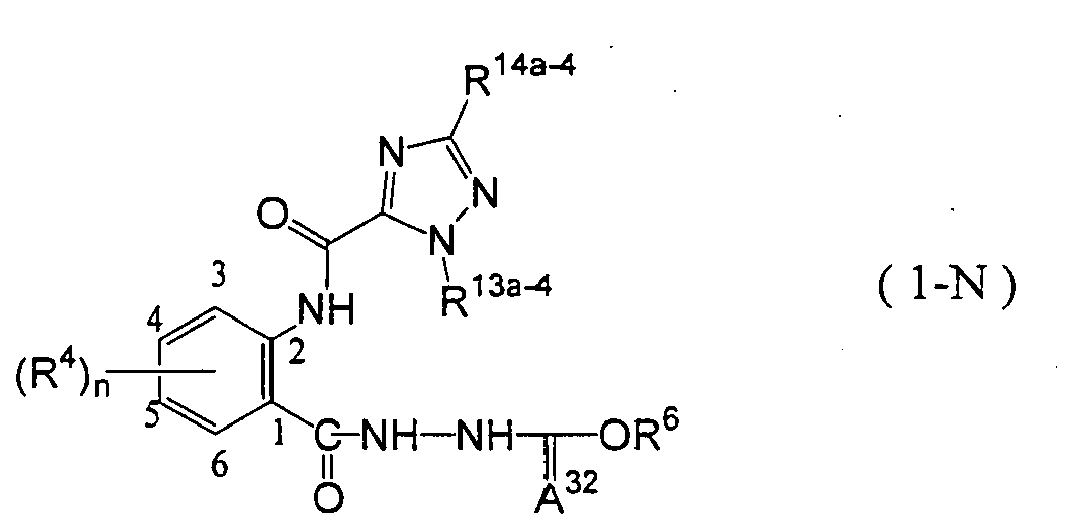
Table 85 R6 A32 (R4)n R13a-4 R14a-4 CH3 O 3-CH3, 5-Cl 3-chloro-2-pyridinyl H CH3 O 3-Br, 5-Cl 3-chloro-2-pyridinyl H CH3 O 3-Br, 5-Br 3-chloro-2-pyridinyl H CH3 O 3-CH3, 5-CN 3-chloro-2-pyridinyl H CH3 O 3-CH3, 5-Cl 3-chloro-2-pyridinyl Cl CH3 O 3-Br, 5-Cl 3-chloro-2-pyridinyl Cl CH3 O 3-Br, 5-Br 3-chloro-2-pyridinyl Cl CH3 O 3-CH3, 5-CN 3-chloro-2-pyridinyl Cl CH3 O 3-CH3, 5-Cl 3-chloro-2-pyridinyl Br CH3 O 3-Br, 5-Cl 3-chloro-2-pyridinyl Br CH3 O 3-Br, 5-Br 3-chloro-2-pyridinyl Br CH3 O 3-CH3, 5-CN 3-chloro-2-pyridinyl Br CH3 O 3-CH3, 5-Cl 3-chloro-2-pyridinyl CF3 CH3 O 3-Br, 5-Cl 3-chloro-2-pyridinyl CF3 CH3 O 3-Br, 5-Br 3-chloro-2-pyridinyl CF3 CH3 O 3-CH3, 5-CN 3-chloro-2-pyridinyl CF3 CH2CH3 O 3-CH3, 5-Cl 3-chloro-2-pyridinyl H CH2CH3 O 3-Br, 5-Cl 3-chloro-2-pyridinyl H CH2CH3 O 3-Br, 5-Br 3-chloro-2-pyridinyl H CH2CH3 O 3-CH3, 5-CN 3-chloro-2-pyridinyl H CH2CH3 O 3-CH3, 5-Cl 3-chloro-2-pyridinyl Cl CH2CH3 O 3-Br, 5-Cl 3-chloro-2-pyridinyl Cl CH2CH3 O 3-Br, 5-Br 3-chloro-2-pyridinyl Cl CH2CH3 O 3-CH3, 5-CN 3-chloro-2-pyridinyl Cl CH2CH3 O 3-CH3, 5-Cl 3-chloro-2-pyridinyl Br CH2CH3 O 3-Br, 5-Cl 3-chloro-2-pyridinyl Br CH2CH3 O 3-Br, 5-Br 3-chloro-2-pyridinyl Br CH2CH3 O 3-CH3, 5-CN 3-chloro-2-pyridinyl Br CH2CH3 O 3-CH3, 5-Cl 3-chloro-2-pyridinyl CF3 CH2CH3 O 3-Br, 5-Cl 3-chloro-2-pyridinyl CF3 CH2CH3 O 3-Br, 5-Br 3-chloro-2-pyridinyl CF3 CH2CH3 O 3-CH3, 5-CN 3-chloro-2-pyridinyl CF3 - A compound represented by the formula (1-Q):

Table 86 R6 A32 (R4)n R14bz-1 R14by-1 R13b-1 CH3 O 3-CH3, 5-Cl 2-chlorophenyl H CH3 CH3 O 3-Br, 5-Cl 2-chlorophenyl H CH3 CH3 O 3-Br, 5-Br 2-chlorophenyl H CH3 CH3 O 3-CH3, 5-CN 2-chlorophenyl H CH3 CH3 O 3-CH3, 5-Cl 3-chloro-2-pyridinyl H CH3 CH3 O 3-Br, 5-Cl 3-chloro-2-pyridinyl H CH3 CH3 O 3-Br, 5-Br 3-chloro-2-pyridinyl H CH3 CH3 O 3-CH3, 5-CN 3-chloro-2-pyridinyl H CH3 CH3 O 3-CH3, 5-Cl H 2-chlorophenyl CH3 CH3 O 3-Br, 5-Cl H 2-chlorophenyl CH3 CH3 O 3-Br, 5-Br H 2-chlorophenyl CH3 CH3 O 3-CH3, 5-CN H 2-chlorophenyl CH3 CH3 O 3-CH3, 5-Cl H 3-chloro-2-pyridinyl CH3 CH3 O 3-Br, 5-Cl H 3-chloro-2-pyridinyl CH3 CH3 O 3-Br, 5-Br H 3-chloro-2-pyridinyl CH3 CH3 O 3-CH3, 5-CN H 3-chloro-2-pyridinyl CH3 CH3 O 3-CH3, 5-Cl 2-chlorophenyl H C(CH3)3 CH3 O 3-Br, 5-Cl 2-chlorophenyl H C(CH3)3 CH3 O 3-Br, 5-Br 2-chlorophenyl H C(CH3)3 CH3 O 3-CH3, 5-CN 2-chlorophenyl H C(CH3)3 CH3 O 3-CH3, 5-Cl 3-chloro-2-pyridinyl H C(CH3)3 CH3 O 3-Br, 5-Cl 3-chloro-2-pyri-dinyl H C(CH3)3 CH3 O 3-Br, 5-Br 3-chloro-2-pyridinyl H C(CH3)3 CH3 O 3-CH3, 5-CN 3-chloro-2-pyridinyl H C(CH3)3 CH3 O 3-CH3, 5-Cl H 2-chlorophenyl C(CH3)3 CH3 O 3-Br, 5-Cl H 2-chlorophenyl C(CH3)3 CH3 O 3-Br, 5-Br H 2-chlorophenyl C(CH3)3 CH3 O 3-CH3, 5-CN H 2-chlorophenyl C(CH3)3 CH3 O 3-CH3, 5-Cl H 3-chloro-2-pyridinyl C(CH3)3 CH3 O 3-Br, 5-Cl H 3-chloro-2-pyridinyl C(CH3)3 CH3 O 3-Br, 5-Br H 3-chloro-2-pyridinyl C(CH3)3 CH3 O 3-CH3, 5-CN H 3-chloro-2-pyridinyl C(CH3)3 Table 87 R6 A32 (R4)n R14bz-1 R14by-1 R13b-1 CH3 O 3-CH3, 5-Cl 2-chlorophenyl H CH2CF3 CH3 O 3-Br, 5-Cl 2-chlorophenyl H CH2CF3 CH3 O 3-Br, 5-Br 2-chlorophenyl H CH2CF3 CH3 O 3-CH3, 5-CN 2-chlorophenyl H CH2CF3 CH3 O 3-CH3, 5-Cl 3-chloro-2-pyridinyl H CH2CF3 CH3 O 3-Br, 5-Cl 3-chloro-2-pyridinyl H CH2CF3 CH3 O 3-Br, 5-Br 3-chloro-2-pyridinyl H CH2CF3 CH3 O 3-CH3, 5-CN 3-chloro-2-pyridinyl H CH2CF3 CH3 O 3-CH3, 5-Cl H 2-chlorophenyl CH2CF3 CH3 O 3-Br, 5-Cl H 2-chlorophenyl CH2CF3 CH3 O 3-Br, 5-Br H 2-chlorophenyl CH2CF3 CH3 O 3-CH3, 5-CN H 2-chlorophenyl CH2CF3 CH3 O 3-CH3, 5-Cl H 3-chloro-2-pyridinyl CH2CF3 CH3 O 3-Br, 5-Cl H 3-chloro-2-pyridinyl CH2CF3 CH3 O 3-Br, 5-Br H 3-chloro-2-pyridinyl CH2CF3 CH3 O 3-CH3, 5-CN H 3-chloro-2-pyridinyl CH2CF3 CH2CH3 O 3-CH3, 5-Cl 2-chlorophenyl H CH3 CH2CH3 O 3-Br, 5-Cl 2-chlorophenyl H CH3 CH2CH3 O 3-Br, 5-Br 2-chlorophenyl H CH3 CH2CH3 O 3-CH3, 5-CN 2-chlorophenyl H CH3 CH2CH3 O 3-CH3, 5-Cl 3-chloro-2-pyridinyl H CH3 CH2CH3 O 3-Br, 5-Cl 3-chloro-2-pyridinyl H CH3 CH2CH3 O 3-Br, 5-Br 3-chloro-2-pyridinyl H CH3 CH2CH3 O 3-CH3, 5-CN 3-chloro-2-pyridinyl H CH3 CH2CH3 O 3-CH3, 5-Cl H 2-chlorophenyl CH3 CH2CH3 O 3-Br, 5-Cl H 2-chlorophenyl CH3 CH2CH3 O 3-Br, 5-Br H 2-chlorophenyl CH3 CH2CH3 O 3-CH3, 5-CN H 2-chlorophenyl CH3 CH2CH3 O 3-CH3, 5-Cl H 3-chloro-2-pyridinyl CH3 CH2CH3 O 3-Br, 5-Cl H 3-chloro-2-pyridinyl CH3 CH2CH3 O 3-Br, 5-Br H 3-chloro-2-pyridinyl CH3 CH2CH3 O 3-CH3, 5-CN H 3-chloro-2-pyridinyl CH3 Table 88 R6 A32 (R4)n R140z-1 R140y-1 R13b-1 CH2CH3 O 3-CH3, 5-Cl 2-chlorophenyl H C(CH3)3 CH2CH3 O 3-Br, 5-Cl 2-chlorophenyl H C(CH3)3 CH2CH3 O 3-Br, 5-Br 2-chlorophenyl H C(CH3)3 CH2CH3 O 3-CH3, 5-CN 2-chlorophenyl H C(CH3)3 CH2CH3 O 3-CH3, 5-Cl 3-chloro-2-pyridinyl H C(CH3)3 CH2CH3 O 3-Br, 5-Cl 3-chloro-2-pyridinyl H C(CH3)3 CH2CH3 O 3-Br, 5-Br 3-chloro-2-pyridinyl H C(CH3)3 CH2CH3 O 3-CH3, 5-CN 3-chloro-2-pyridinyl H C(CH3)3 CH2CH3 O 3-CH3, 5-Cl H 2-chlorophenyl C(CH3)3 CH2CH3 O 3-Br, 5-Cl H 2-chlorophenyl C(CH3)3 CH2CH3 O 3-Br, 5-Br H 2-chlorophenyl C(CH3)3 CH2CH3 O 3-CH3, 5-CN H 2-chlorophenyl C(CH3)3 CH2CH3 O 3-CH3, 5-Cl H 3-chloro-2-pyridinyl C(CH3)3 CH2CH3 O 3-Br, 5-Cl H 3-chloro-2-pyridinyl C(CH3)3 CH2CH3 O 3-Br, 5-Br H 3-chloro-2-pyridinyl C(CH3)3 CH2CH3 O 3-CH3, 5-CN H 3-chloro-2-pyridinyl C(CH3)3 CH2CH3 O 3-CH3, 5-Cl 2-chlorophenyl H CH2CF3 CH2CH3 O 3-Br, 5-Cl 2-chlorophenyl H CH2CF3 CH2CH3 O 3-Br, 5-Br 2-chlorophenyl H CH2CF3 CH2CH3 O 3-CH3, 5-CN 2-chlorophenyl H CH2CF3 CH2CH3 O 3-CH3, 5-Cl 3-chloro-2-pyridinyl H CH2CF3 CH2CH3 O 3-Br, 5-Cl 3-chloro-2-pyridinyl H CH2CF3 CH2CH3 O 3-Br, 5-Br 3-chloro-2-pyridinyl H CH2CF3 CH2CH3 O 3-CH3, 5-CN 3-chloro-2-pyridinyl H CH2CF3 CH2CH3 O 3-CH3, 5-Cl H 2-chlorophenyl CH2CF3 CH2CH3 O 3-Br, 5-Cl H 2-chlorophenyl CH2CF3 CH2CH3 O 3-Br, 5-Br H 2-chlorophenyl CH2CF3 CH2CH3 O 3-CH3, 5-CN H 2-chlorophenyl CH2CF3 CH2CH3 O 3-CH3, 5-Cl H 3-chloro-2-pyridinyl CH2CF3 CH2CH3 O 3-Br, 5-Cl H 3-chloro-2-pyridinyl CH2CF3 CH2CH3 O 3-Br, 5-Br H 3-chloro-2-pyridinyl CH2CF3 CH2CH3 O 3-CH3, 5-CN H 3-chloro-2-pyridinyl CH2CF3 Table 89 R6 A32 (R4)n R14bz-1 R14by-1 R13b-1 CH3 O 3-CH3, 5-Cl 2-chlorophenyl H CHF2 CH3 O 3-Br, 5-Cl 2-chlorophenyl H CHF2 CH3 O 3-Br, 5-Br 2-chlorophenyl H CHF2 CH3 O 3-CH3, 5-CN 2-chlorophenyl H CHF2 CH3 O 3-CH3, 5-Cl 3-chloro-2-pyridinyl H CHF2 CH3 O 3-Br, 5-Cl 3-chloro-2-pyridinyl H CHF2 CH3 O 3-Br, 5-Br 3-chloro-2-pyridinyl H CHF2 CH3 O 3-CH3, 5-CN 3-chloro-2-pyridinyl H CHF2 CH3 O 3-CH3, 5-Cl H 2-chlorophenyl CHF2 CH3 O 3-Br, 5-Cl H 2-chlorophenyl CHF2 CH3 O 3-Br, 5-Br H 2-chlorophenyl CHF2 CH3 O 3-CH3, 5-CN H 2-chlorophenyl CHF2 CH3 O 3-CH3, 5-Cl H 3-chloro-2-pyridinyl CHF2 CH3 O 3-Br, 5-Cl H 3-chloro-2-pyridinyl CHF2 CH3 O 3-Br, 5-Br H 3-chloro-2-pyridinyl CHF2 CH3 O 3-CH3, 5-CN H 3-chloro-2-pyridinyl CHF2 CH3 O 3-CH3, 5-Cl 2-chlorophenyl H CBrF2 CH3 O 3-Br, 5-Cl 2-chlorophenyl H CBrF2 CH3 O 3-Br, 5-Br 2-chlorophenyl H CBrF2 CH3 O 3-CH3, 5-CN 2-chlorophenyl H CBrF2 CH3 O 3-CH3, 5-Cl 3-chloro-2-pyridinyl H CBrF2 CH3 O 3-Br, 5-Cl 3-chloro-2-pyridinyl H CBrF2 CH3 O 3-Br, 5-Br 3-chloro-2-pyridinyl H - CBrF2 CH3 O 3-CH3, 5-CN 3-chloro-2-pyridinyl H CBrF2 CH3 O 3-CH3, 5-Cl H 2-chlorophenyl CBrF2 CH3 O 3-Br, 5-Cl H 2-chlorophenyl CBrF2 CH3 O 3-Br, 5-Br H 2-chlorophenyl CBrF2 CH3 O 3-CH3, 5-CN H 2-chlorophenyl CBrF2 CH3 O 3-CH3, 5-Cl H 3-chloro-2-pyridinyl CBrF2 CH3 O 3-Br, 5-Cl H 3-chloro-2-pyridinyl CBrF2 CH3 O 3-Br, 5-Br H 3-chloro-2-pyridinyl CBrF2 CH3 O 3-CH3, 5-CN H 3-chloro-2-pyridinyl CBrF2 - Examples of the pests against which the present compound has controlling efficacy include harmful arthropods such as harmful insects and harmful mites, and nemathelminths such as nematodes, and specific examples are as shown below.
- Planthoppers (Delphacidae) such as small brown planthopper (Laodelphax striatellus), brown rice planthopper (Nilaparvata lugens), and white-backed rice planthopper (Sogatella furcifera); leafhoppers (Deltocephalidae) such as green rice leafhopper (Nephotettix cincticeps), green rice leafhopper (Nephotettix virescens), and tea green leafhopper (Empoasca onukii); aphids (Aphididae) such as cotton aphid (Aphis gossypii), green peach aphid (Myzus persicae), cabbage aphid (Brevicoryne brassicae), spiraea aphid (Aphis spiraecola), potato aphid (Macrosiphum euphorbiae), foxglove aphid (Aulacorthum solani), oat bird-cherry aphid (Rhopalosiphum padi), tropical citrus aphid (Toxoptera citricidus), and mealy plum aphid (Hyalopterus pruni); stink bugs (Pentatomidae) such as green stink bug (Nezara antennata), bean bug (Riptortus clavetus), rice bug (Leptocorisa chinensis), white spotted spined bug (Eysarcoris parvus), and stink bug (Halyomorpha mista); whiteflies (Aleyrodidae) such as greenhouse whitefly (Trialeurodes vaporariorum), sweetpotato whitefly (Bemisia tabaci), silver leaf whitefly (Bemisia argentifolii), citrus whitefly (Dialeurodes citri), and citrus spiny white fly (Aleurocanthus spiniferus); scales (Coccidae) such as Calfornia red scale (Aonidiella aurantii), San Jose scale (Comstockaspis perniciosa), citrus north scale (Unaspis citri), red wax scale (Ceroplastes rubens), cottonycushion scale (Icerya purchasi), Japanese mealybug (Planococcus kraunhiae), Cosmstock mealybug (Pseudococcus longispinis), and white peach scale (Pseudaulacaspis pentagona); lace bags (Tingidae); psyllids (Psyllidae); etc.
- Pyralid moths (Pyralidae) such as rice stem borer (Chilo suppressalis), yellow rice borer (Tryporyza incertulas), rice leafroller (Cnaphalocrocis medinalis), cotton leafroller (Notarcha derogata), Indian meal moth (Plodia interpunctella), oriental corn borer (Ostrinia furnacalis), cabbage webworm (Hellula undalis), and bluegrass webworm (Pediasia teterrellus); owlet moths (Noctuidae) such as common cutworm (Spodoptera litura), beet armyworm (Spodoptera exigua), armyworm (Pseudaletia separata), cabbage armyworm (Mamestra brassicae), black cutworm (Agrotis ipsilon), beet semi-looper (Plusia nigrisigna), Thoricoplusia spp., Heliothis spp., and Helicoverpa spp.; whites and sulfer butterflies (Pieridae) such as common white (Pieris rapae); tortricid moths (Tortricidae) such as Adoxophyes spp., oriental fruit moth (Grapholita molesta), soybean pod borer (Leguminivora glycinivorella), azuki bean podworm (Matsumuraeses azukivora), summer fruit tortrix (Adoxophyes orana fasciata), Adoxophyes sp., oriental tea tortrix (Homona magnanima), apple tortrix (Archips fuscocupreanus), and Cydia pomonella; leafblotch miners (Gracillariidae) such as tea leafroller (Caloptilia theivora), and apple leafminer (Phyllonorycter ringoneella); Carposinidae such as peach fruit moth (Carposina niponensis); lyonetiid moths (Lyonetiidae) such as Lyonetia spp.; tussock moths (Lymantriidae) such as Lymantria spp., and Euproctis spp.; yponomeutid moths (Yponomeutidae) such as diamondback (Plutella xylostella); gelechiid moths (Gelechiidae) such as pink bollworm (Pectinophora gossypiella), and potato tubeworm (Phthorimaea operculella); tiger moths and allies (Arctiidae) such as fall webworm (Hyphantria cunea); tineid moths (Tineidae) such as casemaking clothes moth (Tinea translucens), and webbing clothes moth (Tineola bisselliella); etc.
- Thrips (Thripidae) such as yellow citrus thrips (Frankliniella occidentalis), Thrips parmi, yellow tea thrips (Scirtothrips dorsalis), onion thrip (Thrips tabaci), flower thrips (Frankliniella intonsa), etc.
- Housefly (Musca domestica), common mosquito (Culex popiens pallens), horsefly (Tabanus trigonus), onion maggot (Hylemya antiqua), seedcorn maggot (Hylemya platura), Anopheles sinensis, rice leafminer (Agromyza oryzae), rice leafminer (Hydrellia griseola), rice stem maggot (Chlorops oryzae), melon fly (Dacus cucurbitae), Ceratitis capitata, legume leafminer (Liriomyza trifolii), tomato leafminer (Liriomyza sativae), garden pea leafminer (Chromatomyia horticola), etc.
- Twenty-eight-spotted ladybird (Epilachna vigintioctopunctata), cucurbit leaf beetle (Aulacophora femoralis), striped flea beetle (Phyllotreta striolata), rice leaf beetle (Oulema oryzae), rice curculio (Echinocnemus squameus), rice water weevil (Lissorhoptrus oryzophilus), Anthonomus grandis, azuki bean weevil (Callosobruchus chinensis), Sphenophorus venatus, Japanese beetle (Popillia japonica), cupreous chafer (Anomala cuprea), corn root worm (Diabrotica spp.), Colorado beetle (Leptinotarsa decemlineata), click beetle (Agriotes spp.), cigarette beetle (Lasioderma serricorne), varied carper beetle (Anthrenus verbasci), red flour beetle (Tribolium castaneum), powder post beetle (Lyctus brunneus), white-spotted longicorn beetle (Anoplophora malasiaca), pine shoot beetle (Tomicus piniperda), etc.
- Asiatic locust (Locusta migratoria), African mole cricket (Gryllotalpa africana), rice grasshopper (Oxya yezoensis), rice grasshopper (Oxya japonica), etc.
- Cabbage sawfly (Athalia rosae), Acromyrmex spp., fire ant (Solenopsis spp.), etc.
- Rice white-tip nematode (Aphelenchoides besseyi), strawberry bud nematode (Nothotylenchus acris), southern root-knot nematode (Meloidogyne incognita), northern root-knot nematode (Meloidogyne hapla), Javanese root-knot nematode (Meloidogyne javanica), soybean cyst nematode (Heterodera glycines), potato cyst nematode (Globodera rostochiensis), coffee root-lesion nematode (Pratylenchus coffeae), California root-lesion nematode (Pratylenchus neglectus), etc.
- German cockroach (Blattella germanica), smokybrown cockroach (Periplaneta fuliginosa), American cockroach (Periplaneta americana), Periplaneta brunnea, oriental cockroach (Blatta orientalis), etc.
- Spider mites (Tetranychidae) such as two-spotted spider mite (Tetranychus urticae), Kanzawa spider mite (Tetranychus kanzawai), citrus red mite (Panonychus citri), European red mite (Panonychus ulmi), and Oligonychus spp.; eriophyid mites (Eriophyidae) such as pink citrus rust mite (Aculops pelekassi), pink citrus rust mite (Phyllocoptruta citri), tomato rust mite (Aculops lycopersici), purple tea mite (Calacarus carinatus), pink tea rust mite (Acaphylla theavagran), and Eriophyes chibaensis; tarosonemid mites (Tarsonemidae) such as broad mite (Polyphagotarsonemus latus); false spider mites (Tenuipalpidae) such as Brevipalpus phoenicis; Tuckerellidae; ticks (Ixodidae) such as Haemaphysalis longicornis, Haemaphysalis flava, Dermacentor taiwanicus, Ixodes ovatus, Ixodes persulcatus, Boophilus microplus, and Rhipicephalus sanguineus; acarid mites (Acaridae) such as mold mite (Tyrophagus putrescentiae), and Tyrophagus similis; house dust mites (Pyroglyphidae) such as Dermatophagoides farinae, and Dermatophagoides ptrenyssnus; cheyletide mites (Cheyletidae) such as Cheyletus eruditus, Cheyletus malaccensis, and Cheyletus moorei; parasitoid mites (Dermanyssidae); etc.
- The pesticide of the present invention may be the present compound itself but, usually, the present compound is mixed with an inert carrier such as a solid carrier, a liquid carrier, a gaseous carrier and the like and, if necessary, a surfactant, and other preparation additives are added to formulate into a composition or a preparation such as an emulsion, oil, powder, granules, a wettable preparation, a flowable preparation, microcapsules, an aerosol, a fumigant, poison bait, a resin preparation or the like. These compositions or preparations usually contain 0.01 to 95% by weight of the present compound.
- Examples of the solid carrier to be used include fine powders and granules such as clays (kaolin clay, diatomaceous earth, bentonite, fubasami clay, acid clay, etc.), synthetic hydrous silicon oxide, talc, ceramic, other inorganic minerals (sericite, quartz, sulfur, active carbon, calcium carbonate, hydrated silica, etc.), chemical fertilizers (ammonium sulfate, ammonium phosphate, ammonium nitrate, urea, ammonium chloride, etc.) and the like.
- Examples of the liquid carrier include water, alcohols (methanol, ethanol, isopropyl alcohol, butanol, hexanol, benzyl alcohol, ethylene glycol, propylene glycol, phenoxyethanol, etc.), ketones (acetone, methyl ethyl ketone, cyclohexanone, etc.), aromatic hydrocarbons (toluene, xylene, ethylbenzene, dodecylbenzene, phenylxylylethane, methylnaphthalene, etc.), aliphatic hydrocarbons (hexane, cyclohexane, kerosene, gas oil, etc.), esters (ethyl acetate, butyl acetate, isopropyl myristate, ethyl oleate, diisopropyl adipate, diisobutyl adipate, propylene glycol monomethyl ether acetate, etc.), nitriles (acetonitrile, isobutyronitrile, etc.), ethers (diisopropyl ether, 1,4-dioxane, ethylene glycol dimethyl ether, diethylene glycol dimethyl ether, diethylene glycol monomethyl ether, propylene glycol monomethyl ether, dipropylene glycol monomethyl ether, 3-methoxyl-3-methyl-1-butanol, etc.), acid amides (N,N-dimethylformamide, N, N-dimethylacetamide, etc.), halogenated hydrocarbons (dichloromethane, trichloroethane, carbon tetrachloride, etc.), sulfoxides (dimethyl sulfoxide, etc.), carbonic propylene and vegetable oils (soybean oil, cottonseed oil, etc.).
- Examples of the gaseous carrier include fluorocarbon, butane gas, LPG (liquefied petroleum gas), dimethyl ether, and carbonic acid gas.
- Examples of the surfactant include nonionic surfactants such as polyoxyethylene alkyl ether, polyoxyethylene alkyl aryl ether, polyethylene glycol fatty acid ester, and the like, and anionic surfactants such as alkyl sulfonate salts, alkylbenzene sulfonate salts and alkyl sulfate salts.
- Examples of other preparation additives include binders, dispersing agents, coloring agents and stabilizers, specifically, casein, gelatin, sugars (starch, gum arabic, cellulose derivatives, alginic acid, etc.), lignin derivatives, bentonite, synthetic water-soluble polymers (polyvinyl alcohol, polyvinylpyrrolidone, polyacrylic acids, etc.), PAP (acidic isopropyl phosphate), BHT (2,6-di-tert-butyl-4-methylphenol), and BHA(a mixture of 2-tert-butyl-4-methoxyphenol and 3-tert-butyl-4-methoxyphenol).
- The method of controlling a pest of the present invention is usually performed by applying the pesticide of the present invention directly to a pest or to a place where a pest inhabits (plant, soil, in house, animal, etc.).
- When the pesticide of the present invention is used for controlling a pest in the agricultural field, an amount to be applied is usually 1 to 10,000 g per 10,000 m2 in terms of the amount of the present compound. When the pesticide of the present invention is formulated into an emulsion, a wettable preparation, a flowable preparation or the like, usually, the agent is applied by diluting with water so that the active ingredient concentration becomes 0.01 to 10,000 ppm, and granules, powder or the like are usually applied as they are.
- These preparations, or preparations diluted with water may be directly applied to a pest or to a plant such as a crop to be protected against a pest, or may be applied to soil of a cultivated land in order to control a pest inhabiting in the soil.
- Alternatively, treatment may be performed for example, by winding a sheet-like or string-like-processed resin preparation on a crop, surrounding a crop with the resin preparation, or laying the resin preparation on soil about roots of a crop.
- When the pesticide of the present invention is used for controlling a pest which inhabits in a house (e.g. fly, mosquito, cockroach, etc.), the amount to be applied is usually 0.01 to 1000 mg per 1 m2 of treating area in terms of the amount of the present compound in case of surface treatment, and is usually 0.01 to 500 mg per 1 m3 of treating space in terms of the amount of the present of compound in case of spatial treatment. When the pesticide of the present invention is formulated into an emulsion, a wettable preparation, a flowable preparation or the like, usually, the agent is applied by diluting with water so that the active ingredient concentration becomes 0.1 to 1000 ppm, and oil, an aerosol, a fumigant, poison bait or the like is applied as it is.
- The pesticide of the present invention may contain other harmful arthropod controlling agents, acaricides, nematicides, fungicides, herbicides, plant growth regulators, synergists, fertilizers, soil conditioners, animal feeds, and the like.
- As the active ingredients of the aforementioned other harmful arthropod controlling agents, acaricides and/or nematicides, for example, the following compounds can be mentioned.
- Acephate, aluminium phosphide, butathiofos, cadusafos, chlorethoxyfos, chlorfenvinphos, chlorpyrifos, chlorpyrifos-methyl, cyanophos: CYAP, diazinon, DCIP (dichlorodiisopropyl ether), dichlofenthion: ECP, dichlorvos: DDVP, dimethoate, dimethylvinphos, disulfoton, EPN, ethion, ethoprophos, etrimfos, fenthion: MPP, fenitrothion: MEP, fosthiazate, formothion, hydrogen phosphide, isofenphos, isoxathion, malathion, mesulfenfos, methidathion: DMTP, monocrotophos, naled: BRP, oxydeprofos:ESP, parathion, phosalone, phosmet: PMP, pirimiphos-methyl, pyridafenthion, quinalphos, phenthoate: PAP, profenofos, propaphos, prothiofos, pyraclorfos, salithion, sulprofos, tebupirimfos, temephos, tetrachlorvinphos, terbufos, thiometon, trichlorphon:DEP, vamidothion, and the like.
- Alanycarb, bendiocarb, benfuracarb, BPMC, carbaryl, carbofuran, carbosulfan, cloethocarb, ethiofencarb, fenobucarb, fenothiocarb, fenoxycarb, furathiocarb, isoprocarb:MIPC, metolcarb, methomyl, methiocarb, NAC, oxamyl, pirimicarb, propoxur: PHC, XMC, thiodicarb, xylylcarb, and the like.
- Acrinathrin, allethrin, benfluthrin, beta-cyfluthrin, bifenthrin, cycloprothrin, cyfluthrin, cyhalothrin, cypermethrin, deltamethrin, esfenvalerate, ethofenprox, fenpropathrin, fenvalerate, flucythrinate, flufenoprox, flumethrin, fluvalinate, halfenprox, imiprothrin, permethrin, prallethrin, pyrethrins, resmethrin, sigma-cypermethrin, silafluofen, tefluthrin, tralomethrin, transfluthrin, 2,3,5,6-tetrafluoro-4-(methoxymethyl)benzyl (EZ)-(1RS, 3RS;1RS,3SR)-2,2-dimethyl-3-prop-1-enylcyclopropanecarboxyl ate, 2,3,5,6-tetrafluoro-4-methylbenzyl (EZ)-(1RS,3RS;1RS,3SR)-2,2-dimethyl-3-prop-1-enylcyclopropa necarboxylate, 2,3,5,6-tetrafluoro-4-(methoxymethyl)benzyl (1RS,3RS;1RS,3SR)-2,2-dimethyl-3-(2-methyl-1-propenyl)cyclo propanecarboxylate, and the like.
- Cartap, bensultap, thiocyclam, monosultap, bisultap, and the like.
- Imidacloprid, nitenpyram, acetamiprid, thiamethoxam, thiacloprid, dinotefuran, clothianidin, and the like.
- Chlorfluazuron, bistrifluron, diafenthiuron, diflubenzuron, fluazuron, flucycloxuron, flufenoxuron, hexaflumuron, lufenuron, novaluron, noviflumuron, teflubenzuron, triflumuron, and the like.
- Acetoprole, ethiprole, fiproni1, vaniliprole, pyriprole, pyrafluprole, and the like.
- Viable endospores derived from Bacillus thuringiensis and crystalline toxins produced by it, as well as a mixture of thereof.
- Chromafenozide, halofenozide, methoxyfenozide, tebufenozide, and the like.
- Aldrin, dieldrin, dienochlor, endosulfan, methoxychlor, and the like.
- Machine oil, nicotine-sulfate, and the like.
- Avermectin-B, bromopropylate, buprofezin, chlorphenapyr, cyromazine, 1, 3-Dichloropropene, emamectin-benzoate, fenazaquin, flupyrazofos, hydroprene, indoxacarb, metoxadiazone, milbemycin-A, pymetrozine, pyridalyl, pyriproxyfen, spinosad, sulfluramid, tolfenpyrad, triazamate, flubendiamide, SI-0009, cyflumetofen, arsenic acid, benclothiaz, calcium cyanamide, calcium polysulfide, chlordane, DDT, DSP, flufenerim, flonicamid, flurimfen, formetanate, metam-ammonium, metam-sodium, Methyl bromide, nidinotefuran, Potassium oleate, protrifenbute, spiromesifen, sulfur, metaflumizone, spirotetramat, and the like.
- Acequinocyl, amitraz, benzoximate, bromopropylate, chinomethionat, chlorobenzilate, CPCBS(chlorfenson), clofentezine, Kelthane(dicofol), etoxazole, fenbutatin oxide, fenothiocarb, fenpyroximate, fluacrypyrim, fluproxyfen, hexythiazox, propargite:BPPS, polynactins, pyridaben, Pyrimidifen, tebufenpyrad, tetradifon, spirodiclofen, amidoflumet, Bifenazate, Cyflumetofen, and the like. Nematicides (nematicidal active ingredients)
- DCIP, fosthiazate, levamisol, methyisothiocyanate, morantel tartarate, and the like.
- The present invention will be explained in more detail below by way of Preparation Examples, Formulation Examples, Test Examples, but the present invention is not limited to these Examples.
- First, Preparation Examples of the present compound will be explained.
- A mixture of 0.22 g of N-(2-aminobenzoyl)-N'-ethoxycarbonylhydrazine, 0.31 g of 1-(3-chloro-2-pyridinyl)-3-trifluoromethyl-1H-pyrazole-5-carbonyl chloride and 10 ml of pyridine was stirred at room temperature for 2 hours. Water was poured into the reaction mixture, and a deposited precipitate was collected by filtration to obtain 0.13 g of the present compound (1) of the formula:

1H-NMR(CDCl3,TMS)δ(ppm):1.35(3H,t,J=8Hz),4.29(2H,q,J=8Hz), 6.85(1H,brs),7.10(1H,t,J=8Hz),7.24(1H,s),7.44(1H,t,J=8Hz), 7.47(1H,dd,J=8Hz,4Hz),7.62(1H,d,J=8Hz),7.93(1H,d,J=4Hz), 8.42(1H,brs),8.46(1H,d,J=8Hz),8.52(1H,d,J=8Hz),11.86(1H, brs) - A mixture of 0.13 g of 1-methyl-1H-pyrrole-2-carboxylic acid, 0.15 g of thionyl chloride and 5 ml of hexane was heated under reflux for 2 hours. The reaction mixture was concentrated under reduced pressure to obtain 0.14 g of 1-methyl-1H-pyrrole-2-carbonyl chloride. To a mixture of 0.22 g of N-(2-aminobenzoyl)-N'-ethoxycarbonylhydrazine and 10 ml of pyridine was added 0.14 g of the resulting 1-methyl-1H-pyrrole-2-carbonyl chloride, and the mixture was stirred at room temperature for 2 hours. Water was poured into the reaction mixture, and a deposited precipitate was collected by filtration to obtain 0.11 g of the present compound (2) of the formula:

1H-NMR (DMSO-d6, TMS)δ(ppm):1.02-1.28(3H,m),3.91(3H,s), 4.00-4.16(2H,m),6.1(1H,d,J=4Hz),6.78(1H,d,J=4Hz),7.06 (1H,m),7.15(1H,t,J=8Hz),7.56(1H,t,J=8Hz),7.79(1H,d,J=8Hz), 8.57(1H,d,J=8Hz),9.30(1H,brs),10.57(1H,brs),11.63(1H,brs) Preparation Example 3 - A mixture of 0.19 g of 1-methyl-3-trifluoromethyl-1H-pyrazole-5-carboxylic acid, 0.15 g of thionyl chloride and 5 ml of hexane was heated under reflux for 2 hours. The reaction mixture was concentrated under reduced pressure to obtain 0.14 g of 1-methyl-3-trifluoromethyl-1H-pyrazole-5-carbonyl chloride. To a mixture of 0.22 g of N-(2-aminobenzoyl)-N'-ethoxycarbonylhydrazine and 10 ml of pyridine was added 0.14 g of the resulting 1-methyl-3-trifluoromethyl-1H-pyrazole-5-carbonyl chloride and the mixture was stirred at room temperature for 2 hours. Water was poured into the reaction mixture, and a deposited precipitates were collected by filtration to obtain 0.23 g of the present compound (3) of the formula:

1H-NMR(DMSO-d6,TMS)δ(ppm):1.20(3H,t,J=8Hz),4.10(2H,q, J=8Hz),4.19(3H,s),7.17(1H,s),7.28(1H,t,J=8Hz),7.60(1H,t, J=8Hz),7.79(1H,d,J=8Hz),8.37(1H,d,J=8Hz),9.02(1H,brs),10.41 (1H,brs),11.50(1H,brs) - A mixture of 0.22 g of N-[4-chloro-2-(hydrazinocarbonyl)-6-methylphenyl]-1-(3-chloro-2-pyridinyl)-3-trifluoromethyl-1H-pyrazole-5-carboxamide, 0.06 g of ethyl chloroformate and 10 ml of pyridine was stirred at room temperature for 2 hours. Water was poured into the reaction mixture, and a deposited precipitate was collected by filtration to obtain 0. 08 g of the present compound (4) of the formula:

1H-NMR(DMSO-d6,TMS)δ(ppm):0.96-1.26(3H,m),2.16(3H,s), 3.90-4.12(2H,m),7.38(1H,s),7.55(1H,s),7.66(1H,dd,J=8Hz,4Hz) ,7.71(1H,s),8.22(1H,d,J=8Hz),8.53(1H,d,J=4Hz),9.25(1H,brs), 10.14(1H,brs),10.37(1H,brs) - A mixture of 0.22 g of N-[4-chloro-2-(hydrazinocarbonyl)-6-methylphenyl]-1-(3-chloro-2-pyridinyl)-3-trifluoromethyl-1H-pyrazole-5-carboxamide, 0.05 g of methyl chloroformate and 10 ml of pyridine was stirred at room temperature for 2 hours. Water was poured into the reaction mixture, and a deposited precipitate was collected by filtration to obtain 0.16 g of the present compound (5) of the formula:

1H-NMR(DMSO-d6,TMS)δ(ppm):2.16(3H,s),3.62(3H,s),7.39(1H,s), 7.56(1H,s),7.67(1H,dd,J=8Hz,4Hz),7.70(1H,s),8.22(1H,d, J=8Hz),8.54(1H,d,J=4Hz),9.31(1H,brs),10.17(1H,brs),10.38 (1H,brs) - A mixture of 0.22 g of N- [4-chloro-2-(hydrazinocarbonyl) - 6-methylphenyl]-1-(3-chloro-2-pyridinyl)-3-trifluoromethyl-1H-pyrazole-5-carboxamide, 0.05 g of isopropyl chloroformate and 10 ml of pyridine was stirred at room temperature for 2 hours. Water was poured into the reaction mixture, and a deposited precipitate was collected by filtration to obtain 0.21 g of the present compound (6) of the formula:

1H-NMR(DMSO-d6,TMS)δ(ppm):0.97-1.31(6H,m),2.16(3H,s), 4.68-4.89(1H,m),7.38(1H,s),7.55(1H,s),7.66(1H,dd,J=8Hz, 4Hz),7.71(1H,s),8.22(1H,d,J=8Hz),8.53(1H,d,J=4Hz),9.18(1H, brs),10.12(1H,brs),10.37(1H,brs) - A mixture of 0.22 g of N- [4-chloro-2-(hydrazinocarbonyl) - 6-methylphenyl]-1-(3-chloro-2-pyridinyl)-3-trifluoromethyl-1H-pyrazole-5-carboxamide, 0.05 g of cyclopropanecarbonyl chloride and 10 ml of pyridine was stirred at room temperature for 2 hours. Water was poured into the reaction mixture, and a deposited precipitate was collected by filtration to obtain 0.20 g of the present compound (7) of the formula:

1H-NMR(DMSO-d6,TMS)δ(ppm):0.57-0.82(4H,m),1.63-1.73(1H,m), 2.16(3H,s),7.43(1H,s),7.54(1H,s),7.66(1H,dd,J=8Hz,4Hz),7.74 (1H,s),8.22(1H,d,J=8Hz),8.53(1H,d,J=4Hz),10.19(2H,brs), 10.40(1H,brs) - A mixture of 0.22 g of N-[4-chloro-2-(hydrazinocarbonyl)-6-methylphenyl]-1-(3-chloro-2-pyridinyl)-3-trifluoromethyl-1H-pyrazole-5-carboxamide, 0.07 g of benzoyl chloride and 10 ml of pyridine was stirred at room temperature for 2 hours. Water was poured into the reaction mixture, and a deposited precipitate was collected by filtration to obtain 0.15 g of the present compound (8) of the formula:

1H-NMR(DMSO-d6,TMS)δ(ppm):2.18(3H,s),7.48-7.69(5H,m),7.77 (1H,s),7.90-7.96(3H,m),8.22(1H,d,J=8Hz),8.55(1H,d,J=4Hz), 10.36(1H,brs),10.42(1H,brs),10.60(1H,brs) - A mixture of 0.22 g of N- [4-chloro-2-(hydrazinocarbonyl)-6-methylphenyl]-1-(3-chloro-2-pyridinyl)-3-trifluoromethyl-1H-pyrazole-5-carboxamide, 0.07 g of 4-morpholinecarbonyl chloride and 10 ml of pyridine was stirred at room temperature for 2 hours. Water was poured into the reaction mixture, and a deposited precipitate was collected by filtration to obtain 0.12 g of the present compound (9) of the formula:

1H-NMR(DMSO-d6,TMS)δ(ppm):2.15(3H,s),3.22-3.42(4H,m), 3.53-3.63(4H,m),7.44(1H,s),7.53(1H,s),7.66(1H,dd,J=8Hz, 4Hz),7.77(1H,s),8.22(1H,d,J=8Hz),8.54(1H,d,J=4Hz),8.78(1H, brs),9.88(1H,brs),10.33(1H,brs) - A mixture of 0.22 g of N-[4-chloro-2-(hydrazinocarbonyl)-6-methylphenyl]-1-(3-chloro-2-pyridinyl)-3-trifluoromethyl-1H-pyrazole-5-carboxamide, 0.06 g of N,N-dimethylcarbamoyl chloride and 10 ml of pyridine was stirred at room temperature for 2 hours. Water was poured into the reaction mixture, and a deposited precipitate was collected by filtration to obtain 0.13 g of the present compound (10) of the formula:

1H-NMR(DMSO-d6,TMS)δ(ppm):2.14(3H,s),2.86(6H,s),7.42(1H,s), 7.52(1H,s),7.67(1H,dd,J=8Hz,4Hz),7.82(1H,s),8.22 (1H,d,J=8Hz),8.48-8.58(2H,m),9.83(1H,brs),10.31(1H,brs) - A mixture of 0.22 g of N- [4-chloro-2-(hydrazinocarbonyl) - 6-methylphenyl]-1-(3-chloro-2-pyridinyl)-3-trifluoromethyl-1H-pyrazole-5-carboxamide, 0.06 g of N-propyl chloroformate and 10 ml of pyridine was stirred at room temperature for 2 hours. Water was poured into the reaction mixture, and a deposited precipitate was collected by filtration to obtain 0.24 g of the present compound (11) of the formula:

1H-NMR(DMSO-d6,TMS)δ(ppm):0.66-0.98(3H,m),1.37-1.66(2H,m), 2.16(3H,s),3.83-4.08(2H,m),7.38(1H,s),7.55(1H,s),7.66(1H, dd,J=8Hz,4Hz),7.71(1H,s),8.22(1H,d,J=8Hz),8.53(1H,d,J=4Hz), 9.26(1H,brs),10.14(1H,brs),10.37(1H,brs) - A mixture of 0.22 g of N-[4-chloro-2-(hydrazinocarbonyl)-6-methylphenyl]-1-(3-chloro-2-pyridinyl)-3-trifluoromethyl-1H-pyrazole-5-carboxamide, 0.05 g of ethyl isocyanate and 10 ml of tetrahydrofuran was stirred at room temperature for 2 hours. Water was poured into the reaction mixture, and a deposited precipitate was collected by filtration to obtain 0.16 g of the present compound (12) of the formula:

1H-NMR(DMSO-d6,TMS)δ(ppm):1.12(3H,t,J=6Hz),2.18(3H,s),3.78 (2H,q,J=6Hz),6.34(1H,m),7.48(1H,s),7.54(1H,s),7.65-7.69(2H, m),7.74(1H,brs),8.23(1H,d,J=8Hz),8.54(1H,d,J=4Hz),9.99(1H, brs),10.34(1H,brs) - A mixture of 0.22 g of N-[4-chloro-2-(hydrazinocarbonyl)-6-methylphenyl]-1-(3-chloro-2-pyridinyl)-3-trifluoromethyl-1H-pyrazole-5-carboxamide, 0.07 g of phenyl isocyanate and 10 ml of tetrahydrofuran was stirred at room temperature for 2 hours. Water was poured into the reaction mixture, and a deposited precipitates were collected by filtration to obtain 0.12 g of the present compound (13) of the formula:

1H-NMR(DMSO-d6,TMS)δ(ppm):2.18(3H,s),6.93-7.00(2H,m),7.21-7.31(2H,m),7.40-7.47(2H,m),7.51(1H,s),7.54-7.58(1H,m),7.66 (1H,dd,J=8Hz,4Hz),7.71(1H,s),8.22(1H,d,J=8Hz),8.53(1H,d, J=4Hz),8.73(1H,brs),10.18(1H,brs),10.40(1H,brs) - A mixture of 0.24 g of N-(2-methylaminobenzoyl)-N'-ethoxycarbonylhydrazine, 0.31 g of 1-(3-chloro-2-pyridinyl)-3-trifluoromethyl-1H-pyrazole-5-carbonyl chloride and 10 ml of pyridine was stirred at room temperature for 2 hours. Water was poured into the reaction mixture, and a deposited precipitate was collected by filtration to obtain 0.20 g of the present compound (14) of the formula:

1H-NMR(DMSO-d6,TMS)δ(ppm):1.06-1.27(3H,m),3.18(3H,s),4.01-4.16(2H,m),6.34(1H,s),7.31-7.37(1H,m),7.53-7.61(3H,m),7.71 (1H,dd,J=8Hz,4Hz),8.31(1H,d,J=8Hz),8.62(1H,d,J=4Hz),9.33 (1H,brs),10.44(1H,brs) - A mixture of 0.22 g of N- [4-chloro-2-(hydrazinocarbonyl) - 6-methylphenyl]-1-(3-chloro-2-pyridinyl)-3-trifluoromethyl-1H-pyrazole-5-carboxamide, 0.05 g of ethanesulfonyl chloride and 10 ml of pyridine was stirred at room temperature for 2 hours. Water was poured into the reaction mixture, and a deposited precipitate was collected by filtration to obtain 0.14 g of the present compound (15) of the formula:
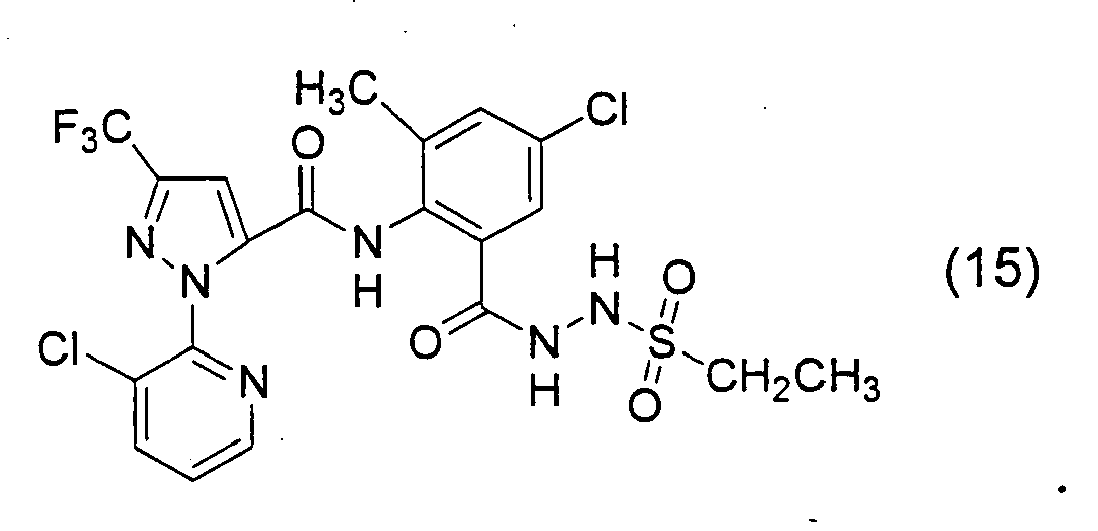
1H-NMR(DMSO-d6,TMS)δ(ppm):1.20(3H,t,J=8Hz),2.18(3H,s),3.02 (2H,q,J=8Hz),7.39(1H,s),7.57(1H,s),7.66(1H,dd,J=8Hz,4Hz), 7.68(1H,s),8.22(1H,d,J=8Hz),8.53(1H,d,J=4Hz),9.95(1H,brs), 10.41(1H,brs),10.57(1H,brs) - A mixture of 0.22 g of N-[4-chloro-2-(hydrazinocarbonyl)-6-methylphenyl]-1-(3-chloro-2-pyridinyl)-3-trifluoromethyl-1H-pyrazole-5-carboxamide, 0.05 g of N,N-dimethylsulfamoyl chloride and 10 ml of pyridine was stirred at room temperature for 2 hours. Water was poured into the reaction mixture, and a deposited precipitate was collected by filtration to obtain 0.14 g of the present compound (16) of the formula:

1H-NMR(DMSO-d6,TMS)δ(ppm):2.16(3H,s),2.71(6H,s),7.28(1H,s), 7.57(1H,s),7.66(1H,dd,J=8Hz,4Hz),7.75(1H,s),8.22(1H,d, J=8Hz),8.53(1H,d,J=4Hz),9.31(1H,brs),10.42(1H,brs),10.51 (1H,brs) - A mixture of 0.22 g of N-[4-chloro-2-(hydrazinocarbonyl)-6-methylphenyl]-1-(3-chloro-2-pyridinyl)-3-trifluoromethyl-1H-pyrazole-5-carboxamide, 10 mL of formic acid and 5 ml of acetic anhydride prepared under ice-cooling was stirred at room temperature for 2 hours. Water was poured into the reaction mixture, and a deposited precipitate was collected by filtration to obtain 0.02 g of the present compound (17) of the formula:

1H-NMR(DMSO-d6,TMS)δ(ppm):2.16(3H,s),7.43(1H,s),7.56(1H,s), 7.66(1H,dd,J=8Hz,4Hz),7.73(1H,s),8.05(1H,s),8.22(1H,d, J=8Hz),8.53(1H,d,J=4Hz),10.13(1H,brs),10.39(1H,brs),10.46 (1H,brs) - A mixture of 0.22 g of N-[4-chloro-2-(hydrazinocarbonyl)-6-methylphenyl]-1-(3-chloro-2-pyridinyl)-3-trifluoromethyl-1H-pyrazole-5-carboxamide, 0.05 g of propionyl chloride and 10 ml of pyridine was stirred at room temperature for 2 hours. Water was poured into the reaction mixture, and a deposited precipitate was collected by filtration to obtain 0.15 g of the present compound (18) of the formula:

1H-NMR(DMSO-d6,TMS)δ(ppm):1.04(3H,t,J=8Hz),2.13(5H,m),7.44 (1H,s),7.55(1H,s),7.66(1H,dd,J=8Hz,4Hz),7.74(1H,s),8.22(1H, d,J=8Hz),8.54(1H,d,J=4Hz),9.91(1H,brs),10.16(1H,brs),10.36 (1H,brs) - A mixture of 0.22 g of N-[4-chloro-2-(hydrazinocarbonyl)-6-methylphenyl]-1-(3-chloro-2-pyridinyl)-3-trifluoromethyl-1H-pyrazole-5-carboxamide, 0.05 g of n-butyl chloroformate and 10 ml of pyridine was stirred at room temperature for 2 hours. Water was poured into the reaction mixture, and a deposited precipitate was collected by filtration to obtain 0.19 g of the present compound (19) of the formula:

1H-NMR(DMSO-d6,TMS)δ(ppm):0.79-0.94(3H,m),1.22-1.40(2H,m), 1.46-1.62(2H,m),2.17(3H,s),3.92-4.13(2H,m),7.37(1H,s),7.56 (1H,s),7.66(1H,dd,J=8Hz,4Hz),7.70(1H,s),8.22(1H,d,J=8Hz), 8.53(1H,d,J=4Hz),9.25(1H,brs),10.14(1H,brs),10.37(1H,brs) - A mixture of 0.22 g of N-[4-chloro-2-(hydrazinocarbonyl)-6-methylphenyl]-1-(3-chloro-2-pyridinyl)-3-trifluoromethyl-1H-pyrazole-5-carboxamide, 0.05 g of allyl chloroformate and 10 ml of pyridine was stirred at room temperature for 2 hours. Water was poured into the reaction mixture, and a deposited precipitate was collected by filtration to obtain 0.23 g of the present compound (20) of the formula:

1H-NMR(DMSO-d6,TMS)δ(ppm):2.16(3H,s),4.43-4.60(2H,m),5.21 (1H,d,J=6Hz),5.33(1H,d,J=8Hz),5.86-6.00(1H,m),7.39(1H,s), 7.56(1H,s),7.66(1H,dd,J=8Hz,4Hz),7.70(1H,s),8.22(1H,d, J=8Hz),8.54(1H,d,J=4Hz),9.39(1H,brs),10.18(1H,brs),10.38 (1H,brs) - A mixture of 0.22 g of N-[4-chloro-2-(N-methylhydrazinocarbonyl)-6-methylphenyl]-1-(3-chloro-2-pyridinyl)-3-trifluoromethyl-1H-pyrazole-5-carboxamide, 0.05 g of methyl chloroformate and 10 ml of pyridine was stirred at room temperature for 2 hours. Water was poured into the reaction solution, and a deposited precipitate was collected by filtration to obtain 0.09 g of the present compound (21) of the formula:

1H-NMR(DMSO-d6,TMS)δ(ppm):2.11(3H,s),3.06(3H,s),3.33(3H,s), 7.07(1H,s),7.45(1H,s),7.68(1H,s),7.69(1H,dd,J=8Hz,4Hz),8.24 (1H,d,J=8Hz),8.55(1H,d,J=4Hz),9.11(0.6H,brs),10.20(1H,brs), 10.54(0.4H,brs) - A mixture of 0.22 g of N- [4-chloro-2- (hydrazinocarbonyl) - 6-methylphenyl]-1-(3-chloro-2-pyridinyl)-3-trifluoromethyl-1H-pyrazole-5-carboxamide, 0.05 g of N,N-diethylcarbamoyl chloride and 10 ml of pyridine was stirred at room temperature for 2 hours. Water was poured into the reaction mixture, and a deposited precipitate was collected by filtration to obtain 0.19 g of the present compound (22) of the formula:

1H-NMR(DMSO-d6,TMS)δ(ppm):1.06(6H,t,J=6Hz),2.14(3H,s),3.26 (4H,q,J=6Hz),7.42(1H,s),7.52(1H,s),7.68(1H,dd,J=8Hz,4Hz), 7.82(1H,s),8.23(1H,d,J=8Hz),8.48(1H,brs),8.53(1H,d,J=4Hz), 9.84(1H,brs),10.35(1H,brs) - A mixture of 0.22 g of N-[4-chloro-2-(hydrazinocarbonyl)-6-methylphenyl]-1-(3-chloro-2-pyridinyl)-3-trifluoromethyl-1H-pyrazole-5-carboxamide, 0.10 g of N-methyl-N-phenylcarbamoyl chloride and 10 ml of pyridine was stirred at room temperature for 2 hours. Water was poured into the reaction mixture, and a deposited precipitate was collected by filtration to obtain 0.19 g of the present compound (23) of a formula:

1H-NMR(DMSO-d6,TMS)δ(ppm):2.15(3H,s),3.08(3H,s),7.10-7.45 (6H,m),7.53(1H,s),7.66(1H,dd,J=8Hz,4Hz),7.76(1H,s),8.14 (1H,brs),8.20(1H,d,J=8Hz),8.50(1H,d,J=4Hz),9.97(1H,brs), 10.32(1H,brs) - A mixture of 0.22 g of N-[4-chloro-2-(hydrazinocarbonyl)-6-methylphenyl]-1-(3-chloro-2-pyridinyl)-3-trifluoromethyl-1H-pyrazole-5-carboxamide, 0.15 g of N,N-diphenylcarbamoyl chloride and 10 ml of pyridine was stirred at room temperature for 2 hours. Water was poured into the reaction mixture, and a deposited precipitate was collected by filtration to obtain 0.24 g of the present compound (24) of the formula:

1H-NMR(DMSO-d6,TMS)δ(ppm):2.15(3H,s),6.77(1H,t,J=8Hz),6.81 (1H,t,J=8Hz),7.05-7.39(9H,m),7.52(1H,s),7.64(1H,dd,J=8Hz, 4Hz),7.72(1H,s),8.13(1H,brs),8.19(1H,d,J=8Hz)8.47(1H,d, J=4Hz),10.08(1H,brs),10.34(1H,brs) - A mixture of 0.22 g of N-[4-chloro-2-(hydrazinocarbonyl)-6-methylphenyl]-1-(3-chloro-2-pyridinyl)-3-trifluoromethyl-1H-pyrazole-5-carboxamide, 0.07 g of picolinoyl chloride hydrochloride and 10 ml of pyridine was stirred at room temperature for 2 hours. Water was poured into a reaction mixture, and a deposited precipitate was collected by filtration to obtain 0.16 g of the present compound (25) of the formula:

1H-NMR(DMSO-d6,TMS)δ(ppm):2.18(3H,s),7.50-7.59(2H,m), 7.63-7.71(3H,m),7.77-7.88(1H,m),8.05(1H,s),8.06(1H,s),8.23 (1H,d,J=8Hz),8.54(1H,d,J=4Hz),8.70(1H,d,J=4Hz),10.35-10.70 (2H,m) - A mixture of 0.22 g of N- [4-chloro-2-(hydrazinocarbonyl) - 6-methylphenyl]-1-(3-chloro-2-pyridinyl)-3-trifluoromethyl-1H-pyrazole-5-carboxamide, 0.07 g of phenyl chloroformate and 10 ml of pyridine was stirred at room temperature for 2 hours. Water was poured into the reaction mixture, and a deposited precipitate was collected by filtration to obtain 0. 16 g of the present compound (26) of a formula:

1H-NMR(DMSO-d6,TMS)δ(ppm):2.17(3H,s),7.13-7.69(9H,m),8.22 (1H,d,J=8Hz)8.53(1H,d,J=4Hz),9.95(1H,brs),10.43(1H,brs), 10.45(1H,brs) - A mixture of 0.22 g of N-[4-chloro-2-(hydrazinocarbonyl)-6-methylphenyl]-1-(3-chloro-2-pyridinyl)-3-trifluoromethyl-1H-pyrazole-5-carboxamide, 0.04 g of acetyl chloride and 10 ml of pyridine was stirred at room temperature for 2 hours. Water was poured into the reaction mixture, and a deposited precipitate was collected by filtration to obtain 0.22 g of the present compound (27) of the formula:

1H-NMR(DMSO-d6,TMS)δ(ppm):1.89(3H,s),2.16(3H,s),7.44(1H,s), 7.55(1H,s),7.66(1H,dd,J=8Hz,4Hz),7.73(1H,s),8.21(1H,d, J=8Hz),8.54(1H,d,J=4Hz),9.94(1H,brs),10.17(1H,brs),10.38 (1H,brs) - A mixture of 0.22 g of N-[4-chloro-2-(hydrazinocarbonyl)-6-methylphenyl]-1-(3-chloro-2-pyridinyl)-3-trifluoromethyl-1H-pyrazole-5-carboxamide, 0.06 g of trimethylacetyl chloride and 10 ml of pyridine was stirred at room temperature for 2 hours. Water was poured into the reaction mixture, and a deposited precipitate was collected by filtration to obtain 0.25 g of the present compound (28) of the formula:

1H-NMR(DMSO-d6,TMS)δ(ppm):1.17(9H,s),2.15(3H,s),7.46(1H,s), 7.54(1H,s),7.66(1H,dd,J=8Hz,4Hz),7.76(1H,s),8.23(1H,d, J=8Hz),8.54(1H,d,J=4Hz),9.66(1H,brs),10.01(1H,brs),10.32 (1H,brs) - A mixture of 0.22 g of N-[4-chloro-2-(hydrazinocarbonyl)-6-methylphenyl]-1-(3-chloro-2-pyridinyl)-3-trifluoromethyl-1H-pyrazole-5-carboxamide, 0.05 g of methyl chlorothiol formate of the formula:


1H-NMR(DMSO-d6,TMS)δ(ppm):2.03-2.34(6H,m),7.40(1H,s),7.58 (1H,s),7.66(1H,dd,J=8Hz,4Hz),7.71(1H,s),8.22(1H,d,J=8Hz), 8.53(1H,d,J=4Hz),9.84(1H,brs),10.41(1H,brs),10.56(1H,brs) - A mixture of 0.22 g of N- [4-chloro-2- (hydrazinocarbonyl)-6-methylphenyl]-1-(3-chloro-2-pyridinyl)-3-trifluoromethyl-1H-pyrazole-5-carboxamide, 0.09 g of 3-methylbenzoyl chloride and 10 ml of pyridine was stirred at room temperature for 2 hours. Water was poured into the reaction mixture, and a deposited precipitate was collected by filteration to obtain 0.19 g of the present compound (30) of the formula:

1H-NMR(DMSO-d6,TMS)δ(ppm):2.18(3H,s),2.30(3H,s),7.40(1H,s), 7.55(1H,s),7.58(1H,s),7.65-7.73(4H,m),7.77(1H,s),8.23(1H, d,J=8Hz),8.54(1H,d,J=4Hz),10.35(1H,brs),10.41(1H,brs),10.54 (1H,brs) - A mixture of 0.22 g of N- [4-chloro-2- (hydrazinocarbonyl) - 6-methylphenyl]-1-(3-chloro-2-pyridinyl)-3-trifluoromethyl-1H-pyrazole-5-carboxamide, 0.09 g of 4-methoxybenzoyl chloride and 10 ml of pyridine was stirred at room temperature for 2 hours. Water was poured into the reaction mixture, and a deposited precipitate was collected by filtration to obtain 0.09 g of the present compound (31) of the formula:

1H-NMR(DMSO-d6,TMS)δ(ppm):2.18(3H,s),3.83(3H,s),7.04(2H,d, J=8Hz),7.55(1H,s),7.58(1H,s),7.69(1H,dd,J=8Hz,4Hz),7.77(1H, s),7.90(2H,d,8Hz),8.23(1H,d,J=8Hz),8.54(1H,d,J=4Hz),10.28 (1H,brs),10.41(1H,brs),10.45(1H,brs) - A mixture of 0.18 g of 1-(3-chloro-2-pyridinyl)-N-[2-(hydrazinocarbonyl)-6-methylphenyl]-3-trifluoromethyl-1H-pyrazole-5-carboxamide, 0.06 ml of ethyl chloroformate and 1 ml of pyridine was stirred at room temperature for 2 hours. Water and toluene were added successively to the reaction mixture, and the mixture was concentrated under reduced pressure. The resulting residue was mixed with methyl tert-butyl ether and water, the mixture was separated into layers, the resulting organic layer was washed with an aqueous saturated sodium chloride solution, dried over anhydrous magnesium sulfate, and concentrated under reduced pressure. The resulting residue was subjected to silica gel column chromatography to obtain 0.14 g of the present compound (32) of the formula:

1H-NMR(CDCl3,TMS)δ(ppm):1.26(3H,brm),2.21(3H,s),4.18(2H, brq,J=7Hz),6.88(1H,brs),7.17(1H,t,J=8Hz),7.28-7.39(4H,m), 7.86(1H,d,J=8Hz),8.05(1H,brs),8.43(1H,d,J=4Hz),9.73(1H,brs) - A mixture of 0.21 g of N-[2-chloro-6-(hydr-azinocarbonyl)phenyl]-1-(3-chloro-2-pyridinyl)-3-trifluoromethyl-1H-pyrazole-5-carboxamide, 0.06 ml of ethyl chloroformate and 5 ml of pyridine was stirred at room temperature for 2 hours. Water was poured into the reaction mixture, and the mixture was extracted with methyl tert-butyl ether three times. The organic layers were combined, washed successively with 2 mol/L-hydrochloric acid, an aqueous saturated sodium bicarbonate solution and an aqueous saturated sodium chloride solution, dried over anhydrous magnesium sulfate, and concentrated under reduced pressure. The resulting residue was subjected to silica gel column chromatography to obtain 0.16 g of the present compound (33) of the formula:

1H-NMR(CDCl3,TMS)δ(ppm):1.28(3H,t,J=7Hz),4.21(2H,q,J=7Hz), 6.76(1H,brs),7.23-7.30(2H,m),7.42(1H,dd,J=8Hz,4Hz),7.50(1H, d,J=8Hz),7.55(1H,d,J=8Hz),7.85(1H,brs),7.90(1H,dd,J=8Hz, 1Hz),8.47(1H,dd,J=4Hz,1Hz),9.16(1H,brs) - A mixture of 0.30 g of 3-bromo-N-[4-chloro-2-(hydrazinocarbonyl)-6-methylphenyl]-1-(3-chloro-2-pyridinyl)-1H-pyrazole-5-carboxamide, 0.20 ml of methyl chloroformate, 0.09 ml of triethylamine, 20 ml of acetonitrile and 10 ml of N,N-dimethylformamide was stirred at room temperature for 3 hours. Water was poured into the reaction mixture, and the mixture was extracted with methyl tert-butyl ether three times. The organic layers were combined, washed with an aqueous saturated sodium chloride solution, dried with anhydrous magnesium sulfate, and concentrated under reduced pressure. The resulting residue was subjected to silica gel column chromatography to obtain 0.13 g of the present compound (34) of the formula:

H-NMR(DMSO-d6)δ(ppm):2.14-(3H,s),3.61(3H,brs),7.33(1H,s), 7.37(1H,brs),7.53(1H,brs),7.60(1H,dd,J=8Hz,4Hz),8.16(1H,dd, J=8Hz,1Hz),8.49(1H,dd,J=4Hz,1Hz),9.29(1H,brs),10.15(1H, brs),10.22(1H,brs) - A mixture of 0.30g of 3-bromo-N-[4-chloro-2-(hydrazinocarbonyl)-6-methylphenyl]-1-(3-chloro-2-pyridinyl)-1H-pyrazole-5-carboxamide, 0.09ml of ethyl chloroformate and 3ml of pyridine was stirred at room temperature for 3 hours, and concentrated under reduced pressure. Water and toluene were added to the resulting residue, the mixture was filtered, the resulting filter cake was mixed with methyl tert-butyl ether and water, and the mixture was separated into layers. The organic layer was washed with an aqueous saturated sodium chloride solution, dried over anhydrous magnesium sulfate, and concentrated under reduced pressure. The resulting residue was subjected to silica gel column chromatography to obtain 0.23g of the present compound (35) of the formula:

1H-NMR(DMSO-d6)δ(ppm):1.18(3H,brm),2.14(3H,s),4.06(2H,brm), 7.34(1H,s),7.37(1H,brs),7.53(1H,s),7.60(1H,dd,J=8Hz,4Hz), 8.16(1H,dd,J=8Hz,1Hz),8.49(1H,dd,J=4Hz,1Hz),9.24(1H,brs), 10.12(1H,brs),10.21(1H,brs) - To a solution of 0.30g of N-[4-chloro-2-(hydrazinocarbonyl)-6-methylphenyl]-1-(2-chlorophenyl)-3-trifluoromethyl-1H-pyrazole-5-carboxamide in 10ml of acetonitrile were added 0.10ml of methyl chloroformate and 0.09ml of triethylamine, the mixture was stirred at room temperature for 1 hour, and 0.10 ml of methyl chloroformate was added to the mixture, followed by further stirring for 3 hours. Water was poured into the reaction mixture, and the mixture was extracted with methyl tert-butyl ether three times. The organic layers were combined, washed with an aqueous saturated sodium chloride solution, dried over anhydrous magnesium sulfate, and concentrated under reduced pressure. The resulting residue was subjected to silica gel column chromatography to obtain 0.16g of the present compound (36) and 0.16g of the present compound (37) of the fromulas:

1H-NMR(CDCl3,TMS)δ(ppm):2.15(3H,s),3.76(6H,s),7.23-7.27(3H, m),7.30-7.40(2H,m),7.43-7.47(2H,m),8.84(1H,brs),9.29(1H, brs)
1H-NMR(DMSO-d6)δ(ppm):2.22(3H,s),3.68(3H,brs),7.44(1H,brs), 7.53-7.72(6H,m),9.35(1H,brs),10.23(1H,brs),10.32(1H,brs) - A mixture of 0.30g of N-[4-chloro-2-(hydrazinocarbonyl)-6-methylphenyl]-1-(2-chlorophenyl)-3-trifluoromethyl-1H-pyrazole-5-carboxamide, 2ml of pyridine and 0.09ml of ethyl chloroformate was stirred at room temperature for 1 hour, and concentrated under reduced pressure. Water and toluene were added to the resulting residue, and the mixture was filtered. The filter cake was subjected to silica gel column chromatography to obtain 0.22g of the present compound (38) or the formula:

1H-NMR(DMSO-d6)δ(ppm):1.19(3H,brm),2.15(3H,s),4.05(2H,brm), 7.37(1H,s),7.49-7.66(6H,m),9.22(1H,brs),10.14(1H,brs),10.25 (1H,brs) - A mixture of 0.18g of 1-(3-chloro-2-pyridinyl)-N-[2-(hydrazinocarbonyl)-6-methylphenyl]-3-trifluoromethyl-1H-pyrazole-5-carboxamide, 0.05ml of methyl chloroformate and 1ml of pyridine was stirred at room temperature for 2 hours. Water was poured into the reaction mixture, and toluene was added, followed by concentration under reduced pressure. The resulting residue was mixed with methyl tert-butyl ether and water, the mixture was separated into layers, and the organic layer was washed with an aqueous saturated sodium chloride solution, dried with anhydrous magnesium sulfate, and concentrated under reduced pressure. The resulting residue was subjected to silica gel column chromatography to obtain 0.13g of the present compound (39) of the formula:

1H-NMR(CDCl3,TMS)δ(ppm):2.22(3H,s),3.75(3H,brs),6.86(1H, brs),7.19(1H,t,J=8Hz),7.27(1H,s),7.34-7.40(3H,m),7.87(1H, dd,J=8Hz,1.5Hz),7.97(1H,brs),8.44(1H,J=4Hz,1Hz),9.68(1H, brs) - A mixture of 0.30g of N-[4-chloro-2-(hydrazinocarbonyl)-6-methylphenyl]-1-(3-chloro-2-pyridinyl)-1H-pyrazole-5-carboxamide, 0.09ml of methyl chloroformate and 3 ml of pyridine was stirred at room temperature for 1.5 hours. Water and toluene were successively added to the reaction mixture, followed by concentration under reduced pressure. The resulting residue was mixed with ethyl acetate and water, the mixture was separated into layers, and the organic layer was washed with an aqueous saturated sodium chloride solution, dried over anhydrous magnesium sulfate, and concentrated under reduced pressure. The resulting residue was subjected to silica gel column chromatography to obtain 0.20g of the present compound (40) of the formula:

1H-NMR(DMSO-d6)δ(ppm):2.17(3H,s),3.62(3H,brs),7.25(1H,d, J=2Hz),7.40(1H,brs),7.52(1H,d,J=2Hz),7.56(1H,dd,J=8Hz,4Hz), 7.86(1H,d,J=2Hz),8.11(1H,dd,J=8Hz,1Hz),8.48(1H,dd,J=4Hz, 1Hz),9.31(1H,brs),10.11(1H,brs),10.13(1H,brs) - According to the same manner as that of Preparation Example 5, N-[4,6-dimethyl-2-(hydrazinocarbonyl)phenyl]-1-(3-chloro-2-pyridinyl)-3-trifluoromethyl-1H-pyrazole-5-carboxamide was used in place of N-[4-chloro-2-(hydrazinocarbonyl)-6-methylphenyl]-1-(3-chloro-2-pyridinyl)-3-trifluoromethyl-1H-pyrazole-5-carboxamide to obtain the present compound (41) of the formula:

1H-NMR(DMSO-d6,TMS)δ(ppm):2.11(3H,s),2.29(3H,s),3.55-3.68 (3H,m),7.19-7.25(2H,m),7.66(1H,dd,J=8Hz,4Hz),7.71(1H,s), 8.22(1H,d,J=8Hz),8.53(1H,d,J=4Hz),9.23(1H,brs),9.98(1H, brs),10.22(1H,brs) - According to the same manner as that of Preparation Example 10, N-[4,6-dimethyl-2-(hydrazinocarbonyl)phenyl]-1-(3-chloro-2-pyridinyl)-3-trifluoromethyl-1H-pyrazole-5-carboxamide was used in place of N-[4-chloro-2-(hydrazinocarbonyl)-6-methylpheny]-1-(3-chloro-2-pyridinyl)-3-trifluorlmethyl-1H-pyrazole-5-carboxamide to obtain the present compound (42) of the formula:

1H-NMR(DMSO-d6,TMS)δ(ppm):2.13(3H,s),2.31(3H,S),2.86(6H,s), 7.14-7.27(2H,m),7.65-7.70(1H,m),7.82(1H,s),8.23(1H,d, J=8Hz),8.48(1H,brs),8.53(1H,d,J=4Hz),9.65(1H,brs),10.16(1H, brs) - According to the same manner as that of Preparation Example 5, N-[6-bromo-2-(hydrazinocarbonyl)-4-methylphenyl]-1-(3-chloro-2-pyridinyl)-3-trifluoromethyl-1H-pyrazole-5-carboxamide was used in place of N-[4-chloro-2-(hydrazinocarbonyl)-6-methylphenyl]-1-(3-chloro-2-pyridinyl)-3-trifluoromethyl-1H-pyrazole-5-carboxamide to obtain the present compound (43) of the formula:

1H-NMR(DMSO-d6,TMS)δ(ppm):2.35(3H,s),3.53-3.65(3H,m),7.35 (1H,s),7.65(1H,dd,J=8Hz,4Hz),7.68-7.70(1H,m),7.76(1H,s), 8.20(1H,d,J=8Hz),8.53(1H,d,J=4Hz),9.27(1H,brs),10.04(1H, brs),10.47(1H,brs) - According to the same manner as that of Preparation Example 10, N-[6-bromo-2-(hydrazinocarbonyl)-4-methylphenyl]-1-(3-chloro-2-pyridinyl)-3-trifluoromethyl-1H-pyrazole-5-carboxamide was used in place of N-[4-chloro-2-(hydrazinocarbonyl)-6-methylpheny]-1-(3-chloro-2-pyridinyl)-3-trifluorlmethyl-1H-pyrazole-5-carboxamide to obtain the present compound (44) of the formula:

1H-NMR(DMSO-d6,TMS)δ(ppm):2.34(3H,s),2.84(6H,s),7.40(1H,s), 7.62-7.70(2H,m),7.83(1H,s),8.20(1H,d,J=8Hz),8.48(1H,brs), 8.51-8.56(1H,m),9.69(1H,brs),10.42(1H,brs) - According to the same manner as that of Preparation Example 5, N-[3-chloro-2-(hydrazinocarbonyl)phenyl]-1-(3-chloro-2-pyridinyl)-3-trifluoromethyl-1H-pyrazole-5-carboxamide was used in place of N-[4-chloro-2-(hydrazinocarbonyl)-6-methylphenyl]-1-(3-chloro-2-pyridinyl)-3-trifluoromethyl-1H-pyrazole-5-carboxamide to obtain the present compound (45) of the formula:

1H-NMR(DMSO-d6,TMS)δ(ppm):3.67-3.74(3H,m),7.37-7.47(2H,m), 7.69-7.74(1H,m),7.82-7.88(2H,m),8.25-8.33(1H,m),8.57(1H,d, J=4Hz),9.71(1H,brs),9.83(1H,brs),10.56(1H,brs) - According to the same manner as that of Preparation Example 10, N-[4-chloro-2-(hydrazinocarbonyl)phenyl]-1-(3-chloro-2-pyridinyl)-3-trifluoromethyl-1H-pyrazole-5-carboxa mide was used in place of N-[4-chloro-2-(hydrazinocarbonyl)-6-methylpheny]-1-(3-chloro-2-pyridinyl)-3-trifluorlmethyl-1H-pyrazole-5-carboxamide to obtain the present compound (46) of the formula:

1H-NMR(DMSO-d6,TMS)δ(ppm):2.90(6H,s),7.57(1H,d,J=8Hz),7.68-7.70(1H,m),7.73(1H,dd,8Hz,4Hz),7.81(1H,s),8.18(1H,d,J=8Hz), 8.29(1H,d,J=8Hz),8.57(lH,d,J=4Hz),8.83(1H,brs),10.36(1H, brs),11.27(1H,brs) - According to the same manner as that of Preparation Example 5, N-[4-chloro-2-(hydrazinocarbonyl)phenyl]-1-(3-chloro-2-pyridinyl)-3-trifluoromethyl-1H-pyrazole-5-carboxamide was used in place of N-[4-chloro-2-(hydrazinocarbonyl)-6-methylphenyl]-1-(3-chloro-2-pyridinyl)-3-trifluoromethyl-1H-pyrazole-5-carboxamide to obtain the present compound (47) of the formula:

1H-NMR(DMSO-d6,TMS)δ(ppm):3.64-3.71(3H,m),7.59(1H,s),7.63 (1H,d,J=8Hz),7.72(1H,dd,J=8Hz,4Hz),7.86(1H,s),8.12(1H,d, J=8Hz),8.29(1H,d,J=8Hz),8.58(1H,d,J=4Hz),9.51(1H,brs),10.75 (1H,brs),11.68(1H,brs) - A mixture of 0.22g of N-[4-chloro-2-(hydrazinocarbonyl)-6-methylphenyl]-1-(3-chloro-2-pyridinyl)-3-trifluoromethyl-1H-pyrazole-5-carboxamide, 0.04g of sodium cyanate, 0.5ml of acetic acid and 5ml of chloroform was stirred under ice-cooling for 4 hours. The reaction mixture was concentrated under reduced pressure, and the resulting residue was washed successively with water and chloroform to obtain 0.080g of the present compound (48) of the formula:

1H-NMR(DMSO-d6,TMS)δ(ppm):2.16(3H,s),5.97(2H,brs),7.52-7.54 (2H,m),7.67(1H,dd,J=8Hz,4Hz),7.70(1H,s),7.76(1H,brs),8.22 (1H,d,J=8Hz),8.54(1H,d,J=4Hz),10.01(1H,brs),10.39(1H,brs) - According to the same manner as that of Preparation Example 5 except that N-[4,6-dibromo-2-(hydrazinocarbonyl)phenyl]-1-(3-chloro-2-pyridinyl)-3-trifluoromethyl-1H-pyrazole-5-carboxamide was used in place of N-[4-chloro-2-(hydrazinocarbonyl)-6-methylphenyl]-1-(3-chloro-2-pyridinyl)-3-trifluoromethyl-1H-pyrazole-5-carboxamide to obtain the present compound (49) of the formula:

1H-NMR(DMSO-d6,TMS)δ(ppm):3.40-3.70(3H,m),7.63-7.69(2H,m), 7.76(1H,s),8.16(1H,s),8.21(1H,d,J=8Hz),8.54(1H,d,J=4Hz), 9.35(1H,brs),10.23(1H,brs),10.63(1H,brs) - According to the same manner as that of Preparation Example 5 except that N-[4,6-diiodo-2-(hydrazinocarbonyl)phenyl]-1-(3-chloro-2-pyridinyl)-3-trifluoromethyl-1H-pyrazole-5-carboxamide was used in place of N-[4-chloro-2-(hydrazinocarbonyl)-6-methylphenyl]-1-(3-chloro-2-pyridinyl)-3-trifluoromethyl-1H-pyrazole-5-carboxamide to obtain the present compound (50) of the formula:
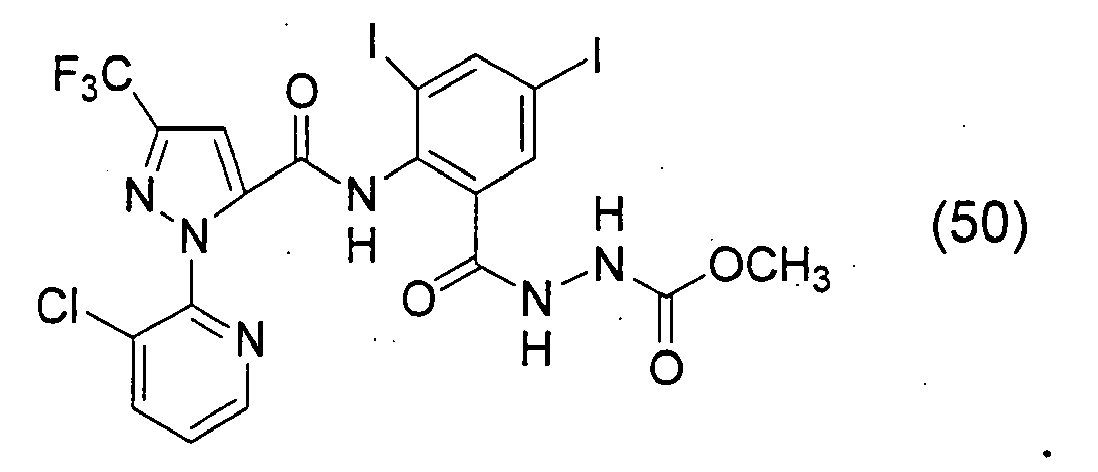
1H-NMR(DMSO-d6,TMS)δ(ppm):3.55-3.65(3H,m),7.65(1H,dd,J=8Hz, 4Hz),7.75-7.82(2H,m),8.20(1H,d,J=8Hz),8.39(1H,s),8.53(1H,d, J=4Hz),9.31(1H,brs),10.14(1H,brs),10.59(1H,brs) - A mixture of 0.22g of N-[4-chloro-2-(hydrazinocarbonyl)-6-methylphenyl]-1-(3-chloro-2-pyridinyl)-3-trifluoromethyl-1H-pyrazole-5-carboxamide, 0.05g of methyl isothiocyanate and 10ml of tetrahydrofuran was stirred at room temperature for 2 hours. Water was poured into the reaction mixture, and a deposited precipitate was collected by filtration to obtain 0.20g of the present compound (51) of the formula:

1H-NMR(DMSO-d6,TMS)δ(ppm):2.20(3H,s),2.85(3H,d,J=4Hz),7.57 (1H,s),7.60-7.63(2H,m),7.68(1H,dd,J=8Hz,4Hz),7.72(1H,brs), 8.24(1H,d,J=8Hz),8.57(1H,d,J=4Hz),9.13(1H,brs),10.31(1H, brs),10.42(1H,brs) - According to the same manner as that of Preparation Example 5 except that N-[5-chloro-2-(hydrazinocarbonyl)phenyl]-1-(3-chloro-2-pyridinyl)-3-trifluoromethyl-1H-pyrazole-5-carboxamide was used in place of N-[4-chloro-2-(hydrazinocarbonyl)-6-methylphenyl]-1-(3-chloro-2-pyridinyl)-3-trifluoromethyl-1H-pyrazole-5-carboxamide to obtain the present compound (52) of the formula:

1H-NMR(DMSO-d6,TMS)δ(ppm):3.60-3.77(3H,m),7.40(1H,d,J=8Hz), 7.57(1H,s),7.74(1H,dd,J=8Hz,4Hz),7.85(1H,d,J=8Hz),8.22(1H, s),8.31(1H,d,J=8Hz),8.59(1H,d,J=4Hz),9.49(1H,brs),10.77(1H, brs),12.04(1H,brs) - According to the same manner as that of Preparation Example 5 except that N-[2-(hydrazinocarbonyl)-4-methylphenyl]-1-(3-chloro-2-pyridinyl)-3-trifluoromethyl-1H-pyrazole-5-carboxamide was used in place of N-[4-chloro-2-(hydrazinocarbonyl)-6-methylphenyl]-1-(3-chloro-2-pyridinyl)-3-trifluoromethyl-1H-pyrazole-5-carboxamide to obtain the present compound (53) of the formula:

1H-NMR(DMSO-d6,TMS)δ(ppm):2.32(3H,s),3.60-3.72(3H,m),7.37 (1H,d,J=8Hz),7.55(1H,s),7.65(1H,s),7.73(1H,dd,J=8Hz,4Hz), 8.02(1H,d,J=8Hz),8.29(1H,d,J=8Hz),8.57(1H,d,J=4Hz),9.43(1H, brs),10.64(1H,brs),11.72(1H,brs) - According to the same manner as that of Preparation Example 10 except that N-[2-(hydrazinocarbonyl)-4-methylphenyl]-1-(3-chloro-2-pyridinyl)-3-trifluoromethyl -1H-pyrazole-5-carboxamide was used in place of N-[4-chloro-2-(hydrazinocarbonyl)-6-methylpheny]-1-(3-chloro-2-pyridinyl)-3-trifluorlmethyl-1H-pyrazole-5-carboxamide to obtain the present compound (54) of the formula:

1H-NMR(DMSO-d6,TMS)δ(ppm):2.31(3H,s),2.91(6H,s),7.29-7.34 (1H,m),7.48-7.51(1H,m),7.70-7.79(2H,m),8.04-8.09(1H,m),8.26 -8.33(1H,m),8.55-8.60(1H,m),8.75(1H,brs),10.24(1H,brs), 11.30(1H,brs) - According to the same manner as that of Preparation Example 5 except that N-[2-(hydrazinocarbonyl)-3-methylphenyl]-1-(3-chloro-2-pyridinyl)-3-trifluoromethyl-1H-pyrazole-5-carboxamide was used in place of N-[4-chloro-2-(hydrazinocarbonyl)-6-methylphenyl]-1-(3-chloro-2-pyridinyl)-3-trifluoromethyl-1H-pyrazole-5-carboxamide to obtain the present compound (55) of the formula:

1H-NMR(DMSO-d6,TMS)δ(ppm):2.32(3H,s),3.62-3.75(3H,m),7.12 (1H,d,J=8Hz),7.31(1H,t,J=8Hz),7.61(1H,d,J=8Hz),7.68-7.73 (1H,m),7.80(1H,s),8.27(1H,d,J=8Hz),8.56(1H,d,J=4Hz),9.59 (1H,brs),9.66(1H,brs),10.30(1H,brs) - According to the same manner as that of Preparation Example 5 except that N-[4,6-dichloro-2-(hydrazinocarbonyl)phenyl]-1-(3-chloro-2-pyridinyl)-3-trifluoromethyl-1H-pyrazole-5-carboxamide was used in place of N-[4-chloro-2-(hydrazinocarbonyl)-6-methylphenyl]-1-(3-chloro-2-pyridinyl)-3-trifluoromethyl-1H-pyrazole-5-carboxamide to obtain the present compound (56) of the formula:

1H-NMR(DMSO-d6,TMS)δ(ppm):3.45-3.66(3H,m),7.51(1H,s),7.66 (1H,dd,J=8Hz,4Hz),7.76(1H,s),7.94(1H,s),8.21(1H,d,J=8Hz), 8.53(1H,d,J=4Hz),9.37(1H,brs),10.27(1H,brs),10.64(1H,brs) - According to the same manner as that of Preparation Example 10 except that N-[4,6-dichloro-2-(hydrazinocarbonyl)phenyl]-1-(3-chloro-2-pyridinyl)-3-trifluoromethyl-1H-pyrazole-5-carboxamide was used in place of N-[4-chloro-2-(hydrazinocarbonyl)-6-methylpheny]-1-(3-chloro-2-pyridinyl)-3-trifluorlmethyl-1H-pyrazole-5-carboxamide to obtain the present compound (57) of the formula:

1H-NMR(DMSO-d6,TMS)δ(ppm):2.85(6H,s),7.58(1H,s),7.64-7.70 (1H,m),7.85(1H,s),7.90(1H,s),8.22(1H,d,J=8Hz),8.54(1H,d, J=4Hz),8.58(1H,brs),9.91(1H,brs),10.59(1H,brs) - According to the same manner as that of Preparation Example 10 except that N-[4,6-dibromo-2-(hydrazinocarbonyl)phenyl]-1-(3-chloro-2-pyridinyl)-3-trifluoromethyl-1H-pyrazole-5-carboxamide was used in place of N-[4-chloro-2-(hydrazinocarbonyl)-6-methylpheny]-1-(3-chloro-2-pyridinyl)-3-trifluorlmethyl-1H-pyrazole-5-carboxamide to obtain the present compound (58) of the formula:

1H-NMR(DMSO-d6,TMS)δ(ppm):2.84(6H,s),7.67(1H,dd,J=8Hz,4Hz), 7.74(1H,s),7.83(1H,s),8.13(1H,s),8.21(1H,d,J=8Hz),8.52-8.57 (2H,m),9.88(1H,brs),10.60(1H,brs) - According to the same manner as that of Preparation Example 5 except that N-[6-bromo-4-chloro-2-(hydrazinocarbonyl)phenyl]-1-(3-chloro-2-pyridinyl)-3-trifluoromethyl-1H-pyrazole-5-carboxamide was used in place of N-[4-chloro-2-(hydrazinocarbonyl)-6-methylphenyl]-1-(3-chloro-2-pyridinyl)-3-trifluoromethyl-1H-pyrazole-5-carboxamide to obtain the present compound (59) of the formula:

1H-NMR(DMSO-d6,TMS)δ(ppm)3.55-3.65(3H,m),7.54(1H,s),7.66 (1H,dd,J=8Hz,4Hz),7.76(1H,s),8.06(1H,s),8.21(1H,d,J=8Hz), 8.53(1H,d,J=4Hz),9.36(1H,brs),10.23(1H,brs),10.64(1H,brs) - According to the same manner as that of Preparation Example 10 except that N-[6-bromo-4-chloro-2-(hydrazinocarbonyl)phenyl]-1-(3-chloro-2-pyridinyl)-3-trifluoromethyl-1H-pyrazole-5-carboxamide was used in place of N-[4-chloro-2-(hydrazinocarbonyl)-6-methylpheny]-1-(3-chloro-2-pyridinyl)-3-trifluorlmethyl-1H-pyrazole-5-carboxamide to obtain the present compound (60) of the formula:

1H-NMR(DMSO-d6,TMS)δ(ppm):2.84(6H,s),7.62(1H,s),7.67(1H,dd, J=8Hz,4Hz),7.83(1H,s),8.02(1H,s),8.21(1H,d,J=8Hz),8.52-8.57 (2H,m),9.87(1H,brs),10.60(1H,brs) - According to the same manner as that of Preparation Example 10 except that N-[4,6-diiodo-2-(hydrazinocarbonyl)phenyl]-1-(3-chloro-2-pyridinyl)-3-trifluoromethyl-1H-pyrazole-5-carboxamide was used in place of N-[4-chloro-2-(hydrazinocarbonyl)-6-methylpheny]-1-(3-chloro-2-p-yridinyl)-3-trifluorlmethyl-1H-pyrazole-5-carboxamide to obtain the present compound (61) of the formula:

1H-NMR(DMSO-d6,TMS)δ(ppm):2.83(6H,s),7.66(1H,dd,J=8Hz,4Hz), 7.82(1H,s),7.88(1H,s),8.21(1H,d,J=8Hz),8.37(1H,s),8.48(1H, brs),8.53(1H,d,J=4Hz),9.78(1H,brs),10.55(1H,brs) - According to the same manner as that of Preparation Example 10 except that N-[5-chloro-2-(hydrazinocarbonyl)phenyl]-1-(3-chloro-2-pyridinyl)-3-trifluoromethyl-1H-pyrazole-5-carboxamide was used in place of N-[4-chloro-2-(hydrazinocarbonyl)-6-methylpheny]-1-(3-chloro-2-pyridinyl)-3-trifluoromethyl-1H-pyrazole-5-carboxamide to obtain the present compound (62) of the formula:

1H-NMR(DMSO-d6,TMS)δ(ppm):2.91(6H,s),7.33-7.48(1H,m),7.67-7.81(3H,m),8.24-8.35(2H,m),8.56-8.63(1H,m),8.80(1H,brs), 10.38(1H,brs),11.57(1H,brs) - According to the same manner as that of Preparation Example 5 except that N-[2-(hydrazinocarbonyl)-5-methyphenyl]-1-(3-chloro-2-pyridinyl)-3-trifluoromethyl-1H-pyrazole-5-carboxamide was used in place of N-[4-chloro-2-(hydrazinocarbonyl)-6-methylphenyl]-1-(3-chloro-2-pyridinyl)-3-trifluoromethyl-1H-pyrazole-5-carboxamide to obtain the present compound (63) of the formula:

1H-NMR(DMSO-d6,TMS)δ(ppm):2.32(3H,s),3.60-3.69(3H,m),7.09 (1H,d,J=8Hz),7.54(1H,s),7.71-7.79(2H,m),8.06(1H,s),8.30(1H, d,J=8Hz),8.58(1H,d,J=4Hz),9.41(1H,brs),10.64(1H,brs),12.19 (1H,brs) - According to the same manner as that of Preparation Example 10 except that N-[2-(hydrazinocarbonyl)-5-methylphenyl]-1-(3-chloro-2-pyridinyl)-3-trifluoromethyl-1H-pyrazole-5-carboxamide was used in place of N-[4-chloro-2-(hydrazinocarbonyl)-6-methylpheny]-1-(3-chloro-2-pyridinyl)-3-trifluorlmethyl-1H-pyrazole-5-carboxamide to obtain the present compound (64) of the formula:

- According to the same manner as that of Preparation Example 3 except that N-(2-amino-5-chloro-3-methylbenzoyl)-N'-methoxycarbonylhydrazine was used in place of N-(2-aminobenzoyl)-N'-ethoxycarbonylhydrazine to obtain the present compound (65) of the formula:

1H-NMR(DMSO-d6,TMS)δ(ppm):2.25(3H,s),3.59(3H,s),4.13(3H,s), 7.40(1H,s),7.44(1H,s),7.59(1H,s),9.26(1H,brs),10.11(1H, brs),10.17(1H,brs) - A mixture of 0.28g of N-[1-chloro-3-(hydrazinocarbonyl)-2-naphthyl]-1-(3-chloro-2-pyridinyl)-3-trifluoromethyl-1H-pyrazole-5-carboxamide, 0.06g of methyl chloroformate and 10ml of pyridine was stirred at room temperature for 2 hours. Water was poured into the reaction mixture, and a deposited precipitate was collected by filtration to obtain 0.08g of the present compound (66) of the formula:

1H-NMR(DMSO-d6,TMS)δ(ppm):3.60-3.68(3H,m),7.35-7.43(1H,m), 7.60-7.85(3H,m),8.12-8.28(3H,m),8.52-8.60(2H,m),9.35(1H, brs),10.32(1H,brs),10.76(1H,brs) - According to the same manner as that of Preparation Example 66 except that N-[1-bromo-3-(hydrazinocarbonyl)-2-naphthyl]-1-(3-chloro-2-pyridinyl)-3-trifluoromethyl-1H-pyrazole-5-carboxamide was used in place of N-[1-chloro-3-(hydrazinocarbonyl)-2-naphthyl]-1-(3-chloro-2-pyridinyl)-3-trifluoromethyl-1H-pyrazole-5-carboxamide to obtain the present compound (67) of the formula:

1H-NMR(DMSO-d6,TMS)δ(ppm):3.58-3.69(3H,m),7.34-7.44(1H,m), 7.60-7.85(3H,m),8.10-8.28(3H,m),8.50-8.62(2H,m),9.33(1H, brs),10.28(1H,brs),10.78(1H,brs) - A mixture of 0.30g of 2-[3-bromo-1-(3-chloro-2-pyridinyl)-1H-pyrazole-5-yl]-6,8-dibromo-4H-3,1-benzoxazine-4-one, 0.45g of methyl carbazate and 10ml of N,N-dimethylformamide was stirred at room temperature for 10 hours. Into the reaction mixture, 30ml of water was poured, and the mixture was extracted with ethyl acetate three times. The organic layers were combined, washed with an aqueous saturated sodium chloride solution, dried over anhydrous magnesium sulfate, and concentrated under reduced pressure. The resulting residue was subjected to silica gel column chromatography to obtain 0.14g of the present compound (68) of the formula:

1H-NMR(DMSO-d6,TMS)δ(ppm):3.44-3.66(3H,m),7.45(1H,s),7.60 (1H,dd,J=8Hz,4Hz),7.65(1H,s),8.14-8.18(2H,m),8.50(1H,d, J=4Hz),9.36(1H,brs),10.26(1H,brs),10.55(1H,brs) - According to the same manner as that of Preparation Example 5 except that N-[4-chloro-2-(hydrazinocarbonyl)-6-methyphenyl]-1-(2-pyridinyl)-3-trifluoromethyl-1H-pyrazole-5-carboxamide was used in place of N-[4-chloro-2-(hydrazinocarbonyl)-6-methylphenyl]-1-(3-chloro-2-pyridinyl)-3-trifluoromethyl-1H-pyrazole-5-carboxamide to obtain the present compound (69) of the formula:

1H-NMR(DMSO-d6)δ(ppm):2.33(3H,s),3.63(3H,s),7.36(2H,s),7.52 (1H,dd,J=8Hz,4Hz),7.58(1H,s),7.81(1H,d,J=8Hz),8.06(1H,t, J=8Hz),8.46(1H,d,J=4Hz),9.33(1H,brs),10.19(1H,brs),10.34 (1H,brs) - A mixture of 0.30g of 2-[3-bromo-1-(3-chloro-2-pyridinyl)-1H-pyrazole-5-yl]-8-bromo-6-chloro-4H-3,1-benzoxazine-4-one, 0.45g of methyl carbazate and 10ml of N,N-dimethylformamide was stirred at room temperature for 10 hours. Into the reaction mixture, 30ml of water was poured and the mixture was extracted with ethyl acetate three times. The organic layers were combined, washed with an aqueous saturated sodium chloride solution, dried over anhydrous magnesium sulfate, and concentrated under reduced pressure. The resulting residue was subjected to silica gel column chromatography to obtain 0.13g of the present compound (70) of the formula:

1H-NMR(DMSO-d6,TMS)δ(ppm):3.48-3.62(3H,m),7.41(1H,s),7.53-7.62(2H,m),8.05(1H,s),8.16(1H,d,J=8Hz),8.50(1H,d,J=4Hz), 9.36(1H,brs),10.21(1H,brs),10.48(1H,brs) - A mixture of 0.30g of 2-[3-bromo-1-(3-chloro-2-pyridinyl)-1H-pyrazole-5-yl]-8-bromo-6-methyl-4H-3,1-benzoxazine-4-one, 0.45g of methyl carbazate and 10ml of N,N-dimethylformamide was stirred at room temperature for 10 hours. Into the reaction mixture, 30ml of water was poured, and the mixture was extracted with ethyl acetate three times. The organic layers were combined, washed with an aqueous saturated sodium chloride solution, dried over anhydrous magnesium sulfate, and concentrated under reduced pressure. The resulting residue was subjected to silica gel column chromatography to obtain 0.17g of the present compound (71) of the formula:

1H-NMR(DMSO-d6,TMS)δ(ppm):2.34(3H,s),3.56-3.64(3H,m),7.32-7.44(2H,m),7.59(1H,dd,J=8Hz,4Hz),7.66-7.71(1H,m),8.15(1H,d, J=8Hz),8.49(1H,d,J=4Hz),9.27(1H,brs),10.01(1H,brs),10.31 (1H,brs) - A mixture of 0.21g of 2-[3-bromo-1-(3-chloro-2-pyridinyl)-1H-pyrazole-5-yl]-8-chloro-4H-3,1-benzoxazine-4-one, 0.9g of methyl carbazate and 10ml of N, N-dimethylformamide was stirred at room temperature for 10 hours. Water was poured into the reaction mixture, and this was extracted with ethyl acetate. The organic layer was washed with water, dried over sodium sulfate, and concentrated under reduced pressure. The resulting residue was subjected to silica gel column chromatography to obtain 0.10g of the present compound (72) of the formula:

1H-NMR(DMSO-d6,TMS)δ(ppm):3.44-3.65(3H,m),7.40-7.54(3H,m), 7.59(1H,dd,J=BHz,4Hz),7.68(1H,d,J=8Hz),8.15(1H,d,J=8Hz), 8.49(1H,d,J=4Hz),9.29(1H,brs),10.11(1H,brs),10.39(1H,brs) - According to the same manner as that of Preparation Example 5 except that N-[4-chloro-2-(hydrazinocarbonyl)-6-methyphenyl]-1-phenyl-3-trifluoromethyl-1H-pyrazole-5-carboxamide was used in place of N-[4-chloro-2-(hydrazinocarbonyl)-6-methylphenyl]-1-(3-chloro-2-pyridinyl)-3-trifluoromethyl-1H-pyrazole-5-carboxamide to obtain the present compound (73) of the formula:

1H-NMR(DMSO-d6)δ(ppm):2.18(3H,s),3.61(3H,s),7.37(1H,s), 7.49-7.55(7H,m),9.31(1H,brs),10.22(1H,brs),10.30(1H,brs) - According to the same manner as that of Preparation Example 72 except that 6-bromo-2-[1-(3-chloro-2-pyridinyl)-3-trifluoromethyl-1H-pyrazole-5-yl]-8-methyl-4H-3,1-benzoxazine-4-one was used in place of 2-[3-bromo-1-(3-chloro-2-pyridinyl)-1H-pyrazole-5-yl]-8-chloro-4H-3,1-benzoxazine-4-one to obtain the present compound (74) of the formula:

1H-NMR(DMSO-d6,TMS)δ(ppm):2.15(3H,s),3.56-3.65(3H,m),7.47-7.55(1H,m),7.62-7.75(3H,m),8.22(1H,d,J=8Hz),8.53(1H,d, J=4Hz),9.31(1H,brs),10.17(1H,brs),10.38(1H,brs) - According to the same manner as that of Preparation Example 72 except that 2-[1-(3-chloro-2-pyridinyl)-3-trifluoromethyl-1H-pyrazole-5-yl]-6-iodo-8-methyl-4H-3,1-benzoxazine-4-one was used in place of 2-[3-bromo-1-(3-chloro-2-pyridinyl)-1H-pyrazole-5-yl]-8-chloro-4H-3,1-benzoxazine-4-one to obtain the present compound (75) of the formula:.

1H-NMR(DMSO-d6,TMS)δ(ppm):2.12(3H,s),3.55-3.66(3H,m), 7.63-7.72(3H,m),7.83(1H,s),8.22(1H,d,J=8Hz),8.53(1H,d, J=4Hz),9.28(1H,brs),10.14(1H,brs),10.35(1H,brs) - A mixture of 0.18g of N-[4-chloro-2-(hydrazinocarobnyl)-6-methylphenyl]-3-(2-chlorophenyl)-1-methyl-1H-pyrazole-4-carboxamide, 45mg of methyl chloroformate, 68mg of pyridine and 5ml of acetonitrile was prepared under ice-cooling, and the mixture was stirred at room temperature for 0.5 hour. Water was poured into the reaction mixture, and the mixture was extracted with ethyl acetate. The organic layer was washed with water, dried over anhydrous sodium sulfate, and concentrated under reduce pressure. The resulting residue was subjected to silica gel column chromatography to obtain 0.12g of the present compound (76) of the formula:

1H-NMR(DMSO-d6)δ(ppm):2.13(3H,s),3.37-3.67(6H,m),7.37(1H, brs),7.42-7.52(4H,m),7.60(1H,d,J=8Hz),8.13(1H,s),9.28-9.37 (2H,m),10.13(1H,brs) - According to the same manner as that of Preparation Example (76) except that N-[4-chlolro-2-(hydrazinocarhbonyl)-6-methylphenyl]-5-(2-chlorophenyl)-1-mehyl-1H-pyrazole-4-carboxamide was used in place of N-[4-chloro-2-(hydrazinocarbonyl)-6-mehylphenyl]-3-(2-chlorophenyl)-1-methyl-1H-pyrazole-4-carboxamide to obtain the present compound (77) of the formula:

1H-NMR(DMSO-d6)δ(ppm):2.17(3H,s),3.46-3.62(3H,m),3.94(3H, s),7.32-7.41(4H,m),7.44-7.46(1H,m),7.50(1H,s),8.36(1H,s), 9.30-9.34(2H,m),10.17(1H,brs) - According to the same manner as that of Preparation Example 72 except that 2-[3-bromo-1-(3-chloro-2-pyridinyl)-1H-pyrazole-5-yl]-6-chloro-8-methoxy-4H-3,1-benzoxazine-4-one was used in place of 2-[3-bromo-1-(3-chloro-2-pyridinyl) - 1H-pyrazole-5-yl]-8-chloro-4H-3,1-benzoxazine-4-one to obtain the present compound (78) of the formula:

1H-NMR(DMSO-d6,TMS)δ(ppm):3.56-3.64(3H,m),3.77-3.80(3H,m), 7.12(1H,brs),7.32(1H,brs),7.38(1H,brs),7.59(1H,dd,J=8Hz, 4Hz),8.15(1H,d,J=8Hz),8.49(1H,d,J=4Hz),9.28(1H,brs),9.95 (1H,brs),10.07(1H,brs) - According to the same manner as that of Preparation Example 72 except that 2-[3-bromo-1-(3-chloro-2-pyridinyl)-1H-pyrazole-5-yl]-6-chloro-8-iodo-4H-3,1-benzoxazine-4-one was used in place of 2-[3-bromo-1-(3-chloro-2-pyridinyl)-1H-pyrazole-5-yl]-B-chloro-4H-3,1-benzoxazine-4-one to obtain the present compound (79) of the formula:
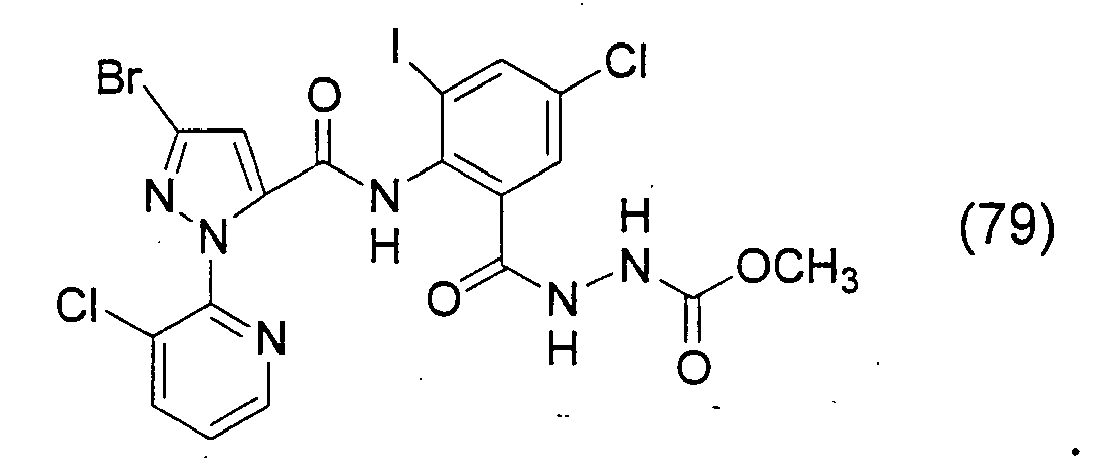
1H-NMR(DMSO-d6,TMS)δ(ppm):3.56-3.64(3H,m),7.43(1H,s),7.53 (1H,s),7.60(1H,dd,J=8Hz,4Hz),8.12-8.19(2H,m),8.50(1H,d, J=4Hz),9.34(1H,brs),10.16(1H,brs),10.47(1H,brs) - According to the same manner as that of Preparation Example 72 except that 2-[3-bromo-1-(3-chloro-2-pyridinyl)-1H-pyrazole-5-yl]-8-methoxy-4H-3,1-benzoxazine-4-one was used in place of 2-[3-bromo-1-(3-chloro-2-pyridinyl)-1H-pyrazole-5-yl]-8-chloro-4H-3,1-benzoxazine-4-one to obtain the present compound (80) of the formula:

1H-NMR(DMSO-d6,TMS)δ(ppm):3.52-3.64(3H,m),3.74(3H,s),7.07-7.14(1H,m),7.21(1H,d,J=8Hz),7.31-7.42(2H,m),7.59(1H,dd, J=8Hz,4Hz),8.15(1H,d,J=8Hz),8.49(1H,d,J=4Hz),9.21(1H,brs), 9.87(1H,brs),9.92(1H,brs) - According to the same manner as that of Preparation Example 72 except that 2-[3-bromo-1-(3-chloro-2-pyridinyl)-1H-pyrazole-5-yl]-8-trifluoromethyl-4H-3,1-benzoxazine-4-one was used in place of 2-[3-bromo-1-(3-chloro-2-pyridinyl)-1H-pyrazole-5-yl]-8-chloro-4H-3,1-benzoxazine-4-one to obtain the present compound (81) of the formula:

1H-NMR(DMSO-d6,TMS)δ(ppm):3.46-3.69(3H,m),7.41(1H,s),7.59 (1H,dd,J=8Hz,4Hz),7.68(1H,t,J=8Hz),7.77-7.87(1H,m), 7.90-7.97(1H,m),8.14(1H,d,J=8Hz),8.48(1H,d,J=4Hz),9.32(1H, brs),10.14(1H,brs),10.48(1H,brs) - To a mixture of 0.25g of 3-chloro-2-(3-trifluoromethyl-1H-1,2,4-triazol-1-yl)pyridine and 5ml of tetrahydrofuran was added dropwise 0.50ml of a 2.0M lithium diisopropylamide solution in heptane/tetrahydrofuran/ethylbenzene at -78°C and the mixture was stirred at -78°C for 15 minutes. Carbon dioxide was introduced into the mixture at such a rate that an inner temperature was maintained at -60°C or lower and, after the mixture turned yellow, the mixture was further stirred at -78°C for 10 minutes. The temperature of the reaction mixture was raised to room temperature, followed by concentration. A 2N aqueous sodium hydroxide solution was added to adjust the pH of the aqueous layer to 10 to 12, the layers were separated, and the organic layer was extracted with a 0.5N aqueous sodium hydroxide solution. The aqueous layers were combined, and washed with chloroform, and 2N hydrochloric acid was added so that the pH of the aqueous layer became about 3, followed by extraction with ethyl acetate three times. The organic layers were combined, washed with an aqueous saturated sodium chloride solution, dried over magnesium sulfate, and concentrated under reduced pressure to obtain 0.13g of crude 1-(3-chloro-2-pyridinyl)-3-trifluoromethyl-1H-1,2,4-triazole 5-carboxylic acid of the formula:

- A mixture of 0.13g of the resulting crude 1-(3-chloro-2-pyridinyl)-3-trifluoromethyl-1H-1,2,4-triazole 5-carboxylic acid and 0.10ml of thionyl chloride was heated under reflux in 10ml of acetonitrile for 2 hours. The reaction mixture was allowed to cool to room temperature, and concentrated under reduced pressure, the resulting residue was dissolved in 10ml of acetonitrile, 0.11g of N-(2-amino-5-chloro-3-methylbenzoyl)-N'-methoxycarbonylhydrazine and 0.10ml of diisopropylethylamine were added, and the mixture was stirred at room temperature for 16 hours. Water was poured into the reaction mixture, and the mixture was extracted with ethyl acetate two times. The organic layers were- combined, washed with an aqueous saturated sodium chloride solution, dried over anhydrous magnesium sulfate, and concentrated under reduced pressure. The resulting residue was subjected to silica gel column chromatography to obtain 12mg of the present compound (82) of the formula:

1H-NMR(DMSO-d6,TMS)δ(ppm):2.31(3H,s),3.64(3H,s),7.40(1H,s), 7.60(1H,s),7.90(1H,brs),8.77(1H,d,J=7Hz),9.33(1H,brs),9.50 (1H,brs),10.27(1H,brs),10.44(1H,brs) - According to the same manner as that of Preparation Example 5 except that N-[4-chloro-2-(hydrazinocarbonyl)-6-methyphenyl]-1-ethyl-3-trifluoromethyl-1H-pyrazole-5-carboxamide was used in place of N-[4-chloro-2-(hydrazinocarbonyl)-6-methylphenyl]-1-(3-chloro-2-pyridinyl)-3-trifluoromethyl-1H-pyrazole-5-cadrboxamide to obtain the present compound (83) of the formula:

1H-NMR(DMSO-d6)δ(ppm):1.37(3H,t,J=7Hz),2.26(3H,s),3.60(3H, s),4.55(2H,q,J=7Hz),7.41(2H,s),7.58(1H,s),9.26(1H,brs), 10.12(1H,brs),10.18(1H,brs) - According to the same manner as that of Preparation Example 76 except that 1-tert-butyl-N-[4-chloro-2-(hydrazinocarbonyl)-6-methylphenyl]-5-(2-chlorophenyl)-1H-pyrazole-4-carboxamide was used in place of N-[4-chloro-2-(hydrazinocarbonyl)-6-methylphenyl]-3-(2-chlorophenyl)-1-methyl-1H-pyrazole-4-carboxamide to obtain the present compound (84) of the formula:

1H-NMR(DMSO-d6)δ(ppm):1.39(9H,s),2.05(3H,s),3.47-3.62(3H, m),7.36-7.53(6H,m),8.10(1H,s),9.19-9.26(2H,m),10.12(1H,brs) - According to the same manner as that of Preparation Example 72 except that 2-[3-bromo-1-(3-chloro-2-pyridinyl)-1H-pyrazole-5-yl]-7-chloro-8-methyl-4H-3,1-benzoxazine-4-one was used in place of 2-[3-bromo-1-(3-chloro-2-pyridinyl)-1H-pyrazole-5-yl]-8-chloro-4H-3,1-benzoxazine-4-one to obtain the present compound (85) of the formula:

1H-NMP(DMSO-d6,TMS)δ(ppm):2.17(3H,s),3.60-3.65(3H,m),7.35-7.43(2H,m),7.54(1H,d,J=8Hz),7.61(1H,dd,J=8Hz,4Hz),8.17(1H, d,J=8Hz),8.50(1H,d,J=4Hz),9.28(1H,brs),10.14(1H,brs),10.41 (1H,brs) - According to the same manner as that of Preparation Example 5 except that N-[4-chloro-2-(hydrazinocarbonyl)-6-methyphenyl]-1-isopropyl-3-trifluoromethyl-1H-pyrazole-5-carboxamide was used in place of N-[4-chloro-2-(hydrazinocarbonyl)-6-methylphenyl]-1-(3-chloro-2-pyridinyl)-3-trifluoromethyl-1H-pyrazole-5-carboxamide to obtain the present compound (86) of the formula:

1H-NMR(DMSO-d6)δ(ppm):1.43(6H,d,J=6Hz),2.26(3H,s),3.60(3H, s),5.41-5.45(1H,m),7.35(1H,s),7.40(1H,s),7.59(1H,s),9.26 (1H,brs),10.10(1H,brs),10.17(1H,brs) - According to the same manner as that of Preparation Example 72 except that 2-[3-bromo-1-(3-chloro-2-pyridinyl)-1H-pyrazole-5-yl]-5,8-dichloro-4H-3,1-benzoxazine-4-one was used in place of 2-[3-bromo-1-(3-chloro-2-pyridinyl)-1H-pyrazole-5-yl]-8-chloro-4H-3,1-benzoxazine-4-one to obtain the present compound (87) of the formula:

1H-NMR(DMSO-d6,TMS)δ(ppm):3.50-3.68(3H,m),7.47(1H,s),7.52-7.65(3H,m),8.17(1H,d,J=8Hz),8.49(1H,d,J=4Hz),9.43(1H,brs), 10.17(1H,brs),10.47(1H,brs) - According to the same manner as that of Preparation Example 72 except that 2-[3-bromo-1-(3-chloro-2-pyridinyl)-1H-pyrazole-5-yl]-5-chloro-8-methyl-4H-3,1-benzoxazine-4-on e was used in place of 2-[3-bromo-1-(3-chloro-2-pyridinyl)-1H-pyrazole-5-yl]-8-chloro-4H-3,1-benzoxazine-4-one to obtain the present compound (88) of the formula:

1H-NMR(DMSO-d6,TMS)δ(ppm):2.09(3H,s),3.51-3.68(3H,m),7.31-7.45(3H,m),7.61(1H,dd,J=8Hz,4Hz),8.19(1H,d,J=8Hz),8.49(1H, d,J=4Hz),9.43(1H,brs),10.04(1H,brs),10.13(1H,brs) - According to the same manner as that of Preparation Example 5 except that N-[4-chloro-2-(hydrazinocarbonyl)-6-methyphenyl]-1-tert-butyl-3-trifluoromethyl-1H-pyrazole-5-carboxamide was used in place of N-[4-chloro-2-(hydrazinocarbonyl)-6-methylphenyl]-1-(3-chloro-2-pyridinyl )-3-trifluoromethyl-1H-pyrazole-5-cadrboxamide to obtain the present compound (89) of the formula:

1H-NMR(DMSO-d6)δ(ppm):1.67(9H,s),2.28(3H,s),3.64(3H,s),7.11 (1H,s),7.42(1H;s),7.55(1H,s),9.29(1H,brs),10.18(1H,brs), 10.23(1H,brs) - According to the same manner as that of Preparation Example 5 except that N-[4-chloro-2-(hydrazinocarbonyl)-6-methylphenyl]-1-tert-butyl-5-trifluoromethyl-1H-pyrazole-3-carboxamide was used in place of N-[4-chloro-2-(hydrazinocarbonyl)-6-methylphenyl]-1-(3-chloro-2-pyridinyl)-3-trifluoromethyl-1H-pyrazole-5-carboxamide to obtain the present compound (90) of the formula:

1H-NMR(DMSO-d6)δ(ppm):1.69(9H,s),2.26(3H,s),3.57(3H,s),7.43 (1H,s),7.62(1H,d,J=2Hz),7.82(1H,d,J=2Hz),9.30(1H,brs),10.23 (1H,brs),10.56(1H,brs) - According to the same manner as that of Preparation Example 72 except that 2-[3-bromo-1-(3-chloro-2-pyridinyl)-1H-pyrazole-5-yl]-8-methyl-4H-3,1-benzoxazine-4-one was used in place of 2-[3-bromo-1-(3-chloro-2-pyridinyl)-1H-pyrazole-5-yl]-8-chloro-4H-3,1-benzoxazine-4-one to obtain the present compound (91) of the formula:

1H-NMR(DMSO-d6,TMS)δ(ppm):2.15(3H,s),3.55-3.67(3H,m),7.25-7.45(3H,m),7.61(1H,dd,J=8Hz,4Hz),7.94-7.97(1H,m),8.17(1H,d, J=8Hz),8.48-8.53(1H,m),9.25(1H,brs),10.04(1H,brs),10.20(1H, brs) - According to the same manner as that of Preparation Example 72 except that 8-bromo-2-[3-bromo-1-(3-chloro-2-pyridinyl)-1H-pyrazole-5-yl]-4H-3,1-benzoxazine-4-one was used in place of 2-[3-bromo-1-(3-chloro-2-pyridinyl)-1H-pyrazole-5-yl]-8-chloro-4H-3,1-benzoxazine-4-one to obtain the present compound (92) of the formula:

1H-NMR(DMSO-d6,TMS)δ(ppm):3.45-3.67(3H,m),7.34-7.44(2H,m), 7.53(1H,s),7.60(1H,dd,J=8Hz,4Hz),7.84(1H,d,J=8Hz),8.15(1H, d,J=8Hz),8.50(1H,d,J=4Hz),9.29(1H,brs),10.08(1H,brs),10.42 (1H,brs) - A mixture of 0.20g of 4-bromo-N-[4-chloro-2-(hydrazinocarbonyl)-6-methylphenyl]-1-(3-chloro-2-pyridinyl )-1H-pyrrole-2-carboxamide, 0.05g of methyl chloroformate and 0.07ml of pyridine in N, N-dimethylformamide was stirred at room temperature for 8 hours. Water was poured into the reaction mixture, and a deposited precipitate was collected by filtration to obtain 0.16g of the present compound (93) of the formula:

1H-NMR(DMSO-d6)δ(ppm):2.16(3H,s),3.63(3H,s),7.23(1H,s),7.41 (1H,d,J=2Hz),7.48-7.51(3H,m),8.05(1H,dd,J=8Hz,2Hz),8.43(1H, dd,J=5Hz,2Hz)9.31(1H,brs),9.75(1H,brs),10.12(1H,brs) - A mixture of 0.26g of 3-bromo-N-[4-chloro-2-(N'-isopropylhydrazinocarbonyl)-6-methylphenyl]-1-(3-chloro-2-pyridinyl)-1H-pyrazole-5-carboxamide, 0.06ml of methyl chloroformate and 2ml of pyridine was stirred at room temperature for 1.5 hours. Water was poured into the reaction mixture, and the mixture was extracted with methyl t-butyl ether three times. The organic layers were combined, washed successively with 1N hydrochloric acid, an aqueous saturated sodium bicarbonate solution and an aqueous saturated sodium chloride solution, dried over anhydrous magnesium sulfate, and concentrated under reduced pressure. The resulting residue was subjected to silica gel column chromatography to obtain 0.18g of the present compound (94) of the formula:

1H-NMR(DMSO-d6,80°C)δ(ppm):1.03(6H,d,J=7Hz),2.18(3H,s),3.53 (3H,s),4.24(1H,hept.,J=7Hz),7.29(1H,s),7.37(1H,d,J=2Hz), 7.49(1H,d,J=2Hz),7.57(1H,dd,J=8Hz,4Hz),8.10(1H,dd,J=8Hz, 1Hz),8.45(1H,dd,J=4Hz,1Hz),9.92(1H,s),9.98(1H,s) - To a mixture of 4.11g of the present compound (34), 1.45ml of triethylamine and 80ml of tetrahydrofuran was added dropwise 0.69ml of methyl chloroformate under ice-cooling. After the resulting mixture was stirred at room temperature for 1 hour, water was poured into the reaction mixture, and the mixture was extracted with ethyl acetate three times. The organic layers were combined, washed with an aqueous saturated sodium chloride solution, dried over anhydrous magnesium sulfate, and concentrated under reduced pressure. The resulting residue was subjected to silica gel column chromatography to obtain 2. 66g of the present compound (95) of the formula:

1H-NMR(CDCl3,TMS)δ(ppm):2.22(3H,s),3.82(6H,s),6.99(1H,s), 7.34-7.37(2H,m),7.41(1H,d,J=2Hz),7.88(1H,dd,J=8Hz,1Hz),8.37 (1H,dd,J=4Hz,1Hz),8.43(1H,s),9.21(1H,s) - A mixture of 0.11g of N- [4-chloro-2- (hydrazinocarbonyl) - 6-methylphenyl]-1-(3-chloro-2-pyridinyl)-3-iodo-1H-pyrazole-5-carboxamide, 0.095ml of methyl chloroformate and 2ml of pyridine were mixed, and the mixture was stirred at room temperature for 2.75 hours. Water and toluene were poured into the reaction mixture, followed by concentration under reduced pressure. The residue was distributed between water and ethyl acetate, and the organic layer was washed with an aqueous saturated sodium chloride solution, dried over anhydrous magnesium sulfate, and concentrated under reduced pressure. The resulting residue was subjected to silica gel column chromatography to obtain 0.11g of the present compound (96) of the formula:

1H-NMR(DMSO-d6)δ(ppm):2.15(3H,s),3.63(3H,brs),7.40(2H,brs), 7.54(1H,s),7.59(1H,dd,J=8Hz,4Hz),8.15(1H,d,J=8Hz),8.49(1H, d,J=4Hz),9.31(1H,brs),10.16(2H,brs) - A mixture of 0.27g of 4-bromo-N-[4-chloro-2-(hydrazinocarbonyl)-6-methylphenyl]-1-(3-chloro-2-pyridinyl)-1H-pyrazole-5-carboxamide, 0.13ml of methyl chloroformate and 3ml of pyridine was stirred at room temperature for 1.75 hours. Water and toluene were poured into the reaction mixture, followed by concentration under reduced pressure. The residue was distributed between water and ethyl acetate, and the organic layer was washed with an aqueous saturated sodium chloride solution, dried over anhydrous magnesium sulfate, and concentrated under reduced pressure. The resulting residue was subjected to silica gel column chromatography to obtain 0.24g of the present compound (97) of the formula:

1H-NMR(DMSO-d6,80°C)δ(ppm):214(3H,s),3.59(3H,brs),7.43(1H, s),7.48(1H,s),7.57(1H,dd,J=8Hz,4Hz),8.03(1H,s),8.12(1H,d,J= 8Hz),8.47(1H,d,J=4Hz),8.94(1H,brs),9.81(1H,brs),10.11(1H, brs) - A mixture of 0.30g of N-[4-chloro-2-(hydrazinocarbonyl)-6-methylphenyl]-1-(3-chloro-2-pyridinyl)-3-phenyl-1H-pyrazole-5-carboxamide, 0.15ml of methyl chloroformate and 3ml of pyridine was stirred at room temperature for 1.75 hours. Water and toluene were poured into the reaction mixture, followed by the concentration under reduced pressure. The residue was distributed between water and ethyl acetate, and the organic layer was washed with an aqueous saturated sodium chloride solution, dried over anhydrous magnesium sulfate, and concentrated under reduced pressure. The resulting residue was subjected to silica gel column chromatography to obtain 0.30g of the present compound (98) of the formula:

1H-NMR(DMSO-d6)5(ppm):2.19(3H,s),3.62(3H,brs),7.42-7.52(4H, m),7.55(1H,brs),7.60(1H,dd,J=8Hz,4Hz),7.70(1H,brs),7.88(2H, d,J=7Hz),8.17(1H,dd,J=8Hz,1Hz),8.32(1H,dd,J=4Hz,1Hz),9.34 (1H,brs),10.19(2H,brs) - A mixture of 0.27g of N-[4-chloro-2-(hydrazinocarbonyl)-6-methylphenyl]-1-(3-chloro-2-pyridinyl)-3-methylthio-1H -pyrazole-5-carboxamide, 0.14ml of methyl chloroformate and 3ml of pyridine was stirred at room temperature for 2 hours. Water and toluene were poured into the reaction mixture, followed by concentration under reduced pressure. The residue was distributed between water and ethyl acetate, and the organic layer was washed with an aqueous saturated sodium chloride solution, dried over anhydrous magnesium sulfate, and concentrated under reduced pressure. The resulting residue was subjected to silica gel column chromatography to obtain 0.14g of the present compound (99) of the formula:

1H-NMR(DMSO-d6)δ(ppm):2.16(3H,s),2.54(3H,s)3.62(3H,brs), 7.20(1H,s),7.38(1H,brs),7.54-7.58(2H,m),8.13(1H,dd,J=8Hz, 1Hz),8.48(1H,dd,J=4Hz,1.5Hz),9.32(1H,brs),10.11(1H,s),10.14 (1H,s) - A mixture of 0.20g of 6-chloro-2-[1-(3-chloro-2-pyrizinyl)-3-methylsulfonyl-1H-pyrazol-5-yl]-8-methyl-4H-3,1-benzoxazine-4-one, 0.40g of methyl carbazate and 8ml of N,N-dimethylformamide was stirred at room temperature for 22 hours. Water was poured into the reaction mixture, the mixture was extracted with methyl t-butyl ether three times. The organic layers were combined, washed successively with water and an aqueous saturated sodium chloride solution, dried over anhydrous magnesium sulfate, and concentrated under reduced pressure. The resulting residue was subjected to silica gel column chromatography to obtain 0.13g of the present compound (100) of the formula:

1H-NMR(DMSO-d6)δ(ppm):2.16(3H,s),3.39(3H,s)3.62(3H,brs), 7.39(1H,brs),7.56(1H,s),7.67(1H,dd,J=8Hz,4Hz),7.78(1H,s), 8.23(1H,dd,J=8Hz,1Hz),8.54(1H,dd,J=4Hz,1Hz),9.31(1H,brs), 10.16(1H,brs),10.41(1H,brs) - A mixture of 0.10g of 6-chloro-2-[1-(3-chloro-2-pyridinyl)-3-methylsulfinyl-1H-pyrazol-5-yl]-8-methyl-4H-3,1-benzoxazine-4-one, 0.21g of methyl carbazate and 4ml of N,N-dimethylformamide was stirred at room temperature for 20 hours. Water was poured into the reaction mixture, and the mixture was extracted with methyl t-butyl ether three times. The organic layers were combined, washed successively with water and an aqueous saturated sodium chloride solution, dried over anhydrous magnesium sulfate, and concentrated under reduced pressure. The resulting residue was subjected to silica gel column chromatography to obtain 0.092g of the present compound (101) of the formula:

1H-NMR(DMSO-d6)δ(ppm):2.16(3H,s),2.99(3H,s)3.62(3H,brs), 7.39(1H,brs),7.55(1H,s),7.64(1H,dd,J=8Hz,4Hz),7.74(1H,s), 8.20(1H,dd,J=8Hz,1.5Hz),8.52(1H,dd,J=4Hz,1Hz),9.32(1H,brs), 10.15(1H,brs),10.35(1H,brs) - A mixture 0.12g of 6-chloro-2-[1-(3-chloro-2-pyridinyl)-3-methyl-1H-pyrazole-5-yl]-8-methyl-4H-3,1-benzoxazine-4-one, 0.27g of methyl carbazate and 4ml of N, N-dimethylformamide was stirred at room temperature for 24 hours. Water was poured into the reaction mixture, and the mixture was extracted with methyl t-butyl ether three times. The organic layers were combined, washed successively with water and an aqueous saturated sodium chloride solution, dried over anhydrous magnesium sulfate, and concentrated under reduced pressure. The resulting residue was subjected to silica gel column chromatography to obtain 0.10g of the present compound (102) or the formula:

1H-NMR(DMSO-d6)δ(ppm):2.15(3H,s),2.31(3H,s)3.62(3H,brs), 7.02(1H,s),7.40(1H,brs),7.52-7.55(2H,m),8.11(1H,dd,J=8Hz, 1Hz),8.46(1H,dd,J=4Hz,1Hz),9.31(1H,brs),10.03(1H,brs),10.14 (1H,brs) - According to the same manner as that of Preparation Example 10 except that N-[2-(hydrazinocarbonyl)-3-methylphenyl]-1-(3-chloro-2-pyridinyl)-3-trifluoromethyl-1H-pyrazole-5-carboxamide was used in place of N-[4-chloro-2-(hydrazinocarbonyl)-6-methylphenyl]-1-(3-chloro-2-pyridinyl )-3-trifluoromethyl-1H-pyrazole-5-carboxamide to obtain the present compound (103) of the formula:
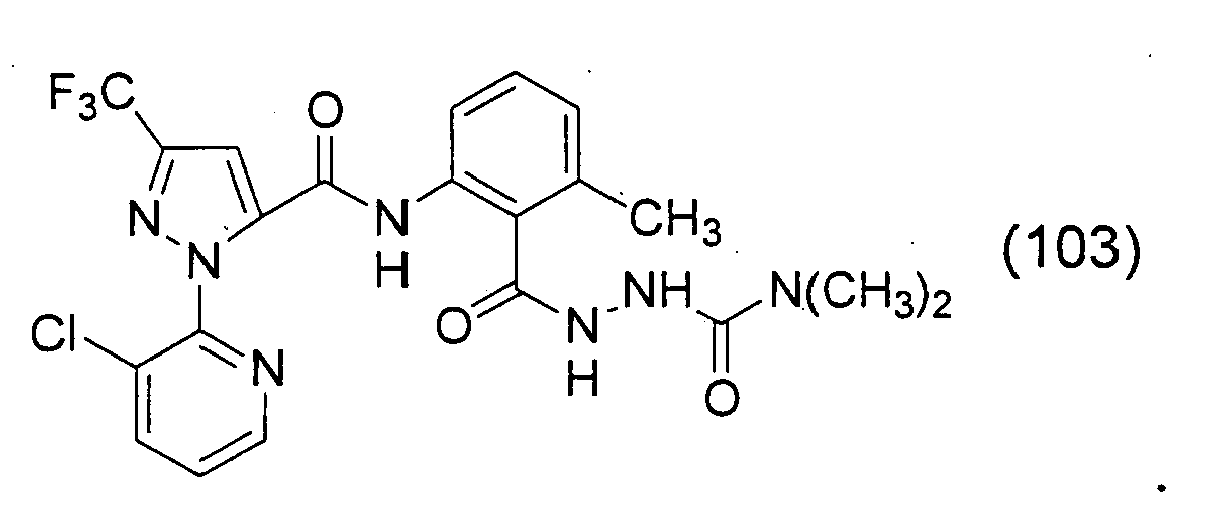
1H-NMR(DMSO-d6)δ(ppm):2.29(3H,s),2.93(6H,s),7.07(1H,d, J=8Hz),7.27(1H,t,J=8Hz),7.71(1H,dd,J=8Hz,4Hz),7.86(1H,d, J=8Hz),8.11(1H,s),8.28(1H,d,J=8Hz),8.56(1H,d,J=4Hz),8.99 (1H,brs),10.10(1H,brs),10.19(1H,brs) - A mixture of 0.20g of 6-chloro-2-[1-(3-chloro-2-pyridinyl)-3-isopropyl-1H-pyrazol-5-yl]-8-methyl-4H-3,1-ben zoxazine-4-one, 0.43g of methyl carbazate and 5ml of N,N-dimethylformamide was stirred at room temperature for 20 hours. Water was poured into the reaction mixture, and the mixture was extracted with methyl t-butyl ether three times. The organic layers were combined, washed successively with water and an aqueous saturated sodium chloride solution, dried over anhydrous magnesium sulfate, and concentrated under reduced pressure. The resulting residue was subjected to silica gel column chromatography to obtain 0.22g of the present compound (104) of the formula:

1H-NMR(DMSO-d6)δ(ppm):1.35(6H,d,J=7Hz),2.22(3H,s),3.08(1H, hept.,J=7Hz),3.68(3H,brs),7.17(1H,s),7.45(1H,brs),7.58-7.62 (2H,m),8.17(1H,dd,J=8Hz,1Hz),8.52(1H,dd,J=4Hz,1Hz),9.39(1H, brs),10.09(1H,brs),10.20(1H,brs) - A mixture of 0.20g of 2-[1-(3-chloro-2-pyridinyl)-3-isopropyl-1H-pyrazol-5-yl]-6,8-dibromo-4H-3,1-benzoxazine-4-one, 0.34g of methyl carbazate and 4ml of N,N-dimethylformamide was stirred at room temperature for 17 hours. Water was poured into the reaction mixture, and the mixture was extracted with methyl t-butyl ether three times. The organic layers were combined, washed successively with water and an aqueous saturated sodium chloride solution, dried over anhydrous magnesium sulfate, and concentrated under reduced pressure. The resulting residue was subjected to silica gel column chromatography to obtain 0. 16g of the present compound (105) of the formula:

1H-NMR(DMSO-d6)δ(ppm):1.27(6H,d,J=7Hz),3.01(1H,hept., J=7Hz),3.60(3H,brs),7.16(1H,s),7.53(1H,dd,J=8Hz,4Hz),7.64 (1H,brs),8.07(1H,dd,J=8Hz,1Hz),8.11(1H,brs),8.45(1H,dd, J=4Hz,1Hz).9.35(1H,brs),10.16(1H,brs),10.22(1H,brs) - According to the same manner as that of Preparation Example 95 except that the present compound (59) was used in place of the present compound (34) to obtain the present compound (106) of the formula:

1H-NMR(CDCl3,TMS)δ(ppm):3.73(6H,s),7.38-7.45(3H,m),7.64(1H, d,J=2Hz),7.89(1H,d,J=8Hz),8.37(1H,d,J=4Hz),8.67(1H,brs), 9.21(1H,brs) - According to the same manner as that of Preparation Example 95 except that the present compound (70) was used in place of the present compound (34) to obtain the present compound (107) of the formula:

1H-NMR(CDCl3,TMS)δ(ppm):3.77(6H,s),7.09(1H,s),7.36(1H,dd, J=8Hz,4Hz),7.51(1H,d,J=2Hz),7.69(1H,d,J=2Hz),7.88(1H,dd, J=8Hz,1Hz),8.35(1H,dd,J=4Hz,1Hz),8.63(1H,brs),8.95(1H,brs) - According to the same manner as that of Preparation Example 95 except that the present compound (5) was used in place of the present compound (34) to obtain the present compound (108) of the formula:

1H-NMR(CDCl3,TMS)δ(ppm):2.23(3H,s),3.81(6H,s),7.24(1H,s), 7.36(1H,d,J=2Hz),7.39-7.42(2H,m),7.91(1H,dd,J=8Hz,1Hz), 8.28(1H,s),8.40(1H,dd,J=4Hz,1Hz),9.27(1H,s). - According to the same manner as that of Preparation Example 95 except that the present compound (49) was used in place of the present compound (34) to obtain the present compound (109) of the formula:

1H-NMR(CDCl3,TMS)δ(ppm):3.75(6H,s),7.37-7.43(2H,m),7.63(1H, d,J=2Hz),7.84(1H,d,J=2Hz),7.90(1H,dd,J=8Hz,1Hz),8.38(1H,dd, J=4Hz,J=1Hz),8.57(1H,brs),9.17(1H,brs). - According to the same manner as that of Preparation Example 95 except that the present compound (68) was used in place of the present compound (34) to obtain the present compound (110) of the formula:

1H-NMR(CDCl3,TMS)δ(ppm):3.78(6H,s),7.08(1H,s),7.37(1H,dd,J= 8Hz,4Hz),7.67(1H,d,J=2Hz),7.87-7.90(2H,m),8.35(1H,dd,J=4Hz, 1Hz),8.54(1H,brs),8.88(1H,brs). - According to the same manner as that of Preparation Example 95 except that ethyl chloroformate was used in place of methyl chloroformate to obtain the present compound (111) of the formula:

1H-NMR(CDCl3,TMS)δ(ppm):1.30(3H,t,J=7Hz),2.24(3H,s),3.82 (3H,s),4.30(2H,q,J=7Hz),6.97(1H,s),7.34-7.38(2H,m),7.45(1H, s),7.88(1H,dd,J=8Hz,2Hz),8.27(1H,s),8.38(1H,dd,J=5Hz,2Hz), 9.21(1H,s). - According to the same manner as that of Preparation Example 95 except that isobutyl chloroformate was used in place of methyl chloroformate to obtain the present compound (112) of the formula:

1H-NMR(CDCl3,TMS)δ(ppm):0.94(6H,d,J=7Hz),1.98(1H,hept, J=7Hz),2.24(3H,s),3.82(3H,s),9.04(2H,d,J=7Hz),6.96(1H,s), 7.34-7.37(2H,m),7.45(1H,d,J=2Hz),7.88(1H,dd,J=8Hz,2Hz),8.29 (1H,s),8.38(1H,dd,J=5Hz,2Hz),9.23(1H,s). - A mixture of 0.10g of 6-chloro-2-[1-(3-chloro-2-pyridinyl)-3-cyano-1H-pyrazole-5-yl]-8-methyl-4H-3,1-benzoxazine-4-one, 0.23g of methyl carbazate and 4ml of N,N-dimethylformamide was stirred at room temperature for 18 hours. Water was poured into the reaction mixture, and the mixture was extracted with methyl t-butyl ether three times. The organic layers were combined, washed successively with water and an aqueous saturated sodium chloride solution, dried over anhydrous magnesium sulfate, and concentrated under reduced pressure. The resulting residue was subjected to silica gel column chromatography to obtain 0.090g of the present compound (113) of the formula:

1H-NMR(DMSO-d6)δ(ppm):2.14(3H,s),3.61(3H,brs),7.38(1H,brs), 7.54(1H,s),7.67(1H,dd,J=8Hz,5Hz),7.81(1H,s),8.22(1H,d, J=8Hz),8.53(1H,d,J=5Hz),9.29(1H,brs),10.16(1H,brs),10.44 (1H,brs). - A mixture of 0.30g of 2-[3-bromo-1-(3-chloro-2-pyridinyl)-1H-pyrazole-5-yl]-6-chloro-8-methyl-4H-3,1-benzoxazine-4-one, 0.69g of N-methyl-N-methoxycarbonylhydrazine and 15ml of N,N-dimethylformamide was stirred at 60°C for 9 hours and at 80°C for 22 hours. Water was poured into the reaction mixture, and the mixture was extracted with methyl tert-butyl ether three times. The organic layers were combined, washed with water and an aqueous saturated sodium chloride solution, dried over anhydrous magnesium sulfate, and concentrated under reduced pressure. The residue was subjected to silica gel column chromatography to obtain 0.036g of the present compound (114) of the formula:

1H-NMR(CDCl3,TMS)δ(ppm):2.20(3H,s),3.21(3H,s),3.74(3H,brs), 7.05(1H,s),7.26-7.38(3H,m),7.86(1H,dd,J=8Hz,2Hz),8.03 (1H,s),8.42(1H,dd,J=5Hz,2Hz),9.47(1H,s). - A mixture of 0.60g of 3-bromo-N-[4-chloro-2-(N-methylhydrazinocarbonyl)-6-methylphenyl]-1-(3-chloro-2-pyridinyl)-1H-pyrazole-5-carboxamide, 0.41ml of methyl chloroformate and 6ml of pyridine was stirred at room temperature for 3 hours. Water was poured into the reaction mixture, followed by concentration under reduced pressure. The residue was distributed between water and ethyl acetate, and the organic layer was washed with an aqueous saturated sodium chloride solution, dried over anhydrous magnesium sulfate, and concentrated under reduced pressure. The residue was subjected to silica gel column chromatography to obtain 0.46g of the present compound (115) of the formula:

1H-NMR(CDCl3,TMS)δ(ppm):2.04(3H,s),3.22(3H,s),3.57(2.6H,s), 3.80(0.4H,s),7.01(1H,s),7.04(1H,s),7.28(1H,s),7.40(1H,dd, J=8Hz,5Hz),7.61(1H,brs),7.87(1H,dd,J=8Hz,2Hz),8.46(1H,dd, J=5Hz,2Hz),9.80(1H,brs). - According to the same manner as that of Preparation Example 72 except that 2-[3-bromo-1-(3-chloro-2-pyridinyl)-1H-pyrazole-5-yl]-6,7-dichloro-8-methyl-4H-3,1-b enzoxazine-4-one was used in place of 2-[3-bromo-1-(3-chloro-2-pyridinyl)-1H-pyrazole-5-yl]-8-chloro-4H-3,1-benzoxazine-4-one to obtain the present compound (116) of the formula:

1H-NMR(DMSO-d6,TMS)δ(ppm):2.25(3H,s),3.45-3.68(3H,m),7.36 (1H,s),7.57-7.65(2H,m),8.18(1H,d,J=8Hz),8.50(1H,d,J=4Hz), 9.36(1H,brs),10.24(1H,brs),10.49(1H,brs). - According to the same manner as that of Preparation Example 72 except that 2-[3-bromo-1-(3-chloro-2-pyridinyl)-1H-pyrazole-5-yl]-8-methyl-6-cyano-4H-3,1-benzoxazine-4-one was used in place of 2-[3-bromo-1-(3-chloro-2-pyridinyl)-1H-pyrazole-5-yl]-8-chloro-4H-3,1-benzoxazine-4-one to obtain the present compound (117) of the formula:

1H-NMR(DMSO-d6,TMS)δ(ppm):2.20(3H,s),3.45-3.68(3H,m),7.38 (1H,s),7.61(1H,dd,J=8Hz,5Hz),7.77(1H,s),7.96(1H,s),8.17(1H, d,J=8Hz),8.50(1H,d,J=5Hz),9.36(1H,brs),10.27(1H,brs),10.49 (1H,brs). - A mixture of 0.59g of 3,5-dibromo-2-{N-[3-bromo-1-(3-chloro-2-pyridinyl)-1H-pyrazole-5-carbonyl]-N-methylamino}benzoic acid, 2ml of thionyl chloride and one droplet of N,N-dimethylformamide was stirred at 80°C for 1 hour. The reaction mixture was concentrated under reduced pressure, 10ml of hexane was added thereto, and the mixture was further concentrated under reduced pressure. The resulting residue, 10ml of tetrahydrofuran, 0.10g of methyl carbazate and 1ml of pyridine were mixed, and the mixture was stirred at room temperature for 3 hours. The reaction mixture was poured into 30ml of water, and the mixture was extracted with ethyl acetate three times. The organic layers were combined, washed successively with water and an aqueous saturated sodium chloride solution, dried over anhydrous sodium sulfate, and concentrated under reduced pressure. The resulting residue was subjected to silica gel column chromatography to obtain 0.23g of the present compound (118) of the formula:

1H-NMR(DMSO-d6,TMS)δ(ppm):3.05(1.9H,s),3.38(1.1H,s), 3.52-3.73(3H,m),5.68(0.7H,brs),7.11(0.3H,brs),7.57-7.81(2H, m),8.16-8.32(2H,m),8.49-8.55(1H,m),9.42(1H,brs),10.54(1H, brs). - A mixture of 0.30g of 3-bromo-N-[4-chloro-2-(N,N'-dimethylhydrazinocarbonyl)-6-methylphenyl]-1-(3-chloro-2-pyridinyl)-1H-pyrazole-5-carboxamide, 0.07ml of methyl chloroformate and 5ml of pyridine was stirred at room temperature for 1 hour. Water was poured into the reaction mixture, and the mixture was extracted with ethyl acetate three times. The organic layers were combined, dried over anhydrous sodium sulfate, and concentrated under reduced pressure. The resulting residue was washed with a mixed solvent of ethyl acetate and hexane to obtain 0.09g of the present compound (119) of the formula:

1H-NMR(DMSO-d6,TMS)δ(ppm):2.10-2.24(3H,m),2.61-2.87(3H,m), 2.90-3.18(3H,m),3.45-3.74(3H,m),7.12-7.30(1H,m),7.33-7.44 (1H,m),7.44-7.88(1H,m),7.58-7.66(1H,m),8.20(1H,d,J=8Hz), 8.47-8.54(1H, m), 10.10-10.50(1H, m). - According to the same manner as that of Preparation Example 72 except that 2-[3-bromo-1-(3-chloro-2-pyridinyl)-1H-pyrazole-5-yl]-8-bromo-6-fluoro-4H-3,1-benzoxazine-4-one was used in place of 2-[3-bromo-1-(3-chloro-2-pyridinyl)-1H-pyrazole-5-yl]-8-chloro-4H-3,1-benzoxazine-4-one to obtain the present compound (120) of the formula:

1H-NMR(DMSO-d6,TMS)δ(ppm):3.42-3.69(3H,m),7.34(1H,d,J=8Hz), 7.41(1H,s),7.60(1H,dd,J=8Hz,5Hz),7.89(1H,d,J=8Hz),8.16(1H, d,J=8Hz),8.50(1H,d,J=5Hz),9.36(1H,brs),10.18(1H,brs),10.42 (1H,brs). - According to the same manner as that of Preparation Example 72 except that 2-[3-bromo-1-(3-chloro-2-pyridinyl)-1H-pyrazole-5-yl]-8-phenyl-4H-3,1-benzoxazine-4-one was used in place of 2-[3-bromo-1-(3-chloro-2-pyridinyl)-1H-pyrazole-5-yl]-8-chloro-4H-3,1-benzoxazine-4-one to obtain the present compound (121) of the formula:

1H-NMR(DMSO-d6,TMS)δ(ppm):3.49-3.68(3H,m),7.24-7.67(10H,m), 8.08(1H,d,J=8Hz),8.43(1H,d,J=4Hz),9.29(1H,brs),10.08(1H, brs),10.19(1H,brs). - A mixture of 0.17g of 6,8-dibromo-2-[4-bromo-1-(3-chloro-2-pyridinyl)-1H-pyrrol-2 -yl]-4H-3,1-benzoxazine-4-one, 0.27g of methyl carbazate and 20ml of N,N-dimethylformamide was stirred at room temperature for 2 days. Water was poured into the reaction mixture, and the mixture was extracted with ethyl acetate. The organic layer was washed with water, dried over sodium sulfate, and concentrated under reduced pressure to obtain 0.15g of the present compound (122) of the formula:

1H-NMR(DMSO-d6)δ(ppm):3.67(3H,s),7.36(1H,s),7.46(1H,d, J=2Hz),7.54(1H,dd,J=8Hz,5Hz),7.70(1H,s),8.09(1H,d,J=8Hz), 8.13(1H,d,J=2Hz),8.48(1H,d,J=5Hz),9.40(1H,brs),9.97 (1H, brs), 10.18(1H, brs) - According to the same manner as that of Preparation Example 122 except that 8-bromo-2-[4-bromo-1-(3-chloro-2-pyridinyl)-1H-pyrrol-2-yl]-6-chloro-4H-3,1-benzoxazine-4-one was used in place of 6,8-dibromo-2-[4-bromo-1-(3-chloro-2-pyridinyl)-1H-pyrrol-2-yl]-4H-3,1-benzoxazine-4-one to obtain the present compound (123) of the formula:

1H-NMR(DMSO-d6)δ(ppm):3.62(3H,s),7.30(1H,s),7.39(1H,d, J=2Hz),7.48(1H,dd,J=8Hz,5Hz),7.52(1H,s),7.96(1H,d,J=2Hz), 8.03(1H,dd,J=8Hz,2Hz),8.42(1H,dd,J=5Hz,2Hz),9.35(1H,brs), 9.92(1H,brs),10.11(1H,brs) - According to the same manner as that of Preparation Example 122 except that 2-[4-bromo-1-(3-chloro-2-pyridinyl)-1H-pyrrol-2-yl]-6-cyano-8-methyl-4H-3,1-benzoxazine-4-one was used in place of 6,8-dibromo-2-[4-bromo-1-(3-chloro-2-pyridinyl)-1H-pyrrole-2-yl]-4H-3,1-benzoxazine-4-one to obtain the present compound (124) of the formula:

1H-NMR(DMSO-d6)δ(ppm):2.21(3H,s),3.64(3H,s),7.25(1H,d, J=2Hz),7.41(1H,d,J=2Hz),7.49(1H,dd,J=8Hz,5Hz),7.77(1H,s), 7.88(1H,s),8.04(1H,dd,J=8Hz,2Hz),8.43(1H,dd,J=5Hz,2Hz), 9.36(1H,brs),10.05(1H,brs),10.27(1H,brs) - According to the same manner as that of Preparation Example 72, 2-[3-bromo-1-(3-chloro-2-pyridinyl)-1H-pyrazol-5-yl]-8- ethyl-4H-3,1-benzoxazine-4-one was used in place of 2-[3-bromo-1-(3-chloro-2-pyridinyl)-1H-pyrazol-5-yl]-8-chloro-4H-3,1-benzoxazine-4-one to obtain the present compound (125) of the formula:

1H-NMR (DMSO-d6,TMS)δ (ppm) : 1.06-1.13 (3H, m), 2.45-2.60 (2H, m), 3.55-3.70 (3H, m), 7.25-7.47 (4H, m), 7.57-7.63 (1H, m), 8.14-8.19 (1H, m), 8.46-8.53 (1H, m), 9.24 (1H, brs), 9.98 (1H, brs), 10.16 (1H, brs). - According to the same manner as that of Preparation Example 5, N-[4-chloro-2-(hydrazinocarbonyl)-6-methylphenyl] -1-cyclohexyl-3-trifluoromethyl-1H-pyrazole-5-carboxamide was used in place of N-[4-chloro-2-(hydrazinocarbonyl)-6-methylphenyl]-1-(3-chloro-2-pyridinyl)-3-trifluoromethyl-1H -pyrazole-5-carboxamide to obtain the present compound (126) of the formula:

1H-NMR (DMSO-d6) δ ppm) : 1.20-1.41 (3H, m),1.67-1.80 (5H, m), 1.98-2.00 (2H, m), 2.25 (3H, s), 3.56 (3H, s), 5.00-5.08 (1H, m), 7.33 (1H, s), 7.40 (1H, d, J=2Hz), 7.55 (1H, d, J=2Hz), 9.02 (1H, brs), 9.94 (1H, brs), 10.04 (1H, brs). - According to the same manner as that of Preparation Example 93, 4,5-dibromo-N-[4-chloro-2-(hydrazinocarbonyl)-6-methyLphenyl]-1-(3-chloro-2-pyridinyl)-1H-pyrrole-2-carboxamide was used in place of 4-bromo-N-[4-chloro-2-(hydrazinocarbonyl)-6-methylphenyl]-1-(3-chloro-2-pyridinyl )-1H-pyrrole-2-carboxamide to obtain the present compound (127) of the formula:

1H-NMR (DMSO-d6) δ (ppm): 2.09 (3H, s), 3.63 (3H, s), 7.36 (1H, s), 7.42 (1H, s), 7.49 (1H, s), 7.57 (1H, dd, J=8Hz, 5Hz), 8.14 (1H, d, J=8Hz), 8.50 (1H, d, J=5Hz), 9.29 (1H, brs), 9.79 (1H, brs), 10.12 (1H, brs). - A mixture of 0.20 g of 4,5-dibromo-N-[4-chloro-2-(hydrazinocarbonyl)-6-methylphenyl]-1-(3-chloro-2-pyridinyl )-1H-pyrrole-2-carboxamide, 0.04 g of N,N-dimethylcarbamoyl chloride and 0.08 ml of pyridine in N,N-dimethylformamide was stirred at room temperature for 14 hours. Water was poured into the reaction mixture and the mixture was extracted with ethyl acetate. The organic layer was washed with water, dried over sodium sulfate, and concentrated under reduced pressure. The resulting residue was subjected to silica gel column chromatography to obtain 0.16 g of the present compound (128) of the formula:

1H-NMR (DMSO-d6) δ (ppm): 2.08 (3H, s), 2.88 (6H, s), 7.40 (1H, d, J=2Hz), 7.44 (1H, d, J=2Hz), 7.52 (1H, s), 7.58 (1H, dd, J=8Hz, 5Hz), 8.14 (1H, dd, J=8Hz, 1Hz), 8.50 (1H, dd, J=5Hz, 1Hz), 8.56 (1H, brs), 9.75 (1H, brs), 9.81 (1H, brs). - According to the same manner as that of Preparation Example 122, 2-[5-chloro-1-(3-chloro-2-pyridinyl)-1H-pyrrol-2-yl]-6-chloro-8-methyl-4H-3,1-benzoxazine-4-one was used in place of 6,8-dibromo-2-[4-bromo-1-(3-chloro-2-pyridinyl)-1H-pyrrol-2-yl]-4H-3,1-benzoxazine-4-one to obtain the present compound (129) of the formula:

1H-NMR(DMSO-d6,TMS)δ(ppm):2.11(3H,s),3.63(3H,s),6.48(1H,d, J=4Hz),7.24(1H,d,J=4Hz),7.48(1H,s),7.55(1H,dd,J=8Hz,5Hz), 7.95(1H, s), 8.12(1H, dd, J=8Hz, 2Hz), 8.49(1H, dd, J=5Hz, 2Hz), 9.31 (1H,brs),9.74(1H,brs),10.13(1H,brs) - According to the same manner as that of Preparation Example 93, N-[4-chloro-2-(hydrazinocarbonyl)-6-methylphenyl]-1-(3-chloro-2-pyridinyl)-1H-pyrrole-2-carboxamide was used in place of 4-bromo-N-[4-chloro-2-(hydrazinocarbonyl)-6-methylphenyl]-1-(3-chloro-2-pyridinyl )-1H-pyrrole-2- carboxamide to obtain the present compound (130) of the formula:

1H-NMR(DMSO-d6,TMS)δ(ppm):2.16(3H,s),3.61(3H,s),6.37(1H,d, J=3Hz),7.12-7.18(2H,m),7.40(1H,s),7.45-7.50(2H,m),8.03(1H, d,J=8Hz),8.42.(1H,d,J=5Hz),9.33(1H,brs),9.71(1H,brs),10.14 (1H,brs) - According to the same manner as that of Preparation Example 10, 3-bromo-1-(3-chloro-2-pyridinyl)-N-[4-cyano-2-(hydrazinocarbonyl)-6-methylphenyl]-1H-pyrazole-5-carboxamide was used in place of N-[4-chloro-2-(hydrazinocarbonyl)-6-methylphenyl]-1-(3-chloro-2-pyridinyl)-3-trifluoromethyl-1H-pyrazole-5-carboxamide to obtain the present compound (131) of the formula:

1H-NMR(DMSO-d6,TMS)δ(ppm):2.18(3H,s),2.88(6H,s),7.49(1H,s), 7.62(1H,dd,J=8Hz,5Hz),7.82(1H,s),7.93(1H,s),8.19(1H,dd, J=8Hz,1Hz),8.50(1H,dd,J=5Hz,1Hz),8.63(1H,brs),9.93(1H,brs), 10.42(1H,brs) - According to the same manner as that of Preparation Example 93, 4,5-dichloro-N-[4-chloro-2-(hydrazinocarbonyl) -6-methylphenyl]-1-(3-chloro-2-pyridinyl)-1H-pyrrole-2-carboxamide was used in place of 4-bromo-N-[4-chloro-2-(hydrazinocarbonyl)-6-methylphenyl]-1-(3-chloro-2-pyridinyl)-1H-pyrrole-2-carboxamide to obtain the present compound (132) of the formula:

1H-NMR(DMSO-d6,TMS)δ(ppm):2.10(3H,s),3.63(3H,s),7.39(2H,s), 7.49(1H,s),7.59(1H,dd,J=8Hz,5Hz),8.15(1H,dd,J=8Hz,1Hz),8.51 (1H,dd,J=5Hz,1Hz),9.30(1H,brs),9.82(1H,brs),10.12(1H,brs) - According to the same manner as that of Preparation Example 128, 4,5-dichloro-N-[4-chloro-2-(hydrazinocarbonyl)-6-methylphenyl]-1-(3-chloro-2-pyridinyl)-1H-pyrrole-2-carboxamide was used in place of 4,5-dibromo-N-[4-chloro-2-(hydrazinocarbonyl)-6-methylphenyl]-1-(3-chloro-2-pyridinyl)-1H-pyrrole-2-carboxamide to obtain the present compound (133) of the formula:

1H-NMR(DMSO-d6,TMS)δ(ppm):2.10(3H,s),2.53(6H,s),7.37-7.39 (2H,m),7.51(1H,d,J=2Hz),7.59(1H,dd,J=8Hz,5Hz),8.17(1H,dd, J=8Hz,2Hz),8.52(1H,dd,J=5Hz,2Hz),9.31(1H,brs),9.82(1H,brs), 10.13(1H,brs) - A mixture of 0.50 g of 4-bromo-N-[4-chloro-2-(N-methylhydrazinocarbonyl)-6-methylphenyl]-1-(3-chloro-2-pyridinyl)-1H-pyrrole-2-carboxamide, 0.11 g of methyl chloroformate, 0.18 ml of pyridine and 5 ml of N,N-dimethylformamide was stirred at room temperature for 3 hours. The reaction mixture was poured into water, and extracted with ethyl acetate three times. The organic layers were combined, washed successively with water and an aqueous saturated sodium chloride solution, dried over anhydrous sodium sulfate, and concentrated under reduced pressure. The resulting residue was subjected to silica gel column chromatography to obtain 0.09 g of the present compound (134) of the formula:

1H-NMR(CDCl3,TMS)δ(ppm):2.05-2.12(3H,m),3.21(3H,s),3.54-3.76(3H,m),7.02(1H,d,J=2Hz),7.06(2H,s),7.29(1H,brs),7.33 (1H,dd,J=8Hz,5Hz),7.80-7.86(2H,m),8.40(1H,dd,J=5Hz,2Hz), 8.99(1H,brs) - According to the same manner as that of Preparation Example 72, 2-[3-bromo-1-(3-chloro-2-pyridinyl)-1H-pyrazol-5-yl]-6,8-dichloro-4H-3,1-benzoxazine-4-one was used in place of 2-[3-bromo-1-(3-chloro-2-pyridinyl)-1H-pyrazol-5-yl]-8-chloro-4H-3,1-benzoxazine-4-one to obtain the present compound (135) of the formula:

1H-NMR(DMSO-d6,TMS)δ(ppm):3.47-3.62(3H,m),7.40(1H,s), 7.41(1H,s),7.60(1H,dd,J=8Hz,5Hz),7.93(1H,s),8.16(1H,dd, J=8Hz,1Hz),8.50(1H,dd,J=5Hz,1Hz),9.37(1H,brs), 10.24(1H,brs),10.48(1H,brs) - A mixture of 0.25 g of 4-bromo-N-[4-chloro-2-(N-methylhydrazinocarbonyl)-6-methylphenyl]-1-(3-chloro-2-pyridinyl)-1H-pyrrole-2- carboxamide, 0.06 g of N,N-dimethylcarbamoyl chloride, 0.09 ml of pyridine and 5 ml of N,N-dimethylformamide was stirred at 70°C for 8 hours. The reaction mixture was poured into water, and a deposited precipitate was collected by filtration. The resulting solid was washed with acetonitrile to obtain 0.10 g of the present compound (136) of the formula:

1H-NMR(DMSO-d6,TMS)δ(ppm):2.11(3H,s),2.65-2.85(6H,m), 3.19-3.29(3H,m),7.07(1H,s),7.14(1H,s),7.28(1H,s), 7.40(1H,s),7.50(1H,dd,J=8Hz,5Hz),7.60(1H,brs),8.06(1H,d, J=8Hz),8.43(1H,d,J=5Hz),9.86(1H,brs) - Under ice-cooling, 0.50 g of 4-bromo-N-[4-chloro-2-(hydrazinocarbonyl)-6-methylphenyl]-1-(3-chloro-2-pyridinyl )-1H-pyrrole-2-carboxamide, 4 ml of formic acid and 2 ml of acetic anhydride were mixed. The mixture was stirred at room temperature for 2 hours. The reaction mixture was poured into water, and extracted with ethyl acetate three times. The organic layers were combined, washed successively with water and an aqueous saturated sodium chloride solution, dried over anhydrous sodium sulfate, and concentrated under reduced pressure. The residue was washed with acetonitrile to obtain 0.20 g of the present compound (137) of the formula:

1H-NMR(DMSO-d6,TMS)δ(ppm):2.15(3H,s),7.23(1H,s),7.42-7.44 (2H,m),7.48-7.52(2H,m),8.05(1H,d,J=7Hz),8.43(1H,d,J=3Hz), 8.98(1H, s),9.76(1H, s), 9.96(1H, brs), 10.12(1H, brs) - According to the same manner as that of Preparation Example 115, 3-bromo-1-(3-chloro-2-pyridinyl)-N-[4-cyano-2-(N-methylhydrazinocarbonyl)-6-methylphenyl]-1H-pyrazole-5-carboxamide was used in place of 3-bromo-N-[4-chloro-2-(N-methylhydrazinocarbonyl)-6-methylphenyl]-1-(3-chloro-2-pyridinyl)-1H-pyrazole-5-carboxamide to obtain the present compound (138) of the formula:

1H-NMR(DMSO-d6,TMS)δ (ppm) :2.21(3H,s)3.08(3H,s)3.45-3.70 (3H,m),7.30-7.43(1H,m),7.44-7.61(1H,m),7.63(1H,dd,J=8Hz, 5Hz),7.82-7.94(1H,m),8.21(1H,d,J=8Hz,1Hz),8.51(1H,dd,J=5Hz, 1Hz),9.21(1H,brs),10.24(1H,brs) - According to the same manner as that of Preparation Example 134, 4-bromo-1-(3-chloro-2-pyridinyl)-N-[4-cyano-2-(N-methylhydrazinocarbonyl)-6-methylphenyl]-1H-pyrrole-2-carboxamide was used in place of 4-bromo-N-[4-chloro-2-(N-methylhydrazinocarbonyl)-6-methylphenyl]-1-(3-chloro-2-pyridinyl)-1H-pyrrole-2-carboxamide to obtain the present compound (139) of the formula:

1H-NMR(DMSO-d6,TMS)δ(ppm):2.21(3H,s),3.08(3H,s),3.47-3.70 (3H,m),7.18-7.30(1H,m),7.41-7.50(1H,m),7.51-7.56(2H,m), 7.80-7.90(1H,m),8.12(1H,dd,J=8Hz,1Hz),8.45(1H,dd,J=5Hz, 1Hz),9.10(1H,brs),9.73(1H,brs) - According to the same manner as that of Preparation Example 66, 3-bromo-N-[1-bromo-3-(hydrazinocarbonyl)-2-naphthyl]-1-(3-chloro-2-pyridinyl)-1H-pyrazole-5-carboxamide was used in place of N-[1-chloro-3-(hydrazinocarbonyl)-2-naphthyl]-1-(3-chloro-2-pyridinyl)-3-trifluoromethyl-1H-pyrazole-5-carboxamide to obtain the present compound (140) of the formula:

1H-NMR(DMSO-d6,TMS)δ(ppm):3.42-3.71(3H,m)7.48(1H,s)7.58 (1H,dd,J=8Hz,5Hz),7.72(1H,t,J=7Hz),7.81(1H,t,J=7Hz),8.10-8.21(3H,m),8.24(1H,d,J=8Hz),8.50(1H,d,J=5Hz),9.34(1H,brs), 10.26(1H,brs),10.64(1H,brs) - According to the same manner as that of Preparation Example 66, 4-bromo-N-[1-bromo-3-(hydrazinocarbonyl)-2-naphthyl]-1-(3-chloro-2-pyridinyl)-1H-pyrrole-2-carboxamide was used in place of N-[1-chloro-3-(hydrazinocarbonyl)-2-naphthyl]-1-(3-chloro-2-pyridinyl)-3-trifluoromethyl-1H-pyrazole-5- carboxamide to obtain the present compound (141) of the formula:

1H-NMR(DMSO-d6,TMS)δ(ppm):3.43-3.70(3H,m),7.37(1H,s),7.42-7.52(2H,m),7.70(1H,t,J=7Hz),7.79(1H,t,J=7Hz),8.03(1H,d, J=7Hz),8.06-8.20(2H,m),8.23(1H,d,J=8Hz),8.43(1H,d,J=4Hz), 9.34(1H,brs),10.09(1H,brs),10.19(1H,brs) - According to the same manner as that of Preparation Example 17, 3-bromo-1-(3-chloro-2-pyridinyl)-N-[4-cyano-2-(hydrazinocarbonyl)-6-methylphenyl]-1H-pyrazole-5-carboxamide was used in place of N-[4-chloro-2-(hydrazinocarbonyl)-6-methylphenyl]-1-(3-chloro-2-pyridinyl)-3-trifluoromethyl-1H-pyrazole-5-carboxamide to obtain the present compound (142) of the formula:

1H-NMR(DMSO-d6,TMS)δ(ppm):2.16-2.34(3H,m),7.35-7.45(1H,m), 7.57-7.66(1H,m),7.76-7.88(1H,m),7.93-8.02(1H,m),8.03-8.12 (1H,m),8.17(1H,d,J=7Hz),8.50(1H,brs),9.55-10.03(1H,m), 10.17-10.58(2H,m) - According to the same manner as that of Preparation Example 17, 4-bromo-1-(3-chloro-2-pyridinyl)-N-[4-cyano-2-(hydrazinocarbonyl)-6-methylphenyl]-1H-pyrrole-2-carboxamide was used in place of N-[4-chloro-2-(hydrazinocarbonyl)-6-methylphenyl]-1-(3-chloro-2-pyridinyl )-3-trifluoromethyl-1H-pyrazole-5-carboxamide to obtain the present compound (143) of the formula:
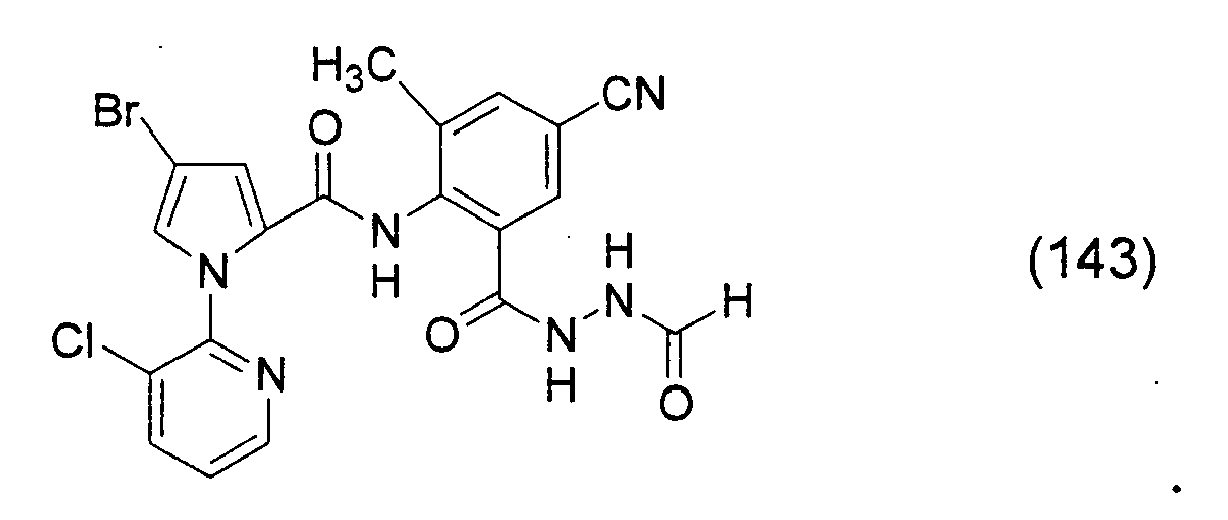
1H-NMR(DMSO-d6,TMS)δ(ppm):2.17-2.30(3H,m),7.24-7.36(1H,m), 7.45-7.55(2H,m),7.74-7.82(1H,m),7.88-7.95(1H,m),8.03-8.09 (2H,m),8.44(1H,d,J=5Hz),10.02(1H,brs),10.21(1H,brs),10.46 (1H,brs) - According to the same manner as that of Preparation Example 119, 3-bromo-1-(3-chloro-2-pyridinyl)-N-[4-cyano-2-(N,N'-dimethylhydrazinocarbonyl)-6-methylphenyl]-1H-pyrazole-5- carboxamide was used in place of 3-bromo-N-[4-chloro-2-(N,N'-dimethylhydrazinocarbonyl)-6-methylphenyl]-1-(3-chloro-2-pyridinyl)-1H-pyrazole-5-carboxamide to obtain the present compound (144) of the formula:

1H-NMR(DMSO-d6,TMS)δ(ppm):2.14-2.29(3H,m),2.64-2.87(3H,m), 2.87-3.15(3H,m),3.42-3.73(3H,m),7.30-7.45(1H,m),7.54-7.81 (2H,m),7.83-8.01(1H,m),8.15-8.24(1H,m),8.50(1H,brs),10.20-10.68(1H,m) - A mixture of 0.25 g of 3-bromo-N-[1-bromo-3-(hydrazinocarbonyl)-2-naphthyl]-1-(3-chloro-2-pyridinyl)-1H-pyrazole-5-carboxamide, 0.22 g of N,N-dimethylcarbamoyl chloride, 4 ml of acetonitrile and 1 ml of pyridine was stirred at room temperature for 2 hours, and allowed to stand at room temperature overnight. Water was poured into the reaction mixture, and the mixture was extracted with ethyl acetate three times. The organic layers were combined, washed successively with water and an aqueous saturated sodium chloride solution, dried over anhydrous magnesium sulfate, and concentrated under reduced pressure to obtain 0.20 g of the present compound (145) of the formula:

1H-NMR(DMSO-d6,TMS)δ(ppm):2.88(6H,s),7.54(1H,s),7.59(1H,dd, J=8Hz,5Hz),7.72(1H,t,J=7Hz),7.79(1H,t,J=7Hz),8.09(1H,d, J=7Hz),8.15(1H,dd,J=8Hz,1Hz),8.19-8.26(2H,m),8.50(1H,dd, J=5,1Hz),8.54(1H,brs),9.90(1H,brs),10.57(1H,brs) - According to the same manner as that of Preparation Example 145, 4-bromo-N-[1-bromo-3-(hydrazinocarbonyl)-2-naphthyl]-1-(3-chloro-2-pyridinyl)-1H-pyrrole-2-carboxamide was used in place of 3-bromo-N-[1-bromo-3-(hydrazinocarbonyl)-2-naphthyl]-1-(3-chloro-2-pyridinyl)-1H -pyrazole-5- carboxamide to obtain the present compound (146) of the formula:

1H-NMR(DMSO-d6,TMS)δ(ppm):2.88(6H,s),7.37-7.44(1H,m), 7.44-7.51(2H,m),7.69(1H,t,J=7Hz),7.77(1H,t,J=7Hz),8.01-8.10 (2H,m),8.19-8.25(2H,m),8.43(1H,dd,J=5Hz,1Hz),8.55(1H,brs), 9.84(1H, brs), 10.05(1H, brs) - A mixture of 0.26 g of 4-bromo-N-[4-chloro-2-(N,N'-dimethylhydrazinocarbonyl)-6-methylphenyl]-1-(3-chloro-2-pyridinyl)-1H-pyrrole-2- carboxamide, 0.05 g of methyl chloroformate, 0.09 ml of pyridine and 5 ml of N,N-dimethylformamide was stirred at room temperature for 3 hours. The reaction mixture was poured into water, and extracted with ethyl acetate three times. The organic layers were combined, washed successively with water and an aqueous saturated sodium chloride solution, dried over anhydrous sodium sulfate, and concentrated under reduced pressure. The resulting residue was subjected to silica gel column chromatography to obtain 0.20 g of the present compound (147) of the formula:

1H-NMR(CDCl3,TMS)δ(ppm):2.18(3H,s),2.88-2.98(3H,m), 3.13-3.22(3H,m),3.63-3.82(3H,m),7.01-7.12(3H,m),7.20(1H,s), 7.30(1H,d,J=5Hz),7.79-7.80(1H,m),8.37-8.38(1H,m), 8.45-8.58(1H,brm) - According to the same manner as that of Preparation Example 93, N-[4,6-dibromo-2-(hydrazinocarbonyl)phenyl]-4,5-dichloro-1-(3-chloro-2-pyridinyl)-1H-pyrrole-2-carboxamide was used in place of 4-bromo-N-[4-chloro-2-(hydrazinocarbonyl)-6-methylphenyl]-1-(3-chloro-2-pyridinyl)-1H-pyrrole-2-carboxamide to obtain the present compound (148) of the formula:

1H-NMR(DMSO-d6,TMS)δ(ppm):3.62(3H,s),7.45(1H,s),7.58(1H,dd, J=8Hz,5Hz),7.63(1H,s),8.10(1H,s),8.15(1H,dd,J=8Hz,2Hz),8.51 (1H,dd,J=5Hz,2Hz),9.34(1H,brs),10.00(1H,brs),10.15(1H,brs) - A mixture of 0.50 g of 3-bromo-N-[4-chloro-2-(N-methylhydrazinocarbonyl)-6-methylphenyl]-1-(3-chloro-2-pyridinyl)-1H-pyrazole-5-carboxamide, 0.09 g of acetyl chloride, 0.09 g of pyridine and 10 ml of tetrahydrofuran was stirred at room temperature for 2 hours. Water was poured into the reaction mixture, and the mixture was extracted with ethyl acetate. The organic layer was washed with water, dried over anhydrous magnesium sulfate, and concentrated under reduced pressure. The resulting residue was washed with methyl t-butyl ether and hexane to obtain 0.48 g of the present compound (149) of the formula:

1H-NMR(CDCl3,TMS)δ(ppm) :1.56(3H,s),2.01(3H,s),3.24(3H,s), 6.97(2H,d,J=2Hz),7.39-7.42(2H,m),7.88(1H,dd,J=8Hz,1Hz), 8.39(1H,s),8.47(1H,dd,J=5Hz,1Hz),10.12(1H,brs) - A mixture of 0.50 g of 3-bromo-N-[4-chloro-2-(N-methylhydrazinocarbonyl)-6-methylphenyl]-1-(3-chloro-2-pyridinyl)-1H-pyrazole-5-carboxamide, 0.12 g of methyl chlorothiol formate, 0.09 g of pyridine and 10 ml of tetrahydrofuran was stirred at room temperature for 2 hours. Water was poured into the reaction mixture, and the mixture was extracted with ethyl acetate. The organic layer was washed with water, dried over anhydrous magnesium sulfate, and concentrated under reduced pressure. The resulting residue was washed with methyl t-butyl ether and hexane to obtain 0.50 g of the present compound (150) of the formula:

1H-NMR(CDCl3,TMS)δ(ppm):2.06(3H,brs)2.25(3H,brs)3.20(3H, brs), 6.99-7.29(3H, m), 7.41(1H, dd, J=8Hz, 5Hz),7 .88(1H, dd, J=8Hz,1Hz),8.01-8.23(1H,brm),8.46(1H,d,J=5Hz),9.49-9.79(1H, brm) - A mixture of 0.49 g of 2-[3-bromo-1-(3-chloro-2-pyridinyl)-1H-pyrazol-5-yl]-10-chloro-4H-naphtho[2,3-d][1,3 ]oxazine-4-one, 0.90 g of methyl carbazate and 5 ml of N,N-dimethylformamide was stirred at room temperature for 2 hours. Water was poured into the reaction mixture, and the mixture was extracted with ethyl acetate three times. The organic layers were combined, washed successively with water and an aqueous saturated sodium chloride solution, dried over anhydrous magnesium sulfate, and concentrated under reduced pressure to obtain 0.31 g of the present compound (151) of the formula:

1H-NMR(DMSO-d6,TMS)δ(ppm):3.59-3.68(3H,m),7.47(1H,s), 7.56-7.62(1H,m),7.74(1H,d,J=7Hz),7.80(1H,d,J=7Hz),8.12-8.18 (3H,m),8.25(1H,d,J=7Hz),8.50(1H,d,J=5Hz),9.35(1H,brs),10.30 (1H, brs), 10.60(1H, brs - According to the same manner as that of Preparation Example 151, 2-[4-bromo-1-(3-chloro-2-pyridinyl)-1H-pyrrol-2-yl]-10- chloro-4H-naphtho[2,3-d][1,3]oxazine-4-one was used in place of 2-[3-bromo-1-(3-chloro-2-pyridinyl)-1H-pyrazol-5-yl]-10-chloro-4H-naphtho[2,3-d][1,3]oxazine-4-one to obtain the present compound (152) of the formula:

1H-NMR(DMSO-d6,TMS)δ(ppm):3.55-3.70(3H,m),7.35(1H,s),7.43-7.51(2H,m),7.71(1H,t,J=8Hz),7.79(1H,t,J=8Hz),8.04(1H,d, J=8Hz),8.12(2H,d,J=8Hz),8.23(1H,d,J=8Hz),8.43(1H,d,J=5Hz), 9.35(1H,brs),10.06(1H,brs),10.24(1H,brs) - According to the same manner as that of Preparation Example 93, 4-chloro-N-[4-chloro-2-(hydrazinocarbonyl)-6-methylphenyl]-1-(3-chloro-2-pyridinyl))-1H-pyrrole-2-carboxamide was used in place of 4-bromo-N-[4-chloro-2-(hydrazinocarbonyl)-6-methylphenyl]-1-(3-chloro-2-pyridinyl )-1H-pyrrole-2-carboxamide to obtain the present compound (153) of the formula:

1H-NMR(DMSO-d6,TMS)δ(ppm):2.17(3H,s),3.63(3H,s),7.18(1H,d, J=2Hz),7.35(1H,d,J=2Hz),7.39(1H,s),7.47(1H,s),7.49(1H,dd, J=8Hz,5Hz),8.03(1H,dd,J=8Hz,2Hz),8.42(1H,dd,J=5Hz,2Hz), 9.31(1H,brs),9.76(1H,brs),10.12(1H,brs) - A mixture of 0.52 g of 3-bromo-N-[4,6-dichloro-2-(N-methylhydrazinocarbonyl)phenyl]-1-(3-chloro-2-pyridinyl) -1H-pyrazole-5-carboxamide, 0.10 g of methyl chloroformate, 0.09 g of pyridine and 7 ml of tetrahydrofuran was stirred at room temperature for 1 hour. Water was poured into the reaction mixture, and the mixture was extracted with ethyl acetate. The organic layer-was washed with water, dried over anhydrous magnesium sulfate, and concentrated under reduced pressure. The resulting residue was washed with methyl t-butyl ether and hexane to obtain 0.49 g of the present compound (154) of the formula:

1H-NMR(CDCl3,TMS)δ(ppm):3.12-3.18(3H,brm),3.60-3.84(3H,brm), 7.21-7.22(2H,m),7.34(1H,brs),7.41(1H,dd,J=8Hz,5Hz), 7.51(1H,brs),7.88(1H,dd,J=8Hz,1Hz),8.48(1H,dd,J=5Hz,1Hz), 9.85(1H,brs) - According to the same manner as that of Preparation Example 154, ethyl chloroformate was used in place of methyl chloroformate to obtain the present compound (155) of the formula:

1H-NMR(CDCl3,TMS)δ(ppm):1.11-1.39(3H,m),3.12-3.18(3H,brm), 4.06-4.25(2H,brm),7.08-7.22(2H,m),7.34(1H,brs),7.41(1H,dd, J=8Hz,5Hz),7.43(1H,brs),7.88(1H,dd,J=8Hz,1Hz),8.49(1H,dd, J=5Hz,1Hz),9.87(1H,brs) - A mixture of 0.50 g of 3-bromo-N-[4-chloro-2-(N-methylhydrazinocarbonyl)-6-methylphenyl]-1-(3-chloro-2-pyridinyl)-1H-pyrazole-5-carboxamide and 5 ml of formic acid was stirred at 50°C for 1 hour. Water was poured into the reaction mixture, and the mixture was extracted with ethyl acetate. The organic layer was washed with water, dried over anhydrous magnesium sulfate, and concentrated under reduced pressure. The resulting residue was washed with t-butyl ether and hexane to obtain 0.40 g of the present compound (156) of the formula:

1H-NMR(CDCl3,TMS)δ (ppm) :2.02(3H,s),3.25(3H,s),6.99(2H,d, J=4Hz),7.35(1H,s),7.41(1H,dd,J=8Hz,5Hz),7.64(1H,s),7.88(1H, dd,J=8Hz,2Hz),8.47(1H,dd,J=5Hz,2Hz),8.58(1H,s),10.08(1H,s) - According to the same manner as that of Preparation Example 93, 5-bromo-N-[4-chloro-2-(hydrazinocarbonyl)-6-methylphenyl]-1-(3-chloro-2-pyridinyl)-1H-pyrrole-2-carboxamide was used in place of 4-bromo-N-[4-chloro-2-(hydrazinocarbonyl)-6-methylphenyl]-1-(3-chloro-2-pyridinyl )-1H-pyrrole-2- carboxamide to obtain the present compound (157)of the formula:
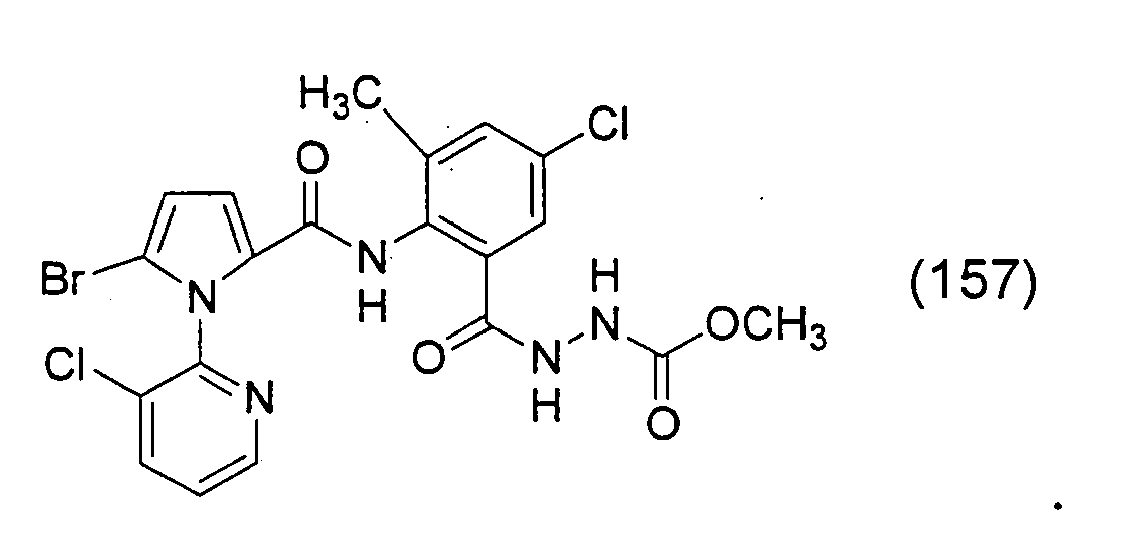
1H-NMR(DMSO-d6,TMS)δ(ppm):2.11(3H,s),3.63(3H,s),6.54(1H,d, J=3Hz),7.24(1H,d,J=3Hz),7.39(1H,s),7.46(1H,s),7.54(1H,dd, J=8Hz,4Hz),8.09(1H,d,J=8Hz),8.28(1H,d,J=4Hz),9.30(1H,brs), 9.74(1H,brs),10.13(1H,brs) - Under ice-cooling, 0.14 ml of methyl chloroformate was added to a mixture of 0.50 g of the present compound (93), 0.26 ml of triethylamine and 15 ml of tetrahydrofuran. The mixture was stirred at room temperature for 5 hours. Water was poured into the reaction mixture, and the mixture was extracted with ethyl acetate three times. The organic layers were combined, washed successively with water and an aqueous saturated sodium chloride solution, dried over anhydrous magnesium sulfate, and concentrated under reduced pressure. The resulting residue was subjected to silica gel column chromatography to obtain 0.21 g of the present compound (158) of the formula:

1H-NMR(CDCl3,TMS)δ(ppm):2.22(3H,s),3.79(6H,s),7.01(1H,d, J=2Hz),7.07(1H,d,J=2Hz),7.30(1H,dd,J=8Hz,5Hz),7.32(1H,s), 7.39(1H,s),7.82(1H,d,J=8Hz),8.33(1H,d,J=5Hz),8.45(1H,brs), 8.88(1H,brs) - According to the same manner as that of Preparation Example (158), the present compound (153) was used in place of the present compound (93) to obtain the present compound (159) of the formula:

1H-NMR(CDCl3,TMS)δ(ppm):2.18(3H,s),3.73(6H,s),7.00-7.01 (2H,m),7.24-7.28(3H,m),7.79(1H,d,J=8Hz),8.29(1H,d,J=4Hz), 8.82(1H,brs),9.06(1H,brs) - Under ice-cooling, 0.50 g of 3-bromo-N-[4-chloro-2-(N-methylhydrazinocarbonyl)-6-methylphenyl]-1-(3-chloro-2-pyridinyl)-1H-pyrazole-5-carboxamide, 0.12 g of N,N-dimethylcarbamoyl chloride, 0.09 g of pyridine and 20 ml of tetrahydrofuran were mixed, and the mixture was stirred at 50°C for 14 hours. To the mixture were further added 0.12 g of N,N-dimethylcarbamoyl chloride and 0.09 g of pyridine. The mixture was stirred at 50°C for 9 hours. Water was poured into the reaction mixture, and the mixture was extracted with ethyl acetate. The organic layer was washed with water, dried over anhydrous magnesium sulfate, and concentrated under reduced pressure. The resulting residue was washed with methyl t-butyl ether and hexane to obtain 0.15 g of the present compound (160) of the formula:

1H-NMR(CDCl3,TMS)δ(ppm):1.98(3H,s),2.46(6H,s),3.30(3H,s), 6.95(1H,d,J=2Hz),7.05(1H,d,J=2Hz),7.37(1H,dd,J=8Hz,5Hz), 7.51(1H, s), 7.81(1H, s), 7.85(1H, dd, J=8Hz, 2Hz), 8.45(1H, dd, J=5Hz,2Hz),10.34(1H,brs). - According to the same manner as that of Preparation Example 93, 5-bromo-N-[4-chloro-2-(hydrazinocarbonyl)-6-methylphenyl]-1-(2-pyrimidinyl)-1H-pyrrole-2-carboxamide was used in place of 4-bromo-N-[4-chloro-2-(hydrazinocarbonyl)-6-methylphenyl]-1-(3-chloro-2-pyridinyl )-1H-pyrrole-2- carboxamide to obtain the present compound (161) of the formula:

1H-NMR(DMSO-d6,TMS)δ(ppm) :2.14 (3H,s),3.46-3.67(3H,m), 6.08-6.50(1H,m),7.08-7.29(1H,m),7.38(1H,s),7.51(1H,s), 7.58-7.65(1H,m),8.89-8.95(2H,m),9.09-9.39(1H,m), 9.74-9.90(1H,m),10.11(1H,brs) - According to the same manner as that of Preparation Example 93, 4-bromo-N-[4-chloro-2-(hydrazinocarbonyl)-6-methylphenyl]-1-(2,6-dichlorophenyl)-1H-pyrrole-2-carboxamide was used in place of 4-bromo-N-[4-chloro-2-(hydrazinocarbonyl)-6-methylphenyl]-1-(3-chloro-2-pyridinyl )-1H-pyrrole-2- carboxamide to obtain the present compound (162) of the formula:

1H-NMR(DMSO-d6,TMS)δ(ppm):2.11(3H,s)3.46-3.68(3H,m) 7.27(1H,s),7.30-7.47(3H,m),7.50(1H,s),7.53-7.65(2H,m), 9.02-9.38(1H,m),9.71(1H,brs),10.13(1H,brs) - According to the same manner as that of Preparation Example 93, 4-bromo-N-[4-chloro-2-(hydrazinocarbonyl)-6-methylphenyl]-1-(3,5-dichloro-4-pyridinyl)-1H-pyrrole-2-carboxamide was used in place of 4-bromo-N-[4-chloro-2-(hydrazinocarbonyl)-6-methylphenyl]-1-(3-chloro-2-pyridinyl )-1H-pyrrole-2- carboxamide to obtain the present compound (163) of the formula:

1H-NMR(DMSO-d6,TMS)δ(ppm):2.12(3H,s),3.48-3.67(3H,m), 7.33-7.40(2H,m),7.46(1H,d,J=2Hz),7.51(1H,d,J=2Hz), 8.76(2H,s),9.31(1H,brs),9.82(1H,brs),10.14(1H,brs) - According to the same manner as that of Preparation Example 137, 4,5-dichloro-N-[4-chloro-2-(hydrazinocarbonyl)-6-methylphenyl]-1-(3-chloro-2-pyridinyl)-1H-pyrrole-2-carboxamide was used in place of 4-bromo-N-[4-chloro-2-(hydrazinocarbonyl)-6-methylphenyl]-1-(3-chloro-2-pyridinyl )-1H-pyrrole-2-carboxamide to obtain the present compound (164)of the formula:

1H-NMR(DMSO-d6,TMS)δ(ppm):2.09-2.19(3H,s),7.34-7.53(3H,m), 7.59(1H,dd,J=8Hz,5Hz),8.06(1H,s),8.16(1H,d,J=8Hz), 8.52(1H,d,J=5Hz),9.87(1H,brs),10.13(1H,brs)10.38(1H,brs) - Under ice-cooling, 0.43 g of N-[4-chloro-2-(hydrazinocarbonyl)-6-methylphenyl]-1-(2,6-dichlorophenyl)-1H-pyrrole-3-carboxamide, 0.15 g of methyl chloroformate, 2 ml of pyridine and 10 ml of acetonitrile were mixed, and the mixture was stirred for 1 hour under ice-cooling. Water was poured into a reaction mixture, and the mixture was extracted with ethyl acetate three times. The organic layers were combined, washed successively with water and an aqueous saturated sodium chloride solution, dried over anhydrous magnesium sulfate, and concentrated under reduced pressure to obtain 0.16 g of the present compound (165) of the formula:

1H-NMR(DMSO-d6,TMS)δ(ppm):2.24(3H,s),3.38-3.65(3H,m), 6.81(1H,brs),6.96(1H,brs),7.33-7.61(4H,m),7.68-7.74(2H,m), 9.37(1H,brs),9.52(1H,brs),10.21(1H,brs) - A mixture of 0.56 g of 2-[3-bromo-1-(3-chloro-2-pyridinyl)-1H-pyrazol-5-yl]-6,8-dibromo-4H-3,1-benzoxazine-4-one, 0.47 g of 2,4,4-trimethylsemicarbazide and 15 ml of 1-methyl-2-pyrrolidone was stirred at room temperature for 22 hours. Water was poured into the reaction mixture, and the mixture was extracted with ethyl acetate. The organic layer was washed with water, dried over anhydrous magnesium sulfate, and concentrated under reduced pressure. The resulting residue was washed with ethyl acetate to obtain 0.11 g of the present compound (166) of the formula:

1H-NMR(DMSO-d6,TMS)δ(ppm) :2.66(6H,s),2.68(3H,s), 7.45(1H,brs),7.59-7.63(2H,m),8.15-8.17(2H,m), 8.49(1H,d,J=4Hz), 10.50(1H,brs),10.55(1H,brs). - According to the same manner as that of Preparation Example 158, the present compound (132) was used in place of the present compound (93) to obtain the present compound (167) of the formula:

1H-NMR(CDCl3,TMS)δ(ppm):2.18(3H,s),3.82(6H,s),7.00(1H,s), 7.32(1H,d,J=2Hz),7.36-7.39(2H,m),7.86(1H,dd,J=8Hz,2Hz), 8.12(1H, s), 8.43(1H, dd, J=5Hz, 2Hz), 8.85(1H, brs) - According to the same manner as that of Preparation Example 134, 4,5-dichloro-N-[4-chloro-2-(N-methylhydrazinocarbonyl)-6-methylphenyl]-1-(3-chloro-2-pyridinyl)-1H-pyrrole-2- carboxamide was used in place of 4-bromo-N-[4-chloro-2-(N-methylhydrazinocarbonyl)-6-methylphenyl]-1-(3-chloro-2-pyridinyl)-1H-pyrrole-2-carboxamide to obtain the present compound (168) of the formula:

1H-NMR(CDCl3,TMS)δ(ppm):2.02-2.11(3H,m),3.02-3.28(3H,m), 3.54-3.89(3H,m),6.95-7.15(1H,m),7.22-7.31(2H,m),7.39(1H,dd, J=8Hz,5Hz),7.70.(1H,brs),7.87(1H,dd,J=8Hz,2Hz),8.47(1H,dd, J=5Hz,2Hz),9.23(1H,brs) - According to the same manner as that of Preparation Example 5, N-[4-chloro-2-(hydrazinocarbonyl)-6-methylphenyl] -1-[(2-fluoro-3-pyridinyl)methyl]-3-trifluoromethyl-1H-pyrazole-5- carboxamide was used in place of N-[4-chloro-2-(hydrazinocarbonyl)-6-methylphenyl]-1-(3-chloro-2-pyridinyl )-3-trifluoromethyl-1H-pyrazole-5-carboxamide to obtain the present compound (169) of the formula:

1H-NMR(DMSO-d6,TMS)δ(ppm):2.14(3H,s),3.52-3.62(3H,m),5.85 (2H,s),7.30-7.36(1H,m),7.39(1H,s),7.51(1H,s),7.59(1H,d, J=2Hz),7.61-7.71(1H,m),8.19(1H,d,J=5Hz),9.26(1H,brs), 10.20(1H,brs),10.25(1H,brs) - Under ice-cooling, 0.08 g of N-[4-chloro-2-(hydrazinocarbonyl)-6-methylphenyl]-1-[(3-chloro-2-pyridinyl)methyl]-5-trifluoromethyl-1H-pyrazole-3-carboxamide, 0.05 g of methyl chloroformate, 1 ml of pyridine and 10 ml of acetonitrile were mixed, and the mixture was stirred for 1 hour under ice-cooling. Water was poured into the reaction mixture, and the mixture was extracted with ethyl acetate three times. The organic layers were combined, washed successively with water and an aqueous saturated sodium chloride solution, dried over anhydrous magnesium sulfate, and concentrated under reduced pressure to obtain 0.06 g of the present compound (170) of the formula:

1H-NMR(DMSO-d6,TMS)δ(ppm):2.20(3H,s),3.53-3.64(3H,m), 5.86(2H,s),7.41-7.49(3H,m),7.59(1H,s),8.03(1H,d,J=7Hz), 8.44(1H,d,J=4Hz),9.32(1H,brs),9.96(1H,brs),10.25(1H,brs) - According to the same manner as that of Preparation Example 93, N-[4-chloro-2-(hydrazinocarbonyl)-6-methylphenyl]-1-(3-chloro-2-pyridinyl)-4-iodo-1H-pyrrole-2-carboxamide was used in place of 4-bromo-N-[4-chloro-2-(hydrazinocarbonyl)-6-methylphenyl]-1-(3-chloro-2-pyridinyl )-1H-pyrrole-2- carboxamide to obtain the present compound (171) of the formula:

1H-NMR(DMSO-d6,TMS)δ(ppm):2.15(3H,s),3.63(3H,s),7.25(1H,s), 7.38(1H,s),7.40(1H,s),7.49(1H,dd,J=8Hz,5Hz),7.51(1H,s), 8.05(1H,dd,J=8Hz,2Hz),8.43(1H,dd,J=5Hz,2Hz),9.33(1H,brs), 9.72(1H,brs),10.12(1H,brs) - According to the same manner as that of Preparation Example 158, the present compound (171) was used in place of the present compound (93) to obtain the present compound (172) of the formula:

1H-NMR(CDCl3,TMS)δ(ppm):2.19(3H,s),3.73(6H,s),7.10(1H,d, J=1Hz),7.14(1H,d,J=1Hz),7.25-7.31(3H,m),7.79(1H,dd,J=8Hz, 2Hz),8.31(1H,dd,J=5Hz,2Hz),9.20(1H,s),9.23(1H,brs) - According to the same manner as that of Preparation Example 151, 10-chloro-2-[4,5-dichloro-1-(3-chloro-2-pyridinyl)-1H-pyrrol-2-yl]-4H-naphtho[2,3-d][1,3]oxazine-4-one was used in place of 2-[3-bromo-1-(3-chloro-2-pyridinyl)-1H-pyrazol-5-yl]-10-chloro-4H-naphtho[2,3-d][1,3 ]oxazine-4-one to obtain the present compound (173) of the formula:

1H-NMR(CDCl3,TMS)δ(ppm):3.60(3H,s),7.46-7.59(2H,m), 7.69-7.81(2H,m),8.11-8.23(4H,m),8.48-8.52(1H,m), 9.32(1H,brs),10.09(1H,brs),10.22(1H,brs) - According to the same manner as that of Preparation Example 93, 4-bromo-N-[4-chloro-2-(hydrazinocarbonyl)-6-methylphenyl]-1-(2-chloro-3-pyridinyl)-1H-pyrrole-2-carboxamide was used in place of 4-bromo-N-[4-chloro-2-(hydrazinocarbonyl)-6-methylphenyl]-1-(3-chloro-2-pyridinyl )-1H-pyrrole-2- carboxamide to obtain the present compound (174) of the formula:

1H-NMR(DMSO-d6,TMS)δ(ppm):2.15(3H,s),3.45-3.67(3H,m), 7.27(1H,s),7.36(1H,s),7.42(1H,d,J=1Hz),7.48-7.54(2H,m), 7.94(1H,dd,J=8Hz,1Hz),8.42(1H,dd,J=5Hz,1Hz),9.29(1H,brs), 9.73(1H,brs),10.12(1H,brs) - According to the same manner as that of Preparation Example 151, 7-bromo-2-[3-bromo-1-(3-chloro-2-pyridinyl) -1H-pyrazol-5-yl]-10-chloro-4H-naphtho[2,3-d][1,3]oxazine-4 -one was used in place of 2-[3-bromo-1-(3-chloro-2-pyridinyl) -1H-pyrazol-5-yl]-10-chloro-4H-naphtho[2,3-d][1,3]oxazine-4 -one to obtain the present compound (175)of the formula:

1H-NMR(DMSO-d6,TMS)δ(ppm):3.58-3.70(3H,m),7.46(1H,s),7.59 (1H,dd,J=8Hz,5Hz),7.93(1H,d,J=9Hz),8.08-8.21(3H,m),8.46-8.53(2H,m),9.36(1H,brs),10.33(1H,brs),10.62(1H,brs) - According to the same manner as that of Preparation Example 151, 7,10-dibromo-2-[3-bromo-1-(3-chloro-2-pyridinyl)-1H-pyrazol-5-yl]-4H-naphtho[2,3-d][1,3]oxazine -4-one was used in place of 2-[3-bromo-1-(3-chloro-2-pyridinyl)-1H-pyrazol-5-yl]-10-chloro-4H-naphtho[2,3-d] [1,3]oxazine-4-one to obtain the present compound (176) of the formula:

1H-NMR(DMSO-d6,TMS)δ(ppm):3.59-3.69(3H,m),7.47(1H,s), 7.56-7.62(1H,m),7.92(1H,d,J=9Hz),8.10-8.20(3H,m),8.45-8.54 (2H,m),9.35(1H,brs),10.29(1H,brs),10.66(1H,brs) - According to the same manner as that of Preparation Example 93, 5-chloro-N-[4-chloro-2-(hydrazinocarbonyl)-6-methylphenyl]-1-(2-pyridinyl)-1H-pyrrole-2-carboxamide was used in place of 4-bromo-N-[4-chloro-2-(hydrazinocarbonyl)-6-methylphenyl]-1-(3-chloro-2-pyridinyl )-1H-pyrrole-2-carboxamide to obtain the present compound (177) of the formula:

1H-NMR(DMSO-d6,TMS)δ(ppm):2.13(3H,s),3.63(3H,s),6.42(1H,d, J=4Hz),7.13(1H,d,J=4Hz),7.37(1H,s),7.42-7.47(2H,m),7.50 (1H,d,J=2Hz),7.94(1H,td,J=8Hz,2Hz),8.50(1H,dd,J=5Hz,2Hz), 9.33(1H,brs),9.69(1H,brs),10.12(1H,brs) - According to the same manner as that of Preparation Example 134, 4-bromo-N-[6-bromo-4-chloro-2-(N-methylhydrazinocarbonyl)phenyl]-1-(3-chloro-2-pyridinyl) -1H-pyrrole-2-carboxamide was used in place of 4-bromo-N-[4-chloro-2-(N-methylhydrazinocarbonyl)-6-methylphenyl]-1-(3-chloro-2-pyridinyl)-1H-pyrrole-2-carboxamide to obtain the present compound (178) of the formula:

1H-NMR(CDCl3,TMS)δ(ppm):3.15(3H,s),3.58(3H,s),7.04(1H,d, J=2Hz),7.26(1H,s),7.35(1H,dd,J=8Hz,5Hz),7.46(1H,d,J=2Hz), 7.70(1H,s),7.82(1H,dd,J=8Hz,2Hz),8.43(1H,dd,J=5Hz,2Hz), 8.55(1H,brs),8.80(1H,brs) - According to the same manner as that of Preparation Example 158, the present compound (173) was used in place of the present compound (93) to obtain the present compound (179) of the formula:
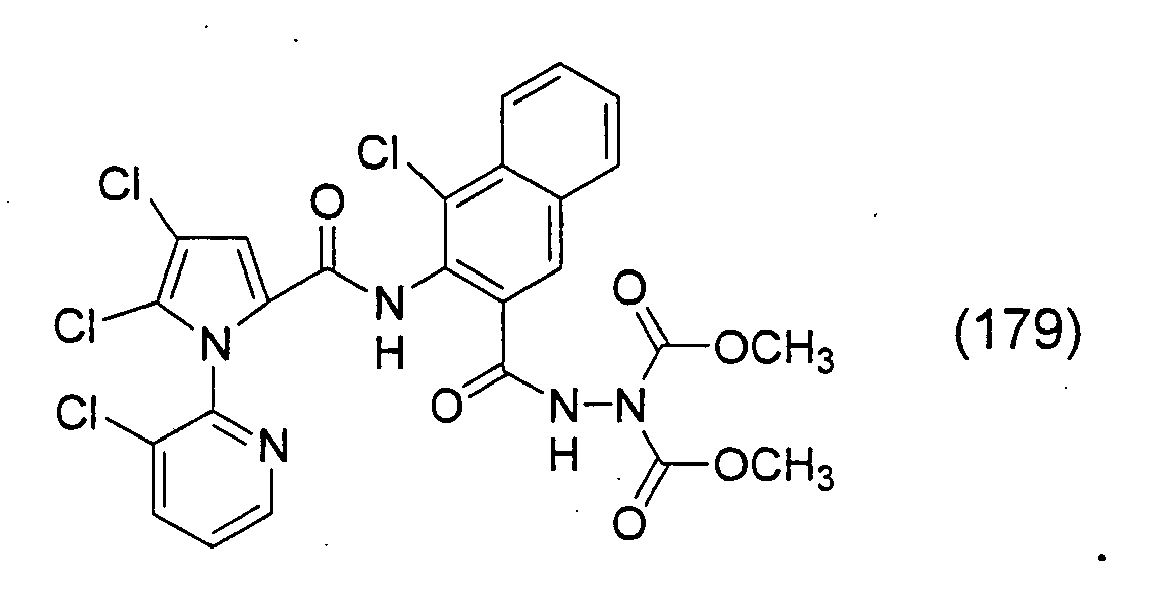
1H-NMR(CDCl3,TMS)δ(ppm):3.81(6H,s),7.15(1H,s),7.35(1H,dd, J=8Hz,5Hz),7.52-7.63(2H,m),7.84(1H,d,J=8Hz),7.85(1H,d, J=8Hz),8.04(1H,s),8.15(1H,dd,J=8Hz,2Hz),8.41(1H,dd,J=5Hz, 2Hz),8.46(1H,brs),8.68(1H,brs) - According to the same manner as that of Preparation Example 122, 6,8-dibromo-2-[4-bromo-1-(3-cyano-2-pyridinyl) -1H-pyrrol-2-yl]-4H-3,1-benzoxazine-4-one was used in place of 6,8-dibromo-2-[4-bromo-1-(3-chloro-2-pyridinyl)-1H-pyrrol-2-yl]-4H-3,1-benzoxazine-4-one to obtain the present compound (180) of the formula:

1H-NMR(DMSO-d6,TMS)δ(ppm):3.62(3H,s),7.36(1H,d,J=2Hz),7.64 (1H,d,J=2Hz),7.64(1H,s),7.67(1H,dd,J=8Hz,5Hz),8.11(1H,s), 8.47(1H,dd,J=8Hz,2Hz),8.74(1H,dd,J=5Hz,2Hz),9.24(1H,brs), 10.03(1H,brs),10.14(1H,brs) - According to the same manner as that of Preparation Example 122, 6,8-dibromo-2-[4-bromo-1-(3-trifluoromethyl-2-pyridinyl)-1H-pyrrol-2-yl]-4H-3,1- benzoxazine-4-one was used in place of 6,8-dibromo-2-[4-bromo-1-(3-chloro-2-pyridinyl)-1H-pyrrol-2-yl]-4H-3,1-benzoxazine-4-one to obtain the present compound (181) of the formula:

1H-NMR(DMSO-d6,TMS)δ(ppm):3.62(3H,s),7.33(1H,s),7.50(1H,s), 7.63(1H,s),7.72(1H,dd,J=8Hz,5Hz),8.08(1H,s),8.33(1H,d, J=8Hz),8.74(1H,d,J=5Hz),9.35(1H,brs),9.88(1H,brs), 10.11(1H,brs) - According to the same manner as that of Preparation Example 93, N-[4-chloro-2-(hydrazinocarbonyl)-6-methylphenyl]-1-(3-chloro-2-pyridinyl)-5-iodo-1H-pyrrole-2-carboxamide was used in place of 4-bromo-N-[4-chloro-2-(hydrazinocarbonyl)-6-methylphenyl]-1-(3-chloro-2-pyridinyl )-1H-pyrrole-2-carboxamide to obtain the present compound (182) of the formula:

1H-NMR(DMSO-d6,TMS)δ(ppm):2.11(3H,s),3.63(3H,s),6.63(1H,d, J=4Hz),7.19(1H,d,J=4Hz),7.40(1H,s),7.43(1H,s),7.52(1H,dd, J=8Hz,5Hz),8.06(1H,dd,J=8Hz,2Hz),8.48(1H,dd,J=5Hz,2Hz), 9.28(1H,brs),9.71(1H,brs),10.13(1H,brs - According to the same manner as that of Preparation Example 72, 2-[3-bromo-1-(3-chloro-2-pyridinyl)-1H-pyrazol-5-yl]-8-methyl-6-nitro-4H-3,1-benzoxazine-4-one was used in place of 2-[3-bromo-1-(3-chloro-2-pyridinyl)-1H-pyrazol-5-yl]-8-chloro-4H-3,1-benzoxazine-4-one to obtain the present compound (183) of the formula:

1H-NMR(DMSO-d6,TMS)δ(ppm) :2.29(3H,s), 3.51-3.68(3H,m), 7.37-7.42(1H,m),7.58-7.65(1H,m),8.14-8.22(2H,m),8.32-8.39(1H,m), 8.48-8.54(1H,m),9.39(1H,brs),10.41(1H,brs), - To a mixture of 0.26 g of N,N'-dimethylhydrazine dihydrochloride, 2 ml of water, 0.5 g of potassium carbonate and 10 ml of N,N-dimethylformamide was added 0.20 g of 2-[3-bromo-1-(3-chloro-2-pyridinyl)- 1H-pyrazol-5-yl]-8-methyl-6-nitro-4H-3,1-benzoxazine-4-one. The resulting mixture was stirred at room temperature for 2 hours. The reaction mixture was poured into water, and extracted with ethyl acetate three times. The organic layers were combined, washed successively with water and an aqueous saturated sodium chloride solution, dried over anhydrous sodium sulfate, and concentrated under reduced pressure to obtain 3-bromo-1-(3-chloro-2-pyridinyl)-N-[2-(N,N'-dimethylhydrazinocarbonyl)-6-methyl-4-nitrophenyl]-1H-pyrazole-5-carboxamide of the formula:

- Under ice-cooling, 0.1 g of methyl chloroformate was added to a mixture of 3-bromo-1-(3-chloro-2-pyridinyl)-N-[2-(N,N'-dimethylhydrazinocarbonyl)-6-methyl-4-nitrophenyl]-1H-pyrazole-5-carboxamide, 1 ml of pyridine and 10 ml of acetonitrile, and the mixture was stirred at room temperature for 2 hours. Water was poured into the reaction mixture, and the mixture was extracted with ethyl acetate two times. The organic layers were combined, washed successively with water and an aqueous saturated sodium chloride solution, dried over anhydrous sodium sulfate, and concentrated under reduced pressure. The resulting residue was subjected to silica gel column chromatography to obtain 0.07 g of the present compound (184) of the formula:

1H-NMR(DMSO-d6,TMS)δ(ppm):2.27-2.37(3H,m),2.70-2.88(3H,m), 2.88-3.11(3H,m),3.45-3.74(3H,m),7.38-7.46(1H,m),7.63(1H,dd, J=8Hz,5Hz),7.92-8.04(1H,m),8.21(1H,dd,J=8Hz,1Hz),8.24-8.34 (1H,m),8.51(1H,dd,J=5Hz,1Hz),10.40-10.75(1H,m) - According to the same manner as that of Preparation Example 122, 6,8-dibromo-2-[4-bromo-1-(3-nitro-2-pyridinyl)-1H-pyrrol-2-yl]-4H-3,1-benzoxazine-4-one was used in place of 6,8-dibromo-2-[4-bromo-1-(3-chloro-2-pyridinyl)-1H-pyrrol-2-yl]-4H-3,1-benzoxazine-4-one to obtain the present compound (185) of the formula:

1H-NMR(DMSO-d6,TMS)δ(ppm):3.61(3H,s),7.36(1H,s),7.57(1H,d, J=2Hz),7.62(1H,s),7.78(1H,dd,J=8Hz,5Hz),8.10(1H,d,J=2Hz), 8.61(1H,dd,J=8Hz,2Hz),8.79(1H,dd,J=5Hz,2Hz),9.24(1H,brs), 9.95(1H,brs),10.12(1H,brs) - According to the same manner as that of Preparation Example 122, 6,8-dibromo-2-[4-bromo-1-(3-bromo-2-pyridinyl)-1H-pyrrol-2-yl]-4H-3,1-benzoxazine-4-one was used in place of 6,8-dibromo-2-[4-bromo-1-(3-chloro-2-pyridinyl)-1H-pyrrol-2-yl]-4H-3,1-benzoxazine-4-one to obtain the present compound (186) of-the formula:

1H-NMR(DMSO-d6,TMS)δ(ppm):3.61(3H,s),7.32(1H,s),7.40(1H,dd, J=8Hz,5Hz),7.42(1H,s),7.63(1H,s),8.10(1H,s),8.17(1H,d, J=8Hz),8.46(1H,d,J=5Hz),9.36(1H,brs),9.90(1H,brs),10.16(1H, brs) - According to the same manner as that of Preparation Example 93, 4-bromo-N-[4-chloro-2-(hydrazinocarbonyl)-6-methylphenyl]-1-(3-chloro-4-pyridinyl)-1H-pyrrole-2-carboxamide was used in place of 4-bromo-N-[4-chloro-2-(hydrazinocarbonyl)-6-methylphenyl]-1-(3-chloro-2-pyridinyl )-1H-pyrrole-2-carboxamide to obtain the present compound (187) of the formula:
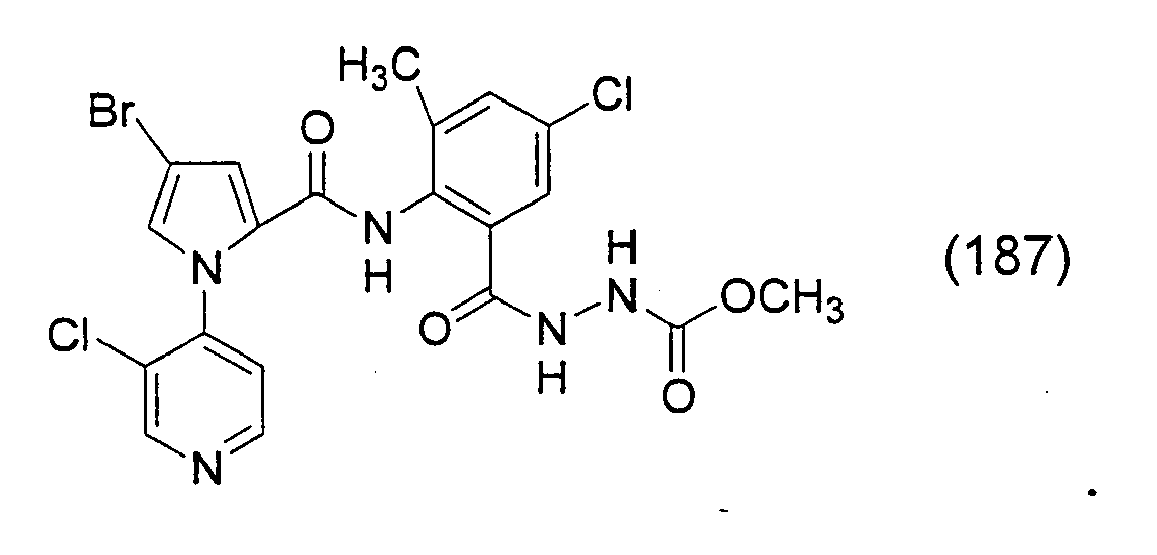
1H-NMR(DMSO-d6,TMS)δ(ppm):2.16(3H,s),3.41-3.68(3H,m),7.29 (1H,brs),7.33-7.40(1H,m),7.43(1H,d,J=2Hz),7.52(1H,d,J=2Hz), 7.55(1H,d,J=5Hz),8.59(1H,d,J=5Hz),8.72(1H,brs),9.30(1H,brs), 9.78(1H,brs),10.15(1H,brs) - According to the same manner as that of Preparation Example 72, 2-[3-bromo-1-(3-chloro-2-pyridinyl)-1H-pyrazol-5-yl]-6-chloro-4H-3,1-benzoxazine-4-one was used in place of 2-[3-bromo-1-(3-chloro-2-pyridinyl)-1H-pyrazol-5-yl]-8-chloro-4H-3,1-benzoxazine-4-one to obtain the present compound (188) of the formula:

1H-NMR(DMSO-d6,TMS)δ(ppm):3.68(3H,brs),7.23(1H,brs),7.62 (1H,dd,J=9Hz,2Hz),7.67(1H,dd,J=8Hz,5Hz),7.88(1H,s),8.18 (1H,d,J=9Hz),8.25(1H,dd,J=8Hz,1Hz),8.54(1H,dd,J=5Hz,1Hz), 9.49(1H,brs),10.78(1H,brs),11.77(1H,brs) - According to the same manner as that of Preparation Example 115, 3-bromo-N-[4-chloro-2-(N-methylhydrazinocarbonyl)phenyl]-1-(3-chloro-2-pyridinyl)-1H-pyrazole-5-carboxamide was used in place of 3-bromo-N-[4-chloro-2-(N-methylhydrazinocarbonyl)-6-methylphenyl]-1-(3-chloro-2-pyridinyl)-1H-pyrazole-5-carboxamide to obtain the present compound (189) of the formula:

1H-NMR(DMSO-d6,TMS)δ(ppm):3.07(3H,s),3.51(3H,brs),7.29 (2H,brs),7.47-7.54(2H,m),7.65(1H,dd,J=8Hz,5Hz),8.22(1H,dd, J=8Hz,1Hz),8.52(1H,dd,J=5Hz,1Hz),9.55(1H,brs),10.14(1H,brs) - According to the same manner as that of Preparation Example 119, 3-bromo-N-[4-chloro-2-(N,N'-dimethylhydrazinocarbonyl)phenyl]-1-(3-chloro-2-pyridinyl)-1H-pyrazole-5-carboxamide was used in place of 3-bromo-N-[4-chloro-2-(N,N'-dimethylhydrazinocarbonyl)-6-methylphenyl ]-1-(3-chloro-2-pyridinyl)-1H-pyrazole-5- carboxamide to obtain the present compound (190) of the formula:

1H-NMR(DMSO-d6,TMS)δ(ppm):2.83-3.07(6H,m),3.52-3.70(3H,m), 7.29-7.60(4H,m),7.64(1H,dd,J=8Hz,5Hz),8.22(1H,dd,J=8Hz,2Hz), 8.51(1H,dd,J=5Hz,2Hz),10.53-10.68(1H,brm). - According to the same manner as that of Preparation Example 93, 4,5-dichloro-N-[4-chloro-2-(hydrazinocarbonyl)-6-methylphenyl]-1-(2-pyridinyl)-1H- pyrrole-2-carboxamide was used in place of 4-bromo-N-[4-chloro-2-(hydrazinocarbonyl)-6-methylphenyl]-1-(3-chloro-2-pyridinyl )-1H-pyrrole-2-carboxamide to obtain the present compound (191) of the formula:

1H-NMR(DMSO-d6,TMS)δ(ppm):2.13(3H,s),3.63(3H,s),7.24(1H,s), 7.35(1H,s),7.49-7.51(3H,m),7.97(1H,td,J=8Hz,2Hz),8.52(1H,dd, J=6Hz,2Hz),9.31(1H,brs),9.78(1H,brs),10.12(1H,brs) - According to the same manner as that of Preparation Example 93, 3,5-dichloro-N-[4-chloro-2-(hydrazinocarbonyl) -6-methylphenyl]-1-(2-pyridinyl)-1H- pyrrole-2-carboxamide was used in place of 4-bromo-N-[4-chloro-2-(hydrazinocarbonyl)-6-methylphenyl]-1-(3-chloro-2-pyridinyl )-1H-pyrrole-2-carboxamide to obtain the present compound (192) of the formula:

1H-NMR(DMSO-d6,TMS)δ(ppm):2.09(3H,s),3.68(3H,s),6.69(1H,s), 7.92(1H,s),7.48-7.60(3H,m),7.94-8.01(1H,m),8.51(1H,d, J=5Hz),9.37(1H,brs),9.71(1H,brs),10.33(1H,brs) - According to the same manner as that of Preparation Example 93, 4-bromo-N-[4,6-dibromo-2-(hydrazinocarbonyl) phenyl]-5-chloro-1-(3-chloro-2-pyridinyl)-1H-pyrrole-2-carboxamide was used in place of 4-bromo-N-[4-chloro-2-(hydrazinocarbonyl)-6-methylphenyl]-1-(3-chloro-2-pyridinyl )-1H-pyrrole-2-carboxamide to obtain the present compound (193) of the formula:

1H-NMR(DMSO-d6,TMS)δ(ppm):3.62(3H,s),7.47(1H,s),7.58(1H,dd, J=8Hz,5Hz),7.63(1H,s),8.10(1H,s),8.15(1H,d,J=8Hz),8.51(1H,d, J=5Hz),9.34(1H,brs),10.00(1H,brs),10.15(1H,brs) - According to the same manner as that of Preparation Example 128, 4-bromo-N-[4,6-dibromo-2-(hydrazinocarbonyl) phenyl]-5-chloro-1-(3-chloro-2-pyridinyl)-1H-pyrrole-2-carboxamide was used in place of 4,5-dibromo-N-[4-chloro-2-(hydrazinocarbonyl)-6-methylphenyl]-1-(3-chloro-2-pyridinyl)-1H-pyrrole-2- carboxamide to obtain the present compound (194) of the formula:

1H-NMR(DMSO-d6,TMS)δ(ppm):2.85(6H,s),7.53(1H,s),7.59(1H,dd, J=8Hz,5Hz),7.70(1H,s),8.06(1H,s),8.16(1H,d,J=8Hz),8.51(1H,d, J=5Hz),8.56(1H,brs),9.82(1H,brs),9.97(1H,brs) - A mixture of 0.59 g of 3-bromo-N-[4,6-dibromo-2-(hydrazinocarbonyl)phenyl]-1-(3-chloro-2-pyridinyl)-1H-pyrazole-5-carboxamide, 0.23 g of propargyl chloroformate, 0.16 g of pyridine and 2 ml of acetonitrile was stirred at room temperature for 1 hour. Water was poured into the reaction mixture, and the mixture was extracted with ethyl acetate. The organic layer was washed with water, dried over sodium sulfate, and concentrated under reduced pressure. The resulting residue was washed with ethyl acetate to obtain 0.22 g of the present compound (195) of the formula:

1H-NMR(DMSO-d6,TMS)δ(ppm):3.56(1H,s)4.71(2H,s)7.41(1H,s), 7.60(1H,dd,J=8Hz,5Hz),7.66(1H,s),8.14-8.16(2H,m),8.50(1H,dd, J=5Hz,1Hz),9.60(1H,brs),10.29(1H,brs),10.50(1H,brs). - According to the same manner as that of Preparation Example 34, propargyl chloroformate was used in place of methyl chloroformate to obtain the present compound (196) of the formula:

1H-NMR(DMSO-d6,TMS)δ(ppm):2.15(3H,s)3.56(1H,brs)4.72(2H, s),7.35(1H,s),7.39(1H,brs),7.55(1H,s),7.61(1H,dd,J=8Hz,5Hz), 8.17(1H,dd,J=8Hz,1Hz),8.50(1H,dd,J=5Hz,1Hz),9.55(1H,s), 10.23-10.26(2H,brm). - According to the same manner as that of Preparation Example 10, 3-bromo-N-[4-chloro-2-(hydrazinocarbonyl)-6-methylphenyl]-1-(3-chloro-2-pyridinyl)-1H-pyrazole-5-carboxamide was used in place of N-[4-chloro-2-(hydrazinocarbonyl)-6-methylphenyl]-1-(3-chloro-2-pyridinyl )-3-trifluoromethyl-1H-pyrazole-5-carboxamide to obtain the present compound (197) of the formula:

1H-NMR(DMSO-d6,TMS)δ(ppm):2.20(3H,s),2.93(6H,s),7.50-7.52 (2H,m),7.58(1H,brs),7.67(1H,dd,J=8Hz,5Hz),8.24(1H,d,J=8Hz), 8.56(1H,d,J=5Hz),8.60(1H,s),9.89(1H,brs),10.23(1H,brs) - To a mixture of 0.20 g of the present compound (197), 0.10 ml of triethylamine and 5 ml of tetrahydrofuran was added dropwise 0.040 ml of methyl chloroformate under ice-cooling. The mixture was stirred at room temperature for 2.5 hours. Water was poured into the reaction mixture, and the mixture was extracted with ethyl acetate three times. The organic layers were combined, washed with water and an aqueous saturated sodium chloride solution, dried over anhydrous magnesium sulfate, and concentrated under reduced pressure. The resulting residue was subjected to silica gel column chromatography to 0.13 g of the present compound (198) of the formula:

1H-NMR(CDCl3,TMS)δ(ppm):2.22(3H,s),3.05(3H,brs),3.15(3H, brs),3.76(3H,s),6.99(1H,s),7.35-7.38(2H,m),7.44(1H,s), 7.86(1H,d,J=8Hz),8.39(1H,s),8.46(1H,d,J=5Hz),9.40(1H,s) - A mixture of 1.0 g of 2-[3-bromo-1-(3-chloro-2-pyridinyl)-1H-pyrazol-5-yl]-6-chloro-8-methyl-4H-3,1-benzoxazine-4-one, 1.33 g of formic hydrazide and 40 ml of N,N-dimethylformamide was stirred at 50ºC for 3.5 hours, and at 70°C for 7 hours. The reaction mixture was allowed to cool to room temperature, and thereto water was poured. The mixture was extracted with methyl tert-butyl ether. The organic layer was washed with water and an aqueous saturated sodium chloride solution, dried over anhydrous magnesium sulfate, and concentrated under reduced pressure. The resulting residue was subjected to silica gel column chromatography to obtain 0.36 g of the present compound (199) of the formula:

1H-NMR(DMSO-d6,TMS)δ(ppm):2.10-2.21(3.0H,m),7.25-7.62(4.7H, m),7.79-7.81(0.2H,m),8.05(0.3H,s),8.16(1.0H,d,J=8Hz), 8.49(1.0H,d,J=5Hz),9.48-9.55(0.7H,m),10.05-10.45(2.1H,m) - To a mixture of 0.20 g of the present compound (115), 0.14 ml of triethylamine and 10 ml of acetonitrile was added 0.12 ml of methyl chloroformate at room temperature. The resulting mixture was stirred at room temperature for 18 hours. Water was poured into the reaction mixture, and the mixture was extracted with ethyl acetate three times. The organic layers were combined, washed successively with water and an aqueous saturated sodium chloride solution, dried over anhydrous magnesium sulfate, and concentrated under reduced pressure. The resulting residue was subjected to silica gel column chromatography to obtain 0.010 g of the present compound (200) of the formula:
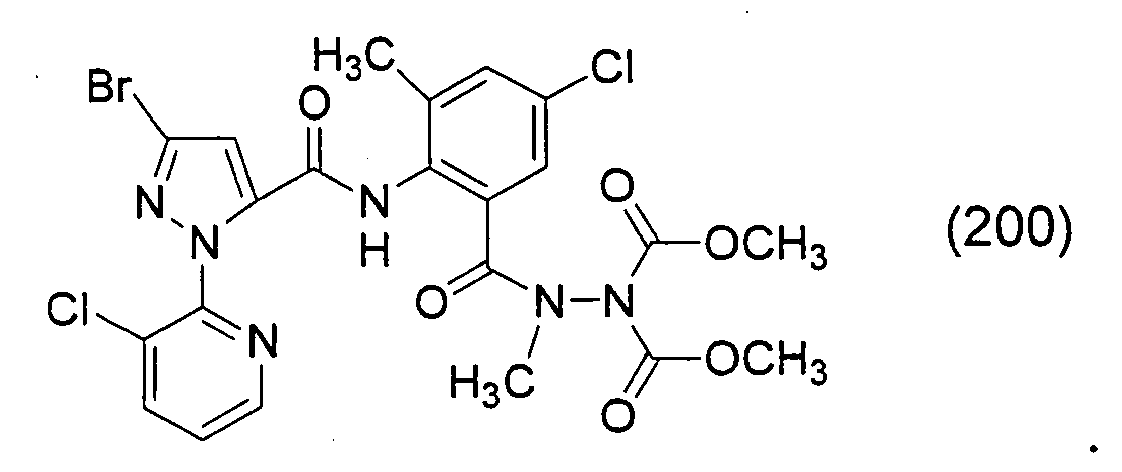
1H-NMR(CDCl3,TMS)δ(ppm):2.21(3H,s),3.23(3H,s),3.89(6H,brs), 6.46(1H,s),7.08(1H,s),7.30(1H,s),7.43(1H,dd,J=8Hz,5Hz), 8.92(1H,d,J=8Hz),8.51(1H,d,J=5Hz),9.21(1H,s) - According to the same manner as that of Preparation Example 158, that the present compound (122) was used in place of the present compound (93) to obtain the present compound (201) of the formula:

1H-NMR(CDCl3,TMS)δ(ppm):3.74(6H,s),7.08(2H,s),7.30(1H,dd, J=8Hz,5Hz),7.66(1H,s),7.82(1H,d,J=8Hz),7.86(1H,s), 8.28(1H,brs),8.32(1H,d,J=5Hz),8.60(1H,brs) - According to the same manner as that of Preparation Example 134, 4-bromo-N-[4,6-dibromo-2-(N-methylhydrazinocarbonyl)phenyl]-1-(3-chloro-3-pyridinyl)-1H-pyrrole-2-cabroxamide was used in place of 4-bromo-N-[4-chloro-2-(N-methylhydrazinocarbonyl)-6-methylphenyl]-1-(3-chloro-2-pyridinyl)-1H-pyrrole-2-carboxamide to obtain the present compound (202) of the formula:

1H-NMR(CDCl3,TMS)δ(ppm):3.05(0.5H,brs)3.13(2.5H,s),3.59 (2.5H,s),3.82(0.5H,brs),7.05(1.0H,d,J=2Hz),7.21(1.0H,s), 7.35(1.3H,dd,J=8Hz,5Hz),7.42(1.0H,s),7.65(2.0H,s),7.82(1.0H, d,J=8Hz),8.43(1.0H,dd,J=5H,2Hz),8.57(0.7H,s) - According to the same manner as that of Preparation Example 115, 3-bromo-N-[4,6-dibromo-2-(N-methylhydrazinocarbonyl)phenyl]-1-(3-chloro-2-pyridinyl)-1H-pyrazole-5-carboxamide was used in place of 3-bromo-N-[4-chloro-2-(N-methylhydrazinocarbonyl)-6-methylphenyl]-1-(3-chloro-2-pyridinyl)-1H-pyrazole-5-carboxamide to obtain the present compound (203) of the formula:

1H-NMR(100°C,DMSO-d6,TMS)δ(ppm):2.96(3H,s),3.04(3H,brs), 7.30(1H,s),7.38(1H,s),7.58(1H,dd,J=8Hz,5Hz),7.96(1H,s),8.11 (1H,d,J=8Hz),8.47(1H,d,J=5Hz),8.68(1H,brs),10.08(1H,brs) - A mixture of 0.30 g of 3-bromo-N-[4,6-dibromo-2-(N,N'-dimethylhydrazinocarbonyl)phenyl]-1-(3-chloro-2-pyridinyl)-1H-pyrazole-5-carboxamide, 0.15 ml of methyl chloroformate and 3 ml of pyridine was stirred at room temperature for 2.5 hours. Then, 0.08 ml of methyl chloroformate was added thereto, and the mixture was stirred for 1 hour. Then, 0.08 ml of methyl chloroformate was added thereto, and the mixture was further stirred for 0.5 hour. Water was poured into the reaction mixture, and the mixture was extracted with ethyl acetate. The organic layer was dried over anhydrous magnesium sulfate, and concentrated under reduced pressure. The resulting residue was subjected to silica gel column chromatography to obtain 0.24 g of the present compound (204) of the formula:

1H-NMR(DMSO-d6,TMS)δ(ppm):2.71(1.4H,s),2.83(1.6H,s), 2.94(1.5H,s),3.06(1.5H,s),3.35-3.70(3.0H,m),7.41(0.5H,s), 7.45(0.6H,s),7.47(0.6H,s),7.60-7.64(1.3H,m),8.07(0.5H,d, J=2Hz),8.13(0.5H,s),8.18(1.0H,d,J=8Hz),8.50(1.0H,m), 10.52(0.5H,s),10.67(0.5H,s) - According to the same manner as that of Preparation Example 147, 4-bromo-N-[4,6-dibromo-2-(N,N'-dimethylhydrazinocarbonyl)phenyl]-1-(3-chloro-2-pyridinyl)-1H-pyrrole-2-carboxamide was used in place of 4-bromo-N-[4-chloro-2-(N,N'-dimethylhydrazinocarbonyl)-6-methylphenyl]-1-(3-chloro-2-pyridinyl)-1H-pyrrole-2-carboxamide to obtain the present compound (205) of the formula:

1H-NMR(DMSO-d6,TMS)δ(ppm):2.73(1.4H,s),2.82(1.8H,s), 2.89(1.3H,s),3.06(1.5H,s),3.35-3.70(3.0H,m),7.32(0.5H,s), 7.34-7.38(0.6H,m),7.43(0.5H,s),7.48-7.53(2.4H,m),8.03(0.4H, d,J=2Hz),8.07-8.10(1.6H,m),8.43-8.45(1.0H,m),9.93(0.5H,s), 10.07(0.5H,s) - According to the same manner as that of Preparation Example 136, 4-bromo-N-[4,6-dibromo-2-(N-methýlhydrazinocarbonyl)phenyl]-1-(3-chloro-2-pyridiny1)-1H-pyrrole-2-carboxamide was used in place of 4-bromo-N-[4-chloro-2-(N-methylhydrazinocarbonyl)-6-methylphenyl]-1-(3-chloro-2-pyridinyl)-1H-pyrrole-2-carboxamide to obtain the present compound (206) of the formula:


1H-NMR(DMSO-d6,TMS)δ(ppm):7.31(0.6H,s)7.36(0.3H,s), 7.44(0.6H,d,J=2Hz),7.47-7.52(1.5H,m),7.65-7.75(1.3H,m), 8.03-8.12(2.7H,m),8.43(1.0H,dd,J=5Hz,2Hz),9.49-9.52(0.3H,m), 9.94-9.99(0.4H,m),10.17(1.0H,s),10.39-10.44(1.0H,m) - According to the same manner as that of Preparation Example 199, 2-[3-bromo-1-(3-chloro-2-pyridinyl)-1H-pyrazol-5-yl]-6,8-dibromo-4H-3,1-benzoxazine-4-one was used in place of 2-[3-bromo-1-(3-chloro-2-pyridinyl)-1H-pyrazol-5-yl]-6-chloro-8-methyl-4H-3,1-benzoxazine-4-one to obtain the present compound (208) of the formula:

1H-NMR(DMSO-d6,TMS)δ(ppm):7.41(0.7H,s)7.45(0.3H,s), 7.58-7.63(1.0H,m),7.69-7.73(1.0H,m),7.77-7.79(0.4H,m), 8.04(0.6H,s),8.13-8.18(2.0H,m),8.49-8.51(1.0H,m), 9.55-9.58(0.4H,m),10.18(0.6H,s),10.45-10.60(2.0H,m) - A mixture of 0.30 g of 6,8-dibromo-2-[4-bromo-1-(3-chloro -2-pyridinyl)-1H-pyrrol-2-yl]-4H-3,1-benzoxazine-4-one, 0.28 g of N-methyl-N- methoxycarbonylhydrazine and 15 ml of N,N-dimethylformamide was stirred at 80°C for 35 hours, and then allowed to cool to room temperature. Water was poured into the reaction mixture, and the mixture was extracted with methyl tert-butyl ether. The organic layer was washed successively with water and an aqueous saturated sodium chloride solution, dried over anhydrous magnesium sulfate, and concentrated under reduced pressure. The resulting residue was subjected to silica gel column chromatography to obtain 0.18 g of the present compound (209) of the formula:

1H-NMR(DMSO-d6,TMS)δ(ppm):2.84(3H,s),3.45-3.70(3H,brm), 7.38(1H,brs),7.47(1H,d,J=2Hz),7.50(1H,dd,J=8Hz,5Hz), 7.54(1H,d,J=2Hz),8.05(1H,dd,J=8Hz,2Hz),8.12(1H,d,J=2Hz), 8.41(1H,dd,J=5Hz,2Hz),9.95(1H,s),10.50(1H,s) - A mixture of 0.16 g of 4-bromo-N-[4,6-dibromo-2-(N,N'-dimethylhydrazinocarbonyl)phenyl]-1-(3-chloro-2-pyridinyl)-1H-pyrrole-2-carboxamide, 0.12 ml of N,N-dimethylcarbamoyl chloride and 0.2 ml of pyridine was stirred at 80°C for 5 hours and then allowed to cool to room temperature. Water was poured into the reaction mixture, and the mixture was extracted with ethyl acetate. The organic layer was washed successively with water and an aqueous saturated sodium chloride solution, dried over anhydrous magnesium sulfate, and concentrated under reduced pressure. The resulting residue was subjected to silica gel column chromatography to obtain 0.15 g of the present compound (210) of the formula:

1H-NMR(DMSO-d6,TMS)δ(ppm):2.44(4.5H,s),2.58(3.0H,s), 2.74(1.5H,brs),2.78(1.0H,s),3.12(2.0H,s),7.14(0.7H,d,J=2Hz), 7.32(0.7H,d,J=2Hz),7.38(0.3H,s),7.47-7.54(2.3H,m), 8.00(0.7H,d,J=2Hz),8.07-8.10(1.3H,m),8.42-8.45(1.0H,m), 9.95(0.7H,brs),10.08(0.3H,brs) - A mixture of 0.16 g of 3-bromo-N-[4,6-dibromo-2-(N,N'-dimethylhydrazinocarbonyl)phenyl]-1-(3-chloro-2-pyridinyl)-1H-pyrazole-5-carboxamide, 0.12 ml of N,N-dimethylcarbamoyl chloride and 2 ml of pyridine was stirred at 80°C for 5 hours, and then allowed to cool to room temperature. Water was poured into the reaction mixture, and the mixture was extracted with ethyl acetate. The organic layer was washed successively with water and an aqueous saturated sodium chloride solution, dried over anhydrous magnesium sulfate, and concentrated under reduced pressure. The resulting residue was subjected to silica gel column chromatography to obtain 0.12 g of the present compound (211) of the formula:

1H-NMR(DMSO-d6,TMS)δ(ppm):2.35(4.5H,s),2.49(2.0H,s), 2.57(1.0H,brs),2.67(1.5H,brs),2.73(1.0H,s),3.05(2.0H,s), 7.10(0.7H,s),7.34(0.7H,s),7.39(0.3H,s),7.52-7.57(1.3H,m), 7.97(0.7H,d,J=2Hz),8.06(0.3H,s),8.11(1.0H,dd,J=8Hz,2Hz), 8.41-8.45(1.0H,m),10.49(0.7H,s),10.62(0.3H,s) - According to the same manner as that of Preparation Example 160, 3-bromo-N-[4,6-dibromo-2-(N-methylhydrazinocarbonyl)phenyl]-1-(3-chloro-2-pyridinyl)-. 1H-pyrazole-5-carboxamide was used in place of 3-bromo-N-[4-chloro-2-(N-methylhydrazinocarbonyl)-6-methylphenyl]-1-(3-chloro-2-pyridinyl)-1H-pyrazole-5-carboxamide to obtain the present compound (212) of the formula:

1H-NMR(CDCl3,TMS)δ(ppm):2.50(6H,s)3.28(3H,s)7.38(1H,dd, J=8Hz,5Hz),7.46(1H,d,J=2Hz),7.50(1H,s),7.55(1H,d,J=2Hz), 7.78(1H,s),7.86(1H,d,J=8Hz),8.46(1H,d,J=5Hz),10.20(1H,s). - According to the same manner as that of Preparation Example 114, 2-[3-bromo-1-(3-chloro-2-pyridinyl)-1H-pyrazol-5-yl]-6,8-dibromo-4H-3,1-benzoxazine-4-one was used in place of 2-[3-bromo-1-(3-chloro-2-pyridinyl)-1H-pyrazol-5-yl]-6-chloro-8-methyl-4H-3,1-benzoxazine-4-one to obtain the present compound (213) of the formula:

1H-NMR(DMSO-d6)δ(ppm):2.87(3H,s),3.46-3.66(3H,brm), 7.46(1H,s),7.58-7.61(2H,m),8.13-8.18(2H,m),8.47(1H,dd,J=5Hz, 2Hz),10.54(1H,s),10.61(1H,s) - According to the same manner as that of Preparation Example 34, 2-methoxyethyl chloroformate was used in place of methyl chloroformate to obtain the present compound (214) of the formula:

1H-NMR(CDCl3,TMS)δ(ppm):2.21(3H,s),3.39(3H,brs), 3.61(2H,brs),4.31(2H,brs),6.96(1H,brs),7.01(1H,s), 7.32-7.39(3H,m),7.85(1H,dd,J=8Hz,2Hz),8.03(1H,brs), 8.41(1H,d,J=5Hz),9.47(1H,s) - According to the same manner as that of Preparation Example 95, the present compound (214) was used in place of the present compound (34) to obtain the present compound (215) of the formula:

1H-NMR(CDCl3,TMS)δ(ppm):2.24(3H,s),3.31(3H,s), 3.58(2H,t,J=5Hz),3.83(3H,s),4.32(2H,brs),6.98(1H,s), 7.32-7.37(2H,m),7.46(1H,d,J=2Hz),7.88(1H,d,J=8Hz), 8.34(1H,d,J=5Hz),8.70(1H,s),9.33(1H,s) - According to the same manner as that of Preparation Example 34, 2,2,2-trichloroethyl chloroformate was used in place of methyl chloroformate to obtain the present compound (216) of the formula:

1H-NMR(DMSO-d6,TMS)δ(ppm):2.22(3.0H,s),4.89(0.4H,s),4.97 (1.6H,s),7.41(1.0H,s),7.46(0.8H,s),7.53(0.2H,s), 7.62(1.0H,s),7.67(1.0H,dd,J=8Hz,5Hz),8.24(1.0H,dd,J=8Hz, 2Hz),8.56(1.0H,dd,J=5Hz,2Hz),9.52(0.2H,s),10.00(0.8H,s), 10.31-10.36(1.0H,brm),10.41(0.8H,s),10.50(0.2H,s) - According to the same manner as that of Preparation Example 195, 2,2,2-trichloroethyl chloroformate was used in place of propargyl chloroformate to obtain the present compound (217) of the formula:

1H-NMR(DMSO-d6,TMS)δ(ppm):4.83-4.90(2.0H,brm),7.40(1.0H,s), 7.60(1.0H,dd,J=8Hz,5Hz),7.67(0.7H,s),7.74(0.3H,s),8.14-8.18 (2.0H,m),8.50(1.0H,d,J=5Hz),9.51(0.3H,s),9.99(0.7H,s), 10.41(0.7H,s),10.48-10.54(1.3H,m) - According to the same manner as that of Preparation Example 34, butyl chloroformate was used in place of methyl chloroformate to obtain the present compound (218) of the formula:

1H-NMR(DMSO-d6,TMS)δ(ppm):0.90(3H,brs),1.36(2H,brs),1.56(2H, brs),2.15(3H,s),3.92-4.06(2H,brm),7.34-7.39(2H,brm),7.55(1H, d,J=2Hz),7.61(1H,dd,J=BHz,5Hz),8.17(1H,dd,J=BHz,2Hz), 8.49(1H,dd,J=5Hz,2Hz),9.26(1H,s),10.13(1H,s),10.23(1H,s) - According to the same manner as that of Preparation Example 95, the present compound (218) was used in place of the present compound (34) to obtain the present compound (219) of the formula:

1H-NMR(CDCl3,TMS)δppm):0.93(3H,t,J=7Hz)1.38(2H,qt,J=7Hz, 7Hz),1.65(2H,tt,J=7Hz,7Hz),2.23(3H,s),3.81(3H,s),4.24(2H,t, J=7Hz),6.97(1H,s),7.34-7.38(2H,m),7.44(1H,d,J=2Hz),7.88(1H, dd,J=8Hz,2Hz),8.35(1H,s),8.38(1H,dd,J=5Hz,2Hz),9.24(1H,s) - A mixture of 0.30 g of 3-bromo-N-[4-chloro-2-(hydrazinocarbonyl)-6-methylphenyl]-1-(3-chloro-2-pyridinyl )-1H-pyrazole-5-carboxamide, 0.10 g of methoxyacetyl chloride and 3 ml of pyridine was stirred at room temperature for 2.5 hours. Water was poured into the reaction mixture, and the mixture was extracted with ethyl acetate three times. The organic layers were combined, and was washed with an aqueous saturated sodium chloride solution, dried over anhydrous magnesium sulfate, and concentrated under reduced pressure. The resulting residue was subjected to silica gel column chromatography to obtain 0.21 g of the present compound (220) of the formula:

1H-NMR(CDCl3,TMS)δ(ppm):2.21(3H,s),3.50(3H,s),4.08(2H,s), 7.02(1H,s),7.34-7.40(3H,m),7.86(1H,dd,J=8Hz,2Hz),8.44(1H,dd, J=5Hz,2Hz),8.57(1H,d,J=5Hz),8.85(1H,d,J=5Hz),9.58(1H,s). - According to the same manner as that of Preparation Example 34, 2-fluoroethyl chloroformate was used in place of methyl chloroformate to obtain the present compound (221) of the formula:

1H-NMR(DMSO-d6,TMS)δ(ppm):2.13(3H,s),4.20-4.34(2H,m),4.53-4.70(2H,m),7.35(1H,s),7.39(1H,s),7.55(1H,s),7.61(1H,dd, J=8Hz,5Hz),8.17(1H,dd,J=8Hz,2Hz),8.50(1H,dd,J=5Hz,2Hz), 9.49(1H,s),10.19(1H,brs),10.24(1H,brs) - According to the same manner as that of Preparation Example 122, 6,8-dibromo-2-[1-(3-chloro-2-pyridinyl)-5-thiocyanato-1H-pyrrol-2-yl]-4H-3,1-benzoxazine-4-one was used in place of 6,8-dibromo-2-[4-bromo-1-(3-chloro-2-pyridinyl)-1H-pyrrol-2-yl]-4H-3,1-benzoxazine-4-one to obtain the present compound (222) of the formula:

1H-NMR(DMSO-d6,TMS)δ(ppm):3.61(3H,s),7.10(1H,d,J=4Hz),7.38 (1H,d,J=4Hz),7.59(1H,dd,J=8Hz,5Hz),7.64(1H,brs),8.11(1H,d, J=2Hz),8.15(1H,dd,J=8Hz,1Hz),8.54(1H,dd,J=5Hz,1Hz), 9.35(1H,brs),10.14(2H,brs) - According to the same manner as that of Preparation Example 93, 4-bromo-N-[4,6-dibromo-2-(hydrazinocarbonyl) phenyl]-1-(3-chloro-2-pyridinyl)-1H-pyrrole-2-carboxamide and propargyl chloroformate were used in place of 4-bromo-N-[4-chloro-2-(hydrazinocarbonyl)-6-methylphenyl]-1 -(3-chloro-2-pyridinyl)-1H-pyrrole-2-carboxamide and methyl chloroformate respectively to obtain the present compound (223) of the formula:
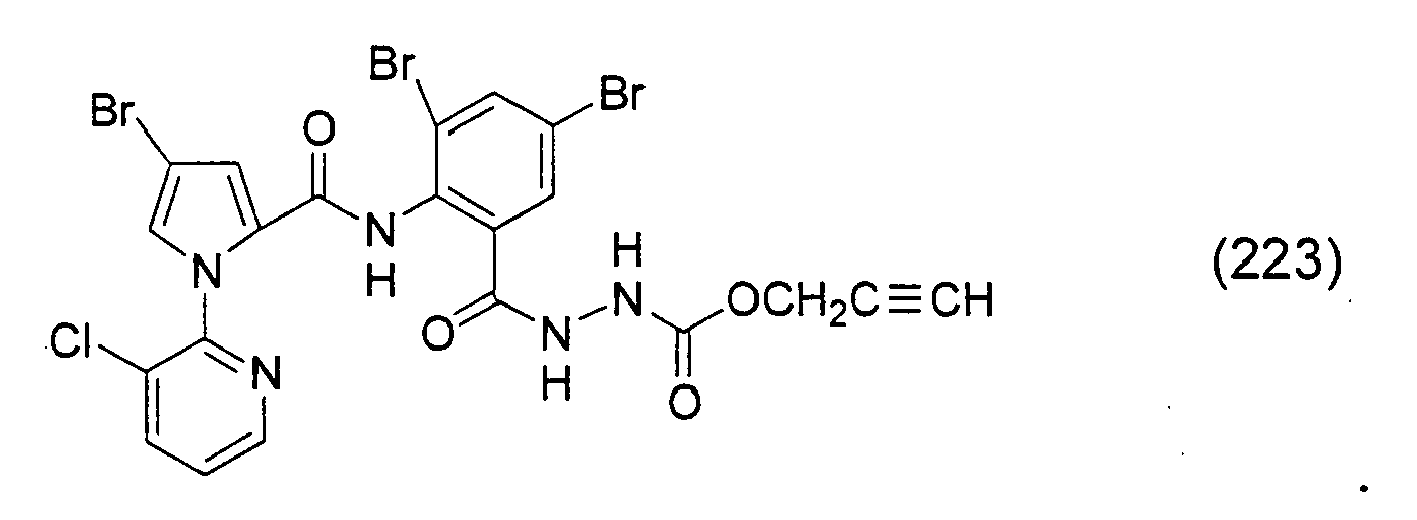
1H-NMR(DMSO-d6,TMS)δ(ppm):3.55(1H,s),4.70(2H,s),7.30(1H,s), 7.44(1H,d,J=1Hz),7.49(1H,dd,J=8Hz,5Hz),7.64(1H,s),8.05(1H,d, J=8Hz),8.11(1H,s),8.43(1H,dd,J=5Hz,1Hz),9.60(1H,brs), 9.94(1H,brs),10.22(1H,brs) - According to the same manner as that of Preparation Example 93, N-[4,6-dibromo-2-(hydrazinocarbonyl) phenyl]-4,5-dichloro-1-(3-chloro-2-pyridinyl)-1H-pyrrole-2-carboxamide and propargyl chloroformate were used in place of 4-bromo-N-[4-chloro-2-(hydrazinocarbonyl)-6-methylphenyl]-1 -(3-chloro-2-pyridinyl)-1H-pyrrole-2-carboxamide and methyl chloroformate respectively to obtain the present compound (224) of the formula:

1H-NMR(DMSO-d6,TMS)δ(ppm):3.55(1H,s),4.71(2H,s),7.44(1H,s), 7.56-7.64(2H,m),8.10(1H,s),8.15(1H,dd,J=8Hz,1Hz),8.51(1H,dd, J=5Hz,1Hz),9.58(1H,brs),10.02(1H,brs),10.23(1H,brs) - A mixture of 0.10 g of 6,8-dibromo-2-[4-bromo-1-(3-chloro -2-pyridinyl)-1H-imidazol-2-yl]-4H-3,1-benzoxazine-4-one, 0.16 g of methyl carbazate and 10 ml of N,N-dimethylformamide was stirred at room temperature for 1 day. The reaction mixture was poured into water, and extracted with ethyl acetate three times. The organic layers were combined, washed successively with water and an aqueous saturated sodium chloride solution, dried over anhydrous sodium sulfate, and concentrated under reduced pressure. The resulting residue was subjected to silica gel column chromatography to obtain 0.080 g of the present compound (125) of the formula:

1H-NMR(DMSO-d6,TMS)δ(ppm):3.63(3H,s),7.59(1H,dd,J=8Hz,5Hz), 7.90(1H,s),8.04(1H,d,J=2Hz),8.11(1H,d,J=8Hz),8.24(1H,s), 8.49(1H,d,J=5Hz),9.36(1H,brs),10.17(1H,brs),10.27(1H,brs) - According to the same manner as that of Preparation Example 122, 6,8-dibromo-2-[1-(3-chloro-2-pyridinyl)-5-methylsulfonyl-1H-pyrrol-2-yl]-4H-3, 1- benzoxazine-4-one was used in place of 6,8-dibromo-2-[4-bromo-1-(3-chloro-2-pyridinyl)-1H-pyrrol-2-yl]-4H-3,1- benzoxazine-4-one to obtain the present compound (226) of the formula:

1H-NMR(DMSO-d6,TMS)δ(ppm):3.27(3H,s),3.61(3H,s),7.11(1H,d, J=4Hz),7.36(1H,d,J=4Hz),7.53(1H,dd,J=8Hz,5Hz),7.65(1H,brs), 8.04(1H,dd,J=8Hz,2Hz),8.12(1H,d,J=2Hz),8.46(1H,dd,J=5Hz, 2Hz),9.36(1H,brs),10.16(1H,brs),10.22(1H,brs) - According to the same manner as that of Preparation Example 122, 6,8-dibromo-2-[1-(3-chloro-2-pyridinyl)-5-methylthio-1H-pyrrol-2-yl]-4H-3,1-benzoxazine- 4-one was used in place of 6,8-dibromo-2-[4-bromo-1-(3-chloro-2-pyridinyl)-1H-pyrrol-2-yl]-4H-3,1-benzoxazine-4-one to obtain the present compound (227) of the formula:

1H-NMR(DMSO-d6,TMS)δ(ppm):2.25(3H,s),3.60(3H,s),6.52(1H,d, J=4Hz),7.27(1H,d,J=4Hz),7.49(1H,dd,J=8Hz,5Hz),7.62(1H,brs), 8.04(1H,dd,J=8Hz,1Hz),8.07(1H,d,J=2Hz),8.45(1H,dd,J=5Hz, 1Hz),9.34(1H,brs),9.77(1H,brs),10.10(1H,brs) - According to the same manner as that of Preparation Example 72, 6-chloro-2-{1-(3-chloro-2-pyridinyl)-3-[1,1,2-trifluoro-2-(trifluoromethoxy)ethoxy]-1H-pyrazol-5-yl}-8-methyl-4H-3,1-benzoxazine-4-one was used in place of 2-[3-bromo-1-(3-chloro-2-pyridinyl)-1H-pyrazol-5-yl]-8-chloro-4H-3,1-benzoxazine-4-one to obtain the present compound (228) of the formula:

1H-NMR(DMSO-d6,TMS)δ(ppm):2.16(3H,s),3.62(3H,brs), 7.20(1H,s),7.37(1H,dt,J=51Hz,4Hz),7.38(1H,s),7.55(1H,s), 7.61(1H,dd,J=8Hz,5Hz),8.17(1H,d,J=8Hz),8.50(1H,d,J=5Hz), 9.32(1H,s),10.16(1H,s),10.30(1H,s) - According to the same manner as that of Preparation Example 114, 6-chloro-2-{1-(3-chloro-2-pyridinyl)-3-[1,1,2-trifluoro-2-(trifluoromethoxy)ethoxy]-1H-py4azol-5-yl}-8-methyl-4H-3,1-benzoxazine-4-one was used in place of 2-[3-bromo-1-(3-chloro-2-pyridinyl)-1H-pyrazole-5-yl]-6-chloro-8 -methyl-4H-3,1-benzoxazine-4-one to obtain the present compound (229) of the formula:

1H-NMR(DMSO-d6,TMS)δ(ppm):2.22(3H,s),2.91(3H,s),3.47-3.68 (3H,brm),7.24(1H,s),7.31(1H,s),7.37(1H,dt,J=51Hz,4Hz),7.57 (1H,d,J=2Hz),7.61(1H,dd,J=8Hz,5Hz),8.17(1H,dd,J=8Hz,1Hz), 8.48(1H,dd,J=5Hz,1Hz),10.32(1H,s),10.53(1H,s) - According to the same manner as that of Preparation Example 72, 6-chloro-2-[1-(3-chloro-2-pyridinyl)-3-(trifluoromethylthio)-1H-pyrazol-5-yl]-8-methyl-4H-3,1-benzoxazine-4-one was used in place of 2-[3-bromo-1-(3-chloro-2-pyridinyl)-1H-pyrazol-5-yl]-8-chloro-4H-3,1-benzoxazine-4-one to obtain the present compound (230) of the formula:

1H-NMR(DMSO-d6,TMS)δ(ppm):2.15(3H,s),3.62(3H,brs),7.39(1H, brs),7.55(1H,s),7.62-7.68(2H,m),8.20(1H,dd,J=8Hz,2Hz),8.52 (1H,dd,J=5Hz,2Hz),9.32(1H,brs),10.16(1H,brs),10.36(1H,brs) - A mixture of 0.50 g of 3-bromo-N-[9,6-dichloro-2-(N,N'-dimethylhydrazinocarbonyl)phenyl]-1-(3-chloro-2- pyridinyl)-1H-pyrazole-5-carboxamide, 0.18 g of methyl chloroformate, 0.16 g of pyridine and 10 ml of acetonitrile were mixed under ice-cooling, and the mixture was stirred for 3.5 hours under ice-cooling. Water was poured into the reaction mixture, and the mixture was extracted with ethyl acetate. The organic layer was washed successively with water and an aqueous saturated sodium chloride solution, dried over anhydrous magnesium sulfate, and concentrated under reduced pressure. The resulting residue was washed with a mixture of methyl tert-butyl ether and hexane to obtain 0.47 g of the present compound (231) of the formula:

1H-NMR(DMSO-d6,TMS)δ(ppm):2.73(1.4H,s),2.83(1.6H,s),2.95-(1.6H,s),3.07(1.4H,s),3.49-3.68(3.0H,m),7.32-7.44(2.0H,m), 7.62(1.0H,dd,J=8Hz,5Hz),7.85(0.5H,d,J=2Hz),7.92(0.5H,s), 8.19(1.0H,dd,J=8Hz,1Hz),8.49-8.52(1.0H,m),10.53(0.5H,s), 10.71 (0.5H,s) - Then, examples of preparation methods for intermediate compounds used in Preparation Examples will be shown in Reference Preparation Examples.
- A mixture of 0.44 g of 6-chloro-2-[1-(3-chloro-2-pyridinyl)-3-trifluoromethyl-1H-pyrazol-5-yl]-8-methyl-4H-3 ,1-benzoxazine-4-one, 0.05 g of hydrazine monohydrate and 10 ml of tetrahydrofuran was stirred at room temperature for 2 hours. After the reaction mixture was mixed with water and ethyl acetate, layers were separated. The organic layer was washed with water, dried over sodium sulfate, and concentrated under reduced pressure. The resulting residue was subjected to silica gel column chromatography to obtain 0.10 g of N-[4-chloro-2-(hydrazinocarbonyl)-6-methylphenyl]-1-(3-chloro-2-pyridinyl)-3-trifluoromethyl-1H-pyrazole-5-carboxamide of the formula:

1H-NMR (DMSO-d6,TMS) δ (ppm): 2.16 (3H, s), 4.36 (2H, s), 7.32 (1H, s), 7.48 (1H, s), 7.66 (1H, dd, J=4Hz, 8Hz), 7.74 (1H, s), 8.22 (1H, d, J=8Hz), 8.54 (1H, d, J=4Hz), 9.56 (1H, brs), 10.39 (1H, brs). - A mixture of 0.44 g of 6-chloro-2-[1-(3-chloro-2-pyridinyl)-3-trifluoromethyl-1H-pyrazol-5-yl]-8-methyl-4H-3 ,1-benzoxazine-4-one, 0.05 g of methylhydrazine and 10 ml of tetrahydrofuran was stirred at room temperature for 2 hours. After the reaction mixture was mixed with water and ethyl acetate, layers were separated. The organic layer was washed with water, dried over sodium sulfate, and concentrated under reduced pressure. The resulting residue was subjected to silica gel column chromatography to obtain 0.40 g of N-[4-chloro-2-(N-methylhydrazinocarbonyl)-6-methylphenyl]-1 -(3-chloro-2-pyridinyl)-3-trifluoromethyl-1H-pyrazole-5-carboxamide of the formula:

1H-NMR (DMSO-d6, TMS) δ (ppm): 2.17 (1.8H, s), 2.30 (1.2H, s), 2.76 (1.2H, s), 3.05 (1.8H, s), 4.54 (1.2H, brs), 4.99 (0.8H, brs), 7.16-7.23 (1H, m), 7.36 (0.6H, s), 7.46 (0.4H, s), 7.66-7.70 (2H, m), 8.24 (1H, d, J=8Hz), 8.54 (1H, d, J=4Hz), 10.25 (0.6H, brs), 10.51 (0.4H, brs). - A mixture of 0.40 g of 2-[1-(3-chloro-2-pyridinyl)-3-trifluoromethyl-1H-pyrazol-5-yl]-8-methyl-4H-3,1-benzoxazine-4-one, 0.09 ml of hydrazine monohydrate and 20 ml of tetrahydrofuran was stirred at room temperature for 3 hours. Water was poured into the reaction mixture, and the mixture was extracted with ethyl acetate three times. The organic layers were combined, washed with an aqueous saturated sodium chloride solution, dried over anhydrous magnesium sulfate, and concentrated under reduced pressure to obtain 0.26 g of 1-(3-chloro-2-pyridinyl)-N-[2-(hydrazinocarbonyl)-6-methylphenyl]-3-trifluoromethyl-1H-pyrazole-5-carboxamide of the formula:

1H-NMR (CDCl3, TMS) δ (ppm): 2.22 (3H, s), 4.05 (2H, s), 7.18-7.40 (5H, m), 7.42 (1H, dd, J=8Hz, 4Hz), 7.89 (1H, dd, J=8Hz, 1Hz), 8.48 (1H, dd, J=4Hz, 1Hz), 10.04 (1H, s). - A mixture of 0.27 g of 8-chloro-2-[1-(3-chloro-2-pyridinyl)-3-trifluoromethyl-1H-pyrazol-5-yl]-4H-3,1-benzoxazine-4-one, 0.025 ml of hydrazine monohydrate and 10 ml of tetrahydrofuran was stirred at room temperature for 3 hours. Water was poured into the reaction mixture, and the mixture was extracted with ethyl acetate three times. The organic layers were combined, washed with an aqueous saturated sodium chloride solution, dried over anhydrous magnesium sulfate, and concentrated under reduced pressure. The resulting residue was washed with a mixed solvent of chloroform and methyl t-butyl ether to obtain 0.21 g of N-[2-chloro-6-(hydrazinocarbonyl) phenyl]-1-(3-chloro-2-pyridinyl)-3-trifluoromethyl-1H-pyrazole-5-carboxamide of the formula:

1H-NMR (DMSO-d6) δ (ppm): 4.35 (2H, brs), 7.38-7.39 (2H, m), 7.61-7.66 (2H, m), 7.79 (1H, s), 8.20 (1H, d, J=8Hz), 8.53 (1H, d, J=4Hz), 9.52 (1H, s), 10.04 (1H, s). - A mixture of 0.40 g of 2-[3-bromo-1-(3-chloro-2-pyridinyl)-1H-pyrazol-5-yl]-6-chloro-8-methyl-4H-3,1-benzoxazine-4-one, 0.08 ml of hydrazine monohydrate and 10 ml of tetrahydrofuran was stirred at room temperature for 3 hours. The reaction mixture was poured into water and then filtered. The resulting filter cake was washed with water and methyl tert-butyl ether. The filter cake was dissolved in ethyl acetate, dried over anhydrous magnesium sulfate, and concentrated under reduced pressure to obtain 0.35 g of 3-bromo-N-[4-chloro-2-(hydrazinocarbonyl)-6-methylphenyl]-1 -(3-chloro-2-pyridinyl)-1H-pyrazole-5-carboxamide of the formula:

1H-NMR (DMSO-d6) δ (ppm): 2.14 (3H, s), 4.37 (2H, brs), 7.31 (1H, s), 7.38 (1H, s), 7.47 (1H, s), 7.61 (1H, dd, J=8Hz, 4Hz), 8.17 (1H, dd, J=8Hz, 1Hz), 8.50 (1H, dd, J=4Hz, 1Hz), 9.55 (1H, brs), 10.26 (1H, brs). - A mixture of 0.88 g of 6-chloro-2-[1-(2-chlorophenyl)-3-trifluoromethyl-1H-pyrazol-5-yl]-8-methyl-4H-3,1-benzoxazine-4-one, 0.19 ml of hydrazine monohydrate and 3 ml of tetrahydrofuran was stirred at room temperature for 2 hours. Water was poured into the reaction mixture, and the mixture was extracted with ethyl acetate three times. The organic layers were combined, washed with an aqueous saturated sodium chloride solution, dried over anhydrous magnesium sulfate, and concentrated under reduced pressure to obtain 0.94 g of N-[4-chloro-2-(hydrazinocarbonyl)-6-methylphenyl]-1-(2-chlorophenyl)-3-trifluoromethyl-1H-pyrazole-5-carboxamide of the formula:

1H-NMR (CDCl3,TMS) δ (ppm) : 2.18 (3H, s), 4.03 (2H, brs), 7.19-7.54 (8H, m), 9.74 (1H, s). - A mixture of 0.50 g of 6-chloro-2-[1-(3-chloro-2-pyridinyl)-1H-pyrazol-5-yl]-8-methyl-4H-3,1-benzoxazine-4-one, 0.13 ml of hydrazine monohydrate and 20 ml of tetrahydrofuran was stirred at room temperature for 4 hours. Water was poured into the reaction mixture, and the mixture was extracted with ethyl acetate two times. The organic layers were combined, washed with an aqueous saturated sodium chloride solution, dried over anhydrous magnesium sulfate, and concentrated under reduced pressure. The resulting residue was washed with a mixed solvent of ethyl acetate and hexane to obtain 0.44 g of N-[4-chloro-2-(hydrazinocarbonyl)-6-methylphenyl]-1-(3-chloro-2-pyridinyl)-1H-pyrazole-5-carboxamide of the formula:

1H-NMR (CDCl3,TMS) δ (ppm): 2.19 (3H, s), 4.03 (2H, brs), 7.05 (1H, d, J=2Hz), 7.19 (1H, d, J=2Hz), 7.36 (1H, dd, J=8Hz, 4Hz), 7.50 (1H, s), 7.83-7.86 (2H, m), 8.46 (1H, dd, J=4Hz, 1Hz), 9.64 (1H, s). - To a solution of 3.1 g of 1-(3-chloro-2-pyridinyl)-3-trifluoromethyl-1H-pyrazole-5-carbonyl chloride in 100 ml of acetonitrile, 1.9 g of 2-amino-5-chloro-3-methylbenzoic acid was added. The mixture was stirred at room temperature for 10 minutes and then, 1.0 g of triethylamine was added thereto. The mixture was stirred at room temperature for 20 minutes and then, 2.0 g of triethylamine was further added thereto. After the mixture was stirred at room temperature for 20 minutes, 1.2 g of methanesulfonyl chloride was added and the mixture was stirred at room temperature for 3 hours. After the reaction mixture was concentrated under reduced pressure, ethyl acetate and water were poured into the residue to separate layers. The organic layer was washed with water, dried over sodium sulfate, and concentrated under reduced pressured. The resulting residue was subjected to silica gel column chromatography to obtain 4.2 g of 6-chloro-2-[1-(3-chloro-2-pyridinyl)-3-trifluoromethyl-1H-pyrazol-5-yl]-8-methyl-4H-3,1-benzoxazine-4-one of the formula:

1H-NMR (CDCl3,TMS) δ (ppm): 1.73 (3H, s), 7.80 (1H, s), 7.82 (1H, dd, J=4Hz, 8Hz), 7.90 (1H, s), 7.91 (1H, s), 8.39 (1H, d, J=8Hz), 8.66 (1H, d, J=4Hz). - To a solution of 2.0 g of 1-(3-chloro-2-pyridinyl)-3-trifluoromethyl-1H-pyrazole-5-carbonyl chloride in 50 ml of acetonitrile, 0.98 g of 2-amino-3-methylbenzoic acid was added. The mixture was stirred at room temperature for 10 minutes and then, 0.9 ml of triethylamine was added thereto. The mixture was stirred at room temperature for 20 minutes and then, 1.8 ml of triethylamine was further added thereto. After the mixture was stirred at room temperature for 20 minutes, 0.56 ml of methanesulfonyl chloride was added and the mixture was stirred at room temperature for 3 hours. Water was poured into the reaction mixture, and the mixture was extracted with ethyl acetate two times. The organic layers were combined, washed with an aqueous saturated sodium chloride solution, dried over anhydrous magnesium sulfate, and concentrated under reduced pressure. The resulting residue was subjected to silica gel column chromatography to obtain 1.17 g of 2-[1-(3-chloro-2-pyridinyl)-3-trifluoromethyl-1H-pyrazol-5-yl]-8-methyl-4H-3 ,1-benzoxazine-4-one of the formula:

1H-NMR (CDCl3TMS) δ (ppm): 1.84 (3H, s), 7.39 (1H, t, J=8Hz), 7.50-7.55 (3H, m), 7.99 (1H, dd, J=8Hz, 1Hz), 8.01 (1H, d, J=8Hz), 8.59 (1H, dd, J=4.5Hz, 1Hz). - To a solution of 0.80 g of 1-(3-chloro-2-pyridinyl)-3-trifluoromethyl-1H-pyrazole-5-carbonyl chloride in 20 ml of acetonitrile, 0.44 g of 2-amino-3-chlorobenzoic acid was added. The mixture was stirred at room temperature for 10 minutes and then, 0.36 ml of triethylamine was added thereto. The mixture was stirred at room temperature for 20 minutes and then, 0.72 ml of triethylamine was further added thereto. After the mixture was stirred at room temperature for 20 minutes, 0.22 ml of methanesulfonyl chloride was added and the mixture was stirred at room temperature for 20 hours. Water was poured into the reaction mixture, and the mixture was extracted with ethyl acetate two times. The organic layers were combined, washed with an aqueous saturated sodium chloride solution, dried over anhydrous magnesium sulfate, and concentrated under reduced pressure. The resulting residue was subjected to silica gel column chromatography to obtain 1.17 g of 8-chloro-2-[1-(3-chloro-2-pyridinyl)-3-trifluoromethyl-1H-pyrazol-5-yl]-4H-3 ,1-benzoxazine-4-one of the formula:
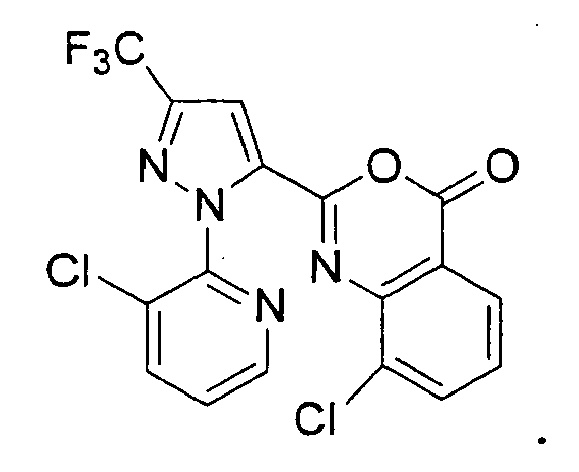
1H-NMR (CDCl3,TMS) δ (ppm): 7.43 (1H, t, J=8Hz), 7.52 (1H, dd, J=8Hz, 4Hz), 7.53 (1H, s), 7.75 (1H, dd, J=8Hz, 1Hz), 8.00 (1H, dd, J=8Hz, 1Hz), 8.11 (1H, dd, J=8Hz, 1Hz), 8.57 (1H, dd, J=4Hz, 1Hz) - To a mixture of 0.44 g of 3-bromo-1-(3-chloro-2-pyridinyl)-1H-pyrazole-5-carboxylic acid, 6 ml of acetonitrile and 0.20 g of triethylamine was added 0.125 ml of methanesulfonyl chloride. After the resulting mixture was stirred at room temperature for 15 minutes, 0.27 g of 2-amino-5-chloro-3-methylbenzoic acid was added and the mixture was stirred at room temperature for 20 minutes. To the mixture, 0.40 ml of triethylamine was added. After the mixture was stirred at room temperature for 20 minutes, 0.13 ml of methanesulfonyl chloride was added and the mixture was stirred at room temperature for 16 hours. The reaction mixture was filtered and the filter cake was washed with methyl tert-butyl ether. The resulting filter cake was dissolved in ethyl acetate, washed successively with water and an aqueous saturated sodium chloride solution, dried over anhydrous magnesium sulfate, and concentrated under reduced pressure to obtain 0.098 g of 2-[3-bromo-1-(3-chloro-2-pyridinyl)-1H-pyrazol-5-yl]-6-chlo ro-8-methyl-4H-3,1-benzoxazine-4-one. In addition, the filtrate was concentrated under reduced pressure, and the resulting residue was subjected to silica gel column chromatography to obtain 0.093 g of 2-[3-bromo-1-(3-chloro-2-pyridinyl)-1H-pyrazol-5-yl]-6-chloro-8-methyl-4H-3,1-benzoxazine-4-one of the formula:

1H-NMR (CDCl3,TMS) δ (ppm): 1.81 (3H, s), 7.25 (1H, s), 7.48-7.51 (2H, m), 7.95-7.98 (2H, m), 8.56 (1H, dd, J=4Hz, 1Hz) - To a mixture of 1.0 g of 1-(2-chlorophenyl)-3-trifluoromethyl-1H-pyrazole-5-carbonyl chloride and 10 ml of acetonitrile was added 0.60 g of 2-amino-5-chloro-3-methylbenzoic acid, and the resulting mixture was stirred at room temperature for 10 minutes. To the mixture, 0.46 ml of triethylamine was added. After the mixture was stirred at room temperature for 20 minutes, 0.92 ml of triethylamine was further added thereto. After the mixture was stirred at room temperature for 20 minutes, 0.28 ml of methanesulfonyl chloride was added thereto and the mixture was stirred at room temperature for 3 hours. The reaction mixture was filtered, and the resulting filtrate was concentrated under reduced pressure. The resulting residue was subjected to silica gel column chromatography to obtain 0.98 g of 6-chloro-2-[1-(2-chlorophenyl)-3-trifluoromethyl-1H-pyrazol-5-yl]-8-methyl-4 H-3,1-benzoxazine-4-one of the formula:

1H-NMR (CDCl3,TMS) δ (ppm): 1.82 (3H, s), 7.45-7.60 (6H, m), 7.99 (1H, s). - A mixture of 1.22 g of 1-(3-chloro-2-pyridinyl)-1H-pyrazole-5-carboxylic acid and 1.15 ml of thionyl chloride was heated to reflux for 2 hours. The reaction mixture was allowed to cool to room temperature and then concentrated under reduced pressure. The resulting residue was dissolved in 15 ml of acetonitrile, and 0.27 g of 2-amino-5-chloro-3-methylbenzoic acid was added thereto. The mixture was stirred at room temperature for 10 minutes. To the mixture was added 0.73 ml of triethylamine, and the mixture was stirred at room temperature for 20 minutes. Thereto 1.45 ml of triethylamine was further added, and the mixture was stirred at room temperature for 20 minutes. Then 0.44 ml of methanesulfonyl chloride was added, and the mixture was stirred at room temperature for 3 hours. Water was poured into the reaction mixture, and the mixture was extracted with ethyl acetate two times. The organic layers were combined, washed with an aqueous saturated sodium chloride solution, dried over anhydrous magnesium sulfate, and concentrated under reduced pressure. The resulting residue was washed with methyl tert-butyl ether to obtain 0.68 g of 6-chloro-2-[1-(3-chloro-2-pyridinyl)-1H-pyrazol-5-yl]-8-methyl-4H-3,1-benzoxazine-4-one of the formula:
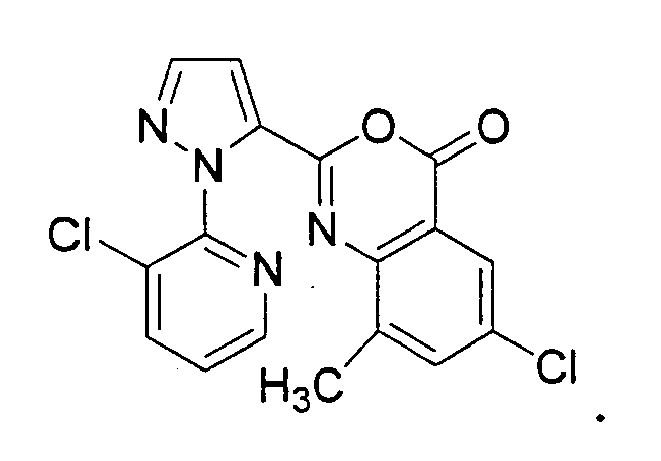
1H-NMR (CDCl3,TMS) δ (ppm): 1.82 (3H, s), 7.28 (1H, d, J=2Hz), 7.46-7.49 (2H, m), 7.91 (1H, d, J=2Hz), 7.95-7.99 (2H, m), 8.57 (1H, dd, J=4Hz, 1Hz). - A mixture of 15.30 g of 3-trifluoromethyl-1H-pyrazole, 16.64 g of 2, 3-dichloropyridine, 26. 42 g of potassium carbonate and 100 ml of N,N-dimethylformamide was stirred at 130°C for 14 hours. The reaction mixture was allowed to cool to room temperature and then water was poured thereto. The mixture was extracted with ethyl acetate two times. The organic layers were combined, washed successively with water and an aqueous saturated sodium chloride solution, dried over magnesium sulfate, and concentrated under reduced pressure. The resulting residue was subjected to silica gel column chromatography to obtain 22.88 g of 3-chloro-2-(3-trifluoromethyl-1H-pyrazol -1-yl)pyridine of the formula:

1H-NMR (CDCl3, TMS) δ (ppm): 6.75 (1H, d, J=2Hz), 7.37 (1H, dd, J=8Hz, 4Hz), 7.95 (1H, dd, J=8Hz, 1Hz), 8.14 (1H, d, J=1Hz), 8.49 (1H, dd, J=4Hz, 1Hz). - To a mixture of 15 g of 3-chloro-2-(3-trifluoromethyl-1H-pyrazol-1-yl)pyridine and 150 ml of tetrahydrofuran was added dropwise 39 ml of a 2.0 mol/L lithium diisopropylamide solution in heptane/tetrahydrofuran/ethylbenzene at -78°C, and then stirred at -78°C for 15 minutes. Carbon dioxide was introduced into the mixture at such a rate that the inner temperature was retained at -60°C or lower. After the mixture turned yellow, it was further stirred at -78°C for 10 minutes. After the temperature of the reaction mixture was allowed to rise to room temperature, 200 ml of water and 200 ml of hexane were poured. The aqueous layer was adjusted to pH 10-12 by an addition of a 2N aqueous sodium hydroxide solution and then layers were separated. The organic layer was extracted with a 0.5N aqueous sodium hydroxide solution. The aqueous layers were combined, washed with diethyl ether, adjusted to around pH 3 by an addition of 2N hydrochloric acid, and then extracted with methyl tert-butyl ether three times. The organic layers were combined, washed with an aqueous saturated sodium chloride solution, dried over magnesium sulfate, and concentrated under reduced pressure to obtain 16.08 g of 1- (3-chloro-2-pyridinyl) -3-trifluoromethyl-1H-pyrazole-5-carboxylic acid of the formula:

1H-NMR (DMSO-d6) δ (ppm): 7.60 (1H, s), 7.74 (1H, dd, J=8Hz, 4Hz), 8.30 (1H, dd, J=8Hz, 1Hz), 8.60 (1H, dd, J=4Hz, 1Hz). - A mixture of 16.08 g of 1-(3-chloro-2-pyridinyl)-3-trifluoromethyl-1H-pyrazole-5-carboxylic acid and 12 ml of thionyl chloride was heated to reflux for 2 hours. The reaction mixture was allowed to cool to room temperature and subjected to distillation under reduced pressure (125°C/3mmHg) to obtain 14.2 g of 1-(3-chloro-2-pyridinyl)-3-trifluoromethyl-1H-pyrazole-5-carbonyl chloride of the formula:

1H-NMR (CDCl3,TMS) δ (ppm): 7.52 (1H, s), 7.52 (1H, dd, J=8Hz, 4Hz), 7.97 (1H, dd, J=8Hz, 1Hz), 8.53 (1H, dd, J=4Hz, 1Hz). - To a mixture of 18 g of 4-ethoxy-1,1,1-trifluoro-3-butene -2-one and 50 ml of methanol was added 5.7 ml of methylhydrazine, and the mixture was heated to reflux for 4 hours. The reaction mixture was allowed to cool to room temperature, concentrated under reduced pressure, and subjected to distillation under reduced pressure (60°C/15 mmHg) to obtain 8.71 g of 1-methyl-3-trifluoromethyl-1H-pyrazole of the formula:

1H-NMR (CDCl3,TMS) δ (ppm): 3.97 (3H, s), 6.51 (1H, d, J=2Hz), 7.40 (1H, d, J=2Hz). - To a mixture of 8.71 g of 1-methyl-3-trifluoromethyl-1H-pyrazole and 130 ml of tetrahydrofuran was added dropwise 32 ml of a 2.0 mol/L lithium diisopropylamide solution in heptane/tetrahydrofuran/ethylbenzene at -78°C. The mixture of stirred at -78°C for 2 hours and then poured into a mixture was dry ice and 50 ml of tetrahydrofuran. The mixture was stirred for 2 hours while allowing it to rise to around room temperature. Water and diethyl ether were poured into the reaction mixture. The aqueous layer was adjusted to pH 10-12 by an addition of a 2N aqueous sodium hydroxide solution, and then layers were separated. The resulting aqueous layer was washed with diethyl ether two times, adjusted to around pH 3 by an addition of 2N hydrochloric acid, and then extracted with methyl tert-butyl ether three times. The organic layers were combined, washed with an aqueous saturated sodium chloride solution, dried over magnesium sulfate, and concentrated under reduced pressure to obtain 8.19 g of 1-methyl-3-trifluoromethyl-1H-pyrazole-5-carboxylic acid of the formula:

1H-NMR (CDCl3,TMS) δ (ppm): 4.13 (3H, s), 7.22 (1H, s). - To a mixture of 15 g of pyrazole and 200 ml of toluene was added dropwise 23.7 ml of dimethylsulfamoyl chloride at room temperature. Then, 40 ml of triethylamine was added to the mixture, and the mixture was stirred at room temperature for 18 hours. The reaction mixture was filtered, and the filtrate was concentrated under reduced pressure. The resulting residue was subjected to silica gel column chromatography to obtain 17.6 g of N,N-dimethyl-1H-pyrazole-1-sulfonamide of the formula:

1H-NMR (CDCl3,TMS) δ (ppm): 2.95 (6H, s), 6.40 (1H, dd, J=2Hz, J=1Hz), 7.75 (1H, d, J=1Hz), 7.95 (1H, d, J=2Hz,). - To a mixture of 17.6 g of N,N-dimethyl-1H-pyrazole-1-sulfonamide and 200 ml of tetrahydrofuran was added dropwise 80 ml of a 1.3M solution of n-butyl lithium in hexane at -78°C, and the resulting mixture was stirred at -78°C for 15 minutes. To the mixture, a solution of 35.8 g of 1,2-dibromo-1,1,2,2-tetrachloroethane in 60 ml of tetrahydrofuran was added dropwise, and the resulting mixture was stirred at -78°C for 15 minutes. The reaction mixture was returned to room temperature, and stirred for 1 hour. Water was poured into the reaction mixture, and the mixture was extracted with ethyl acetate three times. The organic layers were combined, washed with an aqueous saturated sodium chloride solution, dried over magnesium sulfate, and concentrated under reduced pressure. The resulting residue was subjected to silica gel column chromatography to obtain 21.3 g of 5-bromo-N,N-dimethyl-1H-pyrazole-1-sulfonamide of the formula:

1H-NMR (CDCl3,TMS) δ (ppm): 3.08 (6H, s), 6.43 (1H, m), 7.61 (1H, m). - A mixture of 21.3 g of 5-bromo-N,N-dimethyl-1H-pyrazole-1-sulfonamide and 30 ml of trifluoroacetic acid was stirred at room temperature for 2 hours. After hexane was poured into the reaction mixture, the mixture was filtered. After methyl tert-butyl ether was added to the resulting filtrate, the mixture was washed successively with an aqueous saturated sodium hydrogen carbonate solution, water and an aqueous saturated sodium chloride solution, dried over magnesium sulfate, and concentrated under reduced pressure to obtain 10. 7 g of 3-bromo-1H-pyrazole of the formula:

1H-NMR (CDCl3,TMS) δ (ppm): 6.37 (1H, d, J=2Hz), 7.55 (1H, d, J=2Hz), 12.6 (1H, brs). - A mixture of 10.7 g of 3-bromo-1H-pyrazole, 11.8 g of 2,3-dichloropyridine, 57.3 g of cesium carbonate and 80 ml of N,N-dimethylformamide was stirred at 100°C for 8 hours. The reaction mixture was allowed to cool to room temperature, and water was poured thereto. The mixture was extracted with methyl tert-butyl ether two times. The organic layers were combined, washed successively with water and an aqueous saturated sodium chloride solution, dried over magnesium sulfate, and concentrated under reduced pressure. The resulting residue was subjected to silica gel column chromatography to obtain 12.9 g of 2-(3-bromo-1H-pyrazol-1-yl)-3-chloropyridine of the formula:
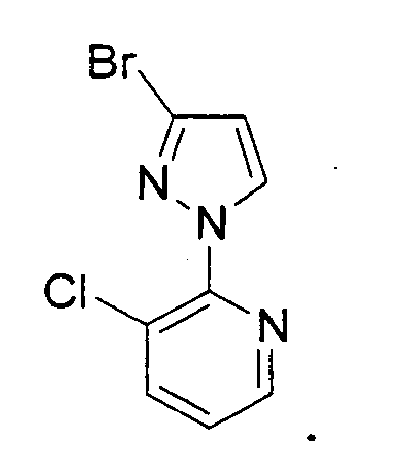
1H-NMR (CDCl3,TMS) δ (ppm): 6.51 (1H, d, J=2Hz), 7.31 (1H, dd, J=8Hz, 4Hz), 7.91 (1H, dd, J=8Hz, 1Hz), 8.04 (1H, d, J=2Hz), 8.45 (1H, dd, J=4Hz, 1Hz). - To a mixture of 9.2 g of 2-(3-bromo-1H-pyrazol-1-yl)-3-chloropyridine and 80 ml of tetrahydrofuran was added dropwise 21.3 ml of a 2.0M lithium diisopropylamide solution in heptane/tetrahydrofuran/ethylbenzene at -78°C. The resulting mixture was stirred at -78°C for 15 minutes, poured to a mixture of dry ice and 50 ml of tetrahydrofuran, and stirred for 1 hour with allowing it to rise to around room temperature. After water and diethyl ether were poured into the reaction mixture, the aqueous layer was adjusted to pH 10-12 by an addition of a 2N aqueous sodium hydroxide solution and layers were separated. The resulting aqueous layer was washed with diethyl ether two times, adjusted to around pH 3 by an addition of 2N hydrochloric acid, and extracted with methyl tert-butyl ether three times. The organic layers were combined, washed with an aqueous saturated sodium chloride solution, dried over magnesium sulfate, and concentrated under reduced pressure to obtain 7.96 g of 3-bromo-1-(3-chloro-2-pyridinyl)-1H-pyrazole -5-carboxylic acid of the formula:

1H-NMR (DMSO-d6) δ (ppm): 7.25 (1H, s), 7.68 (1H, dd, J=8Hz, 4Hz), 8.24 (1H, dd, J=8Hz, J=1Hz), 8.56 (1H, dd, J=4Hz, 1Hz). - To a mixture of 12.96 g of 4,4,4-trifluoro-1-(2-furyl)-1,3-butanedione, 8.56 g of sodium acetate and 40 ml of acetic acid was added 11.26 g of 2-chlorophenylhydrazine hydrochloride at room temperature. The mixture was stirred at 60°C for 1 hour, and concentrated under reduced pressure. After the reaction mixture was concentrated under reduced pressure and water was poured into the residue, the mixture was extracted with chloroform three times. The organic layers were combined, washed with an aqueous saturated sodium chloride solution, dried over magnesium sulfate, and concentrated under reduced pressure. The resulting residue was subjected to silica gel column chromatography to obtain 18.43 g of 1-(2-chlorophenyl)-5-(2-furyl)-3-trifluoromethyl-1H-pyrazole of the formula:

1H-NMR (CDCl3,TMS) δ (ppm): 5.76 (1H, d, J=3Hz), 6.31 (1H, dd, J=3Hz, 2Hz), 6.95 (1H, s), 7.40 (1H, d, J=2Hz), 7.43-7.59 (4H, m). - An aqueous solution of 27.94 g of potassium permanganate in 100 ml of water was added dropwise to a mixture of 18.43 g of 1-(2-chlorophenyl)-5-(2-furyl)-3-trifluoromethyl-1H-pyrazole and 250 ml of acetone with being kept at 40°C or lower. Then, the mixture was stirred at room temperature for 20 hours. The reaction mixture was filtered through Celite (registered trademark) to obtain a filtrate. The filtrate was adjusted to pH 10-12 by an addition of a 2N aqueous sodium hydroxide solution, and then extracted with ethyl acetate two times. The aqueous layer was adjusted to around pH 3 by an addition of 2 N hydrochloric acid, and then extracted with methyl tert-butyl ether three times. The organic layers were combined, washed with an aqueous saturated sodium chloride solution, dried over magnesium sulfate, and concentrated under reduced pressure to obtain 10.65 g of 1-(2-chlorophenyl)-3-trifluoromethyl-1H-pyrazole-5-carboxylic acid of the formula:
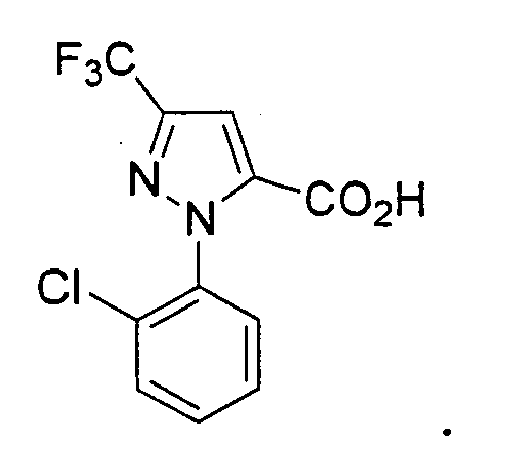
1H-NMR (CDCl3,TMS) δ (ppm): 7.33 (1H, s), 7.42-7.54 (4H, m). - A mixture of 10.65 g of 1-(2-chlorophenyl)-3-trifluoromethyl-1H-pyrazole-5-carboxylic acid and 8 ml of thionyl chloride heated to reflux for 2 hours. The reaction mixture was allowed to cool to room temperature, concentrated under reduced pressure, and subjected to distillation under reduced pressure (110°C/5 mmHg) to obtain 8.39 g of 1-(2-chlorophenyl)-3-trifluoromethyl-1H-pyrazole-5-carbonyl chloride of the formula:

1H-NMR (CDCl3,TMS) δ (ppm): 7.42-7.57 (5H, m). - A mixture of 2 g of pyrazole, 4.34 g of 2,3-dichloropyridine, 9.58 g of cesium carbonate and 40 ml N,N-dimethylformamide was stirred at 100°C for 8 hours. The reaction mixture was allowed to cool to room temperature, and water was added thereto. The mixture was extracted with methyl tert-butyl ether three times. The organic layers were combined, washed successively with water and an aqueous saturated sodium chloride solution, dried over magnesium sulfate, and concentrated under reduced pressure. The resulting residue was subjected to silica gel column chromatography to obtain 3.57 g of 3-chloro-2-(1H-pyrazol-1-yl)pyridine of the formula:

1H-NMR (CDCl3,TMS) δ (ppm): 6.50 (1H, dd, J=2Hz, 1Hz), 7.28 (1H, dd, J=8Hz, 4Hz), 7.83 (1H, d, J=1Hz), 7.92 (1H, dd, J=8Hz, 1Hz), 8.17 (1H, d, J=2Hz), 8.46 (1H, dd, J=4Hz, 1Hz). - To a mixture of 2.0 g of 3-chloro-2-(1H-pyrazol-1-yl) pyridine and 100 ml of tetrahydrofuran was added dropwise 6.7 ml of a 2.0 mol/L lithium diisopropylamide solution in heptane/tetrahydrofuran/ethylbenzene at -78°C. The mixture was stirred at -78°C for 10 minutes, poured into a mixture of dry ice and 50 ml of tetrahydrofuran, and stirred for 0.5 hour with allowing it to rise to around room temperature. After water and diethyl ether were added to the reaction mixture, the aqueous layer was adjusted to pH 10-12 by an addition of a 2N aqueous sodium hydroxide solution and layers were separated. After the aqueous layer was washed with diethyl ether two times, the aqueous layer was adjusted to around pH 3 by an addition of 2N hydrochloric acid, and the mixture was extracted with methyl tert-butyl ether three times. The organic layers were combined, washed with an aqueous saturated sodium chloride solution, dried over magnesium sulfate, and concentrated under reduced pressure to obtain 1.22 g of 1-(3-chloro-2-pyridinyl)-1H- pyrazole-5-carboxylic acid of the formula:

1H-NMR (CDCl3,TMS) δ (ppm): 7.10 (1H, d, J=2Hz), 7.42 (1H, dd, J=8Hz, 4Hz), 7.82 (1H, d, J=2Hz), 7.91 (1H, dd, J=8Hz, 1Hz), 8.51 (1H, dd, J=4Hz, 1Hz). - A mixture of 16.3 g of isatoic anhydride, 10.4 g of ethyl carbazate and 50 ml of ethanol was heated to reflux for 3 hours. After the reaction mixture was allowed to cool to around room temperature, ethyl acetate was added thereto and the mixture was washed with water two times. The organic layer was dried over anhydrous sodium sulfate and concentrated under reduced pressure. The resulting residue was washed with methyl tert-butyl ether to obtain 14.9 g of N-(2-aminobenzoyl)-N'-ethoxycarbonylhydrazine of the formula:

1H-NMR (CDCl3,TMS) δ (ppm): 1.28 (3H, t, J=8Hz), 4.22 (2H, q, J=8Hz), 5.45 (2H, brs), 6.63-6.68 (2H, m), 6.85 (1H, brs), 7.22 (1H, brs), 7.43 (1H, d, J=8Hz), 7.95 (1H, brs). - A mixture of 8.86 g of N-methylisatoic anhydride, 5.73 g of ethyl carbazate and 25 ml of ethanol was heated to reflux for 2 hours. After the reaction mixture was allowed to around room temperature, ethyl acetate was added thereto and the mixture was washed with water two times. The organic layer was dried over anhydrous sodium sulfate, and concentrated under reduced pressure. The resulting residue was washed with methyl tert-butyl ether to obtain 5.99 g of N- (2-methylaminobenzoyl)-N'-ethoxycarbonylhydrazine of the formula:

1H-NMR (CDCl3,TMS) δ (ppm): 1.28 (3H, t, J=7Hz), 2.85 (3H, d, J=5Hz), 4.21 (2H, q, J=7Hz), 6.55-6.59 (1H, m), 6.66 (1H, d, J=8Hz), 6.78 (1H, brs), 7.29-7.37 (2H, m), 7.43 (1H, dd, J=8Hz, 1Hz), 7.91 (1H, brs). - A mixture of 1.0 g of 1-(3-chloro-2-pyridinyl)-3-trifluoromethyl-1H-pyrazole-5-carboxylic acid and 2 ml of thionyl chloride was heated to reflux for 2 hours. The reaction mixture was allowed to cool to room temperature, and concentrated under reduced pressure. The resulting residue was dissolved in 15 ml of acetonitrile, and 0.49 g of 2-amino-3,5-dimethylbenzoic acid was added thereto. The mixture was stirred at room temperature for 30 minutes. To the mixture, 0.7 ml of triethylamine was added, and the mixture was stirred at room temperature for 30 minutes. Further 1.4 ml of triethylamine was added, and the mixture was stirred at room temperature for 30 minutes. Then 0.5 ml of methanesulfonyl chloride was added, and the mixture was stirred at room temperature for 5 hours. Water was poured into the reaction mixture, and the mixture was concentrated under reduced pressure. The resulting residue was washed with water and methyl tert-butyl ether to obtain 0.71 g of 2-[1-(3-chloro-2-pyridinyl)-3-trifluoromethyl-1H-pyrazol-5-yl]-6,8-dimethyl-4H-3,1-benzoxazine-4-one of the formula:

1H-NMR (DMSO-d6,TMS) δ (ppm): 1.72 (3H, s), 2.37 (3H, s), 7.54 (1H, s), 7.77 (1H, s), 7.78-7.85 (2H, m), 8.39 (1H, d, J=8Hz), 8.66 (1H, d, J=4Hz). - According to the same manner as that of Reference Preparation Example 1, 2-[1-(3-chloro-2-pyridinyl)-3-trifluoromethyl-1H-pyrazol-5-yl]-6,8-dimethyl-4H-3,1-benzox azine-4-one was used in place of 6-chloro-2-[1-(3-chloro-2-pyridinyl)-3-trifluoromethyl-1H-pyrazol-5-yl]-8-methyl-4H-3 ,1-benzoxazine-4-one to obtain N-[4,6-dimethyl-2-(hydrazinocarbonyl)phenyl]-1-(3-chloro-2-pyridinyl)-3-trifluoromethyl-1H-pyrazole-5-carboxamide of the formula:

1H-NMR (DMSO-d6,TMS) δ (ppm): 2.11 (3H, s), 2.27 (3H, s), 4.34 (2H, brs), 7.11 (1H, s), 7.17 (1H, s), 7.66 (1H, dd, J=8Hz, 4Hz), 7.74 (1H, s), 8.21 (1H, d, J=8Hz), 8.53 (1H, d, J=4Hz), 9.37 (1H, brs), 10.26 (1H, brs). - According to the same manner as that of Reference Preparation Example 31-(1), 2-amino-3-bromo-5-methylbenzoic acid was used in place of 2-amino-3,5-dimethylbenzoic acid to obtain 8-bromo-2-[1-(3-chloro-2-pyridinyl)-3-trifluoromethyl-1H-pyrazol-5-yl]-6-methyl-4H-3,1-benzoxazine-4-one of the formula:

1H-NMR (DMSO-d6,TMS) δ (ppm) : 2.41 (3H, s), 7.77 (1H, dd, J=8Hz, 4Hz), 7.87 (1H, s), 7.93 (1H, s), 7.98 (1H, s), 8.36 (1H, d, J=8Hz), 8.63 (1H, d, J=4Hz). - According to the same manner as that of Reference Preparation Example 1, 8-bromo-2-[1-(3-chloro-2-pyridinyl)-3 -trifluoromethyl-1H-pyrazol-5-yl]-6-methyl-4H-3,1-benzoxazine-4-one was used in place of 6-chloro-2-[1-(3-chloro -2-pyridinyl)-3-trifluoromethyl-1H-pyrazol-5-yl]-8-methyl-4 H-3,1-benzoxazine-4-one to obtain N-[6-bromo-2-(hydrazinocarbonyl)-4-methylphenyl]-1-(3-chloro-2-pyridinyl )-3-trifluoromethyl-1H-pyrazole-5-carboxamide of the formula:
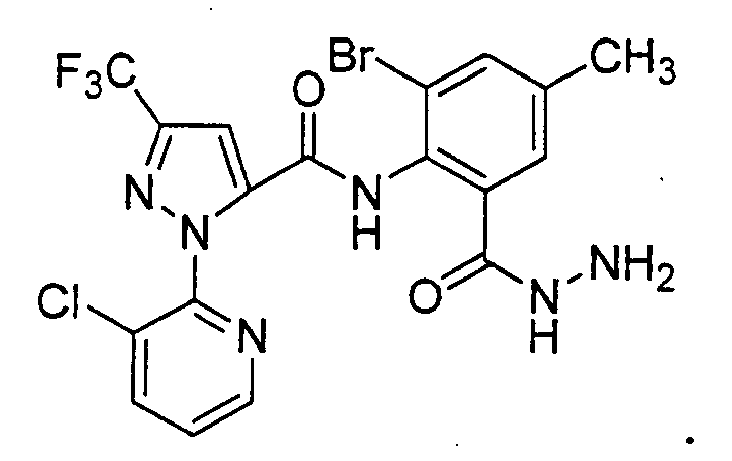
1H-NMR (DMSO-d6,TMS) δ (ppm): 2.31 (3H, s), 4.33 (2H, brs), 7.24 (1H, s), 7.43 (1H, s), 7.57-7.65 (2H, m), 8.15 (1H, d, J=8Hz), 8.49 (1H, d, J=4Hz), 9.38 (1H, brs), 10.31 (1H, brs). - According to the same manner as that of Reference Preparation Example 31-(1), 2-amino-6-chlorobenzoic acid was used in place of 2-amino-3,5-dimethylbenzoic acid to obtain 5-chloro-2-[1-(3-chloro-2-pyridinyl)-3-trifluoromethyl-1H-pyrazol-5-yl]-4H-3,1-benzoxazine-4-one of the formula:

1H-NMR (DMSO-d6,TMS) δ (ppm): 6.91 (1H, d, J=8Hz), 7.68 (1H, d, J=8Hz), 7.77 (1H, t, J=8Hz), 7.83 (1H, dd, J=8Hz, 4Hz), 7.91 (1H, s), 8.37 (1H, d, J=8Hz), 8.64 (1H, d, J=4Hz). - According to the same manner as that of Reference Preparation Example 1, 5-chloro-2-[1-(3-chloro-2-pyridinyl)-3-trifluoromethyl-1H-pyrazol-5-yl]-4H-3,1-benzoxazine-4-one was used in place of 6-chloro-2-[1-(3-chloro-2-pyridinyl)-3-trifluoromethyl-1H-pyrazol-5-yl]-8-methyl-4H-3,1-benzoxazine-4-one to obtain N-[3-chloro-2-(hydrazinocarbonyl)phenyl]-1-(3-chloro-2-pyridinyl)-3-trifluoromethyl-1H-pyrazole-5-carboxamide of the formula:

1H-NMR (DMSO-d6,TMS) δ (ppm): 4.47 (2H, brs), 7.32-7.50 (3H, m), 7.65-7.75 (2H, m), 8.25 (1H, d, J=8Hz), 8.56 (1H, d, J=4Hz), 9.58 (1H, brs), 10.29 (1H, brs). - According to the same manner as that of Reference Preparation Example 31-(1), 2-amino-5-chlorobenzoic acid was used in place of 2-amino-3,5-dimethylbenzoic acid to obtain 6-chloro-2-[1-(3-chloro-2-pyridinyl)-3-trifluoromethyl-1H-pyrazol-5-yl]-4H-3,1-benzoxazine-4-one of the formula:

1H-NMR (DMSO-d6,TMS) δ (ppm): 7.02 (1H, d, J=8Hz), 7.83 (1H, dd, J=8Hz, 4Hz), 7.87-7.92 (2H, m), 8.08 (1H, s), 8.37 (1H, d, J=8Hz), 8.64 (1H, d, J=4Hz). - According to the same manner as that of Reference Preparation Example 1, 6-chloro-2-[1-(3-chloro-2-pyridinyl)-3-trifluoromethyl-1H-pyrazol-5-yl]-4H-3,1-benzoxazine-4-one was used in place of 6-chloro-2-[1-(3-chloro-2-pyridinyl)-3-trifluoromethyl-1H-pyrazol-5-yl]-8-methyl-4H-3,1-benzoxazine-4-one to obtain N-[4-chloro-2-(hydrazinocarbonyl)phenyl]-1-(3-chloro-2-pyridinyl)-3-trifluoromethyl-1H-pyrazole-5-carboxamide of the formula:

1H-NMR (DMSO-d6,TMS) δ (ppm): 7.52-7.56 (2H, m), 7.73 (1H, dd, J=8Hz, 4Hz), 7.85 (1H, s), 8.19 (1H, d, J=8Hz), 8.29 (1H, d, J=8Hz), 8.58 (1H, d, J=4Hz), 10.30 (1H, brs), 12.52 (1H, brs). - According to the same manner as that of Reference Preparation Example 31-(1), 2-amino-3,5-dibromobenzoic acid was used in place of 2-amino-3, 5-dimethylbenzoic acid to obtain 2-[1-(3-chloro-2-pyridinyl)-3-trifluoromethyl-1H-pyrazol-5-yl]-6,8-dibromo-4H-3,1-benzoxazine-4-one of the formula:

1H-NMR (DMSO-d6,TMS) δ (ppm): 7.77 (1H, dd, J=8Hz, 4Hz), 7.94 (1H, s), 8.19-8.21 (1H, m), 8.35-8.39 (2H, m), 8.63 (1H, d, J=4Hz). - According to the same manner as that of Reference Preparation Example 1, 2-[1-(3-chloro-2-pyridinyl)-3-trifluoromethyl-1H-pyrazol-5-yl]-6,8-dibromo-4H-3,1-benzoxazine-4-one was used in place of 6-chloro-2- [1- (3-chloro -2-pyridinyl)-3-trifluoromethyl-1H-pyrazol-5-yl]-8-methyl-4 H-3,1-benzoxazine-4-one to obtain N-[4,6-dibromo-2-(hydrazinocarbonyl)phenyl]-1-(3-chloro-2-pyridinyl)-3-trifluoromethyl-1H-pyrazole-5-carboxamide of the formula:

1H-NMR (DMSO-d6,TMS) δ (ppm) : 4.40 (2H, brs), 7.61 (1H, s), 7.66 (1H, dd, J=8Hz, 4Hz), 7.79 (1H, s), 8.08 (1H, s), 8.21 (1H, d, J=8Hz), 8.54 (1H, d, J=4Hz), 9.60 (1H, brs), 10.62 (1H, brs). - According to the same manner as that of Reference Preparation Example 31-(1), 2-amino-3,5-diiodobenzoic acid was used in place of 2-amino-3, 5-dimethylbenzoic acid to obtain 2-[1-(3-chloro-2-pyridinyl)-3-trifluoromethyl-1H-pyrazol-5-yl]-6,8-diiodo-4H-3,1-benzoxazine-4-one of the formula:
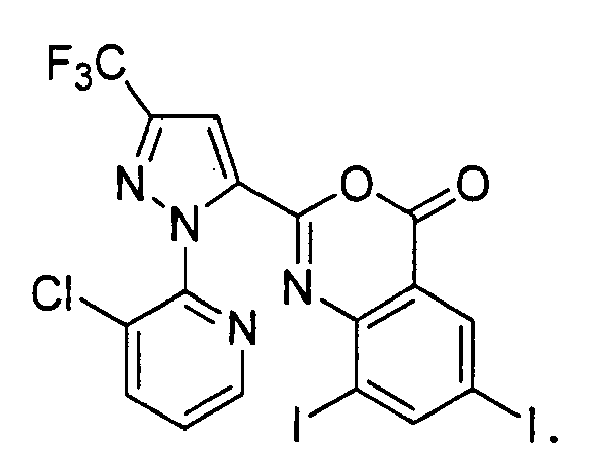
1H-NMR (DMSO-d6,TMS) δ (ppm): 7.74 (1H, dd, J=8Hz, 4Hz), 7.89 (1H, s), 8.31-8.35 (2H, m), 8.59-8.63 (2H, m). - According to the same manner as that of Reference Preparation Example 1, 2-[1-(3-chloro-2-pyridinyl)-3-trifluoromethyl-1H-pyrazol-5-yl]-6,8-diiodo-4H-3,1-benzoxazine-4-one was used in place of 6-chloro-2-[1-(3-chloro-2-pyridinyl)-3-trifluoromethyl-1H-pyrazol-5-yl]-8-methyl-4H-3,1-benzoxazine-4-one to obtain N-[4,6-diiodo-2-(hydrazinocarbonyl)phenyl]-1-(3-chloro-2-pyridinyl)-3-trifluoromethyl-1H-pyrazole-5-carboxamide of the formula:

1H-NMR (DMSO-d6,TMS) δ (ppm): 4.39 (2H, brs), 7.66 (1H, dd, J=8Hz, 4Hz), 7.71 (1H, s), 7.79 (1H, s), 8.20 (1H, d, J=8Hz), 8.33 (1H, s), 8.53 (1H, d, J=4Hz), 9.51 (1H, brs), 10.58 (1H, brs). - According to the same manner as that of Reference Preparation Example 31-(1), 2-amino-4-chlorobenzoic acid was used in place of 2-amino-3,5-dimethylbenzoic acid to obtain 7-chloro-2-[1-(3-chloro-2-pyridinyl)-3-trifluoromethyl-1H-pyrazol-5-yl]-4H-3,1-benzoxazine-4-one of the formula:

1H-NMR (DMSO-d6,TMS) δ (ppm) : 7.02 (1H, s), 7.68 (1H, d, J=8Hz), 7.84 (1H, dd, J=8Hz, 4Hz), 7.91 (1H, s), 8.10 (1H, d, J=8Hz), 8.38 (1H, d, J=8Hz), 8.64 (1H, d, J=4Hz). - According to the same manner as that of Reference Preparation Example 1, 7-chloro-2-[1-(3-chloro-2-pyridinyl)-3-trifluoromethyl-1H-pyrazol-5-yl]-4H-3,1-benzoxazine-4-one was used in place of 6-chloro-2-[1-(3-chloro-2-pyridinyl)-3-trifluoromethyl-1H-pyrazol-5-yl]-8-methyl-4H-3,1-benzoxazine-4-one to obtain N-[5-chloro-2-(hydrazinocarbonyl)phenyl]-1-(3-chloro-2-pyridinyl)-3-trifluoromethyl-1H-pyrazole-5-carboxamide of the formula:

1H-NMR (DMSO-d6,TMS) δ (ppm): 7.31 (1H, d, J=8Hz), 7.55 (1H, s), 7.75 (1H, dd, J=8Hz, 4Hz), 7.82 (1H, d, J=8Hz), 8.27 (1H, s), 8.31 (1H, d, J=8Hz), 8.59 (1H, d, J=4Hz), 10.32 (1H, brs), 12.86 (1H, brs). - According to the same manner as that of Reference Preparation Example 31-(1), 2-amino-5-methylbenzoic acid was used in place of 2-amino-3,5-dimethylbenzoic acid to obtain 2-[1-(3-chloro-2-pyridinyl)-3-trifluoromethyl-1H-pyrazol-5-yl]-6-methyl-4H-3,1-benzoxazine-4-one of the formula:

1H-NMR (DMSO-d6,TMS) δ (ppm) : 2.43 (3H, s), 6.94 (1H, d, J=8Hz), 7.69 (1H, d, J=8Hz), 7.80-7.85 (2H, m), 7.92 (1H, s), 8.36 (1H, d, J=8Hz), 8.63 (1H, d, J=4Hz). - According to the same manner as that of Reference Preparation Example 1, 2-[1-(3-chloro-2-pyridinyl)-3-trifluoromethyl-1H-pyrazol-5-yl]-6-methyl-4H-3,1-benzoxazine-4-one was used in place of 6-chloro-2-[1-(3-chloro -2-pyridinyl)-3-trifluoromethyl-1H-pyrazol-5-yl]-8-methyl-4 H-3,1-benzoxazine-4-one to obtain N-[2-(hydrazinocarbonyl)-4-methylphenyl]-1-(3-chloro-2-pyridinyl)-3-trifluoromethyl-1H-pyrazole-5-carboxamide of the formula:

1H-NMR (DMSO-d6,TMS) δ (ppm) : 2.29 (3H, s), 4.71 (2H, brs), 7.29 (1H, d, J=8Hz), 7.51-7.54 (1H, m), 7.61-7.63 (1H, m), 7.72-7.74 (1H, m), 8.07 (1H, d, J=8Hz), 8.29 (1H, d, J=8Hz), 8.56-8.59 (1H, m), 10.13 (1H, brs), 12.52 (1H, brs). - According to the same manner as that of Reference Preparation Example 31-(1), 2-amino-6-methylbenzoic acid was used in place of 2-amino-3,5-dimethylbenzoic acid to obtain 2-[1-(3-chloro-2-pyridinyl)-3-trifluoromethyl-1H-pyrazol-5-yl]-5-methyl-4H-3,1-benzoxazine-4-one of the formula:

1H-NMR (DMSO-d6,TMS) δ (ppm) : 2.68 (3H, s), 6.82 (1H, d, J=8Hz), 7.44 (1H, d, J=8Hz), 7.70 (1H, t, J=8Hz), 7.82 (1H, dd, J=8Hz, 4Hz), 7.85 (1H, s), 8.36 (1H, d, J=8Hz), 8.64 (1H, d, J=4Hz). - According to the same manner as that of Reference Preparation Example 1, 2-[1-(3-chloro-2-pyridinyl)-3-trifluoromethyl-1H-pyrazol-5-yl]-5-methyl-4H-3,1-benzoxazine-4-one was used in place of 6-chloro-2-[1-(3-chloro-2-pyridinyl)-3-trifluoromethyl-1H-pyrazol-5-yl]-8-methyl-4H-3,1-benzoxazine-4-one to obtain N-[2-(hydrazinocarbonyl)-3-methylphenyl]-1-(3-chloro-2-pyridinyl)-3-trifluoromethyl-1H -pyrazole-5-carboxamide of the formula:

1H-NMR (DMSO-d6,TMS) δ (ppm) : 2.27 (3H, s), 4.48 (2H, brs), 7.11 (1H, d, J=8Hz), 7.24-7.35 (2H, m), 7.65-7.72 (2H, m), 8.25 (1H, d, J=8Hz), 8.55 (1H, d, J=4Hz), 9.35 (1H, brs), 10.15 (1H, brs). - According to the same manner as that of Reference Preparation Example 31-(1), 2-amino-3,5-dichlorobenzoic acid was used in place of 2-amino-3,5-dimethylbenozoic acid to obtain 2-[1-(3-chloro-2-pyridinyl)-3-trifluoromethyl-1H-pyrazol-5-yl]-6,8-dichloro-4H-3,1-benzooxazine-4-one of the formula:

1H-NMR (DMSO-d6,TMS) δ (ppm): 7.78 (1H, dd, J=8Hz, 4Hz), 7.95 (1H, s), 8.06 (1H, s), 8.14 (1H, s), 8.37 (1H, d, J=8Hz), 8.63 (1H, d, J=4Hz). - According to the same manner as that of Reference Preparation Example 1, 2-[1-(3-chloro-2-pyridinyl)-3-trifluoromethyl-1H-pyrazol-5-yl]-6,8-dichloro-4H-3,1-benzox azine-4-one was used in place of 6-chloro-2-[1-(3-chloro-2-pyridinyl)-3-trifluoromethyl-1H-pyrazol-5-yl]-8-methyl-4H -3,1-benzoxazine-4-one to obtain N-[4,6-dichloro-2-(hydrazinocarbonyl)phenyl]-1-(3-chloro-2-pyridinyl)-3-trifluoromethyl-1H-pyrazole-5-carboxamide of the formula:

1H-NMR (DMSO-d6,TMS) δ (ppm) : 4.38 (2H, brs), 7.47 (1H, s), 7.66 (1H, dd, J=8Hz, 4Hz), 7.79 (1H, s), 7.86 (1H, s), 8.21 (1H, d, J=8Hz), 8.53 (1H, d, J=4Hz), 9.64 (1H, brs), 10.63 (1H, brs). - To a mixture of 1.7g of 2-amino-5-chlorobenzoic acid and 100 ml of N,N-dimethylformamide was added 1.8g of N-bromosuccinimide at room temperature, and the mixture was stirred at room temperature for 10 hours. Water was poured into the reaction mixture, and a deposited precipitate was collected by filtration to obtain 1.1g of 2-amino-3-bromo-5-chlorobenzoic acid of the formula:

1H-NMR (DMSO-d6,TMS) δ (ppm): 6.87 (2H, brs), 7.74 (1H, d, J=2Hz), 7.76 (1H, d, J=2Hz). - According to the same manner as that of Reference Preparation Example 31-(1), 2-amino-3-bromo-5-chlorobenzoic acid was used in place of 2-amino-3,5-dimethylbenzoic acid to obtain 8-bromo-6-chloro-2-[1-(3-chloro-2-pyridinyl)-3-trifluoromethyl-1H-pyrazol-5-yl]-4H-3,1-benzoxazine-4-one of the formula:

1H-NMR (DMSO-d6,TMS) δ (ppm): 7.77 (1H, dd, J=8,5Hz), 7.94 (1H, s), 8.10 (1H, d, J=2Hz), 8.27 (1H, d, J=2Hz), 8.37 (1H, d, J=8Hz), 8.63 (1H, d, J=4Hz). - According to the same manner as that of Reference Preparation Example 1, 8-bromo-6-chloro-2-[1-(3-chloro-2-pyridinyl)-3-trifluoromethyl-1H-pyrazol-5-yl]-4H-3,1-benzoxazine-4-one was used in place of 6-chloro-2- [1- (3-chloro -2-pyridinyl)-3-trifluoromethyl-1H-pyrazol-5-yl]-8-methyl-4 H-3,1-benzoxazine-4-one to obtain N-[6-bromo-4-chloro-2-(hydrazinocarbonyl)phenyl]-1-(3-chloro-2-pyridinyl)-3-trifluoromethyl-1H-pyrazole-5-carboxamide of the formula:

1H-NMR (DMSO-d6,TMS) δ (ppm) : 4.35 (2H, brs), 7.50 (1H, s), 7.66 (1H, dd, J=8Hz, 4Hz), 7.79 (1H, s), 7.98 (1H, s), 8.21 (1H, d, J=8Hz), 8.53 (1H, d, J=4Hz), 9.60 (1H, brs), 10.63 (1H, brs). - According to the same manner as that of Reference Preparation Example 31-(1), 2-amino-4-methylbenozic acid was used in place of 2-amino-3,5-dimethylbenzoic acid to obtain 2-[1-(3-chloro-2-pyridinyl)-3-trifluoromethyl-1H-pyrazol-5-yl]-7-methyl-4H-3,1-benzoxazine-4-one of the formula:

1H-NMR (DMSO-d6,TMS) δ (ppm) : 2.41 (3H, s), 6.84 (1H, s), 7.46 (1H, d, J=8Hz), 7.82-7.85 (2H, m), 8.00 (1H, d, J=8Hz), 8.37 (1H, d, J=8Hz), 8.64 (1H, d, J=4Hz). - According to the same manner as that of Reference Preparation Example 1, 2-[1-(3-chloro-2-pyridinyl)-3-trifluoromethyl-1H-pyrazol-5-yl]-7-methyl-4H-3,1-benzoxazine-4-one was used in place of 6-chloro-2-[1-(3-chloro -2-pyridinyl)-3-trifluoromethyl-1H-pyrazol-5-yl]-8-methyl-4 H-3,1-benzoxazine-4-one to obtain N-[2-(hydrazinocarbonyl)-5-methylphenyl]-1-(3-chloro-2-pyridinyl)-3-trifluoromethyl-1H-pyrazole-5-carboxiamide of the formula:

- A mixture of 1.85g of 2-amino-5-chloro-3-methylbenzoic acid, 0.90g of triphosgene and 10 ml of tetrahydrofuran was stirred at room temperature for 5 hours. The reaction mixture was concentrated under reduced pressure, and a precipitated crystal was washed with water to obtain 1.20 g of 6-chloro-8-methyl-1H-benzo[d]-1,3-oxazine-2,4-dione of the formula:

1H-NMR (DMSO-d,TMS) δ (ppm) : 2.33 (3H, s), 7.69 (1H, d, J=2Hz), 7.73 (1H, d, J=2Hz), 11.18 (1H, s). - A mixture of 1.05 g of 6-chloro-8-methyl-1H-benzo[d]-1,3-oxazine-2,4-dione, 0.46 g of methyl carbazate and 20 ml of methanol was heated to reflux for 3 hours. After the reaction mixture was allowed to cool to around room temperature, water was poured thereto and the mixture was extracted with ethyl acetate three times. The resulting organic layer was concentrated under reduced pressure, and the residue was washed with toluene to obtain 0.77 g of N-(2-amino-5-chloro-3-methylbenzoyl)-N'-methoxycarbonylhydrazine of the formula:

1H-NMR (DMSO-d6,TMS) δ (ppm): 2.10 (3H, s), 3.63 (3H, s), 6.32 (2H, brs), 7.19 (1H, d, J=2Hz), 7.45 (1H, d, J=2Hz), 9.14 (1H, brs), 10.12 (1H, brs). - To a mixture of 1. 9 g of 3-amino-2-naphthoic acid and 100 ml of N,N-dimethylformamide was added 1.3 g of N-chlorosuccinimde at room temperature, and the mixture was stirred at room temperature for 10 hours. After water was added to the reaction mixture, a deposited precipitate was collected by filtration to obtain 1.3 g of 3-amino-4-chloro-2-naphthoic acid of the formula:

1H-NMR (DMSO-d6,TMS) δ (ppm) : 7.27-7.31 (1H, m), 7.60-7.64 (1H, m), 7.88 (1H, d, J=8Hz), 7.93 (1H, d, J=8Hz), 8.53 (1H, s). - According to the same manner as that of Reference Preparation Example 31-(1), 3-amino-4-chloro-2-naphthoic acid was used in place of 2-amino-3, 5-dimethylbenzoic acid to obtain 10-chloro-2-[1-(3-chloro-2-pyridinyl)-3-trifluoromethyl-1H-pyrazol-5-yl]-4H-naphtho[2,3-d][1,3]oxazine-4-one of the formula:

1H-NMR (DMSO-d6,TMS) δ (ppm): 7.77 (1H, t, J=7Hz), 7.84 (1H, dd, J=8Hz, 4Hz), 7.87-7.94 (2H, m), 8.24 (1H, d, J=8Hz), 8.35 (1H, d, J=8Hz), 8.42 (1H, d, J=8Hz), 8.67 (1H, d, J=4Hz), 8.91 (1H, s). - According to the same manner as that of Reference Preparation Example 1, 10-chloro-2-[1-(3-chloro-2-pyridinyl) -3-trifluoromethyl-1H-pyrazol-5-yl]-4H-naphtho[2,3-d][1,3] oxazine-4-one was used in place of 6-chloro-2-[1-(3-chloro-2-pyridinyl)-3-trifluoromethyl-1H-pyrazol-5-yl]-8-methyl-4H -3,1-benzoxazine-4-one to obtain N-[1-chloro-3-(hydrazinocarbonyl)-2-naphthyl]-1-(3-chloro-2-pyridinyl)-3-trifluoromethyl-1H-pyrazole-5-carboxiamide of the formula:

1H-NMR (DMSO-d6,TMS) δ (ppm): 4.39 (2H, brs), 7.65 (1H, dd, J=8Hz, 4Hz), 7.70 (1H, t, J=8Hz), 7.78 (1H, t, J=8Hz), 7.86 (1H, s), 8.05-8.11 (2H, m), 8.18-8.24 (2H, m), 8.53 (1H, d, J=4Hz), 9.70 (1H, brs), 10.77 (1H, brs). - According to the same manner as that of Reference Preparation Example 44-(1), N-bromosuccinimide was used in place of N-chlorosuccinimide to obtain 3-amino-4-bromo-2-naphthoic acid of the formula:

1H-NMR (DMSO-d6,TMS) δ (ppm): 7.28 (1H, t, J=8Hz), 7.61 (1H, t, J=8Hz), 7.86 (1H, d, J=8Hz), 7.92 (1H, d, J=8Hz), 8.57 (1H, s). - According to the same manner as that of Reference Preparation Example 31-(1), 3-amino-4-bromo-2-naphthoic acid was used in place of 2-amino-3, 5-dimethylbenzoic acid to obtain 10-bromo-2-[1-(3-chloro-2-pyridinyl)-3-trifluoromethyl-1H-pyrazol-5-yl]-4H-naphtho[2,3-d][1,3]oxazine-4-one of the formula:

1H-NMR (DMSO-d6,TMS) δ (ppm): 7.76 (1H, t, J=8Hz), 7.82 (1H, dd, J=8Hz, 4Hz), 7.87-7.94 (2H, m), 8.24 (1H, d, J=8Hz), 8.34 (1H, d, J=8Hz), 8.42 (1H, d, J=8Hz), 8.67 (1H, d, J=4Hz), 8.95 (1H, s). - According to the same manner as that of Reference Preparation Example 1, 10-bromo-2-[1-(3-chloro-2-pyridinyl)-3-trifluoromethyl-1H-pyrazol-5-yl]-4H-naphtho[2,3-d][1,3] oxazine-4-one was used in place of 6-chloro-2-[1-(3-chloro-2-pyridinyl)-3-trifluoromethyl-1H-pyrazol-5-yl]-8-methyl-4H -3,1-benzoxazine-4-one to obtain N-[1-bromo-3-(hydrazinocarbonyl)-2-naphthyl]-1-(3-chloro-2-pyridinyl)-3-trifluoromethyl-1H-pyrazole-5-carboxiamide of the formula:

1H-NMR (DMSO-d6,TMS) δ (ppm): 4.37 (2H, brs), 7.64 (1H, dd, J=8Hz, 4Hz), 7.70 (1H, d, J=8Hz), 7.77 (1H, t, J=8Hz), 7.87 (1H, s), 8.05-8.10 (2H, m), 8.17-8.24 (2H, m), 8.53 (1H, d, J=4Hz), 9.66 (1H, brs), 10.80 (1H, brs). - A mixture of 1.0g of 3-bromo-1-(3-chloro-2-pyridinyl)-1H-pyrazole-5-carboxylic acid and 2 ml of thionyl chloride was heated to reflux for 2 hours. The reaction mixture was allowed to cool to room temperature, and concentrated under reduced pressure. The resulting residue was dissolved in 15 ml of acetonitrile, and 0.88g of 2-amino-3,5-dibromobenzoic acid was added. The mixture was stirred at room temperature for 30 minutes. To the mixture, 0.7 ml of triethylamine was added. After the mixture was stirred at room temperature for 30 minutes, 1.4 ml of triethylamine was further added. After the mixture was stirred at room temperature for 30 minutes, 0.5 ml of methanesulfonyl chloride was added, and the mixture was stirred at room temperature for 5 hours. Water was poured into the reaction mixture, and the mixture was concentrated under reduced pressure. The resulting residue was washed with water and methyl tert-butyl ether to obtain 0.80 g of 2-[3-bromo-1-(3-chloro-2-pyridinyl)-1H-pyrazol-5-yl]-6,8-dibromo-4H-3, 1-benzoxazine-4-one of the formula:

1H-NMR (DMSO-d6,TMS) δ (ppm) : 7.56 (1H, s), 7.71 (1H, dd, J=8Hz, 4Hz), 8.18 (1H, d, J=2Hz), 8.32 (1H, d, J=8Hz), 8.35 (1H, d, J=2Hz), 8.59 (1H, d, J=4Hz). - According to the same manner as that of Reference Preparation Example 14, 2-chloropyridine was used in place of 2,3-dichloropyridine to obtain 2-(3-trifluoromethyl-1H-pyrazol-1-yl)pyridine of the formula:

1H-NMR (CDCl3,TMS) δ (ppm) : 6.71 (1H, d, J=2Hz), 7.27-7.28 (1H, m), 7.86 (1H, t, J=8Hz), 8.04 (1H, d, J=8Hz), 8.44 (1H, d, J=4Hz), 8.63 (1H, d, J=2Hz). - According to the same manner as that of Reference Preparation Example 15, 2-(3-trifluoromethyl-1H-pyrazol-1-yl)pyridine was used in place of 3-chloro-2-(3-trifluoromethyl-1H-pyrazol-1-yl)pyridine to obtain 1-(2-pyridinyl)-3-trifluoromethyl-1H-pyrazole-5-carboxylic acid of the formula:

1H-NMR (DMSO-d6) δ (ppm): 7.47 (1H, s), 7.59 (1H, dd, J=8Hz, 5Hz), 7.78 (1H, d, J=8Hz), 8.09 (1H, t, J=8Hz), 8.55 (1H, d, J=5Hz). - According to the same manner as that of Reference Preparation Example 13, 1-(2-pyridinyl)-3-trifluoromethyl-1H-pyrazole-5-carboxylic acid was used in place of 1-(3-chloro-2-pyridinyl)-1H-pyrazole-5-carboxylic acid to obtain 6-chloro-2-[1-(2-pyridinyl)-3-trifluoromethyl-1H-pyrazol-5-yl]-8-methyl-4H-3,1-benzoxazine-4-one of the formula:
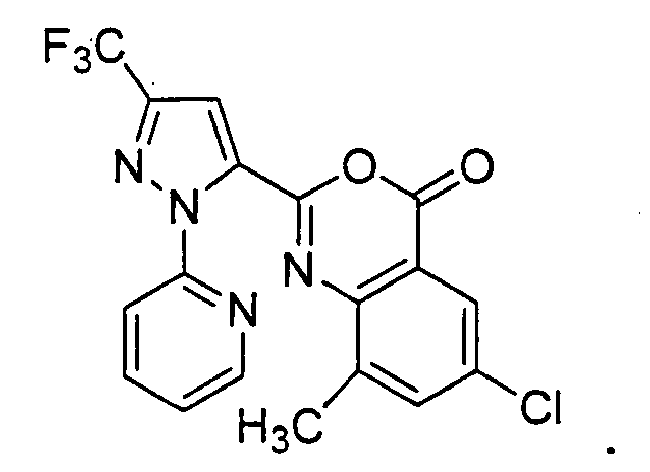
1H-NMR (CDCl3,TMS) δ (ppm): 2.15 (3H, s), 7.26 (1H, s), 7.42 (1H, dd, J=8Hz, 4Hz), 7.58 (1H, s), 7.79 (1H, d, J=8Hz), 7.96-8.00 (2H, m), 8.43 (1H, d, J=4Hz). - According to the same manner as that of Reference Preparation Example 1, 6-chloro-2-[1-(2-pyridinyl)-3-trifluoromethyl-1H-pyrazol-5-yl]-8-methyl-4H-3,1-benzoxazine-4-one was used in place of 6-chloro-2-[1-(3-chloro-2-pyridinyl)-3-trifluoromethyl-1H-pyrazol-5-yl]-8-methyl-4H-3,1-benzoxazine-4-one to obtain N-[4-chloro-2-(hydrazinocarbonyl)-6-methylphenyl]-1-(2-pyridinyl)-3-trifluoromethyl-1H-pyrazole-5-carboxamide of the formula:

1H-NMR (DMSO-d6,TMS) δ (ppm): 2.31 (3H, s), 4.44 (2H, s), 7.34-7.35 (2H, m), 7.50-7.55 (2H, m), 7.81 (1H, d, J=8Hz), 8.07 (1H, t, J=8Hz), 8.48 (1H, d, J=4Hz), 9.55 (1H, brs), 10.39 (1H, brs). - According to the same manner as that of Reference Preparation Example 46-(1), 2-amino-3-bromo-5-chlorobenzoic acid was used in place of 2-amino-3,5-dibromobenzoic acid to obtain 8-bromo-2-[3-bromo-1-(3-chloro-2-pyridinyl)-1H-pyrazol-5-yl]-6-chloro-4H-3,1-benzoxazine-4-one of the formula:

1H-NMR (DMSO-d6,TMS) δ (ppm): 7.56 (1H, s), 7.72 (1H, dd, J=8Hz, 4Hz), 8.08 (1H, d, J=2Hz), 8.25 (1H, d, J=2Hz), 8.32 (1H, dd, J=8Hz, 2Hz), 8.59 (1H, dd, J=4Hz, 2Hz). - According to the same manner as that of Reference Preparation Example 46-(1), 2-amino-3-bromo-5-methylbenzoic acid was used in place of 2-amino-3,5-dibromobenzoic acid to obtain 8-bromo-2-[3-bromo-1-(3-chloro-2-pyridinyl)-1H-pyrazol-5-yl]-6-methyl-4H-3,1-benzoxazine-4-one of the formula:

1H-NMR (DMSO-d6,TMS) δ (ppm): 2.40 (3H, s), 7.50 (1H, s), 7.71 (1H, dd, J=8Hz, 4Hz), 7.91 (1H, s), 7.96 (1H, s), 8.31 (1H, d, J=8Hz), 8.59 (1H, d, J=4Hz). - According to the same manner as that of Reference Preparation Example 46-(1), 2-amino-3-chlorobenzoic acid was used in place of 2-amino-3,5-dibromobenzoic acid to obtain 2-[3-bromo-1-(3-chloro-2-pyridinyl)-1H-pyrazol-5-yl]-8-chloro-4H-3,1-benzoxazine-4-one of the formula:

1H-NMR (DMSO-d6,TMS) δ (ppm): 7.52-7.61 (2H, m), 7.73 (1H, dd, J=8Hz, 4Hz), 7.93 (1H, dd, J=8Hz, 2Hz), 8.04 (1H, dd, J=8Hz, 2Hz), 8.32 (1H, dd, J=8Hz, 2Hz), 8.60 (1H, dd, J=4Hz, 2Hz). - According to the same manner as that of Reference Preparation Example 24, phenylhydrazine was used in place of 2-chlorophenylhydrazine to obtain 5-(2-furyl)-1-phenyl-3-trifluoromethyl-1H-pyrazole of the formula:
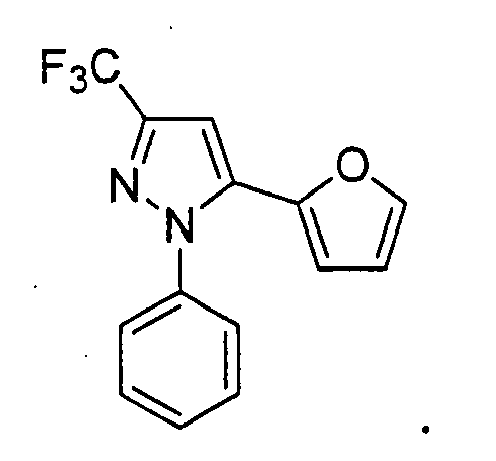
1H-NMR (CDCl3,TMS) δ (ppm): 5.96 (1H, d, J=4Hz), 6.33 (1H, dd, J=4Hz, 2Hz), 6.90 (1H, s), 7.43-7.48 (6H, m). - According to the same manner as that of Reference Preparation Example 25, 5-(2-furyl)-1-phenyl-3-trifluoromethyl-1H-pyrazole was used in place of 5-(2-furyl)-1-(2-chlorophenyl)-3-trifluoromethyl-1H-pyrazole to obtain 1-phenyl-3-trifluoromethyl-1H-pyrazole-5-carboxylic acid of the formula:

- According to the same manner as that of Reference Preparation Example 13, 1-phenyl-3-trifluoromethyl-1H-pyrazole-5-carboxylic acid was used in place of 1-(3-chloro-2-pyridinyl)-1H-pyrazole-5- carboxylic acid to obtain 6-chloro-2-(1-phenyl-3- trifluoromethyl-1H-pyrazol-5-yl)-8-methyl-4H-3,1- benzoxazine-4-one of the formula:

1H-NMR (CDCl3,TMS) δ (ppm): 1.88 (3H, s), 7.47-7.54 (7H, m), 7.99 (1H, d, J=2Hz). - According to the same manner as that of Reference Preparation Example 1, 6-chloro-2-(1-phenyl-3-trifluoromethyl-1H-pyrazol-5-yl)-8-methyl-4H-3,1-benzoxazine-4-one was used in place of 6-chloro-2-[1-(3-chloro-2-pyridinyl)-3-trifluoromethyl-1H-pyrazol-5-yl]-8-methyl-4H-3,1-benzoxazine-4-one to obtain N-[4-chloro-2-(hydrazinocarbonyl)-6-methylphenyl]-1-phenyl-3-trifluoromethyl-1H-pyrazole-5-carboxamide of the formula:

1H-NMR (DMSO-d6,TMS) δ (ppm) : 2.19 (3H, s), 4.41 (2H, brs), 7.32 (1H, d, J=2Hz), 7.46-7.52 (5H, m), 7.56 (2H, d, J=7Hz), 9.61 (1H, brs), 10.29 (1H, brs). - To a mixture of 1.5 g of 2-amino-5-chlorobenzoic acid and 100 ml of N,N-dimethylformamide was added 1.8 g of N-bromosuccinimide at room temperature, and the mixture was stirred at room temperature for 10 hours. After 30 ml of water was poured into the reaction mixture, the mixture was extracted with ethyl acetate three times. The organic layers were combined, washed with an aqueous saturated sodium chloride solution, dried over anhydrous magnesium sulfate, and concentrated under reduced pressure to obtain 1.2 g of 2-amino-5-bromo-3-methylbenzoic acid of the formula:

1H-NMR (DMSO-d6,TMS) δ (ppm) : 2.11 (3H, s), 7.33 (1H, d, J=2Hz), 7.68 (1H, d, J=2Hz). - According to the same manner as that of Reference Preparation Example 31-(1), 2-amino-5-bromo-3-methylbenzoic acid was used in place of 2-amino-3,5-dimethylbenzoic acid to obtain 6-bromo-2-[1-(3-chloro-2-pyridinyl)-3-trifluoromethyl-1H-pyrazol-5-yl]-8-methyl-4H-3,1-benzoxazine-4-one of the formula:

1H-NMR (DMSO-d6,TMS) δ (ppm): 1.733H, s), 7.81 (1H, dd, J=8Hz, 4Hz), 7.90 (1H, s), 7.93 (1H, s), 8.04 (1H, t, J=1Hz), 8.39 (1H, d, J=8Hz), 8.66 (1H, d, J=4Hz). - To a mixture of 2.6 g of 2-amino-3-methylbenzoic acid and 100 ml of N,N-dimethylformamide was added 2.3 g of N-iodosuccinimide at room temperature, and the mixture was stirred at room temperature for 10 hours. After water was poured to the reaction mixture, a deposited precipitate was collected by filtration to obtain 1.7 g of 2-amino-5-iodo-3-methylbenzoic acid of the formula:
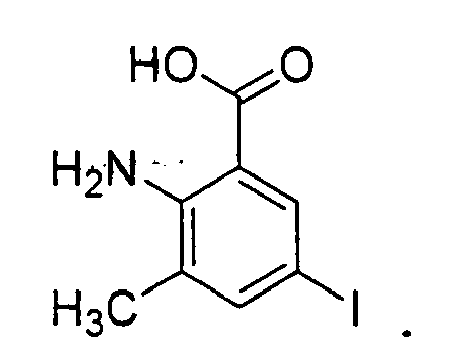
1H-NMR (DMSO-d6,TMS) δ (ppm) : 2.08 (3H, s), 7.44 (1H, d, J=1Hz), 7.86 (1H, d, J=1Hz). - According to the same manner as that of Reference Preparation Example 31-(1), 2-amino-5-iodo-3-methylbenzoic acid was used in place of 2-amino-3,5-dimethylbenzoic acid to obtain 2-[1-(3-chloro-2-pyridinyl)-3-trifluoromethyl-1H-pyrazol-5-yl]-6-iodo-8-methyl-4H-3,1-benzoxazine-4-one of the formula:

1H-NMR (DMSO-d6,TMS) δ (ppm) : 1.70 (3H, s), 7.81 (1H, dd, J=8Hz, 4Hz), 7.89 (1H, s), 8.07 (1H, s), 8.19 (1H, s), 8.39 (1H, d, J=8Hz), 8.66 (1H, d, J=4Hz). - A mixture of 1.41 g of ethyl 2-(2-chlorobenzoyl)-3-(N,N-dimethylamino) acrylate (a compound described in
JP-A 7-101940 
- The resulting ethyl 3-(2-chloro-phenyl)-1H-pyrazole-4-carboxylate, 1.07 g of methyl iodide, 1.04 g of potassium carbonate and 5 ml of N,N-dimethylformaide were mixed under ice-cooling, and the mixture was stirred at room temperature for 10 hours. Water was poured into the reaction mixture, and the mixture was extracted with ethyl acetate. The organic layer was washed with water, dried over anhydrous sodium sulfate, and concentrated under reduced pressure. The resulting residue was subjected to silica gel column chromatography to obtain 0.72 g of ethyl 3-(2-chlorophenyl)-1-methyl-1H-pyrazole-4-carboxylate of the formula:
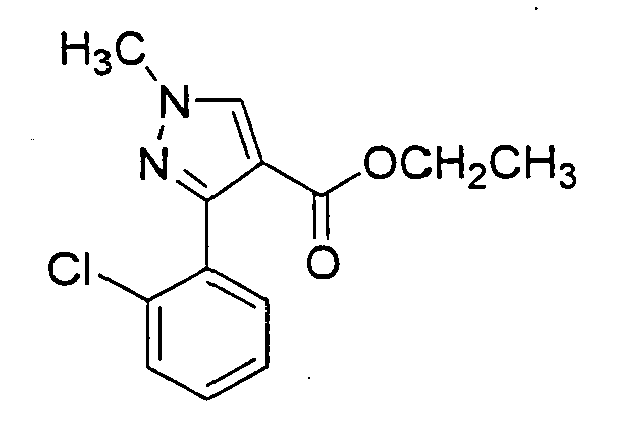
1H-NMR (CDCl3) δ (ppm): 1.12 (3H, t, J=7Hz), 3.68 (3H, s), 4.09-4.15 (2H, m), 7.31 (1H, dd, J=7Hz, 2Hz), 7.38 (1H, td, J=7Hz, 1Hz), 7.44 (1H, td, J=8Hz, 2Hz), 7.52 (1H, dd, J=8Hz, 1Hz), 8.01 (1H, s).
Ethyl 5-(2-chlorophenyl)-1-methyl-1H-pyrazole-4-carboxylate
1H-NMR (CDCl3) δ (ppm) : 1.13 (3H, t, J=7Hz), 3.98 (3H, s), 4.14 (2H, q, J=7Hz), 7.27-7.35 (2H, m), 7.38-7.41 (1H, m), 7.43-7.45 (1H, m), 7.96 (1H, s). - A mixture of 0.72 g of ethyl 3- (2-chlorophenyl) -1-methyl-1H-pyrazole-4-carboxylate, 0.23 g of potassium hydroxide, 1 ml of water and 5 ml of ethanol was stirred at room temperature for 3 days. After the reaction mixture was concentrated under reduced pressure, water was poured into the resulting residue and the mixture was washed with methyl tert-butyl ether. The aqueous layer was adjusted to around pH 3 by an addition of a 10% aqueous citric acid, and then extracted with ethyl acetate. The organic layer was washed with water, dried over anhydrous sodium sulfate, and concentrated under reduced pressure to obtain 0.61 g of 3-(2-chlorophenyl)-1-methyl-1H-pyrazole-4-carboxylic acid of the formula:

1H-NMR (CDCl3) δ (ppm) : 3.66 (3H, s), 7.30 (1H, dd, J=8Hz, 2Hz), 7.37 (1H, td, J=8Hz, 1Hz), 7.43 (1H, td, J=8Hz, 2Hz), 7.51 (1H, dd, J=8Hz, 1Hz), 8.02 (1H, s). - A mixture of 0.61 g of 3-(2-chlorophenyl)-1-methyl-1H-pyrazole-4-carboxylic acid, 0.28 ml of thionyl chloride and 10 ml of toluene was heated to reflux for 1 hour. After the reaction mixture was allowed to cool to room temperature, it was concentrated under reduced pressure and the resulting residue was dissolved in 10 ml of acetonitrile. Thereto 0.48 g of 2-amino-5-chloro-3-methylbenzoic acid was added, and the resulting mixture was stirred at room temperature for 30 minutes. To the mixture, 0.26 g of triethylamine was added, the mixture was stirred at room temperature for 30 minutes. Thereto 0.52 g of triethylamine was further added, and the resulting mixture was stirred at room temperature for 30 minutes. Then, 0.30g of methanesulfonyl chloride was added to the reaction mixture under ice-cooling, and the mixture was stirred at room temperature for 10 hours. Water and ethyl acetate were poured into the reaction mixture, and 0.26 g of a solid was collected by filtration. In addition, the filtrate was separated into two layers. The organic layer was washed with water, dried over anhydrous sodium sulfate, and concentrated under reduced pressure. The resulting residue was washed with ethyl acetate to obtain 0.25 g of a solid. Both of these solids were 6-chloro-2-[3-(2-chlorophenyl)-1-methyl-1H-pyrazol-4-yl]-8-methyl-4H-3,1-benzoxazine-4-one of the formula:

1H-NMR (DMSO-d6) δ (ppm): 1.86 (3H, s), 3.68 (3H, s), 7.52-7.63 (3H, m), 7.69-7.72 (2H, m), 7.81 (1H, d, J=2Hz), 8.18 (1H, s). - After 0.19 g of 6-chloro-2-[3-(2-chlorophenyl)-1-methyl-1H-pyrazol-4-yl]-8-methyl-4H-3,1-benzoxazine-4-one, 0.10 g of hydrazine monohydrate and 10 ml of N-methylpyrrolidinone were mixed under ice-cooling, the mixture was stirred at room temperature for 8 hours. Water was poured into the reaction mixture, and the mixture was extracted with ethyl acetate. The organic layer was washed with water, dried over anhydrous sodium sulfate, and concentrated under reduced pressure to obtain 0.18 g of N-[4-chloro-2-(hydrazinocarbonyl)-6-methylphenyl]-3-(2-chlorophenyl)-1-methyl-1H-pyrazole-4-carboxamide of the formula:

1H-NMR (DMSO-d6) δ (ppm): 2.13 (3H, s), 3.60 (3H, s), 4.39 (2H, brs), 7.29 (1H, d, J=2Hz), 7.42-7.53 (4H, m), 7.60 (1H, d, J=8Hz), 8.11 (1H, s), 9.53 (2H, brs). - According to the same manner as that of Reference Preparation Example 54-(2), ethyl 5-(2-chlorophenyl)-1-methyl-1H-pyrazole-4-carboxylate was used in place of ethyl 3-(2-chlorophenyl)-1-methyl-1H-pyrazole-4-carboxylate to obtain 5-(2-chlorophenyl)-1-methyl-1H-pyrazole-4-carboxylic acid of the formula:
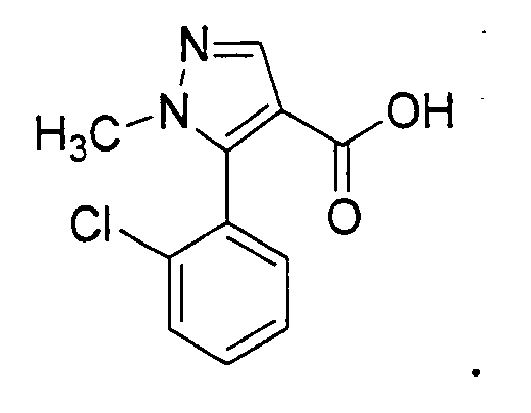
1H-NMR (CDCl3) δ (ppm): 3.97 (3H, s), 7.26-7.35 (2H, m), 7.37-7.39 (1H, m), 7.42-7.44 (1H, m), 7.98 (1H, s). - According to the same manner as that of Reference Preparation Example 54-(3), 5-(2-chlorophenyl)-1-methyl-1H-pyrazole-4-carboxylic acid was used in place of 3-(2-chlorophenyl)-1-methyl-1H-pyrazole-4-carboxylic acid to obtain 6-chloro-2-[5-(2-chlorophenyl)-1-methyl-1H-pyrazol-4-yl]-8-methyl-4H-3,1-benzoxazine-4-one of the formula:

1H-NMR (DMSO-d6) δ (ppm) : 1.90 (3H, s), 3.99 (3H, s), 7.40-7.50 (3H, m), 7.56 (1H, d, J=8Hz), 7.71 (1H, d, J=2Hz), 7.82 (1H, d, J=2Hz), 8.63 (1H, s). - According to the same manner as that of Reference Preparation Example 54-(4), 6-chloro-2-[5-(2-chlorophenyl)-1-methyl-1H-pyrazol-4-yl]-8-methyl-4H-3,1-benzoxazine-4-one was used in place of 6-chloro-2-[3-(2-chlorophenyl)-1-methyl-1H-pyrazol-4-yl]-8-methyl-4H-3,1-benzoxazine-4-one to obtain N-[4-chloro-2-(hydrazinocarbonyl)-6-methylphenyl]-5-(2-chlorophenyl)-1-methyl-1H-pyrazole-4-carboxamide of the formula:
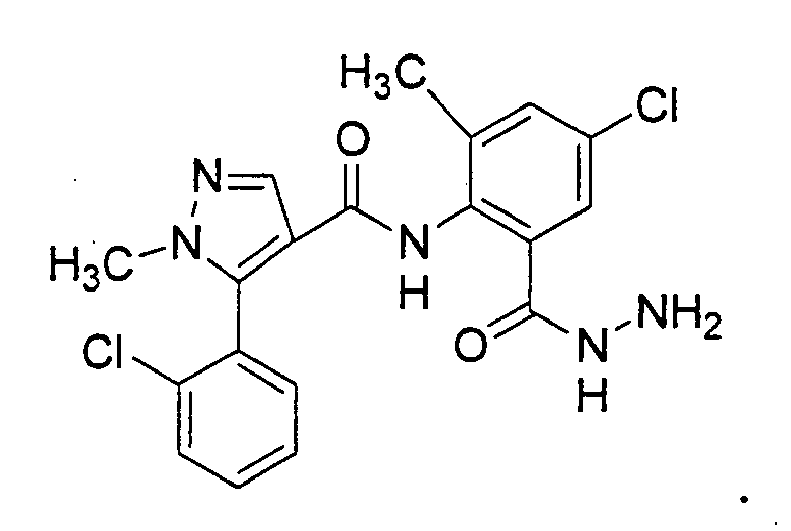
1H-NMR (DMSO-d6) δ (ppm): 2.16 (3H, s), 3.94 (3H, s), 4.39 (2H, brs), 7.30 (1H, d, J=2Hz), 7.33-7.46 (5H, m), 8.36 (1H, s), 9.49-9.59 (2H, brm). - To a mixture of 1.67 g of 2-amino-3-methoxybenzoic acid and 100 ml of N,N-dimethylformamide was added 1.3 g of N-chlorosuccinimide at room temperature, and the resulting mixture was stirred at room temperature for 10 hours. Water was poured into the reaction mixture, and a deposited precipitate was collected by filtration to obtain 1.2 g of 2-amino-5-chloro-3-methoxybenzoic acid.

1H-NMR (DMSO-d6,TMS) δ (ppm): 3.84 (3H, s), 6.99 (1H, s), 7.28 (1H, s). - According to the same manner as that of Reference Preparation Example 46-(1), 2-amino-5-chloro-3-methoxybenzoic acid was used in place of 2-amino-3,5-dibromobenzoic acid to obtain 2-[3-bromo-1-(3-chloro-2-pyridinyl)-1H-pyrazol-5-yl]-6-chloro-8-methoxy-4H-3,1-benzoxazine-4-one of the formula:

1H-NMR (DMSO-d6,TMS) 5 (ppm) : 3.71 (3H, s), 7.45 (1H, d, J=2Hz), 7.48 (1H, s), 7.57 (1H, d, J=2Hz), 7.78 (1H, dd, J=8Hz, 4Hz), 8.28 (1H, dd, J=8Hz, 2Hz), 8.57 (1H, dd, J=4Hz, 2Hz). - To a mixture of 1.5 g of 2-amino-5-chlorobenzoic acid and 100 ml of N,N-dimethylformamide was added 2.7 g of N-iodosuccinimide at room temperature, and the mixture was stirred at room temperature for 24 hours. After 30 ml of water was poured into the reaction mixture, the mixture was extracted with ethyl acetate three times. The organic layers were combined, washed with an aqueous saturated sodium chloride solution, dried over anhydrous magnesium sulfate, and concentrated under reduced pressure to obtain 1.2 g of 2-amino-5-chloro-3-iodobenzoic acid of the formula:

1H-NMR (DMSO-d6,TMS) δ (ppm): 6.76 (2H, brs), 7.75 (1H, d, J=1Hz), 7.87 (1H, d, J=1Hz). - According to the same manner as that of Reference Preparation Example 46-(1), 2-amino-5-chloro-3-iodobenzoic acid was used in place of 2-amino-3,5-dibromobenzoic acid to obtain 2-[3-bromo-1-(3-chloro-2-pyridinyl)-1H-pyrazol-5-yl]-6-chloro-8-iodo-4H-3,1-benzoixazine-4-one of the formula:

1H-NMR (DMSO-d6,TMS) δ (ppm) : 7.53 (1H, s), 7.69 (1H, dd, J=8Hz, 4Hz), 8.08 (1H, d, J=2Hz), 8.29 (1H, d, J=8Hz), 8.38 (1H, d, J=2Hz), 8.57 (1H, d, J=4Hz). - According to the same manner as that of Reference Preparation Example 46-(1), 2-amino-3-methoxybenzoic acid was used in place of 2-amino-3,5-dibromobenzoic acid to obtain 2-[3-bromo-1-(3-chloro-2-pyridinyl)-1H-pyrazol-5-yl]-8-methoxy-4H-3,1-benzoxazine-4-one of the formula:

1H-NMR (DMSO-d6,TMS) δ (ppm) : 3.67 (3H, s), 7.40 (1H, dd, J=8Hz, 1Hz), 7.46 (1H, s), 7.52 (1H, t, J=8Hz), 7.61 (1H, dd, J=8Hz, 1Hz), 7.78 (1H, dd, J=8Hz, 4Hz), 8.28 (1H, dd, J=8Hz, 1Hz), 8.57 (1H, dd, J=4Hz, 1Hz). - According to the same manner as that of Reference Preparation Example 46-(1), 2-amino-3-trifluoromethylbenzoic acid was used in place of 2-amino-3,5-dibromobenzoic acid to obtain 2-[3-bromo-1-(3-chloro-2-pyridinyl)-1H-pyrazol-5-yl]-8-trifluoromethyl-4H-3,1-benzoxazine-4-one of the formula:

1H-NMR (DMSO-d6,TMS) 5 (ppm) : 7.56 (1H, s), 7.69-7.77 (2H, m), 8.15 (1H, d, J=8Hz), 8.29 (1H, dd, J=8Hz, 1Hz), 8.37 (1H, d, J=8Hz), 8.55 (1H, dd, J=4Hz, 1Hz). - To a solution of 4.8 g of hydrazine monohydrate in 160 ml of ethanol, 14.2 g of ethyl trifluoroacetate was added dropwise. The resulting mixture was stirred at room temperature for 1 hour. The reaction mixture was concentrated under reduced pressure. The resulting residue was dissolved in 100 ml of ethanol, and 9.9 g of formamidine acetate was added thereto. The mixture was stirred for 3 hours under heat refluxing. The reaction mixture was allowed to cool to room temperature, and then concentrated under reduced pressure. An aqueous sodium bicarbonate solution was poured into the resulting residue, and the mixture was extracted with ethyl acetate two times. The organic layers were combined, washed successively with water and an aqueous saturated sodium chloride solution, dried over magnesium sulfate, and concentrated under reduced pressure. The resulting residue was subjected to silica gel column chromatography to obtain 7.0 g of 3-trifluoromethyl-1H-1,2,4-triazole of the formula:

1H-NMR (CDCl3,TMS) δ (ppm): 8.48 (1H, s). - A mixture of 3.5 g of 3-trifluoromethyl-1H-1,2,4-triazole, 3.8 g of 2, 3-dichloropyridine, 6.0 g of potassium carbonate and 30 ml of N,N-dimethylformamide was stirred at 120°C for 27 hours. After the reaction mixture was allowed to cool to room temperature, water was poured and the mixture was extracted with ethyl acetate two times. The organic layers were combined, washed successively with water and an aqueous saturated sodium chloride solution, dried over magnesium sulfate, and concentrated under reduced pressure. The resulting residue was subjected to silica gel column chromatography to obtain 0.72 g of 3-chloro-2-(3-trifluoromethyl-1H-1,2,4-triazol-1-yl) pyridine of the formula:

1H-NMR (DMSO-d6) δ (ppm): 7.47 (1H, dd, J=8Hz, 5Hz), 8.01 (1H, dd, J=8Hz, 2Hz), 8.53 (1H, dd, J=5Hz, 2Hz), 8.82 (1H, s). - According to the same manner as that of Reference Preparation Example 17, ethylhydrazine was used in place of methylhydrazine to obtain 1-ethyl-3-trifluoromethyl-1H-pyrazole of the formula:

1H-NMR (CDCl3,TMS) δ (ppm): 1.52 (3H, t, J=7Hz), 4.23 (2H, q, J=7Hz), 6.51 (1H, d, J=2Hz), 7.44 (1H, d, J=2Hz). - According to the same manner as that of Reference Preparation Example 18, 1-ethyl-3-trifluoromethyl-1H-pyrazole was used in place of 1-methyl-3-trifluormethyl-1H-pyrazole to obtain 1-ethyl-3-trifluoromethyl-1H-pyrazole-5-carboxylic acid of the formula:

1H-NMR (CDCl3,TMS) δ (ppm): 1.51 (3H, t, J=7Hz), 4.68 (2H, q, J=7Hz), 7.21 (1H, s). - According to the same manner as that of Reference Preparation Example 13, 1-ethyl-3-trifluoromethyl-1H-pyrazole-5-carboxylic acid was used in place of 1-(3-chloro-2-pyridinyl)-1H-pyrazole-5-carboxylic acid to obtain 6-chloro-2-(1-ethyl-3-trifluoromethyl-1H-pyrazol-5-yl)-8-methyl-4H-3,1-benzoxazine-4-one of the formula:

1H-NMR (CDCl3,TMS) δ (ppm): 1.58 (3H, t, J=7Hz), 2.59 (3H, s), 4.89 (2H, q, J=7Hz), 7.33 (1H, s), 7.69 (1H, d, J=2Hz), 8.07 (1H, d, J=2Hz). - According to the same manner as that of Reference Preparation Example 1, 6-chloro-2-(1-ethyl-3-trifluoromethyl -1H-pyrazol-5-yl)-8-methyl-4H-3,1-benzoxazine-4-one was used in place of 6-chloro-2-[1-(3-chloro-2-pyridinyl)-3-trifluoromethyl-1H-pyrazol-5-yl]-8-methyl-4H-3,1-benzoxazine-4-one to obtain N-[4-chloro-2-(hydrazinocarbonyl)-6-methylphenyl]-1-ethyl-3-trifluoromethyl-1H-pyrazole-5-carboxiamide of the formula:

1H-NMR (CDCl3,TMS) δ (ppm): 1.48 (3H, t, J=7Hz), 2.30 (3H, s), 4.04 (2H, s), 4.66 (2H, q, J=7Hz), 7.08 (1H, s), 7.29 (1H, s), 7.40 (1H, s), 7.45 (1H, brs), 9.81 (1H, brs). - A mixture of 2.82 g of ethyl 2-(2-chlorobenzoyl)-3-(N,N-dimethylamino) acrylate (a compound described in
JP-A 7-101940 
1H-NMR (CDCl3) δ (ppm): 1.04 (3H, t, J=7Hz), 1.47 (9H, s), 3.98-4.12 (2H, m), 7.28-7.35 (2H, m), 7.38-7.42 (1H, m), 7.45-7.48 (1H, m), 7.99 (1H, s). - According to the same manner as that of Reference Preparation Example 54-(2), ethyl 1-tert-butyl-5-(2-chlorophenyl)-1H-pyrazole-4-carboxylate was used in place of ethyl 3-(2-chlorophenyl)-1-methyl-1H-pyrazole-4-carboxylate to obtain 1-tert-butyl-5-(2-chlorophenyl)-1H-pyrazole-4-carboxylic acid of the formula:

1H-NMR (CDCl3) δ (ppm): 1.45 (9H, s), 7.25-7.33 (2H, m), 7.39 (1H, td, J=7Hz, 2Hz), 7.44 (1H, dd, J=8Hz, 1Hz), 8.00 (1H, s). - According to the same manner as that of Reference Preparation Example 54-(3), 1-tert-butyl-5-(2-chlorophenyl)-1H-pyrazole-4-carboxylic acid was used in place of 3-(2-chlorophenyl)-1-methyl-1H-pyrazole-4-carboxylic acid to obtain 2-[1-tert-butyl-5-(2-chlorophenyl)-1H-pyrazol-4-yl]-6-chloro-8-methyl-4H-3,1-benzoxazine-4-one of the formula:

1H-NMR (DMSO-d6) δ (ppm): 1.44 (9H, s), 1.77 (3H, s), 7.47-7.59 (3H, m), 7.65-7.68 (2H, m), 7.80 (1H, d, J=2Hz), 8.18 (1H, s). - According to the same manner as that of Reference Preparation Example 54-(4), 2-[1-tert-butyl-5-(2-chlorophenyl)-1H-pyrazol-4-yl]-6-chloro-8-methyl-4H-3,1-benzoxazine-4-one was used in place of 6-chloro-2-[3-(2-chlorophenyl)-1-methyl-1H-pyrazol-4-yl]-8-methyl-4H-3,1-benzoxazine-4-one to obtain 1-tert-butyl-N-[4-chloro-2-(hydrazinocarbonyl)-6-methylphenyl]-5-(2-chlorophenyl)-1H-pyrazole-4-carboxamide of the formula:

1-tert-Butyl-N-[4-chloro-2-(hydrazinocarbonyl)-6-methylphenyl]-5-(2-chlorophenyl)-1H-pyrazole-4-carboxamide 1H-NMR (DMSO-d6) δ (ppm): 1.40 (9H, s), 2.06 (3H, s), 4.37 (2H, brs), 7.28 (1H, d, J=2Hz), 7.38-7.53 (5H, m), 8.10 (1H, s), 9.36 (1H, brs), 9.53 (1H, brs). - A mixture of 4.62 g of chloral hydrate, 3.5 g of 3-chloro-2-methylaniline, 30 g of anhydrous sodium sulfate, 120 ml of water and 2 ml of 2N hydrochloric acid was stirred at room temperature for 2 hours. Then, to the resulting mixture, 1.8 g of hydroxylamine hydrochloride was added, and the mixture was heated to reflux for 30 minutes. The reaction mixture was ice-cooled, and a deposited precipitate was collected by filtration to obtain 2.5 g of N-(3-chloro-2-methylphenyl)-2-(hydroxyimino)acetamide of the formula:

1H-NMR (DMSO-d6,TMS) δ (ppm) : 2.22 (3H, s), 7.22 (1H, t, J=8Hz), 7.33 (1H, d, J=8Hz), 7.38 (1H, d, J=8Hz), 7.67 (1H, s), 9.78 (1H, brs), 12.21 (1H, s). - To 2.5 g of concentrated sulfuric acid was added 2.5 g of N-(3-chloro-2-methylphenyl)-2-(hydroxyimino)acetamide at 50°C, and the mixture was stirred at 80°C for 30 minutes. The reaction mixture was poured into 200 g of ice, and a deposited precipitate was collected by filtration to obtain 1.3 g of 6-chloro-7-methyl-1H-indole-2,3-dione of the formula:

1H-NMR (DMSO-d6,TMS) δ (ppm) : 2.22 (3H, s), 7.15 (1H, d, J=8Hz), 7.37 (1H, d, J=8Hz), 11.28 (1H, s). - A mixed solution of 1.3 g of 6-chloro-7-methyl-1H-indole-2,3-dione and 50 ml of a 2N aqueous sodium hydroxide solution was added dropwise to 2 g of aqueous hydrogen peroxide (30%), and the mixture was stirred at room temperature for 1 hour. The reaction mixture was adjusted to pH 4 by an addition of 2N hydrochloric acid, and a deposited precipitate was collected by filtration to obtain 0.6 g of 2-amino-4-chloro-3-methylbenzoic acid of the formula:

1H-NMR (DMSO-d6,TMS) δ (ppm) : 2.18 (3H, s), 6.62 (1H, d, J=9Hz), 7.61 (1H, d, J=9Hz). - According to the same manner as that of Reference Preparation Example 46-(1), 2-amino-4-chloro-3-methylbenzoic acid was used in place of 2-amino-3,5-dibromobenzoic acid to obtain 2-[3-bromo-1-(3-chloro-2-pyridinyl)-1H-pyrazol-5-yl]-7-chloro-8-methyl-4H-3,1-benzoxazine-4-one of the formula:

1H-NMR (DMSO-d6,TMS) δ (ppm): 1.76 (3H, s), 7.55 (1H, s), 7.65 (1H, d, J=9Hz), 7.77 (1H, dd, J=8Hz, 4Hz), 7.94 (1H, d, J=9Hz), 8.35 (1H, dd, J=8Hz, 1Hz), 8.64 (1H, dd, J=4Hz, 1Hz). - According to the same manner as that of Reference Preparation Example 14, isopropyl iodide was used in place of 2,3-dichloropyridine to obtain 1-isopropyl-3-trifluoromethyl -1H-pyrazole of the formula:

1H-NMR (CDCl3,TMS) δ (ppm): 1.53 (6H, d, J=7Hz), 4.53-4.60 (1H, m), 6.50 (1H, d, J=2Hz), 7.45 (1H, d, J=2Hz). - According to the same manner as that of Reference Preparation Example 18, 1-isopropyl-3-trifluoromethyl-1H-pyrazole was used in place of 1-methyl-3-trifluoromethyl-1H-pyrazole to obtain 1-isopropyl-3-trifluoromethyl-1H-pyrazole-5-carboxylic acid of the formula:

1H-NMR (CDCl3,TMS) δ (ppm) : 1.53 (6H, d, J=7Hz), 5.49-5.56 (1H, m), 7.17 (1H, s). - According to the same manner as that of Reference Preparation Example 13, 1-isopropyl-3-trifluoromethyl-1H-pyrazole-5-carboxylic acid was used in place of 1-(3-chloro-2-pyridinyl)-1H-pyrazole-5-carboxylic acid to obtain 6-chloro-2-(1-isopropyl-3-trifluromethyl-1H-pyrazol-5-yl)-8-methyl-4H-3,1-benzoxazine-4-one of the formula:

1H-NMR (CDCl3,TMS) δ (ppm): 1.62 (6H, d, J=7Hz), 2.59 (3H, s), 5.83-5.90 (1H, m), 7.31 (1H, s), 7.68 (1H, s), 8.07 (1H, s). - According to the same manner as that of Reference Preparation Example 1, 6-chloro-2-(1-isopropyl-3-trifluoromethyl-1H-pyrazol-5-yl)-8-methyl-4H-3,1-benzoxazine-4-one was used in place of 6-chloro-2-[1-(3-chloro-2-pyridinyl)-3-trifluoromethyl-1H-pyrazol-5-yl]-8-methyl-4H-3,1-benzoxazine-4-one to obtain N-[4-chloro-2-(hydrazinocarbonyl)-6-methylphenyl]-1-isopropyl-3-trifluoro methyl-1H-pyrazole-5-carboxiamide of the formula:

1H-NMR (DMSO-d6,TMS) δ (ppm): 1.44 (6H, d, J=7Hz), 2.25 (3H, s), 4.36 (2H, s), 5.42-5.47 (1H, m), 7.34 (1H, s), 7.36 (1H, s), 7.50 (1H, s), 9.61 (1H, brs), 10.16 (1H, brs). - According to the same manner as that of Reference Preparation Example 46-(1), 2-amino-3,6-dichlorobenzoic acid was used in place of 2-amino-3, 5-dibromobenzoic acid to obtain 2-[3-bromo-1-(3-chloro-2-pyridinyl)-1H-pyrazol-5-yl]-5,8-dichloro-4H-3,1-benzoxazine-4-one of the formula:

1H-NMR (DMSO-d6,TMS) δ (ppm) : 7.57 (1H, s), 7.62 (1H, d, J=8Hz), 7.72 (1H, dd, J=8Hz, 4Hz), 7.87 (1H, d, J=8Hz), 8.31 (1H, d, J=8Hz), 8.59 (1H, d, J=4Hz). - According to the same manner as that of Reference Preparation Example 63-(1), 5-chloro-2-methylaniline was used in place of 3-chloro-2-methylaniline to obtain N-(5-chloro-2-methylphenyl)-2-(hydroxyimino)acetamide of the formula:

1H-NMR (DMSO-d6,TMS) δ (ppm) : 2.20 (3H, s), 7.17 (1H, dd, J=8Hz, 2Hz), 7.27 (1H, d, J=8Hz), 7.64 (1H, d, J=2Hz), 7.70 (1H, d, J=2Hz), 9.56 (1H, s), 12.27 (1H, s). - According to the same manner as that of Reference Preparation Example 63-(2), N-(5-chloro-2-methylphenyl)-2-(hydroxyimino)acetamide was used in place of N-(3-chloro-2-methylphenyl)-2-(hydroxyimino)acetamide to obtain 4-chloro-7-methyl-1H-indole-2,3-dione of the formula:

1H-NMR (DMSO-d6,TMS) δ (ppm) : 2.16 (3H, s), 6.99 (1H, d, J=8Hz), 7.40 (1H, d, J=8Hz), 11.24 (1H, s). - According to the same manner as that of Reference Preparation Example 63-(3), 4-chloro-7-methyl-1H-indole-2,3-dione was used in place of 6-chloro-7-methyl-1H-indole-2,3-dione to obtain 2-amino-6-chloro-3-methylbenzoic acid of the formula:

1H-NMR (DMSO-d6,TMS) δ (ppm): 2.07 (3H, s), 6.57 (1H, d, J=8Hz), 7.01 (1H, d, J=8Hz). - According to the same manner as that of Reference Preparation Example 46-(1), 2-amino-6-chloro-3-methylbenzoic acid was used in place of 2-amino-3,5-dibromobenzoic acid to obtain 2-[3-bromo-1-(3-chloro-2-pyridinyl)-1H-pyrazol-5-yl]-5-chloro-8-methyl-4H-3,1-benzoxazine-4-one of the formula:

1H-NMR (DMSO-d6,TMS) δ (ppm) : 1.66 (3H,s), 7.52-7.56 (2H, m), 7.62 (1H, d, J=8Hz), 7.76 (1H, dd, J=8Hz, 4Hz), 8.34 (1H, d, J=8Hz), 8.63 (1H, d, J=4Hz). - To a mixture of 5 g of 4-ethoxy-1, 1, 1-trifluoro-3-butene-2-one, 3 g of sodium acetate and 15 ml of ethanol was added 4.6 g of tert-butylhydrazine hydrochloride, and the mixture was heated to reflux for 2 days. Water was added to the reaction mixture, and the mixture was extracted with diethyl ether three times. The organic layers were combined, washed with an aqueous saturated sodium chloride solution, dried over anhydrous magnesium sulfate, and concentrated under reduced pressure to obtain 3.0 g of 1-tert-butyl-3-trifluoromethyl-1H-pyrazole of the formula:

1H-NMR (CDCl3,TMS) δ (ppm): 1.61 (9H, s), 6.48 (1H, d, J=2Hz), 7.54 (1H, d, J=2Hz). - According to the same manner as that of Reference Preparation Example 18, 1-tert-butyl-3-trifluoromethyl-1H-pyrazole was used in place of 1-methyl-3-trifluoromethyl-1H-pyrazole to obtain 1-tert-butyl-3-trifluoromethyl-1H-pyrazole-5-carboxylic acid of the formula:

1H-NMR (CDCl3,TMS) δ (ppm): 1.75 (9H, s), 7.28 (1H, s). - According to the same manner as that of Reference Preparation Example 13, 1-tert-butyl-3-trifluoromethyl-1H-pyrazole-5-carboxylic acid was used in place of 1-(3-chloro-2-pyridinyl)-1H-pyrazole-5-carboxylic acid to obtain 6-chloro-2-(1-tert-butyl-3-trifluoromethyl-1H-pyrazol-5-yl) -8-methyl-4H-3,1-benzoxazine-4-one of the formula:

1H-NMR (CDCl3,TMS) δ (ppm): 1.86 (9H, s), 2.61 (3H, s), 7.32 (1H, s), 7.68 (1H, d, J=2Hz), 8.08 (1H, d, J=2Hz). - According to the same manner as that of Reference Preparation Example 1, 6-chloro-2-(1-tert-butyl-3-trifluoromethyl-1H-pyrazol-5-yl)-8-methyl-4H-3,1-benzoxazine-4-one was used in place of 6-chloro-2-[1-(3-chloro-2-pyridinyl)-3-trifluoromethyl-1H-pyrazol-5-yl]-8-methyl-4H-3,1-benzoxazine-4-one to obtain N-[4-chloro-2-(hydrazinocarbonyl)-6-methylphenyl]-1-(2-tert-butyl)-3-trifluoromethyl-1H-pyrazole-5-carboxiamide of the formula:

1H-NMR (DMSO-d6,TMS) δ (ppm): 1.67 (9H, s), 2.27 (3H, s), 4.36 (2H, s), 7.11 (1H, s), 7.34 (1H, s), 7.48 (1H, s), 9.63 (1H, brs), 10.22 (1H, brs). - According to the same manner as that of Reference Preparation Example 24, tert-butylhydrazine hydrochloride was used in place of 2-chlorophenylhydrazine hydrochloride to obtain 1-tert-butyl-3-(2-furyl)-5-trifluoromethyl-1H-pyrazole of the formula:

1H-NMR (CDCl3,TMS) δ (ppm): 1.53 (9H, s), 6.48-6.51 (2H, m), 6.59 (1H, s), 7.55 (1H, dd, J=2Hz, 1Hz). - According to the same manner as that of Reference Preparation Example 25, 1-tert-butyl-3-(2-furyl)-5-trifluoromethyl-1H-pyrazole was used in place of 1-(2-chlorophenyl)-5-(2-furyl)-3-trifluoromethyl-1H-pyrazole to obtain 1-tert-butyl-5-trifluoromethyl-1H-pyrazole-3-carboxylic acid of the formula:

1H-NMR (CDCl3,TMS) δ (ppm): 1.73 (9H, s), 7.90 (1H, brs). - According to the same manner as that of Reference Preparation Example 13, 1-tert-butyl-5-trifluoromethyl-1H-pyrazole-3-carboxylic acid was used in place of 1-(3-chloro-2-pyridinyl)-1H-pyrazole-5-carboxylic acid to obtain 6-chloro-2-[1-tert-butyl-5-trifluoromethyl-1H-pyrazol-3-yl] -8-methyl-4H-3,1-benzoxazine-4-one of the formula:

1H-NMR (CDCl3,TMS) δ (ppm): 1.76 (9H, s), 2.58 (3H, s), 7.57 (1H, s), 7.74 (1H, d, J=2Hz), 8.12 (1H, d, J=2Hz). - According to the same manner as that of Reference Preparation Example 1, 6-chloro-2-(1-tert-butyl-5-trifluoromethyl-1H-pyrazol-3-yl)-8-methyl-4H-3,1-benzoxazine-4-one was used in place of 6-chloro-2-[1-(3-chloro-2-pyridinyl)-3-trifluoromethyl-1H-pyrazol-5-yl]-8-methyl-4H-3,1-benzoxazine-4-one to obtain N-[4-chloro-2-(hydrazinocarbonyl)-6-methylphenyl]-1-tert-butyl-5-trifluoromethyl-1H-pyrazole-3-carboxamide of the formula:

1H-NMR (DMSO-d6,TMS) δ (ppm): 1.70 (9H, s), 2.26 (3H, s), 4.39 (2H, s), 7.37 (1H, s), 7.50 (1H, s), 7.85 (1H, s), 9.75 (1H, brs), 10.67 (1H, brs). - According to the same manner as that of Reference Preparation Example 46-(1), 2-amino-3-methylbenzoic acid was used in place of 2-amino-3,5-dibromobenzoic acid to obtain 2-[3-bromo-1-(3-chloro-2-pyridinyl)-1H-pyrazol-5-yl]-8-methyl-4H-3,1-benzoxazine-4-one of the formula:

1H-NMR (DMSO-d6,TMS) δ (ppm) : 1.74 (3H, s), 7.46-7.51 (2H, m), 7.68 (1H, d, J=8Hz), 7.76 (1H, dd, J=8Hz, 4Hz), 7.94 (1H, d, J=8Hz), 8.35 (1H, dd, J=8Hz, 1Hz), 8.63 (1H, dd, J=4Hz, 1Hz). - According to the same manner as that of Reference Preparation Example 46-(1), 2-amino-3-bromobenzoic acid was used in place of 2-amino-3,5-dibromobenzoic acid to obtain 8-bromo-2-[3-bromo-1-(3-chloro-2-pyridinyl)-1H-pyrazol-5-yl ]-4H-3,1-benzoxazine-4-one of the formula:

1H-NMR (DMSO-d6,TMS) δ (ppm): 7.49 (1H, t, J=8Hz), 7.54 (1H, s), 7.72 (1H, dd, J=8Hz, 4Hz), 8.08 (1H, s), 8.10 (1H, s), 8.32 (1H, t, J=4Hz), 8.60 (1H, d, J=4Hz). - A mixture of 1.0 g of pyrrole, 3.0 g of 3-chloro-2-methanesulfonylpyridine, 6. 6 g of cesium carbonate and 10 ml of N,N-dimethylformamide was stirred at 60°C for 27 hours. After the reaction mixture was allowed to cool to room temperature, water was poured and the mixture was extracted with ethyl acetate two times. The organic layers were combined, washed successively with water and an aqueous saturated sodium chloride solution, dried over magnesium sulfate, and concentrated under reduced pressure. The resulting residue was subjected to silica gel column chromatography to obtain 1.7 g of 3-chloro-2-(1H-pyrrol-1-yl)pyridine of the formula:
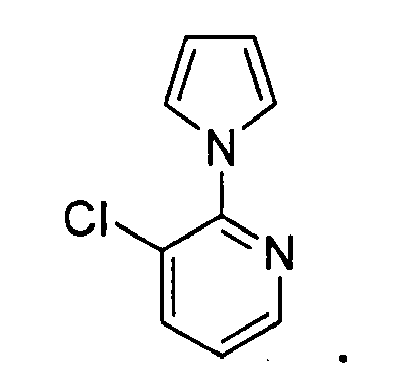
1H-NMR (CDCl3,TMS) δ (ppm): 6.35 (2H, t, J=2Hz), 7.15 (1H, dd, J=8Hz, 5Hz), 7.42 (2H, t, J=2Hz), 7.83 (1H, dd, J=8Hz, 2Hz), 8.39 (1H, dd, J=5Hz, 2Hz). - To 3.8 ml of N, N-dimethylformamide was added dropwise 4.2 ml of phosphorus oxychloride at room temperature, and the mixture was stirred at room temperature for 30 minutes. Thereto 1.6 g of 3-chloro-2-(1H-pyrrol-1-yl)pyridine was added, and the resulting mixture was stirred at 60°C for 2 hours. The reaction mixture was allowed to cool to room temperature, and then slowly added to ice-water. The mixture was adjusted to pH 4 by an addition of a 2N aqueous sodium hydroxide solution. A deposited precipitate was collected by filtration to obtain 1.7 g of 3-chloro-2-(2-formyl-1H-pyrrol-1-yl)pyridine of the formula:

1H-NMR (CDCl3,TMS) δ (ppm): 6.48 (1H, dd, J=4Hz, 3Hz), 7.14-7.15 (2H, m), 7.39 (1H, dd, J=8Hz, 5Hz), 7.89 (1H, dd, J=8Hz, 2Hz), 8.47 (1H, dd, J=5Hz, 2Hz), 9.57 (1H, d, J=1Hz). - To a solution of 1.5 g of 3-chloro-2- (2-formyl-1H-pyrrol-1-yl)pyridine in 20 ml of N,N-dimethylformamide,1.3 g of N-bromosuccinimide was added. The mixture was stirred at room temperature for 3 hours. Water was poured into the reaction mixture, and a deposited precipitate was collected by filtration to obtain 1.9 g of 4-bromo-1-(3-chloro-2-pyridinyl) -1H-pyrrole-2-carbaldehyde of the formula:

1H-NMR (CDCl3mTMS) δ (ppm): 7.11 (1H, d, J=2Hz), 7.14 (1H, dd, J=2Hz, 1Hz), 7.41 (1H, dd, J=8Hz, 5Hz), 7.89 (1H, dd, J=8Hz, 2Hz), 8.46 (1H, dd, J=5Hz, 2Hz), 9.51 (1H, d, J=1Hz). - An aqueous solution of 1.2 g of potassium permanganate in 10 ml of water was added dropwise to a mixture of 0.72 g of 4-bromo-1-(3-chloro-2-pyridinyl)-1H-pyrrole-2-carbaldehyde and 15 ml of acetone while the mixture was retained at 40°C. The mixture was then stirred at 60°C for 8 hours. Precipitates were filtered off to obtain a filtrate. The filtrate was adjusted to pH 10-12 by an addition of a 2N aqueous sodium hydroxide solution, and then washed with chloroform two times. The aqueous layer was adjusted to around pH 3 by an addition of 2N hydrochloric acid. A deposited precipitate was collected by filtration to obtain 0.56 g of 4-bromo-1-(3-chloro-2-pyridinyl)-1H-pyrrole-2-carboxylic acid of the formula:

1H-NMR (DMSO-d6,TMS) δ (ppm): 6.99 (1H, d, J=2Hz), 7.38 (1H, d, J=2Hz), 7.56 (1H, dd, J=8Hz, 5Hz), 8.10 (1H, dd, J=8Hz, 2Hz), 8.48 (1H, dd, J=5Hz, 2Hz). - A mixture of 0.56 g of 4-bromo-1-(3-chloro-2-pyridinyl)-1H-pyrrole-2-carboxylic acid and 0.40 ml of thionyl chloride was heated to reflux in acetonitrile for 2 hours. The reaction mixture was allowed to cool to room temperature, and then concentrated under reduced pressure. The resulting residue was dissolved in 10 ml of acetonitrile. Thereto 0.35 g of 2-amino-5-chloro-3-methylbenzoic acid was added, and the resulting mixture was stirred at room temperature for 10 minutes. To the mixture, 0.53 ml of pyridine was added, and the mixture was stirred at room temperature for 6 hours. Then 0.19 ml of methanesulfonyl chloride was added, and the mixture was stirred at room temperature for 1 hour. Water was poured into the reaction mixture, and a deposited precipitate was collected by filtration to obtain 0.29 g of 2-[4-bromo-1-(3-chloro-2-pyridinyl)-1H-pyrrol-2-yl]-6-chloro-8-methyl-4H -3,1-benzoxazine-4-one of the formula:

1H-NMR (CDCl3,TMS) δ (ppm): 1.73 (3H, s), 7.07 (1H, d, J=2Hz), 7.32 (1H, d, J=2Hz), 7.42-7.44 (2H, m), 7.91 (1H, dd, J=8Hz, 2Hz), 7.93 (1H, d, J=2Hz), 8.51 (1H, dd, J=5Hz, 2Hz). - A mixture of 0.29 g of 2-[4-bromo-1-(3-chloro-2-pyridinyl)-1H-pyrrol-2-yl]-6-chloro-8-methyl-4H-3,1-benzoxazine-4-one, 0.10 g of hydrazine monohydrate and 10 ml of tetrahydrofuran was stirred at room temperature for 2 hours. Water was added to the reaction mixture, and the mixture was extracted with ethyl acetate three times. The organic layers were combined, washed with an aqueous saturated sodium chloride solution, dried over anhydrous magnesium sulfate, and concentrated under reduced pressure to obtain 0.30 g of 4-bromo-N-[4-chloro-2-(hydrazinocarbonyl)-6-methylphenyl]-1 -(3-chloro-2-pyridinyl)-1H-pyrrole-2-carboxamide of the formula:

1H-NMR (CDCl3,TMS) δ (ppm): 2.20 (3H,s), 4.04 (2H, brs), 7.02 (1H, d, J=2Hz), 7.04 (1H, d, J=2Hz), 7.21 (1H, d, J=2Hz), 7.28 (1H, d, J=2Hz), 7.31 (1H, dd, J=8Hz, 5Hz), 7.34 (1H, brs), 7.80 (1H, dd, J=8Hz, 2Hz), 8.41 (1H, dd, J=5Hz, 2Hz), 9.27 (1H, brs). - A mixture of 0.60 g of 2-[3-bromo-1-(3-chloro-2-pyridinyl)-1H-pyrazol-5-yl]-6-chloro-8-methyl-4H-3,1-benzoxazine-4-one, 0.29 g of isopropylhydrazine hydrochloride, 0.27 g of triethylamine and 6 ml of tetrahydrofuran was stirred at room temperature for 3 hours. Water was poured into the reaction mixture, and the mixture was extracted with ethyl acetate two times. The combined organic layer was washed with an aqueous saturated sodium chloride solution, dried over anhydrous magnesium sulfate, and concentrated under reduced pressure. The residue was subjected to silica gel column chromatography to obtain 0.35 g of 3-bromo-N-[4-chloro-2-(N'-isopropylhydrazinocarbonyl)-6-methylphenyl]-1-(3-chloro -2-pyridinyl)-1H-pyrazole-5-carboxamide of the formula:

1H-NMR (CDCl3,TMS) δ (ppm): 1.08 (6H, d, J=6Hz), 2.11 (3H, s), 3.12 (1H, hept., J=6Hz), 4.60 (1H, brs), 7.11 (1H, s), 7.14 (1H, d, J=2Hz), 7.20 (1H, d, J=2Hz), 7.37 (1H, dd, J1=8Hz, J2=4Hz), 7.79-(1H, brs), 7.84 (1H, dd, J1=8Hz, J2=1Hz), 8.44 (1H, dd, J=4Hz, 1Hz), 9.93 (1H, brs). - According to the same manner as that of Reference Preparation Example 20, N-iodosuccinimide was used in place of 1,2-dibromo-1,1,2,2-tetrachloroethane to obtain N,N-dimethyl-5-iodo-1H-pyrazole-1-sulfonamide of the formula:

1H-NMR (CDCl3,TMS) δ (ppm): 3.07 (6H, s), 6.60 (1H, d, J=1Hz), 7.62 (1H, d; J=1Hz). - According to the same manner as that of Reference Preparation Example 21, N,N-dimethyl-5-iodo-1H-pyrazole-1-sulfonamide was used in place of 5-bromo-N,N-dimethyl-1H-pyrazole-1-sulfonamide to obtain 3-iodo-1H-pyrazole of the formula:

1H-NMR (CDCl3,TMS) δ (ppm): 6.74 (1H, d, J=3Hz), 8.10 (1H, d, J=3Hz). - According to the same manner as that of Reference Preparation Example 22, 3-iodo-1H-pyrazole was used in place of 3-bromo-1H-pyrazole to obtain 3-chloro-2-(3-iodo-1H-pyrazol-1-yl)pyridine of the formula:

1H-NMR (CDCl3,TMS) δ (ppm): 6.65 (1H, d, J=2Hz), 7.31 (1H, dd, J=8Hz, 4Hz), 7.91 (1H, dd, J=8Hz, 1Hz), 7.95 (1H, d, J=2Hz), 8.46 (1H, dd, J=4Hz, 1Hz). - According to the same manner as that of Reference Preparation Example 23, 3-chloro-2-(3-iodo-1H-pyrazol-1-yl)pyridine was used in place of 2-(3-bromo-1H-pyrazol-1-yl)-3-chloropyridine to obtain 1-(3-chloro-2-pyridinyl)-3-iodo-1H-pyrazole-5-carboxylic acid of the formula:

1H-NMR (CDCl3,TMS) δ (ppm): 7.20 (1H, s), 7.44 (1H, dd, J=8Hz, 4Hz), 7.91 (1H, dd, J=8Hz, 1Hz), 8.50 (1H, dd, J=4Hz, 1Hz). - According to the same manner as that of Reference Preparation Example 13, 1-(3-chloro-2-pyridinyl)-3-iodo-1H-pyrazole-5-carboxylic acid was used in place of 1-(3-chloro-2-pyridinyl)-1H-pyrazole-5-carboxylic acid to obtain 6-chloro-2-[1-(3-chloro-2-pyridinyl)-3-iodo-1H-pyrazol-5-yl ]-8-methyl-4H-3,1-benzoxazine-4-one of the formula:

1H-NMR (CDCl3,TMS) δ (ppm): 1.82 (3H, s), 7.39 (1H, s), 7.47-7.50 (2H, m), 7.95-7.98 (2H, m), 8.56 (1H, dd, J=4Hz, 1Hz). - According to the same manner as that of Reference Preparation Example 7, 6-chloro-2-[1-(3-chloro-2-pyridinyl)-3-iodo-1H-pyrazol-5-yl]-8-methyl-4H-3,1-benzoxazine-4-one was used in place of 6-chloro-2-[1-(3-chloro-2-pyridinyl)-1H-pyrazol-5-yl]-8-methyl-4H-3,1-benzoxazine-4-one to obtain N-[4-chloro-2-(hydrazinocarbonyl)-6-methylphenyl]-1-(3-chloro-2-pyridinyl)-3-iodo-1H-pyrazole-5-carboxamide of the formula:

1H-NMR (DMSG-d6) δ (ppm): 2.13 (3H, s), 4.36 (2H, brs), 7.31 (1H, brs), 7.42 (1H, brs), 7.46 (1H, brs), 7.59 (1H, dd, J=8Hz, 4Hz), 8.15 (1H, d, J=8Hz), 8.49 (1H, dd, J=4Hz, 1Hz), 9.54 (1H, brs), 10.20 (1H, brs). - According to the same manner as that of Reference Preparation Example 22, 4-bromo-1H-pyrazole was used in place of 3-bromo-1H-pyrazole to obtain 2-(4-bromo-1H-pyrazol-l-yl)-3-chloropyridine of the formula:

1H-NMR (CDCl3,TMS) δ (ppm) : 7.31 (1H, dd, J=8Hz, 4Hz), 7.77 (1H, s), 7.92 (1H, dd, J=8Hz, 1Hz), 8.19 (1H, s), 8.45 (1H, dd, J=4Hz, 1Hz). - According to the same manner as that of Reference Preparation Example 23, 2-(4-bromo-1H-pyrazol-1-yl)-3-chloropyridine was used in place of 2-(3-bromo-1H-pyrazol-1-yl)-3-chloropyridine to obtain 4-bromo-1-(3-chloro-2-pyridinyl)-IH-pyrazole-5-carboxylic acid of the formula:

1H-NMR (DMSO-d6) δ (ppm) : 7.66 (1H, dd, J=8Hz, 4Hz), 8.06 (1H, s), 8.23 (1H, dd, J=8Hz, 1Hz), 8.54 (1H, dd, J=4Hz, 1Hz). - According to the same manner as that of Reference Preparation Example 13, 4-bromo-1-(3-chloro-2-pyridinyl)-1H-pyrazole-5-carboxylic acid was used in place of 1-(3-chloro-2-pyridinyl)-1H-pyrazole-5-carboxylic acid to obtain 2-[4-bromo-1-(3-chloro-2-pyridinyl)-1H-pyrazol-5-yl]-6-chloro-8-methyl-4H-3 ,1-benzoxazine-4-one of the formula:
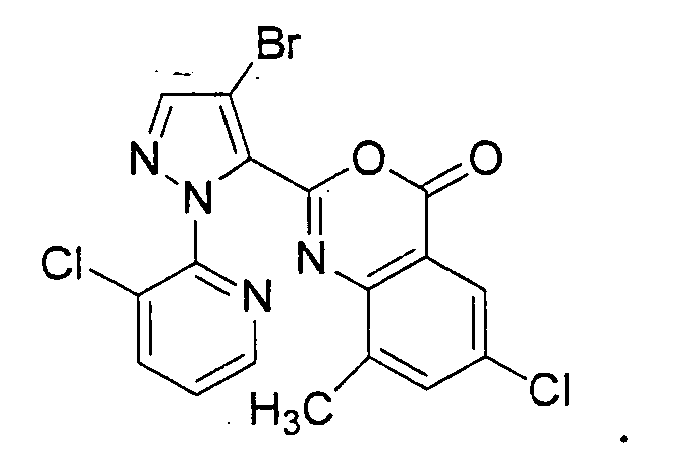
1H-NMR (CDCl3,TMS) δ (ppm): 2.00 (3H, s), 7.46 (1H, dd, J=8Hz, 4Hz), 7.53 (1H, d, J=2Hz), 7.87 (1H, s), 7.95 (1H, dd, J=8Hz, 1Hz), 7.98 (1H, d, J=2Hz), 8.51 (1H, dd, J=4Hz, 1Hz). - According to the same manner as that of Reference Preparation Example 7, 2-[4-bromo-1-(3-chloro-2-pyridinyl)-1H-pyrazol-5-yl]-6-chloro-8-methyl-4H-3,1-benzoxazine-4-one was used in place of 6-chloro-2-[1-(3-chloro-2-pyridinyl)-1H-pyrazol-5-yl]-8-methyl-4H-3,1-benzoxazine-4-one to obtain 4-bromo-N-[4-chloro-2-(hydrazinocarbonyl)-6-methylphenyl]-1 -(3-chloro-2-pyridinyl)-1H-pyrazole-5-carboxamide of the formula:

1H-NMR (DMSQ-d6) δ (ppm): 2.13 (3H, s), 4.47 (2H, brs), 7.37 (1H, s), 7.48 (1H, s), 7.62 (1H, dd, J=8Hz, 4Hz), 8.12 (1H, s), 8.19 (1H, d, J=8Hz), 8.50 (1H, d, J=4Hz), 9.69 (1H, brs), 10.24 (1H, brs). - According to the same manner as that of Reference Preparation Example 22, 3-phenyl-1H-pyrazole was used in place of 3-bromo-1H-pyrazole to obtain 3-chloro-2-(3-phenyl-1H-pyrazol-1-yl)pyridine of the formula:

1H-NMR (CDCl3,TMS) δ (ppm) : 6.82 (1H, d, J=2Hz), 7.27 (1H, dd, J=8Hz, 4Hz), 7.35 (1H, m), 7.43 (2H, m), 7.93 (3H, m), 8.20 (1H, d, J=2Hz), 8.48 (1H, dd, J=4Hz, 1Hz). - According to the same manner as that of Reference Preparation Example 23, 3-chloro-2-(3-phenyl-1H-pyrazol-1-yl)pyridine was used in place of 2-(3-bromo-1H-pyrazol-1-yl)-3-chloropyridine to obtain 1-(3-chloro-2-pyridinyl)-3-phenyl-1H-pyrazole-5-carboxylic acid of the formula:

1H-NMR (DMSO-d6) δ (ppm) : 7.36-7.45 (3H, m), 7.57 (1H, s), 7.67 (1H, dd, J=8Hz, 4Hz), 7.90-7.92 (2H, m), 8.24 (1H, dd, J=8Hz, 1Hz), 8.57 (1H, dd, J=4Hz, 1Hz). - According to the same manner as that of Reference Preparation Example 13, 1-(3-chloro-2-pyridinyl)-3-phenyl-1H-pyrazole-5-carboxylic acid was used in place of 1-(3-chloro-2-pyridinyl)-1H-pyrazole-5-carboxylic acid to obtain 6-chloro-2-[1-(3-chloro-2-pyridinyl)-3-phenyl-1H-pyrazol-5-yl]-8-methyl-4H-3,1-benzoxazine-4-one of the formula:

1H-NMR (CDCl3,TMS) δ (ppm): 1.83 (3H, s), 7.39-7.52 (5H, m), 7.59 (1H, s), 7.92-8.00 (4H, m), 8.59 (1H, dd, J=4Hz, 1Hz). - According to the same manner as that of Reference Preparation Example 7, 6-chloro-2-[1-(3-chloro-2-pyridinyl)-3-phenyl-1H-pyrazol-5-yl]-8-methyl-4H-3,1-benzoxazine-4-one was used in place of 6-chloro-2-[1-(3-chloro-2-pyridinyl)-1H-pyrazol-5-yl]-8-methyl-4H-3,1-benzoxazine-4-one to obtain N-[4-chloro-2-(hydrazinocarbonyl)-6-methylphenyl]-1-(3-chloro-2-pyridinyl)-3-phenyl-1H-pyrazole-5-carboxamide of the formula:

1H-NMR (DMSO-d6) δ (ppm): 2.19 (3H, s), 4.40 (2H, brs), 7.33 (1H, d, J=2Hz), 7.42-7.92 (4H, m), 7.60 (1H, dd, J=8Hz, 4Hz), 7.70 (1H, s), 7.88 (2H, d, J=7Hz), 8.17 (1H, d, J=8Hz), 8.53 (1H, d, J=4Hz), 9.58 (1H, brs), 10.27 (1H, brs). - To a mixture of 4.0 g of N,N-dimethyl-1H-pyrazole-1-sulfonamide and 45 ml of tetrahydrofuran was added dropwise 15.7 ml of a 1.6M n-butyl lithium solution in hexane at -78°C, and the mixture was stirred at -78°C for 10 minutes. After 2.3 ml of dimethyl disulfide was added to the mixture, the mixture was stirred for 4 hours while the reaction temperature was gradually returned to room temperature. Water was poured into the reaction mixture, and the mixture was extracted with methyl t-butyl ether three times. The combined organic layer was washed successively with a 1N aqueous sodium hydroxide solution and an aqueous saturated sodium chloride solution, dried over magnesium sulfate, and concentrated under reduced pressure. The resulting residue was subjected to silica gel column chromatography to obtain 4.87 g of N,N-dimethyl-5-methylthio-1H-pyrazole-1- sulfonamide of the formula:

1H-NMR (CDCl3,TMS) δ (ppm): 2.49 (3H, s), 3.01 (6H, s), 6.10 (1H, d, J=2Hz), 7.63 (1H, d, J=2Hz). - According to the same manner as that of Reference Preparation Example 21, N,N-dimethyl-5-methylthio-1H-pyrazole-1-sulfonamide was used in place of 5-bromo-N,N-dimethyl-1H-pyrazole-1-sulfonamide to obtain 3-methylthio-1H-pyrazole of the formula:

1H-NMR (CDCl3 TMS) δ (ppm): 2.61 (3H, s), 6.45 (1H, d, J=3Hz), 8.19 (1H, d, J=3Hz). - According to the same manner as that of Reference Preparation Example 22, 3-methylthio-1H-pyrazole was used in place of 3-bromo-1H-pyrazole to obtain 3-chloro-2-(3-methylthio-1H-pyrazol-1-yl)pyridine of the formula:

1H-NMR (CDCl3,TMS) δ (ppm): 2.61 (3H, s), 6.40 (1H, d, J=2Hz), 7.25 (1H, dd, J=8Hz, 4Hz), 7.89 (1H, dd, J=8Hz, 1Hz), 8.12 (1H, d, J=2Hz), 8.43 (1H, dd, J=4Hz, 1Hz). - According to the same manner as that of Reference Preparation Example 23, 3-chloro-2-(3-methylthio-1H-pyrazol-1-yl) pyridine was used in place of 2-(3-bromo-1H-pyrazol-1-yl) -3-chloropyridine to obtain 1-(3-chloro-2-pyridinyl)-3-methylthio-1H-pyrazole-5-carboxylic acid of the formula:

1H-NMR (DMSO-d6) δ (ppm): 2.49 (3H, s), 7.02 (1H, s), 7.62 (1H, dd, J=8Hz, 4Hz), 8.19 (1H, dd, J=8Hz, 1Hz), 8.51 (1H, dd, J=4Hz, 1Hz). - According to the same manner as that of Reference Preparation Example 13, 1-(3-chloro-2-pyridinyl)-3-methylthio-1H-pyrazole-5-carboxylic acid was used in place of 1-(3-chloro-2-pyridinyl)-1H-pyrazole-5-carboxylic acid to obtain 6-chloro-2-[1-(3-chloro-2-pyridinyl)-3-methylthio-1H-pyrazole-5-yl]-8-methyl-4H-3,1-benzoxazine-4-one of the formula:.

1H-NMR (CDCl3,TMS) δ (ppm): 1.81 (3H, s), 2.61 (3H, s), 7.15 (1H, s), 7.45-7.48 (2H, m), 7.94-7.98 (2H, m), 8.56 (1H, d, J=4Hz). - According to the same manner as that of Reference Preparation Example 7, 6-chloro-2-[1-(3-chloro-2-pyridinyl)-3-methylthio-1H-pyrazol-5-yl]-8-methyl-4H-3,1-benzoxazine-4 -one was used in place of 6-chloro-2-[1-(3-chloro-2-pyridinyl)-1H-pyrazol-5-yl]-8-methyl-4H-3,1-benzoxazine-4-one to obtain N-[4-chloro-2-(hydrazinocarbonyl)-6-methylphenyl]-1-(3-chloro-2-pyridinyl)-3-methylthio-1H-pyrazole-5-carboxamide of the formula:

1H-NMR (DMSO-d6) δ (ppm): 2.14 (3H, s), 2.53 (3H, s), 4.37 (2H, brs), 7.20 (1H, s), 7.30 (1H, s), 7.46 (1H, s), 7.56 (1H, dd, J=8Hz, 4Hz), 8.12 (1H, d, J=8Hz), 8.47 (1H, d, J=4Hz), 9.54 (1H, brs), 10.16 (1H, brs). - To a mixture of 0.50 g of 1-(3-chloro-2-pyridinyl-)-3-methylthio-1H-pyrazole-5-carboxylic acid and 5 ml of trifluoroacetic acid was added 0.4 ml of 30% aqueous hydrogen peroxide, and the resulting mixture was stirred at room temperature for 4 hours. Water was poured into the reaction mixture, and the mixture was extracted with methyl t-butyl ether three times. The combined organic layer was washed with an aqueous saturated sodium chloride solution, dried over anhydrous sodium sulfate, and concentrated under reduced pressure to obtain 0.44 g of 1-(3-chloro-2-pyridinyl)-3-methylsulfonyl-1H-pyrazole-5-carboxylic acid of the formula:

1H-NMR (DMSO-d6) δ (ppm) : 3.39 (3H, s), 7.57 (1H, s), 7.75 (1H, dd, J=8Hz, 4Hz), 8.31 (1H, dd, J=8Hz, 1Hz), 8.61 (1H, dd, J=4Hz, 1Hz). - According to the same manner as that of Reference Preparation Example 13, 1-(3-chloro-2-pyridinyl)-3-methylsulfonyl-1H-pyrazole-5-carboxylic acid was used in place of 1-(3-chloro-2-pyridinyl)-1H-pyrazole-5-carboxylic acid to obtain 6-chloro-2-[1-(3-chloro-2-pyridinyl)-3-methylsulfonyl-1H-pyrazol-5-yl]-8-methyl-4H-3,1-benzoxazine -4-one of the formula:

1H-NMR (CDCl3,TMS) δ (ppm): 1.85 (3H, s), 3.30 (3H, s), 7.52-7.57 (2H, m), 7.72 (1H, s), 7.99-8.03 (2H, m), 8.58 (1H, dd, J=4Hz, 1Hz). - To a mixture of 0.20 g of 6-chloro-2-[1-(3-chloro-2-pyridinyl)-3-methylthio-1H-pyrazol-5-yl]-8-methyl-4H-3,1-benzoxazine-4-one, 5 ml of dichloromethane and 0.5 ml of water was added 0.18 g of magnesium bis(monoperoxophthalate) hexahydrate (MMPP), and the resulting mixture was stirred at room temperature for 22 hours. Water was added to the reaction mixture, and the mixture was extracted with methyl t-butyl ether. The organic layer was washed with water and an aqueous saturated sodium chloride solution, dried over anhydrous magnesium sulfate, and concentrated under reduced pressure to obtain 0.20 g of 6-chloro-2-[1-(3-chloro-2-pyridinyl)-3-methylsulfinyl-1H-pyrazol-5-yl]-8-methyl-4H-3,1-benzoxazine -4-one of the formula:

1H-NMR (CDCl3,TMS) δ (ppm): 1.85 (3H, s), 3.04 (3H, s), 7.52-7.55 (2H, m), 7.74 (1H, s), 7.99-8.01 (2H, m), 8.58 (1H, dd, J=4Hz, 1Hz). - A mixture of 2.5 g of ethyl 2,4-dioxovalerate, 1.45 g of O-methylhydroxylamine hydrochloride and 10 ml of ethanol was heated to reflux for 2 hours. The reaction mixture was allowed to cool to room temperature, and partitioned between water and ethyl acetate. The organic layer was washed with water and an aqueous saturated sodium chloride solution, dried over anhydrous magnesium sulfate, and concentrated under reduced pressure. The residue was subjected to silica gel column chromatography to obtain 1.34 g of ethyl 2-methoxyimino-4-oxopentanoate of the formula:

1H-NMR (CDCl3,TMS) δ (ppm): 1.35 (3H, t, J=7Hz), 2.21 (3H, s), 3.71 (2H, s), 4.07 (3H, s), 4.34 (2H, q, J=7Hz). - A mixture of 1.34 g of ethyl 2-methoxyimino-4-oxopentanoate, 1.23 g of 3-chloro-2-hydrazinopyridine, 25 ml of tetrahydrofuran and 50 ml of acetic acid was heated to reflux for 8 hours. The reaction mixture was concentrated under reduced pressure. Water was poured into the residue, and the mixture was extracted with methyl t-butyl ether two times. The combined organic layer was washed successively with a 1N aqueous sodium hydroxide solution, water and an aqueous saturated sodium chloride solution, dried over anhydrous magnesium sulfate, and concentrated under reduced pressure. The residue was subjected to silica gel column chromatography to obtain 0.30 g of ethyl 1-(3-chloro-2-pyridinyl)-3-methyl-1H-pyrazole-5-carboxylate of the formula:

1H-NMR (CDCl3,TMS) δ (ppm): 1.20 (3H,_t, J=7Hz), 2.40 (3H, s), 4.20 (2H, q, J=7Hz), 6.84 (1H, s), 7.40 (1H, dd, J=8Hz, 4Hz), 7.88 (1H, d, J=8Hz), 8.51 (1H, d, J=4Hz). - A mixture of 0.30 g of ethyl 1-(3-chloro-2-pyridinyl)-3-methyl-1H-pyrazole-5-carboxylate, 5 ml of methanol and 5 ml of a 2N aqueous sodium hydroxide solution was heated to reflux for 3 hours. After the reaction mixture was allowed to cool, water was poured and the aqueous layer was washed with methyl t-butyl ether two times. The aqueous layer was adjusted to around pH 3 by an addition of 2N hydrochloric acid, and then extracted with methyl t-butyl ether three times. The combined organic layer was washed with an aqueous saturated sodium chloride solution, dried over anhydrous magnesium sulfate, and concentrated under reduced pressure to obtain 0.24 g of 1-(3-chloro-2-pyridinyl)-3-methyl-1H-pyrazole-5-carboxylic acid of the formula:

1H-NMR (CDCl3,TMS) δ (ppm): 2.40 (3H, s), 6.89 (1H, s), 7.40 (1H, dd, J=8Hz, 4Hz), 7.89 (1H; dd, J=8Hz, 1Hz), 8.49 (1H, dd, J=4Hz, 1Hz). - According to the same manner as that of Reference Preparation Example 13, 1-(3-chloro-2-pyridinyl)-3-methyl-1H-pyrazole-5-carboxylic acid was used in place of 1-(3-chloro-2-pyridinyl)-1H-pyrazole-5-carboxylic acid to obtain 6-chloro-2-[1-(3-chloro-2-pyridinyl)-3-methyl-1H-pyrazol-5-yl]-8-methyl-4H-3,1-benzoxazine-4-one of the formula:

1H-NMR (CDCl3,TMS) δ (ppm): 1.81 (3H, s), 2.45 (3H, s); 7.07 (1H, s), 7.43-7.47 (2H, m), 7.92-7.98 (2H, m), 8.56 (1H, dd, J=4Hz, 1Hz). - To a mixture of 17.2 g of 3-methyl-2-butanone, 27.1 g of diethyl oxalate and 130 ml of ethanol was added 95 ml of sodium ethoxide (20% ethanol solution), and the resulting mixture was stirred at 60°C for 5 hours. After allowed to cool to room temperature, a deposited precipitate was collected by filtration and washed with ethanol. The filter cake was partitioned between 2N hydrochloric acid and methyl t-butyl ether. The organic layer was washed with an aqueous saturated sodium chloride solution, dried over anhydrous magnesium sulfate, and concentrated under reduced pressure to obtain 28.8 g of ethyl 4-hydroxy-5-methyl-2-oxo-3-hexenoate of the formula:

1H-NMR (CDCl3,TMS) δ (ppm): 1.19 (6H, d, J=7Hz), 1.38 (3H, t, J=7Hz), 2.66 (1H, hept., J=7Hz), 4.36 (2H, q, J=7Hz), 6.41 (1H, s). - A mixture of 5.0 g of ethyl 4-hydroxy-5-methyl-2-oxo-3-hexenoate, 2.46 g of O-methylhydroxylamine hydrochloride and 10 ml of ethanol was stirred at room temperature for 6 hours. After ethyl acetate was poured into the reaction mixture, the organic layer was washed with water and an aqueous saturated sodium chloride solution, dried over anhydrous magnesium sulfate, and concentrated under reduced pressure to obtain 5.32 g of ethyl 2-methoxyimino-5-methyl-4-oxohexanoate of the formula:

1H-NMR (CDCl3,TMS) δ (ppm): 1.15 (6H, d, J=7Hz), 1.34 (3H, t, J=7Hz), 2.68 (1H, hept., J=7Hz), 3.76 (2H, s), 4.05 (3H, s), 4.33 (2H, q, J=7Hz). - A mixture of 3.0 g of ethyl 2-methoxyimino-5-methyl-4-oxohexanoate, 2.4 g of 3-chloro-2-hydrazinopyridine, 50 ml of tetrahydrofuran and 100 ml of acetic acid was stirred at room temperature for 20 hours, and then heated to reflux for 4 hours. The reaction mixture was concentrated under reduced pressure. Water was poured into the residue, and the mixture was extracted with methyl t-butyl ether two times. The combined organic layer was washed successively with a 1N aqueous sodium hydroxide solution, water and an aqueous saturated chloride solution, dried over anhydrous magnesium sulfate, and concentrated under reduced pressure. The residue was subjected to silica gel column chromatography to obtain 1.07 g of ethyl 1-(3-chloro-2-pyridinyl)-3-isopropyl-1H-pyrazole-5-carboxyl ate of the formula:
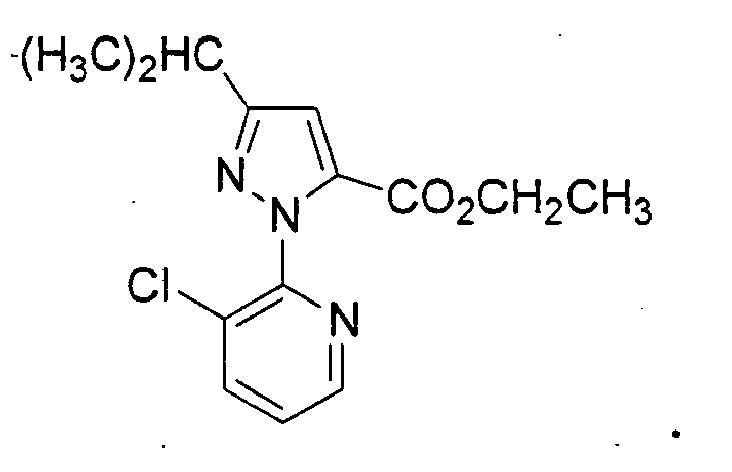
1H-NMR (CDCl3,TMS) δ (ppm): 1.20 (3H, t, J=7Hz), 1.34 (6H, d, J=7Hz), 3. 11 (1H, hept., J=7Hz), 4.20 (2H, q, J=7Hz), 6.88 (1H, s), 7.40 (1H, dd, J=8Hz, 4Hz), 7.88 (1H, d, J=8Hz), 8.52 (1H, d, J=4Hz). - A mixture of 1.07 g of ethyl 1-(3-chloro-2-pyridinyl)-3-isopropyl-1H-pyrazole-5-carboxylate, 15 ml of methanol and 15 ml of a 2N aqueous sodium hydroxide solution was heated to reflux for 1.5 hours. After the reaction mixture was allowed to cool, water was poured and the mixture was washed with methyl t-butyl ether two times. The aqueous layer was adjusted to around pH 3 by an addition of 2N hydrochloric acid, and then extracted with methyl t-butyl ether three times. The combined organic layer was washed with an aqueous saturated sodium chloride solution, dried over anhydrous magnesium sulfate, and concentrated under reduced pressure to obtain 0.97 g of 1-(3-chloro-2-pyridinyl)-3-isopropyl-1H-pyrazole-5-carboxylic acid of the formula:

1H-NMR (CDCl3,TMS) δ (ppm) : 1.33 (6H, d, J=7Hz) 3.10 (1H, hept., J=7Hz), 6.93 (1H, s), 7.39 (1H, dd, J=8Hz, 4Hz.), 7.88 (1H, d, J=8Hz), 8.49 (1H, d, J=4Hz). - According to the same manner as that of Reference Preparation Example 13, 1-(3-chloro-2-pyridinyl)-3-isopropyl-1H-pyrazole-5-carboxylic acid was used in place of 1-(3-chloro-2-pyridinyl)-1H-pyrazole-5-carboxylic acid to obtain 6-chloro-2-[1-(3-chloro-2-pyridinyl)-3-isopropyl-1H-pyrazol-5-yl]-8-methyl-4H-3,1-benzoxazine-4-one of the formula:

1H-NMR (CDCl3,TMS) δ (ppm): 1.37 (6H, d, J=7Hz), 1.81 (3H, s), 3.15 (1H, hept., J=7Hz), 7.12 (1H, s), 7.45 (1H, dd, J=8Hz, 4Hz), 7.47 (1H, d, J=1Hz), 7.93 (1H, dd, J=8Hz, 1Hz), 7.98 (1H, d, J=1Hz), 8.56 (1H, dd, J=4Hz, 1Hz). - According to the same manner as that of Reference Preparation Example 46, 1-(3-chloro-2-pyridinyl)-3-isopropyl-1H-pyrazole-5-carboxylic acid was used in place of 3-bromo-1-(3-chloro-2-pyridinyl)-1H-pyrazole-5-carboxylic acid to obtain 2-[1-(3-chloro-2-pyridinyl)-3-isopropyl-1H-pyrazol-5-yl]-6,8-dibromo-4H-3,1-benzoxazine-4-one of the formula:

1H-NMR (CDCl3,TMS) δ (ppm) : 1.35 (6H, d, J=7Hz), 3.16 (1H, hept., J=7Hz), 7.16 (1H, s), 7.43 (1H, dd, J=8Hz, 4Hz), 7.94 (1H, dd, J=8Hz, 1Hz), 8.03 (1H, d, J=2Hz), 8.25 (1H, d, J=2Hz), 8.56 (1H, dd, J=4Hz, 1Hz). - A mixture of 23.6 g of pyruvic aldehyde dimethylacetal and 23.8 g of N,N-dimethylformamide dimethylacetal was stirred at 80°C for 4 hours while produced methanol was distilled off, to obtain 38.8 g (purity: about 80 %) of 4-dimethylamino-1,1-dimethoxy-3-butene-2-one of the formula:

1H-NMR (CDCl3,TMS) δ (ppm): 2.87 (3H, s), 3.11 (3H, s), 3.41 (6H, s), 4.58 (1H, s), 5.35 (1H, d, J=12Hz), 7.74 (1H, d, J=12Hz). - A mixture of 5 g of 4-dimethylamino-1,1-dimethoxy-3-butene-2-one, 1.7 ml of hydrazine monohydrate and 15 ml of methanol was stirred for 8 hours under heat refluxing. The reaction mixture was concentrated under reduced pressure to obtain 4.07 g of 3-(dimethoxymethyl)-1H-pyrazole of the formula:

1H-NMR (CDCl3,TMS) δ (ppm): 3.37 (6H, s), 5.58 (1H, s), 6.35 (1H, d, J=2Hz), 7.58 (1H, d, J=2Hz). - According to the same manner as that of Reference Preparation Example 22, 3-(dimethoxymethyl)-1H-pyrazole was used in place of 3-bromo-1H-pyrazole to obtain 3-chloro-2-[3-(dimethoxymethyl)-1H-pyrazol-1-yl]pyridine of the formula:

1H-NMR (CDCl3,TMS) δ (ppm): 3.44 (6H, s), 5.58 (1H, s), 6.57 (1H, d, J=2Hz), 7.29 (1H, dd, J=8Hz, 5Hz), 7.90 (1H, dd, J=8Hz, 2Hz), 8.07 (1H, d, 2Hz), 8.47 (1H, dd, 5Hz, 2Hz). - A mixture of 3.35 g of 3-chloro-2-[3-(dimethoxymethyl)-1H-pyrazol-1-yl] pyridine, 24 ml of formic acid and 6 ml of water was stirred at 60°C for 1 hour. The reaction mixture was concentrated under reduced pressure. Ice water was poured into the residue, and a precipitated solid was collected by filtration to obtain 2.38 g of 1-(3-chloro-2-pyridinyl)-1H-pyrazole-3-carbaldehyde of the formula:

1H-NMR (CDCl3,TMS) δ (ppm): 7.01 (1H, d, J=2Hz), 7.40 (1H, dd, J=8Hz, 5Hz), 7.98 (1H, dd, J=8Hz, 2Hz), 8.18 (1H, dd, J=3Hz, 2Hz), 8.52 (1H, dd, 5Hz, 2Hz), 10.14 (1H, d, 2Hz). - A mixture of 2.00 g of 1-(3-chloro-2-pyridinyl)-1H-pyrazole-3-carbaldehyde, 1.21 g of O-methylhydroxylamine hydrochloride and 8 ml of pyridine was heated to reflux for 1 hour. After the reaction mixture was concentrated under reduced pressure, an aqueous saturated sodium hydrogen carbonate solution was poured into the residue and the mixture was extracted with methyl t-butyl ether three times. The organic layers were combined, washed successively with water and an aqueous saturated sodium chloride solution, dried over anhydrous magnesium sulfate, and concentrated under reduced pressure to obtain 2.23 g of 1-(3-chloro-2-pyridinyl)-1H-pyrazole-3-carbaldehyde O-methyloxime of the formula:

1-(3-Chloro-2-pyridinyl)-1H-pyrazole-3-carbaldehyde O-methyloxime
1H-NMR (CDCl3,TMS) δ (ppm): - E isomer: 3.99 (3H, s), 6.84 (1H, d, J=3Hz), 7.30 (1H, dd, J=8Hz, 5Hz), 7.92 (1H, dd, J=8Hz, 2Hz), 8.12 (1H, dd, J=3Hz, 1Hz), 8.25 (1H, s), 8.48 (1H, dd, J=5Hz, 2Hz).
- Z isomer: 4.07 (3H, s), 7.18 (1H, d, J=3Hz), 7.33 (1H, dd, J=8Hz, 5Hz), 7.67 (1H, s), 7.93 (1H, dd, J=8Hz, 2Hz), 8.14 (1H, dd, J=3Hz, 1Hz), 8.49 (1H, dd, J=5Hz, 2Hz).
- According to the same manner as that of Reference Preparation Example 23, 1-(3-chloro-2-pyridinyl)-1H-pyrazole-3-carbaldehyde O-methyloxime was used in place of 2-(3-bromo-1H-pyrazol-1-yl)-3-chloropyridine to obtain 1-(3-chloro-2-pyridinyl)-3-methoxyiminomethyl-1H-pyrazole-5 -carboxylic acid of the formula:
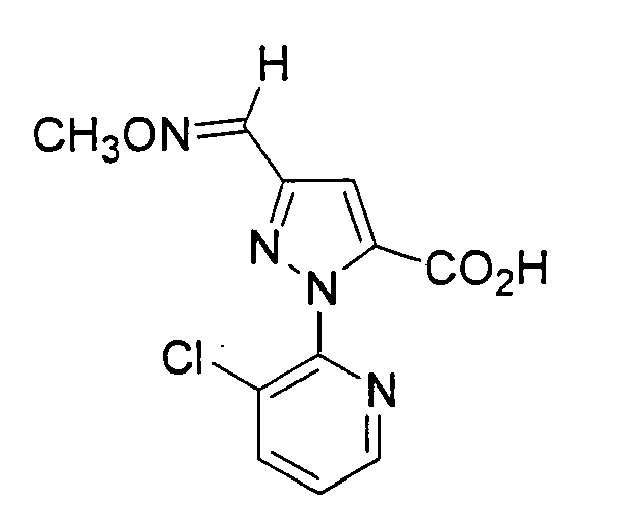
1-(3-Chloro-2-pyridinyl)-3-methoxyiminomethyl-1H-pyrazole-5 -carboxylic acid
1H-NMR (CDCl3,TMS) δ (ppm): - E isomer: 4.00 (3H, s), 7.39 (1H, s), 7.45 (1H, dd, J=8Hz, 5Hz), 7.92 (1H, dd, J=8Hz, 2Hz), 8.15 (1H, s), 8.51 (1H, dd, J=5Hz, 2Hz).
- Z isomer: 4.08 (3H, s), 7.38 (1H, s), 7.51-(1H, dd, J=8Hz, 5Hz), 7.60 (1H, s), 7.94 (1H, dd, J=8Hz, 2Hz), 8.51 (1H, dd, J=5Hz, 2Hz).
- A mixture of 0.70 g of 1-(3-chloro-2-pyridinyl)-3-methoxyiminomethyl-1H-pyrazole-5-carboxylic acid and 0.55 ml of thionyl chloride was heated to reflux for 1 hour. The reaction mixture was allowed to cool to room temperature, and then concentrated under reduced pressure. After the resulting residue was dissolved in 10 ml of acetonitrile, 0.46 g of 2-amino-5-chloro-3-methylbenzoic acid was added and the mixture was stirred at room temperature for 10 minutes. To the mixture was added 0.35 ml of triethylamine, and the mixture was stirred at room temperature for 20 minutes. Further 70 ml of triethylamine was added, and the mixture was stirred at room temperature for 20 minutes. Then 0.21 ml of methanesulfonyl chloride was added, and the mixture was stirred at room temperature for 17 hours. Water was added to the reaction mixture, and the mixture was extracted with chloroform three times. The organic layers were combined, washed with an aqueous saturated sodium chloride solution, dried over anhydrous magnesium sulfate, and concentrated under reduced pressure. The residue was subjected to silica gel column chromatography to obtain 0.16 g of 6-chloro-2-[1-(3-chloro-2-pyridinyl)-3-cyano-1H-pyrazol-5-yl]-8-methyl-4H-3,1-benzoxazine-4-one of the formula:

1H-NMR (CDCl3,TMS) δ (ppm): 1.83 (3H, s), 7.52 (1H, dd, J=2Hz, 1Hz), 7.56 (1H, dd, 8Hz, 5Hz), 7.58 (1H, s), 7.99-8.03 (2H, m), 8.58 (1H, dd, J=5Hz, 2Hz). - To a mixture of 10.6 ml of methylhydrazine, 50 ml of methanol and 8.0 g of sodium hydroxide was added dropwise 15.4 ml of methyl chloroformate under ice-cooling, and the mixture was stirred at room temperature for 1 hour. The reaction mixture was filtered, and the filtrate was concentrated. The residue was distilled under reduced pressure (50 to 80°C/15 mmHg) to obtain 13.4 g of N-methyl-N-methoxycarbonylhydrazine. N-methyl-N-methoxycarbonylhydrazine
1H-NMR (CDCl3,TMS) δ (ppm): 3.11 (3H,s), 3.73 (3H, s), 4.13 (2H, brs). - A mixture of 1.0 g of 2-[3-bromo-1-(3-chloro-2-pyridinyl)-1H-pyrazol-5-yl]-6-chloro-8-methyl-4H-3,1-benzoxazine-4-one, 0.35 ml of methylhydrazine and 20 ml of tetrahydrofuran was stirred at room temperature for 24 hours. Water was poured into the reaction mixture and the mixture was extracted with ethyl acetate three times. The combined organic layer was washed with an aqueous saturated sodium chloride solution, dried over anhydrous sodium sulfate, and concentrated under reduced pressure. The residue was subjected to silica gel column chromatography to obtain 0.85 g of 3-bromo-N-[4-chloro-2-(N-methylhydrazinocarbonyl)-6-methylphenyl]-1-(3-chloro-2-pyridinyl)-1H-pyrazole-5-carboxamide of the formula:
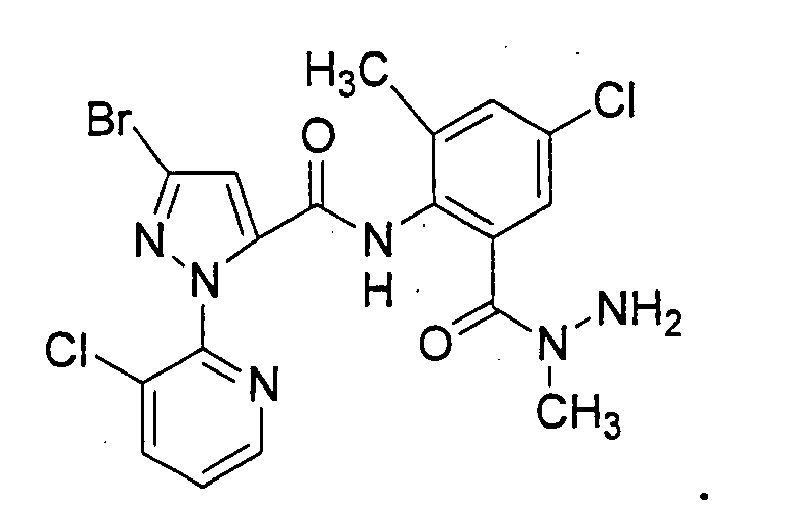
1H-NMR (CDCl3,TMS) δ (ppm): 2.20 (3H, s), 3.21 (3H, s), 3.74 (3H, brs), 7.05 (1H, s), 7.26-7.38 (3H, m), 7.86 (1H, dd, J=8Hz, 2Hz), 8.03 (1H, s), 8.42 (1H, dd, J=5Hz, 2Hz), 9.47 (1H, s). - To a mixture of 0.34 g of 2-amino-4-chloro-3-methylbenzoic acid and 10 ml of N, N-dimethylformamide was added 0.26 g of N-chlorosuccinimide at room temperature, and the mixture was stirred at room temperature for 5 hours. After 30 ml of water was poured into the reaction mixture, the mixture was extracted with ethyl acetate three times. The organic layers were combined, dried over anhydrous sodium sulfate, and concentrated under reduced pressure to obtain 0.22 g of 2-amino-4,5-dichloro-3-methylbenzoic acid of the formula:

1H-NMR (DMSO-d6,TMS) δ :2.25 (3H, s), 7.76 (1H, s). - According to the same manner as that of Reference Preparation Example 46-(1), 2-amino-4,5-dichloro-3-methylbenzoic acid was used in place of 2-amino-3,5-dibromobenzoic acid to obtain 2-[3-bromo-1-(3-chloro-2-pyridinyl)-1H-pyrazol-5-yl]-6,7-dichloro-8-methyl-4H-3,1-benzoxazine-4-one of the formula:

1H-NMR (DMSO-d6,TMS) δ :1.82 (3H, s), 7.57 (1H, s), 7.77 (1H, dd, J=8Hz, 5Hz), 8.14 (1H, s), 8.36 (1H, d, J=8Hz), 8.64 (1H, d, J=5Hz). - A mixture of 1.0 g of 2-amino-5-iodo-3-methylbenzoic acid, 0.45 g of copper cyanide and 10 ml of N,N-dimethylformamide was stirred at 150°C for 9 hours. The reaction mixture was concentrated under reduced pressure. Into the residue, 20 ml of water and 2 ml of ethylenediamine were poured, and the mixture was stirred at room temperature for 1 hour. After the reaction mixture was filtered, the filtrate was adjusted to around pH 5 by an addition of concentrated hydrochloric acid, and then extracted with ethyl acetate three times. The combined organic layer was dried over sodium sulfate, and concentrated under reduced pressure to obtain 0.40 g of 2-amino-5-cyano-3-methylbenzoic acid of the formula:
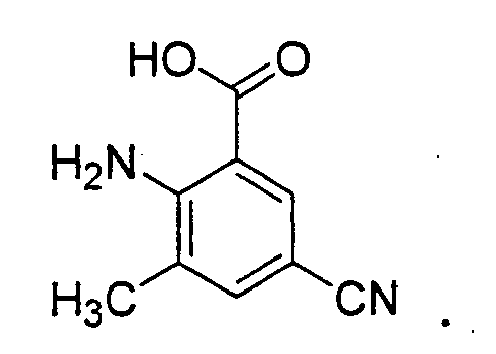
1H-NMR (DMSO-d6,TMS) δ: 2.13 (3H, s), 7.34 (2H, brs), 7.51 (1H, d, J=2Hz), 7.97 (1H, d, J=2Hz). - According to the same manner as that of Reference Preparation Example 46-(1), 2-amino-5-cyano-3-methylbenzoic acid was used in place of 2-amino-3,5-dibromobenzoic acid to obtain 2-[3-bromo-1-(3-chloro-2-pyridinyl)-1H-pyrazol-5-yl]-8-methyl-6-cyano-4H-3,1-benzoxazine-4-one of the formula:

1H-NMR (DMSO-d6,TMS) δ :1.73 (3H, s), 7.60 (1H, s), 7.77 (1H, dd, J=8Hz, 5Hz), 8.10 (1H, d, J=2Hz), 8.34-8.39 (2H, m), 8.63 (1H, d, J=5Hz). - To a mixture of 15.1 g of N-methyl anthranilic acid and 300 ml acetic acid was added dropwise 3.2 g of bromine over 15 minutes. The resulting mixture was stirred at room temperature for 5 hours. Further 1.6 g of bromine was added dropwise thereto over 15 minutes, and the mixture was stirred at room temperature for 3 hours. The reaction mixture was filtered, and the resulting solid was washed successively with acetic acid, ethyl acetate and acetone to obtain 23 g of 3,5-dibromo-2-methylaminobenzoic acid of the formula:

1H-NMR (DMSO-d6,TMS) δ :2.89-2.92 (3H, m), 7.76-7.79 (1H, m), 7.83-7.86 (1H, m). - A mixture of 1.0 g of 3-bromo-1-(3-chloro-2-pyridinyl)-1H-pyrazole-5-carboxylic acid, 2 ml of thionyl chloride and one drop of N,N-dimethylformamide was stirred at 80°C for 1 hour. After he reaction mixture was concentrated under reduced pressure, 10 ml of hexane was added and the mixture was further concentrated under reduced pressure. The resulting residue was mixed with 20 ml of acetonitrile and 0.93 g of 3,5-dibromo-2-methylaminobenzoic acid. After the mixture was stirred at room temperature for 1 hour, 0.6 g of triethylamine was added and the mixture was further stirred at room temperature for 1 hour. The reaction mixture was poured into 30 ml of water, and the mixture was extracted with ethyl acetate three times. The organic layers were combined, washed successively with water and an aqueous saturated sodium chloride solution, dried over anhydrous sodium sulfate, and concentrated under reduced pressure. The residue was washed with methyl t-butyl ether to obtain 1.3 g of 3,5-dibromo-2-{N-[3-bromo-1-(3-chloro-2-pyridinyl)-1H-pyrazole-5-carbonyl]-N-methylamino}benzoic acid of the formula:

1H-NMR (DMSO-d6,TMS) δ :2.98-3.34 (3H, m), 5.95 (1H, s), 7.62 (1H, dd, J=8Hz, 5Hz), 7.70 (1H, d, J=2Hz), 7.89 (1H, d, J=2Hz), 8.18 (1H, d, J=8Hz), 8.49 (1H, d, J=5Hz). - To a mixture of 0.13 g of N,N'-dimethylhydrazine dihydrochloride, 1 ml of water, 0.14 g of potassium carbonate and 10 ml of tetrahydrofuran was added 0.23 g of 2-[3-bromo-1-(3-chloro-2-pyridinyl)-1H-pyrazol-5-yl]-6-chloro-8-methyl-4H-3,1-benzoxazine-4-one, and the resulting mixture was stirred at room temperature for 3 hours. The reaction mixture was poured into 30 ml of water, and the mixture was extracted with ethyl acetate three times. The organic layers were combined, dried over anhydrous sodium sulfate, and concentrated under reduced pressure. The residue was washed with ethyl acetate to obtain 0.35 g of 3-bromo-N-[4-chloro-2-(N,N'-dimethylhydrazinocarbonyl)-6-methylphenyl]-1-(3-chloro-2-pyridinyl)-1H-pyrazole-5-carboxamide of the formula:

1H-NMR (DMSO-d6,TMS) δ :1.99-2.40 (6H, m), 2.98-3.09 (3H, m), 4.61 (0.7H, brs), 5.68 (0.3H, brs), 7.14-7.51 (3H,m), 7.61 (1H, dd, J=8Hz, 5Hz), 8.18 (1H, d, J=5Hz), 8.50 (1H, d, J=2Hz), 10.03 (0.6H, brs), 10.39 (0.4H, brs). - To a mixture of 0.78 g of 2-amino-5-fluorobenzoic acid and 100 ml of N,N-dimethylformamide was added 1.1 g of N-bromosuccinimide at room temperature, and the mixture was stirred at room temperature for 5 hours. After water was added to the reaction mixture, a deposited precipitate was collected by filtration, and then washed with acetone to obtain 0.43 g of 2-amino-3-bromo-5-fluorobenzoic acid of the formula:
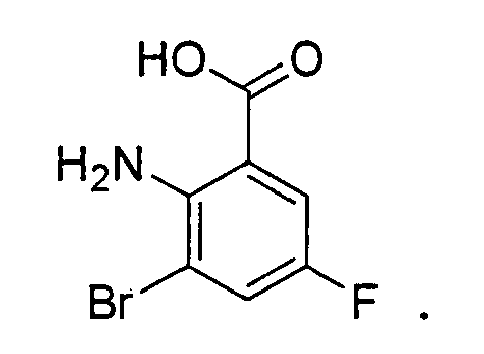
1H-NMR (DMSO-d6,TMS) δ :7.55 (1H, dd, J=8Hz, 3Hz), 7.71 (1H, dd, J=8Hz, 3Hz). - According to the same manner as that of Reference Preparation Example 46-(1), 2-amino-3-bromo-5-fluorobenzoic acid was used in place of 2-amino-3,5-dibromobenzoic acid to obtain 2-[3-bromo-1-(3-chloro-2-pyridinyl)-1H-pyrazol-5-yl]-8-bromo-6-fluoro-4H-3,1-benzoxazine-4-one of the formula:

1H-NMR (DMSO-d6,TMS) 5:7.54 (1H, s), 7.72 (1H, dd, J=8Hz, 5Hz), 7.92 (1H, dd, J=8Hz, 3Hz), 8.15 (1H, dd, J=8Hz, 3Hz), 8.32 (1H, dd, J=8Hz, 1Hz), 8.59 (1H, dd, J=5Hz, 1Hz). - According to the same manner as that of Reference Preparation Example 63-(1), 2-phenylaniline was used in place of 3-chloro-2-methylaniline to obtain N-(biphenyl-2-yl)-2-(hydroxyimino)acetamide of the formula:

1H-NMR (DMSO-d6,TMS) δ :7.27-7.48 (9H, m), 7.83 (1H, d, J=8Hz), 9.1-8 (1H, s), 12.14 (1H, s). - According to the same manner as that of Reference Preparation Example 63-(2), N-(biphenyl-2-yl)-2-(hydroxyimino)acetamide was used in place of N-(3-chloro-2-methylphenyl)-2-(hydroxyimino)acetamide to obtain 7-phenyl-1H-indole-2,3-dione of the formula:

1H-NMR (DMSO-d6,TMS) δ :7.18 (1H, t, J=8Hz), 7.40-7.63 (7H, m), 10.91 (1H, s). - According to the same manner as that of Reference Preparation Example 63-(3), 7-phenyl-1H-indole-2,3-dione was used in place of 6-chloro-7-methyl-1H-indole-2,3-dione to obtain 2-amino-3-phenylbenzoic acid of the formula:

1H-NMR (DMSO-d6,TMS) δ :6.65 (1H, t, J=8Hz), 7.17 (1H, d, J=7Hz), 7.35-7.55 (5H, m), 7.78 (1H, d, J=8Hz). - According to the same manner as that of Reference Preparation Example 46-(1), 2-amino-3-phenylbenzoic acid was used in place of 2-amino-3,5-dibromobenzoic acid to obtain 2-[3-bromo-1-(3-chloro-2-pyridinyl)-1H-pyrazol-5-yl]-8-phenyl-4H-3,1-benzoxazine-4-one of the formula:

1H-NMR (DMSO-d6,TMS) δ :7.05-7.48 (7H, m), 7.61-7.89 (3H, m), 8.09-8.28 (2H, m). - According to the same manner as that of Reference Preparation Example 71-(5), 2-amino-3,5-dibromobenzoic acid was used in place of 2-amino-5-chloro-3-methylbenzoic acid to obtain 6,8-dibromo-2-[4-bromo-1-(3-chloro-2-pyridinyl)-1H-pyrrol-2-yl]-4H-3,1-benzoxazine-4-one of the formula:

1H-NMR (CDCl3,TMS) δ (ppm): 7.11 (1H, d, J=2Hz), 7.37 (1H, d, J=2Hz), 7.41 (1H, dd, J=8Hz, 5Hz), 7.92 (1H, dd, J=8Hz, 2Hz), 7.97 (1H, d, J=2Hz), 8.20 (1H, d, J=2Hz), 8.51 (1H, dd, J=5Hz, 2Hz). - According to the same manner as that of Reference Preparation Example 71-(5), 2-amino-3-bromo-5-chlorobenzoic acid was used in place of 2-amino-5-chloro-3-methylbenzoic acid to obtain 8-bromo-2-[4-bromo-1-(3-chloro-2-pyridinyl)-1H-pyrrol-2-yl]-6-chloro-4H-3,1-benzoxazine-4-one of the formula:

1H-NMR (CDCl3,TMS) δ (ppm): 7.11 (1H, d, J=2Hz), 7.37 (1H, d, J=2Hz), 7.41 (1H, dd, J=8Hz, 5Hz), 7.82 (1H, d, J=2Hz), 7.92 (1H, dd, J=8Hz, 2Hz), 8.05 (1H, d, J=2Hz), 8.51 (1H, dd, J=5Hz, 2Hz). - According to the same manner as that of Reference Preparation Example 71-(5), 2-amino-5-cyano-3-methylbenzoic acid was used in place of 2-amino-5-chloro-3-methylbenzoic acid to obtain 2-[4-bromo-1-(3-chloro-2-pyridinyl)-1H-pyrrol-2-yl]-6-cyano-8-methyl-4H-3,1-benzoxazine-4-one of the formula:

1H-NMR (DMSO-d6,TMS) δ (ppm) : 1.68 (3H, s), 7.35 (1H, d, J=2Hz), 7.67 (1H, dd, J=8Hz, 5Hz), 7.70 (1H, d, J=2Hz), 7.97 (1H, s), 8.23 (1H, dd, J=8Hz, 2Hz), 8.28 (1H, s), 8.57 (1H, dd, J=5Hz, 2Hz). - According to the same manner as that of Reference Preparation Example 63-(1), 2-ethylaniline was used in place of 3-chloro-2-methylaniline to obtain N-(2-ethylphenyl)-2-(hydroxyimino)acetamide of the formula:

1H-NMR(DMSO-d6,TMS)δ:1.12(3H,t,J=8Hz),2.59(2H,q,J=8Hz),7.15 -7.27(3H,m),7.43(1H,dd,J=6Hz,4Hz),7.67(1H,s),9.49(1H,s),12. 17(1H,s). - According to the same manner as that of Reference Preparation Example 63-(2), N-(2-ethylphenyl)-2-(hydroxyimino)acetamide was used in place of N-(3-chloro-2-methylphenyl)-2-(hydroxyimino)acetamide to obtain crude 7-ethyl-1H-indole-2,3-dione of the formula:

- A mixture of 1.0 g of crude 7-ethyl-1H-indole-2,3-dione and 3 ml of a 2N aqueous sodium hydroxide solution was added dropwise to 2 g of aqueous hydrogen peroxide (30%) at room temperature, and the resulting mixture was stirred at room temperature for 1 hour. The reaction mixture was adjusted to pH 4 by an addition of 2N hydrochloric acid, and a deposited precipitate was collected by filtration. The resulting filter cake was partitioned between ethyl acetate and a saturated sodium hydrogen carbonate solution. The aqueous layer was adjusted to pH 4 by an addition of 2N hydrochloric acid, and a deposited precipitate was collected by filtration to obtain 0.42 g of 2-amino-3-ethylbenzoic acid of the formula:

1H-NMR (DMSO-d6,TMS) δ :1.15 (3H, t, J=7Hz), 2.44-2.53 (2H, m), 6.50 (1H, dd, J=8Hz, 7Hz), 7.15 (1H, d, J=7Hz), 7.62 (1H, d, J=8Hz). - According to the same manner as that of Reference Preparation Example 46-(1), 2-amino-3-ethylbenzoic acid was used in place of 2-amino-3,5-dibromobenzoic acid to obtain 2-[3-bromo-1-(3-chloro-2-pyridinyl)-1H-pyrazol-5-yl]-8-ethyl-4H-3,1-benzoxazine-4-one of the formula:

1H-NMR (DMSO-d6,TMS) δ :0.81 (3H, t, J=7Hz), 2.07 (2H, q, J=7Hz), 7.47-7.57 (2H, m), 7.70 (1H, d, J=7Hz), 7.79 (1H, dd, J=8,5Hz), 7.95 (1H, d, J=7Hz), 8.37 (1H, d, J=8Hz), 8.64 (1H, d, J=5Hz). - According to the same manner as that of Reference Preparation Example 67-(1), cyclohexylhydrazine hydrochloride was used in place of tert-butylhydrazine hydrochloride to obtain 1-cyclohexyl-3-trifluoromethyl-1H-pyrazole of the formula:

1H-NMR (CDCl3,TMS) δ (ppm): 1.19-1.33 (3H, m), 1.67-1.77 (2H, m), 1.93-1.99 (4H, m), 2.16-2.19 (1H, m), 4.13-4.20 (1H, m), 6.49 (1H, s), 7.45 (1H, s). - According to the same manner as that of Reference Preparation Example 15, 1-cyclohexyl-3-trifluoromethyl-1H-pyrazole was used in place of 3-chloro-2-(3-trifluoromethyl-1H-pyrazole-1-yl)pyridine to obtain 1-cyclohexyl-3-trifluoromethyl-1H-pyrazole-5-carboxylic acid of the formula:

1H-NMR (CDCl3,TMS) δ (ppm): 1.26-2.00 (10H, m), 5.10-5.18 (1H, m), 7.15 (1H, s). - According to the same manner as that of Reference Preparation Example 13, 1-cyclohexyl-3-trifluoromethyl-1H-pyrazole-5-carboxylic acid was used in place of 1-(3-chloro-2-pyridinyl)-1H-pyrazole-5-carboxylic acid to obtain 6-chloro-2-(1-cyclohexyl-3-trifluoromethyl-1H-pyrazol-5-yl)
- -8-methyl-4H-3,1-benzoxazine-4-one of the formula:

1H-NMR (CDCl3,TMS) δ (ppm): 1.26-1.54 (4H, m), 1.77 (1H, d, J=2Hz), 1.96-2.62 (5H,m), 2.62 (3H, s), 5.51-5.58 (1H, m), 7.31 (1H, s), 7.69 (1H, d, J=2Hz), 8.07 (1H, d, J=2Hz). - According to the same manner as that of Reference Preparation Example 1, 6-chloro-2-(1-cyclohexyl-3-trifluoromethyl-1H-pyrazol-5-yl)-8-methyl-4H-3,1-benzoxazine-4-one was used in place of 6-chloro-2-[1-(3-chloro-2-pyridinyl)-3-trifluoromethyl-1H-pyrazol-5-yl]-8-methyl-4H-3,1-benzoxazine-4-one to obtain N-[4-chloro-2-(hydrazinocarbonyl)-6-methylphenyl]-1-cyclohexyl-3-trifluoromethyl-1H-pyrazole-5-carboxamide of the formula:
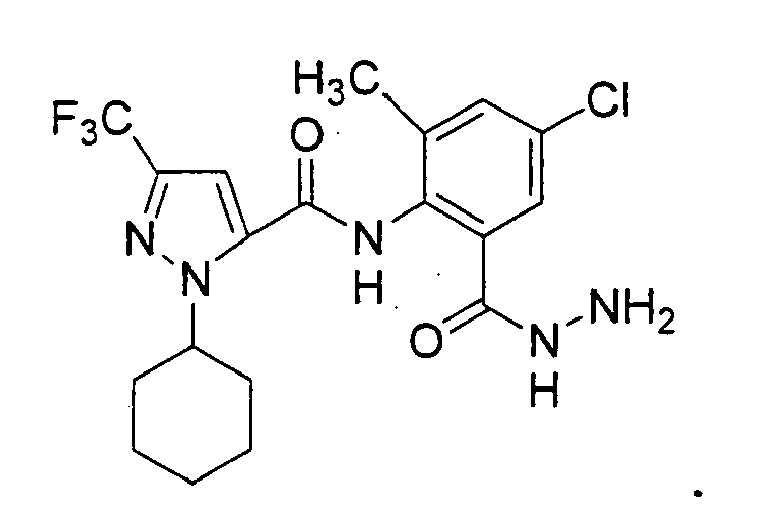
1H-NMR (DMSO-d6,TMS) δ (ppm): 1.20-1.39 (3H, m), 1.66 (1H, d, J=12Hz), 1.75-1.84 (4H, m), 1.98 (2H, d, J=10Hz), 2.25 (3H, s), 4.36 (2H, brs), 5.03-5.09 (1H, m), 7.35 (2H, s), 7.52 (1H, s), 9.62 (1H, brs), 10.17 (1H, brs). - To a solution of 1.0 g of 3-chloro-2-(2-formyl-1H-pyrrol-1-yl)pyridine in 15 ml of N,N-dimethylformamide, 1.9 g of N-bromosuccinimide was added. The mixture was stirred at room temperature for 3 hours. Water was poured into the reaction mixture, and the mixture was extracted with ethyl acetate three times. The organic layers were combined, washed with an aqueous saturated sodium chloride solution, dried over anhydrous magnesium sulfate, and concentrated under reduced pressure to obtain 1.2 g of 4,5-dibromo-1-(3-chloro-2-pyridinyl)-1H-pyrrole-2-carbaldehyde of the formula:
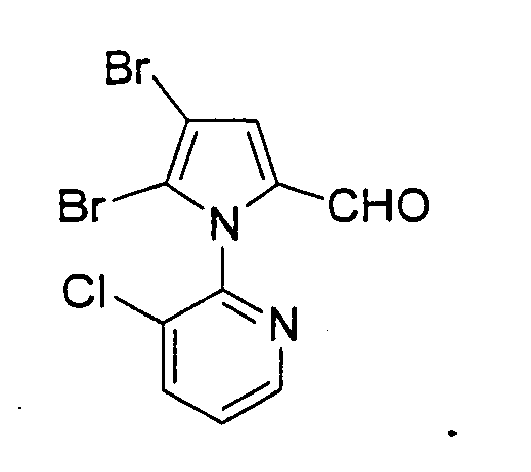
1H-NMR (CDCl3,TMS) δ (ppm): 7.14 (1H, s), 7.47 (1H, dd, J=8Hz, 5Hz), 7.93 (1H, dd, J=8Hz, 2Hz), 8.53 (1H, dd, J=5Hz, 2Hz), 9.33 (1H, s). - To a mixture of 1.0 g of 4,5-dibromo-1-(3-chloro-2-pyridinyl)-1H-pyrrole-2-carbaldehyde, 15 ml of acetone and 7 ml of water was slowly added 1.3 g of potassium permanganate at 40°C. The resulting mixture was stirred at 60°C for 2 hours. Precipitates in the reaction mixture were removed by filtration. The resulting filtrate was washed with chloroform two times. The aqueous layer was adjusted to around pH 3 by an addition of 2N hydrochloric acid and then extracted with ethyl acetate three times. The organic layers were combined, washed with an aqueous saturated sodium chloride solution, dried over anhydrous magnesium sulfate, and then concentrated under reduced pressure to obtain 0.69 g of 4,5-dibromo-1-(3-chloro-2-pyridinyl)-1H-pyrrole-2-carboxylic acid of the formula:

1H-NMR (DMSO-d6,TMS) δ (ppm) : 7.15 (1H, m), 7.64 (1H, dd, J=8Hz, 5Hz), 8.19 (1H, dd, J=8Hz, 2Hz), 8.56 (1H, dd, J=5Hz, 2Hz). - According to the same manner as that of Reference Preparation Example 71-(5), 4,5-dibromo-1-(3-chloro-2-pyridinyl)-1H-pyrrole-2-carboxylic acid was used in place of 4-bromo-1-(3-chloro-2-pyridinyl)-1H-pyrrole-2-carboxylic acid to obtain 2-[4,5-dibromo-1-(3-chloro-2-pyridinyl)-1H-pyrrol-2-yl]-6-chloro-8-methyl-4H-3,1-benzoxazine-4-one of the formula:

1H-NMR (CDCl3,TMS) δ (ppm): 1.72 (3H, s), 7.40 (2H, s), 7.48 (1H, dd, J=8Hz, 5Hz), 7.92 (1H, s), 7.98 (1H, dd, J=8Hz, 2Hz), 8.58 (1H, dd, J=5Hz, 2Hz). - According to the same manner as that of Reference Preparation Example 71-(6), 2-[4,5-dibromo-1-(3-chloro-2-pyridinyl)-1H-pyrrol-2-yl]-6-chloro-8-methyl-4H-3,1-benzoxazine-4-one was used in place of 2- [4-bromo-1- (3-chloro-2-pyridinyl)-1H-pyrrol-2-yl]-6-chloro-8-methyl-4H-3,1-benzoxazine-4-one to obtain 4,5-dibromo-N-[4-chloro-2-(hydrazinocarbonyl)-6-methylphenyl]-1-(3-chloro-2-pyridinyl )-1H-pyrrole-2-carboxamide of the formula:

1H-NMR (CDCl3,TMS) δ (ppm): 2.15 (3H, s), 4.03 (2H, brs), 7.15 (1H, s), 7.22 (1H, d, J=3Hz), 7.25 (1H, d, J=3Hz), 7.37 (1H, dd, J=8Hz, 5Hz), 7.70 (1H, brs), 7.86 (1H, dd, J=8Hz, 2Hz), 8.47 (1H, dd, J=5Hz, 2Hz), 9.50 (1H, brs). - To a solution of 1.0 g of 3-chloro-2- (2-formyl-1H-pyrrol-1-yl)pyridine in 15 ml of N,N-dimethylformamide was added 0.68 g of N-chlorosuccinimide. The resulting mixture was stirred at 50°C for 2 days. Water was poured into the reaction mixture, and the mixture was extracted with ethyl acetate two times. The organic layers were combined, washed successively with water and an aqueous saturated sodium chloride solution, dried over anhydrous magnesium sulfate, and concentrated under reduced pressure. The residue was subjected to silica gel column chromatography to obtain 0.35 g of 4-chloro-1-(3-chloro-2-pyridinyl)-1H-pyrrole-2-carbaldehyde of the formula:


1H-NMR(CDCl3,TMS)δ(ppm):7.04(1H,d,J=2Hz),7.10(1H,dd,J=2Hz, 1Hz),7.41(1H,dd,J=8Hz,5Hz),7.89(1H,dd,J=8Hz,2Hz),8.46(1H,dd, J=5Hz,2Hz),9.50(1H,d,J=1Hz)
5-Chloro-1-(3-chloro-2-pyridinyl)-1H-pyrrole-2-carbaldehyde 1H-NMR(CDCl3,TMS)δ(ppm):6.41(1H,d,J=4Hz),7.08(1H,d,J=4Hz), 7.45(1H,dd,J=8Hz,5Hz),7.92(1H,dd,J=8Hz,2Hz),8.54(1H,dd, J=5Hz,2Hz),9.41(1H,s) - According to the same manner as that of Reference Preparation Example 71-(4), 5-chloro-1-(3-chloro-2-pyridinyl)-1H-pyrrole-2-carbaldehyde was used in place of 4-bromo-1-(3-chloro-2-pyridinyl)-1H-pyrrole-2-carbaldehyde to obtain 5-chloro-1-(3-chloro-2-pyridinyl)-1H-pyrrole-2-carboxylic acid of the formula:

1H-NMR(DMSO-d6,TMS)δ(ppm):6.39(1H,d,J=4Hz),7.01(1H,d,J=4Hz), 7.62(1H,dd,J=8Hz,5Hz)8.13(1H,d,J=8Hz),8.54(1H,d,J=5Hz) - According to the same manner as that of Reference Preparation Example 71-(5), 5-chloro-1-(3-chloro-2-pyridinyl)-1H-pyrrole-2-carboxylic acid was used in place of 4-bromo-1-(3-chloro-2-pyridinyl)-1H-pyrrole-2- carboxylic acid to obtain 2-[5-chloro-1-(3-chloro-2-pyridinyl)-1H-pyrrol-2-yl]-6-chloro-8-methyl-4H-3,1-benzoxazine-4-one of the formula:

1H-NMR(CDCl3,TMS)δ(ppm):1.71(3H,s),6.43(1H,d,J=4Hz),7.32 (1H,d,J=4Hz),7.38(1H,d,J=2Hz),7.47(1H,dd,J=8Hz,5Hz),7.92 (1H,d,J=2Hz),7.97(1H,dd,J=8Hz,2Hz),8.59(1H,dd,J=5Hz,2Hz) - According to the same manner as that of Reference Preparation Example 71-(4), 1-(3-chloro-2-pyridinyl)-1H-pyrrole-2-carbaldehyde was used in place of 4-bromo-1-(3-chloro-2-pyridinyl)-1H-pyrrole-2-carbaldehyde to obtain 1-(3-chloro-2-pyridinyl)-1H-pyrrole-2-carboxylic acid of the formula:
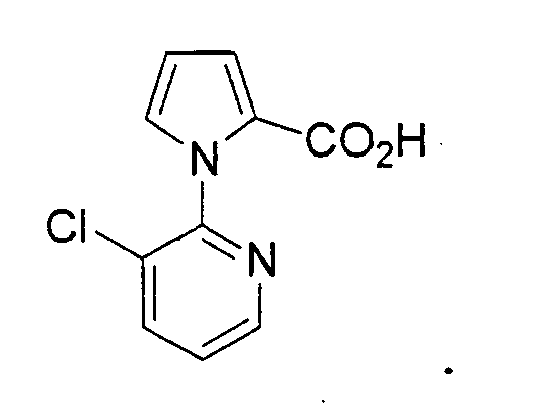
1H-NMR(DMSO-d6,TMS)δ(ppm):6.33-6.34(1H,m),6.97(1H,d,J=4Hz), 7.18(1H,brs),7.54(1H,dd,J=8Hz,5Hz),8.10(1H,d,J=8Hz),8.47-8. 49(1H,m) - According to the same manner as that of Reference Preparation Example 71-(5), 1-(3-chloro-2-pyridinyl)-1H-pyrrole-2-carboxylic acid was used in place of 4-bromo-1-(3-chloro-2-pyridinyl)-1H-pyrrole-2-carboxylic acid to obtain 2-[1-(3-chloro-2-pyridinyl)-1H-pyrrol-2-yl]-6-chloro-8-methyl-4H-3,1-benzoxazine-4-one of the formula:

1H-NMR(CDCl3,TMS)δ(ppm):1.73(3H,s),6.50(1H,dd,J=4Hz,3Hz), 7.09(1H,dd,J=3Hz,2Hz),7.36(1H,dd,J=4Hz,2Hz),7.39(1H,s),7.41 (1H,dd,J=8Hz,5Hz),7.90(1H,dd,J=8Hz,2Hz),7.93(1H,s),8.52(1H, dd,J=5Hz,2Hz) - According to the same manner as that of Reference Preparation Example 71-(6), 2-[1-(3-chloro-2-pyridinyl)-1H-pyrrol-2-yl]-6-chloro-8-methyl-4H-3,1-benzoxazine-4-one was used in place of 2-[4-bromo-1-(3-chloro-2-pyridinyl)-1H-pyrrol-2-yl]-6-chloro-8-methyl-4H-3,1-benzoxazine-4-one to obtain N-[4-chloro-2-(hydrazinocarbonyl)-6-methylphenyl]-1-(3-chloro-2-pyridinyl)-1H-pyrrole-2-carboxamide of the formula:

1H-NMR(DMSO-d6,TMS)δ(ppm):2.16(3H,s),4.40(2H,brs),6.37(1H, dd,J=4Hz,3Hz),7.13-7.16(2H,m),7.31(1H,d,J=2Hz),7.41(1H,brs), 7.47(1H,dd,J=8Hz,5Hz),8.02(1H,d,J=8Hz),8.42(1H,d,J=5Hz), 9.56(1H,brs),9.84(1H,brs) - According to the same manner as that of Reference Preparation Example 1, 2-[3-bromo-1-(3-chloro-2-pyridinyl)-1H-pyrazol-5-yl]-6-cyano-8-methyl-4H-3,1- benzoxazine-4-one was used in place of 6-chloro-2-[1-(3-chloro-2-pyridinyl)-3-trifluoromethyl-1H-pyrazol-5-yl]-8-methyl-4H-3,1-benzoxazine-4-one to obtain 3-bromo-1-(3-chloro-2-pyridinyl) -N-[4-cyano-2-(hydrazinocarbonyl)-6-methylphenyl]-1H-pyrazole-5-carboxamide of the formula:

1H-NMR(DMSO-d6)δ:2.19(3H,s),4.41(2H,brs),7.41(1H,s),7.61(1H, dd,J=8Hz,5Hz),7.72(1H,s),7.88(1H,s),8.17(1H,d,J=8Hz), 8.50(1H,d,J=5Hz),9.65(1H,brs),10.52(1H,brs) - To a solution of 3.0 g of 3-chloro-2- (2-formyl-1H-pyrrol-1-yl)pyridine in 10 ml of N,N-dimethylformamide was added 4.5 g of N-chlorosuccinimide. The resulting mixture was stirred at 50°C for 2 hours. Water was poured into the reaction mixture, and the mixture was extracted with ethyl acetate two times. The organic layers were combined, washed successively with water and an aqueous saturated sodium chloride solution, dried over anhydrous magnesium sulfate, and concentrated under reduced pressure to obtain 3.6 g of 4,5-dichloro-1-(3-chloro-2-pyridinyl)-1H-pyrrole-2-carbaldehyde of the formula:

1H-NMR(CDCl3,TMS)δ(ppm):7.06(1H,s),7.47(1H,dd,J=8Hz,5Hz), 7.93(1H,dd,J=8Hz,2Hz),8.53(1H,dd,J=5Hz,2Hz),9.37(1H,s) - According to the same manner as that of Reference Preparation Example 71-(4), 4,5-dichloro-1-(3-chloro-2-pyridinyl)-1H-pyrrole-2-carbaldehyde was used in place of 4-bromo-1-(3-chloro-2-pyridinyl)-1H-pyrrole-2- carbaldehyde to obtain 4,5-dichloro-1-(3-chloro-2-pyridinyl)-1H-pyrrole-2-carboxylic acid of the formula:

1H-NMR(DMSO-d6,TMS)δ(ppm):7.18(1H,s),7.68(1H,dd,J=8Hz,5Hz), 8.25(1H,dd,J=8Hz,2Hz),8.59(1H,dd,J=5Hz,2Hz) - According to the same manner as that of Reference Preparation Example 71-(5), 4,5-dichloro-1-(3-chloro-2-pyridinyl)-1H-pyrrole-2-carboxylic acid was used in place of 4-bromo-1-(3-chloro-2-pyridinyl)-1H-pyrrole-2-carboxylic acid to obtain 2-[4,5-dichloro-1-(3-chloro-2-pyridinyl)-1H-pyrrol-2-yl]-6-chloro-8-methyl-4H-3,1-benzoxazine-4-one of the formula:

1H-NMR(CDCl3,TMS)δ(ppm):1.71(3H,s),7.31(1H,s),7.40(1H,s), 7.49(1H,dd,J=8Hz,5Hz),7.92(1H,s),7.98(1H,d,J=8Hz), 8.58(1H,d,J=5Hz) - According to the same manner as that of Reference Preparation Example 71-(6), 2-[4,5-dichloro-1-(3-chloro-2-pyridinyl)-1H-pyrrole-2-yl]-6-chloro-8-methyl-4H-3,1-benzoxazine-4-one was used in place of 2-[4-bromo-1-(3-chloro-2-pyridinyl)-1H-pyrrol-2-yl]-6-chloro-8-methyl-4H-3,1-benzoxazine-4-one to obtain 4,5-dichloro-N-[4-chloro-2-(hydrazinocarbonyl)-6-methylphenyl]-1-(3-chloro-2-pyridinyl )-1H-pyrrole-2-carboxamide of the formula:

1H-NMR(CDCl3,TMS)δ(ppm):2.01(3H,s),4.03(2H,brs),7.07(1H,s), 7.16(1H,d,J=2Hz),7.22(1H,d,J=2Hz),7.37(1H,dd,J=8Hz,5Hz), 7.47(1H,brs),7.86(1H,dd,J=8Hz,2Hz),8.47(1H,dd,J=5Hz,2Hz), 9.41(1H,brs) - A mixture of 0.86 g of 2-[4-bromo-1-(3-chloro-2-pyridinyl)-1H-pyrrol-2-yl]-6-chloro-8-methyl-4H-3,1-benzoxazine-4-one, 0.11 g of methylhydrazine and 15 ml of tetrahydrofuran was stirred at room temperature for 2 hours. Water was poured into the reaction mixture, and the mixture was extracted with ethyl acetate. The organic layer was washed with water, dried over sodium sulfate, and concentrated under reduced pressure. The resulting residue was subjected to silica gel chromatography to obtain 0.17 g of 4-bromo-N-[4-chloro-2-(N-methylhydrazinocarbonyl)-6-methylphenyl]-1-(3-chloro-2-pyridinyl)-1H-pyrrole-2-carboxamide of the formula:

1H-NMR(CDCl3,TMS)δ(ppm):2.14-2.16(3H,m),3.02-3.23(3H,m), 4.04(0.7H,brs),4.60(1.3H,brs),7.03(2H,s),7.11(0.5H,s), 7.19(0.5H,s),7.31(1H,dd,J=8Hz,4Hz),7.80(1H,d,J=8Hz), 8.41(1H,d,J=4Hz),8.56(1H,brs) - According to the same manner as that of Reference Preparation Example 46-(1), 2-amino-3,5-dichlorobenzoic acid was used in place of 2-amino-3,5-dibromobenzoic acid to obtain 2-[3-bromo-1-(3-chloro-2-pyridinyl)-1H-pyrazol-5-yl]-6,8-dichloro-4H-3,1-benzoxazine-4-one of the formula:

1H-NMR(DMSO-d6,TMS)δ(ppm):7.57(1H,s)7.73(1H,dd,J=8Hz,5Hz), 8.03(1H,d,J=2Hz),8.12(1H,d,J=2Hz),8.32(1H,dd,J=8Hz,2Hz), 8.60(1H,dd,J=5Hz,2Hz). - According to the same manner as that of Reference Preparation Example 84, 2-[3-bromo-1-(3-chloro-2-pyridinyl)-1H-pyrazol-5-yl]-6-cyano-8-methyl-4H-3,1-benzoxazine-4-one was used in place of 2-[3-bromo-1-(3-chloro-2-pyridinyl)-1H-pyrazol-5-yl]-6-chloro-8-methyl-4H-3,1-benzoxazine-4-one to obtain 3-bromo-1-(3-chloro-2-pyridinyl)-N-[4-cyano-2-(N-methylhydrazinocarbonyl)-6-methylphenyl]-1H-pyrazole-5-carboxamide of the formula:

1H-NMR(DMSO-d6,TMS)δ(ppm):2.22(3H,s),2.75-3.10(3H,m), 4.51-5.03(2H,m),7.36(1H,s),7.60-7.71(2H,m),7.74-7.88(1H,m), 8.20(1H,d,J=8Hz),8.51(1H,d,J=4Hz),10.27-10.63(1H,m) - According to the same manner as that of Reference Preparation Example 101, 2-[4-bromo-1-(3-chloro-2-yridinyl)-1H-pyrrol-2-yl]-6-cyano-8-methyl-4H-3,1-enzoxazine-4-one was used in place of 2-[4-bromo-1-(3-chloro-2-pyridinyl)-1H-pyrrol-2-yl]-6-chloro-8-methyl-4H-3,1-benzoxazine-4-one to obtain 4-bromo-1-(3-chloro-2-pyridinyl)-N-[4-cyano-2-(N-methylhydrazinocarbonyl)-6-methylphenyl]-1H-pyrrole-2-carboxamide of the formula:

1H-NMR(DMSO-d6,TMS)δ(ppm):2.21(3H,s),2.74-3.10(3H,m),4.51-4.99(2H,m),7.22-7.28(1H,m),7.46-7.56(2H,m),7.56-7.65(1H,m), 7.70-7.84(1H,m),8.09(1H,d,J=8Hz),8.44(1H,d,J=4Hz),9.76-10.04(1H,m) - According to the same manner as that of Reference Preparation Example 46-(1), 3-amino-4-bromo- 2-naphthoic acid was used in place of 2-amino-3,5- dibromobenzoic acid to obtain 10-bromo-2-[3-bromo-1-(3-chloro-2-pyridinyl)-1H-pyrazol-5-yl]-4H-naphtho[2, 3-d][1,3]oxazine- 4-one of the formula:

1H-NMR(DMSO-d6,TMS)δ(ppm):7.55(1H,s),7.72-7.79(2H,m),7.89 (1H,t,J=8Hz),8.23(1H,d,J=8Hz),8.32(1H,d,J=8Hz),8.37(1H,dd, J=8Hz,1Hz),8.63(1H,dd,J=5Hz,1Hz),8.93(1H,s) - According to the same manner as that of Reference Preparation Example 1, 10-bromo-2-[3-bromo-1-(3-chloro-2-pyridinyl)-1H-pyrazol-5-yl]-4H-naphtho[2,3-d][1,3]oxazine-4 -one was used in place of 6-chloro-2-[1-(3-chloro-2-pyridinyl)-3-trifluoromethyl-1H-pyrazol-5-yl]-8-methyl-4H-3,1-benzoxazine-4-one to obtain 3-bromo-N-[1-bromo-3-(hydrazinocarbonyl)-2-naphthyl]-1-(3-chloro-2-pyridinyl)-1H-pyrazole-5-carboxamide of the formula:

1H-NMR(DMSO-d6,TMS)δ(ppm):4.37(2H,brs),7.52(1H,s),7.59(1H, dd,J=8Hz,4Hz),7.69(1H,t,J=8Hz),7.77(1H,t,J=8Hz),8.04-8.09 (2H,m),8.15(1H,d,J=8Hz),8.21(1H,d,J=8Hz),8.50(1H,d,J=4Hz), 9.63(1H,brs),10.65(1H,brs) - According to the same manner as that of Reference Preparation Example 71-(5), 3-amino-4-bromo-2-naphthoic acid was used in place of 2-amino-5-chloro-3-methylbenzoic acid to obtain 10-bromo-2-[4-bromo-1-(3-chloro-2-pyridinyl)-1H-pyrrol-2-yl]-4H-naphtho[2,3-d][1,3]oxazine-4-one of the formula:

1H-NMR(DMSO-d6,TMS)δ(ppm):7.33(1H,d,J=2Hz),7.65-7.75(3H,m), 7.84(1H,t,J=8Hz),8.17(1H,d,J=8Hz),8.28(2H,d,J=8Hz), 8.57-8.61(1H,m),8.87(1H,s) - According to the same manner as that of Reference Preparation Example 71-(6), 10-bromo-2-[4-bromo-1-(3-chloro-2-pyridinyl)-1H-pyrrol-2-yl]-4H-naphtho[2,3-d][1,3]oxazine-4-one was used in place of 2-[4-bromo-1-(3-chloro-2-pyridinyl)-1H-pyrrol-2-yl]-6-chloro-8-methyl-4H-3,1-benzoxazine-4-one to obtain 4-bromo-N-[1-bromo-3-(hydrazinocarbonyl)-2-naphthyl]-1-(3-chloro-2-pyridinyl)-1H -pyrrole-2-carboxamide of the formula:

1H-NMR(DMSO-d6,TMS)δ(ppm):4.37(2H,brs),7.40(1H,s),7.43-7.52 (2H,m),7.66(1H,t,J=7Hz),7.75(1H,t,J=7Hz),8.01-8.08(3H,m), 8.20(1H,d,J=8Hz),8.43(1H,d,J=5Hz), 9.55(1H,brs),10.12(1H, brs) - According to the same manner as that of Reference Preparation Example 71-(6), 2-[4-bromo-1-(3-chloro-2-pyridinyl)-1H-pyrrol-2-yl]-6-cyano-8-methyl-4H-3,1-benzoxazine-4-one was used in place of 2-[4-bromo-1-(3-chloro-2-pyridinyl)-1H-pyrrol-2-yl]-6-chloro-8-methyl-4H-3,1-benzoxazine-4-one to obtain 4-bromo-1-(3-chloro-2-pyridinyl)-N-[4-cyano-2-(hydrazinocarbonyl)-6-methylphenyl] -1H- pyrrole-2-carboxamide of the formula:

1H-NMR(DMSO-d6,TMS)δ(ppm):2.18(3H,s),4.42(2H,brs),7.28 (1H,s),7.45-7.55(2H,m),7.71(1H,s),7.84(1H,s),8.07(1H,d, J=8Hz),8.44(1H,d,J=4Hz),9.68(1H,brs),10.16(1H,brs) - According to the same manner as that of Reference Preparation Example 88, 2-[4-bromo-1-(3-chloro-2-pyridinyl)-1H-pyrrol-2-yl]-6-cyano-8-methyl-4H-3,1-benzoxazine-4-one was used in place of 2- [3-bromo-1- (3-chloro-2-pyridinyl)-1H-pyrazol-5-yl]-6-chloro-8-methyl-4H-3,1-benzoxazine-4-one to obtain 3-bromo-1-(3-chloro-2-pyridinyl)-N-[4-cyano-2-(N,N'-dimethylhydrazinocarbonyl)-6-methylphenyl]-1H-pyrazole-5-carboxamide of the formula:

1H-NMR(DMSO-d6,TMS)δ(ppm):2.14-2.33(6H,m),2.70-3.09(3H,m), 4.55-6.05(1H,m),7.37(1H,s),7.58-7.66(2H,m),7.71-7.90(1H,m), 8.15-8.21(1H,m),8.48-8.52(1H,m),10.25-10.62(1H,m) - To a mixture of 0.29 g of N,N'-dimethylhydrazine dihydrochloride, 1 ml of water, 0.31 g of potassium carbonate and 10 ml of N,N-dimethylformamide was added 1.0 g of 2-[4-bromo-1-(3-chloro-2-pyridinyl)-1H-pyrrol-2-yl]-6-chloro-8-methyl-4H-3,1-benzoxazine-4-one. The resulting mixture was stirred at room temperature for 6 hours. Water was poured into the reaction mixture, and the mixture was extracted with ethyl acetate three times. The organic layers were combined, dried over anhydrous sodium sulfate, and concentrated under reduced pressure. The resulting residue was subjected to silica gel chromatography to obtain 0.26 g of 4-bromo-N-[4-chloro-2-(N,N'-dimethylhydrazinocarbonyl)-6-methylphenyl]-1-(3-chloro-2-pyridinyl)-1H-pyrrole-2-carboxamide of the formula:

1H-NMR(CDCl3,TMS)δ(ppm):2.16(3H,s),2.43(1H,d,J=6Hz),2.61(2H, d,J=6Hz),2.95(2H,s),3.19(1H,s),3.54(0.3H,d,J=6Hz),5.62(0.7H, d,J=6Hz),7.01-7.07(3H,m),7.14-7.18(1H,m),7.30-(1H,dd,J=8Hz, 5Hz),7.79(1H,d,J=8Hz),8.40(1H,d,J=5Hz),8.56(1H,brs) - According to the same manner as that of Reference Preparation Example 71-(5), 4,5-dichloro-1-(3-chloro-2-pyridinyl)-1H-pyrrole-2-carboxylic acid and 2-amino-3,5-dibromobenzoic acid were used in place of 4-bromo-1-(3-chloro-2-pyridinyl)-1H-pyrrole-2-carboxylic acid and 2-amino-5-chloro-3-methylbenzoic acid respectively to obtain 6,8-dibromo-2-[4,5-dichloro-1-(3-chloro-2-pyridinyl)-1H-pyrrol-2-yl]-4H-3,1-benzoxazine-4-one of the formula:

1H-NMR(CDCl3,TMS)δ(ppm):7.36(1H,s),7.47(1H,dd,J=8Hz,5Hz), 7.95(1H,d,J=2Hz),7.99(1H,dd,J=8Hz,2Hz),8.19(1H,d,J=2Hz), 8.57(1H,dd,J=5Hz,2Hz) - According to the same manner as that of Reference Preparation Example 71-(6), 6,8-dibromo-2-[4,5-dichloro-1-(3-chloro-2-pyridinyl)-1H-pyrrol-2-yl]-4H-3,1-benzoxazine-4 -one was used in place of 2-[4-bromo-1-(3-chloro-2-pyridinyl)-1H-pyrrol-2-yl]-6-chloro-8-methyl- 4H-3,1-benzoxazine-4-one to obtain N-[4,6-dibromo-2-(hydrazinocarbonyl)phenyl]-4,5-dichloro-1-(3-chloro-2- pyridinyl)-1H-pyrrole-2-carboxamide of the formula:

1H-NMR(DMSO-d6,TMS)δ(ppm):4.40(2H,brs),6.47(1H,s),7.65 (1H,s),7.75-7.76(1H,m),7.89(1H,s),8.05-8.06(1H,m),8.27-8.28 (1H,m),9.64(1H,brs),10.20(1H,brs) - According to the same manner as that of Reference Preparation Example 46-(1), 3-amino-4-chloro-2-naphthoic acid was used in place of 2-amino-3, 5-dibromobenzoic acid to obtain 2-[3-bromo-1-(3-chloro-2-pyridinyl)-1H-pyrazol-5-yl]-10-chloro-4H-naphtho[2,3-d][1,3]oxazine-4-one of the formula:

1H-NMR(DMSO-d6,TMS)δ(ppm):7.56(1H,s),7.73-7.81(2H,m),7.89 (1H,t,J=8Hz),8.23(1H,d,J=8Hz),8.34(1H,d,J=8Hz),8.37(1H,dd, J=8Hz,1Hz),8.64(1H,dd,J=5Hz,1Hz),8.89(1H,s) - According to the same manner as that of Reference Preparation Example 71-(5), 3-amino-4-chloro-2-naphthoic acid was used in place of 2-amino-5-chloro-3-methylbenzoic acid to obtain 2-[4-bromo-1-(3-chloro-2-pyridinyl)-1H-pyrrol-2-yl]-10-chloro-4H-naphtho[2,3-d][1,3]oxazine-4-one of the formula:

1H-NMR(DMSO-d6,TMS)δ(ppm):7.33(1H,d,J=2Hz),7.67-7.73(2H,m), 7.74(1H,d,J=2Hz),7.82-7.87(1H,m),8.17(1H,d,J=8Hz),8.26-8.31 (2H,m),8.59(1H,dd,J=5Hz,1Hz),8.84(1H,s) - According to the same manner as that of Reference Preparation Example 71-(4), 4-chloro-1-(3-chloro-2-pyridinyl)-1H-pyrrole-2-carboxamide was used in place of 4-bromo-1-(3-chloro-2-pyridinyl)-1H-pyrrole-2-carbaldehyde to obtain 4-chloro-1-(3-chloro-2-pyridinyl)-1H-pyrrole-2-carboxylic acid of the formula:

1H-NMR(DMSO-d6,TMS)δ(ppm):6.97(1H,d,J=2Hz),7.48(1H,d,J=2Hz), 7.59(1H,dd,J=8Hz,5Hz),8.16(1H,dd,J=8Hz,2Hz),8.50(1H,dd, J=5Hz,2Hz) - According to the same manner as that of Reference Preparation Example 71-(5), 4-chloro-1-(3-chloro-2-pyridinyl)-1H-pyrrole-2-cabroxylic acid was used in place of 4-bromo-1-(3-chloro-2-pyridinyl)-1H-pyrrole-2-carboxylic acid to obtain 2-[4-chloro-1-(3-chloro-2-pyridinyl)-1H-pyrrol-2-yl]-6-chloro-8-methyl-4H-3,1-benzoxazine-4-one of the formula:

1H-NMR(CDCl3,TMS)δ(ppm):1.73(3H,s),7.03(1H,d,J=2Hz),7.26(1H, d,J=2Hz),7.41(1H,d,J=2Hz),7.43(1H,dd,J=8Hz,5Hz),7.91(1H,dd, J=8Hz,2Hz),7.94(1H,d,J=2Hz),8.51(1H,dd,J=5Hz,2Hz) - According to the same manner as that of Reference Preparation Example 71-(6), 2-[4-chloro-1-(3-chloro-2-pyridinyl)-1H-pyrrol-2-yl]-6-chloro-8-methyl-4H-3,1-benzoxazine-4-one was used in place of 2- [4-bromo-1- (3-chloro-2-pyridinyl)-1H-pyrrol-2-yl]-6-chloro-8-methyl-4H-3,1-benzoxazine-4-one to obtain 4-chloro-N-[4-chloro-2-(hydrazinocarbonyl)-6-methylphenyl]-1-(3-chloro-2-pyridinyl )-1H-pyrrole-2-carboxamide of the formula:

1H-NMR(CDCl3,TMS)δ(ppm):2.19(3H,s),6.97(1H,d,J=2Hz),7.00 (1H,d,J=2Hz),7.26(1H,s),7.30(1H,dd,J=8Hz,5Hz),7.48(1H,s), 7.79(1H,dd,J=8Hz,2Hz),8.40(1H,dd,J=5Hz,2Hz),9.29(1H,brs) - According to the same manner as that of Reference Preparation Example 84, 2-[3-bromo-1-(3-chloro-2-pyridinyl)-1H-pyrazol-5-yl]-6,8- dichloro-4H-3,1-benzoxazine-4-one was used in place of 2-[3-bromo-1-(3-chloro-2-pyridinyl)-1H-pyrazol-5-yl]-6-chloro-8-methyl-4H-3,1-benzoxazine-4-one to obtain 3-bromo-N-[4,6-dichloro-2-(N-methylhydrazinocarbonyl)phenyl]-1-(3-chloro-2-pyridinyl)-1H -pyrazole-5-carboxamide of the formula:

1H-NMR(DMSO-d6,TMS)δ(ppm):2.76(0.6H,s),3.06(2.4H,s),4.55 (1.6H,s),5.02(0.4H,s),7.38-7.46(2.0H,m),7.60-7.64(1.0H,m), 7.71(0.8H,d,J=2Hz),7.83(0.2H,d,J=2Hz),8.17-8.20(1.0H,m), 8.51(1.0H,dd,J=5Hz,2Hz),10.38(0.8H,s),10.64(0.2H,s). - To a solution of 3.0 g of 3-chloro-2-(1H-pyrrol-1-yl)pyridine in 30 ml of N,N-dimethylformamide was added 3.1 g of N-bromosucciniimde. The resulting mixture was stirred at room temperature for 6 hours. Water was poured into the reaction mixture, and the mixture was extracted with ethyl acetate two times. The organic layers were combined, washed with an aqueous saturated sodium chloride solution, dried over anhydrous magnesium sulfate, and concentrated under reduced pressure. The residue was subjected to silica gel column chromatography to obtain 1.1 g of 2-(2-bromo-1H-pyrrol-1-yl)-3-chloropyridine of the formula:

1H-NMR(CDCl3,TMS)δ(ppm):6.37-6.41(2H,m),6.93(1H,dd,J=3Hz, 2Hz),7.38(1H,dd,J=8Hz,5Hz),7.91(1H,dd,J=8Hz,2Hz),8.52(1H,dd, J=5Hz,2Hz) - According to the same manner as that of Reference Preparation Example 71-(2), 2-(2-bromo-1H-pyrrol-1-yl)-3-chloropyridine was used in place of 3-chloro-2-(1H-pyrrol-1-yl)pyridine to obtain 5-bromo-1-(3-chloro-2-pyridinyl)-1H-pyrrole-2-carbaldehyde of the formula:

1H-NMR(CDCl3,TMS)δ(ppm):6.53(1H,d,J=4Hz),7.07(1H,d,J=4Hz), 7.45(1H,dd,J=8Hz,5Hz),7.92(1H,dd,J=8Hz,2Hz),8.54(1H,dd, J=5Hz,2Hz),9.36(1H,s) - According to the same manner as that of Reference Preparation Example 71-(4), 5-bromo-1-(3-chloro-2-pyridinyl)-1H-pyrrole-2-carbaldehyde was used in place of 4-bromo-1-(3-chloro-2-pyridinyl)-1H-pyrrole-2-carbaldehyde to obtain 5-bromo-1-(3-chloro-2-pyridinyl)-1H-pyrrole-2-carboxylic acid of the formula:

1H-NMR(DMSO-d6,TMS)δ(ppm):6.54(1H,d,J=4Hz),7.02(1H,d,J=4Hz), 7.63(1H,dd,J=8Hz,5Hz),8.21(1H,d,J=8Hz),8.56(1H,d,J=5Hz),-12.54(1H,brs) - According to the same manner as that of Reference Preparation Example 71-(5), 5-bromo-1-(3-chloro-2-pyridinyl) -1H-pyrrole-2-carboxylic acid was used in place of 4-bromo-1-(3-chloro-2-pyridinyl)-1H- pyrrole-2-carboxylic acid to obtain 2-[5-bromo-1-(3-chloro-2-pyridinyl)-1H-pyrrol-2-yl]-6-chloro-8-methyl-4H-3,1-benzoxazine-4-one of the formula:

1H-NMR(CDCl3,TMS)δ(ppm):1.57(3H,s),6.55(1H,d,J=4Hz),7.33 (1H,d,J=4Hz),7.38(1H,d,J=2Hz),7.47(1H,dd,J=8Hz,5Hz),7.92 (1H,d,J=2Hz),7.97(1H,dd,J=8Hz,2Hz),8.59(1H,dd,J=5Hz,2Hz) - According to the same manner as that of Reference Preparation Example 71-(6), 2-[5-bromo-1-(3-chloro-2-pyridinyl)-1H-pyrrol-2-yl]-6-chloro-8-methyl-4H-3,1-benzoxa zine-4-one was used in place of 2-[4-bromo-1-(3-chloro-2-pyridinyl)-1H-pyrrol-2-yl]-6-chloro-8-methyl-4H-3,1-benzoxazine-4-one to obtain 5-bromo-N-[4-chloro-2-(hydrazinocarbonyl)-6-methylphenyl]-1-(3-chloro-2-pyridinyl )-1H-pyrrole-2-carboxamide of the formula:

1H-NMR(CDCl3,TMS)δ(ppm):2.17(3H,s),4.02(2H,brs),6.47(1H,d, J=4Hz),7.03(1H,d,J=4Hz),7.20(1H,s),7.27(1H,s),7.36(1H,dd, J=8Hz,5Hz),7.86(1H,dd,J=8Hz,2Hz),8.40(1H,dd,J=5Hz,2Hz), 9.22(1H,brs) - A mixture of 1.9 g of 2-pyrrolecarbaldehyde, 2.3 g of 2-chloropyrimidine, 7.8 g of cesium carbonate and 20 ml of N-methylpyrrolidone was stirred at 130°C for 13 hours, and then allowed to cool to room temperature. Water was poured into the reaction mixture, and the mixture was extracted with ethyl acetate two times. The organic layers were combined, washed successively with water and an aqueous saturated sodium chloride solution, dried over anhydrous sodium sulfate, and concentrated under reduced pressure. The resulting residue was subjected to silica gel chromatography to obtain 0.94 g of 1-(2-pyrimidinyl)-1H-pyrrole-2-carbaldehyde of the formula:

1H-NMR(CDCl3,TMS)δ(ppm):6.40-6.41(1H,m)7.22(1H,t,J=5Hz), 7.29(1H,dd,J=4Hz,2Hz),7.96(1H,dd,J=3Hz,2Hz),8.73(2H,d, J=5Hz),10.61(1H,s) - To a solution of 0.5 g of 1- (2-pyrimidinyl) -1H-pyrrole-2-carbaldehyde in 10 ml of N,N-dimethylformamide was added 0.6 g of N-bromosuccinimide. The resulting mixture was stirred at room temperature for 1 hour. Water was poured into the reaction mixture, and the mixture was extracted with ethyl acetate two times. The organic layers were combined, washed successively with water and an aqueous saturated sodium chloride solution, dried over anhydrous sodium sulfate, and concentrated under reduced pressure. The resulting residue was subjected to silica gel chromatography to obtain 0.43 g of 5-bromo-1-(2-pyrimidinyl)-1H-pyrrole-2-carbaldehyde of the formula:

1H-NMR(DMSO-d6,TMS)δ(ppm):6.67(1H,d,J=4Hz),7.28(1H,d,J=4Hz), 7.75(1H,t,J=5Hz),9.02(2H,d,J=5Hz),9.39(1H,s) - A solution of 2.0 g of potassium permanganate in 10 ml of water was added dropwise to a mixture of 0.76 g of 5-bromo-1-(2-pyrimidinyl)-1H- pyrrole-2-carbaldehyde and 18 ml of acetone while the mixture was maintained at 40°C. The resulting mixture was stirred at 40°C for 4 hours. A precipitate was filtered off to obtain a filtrate. The filtrate was adjusted to pH 10-12 by an addition of a 2N aqueous sodium hydroxide solution, and then washed with chloroform two times. The aqueous layer was adjusted to around pH 3 by an addition of 2N hydrochloric acid, and then extracted with ethyl acetate two times. The organic layers were combined, washed successively with water and an aqueous saturated sodium chloride solution, dried over anhydrous sodium sulfate, and concentrated under reduced pressure to obtain 0.28 g of 5-bromo-1-(2-pyrimidinyl)-1H- pyrrole-2-carboxylic acid of the formula:

1H-NMR(DMSO-d6,TMS)δ(ppm):6.40-6.51(1H,m)6.89-7.16(1H,m), 7.66-7.75(1H,m),8.99(2H,d,J=5Hz) - According to the same manner as that of Reference Preparation Example 71-(5), 5-bromo-1-(2-pyrimidinyl)-1H-pyrrole-2-carboxylic acid was used in place of 4-bromo-1-(3-chloro-2-pyridinyl)-1H-pyrrole-2-carboxylic acid to obtain 2-[5-bromo-1-(2-pyrimidinyl)-1H-pyrrol-2-yl]-6-chloro-8-methyl-4H-3,1-benzoxazine-4-one of the formula:

1H-NMR(DMSO-d6,TMS)δ(ppm):1.67(3H,s),6.62(1H,d,J=4Hz),7.20-7.30(1H,m),7.67-7.72(1H,m),7.77-7.88(2H,m),9.06-9.12(2H,m) - According to the same manner as that of Reference Preparation Example 71-(6), 2-[5-bromo-1-(2-pyrimidinyl)-1H-pyrrol-2-yl]-6-chloro-8-methyl-4H-3,1-benzoxazine-4-one was used in place of 2-[4-bromo-1- (3-chloro-2-pyridinyl)-1H-pyrrol-2-yl]-6-chloro-8-methyl-4H-3,1-benzoxazine-4-one to obtain 5-bromo-N-[4-chloro-2-(hydrazinocarbonyl)-6-methylphenyl]-1-(2-pyrimidinyl)-1H-pyrrole-2-carboxamide of the formula:

1H-NMR(DMSO-d6,TMS)δ(ppm):2.13(3H,s),6.45(1H,d,J=4Hz),7.12 (1H,brs),7.30(1H,brs),7.44(1H,brs),7.59-7.66(1H,m),8.90-8.95(2H,m),9.51(1H,brs),9.92(1H,brs) - A mixture of 5 g of 2,6-dichloroaniline, 4.5 g of 2,5-dimethoxytetrahydrofuran and 30 ml of acetic acid was heated to reflux for 10 hours. The reaction mixture was allowed to cool, poured into water, and extracted with ethyl acetate two times. The organic layers were combined, washed successively with water and an aqueous saturated sodium chloride solution, dried over anhydrous sodium sulfate, and concentrated under reduced pressure. The resulting residue was subjected to silica gel chromatography to obtain 5.45 g of 1-(2,6-dichlorophenyl)-1H-pyrrole of the formula:

H-NMR(DMSO-d6,TMS)δ(ppm):6.26(2H,t,J=2Hz),6.82(2H,t,J=2Hz) ,7.50(1H,t,J=8Hz),7.66(2H,d,J=8Hz) - Under ice-cooling, 7.67 g of phosphorus oxychloride was added dropwise to 4 g of N,N-dimethylformamide. The mixture was stirred at room temperature for 30 minutes, and 2.1 g of 1-(2,6-dichlorophenyl)-1H-pyrrole was added thereto. The resulting mixture was stirred at 60°C for 2 hours, allowed to cool to room temperature, and then poured into ice water. The mixture was adjusted to pH 4 by an addition of a 2N aqueous sodium hydroxide solution, and then extracted with ethyl acetate two times. The organic layers were combined, washed successively with water and an aqueous saturated sodium chloride solution, dried over anhydrous sodium sulfate, and concentrated under reduced pressure. The resulting residue was subjected to silica gel chromatography to obtain 0.80 g of 1-(2,6-dichlorophenyl)-1H-pyrrole-2-carbaldehyde of the formula:


1H-NMR(DMSO-d6,TMS)δ(ppm):6.54(1H,dd,J=4Hz,3Hz),7.29(1H,dd, J=4Hz,2Hz),7.35(1H,ddd,J=3Hz,2Hz,1Hz),7.53(1H,dd,J=9Hz,7Hz), 7.63-7.67(2H,m),9.50(1H,d,J=1Hz)
1-(2,6-Dichlorophenyl)-1H-pyrrole-3-carbaldehyde
1H-NMR(DMSO-d6,TMS)δ(ppm):6.69(1H,dd,J=3,2Hz),7.07(1H,ddd, J=3Hz,2Hz,1Hz),7.58(1H,dd,J=9Hz,8Hz),7.71-7.75(2H,m), 7.85(1H,brs),9.78(1H,d,J=1Hz) - In 10 ml of N,N-dimethylformamide was dissolved 0.65 g of 1-(2,6-dichlorophenyl)-1H-pyrrole-2-carbaldehyde, and then 0.53 g of N-bromosuccinimide was added thereto. The mixture was stirred at room temperature for 1 hour. Water was poured into the reaction mixture, a deposited precipitate was collected by filtration to obtain 0.85 g of 4-bromo-1-(2,6-dichlorophenyl)-1H-pyrrole-2-carbaldehyde of the formula:

1H-NMR(DMSO-d6,TMS)δ(ppm):7.43(1H,d,J=2Hz)7.56(1H,dd,J=9Hz ,7Hz),7.65-7.69(3H,m),9.46(1H,s) - A solution of 2.0 g of potassium permanganate in 10 ml of water was added dropwise to a mixture of 0.85 g of 4-bromo-1-(2,6-dichlorophenyl)-1H-pyrrole-2-carbaldehyde and 18 ml of acetone while the mixture was maintained at 40°C. The resulting mixture was stirred at 40°C for 2 hours. A precipitate was filtered off to obtain a filtrate. The filtrate was adjusted to pH 10-12 by an addition of a 2N aqueous sodium hydroxide solution, and then extracted with chloroform two times. The aqueous layer was adjusted to around pH 3 by an addition of 2N hydrochloric acid, and then extracted with ethyl acetate two times. The organic layers were combined, washed successively with water and an aqueous saturated sodium chloride solution, dried over anhydrous sodium sulfate, and concentrated under reduced pressure to obtain 0.66 g of 4-bromo-1-(2,6-dichlorophenyl)-1H-pyrrole-2-carboxylic acid of the formula:

1H-NMR(DMSO-d6,TMS)δ(ppm):7.05(1H,brs)7.40(1H,brs)7.51(1H ,t,J=8Hz),7.60-7.67(2H,m),12.65(1H,s) - According to the same manner as that of Reference Preparation Example 71-(5), 4-bromo-1-(2,6-dichlorophenyl)-1H-pyrrole-2-carboxylic acid was used in place of 4-bromo-1-(3-chloro-2-pyridinyl)-1H- pyrrole-2-carboxylic acid to obtain 2-[4-bromo-1-(2,6-dichlorophenyl)-1H-pyrrol-2-yl]-6-chloro-8-methyl-4H-3,1-benzoxazine-4-one of the formula:

1H-NMR(DMSO-d6,TMS)δ(ppm):1.68(3H,s),7.32(1H,d,J=1Hz), 7.54-7.64(2H,m),7.67-7.77(3H,m),7.83(1H,d,J=2Hz) - According to the same manner as that of Reference Preparation Example 71-(6), 2-[4-bromo-1-(2,6-dichlorophenyl)-1H-pyrrol-2-yl]-6-chloro-8-methyl-4H-3,1-benzoxazine-4-one was used in place of 2-[4-bromo-1-(3-chloro-2-pyridinyl)-1H-pyrrol-2-yl]-6-chloro-8-methyl-4H-3, 1-benzoxazine-4-one to obtain 4-bromo-N-[4-chloro-2-(hydrazinocarbonyl)-6-methylphenyl]-1-(2,6-dichlorophenyl)-1H-pyrrole-2-carboxamide of the formula:

1H-NMR(DMSO-d6,TMS)δ(ppm):2.11(3H,s),4.38(2H,brs),7.27-7.30 (2H,m),7.34(1H,d,J=2Hz),7.40-7.46(2H,m),7.56(2H,d,J=8Hz), 9.51(1H,brs),9.81(1H,brs) - A mixture of 2.6 g of 2-pyrrolecabaldehyde, 5.0 g of 3,4,5-trichloropyridine, 10.7 g of cesium carbonate and 30 ml of N-methylpyrrolidone was stirred at 100°C for 2 hours, and then allowed to cool to room temperature. Water was poured into the reaction mixture, and the mixture was extracted with ethyl acetate two times. The organic layers were combined, washed successively water and an aqueous saturated sodium chloride solution, dried over anhydrous sodium sulfate, and concentrated under reduced pressure. The resulting residue was subjected to silica gel chromatography to obtain 2.14 g of 1-(3,5-dichloro-4-pyridinyl)-1H-pyrrole-2-carbaldehyde of the formula:
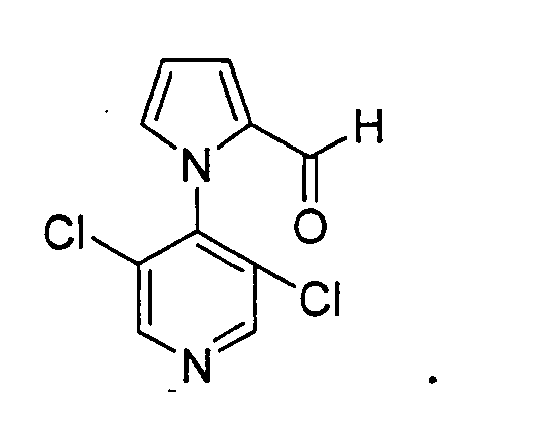
1H-NMR(DMSO-d6,TMS)δ(ppm):6.61(1H, dd, J=4Hz, 3Hz),7.37 (1H,dd, J=4Hz,2Hz),7.46(1H,ddd,J=3Hz,2Hz,1Hz),8.85(2H,s),9.54(1H,d, J=1Hz) - To a solution of 2.14 g of 1-(3,5-dichloro-4-pyridinyl)-1H-pyrrole-2-carbaldehyde in 10 ml of N,N-dimethylformamide was added 1.7 g of N-bromosuccinimide. The mixture was stirred at room temperature for 2 hours. Water was poured into the reaction mixture, and a deposited precipitate was collected by filtration to obtain 2.9 g of 4-bromo-1-(3,5-dichloro-4-pyridinyl)-1H-pyrrole-2-carbaldehyde of the formula:

1H-NMR(DMSO-d6,TMS)δ(ppm):7.52(1H,d,J=2Hz),7.74(1H,dd,J=2Hz, 1Hz),8.88(2H,s),9.51(1H,d,J=1Hz) - A solution of 2.9 g of potassium permanganate in 15 ml of water was added dropwise to a mixture of 2.86 g of 4-bromo-1-(3,5-dichloro-4-pyridinyl)-1H-pyrrole-2-carbaldehyde and 30 ml of acetone while the mixture was maintained at 40°C. The mixture was stirred at 40°C for 2 hours. A precipitate was filtered off to obtain a filtrate. The filtrate was adjusted to pH 10-12 by an addition of a 2N aqueous sodium hydroxide solution, and then washed with chloroform two times. The aqueous layer was adjusted to around pH 3 by an addition of 2N hydrochloric acid. A deposited precipitate was collected by filtration to obtain 2.08 g of 4-bromo-1-(3,5-dichloro-4-pyridinyl)-1H-pyrrole-2-carboxylic acid of the formula:

1H-NMR(DMSO-d6,TMS)δ(ppm):7.12(1H,d,J=2Hz),7.51(1H,d,J=2Hz), 8.85(2H,s) - According to the same manner as that of Reference Preparation Example 71-(5), 4-bromo-1-(3,5-dichloro-4-pyridinyl)-1H-pyrrole-2-carboxylic acid was used in place of 4-bromo-1-(3-chloro-2-pyridinyl)-1H- pyrrole-2-carboxylic acid to obtain 2-[4-bromo-1-(3,5-dichloro-4-pyridinyl)-1H-pyrrol-2-yl]-6-chloro-8-methyl-4H-3,1-benzoxazine-4-one of the formula:

1H-NMR(DMSO-d6,TMS)δ(ppm):1.64(3H,s),7.39(1H,brs), 7.72(2H,s),7.85(1H,brs),8.95(2H,s) - According to the same manner as that of Reference Preparation Example 71-(6), 2-[4-bromo-1-(3,5-dichloro-4-pyridinyl)-1H-pyrrol-2-yl]-6-chloro-8-methyl-4H-3,1-benzoxazine-4-one was used in place of 2-[4-bromo-1-(3-chloro-2-pyridinyl)-1H-pyrrol-2-yl]-6-chloro-8-methyl-4H-3,1-benzoxazine-4-one to obtain 4-bromo-N-[4-chloro-2-(hydrazinocarbonyl)-6-methylphenyl]-1 -(3,5- dichloro-4-pyridinyl)-1H-pyrrole-2-carboxamide of the formula:

1H-NMR(DMSO-d6,TMS)δ(ppm):2.13(3H,s)4.35(2H,brs)7.28(1H,d, J=2Hz),7.37(1H,d,J=2Hz),7.43-7.47(2H,m),8.76(2H,s), 9.52(1H,brs),9.89(1H,brs) - A solution of 0.9 g of potassium permanganate in 10ml of water was added dropwise to a mixture of 0.58 g of 1-(2,6-dichlorophenyl)-1H-pyrrole-3-carbaldehyde and 20 ml of acetone while the mixture was maintained at 40°C. The resulting mixture was stirred at 40°C for 2 hours. A deposited precipitate was filtered off to obtain a filtrate. The filtrate was adjusted to pH 10-12 by an addition of a 2N aqueous sodium hydroxide solution, and then washed with chloroform two times. The aqueous layer was adjusted to around pH 3 by an addition of 2N hydrochloric acid, and then extracted with ethyl acetate two times. The organic layers were combined, washed successively with water and an aqueous saturated sodium chloride solution, dried over anhydrous sodium sulfate, and concentrated under reduced pressure to obtain 0.34 g of 1-(2,6-dichlorophenyl)-1H-pyrrole-3-carboxylic acid of the formula:

1H-NMR(DMSO-d6,TMS)δ(ppm):6.60(1H,dd,J=3Hz,2Hz)6.92(1H,dd, J=3Hz,1Hz),7.48(1H,dd,J=2Hz,1Hz),7.55(1H,dd,J=8Hz,7Hz), 7.67-7.72(2H,m),12.05(1H,brs) - According to the same manner as that of Reference Preparation Example 71-(5), 1-(2,6-dichlorophenyl)-1H-pyrrole-3-carboxylic acid was used in place of 4-bromo-1-(3-chloro-2-pyridinyl)-1H-pyrrole-2-carboxylic acid to obtain 6-chloro-2-[1-(2,6-dichlorophenyl)-1H-pyrrol-3-yl]-8-methyl-4H-3,1-benzoxazine-4-one of the formula:

1H-NMR(DMSO-d6,TMS)δ(ppm):2.53(3H,s),6.89(1H,s),7.10(1H,s), 7.43-7.64(2H,m),7.67-7.77(2H,m),7.82-7.91(2H,m) - According to the same manner as that of Reference Preparation Example 71-(6), 6-chloro-2-[1-(2,6-dichlorophenyl)-1H-pyrrol-3-yl]-8-methyl-4H-3,1-benzoxazine -4-one was used in place of 2-[4-bromo-1-(3-chloro-2-pyridinyl)-1H-pyrrol-2-yl]-6-chloro-8-methyl-4H-3,1-benzoxazine-4-one to obtain N-[4-chloro-2-(hydrazinocarbonyl)-6-methylphenyl]-1-(2,6-dichlorophenyl)-1H-pyrrole-3-carboxamide of the formula:

1H-NMR(DMSO-d6,TMS)δ(ppm):2.22(3H,s),4.59(2H,brs),6.79(1H, brs),6.97(1H,brs),7.37(1H,brs),7.47-7.59(3H,m),7.71(2H,d, J=8Hz),9.66(1H,brs),9.70(1H,brs) - To a mixture of 4.61 g of methylhydrazine, 25 ml of methanol and 4.0 g of sodium hydroxide was added dropwise 10.8 g of N,N-dimethylcarbamoyl chloride under ice-cooling. The mixture was stirred at room temperature for 1 hour. The reaction mixture was filtered, and the filtrate was concentrated under reduced pressure. The residue was distilled under reduced pressure (90 to 99°C/22 mmHg) to obtain 5.70 g of 2,4,4-trimethylsemicarbazide of the formula:

1H-NMR(CDCl3,TMS)δ(ppm):2.90(6H,s),2.95(3H,s),3.94(2H,brs). - According to the same manner as that of Reference Preparation Example 101, 2-[4,5-dichloro-1-(3-chloro-2-pyridinyl)-1H-pyrrol-2-yl]-6-chloro-8-methyl-4H-3,1-benzoxazine-4-one was used in place of 2-[4-bromo-1-(3-chloro-2-pyridinyl)-1H-pyrrol-2-yl]-6-chloro-8-methyl-4H-3,1-benzoxazine-4-one to obtain 4,5-dichloro-N-[4-chloro-2-(N-methylhydrazinocarbonyl)-6-methylphenyl]-1-(3-chloro-2-pyridinyl)-1H-pyrrole-2-carboxamide of the formula:

1H-NMR(CDCl3,TMS)δ(ppm):2.01-2.05(3H,m),2.92(2H,s), 3.21(1H,s),4.05(0.7H,brs),4.59(1.3H,brs),6.95-7.10(2H,m), 7.19(0.6H,s),7.29(0.4H,s),7.37(1H,dd,J=8Hz,4Hz),7.86(1H,d, J=8Hz),8.48(1H,d,J=5Hz),9.11(0.6H,brs),9.42(0.4H,brs) - According to the same manner as that of Reference Preparation Example 13, 1-[(2-fluoro-3-pyridinyl) methyl]-3-trifluromethyl-1H-pyrazole-5-carboxylic acid was used in place of 1-(3-chloro-2-pyridinyl)-1H-pyrazole-5-carboxylic acid to obtain 6-chloro-2-[1-[(2-fluoro-3-pyridinyl)methyl]-3-trifluoromethyl-1H-pyrazol-5-yl]-8-methyl-4H-3,1- benzoxazine-4-one of the formula:

1H-NMR(DMSO-d6,TMS)δ(ppm):2.25(3H,s),6.16(2H,s), 7.30-7.36(1H,m),7.39-7.46(1H,m),7.69(1H,s),7.90(1H,d,J=2Hz), 7.98(1H,d,J=2Hz),8.20(1H,d,J=4Hz) - According to the same manner as that of Reference Preparation Example 1, 6-chloro-2-[1-[(2-fluoro-3-pyridinyl) methyl]-3-trifluoromethyl-1H-pyrazol-5-yl]-8-methyl-4H-3,1-benzoxazine-4-one was used in place of 6-chloro-2-[1-(3-chloro-2-pyridinyl)-3-trifluoromethyl-1H-pyrazol-5-yl]-8-methyl-4H -3,1-benzoxazine-4-one to obtain N-[4-chloro-2-(hydrazinocarbonyl)-6-methylphenyl]-1-[(2-fluoro-3-pyridinyl)methyl]-3-trifluoromethyl-1H-pyrazole-5-carboxamide of the formula:

1H-NMR(DMSO-d6,TMS)δ(ppm):2.13(3H,s),4.37(2H,brs), 5.86(2H,s),7.32-7.38(2H,m),7.50-7.57(2H,m),7.57-7.64(1H,m), 8.16-8.21(1H,m),9.62(1H,brs),10.28(1H,brs) - According to the same manner as that of Reference Preparation Example 13, 1-[(3-chloro-2-pyridinyl)methyl]-5-trifluoromethyl-1H- pyrazole-3-carboxylic acid was used in place of 1-(3-chloro- 2-pyridinyl)-1H-pyrazole-5-carboxylic acid to obtain 2-[1-[(3-chloro-2-pyridinyl)methyl]-5-trifluoromethyl-1H-pyrazol-3-yl]-6-chloro-8-methyl-4H-3,1-benzoxazine-4-one of the formula:

1H-NMR(DMSO-d6,TMS)δ(ppm):2.56(3H,s),5.92(2H,s),7.44(1H,dd, J=8Hz,5Hz),7.67(1H,s),7.89-7.95(2H,m),8.04(1H,d,J=8Hz), 8.42(1H,d,J=5Hz) - According to the same manner as that of Reference Preparation Example 1, 2-[1-[(3-chloro-2-pyridinyl)methyl] -5-trifluoromethyl-1H-pyrazol-3-yl]-6-chloro-8-methyl-4H-3, 1-benzoxazine-4-one was used in place of 6-chloro-2-[1-(3-chloro-2-pyridinyl)-3-trifluoromethyl-1H-pyrazol-5-yl]-8-methyl-4H-3,1-benzoxazine-4-one to obtain N-[4-chloro-2-(hydrazinocarbonyl)-6-methylphenyl]-1-[(3-chloro-2-pyridinyl)methyl]-5-trifluoromethyl-1H-pyrazole-3-carboxamide of the formula:

1H-NMR(DMSO-d6,TMS)δ(ppm):2.19(3H,s)4.45(2H,brs)5.87 (2H,s),7.37(1H,brs),7.41-7.50(2H,m),7.52(1H,brs),8.04(1H,d, J=8Hz),8.45(1H,d,J=4Hz),9.71(1H,brs),10.12(1H,brs) - To a solution of 5.0 g of 3-chloro-2- (2-formyl-1H-pyrrol-1-yl)pyridine in 50 ml of N,N-dimethylformamide was added 5.4 g of N-iodosuccinimide. The resulting mixture was stirred at room temperature for 1 day. Water was poured into the reaction mixture, and the mixture was extracted with ethyl acetate two times. The organic layers were combined, washed with an aqueous saturated sodium chloride solution, dried over anhydrous magnesium sulfate, and concentrated under reduced pressure. The residue was subjected to silica gel column chromatography to obtain 3.2 g of 1-(3-chloro-2-pyridinyl)-4-iodo-1H-pyrrole -2-carbaldehyde of the formula:


1H-NMR(CDCl3,TMS)δ(ppm):7.19-7.20(2H,m),7.38-7.42(1H,m), 7.89(1H,d,J=8Hz),8.45-8.47(1H,m),9.51(1H,s)
1-(3-Chloro-2-pyridinyl)-5-iodo-1H-pyrrole-2-carbaldehyde
1H-NMR(CDCl3,TMS)δ(ppm):6.72(1H,d,J=4Hz),7.04(1H,d,J=4Hz), 7.47(1H,dd,J=8Hz,5Hz),7.93(1H,dd,J=8Hz,2Hz),8.55(1H,dd, J=5Hz,2Hz),9.26(1H,s) - According to the same manner as that of Reference Preparation Example 71-(4), 1-(3-chloro-2-pyridinyl)-4-iodo-1H-pyrrole-2-carbaldehyde was used in place of 4-bromo-1-(3-chloro-2-pyridinyl)-1H-pyrrole-2-carbaldehyde to obtain 1-(3-chloro-2-pyridinyl)-4-iodo-1H-pyrrole-2-carboxylic acid of the formula:

1H-NMR(DMSO-d6,TMS)δ(ppm):7.05(1H,d,J=2Hz),7.45(1H,d,J=2Hz), 7.57(1H,dd,J=8Hz,5Hz),8.15(1H,dd,J=8Hz,2Hz),8.49(1H,dd, J=5Hz,2Hz),12.65(1H,brs) - According to the same manner as that of Reference Preparation Example 71-(5), 1-(3-chloro-2-pyridinyl)-4-iodo-1H-pyrrole-2-carboxylic acid was used in place of 4-bromo-1-(3-chloro-2-pyridinyl)-1H-pyrrole-2-carboxylic acid to obtain 6-chloro-2-[1-(3-chloro-2-pyridinyl)-4-iodo-1H-pyrrol-2-yl]-8-methyl-4H-3,1-benzoxazine-4-one of the formula:

1H-NMR(CDCl3,TMS)δ(ppm):1.67(3H,s),7.30(1H,d,J=2Hz), 7.61(1H,d,J=2Hz),7.63-7.67(2H,m),7.82(1H,d,J=3Hz), 8.22(1H,dd,J=8Hz,2Hz),8.56(1H,dd,J=5Hz,2Hz) - According to the same manner as that of Reference Preparation Example 71-(6), 6-chloro-2-[1-(3-chloro-2-pyridinyl)-4-iodo-1H-pyrrol-2-yl]-8-methyl-4H-3,1-benzoxazine-4-one was used in place of 2-[4-bromo-1-(3-chloro-2-pyridinyl)-1H-pyrrol-2-yl]-6-chloro-8-methyl-4H-3,1-benzoxazine-4-one to obtain N-[4-chloro-2-(hydrazinocarbonyl)-6-mehtylphenyl]-1-(3-chloro-2-pyridinyl )-4-iodo-1H-pyrrole-2-carboxamide of the formula:

1H-NMR(DMSO-d6,TMS)δ(ppm):2.13(3H,s),4.39(2H,brs), 7.26(1H,s),7.30(1H,s),7.39(1H,s),7.42(1H,s),7.49(1H,dd, J=8Hz,5Hz),8.05(1H,dd,J=8Hz,2Hz),8.43(1H,dd,J=5Hz,2Hz), 9.52(1H,brs),9.84(1H,brs) - According to the same manner as that of Reference Preparation Example 71-(5), 4,5-dichloro-1-(3-chloro-2-pyridinyl)-1H-pyrrole-2-carboxylic acid and 3-amino-7-bromo-4-chloro-2-naphthoic acid were used in place of 4-bromo-1-(3-chloro-2-pyridinyl)-1H-pyrrole- 2-carboxylic acid and 2-amino-5-chloro-3-methylbenzoic acid respectively to obtain 10-chloro-2-[4,5-dichloro-1-(3-chloro-2-pyridinyl)-1H-pyrrol-2-yl]-4H-naphtho[2,3-d][1,3]oxazine-4-one of the formula:

1H-NMR(DMSO-d6,TMS)δ(ppm):7.51(1H,s)7.70(1H,t,J=8Hz)7.78 (1H,dd,J=8Hz,5Hz),7.84(1H,t,J=8Hz),8.16(1H,d,J=8Hz),8.28(1H, d,J=8Hz),8.40(1H,dd,J=8Hz,2Hz),8.68(1H,dd,J=5Hz,2Hz),8.82 (1H,s) - To 30 ml of acetic acid were added 5.0 g of 2-chloro-3-pyridinylamine and 5.6 g of 2,5-dimethoxytetrahydrofuran, and the mixture was heated to reflux for 2 hours. The reaction mixture was allowed to cool to room temperature, poured into water, and then extracted with ethyl acetate two times. The organic layers were combined, washed successively with water and an aqueous saturated sodium chloride solution, dried over anhydrous sodium sulfate, and concentrated under reduced pressure. The resulting residue was subjected to silica gel chromatography to obtain 6.5 g of 1- (2-chloro-3-pyridinyl)-1H-pyrrole of the formula:

1H-NMR (DMSO-d6,TMS)δ(ppm):6.29(2H,t,J=2Hz),7.09(2H,t,J=2Hz), 7.58(1H,dd,J=8H,5Hz),7.95(1H,dd,J=8H,2Hz),8.45(1H,dd,J=5H, 2Hz) - To 14.6 g of N,N-dimethylformamide was added dropwise 8.3 g of phosphorus oxychloride under ice-cooling. The mixture was stirred at room temperature for 30 minutes. Thereto 6.5 g of 1-(2-chloro-3-pyridinyl)-1H-pyrrole was added, and the - resulting mixture was stirred at 60°C for 2 hours. The reaction mixture was allowed to cool to room temperature, and added to ice water. The mixture was adjusted to pH 4 by an addition of a 2N aqueous sodium hydroxide solution, and then extracted with ethyl acetate two times. The organic layers were combined, washed successively with water and an aqueous saturated sodium chloride solution, dried over anhydrous sodium sulfate, and concentrated under reduced pressure. The resulting residue was subjected to silica gel chromatography to obtain 6.05 g of 1-(2-chloro-3-pyridinyl)-1H-pyrrole-2-carbaldehyde of the formula:
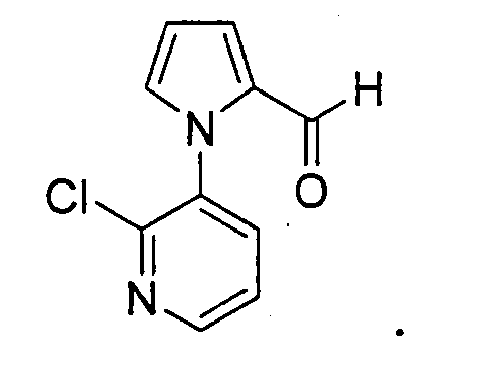
1H-NMR(DMSO-d6,TMS)δ(ppm) :6.53(1H,t,J=2Hz),7.30(1H,d,J=2Hz), 7.43(1H,brs),7.59(1H,dd,J=8H,5Hz),8.00(1H,d,J=8Hz), 8.52(1H,d,J=5Hz),9.51(1H,s) - To a solution of 6.05 g of 1-(2-chloro-3-pyridinyl)-1H-pyrrole-2-carbaldehyde in 20 ml of N,N-dimethylformamide was added 5.72 g of N-bromosuccinimide. The resulting mixture was stirred at room temperature for 1 hour. Water was poured into the reaction mixture, and a deposited precipitate was collected by filtration to obtain 4.22 g of 4-bromo-1-(2-chloro-3-pyridinyl)-1H-pyrrole-2-carbaldehyde of the formula:

1H-NMR(DMSO-d6,TMS)δ(ppm):7.42(1H,d,J=2Hz),7.60(1H,dd,J=8H, 5Hz),7.70(1H,dd,J=2H,1Hz),8.06(1H,dd,J=8H,2Hz),8.54(1H,dd, J=5H,2Hz) 9.47(1H,d,J=1Hz) - A solution of 4.43 g of potassium permanganate in 15 ml of water was added dropwise to a mixture of 4.22 g of 4-bromo-1-(2-chloro-3-pyridinyl)-1H-pyrrole-2-carbaldehyde and 30 ml of acetone while the mixture was maintained at 40°C. The resulting mixture was stirred at 40°C for 2 hours. A precipitate was filtered off to obtain a filtrate. The filtrate was adjusted to pH 10-12 by an addition of a 2N aqueous sodium hydroxide solution, and then washed with chloroform two times. The aqueous layer was adjusted to around pH 3 by an addition of 2N hydrochloric acid, and then extracted with ethyl acetate two times. The organic layers were combined, washed successively with water and an aqueous saturated sodium chloride solution, dried over anhydrous sodium sulfate, and concentrated under reduced pressure to obtain 3.02 g of 4-bromo-1-(2-chloro-3-pyridinyl)-1H-pyrrole-2-carboxylic acid of the formula:

1H-NMR(DMSO-d6,TMS)δ(ppm):7.05(1H,s),7.46(1H,s),7.57(1H,dd, J=8H,4Hz),8.02(1H,d,J=8Hz),8.49(1H,d,J=4Hz),12.70(1H,brs) - According to the same manner as that of Reference Preparation Example 71-(5), 4-bromo-1-(2-chloro-3-pyridinyl)-1H-pyrrole-2-carboxylic acid was used in place of 4-bromo-1-(3-chloro-2-pyridinyl)-1H-pyrrole-2-carboxylic acid to obtain 2-[4-bromo-1-(2-chloro-3-pyridinyl)-1H-pyrrol-2-yl]-6-chloro-8-methyl-4H-3,1-benzoxazine-4-one of the formula:

1H-NMR(DMSO-d6,TMS)δ(ppm):1.65(3H,s),7.31(1H,s),7.62-7.73 (3H,m),7.84(1H,s),8.10(1H,d,J=6Hz),8.57(1H,s) - According to the same manner as that of Reference Preparation Example 71-(6), 2-[4-bromo-1-(2-chloro-3-pyridinyl)-1H-pyrrol-2-yl]-6-chloro-8-methyl-4H-3,1-benzoxazine-4-one was used in place of 2-[4-bromo-1-(3-chloro-2-pyridinyl)-1H-pyrrol-2-yl]-6-chloro-8-methyl-4H-3,1-benzo xazine-4-one to obtain 4-bromo-N-[4-chloro-2-(hydrazinocarbonyl)-6-methylphenyl]-1-(2-chloro-3-pyridinyl)-1H-pyrrole-2-carboxamide of the formula:

1H-NMR (DMSO-d6,TMS) δ (ppm):2.14 (3H,s),4.37 (2H,brs), 7.28(2H,s),7.40-7.46(2H,m),7.52(1H,dd,J=8H,4Hz),7.95(1H,d, J=8Hz),8.42(1H,d,J=4Hz),9.51(1H,brs),9.82(1H,brs) - To a mixture of 0.56 g of 3-amino-4-chloro-2-naphthoic acid and 20 ml of acetic acid was added dropwise 0.4 g of bromine at room temperature. The resulting mixture was stirred at room temperature for 1 hour. A deposited precipitate was collected by filtration, and the resulting solid was washed successively with acetic acid and ethyl acetate to obtain 0.36 g of 3-amino-7-bromo-4-chloro-2-naphthoic acid of the formula:

1H-NMR(DMSO-d6,TMS)δ(ppm) :7.70(1H,d,J=9Hz),7.81(1H,d,J=9Hz), 8.24(1H,s),8.53(1H,s) - According to the same manner as that of Reference Preparation Example 46-(1), 3-amino-7-bromo-4-chloro-2-naphthoic acid was used in place of 2-amino-3,5-dibromobenzoic acid to obtain 7-bromo-2-[3-bromo-1-(3-chloro-2-pyridinyl)-1H-pyrazol-5-yl]-10-chloro-4H-naphtho[2,3-d][1,3]oxazine-4-one of the formula:

1H-NMR(DMSO-d6,TMS)δ(ppm):7.56(1H,s),7.75-7.81(1H,m), 7.99(1H,d,J=10Hz),8.14(1H,d,J=10Hz),8.37(1H,d,J=8Hz), 8.61-8.68(2H,m),8.85(1H,brs) - To a mixture of 0.47 g of 3-amino-2-naphthoic acid and 20 ml of acetic acid was added dropwise 0.8 g of bromine at room temperature. The resulting mixture was stirred at room temperature for 1 hour. A deposited precipitate was collected by filtration, and the resulting solid was washed successively with acetic acid and ethyl acetate to obtain 0.61 g of 3-amino-4,7-dibromo-2-naphthoic acid of the formula:

1H-NMR(DMSO-d6,TMS)δ(ppm):7.70(1H,dd,J=9,2Hz),7.80(1H,d, J=9Hz),8.22(1H,d,J=2Hz),8.57(1H,s) - According to the same manner as that of Reference Preparation Example 46-(1), 3-amino-4,7-dibromo-2-naphthoic acid was used in place of 2-amino-3,5-dibromobenzoic acid to obtain 7,10-dibromo-2-[3-bromo-1-(3-chloro-2-pyridinyl)-1H-pyrazol-5-yl]-4H-naphtho[2,3-d][1,3]oxazine-4-one of the formula:

1H-NMR(DMSO-d6,TMS)δ(ppm( :7.56(1H,s),7.76(1H,dd,J=8Hz,5Hz), 7.99(1H,d,J=9Hz),8.14(1H,d,J=9Hz),8.37(1H,d,J=8Hz), 8.61-8.67(2H,m),8.90(1H,brs) - A mixture of 10 g of 2-pyrrolecarbaldehyde, 10 g of 2-fluoropyridine, 24 g of cesium carbonate and 100 ml of N-methylpyrrolidone was stirred at 120°C for 1 day. The reaction mixture was allowed to cool to room temperature. Water was poured into the mixture, and the mixture was extracted with ethyl acetate two times. The organic layers were combined, washed successively with water and an aqueous saturated sodium chloride solution, dried over magnesium sulfate, and concentrated under reduced pressure. The resulting residue was subjected to silica gel chromatography to obtain 7.7 g of 1-(2-pyridinyl)-1H-pyrrole-2-carbaldehyde of the formula:

1H-NMR(CDCl3,TMS)δ(ppm):6.44(1H,dd,J=4Hz,3Hz),7.21(1H,dd, J=4Hz,2Hz),7.30-7.33(1H,m),7.44-7.47(2H,m),7.81-7.86(1H,m), 8.53(1H,dd,J=5Hz,2Hz),9.77(1H,s) - According to the same manner as that of Reference Preparation Example 97-(1), 1-(2-pyridinyl)-1H-pyrrole-2-carbaldehyde was used in place of 3-chloro-2-(2-formyl-1H-pyrrole-1-yl)pyridine to obtain 5-chloro-1-(2-pyridinyl)-1H-pyrrole-2-carbaldehyde of the formula:

1H-NMR(CDCl3,TMS)δ(ppm):6.36(1H,d,J=4Hz),7.07(1H,d,J=4Hz), 7.38(1H,d,J=8Hz),7.44(1H,dd,J=8Hz,5Hz),7.87-7.91(1H,m), 8.61(1H,d,J=5Hz),9.41(1H,s) - According to the same manner as that of Reference Preparation Example 71-(4), 5-chloro-1-(2-pyridinyl)-1H-pyrrole-2-carbaldehyde was used in place of 4-bromo-1-(3-chloro-2-pyridinyl)-1H-pyrrole-2-carbaldehyde to obtain 5-chloro-1-(2-pyridinyl)-1H-pyrrole-2-carboxylic acid of the formula:
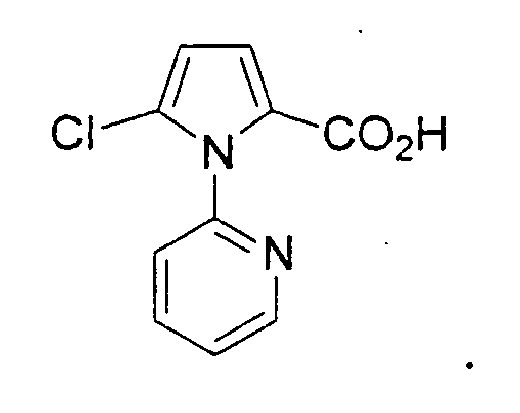
1H-NMR(DMSO-d6,TMS)δ(ppm):6.36(1H,d,J=4Hz),6.98(1H,d,J=4Hz), 7.45(1H,d,J=8Hz),7.50-7.53(1H,m),7.97-8.00(1H;m),8.56(1H,d, J=5Hz),12.34(1H,brs) - According to the same manner as that of Reference Preparation Example 71-(5), 5-chloro-1-(2-pyridinyl)-1H-pyrrole-2-carboxylic acid was used in place of 4-bromo-1-(3-chloro-2-pyridinyl)-1H- pyrrole-2-carboxylic acid to obtain 2-[5-chloro-1-(2-pyridinyl)-1H-pyrrol-2-yl]-6-chloro-8-methyl-4H-3,1-benoxazine-4-one of the formula:

1H-NMR(CDCl3,TMS)δ(ppm):1.70(3H,s),6.38(1H,d,J=4Hz),7.29(1H, d,J=4Hz),7.38(1H,s),7.41-7.49(2H,m),7.91-7.94(2H,m),8.66(1H, brs) - According to the same manner as that of Reference Preparation Example 71-(6), 2-[5-chloro-1-(2-pyridinyl)-1H-pyrrol-2-yl]-6-chloro-8-methyl-4H-3,1-benoxazine-4-one was used in place of 2-[4-bromo-1-(3-chloro-2-pyridinyl)-1H-pyrrol-2-yl]-6-chloro-8-methyl-4H-3,1-benozxazine-4-one to obtain 5-chloro-N-[4-chloro-2-(hydrazinocarbonyl)-6-methylphenyl]-1-(2- pyridinyl)-1H-pyrrole-2-carboxamide of teh formula:

1H-NMR(DMSO-d6,TMS)δ(ppm):2.13(3H,s),4.43(2H,brs),6.40(1H,d, J=4Hz),7.11(1H,d,J=4Hz),7.30(1H,d,J=2Hz),7.40-7.47(3H,m), 7.94(1H,td,J=7Hz,2Hz),8.51(1H,dd,J=5Hz,2Hz),9.51(1H,brs), 9.85(1H,brs) - According to the same manner as that of Reference Preparation Example 101, 8-bromo-2-[4-bromo-1-(3-chloro-2-pyridinyl)-1H-pyrrol-2-yl]-6-chloro-4H-3,1-benoxazine-4-one was used in place of 2-[4-bromo-1-(3-chloro-2-pyridinyl)-1H-pyrrol-2-yl]-6-chloro-8-methyl-4H-3,1-benoxazine-4-one to obtain 4-bromo-N-[6-bromo-4-chloro-2-(N-methylhydrazinocarbonyl)phenyl]-1-(3-chlolo-2-pyridinyl)-1H -pyrrole-2-carboxamide of the formula:

phenyl]-1-(3-chlolo-2-pyridinyl)-1H-pyrrole-2-carboxamide
1H-NMR(CDCl3,TMS)δ(ppm):2.96(1.5H,s),3.15(1.5H,s),4.05(1H, brs),4.49(1H,brs),7.03(1H,d,J=2Hz),7.16(1H,dd,J=7Hz,4Hz), 7.20(1H,d,J=2Hz),7.29-7.34(1H,m),7.47(0.5H,d,J=2Hz), 7.53(0.5H,d,J=2Hz),7.83-7.79(1H,m),8.40-8.43(1H,m), 8.67(0.5H,brs),8.77(0.5H,brs) - According to the same manner as that of Reference Preparation Example 129-(1), 2-chloro-3-cyanopyridine was used in place of 2-fluoropyridine to obtain 2-(2-formyl-1H-pyrrol-1-yl)-3-cyanopyridine of the formula:

-1H-NMR(CDCl3,TMS)δ(ppm):6.53(1H,dd,J=4Hz,3Hz),7.22(1H,dd, J=4Hz,2Hz),7.29-7.31(1H,m),7.51(1H,dd,J=8Hz,5Hz),8.12(1H,dd, J=8Hz,2Hz),8.74(1H,dd,J=5Hz,2Hz)9.65(1H,s) - According to the same manner as that of Reference Preparation Example 71-(3), 2-(2-formyl-1H-pyrrol-yl)-3-cyanopyridine was used in place of 3-chloro-2-(2-formyl-1H-pyrrol-1-yl)pyridine to obtain 2-(4-bromo-2-formyl-1H-pyrrol-1-yl)-3-cyanopyridine of the formula:

1H-NMR(CDCl3,TMS)δ(ppm):7.18(1H,d,J=2Hz),7.29(1H,d,J=2Hz), 7.54(1H,dd,J=8Hz,5Hz),8.13(1H,dd,J=8Hz,2Hz),8.74(1H,dd, J=5Hz,2Hz),9.59(1H,s) - According to the same manner as that of Reference Preparation Example 71-(4), 2-(4-bromo-2-formyl-1H-pyrrol-1-yl)-3-cyanopyridine was used in place of 4-bromo-1-(3-chloro-2-pyridinyl)-1H-pyrrole- 2-carbaldehyde to obtain 4-bromo-1-(3-cyano-2-pyridinyl)-1H-pyrrole-2-carboxylic acid of the formula:

1H-NMR(DMSO-d6,TMS)δ(ppm):7.10(1H,d,J=2Hz),7.65(1H,d,J=2Hz), 7.75(1H,dd,J=8Hz,5Hz),8.55(1H,dd,J=8Hz,2Hz),8.82(1H,dd,J=5H z,2Hz) - According to the same manner as that of Reference Preparation Example 71-(5), 4-bromo-1-(3-cyano-2-pyridinyl)-1H-pyrrole-2-carboxylic acid and 2-amino-3,5-dibromobenzoic acid were used in place of 4-bromo-1-(3-chloro-2-pyridinyl)-1H-pyrrole-2-carboxylic acid and 2-amino-5-chloro-3-methylbenozoic acid respectively to obtain 6,8-dibromo-2-[4-bromo-1-(3-cyano-2-pyridinyl)-1H-pyrrol-2-yl]-4H-3,1-benzox azine-4-one of the formula:

1H-NMR(DMSO-d6,TMS)δ(ppm):7.39(1H,d,J=2Hz),7.77(1H,dd,J=8Hz, 5Hz),7.81(1H,d,J=2Hz),8.14(1H,d,J=2Hz),8.21(1H,d,J=2Hz), 8.58(1H,dd,J=8Hz,2Hz),8.83(1H,dd,J=5Hz,2Hz) - According to the same manner as that of Reference Preparation Example 129-(1), 2-chloro-3-trifluoromethylpyridine was used in place of 2-fluoropyridine to obtain 1-(3-trifluoromethyl-2-pyridinyl)-1H-pyrrole-2-carbaldehyde of the formula:

1H-NMR(CDCl3,TMS)δ(ppm):6.47(1H,dd,J=4Hz,3Hz),7.12-7.14(2H, m),7.59(1H,dd,J=8Hz,5Hz),8.18(1H,d,J=8Hz),8.75(1H,d,J=5Hz), 9.54(1H,d,J=1Hz) - According to the same manner as that of Reference Preparation Example 71-(3), 1-(3-trifluoromethyl-2-pyridinyl)-1H-pyrrole-2-carbaldehyde was used in place of 3-chloro-2-(2-formyl-1H-pyrrol-1-yl)pyridine to obtain 4-bromo-1-(3-trifluoromethyl-2-pyridinyl)-1H-pyrrole-2-carbaldehyde of the formula:
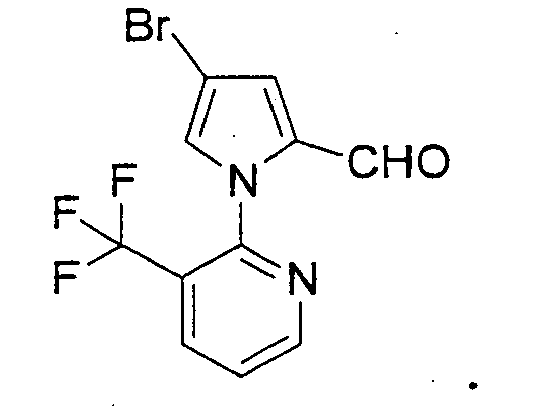
1H-NMR(CDCl3,TMS)δ(ppm):7.11(2H,s),7.62(1H,dd,J=8Hz,5Hz), 8.18(1H,d,J=8Hz),8.74(1H,d,J=5Hz),9.47(1H,s) - According to the same manner as that of Reference Preparation Example 71-(4), 4-bromo-1-(3-trifluoromethyl-2-pyridinyl)-1H-pyrrole-2- carbaldehyde was used in place of 4-bromo-1-(3-chloro-2-pyridinyl)-1H-pyrrole-2-carbaldehyde to obtain 4-bromo-1-(3-trifluoromethyl-2-pyridinyl)-1H-pyrrole-2-carboxylic acid of the formula:

1H-NMR(DMSO-d6,TMS)δ(ppm):7.02(1H,d,J=2Hz),7.56(1H,d,J=2Hz), 7.80(1H,dd,J=7Hz,5Hz),8.42(1H,d,J=7Hz),8.82(1H,d,J=5Hz),12. 66(1H,brs) - According to the same manner as that of Reference Preparation Example 71-(5), 4-bromo-1-(3-trifluoromethyl-2-pyridinyl)-1H-pyrrole-2- carboxylic acid and 2-amino-3,5-dibromobenzoic acid were used in place of 4-bromo-1- (3-chloro-2-pyridinyl)-1H-pyrrole-2-carboxylic acid and 2-amino-5-chloro-3-methylbenzoic acid respectively to obtain 6,8-dibromo-2-[4-bromo-1-(3-trifluoromethyl-2-pyridinyl)-1H-pyrrol-2-yl]-4H-3,1-benzoxazine-4-one of the formula:

1H-NMR(DMSO-d6,TMS)δ(ppm):7.34(1H,s),7.71(1H,s),7.83(1H,dd, J=8Hz,5Hz),8.10(1H,d,J=2Hz),8.19(1H,d,J=2Hz),8.48(1H,d, J=8Hz),8.84(1H,d,J=5Hz) - According to the same manner as that of Reference Preparation Example 71-(4), 1-(3-chloro-2-pyridinyl)-5-iodo-1H-pyrrole-2-carbaldehyde was used in place of 4-bromo-1-(3-chloro-2-pyridinyl)-1H-pyrrole-2-carbaldehyde to obtain 1-(3-chloro-2-pyridinyl)-5-iodo-1H-pyrrole-2-carboxylic acid of the formula:

1H-NMR(DMSO-d6,TMS)δ(ppm):6.63(1H,d,J=4Hz),6.97(1H,d,J=4Hz), 7.62(1H,dd,J=8Hz,5Hz),8.20(1H,d,J=8Hz),8.56(1H,d,J=5Hz), 12.43(1H,brs) - According to the same manner as that of Reference Preparation Example 71-(5), 1-(3-chloro-2-pyridinyl)-5-iodo-1H-pyrrole-2-carboxylic acid was used in place of 4-bromo-1-(3-chloro-2-pyridinyl)-1H-pyrrole- 2-carboxylic acid to obtain 6-chloro-2-[1-(3-chloro-2-pyridinyl)-5-iodo-1H-pyrrol-2-yl]-8-methyl-4H-3,1-benzoxazine-4-one of the formula:

1H-NMR(DMSO-d6,TMS)δ(ppm):1.65(3H,s),6.82(1H,d,J=3Hz), 7.23(1H,d,J=3Hz),7.67(1H,s),7.71(1H,dd,J=8Hz,5Hz), 7.81(1H,s),8.32(1H,d,J=8Hz),8.65(1H,d,J=5Hz) - According to the same manner as that of Reference Preparation Example 71-(6), 6-chloro-2-[1-(3-chloro-2-pyridinyl)-5-iodo-1H-pyrrol-2-yl]-8-methyl-4H-3,1-benzoxazine-4-one was used in place of 2-[4-bromo-1-(3-chloro-2-pyridinyl)-1H-pyrrol-2-yl]-6-chloro-8-methyl-4H-3,1-benzoxazine-4-one to obtain N-[4-chloro-2-(hydrazinocarbonyl)-6-methylphenyl]-1-(3-chlo ro-2-pyridinyl)-5-iodo-1H-pyrrole-2-carboxamide of the formula:

1H-NMR(CDCl3,TMS)δ(ppm):2.16(3H,s),4.02(2H,brs),6.66(1H,s), 7.05(1H,s),7.19(1H,s),7.24(1H,s),7.37(1H,dd,J=8Hz,5Hz), 7.50(1H,brs),7.86(1H,d,J=8Hz),8.49(1H,d,J=5Hz),9.28(1H,brs) - A mixture of 1.51 g of 2-amino-3-methylbenzoic acid, 1.0 g of acetic anhydride and 20 ml of tetrahydrofuran was stirred at 80°C for 13 hours. The reaction mixture was allowed to cool to room temperature, poured into water, and extracted with ethyl acetate two times. The organic layers were combined, washed successively with water and an aqueous saturated sodium chloride solution, dried over anhydrous sodium sulfate, and concentrated under reduced pressure. The resulting residue was washed with ethyl acetate to obtain 0.72 g of 2-acetylamino-3-methylbenzoic acid of the formula:

1H-NMR(DMSO-d6,TMS)δ(ppm):2.00(3H,s)2.19(3H,s)7.21(1H,t, J=8Hz),7.41(1H,d,J=8Hz),7.58(1H,d,J=8Hz),9.47(1H,brs) - To a mixture of 0.72 g of 2-acetylamino-3-methylbenzoic acid and 8 ml of concentrated sulfuric acid was added dropwise 1.6 g of fuming nitric acid at room temperature. The resulting mixture was stirred at room temperature for 2 hours. The reaction mixture was poured into ice water. A deposited precipitate was collected by filtration to obtain 0.45 g of 2-acetylamino-3-methyl-5-nitrobenzoic acid of the formula:

1H-NMR(DMSO-d6,TMS)δ(ppm):2.06(3H,s),2.34(3H,s),8.31(2H,s), 9.93(1H,brs) - A mixture of 0.45 g of 2-acetylamino-3-methyl-5-nitrobenzoic acid, 0.45 g of potassium hydroxide, 5 ml of methanol and 20 ml of water was heated to reflux at 80°C for 2 hours. The reaction mixture was allowed to cool to room temperature, and water was poured into the mixture. The mixture was adjusted to pH 3 by an addition of 2N hydrochloric acid. A deposited precipitate was collected by filtration to obtain 0.28 g of 2-amino-3-methyl-5-nitrobenzoic acid of the formula:

1H-NMR(DMSO-d6,TMS)δ(ppm):2.19(3H,s),7.99(1H,s),8.56(1H,s) - According to the same manner as that of Reference Preparation Example 46-(1), 2-amino-3-methyl-5-nitrobenzoic acid was used in place of 2-amino-3,5-dibromobenzoic acid to obtain 2-[3-bromo-1-(3-chloro-2-pyridinyl)-1H-pyrazol-5-yl]-8-methyl-6-nitro-4H-3,1-benzoxazine-4-one of the formula:

1H-NMR(DMSO-d6,TMS)δ(ppm):1.81(3H,s)7.64(1H,s)7.79(1H,dd, J=8Hz,4Hz),8.38(1H,d,J=8Hz),8.48(1H,s),8.55(1H,s),8.64(1H,d, J=4Hz) - According to the same manner as that of Reference Preparation Example 129-(1), 2-chloro-3-nitropyridine was used in place of 2-fluoropyridine to obtain 1-(3-nitro-2-pyridinyl)-1H-pyrrole-2-carbaldehyde of the formula:

1H-NMR(CDCl3,TMS)δ(ppm):6.54(1H,dd,J=4Hz,3Hz),7.18(1H,dd, J=4Hz,2Hz),7.34-7.35(1H,m),7.60(1H,dd,J=8Hz,5Hz),8.51(1H, dd,J=8Hz,2Hz),8.75(1H,dd,J=5Hz,2Hz),9.48(1H,d,J=1Hz) - According to the same manner as that of Reference Preparation Example 71-(3), 1-(3-nitro-2-pyridinyl)-1H-pyrrole-2-carbaldehyde was used in place of 3-chloro-2-(2-formyl-1H-pyrrol-1-yl)pyridine to obtain 4-bromo-1-(3-nitro-2-pyridinyl)-1H-pyrrole-2-carbaldehyde of the formula:

1H-NMR(CDCl3,TMS)δ(ppm):7.14(1H,d,J=2Hz),7.33(1H,d,J=2Hz), 7.63(1H,dd,J=8Hz,5Hz),8.53(1H,dd,J=8Hz,2Hz),8.75(1H,dd, J=5Hz,2Hz),9.42(1H,s) - According to the same manner as that of Reference Preparation Example 71-(4), 4-bromo-1-(3-nitro-2-pyridinyl)-1H-pyrrole-2-carbaldehyde was used in place of 4-bromo-1-(3-chloro-2-pyridinyl)-1H-pyrrole-2- carbaldehyde to obtain 4-bromo-1-(3-nitro-2-pyridinyl)-1H-pyrrole-2- carboxylic acid of the formula:

1H-NMR(DMSO-d6,TMS)δ(ppm):7.05(1H,d,J=2Hz),7.60(1H,d,J=2Hz), 7.84(1H,dd,J=8Hz,5Hz),8.68(1H,d,J=8Hz,2Hz),8,84(1H,d,J=5Hz, 2Hz) - According to the same manner as that of Reference Preparation Example 71-(5), 4-bromo-1-(3-nitro-2-pyridinyl)-1H-pyrrole-2-carboxylic acid and 2-amino-3,5-dibromobenzoic acid were used in place of 4-bromo-1-(3-chloro-2-pyridinyl)-1H-pyrrole-2-carboxylic acid and 2-amino-5-chloro-3-methylbenzoic acid respectively to obtain 6,8-dibromo-2-[4-bromo-1-(3-nitro-2-pyridinyl)-1H-pyrrol-2-yl]-4H-3,1-benzoxazine-4-one of the formula:

1H-NMR(DMSO-d6,TMS)δ(ppm):7.38(1H,d,J=2Hz),7.80(1H,d,J=2Hz), 7.92(1H,dd,J=8Hz,5Hz),8.11(1H,d,J=2Hz),8.26(1H,d,J=2Hz), 8.84(1H,d,J=8Hz),8.65(1H,d,J=5Hz) - According to the same manner as that of Reference Preparation Example 129-(1), 3-bromo-2-chloropyridine was used in place of 2-fluoropyridine to obtain 1-(3-bromo-2-pyridinyl)-1H-pyrrole-2-carbaldehyde of the formula:

1H-NMR(CDCl3,TMS)δ(ppm):6.48(1H,dd,J=4Hz,3Hz),7.10-7.17 (2H,m),7.31(1H,dd,J=8Hz,5Hz),8.05(1H,dd,J=8Hz,2Hz),8.51(1H, dd,J=5Hz,2Hz),9.57(1H,s) - According to the same manner as that of Reference Preparation Example 71-(3), 1-(3-bromo-2-pyridinyl)-1H-pyrrole-2-carbaldehyde was used in place of 3-chloro-2-(2-formyl-1H-pyrrol-1-yl)pyridine to obtain 4-bromo-l-(3-bromo-2-pyridinyl)-1H-pyrrole-2-carbaldehyde of the formula:

1H-NMR(CDCl3,TMS)δ(ppm):7.11-7.14(2H,m),7.33(1H,dd,J=8Hz, 5Hz),8.06(1H,dd,J=8Hz,2Hz),8.50(1H,dd,J=5Hz,2Hz),9.50(1H,d, J=1Hz) - According to the same manner as that of Reference Preparation Example 71-(4), 4-bromo-1-(3-bromo-2-pyridinyl)-1H-pyrrole-2-carbaldehyde was used in place of 4-bromo-1-(3-chloro-2-pyridinyl)-1H- pyrrole-2-carbaldehyde to obtain 9-bromo-1-(3-bromo-2-pyridinyl)-1H- pyrrole-2-carboxylic acid of the formula:

1H-NMR(DMSO-d6,TMS)δ(ppm):7.01(1H,s),7.48-7.51(2H,m),8.28 (1H,d,J=8Hz),8.52(1H,d,J=5Hz),12.67(1H,brs) - According to the same manner as that of Reference Preparation Example 71-(5), 4-bromo-1-(3-bromo-2-pyridinyl)-1H-pyrrole-2-carboxylic acid and 2-amino-3,5-dibromobenzoic acid were used in place of 4-bromo-1-(3-chloro-2-pyridinyl)-1H-pyrrole-2-carboxylic acid and 2-amino-5-chloro-3-methylbenzoic acid respectively to obtain 6,8-dibromo-2-[4-bromo-1-(3-bromo-2-pyridinyl)-1H-pyrrol-2-yl]-4H-3,1-benzoxazine-4-one of the formula:

1H-NMR(DMSO-d6,TMS)δ(ppm):7.33(1H,s),7.53(1H,dd,J=8Hz,5Hz), 7.72(1H,s),8.12(1H,d,J=2Hz),8.27(1H,d,J=2Hz),8.36(1H,d, J=8Hz),8.57(1H,d,J=5Hz) - A mixture of 2.0 g of 2-pyrrolecarbaldehyde, 3.0 g of 3,4-dichloropyridine, 8.0 g of cesium carbonate and 30 ml of N-methylpyrrolidone was stirred at 120°C for 25 hours. The reaction mixture was allowed to cool room temperature, and water was poured into the mixture. The mixture was extracted with ethyl acetate two times. The organic layers were combined, washed successively with water and an aqueous saturated sodium chloride solution, dried over anhydrous sodium sulfate, and concentrated under reduced pressure. The resulting residue was subjected to silica gel chromatography to obtain 2.95 g of 1-(3-chloro-4-pridinyl)-1H-pyrrole-2-carbaldehyde of the formula:

1H-NMR(DMSO-d6,TMS)δ(ppm) :6.55(1H,dd,J=4Hz,3Hz),7.33(1H,dd, J=4Hz,2Hz),7.44(1H,ddd,J=3Hz,2Hz,1Hz),7.60(1H,d,J=5Hz), 8.66(1H,d,J=5Hz),8.83(1H,s),9.52(1H,d,J=1Hz) - To a solution of 2.95 g of 1-(3-chloro-4-pyridinyl)-1H-pyrrole-2-carbaldehyde in 20 ml of N,N-dimethylformamide was added 2.66 g of N-bromosuccinimide. The resulting mixture was stirred at room temperature for 10 hours. Water was poured into the reaction mixture, and a deposited precipitate was collected by filtration to obtain 1.2 g of 4-bromo-1-(3-chloro-4-pyridinyl)-1H-pyrrole-2-carbaldehyde of the formula:

1H-NMR(DMSO-d6,TMS)δ(ppm):7.44-7.46(1H,m),7.66(1H,d,J=5Hz), 7.69-7.72(1H,m),8.68(1H,d,J=5Hz),8.85(1H,s),9.47(1H,s) - A solution of 2.0 g of potassium permanganate in 10 ml of water was added dropwise to a mixture of 1.2 g of 4-bromo-1-(3-chloro-4-pyridinyl)-1H-pyrrole-2-carbaldehyde and 30 ml of acetone while the mixture was maintained at 40°C. The resulting mixture was stirred at 60°C for 1 hour. A precipitate was filtered off to obtain a filtrate. The filtrate was adjusted to pH 10-12 by an addition of a 2N aqueous sodium hydroxide solution, and then washed with chloroform two times. The aqueous layer was adjusted to around pH 3 by an addition of 2N hydrochloric acid, and then extracted with ethyl acetate two times. The organic layers were combined, washed successively with water and an aqueous saturated sodium chloride solution, dried over anhydrous sodium sulfate, and concentrated under reduced pressure to obtain 0.43 g of 4-bromo-1-(3-chloro-4-pyridinyl)-1H-pyrrole-2-carboxylic acid of the formula:

- According to the same manner as that of Reference Preparation Example 71-(5), 4-bromo-1-(3-chloro-4-pyridinyl)-1H-pyrrole-2-carboxylic acid was used in place of 4-bromo-1-(3-chloro-2-pyridinyl)- 1H-pyrrole-2-carboxylic acid to obtain 2-[4-bromo-1-(3-chloro-4-pyridinyl)-1H-pyrrol-2-yl]-6-chloro-8-methyl-4H-3,1- benzoxazine-4-one of the formula:
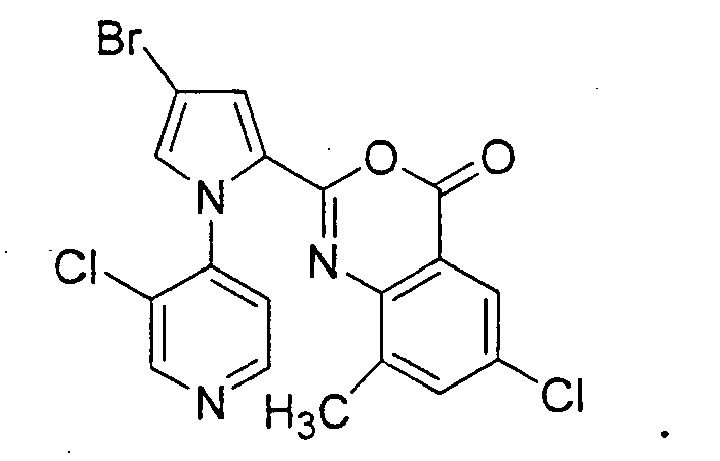
1H-NMR(DMSO-d6,TMS)δ(ppm):1.63(3H,s), 7.33(1H,d,J=2Hz) 7.68-7.74(3H,m),7.85(1H,d,J=2Hz),8.73(1H,d,J=5Hz),8.91(1H,s) - According to the same manner as that of Reference Preparation Example 71-(6), 2-[4-bromo-1-(3-chloro-4-pyridinyl)-1H-pyrrol-2-yl]-6-chloro-8-methyl-4H-3,1-benzoxazine-4-one was used in place of 2-[4-bromo-1-(3-chloro-2-pyridinyl)-1H-pyrrol-2-yl]-6-chloro-8-methyl-4H-3, 1-benzoxazine-4-one to obtain 4-bromo-N-[4-chloro-2-(hydrazinocarbonyl)-6-methylphenyl]-1-(3-chloro-4-pyridinyl )-1-pyrrole-2-carboxamide of the formula:

1H-NMR(DMSO-d6,TMS)δ(ppm):2.15(3H,s),4.39(2H,brs),7.27-7.31 (2H,m),7.42-7.46(2H,m),7.56(1H,d,J=5Hz),8.60(1H,d,J=5Hz), 8.72(1H,s),9.54(1H,brs),9.87(1H,brs) - According to the same manner as that of Reference Preparation Example 46-(1), 2-amino-5-chloro-benzoic acid was used in place of 2-amino-3,5-dibromobenzoic acid to obtain 2-[3-bromo-1-(3-chloro-2-pyridinyl)-1H-pyrazole-5-yl]-6-chloro-4H-3,1- benzoxazine-4-one of the formula:
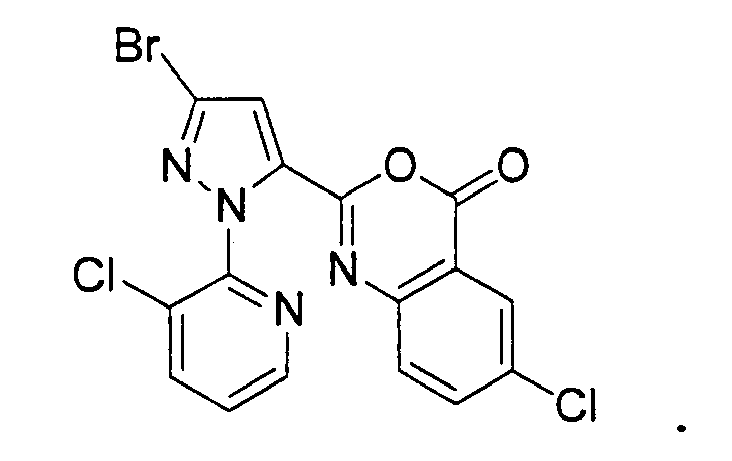
1H-NMR(DMSO-d6,TMS)δ(ppm):7.01(1H,d,J=9Hz),7.53(1H,s),7.78 (1H,dd,J=8Hz,5Hz),7.88(1H,dd,J=9Hz,3Hz),8.06(1H,d,J=3Hz), 8.32(1H,dd,J=8Hz,1Hz),8.60(1H,dd,J=5Hz,1Hz). - According to the same manner as that of Reference Preparation Example 84, 2-[3-bromo-1-(3-chloro-2-pyridinyl)-1H-pyrazol-5-yl]-6- chloro-4H-3,1-benzoxazine-4-one was used in place of 2-[3-bromo-1-(3-chloro-2-pyridinyl)-1H-pyrazol-5-yl]-6- chloro-8-methyl-4H-3,1-benoxazine-4-one to obtain 3-bromo-N-[4-chloro-2-(N-methylhydrazinocarbonyl)phenyl]-1 -(3-chloro-2-pyridinyl)-1H-pyrazole-5-carboxamide of the formula:

1H-NMR(DMSO-d6,TMS)δ(ppm):2.88(0.6H,s),3.10(2.4H,s),4.71 (1.6H,s),5.01(0.4H,s),7.29-7.34(1.0H,brm),7.38-7.52(3.0H,m), 7.65(1.0H,dd,J=8Hz,5Hz),8.22(1.0H,dd,J=8Hz,2Hz),8.52(1.0H, dd,J=5Hz,2Hz),10.40-10.50(1.0H,brm). - According to the same manner as that of Reference Preparation Example 88, 2-[3-bromo-1-(3-chloro-2-pyridinyl)-1H-pyrazol-5-yl]-6-chloro-4H-3,1-benzoxazine-4-one was used in place of 2-[3-bromo-1-(3-chloro-2-pyridinyl)-1H-pyrazol-5-yl]-6- chloro-8-methyl-4H-3,1-benzoxazine-4-one to obtain 3-bromo-N-[4-chloro-2-(N,N'-dimethylhydrazinocarbonyl) phenyl]-1-(3-chloro-2-pyridinyl)-1H-pyrazole-5-carboxamide of the formula:

H-NMR(CDCl3,TMS)δ(ppm):2.69(3H,brs)3.28(3H,s)6.92(1H,s), 7.30-7.46(3H,m),7.91(1H,dd,J=8Hz,2Hz),8.17(1H,d,J=9Hz),8.49 (1H,dd,J=5Hz,2Hz),10.29(1H,brs). - According to the same manner as that of Reference Preparation Example Preparation Example 100-(1), 2-(2-formyl-1H-pyrrol-1-yl)pyridine was used in place of 3-chloro-2-(2-formyl-1H-pyrrol-1-yl)pyridine to obtain 4,5-dichloro-1-(2-pyridinyl)-1H-pyrrole-2-carbaldehyde of the formula:

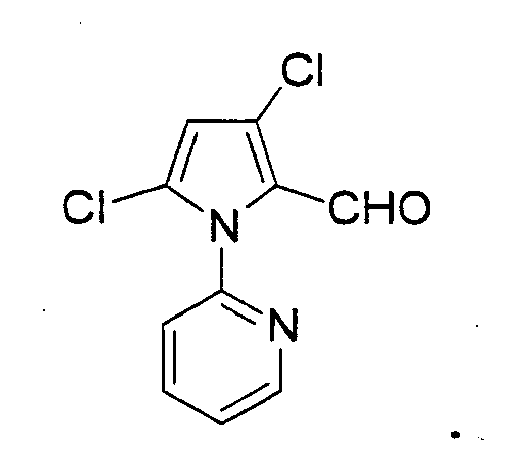
1H-NMR(CDCl3,TMS)δ(ppm):7.08(1H,s),7.38-7.41(1H,m),7.47-7.50(1H,m),7.91-7.95(1H,m),8.63-8.65(1H,m),9.40(1H,s)
3,5-Dichloro-1-(2-pyridinyl)-1H-pyrrole-2-carbaldehyde
1H-NMR(CDCl3,TMS)δ(ppm):6.35(1H,s),7.33-7.36(1H,m),7.45-7.48(1H,m),7.89-7.93(1H,m),8.61-8.62(1H,m),9.64(1H,s) - According to the same manner as that of Reference Preparation Example 71-(4), 4,5-dichloro-1-(2-pyridinyl)-1H-pyrrole-2-carbaldehyde was used in place of 4-bromo-1-(3-chloro-2-pyridinyl)-1H-pyrrole-2-carbaldehyde to obtain 4,5-dichloro-1-(2-pyridinyl)-1H-pyrrole-2-carboxylic acid of the formula:

1H-NMR(DMSO-d6,TMS)δ(ppm):7.11(1H,s),7.56-7.58(2H,m),8.03 (1H,td,J=8Hz,2Hz),8.58(1H,dd,J=4Hz,2Hz) - According to the same manner as that of Reference Preparation Example 71-(5), 4,5-dichloro-1-(2-pyridinyl)-1H-pyrrole-2-carboxylic acid was used in place of 4-bromo-1-(3-chloro-2-pyridinyl)-1H- pyrrole-2-carboxylic acid to obtain 6-chloro-2-[4,5-dichloro-1-(2-pyridinyl)-1H-pyrrol-2-yl]-8-methyl-4H-3,1-benzoxazine- 4-one of the formula: -

1H-NMR(DMSO-d6,TMS)δ(ppm):2.07(3H,s),7.35(1H,s),7.62-7.67 (3H,m),7.81(1H,s),8.11(1H,t,J=8Hz),8.65(1H,d,J=5Hz) - According to the same manner as that of Reference Preparation Example 71-(6), 6-chloro-2-[4,5-dichloro-1-(2-pyridinyl)-1H-pyrrol-2-yl]-8-methyl-4H-3,1-benzoxazine-4 -one was used in place of 2- [4-bromo-1- (3-chloro-2-pyridinyl) - 1H-pyrrol-2-yl]-6- chloro-8-methyl-4H-3,1-benzoxazine-4-one to obtain 4,5-dichloro-N-[4-chloro-2-(hydrazinocarbonyl)-6-methylphenyl]-1-(2-pyridinyl)-1H-pyrrole-2-carboxamide of the formula:

1H-NMR(CDCl3,TMS)δ(ppm):2.16(3H,s),7.01(1H,s),7.25(2H,s), 7.36-7.41(2H,m),7.87(1H,td,J=8Hz,2Hz),7.95(1H,brs), 8.55-8.57(1H,m),9.42(1H,brs) - According to the same manner as that of Reference Preparation Example 71-(4), 3,5-dichloro-1-(2-pyridinyl)-1H-pyrrole-2-carbaldehyde was used in place of 4-bromo-1-(3-chloro-2-pyridinyl)-1H-pyrrole- 2-carbaldehyde to obtain 3,5-dichloro-1-(2-pyridinyl)-1H-pyrrole-2-carboxylic acid of the formula:

1H-NMR(DMSO-d6,TMS)δ(ppm):6.64(1H,s),7.53-7.57(2H,m), 8.02(1H,td,J=8Hz,2Hz),8.55-8.57(1H,m) - According to the same manner as that of Reference Preparation Example 71-(5), 3,5-dichloro-1-(2-pyridinyl)-1H-pyrrole-2-carboxylic acid was used in place of 4-bromo-1-(3-chloro-2-pyridinyl)-1H-pyrrole-2-carboxylic acid to obtain 6-chloro-2-[3,5-dichloro-1-(2-pyridinyl)-1H-pyrrol-2-yl]-8-methyl-4H-3,1-benzoxazine-4-one of the formula:

1H-NMR(DMSO-d6,TMS)δ(ppm):1.82(3H,s),6.97(1H,s),7.60-7.70 (3H,m),7.81-7.83(1H,m),8.04-8.12(1H,m),8.58(1H,d,J=6Hz) - According to the same manner as that of Reference Preparation Example 71-(6), 6-chloro-2-[3,5-dichloro-1-(2-pyridinyl)-1H-pyrrol-2-yl]-8-methyl-4H-3,1-benzoxazine-4-one was used in place of 2-[4-bromo-1-(3-chloro-2-pyridinyl)-1H-pyrrol-2-yl]-6-chloro-8-methyl- 4H-3,1-benzoxazine-4-one to obtain 3,5-dichloro-N-[4-chloro-2-(hydrazinocarbonyl)-6-methylphenyl]-1-(2-pyridinyl)-1H-pyrrole-2-carboxamide of the formula:

1H-NMR(CDCl3,TMS)δ(ppm):2.14(3H,s),6.26(1H,s),7.20-7.23 (2H,s),7.28-7.34(2H,m),7.61-7.65(1H,m),7.76-7.81(1H,m), 8.49(1H,brs),8.79(1H,brs) - To a solution of 3.0 g of 3-chloro-2-(4-bromo-2-formyl-1H-pyrrol-1-yl)-pyridine in 30 ml of tetrahydrofuran was added 1.5 g of N-chlorosuccinimide. The resulting mixture was stirred at room temperature for 2 days. Water was poured into the reaction mixture, and the mixture was extracted with ethyl acetate two times. The organic layers were combined, washed with an aqueous saturated sodium chloride solution, dried over anhydrous magnesium sulfate, and concentrated under reduced pressure. The residue was subjected to silica gel column chromatography to obtain 2.5 g of 4-bromo-5-chloro-1-(3-chloro-2-pyridinyl)-1H-pyrrole-2-carbaldehyde of the formula:

1H-NMR(CDCl3,TMS)δ(ppm):7.12(1H,s),7.47(1H,dd,J=8Hz,5Hz), 7.94(1H,dd,J=8Hz,2Hz),8.53(1H,dd,J=5Hz,2Hz),9.38(1H,s) - According to the same manner as that of Reference Preparation Example 71-(4), 4-bromo-5-chloro-1-(3-chloro-2-pyridinyl)-1H-pyrrole-2-carbaldehyde was used in place of 4-bromo-1-(3-chloro-2-pyridinyl)-1H-pyrrole-2-carbaldehyde to obtain 4-bromo-5-chloro-1-(3-chloro-2-pyridinyl)-1H-pyrrole-2-carboxylic acid of the formula:

1H-NMR(DMSO-d6,TMS)δ(ppm):7.20(1H,s),7.67(1H,dd,J=8Hz,5Hz), 8.25(1H,dd,J=8Hz,2Hz),8.58(1H,dd,J=5Hz,2Hz),12.99(1H,brs) - According to the same manner as that of Reference Preparation Example 71-(5), 4-bromo-5-chloro-1-(3-chloro-2-pyridinyl)-1H-pyrrole-2-carboxylic acid and 2-amino-3,5-dibromobenzoic acid were used in place of 4-bromo-1- (3-chloro-2-pyridinyl)-1H-pyrrole-2-carboxylic acid and 2-amino-5-chloro-3-methylbenzoic acid respectively to obtain 2-[4-bromo-5-chloro-1-(3-chloro-2-pyridinyl)-1H-pyrrol-2-yl ]-6,8-dibromo-4H-3,1-benzoxazine-4-one of the formula:

1H-NMR(CDCl3,TMS)δ(ppm):7.49(1H,s),7.71(1H,dd,J=8Hz,5Hz), 8.11(1H,d,J=2Hz),8.26(1H,d,J=2Hz),8.34(1H,dd,J=8Hz,1Hz), 8.63(1H,dd,J=5Hz,1Hz) - According to the same manner as that of Reference Preparation Example 71-(6), 2-[4-bromo-5-chloro-1-(3-chloro-2-pyridinyl)-1H-pyrrol-2-yl]-6,8-dibromo-4H-3,1-benzoxazine -4-one was used in place of 2-[4-bromo-1-(3-chloro-2-pyridinyl)-1H-pyrrol-2-yl]-6-chloro-8-methyl-4H-3,1-benzoxazine-4-one to obtain 4-bromo-N-[4,6-dibromo-2-(hydrazinocarbonyl)phenyl]-5-chloro-1-(3-chloro-2-pyridinyl )-1H-pyrrole-2-carboxamide of the formula:

1H-NMR(CDCl3,TMS)δ(ppm):7.21(1H,s),7.39(1H,dd,J=8Hz,5Hz), 7.42(1H,d,J=2Hz),7.70(1H,d,J=2Hz),7.88(1H,dd,J=8Hz,2Hz), 8.49(1H,dd,J=5Hz,2Hz),8.71(1H,s) - Under ice-cooling, 8.42 g of 2-[3-bromo-1-(3-chloro-2-pyridinyl)-1H-pyrazol-5-yl]-6,8-dibromo-4H-3,1-benzoxazine-4-one, 3.0 g of hydrazine monohydrate and 60 ml of tetrahydrofuran were mixed, and the mixture was stirred at room temperature for 3 hours. A deposited precipitate was collected by filtration, and washed successively with tetrahydrofuran and methyl t-butyl ether to obtain 4.85 g of 3-bromo-N-[4,6-dibromo-2-(hydrazinocarbonyl)phenyl]-1-(3-chloro-2-pyridinyl)-1H-pyrazole-5-carboxamide of the formula:

1H-NMR(DMSO-d6,TMS)δ(ppm):4.35(2H,brs),7.42(1H,s),7.58-7.62 (2H,m),8.07(1H,d,J=2Hz),8.16(1H,dd,J=8Hz,2Hz),8.50(1H,dd, J=5Hz,2Hz),9.61(1H,brs) - A mixture of 0.50 g of 6,8-dibromo-2-[4-bromo-1-(3-chloro-2-pyridinyl)-1H-pyrrol-2-yl]-4H-3,1-benzoxazine-4-one, 0.15 ml of methylhydrazine and 8 ml of tetrahydrofuran was stirred at room temperature for 20 hours. Water was poured into the reaction mixture, and the mixture was extracted with ethyl acetate. The organic layer was washed successively with water and an aqueous saturated sodium chloride solution, dried over anhydrous magnesium sulfate, and concentrated under reduced pressure. The resulting residue was subjected to silica gel chromatography to obtain 0.39 g of 4-bromo-N-[4,6-dibromo-2-(N-methylhydrazinocarbonyl)phenyl]-1-(3-chloro-2-pyridinyl) -1H-pyrrole-2-carboxamide of the formula:

1H-NMR(CDCl3,TMS)δ(ppm):2.96(1.5H,s),3.15(1.5H,s),4.05(1.0H, s),4.48(1.0H,s),7.03(1.0H,d,J=2Hz),7.18(0.5H,d,J=2Hz), 7.21(0.5H,d,J=2Hz),7.29-7.34(2.0H,m),7.63(0.5H,d,J=2Hz), 7.68(0.5H,d,J=2Hz),7.79-7.83(1.0H,m),8.40-8.44(1.0H,m), 8.67(0.5H,s),8.77(0.5H,s) - A mixture of 1.0 g of 2-[3-bromo-1-(3-chloro-2-pyridinyl)-1H-pyrazol-5-yl]-6,8-dibromo-4H-3,1-benzoxazine-4-one, 0.28 ml of methylhydrazine and 16 ml of tetrahydrofuran was stirred at room temperature for 19 hours. Water was poured into the reaction mixture, and the mixture was extracted with ethyl acetate. The organic layer was washed successively with water and an aqueous saturated sodium chloride solution, dried over anhydrous magnesium sulfate, and concentrated under reduced pressure. The resulting residue was subjected to silica gel chromatography to obtain 0.97 g of 3-bromo-N-[4,6-dibromo-2-(N-methylhydrazinocarbonyl)phenyl]-1-(3-chloro-2-pyridinyl)-1H-pyrazole-5-carboxamide of the formula:

1H-NMR(CDCl3,TMS)δ(ppm):2.97(1.5H,s),3.17(1.5H,s),3.99(1.0H, s),4.51(1.0H,s),7.31(1.0H,d,J=2Hz),7.35-7.41(2.0H,m), 7.61(0.5H,d,J=2Hz),7.67(0.5H,d,J=2Hz),7.84-7.89(1.0H,m), 8.45-8.50(1.0H,m),9.32(0.5H,s),9.45(0.5H,s) - To a mixture of 0.42 g of N,N'-dimethylhydrazine dihydrochloride, five drops of water, 0.87 g of potassium carbonate and 10 ml of tetrahydrofuran was added 0.60 g of 2-[3-bromo-1-(3-chloro-2-pyridinyl)-1H-pyrazol-5-yl]-6,8-dibromo-4H-3,1-benzoxazine-4-one. The resulting mixture was stirred at room temperature for 19 hours. Water was poured into the reaction mixture, and the mixture was extracted with ethyl acetate. The organic layer was washed successively with water and an aqueous saturated sodium chloride solution, dried over anhydrous magnesium sulfate, and concentrated under reduced pressure. The resulting residue was subjected to silica gel chromatography to obtain 0.51 g of 3-bromo-N-[4,6-dibromo-2-(N,N'-dimethylhydrazinocarbonyl)phenyl]-1-(3-chloro-2-pyridinyl)-1H-pyrazole-5-carboxamide of the formula:

1H-NMR(CDCl3,TMS)δ(ppm) :2.49(1.5H,d,J=6Hz),2.58 (1.5H, d, J=6Hz),2.92(1.5H,s),3.11(1.5H,s),3.52(0.5H,q,J=6Hz), 5.43(0.5H,q,J=6Hz),7.21(0.5H,s),7.24(0.5H,s),7.30(0.5H,d, J=2Hz),7.32(0.5H,d,J=2Hz),7.35-7.39(1.0H,m),7.61(0.5H,d, J=2Hz),7.67(0.5H,d,J=2Hz),7.83-7.87(1.0H,m),8.44-8.47 (1.0H,m),9.24(0.5H,s),9.42(0.5H,s) - To a mixture of 0.42 g of N,N'-dimethylhydrazine dihydrochloride, five drops of water, 0.87 g of potassium carbonate and 10 ml of tetrahydrofuran was added 0.59 g of 6,8-dibromo-2-[4-bromo-1-(3-chloro-2-pyridinyl)-1H-pyrrol-2-yl]-4H-3,1-benzoxazine-4-one. The resulting mixture was stirred at room temperature for 2 hours. Water was poured into the reaction mixture, and the mixture was extracted with ethyl acetate. The organic layer was washed successively with water and an aqueous saturated sodium chloride solution, dried over anhydrous magnesium sulfate, and concentrated under reduced pressure. The resulting residue was subjected to silica gel chromatography to obtain 0.52 g of 4-bromo-N-[4,6-dibromo-2-(N,N'-dimethylhydrazinocarbonyl)phenyl]-1-(3-chloro-2-pyridinyl)-1H-pyrrole-2-carboxamide of the formula:

1H-NMR(CDCl3)δ:2.47(1.5H,d,J=6Hz),2.55(1.5H,brs),2.91 (1.5H,s),3.08(1.5H,s),3.54(0.5H,q,J=6Hz),5.46(0.5H,brs), 7.03(1.0H,d,J=2Hz),7.10(0.5H,d,J=2Hz),7.15(0.5H,d,J=2Hz), 7.28-7.32(2.0H,m),7.65(0.5H,d,J=2Hz),7.69(0.5H,d,J=2Hz), 7.77-7.81(1.0H,m),8.39-8.41(1.5H,m),8.62(0.5H,s). - To 10 ml of methanol were added 1.0 g of 3-chloro-2-(2-formyl-1H-pyrrol-1-yl)-pyridine and 1.4 g of sodium thiocyanate. A solution of 1.0 g of bromine in 5 ml of saturated sodium bromide-methanol was added dropwise thereto at -20°C. The resulting mixture was stirred at the same temperature for 2 hours. The reaction mixture was added to 100 ml of ice water, and extracted with chloroform two times. The organic layers were combined, washed with an aqueous saturated sodium chloride solution, dried over anhydrous magnesium sulfate, and concentrated under reduced pressure to obtain 1.6 g of 1-(3-chloro-2-pyridinyl)-5-thiocyanato-1H-pyrrole-2-carbaldehyde of the formula:

1H-NMR(CDCl3,TMS)δ(ppm):6.95(1H,d,J=4Hz),7.16(1H,d,J=4Hz), 7.52(1H,dd,J=8Hz,5Hz),7.97(1H,dd,J=8Hz,2Hz),8.57(1H,dd, J=5Hz,2Hz),9.58(1H,s) - According to the same manner as that of Reference Preparation Example 71-(4), 1-(3-chloro-2-pyridinyl)-5-thiocyanato-1H-pyrrole-2-carbaldehyde was used in place of 4-bromo-1-(3-chloro-2-pyridinyl)-1H-pyrrole-2-carbaldehyde to obtain 1-(3-chloro-2-pyridinyl)-5-thiocyanato-1H-pyrrole-2-carboxylic acid of the formula:

1H-NMR(DMSO-d6,TMS)δ(ppm):7.07(1H,d,J=4Hz),7.11(1H,d,J=4Hz), 7.69(1H,dd,J=8Hz,5Hz),8.27(1H,d,J=8Hz),8.62(1H,d,J=5Hz) - According to the same manner as that of Reference preparation Example 71-(5), 1-(3-chloro-2-pyridinyl)-5-thiocyanato-1H-pyrrole-2- carboxylic acid and 2-amino-3,5-dibromobenzoic acid were used in place of 4-bromo-1-(3-chloro-2-pyridinyl)-1H-pyrrole-2-carboxylic acid and 2-amino-5-chloro-3-methylbenzoic acid respectively to obtain 6,8-dibromo-2-[1-(3-chloro-2-pyridinyl)-5-thiocyanato-1H-pyrrol-2-yl]-4H- 3,1-benzoxazine-4-one of the formula:

1H-NMR(DMSO-d6,TMS)δ(ppm):7.23(1H,d,J=4Hz),7.41(1H,d,J=4Hz), 7.72(1H,dd,J=8Hz,5Hz),8.14(1H,d,J=2Hz),8.29(1H,d,J=2Hz), 7.34(1H,d,J=8Hz),8.66(1H,d,J=5Hz) - Under ice-cooling, 0.569 g of 6,8-dibromo-2-[4-bromo-1-(3-chloro-2-pyridinyl)-1H-pyrrol-2-yl]-4H-3,1-benzoxazine-4-one, 0.20 g of hydrazine monohydrate and 2 ml of tetrahydrofuran were mixed, and the mixture was stirred at room temperature for 1 hour. Water was poured into the reaction mixture, and the mixture was extracted with ethyl acetate. The organic layer was washed with water, dried over sodium sulfate, and concentrated under reduced pressure to obtain 0.53 g of 4-bromo-N-[4,6-dibromo-2-(hydrazinocarbonyl)phenyl]-1-(3-chloro-2-pyridinyl)-1H-pyrrole-2-carboxamide of the formula:
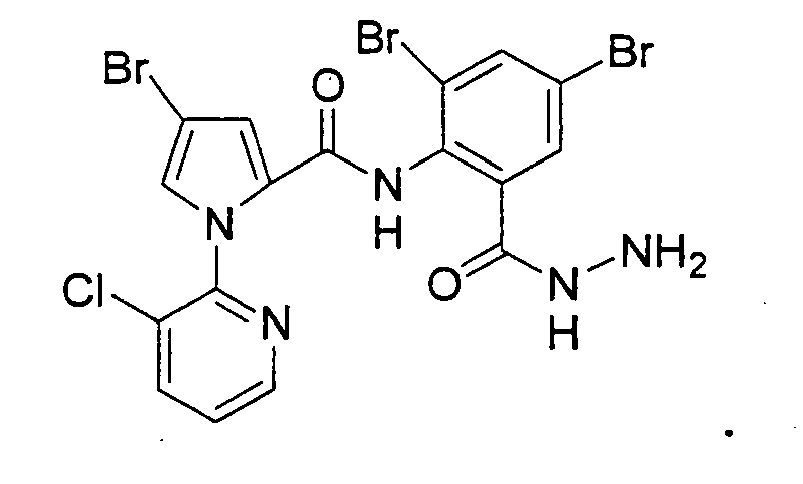
- A mixture of 1.0 g of 4-bromoimidazole, 1.3 g of 3-chloro-2-(methanesulfonyl)pyridine, 2.7 g of cesium carbonate and 10 ml of N,N-dimethylformamide was stirred at 100°C for 6 hours. The reaction mixture was allowed to cool to room temperature, and water was poured into the mixture. A deposited precipitate was collected by filtration to obtain 1.7 g of 2-(4-bromo-1H-imidazol-1-yl)-3-chloropyridine of the formula:

1H-NMR(CDCl3,TMS)δ(ppm):7.33(1H,dd,J=8Hz,5Hz),7.63(1H,s), 7.93(1H,dd,J=8Hz,2Hz),8.13(1H,s),8.45-8.46(1H,m) - To a solution of 1.0 g of 2-(4-bromo-1H-imidazol-1-yl)-3-chloropyridine in 5 ml of dichloromethane was added dropwise a solution of 0.45 ml of trichloroacetyl chloride in 5 ml of dichloromethane at room temperature. The resulting mixture was stirred at room temperature for 1 day. Thereto 0.57 ml of triethylamine was added, and the resulting mixture was stirred at room temperature for 2 hours. The reaction mixture was concentrated under reduced pressure, and the resulting residue was subjected to silica gel chromatography to obtain 1.0 g of 1-[4-bromo-1-(3-chloro-2-pyridinyl)-1H-imidazol-2-yl]-2,2,2-trichloroethanone of the formula:

1H-NMR(CDCl3,TMS)δ(ppm):7.35(1H,s),7.49(1H,dd,J=8Hz,5Hz), 7.95(1H,dd,J=8Hz,2Hz),8.51(1H,dd,J=5Hz,2Hz) - To a solution of 0.50 g of 1-[4-bromo-1-(3-chloro-2-pyridinyl)-1H-imidazol-2-yl]-2,2,2-trichloroethanone and 0.37 g of 2-amino-3,5-dibromobenzoic acid in 10 ml of acetonitrile was added 0.43 ml of triethylamine. The resulting mixture was stirred at room temperature for 1 day. Thereto 0.12 ml of methanesulfonyl chloride was added, and the mixture was stirred at room temperature for 3 hours. Water was poured into the reaction mixture, and the mixture was extracted with ethyl acetate three times. The organic layers were combined, washed with an aqueous saturated sodium chloride solution, dried over anhydrous magnesium sulfate, and concentrated under reduced pressure. The residue was subjected to silica gel column chromatography to obtain 0.29 g of 2-[4-bromo-1-(3-chloro-2-pyridinyl)-1H-imidazol-2-yl]-6,8-dibromo-4H-3,1-benzoxazine -4-one of the formula:

1H-NMR(DMSO-d6,TMS)δ(ppm):7.70(1H,dd,J=8Hz,5Hz),8.18(1H,d, J=3Hz),8.18(1H,s),8.31(1H,dd,J=8Hz,1Hz),8.33(1H,d,J=3Hz), 8.59(1H,dd,J=5Hz,1Hz) - A mixture of 0.70 g of 1-(3-chloro-2-pyridinyl)-5-thiocyanato-1H-pyrrole-2-carbaldehyde, 0.64 g of sodium sulfide nonahydrate and 10 ml of water was stirred for 1 hour under heat refluxing. The reaction mixture was allowed to cool to room temperature, adjusted to pH 5 by an addition of acetic acid, and then extracted with ethyl acetate two times. The organic layers were combined, washed with an aqueous saturated sodium chloride solution, dried over anhydrous magnesium sulfate, and concentrated under reduced pressure. The residue was washed with methyl tert-butyl ether to obtain 0.50 g of 1-(3-chloro-2-pyridinyl)-5-mercapto-1H-pyrrole-2-carbaldehyde of the formula:
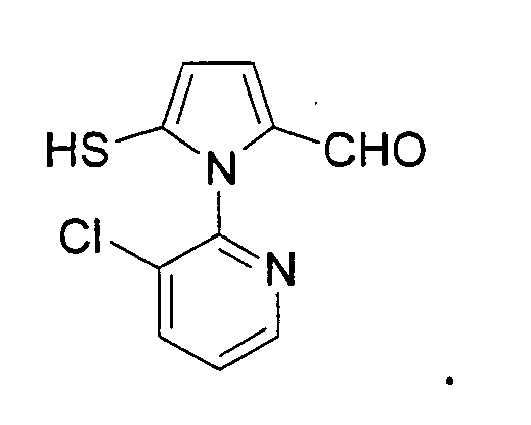
1H-NMR(CDCl3,TMS)δ(ppm):6.56(1H,d,J=4Hz),7.07(1H,d,J=4Hz), 7.46(1H,dd,J=8Hz,5Hz),7.93(1H,dd,J=8Hz,2Hz),8.54(1H,dd, J=5Hz,2Hz),9.42(1H,s) - A mixture of 0.50 g of 1-(3-chloro-2-pyridinyl)-5-mercapto-1H-pyrrole-2- carbaldehyde, 0.36 g of methyl iodide, 0.43 g of potassium carbonate and 50 ml of N, N-dimethylformamide was stirred at room temperature for 1 day. Water was poured into the reaction mixture, and the mixture was extracted with ethyl acetate three times. The organic layers were combined, washed successively with water and an aqueous saturated sodium chloride solution, dried over anhydrous magnesium sulfate, and concentrated under reduced pressure. The residue was subjected to silica gel column chromatography to obtain 0.34 g of 1-(3-chloro-2-pyridinyl)-5-methylthio-1H-pyrrole-2-carbaldehyde of the formula:

1H-NMR(CDCl3,TMS)δ(ppm):2.39(3H,s),6.45(1H,d,J=4Hz), -7.10(1H,d,J=4Hz),7.43(1H,dd,J=8Hz,5Hz),7.90(1H,dd,J=8Hz, 2Hz),8.52(1H,dd,J=5Hz,2Hz),9.41(1H,s) - To a mixture of 0.38 g of 1-(3-chloro-2-pyridinyl)-5-methylthio-1H-pyrrole-2-carbaldehyde, 5 ml of acetone and 3 ml of water was added 0.38 g of potassium permanganate at 40°C. The resulting mixture was stirred at 50°C for 4 hours. The reaction mixture was allowed to cool to room temperature, and filtered. The filtrate was washed with chloroform two times, and then adjusted to around pH 3 by an addition of 2N hydrochloric acid. A deposited crystal was collected by filtration to obtain 0.38 g of a mixture of 1-(3-chloro-2-pyridinyl)-5-methylsulfonyl-1H-pyrrole-2-carboxylic acid and 1-(3-chloro-2-pyridinyl)-5-methylthio-1H-pyrrole-2-carboxylic acid.
- A mixture of the resulting mixture and 0.29 ml of thionyl chloride was heated to reflux in 10 ml of acetonitrile for 1 hour. The reaction mixture was allowed to cool to room temperature, and concentrated under reduced pressure. The resulting residue was dissolved in 10 ml of acetonitrile. Thereto 0.39 g of 2-amino-3,5-dibromobenzoic acid and 0.65 ml of triethylamine were added, and the mixture was stirred at room temperature for 6 hours. Thereto 0.13 ml of methanesulfonyl chloride was added, and the mixture was stirred at room temperature for 1 hour. Water was poured into the reaction mixture, and the mixture was extracted with ethyl acetate three times. The organic layers were combined, washed with an aqueous saturated sodium chloride solution, dried over anhydrous magnesium sulfate, and concentrated under reduced pressure. The residue was subjected to silica gel column chromatography to obtain 0.05 g of 6,8-dibromo-2-[1-(3-chloro-2-pyridinyl)-5-methylsulfonyl-1H-pyrrol-2-yl]-4H-3,1-benzoxazine-4-one of the formula:


1H-NMR(CDCl3, TMS)δ(ppm):3.23(3H, s), 7.21(1H, d, J=4Hz), 7.41(1H, d, J=4Hz), 7.50(1H, dd, J=8Hz, 4Hz), 7.95(1H, d, J=8Hz), 8.02(1H,d, J=2Hz), 8.24(1H, d, J=2Hz), 8.56(1H, d, J=4Hz)
6,8-Dibromo-2-[1-(3-chloro-2-pyridinyl)-5-methylthio-1H-pyrrol-2-yl]-4H-3,1-benzoxazine-4-one
1H-NMR(CDCl3,TMS)δ(ppm):2.39(3H,s),6.63(1H,d,J=4Hz),7.35(1H, d,J=4Hz),7.63(1H,dd,J=8Hz,5Hz),8.08(1H,d,J=2Hz),8.22(1H,d, J=2Hz),8.25(1H,dd,J=8Hz,2Hz),8.58(1H,dd,J=5Hz,2Hz) - To a mixture of 20 g of 3-chloro-2-hydrazinopyridine, 56 ml of sodium ethoxide (a 21% solution in ethanol) and 75 ml of ethanol was added dropwise 27 ml of diethyl maleate. The resulting mixture was heated to reflux for 10 minutes. The reaction mixture was allowed to cool to 65°C, and 15 ml of acetic acid was poured into the mixture. The reaction mixture was allowed to cool to room temperature. After 190 ml of water was poured into the reaction mixture, the mixture was adjusted to pH 2 by an addition of 6N hydrochloric acid and then extracted with methyl tert-butyl ether three times. The organic layers were combined, washed with an aqueous saturated sodium chloride solution, dried over anhydrous magnesium sulfate, and concentrated under reduced pressure. Diethyl ether was added to the resulting residue, and a solid was collected by filtration to obtain 4.28 g of ethyl 2-(3-chloro-2-pridinyl)-5-oxo-3-pyrazolidinecarboxylate of the formula:

1H-NMR(DMSO-d6,TMS)δ(ppm):1.22(3H,t,J=7Hz),2.36(1H,d, J=17Hz),2.92(1H,dd,J=17Hz,10Hz),4.20(2H,q,J=7Hz),4.83(1H,d, J=10Hz),7.20(1H,dd,J=8Hz,5Hz),7.93(1H,d,J=8Hz),8.27(1H,d,J= 5Hz),10.17(1H,s) - To a mixture of 12.0 g of ethyl 2- (3-chloro-2-pyridinyl) - 5-oxo-3-pyrazolidinecarboxylate, 90 ml of acetonitrile and 4.8 ml of sulfuric acid was added 14.5 g of potassium persulfate. The resulting mixture was heated to reflux for 3.5 hours. The reaction mixture was allowed to cool to room temperature, and filtered. Water was poured into the filtrate, and the mixture was extracted with methyl tert-butyl ether three times. The organic layers were combined, washed with an aqueous saturated sodium chloride solution, dried over anhydrous magnesium sulfate, and concentrated under reduced pressure. The resulting residue was subjected to silica gel chromatography to obtain 7.23 g of ethyl 1-(3-chloro-2-pyridinyl)-3-hydroxy-1H-pyrazole-5-carboxylate of the formula:

1H-NMR(DMSO-d6,TMS)δ(ppm):1.06(3H,t,J=7Hz),4.11(2H,q,J=7Hz), 6.34(1H,s),7.59-7.63(1H,m),8.17-8.23(1H,m),8.50-8.52(1H,m), 10.65(1H,s) - Trifluoromethyl trifluorovinyl ether was blown into a mixture of 1.0 g of ethyl 1-(3-chloro-2-pyridinyl)-3-hydroxy-1H-pyrazole-5-carboxylate, 0.042 g of potassium hydroxide, 10 ml of methanol and 10 ml of dimethyl sulfoxide under ice-cooling. The resulting mixture was stirred at room temperature for 4 days. Water was poured into the reaction mixture, and the mixture was extracted with diethyl ether two times. The organic layers were combined, washed with water and an aqueous saturated sodium chloride solution, dried over anhydrous magnesium sulfate, and concentrated under reduced pressure. The resulting residue was subjected to silica gel chromatography to obtain 1.32 g of methyl 1-(3-chloro-2-pyridinyl)-3-[1,1,2-trifluoro-2-(trifluoromethoxy)ethoxy]-1H-pyrazole-5-carboxylate of the formula:

1H-NMR(CDCl3,TMS)δ(ppm):3.80(3H,s),6.04(1H,dt,J=54Hz,3Hz), 6.80(1H,s),7.45(1H,dd,J=8Hz,5Hz),7.92(1H,dd,J=8Hz,2Hz),8.51 (1H,dd,J=5Hz,2Hz) - To a mixture of 1.32 g of methyl 1- (3-chloro-2-pyridinyl)-3-[1,1,2-trifluoro-2-(trifluoromethoxy)ethoxy]-1H-pyrazole-5-carboxylate and 15 ml of methanol was added 5 ml of a 2N aqueous sodium hydroxide solution. The resulting mixture was stirred at room temperature for 3 hours. Water was poured into the reaction mixture, and the mixture was washed with methyl tert-butyl ether. The aqueous layer was adjusted to pH 2 by an addition of 6N hydrochloric acid and then extracted with methyl tert-butyl ether two times. The organic layers were combined, washed with an aqueous saturated sodium chloride solution, dried over anhydrous magnesium sulfate, and concentrated under reduced pressure to obtain 1.18 g of 1-(3-chloro-2-pyridinyl)-3-[1,1,2-trifluoro-2-(trifluoromethoxy)ethoxy]-1H-pyrazole-5-carboxylic acid of the formula:

1H-NMR(CDCl3,TMS)δ(ppm):6.04(1H,dt,J=54Hz, Hz),6.84(1H,s), 7.46(1H,dd,J=8Hz,5Hz),7.93(1H,dd,J=8Hz,2Hz),8.50(1H,dd,J= 5Hz,2Hz) - According to the same manner as that of Reference Preparation Example 13, 1-(3-chloro-2-pyridinyl)-3-[1,1,2-trifluoro-2-(trifluoromethoxy)ethoxy]-1H-pyrazole-5-carboxylic acid was used in place of 1-(3-chloro-2-pyridinyl)-1H-pyrazole-5-carboxylic acid to obtain 6-chloro-2-{1-(3-chloro-2-pyridinyl)-3-[1,1,2-trifluoro-2-(trifluoromethoxy)ethoxy]-1H-pyrazol-5-yl}-8-methyl-4H-3,1-benzoxazine-4-one of the formula:
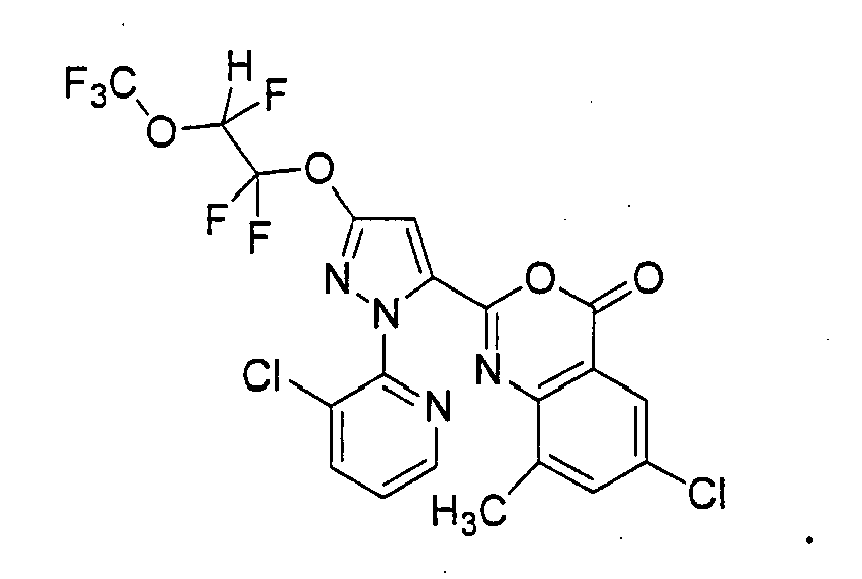
1H-NMR(CDCl3,TMS)δ(ppm) :1.83(3H,s),6.06(1H,dt,J=54Hz,3Hz), 7.04(1H,s),7.48-7.51(2H,m),7.96-8.00(2H,m),8.55(1H,dd,J=5Hz, 2Hz) - To a mixture of 4.0 g of N,N-dimethyl-1H-pyrazole-1-sulfonamide and 50 ml of tetrahydrofuran was added dropwise 15.7 ml of a 1.6M solution of N-butyl lithium in hexane at -78°C. The resulting mixture was stirred at -78°C for 10 minutes. A mixture of 1.46 g of sulfur and 20 ml of tetrahydrofuran was added to the mixture. The mixture was stirred at -78°C for 1 hour, and further stirred for 1.5 hours while the reaction temperature was gradually raised to room temperature. A deposited solid was collected by filtration, and washed with diethyl ether. The solid was dissolved in water. The resulting aqueous solution was adjusted to around pH 3 by an addition of 6N hydrochloric acid, and then extracted with methyl t-butyl ether three times. The organic layers were combined, washed with an aqueous saturated sodium chloride solution, dried over magnesium sulfate, and concentrated under reduced pressure to obtain 3.92 g of N,N-dimethyl-5-mercapto-1H-pyrazole-1-sulfonamide of the formula:
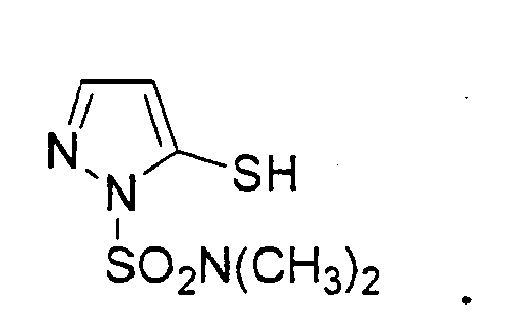
1H-NMR(CDCl3,TMS)δ(ppm):3.03(6H,s),4.39(1H,s),6.27(1H,d,J= 2Hz),7.59(1H,d,J=2Hz) - A mixture of 1.0 g of N,N-dimethyl-5-mercapto-1H-pyrazole-1-sulfonamide, 0.30 g of sodium hydride (50% in oil) and 25 ml of tetrahydrofuran was stirred at room temperature for 0.5 hour, and then cooled to -60°C. Thereto 1.94 g of S-(trifluoromethyl)dibenzothiophenium trifluoromethanesulphonate was added. The resulting mixture was stirred at -60°C for 0.5 hour, and further stirred at room temperature for 2 hours. Water was poured into the reaction mixture, and the mixture was extracted with ethyl acetate three times. The organic layers were combined, washed with an aqueous saturated sodium chloride solution, dried over magnesium sulfate, and concentrated under reduced pressure. The resulting residue was subjected to silica gel chromatography to obtain 1.30 g of N,N-dimethyl-5-(triflioromethylthio)-1H-pyrazole-1-sulfonamide of the formula:

1H-NMR(CDCl3,TMS)δ(ppm):3.08(6H,s),6.73(1H,s),7.73(1H,s) - According to the same manner as that of Reference Preparation Example 21, N,N-dimethyl-5-(trifluoromethylthio)-1H-pyrazole-1-sulfoneamide was used in place of 5-bromo-N,N-dimethyl-1H-pyrazole-1-sulfonamide to obtain 3-(trifluoromethylthio)-1H-pyrazole of the formula:

1H-NMR(CDCl3,TMS)δ(ppm):6.70(1H,d,J=3Hz),7.74(1H,d,J=3Hz), 12.47(1H,brs) - According to the same manner as that of Reference Preparation Example 22, 3-(trifluoromethylthio)-1H-pyrazole was used in place of 3-bromo-1H-pyrazole to obtain 3-chloro-2-[3-(trifluoromethylthio)-1H-pyrazol-1-yl]pyridine of the formula:

1H-NMR(CDCl3,TMS)δ(ppm):6.78(1H,d,J=3Hz),7.35(1H,dd,J=8Hz, 5Hz),7.94(1H,dd,J=8Hz,2Hz),8.17(1H,d,J=3Hz),8.47(1H,dd,J= 5Hz,2Hz) - According to the same manner as that of Reference Preparation Example 23, 3-chloro-2-[3-(trifluoromethylthio)-1H-pyrazol-1-yl]pyridine was used in place of 2-(3-bromo-1H-pyrazol-1-yl)-3-chloropyridine to obtain 1-(3-chloro-2-pyridinyl)-3-(trifluoromethylthio)-1H-pyrazole-5-carboxylic acid of the formula:

1H-NMR(CDCl3,TMS)δ(ppm):7.35(1H,s),7.47(1H,dd,J=8Hz,5Hz), 7.94(1H,d,J=8Hz),8.52(1H,d,J=5Hz) - According to the same manner as that of Reference Preparation Example 13, 1-(3-chloro-2-pyridinyl)-3-(trifluoromethylthio)-1H-pyrazole-5-carboxylic acid was used in place of 1-(3-chloro-2-pyridinyl)-1H-pyrazole-5-carboxylic acid to obtain 6-chloro-2-[1-(3-chloro-2-pyridinyl)-3-(trifluoromethylthio)-1H-pyrazol-5-yl]-8-methyl-4H-3,1-benzoxazine-4-one of the formula:

1H-NMR(CDCl3,TMS)δ(ppm):1.82(3H,s),7.50-7.54(3H,m), 7.98-8.00(2H,m),8.57(1H,dd,J=5Hz,2Hz) - According to the same manner as that of Reference Preparation Example 147, 2-[3-bromo-1-(3-chloro-2-pyridinyl)-1H-pyrazol-5-yl]-6,8-dichloro-4H-3,1-benzoxazin-4-one was used in place of 2-[3-bromo-1-(3-chloro-2-pyridinyl)-1H-pyrazol-5-yl]-6,8-dibromo-4H-3,1-benzoxazin-4-one to obtain 3-bromo-N-[4,6-dichloro-2-(N,N'-dimethylhydrazinocarbonyl)phenyl]-1-(3-chloro-2-pyridinyl)-1H-pyrazole-5-carboxamide of the formula:

1H-NMR(DMSO-d6,TMS)δ(ppm):2.20(2.4H,d,J=5Hz),2.39(0.6H,d,J= 6Hz),2.72(0.6H,s),3.02(2.4H,s),4.59(0.8H,q,J=5Hz),5.68(0.2H, q,J=6Hz),7.38(0.8H,d,J=2Hz),7.40(1.0H,s),7.53(0.2H,d,J=2Hz), 7.60-7.64(1.0H,m),7.70(0.8H,d,J=2Hz),7.84(0.2H,d,J=2Hz), 8.16-8.19(1.0H,m),8.49-8.50(1.0H,m),10.34(0.8H,s),10.65 (0.2H,s) - Then, Formulation Examples will be shown. All parts are by weight.
- Into a mixture of 35 parts of xylene and 35 parts of N,N-dimethylformamide, 10 parts of any one of the present compounds (1) to (231) is dissolved, and then 14 parts of polyoxyethylene styrylphenyl ether and 6 parts of calcium dodecylbenzenesulfonate are added. The mixture is stirred thoroughly to obtain a 10% emulsion.
- To a mixture of 4 parts of sodium laurylsulfate, 2 parts of calcium ligninsulfonate, 20 parts of synthetic hydrous silicon oxide fine powder and 54 parts of diatomaceous earth, 20 parts of any one of the present compounds (1) to (231) is added. The mixture is stirred thoroughly to obtain a 20% wettable agent.
- To 2 parts of any one of the present compounds (1) to (231), 1 part of synthetic hydrous silicon oxide fine powder, 2 parts of calcium ligninsulfonate, 30 parts of bentonite and 65 parts of kaolin clay are added, and then stirred thoroughly. Then, an appropriate amount of water is added to the mixture. The mixture is further stirred, granulated with a granulator, and forced-air dried to obtain a 2% granule.
- Into an appropriate amount of acetone, 1 part of any one of the present compounds (1) to (231) is dissolved, and then 5 parts of synthetic hydrous silicon oxide fine powder, 0. 3 part of PAP and 93.7 parts of fubasami clay are added. The mixture is stirred thoroughly. Then, acetone is removed from the mixture by evaporation to obtain a 1% powder.
- A mixture of 10 parts of any one of the present compounds (1) to (231); 35 parts of white carbon containing 50 parts of polyoxyethylene alkyl ether sulfate ammonium salt; and 55 parts of water is finely ground by a wet grinding method to obtain a 10% flowable agent.
- In 5 parts of xylene and 5 parts of trichloroethane, 0.1 part of any one of the present compounds (1) to (231) is dissolved. The solution is mixed with 89.9 parts of deodorized kerosene to obtain a 0.1% oil.
- In 0.5 ml of acetone, 10 mg of any one of the present compounds (1) to (231) is dissolved. The solution is mixed uniformly with 5 g of a solid feed powder for an animal (solid feed powder for rearing and breeding CE-2, manufactured by CLEA Japan, Inc.), and then dried by evaporation of acetone to obtain poison bait.
- Then, it will be shown by Test Examples that the present compound is effective in controlling harmful arthropods.
- Preparations of the present compounds (1), (4) to (53), (55) to (74), (76) to (83), (85) to (120), (122) to (156), (158) to (167), (170) to (171), (173), (175) to (176), (178), (181) to (184), (188) to (190), (195) to (197), (200) to (216), (218) to (219), (221) to (223) and (231) obtained in Formulation Example 5 were diluted with water so that the active ingredient concentration became 500 ppm, to prepare test spray solutions.
- At the same time, cabbage was planted in a polyethylene cup, and grown until the third true leaf or the fourth true leaf was developed. The test spray solution as described above was sprayed in an amount of 20 ml/cup on the cabbage.
- After the drug solution sprayed on the cabbage was dried, 10 third-instar larvae of diamondback moths were put on the cabbage. After 5 days, the number of diamondback moths was counted, and a controlling value was calculated by the following equation:

wherein, - Cb: the number of worms in a non-treated section before treatment
- Cai: the number of worms in a non-treated section on observation
- Tb: the number of worms in a treated-section before treatment
- Tai: the number of worms in a treated-section on observation.
- As a result, the test spray solutions of the present compounds (1), (4) to (53), (55) to (74), (76) to (83), (85) to (120), (122) to (156), (158) to (167), (170) to (171), (173), (175) to (176), (178), (181) to (184), (188) to (190), (195) to (197), (200) to (216), (218) to (219), (221) to (223) and (231) each exhibited a controlling value of 80% or more.
- Preparations of the present compounds (4) to (7), (9) to (12), (17) to (23), (27), (29), (32) to (44), (48) to (51), (56) to (61), (65) to (68), (70) to (72), (74) to (75), (78) to (81), (83) to (85), (87) to (88), (91) to (97), (99) to (102), (104) to (120), (122) to (125), (127) to (135), (137) to (144), (147) to (149), (151) to (161), (164), (166) to (168), (171) to (173), (175) to (184), (186) to (188), (191), (193) to (205), (208) to (209), (213) to (215), (218) to (224), (226) to (230) and (231) obtained in Formulation Example 5 was diluted with water so that the active ingredient concentration became 500 ppm to prepare test spray solutions.
- At the same time, cucumber was planted in a polyethylene cup, and was grown until the first true leaf was developed. About 30 cotton aphids were put on the cucumber. One day after, the test spray solution as described above was sprayed in an amount of 20 ml/cup on the cucumber. Six days after spraying, the number of cotton aphids was counted, and a controlling value was calculated by the following equation:

wherein, - Cb: the number of insects in a non-treated section before treatment
- Cai: the number of insects in a non-treated section on observation
- Tb: the number of insects in a treated-section before treatment
- Tai: the number of insects in a treated-section on observation.
- As a result, the test spray solutions of the present compounds (4) to (7), (9) to (12), (17) to (23), (27), (29), (32) to (44), (48) to (51), (56) to (61), (65) to (68), (70) to (72), (74) to (75), (78) to (81), (83) to (85), (87) to (88), (91) to (97),-(99) to (102), (104) to (120), (122) to (125), (127) to (135), (137) to (144), (147) to (149), (151) to (161), (164), (166) to (168), (171) to (173), (175) to (184), (186) to (188), (191), (193) to (205), (208) to (209), (213) to (215), (218) to (224), (226) to (230) and (231) each exhibited a controlling value of 90% or more.
Furthermore, the same way as Test Example 2, test spray salution of the comparative compound of the formula:
WO2003/015518A page 109 Compound 354) exhibited a controlling value of less than 30 %. - Preparations of the present compounds (4) to (13), (15) to (23), (25) to (44), (48) to (51), (56) to (58), (61), (65) to (74), (80) to (81), (85) to (97), (100), (102), (104) to (120), (122) to (125), (127) to (137), (139) to (156), (158) to (167), (170) to (171), (173), (175) to (176), (178), (181) to (184), (188) to (190), (195) to (197), (200) to (208), (210) to (216), (218) to (219), (221) to (224) and (231) obtained in Formulation Example 5 was diluted with water so that the active ingredient concentration became 500 ppm to prepare test spray solutions.
- At the same time, cabbage was planted in a polyethylene cup, and grown until the third true leaf or the fourth true leaf was developed. The test spray solution as described above was sprayed in an amount of 20 ml/cup on the cabbage. After the drug solution sprayed on the cabbage was dried, 10 fourth-instar larvae of Spodoptera litura were put on the cabbage. After 4 days, the number of Spodoptera litura surviving on the cabbage leaves was counted, and a controlling value was calculated by the following equation:

wherein, - Cb: the number of worms in a non-treated section before treatment
- Cai: the number of worms in a non-treated section on observation
- Tb: the number of worms in a treated-section before treatment
- Tai: the number of worms in a treated-section on observation.
- As a result, the test spray solutions of the present compounds (4) to (13), (15) to (23), (25) to (44), (48) to (51), (56) to (58), (61), (65) to (74), (80) to (81), (85) to (97), (100), (102), (104) to (120), (122) to (125), (127) to (137), (139) to (156), (158) to (167), (170) to (171), (173), (175) to (176), (178), (181) to (184), (188) to (190), (195) to (197), (200) to (208), (210) to (216), (218) to (219), (221) to (224) and (231) each exhibited a controlling value of 80% or more.
- Preparations of the present compounds) (4) to (13), (15) to (23), (25) to (45), (47) to (51), (53), (55) to (61), (65) to (72), (74), (78) to (81), (83), (85) to (102), (104) to (105), (107) to (117), (119) to (120), (122) to (125), (127) to (156), (158) to (164), (166) to (167), (171), (173), (175) to (176), (178), (181) to (184), (188) to (190), (195) to (197), (200) to (211), (213) to (216), (218) to (219), (221) to (224) and (231) obtained in Formulation Example 5 was diluted with water so that the active ingredient concentration became 500 ppm to prepare test spray solutions.
- At the same time, 20 ml of the test spray solution as described above was sprayed to an apple seedling (28 day-old seeding, tree height: about 15 cm) planted in a plastic cup. The apple seedling was air-dried to such an extent that the drug solution sprayed on the apple seedling was dried, about 30 first-instar larvae of Adoxophyes orana fasciata were released. Seven days after spraying, the number of worms surviving on the apple seedling was counted, and a controlling value was calculated by the following equation:

wherein, - Cb: the number of worms in a non-treated section before treatment
- Cai: the number of worms in a non-treated section on observation
- Tb: the number of worms in a treated-section before treatment
- Tai: the number of worms in a treated-section on observation.
- As a result, the test spray solutions of the present compounds (4) to (13), (15) to (23), (25) to (45), (47) to (51), (53), (55) to (61), (65) to (72), (74), (78) to (81), (83), (85) to (102), (104) to (105), (107) to (117), (119) to (120), (122) to (125), (127) to (156), (158) to (164), (166) to (167), (171), (173), (175) to (176), (178), (181) to (184), (188) to (190), (195) to (197), (200) to (211), (213) to (216), (218) to (219), (221) to (224) and (231) each exhibited a controlling value of 90% or more.
- Preparations of the present compounds (4) to (5), (9) to (10), (17), (19) to (22), (27), (29), (32) to (44), (48) to (51), (56) to (61), (66) to (68), (70) to (72), (74) to (75), (79), (81), (85), (88), (91) to (92), (94) to (95), (99), (101) to (102), (104) to (120), (122) to (124), (127) to (129), (131) to (132), (135) to (136), (140), (142) to (145), (147) to (151), (153) to (157), (159), (163) to (164), (167), (171) to (172), (175) to (176), (183), (187), (193) to (194), (196) to (204), (206), (208) to (209), (213) to (221), (226), (227) and (231) obtained in Formulation Example 5 was diluted with water so that the active ingredient concentration became 500 ppm to prepare test spray solutions.
- At the same time, cucumber was planted in a polyethylene cup, and was grown until the first true leaf was developed. The test spray solution as described above was sprayed in an amount of 20 ml/cup on the cucumber. After the drug solution sprayed on the cucumber was dried, the first true leaf was cut and then placed on a filter paper (diameter: 70 mm) containing water in a polyethylene cup (diameter: 110 mm). On the cucumber leaf, 20 larvae of Frankliniella occidentalis were released, and the polyethylene cup was capped. Seven days after spraying, the number of insects surviving on the cucumber leaf was counted, and a controlling value was calculated by the following equation:

wherein, - Cb: the number of insects in a non-treated section before treatment
- Cai: the number of insects in a non-treated section on observation
- Tb: the number of insects in a treated-section before treatment
- Tai: the number of insects in a treated-section on observation.
- As a result, the test spray solutions of the present compounds (4) to (5), (9) to (10), (17), (19) to (22), (27), (29), (32) to (44), (48) to (51), (56) to (61), (66) to (68), (70) to (72), (74) to (75), (79), (81), (85), (88), (91) to (92), (94) to (95), (99), (101) to (102), (104) to (120), (122) to (124), (127) to (129), (131) to (132), (135) to (136), (140), (142) to (145), (147) to (151), (153) to (157), (159), (163) to (164), (167), (171) to (172), (175) to (176), (183), (187), (193) to (194), (196) to (204), (206), (208) to (209), (213) to (221), (226), (227) and (231) each exhibited a controlling value of 90% or more.
- Preparations of the present compounds (5), (32), (34), (43) to (44), (49) to (50), (56), (59), (93), (95) to (96), (107), (111) to (112), (114), (119), (127), (129), (132) to (133), (144), (147) to (148), (153), (158), (167) to (168), (171) to (172), (177) to (178), (182) to (184), (186) to (187), (193) to (194), (197) to (199), (201), (204), (209), (213), (215), (219) to (220), (221), (223), (226) and (231) obtained in Formulation Example 5 was diluted with water so that the active ingredient concentration became 500 ppm to prepare test spray solutions.
- At the same time, cabbage was planted in a polyethylene cup, and grown until the first true leaf was developed. All leaves excluding the first true leaf were cut off. On the first true leaf, imagoes of silver leaf whitefly were released and allowed to lay eggs for about 24 hours. The cabbage was retained in a greenhouse for 8 days. When larvae hatched from the laid eggs, the test spray solution as described above was sprayed in an amount of 20 ml/cup to the cabbage. Seven days after spraying, the number of larvae surviving on the cabbage was counted, and a controlling value was calculated by the following equation:

wherein, - Cb: the number of worms in a non-treated section before treatment
- Cai: the number of worms in a non-treated section on observation
- Tb: the number of worms in a treated-section before treatment
- Tai: the number of worms in a treated-section on observation.
- As a result, the test spray solutions of the present compounds (5), (32), (34), (43) to (44), (49) to (50), (56), (59), (93), (95) to (96), (107), (111) to (112), (114), (119), (127), (129), (132) to (133), (144), (147) to (148), (153), (158), (167) to (168), (171) to (172), (177) to (178), (182) to (184), (186) to (187), (193) to (194), (197) to (199), (201), (204), (209), (213), (215), (219) to (220), (221), (223), (226) and (231) each exhibited a controlling value of 90% or more.
- According to the present invention, since the hydrazide compound of the present invention has excellent efficacy of controlling pests, it is useful as an active ingredient of a pesticide.
- The present invention is summarized by the following items:
- 1. A hydrazide compound represented by the formula (1) :

- R1 represents a hydrogen atom, a C1-C6 alkyl group optionally substituted with at least one halogen atom, a C2-C6 cyanoalkyl group, a C2-C6 alkoxyalkyl group optionally substituted with at least one halogen atom, a C2-C6 alkenyl group optionally substituted with at least one halogen atom, a C3-C6 alkynyl group optionally substituted with at least one halogen atom, or a C7-C9 phenyl alkyl group whose benzene ring moiety may be substituted with 1 to 5 independent substituents selected from the group consisting of (1) a halogen atom, (2) a cyano group, (3) a nitro group, (4) a C1-C6 alkyl group optionally substituted with at least one halogen atom and (5) a C1-C6 alkoxy group optionally substituted with at least one halogen atom,
- R2 and R3 independently represent a hydrogen atom, a C1-C6 alkyl group optionally substituted with at least one halogen atom, a C1-C6 acyl group, a C2-C6 alkoxycarbonyl group, a C3-C7 N,N-dialkylcarbamoyl group, or a phenyl group optionally substituted with 1 to 5 independent substituents selected from the group consisting of (1) a halogen atom, (2) a cyano group, (3) a nitro group and (4) a C1-C6 alkyl group optionally substituted with at least one halogen atom,
- R4 represents a halogen atom, a cyano group, a nitro group, a C1-C6 alkyl group optionally substituted with at least one halogen atom, a C1-C6 alkoxy group optionally substituted with at least one halogen atom, a phenyl group optionally substituted with at least one halogen atom, a C1-C6 alkylthio group optionally substituted with at least one halogen atom, a C1-C6 alkylsulfinyl group optionally substituted with at least one halogen atom, or a C1-C6 alkylsulfonyl group optionally substituted with at least one halogen atom, or two R4 groups which are bound to the adjacent carbon atoms are bound at their terminal ends to each other to form a group T1 or T2
T1 : -CR41=CR42-CR43=CR49-
T2: -(CR45R96)h-
(wherein R41, R42, R43 and R44 independently represent a hydrogen atom, a halogen atom, a cyano group, a nitro group, a C1-C6 alkyl group optionally substituted with at least one halogen atom, a C1-C6 alkoxy group optionally substituted with at least one halogen atom, a C1-C6 alkylthio group optionally substituted with at least one halogen atom, a C1-C6 alkylsulfinyl group optionally substituted with at least one halogen atom, or a C1-C6 alkylsulfonyl group optionally substituted with at least one halogen atom, - R45 and R46 independently represent a hydrogen atom, or a C1-C6 alkyl group optionally substituted with at least one halogen atom, and
- h represents an integer of 3 or 4),
- n represents an integer of 0 to 4 (provided that, when n is an integer of 2 or more, R4' s may be the same or different),
- Q represents a group selected from Q1 to Q6:
- Q1: -C(=A31)-R5
- Q2: -C(=A32)-OR6
- Q3: -C(=A33)-SR7
- Q4: -C(=A34)-NR8R9
- Q5: -S(O)2-R10
- Q6: -S(Oh-NR11R12
- R5 represents a hydrogen atom; a C2-C6 alkenyl group optionally substituted with at least one halogen atom; a C2-C6 a-lkynyl group optionally substituted with at least one halogen atom; a C1-C6 alkyl group optionally substituted with one or more independent substituents selected from the group consisting of (1) a halogen atom, (2) a C1-C6 alkoxy group, (3) a C1-C6 alkylthio group, (4) a C1-C6 alkylsulfinyl group, (5) a C1- alkylsulfonyl group, (6) a C2-C6 dialkylamino group and (7) a C3-C6 cycloalkyl group; a C3-C6 cycloalkyl group optionally substituted with one or more independent substituents selected from the group consisting of (1) a halogen atom and (2) a C1-C6 alkyl group; a phenyl group optionally substituted with 1 to 5 independent substituents selected from the group consisting of (1) a halogen atom, (2) a cyano group, (3) a nitro group, (4) a C1-C6 alkyl group optionally substituted with at least one halogen atom, (5) a C1-C6 alkoxy group optionally substituted with at least one halogen atom, (6) a C1-C6 alkylthio group optionally substituted with at least one halogen atom, (7) a C1-C6 alkylsulfinyl group optionally substituted with at least one halogen atom, (8) a C1-C6 alkylsulfonyl group optionally substituted with at least one halogen atom, (9) a C2-C6 dialkylamino group optionally substituted with at least one halogen atom and (10) a C2-C6 alkoxycarbonyl group optionally substituted with at least one halogen atom; a naphthyl group optionally substituted with 1 to 9-independent substituents selected from the group consisting of (1) a halogen atom, (2) a cyano group, (-3) a nitro group, (4) a C1-C6 alkyl group optionally substituted with at least one halogen atom and (5) a C1-C6 alkoxy group optionally substituted with at least one halogen atom; a 5- to 6-membered heteroaryl group optionally substituted with one or more independent substituents selected from the group consisting of (1) a halogen atom, (2) a cyano group, (3) a nitro group, (4) a C1-C6 alkyl group optionally substituted with at least one halogen atom and (5) a C1-C6 alkoxy group optionally substituted with at least one halogen atom; a 3- to 8-membered non-aromatic heterocyclic group optionally substituted with one or more independent substituents selected from the group consisting of (1) a halogen atom and (2) a C1-C6 alkyl group; a C7-C9 phenylalkyl group whose benzene ring moiety may be substituted with 1 to 5 independent substituents selected from the group consisting of (1) a halogen atom, (2) a cyano group, (3) a nitro group, (4) a C1-C6 alkyl group optionally substituted with at least one halogen atom and (5) a C1-C6 alkoxy group optionally substituted with at least one halogen atom; or a C7-C9 phenoxyalkyl group whose benzene ring moiety may be substituted with 1 to 5 independent substituents selected from the group consisting of (1) a halogen atom, (2) a cyano group, (3) a nitro group, (4) a C1-C6 alkyl group optionally substituted with at least one halogen atom and (5) a C1-C6 alkoxy group-optionally substituted with at least one halogen atom,
- R6 and R7 represent a C1-C6 alkyl group optionally substituted with at least one halogen atom; a C3-C6 alkoxyalkyl group optionally substituted with at least one halogen atom; a C2-C6 alkenyl group optionally substituted with at least one halogen atom; a C3-C6 alkynyl group optionally substituted with at least one halogen atom; a C3-C6 cycloalkyl group optionally substituted with one or more independent substituents selected from the group consisting of (1) a halogen atom and (2) a C1-C6 alkyl group; a phenyl group optionally substituted with 1 to 5 independent substituents selected from the group consisting of (1) a halogen atom, (2) a cyano group, (3) a nitro group, (4) a C1-C6 alkyl group optionally substituted with at least one halogen atom, (5) a C1-C6 alkoxy group optionally substituted with at least one halogen atom, (6) a C1-C6 alkylthio group optionally substituted with at least one halogen atom, (7) a C1-C6 alkylsulfinyl group optionally substituted with at least one halogen atom, (8) a C1-C6 alkylsulfonyl group optionally substituted with at least one halogen atom, (9) a C2-C6 dialkylamino group optionally substituted with at least one halogen atom and (10) a C2-C6 alkoxycarbonyl group optionally substituted with at least one halogen atom; a 5- to 6-membered heteroaryl group optionally substituted with 1 to 5 independent substituents selected from the group consisting of (1) a halogen atom, (2) a cyano group, (3) a nitro group, (4) a C1-C6 alkyl group optionally substituted with at least one halogen atom and (5) a C1-C6 alkoxy group optionally substituted with at least one halogen atom; or a C7-C9 phenylalkyl group whose benzene ring moiety may be substituted with 1 to 5 independent substituents selected from the group consisting of (1) a halogen atom, (2) a cyano group, (3) a nitro group, (4) a C1-C6 alkyl group optionally substituted with at least one halogen atom and (5) a C1-C6 alkoxy group optionally substituted with at least one halogen atom,
- R8 and R9 independently represent a hydrogen atom; a C1-C6 alkyl group optionally substituted with at least one halogen atom; a C2-C6 alkoxyalkyl group optionally substituted with at least one halogen atom; a C2-C6 alkenyl group optionally substituted with at least one halogen atom; a C3-C6 alkynyl group optionally substituted with at least one halogen atom; a C3-C6 cycloalkyl group optionally substituted with one or more independent substituents selected from the group consisting of (1) a halogen atom and (2) a C1-C6 alkyl group; a phenyl group optionally substituted with 1 to 5 independent substituents selected from the group consisting of (1) a halogen atom, (2) a cyano group, (3) a nitro group, (4) a C1-C6 alkyl group optionally substituted with at least one halogen atom, (5) a C1-C6 alkoxy group optionally substituted with at least one halogen atom, (6) a C1-C6 alkylthio group optionally-substituted with at least one halogen atom, (7) a C1-C6 alkylsulfinyl group optionally substituted with at least one halogen atom, (8) a C1-C6 alkylsulfonyl group optionally substituted with at least one halogen atom, (9) a C2-C6 dialkylamino group optionally substituted with at least one halogen atom and (10) a C2-C6 alkoxycarbonyl group optionally substituted with at least one halogen atom; a 5- to 6-membered heteroaryl group optionally substituted with 1 to 5 independent substituents selected from the group consisting of (1) a halogen atom, (2) a cyano group, (3) a nitro group, (4) a C1-C6 alkyl group optionally substituted with at least one halogen atom and (5) a C1-C6 alkoxy group optionally substituted with at least one halogen atom; or a C7-C9 phenylalkyl group whose benzene ring moiety may be substituted with 1 to 5 independent substituents selected from the group consisting of (1) a halogen atom, (2) a cyano group, (3) a nitro group, (4) a C1-C6 alkyl group optionally substituted with at least one halogen atom and (5) a C1-C6 alkoxy group optionally substituted with at least one halogen atom; or R8 and R9 are taken together with the nitrogen atom to which they are bound to form a 3- to 8-membered non-aromatic heterocyclic group, the 3 to 8-membered non-aromatic heterocyclic group may contain, in the ring, one or more independent groups selected from the group consisting of (1) an oxygen atom, (2) a sulfur group and (3) a -NRa- group (wherein Ra represents a C1-C6 alkyl group optionally substituted with at least one halogen atom, a C2-C6 alkoxycarbonyl group optionally substituted with at least one halogen atom, or a phenyl group optionally substituted with 1 to 5 independent substituents selected from the group consisting of (1) a halogen atom, (2) a cyano group, (3) a nitro group, (4) a C1-C6 alkyl group optionally substituted with at least one halogen atom and (5) a C1-C6 alkoxy group optionally substituted with at least one halogen atom), or carbon atom(s) in the ring may be substituted with one or more independent substituents selected from the group consisting of (1) a halogen atom, (2) a C1-C6 alkyl group optionally substituted with at least one halogen atom and (3) a C2-C6 alkoxycarbonyl group optionally substituted with at least one halogen atom,
- R10 represents a C1-C6 alkyl group optionally substituted with at least one halogen atom; a C3-C6 cycloalkyl group optionally substituted with one or more independent substituents selected from the group consisting of (1) a halogen atom and (2) a C1-C6 alkyl group optionally substituted with at least one halogen atom; or a phenyl group optionally substituted with 1 to 5 independent substituents selected from the group consisting of (1) a halogen atom, (2) a cyano group, (3) a nitro group, (4) a C1-C6 alkyl group optionally substituted with at least one halogen atom and (5) a C1-C6 alkoxy group optionally substituted with at least one halogen -atom, and
- R11 and R12 independently represent a C1-C6 alkyl group optionally substituted with at least one halogen atom; a C3-C6 cycloalkyl group optionally substituted with one or more independent substituents selected from the group consisting of (1) a halogen atom and (2) a C1-C6 alkyl group optionally substituted with at least one halogen atom; or a phenyl group optionally substituted with 1 to 5 independent substituents selected from the group consisting of (1) a halogen atom, (2) a cyano group, (3) a nitro group, (4) a C1-C6 alkyl group optionally substituted with at least one halogen atom and (5) a C1-C6 alkoxy group optionally substituted with at least one halogen atom; or R11 and R12 are taken together with the nitrogen atom to which they are bound to form a 3- to 8-membered non-aromatic heterocyclic group, the 3- to 8-membered non-aromatic heterocyclic group may contain, in the ring, one or more independent groups selected from the group consisting of (1) an oxygen atom, (2) a sulfur atom and (3) a -NRb-group (wherein Rb represents a C1-C6 alkyl group optionally substituted with at least one halogen atom, a C2-C6 alkoxycarbonyl group optionally substituted with at least one halogen atom, or a phenyl group optionally substituted with 1 to 5 independent substituents selected from the group consisting of (1) a halogen atom, (2) a cyano group, (3) a nitro group, (4) a C1-C6 alkyl group optionally substituted with at least-one halogen atom and (5) a C1-C6 alkoxy group optionally substituted with at least one halogen atom), or carbon atom(s) in the ring may be substituted with one or more independent substituents selected from the group consisting of (1) a halogen atom, (2) a C1-C6 alkyl group optionally substituted with at least one halogen atom and (3) a C2-C6 alkoxycarbonyl group optionally substituted with at least one halogen atom),
- J represents a group represented by J1 or J2:

- R13a and R13b represent a C1-C6 alkyl group optionally substituted with at least one halogen atom; a C2-C6 cyanoalkyl group; a C2-C6 alkoxyalkyl group optionally substituted with at least one halogen atom; a C2-C6 alkenyl group optionally substituted with at least one halogen atom; a C2-C6 alkynyl group optionally substituted with at least one halogen atom; a C3-C6 cycloalkyl group optionally substituted with one or more independent substituents selected from the group consisting-of (1) a halogen atom and (2) a C1-C6 alkyl group; a phenyl group optionally substituted with 1 to 5 independent substituents selected from the group consisting of (1) a halogen atom, (2) a cyano group, (3) a nitro group, (4) a C1-C6 alkyl group optionally substituted with at least one halogen atom, (5) a C1-C6 alkoxy group optionally substituted with at least one halogen atom, (6) a C1-C6 alkylthio group optionally substituted with at least one halogen atom, (7) a C1-C6 alkylsulfinyl group optionally substituted with at least one halogen atom and (8) a C1-C6 alkylsulfonyl group optionally substituted with at least one halogen atom; a 5- to 6-membered heteroaryl group optionally substituted with one or more independent substituents selected from the group consisting of (1) a halogen atom, (2) a cyano group, (3) a nitro group, (4) a C1-C6 alkyl group optionally substituted with at least one halogen atom and (5) a C1-C6 alkoxy group optionally substituted with at least one halogen atom; a C7-C9 phenylalkyl group in whose benzene ring moiety may be substituted with one or more independent substituents selected from the group consisting of (1) a halogen atom, (2) a cyano group, (3) a nitro group, (4) a C1-C6 alkyl group optionally substituted with at least one halogen atom and (5) a C1-C6 alkoxy group optionally substituted with at least one halogen atom; and a C7-C9 pyridinylalkyl group whose pyridine ring moiety may be substituted with one or more independent substituents selected from the group consisting of (1) a halogen atom, (2) a cyano group, (3) a nitro group, (4) a C1-C6 alkyl group optionally substituted with at least one halogen atom and (5) a C1-C6 alkoxy group optionally substituted with at least one halogen atom,
- R14a and R14b represent a halogen atom; a cyano group; a nitro group; an isocyanato group; a C1-C6 alkyl group optionally substituted with at least one halogen atom; a C1-C6 alkoxy group optionally substituted with at least one halogen atom; a C2-C6 cyanoalkyloxy group; a C3-C6 alkoxyalkyloxy group optionally substituted with at least one halogen atom; a C3-C6 alkenyloxy group optionally substituted with at least one halogen atom; a C3-C6 alkynyloxy group optionally substituted with at least one halogen atom; a C1-C6 alkylthio group optionally substituted with at least one halogen atom; a C1-C6 alkylsulfinyl group optionally substituted with at least one halogen atom; a C1-C6 alkylsulfonyl group optionally substituted with at least one halogen atom; a phenyl group optionally substituted with 1 to 5 independent substituents selected from the group consisting of (1) a halogen atom, (2) a cyano group, (3) a nitro group, (4) a C1-C6 alkyl group optionally substituted with at least one halogen atom and (5) a C1-C6 alkoxy group optionally substituted with at least one halogen atom; a 5- to 6-membered heteroaryl group optionally substituted with one or more independent substituents selected from the group consisting of (1) a halogen atom, (2) a cyano group, (3) a nitro group, (4) a C1-C6 alkyl group optionally substituted with at least one halogen atom and (5) a C1-C6 alkoxy group optionally substituted with at least one halogen atom; or a phenoxy group optionally substituted with 1 to 5 independent substituents selected from the group consisting of (1) a halogen atom, (2) a cyano group, (3) a nitro group, (4) a C1-C6 alkyl group optionally substituted with at least one halogen atom and (5) a C1-C6 alkoxy group optionally substituted with at least one halogen atom,
- p represents an integer of 0 to 3, and
- q represents an integer of 0 to 3 (provided that, when p is an integer of 2 or 3, two or more R14a' S may be the same or different and, when q is an integer of 2 or 3, two or more R14b'S may be the same or different), and
- A1 and A2 independently represent an oxygen atom or a sulfur atom.
- 2. The compound according to item 1, wherein n is an integer of 0 to 3.
- 3. The compound according to item 2, wherein R4 is a halogen atom, a cyano group, a C1-C6 alkyl group optionally substituted with at least one halogen atom, a C1-C6 alkoxy group optionally substituted with at least one halogen atom, or a phenyl group optionally substituted with at least one halogen atom, or two R4 groups which are bound to the adjacent carbon atoms are bound at their terminal ends to form a group T1: -CR41=CR42-CR43=CR49-
(wherein R41, R42, R43 and R44 represent a hydrogen atom). - 4. The compound according to item 3, wherein R4 is a fluorine atom, a chlorine atom, a bromine atom, an iodine atom, a cyano group, a methyl group, an ethyl group, a trifluoromethyl group, a methoxy group, a phenyl group, or two R4 groups which are bound to the adjacent carbon atoms are bound at their terminal end to form a group T1: -CR41=CR42-CR43=CR44-(wherein R41, R42, R43 and R44 represent a hydrogen atom).
- 5. The compound according to item 1, wherein
- J is J1,
- Ya is CH,
- R13a is a C1-C6 alkyl group optionally substituted with at least one halogen atom; a C3-C6 cycloalkyl group optionally substituted with one or more independent substituents selected from the group consisting of (1) a halogen atom and (2) a C1-C6 alkyl group; a phenyl group optionally substituted with 1 to 5 independent substituents selected from the group consisting of (1) a halogen atom, (2) a cyano group, (3) a nitro group, (4) a C1-C6 alkyl group optionally substituted with at least one halogen atom, (5) a C1-C6 alkoxy group optionally substituted with at least one halogen atom, (6) a C1-C6 alkylthio group optionally substituted with at least one halogen atom, (7) a C1-C6 alkylsulfinyl group optionally substituted with at least one halogen atom and (8) a C1-C6 alkylsulfonyl group optionally substituted with at least one halogen atom; or a 5 to 6-membered heteroaryl group optionally substituted with one or more independent substituents selected from the group consisting of (1) a halogen atom, (2) a cyano group, (3) a nitro group, (4) a C1-C6 alkyl group optionally substituted with at least one halogen atom and (5) a C1-C6 alkoxy group optionally substituted with at least one halogen atom,
- R14a is a halogen atom; a cyano group; a C1-C6 alkyl group optionally substituted with at least one halogen atom; a C1-C6 alkylthio group optionally substituted with at least one halogen atom; a C1-C6 alkylsulfinyl group optionally substituted with at least one halogen atom; a C1-C6 alkylsulfonyl group optionally substituted with at least one halogen atom; or a phenyl group optionally substituted with 1 to 5 independent substituents selected from the group consisting of (1) a halogen atom, (2) a cyano group, (3) a nitro group, (4) a C1-C6 alkyl group optionally substituted with at least one halogen atom and (5) a C1-C6 alkoxy group optionally substituted with at least one halogen atom, and
- p is an integer of 0 to 2.
- 6. The compound according to item 1, wherein
- J is J2, Yb is CH,
- R13b is a C1-C6 alkyl group optionally substituted with at least one halogen atom,
- R14b is a C1-C6 alkyl group optionally substituted with at least one halogen atom, or a phenyl group optionally substituted with 1 to 5 independent substituents selected from the group consisting of (1) a halogen atom, (2) a cyano group, (3) a nitro group, (4) a C1-C6 alkyl group optionally substituted with at least one halogen atom and (5) a C1-C6 alkoxy group optionally substituted with at least one halogen atom, and
- q is 1.
- 7. The compound according to item 1, wherein A1 and A2 are an oxygen atom, and R1 is a hydrogen atom or a methyl group.
- 8. The compound according to item 1, wherein
- Q is Q1,
- A31 is an oxygen atom, and
- R5 is a hydrogen atom; a C1-C6 alkyl group optionally substituted with one or more independent substituents selected from the group consisting of (1) a halogen atom, (2) a C1-C6 alkoxy group, (3) a C1-C6 alkylthio group, (4) a C1-C6 alkylsulfinyl group, (5) a C1-C6 alkylsulfonyl group, (6) a C2-C6 dialkylamino group and (7) a C3-C6 cycloalkyl group; a C3-C6 cycloalkyl group optionally substituted with one or more independent substituents selected from the group consisting of (1) a halogen and (2) a C1-C6 alkyl group; a phenyl group optionally substituted with 1 to 5 independent substituents selected from the group consisting of (1) a halogen atom, (2) a cyano group, (3) a nitro group, (4) a C1-C6 alkyl group optionally substituted with at least one halogen atom, (5) a C1-C6 alkoxy group optionally substituted with at least one halogen atom, (6) a C1-C6 alkylthio group optionally substituted with at least one halogen atom, (7) a C1-C6 alkylsulfinyl group optionally substituted with at least one halogen atom, (8) a C1-C6 alkylsulfonyl group optionally substituted with at least one halogen atom, (9) a C2-C6 dialkylamino group optionally substituted with at least one halogen atom and (10) a C2-C6 alkoxycarbonyl group optionally substituted with at least one halogen atom, a 5- to 6-membered heteroaryl group optionally substituted with one or more independent substituents selected from the group consisting of (1) a halogen atom, (2) a cyano group, (3) a nitro group, (4) a C1-C6 alkyl group optionally substituted with at least one halogen atom and (5) a C1-C6 alkoxy group optionally substituted with at least one halogen atom, or a 3- to 8-membered non-aromatic heterocyclic group optionally substituted with one or more independent groups selected from the group consisting of (1) a halogen atom and (2) a C1-C6 alkyl group.
- 9. The compound according to item 8, wherein R5 is a hydrogen atom, a methyl group, an ethyl group, a tert-butyl group, a cyclopropyl group, a phenyl group, a 3-methylphenyl group, a 4-methoxyphenyl group, a 2-pyridinyl group, or a morpholino group.
- 10. The compound according to item 1, wherein
- Q is Q2,
- A32 is an oxygen atom, and
- R6 is a C1-C6 alkyl group optionally substituted with at least one halogen atom; a C2-C6 alkenyl group optionally substituted with at least one halogen atom; or a phenyl group optionally substituted with 1 to 5 independent substituents selected from the group consisting of (1) a halogen atom, (2) a cyano group, (3) a nitro group, (4) a C1-C6 alkyl group optionally substituted with at least one halogen atom, (5) a C1-C6 alkoxy group optionally substituted with at least one halogen atom, (6) a C1-C6 alkylthio group optionally substituted with at least one halogen atom, (7) a C1-C6 alkylsulfinyl group optionally substituted with at least one halogen atom, (8) a C1-C6 alkylsulfonyl group optionally substituted with at least one halogen atom, (9) a C2-C6 dialkylamino group optionally substituted with at least one halogen atom and (10) a C2-C6 alkoxy carbonyl group optionally substituted with at least one halogen atom.
- 11. The compound according to item 10, wherein R6 is a methyl group, an ethyl group, a propyl group, an isopropyl group, a butyl group, a sec-butyl group, a 2-propenyl group, or a phenyl group.
- 12. The compound according to item 1, wherein
- Q is Q4,
- A34 is an oxygen atom, and
- R8 and R9 independently represent a hydrogen atom; a C1-C6 alkyl group optionally substituted with at least one halogen atom; or a phenyl group optionally substituted with 1 to 5 independent substituents selected from the group consisting of (1) a halogen atom, (2) a cyano group, (3) a nitro group, (4) a C1-C6 alkyl group optionally substituted with at least one halogen atom, (5) a C1-C6 alkoxy group optionally substituted with at least one halogen atom, (6) a C1-C6 alkylthio group optionally substituted with at least one halogen atom, (7) a C1-C6 alkylsulfinyl group optionally substituted with at least one halogen atom, (8) a C1-C6 alkylsulfonyl group optionally substituted with at least one halogen atom, (9) a C2-C6 dialkylamino group optionally substituted with at least one halogen atom and (10) a C2-C6 alkoxy carbonyl group optionally substituted with at least one halogen atom.
- 13. The compound according to item 12, wherein R8 and R9 independently represent a hydrogen atom, a methyl group, an ethyl group, or a phenyl group.
- 14. The compound according to item 1, wherein R2 is a hydrogen atom or a methyl group, and R3 is a hydrogen atom, a methyl group, an isopropyl group, or a methoxycarbonyl group.
- 15. The compound according to item 1, wherein
- R1 is a hydrogen atom, or a C1-C6 alkyl group optionally substituted with at least one halogen atom,
- R2 is a hydrogen atom, or a C1-C6 alkyl group optionally substituted with at least one halogen atom,
- R3 is a hydrogen atom, a C1-C6 alkyl group optionally substituted with at least one halogen atom, or a C2-C6 alkoxycarbonyl group,
- R4 is a halogen atom, a cyano group, a C1-C6 alkyl group optionally substituted with at least one halogen atom, a C1-C6 alkoxy group optionally substituted with at least one halogen atom, a phenyl group optionally substituted with at least one halogen atom, or
- two R4 groups which are bound to the adjacent carbon atoms are bound at their terminal ends to form a group T1: -CR41=CR42-CR43=CR44-
(wherein R41, R42, R43 and R44 represent a hydrogen atom), - n is an integer of 0 to 3,
- Q is a group selected from Q1 to Q6:
- Q1: -C(=A31)-R5
- Q2: -C(=A32)-OR6
- Q3: -C(=A33)-SR7
- Q4: -C(=A34)-NR8R9
- Q5: -S(O)2-R10
- Q6: -S(O)2-NR11R12
- R5 is a hydrogen atom; a C1-C6 alkyl group optionally substituted with one or more independent substituents selected from the group consisting of (1) a halogen atom, (2) a C1-C6 alkoxy group, (3) a C1-C6 alkylthio group, (4) a C1-C6 alkylsulfinyl group, (5) a C1-C6 alkylsulfonyl group, (6) a C2-C6 dialkylamino group and (7) a C3-C6 cycloalkyl group; a C3-C6 cycloalkyl group optionally substituted with one or more independent substituents selected from the group consisting of (1) a halogen atom and (2) a C1-C6 alkyl group; a phenyl group optionally substituted with 1 to 5 independent substituents selected from the group consisting of (1) a halogen atom, (2) a cyano group, (3) a nitro group, (4) a C1-C6 alkyl group optionally substituted with at least one halogen atom, (5) a C1-C6 alkoxy group optionally substituted with at least one halogen atom, (6) a C1-C6 alkylthio group optionally substituted with at least one halogen atom, (7) a C1-C6 alkylsulfinyl group optionally substituted with at least one halogen atom, (8) a C1-C6 alkylsulfonyl group optionally substituted with at least one halogen atom, (9) a C2-C6 dialkylamino group optionally substituted with at least one halogen atom and (10) a C2-C6 alkoxycarbonyl group optionally substituted with at least one halogen atom; a 5- to 6-membered heteroaryl group optionally substituted with one or more independent substituents selected from the group consisting of (1) a halogen atom, (2) a cyano group, (3) a nitro group, (4) a C1-C6 alkyl group optionally substituted with at least one halogen atom and (5) a C1-C6 alkoxy group optionally substituted with at least one halogen atom; or a 3- to 8-membered non-aromatic heterocyclic group optionally substituted with one or more independent substituents selected from the group consisting of (1) a halogen atom and (2) a C1-C6 alkyl group,
- R6 is a C1-C6 alkyl group optionally substituted with at least one halogen atom; a C2-C6 alkenyl group optionally substituted with at least one halogen atom; or a phenyl group optionally substituted with 1 to 5 independent substituents selected from the group consisting of (1) a halogen atom, (2) a cyano group, (3) a nitro group, (4) a C1-C6 alkyl group optionally substituted with at least one halogen atom, (5) a C1-C6 alkoxy group optionally substituted with at least one halogen atom, (6) a C1-C6 alkylthio group optionally substituted with at least one halogen atom, (7) a C1-C6 alkylsulfinyl group optionally substituted with at least one halogen atom, (8) a C1-C6 alkylsulfonyl group optionally substituted with at least one halogen atom, (9) a C2-C6 dialkylamino group optionally substituted with at least one halogen atom and (10) a C2-C6 alkoxycarbonyl group optionally substituted with at least one halogen atom,
- R7 is a C1-C6 alkyl group optionally substituted with at least one halogen atom,
- R8 and R9 independently represent a hydrogen atom; a C1-C6 alkyl group optionally substituted with at least one halogen atom; or a phenyl group optionally substituted with 1 to 5 independent substituents selected from the group consisting of (1) a halogen atom, (2) a cyano group, (3) a nitro group, (4) a C1-C6 alkyl group optionally substituted with at least one halogen atom, (5) a C1-C6 alkoxy group optionally substituted with at least one halogen atom, (6) a C1-C6 alkylthio group optionally substituted with at least one halogen atom, (7) a C1-C6 alkylsulfinyl group optionally substituted with at least one halogen atom, (8) a C1-C6 alkylsulfonyl group optionally substituted with at least one halogen atom, (9) a C2-C6 dialkylamino group optionally substituted with at least one halogen atom and (10) a C2-C6 alkoxycarbonyl group optionally substituted with at least one halogen atom,
- R10 is a C1-C6 alkyl group optionally substituted with at least one halogen atom, and
- R11 and R12 independently represent a C1-C6 alkyl group optionally substituted with at least one halogen atom),
- J is a group represented by J1 or J2:

- R13a is a C1-C6 alkyl group optionally substituted with at least one halogen atom; a C3-C6 cycloalkyl group optionally substituted with one or more independent substituents selected from the group consisting of (1) a halogen atom and (2) a C1-C6 alkyl group; a phenyl group optionally substituted with 1 to 5 independent substituents selected from the group consisting of (1) a halogen atom, (2) a cyano group, (3) a nitro group, (4) a C1-C6 alkyl group optionally substituted with at least one halogen atom, (5) a C1-C6 alkoxy group optionally substituted with at least one halogen atom, (6) a C1-C6 alkylthio group optionally substituted with at least one halogen atom, (7) a C1-C6 alkylsulfinyl group optionally substituted with at least one halogen atom and (8) a C1-C6 alkylsulfonyl group optionally substituted with at least one halogen atom; or a 5 to 6-membered heteroaryl group optionally substituted with one or more independent substituents selected from the group consisting of (1) a halogen atom, (2) a cyano group, (3) a nitro group, (4) a C1-C6 alkyl group optionally substituted with at least one halogen atom and (5) a C1-C6 alkoxy group optionally substituted with at least one halogen atom,
- R13b is a C1-C6 alkyl group optionally substituted with at least one halogen atom,
- R14a is a halogen atom; a cyano group; a C1-C6 alkyl group optionally substituted with at least one halogen atom; a C1-C6 alkylthio group optionally substituted with at least one halogen atom; a C1-C6 alkylsulfinyl group optionally substituted with at least one halogen atom; a C1-C6 alkylsulfonyl group optionally substituted with at least one halogen atom; or a phenyl group optionally substituted with 1 to 5 independent substituents selected from the group consisting of (1) a halogen atom, (2) a cyano group, (3) a nitro group, (4) a C1-C6 alkyl group optionally substituted with at least one halogen atom and (5) a C1-C6 alkoxy group optionally substituted with at least one halogen atom,
- R14b is a C1-C6 alkyl group optionally substituted with at least one halogen atom; or a phenyl group optionally substituted with 1 to 5 independent substituents selected from the group consisting of (1) a halogen atom, (2) a cyano group, (3) a nitro group, (4) a C1-C6 alkyl group optionally substituted with at least one halogen atom and (5) a C1-C6 alkoxy group optionally substituted with at least one halogen atom,
- p is an integer of 0 to 2, and
- q is 1,
- A1 and A2 are an oxygen atom.
- 16. A hydrazide compound represented by the formula (1-1):

- R1 is a hydrogen atom, or a C1-C6 alkyl group optionally substituted with at least one halogen atom,
- R2 is a C1-C6 alkyl group optionally substituted with at least one halogen atom,
- R3 is a hydrogen atom, a C1-C6 alkyl group optionally substituted with at least one halogen atom, or a C2-C6 alkoxycarbonyl group,
- R4a is a hydrogen atom, a halogen atom, a C1-C6 alkyl group optionally substituted with at least one halogen atom, a C1-C6 alkoxy group optionally substituted with at least one halogen atom, or a phenyl group optionally substituted with at least one halogen atom,
- R4b, R4c and R4d independently are a hydrogen atom, a halogen atom, a cyano group, or a C1-C6 alkyl group optionally substituted with at least one halogen atom, or
- R4b and R4c are bound to each other at their terminal ends to form a group: -CR41=CR42-CR43=CR44-
(wherein R41, R42, R43 and R44 represent a hydrogen atom), - M is OR6, SR7 or NR8R9
(wherein R6 and R7 are independently a C1-C6 alkyl group optionally substituted with at least one halogen atom, a C3-C6 alkoxyalkyl group optionally substituted with at least one halogen atom, a C2-C6 alkenyl group optionally substituted with at least one halogen atom, or a C3-C6 alkynyl group optionally substituted with at least one halogen atom, - R8 and R9 are independently a hydrogen atom, a C1-C6 alkyl group optionally substituted with at least one halogen atom, a C2-C6 alkenyl group optionally substituted with at least one halogen atom, a C3-C6 alkynyl group optionally substituted with at least one halogen atom, or
- R8 and R9 are taken together with the nitrogen atom to which they are bound to form a pyrrolidin-1-yl group, a piperidino group, a hexamethyleneimin-1-yl group, a heptamethyleneimin-1-yl group, a morpholino group, a thiomorpholin-4-yl group, or a 4-phenylpiperazin-1-yl group),
- Xa is a nitrogen atom or CR14ax
(wherein R14ax represents a hydrogen atom, a halogen atom, a cyano group, a C1-C6 alkyl group optionally substituted with at least one halogen atom, a C1-C6 alkylthio group optionally substituted with at least one halogen atom, or a C1-C6 alkylsulfinyl group optionally substituted with at least one halogen atom), - R14ay is a hydrogen atom, a halogen atom, a cyano group, a C1-C6 alkyl group optionally substituted with at least one halogen atom, a C1-C6 alkylthio group optionally substituted with at least one halogen atom, a C1-C6 alkylsulfinyl group optionally substituted with at least one halogen atom, a C1-C6 alkylsulfonyl group optionally substituted with at least one halogen atom, or a phenyl group,
- R14az is a hydrogen atom,
- R18 is a nitrogen atom or CR18e
(wherein R18e is a hydrogen atom or a halogen atom), and - R18a, R18b, R18c and R18d are independently a hydrogen atom or a halogen atom.
- 17. A hydrazide compound represented by the formula (1-1) :

- R1 is a hydrogen atom, or a C1-C6 alkyl group optionally substituted with at least one halogen atom,
- R2 is a hydrogen atom, or a C1-C6 alkyl group optionally substituted with at least one halogen atom,
- R3 is a hydrogen atom, a C1-C6 alkyl group optionally substituted with at least one halogen atom, or a C2-C6 alkoxycarbonyl group,
- R4a is a hydrogen atom, a halogen atom, a C1-C6 alkyl group optionally substituted with at least one halogen atom, a C1-C6 alkoxy group optionally substituted with at least one halogen atom, or a phenyl group optionally substituted with at least one halogen atom,
- R4b, R4c and R4d are independently a hydrogen atom, a halogen atom, a cyano group, a C1-C6 alkyl group optionally substituted with at least one halogen atom, or
- R4b and R4c are bound to each other at their terminal ends to form a group: -CR41=CR42-CR43=CR44-
(wherein R41, R42, R43 and R44 represent a hydrogen atom), - M is a hydrogen atom,
- Xa is a nitrogen atom or CR14ax
(wherein R14ax is a hydrogen atom, a halogen atom, a cyano group, a C1-C6 alkyl group optionally substituted with at least one halogen atom, a C1-C6 alkoxy group optionally substituted with at least one halogen atom, a C1-C6 alkylthio group optionally substituted with at least one halogen atom, a C1-C6 alkylsulfinyl group optionally substituted with at least one halogen atom, or a C1-C6 alkylsulfonyl group optionally substituted with at least one halogen atom), - R14ay is a hydrogen atom, a halogen atom, a cyano group, a C1-C6 alkyl group optionally substituted with at least one halogen atom, a C1-C6 alkylthio group optionally substituted with at least one halogen atom, a C1-C6 alkylsulfinyl group optionally substituted with at least one halogen atom, a C1-C6 alkylsulfonyl group optionally substituted with at least one halogen atom, or a phenyl group,
- R14az is a hydrogen atom,
- X18 is a nitrogen atom or CR18e
(wherein R18e is a hydrogen atom or a halogen atom), and - R18a, R18b, R18c and R18d, each, independently, are a hydrogen atom or a halogen atom.
- 18. A hydrazide compound represented by the formula (II) :
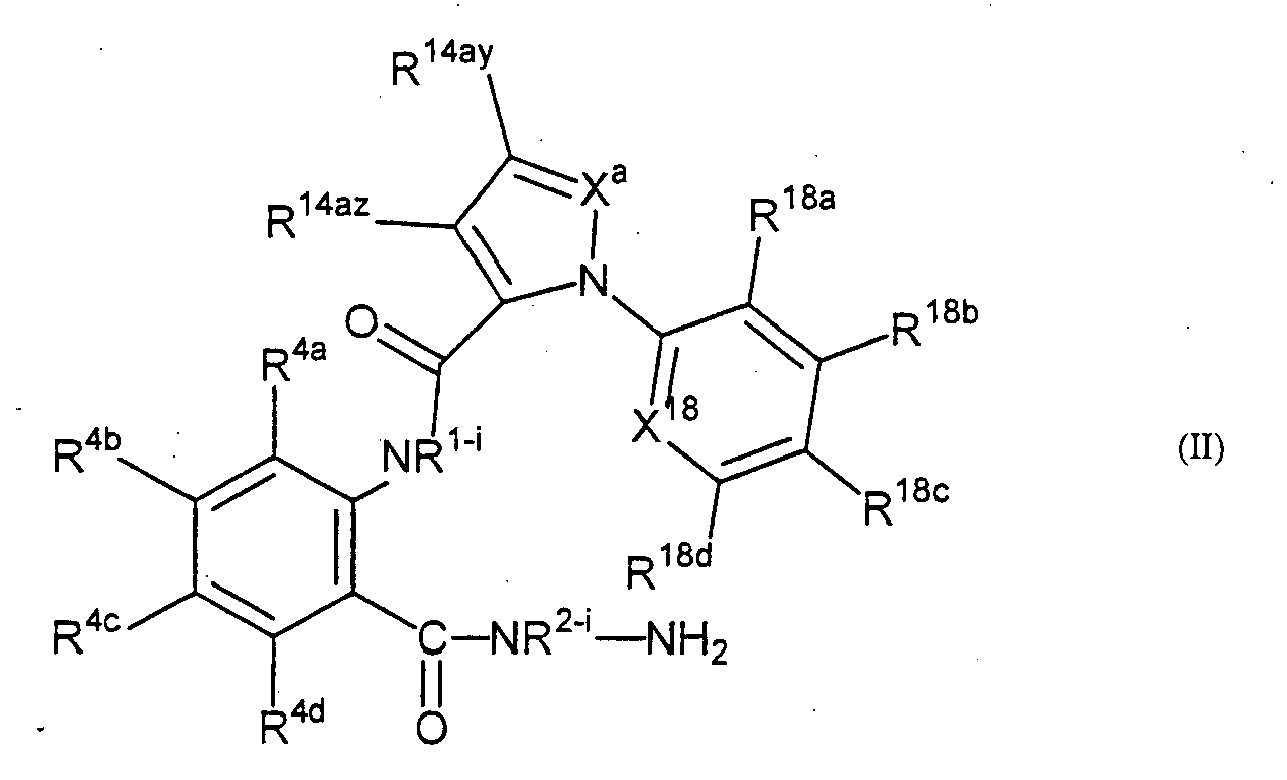
- R1-i represents a hydrogen atom, or a C1-C6 alkyl group optionally substituted with at least one halogen atom,
- R2-i represents a hydrogen atom or a methyl group,
- R4a represents a halogen atom, or a C1-C6 alkyl group optionally substituted with at least one halogen atom,
- R4b, R4c and R4d independently represent a hydrogen atom, a halogen atom, a cyano group, a C1-C6 alkyl group optionally substituted with at least one halogen atom,
- or R4b and R4c are bound to each other at their terminal ends to form T1: -CR41=CR42-CR43=CR44-
(wherein R41, R42, R43 and R44 independently represent a hydrogen atom, a halogen atom, a cyano group, or a C1-C6 alkyl group optionally substituted with at least one halogen atom), - Xa represents a nitrogen atom or CR14ax
(wherein R14ax represents a hydrogen atom, a halogen atom, a cyano group, a C1-C6 alkyl group optionally substituted with at least one halogen atom, a C1-C6 alkoxy group optionally substituted with at least one halogen atom, a C1-C6 alkylthio group optionally substituted with at least one halogen atom, a C1-C6 alkylsulfinyl group optionally substituted with at least one halogen atom, or a C1-C6 alkylsulfonyl group optionally substituted with at least one halogen atom), - R14ay and R14az, each, independently, represent a hydrogen atom, a halogen atom, a cyano group, a C1-C6 alkyl group optionally substituted with at least one halogen atom, a C1-C6 alkoxy group optionally substituted with at least one halogen atom, a C1-C6 alkylthio group optionally substituted with at least-one halogen atom, a C1-C6 alkylsulfinyl group optionally substituted with at least one halogen atom, or a C1-C6 alkylsulfonyl group optionally substituted with at-least one halogen atom,
- X18 represents a nitrogen atom or CR18e,
(wherein R18e represents a hydrogen atom, a halogen atom, or a C1-C6 alkyl group optionally substituted with at least one halogen atom) - R18a represents a halogen atom, or a C1-C6 alkyl group optionally substituted with at least one halogen atom, and
- R18b, R18c and R18d independently represent a hydrogen atom, a halogen atom, or a C1-C6 alkyl group optionally substituted with at least one halogen atom.
- 19. The compound according to item 18, wherein R2-i is a methyl group.
- 20. A pesticide comprising the compound according to item 1 as an active ingredient.
- 21. A method of controlling a pest which comprises applying the compound according to item 1 directly to a pest, or to a place where a pest inhabits.
- 22. Use of the compound according to item 1 for controlling a pest.
- 23. Use of the compound according to item 1 for manufacturing a pesticidal preparation.


Claims (3)
- A compound represented by the formula (2-i):
 R2 and R3 independently represent a hydrogen atom, a C1-C6 alkyl group optionally substituted with at least one halogen atom, a C1-C6 acyl group, a C2-C6 alkoxycarbonyl group, a C3-C7 N,N-dialkylcarbamoyl group, or a phenyl group optionally substituted with 1 to 5 independent substituents selected from the group consisting of (1) a halogen atom, (2) a cyano group, (3) a nitro group and (4) a C1-C6 alkyl group optionally substituted with at least one halogen atom,R4 represents a halogen atom, a cyano group, a nitro group, a C1-C6 alkyl group optionally substituted with at least one halogen atom, a C1-C6 alkoxy group optionally substituted with at least one halogen atom, a phenyl group optionally substituted with at least one halogen atom, a C1-C6 alkylthio group optionally substituted with at least one halogen atom, a C1-C6 alkylsulfinyl group optionally substituted with at least one halogen atom, or a C1-C6 alkylsulfonyl group optionally substituted with at least one halogen atom, or two R4 groups which are bound to the adjacent carbon atoms are bound at their terminal ends to each other to form a group T1 or T2
T1: -CR41=CR42-CR43=CR44-
T2: -(CR45R46)h-
(wherein R41, R42, R43 and R44 independently represent a hydrogen atom, a halogen atom, a cyano group, a nitro group, a C1-C6 alkyl group optionally substituted with at least one halogen atom, a C1-C6 alkoxy group optionally substituted with at least one halogen atom, a C1-C6 alkylthio group optionally substituted with at least one halogen atom, a C1-C6 alkylsulfinyl group optionally substituted with at least one halogen atom, or a C1-C6 alkylsulfonyl group optionally substituted with at least one halogen atom,R45 and R46 independently represent a hydrogen atom, or a C1-C6 alkyl group optionally substituted with at least one halogen atom, andh represents an integer of 3 or 4),n represents an integer of 0 to 4 (provided that, when n is an integer of 2 or more, R4's may be the same or different),J represents a group represented by J1 or J2: R13a and R13b represent a C1-C6 alkyl group optionally substituted with at least one halogen atom; a C2-C6 cyanoalkyl group; a C2-C6 alkoxyalkyl group optionally substituted with at least one halogen atom; a C2-C6 alkenyl group optionally substituted with at least one halogen atom; a C2-C6 alkynyl group optionally substituted with at least one halogen atom; a C3-C6 cycloalkyl group optionally substituted with one or more independent substituents selected from the group consisting of (1) a halogen atom and (2) a C1-C6 alkyl group; a phenyl group optionally substituted with 1 to 5 independent substituents selected from the group consisting of (1) a halogen atom, (2) a cyano group, (3) a nitro group, (4) a C1-C6 alkyl group optionally substituted with at least one halogen atom, (5) a C1-C6 alkoxy group optionally substituted with at least one halogen atom, (6) a C1-C6 alkylthio group optionally substituted with at least one halogen atom, (7) a C1-C6 alkylsulfinyl group optionally substituted with at least one halogen atom and (8) a C1-C6 alkylsulfonyl group optionally substituted with at least one halogen atom; a 5- to 6-membered heteroaryl group optionally substituted with one or more independent substituents selected from the group consisting of (1) a halogen atom, (2) a cyano group, (3) a nitro group, (4) a C1-C6 alkyl group optionally substituted with at least one halogen atom and (5) a C1-C6 alkoxy group optionally substituted with at least one halogen atom; a C7-C9 phenylalkyl group in whose benzene ring moiety may be substituted with one or more independent substituents selected from the group consisting of (1) a halogen atom, (2) a cyano group, (3) a nitro group, (4) a C1-C6 alkyl group optionally substituted with at least one halogen atom and (5) a C1-C6 alkoxy group optionally substituted with at least one halogen atom; or a C7-C9 pyridinylalkyl group whose pyridine ring moiety may be substituted with one or more independent substituents selected from the group consisting of (1) a halogen atom, (2) a cyano group, (3) a nitro group, (4) a C1-C6 alkyl group optionally substituted with at least one halogen atom and (5) a C1-C6 alkoxy group optionally substituted with at least one halogen atom,R14a and R14b represent a halogen atom; a cyano group; a nitro group; a C1-C6 alkyl group optionally substituted with at least one halogen atom; a C1-C6 alkoxy group optionally substituted with at least one halogen atom; a C2-C6 cyanoalkyloxy group; a C3-C6 alkoxyalkyloxy group optionally substituted with at least one halogen atom; a C3-C6 alkenyloxy group optionally substituted with at least one halogen atom; a C3-C6 alkynyloxy group optionally substituted with at least one halogen atom; a C1-C6 alkylthio group optionally substituted with at least one halogen atom; a C1-C6 alkylsulfinyl group optionally substituted with at least one halogen atom; a C1-C6 alkylsulfonyl group optionally substituted with at least one halogen atom; a phenyl group optionally substituted with 1 to 5 independent substituents selected from the group consisting of (1) a halogen atom, (2) a cyano group, (3) a nitro group, (4) a C1-C6 alkyl group optionally substituted with at least one halogen atom and (5) a C1-C6 alkoxy group optionally substituted with at least one halogen atom; a 5- to 6-membered heteroaryl group optionally substituted with one or more independent substituents selected from the group consisting of (1) a halogen atom, (2) a cyano group, (3) a nitro group, (4) a C1-C6 alkyl group optionally substituted with at least one halogen atom and (5) a C1-C6 alkoxy group optionally substituted with at least one halogen atom; or a phenoxy group optionally substituted with 1 to 5 independent substituents selected from the group consisting of (1) a halogen atom, (2) a cyano group, (3) a nitro group, (4) a C1-C6 alkyl group optionally substituted with at least one halogen atom and (5) a C1-C6 alkoxy group optionally substituted with at least one halogen atom,p represents an integer of 0 to 3, andq represents an integer of 0 to 3 (provided that, when p is an integer of 2 or 3, two or more R14a's may be the same or different and, when q is an integer of 2 or 3, two or more R14b's may be the same or different).
 - A hydrazide compound represented by the formula (II) :
 R1-i represents a hydrogen atom, or a C1-C6 alkyl group optionally substituted with at least one halogen atom,R2-i represents a hydrogen atom or a methyl group,R4a represents a halogen atom, or a C1-C6 alkyl group optionally substituted with at least one halogen atom,R4b, R4c and R4d independently represent a hydrogen atom, a halogen atom, a cyano group, a C1-C6 alkyl group optionally substituted with at least one halogen atom,or R4b and R4c are bound to each other at their terminal ends to form T1: -CR41=CR42-CR43=CR44-
(wherein R41, R42, R43 and R44 independently represent a hydrogen atom, a halogen atom, a cyano group, or a C1-C6 alkyl group optionally substituted with at least one halogen atom),Xa represents a nitrogen atom or CR14ax (wherein R14ax represents a hydrogen atom, a halogen atom, a cyano group, a C1-C6 alkyl group optionally substituted with at least one halogen atom, a C1-C6 alkoxy group optionally substituted with at least one halogen atom, a C1-C6 alkylthio group optionally substituted with at least one halogen atom, a C1-C6 alkylsulfinyl group optionally substituted with at least one halogen atom, or a C1-C6 alkylsulfonyl group optionally substituted with at least one halogen atom),R14ay and R14az, each, independently, represent a hydrogen atom, a halogen atom, a cyano group, a C1-C6 alkyl group optionally substituted with at least one halogen atom, a C1-C6 alkoxy group optionally substituted with at least one halogen atom, a C1-C6 alkylthio group optionally substituted with at least one halogen atom, a C1-C6 alkylsulfinyl group optionally substituted with at least one halogen atom, or a C1-C6 alkylsulfonyl group optionally substituted with at least one halogen atom,X18 represents a nitrogen atom or CR18e,
(wherein R18e represents a hydrogen atom, a halogen atom, or a C1-C6 alkyl group optionally substituted with at least one halogen atom)R18a represents a halogen atom, or a C1-C6 alkyl group optionally substituted with at least one halogen atom, andR18b, R18c and R18d independently represent a hydrogen atom, a halogen atom, or a C1-C6 alkyl group optionally substituted with at least one halogen atom. - The compound according to claim 2, wherein R2-i is a methyl group.
Applications Claiming Priority (3)
| Application Number | Priority Date | Filing Date | Title |
|---|---|---|---|
| JP2005299843 | 2005-10-14 | ||
| JP2006144829 | 2006-05-25 | ||
| EP06811793A EP1937664B1 (en) | 2005-10-14 | 2006-10-10 | Hydrazide compound and pesticidal use of the same |
Related Parent Applications (1)
| Application Number | Title | Priority Date | Filing Date |
|---|---|---|---|
| EP06811793.6 Division | 2006-10-10 |
Publications (1)
| Publication Number | Publication Date |
|---|---|
| EP2251336A1 true EP2251336A1 (en) | 2010-11-17 |
Family
ID=37636050
Family Applications (2)
| Application Number | Title | Priority Date | Filing Date |
|---|---|---|---|
| EP10006958A Withdrawn EP2251336A1 (en) | 2005-10-14 | 2006-10-10 | Hydrazide compounds as intermediates of pesticides |
| EP06811793A Not-in-force EP1937664B1 (en) | 2005-10-14 | 2006-10-10 | Hydrazide compound and pesticidal use of the same |
Family Applications After (1)
| Application Number | Title | Priority Date | Filing Date |
|---|---|---|---|
| EP06811793A Not-in-force EP1937664B1 (en) | 2005-10-14 | 2006-10-10 | Hydrazide compound and pesticidal use of the same |
Country Status (13)
| Country | Link |
|---|---|
| US (2) | US7867949B2 (en) |
| EP (2) | EP2251336A1 (en) |
| JP (1) | JP2013047270A (en) |
| KR (1) | KR101315574B1 (en) |
| AR (1) | AR056208A1 (en) |
| AU (1) | AU2006300182B2 (en) |
| BR (1) | BRPI0617221B1 (en) |
| CA (1) | CA2623202C (en) |
| DK (1) | DK1937664T3 (en) |
| PL (1) | PL1937664T3 (en) |
| PT (1) | PT1937664E (en) |
| TW (2) | TW201234964A (en) |
| WO (1) | WO2007043677A1 (en) |
Families Citing this family (286)
| Publication number | Priority date | Publication date | Assignee | Title |
|---|---|---|---|---|
| UA89546C2 (en) | 2005-07-07 | 2010-02-10 | Басф Се | N-thio-anthranilamid compounds, process for the preparation thereof, their use and method for control of parasites, method for plant protection, method for treatment of animals, composition and process for the preparation thereof |
| HUE028588T2 (en) | 2005-12-13 | 2016-12-28 | Incyte Holdings Corp | Heteroaryl-substituted pyrrolo [2,3-b] pyridines and pyrrolo [2,3-b] pyrimidines as Janus kinase inhibitors |
| JP2008280336A (en) * | 2007-04-11 | 2008-11-20 | Sumitomo Chemical Co Ltd | Method for producing amide compound |
| CL2008000979A1 (en) * | 2007-04-11 | 2008-10-17 | Sumitomo Chemical Co | PROCESS TO PRODUCE A COMPOUND DERIVED FROM 2-PIRIDIN-2-IL-2H-PIRAZOL-3-PHENYLAMIDE; INTERMEDIARY COMPOUNDS; THE COMPOUND IN YES; PESTICIDE COMPOSITION CONTAINING SUCH COMPOUND; USE OF SUCH COMPOUND AS A PESTICIDE; AND METHOD FOR CONTROL |
| JP2008280341A (en) * | 2007-04-12 | 2008-11-20 | Sumitomo Chemical Co Ltd | Hydrazide compounds and their control applications |
| JP2008280339A (en) * | 2007-04-12 | 2008-11-20 | Sumitomo Chemical Co Ltd | Hydrazide compound and harmful arthropod control agent containing the same |
| JP2008280340A (en) | 2007-04-12 | 2008-11-20 | Sumitomo Chemical Co Ltd | Hydrazide compound and harmful arthropod control agent containing the same |
| EP2740731B1 (en) | 2007-06-13 | 2016-03-23 | Incyte Holdings Corporation | Crystalline salts of the janus kinase inhibitor (r)-3-(4-(7h-pyrrolo[2,3-d]pyrimidin-4-yl)-1h-pyrazol-1-yl)-3-cyclopentylpropanenitrile |
| CN101362757A (en) * | 2007-08-09 | 2009-02-11 | 山东轩竹医药科技有限公司 | Sulfonyl substituted carbpenems compounds |
| WO2009022600A1 (en) | 2007-08-14 | 2009-02-19 | Sumitomo Chemical Company, Limited | Process for production of hydrazine compound, intermediate for production of hydrazine compound, and process for production of the intermediate |
| WO2010083283A2 (en) | 2009-01-15 | 2010-07-22 | Incyte Corporation | Processes for preparing jak inhibitors and related intermediate compounds |
| JP2010222342A (en) * | 2009-02-26 | 2010-10-07 | Sumitomo Chemical Co Ltd | Pest control composition |
| EP2414353A1 (en) | 2009-04-01 | 2012-02-08 | Basf Se | Isoxazoline compounds for combating invertebrate pests |
| EA022081B1 (en) | 2009-04-28 | 2015-10-30 | Басф Корпорейшн | FOAM FORMULATING PESTICIDE COMPOSITIONS |
| NZ596479A (en) | 2009-05-22 | 2014-01-31 | Incyte Corp | N-(hetero)aryl-pyrrolidine derivatives of pyrazol-4-yl-pyrrolo[2,3-d]pyrimidines and pyrrol-3-yl-pyrrolo[2,3-d]pyrimidines as janus kinase inhibitors |
| BRPI1012108B8 (en) | 2009-05-22 | 2021-05-25 | Incyte Corp | compound 3-[4-(7h-pyrrolo[2,3-d]pyrimidin-4-yl)-1h-pyrazol-1-yl]octane- or heptane-nitrile, its composition, its uses and process for preparing a phosphoric acid salt |
| JP2010275202A (en) * | 2009-05-26 | 2010-12-09 | Sumitomo Chemical Co Ltd | NOVEL COMPOSITION, Root Growth Promoter, and Plant Root Growth Promotion Method |
| US8957254B2 (en) | 2009-07-06 | 2015-02-17 | Solvay Sa | Process for chemical synthesis from an alkenone made from a halogenated precursor |
| JP2013500246A (en) | 2009-07-24 | 2013-01-07 | ビーエーエスエフ ソシエタス・ヨーロピア | Pyridine derivative compounds for invertebrate pest control |
| AU2010278948B2 (en) | 2009-07-30 | 2015-04-23 | Boehringer Ingelheim Animal Health USA Inc. | Insecticidal 4-Amino-thieno(2,3-d)-pyrimidine compounds and methods of their use |
| CN102471291B (en) | 2009-08-20 | 2015-04-22 | 拜尔农作物科学股份公司 | 3-triazolylphenyl-substituted sulfide derivatives for use as acaricides and insecticides |
| ES2559012T3 (en) | 2009-08-20 | 2016-02-10 | Bayer Intellectual Property Gmbh | 3- [1- (3-haloalkyl) -triazolyl] -phenyl sulfide derivatives as acaricides and insecticides |
| KR20120061931A (en) | 2009-08-28 | 2012-06-13 | 바스프 코포레이션 | Foamable pesticide compositions and methods of application |
| TW201113285A (en) | 2009-09-01 | 2011-04-16 | Incyte Corp | Heterocyclic derivatives of pyrazol-4-yl-pyrrolo[2,3-d]pyrimidines as janus kinase inhibitors |
| EP2480537A1 (en) | 2009-09-24 | 2012-08-01 | Basf Se | Aminoquinazoline compounds for combating invertebrate pests |
| JP5823398B2 (en) | 2009-10-12 | 2015-11-25 | バイエル・インテレクチュアル・プロパティ・ゲゼルシャフト・ミット・ベシュレンクテル・ハフツングBayer Intellectual Property GmbH | Novel amides and thioamides as pesticides |
| KR20120098645A (en) * | 2009-10-23 | 2012-09-05 | 스미또모 가가꾸 가부시끼가이샤 | Pest control composition |
| UY32940A (en) | 2009-10-27 | 2011-05-31 | Bayer Cropscience Ag | AMIDAS REPLACED WITH HALOGENO RENT AS INSECTICIDES AND ACARICIDES |
| WO2011057942A1 (en) | 2009-11-12 | 2011-05-19 | Basf Se | Insecticidal methods using pyridine compounds |
| AU2010321038C1 (en) | 2009-11-17 | 2015-04-30 | Boehringer Ingelheim Animal Health USA Inc. | Fluorinated oxa or thia heteroarylalkylsulfide derivatives for combating invertebrate pests |
| WO2011064188A1 (en) | 2009-11-27 | 2011-06-03 | Basf Se | Insecticidal methods using nitrogen-containing heteroaromatic compounds |
| ES2546100T3 (en) | 2009-12-04 | 2015-09-18 | Merial, Inc. | Bis-organosulfurized pesticide compounds |
| WO2011069955A1 (en) | 2009-12-07 | 2011-06-16 | Basf Se | Sulfonimidamide compounds for combating animal pests |
| BR112012014944A2 (en) | 2009-12-18 | 2015-09-15 | Basf Se | substituted azoline compounds, composition, use of a compound, and methods for controlling invertebrate pests and for treating, controlling, preventing or protecting animals against infestation or parasite infection. |
| KR20120125332A (en) | 2010-02-01 | 2012-11-14 | 바스프 에스이 | Substituted ketonic isoxazoline compounds and derivatives for combating animal pests |
| KR20120125642A (en) | 2010-02-09 | 2012-11-16 | 바이엘 크롭사이언스 아게 | Hydrazine-substituted anthranilic acid derivatives |
| EP2534133B1 (en) | 2010-02-10 | 2018-09-05 | Bayer CropScience Aktiengesellschaft | Biphenyl substituted cyclical keto-enols |
| WO2011098443A1 (en) | 2010-02-10 | 2011-08-18 | Bayer Cropscience Ag | Spiroheterocyclical substituted tetramic acid derivatives |
| AR080443A1 (en) | 2010-03-04 | 2012-04-11 | Bayer Cropscience Ag | 2-AMIDOBENCIMIDAZOLES REPLACED WITH FLURUOALQUILO |
| CA2792508C (en) | 2010-03-10 | 2018-01-16 | Incyte Corporation | Piperidin-4-yl azetidine derivatives as jak1 inhibitors |
| US8937177B2 (en) | 2010-03-23 | 2015-01-20 | Basf Se | Pyridazine compounds for controlling invertebrate pests |
| WO2011117804A1 (en) | 2010-03-23 | 2011-09-29 | Basf Se | Pyridazine compounds for controlling invertebrate pests |
| JP5782678B2 (en) | 2010-04-27 | 2015-09-24 | 住友化学株式会社 | Pest control composition and use thereof |
| JP5712504B2 (en) | 2010-04-27 | 2015-05-07 | 住友化学株式会社 | Pest control composition and use thereof |
| RU2555405C2 (en) | 2010-04-27 | 2015-07-10 | Сумитомо Кемикал Компани, Лимитед | Pesticidal composition and pest control method |
| PL2563131T3 (en) | 2010-04-27 | 2017-09-29 | Sumitomo Chemical Company, Limited | Pesticidal composition and its use |
| PH12012502031A1 (en) | 2010-04-27 | 2017-06-07 | Sumitomo Chemical Co | Pesticidal composition and its use |
| RU2569962C2 (en) | 2010-04-28 | 2015-12-10 | Сумитомо Кемикал Компани, Лимитед | Composition for controlling plant diseases and thereof application |
| JP5724212B2 (en) | 2010-04-28 | 2015-05-27 | 住友化学株式会社 | Plant disease control composition and use thereof |
| JP5789918B2 (en) | 2010-04-28 | 2015-10-07 | 住友化学株式会社 | Plant disease control composition and use thereof |
| JP5724211B2 (en) | 2010-04-28 | 2015-05-27 | 住友化学株式会社 | Plant disease control composition and use thereof |
| CN102858163A (en) | 2010-04-28 | 2013-01-02 | 住友化学株式会社 | Plant disease control composition and use thereof |
| WO2011135834A1 (en) | 2010-04-28 | 2011-11-03 | Sumitomo Chemical Company, Limited | Pesticidal composition and its use |
| JP5724210B2 (en) | 2010-04-28 | 2015-05-27 | 住友化学株式会社 | Plant disease control composition and use thereof |
| EA202091303A3 (en) | 2010-05-21 | 2021-05-31 | Инсайт Холдингс Корпорейшн | JAK INHIBITOR COMPOSITION FOR LOCAL APPLICATION |
| WO2011148886A1 (en) | 2010-05-24 | 2011-12-01 | Meiji Seikaファルマ株式会社 | Noxious organism control agent |
| MX339218B (en) | 2010-05-28 | 2016-05-17 | Basf Se | Pesticidal mixtures. |
| JP5993846B2 (en) | 2010-06-15 | 2016-09-14 | バイエル・インテレクチュアル・プロパティ・ゲゼルシャフト・ミット・ベシュレンクテル・ハフツングBayer Intellectual Property GmbH | Anthranilic acid derivative |
| MX2012014574A (en) | 2010-06-15 | 2013-02-07 | Bayer Ip Gmbh | Anthranilic acid diamide derivatives with cyclical side chains. |
| EP2582693B1 (en) | 2010-06-15 | 2016-03-30 | Bayer Intellectual Property GmbH | New ortho-substituted arylamide derivatives |
| ES2555260T3 (en) | 2010-06-15 | 2015-12-30 | Bayer Intellectual Property Gmbh | Diaranic derivatives of anthranilic acid |
| BR112012033694A2 (en) | 2010-06-29 | 2015-09-15 | Bayer Ip Gmbh | improved insecticidal compositions comprising cyclic carbonylamidines. |
| WO2012001068A2 (en) | 2010-07-02 | 2012-01-05 | Bayer Cropscience Ag | Insecticidal or acaricidal formulations with improved availability on plant surfaces |
| JP5926253B2 (en) | 2010-07-09 | 2016-05-25 | バイエル・インテレクチュアル・プロパティ・ゲゼルシャフト・ミット・ベシュレンクテル・ハフツングBayer Intellectual Property GmbH | Anthranilamide derivatives as pesticides |
| WO2012007426A1 (en) | 2010-07-13 | 2012-01-19 | Basf Se | Azoline substituted isoxazoline benzamide compounds for combating animal pests |
| EP2593447B1 (en) | 2010-07-15 | 2016-08-17 | Bayer Intellectual Property GmbH | 3-pyridyl-heteroarylcarboxamide compounds as pesticides |
| US9247745B2 (en) | 2010-07-22 | 2016-02-02 | Basf Se | Substituted pyridazines for controlling invertebrate pests |
| CN102372674A (en) * | 2010-08-17 | 2012-03-14 | 上海药明康德新药开发有限公司 | Synthesis method for pharmaceutical intermediate 3-formyl-4-halogeno pyrazole |
| WO2012028583A1 (en) | 2010-09-03 | 2012-03-08 | Bayer Cropscience Ag | Formulations comprising deltamethrin |
| JP2013537178A (en) | 2010-09-13 | 2013-09-30 | ビーエーエスエフ ソシエタス・ヨーロピア | Pyridine compounds for controlling invertebrate pests III |
| CN103097376A (en) | 2010-09-13 | 2013-05-08 | 巴斯夫欧洲公司 | Pyridine compounds for controlling invertebrate pests ii |
| JP2013542918A (en) | 2010-09-13 | 2013-11-28 | ビーエーエスエフ ソシエタス・ヨーロピア | Pyridine compounds I for controlling invertebrate pests |
| EP2621897A1 (en) | 2010-10-01 | 2013-08-07 | Basf Se | Imine compounds |
| KR20130143047A (en) | 2010-10-01 | 2013-12-30 | 바스프 에스이 | Imine substituted 2,4-diaryl-pyrroline derivatives as pesticides |
| BR112013009823A2 (en) | 2010-10-22 | 2016-07-05 | Bayer Ip Gmbh | new heterocyclic compounds as pesticides |
| EP2446742A1 (en) | 2010-10-28 | 2012-05-02 | Bayer CropScience AG | Insecticide or acaricide compositions containing mono- or disaccharides as activity enhancers |
| CA2818542A1 (en) | 2010-11-19 | 2012-05-24 | Incyte Corporation | Cyclobutyl substituted pyrrolopyridine and pyrrolopyrimidine derivatives as jak inhibitors |
| ES2536415T3 (en) | 2010-11-19 | 2015-05-25 | Incyte Corporation | Pyrrolopyridines and heterocyclic substituted pyrrolopyrimidines as JAK inhibitors |
| EP2648515A1 (en) | 2010-12-09 | 2013-10-16 | Bayer Intellectual Property GmbH | Pesticidal mixtures with improved properties |
| US20130331417A1 (en) | 2010-12-09 | 2013-12-12 | Bayer Intellectual Property Gmbh | Insecticidal mixtures with improved properties |
| WO2012076704A2 (en) | 2010-12-10 | 2012-06-14 | Basf Se | Pyrazole compounds for controlling invertebrate pests |
| BR112013014913A2 (en) | 2010-12-20 | 2016-07-19 | Basf Se | pesticide mixtures, pesticidal or parasiticidal composition, method to protect vegetables from insect attack or infestation, to control insects, to control harmful phytopathogenic fungi, to protect vegetables from harmful phytopathogenic fungi, to protect material propagation of plants, for the protection of animals against parasitic infestation or infection, for the treatment of parasites infected or infected with |
| DE102010063691A1 (en) | 2010-12-21 | 2012-06-21 | Bayer Animal Health Gmbh | Ectoparasiticidal drug combinations |
| WO2012085081A1 (en) | 2010-12-22 | 2012-06-28 | Basf Se | Sulfoximinamide compounds for combating invertebrate pests ii |
| EP2471363A1 (en) | 2010-12-30 | 2012-07-04 | Bayer CropScience AG | Use of aryl-, heteroaryl- and benzylsulfonamide carboxylic acids, -carboxylic acid esters, -carboxylic acid amides and -carbonitriles and/or its salts for increasing stress tolerance in plants |
| CN103582639A (en) | 2011-04-06 | 2014-02-12 | 巴斯夫欧洲公司 | Substituted pyrimidinium compounds for controlling animal pests |
| AR085872A1 (en) | 2011-04-08 | 2013-10-30 | Basf Se | HETEROBICICLIC DERIVATIVES N-SUBSTITUTES USEFUL TO COMBAT PARASITES IN PLANTS AND / OR ANIMALS, COMPOSITIONS THAT CONTAIN THEM AND METHODS TO COMBAT SUCH PESTS |
| AR090010A1 (en) | 2011-04-15 | 2014-10-15 | Bayer Cropscience Ag | 5- (CICLOHEX-2-EN-1-IL) -PENTA-2,4-DIENOS AND 5- (CICLOHEX-2-EN-1-IL) -PENT-2-EN-4-INOS REPLACED AS ACTIVE PRINCIPLES AGAINST THE ABIOTIC STRESS OF PLANTS, USES AND TREATMENT METHODS |
| AR085568A1 (en) | 2011-04-15 | 2013-10-09 | Bayer Cropscience Ag | 5- (BICYCLE [4.1.0] HEPT-3-EN-2-IL) -PENTA-2,4-DIENOS AND 5- (BICYCLE [4.1.0] HEPT-3-EN-2-IL) -PENT- 2-IN-4-INOS REPLACED AS ACTIVE PRINCIPLES AGAINST ABIOTIC STRESS OF PLANTS |
| AR085585A1 (en) | 2011-04-15 | 2013-10-09 | Bayer Cropscience Ag | VINIL- AND ALQUINILCICLOHEXANOLES SUBSTITUTED AS ACTIVE PRINCIPLES AGAINST STRIPS ABIOTIQUE OF PLANTS |
| AU2012244846B2 (en) | 2011-04-21 | 2016-07-07 | Basf Se | Novel pesticidal pyrazole compounds |
| WO2012164085A1 (en) | 2011-06-03 | 2012-12-06 | Merz Pharma Gmbh & Co. Kgaa | Glycine b antagonists |
| US8691807B2 (en) | 2011-06-20 | 2014-04-08 | Incyte Corporation | Azetidinyl phenyl, pyridyl or pyrazinyl carboxamide derivatives as JAK inhibitors |
| BR112014000267A2 (en) | 2011-07-04 | 2016-09-20 | Bayer Ip Gmbh | use of substituted isoquinolinones, isoquinolinediones, isoquinolinetrionas and dihydroisoquinolinones or, in each case, salts thereof as active agents against abiotic stress in plants |
| CN103702992B (en) * | 2011-07-08 | 2017-02-22 | 拜耳知识产权有限责任公司 | Method for producing tetrazole-substituted anthranilic acid diamide derivatives by reacting pyrazolic acid with anthranilic acid ester |
| IN2014CN00712A (en) | 2011-07-15 | 2015-04-03 | Basf Se | |
| BR112014003221A2 (en) | 2011-08-12 | 2017-04-18 | Basf Se | compound of the general formula (i), method for preparing a gate of the formula (i), agricultural or veterinary composition, methods for combating or controlling invertebrate pests, for the protection of growing plants against invertebrate pest attack or infestation; the protection of seeds against terrestrial insects and seedling roots and branches against terrestrial and foliar insects, seed, use of a compound and method for treating a parasitized or infested animal or to prevent animals from becoming infested or infected with parasites or to protect an animal against infestation or parasite infection |
| BR112014003111A2 (en) | 2011-08-12 | 2017-02-21 | Basf Se | process for preparing an n-substituted 1h-pyrazole-5-carbonylchloride compound and process for preparing a sulphimine compound |
| BR112014003112A2 (en) | 2011-08-12 | 2017-02-21 | Basf Se | compound of the general formula (i), methods for preparing a compound of the formula (i), agricultural or veterinary composition, method for combating or controlling invertebrate pests, method for protecting plant cultivation, method for protecting seeds, seed, uses of a compound and method for treating an animal |
| EP2742036A1 (en) | 2011-08-12 | 2014-06-18 | Basf Se | N-thio-anthranilamide compounds and their use as pesticides |
| IN2014CN01136A (en) | 2011-08-12 | 2015-04-10 | Basf Se | |
| KR20140051402A (en) | 2011-08-12 | 2014-04-30 | 바스프 에스이 | N-thio-anthranilamide compounds and their use as pesticides |
| US20140171316A1 (en) | 2011-08-12 | 2014-06-19 | Basf Se | Anthranilamide compounds and their use as pesticides |
| CN103842342A (en) | 2011-08-12 | 2014-06-04 | 巴斯夫欧洲公司 | Anthranilamide compounds and their use as pesticides |
| BR112014003646A2 (en) | 2011-08-18 | 2017-03-07 | Basf Se | compound of formula (i), method for preparing a compound of formula (i), agricultural or veterinary composition, method for combating or controlling invertebrate insect pests, arachnids or nematodes, method for protecting plants, method for seed protection , seed and method for treating a parasitized or infested animal |
| TW201313721A (en) | 2011-08-18 | 2013-04-01 | Incyte Corp | Cyclohexyl azetidine derivatives as JAK inhibitors |
| BR112014003595A2 (en) | 2011-08-18 | 2017-03-01 | Basf Se | compounds, method of preparing a compost, agricultural composition, method of combating or controlling invertebrate pests, methods of protecting plant growth and protecting seeds, seed, use of a compound and method of treating infested animals |
| EP2744785A1 (en) | 2011-08-18 | 2014-06-25 | Basf Se | Carbamoylmethoxy- and carbamoylmethylthio- and carbamoylmethylamino benzamides for combating invertebrate pests |
| EP2561759A1 (en) | 2011-08-26 | 2013-02-27 | Bayer Cropscience AG | Fluoroalkyl-substituted 2-amidobenzimidazoles and their effect on plant growth |
| AR089556A1 (en) | 2011-09-02 | 2014-09-03 | Basf Se | USE OF 3-ARILQUINAZOLIN-4-ONA ACTIVE PESTICIDE DERIVATIVES IN SOIL APPLICATION METHODS |
| UA111854C2 (en) | 2011-09-07 | 2016-06-24 | Інсайт Холдінгс Корпорейшн | METHODS AND INTERMEDIATE COMPOUNDS FOR JAK INHIBITORS |
| CN103781352A (en) | 2011-09-16 | 2014-05-07 | 拜耳知识产权有限责任公司 | Use of phenylpyrazoline-3-carboxylates for increasing plant yield |
| CN107897194A (en) | 2011-09-16 | 2018-04-13 | 拜耳知识产权有限责任公司 | Use of 5-phenyl-or 5-benzyl-2-isoxazoline-3-carboxylic acid esters for improving plant yield |
| BR112014006217B1 (en) | 2011-09-16 | 2019-01-15 | Bayer Intellectual Property Gmbh | use of acylsulfonamides to improve plant yield, method for inducing growth regulating responses in useful plants or crop plants and composition. |
| ES2565821T3 (en) | 2011-11-21 | 2016-04-07 | Basf Se | Process for preparing N-substituted 1H-pyrazol-5-carboxylate compounds and derivatives thereof |
| WO2013079600A1 (en) | 2011-12-02 | 2013-06-06 | Basf Se | Method and system for monitoring crops during storage |
| WO2013079601A1 (en) | 2011-12-02 | 2013-06-06 | Basf Se | Method and system for monitoring crops and/or infestation of crops with harmful organismus during storage |
| WO2013092868A1 (en) | 2011-12-21 | 2013-06-27 | Basf Se | N-thio-anthranilamide compounds and their use as pesticides |
| US9732051B2 (en) | 2011-12-23 | 2017-08-15 | Basf Se | Isothiazoline compounds for combating invertebrate pests |
| WO2013113789A1 (en) | 2012-02-02 | 2013-08-08 | Basf Se | N-thio-anthranilamide compounds and their use as pesticides |
| WO2013144228A1 (en) | 2012-03-29 | 2013-10-03 | Basf Se | Pesticidal methods using heterocyclic compounds and derivatives for combating animal pests |
| WO2013144223A1 (en) | 2012-03-30 | 2013-10-03 | Basf Se | N-substituted pyrimidinylidene compounds and derivatives for combating animal pests |
| CN104202981B (en) | 2012-03-30 | 2018-01-30 | 巴斯夫欧洲公司 | Prevent and treat the pyridylidene compound and derivative of the N substitutions of animal pest |
| US20150065343A1 (en) | 2012-04-02 | 2015-03-05 | Basf Se | Acrylamide compounds for combating invertebrate pests |
| WO2013149903A1 (en) | 2012-04-03 | 2013-10-10 | Basf Se | N- substituted hetero - bicyclic furanone derivatives for combating animal |
| WO2013150115A1 (en) | 2012-04-05 | 2013-10-10 | Basf Se | N- substituted hetero - bicyclic compounds and derivatives for combating animal pests |
| KR20150050527A (en) | 2012-05-04 | 2015-05-08 | 바스프 에스이 | Substituted pyrazole-containing compounds and their use as pesticides |
| BR112014027133A2 (en) | 2012-05-09 | 2017-06-27 | Basf Se | compound, agricultural or veterinary composition, method for controlling invertebrate pests, plant propagating material and method for treating or protecting an animal. |
| TW201406761A (en) | 2012-05-18 | 2014-02-16 | Incyte Corp | Piperidinylcyclobutyl substituted pyrrolopyridine and pyrrolopyrimidine derivatives as JAK inhibitors |
| CN104487439B (en) | 2012-05-24 | 2017-06-09 | 巴斯夫欧洲公司 | N-thioanthranilamide compounds and their use as pesticides |
| BR112014030412A2 (en) | 2012-06-14 | 2017-06-27 | Basf Se | method for combating or controlling pests, method for protecting crops, compost, process for preparing compost, use of compost, agricultural or veterinary composition and seed. |
| BR122019015109B1 (en) | 2012-06-20 | 2020-04-07 | Basf Se | pesticide mixture, composition, agricultural composition, methods for combating or controlling invertebrate pests, for the protection of growing plants or plant propagation material, for the protection of plant propagation material and the use of a pesticide mixture |
| EP2684879A1 (en) | 2012-07-09 | 2014-01-15 | Basf Se | Substituted mesoionic compounds for combating animal pests |
| WO2014037340A1 (en) | 2012-09-05 | 2014-03-13 | Bayer Cropscience Ag | Use of substituted 2-amidobenzimidazoles, 2-amidobenzoxazoles and 2-amidobenzothiazoles or salts thereof as active substances against abiotic plant stress |
| WO2014047334A1 (en) | 2012-09-21 | 2014-03-27 | Basf Se | Methods for preventing pest infestations |
| US20150230470A1 (en) | 2012-09-21 | 2015-08-20 | Basf Se | Pyrethroid Insecticide For Protecting Plants And Seed |
| WO2014053406A1 (en) | 2012-10-01 | 2014-04-10 | Basf Se | Method of controlling ryanodine-modulator insecticide resistant insects |
| WO2014053401A2 (en) | 2012-10-01 | 2014-04-10 | Basf Se | Method of improving plant health |
| AR093828A1 (en) | 2012-10-01 | 2015-06-24 | Basf Se | ACTIVE MIXTURES AS PESTICIDES, WHICH INCLUDE ANTRANILAMIDE COMPOUNDS |
| US20150305331A1 (en) | 2012-10-01 | 2015-10-29 | Basf Se | Pesticidal mixtures comprising jasmonic acid or a derivative thereof |
| WO2014053407A1 (en) | 2012-10-01 | 2014-04-10 | Basf Se | N-thio-anthranilamide compounds and their use as pesticides |
| US20150250174A1 (en) | 2012-10-01 | 2015-09-10 | Basf Se | Use of n-thio-anthranilamide compounds on cultivated plants |
| EP2903438A1 (en) | 2012-10-01 | 2015-08-12 | Basf Se | Pesticidally active mixtures comprising anthranilamide compounds |
| WO2014053403A1 (en) | 2012-10-01 | 2014-04-10 | Basf Se | Method of controlling insecticide resistant insects |
| WO2014060381A1 (en) | 2012-10-18 | 2014-04-24 | Bayer Cropscience Ag | Heterocyclic compounds as pesticides |
| KR102242077B1 (en) | 2012-11-15 | 2021-04-20 | 인사이트 홀딩스 코포레이션 | Sustained-release dosage forms of ruxolitinib |
| WO2014079772A1 (en) | 2012-11-22 | 2014-05-30 | Basf Se | Pesticidal mixtures |
| WO2014079841A1 (en) | 2012-11-22 | 2014-05-30 | Basf Se | Pesticidal mixtures |
| WO2014079774A1 (en) | 2012-11-22 | 2014-05-30 | Basf Se | Pesticidal mixtures |
| WO2014079766A1 (en) | 2012-11-22 | 2014-05-30 | Basf Se | Pesticidal mixtures |
| WO2014079728A1 (en) | 2012-11-22 | 2014-05-30 | Basf Se | Pesticidal mixtures |
| WO2014079804A1 (en) | 2012-11-22 | 2014-05-30 | Basf Se | Pesticidal mixtures |
| WO2014079820A1 (en) | 2012-11-22 | 2014-05-30 | Basf Se | Use of anthranilamide compounds for reducing insect-vectored viral infections |
| WO2014079813A1 (en) | 2012-11-23 | 2014-05-30 | Basf Se | Pesticidal mixtures |
| WO2014079752A1 (en) | 2012-11-23 | 2014-05-30 | Basf Se | Pesticidal mixtures |
| US20150305334A1 (en) | 2012-12-05 | 2015-10-29 | Bayer Cropscience Ag | Use of substituted 1-(aryl ethynyl)-, 1-(heteroaryl ethynyl)-, 1-(heterocyclyl ethynyl)- and 1-(cycloalkenyl ethynyl)-cyclohexanols as active agents against abiotic plant stress |
| JP2016501264A (en) | 2012-12-14 | 2016-01-18 | ビーエーエスエフ ソシエタス・ヨーロピアBasf Se | Malononitrile compounds for controlling animal pests |
| KR20150100808A (en) | 2012-12-21 | 2015-09-02 | 바스프 에스이 | Cycloclavine and derivatives thereof for controlling invertebrate pests |
| WO2014102244A1 (en) | 2012-12-27 | 2014-07-03 | Basf Se | 2-(pyridin-3-yl)-5-hetaryl-thiazole compounds carrying an imine or imine-derived substituent for combating invertebrate pests |
| WO2014128136A1 (en) | 2013-02-20 | 2014-08-28 | Basf Se | Anthranilamide compounds and their use as pesticides |
| EP2964629A1 (en) | 2013-03-06 | 2016-01-13 | Bayer CropScience Aktiengesellschaft | Alkoximino-substituted anthranilic acid diamides as pesticides |
| EP3489239B1 (en) | 2013-03-06 | 2021-09-15 | Incyte Holdings Corporation | Processes and intermediates for making a jak inhibitor |
| US20160029629A1 (en) | 2013-03-13 | 2016-02-04 | Bayer Cropscience Aktiengesellschaft | Lawn growth-promoting agent and method of using same |
| ES2630373T3 (en) | 2013-04-19 | 2017-08-21 | Basf Se | N-substituted acyl-imino-pyridine compounds and derivatives to combat animal pests |
| MX2015017640A (en) * | 2013-06-20 | 2016-09-07 | Basf Se | Process for preparing pyridylpyrazole compounds and derivatives thereof from pyridylhydrazine. |
| US20160145222A1 (en) | 2013-06-21 | 2016-05-26 | Basf Se | Methods for Controlling Pests in Soybean |
| US9497970B2 (en) | 2013-07-15 | 2016-11-22 | Basf Se | Pesticide compounds |
| MX376856B (en) | 2013-08-07 | 2025-03-07 | Incyte Holdings Corp | EXTENDED-RELEASE DOSAGE FORMS FOR A JAK 1 (JANUS KINASE 1) INHIBITOR. |
| US10206397B2 (en) | 2013-09-19 | 2019-02-19 | Basf Se | N-acylimino heterocyclic compounds |
| WO2015055497A1 (en) | 2013-10-16 | 2015-04-23 | Basf Se | Substituted pesticidal pyrazole compounds |
| UA121106C2 (en) | 2013-10-18 | 2020-04-10 | Басф Агрокемікал Продактс Б.В. | APPLICATION OF PESTICIDE ACTIVE CARBOXAMIDE DERIVATIVE IN METHODS OF APPLICATION AND TREATMENT OF SEEDS AND SOIL |
| WO2015091649A1 (en) | 2013-12-18 | 2015-06-25 | Basf Se | N-substituted imino heterocyclic compounds |
| CN105829296A (en) | 2013-12-18 | 2016-08-03 | 巴斯夫欧洲公司 | Azole compounds with imine-derived substituents |
| WO2015101622A1 (en) | 2014-01-03 | 2015-07-09 | Bayer Cropscience Ag | Novel pyrazolyl-heteroarylamides as pesticides |
| WO2015104422A1 (en) | 2014-01-13 | 2015-07-16 | Basf Se | Dihydrothiophene compounds for controlling invertebrate pests |
| HRP20221373T1 (en) | 2014-03-07 | 2023-01-06 | Biocryst Pharmaceuticals, Inc. | Substituted pyrazoles as human plasma kallikrein inhibitors |
| WO2015184305A1 (en) | 2014-05-30 | 2015-12-03 | Incyte Corporation | TREATMENT OF CHRONIC NEUTROPHILIC LEUKEMIA (CNL) AND ATYPICAL CHRONIC MYELOID LEUKEMIA (aCML) BY INHIBITORS OF JAK1 |
| WO2016001129A1 (en) | 2014-07-01 | 2016-01-07 | Bayer Cropscience Aktiengesellschaft | Improved insecticidal compositions |
| JP2017521441A (en) | 2014-07-15 | 2017-08-03 | バイエル・アニマル・ヘルス・ゲゼルシャフト・ミット・ベシュレンクテル・ハフツングBayer Animal Health Gmbh | Aryl-triazolylpyridines as pest control agents |
| US10149477B2 (en) | 2014-10-06 | 2018-12-11 | Basf Se | Substituted pyrimidinium compounds for combating animal pests |
| US20180368404A1 (en) | 2014-11-06 | 2018-12-27 | Basf Se | 3-pyridyl heterobicyclic compound for controlling invertebrate pests |
| EP3253209A1 (en) | 2015-02-06 | 2017-12-13 | Basf Se | Pyrazole compounds as nitrification inhibitors |
| US10701937B2 (en) | 2015-02-11 | 2020-07-07 | Basf Se | Pesticidal mixture comprising a pyrazole compound, an insecticide and a fungicide |
| WO2016162371A1 (en) | 2015-04-07 | 2016-10-13 | Basf Agrochemical Products B.V. | Use of an insecticidal carboxamide compound against pests on cultivated plants |
| WO2016180859A1 (en) | 2015-05-12 | 2016-11-17 | Basf Se | Thioether compounds as nitrification inhibitors |
| WO2016198611A1 (en) | 2015-06-11 | 2016-12-15 | Basf Se | N-(thio)acylimino heterocyclic compounds |
| WO2016198613A1 (en) | 2015-06-11 | 2016-12-15 | Basf Se | N-(thio)acylimino compounds |
| WO2017016883A1 (en) | 2015-07-24 | 2017-02-02 | Basf Se | Process for preparation of cyclopentene compounds |
| EA201890854A1 (en) | 2015-10-02 | 2018-10-31 | Басф Се | IMINOUNCEMENTS WITH 2-CHLORPYRIMIDIN-5-ILY DEPUTY AS A MEANS OF COMBATING PERSONS |
| WO2017093163A1 (en) | 2015-11-30 | 2017-06-08 | Basf Se | Mixtures of cis-jasmone and bacillus amyloliquefaciens |
| UY37137A (en) | 2016-02-24 | 2017-09-29 | Merial Inc | ANTIPARASITARY COMPOUNDS OF ISOXAZOLINE, INJECTABLE FORMULATIONS OF PROLONGED ACTION THAT INCLUDE THEM, METHODS AND USES OF THE SAME |
| EP3426660A1 (en) | 2016-03-09 | 2019-01-16 | Basf Se | Spirocyclic derivatives |
| CN108697089A (en) | 2016-03-11 | 2018-10-23 | 巴斯夫欧洲公司 | The method for preventing and kill off plant insect |
| MX2018012016A (en) | 2016-04-01 | 2019-01-24 | Basf Se | Bicyclic compounds. |
| AU2017267129A1 (en) | 2016-05-18 | 2018-11-22 | Basf Se | Capsules comprising benzylpropargylethers for use as nitrification inhibitors |
| US20200077658A1 (en) | 2016-12-16 | 2020-03-12 | Basf Se | Pesticidal Compounds |
| WO2018162312A1 (en) | 2017-03-10 | 2018-09-13 | Basf Se | Spirocyclic derivatives |
| WO2018166855A1 (en) | 2017-03-16 | 2018-09-20 | Basf Se | Heterobicyclic substituted dihydroisoxazoles |
| WO2018177781A1 (en) | 2017-03-28 | 2018-10-04 | Basf Se | Pesticidal compounds |
| CN116076518A (en) | 2017-03-31 | 2023-05-09 | 巴斯夫欧洲公司 | Pyrimidinium compounds and mixtures thereof for combating animal pests |
| WO2018192793A1 (en) | 2017-04-20 | 2018-10-25 | Basf Se | Substituted rhodanine derivatives |
| US20200190073A1 (en) | 2017-04-26 | 2020-06-18 | Basf Se | Substituted succinimide derivatives as pesticides |
| US11591335B2 (en) | 2017-05-10 | 2023-02-28 | Basf Se | Bicyclic pesticidal compounds |
| KR101798840B1 (en) | 2017-05-17 | 2017-11-17 | 주식회사 레고켐 바이오사이언스 | Novel Compounds as Autotaxin Inhibitors and Pharmaceutical Compositions Comprising the Same |
| WO2018224455A1 (en) | 2017-06-07 | 2018-12-13 | Basf Se | Substituted cyclopropyl derivatives |
| EP3638677A1 (en) | 2017-06-16 | 2020-04-22 | Basf Se | Mesoionic imidazolium compounds and derivatives for combating animal pests |
| BR112019025191B1 (en) | 2017-06-19 | 2023-11-28 | Basf Se | SUBSTITUTED PYRIMIDINIUM COMPOUNDS, COMPOSITION, METHOD FOR PROTECTING CROPS, COATED SEED, USE OF THE COMPOUNDS AND USE OF A COMPOUND |
| WO2018234488A1 (en) | 2017-06-23 | 2018-12-27 | Basf Se | SUBSTITUTED CYCLOPROPYL DERIVATIVES |
| WO2019042932A1 (en) | 2017-08-31 | 2019-03-07 | Basf Se | Method of controlling rice pests in rice |
| EP3453706A1 (en) | 2017-09-08 | 2019-03-13 | Basf Se | Pesticidal imidazole compounds |
| US11399543B2 (en) | 2017-10-13 | 2022-08-02 | Basf Se | Substituted 1,2,3,5-tetrahydroimidazo[1,2-a]pyrimidiniumolates for combating animal pests |
| TW201924683A (en) | 2017-12-08 | 2019-07-01 | 美商英塞特公司 | Low dose combination therapy for treatment of myeloproliferative neoplasms |
| KR102725178B1 (en) | 2017-12-20 | 2024-11-04 | 피아이 인더스트리스 엘티디. | Use of pyrazolopyridine-diamide as an insecticide and its preparation method |
| WO2019121143A1 (en) | 2017-12-20 | 2019-06-27 | Basf Se | Substituted cyclopropyl derivatives |
| WO2019123194A1 (en) | 2017-12-20 | 2019-06-27 | Pi Industries Ltd. | Anthranilamides, their use as insecticide and processes for preparing the same. |
| US11512054B2 (en) | 2017-12-21 | 2022-11-29 | Basf Se | Pesticidal compounds |
| KR102705587B1 (en) | 2018-01-09 | 2024-09-10 | 바스프 에스이 | Silylethynyl hetaryl compounds as nitrification inhibitors |
| WO2019137995A1 (en) | 2018-01-11 | 2019-07-18 | Basf Se | Novel pyridazine compounds for controlling invertebrate pests |
| AU2019213694B2 (en) | 2018-01-30 | 2023-04-06 | Pi Industries Ltd. | Novel anthranilamides, their use as insecticide and processes for preparing the same. |
| MD3746429T2 (en) | 2018-01-30 | 2022-08-31 | Incyte Corp | Processes for preparing (1-(3-fluoro-2-(trifluoromethyl)isonicotinyl)piperidine-4-one) |
| JP7444780B2 (en) | 2018-02-28 | 2024-03-06 | ビーエーエスエフ ソシエタス・ヨーロピア | Use of N-functionalized alkoxypyrazole compounds as nitrification inhibitors |
| EP3758491A1 (en) | 2018-02-28 | 2021-01-06 | Basf Se | Use of pyrazole propargyl ethers as nitrification inhibitors |
| US12075780B2 (en) | 2018-02-28 | 2024-09-03 | Basf Se | Use of alkoxypyrazoles as nitrification inhibitors |
| WO2019175713A1 (en) | 2018-03-14 | 2019-09-19 | Basf Corporation | New catechol molecules and their use as inhibitors to p450 related metabolic pathways |
| WO2019175712A1 (en) | 2018-03-14 | 2019-09-19 | Basf Corporation | New uses for catechol molecules as inhibitors to glutathione s-transferase metabolic pathways |
| WO2019185413A1 (en) | 2018-03-27 | 2019-10-03 | Basf Se | Pesticidal substituted cyclopropyl derivatives |
| KR20260080448A (en) | 2018-03-30 | 2026-06-02 | 인사이트 코포레이션 | Treatment of hidradenitis suppurativa using jak inhibitors |
| WO2019219529A1 (en) | 2018-05-15 | 2019-11-21 | Basf Se | Mixtures comprising benzpyrimoxan and oxazosulfyl and uses and methods of applying them |
| WO2019224092A1 (en) | 2018-05-22 | 2019-11-28 | Basf Se | Pesticidally active c15-derivatives of ginkgolides |
| WO2020002472A1 (en) | 2018-06-28 | 2020-01-02 | Basf Se | Use of alkynylthiophenes as nitrification inhibitors |
| ES2969872T3 (en) | 2018-07-23 | 2024-05-23 | Basf Se | Use of a substituted thiazolidine compound as a nitrification inhibitor |
| HUE067997T2 (en) | 2018-07-23 | 2024-12-28 | Basf Se | Use of substituted 2-thiazolines as nitrification inhibitors |
| EP3613736A1 (en) | 2018-08-22 | 2020-02-26 | Basf Se | Substituted glutarimide derivatives |
| EP3628156A1 (en) | 2018-09-28 | 2020-04-01 | Basf Se | Method for controlling pests of sugarcane, citrus, rapeseed, and potato plants |
| CA3112042A1 (en) | 2018-09-28 | 2020-04-02 | Basf Se | Method of controlling pests by seed treatment application of a mesoionic compound or mixture thereof |
| EP3628157A1 (en) | 2018-09-28 | 2020-04-01 | Basf Se | Method of controlling insecticide resistant insects and virus transmission to plants |
| EP3628158A1 (en) | 2018-09-28 | 2020-04-01 | Basf Se | Pesticidal mixture comprising a mesoionic compound and a biopesticide |
| EP3643705A1 (en) | 2018-10-24 | 2020-04-29 | Basf Se | Pesticidal compounds |
| JP6911143B2 (en) | 2018-11-07 | 2021-07-28 | 福建永晶科技股▲ふん▼有限公司Fujian Yongjing Technology Co., Ltd | New method for producing pyrazole or pyrimidinone |
| WO2020109039A1 (en) | 2018-11-28 | 2020-06-04 | Basf Se | Pesticidal compounds |
| BR112021009395A2 (en) | 2018-12-18 | 2021-08-10 | Basf Se | substituted pyrimidinium compounds, compounds of formula (I), methods for protecting crops, for combating, controlling, preventing or protecting, non-therapeutic method for treating animals, seed and uses of compounds of formula (i) |
| EP3696177A1 (en) | 2019-02-12 | 2020-08-19 | Basf Se | Heterocyclic compounds for the control of invertebrate pests |
| EP3975718A1 (en) | 2019-05-29 | 2022-04-06 | Basf Se | Mesoionic imidazolium compounds and derivatives for combating animal pests |
| EP3769623A1 (en) | 2019-07-22 | 2021-01-27 | Basf Se | Mesoionic imidazolium compounds and derivatives for combating animal pests |
| EP3766879A1 (en) | 2019-07-19 | 2021-01-20 | Basf Se | Pesticidal pyrazole derivatives |
| CA3162521A1 (en) | 2019-12-23 | 2021-07-01 | Basf Se | Enzyme enhanced root uptake of agrochemical active compound |
| WO2021170463A1 (en) | 2020-02-28 | 2021-09-02 | BASF Agro B.V. | Methods and uses of a mixture comprising alpha-cypermethrin and dinotefuran for controlling invertebrate pests in turf |
| EP4143167B1 (en) | 2020-04-28 | 2024-05-15 | Basf Se | Pesticidal compounds |
| EP3909950A1 (en) | 2020-05-13 | 2021-11-17 | Basf Se | Heterocyclic compounds for the control of invertebrate pests |
| US11833155B2 (en) | 2020-06-03 | 2023-12-05 | Incyte Corporation | Combination therapy for treatment of myeloproliferative neoplasms |
| CA3206495A1 (en) | 2021-02-02 | 2022-08-11 | Alexander Wissemeier | Synergistic action of dcd and alkoxypyrazoles as nitrification inhibitors |
| EP4043444A1 (en) | 2021-02-11 | 2022-08-17 | Basf Se | Substituted isoxazoline derivatives |
| AR125955A1 (en) | 2021-05-21 | 2023-08-30 | Basf Se | USE OF AN N-FUNCTIONALIZED ALCOXY PYRAZOLE COMPOUND AS A NITRIFICATION INHIBITOR |
| AR125954A1 (en) | 2021-05-21 | 2023-08-30 | Basf Se | USE OF ETHYNYLPYRIDINE COMPOUNDS AS NITRIFICATION INHIBITORS |
| US20240309022A1 (en) | 2021-06-21 | 2024-09-19 | Basf Se | Metal-Organic Frameworks with Pyrazole-Based Building Blocks |
| EP4119547A1 (en) | 2021-07-12 | 2023-01-18 | Basf Se | Triazole compounds for the control of invertebrate pests |
| CA3223599A1 (en) | 2021-08-19 | 2023-02-23 | Peter FINKBEINER | Method for controlling diamide resistant pests & compounds therefor |
| EP4140986A1 (en) | 2021-08-23 | 2023-03-01 | Basf Se | Pyrazine compounds for the control of invertebrate pests |
| EP4140995A1 (en) | 2021-08-27 | 2023-03-01 | Basf Se | Pyrazine compounds for the control of invertebrate pests |
| EP4151631A1 (en) | 2021-09-20 | 2023-03-22 | Basf Se | Heterocyclic compounds for the control of invertebrate pests |
| EP4194453A1 (en) | 2021-12-08 | 2023-06-14 | Basf Se | Pyrazine compounds for the control of invertebrate pests |
| EP4198033A1 (en) | 2021-12-14 | 2023-06-21 | Basf Se | Heterocyclic compounds for the control of invertebrate pests |
| EP4198023A1 (en) | 2021-12-16 | 2023-06-21 | Basf Se | Pesticidally active thiosemicarbazone compounds |
| EP4238971A1 (en) | 2022-03-02 | 2023-09-06 | Basf Se | Substituted isoxazoline derivatives |
| WO2023203066A1 (en) | 2022-04-21 | 2023-10-26 | Basf Se | Synergistic action as nitrification inhibitors of dcd oligomers with alkoxypyrazole and its oligomers |
| CA3250199A1 (en) | 2022-04-25 | 2023-11-02 | Basf Se | An emulsifiable concentrate having a (substituted) benzaldehyde-based solvent system |
| AU2023317620A1 (en) | 2022-08-02 | 2025-02-13 | Basf Se | Pyrazolo pesticidal compounds |
| EP4342885A1 (en) | 2022-09-20 | 2024-03-27 | Basf Se | N-(3-(aminomethyl)-phenyl)-5-(4-phenyl)-5-(trifluoromethyl)-4,5-dihydroisoxazol-3-amine derivatives and similar compounds as pesticides |
| EP4389210A1 (en) | 2022-12-21 | 2024-06-26 | Basf Se | Heteroaryl compounds for the control of invertebrate pests |
| EP4455137A1 (en) | 2023-04-24 | 2024-10-30 | Basf Se | Pyrimidine compounds for the control of invertebrate pests |
| EP4467535A1 (en) | 2023-05-25 | 2024-11-27 | Basf Se | Lactam pesticidal compounds |
| EP4488269A1 (en) | 2023-07-06 | 2025-01-08 | Basf Se | Triazole compounds for the control of invertebrate pests |
| EP4488273A1 (en) | 2023-07-06 | 2025-01-08 | Basf Se | Triazole compounds for the control of invertebrate pests |
| EP4488270A1 (en) | 2023-07-06 | 2025-01-08 | Basf Se | Triazole compounds for the control of invertebrate pests |
| CN119613426B (en) | 2023-09-14 | 2025-12-09 | 青岛清原化合物有限公司 | Pyripyropene derivative, composition and application thereof |
| WO2025117659A1 (en) | 2023-11-29 | 2025-06-05 | Basf Corporation | Insecticide delivery by nanocarriers |
| EP4574819A1 (en) | 2023-12-22 | 2025-06-25 | Basf Se | Diazinone compounds for the control of invertebrate pests |
| WO2025242699A1 (en) | 2024-05-22 | 2025-11-27 | Basf Se | Method for improving rainfastness of an agrochemical active ingredient |
| WO2026037853A1 (en) | 2024-08-14 | 2026-02-19 | Basf Se | Benzoxazole derivatives as pesticidal compounds |
| WO2026041702A1 (en) | 2024-08-21 | 2026-02-26 | Basf Se | Benzoxazole derivatives as pesticidal compounds |
| WO2026093251A1 (en) | 2024-10-28 | 2026-05-07 | Basf Se | Pesticidal compounds and uses thereof |
| WO2026109530A1 (en) | 2024-11-21 | 2026-05-28 | Basf Se | Heterobicyclic compounds for the control of invertebrate pests |
| WO2026132258A1 (en) | 2024-12-20 | 2026-06-25 | Basf Se | Heterocyclic compounds for combating invertebrate pests |
| WO2026162627A1 (en) | 2025-01-30 | 2026-08-06 | Basf Agricultural Solutions Deutschland Gmbh | Heterocyclic compounds for combating invertebrate pests |
| WO2026162563A1 (en) | 2025-01-30 | 2026-08-06 | Basf Agricultural Solutions Deutschland Gmbh | Diazinone derivatives for the control of invertebrate pests |
| WO2026162559A1 (en) | 2025-01-30 | 2026-08-06 | Basf Agricultural Solutions Deutschland Gmbh | Diazinone derivatives for the control of invertebrate pests |
Citations (5)
| Publication number | Priority date | Publication date | Assignee | Title |
|---|---|---|---|---|
| WO2001070671A2 (en) | 2000-03-22 | 2001-09-27 | E.I. Du Pont De Nemours And Company | Insecticidal anthranilamides |
| WO2003016284A1 (en) | 2001-08-16 | 2003-02-27 | E. I. Du Pont De Nemours And Company | Substituted anthranilamides for controlling invertebrate pests |
| WO2003015518A1 (en) | 2001-08-13 | 2003-02-27 | E.I. Du Pont De Nemours And Company | Method for controlling particular insect pests by applying anthranilamide compounds |
| WO2003016300A1 (en) | 2001-08-15 | 2003-02-27 | E. I. Du Pont De Nemours And Company | Ortho-substituted aryl amides for controlling invertebrate pests |
| WO2003024222A1 (en) | 2001-09-21 | 2003-03-27 | E. I. Du Pont De Nemours And Company | Anthranilamide arthropodicide treatment |
Family Cites Families (5)
| Publication number | Priority date | Publication date | Assignee | Title |
|---|---|---|---|---|
| JPH01275554A (en) * | 1988-04-28 | 1989-11-06 | Nissan Chem Ind Ltd | Sulfonylhydrazine compound and insecticide |
| GB9113624D0 (en) | 1991-06-25 | 1991-08-14 | Wellcome Found | Pesticides |
| GB9405347D0 (en) | 1994-03-18 | 1994-05-04 | Agrevo Uk Ltd | Fungicides |
| AR036872A1 (en) | 2001-08-13 | 2004-10-13 | Du Pont | ANTRANILAMIDE COMPOSITE, COMPOSITION THAT INCLUDES IT AND METHOD FOR CONTROLLING AN INVERTEBRATE PEST |
| AR048669A1 (en) | 2004-03-03 | 2006-05-17 | Syngenta Ltd | BISAMIDE BICYCLE DERIVATIVES |
-
2006
- 2006-10-10 PL PL06811793T patent/PL1937664T3/en unknown
- 2006-10-10 BR BRPI0617221A patent/BRPI0617221B1/en not_active IP Right Cessation
- 2006-10-10 DK DK06811793.6T patent/DK1937664T3/en active
- 2006-10-10 EP EP10006958A patent/EP2251336A1/en not_active Withdrawn
- 2006-10-10 KR KR1020087008873A patent/KR101315574B1/en not_active Expired - Fee Related
- 2006-10-10 US US11/992,490 patent/US7867949B2/en active Active
- 2006-10-10 WO PCT/JP2006/320522 patent/WO2007043677A1/en not_active Ceased
- 2006-10-10 EP EP06811793A patent/EP1937664B1/en not_active Not-in-force
- 2006-10-10 PT PT06811793T patent/PT1937664E/en unknown
- 2006-10-10 AU AU2006300182A patent/AU2006300182B2/en not_active Ceased
- 2006-10-10 CA CA2623202A patent/CA2623202C/en not_active Expired - Fee Related
- 2006-10-13 TW TW101112732A patent/TW201234964A/en unknown
- 2006-10-13 AR ARP060104492A patent/AR056208A1/en unknown
- 2006-10-13 TW TW095137653A patent/TWI377910B/en not_active IP Right Cessation
-
2010
- 2010-11-19 US US12/950,535 patent/US7968573B2/en not_active Expired - Fee Related
-
2012
- 2012-11-20 JP JP2012253934A patent/JP2013047270A/en not_active Withdrawn
Patent Citations (5)
| Publication number | Priority date | Publication date | Assignee | Title |
|---|---|---|---|---|
| WO2001070671A2 (en) | 2000-03-22 | 2001-09-27 | E.I. Du Pont De Nemours And Company | Insecticidal anthranilamides |
| WO2003015518A1 (en) | 2001-08-13 | 2003-02-27 | E.I. Du Pont De Nemours And Company | Method for controlling particular insect pests by applying anthranilamide compounds |
| WO2003016300A1 (en) | 2001-08-15 | 2003-02-27 | E. I. Du Pont De Nemours And Company | Ortho-substituted aryl amides for controlling invertebrate pests |
| WO2003016284A1 (en) | 2001-08-16 | 2003-02-27 | E. I. Du Pont De Nemours And Company | Substituted anthranilamides for controlling invertebrate pests |
| WO2003024222A1 (en) | 2001-09-21 | 2003-03-27 | E. I. Du Pont De Nemours And Company | Anthranilamide arthropodicide treatment |
Also Published As
| Publication number | Publication date |
|---|---|
| US7867949B2 (en) | 2011-01-11 |
| TWI377910B (en) | 2012-12-01 |
| AU2006300182A1 (en) | 2007-04-19 |
| BRPI0617221A2 (en) | 2009-11-24 |
| EP1937664B1 (en) | 2011-06-15 |
| AR056208A1 (en) | 2007-09-26 |
| KR101315574B1 (en) | 2013-10-08 |
| TW200800018A (en) | 2008-01-01 |
| PT1937664E (en) | 2011-07-07 |
| WO2007043677A9 (en) | 2007-06-07 |
| DK1937664T3 (en) | 2011-07-18 |
| US7968573B2 (en) | 2011-06-28 |
| WO2007043677A1 (en) | 2007-04-19 |
| BRPI0617221B1 (en) | 2016-07-12 |
| US20110071291A1 (en) | 2011-03-24 |
| CA2623202A1 (en) | 2007-04-19 |
| AU2006300182B2 (en) | 2012-01-19 |
| CA2623202C (en) | 2014-09-16 |
| US20090181956A1 (en) | 2009-07-16 |
| KR20080059202A (en) | 2008-06-26 |
| PL1937664T3 (en) | 2011-11-30 |
| TW201234964A (en) | 2012-09-01 |
| EP1937664A1 (en) | 2008-07-02 |
| JP2013047270A (en) | 2013-03-07 |
Similar Documents
| Publication | Publication Date | Title |
|---|---|---|
| EP1937664B1 (en) | Hydrazide compound and pesticidal use of the same | |
| EP2144898B1 (en) | Heterocyclic hydrazide compound and pesticidal use of the same | |
| JP5186751B2 (en) | Hydrazide compounds and their pest control applications | |
| EP2143721B1 (en) | Hydrazide compound and harmful arthropod-controlling agent containing the same | |
| CN101287721B (en) | Hydrazide compound and pesticidal use of the same | |
| AU2008239009B2 (en) | Hydrazide compound and harmful arthropod-controlling agent containing the same | |
| JP2008280344A (en) | Hydrazide compound and harmful arthropod control agent containing the same | |
| US20100137314A1 (en) | Harmful organism control composition | |
| JP2008260716A (en) | Hydrazide compound and harmful arthropod control agent containing the same | |
| AU2012201997A1 (en) | Hydrazide compound and pesticidal use of the same |
Legal Events
| Date | Code | Title | Description |
|---|---|---|---|
| PUAI | Public reference made under article 153(3) epc to a published international application that has entered the european phase |
Free format text: ORIGINAL CODE: 0009012 |
|
| AC | Divisional application: reference to earlier application |
Ref document number: 1937664 Country of ref document: EP Kind code of ref document: P |
|
| AK | Designated contracting states |
Kind code of ref document: A1 Designated state(s): AT BE BG CH CY CZ DE DK EE ES FI FR GB GR HU IE IS IT LI LT LU LV MC NL PL PT RO SE SI SK TR |
|
| RIN1 | Information on inventor provided before grant (corrected) |
Inventor name: IWATA, CHIEMI Inventor name: NOKURA, YOSHIHIKO Inventor name: IKEGAMI, HIROSHI Inventor name: JACHMANN, MARKUS |
|
| 17P | Request for examination filed |
Effective date: 20110517 |
|
| 17Q | First examination report despatched |
Effective date: 20110720 |
|
| GRAP | Despatch of communication of intention to grant a patent |
Free format text: ORIGINAL CODE: EPIDOSNIGR1 |
|
| STAA | Information on the status of an ep patent application or granted ep patent |
Free format text: STATUS: THE APPLICATION IS DEEMED TO BE WITHDRAWN |
|
| 18D | Application deemed to be withdrawn |
Effective date: 20120731 |