EP2251260A2 - Compartment cooling loss identification for efficient system operation - Google Patents
Compartment cooling loss identification for efficient system operation Download PDFInfo
- Publication number
- EP2251260A2 EP2251260A2 EP10250905A EP10250905A EP2251260A2 EP 2251260 A2 EP2251260 A2 EP 2251260A2 EP 10250905 A EP10250905 A EP 10250905A EP 10250905 A EP10250905 A EP 10250905A EP 2251260 A2 EP2251260 A2 EP 2251260A2
- Authority
- EP
- European Patent Office
- Prior art keywords
- galley
- cooling
- cooling unit
- set forth
- inefficient operation
- Prior art date
- Legal status (The legal status is an assumption and is not a legal conclusion. Google has not performed a legal analysis and makes no representation as to the accuracy of the status listed.)
- Granted
Links
Images


Classifications
-
- B—PERFORMING OPERATIONS; TRANSPORTING
- B64—AIRCRAFT; AVIATION; COSMONAUTICS
- B64D—EQUIPMENT FOR FITTING IN OR TO AIRCRAFT; FLIGHT SUITS; PARACHUTES; ARRANGEMENT OR MOUNTING OF POWER PLANTS OR PROPULSION TRANSMISSIONS IN AIRCRAFT
- B64D13/00—Arrangements or adaptations of air-treatment apparatus for aircraft crew or passengers, or freight space
- B64D13/06—Arrangements or adaptations of air-treatment apparatus for aircraft crew or passengers, or freight space the air being conditioned
- B64D13/08—Arrangements or adaptations of air-treatment apparatus for aircraft crew or passengers, or freight space the air being conditioned the air being heated or cooled
-
- B—PERFORMING OPERATIONS; TRANSPORTING
- B64—AIRCRAFT; AVIATION; COSMONAUTICS
- B64D—EQUIPMENT FOR FITTING IN OR TO AIRCRAFT; FLIGHT SUITS; PARACHUTES; ARRANGEMENT OR MOUNTING OF POWER PLANTS OR PROPULSION TRANSMISSIONS IN AIRCRAFT
- B64D13/00—Arrangements or adaptations of air-treatment apparatus for aircraft crew or passengers, or freight space
- B64D13/06—Arrangements or adaptations of air-treatment apparatus for aircraft crew or passengers, or freight space the air being conditioned
-
- F—MECHANICAL ENGINEERING; LIGHTING; HEATING; WEAPONS; BLASTING
- F25—REFRIGERATION OR COOLING; COMBINED HEATING AND REFRIGERATION SYSTEMS; HEAT PUMP SYSTEMS; MANUFACTURE OR STORAGE OF ICE; LIQUEFACTION SOLIDIFICATION OF GASES
- F25D—REFRIGERATORS; COLD ROOMS; ICE-BOXES; COOLING OR FREEZING APPARATUS NOT OTHERWISE PROVIDED FOR
- F25D13/00—Stationary devices, e.g. cold-rooms
- F25D13/02—Stationary devices, e.g. cold-rooms with several cooling compartments, e.g. refrigerated locker systems
-
- F—MECHANICAL ENGINEERING; LIGHTING; HEATING; WEAPONS; BLASTING
- F25—REFRIGERATION OR COOLING; COMBINED HEATING AND REFRIGERATION SYSTEMS; HEAT PUMP SYSTEMS; MANUFACTURE OR STORAGE OF ICE; LIQUEFACTION SOLIDIFICATION OF GASES
- F25D—REFRIGERATORS; COLD ROOMS; ICE-BOXES; COOLING OR FREEZING APPARATUS NOT OTHERWISE PROVIDED FOR
- F25D17/00—Arrangements for circulating cooling fluids; Arrangements for circulating gas, e.g. air, within refrigerated spaces
- F25D17/02—Arrangements for circulating cooling fluids; Arrangements for circulating gas, e.g. air, within refrigerated spaces for circulating liquids, e.g. brine
-
- B—PERFORMING OPERATIONS; TRANSPORTING
- B64—AIRCRAFT; AVIATION; COSMONAUTICS
- B64D—EQUIPMENT FOR FITTING IN OR TO AIRCRAFT; FLIGHT SUITS; PARACHUTES; ARRANGEMENT OR MOUNTING OF POWER PLANTS OR PROPULSION TRANSMISSIONS IN AIRCRAFT
- B64D13/00—Arrangements or adaptations of air-treatment apparatus for aircraft crew or passengers, or freight space
- B64D13/06—Arrangements or adaptations of air-treatment apparatus for aircraft crew or passengers, or freight space the air being conditioned
- B64D2013/0603—Environmental Control Systems
- B64D2013/0629—Environmental Control Systems with subsystems for cooling food, catering or special loads
Definitions
- This application relates to a method and apparatus for determining when one of several galley monuments may have a temperature loss occurring, such that a system control can route cooling capacity accordingly.
- Some systems include a plurality of galley monuments for cooling foods.
- a large aircraft may have more than six separate galleys, each with a galley monument that includes food carts, small refrigerators, etc.
- Several of these galley monuments are typically cooled by a single cooling system, which routes a cooling fluid to each of the galley monuments.
- the galley monuments may include a work station, stationary cooling components (refrigerators), and docking stations to cool removable food carts. They have doors that may be left open while attendants are working to access food, the carts, etc. When a door is open, there can be cooling loss occurring.
- a galley cooling system comprises a plurality of galley cooling units each to be associated with a separate galley monument.
- a control determines whether a sensed condition is indicative of efficient operation of a particular galley cooling unit, and the control is operable to decrease cooling capacity delivered to a galley cooling unit which is experiencing inefficient operation.
- An aircraft galley system incorporating the above cooling unit, and a method of operating a galley cooling unit are also disclosed and claimed.
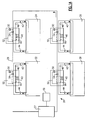
- FIG. 1A An aircraft galley system 20 is illustrated in Figure 1A .
- the galley monuments each may include a small refrigerator, a work station, docking for removable food carts, etc.
- a cooling system includes a control 30 and a cooling system 27 to circulate a cooling fluid through a circuit 29.
- the circuit is shown as extending to each of the galley monuments 22, 24, 26, and 28 in series, however, in practice the flow may be in parallel.
- Each of the galley monuments includes a galley cooling unit 40 through which the cooling fluid in circuit 29 passes. Air is circulated through a passage 46, and is cooled by the cooling fluid in the galley cooling unit 40. This air is then circulated to the galley monument, and into the refrigerator, to components that circulate the cooling air within the removable food carts, and to other destinations within the galley monument that need to be cool.
- each cooling passage 46 is a temperature supply sensor 42 and a temperature return sensor 44. These sensors provide feedback of the temperature of the air being delivered to the galley monuments 22, 24, 26, and 28, and the temperature returning from the galley monument.
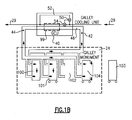
- FIG. 1B shows a single galley monument 24, and its galley cooling unit 40.
- carts 100 may be fully stowed with doors closed.
- Another cart 102 could be removed and at location 103, while another cart 104 could have an open door.
- the cart 104 with an open door can result in loss of cooling, as described elsewhere in this application.
- FIG. 2 shows an algorithm for determining whether there may be a cooling loss at any one galley monument.
- a compartment temperature 60 signal which may be the return temperature from sensor 44, is sent to a filter 62.
- the filter 62 may be a low pass filter that attenuates high frequency noise on the sensed temperature.
- This is then sent to a derivative calculator 64.
- the derivative of the filtered temperature is computed and represents the rate at which the compartment temperature is changing with time.
- This is then sent to a comparator 66, which determines how the rate of temperature change compares to an expected rate.
- a map 68 includes an expected rate, and identifies whether a temperature change is or is not as expected at any one moment. As can be appreciated from map 68, essentially, if the rate of change is above an expected rate, then this is determined to be inefficient or undesired operation.
- the derivative is positive at any point, this is also deemed as an unacceptable change, and is indicative of some cooling loss. Further, if the change in temperature is not as expected over a long period of time, an indication may be made that there is some maintenance problem with a particular galley monument and a signal may be sent.
- the system looks for inefficient cooling at any one of the galley monuments, and determines that some adjustment may be desirable when inefficient operation is identified. While the return temperature is the condition that is monitored in a disclosed embodiment, other conditions that would provide an indication of inefficient operation can also be monitored within the scope of this invention.
- Each galley monument is monitored, and the control 30 is provided with an indication of the operation of each galley monument. This is then utilized to determine a proper allocation of cooling load.
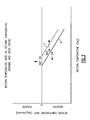
- Figure 3 is a chart showing the derivative changes in the return temperature.
- a lower slope X is associated with an expected rate change, while an upper slope Y is associated with an actual rate change that could be seen from a cart having an open door. That is, these are the derivatives of the return temperature as expected (X) and as may be actually sensed (Y) from a galley monument having at least one cart with an open door. Of course, the more open doors, the greater the difference between the expected rate and the actual rate.
- Figure 4 is a graph of supply and return temperatures over time, and shows temperature change for a galley monument with at least one door open, and a galley monument with all doors closed.
- the difference between the supply temperature and the return temperature is the amount of cooling, Q, that is occurring.
- the door open temperature return is much higher, and indicates a greater amount of cooling load utilized at a particular galley monument.
- any one galley monument with an open door can complicate cooling the other galleys.
- each of the galley cooling units are provided with a heat exchanger 99, a bypass line 52 and valves 50 and 54.
- the valves 50 and 54 are under the control of the control 30, or a local controller.
- a portion of the cooling fluid in the cooling fluid line 29 may be passed through the bypass line 52 such that it does not pass through the galley cooling unit heat exchanger 99.
- the valves 50 and 54 may modulate the flow of cooling fluid such that only a portion passes through the galley cooling unit heat exchanger 99, or may entirely bypass a particular galley cooling unit heat exchanger 99.
- galley monument in an overall aircraft galley system 20 is illustrated, this application would provide benefits in any number of other configurations of galley monuments and aircraft galley systems.
Landscapes
- Engineering & Computer Science (AREA)
- Health & Medical Sciences (AREA)
- General Health & Medical Sciences (AREA)
- Pulmonology (AREA)
- Aviation & Aerospace Engineering (AREA)
- Chemical & Material Sciences (AREA)
- Combustion & Propulsion (AREA)
- Physics & Mathematics (AREA)
- Mechanical Engineering (AREA)
- Thermal Sciences (AREA)
- General Engineering & Computer Science (AREA)
- Devices That Are Associated With Refrigeration Equipment (AREA)
Abstract
Description
- This application relates to a method and apparatus for determining when one of several galley monuments may have a temperature loss occurring, such that a system control can route cooling capacity accordingly.
- Some systems include a plurality of galley monuments for cooling foods. As an example, a large aircraft may have more than six separate galleys, each with a galley monument that includes food carts, small refrigerators, etc. Several of these galley monuments are typically cooled by a single cooling system, which routes a cooling fluid to each of the galley monuments.
- The galley monuments may include a work station, stationary cooling components (refrigerators), and docking stations to cool removable food carts. They have doors that may be left open while attendants are working to access food, the carts, etc. When a door is open, there can be cooling loss occurring.
- In addition, with time, it is possible a particular galley monument could have a wall become cracked, or may have another reason that its cooling efficiency is lowered.
- When any one of the galley monuments in an aircraft, or other system, is experiencing these cooling losses, the ability of the cooling system to cool all of the galley monuments is degraded.
- A galley cooling system comprises a plurality of galley cooling units each to be associated with a separate galley monument. A control determines whether a sensed condition is indicative of efficient operation of a particular galley cooling unit, and the control is operable to decrease cooling capacity delivered to a galley cooling unit which is experiencing inefficient operation. An aircraft galley system incorporating the above cooling unit, and a method of operating a galley cooling unit are also disclosed and claimed.
- These and other features of the present invention can be best understood from the following specification and drawings, the following of which is a brief description.
-
-
Figure 1A schematically shows an aircraft galley cooling system. -
Figure 1B shows further detail. -
Figure 2 is a schematic of a determination method for determining a temperature loss. -
Figure 3 shows further detail of theFigure 2 map. -
Figure 4 is a graph of temperature versus time. - An aircraft galley system 20 is illustrated in
Figure 1A . As shown, there may be several galley monuments, shown here as 22, 24, 26, and 28. The galley monuments each may include a small refrigerator, a work station, docking for removable food carts, etc. A cooling system includes acontrol 30 and acooling system 27 to circulate a cooling fluid through acircuit 29. The circuit is shown as extending to each of thegalley monuments - Each of the galley monuments includes a
galley cooling unit 40 through which the cooling fluid incircuit 29 passes. Air is circulated through apassage 46, and is cooled by the cooling fluid in thegalley cooling unit 40. This air is then circulated to the galley monument, and into the refrigerator, to components that circulate the cooling air within the removable food carts, and to other destinations within the galley monument that need to be cool. - Within each
cooling passage 46 is atemperature supply sensor 42 and atemperature return sensor 44. These sensors provide feedback of the temperature of the air being delivered to thegalley monuments -
Figure 1B shows asingle galley monument 24, and itsgalley cooling unit 40. As shown, carts 100 may be fully stowed with doors closed. Anothercart 102 could be removed and atlocation 103, while anothercart 104 could have an open door. Thecart 104 with an open door can result in loss of cooling, as described elsewhere in this application. -
Figure 2 shows an algorithm for determining whether there may be a cooling loss at any one galley monument. As shown, acompartment temperature 60 signal, which may be the return temperature fromsensor 44, is sent to afilter 62. Thefilter 62 may be a low pass filter that attenuates high frequency noise on the sensed temperature. This is then sent to aderivative calculator 64. The derivative of the filtered temperature is computed and represents the rate at which the compartment temperature is changing with time. This is then sent to acomparator 66, which determines how the rate of temperature change compares to an expected rate. Amap 68 includes an expected rate, and identifies whether a temperature change is or is not as expected at any one moment. As can be appreciated frommap 68, essentially, if the rate of change is above an expected rate, then this is determined to be inefficient or undesired operation. - If the derivative is positive at any point, this is also deemed as an unacceptable change, and is indicative of some cooling loss. Further, if the change in temperature is not as expected over a long period of time, an indication may be made that there is some maintenance problem with a particular galley monument and a signal may be sent.
- Essentially, the system looks for inefficient cooling at any one of the galley monuments, and determines that some adjustment may be desirable when inefficient operation is identified. While the return temperature is the condition that is monitored in a disclosed embodiment, other conditions that would provide an indication of inefficient operation can also be monitored within the scope of this invention.
- Each galley monument is monitored, and the
control 30 is provided with an indication of the operation of each galley monument. This is then utilized to determine a proper allocation of cooling load. -
Figure 3 is a chart showing the derivative changes in the return temperature. A lower slope X is associated with an expected rate change, while an upper slope Y is associated with an actual rate change that could be seen from a cart having an open door. That is, these are the derivatives of the return temperature as expected (X) and as may be actually sensed (Y) from a galley monument having at least one cart with an open door. Of course, the more open doors, the greater the difference between the expected rate and the actual rate. -
Figure 4 is a graph of supply and return temperatures over time, and shows temperature change for a galley monument with at least one door open, and a galley monument with all doors closed. The difference between the supply temperature and the return temperature is the amount of cooling, Q, that is occurring. As can be appreciated, the door open temperature return is much higher, and indicates a greater amount of cooling load utilized at a particular galley monument. Thus, any one galley monument with an open door can complicate cooling the other galleys. - Returning to
Figures 1A and1B , each of the galley cooling units are provided with aheat exchanger 99, abypass line 52 andvalves valves control 30, or a local controller. When it is determined that a particular galley monument is undergoing a cooling loss, such as a door being open, a portion of the cooling fluid in thecooling fluid line 29 may be passed through thebypass line 52 such that it does not pass through the galley coolingunit heat exchanger 99. In this manner, the amount of cooling capacity utilized at the inefficient galley monument is reduced, and there is more cooling capacity available for the other galley monuments. Thevalves unit heat exchanger 99, or may entirely bypass a particular galley coolingunit heat exchanger 99. - Although one example of a galley monument in an overall aircraft galley system 20 is illustrated, this application would provide benefits in any number of other configurations of galley monuments and aircraft galley systems.
- Although an embodiment of this invention has been disclosed, a worker of ordinary skill in this art would recognize that certain modifications would come within the scope of this invention. For that reason, the following claims should be studied to determine the true scope and content of this invention.
Claims (11)
- A galley cooling system (20) comprising:a plurality of galley cooling units (40) each to be associated with a separate galley monument (22-28);a sensor (42,44) for sensing a condition at each of the galley monuments; anda control (30) for determining whether a sensed condition is indicative of efficient operation of a particular galley cooling unit, and said control being operable to decrease cooling capacity delivered to a galley cooling unit which is experiencing inefficient operation.
- The galley cooling system as set forth in claim 1, wherein said sensed condition is a return temperature of air being returned to said galley cooling unit (40) from each of the galley monuments.
- The galley cooling system as set forth in claim 2, wherein the control is arranged to compare a change in the sensed return temperature to an expected change in the return temperature to determine if inefficient operation is occurring.
- The galley cooling system as set forth in claim 1,2 or 3 wherein a valve (50) and bypass line (52) are arranged to selectively bypass a cooling fluid away from a galley cooling unit which has been determined to be experiencing inefficient operation.
- The galley cooling system as set forth in claim 4, wherein there are a plurality of galley monuments (22-28) associated with said galley cooling system (20), and configured such that the bypass of cooling fluid around a galley cooling unit which has been determined to be experiencing inefficient operation allows more cooling capacity for the others of said plurality of galley cooling units.
- An aircraft galley monument system comprising:a plurality of galley monuments (22-28), each of said galley monuments being for cooling food; anda galley cooling system as claimed in any preceding claim.
- A method of cooling a galley comprising the steps of:(a) supplying a cooling fluid to a galley cooling unit (40), and cooling air at said galley cooling unit;(b) circulating cooled air from said galley cooling unit into a galley;(c) sensing a condition at each said galley; and(d) determining if a particular galley cooling unit is experiencing inefficient operation, and reducing the amount of cooling capacity provided by the cooling fluid to a galley cooling unit which is determined to be experiencing inefficient operation.
- The method as set forth in claim 7, wherein the condition that is sensed is a return temperature of air being returned to the galley cooling unit.
- The method as set forth in claim 8, wherein a rate of change of said return temperature of air is compared to an expected rate of change to determine if inefficient operation is occurring.
- The method as set forth in claim 7, 8 or 9, wherein a valve (50) and bypass line (52) selectively bypass a cooling fluid away from a galley cooling unit which has been determined to be experiencing inefficient operation.
- The method as set forth in claim 10, wherein the bypass of cooling fluid around a galley cooling unit which has been determined to be experiencing inefficient operation allowing more cooling capacity for the others of said plurality of galley cooling units.
Applications Claiming Priority (1)
| Application Number | Priority Date | Filing Date | Title |
|---|---|---|---|
| US12/463,451 US8171745B2 (en) | 2009-05-11 | 2009-05-11 | Compartment cooling loss identification for efficient system operation |
Publications (3)
| Publication Number | Publication Date |
|---|---|
| EP2251260A2 true EP2251260A2 (en) | 2010-11-17 |
| EP2251260A3 EP2251260A3 (en) | 2014-03-12 |
| EP2251260B1 EP2251260B1 (en) | 2018-01-10 |
Family
ID=42271887
Family Applications (1)
| Application Number | Title | Priority Date | Filing Date |
|---|---|---|---|
| EP10250905.6A Active EP2251260B1 (en) | 2009-05-11 | 2010-05-11 | Compartment cooling loss identification for efficient system operation |
Country Status (2)
| Country | Link |
|---|---|
| US (1) | US8171745B2 (en) |
| EP (1) | EP2251260B1 (en) |
Cited By (6)
| Publication number | Priority date | Publication date | Assignee | Title |
|---|---|---|---|---|
| EP2650216A1 (en) * | 2012-04-13 | 2013-10-16 | Airbus Operations GmbH | Cooling arrangement |
| EP2664543A1 (en) * | 2012-05-16 | 2013-11-20 | Airbus Operations GmbH | Method for operating an aircraft cooling system and aircraft cooling system |
| EP2845802A1 (en) * | 2013-09-04 | 2015-03-11 | The Boeing Company | System and method for refrigerating galley compartments |
| WO2016007530A1 (en) * | 2014-07-08 | 2016-01-14 | B/E Aerospace, Inc. | Chiller for an aircraft galley cart compartment |
| US10337776B2 (en) | 2017-09-19 | 2019-07-02 | The Boeing Company | Refrigeration system having valves and valve control actuators |
| US11072426B2 (en) | 2015-11-23 | 2021-07-27 | The Boeing Company | Galley system of an aircraft |
Families Citing this family (10)
| Publication number | Priority date | Publication date | Assignee | Title |
|---|---|---|---|---|
| US8880685B2 (en) * | 2010-03-26 | 2014-11-04 | Be Intellectual Property, Inc. | Gain to gain network for aircraft galley system |
| US9188380B2 (en) * | 2011-08-23 | 2015-11-17 | B/E Aerospace, Inc. | Aircraft galley liquid cooling system |
| CN106949695A (en) * | 2012-03-22 | 2017-07-14 | B/E航空公司 | Vehicles refrigeration plant with steam circulation |
| US8850830B2 (en) | 2012-06-12 | 2014-10-07 | Hamilton Sundstrand Corporation | Temperature compensation system and method |
| US9030824B2 (en) | 2012-10-02 | 2015-05-12 | Hamilton Sundstrand Corporation | Dielectrophoretic cooling solution for electronics |
| US8848371B2 (en) | 2012-10-01 | 2014-09-30 | Hamilton Sundstrand Corporation | Dielectrophoretic restriction to prevent vapor backflow |
| US9038407B2 (en) | 2012-10-03 | 2015-05-26 | Hamilton Sundstrand Corporation | Electro-hydrodynamic cooling with enhanced heat transfer surfaces |
| US9434474B2 (en) * | 2012-11-16 | 2016-09-06 | B/E Aerospace, Inc. | Aircraft galley cart door interlock |
| US9086154B2 (en) | 2013-04-04 | 2015-07-21 | Hamilton Sundstrand Corporation | Ball shaft for a liquid coolant valve |
| US10040556B2 (en) * | 2013-10-07 | 2018-08-07 | B/E Aerospace, Inc. | Chilled air plenum system for aircraft galleys |
Family Cites Families (10)
| Publication number | Priority date | Publication date | Assignee | Title |
|---|---|---|---|---|
| US5743102A (en) * | 1996-04-15 | 1998-04-28 | Hussmann Corporation | Strategic modular secondary refrigeration |
| US6064121A (en) * | 1998-02-27 | 2000-05-16 | Hamilton Sundstrand Corporation | Axially compact generator set and refrigeration system employing the same |
| US6880351B2 (en) * | 2001-09-05 | 2005-04-19 | Be Intellectual Property, Inc. | Liquid galley refrigeration system for aircraft |
| US6906537B2 (en) * | 2002-08-19 | 2005-06-14 | Hamilton Sundstrand | System for controlling the temperature of an aircraft airfoil component |
| US7093458B2 (en) * | 2003-02-19 | 2006-08-22 | The Boeing Company | System and method of refrigerating at least one enclosure |
| US7024874B2 (en) * | 2003-09-22 | 2006-04-11 | Hamilton Sundstrand | Aircraft galley chiller system |
| US6845627B1 (en) * | 2003-11-10 | 2005-01-25 | Be Intellectual Property, Inc. | Control system for an aircraft galley cooler |
| US7231778B2 (en) * | 2004-03-29 | 2007-06-19 | Be Intellectual Property, Inc. | Cooling system for a commercial aircraft galley |
| US7380408B2 (en) * | 2005-12-20 | 2008-06-03 | Hamilton Sunstrand Corporation | Integrated control system for combined galley refrigeration unit and cabin air conditioning system |
| US8042355B2 (en) * | 2006-12-28 | 2011-10-25 | Whirlpool Corporation | Temporary refrigerator storage modules |
-
2009
- 2009-05-11 US US12/463,451 patent/US8171745B2/en active Active
-
2010
- 2010-05-11 EP EP10250905.6A patent/EP2251260B1/en active Active
Non-Patent Citations (1)
| Title |
|---|
| None |
Cited By (9)
| Publication number | Priority date | Publication date | Assignee | Title |
|---|---|---|---|---|
| EP2650216A1 (en) * | 2012-04-13 | 2013-10-16 | Airbus Operations GmbH | Cooling arrangement |
| EP2664543A1 (en) * | 2012-05-16 | 2013-11-20 | Airbus Operations GmbH | Method for operating an aircraft cooling system and aircraft cooling system |
| US9903672B2 (en) | 2012-05-16 | 2018-02-27 | Airbus Operations Gmbh | Method for operating an aircraft cooling system and aircraft cooling system |
| EP2845802A1 (en) * | 2013-09-04 | 2015-03-11 | The Boeing Company | System and method for refrigerating galley compartments |
| US10273010B2 (en) | 2013-09-04 | 2019-04-30 | The Boeing Company | Systems and methods for refrigerating galley compartments |
| WO2016007530A1 (en) * | 2014-07-08 | 2016-01-14 | B/E Aerospace, Inc. | Chiller for an aircraft galley cart compartment |
| US10016055B2 (en) | 2014-07-08 | 2018-07-10 | B/E Aerospace, Inc. | Compact liquid cooled, air through galley chiller |
| US11072426B2 (en) | 2015-11-23 | 2021-07-27 | The Boeing Company | Galley system of an aircraft |
| US10337776B2 (en) | 2017-09-19 | 2019-07-02 | The Boeing Company | Refrigeration system having valves and valve control actuators |
Also Published As
| Publication number | Publication date |
|---|---|
| EP2251260B1 (en) | 2018-01-10 |
| US8171745B2 (en) | 2012-05-08 |
| EP2251260A3 (en) | 2014-03-12 |
| US20100281892A1 (en) | 2010-11-11 |
Similar Documents
| Publication | Publication Date | Title |
|---|---|---|
| US8171745B2 (en) | Compartment cooling loss identification for efficient system operation | |
| EP2782851B1 (en) | Method for in-service testing a climate control system for a container | |
| EP1685374B1 (en) | Liquid sensing system for an aircraft galley cooler using a two phase working fluid | |
| US7421849B2 (en) | Liquid galley refrigeration system for aircraft | |
| US6845627B1 (en) | Control system for an aircraft galley cooler | |
| EP3470291B1 (en) | Vehicle air-conditioning device and railroad-car communication system | |
| EP3095699B1 (en) | Galley cart and galley system of an aircraft | |
| US20150289643A1 (en) | Galley cooling system and method of operating a galley cooling system | |
| EP2650216B1 (en) | Cooling arrangement | |
| US20120291459A1 (en) | Method and apparatus for aircraft galley cooling | |
| EP3123085A1 (en) | Vehicle refrigeration equipment having a liquid heat rejection system | |
| EP3095698A1 (en) | Galley cart refrigeration system of an aircraft | |
| EP2489855A1 (en) | Distributed bleed air management system and method | |
| EP2664543B1 (en) | Method for operating an aircraft cooling system and aircraft cooling system | |
| EP3116784B1 (en) | Independently controlled dual outlet aircraft air unit | |
| EP4011778B1 (en) | Recirculation ground maintenance mode | |
| CA3113387A1 (en) | Systems and methods for display case turndown | |
| EP3783282B1 (en) | Vapor cycle machine availability for high impact applications | |
| CN105492321A (en) | Device for reversing chiller airflow in an aircraft galley | |
| EP3390931B1 (en) | Methods and systems for checking proper airflow within a container | |
| EP2801526A1 (en) | Galley cooling heat exchanger defrost mechanism | |
| CN213831681U (en) | Kitchens and Vehicles for Vehicles | |
| HK1094981B (en) | Control system for an aircraft galley cooler |
Legal Events
| Date | Code | Title | Description |
|---|---|---|---|
| PUAI | Public reference made under article 153(3) epc to a published international application that has entered the european phase |
Free format text: ORIGINAL CODE: 0009012 |
|
| AK | Designated contracting states |
Kind code of ref document: A2 Designated state(s): AL AT BE BG CH CY CZ DE DK EE ES FI FR GB GR HR HU IE IS IT LI LT LU LV MC MK MT NL NO PL PT RO SE SI SK SM TR |
|
| AX | Request for extension of the european patent |
Extension state: BA ME RS |
|
| REG | Reference to a national code |
Ref country code: DE Ref legal event code: R079 Ref document number: 602010047912 Country of ref document: DE Free format text: PREVIOUS MAIN CLASS: B64D0013080000 Ipc: B64D0013060000 |
|
| PUAL | Search report despatched |
Free format text: ORIGINAL CODE: 0009013 |
|
| AK | Designated contracting states |
Kind code of ref document: A3 Designated state(s): AL AT BE BG CH CY CZ DE DK EE ES FI FR GB GR HR HU IE IS IT LI LT LU LV MC MK MT NL NO PL PT RO SE SI SK SM TR |
|
| AX | Request for extension of the european patent |
Extension state: BA ME RS |
|
| RIC1 | Information provided on ipc code assigned before grant |
Ipc: B64D 13/06 20060101AFI20140205BHEP Ipc: F25D 17/02 20060101ALI20140205BHEP Ipc: F25D 13/02 20060101ALI20140205BHEP |
|
| 17P | Request for examination filed |
Effective date: 20140514 |
|
| RBV | Designated contracting states (corrected) |
Designated state(s): AL AT BE BG CH CY CZ DE DK EE ES FI FR GB GR HR HU IE IS IT LI LT LU LV MC MK MT NL NO PL PT RO SE SI SK SM TR |
|
| 17Q | First examination report despatched |
Effective date: 20160701 |
|
| STAA | Information on the status of an ep patent application or granted ep patent |
Free format text: STATUS: EXAMINATION IS IN PROGRESS |
|
| GRAP | Despatch of communication of intention to grant a patent |
Free format text: ORIGINAL CODE: EPIDOSNIGR1 |
|
| STAA | Information on the status of an ep patent application or granted ep patent |
Free format text: STATUS: GRANT OF PATENT IS INTENDED |
|
| INTG | Intention to grant announced |
Effective date: 20170718 |
|
| GRAS | Grant fee paid |
Free format text: ORIGINAL CODE: EPIDOSNIGR3 |
|
| GRAA | (expected) grant |
Free format text: ORIGINAL CODE: 0009210 |
|
| STAA | Information on the status of an ep patent application or granted ep patent |
Free format text: STATUS: THE PATENT HAS BEEN GRANTED |
|
| AK | Designated contracting states |
Kind code of ref document: B1 Designated state(s): AL AT BE BG CH CY CZ DE DK EE ES FI FR GB GR HR HU IE IS IT LI LT LU LV MC MK MT NL NO PL PT RO SE SI SK SM TR |
|
| REG | Reference to a national code |
Ref country code: GB Ref legal event code: FG4D |
|
| REG | Reference to a national code |
Ref country code: CH Ref legal event code: EP Ref country code: AT Ref legal event code: REF Ref document number: 962103 Country of ref document: AT Kind code of ref document: T Effective date: 20180115 |
|
| REG | Reference to a national code |
Ref country code: IE Ref legal event code: FG4D |
|
| REG | Reference to a national code |
Ref country code: DE Ref legal event code: R096 Ref document number: 602010047912 Country of ref document: DE |
|
| REG | Reference to a national code |
Ref country code: FR Ref legal event code: PLFP Year of fee payment: 9 |
|
| REG | Reference to a national code |
Ref country code: NL Ref legal event code: MP Effective date: 20180110 |
|
| REG | Reference to a national code |
Ref country code: AT Ref legal event code: MK05 Ref document number: 962103 Country of ref document: AT Kind code of ref document: T Effective date: 20180110 |
|
| PG25 | Lapsed in a contracting state [announced via postgrant information from national office to epo] |
Ref country code: NL Free format text: LAPSE BECAUSE OF FAILURE TO SUBMIT A TRANSLATION OF THE DESCRIPTION OR TO PAY THE FEE WITHIN THE PRESCRIBED TIME-LIMIT Effective date: 20180110 |
|
| PG25 | Lapsed in a contracting state [announced via postgrant information from national office to epo] |
Ref country code: ES Free format text: LAPSE BECAUSE OF FAILURE TO SUBMIT A TRANSLATION OF THE DESCRIPTION OR TO PAY THE FEE WITHIN THE PRESCRIBED TIME-LIMIT Effective date: 20180110 Ref country code: HR Free format text: LAPSE BECAUSE OF FAILURE TO SUBMIT A TRANSLATION OF THE DESCRIPTION OR TO PAY THE FEE WITHIN THE PRESCRIBED TIME-LIMIT Effective date: 20180110 Ref country code: LT Free format text: LAPSE BECAUSE OF FAILURE TO SUBMIT A TRANSLATION OF THE DESCRIPTION OR TO PAY THE FEE WITHIN THE PRESCRIBED TIME-LIMIT Effective date: 20180110 Ref country code: CY Free format text: LAPSE BECAUSE OF FAILURE TO SUBMIT A TRANSLATION OF THE DESCRIPTION OR TO PAY THE FEE WITHIN THE PRESCRIBED TIME-LIMIT Effective date: 20180110 Ref country code: NO Free format text: LAPSE BECAUSE OF FAILURE TO SUBMIT A TRANSLATION OF THE DESCRIPTION OR TO PAY THE FEE WITHIN THE PRESCRIBED TIME-LIMIT Effective date: 20180410 Ref country code: FI Free format text: LAPSE BECAUSE OF FAILURE TO SUBMIT A TRANSLATION OF THE DESCRIPTION OR TO PAY THE FEE WITHIN THE PRESCRIBED TIME-LIMIT Effective date: 20180110 |
|
| PG25 | Lapsed in a contracting state [announced via postgrant information from national office to epo] |
Ref country code: IS Free format text: LAPSE BECAUSE OF FAILURE TO SUBMIT A TRANSLATION OF THE DESCRIPTION OR TO PAY THE FEE WITHIN THE PRESCRIBED TIME-LIMIT Effective date: 20180510 Ref country code: GR Free format text: LAPSE BECAUSE OF FAILURE TO SUBMIT A TRANSLATION OF THE DESCRIPTION OR TO PAY THE FEE WITHIN THE PRESCRIBED TIME-LIMIT Effective date: 20180411 Ref country code: PL Free format text: LAPSE BECAUSE OF FAILURE TO SUBMIT A TRANSLATION OF THE DESCRIPTION OR TO PAY THE FEE WITHIN THE PRESCRIBED TIME-LIMIT Effective date: 20180110 Ref country code: AT Free format text: LAPSE BECAUSE OF FAILURE TO SUBMIT A TRANSLATION OF THE DESCRIPTION OR TO PAY THE FEE WITHIN THE PRESCRIBED TIME-LIMIT Effective date: 20180110 Ref country code: LV Free format text: LAPSE BECAUSE OF FAILURE TO SUBMIT A TRANSLATION OF THE DESCRIPTION OR TO PAY THE FEE WITHIN THE PRESCRIBED TIME-LIMIT Effective date: 20180110 Ref country code: SE Free format text: LAPSE BECAUSE OF FAILURE TO SUBMIT A TRANSLATION OF THE DESCRIPTION OR TO PAY THE FEE WITHIN THE PRESCRIBED TIME-LIMIT Effective date: 20180110 Ref country code: BG Free format text: LAPSE BECAUSE OF FAILURE TO SUBMIT A TRANSLATION OF THE DESCRIPTION OR TO PAY THE FEE WITHIN THE PRESCRIBED TIME-LIMIT Effective date: 20180410 |
|
| REG | Reference to a national code |
Ref country code: DE Ref legal event code: R097 Ref document number: 602010047912 Country of ref document: DE |
|
| PG25 | Lapsed in a contracting state [announced via postgrant information from national office to epo] |
Ref country code: EE Free format text: LAPSE BECAUSE OF FAILURE TO SUBMIT A TRANSLATION OF THE DESCRIPTION OR TO PAY THE FEE WITHIN THE PRESCRIBED TIME-LIMIT Effective date: 20180110 Ref country code: AL Free format text: LAPSE BECAUSE OF FAILURE TO SUBMIT A TRANSLATION OF THE DESCRIPTION OR TO PAY THE FEE WITHIN THE PRESCRIBED TIME-LIMIT Effective date: 20180110 Ref country code: IT Free format text: LAPSE BECAUSE OF FAILURE TO SUBMIT A TRANSLATION OF THE DESCRIPTION OR TO PAY THE FEE WITHIN THE PRESCRIBED TIME-LIMIT Effective date: 20180110 Ref country code: RO Free format text: LAPSE BECAUSE OF FAILURE TO SUBMIT A TRANSLATION OF THE DESCRIPTION OR TO PAY THE FEE WITHIN THE PRESCRIBED TIME-LIMIT Effective date: 20180110 |
|
| PLBE | No opposition filed within time limit |
Free format text: ORIGINAL CODE: 0009261 |
|
| STAA | Information on the status of an ep patent application or granted ep patent |
Free format text: STATUS: NO OPPOSITION FILED WITHIN TIME LIMIT |
|
| PG25 | Lapsed in a contracting state [announced via postgrant information from national office to epo] |
Ref country code: DK Free format text: LAPSE BECAUSE OF FAILURE TO SUBMIT A TRANSLATION OF THE DESCRIPTION OR TO PAY THE FEE WITHIN THE PRESCRIBED TIME-LIMIT Effective date: 20180110 Ref country code: CZ Free format text: LAPSE BECAUSE OF FAILURE TO SUBMIT A TRANSLATION OF THE DESCRIPTION OR TO PAY THE FEE WITHIN THE PRESCRIBED TIME-LIMIT Effective date: 20180110 Ref country code: SM Free format text: LAPSE BECAUSE OF FAILURE TO SUBMIT A TRANSLATION OF THE DESCRIPTION OR TO PAY THE FEE WITHIN THE PRESCRIBED TIME-LIMIT Effective date: 20180110 Ref country code: SK Free format text: LAPSE BECAUSE OF FAILURE TO SUBMIT A TRANSLATION OF THE DESCRIPTION OR TO PAY THE FEE WITHIN THE PRESCRIBED TIME-LIMIT Effective date: 20180110 |
|
| REG | Reference to a national code |
Ref country code: CH Ref legal event code: PL |
|
| 26N | No opposition filed |
Effective date: 20181011 |
|
| REG | Reference to a national code |
Ref country code: BE Ref legal event code: MM Effective date: 20180531 |
|
| PG25 | Lapsed in a contracting state [announced via postgrant information from national office to epo] |
Ref country code: MC Free format text: LAPSE BECAUSE OF FAILURE TO SUBMIT A TRANSLATION OF THE DESCRIPTION OR TO PAY THE FEE WITHIN THE PRESCRIBED TIME-LIMIT Effective date: 20180110 |
|
| REG | Reference to a national code |
Ref country code: IE Ref legal event code: MM4A |
|
| PG25 | Lapsed in a contracting state [announced via postgrant information from national office to epo] |
Ref country code: CH Free format text: LAPSE BECAUSE OF NON-PAYMENT OF DUE FEES Effective date: 20180531 Ref country code: LI Free format text: LAPSE BECAUSE OF NON-PAYMENT OF DUE FEES Effective date: 20180531 Ref country code: SI Free format text: LAPSE BECAUSE OF FAILURE TO SUBMIT A TRANSLATION OF THE DESCRIPTION OR TO PAY THE FEE WITHIN THE PRESCRIBED TIME-LIMIT Effective date: 20180110 |
|
| PG25 | Lapsed in a contracting state [announced via postgrant information from national office to epo] |
Ref country code: LU Free format text: LAPSE BECAUSE OF NON-PAYMENT OF DUE FEES Effective date: 20180511 |
|
| PG25 | Lapsed in a contracting state [announced via postgrant information from national office to epo] |
Ref country code: IE Free format text: LAPSE BECAUSE OF NON-PAYMENT OF DUE FEES Effective date: 20180511 |
|
| PG25 | Lapsed in a contracting state [announced via postgrant information from national office to epo] |
Ref country code: BE Free format text: LAPSE BECAUSE OF NON-PAYMENT OF DUE FEES Effective date: 20180531 |
|
| PG25 | Lapsed in a contracting state [announced via postgrant information from national office to epo] |
Ref country code: MT Free format text: LAPSE BECAUSE OF NON-PAYMENT OF DUE FEES Effective date: 20180511 |
|
| PG25 | Lapsed in a contracting state [announced via postgrant information from national office to epo] |
Ref country code: TR Free format text: LAPSE BECAUSE OF FAILURE TO SUBMIT A TRANSLATION OF THE DESCRIPTION OR TO PAY THE FEE WITHIN THE PRESCRIBED TIME-LIMIT Effective date: 20180110 |
|
| PG25 | Lapsed in a contracting state [announced via postgrant information from national office to epo] |
Ref country code: HU Free format text: LAPSE BECAUSE OF FAILURE TO SUBMIT A TRANSLATION OF THE DESCRIPTION OR TO PAY THE FEE WITHIN THE PRESCRIBED TIME-LIMIT; INVALID AB INITIO Effective date: 20100511 Ref country code: PT Free format text: LAPSE BECAUSE OF FAILURE TO SUBMIT A TRANSLATION OF THE DESCRIPTION OR TO PAY THE FEE WITHIN THE PRESCRIBED TIME-LIMIT Effective date: 20180110 |
|
| PG25 | Lapsed in a contracting state [announced via postgrant information from national office to epo] |
Ref country code: MK Free format text: LAPSE BECAUSE OF NON-PAYMENT OF DUE FEES Effective date: 20180110 |
|
| P01 | Opt-out of the competence of the unified patent court (upc) registered |
Effective date: 20230522 |
|
| PGFP | Annual fee paid to national office [announced via postgrant information from national office to epo] |
Ref country code: DE Payment date: 20250423 Year of fee payment: 16 |
|
| PGFP | Annual fee paid to national office [announced via postgrant information from national office to epo] |
Ref country code: GB Payment date: 20250423 Year of fee payment: 16 |
|
| PGFP | Annual fee paid to national office [announced via postgrant information from national office to epo] |
Ref country code: FR Payment date: 20250423 Year of fee payment: 16 |