EP2250639B1 - Shoulder rest for a stringed instrument - Google Patents
Shoulder rest for a stringed instrument Download PDFInfo
- Publication number
- EP2250639B1 EP2250639B1 EP09714737.5A EP09714737A EP2250639B1 EP 2250639 B1 EP2250639 B1 EP 2250639B1 EP 09714737 A EP09714737 A EP 09714737A EP 2250639 B1 EP2250639 B1 EP 2250639B1
- Authority
- EP
- European Patent Office
- Prior art keywords
- stringed instrument
- piece
- shoulder rest
- shoulder
- attachment
- Prior art date
- Legal status (The legal status is an assumption and is not a legal conclusion. Google has not performed a legal analysis and makes no representation as to the accuracy of the status listed.)
- Not-in-force
Links
Images


Classifications
-
- G—PHYSICS
- G10—MUSICAL INSTRUMENTS; ACOUSTICS
- G10D—STRINGED MUSICAL INSTRUMENTS; WIND MUSICAL INSTRUMENTS; ACCORDIONS OR CONCERTINAS; PERCUSSION MUSICAL INSTRUMENTS; AEOLIAN HARPS; SINGING-FLAME MUSICAL INSTRUMENTS; MUSICAL INSTRUMENTS NOT OTHERWISE PROVIDED FOR
- G10D3/00—Details of, or accessories for, stringed musical instruments, e.g. slide-bars
- G10D3/18—Chin-rests, hand-rests, shoulder rests or guards being removable from, or integral with the instrument
Definitions
- This invention relates to a shoulder rest for stringed instrument such as violin or viola intended for support on a shoulder of a user.
- a conventional bridge-type shoulder rest may also hinder the smooth transmission of sound from the violin to the body of the user.
- metal clamps are incorporated thereon for securing the violin which may also damage the violin body.
- the present invention in one aspect, is a shoulder rest for supporting a stringed instrument which comprises an attachment piece, an abutment piece, and a padding piece.
- the attachment piece is adapted to secure the shoulder rest to a tail-pin of the stringed instrument and the abutment piece, extending from the attachment piece, is adapted to provide support to the stringed instrument once rested onto the shoulder rest.
- the attachment and abutment pieces are coupled to form an L-shaped support configuration for providing an area for contact between the stringed instrument and the shoulder rest to support the stringed instrument.
- the padding piece connects to the abutment piece and is adapted to rest on and conform to the contour of a shoulder of a user.
- the attachment piece is adapted to clip onto an end button of the stringed instrument such that the contact surface between said stringed instrument and said shoulder rest is juxtaposing a bottom block of said stringed instrument.
- the abutment piece comprises a rigid material to minimize any contact between a bottom board of the stringed instrument and the shoulder rest upon attachment of said attachment piece onto said stringed instrument. As such, damping of said stringed instrument resting on said shoulder rest could be prevented during usage.
- the attachment plate contains a first end and an opposing second end.
- the first end further has a slot provided therein and adapted to mate with an end button of the stringed instrument for securing the shoulder rest to the stringed instrument.
- the abutment piece rigidly extends from the second end of the attachment plate such that a substantially L-shaped support is formed therebetween to provide an area for contact between the stringed instrument and the shoulder rest to support the stringed instrument.
- the stringed instrument enables the contact surface to be at a bottom block of the stringed instrument such that the angle formed between the attachment plate and the abutment piece allows the abutment piece to support the edge of a bottom board juxtaposing said bottom block during usage while minimizing the contact of the bottom board of the stringed instrument with the shoulder rest.
- the pad, attaching to and spreading around the abutment piece along the plane thereof, is adapted to simultaneously contact and protect the shoulder and the clavicle of the user during usage.
- the L-shaped support formed by the coupling of the attachment and abutment pieces is allowed to be forced open upon attachment of the shoulder rest to the stringed instrument.
- the abutment piece would then be forced away from the stringed instrument such that contacts between the shoulder rest and the stringed instrument, and thus the damping of the stringed instrument resting thereonto, could be minimized.
- the ridge-shaped abutment piece of the shoulder rest of this invention helps in preventing the dropping of the scroll of the violin or viola during playing and so the hand holding the stringed instrument can have complete freedom of movements to attain a full range of orientations and directions. Further, the playing ergonomics of the arm holding the stringed instrument can be improved.
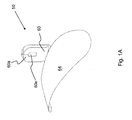
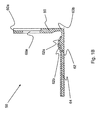
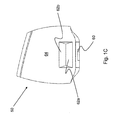
- Fig. 1A , Fig. 1B , and Fig. 1C are perspective, side and top views of a shoulder rest for supporting a stringed instrument respectively according to one embodiment of the present invention.
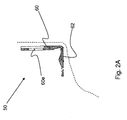
- Fig. 2A is an illustration of the shoulder rest resting on a shoulder of a user without attaching to a stringed instrument according to the same embodiment of the present invention.
- Fig. 2B is an illustration of the shoulder rest in use in which a stringed instrument is attached thereonto according to the same embodiment of the present invention.
- Fig. 3 is a perspective view of a shoulder rest for supporting a stringed instrument according to another embodiment of the present invention.
- formable refers to the nature of a material that allows for a substance made thereof to have its shape readily changeable, but once changed, it can retain the shape.
- Proximal side refers to the side of the shoulder of a user that is closer to the neck.
- distal side refers to the side of the shoulder near the arm and positioned farther away from the neck.
- proximal clavicle means the side of the clavicle of a user closer to the neck of that user, whereas “distal clavicle” is the opposing side of the "proximal clavicle”.
- the first embodiment of the present invention is a shoulder rest 50 for supporting a stringed instrument which comprises an attachment piece 60, an abutment piece 62, and a padding piece 64.
- the attachment piece 60 is a flat plate containing a first end 60a and an opposing second end 60b.
- a slot 60e is provided within the first end 60a.
- the abutment piece 62 is a tongue extending from the second end 60b to form a substantially L-shaped support with the attachment piece 60. It has a shape of a ridge disposed across the upper surface of the tongue and horizontally aligned with the two ends of the attachment piece 60.
- the ridge of the abutment piece 62 contains a slanted inner surface 62a facing the attachment piece 60 and an adjacent slanted outer surface 62b.
- the padding piece 64 is a flexible pad attached to the abutment piece 62 that spreads around the plane thereof.
- the shoulder rest 50 can be attached onto a stringed instrument 80 by sliding the slot 60e through the neck of the end button 82.
- the first end 60a consists of a slit next to the slot 60e. The slit can be pulled open to allow the end button 82 to be inserted into the slot 60e for attaching the shoulder rest 50 onto the stringed instrument 80.
- the attachment piece 60 is made of rigid but yet elastic material and so it can aid in securing the attachment. As further illustrated in Fig.
- the tail-pin 80a of the stringed instrument 80 would come into contact to the inner surface 62a of the abutment piece 62 adapted to provide support to the stringed instrument 80 once rested onto the shoulder rest 50.
- the bottom board 80b of the stringed instrument 80 upon attachment of the attachment piece 60 onto the tail-pin 80a, would be pressed onto the hard but flexible abutment piece 62, forcing open the L-shaped support joining the abutment piece 62 with the attachment piece 60.
- the distal side of the abutment piece 62 would be forced away from the bottom board 80b in order to minimize any contact that may occur between the bottom board 80b (that facilitates the generation of music through vibration) and the abutment piece 62. As such, damping of the stringed instrument 80 resting on the shoulder rest 50 could be minimized.
- Padding piece is not shown in both Figs. 2A and 2B for ease of description.
- the attachment piece 60 of the shoulder rest 50 is provided with a size adjustment mechanism for the slot 60e to accommodate the clipping of the slot 60e onto end buttons with different sizes.
- the size adjustment mechanism in the embodiment illustrated in Fig. 3 is composed of a flexible band 90 which is attached to the attachment piece 60 at a back side thereof and stretches across the slot 60e.
- the size of the slot 60e can be adjusted by adjusting the length of the band 90 thereacross (as shown in dotted lines 90a, the extended form of band 90, in Fig.3 ) and so end buttons with different sizes can be fitted with the shoulder rest.
- the end button 80 (shown in dotted lines in Fig. 3 ) is inserted into the slot 60e.
- the slot 60e comprises an opening at the first end 60a of the attachment piece 60.
- the flexible band 90 is stretched to wrap around the end button 80. As such, a resistive force is applied onto the end button 80 by the flexible band 90 to prevent it from being disconnected from the slot 60e.
- the user can attain unrestricted movement of his/her clavicle during play while his/her stringed instrument 80 rests comfortably on his/her shoulder above on the shoulder rest 50.
- the padding piece 64 of the shoulder rest 50 is made and designed to conform to the contour of the user's shoulder and simultaneously contact the shoulder and the clavicle of the user during play. Since it is preferably made of a soft, flexible or formable material, both the sternoclavicular and acromial-clavicular joints of the user can be remained free and mobile. Further, the user's arm holding the stringed instrument 80 can now move in multiple orientations and directions.
- attachment piece and abutment piece are illustrated to be provided on the central position of the padding piece, but it is clear to one skilled in the art that these two pieces can be disposed on other positions of the padding piece according to the user's preference.
- the attachment piece and the abutment piece may be made of any rigid material, such as but not limited to plastic or wood, and can be of other shape and thickness according to the user's requirement based on the teaching provided herein. Further, the length and shape of the abutment piece can be varied according to one's preferences.
- the attachment piece is illustrated in the aforesaid example to contain a slit followed by a slot to accommodate the end button. It is clear that other configurations of the attachment piece may be used based on the teaching provided herein. For example, a narrow slot may be provided instead of a slit, or other clamping mechanism may be used to secure the attachment piece to end button or the clamps around the end button or their equivalents according to the stringed instrument.
- the angle between the abutment piece and the attachment piece within the L-shaped support could be of any angle that fits the end of the stringed instrument resting thereon.
- the padding piece of the shoulder rest can be made of a soft material such as soft rubber, sponge or quilt, among others. It can also be made of an ergonomically adjustable frame such that it can be modified to conform to different contours of different users according to one's preferences. For example, a wire frame or a formable material can also be used to support the soft material for the base such that the resulting shoulder rest can be adjusted to conform to the contour of the shoulder of the user.
- the padding piece can be designed to be detachable from the abutment piece such that when the shoulder rest is not in use, the user can disconnect the padding piece from the abutment piece, while the abutment piece remains attached to the stringed instrument, according to the his/her preferences.
- a piece of soft material can also be incorporated onto the joint between the attachment piece and the abutment piece within the L-shaped support for extra protection to the stringed instrument resting onto the shoulder rest according to the preferences of the user.
- the size adjustment mechanism as illustrated is composed of a flexible band in the embodiment described above, but it is clear to one skilled in the art that other forms such as Velcro, spring, screws or adaptors can be used to provide secure attachment of the shoulder rest onto the stringed instrument.
- the flexible band can be made of a resilient and flexible material such as soft rubber, nylon, a combination thereof, among others.
Landscapes
- Physics & Mathematics (AREA)
- Engineering & Computer Science (AREA)
- Acoustics & Sound (AREA)
- Multimedia (AREA)
- Stringed Musical Instruments (AREA)
Description
- This invention relates to a shoulder rest for stringed instrument such as violin or viola intended for support on a shoulder of a user.
- Many violinists or violists have often experienced pain or fatigue over their neck and/or shoulder area from playing their instruments. The contact of the hard wooden back of a violin/viola further aggravates the clavicle bone, especially after prolonged practice or play. Therefore, the introduction of a shoulder rest for supporting the violin/viola seems to be an effective solution to improve the player's comfort and providing good security of the instrument on the shoulder.
- However, a number of virtuoso violinists/violists discourage the use of shoulder rest. One of the demerits they argue is that conventional shoulder rests may freeze the shoulder joint movement due to its inherent design, essentially restricting the freedom of movement of the violin on the shoulder, resulting in the loss of the necessary dynamic interactions between the violin, the bow and the player. Some shoulder rest designs are disclosed in
DE 836 591 C (FRANZ ) andDE 198 35 675 Al (THIESSEN ). - A conventional bridge-type shoulder rest may also hinder the smooth transmission of sound from the violin to the body of the user. In other shoulder rest designs, metal clamps are incorporated thereon for securing the violin which may also damage the violin body.
- In the light of the foregoing background, it is an object of the present invention to provide an alternate shoulder rest for supporting a stringed instrument, especially for violin and viola.
- Accordingly, the present invention, in one aspect, is a shoulder rest for supporting a stringed instrument which comprises an attachment piece, an abutment piece, and a padding piece. The attachment piece is adapted to secure the shoulder rest to a tail-pin of the stringed instrument and the abutment piece, extending from the attachment piece, is adapted to provide support to the stringed instrument once rested onto the shoulder rest. In one embodiment, the attachment and abutment pieces are coupled to form an L-shaped support configuration for providing an area for contact between the stringed instrument and the shoulder rest to support the stringed instrument. The padding piece connects to the abutment piece and is adapted to rest on and conform to the contour of a shoulder of a user. It is further adapted to simultaneously contact the shoulder and the clavicle of the user during usage. Further, the attachment piece is adapted to clip onto an end button of the stringed instrument such that the contact surface between said stringed instrument and said shoulder rest is juxtaposing a bottom block of said stringed instrument.
- In yet another embodiment, the abutment piece comprises a rigid material to minimize any contact between a bottom board of the stringed instrument and the shoulder rest upon attachment of said attachment piece onto said stringed instrument. As such, damping of said stringed instrument resting on said shoulder rest could be prevented during usage.
- According to another aspect of the present invention, a shoulder rest for supporting a stringed instrument is provided and comprises an attachment plate, an abutment piece, and a flexible pad. The attachment plate contains a first end and an opposing second end. The first end further has a slot provided therein and adapted to mate with an end button of the stringed instrument for securing the shoulder rest to the stringed instrument. The abutment piece rigidly extends from the second end of the attachment plate such that a substantially L-shaped support is formed therebetween to provide an area for contact between the stringed instrument and the shoulder rest to support the stringed instrument. Further, the stringed instrument enables the contact surface to be at a bottom block of the stringed instrument such that the angle formed between the attachment plate and the abutment piece allows the abutment piece to support the edge of a bottom board juxtaposing said bottom block during usage while minimizing the contact of the bottom board of the stringed instrument with the shoulder rest. The pad, attaching to and spreading around the abutment piece along the plane thereof, is adapted to simultaneously contact and protect the shoulder and the clavicle of the user during usage.
- Being rigid but flexible, the L-shaped support formed by the coupling of the attachment and abutment pieces is allowed to be forced open upon attachment of the shoulder rest to the stringed instrument. The abutment piece would then be forced away from the stringed instrument such that contacts between the shoulder rest and the stringed instrument, and thus the damping of the stringed instrument resting thereonto, could be minimized.
- Also, due to its inherent design, the ridge-shaped abutment piece of the shoulder rest of this invention helps in preventing the dropping of the scroll of the violin or viola during playing and so the hand holding the stringed instrument can have complete freedom of movements to attain a full range of orientations and directions. Further, the playing ergonomics of the arm holding the stringed instrument can be improved.
-
Fig. 1A ,Fig. 1B , andFig. 1C are perspective, side and top views of a shoulder rest for supporting a stringed instrument respectively according to one embodiment of the present invention. -
Fig. 2A is an illustration of the shoulder rest resting on a shoulder of a user without attaching to a stringed instrument according to the same embodiment of the present invention. -
Fig. 2B is an illustration of the shoulder rest in use in which a stringed instrument is attached thereonto according to the same embodiment of the present invention. -
Fig. 3 is a perspective view of a shoulder rest for supporting a stringed instrument according to another embodiment of the present invention. - As used herein and in the claims, "comprising" means including the following elements but not excluding others. When interpreting each statement in this specification that includes the term "comprising", features other than that or those prefaced by the term may also be present. Related terms such as "comprise" and "comprises" are to be interpreted in the same manner.
- The term "formable" refers to the nature of a material that allows for a substance made thereof to have its shape readily changeable, but once changed, it can retain the shape.
- "Proximal side" refers to the side of the shoulder of a user that is closer to the neck. Likewise, its counterpart, "distal side", refers to the side of the shoulder near the arm and positioned farther away from the neck. Correspondingly, "proximal clavicle" means the side of the clavicle of a user closer to the neck of that user, whereas "distal clavicle" is the opposing side of the "proximal clavicle".
- Referring first to
Figs. 1A ,1B and1C , the first embodiment of the present invention is ashoulder rest 50 for supporting a stringed instrument which comprises anattachment piece 60, anabutment piece 62, and apadding piece 64. In the example shown, theattachment piece 60 is a flat plate containing afirst end 60a and an opposingsecond end 60b. Aslot 60e is provided within thefirst end 60a. Theabutment piece 62 is a tongue extending from thesecond end 60b to form a substantially L-shaped support with theattachment piece 60. It has a shape of a ridge disposed across the upper surface of the tongue and horizontally aligned with the two ends of theattachment piece 60. The ridge of theabutment piece 62 contains a slantedinner surface 62a facing theattachment piece 60 and an adjacent slantedouter surface 62b. Thepadding piece 64 is a flexible pad attached to theabutment piece 62 that spreads around the plane thereof. - Turning now to
Figs. 2A and2B , theshoulder rest 50 can be attached onto a stringedinstrument 80 by sliding theslot 60e through the neck of theend button 82. In the embodiment shown, thefirst end 60a consists of a slit next to theslot 60e. The slit can be pulled open to allow theend button 82 to be inserted into theslot 60e for attaching theshoulder rest 50 onto the stringedinstrument 80. In the embodiment shown, theattachment piece 60 is made of rigid but yet elastic material and so it can aid in securing the attachment. As further illustrated inFig. 2B , the tail-pin 80a of the stringedinstrument 80 would come into contact to theinner surface 62a of theabutment piece 62 adapted to provide support to the stringedinstrument 80 once rested onto theshoulder rest 50. As such, upon attachment of theattachment piece 60 onto the tail-pin 80a, thebottom board 80b of the stringedinstrument 80 would be pressed onto the hard butflexible abutment piece 62, forcing open the L-shaped support joining theabutment piece 62 with theattachment piece 60. With the presence of the ridge, the distal side of theabutment piece 62 would be forced away from thebottom board 80b in order to minimize any contact that may occur between thebottom board 80b (that facilitates the generation of music through vibration) and theabutment piece 62. As such, damping of thestringed instrument 80 resting on theshoulder rest 50 could be minimized. Padding piece is not shown in bothFigs. 2A and2B for ease of description. - In another embodiment of the present invention, the
attachment piece 60 of theshoulder rest 50 is provided with a size adjustment mechanism for theslot 60e to accommodate the clipping of theslot 60e onto end buttons with different sizes. The size adjustment mechanism in the embodiment illustrated inFig. 3 is composed of aflexible band 90 which is attached to theattachment piece 60 at a back side thereof and stretches across theslot 60e. The size of theslot 60e can be adjusted by adjusting the length of theband 90 thereacross (as shown indotted lines 90a, the extended form ofband 90, inFig.3 ) and so end buttons with different sizes can be fitted with the shoulder rest. - On attaching the
shoulder rest 50 onto the stringed instrument (not shown inFig. 3 ), the end button 80 (shown in dotted lines inFig. 3 ) is inserted into theslot 60e. In this specific embodiment, theslot 60e comprises an opening at thefirst end 60a of theattachment piece 60. Then, theflexible band 90 is stretched to wrap around theend button 80. As such, a resistive force is applied onto theend button 80 by theflexible band 90 to prevent it from being disconnected from theslot 60e. - With the use of the
shoulder rest 50 of the present invention, the user can attain unrestricted movement of his/her clavicle during play while his/herstringed instrument 80 rests comfortably on his/her shoulder above on theshoulder rest 50. Thepadding piece 64 of theshoulder rest 50 is made and designed to conform to the contour of the user's shoulder and simultaneously contact the shoulder and the clavicle of the user during play. Since it is preferably made of a soft, flexible or formable material, both the sternoclavicular and acromial-clavicular joints of the user can be remained free and mobile. Further, the user's arm holding thestringed instrument 80 can now move in multiple orientations and directions. - The details of some embodiments of the present invention are thus fully described. Although the description refers to particular embodiments, it will be clear to one skilled in the art that the present invention may be practiced with variation of these specific details. Hence this invention should not be construed as limited to the embodiments set forth herein.
- For example, the attachment piece and abutment piece are illustrated to be provided on the central position of the padding piece, but it is clear to one skilled in the art that these two pieces can be disposed on other positions of the padding piece according to the user's preference. The attachment piece and the abutment piece may be made of any rigid material, such as but not limited to plastic or wood, and can be of other shape and thickness according to the user's requirement based on the teaching provided herein. Further, the length and shape of the abutment piece can be varied according to one's preferences.
- The attachment piece is illustrated in the aforesaid example to contain a slit followed by a slot to accommodate the end button. It is clear that other configurations of the attachment piece may be used based on the teaching provided herein. For example, a narrow slot may be provided instead of a slit, or other clamping mechanism may be used to secure the attachment piece to end button or the clamps around the end button or their equivalents according to the stringed instrument.
- During use when the stringed instrument rests on the shoulder rest, the angle between the abutment piece and the attachment piece within the L-shaped support could be of any angle that fits the end of the stringed instrument resting thereon.
- The padding piece of the shoulder rest can be made of a soft material such as soft rubber, sponge or quilt, among others. It can also be made of an ergonomically adjustable frame such that it can be modified to conform to different contours of different users according to one's preferences. For example, a wire frame or a formable material can also be used to support the soft material for the base such that the resulting shoulder rest can be adjusted to conform to the contour of the shoulder of the user.
- Further, the padding piece can be designed to be detachable from the abutment piece such that when the shoulder rest is not in use, the user can disconnect the padding piece from the abutment piece, while the abutment piece remains attached to the stringed instrument, according to the his/her preferences.
- A piece of soft material can also be incorporated onto the joint between the attachment piece and the abutment piece within the L-shaped support for extra protection to the stringed instrument resting onto the shoulder rest according to the preferences of the user.
- The size adjustment mechanism as illustrated is composed of a flexible band in the embodiment described above, but it is clear to one skilled in the art that other forms such as Velcro, spring, screws or adaptors can be used to provide secure attachment of the shoulder rest onto the stringed instrument. The flexible band can be made of a resilient and flexible material such as soft rubber, nylon, a combination thereof, among others.
Claims (7)
- A shoulder rest for supporting a stringed instrument comprisinga) an attachment piece adapted to secure said shoulder rest to a tail-pin of said stringed instrument;b) an abutment piece, extending from said attachment piece, adapted to provide support to said stringed instrument once rested onto said shoulder rest; said attachment piece is coupled to said abutment piece in a L-shaped support configuration to provide an area for contact between said stringed instrument and said shoulder rest to support said stringed instrument; andc) a padding piece, connecting to said abutment piece, adapted to rest on and conform to the contour of a shoulder of a user, and simultaneously contact the shoulder and the clavicle of said user during usage;
wherein said attachment piece is adapted to clip onto an end button of said stringed instrument such that the contact surface between said stringed instrument and said shoulder rest is juxtaposing a bottom block of said stringed instrument. - A shoulder rest according to claim 1 wherein said abutment piece comprises a rigid material to minimize any contact between a bottom board of said stringed instrument and said shoulder rest upon attachment of said attachment piece onto said stringed instrument so as to prevent damping of said stringed instrument resting on said shoulder rest during usage.
- A shoulder rest according to claim 2 wherein said abutment piece having the shape of a ridge further comprises a slanted inner surface facing said attachment piece and an adjacent slanted outer surface; upon attachment of said attachment piece onto said stringed instrument, the edge of said bottom block of said stringed instrument would press onto said inner surface to force open said L-shaped support for secure attachment of said shoulder rest to said stringed instrument while minimizing the contact between said bottom board and said shoulder rest.
- A shoulder rest according to claim 1 wherein said padding piece comprises a wire frame that is shaped to conform to said contour of said shoulder of said user.
- A shoulder rest according to claim 1 wherein said attachment piece further comprises a slot provided therewithin with a size adjustment mechanism; wherein during usage, end buttons in different sizes can be secured through said slot of said attachment piece..
- A shoulder rest according to claim 5 wherein said size adjustment mechanism is composed of a flexible band provided across said slot to hold said end button of said stringed instrument within said slot after being inserted thereinto.
- A shoulder rest according to claim 1 wherein said padding piece is adapted to be detachable from said abutment piece such that said abutment piece can remain attached to said stringed instrument while said padding piece can be disconnected from said stringed instrument when said shoulder rest is not in use.
Applications Claiming Priority (2)
| Application Number | Priority Date | Filing Date | Title |
|---|---|---|---|
| US3243108P | 2008-02-29 | 2008-02-29 | |
| PCT/CN2009/070548 WO2009106005A1 (en) | 2008-02-29 | 2009-02-26 | Shoulder rest for a stringed instrument |
Publications (3)
| Publication Number | Publication Date |
|---|---|
| EP2250639A1 EP2250639A1 (en) | 2010-11-17 |
| EP2250639A4 EP2250639A4 (en) | 2012-04-04 |
| EP2250639B1 true EP2250639B1 (en) | 2013-04-17 |
Family
ID=41015542
Family Applications (1)
| Application Number | Title | Priority Date | Filing Date |
|---|---|---|---|
| EP09714737.5A Not-in-force EP2250639B1 (en) | 2008-02-29 | 2009-02-26 | Shoulder rest for a stringed instrument |
Country Status (8)
| Country | Link |
|---|---|
| US (1) | US8119894B2 (en) |
| EP (1) | EP2250639B1 (en) |
| JP (1) | JP2011514554A (en) |
| KR (1) | KR20100125323A (en) |
| CN (2) | CN101952881A (en) |
| AU (1) | AU2009218946A1 (en) |
| CA (1) | CA2716132A1 (en) |
| WO (1) | WO2009106005A1 (en) |
Families Citing this family (12)
| Publication number | Priority date | Publication date | Assignee | Title |
|---|---|---|---|---|
| CN101980333B (en) * | 2010-10-21 | 2012-07-18 | 李腊 | Violin-holding protection device |
| JP5579949B1 (en) * | 2014-04-21 | 2014-08-27 | 一郎 尾形 | Shoulder rest for stringed instruments used as both ordinary and mirrored instruments |
| CA160746S (en) * | 2015-02-02 | 2016-02-19 | Kun Shoulder Rest Inc | Shoulder rest for musical instrument |
| CA160885S (en) * | 2015-02-11 | 2016-02-19 | Kun Shoulder Rest Inc | Shoulder rest for musical instrument |
| CA160882S (en) * | 2015-02-11 | 2016-02-19 | Kun Shoulder Rest Inc | Shoulder rest for musical instrument |
| CA160884S (en) * | 2015-02-11 | 2016-02-19 | Kun Shoulder Rest Inc | Shoulder rest for musical instrument |
| US9721550B2 (en) * | 2015-05-27 | 2017-08-01 | Daniel Manrique | Ergonomic support and control pad for a stringed musical instrument |
| WO2017171186A1 (en) * | 2016-03-31 | 2017-10-05 | 주식회사 씨엘 | Shoulder rest for violin/viola |
| EP3465674B1 (en) * | 2016-06-01 | 2024-10-09 | Molina, Isabel | Adapter for a support device for a string instrument |
| US10360879B2 (en) | 2016-07-01 | 2019-07-23 | The ArcRest, Inc. | Shoulder rest for bowed string instruments |
| KR200492157Y1 (en) | 2019-03-12 | 2020-08-19 | 김영채 | Shoulder rest for a stringed instrument |
| KR200495456Y1 (en) | 2020-11-10 | 2022-05-25 | 김영채 | Shoulder rest for a stringed instrument |
Family Cites Families (12)
| Publication number | Priority date | Publication date | Assignee | Title |
|---|---|---|---|---|
| DE836591C (en) | 1949-06-03 | 1952-04-15 | Franz Josef Rothaug | Violin holder |
| DE3216759C1 (en) * | 1982-05-05 | 1983-12-22 | Jaroslav 6000 Frankfurt Machala | Chin rest for a string musical instrument |
| CN2137387Y (en) * | 1992-08-12 | 1993-06-30 | 吴彬 | Sucker-type shoulder mat for violin |
| DE29714325U1 (en) | 1997-08-11 | 1998-12-10 | Thiessen, Paul, 20251 Hamburg | Violin holder |
| GB0006905D0 (en) * | 2000-03-23 | 2000-05-10 | Benham William | Attachment for a stringed instrument |
| US6278044B1 (en) * | 2000-07-12 | 2001-08-21 | Ying Gang Ruan | Violin shoulder cradle |
| US6927329B2 (en) * | 2003-12-05 | 2005-08-09 | Dynasty Instrument Co., Ltd. | Shoulder rest for violin having rack rail based width adjustment mechanism |
| JP2006065263A (en) * | 2004-08-28 | 2006-03-09 | Takayuki Tsubaki | Three-point-supporting shoulder pad for violin contacting shoulder with belt |
| WO2006096867A2 (en) * | 2005-03-08 | 2006-09-14 | Joe Armstrong | Instrument support |
| GB2426117A (en) | 2005-05-04 | 2006-11-15 | Russell David Stowe | Shoulder rest |
| US7262352B1 (en) * | 2005-09-12 | 2007-08-28 | Guido Antonio Lavorata | Supporting shoulder rest for a stringed instrument |
| GB2461063B (en) * | 2008-06-19 | 2012-06-20 | John Joseph Patrick Cadd | Wearable instrument supporting means |
-
2009
- 2009-02-26 US US12/919,765 patent/US8119894B2/en not_active Expired - Fee Related
- 2009-02-26 AU AU2009218946A patent/AU2009218946A1/en not_active Abandoned
- 2009-02-26 EP EP09714737.5A patent/EP2250639B1/en not_active Not-in-force
- 2009-02-26 CA CA2716132A patent/CA2716132A1/en not_active Abandoned
- 2009-02-26 CN CN2009801060280A patent/CN101952881A/en active Pending
- 2009-02-26 JP JP2010547937A patent/JP2011514554A/en active Pending
- 2009-02-26 WO PCT/CN2009/070548 patent/WO2009106005A1/en not_active Ceased
- 2009-02-26 KR KR1020107020636A patent/KR20100125323A/en not_active Withdrawn
- 2009-02-27 CN CN200920003893U patent/CN201383316Y/en not_active Expired - Fee Related
Also Published As
| Publication number | Publication date |
|---|---|
| CA2716132A1 (en) | 2009-09-03 |
| EP2250639A4 (en) | 2012-04-04 |
| JP2011514554A (en) | 2011-05-06 |
| WO2009106005A1 (en) | 2009-09-03 |
| CN201383316Y (en) | 2010-01-13 |
| CN101952881A (en) | 2011-01-19 |
| EP2250639A1 (en) | 2010-11-17 |
| KR20100125323A (en) | 2010-11-30 |
| AU2009218946A1 (en) | 2009-09-03 |
| US20110000358A1 (en) | 2011-01-06 |
| US8119894B2 (en) | 2012-02-21 |
Similar Documents
| Publication | Publication Date | Title |
|---|---|---|
| US8119894B2 (en) | Shoulder rest for a stringed instrument | |
| US5542588A (en) | Adjustable pen holder | |
| US5064109A (en) | Hand-held video camera support | |
| US20080196572A1 (en) | Navarro guitar support | |
| US10410613B2 (en) | Flute with enhanced flute-finger connection | |
| KR20030016395A (en) | Violin Shoulder Cradle | |
| US9196233B2 (en) | Protective pad or cover device for a musical instrument | |
| US10885889B2 (en) | Method and apparatus for counterbalancing an instrument | |
| JPS6248830B2 (en) | ||
| KR102400835B1 (en) | device for supporting the saxophone | |
| KR20240146572A (en) | Violin shoulder rest having knuckle claw assembly for moving pad | |
| US20030041718A1 (en) | Support cushion for musical instrument | |
| US6239337B1 (en) | Adjustable shoulder rest for a stringed instrument | |
| JPS61179492A (en) | Supporter for violin or viola | |
| US5553529A (en) | Thumbrest ring adapter for musical instrument | |
| US9305528B1 (en) | Clamping device for holding shoulder rest to violin and viola | |
| US8035019B2 (en) | Wearable instrument supporting means | |
| US6143964A (en) | Universal body pad for string musical instrument | |
| US5507213A (en) | Shoulder rest device for use with a violin or viola | |
| US20190221198A1 (en) | Finger Connecting Flute Attachment | |
| US6507335B1 (en) | Pointing device with adjustable palm rest | |
| US7659463B2 (en) | Viola/violin shoulder rest | |
| US6441283B1 (en) | Support for round back stringed instrument | |
| KR200432300Y1 (en) | Violin Shoulder Rest with Clavicle Support | |
| WO2001071705A1 (en) | Collar bone rest for a stringed instrument |
Legal Events
| Date | Code | Title | Description |
|---|---|---|---|
| PUAI | Public reference made under article 153(3) epc to a published international application that has entered the european phase |
Free format text: ORIGINAL CODE: 0009012 |
|
| 17P | Request for examination filed |
Effective date: 20100929 |
|
| AK | Designated contracting states |
Kind code of ref document: A1 Designated state(s): AT BE BG CH CY CZ DE DK EE ES FI FR GB GR HR HU IE IS IT LI LT LU LV MC MK MT NL NO PL PT RO SE SI SK TR |
|
| AX | Request for extension of the european patent |
Extension state: AL BA RS |
|
| DAX | Request for extension of the european patent (deleted) | ||
| REG | Reference to a national code |
Ref country code: HK Ref legal event code: DE Ref document number: 1149837 Country of ref document: HK |
|
| A4 | Supplementary search report drawn up and despatched |
Effective date: 20120301 |
|
| RIC1 | Information provided on ipc code assigned before grant |
Ipc: G10D 3/18 20060101AFI20120224BHEP |
|
| GRAP | Despatch of communication of intention to grant a patent |
Free format text: ORIGINAL CODE: EPIDOSNIGR1 |
|
| GRAS | Grant fee paid |
Free format text: ORIGINAL CODE: EPIDOSNIGR3 |
|
| GRAA | (expected) grant |
Free format text: ORIGINAL CODE: 0009210 |
|
| AK | Designated contracting states |
Kind code of ref document: B1 Designated state(s): AT BE BG CH CY CZ DE DK EE ES FI FR GB GR HR HU IE IS IT LI LT LU LV MC MK MT NL NO PL PT RO SE SI SK TR |
|
| REG | Reference to a national code |
Ref country code: GB Ref legal event code: FG4D |
|
| REG | Reference to a national code |
Ref country code: CH Ref legal event code: EP |
|
| REG | Reference to a national code |
Ref country code: IE Ref legal event code: FG4D |
|
| REG | Reference to a national code |
Ref country code: AT Ref legal event code: REF Ref document number: 607738 Country of ref document: AT Kind code of ref document: T Effective date: 20130515 |
|
| REG | Reference to a national code |
Ref country code: DE Ref legal event code: R096 Ref document number: 602009015013 Country of ref document: DE Effective date: 20130613 |
|
| REG | Reference to a national code |
Ref country code: AT Ref legal event code: MK05 Ref document number: 607738 Country of ref document: AT Kind code of ref document: T Effective date: 20130417 |
|
| REG | Reference to a national code |
Ref country code: LT Ref legal event code: MG4D |
|
| REG | Reference to a national code |
Ref country code: NL Ref legal event code: VDEP Effective date: 20130417 |
|
| PG25 | Lapsed in a contracting state [announced via postgrant information from national office to epo] |
Ref country code: BE Free format text: LAPSE BECAUSE OF FAILURE TO SUBMIT A TRANSLATION OF THE DESCRIPTION OR TO PAY THE FEE WITHIN THE PRESCRIBED TIME-LIMIT Effective date: 20130417 Ref country code: ES Free format text: LAPSE BECAUSE OF FAILURE TO SUBMIT A TRANSLATION OF THE DESCRIPTION OR TO PAY THE FEE WITHIN THE PRESCRIBED TIME-LIMIT Effective date: 20130728 Ref country code: IS Free format text: LAPSE BECAUSE OF FAILURE TO SUBMIT A TRANSLATION OF THE DESCRIPTION OR TO PAY THE FEE WITHIN THE PRESCRIBED TIME-LIMIT Effective date: 20130817 Ref country code: LT Free format text: LAPSE BECAUSE OF FAILURE TO SUBMIT A TRANSLATION OF THE DESCRIPTION OR TO PAY THE FEE WITHIN THE PRESCRIBED TIME-LIMIT Effective date: 20130417 Ref country code: SE Free format text: LAPSE BECAUSE OF FAILURE TO SUBMIT A TRANSLATION OF THE DESCRIPTION OR TO PAY THE FEE WITHIN THE PRESCRIBED TIME-LIMIT Effective date: 20130417 Ref country code: AT Free format text: LAPSE BECAUSE OF FAILURE TO SUBMIT A TRANSLATION OF THE DESCRIPTION OR TO PAY THE FEE WITHIN THE PRESCRIBED TIME-LIMIT Effective date: 20130417 Ref country code: PT Free format text: LAPSE BECAUSE OF FAILURE TO SUBMIT A TRANSLATION OF THE DESCRIPTION OR TO PAY THE FEE WITHIN THE PRESCRIBED TIME-LIMIT Effective date: 20130819 Ref country code: GR Free format text: LAPSE BECAUSE OF FAILURE TO SUBMIT A TRANSLATION OF THE DESCRIPTION OR TO PAY THE FEE WITHIN THE PRESCRIBED TIME-LIMIT Effective date: 20130718 Ref country code: NO Free format text: LAPSE BECAUSE OF FAILURE TO SUBMIT A TRANSLATION OF THE DESCRIPTION OR TO PAY THE FEE WITHIN THE PRESCRIBED TIME-LIMIT Effective date: 20130717 Ref country code: SI Free format text: LAPSE BECAUSE OF FAILURE TO SUBMIT A TRANSLATION OF THE DESCRIPTION OR TO PAY THE FEE WITHIN THE PRESCRIBED TIME-LIMIT Effective date: 20130417 Ref country code: FI Free format text: LAPSE BECAUSE OF FAILURE TO SUBMIT A TRANSLATION OF THE DESCRIPTION OR TO PAY THE FEE WITHIN THE PRESCRIBED TIME-LIMIT Effective date: 20130417 |
|
| PG25 | Lapsed in a contracting state [announced via postgrant information from national office to epo] |
Ref country code: PL Free format text: LAPSE BECAUSE OF FAILURE TO SUBMIT A TRANSLATION OF THE DESCRIPTION OR TO PAY THE FEE WITHIN THE PRESCRIBED TIME-LIMIT Effective date: 20130417 Ref country code: BG Free format text: LAPSE BECAUSE OF FAILURE TO SUBMIT A TRANSLATION OF THE DESCRIPTION OR TO PAY THE FEE WITHIN THE PRESCRIBED TIME-LIMIT Effective date: 20130717 Ref country code: CY Free format text: LAPSE BECAUSE OF FAILURE TO SUBMIT A TRANSLATION OF THE DESCRIPTION OR TO PAY THE FEE WITHIN THE PRESCRIBED TIME-LIMIT Effective date: 20130417 Ref country code: LV Free format text: LAPSE BECAUSE OF FAILURE TO SUBMIT A TRANSLATION OF THE DESCRIPTION OR TO PAY THE FEE WITHIN THE PRESCRIBED TIME-LIMIT Effective date: 20130417 Ref country code: HR Free format text: LAPSE BECAUSE OF FAILURE TO SUBMIT A TRANSLATION OF THE DESCRIPTION OR TO PAY THE FEE WITHIN THE PRESCRIBED TIME-LIMIT Effective date: 20130417 |
|
| PG25 | Lapsed in a contracting state [announced via postgrant information from national office to epo] |
Ref country code: DK Free format text: LAPSE BECAUSE OF FAILURE TO SUBMIT A TRANSLATION OF THE DESCRIPTION OR TO PAY THE FEE WITHIN THE PRESCRIBED TIME-LIMIT Effective date: 20130417 Ref country code: SK Free format text: LAPSE BECAUSE OF FAILURE TO SUBMIT A TRANSLATION OF THE DESCRIPTION OR TO PAY THE FEE WITHIN THE PRESCRIBED TIME-LIMIT Effective date: 20130417 Ref country code: CZ Free format text: LAPSE BECAUSE OF FAILURE TO SUBMIT A TRANSLATION OF THE DESCRIPTION OR TO PAY THE FEE WITHIN THE PRESCRIBED TIME-LIMIT Effective date: 20130417 Ref country code: EE Free format text: LAPSE BECAUSE OF FAILURE TO SUBMIT A TRANSLATION OF THE DESCRIPTION OR TO PAY THE FEE WITHIN THE PRESCRIBED TIME-LIMIT Effective date: 20130417 |
|
| PLBE | No opposition filed within time limit |
Free format text: ORIGINAL CODE: 0009261 |
|
| STAA | Information on the status of an ep patent application or granted ep patent |
Free format text: STATUS: NO OPPOSITION FILED WITHIN TIME LIMIT |
|
| PG25 | Lapsed in a contracting state [announced via postgrant information from national office to epo] |
Ref country code: NL Free format text: LAPSE BECAUSE OF FAILURE TO SUBMIT A TRANSLATION OF THE DESCRIPTION OR TO PAY THE FEE WITHIN THE PRESCRIBED TIME-LIMIT Effective date: 20130417 Ref country code: IT Free format text: LAPSE BECAUSE OF FAILURE TO SUBMIT A TRANSLATION OF THE DESCRIPTION OR TO PAY THE FEE WITHIN THE PRESCRIBED TIME-LIMIT Effective date: 20130417 Ref country code: RO Free format text: LAPSE BECAUSE OF FAILURE TO SUBMIT A TRANSLATION OF THE DESCRIPTION OR TO PAY THE FEE WITHIN THE PRESCRIBED TIME-LIMIT Effective date: 20130417 |
|
| 26N | No opposition filed |
Effective date: 20140120 |
|
| REG | Reference to a national code |
Ref country code: DE Ref legal event code: R097 Ref document number: 602009015013 Country of ref document: DE Effective date: 20140120 |
|
| PG25 | Lapsed in a contracting state [announced via postgrant information from national office to epo] |
Ref country code: LU Free format text: LAPSE BECAUSE OF FAILURE TO SUBMIT A TRANSLATION OF THE DESCRIPTION OR TO PAY THE FEE WITHIN THE PRESCRIBED TIME-LIMIT Effective date: 20140226 Ref country code: MC Free format text: LAPSE BECAUSE OF FAILURE TO SUBMIT A TRANSLATION OF THE DESCRIPTION OR TO PAY THE FEE WITHIN THE PRESCRIBED TIME-LIMIT Effective date: 20130417 |
|
| REG | Reference to a national code |
Ref country code: CH Ref legal event code: PL |
|
| PG25 | Lapsed in a contracting state [announced via postgrant information from national office to epo] |
Ref country code: LI Free format text: LAPSE BECAUSE OF NON-PAYMENT OF DUE FEES Effective date: 20140228 Ref country code: CH Free format text: LAPSE BECAUSE OF NON-PAYMENT OF DUE FEES Effective date: 20140228 |
|
| REG | Reference to a national code |
Ref country code: IE Ref legal event code: MM4A |
|
| PG25 | Lapsed in a contracting state [announced via postgrant information from national office to epo] |
Ref country code: IE Free format text: LAPSE BECAUSE OF NON-PAYMENT OF DUE FEES Effective date: 20140226 |
|
| REG | Reference to a national code |
Ref country code: FR Ref legal event code: PLFP Year of fee payment: 7 |
|
| PGFP | Annual fee paid to national office [announced via postgrant information from national office to epo] |
Ref country code: DE Payment date: 20150225 Year of fee payment: 7 |
|
| PGFP | Annual fee paid to national office [announced via postgrant information from national office to epo] |
Ref country code: GB Payment date: 20150224 Year of fee payment: 7 Ref country code: FR Payment date: 20150225 Year of fee payment: 7 |
|
| PG25 | Lapsed in a contracting state [announced via postgrant information from national office to epo] |
Ref country code: MT Free format text: LAPSE BECAUSE OF FAILURE TO SUBMIT A TRANSLATION OF THE DESCRIPTION OR TO PAY THE FEE WITHIN THE PRESCRIBED TIME-LIMIT Effective date: 20130417 |
|
| PG25 | Lapsed in a contracting state [announced via postgrant information from national office to epo] |
Ref country code: TR Free format text: LAPSE BECAUSE OF FAILURE TO SUBMIT A TRANSLATION OF THE DESCRIPTION OR TO PAY THE FEE WITHIN THE PRESCRIBED TIME-LIMIT Effective date: 20130417 Ref country code: HU Free format text: LAPSE BECAUSE OF FAILURE TO SUBMIT A TRANSLATION OF THE DESCRIPTION OR TO PAY THE FEE WITHIN THE PRESCRIBED TIME-LIMIT; INVALID AB INITIO Effective date: 20090226 |
|
| REG | Reference to a national code |
Ref country code: DE Ref legal event code: R119 Ref document number: 602009015013 Country of ref document: DE |
|
| GBPC | Gb: european patent ceased through non-payment of renewal fee |
Effective date: 20160226 |
|
| REG | Reference to a national code |
Ref country code: FR Ref legal event code: ST Effective date: 20161028 |
|
| PG25 | Lapsed in a contracting state [announced via postgrant information from national office to epo] |
Ref country code: DE Free format text: LAPSE BECAUSE OF NON-PAYMENT OF DUE FEES Effective date: 20160901 Ref country code: GB Free format text: LAPSE BECAUSE OF NON-PAYMENT OF DUE FEES Effective date: 20160226 Ref country code: FR Free format text: LAPSE BECAUSE OF NON-PAYMENT OF DUE FEES Effective date: 20160229 |
|
| REG | Reference to a national code |
Ref country code: HK Ref legal event code: WD Ref document number: 1149837 Country of ref document: HK |
|
| PG25 | Lapsed in a contracting state [announced via postgrant information from national office to epo] |
Ref country code: MK Free format text: LAPSE BECAUSE OF FAILURE TO SUBMIT A TRANSLATION OF THE DESCRIPTION OR TO PAY THE FEE WITHIN THE PRESCRIBED TIME-LIMIT Effective date: 20130417 |