EP2250624B1 - Image processing method and image processing apparatus - Google Patents
Image processing method and image processing apparatus Download PDFInfo
- Publication number
- EP2250624B1 EP2250624B1 EP08718758A EP08718758A EP2250624B1 EP 2250624 B1 EP2250624 B1 EP 2250624B1 EP 08718758 A EP08718758 A EP 08718758A EP 08718758 A EP08718758 A EP 08718758A EP 2250624 B1 EP2250624 B1 EP 2250624B1
- Authority
- EP
- European Patent Office
- Prior art keywords
- distances
- image
- blocks
- motions
- motion
- Prior art date
- Legal status (The legal status is an assumption and is not a legal conclusion. Google has not performed a legal analysis and makes no representation as to the accuracy of the status listed.)
- Active
Links
Images






Classifications
-
- G—PHYSICS
- G06—COMPUTING OR CALCULATING; COUNTING
- G06T—IMAGE DATA PROCESSING OR GENERATION, IN GENERAL
- G06T7/00—Image analysis
- G06T7/20—Analysis of motion
- G06T7/215—Motion-based segmentation
-
- G—PHYSICS
- G06—COMPUTING OR CALCULATING; COUNTING
- G06T—IMAGE DATA PROCESSING OR GENERATION, IN GENERAL
- G06T2207/00—Indexing scheme for image analysis or image enhancement
- G06T2207/10—Image acquisition modality
- G06T2207/10016—Video; Image sequence
-
- G—PHYSICS
- G06—COMPUTING OR CALCULATING; COUNTING
- G06T—IMAGE DATA PROCESSING OR GENERATION, IN GENERAL
- G06T2207/00—Indexing scheme for image analysis or image enhancement
- G06T2207/30—Subject of image; Context of image processing
- G06T2207/30196—Human being; Person
Definitions
- the present invention relates to image processing apparatuses and, in particular, to an apparatus which performs segmentation on an image including an object such as a moving person with its deformation, based on motions of blocks, each of which is made up of one or more pixels, in images, so as to detect the object.
- Patent Reference 1 has disclosed the method for extracting a silhouette image of a physical object such as a person from images as a candidate region of the physical object and applying, to the extracted silhouette image, a model for the physical object whose region is parameterized in advance based on knowledge about the physical object. In this way, since a parameterized model can be applied to an object such as a moving person with its deformation, it becomes possible to detect the object and perform segmentation on a region of the object.
- Non-Patent Reference 1 has disclosed the method for calculating distances between pixel value data in each image and pixel value data in other images, with images in which a fixed object is captured from angles as inputs, and performing nonlinear dimensionality reduction, with the distances as inputs, to allow images captured from similar angles to be projected such that they are at a short distance in a two-dimensional space.
- linear dimensionality reduction method such as conventional Principal Component Analysis (PCA)
- PCA Principal Component Analysis
- Patent Reference 1 Japanese Unexamined Patent Application Laid-Open Publication No. 8-214289 .
- Non-Patent Reference 1 Joshua Tenenbaum, Vin de Silva, John Langford, "A Global Geometric Framework for Nonlinear Dimensionality Reduction", Science, VOL290, pp.2319-2322, 22 December, 2000 .
- the image processing method represented by the above-mentioned Patent Reference 1 requires that a candidate region of each physical object is extracted from the image.
- the candidate regions of the physical objects cannot be extracted properly, it becomes impossible to accurately apply a model in which a physical object is parameterized to a candidate region of the physical object.
- the candidate regions of the physical objects can be extracted properly, there is the following problem.
- Non-Patent Reference 1 performs a nonlinear process with distances between pixels as inputs, so as to project image data into an efficiently reduced low-dimensional space. In this way, noise resistance can be expected.
- the main purpose of Non-Patent Reference 1 is to project images into a low-dimensional space so as to visualize a similarity between images, and a method for robustly detecting an object and performing segmentation on the object while corresponding to various posture changes of an articulated object such as a person with its deformation has not been disclosed.
- US2002176625A discloses a method for segmenting multi-resolution video objects in accordance with the preamble of claims 1 and 8.
- the present invention has an object of providing an image processing method and an image processing apparatus which can robustly perform segmentation on an image including an object such as a moving person with its deformation.
- the invention consists in an image processing method in accordance with claim 1.
- the invention consists in an image processing apparatus in accordance with claim 8.
- the invention consists in a program for an image processing method in accordance with claim 9.
- the above-mentioned method and apparatus can detect an object such as a moving person with its deformation and perform the segmentation on regions. Further, it is also possible to predict a motion of the object, and the like, using a result of the detection and segmentation.
- One embodiment of the present invention is that of an image processing method for performing segmentation on an image based on motions of blocks, each of which is made up of one pixel or adjacent pixels, said method comprising:
- the segmentation is performed on an object such as a moving person with its deformation, which allows the object in an image to be surely detected.
- Using distances functions and nonlinear spaces allows more highly accurate segmentation of an image. It is also possible to robustly detect an object, especially a moving person with its deformation and to perform the segmentation on the object at the same time.
- the nonlinear space processing step by converting Euclidean distances into geodesic distances it is possible to robustly detect an object, especially a moving person with its deformation and to perform the segmentation on the object at the same time. Allowing an estimated error of motions of pixels enables robust detection of an object such as a moving person with its deformation and at the same time segmentation of the object.
- since distances that are selected and those that are not selected are to be in a nonlinear relation, it becomes possible to reduce motions of an articulated object such as a person highly efficiently and accurately.
- More preferred embodiment of the present invention is that, in the motion analyzing step, one of a two-dimensional motion vector and an affine displacement is calculated as the motions of the blocks. Analyzing motions of blocks with a motion vector or an affine displacement allows temporal motion trajectories of the blocks to be calculated.
- the image processing method includes an image displaying step of displaying, on the image received in the image receiving step, a result of the clustering performed in the nonlinear space. Displaying regions on which clustering is performed on an image can be applied to style reforms in sports, correction of walking in rehabilitation, and the like.
- One embodiment of the present invention is that, in the nonlinear space processing step, at least two different moving physical bodies included in the image received in the image receiving step are detected based on a result of the segmentation performed in the nonlinear space. Detection in a nonlinear space allows moving physical bodies to be detected robustly.
- the image processing method further includes an object motion predicting step of calculating a representative trajectory from temporal motion trajectories of blocks included in each cluster obtained by the clustering, based on a result of the clustering performed in the nonlinear space, and predicting motion of an object according to the representative trajectory.
- Motion prediction with high noise resistance becomes possible by predicting motions of an object using a representative trajectory among temporal motion trajectories of blocks.
- the image processing method further includes a recording and transmitting step of identifying a cluster on the image received in the image receiving step, based on a result of the clustering performed in the nonlinear space, and recording or transmitting the result corresponding to the identified cluster.
- a recording and transmitting step of identifying a cluster on the image received in the image receiving step based on a result of the clustering performed in the nonlinear space, and recording or transmitting the result corresponding to the identified cluster.
- FIG. 1 is a diagram showing a structure of an image processing apparatus according to a first embodiment of the present invention.
- the image processing apparatus shown in FIG. 1 is an image processing apparatus which robustly performs segmentation on an image including an object such as a moving person with its deformation, based on motions of blocks, each of which is made up of one or more pixels, in images, so as to surely detect the object in the image, and includes: an image inputting unit 101; a motion analyzing unit 102; a distance calculating unit 103; and a nonlinear space processing unit 104.
- the image inputting unit 101 is a processing unit which receives temporally successive images and, for example, is a video camera or a communication interface connected to a video camera.
- the motion analyzing unit 102 is a processing unit which calculates motions of blocks using at least two temporally different images selected from among the images received by the image inputting unit 101 and tracks movements of the blocks based on the calculated motions of the blocks in the temporally successive images, so as to calculate temporal motion trajectories of pixels.
- the distance calculating unit 103 is a processing unit which calculates distances including a similarity of the motions of the blocks using a temporal motion trajectory of a block i and temporal motion trajectories of blocks other than the block i calculated by the motion analyzing unit 102, so as to capture deformation of a moving object.
- distances to be calculated are an N x N distance matrix.
- distance in the present Description is not only a distance between two points in a two-dimensional space but includes a mathematical distance between multidimensional data, and is a value or a set of values (distance matrix).
- the nonlinear space processing unit 104 is a processing unit which first performs a nonlinear process on the distance matrix calculated by the distance calculating unit 103, then projects the distance matrix calculated by the distance calculating unit 103 into a reduced space (that is, a nonlinear space), and performs detection and segmentation in the reduced nonlinear space.
- a reduced space that is, a nonlinear space
- the nonlinear space processing unit 104 can reduce shape information of a moving physical body with its deformation like an articulated object to a low-dimensional space more properly by an effect of the nonlinear process and dimensionality reduction, the nonlinear space processing unit 104 can detect an object in an image and perform the segmentation on the image robustly with low calculation amount.
- each component included in the image processing apparatus may be realized by software such as a program executed in a computer having a CPU, a RAM, a ROM, a communication interface, an I/O port, a hard disk, a display, and the like or by hardware such as electric circuitry.
- software such as a program executed in a computer having a CPU, a RAM, a ROM, a communication interface, an I/O port, a hard disk, a display, and the like or by hardware such as electric circuitry.
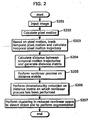
- the following describes in detail an example of detecting an object and performing segmentation on the object, using the flow chart shown in FIG. 2 .
- step S201 the image inputting unit 101 receives input images.
- step S202 the motion analyzing unit 102 calculates motions of blocks using at least two input images.
- motions of pixels are calculated.
- block-by-block processing pixel-by-pixel processing will be described.
- data (representative value) corresponding to a block is obtained by summing data corresponding to a pixel for the number of blocks or by calculating an average value for the number of blocks, and the processing may be performed using the obtained representative value in the same manner as the pixel-by-pixel processing.
- Non-Patent Reference 2 or Non-Patent Reference 3 can be used for calculating a motion vector by the optical flow computation.
- Non-Patent Reference 2 P. Anandan, "A Computational Framework and an Algorithm for the Measurement of Visual Motion", International Journal of Computer Vision, Vol. 2, pp. 283-310, 1989 .
- Non-Patent Reference 3 Vladimir Kolmogorov and Ramin Zabih, "Computing Visual Correspondence with Occlusions via Graph Cuts", International Conference on Computer Vision, 2001 .
- a motion vector u t i v t i of a pixel i is estimated using images inputted at time t and time t+1.
- the images inputted are not necessarily temporally successive, and, for example, motions of pixels may be calculated using images inputted at time t and time t+n.
- n is an integer equal to or more than 1.
- an affine displacement may be estimated as the motion of the pixels. At this time, motion information regarding all pixels may be obtained.
- an image is divided into a grid and motion information of only pixels on the grid at regular intervals may be obtained or, as mentioned above, an image is divided into blocks and motion information may be obtained on a block-by-block basis.
- a motion vector using Non-Patent Reference 2 since its degree of reliability can be calculated, only pixels having motion information with high degree of reliability may be used.
- occlusion can be estimated. Thus, only motion information of pixels not occluded may be used.
- Non-Patent Reference 4 can be used for the method for calculating the motion vector based on the assumption of the affine transformation.
- Non-Patent Reference 4 Jianbo Shi and Carlo Tomosi, "Good Features to Track", IEEE Conference on Computer Vision and Pattern Recognition, pp. 593-600, 1994 .
- the above method estimates an affine parameter A; equivalent to a motion adjacent to the pixel i of images respectively inputted at time t and time t+1.
- pixel locations x t i , and x t + 1 i , on the images of time t and time t+1 have the following relation.
- x t + 1 i A t i ⁇ x t i + B t i
- a t i is a parameter indicating scale and rotaion
- B t i is a parameter indicating translation.
- the above method can estimate a motion of the pixel i with respect to especially a rotating object more highly accurately than the case of using the method for calculating the motion vector based on the assumption of the translation movement.
- step S203 the motion analyzing unit 102 calculates the temporal motion trajectory of the pixel i from the motion of the pixel i with respect to temporally successive images, using the motion information calculated in step S202.
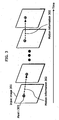
- the motion of the pixel i is tracked using motion information 302 calculated, in step S202, from a motion of a pixel i 303 of an input image 301 at time t.
- the distance calculating unit 103 calculates a distance matrix including a similarity of motions of pixels using the temporal motion trajectory of the pixel i calculated by Equation 2.
- a time fluctuation component of the distance between the pixels shown by Equation 5 is made an element for the linear distance f (i, j).
- the fluctuation component of the distance between the pixels shown by Equation 5 indicates the similarity of the motions of the pixels, and this enables not only a rigid body in which a relation of distances between pixels does not change but also deformation which is caused by an articulated object and the like to be captured.
- nonlinearization of the distance it is not limited to the above function, and anything which performs nonlinear conversion on the distance between the pixel i and the pixel j is acceptable.
- min (x, y) is a function which returns a smaller value between value x and value y.
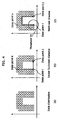
- Equation 7 to 10 will be described with reference to the conceptual diagram of FIG. 4(a) to (c) .
- Equation 8 is described here, it can be expected that performing other nonlinear processes brings about the same effect.
- a left diagram (a) of FIG. 4 shows a two dimensional data distribution.
- respective data points are equivalent to the temporal motion trajectory of the pixel i shown by Equation 3.
- a distance between a data point i and a data point j becomes smaller than a distance between the data point i and a data point k.
- the distance between the data point i and the data point j is not a Euclidean distance but is a distance, referred to as a geodesic distance, over which an arrow tracks the data points.
- the distance between the data point i and the data point j becomes greater than the distance between the data point i and the data point k.
- FIG. 5(a) shows an example where the processes shown by Equations 7 to 10 are not performed.
- a distance between a pixel i 402 of a head and a pixel j 403 of a hand is a distance shown by a linear distance 401.
- the distance between the pixel i 402 of the head and the pixel j 403 of the hand is a distance shown by summing arrows tracking via a pixel k 404 to the pixel j. Consequently, a shape of an articulated object such as a person cannot be expressed with the linear distance 401, whereas it, by contrast, allows shapes of joints to be expressed as distances. It should be noted that a method for calculating the geodesic distance is not limited to Equation 10.
- step S206 the nonlinear space processing unit 104 performs dimensionality reduction on the nonlinearized distance matrix calculated in step S205.
- the dimensionality reduction can be realized by obtaining Eigensystem after performing Young-Householder transformation. This is a method for efficiently projecting data distributed in a multidimensional space into a low-dimensional space, and can express robust data with respect to input data noise (here, equivalent to a case where an error is included in the motion information of the pixel i at a time of calculating the temporal motion trajectory of the pixel i using Equation 2).
- the Young-Householder transformation in which G in Equation 11 is multiplied by a centering matrix H on both sides is performed as follows.
- the distance matrix includes a distance between points, whereas this is, by contrast, for transforming to a distance matrix having a gravity center as origin.
- ⁇ G H ⁇ G 2 ⁇ H 2
- e p i is an i th element of a p th eigenvector ep.
- P is the number of eigenvectors to be used, that is, the number of dimensions of a reduced space.
- N is the number of all of the eigenvectors.
- P at time which the contribution ratio a p is equal to or more than a constant value may be the number of eigenvectors.
- the temporal motion trajectories of the pixels i as shown by Equation 2 can be associated with data in a space that is dimensionality-reduced to be nonlinear by the eigenvector ep.
- FIG. 6 shows, in the case where an image in which a person is walking is inputted, a result of projecting, into a space, the temporal motion trajectories of the pixels i which are dimensionality-reduced to be nonlinearly.
- the horizontal axis is an eigenvector e 1
- the vertical axis is an eigenvector e 2 .
- a point z 1 i z 2 i projected two-dimensionally is g new i projected.
- step S207 the nonlinear space processing unit 104 detects an object and performs segmentation on the object by clustering data projected into the reduced nonlinear space in step s206 as shown in FIG. 6 .
- Each segment region ⁇ m is expressed by parameters z m , Z m .
- z m is an average value of coordinates of data belonging to the segment ⁇ m in the reduced nonlinear space
- Z m is a dispersion matrix regarding the coordinates of the data belonging to the segment ⁇ m .
- An initial value of z m may be randomly determined or coordinates of an intersection obtained by dividing the reduced nonlinear space into a grid may be set as the initial value.
- Each data comes to belong to a segment region ⁇ m where ⁇ m ( z j ) is the minimum value.
- ⁇ m ( z i ) is a Mahalanobis distance
- ⁇ m z i z i - z m ⁇ t ⁇ Z m - 1 ⁇ z i - z m ⁇
- ⁇ m ( z i ) may be used instead of ⁇ m ( z i ).
- p ( ⁇ m ) may be a constant value, and in the case of performing segmentation on a routine object such as a person, it may be set based on shapes of body regions, area ratios, and the like.
- ⁇ m is a weighting factor for the segment region ⁇ m .
- repeating the distance calculation and parameter update using Equations 21 to 24 a fixed number of times allows the segment region ⁇ m t o which each data in the nonlinear space belongs to be obtained.
- other clustering methods such as k-mean and competitive learning may be used.
- ⁇ 1 corresponds to a person's head
- ⁇ 2 corresponds to an upper torso
- ⁇ 3 corresponds to an arm
- ⁇ 4 corresponds to a lower torso
- ⁇ 5 and ⁇ 7 correspond to a thigh
- ⁇ 6 and ⁇ 8 correspond to a crus.
- ⁇ 9 corresponds to part of a background.
- what corresponds to the segment regions in the reduced nonlinear space is not only regions on one image but also a result of tracking pixels over temporally successive images. That is to say, performing the segmentation in the reduced nonlinear space allows detection of an object (regions of an object) in an image and segmentation of the image including the object as a result of temporally tracking regions of a physical body moving in the image. Furthermore, since it is not necessary to set candidate regions of a person as preprocessing, there is no failure in segmentation caused by a mistake in detecting the candidate regions of the person. As mentioned above, without requiring fitting of a vast number of parameters, clustering in the nonlinear space allows the segmentation of the image including a moving person with its deformation so that the object in the image can be detected robustly.
- the present image processing apparatus includes the image inputting unit 101, the motion analyzing unit 102, the distance calculating unit 103, and the nonlinear space processing unit 104.
- the present image processing apparatus includes the image inputting unit 101, the motion analyzing unit 102, the distance calculating unit 103, and the nonlinear space processing unit 104.
- the first modification a method for detecting objects by changing parameters with the same method as in the first embodiment will be described. Specifically, a value of K when using Equation 7 or a value of TH when using Equation 8 is set to a larger value than when performing segmentation on regions is intended, using either Equation 7 or Equation 8.
- the segment region ⁇ 1 corresponds to a motion of the bicycle on the image
- the segment region ⁇ 2 corresponds to walk by the person on the image.
- performing the segmentation in the low-dimensional reduced space allows the motion of the bicycle and the motion of the person to be simply and robustly detected separately (that is, segmentation).
- temporal motion trajectories of motionless pixels are not used as inputs here, only two moving articulated bodies, the walking person and the bicycle, are projected into the nonlinear space.
- the temporal motion trajectories of the motionless pixels may be used as the inputs.
- what corresponds to the segment regions in the reduced nonlinear space as in the first embodiment is not only regions on one image but also a result of tracking pixels over temporally successive images. That is to say, performing segmentation in the reduced nonlinear space allows detection of each physical body as a result of temporally tracking regions of physical bodies moving in the image.
- it is not necessary to set candidate regions of a person as preprocessing there is no failure in segmentation caused by a mistake in detecting the candidate regions of the person.
- partially changing parameters allows the robust detection and segmentation of moving objects.
- an image processing apparatus according to a third modification of the first embodiment of the present invention will be described.
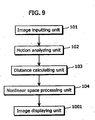
- an example where a function for displaying the result of detecting the object and performing segmentation on the regions in the first embodiment as an image is added will be described.
- an image displaying unit 1001 is added to such image processing apparatus according to the third modification which includes the image inputting unit 101, the motion analyzing unit 102, and the nonlinear space processing unit 104, and accordingly the image processing apparatus can display, as an image, segmented regions on a monitor and the like.
- the image displaying unit 1001 separates segment regions on an image which correspond to segment regions ⁇ m by color, allows segmented regions to be distinguished respectively, and displays them on the monitor and the like. As a matter of course, each region may be displayed differentially.
- the temporal motion trajectories of the pixels i shown by Equation 2 correspond to any segment region ⁇ m . Consequently, when pixels on an image are selected based on temporal motion trajectories of pixels i belonging to a segment region ⁇ m and color coding is performed based on a segment region number m, it is easy to display segment regions on the image.
- an image processing apparatus according to a fourth modification of the first embodiment of the present invention will be described.
- a function for recording and transmitting, for each segment region, the result of detecting the object and performing segmentation on the regions in the first embodiment is added will be described.
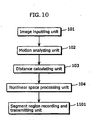
- FIG. 10 such image processing apparatus according to the fourth modification which includes the image inputting unit 101, the motion analyzing unit 102, and the nonlinear space processing unit 104 can be realized by adding a segment region recording and transmitting unit 1101.
- the segment region recording and transmitting unit 1101 separately records and transmits images according to a segment region number m.
- motion information can be reduced by averaging motion information belonging to each segment as follows. Although normally it is necessary to hold motion information for each pixel, when the following process is performed, it is only necessary to hold one piece of motion information for one segment.
- u t c m , v t c m are respectively a motion vector of a pixel which belongs to a segment region ⁇ m .
- an image processing apparatus includes the image inputting unit 101, the motion analyzing unit 102, a distance calculating unit 103a, and a nonlinear space processing unit 104a.
- the image inputting unit 101 and the motion analyzing unit 102 are same as in the first embodiment, their descriptions are not given here.
- the distance calculating unit 103a and the nonlinear space processing unit 104a each basically have the same function as the distance calculating unit 103 and the nonlinear space processing unit 104 of the first embodiment, a point that additional parameters are used by the former units for performing a process more highly accurately differs from the first embodiment. The following mainly describes the point different from the first embodiment.
- the distance calculating unit 103a calculates a distance matrix for each distance function using a distance function for a distance between pixels on an image and its fluctuation and a distance function for an angle between pixels and its fluctuation.
- the nonlinear space processing unit 104a After projecting the two distance matrices calculated by the distance calculating unit 103a into respective different nonlinear spaces, the nonlinear space processing unit 104a performs clustering by integrating the two different nonlinear spaces.
- steps S201 to 5203 are same as in the first embodiment, their descriptions are not given here.
- step S204 the distance calculating unit 103a calculates a distance matrix including a similarity of motions of pixels using the temporal motion trajectory of the pixel i calculated by Equation 2.
- f 2 i j a_mean ij + w a ⁇ a _var ij where w a is a weighting factor and a parameter set by a designer.
- a ij arctan y t i - y t j x t i - x t j
- the similarity of the motions of the pixels using the angle between the pixel i and the pixel j and its fluctuation component can be expressed. This allows not only a rigid body but also deformation, especially including a rotational motion, of an articulated object and the like to be captured.
- Equation 37 can express the similarity of the motions of the pixels using an angle difference between motion vectors of the pixel i and the pixel j and its fluctuation component. This allows motion change including rotation to be captured.
- step S205a the nonlinear space processing unit 104a calculates g new ( i, j ) corresponding to the distance f ( i, j ) of Equation 3 using the processes shown by Equations 7 to 10.
- g 2_ new ( i , j ) corresponding to the distance f 2 ( i , j ) based on the angle between the pixel i and the pixel j is calculated. That is to say, two nonlinearized distances are separately calculated. Although the distance between the pixels and the angle between the pixels are described here, three or more distances may be calculated using a distance which expresses a similarity of motions of other pixels.
- step S206a the nonlinear space processing unit 104a generates G 2 from the distance g 2_ new ( i , j ) separately nonlinearized in the same manner as in Equation 11. Further, the processes shown by Equations 12 to 16 are similarly performed on G 2 , G 2 is projected into the dimensionality-reduced space, like Equation 16, and z 2 _p ⁇ 2 ⁇ is calculated.
- step S207a the nonlinear space processing unit 104a concatenates z p i calculated by Equation 16 and z 2 _p ⁇ 2 ⁇ performs clustering so as to detect an object and perform segmentation on the object simultaneously.
- Equations 21 to 24 in step S207a are same as before, their descriptions are not given.
- the image processing apparatus calculates the distance matrix for each distance function using the distance function for the distance between the pixels on the image and its fluctuation and the distance function for the angle between the pixels and its fluctuation, integrates the two different nonlinear spaces and performs clustering after projecting each distance matrix into the respective nonlinear spaces, so as to detect and perform segmentation more highly accurately as a result of temporally tracking the regions of the physical body moving in the image.
- using the angle between the pixels on the image and its fluctuation as a distance function allows a rotational motion especially caused by joint motion to be captured more properly.
- it is not necessary to set candidate regions of a person as preprocessing there is no failure in segmentation caused by a mistake in detecting the candidate regions of the person.
- an image processing apparatus to which a function for predicting a motion of an object based on a result of detecting and performing segmentation on the object using the image processing method described in the first embodiment is added will be described.
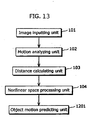
- an object motion predicting unit 1201 is added to the image processing apparatus which includes the image inputting unit 101, the motion analyzing unit 102, the distance calculating unit 103, and the nonlinear space processing unit 104, and accordingly the image processing apparatus comes to have the function for predicting the motion of the object.
- the object motion predicting unit 1201 calculates a representative trajectory from temporal motion trajectories of pixels included in each segment based on the result of the segmentation, and predicts the motion of the object according to the representative trajectory.
- FIG. 14 shows the flow chart of processing according to a third embodiment. As steps 5201 to S206 are same as in the first embodiment, their descriptions are not given here.
- step S1301 the object motion predicting unit 1201 obtains a representative point and a representative trajectory of a cluster using the result of the segmentation performed in step S207 as follows.
- temporal motion trajectories of pixels corresponding to the data z c m in the nonlinear space which belongs to the segment region ⁇ m shown in FIG. 7(a) and (b) and FIG. 8 are expressed as x c m .
- an average temporal motion trajectory is calculated as a representative temporal motion trajectory here, weighting for each of the temporal motion trajectories x c m of the pixels, and the like, may be performed or a temporal motion trajectory of a pixel corresponding to a gravity center of a cluster on an image may be used as the representative temporal motion trajectory.
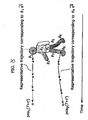
- FIG. 15 shows an example where a representative temporal motion trajectory is obtained for each cluster ⁇ m based on Equation 41. It should be noted that, in consideration of viewability, only representative temporal motion trajectories regarding a cluster region ⁇ 1 , corresponding to a head and a cluster region ⁇ 8 corresponding to a crus are shown. Crosses in the figure are elements of x m respectively corresponding to time t and each indicates a pixel location. Further, as shown by Equations 3 and 33, since segmentation by clustering in the nonlinear space is performed in consideration of a similarity of motions of pixels, calculation is possible only using temporal motion trajectories of pixels having similar motions.
- representative temporal motion trajectories can be obtained more highly accurately.
- obtaining the representative motion trajectory for each cluster region allows a motion for each region to be expressed accurately and easily.
- step S1302 the object motion predicting unit 1201 predicts a location of the object at time later than time T based on the representative temporal motion trajectories calculated in step S1301.
- locations of regions of the object at time T+t' pos m ( T + t ') can be predicated for each region of the object using the acceleration vector of Equation 42 as follows.
- the regions of the object are used as the example here, it is possible to predict a location for each object such as the bicycle and the pedestrian described in FIG. 8 .
- the affine parameter can express a motion including a rotational motion and is suitable for expressing rotational motions of an arm and a leg.
- N th order function instead of the above-mentioned motion vector and acceleration, directly fitting N th order function to the representative temporal motion trajectory x m is possible.
- N th order function to location information included in x m o n T images is possible.
- a location on the image at time (T + t') pos m ( T + t' ) can be estimated so that it fits a value of the function on which fitting is performed.
- fitting with the function allows a smoother motion to be expressed, more highly accurate prediction becomes possible.
- the prediction for locations on these images can be used for time interpolation.
- the temporal motion trajectories of the pixels having similar motions can be calculated as the same cluster, the representative temporal motion trajectory can be obtained highly accurately.
- the motion of each region of especially the articulated object and the like can be expressed, and it is possible to predict the locations of the regions of the object highly accurately without setting the candidate regions of the person as preprocessing.
- the present invention can be used for an image processing apparatus which performs segmentation on an image including an object such as a moving person with its deformation, based on motions of blocks having one or more pixels in images, so as to detect the object, for example an image processing apparatus to be included in a motion analysis device, a monitoring device, and AV equipment such as a video camera and TV.
- an image processing apparatus which performs segmentation on an image including an object such as a moving person with its deformation, based on motions of blocks having one or more pixels in images, so as to detect the object
- an image processing apparatus to be included in a motion analysis device, a monitoring device, and AV equipment such as a video camera and TV.
Landscapes
- Engineering & Computer Science (AREA)
- Multimedia (AREA)
- Computer Vision & Pattern Recognition (AREA)
- Physics & Mathematics (AREA)
- General Physics & Mathematics (AREA)
- Theoretical Computer Science (AREA)
- Image Analysis (AREA)
- Image Processing (AREA)
Abstract
Description
- The present invention relates to image processing apparatuses and, in particular, to an apparatus which performs segmentation on an image including an object such as a moving person with its deformation, based on motions of blocks, each of which is made up of one or more pixels, in images, so as to detect the object.
- There is a method available by combining a method for extracting candidate regions of a physical object from an image, as a technique for detecting an object such as a moving person with its deformation and performing segmentation on an image including the object, and a method for applying a physical object model prepared in advance to the extracted candidate regions of the physical object. For example,
Patent Reference 1 has disclosed the method for extracting a silhouette image of a physical object such as a person from images as a candidate region of the physical object and applying, to the extracted silhouette image, a model for the physical object whose region is parameterized in advance based on knowledge about the physical object. In this way, since a parameterized model can be applied to an object such as a moving person with its deformation, it becomes possible to detect the object and perform segmentation on a region of the object. - Furthermore, Non-Patent
Reference 1 has disclosed the method for calculating distances between pixel value data in each image and pixel value data in other images, with images in which a fixed object is captured from angles as inputs, and performing nonlinear dimensionality reduction, with the distances as inputs, to allow images captured from similar angles to be projected such that they are at a short distance in a two-dimensional space. Here, in comparison with the linear dimensionality reduction method such as conventional Principal Component Analysis (PCA), it is shown that reduction to much lower dimension is possible and, further, that handling data nonlinearly-distributed is also possible. - Patent Reference 1: Japanese Unexamined Patent Application Laid-Open Publication No.
8-214289 - Non-Patent Reference 1: Joshua Tenenbaum, Vin de Silva, John Langford, "A Global Geometric Framework for Nonlinear Dimensionality Reduction", Science, VOL290, pp.2319-2322, 22 December, 2000.
- However, with the technique of the above-mentioned
Patent Reference 1, there is a problem that, in a scene where objects such as people come and go, especially in a street or the like, it is impossible to robustly detect an object and perform segmentation on the object. As stated above, the image processing method represented by the above-mentionedPatent Reference 1 requires that a candidate region of each physical object is extracted from the image. When the candidate regions of the physical objects cannot be extracted properly, it becomes impossible to accurately apply a model in which a physical object is parameterized to a candidate region of the physical object. In particular, it is difficult to properly extract the candidate regions of the physical objects in a crowded scene. Further, even when the candidate regions of the physical objects can be extracted properly, there is the following problem. In the case where especially an articulated object such as a person is a physical object, since variation of appearance on an image caused by various postures of the physical object is enormously large, parameterizing a physical object model requires the vast number of parameters. This induces not only an increase in calculation amount but also a mistake in applying a model. Thus, it is difficult to robustly detect an object and perform the segmentation on the object. - On the other hand, the image processing method represented by Non-Patent
Reference 1 performs a nonlinear process with distances between pixels as inputs, so as to project image data into an efficiently reduced low-dimensional space. In this way, noise resistance can be expected. However, the main purpose of Non-PatentReference 1 is to project images into a low-dimensional space so as to visualize a similarity between images, and a method for robustly detecting an object and performing segmentation on the object while corresponding to various posture changes of an articulated object such as a person with its deformation has not been disclosed. -
US2002176625A discloses a method for segmenting multi-resolution video objects in accordance with the preamble ofclaims 1 and 8. - Thus, the present invention has an object of providing an image processing method and an image processing apparatus which can robustly perform segmentation on an image including an object such as a moving person with its deformation.
- In a first aspect, the invention consists in an image processing method in accordance with
claim 1. - In a second aspect, the invention consists in an image processing apparatus in accordance with claim 8.
- In a third aspect, the invention consists in a program for an image processing method in accordance with claim 9.
- The above-mentioned method and apparatus can detect an object such as a moving person with its deformation and perform the segmentation on regions. Further, it is also possible to predict a motion of the object, and the like, using a result of the detection and segmentation.
-
-
FIG. 1 is a diagram showing a basic structure of an image processing apparatus according to a first embodiment of the present invention. -
FIG. 2 is a flow chart showing a basic operation of the image processing apparatus according to the first embodiment of the present invention. -
FIG. 3 is a diagram showing a process example of a motion analyzing unit according to the first embodiment of the present invention.FIG. 4 is a conceptual diagram showing an effect of a nonlinear space processing unit according to the first embodiment of the present invention. -
FIG. 5 is a diagram showing an example of the effect of the nonlinear space processing unit according to the first embodiment of the present invention. -
FIG. 6 is a diagram showing an example of dimensionality reduction performed by the nonlinear space processing unit according to the first embodiment of the present invention. -
FIG. 7 is a diagram showing an example of detection and segmentation performed by the nonlinear space processing unit according to the first embodiment of the present invention. -
FIG. 8 is a diagram showing an example of detection and segmentation performed by a nonlinear space processing unit according to a first modification of the first embodiment of the present invention. -
FIG. 9 is a flow chart showing a basic operation of an image processing apparatus according to a second modification of the first embodiment of the present invention. -
FIG. 10 is a diagram showing an example of detection and segmentation performed by a nonlinear space processing unit according to the second modification of the first embodiment of the present invention. -
FIG. 11 is a diagram showing a structural example of an image processing apparatus according to a third modification of the first embodiment of the present invention. -
FIG. 12 is a diagram showing a structural example of an image processing apparatus according to a fourth modification of the first embodiment of the present invention. -
FIG. 13 is a diagram showing a structural example of an image processing apparatus according to a second embodiment of the present invention. -
FIG. 14 is a flow chart showing a basic operation of the image processing apparatus according to the second embodiment of the present invention. -
FIG. 15 is a diagram showing a structure of an image processing apparatus according to a third embodiment of the present invention. - FIG. 16 is a flow chart showing a basic operation of the image processing apparatus according to the third embodiment of the present invention.
- FIG. 17 is a diagram showing an example of motion prediction according to the third embodiment of the present invention.
-
- 101
- Image inputting unit
- 102
- Motion analyzing unit
- 103, 103a
- Distance calculating unit
- 104, 104a
- Nonlinear space processing unit
- 1001
- Image displaying unit
- 1101
- Segment region recording and transmitting unit
- 1201
- Object motion predicting unit
- One embodiment of the present invention is that of an image processing method for performing segmentation on an image based on motions of blocks, each of which is made up of one pixel or adjacent pixels, said method comprising:
- an image receiving step of receiving temporally successive images;
- a motion analyzing step of calculating the motions of the blocks using at least two temporally different images and calculating, based on the motions of the blocks, temporal motion trajectories of the blocks in the temporally successive images;
- a distance calculating step of calculating distances, each of which indicates a similarity of the motions of the blocks, based on (a) a difference of positions, (b) an angle, or (c) an angle difference and a fluctuation component of the angle difference, between a temporal motion trajectory of a block i and a temporal motion trajectory of a block other than the block i calculated in said motion analyzing step; characterised in that the image includes an articulated object whose shape changes; and
- a nonlinear space processing step of projecting the distances calculated in said distance calculating step into a nonlinear space by calculating nonlinearized distances using one of the following alternatives:
- (i) infinitizing distances among distances to the block i which are greater than the k-th smallest distances;
- (ii) infinitizing distances among the distances to the block i which are greater than a threshold; and
- (iii) transforming the distances using an exponential function;
- Based on the motions of the blocks, the segmentation is performed on an object such as a moving person with its deformation, which allows the object in an image to be surely detected. Using distances functions and nonlinear spaces allows more highly accurate segmentation of an image. It is also possible to robustly detect an object, especially a moving person with its deformation and to perform the segmentation on the object at the same time. In the nonlinear space processing step, by converting Euclidean distances into geodesic distances it is possible to robustly detect an object, especially a moving person with its deformation and to perform the segmentation on the object at the same time. Allowing an estimated error of motions of pixels enables robust detection of an object such as a moving person with its deformation and at the same time segmentation of the object. Furthermore, in the nonlinear space processing step, since distances that are selected and those that are not selected are to be in a nonlinear relation, it becomes possible to reduce motions of an articulated object such as a person highly efficiently and accurately.
- More preferred embodiment of the present invention is that, in the motion analyzing step, one of a two-dimensional motion vector and an affine displacement is calculated as the motions of the blocks. Analyzing motions of blocks with a motion vector or an affine displacement allows temporal motion trajectories of the blocks to be calculated.
- One embodiment of the present invention is that the image processing method includes an image displaying step of displaying, on the image received in the image receiving step, a result of the clustering performed in the nonlinear space. Displaying regions on which clustering is performed on an image can be applied to style reforms in sports, correction of walking in rehabilitation, and the like.
- One embodiment of the present invention is that, in the nonlinear space processing step, at least two different moving physical bodies included in the image received in the image receiving step are detected based on a result of the segmentation performed in the nonlinear space. Detection in a nonlinear space allows moving physical bodies to be detected robustly.
- One embodiment of the present invention is that the image processing method further includes an object motion predicting step of calculating a representative trajectory from temporal motion trajectories of blocks included in each cluster obtained by the clustering, based on a result of the clustering performed in the nonlinear space, and predicting motion of an object according to the representative trajectory. Motion prediction with high noise resistance becomes possible by predicting motions of an object using a representative trajectory among temporal motion trajectories of blocks.
- One embodiment of the present invention is that the image processing method further includes a recording and transmitting step of identifying a cluster on the image received in the image receiving step, based on a result of the clustering performed in the nonlinear space, and recording or transmitting the result corresponding to the identified cluster. Separately holding respective clusters of a detected object included in an image allows necessary clusters to be selected from the clusters, recorded, and outputted to the outside. As a result, efficient recording and outputting of the clusters as graphic elements become possible. Therefore, it operates effectively in the case where the clusters are recorded in and transmitted to devices having a limited processing capability such as a mobile telephone.
- The following describes embodiments of the present invention with reference to the drawings.
-
FIG. 1 is a diagram showing a structure of an image processing apparatus according to a first embodiment of the present invention. The image processing apparatus shown inFIG. 1 is an image processing apparatus which robustly performs segmentation on an image including an object such as a moving person with its deformation, based on motions of blocks, each of which is made up of one or more pixels, in images, so as to surely detect the object in the image, and includes: animage inputting unit 101; amotion analyzing unit 102; adistance calculating unit 103; and a nonlinearspace processing unit 104. - The
image inputting unit 101 is a processing unit which receives temporally successive images and, for example, is a video camera or a communication interface connected to a video camera. - The
motion analyzing unit 102 is a processing unit which calculates motions of blocks using at least two temporally different images selected from among the images received by theimage inputting unit 101 and tracks movements of the blocks based on the calculated motions of the blocks in the temporally successive images, so as to calculate temporal motion trajectories of pixels. - The
distance calculating unit 103 is a processing unit which calculates distances including a similarity of the motions of the blocks using a temporal motion trajectory of a block i and temporal motion trajectories of blocks other than the block i calculated by themotion analyzing unit 102, so as to capture deformation of a moving object. For example, in the case where temporal motion trajectories of N blocks are used, distances to be calculated are an N x N distance matrix. Here, it is possible to express, as a distance matrix, an object whose motion changes distances between blocks, especially a motion of an object such as a moving person with its deformation like an articulated object, by calculating distances each of which evaluates the similarity of the motions of the blocks. As stated above, "distance" in the present Description is not only a distance between two points in a two-dimensional space but includes a mathematical distance between multidimensional data, and is a value or a set of values (distance matrix). - The nonlinear
space processing unit 104 is a processing unit which first performs a nonlinear process on the distance matrix calculated by thedistance calculating unit 103, then projects the distance matrix calculated by thedistance calculating unit 103 into a reduced space (that is, a nonlinear space), and performs detection and segmentation in the reduced nonlinear space. In particular, since the nonlinearspace processing unit 104 can reduce shape information of a moving physical body with its deformation like an articulated object to a low-dimensional space more properly by an effect of the nonlinear process and dimensionality reduction, the nonlinearspace processing unit 104 can detect an object in an image and perform the segmentation on the image robustly with low calculation amount. - It should be noted that each component included in the image processing apparatus (the
image inputting unit 101, themotion analyzing unit 102, thedistance calculating unit 103, and the nonlinear space processing unit 104) may be realized by software such as a program executed in a computer having a CPU, a RAM, a ROM, a communication interface, an I/O port, a hard disk, a display, and the like or by hardware such as electric circuitry. Hereinafter, the same applies to an image processing apparatus according to other embodiments. - Regarding the image processing method of the present invention, the following describes in detail an example of detecting an object and performing segmentation on the object, using the flow chart shown in
FIG. 2 . - First, in step S201, the
image inputting unit 101 receives input images. - Next, in step S202, the
motion analyzing unit 102 calculates motions of blocks using at least two input images. It should be noted that, here, as an example of calculating the motions of the blocks, motions of pixels are calculated. Hereinafter, in the present embodiment, as an example of block-by-block processing, pixel-by-pixel processing will be described. In the case of performing the block-by-block processing where a block is made up of pixels, data (representative value) corresponding to a block is obtained by summing data corresponding to a pixel for the number of blocks or by calculating an average value for the number of blocks, and the processing may be performed using the obtained representative value in the same manner as the pixel-by-pixel processing. - First, an example of calculating the motions of the pixels by optical flow computation will be described.
Non-Patent Reference 2 or Non-Patent Reference 3 can be used for calculating a motion vector by the optical flow computation.
Non-Patent Reference 2: P. Anandan, "A Computational Framework and an Algorithm for the Measurement of Visual Motion", International Journal of Computer Vision, Vol. 2, pp. 283-310, 1989.
Non-Patent Reference 3: Vladimir Kolmogorov and Ramin Zabih, "Computing Visual Correspondence with Occlusions via Graph Cuts", International Conference on Computer Vision, 2001. - For example, when it is assumed that T images are inputted in step S201, a motion vector

time t+ 1. Here, the images inputted are not necessarily temporally successive, and, for example, motions of pixels may be calculated using images inputted at time t and time t+n. Note that n is an integer equal to or more than 1. Further, instead of the motion vector, an affine displacement may be estimated as the motion of the pixels. At this time, motion information regarding all pixels may be obtained. - Furthermore, in the case where it is desired to perform a process at higher speed, an image is divided into a grid and motion information of only pixels on the grid at regular intervals may be obtained or, as mentioned above, an image is divided into blocks and motion information may be obtained on a block-by-block basis. Further, in the case of calculating a motion vector using
Non-Patent Reference 2, since its degree of reliability can be calculated, only pixels having motion information with high degree of reliability may be used. Moreover, in the case of calculating a motion vector using Non-Patent Reference 3, occlusion can be estimated. Thus, only motion information of pixels not occluded may be used. - Further, instead of a method for calculating a motion vector based on an assumption of a translation movement of a block, a method for calculating a motion vector based on an assumption of an affine transformation of a block may be used as a method for calculating the motions of the pixels. Non-Patent Reference 4 can be used for the method for calculating the motion vector based on the assumption of the affine transformation.
- Non-Patent Reference 4: Jianbo Shi and Carlo Tomosi, "Good Features to Track", IEEE Conference on Computer Vision and Pattern Recognition, pp. 593-600, 1994.
- The above method estimates an affine parameter A; equivalent to a motion adjacent to the pixel i of images respectively inputted at time t and
time t+ 1. Regarding the pixel i, pixel locations


where

- Next, in step S203, the
motion analyzing unit 102 calculates the temporal motion trajectory of the pixel i from the motion of the pixel i with respect to temporally successive images, using the motion information calculated in step S202. As shown inFIG. 3 , the motion of the pixel i is tracked usingmotion information 302 calculated, in step S202, from a motion of a pixel i 303 of aninput image 301 at time t. The temporal motion trajectory of the pixel i is calculated, using a pixel location

- Next, in step 5204, the
distance calculating unit 103 calculates a distance matrix including a similarity of motions of pixels using the temporal motion trajectory of the pixel i calculated byEquation 2. A linear distance between the pixel i and a pixel j f (i, j) can be calculated by
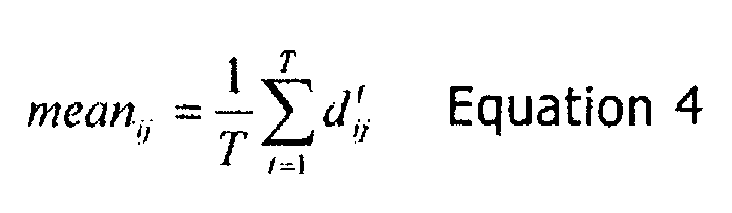
where w is a weighting factor and a parameter set by a designer. - Furthermore, the following expresses mean ij and var ij

where
- As mentioned above, as shown by Equation 3, in addition to a time average value of the distance between the pixels shown by Equation 4, a time fluctuation component of the distance between the pixels shown by Equation 5 is made an element for the linear distance f (i, j). Especially, the fluctuation component of the distance between the pixels shown by Equation 5 indicates the similarity of the motions of the pixels, and this enables not only a rigid body in which a relation of distances between pixels does not change but also deformation which is caused by an articulated object and the like to be captured.
- Next, in step S205, the nonlinear
space processing unit 104 performs a nonlinear process on the linear distance f (i,j) calculated by Equation 3 as follows
where, when attention is focused on the pixel i, K pixels j are selected in ascending order from linear distances to the pixel i, distances to the selected pixels j are not changed, and distances to the non-selected pixels j are changed to infinity. Here, although the linear distances are selected in ascending order, a threshold TH may be set by
Further, the linear distances may be nonlinearized, using an exponential function, by
where a designer gives σ. - Regarding the nonlinearization of the distance, it is not limited to the above function, and anything which performs nonlinear conversion on the distance between the pixel i and the pixel j is acceptable.
- Next, a geodesic distance is calculated as follows

where k is an index of a pixel k excluding a pixel i and a pixel j. Note that min (x, y) is a function which returns a smaller value between value x and value y. - Here, the nonlinear process shown by Equations 7 to 10 will be described with reference to the conceptual diagram of
FIG. 4(a) to (c) . Although Equation 8 is described here, it can be expected that performing other nonlinear processes brings about the same effect. First, a left diagram (a) ofFIG. 4 shows a two dimensional data distribution. Here, respective data points are equivalent to the temporal motion trajectory of the pixel i shown by Equation 3. In the case where the nonlinear process shown by Equations 7 to 10 is not performed, as shown in a central diagram (b) ofFIG. 4 , a distance between a data point i and a data point j becomes smaller than a distance between the data point i and a data point k. However, as shown in a right diagram (c) ofFIG. 4 , for example, when the processes shown by Equations 8 and 10 are performed, the distance between the data point i and the data point j is not a Euclidean distance but is a distance, referred to as a geodesic distance, over which an arrow tracks the data points. As a result, it differs from the case of using the Euclidean distance, and the distance between the data point i and the data point j becomes greater than the distance between the data point i and the data point k. - Next, validity of performing the nonlinear process shown by Equations 7 to 10 will be described with reference to the conceptual diagram of
FIG. 5(a) and (b) . Here, to describe a difference between the linear distance f(i, j) and the nonlinearized distance gnew (i, j) clearly, as shown by Equation 6, the distance between the pixels at time t is used as an example. Actually, in addition to the distance between the pixels, as shown by Equation 3, when the fluctuation component of the distance between the pixels is used as the similarity of the motions of the pixels, not only can a shape of an articulated object and the like but also its deformation be captured.FIG. 5(a) shows an example where the processes shown by Equations 7 to 10 are not performed. For example, a distance between a pixel i 402 of a head and apixel j 403 of a hand is a distance shown by alinear distance 401. - On the other hand, when the nonlinear process shown by Equations 7 to 10 is performed, as shown in
FIG. 5(b) , the distance between the pixel i 402 of the head and thepixel j 403 of the hand is a distance shown by summing arrows tracking via apixel k 404 to the pixel j. Consequently, a shape of an articulated object such as a person cannot be expressed with thelinear distance 401, whereas it, by contrast, allows shapes of joints to be expressed as distances. It should be noted that a method for calculating the geodesic distance is not limited to Equation 10. - Next, in step S206, the nonlinear
space processing unit 104 performs dimensionality reduction on the nonlinearized distance matrix calculated in step S205. The dimensionality reduction can be realized by obtaining Eigensystem after performing Young-Householder transformation. This is a method for efficiently projecting data distributed in a multidimensional space into a low-dimensional space, and can express robust data with respect to input data noise (here, equivalent to a case where an error is included in the motion information of the pixel i at a time of calculating the temporal motion trajectory of the pixel i using Equation 2). - In other words, the nonlinearized distance matrix is expressed as

, and the Young-Householder transformation in which G in Equation 11 is multiplied by a centering matrix H on both sides is performed as follows. The distance matrix includes a distance between points, whereas this is, by contrast, for transforming to a distance matrix having a gravity center as origin.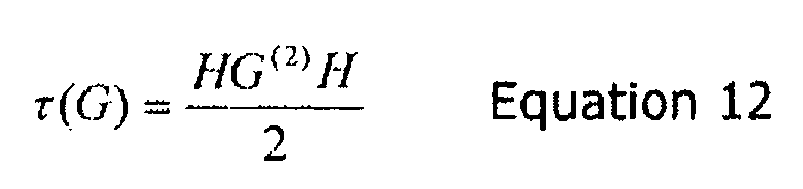
- Note that H is the centering matrix, and is expressed by

i is a unit matrix, and N is the number of temporal motion trajectories of pixels i shown byEquation 2. - Moreover,

- Next, to perform the dimensionality reduction, P eigenvectors ep corresponding to τ (G) and an eigenvalue λ P corresponding to τ (G) are calculated.
- In this way, based on Equation 10, when

is assumed, a result of projecting


- Note that


- P is the number of eigenvectors to be used, that is, the number of dimensions of a reduced space. N is the number of all of the eigenvectors. Thus, P at time which the contribution ratio ap is equal to or more than a constant value may be the number of eigenvectors.
- As stated above, with the processes shown by
Equations 2 to 16, the temporal motion trajectories of the pixels i as shown byEquation 2 can be associated with data in a space that is dimensionality-reduced to be nonlinear by the eigenvector ep. -
FIG. 6 shows, in the case where an image in which a person is walking is inputted, a result of projecting, into a space, the temporal motion trajectories of the pixels i which are dimensionality-reduced to be nonlinearly. The horizontal axis is an eigenvector e1, and the vertical axis is an eigenvector e2. A point


- Next, in step S207, the nonlinear
space processing unit 104 detects an object and performs segmentation on the object by clustering data projected into the reduced nonlinear space in step s206 as shown inFIG. 6 . - First, a segment region is expressed by

where M is the number of segment regions and empirically determined according to a scene to be used. - Each segment region θm is expressed by parameters
zm , Zm . Here,z m is an average value of coordinates of data belonging to the segment θ m in the reduced nonlinear space, and Zm is a dispersion matrix regarding the coordinates of the data belonging to the segment θ m . - An initial value of
z m may be randomly determined or coordinates of an intersection obtained by dividing the reduced nonlinear space into a grid may be set as the initial value. - Note that
zm , Zm can be expressed by

where Cm is the number of data belonging to the segment region θm in the reduced nonlinear space. - The following describes a specific calculation method. First, the segment region θm to which data zi in the reduced nonlinear space belongs is obtained using the following distance function

where ψ m (zi ) shows a distance between the data zi in the nonlinear space corresponding to the temporal motion trajectory of the pixel i and each segment θm. Each data comes to belong to a segment region θm where ψ m (zj ) is the minimum value. Note that ϕ m (zi ) is a Mahalanobis distance, and
Moreover, ϕ m (zi ) may be used instead of ψ m (zi ). - Further, p(ω m ) may be a constant value, and in the case of performing segmentation on a routine object such as a person, it may be set based on shapes of body regions, area ratios, and the like.
- ω m is a weighting factor for the segment region θm.
- Next, based on a result of calculation by Equation 21, the parameters
zm ,Zm of the segment region θm are updated using the data zi belonging to the segment region θ m as follows

where z cm is data which belongs to the segment region θ m in the reduced nonlinear space. Moreover, ω=1 may be accepted or ω may be adjusted depending on deviation from an average value of input data. As stated above, repeating the distance calculation and parameter update using Equations 21 to 24 a fixed number of times allows the segment region θ m t o which each data in the nonlinear space belongs to be obtained. It should be noted that, in addition to the above, other clustering methods such as k-mean and competitive learning may be used.FIG. 7(a) and (b) shows an example of performing segmentation on data in a nonlinear space, assuming M=9, in the case of using, as an input, an image in which a person is walking. When respective correspondences of segment regions θ1 to θ9 in the reduced nonlinear space are viewed on the image, θ1 corresponds to a person's head, θ2 corresponds to an upper torso, θ3 corresponds to an arm, θ4 corresponds to a lower torso, θ5 and θ7 correspond to a thigh, and θ6 and θ8 correspond to a crus. Note that θ9 corresponds to part of a background. - Here, as shown by arrows in
FIG. 7(b) , what corresponds to the segment regions in the reduced nonlinear space is not only regions on one image but also a result of tracking pixels over temporally successive images. That is to say, performing the segmentation in the reduced nonlinear space allows detection of an object (regions of an object) in an image and segmentation of the image including the object as a result of temporally tracking regions of a physical body moving in the image. Furthermore, since it is not necessary to set candidate regions of a person as preprocessing, there is no failure in segmentation caused by a mistake in detecting the candidate regions of the person. As mentioned above, without requiring fitting of a vast number of parameters, clustering in the nonlinear space allows the segmentation of the image including a moving person with its deformation so that the object in the image can be detected robustly. - Next, an example where the segmentation in the nonlinear space is performed according to the first embodiment so as to detect objects will be described as a first modification of the first embodiment. In the first embodiment, the method for performing the segmentation on the regions of the person in the image in which the person is walking has been described. As shown in
FIG. 1 , the present image processing apparatus includes theimage inputting unit 101, themotion analyzing unit 102, thedistance calculating unit 103, and the nonlinearspace processing unit 104. As its structure is same as in the first embodiment, a description of the structure is not given here. In the first modification, a method for detecting objects by changing parameters with the same method as in the first embodiment will be described. Specifically, a value of K when using Equation 7 or a value of TH when using Equation 8 is set to a larger value than when performing segmentation on regions is intended, using either Equation 7 or Equation 8. -
FIG. 8 shows an example of a result of segmentation in a reduced nonlinear space, assuming M=2, in the case of using, as an input, an image in which a person is walking and a bicycle is running. Correspondences of segment regions θ1 and θ2 in the reduced nonlinear space will be described. The segment region θ1 corresponds to a motion of the bicycle on the image, and the segment region θ2 corresponds to walk by the person on the image. As stated above, performing the segmentation in the low-dimensional reduced space allows the motion of the bicycle and the motion of the person to be simply and robustly detected separately (that is, segmentation). - It should be noted that, as shown by
Equation 2, since temporal motion trajectories of motionless pixels are not used as inputs here, only two moving articulated bodies, the walking person and the bicycle, are projected into the nonlinear space. As a matter of course, the temporal motion trajectories of the motionless pixels may be used as the inputs. Here, what corresponds to the segment regions in the reduced nonlinear space as in the first embodiment is not only regions on one image but also a result of tracking pixels over temporally successive images. That is to say, performing segmentation in the reduced nonlinear space allows detection of each physical body as a result of temporally tracking regions of physical bodies moving in the image. Furthermore, since it is not necessary to set candidate regions of a person as preprocessing, there is no failure in segmentation caused by a mistake in detecting the candidate regions of the person. As described above, partially changing parameters allows the robust detection and segmentation of moving objects. - Next, an image processing apparatus according to a third modification of the first embodiment of the present invention will be described. Here, an example where a function for displaying the result of detecting the object and performing segmentation on the regions in the first embodiment as an image is added will be described. As shown in
FIG. 9 , animage displaying unit 1001 is added to such image processing apparatus according to the third modification which includes theimage inputting unit 101, themotion analyzing unit 102, and the nonlinearspace processing unit 104, and accordingly the image processing apparatus can display, as an image, segmented regions on a monitor and the like. - As shown in
FIG. 7 (b) , theimage displaying unit 1001 separates segment regions on an image which correspond to segment regions θ m by color, allows segmented regions to be distinguished respectively, and displays them on the monitor and the like. As a matter of course, each region may be displayed differentially. Here, the temporal motion trajectories of the pixels i shown byEquation 2 correspond to any segment region θ m . Consequently, when pixels on an image are selected based on temporal motion trajectories of pixels i belonging to a segment region θ m and color coding is performed based on a segment region number m, it is easy to display segment regions on the image. - Next, an image processing apparatus according to a fourth modification of the first embodiment of the present invention will be described. Here, an example where a function for recording and transmitting, for each segment region, the result of detecting the object and performing segmentation on the regions in the first embodiment is added will be described. As shown in
FIG. 10 , such image processing apparatus according to the fourth modification which includes theimage inputting unit 101, themotion analyzing unit 102, and the nonlinearspace processing unit 104 can be realized by adding a segment region recording and transmittingunit 1101. - Similar to the case of image displaying, as a result of the segmentation, the segment region recording and transmitting
unit 1101 separately records and transmits images according to a segment region number m. Moreover, motion information can be reduced by averaging motion information belonging to each segment as follows. Although normally it is necessary to hold motion information for each pixel, when the following process is performed, it is only necessary to hold one piece of motion information for one segment. For example, when a motion vector of a pixel i


where Cm is the number of pixels which belong to a segment region θ m or the number of temporal motion trajectories of pixels.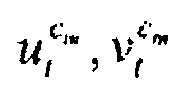
- It should be noted that in the case where motion information is reduced using affine motion, instead of Equations 31 and 32, an average value of a pixel location to which a pixel is moved based on the affine motion may be calculated. As described above, it is possible to record and transmit the segment region while reducing the motion information of the pixel.
- Next, a method for realizing detection and segmentation more highly accurately using two or more distance functions will be described as a second embodiment. As shown in
FIG. 11 , an image processing apparatus includes theimage inputting unit 101, themotion analyzing unit 102, adistance calculating unit 103a, and a nonlinear space processing unit 104a. Theimage inputting unit 101 and themotion analyzing unit 102 are same as in the first embodiment, their descriptions are not given here. - Although the
distance calculating unit 103a and the nonlinear space processing unit 104a each basically have the same function as thedistance calculating unit 103 and the nonlinearspace processing unit 104 of the first embodiment, a point that additional parameters are used by the former units for performing a process more highly accurately differs from the first embodiment. The following mainly describes the point different from the first embodiment. - The
distance calculating unit 103a calculates a distance matrix for each distance function using a distance function for a distance between pixels on an image and its fluctuation and a distance function for an angle between pixels and its fluctuation. - After projecting the two distance matrices calculated by the
distance calculating unit 103a into respective different nonlinear spaces, the nonlinear space processing unit 104a performs clustering by integrating the two different nonlinear spaces. - Here, a description is given along the flow chart of processing shown in
FIG. 12 . First, as steps S201 to 5203 are same as in the first embodiment, their descriptions are not given here. - Next, in step S204, the
distance calculating unit 103a calculates a distance matrix including a similarity of motions of pixels using the temporal motion trajectory of the pixel i calculated byEquation 2. - Here, in addition to the distance f(i,j) shown by Equation 3, an example where a distance f 2(i,j) based on an angle between the pixel i and a pixel j is used as the second distance function will be described.

where wa is a weighting factor and a parameter set by a designer. Furthermore, the following expresses a_meanij and a_varij

Where
- As stated above, the similarity of the motions of the pixels using the angle between the pixel i and the pixel j and its fluctuation component can be expressed. This allows not only a rigid body but also deformation, especially including a rotational motion, of an articulated object and the like to be captured.
- It should be noted that as long as f 2 (i, j) is a distance value which allows evaluation of the similarity of the motions of the pixels, any value can be used for f 2(i,j), and Equation 37 may be, for example, used instead of Equations 34 to 36. Equation 37 can express the similarity of the motions of the pixels using an angle difference between motion vectors of the pixel i and the pixel j and its fluctuation component. This allows motion change including rotation to be captured.

Next, in step S205a, the nonlinear space processing unit 104a calculates gnew (i, j) corresponding to the distance f(i, j) of Equation 3 using the processes shown by Equations 7 to 10. Further, apart from the above calculation, g 2_new (i, j) corresponding to the distance f 2(i, j) based on the angle between the pixel i and the pixel j is calculated. That is to say, two nonlinearized distances are separately calculated. Although the distance between the pixels and the angle between the pixels are described here, three or more distances may be calculated using a distance which expresses a similarity of motions of other pixels. - Next, in step S206a, the nonlinear space processing unit 104a generates G 2 from the distance g 2_new (i, j) separately nonlinearized in the same manner as in Equation 11. Further, the processes shown by Equations 12 to 16 are similarly performed on G 2, G 2 is projected into the dimensionality-reduced space, like Equation 16, and

Next, in step S207a, the nonlinear space processing unit 104a concatenates

Equations 19 and 20 as follows

- Hereinafter, Equations 21 to 24 in step S207a are same as before, their descriptions are not given.
- As described above, the image processing apparatus according to the present embodiment calculates the distance matrix for each distance function using the distance function for the distance between the pixels on the image and its fluctuation and the distance function for the angle between the pixels and its fluctuation, integrates the two different nonlinear spaces and performs clustering after projecting each distance matrix into the respective nonlinear spaces, so as to detect and perform segmentation more highly accurately as a result of temporally tracking the regions of the physical body moving in the image. Further, using the angle between the pixels on the image and its fluctuation as a distance function allows a rotational motion especially caused by joint motion to be captured more properly. Furthermore, since it is not necessary to set candidate regions of a person as preprocessing, there is no failure in segmentation caused by a mistake in detecting the candidate regions of the person. As stated above, it is possible to detect an object such as a moving person with its deformation and perform the segmentation on the regions more highly accurately.
- In the present embodiment, an image processing apparatus to which a function for predicting a motion of an object based on a result of detecting and performing segmentation on the object using the image processing method described in the first embodiment is added will be described. As shown in
FIG. 13 , an objectmotion predicting unit 1201 is added to the image processing apparatus which includes theimage inputting unit 101, themotion analyzing unit 102, thedistance calculating unit 103, and the nonlinearspace processing unit 104, and accordingly the image processing apparatus comes to have the function for predicting the motion of the object. - The object
motion predicting unit 1201 calculates a representative trajectory from temporal motion trajectories of pixels included in each segment based on the result of the segmentation, and predicts the motion of the object according to the representative trajectory.FIG. 14 shows the flow chart of processing according to a third embodiment. As steps 5201 to S206 are same as in the first embodiment, their descriptions are not given here. - Next, in step S1301, the object
motion predicting unit 1201 obtains a representative point and a representative trajectory of a cluster using the result of the segmentation performed in step S207 as follows. Here, temporal motion trajectories of pixels corresponding to the data zcm in the nonlinear space which belongs to the segment region θ m shown inFIG. 7(a) and (b) andFIG. 8 are expressed as xcm . As mentioned before, since data
m belonging to a cluster region θ m is selected, temporal motion trajectories xcm of corresponding pixels are automatically determined. Further, as in the following equation, a representative temporal motion trajectory is obtained for each cluster region θ m . - Although an example where an average temporal motion trajectory is calculated as a representative temporal motion trajectory here, weighting for each of the temporal motion trajectories xc
m of the pixels, and the like, may be performed or a temporal motion trajectory of a pixel corresponding to a gravity center of a cluster on an image may be used as the representative temporal motion trajectory.
-
FIG. 15 shows an example where a representative temporal motion trajectory is obtained for each cluster θ m based on Equation 41. It should be noted that, in consideration of viewability, only representative temporal motion trajectories regarding a cluster region θ1, corresponding to a head and a cluster region θ8 corresponding to a crus are shown. Crosses in the figure are elements ofxm respectively corresponding to time t and each indicates a pixel location. Further, as shown by Equations 3 and 33, since segmentation by clustering in the nonlinear space is performed in consideration of a similarity of motions of pixels, calculation is possible only using temporal motion trajectories of pixels having similar motions. Accordingly, compared to a method for simply obtaining an average of motion trajectories of adjacent pixels, representative temporal motion trajectories can be obtained more highly accurately. In this way, obtaining the representative motion trajectory for each cluster region allows a motion for each region to be expressed accurately and easily. - Next, in step S1302, the object
motion predicting unit 1201 predicts a location of the object at time later than time T based on the representative temporal motion trajectories calculated in step S1301. - First, an example where acceleration is calculated from the representative temporal motion trajectories and a location of the object after T+1 is predicated will be described. In the case where three or more time series images are inputted, an acceleration vector sm can be obtained for each representative temporal motion trajectory
xm as in the following equation
where

As shown by dashed arrows and circles inFIG. 15 , locations of regions of the object at time T+t' posm (T+t') can be predicated for each region of the object using the acceleration vector of Equation 42 as follows. Although the regions of the object are used as the example here, it is possible to predict a location for each object such as the bicycle and the pedestrian described inFIG. 8 .
- This allows prediction which takes the acceleration into consideration. In the case where a motion suddenly becomes rapid or suddenly stops, it is possible to predict the location of the object with such acceleration. Moreover, the affine parameter may be used instead of the motion vector. The affine parameter can express a motion including a rotational motion and is suitable for expressing rotational motions of an arm and a leg.
- Further, instead of the above-mentioned motion vector and acceleration, directly fitting Nth order function to the representative temporal motion trajectory xm is possible. In the case where T time series images are inputted, fitting Nth order function to location information included in
xm o n T images is possible. In this way, a location on the image at time (T + t') posm (T+t') can be estimated so that it fits a value of the function on which fitting is performed. Specifically, since fitting with the function allows a smoother motion to be expressed, more highly accurate prediction becomes possible. As a matter of course, the prediction for locations on these images can be used for time interpolation. - As described above, according to the present embodiment, since the temporal motion trajectories of the pixels having similar motions can be calculated as the same cluster, the representative temporal motion trajectory can be obtained highly accurately. The motion of each region of especially the articulated object and the like can be expressed, and it is possible to predict the locations of the regions of the object highly accurately without setting the candidate regions of the person as preprocessing.
- Although the image processing method and the image processing apparatus according to the present invention have been described based on the embodiments and the modifications, the present invention is not limited to these embodiments and modifications. The present invention includes an embodiment realized by applying, to each embodiment, within the scope of the present claims, various modifications conceivable to a person with an ordinary skill in the art.
- The present invention can be used for an image processing apparatus which performs segmentation on an image including an object such as a moving person with its deformation, based on motions of blocks having one or more pixels in images, so as to detect the object, for example an image processing apparatus to be included in a motion analysis device, a monitoring device, and AV equipment such as a video camera and TV.
wherein, in said distance calculating step, using two distance functions, distances are calculated for each of pairs of the blocks, and
in said nonlinear space processing step, the distances are transformed into vectors in respective different nonlinear spaces, and clustering of concatenated vectors is performed which is the concatenation of the two vectors of the different nonlinear spaces.
Claims (9)
- An image processing method for performing segmentation on an image (301) based on motions of blocks, each of which is made up of one pixel (303) or adjacent pixels, said method comprising:an image receiving step (S201) of receiving temporally successive images;a motion analyzing step of calculating (S202) the motions (302) of the blocks using at least two temporally different images and calculating (S203), based on the motions of the blocks, temporal motion trajectories (302) of the blocks in the temporally successive images;a distance calculating step (S204) of calculating distances, each of which indicates a similarity of the motions of the blocks, based on (a) a difference of positions, (b) an angle, or (c) an angle difference and a fluctuation component of the angle difference, between a temporal motion trajectory of a block i and a temporal motion trajectory of a block other than the block i calculated in said motion analyzing step; characterised in that the image includes an articulated object whose shape changes; anda nonlinear space processing step (S205) of projecting the distances calculated in said distance calculating step into a nonlinear space by calculating nonlinearized distances using one of the following alternatives:wherein, in said distance calculating step, using two distance functions, distances are calculated for each of pairs of the blocks, and(i) infinitizing distances among distances to the block i which are greater than the k-th smallest distances;(ii) infinitizing distances among the distances to the block i which are greater than a threshold; and(iii) transforming the distances using an exponential function;transforming the nonlinearized distances into geodetic distances, transforming the geodetic distances into vectors by dimensionality reduction using eigen vectors, and performing clustering (S207) of the vectors wherein the number of clusters (M) is empirically determined according to a scene to be used,
in said nonlinear space processing step, the distances are transformed into vectors in respective different nonlinear spaces, and clustering of concatenated vectors is performed which is the concatenation of the two vectors of the different nonlinear spaces. - The image processing method according to Claim 1,
wherein, in said nonlinear space processing step (S205), the clustering of the vectors is performed based on a mean of the vectors, or the mean and a covariance of the vectors. - The image processing method according to Claim 1,
wherein, in said motion analyzing step (5202, S203), one of a two-dimensional motion vector and an affine displacement is calculated as the motions of the blocks. - The image processing method according to Claim 1, further comprising
an image displaying step of displaying, on the image (301) received in said image receiving step (S201), a result of the clustering performed in the nonlinear space. - The image processing method according to Claim 1,
wherein, in said nonlinear space processing step (S205), at least two different moving physical bodies included in the image (301) received in said image receiving step (S201) are detected based on a result of the clustering performed in the nonlinear space. - The image processing method according to Claim 1, further comprising
an object motion predicting step (S1302) of calculating (S1301) a representative trajectory from temporal motion trajectories of blocks included in each cluster obtained by the clustering, based on a result of the clustering performed in the nonlinear space, and predicting a new position of an object according to the representative trajectory. - The image processing method according to Claim 1, further comprising
a recording and transmitting step of identifying a cluster on the image (301) received in said image receiving step (S201), based on a result of the clustering performed in the nonlinear space, and recording or transmitting the result corresponding to the identified cluster. - An image processing apparatus for performing segmentation on an image (301), based on motions of blocks, each of which is made up of one pixel (303) or adjacent pixels, said apparatus comprising:an image receiving unit (101) operable to receive temporally successive images;a motion analyzing unit (102) operable to calculate the motions of the blocks using at least two temporally different images and to calculate, based on the motions (302) of the blocks, temporal motion trajectories of the blocks in the temporally successive images; anda distance calculating unit (103) operable to calculate distances, each of which indicates a similarity of the motions of the blocks, based on (a) a difference of positions, (b) an angle, or (c) an angle difference and a fluctuation component of the angle difference, between a temporal motion trajectory of a block i and a temporal motion trajectory of a block other than the block i calculated by said motion analyzing unit;characterised in that the image includes an articulated object whose shape changes; and
a nonlinear space processing unit (104) operable to project the distances calculated by said distance calculating unit into a nonlinear space by calculating nonlinearized distances using one of the following alternatives:(i) infinitizing distances among distances to the block i which are greater than the k-th smallest distances;(ii) infinitizing distances among the distances to the block i which are greater than a threshold; and(iii) transforming the distances using an exponential function;transforming the nonlinearized distances into geodetic distances, transforming the geodetic distances into vectors by dimensionality reduction using eigen vectors, and performing clustering of the vectors wherein the number of clusters (M) is empirically determined according to a scene to be used,
wherein, in said distance calculating unit, using two distance functions, distances are calculated for each of pairs of the blocks, and
in said nonlinear space processing unit, the distances are transformed into vectors in respective different nonlinear spaces, and clustering of concatenated vectors is performed which is the concatenation of the two vectors of the different nonlinear spaces. - A program for an image processing method for performing segmentation on an image (301) including an articulated object whose shape changes, based on motions of blocks, each of which is made up of one pixel (303) or adjacent pixels, said program causing a computer to execute the method of any of claims 1 to 7.
Priority Applications (1)
| Application Number | Priority Date | Filing Date | Title |
|---|---|---|---|
| EP11183986.6A EP2418622B1 (en) | 2008-03-14 | 2008-03-14 | Image processing method and image processing apparatus |
Applications Claiming Priority (1)
| Application Number | Priority Date | Filing Date | Title |
|---|---|---|---|
| PCT/GB2008/000918 WO2009112790A1 (en) | 2008-03-14 | 2008-03-14 | Image processing method and image processing apparatus |
Related Child Applications (2)
| Application Number | Title | Priority Date | Filing Date |
|---|---|---|---|
| EP11183986.6A Division EP2418622B1 (en) | 2008-03-14 | 2008-03-14 | Image processing method and image processing apparatus |
| EP11183986.6 Division-Into | 2011-10-05 |
Publications (2)
| Publication Number | Publication Date |
|---|---|
| EP2250624A1 EP2250624A1 (en) | 2010-11-17 |
| EP2250624B1 true EP2250624B1 (en) | 2011-12-21 |
Family
ID=40028900
Family Applications (2)
| Application Number | Title | Priority Date | Filing Date |
|---|---|---|---|
| EP08718758A Active EP2250624B1 (en) | 2008-03-14 | 2008-03-14 | Image processing method and image processing apparatus |
| EP11183986.6A Active EP2418622B1 (en) | 2008-03-14 | 2008-03-14 | Image processing method and image processing apparatus |
Family Applications After (1)
| Application Number | Title | Priority Date | Filing Date |
|---|---|---|---|
| EP11183986.6A Active EP2418622B1 (en) | 2008-03-14 | 2008-03-14 | Image processing method and image processing apparatus |
Country Status (6)
| Country | Link |
|---|---|
| US (1) | US8437549B2 (en) |
| EP (2) | EP2250624B1 (en) |
| JP (1) | JP5054206B2 (en) |
| CN (1) | CN101960490B (en) |
| AT (1) | ATE538453T1 (en) |
| WO (1) | WO2009112790A1 (en) |
Cited By (1)
| Publication number | Priority date | Publication date | Assignee | Title |
|---|---|---|---|---|
| US9070004B2 (en) | 2012-05-03 | 2015-06-30 | General Electric Company | Automatic segmentation and characterization of cellular motion |
Families Citing this family (34)
| Publication number | Priority date | Publication date | Assignee | Title |
|---|---|---|---|---|
| WO2011080923A1 (en) * | 2009-12-28 | 2011-07-07 | パナソニック株式会社 | Articulated region detection device and method for same |
| WO2011080900A1 (en) * | 2009-12-28 | 2011-07-07 | パナソニック株式会社 | Moving object detection device and moving object detection method |
| EP2548174B1 (en) * | 2010-03-15 | 2015-05-27 | Panasonic Corporation | Method and apparatus for trajectory estimation, and method for segmentation |
| CN102741884B (en) * | 2010-07-27 | 2016-06-08 | 松下知识产权经营株式会社 | Moving body detecting device and moving body detection method |
| US8855361B2 (en) * | 2010-12-30 | 2014-10-07 | Pelco, Inc. | Scene activity analysis using statistical and semantic features learnt from object trajectory data |
| JP2012151796A (en) * | 2011-01-21 | 2012-08-09 | Sony Corp | Image processing device, image processing method, and program |
| WO2012127815A1 (en) * | 2011-03-22 | 2012-09-27 | パナソニック株式会社 | Moving object detecting apparatus and moving object detecting method |
| JP5919665B2 (en) * | 2011-07-19 | 2016-05-18 | 日本電気株式会社 | Information processing apparatus, object tracking method, and information processing program |
| UA112660C2 (en) * | 2011-09-07 | 2016-10-10 | Юнілевер Н.В. | A water purification system |
| KR101901958B1 (en) * | 2012-03-26 | 2018-11-08 | 한국전자통신연구원 | Apparatus for fast path search by learning heuristic function and method thereof |
| US9336302B1 (en) | 2012-07-20 | 2016-05-10 | Zuci Realty Llc | Insight and algorithmic clustering for automated synthesis |
| EP2790152B1 (en) * | 2013-04-12 | 2015-12-02 | Alcatel Lucent | Method and device for automatic detection and tracking of one or multiple objects of interest in a video |
| CN103259962B (en) * | 2013-04-17 | 2016-02-17 | 深圳市捷顺科技实业股份有限公司 | A kind of target tracking method and relevant apparatus |
| US9213901B2 (en) * | 2013-09-04 | 2015-12-15 | Xerox Corporation | Robust and computationally efficient video-based object tracking in regularized motion environments |
| US9070023B2 (en) | 2013-09-23 | 2015-06-30 | Toyota Motor Engineering & Manufacturing North America, Inc. | System and method of alerting a driver that visual perception of pedestrian may be difficult |
| MA41117A (en) | 2014-12-05 | 2017-10-10 | Myfiziq Ltd | IMAGING OF A BODY |
| JP6241447B2 (en) * | 2015-04-28 | 2017-12-06 | マツダ株式会社 | Pedestrian movement estimation method and estimation apparatus |
| CN105025198B (en) * | 2015-07-22 | 2019-01-01 | 东方网力科技股份有限公司 | A kind of group technology of the video frequency motion target based on Spatio-temporal factors |
| JP6493877B2 (en) | 2015-08-25 | 2019-04-03 | 富士フイルム株式会社 | Reference point evaluation apparatus, method and program, and alignment apparatus, method and program |
| US10264996B2 (en) * | 2015-10-19 | 2019-04-23 | Sayfe Kiaei | Method and apparatus for wirelessly monitoring repetitive bodily movements |
| CN106095104A (en) * | 2016-06-20 | 2016-11-09 | 电子科技大学 | Continuous gesture path dividing method based on target model information and system |
| CN105931429B (en) * | 2016-07-18 | 2019-01-29 | 四川君逸数码科技股份有限公司 | A kind of wisdom gold eyeball identification night proximity sensing method and apparatus |
| CN106128022B (en) * | 2016-07-18 | 2018-12-11 | 四川君逸数码科技股份有限公司 | A kind of wisdom gold eyeball identification violent action alarm method |
| US10419558B2 (en) * | 2016-08-24 | 2019-09-17 | The Directv Group, Inc. | Methods and systems for provisioning a user profile on a media processor |
| US11205103B2 (en) | 2016-12-09 | 2021-12-21 | The Research Foundation for the State University | Semisupervised autoencoder for sentiment analysis |
| CN109344685B (en) * | 2018-08-03 | 2021-03-09 | 广东工业大学 | Intelligent tray and intelligent positioning and tracking method thereof |
| CN109741242B (en) * | 2018-12-25 | 2023-11-14 | 努比亚技术有限公司 | Optical drawing processing method, terminal and computer readable storage medium |
| CN110543539B (en) * | 2019-08-29 | 2022-09-16 | 河海大学 | Method for inquiring track similarity of moving objects in distributed road network environment |
| WO2021059747A1 (en) * | 2019-09-26 | 2021-04-01 | パナソニック インテレクチュアル プロパティ コーポレーション オブ アメリカ | Information processing method, program, and information processing device |
| CN110751056B (en) * | 2019-09-27 | 2023-05-23 | 湖北工业大学 | Pedestrian motion prediction method based on improved top-down method multi-person gesture detection |
| CN111161312B (en) * | 2019-12-16 | 2022-03-22 | 重庆邮电大学 | Object trajectory tracking and identifying device and system based on computer vision |
| JP2021176347A (en) * | 2020-05-07 | 2021-11-11 | コニカミノルタ株式会社 | Action information display device |
| CN113838120B (en) * | 2021-09-30 | 2024-01-30 | 重庆大学 | Large-rotation-angle motion displacement measurement method based on digital image correlation |
| JP7720091B2 (en) * | 2022-03-23 | 2025-08-07 | 国立研究開発法人農業・食品産業技術総合研究機構 | Information processing device, information processing method, and program |
Family Cites Families (17)
| Publication number | Priority date | Publication date | Assignee | Title |
|---|---|---|---|---|
| US5016173A (en) * | 1989-04-13 | 1991-05-14 | Vanguard Imaging Ltd. | Apparatus and method for monitoring visually accessible surfaces of the body |
| JP3780017B2 (en) | 1994-12-06 | 2006-05-31 | オリンパス株式会社 | Time-series image analysis apparatus and analysis method thereof |
| JPH1166319A (en) | 1997-08-21 | 1999-03-09 | Omron Corp | Moving object detection method and apparatus, moving object recognition method and apparatus, and human detection method and apparatus |
| JP2000222584A (en) * | 1999-01-29 | 2000-08-11 | Toshiba Corp | Video information description method, video search method, and video search device |
| US6859554B2 (en) | 2001-04-04 | 2005-02-22 | Mitsubishi Electric Research Laboratories, Inc. | Method for segmenting multi-resolution video objects |
| US20030123704A1 (en) * | 2001-05-30 | 2003-07-03 | Eaton Corporation | Motion-based image segmentor for occupant tracking |
| KR100927143B1 (en) * | 2002-11-27 | 2009-11-18 | 삼성전자주식회사 | Motion Detection Device and Method |
| US8614741B2 (en) * | 2003-03-31 | 2013-12-24 | Alcatel Lucent | Method and apparatus for intelligent and automatic sensor control using multimedia database system |
| US7142602B2 (en) * | 2003-05-21 | 2006-11-28 | Mitsubishi Electric Research Laboratories, Inc. | Method for segmenting 3D objects from compressed videos |
| JP4506409B2 (en) * | 2004-10-27 | 2010-07-21 | 株式会社デンソー | Region dividing method and apparatus, image recognition processing apparatus, program, and recording medium |
| US7647214B2 (en) * | 2004-12-27 | 2010-01-12 | Seoul National University Industry Foundation | Method for simulating stable but non-dissipative water |
| JP2007199864A (en) | 2006-01-24 | 2007-08-09 | Matsushita Electric Ind Co Ltd | Image sequence generation method and image sequence generation apparatus |
| JP4148281B2 (en) | 2006-06-19 | 2008-09-10 | ソニー株式会社 | Motion capture device, motion capture method, and motion capture program |
| DE102007013811A1 (en) * | 2007-03-22 | 2008-09-25 | Fraunhofer-Gesellschaft zur Förderung der angewandten Forschung e.V. | A method for temporally segmenting a video into video sequences and selecting keyframes for finding image content including subshot detection |
| JP4893471B2 (en) * | 2007-05-24 | 2012-03-07 | カシオ計算機株式会社 | Image processing apparatus and program |
| JP4542207B1 (en) * | 2009-01-09 | 2010-09-08 | パナソニック株式会社 | Moving object detection method and moving object detection apparatus |
| US8559763B2 (en) * | 2010-12-14 | 2013-10-15 | The United States Of America As Represented By The Secretary Of The Navy | Method and apparatus for motion-compensated interpolation (MCI) with conservative motion model |
-
2008
- 2008-03-14 AT AT08718758T patent/ATE538453T1/en active
- 2008-03-14 WO PCT/GB2008/000918 patent/WO2009112790A1/en not_active Ceased
- 2008-03-14 JP JP2010550248A patent/JP5054206B2/en active Active
- 2008-03-14 EP EP08718758A patent/EP2250624B1/en active Active
- 2008-03-14 CN CN2008801275678A patent/CN101960490B/en active Active
- 2008-03-14 EP EP11183986.6A patent/EP2418622B1/en active Active
- 2008-03-14 US US12/919,849 patent/US8437549B2/en active Active
Cited By (1)
| Publication number | Priority date | Publication date | Assignee | Title |
|---|---|---|---|---|
| US9070004B2 (en) | 2012-05-03 | 2015-06-30 | General Electric Company | Automatic segmentation and characterization of cellular motion |
Also Published As
| Publication number | Publication date |
|---|---|
| EP2418622A2 (en) | 2012-02-15 |
| WO2009112790A1 (en) | 2009-09-17 |
| EP2418622B1 (en) | 2015-12-02 |
| EP2250624A1 (en) | 2010-11-17 |
| JP2011513868A (en) | 2011-04-28 |
| US20110013840A1 (en) | 2011-01-20 |
| CN101960490B (en) | 2013-07-17 |
| CN101960490A (en) | 2011-01-26 |
| JP5054206B2 (en) | 2012-10-24 |
| US8437549B2 (en) | 2013-05-07 |
| ATE538453T1 (en) | 2012-01-15 |
| EP2418622A3 (en) | 2012-05-09 |
Similar Documents
| Publication | Publication Date | Title |
|---|---|---|
| EP2418622B1 (en) | Image processing method and image processing apparatus | |
| JP4456181B1 (en) | Moving object detection method and moving object detection apparatus | |
| EP2521093B1 (en) | Moving object detection device and moving object detection method | |
| JP4979840B2 (en) | Moving body detection apparatus and moving body detection method | |
| CN102378992B (en) | Articulated region detection device and method for same | |
| EP2461292B1 (en) | Mobile body detection apparatus and mobile body detection method | |
| JP4542207B1 (en) | Moving object detection method and moving object detection apparatus | |
| EP2548174B1 (en) | Method and apparatus for trajectory estimation, and method for segmentation | |
| Salhi et al. | Object tracking system using Camshift, Meanshift and Kalman filter | |
| EP2352128B1 (en) | Mobile body detection method and mobile body detection apparatus | |
| Martínez et al. | Tracking human body parts using particle filters constrained by human biomechanics | |
| Almajdoub et al. | Fine-Tuning a CNN for Object Classification with ROI-Based Kalman Filter Tracking in an Assistive System for the Visually Impaired | |
| Zhou et al. | Efficient motion tracking using gait analysis | |
| Jiménez et al. | Dynamic selection of characteristics for feature based image sequence stabilization | |
| Zhou et al. | Effective and Efficient Tracking and Ego-Motion Recovery for Mobile Cameras |
Legal Events
| Date | Code | Title | Description |
|---|---|---|---|
| PUAI | Public reference made under article 153(3) epc to a published international application that has entered the european phase |
Free format text: ORIGINAL CODE: 0009012 |
|
| 17P | Request for examination filed |
Effective date: 20101005 |
|
| AK | Designated contracting states |
Kind code of ref document: A1 Designated state(s): AT BE BG CH CY CZ DE DK EE ES FI FR GB GR HR HU IE IS IT LI LT LU LV MC MT NL NO PL PT RO SE SI SK TR |
|
| AX | Request for extension of the european patent |
Extension state: AL BA MK RS |
|
| 17Q | First examination report despatched |
Effective date: 20110228 |
|
| DAX | Request for extension of the european patent (deleted) | ||
| GRAP | Despatch of communication of intention to grant a patent |
Free format text: ORIGINAL CODE: EPIDOSNIGR1 |
|
| GRAS | Grant fee paid |
Free format text: ORIGINAL CODE: EPIDOSNIGR3 |
|
| GRAA | (expected) grant |
Free format text: ORIGINAL CODE: 0009210 |
|
| AK | Designated contracting states |
Kind code of ref document: B1 Designated state(s): AT BE BG CH CY CZ DE DK EE ES FI FR GB GR HR HU IE IS IT LI LT LU LV MC MT NL NO PL PT RO SE SI SK TR |
|
| REG | Reference to a national code |
Ref country code: GB Ref legal event code: FG4D |
|
| REG | Reference to a national code |
Ref country code: CH Ref legal event code: EP |
|
| REG | Reference to a national code |
Ref country code: AT Ref legal event code: REF Ref document number: 538453 Country of ref document: AT Kind code of ref document: T Effective date: 20120115 |
|
| REG | Reference to a national code |
Ref country code: IE Ref legal event code: FG4D |
|
| REG | Reference to a national code |
Ref country code: DE Ref legal event code: R096 Ref document number: 602008012163 Country of ref document: DE Effective date: 20120308 |
|
| REG | Reference to a national code |
Ref country code: NL Ref legal event code: VDEP Effective date: 20111221 |
|
| PG25 | Lapsed in a contracting state [announced via postgrant information from national office to epo] |
Ref country code: LT Free format text: LAPSE BECAUSE OF FAILURE TO SUBMIT A TRANSLATION OF THE DESCRIPTION OR TO PAY THE FEE WITHIN THE PRESCRIBED TIME-LIMIT Effective date: 20111221 Ref country code: NO Free format text: LAPSE BECAUSE OF FAILURE TO SUBMIT A TRANSLATION OF THE DESCRIPTION OR TO PAY THE FEE WITHIN THE PRESCRIBED TIME-LIMIT Effective date: 20120321 |
|
| LTIE | Lt: invalidation of european patent or patent extension |
Effective date: 20111221 |
|
| PG25 | Lapsed in a contracting state [announced via postgrant information from national office to epo] |
Ref country code: LV Free format text: LAPSE BECAUSE OF FAILURE TO SUBMIT A TRANSLATION OF THE DESCRIPTION OR TO PAY THE FEE WITHIN THE PRESCRIBED TIME-LIMIT Effective date: 20111221 Ref country code: GR Free format text: LAPSE BECAUSE OF FAILURE TO SUBMIT A TRANSLATION OF THE DESCRIPTION OR TO PAY THE FEE WITHIN THE PRESCRIBED TIME-LIMIT Effective date: 20120322 Ref country code: SI Free format text: LAPSE BECAUSE OF FAILURE TO SUBMIT A TRANSLATION OF THE DESCRIPTION OR TO PAY THE FEE WITHIN THE PRESCRIBED TIME-LIMIT Effective date: 20111221 Ref country code: SE Free format text: LAPSE BECAUSE OF FAILURE TO SUBMIT A TRANSLATION OF THE DESCRIPTION OR TO PAY THE FEE WITHIN THE PRESCRIBED TIME-LIMIT Effective date: 20111221 Ref country code: NL Free format text: LAPSE BECAUSE OF FAILURE TO SUBMIT A TRANSLATION OF THE DESCRIPTION OR TO PAY THE FEE WITHIN THE PRESCRIBED TIME-LIMIT Effective date: 20111221 Ref country code: HR Free format text: LAPSE BECAUSE OF FAILURE TO SUBMIT A TRANSLATION OF THE DESCRIPTION OR TO PAY THE FEE WITHIN THE PRESCRIBED TIME-LIMIT Effective date: 20111221 |
|
| PG25 | Lapsed in a contracting state [announced via postgrant information from national office to epo] |
Ref country code: BE Free format text: LAPSE BECAUSE OF FAILURE TO SUBMIT A TRANSLATION OF THE DESCRIPTION OR TO PAY THE FEE WITHIN THE PRESCRIBED TIME-LIMIT Effective date: 20111221 Ref country code: CY Free format text: LAPSE BECAUSE OF FAILURE TO SUBMIT A TRANSLATION OF THE DESCRIPTION OR TO PAY THE FEE WITHIN THE PRESCRIBED TIME-LIMIT Effective date: 20111221 |
|
| PG25 | Lapsed in a contracting state [announced via postgrant information from national office to epo] |
Ref country code: CZ Free format text: LAPSE BECAUSE OF FAILURE TO SUBMIT A TRANSLATION OF THE DESCRIPTION OR TO PAY THE FEE WITHIN THE PRESCRIBED TIME-LIMIT Effective date: 20111221 Ref country code: BG Free format text: LAPSE BECAUSE OF FAILURE TO SUBMIT A TRANSLATION OF THE DESCRIPTION OR TO PAY THE FEE WITHIN THE PRESCRIBED TIME-LIMIT Effective date: 20120321 Ref country code: IS Free format text: LAPSE BECAUSE OF FAILURE TO SUBMIT A TRANSLATION OF THE DESCRIPTION OR TO PAY THE FEE WITHIN THE PRESCRIBED TIME-LIMIT Effective date: 20120421 Ref country code: SK Free format text: LAPSE BECAUSE OF FAILURE TO SUBMIT A TRANSLATION OF THE DESCRIPTION OR TO PAY THE FEE WITHIN THE PRESCRIBED TIME-LIMIT Effective date: 20111221 Ref country code: EE Free format text: LAPSE BECAUSE OF FAILURE TO SUBMIT A TRANSLATION OF THE DESCRIPTION OR TO PAY THE FEE WITHIN THE PRESCRIBED TIME-LIMIT Effective date: 20111221 |
|
| PG25 | Lapsed in a contracting state [announced via postgrant information from national office to epo] |
Ref country code: RO Free format text: LAPSE BECAUSE OF FAILURE TO SUBMIT A TRANSLATION OF THE DESCRIPTION OR TO PAY THE FEE WITHIN THE PRESCRIBED TIME-LIMIT Effective date: 20111221 Ref country code: PL Free format text: LAPSE BECAUSE OF FAILURE TO SUBMIT A TRANSLATION OF THE DESCRIPTION OR TO PAY THE FEE WITHIN THE PRESCRIBED TIME-LIMIT Effective date: 20111221 Ref country code: PT Free format text: LAPSE BECAUSE OF FAILURE TO SUBMIT A TRANSLATION OF THE DESCRIPTION OR TO PAY THE FEE WITHIN THE PRESCRIBED TIME-LIMIT Effective date: 20120423 |
|
| REG | Reference to a national code |
Ref country code: AT Ref legal event code: MK05 Ref document number: 538453 Country of ref document: AT Kind code of ref document: T Effective date: 20111221 |
|
| PLBE | No opposition filed within time limit |
Free format text: ORIGINAL CODE: 0009261 |
|
| STAA | Information on the status of an ep patent application or granted ep patent |
Free format text: STATUS: NO OPPOSITION FILED WITHIN TIME LIMIT |
|
| PG25 | Lapsed in a contracting state [announced via postgrant information from national office to epo] |
Ref country code: MC Free format text: LAPSE BECAUSE OF NON-PAYMENT OF DUE FEES Effective date: 20120331 Ref country code: DK Free format text: LAPSE BECAUSE OF FAILURE TO SUBMIT A TRANSLATION OF THE DESCRIPTION OR TO PAY THE FEE WITHIN THE PRESCRIBED TIME-LIMIT Effective date: 20111221 |
|
| REG | Reference to a national code |
Ref country code: CH Ref legal event code: PL |
|
| 26N | No opposition filed |
Effective date: 20120924 |
|
| PG25 | Lapsed in a contracting state [announced via postgrant information from national office to epo] |
Ref country code: IT Free format text: LAPSE BECAUSE OF FAILURE TO SUBMIT A TRANSLATION OF THE DESCRIPTION OR TO PAY THE FEE WITHIN THE PRESCRIBED TIME-LIMIT Effective date: 20111221 |
|
| REG | Reference to a national code |
Ref country code: IE Ref legal event code: MM4A |
|
| REG | Reference to a national code |
Ref country code: DE Ref legal event code: R097 Ref document number: 602008012163 Country of ref document: DE Effective date: 20120924 |
|
| PG25 | Lapsed in a contracting state [announced via postgrant information from national office to epo] |
Ref country code: CH Free format text: LAPSE BECAUSE OF NON-PAYMENT OF DUE FEES Effective date: 20120331 Ref country code: IE Free format text: LAPSE BECAUSE OF NON-PAYMENT OF DUE FEES Effective date: 20120314 Ref country code: AT Free format text: LAPSE BECAUSE OF FAILURE TO SUBMIT A TRANSLATION OF THE DESCRIPTION OR TO PAY THE FEE WITHIN THE PRESCRIBED TIME-LIMIT Effective date: 20111221 Ref country code: LI Free format text: LAPSE BECAUSE OF NON-PAYMENT OF DUE FEES Effective date: 20120331 |
|
| PG25 | Lapsed in a contracting state [announced via postgrant information from national office to epo] |
Ref country code: ES Free format text: LAPSE BECAUSE OF FAILURE TO SUBMIT A TRANSLATION OF THE DESCRIPTION OR TO PAY THE FEE WITHIN THE PRESCRIBED TIME-LIMIT Effective date: 20120401 |
|
| PG25 | Lapsed in a contracting state [announced via postgrant information from national office to epo] |
Ref country code: FI Free format text: LAPSE BECAUSE OF FAILURE TO SUBMIT A TRANSLATION OF THE DESCRIPTION OR TO PAY THE FEE WITHIN THE PRESCRIBED TIME-LIMIT Effective date: 20111221 |
|
| PG25 | Lapsed in a contracting state [announced via postgrant information from national office to epo] |
Ref country code: MT Free format text: LAPSE BECAUSE OF FAILURE TO SUBMIT A TRANSLATION OF THE DESCRIPTION OR TO PAY THE FEE WITHIN THE PRESCRIBED TIME-LIMIT Effective date: 20111221 |
|
| PG25 | Lapsed in a contracting state [announced via postgrant information from national office to epo] |
Ref country code: TR Free format text: LAPSE BECAUSE OF FAILURE TO SUBMIT A TRANSLATION OF THE DESCRIPTION OR TO PAY THE FEE WITHIN THE PRESCRIBED TIME-LIMIT Effective date: 20111221 |
|
| PG25 | Lapsed in a contracting state [announced via postgrant information from national office to epo] |
Ref country code: LU Free format text: LAPSE BECAUSE OF NON-PAYMENT OF DUE FEES Effective date: 20120314 |
|
| PG25 | Lapsed in a contracting state [announced via postgrant information from national office to epo] |
Ref country code: HU Free format text: LAPSE BECAUSE OF FAILURE TO SUBMIT A TRANSLATION OF THE DESCRIPTION OR TO PAY THE FEE WITHIN THE PRESCRIBED TIME-LIMIT Effective date: 20080314 |
|
| REG | Reference to a national code |
Ref country code: FR Ref legal event code: PLFP Year of fee payment: 9 |
|
| REG | Reference to a national code |
Ref country code: FR Ref legal event code: PLFP Year of fee payment: 10 |
|
| REG | Reference to a national code |
Ref country code: FR Ref legal event code: PLFP Year of fee payment: 11 |
|
| PGFP | Annual fee paid to national office [announced via postgrant information from national office to epo] |
Ref country code: GB Payment date: 20260324 Year of fee payment: 19 |
|
| PGFP | Annual fee paid to national office [announced via postgrant information from national office to epo] |
Ref country code: DE Payment date: 20260319 Year of fee payment: 19 |
|
| PGFP | Annual fee paid to national office [announced via postgrant information from national office to epo] |
Ref country code: FR Payment date: 20260320 Year of fee payment: 19 |