EP2250161B1 - Compounds having crth2 antagonist activity - Google Patents
Compounds having crth2 antagonist activity Download PDFInfo
- Publication number
- EP2250161B1 EP2250161B1 EP09702598.5A EP09702598A EP2250161B1 EP 2250161 B1 EP2250161 B1 EP 2250161B1 EP 09702598 A EP09702598 A EP 09702598A EP 2250161 B1 EP2250161 B1 EP 2250161B1
- Authority
- EP
- European Patent Office
- Prior art keywords
- compounds
- compound
- inhibitors
- fluoro
- antagonists
- Prior art date
- Legal status (The legal status is an assumption and is not a legal conclusion. Google has not performed a legal analysis and makes no representation as to the accuracy of the status listed.)
- Active
Links
- 0 *c1c(C=O)cccn1 Chemical compound *c1c(C=O)cccn1 0.000 description 1
- NWRHIGLFCGQCGH-UHFFFAOYSA-N CCOC(CC(C1)C(C)=C(Cc(cccn2)c2S(c(cc2)ccc2Cl)=O)c2c1ccc(F)c2)=O Chemical compound CCOC(CC(C1)C(C)=C(Cc(cccn2)c2S(c(cc2)ccc2Cl)=O)c2c1ccc(F)c2)=O NWRHIGLFCGQCGH-UHFFFAOYSA-N 0.000 description 1
- QZXHHNUIBUNZGY-XFFZJAGNSA-N CCOC(CN/C(/C)=C\c1cc(F)ccc1C)=O Chemical compound CCOC(CN/C(/C)=C\c1cc(F)ccc1C)=O QZXHHNUIBUNZGY-XFFZJAGNSA-N 0.000 description 1
- QFMSNZPFOLUHPE-UHFFFAOYSA-N O=Cc(cccn1)c1Sc(cc1)ccc1Cl Chemical compound O=Cc(cccn1)c1Sc(cc1)ccc1Cl QFMSNZPFOLUHPE-UHFFFAOYSA-N 0.000 description 1
Classifications
-
- C—CHEMISTRY; METALLURGY
- C07—ORGANIC CHEMISTRY
- C07D—HETEROCYCLIC COMPOUNDS
- C07D401/00—Heterocyclic compounds containing two or more hetero rings, having nitrogen atoms as the only ring hetero atoms, at least one ring being a six-membered ring with only one nitrogen atom
- C07D401/02—Heterocyclic compounds containing two or more hetero rings, having nitrogen atoms as the only ring hetero atoms, at least one ring being a six-membered ring with only one nitrogen atom containing two hetero rings
- C07D401/06—Heterocyclic compounds containing two or more hetero rings, having nitrogen atoms as the only ring hetero atoms, at least one ring being a six-membered ring with only one nitrogen atom containing two hetero rings linked by a carbon chain containing only aliphatic carbon atoms
-
- A—HUMAN NECESSITIES
- A61—MEDICAL OR VETERINARY SCIENCE; HYGIENE
- A61P—SPECIFIC THERAPEUTIC ACTIVITY OF CHEMICAL COMPOUNDS OR MEDICINAL PREPARATIONS
- A61P1/00—Drugs for disorders of the alimentary tract or the digestive system
- A61P1/02—Stomatological preparations, e.g. drugs for caries, aphtae, periodontitis
-
- A—HUMAN NECESSITIES
- A61—MEDICAL OR VETERINARY SCIENCE; HYGIENE
- A61P—SPECIFIC THERAPEUTIC ACTIVITY OF CHEMICAL COMPOUNDS OR MEDICINAL PREPARATIONS
- A61P1/00—Drugs for disorders of the alimentary tract or the digestive system
- A61P1/04—Drugs for disorders of the alimentary tract or the digestive system for ulcers, gastritis or reflux esophagitis, e.g. antacids, inhibitors of acid secretion, mucosal protectants
-
- A—HUMAN NECESSITIES
- A61—MEDICAL OR VETERINARY SCIENCE; HYGIENE
- A61P—SPECIFIC THERAPEUTIC ACTIVITY OF CHEMICAL COMPOUNDS OR MEDICINAL PREPARATIONS
- A61P1/00—Drugs for disorders of the alimentary tract or the digestive system
- A61P1/16—Drugs for disorders of the alimentary tract or the digestive system for liver or gallbladder disorders, e.g. hepatoprotective agents, cholagogues, litholytics
-
- A—HUMAN NECESSITIES
- A61—MEDICAL OR VETERINARY SCIENCE; HYGIENE
- A61P—SPECIFIC THERAPEUTIC ACTIVITY OF CHEMICAL COMPOUNDS OR MEDICINAL PREPARATIONS
- A61P1/00—Drugs for disorders of the alimentary tract or the digestive system
- A61P1/18—Drugs for disorders of the alimentary tract or the digestive system for pancreatic disorders, e.g. pancreatic enzymes
-
- A—HUMAN NECESSITIES
- A61—MEDICAL OR VETERINARY SCIENCE; HYGIENE
- A61P—SPECIFIC THERAPEUTIC ACTIVITY OF CHEMICAL COMPOUNDS OR MEDICINAL PREPARATIONS
- A61P11/00—Drugs for disorders of the respiratory system
-
- A—HUMAN NECESSITIES
- A61—MEDICAL OR VETERINARY SCIENCE; HYGIENE
- A61P—SPECIFIC THERAPEUTIC ACTIVITY OF CHEMICAL COMPOUNDS OR MEDICINAL PREPARATIONS
- A61P11/00—Drugs for disorders of the respiratory system
- A61P11/02—Nasal agents, e.g. decongestants
-
- A—HUMAN NECESSITIES
- A61—MEDICAL OR VETERINARY SCIENCE; HYGIENE
- A61P—SPECIFIC THERAPEUTIC ACTIVITY OF CHEMICAL COMPOUNDS OR MEDICINAL PREPARATIONS
- A61P11/00—Drugs for disorders of the respiratory system
- A61P11/06—Antiasthmatics
-
- A—HUMAN NECESSITIES
- A61—MEDICAL OR VETERINARY SCIENCE; HYGIENE
- A61P—SPECIFIC THERAPEUTIC ACTIVITY OF CHEMICAL COMPOUNDS OR MEDICINAL PREPARATIONS
- A61P11/00—Drugs for disorders of the respiratory system
- A61P11/14—Antitussive agents
-
- A—HUMAN NECESSITIES
- A61—MEDICAL OR VETERINARY SCIENCE; HYGIENE
- A61P—SPECIFIC THERAPEUTIC ACTIVITY OF CHEMICAL COMPOUNDS OR MEDICINAL PREPARATIONS
- A61P13/00—Drugs for disorders of the urinary system
- A61P13/02—Drugs for disorders of the urinary system of urine or of the urinary tract, e.g. urine acidifiers
-
- A—HUMAN NECESSITIES
- A61—MEDICAL OR VETERINARY SCIENCE; HYGIENE
- A61P—SPECIFIC THERAPEUTIC ACTIVITY OF CHEMICAL COMPOUNDS OR MEDICINAL PREPARATIONS
- A61P13/00—Drugs for disorders of the urinary system
- A61P13/08—Drugs for disorders of the urinary system of the prostate
-
- A—HUMAN NECESSITIES
- A61—MEDICAL OR VETERINARY SCIENCE; HYGIENE
- A61P—SPECIFIC THERAPEUTIC ACTIVITY OF CHEMICAL COMPOUNDS OR MEDICINAL PREPARATIONS
- A61P13/00—Drugs for disorders of the urinary system
- A61P13/10—Drugs for disorders of the urinary system of the bladder
-
- A—HUMAN NECESSITIES
- A61—MEDICAL OR VETERINARY SCIENCE; HYGIENE
- A61P—SPECIFIC THERAPEUTIC ACTIVITY OF CHEMICAL COMPOUNDS OR MEDICINAL PREPARATIONS
- A61P13/00—Drugs for disorders of the urinary system
- A61P13/12—Drugs for disorders of the urinary system of the kidneys
-
- A—HUMAN NECESSITIES
- A61—MEDICAL OR VETERINARY SCIENCE; HYGIENE
- A61P—SPECIFIC THERAPEUTIC ACTIVITY OF CHEMICAL COMPOUNDS OR MEDICINAL PREPARATIONS
- A61P15/00—Drugs for genital or sexual disorders; Contraceptives
- A61P15/10—Drugs for genital or sexual disorders; Contraceptives for impotence
-
- A—HUMAN NECESSITIES
- A61—MEDICAL OR VETERINARY SCIENCE; HYGIENE
- A61P—SPECIFIC THERAPEUTIC ACTIVITY OF CHEMICAL COMPOUNDS OR MEDICINAL PREPARATIONS
- A61P17/00—Drugs for dermatological disorders
-
- A—HUMAN NECESSITIES
- A61—MEDICAL OR VETERINARY SCIENCE; HYGIENE
- A61P—SPECIFIC THERAPEUTIC ACTIVITY OF CHEMICAL COMPOUNDS OR MEDICINAL PREPARATIONS
- A61P17/00—Drugs for dermatological disorders
- A61P17/02—Drugs for dermatological disorders for treating wounds, ulcers, burns, scars, keloids, or the like
-
- A—HUMAN NECESSITIES
- A61—MEDICAL OR VETERINARY SCIENCE; HYGIENE
- A61P—SPECIFIC THERAPEUTIC ACTIVITY OF CHEMICAL COMPOUNDS OR MEDICINAL PREPARATIONS
- A61P17/00—Drugs for dermatological disorders
- A61P17/04—Antipruritics
-
- A—HUMAN NECESSITIES
- A61—MEDICAL OR VETERINARY SCIENCE; HYGIENE
- A61P—SPECIFIC THERAPEUTIC ACTIVITY OF CHEMICAL COMPOUNDS OR MEDICINAL PREPARATIONS
- A61P17/00—Drugs for dermatological disorders
- A61P17/06—Antipsoriatics
-
- A—HUMAN NECESSITIES
- A61—MEDICAL OR VETERINARY SCIENCE; HYGIENE
- A61P—SPECIFIC THERAPEUTIC ACTIVITY OF CHEMICAL COMPOUNDS OR MEDICINAL PREPARATIONS
- A61P17/00—Drugs for dermatological disorders
- A61P17/10—Anti-acne agents
-
- A—HUMAN NECESSITIES
- A61—MEDICAL OR VETERINARY SCIENCE; HYGIENE
- A61P—SPECIFIC THERAPEUTIC ACTIVITY OF CHEMICAL COMPOUNDS OR MEDICINAL PREPARATIONS
- A61P17/00—Drugs for dermatological disorders
- A61P17/14—Drugs for dermatological disorders for baldness or alopecia
-
- A—HUMAN NECESSITIES
- A61—MEDICAL OR VETERINARY SCIENCE; HYGIENE
- A61P—SPECIFIC THERAPEUTIC ACTIVITY OF CHEMICAL COMPOUNDS OR MEDICINAL PREPARATIONS
- A61P19/00—Drugs for skeletal disorders
- A61P19/02—Drugs for skeletal disorders for joint disorders, e.g. arthritis, arthrosis
-
- A—HUMAN NECESSITIES
- A61—MEDICAL OR VETERINARY SCIENCE; HYGIENE
- A61P—SPECIFIC THERAPEUTIC ACTIVITY OF CHEMICAL COMPOUNDS OR MEDICINAL PREPARATIONS
- A61P19/00—Drugs for skeletal disorders
- A61P19/06—Antigout agents, e.g. antihyperuricemic or uricosuric agents
-
- A—HUMAN NECESSITIES
- A61—MEDICAL OR VETERINARY SCIENCE; HYGIENE
- A61P—SPECIFIC THERAPEUTIC ACTIVITY OF CHEMICAL COMPOUNDS OR MEDICINAL PREPARATIONS
- A61P21/00—Drugs for disorders of the muscular or neuromuscular system
- A61P21/04—Drugs for disorders of the muscular or neuromuscular system for myasthenia gravis
-
- A—HUMAN NECESSITIES
- A61—MEDICAL OR VETERINARY SCIENCE; HYGIENE
- A61P—SPECIFIC THERAPEUTIC ACTIVITY OF CHEMICAL COMPOUNDS OR MEDICINAL PREPARATIONS
- A61P25/00—Drugs for disorders of the nervous system
-
- A—HUMAN NECESSITIES
- A61—MEDICAL OR VETERINARY SCIENCE; HYGIENE
- A61P—SPECIFIC THERAPEUTIC ACTIVITY OF CHEMICAL COMPOUNDS OR MEDICINAL PREPARATIONS
- A61P25/00—Drugs for disorders of the nervous system
- A61P25/28—Drugs for disorders of the nervous system for treating neurodegenerative disorders of the central nervous system, e.g. nootropic agents, cognition enhancers, drugs for treating Alzheimer's disease or other forms of dementia
-
- A—HUMAN NECESSITIES
- A61—MEDICAL OR VETERINARY SCIENCE; HYGIENE
- A61P—SPECIFIC THERAPEUTIC ACTIVITY OF CHEMICAL COMPOUNDS OR MEDICINAL PREPARATIONS
- A61P27/00—Drugs for disorders of the senses
- A61P27/02—Ophthalmic agents
-
- A—HUMAN NECESSITIES
- A61—MEDICAL OR VETERINARY SCIENCE; HYGIENE
- A61P—SPECIFIC THERAPEUTIC ACTIVITY OF CHEMICAL COMPOUNDS OR MEDICINAL PREPARATIONS
- A61P29/00—Non-central analgesic, antipyretic or antiinflammatory agents, e.g. antirheumatic agents; Non-steroidal antiinflammatory drugs [NSAID]
-
- A—HUMAN NECESSITIES
- A61—MEDICAL OR VETERINARY SCIENCE; HYGIENE
- A61P—SPECIFIC THERAPEUTIC ACTIVITY OF CHEMICAL COMPOUNDS OR MEDICINAL PREPARATIONS
- A61P3/00—Drugs for disorders of the metabolism
- A61P3/04—Anorexiants; Antiobesity agents
-
- A—HUMAN NECESSITIES
- A61—MEDICAL OR VETERINARY SCIENCE; HYGIENE
- A61P—SPECIFIC THERAPEUTIC ACTIVITY OF CHEMICAL COMPOUNDS OR MEDICINAL PREPARATIONS
- A61P3/00—Drugs for disorders of the metabolism
- A61P3/08—Drugs for disorders of the metabolism for glucose homeostasis
- A61P3/10—Drugs for disorders of the metabolism for glucose homeostasis for hyperglycaemia, e.g. antidiabetics
-
- A—HUMAN NECESSITIES
- A61—MEDICAL OR VETERINARY SCIENCE; HYGIENE
- A61P—SPECIFIC THERAPEUTIC ACTIVITY OF CHEMICAL COMPOUNDS OR MEDICINAL PREPARATIONS
- A61P31/00—Antiinfectives, i.e. antibiotics, antiseptics, chemotherapeutics
- A61P31/12—Antivirals
-
- A—HUMAN NECESSITIES
- A61—MEDICAL OR VETERINARY SCIENCE; HYGIENE
- A61P—SPECIFIC THERAPEUTIC ACTIVITY OF CHEMICAL COMPOUNDS OR MEDICINAL PREPARATIONS
- A61P31/00—Antiinfectives, i.e. antibiotics, antiseptics, chemotherapeutics
- A61P31/12—Antivirals
- A61P31/14—Antivirals for RNA viruses
- A61P31/16—Antivirals for RNA viruses for influenza or rhinoviruses
-
- A—HUMAN NECESSITIES
- A61—MEDICAL OR VETERINARY SCIENCE; HYGIENE
- A61P—SPECIFIC THERAPEUTIC ACTIVITY OF CHEMICAL COMPOUNDS OR MEDICINAL PREPARATIONS
- A61P35/00—Antineoplastic agents
-
- A—HUMAN NECESSITIES
- A61—MEDICAL OR VETERINARY SCIENCE; HYGIENE
- A61P—SPECIFIC THERAPEUTIC ACTIVITY OF CHEMICAL COMPOUNDS OR MEDICINAL PREPARATIONS
- A61P37/00—Drugs for immunological or allergic disorders
- A61P37/02—Immunomodulators
- A61P37/06—Immunosuppressants, e.g. drugs for graft rejection
-
- A—HUMAN NECESSITIES
- A61—MEDICAL OR VETERINARY SCIENCE; HYGIENE
- A61P—SPECIFIC THERAPEUTIC ACTIVITY OF CHEMICAL COMPOUNDS OR MEDICINAL PREPARATIONS
- A61P37/00—Drugs for immunological or allergic disorders
- A61P37/08—Antiallergic agents
-
- A—HUMAN NECESSITIES
- A61—MEDICAL OR VETERINARY SCIENCE; HYGIENE
- A61P—SPECIFIC THERAPEUTIC ACTIVITY OF CHEMICAL COMPOUNDS OR MEDICINAL PREPARATIONS
- A61P9/00—Drugs for disorders of the cardiovascular system
-
- A—HUMAN NECESSITIES
- A61—MEDICAL OR VETERINARY SCIENCE; HYGIENE
- A61P—SPECIFIC THERAPEUTIC ACTIVITY OF CHEMICAL COMPOUNDS OR MEDICINAL PREPARATIONS
- A61P9/00—Drugs for disorders of the cardiovascular system
- A61P9/10—Drugs for disorders of the cardiovascular system for treating ischaemic or atherosclerotic diseases, e.g. antianginal drugs, coronary vasodilators, drugs for myocardial infarction, retinopathy, cerebrovascula insufficiency, renal arteriosclerosis
Definitions
- the present invention relates to compounds which are useful as pharmaceuticals, to methods for preparing these compounds, compositions containing them and their use in the treatment and prevention of allergic diseases such as asthma, allergic rhinitis and atopic dermatitis and other inflammatory diseases mediated by prostaglandin D 2 (PGD 2 ) or other agonists acting at the CRTH2 receptor on cells including eosinophils, basophils and Th2 lymphocytes.
- PPD 2 prostaglandin D 2
- PGD 2 is an eicosanoid, a class of chemical mediator synthesised by cells in response to local tissue damage, normal stimuli or hormonal stimuli or via cellular activation pathways. Eicosanoids bind to specific cell surface receptors on a wide variety of tissues throughout the body and mediate various effects in these tissues. PGD 2 is known to be produced by mast cells, macrophages and Th2 lymphocytes and has been detected in high concentrations in the airways of asthmatic patients challenged with antigen ( Murray et al., (1986), N. Engl. J. Med. 315: 800-804 ). Instillation of PGD 2 into airways can provoke many features of the asthmatic response including bronchoconstriction ( Hardy et al., (1984) N.
- the first receptor specific for PGD 2 to be discovered was the DP receptor which is linked to elevation of the intracellular levels of cAMP.
- PGD 2 is thought to mediate much of its proinflammatory activity through interaction with a G protein-coupled receptor termed CRTH2 (chemoattractant receptor-homologous molecule expressed on Th2 cells) which is expressed by Th2 lymphocytes, eosinophils and basophils ( Hirai et al., (2001) J. Exp. Med. 193: 255-261 , and EP0851030 and EP-A-1211513 and Bauer et al., EP-A-1170594 ).
- CRTH2 chemoattractant receptor-homologous molecule expressed on Th2 cells
- the selective DP agonist BW245C does not promote migration of Th2 lymphocytes or eosinophils (Hirai et al., 2001; Gervais et al., (2001) J. Allergy Clin. Immunol. 108: 982-988 ). Based on this evidence, antagonising PGD 2 at the CRTH2 receptor is an attractive approach to treat the inflammatory component of Th2-dependent allergic diseases such as asthma, allergic rhinitis and atopic dermatitis.
- EP-A-1170594 suggests that the method to which it relates can be used to identify compounds which are of use in the treatment of allergic asthma, atopic dermatitis, allergic rhinitis, autoimmune, reperfusion injury and a number of inflammatory conditions, all of which are mediated by the action of PGD 2 or other agonists at the CRTH2 receptor.
- WO-A-03066046 and WO-A-03066047 teach that the compounds to which they relate are modulators of CRTH2 receptor activity and are therefore of use in the treatment or prevention of obstructive airway diseases such as asthma, chronic obstructive pulmonary disease (COPD) and a number of other diseases including various conditions of bones and joints, skin and eyes, GI tract, central and peripheral nervous system and other tissues as well as allograft rejection.
- COPD chronic obstructive pulmonary disease
- These compounds are all indole derivatives with an acetic acid substituent at the 3-position of the indole ring.
- PL 65781 and JP43024418 also relate to indole-3 acetic acid derivatives which are similar in structure to indomethacin and, like indomethacin, are said to have anti-inflammatory and antipyretic activity.
- COX inhibitors an activity which is quite different from that of the compounds of the present invention.
- COX inhibitors are contraindicated in the treatment of many of the diseases and conditions, for example asthma and inflammatory bowel disease for which the compounds of the present invention are useful, although they may sometimes be used to treat arthritic conditions.
- US 4,363,912 relates to indole-1-alkyl carboxylic acid derivatives (including indole-1-acetic acid analogues) which are said to be inhibitors of thromboxane synthetase and to be useful in the treatment of conditions such as thrombosis, ischaemic heart disease and stroke.
- the compounds have an unsubstituted 3-pyridyl or 4-pyridyl substituent in an equivalent position to the pyridyl group of general formula (I).
- WO-A-9603376 relates to compounds which are said to be sPLA 2 inhibitors which are useful in the treatment of bronchial asthma and allergic rhinitis. These compounds all have amide or hydrazide substituents in place of the carboxylic acid derivative of the compounds of the present invention.
- JP 2001247570 relates to a method of producing a 3-benzothiazolylmethyl indole acetic acid, which is said to be an aldose reductase inhibitor.
- US 4,859,692 relates to compounds which are said to be leukotriene antagonists useful in the treatment of conditions such as asthma, hay fever and allergic rhinitis as well as certain inflammatory conditions such as bronchitis, atopic and ectopic eczema.
- Some of the compounds of this document are indole-1-acetic acids but the same authors, in J. Med. Chem., 33, 1781-1790 (1990 ), teach that compounds with an acetic acid group on the indole nitrogen do not have significant peptidoleukotriene activity.
- US 4,273,782 is directed to indole-1-acetic acid derivatives which are said to be useful in the treatment of conditions such as thrombosis, ischaemic heart disease, stroke, transient ischaemic attack, migraine and the vascular complications of diabetes. There is no mention in the document of conditions mediated by the action of PGD 2 or other agonists at the CRTH2 receptor.
- US 3,557,142 relates to 3-substituted-1-indole carboxylic acids and esters which are said to be useful in the treatment of inflammatory conditions.
- WO-A-03/097598 relates to compounds which are CRTH2 receptor antagonists. They do not have an aryl substituent at the indole-3 position.
- EP-A-0539117 relates to indole-1-acetic acid derivatives which are leukotriene antagonists.
- US 2003/0153751 relates to indole-1-acetic acid derivatives which are sPLA 2 inhibitors.
- all of the exemplified compounds have bulky substituents at the 2- and 5-positions of the indole system and are therefore very different from the compounds of the present invention.
- WO 2004/058164 relates to compounds which are said to be asthma and allergic inflammation modulators.
- the only compounds for which activity is demonstrated are entirely different in structure from the indole-1-acetic acid derivatives of the present invention.
- WO-A-03/097042 Compounds which bind to the CRTH2 receptor are disclosed in WO-A-03/097042 and WO-A-03/097598 . These compounds are indole acetic acids but in WO-A-03/097042 the indole system is fused at the 2-3 positions to a 5-7 membered carbocyclic ring. In WO-A-03/097598 there is a pyrrolidine group at the indole 3-position.
- WO-A-03/101981 WO-A-03/101961 and WO-A-2004/007451 all relate to indole-1-acetic acid derivatives which are said to be CRTH2 antagonists but which differ in structure from the compounds of general formula (I) because there is no spacer or an -S- or -SO 2 - group attached to the indole 3-position in place of the CH 2 group of the compounds of the present invention as described below.
- WO-A-2005/019171 also describes indole-1-acetic acid derivatives which are said to be CRTH2 antagonists and which are said to be useful for the treatment of various respiratory diseases. These compounds all have a substituent which is linked to the indole-3 position by an oxygen spacer.
- WO-A-2005/094816 again describes indole-1-acetic acid compounds, this time with an aliphatic substituent at the 3-position of the indole ring.
- the compounds are said to be CRTH2 antagonists.
- WO-A-2006/034419 relates to CRTH2 antagonist indole compounds which have a heterocyclic or heteroaryl substituent directly linked to the 3-position of the indole ring system.
- WO-A-2005/044260 we describe compounds which are antagonists of PGD 2 at the CRTH2 receptor. These compounds are indole-1-acetic acid derivatives substituted at the 3-position with a group CR 8 R 9 , wherein R 9 is hydrogen or alkyl and R 8 is an aryl group which may be substituted with one or more substituents.
- the compounds described in this document are potent antagonists in vitro of PGD 2 at the CRTH2 receptor.
- the indole-1-acetic acid derivatives are substituted at the 3-position with a 1-benzenesulfonyl-1H-pyrrol-2-ylmethyl group, where the phenyl group of the benzenesulfonyl moiety may be substituted.
- These compounds are extremely active CRTH2 antagonists but are rapidly metabolised as determined by incubation with human microsome preparations.
- the present invention relate to pyridyl analogues of the compounds of W02008/012511 . These compounds do not suffer from the metabolic stability disadvantages of the compounds of W02006/095183 and, surprisingly, it has been found that specific pyridyl regioisomers and substitution thereof gives rise to an optimal balance of potency and pharmacokinetic properties. Specifically it has been found that the introduction of a phenyl sulfonyl substituent onto the 2-position of the pyridin-3-yl regioisomer provides compounds with good potency in a functional in vitro assay together with good pharmacokinetics in vivo.
- the present invention therefore relates to novel compounds which bind to the CRTH2 receptor and which are therefore useful in the treatment of diseases and conditions mediated by the activity of PGD 2 at the CRTH2 receptor.
- the compounds of general formula (I) are antagonists at the CRTH2 receptor and are useful in the treatment of conditions which are mediated by PGD 2 or other agonists binding to CRTH2.
- allergic diseases include allergic asthma, perennial allergic rhinitis, seasonal allergic rhinitis, atopic, dermatitis, contact hypersensitivity (including contact dermatitis), conjunctivitis, especially allergic conjunctivitis, vernal keratoconjunctivitis and atopic keratoconjunctivitis, eosinophilic bronchitis, food allergies, eosinophilic gastroenteritis, inflammatory bowel disease, ulcerative, colitis and Crohn's disease, mastocytosis and also other PGD2-mediated diseases, for example autoimmune diseases such as hyper IgE syndrome and systemic lupus erythernatus, psoriasis, acne, multiple sclerosis, allograft rejections reper
- autoimmune diseases such as hyper IgE
- the improved potency in the whole blood eosinophil shape change test and pharmacokinetic profile of the compounds of general formula (I) is particularly surprising since some of the compounds of WO-A-2005/044260 , which are closest in structure to the compounds of general formula (I) do not have these advantageous properties.
- the compound of Example 17 of WO-A-2005/044260 is similar to the compounds of the present invention and might have been expected to have similar properties.
- the improvement in activity is very specific to the group of compounds of general formula (I).
- Compounds which are even more closely related to the compounds specifically disclosed in WO-A-2005/044260 do not have such favourable properties.
- the analogues of general formula (I) in which the SO 2 R group is not at a position on the pyridine ring adjacent the linking methylene moiety which is joined to the 3-position of the indolyl scaffold are less active in in vitro whole blood eosinophil shape change tests.
- C 1 -C 6 alkyl refers to a straight or branched saturated hydrocarbon chain having one to six carbon atoms and optionally substituted with one or more halo substituents and/or with one or more C 3 -C 8 cycloalkyl groups. Examples include methyl, ethyl, n-propyl, isopropyl, t-butyl, n-hexyl, trifluoromethyl, 2-chloroethyl, methylenecyclopropyl, methylenecyclobutyl, methylenecyclobutyl and methylenecyclopentyl.
- C 1 -C 18 alkyl has a similar meaning to the above except that it refers to a straight or branched saturated hydrocarbon chain having one to eighteen carbon atoms.
- C 3 -C 8 cycloalkyl refers to a saturated carbocyclic group having three to eight ring atoms and optionally substituted with one or more halo substituents. Examples include cyclopropyl, cyclopentyl, cyclohexyl and 4-fluorocyclohexyl.
- halo refers to fluoro, chloro, bromo or iodo.
- aryl in the context of the present specification refer to a ring system with aromatic character having from 5 to 14 ring carbon atoms and containing up to three rings. Where an aryl group contains more than one ring, not all rings must be fully aromatic in character. Examples of aromatic moieties are benzene, naphthalene, indane and indene.
- heteroaryl in the context of the specification refer to a ring system with aromatic character having from 5 to 14 ring atoms, at least one of which is a heteroatom selected from N, O and S, and containing up to three rings. Where a heteroaryl group contains more than one ring, not all rings must be fully aromatic in character. Examples of heteroaryl groups include pyridine, pyrimidine, indole, benzofuran, benzimidazole and indolene.
- Appropriate pharmaceutically and veterinarily acceptable salts of the compounds of general formulae (I) include basic addition salts such as sodium, potassium, calcium, aluminium, zinc, magnesium and other metal salts as well as choline, diethanolamine, ethanolamine, ethyl diamine, megulmine and other well known basic addition salts as summarised in Paulekuhn et al., (2007) J. Med. Chem. 50: 6665-6672 and/or known to those skilled in the art.
- Salts which are not pharmaceutically or veterinarily acceptable may still be valuable as intermediates.
- Prodrugs are any covalently bonded compounds which release the active parent drug according to general formula (I) in vivo.
- Examples of prodrugs include alkyl esters of the compounds of general formula (I), for example the esters of general formula (II) below.
- the phenyl group R 1 is unsubstituted or is substituted with a single halo substituent, usually fluoro or chloro, which is generally at the 4-position of the phenyl group R 1 .
- Particularly active compounds of the present invention are:
- W and R 1 are as defined for general formula (I); and R 4 is C 1 -C 6 alkyl or benzyl; may be used in a process for the preparation of a compound of general formula (I), the process comprising reacting the compound of general formula (II) with a base such as sodium hydroxide or lithium hydroxide.
- a base such as sodium hydroxide or lithium hydroxide.
- the reaction may take place in an aqueous solvent or an organic solvent or a mixture of the two.
- a typical solvent used for the reaction is a mixture of tetrahydrofuran and water.
- Compounds of general formula (II) may be prepared from compounds of general formula (III): wherein W is as defined in general formula (I) and R 4 is as defined in general formula (II); by reaction with an aldehyde of general formula (IV): wherein R 1 is as defined for general formula (I).
- the reaction may be carried out in the presence of trimethylsilyltriflate (TMSOTf) in a non polar organic solvent and at reduced temperature, for example -5 to 10°C, typically 0°C.
- TMSOTf trimethylsilyltriflate
- the intermediate product is then reduced, for example with a trialkylsilane such as triethylsilane.
- Compounds of general formula (IV) may be prepared by the reaction of a compound of general formula (V): wherein X is a leaving group such as halo, especially fluoro or chloro; with a compound of general formula (VI): R 1 -SO 2 Na (VI) wherein R 1 is as defined for general formula (I).
- the reaction may be carried out in a polar organic solvent such as DMSO at elevated temperature, typically reflux temperature for a prolonged period, for example 48 to 120 hours.
- a polar organic solvent such as DMSO
- Compounds of general formula (I) are CRTH2 receptor antagonists and are therefore useful in a method for the treatment of diseases and conditions mediated by PGD 2 or other agonists at the CRTH2 receptor, the method comprising administering to a patient in need of such treatment a suitable amount of a compound of general formula (I).
- a compound of general formula (I) for use in medicine, particularly for use in the treatment or prevention of diseases and conditions mediated by PGD 2 or other CRTH2 receptor agonists.
- the compounds are particularly effective when used for the treatment or prevention of allergic asthma, perennial allergic rhinitis, seasonal allergic rhinitis, atopic dermatitis, contact hypersensitivity (including contact dermatitis), conjunctivitis, especially allergic conjunctivitis, vernal keratoconjunctivitis and atopic keratoconjunctivitis, eosinophilic bronchitis, food allergies, eosinophilic gastroenteritis, inflammatory bowel disease, ulcerative colitis and Crohn's disease, mastocytosis and also other PGD2-mediated diseases, for example autoimmune diseases such as hyper IgE syndrome and systemic lupus erythematus, psoriasis, acne, multiple sclerosis, allograft rejection, reperfusion injury, chronic obstructive pulmonary disease, as well as rheumatoid arthritis, psoriatic arthritis, osteoarthritis and fibrotic diseases caused/exacerbated by Th2 immune responses,
- the compounds of general formula (I) must be formulated in an appropriate manner depending upon the diseases or conditions they are required to treat.
- a pharmaceutical composition comprising a compound of general formula (I) together with a pharmaceutical excipient or carrier.
- Other active materials may also be present, as may be considered appropriate or advisable for the disease or condition being treated or prevented.
- each of the carriers must be acceptable in the sense of being compatible with the other ingredients of the formulation and not deleterious to the recipient.
- the formulations include those suitable for oral, rectal, nasal, bronchial (inhaled), topical (including eye drops, buccal and sublingual), vaginal or parenteral (including subcutaneous, intramuscular, intravenous and intradermal) administration and may be prepared by any methods well known in the art of pharmacy.
- compositions for oral, nasal, bronchial or topical administration.
- the composition may be prepared by bringing into association the above defined active agent with the carrier.
- the formulations are prepared by uniformly and intimately bringing into association the active agent with liquid carriers or finely divided solid carriers or both, and then if necessary shaping the product.
- the invention extends to methods for preparing a pharmaceutical composition comprising bringing a compound of general formula (I) in conjunction or association with a pharmaceutically or veterinarily acceptable carrier or vehicle.
- Formulations for oral administration in the present invention may be presented as: discrete units such as capsules, sachets or tablets each containing a predetermined amount of the active agent; as a powder or granules; as a solution or a suspension of the active agent in an aqueous liquid or a non-aqueous liquid; or as an oil-in-water liquid emulsion or a water in oil liquid emulsion; or as a bolus etc.
- the term acceptable carrier includes vehicles such as common excipients e.g. binding agents, for example syrup, acacia, gelatin, sorbitol, tragacanth, polyvinylpyrrolidone (Povidone), methylcellulose, ethylcellulose, sodium carboxymethylcellulose, hydroxypropylmethylcellulose, sucrose and starch; fillers and carriers, for example corn starch, gelatin, lactose, sucrose, microcrystalline cellulose, kaolin, mannitol, dicalcium phosphate, sodium chloride and alginic acid; and lubricants such as magnesium stearate, sodium stearate and other metallic stearates, glycerol stearate, stearic acid, silicone fluid, talc waxes, oils and colloidal silica.
- Flavouring agents such as peppermint, oil of wintergreen, cherry flavouring and the like can also be used. It may be desirable to add
- a tablet may be made by compression or moulding, optionally with one or more accessory ingredients.
- Compressed tablets may be prepared by compressing in a suitable machine the active agent in a free flowing form such as a powder or granules, optionally mixed with a binder, lubricant, inert diluent, preservative, surface-active or dispersing agent.
- Moulded tablets may be made by moulding in a suitable machine a mixture of the powdered compound moistened with an inert liquid diluent.
- the tablets may optionally be coated or scored and may be formulated so as to provide slow or controlled release of the active agent.
- compositions suitable for oral administration include lozenges comprising the active agent in a flavoured base, usually sucrose and acacia or tragacanth; pastilles comprising the active agent in an inert base such as gelatin and glycerin, or sucrose and acacia; and mouthwashes comprising the active agent in a suitable liquid carrier.
- compounds of general formula (I) may be made up into a cream, ointment, jelly, solution or suspension etc.
- Cream or ointment formulations that may be used for the drug are conventional formulations well known in the art, for example, as described in standard text books of pharmaceutics such as the British Pharmacopoeia.
- Compounds of general formula (I) may be used for the treatment of the respiratory tract by nasal, bronchial or buccal administration of, for example, aerosols or sprays which can disperse the pharmacological active ingredient in the form of a powder or in the form of drops of a solution or suspension.
- Pharmaceutical compositions with powder-dispersing properties usually contain, in addition to the active ingredient, a liquid propellant with a boiling point below room temperature and, if desired, adjuncts, such as liquid or solid non-ionic or anionic surfactants and/or diluents.
- Pharmaceutical compositions in which the pharmacological active ingredient is in solution contain, in addition to this, a suitable propellant, and furthermore, if necessary, an additional solvent and/or a stabiliser.
- compressed air can also be used, it being possible for this to be produced as required by means of a suitable compression and expansion device.
- Parenteral formulations will generally be sterile.
- the dose of the compound will be about 0.01 to 100 mg/kg; so as to maintain the concentration of drug in the plasma at a concentration effective to inhibit PGD 2 at the CRTH2 receptor.
- the precise amount of a compound of general formula (I) which is therapeutically effective, and the route by which such compound is best administered, is readily determined by one of ordinary skill in the art by comparing the blood level of the agent to the concentration required to have a therapeutic effect.
- Compounds of general formula (I) may be used in combination with one or more active agents which are useful in the treatment of the diseases and conditions listed above, although these active agents are not necessarily inhibitors of PGD 2 at the CRTH2 receptor.
- the pharmaceutical composition described above may additionally contain one or more of these active agents.
- Additional active agents may be other CRTH2 receptor antagonists or may have a completely different mode of action. They include existing therapies for allergic and other inflammatory diseases including:
- a product comprising a compound of general formula (I) and one or more of the agents listed above as a combined preparation for simultaneous, separate or sequential use in the treatment of a disease or condition mediated by the action of PGD 2 at the CRTH2 receptor.
- kits for the treatment of a disease or condition mediated by the action of PGD 2 at the CRTH2 receptor comprising a first container comprising a compound of general formula (I) and a second container comprising one or more of the active agents listed above.
- Example 1 the 1 H NMR spectra were obtained using a Bruker Advance II spectrometer operating at 300 MHz. All signals were referenced relative to residual protic solvent.
- NMR spectra were collected on a Jeol JNM-GSX spectrometer operating at 400 MHz for 1 H NMR data acquisition and 100 MHz for 13 C NMR data acquisition.
- HPLC-CAD-MS was performed on a Gilson 321 HPLC with detection performed by a ESA Corona CAD and a Finnigan AQA mass spectrometer operating in positive-ion electrospray ionisation mode.
- the HPLC column was a Phenomenex Gemini C18 50x4.6mm 3 ⁇ , with a mobile phase gradient between 100% 0.1% formic acid in water and 100% 0.1% formic acid in acetonitrile run over 2.5 minutes, with a total run time of 6.5 minutes. In some cases MS only was obtained using the instrument described above.
- HPLC was performed on an Agilent 1050 HPLC with detection performed by UV at 220nm.
- the HPLC column was a YMC-Pack, ODS-A 150x4.6mm 5 ⁇ , with a mobile phase gradient between 100% - 0.01% trifluoracetic acid in water and 100% - 0.01% trifluoracetic acid in acetonitrile run over 16 minutes, with a total run time of 21 minutes.
- reaction was quenched by the drop wise addition of saturated NaHCO 3 solution (10 ml) and the biphasic mixture extracted with DCM (2x 50 ml). The combined organics were washed with brine (50 ml) then dried (MgSO 4 ) and evaporated to dryness. The reaction was repeated on an identical scale and the two crude materials were purified separately.
- Compound A is Compound 17 of WO 2005/044260 and a method for the preparation of this compound is set out in Example 1 of that document.
- Compound D is Compound 1 of WO 2006/095183 and a method for its preparation is set out in Example 1 of that document.
- Mono-.polyresolving medium was obtained from Dainippon Pharmaceuticals (Osaka, Japan). Macs anti-CD16 microbeads were from Miltenyi biotec (Bisley, Surrey). ChemoTx plates were purchased from Neuroprobe (Gaithersburg, MD). Poly-D-lysine coated 96-well plates were obtained from Greiner (Gloucestershire, UK). [ 3 H]PGD 2 was from Amersham Biosciences (Buckinghamshire, UK). [ 3 H]SQ29548 was purchased from Perkin Elmer Life Sciences (Buckinghamshire, UK). All other reagents were obtained from Sigma-Aldrich (Dorset, UK), unless otherwise stated.
- Chinese Hamster Ovary cells were transfected with CRTH2 or DP receptors (CHO/CRTH2 and CHO/DP) and were maintained in culture in a humidified atmosphere at 37°C (5% CO 2 ) in Minimum Essential Medium (MEM) supplemented with 10% foetal bovine serum, 2 mM glutamine, and 1 mg ml -1 active G418. The cells were passaged every 2-3 days. For radioligand binding assay, cells were prepared in triple-layer flasks or in 175 cm 2 square flasks (for membrane preparation).
- MEM Minimum Essential Medium
- Membranes were prepared either from CHO/CRTH2 and CHO/DP cells, or from platelets (as a source of TP receptors). CHO cells grown to confluency were washed with PBS and detached using a Versene solution (15 ml per flask). When the cells were grown in 175 cm 2 square flask, they were collected by scrapping in PBS. The cell suspensions were centrifuged (1,700 rpm, 10 min, 4°C) and resuspended in 15 ml of buffer (1xHBSS, supplemented with 10 mM HEPES, pH 7.3). Cell suspensions were then homogenised using an Ultra Turrax at setting 4-6 for 20 s.
- the homogenate was centrifuged at 1,700 rpm for 10 min and the supernatant was collected and centrifuged at 20,000 rpm for 1 h at 4°C. The resulting pellet was resuspended in buffer and stored at -80°C in aliquots of 200-500 ⁇ l.
- the protein concentration was determined by the method of Bradford (1976), using bovine serum albumin as standard.
- the platelets were washed by centrifugation at 600xg for 10 min and resuspended in ice-cold assay buffer (10 mM Tris-HCl, pH 7.4, 5 mM Glucose, 120 mM NaCl, 10 ⁇ M indomethacin) and directly centrifuged at 20,000 rpm for 30 min at 4°C. The resulting pellet was treated as described above.
- [ 3 H]PGD 2 (160 Ci/mmol) binding experiments were performed on membranes prepared as described above. Assays were performed in a final volume of 100 ⁇ l of buffer (1XHBSS/HEPES 10 mM, pH 7.3). Cell membranes (15 ⁇ g) were preincubated at room temperature with varying concentration of competing ligand for 15 min. [ 3 H]PGD 2 was then added and the incubation continued for a further one hour at room temperature. The reaction was terminated by the addition of 200 ⁇ l ice-cold assay buffer to each well, followed by rapid filtration through Whatman GF/B glass fibre filters using a Unifilter Cell harvester (PerkinElmer Life Sciences) and six washes of 300 ⁇ l of ice-cold buffer.
- the Unifilter plates were dried at room temperature for at least 1h and the radioactivity retained on the filters was determined on a Beta Trilux counter (PerkinElmer Life Sciences), following addition of 40 ⁇ l of Optiphase Hi-Safe 3 (Wallac) liquid scintillation. Non specific binding was defined in the presence of 10 ⁇ M unlabelled PGD 2 . Assays were performed in duplicate.
- Compounds which are most suitable for use as pharmaceutical agents have an IC 50 value in the eosinophil shape change test of between about 1 and 10 nM. Therefore, although Compound B binds specifically to the CRTH2 receptor (Table 1), it is not a particularly potent CRTH2 antagonist under physiological conditions.
- comparator compounds closest in structure to that of Compound 1 are Compounds B and C. Of these, Compound C does not bind specifically to the CRTH2 receptor and Compound B is much less potent than Compound 1.
- microsomal stability of the test compounds was determined by the following method.
- test compound 1 micromolar test compound was incubated with human liver microsomes (total protein concentration 0.3 mg/ml) for 60 min. The percentage of the test compound remaining in the sample after 1 hour was measured in order to determine the rate of metabolism of test compound. The results are shown in Table 3, which gives the results for two experiments and the mean value obtained. Table 3 -Microsomal Stability Test Results Compound Test Concentration (M) Mean Parent remaining(%) 1 1x10 -6 96 2 1x10 -6 98 B 1x10 -6 69 C 1x10 -6 90 D 1x10 -6 24
- the compounds of the present invention have significantly improved in vivo pharmacokinetic profiles in the dog compared to compound A.
- the plasma half-lives for Compounds 1 and 2 were 3 and 5 hours respectively whereas Compound A had a half life of only 1 hour
Landscapes
- Health & Medical Sciences (AREA)
- Chemical & Material Sciences (AREA)
- Organic Chemistry (AREA)
- Life Sciences & Earth Sciences (AREA)
- Chemical Kinetics & Catalysis (AREA)
- Veterinary Medicine (AREA)
- General Chemical & Material Sciences (AREA)
- Medicinal Chemistry (AREA)
- Nuclear Medicine, Radiotherapy & Molecular Imaging (AREA)
- Pharmacology & Pharmacy (AREA)
- Animal Behavior & Ethology (AREA)
- General Health & Medical Sciences (AREA)
- Public Health (AREA)
- Engineering & Computer Science (AREA)
- Bioinformatics & Cheminformatics (AREA)
- Pulmonology (AREA)
- Dermatology (AREA)
- Immunology (AREA)
- Urology & Nephrology (AREA)
- Diabetes (AREA)
- Virology (AREA)
- Neurology (AREA)
- Rheumatology (AREA)
- Physical Education & Sports Medicine (AREA)
- Neurosurgery (AREA)
- Biomedical Technology (AREA)
- Hematology (AREA)
- Communicable Diseases (AREA)
- Cardiology (AREA)
- Heart & Thoracic Surgery (AREA)
- Obesity (AREA)
- Endocrinology (AREA)
- Orthopedic Medicine & Surgery (AREA)
- Pain & Pain Management (AREA)
- Oncology (AREA)
- Transplantation (AREA)
- Vascular Medicine (AREA)
- Molecular Biology (AREA)
- Ophthalmology & Optometry (AREA)
- Child & Adolescent Psychology (AREA)
Description
- The present invention relates to compounds which are useful as pharmaceuticals, to methods for preparing these compounds, compositions containing them and their use in the treatment and prevention of allergic diseases such as asthma, allergic rhinitis and atopic dermatitis and other inflammatory diseases mediated by prostaglandin D2 (PGD2) or other agonists acting at the CRTH2 receptor on cells including eosinophils, basophils and Th2 lymphocytes.
- PGD2 is an eicosanoid, a class of chemical mediator synthesised by cells in response to local tissue damage, normal stimuli or hormonal stimuli or via cellular activation pathways. Eicosanoids bind to specific cell surface receptors on a wide variety of tissues throughout the body and mediate various effects in these tissues. PGD2 is known to be produced by mast cells, macrophages and Th2 lymphocytes and has been detected in high concentrations in the airways of asthmatic patients challenged with antigen (Murray et al., (1986), N. Engl. J. Med. 315: 800-804). Instillation of PGD2 into airways can provoke many features of the asthmatic response including bronchoconstriction (Hardy et al., (1984) N. Engl. J. Med. 311: 209-213; Sampson et al., (1997) Thorax 52: 513-518) and eosinophil accumulation (Emery et al., (1989) J. Appl. Physiol. 67: 959-962).
- The potential of exogenously applied PGD2 to induce inflammatory responses has been confirmed by the use of transgenic mice overexpressing human PGD2 synthase which exhibit exaggerated eosinophilic lung inflammation and Th2 cytokine production in response to antigen (Fuj itani et al., (2002) J. Immunol. 168: 443-449).
- The first receptor specific for PGD2 to be discovered was the DP receptor which is linked to elevation of the intracellular levels of cAMP. However, PGD2 is thought to mediate much of its proinflammatory activity through interaction with a G protein-coupled receptor termed CRTH2 (chemoattractant receptor-homologous molecule expressed on Th2 cells) which is expressed by Th2 lymphocytes, eosinophils and basophils (Hirai et al., (2001) J. Exp. Med. 193: 255-261, and
EP0851030 andEP-A-1211513 andBauer et al., EP-A-1170594 ). It seems clear that the effect of PGD2 on the activation of Th2 lymphocytes and eosinophils is mediated through CRTH2 since the selective CRTH2 agonists 13,14 dihydro-15-keto-PGD2 (DK-PGD2) and 15R-methyl-PGD2 can elicit this response and the effects of PGD2 are blocked by an anti-CRTH2 antibody (Hirai et al., 2001; Monneret et al., (2003) J. Pharmacol. Exp. Ther. 304: 349-355). In contrast, the selective DP agonist BW245C does not promote migration of Th2 lymphocytes or eosinophils (Hirai et al., 2001; Gervais et al., (2001) J. Allergy Clin. Immunol. 108: 982-988). Based on this evidence, antagonising PGD2 at the CRTH2 receptor is an attractive approach to treat the inflammatory component of Th2-dependent allergic diseases such as asthma, allergic rhinitis and atopic dermatitis. -
EP-A-1170594 suggests that the method to which it relates can be used to identify compounds which are of use in the treatment of allergic asthma, atopic dermatitis, allergic rhinitis, autoimmune, reperfusion injury and a number of inflammatory conditions, all of which are mediated by the action of PGD2 or other agonists at the CRTH2 receptor. - Compounds which bind to CRTH2 are taught in
WO-A-03066046 WO-A-03066047 GB 1356834 GB 1407658 GB 1460348 WO-A-03066046 WO-A-03066047 -
PL 65781 JP43024418 - There is further prior art which relates to indole-1-acetic acid compounds, although these are not described as CRTH2 antagonists. For example
WO-A-9950268 WO-A-0032180 WO-A-0151489 WO-A-0164205 WO-A-9950268 WO-A-0032180 WO-A-0164205 WO-A-0151849 -
US 4,363,912 relates to indole-1-alkyl carboxylic acid derivatives (including indole-1-acetic acid analogues) which are said to be inhibitors of thromboxane synthetase and to be useful in the treatment of conditions such as thrombosis, ischaemic heart disease and stroke. The compounds have an unsubstituted 3-pyridyl or 4-pyridyl substituent in an equivalent position to the pyridyl group of general formula (I). Evaluation of the closest analogue (5-fluoro-2-methyl-3-(pyridin-3-ylmethyl)-indol-1-yl)-acetic acid) that falls within the claims ofUS 4,363,912 to the compounds of the present invention indicates that it is significantly less active as a CRTH2 antagonist than the compounds of the present invention. In contrast to the compounds of the present invention (which are all indole-1-acetic acid derivatives) the preferred compounds withinUS 4,363,912 are 3-(indol-1-yl)-propionic acid derivatives. -
WO-A-9603376 -
JP 2001247570 -
US 4,859,692 relates to compounds which are said to be leukotriene antagonists useful in the treatment of conditions such as asthma, hay fever and allergic rhinitis as well as certain inflammatory conditions such as bronchitis, atopic and ectopic eczema. Some of the compounds of this document are indole-1-acetic acids but the same authors, in J. Med. Chem., 33, 1781-1790 (1990), teach that compounds with an acetic acid group on the indole nitrogen do not have significant peptidoleukotriene activity. -
US 4,273,782 is directed to indole-1-acetic acid derivatives which are said to be useful in the treatment of conditions such as thrombosis, ischaemic heart disease, stroke, transient ischaemic attack, migraine and the vascular complications of diabetes. There is no mention in the document of conditions mediated by the action of PGD2 or other agonists at the CRTH2 receptor. -
US 3,557,142 relates to 3-substituted-1-indole carboxylic acids and esters which are said to be useful in the treatment of inflammatory conditions. -
WO-A-03/097598 - Cross et al., J. Med. Chem. 29, 342-346 (1986) relates to a process for preparing indole-1-acetic acid derivatives from the corresponding esters. The compounds to which it relates are said to be inhibitors of thromboxane synthetase.
-
EP-A-0539117 relates to indole-1-acetic acid derivatives which are leukotriene antagonists. -
US 2003/0153751 relates to indole-1-acetic acid derivatives which are sPLA2 inhibitors. However, all of the exemplified compounds have bulky substituents at the 2- and 5-positions of the indole system and are therefore very different from the compounds of the present invention. -
US 2004/0116488 discloses indole-1-acetic acid derivatives which are inhibitors of PAI-1. There is no suggestion that the compounds might have CRTH2 antagonist activity. -
WO 2004/058164 relates to compounds which are said to be asthma and allergic inflammation modulators. The only compounds for which activity is demonstrated are entirely different in structure from the indole-1-acetic acid derivatives of the present invention. - Compounds which bind to the CRTH2 receptor are disclosed in
WO-A-03/097042 WO-A-03/097598 WO-A-03/097042 WO-A-03/097598 -
WO-A-03/101981 WO-A-03/101961 WO-A-2004/007451 all relate to indole-1-acetic acid derivatives which are said to be CRTH2 antagonists but which differ in structure from the compounds of general formula (I) because there is no spacer or an -S- or -SO2- group attached to the indole 3-position in place of the CH2 group of the compounds of the present invention as described below. -
WO-A-2005/019171 also describes indole-1-acetic acid derivatives which are said to be CRTH2 antagonists and which are said to be useful for the treatment of various respiratory diseases. These compounds all have a substituent which is linked to the indole-3 position by an oxygen spacer. -
WO-A-2005/094816 again describes indole-1-acetic acid compounds, this time with an aliphatic substituent at the 3-position of the indole ring. The compounds are said to be CRTH2 antagonists. -
WO-A-2006/034419 relates to CRTH2 antagonist indole compounds which have a heterocyclic or heteroaryl substituent directly linked to the 3-position of the indole ring system. - In our earlier application,
WO-A-2005/044260 , we describe compounds which are antagonists of PGD2 at the CRTH2 receptor. These compounds are indole-1-acetic acid derivatives substituted at the 3-position with a group CR8R9, wherein R9 is hydrogen or alkyl and R8 is an aryl group which may be substituted with one or more substituents. The compounds described in this document are potent antagonists in vitro of PGD2 at the CRTH2 receptor. However, we have found that when tested in vivo, the pharmacokinetic profile of some compounds is not optimal and their potency in the whole blood eosinophil shape change test, which gives an indication of the likely in vivo activity of the compounds, is often somewhat less than might have been expected from the in vitro binding results. - In another of our earlier applications,
WO2006/095183 , the indole-1-acetic acid derivatives are substituted at the 3-position with a 1-benzenesulfonyl-1H-pyrrol-2-ylmethyl group, where the phenyl group of the benzenesulfonyl moiety may be substituted. These compounds are extremely active CRTH2 antagonists but are rapidly metabolised as determined by incubation with human microsome preparations. - Our application
WO2008/012511 also relates to CRTH2 antagonist compounds, this time to indole-1-acetic acid derivatives substituted at the 3-position with a 2-phenylsulfonylbenzyl group. It was found that the position of the phenylsulfonyl substituent had a significant effect on both the activity of the compounds and their pharmacokinetic profile. - The present invention relate to pyridyl analogues of the compounds of
W02008/012511 . These compounds do not suffer from the metabolic stability disadvantages of the compounds ofW02006/095183 and, surprisingly, it has been found that specific pyridyl regioisomers and substitution thereof gives rise to an optimal balance of potency and pharmacokinetic properties. Specifically it has been found that the introduction of a phenyl sulfonyl substituent onto the 2-position of the pyridin-3-yl regioisomer provides compounds with good potency in a functional in vitro assay together with good pharmacokinetics in vivo. That this combination should result in a highly beneficial combination of properties is not obvious and is not taught by the literature and patent applications relating to CRTH2 antagonists. It is particularly surprising that the 2-benzenesulfonyl-pyridin-3-yl compounds are potent and specific antagonists of the CRTH2 receptor both in a receptor binding assay and in a functional in vitro assay as we have found that the 3-benzenesulfonyl-pyridin-2-yl analogue is significantly less potent and that the 3-benzenesulfonyl-pyridin-4-yl analogue exhibits lower activity in the functional in vitro assay than might be expected from its receptor binding activity. It therefore appears that the position of the pyridyl nitrogen is particularly significant in the compounds of the invention. - The present invention therefore relates to novel compounds which bind to the CRTH2 receptor and which are therefore useful in the treatment of diseases and conditions mediated by the activity of PGD2 at the CRTH2 receptor.
- In the present invention there is provided a compound of general formula (I)

W is fluoro; and
R1 is phenyl optionally substituted with one halo substituent;
or a pharmaceutically acceptable salt thereof. - The compounds of general formula (I) are antagonists at the CRTH2 receptor and are useful in the treatment of conditions which are mediated by PGD2 or other agonists binding to CRTH2. These include allergic diseases, asthmatic conditions and inflammatory diseases, examples of which are allergic asthma, perennial allergic rhinitis, seasonal allergic rhinitis, atopic, dermatitis, contact hypersensitivity (including contact dermatitis), conjunctivitis, especially allergic conjunctivitis, vernal keratoconjunctivitis and atopic keratoconjunctivitis, eosinophilic bronchitis, food allergies, eosinophilic gastroenteritis, inflammatory bowel disease, ulcerative, colitis and Crohn's disease, mastocytosis and also other PGD2-mediated diseases, for example autoimmune diseases such as hyper IgE syndrome and systemic lupus erythernatus, psoriasis, acne, multiple sclerosis, allograft rejections reperfusion injury, chronic obstructive pulmonary disease, as well as rheumatoid arthritis, psoriatic arthritis, osteoarthritis and fibrotic diseases caused/exacerbated by Th2 immune responses, for example idiopathic pulmonary fibrosis and hypertrophid scars. [ACR1]
- The improved potency in the whole blood eosinophil shape change test and pharmacokinetic profile of the compounds of general formula (I) is particularly surprising since some of the compounds of
WO-A-2005/044260 , which are closest in structure to the compounds of general formula (I) do not have these advantageous properties. In particular, the compound of Example 17 ofWO-A-2005/044260 is similar to the compounds of the present invention and might have been expected to have similar properties. However, in in vivo experiments carried out in the dog, the replacement of the 4-methylsulfonylbenzyl group in Example 17 ofWO-A-2005/044260 with the 2-(benzenesulfonyl)pyridine-3-ylmethyl group in the compounds of formula (I) has a significant effect on the pharmacokinetics of the compounds because when Compound 17 ofWO-A-2005/044260 is administered orally, its pharmacokinetic profile in vivo is less favourable than that of the compounds of general formula (I). - In addition for many of the compounds of
WO-A-2005/044260 , we have found that their in vitro whole blood eosinophil shape change activity is often less than might have been expected from their in vitro activity as measured by radioligand binding experiments to the CRTH2 receptor. - Furthermore, the improvement in activity is very specific to the group of compounds of general formula (I). Compounds which are even more closely related to the compounds specifically disclosed in
WO-A-2005/044260 do not have such favourable properties. For example, the analogues of general formula (I) in which the SO2R group is not at a position on the pyridine ring adjacent the linking methylene moiety which is joined to the 3-position of the indolyl scaffold are less active in in vitro whole blood eosinophil shape change tests. - In the present specification "C1-C6 alkyl" refers to a straight or branched saturated hydrocarbon chain having one to six carbon atoms and optionally substituted with one or more halo substituents and/or with one or more C3-C8 cycloalkyl groups. Examples include methyl, ethyl, n-propyl, isopropyl, t-butyl, n-hexyl, trifluoromethyl, 2-chloroethyl, methylenecyclopropyl, methylenecyclobutyl, methylenecyclobutyl and methylenecyclopentyl.
- The term "C1-C18 alkyl" has a similar meaning to the above except that it refers to a straight or branched saturated hydrocarbon chain having one to eighteen carbon atoms.
- In the present specification "C3-C8 cycloalkyl" refers to a saturated carbocyclic group having three to eight ring atoms and optionally substituted with one or more halo substituents. Examples include cyclopropyl, cyclopentyl, cyclohexyl and 4-fluorocyclohexyl.
- In the present specification, "halo" refers to fluoro, chloro, bromo or iodo.
- The term "aryl" in the context of the present specification refer to a ring system with aromatic character having from 5 to 14 ring carbon atoms and containing up to three rings. Where an aryl group contains more than one ring, not all rings must be fully aromatic in character. Examples of aromatic moieties are benzene, naphthalene, indane and indene.
- The term "heteroaryl" in the context of the specification refer to a ring system with aromatic character having from 5 to 14 ring atoms, at least one of which is a heteroatom selected from N, O and S, and containing up to three rings. Where a heteroaryl group contains more than one ring, not all rings must be fully aromatic in character. Examples of heteroaryl groups include pyridine, pyrimidine, indole, benzofuran, benzimidazole and indolene.
- Appropriate pharmaceutically and veterinarily acceptable salts of the compounds of general formulae (I) include basic addition salts such as sodium, potassium, calcium, aluminium, zinc, magnesium and other metal salts as well as choline, diethanolamine, ethanolamine, ethyl diamine, megulmine and other well known basic addition salts as summarised in Paulekuhn et al., (2007) J. Med. Chem. 50: 6665-6672 and/or known to those skilled in the art.
- Salts which are not pharmaceutically or veterinarily acceptable may still be valuable as intermediates.
- Prodrugs are any covalently bonded compounds which release the active parent drug according to general formula (I) in vivo. Examples of prodrugs include alkyl esters of the compounds of general formula (I), for example the esters of general formula (II) below.
- In particularly suitable compounds of general formula (I), the phenyl group R1 is unsubstituted or is substituted with a single halo substituent, usually fluoro or chloro, which is generally at the 4-position of the phenyl group R1.
- Particularly active compounds of the present invention are:
- (3- {[2-(Benzenesulfonyl)pyridin-3-yl]methyl}-5-fluoro-2-methylindol-1-yl)-acetic acid;
- [5-Fluoro-3-({2-[(4-fluorobenzene)sulfonyl]pyridin-3-yl}methyl)-2-methylindol-1-yl]-acetic acid;
- [3-({2-[(4-Chlorobenzene)sulfonyl]pyridin-3-yl}methyl)-5-fluoro-2-methylindol-1-yl]-acetic acid.
-
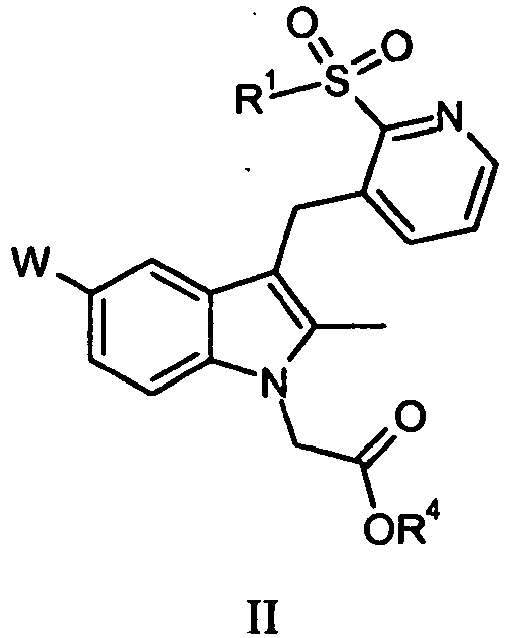
R4 is C1-C6 alkyl or benzyl;
may be used in a process for the preparation of a compound of general formula (I), the process comprising reacting the compound of general formula (II) with a base such as sodium hydroxide or lithium hydroxide. The reaction may take place in an aqueous solvent or an organic solvent or a mixture of the two. A typical solvent used for the reaction is a mixture of tetrahydrofuran and water. - Compounds of general formula (II) may be prepared from compounds of general formula (III):


- Procedures for the preparation of compounds of general formula (III) are known to those skilled in the art and in general involve alkylation of the 5-halo-indole derivative at the 1-position with an alpha-bromoacetate derivative or related alkylating agent. 5-Halo-indole derivatives are readily available or may be prepared by known methods.
- Compounds of general formula (IV) may be prepared by the reaction of a compound of general formula (V):

R1-SO2Na (VI)
wherein R1 is as defined for general formula (I). - The reaction may be carried out in a polar organic solvent such as DMSO at elevated temperature, typically reflux temperature for a prolonged period, for example 48 to 120 hours.
- Compounds of general formula (V) and (VI) are commercially available.
- Compounds of general formula (I) are CRTH2 receptor antagonists and are therefore useful in a method for the treatment of diseases and conditions mediated by PGD2 or other agonists at the CRTH2 receptor, the method comprising administering to a patient in need of such treatment a suitable amount of a compound of general formula (I).
- In a third aspect of the invention, there is provided a compound of general formula (I) for use in medicine, particularly for use in the treatment or prevention of diseases and conditions mediated by PGD2 or other CRTH2 receptor agonists.
- Furthermore, there is also provided the use of a compound of general formula (I) in the preparation of an agent for the treatment or prevention of diseases and conditions mediated by CRTH2 receptor agonists, particularly PGD2.
- The compounds are particularly effective when used for the treatment or prevention of allergic asthma, perennial allergic rhinitis, seasonal allergic rhinitis, atopic dermatitis, contact hypersensitivity (including contact dermatitis), conjunctivitis, especially allergic conjunctivitis, vernal keratoconjunctivitis and atopic keratoconjunctivitis, eosinophilic bronchitis, food allergies, eosinophilic gastroenteritis, inflammatory bowel disease, ulcerative colitis and Crohn's disease, mastocytosis and also other PGD2-mediated diseases, for example autoimmune diseases such as hyper IgE syndrome and systemic lupus erythematus, psoriasis, acne, multiple sclerosis, allograft rejection, reperfusion injury, chronic obstructive pulmonary disease, as well as rheumatoid arthritis, psoriatic arthritis, osteoarthritis and fibrotic diseases caused/exacerbated by Th2 immune responses, for example idiopathic pulmonary fibrosis and hypertrophic scars.
- The compounds of general formula (I) must be formulated in an appropriate manner depending upon the diseases or conditions they are required to treat.
- Therefore, in a further aspect of the invention there is provided a pharmaceutical composition comprising a compound of general formula (I) together with a pharmaceutical excipient or carrier. Other active materials may also be present, as may be considered appropriate or advisable for the disease or condition being treated or prevented.
- The carrier, or, if more than one be present, each of the carriers, must be acceptable in the sense of being compatible with the other ingredients of the formulation and not deleterious to the recipient.
- The formulations include those suitable for oral, rectal, nasal, bronchial (inhaled), topical (including eye drops, buccal and sublingual), vaginal or parenteral (including subcutaneous, intramuscular, intravenous and intradermal) administration and may be prepared by any methods well known in the art of pharmacy.
- The route of administration will depend upon the condition to be treated but preferred compositions are formulated for oral, nasal, bronchial or topical administration.
- The composition may be prepared by bringing into association the above defined active agent with the carrier. In general, the formulations are prepared by uniformly and intimately bringing into association the active agent with liquid carriers or finely divided solid carriers or both, and then if necessary shaping the product. The invention extends to methods for preparing a pharmaceutical composition comprising bringing a compound of general formula (I) in conjunction or association with a pharmaceutically or veterinarily acceptable carrier or vehicle.
- Formulations for oral administration in the present invention may be presented as: discrete units such as capsules, sachets or tablets each containing a predetermined amount of the active agent; as a powder or granules; as a solution or a suspension of the active agent in an aqueous liquid or a non-aqueous liquid; or as an oil-in-water liquid emulsion or a water in oil liquid emulsion; or as a bolus etc.
- For compositions for oral administration (e.g. tablets and capsules), the term acceptable carrier" includes vehicles such as common excipients e.g. binding agents, for example syrup, acacia, gelatin, sorbitol, tragacanth, polyvinylpyrrolidone (Povidone), methylcellulose, ethylcellulose, sodium carboxymethylcellulose, hydroxypropylmethylcellulose, sucrose and starch; fillers and carriers, for example corn starch, gelatin, lactose, sucrose, microcrystalline cellulose, kaolin, mannitol, dicalcium phosphate, sodium chloride and alginic acid; and lubricants such as magnesium stearate, sodium stearate and other metallic stearates, glycerol stearate, stearic acid, silicone fluid, talc waxes, oils and colloidal silica. Flavouring agents such as peppermint, oil of wintergreen, cherry flavouring and the like can also be used. It may be desirable to add a colouring agent to make the dosage form readily identifiable. Tablets may also be coated by methods well known in the art.
- A tablet may be made by compression or moulding, optionally with one or more accessory ingredients. Compressed tablets may be prepared by compressing in a suitable machine the active agent in a free flowing form such as a powder or granules, optionally mixed with a binder, lubricant, inert diluent, preservative, surface-active or dispersing agent. Moulded tablets may be made by moulding in a suitable machine a mixture of the powdered compound moistened with an inert liquid diluent. The tablets may optionally be coated or scored and may be formulated so as to provide slow or controlled release of the active agent.
- Other formulations suitable for oral administration include lozenges comprising the active agent in a flavoured base, usually sucrose and acacia or tragacanth; pastilles comprising the active agent in an inert base such as gelatin and glycerin, or sucrose and acacia; and mouthwashes comprising the active agent in a suitable liquid carrier.
- For topical application to the skin, compounds of general formula (I) may be made up into a cream, ointment, jelly, solution or suspension etc. Cream or ointment formulations that may be used for the drug are conventional formulations well known in the art, for example, as described in standard text books of pharmaceutics such as the British Pharmacopoeia.
- Compounds of general formula (I) may be used for the treatment of the respiratory tract by nasal, bronchial or buccal administration of, for example, aerosols or sprays which can disperse the pharmacological active ingredient in the form of a powder or in the form of drops of a solution or suspension. Pharmaceutical compositions with powder-dispersing properties usually contain, in addition to the active ingredient, a liquid propellant with a boiling point below room temperature and, if desired, adjuncts, such as liquid or solid non-ionic or anionic surfactants and/or diluents. Pharmaceutical compositions in which the pharmacological active ingredient is in solution contain, in addition to this, a suitable propellant, and furthermore, if necessary, an additional solvent and/or a stabiliser. Instead of the propellant, compressed air can also be used, it being possible for this to be produced as required by means of a suitable compression and expansion device.
- Parenteral formulations will generally be sterile.
- Typically, the dose of the compound will be about 0.01 to 100 mg/kg; so as to maintain the concentration of drug in the plasma at a concentration effective to inhibit PGD2 at the CRTH2 receptor. The precise amount of a compound of general formula (I) which is therapeutically effective, and the route by which such compound is best administered, is readily determined by one of ordinary skill in the art by comparing the blood level of the agent to the concentration required to have a therapeutic effect.
- Compounds of general formula (I) may be used in combination with one or more active agents which are useful in the treatment of the diseases and conditions listed above, although these active agents are not necessarily inhibitors of PGD2 at the CRTH2 receptor.
- Therefore, the pharmaceutical composition described above may additionally contain one or more of these active agents.
- There is also provided the use of a compound of general formula (I) in the preparation of an agent for the treatment of diseases and conditions mediated by CRTH2 receptor agonists, especially PGD2, wherein the agent also comprises an additional active agent useful for the treatment of the same diseases and conditions.
- These additional active agents may be other CRTH2 receptor antagonists or may have a completely different mode of action. They include existing therapies for allergic and other inflammatory diseases including:
- Suplatast tosylate and similar compounds;
- β2 adrenoreceptor agonists such as metaproterenol, isoproterenol, isoprenaline, albuterol, salbutamol, formoterol, salmeterol, indacaterol, terbutaline, orciprenaline, bitolterol mesylate and pirbuterol or methylxanthines such as theophylline and aminophylline, mast cell stabilisers such as sodium cromoglycate or muscarinic receptor antagonists such as tiotropium;
- antihistamines, for example histamine H1 receptor antagonists such as loratadine, cetirizine, desloratadine, levocetirizine, fexofenadine, astemizole, azelastine and chlorpheniramine or H4 receptor antagonists;
- α1 and α2 adrenoreceptor agonists such as propylhexedrine phenylephrine, phenylpropanolamine, pseudoephedrine, naphazoline hydrochloride, oxymetazoline hydrochloride, tetrahydrozoline hydrochloride, xylometazoline hydrochloride and ethylnorepinephrine hydrochloride;
- modulators of chemokine receptor function, for example CCR1, CCR2, CCR2A, CCR2B, CCR3, CCR4, CCR5, CCR6, CCR7, CCR8, CCR9, CCR10 and CCR11 (for the C-C family) or CXCR1, CXCR2, CXCR3, CXCR4 and CXCR5 (for the C-X-C family) and CX3CR1 for the C-X3-C family;
- Leukotriene antagonists such as montelukast and zafirlukast
- leukotriene biosynthesis inhibitors such as 5-lipoxygenase inhibitors or 5-lipoxygenase activating protein (FLAP) inhibitors such as zileuton, ABT-761, fenleuton, tepoxalin, Abbott-79175, N-(5-substituted)-thiophene-2-alkylsolfonamides, 2,6-di-tert-butylphenol hydrazones, methoxytetrahydropyrans such as ZD2138, SB-210661, pyridinyl-substituted-2-cyanonaphthalene compounds such as L-739010, 2-cyanoquinoline compounds such as L-746,530, indole and quinoline compounds such as MK-591, MK-886 and BAY x 1005;
- Phosphdiesterase inhibitors, including PDE4 inhibitors such as roflumilast;
- anti-IgE antibody therapies such as omalizumab;
- anti-infectives such as fusidic acid (particularly for the treatment of atopic dermatitis);
- anti-fungals such as clotrimazole (particularly for the treatment of atopic dermatitis);
- immunosuppressants such as tacrolimus and particularly pimecrolimus in the case of inflammatory skin disease or alternatively FK-506, rapamycin, cyclosporine, azathioprine or methotrexate;
- Immunotherapy agents including allergen immunotherapy such as Grazax;
- corticosteroids such as prednisone, prednisolone, flunisolide, triamcinolone acetonide, beclomethasone dipropionate, budesonide, fluticasone propionate mometasone furoate and fluticasone furoate drugs which promote Th1 cytokine response such as interferons, TNF or GM-CSF.
- other antagonists of PGD2 acting at other receptors such as DP antagonists;
- drugs that modulate cytokine production such as inhibitors of TNFα converting enzyme (TACE) anti-TNF monoclonal antibodies, TNF receptor immunoglobulin molecules, inhibitors of other TNF isoforms, non-selective COX-1/COX-2 inhibitors such as piroxicam, diclofenac, propionic acids such as naproxen, flubiprofen, fenoprofen, ketoprofen and ibuprofen, fenamates such as mefanamic acid, indomethacin, sulindac and apazone, pyrazolones such as phenylbutazone, salicilates such as aspirin; COX-2 inhibitors such as meloxicam, celecoxib, fofecoxib, valdecoxib and etoricoxib, low dose methotrexate, lefunomide, ciclesonide, hydroxychloroquine, d-penicillamine, auranofin or parenteral or oral gold;
- drugs that modulate the activity of Th2 cytokines IL-4 and IL-5 such as blocking monoclonal antibodies and soluble receptors;
- PPAR-γ agonists such as rosiglitazone; or with
- anti-RSV antibodies such as Synagis (palivizumab) and agents that may be used to treat rhinovirus infection in the future e.g. intereferon-alpha, interferon-beta or other interferons.
- In yet a further aspect of the invention, there is provided a product comprising a compound of general formula (I) and one or more of the agents listed above as a combined preparation for simultaneous, separate or sequential use in the treatment of a disease or condition mediated by the action of PGD2 at the CRTH2 receptor.
- In yet another aspect of the invention, there is provided a kit for the treatment of a disease or condition mediated by the action of PGD2 at the CRTH2 receptor comprising a first container comprising a compound of general formula (I) and a second container comprising one or more of the active agents listed above.
- The invention will now be described in greater detail with reference to the following non limiting examples.
- In Example 1, the 1H NMR spectra were obtained using a Bruker Advance II spectrometer operating at 300 MHz. All signals were referenced relative to residual protic solvent.
- In Examples 2 and 3, NMR spectra were collected on a Jeol JNM-GSX spectrometer operating at 400 MHz for 1H NMR data acquisition and 100 MHz for 13C NMR data acquisition.
- In Example 1, HPLC-CAD-MS was performed on a Gilson 321 HPLC with detection performed by a ESA Corona CAD and a Finnigan AQA mass spectrometer operating in positive-ion electrospray ionisation mode. The HPLC column was a Phenomenex Gemini C18 50x4.6mm 3µ, with a mobile phase gradient between 100% 0.1% formic acid in water and 100% 0.1% formic acid in acetonitrile run over 2.5 minutes, with a total run time of 6.5 minutes. In some cases MS only was obtained using the instrument described above.
- In Examples 2 and 3, HPLC was performed on an Agilent 1050 HPLC with detection performed by UV at 220nm. The HPLC column was a YMC-Pack, ODS-A 150x4.6mm 5µ, with a mobile phase gradient between 100% - 0.01% trifluoracetic acid in water and 100% - 0.01% trifluoracetic acid in acetonitrile run over 16 minutes, with a total run time of 21 minutes.
-

- To a stirred suspension of benzenesulfinic acid sodium salt (9.36 g, 0.057 mol) in DMSO (45 ml), was added 2-fluoro-3-pyridinecarboxaldehyde (5.20 ml, 0.052 mol). The resulting mixture was stirred at 100°C for 94 hours. After cooling to room temperature, the reaction mixture was partitioned between ethyl acetate and water. The organic layer was separated and the aqueous further extracted with ethyl acetate (3 x 150 ml). The combined organic extracts were washed with water (100 ml) and brine (100 ml), dried over anhydrous MgSO4, filtered and evaporated. The resulting solid was purified by column chromatography eluting with ethyl acetate:hexanes 0:100 to 60:40 v/v to afford 6.56 g (51%) of the title compound (LCMS RT = 5.63 min, MH+ 248).
1H NMR (DMSO): 10.89 (1H, d, J 0.68 Hz), 8.82 (1H, dd, J 1.7, 4.7 Hz), 8.32 (1H, dd, J 1.7, 7.9 Hz), 8.08-8.02 (2H, m), 7.85 (1H, dd, J 7.9, 0.7 Hz), 7.81 (1H, dt, J 1.3, 7.5 Hz), 7.73-7.65 (2H, m). -

- A solution of (5-fluoro-2-methyl-indol-1-yl)-acetic acid ethyl ester (0.95 g, 4.04 mmol), prepared as described in Example 1 of
WO/2006/092579 , and 2-(benzenesulfonyl)isonicotinaldehyde (1.0 g, 4.04 mmol) in dry dichloromethane (45 ml) was added slowly over 5 minutes to a stirred solution of TMSOTf (1.46 ml, 8.08 mmol) in dry dichloromethane (12.5 ml) cooled to 0°C under N2. This mixture was stirred for 15 minutes and triethylsilane (1.94 ml, 12.12 mmol) was added in one portion. The reaction mixture was stirred for 2 h 30 minutes, warmed to room temperature, and quenched by the slow addition of saturated aqueous NaHCO3 (10 ml). The resulting biphasic mixture was extracted with dichloromethane. The combined organic layers were washed with brine, dried over anhydrous MgSO4, filtered and evaporated. The resulting solid was purified by column chromatography eluting with ethyl acetate:hexanes 0:100 to 60:40 v/v to afford 1.21 g (64%) of the title compound (LCMS RT = 6.63 min, MH+ 466.8).
1H NMR (CDCl3): 8.38 (1H, dd, J 1.6, 4.5 Hz), 8.14-8.07 (2H, m), 7.67 (3H, ddt, J 1.3, 27.7, 7.4 Hz), 7.40-7.34 (1H, m), 7.22 (1H, dd, J 4.6, 7.9 Hz), 7.12 (1H, dd, J 4.2, 8.9 Hz), 6.90 (1 H, dt, J 2.5, 9.0 Hz), 6.72 (1H, dd, J 2.4, 9.5 Hz), 4.82 (2H, s), 4.62 (2H, s), 4.24 (2H, q, J 7.2 Hz), 2.30 (3H, s), 1.29 (3H, t, J 7.2 Hz). -

- To a stirred solution of [3-(2-benzenesulfonyl-pyridin-3-ylmethyl)-5-fluoro-2-methyl-indol-1-yl]-acetic acid ethyl ester (1.20 g, 2.56 mmol) in THF (26 ml) was added a solution of potassium hydroxide (0.43 g, 7.68 mmol) in water (9 ml). The resulting solution was stirred at room temperature for 3.5 h. THF was removed in vacuo and the remaining aqueous layer was acidified with aqueous HCl (0.1 M, 25 ml). The product was collected by filtration, washed with water and dried in vacuo to afford 1.12 g (100%) of the title compound (LCMS RT= 4.58 min, M+-H 437.2).
1H NMR (DMSO): 8.41-8.27 (1H, m), 8.06-7.91 (2H, m), 7.84-7.62 (3H, m), 7.50-7.31 (3H, m), 6.93-6.78 (2H, m), 4.99 (2H, s), 4.55 (2H, s), 2.27 (3H, s). -

- 2-Chloro-3-pyridinecarboxaldehyde (4.04 g, 2.86 mmol) and 4-fluorobenzenesulfinic acid sodium salt (5.73 g, 3.14 mmol) were dissolved in DMSO (100 ml) and the mixture was heated at 100°C for 72 h under nitrogen. Upon cooling to ambient the mixture was diluted with water (500 ml) and extracted with EtOAc (3x). The combined organics were washed with water, brine, dried (MgSO4) and evaporated to dryness to afford 7.89 g of crude product. The crude compound was pre-absorbed onto silica and purified by dry pad suction column chromatography, eluting with heptane using an EtOAc gradient, to afford 4.14 g (41%) of the desired product as a yellow solid (plates) (MP = 131-131.3°C; IR = 1691 cm-1; HPLC = 7.21 min >99%).
1H NMR (400 MHz; CDCl3): 7.23-7.29 (2H, m) 7.60 (1H, dd) 8.05-8.10 (2H, m) 8.37 (2H, dd) 8.67 (1H, dd) 11.1 (1H, s).
13C NMR (100 MHz, CDCl3): 116.6 (d) 116.8 (d) 127.3 (d) 130.7 (s) 132.6 (d) 134.0 (s) 137.9 (d) 152.5 (s) 159.7 (s) 165.1 (s) 167.7 (s) 188.5 (d). -

- A solution of (5-fluoro-2-methyl-indol-1-yl)-acetic acid ethyl ester (1.0 g, 4.4 mmol) and 2-(4-fluorobenzenesulfonyl)-pyridine-3-carboxaldehyde (1.13 g, 4.3 mmol) in dry DCM (50 ml) was added over 5-10 min to a stirred solution of TMSOTf in dry DCM (15 ml) at 0°C. The mixture was aged for 15 min before the addition of neat triethylsilane (2.05 ml, 12.8 mmol) in one portion. The mixture was stirred for a further 15 h and allowed to warm up to ambient. The reaction was quenched by the drop wise addition of saturated NaHCO3 solution (10 ml) and the biphasic mixture extracted with DCM (2x 50 ml). The combined organics were washed with brine (50 ml) then dried (MgSO4) and evaporated to dryness. The reaction was repeated on an identical scale and the two crude materials were purified separately. The crude reaction materials were purified by column chromatography using heptane and an ethyl acetate gradient to afford 0.90 g (43%) and 1.50 g (72%) of the desired compound as a pale purple solid and a brown solid respectively of differing purities (96.0% and 94.5% by HPLC) (MP = 150.5-151.5°C, IR = 1751 cm-1; HPLC = 12.24 min).
1H NMR (400 MHz; CDCl3): 1.26 (3H, t) 2.29 (3H, s) 4.22 (2H, q) 4.62 (2H, s) 4.80 (2H, s) 6.79 (1H, dd) 6.86 (1H, ddd) 7.10 (1H, dd) 7.19 (1H, dd) 7.23-7.28 (2H, m) 7.36 (1H, dd) 8.05-8.11 (2H, m) 8.29 (1H, dd).
13C NMR (100 MHz, CDCl3): 10.4 (q) 14.2 (q) 25.3 (t) 45.2 (t) 61.9 (t) 103.4 (d) 103.6 (d) 108.0 (s) 108.1 (s) 109.1 (d) 109.2 (d) 109.5 (d) 109.8 (d) 116.2 (d) 116.4 (d) 127.0 (d) 128.5 (s) 128.6 (s) 132.2 (d) 132.3 (d) 133.3 (s) 135.1 (s) 136.4 (s) 136.6 (s) 139.4 (d) 146.2 (d) 156.2 (s) 157.0 (s) 159.4 (s) 164.7 (s) 167.3 (s) 168.6 (s). -

- KOH (0.34 g, 5.94 mmol) was dissolved in water (7 ml) and added to a vigorously stirred solution of [5-fluoro-3-({2-[(4-fluorobenzene)sulfonyl]pyridin-3-yl}methyl)-2-methylindol-1-yl]-acetic acid ethyl ester (0.96 g, 1.98 mmol) in THF (21 ml) under nitrogen at ambient. The reaction was monitored by TLC and LCMS. After 2 h the solvent was removed in vacuo before adjusting the pH to 1.5 using 0.1M HCl solution. The precipitate was stirred vigorously for 15 min before being isolated by suction filtration. The collected solid was washed with water and then MTBE, pulled dry in air and then dried in vacuo at 50°C to afford 870 mg (97%) of the product as a pink solid (MP = 125-126°C; IR = 1729 cm-1; HPLC = 10.80 min 99.3%).
1H NMR (400 MHz; DMSO): 2.29 (3H, s) 4.56 (2H, s) 4.97 (2H, s) 6.85-6.91 (2H, m) 7.37-7.7.45 (2H, m) 7.47 (1H, dd) 7.51-7.57 (2H, m) 8.06-8.15 (2H, m) 8.36 (1H, dd).
13C NMR (100 MHz, DMSO): 10.5 (q) 25.0 (t) 45.5 (t) 102.7 (d) 102.9 (d) 107.7 (s) 107.8 (s) 108.8 (d) 109.1 (d) 110.9 (d) 111.0 (d) 117.1 (d) 117.3 (d) 128.1 (d) 128.2 (d) 128.3 (d) 132.7 (d) 132.8 (d) 133.8 (d) 135.5 (s) 136.8 (s) 138.1 (s) 140.4 (d) 147.0 (d) 155.9 (s) 156.6 (s) 158.9 (s) 164.6 (s) 167.1 (s) 171.1 (s). -

- 2-Chloro-3-pyridinecarboxaldehyde (5.0 g, 35.0 mmol) and 4-chlorobenzenesulfinic acid sodium salt (7.75 g, 38.8 mmol) were dissolved in DMSO (120 ml) and the mixture was heated at 100°C for 72 h under nitrogen. Upon cooling to ambient the mixture was diluted with water (500 ml) and extracted with EtOAc (3x). The combined organics were washed with water, brine, dried (MgSO4) and evaporated to dryness to afford 8.1 g of crude material. The crude compound was pre-absorbed onto silica and purified by dry pad suction column chromatography, eluting with heptane using an EtOAc gradient, to afford 4.62 g (61%) of the desired product as a white powdery solid (MP = 100.5-101°C; IR = 1698 cm-1; HPLC = 8.00 min >99%).
1H NMR (400 MHz; CDCl3): 7.56 (1H, dd) 7.60 (1H, dd) 7.99 (1H, dd) 8.38 (1H, dd) 8.67 (1H, dd) 11.1 (1H, s).
13C NMR (100 MHz, CDCl3): 127.3 (d) 129.6 (d) 130.8 (s) 131.1 (d) 136.5 (s) 138.0 (d) 141.4 (s) 152.5 (d) 159.5 (s) 188.4 (d). -

- A solution of (5-fluoro-2-methyl-indol-1-yl)-acetic acid ethyl ester (1.0 g, 4.25 mmol) and 2-(4-chlorobenzenesulfonyl)-pyridine-3-carboxaldehyde (1.19 g, 4.22 mmol) in dry DCM (50 ml) was added over 5-10 min to a stirred solution of TMSOTf in dry DCM (15 ml) at 0°C. The mixture was aged for 15 min before the addition of neat triethylsilane (2.05 ml, 12.7 mmol) in one portion. The mixture was stirred for a further 15 h and allowed to warm up to ambient. The reaction was quenched by the drop wise addition of saturated NaHCO3 solution (10 ml) and the biphasic mixture extracted with DCM (2x 50ml). The combined organics were washed with brine (50 ml) then dried (MgSO4) and evaporated to dryness. The reaction was repeated on an identical scale and the two crude products were combined. The crude reaction material was purified by column chromatography using heptane and an ethyl acetate gradient to afford 1.80 g (42%) of the desired compound as a pale orange solid (MP = 124.6-124.9°C; IR = 1741 cm-1; HPLC = 12.75 min 97.3%).
1H NMR (400 MHz; CDCl3): 1.26 (3H, t) 2.29 (3H, s) 4.20 (2H, q) 4.62 (2H, s) 4.80 (2H, s) 6.80 (1H, dd) 6.87 (1H, ddd) 7.10 (1H, dd) 7.19 (1H, dd) 7.37 (1H, dd) 7.54 (2H, dd) 8.00 (2H, dd) 8.28 (1H, dd).
13C NMR (100 MHz, CDCl3): 10.4 (q) 14.3 (q) 25.3 (t) 45.2 (t) 61.9 (t) 103.4 (d) 103.6 (d) 108.0 (s) 108.1 (s) 109.2 (d) 109.2 (d) 109.5 (d) 109.8 (d) 127.0 (d) 128.5 (s) 128.6 (s) 129.3 (d) 130.8 (d) 133.3 (s) 136.4 (s) 136.6 (s) 137.6 (s) 139.4 (d) 140.5 (s) 146.2 (d) 156.1 (s) 157.0 (s) 159.4 (s) 168.6 (s). -

- KOH (0.60 g, 10.7 mmol) dissolved in water (14 ml) was added to a vigorously stirred solution of [3-({2-[(4-chlorobenzene)sulfonyl]pyridin-3-yl}methyl)-5-fluoro-2-methylindol-1-yl]-acetic acid ethyl ester (1.17 g, 3.49 mmol) in THF (40ml) under nitrogen at ambient. The reaction was monitored by TLC and LCMS. After 2 h the solvent was removed in vacuo before adjusting the pH to 1.5 using 0.1M HCl solution. The precipitate was stirred vigorously for 15 min before being isolated by suction filtration. The collected solid was washed with water and then MTBE, pulled dry in air and then dried in vacuo at 50°C to afford 1.31 g (78%) of the title compound as a pink solid (MP = 125.2-126°C ; IR = 1729 cm-1; HPLC = 11.37min >99%).
1H NMR (400 MHz; DMSO): 2.29 (3H, s) 4.56 (2H, s) 4.96 (2H, s) 6.85-6.91 (2H, m) 7.39 (1H, dd) 7.44 (1H, dd) 7.49 (1H, dd) 7.76-7.79 (2H, m) 8.00-8.8.03 (2H, m) 8.36 (1H, dd).
13C NMR (100 MHz, DMSO): 10.5 (q) 25.0 (t) 45.6 (t) 102.7 (d) 102.9 (d) 107.6 (s) 107.7 (s) 108.8 (d) 109.0 (d) 110.9 (d) 111.0 (d) 128.1 (d) 130.0 (d) 131.4 (d) 133.9 (d) 136.9 (s) 138.1 (d) 139.8 (s) 140.5 (s) 147.1 (d) 155.7 (s) 156.5 (s) 158.9 (s) 171.1 (s). - In the following examples, Compounds 1 to 3 were tested against the following comparator compounds:
Cpd Name Structure A [3-(4-Methylsulfonyl-benzyl)-5-fluoro-2-methyl-indol-1-yl]-acetic acid 
B [3-(3-Benzenesulfonyl-pyridin-4-ylmethyl)-5-fluoro-2-methyl-indol-1-yl]-acetic acid 
C [3-(3-Benzenesulfonyl-pyridin-2-ylmethyl)-5-fluoro-2-methyl-indol-1-yl]-acetic acid 
D [3-(1-Benzenesulfonyl-1H-pyrrol-2-ylmethyl)-5-fluoro-2-methyl-indol-1-yl]-acetic acid 
E 5-Fluoro-2-methyl-3-(pyridin-3-ylmethyl)-indol-1-yl)-acetic acid 
WO 2005/044260 and a method for the preparation of this compound is set out in Example 1 of that document. Compound D is Compound 1 ofWO 2006/095183 and a method for its preparation is set out in Example 1 of that document. - Mono-.polyresolving medium was obtained from Dainippon Pharmaceuticals (Osaka, Japan). Macs anti-CD16 microbeads were from Miltenyi biotec (Bisley, Surrey). ChemoTx plates were purchased from Neuroprobe (Gaithersburg, MD). Poly-D-lysine coated 96-well plates were obtained from Greiner (Gloucestershire, UK). [3H]PGD2 was from Amersham Biosciences (Buckinghamshire, UK). [3H]SQ29548 was purchased from Perkin Elmer Life Sciences (Buckinghamshire, UK). All other reagents were obtained from Sigma-Aldrich (Dorset, UK), unless otherwise stated.
- Chinese Hamster Ovary cells were transfected with CRTH2 or DP receptors (CHO/CRTH2 and CHO/DP) and were maintained in culture in a humidified atmosphere at 37°C (5% CO2) in Minimum Essential Medium (MEM) supplemented with 10% foetal bovine serum, 2 mM glutamine, and 1 mg ml-1 active G418. The cells were passaged every 2-3 days. For radioligand binding assay, cells were prepared in triple-layer flasks or in 175 cm2 square flasks (for membrane preparation).
- Membranes were prepared either from CHO/CRTH2 and CHO/DP cells, or from platelets (as a source of TP receptors). CHO cells grown to confluency were washed with PBS and detached using a Versene solution (15 ml per flask). When the cells were grown in 175 cm2 square flask, they were collected by scrapping in PBS. The cell suspensions were centrifuged (1,700 rpm, 10 min, 4°C) and resuspended in 15 ml of buffer (1xHBSS, supplemented with 10 mM HEPES, pH 7.3). Cell suspensions were then homogenised using an Ultra Turrax at setting 4-6 for 20 s. The homogenate was centrifuged at 1,700 rpm for 10 min and the supernatant was collected and centrifuged at 20,000 rpm for 1 h at 4°C. The resulting pellet was resuspended in buffer and stored at -80°C in aliquots of 200-500 µl. The protein concentration was determined by the method of Bradford (1976), using bovine serum albumin as standard. The platelets were washed by centrifugation at 600xg for 10 min and resuspended in ice-cold assay buffer (10 mM Tris-HCl, pH 7.4, 5 mM Glucose, 120 mM NaCl, 10 µM indomethacin) and directly centrifuged at 20,000 rpm for 30 min at 4°C. The resulting pellet was treated as described above.
- [3H]PGD2 (160 Ci/mmol) binding experiments were performed on membranes prepared as described above. Assays were performed in a final volume of 100 µl of buffer (1XHBSS/HEPES 10 mM, pH 7.3). Cell membranes (15 µg) were preincubated at room temperature with varying concentration of competing ligand for 15 min. [3H]PGD2 was then added and the incubation continued for a further one hour at room temperature. The reaction was terminated by the addition of 200 µl ice-cold assay buffer to each well, followed by rapid filtration through Whatman GF/B glass fibre filters using a Unifilter Cell harvester (PerkinElmer Life Sciences) and six washes of 300 µl of ice-cold buffer. The Unifilter plates were dried at room temperature for at least 1h and the radioactivity retained on the filters was determined on a Beta Trilux counter (PerkinElmer Life Sciences), following addition of 40 µl of Optiphase Hi-Safe 3 (Wallac) liquid scintillation. Non specific binding was defined in the presence of 10 µM unlabelled PGD2. Assays were performed in duplicate.
- The results of the radioligand binding experiments to the CRTH2 are shown in Table
Table 1- Radioligand binding data (Ki on CRTH2 Receptor). Compounds Ki (nM) Compound 1 2 Compound 2 2 Compound 3 7 Compound A 7 Compound B 1 Compound C 979 Compound D 1 Compound E 258 - Compounds C and E bind only very weakly to the CRTH2 receptor and were therefore not tested further.
- Compounds 1-3 were assayed for their effect on PGD2 induced eosinophil shape change and were compared with Comparator Compounds A, B and D.
- Compounds (1 µl, 200 x final concentration) were added directly to 200 µl whole blood, mixed well and incubated for 15 min, 37°C, 5% CO2. After this time, cell shape was fixed by addition of 300 µl Cytofix™ buffer (BD Biosciences), 15 min on ice. 10 ml RBC lysis buffer was added to the fixed cells, incubated 5min, at room temperature and centrifuged, 300 x g for 5 min. Supernatant (containing lysed red cells) was removed and the lysis step was repeated. Leukocytes were resuspended in 250 µl RPMI/10% FCS and shape change analysed by FACS. Eosinophils were gated out based on their autofluorescence and 2000 eosinophil events were counted per sample. Data were analysed in triplicate.
- The results for the eosinophil shape change assay are shown in Table 2.
Table 2 - IC50 Values for the Effect of Test Compounds on 10 nM PGD2 -induced Eosinophil Shape Change in human whole blood Compound Value (nM) 1 9 2 2.5 3 10 A 8 B 34 D 8 - Compounds which are most suitable for use as pharmaceutical agents have an IC50 value in the eosinophil shape change test of between about 1 and 10 nM. Therefore, although Compound B binds specifically to the CRTH2 receptor (Table 1), it is not a particularly potent CRTH2 antagonist under physiological conditions.
- It is particularly worthy of note that the comparator compounds closest in structure to that of Compound 1 are Compounds B and C. Of these, Compound C does not bind specifically to the CRTH2 receptor and Compound B is much less potent than Compound 1.
- The microsomal stability of the test compounds was determined by the following method.
- 1 micromolar test compound was incubated with human liver microsomes (total protein concentration 0.3 mg/ml) for 60 min. The percentage of the test compound remaining in the sample after 1 hour was measured in order to determine the rate of metabolism of test compound. The results are shown in Table 3, which gives the results for two experiments and the mean value obtained.
Table 3 -Microsomal Stability Test Results Compound Test Concentration (M) Mean Parent remaining(%) 1 1x10⁻⁶ 96 2 1x10⁻⁶ 98 B 1x10⁻⁶ 69 C 1x10⁻⁶ 90 D 1x10⁻⁶ 24 - The results presented in Table 3 demonstrate that after 120 minutes, 96% of Compound 1 and 98% of compound 2 is unmetabolised in human liver microsomes. This compares with values of 69% and 90% respectively for Compounds B and C, which are regioisomers of Compound 1 and a value of only 24% for Compound D.
- In summary therefore, the experiments described in these examples demonstrate that Compounds C and E do not bind strongly to the CRTH2 receptor, Compound B is much less active than Compound 1 in the whole blood eosinophil shape change assay and Compound D has low stability in human microsomes, which limits its utility as a pharmaceutical agent. Compounds 1 to 3 are surprisingly active as CRTH2 antagonists and surprisingly stable in comparison with compounds to which they are structurally most closely related.
- Furthermore, the compounds of the present invention have significantly improved in vivo pharmacokinetic profiles in the dog compared to compound A. The plasma half-lives for Compounds 1 and 2 were 3 and 5 hours respectively whereas Compound A had a half life of only 1 hour
Claims (13)
- A compound of general formula (I)
 W is fluoro;R1 is phenyl optionally substituted with one halo substituent;or a pharmaceutically acceptable salt thereof.
 - A compound as claimed in claim 1, wherein the halo substituent is fluoro or chloro
- A compound as claimed in claim 2, wherein the fluoro or chloro substituent is at the 4-position of the phenyl group R1.
- A compound as claimed in claim 1 selected from:(3-{[2-(Benzenesulfonyl)pyridin-3-yl]methyl}-5-fluoro-2-methylindol-1-yl)-acetic acid;[5-Fluoro-3-({2-[(4-fluorobenzene)sulfonyl]pyridin-3-yl} methyl)-2-methylindol-1-yl]-acetic acid;[3-({2-[(4-Chlorobenzene)sulfonyl]pyridin-3-yl}methyl)-5-fluoro-2-methylindol-1-yl]-acetic acid.
- A process for the preparation of a compound of general formula (I) as claimed in claim 1, the process comprising reacting a C1-C6 alkyl or benzyl ester of the compound of general formula (I) with a base.
- A compound as claimed in any one of claims 1 to 4 for use in medicine.
- A compound as claimed in any one of claims to 4 for use in the treatment or prevention of allergic asthma, perennial allergic rhinitis, seasonal allergic rhinitis, atopic dermatitis, contact hypersensitivity (including contact dermatitis), conjunctivitis, especially allergic conjunctivitis, vernal keratoconjunctivitis and atopic keratoconjunctivitis, eosinophilic bronchitis, food allergies, eosinophilic gastroenteritis, inflammatory bowel disease, ulcerative colitis and Crohn's disease, mastocytosis and also other PGD2-mediated diseases, for example autoimmune diseases such as hyper IgE syndrome and systemic lupus erythematus, psoriasis, acne, multiple sclerosis, allograft rejection, chronic obstructive pulmonary disease, as well as rheumatoid arthritis, psoriatic arthritis, osteoarthritis and fibrotic diseases caused/exacerbated by Th2 immune responses, for example idiopathic pulmonary fibrosis and hypertrophihic scars.
- A pharmaceutical composition comprising a compound as claimed in any one of claims 1 to 4 together with a pharmaceutical excipient or carrier.
- A composition as claimed in claim 8 formulated for oral, rectal, nasal, bronchial (inhaled), topical (including eye drops, buccal and sublingual), vaginal or parenteral (including subcutaneous, intramuscular, intravenous and intradermal) administration.
- A composition as claimed in claim 7 or claim 8 containing one or more additional active agents useful in the treatment of diseases and conditions mediated by PGD2 or other agonists at the CRTH2 receptor.
- A composition as claimed in claim 10, wherein the additional active agents are selected from:Other CRTH2 antagonists;Suplatast tosylate and similar compounds;2 adrenoreceptor agonists such as metaproterenol, isoproterenol, isoprenaline, albuterol, salbutamol, formoterol, salmeterol, indacaterol, terbutaline, orciprenaline, bitolterol mesylate and pirbuterol or methylxanthanines such as theophylline and aminophylline, mast cell stabilisers such as sodium cromoglycate or muscarinic receptor antagonists such as tiotropium;antihistamines, for example histamine H1 receptor antagonists such as loratadine, cetirizine, desloratadine, levocetirizine, fexofenadine, astemizole, azelastine and chlorpheniramine or H4 receptor antagonists;α1 and α2 adrenoreceptor agonists such as propylhexedrine phenylephrine, phenylpropanolamine, pseudoephedrine, naphazoline hydrochloride, oxymetazoline hydrochloride, tetrahydrozoline hydrochloride, xylometazoline hydrochloride and ethylnorepinephrine hydrochloride;modulators of chemokine receptor function, for example CCR1, CCR2, CCR2A, CCR2B, CCR3, CCR4, CCR5, CCR6, CCR7, CCR8, CCR9, CCR10 and CCR11 (for the C-C family) or CXCR1, CXCR2, CXCR3, CXCR4 and CXCR5 (for the C-X-C family) and CX3CR1 for the C-X3-C family;Leukotriene antagonists such as montelukast and zafirlukastleukotriene biosynthesis inhibitors such as 5-lipoxygenase inhibitors or 5-lipoxygenase activating protein (FLAP) inhibitors such as zileuton, ABT-761, fenleuton, tepoxalin, Abbott-79175, N-(5-substituted)-thiophene-2-alkylsolfonamides, 2,6-di-tert-butylphenol hydrazones, methoxytetrahydropyrans such as ZD2138, SB-210661, pyridinyl-substituted-2-cyanonaphthalene compounds such as L-739010, 2-cyanoquinoline compounds such as L-746,530, indole and quinoline compounds such as MK-591, MK-886 and BAY x 1005;Phosphdiesterase inhibitors, including PDE4 inhibitors such as roflumilast;anti-IgE antibody therapies such as omalizumab;anti-infectives such as fusidic acid (particularly for the treatment of atopic dermatitis);anti-fungals such as clotrimazole (particularly for the treatment of atopic dermatitis);immunosuppressants such as tacrolimus and particularly pimecrolimus in the case of inflammatory skin disease or alternatively FK-506, rapamycin, cyclosporine, azathioprine or methotrexate;Immunotherapy agents including allergen immunotherapy such as Grazax;corticosteroids such as prednisone, prednisolone, flunisolide, triamcinolone acetonide, beclomethasone dipropionate, budesonide, fluticasone propionate mometasone furoate and fluticasone furoate drugs which promote Th1 cytokine response such as interferons, TNF or GM-CSF.CRTH2 antagonists may also be combined with therapies that are in development for inflammatory indications including:other antagonists of PGD2 acting at other receptors such as DP antagonists;drugs that modulate cytokine production such as inhibitors of TNF converting enzyme (TACE) anti-TNF monoclonal antibodies, TNF receptor immunoglobulin molecules, inhibitors of other TNF isoforms, non-selective COX-1/COX-2 inhibitors such as piroxicam, diclofenac, propionic acids such as naproxen, flubiprofen, fenoprofen, ketoprofen and ibuprofen, fenamates such as mefanamic acid, indomethacin, sulindac and apazone, pyrazolones such as phenylbutazone, salicilates such as aspirin; COX-2 inhibitors such as meloxicam, celecoxib, fofecoxib, valdecoxib and etoricoxib, low dose methotrexate, lefunomide, ciclesonide, hydroxychloroquine, d-penicillamine, auranofin or parenteral or oral gold.drugs that modulate the activity of Th2 cytokines IL-4 and IL-5 such as blocking monoclonal antibodies and soluble receptors;PPAR- agonists such as rosiglitazone; or withanti-RSV antibodies such as Synagis (palivizumab) and agents that may be used to treat rhinovirus infection in the future e.g. intereferon-alpha, interferon-beta or other interferons.
- A process for the preparation of a pharmaceutical composition as claimed in any one of claims 7 to 11 comprising bringing a compound as claimed in any one of claims 1 to 7 in conjunction or association with a pharmaceutically or veterinarily acceptable carrier or vehicle.
- A product comprising a compound as claimed in any one of claims 1 to 4 and one or more of the agents listed in claim 11 as a combined preparation for simultaneous, separate or sequential use in the treatment of a disease or condition mediated by the action of PGD2 or other agonists at the CRTH2 receptor, wherein the disease or condition is selected from allergic asthma, perennial allergic rhinitis, seasonal allergic rhinitis, atopic dermatitis, contact hypersensitivity (including contact dermatitis), conjunctivitis, especially allergic conjunctivitis, vernal keratoconjunctivitis and atopic keratoconjunctivitis, eosinophilic bronchitis, food allergies, eosinophilic gastroenteritis, inflammatory bowel disease, ulcerative colitis and Crohn's disease, mastocytosis and also other PGD2-mediated diseases, for example autoimmune diseases such as hyper IgE syndrome and systemic lupus erythernatus, psoriasis, acne, multiple sclerosis, allograft rejection, chronic obstructive pulmonary disease, as well as rheumatoid arthritis, psoriatic arthritis, osteoarthritis and fibrotic diseases caused/exacerbated by Th2 immune responses, for example idiopathic pulmonary fibrosis and hypertrophihic scars.
Priority Applications (3)
| Application Number | Priority Date | Filing Date | Title |
|---|---|---|---|
| PL09702598T PL2250161T3 (en) | 2008-01-18 | 2009-01-19 | Compounds having crth2 antagonist activity |
| SI200930822T SI2250161T1 (en) | 2008-01-18 | 2009-01-19 | Compounds having crth2 antagonist activity |
| CY20141100031T CY1114748T1 (en) | 2008-01-18 | 2014-01-15 | COMPOUNDS WHICH HAVE CRTH2 COMPETITIVE ACTIVITY |
Applications Claiming Priority (3)
| Application Number | Priority Date | Filing Date | Title |
|---|---|---|---|
| GB0800874A GB0800874D0 (en) | 2008-01-18 | 2008-01-18 | Compounds having CRTH2 antagonist activity |
| GB0820526A GB0820526D0 (en) | 2008-11-10 | 2008-11-10 | Compounds having crth2 antagonist activity |
| PCT/GB2009/000142 WO2009090414A1 (en) | 2008-01-18 | 2009-01-19 | Compounds having crth2 antagonist activity |
Publications (2)
| Publication Number | Publication Date |
|---|---|
| EP2250161A1 EP2250161A1 (en) | 2010-11-17 |
| EP2250161B1 true EP2250161B1 (en) | 2013-10-16 |
Family
ID=40473418
Family Applications (1)
| Application Number | Title | Priority Date | Filing Date |
|---|---|---|---|
| EP09702598.5A Active EP2250161B1 (en) | 2008-01-18 | 2009-01-19 | Compounds having crth2 antagonist activity |
Country Status (24)
| Country | Link |
|---|---|
| US (1) | US20090186923A1 (en) |
| EP (1) | EP2250161B1 (en) |
| JP (2) | JP2011509988A (en) |
| KR (1) | KR101644170B1 (en) |
| CN (1) | CN101932571B (en) |
| AU (1) | AU2009204700B2 (en) |
| BR (1) | BRPI0906786B1 (en) |
| CA (1) | CA2712017C (en) |
| CY (1) | CY1114748T1 (en) |
| DK (1) | DK2250161T3 (en) |
| ES (1) | ES2442717T3 (en) |
| HR (1) | HRP20140045T1 (en) |
| IL (1) | IL206959A (en) |
| MA (1) | MA32075B1 (en) |
| MX (1) | MX2010007833A (en) |
| MY (1) | MY155133A (en) |
| NZ (1) | NZ587251A (en) |
| PL (1) | PL2250161T3 (en) |
| PT (1) | PT2250161E (en) |
| RS (1) | RS53142B (en) |
| RU (1) | RU2503672C2 (en) |
| SI (1) | SI2250161T1 (en) |
| WO (1) | WO2009090414A1 (en) |
| ZA (1) | ZA201005799B (en) |
Families Citing this family (52)
| Publication number | Priority date | Publication date | Assignee | Title |
|---|---|---|---|---|
| US6962940B2 (en) | 2002-03-20 | 2005-11-08 | Celgene Corporation | (+)-2-[1-(3-Ethoxy-4-methoxyphenyl)-2-methylsulfonylethyl]-4-acetylaminoisoindoline-1,3-dione: methods of using and compositions thereof |
| GB0324763D0 (en) * | 2003-10-23 | 2003-11-26 | Oxagen Ltd | Use of compounds in therapy |
| WO2009061676A2 (en) * | 2007-11-06 | 2009-05-14 | Amira Pharmaceuticals, Inc. | Antagonists of pgd2 receptors |
| WO2009061681A2 (en) * | 2007-11-06 | 2009-05-14 | Amira Pharmaceuticals, Inc | Antagonists of pgd2 receptors |
| US20110124683A1 (en) * | 2007-11-13 | 2011-05-26 | Oxagen Limited | Use of CRTH2 Antagonist Compounds |
| RS53142B (en) * | 2008-01-18 | 2014-06-30 | Atopix Therapeutics Limited | UNITS THAT HAVE ANTAGONISTIC ACTIVITY ON CRTH2 |
| US7750027B2 (en) * | 2008-01-18 | 2010-07-06 | Oxagen Limited | Compounds having CRTH2 antagonist activity |
| US20100022613A1 (en) * | 2008-01-22 | 2010-01-28 | Oxagen Limited | Compounds Having CRTH2 Antagonist Activity |
| US8168673B2 (en) * | 2008-01-22 | 2012-05-01 | Oxagen Limited | Compounds having CRTH2 antagonist activity |
| CA2713139C (en) | 2008-02-01 | 2013-04-23 | Amira Pharmaceuticals, Inc. | N,n-disubstituted aminoalkylbiphenyl antagonists of prostaglandin d2 receptors |
| EP2257536A4 (en) * | 2008-02-14 | 2011-03-23 | Amira Pharmaceuticals Inc | Cyclic diaryl ether as antagonists of prostaglandin d2 receptors |
| EP2245022A4 (en) | 2008-02-25 | 2012-02-22 | Panmira Pharmaceuticals Llc | Antagonists of prostaglandin d2 receptors |
| US8426449B2 (en) * | 2008-04-02 | 2013-04-23 | Panmira Pharmaceuticals, Llc | Aminoalkylphenyl antagonists of prostaglandin D2 receptors |
| US20110112134A1 (en) * | 2008-05-16 | 2011-05-12 | Amira Pharmaceuticals, Inc. | Tricyclic Antagonists of Prostaglandin D2 Receptors |
| JP2011526281A (en) * | 2008-06-24 | 2011-10-06 | アミラ ファーマシューティカルズ,インク. | Cycloalkane [B] indole antagonist of prostaglandin D2 receptor |
| CA2729292C (en) | 2008-07-03 | 2013-09-03 | Amira Pharmaceuticals, Inc. | Phenoxyphenyl sulfide, sulfinyl and sulfonyl antagonists of prostaglandin d2 receptors |
| GB2463788B (en) * | 2008-09-29 | 2010-12-15 | Amira Pharmaceuticals Inc | Heteroaryl antagonists of prostaglandin D2 receptors |
| WO2010039977A2 (en) | 2008-10-01 | 2010-04-08 | Amira Pharmaceuticals, Inc. | Heteroaryl antagonists of prostaglandin d2 receptors |
| WO2010042652A2 (en) | 2008-10-08 | 2010-04-15 | Amira Pharmaceuticals, Inc. | Heteroalkyl biphenyl antagonists of prostaglandin d2 receptors |
| GB2465062B (en) * | 2008-11-06 | 2011-04-13 | Amira Pharmaceuticals Inc | Cycloalkane(B)azaindole antagonists of prostaglandin D2 receptors |
| WO2010057118A2 (en) | 2008-11-17 | 2010-05-20 | Amira Pharmaceuticals, Inc. | Heterocyclic antagonists of prostaglandin d2 receptors |
| WO2011014587A2 (en) * | 2009-07-31 | 2011-02-03 | Amira Pharmaceuticals, Inc. | Ophthalmic pharmaceutical compositions of dp2 receptor antagonists |
| CN102596902A (en) * | 2009-08-05 | 2012-07-18 | 潘米拉制药公司 | DP2 antagonists and uses thereof |
| JP2013516475A (en) | 2010-01-06 | 2013-05-13 | アミラ ファーマシューティカルズ,インク. | DP2 antagonists and uses thereof |
| CA2790139C (en) | 2010-03-22 | 2018-03-13 | Actelion Pharmaceuticals Ltd | 3-(heteroaryl-amino)-1,2,3,4-tetrahydro-9h-carbazole derivatives and their use as prostaglandin d2 receptor modulators |
| GB201103837D0 (en) | 2011-03-07 | 2011-04-20 | Oxagen Ltd | Amorphous (5-Fluoro-2-Methyl-3-Quinolin-2-Ylmethyl-Indol-1-Yl)-acetic acid |
| JP5964945B2 (en) | 2011-04-14 | 2016-08-03 | アクテリオン ファーマシューティカルズ リミテッドActelion Pharmaceuticals Ltd | 7- (Heteroaryl-amino) -6,7,8,9-tetrahydropyrido [1,2-a] indoleacetic acid derivatives and their use as prostaglandin D2 receptor modulators |
| MX350516B (en) * | 2011-11-17 | 2017-09-08 | Kbp Biosciences Co Ltd | Nitrogen-containing fused ring compounds for use as crth2 antagonists. |
| GB201121557D0 (en) | 2011-12-15 | 2012-01-25 | Oxagen Ltd | Process |
| KR20140113667A (en) * | 2011-12-16 | 2014-09-24 | 아토픽스 테라퓨릭스 리미티드 | Combination of a crth2 antagonist and a proton pump inhibitor for the treatment of eosinophilic esophagitis |
| JP2015522052A (en) * | 2012-07-10 | 2015-08-03 | エフ.ホフマン−ラ ロシュ アーゲーF. Hoffmann−La Roche Aktiengesellschaft | A novel indazole for the treatment and prevention of respiratory syncytial virus infection |
| US8815887B2 (en) | 2012-12-04 | 2014-08-26 | Millenium Pharmaceuticals, Inc. | Prophylactic or therapeutic method for Sjogren's syndrome |
| NZ628320A (en) * | 2013-03-14 | 2017-04-28 | Celgene Corp | Treatment of psoriatic arthritis using apremilast |
| GB201322273D0 (en) * | 2013-12-17 | 2014-01-29 | Atopix Therapeutics Ltd | Process |
| AU2014373683B2 (en) * | 2013-12-31 | 2020-05-07 | Rapamycin Holdings, Llc | Oral rapamycin nanoparticle preparations and use |
| CA2939892C (en) | 2014-03-17 | 2020-03-31 | Idorsia Pharmaceuticals Ltd | Azaindole acetic acid derivatives and their use as prostaglandin d2 receptor modulators |
| CN106103437A (en) | 2014-03-18 | 2016-11-09 | 埃科特莱茵药品有限公司 | Azaindole acetogenin and the purposes as prostaglandin D 2 receptor regulator thereof |
| GB201407807D0 (en) * | 2014-05-02 | 2014-06-18 | Atopix Therapeutics Ltd | Polymorphic form |
| GB201407820D0 (en) * | 2014-05-02 | 2014-06-18 | Atopix Therapeutics Ltd | Polymorphic form |
| GB201407813D0 (en) * | 2014-05-02 | 2014-06-18 | Atopix Therapeutics Ltd | Polymorphic form |
| EP3159339B1 (en) * | 2014-06-09 | 2020-11-25 | Sumitomo Chemical Company, Limited | Method for producing pyridine compound |
| US10092541B2 (en) | 2014-08-15 | 2018-10-09 | Celgene Corporation | Methods for the treatment of diseases ameliorated by PDE4 inhibition using dosage titration of apremilast |
| CN108026093B (en) | 2015-09-15 | 2021-11-16 | 爱杜西亚药品有限公司 | Crystalline forms |
| AU2018318075B2 (en) | 2017-08-14 | 2023-04-13 | Allergan, Inc. | 3,4-disubstituted 3-cyclobutene-1,2-diones and use thereof |
| US20220098197A1 (en) * | 2019-01-10 | 2022-03-31 | Cspc Zhongqi Pharmaceutical Technology (Shijiazhuang) Co., Ltd | Salts of heterocyclic compound and use thereof |
| CN114796264A (en) * | 2021-01-27 | 2022-07-29 | 北京北工大科技园有限公司 | Application of gold complex in preparation of medicine for treating novel coronavirus pneumonia |
| JP2023529011A (en) * | 2020-06-12 | 2023-07-06 | ヌクミト ファーマシューティカルズ シーオー., エルティーディー. | Indene compounds, pharmaceutical compositions thereof, and their therapeutic applications |
| CA3206106A1 (en) | 2021-02-10 | 2022-08-18 | Bhaskar Chaudhuri | Methods for ophthalmic delivery of roflumilast |
| AU2022277167A1 (en) * | 2021-05-15 | 2023-11-30 | Nucmito Pharmaceuticals Company Limited | Indene compounds, pharmaceutical compositions thereof, and their therapeutic applications |
| US12263160B2 (en) | 2021-09-22 | 2025-04-01 | Iolyx Therapeutics, Inc. | Methods of treating ocular inflammatory diseases |
| CN115192584A (en) * | 2022-06-09 | 2022-10-18 | 南方科技大学 | Nano medicine and its preparing method and use |
| CN120513226A (en) * | 2022-11-16 | 2025-08-19 | 藤济(厦门)生物医药科技有限公司 | Indene compound, pharmaceutical composition thereof and therapeutic application thereof |
Citations (2)
| Publication number | Priority date | Publication date | Assignee | Title |
|---|---|---|---|---|
| WO2004007451A1 (en) * | 2002-07-17 | 2004-01-22 | Astrazeneca Ab | Indole-3-sulphur derivatives |
| WO2005040114A1 (en) * | 2003-10-14 | 2005-05-06 | Oxagen Limited | Compounds having crth2 antagonist activity |
Family Cites Families (39)
| Publication number | Priority date | Publication date | Assignee | Title |
|---|---|---|---|---|
| US3557142A (en) | 1968-02-20 | 1971-01-19 | Sterling Drug Inc | 4,5,6,7-tetrahydro-indole-lower-alkanoic acids and esters |
| BE790679A (en) | 1971-11-03 | 1973-04-27 | Ici Ltd | INDOLE DERIVATIVES |
| GB1407658A (en) | 1973-03-06 | 1975-09-24 | Ici Ltd | Process for the manufacture of indole derivatives |
| GB1460348A (en) | 1974-02-04 | 1977-01-06 | Ici Ltd | Quinazoline derivativesa |
| DK151884C (en) | 1979-03-07 | 1988-06-13 | Pfizer | METHOD OF ANALOGUE FOR THE PREPARATION OF 3- (1-IMIDAZOLYLALKYL) INCIDENTAL OR PHARMACEUTICAL ACCEPTABLE ACID ADDITION SALTS THEREOF |
| US4363912A (en) * | 1980-12-15 | 1982-12-14 | Pfizer Inc. | Indole thromboxane synthetase inhibitors |
| GB8607294D0 (en) | 1985-04-17 | 1986-04-30 | Ici America Inc | Heterocyclic amide derivatives |
| GB9122590D0 (en) | 1991-10-24 | 1991-12-04 | Lilly Industries Ltd | Pharmaceutical compounds |
| DE69734141T2 (en) | 1996-06-05 | 2006-07-13 | Bml Inc. | PROTEIN SPECIFIC FOR HUMAN TH2 CELLS, THEREFOR CODING GENE AND CORRESPONDING TRANSFORMANT, RECOMBINANT VECTOR AND MONOCLONAL ANTIBODIES |
| US6916841B2 (en) | 1998-02-25 | 2005-07-12 | Genetics Institute, Llc | Inhibitors of phospholipase enzymes |
| SK7522001A3 (en) | 1998-03-31 | 2002-02-05 | Inst For Pharm Discovery Inc | Substituted indolealkanoic acids |
| TNSN99224A1 (en) | 1998-12-01 | 2005-11-10 | Inst For Pharm Discovery Inc | METHODS OF REDUCING GLUCOSE AND TRIGLYCERIDE LEVELS IN SERUM AND FOR ANTIGENESIS SUPPRESSION USING INDOLEALKANOIC ACIDS |
| GB9902461D0 (en) * | 1999-02-05 | 1999-03-24 | Zeneca Ltd | Chemical compounds |
| JP3486408B2 (en) | 1999-08-23 | 2004-01-13 | 株式会社ビー・エム・エル | For identifying the nature of a substance for the human prostaglandin D2 receptor |
| JP2003519898A (en) | 2000-01-14 | 2003-06-24 | コーニンクレッカ フィリップス エレクトロニクス エヌ ヴィ | Display device |
| AU2001238718A1 (en) | 2000-03-02 | 2001-09-12 | The Institutes For Pharmaceutical Discovery, Llc | Compositions containing a substituted indolealkanoic acid and an angiotensin converting enzyme inhibitor |
| JP2001247570A (en) | 2000-03-08 | 2001-09-11 | Japan Tobacco Inc | Indoleacetic acid compound and method of producing the same |
| US6878522B2 (en) | 2000-07-07 | 2005-04-12 | Baiyong Li | Methods for the identification of compounds useful for the treatment of disease states mediated by prostaglandin D2 |
| SE0200356D0 (en) | 2002-02-05 | 2002-02-05 | Astrazeneca Ab | Novel use |
| SE0200411D0 (en) | 2002-02-05 | 2002-02-05 | Astrazeneca Ab | Novel use |
| WO2003097598A1 (en) | 2002-05-16 | 2003-11-27 | Shionogi & Co., Ltd. | Compound exhibiting pgd 2 receptor antagonism |
| WO2003097042A1 (en) | 2002-05-16 | 2003-11-27 | Shionogi & Co., Ltd. | Pgd2 receptor antagonist |
| TW200307542A (en) | 2002-05-30 | 2003-12-16 | Astrazeneca Ab | Novel compounds |
| SE0201635D0 (en) | 2002-05-30 | 2002-05-30 | Astrazeneca Ab | Novel compounds |
| US7364647B2 (en) | 2002-07-17 | 2008-04-29 | Eksigent Technologies Llc | Laminated flow device |
| NZ541234A (en) | 2002-12-20 | 2008-06-30 | Amgen Inc | Asthma and allergic inflammation modulators |
| JP4324418B2 (en) | 2003-08-05 | 2009-09-02 | 株式会社日立国際電気 | Substrate processing apparatus and semiconductor device manufacturing method |
| SE0302232D0 (en) | 2003-08-18 | 2003-08-18 | Astrazeneca Ab | Novel Compounds |
| GB0324763D0 (en) * | 2003-10-23 | 2003-11-26 | Oxagen Ltd | Use of compounds in therapy |
| AU2005229522A1 (en) | 2004-03-11 | 2005-10-13 | Actelion Pharmaceuticals Ltd. | Indol-1-yl-acetic acid derivatives |
| CA2563707A1 (en) * | 2004-04-20 | 2005-11-03 | Pfizer Inc. | Method of treating neuropathic pain using a crth2 receptor antagonsit |
| JP2008513512A (en) | 2004-09-21 | 2008-05-01 | アサーシス, インク. | Indoleacetic acid exhibiting CRTH2 receptor antagonism and use thereof |
| GB0504150D0 (en) | 2005-03-01 | 2005-04-06 | Oxagen Ltd | Microcrystalline material |
| GB0505048D0 (en) * | 2005-03-11 | 2005-04-20 | Oxagen Ltd | Compounds with PGD antagonist activity |
| PL65781Y1 (en) | 2005-08-16 | 2012-02-29 | Katarzyna Kawczyńska | Cosmetic insert |
| WO2008012511A1 (en) * | 2006-07-22 | 2008-01-31 | Oxagen Limited | Compounds having crth2 antagonist activity |
| GB0722203D0 (en) * | 2007-11-13 | 2007-12-19 | Oxagen Ltd | Use of CRTH2 antagonist compounds |
| NZ585888A (en) * | 2007-12-14 | 2012-02-24 | Pulmagen Therapeutics Asthma Ltd | Indoles and their therapeutic use |
| RS53142B (en) * | 2008-01-18 | 2014-06-30 | Atopix Therapeutics Limited | UNITS THAT HAVE ANTAGONISTIC ACTIVITY ON CRTH2 |
-
2009
- 2009-01-19 RS RS20140016A patent/RS53142B/en unknown
- 2009-01-19 AU AU2009204700A patent/AU2009204700B2/en not_active Ceased
- 2009-01-19 BR BRPI0906786-8A patent/BRPI0906786B1/en not_active IP Right Cessation
- 2009-01-19 NZ NZ587251A patent/NZ587251A/en not_active IP Right Cessation
- 2009-01-19 KR KR1020107017661A patent/KR101644170B1/en not_active Expired - Fee Related
- 2009-01-19 CA CA2712017A patent/CA2712017C/en active Active
- 2009-01-19 WO PCT/GB2009/000142 patent/WO2009090414A1/en not_active Ceased
- 2009-01-19 PT PT97025985T patent/PT2250161E/en unknown
- 2009-01-19 SI SI200930822T patent/SI2250161T1/en unknown
- 2009-01-19 RU RU2010129027/04A patent/RU2503672C2/en active
- 2009-01-19 ES ES09702598.5T patent/ES2442717T3/en active Active
- 2009-01-19 MY MYPI2010003390A patent/MY155133A/en unknown
- 2009-01-19 PL PL09702598T patent/PL2250161T3/en unknown
- 2009-01-19 DK DK09702598.5T patent/DK2250161T3/en active
- 2009-01-19 HR HRP20140045AT patent/HRP20140045T1/en unknown
- 2009-01-19 JP JP2010542688A patent/JP2011509988A/en active Pending
- 2009-01-19 MX MX2010007833A patent/MX2010007833A/en active IP Right Grant
- 2009-01-19 EP EP09702598.5A patent/EP2250161B1/en active Active
- 2009-01-19 CN CN200980103456.8A patent/CN101932571B/en not_active Expired - Fee Related
- 2009-01-21 US US12/356,822 patent/US20090186923A1/en not_active Abandoned
-
2010
- 2010-07-12 IL IL206959A patent/IL206959A/en active IP Right Grant
- 2010-08-13 ZA ZA2010/05799A patent/ZA201005799B/en unknown
- 2010-08-13 MA MA33081A patent/MA32075B1/en unknown
-
2014
- 2014-01-15 CY CY20141100031T patent/CY1114748T1/en unknown
- 2014-05-07 JP JP2014095946A patent/JP5855162B2/en not_active Expired - Fee Related
Patent Citations (2)
| Publication number | Priority date | Publication date | Assignee | Title |
|---|---|---|---|---|
| WO2004007451A1 (en) * | 2002-07-17 | 2004-01-22 | Astrazeneca Ab | Indole-3-sulphur derivatives |
| WO2005040114A1 (en) * | 2003-10-14 | 2005-05-06 | Oxagen Limited | Compounds having crth2 antagonist activity |
Also Published As
Similar Documents
| Publication | Publication Date | Title |
|---|---|---|
| US8980927B2 (en) | Compounds having CRTH2 antagonist activity | |
| CA2712017C (en) | Compounds having crth2 antagonist activity | |
| US8163936B2 (en) | Treatment of CRTH2-mediated diseases and conditions | |
| RS51016B (en) | INDOL-1-IL ACID ACID Derivatives Having PGD2 Antagonist Activity | |
| HK1145175B (en) | Compounds having crth2 antagonist activity | |
| WO2015166278A1 (en) | Polymorphic form of [5-fluoro-3-({2-[(4-fluorobenzene) sulfonyl]pyridin-3-yl}methyl)-2-methylindol-1-yl]-acetic acid |
Legal Events
| Date | Code | Title | Description |
|---|---|---|---|
| PUAI | Public reference made under article 153(3) epc to a published international application that has entered the european phase |
Free format text: ORIGINAL CODE: 0009012 |
|
| 17P | Request for examination filed |
Effective date: 20100805 |
|
| AK | Designated contracting states |
Kind code of ref document: A1 Designated state(s): AT BE BG CH CY CZ DE DK EE ES FI FR GB GR HR HU IE IS IT LI LT LU LV MC MK MT NL NO PL PT RO SE SI SK TR |
|
| AX | Request for extension of the european patent |
Extension state: AL BA RS |
|
| REG | Reference to a national code |
Ref country code: HK Ref legal event code: DE Ref document number: 1145175 Country of ref document: HK |
|
| 17Q | First examination report despatched |
Effective date: 20120209 |
|
| GRAP | Despatch of communication of intention to grant a patent |
Free format text: ORIGINAL CODE: EPIDOSNIGR1 |
|
| GRAP | Despatch of communication of intention to grant a patent |
Free format text: ORIGINAL CODE: EPIDOSNIGR1 |
|
| INTG | Intention to grant announced |
Effective date: 20130507 |
|
| RAP1 | Party data changed (applicant data changed or rights of an application transferred) |
Owner name: ATOPIX THERAPEUTICS LIMITED |
|
| GRAS | Grant fee paid |
Free format text: ORIGINAL CODE: EPIDOSNIGR3 |
|
| GRAA | (expected) grant |
Free format text: ORIGINAL CODE: 0009210 |
|
| AK | Designated contracting states |
Kind code of ref document: B1 Designated state(s): AT BE BG CH CY CZ DE DK EE ES FI FR GB GR HR HU IE IS IT LI LT LU LV MC MK MT NL NO PL PT RO SE SI SK TR |
|
| AX | Request for extension of the european patent |
Extension state: AL BA RS |
|
| REG | Reference to a national code |
Ref country code: GB Ref legal event code: FG4D |
|
| REG | Reference to a national code |
Ref country code: CH Ref legal event code: EP |
|
| REG | Reference to a national code |
Ref country code: IE Ref legal event code: FG4D |
|
| REG | Reference to a national code |
Ref country code: AT Ref legal event code: REF Ref document number: 636449 Country of ref document: AT Kind code of ref document: T Effective date: 20131115 |
|
| REG | Reference to a national code |
Ref country code: DE Ref legal event code: R096 Ref document number: 602009019465 Country of ref document: DE Effective date: 20131212 |
|
| REG | Reference to a national code |
Ref country code: RO Ref legal event code: EPE |
|
| REG | Reference to a national code |
Ref country code: HR Ref legal event code: TUEP Ref document number: P20140045 Country of ref document: HR |
|
| REG | Reference to a national code |
Ref country code: PT Ref legal event code: SC4A Free format text: AVAILABILITY OF NATIONAL TRANSLATION Effective date: 20140114 |
|
| REG | Reference to a national code |
Ref country code: DK Ref legal event code: T3 Effective date: 20140120 |
|
| REG | Reference to a national code |
Ref country code: NL Ref legal event code: T3 |
|
| REG | Reference to a national code |
Ref country code: CH Ref legal event code: NV Representative=s name: FIAMMENGHI-FIAMMENGHI, CH |
|
| REG | Reference to a national code |
Ref country code: SE Ref legal event code: TRGR |
|
| REG | Reference to a national code |
Ref country code: NL Ref legal event code: T3 |
|
| REG | Reference to a national code |
Ref country code: ES Ref legal event code: FG2A Ref document number: 2442717 Country of ref document: ES Kind code of ref document: T3 Effective date: 20140213 |
|
| REG | Reference to a national code |
Ref country code: HR Ref legal event code: T1PR Ref document number: P20140045 Country of ref document: HR |
|
| REG | Reference to a national code |
Ref country code: NO Ref legal event code: T2 Effective date: 20131016 |
|
| REG | Reference to a national code |
Ref country code: GR Ref legal event code: EP Ref document number: 20140400082 Country of ref document: GR Effective date: 20140224 |
|
| REG | Reference to a national code |
Ref country code: HK Ref legal event code: GR Ref document number: 1145175 Country of ref document: HK |
|
| REG | Reference to a national code |
Ref country code: EE Ref legal event code: FG4A Ref document number: E008931 Country of ref document: EE Effective date: 20140114 |
|
| REG | Reference to a national code |
Ref country code: SK Ref legal event code: T3 Ref document number: E 15615 Country of ref document: SK |
|
| REG | Reference to a national code |
Ref country code: PL Ref legal event code: T3 |
|
| REG | Reference to a national code |
Ref country code: DE Ref legal event code: R097 Ref document number: 602009019465 Country of ref document: DE |
|
| PLBE | No opposition filed within time limit |
Free format text: ORIGINAL CODE: 0009261 |
|
| STAA | Information on the status of an ep patent application or granted ep patent |
Free format text: STATUS: NO OPPOSITION FILED WITHIN TIME LIMIT |
|
| 26N | No opposition filed |
Effective date: 20140717 |
|
| REG | Reference to a national code |
Ref country code: HU Ref legal event code: AG4A Ref document number: E019986 Country of ref document: HU |
|
| REG | Reference to a national code |
Ref country code: DE Ref legal event code: R097 Ref document number: 602009019465 Country of ref document: DE Effective date: 20140717 |
|
| REG | Reference to a national code |
Ref country code: FR Ref legal event code: PLFP Year of fee payment: 8 |
|
| REG | Reference to a national code |
Ref country code: FR Ref legal event code: PLFP Year of fee payment: 9 |
|
| REG | Reference to a national code |
Ref country code: FR Ref legal event code: PLFP Year of fee payment: 10 |
|
| REG | Reference to a national code |
Ref country code: HR Ref legal event code: ODRP Ref document number: P20140045 Country of ref document: HR Payment date: 20181129 Year of fee payment: 11 |
|
| PGFP | Annual fee paid to national office [announced via postgrant information from national office to epo] |
Ref country code: MT Payment date: 20190117 Year of fee payment: 11 |
|
| REG | Reference to a national code |
Ref country code: HR Ref legal event code: ODRP Ref document number: P20140045 Country of ref document: HR Payment date: 20200108 Year of fee payment: 12 |
|
| REG | Reference to a national code |
Ref country code: HR Ref legal event code: ODRP Ref document number: P20140045 Country of ref document: HR Payment date: 20210105 Year of fee payment: 13 |
|
| REG | Reference to a national code |
Ref country code: HR Ref legal event code: ODRP Ref document number: P20140045 Country of ref document: HR Payment date: 20220104 Year of fee payment: 14 |
|
| PGFP | Annual fee paid to national office [announced via postgrant information from national office to epo] |
Ref country code: SK Payment date: 20211231 Year of fee payment: 14 |
|
| PGFP | Annual fee paid to national office [announced via postgrant information from national office to epo] |
Ref country code: LU Payment date: 20220127 Year of fee payment: 14 |
|
| PGFP | Annual fee paid to national office [announced via postgrant information from national office to epo] |
Ref country code: LT Payment date: 20220103 Year of fee payment: 14 Ref country code: IE Payment date: 20220127 Year of fee payment: 14 Ref country code: HU Payment date: 20220109 Year of fee payment: 14 Ref country code: GB Payment date: 20220127 Year of fee payment: 14 Ref country code: FI Payment date: 20220127 Year of fee payment: 14 Ref country code: DK Payment date: 20220127 Year of fee payment: 14 Ref country code: DE Payment date: 20220127 Year of fee payment: 14 Ref country code: CH Payment date: 20220202 Year of fee payment: 14 Ref country code: BG Payment date: 20220118 Year of fee payment: 14 Ref country code: AT Payment date: 20220103 Year of fee payment: 14 |
|
| PGFP | Annual fee paid to national office [announced via postgrant information from national office to epo] |
Ref country code: TR Payment date: 20220107 Year of fee payment: 14 Ref country code: RO Payment date: 20220113 Year of fee payment: 14 Ref country code: PT Payment date: 20220118 Year of fee payment: 14 Ref country code: PL Payment date: 20220103 Year of fee payment: 14 Ref country code: NO Payment date: 20220127 Year of fee payment: 14 Ref country code: NL Payment date: 20220126 Year of fee payment: 14 Ref country code: MK Payment date: 20220104 Year of fee payment: 14 Ref country code: MC Payment date: 20220104 Year of fee payment: 14 Ref country code: LV Payment date: 20220103 Year of fee payment: 14 Ref country code: IT Payment date: 20220119 Year of fee payment: 14 Ref country code: HR Payment date: 20220104 Year of fee payment: 14 Ref country code: GR Payment date: 20220127 Year of fee payment: 14 Ref country code: FR Payment date: 20220125 Year of fee payment: 14 Ref country code: ES Payment date: 20220201 Year of fee payment: 14 Ref country code: EE Payment date: 20220103 Year of fee payment: 14 Ref country code: CZ Payment date: 20220107 Year of fee payment: 14 Ref country code: CY Payment date: 20220105 Year of fee payment: 14 Ref country code: BE Payment date: 20220127 Year of fee payment: 14 |
|
| PG25 | Lapsed in a contracting state [announced via postgrant information from national office to epo] |
Ref country code: MT Free format text: LAPSE BECAUSE OF NON-PAYMENT OF DUE FEES Effective date: 20200119 |
|
| PGFP | Annual fee paid to national office [announced via postgrant information from national office to epo] |
Ref country code: SI Payment date: 20220103 Year of fee payment: 14 |
|
| REG | Reference to a national code |
Ref country code: HR Ref legal event code: PBON Ref document number: P20140045 Country of ref document: HR Effective date: 20230119 |
|
| REG | Reference to a national code |
Ref country code: DE Ref legal event code: R119 Ref document number: 602009019465 Country of ref document: DE |
|
| REG | Reference to a national code |
Ref country code: LT Ref legal event code: MM4D Effective date: 20230119 |
|
| REG | Reference to a national code |
Ref country code: EE Ref legal event code: MM4A Ref document number: E008931 Country of ref document: EE Effective date: 20230131 |
|
| REG | Reference to a national code |
Ref country code: DK Ref legal event code: EBP Effective date: 20230131 |
|
| REG | Reference to a national code |
Ref country code: NO Ref legal event code: MMEP |
|
| REG | Reference to a national code |
Ref country code: SE Ref legal event code: EUG |
|
| REG | Reference to a national code |
Ref country code: CH Ref legal event code: PL |
|
| REG | Reference to a national code |
Ref country code: NL Ref legal event code: MM Effective date: 20230201 |
|
| REG | Reference to a national code |
Ref country code: SK Ref legal event code: MM4A Ref document number: E 15615 Country of ref document: SK Effective date: 20230119 |
|
| REG | Reference to a national code |
Ref country code: AT Ref legal event code: MM01 Ref document number: 636449 Country of ref document: AT Kind code of ref document: T Effective date: 20230119 |
|
| GBPC | Gb: european patent ceased through non-payment of renewal fee |
Effective date: 20230119 |
|
| PG25 | Lapsed in a contracting state [announced via postgrant information from national office to epo] |
Ref country code: LU Free format text: LAPSE BECAUSE OF NON-PAYMENT OF DUE FEES Effective date: 20230119 |
|
| REG | Reference to a national code |
Ref country code: BE Ref legal event code: MM Effective date: 20230131 |
|
| PG25 | Lapsed in a contracting state [announced via postgrant information from national office to epo] |
Ref country code: SE Free format text: LAPSE BECAUSE OF NON-PAYMENT OF DUE FEES Effective date: 20230120 Ref country code: RO Free format text: LAPSE BECAUSE OF NON-PAYMENT OF DUE FEES Effective date: 20230119 Ref country code: PT Free format text: LAPSE BECAUSE OF NON-PAYMENT OF DUE FEES Effective date: 20230719 Ref country code: NO Free format text: LAPSE BECAUSE OF NON-PAYMENT OF DUE FEES Effective date: 20230131 Ref country code: NL Free format text: LAPSE BECAUSE OF NON-PAYMENT OF DUE FEES Effective date: 20230201 Ref country code: LI Free format text: LAPSE BECAUSE OF NON-PAYMENT OF DUE FEES Effective date: 20230131 Ref country code: GB Free format text: LAPSE BECAUSE OF NON-PAYMENT OF DUE FEES Effective date: 20230119 Ref country code: FI Free format text: LAPSE BECAUSE OF NON-PAYMENT OF DUE FEES Effective date: 20230119 Ref country code: EE Free format text: LAPSE BECAUSE OF NON-PAYMENT OF DUE FEES Effective date: 20230131 Ref country code: DE Free format text: LAPSE BECAUSE OF NON-PAYMENT OF DUE FEES Effective date: 20230801 Ref country code: CZ Free format text: LAPSE BECAUSE OF NON-PAYMENT OF DUE FEES Effective date: 20230119 Ref country code: CY Free format text: LAPSE BECAUSE OF NON-PAYMENT OF DUE FEES Effective date: 20230119 Ref country code: CH Free format text: LAPSE BECAUSE OF NON-PAYMENT OF DUE FEES Effective date: 20230131 Ref country code: AT Free format text: LAPSE BECAUSE OF NON-PAYMENT OF DUE FEES Effective date: 20230119 |
|
| PG25 | Lapsed in a contracting state [announced via postgrant information from national office to epo] |
Ref country code: SK Free format text: LAPSE BECAUSE OF NON-PAYMENT OF DUE FEES Effective date: 20230119 Ref country code: SI Free format text: LAPSE BECAUSE OF NON-PAYMENT OF DUE FEES Effective date: 20230120 Ref country code: LV Free format text: LAPSE BECAUSE OF NON-PAYMENT OF DUE FEES Effective date: 20230119 Ref country code: LT Free format text: LAPSE BECAUSE OF NON-PAYMENT OF DUE FEES Effective date: 20230119 Ref country code: HU Free format text: LAPSE BECAUSE OF NON-PAYMENT OF DUE FEES Effective date: 20230120 Ref country code: HR Free format text: LAPSE BECAUSE OF NON-PAYMENT OF DUE FEES Effective date: 20230119 Ref country code: GR Free format text: LAPSE BECAUSE OF NON-PAYMENT OF DUE FEES Effective date: 20230804 Ref country code: FR Free format text: LAPSE BECAUSE OF NON-PAYMENT OF DUE FEES Effective date: 20230131 Ref country code: BE Free format text: LAPSE BECAUSE OF NON-PAYMENT OF DUE FEES Effective date: 20230131 |
|
| REG | Reference to a national code |
Ref country code: SI Ref legal event code: KO00 Effective date: 20231019 |
|
| PG25 | Lapsed in a contracting state [announced via postgrant information from national office to epo] |
Ref country code: IT Free format text: LAPSE BECAUSE OF NON-PAYMENT OF DUE FEES Effective date: 20230119 Ref country code: IE Free format text: LAPSE BECAUSE OF NON-PAYMENT OF DUE FEES Effective date: 20230119 Ref country code: DK Free format text: LAPSE BECAUSE OF NON-PAYMENT OF DUE FEES Effective date: 20230131 |
|
| REG | Reference to a national code |
Ref country code: ES Ref legal event code: FD2A Effective date: 20240401 |
|
| PG25 | Lapsed in a contracting state [announced via postgrant information from national office to epo] |
Ref country code: ES Free format text: LAPSE BECAUSE OF NON-PAYMENT OF DUE FEES Effective date: 20230120 |
|
| PG25 | Lapsed in a contracting state [announced via postgrant information from national office to epo] |
Ref country code: ES Free format text: LAPSE BECAUSE OF NON-PAYMENT OF DUE FEES Effective date: 20230120 |
|
| PG25 | Lapsed in a contracting state [announced via postgrant information from national office to epo] |
Ref country code: MC Free format text: LAPSE BECAUSE OF NON-PAYMENT OF DUE FEES Effective date: 20230131 |
|
| PG25 | Lapsed in a contracting state [announced via postgrant information from national office to epo] |
Ref country code: MC Free format text: LAPSE BECAUSE OF NON-PAYMENT OF DUE FEES Effective date: 20230131 |
|
| PG25 | Lapsed in a contracting state [announced via postgrant information from national office to epo] |
Ref country code: PL Free format text: LAPSE BECAUSE OF NON-PAYMENT OF DUE FEES Effective date: 20230119 |
|
| PG25 | Lapsed in a contracting state [announced via postgrant information from national office to epo] |
Ref country code: PL Free format text: LAPSE BECAUSE OF NON-PAYMENT OF DUE FEES Effective date: 20230119 |
|
| PG25 | Lapsed in a contracting state [announced via postgrant information from national office to epo] |
Ref country code: BG Free format text: LAPSE BECAUSE OF NON-PAYMENT OF DUE FEES Effective date: 20230119 |
|
| PG25 | Lapsed in a contracting state [announced via postgrant information from national office to epo] |
Ref country code: BG Free format text: LAPSE BECAUSE OF NON-PAYMENT OF DUE FEES Effective date: 20230119 |
|
| PGFP | Annual fee paid to national office [announced via postgrant information from national office to epo] |
Ref country code: SE Payment date: 20241219 Year of fee payment: 17 |
|
| PG25 | Lapsed in a contracting state [announced via postgrant information from national office to epo] |
Ref country code: IS Free format text: LAPSE BECAUSE OF NON-PAYMENT OF DUE FEES Effective date: 20200806 |