EP2249184A1 - Method and system for passive acoustic monitoring in seismic survey operations - Google Patents
Method and system for passive acoustic monitoring in seismic survey operations Download PDFInfo
- Publication number
- EP2249184A1 EP2249184A1 EP10160911A EP10160911A EP2249184A1 EP 2249184 A1 EP2249184 A1 EP 2249184A1 EP 10160911 A EP10160911 A EP 10160911A EP 10160911 A EP10160911 A EP 10160911A EP 2249184 A1 EP2249184 A1 EP 2249184A1
- Authority
- EP
- European Patent Office
- Prior art keywords
- vessel
- seismic
- acoustic sensor
- cable
- towing
- Prior art date
- Legal status (The legal status is an assumption and is not a legal conclusion. Google has not performed a legal analysis and makes no representation as to the accuracy of the status listed.)
- Withdrawn
Links
- 238000012544 monitoring process Methods 0.000 title claims abstract description 9
- 238000000034 method Methods 0.000 title claims description 9
- 239000004020 conductor Substances 0.000 claims abstract description 18
- 241000283153 Cetacea Species 0.000 claims abstract description 11
- XLYOFNOQVPJJNP-UHFFFAOYSA-N water Substances O XLYOFNOQVPJJNP-UHFFFAOYSA-N 0.000 description 6
- 238000003491 array Methods 0.000 description 3
- 238000004891 communication Methods 0.000 description 2
- 239000000835 fiber Substances 0.000 description 2
- 230000033001 locomotion Effects 0.000 description 2
- 230000003287 optical effect Effects 0.000 description 2
- 238000012795 verification Methods 0.000 description 2
- 230000000007 visual effect Effects 0.000 description 2
- 229920000508 Vectran Polymers 0.000 description 1
- 239000004979 Vectran Substances 0.000 description 1
- 230000002411 adverse Effects 0.000 description 1
- 230000005540 biological transmission Effects 0.000 description 1
- 239000013307 optical fiber Substances 0.000 description 1
- 230000035945 sensitivity Effects 0.000 description 1
- 238000000926 separation method Methods 0.000 description 1
- 230000003595 spectral effect Effects 0.000 description 1
- 238000001228 spectrum Methods 0.000 description 1
Images


Classifications
-
- G—PHYSICS
- G01—MEASURING; TESTING
- G01V—GEOPHYSICS; GRAVITATIONAL MEASUREMENTS; DETECTING MASSES OR OBJECTS; TAGS
- G01V1/00—Seismology; Seismic or acoustic prospecting or detecting
- G01V1/38—Seismology; Seismic or acoustic prospecting or detecting specially adapted for water-covered areas
- G01V1/3808—Seismic data acquisition, e.g. survey design
Definitions
- the invention relates generally to the field of seismic surveying. More particularly, the invention relates to devices and methods for detecting the presence of marine life that may be adversely affected by seismic survey operations.
- PAM passive acoustic monitoring
- Towed PAM equipment includes cables having hydrophones thereon that need to be deployed in the body of water for which verification is to be performed.
- the cables are deployed from a seismic survey vessel entirely separately from seismic signal acquisition equipment deployed in the water from the same vessel.
- acquisition equipment may include one or more seismic source arrays, and one or more seismic sensing streamers.
- the cables often interfere with the seismic equipment deployed in the water, which can lead to lost operational time and/or damaged equipment.
- a method for passive acoustic monitoring in connection with seismic surveying includes towing at least one seismic energy source behind a survey vessel. At least one seismic sensor streamer is towed behind the vessel. At least one acoustic sensor is towed behind the at least one seismic energy source. The at least one acoustic sensor is configured to detect marine mammal vocalization.
- FIG. 1 shows prior art PAM devices used with a seismic acquisition system.
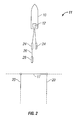
- FIG. 2 shows an example PAM devices according to the invention.
- FIG. 3 shows a cross section view of a PAM hydrophone array and seismic air gun array according to the invention.
- FIG. 4 shows a detailed cross section of an example PAM hydrophone array and a source umbilical cable.
- PAM passive acoustic monitoring
- a seismic survey vessel 10 moves along the surface of a body of water 11 in which seismic surveying is to be performed and in which it is desired to confirm the presence of marine mammals prior to surveying.
- the survey vessel 10 includes thereon certain equipment shown generally at 12 and referred to for convenience as a "recording system.”
- the recording system 12 includes devices (none shown separately for clarity of the illustration) for determining geodetic position of the survey vessel 10, for actuating one or more seismic energy sources 24 (explained below) at selected times, for determining geodetic position of each of a plurality of seismic sensors 22 (explained below) and for recording the signals generated by the seismic sensors 22.
- the recording system 12 may also include equipment for detecting signals produced by a PAM sensor array 28 and for analyzing such signals to determine the presence of marine mammals in the survey area.
- Programs that may be installed in a computer (not shown) in the recording 12 system for determining whether acoustic energy detected by the PAM array 28 corresponds to marine mammal vocalization are described in the Potter et al. Publication referenced above.
- the seismic energy sources 24 are coupled to the survey vessel 10 by umbilical cables 35, explained below in more detail with reference to FIG. 4 .
- the PAM sensor array 28 may be coupled to the survey vessel 10 by a towing cable 26, and is spaced laterally from the centerline of the survey vessel 10 using a running block 30 disposed on an outer "lead in” cable 18 (explained below).
- the seismic sensors 22 are generally part of cables called “streamers” 20 and are disposed at longitudinally spaced apart locations along each of the streamers 20.
- the streamers 20 are towed generally behind the survey vessel 10, and are maintained at selected lateral distances with respect to the centerline of the survey vessel 10 using certain towing equipment.
- the towing equipment includes "super wide" towing ropes 16 at laterally outermost positions therein.
- a paravane 14 is coupled thereto and provides lateral outward deflecting force in response to movement of the towing equipment along the direction of motion of the survey vessel 10.
- a spreader cable 17 is coupled laterally between the paravanes 14 to maintain a selected maximum lateral distance therebetween.
- Lead in cables 18 extend behind the vessel 10 longitudinally to the forward end of each streamer 20, and provide electrical power and electrical and/or optical signal channels to communicate signals from the seismic sensors 22 to the recording system 12.
- FIG. 1 It has been observed that the arrangement shown in FIG. 1 is susceptible to tangling of the PAM array 28 and its towing cable 26 in, among other components, the lead in cables 18 and possible damage thereto.
- FIG. 2 shows a plan view of relevant parts of a PAM array coupled to the seismic acquisition system according to the invention.
- the PAM array 28 may be coupled by its towing cable 26 to an aft end of one of the seismic energy sources 24.
- the length of the PAM array towing cable 26 may be selected such that the PAM array 28 is disposed longitudinally ahead of the spreader cable 17.
- the seismic energy source 24 may comprise a plurality of, for example, seismic air guns 27, 29, 31, 33.
- An example of a seismic air gun that may be used with the present system is described U.S. Patent No. 4,472,794 issued to Chelminski , however the type of air gun is not a limit on the scope of the present invention.
- the seismic air guns are typically each configured to have particular energy spectral content when the entire group of guns is actuated in a selected sequence.
- the seismic energy source 24 may alternatively include water guns (not shown).
- the seismic energy source 24 may be a so-called "impulsive" source, that is, one in which most of the energy emitted in each actuation thereof occurs in a single impulse of relatively short duration. It is impulsive sources that are believed to create the most risk to marine life.
- the actual type of seismic energy source used in any particular example is not a limitation on the scope of the present invention. It is contemplated that the present invention may also be used with marine vibrators and other so called “spread-spectrum" seismic energy sources.
- the seismic air guns 27, 29, 31, 33 are each suspended at a selected depth in the water 11 from a float 25 that is coupled to the vessel (10 in FIG. 2 ) by the umbilical cable 35.
- the PAM array towing cable 26 is coupled to a structural part of the float 25 to transmit axial loading to the umbilical cable 35.
- the umbilical cable 35 includes structural elements to transmit axial loading to the vessel (10 in FIG. 2 ).
- the PAM array 28 may include a plurality of hydrophones S1, S2, S3. Examples of hydrophones that may be used with the present system are described in the above referenced Potter et al. Publication.
- FIG. 4 A more detailed cross section view of the umbilical cable 35 and the PAM array 28 are shown in FIG. 4 .
- An example configuration for the PAM array 28 is described in the Potter et al. publication referred to above.
- the PAM array 28 may have, for example, three (as shown at S1, S2, S3) or four hydrophones at various longitudinal separations, for example, from 5 to 50 meters.
- the output of each hydrophone S1, S2, S3 may be coupled to the input of a respective preamplifier 50.
- the output of each preamplifier 50 may be coupled to a multiplexer 48, the output of which may be coupled to an analog to digital converter (ADC) 46.
- ADC analog to digital converter
- the ADC 46 should be operated to sufficiently sample the highest expected marine mammal vocalization frequency without aliasing, e.g., about 22 KHz, thus a minimum sample frequency of 44 KHz.
- the hydrophones S1, S2, S3 can have a sensitivity of 201 dBV re 1 ⁇ Pa.
- the hydrophones may be spectrally flat to within 1.5 dB over 1 Hz-15 kHz.
- the umbilical cable 35 may include an outer, waterproof jacket 35A. Components of the umbilical cable 35 disposed inside the jacket may include one or more strength members 37 such as may be made from wire rope or cable, or from fiber rope, such as made from a fiber sold under the trademark VECTRAN, which is a registered trademark of Hoescht Celanaese Corp., NY, NY.
- the umbilical cable 35 may also include a compressed air or gas charge conduit 36 to supply compressed gas or air to the air guns (27, 29, 31 and 33 in FIG. 3 ) and plurality of twisted pairs of insulated electrical conductors 38, 40, 42.
- the twisted pairs 38, 40, 42 may provide an electrical actuating signal to operate each of the air guns ((27, 29, 31 and 33 in FIG.
- One of the twisted pairs 42 may be extended into the PAM towing cable used to provide electrical power to the PAM array 28 and to conduct digitized signals from the PAM array 28 to the recording unit (12 in FIG. 2 ). To perform the latter two functions, the twisted pair 42 may be electrically coupled to a power conditioner 44 in the PAM array 28. A signal transceiver 43 may be coupled between the output of the ADC 46 and the twisted pair 42. Other examples may use separate electrical conductors for signal communication and power transmission.
- the PAM towing cable 26 may include an extension of the strength member(s) 37 to transmit axial loading to the float (25 in FIG. 3 ) and ultimately to the vessel (10 in FIG. 2 ).
- the present example in which signals from the hydropohones are digitized proximate thereto and are communicated in digital electrical form over one or more electrical conductors is only one example of communication of the hydrophone signals to the recording system (12 in FIG. 1 ). It is within the scope of the present invention to transmit the hydrophone signals as analog voltages along one or more electrical conductors in the umbilical cable 35. It is also within the scope of the present invention to use optical hydrophones and optical fibers to communicate the hydrophone signals to the recording unit. See, for example, U.S. Patent No. 7,154,082 issued to Maas and commonly owned with the present invention.
- FIGS. 2 , 3 and 4 The number of seismic energy sources, streamers, lead in cables and other parts of the towing equipment shown in FIGS. 2 , 3 and 4 are only provided herein as examples of seismic acquisition systems that may be used in accordance with the invention. Accordingly, the numbers of and the arrangement of such components shown and described herein are not limitations on the scope of the present invention.
- Arrangements of PAM arrays and seismic acquisition devices may reduce entanglement of the PAM array with the seismic acquisition devices, thus reducing non-operating time and possible damage to the seismic devices and/or PAM arrays.
Landscapes
- Life Sciences & Earth Sciences (AREA)
- Physics & Mathematics (AREA)
- Oceanography (AREA)
- Engineering & Computer Science (AREA)
- Acoustics & Sound (AREA)
- Environmental & Geological Engineering (AREA)
- Geology (AREA)
- Remote Sensing (AREA)
- General Life Sciences & Earth Sciences (AREA)
- General Physics & Mathematics (AREA)
- Geophysics (AREA)
- Geophysics And Detection Of Objects (AREA)
Abstract
A system for passive acoustic monitoring in connection with seismic surveying includes a survey vessel (10) having a recording system thereon. At least one seismic energy source (24) is coupled to the vessel (10) by a first towing cable (35). The towing cable (35) includes at least one conductor therein. At least one seismic sensor streamer (20) is coupled to the vessel by a lead in cable. At least one acoustic sensor (28) is coupled to the at least one source by a second towing cable (26). The second towing cable (26) includes at least one signal conductor configured to transmit signals from the acoustic sensor to the at least one conductor in the first towing cable. The at least one acoustic sensor (28) is configured to detect marine mammal vocalization.
Description
- The invention relates generally to the field of seismic surveying. More particularly, the invention relates to devices and methods for detecting the presence of marine life that may be adversely affected by seismic survey operations.
- Authorities in some jurisdictions require seismic survey operators to verify that no marine mammals are present within a certain distance from seismic exploration vessels before seismic survey work can start. Use of towed passive acoustic monitoring ("PAM") equipment is one way to perform such verification. A good description of techniques known in the art for PAM may be found in John R. Potter et al., Visual and Passive Acoustic Marine Mammal Observations and HighFrequency, IEEE Journal of Oceanic Engineering, vol. 32, no. 2, April, 2007.
- Towed PAM equipment includes cables having hydrophones thereon that need to be deployed in the body of water for which verification is to be performed. As explained in the Potter et al. publication referred to above, the cables are deployed from a seismic survey vessel entirely separately from seismic signal acquisition equipment deployed in the water from the same vessel. Such acquisition equipment may include one or more seismic source arrays, and one or more seismic sensing streamers. The cables often interfere with the seismic equipment deployed in the water, which can lead to lost operational time and/or damaged equipment.
- There is a need for improved methods and devices for passive acoustic monitoring that can be used with seismic survey systems.
- A system according to one aspect of the invention for passive acoustic monitoring in connection with seismic surveying includes a survey vessel having a recording system thereon. At least one seismic energy source is coupled to the vessel by a first towing cable. The towing cable includes at least one conductor therein. At least one seismic sensor streamer is coupled to the vessel by a lead in cable. At least one acoustic sensor is coupled to the at least one source by a second towing cable. The second towing cable includes at least one signal conductor configured to transmit signals from the acoustic sensor to the at least one conductor in the first towing cable.
- A method for passive acoustic monitoring in connection with seismic surveying according to another aspect of the invention includes towing at least one seismic energy source behind a survey vessel. At least one seismic sensor streamer is towed behind the vessel. At least one acoustic sensor is towed behind the at least one seismic energy source. The at least one acoustic sensor is configured to detect marine mammal vocalization.
- Other aspects and advantages of the invention will be apparent from the following description and the appended claims.
-
FIG. 1 shows prior art PAM devices used with a seismic acquisition system. -
FIG. 2 shows an example PAM devices according to the invention. -
FIG. 3 shows a cross section view of a PAM hydrophone array and seismic air gun array according to the invention. -
FIG. 4 shows a detailed cross section of an example PAM hydrophone array and a source umbilical cable. - An example passive acoustic monitoring ("PAM") system known in the art, used in conjunction with seismic surveying systems and as described in John R. Potter et al., Visual and Passive Acoustic Marine Mammal Observations and HighFrequency, IEEE Journal of Oceanic Engineering, vol. 32, no. 2, April, 2007, is shown in plan view in
FIG. 1 to help explain differences between PAM systems known in the art and PAM devices according to the invention. - A
seismic survey vessel 10 moves along the surface of a body ofwater 11 in which seismic surveying is to be performed and in which it is desired to confirm the presence of marine mammals prior to surveying. Thesurvey vessel 10 includes thereon certain equipment shown generally at 12 and referred to for convenience as a "recording system." Therecording system 12 includes devices (none shown separately for clarity of the illustration) for determining geodetic position of thesurvey vessel 10, for actuating one or more seismic energy sources 24 (explained below) at selected times, for determining geodetic position of each of a plurality of seismic sensors 22 (explained below) and for recording the signals generated by theseismic sensors 22. Therecording system 12 may also include equipment for detecting signals produced by aPAM sensor array 28 and for analyzing such signals to determine the presence of marine mammals in the survey area. Programs that may be installed in a computer (not shown) in therecording 12 system for determining whether acoustic energy detected by thePAM array 28 corresponds to marine mammal vocalization are described in the Potter et al. Publication referenced above. - The
seismic energy sources 24 are coupled to thesurvey vessel 10 byumbilical cables 35, explained below in more detail with reference toFIG. 4 . ThePAM sensor array 28 may be coupled to thesurvey vessel 10 by atowing cable 26, and is spaced laterally from the centerline of thesurvey vessel 10 using a runningblock 30 disposed on an outer "lead in" cable 18 (explained below). - The
seismic sensors 22 are generally part of cables called "streamers" 20 and are disposed at longitudinally spaced apart locations along each of thestreamers 20. Thestreamers 20 are towed generally behind thesurvey vessel 10, and are maintained at selected lateral distances with respect to the centerline of thesurvey vessel 10 using certain towing equipment. The towing equipment includes "super wide"towing ropes 16 at laterally outermost positions therein. At the longitudinal end of each superwide rope 16, aparavane 14 is coupled thereto and provides lateral outward deflecting force in response to movement of the towing equipment along the direction of motion of thesurvey vessel 10. Aspreader cable 17 is coupled laterally between theparavanes 14 to maintain a selected maximum lateral distance therebetween. Lead incables 18 extend behind thevessel 10 longitudinally to the forward end of eachstreamer 20, and provide electrical power and electrical and/or optical signal channels to communicate signals from theseismic sensors 22 to therecording system 12. - It has been observed that the arrangement shown in
FIG. 1 is susceptible to tangling of thePAM array 28 and itstowing cable 26 in, among other components, the lead incables 18 and possible damage thereto. -
FIG. 2 shows a plan view of relevant parts of a PAM array coupled to the seismic acquisition system according to the invention. InFIG. 2 , thePAM array 28 may be coupled by itstowing cable 26 to an aft end of one of theseismic energy sources 24. The length of the PAMarray towing cable 26 may be selected such that thePAM array 28 is disposed longitudinally ahead of thespreader cable 17. - The arrangement of
FIG. 2 is shown in more detailed cross section view inFIG. 3 . Theseismic energy source 24 may comprise a plurality of, for example,seismic air guns U.S. Patent No. 4,472,794 issued to Chelminski , however the type of air gun is not a limit on the scope of the present invention. The seismic air guns are typically each configured to have particular energy spectral content when the entire group of guns is actuated in a selected sequence. Theseismic energy source 24 may alternatively include water guns (not shown). Generally, although not exclusively, theseismic energy source 24 may be a so-called "impulsive" source, that is, one in which most of the energy emitted in each actuation thereof occurs in a single impulse of relatively short duration. It is impulsive sources that are believed to create the most risk to marine life. However, the actual type of seismic energy source used in any particular example is not a limitation on the scope of the present invention. It is contemplated that the present invention may also be used with marine vibrators and other so called "spread-spectrum" seismic energy sources. Theseismic air guns water 11 from afloat 25 that is coupled to the vessel (10 inFIG. 2 ) by theumbilical cable 35. Preferably, the PAMarray towing cable 26 is coupled to a structural part of thefloat 25 to transmit axial loading to theumbilical cable 35. As will be explained below with reference toFIG. 4 , theumbilical cable 35 includes structural elements to transmit axial loading to the vessel (10 inFIG. 2 ). ThePAM array 28 may include a plurality of hydrophones S1, S2, S3. Examples of hydrophones that may be used with the present system are described in the above referenced Potter et al. Publication. - A more detailed cross section view of the
umbilical cable 35 and thePAM array 28 are shown inFIG. 4 . An example configuration for thePAM array 28 is described in the Potter et al. publication referred to above. ThePAM array 28 may have, for example, three (as shown at S1, S2, S3) or four hydrophones at various longitudinal separations, for example, from 5 to 50 meters. The output of each hydrophone S1, S2, S3 may be coupled to the input of arespective preamplifier 50. The output of eachpreamplifier 50 may be coupled to amultiplexer 48, the output of which may be coupled to an analog to digital converter (ADC) 46. TheADC 46 should be operated to sufficiently sample the highest expected marine mammal vocalization frequency without aliasing, e.g., about 22 KHz, thus a minimum sample frequency of 44 KHz. The hydrophones S1, S2, S3 can have a sensitivity of 201 dBV re 1 µPa. The hydrophones may be spectrally flat to within 1.5 dB over 1 Hz-15 kHz. - The
umbilical cable 35 may include an outer,waterproof jacket 35A. Components of theumbilical cable 35 disposed inside the jacket may include one ormore strength members 37 such as may be made from wire rope or cable, or from fiber rope, such as made from a fiber sold under the trademark VECTRAN, which is a registered trademark of Hoescht Celanaese Corp., NY, NY. Theumbilical cable 35 may also include a compressed air orgas charge conduit 36 to supply compressed gas or air to the air guns (27, 29, 31 and 33 inFIG. 3 ) and plurality of twisted pairs of insulatedelectrical conductors twisted pairs FIG. 3 ) at the selected times. One of thetwisted pairs 42 may be extended into the PAM towing cable used to provide electrical power to thePAM array 28 and to conduct digitized signals from thePAM array 28 to the recording unit (12 inFIG. 2 ). To perform the latter two functions, thetwisted pair 42 may be electrically coupled to apower conditioner 44 in thePAM array 28. Asignal transceiver 43 may be coupled between the output of theADC 46 and thetwisted pair 42. Other examples may use separate electrical conductors for signal communication and power transmission. ThePAM towing cable 26 may include an extension of the strength member(s) 37 to transmit axial loading to the float (25 inFIG. 3 ) and ultimately to the vessel (10 inFIG. 2 ). - The present example, in which signals from the hydropohones are digitized proximate thereto and are communicated in digital electrical form over one or more electrical conductors is only one example of communication of the hydrophone signals to the recording system (12 in
FIG. 1 ). It is within the scope of the present invention to transmit the hydrophone signals as analog voltages along one or more electrical conductors in theumbilical cable 35. It is also within the scope of the present invention to use optical hydrophones and optical fibers to communicate the hydrophone signals to the recording unit. See, for example,U.S. Patent No. 7,154,082 issued to Maas and commonly owned with the present invention. - The number of seismic energy sources, streamers, lead in cables and other parts of the towing equipment shown in
FIGS. 2 ,3 and 4 are only provided herein as examples of seismic acquisition systems that may be used in accordance with the invention. Accordingly, the numbers of and the arrangement of such components shown and described herein are not limitations on the scope of the present invention. - Arrangements of PAM arrays and seismic acquisition devices according to the various aspects of the invention may reduce entanglement of the PAM array with the seismic acquisition devices, thus reducing non-operating time and possible damage to the seismic devices and/or PAM arrays.
Claims (6)
- A method for passive acoustic monitoring in connection with seismic surveying, comprising:towing at least one seismic energy source behind a survey vessel;towing at least one seismic sensor streamer behind the vessel; andtowing at least one acoustic sensor behind the at least one seismic energy source, the at least one acoustic sensor configured to detect marine mammal vocalization.
- The method of claim 1, further comprising conducting signals generated by the at least one acoustic sensor to a recording device on the vessel using a conductor disposed in a cable extending between the at least one source and the vessel.
- The method of claim 1 or claim 2, further comprising conducting electrical power from a device on the vessel to electronic devices associated with the at least one acoustic sensor using a conductor disposed in a cable extending between the at least one source and the vessel.
- The method of any of the preceding claims, further comprising digitizing signals generated by the at least one acoustic sensor at a location proximate the at least one acoustic sensor and transmitting the digitized signals to a recording device on the vessel using a conductor disposed in a cable extending between the at least one source and the vessel.
- A system for passive acoustic monitoring in connection with seismic surveying, comprising:a survey vessel having a recording system thereon;at least one seismic energy source coupled to the vessel by a first towing cable, the towing cable including at least one conductor therein;at least one seismic sensor streamer coupled to the vessel by a lead in cable; and'at least one acoustic sensor coupled to the at least one source by a second towing cable, the second towing cable including at least one signal conductor configured to transmit signals from the acoustic sensor to the at least one conductor in the first towing cable, the at least one acoustic sensor configured to detect marine mammal vocalization.
- The system of claim 5, further comprising a preamplifier proximate the acoustic sensor and coupled at its signal input to a signal output of the acoustic sensor, and an analog to digital converter coupled at a signal input thereof to a signal output of the preamplifier, wherein the at least one conductor in the second towing cable provides electrical power to operate the preamplifier and the converter, wherein the at least one conductor in the second towing cable communicates an output of the converter to a recording unit on the vessel.
Applications Claiming Priority (1)
| Application Number | Priority Date | Filing Date | Title |
|---|---|---|---|
| US12/387,416 US20100278010A1 (en) | 2009-05-01 | 2009-05-01 | Method and system for passive acoustic monitoring in seismic survey operations |
Publications (1)
| Publication Number | Publication Date |
|---|---|
| EP2249184A1 true EP2249184A1 (en) | 2010-11-10 |
Family
ID=42558487
Family Applications (1)
| Application Number | Title | Priority Date | Filing Date |
|---|---|---|---|
| EP10160911A Withdrawn EP2249184A1 (en) | 2009-05-01 | 2010-04-23 | Method and system for passive acoustic monitoring in seismic survey operations |
Country Status (4)
| Country | Link |
|---|---|
| US (1) | US20100278010A1 (en) |
| EP (1) | EP2249184A1 (en) |
| AU (1) | AU2010201477A1 (en) |
| BR (1) | BRPI1001057A2 (en) |
Cited By (2)
| Publication number | Priority date | Publication date | Assignee | Title |
|---|---|---|---|---|
| US8976623B2 (en) | 2011-07-05 | 2015-03-10 | POS Geophysical AS | Towing methods and systems for geophysical surveys |
| US9188691B2 (en) | 2011-07-05 | 2015-11-17 | Pgs Geophysical As | Towing methods and systems for geophysical surveys |
Families Citing this family (9)
| Publication number | Priority date | Publication date | Assignee | Title |
|---|---|---|---|---|
| US20120020184A1 (en) * | 2010-07-26 | 2012-01-26 | Colin Wilson | Using a distributed optical acoustic sensor to position an object |
| US8924158B2 (en) | 2010-08-09 | 2014-12-30 | Schlumberger Technology Corporation | Seismic acquisition system including a distributed sensor having an optical fiber |
| US8947973B2 (en) * | 2010-11-17 | 2015-02-03 | WesternGeco L.L.P. | Active detection of marine mammals during seismic surveying |
| WO2014090811A2 (en) * | 2012-12-10 | 2014-06-19 | Cgg Services Sa | Offshore seismic monitoring system and method |
| CN105044767B (en) | 2013-06-17 | 2018-07-20 | 英洛瓦(天津)物探装备有限责任公司 | The method of the earthquake sampling of transmission compression |
| US9377550B2 (en) | 2013-09-11 | 2016-06-28 | Pgs Geophysical As | Source umbilical cable without functioning power cables |
| US9625592B2 (en) | 2014-03-12 | 2017-04-18 | Sercel | Method for localizing a marine mammal in an underwater environment implemented by a PAM system, corresponding device, computer program product and non-transitory computer-readable carrier medium |
| US9557428B2 (en) * | 2014-03-12 | 2017-01-31 | Sercel | Method for controlling quality of operation of a PAM system, corresponding computer program product, non-transitory computer-readable carrier medium and quality control device |
| NO345687B1 (en) * | 2020-03-11 | 2021-06-14 | Polarcus Shipholding As | Steering of marine equipment towed by a vessel by a running block |
Citations (6)
| Publication number | Priority date | Publication date | Assignee | Title |
|---|---|---|---|---|
| US4472794A (en) | 1981-06-01 | 1984-09-18 | Bolt Technology Corporation | Sleeve shuttle air gun |
| US5099455A (en) * | 1990-07-02 | 1992-03-24 | Parra Jorge M | Passive acoustic aquatic animal finder apparatus and method |
| US6879544B1 (en) * | 2003-10-31 | 2005-04-12 | The United States Of America As Represented By The Secretary Of The Navy | Manatee vocalization detection method and system |
| US7154082B2 (en) | 2004-08-20 | 2006-12-26 | Pgs Americas, Inc. | Frequency division and/or wavelength division multiplexed recursive fiber optic telemetry scheme for an optical sensor array |
| GB2431237A (en) * | 2005-10-14 | 2007-04-18 | Statoil Asa | Marine seismic data acquisition with short streamers |
| US20100067326A1 (en) * | 2008-09-17 | 2010-03-18 | Kambiz Iranpour | Cetacean protection system |
Family Cites Families (1)
| Publication number | Priority date | Publication date | Assignee | Title |
|---|---|---|---|---|
| FR2664063B1 (en) * | 1990-06-29 | 1992-08-28 | Inst Francais Du Petrole | METHOD AND DEVICE FOR OPTIMIZING THE TRIGGERING OF A SET OF SEISMIC MARINE SOURCES. |
-
2009
- 2009-05-01 US US12/387,416 patent/US20100278010A1/en not_active Abandoned
-
2010
- 2010-04-14 AU AU2010201477A patent/AU2010201477A1/en not_active Abandoned
- 2010-04-23 EP EP10160911A patent/EP2249184A1/en not_active Withdrawn
- 2010-04-30 BR BRPI1001057-2A patent/BRPI1001057A2/en not_active Application Discontinuation
Patent Citations (6)
| Publication number | Priority date | Publication date | Assignee | Title |
|---|---|---|---|---|
| US4472794A (en) | 1981-06-01 | 1984-09-18 | Bolt Technology Corporation | Sleeve shuttle air gun |
| US5099455A (en) * | 1990-07-02 | 1992-03-24 | Parra Jorge M | Passive acoustic aquatic animal finder apparatus and method |
| US6879544B1 (en) * | 2003-10-31 | 2005-04-12 | The United States Of America As Represented By The Secretary Of The Navy | Manatee vocalization detection method and system |
| US7154082B2 (en) | 2004-08-20 | 2006-12-26 | Pgs Americas, Inc. | Frequency division and/or wavelength division multiplexed recursive fiber optic telemetry scheme for an optical sensor array |
| GB2431237A (en) * | 2005-10-14 | 2007-04-18 | Statoil Asa | Marine seismic data acquisition with short streamers |
| US20100067326A1 (en) * | 2008-09-17 | 2010-03-18 | Kambiz Iranpour | Cetacean protection system |
Non-Patent Citations (3)
| Title |
|---|
| JOHN R. POTTER ET AL.: "Visual and Passive Acoustic Marine Mammal Observations and HighFrequency", IEEE JOURNAL OF OCEANIC ENGINEERING, vol. 32, no. 2, April 2007 (2007-04-01) |
| POTTER J R ET AL: "Visual and Passive Acoustic Marine Mammal Observations and High-Frequency Seismic Source Characteristics Recorded During a Seismic Survey", IEEE JOURNAL OF OCEANIC ENGINEERING, IEEE SERVICE CENTER, PISCATAWAY, NJ, US LNKD- DOI:10.1109/JOE.2006.880427, vol. 32, no. 2, 1 April 2007 (2007-04-01), pages 469 - 483, XP011197182, ISSN: 0364-9059 * |
| SPIKES C H ET AL: "Whales 95 - revolutionizing marine mammal monitoring technology", SEA TECHNOLOGY,, vol. 37, no. 4, 1 April 1996 (1996-04-01), pages 49 - 56, XP009137776, ISSN: 0093-3651 * |
Cited By (3)
| Publication number | Priority date | Publication date | Assignee | Title |
|---|---|---|---|---|
| US8976623B2 (en) | 2011-07-05 | 2015-03-10 | POS Geophysical AS | Towing methods and systems for geophysical surveys |
| US9188691B2 (en) | 2011-07-05 | 2015-11-17 | Pgs Geophysical As | Towing methods and systems for geophysical surveys |
| US9932093B2 (en) | 2011-07-05 | 2018-04-03 | Pgs Geophysical As | Towing methods and systems for geophysical surveys |
Also Published As
| Publication number | Publication date |
|---|---|
| BRPI1001057A2 (en) | 2011-07-26 |
| AU2010201477A1 (en) | 2010-11-18 |
| US20100278010A1 (en) | 2010-11-04 |
Similar Documents
| Publication | Publication Date | Title |
|---|---|---|
| EP2249184A1 (en) | Method and system for passive acoustic monitoring in seismic survey operations | |
| US8995221B2 (en) | Towed marine sensor streamer having concentric stress member | |
| US8319497B2 (en) | Marine sensor streamer having pressure activated stiffness enhancement | |
| JP2019519750A (en) | Near-seafloor hydrate exploration system | |
| AU2005208086A1 (en) | Marine seismic acquisition system | |
| US7545703B2 (en) | Marine seismic streamer with varying spacer distances for reducing towing noise | |
| US20200073000A1 (en) | Wide spread seismic source towing configuration | |
| EP2372401A1 (en) | Method for towing marine sensor streamers | |
| US12105240B2 (en) | Long-offset acquisition with improved low frequency performance for full wavefield inversion | |
| US20190176936A1 (en) | Method and system for towing widely separated sources | |
| AU2010315682B2 (en) | Solid seismic streamer cable and method | |
| US10012751B2 (en) | Electrode adapter for geophysical surveys | |
| CN211856889U (en) | Active and passive sonar towed line array device | |
| CN110412651A (en) | A segmented marine seismic cable | |
| GB2592703A (en) | Long-offset acquisition with improved low frequency performance for full wavefield inversion | |
| US20080008034A1 (en) | Marine seismic survey streamer configuration for reducing towing noise | |
| GB2439816A (en) | Marine seismic survey streamer construction for reducing towing noise | |
| US20240230940A9 (en) | Umbilical cable with sensors for collecting subsurface data and method | |
| RU138001U1 (en) | TOWED SEISMOACOUSTIC ANTENNA | |
| GB2438426A (en) | Seismic streamer receiver selection | |
| KR20250002138A (en) | Soil cone penetration test apparatus and method | |
| GB2579411A (en) | Seismic acquisition system comprising short streamers | |
| GB2439815A (en) | Marine seismic streamer with varying spacer distances for reducing towing noise |
Legal Events
| Date | Code | Title | Description |
|---|---|---|---|
| PUAI | Public reference made under article 153(3) epc to a published international application that has entered the european phase |
Free format text: ORIGINAL CODE: 0009012 |
|
| AK | Designated contracting states |
Kind code of ref document: A1 Designated state(s): AT BE BG CH CY CZ DE DK EE ES FI FR GB GR HR HU IE IS IT LI LT LU LV MC MK MT NL NO PL PT RO SE SI SK SM TR |
|
| AX | Request for extension of the european patent |
Extension state: AL BA ME RS |
|
| STAA | Information on the status of an ep patent application or granted ep patent |
Free format text: STATUS: THE APPLICATION IS DEEMED TO BE WITHDRAWN |
|
| 18D | Application deemed to be withdrawn |
Effective date: 20110511 |