EP2248849A1 - Fuser member having composite outer layer - Google Patents
Fuser member having composite outer layer Download PDFInfo
- Publication number
- EP2248849A1 EP2248849A1 EP20100160884 EP10160884A EP2248849A1 EP 2248849 A1 EP2248849 A1 EP 2248849A1 EP 20100160884 EP20100160884 EP 20100160884 EP 10160884 A EP10160884 A EP 10160884A EP 2248849 A1 EP2248849 A1 EP 2248849A1
- Authority
- EP
- European Patent Office
- Prior art keywords
- composite material
- silsesquioxane
- polymer matrix
- based particles
- surface features
- Prior art date
- Legal status (The legal status is an assumption and is not a legal conclusion. Google has not performed a legal analysis and makes no representation as to the accuracy of the status listed.)
- Granted
Links
- 239000002131 composite material Substances 0.000 title claims abstract description 92
- 239000002245 particle Substances 0.000 claims abstract description 91
- 229920000642 polymer Polymers 0.000 claims abstract description 78
- 239000011159 matrix material Substances 0.000 claims abstract description 58
- OKTJSMMVPCPJKN-UHFFFAOYSA-N Carbon Chemical compound [C] OKTJSMMVPCPJKN-UHFFFAOYSA-N 0.000 claims abstract description 30
- 239000002041 carbon nanotube Substances 0.000 claims abstract description 30
- 229910021393 carbon nanotube Inorganic materials 0.000 claims abstract description 28
- 239000000758 substrate Substances 0.000 claims description 25
- 125000000524 functional group Chemical group 0.000 claims description 20
- 239000008199 coating composition Substances 0.000 claims description 17
- 238000000034 method Methods 0.000 claims description 12
- 239000000203 mixture Substances 0.000 claims description 11
- 239000002071 nanotube Substances 0.000 claims description 10
- 230000015572 biosynthetic process Effects 0.000 claims description 9
- 125000002924 primary amino group Chemical group [H]N([H])* 0.000 claims description 7
- XLYOFNOQVPJJNP-UHFFFAOYSA-N water Substances O XLYOFNOQVPJJNP-UHFFFAOYSA-N 0.000 claims description 7
- 125000004464 hydroxyphenyl group Chemical group 0.000 claims description 5
- 230000005012 migration Effects 0.000 claims description 5
- 238000013508 migration Methods 0.000 claims description 5
- 125000004469 siloxy group Chemical group [SiH3]O* 0.000 claims description 5
- 239000002048 multi walled nanotube Substances 0.000 claims description 4
- 239000002109 single walled nanotube Substances 0.000 claims description 4
- 238000010438 heat treatment Methods 0.000 claims 1
- 239000010410 layer Substances 0.000 description 44
- 229920002449 FKM Polymers 0.000 description 42
- 239000000463 material Substances 0.000 description 20
- 229920001973 fluoroelastomer Polymers 0.000 description 18
- -1 thermoelastomers Polymers 0.000 description 17
- 125000000217 alkyl group Chemical group 0.000 description 14
- 229920002313 fluoropolymer Polymers 0.000 description 14
- 238000004132 cross linking Methods 0.000 description 12
- 239000004811 fluoropolymer Substances 0.000 description 12
- 125000003118 aryl group Chemical group 0.000 description 11
- BQCIDUSAKPWEOX-UHFFFAOYSA-N 1,1-Difluoroethene Chemical compound FC(F)=C BQCIDUSAKPWEOX-UHFFFAOYSA-N 0.000 description 10
- IISBACLAFKSPIT-UHFFFAOYSA-N bisphenol A Chemical compound C=1C=C(O)C=CC=1C(C)(C)C1=CC=C(O)C=C1 IISBACLAFKSPIT-UHFFFAOYSA-N 0.000 description 10
- 238000000576 coating method Methods 0.000 description 10
- 229910052731 fluorine Inorganic materials 0.000 description 10
- YCKRFDGAMUMZLT-UHFFFAOYSA-N Fluorine atom Chemical compound [F] YCKRFDGAMUMZLT-UHFFFAOYSA-N 0.000 description 9
- 239000011248 coating agent Substances 0.000 description 9
- 239000011737 fluorine Substances 0.000 description 9
- 239000002904 solvent Substances 0.000 description 8
- 239000004971 Cross linker Substances 0.000 description 7
- 239000003795 chemical substances by application Substances 0.000 description 7
- 238000002149 energy-dispersive X-ray emission spectroscopy Methods 0.000 description 7
- HCDGVLDPFQMKDK-UHFFFAOYSA-N hexafluoropropylene Chemical group FC(F)=C(F)C(F)(F)F HCDGVLDPFQMKDK-UHFFFAOYSA-N 0.000 description 7
- ZWEHNKRNPOVVGH-UHFFFAOYSA-N 2-Butanone Chemical compound CCC(C)=O ZWEHNKRNPOVVGH-UHFFFAOYSA-N 0.000 description 6
- ZFVMWEVVKGLCIJ-UHFFFAOYSA-N bisphenol AF Chemical compound C1=CC(O)=CC=C1C(C(F)(F)F)(C(F)(F)F)C1=CC=C(O)C=C1 ZFVMWEVVKGLCIJ-UHFFFAOYSA-N 0.000 description 5
- 229910052751 metal Inorganic materials 0.000 description 5
- 239000002184 metal Substances 0.000 description 5
- BFKJFAAPBSQJPD-UHFFFAOYSA-N tetrafluoroethene Chemical group FC(F)=C(F)F BFKJFAAPBSQJPD-UHFFFAOYSA-N 0.000 description 5
- NTIZESTWPVYFNL-UHFFFAOYSA-N Methyl isobutyl ketone Chemical compound CC(C)CC(C)=O NTIZESTWPVYFNL-UHFFFAOYSA-N 0.000 description 4
- UIHCLUNTQKBZGK-UHFFFAOYSA-N Methyl isobutyl ketone Natural products CCC(C)C(C)=O UIHCLUNTQKBZGK-UHFFFAOYSA-N 0.000 description 4
- PXHVJJICTQNCMI-UHFFFAOYSA-N Nickel Chemical compound [Ni] PXHVJJICTQNCMI-UHFFFAOYSA-N 0.000 description 4
- 125000003277 amino group Chemical group 0.000 description 4
- 239000002346 layers by function Substances 0.000 description 4
- 150000004706 metal oxides Chemical class 0.000 description 4
- 150000002739 metals Chemical class 0.000 description 4
- 239000003921 oil Substances 0.000 description 4
- UJMWVICAENGCRF-UHFFFAOYSA-N oxygen difluoride Chemical compound FOF UJMWVICAENGCRF-UHFFFAOYSA-N 0.000 description 4
- 238000002360 preparation method Methods 0.000 description 4
- CSCPPACGZOOCGX-UHFFFAOYSA-N Acetone Chemical compound CC(C)=O CSCPPACGZOOCGX-UHFFFAOYSA-N 0.000 description 3
- 229930185605 Bisphenol Natural products 0.000 description 3
- 240000002853 Nelumbo nucifera Species 0.000 description 3
- 235000006508 Nelumbo nucifera Nutrition 0.000 description 3
- 235000006510 Nelumbo pentapetala Nutrition 0.000 description 3
- VYPSYNLAJGMNEJ-UHFFFAOYSA-N Silicium dioxide Chemical compound O=[Si]=O VYPSYNLAJGMNEJ-UHFFFAOYSA-N 0.000 description 3
- 238000005903 acid hydrolysis reaction Methods 0.000 description 3
- 238000004140 cleaning Methods 0.000 description 3
- 238000009833 condensation Methods 0.000 description 3
- 230000005494 condensation Effects 0.000 description 3
- 229920006037 cross link polymer Polymers 0.000 description 3
- 239000003431 cross linking reagent Substances 0.000 description 3
- 150000004985 diamines Chemical class 0.000 description 3
- 239000004205 dimethyl polysiloxane Substances 0.000 description 3
- 239000006185 dispersion Substances 0.000 description 3
- 229920001971 elastomer Polymers 0.000 description 3
- NBVXSUQYWXRMNV-UHFFFAOYSA-N fluoromethane Chemical compound FC NBVXSUQYWXRMNV-UHFFFAOYSA-N 0.000 description 3
- 229910052739 hydrogen Inorganic materials 0.000 description 3
- 238000010348 incorporation Methods 0.000 description 3
- CPLXHLVBOLITMK-UHFFFAOYSA-N magnesium oxide Inorganic materials [Mg]=O CPLXHLVBOLITMK-UHFFFAOYSA-N 0.000 description 3
- 229920000435 poly(dimethylsiloxane) Polymers 0.000 description 3
- 230000008569 process Effects 0.000 description 3
- FZHAPNGMFPVSLP-UHFFFAOYSA-N silanamine Chemical compound [SiH3]N FZHAPNGMFPVSLP-UHFFFAOYSA-N 0.000 description 3
- 239000002344 surface layer Substances 0.000 description 3
- RYGMFSIKBFXOCR-UHFFFAOYSA-N Copper Chemical compound [Cu] RYGMFSIKBFXOCR-UHFFFAOYSA-N 0.000 description 2
- QIGBRXMKCJKVMJ-UHFFFAOYSA-N Hydroquinone Chemical compound OC1=CC=C(O)C=C1 QIGBRXMKCJKVMJ-UHFFFAOYSA-N 0.000 description 2
- XEEYBQQBJWHFJM-UHFFFAOYSA-N Iron Chemical compound [Fe] XEEYBQQBJWHFJM-UHFFFAOYSA-N 0.000 description 2
- UQSXHKLRYXJYBZ-UHFFFAOYSA-N Iron oxide Chemical compound [Fe]=O UQSXHKLRYXJYBZ-UHFFFAOYSA-N 0.000 description 2
- 229920001774 Perfluoroether Polymers 0.000 description 2
- 239000004696 Poly ether ether ketone Substances 0.000 description 2
- 239000004952 Polyamide Substances 0.000 description 2
- 239000004642 Polyimide Substances 0.000 description 2
- XUIMIQQOPSSXEZ-UHFFFAOYSA-N Silicon Chemical group [Si] XUIMIQQOPSSXEZ-UHFFFAOYSA-N 0.000 description 2
- 229920006362 Teflon® Polymers 0.000 description 2
- XLOMVQKBTHCTTD-UHFFFAOYSA-N Zinc monoxide Chemical compound [Zn]=O XLOMVQKBTHCTTD-UHFFFAOYSA-N 0.000 description 2
- 229910052782 aluminium Inorganic materials 0.000 description 2
- XAGFODPZIPBFFR-UHFFFAOYSA-N aluminium Chemical compound [Al] XAGFODPZIPBFFR-UHFFFAOYSA-N 0.000 description 2
- LJCFOYOSGPHIOO-UHFFFAOYSA-N antimony pentoxide Chemical compound O=[Sb](=O)O[Sb](=O)=O LJCFOYOSGPHIOO-UHFFFAOYSA-N 0.000 description 2
- 239000010949 copper Substances 0.000 description 2
- 229910052802 copper Inorganic materials 0.000 description 2
- 230000000694 effects Effects 0.000 description 2
- 239000000806 elastomer Substances 0.000 description 2
- FJKIXWOMBXYWOQ-UHFFFAOYSA-N ethenoxyethane Chemical compound CCOC=C FJKIXWOMBXYWOQ-UHFFFAOYSA-N 0.000 description 2
- 239000000945 filler Substances 0.000 description 2
- 239000012530 fluid Substances 0.000 description 2
- 238000007306 functionalization reaction Methods 0.000 description 2
- NAQMVNRVTILPCV-UHFFFAOYSA-N hexane-1,6-diamine Chemical compound NCCCCCCN NAQMVNRVTILPCV-UHFFFAOYSA-N 0.000 description 2
- 239000001257 hydrogen Substances 0.000 description 2
- 125000004435 hydrogen atom Chemical class [H]* 0.000 description 2
- AMWRITDGCCNYAT-UHFFFAOYSA-L hydroxy(oxo)manganese;manganese Chemical compound [Mn].O[Mn]=O.O[Mn]=O AMWRITDGCCNYAT-UHFFFAOYSA-L 0.000 description 2
- 239000010954 inorganic particle Substances 0.000 description 2
- 230000001788 irregular Effects 0.000 description 2
- 230000004807 localization Effects 0.000 description 2
- 239000000395 magnesium oxide Substances 0.000 description 2
- 229910044991 metal oxide Inorganic materials 0.000 description 2
- 239000002105 nanoparticle Substances 0.000 description 2
- 229910052759 nickel Inorganic materials 0.000 description 2
- 229910052755 nonmetal Inorganic materials 0.000 description 2
- 239000004033 plastic Substances 0.000 description 2
- 229920003023 plastic Polymers 0.000 description 2
- 229920002647 polyamide Polymers 0.000 description 2
- 229920000728 polyester Polymers 0.000 description 2
- 229920002530 polyetherether ketone Polymers 0.000 description 2
- 229920001721 polyimide Polymers 0.000 description 2
- 239000002243 precursor Substances 0.000 description 2
- 238000007639 printing Methods 0.000 description 2
- 150000004819 silanols Chemical class 0.000 description 2
- 229910010271 silicon carbide Inorganic materials 0.000 description 2
- 229920002379 silicone rubber Polymers 0.000 description 2
- 125000005373 siloxane group Chemical group [SiH2](O*)* 0.000 description 2
- 238000004528 spin coating Methods 0.000 description 2
- 239000000126 substance Substances 0.000 description 2
- 239000004094 surface-active agent Substances 0.000 description 2
- WEUBQNJHVBMUMD-UHFFFAOYSA-N trichloro(3,3,3-trifluoropropyl)silane Chemical compound FC(F)(F)CC[Si](Cl)(Cl)Cl WEUBQNJHVBMUMD-UHFFFAOYSA-N 0.000 description 2
- 229920003249 vinylidene fluoride hexafluoropropylene elastomer Polymers 0.000 description 2
- KHXKESCWFMPTFT-UHFFFAOYSA-N 1,1,1,2,2,3,3-heptafluoro-3-(1,2,2-trifluoroethenoxy)propane Chemical compound FC(F)=C(F)OC(F)(F)C(F)(F)C(F)(F)F KHXKESCWFMPTFT-UHFFFAOYSA-N 0.000 description 1
- BLTXWCKMNMYXEA-UHFFFAOYSA-N 1,1,2-trifluoro-2-(trifluoromethoxy)ethene Chemical compound FC(F)=C(F)OC(F)(F)F BLTXWCKMNMYXEA-UHFFFAOYSA-N 0.000 description 1
- 238000001644 13C nuclear magnetic resonance spectroscopy Methods 0.000 description 1
- 238000004293 19F NMR spectroscopy Methods 0.000 description 1
- 238000005160 1H NMR spectroscopy Methods 0.000 description 1
- NPAHNYDHPHKLFY-UHFFFAOYSA-N 2-silylphenol Chemical group OC1=CC=CC=C1[SiH3] NPAHNYDHPHKLFY-UHFFFAOYSA-N 0.000 description 1
- 238000005133 29Si NMR spectroscopy Methods 0.000 description 1
- 125000006283 4-chlorobenzyl group Chemical group [H]C1=C([H])C(=C([H])C([H])=C1Cl)C([H])([H])* 0.000 description 1
- 229910052582 BN Inorganic materials 0.000 description 1
- PZNSFCLAULLKQX-UHFFFAOYSA-N Boron nitride Chemical compound N#B PZNSFCLAULLKQX-UHFFFAOYSA-N 0.000 description 1
- WKBOTKDWSSQWDR-UHFFFAOYSA-N Bromine atom Chemical compound [Br] WKBOTKDWSSQWDR-UHFFFAOYSA-N 0.000 description 1
- DOEHJNBEOVLHGL-UHFFFAOYSA-N CCC[Si](Cl)(Cl)Cl Chemical compound CCC[Si](Cl)(Cl)Cl DOEHJNBEOVLHGL-UHFFFAOYSA-N 0.000 description 1
- ZAMOUSCENKQFHK-UHFFFAOYSA-N Chlorine atom Chemical compound [Cl] ZAMOUSCENKQFHK-UHFFFAOYSA-N 0.000 description 1
- QPLDLSVMHZLSFG-UHFFFAOYSA-N Copper oxide Chemical compound [Cu]=O QPLDLSVMHZLSFG-UHFFFAOYSA-N 0.000 description 1
- 239000005751 Copper oxide Substances 0.000 description 1
- 239000001825 Polyoxyethene (8) stearate Substances 0.000 description 1
- 229910007271 Si2O3 Inorganic materials 0.000 description 1
- BQCADISMDOOEFD-UHFFFAOYSA-N Silver Chemical compound [Ag] BQCADISMDOOEFD-UHFFFAOYSA-N 0.000 description 1
- 229910000831 Steel Inorganic materials 0.000 description 1
- 239000004809 Teflon Substances 0.000 description 1
- 229920006172 Tetrafluoroethylene propylene Polymers 0.000 description 1
- WGLPBDUCMAPZCE-UHFFFAOYSA-N Trioxochromium Chemical compound O=[Cr](=O)=O WGLPBDUCMAPZCE-UHFFFAOYSA-N 0.000 description 1
- HCHKCACWOHOZIP-UHFFFAOYSA-N Zinc Chemical compound [Zn] HCHKCACWOHOZIP-UHFFFAOYSA-N 0.000 description 1
- 238000005299 abrasion Methods 0.000 description 1
- 239000000654 additive Substances 0.000 description 1
- 125000003545 alkoxy group Chemical group 0.000 description 1
- 150000001412 amines Chemical class 0.000 description 1
- 238000004458 analytical method Methods 0.000 description 1
- 238000010945 base-catalyzed hydrolysis reactiony Methods 0.000 description 1
- REPSLMXASLLSCM-UHFFFAOYSA-N benzyl(diphenyl)phosphanium;chloride Chemical compound [Cl-].C=1C=CC=CC=1C[PH+](C=1C=CC=CC=1)C1=CC=CC=C1 REPSLMXASLLSCM-UHFFFAOYSA-N 0.000 description 1
- 230000001588 bifunctional effect Effects 0.000 description 1
- 229940106691 bisphenol a Drugs 0.000 description 1
- 239000007767 bonding agent Substances 0.000 description 1
- GDTBXPJZTBHREO-UHFFFAOYSA-N bromine Substances BrBr GDTBXPJZTBHREO-UHFFFAOYSA-N 0.000 description 1
- 229910052794 bromium Inorganic materials 0.000 description 1
- 125000000484 butyl group Chemical group [H]C([*])([H])C([H])([H])C([H])([H])C([H])([H])[H] 0.000 description 1
- 239000000919 ceramic Substances 0.000 description 1
- 238000007385 chemical modification Methods 0.000 description 1
- 238000006243 chemical reaction Methods 0.000 description 1
- 229910052801 chlorine Inorganic materials 0.000 description 1
- 239000000460 chlorine Substances 0.000 description 1
- 229910000423 chromium oxide Inorganic materials 0.000 description 1
- 150000001875 compounds Chemical class 0.000 description 1
- 229920001577 copolymer Polymers 0.000 description 1
- 229910000431 copper oxide Inorganic materials 0.000 description 1
- 238000005336 cracking Methods 0.000 description 1
- 239000011243 crosslinked material Substances 0.000 description 1
- CSCPPACGZOOCGX-WFGJKAKNSA-N deuterated acetone Substances [2H]C([2H])([2H])C(=O)C([2H])([2H])[2H] CSCPPACGZOOCGX-WFGJKAKNSA-N 0.000 description 1
- 238000003618 dip coating Methods 0.000 description 1
- 238000001035 drying Methods 0.000 description 1
- 238000005516 engineering process Methods 0.000 description 1
- RTZKZFJDLAIYFH-UHFFFAOYSA-N ether Substances CCOCC RTZKZFJDLAIYFH-UHFFFAOYSA-N 0.000 description 1
- 125000001495 ethyl group Chemical group [H]C([H])([H])C([H])([H])* 0.000 description 1
- 230000001747 exhibiting effect Effects 0.000 description 1
- 239000004744 fabric Substances 0.000 description 1
- 125000003709 fluoroalkyl group Chemical group 0.000 description 1
- 125000004407 fluoroaryl group Chemical group 0.000 description 1
- 238000009472 formulation Methods 0.000 description 1
- 239000011521 glass Substances 0.000 description 1
- PCHJSUWPFVWCPO-UHFFFAOYSA-N gold Chemical compound [Au] PCHJSUWPFVWCPO-UHFFFAOYSA-N 0.000 description 1
- 229910052737 gold Inorganic materials 0.000 description 1
- 239000010931 gold Substances 0.000 description 1
- 125000001475 halogen functional group Chemical group 0.000 description 1
- 125000005843 halogen group Chemical group 0.000 description 1
- 125000001145 hydrido group Chemical group *[H] 0.000 description 1
- 230000007062 hydrolysis Effects 0.000 description 1
- 238000006460 hydrolysis reaction Methods 0.000 description 1
- 230000002209 hydrophobic effect Effects 0.000 description 1
- 230000005661 hydrophobic surface Effects 0.000 description 1
- 238000006459 hydrosilylation reaction Methods 0.000 description 1
- 125000002887 hydroxy group Chemical group [H]O* 0.000 description 1
- AMGQUBHHOARCQH-UHFFFAOYSA-N indium;oxotin Chemical compound [In].[Sn]=O AMGQUBHHOARCQH-UHFFFAOYSA-N 0.000 description 1
- 239000011256 inorganic filler Substances 0.000 description 1
- 229910003475 inorganic filler Inorganic materials 0.000 description 1
- 229910010272 inorganic material Inorganic materials 0.000 description 1
- 239000011147 inorganic material Substances 0.000 description 1
- 229910052742 iron Inorganic materials 0.000 description 1
- 125000000959 isobutyl group Chemical group [H]C([H])([H])C([H])(C([H])([H])[H])C([H])([H])* 0.000 description 1
- 239000007788 liquid Substances 0.000 description 1
- AXZKOIWUVFPNLO-UHFFFAOYSA-N magnesium;oxygen(2-) Chemical compound [O-2].[Mg+2] AXZKOIWUVFPNLO-UHFFFAOYSA-N 0.000 description 1
- 229910001092 metal group alloy Inorganic materials 0.000 description 1
- 125000002496 methyl group Chemical group [H]C([H])([H])* 0.000 description 1
- 239000000178 monomer Substances 0.000 description 1
- PHQOGHDTIVQXHL-UHFFFAOYSA-N n'-(3-trimethoxysilylpropyl)ethane-1,2-diamine Chemical compound CO[Si](OC)(OC)CCCNCCN PHQOGHDTIVQXHL-UHFFFAOYSA-N 0.000 description 1
- ATPFMBHTMKBVLS-UHFFFAOYSA-N n-[6-(cinnamylideneamino)hexyl]-3-phenylprop-2-en-1-imine Chemical compound C=1C=CC=CC=1C=CC=NCCCCCCN=CC=CC1=CC=CC=C1 ATPFMBHTMKBVLS-UHFFFAOYSA-N 0.000 description 1
- 229910000480 nickel oxide Inorganic materials 0.000 description 1
- 239000011368 organic material Substances 0.000 description 1
- TWNQGVIAIRXVLR-UHFFFAOYSA-N oxo(oxoalumanyloxy)alumane Chemical compound O=[Al]O[Al]=O TWNQGVIAIRXVLR-UHFFFAOYSA-N 0.000 description 1
- GNRSAWUEBMWBQH-UHFFFAOYSA-N oxonickel Chemical compound [Ni]=O GNRSAWUEBMWBQH-UHFFFAOYSA-N 0.000 description 1
- RVTZCBVAJQQJTK-UHFFFAOYSA-N oxygen(2-);zirconium(4+) Chemical compound [O-2].[O-2].[Zr+4] RVTZCBVAJQQJTK-UHFFFAOYSA-N 0.000 description 1
- 238000010422 painting Methods 0.000 description 1
- 150000002978 peroxides Chemical class 0.000 description 1
- 125000001997 phenyl group Chemical group [H]C1=C([H])C([H])=C(*)C([H])=C1[H] 0.000 description 1
- 230000010399 physical interaction Effects 0.000 description 1
- 229920001643 poly(ether ketone) Polymers 0.000 description 1
- 229920000570 polyether Polymers 0.000 description 1
- 229920001296 polysiloxane Polymers 0.000 description 1
- 229920000734 polysilsesquioxane polymer Polymers 0.000 description 1
- 238000012545 processing Methods 0.000 description 1
- 125000001436 propyl group Chemical group [H]C([*])([H])C([H])([H])C([H])([H])[H] 0.000 description 1
- 238000009877 rendering Methods 0.000 description 1
- 229920005989 resin Polymers 0.000 description 1
- 239000011347 resin Substances 0.000 description 1
- 238000007761 roller coating Methods 0.000 description 1
- 239000005060 rubber Substances 0.000 description 1
- 229910052710 silicon Inorganic materials 0.000 description 1
- 239000010703 silicon Substances 0.000 description 1
- 239000000377 silicon dioxide Substances 0.000 description 1
- 229910052814 silicon oxide Inorganic materials 0.000 description 1
- 239000004945 silicone rubber Substances 0.000 description 1
- 229910052709 silver Inorganic materials 0.000 description 1
- 239000004332 silver Substances 0.000 description 1
- 125000003808 silyl group Chemical group [H][Si]([H])([H])[*] 0.000 description 1
- 239000007787 solid Substances 0.000 description 1
- 238000005507 spraying Methods 0.000 description 1
- 239000010959 steel Substances 0.000 description 1
- 230000003075 superhydrophobic effect Effects 0.000 description 1
- 238000003786 synthesis reaction Methods 0.000 description 1
- 229920001897 terpolymer Polymers 0.000 description 1
- 125000000999 tert-butyl group Chemical group [H]C([H])([H])C(*)(C([H])([H])[H])C([H])([H])[H] 0.000 description 1
- 229920006029 tetra-polymer Polymers 0.000 description 1
- 229920001169 thermoplastic Polymers 0.000 description 1
- 229920001187 thermosetting polymer Polymers 0.000 description 1
- 239000004634 thermosetting polymer Substances 0.000 description 1
- 239000004416 thermosoftening plastic Substances 0.000 description 1
- XOLBLPGZBRYERU-UHFFFAOYSA-N tin dioxide Chemical compound O=[Sn]=O XOLBLPGZBRYERU-UHFFFAOYSA-N 0.000 description 1
- 229910001887 tin oxide Inorganic materials 0.000 description 1
- 238000012876 topography Methods 0.000 description 1
- ZDHXKXAHOVTTAH-UHFFFAOYSA-N trichlorosilane Chemical class Cl[SiH](Cl)Cl ZDHXKXAHOVTTAH-UHFFFAOYSA-N 0.000 description 1
- 125000005387 trisiloxy group Chemical group 0.000 description 1
- 238000009736 wetting Methods 0.000 description 1
- 229910052725 zinc Inorganic materials 0.000 description 1
- 239000011701 zinc Substances 0.000 description 1
- 239000011787 zinc oxide Substances 0.000 description 1
- 229910001928 zirconium oxide Inorganic materials 0.000 description 1
Images


Classifications
-
- C—CHEMISTRY; METALLURGY
- C08—ORGANIC MACROMOLECULAR COMPOUNDS; THEIR PREPARATION OR CHEMICAL WORKING-UP; COMPOSITIONS BASED THEREON
- C08G—MACROMOLECULAR COMPOUNDS OBTAINED OTHERWISE THAN BY REACTIONS ONLY INVOLVING UNSATURATED CARBON-TO-CARBON BONDS
- C08G77/00—Macromolecular compounds obtained by reactions forming a linkage containing silicon with or without sulfur, nitrogen, oxygen or carbon in the main chain of the macromolecule
- C08G77/04—Polysiloxanes
- C08G77/045—Polysiloxanes containing less than 25 silicon atoms
-
- C—CHEMISTRY; METALLURGY
- C08—ORGANIC MACROMOLECULAR COMPOUNDS; THEIR PREPARATION OR CHEMICAL WORKING-UP; COMPOSITIONS BASED THEREON
- C08K—Use of inorganic or non-macromolecular organic substances as compounding ingredients
- C08K5/00—Use of organic ingredients
- C08K5/54—Silicon-containing compounds
- C08K5/549—Silicon-containing compounds containing silicon in a ring
-
- G—PHYSICS
- G03—PHOTOGRAPHY; CINEMATOGRAPHY; ANALOGOUS TECHNIQUES USING WAVES OTHER THAN OPTICAL WAVES; ELECTROGRAPHY; HOLOGRAPHY
- G03G—ELECTROGRAPHY; ELECTROPHOTOGRAPHY; MAGNETOGRAPHY
- G03G15/00—Apparatus for electrographic processes using a charge pattern
- G03G15/20—Apparatus for electrographic processes using a charge pattern for fixing, e.g. by using heat
- G03G15/2003—Apparatus for electrographic processes using a charge pattern for fixing, e.g. by using heat using heat
- G03G15/2014—Apparatus for electrographic processes using a charge pattern for fixing, e.g. by using heat using heat using contact heat
- G03G15/2053—Structural details of heat elements, e.g. structure of roller or belt, eddy current, induction heating
- G03G15/2057—Structural details of heat elements, e.g. structure of roller or belt, eddy current, induction heating relating to the chemical composition of the heat element and layers thereof
-
- C—CHEMISTRY; METALLURGY
- C08—ORGANIC MACROMOLECULAR COMPOUNDS; THEIR PREPARATION OR CHEMICAL WORKING-UP; COMPOSITIONS BASED THEREON
- C08G—MACROMOLECULAR COMPOUNDS OBTAINED OTHERWISE THAN BY REACTIONS ONLY INVOLVING UNSATURATED CARBON-TO-CARBON BONDS
- C08G77/00—Macromolecular compounds obtained by reactions forming a linkage containing silicon with or without sulfur, nitrogen, oxygen or carbon in the main chain of the macromolecule
- C08G77/04—Polysiloxanes
- C08G77/22—Polysiloxanes containing silicon bound to organic groups containing atoms other than carbon, hydrogen and oxygen
- C08G77/24—Polysiloxanes containing silicon bound to organic groups containing atoms other than carbon, hydrogen and oxygen halogen-containing groups
-
- G—PHYSICS
- G03—PHOTOGRAPHY; CINEMATOGRAPHY; ANALOGOUS TECHNIQUES USING WAVES OTHER THAN OPTICAL WAVES; ELECTROGRAPHY; HOLOGRAPHY
- G03G—ELECTROGRAPHY; ELECTROPHOTOGRAPHY; MAGNETOGRAPHY
- G03G2215/00—Apparatus for electrophotographic processes
- G03G2215/20—Details of the fixing device or porcess
- G03G2215/2003—Structural features of the fixing device
- G03G2215/2048—Surface layer material
-
- Y—GENERAL TAGGING OF NEW TECHNOLOGICAL DEVELOPMENTS; GENERAL TAGGING OF CROSS-SECTIONAL TECHNOLOGIES SPANNING OVER SEVERAL SECTIONS OF THE IPC; TECHNICAL SUBJECTS COVERED BY FORMER USPC CROSS-REFERENCE ART COLLECTIONS [XRACs] AND DIGESTS
- Y10—TECHNICAL SUBJECTS COVERED BY FORMER USPC
- Y10S—TECHNICAL SUBJECTS COVERED BY FORMER USPC CROSS-REFERENCE ART COLLECTIONS [XRACs] AND DIGESTS
- Y10S977/00—Nanotechnology
- Y10S977/70—Nanostructure
- Y10S977/734—Fullerenes, i.e. graphene-based structures, such as nanohorns, nanococoons, nanoscrolls or fullerene-like structures, e.g. WS2 or MoS2 chalcogenide nanotubes, planar C3N4, etc.
- Y10S977/742—Carbon nanotubes, CNTs
-
- Y—GENERAL TAGGING OF NEW TECHNOLOGICAL DEVELOPMENTS; GENERAL TAGGING OF CROSS-SECTIONAL TECHNOLOGIES SPANNING OVER SEVERAL SECTIONS OF THE IPC; TECHNICAL SUBJECTS COVERED BY FORMER USPC CROSS-REFERENCE ART COLLECTIONS [XRACs] AND DIGESTS
- Y10—TECHNICAL SUBJECTS COVERED BY FORMER USPC
- Y10S—TECHNICAL SUBJECTS COVERED BY FORMER USPC CROSS-REFERENCE ART COLLECTIONS [XRACs] AND DIGESTS
- Y10S977/00—Nanotechnology
- Y10S977/70—Nanostructure
- Y10S977/734—Fullerenes, i.e. graphene-based structures, such as nanohorns, nanococoons, nanoscrolls or fullerene-like structures, e.g. WS2 or MoS2 chalcogenide nanotubes, planar C3N4, etc.
- Y10S977/742—Carbon nanotubes, CNTs
- Y10S977/752—Multi-walled
-
- Y—GENERAL TAGGING OF NEW TECHNOLOGICAL DEVELOPMENTS; GENERAL TAGGING OF CROSS-SECTIONAL TECHNOLOGIES SPANNING OVER SEVERAL SECTIONS OF THE IPC; TECHNICAL SUBJECTS COVERED BY FORMER USPC CROSS-REFERENCE ART COLLECTIONS [XRACs] AND DIGESTS
- Y10—TECHNICAL SUBJECTS COVERED BY FORMER USPC
- Y10T—TECHNICAL SUBJECTS COVERED BY FORMER US CLASSIFICATION
- Y10T428/00—Stock material or miscellaneous articles
- Y10T428/31504—Composite [nonstructural laminate]
- Y10T428/31652—Of asbestos
- Y10T428/31663—As siloxane, silicone or silane
Definitions
- the present teachings relate generally to composite materials and fixing members and, more particularly, to composite materials and fixing members that contain silsesquioxane-based particles and methods for their formation.
- a toner image can be fixed or fused upon a support (e.g., a paper sheet) using a fuser roll.
- Conventional fusing technologies apply release agents/ fuser oils to the fuser roll during the fusing operation, in order to maintain good release properties of the fuser roll.
- a variety of materials are used as surface layer materials of the fuser roll for toner releasing.
- one type of surface layer materials includes fluoroelastomer, such as VITON® from E.I. DuPont de Nemours, Inc. (Wilmington, DE). This type of materials is used in conjunction with release agents, such as PDMS-based fuser oil.
- fluororesin such as TEFLON® also from E.I. DuPont de Nemours, Inc. (Wilmington, DE). This type of material is desired for oil-less fusing with no release agent required. Problems arise, however, due to insufficient mechanical robustness of the Teflon coatings which can cause, for example, denting, cracking, and abrasion.
- the present teachings include a fixing member.
- the fixing member can include a substrate and an outermost layer formed over the substrate.
- the outermost layer can include a first type of composite material including a plurality of silsesquioxane-based particles and a plurality of carbon nanotubes dispersed in a polymer matrix, wherein the silsesquioxane-based particles can be physically dispersed in the polymer matrix and/or can be chemically bonded to a polymer of the polymer matrix.
- the present teachings also include a second type of composite material.
- the second type of composite material can include, for example, a plurality of functionalized silsesquioxane-based particles dispersed in a polymer matrix in an amount, for example, about 5% or greater by weight of the polymer matrix, such that at least one surface of the composite material can include one or more structural surface features.
- the second type of composite material can also optionally include carbon nanotubes and/or "seed" silsesquioxane-based particles.
- this type of composite material can be used as an outermost layer of a fixing member for an oil-less operation.
- the present teachings also include a method for making a fixing member.
- a coating composition can be formed, and applied to a substrate, and then heated to form an outermost layer of a fixing member.
- the coating composition and the formed outermost layer can include one or more polymers, silsesquioxane-based particles, and/or carbon nanotubes.
- FIGS. 1A-1B depict exemplary fixing members having composite materials as outermost layers in accordance with various embodiments of the present teachings.
- FIG. 2 depicts an exemplary composite material in accordance with various embodiments of the present teachings.
- FIG. 3 depicts another exemplary composite material in accordance with various embodiments of the present teachings.
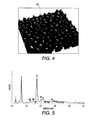
- FIG. 4 is a schematic showing structural surface features of an exemplary composite material in accordance with various embodiments of the present teachings.
- FIG. 5 depicts an energy dispersive spectroscopy (EDS) result for an exemplary composite material in accordance with various embodiments of the present teachings.
- EDS energy dispersive spectroscopy
- the composite material can include, e.g., silsesquioxane-based particles such as polyhedral oligomeric silsesquioxane (POSS) particles dispersed in a polymer matrix that includes one or more polymers such as fluoroelastomers.
- the composite material can include a first type of composite material that includes a physical dispersion and/or a chemical bond between the silsesquioxane-based particles and the polymers of the polymer matrix.
- the first type of composite material can further include carbon nanotubes dispersed in the polymer matrix. This type of composite material can be used as an outermost layer of a fixing member.
- the composite material can include a second type of composite material that includes functionalized silsesquioxane-based particles that are freely-migrateable within the polymer matrix in an amount to form structural surface features on at least one surface of the composite material.
- the structural surface features can be in a nano-, micro- and/or nano-micro- scale.
- carbon nanotubes can be optionally added to facilitate the formation of the structural surface features.
- the second type of composite material having structural surface features may be used as the outermost layer of a fixing member or may be used for other applications that require surface features. But when it is used for the fixing member, an oil-less fixing operation can be achieved without use of fuser oil due to presence of structural surface features.
- the polymer matrix can include, for example, one or more chemically or physically cross-linked polymers including fluorinated polymers (i.e., fluoropolymers), silicone elastomers, thermoelastomers, resins, thermosetting polymers or other cross-linked materials.
- the fluorinated polymers or the fluoropolymers can include, but are not limited to, fluoroelastomers (e.g., VITON®), polyperfluoroether elastomers, fluorocarbon, fluorinated thermoplastics including fluorinated polyethers, fluorinated polyimides, fluorinated polyetherketones, fluorinated polyamides, or fluorinated polyesters.
- fluoroelastomers e.g., VITON®
- polyperfluoroether elastomers e.g., VITON®
- polyperfluoroether elastomers e.g., VITON®
- fluorocarbon e.g., VITON®
- fluorinated thermoplastics including fluorinated polyethers, fluorinated polyimides, fluorinated polyetherketones, fluorinated polyamides, or fluorinated polyesters.
- the one or more cross-linked polymers can be semi-soft and
- the polymer matrix can include fluoroelastomers, e.g., having a monomeric repeat unit selected from the group consisting of vinylidene fluoride, hexafluoropropylene, tetrafluoroethylene, perfluoro(methyl vinyl ether), perfluoro(propyl vinyl ether), perfluoro(ethyl vinyl ether), and mixtures thereof.
- the fluoroelastomers can include cure site monomers to cure or cross link polymers chains of the fluoroelastomers.
- fluoroelastomer can include, for example, products under various designations as VITON® A (copolymers of hexafluoropropylene (HFP) and vinylidene fluoride (VDF or VF2)), VITON® B, (terpolymers of tetrafluoroethylene (TFE), vinylidene fluoride (VDF) and hexafluoropropylene (HFP)); and VITON® GF, (tetrapolymers including TFE, VF2, HFP), as well as VITON® E, VITON® E 60C, VITON® E430, VITON® 910, VITON® GH and/or VITON® GF.
- the VITON® designations are Trademarks of E.I. DuPont de Nemours, Inc. (Wilmington, DE).
- fluoroelastomer can include, for example, Dyneon TM fluoroelastomers from 3M Company (Two Harbors, MN). Additional commercially
- Aflas® a poly(propylene-tetrafluoroethylene) and Fluorel® II (LII900) a poly(propylene-tetrafluoroethylenevinylidenefluoride), both also available from 3M Company, as well as the Tecnoflons identified as For® -60KIR, For® --LHF, or -NM, For ® THF, For®-TFS, -TH, or -TN505, available from Solvay Solexis (Bollate, MI, Italy).
- the polymer matrix can include a vinylidene-fluoride-containing fluoroelastomer cross-linked with an effective curing agent (also referred to herein as a cross-linking agent, bonding agent, or cross-linker), that incudes, but is not limited to, a bisphenol compound, a diamino compound, an aminophenol compound, an amino-siloxane compound, an amino-silane and a phenol-silane compound.
- an effective curing agent also referred to herein as a cross-linking agent, bonding agent, or cross-linker
- An exemplary bisphenol cross-linker can include VITON® Curative No. 50 (VC-50) available from E. I. du Pont de Nemours, Inc.
- Curative VC-50 can contain Bisphenol-AF as a cross-linker and diphenylbenzylphosphonium chloride as an accelerator.
- Bisphenol-AF is also known as 4, 4'-(hexafluoroisopropylidene)diphenol.
- Cross-linked fluoropolymers can form elastomers that are relatively soft and display elastic properties.
- the polymer matrix can include VITON® GF (E. I. du Pont de Nemours, Inc., Wilmington, DE), including tetrafluoroethylene (TFE), hexafluoropropylene (HFP), vinylidene fluoride (VF2), and a brominated peroxide cure site.
- silsesquioxane-based particles can be dispersed in the polymer matrix that contains one or more polymers as described above.
- the silsesquioxane-based particles can be nanosized, e.g., having a size range of about 1000 nm (1 micron) or less.
- the silsesquioxane-based particles can have a nanoparticle size of from about 0.5 nm to about 5 nm, in some cases, from about 1 nm to about 2 nm.
- the silsesquioxane-based particles can be dispersed in, anchored on, or bonded to polymer chains of the polymer matrix.
- the silsesquioxane-based materials can be physically doped or chemically anchored into the polymer matrix of the composite material.
- a variety of silsesquioxane-based particles can be available through Aldrich (St. Louis, MO), Gelest (Morrisville, PA), or other companies.
- the silsesquioxane-based particles can be functionalized with side groups, which are also referred to as "functionalized silsesquioxane-based particles".
- the silsesquioxane-based particle can be an oligomer and can include linear or branched chains of silicon-oxygen bonds.
- the silicon atoms along the silsesquioxane oligomers can be substituted with functional groups, including, but not limited to, hydrogen, fluorine, alkyl, aryl, fluorocarbon functional groups or combinations thereof.
- the choices of functional groups can affect the properties of silsesquioxane-based particles and the functionalization of silsesquioxane-based particles can allow for flexibility to solubilize silsesquioxane-based particles for processing and improving compatibility with host systems such as host polymers, for example, fluoropolymers or specialized fluoropolymers such as fluoroelastomers.
- host systems such as host polymers, for example, fluoropolymers or specialized fluoropolymers such as fluoroelastomers.
- adding fluorinated groups to the silsesquioxane-based particles can result in a compatible particle-shell complex to evenly distribute particles throughout the polymer matrix.
- silsesquioxane-based particles functionalized with fluorinated groups can enhance oil-less release for low-oil fusing systems.
- the silsesquioxane-based particles can also be functionalized with, for example, siloxane groups, to enhance release in fusing systems.
- the silsesquioxane-based materials can be functionalized with hydrophobicity, for example, by use of alkyl, aryl, fluorinated alkyl, fluorinated aryl, perfluoroether, or combinations thereof.
- the silsesquioxane-based particles can further be functionalized with reactive groups that cross-link to polymer chains of the polymer matrix, and therefore, fixing the silsesquioxane-based particles within the matrix and/or cross-linking the polymer.
- the reactive groups can include, such as, for example, amino, siloxyl, or hydroxyphenyl groups being capable of covalently bonding to one or more polymer chains of the polymer matrix, or to one or more functional groups that are covalently attached to the one or more polymer chains.
- the functional groups can include bisphenol-A (BPA) and the functionalized silsesquioxane-based molecules can be capable of bonding directly to the exemplary fluoroelastomer chains and fixing the particles throughout the polymer matrix.
- the silsesquioxane-based particles can be polyhedral in shape and can be oligomeric, and can include polyhedral oligomeric silsesquioxane (POSS).
- POSS materials can be large, discrete molecules exhibiting properties of silica and silicone.
- the stiff, heat-resistant (Si 2 O 3 ) n inorganic core of POSS can increase the mechanical modulus, hardness and thermal stability of the polymer matrix. More specifically, when the silica-like polysilsesquioxane-based particles are used as an outermost layer for a fixing member, the hardness and thermal stability of the outer fuser layer can be increased and, accordingly, the durability of the fixing member can be increased.
- the silsesquioxane-based particles can have silicone-like character similar to polydimethylsiloxane (PDMS) fuser fluid used in known fusing systems, such as, for example, iGen machines.
- PDMS polydimethylsiloxane
- polyhedral shapes of POSS can include octagonal (T8), decagonal (T10), and/or (T12) cages, with the T8 structure most commonly formed.
- T8 octagonal
- T10 decagonal
- T12 triangular frameworks
- the formation of different frameworks of POSS structures can be controlled by factors in preparation, such as pH, temperature, solvent, and hydrolysis method.
- octahedral (T8) POSS can have the general formula Si 8 O 12 and the basic general polyhedral structure as shown in Formula I:
- R is a functional group selected from the group consisting of hydrogen, substituted or unsubstituted alkyl group having from about 1 to about 20 carbons, or from about 1 to about 10 carbons, such as methyl, ethyl, propyl, butyl, tertbutyl, isobutyl, and the like; a substituted or unsubstituted aryl group having from about 6 to about 60 carbons, or from about 6 to about 40 carbons, with the most common example being phenyl; a fluorinated alkyl group having from about 1 to about 30 carbons, or from about 1 to about 20 carbons, a fluorinated aryl group having from about 6 to about 60 carbons, or from about 6 to about 10 carbons; a substituted or unsubstituted siloxy group having from about 1 to about 30 carbons, such as siloxy, bisiloxy, and trisiloxy; an amino group having from about 1 to about 10 carbons, a hydroxyphenyl group having
- functional groups can be chosen to cap the POSS particles to enhance compatibility of POSS to the polymer matrix or the polymer coating composition during its preparation.
- side groups set forth above as R groups in Formula I can be alkyl, aryl, fluoroalkyl, and fluoroaryl groups.
- functional groups capping POSS cages can be different and can be represented by the following Formula II:
- R 1 can be a non-reactive functional group, such as a substituted or unsubstituted alkyl having from about 1 to about 20 carbons, or from about 1 to about 10 carbons, substituted or unsubstituted aryl having from about 6 to about 60 carbons, or from about 6 to about 10 carbons, fluorinated alkyl having from about 1 to about 30 carbons, or from about 1 to about 20 carbons, or fluorinated aryl group having from about 6 to about 60 carbons, or from about 6 to about 10 carbons; and R 2 can be a reactive group, such as a functional cross-linking group.
- a non-reactive functional group such as a substituted or unsubstituted alkyl having from about 1 to about 20 carbons, or from about 1 to about 10 carbons, substituted or unsubstituted aryl having from about 6 to about 60 carbons, or from about 6 to about 10 carbons, fluorinated alkyl having from about 1 to about 30 carbons, or
- POSS with Formula II can be normally formed from silanols that are incompletely condensed POSS frameworks missing one functionality-capped Si corner group. Silanols can be reacted with trialkoxysilane or trihalosilane to form POSS with Formula II.
- R 1 of Formula II can be a fluorinated group selected from a group consisting of a linear fluorinated alkyl chain with the formula F 3 C(F 2 C) n (CH 2 ) m -, wherein n can be a number from 0 to about 17, or from 0 to about 10, and m can be a number from 0 to about 4; a branched fluorinated alkyl chain having the formula (F 3 C) 2 (CH)(F 2 C) n (CH 2 ) m , wherein n can be a number from 0 to about 15, or from about 1 to about 10, and m can be a number from 0 to about 4; a linear perfluoroether chain with the formula F 3 C(F 2 C) n (CH 2 ) m O q , wherein n can be a number from 0 to about 17, or from 0 to about 10, and m can be a number from 0 to about 4, and
- R 2 of Formula II can include a reactive group or a functional cross-linking group capable of covalently bonding to one or more polymer chains of a polymer matrix, or may be covalently bonded to one or more functional groups that are covalently attached to polymer chains.
- Examples include, but are not limited to, functional groups including one or more of an amino group with the formula C n H 2n NH 2 or C n H 2n NHCH 2 CH 2 NH 2 , wherein n can be a number from 0 to about 10, or from about 2 to about 6; a siloxane group with a formula of C n H 2n SiX 3 , wherein n can be a number from 0 to about 30, or from about 2 to about 10, and X can be a halo or alkoxy group; and hydroxyphenyl groups such as bifunctional cross-linking groups with the formula (OH)(C n H 2n )C 6 H 3 C(CX 3 ) 2 C 6 H 3 (C n H 2n )(OH), wherein n can be a number from 0 to about 60, or from 2 to about 10, and X can be H or F.
- Specific examples of the functional cross-linking groups can be selected from the group consisting of the following:
- Formula II with corner capping of reactive functional groups can include heptaisobutyl (3-(2-aminoethyl)amino) propyl-PSS (see Formula A) from Aldrich (St. Louis, MO), wherein the amino functional group of A can be bound to a fluoropolymer matrix.
- precursors to Formula II can include (3-chloropropyl)-heptacyclopentyl-PSS (see Formula B1), chloropropyl-heptaisobutyl-PSS (see Formula B2), (4-chlorobenzyl)-heptacyclopentyl-PSS (see Formula C), and hydrido-heptacyclopentyl-PSS (see Formula D) from Aldrich (St. Louis, MO), wherein the chloro-functional groups of B1, B2, and C can be functionalized to amino, siloxyl, or hydroxyphenyl cross-linking groups. The hydrido functionality of D can be cross-linked by hydrosilation reactions.
- vinyl-functionalized cross-linking groups such as vinyl-substituted bisphenol A (BPA) can be directly linked to the POSS molecule to give the proposed material Formula E below. Since E is multifunctional, this type of material can also be used to cross-link fluoropolymer chains while incorporating POSS into the polymer matrix. Such POSS particles and the like can then serve, in various embodiments, as multiple purposes of cross-linker, reinforcer, and/or release agent.
- BPA vinyl-substituted bisphenol A
- functionalized POSS can include the following with POSS partially functionalized with BPA functional group or amino functional group.
- fluorinated chains to the cores of POSS can be carried out by acid- or base-catalyzed hydrolysis of commercially available silyl precursors such as trialkoxysilanes or trichlorosilanes that are functionalized with fluorinated chains, followed by condensation to form silsesquioxane cages.
- fluorinated POSS molecules can be prepared by acid-catalyzed hydrolysis of commercially available (3,3,3-trifluoropropyl) trichlorosilane, followed by condensation to form silsesquioxane cages as shown below.
- fluorinated POSS particles can be that they are relatively dense as compared to other substituted POSS particles, and can provide additional robustness to a reinforced fluoropolymer layer.
- Fluorinated POSS can also display very low surface energy that aids in the creation of a non-stick surface, i.e., a hydrophobic surface. This can, in turn, decrease the wetting of fuser fluid and improve release.
- Fluorinated POSS containing cross-linking groups can be accomplished by the synthesis of incompletely condensed fluorinated POSS containing reactive sites for functionalization, followed by the incorporation of functional groups, such as, for example, silyl amine groups, silyl phenol groups, or another group such as those set forth as R 2 in Formula II above, that bind to polymer chains. This procedure can fix fluorinated POSS nanoparticles within the fluoropolymer matrix. The incorporation of multiple cross-linking functionalities can allow the additional use of fluorinated POSS materials as fluoropolymer cross-linkers. Below is a schematic illustration of a fluorinated POSS functionalized with an amine cross-linking group.
- cross-linking agents can include a biphenol such as hydroquinone, a bisphenol such as bisphenol A (2,2-bis (4-hydroxyphenyl) propane) or bisphenol AF (2,2-bis (4-hydroxyphenyl) hexafluoropropane, (or in commercial formulations such as VC50 from DuPont Co., Wilmington, DE), an aminosilane such as AO700 (aminoethyl aminopropyl trimethoxysilane cross-linker from Gelest, Morrisville, PA), a diamine such as hexamethylenediamine, and a masked diamine such as N , N '-dicinnamylidene-1,6-hexanediamine.
- a biphenol such as hydroquinone
- a bisphenol such as bisphenol A (2,2-bis (4-hydroxyphenyl) propane) or bisphenol AF (2,2-bis (4-hydroxyphenyl) hexafluoropropane
- an aminosilane such as AO700
- a “masked” diamine refers to the coordination of functional groups to amine functionalities.
- a fluoropolymer can be dissolved in a solvent and a cross-linking agent can be added along with other components that enable cross-linking.
- carbon nanotubes may also be dispersed in the polymer matrix.
- carbon nanotubes can provide, for example, mechanical, electrical, and thermal functions to the composite material.
- the term “nanotubes” refers to elongated materials (including organic and inorganic materials) having at least one minor dimension, for example, width or diameter, about 100 nanometers or less.
- the term “nanotubes” can also include single wall carbon nanotubes (SWCNTs), and/or multi-wall carbon nanotubes (MWCNTs).
- the nanotubes can be modified/ functionalized nanotubes with controlled and/or increased mechanical, electrical or thermal properties through various physical and/or chemical modifications.
- the composite materials can be formed by coating a composition on a substrate.
- the coating composition can include, for example, one or more fluoropolymers, a plurality of silsesquioxane-based particles, and/or a plurality of carbon nanotubes dispersed in a solvent.
- the inorganic particles can include, but are not limited to, metal oxides, non-metal oxides, metals, or other suitable particles.
- the metal oxides can include, for example, silicon oxide, aluminum oxide, chromium oxide, zirconium oxide, zinc oxide, tin oxide, iron oxide, magnesium oxide, manganese oxide, nickel oxide, copper oxide, antimony pentoxide, indium tin oxide, and mixtures thereof.
- the non-metal oxides can include, for example, boron nitride, silicon carbides (SiC) and the like.
- the metals can include, for example, nickel, copper, silver, gold, zinc, iron and the like.
- other additives known to one of ordinary skill in the art can also be included in the coating composition.
- the coating composition or dispersion can be prepared to include, for example, an effective solvent, in order to disperse the silsesquioxane-based particles, the nanotubes, polymers and/or corresponding curing agents; and/or optionally, inorganic filler particles or surfactants known to one of the ordinary skill in the art.
- Effective solvents can include, but are not limited to, methyl isobutyl ketone (MIBK), acetone, methyl ethyl ketone (MEK), and mixtures thereof.
- MIBK methyl isobutyl ketone
- MEK methyl ethyl ketone
- Other solvents that can form suitable dispersions can be within the scope of the embodiments herein.
- the coating composition can be coated over a substrate.
- the substrate can be in a form including, but not limited to, a belt, plate, film, sheet, drum, drelt (cross between a belt and a drum), roller or other known form for a fuser member.
- the substrate to be coated can include a wide variety of materials, such as, for example, metals, metal alloys, rubbers, glass, ceramics, plastics, or fabrics.
- the metals used can include aluminum, anodized aluminum, steel, nickel, copper, and mixtures thereof
- the plastics used can include polyimides, polyester, polyetheretherketone (PEEK), poly(arylene ether)s, polyamides and mixtures thereof.
- one or more functional layers can be disposed between the substrate and the coated layer.
- Various coating techniques can be applied to form the disclosed composite material over the substrate.
- the coating techniques can include, but are not limited to, dip coating, painting, brush coating, roller coating, pad application, spray coating, spin coating, casting, or flow coating.
- a drying process can be performed and followed by a solidifying process, after the coating composition is applied on a desired surface.
- the coated member can be dried and then baked at a temperature, e.g., at a curing temperature of up to 232°C when VITON® is used as the host polymer for the polymer matrix of the composite material.
- the coated member can include various composite materials coated over the substrate, depending on the composition and/or coating conditions.
- a first type of composite material can include silsesquioxane-based particles and carbon nanotubes dispersed in a polymer matrix.
- a second type of composite material can include functionalized silsesquioxane-based particles dispersed in a polymer matrix and can have structural surface features.
- the coated member that includes the first and second type of composite materials can be used in an electrostatographic printing device or process and can be used as a fixing member including, for example, a fuser member, a pressure member, a heat member or a donor member.
- the composite materials can be used as an outermost layer of a fixing member.
- FIGS. 1A-1B depict exemplary fixing members 100A-B having an exemplary core substrate 110 in accordance with the present teachings. It should be readily apparent to one of ordinary skill in the art that the devices 100A-B depicted in FIGS. 1A-1B represent generalized schematic illustrations and that other components/ layers/ substrates can be added or existing components/ layers/ substrates can be removed or modified.
- the coated fixing members 100 A-B can be, for example, fuser rollers with one or more functional layers 120 and/or 130 formed on the core substrate 110.
- the core substrate 110 can take the form of a cylindrical tube or a solid cylindrical shaft.
- substrate forms e.g., a belt substrate, can be used to maintain rigidity and/or structural integrity of the coated member.
- the outermost layers 130 in FIG. 1A and in FIG. 1B can be a coated layer formed from a coating composition that contains polymers, silsesquioxane-based particles, and/or nanotubes in a suitable solvent.
- the coated layer can be formed directly on the substrate surface 110 (see 130 in FIG. 1A ) or can be formed on a functional layer 120 that is formed on the substrate surface 110 (see 130 in FIG. 1 B) .
- the fuser roll can have a 2-layer configuration having an intermediate layer, an adhesion layer and/or a resilient layer (e.g., a silicone rubber layer) used as the functional layer 120, disposed between the coated outermost layer 130 and the core substrate 110, such as a metal used in the related art.
- the outermost layer 130 can include the composite material that contains, for example, fluoroelastomers, silsesquioxane-based particles and/or carbon nanotubes
- the outermost layer 130 can allow for use of fluoroelastomers with desired processability and mechanical properties, for example, for fusing.
- the silsesquioxane-based particles can be in a range from about 3% to about 30% by weight of the outermost layer
- carbon nanotubes can be in a range from about 0.5% to about 25% by weight of the outermost layer.
- the addition of silsesquioxane-based particles can provide an increase in elastic modulus and/or toughness of the outermost layer, and can improve the durability, resulting in increased life time of the exemplary fuser member, without compromising the homogeneity of the material.
- the second type of composite material can include functionalized (e.g., fluorinated) silsesquioxane-based particles dispersed within a polymer matrix in an amount such that at least one surface of the composite material can include one or more structural surface features.
- the second type of composite material can optionally include nanotubes. When nanotubes are dispersed in the polymer matrix, they can be used to facilitate the formation of the structural surface features.
- the second type of composite material can also optionally include "seed" silsesquioxane-based particles, e.g., having reactive functional groups.
- the second type of composite material can be mechanically robust with structural surface features that modify the surface energy of the layer.
- the structural surface features can be regular or irregular and formed from, e.g., clusters of functionalized silsesquioxane-based particles that are migrated and/or aggregated from bulk to the surface of the material.
- the structural surface features can provide a desired surface wettability for the disclosed second type of composite material.
- the surface wettability can include, for example, hydrophobicity; ultra hydrophobicity and/or superhydrophobicity, to have a respective water contact angle of approximately 90° or greater; 120° or greater; and/or 150° or greater.
- the structural surface features can provide "lotus effect" for surface self-cleaning, where the surface exhibits superhydrophobicity.
- the surface features can be in nano- or micro- scale having various regular or irregular topographies, such as periodical and/or ordered nano-, micro-, or nano-micro- surface structures.
- the disclosed surface can have protrusive or intrusive features for providing desired surface wettability.
- about 50% at least of the surface features can have a height or a depth of from about 250 nm to about 15 m, and about 25% at least of the surface features can have a mean diameter of from about 250 nm to about 50 m.
- the disclosed silsesquioxane-based particles can prevent water from a complete touching. That is, the contact area of water to the surface (i.e., the solid-liquid interface area) can be reduced. The reduced contact surface area can result in a very low adhesion between the water and the structured surface.
- the surface features can have various cross-sectional shapes, such as, for example, square, rectangular, circle, star, or any other suitable shapes, which can provide desired surface wettability.
- the surface can have a roughness scale similar to that of a lotus leaf, which is superhydrophobic and has a water contact angle of about 170° or higher.
- the functionalized silsesquioxane-based particles for generating structural surface features can include suitable fluorine-containing silsesquioxane-based particles, such as fluorinated silsesquioxanes.
- suitable fluorine-containing silsesquioxane-based particles such as fluorinated silsesquioxanes.
- at least one of the side groups shown in Formula I can contain fluorine.
- the fluorinated functional groups can include, but are not limited to, a linear or branched fluorinated alkyl, a linear or branched perfluoroether and/or a fluorinated aryl group as disclosed herein.
- the functionalized fluorine-containing silsesquioxane-based particles can include side groups described for R 1 of Formula II as disclosed herein.
- the structural surface features can be produced by dispersing silsesquioxane-based particles in the outermost layer in an amount of about 5% or greater with no carbon nanotubes involved.
- carbon nanotubes can be added to facilitate migration of fluorine-containing silsesquioxane-based particles from the bulk to the surface of the second type of composite material.
- the structural surface features can be produced by dispersing carbon nanotubes of from about 0.5% to about 25% by weight of the polymer matrix and fluorine-containing silsesquioxane-based particles of about 5% or greater by weight of the polymer matrix.
- the addition of carbon nanotubes can modify mechanical properties of the exemplary fuser roll and mitigate fuser roll failure due to wear and due to the produced surface features caused by the silsesquioxane-based clusters.
- the addition of fluorine-containing silsesquioxane-based particles and/or carbon nanotubes can allow for hydrophobicity or ultra- / super-hydrophobicity at the surface, can lead to self-cleaning.
- Water droplets can efficiently roll off the surface.
- the self-cleaning can be extended to self-release at the fuser member surface, where toner components are prevented from adhering to the fusing surface, such as a paper substrate.
- the outermost coated layer can further include increased fluorinated content and lower surface energy, in addition to the surface features which improve self-release via hydrophobicity.
- FIG. 2 depicts an exemplary second type of composite material in accordance with the present teachings.
- the second type of composite material 200 can include, for example, functionalized silsesquioxane-based particles 232, such as functionalized POSS particles, dispersed in a polymer matrix 230, such as a fluoroelastomer matrix.
- the second type of composite material 200 can also include surface features 235.
- the polymer matrix 230 may or may not include carbon nanotubes (CNTs).
- the surface features 235 can be, for example, POSS clusters, due to the clustering (see 205) of POSS particles of the composite material.
- clusters can be primarily localized at the surface of the composite material 200 to form the surface features 235.
- the clustering and the surface localization of the functionalized silsesquioxane-based particles 232 can be generated due to energy minimization of low surface energy.
- the exemplary functionalized POSS particles can thus segregate from the bulk and migrate (see 205) to the surface.
- the POSS particles may clump together or agglomerate during the migration.
- the fluorinated silsesquioxane-based molecules can be functionalized with fluorocarbon chains so as to possess a very low surface energy.
- the fluorinated silsesquioxane-based molecules can be functionalized, e.g., around the POSS core, to render the composite material hydrophobic properties.
- fillers added in the bulk polymer matrix can modify chemical or physical interactions within the bulk matrix, and can be incorporated into the system to promote clustering of POSS and the formation of surface features.
- FIG. 3 depicts another embodiment of the second type of composite material in accordance with the present teachings.
- the second type of composite material 300 can include, for example, functionalized silsesquioxane-based particles 332, such as functionalized POSS particles, dispersed in a polymer matrix 330, such as a fluoroelastomer matrix.
- the second type of composite material 300 or the polymer matrix 330 can include surface features 335.
- the polymer matrix 330 may or may not include carbon nanotubes (CNTs).
- the composite material 300 can further include "seed” silsesquioxane-based particles 337 for the formation of silsesquioxane clusters throughout the composite material.
- the "seed” silsesquioxane-based particles 337 can include reactive sites, i.e., polymer binding groups that bind to or cross-link with the polymer chains of the composite material 300.
- the "seed” silsesquioxane-based particles 337 can be "fixed” within the polymer matrix 330 and used as seeds for particle migration through the bulk polymer matrix.
- the seed silsesquioxane-based particles 337 can be partially functionalized with BPA functional group or amino functional group as described herein.
- the seed silsesquioxane-based particles 337 can be fluorine-containing seed silsesquioxane-based particles with reactive sites or cross-linking groups.
- the seed silsesquioxane-based particles 337 can include those set forth in Formula II.
- the functionalized "seed" silsesquioxane-based particles 337 can be capable of bonding directly to the polymer chains, e.g., fluoroelastomer chains of the polymer matrix 330 and be capable of fixing the seed particles throughout the coated composite material 300.
- the surface features 335 can be "replenishable” on the fixing member as wearing of the fixing surface occurs due to the existence of the seed silsesquioxane-based particles 337.
- Fluorinated POSS molecules were prepared by the acid-catalyzed hydrolysis of commercially available (3,3,3-trifluoropropyl)trichlorosilane, followed by condensation to form silsesquioxane cages, as shown in the following:
- the coating composition included VITON® GF of 7pph VC-50 cross-linker of 1.5 pph, fluorinated POSS particles formed in Example 1 with various concentrations (e.g., 5% and 20% by weight of VITON® GF), MgO of 0.75 pph, and surfactant in MIBK solvent.
- VITON® fuser topcoats were prepared by pouring mixtures dispersed in MIBK, i.e., the coating composition, into moulds, allowing to dry, then heat-treating at standard VITON® curing temperatures up to 232°C.
- the CNT-containing coating compositions and resulting fuser topcoats were also prepared to include 3% CNTs having the fluorinated POSS of about 5% and about 10% respectively by weight of VITON® GF.
- VITON® composite material samples were prepared according to Example 2 to have 5% POSS; 20% POSS; 5% POSS plus 3% CNT; and 20% POSS plus 3% CNT, respectively.
- VITON® composite material/ outermost layer having 5% POSS with no CNTs involved the coating surface was observed to be rough, while no regular surface features were formed.
- the VITON® composite material displayed a surface with moderately spherical features of from about 40 m to about 50 m in size, interspersed with much smaller spherical features having a size of from about 5 m to about 10 m.
- VITON® composite material/ outermost layer having 5% POSS incorporated with 3% CNTs dramatic enhancement of the surface effect was observed displaying an abundance of from about 15 m to about 20 m uniform spherical surface features interspersed with spherical features having a low concentration of small dimensions of less than about 5 m.
- VITON® composite material/ outermost layer having 20% POSS incorporated with 3% CNTs uniform spherical features were observed to have much larger size of from about 40 m to about 50 m with a low concentration of small sized spherical features of from about 5 m to about 10 m, as exemplarily shown in FIG. 4 .
- FIG. 4 depicts a schematic showing the structural surface features 435 of the VITON® composite material having 20% POSS incorporated with 3% CNTs by weight of the polymer VITON®.
- the surface features were further analyzed by energy dispersive spectroscopy (EDS) to determine elemental content.
- EDS energy dispersive spectroscopy
- FIG. 5 depicts an exemplary energy dispersive spectroscopy EDS result for the VITON® composite material sample having 20% POSS incorporated with 3% CNTs by weight of the polymer VITON®.
- the average surface energy values for CNT-containing VITON® composite materials were lower.
- the VITON® composite material/ outermost layer having 5% POSS incorporated with 3% CNTs were observed to have a very low surface energy with a low concentration of small spherical features ( ⁇ 20 m) on the composite surface.
- This material provided similar structural surface features to a lotus leaf, which displays primary features of about 10 m in size and secondary features of about 1 m in size.
Landscapes
- Chemical & Material Sciences (AREA)
- Health & Medical Sciences (AREA)
- Chemical Kinetics & Catalysis (AREA)
- Medicinal Chemistry (AREA)
- Polymers & Plastics (AREA)
- Organic Chemistry (AREA)
- Physics & Mathematics (AREA)
- General Physics & Mathematics (AREA)
- Compositions Of Macromolecular Compounds (AREA)
- Fixing For Electrophotography (AREA)
- Laminated Bodies (AREA)
Abstract
Description
- The present teachings relate generally to composite materials and fixing members and, more particularly, to composite materials and fixing members that contain silsesquioxane-based particles and methods for their formation.
- In the electrostatographic/ electrophotographic printing process, a toner image can be fixed or fused upon a support (e.g., a paper sheet) using a fuser roll. Conventional fusing technologies apply release agents/ fuser oils to the fuser roll during the fusing operation, in order to maintain good release properties of the fuser roll. A variety of materials are used as surface layer materials of the fuser roll for toner releasing. For example, one type of surface layer materials includes fluoroelastomer, such as VITON® from E.I. DuPont de Nemours, Inc. (Wilmington, DE). This type of materials is used in conjunction with release agents, such as PDMS-based fuser oil.
- Another type of surface layer materials for toner releasing includes fluororesin, such as TEFLON® also from E.I. DuPont de Nemours, Inc. (Wilmington, DE). This type of material is desired for oil-less fusing with no release agent required. Problems arise, however, due to insufficient mechanical robustness of the Teflon coatings which can cause, for example, denting, cracking, and abrasion.
- Thus, there is a need to overcome these and other problems of the prior art and to provide composite materials used for fixing members rendering improved wear-/ heat-resistance, conformability, and/or good release without use of release agents at the fusing nip.
- According to various embodiments, the present teachings include a fixing member. The fixing member can include a substrate and an outermost layer formed over the substrate. In one embodiment, the outermost layer can include a first type of composite material including a plurality of silsesquioxane-based particles and a plurality of carbon nanotubes dispersed in a polymer matrix, wherein the silsesquioxane-based particles can be physically dispersed in the polymer matrix and/or can be chemically bonded to a polymer of the polymer matrix.
- According to various embodiments, the present teachings also include a second type of composite material. The second type of composite material can include, for example, a plurality of functionalized silsesquioxane-based particles dispersed in a polymer matrix in an amount, for example, about 5% or greater by weight of the polymer matrix, such that at least one surface of the composite material can include one or more structural surface features. The second type of composite material can also optionally include carbon nanotubes and/or "seed" silsesquioxane-based particles. In various embodiments, this type of composite material can be used as an outermost layer of a fixing member for an oil-less operation.
- According to various embodiments, the present teachings also include a method for making a fixing member. In this method, a coating composition can be formed, and applied to a substrate, and then heated to form an outermost layer of a fixing member. The coating composition and the formed outermost layer can include one or more polymers, silsesquioxane-based particles, and/or carbon nanotubes.
- Additional objects and advantages of the present teachings will be set forth in part in the description which follows, and in part will be obvious from the description, or may be learned by practice of the present teachings. The objects and advantages of the present teachings will be realized and attained by means of the elements and combinations particularly pointed out in the appended claims.
- It is to be understood that both the foregoing general description and the following detailed description are exemplary and explanatory only and are not restrictive of the present teachings, as claimed.
- The accompanying drawings, which are incorporated in and constitute a part of this specification, illustrate several embodiments of the present teachings and together with the description, serve to explain the principles of the present teachings.
-
FIGS. 1A-1B depict exemplary fixing members having composite materials as outermost layers in accordance with various embodiments of the present teachings. -
FIG. 2 depicts an exemplary composite material in accordance with various embodiments of the present teachings. -
FIG. 3 depicts another exemplary composite material in accordance with various embodiments of the present teachings. -
FIG. 4 is a schematic showing structural surface features of an exemplary composite material in accordance with various embodiments of the present teachings. -
FIG. 5 depicts an energy dispersive spectroscopy (EDS) result for an exemplary composite material in accordance with various embodiments of the present teachings. - Reference will now be made in detail to embodiments of the present teachings, examples of which are illustrated in the accompanying drawings. Wherever possible, the same reference numbers will be used throughout the drawings to refer to the same or like parts.
- Exemplary embodiments provide composite materials and fixing members and methods for their formation. The composite material can include, e.g., silsesquioxane-based particles such as polyhedral oligomeric silsesquioxane (POSS) particles dispersed in a polymer matrix that includes one or more polymers such as fluoroelastomers. In some embodiments, the composite material can include a first type of composite material that includes a physical dispersion and/or a chemical bond between the silsesquioxane-based particles and the polymers of the polymer matrix. The first type of composite material can further include carbon nanotubes dispersed in the polymer matrix. This type of composite material can be used as an outermost layer of a fixing member.
- In other embodiments, the composite material can include a second type of composite material that includes functionalized silsesquioxane-based particles that are freely-migrateable within the polymer matrix in an amount to form structural surface features on at least one surface of the composite material. The structural surface features can be in a nano-, micro- and/or nano-micro- scale. In various embodiments, carbon nanotubes can be optionally added to facilitate the formation of the structural surface features. In various embodiments, the second type of composite material having structural surface features may be used as the outermost layer of a fixing member or may be used for other applications that require surface features. But when it is used for the fixing member, an oil-less fixing operation can be achieved without use of fuser oil due to presence of structural surface features.
- As disclosed herein, the polymer matrix can include, for example, one or more chemically or physically cross-linked polymers including fluorinated polymers (i.e., fluoropolymers), silicone elastomers, thermoelastomers, resins, thermosetting polymers or other cross-linked materials.
- In various embodiments, the fluorinated polymers or the fluoropolymers can include, but are not limited to, fluoroelastomers (e.g., VITON®), polyperfluoroether elastomers, fluorocarbon, fluorinated thermoplastics including fluorinated polyethers, fluorinated polyimides, fluorinated polyetherketones, fluorinated polyamides, or fluorinated polyesters. In various embodiments, the one or more cross-linked polymers can be semi-soft and/or molten to mix with the silsesquioxane-based particles and/or nanotubes.
- In various embodiments, the polymer matrix can include fluoroelastomers, e.g., having a monomeric repeat unit selected from the group consisting of vinylidene fluoride, hexafluoropropylene, tetrafluoroethylene, perfluoro(methyl vinyl ether), perfluoro(propyl vinyl ether), perfluoro(ethyl vinyl ether), and mixtures thereof. In addition, the fluoroelastomers can include cure site monomers to cure or cross link polymers chains of the fluoroelastomers.
- Commercially available fluoroelastomer can include, for example, products under various designations as VITON® A (copolymers of hexafluoropropylene (HFP) and vinylidene fluoride (VDF or VF2)), VITON® B, (terpolymers of tetrafluoroethylene (TFE), vinylidene fluoride (VDF) and hexafluoropropylene (HFP)); and VITON® GF, (tetrapolymers including TFE, VF2, HFP), as well as VITON® E, VITON® E 60C, VITON® E430, VITON® 910, VITON® GH and/or VITON® GF. The VITON® designations are Trademarks of E.I. DuPont de Nemours, Inc. (Wilmington, DE).
- Other commercially available fluoroelastomer can include, for example, Dyneon™ fluoroelastomers from 3M Company (Two Harbors, MN). Additional commercially
- available materials can include Aflas® a poly(propylene-tetrafluoroethylene) and Fluorel® II (LII900) a poly(propylene-tetrafluoroethylenevinylidenefluoride), both also available from 3M Company, as well as the Tecnoflons identified as For® -60KIR, For® --LHF, or -NM, For ® THF, For®-TFS, -TH, or -TN505, available from Solvay Solexis (Bollate, MI, Italy).
- In one exemplary embodiment, the polymer matrix can include a vinylidene-fluoride-containing fluoroelastomer cross-linked with an effective curing agent (also referred to herein as a cross-linking agent, bonding agent, or cross-linker), that incudes, but is not limited to, a bisphenol compound, a diamino compound, an aminophenol compound, an amino-siloxane compound, an amino-silane and a phenol-silane compound.
- An exemplary bisphenol cross-linker can include VITON® Curative No. 50 (VC-50) available from E. I. du Pont de Nemours, Inc. Curative VC-50 can contain Bisphenol-AF as a cross-linker and diphenylbenzylphosphonium chloride as an accelerator. Bisphenol-AF is also known as 4, 4'-(hexafluoroisopropylidene)diphenol.
- Cross-linked fluoropolymers can form elastomers that are relatively soft and display elastic properties. In a specific embodiment, the polymer matrix can include VITON® GF (E. I. du Pont de Nemours, Inc., Wilmington, DE), including tetrafluoroethylene (TFE), hexafluoropropylene (HFP), vinylidene fluoride (VF2), and a brominated peroxide cure site.
- As disclosed herein, silsesquioxane-based particles can be dispersed in the polymer matrix that contains one or more polymers as described above.
- In various embodiments, the silsesquioxane-based particles can be nanosized, e.g., having a size range of about 1000 nm (1 micron) or less. For example, the silsesquioxane-based particles can have a nanoparticle size of from about 0.5 nm to about 5 nm, in some cases, from about 1 nm to about 2 nm. In various embodiments, the silsesquioxane-based particles can be dispersed in, anchored on, or bonded to polymer chains of the polymer matrix. In other embodiments, the silsesquioxane-based materials can be physically doped or chemically anchored into the polymer matrix of the composite material. In various embodiments, a variety of silsesquioxane-based particles can be available through Aldrich (St. Louis, MO), Gelest (Morrisville, PA), or other companies.
- The silsesquioxane-based particles can be functionalized with side groups, which are also referred to as "functionalized silsesquioxane-based particles". For example, the silsesquioxane-based particle can be an oligomer and can include linear or branched chains of silicon-oxygen bonds. The silicon atoms along the silsesquioxane oligomers can be substituted with functional groups, including, but not limited to, hydrogen, fluorine, alkyl, aryl, fluorocarbon functional groups or combinations thereof. The choices of functional groups can affect the properties of silsesquioxane-based particles and the functionalization of silsesquioxane-based particles can allow for flexibility to solubilize silsesquioxane-based particles for processing and improving compatibility with host systems such as host polymers, for example, fluoropolymers or specialized fluoropolymers such as fluoroelastomers.
- In various embodiments, adding fluorinated groups to the silsesquioxane-based particles can result in a compatible particle-shell complex to evenly distribute particles throughout the polymer matrix. In addition, silsesquioxane-based particles functionalized with fluorinated groups can enhance oil-less release for low-oil fusing systems. In various embodiments, the silsesquioxane-based particles can also be functionalized with, for example, siloxane groups, to enhance release in fusing systems. In various embodiments, the silsesquioxane-based materials can be functionalized with hydrophobicity, for example, by use of alkyl, aryl, fluorinated alkyl, fluorinated aryl, perfluoroether, or combinations thereof.
- These functional groups described above can promote particle migration of the silsesquioxane-based material from the bulk to the surface of the composite material due to low surface energy of such functionalized particles.
- In various embodiments, the silsesquioxane-based particles can further be functionalized with reactive groups that cross-link to polymer chains of the polymer matrix, and therefore, fixing the silsesquioxane-based particles within the matrix and/or cross-linking the polymer. The reactive groups can include, such as, for example, amino, siloxyl, or hydroxyphenyl groups being capable of covalently bonding to one or more polymer chains of the polymer matrix, or to one or more functional groups that are covalently attached to the one or more polymer chains. In an exemplary embodiment, the functional groups can include bisphenol-A (BPA) and the functionalized silsesquioxane-based molecules can be capable of bonding directly to the exemplary fluoroelastomer chains and fixing the particles throughout the polymer matrix.
- In various embodiments, the silsesquioxane-based particles can be polyhedral in shape and can be oligomeric, and can include polyhedral oligomeric silsesquioxane (POSS). Specifically, the POSS materials can be large, discrete molecules exhibiting properties of silica and silicone. The stiff, heat-resistant (Si2O3)n inorganic core of POSS can increase the mechanical modulus, hardness and thermal stability of the polymer matrix. More specifically, when the silica-like polysilsesquioxane-based particles are used as an outermost layer for a fixing member, the hardness and thermal stability of the outer fuser layer can be increased and, accordingly, the durability of the fixing member can be increased. In addition, the silsesquioxane-based particles can have silicone-like character similar to polydimethylsiloxane (PDMS) fuser fluid used in known fusing systems, such as, for example, iGen machines.
- In various embodiments, polyhedral shapes of POSS can include octagonal (T8), decagonal (T10), and/or (T12) cages, with the T8 structure most commonly formed. The formation of different frameworks of POSS structures can be controlled by factors in preparation, such as pH, temperature, solvent, and hydrolysis method.
- For example, octahedral (T8) POSS can have the general formula Si8O12 and the basic general polyhedral structure as shown in Formula I:

- Wherein R is a functional group selected from the group consisting of hydrogen, substituted or unsubstituted alkyl group having from about 1 to about 20 carbons, or from about 1 to about 10 carbons, such as methyl, ethyl, propyl, butyl, tertbutyl, isobutyl, and the like; a substituted or unsubstituted aryl group having from about 6 to about 60 carbons, or from about 6 to about 40 carbons, with the most common example being phenyl; a fluorinated alkyl group having from about 1 to about 30 carbons, or from about 1 to about 20 carbons, a fluorinated aryl group having from about 6 to about 60 carbons, or from about 6 to about 10 carbons; a substituted or unsubstituted siloxy group having from about 1 to about 30 carbons, such as siloxy, bisiloxy, and trisiloxy; an amino group having from about 1 to about 10 carbons, a hydroxyphenyl group having from about 6 to about 60 carbons; and mixtures thereof, wherein substituted groups can be amino groups, halogen groups (such as chlorine, bromine, fluorine, and the like), hydroxyl groups, or other groups.
- In various embodiments, functional groups can be chosen to cap the POSS particles to enhance compatibility of POSS to the polymer matrix or the polymer coating composition during its preparation. Examples of side groups set forth above as R groups in Formula I can be alkyl, aryl, fluoroalkyl, and fluoroaryl groups.
- In various embodiments, functional groups capping POSS cages can be different and can be represented by the following Formula II:

- Wherein R1 can be a non-reactive functional group, such as a substituted or unsubstituted alkyl having from about 1 to about 20 carbons, or from about 1 to about 10 carbons, substituted or unsubstituted aryl having from about 6 to about 60 carbons, or from about 6 to about 10 carbons, fluorinated alkyl having from about 1 to about 30 carbons, or from about 1 to about 20 carbons, or fluorinated aryl group having from about 6 to about 60 carbons, or from about 6 to about 10 carbons; and R2 can be a reactive group, such as a functional cross-linking group. POSS with Formula II can be normally formed from silanols that are incompletely condensed POSS frameworks missing one functionality-capped Si corner group. Silanols can be reacted with trialkoxysilane or trihalosilane to form POSS with Formula II.
- In various embodiments, R1 of Formula II (or R of Formula I) can be a fluorinated group selected from a group consisting of a linear fluorinated alkyl chain with the formula F3C(F2C)n(CH2)m-, wherein n can be a number from 0 to about 17, or from 0 to about 10, and m can be a number from 0 to about 4; a branched fluorinated alkyl chain having the formula (F3C)2(CH)(F2C)n(CH2)m, wherein n can be a number from 0 to about 15, or from about 1 to about 10, and m can be a number from 0 to about 4; a linear perfluoroether chain with the formula F3C(F2C)n(CH2)mOq, wherein n can be a number from 0 to about 17, or from 0 to about 10, and m can be a number from 0 to about 4, and q can be a number from about 1 to about 10, or from about 1 to about 3; a branched perfluoroether chain with the formula (F3C)2(CH)(F2C)n(CH2)mOq, wherein n can be a number from 0 to about 17, or from 0 to about 10, and m can be a number from 0 to about 4, and q can be a number from about 1 to about 10, or from about 1 to about 3; and a fluorinated aryl group with the formula CnFn-1, wherein n can be a number from about 5 to about 10. Examples of fluorinated alkyl and aryl groups can include, but are not limited to, the following:

- In various embodiments, R2 of Formula II can include a reactive group or a functional cross-linking group capable of covalently bonding to one or more polymer chains of a polymer matrix, or may be covalently bonded to one or more functional groups that are covalently attached to polymer chains. Examples include, but are not limited to, functional groups including one or more of an amino group with the formula CnH2nNH2 or CnH2nNHCH2CH2NH2, wherein n can be a number from 0 to about 10, or from about 2 to about 6; a siloxane group with a formula of CnH2nSiX3, wherein n can be a number from 0 to about 30, or from about 2 to about 10, and X can be a halo or alkoxy group; and hydroxyphenyl groups such as bifunctional cross-linking groups with the formula (OH)(CnH2n)C6H3C(CX3)2C6H3(CnH2n)(OH), wherein n can be a number from 0 to about 60, or from 2 to about 10, and X can be H or F. Specific examples of the functional cross-linking groups can be selected from the group consisting of the following:

- Commercially available examples of Formula II with corner capping of reactive functional groups can include heptaisobutyl (3-(2-aminoethyl)amino) propyl-PSS (see Formula A) from Aldrich (St. Louis, MO), wherein the amino functional group of A can be bound to a fluoropolymer matrix. Commercially available precursors to Formula II can include (3-chloropropyl)-heptacyclopentyl-PSS (see Formula B1), chloropropyl-heptaisobutyl-PSS (see Formula B2), (4-chlorobenzyl)-heptacyclopentyl-PSS (see Formula C), and hydrido-heptacyclopentyl-PSS (see Formula D) from Aldrich (St. Louis, MO), wherein the chloro-functional groups of B1, B2, and C can be functionalized to amino, siloxyl, or hydroxyphenyl cross-linking groups. The hydrido functionality of D can be cross-linked by hydrosilation reactions. Therefore, vinyl-functionalized cross-linking groups such as vinyl-substituted bisphenol A (BPA) can be directly linked to the POSS molecule to give the proposed material Formula E below. Since E is multifunctional, this type of material can also be used to cross-link fluoropolymer chains while incorporating POSS into the polymer matrix. Such POSS particles and the like can then serve, in various embodiments, as multiple purposes of cross-linker, reinforcer, and/or release agent.

- Other embodiments of functionalized POSS can include the following with POSS partially functionalized with BPA functional group or amino functional group.

- In various embodiments, the addition of fluorinated chains to the cores of POSS can be carried out by acid- or base-catalyzed hydrolysis of commercially available silyl precursors such as trialkoxysilanes or trichlorosilanes that are functionalized with fluorinated chains, followed by condensation to form silsesquioxane cages. In one embodiment, fluorinated POSS molecules can be prepared by acid-catalyzed hydrolysis of commercially available (3,3,3-trifluoropropyl) trichlorosilane, followed by condensation to form silsesquioxane cages as shown below.

- Advantages of fluorinated POSS particles can be that they are relatively dense as compared to other substituted POSS particles, and can provide additional robustness to a reinforced fluoropolymer layer. Fluorinated POSS can also display very low surface energy that aids in the creation of a non-stick surface, i.e., a hydrophobic surface. This can, in turn, decrease the wetting of fuser fluid and improve release.
- Fluorinated POSS containing cross-linking groups can be accomplished by the synthesis of incompletely condensed fluorinated POSS containing reactive sites for functionalization, followed by the incorporation of functional groups, such as, for example, silyl amine groups, silyl phenol groups, or another group such as those set forth as R2 in Formula II above, that bind to polymer chains. This procedure can fix fluorinated POSS nanoparticles within the fluoropolymer matrix. The incorporation of multiple cross-linking functionalities can allow the additional use of fluorinated POSS materials as fluoropolymer cross-linkers. Below is a schematic illustration of a fluorinated POSS functionalized with an amine cross-linking group.

- Examples of cross-linking agents can include a biphenol such as hydroquinone, a bisphenol such as bisphenol A (2,2-bis (4-hydroxyphenyl) propane) or bisphenol AF (2,2-bis (4-hydroxyphenyl) hexafluoropropane, (or in commercial formulations such as VC50 from DuPont Co., Wilmington, DE), an aminosilane such as AO700 (aminoethyl aminopropyl trimethoxysilane cross-linker from Gelest, Morrisville, PA), a diamine such as hexamethylenediamine, and a masked diamine such as N,N'-dicinnamylidene-1,6-hexanediamine. A "masked" diamine refers to the coordination of functional groups to amine functionalities. In various embodiments, a fluoropolymer can be dissolved in a solvent and a cross-linking agent can be added along with other components that enable cross-linking.
- As disclosed herein, carbon nanotubes may also be dispersed in the polymer matrix. Generally, carbon nanotubes can provide, for example, mechanical, electrical, and thermal functions to the composite material. As used herein and unless otherwise specified, the term "nanotubes" refers to elongated materials (including organic and inorganic materials) having at least one minor dimension, for example, width or diameter, about 100 nanometers or less. In various embodiments, the term "nanotubes" can also include single wall carbon nanotubes (SWCNTs), and/or multi-wall carbon nanotubes (MWCNTs). In addition, the nanotubes can be modified/ functionalized nanotubes with controlled and/or increased mechanical, electrical or thermal properties through various physical and/or chemical modifications.
- In various embodiments, the composite materials can be formed by coating a composition on a substrate. The coating composition can include, for example, one or more fluoropolymers, a plurality of silsesquioxane-based particles, and/or a plurality of carbon nanotubes dispersed in a solvent.
- In various embodiments, other fillers, such as inorganic particles, can be optionally added to the coating composition. In various embodiments, the inorganic particles can include, but are not limited to, metal oxides, non-metal oxides, metals, or other suitable particles. Specifically, the metal oxides can include, for example, silicon oxide, aluminum oxide, chromium oxide, zirconium oxide, zinc oxide, tin oxide, iron oxide, magnesium oxide, manganese oxide, nickel oxide, copper oxide, antimony pentoxide, indium tin oxide, and mixtures thereof. The non-metal oxides can include, for example, boron nitride, silicon carbides (SiC) and the like. The metals can include, for example, nickel, copper, silver, gold, zinc, iron and the like. In various embodiments, other additives known to one of ordinary skill in the art can also be included in the coating composition.
- The coating composition or dispersion can be prepared to include, for example, an effective solvent, in order to disperse the silsesquioxane-based particles, the nanotubes, polymers and/or corresponding curing agents; and/or optionally, inorganic filler particles or surfactants known to one of the ordinary skill in the art. Effective solvents can include, but are not limited to, methyl isobutyl ketone (MIBK), acetone, methyl ethyl ketone (MEK), and mixtures thereof. Other solvents that can form suitable dispersions can be within the scope of the embodiments herein.
- The coating composition can be coated over a substrate. The substrate can be in a form including, but not limited to, a belt, plate, film, sheet, drum, drelt (cross between a belt and a drum), roller or other known form for a fuser member. In various embodiments, the substrate to be coated can include a wide variety of materials, such as, for example, metals, metal alloys, rubbers, glass, ceramics, plastics, or fabrics. For example, the metals used can include aluminum, anodized aluminum, steel, nickel, copper, and mixtures thereof, while the plastics used can include polyimides, polyester, polyetheretherketone (PEEK), poly(arylene ether)s, polyamides and mixtures thereof. In various embodiments, one or more functional layers can be disposed between the substrate and the coated layer.
- Various coating techniques can be applied to form the disclosed composite material over the substrate. The coating techniques can include, but are not limited to, dip coating, painting, brush coating, roller coating, pad application, spray coating, spin coating, casting, or flow coating. In various embodiments, a drying process can be performed and followed by a solidifying process, after the coating composition is applied on a desired surface. For example, the coated member can be dried and then baked at a temperature, e.g., at a curing temperature of up to 232°C when VITON® is used as the host polymer for the polymer matrix of the composite material.
- The coated member can include various composite materials coated over the substrate, depending on the composition and/or coating conditions. For example, a first type of composite material can include silsesquioxane-based particles and carbon nanotubes dispersed in a polymer matrix. A second type of composite material can include functionalized silsesquioxane-based particles dispersed in a polymer matrix and can have structural surface features.
- In various embodiments, the coated member that includes the first and second type of composite materials can be used in an electrostatographic printing device or process and can be used as a fixing member including, for example, a fuser member, a pressure member, a heat member or a donor member. For example, the composite materials can be used as an outermost layer of a fixing member.
-
FIGS. 1A-1B depict exemplary fixing members 100A-B having anexemplary core substrate 110 in accordance with the present teachings. It should be readily apparent to one of ordinary skill in the art that the devices 100A-B depicted inFIGS. 1A-1B represent generalized schematic illustrations and that other components/ layers/ substrates can be added or existing components/ layers/ substrates can be removed or modified. - The coated fixing members 100 A-B can be, for example, fuser rollers with one or more
functional layers 120 and/or 130 formed on thecore substrate 110. In various embodiments, thecore substrate 110 can take the form of a cylindrical tube or a solid cylindrical shaft. One of ordinary skill in the art will understand that other substrate forms, e.g., a belt substrate, can be used to maintain rigidity and/or structural integrity of the coated member. - As shown, the
outermost layers 130 inFIG. 1A and in FIG. 1B can be a coated layer formed from a coating composition that contains polymers, silsesquioxane-based particles, and/or nanotubes in a suitable solvent. The coated layer can be formed directly on the substrate surface 110 (see 130 inFIG. 1A ) or can be formed on afunctional layer 120 that is formed on the substrate surface 110 (see 130 inFIG. 1 B) . For example, the fuser roll can have a 2-layer configuration having an intermediate layer, an adhesion layer and/or a resilient layer (e.g., a silicone rubber layer) used as thefunctional layer 120, disposed between the coatedoutermost layer 130 and thecore substrate 110, such as a metal used in the related art. - In one embodiment, because the
outermost layer 130 can include the composite material that contains, for example, fluoroelastomers, silsesquioxane-based particles and/or carbon nanotubes, theoutermost layer 130 can allow for use of fluoroelastomers with desired processability and mechanical properties, for example, for fusing. In an exemplary embodiment, the silsesquioxane-based particles can be in a range from about 3% to about 30% by weight of the outermost layer, and carbon nanotubes can be in a range from about 0.5% to about 25% by weight of the outermost layer. - In various embodiments, the addition of silsesquioxane-based particles can provide an increase in elastic modulus and/or toughness of the outermost layer, and can improve the durability, resulting in increased life time of the exemplary fuser member, without compromising the homogeneity of the material.
- As disclosed herein, the second type of composite material can include functionalized (e.g., fluorinated) silsesquioxane-based particles dispersed within a polymer matrix in an amount such that at least one surface of the composite material can include one or more structural surface features. In various embodiments, the second type of composite material can optionally include nanotubes. When nanotubes are dispersed in the polymer matrix, they can be used to facilitate the formation of the structural surface features. In various embodiments, the second type of composite material can also optionally include "seed" silsesquioxane-based particles, e.g., having reactive functional groups.
- In one embodiment, the second type of composite material can be mechanically robust with structural surface features that modify the surface energy of the layer. In various embodiments, the structural surface features can be regular or irregular and formed from, e.g., clusters of functionalized silsesquioxane-based particles that are migrated and/or aggregated from bulk to the surface of the material.
- The structural surface features can provide a desired surface wettability for the disclosed second type of composite material. The surface wettability can include, for example, hydrophobicity; ultra hydrophobicity and/or superhydrophobicity, to have a respective water contact angle of approximately 90° or greater; 120° or greater; and/or 150° or greater. For example, the structural surface features can provide "lotus effect" for surface self-cleaning, where the surface exhibits superhydrophobicity.
- In one embodiment, the surface features can be in nano- or micro- scale having various regular or irregular topographies, such as periodical and/or ordered nano-, micro-, or nano-micro- surface structures. For example, the disclosed surface can have protrusive or intrusive features for providing desired surface wettability. In an exemplary embodiment, about 50% at least of the surface features can have a height or a depth of from about 250 nm to about 15 m, and about 25% at least of the surface features can have a mean diameter of from about 250 nm to about 50 m.
- In various embodiments, the disclosed silsesquioxane-based particles can prevent water from a complete touching. That is, the contact area of water to the surface (i.e., the solid-liquid interface area) can be reduced. The reduced contact surface area can result in a very low adhesion between the water and the structured surface.
- In various embodiments, the surface features can have various cross-sectional shapes, such as, for example, square, rectangular, circle, star, or any other suitable shapes, which can provide desired surface wettability. In an exemplary embodiment, the surface can have a roughness scale similar to that of a lotus leaf, which is superhydrophobic and has a water contact angle of about 170° or higher.
- In various embodiments, the functionalized silsesquioxane-based particles for generating structural surface features, such as POSS clusters, can include suitable fluorine-containing silsesquioxane-based particles, such as fluorinated silsesquioxanes. In one embodiment, referring back to Formula I using Octahedral (T8) POSS as an example for the fluorinated silsesquioxanes, at least one of the side groups shown in Formula I can contain fluorine. In various embodiments, the fluorinated functional groups can include, but are not limited to, a linear or branched fluorinated alkyl, a linear or branched perfluoroether and/or a fluorinated aryl group as disclosed herein. In various embodiments, the functionalized fluorine-containing silsesquioxane-based particles can include side groups described for R1 of Formula II as disclosed herein.
- In one embodiment, the structural surface features can be produced by dispersing silsesquioxane-based particles in the outermost layer in an amount of about 5% or greater with no carbon nanotubes involved.
- In another embodiment, carbon nanotubes can be added to facilitate migration of fluorine-containing silsesquioxane-based particles from the bulk to the surface of the second type of composite material. In this case, the structural surface features can be produced by dispersing carbon nanotubes of from about 0.5% to about 25% by weight of the polymer matrix and fluorine-containing silsesquioxane-based particles of about 5% or greater by weight of the polymer matrix. Further, the addition of carbon nanotubes can modify mechanical properties of the exemplary fuser roll and mitigate fuser roll failure due to wear and due to the produced surface features caused by the silsesquioxane-based clusters.
- In this manner, the addition of fluorine-containing silsesquioxane-based particles and/or carbon nanotubes can allow for hydrophobicity or ultra- / super-hydrophobicity at the surface, can lead to self-cleaning. Water droplets can efficiently roll off the surface. The self-cleaning can be extended to self-release at the fuser member surface, where toner components are prevented from adhering to the fusing surface, such as a paper substrate. In various embodiments, the outermost coated layer can further include increased fluorinated content and lower surface energy, in addition to the surface features which improve self-release via hydrophobicity.
-
FIG. 2 depicts an exemplary second type of composite material in accordance with the present teachings. As shown, the second type ofcomposite material 200 can include, for example, functionalized silsesquioxane-basedparticles 232, such as functionalized POSS particles, dispersed in apolymer matrix 230, such as a fluoroelastomer matrix. The second type ofcomposite material 200 can also include surface features 235. In various embodiments, thepolymer matrix 230 may or may not include carbon nanotubes (CNTs). - The surface features 235 can be, for example, POSS clusters, due to the clustering (see 205) of POSS particles of the composite material. With the incorporation of freely-migrating functionalized silsesquioxane-based particles 232 (e.g., fluorinated POSS) to the
polymer matrix 230, clusters can be primarily localized at the surface of thecomposite material 200 to form the surface features 235. - Although not intending to be bound to any particular theory, it is believed that the clustering and the surface localization of the functionalized silsesquioxane-based
particles 232 can be generated due to energy minimization of low surface energy. The exemplary functionalized POSS particles can thus segregate from the bulk and migrate (see 205) to the surface. In various embodiments, the POSS particles may clump together or agglomerate during the migration. In one example, the fluorinated silsesquioxane-based molecules can be functionalized with fluorocarbon chains so as to possess a very low surface energy. In another example, the fluorinated silsesquioxane-based molecules can be functionalized, e.g., around the POSS core, to render the composite material hydrophobic properties. In an additional example, other fillers added in the bulk polymer matrix (e.g., fluoroelastomer) as disclosed herein can modify chemical or physical interactions within the bulk matrix, and can be incorporated into the system to promote clustering of POSS and the formation of surface features. -
FIG. 3 depicts another embodiment of the second type of composite material in accordance with the present teachings. As shown, the second type ofcomposite material 300 can include, for example, functionalized silsesquioxane-basedparticles 332, such as functionalized POSS particles, dispersed in apolymer matrix 330, such as a fluoroelastomer matrix. The second type ofcomposite material 300 or thepolymer matrix 330 can include surface features 335. In various embodiments, thepolymer matrix 330 may or may not include carbon nanotubes (CNTs). - In various embodiments, the
composite material 300 can further include "seed" silsesquioxane-basedparticles 337 for the formation of silsesquioxane clusters throughout the composite material. - The "seed" silsesquioxane-based
particles 337 can include reactive sites, i.e., polymer binding groups that bind to or cross-link with the polymer chains of thecomposite material 300. In various embodiments, the "seed" silsesquioxane-basedparticles 337 can be "fixed" within thepolymer matrix 330 and used as seeds for particle migration through the bulk polymer matrix. For example, the seed silsesquioxane-basedparticles 337 can be partially functionalized with BPA functional group or amino functional group as described herein. In various embodiments, the seed silsesquioxane-basedparticles 337 can be fluorine-containing seed silsesquioxane-based particles with reactive sites or cross-linking groups. In various embodiments, the seed silsesquioxane-basedparticles 337 can include those set forth in Formula II. - In this manner, the functionalized "seed" silsesquioxane-based
particles 337 can be capable of bonding directly to the polymer chains, e.g., fluoroelastomer chains of thepolymer matrix 330 and be capable of fixing the seed particles throughout the coatedcomposite material 300. As compared with thecomposite material 200 shown inFIG. 2 having surface cluster localization, the surface features 335 can be "replenishable" on the fixing member as wearing of the fixing surface occurs due to the existence of the seed silsesquioxane-basedparticles 337. - EXAMPLES
- Example 1 - Preparation of Fluorinated POSS
- Fluorinated POSS molecules were prepared by the acid-catalyzed hydrolysis of commercially available (3,3,3-trifluoropropyl)trichlorosilane, followed by condensation to form silsesquioxane cages, as shown in the following:

- The molecular structure was confirmed by 1H, 13C, 19F, and 29Si NMR spectroscopy in deuterated acetone.
- Example 2 - Preparation of Coating Composition and Fuser Topcoat Layer
- In this example, the coating composition included VITON® GF of 7pph VC-50 cross-linker of 1.5 pph, fluorinated POSS particles formed in Example 1 with various concentrations (e.g., 5% and 20% by weight of VITON® GF), MgO of 0.75 pph, and surfactant in MIBK solvent.
- VITON® fuser topcoats were prepared by pouring mixtures dispersed in MIBK, i.e., the coating composition, into moulds, allowing to dry, then heat-treating at standard VITON® curing temperatures up to 232°C.
- The CNT-containing coating compositions and resulting fuser topcoats were also prepared to include 3% CNTs having the fluorinated POSS of about 5% and about 10% respectively by weight of VITON® GF.
- Example 3 - Surface Features of the Prepared Composite Material/ Fuser Topcoat Layer
- Four VITON® composite material samples were prepared according to Example 2 to have 5% POSS; 20% POSS; 5% POSS plus 3% CNT; and 20% POSS plus 3% CNT, respectively.
- For VITON® composite material/ outermost layer having 5% POSS with no CNTs involved, the coating surface was observed to be rough, while no regular surface features were formed.
- When the concentration of the fluorinated POSS is increased to 20% by weight of VITON®, the VITON® composite material displayed a surface with moderately spherical features of from about 40 m to about 50 m in size, interspersed with much smaller spherical features having a size of from about 5 m to about 10 m.
- For VITON® composite material/ outermost layer having 5% POSS incorporated with 3% CNTs, dramatic enhancement of the surface effect was observed displaying an abundance of from about 15 m to about 20 m uniform spherical surface features interspersed with spherical features having a low concentration of small dimensions of less than about 5 m.
- For VITON® composite material/ outermost layer having 20% POSS incorporated with 3% CNTs, uniform spherical features were observed to have much larger size of from about 40 m to about 50 m with a low concentration of small sized spherical features of from about 5 m to about 10 m, as exemplarily shown in
FIG. 4 . - Specifically,
FIG. 4 depicts a schematic showing the structural surface features 435 of the VITON® composite material having 20% POSS incorporated with 3% CNTs by weight of the polymer VITON®. - Example 4 - EDS results for Surface Features of the Prepared Composite Material/ Fuser Outermost Layer
- The surface features were further analyzed by energy dispersive spectroscopy (EDS) to determine elemental content.
- For VITON® composite material/ outermost layer having 5% POSS with no CNTs involved, the coating surface was observed to have a moderate amount of silicon (Si) at the surface.
- When the concentration of the fluorinated POSS is increased to 20% by weight of VITON®, the coating surface was observed to have increased Si content and the Si was observed to be localized within the structural surface features, indicating the presence of POSS.
- For VITON® composite material/ outermost layer having 5% POSS and 20% POSS with each incorporated with 3% CNTs, Si content at the surface was observed to be greatly increased and the dominant spherical features become more uniform in size as shown in
FIG. 5 . - Specifically,
FIG. 5 depicts an exemplary energy dispersive spectroscopy EDS result for the VITON® composite material sample having 20% POSS incorporated with 3% CNTs by weight of the polymer VITON®. - Example 5 - Surface Energies of the Prepared Composite Material/ Outermost Layer
- A surface energy analysis for the prepared VITON® composite samples was given in Table 1. As shown, the average surface energy values for the VITON® composite material/ outermost layer having 5% POSS and 20% POSS were close to a comparable VITON® layer with no POSS added.
- In contrast, the average surface energy values for CNT-containing VITON® composite materials were lower. In particular, the VITON® composite material/ outermost layer having 5% POSS incorporated with 3% CNTs were observed to have a very low surface energy with a low concentration of small spherical features (<20 m) on the composite surface. This material provided similar structural surface features to a lotus leaf, which displays primary features of about 10 m in size and secondary features of about 1 m in size.
Table 1 Material SFE - 0.1 s SFE-1 s SFE - 10 s Average Surface Energy
(mN/m2)VITON®/5%POSS 23.35 23.20 23.43 23.33 VITON®/20%POSS 25.95 25.23 25.50 25.56 VITON®/5%POSS/3%cNT 18.80 18.52 18.76 18.69 VITON®/20%POSS/3%cNT 19.94 20.72 20.53 20.40 - Other embodiments of the present teachings will be apparent to those skilled in the art from consideration of the specification and practice of the present teachings disclosed herein. It is intended that the specification and examples be considered as exemplary only, with a true scope and spirit of the present teachings being indicated by the following claims.
Claims (15)
- A composite material comprising:a polymer matrix comprising a polymer; anda plurality of functionalized silsesquioxane-based particles dispersed in a polymer matrix in an amount such that at least one surface of the composite layer comprises one or more structural surface features.
- The composite material of claim 1, wherein the plurality of functionalized silsesquioxane-based particles comprise at least one fluorinated group selected from the group consisting of:

- The composite material of claim1 or 2, wherein the plurality of functionalized silsesquioxane-based particles are present in the amount of at least about 5% by weight of the polymer matrix so as to form the one or more structural surface features.
- The composite material of claim 1 or 2, further comprising a plurality of carbon nanotubes dispersed in the polymer matrix so as to facilitate the formation of the one or more structural surface features,
wherein the plurality of functionalized silsesquioxane-based particles are present in the amount of about 5 % or greater by weight of the polymer matrix, and
wherein the plurality of carbon nanotubes are present in an amount from about 0.5 % to about 25% by weight of the polymer matrix. - The composite material of claim 1 or 2, further comprising a plurality of seed silsesquioxane-based particles in the polymer matrix, wherein each of the plurality of seed silsesquioxane-based particle comprises at least one reactive group selected from the group consisting of:

- The composite material of claim 1 or 2, wherein the at least one surface of the composite material comprises a surface hydrophobicity having a water contact angle of about 90 degree or greater.
- The composite material of claim 1 or 2, wherein each of the one or more structural surface features comprises a cross-sectional shape of a square, a rectangular, a circle, a triangle, a polygon, or a star.
- The composite material of claim 1 or 2, wherein the one or more structural surface features comprise one or more protrusive or intrusive features on the at least one surface of the composite material, and wherein the one or more structural surface features are formed due to particle migration of the plurality of functionalized silsesquioxane-based particles within the polymer matrix.
- The composite material of claim 1 or 2, wherein at least about 50 % of the one or more structural surface features have a height or a depth of about 250 nm to about 15 m, and at least about 25 % of the one or more structural surface features have a mean diameter from about 250 nm to about 50 m.
- A fixing member(100A-B) comprising:a substrate(110); andan outermost layer (130)formed over the substrate, wherein the outermost layer (130) comprises a composite material according to claims 1-9.
- The fixing member of claim 10, wherein the fixing member comprises a fuser roll.
- The fixing member of claim 11, wherein the outermost layer does not include a fuser oil for fixing due to the presence of the one or more structural surface features.
- The fixing member of claim 10, wherein composite material comprises a plurality of silsesquioxane-based particles comprising polyhedral oligomeric silsesquioxanes (POSS) having a particle size of about 1000 nm or less.
- The fixing member of claim 10, wherein the composite material further comprises a plurality of nanotubes each comprising a single wall carbon nanotube (SWCNT), a multi-wall carbon nanotube (MWCNT), or mixtures thereof.
- A method for making a fixing member comprising:providing a substrate;forming a coating composition comprising a composite material according to claims 1-9;applying the formed coating composition to the substrate; and
heating the applied coating composition to form an outermost layer of the fixing member.
Applications Claiming Priority (1)
| Application Number | Priority Date | Filing Date | Title |
|---|---|---|---|
| US12/435,794 US8219013B2 (en) | 2009-05-05 | 2009-05-05 | Fuser member having composite outer layer |
Publications (2)
| Publication Number | Publication Date |
|---|---|
| EP2248849A1 true EP2248849A1 (en) | 2010-11-10 |
| EP2248849B1 EP2248849B1 (en) | 2017-07-26 |
Family
ID=42299115
Family Applications (1)
| Application Number | Title | Priority Date | Filing Date |
|---|---|---|---|
| EP10160884.2A Not-in-force EP2248849B1 (en) | 2009-05-05 | 2010-04-23 | Fuser member having composite outer layer |
Country Status (4)
| Country | Link |
|---|---|
| US (2) | US8219013B2 (en) |
| EP (1) | EP2248849B1 (en) |
| JP (1) | JP5588731B2 (en) |
| CA (1) | CA2701985C (en) |
Cited By (2)
| Publication number | Priority date | Publication date | Assignee | Title |
|---|---|---|---|---|
| EP3204450A4 (en) * | 2014-10-07 | 2018-06-20 | Nbd Nanotechnologies, Inc. | Synthetic blend f-poss compositions formed from multiple feedstock materials |
| US11702433B2 (en) | 2014-10-07 | 2023-07-18 | Nbd Nanotechnologies, Inc. | Functionalized F-POSS monomer compositions and uses thereof |
Families Citing this family (35)
| Publication number | Priority date | Publication date | Assignee | Title |
|---|---|---|---|---|
| US8285184B2 (en) * | 2009-01-21 | 2012-10-09 | Xerox Corporation | Nanocomposites with fluoropolymers and fluorinated carbon nanotubes |
| US8790774B2 (en) * | 2010-12-27 | 2014-07-29 | Xerox Corporation | Fluoroelastomer nanocomposites comprising CNT inorganic nano-fillers |
| JP6222764B2 (en) * | 2011-09-26 | 2017-11-01 | 株式会社タムラ製作所 | Curable resin composition, flexible substrate having a coating of curable resin composition, and reflective sheet |
| KR101820483B1 (en) * | 2012-02-24 | 2018-01-19 | 에스프린팅솔루션 주식회사 | Resistance heating composition, and heating composite and method thereof, heating apparatus and fusing apparatus using the same |
| US9634251B2 (en) * | 2012-02-27 | 2017-04-25 | Nantero Inc. | Nanotube solution treated with molecular additive, nanotube film having enhanced adhesion property, and methods for forming the nanotube solution and the nanotube film |
| JP5881019B2 (en) * | 2013-03-07 | 2016-03-09 | 国立大学法人 鹿児島大学 | Carbon nanotube dispersant, method for producing the same, carbon nanotube dispersion, and method for producing the same |
| US9573360B2 (en) * | 2013-09-09 | 2017-02-21 | Xerox Corporation | Thermally conductive aqueous transfix blanket |
| US20150205232A1 (en) * | 2014-01-22 | 2015-07-23 | Xerox Corporation | Systems and methods for providing and implementing low surface energy external heat rolls in image forming devices |
| JP6331731B2 (en) * | 2014-03-12 | 2018-05-30 | 株式会社リコー | Fixing apparatus and image forming apparatus |
| CN104327512B (en) * | 2014-08-18 | 2017-02-15 | 杭州师范大学 | Preparation method of silicone rubber composite material containing carbon nanotubes |
| US10377881B2 (en) * | 2015-02-20 | 2019-08-13 | Akita University | Composition and molded article |
| US20170011820A1 (en) * | 2015-07-10 | 2017-01-12 | General Electric Company | Insulated windings and methods of making thereof |
| CA3002752A1 (en) | 2015-10-26 | 2017-05-04 | Oti Lumionics Inc. | Method for patterning a coating on a surface and device including a patterned coating |
| US11058039B2 (en) * | 2015-12-29 | 2021-07-06 | 3M Innovative Properties Company | Composites for high frequency electromagnetic interference (EMI) applications |
| WO2017126688A1 (en) * | 2016-01-20 | 2017-07-27 | 国立大学法人お茶の水女子大学 | Fluorine-containing, silicon-containing compound |
| WO2018030427A1 (en) * | 2016-08-10 | 2018-02-15 | 国立大学法人秋田大学 | Composition and molded article |
| JP6789521B2 (en) * | 2016-08-10 | 2020-11-25 | 国立大学法人秋田大学 | Dendrimer, composition and molded product |
| KR102802931B1 (en) | 2016-12-02 | 2025-05-08 | 오티아이 루미오닉스 인크. | Device including a conductive coating disposed over emissive regions and method therefor |
| JP6869795B2 (en) * | 2017-04-27 | 2021-05-12 | キヤノン株式会社 | Fixing member, fixing device and image forming device |
| CN110832660B (en) | 2017-05-17 | 2023-07-28 | Oti照明公司 | Method of selectively depositing a conductive coating on a patterned coating and an apparatus comprising the conductive coating |
| US11751415B2 (en) | 2018-02-02 | 2023-09-05 | Oti Lumionics Inc. | Materials for forming a nucleation-inhibiting coating and devices incorporating same |
| JP6981312B2 (en) * | 2018-03-07 | 2021-12-15 | コニカミノルタ株式会社 | Fixing member and fixing device |
| US11489136B2 (en) | 2018-05-07 | 2022-11-01 | Oti Lumionics Inc. | Method for providing an auxiliary electrode and device including an auxiliary electrode |
| CN109275983B (en) * | 2018-09-30 | 2021-03-23 | 嘉兴学院 | High-flexibility insole and preparation method thereof |
| JP2022508040A (en) | 2018-11-23 | 2022-01-19 | オーティーアイ ルミオニクス インコーポレーテッド | Optoelectronic device containing light transmission region |
| KR20250160226A (en) | 2019-03-07 | 2025-11-11 | 오티아이 루미오닉스 인크. | Materials for forming a nucleation-inhibiting coating and devices incorporating same |
| JP7555600B2 (en) | 2019-04-18 | 2024-09-25 | オーティーアイ ルミオニクス インコーポレーテッド | Materials for forming nucleation-inhibiting coatings and devices incorporating same - Patents.com |
| JP7576337B2 (en) | 2019-05-08 | 2024-11-01 | オーティーアイ ルミオニクス インコーポレーテッド | Materials for forming nucleation-inhibiting coatings and devices incorporating same - Patents.com |
| KR102818817B1 (en) | 2019-08-09 | 2025-06-11 | 오티아이 루미오닉스 인크. | Optoelectronic device including auxiliary electrode and partition |
| CN115552643B (en) | 2019-12-24 | 2025-08-19 | Oti照明公司 | Light emitting device including cover layer and method of manufacturing the same |
| US12113279B2 (en) | 2020-09-22 | 2024-10-08 | Oti Lumionics Inc. | Device incorporating an IR signal transmissive region |
| US11985841B2 (en) | 2020-12-07 | 2024-05-14 | Oti Lumionics Inc. | Patterning a conductive deposited layer using a nucleation inhibiting coating and an underlying metallic coating |
| WO2024163718A1 (en) * | 2023-02-01 | 2024-08-08 | Vibrantz Color Solutions Inc. | Methods for forming dispersed carbon nanomaterials for use in polymer composites and coatings |
| EP4477719A1 (en) * | 2023-06-14 | 2024-12-18 | FUJIFILM Business Innovation Corp. | Film, member, transfer device, fixing device, and image forming apparatus |
| EP4517435B1 (en) | 2023-08-22 | 2026-03-25 | FUJIFILM Business Innovation Corp. | Film, member, transfer member, transfer device, fixing device, and image forming apparatus |
Citations (6)
| Publication number | Priority date | Publication date | Assignee | Title |
|---|---|---|---|---|
| EP1529804A1 (en) * | 2003-10-27 | 2005-05-11 | Michigan Molecular Institute | Composite materials and chemical sensors made therefrom |
| US7193015B1 (en) * | 2000-03-24 | 2007-03-20 | Mabry Joseph M | Nanostructured chemicals as alloying agents in fluorinated polymers |
| EP1936445A1 (en) * | 2006-12-22 | 2008-06-25 | Xerox Corporation | Process to prepare carbon nanotube-reinforced fluoropolymer coatings |
| US20080221262A1 (en) * | 2000-03-24 | 2008-09-11 | Mabry Joseph M | Fluorinated POSS as alloying agents in nonfluorinated polymers |
| EP2042223A1 (en) * | 2007-09-27 | 2009-04-01 | Pall Corporation | Inertial separator |
| US20100035070A1 (en) * | 2008-08-05 | 2010-02-11 | Xerox Corporation | Fuser member coating having polysilsesquioxane outer layer |
Family Cites Families (8)
| Publication number | Priority date | Publication date | Assignee | Title |
|---|---|---|---|---|
| JPS61158362A (en) * | 1984-12-29 | 1986-07-18 | Toshiba Silicone Co Ltd | Heating and fixing roll |
| JP2502376B2 (en) * | 1989-06-29 | 1996-05-29 | キヤノン株式会社 | Heat fixing roller |
| JP3249083B2 (en) * | 1998-01-28 | 2002-01-21 | 株式会社荒井製作所 | Fixing roller for copying machine and method of manufacturing the same |
| JP5535418B2 (en) * | 2000-03-24 | 2014-07-02 | ハイブリッド・プラスチックス・インコーポレイテッド | Nanostructured chemicals as alloying agents in polymers |
| JP2008150505A (en) * | 2006-12-18 | 2008-07-03 | Momentive Performance Materials Japan Kk | Silicone rubber composition and fixing member |
| JP2008299189A (en) * | 2007-06-01 | 2008-12-11 | Shin Etsu Polymer Co Ltd | Method for manufacturing elastic roller, fixing device, and image forming apparatus |
| US8840998B2 (en) * | 2007-11-14 | 2014-09-23 | Xerox Corporation | Imaging device components comprised of hydrophobic carbon nanotubes |
| US9062219B2 (en) | 2009-01-21 | 2015-06-23 | Xerox Corporation | Superhydrophobic nano-fabrics and coatings |
-
2009
- 2009-05-05 US US12/435,794 patent/US8219013B2/en not_active Expired - Fee Related
-
2010
- 2010-04-23 EP EP10160884.2A patent/EP2248849B1/en not_active Not-in-force
- 2010-04-28 CA CA 2701985 patent/CA2701985C/en not_active Expired - Fee Related
- 2010-04-28 JP JP2010103973A patent/JP5588731B2/en not_active Expired - Fee Related
-
2012
- 2012-06-05 US US13/489,432 patent/US8710137B2/en active Active
Patent Citations (7)
| Publication number | Priority date | Publication date | Assignee | Title |
|---|---|---|---|---|
| US7193015B1 (en) * | 2000-03-24 | 2007-03-20 | Mabry Joseph M | Nanostructured chemicals as alloying agents in fluorinated polymers |
| US20080221262A1 (en) * | 2000-03-24 | 2008-09-11 | Mabry Joseph M | Fluorinated POSS as alloying agents in nonfluorinated polymers |
| EP1529804A1 (en) * | 2003-10-27 | 2005-05-11 | Michigan Molecular Institute | Composite materials and chemical sensors made therefrom |
| EP1936445A1 (en) * | 2006-12-22 | 2008-06-25 | Xerox Corporation | Process to prepare carbon nanotube-reinforced fluoropolymer coatings |
| WO2008137209A1 (en) * | 2007-03-19 | 2008-11-13 | Hybrid Plastics, Inc. | Fluorinated poss as alloying agents in nonfluorinated polymers |
| EP2042223A1 (en) * | 2007-09-27 | 2009-04-01 | Pall Corporation | Inertial separator |
| US20100035070A1 (en) * | 2008-08-05 | 2010-02-11 | Xerox Corporation | Fuser member coating having polysilsesquioxane outer layer |
Cited By (4)
| Publication number | Priority date | Publication date | Assignee | Title |
|---|---|---|---|---|
| EP3204450A4 (en) * | 2014-10-07 | 2018-06-20 | Nbd Nanotechnologies, Inc. | Synthetic blend f-poss compositions formed from multiple feedstock materials |
| US10208070B2 (en) | 2014-10-07 | 2019-02-19 | Nbd Nanotechnologies, Inc. | Synthetic blend F-POSS compositions formed from multiple feedstock materials |
| US10584137B2 (en) | 2014-10-07 | 2020-03-10 | Nbd Nanotechnologies, Inc. | Synthetic blend F-POSS compositions formed from multiple feedstock materials |
| US11702433B2 (en) | 2014-10-07 | 2023-07-18 | Nbd Nanotechnologies, Inc. | Functionalized F-POSS monomer compositions and uses thereof |
Also Published As
| Publication number | Publication date |
|---|---|
| US20120257914A1 (en) | 2012-10-11 |
| JP2010262290A (en) | 2010-11-18 |
| EP2248849B1 (en) | 2017-07-26 |
| US8219013B2 (en) | 2012-07-10 |
| US20100286327A1 (en) | 2010-11-11 |
| US8710137B2 (en) | 2014-04-29 |
| JP5588731B2 (en) | 2014-09-10 |
| CA2701985A1 (en) | 2010-11-05 |
| CA2701985C (en) | 2014-02-18 |
Similar Documents
| Publication | Publication Date | Title |
|---|---|---|
| EP2248849B1 (en) | Fuser member having composite outer layer | |
| US9052653B2 (en) | Fuser member coating having polysilsesquioxane outer layer | |
| JP5567862B2 (en) | Self-releasing nanoparticle fillers in fusion members | |
| US8260184B2 (en) | Hyper nanocomposites (HNC) for fuser materials | |
| US9217968B2 (en) | Fuser topcoats comprising superhydrophobic nano-fabric coatings | |
| US8431217B2 (en) | Core-shell particles and fuser member made therefrom | |
| JP2010122681A (en) | Fixer member coating having self-releasing fluoropolymer-fluorocarbon layer | |
| US6395444B1 (en) | Fuser members having increased thermal conductivity and methods of making fuser members | |
| JP5498714B2 (en) | Image fixing member and process for forming image fixing member | |
| JP6165487B2 (en) | Surface coating and fuser parts | |
| JP2012133355A (en) | Fuser member and composition | |
| US20120244346A1 (en) | Fusing composition comprising cross-linking fluorocarbons | |
| JP2015010228A (en) | Fluoroelastomer halloysite nanocomposite | |
| US8512840B2 (en) | Thermoplastic polyimide/polybenzimidazole fuser member | |
| JP5620716B2 (en) | Composite material | |
| US8367175B2 (en) | Coating compositions for fusers and methods of use thereof | |
| US9110415B2 (en) | Fuser member | |
| US8906513B2 (en) | Fuser member | |
| EP1237053A1 (en) | Transfix component having outer layer of haloelastomer with pendant hydrocarbon groups |
Legal Events
| Date | Code | Title | Description |
|---|---|---|---|
| PUAI | Public reference made under article 153(3) epc to a published international application that has entered the european phase |
Free format text: ORIGINAL CODE: 0009012 |
|
| AK | Designated contracting states |
Kind code of ref document: A1 Designated state(s): AT BE BG CH CY CZ DE DK EE ES FI FR GB GR HR HU IE IS IT LI LT LU LV MC MK MT NL NO PL PT RO SE SI SK SM TR |
|
| AX | Request for extension of the european patent |
Extension state: AL BA ME RS |
|
| 17P | Request for examination filed |
Effective date: 20110510 |
|
| 17Q | First examination report despatched |
Effective date: 20160129 |
|
| REG | Reference to a national code |
Ref country code: DE Ref legal event code: R079 Ref document number: 602010043841 Country of ref document: DE Free format text: PREVIOUS MAIN CLASS: C08K0005549000 Ipc: C08G0077240000 |
|
| GRAP | Despatch of communication of intention to grant a patent |
Free format text: ORIGINAL CODE: EPIDOSNIGR1 |
|
| RIC1 | Information provided on ipc code assigned before grant |
Ipc: C08K 5/549 20060101ALI20160829BHEP Ipc: G03G 15/20 20060101ALI20160829BHEP Ipc: C08G 77/04 20060101ALI20160829BHEP Ipc: C08G 77/24 20060101AFI20160829BHEP |
|
| INTG | Intention to grant announced |
Effective date: 20160929 |
|
| GRAJ | Information related to disapproval of communication of intention to grant by the applicant or resumption of examination proceedings by the epo deleted |
Free format text: ORIGINAL CODE: EPIDOSDIGR1 |
|
| GRAP | Despatch of communication of intention to grant a patent |
Free format text: ORIGINAL CODE: EPIDOSNIGR1 |
|
| INTG | Intention to grant announced |
Effective date: 20161222 |
|
| GRAJ | Information related to disapproval of communication of intention to grant by the applicant or resumption of examination proceedings by the epo deleted |
Free format text: ORIGINAL CODE: EPIDOSDIGR1 |
|
| GRAP | Despatch of communication of intention to grant a patent |
Free format text: ORIGINAL CODE: EPIDOSNIGR1 |
|
| INTG | Intention to grant announced |
Effective date: 20170224 |
|
| GRAS | Grant fee paid |
Free format text: ORIGINAL CODE: EPIDOSNIGR3 |
|
| GRAA | (expected) grant |
Free format text: ORIGINAL CODE: 0009210 |
|
| AK | Designated contracting states |
Kind code of ref document: B1 Designated state(s): AT BE BG CH CY CZ DE DK EE ES FI FR GB GR HR HU IE IS IT LI LT LU LV MC MK MT NL NO PL PT RO SE SI SK SM TR |
|
| REG | Reference to a national code |
Ref country code: GB Ref legal event code: FG4D |
|
| REG | Reference to a national code |
Ref country code: CH Ref legal event code: EP |
|
| REG | Reference to a national code |
Ref country code: AT Ref legal event code: REF Ref document number: 912311 Country of ref document: AT Kind code of ref document: T Effective date: 20170815 |
|
| REG | Reference to a national code |
Ref country code: IE Ref legal event code: FG4D |
|
| REG | Reference to a national code |
Ref country code: DE Ref legal event code: R096 Ref document number: 602010043841 Country of ref document: DE |
|
| REG | Reference to a national code |
Ref country code: NL Ref legal event code: MP Effective date: 20170726 |
|
| REG | Reference to a national code |
Ref country code: LT Ref legal event code: MG4D |
|
| REG | Reference to a national code |
Ref country code: AT Ref legal event code: MK05 Ref document number: 912311 Country of ref document: AT Kind code of ref document: T Effective date: 20170726 |
|
| PG25 | Lapsed in a contracting state [announced via postgrant information from national office to epo] |
Ref country code: NL Free format text: LAPSE BECAUSE OF FAILURE TO SUBMIT A TRANSLATION OF THE DESCRIPTION OR TO PAY THE FEE WITHIN THE PRESCRIBED TIME-LIMIT Effective date: 20170726 Ref country code: SE Free format text: LAPSE BECAUSE OF FAILURE TO SUBMIT A TRANSLATION OF THE DESCRIPTION OR TO PAY THE FEE WITHIN THE PRESCRIBED TIME-LIMIT Effective date: 20170726 Ref country code: NO Free format text: LAPSE BECAUSE OF FAILURE TO SUBMIT A TRANSLATION OF THE DESCRIPTION OR TO PAY THE FEE WITHIN THE PRESCRIBED TIME-LIMIT Effective date: 20171026 Ref country code: FI Free format text: LAPSE BECAUSE OF FAILURE TO SUBMIT A TRANSLATION OF THE DESCRIPTION OR TO PAY THE FEE WITHIN THE PRESCRIBED TIME-LIMIT Effective date: 20170726 Ref country code: HR Free format text: LAPSE BECAUSE OF FAILURE TO SUBMIT A TRANSLATION OF THE DESCRIPTION OR TO PAY THE FEE WITHIN THE PRESCRIBED TIME-LIMIT Effective date: 20170726 Ref country code: LT Free format text: LAPSE BECAUSE OF FAILURE TO SUBMIT A TRANSLATION OF THE DESCRIPTION OR TO PAY THE FEE WITHIN THE PRESCRIBED TIME-LIMIT Effective date: 20170726 Ref country code: AT Free format text: LAPSE BECAUSE OF FAILURE TO SUBMIT A TRANSLATION OF THE DESCRIPTION OR TO PAY THE FEE WITHIN THE PRESCRIBED TIME-LIMIT Effective date: 20170726 |
|
| PG25 | Lapsed in a contracting state [announced via postgrant information from national office to epo] |
Ref country code: LV Free format text: LAPSE BECAUSE OF FAILURE TO SUBMIT A TRANSLATION OF THE DESCRIPTION OR TO PAY THE FEE WITHIN THE PRESCRIBED TIME-LIMIT Effective date: 20170726 Ref country code: PL Free format text: LAPSE BECAUSE OF FAILURE TO SUBMIT A TRANSLATION OF THE DESCRIPTION OR TO PAY THE FEE WITHIN THE PRESCRIBED TIME-LIMIT Effective date: 20170726 Ref country code: ES Free format text: LAPSE BECAUSE OF FAILURE TO SUBMIT A TRANSLATION OF THE DESCRIPTION OR TO PAY THE FEE WITHIN THE PRESCRIBED TIME-LIMIT Effective date: 20170726 Ref country code: IS Free format text: LAPSE BECAUSE OF FAILURE TO SUBMIT A TRANSLATION OF THE DESCRIPTION OR TO PAY THE FEE WITHIN THE PRESCRIBED TIME-LIMIT Effective date: 20171126 Ref country code: BG Free format text: LAPSE BECAUSE OF FAILURE TO SUBMIT A TRANSLATION OF THE DESCRIPTION OR TO PAY THE FEE WITHIN THE PRESCRIBED TIME-LIMIT Effective date: 20171026 Ref country code: GR Free format text: LAPSE BECAUSE OF FAILURE TO SUBMIT A TRANSLATION OF THE DESCRIPTION OR TO PAY THE FEE WITHIN THE PRESCRIBED TIME-LIMIT Effective date: 20171027 |
|
| REG | Reference to a national code |
Ref country code: FR Ref legal event code: PLFP Year of fee payment: 9 |
|
| PG25 | Lapsed in a contracting state [announced via postgrant information from national office to epo] |
Ref country code: DK Free format text: LAPSE BECAUSE OF FAILURE TO SUBMIT A TRANSLATION OF THE DESCRIPTION OR TO PAY THE FEE WITHIN THE PRESCRIBED TIME-LIMIT Effective date: 20170726 Ref country code: CZ Free format text: LAPSE BECAUSE OF FAILURE TO SUBMIT A TRANSLATION OF THE DESCRIPTION OR TO PAY THE FEE WITHIN THE PRESCRIBED TIME-LIMIT Effective date: 20170726 Ref country code: RO Free format text: LAPSE BECAUSE OF FAILURE TO SUBMIT A TRANSLATION OF THE DESCRIPTION OR TO PAY THE FEE WITHIN THE PRESCRIBED TIME-LIMIT Effective date: 20170726 |
|
| REG | Reference to a national code |
Ref country code: DE Ref legal event code: R097 Ref document number: 602010043841 Country of ref document: DE |
|
| PG25 | Lapsed in a contracting state [announced via postgrant information from national office to epo] |
Ref country code: EE Free format text: LAPSE BECAUSE OF FAILURE TO SUBMIT A TRANSLATION OF THE DESCRIPTION OR TO PAY THE FEE WITHIN THE PRESCRIBED TIME-LIMIT Effective date: 20170726 Ref country code: SM Free format text: LAPSE BECAUSE OF FAILURE TO SUBMIT A TRANSLATION OF THE DESCRIPTION OR TO PAY THE FEE WITHIN THE PRESCRIBED TIME-LIMIT Effective date: 20170726 Ref country code: IT Free format text: LAPSE BECAUSE OF FAILURE TO SUBMIT A TRANSLATION OF THE DESCRIPTION OR TO PAY THE FEE WITHIN THE PRESCRIBED TIME-LIMIT Effective date: 20170726 Ref country code: SK Free format text: LAPSE BECAUSE OF FAILURE TO SUBMIT A TRANSLATION OF THE DESCRIPTION OR TO PAY THE FEE WITHIN THE PRESCRIBED TIME-LIMIT Effective date: 20170726 |
|
| PLBE | No opposition filed within time limit |
Free format text: ORIGINAL CODE: 0009261 |
|
| STAA | Information on the status of an ep patent application or granted ep patent |
Free format text: STATUS: NO OPPOSITION FILED WITHIN TIME LIMIT |
|
| 26N | No opposition filed |
Effective date: 20180430 |
|
| PG25 | Lapsed in a contracting state [announced via postgrant information from national office to epo] |
Ref country code: SI Free format text: LAPSE BECAUSE OF FAILURE TO SUBMIT A TRANSLATION OF THE DESCRIPTION OR TO PAY THE FEE WITHIN THE PRESCRIBED TIME-LIMIT Effective date: 20170726 |
|
| PG25 | Lapsed in a contracting state [announced via postgrant information from national office to epo] |
Ref country code: MC Free format text: LAPSE BECAUSE OF FAILURE TO SUBMIT A TRANSLATION OF THE DESCRIPTION OR TO PAY THE FEE WITHIN THE PRESCRIBED TIME-LIMIT Effective date: 20170726 |
|
| REG | Reference to a national code |
Ref country code: CH Ref legal event code: PL |
|
| REG | Reference to a national code |
Ref country code: BE Ref legal event code: MM Effective date: 20180430 |
|
| REG | Reference to a national code |
Ref country code: IE Ref legal event code: MM4A |
|
| PG25 | Lapsed in a contracting state [announced via postgrant information from national office to epo] |
Ref country code: LU Free format text: LAPSE BECAUSE OF NON-PAYMENT OF DUE FEES Effective date: 20180423 |
|
| PG25 | Lapsed in a contracting state [announced via postgrant information from national office to epo] |
Ref country code: BE Free format text: LAPSE BECAUSE OF NON-PAYMENT OF DUE FEES Effective date: 20180430 Ref country code: CH Free format text: LAPSE BECAUSE OF NON-PAYMENT OF DUE FEES Effective date: 20180430 Ref country code: LI Free format text: LAPSE BECAUSE OF NON-PAYMENT OF DUE FEES Effective date: 20180430 |
|
| PG25 | Lapsed in a contracting state [announced via postgrant information from national office to epo] |
Ref country code: IE Free format text: LAPSE BECAUSE OF NON-PAYMENT OF DUE FEES Effective date: 20180423 |
|
| PG25 | Lapsed in a contracting state [announced via postgrant information from national office to epo] |
Ref country code: MT Free format text: LAPSE BECAUSE OF NON-PAYMENT OF DUE FEES Effective date: 20180423 |
|
| PG25 | Lapsed in a contracting state [announced via postgrant information from national office to epo] |
Ref country code: TR Free format text: LAPSE BECAUSE OF FAILURE TO SUBMIT A TRANSLATION OF THE DESCRIPTION OR TO PAY THE FEE WITHIN THE PRESCRIBED TIME-LIMIT Effective date: 20170726 |
|
| PGFP | Annual fee paid to national office [announced via postgrant information from national office to epo] |
Ref country code: GB Payment date: 20200323 Year of fee payment: 11 |
|
| PG25 | Lapsed in a contracting state [announced via postgrant information from national office to epo] |
Ref country code: PT Free format text: LAPSE BECAUSE OF FAILURE TO SUBMIT A TRANSLATION OF THE DESCRIPTION OR TO PAY THE FEE WITHIN THE PRESCRIBED TIME-LIMIT Effective date: 20170726 Ref country code: HU Free format text: LAPSE BECAUSE OF FAILURE TO SUBMIT A TRANSLATION OF THE DESCRIPTION OR TO PAY THE FEE WITHIN THE PRESCRIBED TIME-LIMIT; INVALID AB INITIO Effective date: 20100423 |
|
| PG25 | Lapsed in a contracting state [announced via postgrant information from national office to epo] |
Ref country code: MK Free format text: LAPSE BECAUSE OF NON-PAYMENT OF DUE FEES Effective date: 20170726 Ref country code: CY Free format text: LAPSE BECAUSE OF FAILURE TO SUBMIT A TRANSLATION OF THE DESCRIPTION OR TO PAY THE FEE WITHIN THE PRESCRIBED TIME-LIMIT Effective date: 20170726 |
|
| PGFP | Annual fee paid to national office [announced via postgrant information from national office to epo] |
Ref country code: FR Payment date: 20200319 Year of fee payment: 11 |
|
| PGFP | Annual fee paid to national office [announced via postgrant information from national office to epo] |
Ref country code: DE Payment date: 20200319 Year of fee payment: 11 |
|
| REG | Reference to a national code |
Ref country code: DE Ref legal event code: R119 Ref document number: 602010043841 Country of ref document: DE |
|
| GBPC | Gb: european patent ceased through non-payment of renewal fee |
Effective date: 20210423 |
|
| PG25 | Lapsed in a contracting state [announced via postgrant information from national office to epo] |
Ref country code: DE Free format text: LAPSE BECAUSE OF NON-PAYMENT OF DUE FEES Effective date: 20211103 Ref country code: GB Free format text: LAPSE BECAUSE OF NON-PAYMENT OF DUE FEES Effective date: 20210423 Ref country code: FR Free format text: LAPSE BECAUSE OF NON-PAYMENT OF DUE FEES Effective date: 20210430 |