EP2248810A1 - Method for producing phenoxypyridine derivative - Google Patents
Method for producing phenoxypyridine derivative Download PDFInfo
- Publication number
- EP2248810A1 EP2248810A1 EP09713617A EP09713617A EP2248810A1 EP 2248810 A1 EP2248810 A1 EP 2248810A1 EP 09713617 A EP09713617 A EP 09713617A EP 09713617 A EP09713617 A EP 09713617A EP 2248810 A1 EP2248810 A1 EP 2248810A1
- Authority
- EP
- European Patent Office
- Prior art keywords
- formula
- compound represented
- group
- salt
- reaction
- Prior art date
- Legal status (The legal status is an assumption and is not a legal conclusion. Google has not performed a legal analysis and makes no representation as to the accuracy of the status listed.)
- Withdrawn
Links
- 238000004519 manufacturing process Methods 0.000 title claims abstract description 25
- MEAAWTRWNWSLPF-UHFFFAOYSA-N 2-phenoxypyridine Chemical class C=1C=CC=NC=1OC1=CC=CC=C1 MEAAWTRWNWSLPF-UHFFFAOYSA-N 0.000 title description 8
- 150000001875 compounds Chemical class 0.000 claims abstract description 104
- 150000003839 salts Chemical class 0.000 claims abstract description 42
- 239000003795 chemical substances by application Substances 0.000 claims abstract description 17
- 125000004435 hydrogen atom Chemical group [H]* 0.000 claims abstract description 11
- 238000009833 condensation Methods 0.000 claims abstract description 9
- 230000005494 condensation Effects 0.000 claims abstract description 9
- 229910052731 fluorine Inorganic materials 0.000 claims abstract description 9
- 125000001153 fluoro group Chemical group F* 0.000 claims abstract description 9
- 238000000034 method Methods 0.000 claims abstract description 6
- -1 3-hydroxyazetidin-1-yl group Chemical group 0.000 claims description 35
- 125000003277 amino group Chemical group 0.000 claims description 11
- 238000007167 Hofmann rearrangement reaction Methods 0.000 claims description 8
- ZBIKORITPGTTGI-UHFFFAOYSA-N [acetyloxy(phenyl)-$l^{3}-iodanyl] acetate Chemical group CC(=O)OI(OC(C)=O)C1=CC=CC=C1 ZBIKORITPGTTGI-UHFFFAOYSA-N 0.000 claims description 7
- 150000001412 amines Chemical class 0.000 claims description 6
- PEZNEXFPRSOYPL-UHFFFAOYSA-N (bis(trifluoroacetoxy)iodo)benzene Chemical compound FC(F)(F)C(=O)OI(OC(=O)C(F)(F)F)C1=CC=CC=C1 PEZNEXFPRSOYPL-UHFFFAOYSA-N 0.000 claims description 5
- MRYYJGQKVGZGSB-UHFFFAOYSA-N 1-methyl-4-piperidin-4-ylpiperazine Chemical compound C1CN(C)CCN1C1CCNCC1 MRYYJGQKVGZGSB-UHFFFAOYSA-N 0.000 claims description 4
- 125000001997 phenyl group Chemical group [H]C1=C([H])C([H])=C(*)C([H])=C1[H] 0.000 claims description 4
- 125000001424 substituent group Chemical group 0.000 claims description 4
- 125000004044 trifluoroacetyl group Chemical group FC(C(=O)*)(F)F 0.000 claims description 4
- GMWFCJXSQQHBPI-UHFFFAOYSA-N azetidin-3-ol Chemical compound OC1CNC1 GMWFCJXSQQHBPI-UHFFFAOYSA-N 0.000 claims description 3
- 125000004093 cyano group Chemical group *C#N 0.000 claims description 3
- 125000005843 halogen group Chemical group 0.000 claims description 3
- 125000000956 methoxy group Chemical group [H]C([H])([H])O* 0.000 claims description 3
- 125000002496 methyl group Chemical group [H]C([H])([H])* 0.000 claims description 3
- 125000000449 nitro group Chemical group [O-][N+](*)=O 0.000 claims description 3
- 125000002023 trifluoromethyl group Chemical group FC(F)(F)* 0.000 claims description 3
- 125000000587 piperidin-1-yl group Chemical group [H]C1([H])N(*)C([H])([H])C([H])([H])C([H])([H])C1([H])[H] 0.000 claims description 2
- 239000007821 HATU Substances 0.000 claims 1
- 238000006243 chemical reaction Methods 0.000 description 65
- XEKOWRVHYACXOJ-UHFFFAOYSA-N Ethyl acetate Chemical compound CCOC(C)=O XEKOWRVHYACXOJ-UHFFFAOYSA-N 0.000 description 45
- ZMXDDKWLCZADIW-UHFFFAOYSA-N N,N-Dimethylformamide Chemical compound CN(C)C=O ZMXDDKWLCZADIW-UHFFFAOYSA-N 0.000 description 36
- 239000002904 solvent Substances 0.000 description 35
- LFQSCWFLJHTTHZ-UHFFFAOYSA-N Ethanol Chemical compound CCO LFQSCWFLJHTTHZ-UHFFFAOYSA-N 0.000 description 27
- 239000003153 chemical reaction reagent Substances 0.000 description 26
- 239000000203 mixture Substances 0.000 description 24
- 239000007858 starting material Substances 0.000 description 24
- IAZDPXIOMUYVGZ-WFGJKAKNSA-N Dimethyl sulfoxide Chemical compound [2H]C([2H])([2H])S(=O)C([2H])([2H])[2H] IAZDPXIOMUYVGZ-WFGJKAKNSA-N 0.000 description 22
- WYURNTSHIVDZCO-UHFFFAOYSA-N Tetrahydrofuran Chemical compound C1CCOC1 WYURNTSHIVDZCO-UHFFFAOYSA-N 0.000 description 22
- OKKJLVBELUTLKV-UHFFFAOYSA-N Methanol Chemical compound OC OKKJLVBELUTLKV-UHFFFAOYSA-N 0.000 description 21
- ZMANZCXQSJIPKH-UHFFFAOYSA-N Triethylamine Chemical compound CCN(CC)CC ZMANZCXQSJIPKH-UHFFFAOYSA-N 0.000 description 21
- SECXISVLQFMRJM-UHFFFAOYSA-N N-Methylpyrrolidone Chemical compound CN1CCCC1=O SECXISVLQFMRJM-UHFFFAOYSA-N 0.000 description 20
- 238000003756 stirring Methods 0.000 description 20
- 239000011541 reaction mixture Substances 0.000 description 18
- IMNFDUFMRHMDMM-UHFFFAOYSA-N N-Heptane Chemical compound CCCCCCC IMNFDUFMRHMDMM-UHFFFAOYSA-N 0.000 description 17
- RTZKZFJDLAIYFH-UHFFFAOYSA-N Diethyl ether Chemical compound CCOCC RTZKZFJDLAIYFH-UHFFFAOYSA-N 0.000 description 15
- HEMHJVSKTPXQMS-UHFFFAOYSA-M Sodium hydroxide Chemical compound [OH-].[Na+] HEMHJVSKTPXQMS-UHFFFAOYSA-M 0.000 description 15
- FAPWRFPIFSIZLT-UHFFFAOYSA-M Sodium chloride Chemical compound [Na+].[Cl-] FAPWRFPIFSIZLT-UHFFFAOYSA-M 0.000 description 14
- 239000007864 aqueous solution Substances 0.000 description 14
- CSNNHWWHGAXBCP-UHFFFAOYSA-L Magnesium sulfate Chemical compound [Mg+2].[O-][S+2]([O-])([O-])[O-] CSNNHWWHGAXBCP-UHFFFAOYSA-L 0.000 description 12
- 239000012046 mixed solvent Substances 0.000 description 12
- 239000002585 base Substances 0.000 description 11
- 238000000425 proton nuclear magnetic resonance spectrum Methods 0.000 description 11
- YLQBMQCUIZJEEH-UHFFFAOYSA-N tetrahydrofuran Natural products C=1C=COC=1 YLQBMQCUIZJEEH-UHFFFAOYSA-N 0.000 description 11
- XTHFKEDIFFGKHM-UHFFFAOYSA-N Dimethoxyethane Chemical compound COCCOC XTHFKEDIFFGKHM-UHFFFAOYSA-N 0.000 description 10
- VEXZGXHMUGYJMC-UHFFFAOYSA-N Hydrochloric acid Chemical compound Cl VEXZGXHMUGYJMC-UHFFFAOYSA-N 0.000 description 10
- BWHMMNNQKKPAPP-UHFFFAOYSA-L potassium carbonate Chemical compound [K+].[K+].[O-]C([O-])=O BWHMMNNQKKPAPP-UHFFFAOYSA-L 0.000 description 10
- XLYOFNOQVPJJNP-UHFFFAOYSA-N water Substances O XLYOFNOQVPJJNP-UHFFFAOYSA-N 0.000 description 10
- 239000000243 solution Substances 0.000 description 9
- JGFZNNIVVJXRND-UHFFFAOYSA-N N,N-Diisopropylethylamine (DIPEA) Chemical compound CCN(C(C)C)C(C)C JGFZNNIVVJXRND-UHFFFAOYSA-N 0.000 description 8
- JUJWROOIHBZHMG-UHFFFAOYSA-N Pyridine Chemical compound C1=CC=NC=C1 JUJWROOIHBZHMG-UHFFFAOYSA-N 0.000 description 8
- CDBYLPFSWZWCQE-UHFFFAOYSA-L Sodium Carbonate Chemical compound [Na+].[Na+].[O-]C([O-])=O CDBYLPFSWZWCQE-UHFFFAOYSA-L 0.000 description 8
- UIIMBOGNXHQVGW-UHFFFAOYSA-M Sodium bicarbonate Chemical compound [Na+].OC([O-])=O UIIMBOGNXHQVGW-UHFFFAOYSA-M 0.000 description 8
- BDAGIHXWWSANSR-UHFFFAOYSA-N methanoic acid Natural products OC=O BDAGIHXWWSANSR-UHFFFAOYSA-N 0.000 description 8
- 239000012044 organic layer Substances 0.000 description 8
- 230000035484 reaction time Effects 0.000 description 8
- 206010028980 Neoplasm Diseases 0.000 description 7
- 230000002401 inhibitory effect Effects 0.000 description 7
- 239000011780 sodium chloride Substances 0.000 description 7
- QTBSBXVTEAMEQO-UHFFFAOYSA-N Acetic acid Chemical compound CC(O)=O QTBSBXVTEAMEQO-UHFFFAOYSA-N 0.000 description 6
- WEVYAHXRMPXWCK-UHFFFAOYSA-N Acetonitrile Chemical compound CC#N WEVYAHXRMPXWCK-UHFFFAOYSA-N 0.000 description 6
- KFZMGEQAYNKOFK-UHFFFAOYSA-N Isopropanol Chemical compound CC(C)O KFZMGEQAYNKOFK-UHFFFAOYSA-N 0.000 description 6
- 206010027476 Metastases Diseases 0.000 description 6
- LRHPLDYGYMQRHN-UHFFFAOYSA-N N-Butanol Chemical compound CCCCO LRHPLDYGYMQRHN-UHFFFAOYSA-N 0.000 description 6
- 201000011510 cancer Diseases 0.000 description 6
- 239000003112 inhibitor Substances 0.000 description 6
- 230000009401 metastasis Effects 0.000 description 6
- QAEDZJGFFMLHHQ-UHFFFAOYSA-N trifluoroacetic anhydride Chemical compound FC(F)(F)C(=O)OC(=O)C(F)(F)F QAEDZJGFFMLHHQ-UHFFFAOYSA-N 0.000 description 6
- MEFKFJOEVLUFAY-UHFFFAOYSA-N (2,2,2-trichloroacetyl) 2,2,2-trichloroacetate Chemical compound ClC(Cl)(Cl)C(=O)OC(=O)C(Cl)(Cl)Cl MEFKFJOEVLUFAY-UHFFFAOYSA-N 0.000 description 5
- DURPTKYDGMDSBL-UHFFFAOYSA-N 1-butoxybutane Chemical compound CCCCOCCCC DURPTKYDGMDSBL-UHFFFAOYSA-N 0.000 description 5
- ZAFNJMIOTHYJRJ-UHFFFAOYSA-N Diisopropyl ether Chemical compound CC(C)OC(C)C ZAFNJMIOTHYJRJ-UHFFFAOYSA-N 0.000 description 5
- BZLVMXJERCGZMT-UHFFFAOYSA-N Methyl tert-butyl ether Chemical compound COC(C)(C)C BZLVMXJERCGZMT-UHFFFAOYSA-N 0.000 description 5
- BOTLEXFFFSMRLQ-UHFFFAOYSA-N cyclopentyloxycyclopentane Chemical compound C1CCCC1OC1CCCC1 BOTLEXFFFSMRLQ-UHFFFAOYSA-N 0.000 description 5
- 239000004210 ether based solvent Substances 0.000 description 5
- SKTCDJAMAYNROS-UHFFFAOYSA-N methoxycyclopentane Chemical compound COC1CCCC1 SKTCDJAMAYNROS-UHFFFAOYSA-N 0.000 description 5
- 229910000027 potassium carbonate Inorganic materials 0.000 description 5
- BDERNNFJNOPAEC-UHFFFAOYSA-N propan-1-ol Chemical compound CCCO BDERNNFJNOPAEC-UHFFFAOYSA-N 0.000 description 5
- 239000002994 raw material Substances 0.000 description 5
- OSWFIVFLDKOXQC-UHFFFAOYSA-N 4-(3-methoxyphenyl)aniline Chemical compound COC1=CC=CC(C=2C=CC(N)=CC=2)=C1 OSWFIVFLDKOXQC-UHFFFAOYSA-N 0.000 description 4
- QOSSAOTZNIDXMA-UHFFFAOYSA-N Dicylcohexylcarbodiimide Chemical compound C1CCCCC1N=C=NC1CCCCC1 QOSSAOTZNIDXMA-UHFFFAOYSA-N 0.000 description 4
- IAZDPXIOMUYVGZ-UHFFFAOYSA-N Dimethylsulphoxide Chemical compound CS(C)=O IAZDPXIOMUYVGZ-UHFFFAOYSA-N 0.000 description 4
- UFHFLCQGNIYNRP-UHFFFAOYSA-N Hydrogen Chemical compound [H][H] UFHFLCQGNIYNRP-UHFFFAOYSA-N 0.000 description 4
- AFVFQIVMOAPDHO-UHFFFAOYSA-N Methanesulfonic acid Chemical compound CS(O)(=O)=O AFVFQIVMOAPDHO-UHFFFAOYSA-N 0.000 description 4
- KDLHZDBZIXYQEI-UHFFFAOYSA-N Palladium Chemical group [Pd] KDLHZDBZIXYQEI-UHFFFAOYSA-N 0.000 description 4
- 239000005456 alcohol based solvent Substances 0.000 description 4
- 230000033115 angiogenesis Effects 0.000 description 4
- 239000003480 eluent Substances 0.000 description 4
- 235000019253 formic acid Nutrition 0.000 description 4
- 239000000543 intermediate Substances 0.000 description 4
- JDFQKTDSJKTWHG-UHFFFAOYSA-N n-[4-(4-amino-3-fluorophenoxy)pyridin-2-yl]-4-(4-methylpiperazin-1-yl)piperidine-1-carboxamide Chemical compound C1CN(C)CCN1C1CCN(C(=O)NC=2N=CC=C(OC=3C=C(F)C(N)=CC=3)C=2)CC1 JDFQKTDSJKTWHG-UHFFFAOYSA-N 0.000 description 4
- UMJSCPRVCHMLSP-UHFFFAOYSA-N pyridine Natural products COC1=CC=CN=C1 UMJSCPRVCHMLSP-UHFFFAOYSA-N 0.000 description 4
- 238000010898 silica gel chromatography Methods 0.000 description 4
- 229910000030 sodium bicarbonate Inorganic materials 0.000 description 4
- 235000017557 sodium bicarbonate Nutrition 0.000 description 4
- 239000012279 sodium borohydride Substances 0.000 description 4
- 229910000033 sodium borohydride Inorganic materials 0.000 description 4
- 229910000029 sodium carbonate Inorganic materials 0.000 description 4
- JOXIMZWYDAKGHI-UHFFFAOYSA-N toluene-4-sulfonic acid Chemical compound CC1=CC=C(S(O)(=O)=O)C=C1 JOXIMZWYDAKGHI-UHFFFAOYSA-N 0.000 description 4
- TYOBRHWHVZDWNB-UHFFFAOYSA-N 4-(4-amino-3-fluorophenoxy)pyridine-2-carboxamide Chemical compound C1=NC(C(=O)N)=CC(OC=2C=C(F)C(N)=CC=2)=C1 TYOBRHWHVZDWNB-UHFFFAOYSA-N 0.000 description 3
- WFDIJRYMOXRFFG-UHFFFAOYSA-N Acetic anhydride Chemical compound CC(=O)OC(C)=O WFDIJRYMOXRFFG-UHFFFAOYSA-N 0.000 description 3
- UHOVQNZJYSORNB-UHFFFAOYSA-N Benzene Chemical compound C1=CC=CC=C1 UHOVQNZJYSORNB-UHFFFAOYSA-N 0.000 description 3
- 102100022623 Hepatocyte growth factor receptor Human genes 0.000 description 3
- 101000972946 Homo sapiens Hepatocyte growth factor receptor Proteins 0.000 description 3
- FXHOOIRPVKKKFG-UHFFFAOYSA-N N,N-Dimethylacetamide Chemical compound CN(C)C(C)=O FXHOOIRPVKKKFG-UHFFFAOYSA-N 0.000 description 3
- SJRJJKPEHAURKC-UHFFFAOYSA-N N-Methylmorpholine Chemical compound CN1CCOCC1 SJRJJKPEHAURKC-UHFFFAOYSA-N 0.000 description 3
- KWYUFKZDYYNOTN-UHFFFAOYSA-M Potassium hydroxide Chemical compound [OH-].[K+] KWYUFKZDYYNOTN-UHFFFAOYSA-M 0.000 description 3
- YXFVVABEGXRONW-UHFFFAOYSA-N Toluene Chemical compound CC1=CC=CC=C1 YXFVVABEGXRONW-UHFFFAOYSA-N 0.000 description 3
- 239000002253 acid Substances 0.000 description 3
- 235000001014 amino acid Nutrition 0.000 description 3
- 150000001413 amino acids Chemical class 0.000 description 3
- 230000000259 anti-tumor effect Effects 0.000 description 3
- 239000002246 antineoplastic agent Substances 0.000 description 3
- 239000003054 catalyst Substances 0.000 description 3
- 239000003638 chemical reducing agent Substances 0.000 description 3
- KRKNYBCHXYNGOX-UHFFFAOYSA-N citric acid Chemical compound OC(=O)CC(O)(C(O)=O)CC(O)=O KRKNYBCHXYNGOX-UHFFFAOYSA-N 0.000 description 3
- 229910052739 hydrogen Inorganic materials 0.000 description 3
- 239000001257 hydrogen Substances 0.000 description 3
- 239000010410 layer Substances 0.000 description 3
- 229910052943 magnesium sulfate Inorganic materials 0.000 description 3
- 235000019341 magnesium sulphate Nutrition 0.000 description 3
- VLKZOEOYAKHREP-UHFFFAOYSA-N n-Hexane Chemical compound CCCCCC VLKZOEOYAKHREP-UHFFFAOYSA-N 0.000 description 3
- 229920006395 saturated elastomer Polymers 0.000 description 3
- WSLDOOZREJYCGB-UHFFFAOYSA-N 1,2-Dichloroethane Chemical compound ClCCCl WSLDOOZREJYCGB-UHFFFAOYSA-N 0.000 description 2
- RYHBNJHYFVUHQT-UHFFFAOYSA-N 1,4-Dioxane Chemical compound C1COCCO1 RYHBNJHYFVUHQT-UHFFFAOYSA-N 0.000 description 2
- 238000005160 1H NMR spectroscopy Methods 0.000 description 2
- GPIQOFWTZXXOOV-UHFFFAOYSA-N 2-chloro-4,6-dimethoxy-1,3,5-triazine Chemical compound COC1=NC(Cl)=NC(OC)=N1 GPIQOFWTZXXOOV-UHFFFAOYSA-N 0.000 description 2
- 125000004105 2-pyridyl group Chemical group N1=C([*])C([H])=C([H])C([H])=C1[H] 0.000 description 2
- FPQQSJJWHUJYPU-UHFFFAOYSA-N 3-(dimethylamino)propyliminomethylidene-ethylazanium;chloride Chemical compound Cl.CCN=C=NCCCN(C)C FPQQSJJWHUJYPU-UHFFFAOYSA-N 0.000 description 2
- BMYNFMYTOJXKLE-UHFFFAOYSA-N 3-azaniumyl-2-hydroxypropanoate Chemical compound NCC(O)C(O)=O BMYNFMYTOJXKLE-UHFFFAOYSA-N 0.000 description 2
- RJNUXEDAPIKMDE-UHFFFAOYSA-M 4-(4,6-dimethoxy-1,3,5-triazin-2-yl)-4-methylmorpholin-4-ium;chloride;hydrate Chemical compound O.[Cl-].COC1=NC(OC)=NC([N+]2(C)CCOCC2)=N1 RJNUXEDAPIKMDE-UHFFFAOYSA-M 0.000 description 2
- INDTTYGPVQXXPZ-UHFFFAOYSA-N 4-[3-fluoro-4-[(2,2,2-trichloroacetyl)amino]phenoxy]pyridine-2-carboxamide Chemical compound C1=NC(C(=O)N)=CC(OC=2C=C(F)C(NC(=O)C(Cl)(Cl)Cl)=CC=2)=C1 INDTTYGPVQXXPZ-UHFFFAOYSA-N 0.000 description 2
- DIYMBLRGJLZFON-UHFFFAOYSA-N 4-[3-fluoro-4-[(2,2,2-trifluoroacetyl)amino]phenoxy]pyridine-2-carboxamide Chemical compound C1=NC(C(=O)N)=CC(OC=2C=C(F)C(NC(=O)C(F)(F)F)=CC=2)=C1 DIYMBLRGJLZFON-UHFFFAOYSA-N 0.000 description 2
- ZCYVEMRRCGMTRW-UHFFFAOYSA-N 7553-56-2 Chemical compound [I] ZCYVEMRRCGMTRW-UHFFFAOYSA-N 0.000 description 2
- QGZKDVFQNNGYKY-UHFFFAOYSA-N Ammonia Chemical compound N QGZKDVFQNNGYKY-UHFFFAOYSA-N 0.000 description 2
- WKBOTKDWSSQWDR-UHFFFAOYSA-N Bromine atom Chemical compound [Br] WKBOTKDWSSQWDR-UHFFFAOYSA-N 0.000 description 2
- 0 C*1CC*(CC(CC2)CC*2C(*(C)(C)C(*=CC2)=CC2(C)Oc2ccc(*(C)(C)C(C3(CC3)C(*(C)(C)c(cc3)ccc3N)=O)=O)c(C)c2)=O)CC1 Chemical compound C*1CC*(CC(CC2)CC*2C(*(C)(C)C(*=CC2)=CC2(C)Oc2ccc(*(C)(C)C(C3(CC3)C(*(C)(C)c(cc3)ccc3N)=O)=O)c(C)c2)=O)CC1 0.000 description 2
- ROSDSFDQCJNGOL-UHFFFAOYSA-N Dimethylamine Chemical compound CNC ROSDSFDQCJNGOL-UHFFFAOYSA-N 0.000 description 2
- VZCYOOQTPOCHFL-OWOJBTEDSA-N Fumaric acid Chemical compound OC(=O)\C=C\C(O)=O VZCYOOQTPOCHFL-OWOJBTEDSA-N 0.000 description 2
- NBIIXXVUZAFLBC-UHFFFAOYSA-N Phosphoric acid Chemical compound OP(O)(O)=O NBIIXXVUZAFLBC-UHFFFAOYSA-N 0.000 description 2
- 239000005708 Sodium hypochlorite Substances 0.000 description 2
- QAOWNCQODCNURD-UHFFFAOYSA-N Sulfuric acid Chemical compound OS(O)(=O)=O QAOWNCQODCNURD-UHFFFAOYSA-N 0.000 description 2
- 239000012317 TBTU Substances 0.000 description 2
- DTQVDTLACAAQTR-UHFFFAOYSA-N Trifluoroacetic acid Chemical compound OC(=O)C(F)(F)F DTQVDTLACAAQTR-UHFFFAOYSA-N 0.000 description 2
- 235000010724 Wisteria floribunda Nutrition 0.000 description 2
- CLZISMQKJZCZDN-UHFFFAOYSA-N [benzotriazol-1-yloxy(dimethylamino)methylidene]-dimethylazanium Chemical compound C1=CC=C2N(OC(N(C)C)=[N+](C)C)N=NC2=C1 CLZISMQKJZCZDN-UHFFFAOYSA-N 0.000 description 2
- 230000002378 acidificating effect Effects 0.000 description 2
- 150000001408 amides Chemical class 0.000 description 2
- WPYMKLBDIGXBTP-UHFFFAOYSA-N benzoic acid Chemical compound OC(=O)C1=CC=CC=C1 WPYMKLBDIGXBTP-UHFFFAOYSA-N 0.000 description 2
- 230000015572 biosynthetic process Effects 0.000 description 2
- GDTBXPJZTBHREO-UHFFFAOYSA-N bromine Substances BrBr GDTBXPJZTBHREO-UHFFFAOYSA-N 0.000 description 2
- 229910052794 bromium Inorganic materials 0.000 description 2
- 238000009903 catalytic hydrogenation reaction Methods 0.000 description 2
- 238000001816 cooling Methods 0.000 description 2
- MGNCLNQXLYJVJD-UHFFFAOYSA-N cyanuric chloride Chemical compound ClC1=NC(Cl)=NC(Cl)=N1 MGNCLNQXLYJVJD-UHFFFAOYSA-N 0.000 description 2
- 238000004090 dissolution Methods 0.000 description 2
- ODCCJTMPMUFERV-UHFFFAOYSA-N ditert-butyl carbonate Chemical compound CC(C)(C)OC(=O)OC(C)(C)C ODCCJTMPMUFERV-UHFFFAOYSA-N 0.000 description 2
- 230000007062 hydrolysis Effects 0.000 description 2
- 238000006460 hydrolysis reaction Methods 0.000 description 2
- 150000007529 inorganic bases Chemical class 0.000 description 2
- 239000011630 iodine Substances 0.000 description 2
- 229910052740 iodine Inorganic materials 0.000 description 2
- JVTAAEKCZFNVCJ-UHFFFAOYSA-N lactic acid Chemical compound CC(O)C(O)=O JVTAAEKCZFNVCJ-UHFFFAOYSA-N 0.000 description 2
- 229940098779 methanesulfonic acid Drugs 0.000 description 2
- 150000007522 mineralic acids Chemical class 0.000 description 2
- 150000007524 organic acids Chemical class 0.000 description 2
- 150000007530 organic bases Chemical class 0.000 description 2
- 125000000951 phenoxy group Chemical group [H]C1=C([H])C([H])=C(O*)C([H])=C1[H] 0.000 description 2
- ORQYPOUSZINNCB-UHFFFAOYSA-N potassium;hypobromite Chemical compound [K+].Br[O-] ORQYPOUSZINNCB-UHFFFAOYSA-N 0.000 description 2
- 239000011814 protection agent Substances 0.000 description 2
- SUKJFIGYRHOWBL-UHFFFAOYSA-N sodium hypochlorite Chemical compound [Na+].Cl[O-] SUKJFIGYRHOWBL-UHFFFAOYSA-N 0.000 description 2
- 238000003786 synthesis reaction Methods 0.000 description 2
- DYHSDKLCOJIUFX-UHFFFAOYSA-N tert-butoxycarbonyl anhydride Chemical compound CC(C)(C)OC(=O)OC(=O)OC(C)(C)C DYHSDKLCOJIUFX-UHFFFAOYSA-N 0.000 description 2
- PVPAYTUCSFOQGG-UHFFFAOYSA-N tert-butyl n-[4-(2-aminopyridin-4-yl)oxy-2-fluorophenyl]carbamate Chemical compound C1=C(F)C(NC(=O)OC(C)(C)C)=CC=C1OC1=CC=NC(N)=C1 PVPAYTUCSFOQGG-UHFFFAOYSA-N 0.000 description 2
- VZCYOOQTPOCHFL-UHFFFAOYSA-N trans-butenedioic acid Natural products OC(=O)C=CC(O)=O VZCYOOQTPOCHFL-UHFFFAOYSA-N 0.000 description 2
- DNUTZBZXLPWRJG-UHFFFAOYSA-N 1-Piperidine carboxylic acid Chemical compound OC(=O)N1CCCCC1 DNUTZBZXLPWRJG-UHFFFAOYSA-N 0.000 description 1
- PFMAFXYUHZDKPY-UHFFFAOYSA-N 1-[(4-fluorophenyl)carbamoyl]cyclopropane-1-carboxylic acid Chemical compound C=1C=C(F)C=CC=1NC(=O)C1(C(=O)O)CC1 PFMAFXYUHZDKPY-UHFFFAOYSA-N 0.000 description 1
- MCTWTZJPVLRJOU-UHFFFAOYSA-N 1-methyl-1H-imidazole Chemical compound CN1C=CN=C1 MCTWTZJPVLRJOU-UHFFFAOYSA-N 0.000 description 1
- 239000004475 Arginine Substances 0.000 description 1
- 239000005711 Benzoic acid Substances 0.000 description 1
- 208000003174 Brain Neoplasms Diseases 0.000 description 1
- 206010006187 Breast cancer Diseases 0.000 description 1
- 208000026310 Breast neoplasm Diseases 0.000 description 1
- IBGGFNBIOLJHBF-UHFFFAOYSA-N C(C)OCO[AlH]OCOCC.[Li] Chemical compound C(C)OCO[AlH]OCOCC.[Li] IBGGFNBIOLJHBF-UHFFFAOYSA-N 0.000 description 1
- JSAHOLOEGCOTDV-UHFFFAOYSA-N CNc(ccc(Oc1ccnc(NC(N(CC2)CCC2N2CCN(C)CC2)=O)c1)c1)c1F Chemical compound CNc(ccc(Oc1ccnc(NC(N(CC2)CCC2N2CCN(C)CC2)=O)c1)c1)c1F JSAHOLOEGCOTDV-UHFFFAOYSA-N 0.000 description 1
- 208000001333 Colorectal Neoplasms Diseases 0.000 description 1
- FEWJPZIEWOKRBE-JCYAYHJZSA-N Dextrotartaric acid Chemical compound OC(=O)[C@H](O)[C@@H](O)C(O)=O FEWJPZIEWOKRBE-JCYAYHJZSA-N 0.000 description 1
- 208000000461 Esophageal Neoplasms Diseases 0.000 description 1
- WHUUTDBJXJRKMK-UHFFFAOYSA-N Glutamic acid Natural products OC(=O)C(N)CCC(O)=O WHUUTDBJXJRKMK-UHFFFAOYSA-N 0.000 description 1
- UQRCJCNVNUFYDX-UHFFFAOYSA-N Golvatinib Chemical compound C1CN(C)CCN1C1CCN(C(=O)NC=2N=CC=C(OC=3C=C(F)C(NC(=O)C4(CC4)C(=O)NC=4C=CC(F)=CC=4)=CC=3)C=2)CC1 UQRCJCNVNUFYDX-UHFFFAOYSA-N 0.000 description 1
- 208000008839 Kidney Neoplasms Diseases 0.000 description 1
- AHLPHDHHMVZTML-BYPYZUCNSA-N L-Ornithine Chemical compound NCCC[C@H](N)C(O)=O AHLPHDHHMVZTML-BYPYZUCNSA-N 0.000 description 1
- ODKSFYDXXFIFQN-BYPYZUCNSA-P L-argininium(2+) Chemical compound NC(=[NH2+])NCCC[C@H]([NH3+])C(O)=O ODKSFYDXXFIFQN-BYPYZUCNSA-P 0.000 description 1
- CKLJMWTZIZZHCS-REOHCLBHSA-N L-aspartic acid Chemical compound OC(=O)[C@@H](N)CC(O)=O CKLJMWTZIZZHCS-REOHCLBHSA-N 0.000 description 1
- WHUUTDBJXJRKMK-VKHMYHEASA-N L-glutamic acid Chemical compound OC(=O)[C@@H](N)CCC(O)=O WHUUTDBJXJRKMK-VKHMYHEASA-N 0.000 description 1
- KDXKERNSBIXSRK-YFKPBYRVSA-N L-lysine Chemical compound NCCCC[C@H](N)C(O)=O KDXKERNSBIXSRK-YFKPBYRVSA-N 0.000 description 1
- 239000012448 Lithium borohydride Substances 0.000 description 1
- KDXKERNSBIXSRK-UHFFFAOYSA-N Lysine Natural products NCCCCC(N)C(O)=O KDXKERNSBIXSRK-UHFFFAOYSA-N 0.000 description 1
- 239000004472 Lysine Substances 0.000 description 1
- MBBZMMPHUWSWHV-BDVNFPICSA-N N-methylglucamine Chemical compound CNC[C@H](O)[C@@H](O)[C@H](O)[C@H](O)CO MBBZMMPHUWSWHV-BDVNFPICSA-N 0.000 description 1
- GRYLNZFGIOXLOG-UHFFFAOYSA-N Nitric acid Chemical compound O[N+]([O-])=O GRYLNZFGIOXLOG-UHFFFAOYSA-N 0.000 description 1
- AHLPHDHHMVZTML-UHFFFAOYSA-N Orn-delta-NH2 Natural products NCCCC(N)C(O)=O AHLPHDHHMVZTML-UHFFFAOYSA-N 0.000 description 1
- UTJLXEIPEHZYQJ-UHFFFAOYSA-N Ornithine Natural products OC(=O)C(C)CCCN UTJLXEIPEHZYQJ-UHFFFAOYSA-N 0.000 description 1
- 206010061535 Ovarian neoplasm Diseases 0.000 description 1
- 206010061902 Pancreatic neoplasm Diseases 0.000 description 1
- OFOBLEOULBTSOW-UHFFFAOYSA-N Propanedioic acid Natural products OC(=O)CC(O)=O OFOBLEOULBTSOW-UHFFFAOYSA-N 0.000 description 1
- 208000000236 Prostatic Neoplasms Diseases 0.000 description 1
- 108010089836 Proto-Oncogene Proteins c-met Proteins 0.000 description 1
- 102000008022 Proto-Oncogene Proteins c-met Human genes 0.000 description 1
- 239000007868 Raney catalyst Substances 0.000 description 1
- NPXOKRUENSOPAO-UHFFFAOYSA-N Raney nickel Chemical compound [Al].[Ni] NPXOKRUENSOPAO-UHFFFAOYSA-N 0.000 description 1
- 229910000564 Raney nickel Inorganic materials 0.000 description 1
- VYPSYNLAJGMNEJ-UHFFFAOYSA-N Silicium dioxide Chemical compound O=[Si]=O VYPSYNLAJGMNEJ-UHFFFAOYSA-N 0.000 description 1
- 235000021355 Stearic acid Nutrition 0.000 description 1
- 208000005718 Stomach Neoplasms Diseases 0.000 description 1
- KDYFGRWQOYBRFD-UHFFFAOYSA-N Succinic acid Natural products OC(=O)CCC(O)=O KDYFGRWQOYBRFD-UHFFFAOYSA-N 0.000 description 1
- FEWJPZIEWOKRBE-UHFFFAOYSA-N Tartaric acid Natural products [H+].[H+].[O-]C(=O)C(O)C(O)C([O-])=O FEWJPZIEWOKRBE-UHFFFAOYSA-N 0.000 description 1
- DKGAVHZHDRPRBM-UHFFFAOYSA-N Tert-Butanol Chemical compound CC(C)(C)O DKGAVHZHDRPRBM-UHFFFAOYSA-N 0.000 description 1
- 239000007983 Tris buffer Substances 0.000 description 1
- 125000002777 acetyl group Chemical group [H]C([H])([H])C(*)=O 0.000 description 1
- 150000001338 aliphatic hydrocarbons Chemical class 0.000 description 1
- 229910052783 alkali metal Inorganic materials 0.000 description 1
- 229910052784 alkaline earth metal Inorganic materials 0.000 description 1
- AZDRQVAHHNSJOQ-UHFFFAOYSA-N alumane Chemical class [AlH3] AZDRQVAHHNSJOQ-UHFFFAOYSA-N 0.000 description 1
- 229910000147 aluminium phosphate Inorganic materials 0.000 description 1
- 229910021529 ammonia Inorganic materials 0.000 description 1
- 150000003863 ammonium salts Chemical class 0.000 description 1
- 239000004037 angiogenesis inhibitor Substances 0.000 description 1
- 229940121369 angiogenesis inhibitor Drugs 0.000 description 1
- ODKSFYDXXFIFQN-UHFFFAOYSA-N arginine Natural products OC(=O)C(N)CCCNC(N)=N ODKSFYDXXFIFQN-UHFFFAOYSA-N 0.000 description 1
- 150000004945 aromatic hydrocarbons Chemical class 0.000 description 1
- YCOXTKKNXUZSKD-UHFFFAOYSA-N as-o-xylenol Natural products CC1=CC=C(O)C=C1C YCOXTKKNXUZSKD-UHFFFAOYSA-N 0.000 description 1
- 235000003704 aspartic acid Nutrition 0.000 description 1
- 235000010233 benzoic acid Nutrition 0.000 description 1
- HSDAJNMJOMSNEV-UHFFFAOYSA-N benzyl chloroformate Chemical compound ClC(=O)OCC1=CC=CC=C1 HSDAJNMJOMSNEV-UHFFFAOYSA-N 0.000 description 1
- 125000001584 benzyloxycarbonyl group Chemical group C(=O)(OCC1=CC=CC=C1)* 0.000 description 1
- OQFSQFPPLPISGP-UHFFFAOYSA-N beta-carboxyaspartic acid Natural products OC(=O)C(N)C(C(O)=O)C(O)=O OQFSQFPPLPISGP-UHFFFAOYSA-N 0.000 description 1
- KDYFGRWQOYBRFD-NUQCWPJISA-N butanedioic acid Chemical compound O[14C](=O)CC[14C](O)=O KDYFGRWQOYBRFD-NUQCWPJISA-N 0.000 description 1
- 159000000007 calcium salts Chemical class 0.000 description 1
- 229910052799 carbon Inorganic materials 0.000 description 1
- 235000015165 citric acid Nutrition 0.000 description 1
- 239000013078 crystal Substances 0.000 description 1
- ZBCBWPMODOFKDW-UHFFFAOYSA-N diethanolamine Chemical compound OCCNCCO ZBCBWPMODOFKDW-UHFFFAOYSA-N 0.000 description 1
- HPNMFZURTQLUMO-UHFFFAOYSA-N diethylamine Chemical compound CCNCC HPNMFZURTQLUMO-UHFFFAOYSA-N 0.000 description 1
- 238000001035 drying Methods 0.000 description 1
- 230000000694 effects Effects 0.000 description 1
- CCIVGXIOQKPBKL-UHFFFAOYSA-M ethanesulfonate Chemical compound CCS([O-])(=O)=O CCIVGXIOQKPBKL-UHFFFAOYSA-M 0.000 description 1
- PQLFROTZSIMBKR-UHFFFAOYSA-N ethenyl carbonochloridate Chemical compound ClC(=O)OC=C PQLFROTZSIMBKR-UHFFFAOYSA-N 0.000 description 1
- 238000001914 filtration Methods 0.000 description 1
- IRXSLJNXXZKURP-UHFFFAOYSA-N fluorenylmethyloxycarbonyl chloride Chemical compound C1=CC=C2C(COC(=O)Cl)C3=CC=CC=C3C2=C1 IRXSLJNXXZKURP-UHFFFAOYSA-N 0.000 description 1
- 125000002485 formyl group Chemical group [H]C(*)=O 0.000 description 1
- 239000001530 fumaric acid Substances 0.000 description 1
- 235000013922 glutamic acid Nutrition 0.000 description 1
- 239000004220 glutamic acid Substances 0.000 description 1
- 238000010438 heat treatment Methods 0.000 description 1
- 150000004677 hydrates Chemical class 0.000 description 1
- SNHMUERNLJLMHN-UHFFFAOYSA-N iodobenzene Chemical compound IC1=CC=CC=C1 SNHMUERNLJLMHN-UHFFFAOYSA-N 0.000 description 1
- 239000004310 lactic acid Substances 0.000 description 1
- 235000014655 lactic acid Nutrition 0.000 description 1
- 239000012280 lithium aluminium hydride Substances 0.000 description 1
- 208000020816 lung neoplasm Diseases 0.000 description 1
- 159000000003 magnesium salts Chemical class 0.000 description 1
- VZCYOOQTPOCHFL-UPHRSURJSA-N maleic acid Chemical compound OC(=O)\C=C/C(O)=O VZCYOOQTPOCHFL-UPHRSURJSA-N 0.000 description 1
- 239000011976 maleic acid Substances 0.000 description 1
- 229960003194 meglumine Drugs 0.000 description 1
- ACTNHJDHMQSOGL-UHFFFAOYSA-N n',n'-dibenzylethane-1,2-diamine Chemical compound C=1C=CC=CC=1CN(CCN)CC1=CC=CC=C1 ACTNHJDHMQSOGL-UHFFFAOYSA-N 0.000 description 1
- SYSQUGFVNFXIIT-UHFFFAOYSA-N n-[4-(1,3-benzoxazol-2-yl)phenyl]-4-nitrobenzenesulfonamide Chemical class C1=CC([N+](=O)[O-])=CC=C1S(=O)(=O)NC1=CC=C(C=2OC3=CC=CC=C3N=2)C=C1 SYSQUGFVNFXIIT-UHFFFAOYSA-N 0.000 description 1
- VXJFXAWSQVCHBU-UHFFFAOYSA-N n-[4-(2-aminopyridin-4-yl)oxy-2-fluorophenyl]-2,2,2-trichloroacetamide Chemical compound C1=NC(N)=CC(OC=2C=C(F)C(NC(=O)C(Cl)(Cl)Cl)=CC=2)=C1 VXJFXAWSQVCHBU-UHFFFAOYSA-N 0.000 description 1
- YHNRWMRLSXEEAJ-UHFFFAOYSA-N n-[4-(2-aminopyridin-4-yl)oxy-2-fluorophenyl]-2,2,2-trifluoroacetamide Chemical compound C1=NC(N)=CC(OC=2C=C(F)C(NC(=O)C(F)(F)F)=CC=2)=C1 YHNRWMRLSXEEAJ-UHFFFAOYSA-N 0.000 description 1
- 229910017604 nitric acid Inorganic materials 0.000 description 1
- QIQXTHQIDYTFRH-UHFFFAOYSA-N octadecanoic acid Chemical compound CCCCCCCCCCCCCCCCCC(O)=O QIQXTHQIDYTFRH-UHFFFAOYSA-N 0.000 description 1
- OQCDKBAXFALNLD-UHFFFAOYSA-N octadecanoic acid Natural products CCCCCCCC(C)CCCCCCCCC(O)=O OQCDKBAXFALNLD-UHFFFAOYSA-N 0.000 description 1
- 230000003287 optical effect Effects 0.000 description 1
- 229960003104 ornithine Drugs 0.000 description 1
- MUMZUERVLWJKNR-UHFFFAOYSA-N oxoplatinum Chemical compound [Pt]=O MUMZUERVLWJKNR-UHFFFAOYSA-N 0.000 description 1
- NXJCBFBQEVOTOW-UHFFFAOYSA-L palladium(2+);dihydroxide Chemical compound O[Pd]O NXJCBFBQEVOTOW-UHFFFAOYSA-L 0.000 description 1
- 238000005192 partition Methods 0.000 description 1
- AHWALFGBDFAJAI-UHFFFAOYSA-N phenyl carbonochloridate Chemical compound ClC(=O)OC1=CC=CC=C1 AHWALFGBDFAJAI-UHFFFAOYSA-N 0.000 description 1
- XYFCBTPGUUZFHI-UHFFFAOYSA-O phosphonium Chemical compound [PH4+] XYFCBTPGUUZFHI-UHFFFAOYSA-O 0.000 description 1
- 229910003446 platinum oxide Inorganic materials 0.000 description 1
- XAEFZNCEHLXOMS-UHFFFAOYSA-M potassium benzoate Chemical compound [K+].[O-]C(=O)C1=CC=CC=C1 XAEFZNCEHLXOMS-UHFFFAOYSA-M 0.000 description 1
- 238000010791 quenching Methods 0.000 description 1
- 239000000741 silica gel Substances 0.000 description 1
- 229910002027 silica gel Inorganic materials 0.000 description 1
- BEOOHQFXGBMRKU-UHFFFAOYSA-N sodium cyanoborohydride Chemical compound [Na+].[B-]C#N BEOOHQFXGBMRKU-UHFFFAOYSA-N 0.000 description 1
- 159000000000 sodium salts Chemical class 0.000 description 1
- 239000012321 sodium triacetoxyborohydride Substances 0.000 description 1
- 239000012265 solid product Substances 0.000 description 1
- 239000008117 stearic acid Substances 0.000 description 1
- 239000011975 tartaric acid Substances 0.000 description 1
- 235000002906 tartaric acid Nutrition 0.000 description 1
- ISHLCKAQWKBMAU-UHFFFAOYSA-N tert-butyl n-diazocarbamate Chemical compound CC(C)(C)OC(=O)N=[N+]=[N-] ISHLCKAQWKBMAU-UHFFFAOYSA-N 0.000 description 1
Classifications
-
- C—CHEMISTRY; METALLURGY
- C07—ORGANIC CHEMISTRY
- C07D—HETEROCYCLIC COMPOUNDS
- C07D401/00—Heterocyclic compounds containing two or more hetero rings, having nitrogen atoms as the only ring hetero atoms, at least one ring being a six-membered ring with only one nitrogen atom
- C07D401/02—Heterocyclic compounds containing two or more hetero rings, having nitrogen atoms as the only ring hetero atoms, at least one ring being a six-membered ring with only one nitrogen atom containing two hetero rings
- C07D401/12—Heterocyclic compounds containing two or more hetero rings, having nitrogen atoms as the only ring hetero atoms, at least one ring being a six-membered ring with only one nitrogen atom containing two hetero rings linked by a chain containing hetero atoms as chain links
Definitions
- the present invention relates to a method for producing a phenoxypyridine derivatives (hereafter referred to as “the present compound”) useful as an anti-tumor agent and an inhibitor for cancer metastasis having inhibitory activity against hepatocyte growth factor receptor (hereafter referred to as "HGFR”), anti-tumor activity, inhibitory activity against angiogenesis, inhibitory activity against cancer metastasis or the like, and to production intermediates in the production method.
- HGFR hepatocyte growth factor receptor
- Patent Literature 1 discloses a phenoxypyridine derivative having inhibitory activity against HGFR and being useful as an anti-tumor anent, inhibitor for angiogenesis or inhibitor for cancer metastasis and a method for producing thereof
- Patent Literature 1 WO 2007/023768
- An object of the invention is to find an improved method for producing the phenoxypyridine derivative useful as an anti-tumor agent, inhibitor for angiogenesis, inhibitor for cancer metastasis disclosed in Patent Literature 1 as well as a production intermediate in the production method.
- the present invention provides the following [1] to [4].
- the present invention can provide a method for producing a phenoxypyridine derivative suitable for industrial large scale synthesis, having an HGFR inhibitory activity and having anti-tumor activity, inhibitory activity against angiogenesis, inhibitory activity against cancer metastasis, or the like.
- the present invention also provides a production intermediate useful in the above production method.
- the structural formulas for the compounds throughout the present specification may represent only certain isomeric form for the sake of convenience, but the invention encompasses all isomers such as geometric isomers, optical isomers based on asymmetric carbons, stereoisomers, tautomers, and mixtures of those isomers which occur due to the structures of the compounds, without being limited to any of the formulas shown for the sake of convenience and may be either one of isomers or a mixture thereof.
- the compounds of the invention therefore may sometimes contain asymmetric carbons in the molecular and an optically active or racemic form may be present, but the present invention is not limited to either one but includes both of them.
- polymorphic crystalline forms thereof there are also no restrictions when polymorphic crystalline forms thereof exist, and the compounds may be in one crystalline form or a mixture of different crystalline forms. Further, anhydrates and hydrates of the compounds of the invention are also included.
- the “salt” is not particularly limited so long as a salt can be formed with the compound according to the present invention and includes, for example, a salt with an inorganic acid, a salt with an organic acid, a salt with an inorganic base, a salt with an organic base, a salt with an acidic or basic amino acid or the like.
- the preferable salt with an inorganic acid includes, for example, a salt with hydrochloric acid, hydrobromic acid, sulfuric acid, nitric acid, phosphoric acid or the like.
- the preferable salt with an organic acid includes, for example, a salt with acetic acid, succinic acid, fumaric acid, maleic acid, tartaric acid, citric acid, lactic acid, stearic acid, benzoic acid, methanesulfonic acid, ethanesulfonic acid, p-toluenesulfonic acid or the like.
- the preferable salt with an inorganic base includes, for example, an alkali metal salt such as sodium salt and potassium salt, an alkali earth metal salt such as calcium salt and magnesium salt, aluminum salt, ammonium salt or the like.
- the preferable salt with an organic base includes, for example, a salt with diethylamine, diethanolamine, meglumine, N,N-dibenzylethylenediamine or the like.
- the preferable salt with an acidic amino acid includes, for example, a salt with aspartic acid, glutamic acid or the like.
- the preferable salt with a basic amino acid includes, for example, a salt with arginine, lysine, ornithine or the like.
- the "condensation agent” in the above [1] represents 4-(4,6-dimethoxy[1.3.5]triazin-2-yl)-4-methylmorpholinium chloride hydrate, 2-chloro-4,6-dimethoxy-1,3,5-triazine, 2,4,6-trichloro-1,3,5-triazine, dicyclohexyl carbodiimide (DCC), 1-ethyl-3,(3'-dimethylaminopropyl)carbodiimide HCl salt (EDC or WSC HCl), O-(7-Azabenzotriazol-1-yl)-N,N,N',N'-tetramethyluronium hexafluorophosphate (HATU), O-(1H-benzotiazol-1-yl)-N,N,N',N'-tetramethyluronium hexafluorophosphate (HBTU), O-(1H-benzotiazol-1-y
- the "Hofmann rearrangement agent" in the above [1] represents iodobenzene diacetate, iodobenzene bis(trifluoroacetate), sodium hypochlorite, potassium hypobromite, bromine, iodine or the like, and iodobenzene diacetate or iodobenzene bis(trifluoroacetate) is preferable.
- R 1 represents a 4-(4-methylpiperazin-1-yl)piperidin-1-yl group or a 3-hydroxyazetidin-1-yl group.
- R 2 , R 3 , R 4 and R 5 may be the same or different and each represents a hydrogen atom or a fluorine atom, provided that two or three of R 2 , R 3 , R 4 and R 5 are a hydrogen atom.
- Preferable examples of the group represented by the formula: include a group represented by the formula:
- R 6 represents a hydrogen atom or a fluorine atom. Preferable examples of R 6 include a fluorine atom.
- R 7 represents a protection group of the amino group conventionally used, and specific examples include a t-butoxycarbonyl group, a benzyloxycarbonyl group, a 9-fluorenyl methoxycarbonyl group, a vinyloxycarbonyl group, a trifluoroacetyl group, a trichloroacetyl group, an acetyl group, a formyl group and the like.
- Preferable examples of R 7 include a t-butoxycarbonyl group, a trifluoroacetyl group or trichloroacetyl group.
- Ar represents a phenyl group optionally substituted with one or two substituents selected from a halogen atom, a methyl group, a methoxy group, a nitro group, a cyano group and a trifluoromethyl group.
- substituents selected from a halogen atom, a methyl group, a methoxy group, a nitro group, a cyano group and a trifluoromethyl group.
- Preferable examples ofAr include a phenyl group.
- a compound (IX) may be used the compounds described in Examples below, publicly known compounds, commercially available compounds or compounds easily produced by methods those skilled in the art usually carry out from commercially available compounds.
- the protection agent for an amino group refers to di-t-butylcarbonate, 2-t-butoxycarbonyloimino-2-phenylacetonitrile, t-butyl azidoformate, benzyloxycarbonyl chloride, 9-fluorenylmethyl chloroformate, vinyl chloroformate, trifluoroacetic anhydride, trichloroacetic anhydride, acetic anhydride, formic acid and the like, and di-t-butylcarbonate, trifluoroacetic anhydride, trichloroacetic anhydride are preferable.
- the solvent used for this step is not particularly limited so long as it dissolves starting materials to some extent and does not inhibit the reaction, and includes, for example, ether solvents such as tetrahydrofuran, 1,2-dimethoxyethane, 1,4-dioxane, tert-butyl methyl ether, cyclopentyl methyl ether, diethyl ether, diisopropyl ether, dibutyl ether and dicyclopentyl ether; N,N-dimethylformamide; N-methyl-2-pyrrolidone; or a mixed solvent thereof or the like, and tetrahydrofuran, N,N-dimethylformamide and N-methyl-2-pyrrolidone are preferable.
- ether solvents such as tetrahydrofuran, 1,2-dimethoxyethane, 1,4-dioxane, tert-butyl methyl ether, cyclopentyl methyl ether, diethyl
- the reaction temperature will generally differ depending on the starting materials, the solvent and the other reagents used in the reaction and it is preferably 0°C to 50°C (internal temperature of the reaction vessel) and more preferably 0°C to 30°C (internal temperature of the reaction vessel).
- the reaction time will generally differ depending on the starting materials, the solvent, the other reagents used in the reaction and the reaction temperature, and stirring the reaction mixture at the above reaction temperature for 1 to 48 hours after the addition of the reagents is preferable and stirring for 4 to 24 hours is more preferable.
- the protection agent of the amino group can be used in an amount of 1.0- to 3.0-fold molar equivalent with respect to compound (IX), and preferably it is used in an amount of 1.0- to 1.3-fold molar equivalent.
- the solvent used for this step is not particularly limited so long as it dissolves starting materials to some extent and does not inhibit the reaction, and include, for example, N,N-dimethylformamide, N,N-dimethylacetamide, dimethyl sulfoxide, N-methyl-2-pyrrolidone or the like, and N,N-dimethylformamide and N-methyl-2-pyrrolidone are preferable.
- the "Hofmann rearrangement agent” represents iodobenzene diacetate, iodobenzene bis(triffuoroacetate), sodium hypochlorite, potassium hypobromite, bromine, iodine or the like, and iodobenzene diacetate and iodobenzene bis(trifluoroacetate) are preferable.
- the reaction temperature will generally differ depending on the starting materials, the solvent and the other reagents used in the reaction, and it is preferably -10°C to 50°C (internal temperature of the reaction vessel) and more preferably 20°C to 30°C (internal temperature of the reaction vessel).
- the reaction time will generally differ depending on the starting materials, the solvent, the other reagents used in the reaction and the reaction temperature, and stirring the reaction mixture at the above reaction temperature for 1 to 24 hours after the addition of the reagents is preferable and stirring for 3 to 5 hours is more preferable.
- the Hofmann rearrangement agent can be used in an amount of 1.0- to 3.0-fold molar equivalent with respect to the compound (VIII), and preferably it is used in an amount of 1.0- to 1.2-fold molar equivalent.
- the compound (VII) may be used publicly known compounds, commercially available compounds or compounds easily produced by methods those skilled in the art usually carry out from commercially available compounds.
- the solvent used for this step is not particularly limited so long as it dissolves starting materials to some extent and does not inhibit the reaction, and includes, for example, ether solvents such as tetrahydrofuran, 1,2-dimethoxyethane, tert-butyl methyl ether, cyclopentyl methyl ether, diethyl ether, diisopropyl ether, dibutyl ether and dicyclopentyl ether; aromatic hydrocarbon solvents such as benzene and toluene; aliphatic hydrocarbon solvents such as heptane and hexane; acetonitrile; or a mixed solvent thereof or the like, and a mixed solvent of tetrahydrofuran and acetonitrile is preferable.
- ether solvents such as tetrahydrofuran, 1,2-dimethoxyethane, tert-butyl methyl ether, cyclopentyl methyl ether, diethyl ether, di
- the base represents pyridine, triethylamine, diisopropylethylamine, potassium carbonate, sodium carbonate or the like, and pyridine is preferable.
- the reaction temperature will generally differ depending on the starting materials, the solvent and the other reagents used in the reaction, and it is preferably -10°C to 50°C (internal temperature of the reaction vessel) and more preferably 0°C to 30°C (internal temperature of the reaction vessel).
- the reaction time will generally differ depending on the starting materials, the solvent, the other reagents used in the reaction and the reaction temperature, and stirring the reaction mixture at the above reaction temperature for 1 to 24 hours after the addition of the reagents is preferable and stirring for 2 to 5 hours is more preferable.
- the compound (VII) can be used in an amount of 1.0- to 3.0-fold molar equivalent with respect to the compound (VI), and preferably it is used in an amount of 1.1-to 2.0-fold molar equivalent.
- the base can be used in an amount of 1.0- to 3.0-fold molar equivalent with respect to the compound (VI), and preferably it is used in an amount of 1.1- to 2.0-fold molar equivalent.
- the amine may be used amines selected from 1-methyl-4-(piperidin-4-yl)piperazine and 3-hydroxyazetidine.
- the solvent used for this step is not particularly limited so long as it dissolves starting materials to some extent and does not inhibit the reaction, and includes, for example, N,N-dimethylformamide, N-methyl-2-pyrrolidone, N,N-dimethylacetamide, dimethyl sulfoxide or the like, and N-methyl-2-pyrrolidone is preferable.
- the base represents potassium carbonate, sodium carbonate, pyridine, triethylamine, diisopropylethylamine or the like, and potassium carbonate is preferable.
- the reaction temperature will generally differ depending on the starting materials, the solvent and the other reagents used in the reaction, and it is preferably 10°C to 100°C (internal temperature of the reaction vessel) and more preferably 20°C to 50° (internal temperature of the reaction vessel).
- the reaction time will generally differ depending on the starting materials, the solvent, the other reagents used in the reaction and the reaction temperature, and stirring the reaction mixture at the above reaction temperature for 1 to 24 hours after the addition of the reagents is preferable and stirring for 1 to 4 hours is more preferable.
- the amine (or a salt thereof) can be used in an amount of 1.0- to 3.0-fold molar equivalent with respect to the compound (V), and preferably it is used in an amount of 1.1-to 1.3-fold molar equivalent.
- the base can be used in an amount of 1.0- to 3.0-fold molar equivalent with respect to the compound (V), and preferably it is used in an amount of 1.1- to 1.3-fold molar equivalent.
- the compound (II) or a salt thereof can be produced by the hydrolysis of the compound (IV) or a salt thereof in the presence of an acid or a base.
- the solvent used for this step is not particularly limited so long as it dissolves starting materials to some extent and does not inhibit the reaction, and includes, for example, alcohol solvents such as methanol, ethanol, propanol and butanol; ether solvents such as tetrahydrofuran, 1,2-dimethoxyethane, tert-butyl methyl ether, cyclopentyl methyl ether, diethyl ether, diisopropyl ether, dibutyl ether and dicyclopentyl ether; water; or a mixed solvent thereof or the like, and a mixed solvent of water and methanol, ethanol or tetrahydrofuran is preferable.
- the acid represents hydrochloric acid, trifluoroacetic acid, hydrobromic acid, acetic acid, p-toluenesulfonic acid, methanesulfonic acid or the like, and hydrochloric acid is preferable.
- the base represents sodium hydroxide, potassium hydroxide, potassium carbonate, sodium carbonate, sodium hydrogencarbonate, ammonia, dimethylamine or the like.
- the reaction temperature will generally differ depending on the starting materials, the solvent and the other reagents used in the reaction, and it is preferably 0°C to 80°C (internal temperature of the reaction vessel) and more preferably 30°C to 50°C (internal temperature of the reaction vessel).
- the reaction time will generally differ depending on the starting materials, the solvent, the other reagents used in the reaction and the reaction temperature, and stirring the reaction mixture at the above reaction temperature for 1 to 24 hours after the addition of the reagents is preferable and stirring for 2 to 5 hours is more preferable.
- the acid can be used in an amount of 1.0- to 5.0-fold molar equivalent with respect to the compound (IV), and preferably it is used in an amount of 1.0- to 2.0-fold molar equivalent.
- the base can be used in an amount of 1.0- to 5.0-fold molar equivalent with respect to the compound (IV), and preferably it is used in an amount of 1.0- to 2.0-fold molar equivalent.
- the solvent used for this step is not particularly limited so long as it dissolves starting materials to some extent and does not inhibit the reaction, and includes, for example, alcohol solvents such as methanol, ethanol, propanol and butanol; ether solvents such as tetrahydrofuran, 1,2-dimethoxyethane, tert-butyl methyl ether, cyclopentyl methyl ether, diethyl ether, diisopropyl ether, dibutyl ether and dicyclopentyl ether; N,N-dimethylformamide; N-methyl-2-pyrrolidone; formic acid; water; or a mixed solvent thereof, and a mixed solvent of water, methanol and tetrahydrofuran, a mixed solvent of water, ethanol and
- the reduction catalyst represents palladium on carbon, palladium hydroxide, platinum oxide, Raney nickel or the like, and palladium on carbon is preferable.
- This step can be carried out under a hydrogen atmosphere at 0.1 MPa (ordinary pressure) to 1.0 MPa, and more preferably under a hydrogen atmosphere at 0.1 MPa to 0.3 MPa.
- formic acid or a mixed solvent containing formic acid is used as a solvent for this step, this step can be carried out without using hydrogen gas.
- the reaction temperature will generally differ depending on the starting materials, the solvent and the other reagents used in the reaction, and it is preferably 0°C to 50°C (internal temperature of the reaction vessel) and more preferably 20°C to 30°C (internal temperature of the reaction vessel).
- the reaction time will generally differ depending on the starting materials, the solvent, the other reagents used in the reaction and the reaction temperature, and stirring the reaction mixture at the above reaction temperature for 1 to 48 hours after the addition of the reagents is preferable and stirring for 3 to 18 hours is more preferable.
- the reduction catalyst can be used in an amount of 0.1- to 5.0-fold molar equivalent with respect to the compound (IV), and preferably it is used in an amount of 0.5-to 1.5-fold molar equivalent.
- the solvent used for this step is not particularly limited so long as it dissolves starting materials to some extent and does not inhibit the reaction, and includes, for example, alcohol solvents such as methanol, ethanol, 1-propartol, 2-propanol and butanol; water; or a mixed solvent thereof, and methanol and ethanol are preferable.
- the reducing agent represents sodium borohydride, lithium borohydride, sodium cyanoborohydride, sodium triacetoxyborohydride, lithium bis(ethoxymethoxy)aluminum hydride, lithium aluminum hydride, or the like.
- the reaction temperature will generally differ depending on the starting materials, the solvent and the other reagents used in the reaction, and it is preferably 0°C to 50°C (internal temperature of the reaction vessel) and more preferably 0°C to 30°C (internal temperature of the reaction vessel).
- the reaction time will generally differ depending on the starting materials, the solvent, the other reagents used in the reaction and the reaction temperature, and stirring the reaction mixture at the above reaction temperature for 1 to 48 hours after the addition of the reagents is preferable and stirring for 2 to 6 hours is more preferable.
- the reducing agent can be used in an amount of 1.0- to 30-fold molar equivalent with respect to the compound (IV), and preferably it is used in an amount of 1.0- to 20-fold molar equivalent.
- a compound (III) may be used publicly known compounds, commercially available compounds or compounds easily produced by methods those skilled in the art usually carry out.
- the solvent used for this step is not particularly limited so long as it dissolves starting materials to some extent and does not inhibit the reaction, and includes, for example, ether solvents such as tetrahydrofuran, 1,2-dimethoxyethane, tert-butyl methyl ether, cyclopentyl methyl ether, diethyl ether, diisopropyl ether, dibutyl ether and dicyclopentyl ether; alcohol solvents such as ethanol, 1-propanol, 2-propanol; N,N-dimethylformamide; N-methyl-2-pyrrolidone; N,N-dimethylacetamide; or a mixed solvent thereof, and N,N-dimethylformamide is preferable.
- ether solvents such as tetrahydrofuran, 1,2-dimethoxyethane, tert-butyl methyl ether, cyclopentyl methyl ether, diethyl ether, diisopropyl ether, di
- the condensation agent refers to 4-(4,6-dimethoxy[1.3.5]triazin-2-yl)-4-methylmorpholinium chloride hydrate, 2-chloro-4,6-dimethoxy-1,3,5-triazine, 2,4,6-trichloro-1,3,5-triazine, dicyclohexyl carbodiimide (DCC), 1-ethyl-3,(3'-dimethylaminopropyl)carbodiimide HCl salt (EDC or WSC HCl), O-(7-Azabenzotriazol-1-yl)-N,N,N',N'-tetramethyluronium hexafluorophosphate (HATU), O-(1H-benzotiazol-1-yl)-N,N,N',N'-tetramethyluronium hexafluorophosphate (HBTU), O-(1H-benzotiazol-1-yl)-N,N,N'
- the base represents N-methylmorpholine, pyridine, triethylamine, diisopropylethylamine, 1-methylimidazol, potassium carbonate, sodium carbonate or the like, and triethylamine is preferable.
- the reaction temperature will generally differ depending on the starting materials, the solvent and the other reagents used in the reaction, and it is preferably -10°C to 50°C (internal temperature of the reaction vessel) and more preferably 20°C to 30°C (internal temperature of the reaction vessel).
- the reaction time will generally differ depending on the starting materials, the solvent, the other reagents used in the reaction and the reaction temperature, and stirring the reaction mixture at the above reaction temperature for 1 to 48 hours after the addition of the reagents is preferable and stirring for 3 to 18 hours is more preferable.
- the compound (III) can be used in an amount of 1.0- to 3.0-fold molar equivalent with respect to the compound (II), and preferably it is used in an amount of 1.0- to 2.0-fold molar equivalent.
- the condensation agent can be used in an amount of 1.0- to 3.0-fold molar equivalent with respect to the compound (II), and preferably it is used in an amount of 1.0-to 2.0-fold molar equivalent
- the base can be used in an amount of 1.0- to 10-fold molar equivalent with respect to the compound (II), and preferably it is used in an amount of 2.0- to 4.0-fold molar equivalent.
- Example A-1 [4-(2-Carbamoylpyridin-4-yloxy)-2-fluorophenyl]carbamic acid t-butyl ester
- Example A-2 [4-(2-aminopyridin-4-yloxy)-2-fluorophenyl]carbamic acid t-butyl ester
- Example A-3 [2-fluoro-4-(2- ⁇ [4-(4-methylpiperazin-1-yl)piperidine-1-carbonyl]amino ⁇ pyridin-4-yloxy)phenylcarbamic acid t-butyl ester
- N,N-diisopropylethylamine (109 ⁇ l) and phenyl chloroformate (98 mg) were added to a solution of [4-(2-aminopyridin-4-yloxy)-2-fluorophenyl]carbamic acid t-butyl ester (91 mg) in tetrahydrofuran (1 ml) with stirring and cooling on ice and the mixture was stirred for 60 minutes. After the solvent was concentrated under reduced pressure, N,N dimethylformamide (1 ml) was added to the residue, 1-methyl-4-(piperidin-4-yl) piperazine (125 ml) was added thereto and the mixture was stirred at room temperature for 40.5 hours.
- Example A-4 4-(4-methylpiperazin-1-yl)piperidine-1-carboxylic acid [4-(4-amino-3-fluorophenoxy)pyridin-2-yl]amide
- Example A-5 N-(2-fluoro-4- ⁇ [2-( ⁇ [4-(4-methylpiperazin-1-yl)piperidin-1-yl]carbonyl ⁇ amino)pyridin-4-yl]oxy ⁇ phenyl)-N'-(4-fluorophenyl)cyclopropane-1,1-dicarboxamide
- Triethylamine (71 mg) and O-(7-Azabenzotriazol-1-yl)-N,N,N',N'-tetramethyluronium hexafluorophosphate (HATU) (222 mg) were added at room temperature to a solution of 4-(4-methylpiperazin-1-yl)piperidine-1-carboxylic acid [4-(4-amino-3-fluorophenoxy)pyridin-2-yl]amide (100 mg) and 1-(4-fluorophenylcarbamoyl)cyclopropanecarboxylic acid (78 mg) in N,N-dimethylformamide (1 ml) and the mixture was stirred for 21 hours at room temperature.
- 4-(4-methylpiperazin-1-yl)piperidine-1-carboxylic acid [4-(4-amino-3-fluorophenoxy)pyridin-2-yl]amide
- a 1N sodium hydroxide aqueous solution (2 ml) was added to the reaction mixture and extracted with ethyl acetate (15 ml). After partitioned, the organic layer was washed with a 5% aqueous solution of sodium chloride, dried over anhydrous magnesium sulfate and the solvent was distilled off to give the residue. The residue was dissolved in ethyl acetate (3 ml) and extracted with 2N hydrochloric acid (3 ml x 1, 2 ml x 1). The aqueous layer was made into alkaline with a 5N sodium hydroxide aqueous solution (5.5 ml).
- Example B-1 4-[3-fluoro-4-(2,2,2-trifluoroacetylamino)phenoxy]pyridine-2-carboxylic acid amide
- Triethylamine (236 mg) was added to a solution of 4-(4-amino-3-fluorophenoxy)pyridine-2-carboxamide (192 mg) in N-methyl-2-pyrrolidone (3 ml) at room temperature with stirring. After confirming the dissolution, the mixture was cooled with ice, trifluoroacetic anhydride (196 mg) was added thereto, and the mixture was stirred for 5 hours at the same temperature. The reaction mixture was diluted using ethyl acetate (2 ml), the mixture was washed with a saturated aqueous solution of sodium hydrogen carbonate and partitioned.
- Example B-2 N-[4-(2-aminopyridin-4-yloxy)-2-fluorophenyl]-2,2,2-trifluoroacetamide
- Example B-3 4-(4-(4-methylpiperazin-1-yl)piperidine-1-carboxylic acid [4-[3-fluoro-4-(2,2,2-trifluoroacetylamino)phenoxy]pyridin-2-yl]amide)
- Example B-4 4-(4-methylpiperazin-1-yl)piperidine-1-carboxylic acid [4-(4-amino-3-fluorophenoxy)pyridin-2-yl]amide
- Example C-1 4-[3-fluoro-4-(2,2,2-trichloroacetylamino)phenoxy]pyridine-2-carboxylic acid amide
- Triethylamine (246 mg) was added to a solution of 4-(4-amino-3-fluorophenoxy)pyridine-2-carboxamide (200 mg) in N-methyl-2-pyrrolidone (2 ml) with stirring and cooling on ice.
- trichloroacetic anhydride 117 ⁇ l was added thereto at the same temperature, which was raised to room temperature and the mixture was stirred for 15 hours at room temperature. Subsequently, trichloroacetic anhydride (39 ⁇ l) was again added to the reaction mixture and the mixture was stirred at room temperature for 1 hour.
- Example C-3 4-(4-(4-methylpiperazin-1-yl)-piperidine-1-carboxylic acid ⁇ 4-[3-fluoro-4-(2,2,2-trichloroacetylamino)phenoxy]pyridin-2-yl]amide
- Example C-4 4-(4-methylpiperazin-1-yl)-piperidine-1-carboxylic acid [4-(4-amino-3-fluorophenoxy)-pyridin-2-yl]amide
- the method for producing a phenoxypyridine derivative according to the present invention can provide a phenoxypyridine derivative useful as anti-tumor agents, angiogenesis inhibitors or inhibitors for cancer metastasis against various kinds of tumors such as pancreatic cancers, gastric cancers, colorectal cancers, breast cancers, prostate cancers, lung cancers, renal cancers, brain tumors, ovarian cancers, esophagus cancers or the like.
Landscapes
- Chemical & Material Sciences (AREA)
- Organic Chemistry (AREA)
- Plural Heterocyclic Compounds (AREA)
- Hydrogenated Pyridines (AREA)
- Pyridine Compounds (AREA)
Abstract
Description
- The present invention relates to a method for producing a phenoxypyridine derivatives (hereafter referred to as "the present compound") useful as an anti-tumor agent and an inhibitor for cancer metastasis having inhibitory activity against hepatocyte growth factor receptor (hereafter referred to as "HGFR"), anti-tumor activity, inhibitory activity against angiogenesis, inhibitory activity against cancer metastasis or the like, and to production intermediates in the production method.
- Patent Literature 1 discloses a phenoxypyridine derivative having inhibitory activity against HGFR and being useful as an anti-tumor anent, inhibitor for angiogenesis or inhibitor for cancer metastasis and a method for producing thereof
- Patent Literature 1:
WO 2007/023768 - An object of the invention is to find an improved method for producing the phenoxypyridine derivative useful as an anti-tumor agent, inhibitor for angiogenesis, inhibitor for cancer metastasis disclosed in Patent Literature 1 as well as a production intermediate in the production method.
- As a result of diligent studies in view of the above situation, the inventors have found a method for producing a phenoxypyridine derivative suitable for industrial large scale synthesis and a production intermediate in the production method, and completed the invention.
- More specifically, the present invention provides the following [1] to [4].
- [1] A method for producing a compound represented by the formula (I)


the method comprising:- 1) protecting an amino group of a compound represented by the formula (IX)

to produce a compound represented by the formula (VIII)
- 2) subsequently reacting the compound represented by the formula (VIII) with a Hofmann rearrangement agent to produce a compound represented by the formula (VI)

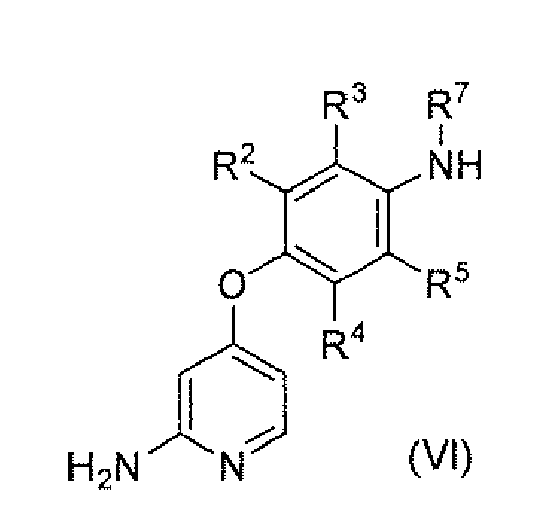
- 3) subsequently reacting the compound represented by the formula (VI) with a compound represented by the formula (VII)

to produce a compound represented by the formula (V)
- 4) subsequently reacting the compound represented by the formula (V) with an amine selected from 1-methyl-4-(piperidin-4-yl)piperazine and 3-hydroxyazetidine or a salt thereof to produce a compound represented by the formula (IV) or a salt thereof


- 5) subsequently deprotecting the amino group of the compound represented by the formula (IV) or a salt thereof to produce a compound represented by the formula (II) or a salt thereof

- 6) reacting the compound represented by the formula (II) or a salt thereof with a compound represented by the formula (III) in the presence of a condensation agent,

- 1) protecting an amino group of a compound represented by the formula (IX)
- [2] the production method according to [1], wherein the Hofmann rearrangement agent is iodobenzene diacetate or iodobenzene bis(trifluoroacetate);
- [3] the production method according to [1], wherein the condensation agent is O-(7-azabenzotriazol-1-yl)-N,N,N',N'-tetramethyluronium hexafluorophosphate (HATU); and
- [4] the production method according to [1], wherein R7 is a t-butoxycarbonyl group, a trifluoroacetyl group or a trichloroacetyl group.
- The present invention can provide a method for producing a phenoxypyridine derivative suitable for industrial large scale synthesis, having an HGFR inhibitory activity and having anti-tumor activity, inhibitory activity against angiogenesis, inhibitory activity against cancer metastasis, or the like. The present invention also provides a production intermediate useful in the above production method.
- The symbols and terms as used herein will be defined and the present invention will be described in details below.
- The structural formulas for the compounds throughout the present specification may represent only certain isomeric form for the sake of convenience, but the invention encompasses all isomers such as geometric isomers, optical isomers based on asymmetric carbons, stereoisomers, tautomers, and mixtures of those isomers which occur due to the structures of the compounds, without being limited to any of the formulas shown for the sake of convenience and may be either one of isomers or a mixture thereof. The compounds of the invention therefore may sometimes contain asymmetric carbons in the molecular and an optically active or racemic form may be present, but the present invention is not limited to either one but includes both of them. There are also no restrictions when polymorphic crystalline forms thereof exist, and the compounds may be in one crystalline form or a mixture of different crystalline forms. Further, anhydrates and hydrates of the compounds of the invention are also included.
- The "salt" is not particularly limited so long as a salt can be formed with the compound according to the present invention and includes, for example, a salt with an inorganic acid, a salt with an organic acid, a salt with an inorganic base, a salt with an organic base, a salt with an acidic or basic amino acid or the like.
- The preferable salt with an inorganic acid includes, for example, a salt with hydrochloric acid, hydrobromic acid, sulfuric acid, nitric acid, phosphoric acid or the like. The preferable salt with an organic acid includes, for example, a salt with acetic acid, succinic acid, fumaric acid, maleic acid, tartaric acid, citric acid, lactic acid, stearic acid, benzoic acid, methanesulfonic acid, ethanesulfonic acid, p-toluenesulfonic acid or the like.
- The preferable salt with an inorganic base includes, for example, an alkali metal salt such as sodium salt and potassium salt, an alkali earth metal salt such as calcium salt and magnesium salt, aluminum salt, ammonium salt or the like. The preferable salt with an organic base includes, for example, a salt with diethylamine, diethanolamine, meglumine, N,N-dibenzylethylenediamine or the like.
- The preferable salt with an acidic amino acid includes, for example, a salt with aspartic acid, glutamic acid or the like. The preferable salt with a basic amino acid includes, for example, a salt with arginine, lysine, ornithine or the like.
- The "condensation agent" in the above [1] represents 4-(4,6-dimethoxy[1.3.5]triazin-2-yl)-4-methylmorpholinium chloride hydrate, 2-chloro-4,6-dimethoxy-1,3,5-triazine, 2,4,6-trichloro-1,3,5-triazine, dicyclohexyl carbodiimide (DCC), 1-ethyl-3,(3'-dimethylaminopropyl)carbodiimide HCl salt (EDC or WSC HCl), O-(7-Azabenzotriazol-1-yl)-N,N,N',N'-tetramethyluronium hexafluorophosphate (HATU), O-(1H-benzotiazol-1-yl)-N,N,N',N'-tetramethyluronium hexafluorophosphate (HBTU), O-(1H-benzotiazol-1-yl)-N,N,N',N'-tetramethyluronium tetrafluoroborate (TBTU), (Benzotriazol-1-yloxy)tris(dimethylamino)phosphonium hexafluorophosphate (BOP reagent) or the like and O-(7-Azabenzotriazol-1-yl)-N,N,N',N'-tetramethyluronium hexafluorophosphate (HATU) is preferable.
- The "Hofmann rearrangement agent" in the above [1] represents iodobenzene diacetate, iodobenzene bis(trifluoroacetate), sodium hypochlorite, potassium hypobromite, bromine, iodine or the like, and iodobenzene diacetate or iodobenzene bis(trifluoroacetate) is preferable.
- The respective substituents of the compound represented by the above formulas (I) to (IX) according to the present invention will be described below.
- R1 represents a 4-(4-methylpiperazin-1-yl)piperidin-1-yl group or a 3-hydroxyazetidin-1-yl group.
- R2, R3, R4 and R5 may be the same or different and each represents a hydrogen atom or a fluorine atom, provided that two or three of R2, R3, R4 and R5 are a hydrogen atom.
Preferable examples of the group represented by the formula:
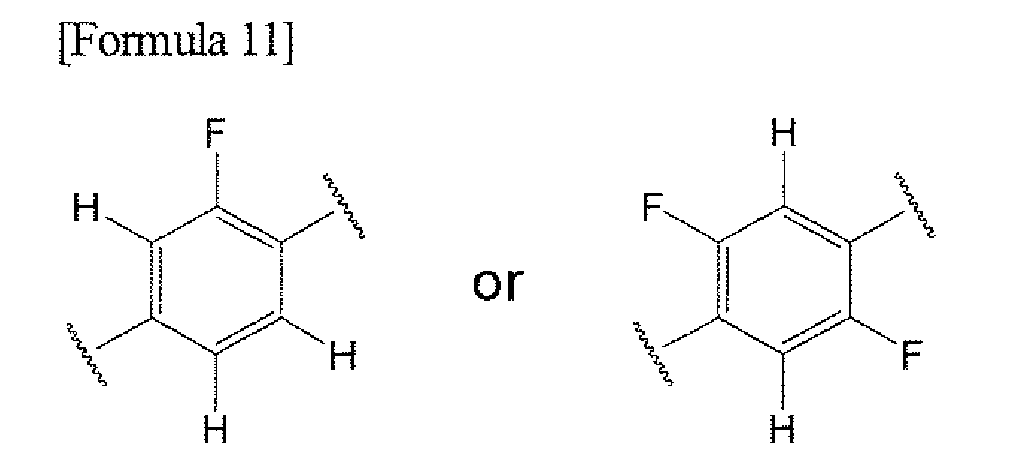
- R6 represents a hydrogen atom or a fluorine atom.
Preferable examples of R6 include a fluorine atom. - R7 represents a protection group of the amino group conventionally used, and specific examples include a t-butoxycarbonyl group, a benzyloxycarbonyl group, a 9-fluorenyl methoxycarbonyl group, a vinyloxycarbonyl group, a trifluoroacetyl group, a trichloroacetyl group, an acetyl group, a formyl group and the like.
Preferable examples of R7 include a t-butoxycarbonyl group, a trifluoroacetyl group or trichloroacetyl group. - Ar represents a phenyl group optionally substituted with one or two substituents selected from a halogen atom, a methyl group, a methoxy group, a nitro group, a cyano group and a trifluoromethyl group.
Preferable examples ofAr include a phenyl group. - The production method according to the present invention is described in details below.


- This is a step of producing a compound (VIII) by protecting the amino group of a compound (IX).
As the compound (IX) may be used the compounds described in Examples below, publicly known compounds, commercially available compounds or compounds easily produced by methods those skilled in the art usually carry out from commercially available compounds.
The protection agent for an amino group refers to di-t-butylcarbonate, 2-t-butoxycarbonyloimino-2-phenylacetonitrile, t-butyl azidoformate, benzyloxycarbonyl chloride, 9-fluorenylmethyl chloroformate, vinyl chloroformate, trifluoroacetic anhydride, trichloroacetic anhydride, acetic anhydride, formic acid and the like, and di-t-butylcarbonate, trifluoroacetic anhydride, trichloroacetic anhydride are preferable.
The solvent used for this step is not particularly limited so long as it dissolves starting materials to some extent and does not inhibit the reaction, and includes, for example, ether solvents such as tetrahydrofuran, 1,2-dimethoxyethane, 1,4-dioxane, tert-butyl methyl ether, cyclopentyl methyl ether, diethyl ether, diisopropyl ether, dibutyl ether and dicyclopentyl ether; N,N-dimethylformamide; N-methyl-2-pyrrolidone; or a mixed solvent thereof or the like, and tetrahydrofuran, N,N-dimethylformamide and N-methyl-2-pyrrolidone are preferable.
The reaction temperature will generally differ depending on the starting materials, the solvent and the other reagents used in the reaction and it is preferably 0°C to 50°C (internal temperature of the reaction vessel) and more preferably 0°C to 30°C (internal temperature of the reaction vessel).
The reaction time will generally differ depending on the starting materials, the solvent, the other reagents used in the reaction and the reaction temperature, and stirring the reaction mixture at the above reaction temperature for 1 to 48 hours after the addition of the reagents is preferable and stirring for 4 to 24 hours is more preferable.
The protection agent of the amino group can be used in an amount of 1.0- to 3.0-fold molar equivalent with respect to compound (IX), and preferably it is used in an amount of 1.0- to 1.3-fold molar equivalent. - This is a step of producing a compound (VI) by reacting the compound (VIII) with a Hofmann rearrangement agent.
The solvent used for this step is not particularly limited so long as it dissolves starting materials to some extent and does not inhibit the reaction, and include, for example, N,N-dimethylformamide, N,N-dimethylacetamide, dimethyl sulfoxide, N-methyl-2-pyrrolidone or the like, and N,N-dimethylformamide and N-methyl-2-pyrrolidone are preferable.
The "Hofmann rearrangement agent" represents iodobenzene diacetate, iodobenzene bis(triffuoroacetate), sodium hypochlorite, potassium hypobromite, bromine, iodine or the like, and iodobenzene diacetate and iodobenzene bis(trifluoroacetate) are preferable.
The reaction temperature will generally differ depending on the starting materials, the solvent and the other reagents used in the reaction, and it is preferably -10°C to 50°C (internal temperature of the reaction vessel) and more preferably 20°C to 30°C (internal temperature of the reaction vessel).
The reaction time will generally differ depending on the starting materials, the solvent, the other reagents used in the reaction and the reaction temperature, and stirring the reaction mixture at the above reaction temperature for 1 to 24 hours after the addition of the reagents is preferable and stirring for 3 to 5 hours is more preferable.
The Hofmann rearrangement agent can be used in an amount of 1.0- to 3.0-fold molar equivalent with respect to the compound (VIII), and preferably it is used in an amount of 1.0- to 1.2-fold molar equivalent. - This is a step of producing a compound (V) by reacting the compound (VI) with compound (VII) in the presence of a base.
As the compound (VII) may be used publicly known compounds, commercially available compounds or compounds easily produced by methods those skilled in the art usually carry out from commercially available compounds.
The solvent used for this step is not particularly limited so long as it dissolves starting materials to some extent and does not inhibit the reaction, and includes, for example, ether solvents such as tetrahydrofuran, 1,2-dimethoxyethane, tert-butyl methyl ether, cyclopentyl methyl ether, diethyl ether, diisopropyl ether, dibutyl ether and dicyclopentyl ether; aromatic hydrocarbon solvents such as benzene and toluene; aliphatic hydrocarbon solvents such as heptane and hexane; acetonitrile; or a mixed solvent thereof or the like, and a mixed solvent of tetrahydrofuran and acetonitrile is preferable.
The base represents pyridine, triethylamine, diisopropylethylamine, potassium carbonate, sodium carbonate or the like, and pyridine is preferable.
The reaction temperature will generally differ depending on the starting materials, the solvent and the other reagents used in the reaction, and it is preferably -10°C to 50°C (internal temperature of the reaction vessel) and more preferably 0°C to 30°C (internal temperature of the reaction vessel).
The reaction time will generally differ depending on the starting materials, the solvent, the other reagents used in the reaction and the reaction temperature, and stirring the reaction mixture at the above reaction temperature for 1 to 24 hours after the addition of the reagents is preferable and stirring for 2 to 5 hours is more preferable.
The compound (VII) can be used in an amount of 1.0- to 3.0-fold molar equivalent with respect to the compound (VI), and preferably it is used in an amount of 1.1-to 2.0-fold molar equivalent.
The base can be used in an amount of 1.0- to 3.0-fold molar equivalent with respect to the compound (VI), and preferably it is used in an amount of 1.1- to 2.0-fold molar equivalent. - This is a step of producing a compound (IV) or a salt thereof by reacting the compound (V) with an appropriate amine (or a salt thereof) in the presence or absence of a base.
As the amine may be used amines selected from 1-methyl-4-(piperidin-4-yl)piperazine and 3-hydroxyazetidine.
The solvent used for this step is not particularly limited so long as it dissolves starting materials to some extent and does not inhibit the reaction, and includes, for example, N,N-dimethylformamide, N-methyl-2-pyrrolidone, N,N-dimethylacetamide, dimethyl sulfoxide or the like, and N-methyl-2-pyrrolidone is preferable.
The base represents potassium carbonate, sodium carbonate, pyridine, triethylamine, diisopropylethylamine or the like, and potassium carbonate is preferable.
The reaction temperature will generally differ depending on the starting materials, the solvent and the other reagents used in the reaction, and it is preferably 10°C to 100°C (internal temperature of the reaction vessel) and more preferably 20°C to 50° (internal temperature of the reaction vessel).
The reaction time will generally differ depending on the starting materials, the solvent, the other reagents used in the reaction and the reaction temperature, and stirring the reaction mixture at the above reaction temperature for 1 to 24 hours after the addition of the reagents is preferable and stirring for 1 to 4 hours is more preferable.
The amine (or a salt thereof) can be used in an amount of 1.0- to 3.0-fold molar equivalent with respect to the compound (V), and preferably it is used in an amount of 1.1-to 1.3-fold molar equivalent.
The base can be used in an amount of 1.0- to 3.0-fold molar equivalent with respect to the compound (V), and preferably it is used in an amount of 1.1- to 1.3-fold molar equivalent. - This is a step of producing a compound (II) or a salt thereof by deprotecting the protection group of the amino group of the compound (IV) or a salt thereof
- The compound (II) or a salt thereof can be produced by the hydrolysis of the compound (IV) or a salt thereof in the presence of an acid or a base.
The solvent used for this step is not particularly limited so long as it dissolves starting materials to some extent and does not inhibit the reaction, and includes, for example, alcohol solvents such as methanol, ethanol, propanol and butanol; ether solvents such as tetrahydrofuran, 1,2-dimethoxyethane, tert-butyl methyl ether, cyclopentyl methyl ether, diethyl ether, diisopropyl ether, dibutyl ether and dicyclopentyl ether; water; or a mixed solvent thereof or the like, and a mixed solvent of water and methanol, ethanol or tetrahydrofuran is preferable.
The acid represents hydrochloric acid, trifluoroacetic acid, hydrobromic acid, acetic acid, p-toluenesulfonic acid, methanesulfonic acid or the like, and hydrochloric acid is preferable.
The base represents sodium hydroxide, potassium hydroxide, potassium carbonate, sodium carbonate, sodium hydrogencarbonate, ammonia, dimethylamine or the like.
The reaction temperature will generally differ depending on the starting materials, the solvent and the other reagents used in the reaction, and it is preferably 0°C to 80°C (internal temperature of the reaction vessel) and more preferably 30°C to 50°C (internal temperature of the reaction vessel).
The reaction time will generally differ depending on the starting materials, the solvent, the other reagents used in the reaction and the reaction temperature, and stirring the reaction mixture at the above reaction temperature for 1 to 24 hours after the addition of the reagents is preferable and stirring for 2 to 5 hours is more preferable.
The acid can be used in an amount of 1.0- to 5.0-fold molar equivalent with respect to the compound (IV), and preferably it is used in an amount of 1.0- to 2.0-fold molar equivalent.
The base can be used in an amount of 1.0- to 5.0-fold molar equivalent with respect to the compound (IV), and preferably it is used in an amount of 1.0- to 2.0-fold molar equivalent. - This is a step of producing a compound (II) or a salt thereof by the catalytic hydrogenation of the compound (IV) or a salt thereof in the presence of a reduction catalyst under a hydrogen atmosphere.
The solvent used for this step is not particularly limited so long as it dissolves starting materials to some extent and does not inhibit the reaction, and includes, for example, alcohol solvents such as methanol, ethanol, propanol and butanol; ether solvents such as tetrahydrofuran, 1,2-dimethoxyethane, tert-butyl methyl ether, cyclopentyl methyl ether, diethyl ether, diisopropyl ether, dibutyl ether and dicyclopentyl ether; N,N-dimethylformamide; N-methyl-2-pyrrolidone; formic acid; water; or a mixed solvent thereof, and a mixed solvent of water, methanol and tetrahydrofuran, a mixed solvent of water, ethanol and tetrahydrofuran, or a mixed solvent of water and ethanol is preferable.
The reduction catalyst represents palladium on carbon, palladium hydroxide, platinum oxide, Raney nickel or the like, and palladium on carbon is preferable.
This step can be carried out under a hydrogen atmosphere at 0.1 MPa (ordinary pressure) to 1.0 MPa, and more preferably under a hydrogen atmosphere at 0.1 MPa to 0.3 MPa.
When formic acid or a mixed solvent containing formic acid is used as a solvent for this step, this step can be carried out without using hydrogen gas.
The reaction temperature will generally differ depending on the starting materials, the solvent and the other reagents used in the reaction, and it is preferably 0°C to 50°C (internal temperature of the reaction vessel) and more preferably 20°C to 30°C (internal temperature of the reaction vessel).
The reaction time will generally differ depending on the starting materials, the solvent, the other reagents used in the reaction and the reaction temperature, and stirring the reaction mixture at the above reaction temperature for 1 to 48 hours after the addition of the reagents is preferable and stirring for 3 to 18 hours is more preferable.
The reduction catalyst can be used in an amount of 0.1- to 5.0-fold molar equivalent with respect to the compound (IV), and preferably it is used in an amount of 0.5-to 1.5-fold molar equivalent. - This is a step of producing a compound (II) or a salt thereof by reducing the compound (IV) or a salt thereof in the presence of a reducing agent.
The solvent used for this step is not particularly limited so long as it dissolves starting materials to some extent and does not inhibit the reaction, and includes, for example, alcohol solvents such as methanol, ethanol, 1-propartol, 2-propanol and butanol; water; or a mixed solvent thereof, and methanol and ethanol are preferable.
The reducing agent represents sodium borohydride, lithium borohydride, sodium cyanoborohydride, sodium triacetoxyborohydride, lithium bis(ethoxymethoxy)aluminum hydride, lithium aluminum hydride, or the like.
The reaction temperature will generally differ depending on the starting materials, the solvent and the other reagents used in the reaction, and it is preferably 0°C to 50°C (internal temperature of the reaction vessel) and more preferably 0°C to 30°C (internal temperature of the reaction vessel).
The reaction time will generally differ depending on the starting materials, the solvent, the other reagents used in the reaction and the reaction temperature, and stirring the reaction mixture at the above reaction temperature for 1 to 48 hours after the addition of the reagents is preferable and stirring for 2 to 6 hours is more preferable.
The reducing agent can be used in an amount of 1.0- to 30-fold molar equivalent with respect to the compound (IV), and preferably it is used in an amount of 1.0- to 20-fold molar equivalent. - This is a step of producing a compound (I) by reacting the compound (II) or a salt thereof with a compound (III) in the presence of a condensation agent and in the presence or absence of abase.
As the compound (III) may be used publicly known compounds, commercially available compounds or compounds easily produced by methods those skilled in the art usually carry out.
The solvent used for this step is not particularly limited so long as it dissolves starting materials to some extent and does not inhibit the reaction, and includes, for example, ether solvents such as tetrahydrofuran, 1,2-dimethoxyethane, tert-butyl methyl ether, cyclopentyl methyl ether, diethyl ether, diisopropyl ether, dibutyl ether and dicyclopentyl ether; alcohol solvents such as ethanol, 1-propanol, 2-propanol; N,N-dimethylformamide; N-methyl-2-pyrrolidone; N,N-dimethylacetamide; or a mixed solvent thereof, and N,N-dimethylformamide is preferable.
The condensation agent refers to 4-(4,6-dimethoxy[1.3.5]triazin-2-yl)-4-methylmorpholinium chloride hydrate, 2-chloro-4,6-dimethoxy-1,3,5-triazine, 2,4,6-trichloro-1,3,5-triazine, dicyclohexyl carbodiimide (DCC), 1-ethyl-3,(3'-dimethylaminopropyl)carbodiimide HCl salt (EDC or WSC HCl), O-(7-Azabenzotriazol-1-yl)-N,N,N',N'-tetramethyluronium hexafluorophosphate (HATU), O-(1H-benzotiazol-1-yl)-N,N,N',N'-tetramethyluronium hexafluorophosphate (HBTU), O-(1H-benzotiazol-1-yl)-N,N,N',N'-tetramethyluronium tetrafluoroborate (TBTU), (Benzotriazol-1-yloxy)tris(dimemylamino)phosphonium hexafluorophosphate (BOP reagent) or the like and O-(7-Azabenzotiazol-1-yl)-N,N,N',N'-tetramethyluronium hexafluorophosphate (HATU) is preferable.
The base represents N-methylmorpholine, pyridine, triethylamine, diisopropylethylamine, 1-methylimidazol, potassium carbonate, sodium carbonate or the like, and triethylamine is preferable.
The reaction temperature will generally differ depending on the starting materials, the solvent and the other reagents used in the reaction, and it is preferably -10°C to 50°C (internal temperature of the reaction vessel) and more preferably 20°C to 30°C (internal temperature of the reaction vessel).
The reaction time will generally differ depending on the starting materials, the solvent, the other reagents used in the reaction and the reaction temperature, and stirring the reaction mixture at the above reaction temperature for 1 to 48 hours after the addition of the reagents is preferable and stirring for 3 to 18 hours is more preferable.
The compound (III) can be used in an amount of 1.0- to 3.0-fold molar equivalent with respect to the compound (II), and preferably it is used in an amount of 1.0- to 2.0-fold molar equivalent.
The condensation agent can be used in an amount of 1.0- to 3.0-fold molar equivalent with respect to the compound (II), and preferably it is used in an amount of 1.0-to 2.0-fold molar equivalent
The base can be used in an amount of 1.0- to 10-fold molar equivalent with respect to the compound (II), and preferably it is used in an amount of 2.0- to 4.0-fold molar equivalent. - Examples are illustrated below for the purpose of the easy understanding of the present invention, but the present invention is not limited to these Examples.
-

1H-NMR Spectrum (DMSO-d6) δ (ppm): 1.47 (9H, s), 7.04 (1H, dd, J=2.8, 9.2 Hz), 7.19 (1H, dd, J=2.4, 5.6 Hz), 7.27 (1H, dd, J=2.8, 11.2 Hz), 7.40 (1H, d, J=2.8 Hz), 7.64-7.75 (2H, m), 8.13 (1H, brs), 8.53 (1H, d, J=5.6 Hz), 9.07 (1H, brs) -

1H-NMR Spectrum (DMSO-d6) δ (ppm): 1.46 (9H, s), 5.83 (1H, d, J=2.4 Hz), 5.92-5.98 (2H, m), 6.15 (1H, dd, J=2.4, 6.0 Hz), 6.93 (1H, d, J=8.8 Hz), 7.56 (1H, dd, J=2.4, 11.2 Hz), 7.59 (1H, t, J=9.2 Hz), 7.81 (1H, d, J=5.6 Hz), 9.01 (1H, brs). -

1H-NMR Spectrum (DMSO-d6) δ (ppm): 1.20-1.35 (2H, m), 1.47 (9H, s), 1.67-1.76 (2H, m), 2.12 (3H, s), 2.22-2.50 (8H, m), 2.68-2.79 (2H, m), 3.31 (1H, s), 4.06-4.14 (2H, m), 6.55-6.62 (1H, m), 6.75 (1H, d, J=7.6 Hz), 6.88-6.98 (1H, m), 7.36-7.39 (1H, m), 7.58-7.69 (1H, m), 8.12 (1H, d, J=5.6 Hz), 9.03 (1H, brs), 9.20 (1H, brs). -


1H-NMR Spectrum (DMSO-d6) δ (ppm): 1.20-1.34 (2H, m), 1.68-1.74 (2H, m), 2.12 (3H, s), 2.20-2.55 (8H, m), 2.72 (2H, d, J=11.6 Hz), 3.32 (1H, brs), 4.09 (2H, d, J=13.2 Hz), 5.12-5.15 (2H, m), 6.50 (1H, dd, J=2.4, 6.0 Hz), 6.72 (1H, dd, J=2.4, 8.4 Hz), 6.81 (1H, t, J=8.8 Hz), 6.92 (1H, dd, J=2.4, 12.0 Hz), 7.31 (1H, d, J=2.0 Hz), 8.05 (1H, d, J=5.6 Hz), 9.10 (1H, s). -

1H-NMR Spectrum (DMSO-d6) δ (ppm): 1.22-1.33 (2H, m), 1.54-1.63 (4H, m), 1.68-1.78 (2H, m), 2.12 (3H, s), 2.12-2.40 (5H, m), 2.40-2.60 (4H, m), 2.68-2.78 (2H, m), 4.06-4.14 (2H, m), 6.60 (1H, dd, J=2.4 Hz, 5.6 Hz), 7.00 (1H, m), 7.19 (2H, t, J=8 Hz), 7.22 (1H, dd, J=2.4 Hz, 11.2 Hz), 7.40 (1H, s), 7.61 (2H, dd, J=5.2 Hz, 8 Hz), 7.93 (1H, t, J=8.8 Hz), 8.13 (1H, d, J=5.6 Hz), 9.21 (1H, s), 9.90 (1H, brs), 10.55 (1H, brs). -

1H-NMR Spectrum (DMSO-d6) δ (ppm): 7.14-7.18 (1H, m), 7.26 (1H, dd, J=2.8, 5.6 Hz), 7.43 (1H, dd, J=2.8, 11.2 Hz), 7.46 (1H, d, J=2.8 Hz), 7.63 (1H, t, J=8.8 Hz), 7.74 (1H, brs), 8.15 (1H, brs), 8.57 (1H, d, J=5.6 Hz), 11.35 (1H, brs). -

1H-NMR Spectrum (DMSO-d6) δ (ppm): 5.91 (1H, d, J=2.4 Hz), 5.98-6.06 (2H, m), 6.19 (1H, dd, J=2.0,5.6 Hz), 7.02-7.06 (1H, m), 7.26 (1H, dd, J=2.8, 11.2 Hz), 7.55 (1H, t, J=8.4 Hz), 7.85 (1H, d, J=6.0 Hz), 11.60 (1H, brs). -


1H-NMR Spectrum (DMSO-d6) δ (ppm): 1.20-1.35 (2H, m), 1.68-1.77 (2H, m), 2.14 (3H, s), 2.26-2.50 (8H, m), 2.74 (2H, t, J=11.6 Hz), 3.32 (1H, brs), 4.11 (2H, d, J=13.2 Hz), 6.64 (1H, dd, J=2.4, 6.0 Hz), 7.05 (1H, dd, J=2.8, 8.8 Hz), 7.28 (1H, dd, J=2.4, 11.2 Hz), 7.44 (1H, d, J=2.4 Hz), 7.59 (1H, t, J=8.8 Hz), 8.16 (1H, d, J=5.6 Hz), 9.26 (1H, brs). -

The 1H-NMR data of this sample corresponded to the data described in Example A-4. -

1H-NMR Spectrum (DMSO-d6) δ (ppm): 7.12-7.17 (1H, m), 7.26 (1H, dd, J=2.4, 5.6 Hz), 7.40 (1H, dd, J=2.8,11.2 Hz), 7.45 (1H, d, J=2.4 Hz), 7.55 (1H, t, J=9.6 Hz), 7.73 (1H, brs), 8.15 (1H, brs), 8.57 (1H, d, J=5.6 Hz), 10.82 (1H, brs). -
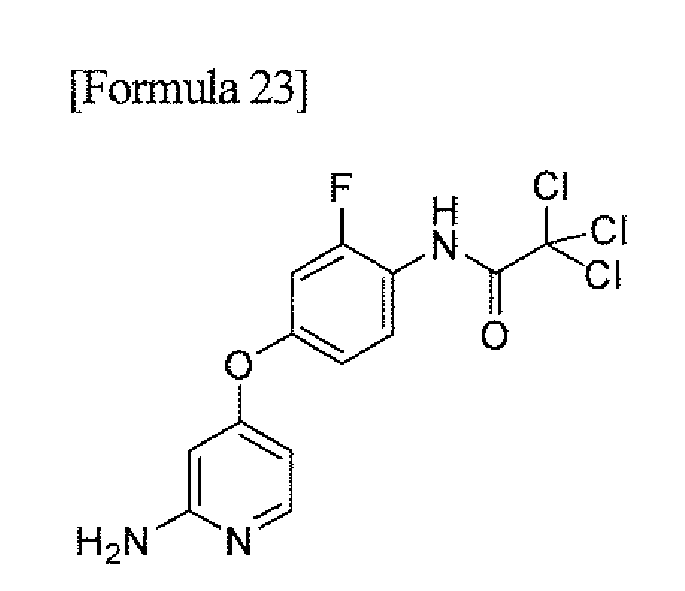
1H-NMR Spectrum (DMSO-d6) δ (ppm): 5.92 (1H, d, J=2.0 Hz), 6.00-6.06 (2H, m), 6.19 (1H, dd, J=2.4, 6.0 Hz), 7.00-7.05 (1H, m), 7.24 (1H, dd, J=2.4, 11.2 Hz), 7.46 (1H, t, J=8.8 Hz), 7.85 (1H, d, J=5.6 Hz), 10.80 (1H, brs). -

1H-NMR Spectrum (DMSO-d6) δ (ppm): 1.20-1.35 (2H, m), 1.68-1.78 (2H, m), 2.13 (3H, s), 2.23-2.50 (8H, m) 2.74 (2H, t, J=11.6 Hz), 3.33 (1H, brs), 4.11 (2H, d, J=13.2 Hz), 6.64 (1H, dd, J=2.4, 5.6 Hz), 7.02-7.07 (1H, m), 7.27 (1H, dd, J=2.8, 11.2 Hz), 7.44 (1H, d, J=2.4 Hz), 7.50 (1H, t, J=8.8 Hz), 8.16 (1H, d, J=5.6 Hz), 9.24 (1H, brs). -

The 1H-NMR data of this sample corresponded to the data described in Example A-4. - The method for producing a phenoxypyridine derivative according to the present invention can provide a phenoxypyridine derivative useful as anti-tumor agents, angiogenesis inhibitors or inhibitors for cancer metastasis against various kinds of tumors such as pancreatic cancers, gastric cancers, colorectal cancers, breast cancers, prostate cancers, lung cancers, renal cancers, brain tumors, ovarian cancers, esophagus cancers or the like.
Claims (4)
- A method for producing a compound represented by the formula (I)

the method comprising:1) protecting an amino group of a compound represented by the formula (IX)
to produce a compound represented by the formula (VIII) 2) subsequently reacting the compound represented by the formula (VIII) with a Hofmann rearrangement agent to produce a compound represented by the formula (VI)
 3) subsequently reacting the compound represented by the formula (VI) with a compound represented by the formula (VII)
to produce a compound represented by the formula (V) 4) subsequently reacting the compound represented by the formula (V) with an amine selected from 1-methyl-4-(piperidin-4-yl)piperazine and 3-hydroxyazetidine or a salt thereof to produce a compound represented by the formula (IV) or a salt thereof
 5) subsequently deprotecting the amino group of the compound represented by the formula (IV) or a salt thereof to produce a compound represented by the formula (II) or a salt thereof
 6) reacting the compound represented by the formula (II) or a salt thereof with a compound represented by the formula (III) in the presence of a condensation agent,wherein R6 has the same definitions as defined above to produce the compound represented by the formula (I).
- The production method according to claim 1, wherein the Hofmann rearrangement agent is iodobenzene diacetate or iodobenzene bis(trifluoroacetate).
- The production method according to claim 1, wherein the condensation agent is O-(7-azabenzotriazol-1-yl)-N,N,N',N'-tetramethyluronium hexafluorophosphate (HATU).
- The production method according to claim 1, wherein R7 is a t-butoxycarbonyl group, a trifluoroacetyl group or trichloroacetyl group.
Applications Claiming Priority (2)
| Application Number | Priority Date | Filing Date | Title |
|---|---|---|---|
| JP2008036161 | 2008-02-18 | ||
| PCT/JP2009/052401 WO2009104520A1 (en) | 2008-02-18 | 2009-02-13 | Method for producing phenoxypyridine derivative |
Publications (2)
| Publication Number | Publication Date |
|---|---|
| EP2248810A1 true EP2248810A1 (en) | 2010-11-10 |
| EP2248810A4 EP2248810A4 (en) | 2011-05-25 |
Family
ID=40985402
Family Applications (1)
| Application Number | Title | Priority Date | Filing Date |
|---|---|---|---|
| EP09713617A Withdrawn EP2248810A4 (en) | 2008-02-18 | 2009-02-13 | Method for producing phenoxypyridine derivative |
Country Status (4)
| Country | Link |
|---|---|
| US (1) | US20100311972A1 (en) |
| EP (1) | EP2248810A4 (en) |
| JP (1) | JPWO2009104520A1 (en) |
| WO (1) | WO2009104520A1 (en) |
Families Citing this family (6)
| Publication number | Priority date | Publication date | Assignee | Title |
|---|---|---|---|---|
| PL1889836T3 (en) * | 2005-08-24 | 2013-10-31 | Eisai R&D Man Co Ltd | Novel pyridine derivative and pyrimidine derivative (3) |
| CN101454311B (en) * | 2006-08-23 | 2013-03-27 | 卫材R&D管理有限公司 | Salts of phenoxypyridine derivatives and their crystals and their preparation methods |
| JP2009132660A (en) * | 2007-11-30 | 2009-06-18 | Eisai R & D Management Co Ltd | Composition for treating esophageal cancer |
| US20090227556A1 (en) * | 2008-01-31 | 2009-09-10 | Eisai R&D Management Co., Ltd. | Receptor tyrosine kinase inhibitors comprising pyridine and pyrimidine derivatives |
| DK2563362T3 (en) | 2010-04-29 | 2014-06-23 | Deciphera Pharmaceuticals Llc | Cyclopropyl dicarboxamides and analogues thereof exhibiting anticancer and antiproliferative activity |
| SG192273A1 (en) * | 2011-03-29 | 2013-09-30 | Eisai R&D Man Co Ltd | Method for producing phenoxypyridine derivative |
Family Cites Families (17)
| Publication number | Priority date | Publication date | Assignee | Title |
|---|---|---|---|---|
| US6352991B1 (en) * | 1997-01-08 | 2002-03-05 | Wayne State University | 2-hydroxymethylcyclopropylidenemethylpurines and -pyrimidines as antiviral agents |
| EP1415987B1 (en) * | 2000-10-20 | 2007-02-28 | Eisai R&D Management Co., Ltd. | Nitrogenous aromatic ring compounds as anti cancer agents |
| CA2454538A1 (en) * | 2001-06-22 | 2003-01-03 | Kirin Beer Kabushiki Kaisha | Quinoline derivatives and quinazoline derivatives capable of inhibiting autophosphorylation of hepatocyte growth factor receptors, and pharmaceutical composition comprising the same |
| ITTV20010116A1 (en) * | 2001-08-28 | 2003-02-28 | Marchi Sport Srl De | STRUCTURE OF PROTECTION ELEMENT PARTICULARLY FOR SHORTS |
| US6790852B2 (en) * | 2002-04-18 | 2004-09-14 | Hoffmann-La Roche Inc. | 2-(2,6-dichlorophenyl)-diarylimidazoles |
| TW200406374A (en) * | 2002-05-29 | 2004-05-01 | Novartis Ag | Diaryl urea derivatives useful for the treatment of protein kinase dependent diseases |
| RS53118B (en) * | 2003-02-26 | 2014-06-30 | Sugen Inc. | AMINOHETEROARYL UNITS AS PROTEIN KINASE INHIBITORS |
| US20050014753A1 (en) * | 2003-04-04 | 2005-01-20 | Irm Llc | Novel compounds and compositions as protein kinase inhibitors |
| EP1719762B1 (en) * | 2004-02-27 | 2012-06-27 | Eisai R&D Management Co., Ltd. | Novel pyridine derivative and pyrimidine derivative (1) |
| US7459562B2 (en) * | 2004-04-23 | 2008-12-02 | Bristol-Myers Squibb Company | Monocyclic heterocycles as kinase inhibitors |
| US7652009B2 (en) * | 2004-11-30 | 2010-01-26 | Amgem Inc. | Substituted heterocycles and methods of use |
| PL1889836T3 (en) | 2005-08-24 | 2013-10-31 | Eisai R&D Man Co Ltd | Novel pyridine derivative and pyrimidine derivative (3) |
| BRPI0619424B1 (en) * | 2005-12-05 | 2022-02-08 | Pfizer Products Inc | USE OF C-MET/HGFRS INHIBITORS FOR DRUG MANUFACTURING |
| CN101454311B (en) * | 2006-08-23 | 2013-03-27 | 卫材R&D管理有限公司 | Salts of phenoxypyridine derivatives and their crystals and their preparation methods |
| US7790885B2 (en) * | 2006-08-31 | 2010-09-07 | Eisai R&D Management Co., Ltd. | Process for preparing phenoxypyridine derivatives |
| JP2009132660A (en) * | 2007-11-30 | 2009-06-18 | Eisai R & D Management Co Ltd | Composition for treating esophageal cancer |
| US20090227556A1 (en) * | 2008-01-31 | 2009-09-10 | Eisai R&D Management Co., Ltd. | Receptor tyrosine kinase inhibitors comprising pyridine and pyrimidine derivatives |
-
2009
- 2009-02-13 JP JP2009554285A patent/JPWO2009104520A1/en active Pending
- 2009-02-13 US US12/867,646 patent/US20100311972A1/en not_active Abandoned
- 2009-02-13 WO PCT/JP2009/052401 patent/WO2009104520A1/en not_active Ceased
- 2009-02-13 EP EP09713617A patent/EP2248810A4/en not_active Withdrawn
Also Published As
| Publication number | Publication date |
|---|---|
| WO2009104520A1 (en) | 2009-08-27 |
| EP2248810A4 (en) | 2011-05-25 |
| US20100311972A1 (en) | 2010-12-09 |
| JPWO2009104520A1 (en) | 2011-06-23 |
Similar Documents
| Publication | Publication Date | Title |
|---|---|---|
| CA2661702C (en) | Method for producing phenoxypyridine derivative | |
| EP3109251B1 (en) | Method for producing inhibitor of activated blood coagulation factor x (fxa) | |
| ES2393692T3 (en) | Method for the preparation of dabigatran and its intermediates | |
| RU2497808C2 (en) | 5,6-bisaryl-2-pyridine carboxamide derivatives, method for preparing and using them in therapy as receptor antagonists | |
| US20100311972A1 (en) | Method for producing phenoxypyridine derivative | |
| CN103641792A (en) | Mirabegron related substance or salt thereof, and preparation method and use thereof | |
| KR20140096571A (en) | Method for preparing 1-(4-(4-(3,4-dichloro-2-fluorophenylamino)-7-methoxyquinazolin-6-yloxy)piperidin-1-yl)prop-2-en-1-one | |
| KR20100090261A (en) | Novel precursors | |
| WO2012004397A1 (en) | Intermediates and process for preparing a thrombin specific inhibitor | |
| CN110300587B (en) | Deuterated (S)-2-(4-(piperidin-3-yl)phenyl)-2H-indazole-7-carboxamide | |
| EP1403251B1 (en) | Bis(2-aryl-5-pyridyl) derivative | |
| EP2189455A1 (en) | Process for production of hydrazine compound, intermediate for production of hydrazine compound, and process for production of the intermediate | |
| CN103923058A (en) | Method for synthesizing vilanterol intermediate and salt thereof | |
| CN105111163A (en) | Synthesis method of 4-(4-aminophenyl)-3-morpholone | |
| CA2825925A1 (en) | Method for producing di(arylamino)aryl compound and synthetic intermediate therefor | |
| RU2590158C2 (en) | Method of producing phenoxypyridine derivative | |
| JPWO2019065954A1 (en) | Optically active pyrrolidine compound and its production method | |
| KR101950942B1 (en) | Method for preparing 1-(4-(4-(3,4-dichloro-2-fluorophenylamino)-7-methoxyquinazolin-6-yloxy)piperidin-1-yl)prop-2-en-1-one | |
| CN121824501A (en) | Application of a class of aromatic compounds in the preparation of USP7 agonists | |
| Feng et al. | A Facile Total Synthesis of Kilogram-Scale Production of SKLB1039: A Novel and Selective Hexahydroisoquinolin-Containing EZH2 Inhibitor | |
| EP1698611A1 (en) | Process for producing phenylacetic acid derivative | |
| JP2014114221A (en) | Method for producing benzimidazole derivative and intermediate thereof | |
| RS20050652A (en) | Process for the preparation of n- (((pyridinyloxy)- phenylamino)quinazolinyl)- alyl)acetamide derivatives and related compounds as well as intermediates of such processes and processes for the preparation of such intermediates | |
| HK40010388A (en) | Preparation method for hydrochloride compound | |
| HK1232541A1 (en) | Method for producing inhibitor of activated blood coagulation factor x (fxa) |
Legal Events
| Date | Code | Title | Description |
|---|---|---|---|
| PUAI | Public reference made under article 153(3) epc to a published international application that has entered the european phase |
Free format text: ORIGINAL CODE: 0009012 |
|
| 17P | Request for examination filed |
Effective date: 20100901 |
|
| AK | Designated contracting states |
Kind code of ref document: A1 Designated state(s): AT BE BG CH CY CZ DE DK EE ES FI FR GB GR HR HU IE IS IT LI LT LU LV MC MK MT NL NO PL PT RO SE SI SK TR |
|
| AX | Request for extension of the european patent |
Extension state: AL BA RS |
|
| A4 | Supplementary search report drawn up and despatched |
Effective date: 20110428 |
|
| DAX | Request for extension of the european patent (deleted) | ||
| RIC1 | Information provided on ipc code assigned before grant |
Ipc: C07D 401/12 20060101AFI20090915BHEP |
|
| STAA | Information on the status of an ep patent application or granted ep patent |
Free format text: STATUS: THE APPLICATION HAS BEEN WITHDRAWN |
|
| 18W | Application withdrawn |
Effective date: 20111223 |