EP2248800A1 - Method for producing isothiocyanate compound having carboxyl group - Google Patents
Method for producing isothiocyanate compound having carboxyl group Download PDFInfo
- Publication number
- EP2248800A1 EP2248800A1 EP09714219A EP09714219A EP2248800A1 EP 2248800 A1 EP2248800 A1 EP 2248800A1 EP 09714219 A EP09714219 A EP 09714219A EP 09714219 A EP09714219 A EP 09714219A EP 2248800 A1 EP2248800 A1 EP 2248800A1
- Authority
- EP
- European Patent Office
- Prior art keywords
- group
- protected
- hydrocarbon group
- aromatic hydrocarbon
- substituted
- Prior art date
- Legal status (The legal status is an assumption and is not a legal conclusion. Google has not performed a legal analysis and makes no representation as to the accuracy of the status listed.)
- Withdrawn
Links
- -1 isothiocyanate compound Chemical class 0.000 title claims abstract description 82
- 125000003178 carboxy group Chemical group [H]OC(*)=O 0.000 title claims abstract description 44
- 238000004519 manufacturing process Methods 0.000 title claims abstract description 12
- QGJOPFRUJISHPQ-UHFFFAOYSA-N Carbon disulfide Chemical compound S=C=S QGJOPFRUJISHPQ-UHFFFAOYSA-N 0.000 claims abstract description 125
- 238000000034 method Methods 0.000 claims abstract description 68
- 229930195734 saturated hydrocarbon Natural products 0.000 claims abstract description 47
- 125000002029 aromatic hydrocarbon group Chemical group 0.000 claims abstract description 45
- 239000002904 solvent Substances 0.000 claims abstract description 20
- 239000000126 substance Substances 0.000 claims abstract description 20
- 229910052736 halogen Inorganic materials 0.000 claims abstract description 19
- 150000002367 halogens Chemical class 0.000 claims abstract description 19
- 125000001183 hydrocarbyl group Chemical group 0.000 claims abstract 17
- 125000002887 hydroxy group Chemical group [H]O* 0.000 claims description 43
- 125000004169 (C1-C6) alkyl group Chemical group 0.000 claims description 34
- 125000004890 (C1-C6) alkylamino group Chemical group 0.000 claims description 34
- 125000003277 amino group Chemical group 0.000 claims description 33
- ZCYVEMRRCGMTRW-UHFFFAOYSA-N 7553-56-2 Chemical group [I] ZCYVEMRRCGMTRW-UHFFFAOYSA-N 0.000 claims description 25
- 229910052740 iodine Inorganic materials 0.000 claims description 25
- 239000011630 iodine Substances 0.000 claims description 24
- 125000004191 (C1-C6) alkoxy group Chemical group 0.000 claims description 22
- 125000005843 halogen group Chemical group 0.000 claims description 22
- 238000006243 chemical reaction Methods 0.000 claims description 20
- 229910052757 nitrogen Inorganic materials 0.000 claims description 20
- 125000004433 nitrogen atom Chemical group N* 0.000 claims description 19
- 125000004454 (C1-C6) alkoxycarbonyl group Chemical group 0.000 claims description 17
- 125000004916 (C1-C6) alkylcarbonyl group Chemical group 0.000 claims description 17
- 125000004093 cyano group Chemical group *C#N 0.000 claims description 16
- 125000000449 nitro group Chemical group [O-][N+](*)=O 0.000 claims description 16
- 125000001570 methylene group Chemical group [H]C([H])([*:1])[*:2] 0.000 claims description 8
- 125000004430 oxygen atom Chemical group O* 0.000 claims description 8
- 150000001412 amines Chemical class 0.000 claims description 4
- 150000007529 inorganic bases Chemical class 0.000 claims description 3
- 125000003282 alkyl amino group Chemical group 0.000 claims description 2
- 125000001997 phenyl group Chemical group [H]C1=C([H])C([H])=C(*)C([H])=C1[H] 0.000 claims description 2
- 125000002924 primary amino group Chemical group [H]N([H])* 0.000 claims description 2
- XEKOWRVHYACXOJ-UHFFFAOYSA-N Ethyl acetate Chemical compound CCOC(C)=O XEKOWRVHYACXOJ-UHFFFAOYSA-N 0.000 description 111
- WYURNTSHIVDZCO-UHFFFAOYSA-N Tetrahydrofuran Chemical compound C1CCOC1 WYURNTSHIVDZCO-UHFFFAOYSA-N 0.000 description 72
- ZMANZCXQSJIPKH-UHFFFAOYSA-N Triethylamine Chemical compound CCN(CC)CC ZMANZCXQSJIPKH-UHFFFAOYSA-N 0.000 description 66
- WEVYAHXRMPXWCK-UHFFFAOYSA-N Acetonitrile Chemical compound CC#N WEVYAHXRMPXWCK-UHFFFAOYSA-N 0.000 description 57
- VEXZGXHMUGYJMC-UHFFFAOYSA-N Hydrochloric acid Chemical compound Cl VEXZGXHMUGYJMC-UHFFFAOYSA-N 0.000 description 48
- XLYOFNOQVPJJNP-UHFFFAOYSA-N water Substances O XLYOFNOQVPJJNP-UHFFFAOYSA-N 0.000 description 46
- 238000004128 high performance liquid chromatography Methods 0.000 description 38
- GEHJYWRUCIMESM-UHFFFAOYSA-L sodium sulfite Chemical compound [Na+].[Na+].[O-]S([O-])=O GEHJYWRUCIMESM-UHFFFAOYSA-L 0.000 description 38
- 238000003756 stirring Methods 0.000 description 38
- YLQBMQCUIZJEEH-UHFFFAOYSA-N tetrahydrofuran Natural products C=1C=COC=1 YLQBMQCUIZJEEH-UHFFFAOYSA-N 0.000 description 36
- 230000014759 maintenance of location Effects 0.000 description 32
- 239000012044 organic layer Substances 0.000 description 30
- 239000002994 raw material Substances 0.000 description 30
- 239000007787 solid Substances 0.000 description 29
- 150000002430 hydrocarbons Chemical group 0.000 description 27
- BDAGIHXWWSANSR-UHFFFAOYSA-N methanoic acid Natural products OC=O BDAGIHXWWSANSR-UHFFFAOYSA-N 0.000 description 26
- 239000000203 mixture Substances 0.000 description 24
- 238000004895 liquid chromatography mass spectrometry Methods 0.000 description 23
- VLKZOEOYAKHREP-UHFFFAOYSA-N n-Hexane Chemical compound CCCCCC VLKZOEOYAKHREP-UHFFFAOYSA-N 0.000 description 21
- 239000007864 aqueous solution Substances 0.000 description 20
- 235000010265 sodium sulphite Nutrition 0.000 description 19
- 239000000243 solution Substances 0.000 description 19
- 239000011541 reaction mixture Substances 0.000 description 18
- UIIMBOGNXHQVGW-UHFFFAOYSA-M Sodium bicarbonate Chemical compound [Na+].OC([O-])=O UIIMBOGNXHQVGW-UHFFFAOYSA-M 0.000 description 16
- ZMXDDKWLCZADIW-UHFFFAOYSA-N N,N-Dimethylformamide Chemical compound CN(C)C=O ZMXDDKWLCZADIW-UHFFFAOYSA-N 0.000 description 15
- 238000001914 filtration Methods 0.000 description 15
- OSWFIVFLDKOXQC-UHFFFAOYSA-N 4-(3-methoxyphenyl)aniline Chemical compound COC1=CC=CC(C=2C=CC(N)=CC=2)=C1 OSWFIVFLDKOXQC-UHFFFAOYSA-N 0.000 description 13
- 235000019253 formic acid Nutrition 0.000 description 13
- 239000003960 organic solvent Substances 0.000 description 13
- 239000000706 filtrate Substances 0.000 description 12
- 125000006239 protecting group Chemical group 0.000 description 12
- ALYNCZNDIQEVRV-UHFFFAOYSA-N 4-aminobenzoic acid Chemical compound NC1=CC=C(C(O)=O)C=C1 ALYNCZNDIQEVRV-UHFFFAOYSA-N 0.000 description 10
- RBEFRYQKJYMLCC-UHFFFAOYSA-N 4-isothiocyanatobenzoic acid Chemical compound OC(=O)C1=CC=C(N=C=S)C=C1 RBEFRYQKJYMLCC-UHFFFAOYSA-N 0.000 description 9
- LFQSCWFLJHTTHZ-UHFFFAOYSA-N Ethanol Chemical compound CCO LFQSCWFLJHTTHZ-UHFFFAOYSA-N 0.000 description 9
- 125000004432 carbon atom Chemical group C* 0.000 description 9
- HEDRZPFGACZZDS-UHFFFAOYSA-N Chloroform Chemical compound ClC(Cl)Cl HEDRZPFGACZZDS-UHFFFAOYSA-N 0.000 description 8
- 239000012046 mixed solvent Substances 0.000 description 7
- CSCPPACGZOOCGX-UHFFFAOYSA-N Acetone Chemical compound CC(C)=O CSCPPACGZOOCGX-UHFFFAOYSA-N 0.000 description 6
- HEMHJVSKTPXQMS-UHFFFAOYSA-M Sodium hydroxide Chemical compound [OH-].[Na+] HEMHJVSKTPXQMS-UHFFFAOYSA-M 0.000 description 6
- WPYMKLBDIGXBTP-UHFFFAOYSA-N benzoic acid Chemical compound OC(=O)C1=CC=CC=C1 WPYMKLBDIGXBTP-UHFFFAOYSA-N 0.000 description 6
- NNPPMTNAJDCUHE-UHFFFAOYSA-N isobutane Chemical compound CC(C)C NNPPMTNAJDCUHE-UHFFFAOYSA-N 0.000 description 6
- 229910000030 sodium bicarbonate Inorganic materials 0.000 description 6
- 235000017557 sodium bicarbonate Nutrition 0.000 description 6
- WKBOTKDWSSQWDR-UHFFFAOYSA-N Bromine atom Chemical group [Br] WKBOTKDWSSQWDR-UHFFFAOYSA-N 0.000 description 5
- 229960004050 aminobenzoic acid Drugs 0.000 description 5
- 150000001875 compounds Chemical class 0.000 description 5
- 125000000524 functional group Chemical group 0.000 description 5
- 239000010410 layer Substances 0.000 description 5
- JGFZNNIVVJXRND-UHFFFAOYSA-N N,N-Diisopropylethylamine (DIPEA) Chemical compound CCN(C(C)C)C(C)C JGFZNNIVVJXRND-UHFFFAOYSA-N 0.000 description 4
- OFBQJSOFQDEBGM-UHFFFAOYSA-N Pentane Chemical compound CCCCC OFBQJSOFQDEBGM-UHFFFAOYSA-N 0.000 description 4
- NBIIXXVUZAFLBC-UHFFFAOYSA-N Phosphoric acid Chemical compound OP(O)(O)=O NBIIXXVUZAFLBC-UHFFFAOYSA-N 0.000 description 4
- ATUOYWHBWRKTHZ-UHFFFAOYSA-N Propane Chemical compound CCC ATUOYWHBWRKTHZ-UHFFFAOYSA-N 0.000 description 4
- GDTBXPJZTBHREO-UHFFFAOYSA-N bromine Substances BrBr GDTBXPJZTBHREO-UHFFFAOYSA-N 0.000 description 4
- 229910052794 bromium Inorganic materials 0.000 description 4
- 239000001273 butane Substances 0.000 description 4
- 229910052801 chlorine Inorganic materials 0.000 description 4
- 125000004122 cyclic group Chemical group 0.000 description 4
- QWTDNUCVQCZILF-UHFFFAOYSA-N iso-pentane Natural products CCC(C)C QWTDNUCVQCZILF-UHFFFAOYSA-N 0.000 description 4
- VNWKTOKETHGBQD-UHFFFAOYSA-N methane Chemical compound C VNWKTOKETHGBQD-UHFFFAOYSA-N 0.000 description 4
- CRSOQBOWXPBRES-UHFFFAOYSA-N neopentane Chemical compound CC(C)(C)C CRSOQBOWXPBRES-UHFFFAOYSA-N 0.000 description 4
- 239000001294 propane Substances 0.000 description 4
- 239000011877 solvent mixture Substances 0.000 description 4
- 238000003786 synthesis reaction Methods 0.000 description 4
- ZWZVWGITAAIFPS-UHFFFAOYSA-N thiophosgene Chemical compound ClC(Cl)=S ZWZVWGITAAIFPS-UHFFFAOYSA-N 0.000 description 4
- KUAZQDVKQLNFPE-UHFFFAOYSA-N thiram Chemical compound CN(C)C(=S)SSC(=S)N(C)C KUAZQDVKQLNFPE-UHFFFAOYSA-N 0.000 description 4
- 229960002447 thiram Drugs 0.000 description 4
- RYHBNJHYFVUHQT-UHFFFAOYSA-N 1,4-Dioxane Chemical compound C1COCCO1 RYHBNJHYFVUHQT-UHFFFAOYSA-N 0.000 description 3
- WFDIJRYMOXRFFG-UHFFFAOYSA-N Acetic anhydride Chemical compound CC(=O)OC(C)=O WFDIJRYMOXRFFG-UHFFFAOYSA-N 0.000 description 3
- UHOVQNZJYSORNB-UHFFFAOYSA-N Benzene Chemical compound C1=CC=CC=C1 UHOVQNZJYSORNB-UHFFFAOYSA-N 0.000 description 3
- 239000005711 Benzoic acid Substances 0.000 description 3
- YMWUJEATGCHHMB-UHFFFAOYSA-N Dichloromethane Chemical compound ClCCl YMWUJEATGCHHMB-UHFFFAOYSA-N 0.000 description 3
- IMNFDUFMRHMDMM-UHFFFAOYSA-N N-Heptane Chemical compound CCCCCCC IMNFDUFMRHMDMM-UHFFFAOYSA-N 0.000 description 3
- SJRJJKPEHAURKC-UHFFFAOYSA-N N-Methylmorpholine Chemical compound CN1CCOCC1 SJRJJKPEHAURKC-UHFFFAOYSA-N 0.000 description 3
- 239000003905 agrochemical Substances 0.000 description 3
- 235000010233 benzoic acid Nutrition 0.000 description 3
- 239000012043 crude product Substances 0.000 description 3
- 239000013078 crystal Substances 0.000 description 3
- 229940079593 drug Drugs 0.000 description 3
- 239000003814 drug Substances 0.000 description 3
- 125000002496 methyl group Chemical group [H]C([H])([H])* 0.000 description 3
- 239000011368 organic material Substances 0.000 description 3
- 238000000425 proton nuclear magnetic resonance spectrum Methods 0.000 description 3
- 230000035484 reaction time Effects 0.000 description 3
- SGUVLZREKBPKCE-UHFFFAOYSA-N 1,5-diazabicyclo[4.3.0]-non-5-ene Chemical compound C1CCN=C2CCCN21 SGUVLZREKBPKCE-UHFFFAOYSA-N 0.000 description 2
- GQHTUMJGOHRCHB-UHFFFAOYSA-N 2,3,4,6,7,8,9,10-octahydropyrimido[1,2-a]azepine Chemical compound C1CCCCN2CCCN=C21 GQHTUMJGOHRCHB-UHFFFAOYSA-N 0.000 description 2
- HQHRFCZZJLWJKI-UHFFFAOYSA-N 2-(4-isothiocyanatophenyl)acetic acid Chemical compound OC(=O)CC1=CC=C(N=C=S)C=C1 HQHRFCZZJLWJKI-UHFFFAOYSA-N 0.000 description 2
- LCJMEPDBFOJQIE-UHFFFAOYSA-N 2-chloro-4-isothiocyanatobenzoic acid Chemical compound OC(=O)C1=CC=C(N=C=S)C=C1Cl LCJMEPDBFOJQIE-UHFFFAOYSA-N 0.000 description 2
- LLOJFKCODXBTKS-UHFFFAOYSA-N 2-hydroxy-4-isothiocyanatobenzoic acid Chemical compound OC(=O)C1=CC=C(N=C=S)C=C1O LLOJFKCODXBTKS-UHFFFAOYSA-N 0.000 description 2
- FXIXLMKSTCAARZ-UHFFFAOYSA-N 2-hydroxy-5-isothiocyanatobenzoic acid Chemical compound OC(=O)C1=CC(N=C=S)=CC=C1O FXIXLMKSTCAARZ-UHFFFAOYSA-N 0.000 description 2
- FDXYXFKOGQCAFR-UHFFFAOYSA-N 3-isothiocyanato-4-methoxybenzoic acid Chemical compound COC1=CC=C(C(O)=O)C=C1N=C=S FDXYXFKOGQCAFR-UHFFFAOYSA-N 0.000 description 2
- LPODZMBNYZGYRV-UHFFFAOYSA-N 3-isothiocyanato-4-methylbenzoic acid Chemical compound CC1=CC=C(C(O)=O)C=C1N=C=S LPODZMBNYZGYRV-UHFFFAOYSA-N 0.000 description 2
- PJRBPKOOGLKPFB-UHFFFAOYSA-N 3-isothiocyanatobenzoic acid Chemical compound OC(=O)C1=CC=CC(N=C=S)=C1 PJRBPKOOGLKPFB-UHFFFAOYSA-N 0.000 description 2
- KNYZWOWYFJTQBK-UHFFFAOYSA-N 4-(4-isothiocyanatophenyl)butanoic acid Chemical compound OC(=O)CCCC1=CC=C(N=C=S)C=C1 KNYZWOWYFJTQBK-UHFFFAOYSA-N 0.000 description 2
- YJHAFHMZBVQRFC-UHFFFAOYSA-N 4-(isothiocyanatomethyl)benzoic acid Chemical compound OC(=O)C1=CC=C(CN=C=S)C=C1 YJHAFHMZBVQRFC-UHFFFAOYSA-N 0.000 description 2
- DQCIFXUOHWQZTC-UHFFFAOYSA-N 4-isothiocyanato-3-methylbenzoic acid Chemical compound CC1=CC(C(O)=O)=CC=C1N=C=S DQCIFXUOHWQZTC-UHFFFAOYSA-N 0.000 description 2
- YYROPELSRYBVMQ-UHFFFAOYSA-N 4-toluenesulfonyl chloride Chemical compound CC1=CC=C(S(Cl)(=O)=O)C=C1 YYROPELSRYBVMQ-UHFFFAOYSA-N 0.000 description 2
- VKXNSANQAPEDDG-UHFFFAOYSA-N 5-isothiocyanatobenzene-1,3-dicarboxylic acid Chemical compound OC(=O)C1=CC(N=C=S)=CC(C(O)=O)=C1 VKXNSANQAPEDDG-UHFFFAOYSA-N 0.000 description 2
- HPOLGIXOQGDPRI-UHFFFAOYSA-N 6-isothiocyanatohexanoic acid Chemical compound OC(=O)CCCCCN=C=S HPOLGIXOQGDPRI-UHFFFAOYSA-N 0.000 description 2
- LVROGUZIUYPHGT-UHFFFAOYSA-N 6-isothiocyanatonaphthalene-2-carboxylic acid Chemical compound C1=C(N=C=S)C=CC2=CC(C(=O)O)=CC=C21 LVROGUZIUYPHGT-UHFFFAOYSA-N 0.000 description 2
- IJGRMHOSHXDMSA-UHFFFAOYSA-N Atomic nitrogen Chemical compound N#N IJGRMHOSHXDMSA-UHFFFAOYSA-N 0.000 description 2
- ZAMOUSCENKQFHK-UHFFFAOYSA-N Chlorine atom Chemical compound [Cl] ZAMOUSCENKQFHK-UHFFFAOYSA-N 0.000 description 2
- IAZDPXIOMUYVGZ-UHFFFAOYSA-N Dimethylsulphoxide Chemical compound CS(C)=O IAZDPXIOMUYVGZ-UHFFFAOYSA-N 0.000 description 2
- OTMSDBZUPAUEDD-UHFFFAOYSA-N Ethane Chemical compound CC OTMSDBZUPAUEDD-UHFFFAOYSA-N 0.000 description 2
- MHAJPDPJQMAIIY-UHFFFAOYSA-N Hydrogen peroxide Chemical compound OO MHAJPDPJQMAIIY-UHFFFAOYSA-N 0.000 description 2
- JLTDJTHDQAWBAV-UHFFFAOYSA-N N,N-dimethylaniline Chemical compound CN(C)C1=CC=CC=C1 JLTDJTHDQAWBAV-UHFFFAOYSA-N 0.000 description 2
- 238000005481 NMR spectroscopy Methods 0.000 description 2
- UFWIBTONFRDIAS-UHFFFAOYSA-N Naphthalene Chemical compound C1=CC=CC2=CC=CC=C21 UFWIBTONFRDIAS-UHFFFAOYSA-N 0.000 description 2
- QGKYLZXFNDWORA-ZKCHVHJHSA-N OC(=O)[C@H]1CC[C@H](CN=C=S)CC1 Chemical compound OC(=O)[C@H]1CC[C@H](CN=C=S)CC1 QGKYLZXFNDWORA-ZKCHVHJHSA-N 0.000 description 2
- IGHHPVIMEQGKNE-UHFFFAOYSA-N [3-(hydroxymethyl)-2-bicyclo[2.2.1]hept-5-enyl]methanol Chemical compound C1C2C=CC1C(CO)C2CO IGHHPVIMEQGKNE-UHFFFAOYSA-N 0.000 description 2
- 125000002777 acetyl group Chemical group [H]C([H])([H])C(*)=O 0.000 description 2
- 239000000654 additive Substances 0.000 description 2
- 229910000147 aluminium phosphate Inorganic materials 0.000 description 2
- MWPLVEDNUUSJAV-UHFFFAOYSA-N anthracene Chemical compound C1=CC=CC2=CC3=CC=CC=C3C=C21 MWPLVEDNUUSJAV-UHFFFAOYSA-N 0.000 description 2
- 125000000732 arylene group Chemical group 0.000 description 2
- 230000015572 biosynthetic process Effects 0.000 description 2
- 239000006227 byproduct Substances 0.000 description 2
- 125000002915 carbonyl group Chemical group [*:2]C([*:1])=O 0.000 description 2
- 239000000460 chlorine Substances 0.000 description 2
- 125000001309 chloro group Chemical group Cl* 0.000 description 2
- ZUOUZKKEUPVFJK-UHFFFAOYSA-N diphenyl Chemical compound C1=CC=CC=C1C1=CC=CC=C1 ZUOUZKKEUPVFJK-UHFFFAOYSA-N 0.000 description 2
- 229910052731 fluorine Inorganic materials 0.000 description 2
- 125000001153 fluoro group Chemical group F* 0.000 description 2
- 238000009776 industrial production Methods 0.000 description 2
- 239000000543 intermediate Substances 0.000 description 2
- 150000002540 isothiocyanates Chemical class 0.000 description 2
- 239000000463 material Substances 0.000 description 2
- 125000000956 methoxy group Chemical group [H]C([H])([H])O* 0.000 description 2
- IJDNQMDRQITEOD-UHFFFAOYSA-N n-butane Chemical compound CCCC IJDNQMDRQITEOD-UHFFFAOYSA-N 0.000 description 2
- TVMXDCGIABBOFY-UHFFFAOYSA-N octane Chemical compound CCCCCCCC TVMXDCGIABBOFY-UHFFFAOYSA-N 0.000 description 2
- 125000000843 phenylene group Chemical group C1(=C(C=CC=C1)*)* 0.000 description 2
- XHXFXVLFKHQFAL-UHFFFAOYSA-N phosphoryl trichloride Chemical compound ClP(Cl)(Cl)=O XHXFXVLFKHQFAL-UHFFFAOYSA-N 0.000 description 2
- BWHMMNNQKKPAPP-UHFFFAOYSA-L potassium carbonate Chemical compound [K+].[K+].[O-]C([O-])=O BWHMMNNQKKPAPP-UHFFFAOYSA-L 0.000 description 2
- 239000000047 product Substances 0.000 description 2
- 125000001424 substituent group Chemical group 0.000 description 2
- 230000002194 synthesizing effect Effects 0.000 description 2
- IMFACGCPASFAPR-UHFFFAOYSA-N tributylamine Chemical compound CCCCN(CCCC)CCCC IMFACGCPASFAPR-UHFFFAOYSA-N 0.000 description 2
- YFTHZRPMJXBUME-UHFFFAOYSA-N tripropylamine Chemical compound CCCN(CCC)CCC YFTHZRPMJXBUME-UHFFFAOYSA-N 0.000 description 2
- 238000005406 washing Methods 0.000 description 2
- 239000003643 water by type Substances 0.000 description 2
- JIAARYAFYJHUJI-UHFFFAOYSA-L zinc dichloride Chemical compound [Cl-].[Cl-].[Zn+2] JIAARYAFYJHUJI-UHFFFAOYSA-L 0.000 description 2
- 125000006273 (C1-C3) alkyl group Chemical group 0.000 description 1
- 125000006274 (C1-C3)alkoxy group Chemical group 0.000 description 1
- CSEWAUGPAQPMDC-UHFFFAOYSA-N 2-(4-aminophenyl)acetic acid Chemical compound NC1=CC=C(CC(O)=O)C=C1 CSEWAUGPAQPMDC-UHFFFAOYSA-N 0.000 description 1
- UENRXLSRMCSUSN-UHFFFAOYSA-N 3,5-diaminobenzoic acid Chemical compound NC1=CC(N)=CC(C(O)=O)=C1 UENRXLSRMCSUSN-UHFFFAOYSA-N 0.000 description 1
- VPEFWSSIQPBNBV-UHFFFAOYSA-N 3,5-diisocyanatobenzoic acid Chemical compound OC(=O)C1=CC(N=C=O)=CC(N=C=O)=C1 VPEFWSSIQPBNBV-UHFFFAOYSA-N 0.000 description 1
- AJHPGXZOIAYYDW-UHFFFAOYSA-N 3-(2-cyanophenyl)-2-[(2-methylpropan-2-yl)oxycarbonylamino]propanoic acid Chemical compound CC(C)(C)OC(=O)NC(C(O)=O)CC1=CC=CC=C1C#N AJHPGXZOIAYYDW-UHFFFAOYSA-N 0.000 description 1
- FDGAEAYZQQCBRN-UHFFFAOYSA-N 3-amino-4-methoxybenzoic acid Chemical compound COC1=CC=C(C(O)=O)C=C1N FDGAEAYZQQCBRN-UHFFFAOYSA-N 0.000 description 1
- XKFIFYROMAAUDL-UHFFFAOYSA-N 3-amino-4-methylbenzoic acid Chemical compound CC1=CC=C(C(O)=O)C=C1N XKFIFYROMAAUDL-UHFFFAOYSA-N 0.000 description 1
- RBHLFWNKEWLHBP-UHFFFAOYSA-N 4-(4-aminophenyl)butanoic acid Chemical compound NC1=CC=C(CCCC(O)=O)C=C1 RBHLFWNKEWLHBP-UHFFFAOYSA-N 0.000 description 1
- MBDUKNCPOPMRJQ-UHFFFAOYSA-N 4-amino-2-chlorobenzoic acid Chemical compound NC1=CC=C(C(O)=O)C(Cl)=C1 MBDUKNCPOPMRJQ-UHFFFAOYSA-N 0.000 description 1
- NHFKECPTBZZFBC-UHFFFAOYSA-N 4-amino-3-methylbenzoic acid Chemical compound CC1=CC(C(O)=O)=CC=C1N NHFKECPTBZZFBC-UHFFFAOYSA-N 0.000 description 1
- WUBBRNOQWQTFEX-UHFFFAOYSA-N 4-aminosalicylic acid Chemical compound NC1=CC=C(C(O)=O)C(O)=C1 WUBBRNOQWQTFEX-UHFFFAOYSA-N 0.000 description 1
- KBZFDRWPMZESDI-UHFFFAOYSA-N 5-aminobenzene-1,3-dicarboxylic acid Chemical compound NC1=CC(C(O)=O)=CC(C(O)=O)=C1 KBZFDRWPMZESDI-UHFFFAOYSA-N 0.000 description 1
- SLXKOJJOQWFEFD-UHFFFAOYSA-N 6-aminohexanoic acid Chemical compound NCCCCCC(O)=O SLXKOJJOQWFEFD-UHFFFAOYSA-N 0.000 description 1
- NZTPZUIIYNYZKT-UHFFFAOYSA-N 6-aminonaphthalene-2-carboxylic acid Chemical compound C1=C(C(O)=O)C=CC2=CC(N)=CC=C21 NZTPZUIIYNYZKT-UHFFFAOYSA-N 0.000 description 1
- QOSSAOTZNIDXMA-UHFFFAOYSA-N Dicylcohexylcarbodiimide Chemical compound C1CCCCC1N=C=NC1CCCCC1 QOSSAOTZNIDXMA-UHFFFAOYSA-N 0.000 description 1
- 241000380126 Gymnosteris Species 0.000 description 1
- KFZMGEQAYNKOFK-UHFFFAOYSA-N Isopropanol Chemical compound CC(C)O KFZMGEQAYNKOFK-UHFFFAOYSA-N 0.000 description 1
- 235000019502 Orange oil Nutrition 0.000 description 1
- GYDJEQRTZSCIOI-UHFFFAOYSA-N Tranexamic acid Chemical compound NCC1CCC(C(O)=O)CC1 GYDJEQRTZSCIOI-UHFFFAOYSA-N 0.000 description 1
- HEDRZPFGACZZDS-MICDWDOJSA-N Trichloro(2H)methane Chemical class [2H]C(Cl)(Cl)Cl HEDRZPFGACZZDS-MICDWDOJSA-N 0.000 description 1
- 239000002253 acid Substances 0.000 description 1
- 230000000996 additive effect Effects 0.000 description 1
- 125000003545 alkoxy group Chemical group 0.000 description 1
- 125000002947 alkylene group Chemical group 0.000 description 1
- 229960002684 aminocaproic acid Drugs 0.000 description 1
- QCTBMLYLENLHLA-UHFFFAOYSA-N aminomethylbenzoic acid Chemical compound NCC1=CC=C(C(O)=O)C=C1 QCTBMLYLENLHLA-UHFFFAOYSA-N 0.000 description 1
- 239000012298 atmosphere Substances 0.000 description 1
- 125000004429 atom Chemical group 0.000 description 1
- 125000001797 benzyl group Chemical group [H]C1=C([H])C([H])=C(C([H])=C1[H])C([H])([H])* 0.000 description 1
- 239000004305 biphenyl Substances 0.000 description 1
- 235000010290 biphenyl Nutrition 0.000 description 1
- 238000009835 boiling Methods 0.000 description 1
- 244000309464 bull Species 0.000 description 1
- QGJOPFRUJISHPQ-NJFSPNSNSA-N carbon disulfide-14c Chemical compound S=[14C]=S QGJOPFRUJISHPQ-NJFSPNSNSA-N 0.000 description 1
- 239000003054 catalyst Substances 0.000 description 1
- 239000007806 chemical reaction intermediate Substances 0.000 description 1
- 239000003153 chemical reaction reagent Substances 0.000 description 1
- 230000000052 comparative effect Effects 0.000 description 1
- 125000006165 cyclic alkyl group Chemical group 0.000 description 1
- 125000001995 cyclobutyl group Chemical group [H]C1([H])C([H])([H])C([H])(*)C1([H])[H] 0.000 description 1
- 125000000113 cyclohexyl group Chemical group [H]C1([H])C([H])([H])C([H])([H])C([H])(*)C([H])([H])C1([H])[H] 0.000 description 1
- 125000001511 cyclopentyl group Chemical group [H]C1([H])C([H])([H])C([H])([H])C([H])(*)C1([H])[H] 0.000 description 1
- 125000001559 cyclopropyl group Chemical group [H]C1([H])C([H])([H])C1([H])* 0.000 description 1
- 238000001514 detection method Methods 0.000 description 1
- HPNMFZURTQLUMO-UHFFFAOYSA-N diethylamine Chemical compound CCNCC HPNMFZURTQLUMO-UHFFFAOYSA-N 0.000 description 1
- 230000000694 effects Effects 0.000 description 1
- 125000006575 electron-withdrawing group Chemical group 0.000 description 1
- 125000001301 ethoxy group Chemical group [H]C([H])([H])C([H])([H])O* 0.000 description 1
- 125000003754 ethoxycarbonyl group Chemical group C(=O)(OCC)* 0.000 description 1
- RIFGWPKJUGCATF-UHFFFAOYSA-N ethyl chloroformate Chemical compound CCOC(Cl)=O RIFGWPKJUGCATF-UHFFFAOYSA-N 0.000 description 1
- 125000001495 ethyl group Chemical group [H]C([H])([H])C([H])([H])* 0.000 description 1
- 125000004672 ethylcarbonyl group Chemical group [H]C([H])([H])C([H])([H])C(*)=O 0.000 description 1
- 239000000945 filler Substances 0.000 description 1
- 239000011737 fluorine Substances 0.000 description 1
- 238000010438 heat treatment Methods 0.000 description 1
- 239000001257 hydrogen Substances 0.000 description 1
- 229910052739 hydrogen Inorganic materials 0.000 description 1
- PNDPGZBMCMUPRI-UHFFFAOYSA-N iodine Chemical compound II PNDPGZBMCMUPRI-UHFFFAOYSA-N 0.000 description 1
- 125000000959 isobutyl group Chemical group [H]C([H])([H])C([H])(C([H])([H])[H])C([H])([H])* 0.000 description 1
- 238000002955 isolation Methods 0.000 description 1
- 125000001449 isopropyl group Chemical group [H]C([H])([H])C([H])(*)C([H])([H])[H] 0.000 description 1
- ZBKFYXZXZJPWNQ-UHFFFAOYSA-N isothiocyanate group Chemical group [N-]=C=S ZBKFYXZXZJPWNQ-UHFFFAOYSA-N 0.000 description 1
- RLJMLMKIBZAXJO-UHFFFAOYSA-N lead nitrate Chemical compound [O-][N+](=O)O[Pb]O[N+]([O-])=O RLJMLMKIBZAXJO-UHFFFAOYSA-N 0.000 description 1
- 238000005259 measurement Methods 0.000 description 1
- KBOPZPXVLCULAV-UHFFFAOYSA-N mesalamine Chemical compound NC1=CC=C(O)C(C(O)=O)=C1 KBOPZPXVLCULAV-UHFFFAOYSA-N 0.000 description 1
- 229960004963 mesalazine Drugs 0.000 description 1
- 229910052751 metal Inorganic materials 0.000 description 1
- 239000002184 metal Substances 0.000 description 1
- 125000001160 methoxycarbonyl group Chemical group [H]C([H])([H])OC(*)=O 0.000 description 1
- 125000004184 methoxymethyl group Chemical group [H]C([H])([H])OC([H])([H])* 0.000 description 1
- 125000000250 methylamino group Chemical group [H]N(*)C([H])([H])[H] 0.000 description 1
- 125000004674 methylcarbonyl group Chemical group CC(=O)* 0.000 description 1
- SYSQUGFVNFXIIT-UHFFFAOYSA-N n-[4-(1,3-benzoxazol-2-yl)phenyl]-4-nitrobenzenesulfonamide Chemical class C1=CC([N+](=O)[O-])=CC=C1S(=O)(=O)NC1=CC=C(C=2OC3=CC=CC=C3N=2)C=C1 SYSQUGFVNFXIIT-UHFFFAOYSA-N 0.000 description 1
- 125000006606 n-butoxy group Chemical group 0.000 description 1
- 125000004108 n-butyl group Chemical group [H]C([H])([H])C([H])([H])C([H])([H])C([H])([H])* 0.000 description 1
- 125000004676 n-butylcarbonyl group Chemical group [H]C([H])([H])C([H])([H])C([H])([H])C([H])([H])C(*)=O 0.000 description 1
- 125000001298 n-hexoxy group Chemical group [H]C([H])([H])C([H])([H])C([H])([H])C([H])([H])C([H])([H])C([H])([H])O* 0.000 description 1
- 125000001280 n-hexyl group Chemical group C(CCCCC)* 0.000 description 1
- 125000003935 n-pentoxy group Chemical group [H]C([H])([H])C([H])([H])C([H])([H])C([H])([H])C([H])([H])O* 0.000 description 1
- 125000000740 n-pentyl group Chemical group [H]C([H])([H])C([H])([H])C([H])([H])C([H])([H])C([H])([H])* 0.000 description 1
- 125000003506 n-propoxy group Chemical group [H]C([H])([H])C([H])([H])C([H])([H])O* 0.000 description 1
- 125000004123 n-propyl group Chemical group [H]C([H])([H])C([H])([H])C([H])([H])* 0.000 description 1
- 125000006252 n-propylcarbonyl group Chemical group [H]C([H])([H])C([H])([H])C([H])([H])C(*)=O 0.000 description 1
- 125000004957 naphthylene group Chemical group 0.000 description 1
- 125000001971 neopentyl group Chemical group [H]C([*])([H])C(C([H])([H])[H])(C([H])([H])[H])C([H])([H])[H] 0.000 description 1
- 239000012299 nitrogen atmosphere Substances 0.000 description 1
- 230000003287 optical effect Effects 0.000 description 1
- 239000010502 orange oil Substances 0.000 description 1
- 239000002245 particle Substances 0.000 description 1
- 229920001184 polypeptide Polymers 0.000 description 1
- 229910000027 potassium carbonate Inorganic materials 0.000 description 1
- 102000004196 processed proteins & peptides Human genes 0.000 description 1
- 108090000765 processed proteins & peptides Proteins 0.000 description 1
- 230000009257 reactivity Effects 0.000 description 1
- 150000003839 salts Chemical class 0.000 description 1
- 125000002914 sec-butyl group Chemical group [H]C([H])([H])C([H])([H])C([H])(*)C([H])([H])[H] 0.000 description 1
- 238000007086 side reaction Methods 0.000 description 1
- FDRCDNZGSXJAFP-UHFFFAOYSA-M sodium chloroacetate Chemical compound [Na+].[O-]C(=O)CCl FDRCDNZGSXJAFP-UHFFFAOYSA-M 0.000 description 1
- 239000007858 starting material Substances 0.000 description 1
- 125000006253 t-butylcarbonyl group Chemical group [H]C([H])([H])C(C(*)=O)(C([H])([H])[H])C([H])([H])[H] 0.000 description 1
- 125000000999 tert-butyl group Chemical group [H]C([H])([H])C(*)(C([H])([H])[H])C([H])([H])[H] 0.000 description 1
- 125000001973 tert-pentyl group Chemical group [H]C([H])([H])C([H])([H])C(*)(C([H])([H])[H])C([H])([H])[H] 0.000 description 1
- 231100000331 toxic Toxicity 0.000 description 1
- 230000002588 toxic effect Effects 0.000 description 1
- 231100000419 toxicity Toxicity 0.000 description 1
- 230000001988 toxicity Effects 0.000 description 1
- 125000005270 trialkylamine group Chemical group 0.000 description 1
- 125000000026 trimethylsilyl group Chemical group [H]C([H])([H])[Si]([*])(C([H])([H])[H])C([H])([H])[H] 0.000 description 1
- 238000010626 work up procedure Methods 0.000 description 1
- 239000011592 zinc chloride Substances 0.000 description 1
- 235000005074 zinc chloride Nutrition 0.000 description 1
Classifications
-
- C—CHEMISTRY; METALLURGY
- C07—ORGANIC CHEMISTRY
- C07C—ACYCLIC OR CARBOCYCLIC COMPOUNDS
- C07C331/00—Derivatives of thiocyanic acid or of isothiocyanic acid
- C07C331/16—Isothiocyanates
- C07C331/18—Isothiocyanates having isothiocyanate groups bound to acyclic carbon atoms
- C07C331/20—Isothiocyanates having isothiocyanate groups bound to acyclic carbon atoms of a saturated carbon skeleton
-
- C—CHEMISTRY; METALLURGY
- C07—ORGANIC CHEMISTRY
- C07C—ACYCLIC OR CARBOCYCLIC COMPOUNDS
- C07C331/00—Derivatives of thiocyanic acid or of isothiocyanic acid
- C07C331/16—Isothiocyanates
- C07C331/18—Isothiocyanates having isothiocyanate groups bound to acyclic carbon atoms
- C07C331/22—Isothiocyanates having isothiocyanate groups bound to acyclic carbon atoms of an unsaturated carbon skeleton
- C07C331/24—Isothiocyanates having isothiocyanate groups bound to acyclic carbon atoms of an unsaturated carbon skeleton the carbon skeleton containing six-membered aromatic rings
-
- C—CHEMISTRY; METALLURGY
- C07—ORGANIC CHEMISTRY
- C07C—ACYCLIC OR CARBOCYCLIC COMPOUNDS
- C07C331/00—Derivatives of thiocyanic acid or of isothiocyanic acid
- C07C331/16—Isothiocyanates
- C07C331/28—Isothiocyanates having isothiocyanate groups bound to carbon atoms of six-membered aromatic rings
-
- C—CHEMISTRY; METALLURGY
- C07—ORGANIC CHEMISTRY
- C07C—ACYCLIC OR CARBOCYCLIC COMPOUNDS
- C07C331/00—Derivatives of thiocyanic acid or of isothiocyanic acid
- C07C331/16—Isothiocyanates
- C07C331/30—Isothiocyanates containing at least two isothiocyanate groups bound to the same carbon skeleton
-
- C—CHEMISTRY; METALLURGY
- C07—ORGANIC CHEMISTRY
- C07C—ACYCLIC OR CARBOCYCLIC COMPOUNDS
- C07C2601/00—Systems containing only non-condensed rings
- C07C2601/12—Systems containing only non-condensed rings with a six-membered ring
- C07C2601/14—The ring being saturated
Definitions
- the present invention relates to a method for producing an isothiocyanate compound having the carboxyl group(s) from the corresponding amino compound having a carboxyl group(s).
- An isothiocyanate group is a very useful functional group in synthetic organic chemistry since its reactivity is high and it can be led to various chemical structures.
- a carboxyl group is a useful functional group in the field of organic materials, drugs or agricultural chemicals because of its characteristic acidity and hydrogen bonding ability.
- an isothiocyanate compound having a carboxyl group(s), which has such two functional groups in one molecule can be said to be a very useful compound as a product or a synthetic intermediate in the field of organic materials, drugs or agricultural chemicals.
- 3,5-diisocyanatobenzoic acid is useful as a starting material for the synthesis of a metal-binding polypeptide (e.g. Patent Document 1).
- Non-Patent Document 2 a method of using ethyl chloroformate (Non-Patent Document 2), a method of using dicyclohexylcarbodiimide (Non-Patent Document 3), a method of using phosphorus oxychloride (Non-Patent Document 4), a method of using lead nitrate (Non-Patent Document 5), a method of using acetic anhydride (Patent Document 2), a method of using hydrogen peroxide (Non-Patent Document 6), a method of using sodium chloroacetate and zinc chloride (Non-Patent Document 7), a method of using iodine (Non-Patent Document 8), a method of using tosyl chloride (Non-Patent Document 9), etc.
- ethyl chloroformate Non-Patent Document 2
- Non-Patent Document 3 a method of using dicyclohexylcarbodiimide
- the method of employing tetramethylthiuram disulfide has a problem that isolation of reaction intermediate is necessary, whereby the operation is cumbersome; the reaction condition is severe such that heating is carried out at a high temperature in the presence of acid; and tetramethylthiuram disulfide to be used is expensive. Therefore, it has been desired to develop a novel method for producing an isothiocyanate compound having a carboxyl group(s) in a high yield and with high purity without using such reagents, which is useful also as an industrial production method.
- the present inventors have conducted an extensive study to solve the above problems and as a result, they have found a novel method for producing an isothiocyanate compound having a carboxyl group(s) in a high yield and with high purity and thus accomplished the present invention. That is, the present invention provides the following.
- the present invention it is possible to provide a novel method whereby without using strongly toxic thiophosgene or expensive tetramethylthiuram disulfide, the corresponding isothiocyanate compound can be produced safely, inexpensively, simply in a high yield and with high purity under mild conditions.
- n means normal, "i” iso, “s” secondary, “t” tertiary, “c” cyclo, “o” ortho, “m” meta, “p” para, and "Me” a methyl group.
- the C 1-12 saturated hydrocarbon group represents a bivalent or trivalent group derived from a linear, branched or cyclic saturated hydrocarbon having from 1 to 12 carbon atoms and may, for example, be a bivalent or trivalent group derived from e.g.
- the C 1-12 saturated hydrocarbon group in A and B in the formula (1) may have a substituent as defined in the definition of A or B.
- the C 1-12 saturated hydrocarbon group for A when m is 1, or the C 1-12 saturated hydrocarbon group for B when n is 1, is a linear, branched or cyclic alkylene (alkane-diyl) group having from 1 to 12 carbon atoms, and such an alkylene group is unsubstituted or substituted as defined in the definition of A or B.
- the C 1-12 saturated hydrocarbon group for A when m is 2, or the C 1-12 saturated hydrocarbon group for B when n is 2 is a linear, branched or cyclic alkane-triyl group having from 1 to 12 carbon atoms, and such an alkane-triyl group is unsubstituted or substituted as defined in the definition of A or B.
- the C 1-6 saturated hydrocarbon group represents a bivalent or trivalent group derived from a linear, branched or cyclic saturated hydrocarbon having from 1 to 6 carbon atoms in the above-described C 1-12 saturated hydrocarbon group and may, for example, be a bivalent or trivalent group derived from e.g.
- the C 1-6 alkyl group represents a linear, branched or cyclic alkyl group having from 1 to 6 carbon atoms and may, for example, be a methyl group, an ethyl group, a n-propyl group, a n-butyl group, a n-pentyl group, a n-hexyl group, an i-propyl group, an i-butyl group, a t-butyl group, a s-butyl group, an i-pentyl group, a neopentyl group, a t-pentyl group, a c-propyl group, a c-butyl group, a c-pentyl group or a c-hexyl group.
- the C 1-6 alkoxy group represents a linear or branched alkoxy group having from 1 to 6 carbon atoms and may, for example, be a methoxy group, an ethoxy group, a n-propoxy group, an i-propoxy group, a n-butoxy group, an i-butoxy group, a s-butoxy group, a t-butoxy group, a n-pentyloxy group, an i-pentyloxy group, a n-hexyloxy group, a c-butyloxy group, a c-pentyloxy group or a c-hexyloxy group.
- the C 1-6 alkylcarbonyl group represents a carbonyl group substituted by a C 1-6 alkyl group and may, for example, be a methylcarbonyl group, an ethylcarbonyl group, a n-propylcarbonyl group, a n-butylcarbonyl group, a n-pentylcarbonyl group, a n-hexylcarbonyl group, an i-propylcarbonyl group, an i-butylcarbonyl group, a t-butylcarbonyl group, a s-butylcarbonyl group, an i-pentylcarbonyl group, a neopentylcarbonyl group, a t-pentylcarbonyl group, a c-propylcarbonyl group, a c-butylcarbonyl group, a c-pentylcarbonyl group or a c-hexylcarbonyl
- the mono C 1-6 alkylamino group represents an amino group substituted by one C 1-6 alkyl group and may, for example, be an N-methylamino group, an N-ethylamino group, an N-n-propylamino group, an N-i-propylamino group, an N-n-butylamino group, an N-i-butylamino group, an N-s-butylamino group, an N-t-butylamino group, an N-n-pentylamino group, an N-i-pentylamino group, an N-neopentylamino group, an N-t-pentylamino group, an N-n-hexylamino group, an N-c-propylamino group, an N-c-butylamino group, an N-c-pentylamino group, an N-c-hexylamino group, an N-c-propylamino group, an N
- the di C 1-6 alkylamino group represents an amino group substituted by the same or different two C 1-6 alkyl groups and may, for example, be an N,N-dimethylamino group, an N,N-diethylamino group, an N,N-di-n-propylamino group, an N,N-di-i-propylamino group, an N-methyl-N-ethylamino group, an N-methyl-N-n-propylamino group, an N-methyl-N-i-propylamino group, an N-ethyl-N-n-propylamino group, an N-ethyl-N-i-propylamino group or an N-n-propyl-N-i-propylamino group.
- the C 1-6 alkoxycarbonyl group represents a carbonyl group substituted by a C 1-6 alkoxy group and may, for example, be a methoxycarbonyl group, an ethoxycarbonyl group, a n-propoxycarbonyl group, an i-propoxycarbonyl group, a n-butoxycarbonyl group, an i-butoxycarbonyl group, a s-butoxycarbonyl group, a t-butoxycarbonyl group, a n-pentyloxycarbonyl group, an i-pentyloxycarbonyl group, a n-hexyloxycarbonyl group, a c-butyloxycarbonyl group, a c-pentyloxycarbonyl group or a c-hexyloxycarbonyl group.
- the C 6-14 aromatic hydrocarbon group is an aromatic hydrocarbon group having from 6 to 14 carbon atoms and may, for example, be a bivalent or trivalent group derived from benzene, naphthalene, biphenyl or anthracene.
- the C 6-14 aromatic hydrocarbon group in A and B in the formula (1) may be substituted as defined in the definition of A or B.
- the C 6-14 aromatic hydrocarbon group for A when m is 1, or the C 6-14 aromatic hydrocarbon group for B when n is 1, is an arylene(aryl-diyl) group having from 6 to 14 carbon atoms, and such arylene group is unsubstituted or substituted as defined in the definition of A or B.
- the C 6-14 aromatic hydrocarbon group for A when m is 2, or the C 6-14 aromatic hydrocarbon group for B when n is 2 is a linear, branched or cyclic aryl-triyl group having from 6 to 14 carbon atoms, and such an aryl-triyl group is unsubstituted or substituted as defined in the definition of A or B.
- protected in e.g. the protected hydroxyl group, the protected amino group, the protected mono C 1-6 alkylamino group and the protected nitrogen atom means that a highly reactive functional group such as a hydroxyl group or an amino group is substituted to be an inert functional group under the reaction condition with carbon disulfide and a halogen as a simple substance in the present invention.
- the protecting group in the protected hydroxyl group may be any protecting group so long as it is effective as a protecting group for a hydroxyl group, and for example, protecting groups disclosed in Greene's Protective Groups in Organic Synthesis (4th ed.), John Wiley, 2007, pp. 24-299 may be mentioned.
- Preferred as protecting groups for a hydroxyl group may, for example, be a methoxymethyl group, an acetyl group, a benzyl group, a trimethylsilyl group, etc.
- the protecting groups in the protected amino group, the protected mono C 1-6 alkylamino group and the protected nitrogen atom may be any protecting groups so long as they are effective as protecting groups for a nitrogen atom, but, for example, protecting groups disclosed in e.g. Greene's Protective Groups in Organic Synthesis (4th ed.), John Wiley, 2007, pp. 706-872 may be mentioned.
- Preferred as such protecting groups may, for example, be an acetyl group, t-butoxycarbonyl group, etc.
- the halogen atom is a fluorine atom, a chlorine atom, a bromine atom or an iodine atom.
- the halogen as a simple substance is fluorine, chlorine, bromine or iodine.
- the halogen as a simple substance to be used for the reaction of the present invention is preferably bromine or iodine, more preferably iodine.
- the C 6-14 aromatic hydrocarbon group is preferably a phenylene group or a naphthylene group, particularly preferably a phenylene group.
- the substituent for the C 6-14 aromatic hydrocarbon group in A is as mentioned above, and is more preferably a halogen atom, a C 1-3 alkyl group, a hydroxyl group or a C 1-3 alkoxy group, further preferably a chlorine atom, a hydroxyl group, a methyl group or a methoxy group.
- the C 1-12 saturated hydrocarbon group in A is preferably a C 1-6 saturated hydrocarbon group, more preferably a C 1-3 saturated hydrocarbon group.
- an amino compound having a carboxyl group(s) as a raw material is reacted, in a solvent for the reaction, with carbon disulfide (CS 2 ) and then with a halogen as a simple substance.
- CS 2 carbon disulfide
- the solvent to be used for the method of the present invention is not particularly limited so long as it is a solvent which is stable under the reaction conditions and inert to the reaction not to prevent the reaction.
- the raw material of the present invention is an amino compound having a carboxyl group(s), which is a so-called amphoteric compound, and under a basic reaction condition, the carboxyl group forms a salt. Therefore, the solvent is preferably one wherein these raw material compounds are soluble.
- a solvent it is preferred to employ water, an organic solvent or a mixed solvent of water and a water-soluble organic solvent.
- the organic solvent include acetonitrile, N,N-dimethylformamide, acetone, chloroform, dichloromethane, etc.
- a specific example of the above-mentioned mixed solvent of water and a water-soluble organic solvent may be a mixed solvent of water and at least one water-soluble organic solvent selecting from the group consisting of tetrahydrofuran, 1,4-dioxane, N,N-dimethylformamide, ethanol, i-propanol, acetone and dimethylsulfoxide.
- a preferred solvent is a mixed solvent of water and tetrahydrofuran, or acetonitrile.
- the amount of the solvent to be used is preferably from 1 to 20 times by volume, preferably from 6 to 15 times by volume, to the amino compound having a carboxyl group(s), and in the case of the mixed solvent of water and a water soluble organic solvent, the volume ratio of the water/the water-soluble organic solvent is preferably from 2:1 to 1:10, particularly preferably from 1:1 to 1:2.
- iodine is used as the after-mentioned halogen as a simple substance
- an organic solvent is preferred to use, as the solvent, an organic solvent.
- a specific example of such an organic solvent may be N,N-dimethylformamide or acetonitrile, preferably N,N-dimethylformamide.
- the amount of carbon disulfide to be used in the method of the present invention is, per one mole of the amino compound having a carboxyl group(s) as the raw material, from (the number of amino groups in one molecule of the raw material ⁇ 1.0) mol to (the number of amino groups in one molecule of the raw material ⁇ 10.0) mol, preferably from (the number of amino groups in one molecule of the raw material ⁇ 2.0) mol to (the number of amino groups in one molecule of the raw material ⁇ 4.0) mol.
- the amino compound having a carboxyl group(s) as the raw material it is possible to add and react the amino compound having a carboxyl group(s) as the raw material, with carbon disulfide and the halogen, at the same time.
- the raw material is reacted with carbon disulfide and then, the halogen as a simple substance is reacted thereto.
- the amount of the halogen as a simple substance to be used in the method of the present invention is, per one mole of the amino compound having a carboxyl group(s) as the raw material, from (the number of amino groups in one molecule of the raw material ⁇ 1.0) mol to (the number of amino groups in one molecule of the raw material ⁇ 2.0) mol, preferably from (the number of amino groups in one molecule of the raw material ⁇ 1.0) mol to (the number of amino groups in one molecule of the raw material ⁇ 1.2) mol.
- reaction with carbon disulfide in the present invention is preferably carried out in the presence of a base.
- Such a base may, for example, be an organic amine such as diethylamine, triethylamine, diisopropylethylamine, tri-n-propylamine, tri-n-butylamine, DBN (1,5-diazabicyclo[4.3.0]-5-nonene), DBU (1,8-diazabicyclo[5.4.0]-7-undecene), N-methylmorpholine or N,N-dimethylaniline; or an inorganic base such as sodium hydroxide, potassium carbonate or sodium hydrogencarbonate.
- organic amine such as diethylamine, triethylamine, diisopropylethylamine, tri-n-propylamine, tri-n-butylamine, DBN (1,5-diazabicyclo[4.3.0]-5-nonene), DBU (1,8-diazabicyclo[5.4.0]-7-undecene), N-methylmorpholine or N,N-d
- an organic amine more preferred is a trialkylamine such as triethylamine, diisopropylethylamine, tri-n-propylamine or tri-n-butylamine; and particularly preferred is triethylamine.
- the amount of the base to be used is, per one mole of the amino compound having a carboxyl group(s) as the raw material, [from (the number of carboxyl groups in one molecule of the raw material ⁇ 1.0 + the number of amino groups in one molecule of the raw material ⁇ 1.0) mol to (the number of carboxyl groups in one molecule of the raw material ⁇ 1.0 + the number of amino groups in one molecule of the raw material ⁇ 5.0)] mol, preferably [from (the number of carboxyl groups in one molecule of the raw material ⁇ 1.0 + the number of amino groups in one molecule of the raw material ⁇ 1.5) mol to (the number of carboxyl groups in one molecule of the raw material ⁇ 1.0 + the number of amino groups in one molecule of the raw material ⁇ 2.5)] mol.
- the reaction in the method of the present invention can be carried out at a temperature within a range of from a temperature at which the solvent does not freeze to the boiling point of the solvent.
- the reaction temperature is preferably from 0 to 40°C.
- the temperature is preferably from 20 to 30°C, and when the material is then reacted with a halogen as a simple substance, the temperature is preferably from 0 to 10°C.
- a preferred reaction temperature is within a range of from -10 to 40°C, and especially when the amino compound having a carboxyl group(s) is reacted with carbon disulfide and a base, the temperature is preferably from 20 to 30°C, and when the material is then reacted with a halogen as a simple substance, the temperature is preferably from -10 to 10°C.
- reaction times for reacting the amino compound having a carboxyl group(s) as the raw material with carbon disulfide and then reacting a halogen as a simple substance vary depending upon the reaction temperatures, the type and amount of the raw material and may suitably be changed depending upon the respective conditions.
- a preferred reaction time for reacting the amino compound having a carboxyl group as the raw material with carbon disulfide is from 3 to 72 hours, more preferably from 6 to 44 hours.
- the reaction time for reacting the halogen as a simple substance is from 0.5 to 5 hours, preferably from 1.5 to 2.5 hours.
- the reaction of the amino compound having a carboxyl group(s) as the raw material with carbon disulfide, and further, the subsequent reaction with the halogen as a simple substance may each be carried out in the presence of air. That is, the reaction can simply be carried out without necessity to replace the interior atmosphere of the reactor with nitrogen.
- the present invention has been described with reference to cases where an amino compound having a carboxyl group being a pure raw material is used.
- a raw material contains an isomer such as a tautomer, a geometrical isomer or an optical isomer
- the present invention includes a method of employing such an isomer or a mixture of isomers.
- NMR nuclear magnetic resonance
- HPLC high performance liquid chromatography LC-MS liquid chromatography-mass spectrometry
- ES electrospray v volume.
- HPLC purity means the area percentage unless otherwise specified.
- measuring conditions for various measurements are as follows. Measuring condition for LC-MS (condition 1) Equipment used: alliance-ZQ LC-MS SYSTEM, manufactured by Waters Column used: SunFire C18 ((average particle diameter of filler: 3.5 ⁇ m), 2.1 mm I.D. ⁇ 20 mm (inner diameter of column ⁇ length of column), the same applies hereinafter) Column temperature: 40°C Solvent composition:
- a 1 H-NMR spectrum was measured by using JNM-ECP300 and JNM-ECX300 manufactured by JEOL Ltd., at 300 MHz in deuterated chloroform (CDCl 3 ).
- Carbon disulfide (0.66 mL, 11 mmol) was added to a mixture comprising 4-aminobenzoic acid (0.50 g, 3.6 mmol), tetrahydrofuran (2.5 mL), water (2.5 mL) and triethylamine (1.3 mL, 9.1 mmol), followed by stirring at room temperature for 24 hours.
- a tetrahydrofuran (2.5 mL) solution of iodine (1.0 g, 4.0 mmol) was dropwise added over a period of 5 minutes at 0°C, followed by stirring at 0°C for further two hours.
- a mixture comprising 4-aminobenzoic acid (0.20 g, 1.5 mmol), dioxane (5 mL), a saturated sodium hydrogencarbonate aqueous solution (5 mL) and carbon disulfide (0.37 mL, 6.1 mmol) was stirred in a nitrogen atmosphere at room temperature for 19 hours and then concentrated under reduced pressure to dryness. The obtained residue was dissolved in water (8.0 mL), and 1 M sodium hydroxide aqueous solution (1.5 mL) was added. With stirring at room temperature, an ethanol (8.0 mL) solution of iodine (0.38 g, 1.5 mmol) was dropwise added thereto over a period of 8 minutes, followed by stirring at room temperature for further 12 minutes.
- Carbon disulfide (0.26 mL, 4.4 mmol) was added to a mixture comprising 3-aminobenzoic acid (0.20 g, 1.5 mmol), tetrahydrofuran (1.0 mL), water (1.0 mL) and triethylamine (0.51 mL, 3.6 mmol), followed by stirring at room temperature for 24 hours.
- a tetrahydrofuran (1.0 mL) solution of iodine (0.41 g, 1.6 mmol) was dropwise added over a period of 5 minutes at 0°C, followed by stirring at 0°C for further two hours.
- Carbon disulfide (0.26 mL, 4.4 mmol) was added to a mixture comprising 4-amino-2-chlorobenzoic acid (0.26 g, 1.5 mmol), tetrahydrofuran (1.0 mL), water (1.0 mL) and triethylamine (0.51 mL, 3.6 mmol), followed by stirring at room temperature for 24.5 hours.
- a tetrahydrofuran (1.0 mL) solution of iodine (0.41 g, 1.6 mmol) was dropwise added over a period of 5 minutes at 0°C, followed by stirring at 0°C for further two hours.
- Carbon disulfide (0.26 mL, 4.4 mmol) was added to a mixture comprising 4-amino-3-methylbenzoic acid (0.23 g, 1.5 mmol), tetrahydrofuran (1.0 mL), water (1.0 mL) and triethylamine (0.51 mL, 3.6 mmol), followed by stirring at room temperature for 28 hours.
- the obtained reaction mixture was dropwise added to a tetrahydrofuran (1.0 mL) solution of iodine (0.41 g, 1.6 mmol) over a period of 5 minutes at 0°C, followed by stirring at 0°C for further 1.5 hours.
- Carbon disulfide (0.26 mL, 4.4 mmol) was added to a mixture comprising 3-amino-4-methylbenzoic acid (0.23 g, 1.5 mmol), tetrahydrofuran (1.0 mL), water (1.0 mL) and triethylamine (0.51 mL, 3.6 mmol), followed by stirring at room temperature for 26 hours.
- the obtained reaction mixture was dropwise added to a tetrahydrofuran (1.0 mL) solution of iodine (0.41 g, 1.6 mmol) over a period of two minutes at 0°C, followed by stirring at 0°C for further two hours.
- Carbon disulfide (0.26 mL, 4.4 mmol) was added to a mixture comprising 4-amino-2-hydroxybenzoic acid (0.23 g, 1.5 mmol), tetrahydrofuran (1.0 mL), water (1.0 mL) and triethylamine (0.51 mL, 3.6 mmol), followed by stirring at room temperature for 31 hours.
- a tetrahydrofuran (1.0 mL) solution of iodine (0.41 g, 1.6 mmol) was dropwise added over a period of 3 minutes at 0°C, followed by stirring at 0°C for further 2.5 hours.
- Carbon disulfide (0.26 mL, 4.4 mmol) was added to a mixture comprising 5-amino-2-hydroxybenzoic acid (0.23 g, 1.5 mmol), tetrahydrofuran (1.0 mL), water (1.0 mL) and triethylamine (0.51 mL, 3.6 mmol), followed by stirring at room temperature for 17 hours.
- the obtained reaction mixture was dropwise added to a tetrahydrofuran (1.0 mL) solution of iodine (0.41 g, 1.6 mmol) over a period of 5 minutes at 0°C, followed by stirring at 0°C for further 2.5 hours.
- Carbon disulfide (0.26 mL, 4.4 mmol) was added to a mixture comprising 3-amino-4-methoxybenzoic acid (0.25 g, 1.5 mmol), tetrahydrofuran (1.0 mL), water (1.0 mL) and triethylamine (0.51 mL, 3.6 mmol), followed by stirring at room temperature for 6 hours.
- a tetrahydrofuran (1.0 mL) solution of iodine (0.41 g, 1.6 mmol) was dropwise added over a period of 5 minutes at 0°C, followed by stirring at 0°C for further 2.5 hours.
- Carbon disulfide (0.26 mL, 4.4 mmol) was added to a mixture comprising 6-amino-2-naphthoic acid (0.28 g, 1.5 mmol), tetrahydrofuran (1.0 mL), water (1.0 mL) and triethylamine (0.51 mL, 3.6 mmol), followed by stirring at room temperature for 24 hours.
- a tetrahydrofuran (1.0 mL) solution of iodine (0.41 g, 1.6 mmol) was dropwise added over a period of 5 minutes at 0°C, followed by stirring at 0°C for further two hours.
- Carbon disulfide (0.54 mL, 9.1 mmol) was added to a mixture comprising 3,5-diaminobenzoic acid (0.23 g, 1.5 mmol), tetrahydrofuran (1.0 mL), water (1.0 mL) and triethylamine (0.84 mL, 6.0 mmol), followed by stirring at room temperature for 31 hours.
- a tetrahydrofuran (2.0 mL) solution of iodine (0.82 g, 1.6 mmol) was dropwise added over a period of 5 minutes at 0°C, followed by stirring at 0°C for further 2.5 hours.
- Carbon disulfide (0.26 mL, 4.4 mmol) was added to a mixture comprising 5-aminoisophthalic acid (0.30 g, 1.5 mmol), tetrahydrofuran (1.0 mL), water (1.0 mL) and triethylamine (0.51 mL, 3.6 mmol), followed by stirring at room temperature for 61 hours.
- the obtained reaction mixture was dropwise added to a tetrahydrofuran (1.0 mL) solution of iodine (0.41 g, 1.6 mmol) over a period of 5 minutes at 0°C, followed by stirring at 0°C for further two hours.
- Carbon disulfide (0.26 mL, 4.4 mmol) was added to a mixture comprising 2-(4-aminophenyl)acetic acid (0.23 g, 1.5 mmol), tetrahydrofuran (1.0 mL), water (1.0 mL) and triethylamine (0.51 mL, 3.6 mmol), followed by stirring at room temperature for 24 hours.
- a tetrahydrofuran (1.0 mL) solution of iodine (0.41 g, 1.6 mmol) was dropwise added over a period of 8 minutes at 0°C, followed by stirring at 0°C for further 1.5 hours.
- Carbon disulfide (0.26 mL, 4.4 mmol) was added to a mixture comprising 4-(4-aminophenyl)butyric acid (0.27 g, 1.5 mmol), tetrahydrofuran (1.0 mL), water (1.0 mL) and triethylamine (0.51 mL, 3.6 mmol), followed by stirring at room temperature for 24 hours.
- a tetrahydrofuran (1.0 mL) solution of iodine (0.41 g, 1.6 mmol) was dropwise added over a period of 5 minutes at 0°C, followed by stirring at 0°C for further 1.5 hours.
- Carbon disulfide (0.26 mL, 4.4 mmol) was added to a mixture comprising 4-(aminomethyl) benzoic acid (0.23 g, 1.5 mmol), tetrahydrofuran (1.0 mL), water (1.0 mL) and triethylamine (0.51 mL, 3.6 mmol), followed by stirring at room temperature for 24 hours.
- a tetrahydrofuran (1.0 mL) solution of iodine (0.41 g, 1.6 mmol) was dropwise added over a period of 4 minutes at 0°C, followed by stirring at 0°C for further two hours.
- Carbon disulfide (0.26 mL, 4.4 mmol) was added to a mixture comprising trans-4-(aminomethyl)cyclohexanecarboxylic acid (0.24 g, 1.5 mmol), tetrahydrofuran (1.0 mL), water (1.0 mL) and triethylamine (0.51 mL, 3.6 mmol), followed by stirring at room temperature for 44 hours.
- the obtained reaction mixture was dropwise added to a tetrahydrofuran (1.0 mL) solution of iodine (0.41 g, 1.6 mmol) over a period of 5 minutes at 0°C, followed by stirring at 0°C for further two hours.
- Carbon disulfide (0.26 mL, 4.4 mmol) was added to a mixture comprising 6-aminohexanoic acid (0.20 g, 1.5 mmol), tetrahydrofuran (1.0 mL), water (1.0 mL) and triethylamine (0.51 mL, 3.6 mmol), followed by stirring at room temperature for 44 hours.
- the obtained reaction mixture was dropwise added to a tetrahydrofuran (1.0 mL) solution of iodine (0.41 g, 1.6 mmol) over a period of 5 minutes at 0°C, followed by stirring at 0°C for further two hours.
- Carbon disulfide (0.66 mL, 11 mmol) was added to a mixture comprising 4-aminobenzoic acid (0.50 g, 3.6 mmol), acetonitrile (7.7 mL) and triethylamine (1.3 mL, 9.1 mmol.), followed by stirring at room temperature for 16 hours.
- iodine (1.2 g, 4.8 mmol) was added at 0°C and stirred for 1.5 hours. Thereafter, 1 M hydrochloric acid (9.0 mL), sodium sulfite (0.23 g, 1.8 mmol), water (5.0 mL) and ethyl acetate (15 mL) were added and stirred.
- Carbon disulfide (0.67 mL, 11 mmol) was added to a mixture comprising 4-aminobenzoic acid (0.50 g, 3.6 mmol), N,N-dimethylformamide (6.3 mL) and triethylamine (1.3 mL, 9.3 mmol), followed by stirring at room temperature for 4 hours.
- bromine (0.20 mL, 3.8 mmol) was dropwise added over a period of 20 minutes at 0°C, followed by stirring at 0°C for further two hours. Thereafter, 1 M hydrochloric acid (3.6 mL), sodium sulfite (0.092 g, 0.72 mmol) and water (5.0 mL) were added and mixed.
- An isothiocyanate compound having a carboxyl group(s) obtainable by the method of the present invention is a compound which is industrially very useful as a product or a synthetic intermediate in the field of organic materials or drugs or agricultural chemicals.
Landscapes
- Chemical & Material Sciences (AREA)
- Organic Chemistry (AREA)
- Organic Low-Molecular-Weight Compounds And Preparation Thereof (AREA)
Abstract
A method for producing an isothiocyanate compound which has a carboxyl group(s) and is represented by the formula (2). And the method comprises reacting an amino compound which has a carboxyl group(s) and is represented by the formula (1) (wherein A is e.g. a C6-14 aromatic hydrocarbon group or a C1-12 saturated hydrocarbon group, and B is e.g. a single bond, a C6-14 aromatic hydrocarbon group or a C1-12 saturated hydrocarbon group), in a solvent, with carbon disulfide (CS2) and then with a halogen as a simple substance.
Description
- The present invention relates to a method for producing an isothiocyanate compound having the carboxyl group(s) from the corresponding amino compound having a carboxyl group(s).
- An isothiocyanate group is a very useful functional group in synthetic organic chemistry since its reactivity is high and it can be led to various chemical structures. And, a carboxyl group is a useful functional group in the field of organic materials, drugs or agricultural chemicals because of its characteristic acidity and hydrogen bonding ability. Accordingly, an isothiocyanate compound having a carboxyl group(s), which has such two functional groups in one molecule, can be said to be a very useful compound as a product or a synthetic intermediate in the field of organic materials, drugs or agricultural chemicals. As an example, it is known that 3,5-diisocyanatobenzoic acid is useful as a starting material for the synthesis of a metal-binding polypeptide (e.g. Patent Document 1).
- Various methods are known as methods for producing isothiocyanate compounds. Among them, a method for producing an isothiocyanate compound from an amino compound and carbon disulfide is a particularly useful method, since the carbon disulfide to be used is inexpensive, and the atom efficiency is good.
- It is generally taken for granted that the method for synthesizing an isothiocyanate from an amino compound and carbon disulfide is suitable for the synthesis of an alkyl isothiocyanate but is inferior in the yield for an aryl isothiocyanate, and that the yield may be improved by using triethylamine as a basic catalyst, but by such a method, it is not possible to synthesize an aryl isothiocyanate having an electron-withdrawing group(s) (e.g. Non-Patent Document 1).
- Further, the following methods of employing various additives in the reaction or in the reaction work-up have already been known as methods for synthesizing isothiocyanates. For example, a method of using ethyl chloroformate (Non-Patent Document 2), a method of using dicyclohexylcarbodiimide (Non-Patent Document 3), a method of using phosphorus oxychloride (Non-Patent Document 4), a method of using lead nitrate (Non-Patent Document 5), a method of using acetic anhydride (Patent Document 2), a method of using hydrogen peroxide (Non-Patent Document 6), a method of using sodium chloroacetate and zinc chloride (Non-Patent Document 7), a method of using iodine (Non-Patent Document 8), a method of using tosyl chloride (Non-Patent Document 9), etc. may be mentioned.
- While there have been such many reports, there has been no report that an isothiocyanate compound having a carboxyl group(s) was produced by a method of using carbon disulfide and an additive(s) from the corresponding amino compound.
- On the other hand, as a method for producing an isothiocyanate compound having the corresponding carboxyl group(s) from the corresponding amino compound, two cases have been reported, i.e. a method of using thiophosgene (Non-Patent Document 10) and a method of using tetramethylthiuram disulfide (Non-Patent Document 11). Among them, the method of using thiophosgene has a problem that thiophosgene itself has a very strong toxicity and bad odor. Further, the method of employing tetramethylthiuram disulfide has a problem that isolation of reaction intermediate is necessary, whereby the operation is cumbersome; the reaction condition is severe such that heating is carried out at a high temperature in the presence of acid; and tetramethylthiuram disulfide to be used is expensive. Therefore, it has been desired to develop a novel method for producing an isothiocyanate compound having a carboxyl group(s) in a high yield and with high purity without using such reagents, which is useful also as an industrial production method.
- Patent Document 1:
WO95/09013 - Patent Document 2:
JP-A-10-87605 - Non-Patent Document 1: The Fifth Series of Experimental Chemistry, Vol.14 (2005) p.543-551, compiled by the Chemical Society of Japan.
- Non-Patent Document 2: J. Am. Chem. Soc.(1958), 80, 3332
- Non-Patent Document 3: Tetrahedron Asymm.(2006), 17, 999
- Non-Patent Document 4: Tetrahedron(2003), 59, 4651
- Non-Patent Document 5: Org. Synth.(1941), 1, 447
- Non-Patent Document 6: Org. Synth.(1965), 45, 19
- Non-Patent Document 7: J. Org. Chem.(1997), 62, 4539
- Non-Patent Document 8: Collection of Czechoslovak Chem. Commun.(1985), 50,2000
- Non-Patent Document 9: J. Org. Chem.(2007), 72, 3969
- Non-Patent Document 10: J. Am. Chem. Soc.(1946), 68, 2506
- Non-Patent Document 11: Russ. Chem. Bull.(1999), 48, 739
- It is an object of the present invention to provide a novel method for producing an isothiocyanate compound having a carboxyl group(s) from the corresponding amino compound in a high yield and with high purity, which is useful also as an industrial production method.
- The present inventors have conducted an extensive study to solve the above problems and as a result, they have found a novel method for producing an isothiocyanate compound having a carboxyl group(s) in a high yield and with high purity and thus accomplished the present invention. That is, the present invention provides the following.
- (I) A method for producing an isothiocyanate compound which has a carboxyl group(s) and is represented by the formula (2):
(SCN)m-A-B-(CO2H)n (2)
wherein m, n, A and B are, respectively, as defined in the formula (1), said method comprising reacting an amino compound which has a carboxyl group(s) and is represented by the formula (1):
(H2N)m-A-B-(CO2H)n (1)
[wherein each of m and n which are independent of each other, is an integer of 1 or 2, A is a C6-14 aromatic hydrocarbon group or a C1-12 saturated hydrocarbon group (said C6-14 aromatic hydrocarbon group and C1-12 saturated hydrocarbon group are unsubstituted or substituted by a halogen atom(s), a nitro group(s), a cyano group(s), a C1-6 alkyl group(s), a hydroxyl group(s), a protected hydroxyl group(s), a C1-6 alkoxy group(s), a di C1-6 alkylamino group(s), a protected amino group(s), a protected mono C1-6 alkylamino group(s), a carboxyl group(s), a C1-6 alkylcarbonyl group(s) or a C1-6 alkoxycarbonyl group(s), and the methylene group(s) in said C1-12 saturated hydrocarbon group may be replaced by an oxygen atom(s), a nitrogen atom(s) substituted by a C1-6 alkyl group, or a protected nitrogen atom(s)), and B is a single bond, a C6-14 aromatic hydrocarbon group or a 61-12 saturated hydrocarbon group (said C6-14 aromatic hydrocarbon group and C1-12 saturated hydrocarbon group are unsubstituted or substituted by a halogen atom(s), a nitro group(s), a cyano group(s), a C1-6 alkyl group(s), a hydroxyl group(s), a protected hydroxyl group(s), a C1-6 alkoxy group(s), a diC1-6 alkylamino group(s), a protected amino group(s), a protected mono C1-6 alkylamino group(s), a C1-6 alkylcarbonyl group(s) or a C1-6 alkoxycarbonyl group(s), and the methylene group(s) in said C1-12 saturated hydrocarbon group may be replaced by an oxygen atom(s), a nitrogen atom(s) substituted by a C1-6 alkyl group, or a protected nitrogen atom(s))], in a solvent, with carbon disulfide (CS2) and then with a halogen as a simple substance. - (II) The method according to the above (I), wherein A is a C6-14 aromatic hydrocarbon group (said C6-14 aromatic hydrocarbon group is unsubstituted or substituted by a halogen atom(s), a nitro group(s), a cyano group(s), a C1-6 alkyl group(s), a hydroxyl group(s), a protected hydroxyl group(s), a C1-6 alkoxy group(s), a di C1-6 alkylamino group(s), a protected amino group(s), a protected mono C1-6 alkylamino group(s), a C1-6 alkylcarbonyl group(s) or a C1-6 alkoxycarbonyl group(s)), and B is a single bond or a 61-12 saturated hydrocarbon group (said 61-12 saturated hydrocarbon group is unsubstituted or substituted by a halogen atom(s), a nitro group(s), a cyano group(s), a C1-6 alkyl group(s), a hydroxyl group(s), a protected hydroxyl group(s), a C1-6 alkoxy group(s), a di C1-6 alkylamino group(s), a protected amino group(s), a protected mono C1-6 alkylamino group(s), a C1-6 alkylcarbonyl group(s) or a C1-6 alkoxycarbonyl group(s), and the methylene group(s) in said C1-12 saturated hydrocarbon group may be replaced by an oxygen atom(s), a nitrogen atom(s) substituted by a C1-6 alkyl group, or a protected nitrogen atom(s)).
- (III) The method according to the above (III), wherein A is a C6-14 aromatic hydrocarbon group (said C6-14 aromatic hydrocarbon group is unsubstituted or substituted by a halogen atom(s), a nitro group(s), a cyano group(s), a C1-6 alkyl group(s), a hydroxyl group(s), a protected hydroxyl group(s), a C1-6 alkoxy group(s), a di C1-6 alkylamino group(s), a protected amino group(s), a protected mono C1-6 alkylamino group(s), a C1-6 alkylcarbonyl group(s) or a C1-6 alkoxycarbonyl group(s)), and B is a single bond or a C1-6 alkyl group.
- (IV) The method according to any one of the above (III), wherein A is a C6-14 aromatic hydrocarbon group (said C6-14 aromatic hydrocarbon group is unsubstituted or substituted by a halogen atom(s), a nitro group(s), a cyano group(s), a C1-6 alkyl group(s), a hydroxyl group(s), a protected hydroxyl group(s), a C1-6 alkoxy group(s), a di C1-6 alkylamino group(s), a protected amino group(s), a protected mono C1-6 alkylamino group(s), a C1-6 alkylcarbonyl group(s) or a C1-6 alkoxycarbonyl group(s)), and B is a single bond.
- (V) The method according to any one of the above (II), wherein A is a C6-14 aromatic hydrocarbon group (said C6-14 aromatic hydrocarbon group is unsubstituted or substituted by a halogen atom(s), a C1-6 alkyl group(s), a hydroxyl group(s) or a C1-6 alkoxy group(s)).
- (VI) The method according to the above (I), wherein A is a C1-12 saturated hydrocarbon group (said C1-12 saturated hydrocarbon group is unsubstituted or substituted by a halogen atom(s), a nitro group(s), a cyano group(s), a C1-6 alkyl group(s), a hydroxyl group(s), a protected hydroxyl group(s), a C1-6 alkoxy group(s), a di C1-6 alkylamino group(s), a protected amino group(s), a protected mono C1-6 alkylamino group(s), a carboxyl group(s), a C1-6 alkylcarbonyl group(s) or a C1-6 alkoxycarbonyl group(s), and the methylene group(s) in said C1-12 saturated hydrocarbon group may be replaced by an oxygen atom(s), a nitrogen atom(s) substituted by a C1-6 alkyl group, or a protected nitrogen atom(s)), and B is a single bond or a C6-14 aromatic hydrocarbon group (said C6-14 aromatic hydrocarbon group is unsubstituted or substituted by a halogen atom(s), a nitro group(s), a cyano group(s), a C1-6 alkyl group(s), a hydroxyl group(s), a protected hydroxyl group(s), a C1-6 alkoxy group(s), a di C1-6 alkylamino group(s), a protected amino group(s), a protected mono C1-6 alkylamino group(s), a C1-6 alkylcarbonyl group(s) or a C1-6 alkoxycarbonyl group(s)).
- (VII) The method according to the above (VI), wherein A is a C1-12 saturated hydrocarbon group, and B is a single bond or a C6-14 aromatic hydrocarbon group (said C6-14 aromatic hydrocarbon group is unsubstituted or substituted by a halogen atom(s), a C1-6 alkyl group(s), a hydroxyl group(s) or a C1-6 alkoxy group(s)).
- (VIII) The method according to the above (VII), wherein A is a C1-12 saturated hydrocarbon group, and B is a single bond or a C6-14 aromatic hydrocarbon group.
- (IX) The method according to the above (VIII), wherein A is a C1-12 saturated hydrocarbon group, and B is a single bond.
- (X) The method according to above (VIII), wherein A is a C1-6 saturated hydrocarbon group, and B is a phenyl group.
- (XI) The method according to any one of the above (I) to (X), wherein m is 1.
- (XII) The method according to any one of the above (I) to (XI), wherein n is 1.
- (XIII)The method according to any one of Claims 1 to 10 and 12, wherein m is 2.
- (XIV) The method according to any one of the above (I) to (XI) and (XIII), wherein n is 2.
- (XV) The method according to any one of the above (I) to (XIV), wherein the reaction of the amino compound having a carboxyl group(s) with carbon disulfide is carried out in the presence of a base.
- (XVI) The method according to the above (XV), wherein the base is an organic amine or an inorganic base.
- (XVII) The method according to any one of the above (I) to (XV), wherein the halogen as a simple substance is iodine.
- According to the present invention, it is possible to provide a novel method whereby without using strongly toxic thiophosgene or expensive tetramethylthiuram disulfide, the corresponding isothiocyanate compound can be produced safely, inexpensively, simply in a high yield and with high purity under mild conditions.
- Now, the present invention will be described in further detail.
- In the present invention, "n" means normal, "i" iso, "s" secondary, "t" tertiary, "c" cyclo, "o" ortho, "m" meta, "p" para, and "Me" a methyl group.
- The C1-12 saturated hydrocarbon group represents a bivalent or trivalent group derived from a linear, branched or cyclic saturated hydrocarbon having from 1 to 12 carbon atoms and may, for example, be a bivalent or trivalent group derived from e.g. methane, ethane, n-propane, n-butane, n-pentane, n-hexane, n-heptane, n-octane, i-propane, i-butane, t-butane, s-butane, i-pentane, neopentane, t-pentane, c-propane, c-butane, c-pentane, c-hexane, c-heptane, c-hexylmethane or c-hexylethane.
- The C1-12 saturated hydrocarbon group in A and B in the formula (1) may have a substituent as defined in the definition of A or B. For example, the C1-12 saturated hydrocarbon group for A when m is 1, or the C1-12 saturated hydrocarbon group for B when n is 1, is a linear, branched or cyclic alkylene (alkane-diyl) group having from 1 to 12 carbon atoms, and such an alkylene group is unsubstituted or substituted as defined in the definition of A or B.
- Further, the C1-12 saturated hydrocarbon group for A when m is 2, or the C1-12 saturated hydrocarbon group for B when n is 2, is a linear, branched or cyclic alkane-triyl group having from 1 to 12 carbon atoms, and such an alkane-triyl group is unsubstituted or substituted as defined in the definition of A or B.
- The C1-6 saturated hydrocarbon group represents a bivalent or trivalent group derived from a linear, branched or cyclic saturated hydrocarbon having from 1 to 6 carbon atoms in the above-described C1-12 saturated hydrocarbon group and may, for example, be a bivalent or trivalent group derived from e.g. methane, ethane, n-propane, n-butane, n-pentane, n-hexane, i-propane, i-butane, t-butane, s-butane, i-pentane, neopentane, t-pentane, c-propane, c-butane, c-pentane or c-hexane.
- The C1-6 alkyl group represents a linear, branched or cyclic alkyl group having from 1 to 6 carbon atoms and may, for example, be a methyl group, an ethyl group, a n-propyl group, a n-butyl group, a n-pentyl group, a n-hexyl group, an i-propyl group, an i-butyl group, a t-butyl group, a s-butyl group, an i-pentyl group, a neopentyl group, a t-pentyl group, a c-propyl group, a c-butyl group, a c-pentyl group or a c-hexyl group.
- The C1-6 alkoxy group represents a linear or branched alkoxy group having from 1 to 6 carbon atoms and may, for example, be a methoxy group, an ethoxy group, a n-propoxy group, an i-propoxy group, a n-butoxy group, an i-butoxy group, a s-butoxy group, a t-butoxy group, a n-pentyloxy group, an i-pentyloxy group, a n-hexyloxy group, a c-butyloxy group, a c-pentyloxy group or a c-hexyloxy group.
- The C1-6 alkylcarbonyl group represents a carbonyl group substituted by a C1-6 alkyl group and may, for example, be a methylcarbonyl group, an ethylcarbonyl group, a n-propylcarbonyl group, a n-butylcarbonyl group, a n-pentylcarbonyl group, a n-hexylcarbonyl group, an i-propylcarbonyl group, an i-butylcarbonyl group, a t-butylcarbonyl group, a s-butylcarbonyl group, an i-pentylcarbonyl group, a neopentylcarbonyl group, a t-pentylcarbonyl group, a c-propylcarbonyl group, a c-butylcarbonyl group, a c-pentylcarbonyl group or a c-hexylcarbonyl group.
- The mono C1-6 alkylamino group represents an amino group substituted by one C1-6 alkyl group and may, for example, be an N-methylamino group, an N-ethylamino group, an N-n-propylamino group, an N-i-propylamino group, an N-n-butylamino group, an N-i-butylamino group, an N-s-butylamino group, an N-t-butylamino group, an N-n-pentylamino group, an N-i-pentylamino group, an N-neopentylamino group, an N-t-pentylamino group, an N-n-hexylamino group, an N-c-propylamino group, an N-c-butylamino group, an N-c-pentylamino group, an N-c-hexylamino group, an N-c-propylmethylamino group, an N-c-butylmethylamino group or an N-c-pentylmethylamino group.
- The di C1-6 alkylamino group represents an amino group substituted by the same or different two C1-6 alkyl groups and may, for example, be an N,N-dimethylamino group, an N,N-diethylamino group, an N,N-di-n-propylamino group, an N,N-di-i-propylamino group, an N-methyl-N-ethylamino group, an N-methyl-N-n-propylamino group, an N-methyl-N-i-propylamino group, an N-ethyl-N-n-propylamino group, an N-ethyl-N-i-propylamino group or an N-n-propyl-N-i-propylamino group.
- The C1-6 alkoxycarbonyl group represents a carbonyl group substituted by a C1-6 alkoxy group and may, for example, be a methoxycarbonyl group, an ethoxycarbonyl group, a n-propoxycarbonyl group, an i-propoxycarbonyl group, a n-butoxycarbonyl group, an i-butoxycarbonyl group, a s-butoxycarbonyl group, a t-butoxycarbonyl group, a n-pentyloxycarbonyl group, an i-pentyloxycarbonyl group, a n-hexyloxycarbonyl group, a c-butyloxycarbonyl group, a c-pentyloxycarbonyl group or a c-hexyloxycarbonyl group.
- The C6-14 aromatic hydrocarbon group is an aromatic hydrocarbon group having from 6 to 14 carbon atoms and may, for example, be a bivalent or trivalent group derived from benzene, naphthalene, biphenyl or anthracene.
- The C6-14 aromatic hydrocarbon group in A and B in the formula (1), may be substituted as defined in the definition of A or B. For example, the C6-14 aromatic hydrocarbon group for A when m is 1, or the C6-14 aromatic hydrocarbon group for B when n is 1, is an arylene(aryl-diyl) group having from 6 to 14 carbon atoms, and such arylene group is unsubstituted or substituted as defined in the definition of A or B.
- Further, the C6-14 aromatic hydrocarbon group for A when m is 2, or the C6-14 aromatic hydrocarbon group for B when n is 2, is a linear, branched or cyclic aryl-triyl group having from 6 to 14 carbon atoms, and such an aryl-triyl group is unsubstituted or substituted as defined in the definition of A or B.
- In the present invention, "protected" in e.g. the protected hydroxyl group, the protected amino group, the protected mono C1-6 alkylamino group and the protected nitrogen atom means that a highly reactive functional group such as a hydroxyl group or an amino group is substituted to be an inert functional group under the reaction condition with carbon disulfide and a halogen as a simple substance in the present invention.
- The protecting group in the protected hydroxyl group may be any protecting group so long as it is effective as a protecting group for a hydroxyl group, and for example, protecting groups disclosed in Greene's Protective Groups in Organic Synthesis (4th ed.), John Wiley, 2007, pp. 24-299 may be mentioned. Preferred as protecting groups for a hydroxyl group may, for example, be a methoxymethyl group, an acetyl group, a benzyl group, a trimethylsilyl group, etc.
- The protecting groups in the protected amino group, the protected mono C1-6 alkylamino group and the protected nitrogen atom may be any protecting groups so long as they are effective as protecting groups for a nitrogen atom, but, for example, protecting groups disclosed in e.g. Greene's Protective Groups in Organic Synthesis (4th ed.), John Wiley, 2007, pp. 706-872 may be mentioned. Preferred as such protecting groups may, for example, be an acetyl group, t-butoxycarbonyl group, etc.
- In the present invention, the halogen atom is a fluorine atom, a chlorine atom, a bromine atom or an iodine atom. The halogen as a simple substance is fluorine, chlorine, bromine or iodine. The halogen as a simple substance to be used for the reaction of the present invention is preferably bromine or iodine, more preferably iodine.
- In the present invention, the C6-14 aromatic hydrocarbon group is preferably a phenylene group or a naphthylene group, particularly preferably a phenylene group. Further, the substituent for the C6-14 aromatic hydrocarbon group in A is as mentioned above, and is more preferably a halogen atom, a C1-3 alkyl group, a hydroxyl group or a C1-3 alkoxy group, further preferably a chlorine atom, a hydroxyl group, a methyl group or a methoxy group.
- The C1-12 saturated hydrocarbon group in A is preferably a C1-6 saturated hydrocarbon group, more preferably a C1-3 saturated hydrocarbon group.
- In the method of the present invention, firstly, an amino compound having a carboxyl group(s) as a raw material, is reacted, in a solvent for the reaction, with carbon disulfide (CS2) and then with a halogen as a simple substance.
- The solvent to be used for the method of the present invention is not particularly limited so long as it is a solvent which is stable under the reaction conditions and inert to the reaction not to prevent the reaction. However, the raw material of the present invention is an amino compound having a carboxyl group(s), which is a so-called amphoteric compound, and under a basic reaction condition, the carboxyl group forms a salt. Therefore, the solvent is preferably one wherein these raw material compounds are soluble.
- As such a solvent, it is preferred to employ water, an organic solvent or a mixed solvent of water and a water-soluble organic solvent. Specific examples of the organic solvent include acetonitrile, N,N-dimethylformamide, acetone, chloroform, dichloromethane, etc. Further, a specific example of the above-mentioned mixed solvent of water and a water-soluble organic solvent may be a mixed solvent of water and at least one water-soluble organic solvent selecting from the group consisting of tetrahydrofuran, 1,4-dioxane, N,N-dimethylformamide, ethanol, i-propanol, acetone and dimethylsulfoxide. A preferred solvent is a mixed solvent of water and tetrahydrofuran, or acetonitrile. The amount of the solvent to be used is preferably from 1 to 20 times by volume, preferably from 6 to 15 times by volume, to the amino compound having a carboxyl group(s), and in the case of the mixed solvent of water and a water soluble organic solvent, the volume ratio of the water/the water-soluble organic solvent is preferably from 2:1 to 1:10, particularly preferably from 1:1 to 1:2.
- Further, in a case where iodine is used as the after-mentioned halogen as a simple substance, it is preferred to use, as the solvent, water, an organic solvent or a mixed solvent of water and a water-soluble organic solvent. Further, in a case where bromine or chlorine is used as the halogen as a simple substance, it is preferred to use, as the solvent, an organic solvent. A specific example of such an organic solvent may be N,N-dimethylformamide or acetonitrile, preferably N,N-dimethylformamide.
- The amount of carbon disulfide to be used in the method of the present invention is, per one mole of the amino compound having a carboxyl group(s) as the raw material, from (the number of amino groups in one molecule of the raw material × 1.0) mol to (the number of amino groups in one molecule of the raw material × 10.0) mol, preferably from (the number of amino groups in one molecule of the raw material × 2.0) mol to (the number of amino groups in one molecule of the raw material × 4.0) mol.
- In the method of the present invention, it is possible to add and react the amino compound having a carboxyl group(s) as the raw material, with carbon disulfide and the halogen, at the same time. However, it is preferred that the raw material is reacted with carbon disulfide and then, the halogen as a simple substance is reacted thereto.
- The amount of the halogen as a simple substance to be used in the method of the present invention is, per one mole of the amino compound having a carboxyl group(s) as the raw material, from (the number of amino groups in one molecule of the raw material × 1.0) mol to (the number of amino groups in one molecule of the raw material × 2.0) mol, preferably from (the number of amino groups in one molecule of the raw material × 1.0) mol to (the number of amino groups in one molecule of the raw material × 1.2) mol.
- The reaction with carbon disulfide in the present invention is preferably carried out in the presence of a base.
- Such a base may, for example, be an organic amine such as diethylamine, triethylamine, diisopropylethylamine, tri-n-propylamine, tri-n-butylamine, DBN (1,5-diazabicyclo[4.3.0]-5-nonene), DBU (1,8-diazabicyclo[5.4.0]-7-undecene), N-methylmorpholine or N,N-dimethylaniline; or an inorganic base such as sodium hydroxide, potassium carbonate or sodium hydrogencarbonate. Among them, preferred is an organic amine; more preferred is a trialkylamine such as triethylamine, diisopropylethylamine, tri-n-propylamine or tri-n-butylamine; and particularly preferred is triethylamine. The amount of the base to be used is, per one mole of the amino compound having a carboxyl group(s) as the raw material, [from (the number of carboxyl groups in one molecule of the raw material × 1.0 + the number of amino groups in one molecule of the raw material × 1.0) mol to (the number of carboxyl groups in one molecule of the raw material × 1.0 + the number of amino groups in one molecule of the raw material × 5.0)] mol, preferably [from (the number of carboxyl groups in one molecule of the raw material × 1.0 + the number of amino groups in one molecule of the raw material × 1.5) mol to (the number of carboxyl groups in one molecule of the raw material × 1.0 + the number of amino groups in one molecule of the raw material × 2.5)] mol.
- The reaction in the method of the present invention can be carried out at a temperature within a range of from a temperature at which the solvent does not freeze to the boiling point of the solvent. In a case where water or a mixed solvent of water and a water-soluble organic solvent, is used as the solvent, the reaction temperature is preferably from 0 to 40°C. Especially when the amino compound having a carboxyl group(s) is reacted with carbon disulfide and a base, the temperature is preferably from 20 to 30°C, and when the material is then reacted with a halogen as a simple substance, the temperature is preferably from 0 to 10°C. If the reaction temperature is lower than the above range, stirring tends to be difficult, and if it is higher than the above range, a side reaction is likely to proceed. In the method of the present invention, in a case where an organic solvent is used as the solvent, a preferred reaction temperature is within a range of from -10 to 40°C, and especially when the amino compound having a carboxyl group(s) is reacted with carbon disulfide and a base, the temperature is preferably from 20 to 30°C, and when the material is then reacted with a halogen as a simple substance, the temperature is preferably from -10 to 10°C.
- In the present invention, the reaction times for reacting the amino compound having a carboxyl group(s) as the raw material with carbon disulfide and then reacting a halogen as a simple substance, vary depending upon the reaction temperatures, the type and amount of the raw material and may suitably be changed depending upon the respective conditions. A preferred reaction time for reacting the amino compound having a carboxyl group as the raw material with carbon disulfide is from 3 to 72 hours, more preferably from 6 to 44 hours. The reaction time for reacting the halogen as a simple substance is from 0.5 to 5 hours, preferably from 1.5 to 2.5 hours.
- In the present invention, the reaction of the amino compound having a carboxyl group(s) as the raw material with carbon disulfide, and further, the subsequent reaction with the halogen as a simple substance, may each be carried out in the presence of air. That is, the reaction can simply be carried out without necessity to replace the interior atmosphere of the reactor with nitrogen.
- In the foregoing, the present invention has been described with reference to cases where an amino compound having a carboxyl group being a pure raw material is used. However, in a case where such a raw material contains an isomer such as a tautomer, a geometrical isomer or an optical isomer, the present invention includes a method of employing such an isomer or a mixture of isomers.
- Now, the present invention will be described in further detail with reference to Examples. However, it should be understood that the present invention is by no means thereby restricted. In Examples, NMR means nuclear magnetic resonance, HPLC high performance liquid chromatography, LC-MS liquid chromatography-mass spectrometry, ES electrospray, and v volume. Further, HPLC purity means the area percentage unless otherwise specified.
- Further, measuring conditions for various measurements are as follows.
Measuring condition for LC-MS (condition 1)
Equipment used: alliance-ZQ LC-MS SYSTEM, manufactured by Waters
Column used: SunFire C18 ((average particle diameter of filler: 3.5 µm), 2.1 mm I.D.×20 mm (inner diameter of column × length of column), the same applies hereinafter)
Column temperature: 40°C
Solvent composition: - 0 min. acetonitrile/0.2 vol% formic acid aqueous solution 10/90 (v/v)
- 3.0 min. acetonitrile/0.2 vol% formic acid aqueous solution 85/15 (v/v)
- 5.0 min. acetonitrile/0.2 vol% formic acid aqueous solution 85/15 (v/v)
- 5.5 min. acetonitrile/0.2 vol% formic acid aqueous solution 95/5 (v/v)
- 7.0 min. acetonitrile/0.2 vol% formic acid aqueous solution 95/5 (v/v)
- 0 min. acetonitrile/0.2 vol% formic acid aqueous solution 20/80 (v/v)
- 0.5 min. acetonitrile/0.2 vol% formic acid aqueous solution 20/80 (v/v)
- 3.5 min. acetonitrile/0.2 vol% formic acid aqueous solution 90/10 (v/v)
- 7.0 min. acetonitrile/0.2 vol% formic acid aqueous solution 90/10 (v/v)
- 0 min. acetonitrile/0.1 vol% formic acid aqueous solution 10/90 (v/v)
- 5.0 min. acetonitrile/0.1 vol% formic acid aqueous solution 10/90 (v/v)
- 20.0 min. acetonitrile/0.1 vol% formic acid aqueous solution 90/10 (v/v)
- 40.0 min. acetonitrile/0.1 vol% formic acid aqueous solution 90/10 (v/v)
- 0 min. acetonitrile/20 mM phosphoric acid aqueous solution 80/20 (v/v)
- 40.0 min. acetonitrile/20 mM phosphoric acid aqueous solution 80/20 (v/v)
- A 1H-NMR spectrum was measured by using JNM-ECP300 and JNM-ECX300 manufactured by JEOL Ltd., at 300 MHz in deuterated chloroform (CDCl3).
- Carbon disulfide (0.66 mL, 11 mmol) was added to a mixture comprising 4-aminobenzoic acid (0.50 g, 3.6 mmol), tetrahydrofuran (2.5 mL), water (2.5 mL) and triethylamine (1.3 mL, 9.1 mmol), followed by stirring at room temperature for 24 hours. To the obtained reaction mixture, a tetrahydrofuran (2.5 mL) solution of iodine (1.0 g, 4.0 mmol) was dropwise added over a period of 5 minutes at 0°C, followed by stirring at 0°C for further two hours. Thereafter, 1 M hydrochloric acid (3.6 mL) and sodium sulfite (91 mg, 0.72 mmol) were added and stirred. Then, ethyl acetate (15 mL) was added, and the organic layer was separated and concentrated under reduced pressure to dryness. To the residue, ethyl acetate (5 mL) and hexane (5 mL) were added and thoroughly mixed, and then, the insoluble matter was collected by filtration to obtain 4-isothiocyanatobenzoic acid as a colorless solid (0.65 g, yield: 100%, HPLC purity: 92%, HPLC retention time: 3.7 min). LC-MS ES- 178 (retention time: 4.0 min, condition 1).
- The production method disclosed in Collection of Czechoslovak Chem. Commun. 50, 2000 (1985), was applied to 4-aminobenzoic acid (an amino compound having a carboxyl group), but both the yield and the purity were low, as shown below.
- A mixture comprising 4-aminobenzoic acid (0.20 g, 1.5 mmol), dioxane (5 mL), a saturated sodium hydrogencarbonate aqueous solution (5 mL) and carbon disulfide (0.37 mL, 6.1 mmol) was stirred in a nitrogen atmosphere at room temperature for 19 hours and then concentrated under reduced pressure to dryness. The obtained residue was dissolved in water (8.0 mL), and 1 M sodium hydroxide aqueous solution (1.5 mL) was added. With stirring at room temperature, an ethanol (8.0 mL) solution of iodine (0.38 g, 1.5 mmol) was dropwise added thereto over a period of 8 minutes, followed by stirring at room temperature for further 12 minutes. Then, the insoluble matter was removed by filtration. The filtrate was concentrated under reduced pressure to remove ethanol and dioxane as far as possible. Then, 1 M hydrochloric acid (4.5 mL) was added, and the precipitated solid was collected by filtration to obtain 4-isothiocyanatobenzoic acid as a ocher solid (0.20 g, yield: 78%). The HPLC purity was 62%.
- Carbon disulfide (0.26 mL, 4.4 mmol) was added to a mixture comprising 3-aminobenzoic acid (0.20 g, 1.5 mmol), tetrahydrofuran (1.0 mL), water (1.0 mL) and triethylamine (0.51 mL, 3.6 mmol), followed by stirring at room temperature for 24 hours. To the obtained reaction mixture, a tetrahydrofuran (1.0 mL) solution of iodine (0.41 g, 1.6 mmol) was dropwise added over a period of 5 minutes at 0°C, followed by stirring at 0°C for further two hours. Thereafter, 1 M hydrochloric acid (1.5 mL) and sodium sulfite (38 mg, 0.30 mmol) were added and mixed. Then, ethyl acetate (6 mL) was added, and the organic layer was separated and concentrated under reduced pressure to dryness. To the residue, ethyl acetate (4 mL) and water (2 mL) were added, and the organic layer was concentrated under reduced pressure to dryness to obtain 3-isothiocyanatobenzoic acid as a cream-colored solid (0.25 g, yield: 96%, HPLC purity: 95%, HPLC retention time: 3.6 min). LC-MS ES- 178 (retention time: 4.0 min, condition 1).
- Carbon disulfide (0.26 mL, 4.4 mmol) was added to a mixture comprising 4-amino-2-chlorobenzoic acid (0.26 g, 1.5 mmol), tetrahydrofuran (1.0 mL), water (1.0 mL) and triethylamine (0.51 mL, 3.6 mmol), followed by stirring at room temperature for 24.5 hours. To the obtained reaction mixture, a tetrahydrofuran (1.0 mL) solution of iodine (0.41 g, 1.6 mmol) was dropwise added over a period of 5 minutes at 0°C, followed by stirring at 0°C for further two hours. Thereafter, 1 M hydrochloric acid (1.5 mL) and sodium sulfite (38 mg, 0.30 mmol) were added and stirred. Then, ethyl acetate (6 mL) was added, and the organic layer was separated and concentrated under reduced pressure to dryness. To the residue, water (4 mL) and sodium hydrogencarbonate (0.14 g, 1.7 mmol) were added, and the insoluble matter was removed by filtration. To the filtrate, 1 M hydrochloric acid (1.5 mL) and water (2.0 mL) were added, and the precipitated solid was collected by filtration. To this solid, ethyl acetate (6 mL), water (2.0 mL) and sodium hydrogencarbonate (25 mg, 1.7 mmol) were added, and the organic layer was concentrated under reduced pressure to dryness to obtain 4-isothiocyanato-2-chlorobenzoic acid as a white solid (0.20 g, yield: 62%, HPLC purity: 91%, HPLC retention time: 3.9 min). LC-MS ES- 212, 214 (retention time: 4.2 min, condition 1).
- Carbon disulfide (0.26 mL, 4.4 mmol) was added to a mixture comprising 4-amino-3-methylbenzoic acid (0.23 g, 1.5 mmol), tetrahydrofuran (1.0 mL), water (1.0 mL) and triethylamine (0.51 mL, 3.6 mmol), followed by stirring at room temperature for 28 hours. The obtained reaction mixture was dropwise added to a tetrahydrofuran (1.0 mL) solution of iodine (0.41 g, 1.6 mmol) over a period of 5 minutes at 0°C, followed by stirring at 0°C for further 1.5 hours. Thereafter, 1 M hydrochloric acid (1.5 mL) and sodium sulfite (38 mg, 0.30 mmol) were added and mixed. Then, ethyl acetate (6 mL) was added, and the organic layer was separated and concentrated under reduced pressure to dryness. To the residue, ethyl acetate (6 mL) and water (1 mL) were added, and the organic layer was washed once with 1 M hydrochloric acid (1 mL) and then concentrated under reduced pressure to dryness to obtain 4-isothiocyanato-3-methylbenzoic acid as a cream-colored solid (0.30 g, yield: 103%, HPLC purity: 88%, HPLC retention time: 4.0 min). LC-MS ES- 192 (retention time: 4.3 min, condition 1).
- Carbon disulfide (0.26 mL, 4.4 mmol) was added to a mixture comprising 3-amino-4-methylbenzoic acid (0.23 g, 1.5 mmol), tetrahydrofuran (1.0 mL), water (1.0 mL) and triethylamine (0.51 mL, 3.6 mmol), followed by stirring at room temperature for 26 hours. The obtained reaction mixture was dropwise added to a tetrahydrofuran (1.0 mL) solution of iodine (0.41 g, 1.6 mmol) over a period of two minutes at 0°C, followed by stirring at 0°C for further two hours. Thereafter, 1 M hydrochloric acid (1.5 mL) and sodium sulfite (38 mg, 0.30 mmol) were added and mixed. Then, ethyl acetate (6 mL) was added, and the organic layer was separated and concentrated under reduced pressure to dryness. To the residue, ethyl acetate (6 mL) and water (1 mL) were added, and the organic layer was concentrated under reduced pressure to dryness to obtain 3-isothiocyanato-4-methylbenzoic acid as a ocher solid (0.26 g, yield: 91 %, HPLC purity: 95%, HPLC retention time: 3.9 min). LC-MS ES- 192 (retention time: 4.3 min, condition 1).
- Carbon disulfide (0.26 mL, 4.4 mmol) was added to a mixture comprising 4-amino-2-hydroxybenzoic acid (0.23 g, 1.5 mmol), tetrahydrofuran (1.0 mL), water (1.0 mL) and triethylamine (0.51 mL, 3.6 mmol), followed by stirring at room temperature for 31 hours. To the obtained reaction mixture, a tetrahydrofuran (1.0 mL) solution of iodine (0.41 g, 1.6 mmol) was dropwise added over a period of 3 minutes at 0°C, followed by stirring at 0°C for further 2.5 hours. Thereafter, 1 M hydrochloric acid (1.5 mL) and sodium sulfite (38 mg, 0.30 mmol) were added and mixed. Then, ethyl acetate (6 mL) was added, and the organic layer was separated and concentrated under reduced pressure to dryness. To the obtained residue, ethyl acetate (6 mL), water (2 mL) and sodium hydrogencarbonate (13 mg, 0.15 mmol) were added, and the organic layer was washed twice with water (2 mL) and then concentrated under reduced pressure to dryness. To the obtained residue, chloroform (1 mL) and hexane (3 mL) were added and thoroughly mixed, and then, an insoluble matter was removed by filtration. The filtrate was concentrated under reduced pressure to dryness to obtain 4-isothiocyanato-2-hydroxybenzoic acid as a brown-colored solid (0.18 g, yield: 64%, HPLC purity: 86%, HPLC retention time: 4.6 min). LC-MS ES- 194 (retention time: 4.4 min, condition 1).
- Carbon disulfide (0.26 mL, 4.4 mmol) was added to a mixture comprising 5-amino-2-hydroxybenzoic acid (0.23 g, 1.5 mmol), tetrahydrofuran (1.0 mL), water (1.0 mL) and triethylamine (0.51 mL, 3.6 mmol), followed by stirring at room temperature for 17 hours. The obtained reaction mixture was dropwise added to a tetrahydrofuran (1.0 mL) solution of iodine (0.41 g, 1.6 mmol) over a period of 5 minutes at 0°C, followed by stirring at 0°C for further 2.5 hours. Thereafter, 1 M hydrochloric acid (1.5 mL) and sodium sulfite (38 mg, 0.30 mmol) were added and mixed. Then, ethyl acetate (6 mL) was added, and the organic layer was separated and concentrated under reduced pressure to dryness. To the residue, ethyl acetate (6 mL) and water (1 mL) were added, and the organic layer was concentrated under reduced pressure to dryness to obtain 5-isothiocyanato-2-hydroxybenzoic acid as a gray solid (0.29 g, yield: 100%, HPLC purity: 97%, HPLC retention time: 4.3 min). LC-MS ES- 194 (retention time: 4.4 min, condition 1).
- Carbon disulfide (0.26 mL, 4.4 mmol) was added to a mixture comprising 3-amino-4-methoxybenzoic acid (0.25 g, 1.5 mmol), tetrahydrofuran (1.0 mL), water (1.0 mL) and triethylamine (0.51 mL, 3.6 mmol), followed by stirring at room temperature for 6 hours. To the obtained reaction mixture, a tetrahydrofuran (1.0 mL) solution of iodine (0.41 g, 1.6 mmol) was dropwise added over a period of 5 minutes at 0°C, followed by stirring at 0°C for further 2.5 hours. Thereafter, 1 M hydrochloric acid (1.5 mL) and sodium sulfite (38 mg, 0.30 mmol) were added and mixed. Then, ethyl acetate (6 mL) was added, and the organic layer was separated and concentrated under reduced pressure to dryness. To the obtained residue, ethyl acetate (6 mL), water (2 mL), sodium hydrogencarbonate (6 mg, 0.07 mmol) and sodium sulfite (9 mg, 0.07 mmol) were added. the organic layer was separated and concentrated under reduced pressure to dryness to obtain 3-isothiocyanato-4-methoxybenzoic acid as a colorless solid (0.29 g, yield: 94%, HPLC purity: 99%, HPLC retention time: 3.5 min). LC-MS ES- 208 (retention time: 21.6 min, condition 3).
- Carbon disulfide (0.26 mL, 4.4 mmol) was added to a mixture comprising 6-amino-2-naphthoic acid (0.28 g, 1.5 mmol), tetrahydrofuran (1.0 mL), water (1.0 mL) and triethylamine (0.51 mL, 3.6 mmol), followed by stirring at room temperature for 24 hours. To the obtained reaction mixture, a tetrahydrofuran (1.0 mL) solution of iodine (0.41 g, 1.6 mmol) was dropwise added over a period of 5 minutes at 0°C, followed by stirring at 0°C for further two hours. Thereafter, 1 M hydrochloric acid (1.5 mL) and sodium sulfite (38 mg, 0.30 mmol) were added and mixed. The formed insoluble matter was collected by filtration and dried under reduced pressure. Then, carbon disulfide (2.0 mL) was added and thoroughly mixed. Then, the insoluble matter was collected by filtration to obtain 6-isothiocyanato-2-naphthoic acid as a cream-colored solid (0.32 g, yield: 96%, HPLC purity: 94%, HPLC retention time: 3.7 min). LC-MS ES- 228 (retention time: 4.5 min, condition 1).
- Carbon disulfide (0.54 mL, 9.1 mmol) was added to a mixture comprising 3,5-diaminobenzoic acid (0.23 g, 1.5 mmol), tetrahydrofuran (1.0 mL), water (1.0 mL) and triethylamine (0.84 mL, 6.0 mmol), followed by stirring at room temperature for 31 hours. To the obtained reaction mixture, a tetrahydrofuran (2.0 mL) solution of iodine (0.82 g, 1.6 mmol) was dropwise added over a period of 5 minutes at 0°C, followed by stirring at 0°C for further 2.5 hours. Thereafter, 1 M hydrochloric acid (1.5 mL) and sodium sulfite (76 mg, 0.30 mmol) were added and mixed. Then, ethyl acetate (6 mL) was added, and the organic layer was separated and concentrated under reduced pressure to dryness. To the obtained residue, ethyl acetate (6 mL), water (3 mL) and sodium hydrogencarbonate (10 mg, 0.12 mmol) were added, and the organic layer was concentrated under reduced pressure to dryness. To the obtained residue, chloroform (6 mL) was added and thoroughly mixed, and then an insoluble matter was removed by filtration. The filtrate was concentrated under reduced pressure to dryness, and then, to the obtained residue, chloroform (6 mL) and hexane (1 mL) were added and thoroughly mixed. Then, the insoluble matter was removed by filtration. The filtrate was concentrated under reduced pressure to dryness to obtain 3,5-diisothiocyanatobenzoic acid as a colorless solid (0.31 g, yield: 86%, HPLC purity: 97%, HPLC retention time: 5.3 min). LC-MS ES- 235 (retention time: 4.6 min, condition 1).
- Carbon disulfide (0.26 mL, 4.4 mmol) was added to a mixture comprising 5-aminoisophthalic acid (0.30 g, 1.5 mmol), tetrahydrofuran (1.0 mL), water (1.0 mL) and triethylamine (0.51 mL, 3.6 mmol), followed by stirring at room temperature for 61 hours. The obtained reaction mixture was dropwise added to a tetrahydrofuran (1.0 mL) solution of iodine (0.41 g, 1.6 mmol) over a period of 5 minutes at 0°C, followed by stirring at 0°C for further two hours. Thereafter, 1 M hydrochloric acid (1.5 mL) and sodium sulfite (38 mg, 0.30 mmol) were added and mixed. Then, ethyl acetate (6 mL) was added, and the organic layer was separated and concentrated under reduced pressure to dryness. To the residue, ethyl acetate (5 mL) was added and thoroughly mixed. Then, the insoluble matter was filtered off. The filtrate was concentrated under reduced pressure to dryness to obtain 5-isothiocyanatoisophthalic acid as a cream-colored solid (0.33 g, yield: 100%, HPLC purity: 88%, HPLC retention time: 2.8 min). LC-MS ES- 222 (retention time: 3.7 min, condition 1).
- Carbon disulfide (0.26 mL, 4.4 mmol) was added to a mixture comprising 2-(4-aminophenyl)acetic acid (0.23 g, 1.5 mmol), tetrahydrofuran (1.0 mL), water (1.0 mL) and triethylamine (0.51 mL, 3.6 mmol), followed by stirring at room temperature for 24 hours. To the obtained reaction mixture, a tetrahydrofuran (1.0 mL) solution of iodine (0.41 g, 1.6 mmol) was dropwise added over a period of 8 minutes at 0°C, followed by stirring at 0°C for further 1.5 hours. Thereafter, 1 M hydrochloric acid (1.5 mL) and sodium sulfite (38 mg, 0.30 mmol) were added and mixed. Then, ethyl acetate (6 mL) was added, and the organic layer was separated, and the aqueous layer was extracted once with a solvent mixture of ethyl acetate (3 mL) and tetrahydrofuran (1 mL). The organic layers were combined and concentrated under reduced pressure to dryness. To the obtained residue, water (8.0 mL) and saturated sodium hydrogencarbonate aqueous solution (2.0 mL) were added and thoroughly mixed. The insoluble matter was filtered off, and to the filtrate, 1 M hydrochloric acid (3.0 mL) was added. The precipitated solid was collected by filtration to obtain 2-(4-isothiocyanatophenyl)acetic acid as a colorless solid (0.22 g, yield: 75%, HPLC purity: 95%, HPLC retention time: 3.4 min). LC-MS ES- 192 (retention time: 20.5 min, condition 3).
- Carbon disulfide (0.26 mL, 4.4 mmol) was added to a mixture comprising 4-(4-aminophenyl)butyric acid (0.27 g, 1.5 mmol), tetrahydrofuran (1.0 mL), water (1.0 mL) and triethylamine (0.51 mL, 3.6 mmol), followed by stirring at room temperature for 24 hours. To the obtained reaction mixture, a tetrahydrofuran (1.0 mL) solution of iodine (0.41 g, 1.6 mmol) was dropwise added over a period of 5 minutes at 0°C, followed by stirring at 0°C for further 1.5 hours. Thereafter, 1 M hydrochloric acid (1.5 mL) and sodium sulfite (38 mg, 0.30 mmol) were added and mixed. Then, ethyl acetate (6 mL) was added, and the organic layer was separated, and the aqueous layer was extracted once with a solvent mixture of ethyl acetate (3 mL) and tetrahydrofuran (1 mL). The organic layers were combined and concentrated under reduced pressure to dryness. To the obtained residue, water (8.0 mL) and saturated sodium hydrogencarbonate aqueous solution (2.0 mL) were added and thoroughly mixed. Thereafter, the insoluble matter was filtered off, and to the filtrate, water (8.0 mL) and saturated sodium hydrogencarbonate aqueous solution (2.0 mL) were added and thoroughly mixed, and an insoluble matter was filtered off. The filtrates were combined, and 1 M hydrochloric acid (5.0 mL) was added thereto. The precipitated solid was collected by filtration to obtain 4-(4-isothiocyanatophenyl)butyric acid as a colorless solid (0.23 g, yield: 69%, HPLC purity: 97%, HPLC retention time: 3.9 min). LC-MS ES- 220 (retention time: 4.3 min, condition 2).
- Carbon disulfide (0.26 mL, 4.4 mmol) was added to a mixture comprising 4-(aminomethyl) benzoic acid (0.23 g, 1.5 mmol), tetrahydrofuran (1.0 mL), water (1.0 mL) and triethylamine (0.51 mL, 3.6 mmol), followed by stirring at room temperature for 24 hours. To the obtained reaction mixture, a tetrahydrofuran (1.0 mL) solution of iodine (0.41 g, 1.6 mmol) was dropwise added over a period of 4 minutes at 0°C, followed by stirring at 0°C for further two hours. Thereafter, 1 M hydrochloric acid (1.5 mL) and sodium sulfite (38 mg, 0.30 mmol) were added and mixed. Then, ethyl acetate (6 mL) was added, and the organic layer was separated and the aqueous layer was extracted once with ethyl acetate (3 mL). The organic layers were combined and concentrated under reduced pressure to dryness. To the obtained residue, ethyl acetate (3 mL) was added and thoroughly mixed, and the insoluble matter was filtered off. Then, the filtrate was concentrated under reduced pressure to dryness to obtain 4-(isothiocyanatomethyl)benzoic acid as a cream-colored solid (0.32 g, yield: 109%, HPLC purity: 88%, HPLC retention time: 3.1 min). LC-MS ES- 192 (retention time: 3.5 min, condition 2).
- Carbon disulfide (0.26 mL, 4.4 mmol) was added to a mixture comprising trans-4-(aminomethyl)cyclohexanecarboxylic acid (0.24 g, 1.5 mmol), tetrahydrofuran (1.0 mL), water (1.0 mL) and triethylamine (0.51 mL, 3.6 mmol), followed by stirring at room temperature for 44 hours. The obtained reaction mixture was dropwise added to a tetrahydrofuran (1.0 mL) solution of iodine (0.41 g, 1.6 mmol) over a period of 5 minutes at 0°C, followed by stirring at 0°C for further two hours. Thereafter, 1 M hydrochloric acid (1.5 mL) was added and mixed. Then, ethyl acetate (6 mL) was added, and the organic layer was separated and concentrated under reduced pressure to dryness. To the obtained residue, a solvent mixture of hexane (3 mL) and ethyl acetate (3 mL) was added and thoroughly mixed, and the insoluble matter was filtered off. Then, the filtrate was concentrated under reduced pressure to dryness to obtain trans-4-(isothiocyanatomethyl)cyclohexanecarboxylic acid as a ocher solid (0.30 g, yield: 101%, and 1H-NMR spectrum showed no distinct by-product). LC-MS ES-198 (retention time: 20.3 min, condition 3).
- Carbon disulfide (0.26 mL, 4.4 mmol) was added to a mixture comprising 6-aminohexanoic acid (0.20 g, 1.5 mmol), tetrahydrofuran (1.0 mL), water (1.0 mL) and triethylamine (0.51 mL, 3.6 mmol), followed by stirring at room temperature for 44 hours. The obtained reaction mixture was dropwise added to a tetrahydrofuran (1.0 mL) solution of iodine (0.41 g, 1.6 mmol) over a period of 5 minutes at 0°C, followed by stirring at 0°C for further two hours. Thereafter, 1 M hydrochloric acid (1.5 mL) and sodium sulfite (38 mg, 0.30 mmol) were added and mixed. Then, ethyl acetate (6 mL) was added, and the organic layer was separated and concentrated under reduced pressure to dryness. To the obtained residue, a solvent mixture of hexane (3 mL) and ethyl acetate (3 mL) was added and thoroughly mixed, and an insoluble matter was filtered off. Then, the filtrate was concentrated under reduced pressure to dryness to obtain 6-isothiocyanatohexanoic acid as an orange oil (0.26 g, yield: 98%, and 1H-NMR spectrum showed no distinct by-product). LC-MS ES-172 (retention time: 19.3 min, condition 3).
- Carbon disulfide (0.66 mL, 11 mmol) was added to a mixture comprising 4-aminobenzoic acid (0.50 g, 3.6 mmol), acetonitrile (7.7 mL) and triethylamine (1.3 mL, 9.1 mmol.), followed by stirring at room temperature for 16 hours. To the obtained reaction mixture, iodine (1.2 g, 4.8 mmol) was added at 0°C and stirred for 1.5 hours. Thereafter, 1 M hydrochloric acid (9.0 mL), sodium sulfite (0.23 g, 1.8 mmol), water (5.0 mL) and ethyl acetate (15 mL) were added and stirred. Then, the solid was collected by filtration and washed with ethyl acetate (10 mL). Obtained crystals were dried under reduced pressure at 50°C to obtain a crude product (0.42 g) of 4-isothiocyanate benzoic acid as a slightly yellow solid.
- Further, the organic layer of the washing solution was separated, and the aqueous layer was extracted with ethyl acetate (30 mL). The organic layers were combined and concentrated under reduced pressure to dryness to obtain a crude product (0.60 g) of brown-colored solid 4-isothiocyanatobenzoic acid.
- The obtained crude products of 4-isothiocyanatobenzoic acid were mixed, and 1 M hydrochloric acid (3.6 mL) and sodium sulfite (0.092 g, 0.73 mmol) were added and stirred for 0.5 hour. Then, a solid was collected by filtration and washed twice with water (3.0 mL). Obtained crystals were dried under reduced pressure at 50°C to obtain 4-isothiocyanate benzoic acid as a cream-colored solid (0.61 g, yield: 93%, HPLC purity: 87%).
- Carbon disulfide (0.67 mL, 11 mmol) was added to a mixture comprising 4-aminobenzoic acid (0.50 g, 3.6 mmol), N,N-dimethylformamide (6.3 mL) and triethylamine (1.3 mL, 9.3 mmol), followed by stirring at room temperature for 4 hours. To the obtained reaction mixture, bromine (0.20 mL, 3.8 mmol) was dropwise added over a period of 20 minutes at 0°C, followed by stirring at 0°C for further two hours. Thereafter, 1 M hydrochloric acid (3.6 mL), sodium sulfite (0.092 g, 0.72 mmol) and water (5.0 mL) were added and mixed. Then, ethyl acetate (15 mL) was added, and the solid was collected by filtration and washed with ethyl acetate (1.0 mL). Obtained crystals were dried under reduced pressure at 50°C to obtain 4-isothiocyanatobenzoic acid as a slightly yellow solid (0.16 g, yield: 25%, HPLC purity: 94%, HPLC retention time: 3.7 min).
- Further, the organic layer of the washing solution was separated, and the aqueous layer was extracted four times ethyl acetate (30 mL). The organic layers were combined and concentrated under reduced pressure to dryness to obtain brown-colored solid 4-isothiocyanate benzoic acid (0.53 g, yield: 81 %, HPLC purity: 80%, HPLC retention time: 3.7 min).
- The structural formulae of the compounds synthesized in the above Examples 1 to 18 are shown below.
- Here, numerals below the respective formulae represent Example numbers.


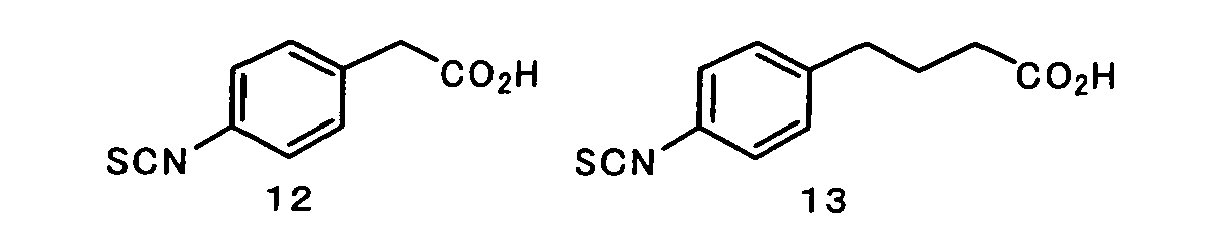

- An isothiocyanate compound having a carboxyl group(s) obtainable by the method of the present invention is a compound which is industrially very useful as a product or a synthetic intermediate in the field of organic materials or drugs or agricultural chemicals.
- The entire disclosures of Japanese Patent Application No.
2008-049369 filed on February 29, 2008 2008-281184 filed on October 31, 2008
Measuring condition for LC-MS (condition 2)
Equipment used: alliance-ZQ LC-MS SYSTEM, manufactured by Waters
Column used: Xterra MS C18 ((3.5 µm), 2.1 mm I.D.x20 mm)
Column temperature: 40°C
Solvent composition:
Measuring condition for LC-MS (condition 3)
Equipment used: 1100MSD-Trap, manufactured by Agilent
Column used: Atlantis dC18 ((5 µm), 2.1 mm I.D.×150 mm)
Column temperature: 40°C
Solvent composition:
Measuring condition for HPLC
Equipment used: SHIMADZU LC-10A series, manufactured by Shimadzu Corporation
Column used: INERTSIL ODS 2 ((5 µm), 4.6 mm I.D.x250 mm)
Column temperature: 40°C
Detection: UV 254 nm
Solvent composition:
Claims (17)
- A method for producing an isothiocyanate compound which has a carboxyl group(s) and is represented by the formula (2):
(SCN)m-A-B-(CO2H)n (2)
wherein m, n, A and B are, respectively, as defined in the formula (1), said method comprising reacting an amino compound which has a carboxyl group(s) and is represented by the formula (1):
(H2N)m-A-B-(CO2H)n (1)
[wherein each of m and n which are independent of each other, is an integer of 1 or 2, A is a C6-14 aromatic hydrocarbon group or a C1-12 saturated hydrocarbon group (said C6-14 aromatic hydrocarbon group and C1-12 saturated hydrocarbon group are unsubstituted or substituted by a halogen atom(s), a nitro group(s), a cyano group(s), a C1-6 alkyl group(s), a hydroxyl group(s), a protected hydroxyl group(s), a C1-6 alkoxy group(s), a di C1-6 alkylamino group(s), a protected amino group(s), a protected mono C1-6 alkylamino group(s), a carboxyl group(s), a C1-6 alkylcarbonyl group(s) or a C1-6 alkoxycarbonyl group(s), and the methylene group(s) in said C1-12 saturated hydrocarbon group may be replaced by an oxygen atom(s), a nitrogen atom(s) substituted by a C1-6 alkyl group, or a protected nitrogen atom(s)), and B is a single bond, a C6-14 aromatic hydrocarbon group or a C1-12 saturated hydrocarbon group (said C6-14 aromatic hydrocarbon group and C1-12 saturated hydrocarbon group are unsubstituted or substituted by a halogen atom(s), a nitro group(s), a cyano group(s), a C1-6 alkyl group(s), a hydroxyl group(s), a protected hydroxyl group(s), a C1-6 alkoxy group(s), a di C1-6 alkylamino group(s), a protected amino group(s), a protected mono C1-6 alkylamino group(s), a C1-6 alkylcarbonyl group(s) or a C1-6 alkoxycarbonyl group(s), and the methylene group(s) in said C1-12 saturated hydrocarbon group may be replaced by an oxygen atom(s), a nitrogen atom(s) substituted by a C1-6 alkyl group, or a protected nitrogen atom(s))], in a solvent, with carbon disulfide (CS2) and then with a halogen as a simple substance. - The method according to Claim 1, wherein A is a C6-14 aromatic hydrocarbon group (said C6-14 aromatic hydrocarbon group is unsubstituted or substituted by a halogen atom(s), a nitro group(s), a cyano group(s), a C1-6 alkyl group(s), a hydroxyl group(s), a protected hydroxyl group(s), a C1-6 alkoxy group(s), a diC1-6 alkylamino group(s), a protected amino group(s), a protected mono C1-6 alkylamino group(s), a C1-6 alkylcarbonyl group(s) or a C1-6 alkoxycarbonyl group(s)), and B is a single bond or a C1-12 saturated hydrocarbon group (said C1-12 saturated hydrocarbon group is unsubstituted or substituted by a halogen atom(s), a nitro group(s), a cyano group(s), a C1-6 alkyl group(s), a hydroxyl group(s), a protected hydroxyl group(s), a C1-6 alkoxy group(s), a di C1-6 alkylamino group(s), a protected amino group(s), a protected mono C1-6 alkylamino group(s), a C1-6 alkylcarbonyl group(s) or a C1-6 alkoxycarbonyl group(s), and the methylene group(s) in said C1-12 saturated hydrocarbon group may be replaced by an oxygen atom(s), a nitrogen atom(s) substituted by a C1-6 alkyl group, or a protected nitrogen atom(s)).
- The method according to Claim 1 or 2, wherein A is a C6-14 aromatic hydrocarbon group (said C6-14 aromatic hydrocarbon group is unsubstituted or substituted by a halogen atom(s), a nitro group(s), a cyano group(s), a C1-6 alkyl group(s), a hydroxyl group(s), a protected hydroxyl group(s), a C1-6 alkoxy group(s), a di C1-6 alkylamino group(s), a protected amino group(s), a protected mono C1-6 alkylamino group(s), a C1-6 alkylcarbonyl group(s) or a C1-6 alkoxycarbonyl group(s)), and B is a single bond or a C1-6 alkyl group.
- The method according to any one of Claims 1 to 3, wherein A is a C6-14 aromatic hydrocarbon group (said C6-14 aromatic hydrocarbon group is unsubstituted or substituted by a halogen atom(s), a nitro group(s), a cyano group(s), a C1-6 alkyl group(s), a hydroxyl group(s), a protected hydroxyl group(s), a C1-6 alkoxy group(s), a di C1-6 alkylamino group(s), a protected amino group(s), a protected mono C1-6 alkylamino group(s), a C1-6 alkylcarbonyl group(s) or a C1-6 alkoxycarbonyl group(s)), and B is a single bond.
- The method according to any one of Claims 1 to 4, wherein A is a C6-14 aromatic hydrocarbon group (said C6-14 aromatic hydrocarbon group is unsubstituted or substituted by a halogen atom(s), a C1-6 alkyl group(s), a hydroxyl group(s) or a C1-6 alkoxy group(s)).
- The method according to Claim 1, wherein A is a C1-12 saturated hydrocarbon group (said C1-12 saturated hydrocarbon group is unsubstituted or substituted by a halogen atom(s), a nitro group(s), a cyano group(s), a C1-6 alkyl group(s), a hydroxyl group(s), a protected hydroxyl group(s), a C1-6 alkoxy group(s), a di C1-6 alkylamino group(s), a protected amino group(s), a protected mono C1-6 alkylamino group(s), a carboxyl group(s), a C1-6 alkylcarbonyl group(s) or a C1-6 alkoxycarbonyl group(s), and the methylene group(s) in said C1-12 saturated hydrocarbon group may be replaced by an oxygen atom(s), a nitrogen atom(s) substituted by a C1-6 alkyl group(s), or a protected nitrogen atom(s)), and B is a single bond or a C6-14 aromatic hydrocarbon group (said C6-14 aromatic hydrocarbon group is unsubstituted or substituted by a halogen atom(s), a nitro group(s), a cyano group(s), a C1-6 alkyl group(s), a hydroxyl group(s), a protected hydroxyl group(s), a C1-6 alkoxy group(s), a di C1-6 alkylamino group(s), a protected amino group(s), a protected mono C1-6 alkylamino group(s), a C1-6 alkylcarbonyl group(s) or a C1-6 alkoxycarbonyl group(s)).
- The method according to Claim 6, wherein A is a C1-12 saturated hydrocarbon group, and B is a single bond or a C6-14 aromatic hydrocarbon group (said C6-14 aromatic hydrocarbon group is unsubstituted or substituted by a halogen atom(s), a C1-6 alkyl group(s), a hydroxyl group(s) or a C1-6 alkoxy group(s)).
- The method according to Claim 7, wherein A is a C1-12 saturated hydrocarbon group, and B is a single bond or a C6-14 aromatic hydrocarbon group.
- The method according to Claim 8, wherein A is a C1-12 saturated hydrocarbon group, and B is a single bond.
- The method according to Claim 8, wherein A is a C1-6 saturated hydrocarbon group, and B is a phenyl group.
- The method according to any one of Claims 1 to 10, wherein m is 1.
- The method according to any one of Claims 1 to 11, wherein n is 1.
- The method according to any one of Claims 1 to 10 and 12, wherein m is 2.
- The method according to any one of Claims 1 to 11 and 13, wherein n is 2.
- The method according to any one of Claims 1 to 14, wherein the reaction of the amino compound having a carboxyl group(s) with carbon disulfide is carried out in the presence of a base.
- The method according to Claim 15, wherein the base is an organic amine or an inorganic base.
- The method according to any one of Claims 1 to 15, wherein the halogen as a simple substance is iodine.
Applications Claiming Priority (3)
| Application Number | Priority Date | Filing Date | Title |
|---|---|---|---|
| JP2008049369 | 2008-02-29 | ||
| JP2008281184 | 2008-10-31 | ||
| PCT/JP2009/053729 WO2009107796A1 (en) | 2008-02-29 | 2009-02-27 | Method for producing isothiocyanate compound having carboxyl group |
Publications (2)
| Publication Number | Publication Date |
|---|---|
| EP2248800A1 true EP2248800A1 (en) | 2010-11-10 |
| EP2248800A4 EP2248800A4 (en) | 2011-12-07 |
Family
ID=41016181
Family Applications (1)
| Application Number | Title | Priority Date | Filing Date |
|---|---|---|---|
| EP09714219A Withdrawn EP2248800A4 (en) | 2008-02-29 | 2009-02-27 | Method for producing isothiocyanate compound having carboxyl group |
Country Status (14)
| Country | Link |
|---|---|
| US (1) | US8367857B2 (en) |
| EP (1) | EP2248800A4 (en) |
| JP (1) | JP5445448B2 (en) |
| KR (1) | KR20100123831A (en) |
| CN (1) | CN101965331B (en) |
| AU (1) | AU2009218090B2 (en) |
| CA (1) | CA2717063A1 (en) |
| IL (1) | IL207523A (en) |
| MX (1) | MX2010009459A (en) |
| NZ (1) | NZ587173A (en) |
| RU (1) | RU2490256C2 (en) |
| TW (1) | TW201000437A (en) |
| WO (1) | WO2009107796A1 (en) |
| ZA (1) | ZA201005566B (en) |
Cited By (2)
| Publication number | Priority date | Publication date | Assignee | Title |
|---|---|---|---|---|
| WO2013041204A1 (en) * | 2011-09-23 | 2013-03-28 | 2LUTION GmbH | Novel isocyanate and isothiocyanate compounds for cancer treatment |
| EP2647623A4 (en) * | 2010-11-29 | 2015-12-30 | Nissan Chemical Ind Ltd | Method for producing isothiocyanate compound |
Families Citing this family (2)
| Publication number | Priority date | Publication date | Assignee | Title |
|---|---|---|---|---|
| JP5212656B2 (en) * | 2009-09-02 | 2013-06-19 | 日産化学工業株式会社 | Method for producing isothiocyanato compound |
| TWI507384B (en) * | 2010-11-30 | 2015-11-11 | Nissan Chemical Ind Ltd | Preparation of Isothiocyanato compound |
Family Cites Families (14)
| Publication number | Priority date | Publication date | Assignee | Title |
|---|---|---|---|---|
| DE832891C (en) * | 1949-12-20 | 1952-03-03 | Bayer Ag | Process for the preparation of thiosemicarbazides |
| US2859235A (en) * | 1954-01-26 | 1958-11-04 | Bayer Ag | Process for the production of isothiocyanates |
| US2921953A (en) * | 1955-04-18 | 1960-01-19 | Phillips Petroleum Co | New substituted amino acid compounds and their preparation |
| US3341564A (en) * | 1964-02-13 | 1967-09-12 | Upjohn Co | Process for converting primary amines to isothiocyanates |
| US3463853A (en) * | 1964-10-26 | 1969-08-26 | Dainippon Pharmaceutical Co | Lungworm disease treating composition containing n-dithiocarboxy derivatives of amino acids and method of using same |
| US4064151A (en) * | 1976-05-17 | 1977-12-20 | United Carbide Corporation | Halosilyl carbamates |
| JPS6034542B2 (en) | 1977-10-04 | 1985-08-09 | 塩野義製薬株式会社 | New isothiocyanate phenyl esters |
| US4680338A (en) * | 1985-10-17 | 1987-07-14 | Immunomedics, Inc. | Bifunctional linker |
| US5449761A (en) | 1993-09-28 | 1995-09-12 | Cytogen Corporation | Metal-binding targeted polypeptide constructs |
| JPH07309831A (en) * | 1994-05-17 | 1995-11-28 | Sumitomo Chem Co Ltd | Method for producing isothiocyanate derivative |
| JP3688785B2 (en) * | 1996-01-24 | 2005-08-31 | レンゴー株式会社 | Method for producing isothiocyanate compound |
| JP3891637B2 (en) | 1996-07-24 | 2007-03-14 | レンゴー株式会社 | Method for producing isothiocyanate compound |
| JP2008049369A (en) | 2006-08-24 | 2008-03-06 | Aikoku Alpha Corp | Method of forming metal sheet |
| JP2008281184A (en) | 2007-05-14 | 2008-11-20 | Nsk Ltd | Planetary roller screw device |
-
2009
- 2009-02-27 TW TW098106458A patent/TW201000437A/en unknown
- 2009-02-27 EP EP09714219A patent/EP2248800A4/en not_active Withdrawn
- 2009-02-27 CA CA2717063A patent/CA2717063A1/en not_active Abandoned
- 2009-02-27 RU RU2010139895/04A patent/RU2490256C2/en not_active IP Right Cessation
- 2009-02-27 JP JP2010500779A patent/JP5445448B2/en not_active Expired - Fee Related
- 2009-02-27 CN CN200980107114.3A patent/CN101965331B/en not_active Expired - Fee Related
- 2009-02-27 US US12/867,339 patent/US8367857B2/en not_active Expired - Fee Related
- 2009-02-27 WO PCT/JP2009/053729 patent/WO2009107796A1/en not_active Ceased
- 2009-02-27 KR KR1020107018170A patent/KR20100123831A/en not_active Ceased
- 2009-02-27 MX MX2010009459A patent/MX2010009459A/en active IP Right Grant
- 2009-02-27 AU AU2009218090A patent/AU2009218090B2/en not_active Ceased
- 2009-02-27 NZ NZ587173A patent/NZ587173A/en not_active IP Right Cessation
-
2010
- 2010-08-04 ZA ZA2010/05566A patent/ZA201005566B/en unknown
- 2010-08-10 IL IL207523A patent/IL207523A/en not_active IP Right Cessation
Non-Patent Citations (2)
| Title |
|---|
| See also references of WO2009107796A1 * |
| ULRIK BOAS ET AL: "Facile synthesis of aliphatic isocyanates and thioureas on solid phase using peptide coupling reagents", TETRAHEDRON LETTERS, vol. 45, 2004, pages 269-272, XP002662562, * |
Cited By (3)
| Publication number | Priority date | Publication date | Assignee | Title |
|---|---|---|---|---|
| EP2647623A4 (en) * | 2010-11-29 | 2015-12-30 | Nissan Chemical Ind Ltd | Method for producing isothiocyanate compound |
| WO2013041204A1 (en) * | 2011-09-23 | 2013-03-28 | 2LUTION GmbH | Novel isocyanate and isothiocyanate compounds for cancer treatment |
| US8987316B2 (en) | 2011-09-23 | 2015-03-24 | DoubleHill GmbH | Isocyanate and isothiocyanate compounds for cancer treatment |
Also Published As
| Publication number | Publication date |
|---|---|
| AU2009218090B2 (en) | 2013-06-06 |
| IL207523A (en) | 2013-08-29 |
| JP5445448B2 (en) | 2014-03-19 |
| RU2490256C2 (en) | 2013-08-20 |
| KR20100123831A (en) | 2010-11-25 |
| TW201000437A (en) | 2010-01-01 |
| JPWO2009107796A1 (en) | 2011-07-07 |
| RU2010139895A (en) | 2012-04-10 |
| CN101965331B (en) | 2014-04-16 |
| NZ587173A (en) | 2012-03-30 |
| ZA201005566B (en) | 2011-10-26 |
| IL207523A0 (en) | 2010-12-30 |
| WO2009107796A1 (en) | 2009-09-03 |
| CA2717063A1 (en) | 2009-09-03 |
| AU2009218090A1 (en) | 2009-09-03 |
| US8367857B2 (en) | 2013-02-05 |
| MX2010009459A (en) | 2010-09-24 |
| US20100312000A1 (en) | 2010-12-09 |
| EP2248800A4 (en) | 2011-12-07 |
| CN101965331A (en) | 2011-02-02 |
Similar Documents
| Publication | Publication Date | Title |
|---|---|---|
| CA2859450C (en) | 2-oxo-1,3-dioxolane-4-carboxamides, their preparation and use | |
| US8367857B2 (en) | Method for producing isothiocyanate compound having carboxyl group | |
| US9102602B2 (en) | Method for producing isothiocyanate compound | |
| CA2246941A1 (en) | Process for the preparation of nitrosourea compounds | |
| JP5681985B2 (en) | Production method of urea compounds by carbon dioxide fixation | |
| Clerici et al. | Mono thiomalonates as thioester enolate equivalents—enantioselective 1, 4-addition reactions to nitroolefins under mild conditions | |
| Okuma et al. | Reaction of benzyne with formamides and acetylimidazole | |
| EP4121408B1 (en) | Synthesis of capsaicin derivatives | |
| KR100261824B1 (en) | Process for preparing bicyclic aromatic sulfonic acid, sulfonyl chloride and sulfonamide | |
| JP5212656B2 (en) | Method for producing isothiocyanato compound | |
| US5155255A (en) | Process for producing cycloalkenylalkenes | |
| KR20250025456A (en) | Method for preparing hydroxyphenyl-1,3,5-triazine compound | |
| HK1150825B (en) | Method for producing isothiocyanate compound having carboxyl group | |
| HK1150825A (en) | Method for producing isothiocyanate compound having carboxyl group | |
| CA1329615C (en) | Process for the preparation of compounds with antiulcer action | |
| RU2571417C2 (en) | Method of producing n-substituted 2-amino-4-(hydroxymethylphosphenyl)-2-butenoic acid | |
| CA1335204C (en) | Aminoacetonitrile derivatives | |
| RU2455303C2 (en) | Method of producing bis-2,4-dialkyl-1,5,3-dithiazepan-3-yls | |
| KR101056769B1 (en) | Sensor comprising flavone derivative having mercury ion selectivity and mercury ion detection method using same | |
| TWI507384B (en) | Preparation of Isothiocyanato compound | |
| CA2310985C (en) | Process for manufacture of n-alkoxy (or aryloxy)carbonyl isothiocyanate derivatives in the presence of n,n-dialkylarylamine catalyst and aqueous solvent | |
| Rozentsveig et al. | Reactions of N-(2, 2-Dichloro-2-phenylethylidene) arenesulfonamides with Aromatic and Heterocyclic Compounds | |
| CA2984565A1 (en) | Processes for converting carboxamides to thiocarboxamides | |
| MX2008010140A (en) | Improved method for producing nitroisourea derivative | |
| KR20150115997A (en) | C5 sulfone compound, method for preparing the same, method for preparing crocetin dinitrile using the same, and use thereof |
Legal Events
| Date | Code | Title | Description |
|---|---|---|---|
| PUAI | Public reference made under article 153(3) epc to a published international application that has entered the european phase |
Free format text: ORIGINAL CODE: 0009012 |
|
| 17P | Request for examination filed |
Effective date: 20100803 |
|
| AK | Designated contracting states |
Kind code of ref document: A1 Designated state(s): AT BE BG CH CY CZ DE DK EE ES FI FR GB GR HR HU IE IS IT LI LT LU LV MC MK MT NL NO PL PT RO SE SI SK TR |
|
| AX | Request for extension of the european patent |
Extension state: AL BA RS |
|
| A4 | Supplementary search report drawn up and despatched |
Effective date: 20111109 |
|
| RIC1 | Information provided on ipc code assigned before grant |
Ipc: C07C 331/30 20060101ALI20111103BHEP Ipc: C07C 331/28 20060101ALI20111103BHEP Ipc: C07C 331/24 20060101ALI20111103BHEP Ipc: C07C 331/20 20060101AFI20111103BHEP |
|
| GRAP | Despatch of communication of intention to grant a patent |
Free format text: ORIGINAL CODE: EPIDOSNIGR1 |
|
| INTG | Intention to grant announced |
Effective date: 20140103 |
|
| STAA | Information on the status of an ep patent application or granted ep patent |
Free format text: STATUS: THE APPLICATION IS DEEMED TO BE WITHDRAWN |
|
| 18D | Application deemed to be withdrawn |
Effective date: 20140507 |