EP2246858A1 - Controlling an optical-disc reader using surface marks - Google Patents
Controlling an optical-disc reader using surface marks Download PDFInfo
- Publication number
- EP2246858A1 EP2246858A1 EP10161581A EP10161581A EP2246858A1 EP 2246858 A1 EP2246858 A1 EP 2246858A1 EP 10161581 A EP10161581 A EP 10161581A EP 10161581 A EP10161581 A EP 10161581A EP 2246858 A1 EP2246858 A1 EP 2246858A1
- Authority
- EP
- European Patent Office
- Prior art keywords
- optical
- disc
- playback
- player
- reader
- Prior art date
- Legal status (The legal status is an assumption and is not a legal conclusion. Google has not performed a legal analysis and makes no representation as to the accuracy of the status listed.)
- Withdrawn
Links
Images



Classifications
-
- G—PHYSICS
- G11—INFORMATION STORAGE
- G11B—INFORMATION STORAGE BASED ON RELATIVE MOVEMENT BETWEEN RECORD CARRIER AND TRANSDUCER
- G11B27/00—Editing; Indexing; Addressing; Timing or synchronising; Monitoring; Measuring tape travel
- G11B27/10—Indexing; Addressing; Timing or synchronising; Measuring tape travel
- G11B27/19—Indexing; Addressing; Timing or synchronising; Measuring tape travel by using information detectable on the record carrier
- G11B27/24—Indexing; Addressing; Timing or synchronising; Measuring tape travel by using information detectable on the record carrier by sensing features on the record carrier other than the transducing track ; sensing signals or marks recorded by another method than the main recording
-
- G—PHYSICS
- G11—INFORMATION STORAGE
- G11B—INFORMATION STORAGE BASED ON RELATIVE MOVEMENT BETWEEN RECORD CARRIER AND TRANSDUCER
- G11B2220/00—Record carriers by type
- G11B2220/20—Disc-shaped record carriers
- G11B2220/25—Disc-shaped record carriers characterised in that the disc is based on a specific recording technology
- G11B2220/2537—Optical discs
- G11B2220/2562—DVDs [digital versatile discs]; Digital video discs; MMCDs; HDCDs
Definitions
- the invention relates to the writing of information to, and the reading of information from optical discs.
- Pre-recorded, read-only optical discs such as the compact disc (CD) and digital versatile disc (DVD) are a popular medium for the storage and distribution of digital information, e.g., digitally encoded movies.
- the typical movie DVD offers the user multiple playback options, e.g., different dialogue languages (French, Spanish, etc.), different audio options (5.1 surround sound, stereo, etc.), different screen formats (widescreen, fullscreen), commentary on or off, subtitles on or off, etc.
- the typical process for changing a playback option is for the user to navigate through one or more on-screen menus using the player's controls or a remote control, a potentially tedious process. Typically, this process is performed when a disc is played on a particular player for the first time. Furthermore, for those players that cannot remember settings for a particular disc, the user might have to repeat the playback-option setting process every time the disc is inserted in the player.
- the invention is a player-implemented method for controlling operation of an optical-disc player having an optical-disc reader.
- the method derives out-of-band information from surface marks of an optical disc and uses the derived out-of-band information to control the operation of the optical-disc reader.
- the invention is an optical-disc player comprising (i) an optical-disc reader adapted to derive out-of-band information from surface marks of an optical disc and (ii) a controller adapted to control operation of the optical-disc reader based on the derived out-of-band information.
- the inventi o n is a user-implemented method of using an optical-disc player to playback an optical disc.
- the user applies, to the optical disc, surface marks corresponding to one or more selected playback options.
- the user then operates the optical-disc player to enable the optical-disc player to (i) derive, from the surface marks, out-of-band information corresponding to the one or more selected playback options and (ii) control the rendering of embedded data of the optical disc based on the out-of-band information to implement the one or more selected playback options.
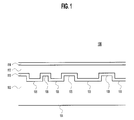
- FIG. 1 is a cross-section of a typical read-only optical disc 100.
- FIG. 2 is a block diagram of disc player 200 according to one embodiment of the present invention.
- FIG. 3 is a functional flowchart of a disc player 200 of FIG. 2 according to various embodiments of the present invention.
- FIG. 4 is a flowchart describing one possible use of a disc player 200 of FIG. 2 according to one embodiment of the present invention.
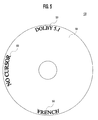
- FIG. 5 is an example of the surface marks a user might make on optical disc 100 of FIG.1 according to certain embodiments of the present invention.
- FIG. 6 is a depiction of lens assembly 600 reading surface mark 500 on disc 100.
- FIG. 1 is a cross-section of a typical read-only optical disc 100.
- Optical disc 100 is a flat, circular disc comprising several layers.
- Bottom-most layer 102 is clear polycarbonate plastic.
- the bottom surface 104 of layer 102 (i.e., the bottom surface of disc 100) is smooth.
- Data is typically stored as a single, continuous, spiral track of pits 106 and lands 108 etched on the top surface of layer 102. Data stored in this manner is referred to as the embedded data.
- the dimensions of the pits and lands depend on the specific optical-disc format. On a CD, pits are 100 nanometers deep, 500 nanometers wide, and a minimum of 850 nanometers long. On a DVD, pits are 120 nanometers deep, 320 nanometers wide, and a minimum of 400 nanometers long.
- Layer 110 is a reflective material, typically aluminum.
- Layer 112 is an acrylic layer that protects reflective layer 110.
- Optional layer 114 is a label or printing.
- a disc player is a system for reading and outputting the information stored on an optical disc.
- a disc player can be a self-contained device, e.g., a standalone DVD player, or it can be a subsystem of a larger system, e.g., the CD reader and associated software within a personal or laptop computer.
- a disc player can include the components necessary to render in-band data, e.g., a DVD player with a built-in monitor, or it cannot, e.g., a standalone DVD player.
- FIG. 2 is a block diagram of disc player 200 according to one embodiment of the present invention.
- Disc player 200 comprises disc reader 202 and controller 204.
- Disc reader 202 comprises disc drive 206 and signal processor 208.
- Signal processor 208 contains an optical character recognition (OCR) module 222.
- OCR optical character recognition
- the data flows of disc player 200 are typically either in-band data or out-of-band data.
- In-band data refers to data that is outputted by the disc player, e.g., a movie displayed on a screen or music played over speakers.
- disc drive 206 reads the embedded data on an optical disc and outputs in-band data 210 to processor 208.
- Processor 208 performs one or more processing operations (e.g., error-detection/correction, decoding, digital-to-analog conversion) on in-band data 210 and outputs processed in-band data 212.
- Out-of-band data refers to data that controls the operation of the disc player.
- Out-of-band data e.g., data 214, 216, or 218, might be generated by any of controller 204, disc drive 206, or processor 208, respectively.
- out-of-band data e.g., data 220, might be received from a source outside disc player 200.
- Controller 204 controls the operations of both disc drive 206 and processor 208.
- controller 204 might be an executable program that receives out-of-band data 220 from an infrared remote-control device and displays various playback options on a screen. A user uses the remote control to select playback options. The controller converts the selected playback options into out-of-band data 214 to disc drive 206 and out-of-band data 216 to processor 208.
- Disc drive 206 is an electro-mechanical assembly comprising three major components (not shown): the drive motor, the tracking mechanism, and the lens assembly.
- the drive motor rotates the disc.
- the tracking mechanism moves the lens assembly along the spiral track of embedded data, and adjusts the distance between the disc surface and the lens assembly, e.g., to focus the lens assembly.
- the lens assembly comprises (i) one or more light sources (e.g., lasers), (ii) one or more lenses, and (iii) one or more optical sensors (e.g., photodiodes).
- Disc drive 206 is adapted to read the embedded data of an optical disc and executes a read process to read the embedded data.
- the drive motor spins the optical disc, and keeps the disc spinning for the duration of the read process.
- the tracking mechanism moves the lens assembly to the correct location adjacent to the optical disc for reading the data.
- the tracking mechanism focuses the lens assembly on the pits and lands embedded within the disc.
- the laser(s) in the lens assembly shoot light upwards at reflective layer 110 through clear polycarbonate 102.
- the reflective layer reflects the light back to the lens assembly. Pits 106 and lands 108 alter the reflected light.
- the photodiodes within the lens assembly detect the alterations in the reflected light and output a corresponding electrical signal.
- the area of an optical disc which the lens assembly can read is known as the readable area of the optical disc.
- the readable area is not necessarily the same as the area that contains embedded data, i.e., there might be areas on an optical disc to which embedded data cannot be or typically is not written, but which can nevertheless be read by the lens assembly.
- a typical lens assembly is specifically adapted to read the nanometer-scale pits and lands of the embedded data of an optical disc
- the lens assembly is not physically limited to read only the embedded data.
- the lens assembly also might be able to read surface marks made on the top or bottom surface of an optical disc that are within the readable area of the disc. For example, a word written in black ink on the bottom surface of an optical disc and within the readable area will most likely result in variations in the reflected light detected by the photodiodes of the typical lens assembly.
- Embodiments of the present invention are methods and apparatuses, e.g., optical-disc players, for deriving out-of-band data from surface marks of an optical disc, and using the derived out-of-band data to control the operation of the disc player.
- optical-disc players for deriving out-of-band data from surface marks of an optical disc, and using the derived out-of-band data to control the operation of the disc player.
- the surface marks may be any mark which can be detected, either by the typical lens assembly of a disc drive or by an additional/other detector system.
- the surface marks may be made in any manner, e.g., written by hand, printed, applied in the form of a sticker, etched, etc.
- the surface marks might be applied to either or both surfaces of the optical disc.
- surface marks are read using the same lens assembly that is used to read embedded data.
- other components e.g., lasers, lenses, photodiodes, are added to the lens assembly for the specific purpose of reading surface marks.
- a mechanism for detecting surface-marks is added to the disc player separate from the lens assembly.
- the focus settings used by the lens assembly to read surface marks are the same as the focus settings used to read embedded data.
- the two focus settings are different. Specifically, when reading surface marks, the lens assembly is defocused, lowering the resolution of the lens assembly, but also reducing the time required to scan the entire disc. Since surface marks are typically significantly larger than the pits and lands typically read by the lens assembly, the loss of resolution does not affect the accuracy of the scanning of the surface marks.
- FIG. 3 is a functional flowchart of a disc player 200 of FIG. 2 according to various embodiments of the present invention. Processing begins at step 302 and proceeds to step 304 where out-of-band information is derived from the surface marks of an optical disc. Next, at step 306, the derived out-of-band information is used to control the operation of a disc player. Processing then terminates at step 308.
- Disc drive 206 is adapted to read surface marks, either with the same mechanism used to read embedded data or with a separate mechanism. Second, out-of-band signals 218 and/or 214 outputted by disc drive 206 might be derived from surface marks.
- FIG. 4 is a flowchart describing one possible use of a disc player 200 of FIG. 2 according to one embodiment of the present invention. Processing begins at step 402 and proceeds to step 404 where surface marks are made on an optical disc. Next, at step 406, the optical disc is inserted in disc player 200. Next, at step 408, the disc player reads the surface marks and sends the resulting image data (e.g., a bitmap) as out-of-band data 218 to processor 208 of FIG. 2 , which processor comprises an optical character recognition (OCR) module 222. Next, at step 410, OCR module 222 converts the received bitmap to text and sends that text as out-of-band information 216 to controller 204.
- OCR optical character recognition
- the controller parses the received text file, sets various controller parameters, e.g., playback options, and transmits those parameters to disc drive 206 (as out-of-band data 214) and/or processor 208 (as out-of-band data 216). Processing then terminates at step 414.
- controller parameters e.g., playback options
- FIG. 5 is an example of the surface marks a user might make on optical disc 100 of FIG.1 according to certain embodiments of the present invention.
- the user makes three surface marks 500, "French,” “Dolby 5.1,” and "No cursor” on the bottom surface 104 of optical disc 100.
- the viewer inserts the disc into a standalone DVD player (the disc-player system) and presses PLAY.
- FIG. 6 is a depiction of the reading of surface mark 500 on disc 100.
- the reading can be performed by a conventional lens assembly 600.
- lens assembly 600 When reading the embedded data of an optical disc, lens assembly 600 emits focused light 606 at pits 106 and lands 108.
- lens assembly 600 When reading surface marks, lens assembly 600 emits defocused light 602 at bottom surface 104 of disc 100, which surface contains surface mark 500.
- the disc reader might contain a separate imaging device 608 adapted to read only surface marks. Imaging device 608, too, emits defocused light 602 at bottom surface 104 of disc 100, which surface contains surface mark 500.
- Lens assembly 600 or imaging device 608 detect variations in reflected light 604 and send the resulting bitmap as out-of-band data 218 to processor 208, which processor comprises an OCR module 222 .
- the OCR module converts the bitmap into a text file and sends the text file as out-of-band data 216 to controller 204, e.g., Microsoft's HDi runtime program.
- the HDi runtime program parses the text file and (i) sets the dialogue language to French, (ii) sets audio to Dolby 5.1, and (iii) turns off the cursor.
- the optical disc is an installation CD for a software program.
- a user writes a special unlock code on the surface of the installation CD and inserts the CD into disc drive 206, e.g., a CD player on the user's personal computer (PC).
- the CD player reads the surface marks, and OCR module 222 in processor 208 OCRs the bitmap and sends the unlock code to controller 204.
- the controller is an executable installation program running on the PC.
- the installation program verifies the unlock code. If the verification succeeds, then installation proceeds. Otherwise, installation is halted.
- the present invention can be embodied in the form of methods and apparatuses for practicing those methods.
- the present invention can also be embodied in the form of program code embodied in tangible media, such as magnetic recording media, optical recording media, solid state memory, floppy diskettes, CD-ROMs, hard drives, or any other machine-readable storage medium, wherein, when the program code is loaded into and executed by a machine, such as a computer, the machine becomes an apparatus for practicing the invention.
- the present invention can also be embodied in the form of program code, for example, whether stored in a storage medium or loaded into and/or executed by a machine, wherein, when the program code is loaded into and executed by a machine, such as a computer, the machine becomes an apparatus for practicing the invention.
- the program code segments combine with the processor to provide a unique device that operates analogously to specific logic circuits.
- figure numbers and/or figure reference labels in the claims is intended to identify one or more possible embodiments of the claimed subject matter in order to facilitate the interpretation of the claims. Such use is not to be construed as necessarily limiting the scope of those claims to the embodiments shown in the corresponding figures.
Landscapes
- Optical Recording Or Reproduction (AREA)
- Signal Processing For Digital Recording And Reproducing (AREA)
Abstract
An optical-disc player having a reader and a controller. The reader derives out-of-band information from surface marks of an optical disc, where the controller controls operations of the reader based on the derived information. The controlled operations may involve the reading and rendering of embedded data of the optical disc. For example, a person writes the words "Spanish" and "widescreen" on the surface of a DVD with a marker and inserts the DVD in a DVD player. The DVD player scans the surface of the DVD and sends the resulting image data to an optical character recognition (OCR) module. The OCR module outputs a text file containing the words "Spanish" and "widescreen" to a controller (e.g., Microsoft HDi runtime). In response, the controller sets the playback language to Spanish and the screen format to widescreen.
Description
- Cross-Reference to Related Applications
- This application claims the benefit of
U.S. provisional application no. 61/174,568 filed on May 1, 2009 - The subject matter of this application is related to the subject matter of U.S. patent application no. xx/xxx,xxx, filed as Attorney Docket No. Fratti 43-8 on the same date as this application, the teachings of which are incorporated herein by reference in their entirety.
- Field of the Invention
- The invention relates to the writing of information to, and the reading of information from optical discs.
- Description of the Related Art
- Pre-recorded, read-only optical discs, such as the compact disc (CD) and digital versatile disc (DVD), are a popular medium for the storage and distribution of digital information, e.g., digitally encoded movies. The typical movie DVD offers the user multiple playback options, e.g., different dialogue languages (French, Spanish, etc.), different audio options (5.1 surround sound, stereo, etc.), different screen formats (widescreen, fullscreen), commentary on or off, subtitles on or off, etc. The typical process for changing a playback option is for the user to navigate through one or more on-screen menus using the player's controls or a remote control, a potentially tedious process. Typically, this process is performed when a disc is played on a particular player for the first time. Furthermore, for those players that cannot remember settings for a particular disc, the user might have to repeat the playback-option setting process every time the disc is inserted in the player.
- In one embodiment, the invention is a player-implemented method for controlling operation of an optical-disc player having an optical-disc reader. The method derives out-of-band information from surface marks of an optical disc and uses the derived out-of-band information to control the operation of the optical-disc reader.
- In another embodiment, the invention is an optical-disc player comprising (i) an optical-disc reader adapted to derive out-of-band information from surface marks of an optical disc and (ii) a controller adapted to control operation of the optical-disc reader based on the derived out-of-band information.
- In yet another embodiment, the invention is a user-implemented method of using an optical-disc player to playback an optical disc. The user applies, to the optical disc, surface marks corresponding to one or more selected playback options. The user then operates the optical-disc player to enable the optical-disc player to (i) derive, from the surface marks, out-of-band information corresponding to the one or more selected playback options and (ii) control the rendering of embedded data of the optical disc based on the out-of-band information to implement the one or more selected playback options.
- Other aspects, features, and advantages of the invention will become more fully apparent from the following detailed description, the appended claims, and the accompanying drawings in which like reference numerals identify similar or identical elements.
-
FIG. 1 is a cross-section of a typical read-onlyoptical disc 100. -
FIG. 2 is a block diagram ofdisc player 200 according to one embodiment of the present invention. -
FIG. 3 is a functional flowchart of adisc player 200 ofFIG. 2 according to various embodiments of the present invention. -
FIG. 4 is a flowchart describing one possible use of adisc player 200 ofFIG. 2 according to one embodiment of the present invention. -
FIG. 5 is an example of the surface marks a user might make onoptical disc 100 ofFIG.1 according to certain embodiments of the present invention. -
FIG. 6 is a depiction oflens assembly 600reading surface mark 500 ondisc 100. -
FIG. 1 is a cross-section of a typical read-onlyoptical disc 100.Optical disc 100 is a flat, circular disc comprising several layers.Bottom-most layer 102 is clear polycarbonate plastic. Thebottom surface 104 of layer 102 (i.e., the bottom surface of disc 100) is smooth. Data is typically stored as a single, continuous, spiral track ofpits 106 andlands 108 etched on the top surface oflayer 102. Data stored in this manner is referred to as the embedded data. The dimensions of the pits and lands depend on the specific optical-disc format. On a CD, pits are 100 nanometers deep, 500 nanometers wide, and a minimum of 850 nanometers long. On a DVD, pits are 120 nanometers deep, 320 nanometers wide, and a minimum of 400 nanometers long. -
Layer 110 is a reflective material, typically aluminum.Layer 112 is an acrylic layer that protectsreflective layer 110.Optional layer 114 is a label or printing. - A disc player is a system for reading and outputting the information stored on an optical disc. A disc player can be a self-contained device, e.g., a standalone DVD player, or it can be a subsystem of a larger system, e.g., the CD reader and associated software within a personal or laptop computer. A disc player can include the components necessary to render in-band data, e.g., a DVD player with a built-in monitor, or it cannot, e.g., a standalone DVD player.
-
FIG. 2 is a block diagram ofdisc player 200 according to one embodiment of the present invention.Disc player 200 comprisesdisc reader 202 andcontroller 204.Disc reader 202 comprisesdisc drive 206 andsignal processor 208.Signal processor 208 contains an optical character recognition (OCR)module 222. - The data flows of
disc player 200 are typically either in-band data or out-of-band data. In-band data refers to data that is outputted by the disc player, e.g., a movie displayed on a screen or music played over speakers. InFIG. 2 ,disc drive 206 reads the embedded data on an optical disc and outputs in-band data 210 toprocessor 208.Processor 208 performs one or more processing operations (e.g., error-detection/correction, decoding, digital-to-analog conversion) on in-band data 210 and outputs processed in-band data 212. - Out-of-band data refers to data that controls the operation of the disc player. Out-of-band data, e.g.,
data controller 204,disc drive 206, orprocessor 208, respectively. Alternatively or in addition, out-of-band data, e.g.,data 220, might be received from a source outsidedisc player 200. -
Controller 204 controls the operations of bothdisc drive 206 andprocessor 208. For example,controller 204 might be an executable program that receives out-of-band data 220 from an infrared remote-control device and displays various playback options on a screen. A user uses the remote control to select playback options. The controller converts the selected playback options into out-of-band data 214 todisc drive 206 and out-of-band data 216 toprocessor 208. -
Disc drive 206 is an electro-mechanical assembly comprising three major components (not shown): the drive motor, the tracking mechanism, and the lens assembly. The drive motor rotates the disc. The tracking mechanism moves the lens assembly along the spiral track of embedded data, and adjusts the distance between the disc surface and the lens assembly, e.g., to focus the lens assembly. The lens assembly comprises (i) one or more light sources (e.g., lasers), (ii) one or more lenses, and (iii) one or more optical sensors (e.g., photodiodes). -
Disc drive 206 is adapted to read the embedded data of an optical disc and executes a read process to read the embedded data. The drive motor spins the optical disc, and keeps the disc spinning for the duration of the read process. The tracking mechanism moves the lens assembly to the correct location adjacent to the optical disc for reading the data. The tracking mechanism focuses the lens assembly on the pits and lands embedded within the disc. The laser(s) in the lens assembly shoot light upwards atreflective layer 110 throughclear polycarbonate 102. The reflective layer reflects the light back to the lens assembly.Pits 106 and lands 108 alter the reflected light. The photodiodes within the lens assembly detect the alterations in the reflected light and output a corresponding electrical signal. - The area of an optical disc which the lens assembly can read is known as the readable area of the optical disc. The readable area is not necessarily the same as the area that contains embedded data, i.e., there might be areas on an optical disc to which embedded data cannot be or typically is not written, but which can nevertheless be read by the lens assembly.
- Although a typical lens assembly is specifically adapted to read the nanometer-scale pits and lands of the embedded data of an optical disc, the lens assembly is not physically limited to read only the embedded data. The lens assembly also might be able to read surface marks made on the top or bottom surface of an optical disc that are within the readable area of the disc. For example, a word written in black ink on the bottom surface of an optical disc and within the readable area will most likely result in variations in the reflected light detected by the photodiodes of the typical lens assembly.
- Embodiments of the present invention are methods and apparatuses, e.g., optical-disc players, for deriving out-of-band data from surface marks of an optical disc, and using the derived out-of-band data to control the operation of the disc player.
- The surface marks may be any mark which can be detected, either by the typical lens assembly of a disc drive or by an additional/other detector system. The surface marks may be made in any manner, e.g., written by hand, printed, applied in the form of a sticker, etched, etc. The surface marks might be applied to either or both surfaces of the optical disc.
- In certain embodiments of the present invention, surface marks are read using the same lens assembly that is used to read embedded data. In other embodiments of the present invention, other components, e.g., lasers, lenses, photodiodes, are added to the lens assembly for the specific purpose of reading surface marks. In yet other embodiments of the present invention, a mechanism for detecting surface-marks is added to the disc player separate from the lens assembly.
- In those embodiments of the present invention where the lens assembly is used to read both embedded data and surface marks, the focus settings used by the lens assembly to read surface marks are the same as the focus settings used to read embedded data. In other embodiments of the present invention, the two focus settings are different. Specifically, when reading surface marks, the lens assembly is defocused, lowering the resolution of the lens assembly, but also reducing the time required to scan the entire disc. Since surface marks are typically significantly larger than the pits and lands typically read by the lens assembly, the loss of resolution does not affect the accuracy of the scanning of the surface marks.
-
FIG. 3 is a functional flowchart of adisc player 200 ofFIG. 2 according to various embodiments of the present invention. Processing begins atstep 302 and proceeds to step 304 where out-of-band information is derived from the surface marks of an optical disc. Next, atstep 306, the derived out-of-band information is used to control the operation of a disc player. Processing then terminates atstep 308. -
Disc drive 206 is adapted to read surface marks, either with the same mechanism used to read embedded data or with a separate mechanism. Second, out-of-band signals 218 and/or 214 outputted bydisc drive 206 might be derived from surface marks. -
FIG. 4 is a flowchart describing one possible use of adisc player 200 ofFIG. 2 according to one embodiment of the present invention. Processing begins atstep 402 and proceeds to step 404 where surface marks are made on an optical disc. Next, atstep 406, the optical disc is inserted indisc player 200. Next, atstep 408, the disc player reads the surface marks and sends the resulting image data (e.g., a bitmap) as out-of-band data 218 toprocessor 208 ofFIG. 2 , which processor comprises an optical character recognition (OCR)module 222. Next, atstep 410,OCR module 222 converts the received bitmap to text and sends that text as out-of-band information 216 tocontroller 204. Next, atstep 412, the controller parses the received text file, sets various controller parameters, e.g., playback options, and transmits those parameters to disc drive 206 (as out-of-band data 214) and/or processor 208 (as out-of-band data 216). Processing then terminates atstep 414. -
FIG. 5 is an example of the surface marks a user might make onoptical disc 100 ofFIG.1 according to certain embodiments of the present invention. The user makes three surface marks 500, "French," "Dolby 5.1," and "No cursor" on thebottom surface 104 ofoptical disc 100. The viewer inserts the disc into a standalone DVD player (the disc-player system) and presses PLAY. -
FIG. 6 is a depiction of the reading ofsurface mark 500 ondisc 100. The reading can be performed by aconventional lens assembly 600. When reading the embedded data of an optical disc,lens assembly 600 emits focused light 606 atpits 106 and lands 108. When reading surface marks,lens assembly 600 emits defocused light 602 atbottom surface 104 ofdisc 100, which surface containssurface mark 500. Alternatively, the disc reader might contain aseparate imaging device 608 adapted to read only surface marks.Imaging device 608, too, emits defocused light 602 atbottom surface 104 ofdisc 100, which surface containssurface mark 500. -
Lens assembly 600 orimaging device 608 detect variations in reflected light 604 and send the resulting bitmap as out-of-band data 218 toprocessor 208, which processor comprises anOCR module 222. The OCR module converts the bitmap into a text file and sends the text file as out-of-band data 216 tocontroller 204, e.g., Microsoft's HDi runtime program. The HDi runtime program parses the text file and (i) sets the dialogue language to French, (ii) sets audio to Dolby 5.1, and (iii) turns off the cursor. - In another example, the optical disc is an installation CD for a software program. A user writes a special unlock code on the surface of the installation CD and inserts the CD into
disc drive 206, e.g., a CD player on the user's personal computer (PC). The CD player reads the surface marks, andOCR module 222 inprocessor 208 OCRs the bitmap and sends the unlock code tocontroller 204. Here, the controller is an executable installation program running on the PC. The installation program verifies the unlock code. If the verification succeeds, then installation proceeds. Otherwise, installation is halted. - The present invention can be embodied in the form of methods and apparatuses for practicing those methods. The present invention can also be embodied in the form of program code embodied in tangible media, such as magnetic recording media, optical recording media, solid state memory, floppy diskettes, CD-ROMs, hard drives, or any other machine-readable storage medium, wherein, when the program code is loaded into and executed by a machine, such as a computer, the machine becomes an apparatus for practicing the invention. The present invention can also be embodied in the form of program code, for example, whether stored in a storage medium or loaded into and/or executed by a machine, wherein, when the program code is loaded into and executed by a machine, such as a computer, the machine becomes an apparatus for practicing the invention. When implemented on a general-purpose processor, the program code segments combine with the processor to provide a unique device that operates analogously to specific logic circuits.
- Unless explicitly stated otherwise, each numerical value and range should be interpreted as being approximate as if the word "about" or "approximately" preceded the value of the value or range.
- It will be further understood that various changes in the details, materials, and arrangements of the parts which have been described and illustrated in order to explain the nature of this invention may be made by those skilled in the art without departing from the scope of the invention as expressed in the following claims.
- The use of figure numbers and/or figure reference labels in the claims is intended to identify one or more possible embodiments of the claimed subject matter in order to facilitate the interpretation of the claims. Such use is not to be construed as necessarily limiting the scope of those claims to the embodiments shown in the corresponding figures.
- It should be understood that the steps of the exemplary methods set forth herein are not necessarily required to be performed in the order described, and the order of the steps of such methods should be understood to be merely exemplary. Likewise, additional steps may be included in such methods, and certain steps may be omitted or combined, in methods consistent with various embodiments of the present invention.
- Although the elements in the following method claims, if any, are recited in a particular sequence with corresponding labeling, unless the claim recitations otherwise imply a particular sequence for implementing some or all of those elements, those elements are not necessarily intended to be limited to being implemented in that particular sequence.
- Reference herein to "one embodiment" or "an embodiment" means that a particular feature, structure, or characteristic described in connection with the embodiment can be included in at least one embodiment of the invention. The appearances of the phrase "in one embodiment" in various places in the specification are not necessarily all referring to the same embodiment, nor are separate or alternative embodiments necessarily mutually exclusive of other embodiments. The same applies to the term "implementation."
Claims (10)
- A player-implemented method for controlling operation of an optical-disc player having an optical-disc reader, the method comprising:(a) deriving out-of-band information from surface marks of an optical disc; and(b) controlling the operation of the optical-disc reader based on the derived out-of-band information.
- The method of claim 1, wherein step (b) comprises setting one or more playback options associated with rendering embedded data read from the optical disc by the optical-disc reader.
- The method of claim 2, wherein the one or more playback options comprise one or more of a language of the playback, whether to include subtitles in the playback, an audio format for the playback, a screen format for playback, and whether to include commentary in the playback.
- An optical-disc player comprising:an optical-disc reader adapted to derive out-of-band information from surface marks of an optical disc; anda controller adapted to control operation of the optical-disc reader based on the derived out-of-band information.
- The optical-disc player system of claim 4, wherein the optical-disc reader is adapted to:(i) generate image data corresponding to the surface marks; and(ii) process the image data to generate the derived out-of-band information.
- The optical-disc player of claim 4, wherein the controller is adapted to set one or more playback options associated with rendering embedded data read from the optical disc by the optical-disc reader.
- The optical-disc player of claim 6, wherein the one or more playback options comprise one or more of a language of the playback, whether to include subtitles in the playback, an audio format for the playback, a screen format for playback, and whether to include commentary in the playback.
- The optical-disc player of claim 4, wherein the optical-disc reader is adapted to read both embedded data of the optical disc and the surface marks.
- The optical-disc player of claim 8, wherein the optical-disc reader comprises a lens assembly adapted to generate:(i) at a first level of optical resolution, a first set of image data corresponding to the embedded data; and(ii) at a second level of optical resolution different from the first level, a second set of image data corresponding to the surface marks.
- The optical-disc player of claim 8, wherein the optical-disc reader comprises:(i) a lens assembly adapted to generate, at a first level of optical resolution, a first set of image data corresponding to the embedded data; and(ii) an imaging device, separate from the lens assembly, adapted to generate, at a second level of optical resolution different from the first level, a second set of image data corresponding to the surface marks.
Applications Claiming Priority (2)
| Application Number | Priority Date | Filing Date | Title |
|---|---|---|---|
| US17456809P | 2009-05-01 | 2009-05-01 | |
| US12/500,089 US8315133B2 (en) | 2009-05-01 | 2009-07-09 | Controlling an optical-disc reader using surface marks |
Publications (1)
| Publication Number | Publication Date |
|---|---|
| EP2246858A1 true EP2246858A1 (en) | 2010-11-03 |
Family
ID=42179824
Family Applications (1)
| Application Number | Title | Priority Date | Filing Date |
|---|---|---|---|
| EP10161581A Withdrawn EP2246858A1 (en) | 2009-05-01 | 2010-04-30 | Controlling an optical-disc reader using surface marks |
Country Status (6)
| Country | Link |
|---|---|
| US (1) | US8315133B2 (en) |
| EP (1) | EP2246858A1 (en) |
| JP (1) | JP2010262729A (en) |
| KR (1) | KR20100119721A (en) |
| CN (1) | CN101877232A (en) |
| TW (1) | TW201104679A (en) |
Citations (3)
| Publication number | Priority date | Publication date | Assignee | Title |
|---|---|---|---|---|
| EP0523492A1 (en) * | 1991-07-18 | 1993-01-20 | TELEFUNKEN Fernseh und Rundfunk GmbH | Programmed playback system of an additional record from a recording medium |
| EP0532997A1 (en) * | 1991-09-16 | 1993-03-24 | Eastman Kodak Company | Method and apparatus for selecting information on a data storage medium |
| US6493506B1 (en) * | 1998-07-01 | 2002-12-10 | Lsi Logic Corporation | Optical disk system and method for storing disk- and user-specific settings |
Family Cites Families (33)
| Publication number | Priority date | Publication date | Assignee | Title |
|---|---|---|---|---|
| US4677604A (en) * | 1985-02-04 | 1987-06-30 | Selsys Corporation | Method for controlling access to recorded data |
| US4872151A (en) * | 1986-02-19 | 1989-10-03 | Bennie C. Fulkerson | Compact disc player capable of playing plural selections recorded on a compact disc in a preselected sequence |
| DE3842149A1 (en) | 1988-12-15 | 1990-06-21 | Bockisch Andreas | Identification of compact discs (CDs) and permanent storage of the track sequence on the CD or in a CD player |
| JPH0383243A (en) * | 1989-08-25 | 1991-04-09 | Nec Eng Ltd | Video tape recorder |
| JP2849161B2 (en) * | 1989-10-14 | 1999-01-20 | 三菱電機株式会社 | Information playback device |
| EP0532998A1 (en) * | 1991-09-16 | 1993-03-24 | Eastman Kodak Company | Picture orientation markable photo compact disk and method and apparatus for using same |
| EP0549488B1 (en) * | 1991-12-20 | 1998-09-30 | Eastman Kodak Company | A storage media for an optical information system having an identification code embedded therein |
| JPH05258390A (en) * | 1992-03-12 | 1993-10-08 | Matsushita Electric Ind Co Ltd | Program recording reservation device |
| US5288107A (en) * | 1993-01-27 | 1994-02-22 | Engineered Data Products, Inc. | Multiple information field label |
| JP3707812B2 (en) * | 1994-09-27 | 2005-10-19 | ソニー株式会社 | Optical recording method, optical recording apparatus, and optical recording medium |
| MY112755A (en) * | 1995-06-06 | 2001-08-30 | Sony Corp | Information data reproducing system, reproducing apparatus, reproducing method, data forming apparatus and data record medium |
| JPH097288A (en) | 1995-06-22 | 1997-01-10 | Sony Corp | Optical disc reproducing apparatus and optical disc discriminating method |
| EP1006516B1 (en) * | 1995-10-09 | 2001-11-21 | Matsushita Electric Industrial Co., Ltd. | An optical disk and an optical disk reproduction apparatus |
| US5815484A (en) * | 1995-12-28 | 1998-09-29 | Hide And Seek Technologies L.L.C. | Copy protectable optical media device and methodology therefor |
| US6028620A (en) * | 1996-12-10 | 2000-02-22 | Photonics Industries Internatinal, Inc. | Method and apparatus for affixing information on optical storage disks |
| DE69739787D1 (en) | 1996-12-19 | 2010-04-08 | Panasonic Corp | Method for recording write-once information on an optical disk. |
| US6070799A (en) * | 1997-01-08 | 2000-06-06 | Eastman Kodak Company | Copy protection for a recordable medium and for controlling a recorder |
| JP3111923B2 (en) * | 1997-04-10 | 2000-11-27 | 松下電器産業株式会社 | Method and apparatus for recording information on optical disc |
| EP0940810A1 (en) | 1998-03-04 | 1999-09-08 | Kichinosuke Nagashio | Recording medium with copyright protection features |
| US20050050343A1 (en) * | 2000-06-30 | 2005-03-03 | Selinfreund Richard H. | Storage media access control method and system |
| US20030123302A1 (en) * | 2001-06-05 | 2003-07-03 | Thompson Robert F. | Limited play optical devices with interstitial reactive layer and methods of making same |
| US7016294B2 (en) * | 2002-03-25 | 2006-03-21 | Dphi Acquisitions, Inc. | Inner region identifier for optical disk |
| US7596069B2 (en) * | 2003-11-25 | 2009-09-29 | Dell Products L.P. | Optical medium aligned information system and method |
| US20060136746A1 (en) * | 2004-12-18 | 2006-06-22 | Al-Khateeb Osama O M | Security system for preventing unauthorized copying of digital data |
| JP2006252621A (en) * | 2005-03-09 | 2006-09-21 | Ricoh Co Ltd | Optical disc drive system, optical disc drive apparatus, and method for driving the apparatus |
| JP2006309806A (en) * | 2005-03-30 | 2006-11-09 | Ricoh Co Ltd | Optical disc drive system, optical disc drive apparatus, and method for driving the apparatus |
| JP2006310967A (en) * | 2005-04-26 | 2006-11-09 | Funai Electric Co Ltd | Apparatus and system for recording information |
| JP2007035199A (en) * | 2005-07-28 | 2007-02-08 | Toshiba Corp | Information reproducing apparatus and information reproducing method |
| JP2007200396A (en) * | 2006-01-24 | 2007-08-09 | Denso Corp | Music player |
| US7957253B2 (en) * | 2006-04-18 | 2011-06-07 | Panasonic Corporation | Multiple recording layers optical disc having physical position information of pre-recording marks |
| EP1879186A1 (en) | 2006-07-12 | 2008-01-16 | Deutsche Thomson-Brandt Gmbh | Optical data storage medium |
| US20080117791A1 (en) * | 2006-11-20 | 2008-05-22 | Atmel Corporation | Optical media identifications |
| US20090327761A1 (en) * | 2007-02-07 | 2009-12-31 | Pioneer Corporation | Recording medium, attaching kit for attaching encryption key sticker to the recording medium, and recording apparatus and reproducing apparatus for the recording medium |
-
2009
- 2009-07-09 US US12/500,089 patent/US8315133B2/en not_active Expired - Fee Related
-
2010
- 2010-04-23 TW TW099112919A patent/TW201104679A/en unknown
- 2010-04-28 CN CN2010101880091A patent/CN101877232A/en active Pending
- 2010-04-28 JP JP2010102813A patent/JP2010262729A/en active Pending
- 2010-04-28 KR KR1020100039410A patent/KR20100119721A/en not_active Withdrawn
- 2010-04-30 EP EP10161581A patent/EP2246858A1/en not_active Withdrawn
Patent Citations (3)
| Publication number | Priority date | Publication date | Assignee | Title |
|---|---|---|---|---|
| EP0523492A1 (en) * | 1991-07-18 | 1993-01-20 | TELEFUNKEN Fernseh und Rundfunk GmbH | Programmed playback system of an additional record from a recording medium |
| EP0532997A1 (en) * | 1991-09-16 | 1993-03-24 | Eastman Kodak Company | Method and apparatus for selecting information on a data storage medium |
| US6493506B1 (en) * | 1998-07-01 | 2002-12-10 | Lsi Logic Corporation | Optical disk system and method for storing disk- and user-specific settings |
Also Published As
| Publication number | Publication date |
|---|---|
| US20100278021A1 (en) | 2010-11-04 |
| KR20100119721A (en) | 2010-11-10 |
| CN101877232A (en) | 2010-11-03 |
| US8315133B2 (en) | 2012-11-20 |
| TW201104679A (en) | 2011-02-01 |
| JP2010262729A (en) | 2010-11-18 |
Similar Documents
| Publication | Publication Date | Title |
|---|---|---|
| US8315133B2 (en) | Controlling an optical-disc reader using surface marks | |
| US7843478B2 (en) | Recording medium drive apparatus, recording medium, and driving method for recording medium drive apparatus | |
| US8279731B2 (en) | Preventing unauthorized use of optical discs | |
| JP2005086483A (en) | Optical disk reproducing device | |
| JP2006518494A (en) | Printed user interface for electronic systems | |
| US7940619B2 (en) | Optical disk apparatus and optical disk recording method with format warning information | |
| JP4349294B2 (en) | Optical disk device | |
| JPH097288A (en) | Optical disc reproducing apparatus and optical disc discriminating method | |
| JP2005332541A (en) | Information printing method and information printing apparatus | |
| JP2005339598A (en) | Recording control method of optical disk recording and reproducing apparatus | |
| JP2011108318A (en) | Optical recording medium, device for reproducing the same, and device for recording the same | |
| US20060280072A1 (en) | Optical disc recording and reproducing apparatus | |
| JP2005276290A (en) | Recording control method for optical disk recording/reproducing device | |
| JP2005166191A (en) | Tilt control method for optical disk recording and reproducing apparatus | |
| US20060092786A1 (en) | Optical disk recording and reproducing device | |
| JP2005293674A (en) | Recording control method of optical disk recording and reproducing apparatus | |
| JP2005190535A (en) | Laser output setting method for optical disk recording reproducing device | |
| JP2005332517A (en) | Recording control method for optical disk recording and reproducing apparatus | |
| JP2005122822A (en) | Optical disk recording and reproducing device | |
| JP2006048928A (en) | Information recording system and information recording method | |
| KR20050119817A (en) | Optical reproducing apparatus and method restricting subtitle data | |
| JP2005293673A (en) | Recording control method of optical disk recording and reproducing apparatus | |
| JP2009118290A (en) | Optical disk reproducing device | |
| JP2004259345A (en) | Recording control method for optical disk recording and reproducing device | |
| KR20070001339A (en) | How to Play Media Using Numeric Keys |
Legal Events
| Date | Code | Title | Description |
|---|---|---|---|
| PUAI | Public reference made under article 153(3) epc to a published international application that has entered the european phase |
Free format text: ORIGINAL CODE: 0009012 |
|
| AK | Designated contracting states |
Kind code of ref document: A1 Designated state(s): AT BE BG CH CY CZ DE DK EE ES FI FR GB GR HR HU IE IS IT LI LT LU LV MC MK MT NL NO PL PT RO SE SI SK SM TR |
|
| AX | Request for extension of the european patent |
Extension state: AL BA ME RS |
|
| 17P | Request for examination filed |
Effective date: 20110503 |
|
| 17Q | First examination report despatched |
Effective date: 20121122 |
|
| STAA | Information on the status of an ep patent application or granted ep patent |
Free format text: STATUS: THE APPLICATION IS DEEMED TO BE WITHDRAWN |
|
| 18D | Application deemed to be withdrawn |
Effective date: 20130403 |