EP2246356A1 - Process for production of optically active amines - Google Patents
Process for production of optically active amines Download PDFInfo
- Publication number
- EP2246356A1 EP2246356A1 EP09701946A EP09701946A EP2246356A1 EP 2246356 A1 EP2246356 A1 EP 2246356A1 EP 09701946 A EP09701946 A EP 09701946A EP 09701946 A EP09701946 A EP 09701946A EP 2246356 A1 EP2246356 A1 EP 2246356A1
- Authority
- EP
- European Patent Office
- Prior art keywords
- optically active
- formula
- pinap
- solution
- sulfonic acid
- Prior art date
- Legal status (The legal status is an assumption and is not a legal conclusion. Google has not performed a legal analysis and makes no representation as to the accuracy of the status listed.)
- Granted
Links
- 0 C*c(ccc1ccccc11)c1-c1c(CCCC2)c2c(N[C@@](C)*(C)C)nn1 Chemical compound C*c(ccc1ccccc11)c1-c1c(CCCC2)c2c(N[C@@](C)*(C)C)nn1 0.000 description 2
Classifications
-
- C—CHEMISTRY; METALLURGY
- C07—ORGANIC CHEMISTRY
- C07F—ACYCLIC, CARBOCYCLIC OR HETEROCYCLIC COMPOUNDS CONTAINING ELEMENTS OTHER THAN CARBON, HYDROGEN, HALOGEN, OXYGEN, NITROGEN, SULFUR, SELENIUM OR TELLURIUM
- C07F9/00—Compounds containing elements of Groups 5 or 15 of the Periodic Table
- C07F9/02—Phosphorus compounds
- C07F9/547—Heterocyclic compounds, e.g. containing phosphorus as a ring hetero atom
- C07F9/645—Heterocyclic compounds, e.g. containing phosphorus as a ring hetero atom having two nitrogen atoms as the only ring hetero atoms
- C07F9/6509—Six-membered rings
- C07F9/650905—Six-membered rings having the nitrogen atoms in the positions 1 and 2
- C07F9/650947—Six-membered rings having the nitrogen atoms in the positions 1 and 2 condensed with carbocyclic rings or carbocyclic ring systems
-
- C—CHEMISTRY; METALLURGY
- C07—ORGANIC CHEMISTRY
- C07B—GENERAL METHODS OF ORGANIC CHEMISTRY; APPARATUS THEREFOR
- C07B57/00—Separation of optically-active compounds
Definitions
- the present invention relates to an optically active amine and a production method thereof.
- N-PINAP [4-(2-Diphenylphosphanylnaphthalen-1-yl)phthalazin-1-yl]-(1-phenylethyl)amine
- Non-patent document 1 discloses that a desired product is obtained with high selectivity and in a high yield by an asymmetric reaction such as an asymmetric addition reaction, an asymmetric conjugate addition reaction, an asymmetric hydroboration reaction and the like, using an asymmetric transition metal complex containing an optically active amine as an asymmetric ligand.
- an asymmetric reaction such as an asymmetric addition reaction, an asymmetric conjugate addition reaction, an asymmetric hydroboration reaction and the like, using an asymmetric transition metal complex containing an optically active amine as an asymmetric ligand.
- Patent document 1 discloses that these optically active amines are obtained by separating the diastereomixture by column chromatography.
- the optically active amine represented by the formula (1) is obtained by dissolving the R-N-PINAP diastereomixture (a mixture of the optically active amine represented by the formula (1) and the optically active amine represented by the formula (3)) in a mixed solvent of toluene and dichloromethane, adding hexane to the obtained solution to allow crystallization of the optically active amine represented by the formula (3), and then subjecting the filtrate to column chromatography.
- the present invention provides ⁇ 1> a salt of an optically active [4-(2-diphenylphosphanylnaphthalen-1-yl)phthalazin-1-yl]-(1-phenylethyl)amine with an optically active organic sulfonic acid;
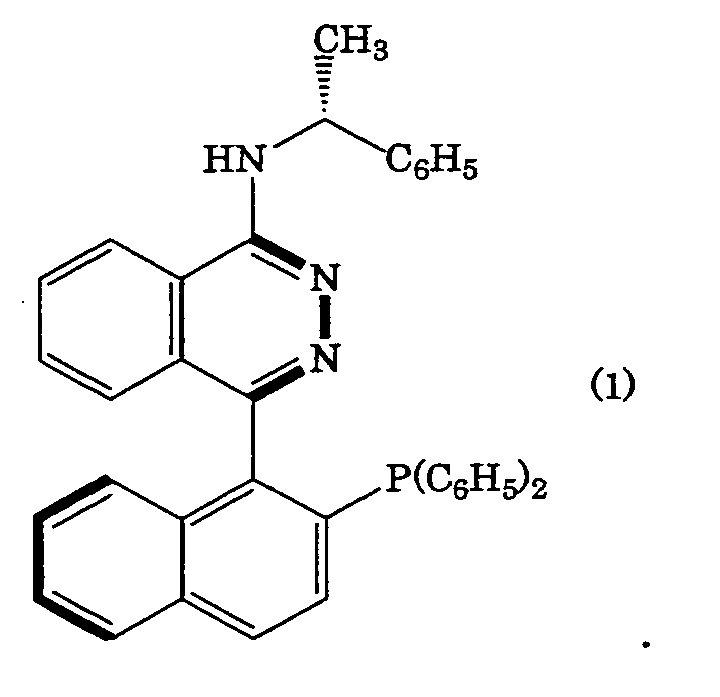
- optically active [4-(2-diphenylphosphanylnaphthalen-1-yl)phthalazin-1-yl]-(1-phenylethyl)amine is an optically active amine represented by the formula (1):
- ⁇ 3> the salt of ⁇ 1> or ⁇ 2>, wherein the optically active organic sulfonic acid is (S)-camphorsulfonic acid;
- optically active organic sulfonic acid which comprises mixing a solution containing the optically active amine represented by the formula (1) and an optically active amine represented by the formula (3):
- optically active organic sulfonic acid ⁇ 5> the method of ⁇ 4>, wherein the amount of the optically active organic sulfonic acid to be used is 0.5 to 5 mol per 1 mol of the total of the optically active amine represented by the formula (1) and the optically active amine represented by the formula (3); ⁇ 6> the method of ⁇ 4> or ⁇ 5>, wherein the optically active organic sulfonic acid is (S)-camphorsulfonic acid; ⁇ 7> the method of ⁇ 4>, ⁇ 5> or ⁇ 6>, wherein the solution is an ether solution or a ketone solution;
- optically active [4-(2-diphenylphosphanylnaphthalen-1-yl)phthalazin-1-yl]-(1-phenylethyl)amine is an optically active amine represented by the formula (2):
- ⁇ 14> the salt of ⁇ 1> or ⁇ 13>, wherein the optically active organic sulfonic acid is (R)-camphorsulfonic acid;
- optically active organic sulfonic acid which comprises mixing a solution containing the optically active amine represented by the formula (2) and an optically active amine represented by the formula (4):
- optically active organic sulfonic acid ⁇ 16> the method of ⁇ 15>, wherein the amount of the optically active organic sulfonic acid to be used is 0.5 to 5 mol per 1 mol of the total of the optically active amine represented by the formula (2) and the optically active amine represented by the formula (4); ⁇ 17> the method of ⁇ 15> or ⁇ 16>, wherein the optically active organic sulfonic acid is (R)-camphorsulfonic acid; ⁇ 18> the method of ⁇ 15>, ⁇ 16> or ⁇ 17>, wherein the solution is an ether solution or a ketone solution;
- ⁇ 21> the method of ⁇ 19> or ⁇ 20>, wherein the amount of the water to be used is 0.1 to 0.5 part by weight per 1 part by weight of the hydrophilic organic solvent
- ⁇ 22> the method of ⁇ 19>, ⁇ 20> or ⁇ 21>, wherein the hydrophilic organic solvent is a hydrophilic aprotic polar solvent
- ⁇ 23> the method of ⁇ 20>, ⁇ 21> or ⁇ 22>, wherein the transition metal complex is a divalent nickel complex containing a phosphine compound
- ⁇ 24> a method of producing an optically active [4-(2-diphenylphosphanylnaphthalen-1-yl)phthalazin-1-yl]-(1-phenylethyl)amine, which comprises reacting a salt of an optically active [4-(2-diphenylphosphanylnaphthalen-1-yl)phthalazin-1-yl]-(1-phenylethyl)amine with an optically active organic sulfonic acid, with a base; and the like.
- a salt of an optically active N-PINAP with an optically active organic sulfonic acid is a novel compound, and can be produced by mixing an optically active N-PINAP with an optically active organic sulfonic acid.
- Examples of the salt of an optically active N-PINAP with an optically active organic sulfonic acid include a salt of an optically active amine represented by the formula (1):
- optically active organic sulfonic acid examples include optically active camphorsulfonic acids such as (S)-camphorsulfonic acid [(1S)-(+)-10-camphorsulfonic acid], (R)-camphorsulfonic acid [(1R)-(-)-10-camphorsulfonic acid], (+)-3-bromocamphor-8-sulfonic acid, (+)-3-bromocamphor-10-sulfonic acid, (-)-3-bromocamphor-8-sulfonic acid, (-)-3-bromocamphor-10-sulfonic acid and the like, and an ammonium salt thereof; optically active 1-phenylalkylsulfonic acids such as (S)-1-phenylethanesulfonic acid, (R)-1-phenylethanesulfonic acid, (S)-1-phenylpropanesulfonic acid, (R)-1-phenylpropanesulfonic acid and the like, and an ammoni
- solution (R) containing (R,P)-N-PINAP and an optically active amine represented by the formula (3):
- (R,M)-N-PINAP) is mixed with an optically active organic sulfonic acid, which allows preferential crystallization of a salt of (R,P)-N-PINAP with the optically active organic sulfonic acid. Then the crystallized salt of (R,P)-N-PINAP with the optically active organic sulfonic acid can be isolated by a conventional separation means such as filtration and the like.
- the solution (R) is mixed with (S)-camphorsulfonic acid, which allows preferential crystallization of a salt of (R,P)-N-PINAP with (S)-camphorsulfonic acid.
- solution (S) containing (S,M)-N-PINAP and an optically active amine represented by the formula (4):
- (S,P)-N-PINAP) is mixed with an optically active organic sulfonic acid, which allows preferential crystallization of a salt of (S,M)-N-PINAP with the optically active organic sulfonic acid. Then the crystallized salt of (S,M)-N-PINAP with the optically active organic sulfonic acid can be isolated by a conventional separation means such as filtration and the like. For example, the solution (S) is mixed with (R)-camphorsulfonic acid, which allows preferential crystallization of a salt of (S,M)-N-PINAP with (R)-camphorsulfonic acid.
- the amount of the optically active organic sulfonic acid to be used is generally 0.5 to 5 mol, preferably 0.8 to 2 mol, per 1 mol of the total of (R,P)-N-PINAP and (R,M)-N-PINAP or the total of (S,M)-N-PINAP and (S,P)-N-PINAP.
- the optically active organic sulfonic acid may be directly used as a solid or in the form of a solution.
- the optically active organic sulfonic acid is preferably used in the form of a solution.
- the ratio of (R,P)-N-PINAP and (R,M)-N-PINAP in the solution (R) is not limited. Also, the ratio of (S,M)-N-PINAP and (S,P)-N-PINAP in the solution (S) is not limited.
- Examples of the solvent contained in the solution (R) or solution (S) include ether solvents such as tetrahydrofuran and the like; and ketone solvents such as acetone, methyl ethyl ketone, methyl isobutyl ketone and the like. From the aspect of the yield, an ether solvent is preferable, and tetrahydrofuran is more preferable.
- the amount of the solvent to be used is generally 5 to 50 parts by weight, preferably 10 to 40 parts by weight, per 1 part by weight of the total of (R,P)-N-PINAP and (R,M)-N-PINAP or per 1 part by weight of the total of (S,M)-N-PINAP and (S,P)-N-PINAP.
- the mixing of the solution (R) or solution (S) with the optically active organic sulfonic acid is preferably performed by adding (preferably adding dropwise) the optically active organic sulfonic acid to the solution (R) or solution (S).
- the temperature for the mixing of the solution (R) or solution (S) with the optically active organic sulfonic acid is generally 30 to 65°C, preferably 35 to 60°C.
- the mixture is stirred for generally 5 min to 24 hr, preferably 30 min to 10 hr, and then aged generally at 0 to 55°C, preferably 5 to 35°C.
- the precipitated crystals are isolated by a conventional separation means such as filtration and the like, and, where necessary, washed with a solvent such as tetrahydrofuran, acetone, methyl ethyl ketone, methyl isobutyl ketone and the like, preferably tetrahydrofuran to give a salt of (R,P)-N-PINAP with the optically active organic sulfonic acid, or a salt of (S,M)-N-PINAP with the optically active organic sulfonic acid.
- the obtained salt of the optically active N-PINAP with the optically active organic sulfonic acid is reacted with a base to give (R,P)-N-PINAP or (S,M)-N-PINAP.
- the salt of (R,P)-N-PINAP with the optically active organic sulfonic acid is reacted with a base to give (R,P)-N-PINAP
- the salt of (S,M)-N-PINAP with the optically active organic sulfonic acid is reacted with a base to give (S,M)-N-PINAP.
- the base examples include inorganic bases such as alkali metal hydroxides (e.g., sodium hydroxide, potassium hydroxide and the like); alkali metal carbonates (e.g., sodium carbonate, potassium carbonate and the like) and the like.
- the amount thereof to be used is 1 equivalent or more relative to the salt of the optically active N-PINAP with the optically active organic sulfonic acid, with no upper limitation.
- the base is generally used in the form of an aqueous solution.
- the reaction of the salt of the optically active N-PINAP with the optically active organic sulfonic acid, with a base is generally carried out in a solvent.
- the solvent include aromatic solvents such as toluene, xylene, chlorobenzene, dichlorobenzene and the like; halogenated hydrocarbon solvents such as dichloromethane, chloroform and the like; and ether solvents such as diethyl ether, methyl tert-butyl ether, cyclopentyl methyl ether and the like.
- the aforementioned concentrated residue is dissolved in methyl isobutyl ketone, methyl ethyl ketone and the like, and a poor solvent such as heptane, hexane and the like is added to the obtained solution to crystallize (R,P)-N-PINAP or (S,M)-N-PINAP.
- the "poor solvent” means a solvent that does not dissolve or hardly dissolve (R,P)-N-PINAP or (S,M)-N-PINAP.
- the obtained (R,P)-N-PINAP or (S,M)-N-PINAP is recrystallized from a solvent such as acetonitrile, methyl ethyl ketone, ethyl acetate, toluene, tetrahydrofuran and the like to give crystals having a higher purity.
- a solvent such as acetonitrile, methyl ethyl ketone, ethyl acetate, toluene, tetrahydrofuran and the like to give crystals having a higher purity.
- the thus-obtained (R,P)-N-PINAP or (S,M)-N-PINAP has an optical purity of generally 95/5 or more, particularly 98/2 or more, of (R,P)/(R,M) or (S,M)/(S,P).
- a solution containing (R,P)-N-PINAP and (R,M)-N-PINAP in a hydrophilic organic solvent is mixed with water, which allows preferential crystallization of (R,M)-N-PINAP.
- a solution containing (S,P)-N-PINAP and (S,M)-N-PINAP in a hydrophilic organic solvent is mixed with water, which allows preferential crystallization of (S,P)-N-PINAP.
- the hydrophilic organic solvent is preferably a comparatively higher polar solvent, particularly a hydrophilic aprotic polar solvent, and examples thereof include hydrophilic amide solvents such as N,N-dimethylformamide, N-methylpyrrolidone, N,N-dimethylacetamide and the like; hydrophilic sulfoxide solvents such as dimethyl sulfoxide and the like; hydrophilic ether solvents such as tetrahydrofuran and the like; hydrophilic nitrile solvents such as acetonitrile and the like, and the like. Of these, a hydrophilic amide solvent is preferable, and N,N-dimethylformamide is more preferable.
- the solvent may be used in a mixture of two or more kinds thereof.
- the amount of the hydrophilic organic solvent to be used is preferably 0.2 to 50 parts by weight, more preferably 2 to 20 parts by weight, per 1 part by weight of the total of (R,P)-N-PINAP and (R,M)-N-PINAP or the total of (S,P)-N-PINAP and (S,M)-N-PINAP, from the aspects of operability and economy.
- the amount of the water to be used is preferably 0.1 to 0.5 part by weight, more preferably 0.2 to 0.4 part by weight, per 1 part by weight of the hydrophilic organic solvent, from the aspects of the purity and yield of the obtained crystals.
- the mixing of the solution containing (R,P)-N-PINAP and (R,M)-N-PINAP in a hydrophilic organic solvent with water is preferably performed by adding (preferably adding dropwise) water to the solution containing (R,P)-N-PINAP and (R,M)-N-PINAP in a hydrophilic organic solvent.
- the mixing of the solution containing (S,P)-N-PINAP and (S,M)-N-PINAP in a hydrophilic organic solvent with water is also preferably performed by adding (preferably adding dropwise) water to the solution containing (S,P)-N-PINAP and (S,M)-N-PINAP in a hydrophilic organic solvent.
- the temperature for the mixing of the solution containing (R,P)-N-PINAP and (R,M)-N-PINAP in a hydrophilic organic solvent or the solution containing (S,P)-N-PINAP and (S,M)-N-PINAP in a hydrophilic organic solvent with water is generally 0 to 100°C, preferably 60 to 95°C.
- the mixture is stirred generally for 5 min to 24 hr, preferably 30 min to 5 hr, cooled generally to 0 to 50°C, preferably 5 to 35°C, and aged.
- the precipitated crystals are isolated by a conventional separation means such as filtration and the like, and, where necessary, washed with a mixed solvent of a hydrophilic organic solvent and water, or a lower alcohol solvent such as isopropanol and the like (preferably isopropanol) to give crystals of (R,M)-N-PINAP or (S,P)-N-PINAP.
- the thus-obtained (R,M)-N-PINAP or (S,P)-N-PINAP has an optical purity of generally 95/5 or more, particularly 98/2 or more, of (R,M)/(R,P) or (S,P)/(S,M).
- the obtained filtrate is mixed with water in an amount of 0.1 to 1 part by weight per 1 part by weight of the hydrophilic organic solvent in the filtrate, which allows precipitation of secondary crystals of (R,M)-N-PINAP or (S,P)-N-PINAP.
- the precipitated crystals are isolated by a conventional separation means such as filtration and the like, and, where necessary, purified by a conventional purification means such as recrystallization and the like to give crystals of (R,M)-N-PINAP or (S,P)-N-PINAP.
- the obtained filtrate is subjected to solvent substitution, and the solution is mixed with an optically active organic sulfonic acid to give a salt of the optically active N-PINAP with the optically active organic sulfonic acid.
- a mixture of (R,P)-N-PINAP and (R,M)-N-PINAP (hereinafter to be abbreviated as (R)-N-PINAP) can be produced, for example, by reacting a compound represented by the formula (5):
- compound (5) (hereinafter to be abbreviated as compound (5)) with diphenylphosphine in a hydrophilic organic solvent, in the presence of a transition metal complex and a tertiary amine.
- the hydrophilic organic solvent is preferably a comparatively higher polar solvent, particularly a hydrophilic aprotic polar solvent, from the aspects of the reactive property.
- hydrophilic amide solvents such as N,N-dimethylformamide, N-methylpyrrolidone, N,N-dimethylacetamide and the like
- hydrophilic sulfoxide solvents such as dimethyl sulfoxide and the like
- hydrophilic ether solvents such as tetrahydrofuran and the like
- hydrophilic nitrile solvents such as acetonitrile and the like, and the like.
- a hydrophilic amide solvent is preferable, and N,N-dimethylformamide is more preferable.
- the hydrophilic organic solvent may be used in a mixture of two or more kinds thereof.
- the amount of the hydrophilic organic solvent to be used is generally 0.2 to 50 parts by weight, preferably 2 to 20 parts by weight, per 1 part by weight of compound (5).
- the amount of the diphenylphosphine to be used is generally 1 to 10 mol, preferably 1 to 3 mol, per 1 mol of compound (5), from the aspects of the completion of the reaction and economy.
- transition metal complex examples include divalent nickel complexes containing a phosphine compound (particularly a dicoordinate phosphine compound) such as (diphenylphosphinoethane)dichloronickel, (diphenylphosphinopropane)dichloronickel, (diphenylphosphinobutane)dichloronickel and the like; divalent palladium complexes containing a phosphine compound (particularly a dicoordinate phosphine compound) such as (diphenylphosphinoethane)dichloropalladium, (diphenylphosphinopropane)dichloropalladium, (diphenylphosphinobutane)dichloropalladium and the like, and the like.
- a divalent nickel complex containing a phosphine compound is preferable, and (diphenylphosphinoethane)dichloronickel is more preferable, from the aspects of the aspects of
- the amount of the transition metal complex to be used is generally 0.001 to 1 mol, preferably 0.01 to 0.2 mol, per 1 mol of compound (5), from the aspects of the reaction rate and economy.
- the tertiary amine may be any as long as it can trap byproduced trifluoromethanesulfonic acid, and examples thereof include 1,4-diazabicyclo[2.2.2]octane, diisopropylethylamine, triethylamine and the like. Of these, 1,4-diazabicyclo[2.2.2]octane is preferable.
- the amount of the tertiary amine to be used is generally 1 to 30 mol, preferably 2 to 10 mol, per 1 mol of compound (5), to suppress by-products and from the economical aspects.
- the reaction of compound (5) with diphenylphosphine is generally carried out by mixing compound (5) with diphenylphosphine, a transition metal complex and a tertiary amine, where the order of mixing is not limited.
- a mixture of compound (5) and a tertiary amine may be added to a mixture of diphenylphosphine and a transition metal complex.
- a mixture of diphenylphosphine and a transition metal complex may be added to a mixture of compound (5) and a tertiary amine.
- the reaction temperature is generally 60°C to 180°C, preferably 80°C to 140°C. While the reaction time varies depending on the starting material to be used and the reaction temperature, it is generally 10 min to 40 hr, preferably 30 min to 24 hr.
- reaction solution is subjected to a conventional posttreatment such as extraction, concentration and the like to isolate (R)-N-PINAP.
- a mixture of (S,P)-N-PINAP and (S,M)-N-PINAP (hereinafter to be abbreviated as (S)-N-PINAP) can be produced, for example, by reacting a compound represented by the formula (6):
- compound (6) (hereinafter to be abbreviated as compound (6)) with diphenylphosphine in a hydrophilic organic solvent, in the presence of a transition metal complex and a tertiary amine.
- the reaction of compound (6) with diphenylphosphine can be carried out in the same manner as in the above-mentioned reaction of compound (5) with diphenylphosphine.
- Compound (5) can be produced by reacting a compound represented by the formula (7):
- compound (7) (hereinafter to be abbreviated as compound (7)) with (R)-1-phenylethylamine.
- compound (6) can be produced by reacting compound (7) with (S)-1-phenylethylamine.
- the amount of the (R)- or (S)-1-phenylethylamine to be used is generally 1 to 10 mol, preferably 2 to 5 mol, per 1 mol of compound (7).
- the reaction of compound (7) with (R)- or (S)-1-phenylethylamine is carried our without a solvent or in a solvent.
- the solvent is not limited as long as it does not inhibit the reaction, and examples thereof include aromatic hydrocarbon solvents such as xylene, toluene and the like; ether solvents such as 1,4-dioxane and the like, and the like. From the aspects of shortened reaction time and yield, an aromatic hydrocarbon solvent is preferable, and xylene is more preferable.
- the amount of the solvent to be used is generally 0.5 to 50 parts by weight, preferably 1 to 15 parts by weight, per 1 part by weight of compound (7).
- the reaction temperature is generally 80 to 200°C, preferably 100 to 150°C. While the reaction time varies depending on the starting material to be used and the reaction temperature, it is generally 1 to 50 hr, preferably 4 to 30 hr.
- the obtained reaction solution is mixed with water and a poor solvent such as an aliphatic hydrocarbon solvent (e.g. heptane, hexane and the like) and the like to give compound (5) or compound (6) as crystals.
- a poor solvent such as an aliphatic hydrocarbon solvent (e.g. heptane, hexane and the like) and the like to give compound (5) or compound (6) as crystals.
- the poor solvent means a solvent that does not dissolve or hardly dissolve compound (5) or compound (6).
- HPLC high performance liquid chromatography
- the obtained solution was stirred at 118 to 122°C for 5 hr to give a reaction solution containing (R,M)-N-PINAP and (R,P)-N-PINAP.
- To the obtained reaction solution was added dropwise water (4 mL) at 85°C, and the mixture was allowed to cool to 28°C, and stirred for 1 hr.
- the precipitated crystals were isolated by filtration to give primary crystals (0.68 g) of (R,M)-N-PINAP.
- To the filtrate was added water (5 mL) to give secondary crystals (0.38 g) of (R,M)-N-PINAP.
- the purity of the primary crystals was 95% and the (R,M)/(R,P) ratio thereof was 99/1, and the purity of the secondary crystals was 83% and the (R,M)/(R,P) ratio thereof was 87/13.
- the (S,M)/(S,P) ratio was 46/54.
- To the solution was added dropwise water (10 mL) at about 60°C, and the mixture was allowed to cool to 23°C, and stirred for 13 hr.
- the precipitated crystals were isolated by filtration, washed with isopropanol (12 mL), and dried to give (S,P)-N-PINAP (1.01 g). yield 27%.
- the purity was 92%, and the (S,M)/(S,P) ratio was 1/99.
- Example 9 To toluene (40 mL) was added the salt (3.3 g) of (S,M)-N-PINAP with (R)-camphorsulfonic acid obtained in Example 9. To the obtained mixture was added dropwise a solution obtained by dissolving sodium hydroxide (0.18 g) in water (35 mL). The obtained mixture was stirred at 24°C for 1.5 hr, and partitioned. The obtained organic layer was washed with water (15 mL), and concentrated at 30 to 60°C under reduced pressure to remove toluene.
- optically active [4-(2-diphenylphosphanylnaphthalen-1-yl)phthalazin-1-yl]-(1-phenylethyl)amines can be obtained without separation by column chromatography.
Landscapes
- Chemical & Material Sciences (AREA)
- Organic Chemistry (AREA)
- Health & Medical Sciences (AREA)
- Life Sciences & Earth Sciences (AREA)
- Biochemistry (AREA)
- General Health & Medical Sciences (AREA)
- Molecular Biology (AREA)
- Organic Low-Molecular-Weight Compounds And Preparation Thereof (AREA)
- Low-Molecular Organic Synthesis Reactions Using Catalysts (AREA)
Abstract

Description
- The present invention relates to an optically active amine and a production method thereof.
- [4-(2-Diphenylphosphanylnaphthalen-1-yl)phthalazin-1-yl]-(1-phenylethyl)amine (hereinafter to be abbreviated as N-PINAP) contains four optical isomers represented by the following formulas (1) to (4).
-


- Non-patent document 1 discloses that a desired product is obtained with high selectivity and in a high yield by an asymmetric reaction such as an asymmetric addition reaction, an asymmetric conjugate addition reaction, an asymmetric hydroboration reaction and the like, using an asymmetric transition metal complex containing an optically active amine as an asymmetric ligand.
- Patent document 1 discloses that these optically active amines are obtained by separating the diastereomixture by column chromatography. Specifically, the optically active amine represented by the formula (1) is obtained by dissolving the R-N-PINAP diastereomixture (a mixture of the optically active amine represented by the formula (1) and the optically active amine represented by the formula (3)) in a mixed solvent of toluene and dichloromethane, adding hexane to the obtained solution to allow crystallization of the optically active amine represented by the formula (3), and then subjecting the filtrate to column chromatography.
- Patent document 1:
JP-A-2006-347884 - Non-patent document 1: Angew. Chem. Int. Ed., 2004, 43, 5971
- The present invention provides
<1> a salt of an optically active [4-(2-diphenylphosphanylnaphthalen-1-yl)phthalazin-1-yl]-(1-phenylethyl)amine with an optically active organic sulfonic acid; - <2> the salt of <1>, wherein the optically active [4-(2-diphenylphosphanylnaphthalen-1-yl)phthalazin-1-yl]-(1-phenylethyl)amine is an optically active amine represented by the formula (1):
-

- <3> the salt of <1> or <2>, wherein the optically active organic sulfonic acid is (S)-camphorsulfonic acid;
- <4> a method of producing a salt of an optically active amine represented by the formula (1):
-

- with an optically active organic sulfonic acid, which comprises mixing a solution containing the optically active amine represented by the formula (1) and an optically active amine represented by the formula (3):
-

- with an optically active organic sulfonic acid;
<5> the method of <4>, wherein the amount of the optically active organic sulfonic acid to be used is 0.5 to 5 mol per 1 mol of the total of the optically active amine represented by the formula (1) and the optically active amine represented by the formula (3);
<6> the method of <4> or <5>, wherein the optically active organic sulfonic acid is (S)-camphorsulfonic acid;
<7> the method of <4>, <5> or <6>, wherein the solution is an ether solution or a ketone solution; - <8> a method of producing an optically active amine represented by the formula (3):
-

- which comprises mixing a solution containing an optically active amine represented by the formula (1):
-

- and the optically active amine represented by the formula (3) in a hydrophilic organic solvent, with water;
<9> the method of <8>, wherein the solution is a reaction solution obtained by reacting a compound represented by the formula (5): -

- with diphenylphosphine in a hydrophilic organic solvent, in the presence of a transition metal complex and a tertiary amine;
<10> the method of <8> or <9>, wherein the amount of the water to be used is 0.1 to 0.5 part by weight per 1 part by weight of the hydrophilic organic solvent;
<11> the method of <8>, <9> or <10>, wherein the hydrophilic organic solvent is a hydrophilic aprotic polar solvent;
<12> the method of <9>, <10> or <11>, wherein the transition metal complex is a divalent nickel complex containing a phosphine compound; - <13> the salt of <1>, wherein the optically active [4-(2-diphenylphosphanylnaphthalen-1-yl)phthalazin-1-yl]-(1-phenylethyl)amine is an optically active amine represented by the formula (2):
-

- <14> the salt of <1> or <13>, wherein the optically active organic sulfonic acid is (R)-camphorsulfonic acid;
- <15> a method of producing a salt of an optically active amine represented by the formula (2):
-

- with an optically active organic sulfonic acid, which comprises mixing a solution containing the optically active amine represented by the formula (2) and an optically active amine represented by the formula (4):
-

- with an optically active organic sulfonic acid;
<16> the method of <15>, wherein the amount of the optically active organic sulfonic acid to be used is 0.5 to 5 mol per 1 mol of the total of the optically active amine represented by the formula (2) and the optically active amine represented by the formula (4);
<17> the method of <15> or <16>, wherein the optically active organic sulfonic acid is (R)-camphorsulfonic acid;
<18> the method of <15>, <16> or <17>, wherein the solution is an ether solution or a ketone solution; - <19> a method of producing an optically active amine represented by the formula (4):
-

- which comprises mixing a solution containing an optically active amine represented by the formula (2):
-

- and the optically active amine represented by the formula (4) in a hydrophilic organic solvent, with water;
<20> the method of <19>, wherein the solution is a reaction solution obtained by reacting a compound represented by the formula (6): -

- with diphenylphosphine in a hydrophilic organic solvent, in the presence of a transition metal complex and a tertiary amine;
<21> the method of <19> or <20>, wherein the amount of the water to be used is 0.1 to 0.5 part by weight per 1 part by weight of the hydrophilic organic solvent;
<22> the method of <19>, <20> or <21>, wherein the hydrophilic organic solvent is a hydrophilic aprotic polar solvent;
<23> the method of <20>, <21> or <22>, wherein the transition metal complex is a divalent nickel complex containing a phosphine compound; - <24> a method of producing an optically active [4-(2-diphenylphosphanylnaphthalen-1-yl)phthalazin-1-yl]-(1-phenylethyl)amine, which comprises reacting a salt of an optically active [4-(2-diphenylphosphanylnaphthalen-1-yl)phthalazin-1-yl]-(1-phenylethyl)amine with an optically active organic sulfonic acid, with a base;
and the like. - A salt of an optically active N-PINAP with an optically active organic sulfonic acid is a novel compound, and can be produced by mixing an optically active N-PINAP with an optically active organic sulfonic acid.
- Examples of the salt of an optically active N-PINAP with an optically active organic sulfonic acid include a salt of an optically active amine represented by the formula (1):
-

- (hereinafter to be abbreviated as (R,P)-N-PINAP) with an optically active organic sulfonic acid, and a salt of an optically active amine represented by the formula (2):
-

- (hereinafter to be abbreviated as (S,M)-N-PINAP) with an optically active organic sulfonic acid.
- Examples of the optically active organic sulfonic acid include optically active camphorsulfonic acids such as (S)-camphorsulfonic acid [(1S)-(+)-10-camphorsulfonic acid], (R)-camphorsulfonic acid [(1R)-(-)-10-camphorsulfonic acid], (+)-3-bromocamphor-8-sulfonic acid, (+)-3-bromocamphor-10-sulfonic acid, (-)-3-bromocamphor-8-sulfonic acid, (-)-3-bromocamphor-10-sulfonic acid and the like, and an ammonium salt thereof; optically active 1-phenylalkylsulfonic acids such as (S)-1-phenylethanesulfonic acid, (R)-1-phenylethanesulfonic acid, (S)-1-phenylpropanesulfonic acid, (R)-1-phenylpropanesulfonic acid and the like, and an ammonium salt thereof; and the like.
- A solution (hereinafter to be abbreviated as solution (R)) containing (R,P)-N-PINAP and an optically active amine represented by the formula (3):
-

- (hereinafter to be abbreviated as (R,M)-N-PINAP) is mixed with an optically active organic sulfonic acid, which allows preferential crystallization of a salt of (R,P)-N-PINAP with the optically active organic sulfonic acid. Then the crystallized salt of (R,P)-N-PINAP with the optically active organic sulfonic acid can be isolated by a conventional separation means such as filtration and the like. For example, the solution (R) is mixed with (S)-camphorsulfonic acid, which allows preferential crystallization of a salt of (R,P)-N-PINAP with (S)-camphorsulfonic acid.
- A solution (hereinafter to be abbreviated as solution (S)) containing (S,M)-N-PINAP and an optically active amine represented by the formula (4):
-

- (hereinafter to be abbreviated as (S,P)-N-PINAP) is mixed with an optically active organic sulfonic acid, which allows preferential crystallization of a salt of (S,M)-N-PINAP with the optically active organic sulfonic acid. Then the crystallized salt of (S,M)-N-PINAP with the optically active organic sulfonic acid can be isolated by a conventional separation means such as filtration and the like. For example, the solution (S) is mixed with (R)-camphorsulfonic acid, which allows preferential crystallization of a salt of (S,M)-N-PINAP with (R)-camphorsulfonic acid.
- The amount of the optically active organic sulfonic acid to be used is generally 0.5 to 5 mol, preferably 0.8 to 2 mol, per 1 mol of the total of (R,P)-N-PINAP and (R,M)-N-PINAP or the total of (S,M)-N-PINAP and (S,P)-N-PINAP.
- The optically active organic sulfonic acid may be directly used as a solid or in the form of a solution. When (S)- or (R)-camphorsulfonic acid is used as an optically active organic sulfonic acid, the optically active organic sulfonic acid is preferably used in the form of a solution.
- The ratio of (R,P)-N-PINAP and (R,M)-N-PINAP in the solution (R) is not limited. Also, the ratio of (S,M)-N-PINAP and (S,P)-N-PINAP in the solution (S) is not limited.
- Examples of the solvent contained in the solution (R) or solution (S) include ether solvents such as tetrahydrofuran and the like; and ketone solvents such as acetone, methyl ethyl ketone, methyl isobutyl ketone and the like. From the aspect of the yield, an ether solvent is preferable, and tetrahydrofuran is more preferable.
- The amount of the solvent to be used is generally 5 to 50 parts by weight, preferably 10 to 40 parts by weight, per 1 part by weight of the total of (R,P)-N-PINAP and (R,M)-N-PINAP or per 1 part by weight of the total of (S,M)-N-PINAP and (S,P)-N-PINAP.
- The mixing of the solution (R) or solution (S) with the optically active organic sulfonic acid is preferably performed by adding (preferably adding dropwise) the optically active organic sulfonic acid to the solution (R) or solution (S).
- The temperature for the mixing of the solution (R) or solution (S) with the optically active organic sulfonic acid is generally 30 to 65°C, preferably 35 to 60°C.
- After mixing, the mixture is stirred for generally 5 min to 24 hr, preferably 30 min to 10 hr, and then aged generally at 0 to 55°C, preferably 5 to 35°C. The precipitated crystals are isolated by a conventional separation means such as filtration and the like, and, where necessary, washed with a solvent such as tetrahydrofuran, acetone, methyl ethyl ketone, methyl isobutyl ketone and the like, preferably tetrahydrofuran to give a salt of (R,P)-N-PINAP with the optically active organic sulfonic acid, or a salt of (S,M)-N-PINAP with the optically active organic sulfonic acid.
- The obtained salt of the optically active N-PINAP with the optically active organic sulfonic acid is reacted with a base to give (R,P)-N-PINAP or (S,M)-N-PINAP. Specifically, the salt of (R,P)-N-PINAP with the optically active organic sulfonic acid is reacted with a base to give (R,P)-N-PINAP, and the salt of (S,M)-N-PINAP with the optically active organic sulfonic acid is reacted with a base to give (S,M)-N-PINAP.
- Examples of the base include inorganic bases such as alkali metal hydroxides (e.g., sodium hydroxide, potassium hydroxide and the like); alkali metal carbonates (e.g., sodium carbonate, potassium carbonate and the like) and the like. The amount thereof to be used is 1 equivalent or more relative to the salt of the optically active N-PINAP with the optically active organic sulfonic acid, with no upper limitation. The base is generally used in the form of an aqueous solution.
- The reaction of the salt of the optically active N-PINAP with the optically active organic sulfonic acid, with a base is generally carried out in a solvent. Examples of the solvent include aromatic solvents such as toluene, xylene, chlorobenzene, dichlorobenzene and the like; halogenated hydrocarbon solvents such as dichloromethane, chloroform and the like; and ether solvents such as diethyl ether, methyl tert-butyl ether, cyclopentyl methyl ether and the like.
- After the completion of the reaction, water is added to the reaction mixture as necessary, and the mixture is partitioned to give the organic layer containing (R,P)-N-PINAP or (S,M)-N-PINAP. The obtained organic layer is concentrated, and a poor solvent such as heptane, hexane and the like is added to the obtained concentrated residue to crystallize (R,P)-N-PINAP or (S,M)-N-PINAP. (R,P)-N-PINAP or (S,M)-N-PINAP can be isolated by a conventional separation means such as filtration and the like. Alternatively, the aforementioned concentrated residue is dissolved in methyl isobutyl ketone, methyl ethyl ketone and the like, and a poor solvent such as heptane, hexane and the like is added to the obtained solution to crystallize (R,P)-N-PINAP or (S,M)-N-PINAP. As used herein, the "poor solvent" means a solvent that does not dissolve or hardly dissolve (R,P)-N-PINAP or (S,M)-N-PINAP.
- In addition, the obtained (R,P)-N-PINAP or (S,M)-N-PINAP is recrystallized from a solvent such as acetonitrile, methyl ethyl ketone, ethyl acetate, toluene, tetrahydrofuran and the like to give crystals having a higher purity.
- The thus-obtained (R,P)-N-PINAP or (S,M)-N-PINAP has an optical purity of generally 95/5 or more, particularly 98/2 or more, of (R,P)/(R,M) or (S,M)/(S,P).
- A solution containing (R,P)-N-PINAP and (R,M)-N-PINAP in a hydrophilic organic solvent is mixed with water, which allows preferential crystallization of (R,M)-N-PINAP. A solution containing (S,P)-N-PINAP and (S,M)-N-PINAP in a hydrophilic organic solvent is mixed with water, which allows preferential crystallization of (S,P)-N-PINAP.
- The hydrophilic organic solvent is preferably a comparatively higher polar solvent, particularly a hydrophilic aprotic polar solvent, and examples thereof include hydrophilic amide solvents such as N,N-dimethylformamide, N-methylpyrrolidone, N,N-dimethylacetamide and the like; hydrophilic sulfoxide solvents such as dimethyl sulfoxide and the like; hydrophilic ether solvents such as tetrahydrofuran and the like; hydrophilic nitrile solvents such as acetonitrile and the like, and the like. Of these, a hydrophilic amide solvent is preferable, and N,N-dimethylformamide is more preferable. The solvent may be used in a mixture of two or more kinds thereof.
- The amount of the hydrophilic organic solvent to be used is preferably 0.2 to 50 parts by weight, more preferably 2 to 20 parts by weight, per 1 part by weight of the total of (R,P)-N-PINAP and (R,M)-N-PINAP or the total of (S,P)-N-PINAP and (S,M)-N-PINAP, from the aspects of operability and economy.
- The amount of the water to be used is preferably 0.1 to 0.5 part by weight, more preferably 0.2 to 0.4 part by weight, per 1 part by weight of the hydrophilic organic solvent, from the aspects of the purity and yield of the obtained crystals.
- The mixing of the solution containing (R,P)-N-PINAP and (R,M)-N-PINAP in a hydrophilic organic solvent with water is preferably performed by adding (preferably adding dropwise) water to the solution containing (R,P)-N-PINAP and (R,M)-N-PINAP in a hydrophilic organic solvent. The mixing of the solution containing (S,P)-N-PINAP and (S,M)-N-PINAP in a hydrophilic organic solvent with water is also preferably performed by adding (preferably adding dropwise) water to the solution containing (S,P)-N-PINAP and (S,M)-N-PINAP in a hydrophilic organic solvent.
- The temperature for the mixing of the solution containing (R,P)-N-PINAP and (R,M)-N-PINAP in a hydrophilic organic solvent or the solution containing (S,P)-N-PINAP and (S,M)-N-PINAP in a hydrophilic organic solvent with water is generally 0 to 100°C, preferably 60 to 95°C.
- After the completion of the mixing, the mixture is stirred generally for 5 min to 24 hr, preferably 30 min to 5 hr, cooled generally to 0 to 50°C, preferably 5 to 35°C, and aged. The precipitated crystals are isolated by a conventional separation means such as filtration and the like, and, where necessary, washed with a mixed solvent of a hydrophilic organic solvent and water, or a lower alcohol solvent such as isopropanol and the like (preferably isopropanol) to give crystals of (R,M)-N-PINAP or (S,P)-N-PINAP.
- The thus-obtained (R,M)-N-PINAP or (S,P)-N-PINAP has an optical purity of generally 95/5 or more, particularly 98/2 or more, of (R,M)/(R,P) or (S,P)/(S,M).
- The obtained filtrate is mixed with water in an amount of 0.1 to 1 part by weight per 1 part by weight of the hydrophilic organic solvent in the filtrate, which allows precipitation of secondary crystals of (R,M)-N-PINAP or (S,P)-N-PINAP. The precipitated crystals are isolated by a conventional separation means such as filtration and the like, and, where necessary, purified by a conventional purification means such as recrystallization and the like to give crystals of (R,M)-N-PINAP or (S,P)-N-PINAP.
- Moreover, the obtained filtrate is subjected to solvent substitution, and the solution is mixed with an optically active organic sulfonic acid to give a salt of the optically active N-PINAP with the optically active organic sulfonic acid.
- As a solution containing (R,P)-N-PINAP and (R,M)-N-PINAP in a hydrophilic organic solvent, the reaction solution obtained by the below-mentioned production method of the mixture of (R,P)-N-PINAP and (R,M)-N-PINAP can be used.
- A mixture of (R,P)-N-PINAP and (R,M)-N-PINAP (hereinafter to be abbreviated as (R)-N-PINAP) can be produced, for example, by reacting a compound represented by the formula (5):
-

- (hereinafter to be abbreviated as compound (5)) with diphenylphosphine in a hydrophilic organic solvent, in the presence of a transition metal complex and a tertiary amine.
- The hydrophilic organic solvent is preferably a comparatively higher polar solvent, particularly a hydrophilic aprotic polar solvent, from the aspects of the reactive property. Examples thereof include hydrophilic amide solvents such as N,N-dimethylformamide, N-methylpyrrolidone, N,N-dimethylacetamide and the like; hydrophilic sulfoxide solvents such as dimethyl sulfoxide and the like; hydrophilic ether solvents such as tetrahydrofuran and the like; hydrophilic nitrile solvents such as acetonitrile and the like, and the like. Of these, a hydrophilic amide solvent is preferable, and N,N-dimethylformamide is more preferable. The hydrophilic organic solvent may be used in a mixture of two or more kinds thereof.
- The amount of the hydrophilic organic solvent to be used is generally 0.2 to 50 parts by weight, preferably 2 to 20 parts by weight, per 1 part by weight of compound (5).
- The amount of the diphenylphosphine to be used is generally 1 to 10 mol, preferably 1 to 3 mol, per 1 mol of compound (5), from the aspects of the completion of the reaction and economy.
- Examples of the transition metal complex include divalent nickel complexes containing a phosphine compound (particularly a dicoordinate phosphine compound) such as
(diphenylphosphinoethane)dichloronickel,
(diphenylphosphinopropane)dichloronickel,
(diphenylphosphinobutane)dichloronickel and the like; divalent palladium complexes containing a phosphine compound (particularly a dicoordinate phosphine compound) such as (diphenylphosphinoethane)dichloropalladium,
(diphenylphosphinopropane)dichloropalladium,
(diphenylphosphinobutane)dichloropalladium and the like, and the like. Of these, a divalent nickel complex containing a phosphine compound is preferable, and
(diphenylphosphinoethane)dichloronickel is more preferable, from the aspects of the reaction rate and economy. - The amount of the transition metal complex to be used is generally 0.001 to 1 mol, preferably 0.01 to 0.2 mol, per 1 mol of compound (5), from the aspects of the reaction rate and economy.
- The tertiary amine may be any as long as it can trap byproduced trifluoromethanesulfonic acid, and examples thereof include 1,4-diazabicyclo[2.2.2]octane, diisopropylethylamine, triethylamine and the like. Of these, 1,4-diazabicyclo[2.2.2]octane is preferable.
- The amount of the tertiary amine to be used is generally 1 to 30 mol, preferably 2 to 10 mol, per 1 mol of compound (5), to suppress by-products and from the economical aspects.
- The reaction of compound (5) with diphenylphosphine is generally carried out by mixing compound (5) with diphenylphosphine, a transition metal complex and a tertiary amine, where the order of mixing is not limited. For example, a mixture of compound (5) and a tertiary amine may be added to a mixture of diphenylphosphine and a transition metal complex. Alternatively, a mixture of diphenylphosphine and a transition metal complex may be added to a mixture of compound (5) and a tertiary amine.
- The reaction temperature is generally 60°C to 180°C, preferably 80°C to 140°C. While the reaction time varies depending on the starting material to be used and the reaction temperature, it is generally 10 min to 40 hr, preferably 30 min to 24 hr.
- After the completion of the reaction, the obtained reaction solution is subjected to a conventional posttreatment such as extraction, concentration and the like to isolate (R)-N-PINAP.
- A mixture of (S,P)-N-PINAP and (S,M)-N-PINAP (hereinafter to be abbreviated as (S)-N-PINAP) can be produced, for example, by reacting a compound represented by the formula (6):
-

- (hereinafter to be abbreviated as compound (6)) with diphenylphosphine in a hydrophilic organic solvent, in the presence of a transition metal complex and a tertiary amine. The reaction of compound (6) with diphenylphosphine can be carried out in the same manner as in the above-mentioned reaction of compound (5) with diphenylphosphine.
- Compound (5) can be produced by reacting a compound represented by the formula (7):
-

- (hereinafter to be abbreviated as compound (7)) with (R)-1-phenylethylamine. Compound (6) can be produced by reacting compound (7) with (S)-1-phenylethylamine.
- The amount of the (R)- or (S)-1-phenylethylamine to be used is generally 1 to 10 mol, preferably 2 to 5 mol, per 1 mol of compound (7).
- The reaction of compound (7) with (R)- or (S)-1-phenylethylamine is carried our without a solvent or in a solvent. The solvent is not limited as long as it does not inhibit the reaction, and examples thereof include aromatic hydrocarbon solvents such as xylene, toluene and the like; ether solvents such as 1,4-dioxane and the like, and the like. From the aspects of shortened reaction time and yield, an aromatic hydrocarbon solvent is preferable, and xylene is more preferable. The amount of the solvent to be used is generally 0.5 to 50 parts by weight, preferably 1 to 15 parts by weight, per 1 part by weight of compound (7).
- The reaction temperature is generally 80 to 200°C, preferably 100 to 150°C. While the reaction time varies depending on the starting material to be used and the reaction temperature, it is generally 1 to 50 hr, preferably 4 to 30 hr.
- After the completion of the reaction, the obtained reaction solution is mixed with water and a poor solvent such as an aliphatic hydrocarbon solvent (e.g. heptane, hexane and the like) and the like to give compound (5) or compound (6) as crystals. As used herein, the poor solvent means a solvent that does not dissolve or hardly dissolve compound (5) or compound (6).
- The present invention is explained in more detail in the following by referring to Examples, which are not to be construed as limitative. The analysis by high performance liquid chromatography (hereinafter to be abbreviated as HPLC) was performed under the following conditions.
column: capsulefacial mask C8DD 4.6 mm×150 mm
mobile phase: acetonitrile-water (gradient)
detection wavelength: 220 nm - To a solution of 1-(4-chlorophthalazin-1-yl)-naphthalen-2-ol (4 kg) in a mixed solvent of pyridine (3.1 kg) and xylene (34.4 kg) was added dropwise trifluoromethanesulfonic anhydride (4.24 kg) over 30 min at 15 to 25°C. The obtained mixture was stirred at 15 to 25°C for 28.5 hr. After confirmation of the completion of the reaction by HPLC, 10 wt% aqueous potassium carbonate solution (20 kg) was added dropwise to the reaction mixture at 10 to 20°C. The obtained mixture was stirred, stood still, and partitioned. The obtained organic layer was washed with water (20 kg), and concentrated at 60°C under reduced pressure. To the obtained residue was added xylene (5.16 kg) to give a solution containing compound (7). The obtained solution was analyzed by HPLC and found to contain 5.72 kg of compound (7).
- To the solution containing 5.72 kg of compound (7), which was obtained in the aforementioned Reference Example 1, was added (R)-1-phenylethylamine (4.75 kg). The obtained mixture was stirred at 135 to 140°C for 23 hr. The obtained mixture was allowed to cool to 60°C, and water (16 kg) was added dropwise thereto. To the obtained mixture was added dropwise heptane (27.4 kg) at 50 to 60°C. The obtained mixture was stirred at 50 to 60°C for 30 min, and allowed to cool to 18°C. The precipitated crystals were isolated by filtration, washed with a mixed solvent of xylene (9.84 kg) and heptane (7.82 kg), and dried to give compound (5) (5.45 kg).
1H-NMR(300MHz, CDCl3) δ: 1.79(t, J =6.7Hz, 6H), 5.49(d, J=7.0Hz, 2H), 5.88(quint, J=6.8Hz, 2H), 7.13-7.65(m, 22H), 7.73-7.82(m, 2H), 7.85-7.90(m, 2H), 7.94-8.00(m, 2H), 8.08(d, J=9.1Hz, 2H) 13C-NMR (100MHz, CDCl3) δ: 21.9, 22.0, 50.7, 50.7, 117.8, 117.8, 118.0(q, JCF=320), 118.7(q, JCF=320), 119.4, 119.5, 120.8, 126.1, 126.1, 126.4, 126.5, 126.7, 126.7, 127.1, 127.2, 127.2, 127.4, 127.5, 127.5, 127.7, 128.1, 128.2, 128.5, 128.6, 131.3, 131.3, 131.4, 131.4, 131.4, 131.5, 132.5, 132.5, 133.6, 133.6, 144.0, 144.3, 145.5, 145.6, 146.5, 146.5, 152.7, 152.8
HRMS (MALDI) calcd. for C27H21F3N3O3S [M+H]+ 524.1250,
found 524.1258
Anal. Calcd for C27H20F3N3O3S: C, 61.94; H, 3.85; N, 8.03
Found: C, 62.15; H, 3.99; N, 7.79 - To N,N-dimethylformamide (11 mL) were added (diphenylphosphinoethane)dichloronickel (0.10 g) and diphenylphosphine (1.4 g). To the obtained solution was added at 130°C a solution obtained by dissolving compound (5) (2.0 g) obtained in the aforementioned Reference Example 2 and 1,4-diazabicyclo[2.2.2]octane (1.7 g) in N,N-dimethylformamide (11 mL). The obtained mixture was stirred at 130°C for 2 hr to give a reaction solution containing (R,M)-N-PINAP and (R,P)-N-PINAP.
The obtained reaction solution was allowed to cool to about 70°C, and water (6.1 mL) was added dropwise thereto. The obtained mixture was allowed to cool to 20°C, and stirred for 30 min. The precipitated crystals were isolated by filtration, washed with isopropanol (6.8 mL), and dried to give crystals (0.66 g) of (R,M)-N-PINAP. As a result of HPLC analysis, the purity was 95%, and the (R,M)/(R,P) ratio was 100/0.
mp: > 210 °C
[α]D 29= -162.0 (c=0.54, CHCl3).
1H-NMR (400MHz, CDCl3) δ: 1.68(d, J=6.8Hz, 3H), 5.34(d, J=7.2Hz, 1H), 5.81(quint, J=6.9Hz, 1H), 7.01(d, J =8.1Hz, 1H), 7.11-7.18(m, 5H), 7.18-7.24(m, 8H), 7.28-7.33(m, 3H), 7.36-7.43(m, 2H), 7.50-7.53(m, 2H), 7.55-7.59(m, 1H), 7.70(d, J=8.3Hz, 1H), 7.79-7.84(m, 2H).
13C-NMR (100 MHz)δ: 22.2(CH3), 50.4(CH), 117.7(C), 120.3(CH), 126.5(CH), 126.7(CH), 126.8(CH), 126.8(CH), 126.9(CH), 126.9(CH), 127.2(CH), 127.8(CH), 128.0(CH), 128.2(CH), 128.2(CH), 128.2(CH), 128.3(CH), 128.3(C), 128.3(C), 128.4(CH), 128.6(CH), 128.8(CH), 130.1(CH), 130.7(CH), 130.8(CH), 133.1(CH), 133.2(C), 133.3(CH), 133.3(C), 133.6(C), 133.7(CH), 133.9(CH), 135.8(C), 136.0(C), 137.3(C), 137.4(C), 137.7(C), 137.8(C), 141.8(C), 142.1(C), 144.6(C), 152.2(C), 152.5(C), 152.6(C).
31P-NMR (121 MHz, CDCl3) δ: -13.18.
FTIR(thin film, cm-1): 3351(br, s), 1654(w), 1559(w), 1508(s), 1420(w), 1361(w), 1217(w), 820(w), 772(s), 698(m).
HRMS(MALDI) calcd. for C38H31N3P+[M+H)+ 560.2250. found 560.2257. Anal. Calcd for C38H30N3P: C, 81.55; H, 5.40; N, 7.51; P, 5.53. Found: C, 81.44; H, 5.52; N, 7.39; P, 5.67. - The filtrate and the solution obtained by washing the crystals, which had been obtained in Example 1, were mixed, and methyl isobutyl ketone (14 mL) and water (13 mL) were added thereto. The obtained mixture was stirred, and partitioned. The obtained organic layer was washed with water (8 mL), and concentrated at 30 to 60°C under reduced pressure. To the obtained residue was added tetrahydrofuran (15 mL). The obtained solution was analyzed by HPLC and found to contain a mixture (0.70 g) of (R,P)-N-PINAP and (R,M)-N-PINAP. The (R,M)/(R,P) ratio was 40/60.
To the obtained solution was added (S)-camphorsulfonic acid (0.35 g) at about 50°C. The obtained mixture was stirred at the same temperature for 1 hr, allowed to cool to 28°C, and stirred for 1 hr. The precipitated crystals were isolated by filtration, washed with tetrahydrofuran (8 mL), and dried to give a salt (0.78 g) of (R,P)-N-PINAP with (S)-camphorsulfonic acid. As a result of HPLC analysis, the (R,M)/(R,P) ratio was 0/100.
mp: 213°C
1H-NMR (400MHz, DMSO-d6) δ: 0.73(s, 3H), 1.05(s, 3H), 1.22-1.31(m, 2H), 1.73-1.81(m, 5H), 1.92(t, J=4.4Hz, 1H), 2.23(dt, J=18.1, 3.9Hz, 1H), 2.39(d, J=14.6Hz, 1H), 2.69-2.75(m, 1H), 2.87-2.91(m, 1H), 5.51(dt, J=6.9Hz, 1H), 7.01(dd, J=7.6Hz, 2H), 7.11(dd, J=7.8Hz, 2H), 7.21-7. 40(m, 10H), 7.46-7.50(m, 4H), 7.58-7.60(m, 2H), 7.66(dt, J=8.3, 3.9Hz, 1H), 7.95(dd, J=7.6Hz, 1H), 8.09(d, J=8.3Hz, 1H), 8.15-8.20(m, 2H), 9.07(d, J=8.3Hz, 1H), 10.02(br, 1H). - The filtrate and the solution obtained by washing the crystals, which had been obtained in the same manner as in Example 1, were mixed, and methyl isobutyl ketone (225 mL) and water (100 mL) were added thereto. The obtained mixture was stirred, and partitioned. The obtained organic layer was washed with water (100 mL). The obtained solution was analyzed by HPLC and found to contain a mixture (8.5 g) of (R,P)-N-PINAP and (R,M)-N-PINAP. The (R,M)/(R,P) ratio was 25/75.
To the obtained solution was added (S)-camphorsulfonic acid (4.2 g) at about 50°C. The obtained mixture was stirred at the same temperature for 1 hr, allowed to cool to 23°C, and stirred for 2 hr. The precipitated crystals were isolated by filtration, washed with methyl isobutyl ketone (25 mL), and dried to give a salt (6.8 g) of (R,P)-N-PINAP with (S)-camphorsulfonic acid. As a result of HPLC analysis, the (R,M)/(R,P) ratio was 0/100. - The salt (2.33 g) of (R,P)-N-PINAP with (S)-camphorsulfonic acid obtained in Example 3 was added to toluene (30 mL). To the obtained mixture was added dropwise a solution obtained by dissolving sodium hydroxide (0.13 g) in water (26.4 g). The obtained mixture was stirred at 24°C for 1.5 hr, and partitioned. The obtained organic layer was washed with water (10 g), and concentrated at 30 to 60°C under reduced pressure to remove toluene (23.5 mL). To the obtained concentrate was added dropwise heptane (1.5 mL) at about 50°C, and the obtained mixture was stirred at 25°C for 1 hr. The crystals were isolated by filtration, washed with a mixed solvent of toluene (4.3 mL) and heptane (1 mL), and dried to give (R,P)-N-PINAP (1.33 g). As a result of HPLC analysis, the (R,M)/(R,P) ratio was 0/100.
mp: 185-188°C
[α]D 26= +127.3 (c=0.39, CHCl3).
1H-NMR (300MHz, CDCl3) δ: 1.78(d, J=6.7Hz, 3H), 5.41(d, J=6.9Hz, 1H), 5.85(quint, J=6.7Hz, 1H), 7.09(d, J =8.1Hz, 1H), 7.13-7.52(m, 18H), 7.56-7.67(m, 3H), 7.80(d, J=8.3Hz, 1H), 7.86-7.91(m, 2H).
13C-NMR(75 MHz)δ: 21.9(CH3), 50.6(CH), 117.5(C), 120.2(CH), 126.3(CH), 126.5(CH), 126.6(CH), 127.1(CH), 127.7(CH), 127.9(CH), 128.0(CH), 128.0(CH), 128.0(CH), 128.1(CH), 128.5(CH), 128.6(CH), 129.9(CH), 130.6(CH), 130.6(CH), 133.1(CH), 133.1(CH), 133.3(CH), 133.4 (CH), 133.4(C), 133.7(CH), 135.9(C), 136.1(C), 136.9(C), 137.0(C), 137.4(C), 137.6(C), 141.3(C), 141.7(C), 144.2(C), 152.1(C), 152.3(C), 152.3(C).
31P-NMR (121 MHz, CDCl3) δ: -12.77.
FTIR(thin film, cm-1): 3347(br, s), 3056(m), 1615(w), 1558(w), 1508(s), 1434(w), 1366(w), 1215(w), 817(s), 744(m), 696(s). HRMS(MALDI) calcd. for C38H31N3P+[M+H]+ 560.2250. found 560.2249.
Anal. Calcd for C38H30N3P: C, 81.55; H, 5.40; N, 7.51; P, 5.53.
Found: C, 81.44; H, 5.41; N, 7.39. - The crystals (36.2 g) (purity 92%) of (R,P)-N-PIANP obtained by the same method as the above-mentioned method were added to acetonitrile (290 mL) and dissolved by heating the mixture. The obtained solution was allowed to cool to 19°C.
The precipitated crystals were isolated by filtration, and dried at about 40°C under reduced pressure to give (R,P)-N-PIANP (21.7 g). The purity was 99.7%. - To a solution obtained by dissolving (Diphenylphosphinoethane)dichloronickel (100 mg) in N,N-dimethylformamide (10 mL) was added diphenylphosphine (1.45 g) at 23°C. The obtained mixture was stirred at 118 to 122°C for 0.5 hr. Then a solution obtained by dissolving compound (5) (2 g) obtained in Reference Example 2 and 1,4-diazabicyclo[2.2.2]octane (1.73 g) in N,N-dimethylformamide (10 mL) was added thereto. The obtained solution was stirred at 118 to 122°C for 5 hr to give a reaction solution containing (R,M)-N-PINAP and (R,P)-N-PINAP. To the obtained reaction solution was added dropwise water (4 mL) at 85°C, and the mixture was allowed to cool to 28°C, and stirred for 1 hr. The precipitated crystals were isolated by filtration to give primary crystals (0.68 g) of (R,M)-N-PINAP. To the filtrate was added water (5 mL) to give secondary crystals (0.38 g) of (R,M)-N-PINAP. As a result of HPLC analysis, the purity of the primary crystals was 95% and the (R,M)/(R,P) ratio thereof was 99/1, and the purity of the secondary crystals was 83% and the (R,M)/(R,P) ratio thereof was 87/13.
- A mixture (2.51 g) of (R,M)-N-PINAP and (R,P)-N-PIANP ((R,M)/(R,P) ratio = about 50/50)) was dissolved in tetrahydrofuran (30 mL) by heating. To the obtained solution was added (S)-camphorsulfonic acid (1.04 g) at 50°C, and the mixture was stirred at 40 to 50°C. The precipitated crystals were isolated by filtration, and washed with tetrahydrofuran (7.5 mL) to give crystals (1.56 g) of (R,P)-N-PINAP. As a result of HPLC analysis, the (R,P)/(R,M) ratio was 96/4.
- To a solution (388.50 g) containing compound (7), which was obtained in the same manner as in Reference Example 1, was added (S)-1-phenylethylamine (35.6 g). The obtained mixture was stirred at 135 to 140°C for 16 hr, and allowed to cool to 60°C. To the obtained mixture was added dropwise water (120 mL), and then heptane (150 mL) was added dropwise thereto at 50°C, and the mixture was allowed to cool to 22°C. The precipitated crystals were isolated by filtration, washed successively with a mixed solvent of xylene (40 mL) and heptane (40 mL), and water (120 mL), and dried to give compound (6) (32.1 g). yield 62%.
mp: 200°C
1H-NMR(400MHz, CDCl3) δ: 1.72(t, J =6.7Hz, 6H), 5.68(d, J=7.0Hz, 2H), 5.83(quint, J=6.8Hz, 2H), 7.06-7.58(m, 22H), 7.72-7.74(m, 2H), 7.90-7.95(m, 4H), 8.05(d, J=8.8Hz, 2H). - To N,N-dimethylformamide (18 mL) were added (diphenylphosphinoethane)dichloronickel (0.18 g) and diphenylphosphine (2.6 g). To the obtained solution was added at 128 to 134°C a solution obtained by dissolving compound (6) (3.5 g) obtained in Reference Example 3 and 1,4-diazabicyclo[2.2.2]octane (3.0 g) in N,N-dimethylformamide (19 mL). The obtained mixture was stirred at 132°C for 3 hr to give a reaction solution containing (S,M)-N-PINAP and (S,P)-N-PINAP. The obtained reaction solution was analyzed by HPLC. As a result, the (S,M)/(S,P) ratio was 46/54. To the solution was added dropwise water (10 mL) at about 60°C, and the mixture was allowed to cool to 23°C, and stirred for 13 hr. The precipitated crystals were isolated by filtration, washed with isopropanol (12 mL), and dried to give (S,P)-N-PINAP (1.01 g). yield 27%. As a result of HPLC analysis, the purity was 92%, and the (S,M)/(S,P) ratio was 1/99.
mp: not less than 210°C
1H-NMR (400MHz, CDCl3) δ: 1.74(d, J=6.8Hz, 3H), 5.42(d, J=7.2Hz, 1H), 5.84(quint, J=6.9Hz, 1H), 7.06(d, J=8.3Hz, 1H), 7.17-7.22(m, 5H), 7.26-7.30(m, 8H), 7.35-7.39(m, 3H), 7.40-7.48(m, 2H), 7.56-7.58(m, 2H), 7.62-7.66(m, 1H), 7.84(d, J=8.3Hz, 1H), 7.85-7.89(m, 2H). - To N,N-dimethylformamide (100 mL) were added (diphenylphosphinoethane)dichloronickel (1.01 g) and diphenylphosphine (14.3 g). To the obtained solution was added at 124°C a solution obtained by dissolving compound (6) (20 g) obtained in Reference Example 3 and 1,4-diazabicyclo[2.2.2]octane (17.1 g) in N,N-dimethylformamide (110 mL). The obtained mixture was stirred at 124°C for 3.5 hr to give a reaction solution containing (S,M)-N-PINAP and (S,P)-N-PINAP. The obtained reaction solution was analyzed by HPLC. As a result, the (S,M)/(S,P) ratio was 41/59. To the solution was added dropwise water (81 mL) at about 60°C, and the mixture was allowed to cool to 22°C, and stirred for 1 hr. The precipitated crystals were isolated by filtration, washed with isopropanol (136 mL), and dried to give (S,P)-N-PINAP (6.46 g). yield 30%. As a result of HPLC analysis, the purity was 94%, and the (S,M)/(S,P) ratio was 1/99.
- The filtrate obtained by filtration of the crystals of (S,P)-N-PINAP, and the solution obtained by washing the crystals, which had been obtained in Example 8, were mixed. To the obtained solution were added methyl isobutyl ketone (240 mL) and water (180 mL). The obtained mixture was stirred, and partitioned. The obtained organic layer was washed with water (190 mL), and concentrated at 30 to 60°C under reduced pressure. To the obtained residue was added tetrahydrofuran (100 mL). As a result of HPLC analysis, the solution was found to contain a mixture (3.2 g) of (S,P)-N-PINAP and (S,M)-N-PINAP ((S,M)/(S,P) ratio = 86/14).
To this solution was added (R)-camphorsulfonic acid (2 g) at about 50°C. The obtained mixture was stirred at the same temperature for 3 hr, allowed to cool to 23°C, and stirred for 1 hr. The precipitated crystals were isolated by filtration, washed with tetrahydrofuran (40 mL), and dried to give a salt (3.5 g) of (S,M)-N-PINAP with (R)-camphorsulfonic acid. As a result of HPLC analysis, the (S,M)/(S,P) ratio was 99.9/0.1. 1H-NMR (400MHz, DMSO-d6) 5: 0.73(s, 3H), 1.05(s, 3H), 1.22-1.32(m, 2H), 1.74-1.83(m, 5H), 1.92(t, J=4.4Hz, 1H), 2.23(dt, J=18.1, 3.9Hz, 1H), 2.39(d, J=14.6Hz, 1H), 2.69-2.75(m, 1H), 2.87-2.91(m, 1H), 5.52(dt, J=6.9Hz, 1H), 7.01(dd, J=7.8Hz, 2H), 7.11(dd, J=7.8Hz, 2H), 7.21-7. 40(m, 10H), 7.46-7.50(m, 4H), 7.58-7.60(m, 2H), 7.66(dt, J=8.3, 3.9Hz, 1H), 7.95(dd, J=7.6Hz, 1H), 8.09(d, J=8.3Hz, 1H), 8.15-8.20(m, 2H), 9.07(d, J=8.3Hz, 1H), 10.02(br, 1H). - To toluene (40 mL) was added the salt (3.3 g) of (S,M)-N-PINAP with (R)-camphorsulfonic acid obtained in Example 9. To the obtained mixture was added dropwise a solution obtained by dissolving sodium hydroxide (0.18 g) in water (35 mL). The obtained mixture was stirred at 24°C for 1.5 hr, and partitioned. The obtained organic layer was washed with water (15 mL), and concentrated at 30 to 60°C under reduced pressure to remove toluene. To the obtained residue were added dropwise methyl ethyl ketone (8.5 mL) and heptane (2.5 mL) at about 50°C, and the obtained mixture was stirred at 25°C for 1 hr. The crystals were isolated by filtration, washed with a mixed solvent of toluene (3.5 mL) and heptane (1 mL), and dried to give (S,M)-N-PINAP (1.4 g). As a result of HPLC analysis, the purity was 97%, and the (S,M)/(S,P) ratio was 100/0.
mp: not less than 210°C
1H-NMR (400MHz, CDCl3) δ: 1.76(d, J=6.7Hz, 3H), 5.37(d, J=6.7Hz, 1H), 5.82(quint, J=6.7Hz, 1H), 7.08(d, J=8.3Hz, 1H), 7.12-7.49(m, 18H), 7.56-7.65(m, 3H), 7.78(d, J=8.3Hz, 1H), 7.86-7.88(m, 2H). - According to the present invention, optically active [4-(2-diphenylphosphanylnaphthalen-1-yl)phthalazin-1-yl]-(1-phenylethyl)amines can be obtained without separation by column chromatography.
- This application is based on patent application No.
2008-009692
Claims (24)
- A salt of an optically active [4-(2-diphenylphosphanylnaphthalen-1-yl)phthalazin-1-yl]-(1-phenylethyl)amine with an optically active organic sulfonic acid.
- The salt of claim 1, wherein the optically active [4-(2-diphenylphosphanylnaphthalen-1-yl)phthalazin-1-yl]-(1-phenylethyl)amine is an optically active amine represented by the formula (1):
- The salt of claim 2, wherein the optically active organic sulfonic acid is (S)-camphorsulfonic acid.
- A method of producing a salt of an optically active amine represented by the formula (1):


- The method of claim 4, wherein the amount of the optically active organic sulfonic acid to be used is 0.5 to 5 mol per 1 mol of the total of the optically active amine represented by the formula (1) and the optically active amine represented by the formula (3).
- The method of claim 4, wherein the optically active organic sulfonic acid is (S)-camphorsulfonic acid.
- The method of claim 4, wherein the solution is an ether solution or a ketone solution.
- A method of producing an optically active amine represented by the formula (3):


- The method of claim 8, wherein the solution is a reaction solution obtained by reacting a compound represented by the formula (5):

- The method of claim 8, wherein the amount of the water to be used is 0.1 to 0.5 part by weight per 1 part by weight of the hydrophilic organic solvent.
- The method of claim 8, wherein the hydrophilic organic solvent is a hydrophilic aprotic polar solvent.
- The method of claim 9, wherein the transition metal complex is a divalent nickel complex containing a phosphine compound.
- The salt of claim 1, wherein the optically active [4-(2-diphenylphosphanylnaphthalen-1-yl)phthalazin-1-yl]-(1-phenylethyl)amine is an optically active amine represented by the formula (2):

- The salt of claim 13, wherein the optically active organic sulfonic acid is (R)-camphorsulfonic acid.
- A method of producing a salt of an optically active amine represented by the formula (2):


- The method of claim 15, wherein the amount of the optically active organic sulfonic acid to be used is 0.5 to 5 mol per 1 mol of the total of the optically active amine represented by the formula (2) and the optically active amine represented by the formula (4).
- The method of claim 15, wherein the optically active organic sulfonic acid is (R)-camphorsulfonic acid.
- The method of claim 15, wherein the solution is an ether solution or a ketone solution.
- A method of producing an optically active amine represented by the formula (4):


- The method of claim 19, wherein the solution is a reaction solution obtained by reacting a compound represented by the formula (6):

- The method of claim 19, wherein the amount of the water to be used is 0.1 to 0.5 part by weight per 1 part by weight of the hydrophilic organic solvent.
- The method of claim 19, wherein the hydrophilic organic solvent is a hydrophilic aprotic polar solvent.
- The method of claim 20, wherein the transition metal complex is a divalent nickel complex containing a phosphine compound.
- A method of producing an optically active [4-(2-diphenylphosphanylnaphthalen-1-yl)phthalazin-1-yl]-(1-phenylethyl)amine, which comprises reacting a salt of an optically active [4-(2-diphenylphosphanylnaphthalen-1-yl)phthalazin-1-yl]-(1-phenylethyl)amine with an optically active organic sulfonic acid, with a base.
Applications Claiming Priority (2)
| Application Number | Priority Date | Filing Date | Title |
|---|---|---|---|
| JP2008009692 | 2008-01-18 | ||
| PCT/JP2009/050382 WO2009090957A1 (en) | 2008-01-18 | 2009-01-14 | Process for production of optically active amines |
Publications (3)
| Publication Number | Publication Date |
|---|---|
| EP2246356A1 true EP2246356A1 (en) | 2010-11-03 |
| EP2246356A4 EP2246356A4 (en) | 2012-07-04 |
| EP2246356B1 EP2246356B1 (en) | 2013-04-03 |
Family
ID=40885346
Family Applications (1)
| Application Number | Title | Priority Date | Filing Date |
|---|---|---|---|
| EP09701946A Active EP2246356B1 (en) | 2008-01-18 | 2009-01-14 | Process for production of optically active amines |
Country Status (8)
| Country | Link |
|---|---|
| US (1) | US20110054171A1 (en) |
| EP (1) | EP2246356B1 (en) |
| JP (1) | JP5424650B2 (en) |
| KR (1) | KR20100103876A (en) |
| CN (1) | CN101910188B (en) |
| CA (1) | CA2711934A1 (en) |
| ES (1) | ES2403285T3 (en) |
| WO (1) | WO2009090957A1 (en) |
Family Cites Families (7)
| Publication number | Priority date | Publication date | Assignee | Title |
|---|---|---|---|---|
| JP3437623B2 (en) * | 1994-01-12 | 2003-08-18 | 高砂香料工業株式会社 | Method for producing ruthenium-iodo-optically active phosphine complex and method for producing optically active 4-methyl-2-oxetanone using this complex |
| US5399771A (en) * | 1994-06-01 | 1995-03-21 | Merck & Co., Inc. | Process of synthesizing binaphthyl derivatives |
| JP2000191676A (en) * | 1998-12-24 | 2000-07-11 | Takasago Internatl Corp | Method for producing optically active aminophosphine compound |
| JP3771070B2 (en) * | 1998-12-24 | 2006-04-26 | 高砂香料工業株式会社 | Method for producing axially asymmetric compound, production intermediate thereof, transition metal complex having novel axially asymmetric compound as ligand, asymmetric hydrogenation catalyst and asymmetric carbon-carbon bond forming catalyst |
| EP1773853A1 (en) * | 2004-06-09 | 2007-04-18 | Sumitomo Chemical Company, Limited | Monophosphine compounds, transition metal complexes thereof and production of optically active compounds using the complexes as asymmetric catalysts |
| CN101098878B (en) * | 2004-06-09 | 2013-10-16 | 住友化学株式会社 | Monophosphine compounds, their transition metal complexes and preparation of optically active compounds using the complexes as asymmetric catalysts |
| JP4704812B2 (en) * | 2004-06-09 | 2011-06-22 | エム. カレイラ エリック | Monophosphine compound, transition metal complex thereof and method for producing optically active compound using the complex as asymmetric catalyst |
-
2009
- 2009-01-14 JP JP2009005902A patent/JP5424650B2/en not_active Expired - Fee Related
- 2009-01-14 US US12/863,146 patent/US20110054171A1/en not_active Abandoned
- 2009-01-14 CA CA2711934A patent/CA2711934A1/en not_active Abandoned
- 2009-01-14 CN CN200980102140.7A patent/CN101910188B/en not_active Expired - Fee Related
- 2009-01-14 WO PCT/JP2009/050382 patent/WO2009090957A1/en not_active Ceased
- 2009-01-14 ES ES09701946T patent/ES2403285T3/en active Active
- 2009-01-14 EP EP09701946A patent/EP2246356B1/en active Active
- 2009-01-14 KR KR1020107018205A patent/KR20100103876A/en not_active Withdrawn
Also Published As
| Publication number | Publication date |
|---|---|
| US20110054171A1 (en) | 2011-03-03 |
| CN101910188B (en) | 2013-05-08 |
| WO2009090957A1 (en) | 2009-07-23 |
| ES2403285T3 (en) | 2013-05-17 |
| JP5424650B2 (en) | 2014-02-26 |
| EP2246356A4 (en) | 2012-07-04 |
| JP2009191063A (en) | 2009-08-27 |
| CA2711934A1 (en) | 2009-07-23 |
| EP2246356B1 (en) | 2013-04-03 |
| CN101910188A (en) | 2010-12-08 |
| KR20100103876A (en) | 2010-09-28 |
Similar Documents
| Publication | Publication Date | Title |
|---|---|---|
| JP7597812B2 (en) | Method for preparing glufosinate | |
| US11168060B2 (en) | Method for producing 2-[4-(4-chlorophenoxy)-2-(trifluoromethyl)phenyl]-1-(1,2,4-triazol-1-yl)propan-2-ol | |
| AU2007245194B2 (en) | Process for preparation of HIV protease inhibitors | |
| JP7620111B2 (en) | Method for preparing glufosinate | |
| CN120303279A (en) | Preparation method of glufosinate ammonium or its derivatives | |
| JPWO2001094304A1 (en) | Method for producing sulfonic acid esters | |
| CN110790689B (en) | Synthetic method of 1, 1-difluoro-2-isonitrile-ethyl phenyl sulfone compound | |
| EP2246356B1 (en) | Process for production of optically active amines | |
| WO2015122502A1 (en) | Method for producing optically active compound, and novel metal-diamine complex | |
| JP2007517797A (en) | Preparation of highly chemical R-5- (2- (2-ethoxyphenoxyethylamino) propyl) -2-methoxybenzenesulfonamide hydrochloride | |
| KR20140088428A (en) | Process for preparation of high purity tamsulosin or salt thereof | |
| CN117736157B (en) | Preparation method of tetrazole-substituted acetophenone compound | |
| JPH0687820A (en) | Method of preparing n-alkylsulfonamide | |
| JP4596804B2 (en) | Method for producing cilazapril | |
| CN102702076B (en) | Compound for preparing alvimopan and preparation process and application thereof | |
| JP2580404B2 (en) | Racemization and optical resolution of binaphthols | |
| KR20180064213A (en) | Preparation method for highly pure tenofovir disoproxil | |
| CN103209961A (en) | Process for the preparation of enantiomeric forms of 2,3-diaminopropionic acid derivatives | |
| KR102157528B1 (en) | Method for producing 2-aminonicotinic acid benzyl ester derivative | |
| JP3698326B2 (en) | Process for producing 5-imidazol-1-yl-2-nitroaniline | |
| WO2023171697A1 (en) | Production method for fluorine-containing compound | |
| JP2006137710A (en) | A method for producing menthyl phenylphosphinate. | |
| JP2020526523A (en) | Method | |
| KR20090053058A (en) | Novel optical splitting agent and method for separating optical isomers using the same | |
| MXPA06007477A (en) | Preparation of r-5-(2-(2-ethoxyphenoxyetylamino)propyl)-2- methoxybenzenesulphonamide hydrochloride of high chemical |
Legal Events
| Date | Code | Title | Description |
|---|---|---|---|
| PUAI | Public reference made under article 153(3) epc to a published international application that has entered the european phase |
Free format text: ORIGINAL CODE: 0009012 |
|
| 17P | Request for examination filed |
Effective date: 20100812 |
|
| AK | Designated contracting states |
Kind code of ref document: A1 Designated state(s): AT BE BG CH CY CZ DE DK EE ES FI FR GB GR HR HU IE IS IT LI LT LU LV MC MK MT NL NO PL PT RO SE SI SK TR |
|
| AX | Request for extension of the european patent |
Extension state: AL BA RS |
|
| RIN1 | Information on inventor provided before grant (corrected) |
Inventor name: KADONO, HIROSHI Inventor name: CARREIRA, ERICK M. Inventor name: FUKUYO, SHOJI Inventor name: MURAKAMI, KAZUO |
|
| A4 | Supplementary search report drawn up and despatched |
Effective date: 20120606 |
|
| RIC1 | Information provided on ipc code assigned before grant |
Ipc: C07F 9/6509 20060101AFI20120531BHEP Ipc: C07B 57/00 20060101ALI20120531BHEP Ipc: C07B 61/00 20060101ALI20120531BHEP |
|
| GRAP | Despatch of communication of intention to grant a patent |
Free format text: ORIGINAL CODE: EPIDOSNIGR1 |
|
| RIN1 | Information on inventor provided before grant (corrected) |
Inventor name: KADONO, HIROSHI Inventor name: FUKUYO, SHOJI Inventor name: CARREIRA, ERICK M. Inventor name: MURAKAMI, KAZUO |
|
| RAP1 | Party data changed (applicant data changed or rights of an application transferred) |
Owner name: SUMITOMO CHEMICAL COMPANY, LIMITED Owner name: CARREIRA, ERICK M. |
|
| GRAS | Grant fee paid |
Free format text: ORIGINAL CODE: EPIDOSNIGR3 |
|
| GRAA | (expected) grant |
Free format text: ORIGINAL CODE: 0009210 |
|
| AK | Designated contracting states |
Kind code of ref document: B1 Designated state(s): AT BE BG CH CY CZ DE DK EE ES FI FR GB GR HR HU IE IS IT LI LT LU LV MC MK MT NL NO PL PT RO SE SI SK TR |
|
| AX | Request for extension of the european patent |
Extension state: AL BA RS |
|
| REG | Reference to a national code |
Ref country code: GB Ref legal event code: FG4D |
|
| REG | Reference to a national code |
Ref country code: AT Ref legal event code: REF Ref document number: 604689 Country of ref document: AT Kind code of ref document: T Effective date: 20130415 Ref country code: CH Ref legal event code: NV Representative=s name: BOHEST AG, CH Ref country code: CH Ref legal event code: EP |
|
| REG | Reference to a national code |
Ref country code: IE Ref legal event code: FG4D |
|
| REG | Reference to a national code |
Ref country code: ES Ref legal event code: FG2A Ref document number: 2403285 Country of ref document: ES Kind code of ref document: T3 Effective date: 20130517 |
|
| REG | Reference to a national code |
Ref country code: NL Ref legal event code: T3 |
|
| REG | Reference to a national code |
Ref country code: DE Ref legal event code: R096 Ref document number: 602009014705 Country of ref document: DE Effective date: 20130529 |
|
| REG | Reference to a national code |
Ref country code: AT Ref legal event code: MK05 Ref document number: 604689 Country of ref document: AT Kind code of ref document: T Effective date: 20130403 |
|
| PG25 | Lapsed in a contracting state [announced via postgrant information from national office to epo] |
Ref country code: SI Free format text: LAPSE BECAUSE OF FAILURE TO SUBMIT A TRANSLATION OF THE DESCRIPTION OR TO PAY THE FEE WITHIN THE PRESCRIBED TIME-LIMIT Effective date: 20130403 |
|
| REG | Reference to a national code |
Ref country code: LT Ref legal event code: MG4D |
|
| PG25 | Lapsed in a contracting state [announced via postgrant information from national office to epo] |
Ref country code: FI Free format text: LAPSE BECAUSE OF FAILURE TO SUBMIT A TRANSLATION OF THE DESCRIPTION OR TO PAY THE FEE WITHIN THE PRESCRIBED TIME-LIMIT Effective date: 20130403 Ref country code: SE Free format text: LAPSE BECAUSE OF FAILURE TO SUBMIT A TRANSLATION OF THE DESCRIPTION OR TO PAY THE FEE WITHIN THE PRESCRIBED TIME-LIMIT Effective date: 20130403 Ref country code: LT Free format text: LAPSE BECAUSE OF FAILURE TO SUBMIT A TRANSLATION OF THE DESCRIPTION OR TO PAY THE FEE WITHIN THE PRESCRIBED TIME-LIMIT Effective date: 20130403 Ref country code: NO Free format text: LAPSE BECAUSE OF FAILURE TO SUBMIT A TRANSLATION OF THE DESCRIPTION OR TO PAY THE FEE WITHIN THE PRESCRIBED TIME-LIMIT Effective date: 20130703 Ref country code: PT Free format text: LAPSE BECAUSE OF FAILURE TO SUBMIT A TRANSLATION OF THE DESCRIPTION OR TO PAY THE FEE WITHIN THE PRESCRIBED TIME-LIMIT Effective date: 20130805 Ref country code: IS Free format text: LAPSE BECAUSE OF FAILURE TO SUBMIT A TRANSLATION OF THE DESCRIPTION OR TO PAY THE FEE WITHIN THE PRESCRIBED TIME-LIMIT Effective date: 20130803 Ref country code: GR Free format text: LAPSE BECAUSE OF FAILURE TO SUBMIT A TRANSLATION OF THE DESCRIPTION OR TO PAY THE FEE WITHIN THE PRESCRIBED TIME-LIMIT Effective date: 20130704 Ref country code: AT Free format text: LAPSE BECAUSE OF FAILURE TO SUBMIT A TRANSLATION OF THE DESCRIPTION OR TO PAY THE FEE WITHIN THE PRESCRIBED TIME-LIMIT Effective date: 20130403 Ref country code: BE Free format text: LAPSE BECAUSE OF FAILURE TO SUBMIT A TRANSLATION OF THE DESCRIPTION OR TO PAY THE FEE WITHIN THE PRESCRIBED TIME-LIMIT Effective date: 20130403 |
|
| PG25 | Lapsed in a contracting state [announced via postgrant information from national office to epo] |
Ref country code: HR Free format text: LAPSE BECAUSE OF FAILURE TO SUBMIT A TRANSLATION OF THE DESCRIPTION OR TO PAY THE FEE WITHIN THE PRESCRIBED TIME-LIMIT Effective date: 20130403 Ref country code: LV Free format text: LAPSE BECAUSE OF FAILURE TO SUBMIT A TRANSLATION OF THE DESCRIPTION OR TO PAY THE FEE WITHIN THE PRESCRIBED TIME-LIMIT Effective date: 20130403 Ref country code: BG Free format text: LAPSE BECAUSE OF FAILURE TO SUBMIT A TRANSLATION OF THE DESCRIPTION OR TO PAY THE FEE WITHIN THE PRESCRIBED TIME-LIMIT Effective date: 20130703 Ref country code: CY Free format text: LAPSE BECAUSE OF FAILURE TO SUBMIT A TRANSLATION OF THE DESCRIPTION OR TO PAY THE FEE WITHIN THE PRESCRIBED TIME-LIMIT Effective date: 20130403 Ref country code: PL Free format text: LAPSE BECAUSE OF FAILURE TO SUBMIT A TRANSLATION OF THE DESCRIPTION OR TO PAY THE FEE WITHIN THE PRESCRIBED TIME-LIMIT Effective date: 20130403 |
|
| PG25 | Lapsed in a contracting state [announced via postgrant information from national office to epo] |
Ref country code: EE Free format text: LAPSE BECAUSE OF FAILURE TO SUBMIT A TRANSLATION OF THE DESCRIPTION OR TO PAY THE FEE WITHIN THE PRESCRIBED TIME-LIMIT Effective date: 20130403 Ref country code: CZ Free format text: LAPSE BECAUSE OF FAILURE TO SUBMIT A TRANSLATION OF THE DESCRIPTION OR TO PAY THE FEE WITHIN THE PRESCRIBED TIME-LIMIT Effective date: 20130403 Ref country code: SK Free format text: LAPSE BECAUSE OF FAILURE TO SUBMIT A TRANSLATION OF THE DESCRIPTION OR TO PAY THE FEE WITHIN THE PRESCRIBED TIME-LIMIT Effective date: 20130403 Ref country code: DK Free format text: LAPSE BECAUSE OF FAILURE TO SUBMIT A TRANSLATION OF THE DESCRIPTION OR TO PAY THE FEE WITHIN THE PRESCRIBED TIME-LIMIT Effective date: 20130403 |
|
| PLBE | No opposition filed within time limit |
Free format text: ORIGINAL CODE: 0009261 |
|
| STAA | Information on the status of an ep patent application or granted ep patent |
Free format text: STATUS: NO OPPOSITION FILED WITHIN TIME LIMIT |
|
| PG25 | Lapsed in a contracting state [announced via postgrant information from national office to epo] |
Ref country code: RO Free format text: LAPSE BECAUSE OF FAILURE TO SUBMIT A TRANSLATION OF THE DESCRIPTION OR TO PAY THE FEE WITHIN THE PRESCRIBED TIME-LIMIT Effective date: 20130403 |
|
| 26N | No opposition filed |
Effective date: 20140106 |
|
| REG | Reference to a national code |
Ref country code: DE Ref legal event code: R097 Ref document number: 602009014705 Country of ref document: DE Effective date: 20140106 |
|
| REG | Reference to a national code |
Ref country code: CH Ref legal event code: PCAR Free format text: NEW ADDRESS: HOLBEINSTRASSE 36-38, 4051 BASEL (CH) |
|
| REG | Reference to a national code |
Ref country code: DE Ref legal event code: R119 Ref document number: 602009014705 Country of ref document: DE |
|
| PG25 | Lapsed in a contracting state [announced via postgrant information from national office to epo] |
Ref country code: LU Free format text: LAPSE BECAUSE OF FAILURE TO SUBMIT A TRANSLATION OF THE DESCRIPTION OR TO PAY THE FEE WITHIN THE PRESCRIBED TIME-LIMIT Effective date: 20140114 Ref country code: MC Free format text: LAPSE BECAUSE OF FAILURE TO SUBMIT A TRANSLATION OF THE DESCRIPTION OR TO PAY THE FEE WITHIN THE PRESCRIBED TIME-LIMIT Effective date: 20130403 |
|
| GBPC | Gb: european patent ceased through non-payment of renewal fee |
Effective date: 20140114 |
|
| REG | Reference to a national code |
Ref country code: DE Ref legal event code: R119 Ref document number: 602009014705 Country of ref document: DE Effective date: 20140801 |
|
| PG25 | Lapsed in a contracting state [announced via postgrant information from national office to epo] |
Ref country code: DE Free format text: LAPSE BECAUSE OF NON-PAYMENT OF DUE FEES Effective date: 20140801 |
|
| REG | Reference to a national code |
Ref country code: FR Ref legal event code: ST Effective date: 20140930 |
|
| REG | Reference to a national code |
Ref country code: IE Ref legal event code: MM4A |
|
| PG25 | Lapsed in a contracting state [announced via postgrant information from national office to epo] |
Ref country code: GB Free format text: LAPSE BECAUSE OF NON-PAYMENT OF DUE FEES Effective date: 20140114 Ref country code: FR Free format text: LAPSE BECAUSE OF NON-PAYMENT OF DUE FEES Effective date: 20140131 |
|
| PG25 | Lapsed in a contracting state [announced via postgrant information from national office to epo] |
Ref country code: IE Free format text: LAPSE BECAUSE OF NON-PAYMENT OF DUE FEES Effective date: 20140114 |
|
| PG25 | Lapsed in a contracting state [announced via postgrant information from national office to epo] |
Ref country code: MT Free format text: LAPSE BECAUSE OF FAILURE TO SUBMIT A TRANSLATION OF THE DESCRIPTION OR TO PAY THE FEE WITHIN THE PRESCRIBED TIME-LIMIT Effective date: 20130403 |
|
| PGFP | Annual fee paid to national office [announced via postgrant information from national office to epo] |
Ref country code: ES Payment date: 20151218 Year of fee payment: 8 |
|
| PGFP | Annual fee paid to national office [announced via postgrant information from national office to epo] |
Ref country code: CH Payment date: 20160119 Year of fee payment: 8 Ref country code: IT Payment date: 20160126 Year of fee payment: 8 |
|
| PGFP | Annual fee paid to national office [announced via postgrant information from national office to epo] |
Ref country code: NL Payment date: 20160128 Year of fee payment: 8 |
|
| PG25 | Lapsed in a contracting state [announced via postgrant information from national office to epo] |
Ref country code: HU Free format text: LAPSE BECAUSE OF FAILURE TO SUBMIT A TRANSLATION OF THE DESCRIPTION OR TO PAY THE FEE WITHIN THE PRESCRIBED TIME-LIMIT; INVALID AB INITIO Effective date: 20090114 Ref country code: TR Free format text: LAPSE BECAUSE OF FAILURE TO SUBMIT A TRANSLATION OF THE DESCRIPTION OR TO PAY THE FEE WITHIN THE PRESCRIBED TIME-LIMIT Effective date: 20130403 |
|
| REG | Reference to a national code |
Ref country code: CH Ref legal event code: PL |
|
| REG | Reference to a national code |
Ref country code: NL Ref legal event code: MM Effective date: 20170201 |
|
| PG25 | Lapsed in a contracting state [announced via postgrant information from national office to epo] |
Ref country code: CH Free format text: LAPSE BECAUSE OF NON-PAYMENT OF DUE FEES Effective date: 20170131 Ref country code: LI Free format text: LAPSE BECAUSE OF NON-PAYMENT OF DUE FEES Effective date: 20170131 |
|
| PG25 | Lapsed in a contracting state [announced via postgrant information from national office to epo] |
Ref country code: NL Free format text: LAPSE BECAUSE OF NON-PAYMENT OF DUE FEES Effective date: 20170201 |
|
| PG25 | Lapsed in a contracting state [announced via postgrant information from national office to epo] |
Ref country code: IT Free format text: LAPSE BECAUSE OF NON-PAYMENT OF DUE FEES Effective date: 20170114 |
|
| PG25 | Lapsed in a contracting state [announced via postgrant information from national office to epo] |
Ref country code: ES Free format text: LAPSE BECAUSE OF NON-PAYMENT OF DUE FEES Effective date: 20170115 |
|
| PG25 | Lapsed in a contracting state [announced via postgrant information from national office to epo] |
Ref country code: MK Free format text: LAPSE BECAUSE OF FAILURE TO SUBMIT A TRANSLATION OF THE DESCRIPTION OR TO PAY THE FEE WITHIN THE PRESCRIBED TIME-LIMIT Effective date: 20130403 |
|
| REG | Reference to a national code |
Ref country code: ES Ref legal event code: FD2A Effective date: 20181116 |