EP2246311A1 - Optical glass - Google Patents
Optical glass Download PDFInfo
- Publication number
- EP2246311A1 EP2246311A1 EP09707758A EP09707758A EP2246311A1 EP 2246311 A1 EP2246311 A1 EP 2246311A1 EP 09707758 A EP09707758 A EP 09707758A EP 09707758 A EP09707758 A EP 09707758A EP 2246311 A1 EP2246311 A1 EP 2246311A1
- Authority
- EP
- European Patent Office
- Prior art keywords
- glass
- refractive index
- optical
- optical glass
- deformation point
- Prior art date
- Legal status (The legal status is an assumption and is not a legal conclusion. Google has not performed a legal analysis and makes no representation as to the accuracy of the status listed.)
- Withdrawn
Links
- 239000005304 optical glass Substances 0.000 title claims abstract description 52
- ZKATWMILCYLAPD-UHFFFAOYSA-N niobium pentoxide Inorganic materials O=[Nb](=O)O[Nb](=O)=O ZKATWMILCYLAPD-UHFFFAOYSA-N 0.000 claims abstract description 23
- 238000012546 transfer Methods 0.000 claims abstract description 13
- 239000011521 glass Substances 0.000 claims description 116
- 230000009477 glass transition Effects 0.000 claims description 18
- BHHYHSUAOQUXJK-UHFFFAOYSA-L zinc fluoride Chemical compound F[Zn]F BHHYHSUAOQUXJK-UHFFFAOYSA-L 0.000 claims description 16
- MCMNRKCIXSYSNV-UHFFFAOYSA-N Zirconium dioxide Chemical compound O=[Zr]=O MCMNRKCIXSYSNV-UHFFFAOYSA-N 0.000 claims description 14
- YBMRDBCBODYGJE-UHFFFAOYSA-N germanium dioxide Chemical compound O=[Ge]=O YBMRDBCBODYGJE-UHFFFAOYSA-N 0.000 claims description 12
- FUJCRWPEOMXPAD-UHFFFAOYSA-N Li2O Inorganic materials [Li+].[Li+].[O-2] FUJCRWPEOMXPAD-UHFFFAOYSA-N 0.000 claims description 8
- KKCBUQHMOMHUOY-UHFFFAOYSA-N Na2O Inorganic materials [O-2].[Na+].[Na+] KKCBUQHMOMHUOY-UHFFFAOYSA-N 0.000 claims description 8
- XUCJHNOBJLKZNU-UHFFFAOYSA-M dilithium;hydroxide Chemical compound [Li+].[Li+].[OH-] XUCJHNOBJLKZNU-UHFFFAOYSA-M 0.000 claims description 8
- CMIHHWBVHJVIGI-UHFFFAOYSA-N gadolinium(III) oxide Inorganic materials [O-2].[O-2].[O-2].[Gd+3].[Gd+3] CMIHHWBVHJVIGI-UHFFFAOYSA-N 0.000 claims description 8
- PBCFLUZVCVVTBY-UHFFFAOYSA-N tantalum pentoxide Inorganic materials O=[Ta](=O)O[Ta](=O)=O PBCFLUZVCVVTBY-UHFFFAOYSA-N 0.000 claims description 7
- PNEYBMLMFCGWSK-UHFFFAOYSA-N aluminium oxide Inorganic materials [O-2].[O-2].[O-2].[Al+3].[Al+3] PNEYBMLMFCGWSK-UHFFFAOYSA-N 0.000 claims description 5
- 229910001632 barium fluoride Inorganic materials 0.000 claims description 5
- 229910052593 corundum Inorganic materials 0.000 claims description 5
- 229910001845 yogo sapphire Inorganic materials 0.000 claims description 5
- RUDFQVOCFDJEEF-UHFFFAOYSA-N yttrium(III) oxide Inorganic materials [O-2].[O-2].[O-2].[Y+3].[Y+3] RUDFQVOCFDJEEF-UHFFFAOYSA-N 0.000 claims description 5
- 238000000465 moulding Methods 0.000 abstract description 29
- 239000006185 dispersion Substances 0.000 abstract description 12
- 238000000034 method Methods 0.000 abstract description 9
- 238000004031 devitrification Methods 0.000 abstract description 7
- 230000008569 process Effects 0.000 abstract description 6
- XLOMVQKBTHCTTD-UHFFFAOYSA-N zinc oxide Inorganic materials [Zn]=O XLOMVQKBTHCTTD-UHFFFAOYSA-N 0.000 description 17
- 230000003247 decreasing effect Effects 0.000 description 14
- 239000000203 mixture Substances 0.000 description 11
- 230000000052 comparative effect Effects 0.000 description 9
- 230000003287 optical effect Effects 0.000 description 9
- 239000011787 zinc oxide Substances 0.000 description 9
- 230000000694 effects Effects 0.000 description 8
- 230000001771 impaired effect Effects 0.000 description 8
- WMWLMWRWZQELOS-UHFFFAOYSA-N bismuth(III) oxide Inorganic materials O=[Bi]O[Bi]=O WMWLMWRWZQELOS-UHFFFAOYSA-N 0.000 description 5
- 230000002349 favourable effect Effects 0.000 description 5
- 238000004519 manufacturing process Methods 0.000 description 5
- 239000002994 raw material Substances 0.000 description 5
- 229910000272 alkali metal oxide Inorganic materials 0.000 description 4
- 239000011248 coating agent Substances 0.000 description 4
- 238000000576 coating method Methods 0.000 description 4
- 239000011347 resin Substances 0.000 description 4
- 229920005989 resin Polymers 0.000 description 4
- BASFCYQUMIYNBI-UHFFFAOYSA-N platinum Substances [Pt] BASFCYQUMIYNBI-UHFFFAOYSA-N 0.000 description 3
- 230000007797 corrosion Effects 0.000 description 2
- 238000005260 corrosion Methods 0.000 description 2
- 230000006866 deterioration Effects 0.000 description 2
- HTUMBQDCCIXGCV-UHFFFAOYSA-N lead oxide Chemical compound [O-2].[Pb+2] HTUMBQDCCIXGCV-UHFFFAOYSA-N 0.000 description 2
- 238000002156 mixing Methods 0.000 description 2
- 238000005498 polishing Methods 0.000 description 2
- 229910001404 rare earth metal oxide Inorganic materials 0.000 description 2
- 229910019142 PO4 Inorganic materials 0.000 description 1
- 229910007470 ZnO—Al2O3 Inorganic materials 0.000 description 1
- 238000010521 absorption reaction Methods 0.000 description 1
- 230000002411 adverse Effects 0.000 description 1
- 239000003513 alkali Substances 0.000 description 1
- 230000004075 alteration Effects 0.000 description 1
- 229910052788 barium Inorganic materials 0.000 description 1
- DSAJWYNOEDNPEQ-UHFFFAOYSA-N barium atom Chemical compound [Ba] DSAJWYNOEDNPEQ-UHFFFAOYSA-N 0.000 description 1
- KGBXLFKZBHKPEV-UHFFFAOYSA-N boric acid Chemical compound OB(O)O KGBXLFKZBHKPEV-UHFFFAOYSA-N 0.000 description 1
- 150000004649 carbonic acid derivatives Chemical class 0.000 description 1
- 230000008859 change Effects 0.000 description 1
- 230000007547 defect Effects 0.000 description 1
- 238000011161 development Methods 0.000 description 1
- 238000011156 evaluation Methods 0.000 description 1
- 239000005308 flint glass Substances 0.000 description 1
- 150000002222 fluorine compounds Chemical class 0.000 description 1
- 230000004927 fusion Effects 0.000 description 1
- 231100001261 hazardous Toxicity 0.000 description 1
- 238000010438 heat treatment Methods 0.000 description 1
- 238000011835 investigation Methods 0.000 description 1
- 229910000464 lead oxide Inorganic materials 0.000 description 1
- WABPQHHGFIMREM-UHFFFAOYSA-N lead(0) Chemical compound [Pb] WABPQHHGFIMREM-UHFFFAOYSA-N 0.000 description 1
- PQXKHYXIUOZZFA-UHFFFAOYSA-M lithium fluoride Inorganic materials [Li+].[F-] PQXKHYXIUOZZFA-UHFFFAOYSA-M 0.000 description 1
- 238000012423 maintenance Methods 0.000 description 1
- 239000000463 material Substances 0.000 description 1
- 238000005259 measurement Methods 0.000 description 1
- 239000000155 melt Substances 0.000 description 1
- 238000002844 melting Methods 0.000 description 1
- 230000008018 melting Effects 0.000 description 1
- 229910044991 metal oxide Inorganic materials 0.000 description 1
- 150000004706 metal oxides Chemical class 0.000 description 1
- 239000006060 molten glass Substances 0.000 description 1
- 229910052759 nickel Inorganic materials 0.000 description 1
- 150000002823 nitrates Chemical class 0.000 description 1
- 230000008520 organization Effects 0.000 description 1
- 238000007254 oxidation reaction Methods 0.000 description 1
- YEXPOXQUZXUXJW-UHFFFAOYSA-N oxolead Chemical compound [Pb]=O YEXPOXQUZXUXJW-UHFFFAOYSA-N 0.000 description 1
- NBIIXXVUZAFLBC-UHFFFAOYSA-K phosphate Chemical compound [O-]P([O-])([O-])=O NBIIXXVUZAFLBC-UHFFFAOYSA-K 0.000 description 1
- 239000010452 phosphate Substances 0.000 description 1
- 229910052697 platinum Inorganic materials 0.000 description 1
- NOTVAPJNGZMVSD-UHFFFAOYSA-N potassium monoxide Inorganic materials [K]O[K] NOTVAPJNGZMVSD-UHFFFAOYSA-N 0.000 description 1
- 238000012545 processing Methods 0.000 description 1
- 230000009467 reduction Effects 0.000 description 1
- PUZPDOWCWNUUKD-UHFFFAOYSA-M sodium fluoride Inorganic materials [F-].[Na+] PUZPDOWCWNUUKD-UHFFFAOYSA-M 0.000 description 1
- 230000006641 stabilisation Effects 0.000 description 1
- 238000011105 stabilization Methods 0.000 description 1
- 238000003756 stirring Methods 0.000 description 1
- 239000000126 substance Substances 0.000 description 1
- 238000012360 testing method Methods 0.000 description 1
- 238000002834 transmittance Methods 0.000 description 1
- FIXNOXLJNSSSLJ-UHFFFAOYSA-N ytterbium(III) oxide Inorganic materials O=[Yb]O[Yb]=O FIXNOXLJNSSSLJ-UHFFFAOYSA-N 0.000 description 1
Classifications
-
- C—CHEMISTRY; METALLURGY
- C03—GLASS; MINERAL OR SLAG WOOL
- C03C—CHEMICAL COMPOSITION OF GLASSES, GLAZES OR VITREOUS ENAMELS; SURFACE TREATMENT OF GLASS; SURFACE TREATMENT OF FIBRES OR FILAMENTS MADE FROM GLASS, MINERALS OR SLAGS; JOINING GLASS TO GLASS OR OTHER MATERIALS
- C03C3/00—Glass compositions
- C03C3/12—Silica-free oxide glass compositions
- C03C3/16—Silica-free oxide glass compositions containing phosphorus
-
- C—CHEMISTRY; METALLURGY
- C03—GLASS; MINERAL OR SLAG WOOL
- C03C—CHEMICAL COMPOSITION OF GLASSES, GLAZES OR VITREOUS ENAMELS; SURFACE TREATMENT OF GLASS; SURFACE TREATMENT OF FIBRES OR FILAMENTS MADE FROM GLASS, MINERALS OR SLAGS; JOINING GLASS TO GLASS OR OTHER MATERIALS
- C03C3/00—Glass compositions
- C03C3/12—Silica-free oxide glass compositions
- C03C3/16—Silica-free oxide glass compositions containing phosphorus
- C03C3/17—Silica-free oxide glass compositions containing phosphorus containing aluminium or beryllium
-
- C—CHEMISTRY; METALLURGY
- C03—GLASS; MINERAL OR SLAG WOOL
- C03C—CHEMICAL COMPOSITION OF GLASSES, GLAZES OR VITREOUS ENAMELS; SURFACE TREATMENT OF GLASS; SURFACE TREATMENT OF FIBRES OR FILAMENTS MADE FROM GLASS, MINERALS OR SLAGS; JOINING GLASS TO GLASS OR OTHER MATERIALS
- C03C3/00—Glass compositions
- C03C3/12—Silica-free oxide glass compositions
- C03C3/16—Silica-free oxide glass compositions containing phosphorus
- C03C3/19—Silica-free oxide glass compositions containing phosphorus containing boron
-
- C—CHEMISTRY; METALLURGY
- C03—GLASS; MINERAL OR SLAG WOOL
- C03C—CHEMICAL COMPOSITION OF GLASSES, GLAZES OR VITREOUS ENAMELS; SURFACE TREATMENT OF GLASS; SURFACE TREATMENT OF FIBRES OR FILAMENTS MADE FROM GLASS, MINERALS OR SLAGS; JOINING GLASS TO GLASS OR OTHER MATERIALS
- C03C3/00—Glass compositions
- C03C3/12—Silica-free oxide glass compositions
- C03C3/16—Silica-free oxide glass compositions containing phosphorus
- C03C3/21—Silica-free oxide glass compositions containing phosphorus containing titanium, zirconium, vanadium, tungsten or molybdenum
-
- C—CHEMISTRY; METALLURGY
- C03—GLASS; MINERAL OR SLAG WOOL
- C03C—CHEMICAL COMPOSITION OF GLASSES, GLAZES OR VITREOUS ENAMELS; SURFACE TREATMENT OF GLASS; SURFACE TREATMENT OF FIBRES OR FILAMENTS MADE FROM GLASS, MINERALS OR SLAGS; JOINING GLASS TO GLASS OR OTHER MATERIALS
- C03C3/00—Glass compositions
- C03C3/12—Silica-free oxide glass compositions
- C03C3/23—Silica-free oxide glass compositions containing halogen and at least one oxide, e.g. oxide of boron
- C03C3/247—Silica-free oxide glass compositions containing halogen and at least one oxide, e.g. oxide of boron containing fluorine and phosphorus
-
- C—CHEMISTRY; METALLURGY
- C03—GLASS; MINERAL OR SLAG WOOL
- C03C—CHEMICAL COMPOSITION OF GLASSES, GLAZES OR VITREOUS ENAMELS; SURFACE TREATMENT OF GLASS; SURFACE TREATMENT OF FIBRES OR FILAMENTS MADE FROM GLASS, MINERALS OR SLAGS; JOINING GLASS TO GLASS OR OTHER MATERIALS
- C03C3/00—Glass compositions
- C03C3/12—Silica-free oxide glass compositions
- C03C3/253—Silica-free oxide glass compositions containing germanium
-
- G—PHYSICS
- G02—OPTICS
- G02B—OPTICAL ELEMENTS, SYSTEMS OR APPARATUS
- G02B1/00—Optical elements characterised by the material of which they are made; Optical coatings for optical elements
-
- G—PHYSICS
- G02—OPTICS
- G02B—OPTICAL ELEMENTS, SYSTEMS OR APPARATUS
- G02B3/00—Simple or compound lenses
- G02B3/02—Simple or compound lenses with non-spherical faces
- G02B3/04—Simple or compound lenses with non-spherical faces with continuous faces that are rotationally symmetrical but deviate from a true sphere, e.g. so called "aspheric" lenses
Definitions
- the present invention relates to an optical glass, and more particularly to an optical glass which has a high refractive index (n d ), low dispersion, a low deformation point (At), and improved resistance to devitrification upon molding, and which has a composition suitable for molding and for transfer of a fine structure.
- a glass preform is softened by heating, which is then formed into a desired shape by precision-mold press molding.
- a glass preform is softened by heating, which is then formed into a desired shape by precision-mold press molding.
- the optical glass constituting the preform can be molded at a relatively low temperature, or, that it has a low glass transition point (Tg) and/or a low deformation point (At).
- the glass used for a molded lens a glass having various optical characteristics suitable for its specific use is demanded.
- the conventional glasses satisfying the above-described optical characteristics include a barium flint glass.
- PbO lead oxide
- metallic lead would be deposited on a surface of the product upon precision press molding, and a glass surface would be likely to become rough due to fusion with the mold.
- a glass for use in transferring a fine structure has been studied in order to achieve higher functionality of an optical part.
- a fine structure-transferred glass is an ultra-precision-mold press-molded product having a glass surface onto which the mold's concavo-convex pattern on the order of ⁇ m to nm has been transferred.
- a conventional optical part may be replaced with a lens provided with such a fine structure so as to advantageously achieve a compact device with higher functionality at a reduced cost.
- a mold made up of Ni and P, which has conventionally been used primarily for molding a resin lens, may be used as well.
- the deformation point is 500°C or lower in order to restrict deterioration of the mold. Furthermore, in order to eliminate the need of a coating film on a lens, climate resistance of the glass itself is required as well.
- a P 2 O 5 -R 1 2 O-R 2 O-(rare earth oxide or the like) type glass (where R 1 : alkali metal oxide, and R 2 : divalent metal oxide) has been disclosed.
- This optical glass has a refractive index (n d ) of 1.63 to 1.67, an Abbe number ( ⁇ d ) of 47 to 59, and a deformation point (At) of 500°C or lower (Patent Document 1).
- n d refractive index
- ⁇ d Abbe number
- At deformation point
- P 2 O 5 -R 1 2 O-BaO-ZnO-(high-valent oxide) type optical glass There is also disclosed a P 2 O 5 -R 1 2 O-BaO-ZnO-(high-valent oxide) type optical glass.
- This optical glass has a refractive index (n d ) of 1.52 to 1.7, and an Abbe number ( ⁇ d ) of 42 to 70 (Patent Document 2). Also disclosed are a P 2 O 5 -R 1 2 O-R 2 O-Nb 2 O 5 type glass, a P 2 O 5 -R 1 2 O-Nb 2 O 5 -WO 3 type glass, and a P 2 O 5 -R 1 2 O-Bi 2 O 3 type glass. These optical glasses each have a refractive index (n d ) of 1.57 or greater, and a deformation point (At) of 570°C or lower (Patent Documents 3 to 7).
- a P 2 O 5 -B 2 O 3 -R 1 2 O-R 2 O-Gd 2 O 3 type glass and a P 2 O 5 -B 2 O 3 -R 1 2 O-BaO-ZnO type glass each have a refractive index (n d ) of 1.54 or greater, and an Abbe number ( ⁇ d ) of 57 or greater (Patent Documents 8 and 9).
- a P 2 O 5 -R 1 2 O-R 2 O-ZnO-Al 2 O 3 type glass has a refractive index (n d ) of 1.55 to 1.65, an Abbe number ( ⁇ d ) of 55 to 65, and a deformation point of 500°C or lower (Patent Documents 10 to 12).
- the optical glasses disclosed in Patent Documents 1 and 2 above while they each have a high refractive index, low dispersion, and a low deformation point, the deformation point has been lowered by using an alkali metal oxide, a zinc oxide, or the like, which would be likely to result in poor climate resistance.
- the optical glasses disclosed in Patent Documents 3 to 7 above they each have high dispersion ( ⁇ d ⁇ 42), and thus, they are unsuitable for applications requiring high refractive index and low dispersion.
- the optical glasses disclosed in Patent Documents 8 and 9 above while they each have a high refractive index and low dispersion, they each have a high deformation point of 500°C or higher, which would adversely affect the surface of the mold.
- an object of the present invention is to provide an optical glass which can solve the above-described problems of the conventional phosphate based optical glasses, which has a high refractive index (in particular, a high refractive index of preferably 1.6 or greater), low dispersion (an Abbe number of 42 or greater), a low deformation point, and improved resistance to devitrification upon molding, and which is suitable for precision-mold press molding or other molding processes and also suitable for transfer of a fine structure.
- an optical glass according to the present invention has a first feature that it is a P 2 O 5 -BaO-ZnO-Nb 2 O 5 type glass that contains: 25-50 wt.% P 2 O 5 , 15-35 wt.% BaO, 1-25 wt.
- the optical glass according to the present invention has, in addition to the first feature described above, a second feature that it contains: 0.1-8 wt.% B 2 O 3 and 0.1-10 wt.% F.
- the optical glass of the present invention has, in addition to the first or second feature described above, a third feature that it contains at least one of: 0-8 wt.% GeO 2 , 0-1 wt.% Al 2 O 3 (excluding 1 wt.%), 0-8 wt.% Li 2 O, 0-10 wt.% Na 2 O, 0-8 wt.% K 2 O, 0-10 wt.% CaO, 0-15 wt.% SrO, 0-5 wt.% MgO, 0-10 wt.% WO 3 , 0-8 wt.% Gd 2 O 3 , 0-8 wt.% Ta 2 O 5 , 0-5 wt.% Y 2 O 3 , 0-3 wt.% ZrO 2 , 0-10 wt.% LiF, 0-10 wt.% NaF, 0-15 wt.% ZnF 2 , and 0-15 wt.%
- the optical glass of the present invention has, in addition to any of the first through third features described above, a fourth feature that it has a refractive index (n d ) of 1.58 to 1.70, an Abbe number ( ⁇ d ) of 42 to 58, a glass transition point (Tg) of 470°C or lower, and a glass deformation point (At) of 500°C or lower. Furthermore, the optical glass of the present invention has, in addition to any of the first through fourth features described above, a fifth feature that it is used for transfer of a fine structure.
- the transfer of a fine structure refers to a process of using a mold having a surface provided with a fine structure, which is made up of a concavo-convex pattern having a period on the order of ⁇ m to nm, to transfer the fine structure on the mold surface onto a surface of an optical glass.
- a precision glass molding method, or a precision transfer method called nanoimprinting may be used.
- the optical glass recited in claim 1 by virtue of the composition recited therein, the optical glass having favorable characteristics of a high refractive index, low dispersion, a low glass transition point, and a low deformation point can be provided. Furthermore, the optical glass would be unlikely to suffer generation of cloudiness on the surface upon molding, and is suitable for precision-mold press molding or other molding processes and also suitable for transfer of a fine structure. It is of course free of lead and thus is safe. According to the optical glass recited in claim 2, it further contains 0.1-8 wt.% B 2 O 3 and 0.1-10 wt.% F, and accordingly, in addition to the effects obtained by the configuration recited in claim 1, stability of the glass can be increased.
- meltability of the glass and climate resistance of the glass can also be enhanced.
- the optical glass recited in claim 3 by virtue of the composition recited therein, in addition to the effects obtained by the configuration recited in claim 1 or 2, the high refractive index (n d ) and low dispersion as the optical characteristics of the glass can further be enhanced. It is also possible to provide the optical glass which has a low deformation point, which would be unlikely to suffer generation of cloudiness, and which is suitable for precision-mold press molding or other molding processes and for transfer of a fine structure.
- the optical glass recited in claim 4 it has a refractive index (n d ) of 1.58 to 1.70, an Abbe number ( ⁇ d ) of 42 to 58, a glass transition point (Tg) of 470°C or lower, and a glass deformation point (At) of 500°C or lower, and accordingly, in addition to the effects obtained by the configuration recited in any of claims 1 to 3, it is possible to provide the optical glass which actually has a high refractive index, low dispersion, a low glass transition point, and a low deformation point, and which is suitable for precision molding and for transfer of a fine structure.
- the optical glass recited in claim 5 it is used for transfer of a fine structure, and accordingly, in addition to the effects obtained by the configuration recited in any of claims 1 to 5, it is possible to obtain the optical glass, such as a lens or the like, that has a glass surface onto which a fine structure of two-dimensional concavo-convex structure having a period smaller than the wavelength of light, for example, has been transferred with accuracy.
- the optical glass having such a surface structure is excellent in preventing reflection of light.
- the component P 2 O 5 forms the glass network structure. It is an essential component for imparting stability enabling fabrication to the glass.
- P 2 O 5 is contained in an amount of 25-50 wt.%. If the content is less than 25 wt.%, it will be difficult to obtain a good glass on a stable basis. On the other hand, if the content exceeds 50 wt.%, it will be difficult to obtain a glass having a sufficiently high refractive index.
- the content of P 2 O 5 is more preferably 28-45 wt.% in consideration of stability, refractive index, and other properties of the glass.
- the component BaO is essential in order to improve the stability of the glass and to decrease the deformation point and the liquidus temperature.
- BaO is contained in an amount of 15-35 wt.%. If the content of BaO is less than 15 wt.%, the deformation point will become high, which is unfavorable in terms of stability of the glass. If the content exceeds 35 wt.%, a satisfactorily high refractive index will not be able to be maintained.
- the content of BaO is more preferably 16-33 wt.% in consideration of formability, refractive index, and other properties of the glass.
- the component ZnO is essential in order to restrict devitrification upon molding of the glass and to improve formability and stability of the glass.
- ZnO is contained in an amount of 1-25 wt.%. If the content is less than 1 wt.%, satisfactory effects will not be able to be obtained. If the content exceeds 25 wt.%, the liquidus temperature of the glass will be increased, leading to unfavorably high glass transition point and deformation point.
- the content of ZnO is more preferably 3-23 wt.%, and particularly preferably 3-20 wt.%, in consideration of glass formability, stability, glass transition point, and deformation point.
- the component Nb 2 O 5 is essential as a component that most contributes to the high refractive index of the glass.
- Nb 2 O 5 is contained in an amount of 3-10 wt.%. If the content is less than 3 wt.%, the effect of increasing the refractive index of the glass will be insufficient. On the other hand, if the content exceeds 10 wt.%, the stability of the glass will be impaired.
- the content of Nb 2 O 5 is more preferably 4-8 wt.% in consideration of the refractive index and stability of the glass.
- the component B 2 O 3 forms the glass network structure to thereby stabilize the glass. It may be contained as an optional component in an amount of 8 wt.% or less. If the content exceeds 8 wt.%, the refractive index will be decreased unfavorably.
- the content of B 2 O 3 is preferably 0.1-8 wt.%, more preferably 0.1-7 wt.%, and particularly preferably 0.1-6 wt.%, in terms of stabilization and refractive index of the glass.
- the component GeO 2 also forms the glass network structure so as to stabilize the glass. Adding GeO 2 can increase the refractive index effectively, thereby fulfilling a desired optical constant.
- GeO 2 may be contained as an optional component in an amount of 8 wt.% or less. If the content exceeds 8 wt.%, the stability of the glass will be degraded unfavorably.
- the content of GeO 2 is preferably 1-7 wt.%, and particularly preferably 1-6 wt.%, in consideration of higher refractive index and stability of the glass.
- the component Al 2 O 3 is an effective component for restricting devitrification upon molding. It can also improve climate resistance. It may be contained as an optional component in an amount up to 1 wt.% (excluding 1 wt.%). If the content is 1 wt.% or more, the liquidus temperature of the glass will be increased, and the refractive index will be decreased unfavorably.
- the content of Al 2 O 3 is preferably 0.1-0.9 wt.%, and particularly preferably 0.5-0.8 wt.%, in consideration of climate resistance and the function of restricting devitrification.
- the component Li 2 O is an effective component for decreasing the glass transition point and at the same time maintaining a favorable refractive index. It may be contained as an optional component in an amount of 8 wt.% or less. If the content exceeds 8 wt.%, viscosity of the glass will be decreased, thereby impairing the stability of the glass.
- the content of Li 2 O is preferably 0.1-8 wt.%, and particularly preferably 1-7 wt.%, in consideration of the above-described functions.
- the component Na 2 O is also an effective component for decreasing the glass transition point and at the same time maintaining a favorable refractive index. It may be contained as an optional component in an amount of 10 wt.% or less. If the content exceeds 10 wt.%, the refractive index of the glass will be decreased.
- the content of Na 2 O is preferably 0.1-10 wt.%, and particularly preferably 1-8 wt.%, in consideration of the glass transition point and refractive index.
- the component K 2 O is also an effective component for decreasing the glass transition point and at the same time maintaining a favorable refractive index. It may be contained as an optional component in an amount of 8 wt.% or less. If the content exceeds 8 wt.%, the refractive index of the glass will be decreased.
- the content of K 2 O is preferably 0.1-8 wt.%, and particularly preferably 1-7 wt.%, in consideration of the glass transition point and refractive index.
- Li 2 O, Na 2 O, and K 2 O are contained together as the alkali metal oxides. It is effective to impart stability enabling fabrication to the glass, and decrease the glass transition point and deformation point as well, by the mixed alkali effect.
- any two or all of these three components are contained in a total amount of preferably 1-10 wt.% and more preferably 2-8 wt.%.
- the component CaO is effective for increasing the stability of the glass and for improving the formability thereof. It may be contained as an optional component in an amount of 10 wt.% or less. If the content exceeds 10 wt.%, the refractive index of the glass will be decreased.
- the content of CaO is preferably 0.1-10 wt.%, and particularly preferably 1-8 wt.%, in consideration of stability, formability, and refractive index of the glass.
- the component SrO is effective for increasing the stability of the glass and for improving the formability thereof. It may be contained as an optional component in an amount of 15 wt.% or less. If the content exceeds 15 wt.%, the refractive index of the glass will be decreased.
- the content of SrO is preferably 0.1-15 wt.%, and particularly preferably 1-12 wt.%, in consideration of stability, formability, and refractive index of the glass.
- the component MgO is effective for increasing the stability of the glass and for improving the formability thereof. It may be contained as an optional component in an amount of 5 wt.% or less. If the content exceeds 5 wt.%, the refractive index of the glass will be decreased.
- the content of MgO is preferably 0.1-5 wt.%, and particularly preferably 1-4 wt.%, in consideration of stability, formability, and refractive index of the glass.
- the component WO 3 is an effective component for imparting a high refractive index to the glass, and also imparting formability by a low deformation point. It may be contained as an optional component in an amount of 10 wt.% or less. If the content exceeds 10 wt.%, the stability of the glass will be impaired.
- the content of WO 3 is preferably 0.1-10 wt.%, and particularly preferably 1-8 wt.%, in consideration of refractive index of the glass, formability, and stability of the glass.
- the components Gd 2 O 3 , Ta 2 O 5 , Y 2 O 3 , and ZrO 2 are effective for increasing the refractive index and the Abbe number of the glass.
- Each of Gd 2 O 3 and Ta 2 O 5 may be contained as an optional component in an amount of 8 wt.% or less. If the content exceeds 8 wt.%, the stability of the glass will be impaired.
- the content of each of Gd 2 O 3 and Ta 2 O 5 is preferably 0.5-8 wt.%, and particularly preferably 1-7 wt.%.
- Y 2 O 3 may be contained as an optional component in an amount of 5 wt.% or less. If the content exceeds 5 wt.%, the stability of the glass will be impaired.
- the content of Y 2 O 3 is preferably 0.1-5 wt.%.
- ZrO 2 may be contained as an optional component in an amount of 3 wt.% or less. If the content exceeds 3 wt.%, the stability of the glass will be impaired.
- the content of ZrO 2 is preferably 0.1-2 wt.%.
- the components LiF, NaF, ZnF 2 , and BaF 2 are effective for improving the meltability of the glass and decreasing the deformation point and liquidus temperature. They are also effective for improving the climate resistance of the glass.
- Each of LiF and NaF may be contained as an optional component in an amount of 10 wt.% or less. If the content exceeds 10 wt.%, the stability of the glass will be impaired.
- the content of each of LiF and NaF is preferably 0.5-10 wt.%, and particularly preferably 1-8 wt.%.
- Each of ZnF 2 and BaF 2 may be contained as an optional component in an amount of 15 wt.% or less. If the content exceeds 15 wt.%, the stability of the glass will be impaired.
- the content of each of ZnF 2 and BaF 2 is preferably 0.5-15 wt.%, and particularly preferably 1-13 wt.%.
- the component F contained in the glass is an effective component for improving the meltability of the glass and for improving the climate resistance of the glass. It may be contained as an optional component in an amount of 10 wt.% or less. If the content exceeds 10 wt.%, the stability of the glass will be impaired.
- the content of F is preferably 0.1-10 wt.%, and more preferably 0.1-8 wt.%, in consideration of meltability, climate resistance, and stability of the glass.
- LiPO 3 , NaPO 3 , KPO 3 , Al(PO 3 ) 3 , Ba(PO 3 ) 2 , and others may be used for the component P 2 O 5
- H 3 BO 3 , B 2 O 3 , and others may be used for the component B 2 O 3
- any raw materials commonly used for the optical glass such as oxides, carbonates, nitrates, and others, may be used.
- an optical glass of the present invention which has no color, a high refractive index, and a low deformation point, and which is transparent, homogeneous, and excellent in processability.
- the following (1), (2), and (3) are specific examples of highly preferable compositions for achieving the optical glasses that have a high refractive index, low dispersion, and a low deformation point, and that can solve the problems of the present invention. These optical glasses are superior in chemical durability as well.
- each glass plate was cut into dice to obtain a plurality of cut pieces of the same size.
- the molded surfaces of the cut pieces were subjected to mirror polishing, and the samples were rinsed to obtain glass preforms for use in press molding.
- the glass preform for molding was introduced into a press molding machine having an upper core and a lower core provided with rare metal-type mold release films.
- the glass preform was heated to a temperature near the deformation point (At) under the N 2 gas or vacuum atmosphere, and applied with pressure for press molding. It was then cooled before being taken out as a press-molded product.
- the molded surface of the press-molded product was observed (appearance), and each core surface that came into contact with the glass was also observed (core surface). Cloudiness on the core surface, if any, is due to the components volatilized from the glass, indicating the presence of fine roughness on the press-molded surface.
- Comparative Example 1 has the composition identical to that of the glass according to Example 14 in Patent Document 1.
- Comparative Example 2 has the composition identical to that of the glass according to Examples 1-3 in Patent Document 2.
- Comparative Example 3 has the organization identical to that of the glass according to Example 1 in Patent Document 3.
- Comparative Example 4 has the composition identical to that of the glass according to Example 2 in Patent Document 8.
- Comparative Example 5 has the composition identical to that of the glass according to Example 1 in Patent Document 9.
- the refractive index (nd) and the Abbe number ( ⁇ d ) were measured using a refractometer (available from Kalnew Co., Ltd.; KPR-200).
- a refractometer available from Kalnew Co., Ltd.; KPR-200.
- Tg glass transition point
- At deformation point
- a rod-shaped sample having a length of 15-20 mm and a diameter (side) of 3-5 mm was heated, with the temperature increased at a constant rate of 5°C per minute, during which elongation and temperature of the sample were measured to obtain a thermal expansion curve.
- the glass transition point and the deformation point were calculated from the thermal expansion curve.
- the obtained glass was processed into a piece of about 10 mm ⁇ 10 mm ⁇ 2 mm (thickness), and the both surfaces of the 10 ⁇ 10 piece were subjected to mirror polishing.
- the polished glass was held in a constant temperature and humidity chamber of about 65°C and about 90%, and the surface conditions were observed at regular time intervals.
- the climate resistance was evaluated in accordance with the time when cloudiness or spots were observed on the glass surface. The measurement results are shown in Tables 1 to 4.
- the glasses according to the Examples of the present invention each have optical constants sufficient for the optical glass, with a high refractive index (n d ) of 1.58 or more as well as a high Abbe number ( ⁇ d ). Furthermore, generation of cloudiness on the molded surface upon molding was satisfactorily restricted. These results show that the optical glass of the present invention has favorable characteristics allowing mass production. Furthermore, the glasses of the Examples of the present invention each have a deformation point (At) falling within a relatively low temperature range of 500°C or lower, which facilitates molding thereof. It is apparent from the foregoing that the glass of the present invention is suitable for precision-mold press molding.
- the climate resistance test showed that in each of the glasses of Comparative Examples 1 and 2, cloudiness began to appear on the surface within 50 hours.
- the glasses of Comparative Examples 3 to 5 each have a high deformation point (At), causing severe deterioration of the surface of the mold.
- the optical glass according to the present invention has industrial applications as an optical glass which has a high refractive index, a high Abbe number, a low glass transition temperature, and a low deformation point, which would be unlikely to suffer generation of cloudiness upon precision-mold press molding and is excellent in resistance to devitrification, and which is particularly suitable for forming an aspherical lens and the like and is also suitable for mass production.
Landscapes
- Chemical & Material Sciences (AREA)
- Life Sciences & Earth Sciences (AREA)
- Engineering & Computer Science (AREA)
- Chemical Kinetics & Catalysis (AREA)
- General Chemical & Material Sciences (AREA)
- Geochemistry & Mineralogy (AREA)
- Materials Engineering (AREA)
- Organic Chemistry (AREA)
- Glass Compositions (AREA)
Abstract
Description
- The present invention relates to an optical glass, and more particularly to an optical glass which has a high refractive index (nd), low dispersion, a low deformation point (At), and improved resistance to devitrification upon molding, and which has a composition suitable for molding and for transfer of a fine structure.
- In the recent significant development of smaller-size and lighter-weight optical equipment, aspherical lenses have been used increasingly. The aspherical lens is advantageous in that aberration of light can readily be corrected and that the number of lenses can be decreased so as to allow reduction in size of the equipment.
For fabricating an aspherical lens or the like, a glass preform is softened by heating, which is then formed into a desired shape by precision-mold press molding. There are generally two ways of obtaining the preform: one is to cut a piece of glass out of a glass block or bar and process it into a preform, and the other is to drop a molten glass from a distal end of a nozzle so as to obtain a glass preform in the spherical form.
In order to obtain a molded product of glass by way of precision molding, it is necessary to press-mold the preform under the temperature condition near the deformation point (At). Therefore, when the preform has a higher deformation point (At), the mold coming into contact with the preform will be exposed to a higher temperature, causing the surface of the mold to suffer oxidization and corrosion. This gives rise to the need of maintenance of the mold, hindering mass production at a low cost. Accordingly, it is desired that the optical glass constituting the preform can be molded at a relatively low temperature, or, that it has a low glass transition point (Tg) and/or a low deformation point (At).
As to the glass used for a molded lens, a glass having various optical characteristics suitable for its specific use is demanded. In particular, there is an increasing demand for a glass having a high refractive index, low dispersion, and a low deformation point.
The conventional glasses satisfying the above-described optical characteristics include a barium flint glass. This not only contains PbO (lead oxide) hazardous to humans, but also poses other unfavorable problems. For example, metallic lead would be deposited on a surface of the product upon precision press molding, and a glass surface would be likely to become rough due to fusion with the mold.
In a digital camera, it is necessary to reduce the lens surface reflection as much as possible, and anti-reflection coating is used for that purpose. In order to restrict the reflectance as well as incident angle dependence and also to broaden the wavelength band, however, a considerable number of layers of coating films are required, resulting in complicated and expensive process steps.
As a way of achieving low reflectance without the coating films, it is known to form, on the surface of a lens or the like, a fine structure that is smaller in size than the wavelength of light. This may be done, for example, by nanoimprinting using a resin. A material having a low softening temperature such as a resin is relatively easy to form and shape using a microfabricated mold. However, temperature dependence of refractive index of the resin is about-1×10⁻⁴ (K), which is greater than that of the glass by two orders of magnitude. This means that for a part intended for higher image quality, the change in refractive index will affect the image quality more severely. In view of the foregoing, a glass for use in transferring a fine structure has been studied in order to achieve higher functionality of an optical part. A fine structure-transferred glass is an ultra-precision-mold press-molded product having a glass surface onto which the mold's concavo-convex pattern on the order of µm to nm has been transferred. For example, a conventional optical part may be replaced with a lens provided with such a fine structure so as to advantageously achieve a compact device with higher functionality at a reduced cost. A mold made up of Ni and P, which has conventionally been used primarily for molding a resin lens, may be used as well. As the characteristics required for the glass, it is crucially important that the deformation point is 500°C or lower in order to restrict deterioration of the mold. Furthermore, in order to eliminate the need of a coating film on a lens, climate resistance of the glass itself is required as well. - As a glass free of PbO and having the above-described optical characteristics, a P2O5-R1 2O-R2O-(rare earth oxide or the like) type glass (where R1: alkali metal oxide, and R2: divalent metal oxide) has been disclosed. This optical glass has a refractive index (nd) of 1.63 to 1.67, an Abbe number (νd) of 47 to 59, and a deformation point (At) of 500°C or lower (Patent Document 1). There is also disclosed a P2O5-R1 2O-BaO-ZnO-(high-valent oxide) type optical glass. This optical glass has a refractive index (nd) of 1.52 to 1.7, and an Abbe number (νd) of 42 to 70 (Patent Document 2). Also disclosed are a P2O5-R1 2O-R2O-Nb2O5 type glass, a P2O5-R1 2O-Nb2O5-WO3 type glass, and a P2O5-R1 2O-Bi2O3 type glass. These optical glasses each have a refractive index (nd) of 1.57 or greater, and a deformation point (At) of 570°C or lower (Patent Documents 3 to 7). There are also disclosed a P2O5-B2O3-R1 2O-R2O-Gd2O3 type glass and a P2O5-B2O3-R1 2O-BaO-ZnO type glass. These optical glasses each have a refractive index (nd) of 1.54 or greater, and an Abbe number (νd) of 57 or greater (Patent Documents 8 and 9). Further disclosed is a P2O5-R1 2O-R2O-ZnO-Al2O3 type glass. This optical glass has a refractive index (nd) of 1.55 to 1.65, an Abbe number (νd) of 55 to 65, and a deformation point of 500°C or lower (Patent Documents 10 to 12).
- Patent Document 1: Japanese Patent Application Laid-Open No.
11-139845 - Patent Document 2: Japanese Patent Application Laid-Open No.
2004-217513 - Patent Document 3: Japanese Patent Application Laid-Open No.
2002-293572 - Patent Document 4: Japanese Patent Application Laid-Open No.
2005-247659 - Patent Document 5: Japanese Patent Application Laid-Open No.
2003-335549 - Patent Document 6: Japanese Patent Application Laid-Open No.
2004-2153 - Patent Document 7: Japanese Patent Application Laid-Open No.
2003-238197 - Patent Document 8: Japanese Patent Application Laid-Open No.
2006-52119 - Patent Document 9:
WO 2003/072518 - Patent Document 10: Japanese Patent Application Laid-Open No.
2004-168593 - Patent Document 11: Japanese Patent Application Laid-Open No.
2004-262703 - Patent Document 12: Japanese Patent Application Laid-Open No.
2005-53749 - As for the optical glasses disclosed in Patent Documents 1 and 2 above, while they each have a high refractive index, low dispersion, and a low deformation point, the deformation point has been lowered by using an alkali metal oxide, a zinc oxide, or the like, which would be likely to result in poor climate resistance.
As for the optical glasses disclosed in Patent Documents 3 to 7 above, they each have high dispersion (νd ≤ 42), and thus, they are unsuitable for applications requiring high refractive index and low dispersion.
As for the optical glasses disclosed in Patent Documents 8 and 9 above, while they each have a high refractive index and low dispersion, they each have a high deformation point of 500°C or higher, which would adversely affect the surface of the mold.
As for the optical glasses disclosed in Patent Documents 10 to 12 above, they each have Al2O3 as an essential component for improved climate resistance. This leads to an increased melting temperature of the glass, possibly causing corrosion of a Pt crucible, which would be likely to result in a decrease in transmittance on the low-wavelength side. - In view of the foregoing, an object of the present invention is to provide an optical glass which can solve the above-described problems of the conventional phosphate based optical glasses, which has a high refractive index (in particular, a high refractive index of preferably 1.6 or greater), low dispersion (an Abbe number of 42 or greater), a low deformation point, and improved resistance to devitrification upon molding, and which is suitable for precision-mold press molding or other molding processes and also suitable for transfer of a fine structure.
- To solve the above-described problems, the inventors have vigorously carried out investigations, and found out that the above problems can be solved by fabricating a glass so as to have a composition falling within a specific range, specifically on the basis of a P2O5-BaO-ZnO-Nb2O5 type glass, by mixing alkali metal oxides as appropriate, by mixing rare earth oxides as appropriate, and by further adding fluorides, and they have finally completed the present invention.
Specifically, an optical glass according to the present invention has a first feature that it is a P2O5-BaO-ZnO-Nb2O5 type glass that contains: 25-50 wt.% P2O5, 15-35 wt.% BaO, 1-25 wt. ZnO, and 3-10 wt.% Nb2O5.
Further, the optical glass according to the present invention has, in addition to the first feature described above, a second feature that it contains: 0.1-8 wt.% B2O3 and 0.1-10 wt.% F.
Furthermore, the optical glass of the present invention has, in addition to the first or second feature described above, a third feature that it contains at least one of: 0-8 wt.% GeO2, 0-1 wt.% Al2O3 (excluding 1 wt.%), 0-8 wt.% Li2O, 0-10 wt.% Na2O, 0-8 wt.% K2O, 0-10 wt.% CaO, 0-15 wt.% SrO, 0-5 wt.% MgO, 0-10 wt.% WO3, 0-8 wt.% Gd2O3, 0-8 wt.% Ta2O5, 0-5 wt.% Y2O3, 0-3 wt.% ZrO2, 0-10 wt.% LiF, 0-10 wt.% NaF, 0-15 wt.% ZnF2, and 0-15 wt.% BaF2.
Furthermore, the optical glass of the present invention has, in addition to any of the first through third features described above, a fourth feature that it has a refractive index (nd) of 1.58 to 1.70, an Abbe number (νd) of 42 to 58, a glass transition point (Tg) of 470°C or lower, and a glass deformation point (At) of 500°C or lower.
Furthermore, the optical glass of the present invention has, in addition to any of the first through fourth features described above, a fifth feature that it is used for transfer of a fine structure.
As used herein, the transfer of a fine structure refers to a process of using a mold having a surface provided with a fine structure, which is made up of a concavo-convex pattern having a period on the order of µm to nm, to transfer the fine structure on the mold surface onto a surface of an optical glass. For the transfer of the fine structure, a precision glass molding method, or a precision transfer method called nanoimprinting may be used. - According to the optical glass recited in claim 1, by virtue of the composition recited therein, the optical glass having favorable characteristics of a high refractive index, low dispersion, a low glass transition point, and a low deformation point can be provided. Furthermore, the optical glass would be unlikely to suffer generation of cloudiness on the surface upon molding, and is suitable for precision-mold press molding or other molding processes and also suitable for transfer of a fine structure. It is of course free of lead and thus is safe.
According to the optical glass recited in claim 2, it further contains 0.1-8 wt.% B2O3 and 0.1-10 wt.% F, and accordingly, in addition to the effects obtained by the configuration recited in claim 1, stability of the glass can be increased. Further, meltability of the glass and climate resistance of the glass can also be enhanced.
According to the optical glass recited in claim 3, by virtue of the composition recited therein, in addition to the effects obtained by the configuration recited in claim 1 or 2, the high refractive index (nd) and low dispersion as the optical characteristics of the glass can further be enhanced. It is also possible to provide the optical glass which has a low deformation point, which would be unlikely to suffer generation of cloudiness, and which is suitable for precision-mold press molding or other molding processes and for transfer of a fine structure.
According to the optical glass recited in claim 4, it has a refractive index (nd) of 1.58 to 1.70, an Abbe number (νd) of 42 to 58, a glass transition point (Tg) of 470°C or lower, and a glass deformation point (At) of 500°C or lower, and accordingly, in addition to the effects obtained by the configuration recited in any of claims 1 to 3, it is possible to provide the optical glass which actually has a high refractive index, low dispersion, a low glass transition point, and a low deformation point, and which is suitable for precision molding and for transfer of a fine structure.
According to the optical glass recited in claim 5, it is used for transfer of a fine structure, and accordingly, in addition to the effects obtained by the configuration recited in any of claims 1 to 5, it is possible to obtain the optical glass, such as a lens or the like, that has a glass surface onto which a fine structure of two-dimensional concavo-convex structure having a period smaller than the wavelength of light, for example, has been transferred with accuracy. The optical glass having such a surface structure is excellent in preventing reflection of light. - Hereinafter, components and their contents in an optical glass of the present invention will be described.
The component P2O5 forms the glass network structure. It is an essential component for imparting stability enabling fabrication to the glass.
P2O5 is contained in an amount of 25-50 wt.%. If the content is less than 25 wt.%, it will be difficult to obtain a good glass on a stable basis. On the other hand, if the content exceeds 50 wt.%, it will be difficult to obtain a glass having a sufficiently high refractive index.
The content of P2O5 is more preferably 28-45 wt.% in consideration of stability, refractive index, and other properties of the glass. - The component BaO is essential in order to improve the stability of the glass and to decrease the deformation point and the liquidus temperature.
BaO is contained in an amount of 15-35 wt.%. If the content of BaO is less than 15 wt.%, the deformation point will become high, which is unfavorable in terms of stability of the glass. If the content exceeds 35 wt.%, a satisfactorily high refractive index will not be able to be maintained.
The content of BaO is more preferably 16-33 wt.% in consideration of formability, refractive index, and other properties of the glass. - The component ZnO is essential in order to restrict devitrification upon molding of the glass and to improve formability and stability of the glass. ZnO is contained in an amount of 1-25 wt.%. If the content is less than 1 wt.%, satisfactory effects will not be able to be obtained. If the content exceeds 25 wt.%, the liquidus temperature of the glass will be increased, leading to unfavorably high glass transition point and deformation point.
The content of ZnO is more preferably 3-23 wt.%, and particularly preferably 3-20 wt.%, in consideration of glass formability, stability, glass transition point, and deformation point. - The component Nb2O5 is essential as a component that most contributes to the high refractive index of the glass.
Nb2O5 is contained in an amount of 3-10 wt.%. If the content is less than 3 wt.%, the effect of increasing the refractive index of the glass will be insufficient. On the other hand, if the content exceeds 10 wt.%, the stability of the glass will be impaired.
The content of Nb2O5 is more preferably 4-8 wt.% in consideration of the refractive index and stability of the glass. - The component B2O3 forms the glass network structure to thereby stabilize the glass. It may be contained as an optional component in an amount of 8 wt.% or less. If the content exceeds 8 wt.%, the refractive index will be decreased unfavorably.
The content of B2O3 is preferably 0.1-8 wt.%, more preferably 0.1-7 wt.%, and particularly preferably 0.1-6 wt.%, in terms of stabilization and refractive index of the glass. - The component GeO2 also forms the glass network structure so as to stabilize the glass.
Adding GeO2 can increase the refractive index effectively, thereby fulfilling a desired optical constant. GeO2 may be contained as an optional component in an amount of 8 wt.% or less. If the content exceeds 8 wt.%, the stability of the glass will be degraded unfavorably.
The content of GeO2 is preferably 1-7 wt.%, and particularly preferably 1-6 wt.%, in consideration of higher refractive index and stability of the glass. - The component Al2O3 is an effective component for restricting devitrification upon molding. It can also improve climate resistance. It may be contained as an optional component in an amount up to 1 wt.% (excluding 1 wt.%). If the content is 1 wt.% or more, the liquidus temperature of the glass will be increased, and the refractive index will be decreased unfavorably.
The content of Al2O3 is preferably 0.1-0.9 wt.%, and particularly preferably 0.5-0.8 wt.%, in consideration of climate resistance and the function of restricting devitrification. - The component Li2O is an effective component for decreasing the glass transition point and at the same time maintaining a favorable refractive index. It may be contained as an optional component in an amount of 8 wt.% or less. If the content exceeds 8 wt.%, viscosity of the glass will be decreased, thereby impairing the stability of the glass.
The content of Li2O is preferably 0.1-8 wt.%, and particularly preferably 1-7 wt.%, in consideration of the above-described functions. - The component Na2O is also an effective component for decreasing the glass transition point and at the same time maintaining a favorable refractive index. It may be contained as an optional component in an amount of 10 wt.% or less. If the content exceeds 10 wt.%, the refractive index of the glass will be decreased.
The content of Na2O is preferably 0.1-10 wt.%, and particularly preferably 1-8 wt.%, in consideration of the glass transition point and refractive index. - The component K2O is also an effective component for decreasing the glass transition point and at the same time maintaining a favorable refractive index. It may be contained as an optional component in an amount of 8 wt.% or less. If the content exceeds 8 wt.%, the refractive index of the glass will be decreased.
The content of K2O is preferably 0.1-8 wt.%, and particularly preferably 1-7 wt.%, in consideration of the glass transition point and refractive index. - It is preferable that at least two of the above-described components Li2O, Na2O, and K2O are contained together as the alkali metal oxides. It is effective to impart stability enabling fabrication to the glass, and decrease the glass transition point and deformation point as well, by the mixed alkali effect.
When used together, any two or all of these three components are contained in a total amount of preferably 1-10 wt.% and more preferably 2-8 wt.%. - The component CaO is effective for increasing the stability of the glass and for improving the formability thereof. It may be contained as an optional component in an amount of 10 wt.% or less. If the content exceeds 10 wt.%, the refractive index of the glass will be decreased.
The content of CaO is preferably 0.1-10 wt.%, and particularly preferably 1-8 wt.%, in consideration of stability, formability, and refractive index of the glass. - The component SrO is effective for increasing the stability of the glass and for improving the formability thereof. It may be contained as an optional component in an amount of 15 wt.% or less. If the content exceeds 15 wt.%, the refractive index of the glass will be decreased.
The content of SrO is preferably 0.1-15 wt.%, and particularly preferably 1-12 wt.%, in consideration of stability, formability, and refractive index of the glass. - The component MgO is effective for increasing the stability of the glass and for improving the formability thereof. It may be contained as an optional component in an amount of 5 wt.% or less. If the content exceeds 5 wt.%, the refractive index of the glass will be decreased.
The content of MgO is preferably 0.1-5 wt.%, and particularly preferably 1-4 wt.%, in consideration of stability, formability, and refractive index of the glass. - The component WO3 is an effective component for imparting a high refractive index to the glass, and also imparting formability by a low deformation point. It may be contained as an optional component in an amount of 10 wt.% or less. If the content exceeds 10 wt.%, the stability of the glass will be impaired.
The content of WO3 is preferably 0.1-10 wt.%, and particularly preferably 1-8 wt.%, in consideration of refractive index of the glass, formability, and stability of the glass. - The components Gd2O3, Ta2O5, Y2O3, and ZrO2 are effective for increasing the refractive index and the Abbe number of the glass.
Each of Gd2O3 and Ta2O5 may be contained as an optional component in an amount of 8 wt.% or less. If the content exceeds 8 wt.%, the stability of the glass will be impaired.
The content of each of Gd2O3 and Ta2O5 is preferably 0.5-8 wt.%, and particularly preferably 1-7 wt.%.
Y2O3 may be contained as an optional component in an amount of 5 wt.% or less. If the content exceeds 5 wt.%, the stability of the glass will be impaired.
The content of Y2O3 is preferably 0.1-5 wt.%.
ZrO2 may be contained as an optional component in an amount of 3 wt.% or less. If the content exceeds 3 wt.%, the stability of the glass will be impaired.
The content of ZrO2 is preferably 0.1-2 wt.%. - The components LiF, NaF, ZnF2, and BaF2 are effective for improving the meltability of the glass and decreasing the deformation point and liquidus temperature. They are also effective for improving the climate resistance of the glass.
Each of LiF and NaF may be contained as an optional component in an amount of 10 wt.% or less. If the content exceeds 10 wt.%, the stability of the glass will be impaired.
The content of each of LiF and NaF is preferably 0.5-10 wt.%, and particularly preferably 1-8 wt.%.
Each of ZnF2 and BaF2 may be contained as an optional component in an amount of 15 wt.% or less. If the content exceeds 15 wt.%, the stability of the glass will be impaired.
The content of each of ZnF2 and BaF2 is preferably 0.5-15 wt.%, and particularly preferably 1-13 wt.%. - The component F contained in the glass is an effective component for improving the meltability of the glass and for improving the climate resistance of the glass. It may be contained as an optional component in an amount of 10 wt.% or less. If the content exceeds 10 wt.%, the stability of the glass will be impaired.
The content of F is preferably 0.1-10 wt.%, and more preferably 0.1-8 wt.%, in consideration of meltability, climate resistance, and stability of the glass. - It is noted that it is preferable not to add Yb2O3 because it has a strong absorption band in the 950 to 1000 nm region.
Furthermore, while Bi2O3 is effective in decreasing the deformation point of the glass, if it is contained in a large amount, the glass would be likely to be colored. Thus, in the case of adding Bi2O3, the content is restricted to 5 wt.% or less. - For the raw materials for fabricating the optical glass of an embodiment, LiPO3, NaPO3, KPO3, Al(PO3)3, Ba(PO3)2, and others may be used for the component P2O5, and H3BO3, B2O3, and others may be used for the component B2O3. For the other components, any raw materials commonly used for the optical glass, such as oxides, carbonates, nitrates, and others, may be used.
When these raw materials are mixed in the above-described component ranges, melted at 900°C to 1300°C, homogenized through fining (gas removal), stirring, and other processing, and poured into the mold and cooled gradually, then an optical glass of the present invention can be obtained which has no color, a high refractive index, and a low deformation point, and which is transparent, homogeneous, and excellent in processability. - The following (1), (2), and (3) are specific examples of highly preferable compositions for achieving the optical glasses that have a high refractive index, low dispersion, and a low deformation point, and that can solve the problems of the present invention. These optical glasses are superior in chemical durability as well.
- (1) A glass composed of: 0.1-3 wt.% B2O3, 30-36 wt.% P2O5, 1-6 wt.% Li2O, 1-5 wt.% Na2O, 28-35 wt.% BaO, 10-15 wt.% ZnO, 0.5-4 wt.% ZnF2, 0.5-5 wt.% Gd2O3, 5-10 wt.% Nb2O5, and 0.5-3 wt.% Ta2O5.
- (2) A glass composed of: 0.1-3 wt.% B2O3, 30-36 wt.% P2O5, 1-6 wt.% Li2O, 1-5 wt.% Na2O, 28-35 wt.% BaO, 10-15 wt.% ZnO, 0.5-4 wt.% ZnF2, 0.5-5 wt.% Gd2O3,5-10 wt.% Nb2O5, 0.1-3 wt.% Ta2O5, and 0.1-3 wt.% ZrO2.
- (3) A glass composed of: 0.1-3 wt.% B2O3, 30-36 wt.% P2O5, 1-6 wt.% Li2O, 1-5 wt.% Na2O, 28-35 wt.% BaO, 10-15 wt.% ZnO, 0.5-4 wt.% ZnF2, 0.5-5 wt.% Gd2O3, 5-10 wt.% Nb2O5, and 0.1-3 wt.% ZrO2.
- Hereinafter, the present invention will further be described by giving examples, although the present invention is not restricted to the examples by any means.
Raw materials were prepared and mixed to achieve the compositions of Examples 1 to 22 and Comparative Examples 1 to 5 shown in Tables 1 to 4. The mixed raw materials for each composition were introduced into a platinum crucible, and melted in an electric furnace at 900°C to 1300°C. The melt was then poured into a mold, and allowed to cool slowly, whereby an optical glass was obtained.
For each of the obtained optical glasses, a refractive index (nd), an Abbe number (νd), a glass transition point (Tg), and a deformation point (At) were measured. Moreover, a microscope was used to check for any defects such as cloudiness.
Next, each glass plate was cut into dice to obtain a plurality of cut pieces of the same size. The molded surfaces of the cut pieces were subjected to mirror polishing, and the samples were rinsed to obtain glass preforms for use in press molding.
The glass preform for molding was introduced into a press molding machine having an upper core and a lower core provided with rare metal-type mold release films. The glass preform was heated to a temperature near the deformation point (At) under the N2 gas or vacuum atmosphere, and applied with pressure for press molding. It was then cooled before being taken out as a press-molded product. The molded surface of the press-molded product was observed (appearance), and each core surface that came into contact with the glass was also observed (core surface). Cloudiness on the core surface, if any, is due to the components volatilized from the glass, indicating the presence of fine roughness on the press-molded surface. - It is noted that Comparative Example 1 has the composition identical to that of the glass according to Example 14 in Patent Document 1. Comparative Example 2 has the composition identical to that of the glass according to Examples 1-3 in Patent Document 2. Comparative Example 3 has the organization identical to that of the glass according to Example 1 in Patent Document 3. Comparative Example 4 has the composition identical to that of the glass according to Example 2 in Patent Document 8. Comparative Example 5 has the composition identical to that of the glass according to Example 1 in Patent Document 9.
- For each of the Examples and Comparative Examples, the refractive index (nd) and the Abbe number (νd) were measured using a refractometer (available from Kalnew Co., Ltd.; KPR-200).
For measuring the glass transition point (Tg) and the deformation point (At), a rod-shaped sample having a length of 15-20 mm and a diameter (side) of 3-5 mm was heated, with the temperature increased at a constant rate of 5°C per minute, during which elongation and temperature of the sample were measured to obtain a thermal expansion curve. The glass transition point and the deformation point were calculated from the thermal expansion curve.
For evaluation of the climate resistance, the obtained glass was processed into a piece of about 10 mm × 10 mm × 2 mm (thickness), and the both surfaces of the 10×10 piece were subjected to mirror polishing. The polished glass was held in a constant temperature and humidity chamber of about 65°C and about 90%, and the surface conditions were observed at regular time intervals. The climate resistance was evaluated in accordance with the time when cloudiness or spots were observed on the glass surface.
The measurement results are shown in Tables 1 to 4.

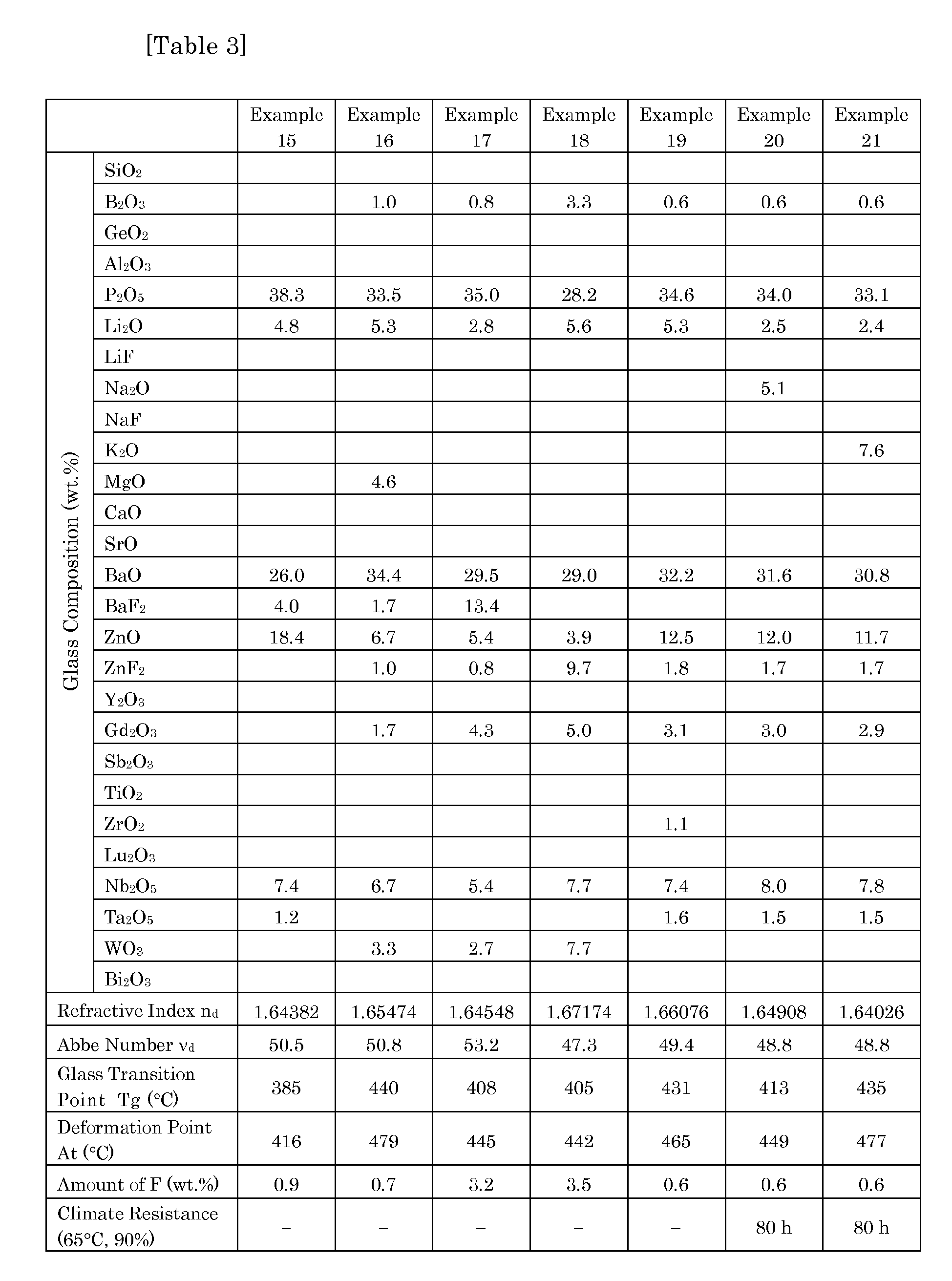

- As apparent from Tables 1 to 3, the glasses according to the Examples of the present invention each have optical constants sufficient for the optical glass, with a high refractive index (nd) of 1.58 or more as well as a high Abbe number (νd). Furthermore, generation of cloudiness on the molded surface upon molding was satisfactorily restricted.
These results show that the optical glass of the present invention has favorable characteristics allowing mass production.
Furthermore, the glasses of the Examples of the present invention each have a deformation point (At) falling within a relatively low temperature range of 500°C or lower, which facilitates molding thereof. It is apparent from the foregoing that the glass of the present invention is suitable for precision-mold press molding.
On the other hand, the climate resistance test showed that in each of the glasses of Comparative Examples 1 and 2, cloudiness began to appear on the surface within 50 hours. The glasses of Comparative Examples 3 to 5 each have a high deformation point (At), causing severe deterioration of the surface of the mold. - The optical glass according to the present invention has industrial applications as an optical glass which has a high refractive index, a high Abbe number, a low glass transition temperature, and a low deformation point, which would be unlikely to suffer generation of cloudiness upon precision-mold press molding and is excellent in resistance to devitrification, and which is particularly suitable for forming an aspherical lens and the like and is also suitable for mass production.
Claims (5)
- A P2O5-BaO-ZnO-Nb2O5 type optical glass, containing 25-50 wt.% P2O5,15-35 wt.% BaO, 1-25 wt. ZnO, and 3-10 wt.% Nb2O5.
- The optical glass according to claim 1, further containing 0.1-8 wt.% B2O3 and 0.1-10 wt.% F.
- The optical glass according to claim 1 or 2, further containing at least one of: 0-8 wt.% GeO2, 0-1 wt.% Al2O3 (excluding 1 wt.%), 0-8 wt.% Li2O, 0-10 wt.% Na2O, 0-8 wt.% K2O, 0-10 wt.% CaO, 0-15 wt.% SrO, 0-5 wt.% MgO, 0-10 wt.% WO3, 0-8 wt.% Gd2O3, 0-8 wt.% Ta2O5, 0-5 wt.% Y2O3, 0-3 wt.% ZrO2, 0-10 wt.% LiF, 0-10 wt.% NaF, 0-15 wt.% ZnF2, and 0-15 wt.% BaF2.
- The optical glass according to any of claims 1 to 3, having a refractive index (nd) of 1.58 to 1.70, an Abbe number (νd) of 42 to 58, a glass transition point (Tg) of 470°C or lower, and a glass deformation point (At) of 500°C or lower.
- The optical glass according to any of claims 1 to 4, used for transfer of a fine structure.
Applications Claiming Priority (2)
| Application Number | Priority Date | Filing Date | Title |
|---|---|---|---|
| JP2008029537 | 2008-02-08 | ||
| PCT/JP2009/052134 WO2009099230A1 (en) | 2008-02-08 | 2009-02-09 | Optical glass |
Publications (1)
| Publication Number | Publication Date |
|---|---|
| EP2246311A1 true EP2246311A1 (en) | 2010-11-03 |
Family
ID=40952295
Family Applications (1)
| Application Number | Title | Priority Date | Filing Date |
|---|---|---|---|
| EP09707758A Withdrawn EP2246311A1 (en) | 2008-02-08 | 2009-02-09 | Optical glass |
Country Status (5)
| Country | Link |
|---|---|
| US (1) | US8404604B2 (en) |
| EP (1) | EP2246311A1 (en) |
| JP (1) | JP5570054B2 (en) |
| CN (1) | CN101970368A (en) |
| WO (1) | WO2009099230A1 (en) |
Families Citing this family (15)
| Publication number | Priority date | Publication date | Assignee | Title |
|---|---|---|---|---|
| US20110256658A1 (en) * | 2010-02-05 | 2011-10-20 | Hitachi Chemical Company, Ltd. | Method for producing photovoltaic cell |
| US20110195540A1 (en) * | 2010-02-05 | 2011-08-11 | Hitachi Chemical Company, Ltd. | Composition for forming p-type diffusion layer, method for forming p-type diffusion layer, and method for producing photovoltaic cell |
| JP5690505B2 (en) * | 2010-05-20 | 2015-03-25 | 株式会社住田光学ガラス | Optical glass, mold press molding preform and optical element |
| CN102557437B (en) * | 2010-12-20 | 2016-08-17 | 株式会社小原 | Optical glass, optical element and preform |
| JP5748997B2 (en) * | 2010-12-24 | 2015-07-15 | 日本山村硝子株式会社 | Optical glass |
| CN102849945A (en) * | 2011-06-28 | 2013-01-02 | 联合大学 | Optical glass |
| CN110040954B (en) * | 2014-01-23 | 2021-07-27 | 成都光明光电股份有限公司 | Optical glass and optical components |
| CN107148403B (en) * | 2014-10-27 | 2021-04-27 | Hoya株式会社 | Optical glass, optical components and optical glass raw materials |
| CN107148404B (en) * | 2014-10-27 | 2021-04-27 | Hoya株式会社 | Optical glass, optical components and optical glass raw materials |
| RU2614787C1 (en) * | 2016-02-29 | 2017-03-29 | Юлия Алексеевна Щепочкина | Optical glass |
| CN115991571A (en) * | 2017-05-19 | 2023-04-21 | 株式会社小原 | Optical glass, preforms and optical components |
| CN107151096A (en) * | 2017-06-20 | 2017-09-12 | 成都光明光电有限责任公司 | low melting point glass |
| CN113912290A (en) * | 2018-05-10 | 2022-01-11 | Hoya株式会社 | Optical glass and optical element |
| CN112811815B (en) * | 2021-01-21 | 2022-04-12 | 成都光明光电股份有限公司 | Optical glass, glass preform, optical element and optical instrument |
| CN115385572B (en) * | 2022-09-05 | 2023-07-18 | 湖北新华光信息材料有限公司 | Phosphate optical glass, preparation method thereof and optical element |
Family Cites Families (25)
| Publication number | Priority date | Publication date | Assignee | Title |
|---|---|---|---|---|
| JPS5378217A (en) * | 1976-12-22 | 1978-07-11 | Hoya Glass Works Ltd | Phosphate optical glass through which light beam length beeing little dependnt on temperature |
| JPS58130136A (en) * | 1982-01-25 | 1983-08-03 | Hoya Corp | Optical glass |
| JPS60171244A (en) * | 1984-02-16 | 1985-09-04 | Ohara Inc | Optical glass |
| JP3987174B2 (en) | 1997-11-06 | 2007-10-03 | 株式会社住田光学ガラス | Optical glass for precision press molding |
| JP3907099B2 (en) | 2001-01-29 | 2007-04-18 | Hoya株式会社 | Optical glass |
| JP2002284534A (en) * | 2001-03-27 | 2002-10-03 | Canon Inc | Optical element molding die and method of manufacturing the same |
| JP2003238197A (en) * | 2002-02-18 | 2003-08-27 | Fuji Photo Optical Co Ltd | Optical glass for press-molded lens |
| AU2003208056A1 (en) | 2002-02-20 | 2003-09-09 | Kabushiki Kaisha Ohara | Optical glass |
| JP4373688B2 (en) | 2002-03-14 | 2009-11-25 | Hoya株式会社 | Optical glass, precision press-molding preform, and optical element |
| JP4603767B2 (en) | 2002-03-14 | 2010-12-22 | Hoya株式会社 | Manufacturing method of glass optical element |
| JP2004168593A (en) * | 2002-11-20 | 2004-06-17 | Minolta Co Ltd | Optical glass |
| JP4289450B2 (en) * | 2002-12-04 | 2009-07-01 | 光ガラス株式会社 | Optical glass |
| JP3982629B2 (en) | 2002-12-27 | 2007-09-26 | Hoya株式会社 | Optical glass, preform for press molding, and optical element |
| US7157391B2 (en) | 2002-12-27 | 2007-01-02 | Hoya Corporation | Optical glass, preform for press molding and optical element |
| JP2004262703A (en) | 2003-02-28 | 2004-09-24 | Minolta Co Ltd | Optical glass and optical element |
| US7994082B2 (en) * | 2003-06-30 | 2011-08-09 | Hoya Corporation | Preforms for precision press molding, optical elements, and methods of manufacturing the same |
| JP2005053749A (en) | 2003-08-05 | 2005-03-03 | Minolta Co Ltd | Optical glass and optical device formed from the same |
| JP4166174B2 (en) | 2004-03-05 | 2008-10-15 | Hoya株式会社 | Precision press molding preform manufacturing method and optical element manufacturing method |
| JP4533069B2 (en) | 2004-07-15 | 2010-08-25 | Hoya株式会社 | Phosphate optical glass, precision press-molding preform and manufacturing method thereof, optical element and manufacturing method thereof |
| JP4575787B2 (en) * | 2005-01-07 | 2010-11-04 | アルプス電気株式会社 | Mold manufacturing method |
| JP2007070194A (en) | 2005-09-09 | 2007-03-22 | Ohara Inc | Optical glass |
| JP5616566B2 (en) * | 2005-11-24 | 2014-10-29 | 株式会社オハラ | Optical glass |
| JP5160043B2 (en) * | 2006-03-31 | 2013-03-13 | Hoya株式会社 | Glass material for mold press and method for producing glass optical element |
| JP5099890B2 (en) | 2007-07-06 | 2012-12-19 | 独立行政法人産業技術総合研究所 | Optical glass |
| JP5056332B2 (en) * | 2007-10-15 | 2012-10-24 | コニカミノルタアドバンストレイヤー株式会社 | Optical glass and optical element |
-
2009
- 2009-02-09 WO PCT/JP2009/052134 patent/WO2009099230A1/en not_active Ceased
- 2009-02-09 CN CN2009801085343A patent/CN101970368A/en active Pending
- 2009-02-09 US US12/866,559 patent/US8404604B2/en not_active Expired - Fee Related
- 2009-02-09 EP EP09707758A patent/EP2246311A1/en not_active Withdrawn
- 2009-02-09 JP JP2009552562A patent/JP5570054B2/en not_active Expired - Fee Related
Non-Patent Citations (1)
| Title |
|---|
| See references of WO2009099230A1 * |
Also Published As
| Publication number | Publication date |
|---|---|
| JPWO2009099230A1 (en) | 2011-06-02 |
| CN101970368A (en) | 2011-02-09 |
| WO2009099230A1 (en) | 2009-08-13 |
| US8404604B2 (en) | 2013-03-26 |
| US20100317504A1 (en) | 2010-12-16 |
| JP5570054B2 (en) | 2014-08-13 |
Similar Documents
| Publication | Publication Date | Title |
|---|---|---|
| US8404604B2 (en) | Optical glass | |
| CN101497494B (en) | Optical glass | |
| JP5174368B2 (en) | Optical glass | |
| CN105461218B (en) | Glass, glass materials for press molding, optical element blanks and optical elements | |
| JP2011037660A (en) | Optical glass, lens preform and optical element | |
| JP7514351B2 (en) | Glass, glass materials for press molding, optical element blanks, and optical elements | |
| JP5099890B2 (en) | Optical glass | |
| JP2023017903A (en) | Optical glass and optical element | |
| JP6672472B2 (en) | Optical glass and optical element | |
| JP6663177B2 (en) | Optical glass, preform and optical element | |
| JP2008273751A (en) | Optical glass | |
| JP2012224501A (en) | Optical glass, optical element and preform | |
| JP6325189B2 (en) | Optical glass | |
| US8298974B2 (en) | Optical glass | |
| JP7685820B2 (en) | Optical Glass and Optical Elements | |
| JP2024159541A (en) | Optical Glass and Optical Elements | |
| WO2020067048A1 (en) | Optical glass | |
| JP2007070194A (en) | Optical glass | |
| JP5748997B2 (en) | Optical glass | |
| JP7305317B2 (en) | Optical glasses, optical element blanks and optical elements | |
| JP2017057121A (en) | Optical glass, preform and optical element | |
| JP7555747B2 (en) | Optical Glass and Optical Elements | |
| JP7409629B2 (en) | Optical glass, preforms for precision press molding, and optical elements | |
| JP2023102688A (en) | Optical glass, preforms for precision press molding, and optical elements | |
| JP6513837B2 (en) | Optical glass, optical element and preform |
Legal Events
| Date | Code | Title | Description |
|---|---|---|---|
| PUAI | Public reference made under article 153(3) epc to a published international application that has entered the european phase |
Free format text: ORIGINAL CODE: 0009012 |
|
| 17P | Request for examination filed |
Effective date: 20100804 |
|
| AK | Designated contracting states |
Kind code of ref document: A1 Designated state(s): AT BE BG CH CY CZ DE DK EE ES FI FR GB GR HR HU IE IS IT LI LT LU LV MC MK MT NL NO PL PT RO SE SI SK TR |
|
| AX | Request for extension of the european patent |
Extension state: AL BA RS |
|
| RIN1 | Information on inventor provided before grant (corrected) |
Inventor name: NISHII, JUNJI Inventor name: KITAMURA, NAOYUKI Inventor name: FUKUMI, KOHEI Inventor name: HASHIMA, HIDEKAZU Inventor name: MAYUMI, YOSHITAKA Inventor name: NAKAMURA, JUNICHI Inventor name: HIDAKA, TATSUO |
|
| DAX | Request for extension of the european patent (deleted) | ||
| STAA | Information on the status of an ep patent application or granted ep patent |
Free format text: STATUS: THE APPLICATION IS DEEMED TO BE WITHDRAWN |
|
| 18D | Application deemed to be withdrawn |
Effective date: 20130903 |