EP2245012B1 - Inhibitors of p38 map kinase - Google Patents
Inhibitors of p38 map kinase Download PDFInfo
- Publication number
- EP2245012B1 EP2245012B1 EP09713855.6A EP09713855A EP2245012B1 EP 2245012 B1 EP2245012 B1 EP 2245012B1 EP 09713855 A EP09713855 A EP 09713855A EP 2245012 B1 EP2245012 B1 EP 2245012B1
- Authority
- EP
- European Patent Office
- Prior art keywords
- alkyl
- optionally substituted
- hydrogen
- amino
- compound
- Prior art date
- Legal status (The legal status is an assumption and is not a legal conclusion. Google has not performed a legal analysis and makes no representation as to the accuracy of the status listed.)
- Not-in-force
Links
- 102000002574 p38 Mitogen-Activated Protein Kinases Human genes 0.000 title description 37
- 108010068338 p38 Mitogen-Activated Protein Kinases Proteins 0.000 title description 37
- 239000003112 inhibitor Substances 0.000 title description 14
- 150000001875 compounds Chemical class 0.000 claims description 94
- -1 pyridinyl radical Chemical class 0.000 claims description 78
- 229910052739 hydrogen Inorganic materials 0.000 claims description 65
- 239000001257 hydrogen Substances 0.000 claims description 47
- RTZKZFJDLAIYFH-UHFFFAOYSA-N Diethyl ether Chemical compound CCOCC RTZKZFJDLAIYFH-UHFFFAOYSA-N 0.000 claims description 27
- UFHFLCQGNIYNRP-UHFFFAOYSA-N Hydrogen Chemical compound [H][H] UFHFLCQGNIYNRP-UHFFFAOYSA-N 0.000 claims description 27
- IJGRMHOSHXDMSA-UHFFFAOYSA-N nitrogen Substances N#N IJGRMHOSHXDMSA-UHFFFAOYSA-N 0.000 claims description 27
- 150000003254 radicals Chemical class 0.000 claims description 25
- 125000006273 (C1-C3) alkyl group Chemical group 0.000 claims description 21
- 125000004435 hydrogen atom Chemical group [H]* 0.000 claims description 21
- 125000001424 substituent group Chemical group 0.000 claims description 19
- 125000004169 (C1-C6) alkyl group Chemical group 0.000 claims description 18
- 230000003834 intracellular effect Effects 0.000 claims description 18
- 125000006413 ring segment Chemical group 0.000 claims description 18
- 125000001997 phenyl group Chemical group [H]C1=C([H])C([H])=C(*)C([H])=C1[H] 0.000 claims description 17
- 229910052757 nitrogen Inorganic materials 0.000 claims description 16
- 125000002950 monocyclic group Chemical group 0.000 claims description 14
- 150000003839 salts Chemical class 0.000 claims description 13
- 108090000371 Esterases Proteins 0.000 claims description 12
- 125000002496 methyl group Chemical group [H]C([H])([H])* 0.000 claims description 12
- 125000001511 cyclopentyl group Chemical group [H]C1([H])C([H])([H])C([H])([H])C([H])(*)C1([H])[H] 0.000 claims description 11
- 125000000999 tert-butyl group Chemical group [H]C([H])([H])C(*)(C([H])([H])[H])C([H])([H])[H] 0.000 claims description 11
- 238000011282 treatment Methods 0.000 claims description 11
- OKTJSMMVPCPJKN-UHFFFAOYSA-N Carbon Chemical group [C] OKTJSMMVPCPJKN-UHFFFAOYSA-N 0.000 claims description 10
- 229910052799 carbon Inorganic materials 0.000 claims description 10
- 125000004185 ester group Chemical group 0.000 claims description 8
- 125000004122 cyclic group Chemical group 0.000 claims description 7
- 125000000113 cyclohexyl group Chemical group [H]C1([H])C([H])([H])C([H])([H])C([H])(*)C([H])([H])C1([H])[H] 0.000 claims description 7
- 125000001153 fluoro group Chemical group F* 0.000 claims description 7
- 125000002527 bicyclic carbocyclic group Chemical group 0.000 claims description 6
- 125000001559 cyclopropyl group Chemical group [H]C1([H])C([H])([H])C1([H])* 0.000 claims description 6
- 125000001495 ethyl group Chemical group [H]C([H])([H])C([H])([H])* 0.000 claims description 6
- 125000000623 heterocyclic group Chemical group 0.000 claims description 6
- 208000027866 inflammatory disease Diseases 0.000 claims description 6
- 125000001449 isopropyl group Chemical group [H]C([H])([H])C([H])(*)C([H])([H])[H] 0.000 claims description 6
- 125000004123 n-propyl group Chemical group [H]C([H])([H])C([H])([H])C([H])([H])* 0.000 claims description 6
- PXQLVRUNWNTZOS-UHFFFAOYSA-N sulfanyl Chemical class [SH] PXQLVRUNWNTZOS-UHFFFAOYSA-N 0.000 claims description 6
- 125000001309 chloro group Chemical group Cl* 0.000 claims description 5
- 125000002924 primary amino group Chemical group [H]N([H])* 0.000 claims description 5
- 125000002023 trifluoromethyl group Chemical group FC(F)(F)* 0.000 claims description 5
- 208000023275 Autoimmune disease Diseases 0.000 claims description 4
- 125000000217 alkyl group Chemical group 0.000 claims description 4
- 125000003277 amino group Chemical group 0.000 claims description 4
- 125000001995 cyclobutyl group Chemical group [H]C1([H])C([H])([H])C([H])(*)C1([H])[H] 0.000 claims description 4
- 150000003568 thioethers Chemical class 0.000 claims description 4
- 125000004191 (C1-C6) alkoxy group Chemical group 0.000 claims description 3
- 125000006700 (C1-C6) alkylthio group Chemical group 0.000 claims description 3
- 125000005913 (C3-C6) cycloalkyl group Chemical group 0.000 claims description 3
- 125000003903 2-propenyl group Chemical group [H]C([*])([H])C([H])=C([H])[H] 0.000 claims description 3
- 229910006074 SO2NH2 Inorganic materials 0.000 claims description 3
- 230000001363 autoimmune Effects 0.000 claims description 3
- 125000002618 bicyclic heterocycle group Chemical group 0.000 claims description 3
- 125000002843 carboxylic acid group Chemical group 0.000 claims description 3
- 125000003709 fluoroalkyl group Chemical group 0.000 claims description 3
- 125000005843 halogen group Chemical group 0.000 claims description 3
- 125000004108 n-butyl group Chemical group [H]C([H])([H])C([H])([H])C([H])([H])C([H])([H])* 0.000 claims description 3
- 150000002825 nitriles Chemical class 0.000 claims description 3
- 125000000449 nitro group Chemical group [O-][N+](*)=O 0.000 claims description 3
- 125000004433 nitrogen atom Chemical group N* 0.000 claims description 3
- QJGQUHMNIGDVPM-UHFFFAOYSA-N nitrogen group Chemical group [N] QJGQUHMNIGDVPM-UHFFFAOYSA-N 0.000 claims description 3
- 125000002914 sec-butyl group Chemical group [H]C([H])([H])C([H])([H])C([H])(*)C([H])([H])[H] 0.000 claims description 3
- 125000000876 trifluoromethoxy group Chemical group FC(F)(F)O* 0.000 claims description 3
- 125000003161 (C1-C6) alkylene group Chemical group 0.000 claims description 2
- DGYIJVNZSDYBOE-UHFFFAOYSA-N [CH2]C1=CC=NC=C1 Chemical group [CH2]C1=CC=NC=C1 DGYIJVNZSDYBOE-UHFFFAOYSA-N 0.000 claims description 2
- 125000004450 alkenylene group Chemical group 0.000 claims description 2
- MDEJDVFJIGMTIC-UHFFFAOYSA-N cyclopentyl 2-[2-[4-[2-amino-3-(2,4-difluorobenzoyl)-6-oxopyridin-1-yl]-3,5-difluorophenyl]ethylamino]-2-methylpropanoate Chemical compound C1CCCC1OC(=O)C(C)(C)NCCC(C=C1F)=CC(F)=C1N(C(C=C1)=O)C(N)=C1C(=O)C1=CC=C(F)C=C1F MDEJDVFJIGMTIC-UHFFFAOYSA-N 0.000 claims description 2
- JLHCSMHVTPMWQL-UHFFFAOYSA-N cyclopentyl 2-[3-[4-[2-amino-3-(2,4-difluorobenzoyl)-6-oxopyridin-1-yl]-3,5-difluorophenoxy]propylamino]-2-methylpropanoate Chemical compound C1CCCC1OC(=O)C(C)(C)NCCCOC(C=C1F)=CC(F)=C1N(C(C=C1)=O)C(N)=C1C(=O)C1=CC=C(F)C=C1F JLHCSMHVTPMWQL-UHFFFAOYSA-N 0.000 claims description 2
- 125000004356 hydroxy functional group Chemical group O* 0.000 claims 2
- VUMMFAUQEGRHCK-UHFFFAOYSA-N cyclopentyl 2-[2-[4-[2-amino-3-(2,4-difluorobenzoyl)-6-oxopyridin-1-yl]phenyl]ethylamino]-2-methylpropanoate Chemical compound C1CCCC1OC(=O)C(C)(C)NCCC(C=C1)=CC=C1N(C(C=C1)=O)C(N)=C1C(=O)C1=CC=C(F)C=C1F VUMMFAUQEGRHCK-UHFFFAOYSA-N 0.000 claims 1
- 239000003937 drug carrier Substances 0.000 claims 1
- 239000008194 pharmaceutical composition Substances 0.000 claims 1
- XEKOWRVHYACXOJ-UHFFFAOYSA-N Ethyl acetate Chemical compound CCOC(C)=O XEKOWRVHYACXOJ-UHFFFAOYSA-N 0.000 description 73
- 210000004027 cell Anatomy 0.000 description 54
- 239000000203 mixture Substances 0.000 description 48
- 238000004895 liquid chromatography mass spectrometry Methods 0.000 description 45
- YMWUJEATGCHHMB-UHFFFAOYSA-N Dichloromethane Chemical compound ClCCl YMWUJEATGCHHMB-UHFFFAOYSA-N 0.000 description 43
- CSNNHWWHGAXBCP-UHFFFAOYSA-L Magnesium sulfate Chemical compound [Mg+2].[O-][S+2]([O-])([O-])[O-] CSNNHWWHGAXBCP-UHFFFAOYSA-L 0.000 description 42
- 239000000243 solution Substances 0.000 description 37
- HEDRZPFGACZZDS-MICDWDOJSA-N Trichloro(2H)methane Chemical compound [2H]C(Cl)(Cl)Cl HEDRZPFGACZZDS-MICDWDOJSA-N 0.000 description 36
- 235000019439 ethyl acetate Nutrition 0.000 description 36
- 239000007787 solid Substances 0.000 description 36
- 238000005160 1H NMR spectroscopy Methods 0.000 description 34
- 230000002829 reductive effect Effects 0.000 description 33
- UIIMBOGNXHQVGW-UHFFFAOYSA-M Sodium bicarbonate Chemical compound [Na+].OC([O-])=O UIIMBOGNXHQVGW-UHFFFAOYSA-M 0.000 description 29
- WYURNTSHIVDZCO-UHFFFAOYSA-N Tetrahydrofuran Chemical compound C1CCOC1 WYURNTSHIVDZCO-UHFFFAOYSA-N 0.000 description 28
- IAZDPXIOMUYVGZ-WFGJKAKNSA-N Dimethyl sulfoxide Chemical compound [2H]C([2H])([2H])S(=O)C([2H])([2H])[2H] IAZDPXIOMUYVGZ-WFGJKAKNSA-N 0.000 description 24
- IMNFDUFMRHMDMM-UHFFFAOYSA-N N-Heptane Chemical compound CCCCCCC IMNFDUFMRHMDMM-UHFFFAOYSA-N 0.000 description 24
- XLYOFNOQVPJJNP-UHFFFAOYSA-N water Substances O XLYOFNOQVPJJNP-UHFFFAOYSA-N 0.000 description 23
- 230000000694 effects Effects 0.000 description 22
- 150000002148 esters Chemical class 0.000 description 22
- 239000003921 oil Substances 0.000 description 22
- 235000019198 oils Nutrition 0.000 description 22
- 238000006243 chemical reaction Methods 0.000 description 21
- 229910052943 magnesium sulfate Inorganic materials 0.000 description 21
- IAZDPXIOMUYVGZ-UHFFFAOYSA-N Dimethylsulphoxide Chemical compound CS(C)=O IAZDPXIOMUYVGZ-UHFFFAOYSA-N 0.000 description 20
- 239000000047 product Substances 0.000 description 20
- WEVYAHXRMPXWCK-UHFFFAOYSA-N Acetonitrile Chemical group CC#N WEVYAHXRMPXWCK-UHFFFAOYSA-N 0.000 description 19
- OKKJLVBELUTLKV-UHFFFAOYSA-N Methanol Chemical compound OC OKKJLVBELUTLKV-UHFFFAOYSA-N 0.000 description 18
- 239000011541 reaction mixture Substances 0.000 description 17
- KDLHZDBZIXYQEI-UHFFFAOYSA-N Palladium Chemical compound [Pd] KDLHZDBZIXYQEI-UHFFFAOYSA-N 0.000 description 14
- 239000002253 acid Substances 0.000 description 14
- 239000012267 brine Substances 0.000 description 14
- 229910000030 sodium bicarbonate Inorganic materials 0.000 description 14
- HPALAKNZSZLMCH-UHFFFAOYSA-M sodium;chloride;hydrate Chemical compound O.[Na+].[Cl-] HPALAKNZSZLMCH-UHFFFAOYSA-M 0.000 description 14
- VEXZGXHMUGYJMC-UHFFFAOYSA-N Hydrochloric acid Chemical compound Cl VEXZGXHMUGYJMC-UHFFFAOYSA-N 0.000 description 13
- 108060008682 Tumor Necrosis Factor Proteins 0.000 description 13
- 102000000852 Tumor Necrosis Factor-alpha Human genes 0.000 description 13
- 210000002540 macrophage Anatomy 0.000 description 13
- VHYFNPMBLIVWCW-UHFFFAOYSA-N 4-Dimethylaminopyridine Chemical compound CN(C)C1=CC=NC=C1 VHYFNPMBLIVWCW-UHFFFAOYSA-N 0.000 description 12
- 108010051152 Carboxylesterase Proteins 0.000 description 12
- 102000013392 Carboxylesterase Human genes 0.000 description 12
- 235000001014 amino acid Nutrition 0.000 description 12
- 229940024606 amino acid Drugs 0.000 description 12
- 238000004440 column chromatography Methods 0.000 description 12
- DTQVDTLACAAQTR-UHFFFAOYSA-N trifluoroacetic acid Substances OC(=O)C(F)(F)F DTQVDTLACAAQTR-UHFFFAOYSA-N 0.000 description 12
- MZOFCQQQCNRIBI-VMXHOPILSA-N (3s)-4-[[(2s)-1-[[(2s)-1-[[(1s)-1-carboxy-2-hydroxyethyl]amino]-4-methyl-1-oxopentan-2-yl]amino]-5-(diaminomethylideneamino)-1-oxopentan-2-yl]amino]-3-[[2-[[(2s)-2,6-diaminohexanoyl]amino]acetyl]amino]-4-oxobutanoic acid Chemical compound OC[C@@H](C(O)=O)NC(=O)[C@H](CC(C)C)NC(=O)[C@H](CCCN=C(N)N)NC(=O)[C@H](CC(O)=O)NC(=O)CNC(=O)[C@@H](N)CCCCN MZOFCQQQCNRIBI-VMXHOPILSA-N 0.000 description 10
- CDBYLPFSWZWCQE-UHFFFAOYSA-L Sodium Carbonate Chemical compound [Na+].[Na+].[O-]C([O-])=O CDBYLPFSWZWCQE-UHFFFAOYSA-L 0.000 description 10
- PFKFTWBEEFSNDU-UHFFFAOYSA-N carbonyldiimidazole Chemical compound C1=CN=CN1C(=O)N1C=CN=C1 PFKFTWBEEFSNDU-UHFFFAOYSA-N 0.000 description 10
- 239000000284 extract Substances 0.000 description 10
- 238000000034 method Methods 0.000 description 10
- LFQSCWFLJHTTHZ-UHFFFAOYSA-N Ethanol Chemical compound CCO LFQSCWFLJHTTHZ-UHFFFAOYSA-N 0.000 description 9
- ZMXDDKWLCZADIW-UHFFFAOYSA-N N,N-Dimethylformamide Chemical compound CN(C)C=O ZMXDDKWLCZADIW-UHFFFAOYSA-N 0.000 description 9
- 238000003556 assay Methods 0.000 description 9
- 238000001914 filtration Methods 0.000 description 9
- 238000000746 purification Methods 0.000 description 9
- QTBSBXVTEAMEQO-UHFFFAOYSA-N Acetic acid Chemical compound CC(O)=O QTBSBXVTEAMEQO-UHFFFAOYSA-N 0.000 description 8
- 102100034069 MAP kinase-activated protein kinase 2 Human genes 0.000 description 8
- 108010041955 MAP-kinase-activated kinase 2 Proteins 0.000 description 8
- SECXISVLQFMRJM-UHFFFAOYSA-N N-Methylpyrrolidone Chemical compound CN1CCCC1=O SECXISVLQFMRJM-UHFFFAOYSA-N 0.000 description 8
- VYPSYNLAJGMNEJ-UHFFFAOYSA-N Silicium dioxide Chemical compound O=[Si]=O VYPSYNLAJGMNEJ-UHFFFAOYSA-N 0.000 description 8
- 125000004432 carbon atom Chemical group C* 0.000 description 8
- 239000003814 drug Substances 0.000 description 8
- 238000002360 preparation method Methods 0.000 description 8
- 239000000725 suspension Substances 0.000 description 8
- FPQQSJJWHUJYPU-UHFFFAOYSA-N 3-(dimethylamino)propyliminomethylidene-ethylazanium;chloride Chemical compound Cl.CCN=C=NCCCN(C)C FPQQSJJWHUJYPU-UHFFFAOYSA-N 0.000 description 7
- 102000004127 Cytokines Human genes 0.000 description 7
- 108090000695 Cytokines Proteins 0.000 description 7
- 102000004190 Enzymes Human genes 0.000 description 7
- 108090000790 Enzymes Proteins 0.000 description 7
- 125000003178 carboxy group Chemical group [H]OC(*)=O 0.000 description 7
- SJYNIFXHYBFZOG-UHFFFAOYSA-N (4-chlorophenyl) 3-(2,4-difluorophenyl)-3-oxopropanimidothioate Chemical compound FC1=CC(F)=CC=C1C(=O)CC(=N)SC1=CC=C(Cl)C=C1 SJYNIFXHYBFZOG-UHFFFAOYSA-N 0.000 description 6
- LMDZBCPBFSXMTL-UHFFFAOYSA-N 1-Ethyl-3-(3-dimethylaminopropyl)carbodiimide Substances CCN=C=NCCCN(C)C LMDZBCPBFSXMTL-UHFFFAOYSA-N 0.000 description 6
- 229960000549 4-dimethylaminophenol Drugs 0.000 description 6
- 229910014455 Ca-Cb Inorganic materials 0.000 description 6
- 102000004308 Carboxylic Ester Hydrolases Human genes 0.000 description 6
- 108090000863 Carboxylic Ester Hydrolases Proteins 0.000 description 6
- NBIIXXVUZAFLBC-UHFFFAOYSA-N Phosphoric acid Chemical compound OP(O)(O)=O NBIIXXVUZAFLBC-UHFFFAOYSA-N 0.000 description 6
- HEMHJVSKTPXQMS-UHFFFAOYSA-M Sodium hydroxide Chemical compound [OH-].[Na+] HEMHJVSKTPXQMS-UHFFFAOYSA-M 0.000 description 6
- 230000035508 accumulation Effects 0.000 description 6
- 238000009825 accumulation Methods 0.000 description 6
- 235000008206 alpha-amino acids Nutrition 0.000 description 6
- 239000012298 atmosphere Substances 0.000 description 6
- NKLCNNUWBJBICK-UHFFFAOYSA-N dess–martin periodinane Chemical compound C1=CC=C2I(OC(=O)C)(OC(C)=O)(OC(C)=O)OC(=O)C2=C1 NKLCNNUWBJBICK-UHFFFAOYSA-N 0.000 description 6
- 229940079593 drug Drugs 0.000 description 6
- 239000002158 endotoxin Substances 0.000 description 6
- 150000002430 hydrocarbons Chemical group 0.000 description 6
- 230000007062 hydrolysis Effects 0.000 description 6
- 238000006460 hydrolysis reaction Methods 0.000 description 6
- 125000002887 hydroxy group Chemical group [H]O* 0.000 description 6
- 229920006008 lipopolysaccharide Polymers 0.000 description 6
- 210000001616 monocyte Anatomy 0.000 description 6
- 239000012044 organic layer Substances 0.000 description 6
- 239000000843 powder Substances 0.000 description 6
- 206010039073 rheumatoid arthritis Diseases 0.000 description 6
- 0 C*(C)c1ncc(C(C)(C)C)nc1 Chemical compound C*(C)c1ncc(C(C)(C)C)nc1 0.000 description 5
- PEDCQBHIVMGVHV-UHFFFAOYSA-N Glycerine Chemical compound OCC(O)CO PEDCQBHIVMGVHV-UHFFFAOYSA-N 0.000 description 5
- 101000938676 Homo sapiens Liver carboxylesterase 1 Proteins 0.000 description 5
- 102100030817 Liver carboxylesterase 1 Human genes 0.000 description 5
- 108091000080 Phosphotransferase Proteins 0.000 description 5
- 239000000443 aerosol Substances 0.000 description 5
- 150000001732 carboxylic acid derivatives Chemical class 0.000 description 5
- 238000003776 cleavage reaction Methods 0.000 description 5
- 201000010099 disease Diseases 0.000 description 5
- 208000037265 diseases, disorders, signs and symptoms Diseases 0.000 description 5
- 230000001965 increasing effect Effects 0.000 description 5
- 230000005764 inhibitory process Effects 0.000 description 5
- 230000026731 phosphorylation Effects 0.000 description 5
- 238000006366 phosphorylation reaction Methods 0.000 description 5
- 102000020233 phosphotransferase Human genes 0.000 description 5
- 230000007017 scission Effects 0.000 description 5
- 229910000029 sodium carbonate Inorganic materials 0.000 description 5
- 238000003786 synthesis reaction Methods 0.000 description 5
- 210000001519 tissue Anatomy 0.000 description 5
- 238000001665 trituration Methods 0.000 description 5
- 239000003643 water by type Substances 0.000 description 5
- KZMGYPLQYOPHEL-UHFFFAOYSA-N Boron trifluoride etherate Chemical compound FB(F)F.CCOCC KZMGYPLQYOPHEL-UHFFFAOYSA-N 0.000 description 4
- 208000006545 Chronic Obstructive Pulmonary Disease Diseases 0.000 description 4
- XDTMQSROBMDMFD-UHFFFAOYSA-N Cyclohexane Chemical compound C1CCCCC1 XDTMQSROBMDMFD-UHFFFAOYSA-N 0.000 description 4
- OKKJLVBELUTLKV-MZCSYVLQSA-N Deuterated methanol Chemical compound [2H]OC([2H])([2H])[2H] OKKJLVBELUTLKV-MZCSYVLQSA-N 0.000 description 4
- 102000043136 MAP kinase family Human genes 0.000 description 4
- 108091054455 MAP kinase family Proteins 0.000 description 4
- FAPWRFPIFSIZLT-UHFFFAOYSA-M Sodium chloride Chemical compound [Na+].[Cl-] FAPWRFPIFSIZLT-UHFFFAOYSA-M 0.000 description 4
- QAOWNCQODCNURD-UHFFFAOYSA-N Sulfuric acid Chemical compound OS(O)(=O)=O QAOWNCQODCNURD-UHFFFAOYSA-N 0.000 description 4
- 125000003118 aryl group Chemical group 0.000 description 4
- 208000006673 asthma Diseases 0.000 description 4
- 125000001584 benzyloxycarbonyl group Chemical group C(=O)(OCC1=CC=CC=C1)* 0.000 description 4
- 230000015572 biosynthetic process Effects 0.000 description 4
- 210000004369 blood Anatomy 0.000 description 4
- 239000008280 blood Substances 0.000 description 4
- 239000000872 buffer Substances 0.000 description 4
- 150000001735 carboxylic acids Chemical class 0.000 description 4
- 239000012043 crude product Substances 0.000 description 4
- XCIXKGXIYUWCLL-UHFFFAOYSA-N cyclopentanol Chemical compound OC1CCCC1 XCIXKGXIYUWCLL-UHFFFAOYSA-N 0.000 description 4
- ZNMFCPLGVGOSSF-UHFFFAOYSA-N cyclopentyl 2-amino-2-methylpropanoate;hydrochloride Chemical compound Cl.CC(C)(N)C(=O)OC1CCCC1 ZNMFCPLGVGOSSF-UHFFFAOYSA-N 0.000 description 4
- 235000019441 ethanol Nutrition 0.000 description 4
- 239000000706 filtrate Substances 0.000 description 4
- 239000000499 gel Substances 0.000 description 4
- 125000001041 indolyl group Chemical group 0.000 description 4
- 108020004999 messenger RNA Proteins 0.000 description 4
- 230000027405 negative regulation of phosphorylation Effects 0.000 description 4
- 125000004193 piperazinyl group Chemical group 0.000 description 4
- 239000002244 precipitate Substances 0.000 description 4
- 239000003755 preservative agent Substances 0.000 description 4
- 230000008569 process Effects 0.000 description 4
- 125000004076 pyridyl group Chemical group 0.000 description 4
- 238000012552 review Methods 0.000 description 4
- 230000011664 signaling Effects 0.000 description 4
- 239000011734 sodium Substances 0.000 description 4
- 239000012453 solvate Substances 0.000 description 4
- 239000002904 solvent Substances 0.000 description 4
- 239000006188 syrup Substances 0.000 description 4
- 235000020357 syrup Nutrition 0.000 description 4
- 238000004809 thin layer chromatography Methods 0.000 description 4
- 230000000699 topical effect Effects 0.000 description 4
- LENZDBCJOHFCAS-UHFFFAOYSA-N tris Chemical compound OCC(N)(CO)CO LENZDBCJOHFCAS-UHFFFAOYSA-N 0.000 description 4
- 239000003981 vehicle Substances 0.000 description 4
- RYHBNJHYFVUHQT-UHFFFAOYSA-N 1,4-Dioxane Chemical compound C1COCCO1 RYHBNJHYFVUHQT-UHFFFAOYSA-N 0.000 description 3
- 125000001140 1,4-phenylene group Chemical group [H]C1=C([H])C([*:2])=C([H])C([H])=C1[*:1] 0.000 description 3
- FZZLYOOMBQRBDH-UHFFFAOYSA-N 2-(4-amino-3,5-difluorophenyl)ethanol Chemical compound NC1=C(F)C=C(CCO)C=C1F FZZLYOOMBQRBDH-UHFFFAOYSA-N 0.000 description 3
- LOTPCJNUATWYRX-UHFFFAOYSA-N 2-[4-[2-amino-3-(2,4-difluorobenzoyl)-6-oxopyridin-1-yl]phenyl]acetic acid Chemical compound NC1=C(C(=O)C=2C(=CC(F)=CC=2)F)C=CC(=O)N1C1=CC=C(CC(O)=O)C=C1 LOTPCJNUATWYRX-UHFFFAOYSA-N 0.000 description 3
- CSCPPACGZOOCGX-UHFFFAOYSA-N Acetone Chemical compound CC(C)=O CSCPPACGZOOCGX-UHFFFAOYSA-N 0.000 description 3
- UHOVQNZJYSORNB-UHFFFAOYSA-N Benzene Chemical compound C1=CC=CC=C1 UHOVQNZJYSORNB-UHFFFAOYSA-N 0.000 description 3
- WVDDGKGOMKODPV-UHFFFAOYSA-N Benzyl alcohol Chemical compound OCC1=CC=CC=C1 WVDDGKGOMKODPV-UHFFFAOYSA-N 0.000 description 3
- 102100021864 Cocaine esterase Human genes 0.000 description 3
- 206010009900 Colitis ulcerative Diseases 0.000 description 3
- 208000011231 Crohn disease Diseases 0.000 description 3
- FBPFZTCFMRRESA-FSIIMWSLSA-N D-Glucitol Natural products OC[C@H](O)[C@H](O)[C@@H](O)[C@H](O)CO FBPFZTCFMRRESA-FSIIMWSLSA-N 0.000 description 3
- 101000898006 Homo sapiens Cocaine esterase Proteins 0.000 description 3
- 208000022559 Inflammatory bowel disease Diseases 0.000 description 3
- WMFOQBRAJBCJND-UHFFFAOYSA-M Lithium hydroxide Chemical compound [Li+].[OH-] WMFOQBRAJBCJND-UHFFFAOYSA-M 0.000 description 3
- 150000001204 N-oxides Chemical class 0.000 description 3
- 238000005481 NMR spectroscopy Methods 0.000 description 3
- DNIAPMSPPWPWGF-UHFFFAOYSA-N Propylene glycol Chemical compound CC(O)CO DNIAPMSPPWPWGF-UHFFFAOYSA-N 0.000 description 3
- 201000004681 Psoriasis Diseases 0.000 description 3
- 239000012980 RPMI-1640 medium Substances 0.000 description 3
- ZMANZCXQSJIPKH-UHFFFAOYSA-N Triethylamine Chemical compound CCN(CC)CC ZMANZCXQSJIPKH-UHFFFAOYSA-N 0.000 description 3
- 201000006704 Ulcerative Colitis Diseases 0.000 description 3
- 229960000583 acetic acid Drugs 0.000 description 3
- 238000005903 acid hydrolysis reaction Methods 0.000 description 3
- 230000004913 activation Effects 0.000 description 3
- 150000001371 alpha-amino acids Chemical class 0.000 description 3
- 229910000147 aluminium phosphate Inorganic materials 0.000 description 3
- 239000002775 capsule Substances 0.000 description 3
- 210000000170 cell membrane Anatomy 0.000 description 3
- 238000005119 centrifugation Methods 0.000 description 3
- 238000010790 dilution Methods 0.000 description 3
- 239000012895 dilution Substances 0.000 description 3
- 230000009977 dual effect Effects 0.000 description 3
- 238000009472 formulation Methods 0.000 description 3
- 150000002332 glycine derivatives Chemical class 0.000 description 3
- 125000005842 heteroatom Chemical group 0.000 description 3
- 125000002883 imidazolyl group Chemical group 0.000 description 3
- 125000000842 isoxazolyl group Chemical group 0.000 description 3
- 239000010410 layer Substances 0.000 description 3
- 239000007788 liquid Substances 0.000 description 3
- 238000004519 manufacturing process Methods 0.000 description 3
- 239000008188 pellet Substances 0.000 description 3
- 239000012071 phase Substances 0.000 description 3
- 230000003389 potentiating effect Effects 0.000 description 3
- 238000002953 preparative HPLC Methods 0.000 description 3
- UORVCLMRJXCDCP-UHFFFAOYSA-N propynoic acid Chemical compound OC(=O)C#C UORVCLMRJXCDCP-UHFFFAOYSA-N 0.000 description 3
- 125000006239 protecting group Chemical group 0.000 description 3
- 230000004044 response Effects 0.000 description 3
- 229920006395 saturated elastomer Polymers 0.000 description 3
- 235000011121 sodium hydroxide Nutrition 0.000 description 3
- FVAUCKIRQBBSSJ-UHFFFAOYSA-M sodium iodide Chemical compound [Na+].[I-] FVAUCKIRQBBSSJ-UHFFFAOYSA-M 0.000 description 3
- AKHNMLFCWUSKQB-UHFFFAOYSA-L sodium thiosulfate Chemical compound [Na+].[Na+].[O-]S([O-])(=O)=S AKHNMLFCWUSKQB-UHFFFAOYSA-L 0.000 description 3
- 239000000600 sorbitol Substances 0.000 description 3
- 235000010356 sorbitol Nutrition 0.000 description 3
- 239000007921 spray Substances 0.000 description 3
- 239000000758 substrate Substances 0.000 description 3
- 239000006228 supernatant Substances 0.000 description 3
- 239000003826 tablet Substances 0.000 description 3
- LSVYCJILORYVCD-UHFFFAOYSA-N tert-butyl 2-amino-2-methylpropanoate Chemical compound CC(C)(C)OC(=O)C(C)(C)N LSVYCJILORYVCD-UHFFFAOYSA-N 0.000 description 3
- 125000001544 thienyl group Chemical group 0.000 description 3
- OUYCCCASQSFEME-UHFFFAOYSA-N tyrosine Natural products OC(=O)C(N)CC1=CC=C(O)C=C1 OUYCCCASQSFEME-UHFFFAOYSA-N 0.000 description 3
- YKJYKKNCCRKFSL-RDBSUJKOSA-N (-)-anisomycin Chemical compound C1=CC(OC)=CC=C1C[C@@H]1[C@H](OC(C)=O)[C@@H](O)CN1 YKJYKKNCCRKFSL-RDBSUJKOSA-N 0.000 description 2
- MTCFGRXMJLQNBG-REOHCLBHSA-N (2S)-2-Amino-3-hydroxypropansäure Chemical compound OC[C@H](N)C(O)=O MTCFGRXMJLQNBG-REOHCLBHSA-N 0.000 description 2
- CYBOBNODYVJFNM-JEDNCBNOSA-N (2s)-2-amino-2-methylbutanoic acid;hydrochloride Chemical compound Cl.CC[C@](C)(N)C(O)=O CYBOBNODYVJFNM-JEDNCBNOSA-N 0.000 description 2
- NILQLFBWTXNUOE-UHFFFAOYSA-N 1-aminocyclopentanecarboxylic acid Chemical compound OC(=O)C1(N)CCCC1 NILQLFBWTXNUOE-UHFFFAOYSA-N 0.000 description 2
- ZLOQOOMLMYSPAG-UHFFFAOYSA-N 2,3-dihydro-1h-inden-2-yl 2-methyl-2-(phenylmethoxycarbonylamino)propanoate Chemical compound C1C2=CC=CC=C2CC1OC(=O)C(C)(C)NC(=O)OCC1=CC=CC=C1 ZLOQOOMLMYSPAG-UHFFFAOYSA-N 0.000 description 2
- XGLFBUVWWKDQKP-UHFFFAOYSA-N 2-(3,5-difluoro-4-nitrophenyl)acetic acid Chemical compound OC(=O)CC1=CC(F)=C([N+]([O-])=O)C(F)=C1 XGLFBUVWWKDQKP-UHFFFAOYSA-N 0.000 description 2
- AXNGRSKDMAKTSV-UHFFFAOYSA-N 2-[2-[4-[2-amino-3-(2,4-difluorobenzoyl)-6-oxopyridin-1-yl]phenyl]ethylamino]-2-methylpropanoic acid Chemical compound C1=CC(CCNC(C)(C)C(O)=O)=CC=C1N1C(=O)C=CC(C(=O)C=2C(=CC(F)=CC=2)F)=C1N AXNGRSKDMAKTSV-UHFFFAOYSA-N 0.000 description 2
- ZURGFZXAZBSTEI-UHFFFAOYSA-N 2-[4-[2-amino-3-(2,4-difluorobenzoyl)-6-oxopyridin-1-yl]-3,5-difluorophenyl]acetaldehyde Chemical compound NC1=C(C(=O)C=2C(=CC(F)=CC=2)F)C=CC(=O)N1C1=C(F)C=C(CC=O)C=C1F ZURGFZXAZBSTEI-UHFFFAOYSA-N 0.000 description 2
- JHOMMFNZHSREGY-UHFFFAOYSA-N 2-[4-[2-amino-3-(2,4-difluorobenzoyl)-6-oxopyridin-1-yl]phenyl]acetaldehyde Chemical compound NC1=C(C(=O)C=2C(=CC(F)=CC=2)F)C=CC(=O)N1C1=CC=C(CC=O)C=C1 JHOMMFNZHSREGY-UHFFFAOYSA-N 0.000 description 2
- RXQHPCYNFHKSOB-UHFFFAOYSA-N 2-[[2-[4-[2-amino-3-(2,4-difluorobenzoyl)-6-oxopyridin-1-yl]phenyl]acetyl]amino]-2-methylpropanoic acid Chemical compound C1=CC(CC(=O)NC(C)(C)C(O)=O)=CC=C1N1C(=O)C=CC(C(=O)C=2C(=CC(F)=CC=2)F)=C1N RXQHPCYNFHKSOB-UHFFFAOYSA-N 0.000 description 2
- OYIFNHCXNCRBQI-UHFFFAOYSA-N 2-aminoadipic acid Chemical compound OC(=O)C(N)CCCC(O)=O OYIFNHCXNCRBQI-UHFFFAOYSA-N 0.000 description 2
- QKVCSJBBYNYZNM-UHFFFAOYSA-N 2-methyl-2-(phenylmethoxycarbonylamino)propanoic acid Chemical compound OC(=O)C(C)(C)NC(=O)OCC1=CC=CC=C1 QKVCSJBBYNYZNM-UHFFFAOYSA-N 0.000 description 2
- HBAQYPYDRFILMT-UHFFFAOYSA-N 8-[3-(1-cyclopropylpyrazol-4-yl)-1H-pyrazolo[4,3-d]pyrimidin-5-yl]-3-methyl-3,8-diazabicyclo[3.2.1]octan-2-one Chemical class C1(CC1)N1N=CC(=C1)C1=NNC2=C1N=C(N=C2)N1C2C(N(CC1CC2)C)=O HBAQYPYDRFILMT-UHFFFAOYSA-N 0.000 description 2
- YKJYKKNCCRKFSL-UHFFFAOYSA-N Anisomycin Natural products C1=CC(OC)=CC=C1CC1C(OC(C)=O)C(O)CN1 YKJYKKNCCRKFSL-UHFFFAOYSA-N 0.000 description 2
- 239000004475 Arginine Substances 0.000 description 2
- 206010012438 Dermatitis atopic Diseases 0.000 description 2
- 208000009386 Experimental Arthritis Diseases 0.000 description 2
- 108010007457 Extracellular Signal-Regulated MAP Kinases Proteins 0.000 description 2
- 102000007665 Extracellular Signal-Regulated MAP Kinases Human genes 0.000 description 2
- 108010010803 Gelatin Proteins 0.000 description 2
- WHUUTDBJXJRKMK-UHFFFAOYSA-N Glutamic acid Natural products OC(=O)C(N)CCC(O)=O WHUUTDBJXJRKMK-UHFFFAOYSA-N 0.000 description 2
- DHMQDGOQFOQNFH-UHFFFAOYSA-N Glycine Natural products NCC(O)=O DHMQDGOQFOQNFH-UHFFFAOYSA-N 0.000 description 2
- 208000009329 Graft vs Host Disease Diseases 0.000 description 2
- 101000628954 Homo sapiens Mitogen-activated protein kinase 12 Proteins 0.000 description 2
- 206010061218 Inflammation Diseases 0.000 description 2
- 108090001005 Interleukin-6 Proteins 0.000 description 2
- 102000004889 Interleukin-6 Human genes 0.000 description 2
- 108090001007 Interleukin-8 Proteins 0.000 description 2
- XUJNEKJLAYXESH-REOHCLBHSA-N L-Cysteine Chemical compound SC[C@H](N)C(O)=O XUJNEKJLAYXESH-REOHCLBHSA-N 0.000 description 2
- ODKSFYDXXFIFQN-BYPYZUCNSA-P L-argininium(2+) Chemical compound NC(=[NH2+])NCCC[C@H]([NH3+])C(O)=O ODKSFYDXXFIFQN-BYPYZUCNSA-P 0.000 description 2
- CKLJMWTZIZZHCS-REOHCLBHSA-N L-aspartic acid Chemical compound OC(=O)[C@@H](N)CC(O)=O CKLJMWTZIZZHCS-REOHCLBHSA-N 0.000 description 2
- WHUUTDBJXJRKMK-VKHMYHEASA-N L-glutamic acid Chemical compound OC(=O)[C@@H](N)CCC(O)=O WHUUTDBJXJRKMK-VKHMYHEASA-N 0.000 description 2
- HNDVDQJCIGZPNO-YFKPBYRVSA-N L-histidine Chemical compound OC(=O)[C@@H](N)CC1=CN=CN1 HNDVDQJCIGZPNO-YFKPBYRVSA-N 0.000 description 2
- KDXKERNSBIXSRK-YFKPBYRVSA-N L-lysine Chemical compound NCCCC[C@H](N)C(O)=O KDXKERNSBIXSRK-YFKPBYRVSA-N 0.000 description 2
- AYFVYJQAPQTCCC-GBXIJSLDSA-N L-threonine Chemical compound C[C@@H](O)[C@H](N)C(O)=O AYFVYJQAPQTCCC-GBXIJSLDSA-N 0.000 description 2
- QIVBCDIJIAJPQS-VIFPVBQESA-N L-tryptophane Chemical compound C1=CC=C2C(C[C@H](N)C(O)=O)=CNC2=C1 QIVBCDIJIAJPQS-VIFPVBQESA-N 0.000 description 2
- OUYCCCASQSFEME-QMMMGPOBSA-N L-tyrosine Chemical compound OC(=O)[C@@H](N)CC1=CC=C(O)C=C1 OUYCCCASQSFEME-QMMMGPOBSA-N 0.000 description 2
- GUBGYTABKSRVRQ-QKKXKWKRSA-N Lactose Natural products OC[C@H]1O[C@@H](O[C@H]2[C@H](O)[C@@H](O)C(O)O[C@@H]2CO)[C@H](O)[C@@H](O)[C@H]1O GUBGYTABKSRVRQ-QKKXKWKRSA-N 0.000 description 2
- 235000010643 Leucaena leucocephala Nutrition 0.000 description 2
- 240000007472 Leucaena leucocephala Species 0.000 description 2
- 239000004472 Lysine Substances 0.000 description 2
- KDXKERNSBIXSRK-UHFFFAOYSA-N Lysine Natural products NCCCCC(N)C(O)=O KDXKERNSBIXSRK-UHFFFAOYSA-N 0.000 description 2
- 102000055120 MEF2 Transcription Factors Human genes 0.000 description 2
- 108010018650 MEF2 Transcription Factors Proteins 0.000 description 2
- 102100026932 Mitogen-activated protein kinase 12 Human genes 0.000 description 2
- 108700015928 Mitogen-activated protein kinase 13 Proteins 0.000 description 2
- 102000056248 Mitogen-activated protein kinase 13 Human genes 0.000 description 2
- 241000699670 Mus sp. Species 0.000 description 2
- 206010028980 Neoplasm Diseases 0.000 description 2
- 108010066154 Nuclear Export Signals Proteins 0.000 description 2
- 108010058846 Ovalbumin Proteins 0.000 description 2
- 108091005804 Peptidases Proteins 0.000 description 2
- 102000035195 Peptidases Human genes 0.000 description 2
- 102100038280 Prostaglandin G/H synthase 2 Human genes 0.000 description 2
- 108050003267 Prostaglandin G/H synthase 2 Proteins 0.000 description 2
- JUJWROOIHBZHMG-UHFFFAOYSA-N Pyridine Chemical compound C1=CC=NC=C1 JUJWROOIHBZHMG-UHFFFAOYSA-N 0.000 description 2
- MTCFGRXMJLQNBG-UHFFFAOYSA-N Serine Natural products OCC(N)C(O)=O MTCFGRXMJLQNBG-UHFFFAOYSA-N 0.000 description 2
- DBMJMQXJHONAFJ-UHFFFAOYSA-M Sodium laurylsulphate Chemical compound [Na+].CCCCCCCCCCCCOS([O-])(=O)=O DBMJMQXJHONAFJ-UHFFFAOYSA-M 0.000 description 2
- AYFVYJQAPQTCCC-UHFFFAOYSA-N Threonine Natural products CC(O)C(N)C(O)=O AYFVYJQAPQTCCC-UHFFFAOYSA-N 0.000 description 2
- 239000004473 Threonine Substances 0.000 description 2
- 108091023040 Transcription factor Proteins 0.000 description 2
- 102000040945 Transcription factor Human genes 0.000 description 2
- 239000007983 Tris buffer Substances 0.000 description 2
- QIVBCDIJIAJPQS-UHFFFAOYSA-N Tryptophan Natural products C1=CC=C2C(CC(N)C(O)=O)=CNC2=C1 QIVBCDIJIAJPQS-UHFFFAOYSA-N 0.000 description 2
- 239000000654 additive Substances 0.000 description 2
- 125000003342 alkenyl group Chemical group 0.000 description 2
- 150000001370 alpha-amino acid derivatives Chemical class 0.000 description 2
- 150000001413 amino acids Chemical class 0.000 description 2
- 238000004458 analytical method Methods 0.000 description 2
- ODKSFYDXXFIFQN-UHFFFAOYSA-N arginine Natural products OC(=O)C(N)CCCNC(N)=N ODKSFYDXXFIFQN-UHFFFAOYSA-N 0.000 description 2
- 235000009697 arginine Nutrition 0.000 description 2
- 206010003246 arthritis Diseases 0.000 description 2
- 235000003704 aspartic acid Nutrition 0.000 description 2
- 201000008937 atopic dermatitis Diseases 0.000 description 2
- 239000002585 base Substances 0.000 description 2
- 230000008901 benefit Effects 0.000 description 2
- 125000003785 benzimidazolyl group Chemical group N1=C(NC2=C1C=CC=C2)* 0.000 description 2
- LUFPJJNWMYZRQE-UHFFFAOYSA-N benzylsulfanylmethylbenzene Chemical compound C=1C=CC=CC=1CSCC1=CC=CC=C1 LUFPJJNWMYZRQE-UHFFFAOYSA-N 0.000 description 2
- OQFSQFPPLPISGP-UHFFFAOYSA-N beta-carboxyaspartic acid Natural products OC(=O)C(N)C(C(O)=O)C(O)=O OQFSQFPPLPISGP-UHFFFAOYSA-N 0.000 description 2
- 229910052796 boron Inorganic materials 0.000 description 2
- 125000001246 bromo group Chemical group Br* 0.000 description 2
- 239000006071 cream Substances 0.000 description 2
- 239000000287 crude extract Substances 0.000 description 2
- 125000000753 cycloalkyl group Chemical group 0.000 description 2
- LAKBTWFVDTYJHZ-UHFFFAOYSA-N cyclopentyl 1-aminocyclopentane-1-carboxylate Chemical compound C1CCCC1OC(=O)C1(N)CCCC1 LAKBTWFVDTYJHZ-UHFFFAOYSA-N 0.000 description 2
- VCOGQZAGOMMPHU-UHFFFAOYSA-N cyclopentyl 2-methyl-2-[(2-methylpropan-2-yl)oxycarbonylamino]propanoate Chemical compound CC(C)(C)OC(=O)NC(C)(C)C(=O)OC1CCCC1 VCOGQZAGOMMPHU-UHFFFAOYSA-N 0.000 description 2
- XUJNEKJLAYXESH-UHFFFAOYSA-N cysteine Natural products SCC(N)C(O)=O XUJNEKJLAYXESH-UHFFFAOYSA-N 0.000 description 2
- 235000018417 cysteine Nutrition 0.000 description 2
- 206010012601 diabetes mellitus Diseases 0.000 description 2
- ZUOUZKKEUPVFJK-UHFFFAOYSA-N diphenyl Chemical compound C1=CC=CC=C1C1=CC=CC=C1 ZUOUZKKEUPVFJK-UHFFFAOYSA-N 0.000 description 2
- 238000001035 drying Methods 0.000 description 2
- 239000003995 emulsifying agent Substances 0.000 description 2
- 102000007595 ets-Domain Protein Elk-4 Human genes 0.000 description 2
- 108010032157 ets-Domain Protein Elk-4 Proteins 0.000 description 2
- 239000000945 filler Substances 0.000 description 2
- 125000002541 furyl group Chemical group 0.000 description 2
- 239000008273 gelatin Substances 0.000 description 2
- 229920000159 gelatin Polymers 0.000 description 2
- 235000019322 gelatine Nutrition 0.000 description 2
- 235000011852 gelatine desserts Nutrition 0.000 description 2
- 235000013922 glutamic acid Nutrition 0.000 description 2
- 239000004220 glutamic acid Substances 0.000 description 2
- 235000011187 glycerol Nutrition 0.000 description 2
- 208000024908 graft versus host disease Diseases 0.000 description 2
- 238000003306 harvesting Methods 0.000 description 2
- 125000001072 heteroaryl group Chemical group 0.000 description 2
- HNDVDQJCIGZPNO-UHFFFAOYSA-N histidine Natural products OC(=O)C(N)CC1=CN=CN1 HNDVDQJCIGZPNO-UHFFFAOYSA-N 0.000 description 2
- 150000004677 hydrates Chemical class 0.000 description 2
- 230000003301 hydrolyzing effect Effects 0.000 description 2
- 210000004969 inflammatory cell Anatomy 0.000 description 2
- 230000004054 inflammatory process Effects 0.000 description 2
- 230000002401 inhibitory effect Effects 0.000 description 2
- 125000001786 isothiazolyl group Chemical group 0.000 description 2
- 229940043355 kinase inhibitor Drugs 0.000 description 2
- 239000008101 lactose Substances 0.000 description 2
- 210000000265 leukocyte Anatomy 0.000 description 2
- 235000018977 lysine Nutrition 0.000 description 2
- HQKMJHAJHXVSDF-UHFFFAOYSA-L magnesium stearate Chemical compound [Mg+2].CCCCCCCCCCCCCCCCCC([O-])=O.CCCCCCCCCCCCCCCCCC([O-])=O HQKMJHAJHXVSDF-UHFFFAOYSA-L 0.000 description 2
- 238000005259 measurement Methods 0.000 description 2
- 230000001404 mediated effect Effects 0.000 description 2
- BDAGIHXWWSANSR-UHFFFAOYSA-N methanoic acid Natural products OC=O BDAGIHXWWSANSR-UHFFFAOYSA-N 0.000 description 2
- 239000002829 mitogen activated protein kinase inhibitor Substances 0.000 description 2
- 201000006417 multiple sclerosis Diseases 0.000 description 2
- 239000002687 nonaqueous vehicle Substances 0.000 description 2
- 239000002674 ointment Substances 0.000 description 2
- 229940092253 ovalbumin Drugs 0.000 description 2
- 125000002971 oxazolyl group Chemical group 0.000 description 2
- 239000002245 particle Substances 0.000 description 2
- 239000000546 pharmaceutical excipient Substances 0.000 description 2
- 239000003757 phosphotransferase inhibitor Substances 0.000 description 2
- 125000003386 piperidinyl group Chemical group 0.000 description 2
- BWHMMNNQKKPAPP-UHFFFAOYSA-L potassium carbonate Chemical compound [K+].[K+].[O-]C([O-])=O BWHMMNNQKKPAPP-UHFFFAOYSA-L 0.000 description 2
- 239000003380 propellant Substances 0.000 description 2
- 235000019833 protease Nutrition 0.000 description 2
- 125000003373 pyrazinyl group Chemical group 0.000 description 2
- 125000003226 pyrazolyl group Chemical group 0.000 description 2
- 125000000714 pyrimidinyl group Chemical group 0.000 description 2
- 125000000168 pyrrolyl group Chemical group 0.000 description 2
- 238000010992 reflux Methods 0.000 description 2
- 230000001105 regulatory effect Effects 0.000 description 2
- 230000002441 reversible effect Effects 0.000 description 2
- 238000003118 sandwich ELISA Methods 0.000 description 2
- 239000011780 sodium chloride Substances 0.000 description 2
- 235000019333 sodium laurylsulphate Nutrition 0.000 description 2
- 238000003756 stirring Methods 0.000 description 2
- 239000000126 substance Substances 0.000 description 2
- 201000000596 systemic lupus erythematosus Diseases 0.000 description 2
- 230000008685 targeting Effects 0.000 description 2
- DYHSDKLCOJIUFX-UHFFFAOYSA-N tert-butoxycarbonyl anhydride Chemical compound CC(C)(C)OC(=O)OC(=O)OC(C)(C)C DYHSDKLCOJIUFX-UHFFFAOYSA-N 0.000 description 2
- CQXDYHPBXDZWBA-UHFFFAOYSA-N tert-butyl 2,2,2-trichloroethanimidate Chemical compound CC(C)(C)OC(=N)C(Cl)(Cl)Cl CQXDYHPBXDZWBA-UHFFFAOYSA-N 0.000 description 2
- OHLUOLTYTMEECV-UHFFFAOYSA-N tert-butyl 2-(3,5-difluoro-4-nitrophenyl)acetate Chemical compound CC(C)(C)OC(=O)CC1=CC(F)=C([N+]([O-])=O)C(F)=C1 OHLUOLTYTMEECV-UHFFFAOYSA-N 0.000 description 2
- LLSVSFBSNRNHKC-UHFFFAOYSA-N tert-butyl 2-methyl-2-(phenylmethoxycarbonylamino)propanoate Chemical compound CC(C)(C)OC(=O)C(C)(C)NC(=O)OCC1=CC=CC=C1 LLSVSFBSNRNHKC-UHFFFAOYSA-N 0.000 description 2
- 125000003554 tetrahydropyrrolyl group Chemical group 0.000 description 2
- 125000001113 thiadiazolyl group Chemical group 0.000 description 2
- 125000000335 thiazolyl group Chemical group 0.000 description 2
- 239000003104 tissue culture media Substances 0.000 description 2
- 238000005406 washing Methods 0.000 description 2
- MRXDGVXSWIXTQL-HYHFHBMOSA-N (2s)-2-[[(1s)-1-(2-amino-1,4,5,6-tetrahydropyrimidin-6-yl)-2-[[(2s)-4-methyl-1-oxo-1-[[(2s)-1-oxo-3-phenylpropan-2-yl]amino]pentan-2-yl]amino]-2-oxoethyl]carbamoylamino]-3-phenylpropanoic acid Chemical compound C([C@H](NC(=O)N[C@H](C(=O)N[C@@H](CC(C)C)C(=O)N[C@@H](CC=1C=CC=CC=1)C=O)C1NC(N)=NCC1)C(O)=O)C1=CC=CC=C1 MRXDGVXSWIXTQL-HYHFHBMOSA-N 0.000 description 1
- UKAUYVFTDYCKQA-UHFFFAOYSA-N -2-Amino-4-hydroxybutanoic acid Natural products OC(=O)C(N)CCO UKAUYVFTDYCKQA-UHFFFAOYSA-N 0.000 description 1
- ZORQXIQZAOLNGE-UHFFFAOYSA-N 1,1-difluorocyclohexane Chemical compound FC1(F)CCCCC1 ZORQXIQZAOLNGE-UHFFFAOYSA-N 0.000 description 1
- JCIIKRHCWVHVFF-UHFFFAOYSA-N 1,2,4-thiadiazol-5-amine;hydrochloride Chemical compound Cl.NC1=NC=NS1 JCIIKRHCWVHVFF-UHFFFAOYSA-N 0.000 description 1
- SSNCMIDZGFCTST-UHFFFAOYSA-N 1,3-difluoro-2-nitrobenzene Chemical compound [O-][N+](=O)C1=C(F)C=CC=C1F SSNCMIDZGFCTST-UHFFFAOYSA-N 0.000 description 1
- ASOKPJOREAFHNY-UHFFFAOYSA-N 1-Hydroxybenzotriazole Chemical group C1=CC=C2N(O)N=NC2=C1 ASOKPJOREAFHNY-UHFFFAOYSA-N 0.000 description 1
- FJECTSWKAXPVGA-UHFFFAOYSA-N 1-[2-[4-[2-amino-3-(2,4-difluorobenzoyl)-6-oxopyridin-1-yl]phenyl]ethylamino]cyclopentane-1-carboxylic acid Chemical compound NC1=C(C(=O)C=2C(=CC(F)=CC=2)F)C=CC(=O)N1C(C=C1)=CC=C1CCNC1(C(O)=O)CCCC1 FJECTSWKAXPVGA-UHFFFAOYSA-N 0.000 description 1
- 125000004973 1-butenyl group Chemical group C(=CCC)* 0.000 description 1
- 125000004972 1-butynyl group Chemical group [H]C([H])([H])C([H])([H])C#C* 0.000 description 1
- IIZPXYDJLKNOIY-JXPKJXOSSA-N 1-palmitoyl-2-arachidonoyl-sn-glycero-3-phosphocholine Chemical compound CCCCCCCCCCCCCCCC(=O)OC[C@H](COP([O-])(=O)OCC[N+](C)(C)C)OC(=O)CCC\C=C/C\C=C/C\C=C/C\C=C/CCCCC IIZPXYDJLKNOIY-JXPKJXOSSA-N 0.000 description 1
- 125000000530 1-propynyl group Chemical group [H]C([H])([H])C#C* 0.000 description 1
- SAWOXNAPCZTUOZ-UHFFFAOYSA-N 2,3-dihydro-1h-inden-2-yl 2-[2-[4-[2-amino-3-(2,4-difluorobenzoyl)-6-oxopyridin-1-yl]phenyl]ethylamino]-2-methylpropanoate Chemical compound C1C2=CC=CC=C2CC1OC(=O)C(C)(C)NCCC(C=C1)=CC=C1N(C(C=C1)=O)C(N)=C1C(=O)C1=CC=C(F)C=C1F SAWOXNAPCZTUOZ-UHFFFAOYSA-N 0.000 description 1
- YWYQUIZWCSQJEY-UHFFFAOYSA-N 2,3-dihydro-1h-inden-2-yl 2-amino-2-methylpropanoate Chemical compound C1=CC=C2CC(OC(=O)C(C)(N)C)CC2=C1 YWYQUIZWCSQJEY-UHFFFAOYSA-N 0.000 description 1
- 125000004215 2,4-difluorophenyl group Chemical group [H]C1=C([H])C(*)=C(F)C([H])=C1F 0.000 description 1
- HPQTXNYULKJRCG-UHFFFAOYSA-N 2-(3,5-difluoro-4-nitrophenyl)ethanol Chemical compound OCCC1=CC(F)=C([N+]([O-])=O)C(F)=C1 HPQTXNYULKJRCG-UHFFFAOYSA-N 0.000 description 1
- QXHDYMUPPXAMPQ-UHFFFAOYSA-N 2-(4-aminophenyl)ethanol Chemical compound NC1=CC=C(CCO)C=C1 QXHDYMUPPXAMPQ-UHFFFAOYSA-N 0.000 description 1
- OHHCMSSCPQHASC-UHFFFAOYSA-N 2-[3-[4-[2-amino-3-(2,4-difluorobenzoyl)-6-oxopyridin-1-yl]-3,5-difluorophenoxy]propylamino]-2-methylpropanoic acid Chemical compound FC1=CC(OCCCNC(C)(C)C(O)=O)=CC(F)=C1N1C(=O)C=CC(C(=O)C=2C(=CC(F)=CC=2)F)=C1N OHHCMSSCPQHASC-UHFFFAOYSA-N 0.000 description 1
- ZXYKUPPWJMOKGE-UHFFFAOYSA-N 2-[4-[(2-methylpropan-2-yl)oxycarbonylamino]phenyl]acetic acid Chemical compound CC(C)(C)OC(=O)NC1=CC=C(CC(O)=O)C=C1 ZXYKUPPWJMOKGE-UHFFFAOYSA-N 0.000 description 1
- QERUYQWQEDDBOE-UHFFFAOYSA-N 2-[4-[2-amino-3-(2,4-difluorobenzoyl)-6-oxopyridin-1-yl]-3,5-difluorophenyl]ethyl acetate Chemical compound FC1=CC(CCOC(=O)C)=CC(F)=C1N1C(=O)C=CC(C(=O)C=2C(=CC(F)=CC=2)F)=C1N QERUYQWQEDDBOE-UHFFFAOYSA-N 0.000 description 1
- BXRQGSLORBIDKF-UHFFFAOYSA-N 2-[4-[2-amino-3-(2,4-difluorobenzoyl)-6-oxopyridin-1-yl]phenyl]ethyl acetate Chemical compound C1=CC(CCOC(=O)C)=CC=C1N1C(=O)C=CC(C(=O)C=2C(=CC(F)=CC=2)F)=C1N BXRQGSLORBIDKF-UHFFFAOYSA-N 0.000 description 1
- FDPIQBLDBITDON-UHFFFAOYSA-N 2-[4-[[1-amino-3-(2,4-difluorophenyl)-3-oxoprop-1-enyl]amino]-3,5-difluorophenyl]ethyl acetate Chemical compound FC1=CC(CCOC(=O)C)=CC(F)=C1NC(N)=CC(=O)C1=CC=C(F)C=C1F FDPIQBLDBITDON-UHFFFAOYSA-N 0.000 description 1
- GXTQMBJRHSJVFJ-UHFFFAOYSA-N 2-[4-[[1-amino-3-(2,4-difluorophenyl)-3-oxopropylidene]amino]phenyl]ethyl acetate Chemical compound C1=CC(CCOC(=O)C)=CC=C1NC(=N)CC(=O)C1=CC=C(F)C=C1F GXTQMBJRHSJVFJ-UHFFFAOYSA-N 0.000 description 1
- KISWVXRQTGLFGD-UHFFFAOYSA-N 2-[[2-[[6-amino-2-[[2-[[2-[[5-amino-2-[[2-[[1-[2-[[6-amino-2-[(2,5-diamino-5-oxopentanoyl)amino]hexanoyl]amino]-5-(diaminomethylideneamino)pentanoyl]pyrrolidine-2-carbonyl]amino]-3-hydroxypropanoyl]amino]-5-oxopentanoyl]amino]-5-(diaminomethylideneamino)p Chemical compound C1CCN(C(=O)C(CCCN=C(N)N)NC(=O)C(CCCCN)NC(=O)C(N)CCC(N)=O)C1C(=O)NC(CO)C(=O)NC(CCC(N)=O)C(=O)NC(CCCN=C(N)N)C(=O)NC(CO)C(=O)NC(CCCCN)C(=O)NC(C(=O)NC(CC(C)C)C(O)=O)CC1=CC=C(O)C=C1 KISWVXRQTGLFGD-UHFFFAOYSA-N 0.000 description 1
- QKNYBSVHEMOAJP-UHFFFAOYSA-N 2-amino-2-(hydroxymethyl)propane-1,3-diol;hydron;chloride Chemical compound Cl.OCC(N)(CO)CO QKNYBSVHEMOAJP-UHFFFAOYSA-N 0.000 description 1
- MSWZFWKMSRAUBD-GASJEMHNSA-N 2-amino-2-deoxy-D-galactopyranose Chemical compound N[C@H]1C(O)O[C@H](CO)[C@H](O)[C@@H]1O MSWZFWKMSRAUBD-GASJEMHNSA-N 0.000 description 1
- 125000004974 2-butenyl group Chemical group C(C=CC)* 0.000 description 1
- 125000000069 2-butynyl group Chemical group [H]C([H])([H])C#CC([H])([H])* 0.000 description 1
- MFNXWZGIFWJHMI-UHFFFAOYSA-N 2-methyl-2-[(2-methylpropan-2-yl)oxycarbonylamino]propanoic acid Chemical compound CC(C)(C)OC(=O)NC(C)(C)C(O)=O MFNXWZGIFWJHMI-UHFFFAOYSA-N 0.000 description 1
- 125000006022 2-methyl-2-propenyl group Chemical group 0.000 description 1
- CDUUKBXTEOFITR-BYPYZUCNSA-N 2-methyl-L-serine Chemical compound OC[C@@]([NH3+])(C)C([O-])=O CDUUKBXTEOFITR-BYPYZUCNSA-N 0.000 description 1
- 108020005345 3' Untranslated Regions Proteins 0.000 description 1
- RQFUZUMFPRMVDX-UHFFFAOYSA-N 3-Bromo-1-propanol Chemical compound OCCCBr RQFUZUMFPRMVDX-UHFFFAOYSA-N 0.000 description 1
- CITZQYUUSAQJQZ-UHFFFAOYSA-N 3-[4-[2-amino-3-(2,4-difluorobenzoyl)-6-oxopyridin-1-yl]-3,5-difluorophenoxy]propanal Chemical compound NC1=C(C(=O)C=2C(=CC(F)=CC=2)F)C=CC(=O)N1C1=C(F)C=C(OCCC=O)C=C1F CITZQYUUSAQJQZ-UHFFFAOYSA-N 0.000 description 1
- TWOIVXRSTXAGRZ-UHFFFAOYSA-N 3-amino-3-(4-chlorophenyl)sulfanyl-1-(2,4-difluorophenyl)prop-2-en-1-one;hydrochloride Chemical compound Cl.C=1C=C(F)C=C(F)C=1C(=O)C=C(N)SC1=CC=C(Cl)C=C1 TWOIVXRSTXAGRZ-UHFFFAOYSA-N 0.000 description 1
- IFWRYFFHOOMIHY-UHFFFAOYSA-N 3-bicyclo[2.2.1]heptanyl 2-amino-2-methylpropanoate Chemical compound C1CC2C(OC(=O)C(C)(N)C)CC1C2 IFWRYFFHOOMIHY-UHFFFAOYSA-N 0.000 description 1
- OSWFIVFLDKOXQC-UHFFFAOYSA-N 4-(3-methoxyphenyl)aniline Chemical compound COC1=CC=CC(C=2C=CC(N)=CC=2)=C1 OSWFIVFLDKOXQC-UHFFFAOYSA-N 0.000 description 1
- 229940117976 5-hydroxylysine Drugs 0.000 description 1
- BQBYZMIJHJVNEV-UHFFFAOYSA-N 6-amino-5-(2,4-difluorobenzoyl)-1-(2,6-difluoro-4-hydroxyphenyl)pyridin-2-one Chemical compound NC1=C(C(=O)C=2C(=CC(F)=CC=2)F)C=CC(=O)N1C1=C(F)C=C(O)C=C1F BQBYZMIJHJVNEV-UHFFFAOYSA-N 0.000 description 1
- OJQDISRENHZSMV-UHFFFAOYSA-N 6-amino-5-(2,4-difluorobenzoyl)-1-[2,6-difluoro-4-(2-hydroxyethyl)phenyl]pyridin-2-one Chemical compound NC1=C(C(=O)C=2C(=CC(F)=CC=2)F)C=CC(=O)N1C1=C(F)C=C(CCO)C=C1F OJQDISRENHZSMV-UHFFFAOYSA-N 0.000 description 1
- FVCFRFGMICTNNK-UHFFFAOYSA-N 6-amino-5-(2,4-difluorobenzoyl)-1-[2,6-difluoro-4-(3-hydroxypropoxy)phenyl]pyridin-2-one Chemical compound NC1=C(C(=O)C=2C(=CC(F)=CC=2)F)C=CC(=O)N1C1=C(F)C=C(OCCCO)C=C1F FVCFRFGMICTNNK-UHFFFAOYSA-N 0.000 description 1
- PDPXZQMJFFEMCL-UHFFFAOYSA-N 6-amino-5-(2,4-difluorobenzoyl)-1-[4-(2-hydroxyethyl)phenyl]pyridin-2-one Chemical compound NC1=C(C(=O)C=2C(=CC(F)=CC=2)F)C=CC(=O)N1C1=CC=C(CCO)C=C1 PDPXZQMJFFEMCL-UHFFFAOYSA-N 0.000 description 1
- 108020005176 AU Rich Elements Proteins 0.000 description 1
- 102000005869 Activating Transcription Factors Human genes 0.000 description 1
- 108010005254 Activating Transcription Factors Proteins 0.000 description 1
- 108010080691 Alcohol O-acetyltransferase Proteins 0.000 description 1
- 235000019489 Almond oil Nutrition 0.000 description 1
- 108010039627 Aprotinin Proteins 0.000 description 1
- DCXYFEDJOCDNAF-UHFFFAOYSA-N Asparagine Natural products OC(=O)C(N)CC(N)=O DCXYFEDJOCDNAF-UHFFFAOYSA-N 0.000 description 1
- 241000416162 Astragalus gummifer Species 0.000 description 1
- VGGGPCQERPFHOB-MCIONIFRSA-N Bestatin Chemical compound CC(C)C[C@H](C(O)=O)NC(=O)[C@@H](O)[C@H](N)CC1=CC=CC=C1 VGGGPCQERPFHOB-MCIONIFRSA-N 0.000 description 1
- VGGGPCQERPFHOB-UHFFFAOYSA-N Bestatin Natural products CC(C)CC(C(O)=O)NC(=O)C(O)C(N)CC1=CC=CC=C1 VGGGPCQERPFHOB-UHFFFAOYSA-N 0.000 description 1
- 201000006474 Brain Ischemia Diseases 0.000 description 1
- WGPKMIJLNQAIQH-UHFFFAOYSA-N C1=CC(NC(=O)OC(C)(C)C)=CC=C1CC(=O)OCC1=CC=CC=C1 Chemical compound C1=CC(NC(=O)OC(C)(C)C)=CC=C1CC(=O)OCC1=CC=CC=C1 WGPKMIJLNQAIQH-UHFFFAOYSA-N 0.000 description 1
- CFZLAMUMFFFTSH-MKZZWYORSA-N CC(C)(C(OC(C1)C11C(CC2)CC2C1)=O)NCCc(cc1)ccc1N([C@H](CC1)O)C(N)=C1C(c(ccc(F)c1)c1F)=O Chemical compound CC(C)(C(OC(C1)C11C(CC2)CC2C1)=O)NCCc(cc1)ccc1N([C@H](CC1)O)C(N)=C1C(c(ccc(F)c1)c1F)=O CFZLAMUMFFFTSH-MKZZWYORSA-N 0.000 description 1
- FJAFHBOMEJPVNI-UHFFFAOYSA-N CCc1ccc(C(C(C=C2)=C(N)N(c3ccc(CC=O)cc3)C2=O)=O)c(F)c1 Chemical compound CCc1ccc(C(C(C=C2)=C(N)N(c3ccc(CC=O)cc3)C2=O)=O)c(F)c1 FJAFHBOMEJPVNI-UHFFFAOYSA-N 0.000 description 1
- OYPRJOBELJOOCE-UHFFFAOYSA-N Calcium Chemical compound [Ca] OYPRJOBELJOOCE-UHFFFAOYSA-N 0.000 description 1
- UXVMQQNJUSDDNG-UHFFFAOYSA-L Calcium chloride Chemical compound [Cl-].[Cl-].[Ca+2] UXVMQQNJUSDDNG-UHFFFAOYSA-L 0.000 description 1
- KXDHJXZQYSOELW-UHFFFAOYSA-M Carbamate Chemical compound NC([O-])=O KXDHJXZQYSOELW-UHFFFAOYSA-M 0.000 description 1
- 206010007572 Cardiac hypertrophy Diseases 0.000 description 1
- 208000006029 Cardiomegaly Diseases 0.000 description 1
- 206010008120 Cerebral ischaemia Diseases 0.000 description 1
- GHXZTYHSJHQHIJ-UHFFFAOYSA-N Chlorhexidine Chemical compound C=1C=C(Cl)C=CC=1NC(N)=NC(N)=NCCCCCCN=C(N)N=C(N)NC1=CC=C(Cl)C=C1 GHXZTYHSJHQHIJ-UHFFFAOYSA-N 0.000 description 1
- VOPWNXZWBYDODV-UHFFFAOYSA-N Chlorodifluoromethane Chemical compound FC(F)Cl VOPWNXZWBYDODV-UHFFFAOYSA-N 0.000 description 1
- OLVPQBGMUGIKIW-UHFFFAOYSA-N Chymostatin Natural products C=1C=CC=CC=1CC(C=O)NC(=O)C(C(C)CC)NC(=O)C(C1NC(N)=NCC1)NC(=O)NC(C(O)=O)CC1=CC=CC=C1 OLVPQBGMUGIKIW-UHFFFAOYSA-N 0.000 description 1
- 229920002261 Corn starch Polymers 0.000 description 1
- 102100023026 Cyclic AMP-dependent transcription factor ATF-1 Human genes 0.000 description 1
- LEVWYRKDKASIDU-QWWZWVQMSA-N D-cystine Chemical compound OC(=O)[C@H](N)CSSC[C@@H](N)C(O)=O LEVWYRKDKASIDU-QWWZWVQMSA-N 0.000 description 1
- FBPFZTCFMRRESA-JGWLITMVSA-N D-glucitol Chemical compound OC[C@H](O)[C@@H](O)[C@H](O)[C@H](O)CO FBPFZTCFMRRESA-JGWLITMVSA-N 0.000 description 1
- XUIIKFGFIJCVMT-GFCCVEGCSA-N D-thyroxine Chemical compound IC1=CC(C[C@@H](N)C(O)=O)=CC(I)=C1OC1=CC(I)=C(O)C(I)=C1 XUIIKFGFIJCVMT-GFCCVEGCSA-N 0.000 description 1
- 230000005778 DNA damage Effects 0.000 description 1
- 231100000277 DNA damage Toxicity 0.000 description 1
- 102100029145 DNA damage-inducible transcript 3 protein Human genes 0.000 description 1
- 101710156077 DNA damage-inducible transcript 3 protein Proteins 0.000 description 1
- BWLUMTFWVZZZND-UHFFFAOYSA-N Dibenzylamine Chemical compound C=1C=CC=CC=1CNCC1=CC=CC=C1 BWLUMTFWVZZZND-UHFFFAOYSA-N 0.000 description 1
- QXNVGIXVLWOKEQ-UHFFFAOYSA-N Disodium Chemical compound [Na][Na] QXNVGIXVLWOKEQ-UHFFFAOYSA-N 0.000 description 1
- 101100291385 Drosophila melanogaster p38a gene Proteins 0.000 description 1
- 102100023275 Dual specificity mitogen-activated protein kinase kinase 3 Human genes 0.000 description 1
- 102100023401 Dual specificity mitogen-activated protein kinase kinase 6 Human genes 0.000 description 1
- 108030004793 Dual-specificity kinases Proteins 0.000 description 1
- 239000004150 EU approved colour Substances 0.000 description 1
- 206010014824 Endotoxic shock Diseases 0.000 description 1
- WQZGKKKJIJFFOK-GASJEMHNSA-N Glucose Natural products OC[C@H]1OC(O)[C@H](O)[C@@H](O)[C@@H]1O WQZGKKKJIJFFOK-GASJEMHNSA-N 0.000 description 1
- 102100031181 Glyceraldehyde-3-phosphate dehydrogenase Human genes 0.000 description 1
- 239000004471 Glycine Substances 0.000 description 1
- 108010045100 HSP27 Heat-Shock Proteins Proteins 0.000 description 1
- 102100039165 Heat shock protein beta-1 Human genes 0.000 description 1
- 101001115394 Homo sapiens Dual specificity mitogen-activated protein kinase kinase 3 Proteins 0.000 description 1
- 101000624426 Homo sapiens Dual specificity mitogen-activated protein kinase kinase 6 Proteins 0.000 description 1
- 101000976900 Homo sapiens Mitogen-activated protein kinase 14 Proteins 0.000 description 1
- 101001050288 Homo sapiens Transcription factor Jun Proteins 0.000 description 1
- CPELXLSAUQHCOX-UHFFFAOYSA-N Hydrogen bromide Chemical class Br CPELXLSAUQHCOX-UHFFFAOYSA-N 0.000 description 1
- PMMYEEVYMWASQN-DMTCNVIQSA-N Hydroxyproline Chemical compound O[C@H]1CN[C@H](C(O)=O)C1 PMMYEEVYMWASQN-DMTCNVIQSA-N 0.000 description 1
- 206010020751 Hypersensitivity Diseases 0.000 description 1
- DGAQECJNVWCQMB-PUAWFVPOSA-M Ilexoside XXIX Chemical compound C[C@@H]1CC[C@@]2(CC[C@@]3(C(=CC[C@H]4[C@]3(CC[C@@H]5[C@@]4(CC[C@@H](C5(C)C)OS(=O)(=O)[O-])C)C)[C@@H]2[C@]1(C)O)C)C(=O)O[C@H]6[C@@H]([C@H]([C@@H]([C@H](O6)CO)O)O)O.[Na+] DGAQECJNVWCQMB-PUAWFVPOSA-M 0.000 description 1
- 102000015271 Intercellular Adhesion Molecule-1 Human genes 0.000 description 1
- 108010064593 Intercellular Adhesion Molecule-1 Proteins 0.000 description 1
- 102100037850 Interferon gamma Human genes 0.000 description 1
- 108010074328 Interferon-gamma Proteins 0.000 description 1
- 108010002352 Interleukin-1 Proteins 0.000 description 1
- 102000003814 Interleukin-10 Human genes 0.000 description 1
- 108090000174 Interleukin-10 Proteins 0.000 description 1
- 108010055717 JNK Mitogen-Activated Protein Kinases Proteins 0.000 description 1
- 206010023203 Joint destruction Diseases 0.000 description 1
- WTDRDQBEARUVNC-LURJTMIESA-N L-DOPA Chemical compound OC(=O)[C@@H](N)CC1=CC=C(O)C(O)=C1 WTDRDQBEARUVNC-LURJTMIESA-N 0.000 description 1
- WTDRDQBEARUVNC-UHFFFAOYSA-N L-Dopa Natural products OC(=O)C(N)CC1=CC=C(O)C(O)=C1 WTDRDQBEARUVNC-UHFFFAOYSA-N 0.000 description 1
- AHLPHDHHMVZTML-BYPYZUCNSA-N L-Ornithine Chemical compound NCCC[C@H](N)C(O)=O AHLPHDHHMVZTML-BYPYZUCNSA-N 0.000 description 1
- ONIBWKKTOPOVIA-BYPYZUCNSA-N L-Proline Chemical compound OC(=O)[C@@H]1CCCN1 ONIBWKKTOPOVIA-BYPYZUCNSA-N 0.000 description 1
- QNAYBMKLOCPYGJ-REOHCLBHSA-N L-alanine Chemical compound C[C@H](N)C(O)=O QNAYBMKLOCPYGJ-REOHCLBHSA-N 0.000 description 1
- ODKSFYDXXFIFQN-BYPYZUCNSA-N L-arginine Chemical compound OC(=O)[C@@H](N)CCCN=C(N)N ODKSFYDXXFIFQN-BYPYZUCNSA-N 0.000 description 1
- 235000014852 L-arginine Nutrition 0.000 description 1
- 229930064664 L-arginine Natural products 0.000 description 1
- DCXYFEDJOCDNAF-REOHCLBHSA-N L-asparagine Chemical compound OC(=O)[C@@H](N)CC(N)=O DCXYFEDJOCDNAF-REOHCLBHSA-N 0.000 description 1
- UKAUYVFTDYCKQA-VKHMYHEASA-N L-homoserine Chemical compound OC(=O)[C@@H](N)CCO UKAUYVFTDYCKQA-VKHMYHEASA-N 0.000 description 1
- AGPKZVBTJJNPAG-WHFBIAKZSA-N L-isoleucine Chemical compound CC[C@H](C)[C@H](N)C(O)=O AGPKZVBTJJNPAG-WHFBIAKZSA-N 0.000 description 1
- ROHFNLRQFUQHCH-YFKPBYRVSA-N L-leucine Chemical compound CC(C)C[C@H](N)C(O)=O ROHFNLRQFUQHCH-YFKPBYRVSA-N 0.000 description 1
- FFEARJCKVFRZRR-BYPYZUCNSA-N L-methionine Chemical compound CSCC[C@H](N)C(O)=O FFEARJCKVFRZRR-BYPYZUCNSA-N 0.000 description 1
- COLNVLDHVKWLRT-QMMMGPOBSA-N L-phenylalanine Chemical compound OC(=O)[C@@H](N)CC1=CC=CC=C1 COLNVLDHVKWLRT-QMMMGPOBSA-N 0.000 description 1
- HXEACLLIILLPRG-YFKPBYRVSA-N L-pipecolic acid Chemical compound [O-]C(=O)[C@@H]1CCCC[NH2+]1 HXEACLLIILLPRG-YFKPBYRVSA-N 0.000 description 1
- KZSNJWFQEVHDMF-BYPYZUCNSA-N L-valine Chemical compound CC(C)[C@H](N)C(O)=O KZSNJWFQEVHDMF-BYPYZUCNSA-N 0.000 description 1
- ROHFNLRQFUQHCH-UHFFFAOYSA-N Leucine Natural products CC(C)CC(N)C(O)=O ROHFNLRQFUQHCH-UHFFFAOYSA-N 0.000 description 1
- GDBQQVLCIARPGH-UHFFFAOYSA-N Leupeptin Natural products CC(C)CC(NC(C)=O)C(=O)NC(CC(C)C)C(=O)NC(C=O)CCCN=C(N)N GDBQQVLCIARPGH-UHFFFAOYSA-N 0.000 description 1
- 208000004852 Lung Injury Diseases 0.000 description 1
- 229940126560 MAPK inhibitor Drugs 0.000 description 1
- 239000007993 MOPS buffer Substances 0.000 description 1
- 102000009571 Macrophage Inflammatory Proteins Human genes 0.000 description 1
- 108010009474 Macrophage Inflammatory Proteins Proteins 0.000 description 1
- 235000019759 Maize starch Nutrition 0.000 description 1
- 239000004430 Mapka Substances 0.000 description 1
- 102100023482 Mitogen-activated protein kinase 14 Human genes 0.000 description 1
- 102000047918 Myelin Basic Human genes 0.000 description 1
- 101710107068 Myelin basic protein Proteins 0.000 description 1
- VCUFZILGIRCDQQ-KRWDZBQOSA-N N-[[(5S)-2-oxo-3-(2-oxo-3H-1,3-benzoxazol-6-yl)-1,3-oxazolidin-5-yl]methyl]-2-[[3-(trifluoromethoxy)phenyl]methylamino]pyrimidine-5-carboxamide Chemical compound O=C1O[C@H](CN1C1=CC2=C(NC(O2)=O)C=C1)CNC(=O)C=1C=NC(=NC=1)NCC1=CC(=CC=C1)OC(F)(F)F VCUFZILGIRCDQQ-KRWDZBQOSA-N 0.000 description 1
- HTLZVHNRZJPSMI-UHFFFAOYSA-N N-ethylpiperidine Chemical compound CCN1CCCCC1 HTLZVHNRZJPSMI-UHFFFAOYSA-N 0.000 description 1
- MBBZMMPHUWSWHV-BDVNFPICSA-N N-methylglucamine Chemical compound CNC[C@H](O)[C@@H](O)[C@H](O)[C@H](O)CO MBBZMMPHUWSWHV-BDVNFPICSA-N 0.000 description 1
- 229910002651 NO3 Inorganic materials 0.000 description 1
- NHNBFGGVMKEFGY-UHFFFAOYSA-N Nitrate Chemical compound [O-][N+]([O-])=O NHNBFGGVMKEFGY-UHFFFAOYSA-N 0.000 description 1
- GRYLNZFGIOXLOG-UHFFFAOYSA-N Nitric acid Chemical compound O[N+]([O-])=O GRYLNZFGIOXLOG-UHFFFAOYSA-N 0.000 description 1
- 235000019502 Orange oil Nutrition 0.000 description 1
- AHLPHDHHMVZTML-UHFFFAOYSA-N Orn-delta-NH2 Natural products NCCCC(N)C(O)=O AHLPHDHHMVZTML-UHFFFAOYSA-N 0.000 description 1
- UTJLXEIPEHZYQJ-UHFFFAOYSA-N Ornithine Natural products OC(=O)C(C)CCCN UTJLXEIPEHZYQJ-UHFFFAOYSA-N 0.000 description 1
- 206010033645 Pancreatitis Diseases 0.000 description 1
- 108090000608 Phosphoric Monoester Hydrolases Proteins 0.000 description 1
- 102000004160 Phosphoric Monoester Hydrolases Human genes 0.000 description 1
- 239000002202 Polyethylene glycol Substances 0.000 description 1
- KWYUFKZDYYNOTN-UHFFFAOYSA-M Potassium hydroxide Chemical class [OH-].[K+] KWYUFKZDYYNOTN-UHFFFAOYSA-M 0.000 description 1
- ONIBWKKTOPOVIA-UHFFFAOYSA-N Proline Natural products OC(=O)C1CCCN1 ONIBWKKTOPOVIA-UHFFFAOYSA-N 0.000 description 1
- 108010029485 Protein Isoforms Proteins 0.000 description 1
- 102000001708 Protein Isoforms Human genes 0.000 description 1
- 206010037423 Pulmonary oedema Diseases 0.000 description 1
- CZPWVGJYEJSRLH-UHFFFAOYSA-N Pyrimidine Chemical compound C1=CN=CN=C1 CZPWVGJYEJSRLH-UHFFFAOYSA-N 0.000 description 1
- 239000012721 SDS lysis buffer Substances 0.000 description 1
- 229940124639 Selective inhibitor Drugs 0.000 description 1
- 206010040070 Septic Shock Diseases 0.000 description 1
- 239000004141 Sodium laurylsulphate Substances 0.000 description 1
- 229920001615 Tragacanth Polymers 0.000 description 1
- 102100023132 Transcription factor Jun Human genes 0.000 description 1
- 206010069363 Traumatic lung injury Diseases 0.000 description 1
- KZSNJWFQEVHDMF-UHFFFAOYSA-N Valine Natural products CC(C)C(N)C(O)=O KZSNJWFQEVHDMF-UHFFFAOYSA-N 0.000 description 1
- YUDRVAHLXDBKSR-UHFFFAOYSA-N [CH]1CCCCC1 Chemical compound [CH]1CCCCC1 YUDRVAHLXDBKSR-UHFFFAOYSA-N 0.000 description 1
- 230000002378 acidificating effect Effects 0.000 description 1
- 150000007513 acids Chemical class 0.000 description 1
- 239000004480 active ingredient Substances 0.000 description 1
- 239000008186 active pharmaceutical agent Substances 0.000 description 1
- 239000013543 active substance Substances 0.000 description 1
- 239000002671 adjuvant Substances 0.000 description 1
- 235000004279 alanine Nutrition 0.000 description 1
- 150000008044 alkali metal hydroxides Chemical class 0.000 description 1
- 229910001860 alkaline earth metal hydroxide Inorganic materials 0.000 description 1
- 125000000304 alkynyl group Chemical group 0.000 description 1
- 208000026935 allergic disease Diseases 0.000 description 1
- 230000000172 allergic effect Effects 0.000 description 1
- 230000007815 allergy Effects 0.000 description 1
- 239000008168 almond oil Substances 0.000 description 1
- HSFWRNGVRCDJHI-UHFFFAOYSA-N alpha-acetylene Natural products C#C HSFWRNGVRCDJHI-UHFFFAOYSA-N 0.000 description 1
- QWCKQJZIFLGMSD-UHFFFAOYSA-N alpha-aminobutyric acid Chemical compound CCC(N)C(O)=O QWCKQJZIFLGMSD-UHFFFAOYSA-N 0.000 description 1
- CDUUKBXTEOFITR-UHFFFAOYSA-N alpha-methylserine Natural products OCC([NH3+])(C)C([O-])=O CDUUKBXTEOFITR-UHFFFAOYSA-N 0.000 description 1
- 150000001408 amides Chemical class 0.000 description 1
- 230000003444 anaesthetic effect Effects 0.000 description 1
- 238000010171 animal model Methods 0.000 description 1
- 230000000844 anti-bacterial effect Effects 0.000 description 1
- 229960004405 aprotinin Drugs 0.000 description 1
- 239000008135 aqueous vehicle Substances 0.000 description 1
- 235000009582 asparagine Nutrition 0.000 description 1
- 229960001230 asparagine Drugs 0.000 description 1
- 208000010668 atopic eczema Diseases 0.000 description 1
- 230000001908 autoinhibitory effect Effects 0.000 description 1
- 239000003899 bactericide agent Substances 0.000 description 1
- 229910052788 barium Inorganic materials 0.000 description 1
- DSAJWYNOEDNPEQ-UHFFFAOYSA-N barium atom Chemical compound [Ba] DSAJWYNOEDNPEQ-UHFFFAOYSA-N 0.000 description 1
- 229960000686 benzalkonium chloride Drugs 0.000 description 1
- 125000004604 benzisothiazolyl group Chemical group S1N=C(C2=C1C=CC=C2)* 0.000 description 1
- 125000004603 benzisoxazolyl group Chemical group O1N=C(C2=C1C=CC=C2)* 0.000 description 1
- WPYMKLBDIGXBTP-UHFFFAOYSA-N benzoic acid group Chemical group C(C1=CC=CC=C1)(=O)O WPYMKLBDIGXBTP-UHFFFAOYSA-N 0.000 description 1
- 125000001164 benzothiazolyl group Chemical group S1C(=NC2=C1C=CC=C2)* 0.000 description 1
- 125000004541 benzoxazolyl group Chemical group O1C(=NC2=C1C=CC=C2)* 0.000 description 1
- DAHLQQYMHTWHQA-UHFFFAOYSA-N benzyl 2-(4-aminophenyl)acetate Chemical compound C1=CC(N)=CC=C1CC(=O)OCC1=CC=CC=C1 DAHLQQYMHTWHQA-UHFFFAOYSA-N 0.000 description 1
- RQSGJFDXFBDQBN-UHFFFAOYSA-N benzyl 2-[4-[2-amino-3-(2,4-difluorobenzoyl)-6-oxopyridin-1-yl]phenyl]acetate Chemical compound NC1=C(C(=O)C=2C(=CC(F)=CC=2)F)C=CC(=O)N1C(C=C1)=CC=C1CC(=O)OCC1=CC=CC=C1 RQSGJFDXFBDQBN-UHFFFAOYSA-N 0.000 description 1
- UEGLVYSACPNUTL-OEAKJJBVSA-N benzyl 2-[4-[[(e)-1-amino-3-(2,4-difluorophenyl)-3-oxoprop-1-enyl]amino]phenyl]acetate Chemical compound C=1C=C(F)C=C(F)C=1C(=O)\C=C(/N)NC(C=C1)=CC=C1CC(=O)OCC1=CC=CC=C1 UEGLVYSACPNUTL-OEAKJJBVSA-N 0.000 description 1
- 235000019445 benzyl alcohol Nutrition 0.000 description 1
- HSDAJNMJOMSNEV-UHFFFAOYSA-N benzyl chloroformate Chemical compound ClC(=O)OCC1=CC=CC=C1 HSDAJNMJOMSNEV-UHFFFAOYSA-N 0.000 description 1
- 125000001797 benzyl group Chemical group [H]C1=C([H])C([H])=C(C([H])=C1[H])C([H])([H])* 0.000 description 1
- CADWTSSKOVRVJC-UHFFFAOYSA-N benzyl(dimethyl)azanium;chloride Chemical compound [Cl-].C[NH+](C)CC1=CC=CC=C1 CADWTSSKOVRVJC-UHFFFAOYSA-N 0.000 description 1
- MSWZFWKMSRAUBD-UHFFFAOYSA-N beta-D-galactosamine Natural products NC1C(O)OC(CO)C(O)C1O MSWZFWKMSRAUBD-UHFFFAOYSA-N 0.000 description 1
- 239000011230 binding agent Substances 0.000 description 1
- 230000004071 biological effect Effects 0.000 description 1
- 230000033228 biological regulation Effects 0.000 description 1
- 239000012455 biphasic mixture Substances 0.000 description 1
- 239000004305 biphenyl Substances 0.000 description 1
- 235000010290 biphenyl Nutrition 0.000 description 1
- OWMVSZAMULFTJU-UHFFFAOYSA-N bis-tris Chemical compound OCCN(CCO)C(CO)(CO)CO OWMVSZAMULFTJU-UHFFFAOYSA-N 0.000 description 1
- 230000037396 body weight Effects 0.000 description 1
- 210000000424 bronchial epithelial cell Anatomy 0.000 description 1
- 239000006172 buffering agent Substances 0.000 description 1
- 239000006227 byproduct Substances 0.000 description 1
- 229910052791 calcium Inorganic materials 0.000 description 1
- 239000011575 calcium Substances 0.000 description 1
- 239000001110 calcium chloride Substances 0.000 description 1
- 229910001628 calcium chloride Inorganic materials 0.000 description 1
- 239000001506 calcium phosphate Substances 0.000 description 1
- 229910000389 calcium phosphate Inorganic materials 0.000 description 1
- 235000011010 calcium phosphates Nutrition 0.000 description 1
- 201000011510 cancer Diseases 0.000 description 1
- 150000004657 carbamic acid derivatives Chemical class 0.000 description 1
- 125000002837 carbocyclic group Chemical group 0.000 description 1
- HUNKABVKDXZOTL-UHFFFAOYSA-N carbonochloridoyl benzoate Chemical compound ClC(=O)OC(=O)C1=CC=CC=C1 HUNKABVKDXZOTL-UHFFFAOYSA-N 0.000 description 1
- 125000002915 carbonyl group Chemical group [*:2]C([*:1])=O 0.000 description 1
- 239000003054 catalyst Substances 0.000 description 1
- 230000003197 catalytic effect Effects 0.000 description 1
- 238000000423 cell based assay Methods 0.000 description 1
- 230000024245 cell differentiation Effects 0.000 description 1
- 230000010261 cell growth Effects 0.000 description 1
- 230000004663 cell proliferation Effects 0.000 description 1
- 230000001413 cellular effect Effects 0.000 description 1
- 230000007960 cellular response to stress Effects 0.000 description 1
- 230000002490 cerebral effect Effects 0.000 description 1
- 206010008118 cerebral infarction Diseases 0.000 description 1
- 239000003153 chemical reaction reagent Substances 0.000 description 1
- 239000003795 chemical substances by application Substances 0.000 description 1
- 229960003260 chlorhexidine Drugs 0.000 description 1
- OEYIOHPDSNJKLS-UHFFFAOYSA-N choline Chemical compound C[N+](C)(C)CCO OEYIOHPDSNJKLS-UHFFFAOYSA-N 0.000 description 1
- 229960001231 choline Drugs 0.000 description 1
- 238000004587 chromatography analysis Methods 0.000 description 1
- 108010086192 chymostatin Proteins 0.000 description 1
- 238000005352 clarification Methods 0.000 description 1
- 239000003240 coconut oil Substances 0.000 description 1
- 235000019864 coconut oil Nutrition 0.000 description 1
- 230000001268 conjugating effect Effects 0.000 description 1
- 230000021615 conjugation Effects 0.000 description 1
- 238000001816 cooling Methods 0.000 description 1
- 230000008878 coupling Effects 0.000 description 1
- 238000010168 coupling process Methods 0.000 description 1
- 238000005859 coupling reaction Methods 0.000 description 1
- WZHCOOQXZCIUNC-UHFFFAOYSA-N cyclandelate Chemical class C1C(C)(C)CC(C)CC1OC(=O)C(O)C1=CC=CC=C1 WZHCOOQXZCIUNC-UHFFFAOYSA-N 0.000 description 1
- 125000000582 cycloheptyl group Chemical group [H]C1([H])C([H])([H])C([H])([H])C([H])([H])C([H])(*)C([H])([H])C1([H])[H] 0.000 description 1
- 125000000640 cyclooctyl group Chemical group [H]C1([H])C([H])([H])C([H])([H])C([H])([H])C([H])(*)C([H])([H])C([H])([H])C1([H])[H] 0.000 description 1
- JBDSSBMEKXHSJF-UHFFFAOYSA-M cyclopentanecarboxylate Chemical compound [O-]C(=O)C1CCCC1 JBDSSBMEKXHSJF-UHFFFAOYSA-M 0.000 description 1
- SIYCVDLBSVYIJH-JTQLQIEISA-N cyclopentyl (2s)-2-amino-2-methylbutanoate Chemical compound CC[C@](C)(N)C(=O)OC1CCCC1 SIYCVDLBSVYIJH-JTQLQIEISA-N 0.000 description 1
- YHENPVPOTQOILG-UHFFFAOYSA-N cyclopentyl 2-[[2-[4-[2-amino-3-(2,4-difluorobenzoyl)-6-oxopyridin-1-yl]phenyl]acetyl]amino]-2-methylpropanoate Chemical compound C1CCCC1OC(=O)C(C)(C)NC(=O)CC(C=C1)=CC=C1N(C(C=C1)=O)C(N)=C1C(=O)C1=CC=C(F)C=C1F YHENPVPOTQOILG-UHFFFAOYSA-N 0.000 description 1
- 229960003067 cystine Drugs 0.000 description 1
- 230000016396 cytokine production Effects 0.000 description 1
- 210000000805 cytoplasm Anatomy 0.000 description 1
- 230000003247 decreasing effect Effects 0.000 description 1
- 238000007257 deesterification reaction Methods 0.000 description 1
- YSMODUONRAFBET-UHFFFAOYSA-N delta-DL-hydroxylysine Natural products NCC(O)CCC(N)C(O)=O YSMODUONRAFBET-UHFFFAOYSA-N 0.000 description 1
- 238000010511 deprotection reaction Methods 0.000 description 1
- 238000011161 development Methods 0.000 description 1
- 230000018109 developmental process Effects 0.000 description 1
- 235000005911 diet Nutrition 0.000 description 1
- 230000037213 diet Effects 0.000 description 1
- USIUVYZYUHIAEV-UHFFFAOYSA-N diphenyl ether Chemical compound C=1C=CC=CC=1OC1=CC=CC=C1 USIUVYZYUHIAEV-UHFFFAOYSA-N 0.000 description 1
- 229940042399 direct acting antivirals protease inhibitors Drugs 0.000 description 1
- 239000007884 disintegrant Substances 0.000 description 1
- PMMYEEVYMWASQN-UHFFFAOYSA-N dl-hydroxyproline Natural products OC1C[NH2+]C(C([O-])=O)C1 PMMYEEVYMWASQN-UHFFFAOYSA-N 0.000 description 1
- 239000000890 drug combination Substances 0.000 description 1
- 238000007876 drug discovery Methods 0.000 description 1
- 239000003596 drug target Substances 0.000 description 1
- 239000008157 edible vegetable oil Substances 0.000 description 1
- 239000000839 emulsion Substances 0.000 description 1
- 210000002889 endothelial cell Anatomy 0.000 description 1
- 239000002532 enzyme inhibitor Substances 0.000 description 1
- YSMODUONRAFBET-UHNVWZDZSA-N erythro-5-hydroxy-L-lysine Chemical compound NC[C@H](O)CC[C@H](N)C(O)=O YSMODUONRAFBET-UHNVWZDZSA-N 0.000 description 1
- BEFDCLMNVWHSGT-UHFFFAOYSA-N ethenylcyclopentane Chemical compound C=CC1CCCC1 BEFDCLMNVWHSGT-UHFFFAOYSA-N 0.000 description 1
- 150000002170 ethers Chemical class 0.000 description 1
- 125000002534 ethynyl group Chemical group [H]C#C* 0.000 description 1
- 238000001704 evaporation Methods 0.000 description 1
- 230000008020 evaporation Effects 0.000 description 1
- 230000029142 excretion Effects 0.000 description 1
- 238000002474 experimental method Methods 0.000 description 1
- 239000003925 fat Substances 0.000 description 1
- 235000019197 fats Nutrition 0.000 description 1
- 239000012467 final product Substances 0.000 description 1
- 238000010579 first pass effect Methods 0.000 description 1
- 238000003818 flash chromatography Methods 0.000 description 1
- 239000000796 flavoring agent Substances 0.000 description 1
- 235000019253 formic acid Nutrition 0.000 description 1
- 125000000524 functional group Chemical group 0.000 description 1
- 239000000417 fungicide Substances 0.000 description 1
- 239000003193 general anesthetic agent Substances 0.000 description 1
- 239000012362 glacial acetic acid Substances 0.000 description 1
- 239000008103 glucose Substances 0.000 description 1
- 235000001727 glucose Nutrition 0.000 description 1
- 108020004445 glyceraldehyde-3-phosphate dehydrogenase Proteins 0.000 description 1
- 125000003630 glycyl group Chemical group [H]N([H])C([H])([H])C(*)=O 0.000 description 1
- 239000008187 granular material Substances 0.000 description 1
- 230000012010 growth Effects 0.000 description 1
- 229940093915 gynecological organic acid Drugs 0.000 description 1
- 230000036541 health Effects 0.000 description 1
- 238000010438 heat treatment Methods 0.000 description 1
- 238000004128 high performance liquid chromatography Methods 0.000 description 1
- NPZTUJOABDZTLV-UHFFFAOYSA-N hydroxybenzotriazole Substances O=C1C=CC=C2NNN=C12 NPZTUJOABDZTLV-UHFFFAOYSA-N 0.000 description 1
- 229960002591 hydroxyproline Drugs 0.000 description 1
- 239000001866 hydroxypropyl methyl cellulose Substances 0.000 description 1
- 235000010979 hydroxypropyl methyl cellulose Nutrition 0.000 description 1
- 229920003088 hydroxypropyl methyl cellulose Polymers 0.000 description 1
- 229960003943 hypromellose Drugs 0.000 description 1
- 208000026278 immune system disease Diseases 0.000 description 1
- 238000000338 in vitro Methods 0.000 description 1
- 238000001727 in vivo Methods 0.000 description 1
- 238000011534 incubation Methods 0.000 description 1
- YIAPLDFPUUJILH-UHFFFAOYSA-N indan-1-ol Chemical compound C1=CC=C2C(O)CCC2=C1 YIAPLDFPUUJILH-UHFFFAOYSA-N 0.000 description 1
- 125000003453 indazolyl group Chemical group N1N=C(C2=C1C=CC=C2)* 0.000 description 1
- 230000001939 inductive effect Effects 0.000 description 1
- ZPNFWUPYTFPOJU-LPYSRVMUSA-N iniprol Chemical compound C([C@H]1C(=O)NCC(=O)NCC(=O)N[C@H]2CSSC[C@H]3C(=O)N[C@@H](CCCCN)C(=O)N[C@@H](C)C(=O)N[C@@H](CCCNC(N)=N)C(=O)N[C@H](C(N[C@H](C(=O)N[C@@H](CCCNC(N)=N)C(=O)N[C@@H](CC=4C=CC(O)=CC=4)C(=O)N[C@@H](CC=4C=CC=CC=4)C(=O)N[C@@H](CC=4C=CC(O)=CC=4)C(=O)N[C@@H](CC(N)=O)C(=O)N[C@@H](C)C(=O)N[C@@H](CCCCN)C(=O)N[C@@H](C)C(=O)NCC(=O)N[C@@H](CC(C)C)C(=O)N[C@@H](CSSC[C@H](NC(=O)[C@H](CC(O)=O)NC(=O)[C@H](CCC(O)=O)NC(=O)[C@H](C)NC(=O)[C@H](CO)NC(=O)[C@H](CCCCN)NC(=O)[C@H](CC=4C=CC=CC=4)NC(=O)[C@H](CC(N)=O)NC(=O)[C@H](CC(N)=O)NC(=O)[C@H](CCCNC(N)=N)NC(=O)[C@H](CCCCN)NC(=O)[C@H](C)NC(=O)[C@H](CCCNC(N)=N)NC2=O)C(=O)N[C@@H](CCSC)C(=O)N[C@@H](CCCNC(N)=N)C(=O)N[C@@H]([C@@H](C)O)C(=O)N[C@@H](CSSC[C@H](NC(=O)[C@H](CC=2C=CC=CC=2)NC(=O)[C@H](CC(O)=O)NC(=O)[C@H]2N(CCC2)C(=O)[C@@H](N)CCCNC(N)=N)C(=O)N[C@@H](CC(C)C)C(=O)N[C@@H](CCC(O)=O)C(=O)N2[C@@H](CCC2)C(=O)N2[C@@H](CCC2)C(=O)N[C@@H](CC=2C=CC(O)=CC=2)C(=O)N[C@@H]([C@@H](C)O)C(=O)NCC(=O)N2[C@@H](CCC2)C(=O)N3)C(=O)NCC(=O)NCC(=O)N[C@@H](C)C(O)=O)C(=O)N[C@@H](CCC(N)=O)C(=O)N[C@H](C(=O)N[C@@H](CC=2C=CC=CC=2)C(=O)N[C@H](C(=O)N1)C(C)C)[C@@H](C)O)[C@@H](C)CC)=O)[C@@H](C)CC)C1=CC=C(O)C=C1 ZPNFWUPYTFPOJU-LPYSRVMUSA-N 0.000 description 1
- 239000012155 injection solvent Substances 0.000 description 1
- 230000003993 interaction Effects 0.000 description 1
- 230000007154 intracellular accumulation Effects 0.000 description 1
- 230000007728 intracellular signaling mechanism Effects 0.000 description 1
- 208000028867 ischemia Diseases 0.000 description 1
- 125000000959 isobutyl group Chemical group [H]C([H])([H])C([H])(C([H])([H])[H])C([H])([H])* 0.000 description 1
- AGPKZVBTJJNPAG-UHFFFAOYSA-N isoleucine Natural products CCC(C)C(N)C(O)=O AGPKZVBTJJNPAG-UHFFFAOYSA-N 0.000 description 1
- 229960000310 isoleucine Drugs 0.000 description 1
- 208000018937 joint inflammation Diseases 0.000 description 1
- 210000003734 kidney Anatomy 0.000 description 1
- HXEACLLIILLPRG-RXMQYKEDSA-N l-pipecolic acid Natural products OC(=O)[C@H]1CCCCN1 HXEACLLIILLPRG-RXMQYKEDSA-N 0.000 description 1
- 239000000787 lecithin Substances 0.000 description 1
- 235000010445 lecithin Nutrition 0.000 description 1
- 229940067606 lecithin Drugs 0.000 description 1
- GDBQQVLCIARPGH-ULQDDVLXSA-N leupeptin Chemical compound CC(C)C[C@H](NC(C)=O)C(=O)N[C@@H](CC(C)C)C(=O)N[C@H](C=O)CCCN=C(N)N GDBQQVLCIARPGH-ULQDDVLXSA-N 0.000 description 1
- 108010052968 leupeptin Proteins 0.000 description 1
- 125000005647 linker group Chemical group 0.000 description 1
- 238000013332 literature search Methods 0.000 description 1
- 230000004807 localization Effects 0.000 description 1
- 239000006210 lotion Substances 0.000 description 1
- 239000007937 lozenge Substances 0.000 description 1
- 210000004072 lung Anatomy 0.000 description 1
- 231100000515 lung injury Toxicity 0.000 description 1
- VTHJTEIRLNZDEV-UHFFFAOYSA-L magnesium dihydroxide Chemical class [OH-].[OH-].[Mg+2] VTHJTEIRLNZDEV-UHFFFAOYSA-L 0.000 description 1
- 235000012254 magnesium hydroxide Nutrition 0.000 description 1
- 235000019359 magnesium stearate Nutrition 0.000 description 1
- 235000019341 magnesium sulphate Nutrition 0.000 description 1
- 238000012423 maintenance Methods 0.000 description 1
- 210000004962 mammalian cell Anatomy 0.000 description 1
- 238000004949 mass spectrometry Methods 0.000 description 1
- 238000001819 mass spectrum Methods 0.000 description 1
- 239000002609 medium Substances 0.000 description 1
- 239000012528 membrane Substances 0.000 description 1
- DJGAAPFSPWAYTJ-UHFFFAOYSA-M metamizole sodium Chemical compound [Na+].O=C1C(N(CS([O-])(=O)=O)C)=C(C)N(C)N1C1=CC=CC=C1 DJGAAPFSPWAYTJ-UHFFFAOYSA-M 0.000 description 1
- HZVOZRGWRWCICA-UHFFFAOYSA-N methanediyl Chemical compound [CH2] HZVOZRGWRWCICA-UHFFFAOYSA-N 0.000 description 1
- 229930182817 methionine Natural products 0.000 description 1
- 229920000609 methyl cellulose Polymers 0.000 description 1
- 239000004292 methyl p-hydroxybenzoate Substances 0.000 description 1
- 235000010270 methyl p-hydroxybenzoate Nutrition 0.000 description 1
- 239000001923 methylcellulose Substances 0.000 description 1
- 235000010981 methylcellulose Nutrition 0.000 description 1
- 230000005012 migration Effects 0.000 description 1
- 238000013508 migration Methods 0.000 description 1
- 150000007522 mineralic acids Chemical class 0.000 description 1
- 125000002757 morpholinyl group Chemical group 0.000 description 1
- 238000010172 mouse model Methods 0.000 description 1
- PSHKMPUSSFXUIA-UHFFFAOYSA-N n,n-dimethylpyridin-2-amine Chemical compound CN(C)C1=CC=CC=N1 PSHKMPUSSFXUIA-UHFFFAOYSA-N 0.000 description 1
- 125000001280 n-hexyl group Chemical group C(CCCCC)* 0.000 description 1
- 125000000740 n-pentyl group Chemical group [H]C([H])([H])C([H])([H])C([H])([H])C([H])([H])C([H])([H])* 0.000 description 1
- 125000001624 naphthyl group Chemical group 0.000 description 1
- 210000000440 neutrophil Anatomy 0.000 description 1
- 229910017604 nitric acid Inorganic materials 0.000 description 1
- 229940006093 opthalmologic coloring agent diagnostic Drugs 0.000 description 1
- 239000010502 orange oil Substances 0.000 description 1
- 150000007524 organic acids Chemical class 0.000 description 1
- 235000005985 organic acids Nutrition 0.000 description 1
- 150000007530 organic bases Chemical class 0.000 description 1
- 239000012074 organic phase Substances 0.000 description 1
- 229960003104 ornithine Drugs 0.000 description 1
- 125000001715 oxadiazolyl group Chemical group 0.000 description 1
- 239000003182 parenteral nutrition solution Substances 0.000 description 1
- 230000008506 pathogenesis Effects 0.000 description 1
- 229950000964 pepstatin Drugs 0.000 description 1
- 108010091212 pepstatin Proteins 0.000 description 1
- FAXGPCHRFPCXOO-LXTPJMTPSA-N pepstatin A Chemical compound OC(=O)C[C@H](O)[C@H](CC(C)C)NC(=O)[C@H](C)NC(=O)C[C@H](O)[C@H](CC(C)C)NC(=O)[C@H](C(C)C)NC(=O)[C@H](C(C)C)NC(=O)CC(C)C FAXGPCHRFPCXOO-LXTPJMTPSA-N 0.000 description 1
- 239000000137 peptide hydrolase inhibitor Substances 0.000 description 1
- COLNVLDHVKWLRT-UHFFFAOYSA-N phenylalanine Natural products OC(=O)C(N)CC1=CC=CC=C1 COLNVLDHVKWLRT-UHFFFAOYSA-N 0.000 description 1
- 125000000843 phenylene group Chemical group C1(=C(C=CC=C1)*)* 0.000 description 1
- 229940096826 phenylmercuric acetate Drugs 0.000 description 1
- 229920001223 polyethylene glycol Polymers 0.000 description 1
- 239000001267 polyvinylpyrrolidone Substances 0.000 description 1
- 235000013855 polyvinylpyrrolidone Nutrition 0.000 description 1
- 229910000027 potassium carbonate Inorganic materials 0.000 description 1
- 235000011118 potassium hydroxide Nutrition 0.000 description 1
- LPNYRYFBWFDTMA-UHFFFAOYSA-N potassium tert-butoxide Chemical compound [K+].CC(C)(C)[O-] LPNYRYFBWFDTMA-UHFFFAOYSA-N 0.000 description 1
- 229920001592 potato starch Polymers 0.000 description 1
- 230000002335 preservative effect Effects 0.000 description 1
- 230000000770 proinflammatory effect Effects 0.000 description 1
- 230000002035 prolonged effect Effects 0.000 description 1
- 238000011321 prophylaxis Methods 0.000 description 1
- 239000004405 propyl p-hydroxybenzoate Substances 0.000 description 1
- 235000010232 propyl p-hydroxybenzoate Nutrition 0.000 description 1
- 235000013772 propylene glycol Nutrition 0.000 description 1
- QELSKZZBTMNZEB-UHFFFAOYSA-N propylparaben Chemical compound CCCOC(=O)C1=CC=C(O)C=C1 QELSKZZBTMNZEB-UHFFFAOYSA-N 0.000 description 1
- 238000000159 protein binding assay Methods 0.000 description 1
- 108090000623 proteins and genes Proteins 0.000 description 1
- 238000000425 proton nuclear magnetic resonance spectrum Methods 0.000 description 1
- 208000005333 pulmonary edema Diseases 0.000 description 1
- 125000004309 pyranyl group Chemical group O1C(C=CC=C1)* 0.000 description 1
- 125000002098 pyridazinyl group Chemical group 0.000 description 1
- UMJSCPRVCHMLSP-UHFFFAOYSA-N pyridine Natural products COC1=CC=CN=C1 UMJSCPRVCHMLSP-UHFFFAOYSA-N 0.000 description 1
- 125000005551 pyridylene group Chemical group 0.000 description 1
- 125000005576 pyrimidinylene group Chemical group 0.000 description 1
- 125000000719 pyrrolidinyl group Chemical group 0.000 description 1
- 238000011552 rat model Methods 0.000 description 1
- 108020003175 receptors Proteins 0.000 description 1
- 238000001953 recrystallisation Methods 0.000 description 1
- QEVHRUUCFGRFIF-MDEJGZGSSA-N reserpine Chemical compound O([C@H]1[C@@H]([C@H]([C@H]2C[C@@H]3C4=C(C5=CC=C(OC)C=C5N4)CCN3C[C@H]2C1)C(=O)OC)OC)C(=O)C1=CC(OC)=C(OC)C(OC)=C1 QEVHRUUCFGRFIF-MDEJGZGSSA-N 0.000 description 1
- 230000003938 response to stress Effects 0.000 description 1
- 238000005070 sampling Methods 0.000 description 1
- 229930195734 saturated hydrocarbon Natural products 0.000 description 1
- 238000003345 scintillation counting Methods 0.000 description 1
- 239000000741 silica gel Substances 0.000 description 1
- 229910002027 silica gel Inorganic materials 0.000 description 1
- 239000000377 silicon dioxide Substances 0.000 description 1
- 210000002027 skeletal muscle Anatomy 0.000 description 1
- 150000003384 small molecules Chemical class 0.000 description 1
- 229910052708 sodium Inorganic materials 0.000 description 1
- 235000017557 sodium bicarbonate Nutrition 0.000 description 1
- HRZFUMHJMZEROT-UHFFFAOYSA-L sodium disulfite Chemical compound [Na+].[Na+].[O-]S(=O)S([O-])(=O)=O HRZFUMHJMZEROT-UHFFFAOYSA-L 0.000 description 1
- 235000009518 sodium iodide Nutrition 0.000 description 1
- 239000004296 sodium metabisulphite Substances 0.000 description 1
- 235000010262 sodium metabisulphite Nutrition 0.000 description 1
- 235000019345 sodium thiosulphate Nutrition 0.000 description 1
- 239000004334 sorbic acid Substances 0.000 description 1
- 235000010199 sorbic acid Nutrition 0.000 description 1
- 229940075582 sorbic acid Drugs 0.000 description 1
- 239000001593 sorbitan monooleate Substances 0.000 description 1
- 235000011069 sorbitan monooleate Nutrition 0.000 description 1
- 229940035049 sorbitan monooleate Drugs 0.000 description 1
- 125000006850 spacer group Chemical group 0.000 description 1
- 239000003381 stabilizer Substances 0.000 description 1
- 230000000638 stimulation Effects 0.000 description 1
- 239000011550 stock solution Substances 0.000 description 1
- 230000035882 stress Effects 0.000 description 1
- WPLOVIFNBMNBPD-ATHMIXSHSA-N subtilin Chemical compound CC1SCC(NC2=O)C(=O)NC(CC(N)=O)C(=O)NC(C(=O)NC(CCCCN)C(=O)NC(C(C)CC)C(=O)NC(=C)C(=O)NC(CCCCN)C(O)=O)CSC(C)C2NC(=O)C(CC(C)C)NC(=O)C1NC(=O)C(CCC(N)=O)NC(=O)C(CC(C)C)NC(=O)C(NC(=O)C1NC(=O)C(=C/C)/NC(=O)C(CCC(N)=O)NC(=O)C(CC(C)C)NC(=O)C(C)NC(=O)CNC(=O)C(NC(=O)C(NC(=O)C2NC(=O)CNC(=O)C3CCCN3C(=O)C(NC(=O)C3NC(=O)C(CC(C)C)NC(=O)C(=C)NC(=O)C(CCC(O)=O)NC(=O)C(NC(=O)C(CCCCN)NC(=O)C(N)CC=4C5=CC=CC=C5NC=4)CSC3)C(C)SC2)C(C)C)C(C)SC1)CC1=CC=CC=C1 WPLOVIFNBMNBPD-ATHMIXSHSA-N 0.000 description 1
- 235000000346 sugar Nutrition 0.000 description 1
- 239000001117 sulphuric acid Substances 0.000 description 1
- 235000011149 sulphuric acid Nutrition 0.000 description 1
- 238000001356 surgical procedure Methods 0.000 description 1
- 239000000375 suspending agent Substances 0.000 description 1
- 230000009885 systemic effect Effects 0.000 description 1
- 239000002278 tabletting lubricant Substances 0.000 description 1
- 239000000454 talc Substances 0.000 description 1
- 229910052623 talc Inorganic materials 0.000 description 1
- YBIANLZYEWCDCW-VIFPVBQESA-N tert-butyl (2s)-2-amino-2-methylbutanoate Chemical compound CC[C@](C)(N)C(=O)OC(C)(C)C YBIANLZYEWCDCW-VIFPVBQESA-N 0.000 description 1
- IEMOFUDXPJPRCO-UHFFFAOYSA-N tert-butyl 1-(phenylmethoxycarbonylamino)cyclopentane-1-carboxylate Chemical compound C=1C=CC=CC=1COC(=O)NC1(C(=O)OC(C)(C)C)CCCC1 IEMOFUDXPJPRCO-UHFFFAOYSA-N 0.000 description 1
- KTYIEPAXQWLADO-UHFFFAOYSA-N tert-butyl 1-aminocyclopentane-1-carboxylate Chemical compound CC(C)(C)OC(=O)C1(N)CCCC1 KTYIEPAXQWLADO-UHFFFAOYSA-N 0.000 description 1
- IFCKTPNRSKNSMH-UHFFFAOYSA-N tert-butyl 2-[2-[4-[2-amino-3-(2,4-difluorobenzoyl)-6-oxopyridin-1-yl]phenyl]ethylamino]-2-methylpropanoate Chemical compound C1=CC(CCNC(C)(C)C(=O)OC(C)(C)C)=CC=C1N1C(=O)C=CC(C(=O)C=2C(=CC(F)=CC=2)F)=C1N IFCKTPNRSKNSMH-UHFFFAOYSA-N 0.000 description 1
- IDUCCWPJHLCUCT-UHFFFAOYSA-N tert-butyl 2-[3-[4-[2-amino-3-(2,4-difluorobenzoyl)-6-oxopyridin-1-yl]-3,5-difluorophenoxy]propylamino]-2-methylpropanoate Chemical compound FC1=CC(OCCCNC(C)(C)C(=O)OC(C)(C)C)=CC(F)=C1N1C(=O)C=CC(C(=O)C=2C(=CC(F)=CC=2)F)=C1N IDUCCWPJHLCUCT-UHFFFAOYSA-N 0.000 description 1
- OGFBTFZTWVAAMG-UHFFFAOYSA-N tert-butyl 2-[[2-[4-[2-amino-3-(2,4-difluorobenzoyl)-6-oxopyridin-1-yl]phenyl]acetyl]amino]-2-methylpropanoate Chemical compound C1=CC(CC(=O)NC(C)(C)C(=O)OC(C)(C)C)=CC=C1N1C(=O)C=CC(C(=O)C=2C(=CC(F)=CC=2)F)=C1N OGFBTFZTWVAAMG-UHFFFAOYSA-N 0.000 description 1
- KUYMVWXKHQSIAS-UHFFFAOYSA-N tert-butyl 2-chloroacetate Chemical compound CC(C)(C)OC(=O)CCl KUYMVWXKHQSIAS-UHFFFAOYSA-N 0.000 description 1
- 125000005931 tert-butyloxycarbonyl group Chemical group [H]C([H])([H])C(OC(*)=O)(C([H])([H])[H])C([H])([H])[H] 0.000 description 1
- 238000012360 testing method Methods 0.000 description 1
- YLQBMQCUIZJEEH-UHFFFAOYSA-N tetrahydrofuran Natural products C=1C=COC=1 YLQBMQCUIZJEEH-UHFFFAOYSA-N 0.000 description 1
- 239000002562 thickening agent Substances 0.000 description 1
- 150000007970 thio esters Chemical class 0.000 description 1
- 125000003396 thiol group Chemical group [H]S* 0.000 description 1
- 229940034208 thyroxine Drugs 0.000 description 1
- XUIIKFGFIJCVMT-UHFFFAOYSA-N thyroxine-binding globulin Natural products IC1=CC(CC([NH3+])C([O-])=O)=CC(I)=C1OC1=CC(I)=C(O)C(I)=C1 XUIIKFGFIJCVMT-UHFFFAOYSA-N 0.000 description 1
- 239000000196 tragacanth Substances 0.000 description 1
- 235000010487 tragacanth Nutrition 0.000 description 1
- 229940116362 tragacanth Drugs 0.000 description 1
- 230000002463 transducing effect Effects 0.000 description 1
- 238000012546 transfer Methods 0.000 description 1
- 230000009466 transformation Effects 0.000 description 1
- 238000013519 translation Methods 0.000 description 1
- 125000004306 triazinyl group Chemical group 0.000 description 1
- 125000001425 triazolyl group Chemical group 0.000 description 1
- QORWJWZARLRLPR-UHFFFAOYSA-H tricalcium bis(phosphate) Chemical compound [Ca+2].[Ca+2].[Ca+2].[O-]P([O-])([O-])=O.[O-]P([O-])([O-])=O QORWJWZARLRLPR-UHFFFAOYSA-H 0.000 description 1
- 210000004881 tumor cell Anatomy 0.000 description 1
- 230000004614 tumor growth Effects 0.000 description 1
- 125000001493 tyrosinyl group Chemical group [H]OC1=C([H])C([H])=C(C([H])=C1[H])C([H])([H])C([H])(N([H])[H])C(*)=O 0.000 description 1
- 229950009811 ubenimex Drugs 0.000 description 1
- 238000000825 ultraviolet detection Methods 0.000 description 1
- 238000002211 ultraviolet spectrum Methods 0.000 description 1
- 230000003827 upregulation Effects 0.000 description 1
- 239000004474 valine Substances 0.000 description 1
- 125000000391 vinyl group Chemical group [H]C([*])=C([H])[H] 0.000 description 1
- 229920002554 vinyl polymer Polymers 0.000 description 1
- 239000000080 wetting agent Substances 0.000 description 1
Classifications
-
- C—CHEMISTRY; METALLURGY
- C07—ORGANIC CHEMISTRY
- C07D—HETEROCYCLIC COMPOUNDS
- C07D213/00—Heterocyclic compounds containing six-membered rings, not condensed with other rings, with one nitrogen atom as the only ring hetero atom and three or more double bonds between ring members or between ring members and non-ring members
- C07D213/02—Heterocyclic compounds containing six-membered rings, not condensed with other rings, with one nitrogen atom as the only ring hetero atom and three or more double bonds between ring members or between ring members and non-ring members having three double bonds between ring members or between ring members and non-ring members
- C07D213/04—Heterocyclic compounds containing six-membered rings, not condensed with other rings, with one nitrogen atom as the only ring hetero atom and three or more double bonds between ring members or between ring members and non-ring members having three double bonds between ring members or between ring members and non-ring members having no bond between the ring nitrogen atom and a non-ring member or having only hydrogen or carbon atoms directly attached to the ring nitrogen atom
- C07D213/60—Heterocyclic compounds containing six-membered rings, not condensed with other rings, with one nitrogen atom as the only ring hetero atom and three or more double bonds between ring members or between ring members and non-ring members having three double bonds between ring members or between ring members and non-ring members having no bond between the ring nitrogen atom and a non-ring member or having only hydrogen or carbon atoms directly attached to the ring nitrogen atom with hetero atoms or with carbon atoms having three bonds to hetero atoms with at the most one bond to halogen, e.g. ester or nitrile radicals, directly attached to ring carbon atoms
- C07D213/72—Nitrogen atoms
- C07D213/73—Unsubstituted amino or imino radicals
-
- A—HUMAN NECESSITIES
- A61—MEDICAL OR VETERINARY SCIENCE; HYGIENE
- A61P—SPECIFIC THERAPEUTIC ACTIVITY OF CHEMICAL COMPOUNDS OR MEDICINAL PREPARATIONS
- A61P1/00—Drugs for disorders of the alimentary tract or the digestive system
-
- A—HUMAN NECESSITIES
- A61—MEDICAL OR VETERINARY SCIENCE; HYGIENE
- A61P—SPECIFIC THERAPEUTIC ACTIVITY OF CHEMICAL COMPOUNDS OR MEDICINAL PREPARATIONS
- A61P1/00—Drugs for disorders of the alimentary tract or the digestive system
- A61P1/04—Drugs for disorders of the alimentary tract or the digestive system for ulcers, gastritis or reflux esophagitis, e.g. antacids, inhibitors of acid secretion, mucosal protectants
-
- A—HUMAN NECESSITIES
- A61—MEDICAL OR VETERINARY SCIENCE; HYGIENE
- A61P—SPECIFIC THERAPEUTIC ACTIVITY OF CHEMICAL COMPOUNDS OR MEDICINAL PREPARATIONS
- A61P11/00—Drugs for disorders of the respiratory system
-
- A—HUMAN NECESSITIES
- A61—MEDICAL OR VETERINARY SCIENCE; HYGIENE
- A61P—SPECIFIC THERAPEUTIC ACTIVITY OF CHEMICAL COMPOUNDS OR MEDICINAL PREPARATIONS
- A61P11/00—Drugs for disorders of the respiratory system
- A61P11/06—Antiasthmatics
-
- A—HUMAN NECESSITIES
- A61—MEDICAL OR VETERINARY SCIENCE; HYGIENE
- A61P—SPECIFIC THERAPEUTIC ACTIVITY OF CHEMICAL COMPOUNDS OR MEDICINAL PREPARATIONS
- A61P17/00—Drugs for dermatological disorders
-
- A—HUMAN NECESSITIES
- A61—MEDICAL OR VETERINARY SCIENCE; HYGIENE
- A61P—SPECIFIC THERAPEUTIC ACTIVITY OF CHEMICAL COMPOUNDS OR MEDICINAL PREPARATIONS
- A61P17/00—Drugs for dermatological disorders
- A61P17/02—Drugs for dermatological disorders for treating wounds, ulcers, burns, scars, keloids, or the like
-
- A—HUMAN NECESSITIES
- A61—MEDICAL OR VETERINARY SCIENCE; HYGIENE
- A61P—SPECIFIC THERAPEUTIC ACTIVITY OF CHEMICAL COMPOUNDS OR MEDICINAL PREPARATIONS
- A61P17/00—Drugs for dermatological disorders
- A61P17/06—Antipsoriatics
-
- A—HUMAN NECESSITIES
- A61—MEDICAL OR VETERINARY SCIENCE; HYGIENE
- A61P—SPECIFIC THERAPEUTIC ACTIVITY OF CHEMICAL COMPOUNDS OR MEDICINAL PREPARATIONS
- A61P19/00—Drugs for skeletal disorders
- A61P19/02—Drugs for skeletal disorders for joint disorders, e.g. arthritis, arthrosis
-
- A—HUMAN NECESSITIES
- A61—MEDICAL OR VETERINARY SCIENCE; HYGIENE
- A61P—SPECIFIC THERAPEUTIC ACTIVITY OF CHEMICAL COMPOUNDS OR MEDICINAL PREPARATIONS
- A61P25/00—Drugs for disorders of the nervous system
-
- A—HUMAN NECESSITIES
- A61—MEDICAL OR VETERINARY SCIENCE; HYGIENE
- A61P—SPECIFIC THERAPEUTIC ACTIVITY OF CHEMICAL COMPOUNDS OR MEDICINAL PREPARATIONS
- A61P29/00—Non-central analgesic, antipyretic or antiinflammatory agents, e.g. antirheumatic agents; Non-steroidal antiinflammatory drugs [NSAID]
-
- A—HUMAN NECESSITIES
- A61—MEDICAL OR VETERINARY SCIENCE; HYGIENE
- A61P—SPECIFIC THERAPEUTIC ACTIVITY OF CHEMICAL COMPOUNDS OR MEDICINAL PREPARATIONS
- A61P3/00—Drugs for disorders of the metabolism
- A61P3/08—Drugs for disorders of the metabolism for glucose homeostasis
- A61P3/10—Drugs for disorders of the metabolism for glucose homeostasis for hyperglycaemia, e.g. antidiabetics
-
- A—HUMAN NECESSITIES
- A61—MEDICAL OR VETERINARY SCIENCE; HYGIENE
- A61P—SPECIFIC THERAPEUTIC ACTIVITY OF CHEMICAL COMPOUNDS OR MEDICINAL PREPARATIONS
- A61P37/00—Drugs for immunological or allergic disorders
-
- A—HUMAN NECESSITIES
- A61—MEDICAL OR VETERINARY SCIENCE; HYGIENE
- A61P—SPECIFIC THERAPEUTIC ACTIVITY OF CHEMICAL COMPOUNDS OR MEDICINAL PREPARATIONS
- A61P37/00—Drugs for immunological or allergic disorders
- A61P37/02—Immunomodulators
-
- A—HUMAN NECESSITIES
- A61—MEDICAL OR VETERINARY SCIENCE; HYGIENE
- A61P—SPECIFIC THERAPEUTIC ACTIVITY OF CHEMICAL COMPOUNDS OR MEDICINAL PREPARATIONS
- A61P37/00—Drugs for immunological or allergic disorders
- A61P37/02—Immunomodulators
- A61P37/06—Immunosuppressants, e.g. drugs for graft rejection
-
- A—HUMAN NECESSITIES
- A61—MEDICAL OR VETERINARY SCIENCE; HYGIENE
- A61P—SPECIFIC THERAPEUTIC ACTIVITY OF CHEMICAL COMPOUNDS OR MEDICINAL PREPARATIONS
- A61P37/00—Drugs for immunological or allergic disorders
- A61P37/08—Antiallergic agents
-
- A—HUMAN NECESSITIES
- A61—MEDICAL OR VETERINARY SCIENCE; HYGIENE
- A61P—SPECIFIC THERAPEUTIC ACTIVITY OF CHEMICAL COMPOUNDS OR MEDICINAL PREPARATIONS
- A61P43/00—Drugs for specific purposes, not provided for in groups A61P1/00-A61P41/00
Definitions
- This invention relates to a series of amino acid esters, to compositions containing them, to processes for their preparation and to their use in medicine as p38 MAP kinase inhibitors for the treatment of autoimmune and inflammatory diseases, including rheumatoid arthritis, psoriasis, inflammatory bowel disease, Crohns disease, ulcerative colitis, chronic obstructive pulmonary disease, asthma, multiple sclerosis, diabetes, atopic dermatitis, graft versus host disease, systemic lupus erythematosus and others.
- autoimmune and inflammatory diseases including rheumatoid arthritis, psoriasis, inflammatory bowel disease, Crohns disease, ulcerative colitis, chronic obstructive pulmonary disease, asthma, multiple sclerosis, diabetes, atopic dermatitis, graft versus host disease, systemic lupus erythematosus and others.
- cytokines such as TNF- ⁇ , IL1- ⁇ and IL-8
- cytokines such as TNF- ⁇ , IL1- ⁇ and IL-8
- COPD chronic obstructive pulmonary disease
- the production of cytokines by inflammatory cells is a result of response to a variety of external stimuli, leading to the activation of a number of intracellular signalling mechanisms.
- MAPK mitogen-activated protein kinase
- ERK extracellular signal-regulated kinase
- JNKs c-Jun NH2-terminal kinases
- p38 MAPK also termed p38 ⁇ /Mpk2/RK/SAPK2 ⁇ /CSBP1/2.
- p38 MAPK was first cloned following its identification as a kinase that is tyrosine phosphorylated after stimulation of monocytes by lipopolysaccharide (LPS) [ Han et al, Science 1994,265,808 ]. Additional homologues of mammalian p38 have been described and include p38 ⁇ [ Jiang et al, J.Biol.Chem, 1996, 271, 17920 ], p38 ⁇ [ Li et al, Biochem. Biophys. Res. Commun.1996, 228, 334 ] and p38 ⁇ [ Jiang et al, J.Biol.Chem. 1997, 272, 30122 ]. While p38 ⁇ and p38 ⁇ are ubiquitously expressed, p38 ⁇ is restricted primarily to skeletal muscle and p38 ⁇ is predominantly expressed in lung and kidney.
- LPS lipopolysaccharide
- p38 MAPK controls stress responses such as the production of IL-8 by bronchial epithelial cells stimulated by TNF- ⁇ , and the up-regulation of the cell adhesion molecule ICAM-1 in LPS-stimulated endothelial cells.
- MAP kinase-activated protein kinase-2 (MAPKAPK-2) has been identified as a target for p38 phosphorylation. It has been demonstrated that mice [ Kotlyarov et al, Nat. Cell Biol. 1999, 1, 94-97 ] lacking MAPKAPK-2 release reduced levels of TNF- ⁇ , IL-1 ⁇ , IL-6, IL-10 and IFN- ⁇ in response to LPS/galactosamine mediated endotoxic shock.
- TNF- ⁇ levels are regulated through translational control via AU-rich elements of the 3'-UTR of TNF- ⁇ mRNA, with MAPKAPK-2 signalling increasing TNF- ⁇ mRNA translation.
- MAPKAPK-2 signalling leads to increased mRNA stability for COX-2, IL-6 and macrophage inflammatory protein.
- MAPKAPK-2 determines the cellular location of p38 MAPK as well as transducing p38 MAPK signalling, possessing a nuclear localisation signal at its carboxyl terminus and a nuclear export signal as part of its autoinhibitory domain [ Engel et al, EMBO J. 1998, 17, 3363-3371 ].
- MAPKAPK-2 and p38 MAPK migrate to the cytoplasm from the nucleus, this migration only occurring when p38 MAPK is catalytically active. It is believed that this event is driven by the exposure of the MAPKAPK-2 nuclear export signal, as a result of phosphorylation by p38 MAPK [ Meng et al, J. Biol. Chem. 2002, 277, 37401-37405 ].
- MAPK either directly or indirectly leads to the phosphorylation of several transcription factors believed to mediate inflammation, including ATF1/2 (activating transcription factors 1/2), CHOP-10/GADD-153 (growth arrest and DNA damage inducible gene 153), SAP-1 (serum response factor accessory protein-1) and MEF2C (myocyte enhancer factor-2) [ Foster et al, Drug News Perspect. 2000, 13, 488-497 ].
- ATF1/2 activating transcription factors 1/2
- CHOP-10/GADD-153 growth arrest and DNA damage inducible gene 153
- SAP-1 serum response factor accessory protein-1
- MEF2C myocyte enhancer factor-2
- Inhibitors of p38 MAPK have been shown to be efficacious in animal models of rheumatoid arthritis, such as collagen-induced arthritis in rat [ Revesz et al, Biorg. Med. Chem. Lett., 2000, 10, 1261-1364 ] and adjuvant-induced arthritis in rat [ Wadsworth et al, J. Pharmacol. Exp. Ther., 1999, 291, 1685-1691 ].
- pretreatment with a p38 MAPK inhibitor reduced TNF- ⁇ release in the airways and pulmonary edema [ Denham et al, Crit.
- p38 MAPK inhibitors have been shown to be efficacious in rat models of cardiac hypertrophy [ Behr et al, Circulation, 2001, 104, 1292-1298 ] and cerebral focal ischemia [ Barone et al, J. Pharmacol. Exp. Ther., 2001, 296, 312-321 ].
- the compounds are thus of use in medicine, for example in the treatment and prophylaxis of immune and inflammatory disorders described herein.
- the compounds are characterised by the presence in the molecule of an ⁇ , ⁇ -disubstituted glycine motif or an ⁇ , ⁇ -disubstituted glycine ester motif which is hydrolysable by an intracellular carboxylesterase.
- Compounds of the invention having the lipophilic ⁇ , ⁇ -disubstituted glycine ester motif cross the cell membrane, and are hydrolysed to the acid by the intracellular carboxylesterases.
- the polar hydrolysis product accumulates in the cell since it does not readily cross the cell membrane.
- the p38 MAP kinase activity of the compound is prolonged and enhanced within the cell.
- the compounds of the invention are related to the p38 MAP kinase inhibitors encompassed by the disclosures in International Patent Application WO03076405 but differ therefrom in that the present compounds have the amino acid ester motif referred to above.
- the compounds of the invention are also related to those disclosed in our copending International Patent Application No. WO 2007/129040 .
- the latter compounds have an ⁇ -monosubstituted glycine ester motif which also enables the compounds to cross the cell membrane into the cell where they are hydrolysed to the corresponding acid by intracellular carboxylesterases.
- that publication does not suggest that ⁇ , ⁇ -disubstituted glycine ester conjugates can be hydrolysed by intracellular carboxylesterases.
- Compounds of formula (I) above may be prepared in the form of salts, especially pharmaceutically acceptable salts, N-oxides, hydrates, and solvates thereof.
- a compound of formula (I) as defined above, or an N-oxide, salt, hydrate or solvate thereof may be used in the preparation of a composition for inhibiting the activity of p38 MAP kinase enzyme.
- the compounds with which the invention is concerned may be used for the inhibition of p38 MAP kinase enzyme activity in vitro or in vivo.
- the compounds of the invention are for use in the treatment of autoimmune or inflammatory disease, particularly those mentioned above in which p38 MAP kinase activity plays a role.
- a method for the treatment of the foregoing disease types may comprise administering to a subject suffering such disease an effective amount of a compound of formula (I) as defined above.
- (C a -C b )alkyl wherein a and b are integers refers to a straight or branched chain alkyl radical having from a to b carbon atoms.
- a 1 and b is 6, for example, the term includes methyl, ethyl, n-propyl, isopropyl, n-butyl, isobutyl, sec-butyl, t-butyl, n-pentyl and n-hexyl.
- divalent (C a -C b )alkylene radical wherein a and b are integers refers to a saturated hydrocarbon chain having from a to b carbon atoms and two unsatisfied valences.
- (C a -C b )alkenyl wherein a and b are integers refers to a straight or branched chain alkenyl moiety having from a to b carbon atoms having at least one double bond of either E or Z stereochemistry where applicable.
- the term includes, for example, vinyl, allyl, 1- and 2-butenyl and 2-methyl-2-propenyl.
- divalent (C a -C b )alkenylene radical means a hydrocarbon chain having from a to b carbon atoms, at least one double bond, and two unsatisfied valences.
- (C a -C b )alkynyl wherein a and b are integers refers to straight chain or branched chain hydrocarbon groups having from a to b carbon atoms and having in addition one triple bond. This term would include for example, ethynyl, 1-propynyl, 1- and 2-butynyl, 2-methyl-2-propynyl, 2-pentynyl, 3-pentynyl, 4-pentynyl, 2-hexynyl, 3-hexynyl, 4-hexynyl and 5-hexynyl.
- divalent (C a -C b )alkynylene radical wherein a and b are integers refers to a divalent hydrocarbon chain having from a to b carbon atoms, and at least one triple bond.
- Carbocyclic refers to a mono-, bi- or tricyclic radical or a bridged monocyclic radical (for example bicyclo[2.2.1]hept-2-yl), having up to 16 ring atoms all of which are carbon, and includes aryl and cycloalkyl.
- cycloalkyl refers to a monocyclic saturated carbocyclic radical having from 3-8 carbon atoms and includes, for example, cyclopropyl, cyclobutyl, cyclopentyl, cyclohexyl, cycloheptyl and cyclooctyl.
- aryl refers to a mono-, bi- or tri-cyclic carbocyclic aromatic radical, and includes radicals having two monocyclic carbocyclic aromatic rings which are directly linked by a covalent bond.
- Illustrative of such radicals are phenyl, biphenyl and napthyl.
- heteroaryl refers to a mono-, bi- or tri-cyclic aromatic radical containing one or more heteroatoms selected from S, N and O, and includes radicals having two such monocyclic rings, or one such monocyclic ring and one monocyclic aryl ring, which are directly linked by a covalent bond.
- Illustrative of such radicals are thienyl, benzthienyl, furyl, benzfuryl, pyrrolyl, imidazolyl, benzimidazolyl, thiazolyl, benzthiazolyl, isothiazolyl, benzisothiazolyl, pyrazolyl, oxazolyl, benzoxazolyl, isoxazolyl, benzisoxazolyl, isothiazolyl, triazolyl, benztriazolyl, thiadiazolyl, oxadiazolyl, pyridinyl, pyridazinyl, pyrimidinyl, pyrazinyl, triazinyl, indolyl and indazolyl.
- heterocyclyl or “heterocyclic” includes “heteroaryl” as defined above, and in its non-aromatic meaning relates to a mono-, bi- or tri-cyclic non-aromatic radical or bridged monocyclic non-aromatic radical, containing one or more heteroatoms selected from S, N and O, and to groups consisting of a monocyclic non-aromatic radical containing one or more such heteroatoms which is covalently linked to another such radical or to a monocyclic carbocyclic radical.
- radicals are pyrrolyl, furanyl, thienyl, piperidinyl, imidazolyl, oxazolyl, isoxazolyl, thiazolyl, thiadiazolyl, pyrazolyl, pyridinyl, pyrrolidinyl, pyrimidinyl, piperazinyl, indolyl, morpholinyl, benzfuranyl, pyranyl, isoxazolyl, benzimidazolyl, methylenedioxyphenyl, ethylenedioxyphenyl, maleimido and succinimido groups.
- a "divalent phenylene, pyridinylene, pyrimidinylene, or pyrazinylene radical" is a benzene, pyridine, pyrimidine or pyrazine ring, with two unsatisfied valencies, and includes 1,3-phenylene, 1,4-phenylene, and the following:
- substituted as applied to any moiety herein means substituted with up to four compatible substituents, each of which independently may be, for example, (C 1 -C 6 )alkyl, (C 1 -C 6 )alkoxy, hydroxy, hydroxy(C 1 -C 6 )alkyl, mercapto, mercapto(C 1 -C 6 )alkyl, (C 1 -C 6 )alkylthio, phenyl, halo (including fluoro, bromo and chloro), trifluoromethyl, trifluoromethoxy, nitro, nitrile (-CN), oxo, -COOH, -COOR A , -COR A , -SO 2 R A , -CONH 2 , -SO 2 NH 2 , -CONHR A , -SO 2 NHR A , - CONR A R B , -SO 2
- side chain of a natural or non-natural alpha-amino acid refers to the group R Y in a natural or non-natural amino acid of formula NH 2 -CH(R Y )-COOH.
- side chains of natural alpha amino acids include those of alanine, arginine, asparagine, aspartic acid, cysteine, cystine, glutamic acid, histidine, 5-hydroxylysine, 4-hydroxyproline, isoleucine, leucine, lysine, methionine, phenylalanine, proline, serine, threonine, tryptophan, tyrosine, valine, ⁇ -aminoadipic acid, ⁇ -amino-n-butyric acid, 3,4-dihydroxyphenylalanine, homoserine, ⁇ -methylserine, ornithine, pipecolic acid, and thyroxine.
- Natural alpha-amino acids which contain functional substituents, for example amino, carboxyl, hydroxy, mercapto, guanidyl, imidazolyl, or indolyl groups in their characteristic side chains include arginine, lysine, glutamic acid, aspartic acid, tryptophan, histidine, serine, threonine, tyrosine, and cysteine.
- R 2 or R 3 in the compounds of the invention is one of those side chains, the functional substituent may optionally be protected.
- side chains of non-natural alpha amino acids include those referred to below in the discussion of suitable R 2 and R 3 groups for use in compounds of the present invention.
- salt includes base addition, acid addition and quaternary salts.
- Compounds of the invention which are acidic can form salts, including pharmaceutically acceptable salts, with bases such as alkali metal hydroxides, e.g. sodium and potassium hydroxides; alkaline earth metal hydroxides e.g. calcium, barium and magnesium hydroxides; with organic bases e.g. N-methyl-D-glucamine, choline tris(hydroxymethyl)amino-methane, L-arginine, L-lysine, N-ethyl piperidine, dibenzylamine and the like.
- bases such as alkali metal hydroxides, e.g. sodium and potassium hydroxides; alkaline earth metal hydroxides e.g. calcium, barium and magnesium hydroxides; with organic bases e.g. N-methyl-D-glucamine, choline tris(hydroxymethyl)amino-methane, L-arginine, L-lysine, N-ethyl pipe
- hydrohalic acids such as hydrochloric or hydrobromic acids, sulphuric acid, nitric acid or phosphoric acid and the like
- organic acids e.g. with acetic, tartaric, succinic, fumaric, maleic, malic, salicylic, citric, methanesulphonic, p-toluenesulphonic, benzoic, benzenesunfonic, glutamic, lactic, and mandelic acids and the like.
- suitable salts see Handbook of Pharmaceutical Salts: Properties, Selection, and Use by Stahl and Wermuth (Wiley-VCH, Weinheim, Germany, 2002 ).
- 'solvate' is used herein to describe a molecular complex comprising the compound of the invention and a stoichiometric amount of one or more pharmaceutically acceptable solvent molecules, for example, ethanol.
- solvent molecules for example, ethanol.
- 'hydrate' is employed when said solvent is water.
- esters of the invention are converted by intracellular esterases to the carboxylic acids. Both the esters and carboxylic acids may have p38 MAP kinase inhibitory activity in their own right.
- the compounds of the invention therefore include not only the ester, but also the corresponding carboxylic acid hydrolysis products.
- D is optionally substituted phenyl or optionally substituted pyridinyl.
- Optional substituents have been referred to above, but preferred optional substituents in D include fluoro and chloro, for example when D is 2,4-difluorophenyl.
- P is hydrogen and U is a radical of formula (IA) as defined above.
- A is optionally substituted 1,4 phenylene.
- Optional substituents have been referred to above, but preferred optional substituents include fluoro and chloro.
- a particularly preferred sub-group of compounds of the invention consists of those of formula (II): wherein R 15 and R 16 are independently hydrogen or fluoro, and wherein z, X 1 , L 1 , Y, R 1 , R 2 and R 3 are as defined above with reference to formula (I), and as further discussed below.
- the radical -Y-L 1 -X 1 -[CH 2 ] z - arises from the particular chemistry strategy chosen to link the amino acid ester motif R 1 R 2 R 3 CNH- to the ring system A.
- the chemistry strategy for that coupling may vary widely, and thus many combinations of the variables Y, L 1 , X 1 and z are possible.
- the precise combination of variables making up the linking chemistry between the amino acid ester motif and the ring system A will often be irrelevant to the primary binding mode of the compound as a whole. On the other hand, that linkage chemistry will in some cases pick up additional binding interactions with the enzyme.
- the benefits of the amino acid ester motif are best achieved when the linkage between the amino acid ester motif and the ring system A is not a substrate for peptidase activity within the cell, which might result in cleavage of the amino acid from the molecule.
- linkage between the amino acid ester motif and the ring system A is not a substrate for peptidase activity within the cell, which might result in cleavage of the amino acid from the molecule.
- stability to intracellular peptidases is easily tested by incubating the compound with disrupted cell contents, and analysing for any such cleavage.
- Alk 1 and Alk 2 include -CH 2 W-, -CH 2 CH 2 W-, -CH 2 CH 2 WCH 2 -, -CH 2 CH 2 WCH(CH 3 )-, -CH 2 WCH 2 CH 2 -, -CH 2 WCH 2 CH 2 WCH 2 -and -WCH 2 CH 2 - where W is -O-, -S-, -NH-, -N(CH 3 )-, or -CH 2 CH 2 N(CH 2 CH 2 OH)CH 2 -.
- Further examples of Alk 1 and Alk 2 include divalent cyclopropyl, cyclopentyl and cyclohexyl radicals.
- L 1 when n is 0, the radical is a hydrocarbon chain (optionally substituted and perhaps having an ether, thioether or amino linkage). Presently it is preferred that there be no optional substituents in L 1 .
- L 1 is a divalent mono- or bicyclic carbocyclic or heterocyclic radical with 5 - 13 ring atoms (optionally substituted).
- L 1 is a divalent radical including a hydrocarbon chain or chains and a mono- or bicyclic carbocyclic or heterocyclic radical with 5 - 13 ring atoms (optionally substituted).
- Q may be, for example, a divalent phenyl, naphthyl, cyclopropyl, cyclopentyl, or cyclohexyl radical, or a mono-, or bi-cyclic heterocyclic radical having 5 to 13 ring members, such as piperidinyl, piperazinyl, indolyl, pyridyl, thienyl, or pyrrolyl radical, but 1,4-phenylene is presently preferred.
- a divalent phenyl, naphthyl, cyclopropyl, cyclopentyl, or cyclohexyl radical or a mono-, or bi-cyclic heterocyclic radical having 5 to 13 ring members, such as piperidinyl, piperazinyl, indolyl, pyridyl, thienyl, or pyrrolyl radical, but 1,4-phenylene is presently preferred.
- L 1 , m and p may be 0 with n being 1. In other embodiments, n and p may be 0 with m being 1. In further embodiments, m, n and p may be all 0. In still further embodiments m may be 0, n may be 1 with Q being a monocyclic heterocyclic radical, and p may be 0 or 1.
- Alk 1 and Alk 2 when present, may be selected from -CH 2 -, -CH 2 CH 2 -, -CH 2 CH 2 CH 2 -, -CH 2 O-, -CH 2 CH 2 O-, -CH 2 OCH 2 -, -CH 2 CH 2 OCH 2 -, and Q may be 1,4-phenylene.
- the ester group R 1 must be one which in the compound of the invention is hydrolysable by one or more intracellular carboxylesterase enzymes to a carboxylic acid group.
- Intracellular carboxylesterase enzymes capable of hydrolysing the ester group of a compound of the invention to the corresponding acid include the three known human enzyme isotypes hCE-1, hCE-2 and hCE-3. Although these are considered to be the main enzymes, other enzymes such as biphenylhydrolase (BPH) may also have a role in hydrolysing the ester.
- BPH biphenylhydrolase
- the carboxylesterase hydrolyses the free amino acid ester to the parent acid it will also hydrolyse the ester motif when covalently conjugated to the inhibitor.
- the broken cell assay and/or the isolated carboxylesterase assay described herein provide a straightforward, quick and simple first screen for esters which have the required hydrolysis profile. Ester motifs selected in that way may then be re-assayed in the same carboxylesterase assay when conjugated to the inhibitor via the chosen conjugation chemistry, to confirm that it is still a carboxylesterase substrate in that background.
- alkyl includes fluoroalkyl
- R 10 is often hydrogen.
- R 14 include methyl, trifluoromethyl, ethyl, n- or iso-propyl, n-, sec- or tert-butyl, cyclohexyl, allyl, bicyclo[2.2.1]hept-2-yl, 2,3-dihydro-1 H -inden-2-yl, phenyl, benzyl, 2-, 3- or 4-pyridylmethyl, N-methylpiperidin-4-yl, tetrahydrofuran-3-yl or methoxyethyl.
- R 14 is cyclopentyl.
- Macrophages are known to play a key role in inflammatory disorders through the release of cytokines in particular TNF ⁇ and IL-1 ( van Roon et al, Arthritis and Rheumatism, 2003, 1229-1238 ). In rheumatoid arthritis they are major contributors to the maintenance of joint inflammation and joint destruction. Macrophages are also involved in tumour growth and development ( Naldini and Carraro, Curr Drug Targets Inflamm Allergy, 2005, 3-8 ). Hence agents that selectively target macrophage cell proliferation could be of value in the treatment of cancer and autoimmune disease. Targeting specific cell types would be expected to lead to reduced side-effects.
- the inventors have discovered a method of targeting p38 kinase inhibitors to macrophages which is based on the observation that the way in which the esterase motif is linked to the p38 kinase inhibitor determines whether it is hydrolysed, and hence whether or not it accumulates in different cell types. Specifically it has been found that macrophages contain the human carboxylesterase hCE-1 whereas other cell types do not.
- the substituents R 2 and R 3 may be regarded as the ⁇ -substituents of an a,a-disubstituted glycine or an ⁇ , ⁇ -disubstituted glycine ester.
- R 2 and R 3 are methyl, and the other is methyl, ethyl, or n- or iso-propyl; or R 2 and R 3 are taken to gether with the carbon to which they are attached form a cyclopropyl, cyclobutyl, cyclopentyl or cyclohexyl ring.
- the substituents R 2 and R 3 are each methyl.
- esters with a slow rate of carboxylesterase cleavage are preferred, since they are less susceptible to pre-systemic metabolism. Their ability to reach their target tissue intact is therefore increased, and the ester can be converted inside the cells of the target tissue into the acid product.
- ester is either directly applied to the target tissue or directed there by, for example, inhalation, it will often be desirable that the ester has a rapid rate of esterase cleavage, to minimise systemic exposure and consequent unwanted side effects.
- the compounds with which the invention is concerned are inhibitors of p38 MAK kinase activity, and are therefore of use in the treatment of diseases such as psoriasis, inflammatory bowel disease, Crohns disease, ulcerative colitis, chronic obstructive pulmonary disease, asthma, multiple sclerosis, diabetes, atopic dermatitis, graft versus host disease, or systemic lupus erythematosus and rheumatoid arthritis, in which p38 MAP kinase activity plays a part.
- diseases such as psoriasis, inflammatory bowel disease, Crohns disease, ulcerative colitis, chronic obstructive pulmonary disease, asthma, multiple sclerosis, diabetes, atopic dermatitis, graft versus host disease, or systemic lupus erythematosus and rheumatoid arthritis, in which p38 MAP kinase activity plays a part.
- the specific dose level for any particular patient will depend upon a variety of factors including the activity of the specific compound employed, the age, body weight, general health, sex, diet, time of administration, route of administration, rate of excretion, drug combination and the severity of the particular disease undergoing treatment. Optimum dose levels and frequency of dosing will be determined by clinical trial.
- the compounds with which the invention is concerned may be prepared for administration by any route consistent with their pharmacokinetic properties.
- the orally administrable compositions may be in the form of tablets, capsules, powders, granules, lozenges, liquid or gel preparations, such as oral, topical, or sterile parenteral solutions or suspensions.
- Tablets and capsules for oral administration may be in unit dose presentation form, and may contain conventional excipients such as binding agents, for example syrup, acacia, gelatin, sorbitol, tragacanth, or polyvinyl-pyrrolidone; fillers for example lactose, sugar, maize-starch, calcium phosphate, sorbitol or glycine; tabletting lubricant, for example magnesium stearate, talc, polyethylene glycol or silica; disintegrants for example potato starch, or acceptable wetting agents such as sodium lauryl sulphate.
- the tablets may be coated according to methods well known in normal pharmaceutical practice.
- Oral liquid preparations may be in the form of, for example, aqueous or oily suspensions, solutions, emulsions, syrups or elixirs, or may be presented as a dry product for reconstitution with water or other suitable vehicle before use.
- Such liquid preparations may contain conventional additives such as suspending agents, for example sorbitol, syrup, methyl cellulose, glucose syrup, gelatin hydrogenated edible fats; emulsifying agents, for example lecithin, sorbitan monooleate, or acacia; non-aqueous vehicles (which may include edible oils), for example almond oil, fractionated coconut oil, oily esters such as glycerine, propylene glycol, or ethyl alcohol; preservatives, for example methyl or propyl p-hydroxybenzoate or sorbic acid, and if desired conventional flavouring or colouring agents.
- suspending agents for example sorbitol, syrup, methyl cellulose, glucose syrup, gelatin hydrogenated edible fats
- emulsifying agents for example lecithin, sorbitan monooleate, or acacia
- non-aqueous vehicles which may include edible oils
- almond oil fractionated coconut oil
- oily esters such as glycerine, propylene
- the drug may be made up into a cream, lotion or ointment.
- Cream or ointment formulations which may be used for the drug are conventional formulations well known in the art, for example as described in standard textbooks of pharmaceutics such as the British Pharmacopoeia.
- the drug may be formulated for aerosol delivery for example, by pressure-driven jet atomizers or ultrasonic atomizers, or preferably by propellant-driven metered aerosols or propellant-free administration of micronized powders, for example, inhalation capsules or other "dry powder" delivery systems.
- Excipients such as, for example, propellants (e.g. Frigen in the case of metered aerosols), surface-active substances, emulsifiers, stabilizers, preservatives, flavorings, and fillers (e.g. lactose in the case of powder inhalers) may be present in such inhaled formulations.
- the drug may be made up into a solution or suspension in a suitable sterile aqueous or non aqueous vehicle.
- Additives for instance buffers such as sodium metabisulphite or disodium edeate; preservatives including bactericidal and fungicidal agents such as phenyl mercuric acetate or nitrate, benzalkonium chloride or chlorhexidine, and thickening agents such as hypromellose may also be included.
- the active ingredient may also be administered parenterally in a sterile medium.
- the drug can either be suspended or dissolved in the vehicle.
- adjuvants such as a local anaesthetic, preservative and buffering agent can be dissolved in the vehicle.
- the compounds of the invention may be prepared by a number of processes generally described below and more specifically in the Examples hereinafter.
- reactive functional groups for example hydroxyl, amino and carboxy groups, where these are desired in the final product, to avoid their unwanted participation in the reactions [see for example Greene, T.W., "Protecting Groups in Organic Synthesis", John Wiley and Sons, 1999 ].
- Conventional protecting groups may be used in conjunction with standard practice. In some instances deprotection may be the final step in the synthesis of a compound of general formula (I) and the processes according to the invention described herein after are understood to extend to such removal of protecting groups.
- the compounds of the invention may be prepared according to the following Examples. All temperatures are in °C. The following abbreviations are used:
- Microwave irradiation was carried out using a CEM Discover focused microwave reactor. Solvents were removed using a GeneVac Series I without heating or a Genevac Series II with VacRamp at 30 °C or a Buchi rotary evaporator. Purification of compounds by flash chromatography column was performed using silica gel, particle size 40-63 ⁇ m (230-400 mesh) obtained from Silicycle.
- UV spectra were recorded at 215 nm using a Gilson G1315A Diode Array Detector, G1214A single wavelength UV detector, Waters 2487 dual wavelength UV detector, Waters 2488 dual wavelength UV detector, or Waters 2996 diode array UV detector.
- Mass spectra were obtained over the range m/z 150 to 850 at a sampling rate of 2 scans per second or 1 scan per 1.2 seconds using Micromass LCT with Z-spray interface or Micromass LCT with Z-spray or MUX interface. Data were integrated and reported using OpenLynx and OpenLynx Browser software.
- CDI 43.26 g, 267 mmol, 1.5 eq
- anhydrous THF 1 l
- Propiolic acid (16.43 ml, 267 mmol, 1.5 eq) was added dropwise and the mixture allowed to warm to room temperature and stirred for 1 hour.
- Benzyl ⁇ 4-[6-amino-5-(2,4-difluorobenzoyl)-2-oxopyridin-1 (2H)-yl]phenyl ⁇ acetate (1.05 g, 2.21 mmol) was dissolved in EtOAc (50 ml). The solution was degassed and flushed with nitrogen before adding Pd/C (200 mg). The resulting suspension was flushed with nitrogen (x3), with hydrogen then stirred at RT for 2 hours. The reaction mixture was filtered through a pad of celite, which was then thoroughly washed with EtOAc.
- Stage 1 product was prepared in a similar manner to Stage 1 product of Intermediate 4 (Scheme 3)
- Stage 2 product was prepared in a similar manner to Stage 2 product of Intermediate 4 (Scheme 3)
- Example 1 was synthesised using Intermediate 2 and Intermediate 7 as described below.
- Example 2 was synthesised using Intermediate 4 and Intermediate 7 in a similar manner to Example 1.
- 1 H NMR (300 MHz,CDCI3) ⁇ : 7.48-7.39 (2H, m), 7.09-6.92 (4H, m), 5.92 (1 H, d,J 9.6 Hz), 5.13 (1 H, br s), 2.87-2.81 (4H, m), 2.05-1.89(2H, m), 1.76-1.62 (6H, m), 1.30 (6H, s).
- Examples 4-10 were synthesised in a similar manner to Example 1.
- Example 8 bicyclo[2.2.1]hept-2-yl N -(2- ⁇ 4-[6-amino-5-(2,4-difluorobenzoyl)-2-oxopyridin-1(2H-yl]phenyl ⁇ ethyl)-2-methylalaninate
- Example 10 tert-butyl N -(3- ⁇ 4-[6-amino-5-(2,4-difluorobenzoyl)-2-oxopyridin-1 (2 H )-yl]-3,5-difluorophenoxy ⁇ propyl)-2-methylalaninate
- Duplicate data points are generated from a 1/3 log dilution series of a stock solution in DMSO. Nine dilutions steps are made from a top concentration of 10 ⁇ M and a 'no compound' blank is included.
- the standard radiometric filter-binding assay is performed at an ATP concentration at, or close to, the Km. Data from scintillation counts are collected and subjected to free-fit analysis by Prism software. From the curve generated, the concentration giving 50% inhibition is determined and reported.
- U937 or HUT78 cells were plated in RPMI 1640, and were incubated at 37°C, 5% CO 2 for 18hours. 10mM stocks of compounds were diluted media/0.1% DMSO to give a log or semi-log dilution series. The wells for 'no treatment' and 'anisomycin' were treated with 0.1% DMSO only. The cells were incubated at 37°C, 5% CO 2 for a further 4 hours. Anisomycin was added to all wells except 'no treatment' at a final concentration of 10 ⁇ M. The cells were incubated at 37°C, 5% CO 2 for 30 minutes before harvest.
- THP-1 cells were plated in 100 ⁇ l at a density of 4 x 10 4 cells/well in V-bottomed 96 well tissue culture treated plates and incubated at 37°C in 5% CO 2 for 16 hours. 2 hours after the addition of the inhibitor in 100 ⁇ l of tissue culture media, the cells were stimulated with LPS ( E coli strain 005:B5, Sigma) at a final concentration of 1 ⁇ g/ml and incubated at 37°C in 5% CO 2 for 6 hours. TNF- ⁇ levels were measured from cell-free supernatants by sandwich ELISA (R&D Systems #QTA00B).
- RPMI1640 tissue culture media (Sigma). 100 ⁇ l was plated in V-bottomed 96 well tissue culture treated plates. 2 hours after the addition of the inhibitor in 100 ⁇ l of RPMI1640 media, the blood was stimulated with LPS ( E coli strain 005:B5, Sigma) at a final concentration of 100ng/ml and incubated at 37°C in 5% CO 2 for 6 hours. TNF- ⁇ levels were measured from cell-free supernatants by sandwich ELISA (R&D Systems #QTA00B).
- IC50 values were allocated to one of three ranges as follows:
- Example Inhibitor activity versus p38 MAPKa Inhibitor activity versus THP-1 TNF ⁇ release Inhibitor activity versus human whole blood TNF ⁇ release 1 A A B 2 A A A 3 A B C 4 A A C 5 B A C 6 B B NT 7 B A C 8 A A C 9 A A B 10 A A C 11 * A NR NR 12 * A NR NR 13 * B NR NR 14 * A NR NR 15 * B NR NR 16 * A NR NR * indicates Reference Example "NT" indicates the compound has not yet been tested in the assay in question. "NR" indicates "Not Relevant”.
- Reference Examples 11-16 are the resultant carboxylic acid analogues of the amino acid esters that are cleaved inside cells. When these carboxylic acids are contacted with the cells, they do not penetrate into the cells and hence do not inhibit TNF- ⁇ in this assay.
- Any given compound of the present invention wherein R 1 is an ester group may be tested to determine whether it meets the requirement that it be hydrolysed by intracellular esterases, by testing in the following assay.
- the resulting supernatant was used as a source of esterase activity and was stored at -80°C until required.
- Table 1 presents data showing that several amino acid ester motifs, conjugated to various intracellular enzyme inhibitors by several different linker chemistries are all hydrolysed by intracellular carboxyesterases to the corresponding acid.
- Table 2 shows that example 1 with the esterase motif attached is 30 times more potent in cells than the parent compound lacking the esterase motif even though the activities against the isolated enzyme are the same.
- the acid formed by cleavage of the ester in example 1 accumulates in U937 cells.
- Table 2 Compound Inhibition of P38 (IC50, nM) Inhibition of phosphorylation of MAPKAP-2 in U937 cells (IC50, nM) Ratio cell IC50s to enzyme IC50 Cell accumulation of the acid in U937 cells at 6 hours (ng/ml) 50 300 6 NA Compound I (parent) Ester 50 Acid 50 10 0.2 987
- Example 1 Example 1
- Table 3 shows that the parent, compound I, is equipotent in monocytic and non-monocytic cell lines whereas example 1, is 100 times more potent in the monocytic cell line.
- Example 1 only accumulates in the monocytic cell line showing that the cell selectivity is achieved by the attachment of an esterase motif that is only cleaved in the monocytic cell line. It also shows that increased potency in the cells correlates with accumulation of the acid in the cells.
Landscapes
- Health & Medical Sciences (AREA)
- Chemical & Material Sciences (AREA)
- Organic Chemistry (AREA)
- Medicinal Chemistry (AREA)
- Chemical Kinetics & Catalysis (AREA)
- General Chemical & Material Sciences (AREA)
- Engineering & Computer Science (AREA)
- Nuclear Medicine, Radiotherapy & Molecular Imaging (AREA)
- Bioinformatics & Cheminformatics (AREA)
- Pharmacology & Pharmacy (AREA)
- Life Sciences & Earth Sciences (AREA)
- Animal Behavior & Ethology (AREA)
- General Health & Medical Sciences (AREA)
- Public Health (AREA)
- Veterinary Medicine (AREA)
- Immunology (AREA)
- Pulmonology (AREA)
- Diabetes (AREA)
- Dermatology (AREA)
- Rheumatology (AREA)
- Hematology (AREA)
- Obesity (AREA)
- Transplantation (AREA)
- Biomedical Technology (AREA)
- Neurology (AREA)
- Neurosurgery (AREA)
- Pain & Pain Management (AREA)
- Endocrinology (AREA)
- Emergency Medicine (AREA)
- Orthopedic Medicine & Surgery (AREA)
- Physical Education & Sports Medicine (AREA)
- Pharmaceuticals Containing Other Organic And Inorganic Compounds (AREA)
- Pyridine Compounds (AREA)
Description
- This invention relates to a series of amino acid esters, to compositions containing them, to processes for their preparation and to their use in medicine as p38 MAP kinase inhibitors for the treatment of autoimmune and inflammatory diseases, including rheumatoid arthritis, psoriasis, inflammatory bowel disease, Crohns disease, ulcerative colitis, chronic obstructive pulmonary disease, asthma, multiple sclerosis, diabetes, atopic dermatitis, graft versus host disease, systemic lupus erythematosus and others.
- Inappropriate activation of leukocytes including monocytes, macrophages and neutrophils leading to the production of elevated levels cytokines such as TNF-α, IL1-β and IL-8, is a feature of the pathogenesis of several inflammatory diseases including rheumatoid arthritis, ulcerative colitis, Crohn's disease, chronic obstructive pulmonary disease (COPD), asthma and psoriasis. The production of cytokines by inflammatory cells is a result of response to a variety of external stimuli, leading to the activation of a number of intracellular signalling mechanisms. Prominent amongst these is the mitogen-activated protein kinase (MAPK) superfamily consisting of highly conserved signalling kinases that regulate cell growth, differentiation and stress responses. Mammalian cells contain at least three families of MAPKs: the p42/44 extracellular signal-regulated kinase (ERK) MAPKs, c-Jun NH2-terminal kinases (JNKs) and p38 MAPK (also termed p38α/Mpk2/RK/SAPK2α/CSBP1/2). p38 MAPK was first cloned following its identification as a kinase that is tyrosine phosphorylated after stimulation of monocytes by lipopolysaccharide (LPS) [Han et al, Science 1994,265,808]. Additional homologues of mammalian p38 have been described and include p38β [Jiang et al, J.Biol.Chem, 1996, 271, 17920], p38γ [Li et al, Biochem. Biophys. Res. Commun.1996, 228, 334] and p38δ [Jiang et al, J.Biol.Chem. 1997, 272, 30122]. While p38α and p38β are ubiquitously expressed, p38γ is restricted primarily to skeletal muscle and p38δ is predominantly expressed in lung and kidney.
- The release of cytokines by host defence cells and the response of leukocytes to cytokines and other pro-inflammatory stresses are to varying extent regulated by p38 MAPK [Cuenda et al, FEBS Lett, 1995, 364, 229-233]. In other cell types, p38 MAPK controls stress responses such as the production of IL-8 by bronchial epithelial cells stimulated by TNF-α, and the up-regulation of the cell adhesion molecule ICAM-1 in LPS-stimulated endothelial cells. Upon activation, via dual phosphorylation of a TGY motif by the dual specificity kinases MKK3 and MKK6, p38 MAPK exerts its effects through phosphorylation of transcription factors and other kinases. MAP kinase-activated protein kinase-2 (MAPKAPK-2) has been identified as a target for p38 phosphorylation. It has been demonstrated that mice [Kotlyarov et al, Nat. Cell Biol. 1999, 1, 94-97] lacking MAPKAPK-2 release reduced levels of TNF-α, IL-1β, IL-6, IL-10 and IFN-γ in response to LPS/galactosamine mediated endotoxic shock. The regulation of the levels of these cytokines as well as COX-2 is at the mRNA level. TNF-α levels are regulated through translational control via AU-rich elements of the 3'-UTR of TNF-α mRNA, with MAPKAPK-2 signalling increasing TNF-α mRNA translation. MAPKAPK-2 signalling leads to increased mRNA stability for COX-2, IL-6 and macrophage inflammatory protein. MAPKAPK-2 determines the cellular location of p38 MAPK as well as transducing p38 MAPK signalling, possessing a nuclear localisation signal at its carboxyl terminus and a nuclear export signal as part of its autoinhibitory domain [Engel et al, EMBO J. 1998, 17, 3363-3371]. In stressed cells, MAPKAPK-2 and p38 MAPK migrate to the cytoplasm from the nucleus, this migration only occurring when p38 MAPK is catalytically active. It is believed that this event is driven by the exposure of the MAPKAPK-2 nuclear export signal, as a result of phosphorylation by p38 MAPK [Meng et al, J. Biol. Chem. 2002, 277, 37401-37405]. Additionally p38 MAPK either directly or indirectly leads to the phosphorylation of several transcription factors believed to mediate inflammation, including ATF1/2 (activating transcription factors 1/2), CHOP-10/GADD-153 (growth arrest and DNA damage inducible gene 153), SAP-1 (serum response factor accessory protein-1) and MEF2C (myocyte enhancer factor-2) [Foster et al, Drug News Perspect. 2000, 13, 488-497].
- It has been demonstrated in several instances that the inhibition of p38 MAPK activity by small molecules, is useful for the treatment of several disease states mediated by inappropriate cytokine production including rheumatoid arthritis, COPD, asthma and cerebral ischemia. This modality has been the subject of several reviews [Salituro et al, Current Medicinal Chemistry, 1999, 6, 807-823 and Kumar et al, Nature Reviews Drug Discovery 2003, 2, 717-726].
- Inhibitors of p38 MAPK have been shown to be efficacious in animal models of rheumatoid arthritis, such as collagen-induced arthritis in rat [Revesz et al, Biorg. Med. Chem. Lett., 2000, 10, 1261-1364] and adjuvant-induced arthritis in rat [Wadsworth et al, J. Pharmacol. Exp. Ther., 1999, 291, 1685-1691]. In murine models of pancreatitis-induced lung injury, pretreatment with a p38 MAPK inhibitor reduced TNF-α release in the airways and pulmonary edema [Denham et al, Crit. Care Med., 2000, 29, 628 and Yang et al, Surgery, 1999, 126, 216]. Inhibition of p38 MAPK before ovalbumin (OVA) challenge in OVA-sensitized mice decreased cytokine and inflammatory cell accumulation in the airways in an allergic airway model of inflammation, [Underwood et al, J. Pharmacol. Exp. Ther., 2000,293, 281]. Increased activity of p38 MAP kinase has been observed in patients suffering from inflammatory bowel disease [Waetzig et al, J. Immunol, 2002,168, 5432-5351]. p38 MAPK inhibitors have been shown to be efficacious in rat models of cardiac hypertrophy [Behr et al, Circulation, 2001, 104, 1292-1298] and cerebral focal ischemia [Barone et al, J. Pharmacol. Exp. Ther., 2001, 296, 312-321].
- We have now discovered a group of compounds which are potent and selective inhibitors of p38 MAPK (p38α, β, γ and δ) and the isoforms and splice variants thereof especially p38α, p38β and p38β2. The compounds are thus of use in medicine, for example in the treatment and prophylaxis of immune and inflammatory disorders described herein. The compounds are characterised by the presence in the molecule of an α,α-disubstituted glycine motif or an α,α-disubstituted glycine ester motif which is hydrolysable by an intracellular carboxylesterase. Compounds of the invention having the lipophilic α,α-disubstituted glycine ester motif cross the cell membrane, and are hydrolysed to the acid by the intracellular carboxylesterases. The polar hydrolysis product accumulates in the cell since it does not readily cross the cell membrane. Hence the p38 MAP kinase activity of the compound is prolonged and enhanced within the cell. The compounds of the invention are related to the p38 MAP kinase inhibitors encompassed by the disclosures in International Patent Application
WO03076405 - The compounds of the invention are also related to those disclosed in our copending International Patent Application No.
WO 2007/129040 . The latter compounds have an α-monosubstituted glycine ester motif which also enables the compounds to cross the cell membrane into the cell where they are hydrolysed to the corresponding acid by intracellular carboxylesterases. However, that publication does not suggest that α,α-disubstituted glycine ester conjugates can be hydrolysed by intracellular carboxylesterases. In fact, it appears that the ability of the intracellular carboxyl esterases, principally hCE-1, hCE-2 and hCE-3, to hydrolyse α,α-disubstituted glycine esters has not previously been investigated. - The general concept of conjugating an α-mono subtituted glycine ester motif to a modulator of an intracellular enzyme or receptor, to obtain the benefits of intracellular accumulation of the carboxylic acid hydrolysis product is disclosed in our International Patent Application
WO 2006/117567 . However, this publication does not suggest that α,α-disubstituted glycine ester conjugates can be hydrolysed by intracellular carboxylesterases. As mentioned above, it appears that the ability of the intracellular carboxyl esterases, principally hCE-1, hCE-2 and hCE-3, to hydrolyse α,α-disubstituted glycine esters has not previously been investigated. - According to the invention there is provided a compound of formula (I):

G is -N= or -CH=
D is an optionally substituted phenyl or optionally substituted pyridinyl radical
R6 is hydrogen or optionally substituted C1-C3 alkyl;
P represents hydrogen and U represents a radical of formula (IA);
-A-(CH2)z-X1-L1-Y-NH-CR1R2R3 (IA)
wherein
A represents an optionally substituted 1, 4 phenylene radical;
z is 0 or 1;
Y is a bond, -C(=O)-, -S(=O)2-, -C(=O)NR7-, -C(=S)-NR7, -C(=NH)NR7 or -S(=O)2NR7- wherein R7 is hydrogen or optionally substituted C1-C6 alkyl;
L1 is a divalent radical of formula -(Alk1)m(Q)n(Alk2)p- wherein
m, n and p are independently 0 or 1,
Q is (i) an optionally substituted divalent mono- or bicyclic carbocyclic or heterocyclic radical having 5 - 13 ring members, or (ii), in the case where both m and p are 0, a divalent radical of formula -X2-Q1- or -Q1-X2- wherein X2 is -O-, S-or NRA- wherein RA is hydrogen or optionally substituted C1-C3 alkyl, and Q1 is an optionally substituted divalent mono- or bicyclic carbocyclic or heterocyclic radical having 5 - 13 ring members,
Alk1 and Alk2 independently represent optionally substituted divalent C3-C7 cycloalkyl radicals, or optionally substituted straight or branched, C1-C6 alkylene, C2-C6 alkenylene ,or C2-C6 alkynylene radicals which may optionally contain or terminate in an ether (-0-), thioether (-S-) or amino (-NRA-) link wherein RA is hydrogen or optionally substituted C1-C3 alkyl; and
X1 represents a bond; -C(=O); or -S(=O)2-; -NR4C(=O)-, -C(=O)NR4-,-NR4C(=O)NR5-, - NR4S(=O)2-, or -S(=O)2NR4- wherein R4 and R5 are independently hydrogen or optionally substituted C1-C6 alkyl.
R1 is an ester group which is hydrolysable by one or more intracellular esterase enzymes to a carboxylic acid group wherein the ester group is of formula -(C=O)OR14 wherein R14 is R8R9R10C- wherein - (i) R8 is hydrogen or optionally substituted (C1-C3)alkyl-(Z1)a-[(C1-C3)alkyl]b- or (C2-C3)alkenyl-(Z1)a-[(C1-C3)alkyl]b- wherein a and b are independently 0 or 1 and Z' is -O-, -S-, or -NR11- wherein R11 is hydrogen or (C1-C3)alkyl; and R9 and R10 are independently hydrogen or (C1-C3)alkyl-;
- (ii) R8 is hydrogen or optionally substituted R12R13N-(C1-C3)alkyl- wherein R12 is hydrogen or (C1-C3)alkyl and R13 is hydrogen or (C1-C3)alkyl; or R12 and R13 together with the nitrogen to which they are attached form an optionally substituted monocyclic heterocyclic ring of 5- or 6- ring atoms or bicyclic heterocyclic ring system of 8 to 10 ring atoms, and R9 and R10 are independently hydrogen or (C1-C3)alkyl-; or
- (iii) R8 and R9 taken together with the carbon to which they are attached form an optionally substituted monocyclic carbocyclic ring of from 3 to 7 ring atoms or bicyclic carbocyclic ring system of 8 to 10 ring atoms, or bridged monocyclic carbocyclic ring system of 7 to 10 ring atoms, and R10 is hydrogen;
- Compounds of formula (I) above may be prepared in the form of salts, especially pharmaceutically acceptable salts, N-oxides, hydrates, and solvates thereof. Any claim to a compound herein, or reference herein to "compounds of the invention", "compounds with which the invention is concerned", "compounds of formula (I)" and the like, includes salts, N-oxides, hydrates, and solvates of such compounds.
- Although the above definition potentially includes molecules of high molecular weight, it is preferable, in line with general principles of medicinal chemistry practice, that the compounds with which this invention is concerned should have molecular weights of no more than 600.
- A compound of formula (I) as defined above, or an N-oxide, salt, hydrate or solvate thereof may be used in the preparation of a composition for inhibiting the activity of p38 MAP kinase enzyme.
- The compounds with which the invention is concerned may be used for the inhibition of p38 MAP kinase enzyme activity in vitro or in vivo.
- In one aspect of the invention, the compounds of the invention are for use in the treatment of autoimmune or inflammatory disease, particularly those mentioned above in which p38 MAP kinase activity plays a role.
- A method for the treatment of the foregoing disease types may comprise administering to a subject suffering such disease an effective amount of a compound of formula (I) as defined above.
- The term "ester" or "esterified carboxyl group" means a group RxO(C=O)- in which Rx is the group characterising the ester, notionally derived from the alcohol RxOH.
- As used herein, the term "(Ca-Cb)alkyl" wherein a and b are integers refers to a straight or branched chain alkyl radical having from a to b carbon atoms. Thus when a is 1 and b is 6, for example, the term includes methyl, ethyl, n-propyl, isopropyl, n-butyl, isobutyl, sec-butyl, t-butyl, n-pentyl and n-hexyl.
- As used herein the term "divalent (Ca-Cb)alkylene radical" wherein a and b are integers refers to a saturated hydrocarbon chain having from a to b carbon atoms and two unsatisfied valences.
- As used herein the term "(Ca-Cb)alkenyl" wherein a and b are integers refers to a straight or branched chain alkenyl moiety having from a to b carbon atoms having at least one double bond of either E or Z stereochemistry where applicable. The term includes, for example, vinyl, allyl, 1- and 2-butenyl and 2-methyl-2-propenyl.
- As used herein the term "divalent (Ca-Cb)alkenylene radical" means a hydrocarbon chain having from a to b carbon atoms, at least one double bond, and two unsatisfied valences.
- As used herein the term "(Ca-Cb)alkynyl" wherein a and b are integers refers to straight chain or branched chain hydrocarbon groups having from a to b carbon atoms and having in addition one triple bond. This term would include for example, ethynyl, 1-propynyl, 1- and 2-butynyl, 2-methyl-2-propynyl, 2-pentynyl, 3-pentynyl, 4-pentynyl, 2-hexynyl, 3-hexynyl, 4-hexynyl and 5-hexynyl.
- As used herein the term "divalent (Ca-Cb)alkynylene radical" wherein a and b are integers refers to a divalent hydrocarbon chain having from a to b carbon atoms, and at least one triple bond.
- As used herein the term "carbocyclic" refers to a mono-, bi- or tricyclic radical or a bridged monocyclic radical (for example bicyclo[2.2.1]hept-2-yl), having up to 16 ring atoms all of which are carbon, and includes aryl and cycloalkyl.
- As used herein the term "cycloalkyl" refers to a monocyclic saturated carbocyclic radical having from 3-8 carbon atoms and includes, for example, cyclopropyl, cyclobutyl, cyclopentyl, cyclohexyl, cycloheptyl and cyclooctyl.
- As used herein the unqualified term "aryl" refers to a mono-, bi- or tri-cyclic carbocyclic aromatic radical, and includes radicals having two monocyclic carbocyclic aromatic rings which are directly linked by a covalent bond. Illustrative of such radicals are phenyl, biphenyl and napthyl.
- As used herein the unqualified term "heteroaryl" refers to a mono-, bi- or tri-cyclic aromatic radical containing one or more heteroatoms selected from S, N and O, and includes radicals having two such monocyclic rings, or one such monocyclic ring and one monocyclic aryl ring, which are directly linked by a covalent bond. Illustrative of such radicals are thienyl, benzthienyl, furyl, benzfuryl, pyrrolyl, imidazolyl, benzimidazolyl, thiazolyl, benzthiazolyl, isothiazolyl, benzisothiazolyl, pyrazolyl, oxazolyl, benzoxazolyl, isoxazolyl, benzisoxazolyl, isothiazolyl, triazolyl, benztriazolyl, thiadiazolyl, oxadiazolyl, pyridinyl, pyridazinyl, pyrimidinyl, pyrazinyl, triazinyl, indolyl and indazolyl.
- As used herein the unqualified term "heterocyclyl" or "heterocyclic" includes "heteroaryl" as defined above, and in its non-aromatic meaning relates to a mono-, bi- or tri-cyclic non-aromatic radical or bridged monocyclic non-aromatic radical, containing one or more heteroatoms selected from S, N and O, and to groups consisting of a monocyclic non-aromatic radical containing one or more such heteroatoms which is covalently linked to another such radical or to a monocyclic carbocyclic radical. Illustrative of such radicals are pyrrolyl, furanyl, thienyl, piperidinyl, imidazolyl, oxazolyl, isoxazolyl, thiazolyl, thiadiazolyl, pyrazolyl, pyridinyl, pyrrolidinyl, pyrimidinyl, piperazinyl, indolyl, morpholinyl, benzfuranyl, pyranyl, isoxazolyl, benzimidazolyl, methylenedioxyphenyl, ethylenedioxyphenyl, maleimido and succinimido groups.
- A "divalent phenylene, pyridinylene, pyrimidinylene, or pyrazinylene radical" is a benzene, pyridine, pyrimidine or pyrazine ring, with two unsatisfied valencies, and includes 1,3-phenylene, 1,4-phenylene, and the following:


- Unless otherwise specified in the context in which it occurs, the term "substituted" as applied to any moiety herein means substituted with up to four compatible substituents, each of which independently may be, for example, (C1-C6)alkyl, (C1-C6)alkoxy, hydroxy, hydroxy(C1-C6)alkyl, mercapto, mercapto(C1-C6)alkyl, (C1-C6)alkylthio, phenyl, halo (including fluoro, bromo and chloro), trifluoromethyl, trifluoromethoxy, nitro, nitrile (-CN), oxo, -COOH, -COORA, -CORA, -SO2RA, -CONH2, -SO2NH2, -CONHRA, -SO2NHRA, - CONRARB, -SO2NRARB, -NH2, -NHRA, -NRARB, -OCONH2, -OCONHRA, -OCONRARB, - NHCORA, -NHCOORA, -NRBCOORA, -NHSO2ORA, -NRBSO2OH, -NRBSO2ORA, - NHCONH2, -NRACONH2, -NHCONHRB, -NRACONHRB, -NHCONRARB, or -NRACONRARB wherein RA and RB are independently a (C1-C6)alkyl, (C3-C6) cycloalkyl , phenyl or monocyclic heteroaryl having 5 or 6 ring atoms, or RA and RB when attached to the same nitrogen atom form a cyclic amino group (for example morpholino, piperidinyl, piperazinyl, or tetrahydropyrrolyl). An "optional substituent" may be one of the foregoing substituent groups.
- The term "side chain of a natural or non-natural alpha-amino acid" refers to the group RY in a natural or non-natural amino acid of formula NH2-CH(RY)-COOH.
- Examples of side chains of natural alpha amino acids include those of alanine, arginine, asparagine, aspartic acid, cysteine, cystine, glutamic acid, histidine, 5-hydroxylysine, 4-hydroxyproline, isoleucine, leucine, lysine, methionine, phenylalanine, proline, serine, threonine, tryptophan, tyrosine, valine, α-aminoadipic acid, α-amino-n-butyric acid, 3,4-dihydroxyphenylalanine, homoserine, α-methylserine, ornithine, pipecolic acid, and thyroxine.
- Natural alpha-amino acids which contain functional substituents, for example amino, carboxyl, hydroxy, mercapto, guanidyl, imidazolyl, or indolyl groups in their characteristic side chains include arginine, lysine, glutamic acid, aspartic acid, tryptophan, histidine, serine, threonine, tyrosine, and cysteine. When R2 or R3 in the compounds of the invention is one of those side chains, the functional substituent may optionally be protected.
- The term "protected" when used in relation to a functional substituent in a side chain of a natural alpha-amino acid means a derivative of such a substituent which is substantially non-functional. For example, carboxyl groups may be esterified (for example as a C1-C6 alkyl ester), amino groups may be converted to amides (for example as a NHCOC1-C6 alkyl amide) or carbamates (for example as an NHC(=O)OC1-C6 alkyl or NHC(=O)OCH2Ph carbamate), hydroxyl groups may be converted to ethers (for example an OC1-C6 alkyl or a O(C1-C6 alkyl)phenyl ether) or esters (for example a OC(=O)C1-C6 alkyl ester) and thiol groups may be converted to thioethers (for example a tert-butyl or benzyl thioether) or thioesters (for example a SC(=O)C1-C6 alkyl thioester).
- Examples of side chains of non-natural alpha amino acids include those referred to below in the discussion of suitable R2 and R3 groups for use in compounds of the present invention.
- As used herein the term "salt" includes base addition, acid addition and quaternary salts. Compounds of the invention which are acidic can form salts, including pharmaceutically acceptable salts, with bases such as alkali metal hydroxides, e.g. sodium and potassium hydroxides; alkaline earth metal hydroxides e.g. calcium, barium and magnesium hydroxides; with organic bases e.g. N-methyl-D-glucamine, choline tris(hydroxymethyl)amino-methane, L-arginine, L-lysine, N-ethyl piperidine, dibenzylamine and the like. Those compounds (I) which are basic can form salts, including pharmaceutically acceptable salts with inorganic acids, e.g. with hydrohalic acids such as hydrochloric or hydrobromic acids, sulphuric acid, nitric acid or phosphoric acid and the like, and with organic acids e.g. with acetic, tartaric, succinic, fumaric, maleic, malic, salicylic, citric, methanesulphonic, p-toluenesulphonic, benzoic, benzenesunfonic, glutamic, lactic, and mandelic acids and the like. For a review on suitable salts, see Handbook of Pharmaceutical Salts: Properties, Selection, and Use by Stahl and Wermuth (Wiley-VCH, Weinheim, Germany, 2002).
- The term 'solvate' is used herein to describe a molecular complex comprising the compound of the invention and a stoichiometric amount of one or more pharmaceutically acceptable solvent molecules, for example, ethanol. The term 'hydrate' is employed when said solvent is water.
- Compounds of the invention which contain one or more actual or potential chiral centres, because of the presence of asymmetric carbon atoms, can exist as enantiomers or as a number of diastereoisomers with R or S stereochemistry at each chiral centre. The invention includes all such enantiomers and diastereoisomers and mixtures thereof.
- As mentioned, the esters of the invention are converted by intracellular esterases to the carboxylic acids. Both the esters and carboxylic acids may have p38 MAP kinase inhibitory activity in their own right. The compounds of the invention therefore include not only the ester, but also the corresponding carboxylic acid hydrolysis products.
- In the compounds with which the invention is concerned, in any compatible combination, the following structural features may be present:
- D is optionally substituted phenyl or optionally substituted pyridinyl. Optional substituents have been referred to above, but preferred optional substituents in D include fluoro and chloro, for example when D is 2,4-difluorophenyl.
- P is hydrogen and U is a radical of formula (IA) as defined above.
- In the radical of formula (IA), A is optionally substituted 1,4 phenylene. Optional substituents have been referred to above, but preferred optional substituents include fluoro and chloro.
- A particularly preferred sub-group of compounds of the invention consists of those of formula (II):

- The radical -Y-L1-X1-[CH2]z-
This radical (or bond) arises from the particular chemistry strategy chosen to link the amino acid ester motif R1R2R3CNH- to the ring system A. Clearly the chemistry strategy for that coupling may vary widely, and thus many combinations of the variables Y, L1, X1 and z are possible. The precise combination of variables making up the linking chemistry between the amino acid ester motif and the ring system A will often be irrelevant to the primary binding mode of the compound as a whole. On the other hand, that linkage chemistry will in some cases pick up additional binding interactions with the enzyme. It should also be noted that the benefits of the amino acid ester motif (facile entry into the cell, esterase hydrolysis within the cell, and accumulation within the cell of active carboxylic acid hydrolysis product) are best achieved when the linkage between the amino acid ester motif and the ring system A is not a substrate for peptidase activity within the cell, which might result in cleavage of the amino acid from the molecule. Of course, stability to intracellular peptidases is easily tested by incubating the compound with disrupted cell contents, and analysing for any such cleavage. - With the foregoing general observations in mind, taking the variables making up the radical -Y-L1-X1-[CH2]z- in turn:
- z may be 0 or 1, so that a methylene radical linked to the ring system A is optional;
- specific preferred examples of Y when macrophage selectivity is not required include-(C=O)-, -(C=O)NH-, and -(C=O)O-; Where macrophage selectivity is required any of the other options for Y, including the case where Y is a bond, are appropriate.
- In the radical L1, examples of Alk1 and Alk2 radicals, when present, include -CH2-, -CH2CH2-, -CH2CH2CH2-, -CH2CH2CH2CH2-, -CH=CH-, -CH=CHCH2-, -CH2CH=CH-, CH2CH=CHCH2-C≡C-, -C≡CCH2-, -CH2C≡C-, and CH2C≡CCH2. Additional examples of Alk1 and Alk2 include -CH2W-, -CH2CH2W-, -CH2CH2WCH2-, -CH2CH2WCH(CH3)-, -CH2WCH2CH2-, -CH2WCH2CH2WCH2-and -WCH2CH2- where W is -O-, -S-, -NH-, -N(CH3)-, or -CH2CH2N(CH2CH2OH)CH2-. Further examples of Alk1 and Alk2 include divalent cyclopropyl, cyclopentyl and cyclohexyl radicals.
- In L1, when n is 0, the radical is a hydrocarbon chain (optionally substituted and perhaps having an ether, thioether or amino linkage). Presently it is preferred that there be no optional substituents in L1. When both m and p are 0, L1 is a divalent mono- or bicyclic carbocyclic or heterocyclic radical with 5 - 13 ring atoms (optionally substituted). When n is 1 and at least one of m and p is 1, L1 is a divalent radical including a hydrocarbon chain or chains and a mono- or bicyclic carbocyclic or heterocyclic radical with 5 - 13 ring atoms (optionally substituted). When present, Q may be, for example, a divalent phenyl, naphthyl, cyclopropyl, cyclopentyl, or cyclohexyl radical, or a mono-, or bi-cyclic heterocyclic radical having 5 to 13 ring members, such as piperidinyl, piperazinyl, indolyl, pyridyl, thienyl, or pyrrolyl radical, but 1,4-phenylene is presently preferred.
- Specifically, in some embodiments of the invention, L1, m and p may be 0 with n being 1. In other embodiments, n and p may be 0 with m being 1. In further embodiments, m, n and p may be all 0. In still further embodiments m may be 0, n may be 1 with Q being a monocyclic heterocyclic radical, and p may be 0 or 1. Alk1 and Alk2, when present, may be selected from -CH2-, -CH2CH2-, -CH2CH2CH2-, -CH2O-, -CH2CH2O-, -CH2OCH2-, -CH2CH2OCH2-, and Q may be 1,4-phenylene.
- Specific examples of the radical -Y-L1-X1-[CH2]z- include -C(=O)- and -C(=O)NH- as well as -(CH2)v-, -(CH2)vO-, -C(=O)-(CH2)v-, -C(=O)-(CH2)vO-, -C(=O)-NH-(CH2)w-, - C(=O)-NH-(CH2)wO-

- The ester group R1 must be one which in the compound of the invention is hydrolysable by one or more intracellular carboxylesterase enzymes to a carboxylic acid group. Intracellular carboxylesterase enzymes capable of hydrolysing the ester group of a compound of the invention to the corresponding acid include the three known human enzyme isotypes hCE-1, hCE-2 and hCE-3. Although these are considered to be the main enzymes, other enzymes such as biphenylhydrolase (BPH) may also have a role in hydrolysing the ester. In general, if the carboxylesterase hydrolyses the free amino acid ester to the parent acid it will also hydrolyse the ester motif when covalently conjugated to the inhibitor. Hence, the broken cell assay and/or the isolated carboxylesterase assay described herein provide a straightforward, quick and simple first screen for esters which have the required hydrolysis profile. Ester motifs selected in that way may then be re-assayed in the same carboxylesterase assay when conjugated to the inhibitor via the chosen conjugation chemistry, to confirm that it is still a carboxylesterase substrate in that background.
- Subject to the requirement that they be hydrolysable by intracellular carboxylesterase enzymes, R1 is an ester group of formula -(C=O)OR14 wherein R14 is R8R9R10C- wherein
- (i) R8 is hydrogen or optionally substituted (C1-C3)alkyl-(Z1)a-[(C1-C3)alkyl]b-or (C2-C3)alkenyl-(Z1)a-[(C1-C3)alkyl]b- wherein a and b are independently 0 or 1 and Z1 is -0-, -S-, or -NR11- wherein R11 is hydrogen or (C1-C3)alkyl; and R9 and R10 are independently hydrogen or (C1-C3)alkyl-;
- (ii) R8 is hydrogen or optionally substituted R12R13N-(C1-C3)alkyl- wherein R12 is hydrogen or (C1C3)alkyl and R13 is hydrogen or (C1-C3)alkyl; or R12 and R13 together with the nitrogen to which they are attached form an optionally substituted monocyclic heterocyclic ring of 5- or 6- ring atoms or bicyclic heterocyclic ring system of 8 to 10 ring atoms, and R9 and R10 are independently hydrogen or (C1-C3)alkyl-; or
- (iii) R8 and R9 taken together with the carbon to which they are attached form an optionally substituted monocyclic carbocyclic ring of from 3 to 7 ring atoms or bicyclic carbocyclic ring system of 8 to 10 ring atoms, or bridged monocyclic carbocyclic ring system of 7 to 10 ring atoms, and R10 is hydrogen.
- In cases (i), (ii) and (iii) above, "alkyl" includes fluoroalkyl.
- Within these classes (i), (ii) and (iii), R10 is often hydrogen. Specific examples of R14 include methyl, trifluoromethyl, ethyl, n- or iso-propyl, n-, sec- or tert-butyl, cyclohexyl, allyl, bicyclo[2.2.1]hept-2-yl, 2,3-dihydro-1H-inden-2-yl, phenyl, benzyl, 2-, 3- or 4-pyridylmethyl, N-methylpiperidin-4-yl, tetrahydrofuran-3-yl or methoxyethyl. Currently preferred is where R14 is cyclopentyl.
- Macrophages are known to play a key role in inflammatory disorders through the release of cytokines in particular TNFα and IL-1 (van Roon et al, Arthritis and Rheumatism, 2003, 1229-1238). In rheumatoid arthritis they are major contributors to the maintenance of joint inflammation and joint destruction. Macrophages are also involved in tumour growth and development (Naldini and Carraro, Curr Drug Targets Inflamm Allergy, 2005, 3-8). Hence agents that selectively target macrophage cell proliferation could be of value in the treatment of cancer and autoimmune disease. Targeting specific cell types would be expected to lead to reduced side-effects. The inventors have discovered a method of targeting p38 kinase inhibitors to macrophages which is based on the observation that the way in which the esterase motif is linked to the p38 kinase inhibitor determines whether it is hydrolysed, and hence whether or not it accumulates in different cell types. Specifically it has been found that macrophages contain the human carboxylesterase hCE-1 whereas other cell types do not. In the general formula (I) when the nitrogen of the esterase motif R1C(R2)(R3)NH- is not directly linked to a carbonyl (-C(=O)-), ie when Y is not a -C(=O), -C(=O)O- or -C(=O)NR3- radical, the ester will only be hydrolysed by hCE-1 and hence the inhibitors will only accumulate in macrophages. Herein, unless "monocyte" or "monocytes" is specified, the term macrophage or macrophages will be used to denote macrophages (including tumour associated macrophages) and/or monocytes.
- The substituents R2 and R3 may be regarded as the α-substituents of an a,a-disubstituted glycine or an α,α-disubstituted glycine ester.
- In the presert invention one of R2 and R3 is methyl, and the other is methyl, ethyl, or n- or iso-propyl; or R2 and R3 are taken to gether with the carbon to which they are attached form a cyclopropyl, cyclobutyl, cyclopentyl or cyclohexyl ring. In a particular case, the substituents R2 and R3 are each methyl.
- For compounds of the invention which are to be administered systemically, esters with a slow rate of carboxylesterase cleavage are preferred, since they are less susceptible to pre-systemic metabolism. Their ability to reach their target tissue intact is therefore increased, and the ester can be converted inside the cells of the target tissue into the acid product. However, for local administration, where the ester is either directly applied to the target tissue or directed there by, for example, inhalation, it will often be desirable that the ester has a rapid rate of esterase cleavage, to minimise systemic exposure and consequent unwanted side effects. In the compounds of this invention, if the carbon adjacent to the alpha carbon of the alpha amino acid ester ester is monosubstituted, ie R2 is CH2Rz (Rz being the mono-substituent) then the esters tend to be cleaved more rapidly than if that carbon is di- or tri-substituted, as in the case where R2 is, for example, phenyl or cyclohexyl.
- As mentioned above, the compounds with which the invention is concerned are inhibitors of p38 MAK kinase activity, and are therefore of use in the treatment of diseases such as psoriasis, inflammatory bowel disease, Crohns disease, ulcerative colitis, chronic obstructive pulmonary disease, asthma, multiple sclerosis, diabetes, atopic dermatitis, graft versus host disease, or systemic lupus erythematosus and rheumatoid arthritis, in which p38 MAP kinase activity plays a part.
- It will be understood that the specific dose level for any particular patient will depend upon a variety of factors including the activity of the specific compound employed, the age, body weight, general health, sex, diet, time of administration, route of administration, rate of excretion, drug combination and the severity of the particular disease undergoing treatment. Optimum dose levels and frequency of dosing will be determined by clinical trial.
- The compounds with which the invention is concerned may be prepared for administration by any route consistent with their pharmacokinetic properties. The orally administrable compositions may be in the form of tablets, capsules, powders, granules, lozenges, liquid or gel preparations, such as oral, topical, or sterile parenteral solutions or suspensions. Tablets and capsules for oral administration may be in unit dose presentation form, and may contain conventional excipients such as binding agents, for example syrup, acacia, gelatin, sorbitol, tragacanth, or polyvinyl-pyrrolidone; fillers for example lactose, sugar, maize-starch, calcium phosphate, sorbitol or glycine; tabletting lubricant, for example magnesium stearate, talc, polyethylene glycol or silica; disintegrants for example potato starch, or acceptable wetting agents such as sodium lauryl sulphate. The tablets may be coated according to methods well known in normal pharmaceutical practice. Oral liquid preparations may be in the form of, for example, aqueous or oily suspensions, solutions, emulsions, syrups or elixirs, or may be presented as a dry product for reconstitution with water or other suitable vehicle before use. Such liquid preparations may contain conventional additives such as suspending agents, for example sorbitol, syrup, methyl cellulose, glucose syrup, gelatin hydrogenated edible fats; emulsifying agents, for example lecithin, sorbitan monooleate, or acacia; non-aqueous vehicles (which may include edible oils), for example almond oil, fractionated coconut oil, oily esters such as glycerine, propylene glycol, or ethyl alcohol; preservatives, for example methyl or propyl p-hydroxybenzoate or sorbic acid, and if desired conventional flavouring or colouring agents.
- For topical application to the skin, the drug may be made up into a cream, lotion or ointment. Cream or ointment formulations which may be used for the drug are conventional formulations well known in the art, for example as described in standard textbooks of pharmaceutics such as the British Pharmacopoeia.
- For topical application by inhalation, the drug may be formulated for aerosol delivery for example, by pressure-driven jet atomizers or ultrasonic atomizers, or preferably by propellant-driven metered aerosols or propellant-free administration of micronized powders, for example, inhalation capsules or other "dry powder" delivery systems. Excipients, such as, for example, propellants (e.g. Frigen in the case of metered aerosols), surface-active substances, emulsifiers, stabilizers, preservatives, flavorings, and fillers (e.g. lactose in the case of powder inhalers) may be present in such inhaled formulations. For the purposes of inhalation, a large number of apparata are available with which aerosols of optimum particle size can be generated and administered, using an inhalation technique which is appropriate for the patient. In addition to the use of adaptors (spacers, expanders) and pear-shaped containers (e.g. Nebulator®, Volumatic®), and automatic devices emitting a puffer spray (Autohaler®), for metered aerosols, in particular in the case of powder inhalers, a number of technical solutions are available (e.g. Diskhaler®, Rotadisk®, Turbohaler® or the inhalers for example as described in European Patent Application
EP 0 505 321 ). - For topical application to the eye, the drug may be made up into a solution or suspension in a suitable sterile aqueous or non aqueous vehicle. Additives, for instance buffers such as sodium metabisulphite or disodium edeate; preservatives including bactericidal and fungicidal agents such as phenyl mercuric acetate or nitrate, benzalkonium chloride or chlorhexidine, and thickening agents such as hypromellose may also be included.
- The active ingredient may also be administered parenterally in a sterile medium. Depending on the vehicle and concentration used, the drug can either be suspended or dissolved in the vehicle. Advantageously, adjuvants such as a local anaesthetic, preservative and buffering agent can be dissolved in the vehicle.
- There are multiple synthetic strategies for the synthesis of the compounds (I) with which the present invention is concerned, but all rely on known chemistry, known to the synthetic organic chemist. Thus, compounds according to formula (I) can be synthesised according to procedures described in the standard literature and are well-known to those skilled in the art. Typical literature sources are " Advanced organic chemistry", 4th Edition (Wiley), J March, " Comprehensive Organic Transformation", 2nd Edition (Wiley), R.C. Larock, " Handbook of Heterocyclic Chemistry", 2nd Edition (Pergamon), A.R. Katritzky), review articles such as found in "Synthesis", "Acc. Chem. Res." , "Chem. Rev", or primary literature sources identified by standard literature searches online or from secondary sources such as "Chemical Abstracts" or "Beilstein".
- The compounds of the invention may be prepared by a number of processes generally described below and more specifically in the Examples hereinafter. In the reactions described below, it may be necessary to protect reactive functional groups, for example hydroxyl, amino and carboxy groups, where these are desired in the final product, to avoid their unwanted participation in the reactions [see for example Greene, T.W., "Protecting Groups in Organic Synthesis", John Wiley and Sons, 1999]. Conventional protecting groups may be used in conjunction with standard practice. In some instances deprotection may be the final step in the synthesis of a compound of general formula (I) and the processes according to the invention described herein after are understood to extend to such removal of protecting groups.
- The compounds of the invention may be prepared according to the following Examples. All temperatures are in °C. The following abbreviations are used:
- EtOAc = ethyl acetate
- Boc = tert-butoxycarbonyl
- CDI = 1,1'-carbonyl diimidazole
- DCM = dichloromethane
- DMAP = dimethylaminopyridine
- DMF = dimethylformamide
- DMSO = dimethyl sulfoxide
- NMP = 1-methyl-2-pyrrolidinone
- THF = tetrahydrofuran
- HCl = hydrochloric acid
- NaHCO3 = sodium hydrogen carbonate
- Pd/C = palladium on carbon
- MgSO4 = magnesium sulfate
- EDCI = N-(3-Dimethylaminopropyl)-N'-ethylcarbodiimide hydrochloride
- Et2O = diethyl ether
- HOBt = 1-hydroxybenzotriazole
- TFA = trifluoroacetic acid
- TLC = thin layer chromatography
- ml = milliliter(s)
- g = gram(s)
- mg = milligram(s)
- mol = moles
- mmol = millimole(s)
- LCMS = high performance liquid chromatography/mass spectrometry
- NMR = nuclear magnetic resonance
- RT = room temperature
- Microwave irradiation was carried out using a CEM Discover focused microwave reactor. Solvents were removed using a GeneVac Series I without heating or a Genevac Series II with VacRamp at 30 °C or a Buchi rotary evaporator. Purification of compounds by flash chromatography column was performed using silica gel, particle size 40-63 µm (230-400 mesh) obtained from Silicycle. Purification of compounds by preparative HPLC was performed on Gilson systems using reverse phase ThermoHypersil-Keystone Hyperprep HS C18 columns (12 µm, 100 x 21.2 mm), gradient 20-100% B (A= water/0.1% TFA, B= acetonitrile/ 0.1% TFA) over 9.5 min, flow = 30 ml/min, injection solvent 2:1 DMSO:acetonitrile (1.6 ml), UV detection at 215 nm.
- 1H NMR spectra were recorded on a Bruker 400 MHz AV or a Bruker 300 MHz AV spectrometer in deuterated solvents. Chemical shifts (δ) are in parts per million. Thin-layer chromatography (TLC) analysis was performed with Kieselgel 60 F254 (Merck) plates and visualized using UV light.
- Analytical LCMS was performed on Agilent HP1100, Waters 600 or Waters 1525 LC systems using reverse phase Hypersil BDS C18 columns (5 µm, 2.1 x 50 mm), gradient 0-95% B (A= water/ 0.1% TFA, B= acetonitrile/ 0.1% TFA) over 2.10 min, flow = 1.0 ml/min. UV spectra were recorded at 215 nm using a Gilson G1315A Diode Array Detector, G1214A single wavelength UV detector, Waters 2487 dual wavelength UV detector, Waters 2488 dual wavelength UV detector, or Waters 2996 diode array UV detector. Mass spectra were obtained over the range m/z 150 to 850 at a sampling rate of 2 scans per second or 1 scan per 1.2 seconds using Micromass LCT with Z-spray interface or Micromass LCT with Z-spray or MUX interface. Data were integrated and reported using OpenLynx and OpenLynx Browser software.
-

- Intermediate 1 can be prepared using experimental procedures described in
WO 2003076405 . -

- {4-[6-Amino-5-(2,4-difluorobenzoyl)-2-oxopyridin-1 (2H)yl]-phenyl}acetaldehyde was synthesised using the route shown in Scheme 1 below.

- 4-chlorophenyl 3-(2,4-difluorophenyl)-3-oxopropanimidothioate (Intermediate 1) (69.7 g, 192 mmol) was suspended in glacial acetic acid (700 ml) and 2-(4-aminophenyl)ethanol (27.71 g, 202 mmol, 1.05 eq) was added. The mixture was heated at 80°C for 2.5 hours before being allowed to cool to room temperature and concentrated under reduced pressure. The residue was triturated with Et2O (500 ml) and washed with Et2O (2 x 250 ml) to give a white solid, which was suspended in saturated NaHCO3 (700 ml) and stirred vigorously for 30 minutes. Filtration and washing with water afforded a beige solid which was dried under reduced pressure to give the title compound (64.12 g, 92 % yield).
LC/MS: m/z 361 [M+H]+. 1H NMR (300 MHz, DMSO-d6)δ: 7.79-7.71 (1H, m), 7.45-7.07 (6H, m), 5.26 (1H, s), 4.21 (2H, t, J=6.8 Hz), 2.89 (2H, t, J=6.5 Hz), 2.00 (3H, s). - CDI (43.26 g, 267 mmol, 1.5 eq) was dissolved in anhydrous THF (1 l) under an atmosphere of nitrogen and cooled to 0°C. Propiolic acid (16.43 ml, 267 mmol, 1.5 eq) was added dropwise and the mixture allowed to warm to room temperature and stirred for 1 hour. A suspension of 2-(4-{[3-(2,4-difluorophenyl)-3-oxopropanimidoyl]-amino}phenyl)ethyl acetate (64.12 g, 178 mmol) in anhydrous THF (500 ml) was added and the mixture heated at 80°C for 6 hours before being left to stir at room temperature overnight. The resulting precipitate was collected by filtration, washed with Et2O and dried under reduced pressure to give the title compound as a pale yellow solid (39.56 g). The filtrate was concentrated under reduced pressure to give a brown oil that was triturated with EtOAc (500 ml), providing a second batch of product by filtration (7.21 g). The two batches were combined to afford the title compound as a yellow solid (46.77 g, 64 % yield).
LC/MS: m/z 413 [M+H]+. 1H NMR (300 MHz, DMSO-d6) δ: 7.55- 7.37 (4H, m), 7.3-7.20 (4H, m), 5.72 (1H, d, J=9.6 Hz), 4.30 (2H, t, J=6.9 Hz), 3.01 (2H, t, J=6.9 Hz), 2.04 (3H, s). - 2-{4-[6-amino-5-(2,4-difluorobenzoyl)-2-oxopyridin-1 (2H)-yl]phenyl}ethyl acetate (46.77 g, 113 mmol) was suspended in 6N aqueous HCl (500 ml) and heated at reflux for 2 hours. A precipitate formed upon cooling to room temperature which was collected by filtration, suspended in saturated aqueous NaHCO3 (1000 ml) and stirred vigorously for 30 minutes. Filtration, washing with water (2 x 500 ml) and drying under reduced pressure afforded the title compound as an off-white solid (40.11 g, 96 % yield). LC/MS: m/z 371 [M+H]+.1H NMR (300 MHz, DMSO-d6) δ: 7.55-7.37 (4H, m), 7.31-7.20 (4H, m), 5.71 (1 H, d, J=9.9 Hz), 4.69 (1 H, t, J=5.3 Hz), 3.71 (2H, m), 2.84 (2H, d, J=6.9 Hz).
- To a suspension of 6-amino-5-(2,4-difluorobenzoyl)-1-[4-(2-hydroxyethyl)phenyl]-pyridin-2(1H)-one (15.00 g, 40.5 mmol) in anhydrous DCM (750 ml) at 0 °C was added Dess-Martin Periodinane (20.62 g, 48.6 mmol, 1.2 eq) in portions. The mixture was allowed to warm to room temperature and stirred for 3 hours, before being poured into saturated aqueous NaHCO3 (400 ml) and saturated aqueous Na2S2O3 (400 ml) and stirred vigorously for 30 minutes. The aqueous layer was separated and extracted with DCM (2 x 500 ml), and the organic extracts combined and dried over MgSO4. Filtration and concentration under reduced pressure afforded the title compound as a crude pale yellow solid that was used without further purification (15.13 g).
LC/MS: m/z 369 [M+H]+. -

- 2-(4-Amino-3,5-difluoro-phenyl)-ethanol was synthesised using the route shown in Scheme 2 below.

- A mixture of potassium tert-butoxide (12.3 g, 111.0 mmol) in NMP (100 ml) was cooled to -20°C under N2. A mixture of 2, 6-difluoronitrobenzene (5.0 g, 31.43 mmol) and tert-butylchloroacetate (7.6 ml, 53.11 mmol) in NMP (100 ml) was added slowly at -10°C to - 20°C over 1.5 hours. After 1.5 hours the reaction was quenched by pouring into 2M HCl (120 ml) and ice, then heptane (300 ml) was added. The mixture was stirred for 10 minutes, separated and the aqueous extracted with heptane (2 x 400 ml). The organic layer was washed with brine (x2), dried (MgSO4), filtered and washed with heptane. The solution was concentrated in vacuo and the residue purified by column chromatography (3-4% EtOAc/Heptane) to provide the title compound as an orange oil (4.34 g, 53 % yield).
1H NMR (300 MHz, CDCl3) δ: 7.06 (2H, d, J=8.7Hz), 3.59 (2H, s), 1.48 (9H, s). - To a solution of tert-butyl (3,5-difluoro-4-nitrophenyl)acetate (4.34 g, 15.88 mmol) in DCM (10 ml), at 0 °C, was added TFA (10 ml). The reaction was warmed to room temperature and stirred for 1.5 hours. The reaction was concentrated in vacuo, slurried in heptane (10 ml), filtered and dried to provide the title compound as an orange solid (2.95 g, 86 % yield).
1H NMR (300 MHz, d6 DMSO) δ: 7.45 (2H, d, J=9.6Hz), 3.79 (2H, s).
Stage 3- 2-(3,5-difluoro-4-nitrophenyl) ethanol - A solution of (3,5-difluoro-4-nitrophenyl)acetic acid (2.95 g, 13.59 mmol) in THF (30 ml), under N2, was cooled to 0 °C and a solution of BH3Me2S in THF (10.2 ml, 20.38 mmol) was added dropwise over 5 minutes. The mixture was warmed to room temperature and stirred for 4.5 hours. The reaction was cooled to 0 °C and quenched with MeOH (10 ml). The mixture was concentrated in vacuo and the residue purified by column chromatography (30-60% EtOAc/Heptane) to provide the title compound as an oil (2.45 g, 89 % yield).
1H NMR (300 MHz, CDCl3) δ: 7.03 (2H, d, J=9.3 Hz), 3.97-3.91 (2H, q, J=5.4, 5.7 Hz), 2.93 (2H, t, J=6.2 Hz), 1.52 (1H, t, J=5.0 Hz). - To a solution of 2-(3,5-difluoro-4-nitrophenyl)ethanol (2.45 g, 12.06 mmol) in EtOAc (50 ml) was added Pd/C (0.8 g). The mixture was stirred under an atmosphere of H2 for 19 hours, filtered and concentrated in vacuo to provide the title compound as a pale brown solid (2.15 g, 100 % yield).
1H NMR (300 MHz, CDCl3) δ: 6.70-6.67 (2H, m), 3.82 (2H, t, J=6.5 Hz), 2.76 (2H,t, J=6.5 Hz). -

- {4-[6-Amino-5-(2,4-difluoro-benzoyl)-2-oxo-2H-pyridin-1-yl]-3,5-difluoro-phenyl}-acetaldehyde was synthesised using the route shown in Scheme 3 below.

- To a mixture of 3-amino-3-[(4-chlorophenyl)thio]-1-(2,4-difluorophenyl)prop-2-en-1-one hydrochloride (3.99 g, 11.1 mmol) (Intermediate 1) in acetic acid (20 ml) was added 2-(4-amino-3, 5-difluorophenyl) ethanol (Intermediate 3) (2.00 g, 11.6 mmol) and the mixture heated at 80°C for 20 hours. The mixture was cooled, concentrated in vacuo and the residue triturated in diethyl ether to provide a solid. The solid was partitioned between EtOAc and sat NaHCO3, washed with brine, dried (MgSO4) and concentrated in vacuo to provide the title compound as a solid (2.91 g, 67 % yield).
LC/MS: m/z 397 [M+H]+. - To a solution of CDI (1.78 g, 10.98 mmol) in THF (36 ml), under N2 at 0 °C, was added dropwise propiolic acid (675 µl, 10.98 mmol). The mixture was warmed to room temperature and stirred for 1.5 hours. A solution of 2-(4-{[1-amino-3-(2,4-difluorophenyl)-3-oxoprop-1-en-1-yl]amino}-3,5-difluorophenyl)ethyl acetate (2.9 g, 7.32 mmol) in THF (18 ml) was added dropwise and the mixture heated at 80°C for 5 hours. The mixture was cooled, concentrated in vacuo and the residue purified twice by column chromatography (0.7-1% MeOH/DCM) to provide the title compound as a solid (1.20 g, 37 % yield).
1H NMR (300 MHz, CDCl3) δ: 7.49-7.39 (2H, m), 7.09-6.90 (4H, m), 5.93 (1 H, d, J=9.9 Hz), 4.37 (2H, t, J=6.4 Hz), 3.06 (2H, t, J=6.6 Hz), 2.10 (3H, s). - To a mixture of 2-{4-[6-amino-5-(2,4-difluorobenzoyl)-2-oxopyridin-1(2H)-yl]-3,5-difluorophenyl}ethyl acetate (1.1 g, 2.45 mmol) in 6N aq HCl (50 ml) was heated at reflux for 24 hours. The mixture was cooled, filtered and washed with water. The precipitate was partitioned between EtOAc and sat aq NaHCO3, the organic layer further washed with brine, dried (MgSO4) and concentrated in vacuo to provide the title compound as a solid (993 mg, 100 % yield).
1H NMR (300 MHz, CDCl3) δ: 7.49-7.39 (2H, m), 7.15-6.90 (4H, m), 5.92 (1 H, d, J=9.6 Hz), 4.00-3.85 (2H, m), 2.95 (2H, t, J=6.0 Hz). - To a mixture of 6-amino-5-(2,4-difluorobenzoyl)-1-[2,6-difluoro-4-(2 hydroxyethyl)phenyl] pyridin-2(1H)-one (500 mg, 1.23 mmol) in DCM (20 ml) was added Dess-Martin periodinane (783 mg, 1.85 mmol). The mixture was stirred for 3.5 hours, sat aq Na2S2O3 (20 ml) and sat NaHCO3 (20 ml) was added and the mixture stirred vigorously for 30 minutes. The organic layer was separated and the aqueous extracted with DCM. The organic layer was washed with brine, dried (MgSO4) and concentrated to provide the title compound as a solid (497 mg, 100 % yield).
1H NMR (300 MHz, CDCl3) δ: 9.88 (1H, s), 7.49-7.40 (2H, m), 7.12-6.91 (4H, m), 5.93 (1 H, d, J=9.9 Hz), 3.89 (2H, s). -

-

- To a solution of 3-(4-aminophenyl) acetic acid (5.00 g, 33 mmol) in aqueous 0.2N sodium hydroxide (40 ml) was added di-tert-butyl dicarbonate (7.22 g, 33mmol) and the reaction mixture stirred at RT overnight. The reaction was acidified to pH 2 with 1M HCl and extracted with EtOAc (3 x 50 ml). The combined organic extracts were washed with brine (50 ml), dried (MgSO4), filtered and concentrated under reduced pressure to leave a beige solid. Recrystallisation from ethanol/heptane afforded the title compound (5.70 g, 68% yield).
LC/MS: m/z 274 [M+Na]+. - To a solution of {4-[(tert-Butoxycarbonyl)amino]phenyl}acetic acid (5.70 g, 22.7 mmol) in DCM (60 ml) were added EDCI (4.78 g, 25 mmol), DMAP (277 mg, 2.3 mmol) and benzyl alcohol (4.7ml, 45.4 mmol). The reaction mixture was stirred at RT over night then washed with 1 M HCl (50 ml), sat. Na2CO3 (50 ml). The organic layer was separated from the aqueous and dried (MgSO4) filtered and concentrated under reduced pressure to leave a pale brown oil. Purification by column chromatography (30% EtOAc in heptane) afforded the title compound as solid (7.75 g, 100% yield).
LC/MS: m/z 364 [M+Na]+. - To a solution of benzyl {4-[(tert-butoxycarbonyl)amino]phenyl}acetate (8.15 g, 23.8 mmol) in DCM (50 ml) was added TFA (25 ml). The reaction mixture was stirred at RT overnight then concentrated under reduced pressure to leave yellow oil. Trituration with Et2O afforded a pale yellow solid. This was partitioned between EtOAc (100 ml) and sat. Na2CO3 (100 ml). The organic layer was separated, washed with brine (30 ml, dried (MgSO4), filtered and concentrated under reduced pressure to leave a yellow oil (3.78 g, 69% yield)
LC/MS: m/z 242 [M+H]+. - Benzyl (4-aminophenyl)acetate (3.78 g, 12.1 mmol) and 4-chlorophenyl 3-(2,4-difluorophenyl)-3-oxopropanimidothioate (Intermediate 1) (4.4 g, 12.1 mmol) were dissolved in acetic acid (45 ml) and the mixture stirred at 80°C for 1 hour then concentrated under reduced pressure. The resulting yellow oil was triturated in Et2O to afford a pale yellow solid. This solid was suspended in sat. NaHCO3 (200 ml) and vigorously stirred at RT for 30 minutes. A yellow solid was collected by filtration thoroughly washed with water and dried under reduced pressure to give a yellow solid (5.13 g, 100%).
LC/MS: m/z 423 [M+H]+. - To a solution of CDI (2.95 g, 18.2 mmol) in THF (100 ml), under N2 at 0 °C, was added dropwise propiolic acid (1.12ml, 18.2 mmol). The mixture was warmed to room temperature and stirred for 1 hour. A solution of benzyl (4-{[(1E)-1-amino-3-(2,4-difluorophenyl)-3-oxoprop-1-en-1-yl]amino}phenyl)acetate (5.13 g, 12.1 mmol) in THF (50 ml) was added dropwise and the mixture heated at 80°C overnight. The mixture was cooled to RT. A beige solid was collected by filtration and discarded (undesired byproduct). The filtrated was concentrated under reduced pressure to leave a brown oil. Trituration with EtOAc afforded a brown sticky solid which was discarded too as contained only a small amount of desired product. The filtrate from trituration was concentrated in vacuo to afford a brown solid. Trituration with a small amount of MeOH and Et2O afforded the title compound as a beige solid (1.05 g, 18% yield).
LC/MS: m/z 475 [M+H]+. - Benzyl {4-[6-amino-5-(2,4-difluorobenzoyl)-2-oxopyridin-1 (2H)-yl]phenyl}acetate (1.05 g, 2.21 mmol) was dissolved in EtOAc (50 ml). The solution was degassed and flushed with nitrogen before adding Pd/C (200 mg). The resulting suspension was flushed with nitrogen (x3), with hydrogen then stirred at RT for 2 hours. The reaction mixture was filtered through a pad of celite, which was then thoroughly washed with EtOAc. The combined filtrated were concentrated under reduced pressure to leave an pale orange solid (0.65 g, 77%)
LC/MS: m/z 385 [M+H]+. 1H NMR (300 MHz, DMSO-d6) δ: 7.56-7.48 (3H, m), 7.41 (1H, td, J=2.5, 9..8Hz), 7.32-7.20 (4H, m), 5.72 (1H, d, J=9.8 Hz), 3.70 (2H, s). -

-

- LC/MS: m/z 327 [M+H]+.
Stage 2-6-amino-5-(2,4-difluorobenzoyl)-1-(2,6-difluoro-4-hydroxyphenyl)pyridin-2(1H)-one - LC/MS: m/z 379 [M+H]+.
- To a solution of 6-amino-5-(2,4-difluorobenzoyl)-1-(2,6-difluoro-4-hydroxyphenyl)pyridin-2(1H)-one (1 g, 2.6 mmol) in acetone (25ml) was added 3-bromopropan-1-ol (0.26ml, 2.9 mmol) followed by sodium iodide (0.8 g, 5.3 mmol) and potassium carbonate (1.46 g, 10.6 mmol). The reaction mixture was stirred at 70°C under an atmosphere of nitrogen for 8 hours and then concentrated under reduced pressure. The residue was triturated with water and Et2O. The resulting solid was filtered in vacuo to leave an off white solid (0.7 g, 61%).
LC/MS: m/z 437 [M+H]+. - To a solution of 6-amino-5-(2,4-difluorobenzoyl)-1-[2,6-difluoro-4-(3 hydroxypropoxy)phenyl]pyridin-2(1H)-one (0.25 g, 0.57 mmol) in DCM (10 ml) was added Dess Martin periodinane (0.29 g, 0.69 mmol) and the mixture stirred at RT overnight. The reaction was quenched with a 1:1 mixture of sat. NaHCO3 (5 ml) and sodium thiosulfate (5 ml). The biphasic mixture was filtered to afford a pale yellow solid. This was washed with water and Et2O to leave an off white solid (0.2 g, 82%)
LC/MS: m/z 435 [M+H]+. -

-

- To a solution of N-(tert-butoxycarbonyl)-2-methylalanine (1.00 g, 4.92 mmol) in DCM (10 ml) at 0 °C was added cyclopentanol (0.83 ml, 9.84 mmol), EDCI (1.06 g, 5.42 mmol) and finally DMAP (60 mg, 0.49 mmol). The reaction mixture was warmed to RT and stirred for 18 hours. The DCM was removed in vacuo to give a clear oil. The crude residue was dissolved in EtOAc (100 ml) and washed with water, 1 M NaHCO3 and brine. The organic phase was dried (MgSO4) and concentrated in vacuo. The crude extract was purified by column chromatography (10% EtOAc in heptane) to yield the desired product as a clear oil (0.254 g, 20 % yield).
1H NMR (300 MHz, CDCl3) δ: 5.25-5.17 (1H, m), 5.04 (1H, brs), 1.93-1.54 (8H, m), 1.49 (6H, s), 1.45 (9H, s). - Cyclopentyl N-(tert-butoxycarbonyl)-2-methylalaninate (0.254 g, 0.93 mmol) was dissolved in THF (5 ml) and treated with 4M HCl/dioxane (2 ml) and the reaction mixture was stirred at RT for 24 hours. The crude mixture was concentrated under reduced pressure and triturated with Et2O to give a white precipitate. This was further washed with Et2O to give the desired product as a white powder (0.16 g, 82 % yield).
1H NMR (300MHz, DMSO-d6) δ: 8.58 (3H, br s), 5.21-5.14 (1 H, m), 1.93-1.78 (2H, m), 1.74-1.53 (6H, m), 1.45 (6H, s). -

-

- To a solution of N-[(benzyloxy)carbonyl]-2-methylalanine (1 g, 4.21 mmol) in DCM (10 ml anhydrous), cyclohexane (10 ml) at 0 °C under nitrogen was added boron trifluoride diethyl etherate (7.7 µl, catalytic). tert-Butyl 2,2,2-trichloroacetimidate (1.51 ml, 8.43 mmol) in cyclohexane (10 ml) was then added slowly over 30 minutes before allowing to warm to RT. Reaction was allowed to stir at RT for 16 hours. To the crude reaction mixture was added 190 mg of NaHCO3 and the reaction filtered. The mother liquors were concentrated in vacuo. The crude extract was purified by column chromatography (10% EtOAc in heptane) to yield the desired product (0.863 g, 70 % yield).
1H NMR (300 MHz, CDCl3) δ: 7.39-7.31 (5H, m), 5.46 (1 H, br s), 5.10 (2H, s), 1.54 (6H, s), 1.45 (9H, s). - To a solution of tert-Butyl N-[(benzyloxy)carbonyl]-2-methylalaninate (0.863 mg, 2.90 mmol) in EtOAc (20 ml) was added 100 mg of Pd/C catalyst. The mixture was evacuated and stirred under an atmosphere of hydrogen for 18 hours, filtered (Celite), washed with EtOAc and concentrated in vacuo. The product was isolated as a yellow oil (0.45 mg, 96% yield) which contained traces of EtOAc. The product is believed to be volatile so caution is needed during evaporation in vacuo.
1H NMR (300 MHz, CDCl3) δ: 1.48 (9H, s), 1.32 (6H ,s). -

-

- To a solution of 1-aminocyclopentanecarboxylic acid (2.58 g, 19.97 mmol) in cyclopentanol (20 ml), was added concentrated sulfuric acid (2.15 g, 21.97 mmol) and the mixture stirred overnight at 70°C. The reaction was allowed to cool to RT and the cyclopentanol removed under reduced pressure. The residue was dissolved in EtOAc (30 ml) and washed with sat. NaHCO3 (30 ml) and water (3 x 20 ml) then dried (MgSO4), filtered and concentrated in vacuo to leave a dark yellow oil. Purification by column chromatography (15% 1.2M NH3/MeOH in EtOAc) afforded the desired product (1.97 g, 50% yield).
1H NMR (300 MHz, CDCl3) δ: 5.21-5.17 (1H, m), 2.15-1.90 (2H, m), 1.85-1.57 (14H, m). -

-

- To a solution of 1-aminocyclopentanecarboxylic acid (3.0 g, 23.2 mmol) in 1:1 dioxane /water (60 ml), was slowly added Na2CO3 (12.3 g, 116 mmol) followed by benzyl chloroformate (3.6 ml, 25.5 mmol) and the mixture stirred overnight at RT. The reaction mixture was carefully acidified to pH 2 with 1 M HCl then extracted with EtOAc (3 x 30 ml). The combined organic extracts were washed with brine (30 ml), dried (MgSO4), filtered and concentrated in vacuo to leave a pale yellow oil. LCMS and NMR showed the crude product to be a mixture of desired product and corresponding benzyl ester. The crude product was dissolved in 1:1 THF / water (60 ml) and treated with lithium hydroxide (2.67 g, 116 mmol). The mixture was stirred at RT over night then washed with Et2O (3 x 30 ml), acidified to pH 2 and extracted with EtOAc (3 x 30 ml). The combined organic extracts were washed with brine (30 ml), dried (MgSO4), filtered and concentrated under reduced pressure to afford the title compound (4.76 g, 78%). LCMS: m/z 264 [M+H]+.
- tert-Butyl 1-{[(benzyloxy)carbonyl]amino)cyclopentanecarboxylate was prepared in a similar fashion to Stage 1 (Scheme 7) of Intermediate 8.
LC/MS: m/z 320 [M+H]+. - fert-Butyl 1-aminocyclopentanecarboxylate was prepared in a similar fashion to Stage 2 (Scheme 7) of Intermediate 8.
1H NMR (300 MHz, CDCl3) δ: 2.08-2.02 (2H, m), 1.87-1.72 (4H, m), 1.64-1.58 (2H, m), 1.47 (9H, s). -

- Intermediate 11 was synthesized following the one step process shown below.
- To a solution of L-isovaline hydrochloride (2 g, 13 mmol) in cyclopentanol (20 ml) was added conc. sulfuric acid (0.76 ml, 14 mmol). Reaction was heated to 70 °C and stirred overnight. The reaction was cooled and evaporated under reduced pressure to give a yellow oil which was dissolved in 2M HCl (25 ml) and washed with Et2O (2 x 20 ml). The aqueous layer was then adjusted to pH 12 with 2M NaOH and extracted with EtOAc (3 x 20 ml). The combined organic extracts were dried (MgSO4), filtered and concentrated under reduced pressure. Purification by column chromatography (5% MeOH in DCM) afforded the title compound as a colourless oil (0.4 g, 16%).
LC/MS: m/z 186 [M+H]+. -

- Intermediate 12 was synthesised using the route shown in Scheme 10 below.

- To a solution of L-isovaline hydrochloride (2 g, 13 mmol) in 1:1 mixture of dioxane and water (40 ml) was slowly added Na2CO3 (6.9 g, 26 mmol) followed by benzoylchloroformate (3.7 ml, 65 mmol). The mixture was stirred at RT overnight. The reaction was carefully acidified to pH 2 with conc. HCl and extracted with EtOAc (3 x 30 ml). The combined organic extracts were washed with brine (30 ml), dried (MgSO4), filtered and concentrated under reduced pressure to leave a pale yellow oil (2 g, 61%). LC/MS: m/z 252 [M+H]+.
- To a solution of N-[(benzyloxy)carbonyl]-L-isovaline (2 g, 8mmol) in DCM (20 ml) and cyclohexane (20 ml) at 0°C was added borontrifluoride diethyletherate (0.02 ml, 0.16 mmol). A solution of t-butyl-2,2,2-trichloroacetimidate (2.85 ml, 16 mmol) in cyclohexane (10 ml) was added dropwise over 15 mins and the mixture stirred at 0°C for 15 mins. The reaction was allowed to warm to RT and stirred for 2.5 hours. Solid NaHCO3 was added and the reaction mixture was filtered. The filtrated was concentrated under reduced pressure leave the crude product. Purification by column chromatography (10% EtOAc in heptane) afforded the title compound as a colourless oil (1.39 g, 57%). LC/MS: m/z 330 [M+Na]+.
- To a solution of tert-butyl N-[(benzyloxy)carbonyl]-L-isovalinate (1.39 g, 4.52 mmol) was dissolved in EtOAc (25 ml) under an atmosphere of nitrogen was added Pd/C (0.15 g). The suspension was flushed with nitrogen (x3) then with hydrogen and stirred under 1 atm of hydrogen at RT for 2 hours. The reaction mixture was filtered through a pad of celite and the filtrate was concentrated under reduced pressure to leave a colourless oil (0.8 g, 100%). LC/MS: m/z 174 [M+H]+.
-
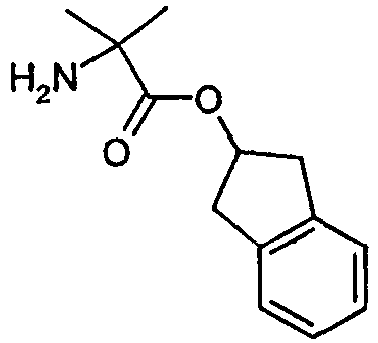
- Intermediate 13 was synthesised using the route shown in Scheme 11 below.

- To a solution of N-[(benzyloxy)carbonyl]-2-methylalanine (2.00 g, 8.4 mmol) in DCM (10 ml) at 0 °C was added indanol (2.26 g, 16.9 mmol), EDCI (1.78 g, 9.3 mmol) and finally DMAP (103 mg, 0.8 mmol). The reaction mixture was warmed to RT and stirred for 18 hours. The reaction mixture was washed with 1 M HCl (10 ml), sat. Na2CO3 (20 ml), dried (MgSO4) filtered and concentrated in vacuo to leave a brown oil. The crude product was purified by column chromatography (20% EtOAc in heptane) to yield the desired product as a white solid (2.26 g, 76%). LC/MS: m/z 354 [M+H]+.
- To a solution of 2,3-dihydro-1H-inden-2-yl N-[(benzyloxy)carbonyl]-2-methylalaninate (2.26 g, 6.39 mmol) was dissolved in EtOAc (30 ml) under an atmosphere of nitrogen was added Pd/C (0.2 g). The suspension was flushed with nitrogen (x3) then with hydrogen and stirred under 1atm of hydrogen at RT overnight. The reaction mixture was filtered through a pad of celite and the filtrate was concentrated under reduced pressure to leave a pale yellow oil (1.35 g, 96 %). LC/MS: m/z 220 [M+H]+.
-

- Intermediate 14 was synthesized following a similar method used in the preparation of Intermediate 13 using norbomeol at Stage 1 of Scheme 11.
LC/MS: m/z 198 [M+H]+. -

- Example 1 was synthesised using Intermediate 2 and Intermediate 7 as described below.
- To a solution of Intermediate 2 (189 mg, 0514 mmol) in anhydrous THF (4 ml) were added cyclopentyl 2-methylalaninate hydrochloride (Intermediate 7) (160 mg, 0.77 mmol, 1.5 eq) and NaBH(OAc)3 (326 mg, 1.54 mmol, 3 eq). The mixture was stirred at room temperature for 16 hours, and then quenched with water (20 ml). The aqueous layer was extracted with EtOAc (3 x 20 ml), and the combined organic extracts washed with brine (40 ml), dried over MgSO4, filtered and concentrated under reduced pressure.
- The residue was purified by preparative HPLC to provide the title compound (130 mg, 48 % yield).
LC/MS: m/z 524 [M+H]+. 1H NMR (300 MHz, CDCl3) δ:10.43 (1 H, br s), 7.51-7.34 (4H, m), 7.28-7.26 (2H, m), 7.04-6.90 (2H, m), 5.93 (1 H, d, J=9.6Hz), 5.20-5.10 (1 H,m), 2.93-2.75 (4H, m), 1.95-1.55 (8H, m), 1.31 (6H, s). -

- Example 2 was synthesised using Intermediate 4 and Intermediate 7 in a similar manner to Example 1.
LC/MS: m/z 560 [M+H]+.1H NMR (300 MHz,CDCI3) δ: 7.48-7.39 (2H, m), 7.09-6.92 (4H, m), 5.92 (1 H, d,J=9.6 Hz), 5.13 (1 H, br s), 2.87-2.81 (4H, m), 2.05-1.89(2H, m), 1.76-1.62 (6H, m), 1.30 (6H, s). -

- To a solution of {4-[6-amino-5-(2,4-difluorobenzoyl)-2-oxopyridin-1(2H)-yl]phenyl}acetic acid (Intermediate 5) (0.1 g, 0.26 mmol) in DCM/DMF (1:1, 6 ml) were added EDCI (0.055 g, 0.29 mmol), DMAP (0.003 g, 0.03 mmol) and triethylamine (40 µl, 0.29 mmol) followed by the addition of cyclopentyl 2-methylalaninate hydrochloride (Intermediate 7) (0.059 g, 0.29 mmol). The mixture was stirred at RT overnight. The reaction mixture was diluted with EtOAc (20 ml), washed with water (2 x 20 ml), brine (20 ml) then dried (MgSO4), filtered and concentrated under reduced pressure to leave a yellow oil. Purification by column chromatography (100% EtOAc) afforded the title compound as a pale yellow solid (68 mg, 48%)
LC/MS: m/z 538 [M+H]+. 1H NMR (300 MHz, DMSO-d6) δ: 8.48 (1 H, s), 7.55-7.37 (4H, m), 7.29-7.20 (4H, m), 5.72 (1H, d, J=9.6 Hz), 5.03-4.99 (1H, m), 3.54 (2, s), 1.78-1.69 (2H, m), 1.63-1.47 (6H, m), 1.36 (6H, s). -

- From Intermediate 2 and Intermediate 9.
- LC/MS: m/z 550 [M+H]+. 1H NMR (300 MHz, DMSO-d6) δ: 7.55-7.34 (6H, m), 7.29-7.21 (2H, m), 5.72 (1 H, d, J=9.8 Hz), 5.27-5.21 (1H, m), 3.31-3.20 (2H, m), 3.10-3.00 (2H, m), 2.22-2.12 (2H, m), 2.08-1.98 (2H, m), 1.90-1.58 (12H, m)
-

- From Intermediate 2 and Intermediate 11.
LC/MS: m/z 538 [M+H]+. 1H NMR (300 MHz, DMSO-d6) δ: 10.09 (1H, br s), 7.55-7.38 (4H, m), 7.27-7.21 (4H, m), 6.88 (1 H, br s), 5.71 (1 H, d, J=9.8 Hz), 5.09 (1 H, br s), 2.77-2.63 (4H, m), 1.97 (1H, br s), 1.83-1.76 (2H, m), 1.68-1.55 (8H, m), 1.16 (3H, s), 0.79 (3H, t, J=7.3 Hz). -

- From Intermediate 2 and Intermediate 12.
- LC/MS m/z 526 [M+H]+: 1H NMR (300 MHz, CD3OD δ: 7.54-7.42 (4H, m), 7.30-7.26 (2H, m), 7.15-7.08 (2H, m), 5.82 (1H, d, J=9.8 Hz), 2.95-2.84 (3H, m), 2.79-2.68 (1H, m), 1.71-1.59 (2H, m), 1.48 (9H, s), 1.26 (3H, s), 0.90-0.83 (3H, m)..
-

- From Intermediate 2 and Intermediate 13.
- LC/MS: m/z 572 [M+H]+ 1H NMR (300 MHz, CDCl3) 7.48-7.35 (4H, m), 7.27-7.20 (6H, m), 7.02 (1H, td, J=2.3, 7.9 Hz), 6.94 (1H, td, J=2.3, 9.1 Hz), 5.94 (1H, d, J=9.6 Hz), 5.56-5.50 (1H, m), 3.38 (2H, dd, J=6.4, 17.0 Hz), 3.01 (2H, dd, J=2.8, 17.0 Hz), 2.82-2.78 (2H, m), 1.30 (6H, s)..
-

- From Intermediate 2 and Intermediate 14.
- LC/MS:m/z 499 [M+H]+ 1H NMR (300 MHz, CDCl3) 11.12 (1H, s), 7.52 (1H, s), 7.37-7.43 (1H, m), 7.28-7.32 (1 H, m), 7.18-7.24 (1 H, m), 7.07 (1 H, s), 5.44 (2H, s), 4.64-4.70 (1H, m), 3.77-3.86 (1H,m), 3.60-3.67 (1H, m), 3.27 (1H, t, J=7.2 Hz), 2.31 (2H, d, J=3.8 Hz), 1.69-1.90 (2H, m), 1.37-1.58 (4H, m), 1.08-1.23 (2H, m), 0.84-0.97 (6H, m).
-

- From Intermediate 6 and Intermediate 7.
- LC/MS m/z 590 [M+H]+.:1H NMR (300 MHz, CDCl3) 7.48-7.38 (2H, m), 7.02 (1H, td, J=2.1, 8.1 Hz), 6.94 (1 H, td, J=2.5, 9.4 Hz), 6.74 (2H, d, J=9.4 Hz), 5.92 (2H, d, J=9.8 Hz), 5.23-5.19 (1 H, m), 4.12 (2H, t, J=6.0 Hz), 2.69 (2H, t, J=6.8 Hz), 2.03-1.95 (2H, m), 1.92-1.84 (2H, m), 1.75-1.60 (6H, m), 1.31 (6H, s).
-

- From Intermediate 6 and Intermediate 8.
- LC/MS: m/z 578 [M+H]+ 1H NMR (300 MHz, CDCl3) 7.36-7.26 (2H, m), 6.93 (1H, td, J=2.1, 7.7 Hz), 6.86 (1H, td, J=2.3, 9.4 Hz), 6.64 (2H, d, J=9.2 Hz), 5.83 (1H, d, J=9.8 Hz), 4.03 (2H, t, J=6.0 Hz), 2.61 (2H, t, J=6.9 Hz), 1.95-1.86 (2H, m), 1.40 (9H, s), 1.20 (6H, s).
-

- Reference example 11 was synthesised using Intermediate 2 and Intermediate 8 as described in Scheme 12 below.

- To a solution of Intermediate 2 (180 mg, 0.489 mmol) in THF (3 ml) was added tert-butyl 2-methylalaninate (Intermediate 8) (117 mg, 0.73 mmol), stirred for 30 minutes, and then NaBH(OAc)3 (310 mg, 1.467 mmol). The reaction was stirred for 24 hours, diluted with EtOAc and the organics washed with sat NaHCO3, brine, dried (MgSO4) and concentrated in vacuo. The residue was purified by preparative HPLC to provide the title compound (Intermediate 15) (120 mg, 48 % yield).
LC/MS: m/z 512 [M+H]+ . 1H NMR (300 MHz, CDCl3) δ:10.41 (1H, br s), 7.51-7.34 (4H, m), 7.28-7.26 (2H, m), 7.05-6.90 (2H, m), 5.93 (1H, d, J=9.9Hz), 5.15 (1H, br s), 2.93-2.78 (4H, m), 1.46 (9H, s), 1.29 (6H, s). - To a solution of Intermediate 15 (100 mg, 0.19 mmol) in DCM (3 ml) was added trifluoroacetic acid (3 ml). The mixture was stirred at room temperature for 16 hours and concentrated under reduced pressure. The residue was triturated with Et2O, collected by filtration and dried under reduced pressure to afford the title compound as an off-white solid (50 mg, 56 % yield).
LC/MS: m/z 456 [M+H]+.1H NMR (300 MHz, DMSO-d6) δ: 10.05 (1H, br s), 7.60-7.15 (9H, m), 6.95 (1H, br s), 5.72 (1H, d, J=9.6Hz), 3.15-2.95 (4H, m), 1.33 (6H, br s). -

- Reference Example 12 was synthesised using Intermediate 4 and Intermediate 8 following the same synthetic route as Reference Example 11 (Scheme 12).
LC/MS: m/z 492 [M+H]+. 1H NMR (300 MHz, DMSO-d6) δ: 7.62-7.54 (1H, m), 7.47-7.35 (4H,m), 7.27-7.21 (1H, m), 5.75 (1H, d, J=9.8 Hz). 3.44-3.07(4H, m), 1.52 (6H, s). -
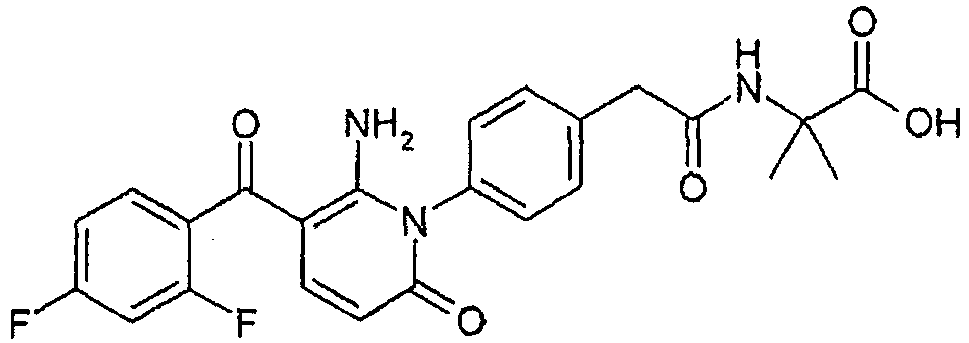
- Reference Example 13 was synthesized using Intermediate 5 and Intermediate 8 as described in Scheme 13 below.
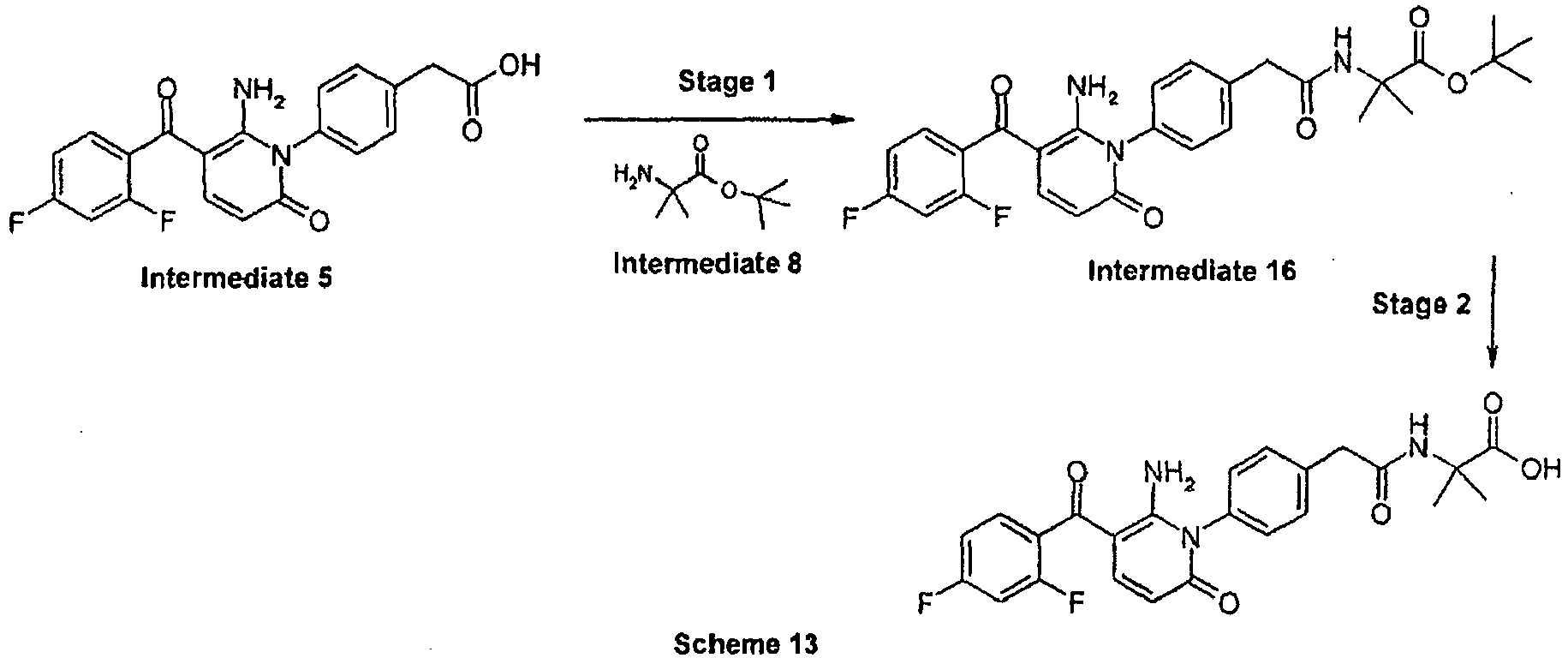
- To a solution of {4-[6-amino-5-(2,4-difluorobenzoyl)-2-oxopyridin-1(2H)-yl]phenyl}acetic acid (Intermediate 5) (0.13 g, 0.34 mmol) in DCM/DMF {1:1, 6 ml) were added EDCI (0.07 g, 0.36 mmol), DMAP (0.004 g, 0.03 mmol) followed by the addition of tert-butyl 2-methylalaninate (Intermediate 8) (0.057 g, 0.36 mmol). The mixture was stirred at RT for overnight. The reaction mixture was diluted with EtOAc (20 ml), washed with water (2 x 20 ml), brine (20 ml), dried (MgSO4), filtered and concentrated under reduced pressure to leave a yellow oil. Purification by column chromatography (100% EtOAc) afforded the title compound as an off-white solid (78 mg, 44% yield).
LCMS: m/z 526 [M+H+. 1H NMR (300 MHz, CDCl3) δ: 7.57 (2H, d, J=8.4 Hz), 7.47-7.32 (4H, m), 7.02(1H, t, J=8.3 Hz), 6.94 (1 H, td, J=2.4, 9.3 Hz), 6.37 (1 H, br.s), 5.93 (1 H, d, J=9.9 Hz), 3.64 (2H, s), 1.58 (6H, s), 1.47 (9H, s). - To a solution of Intermediate 16 (0.05 g, 0.095 mmol) in DCM (2 ml) was added TFA (1 ml). The reaction mixture was stirred at RT for 5 hours and then concentrated under reduced pressure to leave a yellow oil. Trituration with Et2O afforded the title compound as an off-white solid (42 mg, 94%).
LCMS: m/z 470 [M+H]+. 1H NMR (300 MHz, DMSO-d6) δ:12.19 (1H, s), 8.38 (1H, s), 7.55-7.37 (4H, m), 7.29-7.21 (4H, m), 5.71 (1H, d, J=9.6 Hz), 3.55 (2H, s),1.38 (6H, s). -

- Reference Example 14 was synthesized from Example 6 following a similar synthetic route described in Scheme 12.
-

- Reference Example 15 was synthesized using Intermediate 2 and Intermediate 10 following a similar synthetic route described in Scheme 12.
- LCMS: m/z 482 [M+H]+. 1H NMR (300 MHz, DMSO-d6) δ: 7.52-7.37 (4H, m), 7.31-7.20 (4H, m), 5.71 (1H, d, J=10.0 Hz), 3.08-2.93 (4H, m), 2.10-1.99 (2H, m), 1.78-1.68 (6H, m).
-

- LC/MS: m/z 522 [M+H]+ .1H NMR (300 MHz, CD3OD) 7.56-7.49 (2H, m), 7.17-7.11 (2H, m), 6.95 (2H, d, J=10.1 Hz), 5.82 (1H, d, J=9.8 Hz), 4.25 (2H, t, J=5.7 Hz), 3.26-3.21 (2H, m), 2.30-2.21 (2H, m), 1.58 (6H, s).
- The ability of compounds to inhibit p38 MAP a Kinase activity was measured in an assay performed by Upstate (Dundee UK). In a final reaction volume of 25µL, p38 MAP Kinase a (5-10 mU) is incubated with 25mM Tris pH 7.5, 0.002 mMEGTA, 0.33 mg/mL myelin basic protein, 10mM MgAcetate and [g-33p-ATP] (specific activity approx. 500cpm/pmol, concentration as required). The reaction is initiated by the addition of the MgATP mix. After incubation for 40 minutes at room temperature, the reaction is stopped by the addition of 5µL of a 3% phosphoric acid solution. 10µL of the reaction is then spotted onto a P30 filtermat and washed three times for 5 minutes in 75 mM phosphoric acid and once in methanol prior to drying and scintillation counting.
- Duplicate data points are generated from a 1/3 log dilution series of a stock solution in DMSO. Nine dilutions steps are made from a top concentration of 10µM and a 'no compound' blank is included. The standard radiometric filter-binding assay is performed at an ATP concentration at, or close to, the Km. Data from scintillation counts are collected and subjected to free-fit analysis by Prism software. From the curve generated, the concentration giving 50% inhibition is determined and reported.
- U937 or HUT78 cells were plated in RPMI 1640, and were incubated at 37°C, 5% CO2 for 18hours. 10mM stocks of compounds were diluted media/0.1% DMSO to give a log or semi-log dilution series. The wells for 'no treatment' and 'anisomycin' were treated with 0.1% DMSO only. The cells were incubated at 37°C, 5% CO2 for a further 4 hours. Anisomycin was added to all wells except 'no treatment' at a final concentration of 10 µM. The cells were incubated at 37°C, 5% CO2 for 30 minutes before harvest. Plates were stood on ice whilst harvesting, and all following steps were carried out at 4 °C. The cells were pelleted at 1000rpm for 10 minutes at 4°C, the media aspirated, and the pellet washed with cold PBS. The pellets were lysed in 120µl of SDS lysis buffer (62.5mM Tris, pH 6.8, 2% SDS, 10% glycerol, 50mM DTT, with protease inhibitors and phosphatase inhibitors added according to the manufacturer's recommendations). After 30 minutes on ice, the samples were sonicated for 5 seconds before centrifugation at 13,000rpm 4°C for 10 minutes to remove cell debris. 10µl of the resulting gel samples were loaded per lane on NOVEX 4-12% Bis-Tris MOPS gels. Membranes from western transfer of gels were blotted with anti-phospho MAPKAP2, anti-phospho HSP27 and anti GAPDH according to the manufacturer's instructions. Signal was visualised using HRP-linked anti-rabbit or anti-mouse antibodies, ECL reagent and ECL film. IC50 values for the various compounds were visualised from the resulting photographic images, using both band-shift and signal intensity.
- THP-1 cells were plated in 100µl at a density of 4 x 10⁴ cells/well in V-bottomed 96 well tissue culture treated plates and incubated at 37°C in 5% CO2 for 16 hours. 2 hours after the addition of the inhibitor in 100µl of tissue culture media, the cells were stimulated with LPS (E coli strain 005:B5, Sigma) at a final concentration of 1µg/ml and incubated at 37°C in 5% CO2 for 6 hours. TNF-α levels were measured from cell-free supernatants by sandwich ELISA (R&D Systems #QTA00B).
- Whole blood was taken by venous puncture using heparinised vacutainers (Becton Dickinson) and diluted in an equal volume of RPMI1640 tissue culture media (Sigma). 100µl was plated in V-bottomed 96 well tissue culture treated plates. 2 hours after the addition of the inhibitor in 100µl of RPMI1640 media, the blood was stimulated with LPS (E coli strain 005:B5, Sigma) at a final concentration of 100ng/ml and incubated at 37°C in 5% CO2 for 6 hours. TNF-α levels were measured from cell-free supernatants by sandwich ELISA (R&D Systems #QTA00B).
- IC50 values were allocated to one of three ranges as follows:
- Range A: IC50 < 100nM
- Range B: 100nM < IC50 <1000nM
- Range C: IC50 >1000nM
-
Example Inhibitor activity versus p38 MAPKa Inhibitor activity versus THP-1 TNFα release Inhibitor activity versus human whole blood TNFα release 1 A A B 2 A A A 3 A B C 4 A A C 5 B A C 6 B B NT 7 B A C 8 A A C 9 A A B 10 A A C 11 * A NR NR 12 * A NR NR 13 * B NR NR 14 * A NR NR 15 * B NR NR 16 * A NR NR * indicates Reference Example
"NT" indicates the compound has not yet been tested in the assay in question.
"NR" indicates "Not Relevant". Reference Examples 11-16 are the resultant carboxylic acid analogues of the amino acid esters that are cleaved inside cells. When these carboxylic acids are contacted with the cells, they do not penetrate into the cells and hence do not inhibit TNF-α in this assay. - Any given compound of the present invention wherein R1 is an ester group may be tested to determine whether it meets the requirement that it be hydrolysed by intracellular esterases, by testing in the following assay.
- U937 or Hut78 tumour cells (- 109) were washed in 4 volumes of Dulbeccos PBS (-1 litre) and pelleted at 525 g for 10 min at 4°C. This was repeated twice and the final cell pellet was resuspended in 35 ml of cold homogenising buffer (Trizma 10 mM, NaCl 130 mM, CaCl2 0.5 mM pH 7.0 at 25°C). Homogenates were prepared by nitrogen cavitation (700 psi for 50 min at 4°C). The homogenate was kept on ice and supplemented with a cocktail of inhibitors at final concentrations of:
- Leupeptin 1 µM
- Aprotinin 0.1 µM
- E64 8 µM
- Pepstatin 1.5 µM
- Bestatin 162 µM
- Chymostatin 33 µM
- After clarification of the cell homogenate by centrifugation at 525 g for 10 min, the resulting supernatant was used as a source of esterase activity and was stored at -80°C until required.
- Hydrolysis of esters to the corresponding carboxylic acids can be measured using the cell extract, prepared as above. To this effect cell extract (~30 µg / total assay volume of 0.5 ml) was incubated at 37°C in a Tris- HCl 25 mM, 125 mM NaCl buffer, pH 7.5 at 25°C. At zero time the ester (substrate) was then added at a final concentration of 2.5 µM and the samples were incubated at 37°C for the appropriate time (usually 0 or 80 mins). Reactions were stopped by the addition of 3 x volumes of acetonitrile. For zero time samples the acetonitrile was added prior to the ester compound. After centrifugation at 12000 g for 5 mins, samples were analysed for the ester and its corresponding carboxylic acid at room temperature by LCMS (Sciex API 3000, HP1100 binary pump, CTC PAL). Chromatography was based on a MeCN (75 x 2.1mm) column and a mobile phase of 5-95 % acetonitrile in water /0.1 % formic acid.
Rates of hydrolysis are expressed in pg/mL/min. - Table 1 presents data showing that several amino acid ester motifs, conjugated to various intracellular enzyme inhibitors by several different linker chemistries are all hydrolysed by intracellular carboxyesterases to the corresponding acid.
Table 1 Structure of amino acid ester conjugate R Linker Hydrolysis Rate Range U937Cells (pg/mL/min) Preparation of amino ester conjugate 

-CH2CH2O- 100-1000 W02006117552 


1000-50000 W02006117548 


>50000 WO2006117549 

-CH2CH2O- >50000 WO2006117567 

-CH2CH2O- 1000-50000 W02006117567 

-CH2- 1000-50000 W02006117567 

-CO- >50000 W02006117567 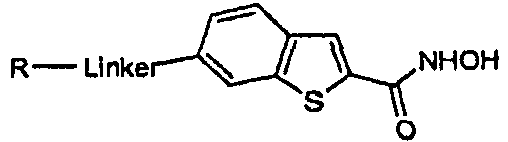


>50000 WO2006117549 


>50000 W02006117549 - Table 2 shows that example 1 with the esterase motif attached is 30 times more potent in cells than the parent compound lacking the esterase motif even though the activities against the isolated enzyme are the same. The acid formed by cleavage of the ester in example 1 accumulates in U937 cells.
Table 2 Compound Inhibition of P38 (IC50, nM) Inhibition of phosphorylation of MAPKAP-2 in U937 cells (IC50, nM) Ratio cell IC50s to enzyme IC50 Cell accumulation of the acid in U937 cells at 6 hours (ng/ml) 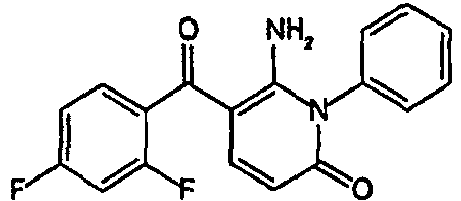
50 300 6 NA Compound I (parent) 
Ester 50 Acid 50 10 0.2 987 Example 1 - Table 3 shows that the parent, compound I, is equipotent in monocytic and non-monocytic cell lines whereas example 1, is 100 times more potent in the monocytic cell line. Example 1 only accumulates in the monocytic cell line showing that the cell selectivity is achieved by the attachment of an esterase motif that is only cleaved in the monocytic cell line. It also shows that increased potency in the cells correlates with accumulation of the acid in the cells.
Table 3 Compound Inhibition of phosphorylation of MAPKAP-2 in U937 cells (IC50, nM) (monocyte cell line) Inhibition of phosphorylation of MAPKAP-2 in HUT 78 cells (IC50, nM) (non-monocytic cell line) Ratio IC50s in HUT 78 to U937 cells Accumulation of the acid in U937 cells (ng/ml) Accumulation of the acid in HUT 78 cells (ng/ml) Parent Compound I 300 450 1.5 NA NA Example 1 10 1000 100 987 3
one of R2 and R3 is methyl, and the other is methyl, ethyl, or n- or iso-propyl; or R2 and R3 taken together with the carbon to which they are attached form a cyclopropyl, cyclobutyl, cyclopentyl or cyclohexyl ring;
and wherein the term "substituted" as applied to any moiety means substituted with up to four compatible substituents, each of which is independently selected from, (C1-C6)alkyl, (C1-C6)alkoxy, hydroxy, hydroxy(C1-C6)alkyl, mercapto, mercapto(C1-C6)alkyl, (C1-C6)alkylthio, phenyl, halo (including fluoro, bromo and chloro), trifluoromethyl, trifluoromethoxy, nitro, nitrile (-CN), oxo, -COOH, -COORA, -CORA, -SO2RA, -CONH2, - SO2NH2, -CONHRA, -SO2NHRA, -CONRARB, -SO2NRARB, -NH2, -NHRA, -NRARB, - OCONH2, -OCONHRA, -OCONRARB, -NHCORA, -NHCOORA, -NRBCOORA, - NHSO2ORA, -NRBSO2OH, -NRBSO2ORA, -NHCONH2, -NRACONH2, -NHCONHRB, - NRACONHRB, -NHCONRARB, and-NRACONRARB wherein RA and RB are independently a (C1-C6)alkyl, (C3-C6) cycloalkyl , phenyl or monocyclic heteroaryl having 5 or 6 ring atoms, or RA and RB when attached to the same nitrogen atom form a cyclic amino group (for example morpholino, piperidinyl, piperazinyl, or tetrahydropyrrolyl). An "optional substituent" may be one of the foregoing substituent groups.
Claims (10)
- A compound of formula (I):
 G is -N= or -CH=D is an optionally substituted phenyl or optionally substituted pyridinyl radical;R6 is hydrogen or optionally substituted C1-C3 alkyl;P represents hydrogen and U represents a radical of formula (IA);
-A-(CH2)z-X1-L1-Y-NH-CR1R2R3 (IA)
whereinA represents an optionally substituted 1,4 phenylene radical;z is 0 or 1;Y is a bond, -C(=O)-, -S(=O)2-, -C(=O)NR7-, -C(=S)-NR7, -C(=NH)NR7 or -S(=O)2NR7- wherein R7 is hydrogen or optionally substituted C1-C6 alkyl;L1 is a divalent radical of formula -(Alk1)m(Q)n(Alk2)p- wherein
m, n and p are independently 0 or 1,
Q is (i) an optionally substituted divalent mono- or bicyclic carbocyclic or heterocyclic radical having 5 - 13 ring members, or (ii), in the case where both m and p are 0, a divalent radical of formula -X2-Q1- or -Q1-X2- wherein X2 is -O-, S-or NRA- wherein RA is hydrogen or optionally substituted C1-C3 alkyl, and Q1 is an optionally substituted divalent mono- or bicyclic carbocyclic or heterocyclic radical having 5 - 13 ring members,
Alk1 and Alk2 independently represent optionally substituted divalent C3-C7 cycloalkyl radicals, or optionally substituted straight or branched, C1-C6 alkylene, C2-C6 alkenylene ,or C2-C6 alkynylene radicals which may optionally contain or terminate in an ether (-0-), thioether (-S-) or amino (-NRA-) link wherein RA is hydrogen or optionally substituted C1-C3 alkyl; andX1 represents a bond; -C(=O); or -S(=O)2-; -NR4C(=O)-, -C(=O)NR4-, -NR4C(=O)NR5-, - NR4S(=O)2-, or -S(=O)2NR4- wherein R4 and R5 are independently hydrogen or optionally substituted C1-C6 alkyl;R1 is an ester group which is hydrolysable by one or more intracellular esterase enzymes to a carboxylic acid group wherein the ester group is of formula - (C=O)OR14 wherein R14 is R8R9R10C- wherein(i) R8 is hydrogen or optionally substituted (C1-C3)alkyl-(Z1)a-[(C1-C3)alkyl]b-or (C2-C3)alkenyl-(Z1)a-[(C1-C3)alkyl]b- wherein a and b are independently 0 or 1 and Z1 is-O-, -S-, or -NR11- wherein R11 is hydrogen or (C1-C3)alkyl; and R9 and R10 are independently hydrogen or (C1-C3)alkyl-;(ii) R8 is hydrogen or optionally substituted R12R13N-(C1-C3)alkyl- wherein R12 is hydrogen or (C1-C3)alkyl and R13 is hydrogen or (C1-C3)alkyl; or R12 and R13 together with the nitrogen to which they are attached form an optionally substituted monocyclic heterocyclic ring of 5- or 6- ring atoms or bicyclic heterocyclic ring system of 8 to 10 ring atoms, and R9 and R10 are independently hydrogen or (C1-C3)alkyl-; or(iii) R8 and R9 taken together with the carbon to which they are attached form an optionally substituted monocyclic carbocyclic ring of from 3 to 7 ring atoms or bicyclic carbocyclic ring system of 8 to 10 ring atoms, or bridged monocyclic carbocyclic ring system of 7 to 10 ring atoms, and R10 is hydrogen;and wherein in cases (i), (ii) and (iii) above, the term "alkyl" includes fluoroalkyl; andone of R2 and R3 is methyl, and the other is methyl, ethyl, or n- or iso-propyl; or R2 and R3 taken together with the carbon to which they are attached form a cyclopropyl, cyclobutyl, cyclopentyl or cyclohexyl ring;and wherein the term "substituted" as applied to any moiety means substituted with up to four compatible substituents, each of which is independently selected from (C1-C6)alkyl, (C1-C6)alkoxy, hydroxy, hydroxy(C1-C6)alkyl, mercapto, mercapto(C1-C6)alkyl, (C1-C6)alkylthio, phenyl, halo, trifluoromethyl, trifluoromethoxy, nitro, nitrile (-CN), oxo, - COOH, -COORA, -CORA, -SO2RA, -CONH2, -SO2NH2, -CONHRA, -SO2NHRA, - CONRARB, -SO2NRARB, -NH2, -NHRA, -NRARB, -OCONH2, -OCONHRA, -OCONRARB, - NHCORA, -NHCOORA, -NRBCOORA, -NHSO2ORA, -NRBSO2OH, -NRBSO2ORA, - NHCONH2, -NRACONH2, -NHCONHRB, -NRACONHRB, -NHCONRARB, and -NRACONRARB wherein RA and RB are independently (C1-C6)alkyl, (C3-C6)cycloalkyl , phenyl or monocyclic heteroaryl having 5 or 6 ring atoms, or RA and RB when attached to the same nitrogen atom form a cyclic amino group. - A compound as claimed in claim 1 wherein R6 is hydrogen or methyl.
- A compound as claimed in claim 1 or claim 2 wherein optional substituents in D and/or A are selected from fluoro and chloro.
- A compound as claimed in claim 1 which has formula (II):

- A compound as claimed in any of the preceding claims wherein the radical -Y-L1-X1-[CH2]z-, is -CH2-, -CH2CH2-, -CH2CH2CH2-, -CH2CH2CH2CH2-, -CH2O-, -CH2CH2O-, -CH2CH2CH2O-, -CH2CH2CH2CH2O-, -C(=O)-CH2-, -C(=O)-CH2O-, - C(=O)-NH-CH2-, or -C(=O)-NH-CH2O-.
- A compound as claimed in any of the preceding claims wherein R14 is methyl, trifluoromethyl, ethyl, n- or iso-propyl, n-, sec- or tert-butyl, cyclohexyl, allyl, bicyclo[2.2.1]hept-2-yl, 2,3-dihydro-1H-inden-2-yl, phenyl, 2-, 3- or 4-pyridylmethyl, N-methylpiperidin-4-yl, tetrahydrofuran-3-yl or methoxyethyl.
- A compound as claimed in any of claims 1 to 5 wherein R14 is cyclopentyl.
- A compound as claimed in claim 1 selected from the group consisting of:Cyclopentyl N-(2-{4-[6-amino-5-(2,4-difluorobenzoyl)-2-oxopyridin-1(2H)-yl]phenyl}ethyl)-2-methylalaninate,Cyclopentyl N-(2-{4-[6-amino-5-(2,4-difluorobenzoyl)-2-oxopyridin-1(2H)-yl]-3,5-difluorophenyl}ethyl)-2-methylalaninate,Cyclopentyl N-(3-{4-[6-amino-5-(2,4-difluorobenzoyl)-2-oxopyridin-1(2H)-yl]-3,5-difluorophenoxy}propyl)-2-methylalaninate,and pharmaceutically acceptable salts thereof.
- A pharmaceutical composition comprising a compound as claimed in any of the preceding claims, together with a pharmaceutically acceptable carrier.
- A compound as claimed in any of claims 1 to 8 for use in the treatment of autoimmune or inflammatory disease.
Applications Claiming Priority (3)
| Application Number | Priority Date | Filing Date | Title |
|---|---|---|---|
| GB0803748A GB0803748D0 (en) | 2008-02-29 | 2008-02-29 | Ihibitors of p38 MAP kinase |
| GB0815544A GB0815544D0 (en) | 2008-08-27 | 2008-08-27 | Inhibitors of p38 map kinase |
| PCT/GB2009/000553 WO2009106844A1 (en) | 2008-02-29 | 2009-02-27 | Inhibitors of p38 map kinase |
Publications (2)
| Publication Number | Publication Date |
|---|---|
| EP2245012A1 EP2245012A1 (en) | 2010-11-03 |
| EP2245012B1 true EP2245012B1 (en) | 2013-07-03 |
Family
ID=40585513
Family Applications (1)
| Application Number | Title | Priority Date | Filing Date |
|---|---|---|---|
| EP09713855.6A Not-in-force EP2245012B1 (en) | 2008-02-29 | 2009-02-27 | Inhibitors of p38 map kinase |
Country Status (5)
| Country | Link |
|---|---|
| US (1) | US8778953B2 (en) |
| EP (1) | EP2245012B1 (en) |
| JP (1) | JP5555186B2 (en) |
| ES (1) | ES2427892T3 (en) |
| WO (1) | WO2009106844A1 (en) |
Families Citing this family (13)
| Publication number | Priority date | Publication date | Assignee | Title |
|---|---|---|---|---|
| HUE033281T2 (en) * | 2006-05-04 | 2017-11-28 | Chroma Therapeutics Ltd | p38 MAP KINASE INHIBITORS |
| GB0803747D0 (en) * | 2008-02-29 | 2008-04-09 | Martin | Enzyme and receptor modulation |
| GB0903480D0 (en) | 2009-02-27 | 2009-04-08 | Chroma Therapeutics Ltd | Enzyme Inhibitors |
| GB201211310D0 (en) | 2012-06-26 | 2012-08-08 | Chroma Therapeutics Ltd | CSF-1R kinase inhibitors |
| SI3222616T1 (en) | 2012-10-17 | 2019-10-30 | Macrophage Pharma Ltd | N-(2-(4-(6-amino-5-(2,4-difluorobenzoyl)-2-oxopyridin-1(2h)-yl)-3,5-difluorophenyl)ethyl)-l-alanine and the terbutyl ester thereof |
| GB201306901D0 (en) * | 2013-04-16 | 2013-05-29 | Chroma Therapeutics Ltd | Combination |
| CN116570594A (en) | 2016-06-23 | 2023-08-11 | 马里兰大学巴尔的摩分校 | Selective p38α-specific MAPK inhibitor |
| GB201713975D0 (en) | 2017-08-31 | 2017-10-18 | Macrophage Pharma Ltd | Medical use |
| JP7594787B2 (en) | 2018-12-07 | 2024-12-05 | ユニバーシティ オブ メリーランド、ボルチモア | Non-ATP/catalytic site p38 mitogen-activated protein kinase inhibitors |
| CN116406355B (en) | 2020-05-18 | 2026-05-15 | Gen1E生命科学公司 | P38α mitogen-activated protein kinase inhibitors |
| AU2021370893B2 (en) | 2020-10-29 | 2024-03-07 | Gen1E Lifesciences Inc. | Crystalline 5-(dimethylamino) -n- (4-(morpholinomethyl)phenyl) naphthalene-1-sulfonamide di-hydrochloride di-hydrate |
| NZ804686A (en) | 2021-03-23 | 2026-03-27 | Gen1E Lifesciences Inc | Substituted naphthyl p38alpha mitogen-activated protein kinase inhibitors |
| CN117651698A (en) * | 2021-07-09 | 2024-03-05 | 新特拉有限公司 | Pyridone MK2 inhibitors and their uses |
Family Cites Families (12)
| Publication number | Priority date | Publication date | Assignee | Title |
|---|---|---|---|---|
| US5331006A (en) * | 1990-08-31 | 1994-07-19 | Warner-Lambert Company | Amino acid analogs as CCK antagonists |
| AU650953B2 (en) | 1991-03-21 | 1994-07-07 | Novartis Ag | Inhaler |
| US6448256B1 (en) * | 1999-05-24 | 2002-09-10 | University Of Massachusetts | Antibiotic prodrugs |
| IL163957A0 (en) * | 2002-03-14 | 2005-12-18 | Bayer Healthcare Ag | Monocyclic aroylpyridinones as antiinflammatory agents |
| EP1633751A1 (en) | 2003-06-16 | 2006-03-15 | Chroma Therapeutics Limited | Carboline and betacarboline derivatives for use as hdac enzyme inhibitors |
| JP2007510621A (en) | 2003-07-29 | 2007-04-26 | シグニチャー アールアンドディー ホールディングス,エルエルシー. | Amino acid prodrug |
| EP3075247B1 (en) | 2004-02-02 | 2022-10-12 | BioSight Ltd. | Conjugates for cancer therapy and diagnosis |
| KR101792651B1 (en) * | 2004-05-14 | 2017-11-20 | 밀레니엄 파머슈티컬스 인코퍼레이티드 | Compounds and methods for inhibiting mitotic progression by inhibition of aurora kinase |
| MX2007013257A (en) * | 2005-05-05 | 2008-01-21 | Chroma Therapeutics Ltd | Alpha aminoacid ester-drug conjugates hydrolysable by carboxylesterase. |
| HUE033281T2 (en) * | 2006-05-04 | 2017-11-28 | Chroma Therapeutics Ltd | p38 MAP KINASE INHIBITORS |
| GB0621830D0 (en) | 2006-11-02 | 2006-12-13 | Chroma Therapeutics Ltd | Inhibitors of p38 mitogen-activated protein kinase |
| WO2009060160A1 (en) | 2007-11-07 | 2009-05-14 | Chroma Therapeutics Ltd. | P38 map kinase inhibitors |
-
2009
- 2009-02-27 ES ES09713855T patent/ES2427892T3/en active Active
- 2009-02-27 JP JP2010548176A patent/JP5555186B2/en not_active Expired - Fee Related
- 2009-02-27 WO PCT/GB2009/000553 patent/WO2009106844A1/en not_active Ceased
- 2009-02-27 EP EP09713855.6A patent/EP2245012B1/en not_active Not-in-force
- 2009-02-27 US US12/867,774 patent/US8778953B2/en not_active Expired - Fee Related
Also Published As
| Publication number | Publication date |
|---|---|
| US20110034520A1 (en) | 2011-02-10 |
| JP5555186B2 (en) | 2014-07-23 |
| ES2427892T3 (en) | 2013-11-04 |
| US8778953B2 (en) | 2014-07-15 |
| WO2009106844A1 (en) | 2009-09-03 |
| JP2011513288A (en) | 2011-04-28 |
| EP2245012A1 (en) | 2010-11-03 |
Similar Documents
| Publication | Publication Date | Title |
|---|---|---|
| US8778953B2 (en) | Inhibitors of P38 map kinase | |
| CA2650970C (en) | P38 map kinase inhibitors | |
| US20090203711A1 (en) | Inhibitors of P38 Map Kinase | |
| US20100267774A1 (en) | P38 map kinase inhibitors | |
| WO2008053158A1 (en) | Inhibitors of p38 mitogen-activated protein kinase | |
| US20110046210A1 (en) | Substituted thiopenecarboxamides as ikk-beta serine-, threonine-protein kinase inhibitors | |
| IL256560A (en) | Tert-butyl n-[2-{4-[6-amino-5-(2,4-difluorobenzoyl)-2-oxopyridin-1(2h)-yl]-3,5- difluorophenyl}ethyl]-l-alaninate or a salt, hydrate or solvate thereof | |
| WO2008053136A1 (en) | 2-(hetero-)aryl,4-carbonyl substituted pyrazole derivatives as inhibitors of p38 mitogen-activated protein kinase | |
| CN101437799B (en) | p38MAP kinase inhibitor | |
| AU2006259137A1 (en) | Anthranilic acid derivatives | |
| HK1236529A (en) | N-[2-{4-[6-amino-5-(2,4-difluorobenzoyl)-2-oxopyridin-1(2h)-yl]-3,5-difluorophenyl}ethyl]-l-alanine | |
| HK1236529A1 (en) | N-[2-{4-[6-amino-5-(2,4-difluorobenzoyl)-2-oxopyridin-1(2h)-yl]-3,5-difluorophenyl}ethyl]-l-alanine and the terbutyl ester thereof | |
| HK1211028B (en) | Tert-butyl n-[2-{4-[6-amino-5-(2,4-difluorobenzoyl)-2-oxopyridin-1(2h)-yl]-3,5- difluorophenyl}ethyl]-l-alaninate or a salt, hydrate or solvate thereof |
Legal Events
| Date | Code | Title | Description |
|---|---|---|---|
| PUAI | Public reference made under article 153(3) epc to a published international application that has entered the european phase |
Free format text: ORIGINAL CODE: 0009012 |
|
| 17P | Request for examination filed |
Effective date: 20100820 |
|
| AK | Designated contracting states |
Kind code of ref document: A1 Designated state(s): AT BE BG CH CY CZ DE DK EE ES FI FR GB GR HR HU IE IS IT LI LT LU LV MC MK MT NL NO PL PT RO SE SI SK TR |
|
| AX | Request for extension of the european patent |
Extension state: AL BA RS |
|
| DAX | Request for extension of the european patent (deleted) | ||
| 17Q | First examination report despatched |
Effective date: 20120222 |
|
| GRAP | Despatch of communication of intention to grant a patent |
Free format text: ORIGINAL CODE: EPIDOSNIGR1 |
|
| GRAP | Despatch of communication of intention to grant a patent |
Free format text: ORIGINAL CODE: EPIDOSNIGR1 |
|
| GRAS | Grant fee paid |
Free format text: ORIGINAL CODE: EPIDOSNIGR3 |
|
| GRAA | (expected) grant |
Free format text: ORIGINAL CODE: 0009210 |
|
| AK | Designated contracting states |
Kind code of ref document: B1 Designated state(s): AT BE BG CH CY CZ DE DK EE ES FI FR GB GR HR HU IE IS IT LI LT LU LV MC MK MT NL NO PL PT RO SE SI SK TR |
|
| REG | Reference to a national code |
Ref country code: GB Ref legal event code: FG4D |
|
| REG | Reference to a national code |
Ref country code: CH Ref legal event code: EP Ref country code: AT Ref legal event code: REF Ref document number: 619667 Country of ref document: AT Kind code of ref document: T Effective date: 20130715 |
|
| REG | Reference to a national code |
Ref country code: IE Ref legal event code: FG4D |
|
| REG | Reference to a national code |
Ref country code: DE Ref legal event code: R096 Ref document number: 602009016842 Country of ref document: DE Effective date: 20130829 |
|
| PG25 | Lapsed in a contracting state [announced via postgrant information from national office to epo] |
Ref country code: SI Free format text: LAPSE BECAUSE OF FAILURE TO SUBMIT A TRANSLATION OF THE DESCRIPTION OR TO PAY THE FEE WITHIN THE PRESCRIBED TIME-LIMIT Effective date: 20130703 |
|
| REG | Reference to a national code |
Ref country code: ES Ref legal event code: FG2A Ref document number: 2427892 Country of ref document: ES Kind code of ref document: T3 Effective date: 20131104 |
|
| REG | Reference to a national code |
Ref country code: AT Ref legal event code: MK05 Ref document number: 619667 Country of ref document: AT Kind code of ref document: T Effective date: 20130703 |
|
| REG | Reference to a national code |
Ref country code: NL Ref legal event code: VDEP Effective date: 20130703 |
|
| REG | Reference to a national code |
Ref country code: LT Ref legal event code: MG4D |
|
| PG25 | Lapsed in a contracting state [announced via postgrant information from national office to epo] |
Ref country code: HR Free format text: LAPSE BECAUSE OF FAILURE TO SUBMIT A TRANSLATION OF THE DESCRIPTION OR TO PAY THE FEE WITHIN THE PRESCRIBED TIME-LIMIT Effective date: 20130703 Ref country code: PT Free format text: LAPSE BECAUSE OF FAILURE TO SUBMIT A TRANSLATION OF THE DESCRIPTION OR TO PAY THE FEE WITHIN THE PRESCRIBED TIME-LIMIT Effective date: 20131104 Ref country code: NO Free format text: LAPSE BECAUSE OF FAILURE TO SUBMIT A TRANSLATION OF THE DESCRIPTION OR TO PAY THE FEE WITHIN THE PRESCRIBED TIME-LIMIT Effective date: 20131003 Ref country code: LT Free format text: LAPSE BECAUSE OF FAILURE TO SUBMIT A TRANSLATION OF THE DESCRIPTION OR TO PAY THE FEE WITHIN THE PRESCRIBED TIME-LIMIT Effective date: 20130703 Ref country code: CY Free format text: LAPSE BECAUSE OF FAILURE TO SUBMIT A TRANSLATION OF THE DESCRIPTION OR TO PAY THE FEE WITHIN THE PRESCRIBED TIME-LIMIT Effective date: 20130710 Ref country code: SE Free format text: LAPSE BECAUSE OF FAILURE TO SUBMIT A TRANSLATION OF THE DESCRIPTION OR TO PAY THE FEE WITHIN THE PRESCRIBED TIME-LIMIT Effective date: 20130703 Ref country code: BE Free format text: LAPSE BECAUSE OF FAILURE TO SUBMIT A TRANSLATION OF THE DESCRIPTION OR TO PAY THE FEE WITHIN THE PRESCRIBED TIME-LIMIT Effective date: 20130703 Ref country code: AT Free format text: LAPSE BECAUSE OF FAILURE TO SUBMIT A TRANSLATION OF THE DESCRIPTION OR TO PAY THE FEE WITHIN THE PRESCRIBED TIME-LIMIT Effective date: 20130703 Ref country code: IS Free format text: LAPSE BECAUSE OF FAILURE TO SUBMIT A TRANSLATION OF THE DESCRIPTION OR TO PAY THE FEE WITHIN THE PRESCRIBED TIME-LIMIT Effective date: 20131103 |
|
| PG25 | Lapsed in a contracting state [announced via postgrant information from national office to epo] |
Ref country code: FI Free format text: LAPSE BECAUSE OF FAILURE TO SUBMIT A TRANSLATION OF THE DESCRIPTION OR TO PAY THE FEE WITHIN THE PRESCRIBED TIME-LIMIT Effective date: 20130703 Ref country code: LV Free format text: LAPSE BECAUSE OF FAILURE TO SUBMIT A TRANSLATION OF THE DESCRIPTION OR TO PAY THE FEE WITHIN THE PRESCRIBED TIME-LIMIT Effective date: 20130703 Ref country code: NL Free format text: LAPSE BECAUSE OF FAILURE TO SUBMIT A TRANSLATION OF THE DESCRIPTION OR TO PAY THE FEE WITHIN THE PRESCRIBED TIME-LIMIT Effective date: 20130703 Ref country code: PL Free format text: LAPSE BECAUSE OF FAILURE TO SUBMIT A TRANSLATION OF THE DESCRIPTION OR TO PAY THE FEE WITHIN THE PRESCRIBED TIME-LIMIT Effective date: 20130703 Ref country code: GR Free format text: LAPSE BECAUSE OF FAILURE TO SUBMIT A TRANSLATION OF THE DESCRIPTION OR TO PAY THE FEE WITHIN THE PRESCRIBED TIME-LIMIT Effective date: 20131004 |
|
| PG25 | Lapsed in a contracting state [announced via postgrant information from national office to epo] |
Ref country code: CY Free format text: LAPSE BECAUSE OF FAILURE TO SUBMIT A TRANSLATION OF THE DESCRIPTION OR TO PAY THE FEE WITHIN THE PRESCRIBED TIME-LIMIT Effective date: 20130703 |
|
| PG25 | Lapsed in a contracting state [announced via postgrant information from national office to epo] |
Ref country code: DK Free format text: LAPSE BECAUSE OF FAILURE TO SUBMIT A TRANSLATION OF THE DESCRIPTION OR TO PAY THE FEE WITHIN THE PRESCRIBED TIME-LIMIT Effective date: 20130703 Ref country code: CZ Free format text: LAPSE BECAUSE OF FAILURE TO SUBMIT A TRANSLATION OF THE DESCRIPTION OR TO PAY THE FEE WITHIN THE PRESCRIBED TIME-LIMIT Effective date: 20130703 Ref country code: EE Free format text: LAPSE BECAUSE OF FAILURE TO SUBMIT A TRANSLATION OF THE DESCRIPTION OR TO PAY THE FEE WITHIN THE PRESCRIBED TIME-LIMIT Effective date: 20130703 Ref country code: SK Free format text: LAPSE BECAUSE OF FAILURE TO SUBMIT A TRANSLATION OF THE DESCRIPTION OR TO PAY THE FEE WITHIN THE PRESCRIBED TIME-LIMIT Effective date: 20130703 Ref country code: RO Free format text: LAPSE BECAUSE OF FAILURE TO SUBMIT A TRANSLATION OF THE DESCRIPTION OR TO PAY THE FEE WITHIN THE PRESCRIBED TIME-LIMIT Effective date: 20130703 |
|
| PLBE | No opposition filed within time limit |
Free format text: ORIGINAL CODE: 0009261 |
|
| STAA | Information on the status of an ep patent application or granted ep patent |
Free format text: STATUS: NO OPPOSITION FILED WITHIN TIME LIMIT |
|
| 26N | No opposition filed |
Effective date: 20140404 |
|
| REG | Reference to a national code |
Ref country code: DE Ref legal event code: R097 Ref document number: 602009016842 Country of ref document: DE Effective date: 20140404 |
|
| PG25 | Lapsed in a contracting state [announced via postgrant information from national office to epo] |
Ref country code: LU Free format text: LAPSE BECAUSE OF FAILURE TO SUBMIT A TRANSLATION OF THE DESCRIPTION OR TO PAY THE FEE WITHIN THE PRESCRIBED TIME-LIMIT Effective date: 20140227 Ref country code: MC Free format text: LAPSE BECAUSE OF FAILURE TO SUBMIT A TRANSLATION OF THE DESCRIPTION OR TO PAY THE FEE WITHIN THE PRESCRIBED TIME-LIMIT Effective date: 20130703 |
|
| REG | Reference to a national code |
Ref country code: CH Ref legal event code: PL |
|
| PG25 | Lapsed in a contracting state [announced via postgrant information from national office to epo] |
Ref country code: LI Free format text: LAPSE BECAUSE OF NON-PAYMENT OF DUE FEES Effective date: 20140228 Ref country code: CH Free format text: LAPSE BECAUSE OF NON-PAYMENT OF DUE FEES Effective date: 20140228 |
|
| REG | Reference to a national code |
Ref country code: IE Ref legal event code: MM4A |
|
| PG25 | Lapsed in a contracting state [announced via postgrant information from national office to epo] |
Ref country code: IE Free format text: LAPSE BECAUSE OF NON-PAYMENT OF DUE FEES Effective date: 20140227 |
|
| REG | Reference to a national code |
Ref country code: FR Ref legal event code: PLFP Year of fee payment: 8 |
|
| PG25 | Lapsed in a contracting state [announced via postgrant information from national office to epo] |
Ref country code: MT Free format text: LAPSE BECAUSE OF FAILURE TO SUBMIT A TRANSLATION OF THE DESCRIPTION OR TO PAY THE FEE WITHIN THE PRESCRIBED TIME-LIMIT Effective date: 20130703 |
|
| PG25 | Lapsed in a contracting state [announced via postgrant information from national office to epo] |
Ref country code: BG Free format text: LAPSE BECAUSE OF FAILURE TO SUBMIT A TRANSLATION OF THE DESCRIPTION OR TO PAY THE FEE WITHIN THE PRESCRIBED TIME-LIMIT Effective date: 20130703 |
|
| PG25 | Lapsed in a contracting state [announced via postgrant information from national office to epo] |
Ref country code: HU Free format text: LAPSE BECAUSE OF FAILURE TO SUBMIT A TRANSLATION OF THE DESCRIPTION OR TO PAY THE FEE WITHIN THE PRESCRIBED TIME-LIMIT; INVALID AB INITIO Effective date: 20090227 Ref country code: TR Free format text: LAPSE BECAUSE OF FAILURE TO SUBMIT A TRANSLATION OF THE DESCRIPTION OR TO PAY THE FEE WITHIN THE PRESCRIBED TIME-LIMIT Effective date: 20130703 |
|
| REG | Reference to a national code |
Ref country code: FR Ref legal event code: PLFP Year of fee payment: 9 |
|
| REG | Reference to a national code |
Ref country code: DE Ref legal event code: R082 Ref document number: 602009016842 Country of ref document: DE Representative=s name: PATENTANWALTSKANZLEI MEYER, DE Ref country code: DE Ref legal event code: R081 Ref document number: 602009016842 Country of ref document: DE Owner name: MACROPHAGE PHARMA LTD., WINDSOR, GB Free format text: FORMER OWNER: CHROMA THERAPEUTICS LTD., ABINGDON, OXFORDSHIRE, GB |
|
| REG | Reference to a national code |
Ref country code: DE Ref legal event code: R081 Ref document number: 602009016842 Country of ref document: DE Owner name: MACROPHAGE PHARMA LTD., WINDSOR, GB Free format text: FORMER OWNER: MACROPHAGE PHARMA LTD., BERKHAMSTED, HERTFORDSHIRE, GB Ref country code: DE Ref legal event code: R082 Ref document number: 602009016842 Country of ref document: DE Representative=s name: PATENTANWALTSKANZLEI MEYER, DE |
|
| REG | Reference to a national code |
Ref country code: GB Ref legal event code: 732E Free format text: REGISTERED BETWEEN 20171116 AND 20171122 |
|
| REG | Reference to a national code |
Ref country code: FR Ref legal event code: PLFP Year of fee payment: 10 |
|
| REG | Reference to a national code |
Ref country code: FR Ref legal event code: TP Owner name: MACROPHAGE PHARMA LIMITED, GB Effective date: 20171214 |
|
| PG25 | Lapsed in a contracting state [announced via postgrant information from national office to epo] |
Ref country code: MK Free format text: LAPSE BECAUSE OF FAILURE TO SUBMIT A TRANSLATION OF THE DESCRIPTION OR TO PAY THE FEE WITHIN THE PRESCRIBED TIME-LIMIT Effective date: 20130703 |
|
| PGFP | Annual fee paid to national office [announced via postgrant information from national office to epo] |
Ref country code: GB Payment date: 20220106 Year of fee payment: 14 Ref country code: DE Payment date: 20220105 Year of fee payment: 14 |
|
| PGFP | Annual fee paid to national office [announced via postgrant information from national office to epo] |
Ref country code: IT Payment date: 20220111 Year of fee payment: 14 Ref country code: FR Payment date: 20220118 Year of fee payment: 14 Ref country code: ES Payment date: 20220303 Year of fee payment: 14 |
|
| REG | Reference to a national code |
Ref country code: DE Ref legal event code: R119 Ref document number: 602009016842 Country of ref document: DE |
|
| GBPC | Gb: european patent ceased through non-payment of renewal fee |
Effective date: 20230227 |
|
| PG25 | Lapsed in a contracting state [announced via postgrant information from national office to epo] |
Ref country code: GB Free format text: LAPSE BECAUSE OF NON-PAYMENT OF DUE FEES Effective date: 20230227 |
|
| PG25 | Lapsed in a contracting state [announced via postgrant information from national office to epo] |
Ref country code: IT Free format text: LAPSE BECAUSE OF NON-PAYMENT OF DUE FEES Effective date: 20230227 Ref country code: GB Free format text: LAPSE BECAUSE OF NON-PAYMENT OF DUE FEES Effective date: 20230227 Ref country code: FR Free format text: LAPSE BECAUSE OF NON-PAYMENT OF DUE FEES Effective date: 20230228 Ref country code: DE Free format text: LAPSE BECAUSE OF NON-PAYMENT OF DUE FEES Effective date: 20230901 |
|
| PG25 | Lapsed in a contracting state [announced via postgrant information from national office to epo] |
Ref country code: ES Free format text: LAPSE BECAUSE OF NON-PAYMENT OF DUE FEES Effective date: 20230228 |
|
| REG | Reference to a national code |
Ref country code: ES Ref legal event code: FD2A Effective date: 20240426 |
|
| PG25 | Lapsed in a contracting state [announced via postgrant information from national office to epo] |
Ref country code: ES Free format text: LAPSE BECAUSE OF NON-PAYMENT OF DUE FEES Effective date: 20230228 |