EP2244743B1 - Capsule with integrated antimicrobial filter - Google Patents
Capsule with integrated antimicrobial filter Download PDFInfo
- Publication number
- EP2244743B1 EP2244743B1 EP09704264.2A EP09704264A EP2244743B1 EP 2244743 B1 EP2244743 B1 EP 2244743B1 EP 09704264 A EP09704264 A EP 09704264A EP 2244743 B1 EP2244743 B1 EP 2244743B1
- Authority
- EP
- European Patent Office
- Prior art keywords
- capsule
- filter
- antimicrobial filter
- liquid
- ingredients
- Prior art date
- Legal status (The legal status is an assumption and is not a legal conclusion. Google has not performed a legal analysis and makes no representation as to the accuracy of the status listed.)
- Not-in-force
Links
- 239000002775 capsule Substances 0.000 title claims description 156
- 230000000845 anti-microbial effect Effects 0.000 title claims description 57
- 239000007788 liquid Substances 0.000 claims description 53
- 239000004615 ingredient Substances 0.000 claims description 42
- 235000013361 beverage Nutrition 0.000 claims description 31
- 235000013350 formula milk Nutrition 0.000 claims description 27
- 238000004519 manufacturing process Methods 0.000 claims description 20
- 235000016709 nutrition Nutrition 0.000 claims description 16
- 239000000843 powder Substances 0.000 claims description 10
- 239000004599 antimicrobial Substances 0.000 claims description 9
- 238000000034 method Methods 0.000 claims description 8
- 238000001914 filtration Methods 0.000 claims description 7
- 239000011148 porous material Substances 0.000 claims description 7
- 239000000463 material Substances 0.000 claims description 5
- 230000000813 microbial effect Effects 0.000 claims description 4
- 235000013336 milk Nutrition 0.000 claims description 4
- 239000008267 milk Substances 0.000 claims description 4
- 210000004080 milk Anatomy 0.000 claims description 4
- 239000000020 Nitrocellulose Substances 0.000 claims description 2
- 239000004952 Polyamide Substances 0.000 claims description 2
- FJWGYAHXMCUOOM-QHOUIDNNSA-N [(2s,3r,4s,5r,6r)-2-[(2r,3r,4s,5r,6s)-4,5-dinitrooxy-2-(nitrooxymethyl)-6-[(2r,3r,4s,5r,6s)-4,5,6-trinitrooxy-2-(nitrooxymethyl)oxan-3-yl]oxyoxan-3-yl]oxy-3,5-dinitrooxy-6-(nitrooxymethyl)oxan-4-yl] nitrate Chemical compound O([C@@H]1O[C@@H]([C@H]([C@H](O[N+]([O-])=O)[C@H]1O[N+]([O-])=O)O[C@H]1[C@@H]([C@@H](O[N+]([O-])=O)[C@H](O[N+]([O-])=O)[C@@H](CO[N+]([O-])=O)O1)O[N+]([O-])=O)CO[N+](=O)[O-])[C@@H]1[C@@H](CO[N+]([O-])=O)O[C@@H](O[N+]([O-])=O)[C@H](O[N+]([O-])=O)[C@H]1O[N+]([O-])=O FJWGYAHXMCUOOM-QHOUIDNNSA-N 0.000 claims description 2
- 229920002301 cellulose acetate Polymers 0.000 claims description 2
- 229920001220 nitrocellulos Polymers 0.000 claims description 2
- 229920002647 polyamide Polymers 0.000 claims description 2
- 229920005597 polymer membrane Polymers 0.000 claims description 2
- XLYOFNOQVPJJNP-UHFFFAOYSA-N water Substances O XLYOFNOQVPJJNP-UHFFFAOYSA-N 0.000 description 14
- 239000012528 membrane Substances 0.000 description 13
- 210000004379 membrane Anatomy 0.000 description 11
- 241000894006 Bacteria Species 0.000 description 10
- 239000006041 probiotic Substances 0.000 description 8
- 235000018291 probiotics Nutrition 0.000 description 8
- 238000011109 contamination Methods 0.000 description 7
- 239000000203 mixture Substances 0.000 description 6
- 230000001580 bacterial effect Effects 0.000 description 5
- 238000002347 injection Methods 0.000 description 5
- 239000007924 injection Substances 0.000 description 5
- IJGRMHOSHXDMSA-UHFFFAOYSA-N Atomic nitrogen Chemical compound N#N IJGRMHOSHXDMSA-UHFFFAOYSA-N 0.000 description 4
- 208000015181 infectious disease Diseases 0.000 description 4
- 230000007246 mechanism Effects 0.000 description 4
- 244000005700 microbiome Species 0.000 description 4
- 244000052769 pathogen Species 0.000 description 4
- 238000002360 preparation method Methods 0.000 description 4
- 230000000844 anti-bacterial effect Effects 0.000 description 3
- 238000000605 extraction Methods 0.000 description 3
- 210000000987 immune system Anatomy 0.000 description 3
- 230000003993 interaction Effects 0.000 description 3
- 239000002184 metal Substances 0.000 description 3
- 229910052751 metal Inorganic materials 0.000 description 3
- 239000004033 plastic Substances 0.000 description 3
- 229920003023 plastic Polymers 0.000 description 3
- 239000000047 product Substances 0.000 description 3
- 241000186000 Bifidobacterium Species 0.000 description 2
- 241000186660 Lactobacillus Species 0.000 description 2
- 230000003385 bacteriostatic effect Effects 0.000 description 2
- 230000001010 compromised effect Effects 0.000 description 2
- 238000010790 dilution Methods 0.000 description 2
- 239000012895 dilution Substances 0.000 description 2
- 238000004090 dissolution Methods 0.000 description 2
- 230000000694 effects Effects 0.000 description 2
- 239000007789 gas Substances 0.000 description 2
- 238000010438 heat treatment Methods 0.000 description 2
- 235000020256 human milk Nutrition 0.000 description 2
- 210000004347 intestinal mucosa Anatomy 0.000 description 2
- 235000014666 liquid concentrate Nutrition 0.000 description 2
- 238000012423 maintenance Methods 0.000 description 2
- 238000002156 mixing Methods 0.000 description 2
- 229910052757 nitrogen Inorganic materials 0.000 description 2
- 239000002245 particle Substances 0.000 description 2
- 238000007789 sealing Methods 0.000 description 2
- 239000007787 solid Substances 0.000 description 2
- 238000007864 suspending Methods 0.000 description 2
- 238000003466 welding Methods 0.000 description 2
- 208000035143 Bacterial infection Diseases 0.000 description 1
- 241001112696 Clostridia Species 0.000 description 1
- 208000036142 Viral infection Diseases 0.000 description 1
- 241000700605 Viruses Species 0.000 description 1
- 230000009471 action Effects 0.000 description 1
- 238000004026 adhesive bonding Methods 0.000 description 1
- 239000004411 aluminium Substances 0.000 description 1
- 229910052782 aluminium Inorganic materials 0.000 description 1
- XAGFODPZIPBFFR-UHFFFAOYSA-N aluminium Chemical compound [Al] XAGFODPZIPBFFR-UHFFFAOYSA-N 0.000 description 1
- 208000022362 bacterial infectious disease Diseases 0.000 description 1
- 244000052616 bacterial pathogen Species 0.000 description 1
- 239000011248 coating agent Substances 0.000 description 1
- 238000000576 coating method Methods 0.000 description 1
- 238000001816 cooling Methods 0.000 description 1
- 235000020247 cow milk Nutrition 0.000 description 1
- 230000035622 drinking Effects 0.000 description 1
- 239000012530 fluid Substances 0.000 description 1
- 239000011888 foil Substances 0.000 description 1
- 235000013305 food Nutrition 0.000 description 1
- 235000012041 food component Nutrition 0.000 description 1
- 239000005417 food ingredient Substances 0.000 description 1
- 210000001035 gastrointestinal tract Anatomy 0.000 description 1
- 210000004251 human milk Anatomy 0.000 description 1
- 230000002519 immonomodulatory effect Effects 0.000 description 1
- 239000012263 liquid product Substances 0.000 description 1
- 239000007769 metal material Substances 0.000 description 1
- 229910044991 metal oxide Inorganic materials 0.000 description 1
- 150000004706 metal oxides Chemical class 0.000 description 1
- 244000000010 microbial pathogen Species 0.000 description 1
- 230000002906 microbiologic effect Effects 0.000 description 1
- 235000015097 nutrients Nutrition 0.000 description 1
- 230000001717 pathogenic effect Effects 0.000 description 1
- 230000002093 peripheral effect Effects 0.000 description 1
- 229920000642 polymer Polymers 0.000 description 1
- 235000014483 powder concentrate Nutrition 0.000 description 1
- 230000008569 process Effects 0.000 description 1
- 230000001681 protective effect Effects 0.000 description 1
- 150000003839 salts Chemical class 0.000 description 1
- 235000013322 soy milk Nutrition 0.000 description 1
- 241000894007 species Species 0.000 description 1
- 238000003860 storage Methods 0.000 description 1
- 239000000126 substance Substances 0.000 description 1
- 239000000758 substrate Substances 0.000 description 1
- 238000011144 upstream manufacturing Methods 0.000 description 1
- 230000009385 viral infection Effects 0.000 description 1
- 239000000341 volatile oil Substances 0.000 description 1
- 230000036642 wellbeing Effects 0.000 description 1
Images


Classifications
-
- B—PERFORMING OPERATIONS; TRANSPORTING
- B65—CONVEYING; PACKING; STORING; HANDLING THIN OR FILAMENTARY MATERIAL
- B65D—CONTAINERS FOR STORAGE OR TRANSPORT OF ARTICLES OR MATERIALS, e.g. BAGS, BARRELS, BOTTLES, BOXES, CANS, CARTONS, CRATES, DRUMS, JARS, TANKS, HOPPERS, FORWARDING CONTAINERS; ACCESSORIES, CLOSURES, OR FITTINGS THEREFOR; PACKAGING ELEMENTS; PACKAGES
- B65D85/00—Containers, packaging elements or packages, specially adapted for particular articles or materials
- B65D85/70—Containers, packaging elements or packages, specially adapted for particular articles or materials for materials not otherwise provided for
- B65D85/804—Disposable containers or packages with contents which are mixed, infused or dissolved in situ, i.e. without having been previously removed from the package
- B65D85/8043—Packages adapted to allow liquid to pass through the contents
- B65D85/8061—Filters
-
- A—HUMAN NECESSITIES
- A23—FOODS OR FOODSTUFFS; TREATMENT THEREOF, NOT COVERED BY OTHER CLASSES
- A23L—FOODS, FOODSTUFFS OR NON-ALCOHOLIC BEVERAGES, NOT OTHERWISE PROVIDED FOR; PREPARATION OR TREATMENT THEREOF
- A23L2/00—Non-alcoholic beverages; Dry compositions or concentrates therefor; Preparation or treatment thereof
- A23L2/385—Concentrates of non-alcoholic beverages
- A23L2/39—Dry compositions
-
- A—HUMAN NECESSITIES
- A23—FOODS OR FOODSTUFFS; TREATMENT THEREOF, NOT COVERED BY OTHER CLASSES
- A23L—FOODS, FOODSTUFFS OR NON-ALCOHOLIC BEVERAGES, NOT OTHERWISE PROVIDED FOR; PREPARATION OR TREATMENT THEREOF
- A23L33/00—Modifying nutritive qualities of foods; Dietetic products; Preparation or treatment thereof
- A23L33/40—Complete food formulations for specific consumer groups or specific purposes, e.g. infant formula
-
- B—PERFORMING OPERATIONS; TRANSPORTING
- B65—CONVEYING; PACKING; STORING; HANDLING THIN OR FILAMENTARY MATERIAL
- B65D—CONTAINERS FOR STORAGE OR TRANSPORT OF ARTICLES OR MATERIALS, e.g. BAGS, BARRELS, BOTTLES, BOXES, CANS, CARTONS, CRATES, DRUMS, JARS, TANKS, HOPPERS, FORWARDING CONTAINERS; ACCESSORIES, CLOSURES, OR FITTINGS THEREFOR; PACKAGING ELEMENTS; PACKAGES
- B65D85/00—Containers, packaging elements or packages, specially adapted for particular articles or materials
- B65D85/70—Containers, packaging elements or packages, specially adapted for particular articles or materials for materials not otherwise provided for
- B65D85/804—Disposable containers or packages with contents which are mixed, infused or dissolved in situ, i.e. without having been previously removed from the package
- B65D85/8043—Packages adapted to allow liquid to pass through the contents
- B65D85/8052—Details of the outlet
Definitions
- infant formulas have been developed as a substitute for human breast milk in order to provide required nutrients to infants.
- infant formulas are either based on cow or soy milk and may be provided in different forms such as powder or concentrated liquid form.
- infant formulas may be provided has their own advantages. For instance, although the infant formula provided in a powder form has a relative high nutritional quality, the preparation thereof is time consuming, since the water used for reconstitution must be boiled in advanced and allowed to cool then poured into a sterilised drinking vessel containing the powder in order to prepare a ready to feed liquid infant formula.
- powdered infant formulas provide a safe and nutritionally good substitute for mother's milk in the situations described above.
- the process needs to be repeated every time a feed is required. It may readily be seen that this may not always be convenient and, as a consequence, many parents and other caregivers do not prepare the formulas properly and hence expose the infant to the risk of infection.
- the water may not be boiled prior to use in which case any pathogens in the water are fed to the infant.
- any pathogens in the water are fed to the infant.
- batches of the infant formula may be prepared and then stored until needed. Unfortunately, if any pathogen has contaminated the formula, it then has time to replicate.
- infant formulas in ready-to-feed single serve portions have been introduced which overcome the inconvenience of the preparation of the infant formula.
- these ready-to-feed products are more costly than infant formulas stored in bulk and there is the same need to consume the formula immediately after opening to avoid the risk of contamination with bacteria.
- WO2006/077259 discloses a method for preparing a single serving of a nutritional composition comprising introducing liquid such as water into a cartridge containing a unit dose of the composition in concentrated form. Thereby, the water is treated prior to the introduction into the cartridge in order to remove pathogens from the water.
- This treatment may be for instance a pre-heating, a filtering or an irradiation of the water with ultra-violet light.
- EP 1 574 452 A discloses a capsule which is designed to hold ingredients to be extracted by injection of liquid under pressure in a beverage production device.
- a device which teaches the principle of treating water by means of a filter used for the preparation of nutritional compositions in a dispenser from capsules is disclosed in co-pending European patent application No. 06117801.8 filed 25 July 2006 entitled "Dispenser for preparing a nutritional composition”.
- certain nutritional formula might provide substrates for bacterial growth. Therefore, prolonged periods of storage, particularly at elevated temperatures might increase the amount of bacteria present.
- EP0507905B1 relates to an apparatus and capsule for preparing a liquid product.
- An internal filtering membrane is placed in the bottom of the cartridge for retaining the solid particles in the cartridge and for preventing clogging of the flow channels provided in the perforating members.
- filters in capsules for ground coffee particles usually have a pore sizes of more than 10 ⁇ m, which pore size is adapted to the typical dimensions of coffee grounds and which (large) pore sizes are thought to be necessary in order to guarantee a sufficient flow rate of the beverage.
- these filters are not able to withhold micro-organisms which typically have dimensions in the order of several ⁇ m (bacteria) or even much less (viruses).
- US5681468 relates to a liquid dispenser for dispensing sterile liquids comprising a container for storing the sterile liquid, a nozzle assembly mounted on the container and a filter which has at least one surface and a plurality of its pore coated with metallic material, e.g., a metal or metal oxide or metal salt, that is bacteriostatic or bactericidal.
- metallic material e.g., a metal or metal oxide or metal salt
- bactericidal materials of metallic origin are undesirable as they can be delivered in the final beverage in uncontrolled quantities.
- the liquid is passed through the device at relatively low pressure by manual squeezing of the container.
- liquid introduced in the capsule for mixing with the ingredients and/or the nutritional ingredients, such as e.g. infant formula ingredients, in the capsule are not perfectly sterile.
- a first aspect of the invention relates to a capsule for single use in a beverage production device.
- the capsule contains one or several ingredients for producing a beverage or liquid comestible when a liquid is fed into the capsule.
- the capsule is provided with an antimicrobial filter placed across the flow path of the liquid traversing the capsule.
- the antimicrobial filter is further placed between the inlet face and the outlet face of the capsule and, preferably, at a certain inward distance from the inlet face.
- the distance from the inlet filter also ensures that the risk of damaging accidentally or voluntarily the filter such as by opening of the face of the capsule (while still being able to use the capsule in the device) is considerably reduced. Furthermore, the filter is also placed inwardly distant from the outlet face.
- the antimicrobial filter is placed between an outlet face of the capsule and ingredients prone to bacterial contamination.
- the antimicrobial filter is placed in the capsule between the inlet face and the ingredients.
- the filter can present a nominal pore size of 1 ⁇ m or less, more preferred 0.5 ⁇ m or less, most preferred 0.2 ⁇ m.
- the ingredients prone to bacterial contamination may comprise milk powder and/or other infant formula components.
- the antimicrobial filter may be arranged in an outlet opening of the capsule.
- the antimicrobial filter can comprise a porous polymer membrane.
- the material for the membrane can be chosen from the list of: PES (polyethersulphone), cellulose acetate, cellulose nitrate, polyamide and combinations thereof.
- the antimicrobial filter comprises a paper layer.
- Ingredients can be arranged between the antimicrobial filter and the outlet face of the capsule.
- the antimicrobial filter can be arranged between the inlet face and the ingredients.
- the antimicrobial filter can be fixed to the sidewall of the capsule.
- the antimicrobial filter can be supported by at least one backing wall that may be placed adjacent the filter.
- the backing wall is more rigid than the filter.
- the backing wall ensures that the filter does not break, perforates or damaged otherwise under the effect of the liquid under the elevated pressure in the capsule (e.g., possibly between 2-10 bar) and/or by the jet created by the liquid stream(s) entering the capsule under high velocity.
- At least one backing member is placed adjacent and downstream of the filter.
- a second backing member can be placed upstream and adjacent the filter.
- the antimicrobial filter is free of bacteriostatic or bactericidal material.
- the rim of the antimicrobial filter may be sealed against the wall of the capsule.
- the antimicrobial filter When the antimicrobial filter is placed between the bottom of the capsule and the ingredients, the antimicrobial filter can be distanced from the bottom of the capsule. Alternatively, the antimicrobial filter can be at least partially in contact with the bottom of the capsule. The antimicrobial filter can also be at least partially sealed to the bottom of the capsule.
- the antimicrobial filter may be externally attached to the capsule such as to the bottom of the capsule or at the top of the capsule.
- the antimicrobial filter when seen from the inlet face of the capsule, may completely extend over the entire interior of the capsule.
- the antimicrobial filter may extend, when seen from the inlet face of the capsule, only partially over the entire interior of the capsule.
- the antimicrobial filter may also be arranged in an outlet opening of the capsule.
- the antimicrobial filter When the antimicrobial filter is placed between the top of the capsule and the ingredients, the antimicrobial filter can be distanced from the top of the capsule. In particular, a certain distance, such as 0.5-1.5 cm, enables to provide a sufficient gap for inserting in the capsule injection means such as needles, blades and the like, without risk of damaging the filter.
- the filter can be formed of at least one porous polymeric thin membrane.
- the antimicrobial filter may have a thickness of less than 500 ⁇ m, preferably less than 300 ⁇ m.
- Another aspect of the invention relates to a beverage production system, comprising a capsule according to any of the preceding claims, and a beverage production machine.
- the machine can be provided with
- the beverage production machine may furthermore comprise:
- the beverage production machine can be designed such that the beverage produced in the capsule can be obtained from the capsule without the beverage contacting a part of the beverage production machine.
- the machine comprises a capsule holder comprising a lower opening of large enough section to entirely uncover the outlet of the capsule.
- a still further aspect of the present invention relates to a method for reducing the microbial load in a nutritional liquid obtained by
- the present invention proposes to integrate an antimicrobial filter into an ingredient containing capsule.
- antimicrobial filter designates a filter which, through a mechanical filtering action reduces the number of microorganisms, such as e.g. bacteria, at the downstream side of the filter.
- the invention generally relates to capsules which contain beverage or food ingredients and is particularly adapted for capsules containing infant formula ingredients such as e.g. milk-based powder.
- capsules according to the present invention are sealed at a production site after having preferably been flushed by a protective gas such as nitrogen, and are opened once they have been placed in an associate beverage or liquid comestible production machine.
- a protective gas such as nitrogen
- the opening of the capsules is not done manually, but by a part of the associated beverage production machine and/or an internal mechanism of the capsule. This opening technique reduces the risks of a contamination of the interior of the capsule.
- the capsule will be supplied manually or in an automated fashion to a chamber of the beverage production machine.
- the capsule is held in a defined position in the chamber.
- the liquid supply to the interior of the capsule and the draining of the nutritional liquid from the capsule is usually carried out while the capsule remains fixed in the chamber.
- the production of the nutritional liquid can be based on a wide range of liquid/ingredient interaction principles, such as e.g. dissolution, dilution, brewing, extraction, mixing, suspending etc. Dissolution, dilution and suspending are preferred in case of infant formulas being present as powder, flaked or liquid concentrate ingredients inside the capsule.
- the capsules will be opened at an inlet face thereof by associated opening or perforation means of the machine.
- an opening or perforation can be produced either by integrated opening/perforation means of the capsule or by associated opening/perforation means being part of the beverage production machine.
- a particular opening mechanism can be to thrust a face of the capsule to be opened against integrated or external perforation/opening means by a pressure built up in the interior of the capsule.
- This pressure built up can be caused by injecting a liquid, such as water through the inlet face of the capsule into the capsule.
- Another mode could also be to have the capsule be opened via a septum or valve which opens as a result of the pressure build up in the capsule or by use of a pusher inserted in the capsule for opening the flow path through the septum or valve.
- the integrated perforation/opening mechanism is used, which will be explained via the embodiment of figure 1 .
- This internal mechanism is particularly used for so-called "direct flow" capsules, in which the produced liquid can be obtained (i.e., delivered) from the capsule without the produced liquid being contacting parts of the beverage production machine. This obviously reduces the risk of contamination of the beverage after it has been produced in the capsule via an interaction between the injected liquid and the ingredients contained in the capsule.
- a closed capsule with integrated opening means is generally known e.g. from EP 1472156 B1 and will now be shortly explained with reference to figure 1 of the enclosed drawings.
- Figure 1 shows a capsule 9 comprising a cup shaped base body 10, which is form stable and e.g. made from plastics, and the membrane 11 welded at the peripheral welding edge 13 forming the periphery of said cup shaped base body 10.
- the membrane 11 can be made e.g. from a sandwich or metallic foil.
- the reference numeral 12 generally designates the ingredients.
- the system for opening the capsule according to this embodiment consists of a disc 14 arranged in the bottom of the cup shaped base body 10 and comprises a puncturing member 15. The puncturing member 15 is enclosed in the chamber formed by the cup shaped base body 10 and the membrane 11. The disc is thus arranged at the bottom of the cup in thus forms a wider area over which the internal pressure may be spread during extraction.
- the capsule is introduced into the beverage production machine, water is introduced via a needle which perforates the membrane 11, and under the effect of the rise and pressure in the capsule 9, the disc 14 experiences a downward thrusting force towards the retaining part 16, such that the piercing member 15 opens the retaining part 16 of the cup shaped base body 10, thus allowing the beverage produced inside the capsule 9 to be drained.
- the reference numeral 1 in figure 1 designates a antimicrobial or antimicrobial filter according to the present invention.
- this filter is arranged between at least a part of the ingredients 12 and the outlet opening 16 of the capsule 9.
- the antimicrobial filter can present a nominal pore size of 1 ⁇ m or less, more preferred 0.5 ⁇ m or less, such as for example 0.2 ⁇ m.
- the filter 1 comprises at least one filtering porous membrane which is sometimes also called "microporous filter”.
- the filter can be made from thin layers of polymer and can have a thickness of less than 500 ⁇ m, preferably 10 to 300 ⁇ m.
- the antimicrobial filter 1 has a high porosity (e.g. up to 70-90% of the total filter) in order to not unduly hinder the flow of the liquid across the filter 1.
- a high porosity e.g. up to 70-90% of the total filter
- the filter may be provided (e.g. coated) with a food grade antimicrobial agent (e.g. essential oils) killing microbes when the beverage passes through the filter 1.
- a food grade antimicrobial agent e.g. essential oils
- the antimicrobial filter 1 can preferably be used together with a capsule containing milk powder and/or other infant formula components.
- the arrow referenced with the numeral 3 designates the incoming stream of a liquid, such as for example water on the inlet side (top side) of the capsule 9.
- Reference 17 designates means for perforating the inlet face of the capsule and supplying a liquid, which can be e.g. a pressurized hot liquid, preferably water.
- the antimicrobial filter 1 is arranged in an outlet spout 4 of the capsule 9.
- the pressure of the injected liquid 3 is sufficient in order to thrust the beverage produced by the interaction of the liquid 3 with the ingredients in the compartment 5 through the filter 1. Any remaining liquid in the capsule can easily be discharged by a push of compressed air into the capsule, in order to ensure a nutritionally compete beverage.
- the produced liquid can then directly flow (e.g. drop) into a baby bottle 2 placed under the outlet face of the capsule 9.
- the antimicrobial filter 1 is arranged such that between the outlet spout 4 of the capsule 9 and the main compartment 5 for ingredients a second compartment 6 is present. If necessary, this second compartment 6 can also be at least partially filled with ingredients and especially with ingredients which are not or less prone to bacterial contamination in comparison to the ingredients in the compartment 5.
- the antimicrobial filter 1 in the embodiment of figure 3 completely traverses the interior of the capsule 9, while the antimicrobial filter 1 in the embodiment of figure 2 extends only partially over the cross-sectional surface (when seen from above) of the interior of the capsule 9.
- the antimicrobial filter is distanced from the bottom 20 of the capsule 9.
- it is preferably to have a backing wall to support with the filter membrane and prevent it from tearing under the pressure of liquid in the capsule.
- a backing wall may be a grid of plastic or metal for instance placed below the filter membrane.
- the antimicrobial filter 1 can also be placed on the bottom 20 of the capsule 9 and can cover completely or partially the bottom 20.
- the antimicrobial filter 1 can be sealed to the bottom 20 over its entire surface or only partially, such as e.g. at its rim portion.
- the antimicrobial filter 1 can also be attached to the outside of the capsule 9 and preferably to the outer face of the bottom of the capsule 20.
- the antimicrobial filter 1 is fixed (e.g. sealed at 19) to the inner surface of the sidewalls 18 of the capsule 9.
- the sealing 19 can be done e.g. via ultrasonic welding, gluing, press-fitting etc.. The sealing guarantees that no beverage can flow between a potential gap between the filter 1 and the inner surface of the walls of the capsule 9 thus creating a bypass for non-filtered liquid.
- any ingredient housed in the second compartment 6, i.e. downstream of the filter 1, will not be filtered and will then reach the receptacle (bottle) 2 without filtering.
- probiotics it has been proposed to add probiotics to infant formulae to encourage gut colonization to take place and to promote colonization with the "good" bacteria - species of Bifidobacteria and Lactobacilli - rather than the harmful bacteria - pathogens such as clostridia, etc.
- a minimum of 10e7cfu/ g of formula is added although generally larger amounts are preferred, for example up to 10e12 cfu/ g of formula.
- probiotics are bacteria or other micro-organisms, it will be appreciated that a microbial filter of the type proposed in the present invention will retain them equally as efficiently as pathogenic micro-organisms.
- the infant formula in the capsule of the present invention should contain probiotics
- special provision will have to be made to ensure that the probiotics are delivered into the bottle with the reconstituted formula.
- probiotics microorganisms may be provided in the second compartment 6. The filter 1 will thus not withhold the probiotics in the main compartment 5.
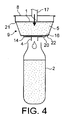
- Fig. 4 illustrates another embodiment in which the antimicrobial filter is positioned between the inlet face 8 and the ingredients housed in compartment 5.
- Such ingredients may comprise an infant formula in powder or liquid concentrate form.
- the formula may include probiotics in dried form, eventually, encapsulated for being physically protected against the other ingredients.
- the filter is distanced from the inlet face 8 of a certain gap sufficient to enable the introduction of an injection means 17 such as a liquid injection needle.
- the filter can for instance be fixed, e.g., sealed, to a stepped portion 21 of the capsule.
- a tearable of puncturable membrane 16 and opening means such as a puncture plate or disc 14 placed between the bottom 20 or outlet 4 of the capsule and the membrane 16.
- the membrane can be sealed onto a second lower stepped portion 22 of the capsule.
- the puncture plate could be made integral to the bottom of the capsule.
- the filter 1 can be further supported by a backing member (not shown) placed between the ingredient and the filter.
- the inlet face 8 can be made of a flexible perforable material such as aluminium and/or plastics.
Landscapes
- Engineering & Computer Science (AREA)
- Life Sciences & Earth Sciences (AREA)
- Health & Medical Sciences (AREA)
- Mechanical Engineering (AREA)
- Food Science & Technology (AREA)
- Chemical & Material Sciences (AREA)
- Nutrition Science (AREA)
- Polymers & Plastics (AREA)
- Pediatric Medicine (AREA)
- Mycology (AREA)
- Apparatus For Making Beverages (AREA)
- Separation Using Semi-Permeable Membranes (AREA)
- Packages (AREA)
Description
- Infant formulas have been developed as a substitute for human breast milk in order to provide required nutrients to infants. In general the infant formulas are either based on cow or soy milk and may be provided in different forms such as powder or concentrated liquid form.
- Each of the different forms in which infant formulas may be provided has their own advantages. For instance, although the infant formula provided in a powder form has a relative high nutritional quality, the preparation thereof is time consuming, since the water used for reconstitution must be boiled in advanced and allowed to cool then poured into a sterilised drinking vessel containing the powder in order to prepare a ready to feed liquid infant formula.
- If prepared and consumed in this manner, powdered infant formulas provide a safe and nutritionally good substitute for mother's milk in the situations described above. However, the process needs to be repeated every time a feed is required. It may readily be seen that this may not always be convenient and, as a consequence, many parents and other caregivers do not prepare the formulas properly and hence expose the infant to the risk of infection. For example, the water may not be boiled prior to use in which case any pathogens in the water are fed to the infant. Usually water sources in developed countries are reasonably safe but this may not be the case everywhere. Alternatively, batches of the infant formula may be prepared and then stored until needed. Unfortunately, if any pathogen has contaminated the formula, it then has time to replicate.
- In further development, infant formulas in ready-to-feed single serve portions have been introduced which overcome the inconvenience of the preparation of the infant formula. However, these ready-to-feed products are more costly than infant formulas stored in bulk and there is the same need to consume the formula immediately after opening to avoid the risk of contamination with bacteria.
- The immune defences of infants and young children are generally not fully developed and, as a result, these populations are particularly vulnerable to both bacterial and viral infections. For example, they may be prone to infections in circumstances where the immune system of a healthy adult would resist infection or they may suffer more serious consequences as a result of infection than would a healthy adult. Similar difficulties may arise in populations where the immune system is compromised such as the elderly. The consequence of this is that devices that prepare nutritional compositions which are perfectly safe for healthy adults may not be able to produce products which meet the increased safety standards required for products to be consumed by subjects having immature or compromised immune systems.
- Therefore, there is a need for a method or an apparatus which enables provision of nutritional composition, for instance, an infant formula in a convenient and safe manner.
-
WO2006/077259 discloses a method for preparing a single serving of a nutritional composition comprising introducing liquid such as water into a cartridge containing a unit dose of the composition in concentrated form. Thereby, the water is treated prior to the introduction into the cartridge in order to remove pathogens from the water. This treatment may be for instance a pre-heating, a filtering or an irradiation of the water with ultra-violet light. -
EP 1 574 452 A - A device which teaches the principle of treating water by means of a filter used for the preparation of nutritional compositions in a dispenser from capsules is disclosed in co-pending European patent application No.
06117801.8 filed 25 July 2006 - Further, although every care is taken to minimize contamination of powdered infant formulae by undesired bacteria, it is difficult to ensure the injection of sterile liquid, e.g., boiled water, in the capsule in an easy and practical way. For instance, liquid can be sterilized by a heating operation in the device but this requires a cooling stage to a controlled temperature, e.g., around 35 degrees, for serving to the baby. Thereby the preparation time is extended significantly or the liquid must be sterilized in advance. Therefore this adds a level of complexity and additional controls to the device. The use of UV light in the device also adds complexity, controls and requires regular maintenance.
- Furthermore, certain nutritional formula might provide substrates for bacterial growth. Therefore, prolonged periods of storage, particularly at elevated temperatures might increase the amount of bacteria present.
- Generally it is also known to use filter in a capsule containing coffee ingredients for filtering a liquid coffee extract and maintaining coffee solids in the capsule. E.g.
EP0507905B1 relates to an apparatus and capsule for preparing a liquid product. An internal filtering membrane is placed in the bottom of the cartridge for retaining the solid particles in the cartridge and for preventing clogging of the flow channels provided in the perforating members. - Systems and methods for obtaining fluid comestibles from substances containing isolated capsules are for example known from
EP-A-512470 US 5,402,707 ). - However, such filters in capsules for ground coffee particles usually have a pore sizes of more than 10µm, which pore size is adapted to the typical dimensions of coffee grounds and which (large) pore sizes are thought to be necessary in order to guarantee a sufficient flow rate of the beverage. Thus, these filters are not able to withhold micro-organisms which typically have dimensions in the order of several µm (bacteria) or even much less (viruses).
-
US5681468 relates to a liquid dispenser for dispensing sterile liquids comprising a container for storing the sterile liquid, a nozzle assembly mounted on the container and a filter which has at least one surface and a plurality of its pore coated with metallic material, e.g., a metal or metal oxide or metal salt, that is bacteriostatic or bactericidal. However, such device is a multidose device and is designed for repeated usages. The coating reduces microbial growth and "growth-through" on the filter. Furthermore, bactericidal materials of metallic origin are undesirable as they can be delivered in the final beverage in uncontrolled quantities. Furthermore, the liquid is passed through the device at relatively low pressure by manual squeezing of the container. - It is therefore the object of the present invention to propose a technique for improving the microbiological safety of nutritional liquids produced from ingredients contained in a single-use capsule, i.e. by feeding a liquid into the capsule.
- This is a particularly important aspect in case the liquid introduced in the capsule for mixing with the ingredients and/or the nutritional ingredients, such as e.g. infant formula ingredients, in the capsule are not perfectly sterile.
- This object is achieved by means of the features of the independent claims. The depending claims develop further the central idea of the present invention.
- A first aspect of the invention relates to a capsule for single use in a beverage production device. The capsule contains one or several ingredients for producing a beverage or liquid comestible when a liquid is fed into the capsule. The capsule is provided with an antimicrobial filter placed across the flow path of the liquid traversing the capsule. The antimicrobial filter is further placed between the inlet face and the outlet face of the capsule and, preferably, at a certain inward distance from the inlet face. As a result, it is ensured that the liquid introduced in the capsule is inevitably passed through the filter whether or not mixed with the ingredients contained in the capsule. The distance from the inlet filter also ensures that the risk of damaging accidentally or voluntarily the filter such as by opening of the face of the capsule (while still being able to use the capsule in the device) is considerably reduced. Furthermore, the filter is also placed inwardly distant from the outlet face.
- In a mode, the antimicrobial filter is placed between an outlet face of the capsule and ingredients prone to bacterial contamination.
- In another mode, the antimicrobial filter is placed in the capsule between the inlet face and the ingredients.
- The filter can present a nominal pore size of 1 µm or less, more preferred 0.5µm or less, most preferred 0.2µm.
- The ingredients prone to bacterial contamination may comprise milk powder and/or other infant formula components.
- The antimicrobial filter may be arranged in an outlet opening of the capsule.
- The antimicrobial filter can comprise a porous polymer membrane. The material for the membrane can be chosen from the list of: PES (polyethersulphone), cellulose acetate, cellulose nitrate, polyamide and combinations thereof.
- Additionally or alternatively the antimicrobial filter comprises a paper layer.
- Ingredients can be arranged between the antimicrobial filter and the outlet face of the capsule.
- Alternatively, the antimicrobial filter can be arranged between the inlet face and the ingredients.
- The antimicrobial filter can be fixed to the sidewall of the capsule.
- The antimicrobial filter can be supported by at least one backing wall that may be placed adjacent the filter. The backing wall is more rigid than the filter. The backing wall ensures that the filter does not break, perforates or damaged otherwise under the effect of the liquid under the elevated pressure in the capsule (e.g., possibly between 2-10 bar) and/or by the jet created by the liquid stream(s) entering the capsule under high velocity. At least one backing member is placed adjacent and downstream of the filter. A second backing member can be placed upstream and adjacent the filter.
- The antimicrobial filter is free of bacteriostatic or bactericidal material.
- The rim of the antimicrobial filter may be sealed against the wall of the capsule.
- When the antimicrobial filter is placed between the bottom of the capsule and the ingredients, the antimicrobial filter can be distanced from the bottom of the capsule. Alternatively, the antimicrobial filter can be at least partially in contact with the bottom of the capsule. The antimicrobial filter can also be at least partially sealed to the bottom of the capsule.
- The antimicrobial filter may be externally attached to the capsule such as to the bottom of the capsule or at the top of the capsule.
- The antimicrobial filter, when seen from the inlet face of the capsule, may completely extend over the entire interior of the capsule.
- The antimicrobial filter may extend, when seen from the inlet face of the capsule, only partially over the entire interior of the capsule.
- In a possible mode, the antimicrobial filter may also be arranged in an outlet opening of the capsule.
- When the antimicrobial filter is placed between the top of the capsule and the ingredients, the antimicrobial filter can be distanced from the top of the capsule. In particular, a certain distance, such as 0.5-1.5 cm, enables to provide a sufficient gap for inserting in the capsule injection means such as needles, blades and the like, without risk of damaging the filter.
- The filter can be formed of at least one porous polymeric thin membrane.
- The antimicrobial filter may have a thickness of less than 500µm, preferably less than 300µm.
- Another aspect of the invention relates to a beverage production system, comprising a capsule according to any of the preceding claims, and a beverage production machine.
- The machine can be provided with
- chamber means for housing and supporting the capsule, and
- means for supplying a liquid to the capsule and optionally a gas (such as compressed air, nitrogen) to completely empty the capsule.
- The beverage production machine may furthermore comprise:
- means for opening an inlet side of the capsule such as piercing means.
- The beverage production machine can be designed such that the beverage produced in the capsule can be obtained from the capsule without the beverage contacting a part of the beverage production machine. For instance, the machine comprises a capsule holder comprising a lower opening of large enough section to entirely uncover the outlet of the capsule.
- A still further aspect of the present invention relates to a method for reducing the microbial load in a nutritional liquid obtained by
- feeding a liquid into a ingredient containing capsule,
- letting interact the ingredients with the liquid wherein the obtained nutritional liquid is filtered by an antimicrobial filter which is part of the capsule and which is arranged inside or fixed outside to the capsule.
- Further features, advantages and objects of the present invention will become evident when going through the following detailed description of preferred embodiments of the invention.
-
Figure 1 shows an example of a capsule according to the present invention, -
Figure 2 shows schematically a capsule having an antimicrobial filter in an outlet opening of the capsule, and -
Figure 3 shows schematically a capsule having an antimicrobial filter in the main enclosure of the capsule. -
Figure 4 shows schematically a capsule having an antimicrobial filter in the main enclosure of the capsule between the inlet face and the ingredients. - Generally the present invention proposes to integrate an antimicrobial filter into an ingredient containing capsule.
- The term "antimicrobial filter" designates a filter which, through a mechanical filtering action reduces the number of microorganisms, such as e.g. bacteria, at the downstream side of the filter.
- The invention generally relates to capsules which contain beverage or food ingredients and is particularly adapted for capsules containing infant formula ingredients such as e.g. milk-based powder. Preferably such capsules according to the present invention are sealed at a production site after having preferably been flushed by a protective gas such as nitrogen, and are opened once they have been placed in an associate beverage or liquid comestible production machine. Preferably the opening of the capsules is not done manually, but by a part of the associated beverage production machine and/or an internal mechanism of the capsule. This opening technique reduces the risks of a contamination of the interior of the capsule.
- The capsule will be supplied manually or in an automated fashion to a chamber of the beverage production machine. The capsule is held in a defined position in the chamber. The liquid supply to the interior of the capsule and the draining of the nutritional liquid from the capsule is usually carried out while the capsule remains fixed in the chamber.
- The production of the nutritional liquid can be based on a wide range of liquid/ingredient interaction principles, such as e.g. dissolution, dilution, brewing, extraction, mixing, suspending etc. Dissolution, dilution and suspending are preferred in case of infant formulas being present as powder, flaked or liquid concentrate ingredients inside the capsule.
- Preferably the capsules will be opened at an inlet face thereof by associated opening or perforation means of the machine. On the other hand, at the outlet face of the capsules an opening or perforation can be produced either by integrated opening/perforation means of the capsule or by associated opening/perforation means being part of the beverage production machine.
- A particular opening mechanism can be to thrust a face of the capsule to be opened against integrated or external perforation/opening means by a pressure built up in the interior of the capsule. This pressure built up can be caused by injecting a liquid, such as water through the inlet face of the capsule into the capsule.
- Another mode could also be to have the capsule be opened via a septum or valve which opens as a result of the pressure build up in the capsule or by use of a pusher inserted in the capsule for opening the flow path through the septum or valve.
- Preferably the integrated perforation/opening mechanism is used, which will be explained via the embodiment of
figure 1 . This internal mechanism is particularly used for so-called "direct flow" capsules, in which the produced liquid can be obtained (i.e., delivered) from the capsule without the produced liquid being contacting parts of the beverage production machine. This obviously reduces the risk of contamination of the beverage after it has been produced in the capsule via an interaction between the injected liquid and the ingredients contained in the capsule. - A closed capsule with integrated opening means is generally known e.g. from
EP 1472156 B1 and will now be shortly explained with reference tofigure 1 of the enclosed drawings. -
Figure 1 shows acapsule 9 comprising a cup shapedbase body 10, which is form stable and e.g. made from plastics, and themembrane 11 welded at theperipheral welding edge 13 forming the periphery of said cup shapedbase body 10. Themembrane 11 can be made e.g. from a sandwich or metallic foil. Thereference numeral 12 generally designates the ingredients. The system for opening the capsule according to this embodiment consists of adisc 14 arranged in the bottom of the cup shapedbase body 10 and comprises a puncturingmember 15. The puncturingmember 15 is enclosed in the chamber formed by the cup shapedbase body 10 and themembrane 11. The disc is thus arranged at the bottom of the cup in thus forms a wider area over which the internal pressure may be spread during extraction. At the time of extraction, the capsule is introduced into the beverage production machine, water is introduced via a needle which perforates themembrane 11, and under the effect of the rise and pressure in thecapsule 9, thedisc 14 experiences a downward thrusting force towards the retainingpart 16, such that the piercingmember 15 opens the retainingpart 16 of the cup shapedbase body 10, thus allowing the beverage produced inside thecapsule 9 to be drained. - The
reference numeral 1 infigure 1 designates a antimicrobial or antimicrobial filter according to the present invention. - As can be seen in
figure 1 , this filter is arranged between at least a part of theingredients 12 and the outlet opening 16 of thecapsule 9. - Preferably the antimicrobial filter can present a nominal pore size of 1 µm or less, more preferred 0.5 µm or less, such as for example 0.2 µm.
- Preferably the
filter 1 comprises at least one filtering porous membrane which is sometimes also called "microporous filter". E.g. the filter can be made from thin layers of polymer and can have a thickness of less than 500 µm, preferably 10 to 300 µm. - Preferably the
antimicrobial filter 1 has a high porosity (e.g. up to 70-90% of the total filter) in order to not unduly hinder the flow of the liquid across thefilter 1. - Additionally the filter may be provided (e.g. coated) with a food grade antimicrobial agent (e.g. essential oils) killing microbes when the beverage passes through the
filter 1. - The
antimicrobial filter 1 can preferably be used together with a capsule containing milk powder and/or other infant formula components. - With reference to
figures 2 and 3 now further embodiments of the invention will be explained. The arrow referenced with thenumeral 3 designates the incoming stream of a liquid, such as for example water on the inlet side (top side) of thecapsule 9.Reference 17 designates means for perforating the inlet face of the capsule and supplying a liquid, which can be e.g. a pressurized hot liquid, preferably water. - In the embodiment of
figure 2 theantimicrobial filter 1 is arranged in anoutlet spout 4 of thecapsule 9. In this case there can be only onemain compartment 5 in the capsule at least partially filled with beverage ingredients. - The pressure of the injected
liquid 3 is sufficient in order to thrust the beverage produced by the interaction of the liquid 3 with the ingredients in thecompartment 5 through thefilter 1. Any remaining liquid in the capsule can easily be discharged by a push of compressed air into the capsule, in order to ensure a nutritionally compete beverage. - As shown in
figures 2 and 3 , the produced liquid can then directly flow (e.g. drop) into ababy bottle 2 placed under the outlet face of thecapsule 9. - In the embodiment of
figure 3 theantimicrobial filter 1 is arranged such that between theoutlet spout 4 of thecapsule 9 and themain compartment 5 for ingredients asecond compartment 6 is present. If necessary, thissecond compartment 6 can also be at least partially filled with ingredients and especially with ingredients which are not or less prone to bacterial contamination in comparison to the ingredients in thecompartment 5. - The
antimicrobial filter 1 in the embodiment offigure 3 completely traverses the interior of thecapsule 9, while theantimicrobial filter 1 in the embodiment offigure 2 extends only partially over the cross-sectional surface (when seen from above) of the interior of thecapsule 9. - In the embodiment of
figure 3 the antimicrobial filter is distanced from the bottom 20 of thecapsule 9. In that case, it is preferably to have a backing wall to support with the filter membrane and prevent it from tearing under the pressure of liquid in the capsule. A backing wall may be a grid of plastic or metal for instance placed below the filter membrane. It is to be noted that theantimicrobial filter 1 can also be placed on the bottom 20 of thecapsule 9 and can cover completely or partially the bottom 20. Theantimicrobial filter 1 can be sealed to the bottom 20 over its entire surface or only partially, such as e.g. at its rim portion. - Note that the
antimicrobial filter 1 can also be attached to the outside of thecapsule 9 and preferably to the outer face of the bottom of thecapsule 20. - The
antimicrobial filter 1 is fixed (e.g. sealed at 19) to the inner surface of thesidewalls 18 of thecapsule 9. The sealing 19 can be done e.g. via ultrasonic welding, gluing, press-fitting etc.. The sealing guarantees that no beverage can flow between a potential gap between thefilter 1 and the inner surface of the walls of thecapsule 9 thus creating a bypass for non-filtered liquid. - As it becomes clear from
figure 3 , any ingredient housed in thesecond compartment 6, i.e. downstream of thefilter 1, will not be filtered and will then reach the receptacle (bottle) 2 without filtering. - Recently, certain strains of bacteria have attracted considerable attention because they have been found to exhibit valuable properties for man if ingested. In particular, specific strains of the genera Lactobacilli and Bifidobacteria have been found to be able to colonise the intestinal mucosa, to reduce the capability of pathogenic bacteria to adhere to the intestinal epithelium, to have immunomodulatory effects and to assist in the maintenance of well-being. Such bacteria are sometimes called probiotics.
- It has been proposed to add probiotics to infant formulae to encourage gut colonization to take place and to promote colonization with the "good" bacteria - species of Bifidobacteria and Lactobacilli - rather than the harmful bacteria - pathogens such as clostridia, etc. Typically a minimum of 10e7cfu/ g of formula is added although generally larger amounts are preferred, for example up to 10e12 cfu/ g of formula. However, as probiotics are bacteria or other micro-organisms, it will be appreciated that a microbial filter of the type proposed in the present invention will retain them equally as efficiently as pathogenic micro-organisms. Therefore, if it is desired that the infant formula in the capsule of the present invention should contain probiotics, special provision will have to be made to ensure that the probiotics are delivered into the bottle with the reconstituted formula. For example, probiotics microorganisms may be provided in the
second compartment 6. Thefilter 1 will thus not withhold the probiotics in themain compartment 5. -
Fig. 4 illustrates another embodiment in which the antimicrobial filter is positioned between theinlet face 8 and the ingredients housed incompartment 5. Such ingredients may comprise an infant formula in powder or liquid concentrate form. The formula may include probiotics in dried form, eventually, encapsulated for being physically protected against the other ingredients. The filter is distanced from theinlet face 8 of a certain gap sufficient to enable the introduction of an injection means 17 such as a liquid injection needle. The filter can for instance be fixed, e.g., sealed, to a steppedportion 21 of the capsule. In the bottom of the capsule can be provided a tearable ofpuncturable membrane 16 and opening means such as a puncture plate ordisc 14 placed between the bottom 20 oroutlet 4 of the capsule and themembrane 16. The membrane can be sealed onto a second lower steppedportion 22 of the capsule. Of course the puncture plate could be made integral to the bottom of the capsule. In this embodiment, thefilter 1 can be further supported by a backing member (not shown) placed between the ingredient and the filter. Theinlet face 8 can be made of a flexible perforable material such as aluminium and/or plastics.
Claims (17)
- A capsule for use in a beverage production device,
the capsule containing ingredients for producing a nutritional liquid when a liquid is fed into the capsule (9) at an inlet face (8) thereof,
the capsule (9) being provided with an antimicrobial filter (1). - The capsule according to claim 1,
wherein the filter (1) is placed between the inlet face (8) and the outlet face (7) and further inwardly distanced from the inlet face, and preferably the outlet face. - The capsule according to claims 1 or 2,
wherein the filter (1) is arranged between an outlet face (7) of the capsule (9) and ingredients (12). - The capsule according to claims 1 or 2,
wherein the filter (1) is arranged between the inlet face (8) of the capsule and ingredients (12). - The capsule according to any of claims 1 to 4,
wherein the antimicrobial filter (1) has a nominal pore size of 1 µm or less, more preferred 0.5 µm or less, most preferred 0.2µm. - The capsule according to any of the preceding claims,
wherein the ingredients (12) comprise a milk-based powder such as an infant formula powder. - The capsule according to claim 3,
wherein the antimicrobial filter (1) is arranged in an outlet opening (4) of the capsule (9). - The capsule according to any of the preceding claims,
wherein the antimicrobial filter (1) comprises a polymer membrane made from a material such as PES (polyethersulphone), cellulose acetate, cellulose nitrate, polyamide and combinations thereof. - The capsule according to any of the preceding claims,
wherein the antimicrobial filter (1) is fixed to the sidewall (18) of the capsule (9). - The capsule according to claims 1 or 2,
wherein the antimicrobial filter (1) is distanced from the bottom (20) of the capsule (9). - The capsule according to claims 1 or 2,
wherein the antimicrobial filter (1) is at least partially in contact with the bottom (20) of the capsule (9). - The capsule according to claim 11,
wherein the antimicrobial filter (1) is at least partially sealed to the bottom (20) of the capsule (9). - The capsule according to claim 1,
wherein the antimicrobial filter (1) is externally attached to the capsule (9). - The capsule according to any of the preceding claims,
wherein the antimicrobial filter (1) has a thickness of less than 500µm, preferably less than 300µm. - A beverage production system,
comprising a capsule (9) according to any of the preceding claims,
and a beverage production machine having:- means for housing the capsule (9), and- means (17) for supplying a liquid (3) to the capsule (9). - The system according to claim 15,
wherein the beverage production machine furthermore comprises:- means (17) for opening an inlet face (8) of the capsule (9). - A method for reducing the microbial load in a nutritional liquid produced by a beverage production system according to claim 15 or claim 16 and obtained by- feeding a liquid into an ingredient containing capsule,- letting interact the ingredients with the liquid, comprising the step of- filtering the obtained nutritional liquid by the antimicrobial filter which is part of the capsule and is arranged inside the capsule or fixed externally to the capsule.
Priority Applications (1)
| Application Number | Priority Date | Filing Date | Title |
|---|---|---|---|
| EP09704264.2A EP2244743B1 (en) | 2008-01-24 | 2009-01-08 | Capsule with integrated antimicrobial filter |
Applications Claiming Priority (3)
| Application Number | Priority Date | Filing Date | Title |
|---|---|---|---|
| EP08100900 | 2008-01-24 | ||
| EP09704264.2A EP2244743B1 (en) | 2008-01-24 | 2009-01-08 | Capsule with integrated antimicrobial filter |
| PCT/EP2009/050154 WO2009092629A1 (en) | 2008-01-24 | 2009-01-08 | Capsule with integrated antimicrobial filter |
Publications (2)
| Publication Number | Publication Date |
|---|---|
| EP2244743A1 EP2244743A1 (en) | 2010-11-03 |
| EP2244743B1 true EP2244743B1 (en) | 2016-07-20 |
Family
ID=39518146
Family Applications (1)
| Application Number | Title | Priority Date | Filing Date |
|---|---|---|---|
| EP09704264.2A Not-in-force EP2244743B1 (en) | 2008-01-24 | 2009-01-08 | Capsule with integrated antimicrobial filter |
Country Status (15)
| Country | Link |
|---|---|
| US (1) | US9309044B2 (en) |
| EP (1) | EP2244743B1 (en) |
| JP (1) | JP5411164B2 (en) |
| KR (1) | KR20100108606A (en) |
| CN (2) | CN105147114B (en) |
| AU (1) | AU2009207824B2 (en) |
| BR (1) | BRPI0906633B1 (en) |
| CA (1) | CA2712413A1 (en) |
| ES (1) | ES2589147T3 (en) |
| MX (1) | MX2010008027A (en) |
| MY (1) | MY161919A (en) |
| PL (1) | PL2244743T3 (en) |
| RU (1) | RU2489336C2 (en) |
| UA (1) | UA99946C2 (en) |
| WO (1) | WO2009092629A1 (en) |
Cited By (1)
| Publication number | Priority date | Publication date | Assignee | Title |
|---|---|---|---|---|
| WO2019158480A1 (en) | 2018-02-19 | 2019-08-22 | Sartorius Stedim Biotech Gmbh | Media filtration device |
Families Citing this family (36)
| Publication number | Priority date | Publication date | Assignee | Title |
|---|---|---|---|---|
| US10722066B2 (en) * | 2010-12-04 | 2020-07-28 | Adrian Rivera | Windowed single serving brewing material holder |
| US11832755B2 (en) * | 2007-07-13 | 2023-12-05 | Adrian Rivera | Brewing material container for a beverage brewer |
| PT2236437E (en) | 2009-03-31 | 2012-04-13 | Nestec Sa | Capsule with filter for preparing a liquid nutritional or food composition and related beverage production system |
| SG175793A1 (en) | 2009-05-05 | 2011-12-29 | Nestec Sa | Capsule for preparing a nutritional product including a filter |
| SA110310345B1 (en) | 2009-05-05 | 2013-12-30 | Nestec Sa | Capsule for Preparing a Nutritional Product Including a Water Filter |
| JP2012526074A (en) | 2009-05-05 | 2012-10-25 | ネステク ソシエテ アノニム | Capsule containing filter and method for preparing a nutritional product |
| JP5681192B2 (en) * | 2009-09-22 | 2015-03-04 | スリーエム イノベイティブ プロパティズ カンパニー | Method for applying atomic layer deposition coatings on porous non-ceramic substrates |
| BR112012009377A2 (en) | 2009-10-08 | 2016-06-07 | Nestec Sa | segmented system for preparing a nutritional product |
| GB2481068B (en) | 2010-06-11 | 2012-06-20 | Kraft Foods R & D Inc | Cartridge for the preparation of beverages |
| US10071851B2 (en) | 2010-07-12 | 2018-09-11 | Robert Bao Vu | Apparatus and products for producing beverages, and methods for making and using same |
| DK3521209T3 (en) * | 2010-07-22 | 2020-04-27 | K Fee System Gmbh | BOTTLE COOKING COVER |
| DE102010047890B4 (en) | 2010-08-16 | 2019-05-29 | K-Fee System Gmbh | Portion capsule with a filter fabric |
| US20130180409A1 (en) | 2010-09-15 | 2013-07-18 | Nestec S.A. | Capsule with enhanced product delivery system |
| RU2013121565A (en) | 2010-10-12 | 2014-11-20 | Нестек С.А. | CAPSULE OPENING KIT |
| EP2444339A1 (en) * | 2010-10-25 | 2012-04-25 | Nestec S.A. | A capsule for preparation of a beverage |
| CN103221320B (en) | 2010-11-11 | 2015-10-21 | 雀巢产品技术援助有限公司 | For capsule, beverage production machines and system prepared by nutrition product |
| GB2487393A (en) * | 2011-01-19 | 2012-07-25 | Kraft Foods R & D Inc | Kit, method and apparatus for preparing a chocolate beverage |
| EP2583732A1 (en) * | 2011-10-17 | 2013-04-24 | Nestec S.A. | Filter cap for filtering and dispensing a nutritional composition |
| ES2550765T3 (en) * | 2011-10-17 | 2015-11-12 | Nestec S.A. | Expandable container for the preparation of a nutritional composition |
| EP2768467B1 (en) | 2011-10-17 | 2015-11-25 | Nestec S.A. | Feeding bottle for preparation of a nutritional composition |
| RU2015102567A (en) * | 2012-06-29 | 2016-08-20 | К-Фее Зюстем Гмбх | PORTION CAPSULE WITH EXTERNAL IDENTIFIER |
| DE102012109186A1 (en) * | 2012-09-27 | 2014-03-27 | K-Fee System Gmbh | Portion capsule with a filter element connected by sealing |
| US10272371B2 (en) * | 2012-12-28 | 2019-04-30 | Kx Technologies Llc | Filtering container |
| US20150375927A1 (en) | 2013-01-14 | 2015-12-31 | Nestec S.A. | Filter unit for a capsule and capsule comprising such filter unit |
| US9783361B2 (en) | 2013-03-14 | 2017-10-10 | Starbucks Corporation | Stretchable beverage cartridges and methods |
| WO2014202383A1 (en) * | 2013-06-18 | 2014-12-24 | Nestec S.A. | Filter unit for a capsule |
| US20160185519A1 (en) * | 2013-08-14 | 2016-06-30 | Merck Patent Gmbh | High pressure extraction capsule |
| US10442610B2 (en) | 2014-03-11 | 2019-10-15 | Starbucks Corporation | Pod-based restrictors and methods |
| US9877495B2 (en) | 2015-01-09 | 2018-01-30 | Starbucks Corporation | Method of making a sweetened soluble beverage product |
| ES2722531T3 (en) | 2015-08-25 | 2019-08-13 | Nestle Sa | Accessory for container and container to prepare a beverage from liquid supplied to the container by a device |
| CA3041722A1 (en) | 2016-11-09 | 2018-05-17 | Pepsico, Inc. | Carbonated beverage makers, methods, and systems |
| NL2018750B1 (en) * | 2017-04-20 | 2018-11-05 | Sterwater Int B V | DEVICE AND METHOD FOR PURIFYING WATER WATER |
| RU2731100C1 (en) * | 2019-04-15 | 2020-08-28 | Общество С Ограниченной Ответственностью "Аквафор" (Ооо "Аквафор") | Liquid supply device |
| TWI719733B (en) | 2019-11-27 | 2021-02-21 | 財團法人工業技術研究院 | Filter cup |
| WO2022148549A1 (en) | 2020-01-14 | 2022-07-14 | Babylat Gmbh | Apparatus and method for obtaining protein-enriched fractions from breast milk |
| US11805934B1 (en) * | 2020-10-21 | 2023-11-07 | Adrian Rivera | Brewing material lid and container for a beverage brewer |
Family Cites Families (40)
| Publication number | Priority date | Publication date | Assignee | Title |
|---|---|---|---|---|
| US3937134A (en) * | 1971-12-15 | 1976-02-10 | Douwe Egberts Tabaksfabriek-Koffiebranderijen-Theehandel B.V. | Coffee filtering |
| CH605293A5 (en) * | 1976-12-17 | 1978-09-29 | Nestle Sa | |
| US4441996A (en) * | 1982-03-31 | 1984-04-10 | Hurst Richard F | Apparatus for producing bacteria free drinking water |
| US4463880A (en) * | 1982-04-30 | 1984-08-07 | The Regents Of The University Of California | Medicine drop dispenser with anti-bacterial filter |
| JP2930365B2 (en) * | 1989-08-01 | 1999-08-03 | 山中産業株式会社 | Coffee filter material and coffee filter bag |
| US4999109A (en) * | 1989-08-28 | 1991-03-12 | Sabre Reza A | Filtering lid with separate inlet and outlet compartments |
| US5028328A (en) * | 1989-11-30 | 1991-07-02 | Long Joseph F | Controlled pore size coffee filter |
| US5186830A (en) * | 1990-05-14 | 1993-02-16 | Rait Joseph M | Water filtration apparatus |
| DK0468078T3 (en) * | 1990-07-27 | 1994-01-03 | Nestle Sa | Method of extracting from closed cartridges and device for carrying out the method |
| DE4192762C2 (en) | 1990-10-31 | 2002-09-19 | Monodor Sa | Apparatus and capsule for the production of a liquid product |
| TW199884B (en) | 1991-05-08 | 1993-02-11 | Sociere Des Produits Nestle S A | |
| US5490938A (en) * | 1993-12-20 | 1996-02-13 | Biopolymerix, Inc. | Liquid dispenser for sterile solutions |
| ATE184780T1 (en) * | 1993-12-20 | 1999-10-15 | Biopolymerix Inc | LIQUID DISPENSOR FOR DISPENSING STERILE LIQUID |
| US5958478A (en) * | 1995-11-09 | 1999-09-28 | Lehrer; Robert | Filtration device for preparation of foods from food concentrates and liquids |
| NL1004210C2 (en) * | 1996-10-07 | 1998-04-10 | Prime Water Systems N V | Water filtration device. |
| NL1006137C2 (en) * | 1997-05-27 | 1998-12-01 | Prime Water Systems N V | Ultrafiltration device. |
| US6461607B1 (en) * | 1998-08-24 | 2002-10-08 | Ganeden Biotech, Inc. | Probiotic, lactic acid-producing bacteria and uses thereof |
| US6103116A (en) * | 1998-10-01 | 2000-08-15 | Kx Industries, L.P. | Collapsible filter |
| JP3431893B2 (en) | 2000-08-31 | 2003-07-28 | 象印マホービン株式会社 | Ion water generator |
| SG111024A1 (en) * | 2000-09-28 | 2005-05-30 | Kataoka Bussan Kk | Filter device for coffee or the like |
| US6740345B2 (en) * | 2000-12-22 | 2004-05-25 | Edward Zhihua Cai | Beverage making cartridge |
| DE20100166U1 (en) * | 2001-01-05 | 2001-03-29 | Melitta Haushaltsprodukte GmbH & Co. KG, 32427 Minden | Portion pack for the production of a brewed beverage |
| JP4749572B2 (en) * | 2001-03-13 | 2011-08-17 | 大成化工株式会社 | Dispensing container plug structure |
| HU225842B1 (en) * | 2002-01-16 | 2007-10-29 | Nestle Sa | Capsule, method for preparing various beverage in the same machine and method for improving hygiene and reducing cross-contamination in the preparation of a baverage from a capsule |
| ITBO20030062A1 (en) * | 2003-02-13 | 2004-08-14 | Ima Spa | CAPSULE USED FOR THE PREPARATION OF AN INFUSED BEVERAGE. |
| BRPI0407994A (en) * | 2003-03-03 | 2006-03-07 | Procter & Gamble | liquid infusion pouches containing insoluble materials |
| JP2005008225A (en) | 2003-06-19 | 2005-01-13 | Sanden Corp | Drink feeder |
| ES2292885T3 (en) | 2003-07-23 | 2008-03-16 | Nestec S.A. | SYSTEM AND PROCEDURE FOR MANAGING DRINKS THAT HAVE DIFFERENT LEVELS OF FOAM FROM CAPSULES. |
| JP2005137495A (en) | 2003-11-05 | 2005-06-02 | Sanden Corp | Beverage feeder |
| JP2005160972A (en) | 2003-11-10 | 2005-06-23 | Rohto Pharmaceut Co Ltd | Container with ophthalmological liquid agent, and ophthalmological liquid agent |
| US9242791B2 (en) * | 2004-08-23 | 2016-01-26 | Nestec S.A. | Capsule for preparing and delivering a drink by injecting a pressurized fluid into the capsule |
| CA2595299A1 (en) | 2005-01-24 | 2006-07-27 | Nestec S.A. | Method of preparing a nutritional composition |
| AU2006210110B2 (en) * | 2005-02-07 | 2012-04-19 | Société des Produits Nestlé S.A. | Device for preparing a drink from a capsule by injection of a pressurized fluid and capsule-holder adapted therefore |
| PL1710172T3 (en) * | 2005-04-04 | 2007-09-28 | Beatrice Amann | Apparatus and disposable cartridge for preparing liquid products, in particular drinks |
| DE102005016297A1 (en) * | 2005-04-08 | 2006-10-12 | Tchibo Gmbh | portion capsule |
| CN106447310A (en) | 2005-09-28 | 2017-02-22 | 维萨国际服务协会 | Device, system and method for reducing an interaction time for a contactless transaction |
| EP1785369A1 (en) * | 2005-11-10 | 2007-05-16 | Nestec S.A. | Beverage ingredient containing capsule having several compartments |
| DE102005058336A1 (en) * | 2005-12-02 | 2007-06-06 | Tchibo Gmbh | portion capsule |
| AU2007278255B2 (en) | 2006-07-25 | 2014-01-09 | Société des Produits Nestlé S.A. | Dispenser for preparing a nutritional composition |
| ITBO20060723A1 (en) * | 2006-10-20 | 2008-04-21 | Aroma System Srl | CAPSULES CONTAINING HYDRO-SOLUBLE PRODUCTS OR INFUSION PRODUCTS TO OBTAIN HOT DRINKS |
-
2009
- 2009-01-08 AU AU2009207824A patent/AU2009207824B2/en not_active Ceased
- 2009-01-08 UA UAA201010201A patent/UA99946C2/en unknown
- 2009-01-08 KR KR1020107018821A patent/KR20100108606A/en not_active Ceased
- 2009-01-08 WO PCT/EP2009/050154 patent/WO2009092629A1/en not_active Ceased
- 2009-01-08 MX MX2010008027A patent/MX2010008027A/en not_active Application Discontinuation
- 2009-01-08 CA CA2712413A patent/CA2712413A1/en not_active Abandoned
- 2009-01-08 CN CN201510463506.0A patent/CN105147114B/en not_active Expired - Fee Related
- 2009-01-08 PL PL09704264T patent/PL2244743T3/en unknown
- 2009-01-08 MY MYPI2010003385A patent/MY161919A/en unknown
- 2009-01-08 ES ES09704264.2T patent/ES2589147T3/en active Active
- 2009-01-08 CN CN2009801097548A patent/CN101977636A/en active Pending
- 2009-01-08 JP JP2010543453A patent/JP5411164B2/en not_active Expired - Fee Related
- 2009-01-08 US US12/864,432 patent/US9309044B2/en not_active Expired - Fee Related
- 2009-01-08 BR BRPI0906633A patent/BRPI0906633B1/en not_active IP Right Cessation
- 2009-01-08 EP EP09704264.2A patent/EP2244743B1/en not_active Not-in-force
- 2009-01-08 RU RU2010135361/12A patent/RU2489336C2/en active
Cited By (2)
| Publication number | Priority date | Publication date | Assignee | Title |
|---|---|---|---|---|
| WO2019158480A1 (en) | 2018-02-19 | 2019-08-22 | Sartorius Stedim Biotech Gmbh | Media filtration device |
| US11877982B2 (en) | 2018-02-19 | 2024-01-23 | Sartorius Stedim Biotech Gmbh | Media filtration device |
Also Published As
| Publication number | Publication date |
|---|---|
| BRPI0906633B1 (en) | 2018-09-18 |
| UA99946C2 (en) | 2012-10-25 |
| CN101977636A (en) | 2011-02-16 |
| MY161919A (en) | 2017-05-15 |
| RU2010135361A (en) | 2012-02-27 |
| KR20100108606A (en) | 2010-10-07 |
| JP2011512299A (en) | 2011-04-21 |
| BRPI0906633A2 (en) | 2015-07-14 |
| AU2009207824B2 (en) | 2013-11-21 |
| CA2712413A1 (en) | 2009-07-30 |
| CN105147114B (en) | 2018-09-11 |
| US9309044B2 (en) | 2016-04-12 |
| RU2489336C2 (en) | 2013-08-10 |
| CN105147114A (en) | 2015-12-16 |
| ES2589147T3 (en) | 2016-11-10 |
| PL2244743T3 (en) | 2017-01-31 |
| EP2244743A1 (en) | 2010-11-03 |
| AU2009207824A1 (en) | 2009-07-30 |
| JP5411164B2 (en) | 2014-02-12 |
| MX2010008027A (en) | 2010-08-04 |
| WO2009092629A1 (en) | 2009-07-30 |
| US20100297299A1 (en) | 2010-11-25 |
Similar Documents
| Publication | Publication Date | Title |
|---|---|---|
| US9309044B2 (en) | Capsule with integrated antimicrobial filter | |
| EP2236437B1 (en) | Capsule with filter for preparing a liquid nutritional or food composition and related beverage production system | |
| EP2427067B1 (en) | Capsule for preparing a nutritional product including a filter and method | |
| EP2244593B1 (en) | Capsule containing nutritional ingredients and method of delivery of a nutritional liquid from the capsule | |
| EP1843685B1 (en) | Method of preparing a nutritional composition | |
| US20130180409A1 (en) | Capsule with enhanced product delivery system | |
| WO2012007258A1 (en) | Beverage brewing apparatus and method | |
| HK1149532B (en) | Capsule with filter for preparing a liquid nutritional or food composition and related beverage production system | |
| HK1168256B (en) | Capsule for preparing a nutritional product including a filter and method |
Legal Events
| Date | Code | Title | Description |
|---|---|---|---|
| PUAI | Public reference made under article 153(3) epc to a published international application that has entered the european phase |
Free format text: ORIGINAL CODE: 0009012 |
|
| 17P | Request for examination filed |
Effective date: 20100824 |
|
| AK | Designated contracting states |
Kind code of ref document: A1 Designated state(s): AT BE BG CH CY CZ DE DK EE ES FI FR GB GR HR HU IE IS IT LI LT LU LV MC MK MT NL NO PL PT RO SE SI SK TR |
|
| AX | Request for extension of the european patent |
Extension state: AL BA RS |
|
| RIN1 | Information on inventor provided before grant (corrected) |
Inventor name: ROULIN, ANNE Inventor name: STEVEN, MATTHEW, DAVID Inventor name: EPARS, YANN |
|
| DAX | Request for extension of the european patent (deleted) | ||
| REG | Reference to a national code |
Ref country code: HK Ref legal event code: DE Ref document number: 1149723 Country of ref document: HK |
|
| 17Q | First examination report despatched |
Effective date: 20150317 |
|
| REG | Reference to a national code |
Ref country code: DE Ref legal event code: R079 Ref document number: 602009039812 Country of ref document: DE Free format text: PREVIOUS MAIN CLASS: A61L0002020000 Ipc: A23L0033000000 |
|
| GRAP | Despatch of communication of intention to grant a patent |
Free format text: ORIGINAL CODE: EPIDOSNIGR1 |
|
| RIC1 | Information provided on ipc code assigned before grant |
Ipc: B65D 85/804 20060101ALI20160217BHEP Ipc: A23L 33/00 20160101AFI20160217BHEP |
|
| INTG | Intention to grant announced |
Effective date: 20160302 |
|
| RIN1 | Information on inventor provided before grant (corrected) |
Inventor name: EPARS, YANN Inventor name: ROULIN, ANNE Inventor name: STEVEN, MATTHEW, DAVID |
|
| GRAS | Grant fee paid |
Free format text: ORIGINAL CODE: EPIDOSNIGR3 |
|
| GRAA | (expected) grant |
Free format text: ORIGINAL CODE: 0009210 |
|
| AK | Designated contracting states |
Kind code of ref document: B1 Designated state(s): AT BE BG CH CY CZ DE DK EE ES FI FR GB GR HR HU IE IS IT LI LT LU LV MC MK MT NL NO PL PT RO SE SI SK TR |
|
| REG | Reference to a national code |
Ref country code: GB Ref legal event code: FG4D |
|
| REG | Reference to a national code |
Ref country code: CH Ref legal event code: EP |
|
| REG | Reference to a national code |
Ref country code: IE Ref legal event code: FG4D |
|
| REG | Reference to a national code |
Ref country code: AT Ref legal event code: REF Ref document number: 813244 Country of ref document: AT Kind code of ref document: T Effective date: 20160815 |
|
| REG | Reference to a national code |
Ref country code: DE Ref legal event code: R096 Ref document number: 602009039812 Country of ref document: DE |
|
| REG | Reference to a national code |
Ref country code: NL Ref legal event code: FP |
|
| REG | Reference to a national code |
Ref country code: SE Ref legal event code: TRGR |
|
| REG | Reference to a national code |
Ref country code: ES Ref legal event code: FG2A Ref document number: 2589147 Country of ref document: ES Kind code of ref document: T3 Effective date: 20161110 Ref country code: LT Ref legal event code: MG4D |
|
| REG | Reference to a national code |
Ref country code: FR Ref legal event code: PLFP Year of fee payment: 9 Ref country code: AT Ref legal event code: MK05 Ref document number: 813244 Country of ref document: AT Kind code of ref document: T Effective date: 20160720 |
|
| PG25 | Lapsed in a contracting state [announced via postgrant information from national office to epo] |
Ref country code: HR Free format text: LAPSE BECAUSE OF FAILURE TO SUBMIT A TRANSLATION OF THE DESCRIPTION OR TO PAY THE FEE WITHIN THE PRESCRIBED TIME-LIMIT Effective date: 20160720 Ref country code: LT Free format text: LAPSE BECAUSE OF FAILURE TO SUBMIT A TRANSLATION OF THE DESCRIPTION OR TO PAY THE FEE WITHIN THE PRESCRIBED TIME-LIMIT Effective date: 20160720 Ref country code: FI Free format text: LAPSE BECAUSE OF FAILURE TO SUBMIT A TRANSLATION OF THE DESCRIPTION OR TO PAY THE FEE WITHIN THE PRESCRIBED TIME-LIMIT Effective date: 20160720 Ref country code: IS Free format text: LAPSE BECAUSE OF FAILURE TO SUBMIT A TRANSLATION OF THE DESCRIPTION OR TO PAY THE FEE WITHIN THE PRESCRIBED TIME-LIMIT Effective date: 20161120 Ref country code: NO Free format text: LAPSE BECAUSE OF FAILURE TO SUBMIT A TRANSLATION OF THE DESCRIPTION OR TO PAY THE FEE WITHIN THE PRESCRIBED TIME-LIMIT Effective date: 20161020 |
|
| PG25 | Lapsed in a contracting state [announced via postgrant information from national office to epo] |
Ref country code: AT Free format text: LAPSE BECAUSE OF FAILURE TO SUBMIT A TRANSLATION OF THE DESCRIPTION OR TO PAY THE FEE WITHIN THE PRESCRIBED TIME-LIMIT Effective date: 20160720 Ref country code: LV Free format text: LAPSE BECAUSE OF FAILURE TO SUBMIT A TRANSLATION OF THE DESCRIPTION OR TO PAY THE FEE WITHIN THE PRESCRIBED TIME-LIMIT Effective date: 20160720 Ref country code: GR Free format text: LAPSE BECAUSE OF FAILURE TO SUBMIT A TRANSLATION OF THE DESCRIPTION OR TO PAY THE FEE WITHIN THE PRESCRIBED TIME-LIMIT Effective date: 20161021 Ref country code: PT Free format text: LAPSE BECAUSE OF FAILURE TO SUBMIT A TRANSLATION OF THE DESCRIPTION OR TO PAY THE FEE WITHIN THE PRESCRIBED TIME-LIMIT Effective date: 20161121 |
|
| REG | Reference to a national code |
Ref country code: DE Ref legal event code: R097 Ref document number: 602009039812 Country of ref document: DE |
|
| PG25 | Lapsed in a contracting state [announced via postgrant information from national office to epo] |
Ref country code: EE Free format text: LAPSE BECAUSE OF FAILURE TO SUBMIT A TRANSLATION OF THE DESCRIPTION OR TO PAY THE FEE WITHIN THE PRESCRIBED TIME-LIMIT Effective date: 20160720 Ref country code: RO Free format text: LAPSE BECAUSE OF FAILURE TO SUBMIT A TRANSLATION OF THE DESCRIPTION OR TO PAY THE FEE WITHIN THE PRESCRIBED TIME-LIMIT Effective date: 20160720 |
|
| PLBE | No opposition filed within time limit |
Free format text: ORIGINAL CODE: 0009261 |
|
| STAA | Information on the status of an ep patent application or granted ep patent |
Free format text: STATUS: NO OPPOSITION FILED WITHIN TIME LIMIT |
|
| PG25 | Lapsed in a contracting state [announced via postgrant information from national office to epo] |
Ref country code: SK Free format text: LAPSE BECAUSE OF FAILURE TO SUBMIT A TRANSLATION OF THE DESCRIPTION OR TO PAY THE FEE WITHIN THE PRESCRIBED TIME-LIMIT Effective date: 20160720 Ref country code: BG Free format text: LAPSE BECAUSE OF FAILURE TO SUBMIT A TRANSLATION OF THE DESCRIPTION OR TO PAY THE FEE WITHIN THE PRESCRIBED TIME-LIMIT Effective date: 20161020 Ref country code: DK Free format text: LAPSE BECAUSE OF FAILURE TO SUBMIT A TRANSLATION OF THE DESCRIPTION OR TO PAY THE FEE WITHIN THE PRESCRIBED TIME-LIMIT Effective date: 20160720 Ref country code: CZ Free format text: LAPSE BECAUSE OF FAILURE TO SUBMIT A TRANSLATION OF THE DESCRIPTION OR TO PAY THE FEE WITHIN THE PRESCRIBED TIME-LIMIT Effective date: 20160720 |
|
| 26N | No opposition filed |
Effective date: 20170421 |
|
| REG | Reference to a national code |
Ref country code: HK Ref legal event code: WD Ref document number: 1149723 Country of ref document: HK |
|
| PG25 | Lapsed in a contracting state [announced via postgrant information from national office to epo] |
Ref country code: SI Free format text: LAPSE BECAUSE OF FAILURE TO SUBMIT A TRANSLATION OF THE DESCRIPTION OR TO PAY THE FEE WITHIN THE PRESCRIBED TIME-LIMIT Effective date: 20160720 |
|
| PG25 | Lapsed in a contracting state [announced via postgrant information from national office to epo] |
Ref country code: MC Free format text: LAPSE BECAUSE OF FAILURE TO SUBMIT A TRANSLATION OF THE DESCRIPTION OR TO PAY THE FEE WITHIN THE PRESCRIBED TIME-LIMIT Effective date: 20160720 |
|
| REG | Reference to a national code |
Ref country code: IE Ref legal event code: MM4A |
|
| PG25 | Lapsed in a contracting state [announced via postgrant information from national office to epo] |
Ref country code: LU Free format text: LAPSE BECAUSE OF NON-PAYMENT OF DUE FEES Effective date: 20170108 |
|
| REG | Reference to a national code |
Ref country code: FR Ref legal event code: PLFP Year of fee payment: 10 |
|
| PG25 | Lapsed in a contracting state [announced via postgrant information from national office to epo] |
Ref country code: IE Free format text: LAPSE BECAUSE OF NON-PAYMENT OF DUE FEES Effective date: 20170108 |
|
| PG25 | Lapsed in a contracting state [announced via postgrant information from national office to epo] |
Ref country code: MT Free format text: LAPSE BECAUSE OF NON-PAYMENT OF DUE FEES Effective date: 20170108 |
|
| PGFP | Annual fee paid to national office [announced via postgrant information from national office to epo] |
Ref country code: PL Payment date: 20181212 Year of fee payment: 11 |
|
| PGFP | Annual fee paid to national office [announced via postgrant information from national office to epo] |
Ref country code: SE Payment date: 20190110 Year of fee payment: 11 |
|
| PG25 | Lapsed in a contracting state [announced via postgrant information from national office to epo] |
Ref country code: HU Free format text: LAPSE BECAUSE OF FAILURE TO SUBMIT A TRANSLATION OF THE DESCRIPTION OR TO PAY THE FEE WITHIN THE PRESCRIBED TIME-LIMIT; INVALID AB INITIO Effective date: 20090108 |
|
| REG | Reference to a national code |
Ref country code: NL Ref legal event code: PD Owner name: SOCIETE DES PRODUITS NESTLE S.A.; CH Free format text: DETAILS ASSIGNMENT: CHANGE OF OWNER(S), MERGE; FORMER OWNER NAME: NESTEC S.A. Effective date: 20190620 |
|
| REG | Reference to a national code |
Ref country code: CH Ref legal event code: PFUS Owner name: SOCIETE DES PRODUITS NESTLE S.A., CH Free format text: FORMER OWNER: NESTEC S.A., CH |
|
| REG | Reference to a national code |
Ref country code: GB Ref legal event code: 732E Free format text: REGISTERED BETWEEN 20190801 AND 20190807 |
|
| PG25 | Lapsed in a contracting state [announced via postgrant information from national office to epo] |
Ref country code: CY Free format text: LAPSE BECAUSE OF NON-PAYMENT OF DUE FEES Effective date: 20160720 |
|
| REG | Reference to a national code |
Ref country code: BE Ref legal event code: PD Owner name: SOCIETE DES PRODUITS NESTLE S.A.; CH Free format text: DETAILS ASSIGNMENT: CHANGE OF OWNER(S), CESSION; FORMER OWNER NAME: NESTEC S.A. Effective date: 20190712 |
|
| PG25 | Lapsed in a contracting state [announced via postgrant information from national office to epo] |
Ref country code: MK Free format text: LAPSE BECAUSE OF FAILURE TO SUBMIT A TRANSLATION OF THE DESCRIPTION OR TO PAY THE FEE WITHIN THE PRESCRIBED TIME-LIMIT Effective date: 20160720 |
|
| REG | Reference to a national code |
Ref country code: ES Ref legal event code: PC2A Owner name: SOCIETE DES PRODUITS NESTLE S.A. Effective date: 20191211 |
|
| REG | Reference to a national code |
Ref country code: DE Ref legal event code: R082 Ref document number: 602009039812 Country of ref document: DE Representative=s name: MITSCHERLICH, PATENT- UND RECHTSANWAELTE PARTM, DE Ref country code: DE Ref legal event code: R081 Ref document number: 602009039812 Country of ref document: DE Owner name: SOCIETE DES PRODUITS NESTLE S.A., CH Free format text: FORMER OWNER: NESTEC S.A., VEVEY, CH |
|
| PG25 | Lapsed in a contracting state [announced via postgrant information from national office to epo] |
Ref country code: TR Free format text: LAPSE BECAUSE OF FAILURE TO SUBMIT A TRANSLATION OF THE DESCRIPTION OR TO PAY THE FEE WITHIN THE PRESCRIBED TIME-LIMIT Effective date: 20160720 |
|
| REG | Reference to a national code |
Ref country code: SE Ref legal event code: EUG |
|
| REG | Reference to a national code |
Ref country code: SE Ref legal event code: EUG |
|
| REG | Reference to a national code |
Ref country code: BE Ref legal event code: MM Effective date: 20200131 |
|
| PG25 | Lapsed in a contracting state [announced via postgrant information from national office to epo] |
Ref country code: SE Free format text: LAPSE BECAUSE OF NON-PAYMENT OF DUE FEES Effective date: 20200109 |
|
| PG25 | Lapsed in a contracting state [announced via postgrant information from national office to epo] |
Ref country code: BE Free format text: LAPSE BECAUSE OF NON-PAYMENT OF DUE FEES Effective date: 20200131 |
|
| PGFP | Annual fee paid to national office [announced via postgrant information from national office to epo] |
Ref country code: GB Payment date: 20201230 Year of fee payment: 13 Ref country code: FR Payment date: 20201210 Year of fee payment: 13 |
|
| PGFP | Annual fee paid to national office [announced via postgrant information from national office to epo] |
Ref country code: CH Payment date: 20210113 Year of fee payment: 13 Ref country code: NL Payment date: 20210113 Year of fee payment: 13 Ref country code: IT Payment date: 20201211 Year of fee payment: 13 |
|
| PGFP | Annual fee paid to national office [announced via postgrant information from national office to epo] |
Ref country code: DE Payment date: 20201229 Year of fee payment: 13 Ref country code: ES Payment date: 20210204 Year of fee payment: 13 |
|
| PG25 | Lapsed in a contracting state [announced via postgrant information from national office to epo] |
Ref country code: PL Free format text: LAPSE BECAUSE OF NON-PAYMENT OF DUE FEES Effective date: 20200108 |
|
| REG | Reference to a national code |
Ref country code: DE Ref legal event code: R119 Ref document number: 602009039812 Country of ref document: DE |
|
| REG | Reference to a national code |
Ref country code: CH Ref legal event code: PL |
|
| REG | Reference to a national code |
Ref country code: NL Ref legal event code: MM Effective date: 20220201 |
|
| GBPC | Gb: european patent ceased through non-payment of renewal fee |
Effective date: 20220108 |
|
| PG25 | Lapsed in a contracting state [announced via postgrant information from national office to epo] |
Ref country code: NL Free format text: LAPSE BECAUSE OF NON-PAYMENT OF DUE FEES Effective date: 20220201 Ref country code: GB Free format text: LAPSE BECAUSE OF NON-PAYMENT OF DUE FEES Effective date: 20220108 Ref country code: DE Free format text: LAPSE BECAUSE OF NON-PAYMENT OF DUE FEES Effective date: 20220802 |
|
| PG25 | Lapsed in a contracting state [announced via postgrant information from national office to epo] |
Ref country code: FR Free format text: LAPSE BECAUSE OF NON-PAYMENT OF DUE FEES Effective date: 20220131 |
|
| PG25 | Lapsed in a contracting state [announced via postgrant information from national office to epo] |
Ref country code: LI Free format text: LAPSE BECAUSE OF NON-PAYMENT OF DUE FEES Effective date: 20220131 Ref country code: CH Free format text: LAPSE BECAUSE OF NON-PAYMENT OF DUE FEES Effective date: 20220131 |
|
| PG25 | Lapsed in a contracting state [announced via postgrant information from national office to epo] |
Ref country code: IT Free format text: LAPSE BECAUSE OF NON-PAYMENT OF DUE FEES Effective date: 20220108 |
|
| REG | Reference to a national code |
Ref country code: ES Ref legal event code: FD2A Effective date: 20230303 |
|
| PG25 | Lapsed in a contracting state [announced via postgrant information from national office to epo] |
Ref country code: ES Free format text: LAPSE BECAUSE OF NON-PAYMENT OF DUE FEES Effective date: 20220109 |