EP2244429A2 - Method and system for instant messaging in a circuit switched mobile environment - Google Patents
Method and system for instant messaging in a circuit switched mobile environment Download PDFInfo
- Publication number
- EP2244429A2 EP2244429A2 EP10008551A EP10008551A EP2244429A2 EP 2244429 A2 EP2244429 A2 EP 2244429A2 EP 10008551 A EP10008551 A EP 10008551A EP 10008551 A EP10008551 A EP 10008551A EP 2244429 A2 EP2244429 A2 EP 2244429A2
- Authority
- EP
- European Patent Office
- Prior art keywords
- mobile subscriber
- instant message
- message
- queued
- instant
- Prior art date
- Legal status (The legal status is an assumption and is not a legal conclusion. Google has not performed a legal analysis and makes no representation as to the accuracy of the status listed.)
- Granted
Links
Images


Classifications
-
- H—ELECTRICITY
- H04—ELECTRIC COMMUNICATION TECHNIQUE
- H04W—WIRELESS COMMUNICATION NETWORKS
- H04W4/00—Services specially adapted for wireless communication networks; Facilities therefor
- H04W4/12—Messaging; Mailboxes; Announcements
-
- H—ELECTRICITY
- H04—ELECTRIC COMMUNICATION TECHNIQUE
- H04L—TRANSMISSION OF DIGITAL INFORMATION, e.g. TELEGRAPHIC COMMUNICATION
- H04L51/00—User-to-user messaging in packet-switching networks, transmitted according to store-and-forward or real-time protocols, e.g. e-mail
- H04L51/04—Real-time or near real-time messaging, e.g. instant messaging [IM]
-
- H—ELECTRICITY
- H04—ELECTRIC COMMUNICATION TECHNIQUE
- H04L—TRANSMISSION OF DIGITAL INFORMATION, e.g. TELEGRAPHIC COMMUNICATION
- H04L51/00—User-to-user messaging in packet-switching networks, transmitted according to store-and-forward or real-time protocols, e.g. e-mail
- H04L51/21—Monitoring or handling of messages
- H04L51/23—Reliability checks, e.g. acknowledgments or fault reporting
-
- H—ELECTRICITY
- H04—ELECTRIC COMMUNICATION TECHNIQUE
- H04L—TRANSMISSION OF DIGITAL INFORMATION, e.g. TELEGRAPHIC COMMUNICATION
- H04L51/00—User-to-user messaging in packet-switching networks, transmitted according to store-and-forward or real-time protocols, e.g. e-mail
- H04L51/58—Message adaptation for wireless communication
-
- H—ELECTRICITY
- H04—ELECTRIC COMMUNICATION TECHNIQUE
- H04M—TELEPHONIC COMMUNICATION
- H04M15/00—Arrangements for metering, time-control or time indication ; Metering, charging or billing arrangements for voice wireline or wireless communications, e.g. VoIP
-
- H—ELECTRICITY
- H04—ELECTRIC COMMUNICATION TECHNIQUE
- H04M—TELEPHONIC COMMUNICATION
- H04M15/00—Arrangements for metering, time-control or time indication ; Metering, charging or billing arrangements for voice wireline or wireless communications, e.g. VoIP
- H04M15/80—Rating or billing plans; Tariff determination aspects
- H04M15/8033—Rating or billing plans; Tariff determination aspects location-dependent, e.g. business or home
-
- H—ELECTRICITY
- H04—ELECTRIC COMMUNICATION TECHNIQUE
- H04M—TELEPHONIC COMMUNICATION
- H04M15/00—Arrangements for metering, time-control or time indication ; Metering, charging or billing arrangements for voice wireline or wireless communications, e.g. VoIP
- H04M15/80—Rating or billing plans; Tariff determination aspects
- H04M15/8038—Roaming or handoff
-
- H—ELECTRICITY
- H04—ELECTRIC COMMUNICATION TECHNIQUE
- H04M—TELEPHONIC COMMUNICATION
- H04M15/00—Arrangements for metering, time-control or time indication ; Metering, charging or billing arrangements for voice wireline or wireless communications, e.g. VoIP
- H04M15/80—Rating or billing plans; Tariff determination aspects
- H04M15/8083—Rating or billing plans; Tariff determination aspects involving reduced rates or discounts, e.g. time-of-day reductions or volume discounts
-
- H—ELECTRICITY
- H04—ELECTRIC COMMUNICATION TECHNIQUE
- H04M—TELEPHONIC COMMUNICATION
- H04M2215/00—Metering arrangements; Time controlling arrangements; Time indicating arrangements
- H04M2215/01—Details of billing arrangements
- H04M2215/0184—Details of billing arrangements involving reduced rates or discounts, e.g. time-of-day reductions, volume discounts, cell discounts, group billing, frequent calling destination(s) or user history list
-
- H—ELECTRICITY
- H04—ELECTRIC COMMUNICATION TECHNIQUE
- H04M—TELEPHONIC COMMUNICATION
- H04M2215/00—Metering arrangements; Time controlling arrangements; Time indicating arrangements
- H04M2215/22—Bandwidth or usage-sensitve billing
-
- H—ELECTRICITY
- H04—ELECTRIC COMMUNICATION TECHNIQUE
- H04M—TELEPHONIC COMMUNICATION
- H04M2215/00—Metering arrangements; Time controlling arrangements; Time indicating arrangements
- H04M2215/32—Involving wireless systems
-
- H—ELECTRICITY
- H04—ELECTRIC COMMUNICATION TECHNIQUE
- H04M—TELEPHONIC COMMUNICATION
- H04M2215/00—Metering arrangements; Time controlling arrangements; Time indicating arrangements
- H04M2215/34—Roaming
-
- H—ELECTRICITY
- H04—ELECTRIC COMMUNICATION TECHNIQUE
- H04M—TELEPHONIC COMMUNICATION
- H04M2215/00—Metering arrangements; Time controlling arrangements; Time indicating arrangements
- H04M2215/74—Rating aspects, e.g. rating parameters or tariff determination apects
- H04M2215/7435—Location dependent, e.g. Bussiness or home
-
- H—ELECTRICITY
- H04—ELECTRIC COMMUNICATION TECHNIQUE
- H04M—TELEPHONIC COMMUNICATION
- H04M2215/00—Metering arrangements; Time controlling arrangements; Time indicating arrangements
- H04M2215/74—Rating aspects, e.g. rating parameters or tariff determination apects
- H04M2215/7442—Roaming
-
- H—ELECTRICITY
- H04—ELECTRIC COMMUNICATION TECHNIQUE
- H04W—WIRELESS COMMUNICATION NETWORKS
- H04W4/00—Services specially adapted for wireless communication networks; Facilities therefor
- H04W4/06—Selective distribution of broadcast services, e.g. multimedia broadcast multicast service [MBMS]; Services to user groups; One-way selective calling services
- H04W4/08—User group management
-
- H—ELECTRICITY
- H04—ELECTRIC COMMUNICATION TECHNIQUE
- H04W—WIRELESS COMMUNICATION NETWORKS
- H04W4/00—Services specially adapted for wireless communication networks; Facilities therefor
- H04W4/16—Communication-related supplementary services, e.g. call-transfer or call-hold
-
- H—ELECTRICITY
- H04—ELECTRIC COMMUNICATION TECHNIQUE
- H04W—WIRELESS COMMUNICATION NETWORKS
- H04W88/00—Devices specially adapted for wireless communication networks, e.g. terminals, base stations or access point devices
- H04W88/18—Service support devices; Network management devices
- H04W88/184—Messaging devices, e.g. message centre
Definitions
- the present invention relates generally to instant message systems, and more particularly to an instant message proxy that is capable of maintaining the availability status of a mobile subscriber when the communicating to the subscriber is temporarily broken.
- IM instant message
- IM instant message
- buddy potential IM participants
- Participant-specific information such as presence contact information
- the IM login server uses the connection to determine the presence status of the buddy; if the connection is broken, the buddy is unavailable.
- IM systems typically rely on a best-effort delivery mechanism in which a message intended for a target buddy is delivered if the IM login server determines that the target buddy is available. If the IM login server determines that the target buddy is not available, the message is dropped. Because a mobile station participant may move in and out of service during an IM session, it may not be possible for the mobile station to maintain a reliable connection with the login server. If the connection is lost, messages targeted at the mobile station will be inadvertently dropped.
- a circuit-switched mobile network has both a considerable delay associated with an IM connection set-up and a high cost associated with maintaining an open connection during an IM session. Therefore, it is not economically practical to implement an IM system with mobile network subscribers by establishing and then maintaining open connections for the duration of IM sessions.
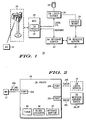
- FIG. 1 shows an architecture of an IM system 10 that accommodates both a mobile subscriber, represented generally by the wireless handset, 12, and a conventional subscriber, represented generally by a personal computer 14. While it should be understood that the system architecture is capable of supporting plural IM sessions among numerous mobile and/or conventional subscribers, only the single mobile subscriber 12 and the single conventional subscriber 14 are shown for discussion purposes.
- the IM system 10 includes an IM login server 16. All IM system subscribers must register with the IM login server 16 to become available for and participate in an IM session.
- the IM login server 16 includes a login database 18 for storing subscriber information, such as presence information for informing subscriber buddies of the login presence of the subscriber, contact information indicating that a subscriber is available for receiving instant messages, and/or other similar subscriber-specific information and parameters that the IM login server 16 detects and receives based on subscriber registration.
- the IM system 10 may also include one or more IM message servers, such as the IM servers 20, 22, for facilitating passage of instant messages between subscribers who have registered with the IM login server 16 in a manner known to those skilled in the art.
- the IM system 10 also includes an IM proxy 24 according to the present invention that is located in a message pathway between the mobile subscriber 12 and both the IM login server 16 and the IM message servers 20, 22.
- the IM proxy 24 functions to set up a connection, such as an IP connection, with the IM login server 16 for the mobile subscriber 12 and for facilitating information flow between the IM login server 16 and the mobile subscriber 12 once the connection is established.
- the IM proxy 24 is preferably a UNIX or NT server, and is preferably associated with a wireless circuit switched mobile network represented generally at 26. More specifically, the IM proxy 24 is preferably housed within a mobile services switching center (MSC) 28.
- MSC mobile services switching center
- the IM proxy 24 may be located in proximity to the MSC 28, or housed in, or located in proximity to, a base station, a base station controller, a GSN regional network controller, a packet data system controller (GSM SGSN), or a packet data gateway (GSM GGSN or CDMA 2000 PDSN), all of which are known mobile network entities.
- a base station a base station controller
- GSN regional network controller a packet data system controller (GSM SGSN)
- GSM GGSN packet data gateway
- CDMA 2000 PDSN CDMA 2000 PDSN
- FIG. 2 shows the IM proxy 24 in more detail.
- the IM proxy 24 includes multiple ports, such as ports 32a - 32c, for establishing an IP connection 34a with the mobile subscriber 12 and IP (TCP or UDP) connections 34b, 34c with the IM login server 16 and the IM servers 20, 22.
- IP TCP or UDP
- a message buffer 36 stores instant messages intended for the mobile subscriber 12 based on IM system parameters discussed below.
- a retry counter 38 and a timer 40 enable the IM proxy 24 to maintain its IP connection with the IM login server 16, and therefore maintain the mobile subscriber's registered status with the IM login server 16, when the mobile subscriber 12 becomes temporarily unavailable due to roaming or the like, by causing the IM proxy 24 to re-send a message intended for the mobile subscriber 12 a predetermined number of times within a predetermined time period before the IM proxy 24 drops the message from the message buffer 36.
- the number of times that a message is re-sent and the time period within which the message is re-sent are parameters that may be programmed into the IM proxy 24 based on system or subscriber requirements.
- the IM proxy 24 minimizes the number of times that instant messages intended for the mobile subscriber 12 are dropped when the mobile subscriber 12 temporarily roams outside a designated mobile coverage area or otherwise temporarily becomes unavailable from the standpoint of the IM login server 16.
- connection as used in TCP Systems does not have the same meaning in UDP system. As used here 'connections' mean some way for two entities to exchange messages.
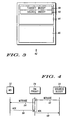
- FIG. 3 illustrates the basic structure of an instant message 42 of the type that is transmitted across the IM system 10.
- the instant message structure is similar to that of an email message and includes both a message header 44 and a message body 46.
- the header 44 includes both target buddy "To" and source buddy “From” subheaders 48, 50.
- the target buddy subheader 48 contains information that identifies a subscriber who is intended to receive the instant message 42, while the source buddy subheader 50 contains information that identifies an IM subscriber who is sending the instant message.
- the header 44 may also contain other information such as timestamp and subject information.
- the message body 46 contains the actual message that is to be communicated to the target buddy.
- the IM proxy 24 efficiently utilizes the information in the target buddy and source buddy subheaders 48, 50 to manage IM sessions between a mobile subscriber, such as the mobile subscriber 12, and buddies of the mobile subscriber, and in a manner that minimizes the occurrence of instant messages intended for the mobile subscriber being dropped.
- IM proxy 24 operation of the IM proxy 24 within the IM system 10 will now be discussed. Although only the mobile subscriber (target buddy) 12 and the conventional subscriber (source buddy) 14 are shown as being registered with the IM login server 16 ( FIG. 1 ) and as communicating with the IM proxy 24, it should be understood that multiple source buddies (either mobile or conventional subscribers) are capable of communicating with multiple target buddies (either mobile or conventional subscribers) via the functionality implemented at the IM proxy 24.
- FIG. 4 illustrates a situation in which the mobile subscriber 12 is available for receiving instant messages from the conventional subscriber 14.
- the conventional subscriber 14 transmits an instant message intended for the mobile subscriber 12 after receiving an indication from the IM proxy 24 that the mobile subscriber 12 is logged on to the IM system 10 and is therefore available to participate in an IM session.
- the target buddy subheader 48 of the instant message identifies the mobile subscriber 12 as the target buddy, while the source buddy subheader 50 identifies the conventional subscriber 14 as the source buddy.
- the instant message is first delivered 52 to the IM proxy 24 and then at 54 is forwarded to the mobile subscriber 12.
- the mobile subscriber 12 Because the mobile subscriber 12 is registered and online when the instant message is forwarded from the IM proxy 24, the mobile subscriber 12 receives the message in real time and at 56 acknowledges receipt of the message by sending an Ack message back to the conventional subscriber 14.
- the IM proxy 24 receives the Ack message and then forwards it at 58 to the conventional subscriber 14 as confirmation that the mobile subscriber 12 received the message sent at 52.
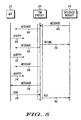
- FIG. 5 illustrates a situation in which the mobile subscriber 12 temporarily travels outside the coverage area of the mobile network 26.
- the conventional subscriber 14 transmits an instant message to the mobile subscriber 12 after learning via the IM proxy 24 that the mobile subscriber 12 is logged on to the IM system 10 and therefore available to participate in an IM session.
- the instant message is first delivered to the IM proxy 24 and then at 62 the IM proxy 24 attempts to deliver the message to the mobile subscriber 12.
- the mobile subscriber 12 temporarily loses coverage and is therefore unavailable to receive the message sent at 60, it does not receive the message and therefore, as indicated at 64, does not reply with an Ack message.
- the IM proxy 24 increments the retry counter 38 and starts the timer 40 before again attempting to send the message, as indicated at 66 and 68, as long as the number of retries has not exceeded a predetermined limit tracked by and programmed into the retry counter 38 and as long as the predetermined time period tracked by the timer 40 has not expired.
- the number of retries, the delay between delivery attempts, and the predetermined time period are parameters that are preferably based on system latency characteristics, such as network reliability, network location, the load on the proxy, the time of day, and the identity of the source or target buddy. However, these parameters may also be determined based on individual service options paid for by each subscriber, subscriber classes, subscriber usage habits, and the like.
- the IM proxy 24 periodically informs the conventional subscriber 14 that, as indicated at 70, it is in the process of trying to deliver the message. However, the mobile subscriber will continue to fail to reply with an Ack message, as indicated at 72 and 74, as long as the mobile subscriber 12 remains outside of the mobile network coverage area.
- the IM proxy 24 stops and resets the retry counter 38 and the timer 40.
- the mobile subscriber 12 responds by sending an Ack message at 78 back to the conventional subscriber 14.
- the IM proxy 24 receives the Ack message from the mobile subscriber 12 and at 80 forwards it to the conventional subscriber 14 as confirmation that the mobile subscriber 12 received the instant message.
- the IM proxy 24 then stops and resets the retry counter 38 and the timer 40.
- the message protocol of the IM proxy is capable of being implemented for IM sessions between two or more mobile subscribers as well as IM sessions between two or more mobile subscribers and two or more conventional subscribers.
- the retry counter 38 and the timer 40 are capable of tracking multiple attempted message deliveries to multiple mobile subscribers.
- the proxy 24 can be implemented with only a counter when the number of retries is limited, or with only a timer when the proxy is designed to retry an unlimited number of times until the timer expires.
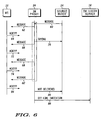
- FIG. 6 illustrates a situation in which the mobile subscriber 12 becomes unavailable for receiving instant messages for a period of time that exceeds the number of retries allotted by and programmed into the retry counter and/or the predetermined time period allotted by the timer 40.
- the sequence of messaging events 60 - 74 are identical to those discussed in connection with FIG. 5 .
- the message events 82, 84 differ from the message events 76, 78.
- the IM proxy 24 again unsuccessfully re-tries at 82 to forward the message to the mobile subscriber 12.
- the mobile subscriber 12 does not receive the message and, as indicated at 84, therefore does not send an Ack message back to the conventional subscriber 14.
- the IM proxy 24 discontinues its attempts to forward the message to the mobile subscriber 12 and drops the message.
- the delivery failure indication will be formatted to appear as though it is sent from the mobile subscriber 12 and to explain that the mobile subscriber 12 is connected via the wireless network 28.
- the IM proxy 24 then drops the connection between it and the conventional subscriber 14. In addition, at 88 the IM proxy 24 also drops its connection with the IM login server 16 after indicating to the IM server 16 that the mobile subscriber 12 is unavailable. Dropping this connection can take numerous forms depending on the underlying transport system. In a TCP system the handshake is discontinued. In UDP systems, a message explicably indicating unavailability, explicit de-registration, or perhaps allowing the expiration of a registration timer can be used.
- the IM proxy 24 of the instant message system of the present invention is capable of maintaining a mobile subscriber's availability status. Therefore, the mobile subscriber continues to appear available to IM buddies when the mobile subscriber is roaming or temporarily out of service even after the IM proxy unsuccessfully attempts to send an instant message to the mobile subscriber. Messages will continue to be re-sent to the mobile subscriber in the near-real time manner characteristic of a typical instant message system until IM parameters programmed into the retry counter 38 and/or the timer 40 are exceeded and the IM proxy drops the message.
- FIGs. 7 and 8 the functionality of the IM proxy 24 will now be described according to another embodiment of the present invention. It should be understood that the underlying IM system of the embodiment discussed in connection with FIGs. 7 and 8 is substantially identical to that shown in FIGs. 1-3 except for those components labeled with different reference numerals.
- FIG. 7 illustrates an IM session between the mobile subscriber 12 and the conventional subscriber 14 in which the IM proxy 24' bundles instant messages sent to the mobile subscriber 12 based on certain predetermined parameters discussed below.
- the mobile subscriber 12 sends a message via the IM proxy at 90 to the conventional subscriber 14.
- the IM server 20 receives the message and then forwards the message at 92 to the conventional subscriber 14 based on information contained in the target buddy subheader 48 ( FIG. 3 ).
- the conventional subscriber 14 After receiving the message, the conventional subscriber 14 responds by sending a message at 94 back to the mobile subscriber 12 through the IM server 20 and the IM proxy 24'.
- the IM proxy 24' recognizes, via information contained in the target buddy subheader 48 ( FIG. 3 ), that the message is intended for the mobile subscriber 12.
- the IM proxy 24' does not maintain an open connection with the mobile subscriber 12.
- the IM proxy 24' registers with the IM server 16 ( FIG. 1 ) on behalf of the mobile subscriber 12 and provides availability information to mobile subscriber buddies such as the conventional subscriber 14.
- the proxy 24' may notify the mobile subscriber 12 by sending the instant messages from the message buffer 36 to the mobile subscriber 12. Therefore, in the current example, the IM proxy 24' stores the instant message forwarded at 96 from the IM server 20 until the above discussed, or other system-specific, downlink parameters are met.
- the mobile subscriber 12 may send an additional message at 98 to the conventional subscriber 14 asking whether the conventional subscriber 14 received the message sent at 90.
- the conventional subscriber 14 again responds by sending a message at 102 back to the mobile subscriber 12 through the IM server 20.
- the IM proxy 24' again recognizes, via information contained in the target buddy subheader 48 ( FIG. 3 ), that the message is intended for the mobile subscribers 12, and therefore stores the instant message in the message buffer 36 until a downlink is established with the mobile subscriber 12.
- this cycle may be repeated until the IM proxy 24' determines that it is time to forward all stored instant messages to the mobile subscriber 12. If, for example, the IM proxy 24' is programmed to forward instant messages to the mobile subscriber 12 when the number of stored instant messages reaches 3, the IM proxy 14 will establish a downlink connection with the mobile subscriber 12 and, as indicated at 114, will forward the three stored messages to the mobile subscriber 12. Therefore, even though some latency is introduced into the IM system, overall system connection overhead is reduced.
- FIG. 8 illustrates an IM session involving the mobile subscriber 12 and multiple buddies, such as conventional subscribers 14, 14' and 14", in which the IM proxy 24' stores and bundles instant messages in its buffer 36 from the conventional subscribers 14, 14' and 14" based on predetermined participant parameters to minimize system connection overhead in a manner that also minimizes the amount of latency introduced into the system due to the message bundling.
- each of the conventional subscribers 14, 14' and 14" sends a message to the mobile subscriber 12 through the IM server 20 and the IM proxy 24'.
- the IM proxy 24' recognizes, via information contained in the target buddy subheader 48 ( FIG. 3 ) of each of the messages, that the messages sent at 116-120 are intended for the mobile subscriber 12.
- the IM proxy 24' then stores and bundles these messages in its message buffer 36 until the IM proxy 24' determines, in a manner that will be discussed in connection with FIG. 9 , that the messages should be downloaded to the mobile subscriber 12.
- the IM proxy 24' determines that download parameters have been met, the IM proxy 24' establishes a connection with the mobile subscriber 12 and at 122 downloads the stored and bundled messages to the mobile subscriber 12.
- FIG. 9 illustrates an exemplary IM session between the mobile subscriber 12 and multiple buddies, such as conventional subscribers 14, 14' and 14", in which the IM proxy 24' monitors the number of participants in an IM session, the message rate and the number of stored messages in its buffer from each participant, and bundles instant messages sent to the mobile subscriber 12 based on certain predetermined participant parameters discussed below to minimize system connection overhead in a manner that also minimizes the amount of latency introduced into the system due to the message bundling.
- the mobile subscriber 12 and the conventional subscribers 14, 14' and 14" come online and register with the IM server 16 ( FIG. 1 ) through respective connections, the mobile subscriber sends a message at 124 through the IM proxy 24' and the IM server 20 as discussed above to the conventional subscriber 14.
- the conventional subscriber 14 responds by sending a message at 126 back to the mobile subscriber 12.
- the IM proxy 24' recognizes, via information contained in the target buddy subheader 48 ( FIG. 3 ), that the message sent at 126 is intended for the mobile subscriber 12. However, the IM proxy 24' recognizes that the message sent at 126 is from the source buddy from which it had recently received the message sent at 124.
- the IM session between the mobile subscriber 12 and the conventional subscriber 14 continues in this manner, as exemplified by subsequent messages sent at 128, 130, until the IM proxy 24' is notified by the IM server 20 that additional buddies, such as conventional subscribers 14', 14", have registered with the IM server 20 as indicated generally at 132, 134.
- the IM proxy 24' continues to forward messages to the mobile subscriber 12 as long as the IM proxy 24' continues to detect only messages from a single IM session participant.
- the IM proxy 24' begins to bundle instant messages intended for the mobile subscriber in the buffer 36 when the IM proxy 24' detects that multiple participants are sending messages, such as those shown at 138-142, to the mobile subscriber 12.
- the IM proxy 24' then establishes a connection with the mobile subscriber 12 and flushes the IM proxy buffer 36 when a predetermined bundling parameter is met, such as when one of the IM session participants, such as the conventional subscriber 14", sends a second message, such as the message at 144, while a previous message sent from that participant at 138 is being stored in the buffer 36.
- the IM proxy 24' forwards the stored instant messages at 146 after it receives the second message at 144 from the conventional subscriber 14".
- the IM proxy 24' can be programmed to cease instant message bundling based on: a predetermined number of IM session participants sending messages to the target buddy within a predetermined time period; more than a predetermined number of IM session participants sending more than a predetermined number of messages to the target buddy within a predetermined time period; an IM session participant sending a second message to the mobile subscriber during message bundling while a previous message sent by the participant is being stored at the IM proxy; more than a predetermined number of messages are stored; a predetermined storage time is exceeded; a predetermined buffer memory threshold is exceeded; the number of IM session participants; call traffic on the wireless system; mobile subscriber subscription parameters; a request or instructions from the mobile subscriber to initiate message bundling; and/or a subsequent connection made by the mobile subscriber for purposes other than the particular IM session.
- the IM proxy 24' can also be programmed to initiate message bundling operations when one or more of the above parameters is/are no longer met, or when, for example, the mobile subscriber 12 informs the IM proxy 24' that the mobile subscriber no longer wants message bundling.
- the IM proxy 24' of the present invention can be programmed to provide message bundling to minimize mobile system overhead connection costs and at the same time minimize IM system latency.
Landscapes
- Engineering & Computer Science (AREA)
- Computer Networks & Wireless Communication (AREA)
- Signal Processing (AREA)
- Business, Economics & Management (AREA)
- General Business, Economics & Management (AREA)
- Mobile Radio Communication Systems (AREA)
Abstract
Description
- The present invention relates generally to instant message systems, and more particularly to an instant message proxy that is capable of maintaining the availability status of a mobile subscriber when the communicating to the subscriber is temporarily broken.
- Conventional instant message (IM) systems use a variety of system architectures. However, such systems typically require that potential IM participants, often referred to as buddies, must register and establish a connection with an IM login server. Participant-specific information, such as presence contact information, is generated through this registration and is stored in a database associated with the IM login server for the duration of the IM session. Additionally, the IM login server uses the connection to determine the presence status of the buddy; if the connection is broken, the buddy is unavailable. Once IM participants are registered with the IM login server, messages sent between registered participants are typically routed through an IM message server or servers to the respective designated target buddy or buddies.
- The above-described conventional IM systems have certain associated limitations when one or more of the participants in an IM session communicate via an IM-enabled mobile station such as a mobile handset. Specifically, IM systems typically rely on a best-effort delivery mechanism in which a message intended for a target buddy is delivered if the IM login server determines that the target buddy is available. If the IM login server determines that the target buddy is not available, the message is dropped. Because a mobile station participant may move in and out of service during an IM session, it may not be possible for the mobile station to maintain a reliable connection with the login server. If the connection is lost, messages targeted at the mobile station will be inadvertently dropped.
- In addition, a circuit-switched mobile network has both a considerable delay associated with an IM connection set-up and a high cost associated with maintaining an open connection during an IM session. Therefore, it is not economically practical to implement an IM system with mobile network subscribers by establishing and then maintaining open connections for the duration of IM sessions.
- Additional objects and advantages of the present invention will be more readily apparent from the following detailed description of preferred embodiments thereof when taken together with the accompanying drawings in which:
-
FIG. 1 is a system diagram of an IM system of a preferred embodiment in accordance with the present invention; -
FIG. 2 is a more detailed block diagram of the IM proxy shown inFIG. 1 ; -
FIG. 3 is a block diagram of the components of an IM message packet of the type sent over the system shown inFIG. 1 ; -
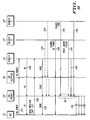
FIG. 4 is a timing diagram illustrating an IM session setup between a source buddy and a target buddy in the system shown inFIG. 1 ; -
FIG. 5 is a timing diagram illustrating message transmission protocol between the source and target buddies shown inFIG. 4 ; -
FIG. 6 is a timing diagram illustrating further message transmission protocol between the source and target buddies shown inFIG. 4 ; -
FIG. 7 is a timing diagram illustrating message transmission protocol between the source and target buddies shown inFIG. 4 over an IM system of another preferred embodiment in accordance with the present invention; -
FIG. 8 is a timing diagram illustrating IM proxy message buffering protocol; and -
FIG. 9 is a timing diagram further illustrating message transmission protocol between multiple source buddies and the target buddy ofFIG. 4 over the IM system discussed in connection withFIGs. 7 and8 . - Referring now to the drawings in which like numerals reference like parts,
FIG. 1 shows an architecture of anIM system 10 that accommodates both a mobile subscriber, represented generally by the wireless handset, 12, and a conventional subscriber, represented generally by apersonal computer 14. While it should be understood that the system architecture is capable of supporting plural IM sessions among numerous mobile and/or conventional subscribers, only the singlemobile subscriber 12 and the singleconventional subscriber 14 are shown for discussion purposes. - The
IM system 10 includes anIM login server 16. All IM system subscribers must register with theIM login server 16 to become available for and participate in an IM session. TheIM login server 16 includes alogin database 18 for storing subscriber information, such as presence information for informing subscriber buddies of the login presence of the subscriber, contact information indicating that a subscriber is available for receiving instant messages, and/or other similar subscriber-specific information and parameters that theIM login server 16 detects and receives based on subscriber registration. TheIM system 10 may also include one or more IM message servers, such as theIM servers IM login server 16 in a manner known to those skilled in the art. - In addition to the above components, the
IM system 10 also includes anIM proxy 24 according to the present invention that is located in a message pathway between themobile subscriber 12 and both theIM login server 16 and theIM message servers IM proxy 24 functions to set up a connection, such as an IP connection, with theIM login server 16 for themobile subscriber 12 and for facilitating information flow between theIM login server 16 and themobile subscriber 12 once the connection is established. TheIM proxy 24 is preferably a UNIX or NT server, and is preferably associated with a wireless circuit switched mobile network represented generally at 26. More specifically, theIM proxy 24 is preferably housed within a mobile services switching center (MSC) 28. Alternatively, theIM proxy 24 may be located in proximity to the MSC 28, or housed in, or located in proximity to, a base station, a base station controller, a GSN regional network controller, a packet data system controller (GSM SGSN), or a packet data gateway (GSM GGSN or CDMA 2000 PDSN), all of which are known mobile network entities. -
FIG. 2 shows theIM proxy 24 in more detail. TheIM proxy 24 includes multiple ports, such asports 32a - 32c, for establishing anIP connection 34a with themobile subscriber 12 and IP (TCP or UDP)connections IM login server 16 and theIM servers message buffer 36 stores instant messages intended for themobile subscriber 12 based on IM system parameters discussed below. Aretry counter 38 and atimer 40 enable theIM proxy 24 to maintain its IP connection with theIM login server 16, and therefore maintain the mobile subscriber's registered status with theIM login server 16, when themobile subscriber 12 becomes temporarily unavailable due to roaming or the like, by causing theIM proxy 24 to re-send a message intended for the mobile subscriber 12 a predetermined number of times within a predetermined time period before theIM proxy 24 drops the message from themessage buffer 36. The number of times that a message is re-sent and the time period within which the message is re-sent are parameters that may be programmed into theIM proxy 24 based on system or subscriber requirements. Through utilization of theretry counter 38 and/or thetimer 40, theIM proxy 24 minimizes the number of times that instant messages intended for themobile subscriber 12 are dropped when themobile subscriber 12 temporarily roams outside a designated mobile coverage area or otherwise temporarily becomes unavailable from the standpoint of theIM login server 16. The reader will note that the word "connection" as used in TCP Systems does not have the same meaning in UDP system. As used here 'connections' mean some way for two entities to exchange messages. -
FIG. 3 illustrates the basic structure of aninstant message 42 of the type that is transmitted across theIM system 10. The instant message structure is similar to that of an email message and includes both amessage header 44 and amessage body 46. Theheader 44 includes both target buddy "To" and source buddy "From"subheaders target buddy subheader 48 contains information that identifies a subscriber who is intended to receive theinstant message 42, while thesource buddy subheader 50 contains information that identifies an IM subscriber who is sending the instant message. Theheader 44 may also contain other information such as timestamp and subject information. Themessage body 46 contains the actual message that is to be communicated to the target buddy. As will now be described, theIM proxy 24 efficiently utilizes the information in the target buddy andsource buddy subheaders mobile subscriber 12, and buddies of the mobile subscriber, and in a manner that minimizes the occurrence of instant messages intended for the mobile subscriber being dropped. - Referring now to the timing diagrams shown in
FIGs. 4-6 , operation of theIM proxy 24 within theIM system 10 will now be discussed. Although only the mobile subscriber (target buddy) 12 and the conventional subscriber (source buddy) 14 are shown as being registered with the IM login server 16 (FIG. 1 ) and as communicating with theIM proxy 24, it should be understood that multiple source buddies (either mobile or conventional subscribers) are capable of communicating with multiple target buddies (either mobile or conventional subscribers) via the functionality implemented at theIM proxy 24. - Specifically,
FIG. 4 illustrates a situation in which themobile subscriber 12 is available for receiving instant messages from theconventional subscriber 14. Initially, at 52 theconventional subscriber 14 transmits an instant message intended for themobile subscriber 12 after receiving an indication from theIM proxy 24 that themobile subscriber 12 is logged on to theIM system 10 and is therefore available to participate in an IM session. Thetarget buddy subheader 48 of the instant message identifies themobile subscriber 12 as the target buddy, while thesource buddy subheader 50 identifies theconventional subscriber 14 as the source buddy. The instant message is first delivered 52 to theIM proxy 24 and then at 54 is forwarded to themobile subscriber 12. Because themobile subscriber 12 is registered and online when the instant message is forwarded from theIM proxy 24, themobile subscriber 12 receives the message in real time and at 56 acknowledges receipt of the message by sending an Ack message back to theconventional subscriber 14. TheIM proxy 24 receives the Ack message and then forwards it at 58 to theconventional subscriber 14 as confirmation that themobile subscriber 12 received the message sent at 52. -
FIG. 5 illustrates a situation in which themobile subscriber 12 temporarily travels outside the coverage area of themobile network 26. At 60, theconventional subscriber 14 transmits an instant message to themobile subscriber 12 after learning via theIM proxy 24 that themobile subscriber 12 is logged on to theIM system 10 and therefore available to participate in an IM session. The instant message is first delivered to theIM proxy 24 and then at 62 theIM proxy 24 attempts to deliver the message to themobile subscriber 12. However, if themobile subscriber 12 temporarily loses coverage and is therefore unavailable to receive the message sent at 60, it does not receive the message and therefore, as indicated at 64, does not reply with an Ack message. Subsequently, theIM proxy 24 increments the retrycounter 38 and starts thetimer 40 before again attempting to send the message, as indicated at 66 and 68, as long as the number of retries has not exceeded a predetermined limit tracked by and programmed into the retrycounter 38 and as long as the predetermined time period tracked by thetimer 40 has not expired. The number of retries, the delay between delivery attempts, and the predetermined time period are parameters that are preferably based on system latency characteristics, such as network reliability, network location, the load on the proxy, the time of day, and the identity of the source or target buddy. However, these parameters may also be determined based on individual service options paid for by each subscriber, subscriber classes, subscriber usage habits, and the like. - Once the retry
counter 38 and thetimer 40 are enabled, theIM proxy 24 periodically informs theconventional subscriber 14 that, as indicated at 70, it is in the process of trying to deliver the message. However, the mobile subscriber will continue to fail to reply with an Ack message, as indicated at 72 and 74, as long as themobile subscriber 12 remains outside of the mobile network coverage area. - If the mobile subscriber re-enters the mobile network coverage area before the number of retries exceeds the predetermined limit tracked by and programmed into the retry
counter 38 and before the predetermined time period tracked by thetimer 40 expires, theIM proxy 24 stops and resets the retrycounter 38 and thetimer 40. Upon finally receiving the instant message at 76, themobile subscriber 12 responds by sending an Ack message at 78 back to theconventional subscriber 14. TheIM proxy 24 receives the Ack message from themobile subscriber 12 and at 80 forwards it to theconventional subscriber 14 as confirmation that themobile subscriber 12 received the instant message. TheIM proxy 24 then stops and resets the retrycounter 38 and thetimer 40. - While the above operation of the
IM proxy 24 has been described with respect to an IM session between a mobile subscriber and a conventional subscriber, it should be appreciated that the message protocol of the IM proxy is capable of being implemented for IM sessions between two or more mobile subscribers as well as IM sessions between two or more mobile subscribers and two or more conventional subscribers. For IM sessions in which there are three or more participants, the retrycounter 38 and thetimer 40 are capable of tracking multiple attempted message deliveries to multiple mobile subscribers. Alternatively, there may be multiple instantiations of the IM proxy within the IM system; namely, one IM proxy per mobile station. Also, it should be appreciated that theproxy 24 can be implemented with only a counter when the number of retries is limited, or with only a timer when the proxy is designed to retry an unlimited number of times until the timer expires. -
FIG. 6 illustrates a situation in which themobile subscriber 12 becomes unavailable for receiving instant messages for a period of time that exceeds the number of retries allotted by and programmed into the retry counter and/or the predetermined time period allotted by thetimer 40. The sequence of messaging events 60 - 74 are identical to those discussed in connection withFIG. 5 . However, themessage events message events mobile subscriber 12 fails to re-enter the mobile network coverage area and therefore remains incapable of receiving the instant message from theconventional subscriber 14, theIM proxy 24 again unsuccessfully re-tries at 82 to forward the message to themobile subscriber 12. Themobile subscriber 12 does not receive the message and, as indicated at 84, therefore does not send an Ack message back to theconventional subscriber 14. - Subsequent to the
IM proxy 24 re-trying to send the message at 82, the number of times that the IM proxy tries to send the message exceeds the predetermined limit allotted by and programmed into the retrycounter 38 and/or the predetermined time period allotted by thetimer 40 expires. As a result, theIM proxy 24 discontinues its attempts to forward the message to themobile subscriber 12 and drops the message. At 86 it sends a delivery failure indication to theconventional subscriber 14. Preferably the delivery failure indication will be formatted to appear as though it is sent from themobile subscriber 12 and to explain that themobile subscriber 12 is connected via thewireless network 28. Once the delivery failure indication is delivered at 86, theIM proxy 24 then drops the connection between it and theconventional subscriber 14. In addition, at 88 theIM proxy 24 also drops its connection with theIM login server 16 after indicating to theIM server 16 that themobile subscriber 12 is unavailable. Dropping this connection can take numerous forms depending on the underlying transport system. In a TCP system the handshake is discontinued. In UDP systems, a message explicably indicating unavailability, explicit de-registration, or perhaps allowing the expiration of a registration timer can be used. - In view of the above, it should now be appreciated that the
IM proxy 24 of the instant message system of the present invention is capable of maintaining a mobile subscriber's availability status. Therefore, the mobile subscriber continues to appear available to IM buddies when the mobile subscriber is roaming or temporarily out of service even after the IM proxy unsuccessfully attempts to send an instant message to the mobile subscriber. Messages will continue to be re-sent to the mobile subscriber in the near-real time manner characteristic of a typical instant message system until IM parameters programmed into the retrycounter 38 and/or thetimer 40 are exceeded and the IM proxy drops the message. - Turning now to
FIGs. 7 and8 , the functionality of theIM proxy 24 will now be described according to another embodiment of the present invention. It should be understood that the underlying IM system of the embodiment discussed in connection withFIGs. 7 and8 is substantially identical to that shown inFIGs. 1-3 except for those components labeled with different reference numerals. - Specifically,
FIG. 7 illustrates an IM session between themobile subscriber 12 and theconventional subscriber 14 in which the IM proxy 24' bundles instant messages sent to themobile subscriber 12 based on certain predetermined parameters discussed below. After both themobile subscriber 12 and theconventional subscriber 14 come online and register with the IM server 16 (FIG. 1 ), themobile subscriber 12 sends a message via the IM proxy at 90 to theconventional subscriber 14. TheIM server 20 receives the message and then forwards the message at 92 to theconventional subscriber 14 based on information contained in the target buddy subheader 48 (FIG. 3 ). - After receiving the message, the
conventional subscriber 14 responds by sending a message at 94 back to themobile subscriber 12 through theIM server 20 and the IM proxy 24'. However, the IM proxy 24' recognizes, via information contained in the target buddy subheader 48 (FIG. 3 ), that the message is intended for themobile subscriber 12. To minimize connection overhead in the circuit switchedmobile network 28, the IM proxy 24' does not maintain an open connection with themobile subscriber 12. Specifically, the IM proxy 24' registers with the IM server 16 (FIG. 1 ) on behalf of themobile subscriber 12 and provides availability information to mobile subscriber buddies such as theconventional subscriber 14. However, it does not maintain a constant connection with themobile subscriber 12, but instead bundles instant messages for themobile subscriber 12 and notifies themobile subscriber 12 that instant messages are available for download from the message buffer 36 (FIG. 2 ) only when themobile subscriber 12 has multiple messages stored in themessage buffer 36 or, alternatively, only after at least one instant message has been stored in themessage buffer 36 for a certain amount of time. Alternatively, the proxy 24' may notify themobile subscriber 12 by sending the instant messages from themessage buffer 36 to themobile subscriber 12. Therefore, in the current example, the IM proxy 24' stores the instant message forwarded at 96 from theIM server 20 until the above discussed, or other system-specific, downlink parameters are met. - In the meantime, the
mobile subscriber 12 may send an additional message at 98 to theconventional subscriber 14 asking whether theconventional subscriber 14 received the message sent at 90. After receiving the message, theconventional subscriber 14 again responds by sending a message at 102 back to themobile subscriber 12 through theIM server 20. However, the IM proxy 24' again recognizes, via information contained in the target buddy subheader 48 (FIG. 3 ), that the message is intended for themobile subscribers 12, and therefore stores the instant message in themessage buffer 36 until a downlink is established with themobile subscriber 12. - As indicated by the message sequences shown at 106 -112, this cycle may be repeated until the IM proxy 24' determines that it is time to forward all stored instant messages to the
mobile subscriber 12. If, for example, the IM proxy 24' is programmed to forward instant messages to themobile subscriber 12 when the number of stored instant messages reaches 3, theIM proxy 14 will establish a downlink connection with themobile subscriber 12 and, as indicated at 114, will forward the three stored messages to themobile subscriber 12. Therefore, even though some latency is introduced into the IM system, overall system connection overhead is reduced. -
FIG. 8 illustrates an IM session involving themobile subscriber 12 and multiple buddies, such asconventional subscribers buffer 36 from theconventional subscribers - For example, after the
conventional subscribers FIG. 1 ), each of theconventional subscribers mobile subscriber 12 through theIM server 20 and the IM proxy 24'. The IM proxy 24' recognizes, via information contained in the target buddy subheader 48 (FIG. 3 ) of each of the messages, that the messages sent at 116-120 are intended for themobile subscriber 12. The IM proxy 24' then stores and bundles these messages in itsmessage buffer 36 until the IM proxy 24' determines, in a manner that will be discussed in connection withFIG. 9 , that the messages should be downloaded to themobile subscriber 12. When the IM proxy 24' determines that download parameters have been met, the IM proxy 24' establishes a connection with themobile subscriber 12 and at 122 downloads the stored and bundled messages to themobile subscriber 12. -
FIG. 9 illustrates an exemplary IM session between themobile subscriber 12 and multiple buddies, such asconventional subscribers mobile subscriber 12 based on certain predetermined participant parameters discussed below to minimize system connection overhead in a manner that also minimizes the amount of latency introduced into the system due to the message bundling. - After both the
mobile subscriber 12 and theconventional subscribers FIG. 1 ) through respective connections, the mobile subscriber sends a message at 124 through the IM proxy 24' and theIM server 20 as discussed above to theconventional subscriber 14. After receiving the message, theconventional subscriber 14 responds by sending a message at 126 back to themobile subscriber 12. The IM proxy 24' recognizes, via information contained in the target buddy subheader 48 (FIG. 3 ), that the message sent at 126 is intended for themobile subscriber 12. However, the IM proxy 24' recognizes that the message sent at 126 is from the source buddy from which it had recently received the message sent at 124. The IM session between themobile subscriber 12 and theconventional subscriber 14 continues in this manner, as exemplified by subsequent messages sent at 128, 130, until the IM proxy 24' is notified by theIM server 20 that additional buddies, such asconventional subscribers 14', 14", have registered with theIM server 20 as indicated generally at 132, 134. As indicated at 136, the IM proxy 24' continues to forward messages to themobile subscriber 12 as long as the IM proxy 24' continues to detect only messages from a single IM session participant. The IM proxy 24' begins to bundle instant messages intended for the mobile subscriber in thebuffer 36 when the IM proxy 24' detects that multiple participants are sending messages, such as those shown at 138-142, to themobile subscriber 12. The IM proxy 24' then establishes a connection with themobile subscriber 12 and flushes theIM proxy buffer 36 when a predetermined bundling parameter is met, such as when one of the IM session participants, such as theconventional subscriber 14", sends a second message, such as the message at 144, while a previous message sent from that participant at 138 is being stored in thebuffer 36. - In the present example, the IM proxy 24' forwards the stored instant messages at 146 after it receives the second message at 144 from the
conventional subscriber 14". However, the IM proxy 24' can be programmed to cease instant message bundling based on: a predetermined number of IM session participants sending messages to the target buddy within a predetermined time period; more than a predetermined number of IM session participants sending more than a predetermined number of messages to the target buddy within a predetermined time period; an IM session participant sending a second message to the mobile subscriber during message bundling while a previous message sent by the participant is being stored at the IM proxy; more than a predetermined number of messages are stored; a predetermined storage time is exceeded; a predetermined buffer memory threshold is exceeded; the number of IM session participants; call traffic on the wireless system; mobile subscriber subscription parameters; a request or instructions from the mobile subscriber to initiate message bundling; and/or a subsequent connection made by the mobile subscriber for purposes other than the particular IM session. - Of course, the IM proxy 24' can also be programmed to initiate message bundling operations when one or more of the above parameters is/are no longer met, or when, for example, the
mobile subscriber 12 informs the IM proxy 24' that the mobile subscriber no longer wants message bundling. - It should therefore be understood based on the above discussion in connection with
FIGs. 8 and9 that the IM proxy 24' of the present invention can be programmed to provide message bundling to minimize mobile system overhead connection costs and at the same time minimize IM system latency. - While the above description is of the preferred embodiment of the present invention, it should be appreciated that the invention may be modified, altered, or varied without deviating from the scope and fair meaning of the following claims.
- Other aspects of embodiments of the invention are defined in the following numbered paragraphs.
- 1. A method of compensating for temporary subscriber unavailability in a mobile instant message session environment, comprising:
- causing a mobile subscriber to register with an instant message system prior to participating in an instant message session;
- indicating availability of the mobile subscriber to buddies of the mobile subscriber,
- receiving an instant message intended for the mobile subscriber from one of the buddies; and
- dropping the instant message intended for the mobile subscriber from the one of the buddies if the mobile subscriber does not receive the instant message after the instant message is resent a predetermined number of times.
- 2. The method of
claim 1, further comprising automatically unregistering the mobile subscriber after the resending of an instant message intended for the mobile subscriber from one of the buddies for one of a predetermined number of times and a predetermined time period. - 3. A mobile subscriber instant message system, comprising:
- an instant message proxy for receiving registration information from a mobile subscriber and for subsequently indicating to registered system subscribers participating in an instant message session that the mobile subscriber is available for receiving instant messages;
- the instant message proxy further for resending an instant message intended for the mobile subscriber and not received by the mobile subscriber to compensate for mobile network latencies; and
- the instant message proxy further for dropping the instant message if the mobile subscriber does not receive the instant message after the instant message is resent a predetermined number of times.
- 4. The mobile subscriber instant message system of
claim 3, wherein the instant message proxy is located in one of a mobile services switching center, a mobile system gateway, and an instant message server. - 5. The mobile subscriber instant message system of
claim 3, wherein the instant message proxy is located in proximity to one of a mobile services switching center, a mobile system gateway, and an instant message server. - 6. The mobile subscriber instant message system of
claim 3, wherein the instant message proxy includes at least one of a timer and a counter programmed to limit the instant message from being sent to the mobile subscriber for at least one of only the predetermined number of times and within a predetermined time period. - 7. The mobile subscriber instant message system of
claim 3, further comprising a login server with which the mobile subscriber must register prior to participating in an instant message session, the login server for indicating to the registered system subscribers participating in the instant message session that the mobile subscriber is available for receiving instant messages.
Claims (13)
- A method of bundling messages for a mobile subscriber in an instant message system to minimize mobile system connection overhead, comprising:queuing instant messages intended for the mobile subscriber while the mobile subscriber is not registered with the instant message system;notifying the mobile subscriber when queued instant message parameters reach a predetermined limit; andfacilitating connection of the mobile subscriber to the instant message system to enable the mobile subscriber to retrieve the queued instant messages.
- The method of claim 1, wherein the notifying the mobile subscriber when queued instant message parameters reach a predetermined limit comprises notifying the mobile subscriber when the number-of queued instant messages intended for the mobile subscriber reaches a predetermined number.
- The method of claim 1, wherein the notifying the mobile subscriber when queued instant message parameters reach a predetermined limit comprises notifying the mobile subscriber when at least one queued instant message intended for the mobile subscriber has been queued for a predetermined amount of time.
- The method of claim 3, wherein the notifying the mobile subscriber when queued instant message parameters reach a predetermined limit comprises notifying the mobile subscriber when a predetermined number of buddies send messages intended for the mobile subscriber within a predetermined amount of time.
- The method of claim 1, wherein the notifying the mobile subscriber when queued instant message parameters reach a predetermined limit comprises notifying the mobile subscriber when a predetermined number of buddies send a predetermined number of messages intended for the mobile subscriber within a predetermined amount of time.
- The method of claim 1, wherein the notifying the mobile subscriber when queued instant message parameters reach a predetermined limit comprises notifying the mobile subscriber when a buddy sends a second message intended for the mobile subscriber subsequent to sending a first unanswered message.
- The method of claim 1, wherein the notifying the mobile subscriber when queued instant message parameters reach a predetermined limit is based at least in part on a number of instant message session participants.
- The method of claim 1, wherein the notifying the mobile subscriber when queued instant message parameters reach a predetermined limit is based at least in part on one of mobile network traffic parameters and mobile subscriber subscription parameters.
- The method of claim 1, wherein the predetermined limit in the notifying the mobile subscriber when queued instant message parameters reach a predetermined limit is based at least in part on mobile subscriber-based instructions.
- The method of claim 1, further comprising:causing the mobile subscriber to register with the instant message system when the mobile subscriber wants to participate in an instant message session; andindicating to buddies of the mobile subscriber that the mobile subscriber is available for receiving instant messages.
- The method of claim 1, further comprising downloading the queued instant messages intended for the mobile subscriber when one of a high priority instant message is received and the mobile subscriber sends an outgoing message.
- The method of claim 1, further comprising notifying buddies of the mobile subscriber that the mobile subscriber is connected through a wireless system upon initiation of the queuing of instant messages intended for the mobile subscriber while the mobile subscriber is not registered with the instant message system.
- A mobile subscriber instant message system, comprising:an instant message proxy located between a mobile subscriber and at least one instant message buddy of the mobile subscriber for queuing instant messages intended for the mobile subscriber while the mobile subscriber is not registered;the instant message proxy further for notifying the mobile subscriber when queued instant message parameters reach a predetermined limit; andthe instant message proxy further for enabling the mobile subscriber to retrieve the queued instant messages when the queued instant message parameters reach the predetermined limit.
Applications Claiming Priority (2)
| Application Number | Priority Date | Filing Date | Title |
|---|---|---|---|
| US09/855,385 US7190956B2 (en) | 2001-05-15 | 2001-05-15 | Instant message proxy for circuit switched mobile environment |
| EP02769661A EP1389394B1 (en) | 2001-05-15 | 2002-04-18 | Method and system for instant messaging for circuit switched mobile environment |
Related Parent Applications (1)
| Application Number | Title | Priority Date | Filing Date |
|---|---|---|---|
| EP02769661.6 Division | 2002-04-18 |
Publications (3)
| Publication Number | Publication Date |
|---|---|
| EP2244429A2 true EP2244429A2 (en) | 2010-10-27 |
| EP2244429A3 EP2244429A3 (en) | 2010-11-17 |
| EP2244429B1 EP2244429B1 (en) | 2012-05-16 |
Family
ID=25321116
Family Applications (2)
| Application Number | Title | Priority Date | Filing Date |
|---|---|---|---|
| EP02769661A Expired - Lifetime EP1389394B1 (en) | 2001-05-15 | 2002-04-18 | Method and system for instant messaging for circuit switched mobile environment |
| EP10008551A Expired - Lifetime EP2244429B1 (en) | 2001-05-15 | 2002-04-18 | Method and system for instant messaging in a circuit switched mobile environment |
Family Applications Before (1)
| Application Number | Title | Priority Date | Filing Date |
|---|---|---|---|
| EP02769661A Expired - Lifetime EP1389394B1 (en) | 2001-05-15 | 2002-04-18 | Method and system for instant messaging for circuit switched mobile environment |
Country Status (7)
| Country | Link |
|---|---|
| US (1) | US7190956B2 (en) |
| EP (2) | EP1389394B1 (en) |
| CN (1) | CN1531816B (en) |
| AT (1) | ATE518362T1 (en) |
| ES (1) | ES2367298T3 (en) |
| MX (1) | MXPA03010418A (en) |
| WO (1) | WO2002093898A1 (en) |
Families Citing this family (118)
| Publication number | Priority date | Publication date | Assignee | Title |
|---|---|---|---|---|
| US6707890B1 (en) * | 2002-09-03 | 2004-03-16 | Bell South Intellectual Property Corporation | Voice mail notification using instant messaging |
| US7283620B2 (en) | 1999-02-26 | 2007-10-16 | At&T Bls Intellectual Property, Inc. | Systems and methods for originating and sending a voice mail message to an instant messaging platform |
| US6882708B1 (en) | 1999-02-26 | 2005-04-19 | Bellsouth Intellectual Property Corporation | Region-wide messaging system and methods including validation of transactions |
| US6832245B1 (en) | 1999-12-01 | 2004-12-14 | At&T Corp. | System and method for analyzing communications of user messages to rank users and contacts based on message content |
| US9246975B2 (en) | 2000-03-17 | 2016-01-26 | Facebook, Inc. | State change alerts mechanism |
| DE60132433T2 (en) * | 2000-03-17 | 2008-12-24 | America Online, Inc. | IMMEDIATE MESSAGE TRANSMISSION WITH ADDITIONAL LANGUAGE COMMUNICATION |
| US7624172B1 (en) | 2000-03-17 | 2009-11-24 | Aol Llc | State change alerts mechanism |
| US9100221B2 (en) | 2000-05-04 | 2015-08-04 | Facebook, Inc. | Systems for messaging senders and recipients of an electronic message |
| US9356894B2 (en) | 2000-05-04 | 2016-05-31 | Facebook, Inc. | Enabled and disabled menu choices based on presence state |
| US7979802B1 (en) | 2000-05-04 | 2011-07-12 | Aol Inc. | Providing supplemental contact information corresponding to a referenced individual |
| US6912564B1 (en) | 2000-05-04 | 2005-06-28 | America Online, Inc. | System for instant messaging the sender and recipients of an e-mail message |
| US20130073648A1 (en) | 2000-05-04 | 2013-03-21 | Facebook, Inc. | Presenting a recipient of an e-mail with an option to instant message a sender or another recipient based on the sender's or the other recipient's address and online status |
| US8122363B1 (en) | 2000-05-04 | 2012-02-21 | Aol Inc. | Presence status indicator |
| US8132110B1 (en) | 2000-05-04 | 2012-03-06 | Aol Inc. | Intelligently enabled menu choices based on online presence state in address book |
| US8001190B2 (en) | 2001-06-25 | 2011-08-16 | Aol Inc. | Email integrated instant messaging |
| US7756979B1 (en) * | 2000-07-13 | 2010-07-13 | Nokia Corporation | Method and system providing a messaging service |
| CN1293740C (en) | 2000-07-25 | 2007-01-03 | 美国在线服务公司 | Video messaging |
| CN1278513C (en) * | 2000-12-08 | 2006-10-04 | 奇卡有限公司 | A messaging system involving wireless communications and method therefor |
| JP3488207B2 (en) * | 2001-02-27 | 2004-01-19 | パナソニック コミュニケーションズ株式会社 | MONITORING DEVICE, RECEIVER TERMINAL, SENDING TERMINAL, AND METHOD OF MONITORING / NOTING RECEIVER TERMINAL IN E-MAIL TRANSMISSION SYSTEM |
| FR2825563B1 (en) * | 2001-05-31 | 2003-10-17 | Gemplus Card Int | METHOD FOR UPDATING A PERSONAL INFORMATION FILE IN MOBILE DEVICES OF COMMUNICATION NETWORKS |
| US20030017826A1 (en) * | 2001-07-17 | 2003-01-23 | Dan Fishman | Short-range wireless architecture |
| US20030018524A1 (en) * | 2001-07-17 | 2003-01-23 | Dan Fishman | Method for marketing and selling products to a user of a wireless device |
| US20030043186A1 (en) * | 2001-08-30 | 2003-03-06 | Marina Libman | Method and apparatus for storing real-time text messages |
| US6658260B2 (en) | 2001-09-05 | 2003-12-02 | Telecommunication Systems, Inc. | Inter-carrier short messaging service providing phone number only experience |
| JP2003087408A (en) * | 2001-09-13 | 2003-03-20 | Nec Corp | Short message distribution system |
| US7512652B1 (en) | 2001-09-28 | 2009-03-31 | Aol Llc, A Delaware Limited Liability Company | Passive personalization of buddy lists |
| US7774711B2 (en) | 2001-09-28 | 2010-08-10 | Aol Inc. | Automatic categorization of entries in a contact list |
| US7765484B2 (en) * | 2001-09-28 | 2010-07-27 | Aol Inc. | Passive personalization of lists |
| EP1298899A1 (en) * | 2001-09-28 | 2003-04-02 | Siemens Aktiengesellschaft | Method of informing one party of a connection, that the other party has become available again after a connection drop in a mobile network |
| US7167701B1 (en) * | 2001-12-18 | 2007-01-23 | Bellsouth Intellectual Property Corporation | Voice mailbox with management support |
| JP2003219032A (en) * | 2002-01-18 | 2003-07-31 | Shijin Kogyo Sakushinkai | How to notify the status of mobile phone in real time and control center of mobile phone service |
| US7043266B2 (en) * | 2002-02-04 | 2006-05-09 | Sprint Spectrum L.P. | Method and system for selectively reducing call-setup latency through management of paging frequency |
| US20040103157A1 (en) * | 2002-04-17 | 2004-05-27 | Nokia Corporation | Store-and-forward server and method for storing and forwarding for instant messaging service implemented in IP multimedia core network subsystem (IMS) |
| US7461378B2 (en) * | 2002-06-11 | 2008-12-02 | Siemens Communications, Inc. | Methods and apparatus for processing an instant message |
| TW564652B (en) * | 2002-09-05 | 2003-12-01 | Ind Tech Res Inst | A mobility management method and system for wireless data networks |
| US7379732B2 (en) * | 2002-09-24 | 2008-05-27 | Research In Motion Limited | System and method of wireless instant messaging |
| US7373144B1 (en) * | 2002-09-30 | 2008-05-13 | Danger, Inc. | System and method for automatically providing user status in a messaging service |
| US20090125591A1 (en) * | 2002-09-30 | 2009-05-14 | Ficus Kirkpatrick | Instant messaging proxy apparatus and method |
| US7428580B2 (en) * | 2003-11-26 | 2008-09-23 | Aol Llc | Electronic message forwarding |
| US8701014B1 (en) | 2002-11-18 | 2014-04-15 | Facebook, Inc. | Account linking |
| US7899862B2 (en) | 2002-11-18 | 2011-03-01 | Aol Inc. | Dynamic identification of other users to an online user |
| US8122137B2 (en) | 2002-11-18 | 2012-02-21 | Aol Inc. | Dynamic location of a subordinate user |
| US7590696B1 (en) | 2002-11-18 | 2009-09-15 | Aol Llc | Enhanced buddy list using mobile device identifiers |
| US8965964B1 (en) | 2002-11-18 | 2015-02-24 | Facebook, Inc. | Managing forwarded electronic messages |
| EP1565830A4 (en) | 2002-11-18 | 2008-03-12 | America Online Inc | People lists |
| US7640306B2 (en) | 2002-11-18 | 2009-12-29 | Aol Llc | Reconfiguring an electronic message to effect an enhanced notification |
| US8005919B2 (en) | 2002-11-18 | 2011-08-23 | Aol Inc. | Host-based intelligent results related to a character stream |
| US8037150B2 (en) | 2002-11-21 | 2011-10-11 | Aol Inc. | System and methods for providing multiple personas in a communications environment |
| US7636755B2 (en) * | 2002-11-21 | 2009-12-22 | Aol Llc | Multiple avatar personalities |
| US7269629B2 (en) * | 2002-12-30 | 2007-09-11 | Intel Corporation | Method and apparatus for distributing notification among cooperating devices and device channels |
| US7949759B2 (en) * | 2003-04-02 | 2011-05-24 | AOL, Inc. | Degrees of separation for handling communications |
| US7263614B2 (en) | 2002-12-31 | 2007-08-28 | Aol Llc | Implicit access for communications pathway |
| US7945674B2 (en) | 2003-04-02 | 2011-05-17 | Aol Inc. | Degrees of separation for handling communications |
| US7913176B1 (en) | 2003-03-03 | 2011-03-22 | Aol Inc. | Applying access controls to communications with avatars |
| US7908554B1 (en) | 2003-03-03 | 2011-03-15 | Aol Inc. | Modifying avatar behavior based on user action or mood |
| US7484176B2 (en) | 2003-03-03 | 2009-01-27 | Aol Llc, A Delaware Limited Liability Company | Reactive avatars |
| US20040230659A1 (en) * | 2003-03-12 | 2004-11-18 | Chase Michael John | Systems and methods of media messaging |
| US8117265B2 (en) | 2003-03-26 | 2012-02-14 | Aol Inc. | Identifying and using identities deemed to be known to a user |
| JP2004326318A (en) * | 2003-04-23 | 2004-11-18 | Murata Mach Ltd | Communication device |
| US7826828B2 (en) * | 2003-04-29 | 2010-11-02 | Comverse, Ltd. | Method and system for detecting availability of a wireless device |
| US7277423B1 (en) | 2003-07-18 | 2007-10-02 | Sprint Spectrum L.P. | Method and system for buffering media to reduce apparent latency in initiating a packet-based real-time media session |
| US7653693B2 (en) | 2003-09-05 | 2010-01-26 | Aol Llc | Method and system for capturing instant messages |
| US7302491B2 (en) * | 2003-07-31 | 2007-11-27 | International Business Machines Corporation | System and method of reducing data corruption due to recycled IP identification numbers |
| SE0303550L (en) * | 2003-09-03 | 2005-04-12 | Tagmaster Ab | Procedure for transmitting geographical information to vehicles or individuals |
| DE202004021921U1 (en) | 2003-09-19 | 2012-11-06 | Research In Motion Ltd. | A handheld electronic device for providing time data in a news environment |
| US7673001B1 (en) * | 2003-11-21 | 2010-03-02 | Microsoft Corporation | Enterprise management of public instant message communications |
| KR100871404B1 (en) * | 2003-12-01 | 2008-12-02 | 리서치 인 모션 리미티드 | Previewing a new event on a small screen device |
| US7660846B2 (en) * | 2003-12-01 | 2010-02-09 | International Business Machines Corporation | Method for dynamically targeted instant messaging |
| US8898239B2 (en) | 2004-03-05 | 2014-11-25 | Aol Inc. | Passively populating a participant list with known contacts |
| US8595146B1 (en) | 2004-03-15 | 2013-11-26 | Aol Inc. | Social networking permissions |
| US7773550B2 (en) * | 2004-04-05 | 2010-08-10 | Daniel J. LIN | Peer-to-peer mobile data transfer method and device |
| US7961663B2 (en) * | 2004-04-05 | 2011-06-14 | Daniel J. LIN | Peer-to-peer mobile instant messaging method and device |
| US7672255B2 (en) | 2004-04-05 | 2010-03-02 | Oomble, Inc. | Mobile instant messaging conferencing method and system |
| US20050249339A1 (en) * | 2004-05-05 | 2005-11-10 | Arnoff Mary S | Providing notification of voicemail (VM) messages using instant messaging (IM) transport |
| US7650432B2 (en) * | 2004-05-20 | 2010-01-19 | Bea Systems, Inc. | Occasionally-connected application server |
| US20060026168A1 (en) * | 2004-05-20 | 2006-02-02 | Bea Systems, Inc. | Data model for occasionally-connected application server |
| US7349690B2 (en) * | 2004-11-19 | 2008-03-25 | Research In Motion Limited | Out-of-coverage service termination using proxy |
| US8060566B2 (en) | 2004-12-01 | 2011-11-15 | Aol Inc. | Automatically enabling the forwarding of instant messages |
| US20060168204A1 (en) * | 2004-12-01 | 2006-07-27 | Barry Appelman | Mobile blocking indicators on a contact list |
| US9002949B2 (en) | 2004-12-01 | 2015-04-07 | Google Inc. | Automatically enabling the forwarding of instant messages |
| US7730143B1 (en) | 2004-12-01 | 2010-06-01 | Aol Inc. | Prohibiting mobile forwarding |
| US9652809B1 (en) | 2004-12-21 | 2017-05-16 | Aol Inc. | Using user profile information to determine an avatar and/or avatar characteristics |
| US20060168051A1 (en) * | 2005-01-21 | 2006-07-27 | Searete Llc, A Limited Liability Corporation Of The State Delaware | Limited-use instant messaging accounts |
| US8831991B2 (en) | 2005-01-21 | 2014-09-09 | The Invention Science Fund I, Llc | Limited-life electronic mail account as intermediary |
| US8738707B2 (en) | 2005-01-21 | 2014-05-27 | The Invention Science Fund I, Llc | Limited-life electronic mail accounts |
| US7707292B2 (en) * | 2005-03-18 | 2010-04-27 | Yahoo! Inc. | Method for signing into a mobile device over a network |
| US7411911B2 (en) * | 2005-04-08 | 2008-08-12 | Cisco Technology, Inc. | Network availability status detection device and method |
| US20060227943A1 (en) * | 2005-04-12 | 2006-10-12 | International Business Machines Corporation | Rule-based instant message retention |
| US7606580B2 (en) | 2005-05-11 | 2009-10-20 | Aol Llc | Personalized location information for mobile devices |
| US7765265B1 (en) | 2005-05-11 | 2010-07-27 | Aol Inc. | Identifying users sharing common characteristics |
| US7430425B2 (en) | 2005-05-17 | 2008-09-30 | Telecommunication Systems, Inc. | Inter-carrier digital message with user data payload service providing phone number only experience |
| US20060274701A1 (en) * | 2005-06-03 | 2006-12-07 | Telefonaktiebolaget Lm Ericsson (Publ) | Means and method for notification |
| CN1889536A (en) * | 2005-06-27 | 2007-01-03 | 华为技术有限公司 | Processing method for limiting multimedia information center retransmitting times of multimedia information |
| US20070133594A1 (en) * | 2005-12-07 | 2007-06-14 | Pazhyannur Rajesh S | Method and system for delivering a message in a communication network |
| US8965978B2 (en) * | 2006-03-31 | 2015-02-24 | Alcatel Lucent | Methods and devices for maintaining sessions based on presence status information |
| US7734704B2 (en) | 2006-07-28 | 2010-06-08 | International Business Machines Corporation | Method and system for identifying and automatically redisplaying unread instant messages |
| US8645973B2 (en) | 2006-09-22 | 2014-02-04 | Oracle International Corporation | Mobile applications |
| US8023889B2 (en) | 2006-10-09 | 2011-09-20 | International Business Machines Corporation | Intelligent device integration using RFID technology |
| US8458252B2 (en) * | 2006-12-15 | 2013-06-04 | International Business Machines Corporation | Minimizing the time required to initiate and terminate an instant messaging session |
| US7881240B1 (en) | 2007-01-25 | 2011-02-01 | Sprint Spectrum L.P. | Dynamic configuration of EV-DO-A slot cycle index based on communication application |
| US9813511B2 (en) * | 2007-12-26 | 2017-11-07 | International Business Machines Corporation | Roaming instant messaging |
| US20090187650A1 (en) * | 2008-01-17 | 2009-07-23 | Ezequiel Cervantes | Method and system for determining probability for availability in an instant message system |
| US8351521B2 (en) * | 2008-03-17 | 2013-01-08 | Qualcomm Incorporated | Multi-resolution beamforming based on codebooks in MIMO systems |
| SG157991A1 (en) * | 2008-07-04 | 2010-01-29 | 3Rd Brand Pte Ltd Company Regi | Extended messaging platform |
| US8000313B1 (en) | 2008-08-15 | 2011-08-16 | Sprint Spectrum L.P. | Method and system for reducing communication session establishment latency |
| US8548503B2 (en) | 2008-08-28 | 2013-10-01 | Aol Inc. | Methods and system for providing location-based communication services |
| US20100070588A1 (en) * | 2008-09-15 | 2010-03-18 | Yahoo! Inc. | Reliability for instant messaging based on end point acknowledgements |
| US12063577B2 (en) * | 2009-04-08 | 2024-08-13 | Huawei Technologies Co., Ltd. | System and method for managing items in a list shared by a group of mobile devices |
| US9438448B2 (en) * | 2009-08-18 | 2016-09-06 | Microsoft Technology Licensing, Llc | Maintaining communication connections during temporary network disruptions |
| US8249078B1 (en) | 2009-11-16 | 2012-08-21 | Sprint Spectrum L.P. | Prediction and use of call setup signaling latency for advanced wakeup and notification |
| US9749435B2 (en) | 2012-01-20 | 2017-08-29 | Apple Inc. | Proxy-based push service |
| CA2889175C (en) * | 2012-10-26 | 2021-02-23 | Sirius Xm Radio Inc. | Systems and methods for cost effective distribution of files to user devices using combination of broadcast and two-way communication paths |
| US9578128B2 (en) | 2012-10-29 | 2017-02-21 | Google Inc. | Systems and methods for message delivery to mobile devices supporting multiple users |
| US9509653B2 (en) * | 2012-10-29 | 2016-11-29 | Google Inc. | Systems and methods for directing messages to multiple user profiles on a mobile device |
| US9992021B1 (en) | 2013-03-14 | 2018-06-05 | GoTenna, Inc. | System and method for private and point-to-point communication between computing devices |
| US9497144B2 (en) | 2014-03-27 | 2016-11-15 | International Business Machines Corporation | Context-based storage of a conversation of one or more instant messages as a record |
| US10193932B2 (en) * | 2014-11-11 | 2019-01-29 | Solarcity Corporation | Real-time energy data publishing systems and methods |
| US11751018B1 (en) * | 2021-08-02 | 2023-09-05 | T-Mobile Usa, Inc. | Airplane mode toggle based on IMS watchdog timer |
Family Cites Families (19)
| Publication number | Priority date | Publication date | Assignee | Title |
|---|---|---|---|---|
| US5594784A (en) * | 1993-04-27 | 1997-01-14 | Southwestern Bell Technology Resources, Inc. | Apparatus and method for transparent telephony utilizing speech-based signaling for initiating and handling calls |
| US5903726A (en) * | 1996-06-26 | 1999-05-11 | Mci Communications Corporation | System using portion of a short message payload to identify short message service types and delivering the message if user subscribes to the services |
| US5802466A (en) * | 1996-06-28 | 1998-09-01 | Mci Communications Corporation | Personal communication device voice mail notification apparatus and method |
| US6014429A (en) * | 1996-08-12 | 2000-01-11 | Lucent Technologies, Inc. | Two-way wireless messaging system with transaction server |
| JP2845831B2 (en) * | 1996-09-06 | 1999-01-13 | 静岡日本電気株式会社 | Radio selective call receiver |
| US5960074A (en) * | 1996-09-23 | 1999-09-28 | Curtis Clark | Mobile tele-computer network for motion picture, television and tv advertising production |
| US6091710A (en) * | 1997-07-07 | 2000-07-18 | Paradyne Corporation | System and method for preventing data slow down over asymmetric data transmission links |
| US6333929B1 (en) * | 1997-08-29 | 2001-12-25 | Intel Corporation | Packet format for a distributed system |
| US6512930B2 (en) * | 1997-12-30 | 2003-01-28 | Telefonaktiebolaget Lm Ericsson (Publ) | On-line notification in a mobile communications system |
| US5940756A (en) * | 1998-02-27 | 1999-08-17 | Motorola, Inc. | Method for transmitting paging communication on a cellular communication system |
| US6463463B1 (en) * | 1998-05-29 | 2002-10-08 | Research In Motion Limited | System and method for pushing calendar event messages from a host system to a mobile data communication device |
| US6301609B1 (en) * | 1999-07-07 | 2001-10-09 | Lucent Technologies Inc. | Assignable associate priorities for user-definable instant messaging buddy groups |
| US6430604B1 (en) * | 1999-08-03 | 2002-08-06 | International Business Machines Corporation | Technique for enabling messaging systems to use alternative message delivery mechanisms |
| US7191213B1 (en) * | 1999-12-08 | 2007-03-13 | Avaya Technology Corp. | Instant message notification application |
| US20020034281A1 (en) * | 2000-02-22 | 2002-03-21 | Ellen Isaacs | System and method for communicating via instant messaging |
| US6760580B2 (en) * | 2000-03-06 | 2004-07-06 | America Online, Incorporated | Facilitating instant messaging outside of user-defined buddy group in a wireless and non-wireless environment |
| US7039391B2 (en) * | 2000-11-28 | 2006-05-02 | Xanboo, Inc. | Method and system for communicating with a wireless device |
| US6681114B2 (en) * | 2000-12-06 | 2004-01-20 | At&T Corp. | On demand multicast messaging system |
| US7150034B2 (en) * | 2001-04-09 | 2006-12-12 | Sony Corporation | Method and apparatus for notifying users of filtered e-mail using a set top box |
-
2001
- 2001-05-15 US US09/855,385 patent/US7190956B2/en not_active Expired - Lifetime
-
2002
- 2002-04-18 WO PCT/US2002/012245 patent/WO2002093898A1/en not_active Ceased
- 2002-04-18 MX MXPA03010418A patent/MXPA03010418A/en active IP Right Grant
- 2002-04-18 CN CN028100050A patent/CN1531816B/en not_active Expired - Lifetime
- 2002-04-18 EP EP02769661A patent/EP1389394B1/en not_active Expired - Lifetime
- 2002-04-18 EP EP10008551A patent/EP2244429B1/en not_active Expired - Lifetime
- 2002-04-18 AT AT02769661T patent/ATE518362T1/en not_active IP Right Cessation
- 2002-04-18 ES ES02769661T patent/ES2367298T3/en not_active Expired - Lifetime
Non-Patent Citations (1)
| Title |
|---|
| None |
Also Published As
| Publication number | Publication date |
|---|---|
| WO2002093898A1 (en) | 2002-11-21 |
| CN1531816A (en) | 2004-09-22 |
| US7190956B2 (en) | 2007-03-13 |
| EP1389394B1 (en) | 2011-07-27 |
| ATE518362T1 (en) | 2011-08-15 |
| CN1531816B (en) | 2013-04-24 |
| MXPA03010418A (en) | 2004-12-06 |
| ES2367298T3 (en) | 2011-11-02 |
| EP1389394A1 (en) | 2004-02-18 |
| EP2244429A3 (en) | 2010-11-17 |
| EP2244429B1 (en) | 2012-05-16 |
| EP1389394A4 (en) | 2009-10-21 |
| US20020173308A1 (en) | 2002-11-21 |
Similar Documents
| Publication | Publication Date | Title |
|---|---|---|
| US7190956B2 (en) | Instant message proxy for circuit switched mobile environment | |
| US5901142A (en) | Method and apparatus for providing packet data communications to a communication unit in a radio communication system | |
| US8447341B2 (en) | Push-to-talk telecommunications system utilizing a voice-over-IP network | |
| US9426618B2 (en) | User plane location services over session initiation protocol (SIP) | |
| EP1461900B1 (en) | System and method of billing based on the reported traffic load in a packet-oriented telecommunications network | |
| US8086545B2 (en) | Charging in a communication system | |
| US8291022B2 (en) | Method and device for messaging | |
| US20050078612A1 (en) | Method and apparatus for providing extended call setup and control features using a short message service | |
| EP2186300B1 (en) | Method and communication node for optimising time sensitive communications | |
| US8265673B2 (en) | Short message distribution center | |
| US11522923B2 (en) | Method for enabling a calling User Equipment, UE, to retry a Session Initiation Protocol, SIP, call attempt to a called UE, over a Circuit Switched domain | |
| TWI383654B (en) | A method and arrangement for controlling a multimedia communication session | |
| EP2144459A1 (en) | Method and network device for implementing communication service | |
| US20030156692A1 (en) | Call charging method and related network elements | |
| JP4347576B2 (en) | Communication service provision method | |
| ZA200602826B (en) | Method for retrieving and delivering multimedia messages using the session intiation protocol | |
| KR100606210B1 (en) | Mobile communication system providing always-on access function and its providing method | |
| RU2351089C2 (en) | Method of retrieving and sending multimedia messages using session initiating protocol | |
| EP1662815A1 (en) | Enhanced SMS handling in CDMA based networks | |
| KR20070079705A (en) | Method and apparatus for notifying the application server of the availability of circuit switching service of a CSI terminal capable of communicating with a BPIP terminal |
Legal Events
| Date | Code | Title | Description |
|---|---|---|---|
| PUAI | Public reference made under article 153(3) epc to a published international application that has entered the european phase |
Free format text: ORIGINAL CODE: 0009012 |
|
| PUAL | Search report despatched |
Free format text: ORIGINAL CODE: 0009013 |
|
| AC | Divisional application: reference to earlier application |
Ref document number: 1389394 Country of ref document: EP Kind code of ref document: P |
|
| AK | Designated contracting states |
Kind code of ref document: A2 Designated state(s): AT BE CH CY DE DK ES FI FR GB GR IE IT LI LU MC NL PT SE TR |
|
| AK | Designated contracting states |
Kind code of ref document: A3 Designated state(s): AT BE CH CY DE DK ES FI FR GB GR IE IT LI LU MC NL PT SE TR |
|
| 17P | Request for examination filed |
Effective date: 20110517 |
|
| 17Q | First examination report despatched |
Effective date: 20110720 |
|
| GRAP | Despatch of communication of intention to grant a patent |
Free format text: ORIGINAL CODE: EPIDOSNIGR1 |
|
| RAP1 | Party data changed (applicant data changed or rights of an application transferred) |
Owner name: MOTOROLA MOBILITY, INC. |
|
| GRAS | Grant fee paid |
Free format text: ORIGINAL CODE: EPIDOSNIGR3 |
|
| GRAA | (expected) grant |
Free format text: ORIGINAL CODE: 0009210 |
|
| AC | Divisional application: reference to earlier application |
Ref document number: 1389394 Country of ref document: EP Kind code of ref document: P |
|
| AK | Designated contracting states |
Kind code of ref document: B1 Designated state(s): AT BE CH CY DE DK ES FI FR GB GR IE IT LI LU MC NL PT SE TR |
|
| REG | Reference to a national code |
Ref country code: GB Ref legal event code: FG4D |
|
| REG | Reference to a national code |
Ref country code: CH Ref legal event code: EP |
|
| REG | Reference to a national code |
Ref country code: AT Ref legal event code: REF Ref document number: 558529 Country of ref document: AT Kind code of ref document: T Effective date: 20120615 |
|
| REG | Reference to a national code |
Ref country code: NL Ref legal event code: T3 Ref country code: IE Ref legal event code: FG4D |
|
| REG | Reference to a national code |
Ref country code: DE Ref legal event code: R096 Ref document number: 60242947 Country of ref document: DE Effective date: 20120726 |
|
| PG25 | Lapsed in a contracting state [announced via postgrant information from national office to epo] |
Ref country code: CY Free format text: LAPSE BECAUSE OF FAILURE TO SUBMIT A TRANSLATION OF THE DESCRIPTION OR TO PAY THE FEE WITHIN THE PRESCRIBED TIME-LIMIT Effective date: 20120516 Ref country code: SE Free format text: LAPSE BECAUSE OF FAILURE TO SUBMIT A TRANSLATION OF THE DESCRIPTION OR TO PAY THE FEE WITHIN THE PRESCRIBED TIME-LIMIT Effective date: 20120516 Ref country code: FI Free format text: LAPSE BECAUSE OF FAILURE TO SUBMIT A TRANSLATION OF THE DESCRIPTION OR TO PAY THE FEE WITHIN THE PRESCRIBED TIME-LIMIT Effective date: 20120516 |
|
| REG | Reference to a national code |
Ref country code: AT Ref legal event code: MK05 Ref document number: 558529 Country of ref document: AT Kind code of ref document: T Effective date: 20120516 |
|
| PG25 | Lapsed in a contracting state [announced via postgrant information from national office to epo] |
Ref country code: PT Free format text: LAPSE BECAUSE OF FAILURE TO SUBMIT A TRANSLATION OF THE DESCRIPTION OR TO PAY THE FEE WITHIN THE PRESCRIBED TIME-LIMIT Effective date: 20120917 Ref country code: GR Free format text: LAPSE BECAUSE OF FAILURE TO SUBMIT A TRANSLATION OF THE DESCRIPTION OR TO PAY THE FEE WITHIN THE PRESCRIBED TIME-LIMIT Effective date: 20120817 |
|
| PG25 | Lapsed in a contracting state [announced via postgrant information from national office to epo] |
Ref country code: BE Free format text: LAPSE BECAUSE OF FAILURE TO SUBMIT A TRANSLATION OF THE DESCRIPTION OR TO PAY THE FEE WITHIN THE PRESCRIBED TIME-LIMIT Effective date: 20120516 |
|
| PG25 | Lapsed in a contracting state [announced via postgrant information from national office to epo] |
Ref country code: AT Free format text: LAPSE BECAUSE OF FAILURE TO SUBMIT A TRANSLATION OF THE DESCRIPTION OR TO PAY THE FEE WITHIN THE PRESCRIBED TIME-LIMIT Effective date: 20120516 Ref country code: DK Free format text: LAPSE BECAUSE OF FAILURE TO SUBMIT A TRANSLATION OF THE DESCRIPTION OR TO PAY THE FEE WITHIN THE PRESCRIBED TIME-LIMIT Effective date: 20120516 |
|
| PG25 | Lapsed in a contracting state [announced via postgrant information from national office to epo] |
Ref country code: IT Free format text: LAPSE BECAUSE OF FAILURE TO SUBMIT A TRANSLATION OF THE DESCRIPTION OR TO PAY THE FEE WITHIN THE PRESCRIBED TIME-LIMIT Effective date: 20120516 |
|
| PLBE | No opposition filed within time limit |
Free format text: ORIGINAL CODE: 0009261 |
|
| STAA | Information on the status of an ep patent application or granted ep patent |
Free format text: STATUS: NO OPPOSITION FILED WITHIN TIME LIMIT |
|
| 26N | No opposition filed |
Effective date: 20130219 |
|
| PG25 | Lapsed in a contracting state [announced via postgrant information from national office to epo] |
Ref country code: ES Free format text: LAPSE BECAUSE OF FAILURE TO SUBMIT A TRANSLATION OF THE DESCRIPTION OR TO PAY THE FEE WITHIN THE PRESCRIBED TIME-LIMIT Effective date: 20120827 |
|
| REG | Reference to a national code |
Ref country code: DE Ref legal event code: R097 Ref document number: 60242947 Country of ref document: DE Effective date: 20130219 |
|
| PG25 | Lapsed in a contracting state [announced via postgrant information from national office to epo] |
Ref country code: MC Free format text: LAPSE BECAUSE OF FAILURE TO SUBMIT A TRANSLATION OF THE DESCRIPTION OR TO PAY THE FEE WITHIN THE PRESCRIBED TIME-LIMIT Effective date: 20120516 |
|
| REG | Reference to a national code |
Ref country code: CH Ref legal event code: PL |
|
| REG | Reference to a national code |
Ref country code: IE Ref legal event code: MM4A |
|
| PG25 | Lapsed in a contracting state [announced via postgrant information from national office to epo] |
Ref country code: CH Free format text: LAPSE BECAUSE OF NON-PAYMENT OF DUE FEES Effective date: 20130430 Ref country code: LI Free format text: LAPSE BECAUSE OF NON-PAYMENT OF DUE FEES Effective date: 20130430 |
|
| PG25 | Lapsed in a contracting state [announced via postgrant information from national office to epo] |
Ref country code: IE Free format text: LAPSE BECAUSE OF NON-PAYMENT OF DUE FEES Effective date: 20130418 |
|
| PG25 | Lapsed in a contracting state [announced via postgrant information from national office to epo] |
Ref country code: TR Free format text: LAPSE BECAUSE OF FAILURE TO SUBMIT A TRANSLATION OF THE DESCRIPTION OR TO PAY THE FEE WITHIN THE PRESCRIBED TIME-LIMIT Effective date: 20120516 |
|
| PG25 | Lapsed in a contracting state [announced via postgrant information from national office to epo] |
Ref country code: LU Free format text: LAPSE BECAUSE OF NON-PAYMENT OF DUE FEES Effective date: 20130418 |
|
| REG | Reference to a national code |
Ref country code: FR Ref legal event code: PLFP Year of fee payment: 15 |
|
| REG | Reference to a national code |
Ref country code: FR Ref legal event code: PLFP Year of fee payment: 16 |
|
| REG | Reference to a national code |
Ref country code: NL Ref legal event code: PD Owner name: MOTOROLA MOBILITY LLC; US Free format text: DETAILS ASSIGNMENT: CHANGE OF OWNER(S), CHANGE OF LEGAL ENTITY; FORMER OWNER NAME: MOTOROLA MOBILITY, INC. Effective date: 20170331 |
|
| REG | Reference to a national code |
Ref country code: NL Ref legal event code: PD Owner name: GOOGLE TECHNOLOGY HOLDINGS LLC; US Free format text: DETAILS ASSIGNMENT: CHANGE OF OWNER(S), ASSIGNMENT; FORMER OWNER NAME: MOTOROLA MOBILITY, INC. Effective date: 20170626 |
|
| REG | Reference to a national code |
Ref country code: GB Ref legal event code: 732E Free format text: REGISTERED BETWEEN 20170831 AND 20170906 |
|
| REG | Reference to a national code |
Ref country code: FR Ref legal event code: CD Owner name: GOOGLE TECHNOLOGY HOLDINGS LLC, US Effective date: 20171214 Ref country code: FR Ref legal event code: TP Owner name: GOOGLE TECHNOLOGY HOLDINGS LLC, US Effective date: 20171214 |
|
| REG | Reference to a national code |
Ref country code: FR Ref legal event code: PLFP Year of fee payment: 17 |
|
| REG | Reference to a national code |
Ref country code: DE Ref legal event code: R082 Ref document number: 60242947 Country of ref document: DE Representative=s name: BETTEN & RESCH PATENT- UND RECHTSANWAELTE PART, DE Ref country code: DE Ref legal event code: R081 Ref document number: 60242947 Country of ref document: DE Owner name: GOOGLE TECHNOLOGY HOLDINGS LLC, MOUNTAIN VIEW, US Free format text: FORMER OWNER: MOTOROLA MOBILITY, INC., LIBERTYVILLE, ILL., US |
|
| PGFP | Annual fee paid to national office [announced via postgrant information from national office to epo] |
Ref country code: NL Payment date: 20190426 Year of fee payment: 18 |
|
| PGFP | Annual fee paid to national office [announced via postgrant information from national office to epo] |
Ref country code: FR Payment date: 20190425 Year of fee payment: 18 |
|
| REG | Reference to a national code |
Ref country code: NL Ref legal event code: MM Effective date: 20200501 |
|
| PG25 | Lapsed in a contracting state [announced via postgrant information from national office to epo] |
Ref country code: FR Free format text: LAPSE BECAUSE OF NON-PAYMENT OF DUE FEES Effective date: 20200430 |
|
| PG25 | Lapsed in a contracting state [announced via postgrant information from national office to epo] |
Ref country code: NL Free format text: LAPSE BECAUSE OF NON-PAYMENT OF DUE FEES Effective date: 20200501 |
|
| PGFP | Annual fee paid to national office [announced via postgrant information from national office to epo] |
Ref country code: DE Payment date: 20210428 Year of fee payment: 20 |
|
| PGFP | Annual fee paid to national office [announced via postgrant information from national office to epo] |
Ref country code: GB Payment date: 20210427 Year of fee payment: 20 |
|
| REG | Reference to a national code |
Ref country code: DE Ref legal event code: R079 Ref document number: 60242947 Country of ref document: DE Free format text: PREVIOUS MAIN CLASS: H04L0012580000 Ipc: H04L0051000000 |
|
| REG | Reference to a national code |
Ref country code: DE Ref legal event code: R071 Ref document number: 60242947 Country of ref document: DE |
|
| REG | Reference to a national code |
Ref country code: GB Ref legal event code: PE20 Expiry date: 20220417 |
|
| PG25 | Lapsed in a contracting state [announced via postgrant information from national office to epo] |
Ref country code: GB Free format text: LAPSE BECAUSE OF EXPIRATION OF PROTECTION Effective date: 20220417 |
|
| P01 | Opt-out of the competence of the unified patent court (upc) registered |
Effective date: 20230516 |