EP2243845B1 - Verfahren zur Herstellung von reduziertem Metall mittels nachgebesserter Kohle - Google Patents
Verfahren zur Herstellung von reduziertem Metall mittels nachgebesserter Kohle Download PDFInfo
- Publication number
- EP2243845B1 EP2243845B1 EP10007593.6A EP10007593A EP2243845B1 EP 2243845 B1 EP2243845 B1 EP 2243845B1 EP 10007593 A EP10007593 A EP 10007593A EP 2243845 B1 EP2243845 B1 EP 2243845B1
- Authority
- EP
- European Patent Office
- Prior art keywords
- coal
- reduced
- metal
- mixture
- solvent
- Prior art date
- Legal status (The legal status is an assumption and is not a legal conclusion. Google has not performed a legal analysis and makes no representation as to the accuracy of the status listed.)
- Expired - Lifetime
Links
Images




Classifications
-
- C—CHEMISTRY; METALLURGY
- C10—PETROLEUM, GAS OR COKE INDUSTRIES; TECHNICAL GASES CONTAINING CARBON MONOXIDE; FUELS; LUBRICANTS; PEAT
- C10L—FUELS NOT OTHERWISE PROVIDED FOR; NATURAL GAS; SYNTHETIC NATURAL GAS OBTAINED BY PROCESSES NOT COVERED BY SUBCLASSES C10G OR C10K; LIQUIFIED PETROLEUM GAS; USE OF ADDITIVES TO FUELS OR FIRES; FIRE-LIGHTERS
- C10L9/00—Treating solid fuels to improve their combustion
- C10L9/02—Treating solid fuels to improve their combustion by chemical means
-
- C—CHEMISTRY; METALLURGY
- C21—METALLURGY OF IRON
- C21B—MANUFACTURE OF IRON OR STEEL
- C21B13/00—Making spongy iron or liquid steel, by direct processes
-
- C—CHEMISTRY; METALLURGY
- C21—METALLURGY OF IRON
- C21B—MANUFACTURE OF IRON OR STEEL
- C21B11/00—Making pig-iron other than in blast furnaces
-
- C—CHEMISTRY; METALLURGY
- C21—METALLURGY OF IRON
- C21B—MANUFACTURE OF IRON OR STEEL
- C21B13/00—Making spongy iron or liquid steel, by direct processes
- C21B13/006—Starting from ores containing non ferrous metallic oxides
-
- C—CHEMISTRY; METALLURGY
- C21—METALLURGY OF IRON
- C21B—MANUFACTURE OF IRON OR STEEL
- C21B13/00—Making spongy iron or liquid steel, by direct processes
- C21B13/0066—Preliminary conditioning of the solid carbonaceous reductant
-
- C—CHEMISTRY; METALLURGY
- C21—METALLURGY OF IRON
- C21B—MANUFACTURE OF IRON OR STEEL
- C21B13/00—Making spongy iron or liquid steel, by direct processes
- C21B13/10—Making spongy iron or liquid steel, by direct processes in hearth-type furnaces
-
- C—CHEMISTRY; METALLURGY
- C21—METALLURGY OF IRON
- C21B—MANUFACTURE OF IRON OR STEEL
- C21B13/00—Making spongy iron or liquid steel, by direct processes
- C21B13/10—Making spongy iron or liquid steel, by direct processes in hearth-type furnaces
- C21B13/105—Rotary hearth-type furnaces
-
- C—CHEMISTRY; METALLURGY
- C21—METALLURGY OF IRON
- C21B—MANUFACTURE OF IRON OR STEEL
- C21B5/00—Making pig-iron in the blast furnace
-
- Y—GENERAL TAGGING OF NEW TECHNOLOGICAL DEVELOPMENTS; GENERAL TAGGING OF CROSS-SECTIONAL TECHNOLOGIES SPANNING OVER SEVERAL SECTIONS OF THE IPC; TECHNICAL SUBJECTS COVERED BY FORMER USPC CROSS-REFERENCE ART COLLECTIONS [XRACs] AND DIGESTS
- Y02—TECHNOLOGIES OR APPLICATIONS FOR MITIGATION OR ADAPTATION AGAINST CLIMATE CHANGE
- Y02P—CLIMATE CHANGE MITIGATION TECHNOLOGIES IN THE PRODUCTION OR PROCESSING OF GOODS
- Y02P10/00—Technologies related to metal processing
- Y02P10/10—Reduction of greenhouse gas [GHG] emissions
- Y02P10/134—Reduction of greenhouse gas [GHG] emissions by avoiding CO2, e.g. using hydrogen
Definitions
- the present invention relates to the field of a technology for producing a reduced metal such as reduced iron using coal as a reducing agent. More specifically, the present invention relates to a method for producing a reduced metal metal using upgraded coal obtained by upgrading low-rank coal such as high-volatile coal.
- a coal-based direct reduction process used as an alternative to a blast furnace process is a process (so-called carbon composite method) in which iron oxide agglomerates incorporated with a carbonaceous material are heated by radiation in a rotary hearth furnace to produce reduced iron, and this process has already successfully been brought into practical application on a commercial scale.
- this process has the problem that the strength of the agglomerates and heat transmission in the agglomerates are insufficient depending on the properties of the coal used as the reducing agent, thereby influencing the properties of a reduced iron product.
- the inventors of the present invention improved the above-mentioned carbon composite method to develop a method in which iron oxide agglomerates incorporated with a carbonaceous material are heated by radiation in a rotary hearth furnace to produce reduced iron, and then the reduced iron is melted by further heating at a high temperature to separate between a metal and a slag and recover the metal. Also, practical application of this method on a commercial scale has been advanced. However, this process has the problem that the metal and the slag cannot be sufficiently separated depending on the properties of the coal used as the reducing agent, and thus the metal remains in the slag, thereby decreasing the recovery yield of the metal.
- a method for producing a titanium oxide-containing slag by separating an iron component from a material for example, an ilmenite ore containing titanium oxide and iron oxide
- a method is used, in which the ilmenite ore is supplied to an electric furnace together with a carbonaceous reducing agent so that iron oxide is reduced, melted, and then taken out as melted iron, and a titanium oxide-containing slag is recovered as an intermediate product for a titanium refining raw material.
- the temperature in the furnace is decreased by proceeding of reduction reaction of iron oxide, which is endothermic reaction, and thus much electric power is consumed for maintaining the temperature in the furnace.
- the method has the problem that a large amount of melted FeO is produced in the treatment process, and thus the refractory in the furnace is greatly damaged by the melted FeO. Therefore, it is difficult to effectively produce a titanium oxide-containing slag using an electric furnace. There is further the problem that the inside of the furnace must be maintained in a highly reducing atmosphere for reducing iron oxide, and thus titanium oxide is also reduced by the highly reducing atmosphere.
- the inventors of the present invention have advanced research and development for practical application of the above-described method disclosed by the inventors in consideration that as an alternative to the electric furnace method, the method can be basically applied to production of a slag containing an oxidized nonferrous metal, which is an intermediate product for nonferrous metallurgy.
- This method basically requires no electric power and does not damage the refractory because melted FeO is not produced.
- the ash in the coal used is mixed in the slag as in the above-described electric furnace method, thereby decreasing the product's value.
- the conventional method for upgrading coal with a solvent is intended to be used in a vertical furnace such as a blast furnace or the like, a carbonaceous material is required to have load strength, and an operation of expressing a caking property other than thermal plasticity must be added.
- the conventional coal upgrading method uses, as the solvent, a hydrogen donor substance such as tetralin or the like for increasing the coal dissolving power, or a nitrogen-containing solvent such as N-methylpyrrolidinone or coal tar, and thus the method is disadvantageous to industrial production for the following reasons:
- the solvent Since the hydrogen donor solvent loses its hydrogen donating property in extraction, the solvent must be re-hydrogenated for recycling the solvent.
- hydrogen is very expensive, and there has been found substantially no example of commercial application in the field of metallurgical use.
- the nitrogen-containing solvent has excessively high compatibility with coal, and thus the solvent and the extracted coal are bonded together, thereby failing to recover the solvent. This causes the problem of failing to recycle the solvent.
- US-patent 5,066,325 describes a process for the production of electricity with relatively efficient use of fuel material including the steps of providing a low grade coal fuel, performing a liquefaction procedure on said coal fuel to remove oil and volatiles therefrom, and to generate a resultant coal char product which is further pelletized.
- EP 1 004 681 A1 discloses a method of producing reduced iron comprising heating and reducing pellets incorporated with a carbonaceous material comprising a carbonaceous material and iron ore mainly composed of iron oxide, whereas the effect of extraction condition on hypercoal production under room temperature is described in T. Yoshida et al., Fuel 2002, 81, 1463-1469 .
- the present invention has been achieved in consideration of the above-described problems, and an object of the invention is to provide a method for producing a high-quality reduced metal using upgraded coal for metallurgy.
- the present invention relates to a method for producing a reduced metal using upgraded coal for metallurgy produced by extracting coal with an organic solvent, the method comprising: a coal upgrading step comprising a slurry preparing step of mixing the coal and the organic solvent to prepare a raw material slurry; an extraction step of aging the raw material slurry by heating to extract a soluble component of the coal in the organic solvent at 0.5 MPa to 1.5 MPa in a nitrogen atmosphere to prepare an extracted slurry; a solvent removing step of removing the organic solvent from the extracted slurry by evaporation to produce upgraded coal for metallurgy as a solid form, wherein the solvent removing step comprises a sedimentation step of sedimenting an insoluble component of the coal by allowing the extracted slurry to stand to separate between a supernatant containing an extracted coal, which is the extracted soluble component and a residual coal slurry containing a residual coal, which is the sedimented insoluble component; and a first solvent removing step of removing the organic
- the production method of the present invention preferably further comprises the following step:
- Fig. 1 is a process flow diagram illustrating a method for producing upgraded coal for metallurgy
- Fig. 2 is a process flow diagram illustrating a method for producing upgraded coal for metallurgy
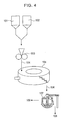
- Fig. 4 is a flow diagram illustrating a step of reducing a chromium-containing raw material in a method for producing a reduced metal by a carbon composite method using upgraded coal for metallurgy according to the present invention
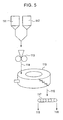
- Fig. 5 is a flow diagram illustrating a step of reducing a chromium-containing raw material in a method for producing a reduced metal by a carbon composite method using upgraded coal for metallurgy according to a further embodiment of the present invention.
- Fig. 7 is a graph showing the relation between the extraction temperature and the extraction rate of coal
- Fig. 8 is a graph showing the relation between the extraction time and the coal extraction rate
- Fig. 9 is a graph showing the relation between the number of repeated uses of a solvent and the coal extraction rate.
- agglomerator 104, 114 ... agglomerate (raw material mixture or mixture), 105, 115, moving hearth furnace, 106 ... reduced agglomerate (reduced mixture), 107 ... melting furnace, 108, 118 ... metal, 109, 119 ... slag, 116 ... reduced solid, 117 ... screen
- Fig. 1 shows an example of a process flow of a method for producing upgraded coal for metallurgy.
- coal (original coal) 1 used as a raw material low-rank coal having no or low thermal plasticity, such as bituminous coal, anthracite coal, sub-bituminous coal, or lignite, can be used.
- the coal 1 and an organic solvent (simply referred to as a "solvent" hereinafter) 2 are mixed in a slurry preparing tank 3 to prepare a raw material slurry 4.
- the raw material slurry 4 is transferred to a heater 7 with a slurry pump 5 and heated therein.
- the heating temperature is 250°C to 400°C and preferably 350°C to 420°C.
- a heat exchanger 6 is preferably provided upstream the heater 7, for pre-heating the raw material slurry 4 using the latent heat of a circulated solvent 16 which will be described below.
- the heated raw material slurry 4 is transferred to an aging tank 8 and aged by keeping at the above-described temperature range.
- the reason for setting the heating temperature (aging temperature) to 250°C to 400°C is the following: At a temperature lower than 250°C, the rate of extraction of the coal 1 in the solvent 2 is decreased. At a temperature over 400°C, the coal deteriorates due to thermal decomposition, and thus the rate of extraction of the coal 1 in the solvent 2 is decreased. Also, thermal decomposition of the coal (extracted coal), which has been extracted, proceeds to accelerate the production of hydrocarbon gases such as methane, ethane, and the like, thereby decreasing the yield of the extracted coal.
- the aging time of the raw material slurry 5 in the aging tank 8 is 5 to 120 minutes and preferably 30 to 80 minutes.
- the pressure in the aging tank 8 is preferably as high as possible for preventing evaporation of the solvent, but a recommended pressure is about 50 to 500 kPa higher than the vapor pressure of the solvent at the aging temperature (heating temperature) because a high pressure brings about an increase in equipment cost. Specifically, the pressure is about 1MPa (0.5 to 1.5 MPa) depending on the coal type and the solvent type.
- the soluble component of the coal 1 in the raw material slurry 4 is dissolved as an extract (extracted coal) in the solvent 2, but the insoluble component remains solid as a residual coal, thereby maintaining a slurry state.
- the treated slurry (referred to as the "extracted slurry" hereinafter) 25 is transferred to a solvent removing apparatus (solvent recovering apparatus) 12 in which the solvent is removed by evaporation to prepare a mixture 32 as a solid mixture containing the extracted coal and the residual coal.
- the extracted slurry 25 possesses temperature and pressure, and thus the solvent is evaporated due to the latent heat under reduced pressure.
- the mixture 32 of the extracted coal and the residual coal remains as a solid because it has no vapor pressure. Therefore, vacuum distillation, spray drying, or the like can be used for the solvent removing apparatus (solvent recovering apparatus) 12.
- the above-described treatment with the solvent causes no thermal plasticity-expressing effect on the residual coal, but the treatment imparts thermal plasticity to the extracted coal due to the thermal plasticity-expressing effect while the original coal (coal) 1 has no thermal plasticity or lower thermal plasticity. Therefore, the mixture 32 of the extracted coal and the residual coal has higher thermal plasticity than that of the original coal 1 and can be used as upgraded coal for metallurgy (simply referred to as an "upgraded coal” hereinafter).
- This embodiment is disadvantageous in that it has limitation to the type of the coal used for obtaining the upgraded coal 32 for metallurgy having a predetermined thermal plasticity.
- the solvent 16 removed by the solvent removing apparatus (solvent recovering apparatus) 12 is preferably recycled.
- the solvent (circulated solvent) 16 can be passed through the heat exchanger 6 to utilize the latent heat of the solvent for preheating the raw material slurry 4 and then recycled as the solvent 2 through a solvent tank 23 and a solvent pump 24.
- the organic solvent 2 used preferably comprises, as a main component, a two ring aromatic compound similar to a coal structural unit and has a boiling point of about 200°C to 300°C because the pressure in the system can be kept at about 1 MPa suitable for extraction, and the solvent 2 can be easily recovered from a liquid after extraction.
- Specific examples of the organic solvent 2 include two ring aromatic compounds such as methylnaphthalene, dimethylnaphthalene, and naphthalene, a mixture mainly containing any of these two ring aromatic compounds, and carbonization oils and petroleums having boiling points in the above-described range.
- the circulated solvent 16 need not be hydrogenated for maintaining the dissolving power of the solvent 2 as long as the solvent 12 selected as descried above is used in treatment at the above-described temperature and pressure. Also, the solvent 16 is not bonded to the extracted coal to permit recovery (removal), and thus the solvent 16 can be repeatedly used without any problem. In addition, a small amount of oil is produced from the coal 1 due to heat treatment in the extraction step.
- the oil mainly comprises a two ring aromatic compound and thus has the effect of supplementing the circulated solvent 16 by the self-produced oil.
- the thermal plasticity-expressing effect cannot be generally expected for the residual coal which is a solvent insoluble component. Therefore, when the mixture of the extracted coal and the residual coal after treatment with the solvent is used directly as upgraded coal for metallurgy as in the above embodiment, the upgraded coal may be not sufficiently suitable for producing a reduced metal by the carbon composite method because the thermal plasticity of the upgraded coal for metallurgy may become insufficient depending on the type of the original coal used. In this case, the extracted coal and the residual coal may be discharged separately, not as a mixture, and then proper amounts of the extracted coal and the residual coal may be mixed so as to have thermal plasticity suitable for producing the reduced metal by the carbon composite method.
- Fig. 2 shows an example of a process flow of a method for producing upgraded coal for metallurgy according to one embodiment of the present invention on the basis of the above-described technical idea.
- description of portions common to the above embodiment is omitted, and only different portions will be described.
- the extracted slurry 25 aged in the aging tank 8 is transferred to a sedimentation tank 9 and then allowed to stand for a predetermined time.
- the residual coal which is a solid, gravitationally sediments at the bottom of the tank.
- the sedimentation time depends on the type of the coal 1, but the sedimentation time is preferably about 30 to 120 minutes. In the sedimentation, a residue sediments in an extract solution of the coal 1 in the solvent 2.
- the extract solution of the coal 1 in the solvent 2 can be easily continuously discharged as a supernatant 26. However, it is generally difficult to continuously discharge only the residual coal as the residue from the bottom of the tank. Therefore, the residual coal is discharged as a residual coal slurry 27 containing the solvent.
- the supernatant 26 and the residual coal slurry 27 are separately discharged, and the solvents thereof are removed by evaporation with separate solvent removing apparatuses (solvent recovering apparatuses) 12 and 13, respectively, to separately recover an extracted coal 14 and a residual coal 17.
- solvent recovering apparatus solvent recovering apparatus
- vacuum distillation, spray drying, or the like can be used for the solvent removing apparatuses (solvent recovering apparatuses) 12 and 13.
- the compounding ratio between the extracted coal 14 and the residual coal 17 separately recovered as described above is controlled to produce upgraded coal 32 for metallurgy having desired thermal plasticity while effectively utilizing the residual coal 17.
- the compounding ratio of the residual coal 17 to the upgraded coal 32 for metallurgy is over 0% by mass and 70% by mass or less, preferably 60% by mass or less.
- the solvents 15 and 16 removed by the solvent removing apparatuses (solvent recovering apparatuses) 12 and 13, respectively, are preferably recycled.
- Fig. 4 shows a step of reducing a chromium-containing raw material used as a metal oxide raw material in a method for producing a reduced metal by the carbon composite method using upgraded coal for metallurgy according to the present invention.
- the metal oxide raw material is not limited to a raw material containing metal oxides of Fe and Cr, and a raw material containing metal oxide of Ni, Mn, and the like may be used.
- the form of the raw material may be any one of an ore, refining dust, and the like.
- the product may be reduced iron, melted iron, melted steel; or iron nuggets.
- reference numeral 101 denotes a chromium-containing raw material (simply referred to as a "raw material” hereinafter) containing chromium oxide and iron oxide; reference numeral 102, upgraded coal for metallurgy; reference numeral 103, an agglomerator; reference numeral 104, agglomerates (mixture); reference numeral 105, a moving hearth furnace; reference numeral 106, reduced agglomerates (reduced mixture); reference numeral 107, a melting furnace; reference numeral 108, a metal; and reference numeral 109, a slag.
- a chromium ore or a residue in a process for producing ferrochromium such as dust, a slag, or the like
- an iron ore or mill scales can be added to adjust the components.
- the raw material 101 contains a large amount of water, the raw material 101 is preferably previously dried. The degree of drying may be determined in view of the mixing means (the agglomerator 103 in this embodiment) used in the subsequent mixing step.
- the grain sizes of the chromium-containing raw material 101 and the upgraded coal 102 for metallurgy are preferably as small as possible because the probability of contact is increased in reduction reaction, as described below. However, when the grain sizes are excessively small, granulation becomes difficult. Therefore, both the chromium-containing raw material 101 and the upgraded coal 102 for metallurgy preferably contain about 75% of grains of 200 mesh or less (75 ⁇ m or less).
- the chromium-containing raw material 101 and the upgraded coal 102 for metallurgy are preferably previously ground according to demand.
- the compounding ratio of the upgraded coal 102 for metallurgy in the agglomerates (mixture) 104 may be determined by the amount of carbon required for reducing chromium oxide and iron oxide in the raw material 101 in the moving hearth furnace 105, the amount of carbon consumed by reduction of the residual chromium oxide in the reduced agglomerates (reduced mixture) 106 in the melting furnace 107, and the amount of carbon to be left in the metal 108.
- reduction of chromium oxide is solid-phase reaction, it is important that the amount of the carbon compounded in the agglomerates (mixture) 104 exceeds the theoretically required amount of carbon, which will be described below, in order to increase the reduction rate of chromium.
- the strength of the agglomerates 104 and the reduced agglomerates 106 is maintained due to the fact that the improved carbon 102 for metallurgy has thermal plasticity and functions as a binder during heating.
- the raw material 101 and the upgraded coal 102 for metallurgy may be mixed using a mixer not shown in the drawing.
- the resultant mixture may be charged directly in the moving hearth furnace 105, but the mixture is preferably agglomerated in the agglomerator 103. This is because agglomeration decreases the amounts of the dust produced in the moving hearth furnace 105 and the melting furnace 107 and improves the efficiency of heat transmission in the agglomerates (mixture) 104 to increase the reduction rate.
- the upgraded coal 102 for metallurgy having high thermal plasticity is used as a carbonaceous material, and the carbonaceous material is fluidized during heating to increase the compactness of grains constituting the agglomerates 104, thereby achieving a high efficiency of heat transmission.
- the agglomerates (mixture) 104 may contain an auxiliary material such as a fluxing agent or the like.
- a compression molding machine such as a briquette press, a tumbling agglomerator such as a disk-type pelletizer, or an extrusion molding machine may be used.
- the agglomerates (mixture) 104 after granulation have a high water content
- the agglomerates 104 may be dried before being charged in the moving hearth furnace 105.
- the agglomerates (mixture) 104 after granulation are charged in the moving hearth furnace 105 and heated by radiation.
- a moving hearth furnace 105 a rotary hearth furnace, a linear furnace, a multistage furnace, or the like can be used.
- the radiation heating can be performed using a combustion burner or the like.
- the agglomerates (mixture) 104 are rapidly heated by radiation heating, and consequently, in the agglomerates (mixture) 104, iron oxide and chromium oxide contained in the chromium-containing raw material 101 are mainly reduced by the fixed carbon contained in the carbonaceous reducing agent (upgraded coal for metallurgy) 102 according to the following reaction formulae (1) and (2) (refer to " Tekko Binran (Handbook of Iron and Steel)" edited by Iron and Steel Institute of Japan, third edition, vol.
- reaction start temperature of formula (1) is 712°C
- reaction start temperature of formula (2) is 1114°C.
- Fe produced by reaction of equation (1) is possibly partially dissolved in Cr 7 O 3 produced according to equation (2) to produce (Cr ⁇ Fe) 7 O 3 .
- the radiation heating is preferably carried out at a mean heating rate of 13.6°C/s or more during the time from the start of the radiation heating of the agglomerates (mixture) 104 to the time when the temperature of the agglomerates (mixture) 104 reaches 1114°C, which is the reduction reaction start temperature of chromium oxide.
- the term "the start of the radiation heating of the agglomerates (mixture) 104" means the time when the agglomerates (mixture) 104 enter a region (radiation heating region) heated by radiation with a combustion burner or the like in the moving hearth furnace 105, excluding the time from the supply of the agglomerates (mixture) 104 onto the furnace hearth to the entrance into the radiation heating region.
- the reason for excluding the time from the supply of the agglomerates (mixture) 104 onto the furnace hearth to the entrance into the radiation heating region is that during this time, the agglomerates (mixture) 104 are mainly heated only by conduction heating from the furnace hearth, and the temperature is not increased to the reduction reaction start temperature of FeO of 712°C because the retention time (passage time) is generally short, thereby causing substantially no consumption of the fixed carbon of the incorporated carbonaceous material by reduction reaction.
- the atmospheric temperature of the region (reduction step) of radiation heating of the agglomerates (mixture) 104 is preferably 1250°C to 1400°C. This is because at a temperature lower than 1250°C, the heating rate of the agglomerates (mixture) 104 to 1114°C tends to become insufficient, while at a temperature over 1400°C, the reduced agglomerates (reduced mixture) 104 soften and easily bond together or adhere to the furnace hearth.
- the retention time of the agglomerates (mixture) 104 in the region (reduction step) of radiation heating is preferably 5.3 to 42.7 min.
- the atmospheric composition of the region of radiation heating (reduction step) of the agglomerates (mixture) 104 may be a reducing atmosphere formed by controlling the air ratio of the combustion burner or blowing a reducing gas into the moving hearth furnace 105.
- the reduced agglomerates (reduced mixture) 106 reduced in the moving hearth furnace 105 are generally cooled to about 1000°C by a radiation cooling plate provided in the moving hearth furnace 105 or a refrigerant spray device and then discharged by a discharge device.
- the above-described theoretically required amount of carbon represents the amount of carbon theoretically required for producing (Cr ⁇ Fe) 7 O 3 through the reaction of iron oxide and chromium oxide contained in the agglomerates (mixture) 104 according to formulae (1) and (2), and defined by the following formula:
- Theoretically required amount of carbon Number of moles of Cr 2 ⁇ O 3 ⁇ 27 / 7 + Number of moles of O bonded to Fe + Number of moles of Fe ⁇ 3 / 7
- an atmosphere conditioning carbonaceous material is charged onto the hearth of the moving hearth furnace 105 together with the agglomerates (mixture) 104.
- the atmosphere conditioning material is particularly preferably charged as a bed before the agglomerates (mixture) 104 are charged onto the furnace hearth.
- the predetermined effect can be obtained.
- the atmosphere conditioning carbonaceous material coal, a waste plastic, a waste tire, or a biomass is preferred.
- the material is charred in the moving hearth furnace 105, and the volatile component becomes a fuel for the moving hearth furnace 105.
- the char component can be used as a reducing agent and/or a heat source of the melting furnace.
- coke, charcoal, petroleum coke, char, or the like can be used.
- Such a material has a low volatile content, and thus the effect of decreasing the fuel consumption in the moving hearth furnace 105 is lower than that of coal.
- the size (grain size) of the atmosphere conditioning material is not particularly limited, but a recommended average grain size is preferably 5 mm or less and more preferably 2 mm or less.
- the thickness of the atmosphere conditioning material supplied onto the furnace hearth is preferably about 1 to 50 mm.
- a hearth protecting material may be supplied for preventing build-up on the hearth.
- the atmosphere conditioning material is preferably charged on the hearth protecting material.
- a material containing a high-melting-point substance is preferred, and a material containing a carbonaceous substance is more preferred.
- the high-melting-point substance an oxide containing alumina and/or magnesia, or a substance containing silicon carbide is recommended.
- the reduced agglomerates (reduced mixture) 106 reduced in the reduction step may be further heated in the moving hearth furnace to agglomerate the reduced metal (Fe and Cr 7 O 3 ) contained in the reduced agglomerates (reduced mixture) 106.
- the heating temperature may be the same as or slightly higher than the temperature in the reduction step so that the reduced metal is not melted, and the heating time may be appropriately controlled according to the heating temperature.
- the reduced metal is agglomerated in the reduced agglomerates (reduced mixture) 106 to increase the grain size of the agglomerates.
- the reduced agglomerates (reduced mixture) 106 discharged from the moving hearth furnace 105 are preferably charged at a high temperature in a melting furnace 107 without being cooled.
- the melting furnace 107 may be connected directly to the discharge part of the moving hearth furnace 105 with a chute or the like, or a conveyance device such as conveyor or a container for storing the agglomerates 106 before charging into the melting furnace 107 may be used.
- the reduced agglomerates (reduced mixture) 106 may be cooled to room temperature and stored or transported as a half-finished product (ferrochromium refining raw material).
- the reduced agglomerates (reduced mixture) 106 may be hot-molded at a high temperature without being cooled, for decreasing the surface area, and the molded product may be cooled and stored or transported as a half-finished product having high resistance to re-oxidation, and then used.
- the melting furnace 107 an electric furnace can be used, but a melting furnace using fossil energy such as coal, heavy oil, natural gas, or the like may also be used.
- a fluxing material or the like is charged in the melting furnace 107, and the reduced agglomerates (reduced mixture) 106 are melted at a high temperature of 1400°C to 1700°C to separate between a metal 108 and a slag 109.
- the metal 108 is used directly as charge chromium or subjected to secondary refining to produce ferrochromium according to demand.
- the compactness of the agglomerates 104 is increased by fluidization of the carbonaceous material during heating, and thus the compactness of the reduced agglomerates 106 is also increased to increase the apparent density. Therefore, the reduced agglomerates 106 can be easily immersed in a melted metal without floating on the melted metal, thereby increasing the melting speed and achieving high productivity.
- Fig. 5 shows a step of reducing a chromium-containing raw material which is a metal oxide-containing raw material in a method for producing a reduced metal by the carbon composite method using an improved carbon for metallurgy according to a further embodiment of the present invention.
- reference numeral 111 denotes a chromium-containing raw material (simply referred to as a "raw material” hereinafter) containing chromium oxide and iron oxide; reference numeral 112, a carbonaceous reducing agent; reference numeral 113, an agglomerator; reference numeral 114, agglomerates (mixture); reference numeral 115, a moving hearth furnace; reference numeral 116, a reduced solid; reference numeral 117, a screen; reference numeral 118, a metal; and reference numeral 119, a slag.
- a chromium-containing raw material (simply referred to as a "raw material” hereinafter) containing chromium oxide and iron oxide
- reference numeral 112 a carbonaceous reducing agent
- reference numeral 113 an agglomerator
- reference numeral 114 agglomerates (mixture)
- reference numeral 115 a moving hearth furnace
- reference numeral 116 a reduced solid
- the raw material 111, the carbonaceous reducing agent 112, the agglomerator 113, and the agglomerates (mixture) 114 are the same as the raw material 101, the carbonaceous reducing agent 102, the agglomerator 103, and the agglomerates (mixture) 104, respectively, in the above embodiment.
- the mixing step is also the same as in the above embodiment, and thus description thereof is omitted.
- the agglomerates (mixture) 114 produced by granulation are charged in the moving hearth furnace 115 and heated by radiation at an atmospheric temperature of 1250°C to 1400°C.
- the mean heating rate of the agglomerates (mixture) 114 by radiation heating may be 13.6°C/s or more from the start of radiation heating of the agglomerates (mixture) 114 to the time when the temperature of the agglomerates 114 (mixture) 114 reaches the reduction reaction start temperature of chromium oxide of 1114°C.
- the retention time of the agglomerates (mixture) 114 is preferably 5.3 to 42.7 min.
- the reduced agglomerates (reduced mixture) are then melted by heating to produce a reduced melt in the moving hearth furnace 115 at an atmospheric temperature of 1350°C to 1700°C, preferably 1350°C to 1650°C, and more preferably 1350°C to 1600°C, higher than the atmospheric temperature (1250°C to 1400°C) in the reduction region.
- the reason for setting the lower limit of the heat melting temperature to 1350°C is that a temperature lower than this temperature easily causes difficulty in melting the reduced agglomerates (reduced mixture).
- the reason for setting the upper limit of the heat melting temperature to 1700°C is that a temperature over this temperature easily causes the problem of heat resistance of the reduction furnace.
- the retention time of the reduced agglomerates (reduced mixture) may be appropriately adjusted in a range of 0.5 to 10 min so that the reduced agglomerates (reduced mixture) are sufficiently melted to separate between a metal and a slag.
- the reason for setting the lower limit of the retention time of the reduced agglomerates (reduced mixture) to 0.5 min is that a retention time shorter than this easily causes insufficient separation between the metal and the slag.
- the reason for setting the upper limit of the retention time to 10 min is that a retention time over this brings about saturation of the degree of separation between the metal and the slag and rather increases the possibility of re-oxidation.
- the upgraded coal for metallurgy having high thermal plasticity is used as a carbonaceous material, and thus the agglomeration property of the metal is increased to promote separation between the metal and the slag, as shown in examples which will be described below.
- reduction and melting may be simultaneously performed by heating in one step at an atmospheric temperature of 1350°C to 1700°C from the start. In this case, the reduced melt can be obtained within a short time.
- the metal and the slag are not necessarily both melted, and only one of the metal and the slag may be melted as long as both can be separated.
- the same atmosphere conditioning material and hearth protecting material as in the fourth embodiment can be used.
- the reduced melt is solidified by cooling to about 100°C in the moving hearth furnace 115 to produce the reduced solid 116.
- the cooling solidification means in the moving hearth furnace 115 the radiation cooling plate or refrigerant spray device described in the above embodiment can be used.
- the reduced solid 116 discharged from the moving hearth furnace 115 may be further cooled by cooling solidification means.
- the cooling solidification means means such as water granulation, indirect water cooling, refrigerant spray, or the like can be used.
- the reduced solid 116 is disintegrated as occasion demands, and then screened with the screen 117 to separate between the metal (coarse ferrochromium) 118 and the slag 119. If required, the metal can be further recovered from the separated slag 119 by means such as magnetic separation, flotation, or the like. If required, the separated metal (coarse ferrochromium) 118 is secondarily refined to produce a ferrochromium product. Alternatively, the metal (course ferrochromium) 118 may be used as a half-finished product (ferrochromium refining raw material), i.e., as a melting raw material for a melting furnace.
- the melting energy for the slag in the melting furnace is not required because the slag has been removed from the metal 118 produced as the half-finished product by the method of this embodiment, and thus the energy consumption of the melting furnace is significantly decreased in comparison with the method of the above embodiment in which the slag remains in the reduced agglomerates produced as a half-finished product. Also, the amount of the slag produced in the melting furnace is significantly decreased to significantly improve the production efficiency of the melting furnace. Furthermore, the metal (coarse ferrochromium) 118 can be used as a raw material for ferrochromium and can be used directly as a raw material for producing a chromium-containing alloy.
- the weight of the half-finished product is decreased due to removal of the slag, and thus the storage and transport coat can be decreased. Therefore, the present invention is preferably carried out in a production place of chromium ores. If required, the metal may be agglomerated for the sake of convenience of storage and transport.
- the metal 118 and the slag 119 are sufficiently separated in the reduction and melting step, and thus the metal can be easily recovered in high yield by a mechanical separation operation in the separation step.
- the atmosphere conditioning material may be recovered and reused or may be charged in the melting furnace together with the metal.
- the hearth protecting material is preferably recovered and reused.
- upgraded coal was obtained from coal 1 only by heat treatment (400°C) in a solvent without separation between extracted coal and residual coal.
- This upgraded coal exhibited the thermal plasticity as shown in Table 4.
- Table 4 indicates that coal without thermal plasticity can be upgraded to coal having thermal plasticity by heat treatment with a solvent without a separation operation. However, it is found that when the coal is separated into extracted coal and residual coat (Test No. 3 in Table 3), the thermal plasticity is more improved as compared with a case (Test No. 4 in Table 4) in which only heat treatment is performed under the same conditions.
- FIG. 7 shows the relation between the extraction temperature and the extraction rate of coal.
- the coal dissolves out at about 200°C, and the extraction rate increases with the temperature.
- the extraction rate conversely decreases at a predetermined temperature or more. This is due to the fact that pyrolysis of the coal vigorously occurs, and the molecules become larger than the initial molecules due to polymerization reaction of pyrolytic molecules or the like. Therefore, heating is preferably performed under appropriate conditions at an optimum temperature for each coal type.
- the results of a test using many types of coal show that the heat treatment temperature is preferably about 350°C to 420°C.
- FIG. 8 shows the relation between the extraction time and the extraction rate of coal. As shown in Fig. 8 , the extraction rate is substantially constant and shows a saturated state with an extraction time of about 40 to 120 minutes regardless of the extraction temperature. However, it is found that at an extraction temperature of as high as 420°C, the adequate extraction time is about 10 minutes.
- Coal 1 was repeatedly extracted using, as an initial solvent, a bicyclic aromatic solvent, 1-methylnaphthalene, which was used in EXAMPLE 1, and the solvent was repeatedly recovered.
- Fig. 9 shows the relation between the number of repeated uses and the extraction rate of coal. Fig. 9 indicates that even when the solvent is repeatedly used, the extraction rate is substantially constant, and thus the bicyclic aromatic solvent can be stably recycled.
- a reduction test simulating production of a reduced metal (reduced iron) by the carbon composite method was carried out.
- An iron ore was used as a metal oxide, and the following three types of carbonaceous materials were used:
- Table 5 shows the crushing strength of the reduced iron obtained by the reduction test. As shown in Table 5, when coal 1 (high-volatile coal) without thermal plasticity is used, the strength of the reduced iron becomes very low (Test No. 1-1), while when coal 1 (high-volatile coal) initially having no thermal plasticity is upgraded by solvent treatment, a soft melting property is exhibited. It is also found that by using such upgraded coal as a carbonaceous material to be incorporated, the strength of reduced iron is significantly improved (Test Nos. 1-2 and 1-3). The yield of the upgraded coal from original coal 1 (high-volatile coal) was 96%, and the degrees of metallization of reduced iron in all tests were about 90%. Table 5 Test No.
- Table 6 shows the ratio of the iron nuggets with a grain size of 0.5 mm or more in the iron nuggets recovered after separation.
- the obtained iron nuggets mainly comprise grains with a grain size of 0.5 mm or less (Test No. 2-1), while when the upgraded coal having thermal plasticity is used, the ratio of grains of 0.5 mm or less is significantly decreased, and the iron nuggets mainly comprise grains of 0.5 mm or more (Test Nos. 2-2 and 2-3).
- Type of carbonaceous material Gieseler maximum thermal plasticity of carbonaceous material log(MFD) Ratio of grains of +0.5 mm in iron nuggets (% by mass) Evaluation Remarks 2-1 High-volatile coal (unupgraded coal) 0 3 Bad Comparative example 2-2 Upgraded coal of high-volatile coal (no separation operation) 0.5 70 Good Example (as reference) 2-3 Upgraded coal of bituminous coal (no separation operation) 4 98 Excellent Example of this invention Table 8 Type of carbonaceous material Coal 1 (high-volatile coal) Coal treated with solvent (no separation) Extracted coal Residual coal Volatile matter content 41.5 36.4 60.4 18.0 Fixed carbon content 46.9 51.3 39.55 60.3 Ash content 11.6 12.3 0.05 21.7 Ash composition % by mass SiO 2 62.4 - - 62.4 Al 2 O 3 25.7 - - 25.7 CaO 0.2 - - 0.2 MgO 0.2 - - 0.2 Fe 2 O 3 8.7 -
- the present invention can provide a method for producing a high-quality reduced metal using upgraded coal for metallurgy obtained by upgrading low rank-coal such as high-volatile coal, which is unsuitable for a conventional carbon composite method, to produce upgraded coal for metallurgy suitable for the carbon composite method.
Landscapes
- Chemical & Material Sciences (AREA)
- Engineering & Computer Science (AREA)
- Organic Chemistry (AREA)
- Manufacturing & Machinery (AREA)
- Materials Engineering (AREA)
- Metallurgy (AREA)
- Chemical Kinetics & Catalysis (AREA)
- General Chemical & Material Sciences (AREA)
- Combustion & Propulsion (AREA)
- Oil, Petroleum & Natural Gas (AREA)
- Manufacture And Refinement Of Metals (AREA)
- Manufacture Of Iron (AREA)
- Solid Fuels And Fuel-Associated Substances (AREA)
- Coke Industry (AREA)
- Production Of Liquid Hydrocarbon Mixture For Refining Petroleum (AREA)
Claims (5)
- Verfahren zur Herstellung eines reduzierten Metalls unter Verwendung qualitätsverbesserter Kohle für die Metallurgie, hergestellt durch Extraktion von Kohle mit einem organischen Lösungsmittel, wobei das Verfahren umfasst:einen Schritt der Verbesserung der Qualität von Kohle, umfassend einen Schritt des Herstellens einer Aufschlämmung des Vermischens der Kohle und des organischen Lösungsmittels, um eine Ausgangsmaterialaufschlämmung herzustellen;einen Extraktionsschritt des Alterns der Ausgangsmaterialaufschlämrüung durch das Erwärmen, um einen löslichen Bestandteil der Kohle in das organische Lösungsmittel bei 0,5 MPa bis 1,5 MPa unter Stickstoffatmosphäre zu extrahieren, um eine extrahierte Aufschlämmung herzustellen;einen Lösungsmittelentfernungsschritt des Entfernens des organischen Lösungsmittels aus der extrahierten Aufschlämmung durch Verdampfung, um qualitätsverbesserte Kohle für die Metallurgie als Feststoff herzustellen,wobei der Lösungsmittelentfernungsschritt einen Sedimentierungsschritt des Sedimentierens eines unlöslichen Bestandteils der Kohle durch Stehenlassen der extrahierten Aufschlämmung, damit sich ein Überstand, enthaltend eine extrahierte Kohle, welcher der extrahierte lösliche Bestandteil ist, und eine zurückbleibende Kohleaufschlämmung, enthaltend eine zurückbleibende Kohle,welche der abgesetzte unlösliche Bestandteil ist, trennen; und einen ersten Lösungsmittelentfernungsschritt des Entfernens des organischen Lösungsmittels von dem Überstand durch Verdampfung umfasst; undeinen Mischungsschritt des Mischens der extrahierten Kohle und der zurückbleibenden Kohle, um die qualitätsverbesserte Kohle für die Metallurgie mit einer höheren thermischen Plastizität als die der Kohle herzustellen;einen Vermengungsschritt des Vermengens der qualitätsverbesserten Kohle für die Metallurgie und eines ein Metalloxid enthaltendes Metalloxidausgangsmaterials, um ein Gemenge herzustellen; undeinen Reduktionsschritt des Reduzierens des Gemenges durch das Erwärmen, um ein reduziertes Metall als ein reduziertes Gemenge herzustellen.
- Verfahren nach Anspruch 1, weiter umfassend:einen Schritt des schrittweisen Erwärmens des reduzierten Gemenges in dem beweglichen Herdofen, um das reduzierte Metall in dem reduzierten Gemenge zu koagulieren.
- Verfahren nach Anspruch 1, weiter umfassend:einen Schmelzschritt des Schmelzens des reduzierten Gemenges durch das Erwärmen in einem Schmelzofen, um ein Metall und eine Schlacke zu trennen; undeinen Rückgewinnungsschritt des Austragens des Metalls nach Ausserhalb des Ofens und des Rückgewinnens des Metalls als das reduzierte Metall.
- Verfahren nach Anspruch 1, weiter umfassend:einen Reduktions- und Schmelzschritt des Reduzierens des Gemenges durch das Erwärmen, um ein reduziertes Gemenge herzustellen, und anschließend des Schmelzens des reduzierten Gemenges durch das weitere Erwärmen, um das reduzierte Metall herzustellen.
- Verfahren nach Anspruch 1, weiter umfassend:einen Reduktions- und Schmelzschritt des Reduzierens des Gemenges durch das Erwärmen in einem Ofen, um ein reduziertes Gemenge herzustellen, undanschließend des Schmelzens des reduzierten Gemenges durch das weitere Erwärmen, um das reduzierte Metall herzustellen;einen Verfestigungsschritt des Verfestigens des reduzierten Metalls durch das Kühlen, um einen reduzierten Feststoff herzustellen; undeinen Trennungs- und Rückgewinnungsschritt des Austragens des reduzierten Feststoffs nach Ausserhalb des Ofens, um ein Metall und eine Schlacke zu trennen und das Metall als das reduzierte Metall zurück zu gewinnen.
Applications Claiming Priority (2)
| Application Number | Priority Date | Filing Date | Title |
|---|---|---|---|
| JP2003105454A JP4295544B2 (ja) | 2003-04-09 | 2003-04-09 | 冶金用改質炭の製造方法、ならびに冶金用改質炭を用いた還元金属および酸化非鉄金属含有スラグの製造方法 |
| EP04717860A EP1616968B1 (de) | 2003-04-09 | 2004-03-05 | Herstellungsverfahren für verbesserte kohle zur verwendung in der metallurgie |
Related Parent Applications (2)
| Application Number | Title | Priority Date | Filing Date |
|---|---|---|---|
| EP04717860.3 Division | 2004-03-05 | ||
| EP04717860A Division EP1616968B1 (de) | 2003-04-09 | 2004-03-05 | Herstellungsverfahren für verbesserte kohle zur verwendung in der metallurgie |
Publications (2)
| Publication Number | Publication Date |
|---|---|
| EP2243845A1 EP2243845A1 (de) | 2010-10-27 |
| EP2243845B1 true EP2243845B1 (de) | 2014-02-26 |
Family
ID=33156880
Family Applications (3)
| Application Number | Title | Priority Date | Filing Date |
|---|---|---|---|
| EP04717860A Expired - Lifetime EP1616968B1 (de) | 2003-04-09 | 2004-03-05 | Herstellungsverfahren für verbesserte kohle zur verwendung in der metallurgie |
| EP10007593.6A Expired - Lifetime EP2243845B1 (de) | 2003-04-09 | 2004-03-05 | Verfahren zur Herstellung von reduziertem Metall mittels nachgebesserter Kohle |
| EP10007592.8A Expired - Lifetime EP2246447B1 (de) | 2003-04-09 | 2004-03-05 | Verfahren zur Herstellung von Schlacke mit oxidiertem Nichteisenmetall mittels veredelter Kohle |
Family Applications Before (1)
| Application Number | Title | Priority Date | Filing Date |
|---|---|---|---|
| EP04717860A Expired - Lifetime EP1616968B1 (de) | 2003-04-09 | 2004-03-05 | Herstellungsverfahren für verbesserte kohle zur verwendung in der metallurgie |
Family Applications After (1)
| Application Number | Title | Priority Date | Filing Date |
|---|---|---|---|
| EP10007592.8A Expired - Lifetime EP2246447B1 (de) | 2003-04-09 | 2004-03-05 | Verfahren zur Herstellung von Schlacke mit oxidiertem Nichteisenmetall mittels veredelter Kohle |
Country Status (10)
| Country | Link |
|---|---|
| US (2) | US7799100B2 (de) |
| EP (3) | EP1616968B1 (de) |
| JP (1) | JP4295544B2 (de) |
| KR (1) | KR100730820B1 (de) |
| CN (3) | CN1771340B (de) |
| AT (1) | ATE510030T1 (de) |
| AU (1) | AU2004227214B2 (de) |
| CA (1) | CA2520070C (de) |
| RU (1) | RU2302450C2 (de) |
| WO (1) | WO2004090175A1 (de) |
Families Citing this family (29)
| Publication number | Priority date | Publication date | Assignee | Title |
|---|---|---|---|---|
| JP4109686B2 (ja) * | 2005-07-19 | 2008-07-02 | 株式会社神戸製鋼所 | コークスの製造方法、及び、銑鉄の製造方法 |
| JP4284314B2 (ja) * | 2005-12-15 | 2009-06-24 | 株式会社神戸製鋼所 | 改質石炭の製造方法 |
| JP4950527B2 (ja) * | 2006-03-15 | 2012-06-13 | 株式会社神戸製鋼所 | コークスの製造方法、及び、銑鉄の製造方法 |
| JP4061351B1 (ja) * | 2006-10-12 | 2008-03-19 | 株式会社神戸製鋼所 | 無灰炭の製造方法 |
| JP5280072B2 (ja) * | 2008-03-10 | 2013-09-04 | 株式会社神戸製鋼所 | コークスの製造方法 |
| JP5384175B2 (ja) * | 2008-04-10 | 2014-01-08 | 株式会社神戸製鋼所 | 粒状金属鉄製造用酸化チタン含有塊成物 |
| WO2011001288A2 (en) | 2009-06-29 | 2011-01-06 | Bairong Li | Metal reduction processes, metallurgical processes and products and apparatus |
| ES2847865T3 (es) * | 2010-05-18 | 2021-08-04 | Tata Steel Ltd | Proceso de fundición directa |
| CN101824503B (zh) * | 2010-05-28 | 2011-07-20 | 攀枝花钢城集团有限公司 | 采用含钒转炉钢渣生产含钒生铁的方法 |
| CN104710999B (zh) * | 2010-09-01 | 2017-06-06 | 杰富意钢铁株式会社 | 煤及粘结材料的软化熔融特性评价方法、以及焦炭的制造方法 |
| CN103108967B (zh) * | 2010-09-15 | 2015-06-17 | 技术资源有限公司 | 直接熔炼方法 |
| JP5657510B2 (ja) * | 2011-12-15 | 2015-01-21 | 株式会社神戸製鋼所 | 無灰炭の製造方法 |
| AU2012359380B2 (en) * | 2011-12-28 | 2015-07-02 | Kabushiki Kaisha Kobe Seiko Sho (Kobe Steel, Ltd.) | Ash-free coal production method |
| CN103998585B (zh) * | 2011-12-28 | 2016-02-10 | 株式会社神户制钢所 | 无灰煤的制造方法 |
| JP5820344B2 (ja) | 2012-07-05 | 2015-11-24 | 株式会社神戸製鋼所 | 還元物の製造方法 |
| US9534275B2 (en) | 2013-03-06 | 2017-01-03 | Midrex Technologies, Inc. | Methods and systems for reducing chromium containing raw material |
| CN103194250B (zh) * | 2013-04-28 | 2014-08-13 | 安徽工业大学 | 一种高硫肥煤改质处理的方法及其在炼焦配煤中的应用 |
| CN113699299B (zh) * | 2013-07-29 | 2023-06-02 | 日本制铁株式会社 | 直接还原用原料、直接还原用原料的制造方法和还原铁的制造方法 |
| CN104138887B (zh) * | 2014-07-24 | 2017-09-19 | 北方民族大学 | 一种固化污酸渣中铬的方法 |
| NO20141486A1 (no) | 2014-12-09 | 2016-06-10 | Elkem As | Energieffektiv integrert fremgangsmåte for fremstilling av metaller eller legeringer |
| JP6424152B2 (ja) * | 2015-11-24 | 2018-11-14 | 株式会社神戸製鋼所 | 炭素繊維製造用原料ピッチの製造方法 |
| JP6644651B2 (ja) * | 2016-07-05 | 2020-02-12 | 株式会社神戸製鋼所 | 劣質炭の改質方法、及びコークスの製造方法、並びに銑鉄の製造方法 |
| US12037264B2 (en) * | 2017-01-20 | 2024-07-16 | Valerie Ann Gamble | Use of basalt to adsorb toxic material |
| CN108865199A (zh) * | 2018-07-11 | 2018-11-23 | 安徽工业大学 | 一种褐煤改质处理的方法及其应用 |
| TWI708850B (zh) * | 2020-03-27 | 2020-11-01 | 金瑲水泥製品股份有限公司 | 未安定化之還原碴的資源化方法 |
| CN112812872A (zh) * | 2021-02-17 | 2021-05-18 | 新疆广汇新能源有限公司 | 一种煤矸石掺烧防结焦处理方法 |
| CN113173686B (zh) * | 2021-04-26 | 2024-06-21 | 徐州无废城市技术研究院有限公司 | 一种油泥综合处理系统及方法 |
| CN113714246B (zh) * | 2021-08-03 | 2022-12-23 | 武汉武锅能源工程有限公司 | 一种垃圾焚烧飞灰处理系统及方法 |
| CN115963134B (zh) * | 2022-12-13 | 2025-10-28 | 龙佰集团股份有限公司 | 一种含钛铁矿物还原后金属化率的计算方法及其应用 |
Family Cites Families (32)
| Publication number | Priority date | Publication date | Assignee | Title |
|---|---|---|---|---|
| US3765868A (en) * | 1971-07-07 | 1973-10-16 | Nl Industries Inc | Method for the selective recovery of metallic iron and titanium oxide values from ilmenites |
| ZA743325B (en) * | 1974-05-24 | 1976-02-25 | South African Coal Oil Gas | Improvements relating to a carbonaceous material |
| KR790001448B1 (ko) * | 1974-07-08 | 1979-10-13 | 허버트 시이 만닝 | 석탄광석의 용제정제에 의한 석탄 처리방법 |
| JPS5155301A (en) * | 1974-11-11 | 1976-05-15 | Nissho Iwai Co Ltd | Hinenketsutan mataha jakunenketsutanyorinenketsutanoseizosuru hoho |
| US4030982A (en) * | 1975-07-10 | 1977-06-21 | Consolidation Coal Company | Process of making formcoke from non-caking or weakly caking coals |
| US3996332A (en) | 1975-12-02 | 1976-12-07 | The United States Of America As Represented By The Secretary Of The Interior | Synthesis of rutile from titaniferous slags |
| US4248669A (en) | 1978-08-21 | 1981-02-03 | Continental Oil Company | Process for making metallurgical coke using fluidizer char |
| JPS5575485A (en) * | 1978-12-05 | 1980-06-06 | Mitsui Cokes Kogyo Kk | Coke production and coke composition |
| JPS5620085A (en) | 1979-07-27 | 1981-02-25 | Nippon Mining Co Ltd | Reforming |
| US4695290A (en) * | 1983-07-26 | 1987-09-22 | Integrated Carbons Corporation | Integrated coal cleaning process with mixed acid regeneration |
| US4617105A (en) * | 1985-09-26 | 1986-10-14 | Air Products And Chemicals, Inc. | Coal liquefaction process using pretreatment with a binary solvent mixture |
| US5066325A (en) * | 1987-08-31 | 1991-11-19 | Northern States Power Company | Cogeneration process for production of energy and iron materials, including steel |
| US5192338A (en) * | 1987-09-03 | 1993-03-09 | Commonwealth Scientific And Industrial Research Organisation | Coal ash modification and reduction |
| IT1223488B (it) * | 1987-12-16 | 1990-09-19 | Eniricerche Spa | Procedimento per la raffinazione del carbone per mezzo di un'agglomerazione selettiva |
| US20010052272A1 (en) * | 1992-08-11 | 2001-12-20 | Schoukens Albert F.S. | Production of high titania slag from ilmenite |
| ZA935072B (en) * | 1992-08-11 | 1994-02-07 | Mintek | The production of high titania slag from ilmenite |
| US5437696A (en) * | 1994-06-22 | 1995-08-01 | Iowa State University Research Foundation, Inc. | Method of removal of sulfur from coal and petroleum products |
| US5601631A (en) | 1995-08-25 | 1997-02-11 | Maumee Research & Engineering Inc. | Process for treating metal oxide fines |
| IL120440A0 (en) | 1996-03-15 | 1997-07-13 | Kobe Steel Ltd | Method and apparatus for making metallic iron |
| JP3480266B2 (ja) * | 1997-09-30 | 2003-12-15 | Jfeスチール株式会社 | 移動型炉床炉の操業方法 |
| JP3396434B2 (ja) | 1998-09-25 | 2003-04-14 | 三菱重工業株式会社 | 還元鉄ペレット製造設備 |
| JP3796680B2 (ja) | 1998-04-01 | 2006-07-12 | テイカ株式会社 | 電磁波吸収材料 |
| JPH11349957A (ja) | 1998-06-08 | 1999-12-21 | Nippon Steel Corp | コークス強度の推定方法 |
| JP2000008047A (ja) * | 1998-06-23 | 2000-01-11 | Nippon Steel Corp | 高炉用コークス製造方法 |
| JP3004265B1 (ja) * | 1998-11-24 | 2000-01-31 | 株式会社神戸製鋼所 | 炭材内装ペレット及び還元鉄製造方法 |
| US6306195B1 (en) * | 2000-03-24 | 2001-10-23 | Council Of Scientific And Industiral Research | Process for the preparation of high grade synthetic rutile and pig iron |
| RU2167952C1 (ru) * | 2000-04-17 | 2001-05-27 | Магнитогорский государственный технический университет им. Г.И. Носова | Способ получения феррохрома из бедных железосодержащих хромовых руд |
| CN1342726A (zh) * | 2000-09-12 | 2002-04-03 | 攀钢集团煤化工公司 | 一种改质煤沥青筑路油的制造方法 |
| JP3553873B2 (ja) * | 2000-12-07 | 2004-08-11 | 株式会社神戸製鋼所 | 還元金属製造用回転式炉床炉及び還元金属の製造方法 |
| JP4669189B2 (ja) | 2001-06-18 | 2011-04-13 | 株式会社神戸製鋼所 | 粒状金属鉄の製法 |
| JP2003055667A (ja) | 2001-08-17 | 2003-02-26 | Sumitomo Metal Ind Ltd | 高炉用コークスの製造方法 |
| JP4153281B2 (ja) * | 2002-10-08 | 2008-09-24 | 株式会社神戸製鋼所 | 酸化チタン含有スラグの製造方法 |
-
2003
- 2003-04-09 JP JP2003105454A patent/JP4295544B2/ja not_active Expired - Lifetime
-
2004
- 2004-03-05 EP EP04717860A patent/EP1616968B1/de not_active Expired - Lifetime
- 2004-03-05 EP EP10007593.6A patent/EP2243845B1/de not_active Expired - Lifetime
- 2004-03-05 RU RU2005134656/02A patent/RU2302450C2/ru not_active IP Right Cessation
- 2004-03-05 WO PCT/JP2004/002922 patent/WO2004090175A1/ja not_active Ceased
- 2004-03-05 US US10/552,465 patent/US7799100B2/en not_active Expired - Fee Related
- 2004-03-05 EP EP10007592.8A patent/EP2246447B1/de not_active Expired - Lifetime
- 2004-03-05 CN CN2004800095025A patent/CN1771340B/zh not_active Expired - Fee Related
- 2004-03-05 AU AU2004227214A patent/AU2004227214B2/en not_active Ceased
- 2004-03-05 AT AT04717860T patent/ATE510030T1/de not_active IP Right Cessation
- 2004-03-05 KR KR1020057019166A patent/KR100730820B1/ko not_active Expired - Fee Related
- 2004-03-05 CN CN2010102790463A patent/CN101935728B/zh not_active Expired - Fee Related
- 2004-03-05 CN CN2010102790158A patent/CN101935727B/zh not_active Expired - Fee Related
- 2004-03-05 CA CA2520070A patent/CA2520070C/en not_active Expired - Fee Related
-
2010
- 2010-07-29 US US12/846,425 patent/US8790420B2/en not_active Expired - Fee Related
Also Published As
| Publication number | Publication date |
|---|---|
| CN101935727B (zh) | 2012-05-09 |
| RU2005134656A (ru) | 2006-03-10 |
| ATE510030T1 (de) | 2011-06-15 |
| JP4295544B2 (ja) | 2009-07-15 |
| US20060278041A1 (en) | 2006-12-14 |
| EP1616968A4 (de) | 2008-03-05 |
| CN101935727A (zh) | 2011-01-05 |
| CN101935728A (zh) | 2011-01-05 |
| CA2520070C (en) | 2010-12-14 |
| CN1771340A (zh) | 2006-05-10 |
| JP2004307714A (ja) | 2004-11-04 |
| AU2004227214A1 (en) | 2004-10-21 |
| EP2246447A1 (de) | 2010-11-03 |
| KR20050120792A (ko) | 2005-12-23 |
| CN101935728B (zh) | 2012-05-09 |
| AU2004227214B2 (en) | 2009-03-05 |
| EP1616968A1 (de) | 2006-01-18 |
| RU2302450C2 (ru) | 2007-07-10 |
| EP2243845A1 (de) | 2010-10-27 |
| WO2004090175A1 (ja) | 2004-10-21 |
| US20100300247A1 (en) | 2010-12-02 |
| EP1616968B1 (de) | 2011-05-18 |
| KR100730820B1 (ko) | 2007-06-20 |
| US8790420B2 (en) | 2014-07-29 |
| US7799100B2 (en) | 2010-09-21 |
| CN1771340B (zh) | 2010-12-22 |
| EP2246447B1 (de) | 2014-02-26 |
| CA2520070A1 (en) | 2004-10-21 |
Similar Documents
| Publication | Publication Date | Title |
|---|---|---|
| EP2243845B1 (de) | Verfahren zur Herstellung von reduziertem Metall mittels nachgebesserter Kohle | |
| US5752993A (en) | Blast furnace fuel from reclaimed carbonaceous materials and related methods | |
| US20080116052A1 (en) | Clean production of coke | |
| US5972066A (en) | Mixed bed iron reduction process | |
| EP1408124B1 (de) | Verfahren zur Herstellung von Einsatzgut für die Produktion von schmelzflüssigem Metall und Verfahren zur Herstellung von schmelzflüssigem Metall | |
| JP4307849B2 (ja) | クロム含有原料の還元方法 | |
| US3642465A (en) | Process for the production of highly prereduced oxide pellets | |
| AU2002304694B2 (en) | Method and installation for utilizing waste products, which contain hydrocarbons and iron oxide, particularly mill scale sludges and coal fines | |
| JP5390977B2 (ja) | 鉄鉱石含有コークス、及び該鉄鉱石含有コークスの製造方法 | |
| JP5491795B2 (ja) | 製鉄原料用塊状成形体の製造方法および鉄鉱石含有コークス | |
| JPH10265788A (ja) | 製鉄ダストを含有する石炭ブリケットの製造方法 | |
| JP2001522405A (ja) | 混合床鉄還元法 |
Legal Events
| Date | Code | Title | Description |
|---|---|---|---|
| PUAI | Public reference made under article 153(3) epc to a published international application that has entered the european phase |
Free format text: ORIGINAL CODE: 0009012 |
|
| AC | Divisional application: reference to earlier application |
Ref document number: 1616968 Country of ref document: EP Kind code of ref document: P |
|
| AK | Designated contracting states |
Kind code of ref document: A1 Designated state(s): AT BE BG CH CY CZ DE DK EE ES FI FR GB GR HU IE IT LI LU MC NL PL PT RO SE SI SK TR |
|
| 17P | Request for examination filed |
Effective date: 20110421 |
|
| 17Q | First examination report despatched |
Effective date: 20120315 |
|
| GRAP | Despatch of communication of intention to grant a patent |
Free format text: ORIGINAL CODE: EPIDOSNIGR1 |
|
| INTG | Intention to grant announced |
Effective date: 20130910 |
|
| GRAS | Grant fee paid |
Free format text: ORIGINAL CODE: EPIDOSNIGR3 |
|
| GRAA | (expected) grant |
Free format text: ORIGINAL CODE: 0009210 |
|
| AC | Divisional application: reference to earlier application |
Ref document number: 1616968 Country of ref document: EP Kind code of ref document: P |
|
| AK | Designated contracting states |
Kind code of ref document: B1 Designated state(s): AT BE BG CH CY CZ DE DK EE ES FI FR GB GR HU IE IT LI LU MC NL PL PT RO SE SI SK TR |
|
| REG | Reference to a national code |
Ref country code: GB Ref legal event code: FG4D |
|
| REG | Reference to a national code |
Ref country code: CH Ref legal event code: EP |
|
| REG | Reference to a national code |
Ref country code: AT Ref legal event code: REF Ref document number: 653655 Country of ref document: AT Kind code of ref document: T Effective date: 20140315 |
|
| REG | Reference to a national code |
Ref country code: IE Ref legal event code: FG4D |
|
| REG | Reference to a national code |
Ref country code: DE Ref legal event code: R096 Ref document number: 602004044476 Country of ref document: DE Effective date: 20140410 |
|
| REG | Reference to a national code |
Ref country code: NL Ref legal event code: VDEP Effective date: 20140226 |
|
| REG | Reference to a national code |
Ref country code: AT Ref legal event code: MK05 Ref document number: 653655 Country of ref document: AT Kind code of ref document: T Effective date: 20140226 |
|
| PG25 | Lapsed in a contracting state [announced via postgrant information from national office to epo] |
Ref country code: CY Free format text: LAPSE BECAUSE OF FAILURE TO SUBMIT A TRANSLATION OF THE DESCRIPTION OR TO PAY THE FEE WITHIN THE PRESCRIBED TIME-LIMIT Effective date: 20140226 Ref country code: PT Free format text: LAPSE BECAUSE OF FAILURE TO SUBMIT A TRANSLATION OF THE DESCRIPTION OR TO PAY THE FEE WITHIN THE PRESCRIBED TIME-LIMIT Effective date: 20140626 Ref country code: SE Free format text: LAPSE BECAUSE OF FAILURE TO SUBMIT A TRANSLATION OF THE DESCRIPTION OR TO PAY THE FEE WITHIN THE PRESCRIBED TIME-LIMIT Effective date: 20140226 Ref country code: AT Free format text: LAPSE BECAUSE OF FAILURE TO SUBMIT A TRANSLATION OF THE DESCRIPTION OR TO PAY THE FEE WITHIN THE PRESCRIBED TIME-LIMIT Effective date: 20140226 Ref country code: NL Free format text: LAPSE BECAUSE OF FAILURE TO SUBMIT A TRANSLATION OF THE DESCRIPTION OR TO PAY THE FEE WITHIN THE PRESCRIBED TIME-LIMIT Effective date: 20140226 Ref country code: FI Free format text: LAPSE BECAUSE OF FAILURE TO SUBMIT A TRANSLATION OF THE DESCRIPTION OR TO PAY THE FEE WITHIN THE PRESCRIBED TIME-LIMIT Effective date: 20140226 |
|
| PG25 | Lapsed in a contracting state [announced via postgrant information from national office to epo] |
Ref country code: BE Free format text: LAPSE BECAUSE OF FAILURE TO SUBMIT A TRANSLATION OF THE DESCRIPTION OR TO PAY THE FEE WITHIN THE PRESCRIBED TIME-LIMIT Effective date: 20140226 |
|
| PG25 | Lapsed in a contracting state [announced via postgrant information from national office to epo] |
Ref country code: DK Free format text: LAPSE BECAUSE OF FAILURE TO SUBMIT A TRANSLATION OF THE DESCRIPTION OR TO PAY THE FEE WITHIN THE PRESCRIBED TIME-LIMIT Effective date: 20140226 Ref country code: RO Free format text: LAPSE BECAUSE OF FAILURE TO SUBMIT A TRANSLATION OF THE DESCRIPTION OR TO PAY THE FEE WITHIN THE PRESCRIBED TIME-LIMIT Effective date: 20140226 Ref country code: EE Free format text: LAPSE BECAUSE OF FAILURE TO SUBMIT A TRANSLATION OF THE DESCRIPTION OR TO PAY THE FEE WITHIN THE PRESCRIBED TIME-LIMIT Effective date: 20140226 Ref country code: CZ Free format text: LAPSE BECAUSE OF FAILURE TO SUBMIT A TRANSLATION OF THE DESCRIPTION OR TO PAY THE FEE WITHIN THE PRESCRIBED TIME-LIMIT Effective date: 20140226 |
|
| REG | Reference to a national code |
Ref country code: CH Ref legal event code: PL |
|
| REG | Reference to a national code |
Ref country code: DE Ref legal event code: R097 Ref document number: 602004044476 Country of ref document: DE |
|
| PG25 | Lapsed in a contracting state [announced via postgrant information from national office to epo] |
Ref country code: PL Free format text: LAPSE BECAUSE OF FAILURE TO SUBMIT A TRANSLATION OF THE DESCRIPTION OR TO PAY THE FEE WITHIN THE PRESCRIBED TIME-LIMIT Effective date: 20140226 Ref country code: ES Free format text: LAPSE BECAUSE OF FAILURE TO SUBMIT A TRANSLATION OF THE DESCRIPTION OR TO PAY THE FEE WITHIN THE PRESCRIBED TIME-LIMIT Effective date: 20140226 Ref country code: SK Free format text: LAPSE BECAUSE OF FAILURE TO SUBMIT A TRANSLATION OF THE DESCRIPTION OR TO PAY THE FEE WITHIN THE PRESCRIBED TIME-LIMIT Effective date: 20140226 Ref country code: MC Free format text: LAPSE BECAUSE OF FAILURE TO SUBMIT A TRANSLATION OF THE DESCRIPTION OR TO PAY THE FEE WITHIN THE PRESCRIBED TIME-LIMIT Effective date: 20140226 |
|
| REG | Reference to a national code |
Ref country code: IE Ref legal event code: MM4A |
|
| PLBE | No opposition filed within time limit |
Free format text: ORIGINAL CODE: 0009261 |
|
| STAA | Information on the status of an ep patent application or granted ep patent |
Free format text: STATUS: NO OPPOSITION FILED WITHIN TIME LIMIT |
|
| GBPC | Gb: european patent ceased through non-payment of renewal fee |
Effective date: 20140526 |
|
| PG25 | Lapsed in a contracting state [announced via postgrant information from national office to epo] |
Ref country code: LI Free format text: LAPSE BECAUSE OF NON-PAYMENT OF DUE FEES Effective date: 20140331 Ref country code: CH Free format text: LAPSE BECAUSE OF NON-PAYMENT OF DUE FEES Effective date: 20140331 Ref country code: IE Free format text: LAPSE BECAUSE OF NON-PAYMENT OF DUE FEES Effective date: 20140305 |
|
| 26N | No opposition filed |
Effective date: 20141127 |
|
| REG | Reference to a national code |
Ref country code: DE Ref legal event code: R097 Ref document number: 602004044476 Country of ref document: DE Effective date: 20141127 |
|
| REG | Reference to a national code |
Ref country code: FR Ref legal event code: ST Effective date: 20150211 |
|
| PG25 | Lapsed in a contracting state [announced via postgrant information from national office to epo] |
Ref country code: IT Free format text: LAPSE BECAUSE OF FAILURE TO SUBMIT A TRANSLATION OF THE DESCRIPTION OR TO PAY THE FEE WITHIN THE PRESCRIBED TIME-LIMIT Effective date: 20140226 |
|
| PGFP | Annual fee paid to national office [announced via postgrant information from national office to epo] |
Ref country code: DE Payment date: 20150224 Year of fee payment: 12 |
|
| PG25 | Lapsed in a contracting state [announced via postgrant information from national office to epo] |
Ref country code: GB Free format text: LAPSE BECAUSE OF NON-PAYMENT OF DUE FEES Effective date: 20140526 Ref country code: FR Free format text: LAPSE BECAUSE OF NON-PAYMENT OF DUE FEES Effective date: 20140428 Ref country code: SI Free format text: LAPSE BECAUSE OF FAILURE TO SUBMIT A TRANSLATION OF THE DESCRIPTION OR TO PAY THE FEE WITHIN THE PRESCRIBED TIME-LIMIT Effective date: 20140226 |
|
| PG25 | Lapsed in a contracting state [announced via postgrant information from national office to epo] |
Ref country code: BG Free format text: LAPSE BECAUSE OF FAILURE TO SUBMIT A TRANSLATION OF THE DESCRIPTION OR TO PAY THE FEE WITHIN THE PRESCRIBED TIME-LIMIT Effective date: 20140226 |
|
| PG25 | Lapsed in a contracting state [announced via postgrant information from national office to epo] |
Ref country code: GR Free format text: LAPSE BECAUSE OF FAILURE TO SUBMIT A TRANSLATION OF THE DESCRIPTION OR TO PAY THE FEE WITHIN THE PRESCRIBED TIME-LIMIT Effective date: 20140527 |
|
| PG25 | Lapsed in a contracting state [announced via postgrant information from national office to epo] |
Ref country code: HU Free format text: LAPSE BECAUSE OF FAILURE TO SUBMIT A TRANSLATION OF THE DESCRIPTION OR TO PAY THE FEE WITHIN THE PRESCRIBED TIME-LIMIT; INVALID AB INITIO Effective date: 20040305 Ref country code: LU Free format text: LAPSE BECAUSE OF NON-PAYMENT OF DUE FEES Effective date: 20140305 Ref country code: TR Free format text: LAPSE BECAUSE OF FAILURE TO SUBMIT A TRANSLATION OF THE DESCRIPTION OR TO PAY THE FEE WITHIN THE PRESCRIBED TIME-LIMIT Effective date: 20140226 |
|
| REG | Reference to a national code |
Ref country code: DE Ref legal event code: R119 Ref document number: 602004044476 Country of ref document: DE |
|
| PG25 | Lapsed in a contracting state [announced via postgrant information from national office to epo] |
Ref country code: DE Free format text: LAPSE BECAUSE OF NON-PAYMENT OF DUE FEES Effective date: 20161001 |