EP2243814A1 - Upgrading light naphtas for increased olefins production - Google Patents
Upgrading light naphtas for increased olefins production Download PDFInfo
- Publication number
- EP2243814A1 EP2243814A1 EP09158607A EP09158607A EP2243814A1 EP 2243814 A1 EP2243814 A1 EP 2243814A1 EP 09158607 A EP09158607 A EP 09158607A EP 09158607 A EP09158607 A EP 09158607A EP 2243814 A1 EP2243814 A1 EP 2243814A1
- Authority
- EP
- European Patent Office
- Prior art keywords
- stream
- sending
- content
- zone
- hydrocarbon stream
- Prior art date
- Legal status (The legal status is an assumption and is not a legal conclusion. Google has not performed a legal analysis and makes no representation as to the accuracy of the status listed.)
- Withdrawn
Links
- 150000001336 alkenes Chemical class 0.000 title description 11
- 238000004519 manufacturing process Methods 0.000 title description 7
- 229930195733 hydrocarbon Natural products 0.000 claims abstract description 97
- 150000002430 hydrocarbons Chemical class 0.000 claims abstract description 97
- 239000004215 Carbon black (E152) Substances 0.000 claims abstract description 76
- 238000006317 isomerization reaction Methods 0.000 claims abstract description 73
- 238000000034 method Methods 0.000 claims abstract description 51
- 238000000926 separation method Methods 0.000 claims abstract description 37
- 238000004230 steam cracking Methods 0.000 claims abstract description 27
- 238000004064 recycling Methods 0.000 claims abstract description 11
- 125000004432 carbon atom Chemical group C* 0.000 claims abstract description 10
- 239000003502 gasoline Substances 0.000 claims abstract description 10
- 238000002156 mixing Methods 0.000 claims abstract description 3
- QWTDNUCVQCZILF-UHFFFAOYSA-N isopentane Chemical compound CCC(C)C QWTDNUCVQCZILF-UHFFFAOYSA-N 0.000 claims description 36
- OFBQJSOFQDEBGM-UHFFFAOYSA-N Pentane Chemical compound CCCCC OFBQJSOFQDEBGM-UHFFFAOYSA-N 0.000 claims description 28
- 239000000203 mixture Substances 0.000 claims description 19
- AFABGHUZZDYHJO-UHFFFAOYSA-N dimethyl butane Natural products CCCC(C)C AFABGHUZZDYHJO-UHFFFAOYSA-N 0.000 claims description 18
- UFHFLCQGNIYNRP-UHFFFAOYSA-N Hydrogen Chemical compound [H][H] UFHFLCQGNIYNRP-UHFFFAOYSA-N 0.000 claims description 13
- 239000001257 hydrogen Substances 0.000 claims description 13
- 229910052739 hydrogen Inorganic materials 0.000 claims description 13
- RGSFGYAAUTVSQA-UHFFFAOYSA-N Cyclopentane Chemical compound C1CCCC1 RGSFGYAAUTVSQA-UHFFFAOYSA-N 0.000 claims description 4
- GNFTZDOKVXKIBK-UHFFFAOYSA-N 3-(2-methoxyethoxy)benzohydrazide Chemical compound COCCOC1=CC=CC(C(=O)NN)=C1 GNFTZDOKVXKIBK-UHFFFAOYSA-N 0.000 claims description 2
- FGUUSXIOTUKUDN-IBGZPJMESA-N C1(=CC=CC=C1)N1C2=C(NC([C@H](C1)NC=1OC(=NN=1)C1=CC=CC=C1)=O)C=CC=C2 Chemical compound C1(=CC=CC=C1)N1C2=C(NC([C@H](C1)NC=1OC(=NN=1)C1=CC=CC=C1)=O)C=CC=C2 FGUUSXIOTUKUDN-IBGZPJMESA-N 0.000 claims description 2
- DMEGYFMYUHOHGS-UHFFFAOYSA-N heptamethylene Natural products C1CCCCCC1 DMEGYFMYUHOHGS-UHFFFAOYSA-N 0.000 claims description 2
- 239000003054 catalyst Substances 0.000 description 24
- 238000001179 sorption measurement Methods 0.000 description 19
- NNPPMTNAJDCUHE-UHFFFAOYSA-N isobutane Chemical compound CC(C)C NNPPMTNAJDCUHE-UHFFFAOYSA-N 0.000 description 16
- 238000011084 recovery Methods 0.000 description 16
- 238000006243 chemical reaction Methods 0.000 description 14
- IJDNQMDRQITEOD-UHFFFAOYSA-N sec-butylidene Natural products CCCC IJDNQMDRQITEOD-UHFFFAOYSA-N 0.000 description 12
- PNEYBMLMFCGWSK-UHFFFAOYSA-N aluminium oxide Inorganic materials [O-2].[O-2].[O-2].[Al+3].[Al+3] PNEYBMLMFCGWSK-UHFFFAOYSA-N 0.000 description 10
- 239000003463 adsorbent Substances 0.000 description 9
- HNPSIPDUKPIQMN-UHFFFAOYSA-N dioxosilane;oxo(oxoalumanyloxy)alumane Chemical compound O=[Si]=O.O=[Al]O[Al]=O HNPSIPDUKPIQMN-UHFFFAOYSA-N 0.000 description 8
- 239000001282 iso-butane Substances 0.000 description 8
- 238000004088 simulation Methods 0.000 description 8
- 238000010926 purge Methods 0.000 description 7
- KAKZBPTYRLMSJV-UHFFFAOYSA-N Butadiene Chemical compound C=CC=C KAKZBPTYRLMSJV-UHFFFAOYSA-N 0.000 description 6
- VQTUBCCKSQIDNK-UHFFFAOYSA-N Isobutene Chemical compound CC(C)=C VQTUBCCKSQIDNK-UHFFFAOYSA-N 0.000 description 6
- 229910021536 Zeolite Inorganic materials 0.000 description 6
- 238000005984 hydrogenation reaction Methods 0.000 description 6
- 229910052751 metal Inorganic materials 0.000 description 6
- 239000002184 metal Substances 0.000 description 6
- BASFCYQUMIYNBI-UHFFFAOYSA-N platinum Chemical compound [Pt] BASFCYQUMIYNBI-UHFFFAOYSA-N 0.000 description 6
- 239000010457 zeolite Substances 0.000 description 6
- NINIDFKCEFEMDL-UHFFFAOYSA-N Sulfur Chemical compound [S] NINIDFKCEFEMDL-UHFFFAOYSA-N 0.000 description 5
- 229910052809 inorganic oxide Inorganic materials 0.000 description 5
- 239000012188 paraffin wax Substances 0.000 description 5
- 229910052717 sulfur Inorganic materials 0.000 description 5
- 239000011593 sulfur Substances 0.000 description 5
- VGGSQFUCUMXWEO-UHFFFAOYSA-N Ethene Chemical compound C=C VGGSQFUCUMXWEO-UHFFFAOYSA-N 0.000 description 4
- 239000005977 Ethylene Substances 0.000 description 4
- JRZJOMJEPLMPRA-UHFFFAOYSA-N olefin Natural products CCCCCCCC=C JRZJOMJEPLMPRA-UHFFFAOYSA-N 0.000 description 4
- 238000007142 ring opening reaction Methods 0.000 description 4
- VZGDMQKNWNREIO-UHFFFAOYSA-N tetrachloromethane Chemical compound ClC(Cl)(Cl)Cl VZGDMQKNWNREIO-UHFFFAOYSA-N 0.000 description 4
- XLYOFNOQVPJJNP-UHFFFAOYSA-N water Substances O XLYOFNOQVPJJNP-UHFFFAOYSA-N 0.000 description 4
- 230000015572 biosynthetic process Effects 0.000 description 3
- 238000003795 desorption Methods 0.000 description 3
- 150000002739 metals Chemical class 0.000 description 3
- 229910052697 platinum Inorganic materials 0.000 description 3
- 239000000047 product Substances 0.000 description 3
- 125000000383 tetramethylene group Chemical group [H]C([H])([*:1])C([H])([H])C([H])([H])C([H])([H])[*:2] 0.000 description 3
- WWUVJRULCWHUSA-UHFFFAOYSA-N 2-methyl-1-pentene Chemical compound CCCC(C)=C WWUVJRULCWHUSA-UHFFFAOYSA-N 0.000 description 2
- XKRFYHLGVUSROY-UHFFFAOYSA-N Argon Chemical compound [Ar] XKRFYHLGVUSROY-UHFFFAOYSA-N 0.000 description 2
- IJGRMHOSHXDMSA-UHFFFAOYSA-N Atomic nitrogen Chemical compound N#N IJGRMHOSHXDMSA-UHFFFAOYSA-N 0.000 description 2
- VEXZGXHMUGYJMC-UHFFFAOYSA-M Chloride anion Chemical compound [Cl-] VEXZGXHMUGYJMC-UHFFFAOYSA-M 0.000 description 2
- XEEYBQQBJWHFJM-UHFFFAOYSA-N Iron Chemical compound [Fe] XEEYBQQBJWHFJM-UHFFFAOYSA-N 0.000 description 2
- PXHVJJICTQNCMI-UHFFFAOYSA-N Nickel Chemical compound [Ni] PXHVJJICTQNCMI-UHFFFAOYSA-N 0.000 description 2
- 230000000274 adsorptive effect Effects 0.000 description 2
- 229910000323 aluminium silicate Inorganic materials 0.000 description 2
- VSCWAEJMTAWNJL-UHFFFAOYSA-K aluminium trichloride Chemical compound Cl[Al](Cl)Cl VSCWAEJMTAWNJL-UHFFFAOYSA-K 0.000 description 2
- 238000005336 cracking Methods 0.000 description 2
- 230000002349 favourable effect Effects 0.000 description 2
- 238000005194 fractionation Methods 0.000 description 2
- 239000007789 gas Substances 0.000 description 2
- 239000007791 liquid phase Substances 0.000 description 2
- VLKZOEOYAKHREP-UHFFFAOYSA-N n-Hexane Chemical compound CCCCCC VLKZOEOYAKHREP-UHFFFAOYSA-N 0.000 description 2
- 229910000510 noble metal Inorganic materials 0.000 description 2
- 239000002245 particle Substances 0.000 description 2
- 239000012071 phase Substances 0.000 description 2
- 239000000376 reactant Substances 0.000 description 2
- VXNZUUAINFGPBY-UHFFFAOYSA-N 1-Butene Chemical compound CCC=C VXNZUUAINFGPBY-UHFFFAOYSA-N 0.000 description 1
- PKXHXOTZMFCXSH-UHFFFAOYSA-N 3,3-dimethylbut-1-ene Chemical compound CC(C)(C)C=C PKXHXOTZMFCXSH-UHFFFAOYSA-N 0.000 description 1
- 238000005727 Friedel-Crafts reaction Methods 0.000 description 1
- GYHNNYVSQQEPJS-UHFFFAOYSA-N Gallium Chemical compound [Ga] GYHNNYVSQQEPJS-UHFFFAOYSA-N 0.000 description 1
- CYTYCFOTNPOANT-UHFFFAOYSA-N Perchloroethylene Chemical compound ClC(Cl)=C(Cl)Cl CYTYCFOTNPOANT-UHFFFAOYSA-N 0.000 description 1
- 150000001335 aliphatic alkanes Chemical class 0.000 description 1
- 238000004458 analytical method Methods 0.000 description 1
- 229910052786 argon Inorganic materials 0.000 description 1
- 239000011230 binding agent Substances 0.000 description 1
- IAQRGUVFOMOMEM-UHFFFAOYSA-N butene Natural products CC=CC IAQRGUVFOMOMEM-UHFFFAOYSA-N 0.000 description 1
- 239000006227 byproduct Substances 0.000 description 1
- 239000012876 carrier material Substances 0.000 description 1
- 230000003197 catalytic effect Effects 0.000 description 1
- 229910017052 cobalt Inorganic materials 0.000 description 1
- 239000010941 cobalt Substances 0.000 description 1
- GUTLYIVDDKVIGB-UHFFFAOYSA-N cobalt atom Chemical compound [Co] GUTLYIVDDKVIGB-UHFFFAOYSA-N 0.000 description 1
- 150000001875 compounds Chemical class 0.000 description 1
- 238000001816 cooling Methods 0.000 description 1
- 230000009849 deactivation Effects 0.000 description 1
- 239000003085 diluting agent Substances 0.000 description 1
- 230000000694 effects Effects 0.000 description 1
- 239000002737 fuel gas Substances 0.000 description 1
- 229910052733 gallium Inorganic materials 0.000 description 1
- 229910052736 halogen Inorganic materials 0.000 description 1
- 150000002367 halogens Chemical class 0.000 description 1
- 238000010438 heat treatment Methods 0.000 description 1
- 229910052738 indium Inorganic materials 0.000 description 1
- APFVFJFRJDLVQX-UHFFFAOYSA-N indium atom Chemical compound [In] APFVFJFRJDLVQX-UHFFFAOYSA-N 0.000 description 1
- 238000003780 insertion Methods 0.000 description 1
- 230000037431 insertion Effects 0.000 description 1
- 229910052742 iron Inorganic materials 0.000 description 1
- 239000007788 liquid Substances 0.000 description 1
- 230000014759 maintenance of location Effects 0.000 description 1
- 239000000463 material Substances 0.000 description 1
- 229910001507 metal halide Inorganic materials 0.000 description 1
- 150000005309 metal halides Chemical class 0.000 description 1
- 239000002808 molecular sieve Substances 0.000 description 1
- 229910052680 mordenite Inorganic materials 0.000 description 1
- 229910052759 nickel Inorganic materials 0.000 description 1
- 229910052757 nitrogen Inorganic materials 0.000 description 1
- 239000002574 poison Substances 0.000 description 1
- 231100000614 poison Toxicity 0.000 description 1
- 231100000572 poisoning Toxicity 0.000 description 1
- 230000000607 poisoning effect Effects 0.000 description 1
- 238000002360 preparation method Methods 0.000 description 1
- 229910052702 rhenium Inorganic materials 0.000 description 1
- WUAPFZMCVAUBPE-UHFFFAOYSA-N rhenium atom Chemical compound [Re] WUAPFZMCVAUBPE-UHFFFAOYSA-N 0.000 description 1
- URGAHOPLAPQHLN-UHFFFAOYSA-N sodium aluminosilicate Chemical compound [Na+].[Al+3].[O-][Si]([O-])=O.[O-][Si]([O-])=O URGAHOPLAPQHLN-UHFFFAOYSA-N 0.000 description 1
- 150000003464 sulfur compounds Chemical class 0.000 description 1
- 230000001131 transforming effect Effects 0.000 description 1
Images




Classifications
-
- C—CHEMISTRY; METALLURGY
- C10—PETROLEUM, GAS OR COKE INDUSTRIES; TECHNICAL GASES CONTAINING CARBON MONOXIDE; FUELS; LUBRICANTS; PEAT
- C10G—CRACKING HYDROCARBON OILS; PRODUCTION OF LIQUID HYDROCARBON MIXTURES, e.g. BY DESTRUCTIVE HYDROGENATION, OLIGOMERISATION, POLYMERISATION; RECOVERY OF HYDROCARBON OILS FROM OIL-SHALE, OIL-SAND, OR GASES; REFINING MIXTURES MAINLY CONSISTING OF HYDROCARBONS; REFORMING OF NAPHTHA; MINERAL WAXES
- C10G9/00—Thermal non-catalytic cracking, in the absence of hydrogen, of hydrocarbon oils
-
- C—CHEMISTRY; METALLURGY
- C10—PETROLEUM, GAS OR COKE INDUSTRIES; TECHNICAL GASES CONTAINING CARBON MONOXIDE; FUELS; LUBRICANTS; PEAT
- C10G—CRACKING HYDROCARBON OILS; PRODUCTION OF LIQUID HYDROCARBON MIXTURES, e.g. BY DESTRUCTIVE HYDROGENATION, OLIGOMERISATION, POLYMERISATION; RECOVERY OF HYDROCARBON OILS FROM OIL-SHALE, OIL-SAND, OR GASES; REFINING MIXTURES MAINLY CONSISTING OF HYDROCARBONS; REFORMING OF NAPHTHA; MINERAL WAXES
- C10G45/00—Refining of hydrocarbon oils using hydrogen or hydrogen-generating compounds
- C10G45/58—Refining of hydrocarbon oils using hydrogen or hydrogen-generating compounds to change the structural skeleton of some of the hydrocarbon content without cracking the other hydrocarbons present, e.g. lowering pour point; Selective hydrocracking of normal paraffins
-
- C—CHEMISTRY; METALLURGY
- C10—PETROLEUM, GAS OR COKE INDUSTRIES; TECHNICAL GASES CONTAINING CARBON MONOXIDE; FUELS; LUBRICANTS; PEAT
- C10G—CRACKING HYDROCARBON OILS; PRODUCTION OF LIQUID HYDROCARBON MIXTURES, e.g. BY DESTRUCTIVE HYDROGENATION, OLIGOMERISATION, POLYMERISATION; RECOVERY OF HYDROCARBON OILS FROM OIL-SHALE, OIL-SAND, OR GASES; REFINING MIXTURES MAINLY CONSISTING OF HYDROCARBONS; REFORMING OF NAPHTHA; MINERAL WAXES
- C10G45/00—Refining of hydrocarbon oils using hydrogen or hydrogen-generating compounds
- C10G45/58—Refining of hydrocarbon oils using hydrogen or hydrogen-generating compounds to change the structural skeleton of some of the hydrocarbon content without cracking the other hydrocarbons present, e.g. lowering pour point; Selective hydrocracking of normal paraffins
- C10G45/60—Refining of hydrocarbon oils using hydrogen or hydrogen-generating compounds to change the structural skeleton of some of the hydrocarbon content without cracking the other hydrocarbons present, e.g. lowering pour point; Selective hydrocracking of normal paraffins characterised by the catalyst used
- C10G45/62—Refining of hydrocarbon oils using hydrogen or hydrogen-generating compounds to change the structural skeleton of some of the hydrocarbon content without cracking the other hydrocarbons present, e.g. lowering pour point; Selective hydrocracking of normal paraffins characterised by the catalyst used containing platinum group metals or compounds thereof
-
- C—CHEMISTRY; METALLURGY
- C10—PETROLEUM, GAS OR COKE INDUSTRIES; TECHNICAL GASES CONTAINING CARBON MONOXIDE; FUELS; LUBRICANTS; PEAT
- C10G—CRACKING HYDROCARBON OILS; PRODUCTION OF LIQUID HYDROCARBON MIXTURES, e.g. BY DESTRUCTIVE HYDROGENATION, OLIGOMERISATION, POLYMERISATION; RECOVERY OF HYDROCARBON OILS FROM OIL-SHALE, OIL-SAND, OR GASES; REFINING MIXTURES MAINLY CONSISTING OF HYDROCARBONS; REFORMING OF NAPHTHA; MINERAL WAXES
- C10G45/00—Refining of hydrocarbon oils using hydrogen or hydrogen-generating compounds
- C10G45/58—Refining of hydrocarbon oils using hydrogen or hydrogen-generating compounds to change the structural skeleton of some of the hydrocarbon content without cracking the other hydrocarbons present, e.g. lowering pour point; Selective hydrocracking of normal paraffins
- C10G45/60—Refining of hydrocarbon oils using hydrogen or hydrogen-generating compounds to change the structural skeleton of some of the hydrocarbon content without cracking the other hydrocarbons present, e.g. lowering pour point; Selective hydrocracking of normal paraffins characterised by the catalyst used
- C10G45/64—Refining of hydrocarbon oils using hydrogen or hydrogen-generating compounds to change the structural skeleton of some of the hydrocarbon content without cracking the other hydrocarbons present, e.g. lowering pour point; Selective hydrocracking of normal paraffins characterised by the catalyst used containing crystalline alumino-silicates, e.g. molecular sieves
-
- C—CHEMISTRY; METALLURGY
- C10—PETROLEUM, GAS OR COKE INDUSTRIES; TECHNICAL GASES CONTAINING CARBON MONOXIDE; FUELS; LUBRICANTS; PEAT
- C10G—CRACKING HYDROCARBON OILS; PRODUCTION OF LIQUID HYDROCARBON MIXTURES, e.g. BY DESTRUCTIVE HYDROGENATION, OLIGOMERISATION, POLYMERISATION; RECOVERY OF HYDROCARBON OILS FROM OIL-SHALE, OIL-SAND, OR GASES; REFINING MIXTURES MAINLY CONSISTING OF HYDROCARBONS; REFORMING OF NAPHTHA; MINERAL WAXES
- C10G69/00—Treatment of hydrocarbon oils by at least one hydrotreatment process and at least one other conversion process
- C10G69/02—Treatment of hydrocarbon oils by at least one hydrotreatment process and at least one other conversion process plural serial stages only
- C10G69/06—Treatment of hydrocarbon oils by at least one hydrotreatment process and at least one other conversion process plural serial stages only including at least one step of thermal cracking in the absence of hydrogen
-
- C—CHEMISTRY; METALLURGY
- C10—PETROLEUM, GAS OR COKE INDUSTRIES; TECHNICAL GASES CONTAINING CARBON MONOXIDE; FUELS; LUBRICANTS; PEAT
- C10G—CRACKING HYDROCARBON OILS; PRODUCTION OF LIQUID HYDROCARBON MIXTURES, e.g. BY DESTRUCTIVE HYDROGENATION, OLIGOMERISATION, POLYMERISATION; RECOVERY OF HYDROCARBON OILS FROM OIL-SHALE, OIL-SAND, OR GASES; REFINING MIXTURES MAINLY CONSISTING OF HYDROCARBONS; REFORMING OF NAPHTHA; MINERAL WAXES
- C10G69/00—Treatment of hydrocarbon oils by at least one hydrotreatment process and at least one other conversion process
- C10G69/14—Treatment of hydrocarbon oils by at least one hydrotreatment process and at least one other conversion process plural parallel stages only
-
- C—CHEMISTRY; METALLURGY
- C10—PETROLEUM, GAS OR COKE INDUSTRIES; TECHNICAL GASES CONTAINING CARBON MONOXIDE; FUELS; LUBRICANTS; PEAT
- C10G—CRACKING HYDROCARBON OILS; PRODUCTION OF LIQUID HYDROCARBON MIXTURES, e.g. BY DESTRUCTIVE HYDROGENATION, OLIGOMERISATION, POLYMERISATION; RECOVERY OF HYDROCARBON OILS FROM OIL-SHALE, OIL-SAND, OR GASES; REFINING MIXTURES MAINLY CONSISTING OF HYDROCARBONS; REFORMING OF NAPHTHA; MINERAL WAXES
- C10G2300/00—Aspects relating to hydrocarbon processing covered by groups C10G1/00 - C10G99/00
- C10G2300/10—Feedstock materials
- C10G2300/1037—Hydrocarbon fractions
- C10G2300/1044—Heavy gasoline or naphtha having a boiling range of about 100 - 180 °C
-
- C—CHEMISTRY; METALLURGY
- C10—PETROLEUM, GAS OR COKE INDUSTRIES; TECHNICAL GASES CONTAINING CARBON MONOXIDE; FUELS; LUBRICANTS; PEAT
- C10G—CRACKING HYDROCARBON OILS; PRODUCTION OF LIQUID HYDROCARBON MIXTURES, e.g. BY DESTRUCTIVE HYDROGENATION, OLIGOMERISATION, POLYMERISATION; RECOVERY OF HYDROCARBON OILS FROM OIL-SHALE, OIL-SAND, OR GASES; REFINING MIXTURES MAINLY CONSISTING OF HYDROCARBONS; REFORMING OF NAPHTHA; MINERAL WAXES
- C10G2300/00—Aspects relating to hydrocarbon processing covered by groups C10G1/00 - C10G99/00
- C10G2300/40—Characteristics of the process deviating from typical ways of processing
- C10G2300/4081—Recycling aspects
-
- C—CHEMISTRY; METALLURGY
- C10—PETROLEUM, GAS OR COKE INDUSTRIES; TECHNICAL GASES CONTAINING CARBON MONOXIDE; FUELS; LUBRICANTS; PEAT
- C10G—CRACKING HYDROCARBON OILS; PRODUCTION OF LIQUID HYDROCARBON MIXTURES, e.g. BY DESTRUCTIVE HYDROGENATION, OLIGOMERISATION, POLYMERISATION; RECOVERY OF HYDROCARBON OILS FROM OIL-SHALE, OIL-SAND, OR GASES; REFINING MIXTURES MAINLY CONSISTING OF HYDROCARBONS; REFORMING OF NAPHTHA; MINERAL WAXES
- C10G2300/00—Aspects relating to hydrocarbon processing covered by groups C10G1/00 - C10G99/00
- C10G2300/80—Additives
- C10G2300/805—Water
- C10G2300/807—Steam
-
- C—CHEMISTRY; METALLURGY
- C10—PETROLEUM, GAS OR COKE INDUSTRIES; TECHNICAL GASES CONTAINING CARBON MONOXIDE; FUELS; LUBRICANTS; PEAT
- C10G—CRACKING HYDROCARBON OILS; PRODUCTION OF LIQUID HYDROCARBON MIXTURES, e.g. BY DESTRUCTIVE HYDROGENATION, OLIGOMERISATION, POLYMERISATION; RECOVERY OF HYDROCARBON OILS FROM OIL-SHALE, OIL-SAND, OR GASES; REFINING MIXTURES MAINLY CONSISTING OF HYDROCARBONS; REFORMING OF NAPHTHA; MINERAL WAXES
- C10G2400/00—Products obtained by processes covered by groups C10G9/00 - C10G69/14
- C10G2400/20—C2-C4 olefins
Definitions
- the present invention relates to the upgrading of light naphthas for increased olefins production.
- Light naphthas are becoming widely available as feedstocks for steam crackers due to the difficulties in its valorization as components of the gasoline pool in refineries.
- the quality of these naphthas as feeds to steam crackers could be improved by increasing the amount of normal paraffins at the expense of iso-paraffins, which would increase the yield of ethylene while reducing yields of fuel gas, C4s and pygas.
- the isomerization reaction between normal and iso-paraffins is essentially limited by thermodynamic equilibrium. This has led to consider whether it would be feasible to operate the refinery isomerization units driving the reaction in a reverse mode, namely transforming iso-paraffins into normal paraffins.
- GB 2 018 815 A1 describes a process for converting unsaturated C4 hydrocarbons into normal butane and more particularly to the conversion of normal butenes and isobutene into normal butane.
- the normal butane can thereafter be either recovered, or advantageously, recycled to the ethylene process as a premium cracking feedstock to increase the overall yield of ethylene.
- the feed stream of normal butenes and isobutene is obtained from unsaturated C4 hydrocarbons generated in the recovery zone of a conventional ethylene production facility.
- the crude unsaturated C4 hydrocarbon by-product stream separated in the recovery zone of a naphtha steam cracker is usually directed to a butadiene recovery facility where high purity 1,3-butadiene is separated from the remaining C4 hydrocarbons.
- the remaining C4 hydrocarbons are withdrawn from the butadiene recovery facility primarily as a mixture known in the art as "butene raffinate.” This mixture is generally comprised of normal butenes and isobutene.
- the process comprises passing a stream of unsaturated C4 hydrocarbons in contact with hydrogen through a hydrogenation zone to react the hydrogen and the unsaturated C4 hydrocarbons to form normal butane and isobutane.
- the normal butane and isobutane are discharged from the hydrogenation zone and are introduced into a separation zone to separate the normal butane from the isobutane.
- the normal butane is discharged and recovered from the separation zone.
- the isobutane from the separation zone is passed into an isomerization zone to convert a portion of the isobutane into normal butane to form a stream of normal butane and isobutane.
- the normal butane and isobutane stream formed in the isomerization zone is withdrawn from the isomerization zone. This stream can thereafter be directed to the same separation zone which separates the normal butane and isobutane introduced from the hydrogenation zone to recover additional amounts of normal butane.
- US 5019661 provides a single-stage process for the shape-selective hydroisomerization of a branched olefin of at least 4 carbon atoms to produce a less branched paraffin product, said process comprising contacting said olefin and a hydrogen-containing gas with a zeolite or zeolite-like catalyst containing at least one metal of Group VIII and in which a major portion of said at least one of these metals is supported within the molecular channels and cavities of the said catalyst, said process being conducted under conditions such that hydroisomerization predominates over both simple hydrogenation and cracking.
- olefinic feedstocks may be hydroisomerised to paraffinic feedstocks and specific catalysts therefor.
- 2-methylpent-1-ene or 3,3-dimethylbut-1-ene may be hydroisomerised to a product containing large amounts of n-hexane.
- US 2005 101814 relates to a process for the production of light olefins from a naphtha feed stream.
- the naphtha is sent to an adsorptive separation unit which produces a first process stream comprising primarily n-paraffins, and a second process stream comprising non-normal hydrocarbons.
- the second process stream is processed through a ring opening reactor that hydrogenates and converts the aromatics and naphthenes to paraffins.
- the paraffins from the adsorptive separation unit and from the hydrogenation ring opening reactor are then passed through a steam cracking unit to produce light olefins. This process increases the yield of light olefins from a naphtha feedstream.
- the process may optionally include the passing of a py-gas stream generated in the steam cracking unit to the ring opening reactor to further increase the light olefin production.
- the paraffins from the hydrogenation ring opening reactor are then passed through an isomerization unit for the conversion of a portion of the iso-paraffins to normal paraffins, and the resulting mixture is recycled to the adsorption unit.
- the isomerization unit increases light olefin production by increasing the amount of normal paraffins recovered from the naphtha feed stream. This process concerns only the treatment of the conventional naphtha feedstock to be used in a steam cracker.
- the present invention relates to the use of an existing isomerization zone of an oil refinery to increase the normal paraffins content of a light naphtha which is further cracked in a steam cracking unit to produce olefins.
- the present invention is a process to upgrade light naphthas comprising branched paraffins and their use as a feedstock in a steam cracking unit, said light naphthas consisting essentially of 90 to 100% by weight of hydrocarbons having at least 5 and up to 8 carbon atoms, said process comprising,
- the present invention is a process to upgrade light naphthas comprising branched paraffins and their use as a feedstock in a steam cracking unit, said light naphthas consisting essentially of 90 to 100% by weight of hydrocarbons having at least 5 and up to 8 carbon atoms, said process comprising,
- the present invention is a process to upgrade light naphthas comprising branched paraffins and their use as a feedstock in a steam cracking unit, said light naphthas consisting essentially of 90 to 100% by weight of hydrocarbons having at least 5 and up to 8 carbon atoms, said process comprising,
- the present invention is a process to upgrade light naphthas comprising branched paraffins and their use as a feedstock in a steam cracking unit, said light naphthas consisting essentially of 90 to 100% by weight of hydrocarbons having at least 5 and up to 8 carbon atoms, said process comprising,
- the fourth embodiment is of particular interest when the light naphtha to be upgraded is a C5 cut comprising, the total being 100w%, 0 to 10 % of C7+, 0 to 10% of C4, 80 to 100% of C5, advantageously said C5 is essentially a mixture of iC5 and nC5.
- the isomerization zone operates in the presence of hydrogen.
- the light naphtha to be upgraded can be a C5 cut comprising, the total being 100w%, 100 to 95% of a mixture of pentane and isopentane and 0 to 5% of cyclopentane.
- the light naphtha to be upgraded can be a C5/C6 cut comprising, the total being 100w%, 0 to 10 % of C7+, 0 to 10% of C4, 80 to 100% of a mixture of normal and branched C5 and C6.
- the light naphtha to be upgraded can be a C5/C6 cut comprising, the total being 100w%, 0 to 10 % of C7+, 0 to 10% of C4, 20 to 60% of a mixture of normal and branched C5, 20 to 60% of a mixture of normal and branched C6.
- Figure 1 shows the equilibrium between the C5 and C6 normal and branched paraffins as function of the reaction temperature. It can be seen that the formation of iso-paraffins is more favorable at higher temperatures although in the considered range it is always found a larger proportion of iso-paraffins. Equilibrium is more favorable for the production of n-C5 than n-C6. The figure also indicates that at higher temperatures other catalytic concepts could be used. It appears clearly from Figure 1 that high reaction temperatures should be preferred for driving the reverse reaction towards n-paraffins and at those conditions a zeolite catalyst could be more advisable. However since existing isomerization units in refineries were designed mainly at low temperature, this case could be also interesting as a minimum investing option.
- Any catalyst known in the art to be suitable for the isomerization of paraffin-rich hydrocarbon streams may be used as an isomerization catalyst in the isomerization zone.
- One suitable isomerization catalyst comprises a platinum-group metal, hydrogen-form crystalline aluminosilicate zeolite and a refractory inorganic oxide, and the composition preferably has a surface area of at least 580 m2 /g.
- the preferred noble metal is platinum, which is present in an amount of from about 0.01 to 5 mass % of the composition, and optimally from about 0.15 to 0.5 mass %.
- Catalytically effective amounts of one or more promoter metals preferably selected from Groups VIB(6), VIII(8-10), IB(11), IIB(12), IVA(14), rhenium, iron, cobalt, nickel, gallium and indium also may be present.
- the crystalline aluminosilicate zeolite may be synthetic or naturally occurring, and preferably is selected from the group consisting of FAU, LTL, MAZ and MOR with mordenite having a silica-to-alumina ratio of from 16:1 to 60:1 being especially preferred.
- the zeolite generally comprises from about 50 to 99.5 mass % of the composition, with the balance being the refractory inorganic oxide.
- Alumina and preferably one or more of gamma-alumina and eta-alumina, is the preferred inorganic oxide. Further details of the composition are disclosed in U.S. Pat. No. 4,735,929 , incorporated herein in its entirety by reference thereto.
- a preferred isomerization catalyst composition comprises one or more platinum-group metals, a halogen, and an inorganic-oxide binder. Preferably the catalyst contains a Friedel-Crafts metal halide, with aluminum chloride being especially preferred.
- the optimal platinum-group metal is platinum which is present in an amount of from about 0.1 to 5 mass %.
- the inorganic oxide preferably comprises alumina, with one or more of gamma-alumina and eta-alumina providing best results.
- the carrier material is in the form of a calcined cylindrical extrudate.
- the inlet stream of the isomerization zone may also contain an organic polyhalo component, with carbon tetrachloride being preferred, and the total chloride content is from about 2 to 15 mass %.
- An organic-chloride promoter, preferably carbon tetrachloride, is added during operation to maintain a concentration of 30 to 300 mass ppm of promoter in the combined feed.
- Other details and alternatives of preparation steps and operation of the preferred isomerization catalyst are as disclosed in U.S. Pat. Nos. 2,999,074 and 3,031,419 which are incorporated herein by reference.
- Hydrogen is advantageously mixed with the inlet stream of the isomerization zone to provide a mole ratio of hydrogen to hydrocarbon feed of about 0.01 to 5.
- the hydrogen may be supplied totally from outside the process or supplemented by hydrogen recycled to the feed after separation from reactor effluent. Light hydrocarbons and small amounts of inserts such as nitrogen and argon may be present in the hydrogen. Water should be removed from hydrogen supplied from outside the process, preferably by an adsorption system as is known in the art.
- the hydrogen to hydrocarbon mol ratio in the reactor effluent is equal to or less than 0.05, generally obviating the need to recycle hydrogen from the reactor effluent to the feed.
- Water and sulfur are catalyst poisons especially for the chlorided platinum-alumina catalyst composition described herein below.
- Water can act to permanently deactivate the catalyst by removing high-activity chloride from the catalyst, and sulfur temporarily deactivates the catalyst by platinum poisoning.
- a hydrotreating or hydrorefining or hydrodesulfurization step usually reduces water-generating oxygenates to the preferred required 0.1 ppm or less and sulfur to 0.5 ppm or less.
- Other means such as adsorption systems for the removal of sulfur and water from hydrocarbon streams are well known to those skilled in the art.
- Isomerization conditions in the isomerization zone include reactor temperatures usually ranging from about 50 to 350°C. Higher reaction temperatures are generally preferred in order to favour equilibrium mixtures having the highest concentration of normal alkanes. Temperatures in the range of about 150 to about 250°C are preferred in the present invention.
- Reactor operating pressures generally range from about 100 kPa to 10 MPa absolute, preferably between about 0.5 and 4 MPa.
- Liquid hourly space velocities range from about 0.2 to about 15 volumes of isomerizable hydrocarbon feed per hour per volume of catalyst, with a range of about 0.5 to 5 hr-1 being preferred.
- Contacting within the isomerization zone may be effected using the catalyst in a fixed-bed system, a moving-bed system, a fluidized-bed system, or in a batch-type operation.
- a fixed-bed system is preferred.
- the reactants may be contacted with the bed of catalyst particles in either upward, downward, or radial-flow fashion.
- the reactants may be in the liquid phase, a mixed liquid-vapour phase, or a vapour phase when contacted with the catalyst particles, with excellent results being obtained by application of the present invention to a primarily liquid-phase operation.
- the isomerization zone may be in a single reactor or in two or more separate reactors with suitable means there between to insure that the desired isomerization temperature is maintained at the entrance to each zone. Two or more reactors in sequence are preferred to enable improved isomerization through control of individual reactor temperatures and for partial catalyst replacement without a process shutdown.
- the isomerization of light naphthas is typically performed in a fixed bed reactor operated at temperatures around about 200°C to about 250°C in order to favour the formation of normal compounds. Under these conditions it is usually preferred to use a catalyst containing a noble metal supported on a chlorated-alumina.
- Cooling or heating of the stream at the inlet of the isomerization zone may be appropriate for temperature flexibility or for the start-up of the process.
- Separation of normal from iso paraffins can be done using an adsorption process that separates both types of species by using a shape selective zeolite. These separation processes could be also useful to enhance the reverse reaction by recycling iso-paraffins instead of n-paraffins as in the conventional process.
- the depentanizer is a conventional fractionation to separate the C5 from the C6 and above.
- the deisopentanizer is known as a super fractionation and separates the iC5 from the C5 cut.
- the adsorption separation unit may be of any suitable type that is appropriate for the specific situation of the process.
- the adsorption unit is comprised of a bed of adsorbent comprised of a molecular sieve or other appropriate adsorbent for adsorbing hydrocarbons.
- suitable adsorption separation units include, but are not limited to, swing bed or simulated moving bed adsorption units.
- the inlet stream is separated in the adsorption unit by the selective adsorption and retention of normal paraffins in the adsorption bed.
- the adsorption separation process undergoes an adsorption step, wherein selected components of the inlet stream are adsorbed onto the adsorbent, and followed by a desorption step wherein the selected components are desorbed from the adsorbent.
- the selected components are the normal paraffins.
- the normal paraffins remain on the adsorbent until a desorbent is passed through the adsorption unit.
- the normal paraffins are separated from the inlet stream by adsorption onto the adsorbent.
- the remaining components of the inlet stream are non-normal (branched) hydrocarbons and pass through the adsorption bed unaffected.
- the non-normal hydrocarbons pass out of the adsorption unit as a raffinate stream containing a portion of the desorbent (remaining in the adsorbent bed further to the desorption step).
- Said raffinate is fractionated to separate the desorbent and recover the second hydrocarbon stream having an enhanced branched paraffins content and a reduced normal paraffins content.
- a desorbent is delivered to the adsorption unit and passes through the adsorbent bed.
- the desorbent has properties which enable it to displace the heavier normal paraffins from the adsorbent, resulting in the formation of an extract stream.
- the extract stream comprises normal hydrocarbons and a portion of the desorbent material.
- the extract stream is fractionated to recycle the desorbent and recover the second hydrocarbon stream having an enhanced branched paraffins content and a reduced normal paraffins content.
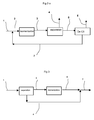
- Fig 2 depicts a process according to the first embodiment of the invention.
- the light naphtha is sent via line 1 and 2 to the isomerization zone to produce a light naphtha having a reduced branched paraffins content and an enhanced normal paraffins content.
- the effluent is withdrawn via line 3 and sent to the separation zone to recover a first hydrocarbon stream 4 having a reduced branched paraffins content and an enhanced normal paraffins content and a second hydrocarbon stream 5 having an enhanced branched paraffins content and a reduced normal paraffins content.
- the first hydrocarbon stream 4 is sent to the steam cracking unit (not shown).
- a part of the second hydrocarbon stream 5 is recycled via line 7 to the isomerization zone and the other part is purge via line 6.
- Fig 2-a derives from fig 2 , a depentanizer is inserted after the separation zone to recycle the pentane at the isomerization zone via line 7 and purge the C6.
- Fig 3 depicts a process according to the second embodiment of the invention.
- the light naphtha is sent via line 1 to the separation zone to recover a first hydrocarbon stream 4 having a reduced branched paraffins content and an enhanced normal paraffins content and a second hydrocarbon stream 3 having an enhanced branched paraffins content and a reduced normal paraffins content.
- the second hydrocarbon stream 3 is sent to the isomerization zone operating at conditions effective to produce a light naphtha 5 having a reduced branched paraffins content and an enhanced normal paraffins content.
- the outlet stream 5 is mixed with the first hydrocarbon stream 4 and said mixed stream 7 is sent to the steam cracking unit (not shown).
- Fig 4 depicts a process according to the third embodiment of the invention.
- the light naphtha is sent via lines 1 and 2 to the separation zone to recover a first hydrocarbon stream 4 having a reduced branched paraffins content and an enhanced normal paraffins content and a second hydrocarbon stream 3 having an enhanced branched paraffins content and a reduced normal paraffins content.
- the first hydrocarbon stream 4 is sent to the steam cracking unit (not shown).
- the second hydrocarbon stream 3 is sent to the isomerization zone via line 6 after a purge 5.
- the isomerization zone is operated at conditions effective to produce a light naphtha having a reduced branched paraffins content and an enhanced normal paraffins content 7 recycled at the inlet of the separation zone.
- Fig 4-a derives from fig 4 by insertion of a depentanizer.
- Hydrocarbon stream 3 is sent to a depentanizer to recover a stream 6 comprising essentially pentane and a stream 5 having a reduced pentane content.
- the stream 6 comprising essentially isopentane is sent to the isomerization zone.
- Fig 5 depicts a process according to the fourth embodiment of the invention.
- the light naphtha is sent via line 1 and 2 to a deisopentanizer to recover a stream 5 comprising essentially isopentane and a stream 4 having a reduced isopentane content.
- the stream 4 having a reduced isopentane content is sent to the steam cracking unit (not shown).
- the stream 5 comprising essentially isopentane is sent to the isomerization zone operated at conditions effective to produce a light naphtha 6 having a reduced branched paraffins content and an enhanced normal paraffins content recycled to the inlet of the deisopentanizer.
Landscapes
- Chemical & Material Sciences (AREA)
- Oil, Petroleum & Natural Gas (AREA)
- Engineering & Computer Science (AREA)
- Chemical Kinetics & Catalysis (AREA)
- General Chemical & Material Sciences (AREA)
- Organic Chemistry (AREA)
- Crystallography & Structural Chemistry (AREA)
- Physics & Mathematics (AREA)
- Thermal Sciences (AREA)
- Production Of Liquid Hydrocarbon Mixture For Refining Petroleum (AREA)
- Organic Low-Molecular-Weight Compounds And Preparation Thereof (AREA)
Abstract
The present invention is a process to upgrade light naphthas comprising branched paraffins and their use as a feedstock in a steam cracking unit, said light naphthas consisting essentially of 90 to 100% by weight of hydrocarbons having at least 5 and up to 8 carbon atoms, said process comprising,
a) providing an isomerization zone recovered from the gasoline unit of an oil refinery,
b) providing a separation zone capable to treat an hydrocarbon stream comprising branched paraffins and normal paraffins to produce a first hydrocarbon stream having a reduced branched paraffins content and an enhanced normal paraffins content and a second hydrocarbon stream having an enhanced branched paraffins content and a reduced normal paraffins content,
c) sending the light naphtha to the isomerization zone and operating said zone at conditions effective to produce a light naphtha having a reduced branched paraffins content and an enhanced normal paraffins content,
d) sending the withdrawn light naphtha from step c) to the separation zone to recover a first and a second hydrocarbon streams,
e) sending the first hydrocarbon stream recovered from step d) to the steam cracking unit,
f) recycling at least a part of the second hydrocarbon stream recovered from step d) at the inlet of the isomerization zone,
or
c) sending the light naphtha to the separation zone to recover a first and a second hydrocarbon streams,
d) sending the second hydrocarbon stream recovered from step c) to the isomerization zone and operating said zone at conditions effective to produce a light naphtha having a reduced branched paraffins content and an enhanced normal paraffins content,
e) mixing the outlet stream of step d) with the first hydrocarbon stream recovered from step c) and sending said mixed stream to the steam cracking unit.
or
c) sending the light naphtha to the separation zone to recover a first and a second hydrocarbon streams,
d) sending the first hydrocarbon stream recovered from step c) to the steam cracking unit,
e) sending at least a part of the second hydrocarbon stream recovered from step d) to the isomerization zone and operating said zone at conditions effective to produce a light naphtha having a reduced branched paraffins content and an enhanced normal paraffins content,
f) recycling the outlet stream from step e) to the inlet of the separation zone.
a) providing an isomerization zone recovered from the gasoline unit of an oil refinery,
b) providing a separation zone capable to treat an hydrocarbon stream comprising branched paraffins and normal paraffins to produce a first hydrocarbon stream having a reduced branched paraffins content and an enhanced normal paraffins content and a second hydrocarbon stream having an enhanced branched paraffins content and a reduced normal paraffins content,
c) sending the light naphtha to the isomerization zone and operating said zone at conditions effective to produce a light naphtha having a reduced branched paraffins content and an enhanced normal paraffins content,
d) sending the withdrawn light naphtha from step c) to the separation zone to recover a first and a second hydrocarbon streams,
e) sending the first hydrocarbon stream recovered from step d) to the steam cracking unit,
f) recycling at least a part of the second hydrocarbon stream recovered from step d) at the inlet of the isomerization zone,
or
c) sending the light naphtha to the separation zone to recover a first and a second hydrocarbon streams,
d) sending the second hydrocarbon stream recovered from step c) to the isomerization zone and operating said zone at conditions effective to produce a light naphtha having a reduced branched paraffins content and an enhanced normal paraffins content,
e) mixing the outlet stream of step d) with the first hydrocarbon stream recovered from step c) and sending said mixed stream to the steam cracking unit.
or
c) sending the light naphtha to the separation zone to recover a first and a second hydrocarbon streams,
d) sending the first hydrocarbon stream recovered from step c) to the steam cracking unit,
e) sending at least a part of the second hydrocarbon stream recovered from step d) to the isomerization zone and operating said zone at conditions effective to produce a light naphtha having a reduced branched paraffins content and an enhanced normal paraffins content,
f) recycling the outlet stream from step e) to the inlet of the separation zone.
Description
- The present invention relates to the upgrading of light naphthas for increased olefins production. Light naphthas are becoming widely available as feedstocks for steam crackers due to the difficulties in its valorization as components of the gasoline pool in refineries. The quality of these naphthas as feeds to steam crackers could be improved by increasing the amount of normal paraffins at the expense of iso-paraffins, which would increase the yield of ethylene while reducing yields of fuel gas, C4s and pygas. The isomerization reaction between normal and iso-paraffins is essentially limited by thermodynamic equilibrium. This has led to consider whether it would be feasible to operate the refinery isomerization units driving the reaction in a reverse mode, namely transforming iso-paraffins into normal paraffins.
-
GB 2 018 815 A1high purity 1,3-butadiene is separated from the remaining C4 hydrocarbons. The remaining C4 hydrocarbons are withdrawn from the butadiene recovery facility primarily as a mixture known in the art as "butene raffinate." This mixture is generally comprised of normal butenes and isobutene. The process comprises passing a stream of unsaturated C4 hydrocarbons in contact with hydrogen through a hydrogenation zone to react the hydrogen and the unsaturated C4 hydrocarbons to form normal butane and isobutane. The normal butane and isobutane are discharged from the hydrogenation zone and are introduced into a separation zone to separate the normal butane from the isobutane. The normal butane is discharged and recovered from the separation zone. The isobutane from the separation zone is passed into an isomerization zone to convert a portion of the isobutane into normal butane to form a stream of normal butane and isobutane. Thereafter, the normal butane and isobutane stream formed in the isomerization zone is withdrawn from the isomerization zone. This stream can thereafter be directed to the same separation zone which separates the normal butane and isobutane introduced from the hydrogenation zone to recover additional amounts of normal butane. -
US 5019661 provides a single-stage process for the shape-selective hydroisomerization of a branched olefin of at least 4 carbon atoms to produce a less branched paraffin product, said process comprising contacting said olefin and a hydrogen-containing gas with a zeolite or zeolite-like catalyst containing at least one metal of Group VIII and in which a major portion of said at least one of these metals is supported within the molecular channels and cavities of the said catalyst, said process being conducted under conditions such that hydroisomerization predominates over both simple hydrogenation and cracking. It is an object of the present invention to provide a process whereby olefinic feedstocks may be hydroisomerised to paraffinic feedstocks and specific catalysts therefor. By way of example, 2-methylpent-1-ene or 3,3-dimethylbut-1-ene may be hydroisomerised to a product containing large amounts of n-hexane. There is no mention of the use of said process (i) to enhance the normal paraffin content of a paraffin fraction and further (ii) use said enhanced normal paraffin fraction as a feedstock in a steam cracker to make olefins. -
US 2005 101814 relates to a process for the production of light olefins from a naphtha feed stream. The naphtha is sent to an adsorptive separation unit which produces a first process stream comprising primarily n-paraffins, and a second process stream comprising non-normal hydrocarbons. The second process stream is processed through a ring opening reactor that hydrogenates and converts the aromatics and naphthenes to paraffins. The paraffins from the adsorptive separation unit and from the hydrogenation ring opening reactor are then passed through a steam cracking unit to produce light olefins. This process increases the yield of light olefins from a naphtha feedstream. The process may optionally include the passing of a py-gas stream generated in the steam cracking unit to the ring opening reactor to further increase the light olefin production. In an alternate process the paraffins from the hydrogenation ring opening reactor are then passed through an isomerization unit for the conversion of a portion of the iso-paraffins to normal paraffins, and the resulting mixture is recycled to the adsorption unit. The isomerization unit increases light olefin production by increasing the amount of normal paraffins recovered from the naphtha feed stream. This process concerns only the treatment of the conventional naphtha feedstock to be used in a steam cracker. - The present invention relates to the use of an existing isomerization zone of an oil refinery to increase the normal paraffins content of a light naphtha which is further cracked in a steam cracking unit to produce olefins.
- In a first embodiment the present invention is a process to upgrade light naphthas comprising branched paraffins and their use as a feedstock in a steam cracking unit, said light naphthas consisting essentially of 90 to 100% by weight of hydrocarbons having at least 5 and up to 8 carbon atoms, said process comprising,
- a) providing an isomerization zone recovered from the gasoline unit of an oil refinery,
- b) providing a separation zone capable to treat an hydrocarbon stream comprising branched paraffins and normal paraffins to produce a first hydrocarbon stream having a reduced branched paraffins content and an enhanced normal paraffins content and a second hydrocarbon stream having an enhanced branched paraffins content and a reduced normal paraffins content,
- c) optionally providing a depentanizer,
- d) sending the light naphtha to the isomerization zone and operating said zone at conditions effective to produce a light naphtha having a reduced branched paraffins content and an enhanced normal paraffins content,
- e) sending the withdrawn light naphta from step d) to the separation zone to recover a first and a second hydrocarbon streams,
- f) sending the first hydrocarbon stream recovered from step e) to the steam cracking unit,
- g) recycling at least a part of the second hydrocarbon stream recovered from step e) at the inlet of the isomerization zone,
- h) optionally, before the recycling of step g), sending the second hydrocarbon stream recovered at step e) to a depentanizer to recover a stream comprising essentially pentane and a stream having a reduced pentane content and sending at least a part of said stream comprising essentially pentane at the inlet of the isomerization zone.
- In a second embodiment the present invention is a process to upgrade light naphthas comprising branched paraffins and their use as a feedstock in a steam cracking unit, said light naphthas consisting essentially of 90 to 100% by weight of hydrocarbons having at least 5 and up to 8 carbon atoms, said process comprising,
- a) providing an isomerization zone recovered from the gasoline unit of an oil refinery,
- b) providing a separation zone capable to treat an hydrocarbon stream comprising branched paraffins and normal paraffins to produce a first hydrocarbon stream having a reduced branched paraffins content and an enhanced normal paraffins content and a second hydrocarbon stream having an enhanced branched paraffins content and a reduced normal paraffins content,
- c) sending the light naphtha to the separation zone to recover a first and a second hydrocarbon streams,
- d) sending the second hydrocarbon stream recovered from step c) to the isomerization zone and operating said zone at conditions effective to produce a light naphtha having a reduced branched paraffins content and an enhanced normal paraffins content,
- e) mixing the outlet stream of step d) with the first hydrocarbon stream recovered from step c) and sending said mixed stream to the steam cracking unit.
- In a third embodiment the present invention is a process to upgrade light naphthas comprising branched paraffins and their use as a feedstock in a steam cracking unit, said light naphthas consisting essentially of 90 to 100% by weight of hydrocarbons having at least 5 and up to 8 carbon atoms, said process comprising,
- a) providing an isomerization zone recovered from the gasoline unit of an oil refinery,
- b) providing a separation zone capable to treat an hydrocarbon stream comprising branched paraffins and normal paraffins to produce a first hydrocarbon stream having a reduced branched paraffins content and an enhanced normal paraffins content and a second hydrocarbon stream having an enhanced branched paraffins content and a reduced normal paraffins content,
- c) optionally providing a depentanizer,
- d) sending the light naphtha to the separation zone to recover a first and a second hydrocarbon streams,
- e) sending the first hydrocarbon stream recovered from step d) to the steam cracking unit,
- f) sending at least a part of the second hydrocarbon stream recovered from step d) to the isomerization zone and operating said zone at conditions effective to produce a light naphtha having a reduced branched paraffins content and an enhanced normal paraffins content,
- g) optionally, before sending the second hydrocarbon recovered from step d) to the isomerization zone, sending said hydrocarbon stream to a depentanizer to recover a stream comprising essentially iso-pentane and a stream having a reduced pentane content and sending said stream comprising essentially iso-pentane to the isomerization zone,
- i) recycling the outlet stream from step f) to the inlet of the separation zone.
- In a fourth embodiment the present invention is a process to upgrade light naphthas comprising branched paraffins and their use as a feedstock in a steam cracking unit, said light naphthas consisting essentially of 90 to 100% by weight of hydrocarbons having at least 5 and up to 8 carbon atoms, said process comprising,
- a) providing an isomerization zone recovered from the gasoline unit of an oil refinery,
- b) providing a deisopentanizer,
- c) sending the light naphtha to a deisopentanizer to recover a stream comprising essentially isopentane and a stream having a reduced isopentane content,
- d) sending the stream having a reduced isopentane content recovered from step c) to the steam cracking unit,
- e) sending the stream comprising essentially isopentane recovered from step c) to the isomerization zone and operating said zone at conditions effective to produce a light naphtha having a reduced branched paraffins content and an enhanced normal paraffins content,
- f) recycling the outlet of step e) to the inlet of the deisopentanizer.
- The fourth embodiment is of particular interest when the light naphtha to be upgraded is a C5 cut comprising, the total being 100w%,
0 to 10 % of C7+,
0 to 10% of C4,
80 to 100% of C5, advantageously said C5 is essentially a mixture of iC5 and nC5. - Advantageously the isomerization zone operates in the presence of hydrogen.
- As regards the light naphtha to be upgraded, one can cite by way of example a C5 and a C5/C6 naphtha. The light naphtha to be upgraded can be a C5 cut comprising, the total being 100w%, 100 to 95% of a mixture of pentane and isopentane and 0 to 5% of cyclopentane.
The light naphtha to be upgraded can be a C5/C6 cut comprising, the total being 100w%,
0 to 10 % of C7+,
0 to 10% of C4,
80 to 100% of a mixture of normal and branched C5 and C6. - In an embodiment the light naphtha to be upgraded can be a C5/C6 cut comprising, the total being 100w%,
0 to 10 % of C7+,
0 to 10% of C4,
20 to 60% of a mixture of normal and branched C5,
20 to 60% of a mixture of normal and branched C6. - As regards the isomerization zone,
Figure 1 shows the equilibrium between the C5 and C6 normal and branched paraffins as function of the reaction temperature. It can be seen that the formation of iso-paraffins is more favorable at higher temperatures although in the considered range it is always found a larger proportion of iso-paraffins. Equilibrium is more favorable for the production of n-C5 than n-C6. The figure also indicates that at higher temperatures other catalytic concepts could be used. It appears clearly fromFigure 1 that high reaction temperatures should be preferred for driving the reverse reaction towards n-paraffins and at those conditions a zeolite catalyst could be more advisable. However since existing isomerization units in refineries were designed mainly at low temperature, this case could be also interesting as a minimum investing option. - Any catalyst known in the art to be suitable for the isomerization of paraffin-rich hydrocarbon streams may be used as an isomerization catalyst in the isomerization zone. One suitable isomerization catalyst comprises a platinum-group metal, hydrogen-form crystalline aluminosilicate zeolite and a refractory inorganic oxide, and the composition preferably has a surface area of at least 580 m2 /g. The preferred noble metal is platinum, which is present in an amount of from about 0.01 to 5 mass % of the composition, and optimally from about 0.15 to 0.5 mass %. Catalytically effective amounts of one or more promoter metals preferably selected from Groups VIB(6), VIII(8-10), IB(11), IIB(12), IVA(14), rhenium, iron, cobalt, nickel, gallium and indium also may be present. The crystalline aluminosilicate zeolite may be synthetic or naturally occurring, and preferably is selected from the group consisting of FAU, LTL, MAZ and MOR with mordenite having a silica-to-alumina ratio of from 16:1 to 60:1 being especially preferred. The zeolite generally comprises from about 50 to 99.5 mass % of the composition, with the balance being the refractory inorganic oxide. Alumina, and preferably one or more of gamma-alumina and eta-alumina, is the preferred inorganic oxide. Further details of the composition are disclosed in
U.S. Pat. No. 4,735,929 , incorporated herein in its entirety by reference thereto. A preferred isomerization catalyst composition comprises one or more platinum-group metals, a halogen, and an inorganic-oxide binder. Preferably the catalyst contains a Friedel-Crafts metal halide, with aluminum chloride being especially preferred. The optimal platinum-group metal is platinum which is present in an amount of from about 0.1 to 5 mass %. The inorganic oxide preferably comprises alumina, with one or more of gamma-alumina and eta-alumina providing best results. Optimally, the carrier material is in the form of a calcined cylindrical extrudate. The inlet stream of the isomerization zone may also contain an organic polyhalo component, with carbon tetrachloride being preferred, and the total chloride content is from about 2 to 15 mass %. An organic-chloride promoter, preferably carbon tetrachloride, is added during operation to maintain a concentration of 30 to 300 mass ppm of promoter in the combined feed. Other details and alternatives of preparation steps and operation of the preferred isomerization catalyst are as disclosed inU.S. Pat. Nos. 2,999,074 and3,031,419 which are incorporated herein by reference. - Hydrogen is advantageously mixed with the inlet stream of the isomerization zone to provide a mole ratio of hydrogen to hydrocarbon feed of about 0.01 to 5. The hydrogen may be supplied totally from outside the process or supplemented by hydrogen recycled to the feed after separation from reactor effluent. Light hydrocarbons and small amounts of inserts such as nitrogen and argon may be present in the hydrogen. Water should be removed from hydrogen supplied from outside the process, preferably by an adsorption system as is known in the art. In a preferred embodiment the hydrogen to hydrocarbon mol ratio in the reactor effluent is equal to or less than 0.05, generally obviating the need to recycle hydrogen from the reactor effluent to the feed.
- Water and sulfur are catalyst poisons especially for the chlorided platinum-alumina catalyst composition described herein below. Water can act to permanently deactivate the catalyst by removing high-activity chloride from the catalyst, and sulfur temporarily deactivates the catalyst by platinum poisoning. A hydrotreating or hydrorefining or hydrodesulfurization step usually reduces water-generating oxygenates to the preferred required 0.1 ppm or less and sulfur to 0.5 ppm or less. Other means such as adsorption systems for the removal of sulfur and water from hydrocarbon streams are well known to those skilled in the art.
- Isomerization conditions in the isomerization zone include reactor temperatures usually ranging from about 50 to 350°C. Higher reaction temperatures are generally preferred in order to favour equilibrium mixtures having the highest concentration of normal alkanes. Temperatures in the range of about 150 to about 250°C are preferred in the present invention. Reactor operating pressures generally range from about 100 kPa to 10 MPa absolute, preferably between about 0.5 and 4 MPa. Liquid hourly space velocities range from about 0.2 to about 15 volumes of isomerizable hydrocarbon feed per hour per volume of catalyst, with a range of about 0.5 to 5 hr-1 being preferred.
- Contacting within the isomerization zone may be effected using the catalyst in a fixed-bed system, a moving-bed system, a fluidized-bed system, or in a batch-type operation. A fixed-bed system is preferred. The reactants may be contacted with the bed of catalyst particles in either upward, downward, or radial-flow fashion. The reactants may be in the liquid phase, a mixed liquid-vapour phase, or a vapour phase when contacted with the catalyst particles, with excellent results being obtained by application of the present invention to a primarily liquid-phase operation. The isomerization zone may be in a single reactor or in two or more separate reactors with suitable means there between to insure that the desired isomerization temperature is maintained at the entrance to each zone. Two or more reactors in sequence are preferred to enable improved isomerization through control of individual reactor temperatures and for partial catalyst replacement without a process shutdown.
- The isomerization of light naphthas is typically performed in a fixed bed reactor operated at temperatures around about 200°C to about 250°C in order to favour the formation of normal compounds. Under these conditions it is usually preferred to use a catalyst containing a noble metal supported on a chlorated-alumina.
- Cooling or heating of the stream at the inlet of the isomerization zone may be appropriate for temperature flexibility or for the start-up of the process.
- Separation of normal from iso paraffins can be done using an adsorption process that separates both types of species by using a shape selective zeolite. These separation processes could be also useful to enhance the reverse reaction by recycling iso-paraffins instead of n-paraffins as in the conventional process.
- As regards the deisopentanizer and the depentanizer, this is known in the art. The depentanizer is a conventional fractionation to separate the C5 from the C6 and above. The deisopentanizer is known as a super fractionation and separates the iC5 from the C5 cut.
- As regards the separation zone, This is known in the art. The adsorption separation unit may be of any suitable type that is appropriate for the specific situation of the process. The adsorption unit is comprised of a bed of adsorbent comprised of a molecular sieve or other appropriate adsorbent for adsorbing hydrocarbons. Examples of suitable adsorption separation units include, but are not limited to, swing bed or simulated moving bed adsorption units. The inlet stream is separated in the adsorption unit by the selective adsorption and retention of normal paraffins in the adsorption bed. The adsorption separation process undergoes an adsorption step, wherein selected components of the inlet stream are adsorbed onto the adsorbent, and followed by a desorption step wherein the selected components are desorbed from the adsorbent. In this case, the selected components are the normal paraffins. The normal paraffins remain on the adsorbent until a desorbent is passed through the adsorption unit.
- During the adsorption step, the normal paraffins are separated from the inlet stream by adsorption onto the adsorbent. The remaining components of the inlet stream are non-normal (branched) hydrocarbons and pass through the adsorption bed unaffected. The non-normal hydrocarbons pass out of the adsorption unit as a raffinate stream containing a portion of the desorbent (remaining in the adsorbent bed further to the desorption step). Said raffinate is fractionated to separate the desorbent and recover the second hydrocarbon stream having an enhanced branched paraffins content and a reduced normal paraffins content.
- During the desorption step, a desorbent is delivered to the adsorption unit and passes through the adsorbent bed. The desorbent has properties which enable it to displace the heavier normal paraffins from the adsorbent, resulting in the formation of an extract stream. The extract stream comprises normal hydrocarbons and a portion of the desorbent material. The extract stream is fractionated to recycle the desorbent and recover the second hydrocarbon stream having an enhanced branched paraffins content and a reduced normal paraffins content.
- One can cite the Molex® process of UOP and process described in
US 3392113 andUS 3455815 . -
Fig 2 depicts a process according to the first embodiment of the invention. The light naphtha is sent vialine line 3 and sent to the separation zone to recover afirst hydrocarbon stream 4 having a reduced branched paraffins content and an enhanced normal paraffins content and asecond hydrocarbon stream 5 having an enhanced branched paraffins content and a reduced normal paraffins content. Thefirst hydrocarbon stream 4 is sent to the steam cracking unit (not shown). A part of thesecond hydrocarbon stream 5 is recycled vialine 7 to the isomerization zone and the other part is purge vialine 6. -
Fig 2-a derives fromfig 2 , a depentanizer is inserted after the separation zone to recycle the pentane at the isomerization zone vialine 7 and purge the C6. -
Fig 3 depicts a process according to the second embodiment of the invention. The light naphtha is sent vialine 1 to the separation zone to recover afirst hydrocarbon stream 4 having a reduced branched paraffins content and an enhanced normal paraffins content and asecond hydrocarbon stream 3 having an enhanced branched paraffins content and a reduced normal paraffins content. Thesecond hydrocarbon stream 3 is sent to the isomerization zone operating at conditions effective to produce alight naphtha 5 having a reduced branched paraffins content and an enhanced normal paraffins content. Theoutlet stream 5 is mixed with thefirst hydrocarbon stream 4 and saidmixed stream 7 is sent to the steam cracking unit (not shown). -
Fig 4 depicts a process according to the third embodiment of the invention. The light naphtha is sent vialines first hydrocarbon stream 4 having a reduced branched paraffins content and an enhanced normal paraffins content and asecond hydrocarbon stream 3 having an enhanced branched paraffins content and a reduced normal paraffins content. Thefirst hydrocarbon stream 4 is sent to the steam cracking unit (not shown). Thesecond hydrocarbon stream 3 is sent to the isomerization zone vialine 6 after apurge 5. The isomerization zone is operated at conditions effective to produce a light naphtha having a reduced branched paraffins content and an enhancednormal paraffins content 7 recycled at the inlet of the separation zone. -
Fig 4-a derives fromfig 4 by insertion of a depentanizer.Hydrocarbon stream 3 is sent to a depentanizer to recover astream 6 comprising essentially pentane and astream 5 having a reduced pentane content. Thestream 6 comprising essentially isopentane is sent to the isomerization zone. -
Fig 5 depicts a process according to the fourth embodiment of the invention. The light naphtha is sent vialine stream 5 comprising essentially isopentane and astream 4 having a reduced isopentane content. Thestream 4 having a reduced isopentane content is sent to the steam cracking unit (not shown). Thestream 5 comprising essentially isopentane is sent to the isomerization zone operated at conditions effective to produce alight naphtha 6 having a reduced branched paraffins content and an enhanced normal paraffins content recycled to the inlet of the deisopentanizer. - This ex is made according to
fig 2 . This is a simulation, the isomerization temperature is 300°C, the recovery of normal paraffins is 99%, the recovery of others is 10% and thepurge 20%. In the following table "str 1" corresponds toline 1 on the fig.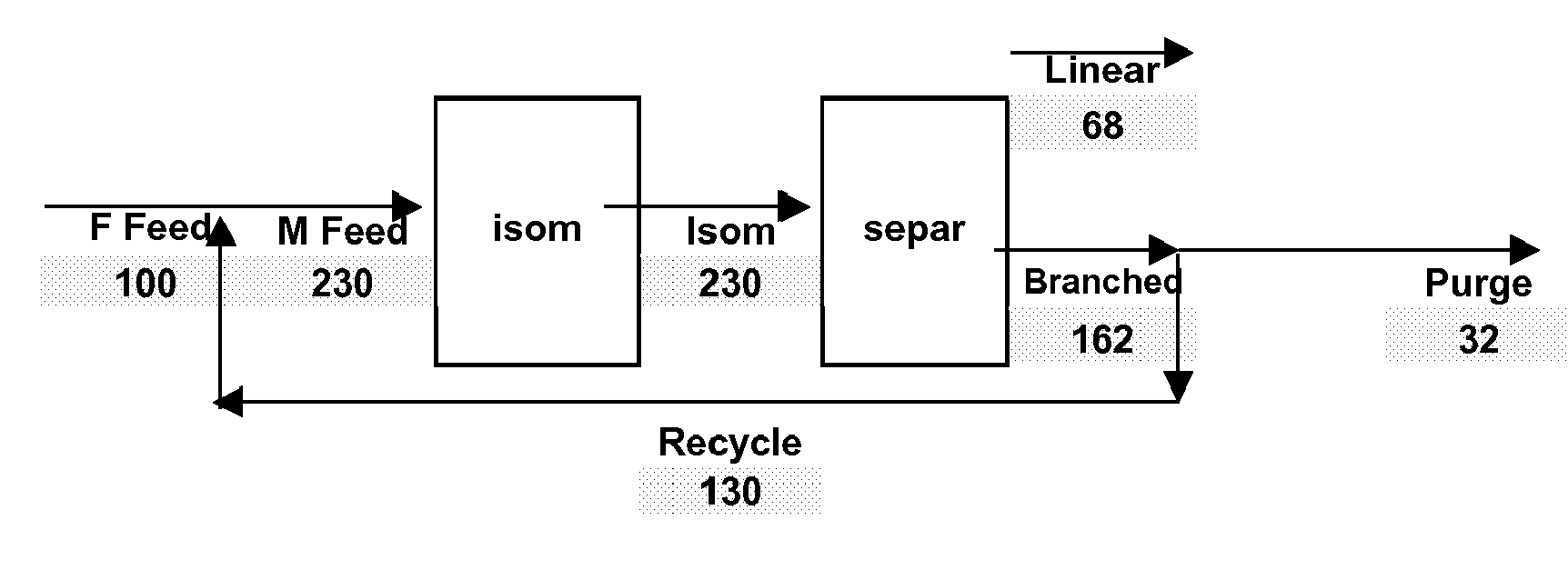
Str1 Str2 Str3 Str4 Str5 Str6 Str7 Stream Fresh Feed Mixed Feed Isomerate Linear Branched Purge Recycle wt% wt% wt% wt% wt% wt% wt% i-C4 0.2 0.4 0.4 0.1 0.5 0.5 0.5 n-C4 4.1 1.8 1.8 6.0 0.0 0.0 0.0 i-C5 17.2 26.6 26.5 9.0 33.8 33.8 33.8 n-C5 27.7 12.2 12.2 41.2 0.2 0.2 0.2 NaftC5 1.6 2.5 2.5 0.8 3.2 3.2 3.2 2-Me-C5 14.2 17.4 15.5 5.3 19.8 19.8 19.8 3-Me-C5 10.2 12.5 11.2 3.8 14.3 14.3 14.3 22DM-C4 2.1 7.0 8.5 2.9 10.9 10.9 10.9 23-DM-C4 2.6 4.0 3.9 1.3 5.0 5.0 5.0 n-C6 13.9 6.1 7.8 26.3 0.1 0.1 0.1 NaftC6 3.3 5.1 5.1 1.7 6.5 6.5 6.5 AroC6 1.0 1.5 1.5 0.5 1.9 1.9 1.9 C7+ 1.9 3.0 3.0 1.0 3.8 3.8 3.8 Total 100.0 100.0 100.0 100.0 100.0 100.0 100.0 Flowrate (ton/h) 100.0 229.6 229.6 67.6 162.0 32.4 129.6 - This ex is made according to
fig 2-a . This is a simulation, the isomerization temperature is 300°C, the recovery of normal paraffins is 99%, the recovery of others is 10%.
Str1 Str2 Str3 Str4 Str5 Str6 Str7 Stream Fresh Feed Mixed Feed Isomerate Linear Branched C6s C5s wt% wt% wt% wt% wt% wt% wt% i-C4 0.2 0.1 0.1 0.4 0.0 0.0 0.0 n-C4 4.1 2.3 2.3 6.7 0.0 0.0 0.0 i-C5 17.2 51.9 46.6 13.3 64.6 0.0 99.5 n-C5 27.7 16.2 21.5 60.8 0.3 0.0 0.5 NaftC5 1.6 0.9 0.9 0.3 1.3 3.7 0.0 2-Me-C5 14.2 8.2 8.2 2.3 11.4 32.5 0.0 3-Me-C5 10.2 5.9 5.9 1.7 8.2 23.4 0.0 22DM-C4 2.1 1.2 4.5 1.3 6.3 17.8 0.0 23-DM-C4 2.6 1.5 2.1 0.6 2.9 8.3 0.0 n-C6 13.9 8.1 4.1 11.7 0.1 0.2 0.0 NaftC6 3.3 1.9 1.9 0.5 2.6 7.6 0.0 AroC6 1.0 0.5 0.5 0.2 0.8 2.2 0.0 C7+ 1.9 1.1 1.1 0.3 1.5 4.4 0.0 Total 100.0 100.0 100.0 100.0 100.0 100.0 100.0 Flowrate (ton/h) 100.0 172.9 172.9 60.7 112.2 39.3 72.9 - This ex is made according to
fig 3 . This is a simulation, the isomerization temperature is 300°C, the recovery of normal paraffins is 99%, the recovery of others is 10%. In the following table "str 1" corresponds toline 1 on the fig.
Str1 Str3 Str4 Str5 Str7 Stream Fresh Feed Branch Linear Isomerate Feed SC wt% wt% wt% wt% wt% i-C4 0.2 0.4 0.0 0.4 0.2 n-C4 4.1 0.1 7.9 0.1 4.1 i-C5 17.2 31.4 3.4 21.9 12.5 n-C5 27.7 0.6 54.2 10.1 32.4 NaftC5 1.6 2.9 0.3 2.9 1.6 2-Me-C5 14.2 25.9 2.8 17.6 10.1 3-Me-C5 10.2 18.5 2.0 12.7 7.3 22DM-C4 2.1 3.8 0.4 9.7 5.0 23-DM-C4 2.6 4.8 0.5 4.5 2.5 n-C6 13.9 0.3 27.2 8.9 18.2 NaftC6 3.3 6.0 0.7 6.0 3.3 AroC6 1.0 1.7 0.2 1.7 0.9 C7+ 1.9 3.5 0.4 3.5 1.9 Total 100.0 100.0 100.0 100.0 100.0 Flowrate (ton/h) 100.0 49.3 50.7 49.3 100.0 - This ex is made according to
fig 3 . This is a simulation, the isomerization temperature is 150°C, the recovery of normal paraffins is 99%, the recovery of others is 10%. In the following table "str 1" corresponds toline 1 on the fig.
Str1 Str3 Str4 Str5 Str7 Stream Fresh Feed Branch Linear Isomerate Feed SC wt% wt% wt% wt% wt% i-C4 0.2 0.4 0.0 0.4 0.2 n-C4 4.1 0.1 7.9 0.1 4.1 i-C5 17.2 31.4 3.4 25.0 14.0 n-C5 27.7 0.6 54.2 7.0 30.9 NaftC5 1.6 2.9 0.3 2.9 1.6 2-Me-C5 14.2 25.9 2.8 15.8 9.2 3-Me-C5 10.2 18.5 2.0 9.7 5.8 22DM-C4 2.1 3.8 0.4 18.3 9.2 23-DM-C4 2.6 4.8 0.5 4.8 2.7 n-C6 13.9 0.3 27.2 4.7 16.1 NaftC6 3.3 6.0 0.7 6.0 3.3 AroC6 1.0 1.7 0.2 1.7 0.9 C7+ 1.9 3.5 0.4 3.5 1.9 Total 100.0 100.0 100.0 100.0 100.0 Flowrate (ton/h) 100.0 49.3 50.7 49.3 100.0 - This ex is made according to
fig 4 . This is a simulation, the isomerization temperature is 250°C, the recovery of normal paraffins is 99%, the recovery of others is 10% and the purge 37%. In the following table "str 1" corresponds toline 1 on the fig.
Str1 Str2 Str3 Str4 Str5 Str6 Str7 Stream Fresh Feed Mixed Feed Branch Linear Purge Feedlsom Isomerate wt% wt% wt% wt% wt% wt% wt% i-C4 0.2 0.3 0.5 0.1 0.5 0.5 0.5 n-C4 4.1 2.6 0.0 6.2 0.0 0.0 0.0 i-C5 17.2 18.3 27.7 4.5 27.7 27.7 20.0 n-C5 27.7 20.4 0.3 49.5 0.3 0.3 8.1 NaftC5 1.6 2.3 3.5 0.6 3.5 3.5 3.5 2-Me-C5 14.2 15.5 23.6 3.8 23.6 23.6 17.7 3-Me-C5 10.2 10.9 16.6 2.7 16.6 16.6 12.3 22DM-C4 2.1 5.7 8.7 1.4 8.7 8.7 11.9 23-DM-C4 2.6 3.4 5.2 0.8 5.2 5.2 4.7 n-C6 13.9 11.6 0.2 28.2 0.2 0.2 7.7 NaftC6 3.3 4.8 7.3 1.2 7.3 7.3 7.3 AroC6 1.0 1.4 2.1 0.3 2.1 2.1 2.1 C7+ 1.9 2.8 4.2 0.7 4.2 4.2 4.2 Total 100.0 100.0 100.0 100.0 100.0 100.0 100.0 Flowrate (ton/h) 100.0 159.5 94.5 65.0 35.0 59.5 59.5 - This ex is made according to
fig 4-a . This is a simulation, the isomerization temperature is 250°C, the recovery of normal paraffins is 99%, the recovery of others is 10%. In the following table "str 1" corresponds toline 1 on the fig.
Str1 Str2 Str3 Str4 Str5 Str6 Str7 Stream Fresh Feed Mixed Feed Branch Linear C6+ IC5s Isomerate wt% wt% wt% wt% wt% wt% wt% i-C4 0.2 1.7 2.8 0.4 0.0 5.1 5.1 n-C4 4.1 2.9 0.1 6.2 0.0 0.1 0.1 i-C5 17.2 31.4 52.0 6.9 5.7 90.2 64.9 n-C5 27.7 27.3 0.5 59.1 0.1 0.9 26.2 NaftC5 1.6 1.2 1.9 0.3 4.1 0.2 0.2 2-Me-C5 14.2 10.3 17.1 2.3 35.8 1.6 1.1 3-Me-C5 10.2 7.4 12.2 1.6 25.6 1.1 0.7 22DM-C4 2.1 1.7 2.8 0.4 5.8 0.3 0.7 23-DM-C4 2.6 1.9 3.2 0.4 6.7 0.3 0.3 n-C6 13.9 9.9 0.2 21.5 0.4 0.0 0.5 NaftC6 3.3 2.4 4.0 0.5 8.4 0.4 0.4 AroC6 1.0 0.7 1.1 0.1 2.4 0.0 0.0 C7+ 1.9 1.3 2.2 0.3 4.9 0.0 0.0 Total 100.0 100.0 100.0 100.0 100.0 100.0 100.0 Flowrate (ton/h) 100.0 142.4 77.4 65.0 35.0 42.4 42.4 - This ex is made according to
fig 5 . This is a simulation, the isomerization temperature is 250°C; In the following table "str 1" corresponds toline 1 on the fig.
Str1 Str2 Str4 Str5 Str6 Stream Fresh Feed Mixed Feed Linear Branched Isomerate wt% wt% wt% wt% wt% i-C4 0.0 0.0 0.0 0.0 0.0 n-C4 0.0 0.0 0.0 0.0 0.0 i-C5 37.0 56.3 0.0 100.0 71.3 n-C5 59.6 42.2 96.6 0.0 28.7 NaftC5 3.4 1.4 3.4 0.0 0.0 2-Me-C5 0.0 0.0 0.0 0.0 0.0 3-Me-C5 0.0 0.0 0.0 0.0 0.0 22DM-C4 0.0 0.0 0.0 0.0 0.0 23-DM-C4 0.0 0.0 0.0 0.0 0.0 n-C6 0.0 0.0 0.0 0.0 0.0 NaftC6 0.0 0.0 0.0 0.0 0.0 AroC6 0.0 0.0 0.0 0.0 0.0 C7+ 0.0 0.0 0.0 0.0 0.0 Total 100.0 100.0 100.0 100.0 100.0 Flowrate (ton/h) 100.0 254.8 100.0 154.8 154.8 - This ex is made according to
fig 5 . This is a simulation, the isomerization temperature is 150°C. In the following table "str 1" corresponds toline 1 on the fig.
Str1 Str2 Str4 Str5 Str6 Stream Fresh Feed Mixed Feed Linear Branched Isomerate wt% wt% wt% wt% wt% i-C4 0.0 0.0 0.0 0.0 0.0 n-C4 0.0 0.0 0.0 0.0 0.0 i-C5 37.0 62.0 7.9 97.0 78.2 n-C5 59.6 36.6 88.7 3.0 21.8 NaftC5 3.4 1.4 3.4 0.0 0.0 2-Me-C5 0.0 0.0 0.0 0.0 0.0 3-Me-C5 0.0 0.0 0.0 0.0 0.0 22DM-C4 0.0 0.0 0.0 0.0 0.0 23-DM-C4 0.0 0.0 0.0 0.0 0.0 n-C6 0.0 0.0 0.0 0.0 0.0 NaftC6 0.0 0.0 0.0 0.0 0.0 AroC6 0.0 0.0 0.0 0.0 0.0 C7+ 0.0 0.0 0.0 0.0 0.0 Total 100.0 100.0 100.0 100.0 100.0 Flowrate (ton/h) 100.0 254.8 100.0 154.8 154.8 - The following working conditions were used:
- ■ 20 g of catalyst loaded without diluents.
- ■ Pressure = 30 bar
- ■ The reactor adiabatic and up flow.
- ■ A model charge feed was used: 90 % iC5 + 10 % nC5 + 300 ppm C2Cl4 bought from Air Product ®
- ■ H2/Hydrocarbon = 0.5 mol/mol (about 90 NI/I) constant over the test
- ■ WH = 1 and 2 h-1
- ■ T = 140 °C, 150°C then 160 °C
- ■ Catalyst :chlorinated alumina ( ATIS-2L from Albemarle)
- ■ The dew point was maintained between - 47°C and - 56°C to avoid catalyst deactivation
- From the test performed, the following results were obtained:
-
Temperature
(°C)Ratio iC5/nC5 at the thermodynamic equilibrium Maximum conversion
(thermodynamic)Conversion measured
(VVH in h-1)140 77 / 23 14% 7% (1 h-1) 150 76 / 24 15% 13% (2 h-1) 160 75 / 25 16% 14% (2 h-1) - Even at an elevated VVH, conversions close to the thermodynamic equilibrium were obtained.
Conversion is calculated with the following formula:

Claims (8)
- Process to upgrade light naphthas comprising branched paraffins and their use as a feedstock in a steam cracking unit, said light naphthas consisting essentially of 90 to 100% by weight of hydrocarbons having at least 5 and up to 8 carbon atoms, said process comprising,a) providing an isomerization zone recovered from the gasoline unit of an oil refinery,b) providing a separation zone capable to treat an hydrocarbon stream comprising branched paraffins and normal paraffins to produce a first hydrocarbon stream having a reduced branched paraffins content and an enhanced normal paraffins content and a second hydrocarbon stream having an enhanced branched paraffins content and a reduced normal paraffins content,c) optionally providing a depentanizer,d) sending the light naphtha to the isomerization zone and operating said zone at conditions effective to produce a light naphtha having a reduced branched paraffins content and an enhanced normal paraffins content,e) sending the withdrawn light naphtha from step d) to the separation zone to recover a first and a second hydrocarbon streams,f) sending the first hydrocarbon stream recovered from step e) to the steam cracking unit,g) recycling at least a part of the second hydrocarbon stream recovered from step e) at the inlet of the isomerization zone,h) optionally, before the recycling of step g), sending the second hydrocarbon stream recovered at step e) to a depentanizer to recover a stream comprising essentially pentane and a stream having a reduced pentane content and sending at least a part of said stream comprising essentially pentane at the inlet of the isomerization zone.
- Process to upgrade light naphthas comprising branched paraffins and their use as a feedstock in a steam cracking unit, said light naphthas consisting essentially of 90 to 100% by weight of hydrocarbons having at least 5 and up to 8 carbon atoms, said process comprising,a) providing an isomerization zone recovered from the gasoline unit of an oil refinery,b) providing a separation zone capable to treat an hydrocarbon stream comprising branched paraffins and normal paraffins to produce a first hydrocarbon stream having a reduced branched paraffins content and an enhanced normal paraffins content and a second hydrocarbon stream having an enhanced branched paraffins content and a reduced normal paraffins content,c) sending the light naphtha to the separation zone to recover a first and a second hydrocarbon streams,d) sending the second hydrocarbon stream recovered from step c) to the isomerization zone and operating said zone at conditions effective to produce a light naphtha having a reduced branched paraffins content and an enhanced normal paraffins content,e) mixing the outlet stream of step d) with the first hydrocarbon stream recovered from step c) and sending said mixed stream to the steam cracking unit.
- Process to upgrade light naphthas comprising branched paraffins and their use as a feedstock in a steam cracking unit, said light naphthas consisting essentially of 90 to 100% by weight of hydrocarbons having at least 5 and up to 8 carbon atoms, said process comprising,a) providing an isomerization zone recovered from the gasoline unit of an oil refinery,b) providing a separation zone capable to treat an hydrocarbon stream comprising branched paraffins and normal paraffins to produce a first hydrocarbon stream having a reduced branched paraffins content and an enhanced normal paraffins content and a second hydrocarbon stream having an enhanced branched paraffins content and a reduced normal paraffins content,c) optionally providing a depentanizer,d) sending the light naphtha to the separation zone to recover a first and a second hydrocarbon streams,e) sending the first hydrocarbon stream recovered from step d) to the steam cracking unit,f) sending at least a part of the second hydrocarbon stream recovered from step d) to the isomerization zone and operating said zone at conditions effective to produce a light naphtha having a reduced branched paraffins content and an enhanced normal paraffins content,g) optionally, before sending the second hydrocarbon recovered from steph) to the isomerization zone, sending said hydrocarbon stream to a depentanizer to recover a stream comprising essentially pentane and a stream having a reduced pentane content and sending said stream comprising essentially isopentane to the isomerization zone,i) recycling the outlet stream from step f) to the inlet of the separation zone.
- Process to upgrade light naphthas comprising branched paraffins and their use as a feedstock in a steam cracking unit, said light naphthas consisting essentially of 90 to 100% by weight of hydrocarbons having at least 5 and up to 8 carbon atoms, said process comprising,a) providing an isomerization zone recovered from the gasoline unit of an oil refinery,b) providing a deisopentanizer,c) sending the light naphtha to a deisopentanizer to recover a stream comprising essentially isopentane and a stream having a reduced isopentane content,d) sending the stream having a reduced isopentane content recovered from step c) to the steam cracking unit,e) sending the stream comprising essentially isopentane recovered from step c) to the isomerization zone and operating said zone at conditions effective to produce a light naphtha having a reduced branched paraffins content and an enhanced normal paraffins content,f) recycling the outlet of step e) to the inlet of the deisopentanizer.
- Process according to any one of the preceding claims wherein the isomerization zone operates under the presence of hydrogen.
- Process according to any one of the preceding claims wherein the light naphtha to be upgraded is a C5 cut comprising, the total being 100w%, 100 to 95% of a mixture of pentane and isopentane and 0 to 5% of cyclopentane.
- Process according to any one of the preceding claims wherein the light naphtha to be upgraded is a C5/C6 cut comprising, the total being 100w%,
0 to 10 % of C7+,
0 to 10% of C4,
80 to 100% of a mixture of normal and branched C5 and C6. - Process according to any one of the preceding claims wherein the light naphtha to be upgraded is a C5/C6 cut comprising, the total being 100w%,
0 to 10 % of C7+,
0 to 10% of C4,
20 to 60% of a mixture of normal and branched C5,
20 to 60% of a mixture of normal and branched C6.
Priority Applications (4)
| Application Number | Priority Date | Filing Date | Title |
|---|---|---|---|
| EP09158607A EP2243814A1 (en) | 2009-04-23 | 2009-04-23 | Upgrading light naphtas for increased olefins production |
| PCT/EP2010/055370 WO2010122115A2 (en) | 2009-04-23 | 2010-04-22 | Upgrading light naphtas for increased olefins production |
| EP10714027A EP2421936A2 (en) | 2009-04-23 | 2010-04-22 | Upgrading light naphtas for increased olefins production |
| US13/262,925 US20120074039A1 (en) | 2009-04-23 | 2010-04-22 | Upgrading light naphtas for increased olefins production |
Applications Claiming Priority (1)
| Application Number | Priority Date | Filing Date | Title |
|---|---|---|---|
| EP09158607A EP2243814A1 (en) | 2009-04-23 | 2009-04-23 | Upgrading light naphtas for increased olefins production |
Publications (1)
| Publication Number | Publication Date |
|---|---|
| EP2243814A1 true EP2243814A1 (en) | 2010-10-27 |
Family
ID=40974497
Family Applications (2)
| Application Number | Title | Priority Date | Filing Date |
|---|---|---|---|
| EP09158607A Withdrawn EP2243814A1 (en) | 2009-04-23 | 2009-04-23 | Upgrading light naphtas for increased olefins production |
| EP10714027A Withdrawn EP2421936A2 (en) | 2009-04-23 | 2010-04-22 | Upgrading light naphtas for increased olefins production |
Family Applications After (1)
| Application Number | Title | Priority Date | Filing Date |
|---|---|---|---|
| EP10714027A Withdrawn EP2421936A2 (en) | 2009-04-23 | 2010-04-22 | Upgrading light naphtas for increased olefins production |
Country Status (3)
| Country | Link |
|---|---|
| US (1) | US20120074039A1 (en) |
| EP (2) | EP2243814A1 (en) |
| WO (1) | WO2010122115A2 (en) |
Cited By (7)
| Publication number | Priority date | Publication date | Assignee | Title |
|---|---|---|---|---|
| WO2015000841A1 (en) | 2013-07-02 | 2015-01-08 | Saudi Basic Industries Corporation | Process for upgrading refinery heavy residues to petrochemicals |
| CN105441120A (en) * | 2015-12-16 | 2016-03-30 | 中国寰球工程公司 | Light naphtha isomerization full circulation system |
| CN105593342A (en) * | 2013-08-07 | 2016-05-18 | 环球油品公司 | Process for promoting disproportionation reactions and ring opening reactions within an isomerization zone |
| US10260011B2 (en) | 2013-07-02 | 2019-04-16 | Saudi Basic Industries Corporation | Process and installation for the conversion of crude oil to petrochemicals having an improved ethylene yield |
| EP4148107A1 (en) * | 2021-09-13 | 2023-03-15 | Uop Llc | Process for deisomerizing light paraffins |
| US11920093B1 (en) | 2022-11-18 | 2024-03-05 | Saudi Arabian Oil Company | Systems and processes for producing ethylene from naphtha and butanes |
| WO2024089665A1 (en) * | 2022-10-28 | 2024-05-02 | Sabic Global Technologies B.V. | Methods and systems for improving ethylene yield from iso-pentane feed by reverse isomerization and separation |
Families Citing this family (9)
| Publication number | Priority date | Publication date | Assignee | Title |
|---|---|---|---|---|
| US9302957B2 (en) | 2014-05-01 | 2016-04-05 | Uop Llc | Process for controlling the yield of an isomerization zone |
| US9302959B2 (en) | 2014-05-01 | 2016-04-05 | Uop Llc | Process for increasing the yield of an isomerization zone |
| US9302960B2 (en) | 2014-05-01 | 2016-04-05 | Uop Llc | Process for producing a feed stream for a steam cracker |
| US9302956B2 (en) | 2014-05-01 | 2016-04-05 | Uop Llc | Process for increasing the yield of an isomerization zone fractionation |
| US9302958B2 (en) | 2014-05-01 | 2016-04-05 | Uop Llc | Process for increasing the yield of an isomerization zone |
| WO2017196501A1 (en) * | 2016-05-11 | 2017-11-16 | Uop Llc | Flow configuration with isomerization in the reforming unit |
| WO2019211684A1 (en) | 2018-04-30 | 2019-11-07 | Sabic Global Technologies B.V. | Process of producing light olefins from isomerized straight run naphtha |
| US11021422B1 (en) * | 2019-12-04 | 2021-06-01 | Saudi Arabian Oil Company | Integrated processes to produce gasoline blending components from light naphtha |
| WO2024040049A1 (en) * | 2022-08-15 | 2024-02-22 | Chevron U.S.A. Inc. | Selective adsorption, separation, and isomerization of alkane isomers |
Citations (10)
| Publication number | Priority date | Publication date | Assignee | Title |
|---|---|---|---|---|
| US2999074A (en) | 1956-09-11 | 1961-09-05 | Universal Oil Prod Co | Catalyst compositions |
| US3031419A (en) | 1959-07-20 | 1962-04-24 | Universal Oil Prod Co | Method of catalyst manufacture |
| US3392113A (en) | 1965-02-16 | 1968-07-09 | Universal Oil Prod Co | Sorption process with removing impurities from the desorbent |
| US3455815A (en) | 1967-07-13 | 1969-07-15 | Universal Oil Prod Co | Sorption process |
| GB2018815A (en) | 1978-04-14 | 1979-10-24 | Stone & Webster Eng Corp | Process for converting unsaturated c4 hydrocarbons into normal butane |
| US4735929A (en) | 1985-09-03 | 1988-04-05 | Uop Inc. | Catalytic composition for the isomerization of paraffinic hydrocarbons |
| US5019661A (en) | 1987-01-15 | 1991-05-28 | Commonwealth Scientific And Industrial Research Organisation | Hydroisomerisation process |
| US20020043480A1 (en) * | 2000-08-25 | 2002-04-18 | Institut Francais Du Petrole | Process combining hydroisomerisation and separation using a zeolitic adsorbent with a mixed structure for the production of high octane number gasolines |
| US20050101814A1 (en) | 2003-11-07 | 2005-05-12 | Foley Timothy D. | Ring opening for increased olefin production |
| US7485768B1 (en) * | 2005-12-15 | 2009-02-03 | Uop Llc | Processes for making higher octane motor fuels having a low reid vapor pressure from naphtha boiling range feedstocks |
-
2009
- 2009-04-23 EP EP09158607A patent/EP2243814A1/en not_active Withdrawn
-
2010
- 2010-04-22 WO PCT/EP2010/055370 patent/WO2010122115A2/en not_active Ceased
- 2010-04-22 EP EP10714027A patent/EP2421936A2/en not_active Withdrawn
- 2010-04-22 US US13/262,925 patent/US20120074039A1/en not_active Abandoned
Patent Citations (10)
| Publication number | Priority date | Publication date | Assignee | Title |
|---|---|---|---|---|
| US2999074A (en) | 1956-09-11 | 1961-09-05 | Universal Oil Prod Co | Catalyst compositions |
| US3031419A (en) | 1959-07-20 | 1962-04-24 | Universal Oil Prod Co | Method of catalyst manufacture |
| US3392113A (en) | 1965-02-16 | 1968-07-09 | Universal Oil Prod Co | Sorption process with removing impurities from the desorbent |
| US3455815A (en) | 1967-07-13 | 1969-07-15 | Universal Oil Prod Co | Sorption process |
| GB2018815A (en) | 1978-04-14 | 1979-10-24 | Stone & Webster Eng Corp | Process for converting unsaturated c4 hydrocarbons into normal butane |
| US4735929A (en) | 1985-09-03 | 1988-04-05 | Uop Inc. | Catalytic composition for the isomerization of paraffinic hydrocarbons |
| US5019661A (en) | 1987-01-15 | 1991-05-28 | Commonwealth Scientific And Industrial Research Organisation | Hydroisomerisation process |
| US20020043480A1 (en) * | 2000-08-25 | 2002-04-18 | Institut Francais Du Petrole | Process combining hydroisomerisation and separation using a zeolitic adsorbent with a mixed structure for the production of high octane number gasolines |
| US20050101814A1 (en) | 2003-11-07 | 2005-05-12 | Foley Timothy D. | Ring opening for increased olefin production |
| US7485768B1 (en) * | 2005-12-15 | 2009-02-03 | Uop Llc | Processes for making higher octane motor fuels having a low reid vapor pressure from naphtha boiling range feedstocks |
Cited By (14)
| Publication number | Priority date | Publication date | Assignee | Title |
|---|---|---|---|---|
| US10260011B2 (en) | 2013-07-02 | 2019-04-16 | Saudi Basic Industries Corporation | Process and installation for the conversion of crude oil to petrochemicals having an improved ethylene yield |
| US11072750B2 (en) | 2013-07-02 | 2021-07-27 | Saudi Basic Industries Corporation | Process for upgrading refinery heavy residues to petrochemicals |
| US11046900B2 (en) | 2013-07-02 | 2021-06-29 | Saudi Basic Industries Corporation | Process for upgrading refinery heavy residues to petrochemicals |
| WO2015000841A1 (en) | 2013-07-02 | 2015-01-08 | Saudi Basic Industries Corporation | Process for upgrading refinery heavy residues to petrochemicals |
| EP3030633A4 (en) * | 2013-08-07 | 2017-04-12 | Uop Llc | Process for promoting disproportionation reactions and ring opening reactions within an isomerization zone |
| CN105593342A (en) * | 2013-08-07 | 2016-05-18 | 环球油品公司 | Process for promoting disproportionation reactions and ring opening reactions within an isomerization zone |
| CN105441120B (en) * | 2015-12-16 | 2017-06-09 | 中国寰球工程公司 | A kind of light naphthar isomerization complete alternation system |
| CN105441120A (en) * | 2015-12-16 | 2016-03-30 | 中国寰球工程公司 | Light naphtha isomerization full circulation system |
| EP4148107A1 (en) * | 2021-09-13 | 2023-03-15 | Uop Llc | Process for deisomerizing light paraffins |
| CN115806461A (en) * | 2021-09-13 | 2023-03-17 | 环球油品有限责任公司 | Process for isomerizing light paraffins |
| WO2024089665A1 (en) * | 2022-10-28 | 2024-05-02 | Sabic Global Technologies B.V. | Methods and systems for improving ethylene yield from iso-pentane feed by reverse isomerization and separation |
| US11920093B1 (en) | 2022-11-18 | 2024-03-05 | Saudi Arabian Oil Company | Systems and processes for producing ethylene from naphtha and butanes |
| WO2024107261A1 (en) * | 2022-11-18 | 2024-05-23 | Saudi Arabian Oil Company | Systems and processes for producing ethylene from naphtha and butanes |
| US12371624B2 (en) | 2022-11-18 | 2025-07-29 | Saudi Arabian Oil Company | Systems and processes for producing ethylene from naphtha and butanes |
Also Published As
| Publication number | Publication date |
|---|---|
| WO2010122115A3 (en) | 2011-02-17 |
| EP2421936A2 (en) | 2012-02-29 |
| WO2010122115A2 (en) | 2010-10-28 |
| US20120074039A1 (en) | 2012-03-29 |
Similar Documents
| Publication | Publication Date | Title |
|---|---|---|
| US20120074039A1 (en) | Upgrading light naphtas for increased olefins production | |
| CA2038824C (en) | Combination process for hydrogenation and isomerization of benzene- and paraffin-containing feedstocks | |
| US6284128B1 (en) | Reforming with selective reformate olefin saturation | |
| US5658453A (en) | Integrated aromatization/trace-olefin-reduction scheme | |
| US8617384B2 (en) | Integrated catalytic cracking gasoline and light cycle oil hydroprocessing to maximize p-xylene production | |
| SG187199A1 (en) | Process for the production of para-xylene | |
| WO2008082842A1 (en) | Multi-zone process for the production of xylene compounds | |
| CA2543835A1 (en) | Ring opening for increased olefin production | |
| Kuchar et al. | Paraffin isomerization innovations | |
| US5294328A (en) | Production of reformulated gasoline | |
| US8524961B2 (en) | Integrated catalytic cracking and reforming processes to improve p-xylene production | |
| WO2021162898A1 (en) | Process and system for hydrogenation of aromatic complex bottoms | |
| WO2021112898A1 (en) | Integrated processes to produce gasoline blending components from light naphtha | |
| US10941352B2 (en) | Processes for increasing an octane value of a gasoline component | |
| US5135639A (en) | Production of reformulated gasoline | |
| US10240097B2 (en) | Methods and apparatuses for an integrated isomerization and platforming process | |
| CN107207976A (en) | Integrated method and system for reforming and isomerizing hydrocarbons | |
| CN104711017B (en) | Catforming | |
| US7037422B2 (en) | Process for producing high RON gasoline using CFI Zeolite | |
| WO2018140279A1 (en) | Isomerization process using feedstock containing dissolved hydrogen | |
| US10294430B1 (en) | Integrated process for production of gasoline | |
| US10851315B1 (en) | Processes for increasing an octane value of a gasoline component | |
| US10301558B1 (en) | Integrated process for production of gasoline | |
| US12371624B2 (en) | Systems and processes for producing ethylene from naphtha and butanes | |
| EP0797650A1 (en) | Process for the isomerisation of a hydrocarbonaceous feedstock |
Legal Events
| Date | Code | Title | Description |
|---|---|---|---|
| PUAI | Public reference made under article 153(3) epc to a published international application that has entered the european phase |
Free format text: ORIGINAL CODE: 0009012 |
|
| AK | Designated contracting states |
Kind code of ref document: A1 Designated state(s): AT BE BG CH CY CZ DE DK EE ES FI FR GB GR HR HU IE IS IT LI LT LU LV MC MK MT NL NO PL PT RO SE SI SK TR |
|
| AX | Request for extension of the european patent |
Extension state: AL BA RS |
|
| STAA | Information on the status of an ep patent application or granted ep patent |
Free format text: STATUS: THE APPLICATION IS DEEMED TO BE WITHDRAWN |
|
| 18D | Application deemed to be withdrawn |
Effective date: 20100428 |