EP2243775A1 - Synthesis of 1-(2,3-Dihydrobenzofuran-4-YL)ethanone as intermediate in the preparation of ramelteon - Google Patents
Synthesis of 1-(2,3-Dihydrobenzofuran-4-YL)ethanone as intermediate in the preparation of ramelteon Download PDFInfo
- Publication number
- EP2243775A1 EP2243775A1 EP09157523A EP09157523A EP2243775A1 EP 2243775 A1 EP2243775 A1 EP 2243775A1 EP 09157523 A EP09157523 A EP 09157523A EP 09157523 A EP09157523 A EP 09157523A EP 2243775 A1 EP2243775 A1 EP 2243775A1
- Authority
- EP
- European Patent Office
- Prior art keywords
- compound
- formula
- group
- ramelteon
- catalyst
- Prior art date
- Legal status (The legal status is an assumption and is not a legal conclusion. Google has not performed a legal analysis and makes no representation as to the accuracy of the status listed.)
- Ceased
Links
- YLXDSYKOBKBWJQ-LBPRGKRZSA-N N-[2-[(8S)-2,6,7,8-tetrahydro-1H-cyclopenta[e]benzofuran-8-yl]ethyl]propanamide Chemical compound C1=C2OCCC2=C2[C@H](CCNC(=O)CC)CCC2=C1 YLXDSYKOBKBWJQ-LBPRGKRZSA-N 0.000 title claims abstract description 38
- 229960001150 ramelteon Drugs 0.000 title claims abstract description 35
- 238000002360 preparation method Methods 0.000 title claims abstract description 23
- 230000015572 biosynthetic process Effects 0.000 title claims description 28
- 238000003786 synthesis reaction Methods 0.000 title claims description 21
- KYSQYUDLMDEGRP-UHFFFAOYSA-N 1-(2,3-dihydro-1-benzofuran-4-yl)ethanone Chemical compound CC(=O)C1=CC=CC2=C1CCO2 KYSQYUDLMDEGRP-UHFFFAOYSA-N 0.000 title abstract description 9
- 150000001875 compounds Chemical class 0.000 claims description 92
- 238000000034 method Methods 0.000 claims description 52
- 239000003054 catalyst Substances 0.000 claims description 36
- 239000002608 ionic liquid Substances 0.000 claims description 28
- 125000000217 alkyl group Chemical group 0.000 claims description 26
- CTSLXHKWHWQRSH-UHFFFAOYSA-N oxalyl chloride Chemical compound ClC(=O)C(Cl)=O CTSLXHKWHWQRSH-UHFFFAOYSA-N 0.000 claims description 22
- 238000005033 Fourier transform infrared spectroscopy Methods 0.000 claims description 21
- HEMHJVSKTPXQMS-UHFFFAOYSA-M Sodium hydroxide Chemical group [OH-].[Na+] HEMHJVSKTPXQMS-UHFFFAOYSA-M 0.000 claims description 21
- LMBFAGIMSUYTBN-MPZNNTNKSA-N teixobactin Chemical compound C([C@H](C(=O)N[C@@H]([C@@H](C)CC)C(=O)N[C@@H](CO)C(=O)N[C@H](CCC(N)=O)C(=O)N[C@H]([C@@H](C)CC)C(=O)N[C@@H]([C@@H](C)CC)C(=O)N[C@@H](CO)C(=O)N[C@H]1C(N[C@@H](C)C(=O)N[C@@H](C[C@@H]2NC(=N)NC2)C(=O)N[C@H](C(=O)O[C@H]1C)[C@@H](C)CC)=O)NC)C1=CC=CC=C1 LMBFAGIMSUYTBN-MPZNNTNKSA-N 0.000 claims description 21
- QQVDYSUDFZZPSU-UHFFFAOYSA-M chloromethylidene(dimethyl)azanium;chloride Chemical compound [Cl-].C[N+](C)=CCl QQVDYSUDFZZPSU-UHFFFAOYSA-M 0.000 claims description 20
- 125000003118 aryl group Chemical group 0.000 claims description 17
- 125000003710 aryl alkyl group Chemical group 0.000 claims description 16
- 239000003795 chemical substances by application Substances 0.000 claims description 13
- 239000007800 oxidant agent Substances 0.000 claims description 13
- 230000001590 oxidative effect Effects 0.000 claims description 13
- 238000011057 process analytical technology Methods 0.000 claims description 12
- 229910052794 bromium Inorganic materials 0.000 claims description 11
- 229910052801 chlorine Inorganic materials 0.000 claims description 11
- 125000000753 cycloalkyl group Chemical group 0.000 claims description 11
- 238000004519 manufacturing process Methods 0.000 claims description 11
- 229910006130 SO4 Inorganic materials 0.000 claims description 10
- 229910052740 iodine Inorganic materials 0.000 claims description 10
- 229910015898 BF4 Inorganic materials 0.000 claims description 8
- 229910021188 PF6 Inorganic materials 0.000 claims description 8
- 125000004350 aryl cycloalkyl group Chemical group 0.000 claims description 8
- 125000001072 heteroaryl group Chemical group 0.000 claims description 8
- 125000004446 heteroarylalkyl group Chemical group 0.000 claims description 8
- 229910052751 metal Inorganic materials 0.000 claims description 8
- 239000002184 metal Substances 0.000 claims description 8
- 229910002666 PdCl2 Inorganic materials 0.000 claims description 7
- 238000011065 in-situ storage Methods 0.000 claims description 7
- 239000003960 organic solvent Substances 0.000 claims description 7
- PIBWKRNGBLPSSY-UHFFFAOYSA-L palladium(II) chloride Chemical group Cl[Pd]Cl PIBWKRNGBLPSSY-UHFFFAOYSA-L 0.000 claims description 7
- 239000000546 pharmaceutical excipient Substances 0.000 claims description 7
- -1 1,2-dicarboxyethyl Chemical group 0.000 claims description 6
- 125000003342 alkenyl group Chemical group 0.000 claims description 6
- 125000000304 alkynyl group Chemical group 0.000 claims description 6
- QVGXLLKOCUKJST-UHFFFAOYSA-N atomic oxygen Chemical group [O] QVGXLLKOCUKJST-UHFFFAOYSA-N 0.000 claims description 6
- 229910052760 oxygen Inorganic materials 0.000 claims description 6
- 239000001301 oxygen Substances 0.000 claims description 6
- 229910052763 palladium Inorganic materials 0.000 claims description 6
- 229910002651 NO3 Inorganic materials 0.000 claims description 5
- 229930040373 Paraformaldehyde Natural products 0.000 claims description 5
- 230000002051 biphasic effect Effects 0.000 claims description 5
- 125000002057 carboxymethyl group Chemical group [H]OC(=O)C([H])([H])[*] 0.000 claims description 5
- 125000000392 cycloalkenyl group Chemical group 0.000 claims description 5
- 229910052737 gold Inorganic materials 0.000 claims description 5
- 150000004679 hydroxides Chemical class 0.000 claims description 5
- 125000004108 n-butyl group Chemical group [H]C([H])([H])C([H])([H])C([H])([H])C([H])([H])* 0.000 claims description 5
- 229920002866 paraformaldehyde Polymers 0.000 claims description 5
- 150000005621 tetraalkylammonium salts Chemical class 0.000 claims description 5
- 150000003863 ammonium salts Chemical class 0.000 claims description 4
- 229910052697 platinum Inorganic materials 0.000 claims description 4
- 239000004480 active ingredient Substances 0.000 claims description 3
- 229910052736 halogen Inorganic materials 0.000 claims description 3
- 150000002367 halogens Chemical group 0.000 claims description 3
- 150000007522 mineralic acids Chemical class 0.000 claims description 3
- 239000008194 pharmaceutical composition Substances 0.000 claims description 3
- 125000006684 polyhaloalkyl group Polymers 0.000 claims description 3
- 125000000391 vinyl group Chemical group [H]C([*])=C([H])[H] 0.000 claims description 3
- IKHGUXGNUITLKF-UHFFFAOYSA-N Acetaldehyde Chemical group CC=O IKHGUXGNUITLKF-UHFFFAOYSA-N 0.000 claims description 2
- 238000011897 real-time detection Methods 0.000 claims description 2
- 238000006243 chemical reaction Methods 0.000 description 48
- 239000000543 intermediate Substances 0.000 description 24
- BZLVMXJERCGZMT-UHFFFAOYSA-N Methyl tert-butyl ether Chemical compound COC(C)(C)C BZLVMXJERCGZMT-UHFFFAOYSA-N 0.000 description 20
- 239000000243 solution Substances 0.000 description 19
- 239000012071 phase Substances 0.000 description 13
- XLYOFNOQVPJJNP-UHFFFAOYSA-N water Substances O XLYOFNOQVPJJNP-UHFFFAOYSA-N 0.000 description 13
- WLZOPMPOGRQZCJ-UHFFFAOYSA-N 4-ethenyl-2,3-dihydro-1-benzofuran Chemical compound C=CC1=CC=CC2=C1CCO2 WLZOPMPOGRQZCJ-UHFFFAOYSA-N 0.000 description 12
- ZZUIZMWFNOKNLN-UHFFFAOYSA-N 1,2,6,7-tetrahydrocyclopenta[e][1]benzofuran-8-one Chemical compound C1=C2OCCC2=C2C(=O)CCC2=C1 ZZUIZMWFNOKNLN-UHFFFAOYSA-N 0.000 description 11
- 125000004432 carbon atom Chemical group C* 0.000 description 11
- 239000000047 product Substances 0.000 description 11
- YXFVVABEGXRONW-UHFFFAOYSA-N Toluene Chemical compound CC1=CC=CC=C1 YXFVVABEGXRONW-UHFFFAOYSA-N 0.000 description 9
- 239000003153 chemical reaction reagent Substances 0.000 description 9
- 239000002904 solvent Substances 0.000 description 9
- CSNNHWWHGAXBCP-UHFFFAOYSA-L Magnesium sulfate Chemical compound [Mg+2].[O-][S+2]([O-])([O-])[O-] CSNNHWWHGAXBCP-UHFFFAOYSA-L 0.000 description 8
- OFBQJSOFQDEBGM-UHFFFAOYSA-N Pentane Chemical compound CCCCC OFBQJSOFQDEBGM-UHFFFAOYSA-N 0.000 description 8
- FAPWRFPIFSIZLT-UHFFFAOYSA-M Sodium chloride Chemical compound [Na+].[Cl-] FAPWRFPIFSIZLT-UHFFFAOYSA-M 0.000 description 8
- HEDRZPFGACZZDS-MICDWDOJSA-N Trichloro(2H)methane Chemical compound [2H]C(Cl)(Cl)Cl HEDRZPFGACZZDS-MICDWDOJSA-N 0.000 description 8
- 239000012074 organic phase Substances 0.000 description 7
- 239000011541 reaction mixture Substances 0.000 description 7
- HOIWDDKWWRIJDG-UHFFFAOYSA-N 4-(2-chloroethyl)-2,3-dihydro-1-benzofuran Chemical compound ClCCC1=CC=CC2=C1CCO2 HOIWDDKWWRIJDG-UHFFFAOYSA-N 0.000 description 5
- NLFBCYMMUAKCPC-KQQUZDAGSA-N ethyl (e)-3-[3-amino-2-cyano-1-[(e)-3-ethoxy-3-oxoprop-1-enyl]sulfanyl-3-oxoprop-1-enyl]sulfanylprop-2-enoate Chemical compound CCOC(=O)\C=C\SC(=C(C#N)C(N)=O)S\C=C\C(=O)OCC NLFBCYMMUAKCPC-KQQUZDAGSA-N 0.000 description 5
- XMBWDFGMSWQBCA-UHFFFAOYSA-M iodide Chemical compound [I-] XMBWDFGMSWQBCA-UHFFFAOYSA-M 0.000 description 5
- WEVYAHXRMPXWCK-UHFFFAOYSA-N Acetonitrile Chemical compound CC#N WEVYAHXRMPXWCK-UHFFFAOYSA-N 0.000 description 4
- IJGRMHOSHXDMSA-UHFFFAOYSA-N Atomic nitrogen Chemical compound N#N IJGRMHOSHXDMSA-UHFFFAOYSA-N 0.000 description 4
- RTZKZFJDLAIYFH-UHFFFAOYSA-N Diethyl ether Chemical compound CCOCC RTZKZFJDLAIYFH-UHFFFAOYSA-N 0.000 description 4
- 102100024970 Melatonin receptor type 1B Human genes 0.000 description 4
- 101710098567 Melatonin receptor type 1B Proteins 0.000 description 4
- UIIMBOGNXHQVGW-UHFFFAOYSA-M Sodium bicarbonate Chemical compound [Na+].OC([O-])=O UIIMBOGNXHQVGW-UHFFFAOYSA-M 0.000 description 4
- QAOWNCQODCNURD-UHFFFAOYSA-N Sulfuric acid Chemical compound OS(O)(=O)=O QAOWNCQODCNURD-UHFFFAOYSA-N 0.000 description 4
- ZMANZCXQSJIPKH-UHFFFAOYSA-N Triethylamine Chemical compound CCN(CC)CC ZMANZCXQSJIPKH-UHFFFAOYSA-N 0.000 description 4
- ILAHWRKJUDSMFH-UHFFFAOYSA-N boron tribromide Chemical compound BrB(Br)Br ILAHWRKJUDSMFH-UHFFFAOYSA-N 0.000 description 4
- WTEOIRVLGSZEPR-UHFFFAOYSA-N boron trifluoride Chemical compound FB(F)F WTEOIRVLGSZEPR-UHFFFAOYSA-N 0.000 description 4
- 229910052943 magnesium sulfate Inorganic materials 0.000 description 4
- 238000000746 purification Methods 0.000 description 4
- 239000011780 sodium chloride Substances 0.000 description 4
- 238000003756 stirring Methods 0.000 description 4
- QGZKDVFQNNGYKY-UHFFFAOYSA-N Ammonia Chemical compound N QGZKDVFQNNGYKY-UHFFFAOYSA-N 0.000 description 3
- 239000008346 aqueous phase Substances 0.000 description 3
- 238000003818 flash chromatography Methods 0.000 description 3
- 238000002955 isolation Methods 0.000 description 3
- 125000001997 phenyl group Chemical group [H]C1=C([H])C([H])=C(*)C([H])=C1[H] 0.000 description 3
- 239000000376 reactant Substances 0.000 description 3
- 238000010626 work up procedure Methods 0.000 description 3
- IANQTJSKSUMEQM-UHFFFAOYSA-N 1-benzofuran Chemical compound C1=CC=C2OC=CC2=C1 IANQTJSKSUMEQM-UHFFFAOYSA-N 0.000 description 2
- 238000001644 13C nuclear magnetic resonance spectroscopy Methods 0.000 description 2
- 238000005160 1H NMR spectroscopy Methods 0.000 description 2
- 229910015900 BF3 Inorganic materials 0.000 description 2
- DRSHXJFUUPIBHX-UHFFFAOYSA-N COc1ccc(cc1)N1N=CC2C=NC(Nc3cc(OC)c(OC)c(OCCCN4CCN(C)CC4)c3)=NC12 Chemical compound COc1ccc(cc1)N1N=CC2C=NC(Nc3cc(OC)c(OC)c(OCCCN4CCN(C)CC4)c3)=NC12 DRSHXJFUUPIBHX-UHFFFAOYSA-N 0.000 description 2
- VTYYLEPIZMXCLO-UHFFFAOYSA-L Calcium carbonate Chemical compound [Ca+2].[O-]C([O-])=O VTYYLEPIZMXCLO-UHFFFAOYSA-L 0.000 description 2
- XEKOWRVHYACXOJ-UHFFFAOYSA-N Ethyl acetate Chemical compound CCOC(C)=O XEKOWRVHYACXOJ-UHFFFAOYSA-N 0.000 description 2
- 238000001157 Fourier transform infrared spectrum Methods 0.000 description 2
- 102000001419 Melatonin receptor Human genes 0.000 description 2
- 108050009605 Melatonin receptor Proteins 0.000 description 2
- 102100024930 Melatonin receptor type 1A Human genes 0.000 description 2
- 101710098568 Melatonin receptor type 1A Proteins 0.000 description 2
- DWAQJAXMDSEUJJ-UHFFFAOYSA-M Sodium bisulfite Chemical compound [Na+].OS([O-])=O DWAQJAXMDSEUJJ-UHFFFAOYSA-M 0.000 description 2
- 229920004482 WACKER® Polymers 0.000 description 2
- 150000001335 aliphatic alkanes Chemical class 0.000 description 2
- 150000001408 amides Chemical group 0.000 description 2
- 239000012267 brine Substances 0.000 description 2
- 239000006227 byproduct Substances 0.000 description 2
- 230000003197 catalytic effect Effects 0.000 description 2
- 150000001879 copper Chemical class 0.000 description 2
- RNTRKRXLUUYBHE-UHFFFAOYSA-N dicyclohexylazanium;2,2,2-trifluoroacetate Chemical compound [O-]C(=O)C(F)(F)F.C1CCCCC1[NH2+]C1CCCCC1 RNTRKRXLUUYBHE-UHFFFAOYSA-N 0.000 description 2
- 230000000694 effects Effects 0.000 description 2
- 238000005516 engineering process Methods 0.000 description 2
- 229940006461 iodide ion Drugs 0.000 description 2
- HQKMJHAJHXVSDF-UHFFFAOYSA-L magnesium stearate Chemical compound [Mg+2].CCCCCCCCCCCCCCCCCC([O-])=O.CCCCCCCCCCCCCCCCCC([O-])=O HQKMJHAJHXVSDF-UHFFFAOYSA-L 0.000 description 2
- UZGAXXITLDAIOK-UHFFFAOYSA-N methyl-(2-methylphenyl)azanium;2,2,2-trifluoroacetate Chemical compound [O-]C(=O)C(F)(F)F.C[NH2+]C1=CC=CC=C1C UZGAXXITLDAIOK-UHFFFAOYSA-N 0.000 description 2
- 229910052757 nitrogen Inorganic materials 0.000 description 2
- 229910000030 sodium bicarbonate Inorganic materials 0.000 description 2
- HPALAKNZSZLMCH-UHFFFAOYSA-M sodium;chloride;hydrate Chemical compound O.[Na+].[Cl-] HPALAKNZSZLMCH-UHFFFAOYSA-M 0.000 description 2
- 239000007858 starting material Substances 0.000 description 2
- 125000003011 styrenyl group Chemical class [H]\C(*)=C(/[H])C1=C([H])C([H])=C([H])C([H])=C1[H] 0.000 description 2
- 239000000126 substance Substances 0.000 description 2
- 229910052723 transition metal Inorganic materials 0.000 description 2
- 150000003624 transition metals Chemical class 0.000 description 2
- RYHBNJHYFVUHQT-UHFFFAOYSA-N 1,4-Dioxane Chemical compound C1COCCO1 RYHBNJHYFVUHQT-UHFFFAOYSA-N 0.000 description 1
- NIXOWILDQLNWCW-UHFFFAOYSA-M Acrylate Chemical compound [O-]C(=O)C=C NIXOWILDQLNWCW-UHFFFAOYSA-M 0.000 description 1
- 229910021591 Copper(I) chloride Inorganic materials 0.000 description 1
- 229910021592 Copper(II) chloride Inorganic materials 0.000 description 1
- 229920002153 Hydroxypropyl cellulose Polymers 0.000 description 1
- GUBGYTABKSRVRQ-QKKXKWKRSA-N Lactose Natural products OC[C@H]1O[C@@H](O[C@H]2[C@H](O)[C@@H](O)C(O)O[C@@H]2CO)[C@H](O)[C@@H](O)[C@H]1O GUBGYTABKSRVRQ-QKKXKWKRSA-N 0.000 description 1
- YJPIGAIKUZMOQA-UHFFFAOYSA-N Melatonin Natural products COC1=CC=C2N(C(C)=O)C=C(CCN)C2=C1 YJPIGAIKUZMOQA-UHFFFAOYSA-N 0.000 description 1
- 229940121723 Melatonin receptor agonist Drugs 0.000 description 1
- 229920000168 Microcrystalline cellulose Chemical class 0.000 description 1
- NBIIXXVUZAFLBC-UHFFFAOYSA-N Phosphoric acid Chemical compound OP(O)(O)=O NBIIXXVUZAFLBC-UHFFFAOYSA-N 0.000 description 1
- 239000002202 Polyethylene glycol Substances 0.000 description 1
- VYPSYNLAJGMNEJ-UHFFFAOYSA-N Silicium dioxide Chemical compound O=[Si]=O VYPSYNLAJGMNEJ-UHFFFAOYSA-N 0.000 description 1
- 229920002472 Starch Polymers 0.000 description 1
- NINIDFKCEFEMDL-UHFFFAOYSA-N Sulfur Chemical compound [S] NINIDFKCEFEMDL-UHFFFAOYSA-N 0.000 description 1
- 239000005864 Sulphur Substances 0.000 description 1
- 125000000218 acetic acid group Chemical group C(C)(=O)* 0.000 description 1
- 239000000556 agonist Substances 0.000 description 1
- 229910052784 alkaline earth metal Inorganic materials 0.000 description 1
- 150000001342 alkaline earth metals Chemical class 0.000 description 1
- 239000000010 aprotic solvent Substances 0.000 description 1
- 239000011230 binding agent Substances 0.000 description 1
- 229910000019 calcium carbonate Inorganic materials 0.000 description 1
- 239000000969 carrier Substances 0.000 description 1
- 239000001913 cellulose Chemical class 0.000 description 1
- 229920002678 cellulose Chemical class 0.000 description 1
- 235000010980 cellulose Nutrition 0.000 description 1
- 238000005660 chlorination reaction Methods 0.000 description 1
- 230000027288 circadian rhythm Effects 0.000 description 1
- 239000003426 co-catalyst Substances 0.000 description 1
- 230000002860 competitive effect Effects 0.000 description 1
- OXBLHERUFWYNTN-UHFFFAOYSA-M copper(I) chloride Chemical compound [Cu]Cl OXBLHERUFWYNTN-UHFFFAOYSA-M 0.000 description 1
- ORTQZVOHEJQUHG-UHFFFAOYSA-L copper(II) chloride Chemical compound Cl[Cu]Cl ORTQZVOHEJQUHG-UHFFFAOYSA-L 0.000 description 1
- 230000008878 coupling Effects 0.000 description 1
- 238000010168 coupling process Methods 0.000 description 1
- 238000005859 coupling reaction Methods 0.000 description 1
- 125000004852 dihydrofuranyl group Chemical group O1C(CC=C1)* 0.000 description 1
- 239000003085 diluting agent Substances 0.000 description 1
- 230000008034 disappearance Effects 0.000 description 1
- 150000002170 ethers Chemical class 0.000 description 1
- 235000019439 ethyl acetate Nutrition 0.000 description 1
- 238000002474 experimental method Methods 0.000 description 1
- 238000000605 extraction Methods 0.000 description 1
- 239000000796 flavoring agent Substances 0.000 description 1
- 229910052731 fluorine Inorganic materials 0.000 description 1
- 235000013355 food flavoring agent Nutrition 0.000 description 1
- 235000003599 food sweetener Nutrition 0.000 description 1
- 239000003205 fragrance Substances 0.000 description 1
- 231100001261 hazardous Toxicity 0.000 description 1
- 239000001863 hydroxypropyl cellulose Substances 0.000 description 1
- 235000010977 hydroxypropyl cellulose Nutrition 0.000 description 1
- 238000000338 in vitro Methods 0.000 description 1
- 239000008101 lactose Substances 0.000 description 1
- 239000007788 liquid Substances 0.000 description 1
- 239000000314 lubricant Substances 0.000 description 1
- 235000019359 magnesium stearate Nutrition 0.000 description 1
- 238000012423 maintenance Methods 0.000 description 1
- 229960003987 melatonin Drugs 0.000 description 1
- DRLFMBDRBRZALE-UHFFFAOYSA-N melatonin Chemical compound COC1=CC=C2NC=C(CCNC(C)=O)C2=C1 DRLFMBDRBRZALE-UHFFFAOYSA-N 0.000 description 1
- 125000000956 methoxy group Chemical group [H]C([H])([H])O* 0.000 description 1
- 239000008108 microcrystalline cellulose Chemical class 0.000 description 1
- 235000019813 microcrystalline cellulose Nutrition 0.000 description 1
- 229940016286 microcrystalline cellulose Drugs 0.000 description 1
- 238000003541 multi-stage reaction Methods 0.000 description 1
- TXXJGCVOHDSYBC-UHFFFAOYSA-N n-methylaniline;2,2,2-trifluoroacetic acid Chemical compound [O-]C(=O)C(F)(F)F.C[NH2+]C1=CC=CC=C1 TXXJGCVOHDSYBC-UHFFFAOYSA-N 0.000 description 1
- 125000001624 naphthyl group Chemical group 0.000 description 1
- 238000005580 one pot reaction Methods 0.000 description 1
- 238000005457 optimization Methods 0.000 description 1
- 230000003647 oxidation Effects 0.000 description 1
- 238000007254 oxidation reaction Methods 0.000 description 1
- 125000003884 phenylalkyl group Chemical group 0.000 description 1
- 229920000058 polyacrylate Polymers 0.000 description 1
- 229920001223 polyethylene glycol Polymers 0.000 description 1
- 238000006116 polymerization reaction Methods 0.000 description 1
- 229920000036 polyvinylpyrrolidone Polymers 0.000 description 1
- 239000001267 polyvinylpyrrolidone Substances 0.000 description 1
- 235000013855 polyvinylpyrrolidone Nutrition 0.000 description 1
- 239000003755 preservative agent Substances 0.000 description 1
- 230000035484 reaction time Effects 0.000 description 1
- 102000005962 receptors Human genes 0.000 description 1
- 108020003175 receptors Proteins 0.000 description 1
- 238000007363 ring formation reaction Methods 0.000 description 1
- 239000000523 sample Substances 0.000 description 1
- 238000007086 side reaction Methods 0.000 description 1
- 230000008454 sleep-wake cycle Effects 0.000 description 1
- 229940079832 sodium starch glycolate Drugs 0.000 description 1
- 229920003109 sodium starch glycolate Polymers 0.000 description 1
- 239000008109 sodium starch glycolate Substances 0.000 description 1
- 239000007787 solid Substances 0.000 description 1
- 239000003381 stabilizer Substances 0.000 description 1
- 229940032147 starch Drugs 0.000 description 1
- 239000008107 starch Substances 0.000 description 1
- 235000019698 starch Nutrition 0.000 description 1
- 125000001424 substituent group Chemical group 0.000 description 1
- 239000003765 sweetening agent Substances 0.000 description 1
- 230000002194 synthesizing effect Effects 0.000 description 1
- 239000000454 talc Substances 0.000 description 1
- 229910052623 talc Inorganic materials 0.000 description 1
- 235000012222 talc Nutrition 0.000 description 1
- 150000003512 tertiary amines Chemical class 0.000 description 1
- 231100000331 toxic Toxicity 0.000 description 1
- 230000002588 toxic effect Effects 0.000 description 1
Classifications
-
- C—CHEMISTRY; METALLURGY
- C07—ORGANIC CHEMISTRY
- C07D—HETEROCYCLIC COMPOUNDS
- C07D307/00—Heterocyclic compounds containing five-membered rings having one oxygen atom as the only ring hetero atom
- C07D307/77—Heterocyclic compounds containing five-membered rings having one oxygen atom as the only ring hetero atom ortho- or peri-condensed with carbocyclic rings or ring systems
- C07D307/78—Benzo [b] furans; Hydrogenated benzo [b] furans
- C07D307/79—Benzo [b] furans; Hydrogenated benzo [b] furans with only hydrogen atoms, hydrocarbon or substituted hydrocarbon radicals, directly attached to carbon atoms of the hetero ring
Definitions
- the present invention relates in general to the field of organic chemistry and in particular to the preparation of 1-(2,3-dihydrobenzofuran-4-yl)ethanone, an intermediate in preparation of (S)-N-[2-(1,6,7,8-tetrahydro-2H-indeno-[5,4-b]furan-8-yl)ethyl]propionamide, i.e. ramelteon.
- Ramelteon (S)-N-[2-(1,6,7,8-tetrahydro-2H-indeno-[5,4-b]furan-8-yl)ethyl]propion- amide, is a melatonin receptor agonist with both high affinity for melatonin MT1 and MT2 receptors and selectivity over the MT3 receptor.
- Ramelteon demonstrates full agonist activity in vitro in cells expressing human MT1 or MT2 receptors, and high selectivity for human MT1 and MT2 receptors compared to the MT3 receptor.
- ramelteon at the MT1 and MT2 receptors is believed to contribute to its sleep-promoting properties, as these receptors, acted upon by endogenous melatonin, are thought to be involved in the maintenance of the circadian rhythm underlying the normal sleep-wake cycle.
- ramelteon is disclosed in EP885210B1 , EP1792899A1 and J. Med Chem. 2002, 45, 4222-4239 .
- Ramelteon is synthesized in two parts; first the synthesis of the tricyclic core with the key intermediate 6,7-dihydro-1H-indeno[5,4-b]furan-8(2H)-one is performed in six or seven steps and then the side chain with the introduction of the chirality and amide function is performed in four steps.
- the synthesis uses 2,3-benzofuran as starting material and in several steps involves the use of small to large excess of halogenated reagents.
- the present invention provides the following items including main aspects and preferred embodiments, which respectively alone and in combination particularly contribute to solving the above object and eventually provide additional advantages:
- the invention solves the problem of long and tedious synthesis of tricycle 6,7-dihydro-1H-indeno[5,4-b]furan-8(2H)-one, which is a useful intermediate for further synthesis, in particular for the synthesis of ramelteon.
- Embodiments of relevant process steps according to this invention proceed via 4-(2-chloroethyl)-2,3-dihydrobenzofuran, 4-vinyl-2,3-dihydrobenzofuran and 1-(2,3-dihydrobenzofuran-4-yl)ethanone, which respectively represent prior intermediates themselves being useful for synthetically providing the desired key intermediate of tricyclic 6,7-dihydro-1H-indeno[5,4-b]furan-8(2H)-one, and which altogether are short and efficient and provide yields that are industrially applicable and competitive.
- the procedural concept according to the present invention uses cheap starting materials, and its steps altogether involve only four steps to provide the desired key intermediate.
- alkyl means straight or branched alkyl of 1 to 10 carbon atoms, preferably 1 to 8 carbon atoms and more preferably 1 to 6 carbon atoms
- cycloalkyl means cycloalkyls of 3 to 8 carbon atoms
- aryl means substituted or unsubstituted aryls selected from a single six-membered ring or condensed six-membered rings, preferably phenyl or naphtyl, more preferably phenyl
- arylalkyl means substituted or unsubstituted phenylalkyl, where alkyl is 1 to 6 carbon atoms
- heteroaryl means aromatic rings of 5 to 7 carbon atoms where 1, 2 or 3 carbon atoms
- any aforementioned alkyl, aryl, arylalkyl or heteroarylalkyl can be optionally unsaturated in its alkyl moiety, or substituted in its aromatic and/or alkyl moiety with one or more substituents selected from alkyl of 1 to 4 carbon atoms, F, Cl, Br, OH, OCH 3 , CF 3 , and COOR 9 , where R 9 is H, alkyl of 1 to 4 carbon atoms, phenyl, alkenyl or alkynyl of 2 to 10 carbon atoms.
- Reaction Scheme 1 illustrates a preferred embodiment of the process according to the present invention for preparing 1-(2,3-dihydrobenzofuran-4-yl)ethanone (V), which is valuable as an important intermediate in preparation of ramelteon.
- Reaction is performed in organic solvent, preferably in MeCN. Said organic solvent is cooled, preferably at temperature from -30°C to -10°C, more preferably at temperature from -22°C to -18°C.
- organic solvent oxalyl chloride and subsequently DMF is added, preferably under stirring, to form N-(chloromethylene)-N,N-dimethylammonium chloride, a so called "Vilsmeier reagent", in situ.
- This is a complex and multistep reaction involving short living Vilsmeier adducts followed by cyclization of one chain to dihydrofurane ring and chlorination of the other one. Such complex reactions may produce unwanted by-products e. g.
- In-line FTIR probe that measures characteristic FTIR bands of reagents, intermediates and products and allows continuous following of processes in real time). Such reaction control is even more desired if no special isolation of II is carried out and the product is transferred to the next steps without purification as all side product would also be transferred to the next step.
- compound I is added portion wise, while the reaction mixture is kept at temperature below 0°C, preferably at temperature from -30°C to -10°C, more preferably at temperature from -22°C to -18°C.
- Formation of the intermediate is preferably controlled using PAT, in particular using PAT-FTIR.
- tertiary amine preferably Et 3 N
- reaction mixture is warmed up, preferably to a temperature above 40°C, more preferably to a temperature at about 50°C, preferably under stirring.
- Formation of compound of formula II is preferably controlled using PAT, in particular using PAT-FTIR.
- the reaction mixture is cooled down to a temperature below 30°C, more preferably at around 20°C and quenched, preferably by adding water. Extractive work up furnishes compound of formula II in organic phase which is preferably stored at temperature below 10°C, preferably at temperature around 4°C.
- the step of synthesizing the compound of formula II therefore represents a process which is useful of its own and can be adexcellentously used also for other purposes and synthesis schemes. In a preferred embodiment, this step is particularly adapted to the preparation of the compound of formula III as described in the following.
- compound of formula III is prepared by a process comprising reacting a compound of formula II with base to give a compound of formula III, wherein said base is preferably selected from the group of hydroxides, most preferably base is NaOH.
- This reaction is carried out in biphasic media, composed of basic aqueous phase and organic phase.
- ether preferably methyl tert-butyl ether (MTBE), and water is used.
- phase transfer agent preferably selected from the group consisting of tetraalkyl ammonium salts of general formula R 5 4 NX wherein R 5 is selected from substituted and unsubstituted alkyl group and wherein X is selected from the group consisting of Cl, Br, I, SO 4 and OH, most preferably phase transfer agent is Bu 4 NOH.
- Reaction is preferably performed in presence of catalytic amount of iodide anion to accelerate the reaction.
- Preferably less than 0.2 molar equivalents of iodide ion compared to compound of formula II is used, more preferably about 0.1 molar equivalents of iodide ion compared to compound of formula II is used.
- Source of iodide anion can be selected from the group consisting of compounds represented by the general compounds of formulae R 5 4 NI and MI, wherein R 5 is as defined above and wherein M is selected from the group consisting of alkaline and alkaline earth metals, preferably iodide anion source is KI.
- Reaction is preferably performed under stirring at a temperature above 30°C, more preferably at temperature at about 50°C. Reaction is preferably followed using PAT, in particular using PAT-FTIR.
- Extractive work up furnishes compound of formula III in organic phase, preferably ether and especially MTBE which is preferably stored at temperature below 10°C, preferably at temperature around 4°C until next step.
- the compound of formula III is useful as an intermediate for the synthesis of ramelteon.
- the compound of formula III is advantageously used to prepare the compound of formula V using a Wacker reaction process.
- the Wacker reaction is a conversion of a vinyl group to an acetyl one in the presence of metal catalysts, especially transition metal catalysts.
- metal catalysts especially transition metal catalysts.
- yields might not be industrially acceptable.
- the reaction has been reported mostly only on simple styrenes and not on more complicated systems, and especially not for a compound of formula III.
- the compound of formula III is therefore reacted with an oxidant in the presence of catalyst, preferably metal catalyst and especially a transition metal catalyst.
- Said step of reacting a compound of formula III with an oxidant in the presence of catalyst is preferably performed in the presence of ionic liquid.
- Ionic liquid herein represents a compound that is in liquid form and completely in ionic state at about room temperature. It acts as co-catalyst and helps to enhance the reaction rate.
- ionic liquid is selected from the compounds having a general formulae: wherein R 1 , R 2 , R 3 and R 4 are each independently selected from the group consisting of independently substituted or unsubstituted alkyl, cycloalkyl, alkenyl, cycloalkenyl, alkynyl, aryl, arylalkyl, arylcycloalkyl,heteroaryl, arylalkyl and heteroarylalkyl group, and X is selected from the group consisting of Cl, Br, I, SO 4 , NO 3 , BF 4 , PF 6 , [(CF 3 SO 2 ) 2 N] and CF 3 SO 3 .
- ionic liquid is a compound of formula IVa, wherein R 1 is carboxymethyl, R 2 is 1,2-dicarboxyethyl and X is Cl, or a compound of formula IVa, wherein R 1 is n-Bu, R 2 is Me and X is BF 4 or PF 6 .
- ionic liquid is used in the amount of less than 0.02 molar equivalents compared to compound III, more preferably the amount of ionic liquid used is less then 0.01 molar equivalents compared to compound of formula III, and most preferably the amount of ionic liquid used is about 0.005 molar equivalents compared to compound of formula III.
- Said metal catalyst is preferably selected from the group consisting of Pd, Au and Pt catalysts, preferably Pd catalyst is used and most preferably catalyst is PdCl 2 , Optionally said catalyst is used in combination with stochiometric amount of copper salts such as CuCl or CuCl 2 , although preferably no copper salt is used.
- Said oxidant is selected from the group consisting of oxygen and H 2 O 2 , preferably oxidant is H 2 O 2 , more preferably from about 1 to about 1.5 molar equivalents of H 2 O 2 compared to compound of formula III is used.
- the reaction is preferably performed in concentrated apolar solvent solution selected from the group consisting of aromatics, alkanes or halogenated solvents.
- the reaction is performed in toluene (preferably 0.5 to 6 weight equivalents of toluene compared to compound of formula III is used).
- the reaction mixture should be kept at temperature from 0 to 100°C, preferably at a temperature from 40 to 70°C, more preferably at about 55°C.
- Formation of the intermediate is preferably controlled using PAT, most preferably using PAT-FTIR. Extractive work up furnishes compound of formula V.
- the intermediate compound of formula V 1-(2,3-dihydrobenzofuran-4-yl)ethanone (V)
- V can then be subjected to further synthesis steps to yield ramelteon, preferably through intermediate 6,7-dihydro-1H-indeno[5,4-b]furan-8(2H)-one (VI).
- a compound of formula V is reacted with paraformaldehyde in the presence of an ammonium salt of formula R 6 R 7 NH 2 + X - , (wherein R 6 and R 7 are each independently selected from alkyl, cycloalkyl, aryl, arylalkyl and arylcycloalkyl; and X is halogen, BF 4 , PF 6 , H 2 PO 4 or R 8 CO 2 , wherein R 8 is one of alkyl, aryl, polyhaloalkyl), such as for example TADCA (dicyclohexylammonium 2,2,2-trifluoroacetate), TAMT (N-methyltoluidinium 2,2,2-trifluoroacetate) or TAMA (N-methylanilinium 2,2,2-trifluoroacetate) or TAMT (N-methyltoluidinium 2,2,2-trifluoroacetate).
- TADCA dicyclohexylammonium 2,2,2-trifluoroacetate
- the reaction is preferably performed in aprotic solvent for 1 to 36 hours, more preferably for 2-12 hours, at about 60 to 120 o C.
- acrylate intermediate VII can be effectively obtained in the form of a solution in organic solvent.
- the organic solvent is suitably an apolar solvent and is preferably selected from the group of alkanes, ethers or chlorinated solvents.
- the solution is then reacted with strong inorganic acid, preferably sulfuric acid, at a temperature between 0 to 100°C, preferably 30°C to 70 o C to give a compound of formula VI.
- strong inorganic acid preferably sulfuric acid
- the intermediate compound of formula VI 6,7-dihydro-1H-indeno[5,4-b]furan-8(2H)-one, can then be subjected to further synthesis steps to yield ramelteon by synthesis route known to or readily devisable by a person skilled in the art, suitably involving the introduction of the side chain having chirality and amide function.
- synthesis route known to or readily devisable by a person skilled in the art, suitably involving the introduction of the side chain having chirality and amide function.
- ramelteon for preparing a pharmaceutical composition
- first ramelteon is provided by the process as described above, and then the thus prepared ramelteon is admixed with at least one suitable pharmaceutically acceptable excipient.
- Pharmaceutically acceptable excipients may be selected from the group consisting of binders, diluents, disintegrating agents, stabilizing agents, preservatives, lubricants, fragrances, flavoring agents, sweeteners and other excipients known in the field of the pharmaceutical technology.
- carriers and excipients may be selected from the group consisting of lactose, microcrystalline cellulose, cellulose derivatives, e.g.
- hydroxypropylcellulose polyacrylates, calcium carbonate, starch, colloidal silicone dioxide, sodium starch glycolate, talc, magnesium stearate, polyvinylpyrrolidone, polyethylene glycol and other excipients known in the field of the pharmaceutical technology.
- FTIR spectra of MeCN 140 ml was recorded as reference. MeCN was cooled to -20°C, oxalyl chloride (16.5 ml) was added at once and waited until temperature re-stabilized at -20°C. DMF (16.6 ml) was then added drop-wise (temperature between -18°C and -22°C, 0.5 ml/min). Reaction was stirred until no oxalyl chloride was visible and DMF level was stable by FTIR. Vilsmeier reagent is thereby formed in situ according to the following reaction:
- Compound II (product): Area to two point baseline, peak from 993 cm -1 to 981 cm -1 , baseline 993 cm -1 to 981 cm -1 .
- DMF Height to single point baseline, peak from 1694 cm -1 to 1680 cm -1 , baseline 1694 cm -1 .
- FTIR spectra of MTBE was recorded prior to the reaction as reference.
- Compound V (product): Area to zero, peak from 1730 cm -1 to 1724 cm -1 .
- Reaction was partitioned between water (20 ml) and pentane (30 ml). Aqueous phase was re-extracted 4 times with pentane (10 ml). Combined pentane phases were washed with water and brine, dried over MgSO 4 . Solution was diluted to 100 ml with pentane. This solution was added dropwise to a pre-heated solution of sulfuric acid at 67°C (10 ml) under nitrogen stream. At the end of addition, the reaction was stirred for 30 min. Reaction was cooled down to room temperature and poured on iced water (50 ml). Solution was extracted 5 times with MTBE.
Landscapes
- Chemical & Material Sciences (AREA)
- Organic Chemistry (AREA)
- Organic Low-Molecular-Weight Compounds And Preparation Thereof (AREA)
- Pharmaceuticals Containing Other Organic And Inorganic Compounds (AREA)
Abstract
The present invention relates in general to the field of organic chemistry and in particular to the preparation of 1-(2,3-dihydrobenzofuran-4-yl)ethanone, an intermediate in preparation of (S)-N-[2-(1,6,7,8-tetrahydro-2H-indeno-[5,4-b]furan-8-yl)ethyl]propionamide, i.e. ramelteon.
Description
- The present invention relates in general to the field of organic chemistry and in particular to the preparation of 1-(2,3-dihydrobenzofuran-4-yl)ethanone, an intermediate in preparation of (S)-N-[2-(1,6,7,8-tetrahydro-2H-indeno-[5,4-b]furan-8-yl)ethyl]propionamide, i.e. ramelteon.
- Ramelteon, (S)-N-[2-(1,6,7,8-tetrahydro-2H-indeno-[5,4-b]furan-8-yl)ethyl]propion- amide, is a melatonin receptor agonist with both high affinity for melatonin MT1 and MT2 receptors and selectivity over the MT3 receptor. Ramelteon demonstrates full agonist activity in vitro in cells expressing human MT1 or MT2 receptors, and high selectivity for human MT1 and MT2 receptors compared to the MT3 receptor. The activity of ramelteon at the MT1 and MT2 receptors is believed to contribute to its sleep-promoting properties, as these receptors, acted upon by endogenous melatonin, are thought to be involved in the maintenance of the circadian rhythm underlying the normal sleep-wake cycle.
- The synthesis of ramelteon is disclosed in
EP885210B1 EP1792899A1 and J. Med Chem. 2002, 45, 4222-4239. Ramelteon is synthesized in two parts; first the synthesis of the tricyclic core with the key intermediate 6,7-dihydro-1H-indeno[5,4-b]furan-8(2H)-one is performed in six or seven steps and then the side chain with the introduction of the chirality and amide function is performed in four steps. The synthesis uses 2,3-benzofuran as starting material and in several steps involves the use of small to large excess of halogenated reagents. - International patent application
W02008/106179 A1 discloses a ten step synthesis of ramelteon via alternative intermediates. The synthesis uses excess of halogenated reagents, as well as reagents such as liquid ammonia and borontribromide. - International patent application
W02008/151170 A2 describes the preparation of ramelteon via key intermediate 6,7-dihydro-1H-indeno[5,4-b]furan-8(2H)-one which is in 6 steps transformed to ramelteon. Excess of halogenated reagents and reagents such as liquid ammonia and borontrifluoride are used. - The present invention provides the following items including main aspects and preferred embodiments, which respectively alone and in combination particularly contribute to solving the above object and eventually provide additional advantages:
- (1) A process for preparing a compound of formula V


- (2) The process according to item (1) comprising the step of reacting a compound of formula III with an oxidant in the presence of catalyst.
- (3) The process according to item (2) wherein said step of reacting a compound of formula III with an oxidant in the presence of catalyst is performed in the presence of ionic liquid.
- (4) The process according to item (3), wherein the ionic liquid is selected from the compounds having general formulae IVa and IVb:

- (5) The process according to any of items (3) and (4), wherein said ionic liquid is used in an amount of less than 0.02 molar equivalents compared to compound III, more preferably the amount of ionic liquid used is less then 0.01 molar equivalents compared to compound of formula III, most preferably the amount of ionic liquid used is about 0.005 molar equivalents compared to compound of formula III.
- (6) The process according to any one of items (2) - (5), wherein said catalyst is a metal catalyst selected from the group consisting of Pd, Au and Pt catalysts.
- (7) The process according to item (6), wherein Pd catalyst is used, preferably said catalyst is PdCl2.
- (8) The process according to any one of items (2) - (7), wherein said oxidant is selected from oxygen and H2O2.
- (9) The process according to item (8), wherein said oxidant is H2O2.
- (10) The process according to any one of items (1) - (9), wherein said compound of formula III is prepared by a process comprising reacting a compound of formula II

- (11) The process according to item (10), wherein said base is selected from the group of hydroxides, preferably the base is NaOH.
- (12) The process according to any one of items (10) and (11), wherein said process for preparing the compound of formula III is performed in the presence of phase transfer agent.
- (13) The process according to item (12), wherein said phase transfer agent is selected from the group consisting of tetraalkyl ammonium salts of general formula R5 4NX wherein R5 is selected from substituted and unsubstituted alkyl group and wherein X is selected from the group consisting of Cl, Br, I, SO4 and OH, preferably said phase transfer agent is Bu4NOH.
- (14) A process for preparing a compound of formula II

- a) in situ preparation of Vilsmeier reagent by reacting oxalyl chloride with DMF,
- b) reacting compound of formula I with Vilsmeier reagent obtained from step a) to yield the compound of formula II

- (15) The process according to item (14), wherein steps a) and b) are performed in one pot without isolation of Vilsmeier reagent obtained from step a).
- (16) The process according to any one of items (14) and (15), wherein compound of formula I is added not before the Vilsmeier reagent is completely formed.
- (17) The process according to any one of items (14) to (16), wherein step a) and b) is performed at a temperature below 0°C, preferably at a temperature from -30°C to -10°C, more preferably at a temperature from -22°C to -18°C.
- (18) The process according to any one of items (10) - (13), wherein said compound of formula II is prepared by a process according to any one of items (14) to (17).
- (19) A process for preparing the compound of formula V comprising the steps of:
- a) preparing the compound of formula II by a process comprising the steps of:
- in situ preparation of Vilsmeier reagent from oxalyl chloride and DMF and
- reacting compound of formula I with Vilsmeier reagent to yield a compound of formula II;
- b) reacting the compound of formula II with base selected from the group of hydroxides, wherein preferably the base is NaOH, in biphasic media, in the presence of phase transfer agent selected from the group consisting of tetraalkyl ammonium salts of general formula R5 4NX wherein R5 is selected from substituted and unsubstituted alkyl group and wherein X is selected from the group consisting of Cl, Br, I, SO4 and OH, to yield a compound of formula III, wherein a preferable phase transfer agent is Bu4NOH;
- c) reacting the compound of formula III with an oxidant selected from the group consisting of oxygen and H2O2 in the presence of catalyst, wherein said catalyst is a metal catalyst selected from the group consisting of Pd, Au and Pt catalysts, preferably the catalyst is PdCl2, and in the presence of ionic liquid, wherein said ionic liquid is selected from the compounds having general formulae IVa and IVb:


- a) preparing the compound of formula II by a process comprising the steps of:
- (20) The process according to any one of items (1)- (19), wherein the respectively specified process step, alone or in combination, is controlled using Process Analytical Technology (PAT) using real time detection of at least one of educts and products by Fourier transform infrared spectroscopy (FTIR).
- (21) The process according to any one of items (1)-(13), (19) and (20), wherein said compound of formula V is further converted to compound of formula VI, said conversion comprising the steps of
- a) reacting a compound of formula V with paraformaldehyde in the presence of ammonium salt, R6R7NH2 +X-, (wherein R6 and R7 are each independently selected from alkyl, cycloalkyl, aryl, arylalkyl and arylcycloalkyl; and X is halogen, BF4, PF6, H2PO4 or R8CO2, wherein R8 is one of alkyl, aryl, polyhaloalkyl) in organic solvent;
- b) contacting the solution from step a) with strong inorganic acid and obtaining compound of formula VI

- (22) A process for the preparation of ramelteon, comprising the steps of:
- carrying out a process for preparing the compound of formula V according to any one of items (1)-(13) and (19)-(20); and
- subjecting the compound of formula V to further synthesis steps to yield ramelteon.
- (23) A process for the preparation of ramelteon, comprising the steps of:
- carrying out a process for preparing the compound of formula VI according to item (21); and
- subjecting the compound of formula VI to further synthesis steps to yield ramelteon.
- (24) Use of a compound of formula III

- (25) A process for the preparation of a pharmaceutical composition comprising ramelteon as active ingredient, comprising the steps of:
- preparing ramelteon according to the process according to any one of the items (22) - (23) or according to the use of item (24), and
- admixing the thus prepared ramelteon with at least one pharmaceutically acceptable excipient.
- The invention solves the problem of long and tedious synthesis of tricycle 6,7-dihydro-1H-indeno[5,4-b]furan-8(2H)-one, which is a useful intermediate for further synthesis, in particular for the synthesis of ramelteon. Embodiments of relevant process steps according to this invention proceed via 4-(2-chloroethyl)-2,3-dihydrobenzofuran, 4-vinyl-2,3-dihydrobenzofuran and 1-(2,3-dihydrobenzofuran-4-yl)ethanone, which respectively represent prior intermediates themselves being useful for synthetically providing the desired key intermediate of tricyclic 6,7-dihydro-1H-indeno[5,4-b]furan-8(2H)-one, and which altogether are short and efficient and provide yields that are industrially applicable and competitive. The procedural concept according to the present invention uses cheap starting materials, and its steps altogether involve only four steps to provide the desired key intermediate. Further, compared to prior art processes it is possible that reduced amounts of halogenated reagents are used, and toxic and/or hazardous reagents such as liquid ammonia, borontrifluoride and borontribromide are not needed. According to this invention said whole process and individual reaction steps are susceptible to applying process analytical technology (PAT) to individual reaction steps, which thereby enables optimization of reaction conditions (e.g. reagents amounts, reaction times and safety).
- In the following, the present invention will be described in more detail by preferred embodiments and examples noting, however, that these embodiments, examples are presented for illustrative purposes only and shall not limit the invention in any way.
- The term "about" generally means within 10%, preferably 5% and more preferably within 1 % of a given value or range. Alternatively, the term "about" means within an acceptable standard error of the mean, when considered by one of the ordinary skill in the art.
- As used herein, the terms "alkyl", "cycloalkyl","aryl", "arylalkyl", "heteroaryl", and "heteroarylalkyl" may adopt their usual and known meanings. More specifically, "alkyl" means straight or branched alkyl of 1 to 10 carbon atoms, preferably 1 to 8 carbon atoms and more preferably 1 to 6 carbon atoms, "cycloalkyl" means cycloalkyls of 3 to 8 carbon atoms, "aryl" means substituted or unsubstituted aryls selected from a single six-membered ring or condensed six-membered rings, preferably phenyl or naphtyl, more preferably phenyl, "arylalkyl" means substituted or unsubstituted phenylalkyl, where alkyl is 1 to 6 carbon atoms, "heteroaryl" means aromatic rings of 5 to 7 carbon atoms where 1, 2 or 3 carbon atoms are exchanged by oxygen, nitrogen or sulphur, and "heteroarylalkyl" means the aforementioned heteroaryls comprising alkyl of 1 to 6 carbon atoms. Any aforementioned alkyl, aryl, arylalkyl or heteroarylalkyl can be optionally unsaturated in its alkyl moiety, or substituted in its aromatic and/or alkyl moiety with one or more substituents selected from alkyl of 1 to 4 carbon atoms, F, Cl, Br, OH, OCH3, CF3, and COOR9, where R9 is H, alkyl of 1 to 4 carbon atoms, phenyl, alkenyl or alkynyl of 2 to 10 carbon atoms.
- Reaction Scheme 1 illustrates a preferred embodiment of the process according to the present invention for preparing 1-(2,3-dihydrobenzofuran-4-yl)ethanone (V), which is valuable as an important intermediate in preparation of ramelteon.

- According to the preferred embodiment of Scheme 1, compound of formula II is prepared by a process comprising the steps of:
- a) in situ preparation of Vilsmeier reagent (i. e. N-(chloromethylene)-N,N-dimethylammonium chloride) from oxalyl chloride and DMF
- b) reacting compound of formula I with Vilsmeier reagent to yield a compound of formula II
- Reaction is performed in organic solvent, preferably in MeCN. Said organic solvent is cooled, preferably at temperature from -30°C to -10°C, more preferably at temperature from -22°C to -18°C. To organic solvent oxalyl chloride and subsequently DMF is added, preferably under stirring, to form N-(chloromethylene)-N,N-dimethylammonium chloride, a so called "Vilsmeier reagent", in situ. This is a complex and multistep reaction involving short living Vilsmeier adducts followed by cyclization of one chain to dihydrofurane ring and chlorination of the other one. Such complex reactions may produce unwanted by-products e. g. in this case intermolecular couplings and intermediate compounds. Using isolated Vilsmeier reagent as it is described in literature gives some benefits in reaction control but an isolation of pure Vilsmeier reagent is a troublesome procedure or if commercially supplied more expensive option. It is advantageous to use simple chemicals like oxalyl chloride and DMF for industrial purposes but a complex reaction like this becomes uncontrollable because unconsumed oxalyl chloride may form additional side reaction. It has been found significant that the formation of the Vilsmeier reagent should efficiently be controlled during reaction by in-line control using PAT, preferably PAT-FTIR is used (i.e. In-line FTIR probe that measures characteristic FTIR bands of reagents, intermediates and products and allows continuous following of processes in real time). Such reaction control is even more desired if no special isolation of II is carried out and the product is transferred to the next steps without purification as all side product would also be transferred to the next step.
- Thus when detecting that Vilsmeier reagent is completely formed and slight excess of DMF is observed, compound I is added portion wise, while the reaction mixture is kept at temperature below 0°C, preferably at temperature from -30°C to -10°C, more preferably at temperature from -22°C to -18°C. Formation of the intermediate is preferably controlled using PAT, in particular using PAT-FTIR. After the completion of formation of intermediate, tertiary amine, preferably Et3N, is added drop wise, while the reaction mixture is still kept at temperature below 0°C, preferably at temperature from -30°C to -10°C, more preferably at temperature from -22°C to -18°C. Subsequently the reaction mixture is warmed up, preferably to a temperature above 40°C, more preferably to a temperature at about 50°C, preferably under stirring. Formation of compound of formula II is preferably controlled using PAT, in particular using PAT-FTIR. After reaction completion, the reaction mixture is cooled down to a temperature below 30°C, more preferably at around 20°C and quenched, preferably by adding water. Extractive work up furnishes compound of formula II in organic phase which is preferably stored at temperature below 10°C, preferably at temperature around 4°C. The step of synthesizing the compound of formula II therefore represents a process which is useful of its own and can be adavantageously used also for other purposes and synthesis schemes. In a preferred embodiment, this step is particularly adapted to the preparation of the compound of formula III as described in the following.
- Specifically, further according to the preferred embodiment of Scheme 1, compound of formula III is prepared by a process comprising reacting a compound of formula II with base to give a compound of formula III, wherein said base is preferably selected from the group of hydroxides, most preferably base is NaOH. This reaction is carried out in biphasic media, composed of basic aqueous phase and organic phase. Preferably the combination of ether, preferably methyl tert-butyl ether (MTBE), and water is used.
- Said process is preferably performed in the presence of phase transfer agent, preferably selected from the group consisting of tetraalkyl ammonium salts of general formula R5 4NX wherein R5 is selected from substituted and unsubstituted alkyl group and wherein X is selected from the group consisting of Cl, Br, I, SO4 and OH, most preferably phase transfer agent is Bu4NOH. Reaction is preferably performed in presence of catalytic amount of iodide anion to accelerate the reaction. Preferably less than 0.2 molar equivalents of iodide ion compared to compound of formula II is used, more preferably about 0.1 molar equivalents of iodide ion compared to compound of formula II is used. Source of iodide anion can be selected from the group consisting of compounds represented by the general compounds of formulae R5 4NI and MI, wherein R5 is as defined above and wherein M is selected from the group consisting of alkaline and alkaline earth metals, preferably iodide anion source is KI. Reaction is preferably performed under stirring at a temperature above 30°C, more preferably at temperature at about 50°C. Reaction is preferably followed using PAT, in particular using PAT-FTIR.
- Extractive work up furnishes compound of formula III in organic phase, preferably ether and especially MTBE which is preferably stored at temperature below 10°C, preferably at temperature around 4°C until next step.
- As such, the compound of formula III is useful as an intermediate for the synthesis of ramelteon.
- Further according to the preferred embodiment of Scheme 1 the compound of formula III is advantageously used to prepare the compound of formula V using a Wacker reaction process. The Wacker reaction is a conversion of a vinyl group to an acetyl one in the presence of metal catalysts, especially transition metal catalysts. In certain cases, especially in the case of styrenes which are very succeptible to polymerization, yields might not be industrially acceptable. Up to date the reaction has been reported mostly only on simple styrenes and not on more complicated systems, and especially not for a compound of formula III.
- Use of non-solvent conditions in the presence of catalytic amount of ionic liquids, as known from the literature, would appear to pose a problem in the present case because the product of formula V is a solid and the reaction mixture therefore would become impossible to stir.
- It has been found that the oxidation of the compound of formula III in the presence of metal catalyst such as PdCl2 can be effectively carried out in presence of ionic liquid to give compound V. Ionic liquid could be present in a large amount, such as more than 4 molar equivalents of respective ionic liquid substance compared to compound of formula III. However using large amounts of ionic liquid is economically disadvantageous. Surprisingly the reaction can as well be performed using concentrated solvent solution and minimum amounts of ionic liquid, while being carefully controlled by PAT.
- The compound of formula III is therefore reacted with an oxidant in the presence of catalyst, preferably metal catalyst and especially a transition metal catalyst. Said step of reacting a compound of formula III with an oxidant in the presence of catalyst is preferably performed in the presence of ionic liquid.
- Ionic liquid herein represents a compound that is in liquid form and completely in ionic state at about room temperature. It acts as co-catalyst and helps to enhance the reaction rate.
- Preferably ionic liquid is selected from the compounds having a general formulae:

- Preferably ionic liquid is used in the amount of less than 0.02 molar equivalents compared to compound III, more preferably the amount of ionic liquid used is less then 0.01 molar equivalents compared to compound of formula III, and most preferably the amount of ionic liquid used is about 0.005 molar equivalents compared to compound of formula III.
- Said metal catalyst is preferably selected from the group consisting of Pd, Au and Pt catalysts, preferably Pd catalyst is used and most preferably catalyst is PdCl2, Optionally said catalyst is used in combination with stochiometric amount of copper salts such as CuCl or CuCl2, although preferably no copper salt is used.
- Said oxidant is selected from the group consisting of oxygen and H2O2, preferably oxidant is H2O2, more preferably from about 1 to about 1.5 molar equivalents of H2O2 compared to compound of formula III is used.
- The reaction is preferably performed in concentrated apolar solvent solution selected from the group consisting of aromatics, alkanes or halogenated solvents. Preferably the reaction is performed in toluene (preferably 0.5 to 6 weight equivalents of toluene compared to compound of formula III is used). The reaction mixture should be kept at temperature from 0 to 100°C, preferably at a temperature from 40 to 70°C, more preferably at about 55°C. Formation of the intermediate is preferably controlled using PAT, most preferably using PAT-FTIR. Extractive work up furnishes compound of formula V. Optionally purification, preferably by flash chromatography, is performed to yield pure compound of formula V.
- The intermediate compound of formula V, 1-(2,3-dihydrobenzofuran-4-yl)ethanone (V), can then be subjected to further synthesis steps to yield ramelteon, preferably through intermediate 6,7-dihydro-1H-indeno[5,4-b]furan-8(2H)-one (VI).
- Though other synthetic routes are feasible, according to the preferred embodiment of this invention the intermediate of formula VI is prepared according to a process illustrated in reaction scheme 2.

- According to the preferred embodiment of Scheme 2, a compound of formula V is reacted with paraformaldehyde in the presence of an ammonium salt of formula R6R7NH2 +X-, (wherein R6 and R7 are each independently selected from alkyl, cycloalkyl, aryl, arylalkyl and arylcycloalkyl; and X is halogen, BF4, PF6, H2PO4 or R8CO2, wherein R8 is one of alkyl, aryl, polyhaloalkyl), such as for example TADCA (dicyclohexylammonium 2,2,2-trifluoroacetate), TAMT (N-methyltoluidinium 2,2,2-trifluoroacetate) or TAMA (N-methylanilinium 2,2,2-trifluoroacetate) or TAMT (N-methyltoluidinium 2,2,2-trifluoroacetate).
- An excess of the ammonium salt (up to 1 equivalent) can be used.
- The reaction is preferably performed in aprotic solvent for 1 to 36 hours, more preferably for 2-12 hours, at about 60 to 120ºC.
- At this stage acrylate intermediate VII can be effectively obtained in the form of a solution in organic solvent. The organic solvent is suitably an apolar solvent and is preferably selected from the group of alkanes, ethers or chlorinated solvents. Advantageously, it is not necessary that intermediate VII is isolated but is subjected in solution to further reaction.
- The solution is then reacted with strong inorganic acid, preferably sulfuric acid, at a temperature between 0 to 100°C, preferably 30°C to 70ºC to give a compound of formula VI.
- The intermediate compound of formula VI, 6,7-dihydro-1H-indeno[5,4-b]furan-8(2H)-one, can then be subjected to further synthesis steps to yield ramelteon by synthesis route known to or readily devisable by a person skilled in the art, suitably involving the introduction of the side chain having chirality and amide function. The documents mentioned infra are incorporated herein by way of reference. For example, the following synthesis route may be applied:
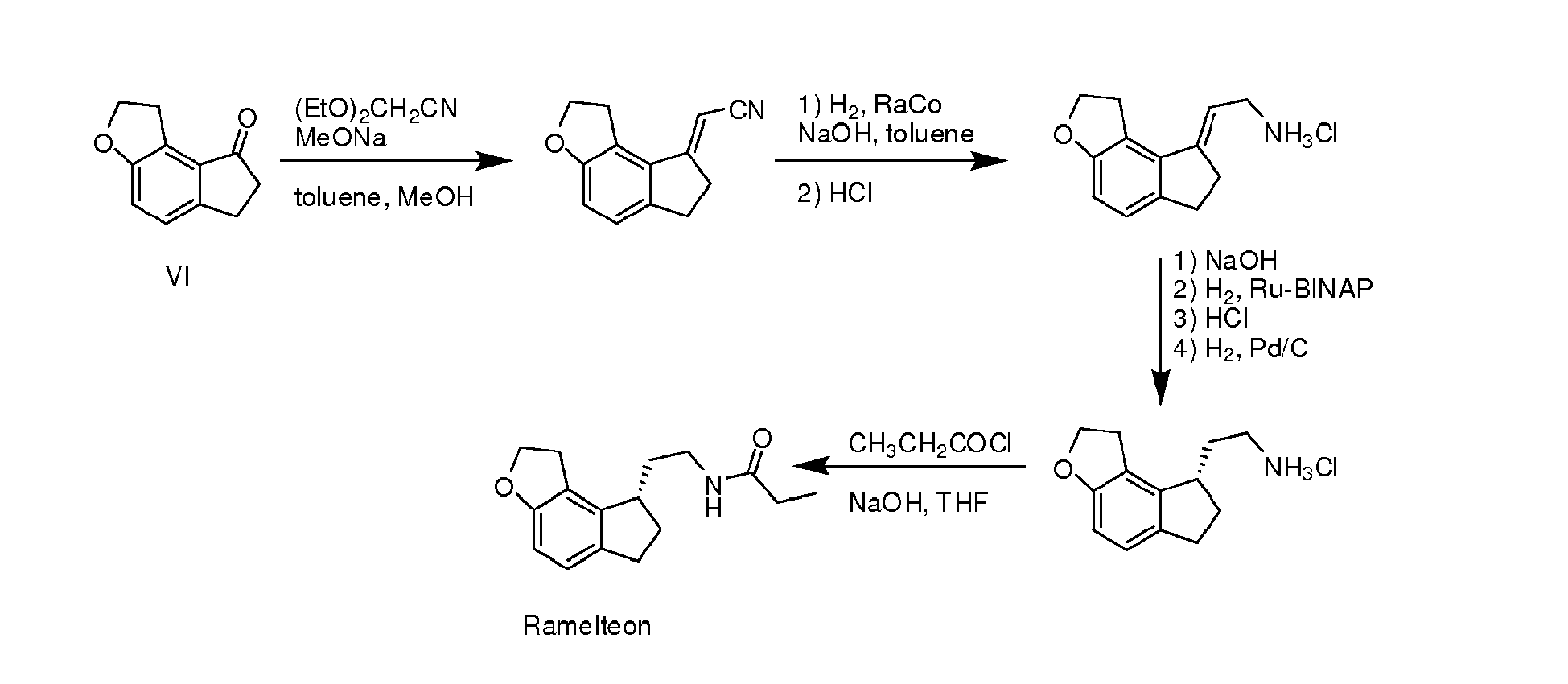
- For preparing a pharmaceutical composition comprising ramelteon as active ingredient, first ramelteon is provided by the process as described above, and then the thus prepared ramelteon is admixed with at least one suitable pharmaceutically acceptable excipient. Pharmaceutically acceptable excipients may be selected from the group consisting of binders, diluents, disintegrating agents, stabilizing agents, preservatives, lubricants, fragrances, flavoring agents, sweeteners and other excipients known in the field of the pharmaceutical technology. Preferably, carriers and excipients may be selected from the group consisting of lactose, microcrystalline cellulose, cellulose derivatives, e.g. hydroxypropylcellulose, polyacrylates, calcium carbonate, starch, colloidal silicone dioxide, sodium starch glycolate, talc, magnesium stearate, polyvinylpyrrolidone, polyethylene glycol and other excipients known in the field of the pharmaceutical technology.
-

- FTIR spectra of MeCN (140 ml) was recorded as reference. MeCN was cooled to -20°C, oxalyl chloride (16.5 ml) was added at once and waited until temperature re-stabilized at -20°C. DMF (16.6 ml) was then added drop-wise (temperature between -18°C and -22°C, 0.5 ml/min). Reaction was stirred until no oxalyl chloride was visible and DMF level was stable by FTIR. Vilsmeier reagent is thereby formed in situ according to the following reaction:

- Product I was then added portion wise (temperature between -18°C and -21 °C, about 30 min). Formation of intermediate was immediately observed by FTIR. Reaction was stirred for one hour. Et3N was then added drop-wise (temperature between -18°C and -22°C, 50 ml/h). At the end of addition, reaction was stirred 15 min at -20°C and temperature was slowly raised to 50°C (within about 15 min). Disappearance of intermediate and formation of DMF and product II was monitored by FTIR. When reaction looked completed by FTIR (about 2h at 50°C), the reaction was cooled down to 20°C and quenched with water (45 ml). Solution was transferred to a round bottom flask and MeCN was removed under reduced pressure. Solution was then diluted with MTBE (100 ml) and water (50 ml). Phases were separated and aqueous phase was re-extracted twice with MTBE (50 ml). Combined organic phases were washed twice with 10% H3PO4/10% NaCl solution and stored at 4°C until next step.
- List of FTIR bands used to follow the reaction (using 2nd derivative and solvent subtraction): Oxalyl chloride (reactant): Height to two point baseline, peak from 1800 cm-1 to 1770 cm-1, baseline 1800 cm-1 to 1770 cm-1.
- Intermediate: Height to single point baseline, peak from 1722 cm-1 to 1712 cm-1, baseline 1722 cm-1.
- Compound II (product): Area to two point baseline, peak from 993 cm-1 to 981 cm-1, baseline 993 cm-1 to 981 cm-1.
- DMF: Height to single point baseline, peak from 1694 cm-1 to 1680 cm-1, baseline 1694 cm-1.
-

- FTIR spectra of MTBE was recorded prior to the reaction as reference. To the solution of 4-(2-chloroethyl)-2,3-dihydrobenzofuran (II) in MTBE (150 ml) obtained at the previous step, was added, water (38 ml), KI (1.37 g), Bu4NOH 40% (19 ml) and NaOH 50% solution (66 ml). Reaction was vigorously stirred and heated at 50°C until reaction looked completed by FTIR (4 to 5 h). Warm reaction mixture was then transferred into an extraction funnel to give three phases. Water phase (bottom) was removed and did not contain product. Medium phase (colored black) was diluted with water (120 ml) and was extracted three times with MTBE. Combined organic phases were washed twice with water, once with 0.5M NaHSO3/10% NaCl solution and once with 1N NaOH/10% NaCl solution. MTBE solution was dried using MgSO4, filtered, concentrated and used immediately for next step.
- List of FTIR bands used to follow the reaction (using 2nd derivative and solvent subtraction)
- Compound II (reactant): Area to zero, peak from 1440 cm-1 to 1437 cm-1
- Compound III (product): Area to zero, peak from 1417 cm-1 to 1412 cm-1.
- Compound III (product): Area to zero, peak from 1565 cm-1 to 1562 cm-1.
-

- 4-vinyl-2,3-dihydrobenzofuran (III) (2.4 g) was dissolved in toluene (2 ml) and were successively added (ITC) (51 mg), PdCl2 (30 mg) and H2O2 30% (2 ml). Reaction was vigorously stirred at 55°C until reaction looked completed by FTIR. (for around 24 h). Reaction was cooled down to room temperature, diluted with EtOAc (50 ml) and water (50 ml). Phases were separated and organic phase was washed with 0.5M NaHSO3/10% NaCl solution and twice with 1 M NaHCO3, dried over MgSO4 and concentrated. Purification by flash chromatography gave 1-(2,3-dihydrobenzofuran-4-yl)ethanone (V). 1H NMR □ (CDCl3) 7.35 (dd, 1H, J = 0.8 Hz, J = 7.8 Hz), 7.19 (t, 1H, J = 7.9 Hz), 6.95 (d, 1H, J = 8.0 Hz), 4.57 (t, 2H, J = 8.8 Hz), 3.52 (t, 2H, J = 8.8 Hz), 2.57 (s, 3H). 13C NMR □ (CDCl3) 198.8, 161.0, 133.8, 128.2, 127.9, 121.4, 113.4, 71.6, 31.0, 27.6.
- List of FTIR bands used to follow the reaction (using 2nd derivative and solvent subtraction) Compound III (reactant): Area to single point baseline, peak from 925 cm-1 to 915 cm-1, baseline 915 cm-1.
- Compound V (product): Area to zero, peak from 1730 cm-1 to 1724 cm-1.
-

Claims (15)
- A process for preparing a compound of formula V


- The process according to claim 1, comprising the step of reacting a compound of formula III with an oxidant in the presence of catalyst, preferably said catalyst is a metal catalyst selected from the group consisting of Pd, Au and Pd catalysts, more preferably Pd catalyst is used, most preferably said catalyst is PdCl2.
- The process according to claim 2, wherein said step of reacting a compound of formula III with an oxidant in the presence of catalyst is performed in the presence of ionic liquid.
- The process according to claim 3, wherein the ionic liquid is selected from compounds having general formulae IVa and IVb:

- The process according to any one of claims 2-4, wherein said oxidant is selected from oxygen and H2O2.
- The process according to any one of claims 2-5, wherein said compound of
formula III has been prepared by reacting a compound of formula II
- The process according to claim 6, wherein said base is selected from the group of hydroxides, preferably the base is NaOH.
- The process according to any one of claims 6 and 7, wherein said process for preparing the compound of formula III is performed in the presence of phase transfer agent, preferably said phase transfer agent is selected from the group consisting of tetraalkyl ammonium salts of general formula R5 4NX wherein R5 is selected from substituted and unsubstituted alkyl group and wherein X is selected from the group consisting of Cl, Br, I, SO4 and OH, preferably said phase transfer agent is Bu4NOH.
- A process for preparing a compound of formula II
 a) in situ preparation of Vilsmeier reagent by reacting oxalyl chloride with DMF,b) reacting compound of formula I with Vilsmeier reagent obtained from step a)
to yield the compound of formula II
- A process for preparing the compound of formula V comprising the steps of:a) preparing the compound of formula II by a process comprising the steps of:- in situ preparation of Vilsmeier reagent from oxalyl chloride and DMF and- reacting compound of formula I with Vilsmeier reagent to yield a compound of formula II;b) reacting the compound of formula II with base selected from the group of hydroxides, wherein preferably the base is NaOH, in biphasic media, in the presence of phase transfer agent selected from the group consisting of tetraalkyl ammonium salts of general formula R5 4NX wherein R5 is selected from substituted and unsubstituted alkyl group and wherein X is selected from the group consisting of Cl, Br, I, SO4 and OH, to yield a compound of formula III, wherein a preferable phase transfer agent is Bu4NOH; andc) reacting the compound of formula III with an oxidant selected from the group consisting of oxygen and H2O2 in the presence of catalyst, wherein said catalyst is a metal catalyst selected from the group consisting of Pd, Au and Pt catalysts, preferably the catalyst is PdCl2, and in the presence of ionic liquid, wherein said ionic liquid is selected from compounds having general formulae IVa and IVb:


- The process according to any one of claims 1-10, wherein the respectively specified process step, alone or in combination, is controlled using Process Analytical Technology (PAT) using real time detection of at least one of educts and products by Fourier transform infrared (FTIR) spectroscopy (FTIR).
- A process for the preparation of ramelteon, comprising the steps of carrying out a process for preparing the compound of formula V according to any one of claims 1-8, 10 and 11; and subjecting the compound of formula V to further synthesis steps to yield ramelteon.
- The process for the preparation of ramelteon according to claim 12, wherein the further synthesis steps to yield ramelteon proceeds via a compound of formula VI, prepared from the compound of formula V comprising the steps ofa) reacting a compound of formula V with paraformaldehyde in the presence of ammonium salt, R6R7NH2 +X-, (wherein R6 and R7 are each independently selected from alkyl, cycloalkyl, aryl, arylalkyl and arylcycloalkyl; and X is halogen, BF4, PF6, H2PO4 or R8CO2, wherein R8 is one of alkyl, aryl, polyhaloalkyl) in organic solvent;b) contacting the solution from step a) with strong inorganic acid and obtaining compound of formula VI

- Use of a compound of formula III

- A process for the preparation of a pharmaceutical composition comprising ramelteon as active ingredient, comprising the steps of:preparing ramelteon according to the process according to any one of the claims 12-13 or according to the use of claim 14, andadmixing the thus prepared ramelteon with at least one pharmaceutically acceptable excipient.
Priority Applications (4)
| Application Number | Priority Date | Filing Date | Title |
|---|---|---|---|
| EP09157523A EP2243775A1 (en) | 2009-04-07 | 2009-04-07 | Synthesis of 1-(2,3-Dihydrobenzofuran-4-YL)ethanone as intermediate in the preparation of ramelteon |
| US13/263,039 US20120083526A1 (en) | 2009-04-07 | 2010-04-06 | Synthesis of 1-(2,3-dihydrobenzofuran-4-yl)ethanone as intermediate in the preparation of ramelteon |
| EP10715175A EP2417117A2 (en) | 2009-04-07 | 2010-04-06 | Synthesis of 1-(2,3-dihydrobenzofuran-4-yl)ethanone as intermediate in the preparation of ramelteon |
| PCT/EP2010/054541 WO2010115897A2 (en) | 2009-04-07 | 2010-04-06 | Synthesis of 1-(2,3-dihydrobenzofuran-4-yl)ethanone as intermediate in the preparation of ramelteon |
Applications Claiming Priority (1)
| Application Number | Priority Date | Filing Date | Title |
|---|---|---|---|
| EP09157523A EP2243775A1 (en) | 2009-04-07 | 2009-04-07 | Synthesis of 1-(2,3-Dihydrobenzofuran-4-YL)ethanone as intermediate in the preparation of ramelteon |
Publications (1)
| Publication Number | Publication Date |
|---|---|
| EP2243775A1 true EP2243775A1 (en) | 2010-10-27 |
Family
ID=40911043
Family Applications (2)
| Application Number | Title | Priority Date | Filing Date |
|---|---|---|---|
| EP09157523A Ceased EP2243775A1 (en) | 2009-04-07 | 2009-04-07 | Synthesis of 1-(2,3-Dihydrobenzofuran-4-YL)ethanone as intermediate in the preparation of ramelteon |
| EP10715175A Withdrawn EP2417117A2 (en) | 2009-04-07 | 2010-04-06 | Synthesis of 1-(2,3-dihydrobenzofuran-4-yl)ethanone as intermediate in the preparation of ramelteon |
Family Applications After (1)
| Application Number | Title | Priority Date | Filing Date |
|---|---|---|---|
| EP10715175A Withdrawn EP2417117A2 (en) | 2009-04-07 | 2010-04-06 | Synthesis of 1-(2,3-dihydrobenzofuran-4-yl)ethanone as intermediate in the preparation of ramelteon |
Country Status (3)
| Country | Link |
|---|---|
| US (1) | US20120083526A1 (en) |
| EP (2) | EP2243775A1 (en) |
| WO (1) | WO2010115897A2 (en) |
Cited By (1)
| Publication number | Priority date | Publication date | Assignee | Title |
|---|---|---|---|---|
| CN105884725A (en) * | 2016-05-10 | 2016-08-24 | 杭州偶联医药科技有限公司 | Preparation method of 4-vinyl-2,3-dihydrobenzene |
Families Citing this family (1)
| Publication number | Priority date | Publication date | Assignee | Title |
|---|---|---|---|---|
| CN103204845B (en) * | 2013-03-12 | 2014-12-24 | 西北大学 | Imidazolyl ionic liquid, and synthesizing method and application thereof |
Citations (6)
| Publication number | Priority date | Publication date | Assignee | Title |
|---|---|---|---|---|
| US6034239A (en) * | 1996-03-08 | 2000-03-07 | Takeda Chemical Industries, Ltd. | Tricyclic compounds, their production and use |
| US20010039286A1 (en) * | 2000-02-14 | 2001-11-08 | Kevin Dinnell | 2-aryl indole derivatives and their use as therapeutic agents |
| EP0885210B1 (en) | 1996-03-08 | 2002-06-12 | Takeda Chemical Industries, Ltd. | Tricylic compounds having binding affinity for melatonin receptors, their production and use |
| EP1792899A1 (en) | 2004-09-13 | 2007-06-06 | Takeda Pharmaceutical Company Limited | Process for production of optically active amine derivatives |
| WO2008106179A1 (en) | 2007-02-26 | 2008-09-04 | Teva Pharmaceutical Industries Ltd. | Intermediates and processes for the synthesis of ramelteon |
| WO2008151170A2 (en) | 2007-05-31 | 2008-12-11 | Teva Pharmaceutical Industries Ltd. | Process for the synthesis of ramelteon and its intermediates |
-
2009
- 2009-04-07 EP EP09157523A patent/EP2243775A1/en not_active Ceased
-
2010
- 2010-04-06 EP EP10715175A patent/EP2417117A2/en not_active Withdrawn
- 2010-04-06 US US13/263,039 patent/US20120083526A1/en not_active Abandoned
- 2010-04-06 WO PCT/EP2010/054541 patent/WO2010115897A2/en not_active Ceased
Patent Citations (6)
| Publication number | Priority date | Publication date | Assignee | Title |
|---|---|---|---|---|
| US6034239A (en) * | 1996-03-08 | 2000-03-07 | Takeda Chemical Industries, Ltd. | Tricyclic compounds, their production and use |
| EP0885210B1 (en) | 1996-03-08 | 2002-06-12 | Takeda Chemical Industries, Ltd. | Tricylic compounds having binding affinity for melatonin receptors, their production and use |
| US20010039286A1 (en) * | 2000-02-14 | 2001-11-08 | Kevin Dinnell | 2-aryl indole derivatives and their use as therapeutic agents |
| EP1792899A1 (en) | 2004-09-13 | 2007-06-06 | Takeda Pharmaceutical Company Limited | Process for production of optically active amine derivatives |
| WO2008106179A1 (en) | 2007-02-26 | 2008-09-04 | Teva Pharmaceutical Industries Ltd. | Intermediates and processes for the synthesis of ramelteon |
| WO2008151170A2 (en) | 2007-05-31 | 2008-12-11 | Teva Pharmaceutical Industries Ltd. | Process for the synthesis of ramelteon and its intermediates |
Non-Patent Citations (4)
| Title |
|---|
| CHATTERJEE A ET AL: "Efficient Syntheses of Some 1-Naphthylalkyl Ketones and Studies on their Autooxidation in Basic Medium", TETRAHEDRON, ELSEVIER SCIENCE PUBLISHERS, AMSTERDAM, NL, vol. 37, no. 21, 1 January 1981 (1981-01-01), pages 3653 - 3660, XP002303234, ISSN: 0040-4020 * |
| J. MED CHEM., vol. 45, 2002, pages 4222 - 4239 |
| M. RAO ET AL: "A practical pilot-scale synthesis of 4-vinyl-2,3-dihydrobenzofuran using imidate ester chemistry and phase-transfer catalysis", ORGANIC PROCESS RESEARCH & DEVELOPMENT, vol. 7, 30 May 2003 (2003-05-30), pages 547 - 550, XP002540905 * |
| UCHIKAWA O ET AL: "Synthesis of a novel series of tricyclic indan derivatives as melatonin receptor agonists", JOURNAL OF MEDICINAL CHEMISTRY, AMERICAN CHEMICAL SOCIETY, WASHINGTON, US, vol. 45, 1 January 2002 (2002-01-01), pages 4222 - 4239, XP002990691, ISSN: 0022-2623 * |
Cited By (2)
| Publication number | Priority date | Publication date | Assignee | Title |
|---|---|---|---|---|
| CN105884725A (en) * | 2016-05-10 | 2016-08-24 | 杭州偶联医药科技有限公司 | Preparation method of 4-vinyl-2,3-dihydrobenzene |
| CN105884725B (en) * | 2016-05-10 | 2018-03-06 | 杭州偶联医药科技有限公司 | A kind of preparation method of the Dihydrobenzofuranes of 4 vinyl 2,3 |
Also Published As
| Publication number | Publication date |
|---|---|
| WO2010115897A3 (en) | 2011-01-06 |
| WO2010115897A2 (en) | 2010-10-14 |
| EP2417117A2 (en) | 2012-02-15 |
| US20120083526A1 (en) | 2012-04-05 |
Similar Documents
| Publication | Publication Date | Title |
|---|---|---|
| Wasserman et al. | Reaction of singlet oxygen with enamino carbonyl systems. A general method for the synthesis of. alpha.-keto derivatives of lactones, esters, amides, lactams, and ketones | |
| Klimešová et al. | Synthesis and preliminary evaluation of benzimidazole derivatives as antimicrobial agents | |
| Zhang et al. | TBHP/I 2-promoted oxidative coupling of acetophenones with amines at room temperature under metal-free and solvent-free conditions for the synthesis of α-ketoamides | |
| Debleds et al. | A Dual Gold‐Iron Catalysis for a One‐Pot Synthesis of 2, 3‐Dihydroisoxazoles from Propargylic Alcohols and N‐Protected Hydroxylamines | |
| Chang et al. | FeCl 3 or MeSO 3 H-promoted multicomponent reactions for facile synthesis of structurally diverse furan analogues | |
| KR20110081188A (en) | Method for preparing 2-alkyl-3-aroyl-5-nitro-benzofuran | |
| Koseki et al. | A new approach to isoindolobenzazepines via a ring-expansion of isoindoloisoquinoline: Synthesis of lennoxamine and chilenine | |
| Mahdavinia et al. | Covalently anchored sulfonic acid on silica gel (SiO2-R-SO3H) as an efficient and reusable heterogeneous catalyst for the one-pot synthesis of 1, 8-dioxo-octahydroxanthenes under solvent-free conditions | |
| Kumar et al. | Hg/Pt-catalyzed conversion of bromo alkynamines/alkynols to saturated and unsaturated γ-butyrolactams/lactones via intramolecular electrophilic cyclization | |
| EP3148968A1 (en) | Processes for the preparation of -aminosulfone compounds | |
| Montaignac et al. | Copper (i)–amine metallo-organocatalyzed synthesis of carbo-and heterocyclic systems | |
| US20120083526A1 (en) | Synthesis of 1-(2,3-dihydrobenzofuran-4-yl)ethanone as intermediate in the preparation of ramelteon | |
| Schultz et al. | Asymmetric synthesis of the core structure of the melodinus alkaloids | |
| EP3207023B1 (en) | Process for the preparation of 1-(3,5-dichlorophenyl)-2,2,2-trifluoroethanone and derivatives thereof | |
| WO2013124745A1 (en) | Process for preparation of dronedarone by oxidation of a hydroxyl group | |
| Ramachandran et al. | Efficient iodine catalyzed chemoselective synthesis of aminals—an access to N, N-acetals by the addition of lactams to N-acyl imines | |
| IL183804A (en) | Process for preparing substituted 2-alkoxycarbonyl-3-aminothiophenes | |
| Alcaide et al. | Gold-catalyzed preparation of annelated 2-azetidinones via divergent heterocyclization of enyne-tethered oxazolidines | |
| Shaterian et al. | Four-component synthesis of 2H-indazolo [2, 1-b] phthalazine-1, 6, 11 (13H)-trione derivatives | |
| Abd El-Nabi | 1-Aryl-5-methoxy-pyrrolones as Synthons for 1, 3-Dipolar Cycloadditions | |
| Shin et al. | Friedel–Crafts acylation via interrupted Beckmann fragmentation of activated ketones | |
| KR101140134B1 (en) | Novel 3-arylbutenolide derivatives and its preparation method | |
| WO2012062918A1 (en) | Process for the preparation of 3-aroyl-5-aminobenzofuran derivatives | |
| FI73211B (en) | FRAMSTAELLNING AV 2-OXO-DIHYDROBENSO / D // 1,3 / OXAZINER. | |
| EP2328882A1 (en) | Synthesis of 6,7-dihydro-1h-indeno[5,4-b]furan-8(2h)-one as intermediate in the preparation of ramelteon |
Legal Events
| Date | Code | Title | Description |
|---|---|---|---|
| PUAI | Public reference made under article 153(3) epc to a published international application that has entered the european phase |
Free format text: ORIGINAL CODE: 0009012 |
|
| AK | Designated contracting states |
Kind code of ref document: A1 Designated state(s): AT BE BG CH CY CZ DE DK EE ES FI FR GB GR HR HU IE IS IT LI LT LU LV MC MK MT NL NO PL PT RO SE SI SK TR |
|
| AX | Request for extension of the european patent |
Extension state: AL BA RS |
|
| STAA | Information on the status of an ep patent application or granted ep patent |
Free format text: STATUS: THE APPLICATION HAS BEEN REFUSED |
|
| 18R | Application refused |
Effective date: 20101218 |