EP2243767A1 - Process for the iodination of aromatic compounds - Google Patents
Process for the iodination of aromatic compounds Download PDFInfo
- Publication number
- EP2243767A1 EP2243767A1 EP09158319A EP09158319A EP2243767A1 EP 2243767 A1 EP2243767 A1 EP 2243767A1 EP 09158319 A EP09158319 A EP 09158319A EP 09158319 A EP09158319 A EP 09158319A EP 2243767 A1 EP2243767 A1 EP 2243767A1
- Authority
- EP
- European Patent Office
- Prior art keywords
- acid
- process according
- formula
- iodine
- oxidizing agent
- Prior art date
- Legal status (The legal status is an assumption and is not a legal conclusion. Google has not performed a legal analysis and makes no representation as to the accuracy of the status listed.)
- Withdrawn
Links
- 238000000034 method Methods 0.000 title claims abstract description 58
- 230000008569 process Effects 0.000 title claims abstract description 49
- 238000006192 iodination reaction Methods 0.000 title abstract description 24
- 230000026045 iodination Effects 0.000 title abstract description 18
- 150000001491 aromatic compounds Chemical class 0.000 title description 2
- 238000002360 preparation method Methods 0.000 claims abstract description 17
- JEZJSNULLBSYHV-UHFFFAOYSA-N 5-amino-2,4,6-triiodobenzene-1,3-dicarboxylic acid Chemical compound NC1=C(I)C(C(O)=O)=C(I)C(C(O)=O)=C1I JEZJSNULLBSYHV-UHFFFAOYSA-N 0.000 claims description 27
- 150000001875 compounds Chemical class 0.000 claims description 26
- 239000000758 substrate Substances 0.000 claims description 26
- QFWPJPIVLCBXFJ-UHFFFAOYSA-N glymidine Chemical compound N1=CC(OCCOC)=CN=C1NS(=O)(=O)C1=CC=CC=C1 QFWPJPIVLCBXFJ-UHFFFAOYSA-N 0.000 claims description 22
- 229910052740 iodine Inorganic materials 0.000 claims description 20
- 239000011630 iodine Substances 0.000 claims description 20
- ZCYVEMRRCGMTRW-UHFFFAOYSA-N 7553-56-2 Chemical compound [I] ZCYVEMRRCGMTRW-UHFFFAOYSA-N 0.000 claims description 19
- PNDPGZBMCMUPRI-UHFFFAOYSA-N iodine Chemical compound II PNDPGZBMCMUPRI-UHFFFAOYSA-N 0.000 claims description 18
- 239000007800 oxidant agent Substances 0.000 claims description 18
- QAOWNCQODCNURD-UHFFFAOYSA-N Sulfuric acid Chemical compound OS(O)(=O)=O QAOWNCQODCNURD-UHFFFAOYSA-N 0.000 claims description 15
- KBZFDRWPMZESDI-UHFFFAOYSA-N 5-aminobenzene-1,3-dicarboxylic acid Chemical compound NC1=CC(C(O)=O)=CC(C(O)=O)=C1 KBZFDRWPMZESDI-UHFFFAOYSA-N 0.000 claims description 14
- MHAJPDPJQMAIIY-UHFFFAOYSA-N Hydrogen peroxide Chemical compound OO MHAJPDPJQMAIIY-UHFFFAOYSA-N 0.000 claims description 12
- 238000006243 chemical reaction Methods 0.000 claims description 11
- 239000000203 mixture Substances 0.000 claims description 11
- 230000002083 iodinating effect Effects 0.000 claims description 10
- 239000002253 acid Substances 0.000 claims description 9
- 150000003839 salts Chemical class 0.000 claims description 9
- XLYOFNOQVPJJNP-UHFFFAOYSA-N water Substances O XLYOFNOQVPJJNP-UHFFFAOYSA-N 0.000 claims description 7
- 239000002798 polar solvent Substances 0.000 claims description 5
- 125000003178 carboxy group Chemical group [H]OC(*)=O 0.000 claims description 4
- 125000002887 hydroxy group Chemical group [H]O* 0.000 claims description 4
- 239000012429 reaction media Substances 0.000 claims description 4
- AKEJUJNQAAGONA-UHFFFAOYSA-N sulfur trioxide Chemical compound O=S(=O)=O AKEJUJNQAAGONA-UHFFFAOYSA-N 0.000 claims description 4
- NBIIXXVUZAFLBC-UHFFFAOYSA-N Phosphoric acid Chemical compound OP(O)(O)=O NBIIXXVUZAFLBC-UHFFFAOYSA-N 0.000 claims description 3
- 150000001298 alcohols Chemical class 0.000 claims description 3
- 125000004178 (C1-C4) alkyl group Chemical group 0.000 claims description 2
- 125000004191 (C1-C6) alkoxy group Chemical group 0.000 claims description 2
- 125000004169 (C1-C6) alkyl group Chemical group 0.000 claims description 2
- UFHFLCQGNIYNRP-UHFFFAOYSA-N Hydrogen Chemical compound [H][H] UFHFLCQGNIYNRP-UHFFFAOYSA-N 0.000 claims description 2
- AFVFQIVMOAPDHO-UHFFFAOYSA-N Methanesulfonic acid Chemical compound CS(O)(=O)=O AFVFQIVMOAPDHO-UHFFFAOYSA-N 0.000 claims description 2
- GRYLNZFGIOXLOG-UHFFFAOYSA-N Nitric acid Chemical compound O[N+]([O-])=O GRYLNZFGIOXLOG-UHFFFAOYSA-N 0.000 claims description 2
- CBENFWSGALASAD-UHFFFAOYSA-N Ozone Chemical compound [O-][O+]=O CBENFWSGALASAD-UHFFFAOYSA-N 0.000 claims description 2
- FAPWRFPIFSIZLT-UHFFFAOYSA-M Sodium chloride Chemical compound [Na+].[Cl-] FAPWRFPIFSIZLT-UHFFFAOYSA-M 0.000 claims description 2
- 239000003513 alkali Substances 0.000 claims description 2
- 229910052783 alkali metal Inorganic materials 0.000 claims description 2
- 229910052784 alkaline earth metal Inorganic materials 0.000 claims description 2
- 125000005518 carboxamido group Chemical group 0.000 claims description 2
- 150000002334 glycols Chemical class 0.000 claims description 2
- 239000001257 hydrogen Substances 0.000 claims description 2
- 229910052739 hydrogen Inorganic materials 0.000 claims description 2
- 229910017604 nitric acid Inorganic materials 0.000 claims description 2
- 239000011780 sodium chloride Substances 0.000 claims description 2
- 239000001117 sulphuric acid Substances 0.000 claims description 2
- 235000011149 sulphuric acid Nutrition 0.000 claims description 2
- -1 3,5-disubstituted anilines Chemical class 0.000 abstract description 20
- 239000002872 contrast media Substances 0.000 abstract description 12
- 230000015572 biosynthetic process Effects 0.000 abstract description 8
- 150000001448 anilines Chemical class 0.000 abstract description 7
- 229940039231 contrast media Drugs 0.000 abstract description 4
- 239000000543 intermediate Substances 0.000 abstract description 4
- 238000003786 synthesis reaction Methods 0.000 abstract description 3
- 239000000243 solution Substances 0.000 description 13
- 125000003118 aryl group Polymers 0.000 description 12
- 239000007787 solid Substances 0.000 description 12
- ICIWUVCWSCSTAQ-UHFFFAOYSA-N iodic acid Chemical compound OI(=O)=O ICIWUVCWSCSTAQ-UHFFFAOYSA-N 0.000 description 10
- PAYRUJLWNCNPSJ-UHFFFAOYSA-N Aniline Chemical compound NC1=CC=CC=C1 PAYRUJLWNCNPSJ-UHFFFAOYSA-N 0.000 description 6
- 239000012336 iodinating agent Substances 0.000 description 6
- 238000004519 manufacturing process Methods 0.000 description 6
- 239000011541 reaction mixture Substances 0.000 description 6
- 239000007864 aqueous solution Substances 0.000 description 5
- 239000006227 byproduct Substances 0.000 description 5
- 239000012045 crude solution Substances 0.000 description 5
- 238000004128 high performance liquid chromatography Methods 0.000 description 5
- 239000000047 product Substances 0.000 description 5
- 239000002904 solvent Substances 0.000 description 5
- 239000000725 suspension Substances 0.000 description 5
- VEXZGXHMUGYJMC-UHFFFAOYSA-N Hydrochloric acid Chemical compound Cl VEXZGXHMUGYJMC-UHFFFAOYSA-N 0.000 description 4
- 230000002378 acidificating effect Effects 0.000 description 4
- MTHSVFCYNBDYFN-UHFFFAOYSA-N diethylene glycol Chemical compound OCCOCCO MTHSVFCYNBDYFN-UHFFFAOYSA-N 0.000 description 4
- 229960004647 iopamidol Drugs 0.000 description 4
- XQZXYNRDCRIARQ-LURJTMIESA-N iopamidol Chemical compound C[C@H](O)C(=O)NC1=C(I)C(C(=O)NC(CO)CO)=C(I)C(C(=O)NC(CO)CO)=C1I XQZXYNRDCRIARQ-LURJTMIESA-N 0.000 description 4
- 239000007858 starting material Substances 0.000 description 4
- QTBSBXVTEAMEQO-UHFFFAOYSA-N Acetic acid Chemical compound CC(O)=O QTBSBXVTEAMEQO-UHFFFAOYSA-N 0.000 description 3
- QXNVGIXVLWOKEQ-UHFFFAOYSA-N Disodium Chemical class [Na][Na] QXNVGIXVLWOKEQ-UHFFFAOYSA-N 0.000 description 3
- QZRGKCOWNLSUDK-UHFFFAOYSA-N Iodochlorine Chemical compound ICl QZRGKCOWNLSUDK-UHFFFAOYSA-N 0.000 description 3
- OKKJLVBELUTLKV-UHFFFAOYSA-N Methanol Chemical compound OC OKKJLVBELUTLKV-UHFFFAOYSA-N 0.000 description 3
- 238000007792 addition Methods 0.000 description 3
- 238000007796 conventional method Methods 0.000 description 3
- 229960000780 iomeprol Drugs 0.000 description 3
- NJKDOADNQSYQEV-UHFFFAOYSA-N iomeprol Chemical compound OCC(=O)N(C)C1=C(I)C(C(=O)NCC(O)CO)=C(I)C(C(=O)NCC(O)CO)=C1I NJKDOADNQSYQEV-UHFFFAOYSA-N 0.000 description 3
- 239000012071 phase Substances 0.000 description 3
- 238000000746 purification Methods 0.000 description 3
- 239000000376 reactant Substances 0.000 description 3
- 230000035484 reaction time Effects 0.000 description 3
- 241000894007 species Species 0.000 description 3
- RTZKZFJDLAIYFH-UHFFFAOYSA-N Diethyl ether Chemical compound CCOCC RTZKZFJDLAIYFH-UHFFFAOYSA-N 0.000 description 2
- XUHXFSYUBXNTHU-UHFFFAOYSA-N Iotrolan Chemical compound IC=1C(C(=O)NC(CO)C(O)CO)=C(I)C(C(=O)NC(CO)C(O)CO)=C(I)C=1N(C)C(=O)CC(=O)N(C)C1=C(I)C(C(=O)NC(CO)C(O)CO)=C(I)C(C(=O)NC(CO)C(O)CO)=C1I XUHXFSYUBXNTHU-UHFFFAOYSA-N 0.000 description 2
- 125000003277 amino group Chemical group 0.000 description 2
- RWZYAGGXGHYGMB-UHFFFAOYSA-N anthranilic acid Chemical compound NC1=CC=CC=C1C(O)=O RWZYAGGXGHYGMB-UHFFFAOYSA-N 0.000 description 2
- 238000013459 approach Methods 0.000 description 2
- WPYMKLBDIGXBTP-UHFFFAOYSA-N benzoic acid Chemical compound OC(=O)C1=CC=CC=C1 WPYMKLBDIGXBTP-UHFFFAOYSA-N 0.000 description 2
- 238000009835 boiling Methods 0.000 description 2
- 244000309464 bull Species 0.000 description 2
- 238000009833 condensation Methods 0.000 description 2
- 230000005494 condensation Effects 0.000 description 2
- IUEVXLACZFKZSP-UHFFFAOYSA-L disodium;5-aminobenzene-1,3-dicarboxylate Chemical compound [Na+].[Na+].NC1=CC(C([O-])=O)=CC(C([O-])=O)=C1 IUEVXLACZFKZSP-UHFFFAOYSA-L 0.000 description 2
- 238000007336 electrophilic substitution reaction Methods 0.000 description 2
- 238000010828 elution Methods 0.000 description 2
- 230000007613 environmental effect Effects 0.000 description 2
- 229960003182 iotrolan Drugs 0.000 description 2
- 230000003647 oxidation Effects 0.000 description 2
- 238000007254 oxidation reaction Methods 0.000 description 2
- 238000005691 oxidative coupling reaction Methods 0.000 description 2
- 230000001590 oxidative effect Effects 0.000 description 2
- 230000008707 rearrangement Effects 0.000 description 2
- 230000009467 reduction Effects 0.000 description 2
- 238000003860 storage Methods 0.000 description 2
- FYSNRJHAOHDILO-UHFFFAOYSA-N thionyl chloride Chemical compound ClS(Cl)=O FYSNRJHAOHDILO-UHFFFAOYSA-N 0.000 description 2
- 0 *C(C(N(*)c(c(I)c(*)c(I)c1*)c1I)=O)O Chemical compound *C(C(N(*)c(c(I)c(*)c(I)c1*)c1I)=O)O 0.000 description 1
- WXLJJIHGDBUBJM-UHFFFAOYSA-N 1,3,5-triiodobenzene Chemical class IC1=CC(I)=CC(I)=C1 WXLJJIHGDBUBJM-UHFFFAOYSA-N 0.000 description 1
- DFDJVFYYDGMDTB-BIYVAJLZSA-N 1-n,3-n-bis(2,3-dihydroxypropyl)-2,4,6-triiodo-5-[[(3s,4r,5s)-3,4,5,6-tetrahydroxy-2-oxohexanoyl]amino]benzene-1,3-dicarboxamide Chemical compound OCC(O)CNC(=O)C1=C(I)C(NC(=O)C(=O)[C@@H](O)[C@H](O)[C@@H](O)CO)=C(I)C(C(=O)NCC(O)CO)=C1I DFDJVFYYDGMDTB-BIYVAJLZSA-N 0.000 description 1
- GNOYQZRQXNVAKE-UHFFFAOYSA-N 2,4,6-triiodoaniline Chemical class NC1=C(I)C=C(I)C=C1I GNOYQZRQXNVAKE-UHFFFAOYSA-N 0.000 description 1
- HVSOUCGIMNXGCY-UHFFFAOYSA-N 2-[[2-[2-[2-[2-(2-carboxy-3,5,6-triiodoanilino)-2-oxoethoxy]ethoxy]ethoxy]acetyl]amino]-3,4,6-triiodobenzoic acid Chemical compound OC(=O)C1=C(I)C=C(I)C(I)=C1NC(=O)COCCOCCOCC(=O)NC1=C(I)C(I)=CC(I)=C1C(O)=O HVSOUCGIMNXGCY-UHFFFAOYSA-N 0.000 description 1
- GOLGILSVWFKZRQ-UHFFFAOYSA-N 2-amino-5-iodobenzoic acid Chemical compound NC1=CC=C(I)C=C1C(O)=O GOLGILSVWFKZRQ-UHFFFAOYSA-N 0.000 description 1
- KJJPLEZQSCZCKE-UHFFFAOYSA-N 2-aminopropane-1,3-diol Chemical compound OCC(N)CO KJJPLEZQSCZCKE-UHFFFAOYSA-N 0.000 description 1
- IWLIBARWYNRYQO-OCPVLIPCSA-N 3,5-diacetamido-2,4,6-triiodo-n-methyl-n-[2-[methyl-[(2s,3r,4r,5r)-2,3,4,5,6-pentahydroxyhexyl]amino]-2-oxoethyl]benzamide Chemical compound OC[C@@H](O)[C@@H](O)[C@H](O)[C@@H](O)CN(C)C(=O)CN(C)C(=O)C1=C(I)C(NC(C)=O)=C(I)C(NC(C)=O)=C1I IWLIBARWYNRYQO-OCPVLIPCSA-N 0.000 description 1
- ODYPLCHSCOJEIZ-GMYJMXFCSA-N 3-[acetyl(methyl)amino]-n-(2-hydroxyethyl)-2,4,6-triiodo-5-[[(2s,3s,4r,5r)-2,3,4,5,6-pentahydroxyhexanoyl]amino]benzamide Chemical compound CC(=O)N(C)C1=C(I)C(NC(=O)[C@@H](O)[C@@H](O)[C@H](O)[C@H](O)CO)=C(I)C(C(=O)NCCO)=C1I ODYPLCHSCOJEIZ-GMYJMXFCSA-N 0.000 description 1
- KQIGMPWTAHJUMN-UHFFFAOYSA-N 3-aminopropane-1,2-diol Chemical compound NCC(O)CO KQIGMPWTAHJUMN-UHFFFAOYSA-N 0.000 description 1
- OQHLOKBHRXMXLD-UHFFFAOYSA-N 5-[3-[3-[3,5-bis[2,3-dihydroxypropyl(methyl)carbamoyl]-2,4,6-triiodoanilino]-3-oxopropyl]sulfanylpropanoylamino]-1-n,3-n-bis(2,3-dihydroxypropyl)-2,4,6-triiodo-1-n,3-n-dimethylbenzene-1,3-dicarboxamide Chemical compound OCC(O)CN(C)C(=O)C1=C(I)C(C(=O)N(CC(O)CO)C)=C(I)C(NC(=O)CCSCCC(=O)NC=2C(=C(C(=O)N(C)CC(O)CO)C(I)=C(C(=O)N(C)CC(O)CO)C=2I)I)=C1I OQHLOKBHRXMXLD-UHFFFAOYSA-N 0.000 description 1
- NBDAHKQJXVLAID-UHFFFAOYSA-N 5-nitroisophthalic acid Chemical compound OC(=O)C1=CC(C(O)=O)=CC([N+]([O-])=O)=C1 NBDAHKQJXVLAID-UHFFFAOYSA-N 0.000 description 1
- WEVYAHXRMPXWCK-UHFFFAOYSA-N Acetonitrile Chemical compound CC#N WEVYAHXRMPXWCK-UHFFFAOYSA-N 0.000 description 1
- GNOGSFBXBWBTIG-UHFFFAOYSA-N Acetrizoic acid Chemical compound CC(=O)NC1=C(I)C=C(I)C(C(O)=O)=C1I GNOGSFBXBWBTIG-UHFFFAOYSA-N 0.000 description 1
- 239000005711 Benzoic acid Substances 0.000 description 1
- OYPRJOBELJOOCE-UHFFFAOYSA-N Calcium Chemical class [Ca] OYPRJOBELJOOCE-UHFFFAOYSA-N 0.000 description 1
- ZAMOUSCENKQFHK-UHFFFAOYSA-N Chlorine atom Chemical compound [Cl] ZAMOUSCENKQFHK-UHFFFAOYSA-N 0.000 description 1
- LYCAIKOWRPUZTN-UHFFFAOYSA-N Ethylene glycol Chemical compound OCCO LYCAIKOWRPUZTN-UHFFFAOYSA-N 0.000 description 1
- 230000005526 G1 to G0 transition Effects 0.000 description 1
- DGAQECJNVWCQMB-PUAWFVPOSA-M Ilexoside XXIX Chemical class C[C@@H]1CC[C@@]2(CC[C@@]3(C(=CC[C@H]4[C@]3(CC[C@@H]5[C@@]4(CC[C@@H](C5(C)C)OS(=O)(=O)[O-])C)C)[C@@H]2[C@]1(C)O)C)C(=O)O[C@H]6[C@@H]([C@H]([C@@H]([C@H](O6)CO)O)O)O.[Na+] DGAQECJNVWCQMB-PUAWFVPOSA-M 0.000 description 1
- SMQYOVYWPWASGU-UHFFFAOYSA-N Iocarmic acid Chemical compound OC(=O)C1=C(I)C(C(=O)NC)=C(I)C(NC(=O)CCCCC(=O)NC=2C(=C(C(=O)NC)C(I)=C(C(O)=O)C=2I)I)=C1I SMQYOVYWPWASGU-UHFFFAOYSA-N 0.000 description 1
- WWVAPFRKZMUPHZ-UHFFFAOYSA-N Iodoxamic acid Chemical compound OC(=O)C1=C(I)C=C(I)C(NC(=O)CCOCCOCCOCCOCCC(=O)NC=2C(=C(C(O)=O)C(I)=CC=2I)I)=C1I WWVAPFRKZMUPHZ-UHFFFAOYSA-N 0.000 description 1
- UXIGWFXRQKWHHA-UHFFFAOYSA-N Iotalamic acid Chemical compound CNC(=O)C1=C(I)C(NC(C)=O)=C(I)C(C(O)=O)=C1I UXIGWFXRQKWHHA-UHFFFAOYSA-N 0.000 description 1
- AMDBBAQNWSUWGN-UHFFFAOYSA-N Ioversol Chemical compound OCCN(C(=O)CO)C1=C(I)C(C(=O)NCC(O)CO)=C(I)C(C(=O)NCC(O)CO)=C1I AMDBBAQNWSUWGN-UHFFFAOYSA-N 0.000 description 1
- WHXSMMKQMYFTQS-UHFFFAOYSA-N Lithium Chemical class [Li] WHXSMMKQMYFTQS-UHFFFAOYSA-N 0.000 description 1
- BAQCROVBDNBEEB-UBYUBLNFSA-N Metrizamide Chemical compound CC(=O)N(C)C1=C(I)C(NC(C)=O)=C(I)C(C(=O)N[C@@H]2[C@H]([C@H](O)[C@@H](CO)OC2O)O)=C1I BAQCROVBDNBEEB-UBYUBLNFSA-N 0.000 description 1
- ISWSIDIOOBJBQZ-UHFFFAOYSA-N Phenol Chemical compound OC1=CC=CC=C1 ISWSIDIOOBJBQZ-UHFFFAOYSA-N 0.000 description 1
- 229920002582 Polyethylene Glycol 600 Polymers 0.000 description 1
- ZLMJMSJWJFRBEC-UHFFFAOYSA-N Potassium Chemical class [K] ZLMJMSJWJFRBEC-UHFFFAOYSA-N 0.000 description 1
- VYPSYNLAJGMNEJ-UHFFFAOYSA-N Silicium dioxide Chemical compound O=[Si]=O VYPSYNLAJGMNEJ-UHFFFAOYSA-N 0.000 description 1
- FFINMCNLQNTKLU-UHFFFAOYSA-N adipiodone Chemical compound OC(=O)C1=C(I)C=C(I)C(NC(=O)CCCCC(=O)NC=2C(=C(C(O)=O)C(I)=CC=2I)I)=C1I FFINMCNLQNTKLU-UHFFFAOYSA-N 0.000 description 1
- YVPYQUNUQOZFHG-UHFFFAOYSA-N amidotrizoic acid Chemical compound CC(=O)NC1=C(I)C(NC(C)=O)=C(I)C(C(O)=O)=C1I YVPYQUNUQOZFHG-UHFFFAOYSA-N 0.000 description 1
- 125000002490 anilino group Chemical group [H]N(*)C1=C([H])C([H])=C([H])C([H])=C1[H] 0.000 description 1
- 239000003125 aqueous solvent Substances 0.000 description 1
- 235000010233 benzoic acid Nutrition 0.000 description 1
- 239000011575 calcium Chemical class 0.000 description 1
- 229910052791 calcium Inorganic materials 0.000 description 1
- 150000001768 cations Chemical class 0.000 description 1
- 238000012512 characterization method Methods 0.000 description 1
- 239000007806 chemical reaction intermediate Substances 0.000 description 1
- 239000000460 chlorine Substances 0.000 description 1
- 229910052801 chlorine Inorganic materials 0.000 description 1
- 125000001309 chloro group Chemical group Cl* 0.000 description 1
- 238000004587 chromatography analysis Methods 0.000 description 1
- 238000003776 cleavage reaction Methods 0.000 description 1
- 238000001816 cooling Methods 0.000 description 1
- 238000001514 detection method Methods 0.000 description 1
- 238000012631 diagnostic technique Methods 0.000 description 1
- 229960005423 diatrizoate Drugs 0.000 description 1
- 239000000539 dimer Substances 0.000 description 1
- 230000000694 effects Effects 0.000 description 1
- 238000001914 filtration Methods 0.000 description 1
- XMBWDFGMSWQBCA-UHFFFAOYSA-N hydrogen iodide Chemical compound I XMBWDFGMSWQBCA-UHFFFAOYSA-N 0.000 description 1
- 238000005984 hydrogenation reaction Methods 0.000 description 1
- 238000003384 imaging method Methods 0.000 description 1
- 238000011065 in-situ storage Methods 0.000 description 1
- 238000002347 injection Methods 0.000 description 1
- 239000007924 injection Substances 0.000 description 1
- VVDGWALACJEJKG-UHFFFAOYSA-N iodamide Chemical compound CC(=O)NCC1=C(I)C(NC(C)=O)=C(I)C(C(O)=O)=C1I VVDGWALACJEJKG-UHFFFAOYSA-N 0.000 description 1
- 229960004901 iodamide Drugs 0.000 description 1
- ICIWUVCWSCSTAQ-UHFFFAOYSA-M iodate Chemical compound [O-]I(=O)=O ICIWUVCWSCSTAQ-UHFFFAOYSA-M 0.000 description 1
- 239000000193 iodinated contrast media Substances 0.000 description 1
- 150000002496 iodine Chemical class 0.000 description 1
- 229940029355 iodipamide Drugs 0.000 description 1
- 229960004359 iodixanol Drugs 0.000 description 1
- NBQNWMBBSKPBAY-UHFFFAOYSA-N iodixanol Chemical compound IC=1C(C(=O)NCC(O)CO)=C(I)C(C(=O)NCC(O)CO)=C(I)C=1N(C(=O)C)CC(O)CN(C(C)=O)C1=C(I)C(C(=O)NCC(O)CO)=C(I)C(C(=O)NCC(O)CO)=C1I NBQNWMBBSKPBAY-UHFFFAOYSA-N 0.000 description 1
- 229960002487 iodoxamic acid Drugs 0.000 description 1
- 229950006335 ioglunide Drugs 0.000 description 1
- 229960001025 iohexol Drugs 0.000 description 1
- NTHXOOBQLCIOLC-UHFFFAOYSA-N iohexol Chemical compound OCC(O)CN(C(=O)C)C1=C(I)C(C(=O)NCC(O)CO)=C(I)C(C(=O)NCC(O)CO)=C1I NTHXOOBQLCIOLC-UHFFFAOYSA-N 0.000 description 1
- 150000002500 ions Chemical class 0.000 description 1
- 229960000824 iopentol Drugs 0.000 description 1
- IUNJANQVIJDFTQ-UHFFFAOYSA-N iopentol Chemical compound COCC(O)CN(C(C)=O)C1=C(I)C(C(=O)NCC(O)CO)=C(I)C(C(=O)NCC(O)CO)=C1I IUNJANQVIJDFTQ-UHFFFAOYSA-N 0.000 description 1
- 229960002603 iopromide Drugs 0.000 description 1
- DGAIEPBNLOQYER-UHFFFAOYSA-N iopromide Chemical compound COCC(=O)NC1=C(I)C(C(=O)NCC(O)CO)=C(I)C(C(=O)N(C)CC(O)CO)=C1I DGAIEPBNLOQYER-UHFFFAOYSA-N 0.000 description 1
- 229950007842 iosarcol Drugs 0.000 description 1
- 229950011097 iotasul Drugs 0.000 description 1
- 229940029378 iothalamate Drugs 0.000 description 1
- 229960004537 ioversol Drugs 0.000 description 1
- 229940029407 ioxaglate Drugs 0.000 description 1
- TYYBFXNZMFNZJT-UHFFFAOYSA-N ioxaglic acid Chemical compound CNC(=O)C1=C(I)C(N(C)C(C)=O)=C(I)C(C(=O)NCC(=O)NC=2C(=C(C(=O)NCCO)C(I)=C(C(O)=O)C=2I)I)=C1I TYYBFXNZMFNZJT-UHFFFAOYSA-N 0.000 description 1
- 229960002611 ioxilan Drugs 0.000 description 1
- UUMLTINZBQPNGF-UHFFFAOYSA-N ioxilan Chemical compound OCC(O)CN(C(=O)C)C1=C(I)C(C(=O)NCCO)=C(I)C(C(=O)NCC(O)CO)=C1I UUMLTINZBQPNGF-UHFFFAOYSA-N 0.000 description 1
- 229910052744 lithium Inorganic materials 0.000 description 1
- 159000000003 magnesium salts Chemical class 0.000 description 1
- 238000003760 magnetic stirring Methods 0.000 description 1
- 238000010907 mechanical stirring Methods 0.000 description 1
- 230000007246 mechanism Effects 0.000 description 1
- 229960000554 metrizamide Drugs 0.000 description 1
- GGGDNPWHMNJRFN-UHFFFAOYSA-N metrizoic acid Chemical compound CC(=O)N(C)C1=C(I)C(NC(C)=O)=C(I)C(C(O)=O)=C1I GGGDNPWHMNJRFN-UHFFFAOYSA-N 0.000 description 1
- 229960004712 metrizoic acid Drugs 0.000 description 1
- 238000005457 optimization Methods 0.000 description 1
- 239000012074 organic phase Substances 0.000 description 1
- 150000002989 phenols Chemical class 0.000 description 1
- 229920002523 polyethylene Glycol 1000 Polymers 0.000 description 1
- 229920001223 polyethylene glycol Polymers 0.000 description 1
- 229910052700 potassium Inorganic materials 0.000 description 1
- 239000011591 potassium Chemical class 0.000 description 1
- 239000002244 precipitate Substances 0.000 description 1
- 238000001556 precipitation Methods 0.000 description 1
- 230000000750 progressive effect Effects 0.000 description 1
- 125000006239 protecting group Chemical group 0.000 description 1
- 230000002285 radioactive effect Effects 0.000 description 1
- 238000004064 recycling Methods 0.000 description 1
- 230000007017 scission Effects 0.000 description 1
- 238000007086 side reaction Methods 0.000 description 1
- 229910052708 sodium Inorganic materials 0.000 description 1
- 239000011734 sodium Substances 0.000 description 1
- AJPJDKMHJJGVTQ-UHFFFAOYSA-M sodium dihydrogen phosphate Chemical compound [Na+].OP(O)([O-])=O AJPJDKMHJJGVTQ-UHFFFAOYSA-M 0.000 description 1
- 229910000162 sodium phosphate Inorganic materials 0.000 description 1
- 238000003756 stirring Methods 0.000 description 1
- 238000000859 sublimation Methods 0.000 description 1
- 230000008022 sublimation Effects 0.000 description 1
- 239000000126 substance Substances 0.000 description 1
- ZIBGPFATKBEMQZ-UHFFFAOYSA-N triethylene glycol Chemical compound OCCOCCOCCO ZIBGPFATKBEMQZ-UHFFFAOYSA-N 0.000 description 1
- 238000010626 work up procedure Methods 0.000 description 1
Classifications
-
- C—CHEMISTRY; METALLURGY
- C07—ORGANIC CHEMISTRY
- C07C—ACYCLIC OR CARBOCYCLIC COMPOUNDS
- C07C227/00—Preparation of compounds containing amino and carboxyl groups bound to the same carbon skeleton
- C07C227/14—Preparation of compounds containing amino and carboxyl groups bound to the same carbon skeleton from compounds containing already amino and carboxyl groups or derivatives thereof
- C07C227/16—Preparation of compounds containing amino and carboxyl groups bound to the same carbon skeleton from compounds containing already amino and carboxyl groups or derivatives thereof by reactions not involving the amino or carboxyl groups
-
- C—CHEMISTRY; METALLURGY
- C07—ORGANIC CHEMISTRY
- C07C—ACYCLIC OR CARBOCYCLIC COMPOUNDS
- C07C227/00—Preparation of compounds containing amino and carboxyl groups bound to the same carbon skeleton
- C07C227/38—Separation; Purification; Stabilisation; Use of additives
- C07C227/40—Separation; Purification
- C07C227/42—Crystallisation
-
- C—CHEMISTRY; METALLURGY
- C08—ORGANIC MACROMOLECULAR COMPOUNDS; THEIR PREPARATION OR CHEMICAL WORKING-UP; COMPOSITIONS BASED THEREON
- C08G—MACROMOLECULAR COMPOUNDS OBTAINED OTHERWISE THAN BY REACTIONS ONLY INVOLVING UNSATURATED CARBON-TO-CARBON BONDS
- C08G18/00—Polymeric products of isocyanates or isothiocyanates
- C08G18/06—Polymeric products of isocyanates or isothiocyanates with compounds having active hydrogen
- C08G18/28—Polymeric products of isocyanates or isothiocyanates with compounds having active hydrogen characterised by the compounds used containing active hydrogen
- C08G18/30—Low-molecular-weight compounds
- C08G18/38—Low-molecular-weight compounds having heteroatoms other than oxygen
- C08G18/3819—Low-molecular-weight compounds having heteroatoms other than oxygen having nitrogen
- C08G18/3821—Carboxylic acids; Esters thereof with monohydroxyl compounds
Definitions
- the present invention relates to a process for the iodination of aromatic compounds so as to prepare poly-iodinated aromatic derivatives.
- it relates to a process including the direct iodination of 3,5-disubstituted anilines to the corresponding 3,5-disubstituted-2,4,6-triiodoanilines, which are useful intermediates for the synthesis of x-ray contrast media, and to the preparation of the contrast media themselves.
- Iodinated contrast media are well-known compounds widely used in x-ray imaging diagnostic techniques. Suitable examples of the said compounds include, for instance, diatrizoate, iothalamate, ioxithalamate, metrizoate, iohexol, iomeprol, iopamidol, iopentol, iopromide, ioversol, ioxilan, iodixanol, iosarcol, iogulamide, ioglunide, iogluamide, acetrizoate, iodamide, iocetamide and metrizamide, which are all monomeric; while, for example, ioxaglate, iotrolan, iotasul, iodipamide, iocarmate, iodoxamate, iotroxate, iotrolan, and the like, are dimers.
- iodinated contrast agents are described, for instance, in WO
- the said compounds may be prepared by a variety of routes, some of which comprise the aromatic iodination of given substrates, for instance of suitable 3,5-disubstituted phenols, which undergo triiodination on the available 2, 4 and 6 positions, thus leading to the corresponding 3,5-disubstituted-2,4,6-triiodophenols. These latter, in turn, may be further converted and processed through the so-called Smile's rearrangement, to the expected final compounds.
- Smile's rearrangement see, for instance, WO 88/09328 , WO 97/05097 and WO 00/32561 (Bracco ).
- the aromatic iodination may be also performed on suitable anilines, so as to provide the corresponding 2,4,6-triiodoaniline derivatives, to be further converted and processed to the final compounds.
- the iodination step may be performed utilizing different procedures.
- the iodination of the aromatic ring may be carried out by using solutions of iodine chloride (IC1) in concentrated hydrochloric acid (HC1) or, alternatively, by means of analogous iodinating agents such as, for instance, KICl2 or NaICl2 in aqueous solution; see, for a general reference, WO 92/14695 (Guerbet ) or US 5,013,865 (Mallinckrodt ).
- the above methods suffer from major drawbacks mainly due to the corrosive properties of the iodinating agents and to their limited storage life. As such, particularly when considering large amounts of reactants and substrates to be employed, for instance on an industrial scale, the need of preparing the iodinating agent before usage and its storage may become particularly troublesome.
- a method for producing monoiodinated aniline derivatives namely 2-amino-5-iodobenzoic acid, in which 2-aminobenzoic acid, solubilised in acetic acid, is iodinated with iodine in the presence of an oxidizing agent, especially hydrogen peroxide, is disclosed in US 2007/0219396 .
- This reference is silent on the possibility of exploiting the provided process to produce poly-iodinated and, especially, triiodinated aniline derivatives.
- the present invention thus provides a process for the triiodination of 3,5-disubstituted anilines with suitably activated iodine and, also, a method for the preparation of x-ray contrast agents including the above iodination step.
- a first object of the present invention is represented by a process for the preparation of 5-amino-2,4,6-triiodoisophthalic acid of formula (II) which process comprises iodinating 5-aminoisophthalic acid of formula (I) or a salt thereof with molecular iodine in the presence of a suitable oxidizing agent.
- the process of the invention is particularly advantageous as it enables the complete triiodination of the 5-aminoisophthalic acid of formula (I), or of the corresponding salt thereof, so as to lead to the corresponding 5-amino-2,4,6-triiodoisophthalic acid of formula (II), in high yields and purity.
- the above process is not affected, at least to a significant extent, by the presence of side-products deriving from the oxidative couplings occurring on the amino group.
- the process of the invention does not require the step of purification of the obtained triiodinated compound that, being isolated by filtration from the crude solution as a pure compound, fulfils the analytical specifications for the industrially produced compound.
- the effective iodinating specie may be represented by iodine (I + ) cations, at least the portion of which is first generated by molecular iodine (I 2 ), the unreactive iodide (I - ) counter-ions thus produced are conveniently oxidized by the oxidizing agent, back to molecular iodine or even to iodine cations with a higher oxidation state, thus making them still available for the iodination of the aromatic ring.
- iodine (I + ) cations at least the portion of which is first generated by molecular iodine (I 2 )
- the unreactive iodide (I - ) counter-ions thus produced are conveniently oxidized by the oxidizing agent, back to molecular iodine or even to iodine cations with a higher oxidation state, thus making them still available for the iodination of the aromatic ring.
- suitable oxidizing agents for use in the process of the invention are those commonly employed on an industrial scale and that are capable of oxidizing iodide ions to a higher oxidation state active for iodination, for instance from (I 0 ) to (I V ), as detailed in the following paragraphs.
- oxidizing agents thus include, for instance, nitric acid, sulphuric acid, iodic acid, sulphur trioxide, hydrogen peroxide, ozone, and the like.
- the choice of the oxidizing agent will depend from several factors among which is, for instance, their availability and, also, the selection of operating conditions enabling them to properly exert their oxidative function during the course of the reaction, so as to bring to the formation of the desired compound.
- the oxidizing agent is preferably selected between hydrogen peroxide and iodic acid, the latter being even more preferred.
- the combined use of iodine and iodic acid enables the complete triiodination of the aromatic substrate of formula (I) by avoiding, from one side, the need of any surplus of iodinating agent, especially of molecular iodine and, on the other side, the formation of by-products, especially unreactive poly-iodide ions, for instance of I 3 - ions, mainly deriving from the combination of I 2 with iodide ions.
- the equivalent ratio between the iodinating specie considered, as said, as the sum of both of the added I 2 and HIO 3 , and the 5-aminoisophtalic substrate has to be at least equal to 3:1, as per the former general Scheme 2.
- the triiodination of the 5-aminoisophthalic substrate with iodine and iodic acid will be carried out by using at least one mole of molecular iodine for each mole of 5-aminoisophtalic substrate of formula (I).
- the molar ratio between iodine and 5-aminoisophtalic substrate (I) [I 2 /(I)] will vary from 1 to 1.5, more preferably from 1 to 1.3; even more preferably, the triiodination of the 5-aminoisophtalic substrate with iodine and iodic acid will be carried out by using only 1.2 moles of iodine per mole of substrate.
- the molar ratio between iodine to iodic acid shall be at least equal to 1 : 0.5, while the molar ratio between 5-aminoisophtalic substrate (I) and iodic acid shall be at least equal to 1 : 0.6.
- the triiodination of the 5-aminoisophtalic substrate with iodine and iodic acid will be thus carried out by using a molar ratio 5-aminoisophtalic substrate : iodine : iodic acid of 1:1.2:0.6.
- a molar ratio 5-aminoisophtalic substrate : iodine : iodic acid of 1:1.2:0.6.
- a molar ratio iodine to iodic acid ranging from 1 : 0.5 to about 1 : 1 and, more preferably, from 1 : 0.5 to about 1 : 0.8, will be employed.
- the proper amount of iodic acid may be added at once to the reaction mixture or, alternatively, it may be added gradually.
- iodic acid is preferably slowly added to the reaction medium, either continuously over time or portion-wise according to conventional means, so as to minimize the occurrence of oxidized side-products.
- slow additions of iodic acid may be affected over time, for instance in a few hours, and preferably from 2 to 10 hours, as per the following experimental section.
- the iodination reaction comprising the iodinating system I 2 /HIO 3 , as set forth above, is preferably carried out in the presence of a polar solvent and under acidic conditions. These latter are achieved in the presence of a suitable acid including, for instance, phosphoric, metanesulfonic or sulfuric acid, e.g. 96% H 2 SO 4 .
- a suitable acid including, for instance, phosphoric, metanesulfonic or sulfuric acid, e.g. 96% H 2 SO 4 .
- pH is kept between 0 and 3 and, even more preferably, between 0 and 2 by using concentrated H 2 SO 4 .
- the aromatic substrate undergoing triiodination is represented by the 5-aminoisophthalic acid of formula (I), either employed as starting material of the process or, alternatively, formed in situ from the corresponding salt.
- This latter is preferably selected from alkali or alkali-earth metal salts of 5-aminoisophthalic acid such as, for instance, sodium, lithium, potassium, calcium or magnesium salts.
- Particularly preferred, among them, is the 5-aminoisophthalic acid disodium salt which can be used as such, i.e. as a pure compound or, alternatively, as comprised within a crude solution directly deriving from a previous step in the processes for the preparation of triiodinated contrast agents, for instance iopamidol.
- the possible starting material of the present process are known or can be prepared according to known methods, typically including the reduction or hydrogenation of commercially available 5-nitroisophthalic acid, according to conventional means.
- the above iodination reaction with I 2 /HIO 3 is carried out in the presence of a polar solvent and, preferably, a protic one.
- Non limiting examples of suitable solvents may thus include, for instance: water, lower alcohols C 1 -C 4 and hydroalcoholic mixtures thereof, aqueous solutions including saline solutions, glycols such as, for instance, diethylene glycol, triethylene glycol, and polyethylene glycols like PEG 600, PEG1000 or PEG2000, and mixtures thereof.
- the iodination process is carried out in water or aqueous solution, that significantly contributes to reduce the costs and the environmental impact of the industrial process of the invention.
- 5-amino-2,4,6-triiodoisophthalic acid is unexpectedly obtained in high yields and purity despite of the practical insolubility of the aromatic substrate to be iodinated.
- reaction time may vary according to the selected operative conditions and, generally, may range from about 2 to about 10 hours, more particularly from about 5 to about 8 hours.
- the temperature during the process is kept constant, for instance between about 50°C to about 85°C and, preferably, from about 65°C to about 80°C, by operating according to conventional methods.
- the process may reach the solvent boiling point, particularly when lower boiling solvents, like methanol, are employed.
- the partial sublimation of the iodine might also occur, even if the sublimed amount remains negligible if the reaction temperature is kept within the above range of values.
- standard cooling or condensing equipments may, for instance, be used to condensate both the solvent and the sublimate iodine that is then added to the reaction mixture according to conventional methods, for instance by adding small amounts of solvent.
- a proper amount of the 5-aminoisophthalic substrate is suspended or solubilised, as the case may be, into an aqueous solvent, typically water.
- the obtained solution/suspension is firstly diluted to a substrate concentration ranging from about 8 % to about 3% (w/w) and, preferably, from about 5% to about 3%, and then acidified at pH lower than 2, preferably around 1, with a suitable amount of acid, for instance with 96% H 2 SO 4 .
- This crude solution is then diluted, typically with water, to the above concentration range and then acidified at the aforementioned values, for instance with 96% H 2 SO 4 .
- solid I 2 may be first added to the crude solution of the 5-aminoisophthalic acid disodium salt and the obtained mixture is diluted with water and heated at about 70°-80°C, for instance for a couple of hours. The mixture is then cooled at room temperature, acidified with 96% H 2 SO 4 at the formerly indicated pH value, and the obtained suspension is then heated again at the previous temperature values.
- the filtered compound is pure and ready to be used, without the need of any further purification, in the subsequent steps for the preparation of the desired contrast agent.
- the collected filtered solution, duly acidified at the requested pH, may be optionally recycled together with a fresh amount of aromatic substrate, for a subsequent iodination step so as to convert, advantageously, any unreacted portion of 5-aminoisophthalic acid.
- This recycling step may be repeated more than once, for instance two or three times, thus highly improving the global yield of the process.
- the 5-amino-2,4,6-triiodoisophthalic acid of formula (II) may be then easily converted into iopamidol or iomeprol, by working according to known methods.
- the said methods comprise, essentially, the conversion of 5-amino-2,4,6-triiodoisophthalic acid into the corresponding acid dichloride, according to known methods, for instance in the presence of thionyl chloride; its subsequent condensation with the selected substrate so as to give rise to the corresponding 5-carboxamido derivative and, finally, the condensation of this latter with serinol or isoserinol and subsequent work-up including any possible cleavage of protecting groups, so to obtain the expected final compounds.
- the process object of the present invention is of general applicability and provides, very advantageously, a route for the preparation of other iodinated contrast agents starting from the intermediate 5-amino-2,4,6-triiodoisophthalic acid.
- the iodination step (1) is carried out as extensively reported in the previous sections whilst, subsequent steps comprehensive of experimental operative conditions and optional variants thereof, conveniently grouped under step (2), are all to be performed according to conventional methods reported in the art.
Landscapes
- Chemical & Material Sciences (AREA)
- Organic Chemistry (AREA)
- Chemical Kinetics & Catalysis (AREA)
- Health & Medical Sciences (AREA)
- Medicinal Chemistry (AREA)
- Polymers & Plastics (AREA)
- Crystallography & Structural Chemistry (AREA)
- Organic Low-Molecular-Weight Compounds And Preparation Thereof (AREA)
Abstract
The present invention relates to a process for the preparation of iodinated anilines; in particular, it relates to a process including the direct iodination of 3,5-disubstituted anilines to the corresponding 3,5-disubstituted-2,4,6-triiodoanilines, which are useful intermediates for the synthesis of x-ray contrast media, and to the preparation of the contrast media themselves.
Description
- The present invention relates to a process for the iodination of aromatic compounds so as to prepare poly-iodinated aromatic derivatives. In particular, it relates to a process including the direct iodination of 3,5-disubstituted anilines to the corresponding 3,5-disubstituted-2,4,6-triiodoanilines, which are useful intermediates for the synthesis of x-ray contrast media, and to the preparation of the contrast media themselves.
- Iodinated contrast media are well-known compounds widely used in x-ray imaging diagnostic techniques. Suitable examples of the said compounds include, for instance, diatrizoate, iothalamate, ioxithalamate, metrizoate, iohexol, iomeprol, iopamidol, iopentol, iopromide, ioversol, ioxilan, iodixanol, iosarcol, iogulamide, ioglunide, iogluamide, acetrizoate, iodamide, iocetamide and metrizamide, which are all monomeric; while, for example, ioxaglate, iotrolan, iotasul, iodipamide, iocarmate, iodoxamate, iotroxate, iotrolan, and the like, are dimers. Other examples of iodinated contrast agents are described, for instance, in
WO 94/14478 (Bracco - As a common feature, their chemical structure shares a triiodinated aromatic nucleus which provides the enhanced contrast effect.
- The said compounds may be prepared by a variety of routes, some of which comprise the aromatic iodination of given substrates, for instance of suitable 3,5-disubstituted phenols, which undergo triiodination on the available 2, 4 and 6 positions, thus leading to the corresponding 3,5-disubstituted-2,4,6-triiodophenols. These latter, in turn, may be further converted and processed through the so-called Smile's rearrangement, to the expected final compounds. For a general reference to the above synthetic route and Smile's rearrangement see, for instance,
WO 88/09328 WO 97/05097 WO 00/32561 (Bracco - The iodination reaction on both the phenol and aniline rings normally occur at the ortho and para free positions, i.e. at the 2, 4 and 6 positions, according to the well-known electrophilic substitution mechanism, thus leading to the triiodinated ring.
- The iodination step may be performed utilizing different procedures. For instance, according to the known processes for the preparation of the above radiographic contrast agents, the iodination of the aromatic ring may be carried out by using solutions of iodine chloride (IC1) in concentrated hydrochloric acid (HC1) or, alternatively, by means of analogous iodinating agents such as, for instance, KICl2 or NaICl2 in aqueous solution; see, for a general reference,
WO 92/14695 (Guerbet US 5,013,865 (Mallinckrodt ). - The above methods suffer from major drawbacks mainly due to the corrosive properties of the iodinating agents and to their limited storage life. As such, particularly when considering large amounts of reactants and substrates to be employed, for instance on an industrial scale, the need of preparing the iodinating agent before usage and its storage may become particularly troublesome.
- In addition, the presence of chlorine atoms within the iodinating agents themselves may lead to side-reactions and, thus, to the undesired formation of chlorine side-products, which may affect reaction yields and purity of the final compounds.
- In this regard, it is worth noting that within the processes for the preparation of diagnostic contrast agents, and among them of 2,4,6-triiodobenzene derivatives, the need of collecting reaction intermediates and final compounds with a high degree of purity is of utmost importance so as to optimize, to a very significant extent, the purification steps required for the product intended for the administration, that has to be in compliance with the strict purity profile and limits imposed by the Pharmacopoeia for the product intended for the administration.
- In addition, it is an increasingly recognized need to have manufacturing processes consenting to combine low production costs, process efficiency and optimal environmental impact.
- Thus, attempts have been devoted to address iodination methods comprising the use of iodinating agents alternative to iodine chloride or derivatives thereof. Among them are, for instance, the electrochemical iodination processes of 3,5-disubstituted anilines or of given 3,5-disubstituted phenols, as disclosed, respectively, in
WO 96/37461 08151661.9 - Beside the above electrochemical synthetic approaches, the iodination of given phenol derivatives, referred to as ortho-hydroxy substituted aromatic carbonyl compounds, in the presence of molecular iodine suitably activated with a strong oxidizing agent, including iodic acid, has been described by Patil et al. in Tetrahedron Letters 46 (2005) 7179-7181; and in ARKIVOC 2006, 104-108. For contrast, the possibility of exploiting that same synthetic approach, namely the combined use of molecular iodine and an oxidizing agent, to iodinate or poly-iodinate aniline or aniline derivatives is not referred in the cited art.
- A method for producing monoiodinated aniline derivatives, namely 2-amino-5-iodobenzoic acid, in which 2-aminobenzoic acid, solubilised in acetic acid, is iodinated with iodine in the presence of an oxidizing agent, especially hydrogen peroxide, is disclosed in
US 2007/0219396 . This reference is silent on the possibility of exploiting the provided process to produce poly-iodinated and, especially, triiodinated aniline derivatives. - In this respect, it is worth noting that the use of strong oxidizing agents with aniline or even halogenated anilines is known to lead to the formation of mixtures of colored by-products, mainly azo-compounds deriving from oxidative coupling reactions involving the aromatic amino group (see, for instance, Erich Baer and Anthony L. Tosoni, J. Am. Chem. Soc., 1956, 78 (12), 2857-2858).
- In spite of this major drawback, we have now unexpectedly found that the triiodination of suitable 3,5-disubstituted anilines can be advantageously carried out in high yields and purity by using a iodinating system comprising molecular iodine and an oxidizing agent.
- The present invention thus provides a process for the triiodination of 3,5-disubstituted anilines with suitably activated iodine and, also, a method for the preparation of x-ray contrast agents including the above iodination step.
- More particularly, a first object of the present invention is represented by a process for the preparation of 5-amino-2,4,6-triiodoisophthalic acid of formula (II)


- The process of the invention is particularly advantageous as it enables the complete triiodination of the 5-aminoisophthalic acid of formula (I), or of the corresponding salt thereof, so as to lead to the corresponding 5-amino-2,4,6-triiodoisophthalic acid of formula (II), in high yields and purity.
- Remarkably, and unlike previous teachings on oxidability of anilines, the above process is not affected, at least to a significant extent, by the presence of side-products deriving from the oxidative couplings occurring on the amino group. Moreover, advantageously, the process of the invention does not require the step of purification of the obtained triiodinated compound that, being isolated by filtration from the crude solution as a pure compound, fulfils the analytical specifications for the industrially produced compound.
- From all of the above and, also, by efficiently consuming all of the added molecular iodine and by operating under environmentally friendly conditions, as per details below, the need of subsequent steps to recycle unreacted iodine and to treat industrial flowstreams may be minimized to a very significant extent.
- As formerly reported, the iodination reaction leading to the formation of the 5-amino-2,4,6-triiodoisophthalic acid of formula (II) according to the process of the invention occurs with molecular iodine (I2) in the presence of a suitable oxidizing agent.
- To this extent, as the effective iodinating specie may be represented by iodine (I+) cations, at least the portion of which is first generated by molecular iodine (I2), the unreactive iodide (I-) counter-ions thus produced are conveniently oxidized by the oxidizing agent, back to molecular iodine or even to iodine cations with a higher oxidation state, thus making them still available for the iodination of the aromatic ring.
- Because of the above, and unless otherwise provided, suitable oxidizing agents for use in the process of the invention are those commonly employed on an industrial scale and that are capable of oxidizing iodide ions to a higher oxidation state active for iodination, for instance from (I0) to (IV), as detailed in the following paragraphs.
- Suitable examples of oxidizing agents thus include, for instance, nitric acid, sulphuric acid, iodic acid, sulphur trioxide, hydrogen peroxide, ozone, and the like.
- Generally speaking, the choice of the oxidizing agent will depend from several factors among which is, for instance, their availability and, also, the selection of operating conditions enabling them to properly exert their oxidative function during the course of the reaction, so as to bring to the formation of the desired compound.
- As such, and according to a first embodiment of the process of the invention, the oxidizing agent is preferably selected between hydrogen peroxide and iodic acid, the latter being even more preferred.
- When molecular iodine is used in the presence of iodic acid (HIO3), in fact, the unreactive iodide ions that are formed in the iodination reaction are converted back to molecular iodine through the so-called Dushman reaction, as per the following reaction Scheme 1
IO3 - + 5I- + + 6 H+ → 3I2 + 3H2O
Remarkably, this reaction further leads to a convenient reduction of the iodate (IO3 -) ions to molecular iodine, still available for the iodination of the aromatic ring (see, for instance, Furuichi, R. and Liebhafsky, H.A. Radioactive iodine exchange and the Dushman reaction. Bull. Chem. Soc. Japan 1973, 46, 2008-2010 and Bull. Chem. Soc. Japan 1975, 48, 745-750). - As a result, a complete triiodination of the 5-aminoisophthalic substrate is achieved so as to obtain, very advantageously, the desired compound of formula (II) in high yields and purity, by wholly consuming a stoichiometric amount of iodinating specie, that is calculated as the sum of both of the added I2 and HIO3, as per the following general reaction Scheme 2.
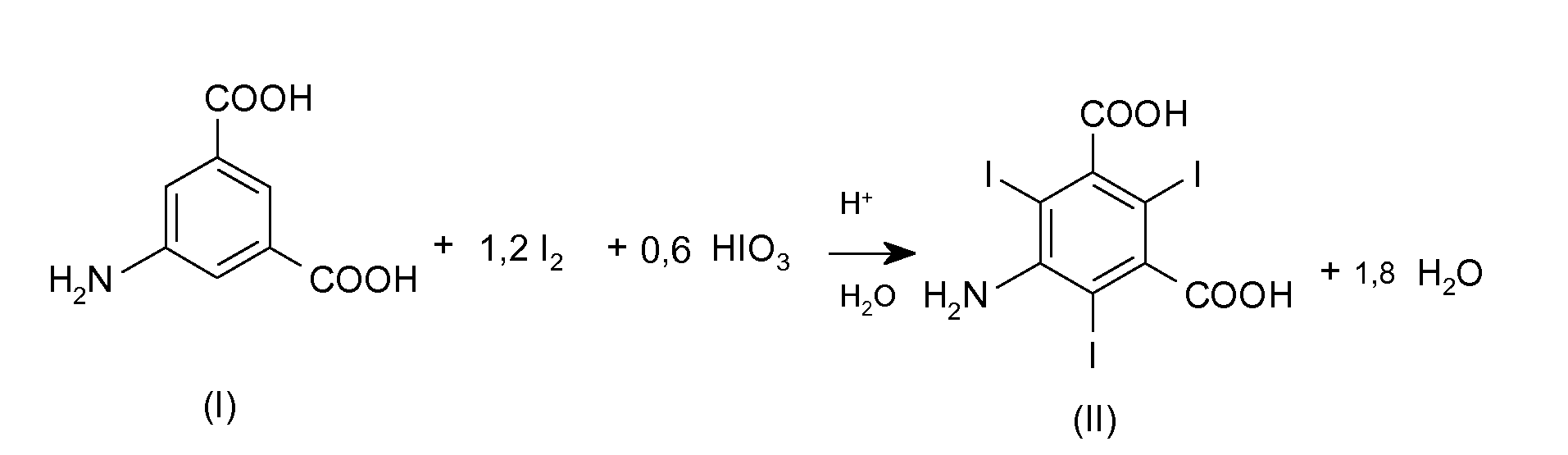
- In other words, the combined use of iodine and iodic acid, as per the preferred embodiment of the invention, enables the complete triiodination of the aromatic substrate of formula (I) by avoiding, from one side, the need of any surplus of iodinating agent, especially of molecular iodine and, on the other side, the formation of by-products, especially unreactive poly-iodide ions, for instance of I3 - ions, mainly deriving from the combination of I2 with iodide ions.
- In this respect, it is clear to the skilled person that the equivalent ratio between the iodinating specie considered, as said, as the sum of both of the added I2 and HIO3, and the 5-aminoisophtalic substrate, has to be at least equal to 3:1, as per the former general Scheme 2.
- Kept safe this point, in the process of the instant invention the triiodination of the 5-aminoisophthalic substrate with iodine and iodic acid will be carried out by using at least one mole of molecular iodine for each mole of 5-aminoisophtalic substrate of formula (I). Preferably, the molar ratio between iodine and 5-aminoisophtalic substrate (I) [I2/(I)] will vary from 1 to 1.5, more preferably from 1 to 1.3; even more preferably, the triiodination of the 5-aminoisophtalic substrate with iodine and iodic acid will be carried out by using only 1.2 moles of iodine per mole of substrate.
- On the other side, because of the stoichiometry of the involved reaction, it should be clear to the skilled person that the molar ratio between iodine to iodic acid shall be at least equal to 1 : 0.5, while the molar ratio between 5-aminoisophtalic substrate (I) and iodic acid shall be at least equal to 1 : 0.6. Thus, in a preferred embodiment of the invention, the triiodination of the 5-aminoisophtalic substrate with iodine and iodic acid will be thus carried out by using a molar ratio 5-aminoisophtalic substrate : iodine : iodic acid of 1:1.2:0.6. However, we have now found that higher yields of 5-amino-2,4,6-triiodoisophthalic acid have been obtained, as reported in the experimental section, by using a slight excess of iodic acid over molecular iodine.
- Therefore, and according to a further preferred embodiment of the invention, a molar ratio iodine to iodic acid ranging from 1 : 0.5 to about 1 : 1 and, more preferably, from 1 : 0.5 to about 1 : 0.8, will be employed.
- To this extent, and as per the following experimental section, the proper amount of iodic acid may be added at once to the reaction mixture or, alternatively, it may be added gradually.
- However, iodic acid is preferably slowly added to the reaction medium, either continuously over time or portion-wise according to conventional means, so as to minimize the occurrence of oxidized side-products.
- More preferably, slow additions of iodic acid may be affected over time, for instance in a few hours, and preferably from 2 to 10 hours, as per the following experimental section.
- According to another different aspect of the invention, the iodination reaction comprising the iodinating system I2/HIO3, as set forth above, is preferably carried out in the presence of a polar solvent and under acidic conditions. These latter are achieved in the presence of a suitable acid including, for instance, phosphoric, metanesulfonic or sulfuric acid, e.g. 96% H2SO4. Preferably, pH is kept between 0 and 3 and, even more preferably, between 0 and 2 by using concentrated H2SO4.
- Interestingly, despite the fact that the above pH conditions are known to strongly deactivate any electrophilic substitution on aniline substrates, we have now found that under these same conditions, apparently unfavourable, higher amounts of 5-amino-2,4,6-triiodoisophthalic acid are unexpectedly obtained.
- It should be clear to the skilled person that when operating under such acidic conditions, the aromatic substrate undergoing triiodination is represented by the 5-aminoisophthalic acid of formula (I), either employed as starting material of the process or, alternatively, formed in situ from the corresponding salt. This latter, unless otherwise provided in the present description, is preferably selected from alkali or alkali-earth metal salts of 5-aminoisophthalic acid such as, for instance, sodium, lithium, potassium, calcium or magnesium salts. Particularly preferred, among them, is the 5-aminoisophthalic acid disodium salt which can be used as such, i.e. as a pure compound or, alternatively, as comprised within a crude solution directly deriving from a previous step in the processes for the preparation of triiodinated contrast agents, for instance iopamidol.
- The possible starting material of the present process are known or can be prepared according to known methods, typically including the reduction or hydrogenation of commercially available 5-nitroisophthalic acid, according to conventional means.
- For a general reference to 5-aminoisophthalic acid and salts thereof, particularly the corresponding disodium salt, and their preparation see, for instance,
WO 96/037458 WO 96/037459 - As formerly reported, the above iodination reaction with I2/HIO3 is carried out in the presence of a polar solvent and, preferably, a protic one.
- Non limiting examples of suitable solvents may thus include, for instance: water, lower alcohols C1-C4 and hydroalcoholic mixtures thereof, aqueous solutions including saline solutions, glycols such as, for instance, diethylene glycol, triethylene glycol, and polyethylene glycols like PEG 600, PEG1000 or PEG2000, and mixtures thereof.
- In a particularly preferred embodiment of the invention, the iodination process is carried out in water or aqueous solution, that significantly contributes to reduce the costs and the environmental impact of the industrial process of the invention.
- Interestingly, according to the above operating conditions, that is in the presence of an acidic aqueous environment, 5-amino-2,4,6-triiodoisophthalic acid is unexpectedly obtained in high yields and purity despite of the practical insolubility of the aromatic substrate to be iodinated.
- When 5-aminoisophthalic acid is used as starting material, in fact, a proper amount of this compound is first suspended and thus maintained in the reaction medium before iodination reaction takes place. Alternatively, when using a corresponding salt of it, for instance by starting from an aqueous solution of the disodium salt, the acidic conditions are such to provoke the precipitation of the insoluble acid of formula (I) to be kept in suspension according to conventional means, e.g. under magnetic or mechanical stirring. The reaction time may vary according to the selected operative conditions and, generally, may range from about 2 to about 10 hours, more particularly from about 5 to about 8 hours.
- The temperature during the process is kept constant, for instance between about 50°C to about 85°C and, preferably, from about 65°C to about 80°C, by operating according to conventional methods. Typically, by working at the formerly given temperatures, the process may reach the solvent boiling point, particularly when lower boiling solvents, like methanol, are employed. In addition, the partial sublimation of the iodine might also occur, even if the sublimed amount remains negligible if the reaction temperature is kept within the above range of values.
- Nevertheless, standard cooling or condensing equipments may, for instance, be used to condensate both the solvent and the sublimate iodine that is then added to the reaction mixture according to conventional methods, for instance by adding small amounts of solvent.
- Specific operative conditions and possible variations of the parameters of the process over those above indicated, for instance concerning deviations of molar ratios between reactants and substrates, time of addition of reactants, selected temperatures and the like, are all to be intended as a possible optimization of the process and, hence, are comprised within the scope of the invention. Likewise, alternative iodinating systems among those formerly reported and comprising molecular iodine in the presence of an oxidising agent other than iodic acid, for instance hydrogen peroxide, and operative conditions thereof, are also to be regarded as comprised within the scope of the invention.
- Details concerning the process of the invention are however reported in the following experimental section.
- According to a practical preferred embodiment of the invention, a proper amount of the 5-aminoisophthalic substrate is suspended or solubilised, as the case may be, into an aqueous solvent, typically water. The obtained solution/suspension is firstly diluted to a substrate concentration ranging from about 8 % to about 3% (w/w) and, preferably, from about 5% to about 3%, and then acidified at pH lower than 2, preferably around 1, with a suitable amount of acid, for instance with 96% H2SO4.
- Preferably, a crude solution directly obtained from the industrial process and comprising the 5-aminoisophthalic substrate as disodium salt, at a concentration typically ranging around 7-8% (w/w), is used as starting material. This crude solution is then diluted, typically with water, to the above concentration range and then acidified at the aforementioned values, for instance with 96% H2SO4.
- A proper amount of solid I2 is then added to the obtained suspension that is thus kept under stirring and heated at the temperature values formerly indicated. A from pink to orange suspension is thus obtained.
- Alternatively, solid I2 may be first added to the crude solution of the 5-aminoisophthalic acid disodium salt and the obtained mixture is diluted with water and heated at about 70°-80°C, for instance for a couple of hours. The mixture is then cooled at room temperature, acidified with 96% H2SO4 at the formerly indicated pH value, and the obtained suspension is then heated again at the previous temperature values.
- A proper amount of an aqueous solution of HIO3 is slowly added into the reaction medium, thus causing the progressive solubilisation of the 5-aminoisophthalic substrate up to reach a homogeneous dark solution.
- By proceeding with the addition of HIO3 up to completion, the formed 5-amino-2,4,6-triiodoisophthalic acid precipitates from the reaction mixture as a pale pink solid that is filtered and dried.
- The filtered compound is pure and ready to be used, without the need of any further purification, in the subsequent steps for the preparation of the desired contrast agent.
- The collected filtered solution, duly acidified at the requested pH, may be optionally recycled together with a fresh amount of aromatic substrate, for a subsequent iodination step so as to convert, advantageously, any unreacted portion of 5-aminoisophthalic acid.
- This recycling step may be repeated more than once, for instance two or three times, thus highly improving the global yield of the process.
- Once obtained, the 5-amino-2,4,6-triiodoisophthalic acid of formula (II) may be then easily converted into iopamidol or iomeprol, by working according to known methods. The said methods comprise, essentially, the conversion of 5-amino-2,4,6-triiodoisophthalic acid into the corresponding acid dichloride, according to known methods, for instance in the presence of thionyl chloride; its subsequent condensation with the selected substrate so as to give rise to the corresponding 5-carboxamido derivative and, finally, the condensation of this latter with serinol or isoserinol and subsequent work-up including any possible cleavage of protecting groups, so to obtain the expected final compounds.
- For a general reference to the preparation of iopamidol or iomeprol from 5-amino-2,4,6-triiodoisophthalic acid and operative conditions and possible variants thereof see, for instance,
WO 96/037460 US 5362905 ,WO 97/047590 WO 98/24757 - In addition, the process object of the present invention is of general applicability and provides, very advantageously, a route for the preparation of other iodinated contrast agents starting from the intermediate 5-amino-2,4,6-triiodoisophthalic acid.
- Hence, it is a further object of the present invention a process for the preparation of the compounds of formula (III) below

- R and R' represent, the same or different from each other, a group selected from carboxy (-COOH), carboxyester (-COOR1) and carboxamido (-CONH2, -CONHR1 or -CONR2R3), wherein R1, R2 and R3 are, the same or different from each other, a straight or branched C1-C4 alkyl group optionally substituted by one or more hydroxy groups, and
- R4 and R5 are, the same or different from each other, hydrogen or a straight or branched C1-C6 alkyl group optionally substituted by one or more hydroxy or C1-C6 alkoxy groups, the said process comprising:
- 1) preparing 5-amino-2,4,6-triiodoisophthalic acid of formula (II)


- 1) preparing 5-amino-2,4,6-triiodoisophthalic acid of formula (II)
- According to the present process for preparing x-ray contrast agents, the iodination step (1) is carried out as extensively reported in the previous sections whilst, subsequent steps comprehensive of experimental operative conditions and optional variants thereof, conveniently grouped under step (2), are all to be performed according to conventional methods reported in the art.
- With the aim to better illustrate the present invention, without posing any limitation to it, the following examples are now given.
- The purity of the obtained 5-amino-2,4,6-triiodoisoftalic acid has been determined by HPLC using benzoic acid as internal standard
-
- Stationary phase:
- Zorbax SB-Phenyl 80 Å 5 µm, 250 x 4.6 mm (Agilent
- T
- echnologies)
- Mobile phase:
- A: 0.015 M NaH2PO4 + 0.028 M H3PO4 B: CH3CN
- Elution:
- gradient elution gradient table:
- Temperature:
- 45 °C
- Detection:
- UV (240 nm)
- Flow:
- 1 mL/min
- Sample concentration:
- 5 mg/mL
- Injection:
- 10 µL
- In a 250 mL three naked round bottom flask equipped with thermometer, condenser and magnetic stirrer, a 3.86 % (w/w) solution of 5-aminoisophthalic acid (I) in H2O (129.42 g; 27.6 mmol) was added and acidified at pH 1 with 96% H2SO4 (2 mL; 35.3 mmol) then solid I2 (8.42 g; 33.2 mmol) was added and the mixture was heated at 72 °C by means of an oil bath. A 18.65 % (w/v) solution of HIO3 in H2O (20 mL; 21.2 mmol) was added over 5.2 h (adding rate 3.8 mL/h) through syringe pump; after additional 1 h at 72°C (total reaction time 6.2 h) the reaction mixture was cooled at room temperature and filtered; the solid was washed with H2O and dried to give 5-amino-2,4,6-triiodoisophthalic acid (II) (12.74 g; 22.8 mmol) as a pale pink solid. Yield 82.6%. The product was analyzed by HPLC and, through a comparison with a standard, fulfilled the analytical specifications for 5-amino-2,4,6-triiodoisophthalic acid industrially produced.
- In a 25 mL three naked round bottom flask equipped with thermometer, condenser and magnetic stirrer, solid I2 (0.842 g; 3.32 mmol) was added to a 3.9 % (w/w) solution of 5-aminoisophthalic acid (I) in H2O (13.1 g; 2.82 mmol), the mixture was heated at 75 °C in an oil bath for 1.5 h then 96% H2SO4 (0.46 mL; 8.11 mmol) was added by means of a dropping funnel. A 29.2 % (w/v) solution of HIO3 in H2O (1 mL; 1.66 mmol) was slowly added over 20 min (adding rate 3 mL/h) through a syringe pump; after 2.5 h at 75,00 °C additional 96% H2SO4 (0.14 mL; 2.47 mmol) was added and a 17.6 % (w/v) solution of HIO3 in H2O (1 mL; 1 mmol) was slowly added over 10 min (adding rate 6 mL/h). After additional 4 h at 75 °C (total reaction time 8.5 h), the reaction mixture was cooled at room temperature transferred in a separating funnel and extracted with ethyl ether (5 x 40 mL). The organic phases were collected and evaporated to give 5-amino-2,4,6-triiodoisophthalic acid (II) (1.29 g; 2.31 mmol) as pale brownish solid. Yield 81.8 %. The product was analyzed by HPLC by comparison with a standard and fulfil the analytical specifications for 5-amino-2,4,6-triiodoisophthalic acid industrially produced.
- In a 250 mL three naked round bottom flask equipped with thermometer, condenser and magnetic stirrer, a 3.86 % (w/w) solution of 5-aminoisophthalic acid (I) in H2O (129.42 g; 27.6 mmol) was added and acidified at pH 1 with 96% H2SO4 (2 mL; 35.3 mmol) then solid I2 (5.26 g; 21.5 mmol) was added and the mixture was heated at 85 °C by means of an oil bath. A 3.08 % (w/v) solution of H2O2 in H2O (25 mL; 22.6 mmol) was slowly added over 8.5 h (adding rate 3 mL/h) through a syringe pump; at the end additional solid I2 (5.26 g; 21.5 mmol) was added. After 0.5h, 2.5h and 6h at 85 °C three portion of a 7 % (w/v) solution of H2O2 in H2O (3 x 10 mL; total 61.7 mmol) was slowly added over 1.7 h each (adding rate 6 mL/h) through a syringe pump. After additional 1 h at 85 °C, the reaction mixture was cooled at room temperature and filtered; the solid was washed with H2O and dried to give 5-amino-2,4,6-triiodoisophthalic acid (II) (12.41 g; 22.2 mmol) as pale brownish solid. Yield 80.4 %. The product was analyzed by HPLC by comparison with a standard and fulfil the analytical specifications for 5-amino-2,4,6-triiodoisophthalic acid industrially produced.
| t (min) | phase A (%) | phase B (%) |
| 0 | 93 | 7 |
| 6 | 93 | 7 |
| 20 | 62 | 38 |
| 25 | 40 | 60 |
Claims (14)
- A process for the preparation of 5-amino-2,4,6-triiodoisophthalic acid of formula (II)


- A process according to claim 1 wherein the oxidizing agent is suitably selected from the group consisting of nitric acid, sulphuric acid, iodic acid, sulphur trioxide, hydrogen peroxide and ozone.
- A process according to claim 2 wherein the oxidizing agent is iodic acid.
- A process according to claim 3 in which the molar ratio between iodine and 5-aminoisophtalic substrate (I) is from 1 to 1,5.
- A process according to claim 4 in which the molar ratio is from 1 to 1,3.
- A process according to claim 3 in which the molar ratio iodine to iodic acid ranges from 1 : 0.5 to 1 : 0.8.
- A process according to claim 3 in which the triiodination of the 5-aminoisophtalic substrate with iodine and iodic acid is carried out by using a molar ratio 5-aminoisophtalic substrate : iodine : iodic acid of 1:1.2:0.6.
- A process according to any one of claims from 1 to 7 that is carried out in a polar solvent and in the presence of an acid selected from phosphoric, metanesulfonic or sulfuric acid.
- A process according to claim 8 wherein the pH value of the reaction medium ranges from 0 to 3.
- A process according to claim 8 wherein the polar solvent is selected from water, lower alcohols C1-C4 and hydroalcoholic mixtures thereof, aqueous saline solutions, glycols and mixtures thereof.
- A process according to claim 10 wherein the polar solvent is selected from water, lower alcohols C1-C4 and hydroalcoholic mixtures thereof.
- A process according to anyone of previous claims in which the reaction temperature is from 50°C to 85°C.
- A process according to claim 1 comprising reacting the compound of formula (I) or the corresponding alkali or alkali-earth metal.
- A process for the preparation of the compounds of formula (III)
 R and R' represent, the same or different from each other, a group selected from carboxy (-COOH), carboxyester (-COOR1) and carboxamido (-CONH2, -CONHR1 or -CONR2R3), wherein R1, R2 and R3 are, the same or different from each other, a straight or branched C1-C4 alkyl group optionally substituted by one or more hydroxy groups, andR4 and R5 are, the same or different from each other, hydrogen or a straight or branched C1-C6 alkyl group optionally substituted by one or more hydroxy or C1-C6 alkoxy groups, the said process comprising:(1) preparing 5-amino-2,4,6-triiodoisophthalic acid of formula (II)
 (2) converting the compound of formula (II) in the corresponding acid dichloride and using it as an intermediate compound for the preparation of the desired compounds of formula (III).
Priority Applications (18)
| Application Number | Priority Date | Filing Date | Title |
|---|---|---|---|
| EP09158319A EP2243767A1 (en) | 2009-04-21 | 2009-04-21 | Process for the iodination of aromatic compounds |
| BRPI1013830-7A BRPI1013830B1 (en) | 2009-04-21 | 2010-04-08 | PROCESS FOR IODATION OF AROMATIC COMPOUNDS |
| EP10718104.2A EP2421819B1 (en) | 2009-04-21 | 2010-04-08 | Process for the iodination of aromatic compounds |
| PL10718104T PL2421819T3 (en) | 2009-04-21 | 2010-04-08 | Process for the iodination of aromatic compounds |
| SI201030616T SI2421819T1 (en) | 2009-04-21 | 2010-04-08 | Process for the iodination of aromatic compounds |
| RU2011147046/04A RU2506254C2 (en) | 2009-04-21 | 2010-04-08 | Method of iodination of aromatic compounds |
| CA2759342A CA2759342C (en) | 2009-04-21 | 2010-04-08 | Process for the iodination of aromatic compounds |
| KR1020117024801A KR101774332B1 (en) | 2009-04-21 | 2010-04-08 | Process for the iodination of aromatic compounds |
| ES10718104.2T ES2469846T3 (en) | 2009-04-21 | 2010-04-08 | Process for the iodination of aromatic compounds |
| PCT/EP2010/054624 WO2010121904A1 (en) | 2009-04-21 | 2010-04-08 | Process for the iodination of aromatic compounds |
| HRP20140431AT HRP20140431T1 (en) | 2009-04-21 | 2010-04-08 | PROCEDURE FOR AROMATIC SUBSTANCES |
| PT107181042T PT2421819E (en) | 2009-04-21 | 2010-04-08 | Process for the iodination of aromatic compounds |
| DK10718104.2T DK2421819T3 (en) | 2009-04-21 | 2010-04-08 | PROCEDURE FOR IODATING AROMATIC COMPOUNDS |
| AU2010241071A AU2010241071B2 (en) | 2009-04-21 | 2010-04-08 | Process for the iodination of aromatic compounds |
| US13/265,165 US9238615B2 (en) | 2009-04-21 | 2010-04-08 | Process for the iodination of aromatic compounds |
| CN201080017568.4A CN102428068B (en) | 2009-04-21 | 2010-04-08 | Process for the iodination of aromatic compounds |
| JP2012506434A JP5469240B2 (en) | 2009-04-21 | 2010-04-08 | Method for iodination of aromatic compounds |
| IL215685A IL215685A (en) | 2009-04-21 | 2011-10-10 | Process for the iodination of aromatic compounds |
Applications Claiming Priority (1)
| Application Number | Priority Date | Filing Date | Title |
|---|---|---|---|
| EP09158319A EP2243767A1 (en) | 2009-04-21 | 2009-04-21 | Process for the iodination of aromatic compounds |
Publications (1)
| Publication Number | Publication Date |
|---|---|
| EP2243767A1 true EP2243767A1 (en) | 2010-10-27 |
Family
ID=40668303
Family Applications (2)
| Application Number | Title | Priority Date | Filing Date |
|---|---|---|---|
| EP09158319A Withdrawn EP2243767A1 (en) | 2009-04-21 | 2009-04-21 | Process for the iodination of aromatic compounds |
| EP10718104.2A Active EP2421819B1 (en) | 2009-04-21 | 2010-04-08 | Process for the iodination of aromatic compounds |
Family Applications After (1)
| Application Number | Title | Priority Date | Filing Date |
|---|---|---|---|
| EP10718104.2A Active EP2421819B1 (en) | 2009-04-21 | 2010-04-08 | Process for the iodination of aromatic compounds |
Country Status (17)
| Country | Link |
|---|---|
| US (1) | US9238615B2 (en) |
| EP (2) | EP2243767A1 (en) |
| JP (1) | JP5469240B2 (en) |
| KR (1) | KR101774332B1 (en) |
| CN (1) | CN102428068B (en) |
| AU (1) | AU2010241071B2 (en) |
| BR (1) | BRPI1013830B1 (en) |
| CA (1) | CA2759342C (en) |
| DK (1) | DK2421819T3 (en) |
| ES (1) | ES2469846T3 (en) |
| HR (1) | HRP20140431T1 (en) |
| IL (1) | IL215685A (en) |
| PL (1) | PL2421819T3 (en) |
| PT (1) | PT2421819E (en) |
| RU (1) | RU2506254C2 (en) |
| SI (1) | SI2421819T1 (en) |
| WO (1) | WO2010121904A1 (en) |
Families Citing this family (11)
| Publication number | Priority date | Publication date | Assignee | Title |
|---|---|---|---|---|
| EP2394984A1 (en) * | 2010-06-10 | 2011-12-14 | Bracco Imaging S.p.A | Process for the iodination of phenolic derivatives |
| EP2773610B1 (en) * | 2011-10-31 | 2017-09-06 | iMAX Diagnostic Imaging Holding Limited | Iodination process for the preparation of 3,5-disubstituted-2,4,6-triiodo aromatic amines compounds |
| CN103086915A (en) * | 2011-10-31 | 2013-05-08 | 上海海神化学生物科技有限公司 | Iodination method for preparing 3,5-disubstituted-2,4,6-triiodo aromatic amine compound |
| PL3066071T3 (en) | 2013-11-05 | 2018-09-28 | Bracco Imaging S.P.A | Process for the preparation of iopamidol |
| CN104098484A (en) * | 2014-07-21 | 2014-10-15 | 杭州杜易科技有限公司 | Iopamidol preparation method |
| JP6743781B2 (en) * | 2016-08-08 | 2020-08-19 | 信越化学工業株式会社 | Resist material and pattern forming method |
| WO2018102779A1 (en) * | 2016-12-02 | 2018-06-07 | The Texas A&M University System | Chemically modified shape memory polymer embolic foams with increased x-ray visualization |
| CN110105233B (en) * | 2018-06-01 | 2024-07-12 | 成都西岭源药业有限公司 | Method for preparing 5-amino-2, 4, 6-tri-iodo isophthalic acid |
| CN110724061A (en) * | 2019-10-21 | 2020-01-24 | 新岸诺亚(北京)催化科技有限公司 | P-iodoaniline and preparation method thereof |
| CN111249459A (en) * | 2020-01-19 | 2020-06-09 | 东华大学 | Iodine-containing polyaniline photothermal diagnosis and treatment agent with CT imaging function and preparation thereof |
| CN113444007A (en) * | 2021-07-30 | 2021-09-28 | 成都倍特药业股份有限公司 | Method for preparing 5-amino-2, 4, 6-triiodo isophthalic acid |
Citations (15)
| Publication number | Priority date | Publication date | Assignee | Title |
|---|---|---|---|---|
| WO1988009328A1 (en) | 1987-05-22 | 1988-12-01 | Bracco Industria Chimica S.P.A. | Preparation of 5-acylamino-2,4,6-triiodo- or tribromo-benzoic acid derivatives |
| US5013865A (en) | 1988-04-06 | 1991-05-07 | Mallinckrodt, Inc. | Process for the preparation of 2,4,6-triiodo-5-amino-N-alkylisophthalamic acid and 2,4,6-triiodo-5-amino-isophthalamide compounds |
| US5075502A (en) * | 1989-12-13 | 1991-12-24 | Mallinckrodt, Inc. | Nonionic x-ray contrast agents, compositions and methods |
| WO1992014695A1 (en) | 1991-02-25 | 1992-09-03 | Guerbet S.A. | New polyiodated compounds, method of preparation, contrast product containing them |
| WO1994014478A1 (en) | 1992-12-24 | 1994-07-07 | Bracco S.P.A. | Aqueous injectable formulations useful for radio-diagnosis comprising iodinated aromatic compounds used as x-ray contrast media |
| US5362905A (en) | 1992-10-27 | 1994-11-08 | Zambon Group S.P.A. | Process for the preparation of L-5-(2-acetoxy-propionylamino)-2,4,6-triiodo-isophthalic acid dichloride |
| WO1996037458A1 (en) | 1995-05-23 | 1996-11-28 | Fructamine S.P.A. | Process for the preparation of a halosubstituted aromatic acid |
| WO1996037459A1 (en) | 1995-05-23 | 1996-11-28 | Fructamine S.P.A. | Process for the preparation of a dicarboxylic acid dichloride |
| WO1996037461A1 (en) | 1995-05-24 | 1996-11-28 | Nycomed Imaging A.S | Iodination process |
| WO1996037460A1 (en) | 1995-05-23 | 1996-11-28 | Fructamine S.P.A. | Process for the preparation of a dicarboxylic acid dichloride |
| WO1997005097A1 (en) | 1995-07-25 | 1997-02-13 | Bracco S.P.A. | Process for the manufacturing of iodinated contrast agents |
| WO1997047590A2 (en) | 1996-06-13 | 1997-12-18 | Fructamine S.P.A. | Process for the purification of an intermediate in the preparation of iopamidol |
| WO1998024757A1 (en) | 1996-12-04 | 1998-06-11 | Dibra S.P.A. | A process for the preparation of 5-amino-2,4,6-triiodo-1,3-benzenedicarboxylic acid derivatives |
| WO2000032561A1 (en) | 1998-11-27 | 2000-06-08 | Bracco International B.V. | A process for the preparation of n,n'-bis[2, 3-dihydroxypropyl] -5-[ (hydroxyacetyl) methylamino]-2, 4,6-triiodo-1, 3-benzenedi carboxamide |
| US20070219396A1 (en) | 2004-08-10 | 2007-09-20 | Kazuhiro Yamada | Method For Producing 2-Amino-5-Iodobenzoic Acid |
Family Cites Families (15)
| Publication number | Priority date | Publication date | Assignee | Title |
|---|---|---|---|---|
| US2820814A (en) * | 1955-03-21 | 1958-01-21 | Schering Corp | Polyiodinated 5-aminoisophthalic acids, salts, and esters |
| CA935164A (en) | 1968-12-06 | 1973-10-09 | Sumimoto Shinzaburo | Industrial process for iodinating aromatic compounds by using novel iodinating reagents |
| CH608189A5 (en) | 1974-12-13 | 1978-12-29 | Savac Ag | |
| IT1193211B (en) * | 1979-08-09 | 1988-06-15 | Bracco Ind Chimica Spa | 2,4,6-TRIIODE-ISOPHTHALIC ACID DERIVATIVES, METHOD FOR THEIR PREPARATION AND CONTRAST MEANS THAT CONTAIN THEM |
| GB9020091D0 (en) | 1990-09-14 | 1990-10-24 | Nycomed As | Contrast media |
| SG49221A1 (en) | 1990-03-09 | 1998-05-18 | Nycomed As | Contrast media |
| JPH06345705A (en) | 1993-06-03 | 1994-12-20 | Terumo Corp | Tetraiodobenzene derivative |
| JPH10316639A (en) | 1997-05-16 | 1998-12-02 | Mitsui Chem Inc | Production of 5-amino-2,4,6-triidoisophthalic acid |
| GB9710725D0 (en) | 1997-05-23 | 1997-07-16 | Nycomed Imaging As | Process |
| JPH10330336A (en) | 1997-06-03 | 1998-12-15 | Mitsui Chem Inc | Production of 5-amino-2,4,6-triiodoisophthaic acid |
| EP0992245A1 (en) * | 1998-09-16 | 2000-04-12 | Goldham Bioglan Pharma GmbH | Radio-contrast agents |
| US6458967B1 (en) * | 2000-06-26 | 2002-10-01 | The Research Foundation Of State University Of New York | Method for preparation of an intermediate dye product |
| ITMI20011706A1 (en) | 2001-08-03 | 2003-02-03 | Bracco Imaging Spa | IONIC AND NON-IONIC RADIOGRAPHIC CONTRAST AGENTS, USABLE FOR THE COMBINED DIAGNOSTIC INVESTIGATION THROUGH X-RAYS AND MAGNETIC RESONANCE |
| JP2008074722A (en) | 2006-09-19 | 2008-04-03 | Mitsubishi Gas Chem Co Inc | Process for producing 2-amino-5-iodobenzoic acid |
| EP2093206A1 (en) | 2008-02-20 | 2009-08-26 | BRACCO IMAGING S.p.A. | Process for the iodination of aromatic compounds |
-
2009
- 2009-04-21 EP EP09158319A patent/EP2243767A1/en not_active Withdrawn
-
2010
- 2010-04-08 AU AU2010241071A patent/AU2010241071B2/en active Active
- 2010-04-08 CN CN201080017568.4A patent/CN102428068B/en active Active
- 2010-04-08 EP EP10718104.2A patent/EP2421819B1/en active Active
- 2010-04-08 DK DK10718104.2T patent/DK2421819T3/en active
- 2010-04-08 CA CA2759342A patent/CA2759342C/en active Active
- 2010-04-08 KR KR1020117024801A patent/KR101774332B1/en active Active
- 2010-04-08 US US13/265,165 patent/US9238615B2/en active Active
- 2010-04-08 SI SI201030616T patent/SI2421819T1/en unknown
- 2010-04-08 RU RU2011147046/04A patent/RU2506254C2/en active
- 2010-04-08 BR BRPI1013830-7A patent/BRPI1013830B1/en active IP Right Grant
- 2010-04-08 PT PT107181042T patent/PT2421819E/en unknown
- 2010-04-08 PL PL10718104T patent/PL2421819T3/en unknown
- 2010-04-08 WO PCT/EP2010/054624 patent/WO2010121904A1/en not_active Ceased
- 2010-04-08 JP JP2012506434A patent/JP5469240B2/en active Active
- 2010-04-08 ES ES10718104.2T patent/ES2469846T3/en active Active
- 2010-04-08 HR HRP20140431AT patent/HRP20140431T1/en unknown
-
2011
- 2011-10-10 IL IL215685A patent/IL215685A/en active IP Right Grant
Patent Citations (16)
| Publication number | Priority date | Publication date | Assignee | Title |
|---|---|---|---|---|
| WO1988009328A1 (en) | 1987-05-22 | 1988-12-01 | Bracco Industria Chimica S.P.A. | Preparation of 5-acylamino-2,4,6-triiodo- or tribromo-benzoic acid derivatives |
| US5013865A (en) | 1988-04-06 | 1991-05-07 | Mallinckrodt, Inc. | Process for the preparation of 2,4,6-triiodo-5-amino-N-alkylisophthalamic acid and 2,4,6-triiodo-5-amino-isophthalamide compounds |
| US5075502A (en) * | 1989-12-13 | 1991-12-24 | Mallinckrodt, Inc. | Nonionic x-ray contrast agents, compositions and methods |
| WO1992014695A1 (en) | 1991-02-25 | 1992-09-03 | Guerbet S.A. | New polyiodated compounds, method of preparation, contrast product containing them |
| US5362905A (en) | 1992-10-27 | 1994-11-08 | Zambon Group S.P.A. | Process for the preparation of L-5-(2-acetoxy-propionylamino)-2,4,6-triiodo-isophthalic acid dichloride |
| WO1994014478A1 (en) | 1992-12-24 | 1994-07-07 | Bracco S.P.A. | Aqueous injectable formulations useful for radio-diagnosis comprising iodinated aromatic compounds used as x-ray contrast media |
| EP0773924A1 (en) * | 1995-05-23 | 1997-05-21 | Fructamine S.P.A. | Process for the preparation of a dicarboxylic acid dichloride |
| WO1996037458A1 (en) | 1995-05-23 | 1996-11-28 | Fructamine S.P.A. | Process for the preparation of a halosubstituted aromatic acid |
| WO1996037459A1 (en) | 1995-05-23 | 1996-11-28 | Fructamine S.P.A. | Process for the preparation of a dicarboxylic acid dichloride |
| WO1996037460A1 (en) | 1995-05-23 | 1996-11-28 | Fructamine S.P.A. | Process for the preparation of a dicarboxylic acid dichloride |
| WO1996037461A1 (en) | 1995-05-24 | 1996-11-28 | Nycomed Imaging A.S | Iodination process |
| WO1997005097A1 (en) | 1995-07-25 | 1997-02-13 | Bracco S.P.A. | Process for the manufacturing of iodinated contrast agents |
| WO1997047590A2 (en) | 1996-06-13 | 1997-12-18 | Fructamine S.P.A. | Process for the purification of an intermediate in the preparation of iopamidol |
| WO1998024757A1 (en) | 1996-12-04 | 1998-06-11 | Dibra S.P.A. | A process for the preparation of 5-amino-2,4,6-triiodo-1,3-benzenedicarboxylic acid derivatives |
| WO2000032561A1 (en) | 1998-11-27 | 2000-06-08 | Bracco International B.V. | A process for the preparation of n,n'-bis[2, 3-dihydroxypropyl] -5-[ (hydroxyacetyl) methylamino]-2, 4,6-triiodo-1, 3-benzenedi carboxamide |
| US20070219396A1 (en) | 2004-08-10 | 2007-09-20 | Kazuhiro Yamada | Method For Producing 2-Amino-5-Iodobenzoic Acid |
Non-Patent Citations (7)
| Title |
|---|
| ARKIVOC, 2006, pages 104 - 108 |
| BULL. CHEM. SOC. JAPAN, vol. 48, 1975, pages 745 - 750 |
| ERICH BAER; ANTHONY L. TOSONI, J. AM. CHEM. SOC., vol. 78, no. 12, 1956, pages 2857 - 2858 |
| FURUICHI, R.; LIEBHAFSKY, H.A.: "Radioactive iodine exchange and the Dushman reaction", BULL. CHEM. SOC. JAPAN, vol. 46, 1973, pages 2008 - 2010 |
| KRETZER: "Zur Kenntniss der Jodosobenzoësäuren", CHEM. BER., no. 2, 1897, pages 1943 - 1948, XP002530262 * |
| LÜTJENS: "Ueber das chemische Verhalten und die Oxydation der Tetrajodterephtalsäure, und fiber Trijoddiamidobenzoësäure", CHEM. BER., vol. 29, no. 3, 1896, pages 2833 - 2839, XP002530263 * |
| PATIL ET AL., TETRAHEDRON LETTERS, vol. 46, 2005, pages 7179 - 7181 |
Also Published As
| Publication number | Publication date |
|---|---|
| IL215685A (en) | 2016-04-21 |
| JP5469240B2 (en) | 2014-04-16 |
| BRPI1013830B1 (en) | 2019-03-06 |
| AU2010241071A1 (en) | 2011-10-20 |
| IL215685A0 (en) | 2012-01-31 |
| CA2759342C (en) | 2016-01-05 |
| PL2421819T3 (en) | 2014-08-29 |
| US9238615B2 (en) | 2016-01-19 |
| SI2421819T1 (en) | 2014-08-29 |
| JP2012524741A (en) | 2012-10-18 |
| EP2421819A1 (en) | 2012-02-29 |
| KR20120016056A (en) | 2012-02-22 |
| ES2469846T3 (en) | 2014-06-20 |
| BRPI1013830A2 (en) | 2010-10-28 |
| CN102428068A (en) | 2012-04-25 |
| CN102428068B (en) | 2014-10-15 |
| RU2011147046A (en) | 2013-05-27 |
| DK2421819T3 (en) | 2014-06-10 |
| AU2010241071B2 (en) | 2014-03-13 |
| CA2759342A1 (en) | 2010-10-28 |
| US20120041224A1 (en) | 2012-02-16 |
| EP2421819B1 (en) | 2014-03-05 |
| WO2010121904A1 (en) | 2010-10-28 |
| PT2421819E (en) | 2014-06-06 |
| KR101774332B1 (en) | 2017-09-04 |
| RU2506254C2 (en) | 2014-02-10 |
| HRP20140431T1 (en) | 2014-07-18 |
Similar Documents
| Publication | Publication Date | Title |
|---|---|---|
| EP2421819B1 (en) | Process for the iodination of aromatic compounds | |
| JP5611057B2 (en) | Iodination of aromatic compounds | |
| US8766003B2 (en) | Process for the iodination of phenolic derivatives | |
| JP6140175B2 (en) | Iodination process for the preparation of 3,5-disubstituted-2,4,6-triiodo aromatic amine compounds | |
| MX2011010333A (en) | Process for the iodination of aromatic compounds. | |
| HK1148515A (en) | Process for the iodination of aromatic compounds |
Legal Events
| Date | Code | Title | Description |
|---|---|---|---|
| PUAI | Public reference made under article 153(3) epc to a published international application that has entered the european phase |
Free format text: ORIGINAL CODE: 0009012 |
|
| AK | Designated contracting states |
Kind code of ref document: A1 Designated state(s): AT BE BG CH CY CZ DE DK EE ES FI FR GB GR HR HU IE IS IT LI LT LU LV MC MK MT NL NO PL PT RO SE SI SK TR |
|
| STAA | Information on the status of an ep patent application or granted ep patent |
Free format text: STATUS: THE APPLICATION IS DEEMED TO BE WITHDRAWN |
|
| 18D | Application deemed to be withdrawn |
Effective date: 20110427 |