EP2241587A1 - Hydrophilic polysiloxane monomer, and production method and application thereof - Google Patents
Hydrophilic polysiloxane monomer, and production method and application thereof Download PDFInfo
- Publication number
- EP2241587A1 EP2241587A1 EP09708990A EP09708990A EP2241587A1 EP 2241587 A1 EP2241587 A1 EP 2241587A1 EP 09708990 A EP09708990 A EP 09708990A EP 09708990 A EP09708990 A EP 09708990A EP 2241587 A1 EP2241587 A1 EP 2241587A1
- Authority
- EP
- European Patent Office
- Prior art keywords
- general formula
- hydrophilic
- hydrophilic polysiloxane
- polysiloxane macromonomer
- producing
- Prior art date
- Legal status (The legal status is an assumption and is not a legal conclusion. Google has not performed a legal analysis and makes no representation as to the accuracy of the status listed.)
- Granted
Links
Images

Classifications
-
- C—CHEMISTRY; METALLURGY
- C08—ORGANIC MACROMOLECULAR COMPOUNDS; THEIR PREPARATION OR CHEMICAL WORKING-UP; COMPOSITIONS BASED THEREON
- C08F—MACROMOLECULAR COMPOUNDS OBTAINED BY REACTIONS ONLY INVOLVING CARBON-TO-CARBON UNSATURATED BONDS
- C08F283/00—Macromolecular compounds obtained by polymerising monomers on to polymers provided for in subclass C08G
- C08F283/12—Macromolecular compounds obtained by polymerising monomers on to polymers provided for in subclass C08G on to polysiloxanes
-
- C—CHEMISTRY; METALLURGY
- C08—ORGANIC MACROMOLECULAR COMPOUNDS; THEIR PREPARATION OR CHEMICAL WORKING-UP; COMPOSITIONS BASED THEREON
- C08F—MACROMOLECULAR COMPOUNDS OBTAINED BY REACTIONS ONLY INVOLVING CARBON-TO-CARBON UNSATURATED BONDS
- C08F290/00—Macromolecular compounds obtained by polymerising monomers on to polymers modified by introduction of aliphatic unsaturated end or side groups
- C08F290/02—Macromolecular compounds obtained by polymerising monomers on to polymers modified by introduction of aliphatic unsaturated end or side groups on to polymers modified by introduction of unsaturated end groups
- C08F290/06—Polymers provided for in subclass C08G
-
- C—CHEMISTRY; METALLURGY
- C08—ORGANIC MACROMOLECULAR COMPOUNDS; THEIR PREPARATION OR CHEMICAL WORKING-UP; COMPOSITIONS BASED THEREON
- C08F—MACROMOLECULAR COMPOUNDS OBTAINED BY REACTIONS ONLY INVOLVING CARBON-TO-CARBON UNSATURATED BONDS
- C08F290/00—Macromolecular compounds obtained by polymerising monomers on to polymers modified by introduction of aliphatic unsaturated end or side groups
- C08F290/02—Macromolecular compounds obtained by polymerising monomers on to polymers modified by introduction of aliphatic unsaturated end or side groups on to polymers modified by introduction of unsaturated end groups
- C08F290/06—Polymers provided for in subclass C08G
- C08F290/061—Polyesters; Polycarbonates
-
- C—CHEMISTRY; METALLURGY
- C08—ORGANIC MACROMOLECULAR COMPOUNDS; THEIR PREPARATION OR CHEMICAL WORKING-UP; COMPOSITIONS BASED THEREON
- C08F—MACROMOLECULAR COMPOUNDS OBTAINED BY REACTIONS ONLY INVOLVING CARBON-TO-CARBON UNSATURATED BONDS
- C08F290/00—Macromolecular compounds obtained by polymerising monomers on to polymers modified by introduction of aliphatic unsaturated end or side groups
- C08F290/02—Macromolecular compounds obtained by polymerising monomers on to polymers modified by introduction of aliphatic unsaturated end or side groups on to polymers modified by introduction of unsaturated end groups
- C08F290/06—Polymers provided for in subclass C08G
- C08F290/068—Polysiloxanes
-
- C—CHEMISTRY; METALLURGY
- C08—ORGANIC MACROMOLECULAR COMPOUNDS; THEIR PREPARATION OR CHEMICAL WORKING-UP; COMPOSITIONS BASED THEREON
- C08F—MACROMOLECULAR COMPOUNDS OBTAINED BY REACTIONS ONLY INVOLVING CARBON-TO-CARBON UNSATURATED BONDS
- C08F8/00—Chemical modification by after-treatment
- C08F8/42—Introducing metal atoms or metal-containing groups
-
- C—CHEMISTRY; METALLURGY
- C08—ORGANIC MACROMOLECULAR COMPOUNDS; THEIR PREPARATION OR CHEMICAL WORKING-UP; COMPOSITIONS BASED THEREON
- C08G—MACROMOLECULAR COMPOUNDS OBTAINED OTHERWISE THAN BY REACTIONS ONLY INVOLVING UNSATURATED CARBON-TO-CARBON BONDS
- C08G77/00—Macromolecular compounds obtained by reactions forming a linkage containing silicon with or without sulfur, nitrogen, oxygen or carbon in the main chain of the macromolecule
- C08G77/04—Polysiloxanes
- C08G77/38—Polysiloxanes modified by chemical after-treatment
-
- C—CHEMISTRY; METALLURGY
- C08—ORGANIC MACROMOLECULAR COMPOUNDS; THEIR PREPARATION OR CHEMICAL WORKING-UP; COMPOSITIONS BASED THEREON
- C08G—MACROMOLECULAR COMPOUNDS OBTAINED OTHERWISE THAN BY REACTIONS ONLY INVOLVING UNSATURATED CARBON-TO-CARBON BONDS
- C08G77/00—Macromolecular compounds obtained by reactions forming a linkage containing silicon with or without sulfur, nitrogen, oxygen or carbon in the main chain of the macromolecule
- C08G77/42—Block-or graft-polymers containing polysiloxane sequences
- C08G77/46—Block-or graft-polymers containing polysiloxane sequences containing polyether sequences
-
- G—PHYSICS
- G02—OPTICS
- G02B—OPTICAL ELEMENTS, SYSTEMS OR APPARATUS
- G02B1/00—Optical elements characterised by the material of which they are made; Optical coatings for optical elements
- G02B1/04—Optical elements characterised by the material of which they are made; Optical coatings for optical elements made of organic materials, e.g. plastics
- G02B1/041—Lenses
- G02B1/043—Contact lenses
Definitions
- the present invention relates to novel hydrophilic polysiloxane macromonomers, methods of production thereof, and ophthalmic lenses employing the hydrophilic polysiloxane macromonomers and, in particular, to a contact lens.
- the present invention relates to a contact lens having both of oxygen permeability and a hydrophilic property, and raw materials therefor.
- High oxygen permeability is demanded for ophthalmic lenses, in particular, for contact lenses, which need supply of oxygen, necessary for maintaining corneal health statuses, from an air medium.
- contact lenses in which siloxane monomers as raw materials are employed for improving oxygen permeability, have been developed.
- High hydrophilic properties as well as oxygen permeability are also demanded for contact lenses.
- Contact lenses with high hydrophilic properties are said to generally have good wear comfort and be comfortably wearable for long time.
- Hydrophilic monomers are commonly used as raw materials in order to improve hydrophilic property of contact lenses.
- hydrophilic contact lenses produced from polysiloxane containing hydrophilic side chains are disclosed in Patent Document 1 and Patent Document 2, wherein compounds containing polyether groups, hydroxyl groups, amide groups, and quaternary amine groups as hydrophilic side chains are selected; however, since the specifically disclosed polysiloxane contains comparatively many hydrophilic side chains which have a comparatively low molecular weight, per molecule, a balance between a hydrophilic property and oxygen permeability is inadequate, and it was difficult to use the polysiloxane as a raw material for an ophthalmic lens with high oxygen permeability and a high hydrophilic property.
- a plastic molding article produced from plastic which includes a compound having a group with a polymerizable double bond, a hydroxyl group, an organosiloxane group, and an amide group as a polymerization ingredient is disclosed in Patent Document 3.
- the polymerization ingredient allows production of the plastic molding article with high transparency, high oxygen permeability, good water wettability, and good mechanical properties.
- the specifically disclosed compound had short siloxane chains, effective oxygen permeability was not obtained.
- the compound had only one polymerizable functional group per molecule, adequate strength was precluded.
- a hydrogel soft contact lens comprising a hydrophilic siloxane monomer and a copolymer thereof is disclosed in Patent Document 4, Patent Document 5 and Patent Document 6, wherein the hydrophilic siloxane monomers contain main chains, in which polymerizable groups and polysiloxane chains are bound through urethane or urea groups, including fluorine-substituted hydrocarbon and polyoxyalkylene groups as side chains. Since hydrophilic siloxane monomers containing urethane or urea groups have high intermolecular forces, copolymers thereof are also prone to have a comparatively high modulus of elasticity, and there were cases where flexibility greatly affecting the wear comfort of contact lenses was lost.
- the present invention addresses problems of providing an ophthalmic lens, in particular, contact lens, which has both of oxygen permeability and a hydrophilic property; and of providing a novel hydrophilic polysiloxane macromonomer, which can be used as a raw material thereof, and a method of production of the macromonomer.
- hydrophilic polysiloxane macromonomer as a raw material, containing a polysiloxane main chain including polyoxyethylenes as hydrophilic side chains, was found to be effective at pursuing both of the high oxygen permeability and high hydrophilic property of an ophthalmic lens, in particular, a contact lens.
- oxygen permeability and hydrophilic property were found to be greatly affected by the length of the polysiloxane main chain, the length of the hydrophilic polyoxyethylene side chains and the number of the included side chains, and the invention was thus accomplished.
- a hydrophilic polysiloxane macromonomer in which both terminals of a main chain have polymerizable functional groups and the polymerizable functional groups and polysiloxane of the main chain are bound through ester groups, was further found to be effective at adequately controlling strength and a modulus of elasticity which greatly affect the usability and wear comfort of a contact lens.
- a hydrophilic polysiloxane macromonomer presented in general formula (1) is exemplified: wherein R 1 is selected from either hydrogen or a methyl group; R 2 is selected from either of hydrogen or a C 1-4 hydrocarbon group; m represents an integer of from 0 to 10; n represents an integer of from 4 to 100; a and b represent integers of 1 or more; a+b is equal to 20-500; b/(a+b) is equal to 0.01-0.22; and the configuration of siloxane units includes a random configuration.
- the configuration of siloxane units includes a random configuration
- the siloxane units containing polyoxyethylene as hydrophilic side chains and siloxane units excluding the polyoxyethylene side chains may be arranged randomly or in block form, or random and block configurations may coexist in one molecule.
- a rate between random and block configurations may be also optional, for example, only a random or block configuration may be included in one molecule, or the random and block configurations may be included at an optional rate.
- the present invention also relates to hydrophilic polysiloxane macromonomers, wherein a and b, presented in the general formula (1), represent 25-200 and 2-20, respectively; to hydrophilic polysiloxane macromonomers, wherein n, presented in the general formula (1), represents 5-20; and to hydrophilic polysiloxane macromonomers, wherein a and b, presented in the general formula (1), represent 25-160 and 3-10, respectively, and n represents 5-15.
- the present invention also relates to methods of producing hydrophilic polysiloxane macromonomers represented by general formula (1), which is obtained via polysiloxane represented by general formula (2) as an intermediate: wherein R 1 is selected from either hydrogen or a methyl group; m represents an integer of from 0 to 10; c and d represent integers of 1 or more; c+d is equal to 20-500; d/(c+d) is equal to 0.01-0.22; and the configuration of siloxane units includes a random configuration.
- R 1 is selected from either hydrogen or a methyl group
- m represents an integer of from 0 to 10
- c and d represent integers of 1 or more
- c+d is equal to 20-500
- d/(c+d) is equal to 0.01-0.22
- the configuration of siloxane units includes a random configuration.
- the present invention also relates to a method in which the step of producing the polysiloxane intermediate represented by general formula (2) is carried out by ring-opening polymerization of cyclic dimethylsiloxane, cyclic siloxane having hydrosilane (Si-H), and siloxane having (meth) acrylic groups at both terminals using an acid catalyst and by stopping the ring-opening polymerization by neutralization reaction with a basic aqueous solution.
- the step of producing the polysiloxane intermediate represented by general formula (2) is carried out by ring-opening polymerization of cyclic dimethylsiloxane, cyclic siloxane having hydrosilane (Si-H), and siloxane having (meth) acrylic groups at both terminals using an acid catalyst and by stopping the ring-opening polymerization by neutralization reaction with a basic aqueous solution.
- the present invention also relates to a method of producing the hydrophilic polysiloxane macromonomers represented by general formula (1) comprising hydrosilylation reaction of the intermediate represented by general formula (2) with polyethylene glycol allyl ether represented by general formula (3): wherein R 2 is selected from either hydrogen or a C 1-4 hydrocarbon group; and n represents an integer of from 4 to 100.
- the hydrosilylation reaction may uses, as a catalyst therefor, a platinum-containing catalyst, and the production method may further comprise the step of washing the hydrophilic polysiloxane macromonomer with a solvent after the reaction.
- the present invention also relates to homopolymers of the above-mentioned hydrophilic polysiloxane macromonomers, or to copolymers copolymerized the above-mentioned hydrophilic polysiloxane macromonomers with one or more polymerizable monomers, ophthalmic lens materials employing these polymers, and ophthalmic lenses and contact lenses employing these materials.
- hydrophilic polysiloxane macromonomer of the present invention has good compatibility with polymerizable mixtures containing a hydrophilic monomer, a transparent copolymer is afforded, and high oxygen permeability can be also maintained.
- the hydrophilic polysiloxane macromonomer utilizing these characteristics is useful as an ophthalmic lens material with a high hydrophilic property and high oxygen permeability.
- ophthalmic lenses are not limited in particular, are preferably understood to be lenses fitted to the anterior eye segment for purposes such as vision correction, test and therapy, and preferably include, e.g., an intraocular lens, a corneal lens, and a contact lens.
- a+b is equal to 20-500, b/ (a+b) is equal to 0.01-0.22, and n represents 4-100; preferably a+b is equal to 27-220, b/(a+b) is equal to 0.01-0.15, and n represents 5-20; more preferably, a+b is equal to 28-160, b/(a+b) is equal to 0.01-0.10, and n represents 5-15.
- a and b per specific hydrophilic polysiloxane macromonomer molecule are preferably equal to 25-200 and 2-20, respectively; more preferably, 25-160 and 3-10, respectively, allowing a balance between oxygen permeability and a hydrophilic property.
- the ratio and total number of c and d may be optionally controlled by varying the compounding ratio of cyclic dimethylsiloxane, cyclic siloxane having hydrosilane (Si-H), and disiloxane having (meth)acrylic groups at both terminals.
- a polysiloxane intermediate obtained in this manner has no single molecular weight but has a molecular weight distribution as in case of a typical synthetic polymer.
- a synthesis method is described in more detail. After ring-opening polymerization of a mixture of cyclic dimethylsiloxane, cyclic siloxane having hydrosilane (Si-H), and siloxane having (meth)acrylic groups at both terminals using an acid catalyst such as sulfuric acid, trifluoromethanesulfonic acid or acid clay, preferably trifluoromethanesulfonic acid having a high acidity and a high catalytic activity, the reaction can be stopped by addition of a basic aqueous solution.
- the basic aqueous solution preferably has a pH of more than 7 but 14 or less, more preferably a weakly basic pH of more than 7 but 9 or less which inhibits a side reaction from occurring.
- reaction solvent As a reaction solvent, no solvent may be used in the reaction, or a solvent that does not inhibit the ring-opening polymerization by an acid catalyst may be used.
- Reaction solvents include, for example, tetrahydrofuran, dioxan, hexane, cyclohexane, heptane, cycloheptane, chloroform, dichloromethane, dichloroethane, dimethoxyethane, toluene, benzene, xylene, diethyl ether, diisoprpyl ether, acetone, and methyl ethyl ketone.
- reaction temperature may be in the range of 0-150°C, preferably 20-100°C, more preferably 25-80°C. The higher reaction temperature results in acceleration of the reaction, but unfavorably allows occurrence of a side reaction due to polymerization of, e.g., (meth)acrylic groups.
- a polymerization inhibitor e.g., HQ (hydroquinone), BHT (2,6-di-t-butyl-4-methylphenol) or MQ (p-methoxyphenol) may be previously added into a reaction system to inhibit a side reaction due to radical polymerization of, e.g., (meth)acrylic groups during ring-opening polymerization.
- HQ hydroquinone
- BHT 2,6-di-t-butyl-4-methylphenol
- MQ p-methoxyphenol
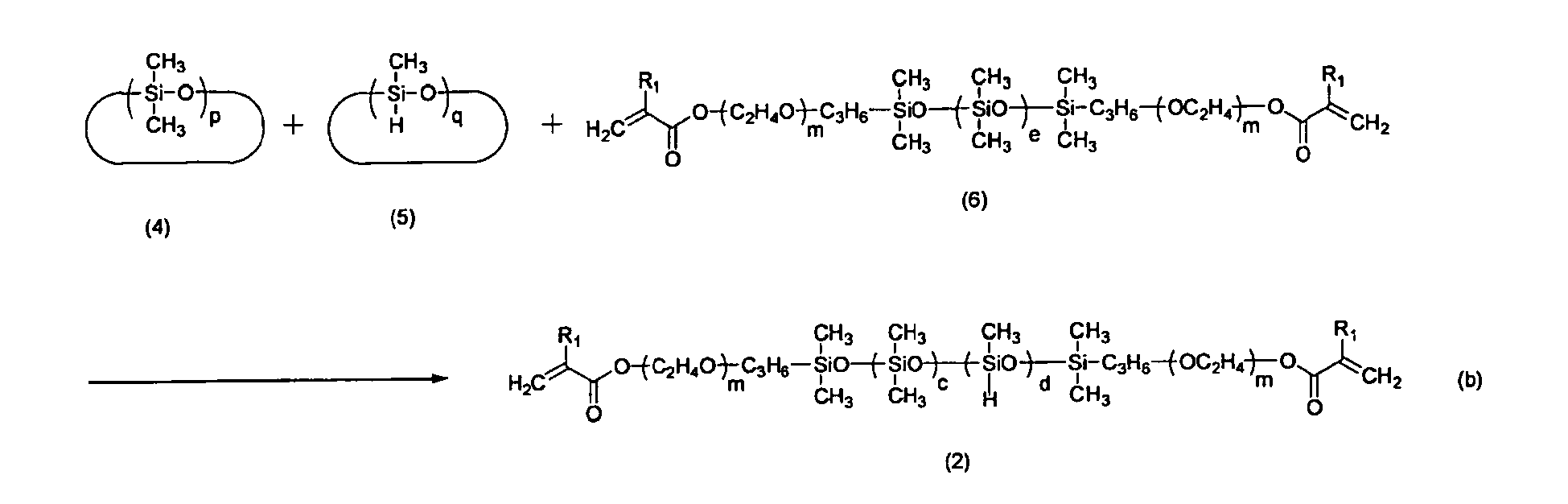
- An example of a method of producing a polysiloxane intermediate represented by the aforementioned general formula (2) includes a method comprising the step of synthesizing a compound represented by general formula (6) as an intermediate, as shown in the following reaction formula (b): wherein R 1 is selected from either hydrogen or a methyl group; m represents an integer of from 0 to 10; p and q represent integers of from 3 to 10, preferably from 3 to 5; c and d represent integers of 1 or more; c+d is equal to 20-500; d/(c+d) is equal to 0.01-0.22; e represents an integer of from 0 to 500; and the configuration of siloxane units includes a random configuration.
- Siloxane having (meth)acrylic groups at both terminals represented by general formula (6) is commercially available as TSL9706 (manufactured by Momentive), and also may be synthesized by following methods, for example.
- a first example of a method of synthesizing siloxane of general formula (6) is exhibited in reaction formulas (c) and (d) described below. That is, the example includes a method comprising carrying out hydrosilylation reaction between siloxane having SiH groups at both terminals represented by general formula (9) and polyoxyalkylene having a terminal hydroxyl group and an allyl group represented by general formula (10) to generate a polyoxyalkylene-polysiloxane block copolymer with both terminal hydroxyl groups represented by general formula (7) in the reaction formula (c); and then reacting the block copolymer (7) obtained in the above-mentioned reaction with (meth)acrylic acid represented by general formula (8) or a reactive derivative thereof to synthesize siloxane having (meth) acrylic groups at both terminals represented by general formula (6) in the following reaction formula (d): wherein R 1 is selected from either hydrogen or a methyl group; m represents an integer of from 0 to 10; and e represents an integer of
- reaction formulas (e) and (f) Another example of a method of synthesizing siloxane of general formula (6) is exhibited in reaction formulas (e) and (f) as described below. That is, the other example includes a method comprising reacting polyoxyalkylene having a terminal hydroxyl group and an allyl group represented by general formula (10) with (meth)acrylic acid represented by general formula (8) or a reactive derivative thereof to generate polyoxyalkylene having a terminal allyl group and a (meth)acrylic group represented by general formula (11) in reaction formula (e); and then carrying out hydrosilylation reaction of (11) obtained in the above-mentioned reaction with siloxane having SiH groups at both terminals represented by general formula (9) to synthesize siloxane having (meth)acrylic groups at both terminals represented by general formula (6) in the following reaction formula (f) : wherein R 1 is selected from either hydrogen or a methyl group; m represents an integer of from 0 to 10; and e represents an
- hydrophilic polysiloxane macromonomer represented by general formula (1) may be obtained by an addition of polyethylene glycol allyl ether to the intermediate presented in general formula (2)utilizing a so-called hydrosilylation reaction, which is an addition reaction to hydrosilane using a transition metal catalyst such as chloroplatinic acid.
- the hydrophilic polysiloxane macromonomer also becomes a compound having a molecular weight distribution as well as a polysiloxane intermediate thereof.
- R 2 is selected from either hydrogen or a C 1-4 hydrocarbon group; n represents an integer of from 4 to 100, particularly preferably 5 to 20, further preferably 5 to 15; and R 2 is preferably hydrogen or a methyl group.
- R 2 is preferably hydrogen or a methyl group.
- it is important to add a larger amount of polyethylene glycol allyl ether than a stoichiometric ratio, allowing inhibition of a side reaction due to an unreacted SiH group, e.g., inhibition of hydrolysis to obtain a macromonomer of stable quality.
- surplus polyethylene glycol allyl ether can be easily removed by a purification method with a solvent as described below, after the reaction.
- Transition metal catalysts for hydrosilylation reaction include, e.g., ruthenium, rhodium, iridium, osmium, and platinum; preferably a platinum-containing catalyst; more preferably hexachloroplatinic acid, 1,3-divinyltetramethyldisiloxane platinum complex, platinum carried on activated carbon, and platinum (IV) oxide; most preferably hexachloroplatinic acid exhibiting a high catalytic activity.
- reaction solvent a solvent that does not inhibit hydrosilylation reaction and react itself may be used.
- Reaction solvents include, for example, isopropanol, tetrahydrofuran, dioxan, hexane, cyclohexane, heptane, cycloheptane, chloroform, dichloromethane, dichloroethane, dimethoxyethane, benzene, toluene, and xylene.
- a method of protecting a hydroxyl group to inhibit side reaction between hydroxyl and SiH groups may be used, more preferably, a method of adding a buffer agent is particularly easily used.
- a buffer agent is particularly easily used.
- potassium acetate is particularly useful.
- Reaction temperature may be in the range of 0-150°C, preferably 25-100°C, more preferably 35-85°C.
- the higher reaction temperature results in acceleration of the reaction, but unfavorably allows occurrence of a side reaction due to polymerization of, e.g., (meth)acrylic groups.
- a washing operation with a solvent may be performed as a purification method following hydrosilylation reaction.
- a hydrophilic polysiloxane macromonomer of interest can be precipitated and separated by dissolution of a crude product in a first solvent, followed by addition of a second solvent.
- the first solvent as used herein refers to a solvent in which a macromonomer represented by general formula (1) is easily dissolved
- the second solvent refers to a solvent in which the macromonomer represented by general formula (1) is difficult to dissolve and polyethylene glycol allyl ether used is dissolved.
- First solvents include methanol, ethanol, propanol, isopropanol, butanol, isobutanol, acetone, tetrahydrofuran, dioxan, chloroform, dichloromethane, dichloroethane, and ethylene glycol.
- Second solvents include, e.g., water.
- a macromonomer of interest can be obtained by distilling out a solvent after purification.
- an appropriate amount of polymerization inhibitor such as HQ (hydroquinone), BHT (2,6-di-t-butyl-4-methylphenol) or MQ (p-methoxyphenol), may be also previously added in order to prevent gelation.
- the present invention is to disclose a polymer of hydrophilic polysiloxane macromonomer alone, presented in the general formula (1), or a copolymer obtained by copolymerizing said hydrophilic polysiloxane macromonomer with one or more polymerizable monomers, and an ophthalmic lens material.
- Ophthalmic lenses to which the present invention is applicable include an intraocular lens and a corneal lens, and further preferably, contact lenses.
- a copolymerizable monomer will now be described below. Any monomer may be used if it is copolymerizable in the present invention, in particular, hydrophilic monomers are useful. That is because the hydrophilic monomers improve the surface hydrophilic properties of hydrophilic polysiloxane macromonomer copolymers and vary water content of the copolymer.
- copolymerizable monomers examples include a hydroxyl group-containing monomer such as 2-hydroxyethyl methacrylate, 2-hydroxypropyl methacrylate, 2-hydroxybutyl acrylate, 4-hydroxybutyl acrylate or glycerol methacrylate; a hydroxyl group-containing monomer having a fluorine-containing substituent such as 3-(1,1,2,2-tetrafluoroethoxy)-2-hydroxypropyl methacrylate; a carboxylic acid group-containing monomer such as methacrylic acid, acrylic acid, itaconic acid, fumaric acid or maleic acid; an alkyl-substituted amino group-containing monomer such as dimethylaminoethyl methacrylate or diethylaminoethyl methacrylate; an amide group-containing monomer such as N,N-dimethylacrylamide, N,N-diethylacrylamide, N-methylacrylamide, methylenebisacrylamide, diacetone acrylamide
- An example of other usable monomers is a fluorine-containing monomer such as acrylic acid fluoroalkyl ester or methacrylic acid fluoroalkyl ester, including, e.g., trifluoroethyl acrylate, tetrafluoroethyl acrylate, tetrafluoropropyl acrylate, pentafluoropropyl acrylate, hexafluorobutyl acrylate, hexafluoroisopropyl acrylate and methacrylates corresponding to these acrylates, which may be selected depending on needed compatibility, hydrophilic property, water content and resistance to deposition.
- a fluorine-containing monomer such as acrylic acid fluoroalkyl ester or methacrylic acid fluoroalkyl ester, including, e.g., trifluoroethyl acrylate, tetrafluoroethyl acrylate, tetrafluoropropyl
- siloxane such as tris(trimethylsiloxy)silylpropyl methacrylate, ⁇ -butyl- ⁇ - ⁇ 3-[2-(2-methacryloxyethylcarbamoyloxy)ethoxy]propyl ⁇ po lydimethylsiloxane, a siloxane-containing macromonomer described in Examples A-1, B-1, C-1 and D-1 in Japanese Patent Publication No. H11-502949 , a siloxane-containing monomer (V2D25) described in U.S. Pat. No. 5260000 , a siloxane-containing macromonomer described in Example 1 in Japanese Patent Publication No.
- a siloxane-containing macromonomer (A1, A2) in International Publication WO2004/063795 , and a siloxane-containing macromonomer described in Example 1 in Japanese Patent Publication No. 2001-311917 may be selected to improve oxygen permeability.
- alkyl acrylate ester monomer an alkyl methacrylate ester monomer, or the like may be also used as needed, examples of which include methyl acrylate, ethyl acrylate, n-propyl acrylate, n-butyl acrylate, cyclopentyl acrylate, n-stearyl acrylate, and methacrylates corresponding to these acrylates.
- Monomers described below may be optionally copolymerized to improve mechanical properties and dimensional stability.
- monomers to improve the mechanical properties include monomers affording high glass transition point polymers , which are aromatic vinyl compounds such as styrene, tert-butylstyrene, ⁇ -methylstyrene, and t-butyl methacrylate, cyclohexyl methacrylate, and isobornyl methacrylate.
- Crosslinkable monomers are particularly useful in further improving dimensional stability, examples of which include ethylene glycol dimethacrylate, diethylene glycol dimethacrylate, triethylene glycol dimethacrylate, polyethylene glycol dimethacrylate, trimethylolpropane trimethacrylate, pentaerythritol tetramethacrylate, bisphenol A dimethacrylate, vinyl methacrylate, allyl methacrylate and acrylates corresponding to these methacrylates; triallyl isocyanurate; divinylbenzene; and N,N'-methylene bisacrylamide.
- One or a combination of two or more of these monomers may be used.
- the properties of copolymers can be controlled by varying the compounding ratios of copolymerizable monomers.
- the ratios of a hydrophilic polysiloxane macromonomer, a hydrophilic monomer and another monomer are preferably 10-90%, 10-80% and 0-80%, respectively, more preferably 30-80%, 10-60% and 0-30%, respectively, most preferably, 30-70%, 20-50% and 5-20%, respectively, to afford effective properties for an ophthalmic lens material.
- additives may be added before and after polymerization as necessary.
- additives include various coloring agents, a UV absorbent, an antioxidizing agent, a surfactant, and a compatibilizer.
- a hydrophilic polymer such as polyvinyl pyrrolidone according to the aforementioned Japanese PCT National Publication No. 2003-528183 may be also added to improve wettability.
- Copolymerization methods which can be used include, e.g., radical polymerization, cationic polymerization, anionic polymerization, and addition polymerization.
- a radical polymerization method of making a photoinitiator present in a monomeric mixture to be irradiated with ultraviolet light to perform polymerization or a radical polymerization method of performing polymerization using an azo compound or organic peroxide by heating preferred.
- photoinitiators used include benzoinethylether, benzyldimethylketal, ⁇ , ⁇ '-diethoxyacetophenone, and 2,4,6-trimethylbenzoyldiphenylphosphineoxide.
- organic peroxides used include benzoyl peroxide and t-butyl peroxide.
- azo compounds used include azobisisobutyronitrile and azobisdimethylvaleronitrile.
- a cross-linking polymer to be used as an ophthalmic lens material according to the present invention may be formed into a contact lens or the like by, e.g., a cast polymerization method of filling a mold with a mixture including a hydrophilic polysiloxane monomer, a copolymerization monomer and an initiator to perform radical polymerization by a well-known method; a method of performing polymerization by loading a monomer mixture in a rotating half mold; or a method of freezing and cutting a copolymer at low temperature.
- a surface of a formed lens may be also further subjected to, for example, plasma treatment, ozone treatment, graft polymerization or plasma polymerization, to reform it, as needed.
- the structural formula of a synthesized hydrophilic polysiloxane macromonomer is presented in general formula (12), wherein the configuration of siloxane units includes a random configuration.
- general formula (12) a hydrophilic polysiloxane macromonomer represented by general formula (1), wherein R 1 represents a methyl group, is presented.
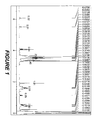
- a 1 H-NMR chart of the synthesized hydrophilic polysiloxane macromonomer A is shown in Fig. 1 ; and its infrared absorption chart is shown in Fig. 2 .
- Synthesis was carried out by the same method as in Example 1, except that the amount of LS8600 was changed to 15 g, to obtain 110 g of an intermediate B. Furthermore, 15 g of the intermediate B and 20 g of Uniox PKA5007 were dissolved in 30 g of isopropanol, and synthesis and washing were performed as in Example 2 to obtain 10 g of a hydrophilic polysiloxane macromonomer D of interest.
- hydrophilic polysiloxane macromonomer A synthesized in Example 2 N-methyl-N-vinylacetamide, N-vinyl pyrrolidone, isobornyl methacrylate, triallyl isocyanurate, and a polymerization initiator 2,4, 6-trimethylbenzoyldiphenylphosphine oxide were mixed and stirred at a weight ratio of 66:18:10:6:0.1:0.1.
- This mixed liquid was put in a mold for a contact lens, made of Soarlite S (The Nippon Synthetic Chemical Industry Co., Ltd.) comprising ethylene vinyl alcohol resin, and was irradiated with ultraviolet light in a photoirradiation device for 1 hour to obtain a lenticular polymer.
- This polymer was immersed overnight in ethyl alcohol and then immersed in water all day long.
- This lens was transferred into a physiological saline solution (ISO 18369-3:2006) and then sterilized in an autoclave to provide a contact lens A.
- the contact lens A was transparent and flexible, and also had good water wettability. On assessing properties, a water content was 37%, a contact angle was 41°, an oxygen permeability coefficient (Dk) was 130, and tensile strength was 1.5 MPa.
- Wettability with a physiological saline solution was assessed by visual observation. A lens immersed in a physiological saline solution for 24 hours or longer was perpendicularly raised from the physiological saline solution. Good: A water film was held on more than half of the lens surface for ⁇ 5 seconds. Average: 1 to 5 seconds. Poor: ⁇ 1 second.
- the lens was placed in a physiological saline solution at 37°C for 72 hours, and then taken out, and water on the surface was wiped off to weigh the lens.
- a contact angle measuring apparatus DropMaster 500 (Kyowa Interface Science) was used to measure a contact angle between a material surface and a water droplet at 25°C.
- An oxygen permeability was measured according to a method described in "A single-lens polarographic measurement of oxygen permeability (Dk) for hypertransmissible soft contact lenses” ( Biomaterials, 28(2007), 4331-4342 ). The oxygen permeability was measured in (ml ⁇ cm/cm 2 ⁇ sec ⁇ mmHg)x10 -11 .
- Tensile strength was measured in a physiological saline solution of 25°C using a tensile testing machine AGS-50B (Shimadzu Corporation). The central area (width of 3 mm) of the lens was cut out to measure its strength in breaking. The strength was measured in MPa.
- hydrophilic polysiloxane macromonomer A was substituted with hydrophilic polysiloxane macromonomers B to E, and contact lenses B to E were produced by the same method as in Example 10 to assess their physical properties. The assessment results are shown in Table 1.
- hydrophilic polysiloxane macromonomer A synthesized in Example 2 N-methyl-N-vinylacetamide, N-vinyl pyrrolidone, hydroxybutyl methacrylate, ⁇ -butyl- ⁇ - ⁇ 3-[2-(2-methacryloxyethylcarbamoyloxy)ethoxy]propyl ⁇ po lydimethylsiloxane, isobornyl methacrylate, triallyl isocyanurate, 2,4,6-trimethylbenzoyldiphenylphosphine oxide, and dioctyl sulfosuccinate sodium salt as an additive were mixed and stirred at a weight ratio of 44:10:30:10:10:6:0.1:0.1:0.5.
- This mixed liquid was put in a mold for a contact lens, made of Soarlite S (The Nippon Synthetic Chemical Industry Co., Ltd.), and was irradiated with ultraviolet light in a photoirradiation device for 1 hour to obtain a lenticular polymer.
- This polymer was immersed overnight in ethyl alcohol and then immersed in water all day long.
- This lens was transferred into a physiological saline solution (ISO 18369-3:2006) and then sterilized in an autoclave to provide a contact lens F.
- the contact lens F was transparent and flexible, and also had good water wettability. On assessing properties, a water content was 44%, a contact angle was 44°, an oxygen permeability coefficient (Dk) was 115, and tensile strength was 3.0 MPa.
- Example 15 The hydrophilic polysiloxane macromonomer A in Example 15 was substituted with the hydrophilic polysiloxane macromonomers F to G, and contact lenses G to H were produced by the same method as in Example 17, and their properties were assessed. The assessment results are shown in Table 1.
- hydrophilic polysiloxane macromonomer A synthesized in Example 2 N-methyl-N-vinylacetamide, methyl methacrylate, triethylene glycol dimethacrylate, 2-hydroxy-4-acryloxyethoxybenzophenone, 2,2'-azobis(2,4-dimethylvaleronitriles), and dimethylsiloxan-ethylene oxide block copolymer (DBE712, Gelest) as an additive were mixed and stirred at a weight ratio of 35:47:17:0.2:0.9:0.5:25. Decompression and nitrogen purge of this mixed liquid were repeated twice to fully remove oxygen from the mixed liquid, followed by putting the mixed liquid in a mold for a contact lens, made of polypropylene.
- the mold was placed in a chamber for exclusive use, and nitrogen substitution was performed, followed by heating the mold for 30 minutes at 55°C, and subsequently for 60 minutes at 80°C, to obtain a lenticular polymer.
- This polymer was immersed overnight in ethyl alcohol and then immersed in water all day long.
- This lens was transferred into a physiological saline solution (ISO 18369-3:2006) and then sterilized in an autoclave to provide a contact lens I.
- the contact lens I was transparent and flexible, and also had good water wettability. On assessing properties, a water content was 40%, a contact angle was 42°, an oxygen permeation coefficient (Dk) was 110, and tensile strength was 2.5 MPa.
- Example 10 The hydrophilic polysiloxane macromonomer A in Example 10 was substituted with the hydrophilic polysiloxane macromonomers H to J, and contact lenses J to L were produced by the same method as in Example 10 to assess their physical properties. The assessment results are shown in Table 1.
- Example Comparative example 10 11 12 13 14 15 16 17 18 4 5 6 Contact lens A B C D E F G H I J K L Hydrophilic polysiloxane macromonomer A B C D E A F G A H I J a ca.90 ca.90 ca.90 ca.85 ca.130 ca.90 ca.85 ca.160 ca.90 ca.15 ca.75 ca.110 b ca.5 ca.5 ca.5 ca.10 ca.5 ca.5 ca.10 ca.4 ca.5 0 ca.25 ca.1 n ca.7 ca.7 ca.5 ca.7 ca.7 ca.7 ca.7 ca.15 ca.7 ca.7 0 ca.1 ca.35 m 0 0 0 0 0 0 0 1 0 0 0 0 R2 CH 3 H CH 3 CH 3 CH 3 CH 3 H CH 3 CH 3 - H CH 3 a+b ca.95 ca.95 can.95 ca.95 ca.1
- Dissolution of 45.05 g of the intermediate H and 30.05 g of polyethylene glycol allyl ether having a molecular weight of about 400 (Uniox PKA5002, NOF Corporation) in 90.45 g of isopropanol was performed, 0.46 g of a 10% potassium acetate/ethanol solution, 0.91 g of a 1% isopropanol solution of chloroplatinic acid and 5.9 mg of 2,6-di-t-butyl-4-methyl phenol (BHT) were further added to this mixture, and this mixture was heated to reflux for 1 hour in an oil bath at 93°C.
- BHT 2,6-di-t-butyl-4-methyl phenol
- reaction solvent was distilled out under reduced pressure, and 60 g of acetone and 30 g of pure water were added to the residue to vigorously stir this mixture, followed by centrifugation (7000 rpm, 10°C, 10 minutes) of the mixture, followed by removing the upper layer. This operation was repeated ten times, and 3.3 mg of BHT, 2.0 mg of p-methoxyphenol (MQ) and 60 g of isopropanol were added to this mixture, and vacuum concentration of this mixture was carried out.
- MQ p-methoxyphenol
- Synthesis was carried out by the same method as in Example 20, except that polyethylene glycol allyl ether (Uniox PKA5002, NOF Corporation) used in Example 20 was substituted with methoxy polyethylene glycol allyl ether having a molecular weight of about 400 (Uniox PKA5007, NOF Corporation), to obtain 56.83 g of a hydrophilic polysiloxane macromonomer L of interest.
- hydrophilic polysiloxane macromonomer A in Example 15 was substituted with the hydrophilic polysiloxane macromonomers K to M, contact lenses M to O were produced by the same method as in Example 18, respectively, and their physical properties were assessed. The assessment results are shown in Table 2.
- Example 23 24 25 Contact lens M N O Hydrophilic polysiloxane macromonomer K L M a ca.124 ca.124 ca.123 b ca.7 ca.7 ca.9 n ca.7 ca.7 ca.7 m 0 0 0 R 2 H CH 3 CH 3 a+b ca.131 ca.131 ca.132 b/( a+b) ca.0.05 ca.0.05 ca.0.07 Transparency good good good Water wettability good good good good Water content (%) 48 46 49 Contact angle (°) 35 34 37 Oxygen permeability ⁇ 110 125 105 Tensile strength (MPa) 0.8 0.8 0.7 ⁇ Unit: (ml ⁇ cm/cm 2 ⁇ sec ⁇ mmHg)x10 -11
- a hydrophilic polysiloxane macromonomer of the present invention has good compatibility with polymerizable mixtures containing a hydrophilic monomer, a transparent copolymer is afforded.
- the copolymer having both of high oxygen permeability and a high hydrophilic property of the material is useful as a raw material for an ophthalmic lens, more specifically, an ophthalmic lens with a high hydrophilic property and high oxygen permeability, in particular, a contact lens material.
Landscapes
- Chemical & Material Sciences (AREA)
- Organic Chemistry (AREA)
- Health & Medical Sciences (AREA)
- Chemical Kinetics & Catalysis (AREA)
- Medicinal Chemistry (AREA)
- Polymers & Plastics (AREA)
- General Chemical & Material Sciences (AREA)
- Physics & Mathematics (AREA)
- General Physics & Mathematics (AREA)
- Optics & Photonics (AREA)
- Silicon Polymers (AREA)
- Eyeglasses (AREA)
- Macromonomer-Based Addition Polymer (AREA)
Abstract
Description
- The present invention relates to novel hydrophilic polysiloxane macromonomers, methods of production thereof, and ophthalmic lenses employing the hydrophilic polysiloxane macromonomers and, in particular, to a contact lens. In more detail, the present invention relates to a contact lens having both of oxygen permeability and a hydrophilic property, and raw materials therefor.
- High oxygen permeability is demanded for ophthalmic lenses, in particular, for contact lenses, which need supply of oxygen, necessary for maintaining corneal health statuses, from an air medium. In recent years, contact lenses, in which siloxane monomers as raw materials are employed for improving oxygen permeability, have been developed.
High hydrophilic properties as well as oxygen permeability are also demanded for contact lenses. Contact lenses with high hydrophilic properties are said to generally have good wear comfort and be comfortably wearable for long time. Hydrophilic monomers are commonly used as raw materials in order to improve hydrophilic property of contact lenses. - To produce a contact lens having both of high oxygen permeability and a high hydrophilic property, it is necessary to use both of a siloxane monomer and a hydrophilic monomer as raw materials; however, since a siloxane monomer has a high hydrophobic property in general and thus has poor compatibility with a hydrophilic monomer, phase separation occurs, which makes it difficult to produce transparent contact lenses. In order to solve this problem, hydrophilized siloxane monomers have been developed.
- For example, hydrophilic contact lenses produced from polysiloxane containing hydrophilic side chains are disclosed in
Patent Document 1 andPatent Document 2, wherein compounds containing polyether groups, hydroxyl groups, amide groups, and quaternary amine groups as hydrophilic side chains are selected; however, since the specifically disclosed polysiloxane contains comparatively many hydrophilic side chains which have a comparatively low molecular weight, per molecule, a balance between a hydrophilic property and oxygen permeability is inadequate, and it was difficult to use the polysiloxane as a raw material for an ophthalmic lens with high oxygen permeability and a high hydrophilic property. - A plastic molding article produced from plastic which includes a compound having a group with a polymerizable double bond, a hydroxyl group, an organosiloxane group, and an amide group as a polymerization ingredient is disclosed in
Patent Document 3. The polymerization ingredient allows production of the plastic molding article with high transparency, high oxygen permeability, good water wettability, and good mechanical properties. However, since the specifically disclosed compound had short siloxane chains, effective oxygen permeability was not obtained. In addition, since the compound had only one polymerizable functional group per molecule, adequate strength was precluded. - A hydrogel soft contact lens comprising a hydrophilic siloxane monomer and a copolymer thereof is disclosed in
Patent Document 4, Patent Document 5 and Patent Document 6, wherein the hydrophilic siloxane monomers contain main chains, in which polymerizable groups and polysiloxane chains are bound through urethane or urea groups, including fluorine-substituted hydrocarbon and polyoxyalkylene groups as side chains. Since hydrophilic siloxane monomers containing urethane or urea groups have high intermolecular forces, copolymers thereof are also prone to have a comparatively high modulus of elasticity, and there were cases where flexibility greatly affecting the wear comfort of contact lenses was lost. - [Patent Document 1] Japanese Patent Publication No.
62-29776 - [Patent Document 2] Japanese Patent Publication No.
62-29777 - [Patent Document 3] Japanese Patent No.
3,644,177 - [Patent Document 4] International Publication
WO 01/044861 - [Patent Document 5] International Publication
WO 2006/026474 - [Patent Document 6] Japanese Patent No.
3,441,024 - The present invention addresses problems of providing an ophthalmic lens, in particular, contact lens, which has both of oxygen permeability and a hydrophilic property; and of providing a novel hydrophilic polysiloxane macromonomer, which can be used as a raw material thereof, and a method of production of the macromonomer.
- As a result of extensive research, use of a hydrophilic polysiloxane macromonomer as a raw material, containing a polysiloxane main chain including polyoxyethylenes as hydrophilic side chains, was found to be effective at pursuing both of the high oxygen permeability and high hydrophilic property of an ophthalmic lens, in particular, a contact lens. In addition, oxygen permeability and hydrophilic property were found to be greatly affected by the length of the polysiloxane main chain, the length of the hydrophilic polyoxyethylene side chains and the number of the included side chains, and the invention was thus accomplished. A hydrophilic polysiloxane macromonomer, in which both terminals of a main chain have polymerizable functional groups and the polymerizable functional groups and polysiloxane of the main chain are bound through ester groups, was further found to be effective at adequately controlling strength and a modulus of elasticity which greatly affect the usability and wear comfort of a contact lens.
- Specifically, a hydrophilic polysiloxane macromonomer presented in general formula (1) is exemplified:

- It is to be noted that "the configuration of siloxane units includes a random configuration" means that the siloxane units containing polyoxyethylene as hydrophilic side chains and siloxane units excluding the polyoxyethylene side chains may be arranged randomly or in block form, or random and block configurations may coexist in one molecule. A rate between random and block configurations may be also optional, for example, only a random or block configuration may be included in one molecule, or the random and block configurations may be included at an optional rate.
- The present invention also relates to hydrophilic polysiloxane macromonomers, wherein a and b, presented in the general formula (1), represent 25-200 and 2-20, respectively; to hydrophilic polysiloxane macromonomers, wherein n, presented in the general formula (1), represents 5-20; and to hydrophilic polysiloxane macromonomers, wherein a and b, presented in the general formula (1), represent 25-160 and 3-10, respectively, and n represents 5-15.
- Furthermore, the present invention also relates to methods of producing hydrophilic polysiloxane macromonomers represented by general formula (1), which is obtained via polysiloxane represented by general formula (2) as an intermediate:

- In more detail, the present invention also relates to a method in which the step of producing the polysiloxane intermediate represented by general formula (2) is carried out by ring-opening polymerization of cyclic dimethylsiloxane, cyclic siloxane having hydrosilane (Si-H), and siloxane having (meth) acrylic groups at both terminals using an acid catalyst and by stopping the ring-opening polymerization by neutralization reaction with a basic aqueous solution.
- The present invention also relates to a method of producing the hydrophilic polysiloxane macromonomers represented by general formula (1) comprising hydrosilylation reaction of the intermediate represented by general formula (2) with polyethylene glycol allyl ether represented by general formula (3):

The hydrosilylation reaction may uses, as a catalyst therefor, a platinum-containing catalyst, and the production method may further comprise the step of washing the hydrophilic polysiloxane macromonomer with a solvent after the reaction. - Furthermore, the present invention also relates to homopolymers of the above-mentioned hydrophilic polysiloxane macromonomers, or to copolymers copolymerized the above-mentioned hydrophilic polysiloxane macromonomers with one or more polymerizable monomers, ophthalmic lens materials employing these polymers, and ophthalmic lenses and contact lenses employing these materials.
- Because a hydrophilic polysiloxane macromonomer of the present invention has good compatibility with polymerizable mixtures containing a hydrophilic monomer, a transparent copolymer is afforded, and high oxygen permeability can be also maintained. The hydrophilic polysiloxane macromonomer utilizing these characteristics is useful as an ophthalmic lens material with a high hydrophilic property and high oxygen permeability. It is to be noted that ophthalmic lenses, but are not limited in particular, are preferably understood to be lenses fitted to the anterior eye segment for purposes such as vision correction, test and therapy, and preferably include, e.g., an intraocular lens, a corneal lens, and a contact lens.
-
-
FIG. 1 is a 1H-NMR chart of a hydrophilic polysiloxane macromonomer A. -
FIG. 2 is an infrared absorption chart of a hydrophilic polysiloxane macromonomer A. - The present invention is specifically described below.
In the aforementioned general formula (1), representing the raw material of an ophthalmic lens with both of high oxygen permeability and a high hydrophilic property, in particular, a contact lens, a combination of a+b, determining the length of a polysiloxane main chain, b/(a+b), determining the percentage content of hydrophilic side chains, and the number n of bound polyoxyethylenes which are the hydrophilic side chains, is important, wherein a+b is equal to 20-500, b/ (a+b) is equal to 0.01-0.22, and n represents 4-100; preferably a+b is equal to 27-220, b/(a+b) is equal to 0.01-0.15, and n represents 5-20; more preferably, a+b is equal to 28-160, b/(a+b) is equal to 0.01-0.10, and n represents 5-15. Furthermore, a and b per specific hydrophilic polysiloxane macromonomer molecule are preferably equal to 25-200 and 2-20, respectively; more preferably, 25-160 and 3-10, respectively, allowing a balance between oxygen permeability and a hydrophilic property. - Various methods of synthesizing a hydrophilic polysiloxane macromonomer disclosed in the present invention are conceivable and include, for example, a method as described below, via a polysiloxane intermediate represented by general formula (2) shown below.
Specifically, ring-opening polymerization of a mixture of cyclic dimethylsiloxane, cyclic siloxane having hydrosilane (Si-H), and disiloxane having (meth)acrylic groups at both terminals is carried out using an acid catalyst, such as sulfuric acid, trifluoromethanesulfonic acid or acid clay, to provide a polysiloxane intermediate containing (meth)acrylic groups at both terminals as shown in general formula (2):
In general formula (2), the ratio and total number of c and d may be optionally controlled by varying the compounding ratio of cyclic dimethylsiloxane, cyclic siloxane having hydrosilane (Si-H), and disiloxane having (meth)acrylic groups at both terminals. A polysiloxane intermediate obtained in this manner has no single molecular weight but has a molecular weight distribution as in case of a typical synthetic polymer. - A synthesis method is described in more detail. After ring-opening polymerization of a mixture of cyclic dimethylsiloxane, cyclic siloxane having hydrosilane (Si-H), and siloxane having (meth)acrylic groups at both terminals using an acid catalyst such as sulfuric acid, trifluoromethanesulfonic acid or acid clay, preferably trifluoromethanesulfonic acid having a high acidity and a high catalytic activity, the reaction can be stopped by addition of a basic aqueous solution. The basic aqueous solution preferably has a pH of more than 7 but 14 or less, more preferably a weakly basic pH of more than 7 but 9 or less which inhibits a side reaction from occurring.
As a reaction solvent, no solvent may be used in the reaction, or a solvent that does not inhibit the ring-opening polymerization by an acid catalyst may be used. Reaction solvents include, for example, tetrahydrofuran, dioxan, hexane, cyclohexane, heptane, cycloheptane, chloroform, dichloromethane, dichloroethane, dimethoxyethane, toluene, benzene, xylene, diethyl ether, diisoprpyl ether, acetone, and methyl ethyl ketone. Among them, the solvents excluding hetero elements, such as oxygen and nitrogen, which suppress the activity of an acid catalyst, are preferred.
Reaction temperature may be in the range of 0-150°C, preferably 20-100°C, more preferably 25-80°C. The higher reaction temperature results in acceleration of the reaction, but unfavorably allows occurrence of a side reaction due to polymerization of, e.g., (meth)acrylic groups.
A polymerization inhibitor, e.g., HQ (hydroquinone), BHT (2,6-di-t-butyl-4-methylphenol) or MQ (p-methoxyphenol), may be previously added into a reaction system to inhibit a side reaction due to radical polymerization of, e.g., (meth)acrylic groups during ring-opening polymerization. - An example of a method of producing a polysiloxane intermediate represented by the aforementioned general formula (2) includes a method comprising the step of synthesizing a compound represented by general formula (6) as an intermediate, as shown in the following reaction formula (b):
- Siloxane having (meth)acrylic groups at both terminals, represented by general formula (6) is commercially available as TSL9706 (manufactured by Momentive), and also may be synthesized by following methods, for example.
- A first example of a method of synthesizing siloxane of general formula (6) is exhibited in reaction formulas (c) and (d) described below. That is, the example includes a method comprising carrying out hydrosilylation reaction between siloxane having SiH groups at both terminals represented by general formula (9) and polyoxyalkylene having a terminal hydroxyl group and an allyl group represented by general formula (10) to generate a polyoxyalkylene-polysiloxane block copolymer with both terminal hydroxyl groups represented by general formula (7) in the reaction formula (c); and then reacting the block copolymer (7) obtained in the above-mentioned reaction with (meth)acrylic acid represented by general formula (8) or a reactive derivative thereof to synthesize siloxane having (meth) acrylic groups at both terminals represented by general formula (6) in the following reaction formula (d):

- Another example of a method of synthesizing siloxane of general formula (6) is exhibited in reaction formulas (e) and (f) as described below. That is, the other example includes a method comprising reacting polyoxyalkylene having a terminal hydroxyl group and an allyl group represented by general formula (10) with (meth)acrylic acid represented by general formula (8) or a reactive derivative thereof to generate polyoxyalkylene having a terminal allyl group and a (meth)acrylic group represented by general formula (11) in reaction formula (e); and then carrying out hydrosilylation reaction of (11) obtained in the above-mentioned reaction with siloxane having SiH groups at both terminals represented by general formula (9) to synthesize siloxane having (meth)acrylic groups at both terminals represented by general formula (6) in the following reaction formula (f) :

- Next, a hydrophilic polysiloxane macromonomer represented by general formula (1) may be obtained by an addition of polyethylene glycol allyl ether to the intermediate presented in general formula (2)utilizing a so-called hydrosilylation reaction, which is an addition reaction to hydrosilane using a transition metal catalyst such as chloroplatinic acid. The hydrophilic polysiloxane macromonomer also becomes a compound having a molecular weight distribution as well as a polysiloxane intermediate thereof.
- For polyethylene glycol allyl ether as used herein, various compounds may be used, among them compounds represented by the following general formula (3) are preferable. In the formula (3), R2 is selected from either hydrogen or a C1-4 hydrocarbon group; n represents an integer of from 4 to 100, particularly preferably 5 to 20, further preferably 5 to 15; and R2 is preferably hydrogen or a methyl group.
In addition, when carrying out a reaction, it is important to add a larger amount of polyethylene glycol allyl ether than a stoichiometric ratio, allowing inhibition of a side reaction due to an unreacted SiH group, e.g., inhibition of hydrolysis to obtain a macromonomer of stable quality. In addition, surplus polyethylene glycol allyl ether can be easily removed by a purification method with a solvent as described below, after the reaction.
- Transition metal catalysts for hydrosilylation reaction include, e.g., ruthenium, rhodium, iridium, osmium, and platinum; preferably a platinum-containing catalyst; more preferably hexachloroplatinic acid, 1,3-divinyltetramethyldisiloxane platinum complex, platinum carried on activated carbon, and platinum (IV) oxide; most preferably hexachloroplatinic acid exhibiting a high catalytic activity.
- For a reaction solvent, a solvent that does not inhibit hydrosilylation reaction and react itself may be used. Reaction solvents include, for example, isopropanol, tetrahydrofuran, dioxan, hexane, cyclohexane, heptane, cycloheptane, chloroform, dichloromethane, dichloroethane, dimethoxyethane, benzene, toluene, and xylene. In particular, when reacting polyethylene glycol allyl ether in general formula (3) in which R2 is hydrogen, a method of protecting a hydroxyl group to inhibit side reaction between hydroxyl and SiH groups may be used, more preferably, a method of adding a buffer agent is particularly easily used. For example, potassium acetate is particularly useful.
- Reaction temperature may be in the range of 0-150°C, preferably 25-100°C, more preferably 35-85°C. The higher reaction temperature results in acceleration of the reaction, but unfavorably allows occurrence of a side reaction due to polymerization of, e.g., (meth)acrylic groups.
- A washing operation with a solvent may be performed as a purification method following hydrosilylation reaction. A hydrophilic polysiloxane macromonomer of interest can be precipitated and separated by dissolution of a crude product in a first solvent, followed by addition of a second solvent. The first solvent as used herein refers to a solvent in which a macromonomer represented by general formula (1) is easily dissolved, and the second solvent refers to a solvent in which the macromonomer represented by general formula (1) is difficult to dissolve and polyethylene glycol allyl ether used is dissolved.
First solvents include methanol, ethanol, propanol, isopropanol, butanol, isobutanol, acetone, tetrahydrofuran, dioxan, chloroform, dichloromethane, dichloroethane, and ethylene glycol. Second solvents include, e.g., water.
A macromonomer of interest can be obtained by distilling out a solvent after purification. In this context, an appropriate amount of polymerization inhibitor, such as HQ (hydroquinone), BHT (2,6-di-t-butyl-4-methylphenol) or MQ (p-methoxyphenol), may be also previously added in order to prevent gelation. - In addition to the production method via the intermediate represented by general formula (2), there is also a method of producing the hydrophilic polysiloxane macromonomer by production of an polyoxyalkylene group-containing intermediate having reactive groups such as hydroxyl groups at both terminals, followed by introduction of a polymerizable group such as a (meth)acrylic group. However, since this method has difficult purification and needs extended steps, the production method via the intermediate represented by general formula (2), as disclosed herein, is industrially useful and preferable.
- Also, the present invention is to disclose a polymer of hydrophilic polysiloxane macromonomer alone, presented in the general formula (1), or a copolymer obtained by copolymerizing said hydrophilic polysiloxane macromonomer with one or more polymerizable monomers, and an ophthalmic lens material. Ophthalmic lenses to which the present invention is applicable include an intraocular lens and a corneal lens, and further preferably, contact lenses.
- A copolymerizable monomer will now be described below. Any monomer may be used if it is copolymerizable in the present invention, in particular, hydrophilic monomers are useful. That is because the hydrophilic monomers improve the surface hydrophilic properties of hydrophilic polysiloxane macromonomer copolymers and vary water content of the copolymer. Examples of copolymerizable monomers include a hydroxyl group-containing monomer such as 2-hydroxyethyl methacrylate, 2-hydroxypropyl methacrylate, 2-hydroxybutyl acrylate, 4-hydroxybutyl acrylate or glycerol methacrylate; a hydroxyl group-containing monomer having a fluorine-containing substituent such as 3-(1,1,2,2-tetrafluoroethoxy)-2-hydroxypropyl methacrylate; a carboxylic acid group-containing monomer such as methacrylic acid, acrylic acid, itaconic acid, fumaric acid or maleic acid; an alkyl-substituted amino group-containing monomer such as dimethylaminoethyl methacrylate or diethylaminoethyl methacrylate; an amide group-containing monomer such as N,N-dimethylacrylamide, N,N-diethylacrylamide, N-methylacrylamide, methylenebisacrylamide, diacetone acrylamide, N-vinyl pyrrolidone or N-vinyl-N-methylacetamide; and an oxyalkylene group-containing monomer such as methoxy polyethylene glycol monomethacrylate or polypropylene glycol monoacrylate.
- An example of other usable monomers is a fluorine-containing monomer such as acrylic acid fluoroalkyl ester or methacrylic acid fluoroalkyl ester, including, e.g., trifluoroethyl acrylate, tetrafluoroethyl acrylate, tetrafluoropropyl acrylate, pentafluoropropyl acrylate, hexafluorobutyl acrylate, hexafluoroisopropyl acrylate and methacrylates corresponding to these acrylates, which may be selected depending on needed compatibility, hydrophilic property, water content and resistance to deposition.
- Furthermore, monomers containing siloxane such as tris(trimethylsiloxy)silylpropyl methacrylate, α-butyl-ω-{3-[2-(2-methacryloxyethylcarbamoyloxy)ethoxy]propyl}po lydimethylsiloxane, a siloxane-containing macromonomer described in Examples A-1, B-1, C-1 and D-1 in Japanese Patent Publication No.
H11-502949 U.S. Pat. No. 5260000 , a siloxane-containing macromonomer described in Example 1 in Japanese Patent Publication No.2003-528183 WO2004/063795 , and a siloxane-containing macromonomer described in Example 1 in Japanese Patent Publication No.2001-311917 - An alkyl acrylate ester monomer, an alkyl methacrylate ester monomer, or the like may be also used as needed, examples of which include methyl acrylate, ethyl acrylate, n-propyl acrylate, n-butyl acrylate, cyclopentyl acrylate, n-stearyl acrylate, and methacrylates corresponding to these acrylates.
- Monomers described below may be optionally copolymerized to improve mechanical properties and dimensional stability. Examples of monomers to improve the mechanical properties include monomers affording high glass transition point polymers , which are aromatic vinyl compounds such as styrene, tert-butylstyrene, α-methylstyrene, and t-butyl methacrylate, cyclohexyl methacrylate, and isobornyl methacrylate.
Crosslinkable monomers are particularly useful in further improving dimensional stability, examples of which include ethylene glycol dimethacrylate, diethylene glycol dimethacrylate, triethylene glycol dimethacrylate, polyethylene glycol dimethacrylate, trimethylolpropane trimethacrylate, pentaerythritol tetramethacrylate, bisphenol A dimethacrylate, vinyl methacrylate, allyl methacrylate and acrylates corresponding to these methacrylates; triallyl isocyanurate; divinylbenzene; and N,N'-methylene bisacrylamide. One or a combination of two or more of these monomers may be used. - The properties of copolymers can be controlled by varying the compounding ratios of copolymerizable monomers. The ratios of a hydrophilic polysiloxane macromonomer, a hydrophilic monomer and another monomer are preferably 10-90%, 10-80% and 0-80%, respectively, more preferably 30-80%, 10-60% and 0-30%, respectively, most preferably, 30-70%, 20-50% and 5-20%, respectively, to afford effective properties for an ophthalmic lens material.
- Furthermore, various additives may be added before and after polymerization as necessary. Examples of additives include various coloring agents, a UV absorbent, an antioxidizing agent, a surfactant, and a compatibilizer. A hydrophilic polymer such as polyvinyl pyrrolidone according to the aforementioned Japanese
PCT National Publication No. 2003-528183 - Copolymerization methods which can be used include, e.g., radical polymerization, cationic polymerization, anionic polymerization, and addition polymerization. Among them, a radical polymerization method of making a photoinitiator present in a monomeric mixture to be irradiated with ultraviolet light to perform polymerization or a radical polymerization method of performing polymerization using an azo compound or organic peroxide by heating preferred. Examples of photoinitiators used include benzoinethylether, benzyldimethylketal, α,α'-diethoxyacetophenone, and 2,4,6-trimethylbenzoyldiphenylphosphineoxide. Examples of organic peroxides used include benzoyl peroxide and t-butyl peroxide. Examples of azo compounds used include azobisisobutyronitrile and azobisdimethylvaleronitrile.
- A cross-linking polymer to be used as an ophthalmic lens material according to the present invention may be formed into a contact lens or the like by, e.g., a cast polymerization method of filling a mold with a mixture including a hydrophilic polysiloxane monomer, a copolymerization monomer and an initiator to perform radical polymerization by a well-known method; a method of performing polymerization by loading a monomer mixture in a rotating half mold; or a method of freezing and cutting a copolymer at low temperature.
A surface of a formed lens may be also further subjected to, for example, plasma treatment, ozone treatment, graft polymerization or plasma polymerization, to reform it, as needed. - Dissolution of 9.7 g of 1,3-bis(3-methacryloxypropyl)-1,1,3,3-tetramethyldisiloxane (TSL9706, Momentive), 139 g of octamethylcyclotetrasiloxane (LS8620, Shin-Etsu Chemical), and 7.5 g of 1,3,5,7-tetramethylcyclotetrasiloxane (LS8600, Shin-Etsu Chemical) in 170 g of chloroform was performed, trifluoromethanesulfonic acid (Wako Pure Chemical Industries) was further added, and this mixture was stirred at 35°C. After 24 hours, 170 g of a 0.5% aqueous sodium hydrogen carbonate solution was added to stop the reaction. After having washed the reaction liquid with 170 g of pure water five times, the reaction solvent was distilled out under reduced pressure to obtain 140 g of a residue. After having washed the residue with 28 g of acetone and 140 g of methanol four times, the cleaning liquid was distilled out under reduced pressure to obtain 100 g of an intermediate A.
- Dissolution of 15 g of the intermediate A and 10 g of methoxy polyethylene glycol allyl ether having a molecular weight of about 400 (Uniox PKA5007, NOF Corporation) in 30 g of isopropanol was performed, and 0.015 g of potassium acetate and 0.003 g of chloroplatinic acid were further added to the solution, and this mixture was stirred for 2 hours at 40°C. The reaction solvent was distilled out under reduced pressure, followed by washing the residue with 26 g of acetone and 6.5 g of pure water. After having repeated the same washing operation for six times, the cleaning liquid was distilled out under reduced pressure to obtain 13 g of a hydrophilic polysiloxane macromonomer A of interest.
The structural formula of a synthesized hydrophilic polysiloxane macromonomer is presented in general formula (12), wherein the configuration of siloxane units includes a random configuration. In general formula (12), a hydrophilic polysiloxane macromonomer represented by general formula (1), wherein R1 represents a methyl group, is presented.
A 1H-NMR chart of the synthesized hydrophilic polysiloxane macromonomer A is shown inFig. 1 ; and its infrared absorption chart is shown inFig. 2 .
The results of analysis of 1H-NMR of the hydrophilic polysiloxane macromonomer A exhibit a=about 90, b=about 5, n=about 7, m=0, and R2 representing CH3 in general formula (1).
- Synthesis and washing were carried out by the same method as in Example 2, except that methoxy polyethylene glycol allyl ether (Uniox PKA5007) used in Example 2 was substituted with 10 g of polyethylene glycol allyl ether having a molecular weight of about 400 (PKA5002, NOF Corporation), to obtain 13 g of a hydrophilic polysiloxane macromonomer B of interest.
The results of analysis of 1H-NMR exhibit a=about 90, b=about 5, n=about 7, m=0, and R2 representing hydrogen in general formula (1). - Synthesis was carried out by the same method as in Example 2, except that methoxy polyethylene glycol allyl ether used in Example 2 (Uniox PKA5007) was substituted with 10 g of Uniox PKA5010 having a molecular weight of about 1500 (NOF Corporation). After termination of the reaction, 100 g of water was added to the reaction liquid, and ultrafiltration was carried out with an ultrafilter P0200 (Advantec). After purification, the solvent was distilled out to obtain 5 g of a hydrophilic polysiloxane macromonomer C.
The results of analysis of 1H-NMR exhibit a=about 90, b=about 5, n=about 35, m=0, and R2 representing CH3 in general formula (1). - Synthesis was carried out by the same method as in Example 1, except that the amount of LS8600 was changed to 15 g, to obtain 110 g of an intermediate B. Furthermore, 15 g of the intermediate B and 20 g of Uniox PKA5007 were dissolved in 30 g of isopropanol, and synthesis and washing were performed as in Example 2 to obtain 10 g of a hydrophilic polysiloxane macromonomer D of interest.
The results of analysis of 1H-NMR exhibit a=about 85, b=about 10, n=about 7, m=0, and R2 representing CH3 in general formula (1). - Synthesis was carried out by the same method as in Example 1, except that the amount of LS8620 was changed to 200 g, to obtain 120 g of an intermediate C. Furthermore, synthesis and washing were carried out by the same method as in Example 2, except that the intermediate A in Example 2 was substituted with 15 g of the intermediate C, to obtain 14 g of a hydrophilic polysiloxane macromonomer E of interest.
The results of analysis of 1H-NMR exhibit a=about 130, b=about 5, n=about 7, m=0, and R2 representing CH3 in general formula (1). - Dissolution of 6 g of an intermediate B in accordance with Example 5 and 12 g of polyethylene glycol allyl ether having a molecular weight of about 750 (Uniox PKA5004, NOF Corporation) in 15 g of isopropanol was performed, 0.007 g of potassium acetate and 0.001 g of chloroplatinic acid were further added, and this mixture was reacted for 45 minutes at 80°C, further for 1 hour under reflux. Addition of 100 g of water to this reaction liquid was performed, and ultrafiltration was carried out with an ultrafilter P0200 (Advantec). After purification, the solvent was distilled out to obtain 3 g of a hydrophilic polysiloxane macromonomer F.
The results of analysis of 1H-NMR exhibit a=about 85, b=about 10, n=about 15, m=0, and R2 representing hydrogen in general formula (1). - Dissolution of 100 g of α,ω-bis[3-(2-hydroxyethoxy)propyl]polydimethylsiloxane having a molecular weight of about 1000 (FM4411, Chisso Corporation), 32 g of methacryloyl chloride (Wako Pure Chemical Industries), and 40 g of triethylamine in 500 g of chloroform, and this solution was stirred overnight. Addition of 100 g of methanol to the reaction liquid was performed and this mixture was stirred for 2 hours, followed by distilling out the reaction solvent under reduced pressure to obtain 135 g of a residue. The residue was washed with 100 g of methanol and 30 g of water five times, followed by distilling out a cleaning liquid under reduced pressure to obtain 103 g of an intermediate D.
- Synthesis and washing were carried out by the same method as in Example 1, except that TSL9706 used in Example 1 was substituted with 50 g of the intermediate D, to obtain 125 g of an intermediate E. Furthermore, 15 g of the intermediate E and 10 g of Uniox PKA5007 were dissolved in 30 g of isopropanol, and synthesis and washing were performed as in Example 2 to obtain 11 g of a hydrophilic polysiloxane macromonomer G of interest.
The results of analysis of 1H-NMR exhibit a=about 160, b=about 4, n=about 7, m=1, and R2 representing CH3 in general formula (1). - Synthesis and washing were carried out by the same method as in Example 1, except that the amounts of TSL9706, LS8620 and LS8600 were changed to 49 g, 95 g and 0 g, respectively, to obtain 105 g of a hydrophilic polysiloxane macromonomer H of interest.
The results of analysis of 1H-NMR exhibit a=about 15, b= 0, n= 0, and m=0 in general formula (1). - Synthesis was carried out by the same method as in Example 1, except that the amount of LS8600 was changed to 38 g, to obtain 125 g of an intermediate F. Furthermore, synthesis and washing were carried out by the same method as in Example 2, except that the intermediate A and Uniox PKA5007 in Example 2 were substituted with 15 g of the intermediate F and 13 g of allyloxy ethanol (Wako Pure Chemical Industries), respectively, to obtain 12 g of a hydrophilic polysiloxane macromonomer I of interest.
The results of analysis of 1H-NMR exhibit a=about 75, b=about 25, n=about 1, m=0, and R2 representing hydrogen in general formula (1). - Synthesis was carried out by the same method as in Example 1, except that the amount of LS8600 was changed to 1.5 g, to obtain 98 g of an intermediate G. Furthermore, synthesis and washing were carried out by the same method as in Example 2, except that intermediate A was substituted with 15 g of intermediate G and methoxy polyethylene glycol allyl ether (Uniox PKA5007 in Example 2) was substituted with 7.5 g of Uniox PKA5010 having a molecular weight of about 1500 (NOF Corporation), to obtain 10 g of a hydrophilic polysiloxane macromonomer J of interest.
The results of analysis of 1H-NMR exhibit a=about 110, b=about 1, n=about 35, m=0, and R2 representing CH3 in general formula (1). - The hydrophilic polysiloxane macromonomer A synthesized in Example 2, N-methyl-N-vinylacetamide, N-vinyl pyrrolidone, isobornyl methacrylate, triallyl isocyanurate, and a
polymerization initiator
On assessing properties, a water content was 37%, a contact angle was 41°, an oxygen permeability coefficient (Dk) was 130, and tensile strength was 1.5 MPa. - It is to be noted that each- property was determined by the following method:
- By visual observation.
Good: no cloudiness, good transparency
Average: cloudiness, semitransparency
Poor: clouded, no transparency - Wettability with a physiological saline solution was assessed by visual observation. A lens immersed in a physiological saline solution for 24 hours or longer was perpendicularly raised from the physiological saline solution.
Good: A water film was held on more than half of the lens surface for ≥5 seconds.
Average: 1 to 5 seconds.
Poor: <1 second. - The lens was placed in a physiological saline solution at 37°C for 72 hours, and then taken out, and water on the surface was wiped off to weigh the lens. The lens was then dried under vacuum at 60°C up to constant weight, and the water content was determined by the following equation using a variation in the weight of the lens.

- A contact angle measuring apparatus DropMaster 500 (Kyowa Interface Science) was used to measure a contact angle between a material surface and a water droplet at 25°C.
- An oxygen permeability was measured according to a method described in "A single-lens polarographic measurement of oxygen permeability (Dk) for hypertransmissible soft contact lenses" (Biomaterials, 28(2007), 4331-4342). The oxygen permeability was measured in (ml·cm/cm2·sec·mmHg)x10-11.
- Tensile strength was measured in a physiological saline solution of 25°C using a tensile testing machine AGS-50B (Shimadzu Corporation). The central area (width of 3 mm) of the lens was cut out to measure its strength in breaking. The strength was measured in MPa.
- The hydrophilic polysiloxane macromonomer A was substituted with hydrophilic polysiloxane macromonomers B to E, and contact lenses B to E were produced by the same method as in Example 10 to assess their physical properties. The assessment results are shown in Table 1.
- The hydrophilic polysiloxane macromonomer A synthesized in Example 2, N-methyl-N-vinylacetamide, N-vinyl pyrrolidone, hydroxybutyl methacrylate,
α-butyl-ω-{3-[2-(2-methacryloxyethylcarbamoyloxy)ethoxy]propyl}po lydimethylsiloxane, isobornyl methacrylate, triallyl isocyanurate, 2,4,6-trimethylbenzoyldiphenylphosphine oxide, and dioctyl sulfosuccinate sodium salt as an additive were mixed and stirred at a weight ratio of 44:10:30:10:10:6:0.1:0.1:0.5. This mixed liquid was put in a mold for a contact lens, made of Soarlite S (The Nippon Synthetic Chemical Industry Co., Ltd.), and was irradiated with ultraviolet light in a photoirradiation device for 1 hour to obtain a lenticular polymer. This polymer was immersed overnight in ethyl alcohol and then immersed in water all day long. This lens was transferred into a physiological saline solution (ISO 18369-3:2006) and then sterilized in an autoclave to provide a contact lens F. The contact lens F was transparent and flexible, and also had good water wettability.
On assessing properties, a water content was 44%, a contact angle was 44°, an oxygen permeability coefficient (Dk) was 115, and tensile strength was 3.0 MPa. - The hydrophilic polysiloxane macromonomer A in Example 15 was substituted with the hydrophilic polysiloxane macromonomers F to G, and contact lenses G to H were produced by the same method as in Example 17, and their properties were assessed. The assessment results are shown in Table 1.
- The hydrophilic polysiloxane macromonomer A synthesized in Example 2, N-methyl-N-vinylacetamide, methyl methacrylate, triethylene glycol dimethacrylate, 2-hydroxy-4-acryloxyethoxybenzophenone, 2,2'-azobis(2,4-dimethylvaleronitriles), and dimethylsiloxan-ethylene oxide block copolymer (DBE712, Gelest) as an additive were mixed and stirred at a weight ratio of 35:47:17:0.2:0.9:0.5:25. Decompression and nitrogen purge of this mixed liquid were repeated twice to fully remove oxygen from the mixed liquid, followed by putting the mixed liquid in a mold for a contact lens, made of polypropylene. Furthermore, the mold was placed in a chamber for exclusive use, and nitrogen substitution was performed, followed by heating the mold for 30 minutes at 55°C, and subsequently for 60 minutes at 80°C, to obtain a lenticular polymer. This polymer was immersed overnight in ethyl alcohol and then immersed in water all day long. This lens was transferred into a physiological saline solution (ISO 18369-3:2006) and then sterilized in an autoclave to provide a contact lens I. The contact lens I was transparent and flexible, and also had good water wettability.
On assessing properties, a water content was 40%, a contact angle was 42°, an oxygen permeation coefficient (Dk) was 110, and tensile strength was 2.5 MPa. - The hydrophilic polysiloxane macromonomer A in Example 10 was substituted with the hydrophilic polysiloxane macromonomers H to J, and contact lenses J to L were produced by the same method as in Example 10 to assess their physical properties. The assessment results are shown in Table 1.
-
Table 1 
(In the formula the configuration of siloxane units includes a random configuration.) Example Comparative example 10 11 12 13 14 15 16 17 18 4 5 6 Contact lens A B C D E F G H I J K L Hydrophilic polysiloxane macromonomer A B C D E A F G A H I J a ca.90 ca.90 ca.90 ca.85 ca.130 ca.90 ca.85 ca.160 ca.90 ca.15 ca.75 ca.110 b ca.5 ca.5 ca.5 ca.10 ca.5 ca.5 ca.10 ca.4 ca.5 0 ca.25 ca.1 n ca.7 ca.7 ca.5 ca.7 ca.7 ca.7 ca.15 ca.7 ca.7 0 ca.1 ca.35 m 0 0 0 0 0 0 0 1 0 0 0 0 R2 CH3 H CH3 CH3 CH3 CH3 H CH3 CH3 - H CH3 a+b ca.95 ca.95 can.95 ca.95 ca.135 ca.95 ca.95 ca.164 ca.a5 ca.15 ca.100 ca.111 b/(a+b) ca.0.05 ca.0.05 ca.0.05 ca.0.11 ca.0.04 ca.0.05 ca.0.11 ca.0.02 ca.0.05 0 ca.0.25 ca.0.009 Transparency good good good good good good good good good poor good poor Water wettability good good good good good good good good good poor poor poor Water content (%) 37 38 55 45 32 44 55 30 40 11 45 21 Contact angle (°) 41 37 30 32 47 44 40 50 42 102 70 92 Oxygen permeabilty† 130 125 90 95 140 115 90 150 110 20 30 130 Tensile strength (MPa) 1.5 1.7 1.2 1.6 1.2 3.0 3.0 2.8 2.5 1.1 0.9 0.7 t Unit: (ml·cm/cm2·sec·mmHg)x10-11 - Dissolution of 74.97 g of 1,3-bis(3-methacryloxypropyl)-1,1,3,3-tetramethyldisiloxane (TSL9706, Momentive), 1617.17 g of octamethylcyclotetrasiloxane (LS8620, Shin-Etsu Chemical), and 87.25 g of 1,3,5,7-tetramethylcyclotetrasiloxane (LS8600, Shin-Etsu Chemical) in 1347.63 g of chloroform was performed, 10.06 g of trifluoromethanesulfonic acid (Wako Pure Chemical Industries) was further added, and this mixture was stirred at 35°C. After 18 hours, 1347.64 g of a 0.5% aqueous sodium hydrogen carbonate solution was added and stirred at room temperature for 6 hours to stop the reaction. After settled separation, the upper layer was removed, and the reaction liquid was washed with 1347 g of pure water seven times, followed by distilling out the reaction solvent under reduced pressure to obtain 1603.3 g of a residue. To the residue, 320 g of acetone was added to uniformalize this mixture, and 1603 g of methanol was added to the mixture to vigorously stir this mixture, followed by centrifugation (7000 rpm, 10°C, 10 minutes) of the mixture, followed by removing the upper layer. This operation was repeated seven times, and the solvent was distilled out under reduced pressure to obtain 1105.7 g of an intermediate H.
- Dissolution of 45.05 g of the intermediate H and 30.05 g of polyethylene glycol allyl ether having a molecular weight of about 400 (Uniox PKA5002, NOF Corporation) in 90.45 g of isopropanol was performed, 0.46 g of a 10% potassium acetate/ethanol solution, 0.91 g of a 1% isopropanol solution of chloroplatinic acid and 5.9 mg of 2,6-di-t-butyl-4-methyl phenol (BHT) were further added to this mixture, and this mixture was heated to reflux for 1 hour in an oil bath at 93°C. The reaction solvent was distilled out under reduced pressure, and 60 g of acetone and 30 g of pure water were added to the residue to vigorously stir this mixture, followed by centrifugation (7000 rpm, 10°C, 10 minutes) of the mixture, followed by removing the upper layer. This operation was repeated ten times, and 3.3 mg of BHT, 2.0 mg of p-methoxyphenol (MQ) and 60 g of isopropanol were added to this mixture, and vacuum concentration of this mixture was carried out. Furthermore, 50 g of isopropanol was added to this mixture, vacuum concentration of this mixture was carried out, and 2.2 mg of BHT and 0.8 mg of MQ were added to this mixture to obtain 55.35 g of a hydrophilic polysiloxane macromonomer K of interest.
The results of analysis of 1H-NMR exhibit a=about 124, b=about 7, n=about 7, m=0, and R2 representing CH3 in general formula (3). - Synthesis was carried out by the same method as in Example 20, except that polyethylene glycol allyl ether (Uniox PKA5002, NOF Corporation) used in Example 20 was substituted with methoxy polyethylene glycol allyl ether having a molecular weight of about 400 (Uniox PKA5007, NOF Corporation), to obtain 56.83 g of a hydrophilic polysiloxane macromonomer L of interest.
The results of analysis of 1H-NMR exhibit a=about 124, b=about 7, n=about 7, m=0, and R2 representing CH3 in the general formula (3). - Synthesis was carried out by the same method as in Example 19, except that the amount of LS8600 was changed to 104.7 g, to obtain an intermediate I. Furthermore, 45.13 g of the intermediate I and 36.03 g of methoxy polyethylene glycol allyl ether (Uniox PKA5007, NOF Corporation) were dissolved in 90.14 g of isopropanol, and synthesis and washing were carried out by the same method as in Example 20 to obtain 56.80 g of a hydrophilic polysiloxane macromonomer M of interest.
The results of analysis of 1H-NMR exhibit a=about 123, b=about 9, n=about 7, m=0, and R2 representing CH3 in general formula (3). - The hydrophilic polysiloxane macromonomer A in Example 15 was substituted with the hydrophilic polysiloxane macromonomers K to M, contact lenses M to O were produced by the same method as in Example 18, respectively, and their physical properties were assessed. The assessment results are shown in Table 2.
-
Table 2 
(In the formula the configuration of siloxane units includes a random configuration.) Example 23 24 25 Contact lens M N O Hydrophilic polysiloxane macromonomer K L M a ca.124 ca.124 ca.123 b ca.7 ca.7 ca.9 n ca.7 ca.7 ca.7 m 0 0 0 R2 H CH3 CH3 a+b ca.131 ca.131 ca.132 b/( a+b) ca.0.05 ca.0.05 ca.0.07 Transparency good good good Water wettability good good good Water content (%) 48 46 49 Contact angle (°) 35 34 37 Oxygen permeability † 110 125 105 Tensile strength (MPa) 0.8 0.8 0.7 † Unit: (ml·cm/cm2·sec·mmHg)x10-11 - Because a hydrophilic polysiloxane macromonomer of the present invention has good compatibility with polymerizable mixtures containing a hydrophilic monomer, a transparent copolymer is afforded. The copolymer having both of high oxygen permeability and a high hydrophilic property of the material is useful as a raw material for an ophthalmic lens, more specifically, an ophthalmic lens with a high hydrophilic property and high oxygen permeability, in particular, a contact lens material.
Claims (15)
- A hydrophilic polysiloxane macromonomer represented by general formula (1):

- The hydrophilic polysiloxane macromonomer according to claim 1, wherein a and b, which are presented in the general formula (1), represent 25-200 and 2-20, respectively.
- The hydrophilic polysiloxane macromonomer according to either of claim 1 or claim 2, wherein n presented in the general formula (1) represents 5 to 20.
- The hydrophilic polysiloxane macromonomer according to any one of claim 1 to claim 3, wherein a and b, which are presented in the general formula (1), represent 25-160 and 3-10, respectively, and n represents 5-15.
- A method of producing the hydrophilic polysiloxane macromonomer according to claim 1, comprising a step of producing a polysiloxane intermediate represented by general formula (2) described below:

- The method of producing the hydrophilic polysiloxane macromonomer according to claim 5, wherein the step of producing the intermediate represented by general formula (2) is carried out using an acid catalyst.
- The method of producing the hydrophilic polysiloxane macromonomer according to claim 5, wherein the step of producing the intermediate represented by general formula (2) is carried out by ring-opening polymerization of cyclic dimethylsiloxane, cyclic siloxane having hydrosilane (Si-H), and siloxane having (meth) acrylic groups at both terminals.
- The method of producing the hydrophilic polysiloxane macromonomer according to claim 7, wherein the step of producing the intermediate represented by general formula (2) is stopped the reaction by neutralization reaction with a basic aqueous solution.
- A method of producing the hydrophilic polysiloxane macromonomer according to claim 1, comprising hydrosilylation reaction of the intermediate represented by general formula (2) with polyethylene glycol allyl ether represented by general formula (3):

- The method of producing the hydrophilic polysiloxane macromonomer according to claim 9, wherein a platinum-containing catalyst is used as the catalyst for the hydrosilylation reaction.
- The method of producing the hydrophilic polysiloxane macromonomer according to claim 9 or 10, further comprising the step of washing the hydrophilic polysiloxane macromonomer with a solvent.
- A homopolymer of the hydrophilic polysiloxane macromonomer according to any one of claim 1 to claim 4, or a copolymer copolymerized with one or more polymerizable monomers.
- An ophthalmic lens material comprising at least a polymer according to claim 12.
- An ophthalmic lens comprising the material according to claim 13.
- A contact lens comprising the material according to claim 13.
Applications Claiming Priority (2)
| Application Number | Priority Date | Filing Date | Title |
|---|---|---|---|
| JP2008028642 | 2008-02-08 | ||
| PCT/JP2009/052019 WO2009099164A1 (en) | 2008-02-08 | 2009-02-06 | Hydrophilic polysiloxane monomer, and production method and application thereof |
Publications (3)
| Publication Number | Publication Date |
|---|---|
| EP2241587A1 true EP2241587A1 (en) | 2010-10-20 |
| EP2241587A4 EP2241587A4 (en) | 2012-05-16 |
| EP2241587B1 EP2241587B1 (en) | 2013-09-25 |
Family
ID=40952236
Family Applications (1)
| Application Number | Title | Priority Date | Filing Date |
|---|---|---|---|
| EP09708990.8A Active EP2241587B1 (en) | 2008-02-08 | 2009-02-06 | Hydrophilic polysiloxane monomer, and production method and application thereof |
Country Status (12)
| Country | Link |
|---|---|
| US (2) | US8129442B2 (en) |
| EP (1) | EP2241587B1 (en) |
| JP (1) | JP5490547B2 (en) |
| KR (1) | KR101259677B1 (en) |
| CN (1) | CN101932632B (en) |
| AU (1) | AU2009211623B2 (en) |
| BR (1) | BRPI0906434B1 (en) |
| CA (1) | CA2712094C (en) |
| ES (1) | ES2431353T3 (en) |
| MX (1) | MX2010008174A (en) |
| MY (1) | MY153130A (en) |
| WO (1) | WO2009099164A1 (en) |
Cited By (4)
| Publication number | Priority date | Publication date | Assignee | Title |
|---|---|---|---|---|
| CN112041059A (en) * | 2018-04-27 | 2020-12-04 | 信越化学工业株式会社 | Hydrophilic silicone resin microchannel |
| EP3181614B1 (en) | 2011-12-23 | 2022-03-30 | Johnson & Johnson Vision Care, Inc. | Silicone hydrogels comprising desirable water content and oxygen permeability |
| EP4071190A4 (en) * | 2019-12-05 | 2023-12-27 | Shin-Etsu Chemical Co., Ltd. | Hydrophilic silicone particles and method for producing same |
| EP4071189A4 (en) * | 2019-12-05 | 2024-05-01 | Shin-Etsu Chemical Co., Ltd. | SILICONE PARTICLE AND PRODUCTION METHOD THEREFOR |
Families Citing this family (101)
| Publication number | Priority date | Publication date | Assignee | Title |
|---|---|---|---|---|
| JP4646152B2 (en) * | 2008-05-27 | 2011-03-09 | 信越化学工業株式会社 | Monomers for ophthalmic device manufacturing |
| SG175812A1 (en) | 2009-10-01 | 2011-12-29 | Coopervision Int Holding Co Lp | Silicone hydrogel contact lenses and methods of making silicone hydrogel contact lenses |
| GB0919459D0 (en) * | 2009-11-06 | 2009-12-23 | Ocutec Ltd | Polymer for contact lenses |
| EP2590810B9 (en) | 2010-07-09 | 2023-11-01 | CooperVision International Limited | Ophthalmic lens molds with low levels of uv light transmittance, ophthalmic lenses molded therein, and related methods |
| CN103052496A (en) | 2010-07-30 | 2013-04-17 | 库柏维景国际控股公司 | Ophthalmic device molds formed from water-soluble vinyl alcohol copolymers, ophthalmic devices molded therein, and related methods |
| US8480227B2 (en) | 2010-07-30 | 2013-07-09 | Novartis Ag | Silicone hydrogel lenses with water-rich surfaces |
| MY166501A (en) | 2010-07-30 | 2018-06-27 | Coopervision Int Holding Co Lp | Ophthalmic lens molds, ophthalmic lenses molded therein, and related methods |
| JP5852659B2 (en) * | 2010-10-06 | 2016-02-03 | ノバルティス アーゲー | Water-treatable silicone-containing prepolymer and use thereof |
| CA2813469C (en) | 2010-10-06 | 2016-01-12 | Novartis Ag | Polymerizable chain-extended polysiloxanes with pendant hydrophilic groups |
| CN102030992B (en) * | 2010-11-25 | 2012-09-26 | 浙江科创新材料科技有限公司 | Liquid silicon rubber platinum catalyst taking polyethylene glycol as ligand and preparation method thereof |
| TWI517861B (en) * | 2011-02-08 | 2016-01-21 | 諾華公司 | Low viscosity hydrophobic ophthalmic device material |
| KR101742351B1 (en) | 2011-02-28 | 2017-05-31 | 쿠퍼비젼 인터내셔날 홀딩 캄파니, 엘피 | Phosphine-containing hydrogel contact lenses |
| HUE043683T2 (en) | 2011-02-28 | 2019-09-30 | Coopervision Int Holding Co Lp | Silicone hydrogel contact lenses having acceptable levels of energy loss |
| AU2012223584B8 (en) | 2011-02-28 | 2014-08-14 | Coopervision International Limited | Dimensionally stable silicone hydrogel contact lenses |
| WO2012118685A2 (en) * | 2011-02-28 | 2012-09-07 | Coopervision International Holding Company, Lp | Silicone hydrogel contact lenses |
| SG192188A1 (en) | 2011-02-28 | 2013-08-30 | Coopervision Int Holding Co Lp | Silicone hydrogel contact lenses and related compositions and methods |
| ES2529351T3 (en) | 2011-02-28 | 2015-02-19 | Coopervision International Holding Company, Lp | Dimensionally stable silicone hydrogel contact lenses |
| ES2802005T3 (en) * | 2011-02-28 | 2021-01-15 | Silicone hydrogel contact lenses | |
| TWI519844B (en) | 2011-02-28 | 2016-02-01 | 古柏威順國際控股有限合夥公司 | Wettable silicone hydrogel contact lenses |
| SG192245A1 (en) | 2011-02-28 | 2013-09-30 | Coopervision Int Holding Co Lp | Silicone hydrogel contact lenses |
| CN103827175B (en) | 2011-02-28 | 2016-08-10 | 库柏维景国际控股公司 | Silicone Hydrogel Contact Lenses |
| SG192231A1 (en) | 2011-02-28 | 2013-09-30 | Coopervision Int Holding Co Lp | Wettable silicone hydrogel contact lenses |
| MX353647B (en) * | 2011-02-28 | 2018-01-15 | Coopervision Int Holding Co Lp | Silicone hydrogel contact lenses. |
| WO2012118676A2 (en) * | 2011-02-28 | 2012-09-07 | Coopervision International Holding Company, Lp | High water content silicone hydrogel contact lenses |
| KR101369381B1 (en) * | 2011-11-04 | 2014-03-06 | 에스케이이노베이션 주식회사 | Coating composition for low refractive layer comprising fluorine-containing compound, anti-reflection film using the same, polarizer and image displaying device comprising said anti-reflection film |
| US8937110B2 (en) | 2011-12-23 | 2015-01-20 | Johnson & Johnson Vision Care, Inc. | Silicone hydrogels having a structure formed via controlled reaction kinetics |
| TWI488892B (en) * | 2011-12-29 | 2015-06-21 | Pegavision Corp | Method of manufacturing hydrophilic silicone prepolymer |
| TWI434865B (en) * | 2011-12-29 | 2014-04-21 | Pegavision Corp | Method for manufacturing hydrophilic silicone macromer |
| CN102863625B (en) * | 2012-08-22 | 2014-02-26 | 王志军 | Surface control aid for radiation curing system, method for preparing same and application thereof |
| SG11201501266UA (en) * | 2012-08-28 | 2015-03-30 | Coopervision Int Holding Co Lp | Contact lenses made with hema-compatible polysiloxane macromers |
| US20140178327A1 (en) | 2012-12-21 | 2014-06-26 | Coopervision International Holding Company, Lp | Antimicrobial Ophthalmic Devices |
| US9248928B2 (en) | 2012-12-21 | 2016-02-02 | Coopervision International Holding Company, Lp | Methods of manufacturing contact lenses for delivery of beneficial agents |
| US9498035B2 (en) | 2012-12-21 | 2016-11-22 | Coopervision International Holding Company, Lp | Silicone hydrogel contact lenses for sustained release of beneficial polymers |
| US9161598B2 (en) | 2012-12-21 | 2015-10-20 | Coopervision International Holding Company, Lp | Ophthalmic devices for delivery of beneficial agents |
| WO2014104719A1 (en) * | 2012-12-26 | 2014-07-03 | 제일모직 주식회사 | Curable polysiloxane composition for optical instrument, packaging material, and optical instrument |
| ES2688532T3 (en) | 2013-01-18 | 2018-11-05 | Basf Se | Acrylic dispersion based coating compositions |
| WO2014121030A2 (en) | 2013-01-31 | 2014-08-07 | Momentive Performance Materials Inc. | Water soluble silicone material |
| KR101640725B1 (en) | 2013-04-30 | 2016-07-18 | 쿠퍼비젼 인터내셔날 홀딩 캄파니, 엘피 | Primary amine-containing silicone hydrogel contact lenses and related compositions and methods |
| WO2015119197A1 (en) * | 2014-02-06 | 2015-08-13 | 隆夫 染谷 | Electrode and method for manufacturing electrode |
| HUE033464T2 (en) * | 2014-02-28 | 2017-12-28 | Coopervision Int Holding Co Lp | Contact lenses made with hema-compatible polysiloxane macromers |
| US9616253B2 (en) * | 2014-08-04 | 2017-04-11 | Elc Management Llc | Water-absorbing (meth) acrylic resin with optical effects, and related compositions |
| US9482788B2 (en) | 2014-12-05 | 2016-11-01 | Pegavision Corporation | UV-blocking silicone hydrogel composition and silicone hydrogel contact lens containing thereof |
| EP3029081A1 (en) * | 2014-12-05 | 2016-06-08 | Pegavision Corporation | Uv-blocking silicone hydrogel composition and silicone hydrogel contact lens containing thereof |
| JP6026071B1 (en) * | 2015-02-25 | 2016-11-16 | 三井化学株式会社 | Modified acrylic resin cured product, laminate thereof, and production method thereof |
| ES2837120T3 (en) | 2015-03-11 | 2021-06-29 | Univ Florida | Control of lubrication mesh size in gemini hydrogels |
| JP6433831B2 (en) * | 2015-03-13 | 2018-12-05 | 信越化学工業株式会社 | Water-absorbing polymer and method for producing the same |
| JP6333211B2 (en) | 2015-04-23 | 2018-05-30 | 信越化学工業株式会社 | Silicone for ophthalmic device manufacturing |
| TWI560217B (en) * | 2015-06-05 | 2016-12-01 | Yung Sheng Optical Co Ltd | Method for manufacturing the substrate of silicone hydrogel contact lens |
| CN108367517A (en) | 2015-12-15 | 2018-08-03 | 诺华股份有限公司 | Method for producing the haptic lens with lubricated surface |
| EP3390498B1 (en) * | 2015-12-15 | 2021-05-26 | Alcon Inc. | Hydrophilized polydiorganosiloxane vinylic crosslinkers and uses thereof |
| WO2017103792A1 (en) * | 2015-12-15 | 2017-06-22 | Novartis Ag | Amphiphilic branched polydiorganosiloxane macromers |
| EP3390497B1 (en) | 2015-12-15 | 2021-01-20 | Alcon Inc. | Polymerizable polysiloxanes with hydrophilic substituents |
| US10035911B2 (en) | 2016-05-19 | 2018-07-31 | Momentive Performance Materials Inc. | Curable, dual cure, one part silicone composition |
| US10422927B2 (en) | 2016-07-14 | 2019-09-24 | Coopervision International Holding Company, Lp | Method of manufacturing silicone hydrogel contact lenses having reduced rates of evaporation |
| TW201805365A (en) * | 2016-08-11 | 2018-02-16 | 鴻海精密工業股份有限公司 | Eye lens material, eye lens, and method for making the same |
| JP6615070B2 (en) | 2016-08-30 | 2019-12-04 | 信越化学工業株式会社 | Both-end modified polysiloxane macromonomer and method for producing the same |
| WO2018069815A1 (en) | 2016-10-11 | 2018-04-19 | Novartis Ag | Chain-extended polydimethylsiloxane vinylic crosslinkers and uses thereof |
| WO2018069816A1 (en) | 2016-10-11 | 2018-04-19 | Novartis Ag | Polymerizable polydimethylsiloxane-polyoxyalkylene block copolymers |
| KR101987303B1 (en) * | 2016-11-23 | 2019-06-11 | 주식회사 인터로조 | Siloxane monomer, polymerization composition comprising this and silicone hydrogel lens manufactured by using this |
| US20180169905A1 (en) | 2016-12-16 | 2018-06-21 | Coopervision International Holding Company, Lp | Contact Lenses With Incorporated Components |
| US20180258243A1 (en) * | 2017-03-10 | 2018-09-13 | Hong Kong Applied Science and Technology Research Institute Company Limited | Composition For Adhering A Polymer To A Substrate and A Method Of Preparation Thereof |
| CN108794750B (en) * | 2017-04-26 | 2024-05-03 | 上海飞凯材料科技股份有限公司 | Polysiloxane with (methyl) acrylate group and preparation method and application thereof |
| EP4481478A3 (en) * | 2017-06-07 | 2025-03-26 | Alcon Inc. | Silicone hydrogel contact lenses |
| WO2018224975A1 (en) * | 2017-06-07 | 2018-12-13 | Novartis Ag | Silicone hydrogel contact lenses |
| US20180354213A1 (en) | 2017-06-13 | 2018-12-13 | Coopervision International Holding Company, Lp | Method of Manufacturing Coated Silicone Hydrogel Contact Lenses |
| JP6803304B2 (en) * | 2017-08-01 | 2020-12-23 | 信越化学工業株式会社 | Siloxane compound and its manufacturing method |
| US10809181B2 (en) | 2017-08-24 | 2020-10-20 | Alcon Inc. | Method and apparatus for determining a coefficient of friction at a test site on a surface of a contact lens |
| JP6991236B2 (en) * | 2017-10-24 | 2022-02-10 | 信越化学工業株式会社 | Method for Producing Radical Polymerizable Organopolysiloxane, Radiation Curable Organopolysiloxane Composition, and Release Sheet |
| US11067831B2 (en) | 2017-10-30 | 2021-07-20 | Coopervision International Limited | Methods of manufacturing coated contact lenses |
| WO2019162881A1 (en) * | 2018-02-26 | 2019-08-29 | Novartis Ag | Silicone hydrogel contact lenses |
| TWI813663B (en) * | 2018-04-05 | 2023-09-01 | 日商日油股份有限公司 | Phosphocholine-containing polysiloxane monomer |
| JP6609359B2 (en) * | 2018-08-30 | 2019-11-20 | 信越化学工業株式会社 | Water-absorbing polymer |
| MY205978A (en) * | 2019-04-25 | 2024-11-22 | Nof Corp | Monomer composition for contact lenses, polymer for contact lenses and method for producing same, and contact lens and method for producing same |
| CN110229341A (en) * | 2019-05-31 | 2019-09-13 | 丽王化工(南通)有限公司 | A kind of organic silicon resin-based Non-ionic dispersant and preparation method thereof |
| US11550166B2 (en) | 2019-06-05 | 2023-01-10 | Coopervision International Limited | Contact lenses with microchannels |
| US11840608B2 (en) | 2019-08-21 | 2023-12-12 | Shin-Etsu Chemical Co., Ltd. | Silicone and a method for preparing the same |
| CN113004528A (en) * | 2019-12-20 | 2021-06-22 | 菁眸生物科技(上海)有限公司 | Contact lens and surfactant for contact lens |
| JP7829834B2 (en) * | 2020-03-12 | 2026-03-16 | 東レ株式会社 | Coating agents and medical materials using the same |
| US20240026145A1 (en) * | 2020-08-25 | 2024-01-25 | Menicon Co., Ltd. | Ophthalmic lens |
| WO2022049031A1 (en) | 2020-09-02 | 2022-03-10 | Byk-Chemie Gmbh | Improvement of surface properties of radiation-cured coatings |
| CN112979957A (en) * | 2021-01-28 | 2021-06-18 | 深圳市安品有机硅材料有限公司 | Method for synthesizing hydroxyl polysiloxane |
| US12351688B2 (en) | 2021-02-09 | 2025-07-08 | Alcon Inc. | Hydrophilized polydiorganosiloxane vinylic crosslinkers |
| CN112940211A (en) * | 2021-04-01 | 2021-06-11 | 深圳市安品有机硅材料有限公司 | Hydroxyl silicone oil modified polyurethane resin, coating and preparation method thereof |
| JP7492485B2 (en) * | 2021-04-13 | 2024-05-29 | 信越化学工業株式会社 | Method for producing silicone particles |
| CA3224210A1 (en) * | 2021-05-04 | 2022-11-10 | Wayne FERRAR | Transparent polymeric materials with high oxygen diffusion containing di-functional poss cages with hydrophilic substituents |
| KR20240023596A (en) | 2021-06-24 | 2024-02-22 | 니치유 가부시키가이샤 | Contact lenses and method of manufacturing the lenses |
| US12503562B1 (en) * | 2021-10-15 | 2025-12-23 | Coloursmith Labs Inc. | Composite particle and use thereof in optical filtration |
| GB2619349B (en) * | 2022-06-01 | 2024-10-02 | Coopervision Int Ltd | Silicone macromonomers, contact lenses and related methods |
| CN116574263A (en) * | 2022-07-19 | 2023-08-11 | 华诺森(武汉)生物医药技术有限公司 | A preparation method of a fluorine-containing hydrophilic macromolecular organosilicon monomer for silicone hydrogel contact lenses |
| TWI828345B (en) * | 2022-09-30 | 2024-01-01 | 晶碩光學股份有限公司 | Siloxane monomer, contact lens composition and contact lens |
| EP4410869A1 (en) | 2023-02-03 | 2024-08-07 | Elkem Silicones France SAS | New functionalized organopolysiloxane compounds, manufacturing method, and uses thereof |
| EP4465097A1 (en) | 2023-05-15 | 2024-11-20 | CooperVision International Limited | Radiation blockers for contact lenses |
| CA3257833A1 (en) | 2023-05-15 | 2024-11-21 | Coopervision International Limited | Radiation blockers for contact lenses |
| CN116589685A (en) * | 2023-05-29 | 2023-08-15 | 华诺森(武汉)生物医药技术有限公司 | A kind of hydrophilic macromolecular organosilicon monomer for silicon hydrogel contact lens and its preparation method and application |
| WO2025012621A1 (en) | 2023-07-11 | 2025-01-16 | Coopervision International Limited | Contact lens formulation and contact lens |
| GB202311164D0 (en) * | 2023-07-20 | 2023-09-06 | Coopervision Int Ltd | Contact lens formulation and contact lens |
| AU2024288300B2 (en) * | 2023-07-11 | 2026-04-23 | Coopervision International Limited | Contact lens formulation and contact lens |
| GB202311167D0 (en) * | 2023-07-20 | 2023-09-06 | Coopervision Int Ltd | Contact lens formulation and contact lens |
| AU2024297764B2 (en) * | 2023-07-11 | 2026-04-02 | Coopervision International Limited | Contact lens formulation and contact lens |
| WO2025012623A2 (en) * | 2023-07-11 | 2025-01-16 | Coopervision International Limited | Contact lens formulation and contact lens |
| CN119638919B (en) * | 2024-12-13 | 2025-11-28 | 江苏丽雯光学有限公司 | High oxygen-permeable silicon hydrogel contact lens and preparation method thereof |
Family Cites Families (27)
| Publication number | Priority date | Publication date | Assignee | Title |
|---|---|---|---|---|
| US4136250A (en) * | 1977-07-20 | 1979-01-23 | Ciba-Geigy Corporation | Polysiloxane hydrogels |
| US4260725A (en) * | 1979-12-10 | 1981-04-07 | Bausch & Lomb Incorporated | Hydrophilic contact lens made from polysiloxanes which are thermally bonded to polymerizable groups and which contain hydrophilic sidechains |
| US4259467A (en) * | 1979-12-10 | 1981-03-31 | Bausch & Lomb Incorporated | Hydrophilic contact lens made from polysiloxanes containing hydrophilic sidechains |
| US4605712A (en) * | 1984-09-24 | 1986-08-12 | Ciba-Geigy Corporation | Unsaturated polysiloxanes and polymers thereof |
| US4600751A (en) * | 1984-12-18 | 1986-07-15 | Dow Corning Corporation | Hydrophilic silicone-organic copolymer elastomers |
| JPS6229776A (en) | 1985-07-31 | 1987-02-07 | Sanyo Electric Co Ltd | Electric motor for compressor |
| JPS6229777A (en) | 1985-07-31 | 1987-02-07 | Tech Res Assoc Openair Coal Min Mach | Control device for engine-driven oil hydraulic pump |
| US4954586A (en) * | 1989-01-17 | 1990-09-04 | Menicon Co., Ltd | Soft ocular lens material |
| US5358995A (en) * | 1992-05-15 | 1994-10-25 | Bausch & Lomb Incorporated | Surface wettable silicone hydrogels |
| JPH0632855A (en) | 1992-07-14 | 1994-02-08 | Nippon Contact Lens Kk | Gas-permeable polymeric material |
| US5260000A (en) | 1992-08-03 | 1993-11-09 | Bausch & Lomb Incorporated | Process for making silicone containing hydrogel lenses |
| US5760100B1 (en) | 1994-09-06 | 2000-11-14 | Ciba Vision Corp | Extended wear ophthalmic lens |
| JP3441024B2 (en) * | 1995-03-10 | 2003-08-25 | 旭化成アイミー株式会社 | Ophthalmic lens material comprising hydrophilic fluorine-containing siloxane monomer and its resin |
| US5807944A (en) * | 1996-06-27 | 1998-09-15 | Ciba Vision Corporation | Amphiphilic, segmented copolymer of controlled morphology and ophthalmic devices including contact lenses made therefrom |
| JP3644177B2 (en) | 1997-01-31 | 2005-04-27 | 東レ株式会社 | Plastic molded product |
| US5994488A (en) * | 1996-12-06 | 1999-11-30 | Toray Industries, Inc. | Plastic articles for medical use |
| US6367929B1 (en) | 1998-03-02 | 2002-04-09 | Johnson & Johnson Vision Care, Inc. | Hydrogel with internal wetting agent |
| US6207782B1 (en) * | 1998-05-28 | 2001-03-27 | Cromption Corporation | Hydrophilic siloxane latex emulsions |
| HK1048331B (en) * | 1999-07-27 | 2004-08-13 | Bausch & Lomb Incorporated | Contact lens material |
| DE60042841D1 (en) * | 1999-12-16 | 2009-10-08 | Asahikasei Aime Co Ltd | SOFT CONTACT LENS SUITABLE FOR CARRYING OVER LONG TIMES |
| JP3929014B2 (en) | 2000-02-24 | 2007-06-13 | Hoyaヘルスケア株式会社 | Contact lens material comprising a macromer having a polysiloxane structure in the side chain |
| KR100419864B1 (en) * | 2001-11-15 | 2004-03-04 | 한국화학연구원 | New Cross-linker, and Cross-linkable Solid polymer Electrolytes using the same |
| JP2003192790A (en) * | 2001-12-27 | 2003-07-09 | Dow Corning Toray Silicone Co Ltd | Radically polymerizable organopolysiloxane mixture and method for producing the same |
| WO2004063795A1 (en) | 2003-01-10 | 2004-07-29 | Menicon Co., Ltd. | Highly safe silicone-containing material for ocular lens and process for producing the same |
| US20060063852A1 (en) | 2004-08-27 | 2006-03-23 | Asahikasei Aime Co. Ltd. | Silicone hydrogel contact lens |
| US7540609B2 (en) * | 2006-06-15 | 2009-06-02 | Coopervision International Holding Company, Lp | Wettable silicone hydrogel contact lenses and related compositions and methods |
| US8231218B2 (en) * | 2006-06-15 | 2012-07-31 | Coopervision International Holding Company, Lp | Wettable silicone hydrogel contact lenses and related compositions and methods |
-
2009
- 2009-02-06 CA CA2712094A patent/CA2712094C/en active Active
- 2009-02-06 US US12/366,670 patent/US8129442B2/en active Active
- 2009-02-06 CN CN200980104033.8A patent/CN101932632B/en active Active
- 2009-02-06 AU AU2009211623A patent/AU2009211623B2/en active Active
- 2009-02-06 MX MX2010008174A patent/MX2010008174A/en active IP Right Grant
- 2009-02-06 EP EP09708990.8A patent/EP2241587B1/en active Active
- 2009-02-06 WO PCT/JP2009/052019 patent/WO2009099164A1/en not_active Ceased
- 2009-02-06 KR KR1020107015556A patent/KR101259677B1/en active Active
- 2009-02-06 ES ES09708990T patent/ES2431353T3/en active Active
- 2009-02-06 JP JP2009552524A patent/JP5490547B2/en active Active
- 2009-02-06 MY MYPI20102544 patent/MY153130A/en unknown
- 2009-02-06 BR BRPI0906434-6A patent/BRPI0906434B1/en active IP Right Grant
-
2012
- 2012-03-05 US US13/411,709 patent/US8524850B2/en active Active
Cited By (5)
| Publication number | Priority date | Publication date | Assignee | Title |
|---|---|---|---|---|
| EP3181614B1 (en) | 2011-12-23 | 2022-03-30 | Johnson & Johnson Vision Care, Inc. | Silicone hydrogels comprising desirable water content and oxygen permeability |
| CN112041059A (en) * | 2018-04-27 | 2020-12-04 | 信越化学工业株式会社 | Hydrophilic silicone resin microchannel |
| EP4071190A4 (en) * | 2019-12-05 | 2023-12-27 | Shin-Etsu Chemical Co., Ltd. | Hydrophilic silicone particles and method for producing same |
| EP4071189A4 (en) * | 2019-12-05 | 2024-05-01 | Shin-Etsu Chemical Co., Ltd. | SILICONE PARTICLE AND PRODUCTION METHOD THEREFOR |
| US12139585B2 (en) | 2019-12-05 | 2024-11-12 | Shin-Etsu Chemical Co., Ltd. | Silicone particle and method for producing the same |
Also Published As
| Publication number | Publication date |
|---|---|
| JPWO2009099164A1 (en) | 2011-05-26 |
| CA2712094A1 (en) | 2009-08-13 |
| US20090234089A1 (en) | 2009-09-17 |
| AU2009211623B2 (en) | 2012-04-12 |
| EP2241587A4 (en) | 2012-05-16 |
| US8129442B2 (en) | 2012-03-06 |
| JP5490547B2 (en) | 2014-05-14 |
| CA2712094C (en) | 2013-05-28 |
| KR20100106479A (en) | 2010-10-01 |
| AU2009211623A1 (en) | 2009-08-13 |
| BRPI0906434B1 (en) | 2019-11-19 |
| MY153130A (en) | 2014-12-31 |
| CN101932632A (en) | 2010-12-29 |
| KR101259677B1 (en) | 2013-05-02 |
| US20120184698A1 (en) | 2012-07-19 |
| MX2010008174A (en) | 2010-08-11 |
| BRPI0906434A2 (en) | 2015-07-14 |
| EP2241587B1 (en) | 2013-09-25 |
| US8524850B2 (en) | 2013-09-03 |
| WO2009099164A1 (en) | 2009-08-13 |
| CN101932632B (en) | 2015-06-24 |
| HK1152538A1 (en) | 2012-03-02 |
| ES2431353T3 (en) | 2013-11-26 |
Similar Documents
| Publication | Publication Date | Title |
|---|---|---|
| EP2241587B1 (en) | Hydrophilic polysiloxane monomer, and production method and application thereof | |
| EP1838748B1 (en) | Polysiloxane prepolymers for biomedical devices | |
| CN104602886B (en) | There are the preparation method of the copolymer products formed containing organosilicon of hydrophilic surface and the silicone hydrogels contact lenses with hydrophilic surface | |
| KR101084932B1 (en) | Polysiloxane-Based Prepolymers and Hydrogels | |
| JP5074205B2 (en) | Polysiloxane prepolymer for biomedical devices | |
| EP2635927B1 (en) | Silicone hydrogel reactive mixtures comprising borates | |
| EP2760917B1 (en) | Silicone hydrogels having improved curing speed and other properties | |
| US7781554B2 (en) | Polysiloxanes and polysiloxane prepolymers with vinyl or epoxy functionality | |
| KR20070089722A (en) | Hydrogel Copolymers for Biomedical Devices | |
| WO2001044861A1 (en) | Soft contact lens capable of being worn for a long period | |
| EP3960779B1 (en) | Monomer composition for contact lenses, polymer for contact lenses and method for producing same, and contact lens and method for producing same | |
| JP2010511532A (en) | How to release contact lens | |
| JP7806707B2 (en) | Monomer composition for contact lenses, polymer for contact lenses, contact lenses, and method for manufacturing the same | |
| US20240376314A1 (en) | Polydimethylsiloxane-containing monomer having phosphorylcholine group and hydroxyl group | |
| HK1152538B (en) | Hydrophilic polysiloxane monomer, and production method and application thereof | |
| HK1188830B (en) | Silicone hydrogel reactive mixtures comprising borates | |
| HK1200475B (en) | Silicone hydrogels having improved curing speed and other properties | |
| HK1160414B (en) | Hydrophilic silicone monomers, process for their preparation and thin films containing the same | |
| HK1160414A1 (en) | Hydrophilic silicone monomers, process for their preparation and thin films containing the same |
Legal Events
| Date | Code | Title | Description |
|---|---|---|---|
| PUAI | Public reference made under article 153(3) epc to a published international application that has entered the european phase |
Free format text: ORIGINAL CODE: 0009012 |
|
| 17P | Request for examination filed |
Effective date: 20100817 |
|
| AK | Designated contracting states |
Kind code of ref document: A1 Designated state(s): AT BE BG CH CY CZ DE DK EE ES FI FR GB GR HR HU IE IS IT LI LT LU LV MC MK MT NL NO PL PT RO SE SI SK TR |
|
| AX | Request for extension of the european patent |
Extension state: AL BA RS |
|
| RAP1 | Party data changed (applicant data changed or rights of an application transferred) |
Owner name: COOPERVISION INTERNATIONAL HOLDING COMPANY, LP |
|
| DAX | Request for extension of the european patent (deleted) | ||
| A4 | Supplementary search report drawn up and despatched |
Effective date: 20120416 |
|
| RIC1 | Information provided on ipc code assigned before grant |
Ipc: C08G 77/38 20060101AFI20120410BHEP Ipc: C08F 290/06 20060101ALI20120410BHEP Ipc: G02C 7/04 20060101ALI20120410BHEP Ipc: C08G 77/50 20060101ALI20120410BHEP Ipc: C08F 299/08 20060101ALI20120410BHEP Ipc: C08G 77/20 20060101ALI20120410BHEP Ipc: C08F 8/42 20060101ALI20120410BHEP Ipc: C08G 77/06 20060101ALI20120410BHEP Ipc: C08F 283/12 20060101ALI20120410BHEP Ipc: G02B 1/04 20060101ALI20120410BHEP Ipc: C08G 77/46 20060101ALI20120410BHEP |
|
| GRAP | Despatch of communication of intention to grant a patent |
Free format text: ORIGINAL CODE: EPIDOSNIGR1 |
|
| RIC1 | Information provided on ipc code assigned before grant |
Ipc: C08F 8/42 20060101ALI20130312BHEP Ipc: C08F 299/08 20060101ALI20130312BHEP Ipc: C08F 283/12 20060101ALI20130312BHEP Ipc: C08G 77/06 20060101ALI20130312BHEP Ipc: G02C 7/04 20060101ALI20130312BHEP Ipc: C08F 290/06 20060101ALI20130312BHEP Ipc: C08G 77/46 20060101ALI20130312BHEP Ipc: C08G 77/50 20060101ALI20130312BHEP Ipc: C08G 77/38 20060101AFI20130312BHEP Ipc: C08G 77/20 20060101ALI20130312BHEP Ipc: G02B 1/04 20060101ALI20130312BHEP |
|
| INTG | Intention to grant announced |
Effective date: 20130410 |
|
| GRAS | Grant fee paid |
Free format text: ORIGINAL CODE: EPIDOSNIGR3 |
|
| GRAA | (expected) grant |
Free format text: ORIGINAL CODE: 0009210 |
|
| AK | Designated contracting states |
Kind code of ref document: B1 Designated state(s): AT BE BG CH CY CZ DE DK EE ES FI FR GB GR HR HU IE IS IT LI LT LU LV MC MK MT NL NO PL PT RO SE SI SK TR |
|
| REG | Reference to a national code |
Ref country code: GB Ref legal event code: FG4D |
|
| REG | Reference to a national code |
Ref country code: CH Ref legal event code: EP |
|
| REG | Reference to a national code |
Ref country code: AT Ref legal event code: REF Ref document number: 633697 Country of ref document: AT Kind code of ref document: T Effective date: 20131015 |
|
| REG | Reference to a national code |
Ref country code: IE Ref legal event code: FG4D |
|
| REG | Reference to a national code |
Ref country code: DE Ref legal event code: R096 Ref document number: 602009019037 Country of ref document: DE Effective date: 20131121 |
|
| REG | Reference to a national code |
Ref country code: SE Ref legal event code: TRGR Ref country code: ES Ref legal event code: FG2A Ref document number: 2431353 Country of ref document: ES Kind code of ref document: T3 Effective date: 20131126 |
|
| REG | Reference to a national code |
Ref country code: SE Ref legal event code: RPOT |
|
| REG | Reference to a national code |
Ref country code: NL Ref legal event code: T3 |
|
| PG25 | Lapsed in a contracting state [announced via postgrant information from national office to epo] |
Ref country code: NO Free format text: LAPSE BECAUSE OF FAILURE TO SUBMIT A TRANSLATION OF THE DESCRIPTION OR TO PAY THE FEE WITHIN THE PRESCRIBED TIME-LIMIT Effective date: 20131225 Ref country code: LT Free format text: LAPSE BECAUSE OF FAILURE TO SUBMIT A TRANSLATION OF THE DESCRIPTION OR TO PAY THE FEE WITHIN THE PRESCRIBED TIME-LIMIT Effective date: 20130925 Ref country code: HR Free format text: LAPSE BECAUSE OF FAILURE TO SUBMIT A TRANSLATION OF THE DESCRIPTION OR TO PAY THE FEE WITHIN THE PRESCRIBED TIME-LIMIT Effective date: 20130925 |
|
| REG | Reference to a national code |
Ref country code: AT Ref legal event code: MK05 Ref document number: 633697 Country of ref document: AT Kind code of ref document: T Effective date: 20130925 |
|
| REG | Reference to a national code |
Ref country code: LT Ref legal event code: MG4D |
|
| PG25 | Lapsed in a contracting state [announced via postgrant information from national office to epo] |
Ref country code: SI Free format text: LAPSE BECAUSE OF FAILURE TO SUBMIT A TRANSLATION OF THE DESCRIPTION OR TO PAY THE FEE WITHIN THE PRESCRIBED TIME-LIMIT Effective date: 20130925 Ref country code: FI Free format text: LAPSE BECAUSE OF FAILURE TO SUBMIT A TRANSLATION OF THE DESCRIPTION OR TO PAY THE FEE WITHIN THE PRESCRIBED TIME-LIMIT Effective date: 20130925 Ref country code: GR Free format text: LAPSE BECAUSE OF FAILURE TO SUBMIT A TRANSLATION OF THE DESCRIPTION OR TO PAY THE FEE WITHIN THE PRESCRIBED TIME-LIMIT Effective date: 20131226 Ref country code: LV Free format text: LAPSE BECAUSE OF FAILURE TO SUBMIT A TRANSLATION OF THE DESCRIPTION OR TO PAY THE FEE WITHIN THE PRESCRIBED TIME-LIMIT Effective date: 20130925 |
|
| PG25 | Lapsed in a contracting state [announced via postgrant information from national office to epo] |
Ref country code: BE Free format text: LAPSE BECAUSE OF FAILURE TO SUBMIT A TRANSLATION OF THE DESCRIPTION OR TO PAY THE FEE WITHIN THE PRESCRIBED TIME-LIMIT Effective date: 20130925 |
|
| PG25 | Lapsed in a contracting state [announced via postgrant information from national office to epo] |
Ref country code: RO Free format text: LAPSE BECAUSE OF FAILURE TO SUBMIT A TRANSLATION OF THE DESCRIPTION OR TO PAY THE FEE WITHIN THE PRESCRIBED TIME-LIMIT Effective date: 20130925 Ref country code: IS Free format text: LAPSE BECAUSE OF FAILURE TO SUBMIT A TRANSLATION OF THE DESCRIPTION OR TO PAY THE FEE WITHIN THE PRESCRIBED TIME-LIMIT Effective date: 20140125 Ref country code: CZ Free format text: LAPSE BECAUSE OF FAILURE TO SUBMIT A TRANSLATION OF THE DESCRIPTION OR TO PAY THE FEE WITHIN THE PRESCRIBED TIME-LIMIT Effective date: 20130925 Ref country code: SK Free format text: LAPSE BECAUSE OF FAILURE TO SUBMIT A TRANSLATION OF THE DESCRIPTION OR TO PAY THE FEE WITHIN THE PRESCRIBED TIME-LIMIT Effective date: 20130925 Ref country code: EE Free format text: LAPSE BECAUSE OF FAILURE TO SUBMIT A TRANSLATION OF THE DESCRIPTION OR TO PAY THE FEE WITHIN THE PRESCRIBED TIME-LIMIT Effective date: 20130925 |
|
| PG25 | Lapsed in a contracting state [announced via postgrant information from national office to epo] |
Ref country code: AT Free format text: LAPSE BECAUSE OF FAILURE TO SUBMIT A TRANSLATION OF THE DESCRIPTION OR TO PAY THE FEE WITHIN THE PRESCRIBED TIME-LIMIT Effective date: 20130925 Ref country code: PL Free format text: LAPSE BECAUSE OF FAILURE TO SUBMIT A TRANSLATION OF THE DESCRIPTION OR TO PAY THE FEE WITHIN THE PRESCRIBED TIME-LIMIT Effective date: 20130925 Ref country code: CY Free format text: LAPSE BECAUSE OF FAILURE TO SUBMIT A TRANSLATION OF THE DESCRIPTION OR TO PAY THE FEE WITHIN THE PRESCRIBED TIME-LIMIT Effective date: 20130925 |
|
| REG | Reference to a national code |
Ref country code: DE Ref legal event code: R097 Ref document number: 602009019037 Country of ref document: DE |
|
| PG25 | Lapsed in a contracting state [announced via postgrant information from national office to epo] |
Ref country code: PT Free format text: LAPSE BECAUSE OF FAILURE TO SUBMIT A TRANSLATION OF THE DESCRIPTION OR TO PAY THE FEE WITHIN THE PRESCRIBED TIME-LIMIT Effective date: 20140127 |
|
| PLBE | No opposition filed within time limit |
Free format text: ORIGINAL CODE: 0009261 |
|
| STAA | Information on the status of an ep patent application or granted ep patent |
Free format text: STATUS: NO OPPOSITION FILED WITHIN TIME LIMIT |
|
| 26N | No opposition filed |
Effective date: 20140626 |
|
| PG25 | Lapsed in a contracting state [announced via postgrant information from national office to epo] |
Ref country code: DK Free format text: LAPSE BECAUSE OF FAILURE TO SUBMIT A TRANSLATION OF THE DESCRIPTION OR TO PAY THE FEE WITHIN THE PRESCRIBED TIME-LIMIT Effective date: 20130925 Ref country code: LU Free format text: LAPSE BECAUSE OF FAILURE TO SUBMIT A TRANSLATION OF THE DESCRIPTION OR TO PAY THE FEE WITHIN THE PRESCRIBED TIME-LIMIT Effective date: 20140206 Ref country code: MC Free format text: LAPSE BECAUSE OF FAILURE TO SUBMIT A TRANSLATION OF THE DESCRIPTION OR TO PAY THE FEE WITHIN THE PRESCRIBED TIME-LIMIT Effective date: 20130925 |
|
| REG | Reference to a national code |
Ref country code: CH Ref legal event code: PL |
|
| REG | Reference to a national code |
Ref country code: DE Ref legal event code: R097 Ref document number: 602009019037 Country of ref document: DE Effective date: 20140626 |
|
| PG25 | Lapsed in a contracting state [announced via postgrant information from national office to epo] |
Ref country code: CH Free format text: LAPSE BECAUSE OF NON-PAYMENT OF DUE FEES Effective date: 20140228 Ref country code: LI Free format text: LAPSE BECAUSE OF NON-PAYMENT OF DUE FEES Effective date: 20140228 |
|
| REG | Reference to a national code |
Ref country code: HU Ref legal event code: AG4A Ref document number: E020699 Country of ref document: HU |
|
| REG | Reference to a national code |
Ref country code: FR Ref legal event code: PLFP Year of fee payment: 8 |
|
| PG25 | Lapsed in a contracting state [announced via postgrant information from national office to epo] |
Ref country code: MT Free format text: LAPSE BECAUSE OF FAILURE TO SUBMIT A TRANSLATION OF THE DESCRIPTION OR TO PAY THE FEE WITHIN THE PRESCRIBED TIME-LIMIT Effective date: 20130925 |
|
| PG25 | Lapsed in a contracting state [announced via postgrant information from national office to epo] |
Ref country code: BG Free format text: LAPSE BECAUSE OF FAILURE TO SUBMIT A TRANSLATION OF THE DESCRIPTION OR TO PAY THE FEE WITHIN THE PRESCRIBED TIME-LIMIT Effective date: 20130925 |
|
| PG25 | Lapsed in a contracting state [announced via postgrant information from national office to epo] |
Ref country code: TR Free format text: LAPSE BECAUSE OF FAILURE TO SUBMIT A TRANSLATION OF THE DESCRIPTION OR TO PAY THE FEE WITHIN THE PRESCRIBED TIME-LIMIT Effective date: 20130925 |
|
| REG | Reference to a national code |
Ref country code: FR Ref legal event code: PLFP Year of fee payment: 9 |
|
| REG | Reference to a national code |
Ref country code: FR Ref legal event code: PLFP Year of fee payment: 10 |
|
| PG25 | Lapsed in a contracting state [announced via postgrant information from national office to epo] |
Ref country code: MK Free format text: LAPSE BECAUSE OF FAILURE TO SUBMIT A TRANSLATION OF THE DESCRIPTION OR TO PAY THE FEE WITHIN THE PRESCRIBED TIME-LIMIT Effective date: 20130925 |
|
| REG | Reference to a national code |
Ref country code: GB Ref legal event code: 732E Free format text: REGISTERED BETWEEN 20210107 AND 20210113 |
|
| REG | Reference to a national code |
Ref country code: NL Ref legal event code: PD Owner name: COOPERVISION INTERNATIONAL LIMITED; GB Free format text: DETAILS ASSIGNMENT: CHANGE OF OWNER(S), ASSIGNMENT; FORMER OWNER NAME: COOPERVISION INTERNATIONAL HOLDING COMPANY, LP Effective date: 20210129 |
|
| REG | Reference to a national code |
Ref country code: HU Ref legal event code: FH1C Free format text: FORMER REPRESENTATIVE(S): FRANKNE DR. MACHYTKA DAISY, GOEDOELLE, KEKES, MESZAROS & SZABO SZABADALMI ES VEDJEGY IRODA, HU Representative=s name: GOEDOELLE, KEKES, MESZAROS ES SZABO SZABADALMI, HU Ref country code: HU Ref legal event code: GB9C Owner name: COOPERVISION INTERNATIONAL LIMITED, GB Free format text: FORMER OWNER(S): COOPERVISION INTERNATIONAL HOLDING COMPANY, LP, BB Ref country code: ES Ref legal event code: PC2A Owner name: COOPERVISION INTERNATIONAL LIMITED Effective date: 20210223 |
|
| REG | Reference to a national code |
Ref country code: DE Ref legal event code: R082 Ref document number: 602009019037 Country of ref document: DE Representative=s name: BOETERS & LIECK, DE Ref country code: DE Ref legal event code: R081 Ref document number: 602009019037 Country of ref document: DE Owner name: COOPERVISION INTERNATIONAL LIMITED, SEGENSWORT, GB Free format text: FORMER OWNER: COOPERVISION INTERNATIONAL HOLDING COMPANY, LP, ST. MICHAEL, BB |
|
| P01 | Opt-out of the competence of the unified patent court (upc) registered |
Effective date: 20230512 |
|
| PGFP | Annual fee paid to national office [announced via postgrant information from national office to epo] |
Ref country code: GB Payment date: 20251218 Year of fee payment: 18 |
|
| PGFP | Annual fee paid to national office [announced via postgrant information from national office to epo] |
Ref country code: NL Payment date: 20251215 Year of fee payment: 18 Ref country code: FR Payment date: 20251208 Year of fee payment: 18 |
|
| PGFP | Annual fee paid to national office [announced via postgrant information from national office to epo] |
Ref country code: SE Payment date: 20251210 Year of fee payment: 18 |
|
| PGFP | Annual fee paid to national office [announced via postgrant information from national office to epo] |
Ref country code: IE Payment date: 20251209 Year of fee payment: 18 |
|
| PGFP | Annual fee paid to national office [announced via postgrant information from national office to epo] |
Ref country code: HU Payment date: 20260122 Year of fee payment: 18 |
|
| PGFP | Annual fee paid to national office [announced via postgrant information from national office to epo] |
Ref country code: ES Payment date: 20260310 Year of fee payment: 18 |
|
| PGFP | Annual fee paid to national office [announced via postgrant information from national office to epo] |
Ref country code: DE Payment date: 20251210 Year of fee payment: 18 |
|
| PGFP | Annual fee paid to national office [announced via postgrant information from national office to epo] |
Ref country code: IT Payment date: 20260122 Year of fee payment: 18 |