EP2241569B1 - Thienopyridazine compounds, their preparations, pharmaceutical compositions and uses - Google Patents
Thienopyridazine compounds, their preparations, pharmaceutical compositions and uses Download PDFInfo
- Publication number
- EP2241569B1 EP2241569B1 EP09703313A EP09703313A EP2241569B1 EP 2241569 B1 EP2241569 B1 EP 2241569B1 EP 09703313 A EP09703313 A EP 09703313A EP 09703313 A EP09703313 A EP 09703313A EP 2241569 B1 EP2241569 B1 EP 2241569B1
- Authority
- EP
- European Patent Office
- Prior art keywords
- pyridazinyl
- thieno
- formamide
- chlorophenyl
- compound
- Prior art date
- Legal status (The legal status is an assumption and is not a legal conclusion. Google has not performed a legal analysis and makes no representation as to the accuracy of the status listed.)
- Active
Links
- 0 *C(c1nnc(CC2NCCCC2C2CCCCC2)c2c1[s]c(-c(cc1)ccc1Cl)c2)=O Chemical compound *C(c1nnc(CC2NCCCC2C2CCCCC2)c2c1[s]c(-c(cc1)ccc1Cl)c2)=O 0.000 description 7
- FCFZTPAIGBYAJW-UHFFFAOYSA-N CN(C)C(c1nnc(CC(C2)COCC2C2CCCCC2)c2c1[s]c(-c(cc1)ccc1Cl)c2)=O Chemical compound CN(C)C(c1nnc(CC(C2)COCC2C2CCCCC2)c2c1[s]c(-c(cc1)ccc1Cl)c2)=O FCFZTPAIGBYAJW-UHFFFAOYSA-N 0.000 description 1
- WHZAVCUTFYLCTG-UHFFFAOYSA-N CNC(c1nnc(CC(CNCC2)C2C2CCCCC2)c2c1[s]c(-c(cc1)ccc1Cl)c2)=O Chemical compound CNC(c1nnc(CC(CNCC2)C2C2CCCCC2)c2c1[s]c(-c(cc1)ccc1Cl)c2)=O WHZAVCUTFYLCTG-UHFFFAOYSA-N 0.000 description 1
- OKMKCJGQGKCZMY-ODLFYWEKSA-N Cc(cc1)ccc1/C(/S)=C/c1c(C)c(C(NC)=O)nnc1Cc1c[nH]cc1 Chemical compound Cc(cc1)ccc1/C(/S)=C/c1c(C)c(C(NC)=O)nnc1Cc1c[nH]cc1 OKMKCJGQGKCZMY-ODLFYWEKSA-N 0.000 description 1
- ZQIOQAWOAMNHSI-UHFFFAOYSA-N NC(c1nnc(CC2CCNCC2)c2c1[s]c(-c(cc1)ccc1Cl)c2)=O Chemical compound NC(c1nnc(CC2CCNCC2)c2c1[s]c(-c(cc1)ccc1Cl)c2)=O ZQIOQAWOAMNHSI-UHFFFAOYSA-N 0.000 description 1
- VMVOGYVHOBHIOU-UHFFFAOYSA-N NC(c1nnc(CC2CNCCC2)c2c1[s]c(-c(cc1)ccc1F)c2)=O Chemical compound NC(c1nnc(CC2CNCCC2)c2c1[s]c(-c(cc1)ccc1F)c2)=O VMVOGYVHOBHIOU-UHFFFAOYSA-N 0.000 description 1
- LZFOKIXHWJTJJQ-UHFFFAOYSA-N NC(c1nnc(CC2COCCC2)c2c1[s]c(-c(cc1)ccc1Br)c2)=O Chemical compound NC(c1nnc(CC2COCCC2)c2c1[s]c(-c(cc1)ccc1Br)c2)=O LZFOKIXHWJTJJQ-UHFFFAOYSA-N 0.000 description 1
- GQUVCWHGEHOTBP-UHFFFAOYSA-N NC(c1nnc(Cc2c[s]cc2)c2c1[s]c(-c(cc1)ccc1F)c2)=O Chemical compound NC(c1nnc(Cc2c[s]cc2)c2c1[s]c(-c(cc1)ccc1F)c2)=O GQUVCWHGEHOTBP-UHFFFAOYSA-N 0.000 description 1
Classifications
-
- C—CHEMISTRY; METALLURGY
- C07—ORGANIC CHEMISTRY
- C07D—HETEROCYCLIC COMPOUNDS
- C07D495/00—Heterocyclic compounds containing in the condensed system at least one hetero ring having sulfur atoms as the only ring hetero atoms
- C07D495/02—Heterocyclic compounds containing in the condensed system at least one hetero ring having sulfur atoms as the only ring hetero atoms in which the condensed system contains two hetero rings
- C07D495/04—Ortho-condensed systems
-
- A—HUMAN NECESSITIES
- A61—MEDICAL OR VETERINARY SCIENCE; HYGIENE
- A61K—PREPARATIONS FOR MEDICAL, DENTAL OR TOILETRY PURPOSES
- A61K31/00—Medicinal preparations containing organic active ingredients
- A61K31/33—Heterocyclic compounds
- A61K31/395—Heterocyclic compounds having nitrogen as a ring hetero atom, e.g. guanethidine or rifamycins
- A61K31/495—Heterocyclic compounds having nitrogen as a ring hetero atom, e.g. guanethidine or rifamycins having six-membered rings with two or more nitrogen atoms as the only ring heteroatoms, e.g. piperazine or tetrazines
- A61K31/50—Pyridazines; Hydrogenated pyridazines
- A61K31/5025—Pyridazines; Hydrogenated pyridazines ortho- or peri-condensed with heterocyclic ring systems
-
- A—HUMAN NECESSITIES
- A61—MEDICAL OR VETERINARY SCIENCE; HYGIENE
- A61P—SPECIFIC THERAPEUTIC ACTIVITY OF CHEMICAL COMPOUNDS OR MEDICINAL PREPARATIONS
- A61P25/00—Drugs for disorders of the nervous system
-
- A—HUMAN NECESSITIES
- A61—MEDICAL OR VETERINARY SCIENCE; HYGIENE
- A61P—SPECIFIC THERAPEUTIC ACTIVITY OF CHEMICAL COMPOUNDS OR MEDICINAL PREPARATIONS
- A61P29/00—Non-central analgesic, antipyretic or antiinflammatory agents, e.g. antirheumatic agents; Non-steroidal antiinflammatory drugs [NSAID]
-
- A—HUMAN NECESSITIES
- A61—MEDICAL OR VETERINARY SCIENCE; HYGIENE
- A61P—SPECIFIC THERAPEUTIC ACTIVITY OF CHEMICAL COMPOUNDS OR MEDICINAL PREPARATIONS
- A61P35/00—Antineoplastic agents
-
- A—HUMAN NECESSITIES
- A61—MEDICAL OR VETERINARY SCIENCE; HYGIENE
- A61P—SPECIFIC THERAPEUTIC ACTIVITY OF CHEMICAL COMPOUNDS OR MEDICINAL PREPARATIONS
- A61P35/00—Antineoplastic agents
- A61P35/02—Antineoplastic agents specific for leukemia
-
- A—HUMAN NECESSITIES
- A61—MEDICAL OR VETERINARY SCIENCE; HYGIENE
- A61P—SPECIFIC THERAPEUTIC ACTIVITY OF CHEMICAL COMPOUNDS OR MEDICINAL PREPARATIONS
- A61P37/00—Drugs for immunological or allergic disorders
- A61P37/02—Immunomodulators
-
- A—HUMAN NECESSITIES
- A61—MEDICAL OR VETERINARY SCIENCE; HYGIENE
- A61P—SPECIFIC THERAPEUTIC ACTIVITY OF CHEMICAL COMPOUNDS OR MEDICINAL PREPARATIONS
- A61P43/00—Drugs for specific purposes, not provided for in groups A61P1/00-A61P41/00
-
- A—HUMAN NECESSITIES
- A61—MEDICAL OR VETERINARY SCIENCE; HYGIENE
- A61P—SPECIFIC THERAPEUTIC ACTIVITY OF CHEMICAL COMPOUNDS OR MEDICINAL PREPARATIONS
- A61P9/00—Drugs for disorders of the cardiovascular system
Definitions
- the present invention relates to pharmaceutical chemistry, in particular, relates to thienopyridazine compounds, their preparations, and pharmaceutical compositions containing them and uses thereof.
- Cancer is a major threat to human health, and a majority of cancers in human are caused by external environmental factors. Every year at least 5 million persons died of concers around the world. The cure rate is still low although some treatment methods of cancers are currently available to cure patients, such as surgery, radiotherapy, chemotherapy and so on. Using chemical pharmaceuticals for preventing and treating cancers is currently one of the most effective methods.
- Thienopyridazine compounds or compounds of their thieno analogues have been found to have anti-tumor activities.
- Hoffman-La Roche AG discloses a thienopyridazine as an IKK inhibitor in WO2005105808 .
- Amgen Inc. of USA discloses a thienopyridazine compound as a p38 protease inhibitor of tyrosine kinase in WO2007124181 .
- Smithkline Beecham Corporation discloses a 2-ureidothiophene compound in WO03029241 and a 3-ureidothiophene compound in WO03028731 , which are similar to thienopyridazine compounds as CHK1 inhibitors.
- AstraZeneca AB discloses a 3-ureidothiophene modified compound as a CHK1 inhibitor in WO 2005066163 .
- Chemical pharmaceuticals for preventing and treating cancers currently include inhibitors of receptors of tyrosine kinases and non-receptors of tyrosine kinases, and their targets include VEGFR, EGFR, HER2, SRC, JAK and TEK; and also include inhibitors of threonine-serine kinases and their targets include MEK, JNK, c-MET, AKT, PIM, TIE, PLK and so on.
- the compounds of the present invention are inhibitors of cancers and protein kinases including Checkpoint Kinase CHK1/CHK2 of cell cycles.
- the present invention provides a novel thienopyridazine compound as inhibitors of protein kinases of novel tumors associated with growth factors (including CHK1, CHK2), which not only have anti-tumor actions but also can enhance anti-tumor effectiveness of other anti-tumor pharmaceuticals.
- the applicant found novel compounds having anti-proliferative activities (e.g. anti-cancer activities), and thereby used for treatment of human and animal.
- the present invention also relates to methods for preparation of said compounds, pharmaceutical compositions comprising them, and their uses in the preparation of pharmaceuticals for use in the production of anti-proliferative effects in worm-blooded animals such as human.
- the present invention includes pharmaceutically acceptable salts or prodrugs of such compounds, and the applicant also provides pharmaceutical compositions and methods of using such compounds for treatment of cancer according to the present invention.
- Such properties of compounds of the present invention are expected to be of useful values for treatments of diseases associated with cell cycle stagnation and cell proliferation as follows: cancer (solid tumor and leukemia), fibroproliferative and differentiative diseases, psoriasis, rheumatoid arthritis, Kaposi's sarcoma, acute and chronic nephropathies, atheroma, atherosclerosis, arterial restenosis, autoimmune diseases, acute and chronic inflammation, bone diseases and ocular diseases with retinal vessel proliferation.
- cancer solid tumor and leukemia
- fibroproliferative and differentiative diseases psoriasis, rheumatoid arthritis, Kaposi's sarcoma, acute and chronic nephropathies, atheroma, atherosclerosis, arterial restenosis, autoimmune diseases, acute and chronic inflammation, bone diseases and ocular diseases with retinal vessel proliferation.
- the compounds of formula (I) or their pharmaceutically acceptable salts or hydrates are provided, wherein, R1 and R2 are independently H or C 1-4 alkyl; R3 is a saturated or unsaturated 5- or 6- membered ring containing N, S or O, and a optical isomers thereof; R4 is a halophenyl monosubstituted or disubstituted at any position.
- R3 is a saturated 6- membered ring containing N, S or O, and its optical isomers.
- R3 is hexahydropyridyl, tetrahydropyranyl, tetrahydrothiopyranyl, tetrahydropyrrolidinyl, tetrahydrofuranyl, or tetrahydrothienyl, and its optical isomers.
- R3 is hexahydropyridinyl, and its optical isomers.
- R4 is a monosubstituted halophenyl.
- R4 is wherein, X represents F, Cl, Br, I.
- R3 is pyridinyl, ⁇ -pyranyl, ⁇ -pyranyl, ⁇ -thiopyranyl, ⁇ -thiopyranyl, pyrrolidinyl, furanyl, or thienyl, and its optical isomers.
- a pharmaceutical composition including compounds of formula (I) having a therapeutically effective amount and its pharmaceutically acceptable salts or hydrates, and pharmaceutically acceptable carriers.
- compositions of the present invention can be locally administered such as at lung, head, colon and so on in the form of solution, suspension, aerosol or dry power and so on; or systematically administered such as oral administration in the form of tablets, power, or parenterally administered in the form of solution or suspension, or subcutaneous administration, or rectal administration in the form of suppository, or prcutaneous administration.
- tumor deseases include cervical tumor, tumor of head and neck, carcinoma of breast, ovary, lung (non small cell ), pancreas, colon, prostate or other tissues, as well as leukemias and lymphomas, tumors of central and peripheral nevous system and other tumors such as melanoma, fibrosarcoma and osteosarcoma.
- proliferative diseases include autoimmune, inflammatory, neurological and cardiovascular diseases.
- the dosage depends on compounds used, administration approaches, required treatment diseases.
- the compound of formula A is treated with dialkyl oxalates: then is treated with hydrazine, to produce the compound of formula B: the compound of formula B is treated with phosphorus oxychloride, to produce the compound of formula C: and the compound of formula C is reacted with the compound R 3 CH 2 , to produce the compound of formula D, and then the compound of formula D is reacted with NHR1R2, the protecting group on R3 is then removed and treated with an alkaline, to produce the compounds of formula (I) or pharmaceutically acceptable salts or hydrates thereof, wherein R is a C 1-4 alkyl, and R1 and R2 are independently H or C 1-4 alkyl respectively; R3 is a saturated or unsaturated 6- or 5-membered ring containing N, S or O, and its optical isomers; R4 is a halophenyl monosubstituted or disubstituted at any position.
- the compound of formula A may be prepared by conventional chemical methods in the field or purchased commercially. After being obtained, the compound of formula A is condensed with dialkyl oxalates, e.g. diethyl oxalate, in the presence of alkali such as common alkali LDA (lithium diisopropylamide) and common organic solvents such as tetrahydrofuran, to produce the compound Y.
- alkali such as common alkali LDA (lithium diisopropylamide) and common organic solvents such as tetrahydrofuran
- LDA lithium diisopropylamide
- tetrahydrofuran common organic solvents
- compound Y is reacted with hydrazine such as H 2 NNH 2 in alcoholic solvent to produce the compound of formula B.
- the compound of formula B is treated with phosphorus oxychloride for an acylation reaction to produce the compound of formula C.
- the above three steps refer to a synthesis method of intermediate of thienopyridazine compound produced by F. Hoffman-La Roche AG in WO2005105808 .
- the compounds of R3CH 2 with a Boc protecting group are prepared by conventional methods in the field, and heated at the reaction temperature of 80-90°C in the presence of catalysts such as PdCl 2 (dppf) and solvents such as phosphates / 1,4-dioxane, the compound of formula C is reacted with R3CH 2 containing a Boc protecting group for overnight to produce the compound of formula D.
- the compounds of R3CH 2 should be pretreated with 9-BBN, please refer to the coupling reaction of " Suzuki-Miyaura", p6125-6128, Tetrahedron Letters 45(2004 ).
- the compounds of formula D and HNR1R2 are ammonolyzed in a sealed container using conventional methods with the reaction solvents of 1,4-dioxane, under heating at temperature of 80°C for overnight, then the Boc protecting group on R3 is removed under acidic conditions to obtain the acid salts of formula (I), and adjust pH with alkali to produce the compounds of formula (I).
- the raw materials of the above mentioned preparations are either obtained by commercial suppliers or are prepared by conventional methods in the field.
- the structure of the compounds of formula (I) is determined by nuclear magnetic resonance (NMR) and mass-spectrometric techniques; the proton NMR chemical shifts are measured using ⁇ scale, and the peak multiplicity is represented as follows: s, single peak; m, multiple peak.
- the intermediate is generally represented by mass spectrometry and NMR.
- 4-Bromochlorobenzene (70.6g) is added into a four mouth flask connecting with a mechanical stirring apparatus, two constant pressure funnels and a temperature probe. Toluene (588.3ml) and tetrahydrofuran (THF) (147ml) are added under stirring at room temperature under argon, and dissolved to obtain a colorless transparent liquid.
- HCl solution (360.4ml, 2.2M) is added to the mixture to warm up to about 10°C, and then placed for layer separation.
- the aqueous phase is reextracted with toluene (58.8ml, 2 times).
- Step 4 Synthesis of 5-(4-chlorophenyl)- thiophene-3- ethyl formate
- Step 5 Synthesis of 5-(4-chlorophenyl)-2-ethoxyoxalyl-thiophene-3-ethyl formate
- HCl solution (2.2M) is added to the flash after reaction and adjusted to pH ⁇ 3, and a color of the reaction liquid is changed from reddish brown into orange. The temperature is warmed up to about 0°C, a solid NaCl is then added, and stirred to desolve, and placed for layer separation. The aqueous phase is reextracted with THF (143.5ml, 2 times).
- a crystal of 5-(4-chlorophenyl)-2-ethoxyoxalyl-thiophene-3-ethyl formate(3.0g), absolute ethanol (45ml) are added into a reaction flask (100ml), stirred at room temperature to obtain a yellow suspension.
- Hydrazine hydrate (0.75ml) is added into a constant pressure funnel, stirred for 10 minutes and then dropped to the reaction flask.
- the yellow suspension is dissolved to a transparent liquid, and the above mixture is heated at 70°C and a yellow solid in the flask is gradually precipitated with rise of the temperature, and the reaction liquid became increasingly viscous.
- the reaction mixture is kept for 1h and then cooled to a room temperature, and filtered to obtain a pistachio solid, and the pistachio solid is respectively washed with a mixture of hexane/ dichloromethane (1:1)(15ml, 2 times) and methanol/dichloromethane (1:1)(15ml, 2 times) and dried under reduced pressures to obtain 2-(4-chlorophenyl)-4-oxo-4,5-dihydro-thiero[2,3-d] pyridazinyl -7-ethyl formate (2.75g).
- Step 7 Synthesis of 4-chloro-2-(4-chlorophenyl)-thieno[2,3-d]pyridazinyl-7-ethyl formate
- HRMS high resolution MS
- Triphenylmethyl phosphonium iodide (22.14g) and toluene (135ml) are added into a three mouth flask (500ml), stirred at room temperature to obtain a milky white suspension and quickly changed to orange after potassium tert-butanolate (5.31g) is added. Then N-Boc-3-piperidone (6.0g) in toluene (66ml) is added into a constant pressure funnel and dropped into the flask under argon with obvious exothermic phenomenon, and kept at the temperature of 30°C and the reaction is tracked by TLC after addition.
- N-Boc-3-methylene pyrazdine (0.4g) is added into a three mouth flask under argon and cooled to 0°C.
- 9-BBN solution (12ml, 0.5M in THF) is injected into the reaction flask with a syringe and kept for 30 min, and then warmed up to room temperature for 2 h, and evaporated to remove solvent under a reduced pressure (25°C).
- 1,4-dioxane (20ml), PdCl 2 (dppf) (0.05g), potassium phosphate (0.32g) and 4-chloro-2-(4-chlorophenyl)-thieno[2,3-d] pyridazinyl-7- ethyl formate are added to the reaction flask and heated at 90°C over night.
- the reaction mixture is cooled to room temperature next day, then addition of ice water (50ml) and ethyl acetate (50ml), and then stirred for about 15min, and placed for layer separation.
- Step 11 Synthesis of 2-(4-chlorophenyl)-4-(3-piperidinemethyl)-thieno[2,3-d] pyridazinyl -7- formamide hydrochloride
- DMPU 225ml
- FeCl 3 (0.75g)
- CuCl 0.3g
- Et 2 Zn 106.8ml
- DMPU 225ml
- FeCl 3 (0.75 g)
- CuCl 0.3 g
- Et 2 Zn 106.8ml
- THF 810 ml
- PdCl 2 5.09 g
- PdCl 2 5.09 g
- the zinc-reagent is dropped to the THF solution at 45°C for 4 hours.
- the reaction mixture is poured into a saturated brine, filtrated after stirring for 15 minutes and placed for layer separation.
- the aqueous phase is extracted with THF (500 ml, 2 times).
- DMPU 225ml
- FeCl 3 (0.75 g)
- CuCl 0.3 g
- Et 2 Zn 106.8ml
- THF 810 ml
- PdCl 2 5.09 g
- PdCl 2 5.09 g
- the zinc-reagent is added to the THF solution at 45°C for 4 hours.
- the reaction mixtue is poured into a saturated brine, filtrated after stirring for 15 minutes and placed for layer separation.
- the aqueous phase is extracted with THF (500 ml, 2 times).
- DMPU 225ml
- FeCl 3 (0.75g)
- CuCl 0.3g
- Et 2 Zn 106.8ml
- THF 810 ml
- PdCl 2 5.09 g
- PdCl 2 5.09 g
- the zinc-reagent is dropped to the THF solution at 45°C for 4 h.
- the reaction mixture is poured into a saturated brine, filtrated after stirring for 15 minutes and placed for layer separation.
- the aqueous phase is extracted with THF (500 ml, 2 times).
- DMPU 225ml
- FeCl 3 (0.75 g)
- CuCl 0.3 g
- Et 2 Zn 106.8ml
- THF 810ml
- PdCl 2 5.09g
- PdCl 2 5.09g
- the zinc-reagent is added to the THF solution at 45°C for 4h.
- the reaction mixture is poured into a saturated brine, filtrated after stirring for 15 minutes and placed for layer separation.
- the aqueous phase is extracted with THF (500 ml, 2 times).
- DMPU 225ml
- FeCl 3 (0.75g)
- CuCl 0.3g
- Et 2 Zn 106.8ml
- THF 810 ml
- PdCl 2 5.09g
- PdCl 2 5.09g
- the zinc-reagent is dropped to the THF solution at 45°C for 4 h.
- the reaction mixture is poured into a saturated brine, filtrated after stirring for 15 minutes and placed for layer separation.
- the aqueous phase is extracted with THF (500 ml, 2 times).
- DMPU 225ml
- FeCl 3 (0.75 g)
- CuCl 0.3 g
- Et 2 Zn 106.8ml
- DMPU 225ml
- FeCl 3 (0.75 g)
- CuCl 0.3 g
- Et 2 Zn 106.8ml
- DMPU 225ml
- FeCl 3 (0.75 g)
- CuCl 0.3 g
- Et 2 Zn 106.8ml
- THF 810 ml
- PdCl 2 5.09 g
- PdCl 2 5.09 g
- the zinc-reagent is dropped to the THF solution at 45°C for 4 h.
- the reaction mixture is poured into a saturated brine, filtrated after stirring for 15 minutes and placed for layer separation.
- the aqueous phase is extracted with THF (500 ml, 2 times).
- DMPU 225ml
- FeCl 3 (0.75 g)
- CuCl 0.3 g
- Et 2 Zn 106.8ml
- THF 810 ml
- PdCl 2 5.09 g
- PdCl 2 5.09 g
- the zinc-reagent is dropped to the THF solution at 45°C for 4 h.
- the reaction mixture is poured into a saturated brine, filtrated after stirring for 15 minutes and placed for layer separation.
- the aqueous phase is extracted with THF (500 ml, 2 times).
- DMPU 225ml
- FeCl 3 (0.75 g)
- CuCl 0.3 g
- Et 2 Zn 106.8ml
- THF 810 ml
- PdCl 2 5.09 g
- PdCl 2 5.09 g
- the zinc-reagent is dropped to the THF solution at 45°C for 4 hours.
- the reaction mixture is poured into a saturated brine, filtrated after stirring for 15 minutes, and placed for layer separation.
- the aqueous phase is extracted with THF (500 ml, 2 times).
- DMPU 225ml
- FeCl 3 (0.75g) and CuCl (0.3g)
- 4-bromomethylpyridine 24.75g, 0.138mol
- Et 2 Zn 106.8ml
- THF 810ml
- PdCl 2 5.09g
- 4-chloro-2-(4-chlorophenyl) -thieno [2,3-d] pyridazinyl-7-ethyl formate (30g
- the zinc-reagent is dropped to the THF solution at 45°C for 4 h.
- reaction mixture is poured into a saturated brine, filtrated after stirring for 15 minutes and placed for layer separation.
- aqueous phase is extracted with THF (500 ml, 2 times).
- the organic phase is combined together, washed with a saturated brine (500ml, 3 times) and dried with anhydrous Na 2 SO 4 , ands evaporated under reduced pressure to remove solvent to obtain4-(4-pyridinemethyl)-2-(4-chlorophenyl)-thieno[2,3-d]pyridazinyl-7-ethyl formate (25 g).
- DMPU 225ml
- FeCl 3 (0.75 g)
- CuCl 0.3 g
- Et 2 Zn 106.8ml
- THF 810ml
- PdCl 2 5.09g
- PdCl 2 5.09g
- PdCl 2 5.09g
- the zinc-reagent is dropped to the THF solution at 45°C for 4 h.
- the reaction mixture is poured into a saturated brine, filtrated after stirring for 15 minutes and placed for layer separation.
- the aqueous phase is extracted with THF (500 ml, 2 times).
- THF 810ml
- PdCl 2 5.09g
- PdCl 2 5.09g
- the zinc-reagent is added dropwise to the THF solution at 45°C for 4 h.
- the reaction mixture is poured into a saturated brine, filtrated after stirring for 15 minutes and place for layer separation.
- the aqueous phase is extracted with THF (500 ml, 2 times).
- DMPU 225ml
- FeCl 3 (0.75 g)
- CuCl 0.3 g
- Et 2 Zn 106.8ml
- DMPU 225ml
- FeCl 3 (0.75 g)
- CuCl 0.3 g
- Et 2 Zn 106.8ml
- HCl solution (2.2M) is added to adjust pH ⁇ 3 after reaction, and the color of the reaction mixture is changed from reddish brown into orange. The temperature is warmed up to about 0°C, a solid NaCl is then added, and desolved under stirring, and then placed for layer separation. The aqueous phase is reextracted with THF (143.5ml, 2 times).
- a crystal of 5-(3,5-dichlorophenyl)-2-ethoxyoxalyl-thiophene-3-ethyl formate (3.0g), and absolute ethanol (45ml) are added into a reaction flask (100ml), stirred at room temperature to obtain a yellow suspension.
- the hydrazine hydrate (0.75ml) is added into a constant pressure funnel under stirring for 10 minutes and then dropped to the flask.
- the yellow suspension is dissolved to a transparent liquid, and heated at 70°C to gradually precipitate yellow solids in the flask with rise of the temperature, and the reaction liquid increasingly becomes viscous, and kept for 1h and then cooled to room temperature, and filtered to obtain a pistachio solid, the solid is respectively washed with a mixture of hexane/ dichloromethane (1:1)(15ml, 2 times) and methanol/dichloromethane (1:1)(15ml, 2 times) and dried under a reduced pressure to obtain 2-(3,5-dichlorophenyl)-4-oxo-4,5-dihydro-thiero [2,3-d]pyridazine-7- ethyl formate (2.75g).
- DMPU 5ml
- FeCl 3 0.017 g
- CuCl 0.007g
- Et 2 Zn 2.5ml
- THF (18ml) and PdCl 2 (dppf) (0.12g) are added to 4-chloro-2-(3,5-dichlorophenyl)-thieno[2,3-d] pyridazinyl-7-ethyl formate (30g), and then the zinc-reagent is dropped to the THF solution at 45°C for 4 h.
- the reaction mixture is poured into a saturated brine, filtrated after stirring for 15 minutes and placed for layer separation.
- the aqueous phase is extracted with THF (80 ml, 2 times).
- reaction is tracked by plate; and evaporated under reduced pressure aAfter reaction to remove solvent to obtain a solid of 2-(3,5-dichlorophenyl)-4-(3-piperidinemethyl)-thieno[2,3-d]pyridazinyl-7-formamide hydrochloride (100 mg).
- the compound II is added into a tank according to the formulation, and water for injection (about 200,000ml) is added and dissolved completely.
- Sodium chloride is then added according to the formation, and then continue to add sufficient quantity sodium chloride after completely dissolved pH is adjusted to 4.0 ⁇ 5.0.
- Activated carbon 250g is added for 30 minutes before being removed with filter decarbonization.
- the mixture is then bottled in 250ml/bottle after precision filtration with Titanium Rod.
- the injection is prepared after water sterilization at 115°C for 30 minutes.
- Compound XXXIII, starch and hydroxypropyl cellulose are added into a hopper of fluidbedgranulator, and warmed up to 38°C ⁇ 45°C by opening the main air to premix the material for 5 minutes.
- Suitable polyvidone K30 (5 %) water solution is nebulized to granulate, the material is controlled to 55°C ⁇ 60°C and dried for 10 minutes, mixed with sodium carboxy methyl starch and magnesium stearate to tablet after granulation.
- Compound XXXXIV 50g Lactose 194.4g Sodium carboxy methyl starch 7.8g Colloidal silicon dioxide 5.2g Magnesium stearate 2.6g To make 1000 capsules
- Compound XXXXIV, lactose, sodium carboxy methyl starch and colloidal silicon dioxide are added into a mixer according to the formulation and mixed for 60 minutes to make it homogeneous.
- Magnesium stearate is then added according to the formulation and mixed for 10 minutes, filled in a general Gelatin plastic shell.
- the compounds of the present invention not only have certain antitumor effects, and can also enhance the antitumor efficacy of the cytotoxic antitumor agents such as Gemcitabine, CPT-11, ADR and so on.
Landscapes
- Health & Medical Sciences (AREA)
- Chemical & Material Sciences (AREA)
- Organic Chemistry (AREA)
- Veterinary Medicine (AREA)
- Public Health (AREA)
- General Health & Medical Sciences (AREA)
- Animal Behavior & Ethology (AREA)
- Life Sciences & Earth Sciences (AREA)
- Medicinal Chemistry (AREA)
- Pharmacology & Pharmacy (AREA)
- General Chemical & Material Sciences (AREA)
- Chemical Kinetics & Catalysis (AREA)
- Nuclear Medicine, Radiotherapy & Molecular Imaging (AREA)
- Bioinformatics & Cheminformatics (AREA)
- Engineering & Computer Science (AREA)
- Epidemiology (AREA)
- Immunology (AREA)
- Oncology (AREA)
- Hematology (AREA)
- Cardiology (AREA)
- Pain & Pain Management (AREA)
- Rheumatology (AREA)
- Biomedical Technology (AREA)
- Neurology (AREA)
- Neurosurgery (AREA)
- Heart & Thoracic Surgery (AREA)
- Heterocyclic Carbon Compounds Containing A Hetero Ring Having Oxygen Or Sulfur (AREA)
- Pharmaceuticals Containing Other Organic And Inorganic Compounds (AREA)
Abstract
Description
- The present invention relates to pharmaceutical chemistry, in particular, relates to thienopyridazine compounds, their preparations, and pharmaceutical compositions containing them and uses thereof.
- Cancer is a major threat to human health, and a majority of cancers in human are caused by external environmental factors. Every year at least 5 million persons died of concers around the world. The cure rate is still low although some treatment methods of cancers are currently available to cure patients, such as surgery, radiotherapy, chemotherapy and so on. Using chemical pharmaceuticals for preventing and treating cancers is currently one of the most effective methods.
- Thienopyridazine compounds or compounds of their thieno analogues have been found to have anti-tumor activities.
- F. Hoffman-La Roche AG discloses a thienopyridazine as an IKK inhibitor in
WO2005105808 .
- Amgen Inc. of USA discloses a thienopyridazine compound as a p38 protease inhibitor of tyrosine kinase in
WO2007124181 .
- Smithkline Beecham Corporation discloses a 2-ureidothiophene compound in
WO03029241 WO03028731 WO 2005066163 . - Chemical pharmaceuticals for preventing and treating cancers currently include inhibitors of receptors of tyrosine kinases and non-receptors of tyrosine kinases, and their targets include VEGFR, EGFR, HER2, SRC, JAK and TEK; and also include inhibitors of threonine-serine kinases and their targets include MEK, JNK, c-MET, AKT, PIM, TIE, PLK and so on. The compounds of the present invention are inhibitors of cancers and protein kinases including Checkpoint Kinase CHK1/CHK2 of cell cycles.
- It has been found from researches for regulations of checkpoints of cell cycle that closing expression of CHK1 can reverse drug resistance of cancer cells, thereby increase sensitivities of tumor cells to DNA damage therapy, and dramatically increase activities of anti-cancer pharmaceuticals. In addition, it may obtain tumors selective pharmaceuticals through majorities of tumors having mutations features in p53 of eliminating G1/S checkpoint. The present invention provides a novel thienopyridazine compound as inhibitors of protein kinases of novel tumors associated with growth factors (including CHK1, CHK2), which not only have anti-tumor actions but also can enhance anti-tumor effectiveness of other anti-tumor pharmaceuticals.
- According to the present invention, the applicant found novel compounds having anti-proliferative activities (e.g. anti-cancer activities), and thereby used for treatment of human and animal. The present invention also relates to methods for preparation of said compounds, pharmaceutical compositions comprising them, and their uses in the preparation of pharmaceuticals for use in the production of anti-proliferative effects in worm-blooded animals such as human.
- The present invention includes pharmaceutically acceptable salts or prodrugs of such compounds, and the applicant also provides pharmaceutical compositions and methods of using such compounds for treatment of cancer according to the present invention.
- Such properties of compounds of the present invention are expected to be of useful values for treatments of diseases associated with cell cycle stagnation and cell proliferation as follows: cancer (solid tumor and leukemia), fibroproliferative and differentiative diseases, psoriasis, rheumatoid arthritis, Kaposi's sarcoma, acute and chronic nephropathies, atheroma, atherosclerosis, arterial restenosis, autoimmune diseases, acute and chronic inflammation, bone diseases and ocular diseases with retinal vessel proliferation.
- According to one aspect of the present invention, the compounds of formula (I) or their pharmaceutically acceptable salts or hydrates are provided,

R3 is a saturated or unsaturated 5- or 6- membered ring containing N, S or O, and a optical isomers thereof;
R4 is a halophenyl monosubstituted or disubstituted at any position. - Preferably, R1=R2=H.
- Preferably, R3 is a saturated 6- membered ring containing N, S or O, and its optical isomers.
- Preferably, R3 is hexahydropyridyl, tetrahydropyranyl, tetrahydrothiopyranyl, tetrahydropyrrolidinyl, tetrahydrofuranyl, or tetrahydrothienyl, and its optical isomers.
- Preferably, R3 is hexahydropyridinyl, and its optical isomers.
- Preferably, R4 is a monosubstituted halophenyl.
- Preferably, R4 is

- More preferably, the compounds of formula (I) are selected from as follows:
- 2-(4-fluorophenyl)-4-(3-piperidinemethyl)-thieno[2,3-d] pyridazinyl-7-formamide;

- 2-(4-chlorophenyl)-4-(3-piperidinemethyl)-thieno[2,3-d] pyridazinyl-7- formamide;

- 2-(4-bromophenyl)-4-(3-piperidinemethyl)-thieno[2,3-d]pyridazinyl-7- formamide;

- 2-(4-fluorophenyl)-4-(3-tetrahydropyranmethyl)-thieno[2,3-d]pyridazinyl-7-formamide;

- 2-(4-chlorophenyl)-4-(3-tetrahydropyranmethyl)-thieno[2,3-d]pyridazinyl-7-formamide;

- 2-(4-bromophenyl)-4-(3-tetrahydropyranmethyl)-thieno[2,3-d]pyridazinyl-7-formamide;

- 2-(4-fluorophenyl)-4-(3-tetrahydrothiapyranmethyl)-thieno[2,3-d] pyridazinyl-7-formamide;

- 2-(4-chlorophenyl)-4-(3-tetrahydrothiapyranmethyl)-thieno[2,3-d]pyridazinyl-7-formamide;

- 2-(4-bromophenyl)-4-(3-tetrahydrothiapyranmethyl)-thieno[2,3-d]pyridazinyl-7-form amide;

- 2-(4-chlorophenyl)-4-(2-piperidinemethyl)-thieno[2,3-d] pyridazinyl-7-formamide;

- 2-(4-chlorophenyl)-4-(4-piperidinemethyl)-thieno[2,3-d] pyridazinyl-7- formamide;

- 2-(4-chlorophenyl)-4-(S-3-piperidinemethyl)-thieno[2,3-d] pyridazinyl-7- formamide;

- 2-(4-chlorophenyl)-4-(R-3-piperidinemethyl)-thieno[2,3-d] pyridazinyl-7- formamide;

- 2-(4-chlorophenyl)-4-(3-piperidinemethyl)-thieno[2,3-d] pyridazinyl-7-N-methyl formamide;

- 2-(4-chlorophenyl)-4-(3-piperidinemethyl)-thieno[2,3-d] pyridazinyl-7-N,N-dimethyl formamide;

- 2-(4-chlorophenyl)-4-(3-tetrahydrothiapyranmethyl)-thieno[2,3-d]pyridazinyl-7-N-me thyl formamide;

- 2-(4-chlorophenyl)-4-(3-tetrahydrothiapyranmethyl)-thieno[2,3-d]pyridazinyl-7-N,N-dimethyl formamide;

- 2-(4-chlorophenyl)-4-(3-tetrahydropyranmethyl)-thieno[2,3-d]pyridazinyl-7-N-methyl formamide;
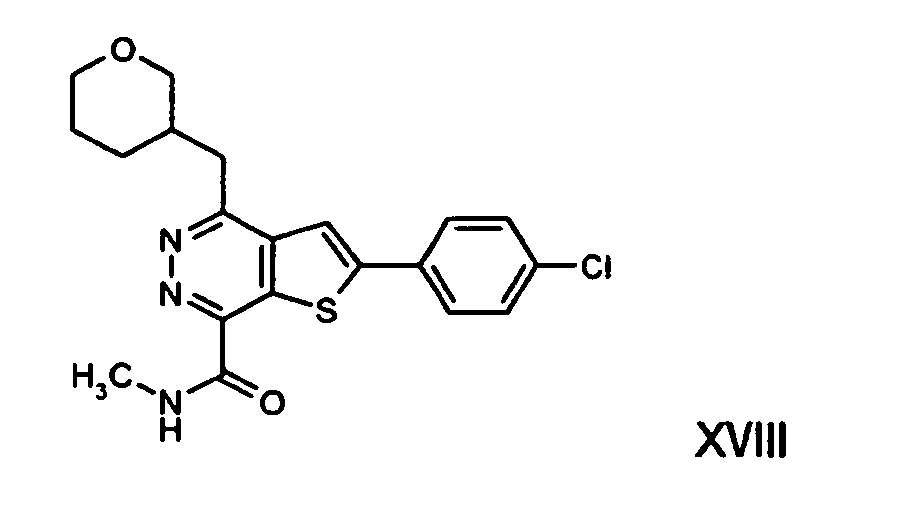
- 2-(4-chlorophenyl)-4-(3-tetrahydropyranmethyl)-thieno[2,3-d]pyridazinyl-7-N,N-dim ethyl formamide;

- 2-(4-fluorophenyl)-4-(3-pyrrolidinemethyl)-thieno[2,3-d]pyridazinyl-7- formamide;

- 2-(4-chlorophenyl)-4-(3-pyrrolidinemethyl)-thieno[2,3-d]pyridazinyl-7- formamide;

- 2-(4-bromophenyl)-4-(3-pyrrolidinemethyl)-thieno[2,3-d] pyridazinyl-7- formamide;

- 2-(4-fluorophenyl)-4-(3-tetrahydrofuranmethyl)-thieno[2,3-d]pyridazinyl-7-formamide;

- 2-(4-chlorophenyl)-4-(3-tetrahydrofuranmethyl)-thieno[2,3-d]pyridazinyl-7-formamide;

- 2-(4-bromophenyl)-4-(3-tetrahydrofuranmethyl)-thieno[2,3-d]pyridazinyl-7-formamide;

- 2-(4-fluorophenyl)-4-(3-tetrahydrothiophenemethyl)-thieno[2,3-d]pyridazinyl-7-formamide;

- 2-(4-chlorophenyl)-4-(3-tetrahydrothiophenemethyl)-thieno[2,3-d]pyridazinyl-7-formamide;

- 2-(4-bromophenyl)-4-(3-tetrahydrothiophenemethyl)-thieno[2,3-d]pyridazinyl-7-formamide;

- 2-(4-chlorophenyl)-4-(3-pyrrolidinemethyl)-thieno[2,3-d]pyridazinyl-7- formamide;

- 2-(4-chlorophenyl)-4-(S-3-pyrrolidinemethyl)-thieno[2,3-d]pyridazinyl-7- formamide;

- 2-(4-chlorophenyl)-4-(R-3-pyrrolidinemethyl)-thieno[2,3-d]pyridazinyl-7-formamide;

- 2-(4-chlorophenyl)-4-(3-pyrrolidinemethyl)-thieno[2,3-d]pyridazinyl-7-N-methyl formamide;

- 2-(4-chlorophenyl)-4-(3-pyrrolidinemethyl)-thieno[2,3-d]pyridazinyl-7-N,N-dimethyl formamide;

- 2-(4-chlorophenyl)-4-(3-tetrahydrothiophenemethyl)-thieno[2,3-d]pyridazinyl-7-N-m ethyl formamide;

- 2-(4-chlorophenyl)-4-(3-tetrahydrothiophenemethyl)-thieno[2,3-d]pyridazinyl-7-N,N-dimethyl formamide;

- 2-(4-chlorophenyl)-4-(3-tetrahydrofuranmethyl)-thieno[2,3-d]pyridazinyl-7-N-methyl formamide;

- 2-(4-chlorophenyl)-4-(3-tetrahydrofuranmethyl)-thieno[2,3-d]pyridazinyl-7-N,N-dime thyl formamide;

- Preferably, R3 is pyridinyl, α-pyranyl, γ-pyranyl, α-thiopyranyl, γ-thiopyranyl, pyrrolidinyl, furanyl, or thienyl, and its optical isomers.
- More preferably, the compounds of formula (I) are selected from as follows:
- 2-(4-fluorophenyl)-4-(3-pyridinemethyl)-thieno[2,3-d]pyridazinyl-7- formamide;

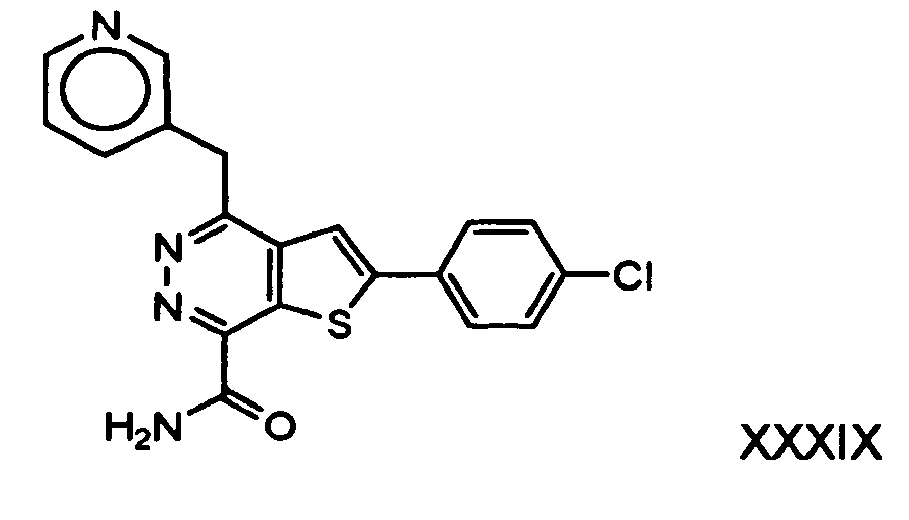
- 2-(4-chlorophenyl)-4-(3-pyridinemethyl)-thieno[2,3-d] pyridazinyl-7- formamide;
- 2-(4-bromophenyl)-4-(3-pyridinemethyl)-thieno[2,3-d] pyridazinyl-7- formamide;

- 2-(4-fluorophenyl)-4-(3-a-pyranmethyl)-thieno[2,3-d] pyridazinyl-7- formamide;

- 2-(4-chlorophenyl)-4-(3-a-pyranmethyl)-thieno[2,3-d] pyridazinyl-7- formamide;

- 2-(4-bromophenyl)-4-(3-a-pyranmethyl)-thieno[2,3-d] pyridazinyl-7- formamide;

- 2-(4-fluorophenyl)-4-(3-a-thiopyranmethyl)-thieno[2,3-d]pyridazinyl-7- formamide;

- 2-(4-chlorophenyl)-4-(3-a-thiopyranmethyl)-thieno[2,3-d] pyridazinyl-7- formamide;

- 2-(4-bromophenyl)-4-(3-a-thiopyranmethyl)-thieno[2,3-d] pyridazinyl-7-formamide;

- 2-(4-chlorophenyl)-4-(2-pyridinemethyl)-thieno[2,3-d] pyridazinyl-7-formamide;

- 2-(4-chlorophenyl)-4-(4-pyridinemethyl)-thieno[2,3-d] pyridazinyl-7-formamide;

- 2-(4-chlorophenyl)-4-(3-pyridinemethyl)-thieno[2,3-d]pyridazinyl-7-N-methyl formamide;

- 2-(4-chlorophenyl)-4-(3-pyridinemethyl)-thieno[2,3-d]pyridazinyl-7-N,N-dimethyl formamide;

- 2-(4-chlorophenyl)-4-(3-thiopyranmethyl)-thieno[2,3-d]pyridazinyl-7-N-methyl formamide;

- 2-(4-chlorophenyl)-4-(3-thiopyranmethyl)-thieno[2,3-d]pyridazinyl-7-N,N-dimethyl formamide;
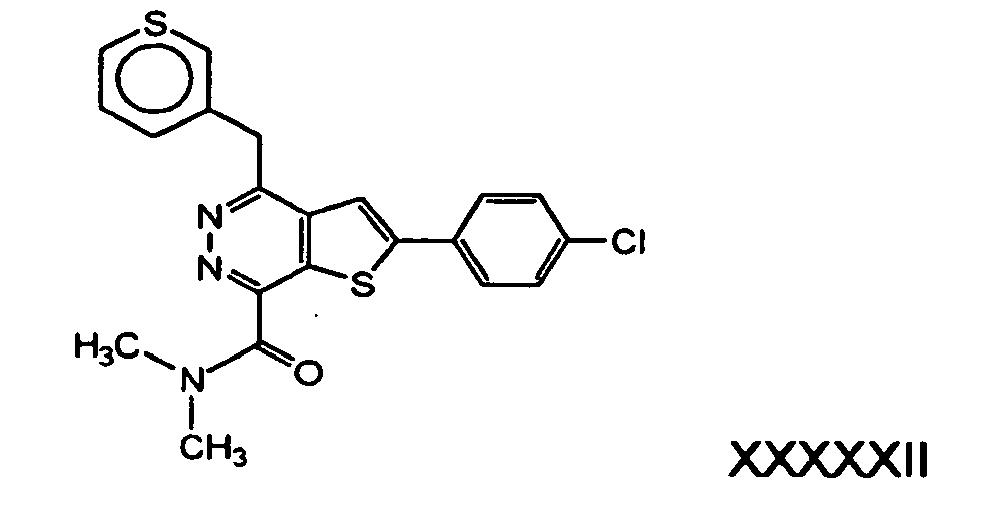
- 2-(4-chlorophenyl)-4-(3-pyranmethyl)-thieno[2,3-d] pyridazinyl-7-N-methyl formamide;

- 2-(4-chlorophenyl)-4-(3-pyranmethyl)-thieno[2,3-d] pyridazinyl-7-N,N-dimethyl formamide;

- 2-(4-fluorophenyl)-4-(3-pyrrolemethyl)-thieno[2,3-d] pyridazinyl-7- formamide;

- 2-(4-chlorophenyl)-4-(3-pyrrolemethyl)-thieno[2,3-d] pyridazinyl-7- formamide;

- 2-(4-bromophenyl)-4-(3-pyrrolemethyl)-thieno[2,3-d] pyridazinyl-7- formamide;

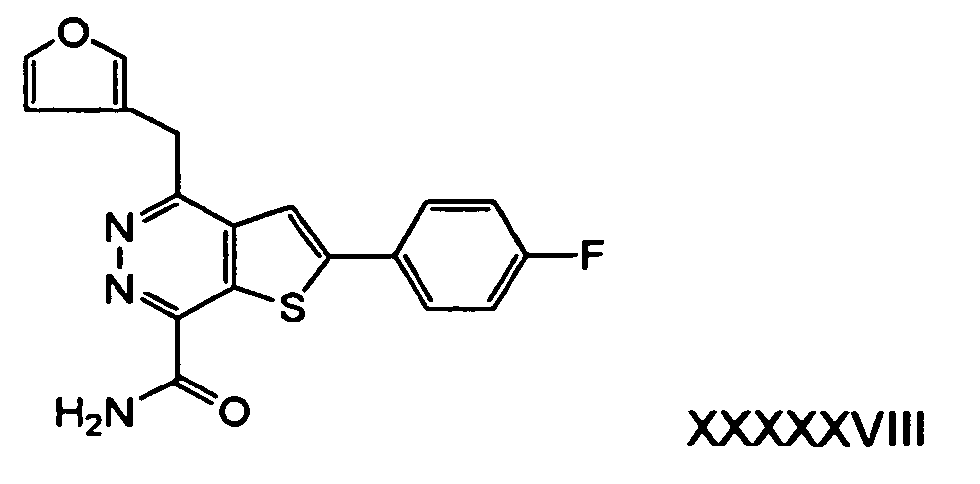
- 2-(4-fluorophenyl)-4-(3-furanmethyl)-thieno[2,3-d] pyridazinyl-7- formamide;
- 2-(4-chlorophenyl)-4-(3-furanmethyl)-thieno[2,3-d] pyridazinyl-7- formamide;

- 2-(4-bromophenyl)-4-(3-furanmethyl)-thieno[2,3-d] pyridazinyl-7- formamide;

- 2-(4-fluorophenyl)-4-(3-thiaphenemethyl)-thieno[2,3-d] pyridazinyl-7- formamide;

- 2-(4-chlorophenyl)-4-(3-thiaphenemethyl)-thieno[2,3-d] pyridazinyl-7- formamide;

- 2-(4-bromophenyl)-4-(3-thiaphenemethyl)-thieno[2,3-d] pyridazinyl-7- formamide;

- 2-(4-chlorophenyl)-4-(2-pyrrolemethyl)-thieno[2,3-d] pyridazinyl-7- formamide;

- 2-(4-chlorophenyl)-4-(3-pyrrolemethyl)-thieno[2,3-d] pyridazinyl-7-N-methyl formamide;

- 2-(4-chlorophenyl)-4-(3-pyrrolemethyl)-thieno[2,3-d]pyridazinyl-7-N,N-dimethyl formamide;

- 2-(4-chlorophenyl)-4-(3-thiaphenemethyl)-thieno[2,3-d]pyridazinyl-7-N-methyl formamide;

- 2-(4-chlorophenyl)-4-(3-thiaphenemethyl)-thieno[2,3-d]pyridazinyl-7-N,N-dimethyl formamide;

- 2-(4-chlorophenyl)-4-(3-furanmethyl)-thieno[2,3-d] pyridazinyl-7-N-methyl formamide;

- 2-(4-chlorophenyl)-4-(3-furanmethyl)-thieno[2,3-d] pyridazinyl-7-N,N-dimethyl formamide;

- 2-(3,5-dichlorophenyl)-4-(3-piperidinemethyl)-thieno[2,3-d] pyridazinyl-7-formamide;

- In accordance with another aspect of the present invention, a pharmaceutical composition is provided, including compounds of formula (I) having a therapeutically effective amount and its pharmaceutically acceptable salts or hydrates, and pharmaceutically acceptable carriers.
- The pharmaceutical compositions of the present invention can be locally administered such as at lung, head, colon and so on in the form of solution, suspension, aerosol or dry power and so on; or systematically administered such as oral administration in the form of tablets, power, or parenterally administered in the form of solution or suspension, or subcutaneous administration, or rectal administration in the form of suppository, or prcutaneous administration.
- In accordance with another aspect of the present invention, uses of the compounds of formula (I) or pharmaceutically acceptable salts or hydrates thereof in the preparation for medicaments of treatment or prophylaxis of tumor deseases are provided. Wherein said tumor deseases include cervical tumor, tumor of head and neck, carcinoma of breast, ovary, lung (non small cell ), pancreas, colon, prostate or other tissues, as well as leukemias and lymphomas, tumors of central and peripheral nevous system and other tumors such as melanoma, fibrosarcoma and osteosarcoma.
- In accordance with further aspect of the present invention, uses of the compounds of formula (I) or pharmaceutically acceptable salts or hydrates thereof in preparation for medicaments of treatment or prophylaxis of proliferative diseases are provided. Wherein said proliferative diseases include autoimmune, inflammatory, neurological and cardiovascular diseases.
- In accordance with one aspect of the present invention, uses of the compounds of formula (I) or pharmaceutically acceptable salts or hydrates thereof in the preparation for medicaments of limiting cell proliferation of human or animals are provided.
- In accordance with still another aspect of the present invention, uses of the compounds of formula (I) or pharmaceutically acceptable salts or hydrates thereof in the preparation for medicaments of inhibiting the tumors or kinases associated with growth factors are provided.
- For the above mentioned uses, the dosage depends on compounds used, administration approaches, required treatment diseases.
- In accordance with last aspect of the present invention, methods of the compounds of formula (I) or pharmaceutically acceptable salts or hydrates thereof are provided, and the method includes the following steps:
- In the presence of alkali, the compound of formula A is treated with dialkyl oxalates:


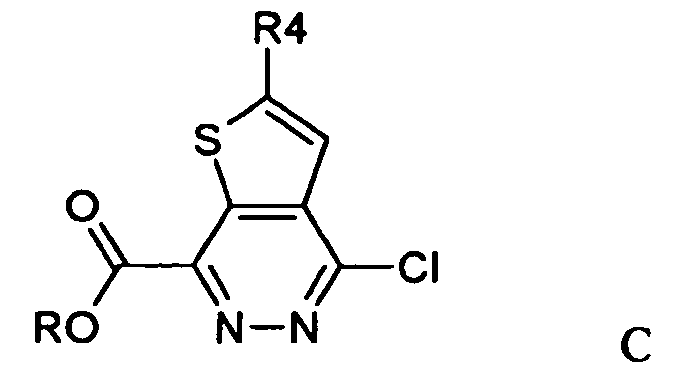


- The synthesis process of the present invention is described be low:

- Wherein, the compound of formula A may be prepared by conventional chemical methods in the field or purchased commercially. After being obtained, the compound of formula A is condensed with dialkyl oxalates, e.g. diethyl oxalate, in the presence of alkali such as common alkali LDA (lithium diisopropylamide) and common organic solvents such as tetrahydrofuran, to produce the compound Y. The condensation reaction should be proceeded at a low temperature due to the presence of LDA. It is easy for persons skilled in the art to obtain LDA which is generally fresh prepared at a low temperature.
- Then, compound Y is reacted with hydrazine such as H2NNH2 in alcoholic solvent to produce the compound of formula B.
- The compound of formula B is treated with phosphorus oxychloride for an acylation reaction to produce the compound of formula C.
- The above three steps refer to a synthesis method of intermediate of thienopyridazine compound produced by F. Hoffman-La Roche AG in
WO2005105808 . - The compounds of R3CH2 with a Boc protecting group are prepared by conventional methods in the field, and heated at the reaction temperature of 80-90°C in the presence of catalysts such as PdCl2 (dppf) and solvents such as phosphates / 1,4-dioxane, the compound of formula C is reacted with R3CH2 containing a Boc protecting group for overnight to produce the compound of formula D. In the above reactions, the compounds of R3CH2 should be pretreated with 9-BBN, please refer to the coupling reaction of "Suzuki-Miyaura", p6125-6128, Tetrahedron Letters 45(2004).
- The compounds of formula D and HNR1R2 are ammonolyzed in a sealed container using conventional methods with the reaction solvents of 1,4-dioxane, under heating at temperature of 80°C for overnight, then the Boc protecting group on R3 is removed under acidic conditions to obtain the acid salts of formula (I), and adjust pH with alkali to produce the compounds of formula (I).
- The raw materials of the above mentioned preparations are either obtained by commercial suppliers or are prepared by conventional methods in the field.
- Hereafter, the present invention will be described specifically with reference to examples. The examples are given only for illustration of the technical solution of the present invention and should not be construed to limit the present invention.
- Where, the structure of the compounds of formula (I) is determined by nuclear magnetic resonance (NMR) and mass-spectrometric techniques; the proton NMR chemical shifts are measured using δ scale, and the peak multiplicity is represented as follows: s, single peak; m, multiple peak. The intermediate is generally represented by mass spectrometry and NMR.
-

- Thiophene-3-formic acid (12.6g) and AcOH (96ml) are added to a reaction flask (250ml), to dissolved after stirred at room temperature, HBr solution (8ml) is then added to the reaction flask, and the reaction is rapidly changed to a light yellow. Pyridinium bromide perbromide (27g) is then added to the flask in batches at room temperature. After addition, the reaction is stirred at room temperature, and the reaction is tracked by HPLC. The above mixture is poured into ice-water after reaction, stirred for about 30 minutes, filtered to form a white powder solid, the white powder solid is crystallized with hot water, filtered and dried to obtain a crystal of 5-bromo-thiophene-3- formic acid (10.8g), content of 92% meastured by HPLC.
- Thiophene-3- formic acid (12.5g), AcOH (83ml) are added to a reaction flask (500ml), stirred at room temperature and dissolved to obtain a colorless transparent liquid. A solution of Br2 (5.4ml) in AcOH (100ml) is placed in a constant pressure funnel and dropped to the reaction flask at room temperature and kept at a temperature below 25°C. After addition, the reaction is carried out at room temperature overnight. The reaction mixture is poured into ice-water next day, stirred for about 30 minutes, filtered to form a white powder solid. The white powder solid is crystallized with hot water, filtered and dried to obtain a white crystal of 5-bromo-thiophene-3- formic acid (10g), content of 92% meastured by HPLC.
-

- 5-bromo-thiophene-3-formic acid (18.5g) obtained by the above step, absolute ethanol (150ml) and concentrated sulfuric acid (5ml) are added into a three mouth flask (500ml) and heated under reflux, and vaporized under reduced pressure to remove solvent after reaction. Then ethyl acetate (100ml) and saturated brine (200ml) are added, and stirred, placed for layer separation. The aqueous layer is reextracted with ethyl acetate (25mi×2) twice. The organic phase is combined together and transferred to a separatory funnel. Sodium carbonate solution (10%) is added to the separatory funnel to adjust pH≈8 and then separated, and a organic phase is washed with a saturated brine to pH=7, and dried with anhydrous magnesium sulfate over night, and filtered next day, and vaporized under reduced pressure to remove solvent to obtain a light yellow oil-liquid of 5-bromo-thiophene-3- ethyl formate (15g).
-

- 4-Bromochlorobenzene (70.6g) is added into a four mouth flask connecting with a mechanical stirring apparatus, two constant pressure funnels and a temperature probe. Toluene (588.3ml) and tetrahydrofuran (THF) (147ml) are added under stirring at room temperature under argon, and dissolved to obtain a colorless transparent liquid. Then triisopropyl borate (109.2ml) and n-butyllithium (176.4ml, 2.5M in hexane) are respectively added into two constant pressure funnels, and cooled the inner temperature to below -78°C, then n-butyllithium solution is dropped to the flask under controlling a dropping speed to keep the inner temperature below -78°C. After addition, the mixture is kept at the temperature for 1 hour, then triisopropyl borate is dropped into the the mixture under the temperature below -78°C, and kept at the temperature for 1 hour after addition, and then the cooling system is removed to naturally warm up to -20°C. HCl solution (360.4ml, 2.2M) is added to the mixture to warm up to about 10°C, and then placed for layer separation. The aqueous phase is reextracted with toluene (58.8ml, 2 times). The organic phase is combined together and washed with saturated brine to pH=7 to obtain a colorless transparent liquid, dried with anhydrous sodium sulfate, filtered, and evaporated under reduced pressure to remove most of solvents and the white solid is finally precipitated, filtered to obtain a crystal of 4-chlorophenylboric acid (48g).
-

- 5-(4-chlorophenyl)- thiophene 3-ethyl formate (10.5g), 4-chlorophenylboronic acid (6g), Pd[P(Ph)3]4 (1.5g), sodium carbonate(7.5g) and a solvent mixture of toluene:water:EtOH (4:2:1, v/v) are in turn added to a three mouth flask (500ml) and heated at reflux for 3 hours, the reaction is tracked by TLC. The reaction mixture is cooled to a room temperature after reaction, and placed for layer separation. The aqueous phase is reextracted with toluene (35ml, 2 times). The organic phase is combined together and washed with saturated brine to pH=7, dried with anhydrous sodium sulfate over night and filtered next day, and then evaporated under reduced pressure to remove solvents to obtain a light yellow viscous fluid, and placed to obtain a clotted solid, and recrystallized with absolute EtOH to obtain a crystal of 5-(4-chlorophenyl)- thiophene-3- ethyl formate (8.6g).
1HNMR(500MHz, DMSO ), δ 8.30 (sc, 1H), 7.81(s, 1H), 7.72(m, 2H), 7.46(m, 2H), 4.27(m, 2H), 1.30(m, 3H). -

- Preparation of LDA: THF (252.6ml) and N,N-diisopropylamine (79ml) are added into a three mouth flask (1000ml) under argon, and n-butyllithium (302.8ml, 1.6M in hexane) is placed to a constant pressure funnel (500ml) and dropped into the flask when the inner temperature is below -20°C with an intensely exothermic reaction, and kept -20°C ∼ -30°C of the inner temperature under controlling an adding speed; after addition, the above mixture naturally is warmed up to a room temperature directly used for the following condensation reaction.
- Condensation reaction: 5-(4-chlorophenyl)-3-thiophene-ethyl formate (28.7g), THF (1084ml) and diethyl oxalate (29.7ml) are added into a four mouth flask (2000ml) connecting with the mechanical stirring apparatus, two constant pressure funnels and a temperature probe. The mixture is stirred at room temperature and dissolved to obtain a light yellow transparent liquid. LDA solution prepared by the above step is transferred into a constant pressure funnel and cooled to a temperature below -78°C, and LDA is dropped to the flash under argon at the temperature below -78°C under controlling a dropping speed, after addition, the reaction is tracked by TLC. HCl solution (2.2M) is added to the flash after reaction and adjusted to pH≈3, and a color of the reaction liquid is changed from reddish brown into orange. The temperature is warmed up to about 0°C, a solid NaCl is then added, and stirred to desolve, and placed for layer separation. The aqueous phase is reextracted with THF (143.5ml, 2 times). The organic phase is combined together and washed with saturated brine for two times, and then adjusted to pH≈8 with diluted sodium carbonate solution; finally, washed with saturated brine to pH=7, dried with anhydrous sodium sulfate, filtered and evaporated under reduced pressure to remove solvent to obtain a light yellow viscous fluid, and placed at room temperature to gradually become a solid, and recrystallized with EtOH to obtain a pure product of 5-(4-chlorophenyl)-2-ethoxyoxalyl- thiophene -3- ethyl formate (orange crystal, 25.5g).
1HNMR (500MHz, CD3Cl), δ 7.61 (s, 1H), 7.59(m, 2H), 7.42(m, 2H), 4.37(m, 4H), 1.39(m, 6H). -

- A crystal of 5-(4-chlorophenyl)-2-ethoxyoxalyl-thiophene-3-ethyl formate(3.0g), absolute ethanol (45ml) are added into a reaction flask (100ml), stirred at room temperature to obtain a yellow suspension. Hydrazine hydrate (0.75ml) is added into a constant pressure funnel, stirred for 10 minutes and then dropped to the reaction flask. The yellow suspension is dissolved to a transparent liquid, and the above mixture is heated at 70°C and a yellow solid in the flask is gradually precipitated with rise of the temperature, and the reaction liquid became increasingly viscous. The reaction mixture is kept for 1h and then cooled to a room temperature, and filtered to obtain a pistachio solid, and the pistachio solid is respectively washed with a mixture of hexane/ dichloromethane (1:1)(15ml, 2 times) and methanol/dichloromethane (1:1)(15ml, 2 times) and dried under reduced pressures to obtain 2-(4-chlorophenyl)-4-oxo-4,5-dihydro-thiero[2,3-d] pyridazinyl -7-ethyl formate (2.75g).
-

1HNMR(500MHz, CD3C1), δ 7.74 (m, 3H), 7.59(m, 2H), 4.65(m, 2H), 1.55(m, 3H). HRMS ( high resolution MS) MW = 351.98. -

- Triphenylmethyl phosphonium iodide (22.14g) and toluene (135ml) are added into a three mouth flask (500ml), stirred at room temperature to obtain a milky white suspension and quickly changed to orange after potassium tert-butanolate (5.31g) is added. Then N-Boc-3-piperidone (6.0g) in toluene (66ml) is added into a constant pressure funnel and dropped into the flask under argon with obvious exothermic phenomenon, and kept at the temperature of 30°C and the reaction is tracked by TLC after addition. After reaction, the mixture is filtered and washed with a saturated brine (200ml, 2 times) and then adjusted to pH≈3 with diluted HCl (1M), and then washed with a saturated brine to pH=7, dried with anhydrous sodium sulfate, and filtered to obtain a yellow transparent liquid. The yellow transparent liquid is purified together with silica gel by chromatography (elution liquid: petroleum ether:ethyl acetate=15:1) to obtain a yellow oil-liquid of N-Boc-3-methylene piperidine (4.2g).
1HNMR(400MHz, CD3Cl ), δ 4.83 (s, 1H), 4.76(s, 1H), 3.89(s, 2H), 3.45(m, 2H), 2.26(m, 2H) 1.64(s, 2H), 1.51(s, 9H). -

- N-Boc-3-methylene pyrazdine (0.4g) is added into a three mouth flask under argon and cooled to 0°C. 9-BBN solution (12ml, 0.5M in THF) is injected into the reaction flask with a syringe and kept for 30 min, and then warmed up to room temperature for 2 h, and evaporated to remove solvent under a reduced pressure (25°C). 1,4-dioxane (20ml), PdCl2 (dppf) (0.05g), potassium phosphate (0.32g) and 4-chloro-2-(4-chlorophenyl)-thieno[2,3-d] pyridazinyl-7- ethyl formate are added to the reaction flask and heated at 90°C over night. The reaction mixture is cooled to room temperature next day, then addition of ice water (50ml) and ethyl acetate (50ml), and then stirred for about 15min, and placed for layer separation. The water layer is reextracted with ethyl acetate for 3 times, the organic phase is combined together and washed with a saturated brine to pH=7, dried with anhydrous magnesium sulfate and filtered. The filtered liquid is purified with silica gel by chromatography (ethyl acetate: petroleum ether =1:5) to obtain an orange viscous fluid (0.6g), and ethanol (2ml) is added to the fluid and crystallized in refrigerator to obtain a solid of 4-(1-Boc-3-piperidinemethyl)-2-(4- chlorophenyl) -thieno[2,3-d]pyridazinyl-7-ethyl formate (0.3g).
1HNMR(400MHz, DMSO ), δ 8. 90 (s, 1H), 8.03(m, 2H), 7.63(m, 2H), 4.54(m, 2H), 3.73(s, 2H), 3.32(m, 2H), 3.28(m, 1H), 2.82(m, 2H) , 2.09(s, 1H), 1.78(s, 1H), 1.64(s, 1H), 1.44(m, 3H), 1.39(s, 1H), 1.32(s, 9H).
MS ( EI): 515 ( M+ ) , 486, 458, 442, 414, 334, 332, 306, 304, 149, 57. -

- 4-(1-Boc-3-piperidinemethyl)-2-(4-chlorophenyl)-thieno[2,3-d]pyridazinyl-7-eth yl formate (0.3g), 1,4-dioxane (5ml) and NH3.H2O (5ml) are added to a sealed tube(25ml) and heated at 80°C over night. The reaction mixture is cooled to room temperature and transferred into a separating funnel next day, and addition of ethyl acetate, vibrated, and placed for layer separation. The water layer is reextracted with ethyl acetate for 2 times, the organic phase is combined together and adjusted to pH≈3 with 1M HCl solution, and then washed with saturated brine to pH=7, dried with anhydrous magnesium sulfate and filtered. The filtered liquid is purified with silica gel by chromatography (ethyl acetate: petroleum ether =1:5) to obtain a solid of 4-(1-Boc-3-piperidinemethyl)-2(4-chlorophenyl)-7-aminocarbonyl-thieno [2,3-d] pyridazine (0.22g)
1HNMR(500MHz, CDCl3 ), δ 8.10 (s, 1H), 7.77(m, 2H), 7.66(s, 1H), 7.48(m, 2H),5.90(s, 1H), 4.05(s, 1H), 3.88(m, 1H), 3.31(m, 1H), 3.21(m, 1H), 2.81(m, 2H), 2.28(s, 1H), 1.81(s, 1H), 1.67(s, 3H), 1.39(s, 9H).
MS(ESI): 487(M+1). -

- 4-(1-Boc-3-piperidinemethyl)-2(4-chlorophenyl)-7-aminocarbonyl-thieno[2,3-d] pyridazine (200g) and ethyl acetate (4ml) are added to a single mouth flask (25ml) and dissolved to a light yellow transparent solution, addition of HCl (4ml, 3M) and the solution is quickly changed to a white suspension, heated at 30°C for 1 h, and the suspension is changed to transparent and the reaction is tracked by plate; after reaction, the above mixture is evaporated under reduced pressure to remove solvent to obtain a solid of 2-(4- chlorophenyl) -4-(3-piperidinemethyl)-thieno[2,3-d] pyridazinyl-7-formamide hydrochloride (100 mg).
1HNMR(500MHz, DMSO ), δ9.51 (m, 1H), 9.09(m, 1H), 8.79 (s, 1H), 8.66(s, 1H), 8.29(s, 1H), 8.08(m, 2H), 7.62(m, 2H), 3.45(m, 2H), 3.4(m, 1H), 3.17(m, 1H), 2.79(m, 2H), 2.52(m, 1H), 1.81(m, 2H), 1.77(m, 1H), 1.42(m, 1H).
MS(ESI):387(M+1). -

- 2-(4-chlorophenyl)-4-(3-piperidinemethyl)-thieno[2,3-d]pyridazinyl-7-formamid e hydrochloride (100 mg) is added to a single mouth flask, then addition of water (5ml) and the sodium carbonate is dropped to pH=9 ∼ 10, stirred for 30min. The above mixture is extracted by ethyl acetate, washed with water, and evaporated under reduced pressure to remove solvent to obtain 2-(4-chlorophenyl)-4-(3 -piperidinemethyl)- thieno[2,3-d] pyridazinyl-7-formamide (70 mg).
-

- DMPU (225ml),FeCl3(0.75g) and CuCl (0.3g) are added to 3-bromomethyltetrahydropyran (24.75g, 0.138mol), and then Et2Zn (106.8ml) is slowly dropped at 40∼45°C for 45 minutes to obtain a zinc-reagent.
- THF (810 ml) and PdCl2(dppf) (5.09 g) are added to 4-chloro-2-(4-chlorophenyl) - thieno[2,3-d]pyridazinyl-7-ethyl formate (30g), and then addition of the zinc-reagent to the THF solution and reacted at 45°C for 4 hours. The above mixture is poured into a saturated brine, filtrated after stirring for 15 minutes and placed for layer separation. The aqueous phase is extracted with THF (500 ml, 2 times). The organic phase is combined together, washed with saturated brine (500ml, 3 times) and dried with anhydrous Na2SO4 and evaporated under reduced pressure to remove solvent to obtain 4-(3-tetrahydropyranmethyl)-2-(4-chlorophenyl)-thieno[2,3-d]pyridazinyl-7-ethyl formate (25 g).
MS (ESI): 417(M+1) - 4-(3-tetrahydropyranmethyl)-2-(4-chlorophenyl)-thieno[2,3-d]pyridazinyl-7-ethy 1 formate (3g), 1,4-dioxane (5 ml) and NH3.H2O (5 ml) are added to a sealed tube (25ml) and heated at 80°C over night, cooled to room temperature over night and transferred to a separating funnel next day, and addition of ethyl acetate, vibrated, placed for layer separation. The aqueous layer is reextracted with ethyl acetate for 2 times. The organic phase is combined together and adjusted with 1M HCl solution to pH≈3, then washed with a saturated brine to pH=7, dried with anhydrous Na2SO4 and filtered. The filtered liquid is purified with silica gel by chromatography to obain a solid of 2-(4-chlorophenyl)-4-(3-tetrahydropyranmethyl)- thieno [2,3-d] pyridazinyl-7- formamide (2 g).
MS (ESI): 388(M+1) -

- DMPU (225ml), FeCl3(0.75 g) and CuCl (0.3 g) are added to 3-bromomethyl tetrahydrothiapyran (24.75g, 0.138mol), and then Et2Zn (106.8ml) is slowly added at 40-45 °C for 45 minutes to obtain a zinc-reagent.
- THF (810 ml) and PdCl2(dppf) (5.09 g) are added to 4-chloro-2-(4-chlorophenyl) -thieno[2,3-d] pyridazinyl-7-ethyl formate (30g), and then the zinc-reagent is dropped to the THF solution at 45°C for 4 hours. The reaction mixture is poured into a saturated brine, filtrated after stirring for 15 minutes and placed for layer separation.The aqueous phase is extracted with THF (500 ml, 2 times). The organic phase is combined together, washed with a saturated brine (500ml, 3 times) and dried with anhydrous Na2SO4 and evaporated under reduced pressure to remove solvent to obtain 4-(3-tetrahydropyranmethyl)-2-(4-chlorophenyl) -thieno[2,3-d] pyridazinyl -7-ethyl formate (25 g).
MS (ESI): 433(M+1) - 4-(3-tetrahydropyranmethyl)-2-(4-chlorophenyl)-thieno[2,3-d]pyridazinyl-7-ethy 1 formate (3 g), 1,4-dioxane (5 ml) and NH3.H2O (5 ml) are added to a sealed tube (25ml) and heated at 80°C over night, and cooled to room temperature and transferred to a separating funnel next day, and addition of ethyl acetate, vibrated, placed for layer separation. The aqueous layer is reextracted with ethyl acetate for 2 times. The organic phase is combined together and adjusted with 1M HCl solution to pH≈3, then washed with a saturated brine to pH=7, dried with anhydrous Na2SO4 and filtered. The filtered liquid is purified with silica gel by chromatography to obtain a solid of 2-(4-chlorophenyl)-4-(3-tetrahydropyranmethy) -thieno [2,3-d] pyridazinyl-7-formamide (2 g).
MS (ESI): 404(M+1) -

- DMPU (225ml), FeCl3(0.75 g) and CuCl (0.3 g) are added to N-Boc-2-bromomethyl piperidine (24.75g, 0.138mol), and then Et2Zn (106.8ml) is slowly added at 40∼45°C for 45 minutes to obtain a zinc-reagent.
- THF (810 ml) and PdCl2(dppf) (5.09 g) are added to 4-chloro-2-(4-chlorophenyl) -thieno[2,3-d]pyridazinyl-7-ethyl formate (30g), and then the zinc-reagent is added to the THF solution at 45°C for 4 hours. The reaction mixtue is poured into a saturated brine, filtrated after stirring for 15 minutes and placed for layer separation. The aqueous phase is extracted with THF (500 ml, 2 times). The organic phase is combined together, washed with saturated brine (500ml, 3 times) and dried with anhydrous Na2SO4 and evaporated under reduced pressure to remove solvent to obtain 2-(4-chlorophenyl)-4-(N-Boc-2- piperidinemethyl) - thieno[2,3-d] pyridazinyl -7-ethyl formate (25 g).
MS (ESI): 516(M+1) - 2-(4-chlorophenyl)-4-(N-Boc-2-piperidinemethyl)-thieno[2,3-d]pyridazinyl-7-eth yl formate (3g), 1,4-dioxane (5ml) and NH3.H2O (5ml) are added to a sealed tube(25ml) and heated at 80°C over night. The reaction mixture is cooled to room temperature and transferred into a separating funnel next day, and addition of ethyl acetate, vibrated, placed for layer separation. The water layer is reextracted with ethyl acetate for 2 times, the organic phase is combined together and adjusted to pH≈3 with 1M HCl solution, and then washed with a saturated brine to pH=7, dried with anhydrous Na2SO4 and filtered. The filtered liquid is purified with silica gel by chromatography to obtain a solid of 2(4-chlorophenyl)-4-(N-Boc-2- piperidinemethyl) - thieno [2,3-d] pyridazinyl-7- formamide (2g).
MS (ESI): 487(M+1) - 4-(N-Boc-2-piperidinemethyl)-2(4-chlorophenyl)-7-aminocarbonyl-thieno[2,3-d] pyridazine (200mg) and ethyl acetate (4ml) are added to a single mouth flask (25ml) and dissolved to a light yellow transparent solution. HCl solution (4ml, 3M) is added and changed to a white suspension, heated at 30°C for 1 h and the white suspension is changed to transparent. The reaction is tracked by plate. After reaction, the solvent is evaporated under reduced pressure to remove solvent to obtain a solid of 2-(4-chlorophenyl)-4-(N-Boc-2- piperidinemethyl) -thieno[2,3-d] pyridazinyl -7-formamide hydrochloride (100 mg).
MS (ESI): 423(M+1) - 2-(4-chlorophenyl)-4-(N-Boc-2-piperidinemethyl)-thieno[2,3-d]pyridazinyl-7-formamide hydrochloride (100 mg) is added to a single mouth flask, then addition of water (5ml) and the sodium carbonate is dropped to pH=9 - 10, stirred for 30min. The above mixture is extracted by ethyl acetate, washed, and evaporated under reduced pressure to remove solvent to obtain 2-(4-chlorophenyl)-4-(2-piperidinemethyl)-thieno [2,3-d] pyridazinyl -7- formamide (70 mg).
MS (ESI): 387(M+1) -
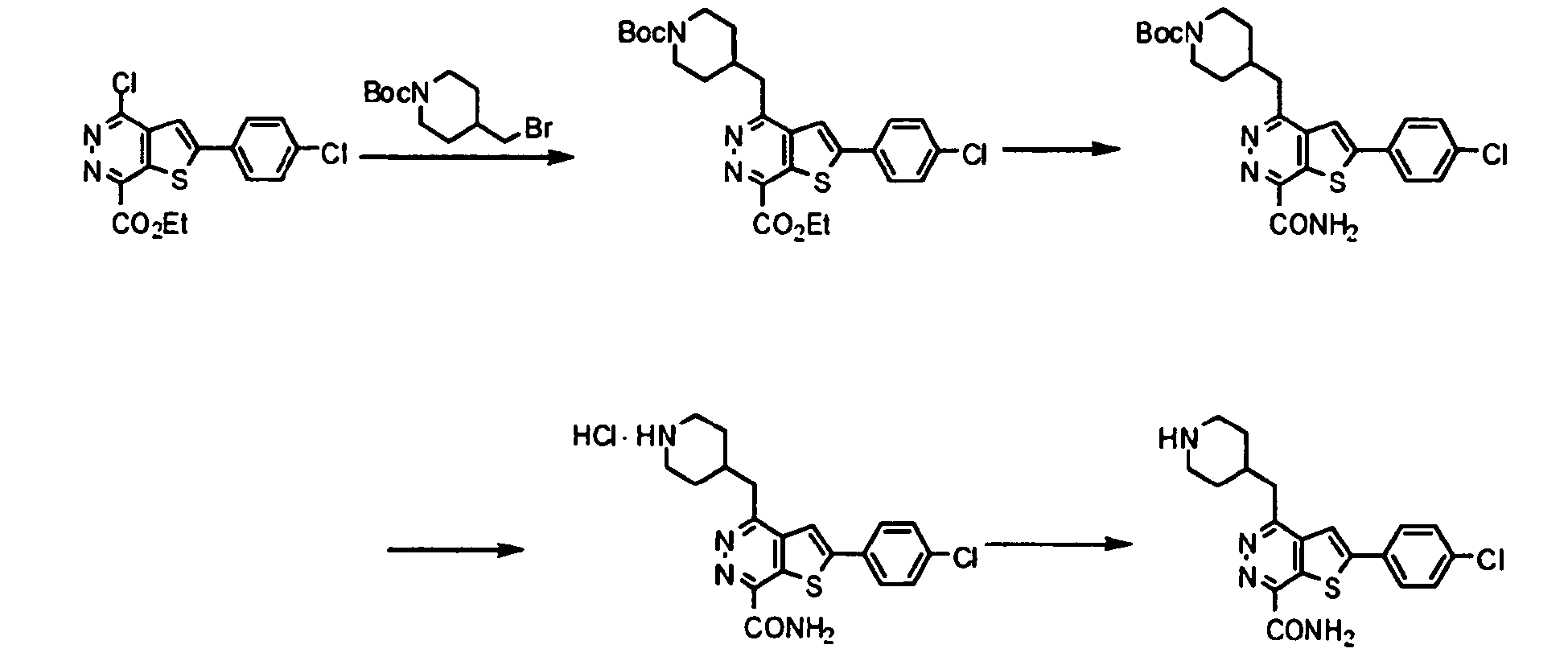
- DMPU (225ml),FeCl3(0.75g) and CuCl (0.3g) are added to N-Boc-4-bromomethylpiperidine (24.75g, 0.138mol), and then Et2Zn (106.8ml) is slowly dropped at 40∼45°C for 45 minutes to obtain a zinc-reagent.
- THF (810 ml) and PdCl2(dppf) (5.09 g) are added to 4-chloro-2-(4-chlorophenyl) -thieno [2,3-d] pyridazinyl-7-ethyl formate (30g) , and then the zinc-reagent is dropped to the THF solution at 45°C for 4 h. The reaction mixture is poured into a saturated brine, filtrated after stirring for 15 minutes and placed for layer separation.The aqueous phase is extracted with THF (500 ml, 2 times). The organic phase is combined together, washed with a saturated brine (500ml, 3 times) and dried with anhydrous Na2SO4, evaporated under reduced pressure to remove solvent to obtain 2-(4-chlorophenyl)- 4-(N-Boc-4-piperidinemethyl)-thieno [2,3-d] pyridazinyl -7-ethyl formate (25 g).
MS (ESI): 515(M+1) - 2-(4-chlorophenyl)-4-(N-Boc-4-piperidinemethyl)-thieno[2,3-d]pyridazinyl-7-eth yl formate (3g), 1,4-dioxane (5ml) and NH3.H2O (5ml) are added to a sealed tube(25ml) and heated at 80°C over night. The reaction mixture is cooled to room temperature and transferred into a separating funnel next day, and addition of ethyl acetate, vibrated, placed for layer separation. The water layer is reextracted with ethyl acetate for 2 times, the organic phase is combined together and adjusted to pH≈3 with 1M HCl solution, and then washed with a saturated brine to pH=7, dried with anhydrous Na2SO4 and filtered. The filtered liquid is purified with silica gel by chromatography to obtain a solid of 2(4-chlorophenyl)-4-(N-Boc-4- piperidinemethyl) - thieno[2,3-d] pyridazinyl -7- formamide (2g).
MS (ESI): 487(M+1) - 4-(N-Boc-4-piperidinemethyl)-2-(4-chlorophenyl)-7-aminocarbonyl-thieno[2,3-d] pyridazine (200mg) and ethyl acetate (4ml) are added to a single mouth flask (25ml) and dissolved to a light yellow transparent solution. HCl solution (4ml, 3M) is added and changed to a white suspension, heated at 30°C for 1 h and the white suspension is changed to transparent. The reaction is tracked by plate. After reaction, the mixture is evaporated under reduced pressure to remove to obtain a solid of 2-(4-chlorophenyl)-4-(4-piperidinemethyl)-thieno[2,3-d]pyridazinyl-7-formamide hydrochloride (100 mg).
MS (ESI): 423(M+1) - 2-(4-chlorophenyl)-4-(4-piperidinemethyl)-thieno[2,3-d]pyridazinyl-7-formamid e hydrochloride is added to a single mouth flask(25ml), then water (5ml) is added and the sodium carbonate is dropped to pH=9 - 10 stirred for 30min. The above mixture is extracted by ethyl acetate, washed, and evaporated under reduced pressure to remove solvent to obtain 2-(4-chlorophenyl)-4-(4-piperidinemethyl)-thieno[2,3-d] pyridazinyl -7- formamide (70 mg).
MS (ESI): 387(M+1) -

- DMPU (225ml), FeCl3(0.75 g) and CuCl (0.3 g) are added to N-Boc-3-bromomethylpyrrole (24.75g, 0.138mol), and then Et2Zn (106.8ml) is slowly dropped at 40∼45°C for 45 minutes to obtain a zinc-reagent.
- THF (810ml) and PdCl2(dppf) (5.09g) are added to 4-chloro-2-(4-chlorophenyl) -thieno [2,3-d] pyridazinyl-7-ethyl formate (30g) , and then the zinc-reagent is added to the THF solution at 45°C for 4h. The reaction mixture is poured into a saturated brine, filtrated after stirring for 15 minutes and placed for layer separation. The aqueous phase is extracted with THF (500 ml, 2 times). The organic phase is combined together, washed with a saturated brine (500ml, 3 times) and dried with anhydrous Na2SO4, ands evaporated under reduced pressure to remove solvent to obtain 2-(4-chlorophenyl)-4-(N-Boc-3-tetrahydropyrrolemethyl)-thieno[2,3-d] pyridazinyl -7-ethyl formate (25g).
MS (ESI): 502(M+1) - 2-(4-chlorophenyl)-4-(N-Boc-3-tetrahydropyrrolemethyl)-thieno[2,3-d]pyridazin yl -7-ethyl formate (3g), 1,4-dioxane (5ml) and NH3.H2O (5ml) are added to a sealed tube(25ml) and heated at 80°C over night. The reaction liquid is cooled to room temperature and transferred into a separating funnel next day, and addition of ethyl acetate, vibrated, placed for layer separation. The water layer is reextracted with ethyl acetate for 2 times, the organic phase is combined together and adjusted to pH≈3 with 1M HCl solution, and then washed with a saturated brine to pH=7, dried with anhydrous Na2SO4 and filtered. The filtered liquid is purified with silica gel by chromatography to obtain a solid of 2(4-chlorophenyl)-4-(N-Boc -3-tetrahydropyrrole methyl)- thieno[2,3-d] pyridazinyl-7- formamide (2g).
MS (ESI): 473(M+1) - 4-(N-Boc-3-tetrahydropyrrolemethyl)-2(4-chlorophenyl)-7-aminocarbonyl-thien o [2,3-d]pyridazine (200mg) and ethyl acetate (4ml) are added to a single mouth flask (25ml) and dissolved to a light yellow transparent solution. HCl solution (4ml, 3M) is added and changed to a white suspension, heated at 30°C for 1 h and changed to transparent. The reaction is tracked by plate. After reaction, the solution is evaporated under reduced pressure to remove solvent to obtain a solid of 2-(4-chlorophenyl)-4-(3-tetrahydropyrrolemethyl)-thieno[2,3-d]pyridazinyl-7-formamide hydrochloride (100 mg).
MS (ESI): 409(M+1) - 2-(4-chlorophenyl)-4-(3-tetrahydropyrrolemethyl)-thieno[2,3-d] pyridazinyl-7-formamide hydrochloride is added to a single mouth flask(25ml), then water (5ml) is added and sodium carbonate is dropped to pH=9 - 10 and stirred for 30min. The mixture is extracted by ethyl acetate, washed, and evaporated under reduced pressure to remove solvent to obtain 2-(4-chlorophenyl)-4-(3-tetrahydropyrrolemethyl) -thieno[2,3-d]pyridazinyl-7-formamide(70mg).
MS (ESI): 373(M+1) -
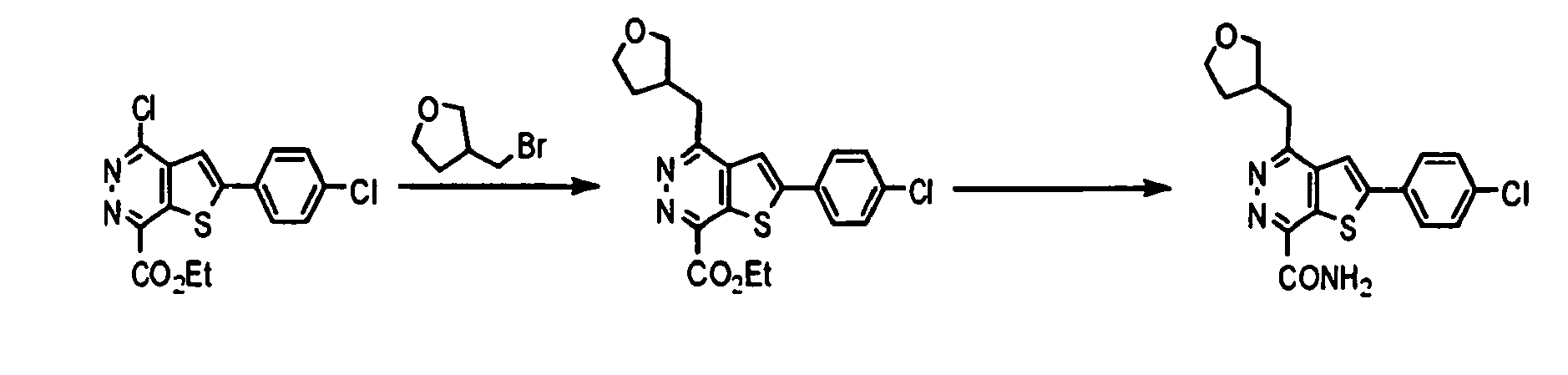
- DMPU (225ml),FeCl3(0.75g) and CuCl (0.3g) are added to 3-bromomethyltetrahydrofuran (24.75g, 0.138mol), and then Et2Zn (106.8ml) is slowly dropped at 40∼45°C for 45 minutes to obtain a zinc-reagent.
- THF (810 ml) and PdCl2(dppf) (5.09g) are added to 4-chloro-2-(4-chlorophenyl)-thieno[2,3-d] pyridazinyl-7-ethyl formate (30g), and then the zinc-reagent is dropped to the THF solution at 45°C for 4 h. The reaction mixture is poured into a saturated brine, filtrated after stirring for 15 minutes and placed for layer separation.The aqueous phase is extracted with THF (500 ml, 2 times). The organic phase is combined together, washed with a saturated brine (500ml, 3 times) and dried with anhydrous Na2SO4, and evaporated under reduced pressure to remove solvent to obtain 4-(3-tetrahydropyranmethyl)-2-(4-chlorophenyl)-thieno [2,3-d] pyridazinyl -7-ethyl formate (25 g).
MS (ESI): 403(M+1) - 4-(3-tetrahydrofuranmethyl)-2-(4-chlorophenyl)-thieno[2,3-d]pyridazinyl-7-ethyl formate (3g), 1,4-dioxane (5 ml) and NH3.H2O (5 ml) are added to a sealed tube (25ml) and heated at 80°C over night. The reaction is cooled to room temperature and transferred to a separating funnel next day, and addition of ethyl acetate, vibrated, placed for layer separation. The aqueous layer is reextracted with ethyl acetate for 2 times. The organic phase is combined together and adjusted with 1M HCl solution to pH≈3, then washed with saturated brine to pH=7, dried with anhydrous Na2SO4 and filtered. The filtered liquid is purified with silica gel by chromatography to obtain a solid of 2-(4-chlorophenyl)-4-(3-tetrahydrofuranmethyl)-thieno[2,3-d] pyridazinyl -7-formamide (2 g).
MS (ESI): 374(M+1) -

- DMPU (225ml), FeCl3(0.75 g) and CuCl (0.3 g) are added to 3-bromomethyl tetrahydrothiophene (24.75g, 0.138mol), and then Et2Zn (106.8ml) is slowly dropped at 40∼45°C for 45 minutes to obtain a zinc-reagent.
- 4-chloro-2-(4-chlorophenyl)-thieno[2,3-d] pyridazinyl-7-ethyl formate (30g), THF (810 ml) and PdCl2(dppf) (5.09 g) are added, and then the zinc-reagent is dropped to the THF solution at 45°C for 4 h. The reaction mixture is poured into a saturated brine, filtrated after stirring for 15 minutes and placed for layer separation. The aqueous phase is extracted with THF (500 ml, 2 times). The organic phase is combined together, washed with a saturated brine (500ml, 3 times) and dried with anhydrous Na2SO4, and evaporated under reduced pressure to remove solvent to obtain 4-(3-tetrahydrothiophenemethyl)-2-(4-chlorophenyl) -thieno[2,3-d] pyridazinyl -7- ethyl formate (25 g).
MS (ESI): 419(M+1) - 4-(3-tetrahydrothiophenemethyl)-2-(4-chlorophenyl)-thieno[2,3-d]pyridazinyl-7-ethyl formate (3g), 1,4-dioxane (5 ml) and NH3.H2O (5 ml) are added to a sealed tube (25ml) and heated at 80°C over night. The reaction mixture is cooled to room temperature and transferred to a separating funnel next day, and addition of ethyl acetate, vibrated, placed for layer separation. The aqueous layer is reextracted with ethyl acetate for 2 times. The organic phase is combined together and adjusted with 1M HCl solution to pH≈3, then washed with a saturated brine to pH=7, dried with anhydrous Na2SO4 and filtered. The filtered liquid is purified with silica gel by chromatography to obtain a solid of 2-(4-chlorophenyl)-4 -(3-tetrahydrothiophene methyl) - thieno [2,3-d] pyridazinyl- 7-formamide (2 g).
MS (ESI): 389(M+1) -

- DMPU (225ml), FeCl3(0.75 g) and CuCl (0.3 g) are added to 3-bromomethylpyridine (24.75g, 0.138mol), and then Et2Zn (106.8ml) is slowly dropped at 40∼45°C for 45 minutes to obtain a zinc-reagent.
- THF (810ml) and PdCl2(dppf) (5.09g) are added to 4-chloro-2-(4-chlorophenyl) -thieno [2,3-d] pyridazinyl-7-ethyl formate (30g), and then the zinc-reagent is dropped to the THF solution at 45°C for 4h. The reaction mixture is poured into a saturated brine, filtered after stirring for 15 minutes and placed for liquid separation. The aqueous phase is extracted with THF (500 ml, 2 times). The organic phase is combined together, washed with a saturated brine (500ml, 3 times) and dried with anhydrous Na2SO4, and evaporated under reduced pressure to remove solvent to obtain4-(3-pyridinemethyl)-2-(4-chlorophenyl)-thieno[2,3-d]pyridazinyl-7-ethyl formate (25 g).
MS (ESI): 410(M+1) - 4-(3-pyridinemethyl)-2-(4-chlorophenyl)-thieno[2,3-d]pyridazinyl-7-ethyl formate (3g), 1,4-dioxane (5 ml) and NH3.H2O (5 ml) are added to a sealed tube (25ml) and heated at 80°C over night. The reaction mixture is cooled to room temperature and transferred to a separating funnel next day, and addition of ethyl acetate, vibrated, placed for layer separation. The aqueous layer is reextracted with ethyl acetate for 2 times. The organic phase is combined together and adjusted with 1M HCl solution to pH≈3, then washed with a saturated brine to pH=7, dried with anhydrous Na2SO4 and filtered. The filtered liquid is purified with silica gel by chromatography to obtain a solid of 2-(4-chlorophenyl)-4-(3-pyridinemethyl)-thieno [2,3-d] pyridazinyl-7-formamide (2 g).
MS (ESI): 381(M+1) -

- DMPU (225ml), FeCl3(0.75 g) and CuCl (0.3 g) are added to 3-bromomethylpyran (24.75g, 0.138mol), and then Et2Zn (106.8ml) is slowly dropped at 40∼45C for 45 minutes to obtain a zinc-reagent.
- THF (810 ml) and PdCl2(dppf) (5.09 g) are added to 4-chloro-2-(4-chlorophenyl) -thieno [2,3-d] pyridazinyl-7-ethyl formate (30g), and then the zinc-reagent is dropped to the THF solution at 45°C for 4 h. The reaction mixture is poured into a saturated brine, filtrated after stirring for 15 minutes and placed for layer separation. The aqueous phase is extracted with THF (500 ml, 2 times). The organic phase is combined together, washed with a saturated brine (500ml, 3 times) and dried with anhydrous Na2SO4, and evaporated under reduced pressure to remove solvent to obtain 4-(3-α-pyranmethyl)-2-(4-chlorophenyl)-thieno[2,3-d] pyridazinyl-7-ethyl formate (25 g).
MS (ESI): 412(M+1) - 4-(3-α-pyranmethyl)-2-(4-chlorophenyl)-thieno[2,3-d]pyridazinyl-7-ethyl formate (3g), 1,4-dioxane (5 ml) and NH3.H2O (5 ml) are added to a sealed tube (25ml) and heated at 80°C over night. The reaction mixture is cooled to room temperature and transferred to a separating funnel next day, and addition of ethyl acetate, vibrated, placed for layer separation. The aqueous layer is reextracted with ethyl acetate for 2 times. The organic phase is combined together and adjusted with 1M HCl solution to pH=3, then washed with a saturated brine to pH=7, dried with anhydrous Na2SO4 and filtered. The filtered liquid is purified with silica gel by chromatography to obtain a solid of 2-(4-chlorophenyl)-4-(3-α-pyranmethyl) -thieno[2,3-d] pyridazinyl- 7-formamide (2 g).
MS (ESI): 383(M+1) -
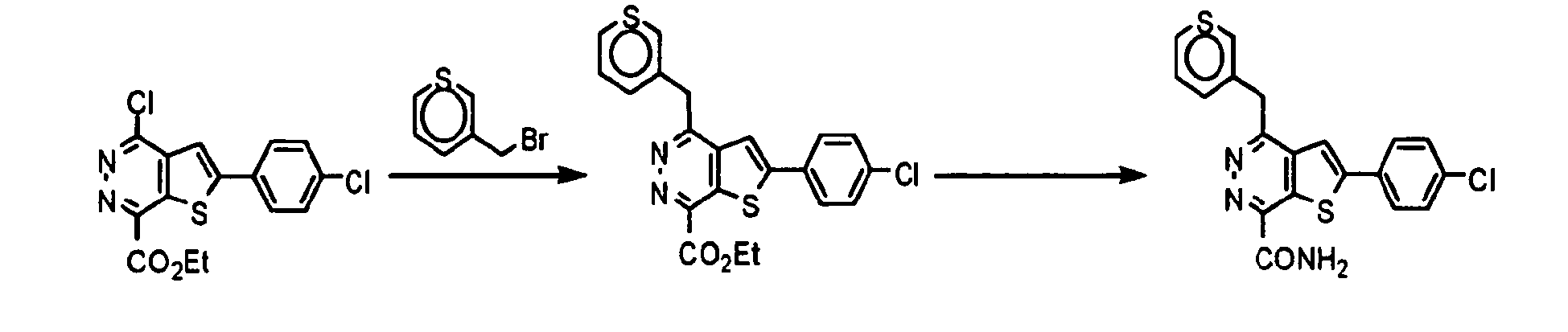
- DMPU (225ml), FeCl3(0.75 g) and CuCl (0.3 g) are added to 3-bromomethylthiopyran (24.75g, 0.138mol), and then Et2Zn (106.8ml) is slowly dropped at 40∼45°C for 45 minutes to obtain a zinc-reagent.
- THF (810 ml) and PdCl2(dppf) (5.09 g) are added to 4-chloro-2-(4-chlorophenyl)-thieno[2,3-d] pyridazinyl-7-ethyl formate (30g), and then the zinc-reagent is dropped to the THF solution at 45°C for 4 h. The reaction mixture is poured into a saturated brine, filtrated after stirring for 15 minutes and placed for layer separation. The aqueous phase is extracted with THF (500 ml, 2 times). The organic phase is combined together, washed with a saturated brine (500ml, 3 times) and dried with anhydrous Na2SO4, and evaporated under reduced pressure to remove solvent to obtain 4-(3-α-thiopyranmethyl)-2-(4-chlorophenyl)-thieno[2,3-d] pyridazinyl-7-ethyl formate (25 g).
MS (ESI): 428(M+1) - 4-(3-α-thiopyranmethyl)-2-(4-chlorophenyl)-thieno[2,3-d]pyridazinyl-7-ethyl formate(3g), 1,4-dioxane (5 ml) and NH3.H2O (5 ml) are added to a sealed tube (25ml) and heated at 80°C over night. The reaction mixture is cooled to room temperature and transferred to a separating funnel next day, and addition of ethyl acetate, vibrated, placed for layer separationn. The aqueous layer is reextracted with ethyl acetate for 2 times. The organic phase is combined and adjusted with 1M HCl solution to pH=3, then washed with a saturated brine to pH=7, dried with anhydrous Na2SO4 and filtered. The filtered liquid is purified with silica gel by chromatography to obtain a solid of 2-(4-chlorophenyl)-4-(3-α-thiopyranmethyl) -thieno [2,3-d] pyridazinyl- 7-formamide (2 g).
MS (ESI): 399(M+1) -

- DMPU (225ml), FeCl3(0.75 g) and CuCl (0.3 g) are added to 2-bromomethylpyridine (24.75g, 0.138mol), and then Et2Zn (106.8ml) is slowly dropped at 40∼45°C for 45 minutes to obtain a zinc-reagent.
- THF (810 ml) and PdCl2(dppf) (5.09 g) are added to 4-chloro-2-(4-chlorophenyl) -thieno [2,3-d] pyridazinyl-7-ethyl formate (30g), and then the zinc-reagent is dropped to the THF solution at 45°C for 4 hours. The reaction mixture is poured into a saturated brine, filtrated after stirring for 15 minutes, and placed for layer separation. The aqueous phase is extracted with THF (500 ml, 2 times). The organic phase is combined together, washed with a saturated brine (500ml, 3 times) and dried with anhydrous Na2SO4, and evaporated under reduced pressure to remove solvent to obtain 4-(2-pyridinemethyl)-2-(4-chlorophenyl)-thieno [2,3-d] pyridazinyl-7-ethyl formate (25 g).
MS (ESI): 410(M+1) - 4-(2-pyridinemethy)-2-(4-chlorophenyl)-thieno[2,3-d] pyridazinyl-7-ethyl formate (3g), 1,4-dioxane (5 ml) and NH3.H2O (5 ml) are added to a sealed tube (25ml) and heated at 80°C over night. The reaction mixture is cooled to room temperature and transferred to a separating funnel next day, and addition of ethyl acetate, vibrated, placed for layer separation. The aqueous layer is reextracted with ethyl acetate for 2 times. The organic phase is combined together and adjusted with 1M HCl solution to pH≈3, then washed with a saturated brine to pH=7, dried with anhydrous Na2SO4 and filtered. The filtered liquid is purified with silica gel by chromatography to obtain a solid of 2-(4-chlorophenyl)-4-(2-pyridinemethyl) -thieno [2,3-d] pyridazinyl- 7-formamide (2 g).
MS (ESI): 381(M+1) -

- DMPU (225ml),FeCl3(0.75g) and CuCl (0.3g) are added to 4-bromomethylpyridine (24.75g, 0.138mol), and then Et2Zn (106.8ml) is slowly dropped at 40∼45°C for 45 minutes to obtain a zinc-reagent.
THF (810ml) and PdCl2(dppf) (5.09g) are added to 4-chloro-2-(4-chlorophenyl) -thieno [2,3-d] pyridazinyl-7-ethyl formate (30g), and then the zinc-reagent is dropped to the THF solution at 45°C for 4 h. The reaction mixture is poured into a saturated brine, filtrated after stirring for 15 minutes and placed for layer separation. The aqueous phase is extracted with THF (500 ml, 2 times). The organic phase is combined together, washed with a saturated brine (500ml, 3 times) and dried with anhydrous Na2SO4, ands evaporated under reduced pressure to remove solvent to obtain4-(4-pyridinemethyl)-2-(4-chlorophenyl)-thieno[2,3-d]pyridazinyl-7-ethyl formate (25 g).
MS (ESI): 410(M+1) - 4-(4-pyridinemethyl)-2-(4-chlorophenyl)-thieno[2,3-d] pyridazinyl -7-ethyl formate (3g), 1,4-dioxane (5 ml) and NH3.H2O (5 ml) are added to a sealed tube (25ml) and heated at 80°C over night. The reaction mixture is cooled to room temperature and transferred to a separating funnel next day, and addition of ethyl acetate, vibrated, placed for layer separation. The aqueous layer is reextracted with ethyl acetate for 2 times. The organic phase is combined together and adjusted with 1M HCl solution to pH≈3, then washed with saturated brine to pH=7, dried with anhydrous Na2SO4 and filtered. The filtered liquid is purified with silica gel by chromatography to obtain a solid of 2-(4-chlorophenyl)-4-(4-pyridinemethyl)-thieno [2,3-d] pyridazinyl- 7-formamide (2 g).
MS (ESI): 381(M+1) -

- DMPU (225ml), FeCl3(0.75 g) and CuCl (0.3 g) are added to 3-bromomethylpyrrole (24.75g, 0.138mol), and then Et2Zn (106.8ml) is slowly dropped at 40∼45°C for 45 minutes to obtain a zinc-reagent.
- THF (810ml) and PdCl2(dppf) (5.09g) are added to4-chloro-2-(4-chlorophenyl) -thieno [2,3-d] pyridazinyl-7-ethyl formate (30g), and then the zinc-reagent is dropped to the THF solution at 45°C for 4 h. The reaction mixture is poured into a saturated brine, filtrated after stirring for 15 minutes and placed for layer separation. The aqueous phase is extracted with THF (500 ml, 2 times). The organic phase is combined together, washed with a saturated brine (500ml, 3 times) and dried with anhydrous Na2SO4, and evaporated under reduced pressure to remove solvent to obtain 4-(3-pyrrolemethyl)-2-(4-chlorophenyl)-thieno[2,3-d] pyridazinyl-7-ethyl formate (25 g).
MS (ESI): 398(M+1) - 4-(3-pyrrolemethyl)-2-(4-chlorophenyl)-thieno[2,3-d]pyridazinyl-7-ethyl formate (3g), 1,4-dioxane (5 ml) and NH3.H2O (5 ml) are added to a sealed tube (25ml) and heated at 80°C over night. The reaction mixture is cooled to room temperature and transferred to a separating funnel next day, and addition of ethyl acetate, vibrated, placed for layer separation. The aqueous layer is reextracted with ethyl acetate for 2 times. The organic phase is combined together and adjusted with 1M HCl solution to pH≈3, then washed with a saturated brine to pH=7, dried with anhydrous Na2SO4 and filtered. The filtered liquid is purified with silica gel by chromatography to obtain a solid of 2-(4-chlorophenyl)-4-(3-pyrrolemethyl)-thieno[2,3-d] pyridazinyl-7-formamide (2 g).
MS (ESI): 369(M+1) -

- DMPU (225ml)), FeCl3(0.75 g) and CuCl (0.3 g) are added to 3-bromomethylfuran (24.75g, 0.138mol), and then Et2Zn (106.8ml) is slowly dropped at 40∼45C for 45 minutes to obtain a zinc-reagent.
- THF (810ml) and PdCl2(dppf) (5.09g) are added to 4-chloro-2-(4-chlorophenyl)-thieno [2,3-d] pyridazinyl-7-ethyl formate (30g), and then the zinc-reagent is added dropwise to the THF solution at 45°C for 4 h. The reaction mixture is poured into a saturated brine, filtrated after stirring for 15 minutes and place for layer separation. The aqueous phase is extracted with THF (500 ml, 2 times). The organic phase is combined together, washed with a saturated brine (500ml, 3 times) and dried with anhydrous Na2SO4, and evaporated under reduced pressure to remove solvent to obtain 4-(3-furanmethyl)-2-(4-chlorophenyl)-thieno[2,3-d] pyridazinyl-7-ethyl formate (25 g).
MS (ESI): 399(M+1) - 4-(3-furanmethyl)-2-(4-chlorophenyl)-thieno[2,3-d]pyridazinyl-7-ethyl formate (3g), 1,4-dioxane (5 ml) and NH3.H2O (5 ml) are added to a sealed tube (25ml) and heated at 80°C over night. The reaction mixture is cooled to room temperature and transferred to a separating funnel next day, and addition of ethyl acetate, vibrated, placed for layer separation. The aqueous layer is reextracted with ethyl acetate for 2 times. The organic phase is combined together and adjusted with 1M HCl solution to pH=3, then washed with a saturated brine to pH=7, dried with anhydrous Na2SO4 and filtered. The filtered liquid is purified with silica gel by chromatography to obtain a solid of 2-(4-chlorophenyl)-4-(3-furanmethyl)-thieno[2,3-d]pyridazinyl-7- formamide (2 g).
MS (ESI): 370(M+1) -

- DMPU (225ml), FeCl3(0.75 g) and CuCl (0.3 g) are added to 3-bromomethylthiophene (24.75g, 0.138mol), and then Et2Zn (106.8ml) is slowly dropped at 40~45°C for 45 minutes to obtain a zinc-reagent.
- THF (810ml) and PdCl2(dppf) (5.09g) are added to 4-chloro-2-(4-chlorophenyl) -thieno [2,3-d] pyridazinyl-7-ethyl formate (30g), and then the zinc-reagent is dropped to the THF solution at 45°C for 4 h. The reaction mixture is poured into a saturated brine, filtrated after stirring for 15 minutes and placed for layer separation. The aqueous phase is extracted with THF (500 ml, 2 times). The organic phase is combined together, washed with a saturated brine (500ml, 3 times) and dried with anhydrous Na2SO4, and evaporated under reduced pressure to remove solvent to obtain 4-(3-thiophenemethyl)-2-(4-chlorophenyl)-thieno[2,3-d] pyridazinyl-7-ethyl formate (25 g).
MS (ESI): 415(M+1) - 4-(3-thiophenemethyl)-2-(4-chlorophenyl)-thieno[2,3-d]pyridazinyl-7-ethyl formate (3g), 1,4-dioxane (5 ml) and NH3.H2O (5 ml) are added to a sealed tube (25ml) and heated at 80°C over night. The reaction mixture is cooled to room temperature and transferred to a separating funnel next day, and addition of ethyl acetate, vibrated, placed for layer separation. The aqueous layer is reextracted with ethyl acetate for 2 times. The organic phase is combined together and adjusted with 1M HCl solution to pH=3, then washed with a saturated brine to pH=7, dried with anhydrous Na2SO4 and filtered. The filtered liquid is purified with silica gel by chromatography to obtain a solid of 2-(4-chlorophenyl)-4-(3-thiophenemethyl)-thieno [2,3-d] pyridazinyl- 7-formamide (2 g).
MS (ESI): 386(M+1) -

- DMPU (225ml), FeCl3(0.75 g) and CuCl (0.3 g) are added to 2-bromomethylpyrrole (24.75g, 0.138mol), and then Et2Zn (106.8ml) is slowly dropped at 40~45°C for 45 minutes to obtain a zinc-reagent.
- THF (810ml) and PdCl2(dppf) (5.09g) are added to 4-chloro-2-(4-chlorophenyl)-thieno [2,3-d] pyridazinyl-7-ethyl formate (30g), and then the zinc-reagent is dropped to the THF solution at 45°C for 4 h. The reaction mixture is poured into a saturated brine, filtrated after stirring for 15 minutes and placed for layer separation. The aqueous phase is extracted with THF (500 ml, 2 times). The organic phase is combined together, washed with a saturated brine (500ml, 3 times) and dried with anhydrous Na2SO4, and evaporated under reduced pressure to remove solvent to obtain 4-(2-pyrrolemethyl)-2-(4-chlorophenyl)-thieno[2,3-d] pyridazinyl-7-ethyl formate (25 g).
MS (ESI): 398(M+1) - 4-(2-pyrrolemethyl)-2-(4-chlorophenyl)-thieno[2,3-d]pyridazinyl-7-ethyl formate (3g), 1,4-dioxane (5 ml) and NH3.H2O (5 ml) are added to a sealed tube (25ml) and heated at 80°C over night. The reaction mixture is cooled to room temperature and transferred to a separating funnel next day, and addition of ethyl acetate, vibrated, placed for layer separation. The aqueous layer is reextracted with ethyl acetate for 2 times. The organic phase is combined together and adjusted with 1M HCl solution to pH=3, then washed with a saturated brine to pH=7, dried with anhydrous Na2SO4 and filtered. The filtered liquid is purified with silica gel by chromatography to obtain a solid of 2-(4-chlorophenyl)-4-(2-pyrrolemethyl)-thieno[2,3-d] pyridazinyl-7-formamide (2 g).
MS (ESI): 369(M+1) -

- 5-bromo-thiophene-3-ethyl formate (10.5g), 3,5-dichlorobenzene boronic acid (6g), Pd[P(Ph)3]4 (1.5g), sodium carbonate(7.5g) and a mixture(347ml) of toluene:water:EtOH (4:2:1, v/v) are in turn added to a three mouth flask (500ml) and heated at reflux for 3 h. The reaction is tracked by TLC. The reaction mixture is cooled to room temperature after reaction, and placed for layer separation. The aqueous phase is extracted with toluene (35ml, 2 times). The organic phase is combined together and washed with a saturated brine to pH=7, dried with anhydrous sodium sulfate over night and filtered next day, and evaporated under reduced pressure to remove solvent to obtain a light yellow viscous fluid, placed for solid condensation, and recrystallized with absolute EtOH to obtain a crystal of 5-(3,5-dichlorophenyl)-3-thiophene-ethyl formate (8.6g).
- Preparation of LDA: THF (252.6ml) and N,N-diisopropylamine (79ml) are added into a three mouth flask (1000ml) under argon, and n-Buli (302.8ml, 1.6M in hexane) is added into a constant pressure funnel (500ml) and is dropped when the inner temperature is below -20°C with an intensely exothermic reaction, and kept the inner temperature between -20°C ~ -30°C by controlling a adding speed. After addition, the reaction mixture is naturally warmed up to room temperature, and then directly used for the following condensation reaction.
- Condensation Reaction: 5-(3,5-dichlorophenyl)thiophene-3- ethyl formate (28.7g), THF (1084ml) and diethyloxalate (29.7ml) are added into a four mouth flask (2000ml) connecting with a mechanical stirring apparatus, a 500ml constant pressure funnel and a temperature probe. The above mixture is stirred at room temperature and dissolved to obtain a light yellow transparent liquid. The LDA solution prepared is transferred into a constant pressure funnel under argon, cooled, and then the LDA is dropped to the flask when the inner temperature is below -78°C, and kept the inner temperature below -78°C by controlling the adding speed. After addition, the reaction is tracked by TLC. HCl solution (2.2M) is added to adjust pH≈3 after reaction, and the color of the reaction mixture is changed from reddish brown into orange. The temperature is warmed up to about 0°C, a solid NaCl is then added, and desolved under stirring, and then placed for layer separation. The aqueous phase is reextracted with THF (143.5ml, 2 times). The organic phase is combined together and washed with a saturated brine for two times, and then adjusted pH≈8 with diluted sodium carbonate solution; finally, washed with a saturated brine to pH=7, dried with anhydrous sodium sulfate, filtered and evaporated under reduced pressure to remove solvent to obtain a light yellow viscous fluid, placed at room temperature and gradually condensated to solid, recrystallized by EtOH to obtain a pure product of 5-(3,5-dichlorophenyl)-2-ethoxyoxalyl-thiophene-3-ethyl formate (orange crystal, 25.5g).
- A crystal of 5-(3,5-dichlorophenyl)-2-ethoxyoxalyl-thiophene-3-ethyl formate (3.0g), and absolute ethanol (45ml) are added into a reaction flask (100ml), stirred at room temperature to obtain a yellow suspension. The hydrazine hydrate (0.75ml) is added into a constant pressure funnel under stirring for 10 minutes and then dropped to the flask. The yellow suspension is dissolved to a transparent liquid, and heated at 70°C to gradually precipitate yellow solids in the flask with rise of the temperature, and the reaction liquid increasingly becomes viscous, and kept for 1h and then cooled to room temperature, and filtered to obtain a pistachio solid, the solid is respectively washed with a mixture of hexane/ dichloromethane (1:1)(15ml, 2 times) and methanol/dichloromethane (1:1)(15ml, 2 times) and dried under a reduced pressure to obtain 2-(3,5-dichlorophenyl)-4-oxo-4,5-dihydro-thiero [2,3-d]pyridazine-7- ethyl formate (2.75g).
- 2-(3,5-dichlorophenyl)-4-oxo-4,5-dihydro-thiero[2,3-d]pyridazine-7-ethyl formate (1.5g) and phosphorous oxychloride (22.5ml) are added to a three mouth flask (100ml), heated at 90°C for 3 h, and gradually dissolved to obtain a dark red brown solution. After reaction, the solution is cooled to room temperature and evaporated under reduced pressure to remove solvent to obtain a chocolate brown viscous fluid. THF and a saturated brine are added under stirring, then yellow solids are precipitated, filtered, placed for layer separation, and reextracted and adjusted to pH≈9 with diluted sodium carbonate solution after the organic phase is combined, and then washed with a saturated brine to pH=7, and dried with anhydrous sodium sulfate, filtered, decolourised with active carbons at reflux to obtain a light yellow green liquid, the liquid is evaporated under reduced pressure to remove solvent to obtain 4-chloro-2-(3,5-dichlorophenyl)-thieno[2,3-d]pyridazinyl-7-ethyl formate (light green flocculent solid, 1.0g).
- DMPU (5ml), FeCl3(0.017 g) and CuCl (0.007g) are added to N-Boc-3-bromomethylpiperidine (0.55g), and then Et2Zn (2.5ml) is slowly dropped at 40~45°C for 45 minutes to obtain a zinc-reagent.
- THF (18ml) and PdCl2(dppf) (0.12g) are added to 4-chloro-2-(3,5-dichlorophenyl)-thieno[2,3-d] pyridazinyl-7-ethyl formate (30g), and then the zinc-reagent is dropped to the THF solution at 45°C for 4 h. The reaction mixture is poured into a saturated brine, filtrated after stirring for 15 minutes and placed for layer separation. The aqueous phase is extracted with THF (80 ml, 2 times). The organic phase is combined together, washed with a saturated brine (80ml, 3 times) and dried with anhydrous Na2SO4, and evaporated under reduced pressure to remove solvent to obtan 2-(3,5-dichlorophenyl)- 4-(N-Boc-3-piperidinemethyl)-thieno[2,3-d] pyridazinyl - 7- ethyl formate (0.5 g).
- 2-(3,5-dichlorophenyl)-4-(N-Boc-3-piperidinemethyl)-thieno[2,3-d]pyridazinyl-7 -ethyl formate (0.5g), 1,4-dioxane (1.0ml) and NH3.H2O (5ml) are added to a sealed tube(5ml) and heated at 80°C over night. The reaction mixture is cooled to room temperature and transferred into a separating funnel next day, and addition of ethyl acetate, vibrated, placed for layer separation. The water layer is reextracted with ethyl acetate for 2 times. The organic phase is combined together and adjusted to pH≈3 with 1M HCl solution, and then washed with saturated brine to pH=7, dried with anhydrous sodium sulfate and filtered. The filtered liquid was purified together with silica gel by flash chromatography to obtain a solid of 2(3,5-dichlorophenyl)-4-(N-Boc-3- piperidinemethyl)-thieno[2,3-d] pyridazinyl-7-formamide (0.3g).
- 2(3,5-dichlorophenyl)-4-(N-Boc-3-piperidinemethyl)-thieno[2,3-d]pyridazinyl-7-formamide (200g) and ethyl acetate (4ml) are added to a single mouth flask (25ml) and dissolved to a light yellow transparent solution. HCl solution (4ml, 3M) is added and changed to a white suspension, and heated at 30°C for 1 h and the white suspension is changed to transparent. The reaction is tracked by plate; and evaporated under reduced pressure aAfter reaction to remove solvent to obtain a solid of 2-(3,5-dichlorophenyl)-4-(3-piperidinemethyl)-thieno[2,3-d]pyridazinyl-7-formamide hydrochloride (100 mg).
- 2-(3,5-dichlorophenyl)-4-(3-piperidinemethyl)-thieno[2,3-d]pyridazinyl-7-formamide hydrochloride (100 mg) is added to a single mouth flask(25ml), then addition of water (5ml) and the sodium carbonate is dropped to pH=9~ 10 under stirring for 30min. The mixture is extracted by ethyl acetate, washed with water, and evaporated under reduced pressure to remove solvent to obtain 2-(3,5-dichlorophenyl)-4-(3-piperidinemethyl) -thieno[2,3-d] pyridazinyl-7- formamide (70 mg).
MS (ESI): 421(M+1) -
Compound II 50g Sodium chloride 2250g Water for injection 250,000ml To make 1,000 bottles - The compound II is added into a tank according to the formulation, and water for injection (about 200,000ml) is added and dissolved completely. Sodium chloride is then added according to the formation, and then continue to add sufficient quantity sodium chloride after completely dissolved pH is adjusted to 4.0~5.0. Activated carbon (250g) is added for 30 minutes before being removed with filter decarbonization. The mixture is then bottled in 250ml/bottle after precision filtration with Titanium Rod. The injection is prepared after water sterilization at 115°C for 30 minutes.
-
Compound XXXIII 50g Starch 160g Hydroxypropyl cellulose 39g Polyvidone K30 (5%) q.s. Sodium carboxy methyl starch 10.4g Magnesium stearate 1.3g To make 1000 tablets - Compound XXXIII, starch and hydroxypropyl cellulose are added into a hopper of fluidbedgranulator, and warmed up to 38°C ~ 45°C by opening the main air to premix the material for 5 minutes. Suitable polyvidone K30 (5 %) water solution is nebulized to granulate, the material is controlled to 55°C~ 60°C and dried for 10 minutes, mixed with sodium carboxy methyl starch and magnesium stearate to tablet after granulation.
-
Compound XXXXIV 50g Lactose 194.4g Sodium carboxy methyl starch 7.8g Colloidal silicon dioxide 5.2g Magnesium stearate 2.6g To make 1000 capsules - Compound XXXXIV, lactose, sodium carboxy methyl starch and colloidal silicon dioxide are added into a mixer according to the formulation and mixed for 60 minutes to make it homogeneous. Magnesium stearate is then added according to the formulation and mixed for 10 minutes, filled in a general Gelatin plastic shell.
- Some of the above compounds are tested in vitro and in vivo for their antitumor activities. Among these tests, the cytotoxicity is tested in vitro using SRB and MTT methods for 72h. The specific activity data is summarized in Table 1. The growth inhibition effect of the compound on mouse S 180 sarcoma is summarized in Table 2. The efficacy of the compounds on treating transplanted tumor of human colon cancer HT-99 on nude mice is summarized in Table 3.
Table 1 Anti-cancer Activity of the Compound IC50(µM) In vitro OrderNo. Compound No. Human poorly differentiated gastric adenocarcinoma (BGC-823) Human colon cancer HT-29 Mouse lung cancer (3LL) Human ovarian cancer (A2780) 1 I 3.35 4.22 1.40 6.40 2 II 4.47 7.4 3.32 6.20 3 VI 5.86 7.53 2.55 1.54 4 XI 9.24 10.70 8.43 11.85 5 XIII 2.62 0.73 1.24 1.18 6 XIV 30.46 16.76 8.59 6.01 7 XV 2.25 804 8 XXI 8.68 9 XXIII >100 5.57 >100 >100 10 XXVI 24.58 >100 >100 >100 11 XXXIV 74.50 > 100 50.64 > 100 12 XXXVIII 8.17 1.33 3.13 3.13 13 XXXXVI 11.11 >100 >100 30.29 14 XXXXXVIII 16.4 21.8 21.4 13.9 15 XXXXXXIX 17.02 9.48 3.31 7.11 16 XXXXXXX 5.45 > 100 > 100 > 100 Table 2 The growth inhibition effects of the compounds on mouse S 180 colon cancer N=7 X±SD Compound No. Dosage mg/kg Adimin Route Starting Body Weight(g) Ending Body Weight(g) Tumor Weight (g) Body Weight without Tumor (g) Rate of inhibition (%) II 50 ip 19.70±0.76 20.03±1.11 1.41±0.30 18.63±0.93 52.62 XX 50 ip. 19.50±0.89 21.19±1.40 1.86±0.26 19.33±1.60 37.23 XII 50 ip. 19.50±0.73 20.79±1.83 1.48±0.16 19.31±1.79 50.02 XXIV 50 ip 19.39±0.60 23.18±1.66 1.62±0.26 21.56±1.48 45.45 Negative Control 19.49±0.76 26.21±2.38 2.97±0.63 23.24±2.18 Note: ip: administration of intraperitoneal injection. Tabel 3 The efficacy of the compound on treating transplanted tumor of human colon cancer HT-99 on nude mice Compound No. Dosage mg/kg Adimin. Route No. of Animals d0/dn TV(X±SD, mm3) RTV X±SD T/C (%) d0 dn II 60 ip.d0,1 6/3 146±13 690±271 4.64±1.65 70 V 60 ip.d0,1 6/3 150±16 910±0 6.40±0 96.5 Xl 60 ip,d0,1 6/1 150±15 1224±440 7.52±0.26 113.4 XIX 60 ip,d0,1 6/3 147±9 663±86 4.53±0.82 68.3 XXII 60 ip,d0,1 6/3 151±11 714±127 4.69±0.71 70.7 XXX 60 ip,d0.1 6/3 144±23 482±83 3.78±1.09 57.0 XXXI 60 ip,d0,1 6/3 145±13 785±300 5.36±1.94 80.8 GCT+II 20+25 ip+iv,d0,1 6/6 183±7 409±8 1.58±0.27 30 GCT+XI 20+25 ip+iv,d0,1 6/6 196±15 399±89 1.55±0.22 27 GCT 20 ip,d0,1 6/6 184±17 7 463±74 1.64±0.44 37 CPT-11+II 20+25 ip+iv,d0,1 6/4 193±15 619±115 3.80±1.01 57 CPT-11+XI 20+25 ip+iv.d0,1 6/5 207±13 601±36 1.61±0.57 33 ADR+II 4+25 ip+iv,d0,1 6/3 195±19 573±80 3.63±1.09 50 ADR+XI 4+25 ip+iv,d0,1 6/3 180±21 697±64 4.60±1.52 69 ADR 4 ip,d0,1 6/3 183±13 667±67 4.38±1.38 64 Control Solvent ip,d0,1 10/8 154±12 1022±276 6.63±1.62 Notes:
d0: adminstration time for the first time;
dn: the 17th day after adminstration;
RTV: relative tumor volume;
Control group: n=10;
Treatment group: n=6;
ip: adminstration of intraperitoneal injection
iv: adminstration of intravenous injection
GCT is a control drug: Gemcitabine
ADR is a control drug: Adriamycin
CPT-11 is a control drug: Irinotecan - It may be shown from the above tables that the compounds of the present invention not only have certain antitumor effects, and can also enhance the antitumor efficacy of the cytotoxic antitumor agents such as Gemcitabine, CPT-11, ADR and so on.
- Although the present invention has been described in connection with the above embodiments, it should be understood that the present invention is not limited to such preferred embodiments and procedures set forth above. The embodiments and procedures were chosen and described in order to best explain the principles of the invention and its practical application, to thereby enable others skilled in the art to best utilize the invention.
Claims (12)
- A compound of formula (I) or a pharmaceutically acceptable salt or a hydrate thereof,

R3 is a saturated or unsaturated 5- or 6- membered ring containing N, S or O, and an optical isomers thereof;
R4 is a halophenyl monosubstituted or disubstituted at any position. - The compound or a pharmaceutically acceptable salt or a hydrate thereof according to claim 1, wherein R1=R2=H.
- The compound or a pharmaceutically acceptable salt or a hydrate thereof according to claim 1, wherein R3 is hexahydropyridinyl, tetrahydropyranyl, tetrahydrothiopyranyl, tetrahydropyrrolidinyl, tetrahydrofuranyl, or tetrahydrothienyl, and an optical isomer thereof.
- The compound or a pharmaceutically acceptable salt or a hydrate thereof according to claim 3, wherein R3 is hexahydropyridinyl, and an optical isomer thereof.
- The compound or a pharmaceutically acceptable salt or a hydrate thereof according to claim 1, wherein R4 is a halophenyl monosubstituted

- The compound or a pharmaceutically acceptable salt or a hydrate thereof according to claim 1, wherein R3 is pyridinyl, α-pyranyl, γ-pyranyl, α-thiopyranyl, γ-thiopyranyl, pyrrolidinyl, furanyl, or thienyl, and an optical isomer thereof.
- The compound or a pharmaceutically acceptable salt or a hydrate thereof according to claim 1, wherein the compounds of formula (I) is selected from:2-(4-fluorophenyl)-4-(3-piperidinemethyl)-thieno[2,3-d] pyridazinyl-7- formamide;2-(4-chlorophenyl)-4-(3-piperidinemethyl)-thieno[2,3-d] pyridazinyl-7- formamide;2-(4-bromophenyl)-4-(3-piperidinemethyl)-thieno[2,3-d] pyridazinyl-7- formamide;2-(4-fluorophenyl)-4-(3-tetrahydropyranmethyl)-thieno[2,3-d]pyridazinyl-7-formamide;2-(4-chlorophenyl)4-(3-tetrahydropyranmethyl)-thieno[2,3-d]pyridazinyl-7-formamide;2-(4-bromophenyl)-4-(3-tetrahydropyranmethyl)-thieno[2,3-d]pyridazinyl-7-formamide;2-(4-fluorophenyl)-4-(3-tetrahydrothiapyranmethyl)-thieno[2,3-d]pyridazinyl-7-formamide;2-(4-chlorophenyl)-4-(3-tetrahydrothiapyranmethyl)-thieno[2,3-d]pyridazinyl-7-formamide;2-(4-bromophenyl)-4-(3-tetrahydrothiapyranmethyl)-thieno[2,3-d]pyridazinyl-7-formamide;2-(4-chlorophenyl)-4-(2-piperidinemethyl)-thieno[2,3-d] pyridazinyl-7- formamide;2-(4-chlorophenyl)-4-(4-piperidinemethyl)-thieno[2,3-d] pyridazinyl-7- formamide;2-(4-chlorophenyl)-4-(S-3-piperidinemethyl)-thieno[2,3-d] pyridazinyl-7- formamide;2-(4-chlorophenyl)-4-(R-3-piperidinemethyl)-thieno[2,3-d] pyridazinyl-7- formamide;2-(4-chlorophenyl)-4-(3-piperidinemethyl)-thieno[2,3-d]pyridazinyl-7-N-methyl-formamide;2-(4-chlorophenyl)-4-(3-piperidinemethyl)-thieno[2,3-d]pyridazinyl-7-N,N-dimethyl-7-formamide;2-(4-chlorophenyl)-4-(3-tetrahydrothiapyranmethyl)-thieno[2,3-d]pyridazinyl-7-N-met hyl- formamide;2g4-chlomphenyl)-4-(3-etrahydrothiapyranemthyl)thieno[2,3-d]pyridazinyl-7-N,N-dime thyl-7- formamide;2-(4-chlorophenyl)-4-(3-tetrahydropyranmethyl)-thieno[2,3-d]pyridazinyl-7-N-methyl-formamide;2-(4-chlorophenyl)4-(3-tetrahydropyranmethyl)-thieno[2,3-d]pyridazinyl-7-N,N-dimethyl -7- formamide;2-(4-fluorophenyl)-4-(3-pyrrolidinemethyl)-thieno[2,3-d] pyridazinyl-7- formamide;2-(4-chlorophenyl)-4-(3-pyrrolidinemethyl)-thieno[2,3-d] pyridazinyl-7- formamide;2-(4-bromophenyl)-4-(3-pyrrolidinemethyl)-thieno[2,3-d] pyridazinyl-7- formamide;2-(4-fluorophenyl)-4-(3-tetrahydrofuranmethyl)-thieno[2,3-d]pyridazinyl-7-formamide;2-(4-chlorophenyl)-4-(3-tetrahydrofuranmethyl)-thieno[2,3-d]pyridazinyl-7-formamide;2-(4-bromophenyl)-4-(3-tetrahydrofuranmethyl)-thieno[2,3-d]pyridazinyl-7-formamide;2-(4-fluorophenyl)-4-(3-tetrahydrothiophenemethyl)-thieno[2,3-d]pyridazinyl-7-formamide;2-(4-chlorophenyl)-4-(3-tetrahydrothiophenemethyl)-thieno[2,3-d]pyridazinyl-7-formamide;2-(4-bromophenyl)-4-(3-tetrahydrothiophenemethyl)-thieno[2,3-d]pyridazinyl-7-formamide;2-(4-chlorophenyl)-4-(3-pyrrolidinemethyl)-thieno[2,3-d] pyridazinyl-7- formamide;2-(4-chlorophenyl)-4-(S-3-pyrrolidinemethyl)-thieno[2,3-d]pyridazinyl-7- formamide;2-(4-chlorophenyl)-4-(R-3-pyrrolidinemethyl)-thieno[2,3-d]pyridazinyl-7-formamide;2-(4-chlorophenyl)-4-(3-pyrrolidinemethyl)-thieno[2,3-d]pyridazinyl-7-N-methyl-formamide;2-(4-chlorophenyl)-4-(3-pyrrolidinemethyl)-thieno[2,3-d]pyridazinyl-7-N,N-dimethylformamide;2-(4-chlorophenyl)-4-(3-tetrahydrothiophenemethyl)-thieno[2,3-d]pyridazinyl-7-N-m ethyl- formamide;2-(4-chlorophenyl)-4-(3-tetrahydrothiophenemethyl)-thieno[2,3-d]pyridazinyl-7-N,N-dimethyl- formamide;2-(4-chlorophenyl)-4-(3-tetrahydrofuranmethyl)-thieno[2,3-d]pyridazinyl-7-N-methyl - formamide;2-(4-chlorophenyl)-4-(3-tetrahydrofuranmethyl)-thieno[2,3-d]pyridazinyl-7-N,N-dimethyl- formamide;2-(4-fluorophenyl)-4-(3-pyridinemethyl)-thieno[2,3-d] pyridazinyl-7- formamide;2-(4-chlorophenyl)-4-(3-pyridinemethyl)-thieno[2,3-d] pyridazinyl-7- formamide;2-(4-bromophenyl)-4-(3-pyridinemethyl)-thieno[2,3-d] pyridazinyl-7- formamide;2-(4-fluorophenyl)-4-(3-a-pyranmethyl)-thieno[2,3-d] pyridazinyl-7- formamide;2-(4-chlorophenyl)-4-(3-a-pyranmethyl)-thieno[2,3-d] pyridazinyl-7- formamide;2-(4-bromophenyl)-4-(3-α-pyranmethyl)-thieno[2,3-d] pyridazinyl-7- formamide;2-(4-fluorophenyl)-4-(3-α-thiopyranmethyl)-thieno[2,3-d] pyridazinyl-7- formamide;2-(4-chlorophenyl)-4-(3-α-thiopyranmethyl)-thieno[2,3-d] pyridazinyl-7- formamide;2-(4-bromophenyl)-4-(3-α-thiopyranmethyl)-thieno[2,3-d] pyridazinyl-7- formamide;2-(4-chlorophenyl)-4-(2-pyridinemethyl)-thieno[2,3-d] pyridazinyl-7- formamide;2-(4-chlorophenyl)-4-(4-pyridinemethyl)-thieno[2,3-d] pyridazinyl-7- formamide;2-(4-chlorophenyl)-4-(3-pyridinemethyl)-thieno[2,3-d]pyridazinyl-7-N-methyl formamide;2-(4-chlorophenyl)-4-(3-pyridinemethyl)-thieno[2,3-d]pyridazinyl-7-N,N-dimethyl formamide;2-(4-chlorophenyl)-4-(3-thiopyranylmethyl)-thieno[2,3-d]pyridazinyl-7-N-methyl formamide;2-(4-chlorophenyl)-4-(3-thiopyranylmethyl)-thieno[2,3-d]pyridazinyl-7-N,N-dimethyl formamide;2-(4-chlorophenyl)-4-(3-pyranmethyl)-thieno[2,3-d]pyridazinyl-7-N-methyl formamide;2-(4-chlorophenyl)-4-(3-pyranmethyl)-thieno[2,3-d]pyridazinyl-7-N,N-dimethyl formamide;2-(4-fluorophenyl)-4-(3-pyrrolemethyl)-thicno[2,3-d] pyridazinyl-7- formamide;2-(4-chlorophenyl)-4-(3-pyrrolemethyl)-thieno[2,3-d] pyridazinyl-7- formamide;2-(4-bromophenyl)-4-(3-pyrrolemethyl)-thieno[2,3-d] pyridazinyl-7- formamide;2-(4-fluorophenyl)-4-(3-furanmethyl)-thieno[2,3-d] pyridazinyl-7- formamide;2-(4-chlorophenyl)-4-(3-furanmethyl)-thieno[2,3-d] pyridazinyl-7- formamide;2-(4-bromophenyl)-4-(3-furanmethyl)-thieno[2,3-d] pyridazinyl-7- formamide;2-(4-fluorophenyl)-4-(3-thiaphenemethyl)-thieno[2,3-d] pyridazinyl-7- formamide;2-(4-chlorophenyl)-4-(3-thiaphenemethyl)-thieno[2,3-d] pyridazinyl-7- formamide;2-(4-bromophenyl)-4-(3-thiaphenemethyl)-thieno[2,3-d] pyridazinyl-7- formamide;2-(4-chlorophenyl)-4-(2-pyrrolemethyl)-thieno[2,3-d] pyridazinyl-7- formamide;2-(4-chlorophenyl)-4-(3-pyrrolemethyl)-thieno[2,3-d]pyridazinyl-7-N-methyl formamide;2-(4-chlorophenyl)-4-(3-pyrrolemethyl)-thieno[2,3-d]pyridazinyl-7-N,N-dimethyl formamide;2-(4-chlorophenyl)-4-(3-thiaphenemethyl)-thieno[2,3-d]pyridazinyl-7-N-methyl formamide;2-(4-chlorophenyl)-4-(3-thiaphenemethyl)-thieno[2,3-d]pyridazinyl-7-N,N-dimethyl formamide;2-(4-chlorophenyl)-4-(3-furanmethyl)-thieno[2,3-d]pyridazinyl-7-N-methyl formamide;2-(4-chlorophenyl)-4-(3-furanmethyl)-thieno[2,3-d]pyridazinyl-7-N,N-dimethyl formamide;2-(3,5-dichlorophenyl)-4-(3-piperidinemethyl)-thieno[2,3-d]pyridazinyl-7-formamide.
- A pharmaceutical compositon comprising a therapeutically effective amount of compound of formula (I) of any one of the claims 1 to 7 or a pharmaceutically acceptable salt or a hydrate thereof, and a pharmaceutically acceptable carrier.
- A use of the compound or a pharmaceutically acceptable salt or a hydrate thereof of any one of claims 1 to 7 in the preparation of a medication for treatment or prophylaxis of tumor diseases, a medication for treatment or prophylaxis of proliferative diseases, a medication for limitation of cell proliferation, and a medicament of inhibiting tumors or kinases associated with growth factors.
- The use according to claim 9, wherein said tumor deseases include cervical tumor, tumor of head and neck, carcinoma of breast, ovary, lung non-small cell, pancreas, colon, prostate or other tissues, as well as leukemias and lymphomas, tumors of central and peripheral nevous system and other tumors such as melanoma, fibrosarcoma and osteosarcoma.
- The use according to claim 9, wherein said proliferative diseases include autoimmune, inflammatory, neurological and cardiovascular diseases.
- A method for preparing the compound of formula (I) or a pharmaceutically acceptable salt or a hydrate thereof of any one of claims 1 to 7, the method comprising:in the presence of alkali, the compound of formula A is treated with dialkyl oxalates:

 the compound of formula B is treated with phosphorus oxychloride, to produce the compound of formula C:


Applications Claiming Priority (3)
| Application Number | Priority Date | Filing Date | Title |
|---|---|---|---|
| CN200810000936 | 2008-01-08 | ||
| CN2009100003371A CN101481380B (en) | 2008-01-08 | 2009-01-06 | Thiofuran pyridazine compound, preparation thereof, pharmaceutical composition and uses thereof |
| PCT/CN2009/000021 WO2009092278A1 (en) | 2008-01-08 | 2009-01-07 | Thienopyridazine compounds, their preparations, pharmaceutical compositions and uses |
Publications (3)
| Publication Number | Publication Date |
|---|---|
| EP2241569A1 EP2241569A1 (en) | 2010-10-20 |
| EP2241569A4 EP2241569A4 (en) | 2011-01-12 |
| EP2241569B1 true EP2241569B1 (en) | 2012-05-23 |
Family
ID=40878690
Family Applications (1)
| Application Number | Title | Priority Date | Filing Date |
|---|---|---|---|
| EP09703313A Active EP2241569B1 (en) | 2008-01-08 | 2009-01-07 | Thienopyridazine compounds, their preparations, pharmaceutical compositions and uses |
Country Status (11)
| Country | Link |
|---|---|
| US (3) | US8962626B2 (en) |
| EP (1) | EP2241569B1 (en) |
| JP (1) | JP5456694B2 (en) |
| KR (1) | KR101512530B1 (en) |
| CN (1) | CN101481380B (en) |
| AU (1) | AU2009207968B2 (en) |
| BR (1) | BRPI0907228B1 (en) |
| CA (1) | CA2711629C (en) |
| MX (1) | MX2010007502A (en) |
| RU (1) | RU2494103C2 (en) |
| WO (1) | WO2009092278A1 (en) |
Cited By (4)
| Publication number | Priority date | Publication date | Assignee | Title |
|---|---|---|---|---|
| WO2014182950A1 (en) * | 2013-05-10 | 2014-11-13 | Nimbus Apollo, Inc. | Acc inhibitors and uses thereof |
| US9988399B2 (en) | 2013-05-10 | 2018-06-05 | Gilead Apollo, Llc | Bicyclic compounds as ACC inhibitors and uses thereof |
| US10208044B2 (en) | 2013-05-10 | 2019-02-19 | Gilead Apollo, Llc | ACC inhibitors and uses thereof |
| US10208063B2 (en) | 2013-05-10 | 2019-02-19 | Gilead Apollo, Llc | ACC inhibitors and uses thereof |
Families Citing this family (7)
| Publication number | Priority date | Publication date | Assignee | Title |
|---|---|---|---|---|
| ES2481791T3 (en) * | 2009-09-18 | 2014-07-31 | Zhanggui Wu | Novel compounds and therapeutic use for protein kinase inhibition |
| EP3483167A1 (en) * | 2013-06-26 | 2019-05-15 | AbbVie Inc. | Primary carboxamides as btk inhibitors |
| CN103288614B (en) * | 2013-06-27 | 2014-09-17 | 中国科学院昆明植物研究所 | Monocyclic phloroglucinol compounds with antineoplastic activity and pharmaceutical composition thereof |
| CA2928568A1 (en) | 2013-07-26 | 2015-01-29 | Update Pharma Inc. | Combinatorial methods to improve the therapeutic benefit of bisantrene |
| CN103694217A (en) * | 2013-12-20 | 2014-04-02 | 华东师范大学 | 2,4-disubstituted thiophene derivative as well as preparation method and application thereof |
| WO2021141974A2 (en) * | 2020-01-07 | 2021-07-15 | Fan Wu | Combination cancer therapy using chk inhibitor |
| US20230183259A1 (en) * | 2020-04-17 | 2023-06-15 | Zhejiang Medicine Co., Ltd. Xinchang Pharmaceutical Factory | Crystal Form Of Thiofuran Pyridazine Compound, Preparation Method Therefor And Application Thereof |
Family Cites Families (8)
| Publication number | Priority date | Publication date | Assignee | Title |
|---|---|---|---|---|
| CO5200835A1 (en) * | 1999-09-28 | 2002-09-27 | Bayer Corp | PIRIDINES AND REPLACED PIRIDACINES WITH ANGIOGENESIS INHIBITION ACTIVITY |
| AU2004265140A1 (en) * | 2003-08-15 | 2005-02-24 | Astrazeneca Ab | Substituted thiophenes and uses thereof |
| WO2005066163A2 (en) * | 2004-01-05 | 2005-07-21 | Astrazeneca Ab | Thiophene derivatives as chk 1 inihibitors |
| EP1745051A1 (en) * | 2004-05-04 | 2007-01-24 | F.Hoffmann-La Roche Ag | Thienopyridazines as ikk inhibitors |
| WO2006106326A1 (en) * | 2005-04-06 | 2006-10-12 | Astrazeneca Ab | Substituted heterocycles and their use as chk1, pdk1 and pak inhibitors |
| EP2038289A2 (en) * | 2006-04-21 | 2009-03-25 | Amgen Inc. | Thieno-[2,3-d]pyrimidine and thieno-pyridazine compounds and methods of use |
| JP2010525077A (en) * | 2007-04-25 | 2010-07-22 | ブリストル−マイヤーズ スクイブ カンパニー | Non-basic melanin-concentrating hormone receptor-1 antagonist |
| WO2009003911A1 (en) * | 2007-06-29 | 2009-01-08 | 4Sc Ag | Thiophene-imidazopyridines |
-
2009
- 2009-01-06 CN CN2009100003371A patent/CN101481380B/en active Active
- 2009-01-07 JP JP2010541010A patent/JP5456694B2/en active Active
- 2009-01-07 US US12/811,898 patent/US8962626B2/en active Active
- 2009-01-07 BR BRPI0907228-4A patent/BRPI0907228B1/en active IP Right Grant
- 2009-01-07 AU AU2009207968A patent/AU2009207968B2/en active Active
- 2009-01-07 RU RU2010128221/04A patent/RU2494103C2/en active
- 2009-01-07 WO PCT/CN2009/000021 patent/WO2009092278A1/en not_active Ceased
- 2009-01-07 EP EP09703313A patent/EP2241569B1/en active Active
- 2009-01-07 KR KR1020107017631A patent/KR101512530B1/en not_active Expired - Fee Related
- 2009-01-07 US US12/349,888 patent/US8318740B2/en active Active
- 2009-01-07 CA CA2711629A patent/CA2711629C/en active Active
- 2009-01-07 MX MX2010007502A patent/MX2010007502A/en active IP Right Grant
-
2012
- 2012-11-02 US US13/668,197 patent/US9249154B2/en active Active
Cited By (6)
| Publication number | Priority date | Publication date | Assignee | Title |
|---|---|---|---|---|
| WO2014182950A1 (en) * | 2013-05-10 | 2014-11-13 | Nimbus Apollo, Inc. | Acc inhibitors and uses thereof |
| US9765089B2 (en) | 2013-05-10 | 2017-09-19 | Gilead Apollo, Llc | ACC inhibitors and uses thereof |
| US9988399B2 (en) | 2013-05-10 | 2018-06-05 | Gilead Apollo, Llc | Bicyclic compounds as ACC inhibitors and uses thereof |
| EA030958B1 (en) * | 2013-05-10 | 2018-10-31 | Джилид Аполло, Ллс | Acc inhibitors and uses thereof |
| US10208044B2 (en) | 2013-05-10 | 2019-02-19 | Gilead Apollo, Llc | ACC inhibitors and uses thereof |
| US10208063B2 (en) | 2013-05-10 | 2019-02-19 | Gilead Apollo, Llc | ACC inhibitors and uses thereof |
Also Published As
| Publication number | Publication date |
|---|---|
| CA2711629C (en) | 2017-10-24 |
| AU2009207968A1 (en) | 2009-07-30 |
| JP2011508750A (en) | 2011-03-17 |
| KR20100117069A (en) | 2010-11-02 |
| US8318740B2 (en) | 2012-11-27 |
| WO2009092278A8 (en) | 2010-07-22 |
| CA2711629A1 (en) | 2009-07-30 |
| WO2009092278A1 (en) | 2009-07-30 |
| BRPI0907228B1 (en) | 2021-08-03 |
| US20090275585A1 (en) | 2009-11-05 |
| RU2494103C2 (en) | 2013-09-27 |
| EP2241569A1 (en) | 2010-10-20 |
| US9249154B2 (en) | 2016-02-02 |
| JP5456694B2 (en) | 2014-04-02 |
| RU2010128221A (en) | 2012-02-20 |
| MX2010007502A (en) | 2010-10-15 |
| BRPI0907228A2 (en) | 2015-07-14 |
| KR101512530B1 (en) | 2015-04-15 |
| US20130143887A1 (en) | 2013-06-06 |
| CN101481380A (en) | 2009-07-15 |
| US20110009415A1 (en) | 2011-01-13 |
| US8962626B2 (en) | 2015-02-24 |
| EP2241569A4 (en) | 2011-01-12 |
| CN101481380B (en) | 2012-10-17 |
| AU2009207968B2 (en) | 2014-04-24 |
Similar Documents
| Publication | Publication Date | Title |
|---|---|---|
| CA2711629C (en) | Thienopyridazine compounds, their preparations, pharmaceutical compositions and uses for treating cancer | |
| CN112300195B (en) | Tetra-fused ring compound and preparation method and application thereof | |
| CN101909631B (en) | Process for making thienopyrimidine compounds | |
| JP6819585B2 (en) | Brk inhibitor compound | |
| KR20190039474A (en) | (S) -N- (5 - ((R) -2- (2,5-difluorophenyl) pyrrolidin-l-yl) -pyrazolo [1,5- a] pyrimidin- ) -3-hydroxypyrrolidine-1-carboxamide | |
| JP2009102447A (en) | Substituted 3-amino-thieno [2,3-b] pyridine-2-carboxylic acid amide compounds, their preparation and use | |
| CN104918942A (en) | Pyrimidinone derivatives and their use for treating, improving or preventing viral diseases | |
| CN104718212B (en) | Process for preparing thienopyrimidine compounds | |
| CN104837844B (en) | Pyrazole-substituted imidazopiperazines as casein kinase 1 D/E inhibitors | |
| CA2774367C (en) | Compounds and therapeutic use thereof for protein kinase inhibition | |
| AU2021105895A4 (en) | Lycoline B-aryl acrylate derivatives, preparation method and application thereof | |
| JP2023542969A (en) | Compounds as Akt Kinase Inhibitors | |
| CN114075190A (en) | Heterocyclic BTK inhibitors | |
| CN109496212B (en) | Quinolyl-substituted carboxylic acid compound or pharmaceutically acceptable salt thereof, and pharmaceutical composition and application thereof | |
| TW202211917A (en) | Novel compounds having inhibitory activity on prostaglandin e2 receptor and uses thereof | |
| KR101804449B1 (en) | Polymorphic forms of icotinib and uses thereof | |
| AU2023220699A1 (en) | Pharmaceutical composition for treating cancer comprising novel compounds for inhibiting prostaglandin e2 receptor and anticancer drug | |
| TW202233632A (en) | Thienopyrimidine derivative | |
| JP6518655B2 (en) | Polymorphs of icotinib maleate and use thereof | |
| HK1244272B (en) | Process for making thienopyrimidine compounds | |
| CN103214470A (en) | Novel anticancer compound synthesized by reaction of ketone and indole derivative | |
| HK1170908B (en) | Novel compounds and therapeutic use thereof for protein kinase inhibition |
Legal Events
| Date | Code | Title | Description |
|---|---|---|---|
| PUAI | Public reference made under article 153(3) epc to a published international application that has entered the european phase |
Free format text: ORIGINAL CODE: 0009012 |
|
| 17P | Request for examination filed |
Effective date: 20100809 |
|
| AK | Designated contracting states |
Kind code of ref document: A1 Designated state(s): AT BE BG CH CY CZ DE DK EE ES FI FR GB GR HR HU IE IS IT LI LT LU LV MC MK MT NL NO PL PT RO SE SI SK TR |
|
| AX | Request for extension of the european patent |
Extension state: AL BA RS |
|
| A4 | Supplementary search report drawn up and despatched |
Effective date: 20101213 |
|
| DAX | Request for extension of the european patent (deleted) | ||
| GRAP | Despatch of communication of intention to grant a patent |
Free format text: ORIGINAL CODE: EPIDOSNIGR1 |
|
| GRAS | Grant fee paid |
Free format text: ORIGINAL CODE: EPIDOSNIGR3 |
|
| GRAA | (expected) grant |
Free format text: ORIGINAL CODE: 0009210 |
|
| AK | Designated contracting states |
Kind code of ref document: B1 Designated state(s): AT BE BG CH CY CZ DE DK EE ES FI FR GB GR HR HU IE IS IT LI LT LU LV MC MK MT NL NO PL PT RO SE SI SK TR |
|
| REG | Reference to a national code |
Ref country code: GB Ref legal event code: FG4D |
|
| REG | Reference to a national code |
Ref country code: CH Ref legal event code: EP |
|
| REG | Reference to a national code |
Ref country code: AT Ref legal event code: REF Ref document number: 559032 Country of ref document: AT Kind code of ref document: T Effective date: 20120615 |
|
| REG | Reference to a national code |
Ref country code: IE Ref legal event code: FG4D |
|
| REG | Reference to a national code |
Ref country code: DE Ref legal event code: R096 Ref document number: 602009007208 Country of ref document: DE Effective date: 20120719 |
|
| REG | Reference to a national code |
Ref country code: NL Ref legal event code: VDEP Effective date: 20120523 |
|
| REG | Reference to a national code |
Ref country code: LT Ref legal event code: MG4D Effective date: 20120523 |
|
| PG25 | Lapsed in a contracting state [announced via postgrant information from national office to epo] |
Ref country code: NO Free format text: LAPSE BECAUSE OF FAILURE TO SUBMIT A TRANSLATION OF THE DESCRIPTION OR TO PAY THE FEE WITHIN THE PRESCRIBED TIME-LIMIT Effective date: 20120823 Ref country code: LT Free format text: LAPSE BECAUSE OF FAILURE TO SUBMIT A TRANSLATION OF THE DESCRIPTION OR TO PAY THE FEE WITHIN THE PRESCRIBED TIME-LIMIT Effective date: 20120523 Ref country code: CY Free format text: LAPSE BECAUSE OF FAILURE TO SUBMIT A TRANSLATION OF THE DESCRIPTION OR TO PAY THE FEE WITHIN THE PRESCRIBED TIME-LIMIT Effective date: 20120523 Ref country code: FI Free format text: LAPSE BECAUSE OF FAILURE TO SUBMIT A TRANSLATION OF THE DESCRIPTION OR TO PAY THE FEE WITHIN THE PRESCRIBED TIME-LIMIT Effective date: 20120523 Ref country code: IS Free format text: LAPSE BECAUSE OF FAILURE TO SUBMIT A TRANSLATION OF THE DESCRIPTION OR TO PAY THE FEE WITHIN THE PRESCRIBED TIME-LIMIT Effective date: 20120923 Ref country code: SE Free format text: LAPSE BECAUSE OF FAILURE TO SUBMIT A TRANSLATION OF THE DESCRIPTION OR TO PAY THE FEE WITHIN THE PRESCRIBED TIME-LIMIT Effective date: 20120523 |
|
| REG | Reference to a national code |
Ref country code: AT Ref legal event code: MK05 Ref document number: 559032 Country of ref document: AT Kind code of ref document: T Effective date: 20120523 |
|
| PG25 | Lapsed in a contracting state [announced via postgrant information from national office to epo] |
Ref country code: PT Free format text: LAPSE BECAUSE OF FAILURE TO SUBMIT A TRANSLATION OF THE DESCRIPTION OR TO PAY THE FEE WITHIN THE PRESCRIBED TIME-LIMIT Effective date: 20120924 Ref country code: SI Free format text: LAPSE BECAUSE OF FAILURE TO SUBMIT A TRANSLATION OF THE DESCRIPTION OR TO PAY THE FEE WITHIN THE PRESCRIBED TIME-LIMIT Effective date: 20120523 Ref country code: LV Free format text: LAPSE BECAUSE OF FAILURE TO SUBMIT A TRANSLATION OF THE DESCRIPTION OR TO PAY THE FEE WITHIN THE PRESCRIBED TIME-LIMIT Effective date: 20120523 Ref country code: HR Free format text: LAPSE BECAUSE OF FAILURE TO SUBMIT A TRANSLATION OF THE DESCRIPTION OR TO PAY THE FEE WITHIN THE PRESCRIBED TIME-LIMIT Effective date: 20120523 Ref country code: GR Free format text: LAPSE BECAUSE OF FAILURE TO SUBMIT A TRANSLATION OF THE DESCRIPTION OR TO PAY THE FEE WITHIN THE PRESCRIBED TIME-LIMIT Effective date: 20120824 |
|
| PG25 | Lapsed in a contracting state [announced via postgrant information from national office to epo] |
Ref country code: BE Free format text: LAPSE BECAUSE OF FAILURE TO SUBMIT A TRANSLATION OF THE DESCRIPTION OR TO PAY THE FEE WITHIN THE PRESCRIBED TIME-LIMIT Effective date: 20120523 |
|
| PG25 | Lapsed in a contracting state [announced via postgrant information from national office to epo] |
Ref country code: EE Free format text: LAPSE BECAUSE OF FAILURE TO SUBMIT A TRANSLATION OF THE DESCRIPTION OR TO PAY THE FEE WITHIN THE PRESCRIBED TIME-LIMIT Effective date: 20120523 Ref country code: DK Free format text: LAPSE BECAUSE OF FAILURE TO SUBMIT A TRANSLATION OF THE DESCRIPTION OR TO PAY THE FEE WITHIN THE PRESCRIBED TIME-LIMIT Effective date: 20120523 Ref country code: AT Free format text: LAPSE BECAUSE OF FAILURE TO SUBMIT A TRANSLATION OF THE DESCRIPTION OR TO PAY THE FEE WITHIN THE PRESCRIBED TIME-LIMIT Effective date: 20120523 Ref country code: SK Free format text: LAPSE BECAUSE OF FAILURE TO SUBMIT A TRANSLATION OF THE DESCRIPTION OR TO PAY THE FEE WITHIN THE PRESCRIBED TIME-LIMIT Effective date: 20120523 Ref country code: NL Free format text: LAPSE BECAUSE OF FAILURE TO SUBMIT A TRANSLATION OF THE DESCRIPTION OR TO PAY THE FEE WITHIN THE PRESCRIBED TIME-LIMIT Effective date: 20120523 Ref country code: RO Free format text: LAPSE BECAUSE OF FAILURE TO SUBMIT A TRANSLATION OF THE DESCRIPTION OR TO PAY THE FEE WITHIN THE PRESCRIBED TIME-LIMIT Effective date: 20120523 Ref country code: CZ Free format text: LAPSE BECAUSE OF FAILURE TO SUBMIT A TRANSLATION OF THE DESCRIPTION OR TO PAY THE FEE WITHIN THE PRESCRIBED TIME-LIMIT Effective date: 20120523 |
|
| PG25 | Lapsed in a contracting state [announced via postgrant information from national office to epo] |
Ref country code: IT Free format text: LAPSE BECAUSE OF FAILURE TO SUBMIT A TRANSLATION OF THE DESCRIPTION OR TO PAY THE FEE WITHIN THE PRESCRIBED TIME-LIMIT Effective date: 20120523 Ref country code: PL Free format text: LAPSE BECAUSE OF FAILURE TO SUBMIT A TRANSLATION OF THE DESCRIPTION OR TO PAY THE FEE WITHIN THE PRESCRIBED TIME-LIMIT Effective date: 20120523 |
|
| PLBE | No opposition filed within time limit |
Free format text: ORIGINAL CODE: 0009261 |
|
| STAA | Information on the status of an ep patent application or granted ep patent |
Free format text: STATUS: NO OPPOSITION FILED WITHIN TIME LIMIT |
|
| PG25 | Lapsed in a contracting state [announced via postgrant information from national office to epo] |
Ref country code: ES Free format text: LAPSE BECAUSE OF FAILURE TO SUBMIT A TRANSLATION OF THE DESCRIPTION OR TO PAY THE FEE WITHIN THE PRESCRIBED TIME-LIMIT Effective date: 20120903 |
|
| 26N | No opposition filed |
Effective date: 20130226 |
|
| REG | Reference to a national code |
Ref country code: DE Ref legal event code: R097 Ref document number: 602009007208 Country of ref document: DE Effective date: 20130226 |
|
| PG25 | Lapsed in a contracting state [announced via postgrant information from national office to epo] |
Ref country code: BG Free format text: LAPSE BECAUSE OF FAILURE TO SUBMIT A TRANSLATION OF THE DESCRIPTION OR TO PAY THE FEE WITHIN THE PRESCRIBED TIME-LIMIT Effective date: 20120823 |
|
| PG25 | Lapsed in a contracting state [announced via postgrant information from national office to epo] |
Ref country code: MC Free format text: LAPSE BECAUSE OF NON-PAYMENT OF DUE FEES Effective date: 20130131 |
|
| REG | Reference to a national code |
Ref country code: CH Ref legal event code: PL |
|
| REG | Reference to a national code |
Ref country code: IE Ref legal event code: MM4A |
|
| PG25 | Lapsed in a contracting state [announced via postgrant information from national office to epo] |
Ref country code: CH Free format text: LAPSE BECAUSE OF NON-PAYMENT OF DUE FEES Effective date: 20130131 Ref country code: LI Free format text: LAPSE BECAUSE OF NON-PAYMENT OF DUE FEES Effective date: 20130131 |
|
| PG25 | Lapsed in a contracting state [announced via postgrant information from national office to epo] |
Ref country code: IE Free format text: LAPSE BECAUSE OF NON-PAYMENT OF DUE FEES Effective date: 20130107 |
|
| PG25 | Lapsed in a contracting state [announced via postgrant information from national office to epo] |
Ref country code: MT Free format text: LAPSE BECAUSE OF FAILURE TO SUBMIT A TRANSLATION OF THE DESCRIPTION OR TO PAY THE FEE WITHIN THE PRESCRIBED TIME-LIMIT Effective date: 20120523 |
|
| REG | Reference to a national code |
Ref country code: FR Ref legal event code: PLFP Year of fee payment: 7 |
|
| PG25 | Lapsed in a contracting state [announced via postgrant information from national office to epo] |
Ref country code: TR Free format text: LAPSE BECAUSE OF FAILURE TO SUBMIT A TRANSLATION OF THE DESCRIPTION OR TO PAY THE FEE WITHIN THE PRESCRIBED TIME-LIMIT Effective date: 20120523 |
|
| PG25 | Lapsed in a contracting state [announced via postgrant information from national office to epo] |
Ref country code: MK Free format text: LAPSE BECAUSE OF FAILURE TO SUBMIT A TRANSLATION OF THE DESCRIPTION OR TO PAY THE FEE WITHIN THE PRESCRIBED TIME-LIMIT Effective date: 20120523 Ref country code: LU Free format text: LAPSE BECAUSE OF NON-PAYMENT OF DUE FEES Effective date: 20130107 Ref country code: HU Free format text: LAPSE BECAUSE OF FAILURE TO SUBMIT A TRANSLATION OF THE DESCRIPTION OR TO PAY THE FEE WITHIN THE PRESCRIBED TIME-LIMIT; INVALID AB INITIO Effective date: 20090107 |
|
| REG | Reference to a national code |
Ref country code: FR Ref legal event code: PLFP Year of fee payment: 8 |
|
| REG | Reference to a national code |
Ref country code: FR Ref legal event code: PLFP Year of fee payment: 9 |
|
| REG | Reference to a national code |
Ref country code: FR Ref legal event code: PLFP Year of fee payment: 10 |
|
| P01 | Opt-out of the competence of the unified patent court (upc) registered |
Effective date: 20230530 |
|
| PGFP | Annual fee paid to national office [announced via postgrant information from national office to epo] |
Ref country code: DE Payment date: 20250120 Year of fee payment: 17 |
|
| PGFP | Annual fee paid to national office [announced via postgrant information from national office to epo] |
Ref country code: FR Payment date: 20250108 Year of fee payment: 17 |
|
| PGFP | Annual fee paid to national office [announced via postgrant information from national office to epo] |
Ref country code: GB Payment date: 20250106 Year of fee payment: 17 |